I AM WRITING THIS OPINIONATED POST with no apologies. As an American woman with a college degree in mass communications (news/editorial emphasis) and experience as a newspaper reporter, I’ve always felt strongly about a free press. Even more so today with threats to that freedom. If you are unaware of current actions against the press, research and read. A free press is a vital part of democracy.
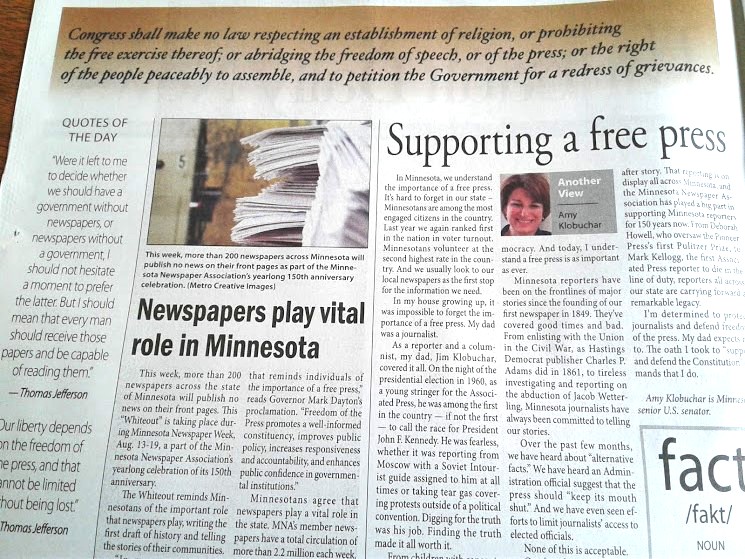
The second page of the Daily News from the August 15, 2017, issue explains the importance of a free press and its role. (Minnesota Prairie Roots copyrighted file photo 2017)
Journalists serve, among other roles, as government watchdogs. That means they, ideally, provide accurate and balanced reporting on government, at all levels. The “fourth estate” holds the government accountable via the stories they write. Not agenda-driven stories shaped by a biased editorial perspective or by information spoon fed to them by a press secretary. But rather stories based on quotes, actions, interviews, facts. Good solid reporting. Not misinformation, disinformation and/or propaganda. I must, though, state the obvious here. Not all sources speak truth to the media. And not all media write truth.
Suppression and criticism of the press are nothing new. Some of the criticism is deserved. Much of it is not. You may like journalists or you may not. That’s not the point. The point is that we need a free press, one unsuppressed/uncensored by those who are in positions of power. If you think otherwise, then look to history and to countries under authoritarian leaders, dictators. Under those leaders, messaging is/has been carefully controlled. Manipulation, intimidation and absolute power rule.
I started my newspaper career at a small town Minnesota weekly, typing my stories on a manual typewriter. This photo was taken in a Hastings antique shop, where I left a message. (Minnesota Prairie Roots copyrighted file photo)
During my journalism career, I have not been immune to those who wanted to control what I wrote. They did that sometimes in a back door way via criticizing me and my work and/or by shutting me out. Thankfully, my editors always had my back.
Let me give you some examples. While covering a school board meeting for a small town southern Minnesota weekly, a teacher said some things that were controversial. Decades out, I can’t recall details. But I do remember how this teacher fumed about my quoting him in a news story. The quote did not reflect favorably on him. But he made the statement at a public meeting. And it needed to be reported. Readers could decide what they thought of his comments.
In that same community, a local realtor called me out for quoting him in a story about a city council meeting. Again, I don’t remember details. But he was absolutely irate and verbally attacked and bullied me for what I’d written. (Sound familiar? Bullying. Fake news.) My reporting was accurate. I was not about to cave to his pressure. Once again, my editor stood up for me. He knew I demanded the best of myself in my work and that I would settle for nothing less than fair and accurate reporting.
Flash ahead to a different small town where I, once again, found myself despised. This time by a school superintendent. He didn’t like that I covered a student walk-out. It happened. I observed, interviewed him and students. And he retaliated. Every time I attended a school board meeting, he refused to give me an agenda or the packet of information distributed to board members and to the editor of the local weekly newspaper. (I worked for a regional daily.) He refused to talk to me. He made no effort to hide his disdain or to make information accessible to me. His was clearly an effort to stop me from reporting on anything school related, including school board meetings. His strategy did not work.
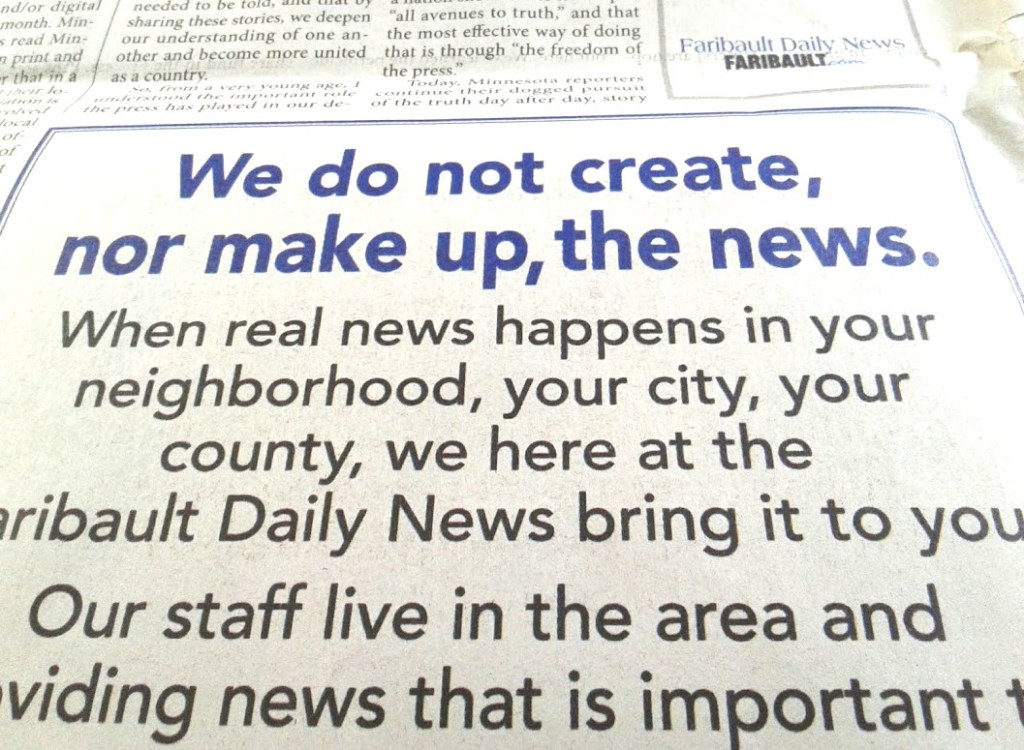
Published in the Faribault Daily News in August 2017 as part of the “Whiteout” campaign. (Minnesota Prairie Roots copyrighted file photo 2017)
Attacks on journalists have become more rabid in recent years. I think we can all agree on that. Don’t kill the messenger for the message he/she delivers. Respect those journalists who truly are doing their best to report fairly and accurately and who hold themselves and their work to high standards. Turn to those reliable sources for news.
Certainly, some media outlets and journalists are incredibly biased with specific agendas. They have become mouthpieces for government leaders, political parties and issues. I’m not praising those who are manipulating people to shape public opinion and to push ideas. Unfortunately, though, I see more and more government leaders, politicians and others targeting dedicated-to-the-craft journalists. These hardworking reporters are being shut out, degraded and abused because they accurately report what they see and hear in their watchdog role. Kinda like me with that small town school superintendent decades ago, just a lot more amplified and with much more serious consequences.
Thankfully, plenty of journalists committed to writing the truth still remain. They are strong men and women of integrity and morals who give a damn about democracy and a free press. Now, more than ever, we need to recognize the value of a free press, underscore FREE. Even though I no longer work as a newspaper journalist, I still strongly value freedom of the press. It is, always has been, a cornerstone of democracy.
(Book cover sourced online)
FYI: I encourage you to read Chasing Hope—A Reporter’s Life by Nicholas D. Kristof, currently an op-ed columnist for The New York Times. The two-time Pulitzer Prize-winning journalist worked as a foreign correspondent in Hong Kong, Beijing and Tokyo. He witnessed some pretty horrible atrocities—including the massacre in Tiananmen Square, the genocide in Darfur and much more—and offers remarkable insights via his experiences, observations and exceptional storytelling.
Of special note in Kristof’s book is a reference to an August 2008 campaign rally in Lakeville, Minnesota, which the author calls “one of the finest moments in American politics in my lifetime.” Kristof shares a story about Senator John McCain, who was then vying for the Republican Presidential nomination. I refer you to pages 239 and 240 in Chasing Hope. This book is worth the read for that story alone. It will give you hope. And, no, I’m not telling you more. Read the book.
When I was a kid, I loved them. Some riddles were stupid. Others silly. Many challenged me. Whichever, riddles usually made me laugh.
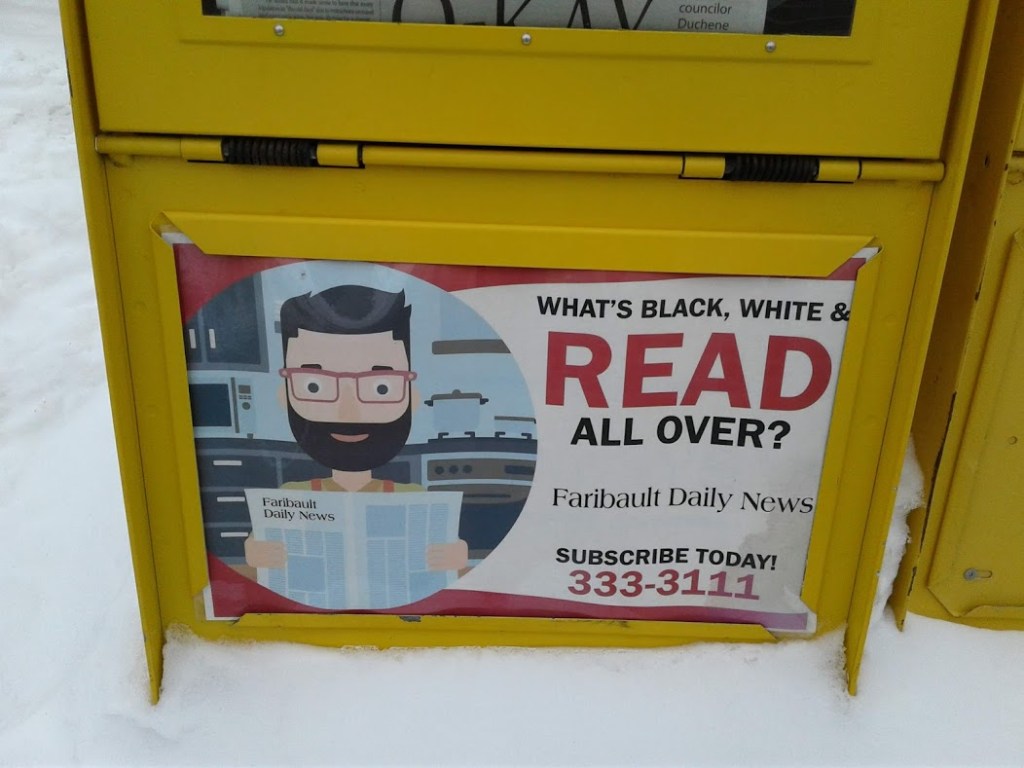
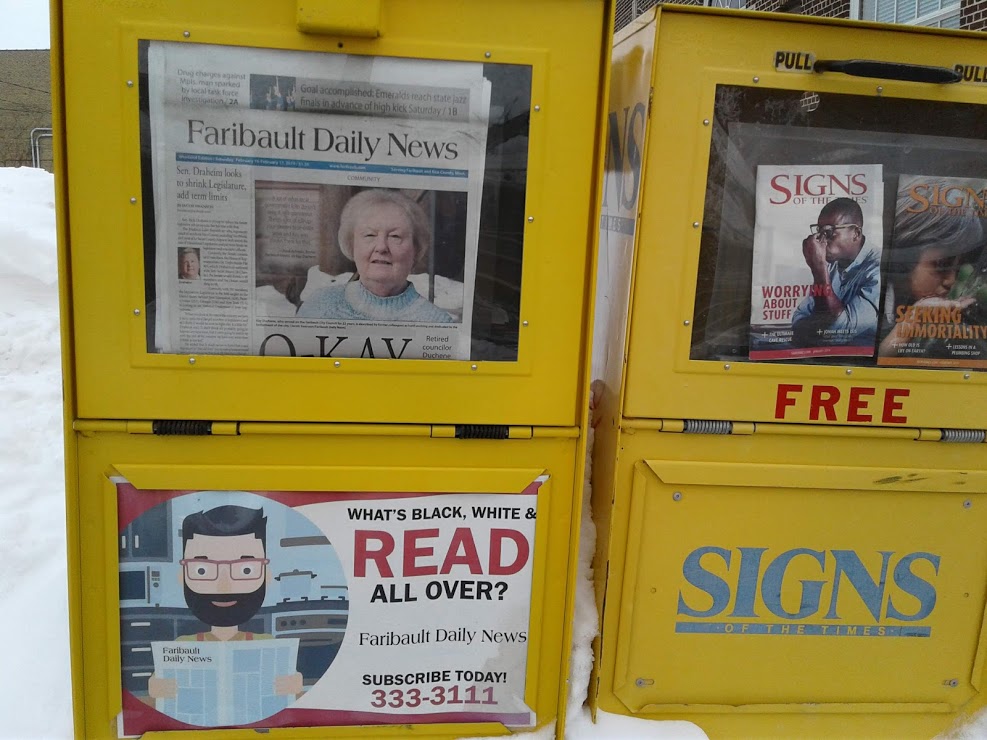
So when I saw one of my favorite childhood riddles posted in a newspaper stand outside the Faribault post office, I laughed, exited the van and walked across icy surfaces to photograph the posting.
Q: What’s black, white and read all over?
A: A newspaper.
I heard that riddle countless times when growing up. I liked it then, like it still, although the riddle no longer rings reality. Newspaper aren’t read all over. And that saddens me, a former journalist. Too many people no longer value newspapers. Rather, they get their news from other sources, not necessarily the most reliable sources either.
Newspapers and journalists are too often the targets of criticism, much of it unjustified. I’m not talking about the publications that call themselves newspapers, but truly are not in any sense of the word. I’m talking about legitimate “news papers” staffed by hardworking, unbiased journalists.
I value newspapers, especially community newspapers. I value the stories reporters write, yes, even the hard news. I value that newspapers keep me informed, expose me to differing viewpoints on the editorial page, alert me to happenings and issues in my community and elsewhere.
I recognize that my feelings about newspapers and journalists stand much stronger than those of most people. In my days working as a news reporter, I was attacked by individuals who disliked me quoting them or writing on an issue they’d rather not see in print. But their disdain didn’t stop me from doing my job.
We need a free press, a strong press, a press that does not cave to political or societal pressure. Our democracy depends on freedom of the press.
Q: What happens in a country without a free press?
A:
TELL ME: Share your thoughts or share a riddle. Please be respectful in your comments.
Here’s an example of a riddle my second daughter shared with the public many years ago at a roller rink:
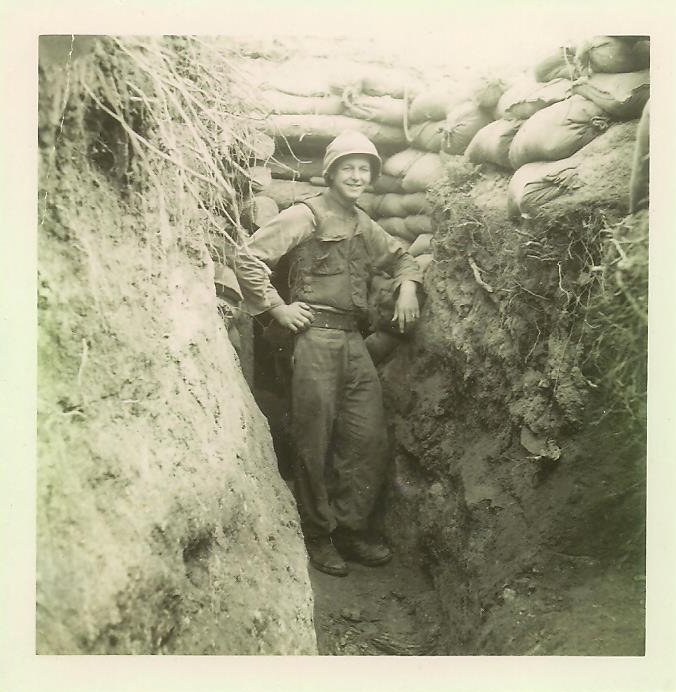
U.S. Army Cpl. Elvern Kletscher, my father, in the trenches in Korea.
WHEN I CONSIDER Veterans Day, I think beyond a general blanket of gratitude for those who have served, and are serving, our country. I see a face. I see my soldier father, an infantryman on the battlefields of Korea and recipient of the Purple Heart.
My dad carried home a July 31, 1953, memorial service bulletin from Sucham-dong, Korea. In the right column is listed the name of his fallen buddy, Raymond W. Scheibe.
My dad, Elvern Kletscher, died in 2003. But his memory remains strong in my heart as do the few stories he shared of his time fighting for his country. He witnessed unspeakable, violent deaths. And, yes, he killed the enemy, often telling his family, “It was shoot or be shot.” I cannot imagine shooting someone so near you can see the whites of their eyes.
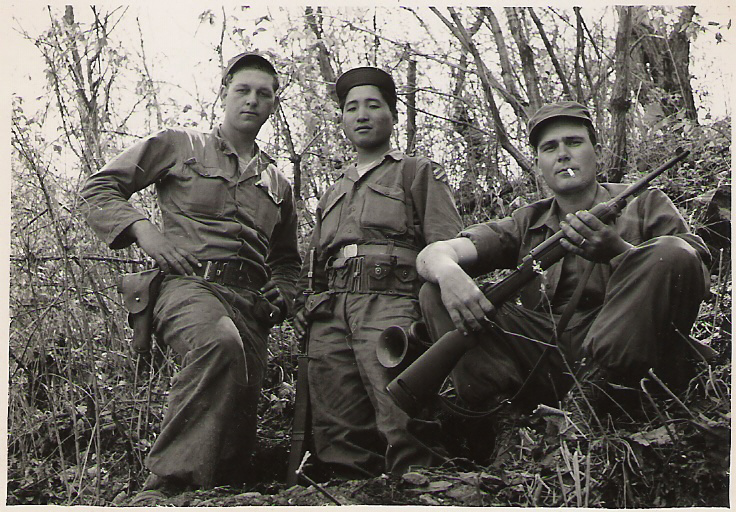
My father, Elvern Kletscher, on the left with two of his soldier buddies in Korea.
Atop Heartbreak Ridge, Dad picked off a sniper who for days had been killing off American soldiers. He suffered a shrapnel wound there.
But his wounds ran much deeper than the physical. His wounds stretched into a lifetime of battling post traumatic stress disorder, long unrecognized. He told stories of diving to the earth when a neighbor fired at a pheasant, the sound of gunfire triggering all those horrible war memories. The neighbor laughed. Likewise, guns shot at a small town parade sent him ducking for cover.
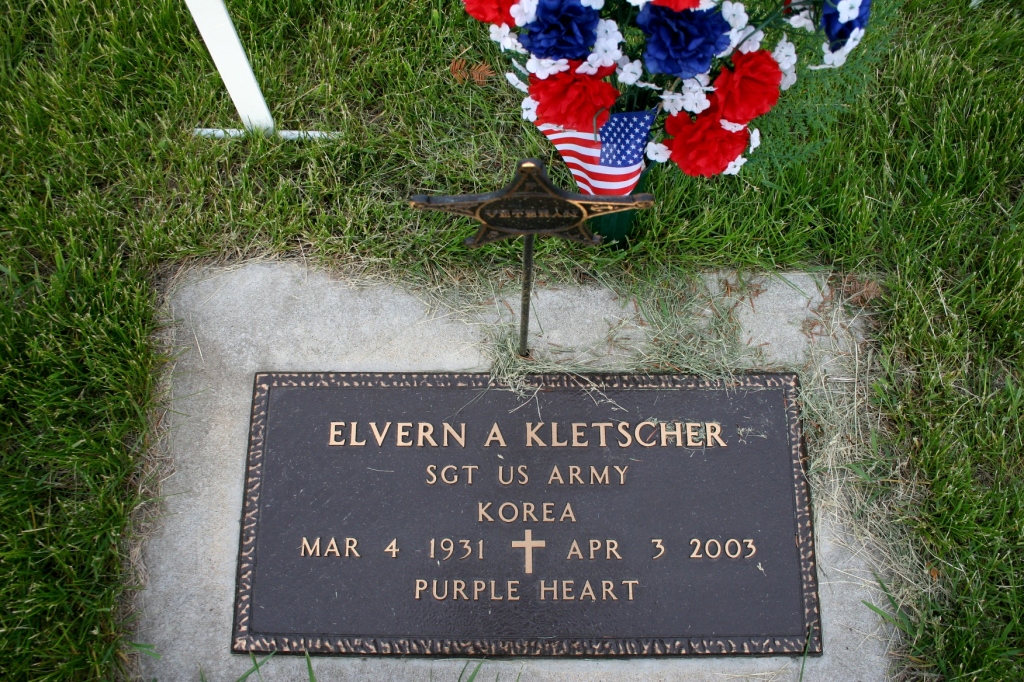
My dad’s military marker in the Vesta City Cemetery. Minnesota Prairie Roots file photo.
I can only imagine the demons my father fought. You cannot walk away from war-time death and violence unchanged. Only much later in life, as the decades passed and awareness of PTSD grew, did my dad find some comfort in talking to other vets with similar experiences.
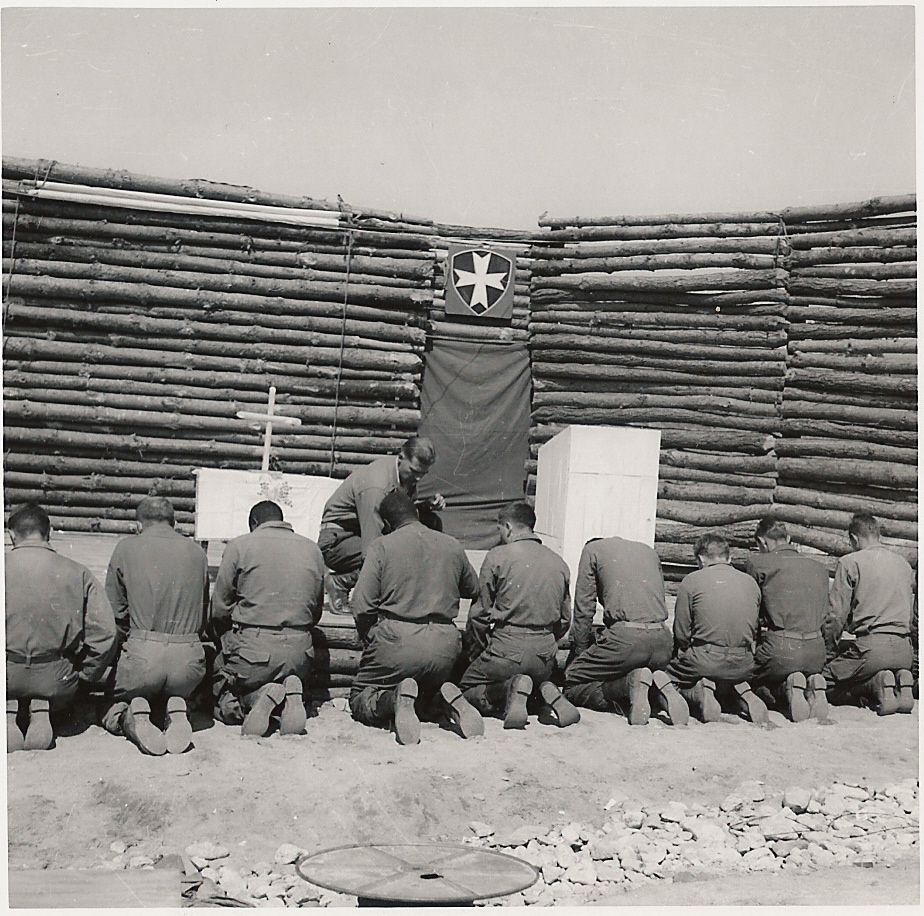
Soldiers receive The Lord’s Supper in Korea, May 1953. Photo by my soldier father, Elvern Kletscher.
Dad’s strong faith also pulled him through his emotional turmoil, during and after war.
Now, as I look back, I wish I had been more understanding, more grateful. But I can’t change that. Rather, I can choose to honor my dad by writing, an expression of the freedom he fought to preserve.
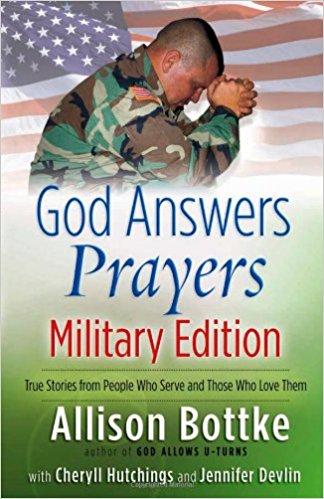
I wrote a story (“Faith and Hope in a Land of Heartbreak”) about my dad’s war experiences in this book, published in 2005 by Harvest House Publishers.
As a writer, I hold dear the value of my freedom to write. No one censors my writing or tells me what to write. I treasure that. I cringe at the current overriding criticism of the press in this country, the constant allegations of “fake news.” I worry about this negative shift in thought, the efforts to suppress and discredit the media. My dad fought to keep us free. And that freedom includes a free press.
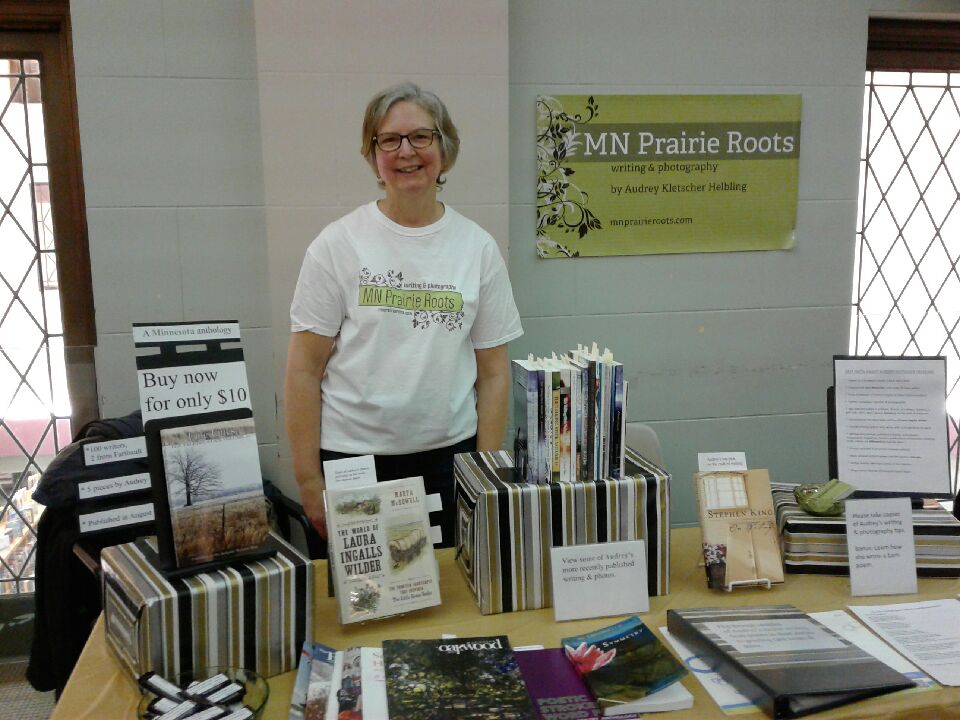
That struck me Thursday evening as I gathered with 13 Faribault area writers at a Local Authors Fair at Buckham Memorial Library. Here we were, inside this building packed with books and magazines and newspapers and more, showcasing our writing. No one stopped us at the door to check if our writing met government standards. No one stopped us from selling our books. No one stopped us from engaging in free conversation with each other and with attendees.
I am grateful to those who assured, and are assuring, that I will always have the ability to write without censorship in a country that still remains free.
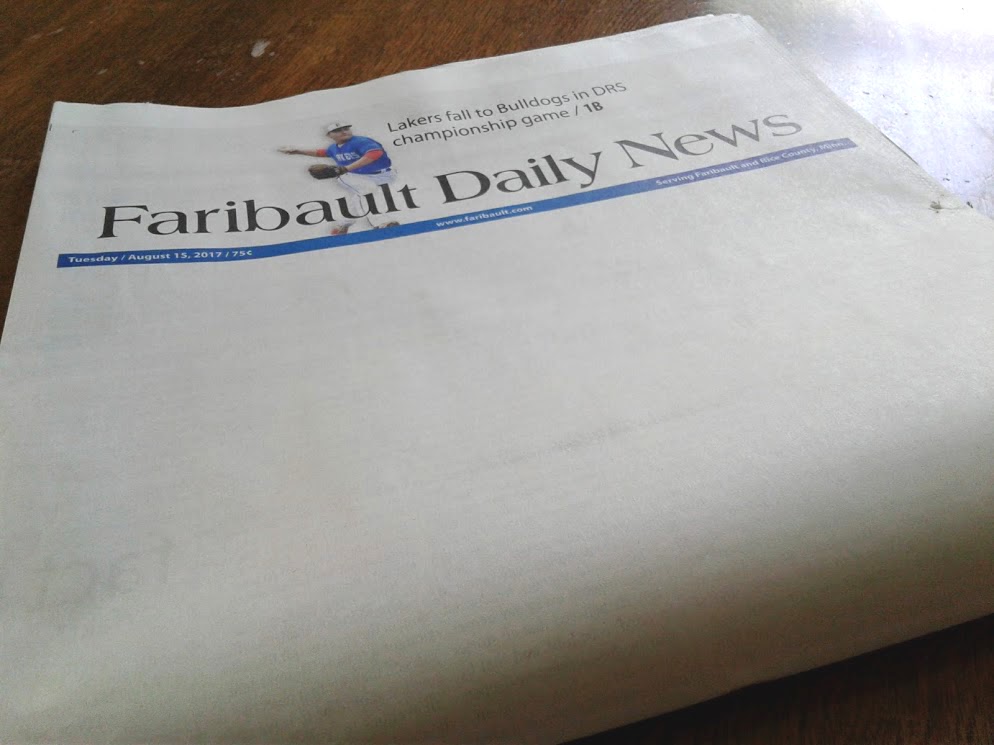
MY MIND WAS ALREADY reaching for the phone, punching the number for the circulation department of the Faribault Daily News when I paused.
With a sports headline printed above the nameplate and an ad stretched across the bottom of an otherwise blank front page, I realized—kaboom—that the white space couldn’t be accidental. There was a reason the paper I grabbed from my front steps on Tuesday morning was devoid of front page news.
I flipped to page two. There I found my answer. The absence of news was intentional. According to an article published there, more than 200 Minnesota newspapers are participating in a “Whiteout” to remind readers of the importance of newspapers in their local communities during Minnesota Newspaper Week.
Brilliant, simply brilliant. What an incredible visual way to make a point.
Quotes supporting freedom of the press ran in a sidebar:
“Our liberty depends on the freedom of the press and that cannot be limited without being lost.”—Thomas Jefferson
“Freedom of the press is not just important to democracy, it is democracy.”—Walter Cronkite
“Congress shall make no law…abridging the freedom of speech, or of the press…” First Amendment to the Constitution
As a former newspaper reporter, I especially value freedom of the press. I hope the average person realizes just how important a free press is to our democracy. When a government controls the media, we lose our freedom.
I can’t recall a time in the U.S. when the media have been more ruthlessly attacked by people in power than now.
When I think back to my years as a community journalist, though, I recall efforts by some locals to curtail my reporting in several small Minnesota towns. A high school music teacher once attempted to intimidate me after I wrote about controversial discussions at a public school board meeting. Likewise, a realtor verbally attacked me when I wrote about city council proceedings that involved him. A school superintendent in one community treated me with disdain after I covered a student walk-out. Thankfully my editors backed me up and I continued to do my job.
Being a journalist isn’t easy, especially in today’s world. I expect the pay, the long and odd hours and stress are just as awful as when I worked in the profession decades ago. And the criticism is fierce. People complain all the time about the media. Sometimes those complaints are justified. But mostly not.
I say, “Stop blaming the messenger.” Journalists do not make the news. They are only reporting it. And we should all value that they have the freedom to do so.





 Minnesota Prairie Roots
Commentary: The importance of a free press in a democracy March 4, 2025
Tags: books, Chasing Hope: A Reporter's Life, commentary, democracy, free press, freedom of the press, government, journalism, journalists, media, news reporters, newspapers, Nicholas D. Kristof, opinion, United States
I AM WRITING THIS OPINIONATED POST with no apologies. As an American woman with a college degree in mass communications (news/editorial emphasis) and experience as a newspaper reporter, I’ve always felt strongly about a free press. Even more so today with threats to that freedom. If you are unaware of current actions against the press, research and read. A free press is a vital part of democracy.
Journalists serve, among other roles, as government watchdogs. That means they, ideally, provide accurate and balanced reporting on government, at all levels. The “fourth estate” holds the government accountable via the stories they write. Not agenda-driven stories shaped by a biased editorial perspective or by information spoon fed to them by a press secretary. But rather stories based on quotes, actions, interviews, facts. Good solid reporting. Not misinformation, disinformation and/or propaganda. I must, though, state the obvious here. Not all sources speak truth to the media. And not all media write truth.
Suppression and criticism of the press are nothing new. Some of the criticism is deserved. Much of it is not. You may like journalists or you may not. That’s not the point. The point is that we need a free press, one unsuppressed/uncensored by those who are in positions of power. If you think otherwise, then look to history and to countries under authoritarian leaders, dictators. Under those leaders, messaging is/has been carefully controlled. Manipulation, intimidation and absolute power rule.
During my journalism career, I have not been immune to those who wanted to control what I wrote. They did that sometimes in a back door way via criticizing me and my work and/or by shutting me out. Thankfully, my editors always had my back.
Let me give you some examples. While covering a school board meeting for a small town southern Minnesota weekly, a teacher said some things that were controversial. Decades out, I can’t recall details. But I do remember how this teacher fumed about my quoting him in a news story. The quote did not reflect favorably on him. But he made the statement at a public meeting. And it needed to be reported. Readers could decide what they thought of his comments.
In that same community, a local realtor called me out for quoting him in a story about a city council meeting. Again, I don’t remember details. But he was absolutely irate and verbally attacked and bullied me for what I’d written. (Sound familiar? Bullying. Fake news.) My reporting was accurate. I was not about to cave to his pressure. Once again, my editor stood up for me. He knew I demanded the best of myself in my work and that I would settle for nothing less than fair and accurate reporting.
Flash ahead to a different small town where I, once again, found myself despised. This time by a school superintendent. He didn’t like that I covered a student walk-out. It happened. I observed, interviewed him and students. And he retaliated. Every time I attended a school board meeting, he refused to give me an agenda or the packet of information distributed to board members and to the editor of the local weekly newspaper. (I worked for a regional daily.) He refused to talk to me. He made no effort to hide his disdain or to make information accessible to me. His was clearly an effort to stop me from reporting on anything school related, including school board meetings. His strategy did not work.
Attacks on journalists have become more rabid in recent years. I think we can all agree on that. Don’t kill the messenger for the message he/she delivers. Respect those journalists who truly are doing their best to report fairly and accurately and who hold themselves and their work to high standards. Turn to those reliable sources for news.
Certainly, some media outlets and journalists are incredibly biased with specific agendas. They have become mouthpieces for government leaders, political parties and issues. I’m not praising those who are manipulating people to shape public opinion and to push ideas. Unfortunately, though, I see more and more government leaders, politicians and others targeting dedicated-to-the-craft journalists. These hardworking reporters are being shut out, degraded and abused because they accurately report what they see and hear in their watchdog role. Kinda like me with that small town school superintendent decades ago, just a lot more amplified and with much more serious consequences.
Thankfully, plenty of journalists committed to writing the truth still remain. They are strong men and women of integrity and morals who give a damn about democracy and a free press. Now, more than ever, we need to recognize the value of a free press, underscore FREE. Even though I no longer work as a newspaper journalist, I still strongly value freedom of the press. It is, always has been, a cornerstone of democracy.
FYI: I encourage you to read Chasing Hope—A Reporter’s Life by Nicholas D. Kristof, currently an op-ed columnist for The New York Times. The two-time Pulitzer Prize-winning journalist worked as a foreign correspondent in Hong Kong, Beijing and Tokyo. He witnessed some pretty horrible atrocities—including the massacre in Tiananmen Square, the genocide in Darfur and much more—and offers remarkable insights via his experiences, observations and exceptional storytelling.
Of special note in Kristof’s book is a reference to an August 2008 campaign rally in Lakeville, Minnesota, which the author calls “one of the finest moments in American politics in my lifetime.” Kristof shares a story about Senator John McCain, who was then vying for the Republican Presidential nomination. I refer you to pages 239 and 240 in Chasing Hope. This book is worth the read for that story alone. It will give you hope. And, no, I’m not telling you more. Read the book.
© Copyright 2025 Audrey Kletscher Helbling