WHAT CAUSED A MINNESOTA farmer to kill his entire family—his wife and four young children—with an ax in a horrific act of domestic violence?
We likely will never know the truth behind the murders-suicide which happened on March 24, 1917, in rural Redwood County, my home county in the fertile farmland of southwestern Minnesota.

Up until the release of a book of historical fiction, Sundown at Sunrise by former Minnesota state legislator Marty Seifert in late 2016, I’d never heard of this crime. I recently read the book published by Beaver’s Pond Press. Therein I found familiar names, including the maiden surname of my maternal grandmother and other known names from Redwood County.
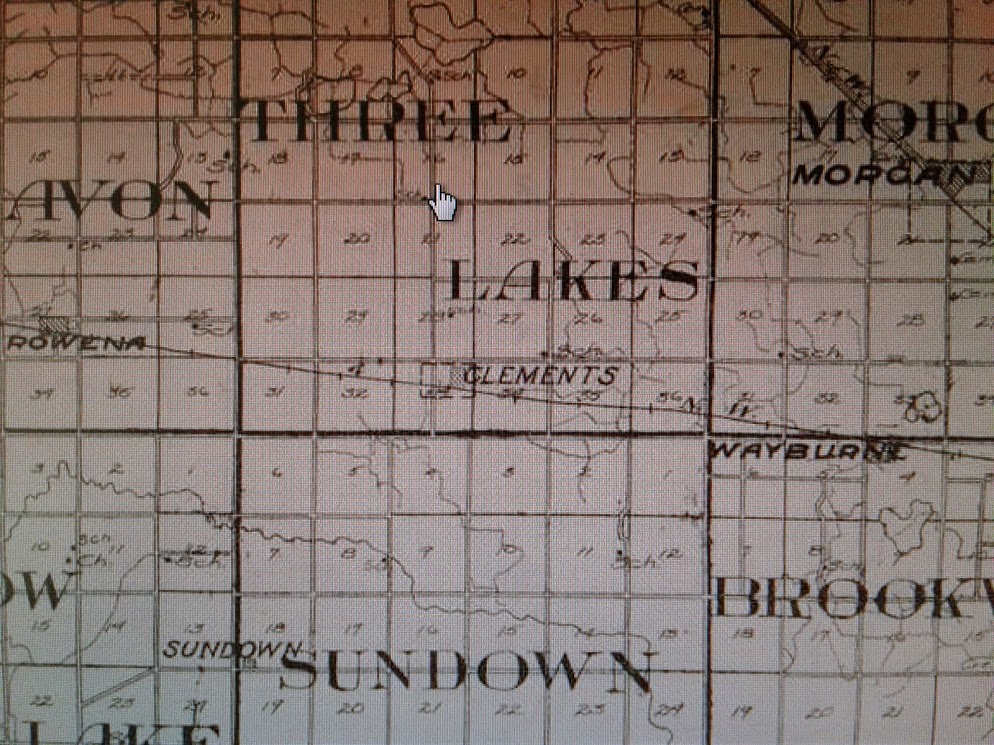
The murder occurred in Section 16 of Three Lakes Township in the area noted by the pointing hand. This is a photo of a Digitized State of Minnesota Plat Book map from 1916. I found this through the Minnesota History Center, Gale Family Library, Borchert Map Library. The author grew up in the northeastern corner of Sundown Township.
Seifert grew up in Sundown Township within miles of the murders. In a farmhouse in Section 16 of Three Lakes Township north of Clements, William Kleeman, 31, raised an ax and killed his wife, Maud, and their children ranging in age from six weeks to five years. He then hung himself. Many times I’ve passed that former farm place at the intersection of Minnesota State Highway 68 and Redwood County Road 1 west of Morgan and near the site of Farm Fest. I had no idea of the violence that occurred there.
But the author grew up hearing the story of the Kleeman ax murders. That and his interest in history—he’s a former history teacher—prompted Seifert to research and pen this book rooted in fact.
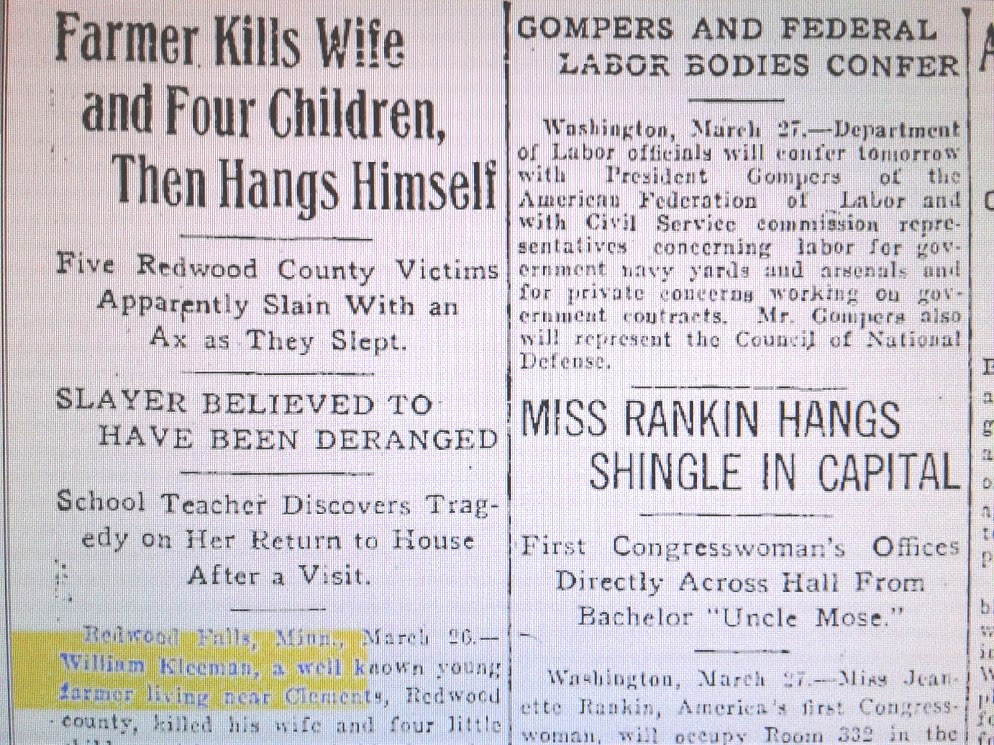
From the Minneapolis Morning Tribune dated March 27, 1917. This is a photo of the article found in the Minnesota Digital Newspaper Hub.
I decided to check out for myself newspaper accounts of the murders. That led me to the Minnesota Digitized Newspaper Hub and sensationalized layered headlines followed by detailed stories. I expect Seifert used the same sources, and more, to research for his book. But he goes beyond those stories to suggest the real reason behind the crime discovered by a young teacher (her name is fictionalized in the book) who boarded with the Kleemans. I won’t share more. You need to read the book.
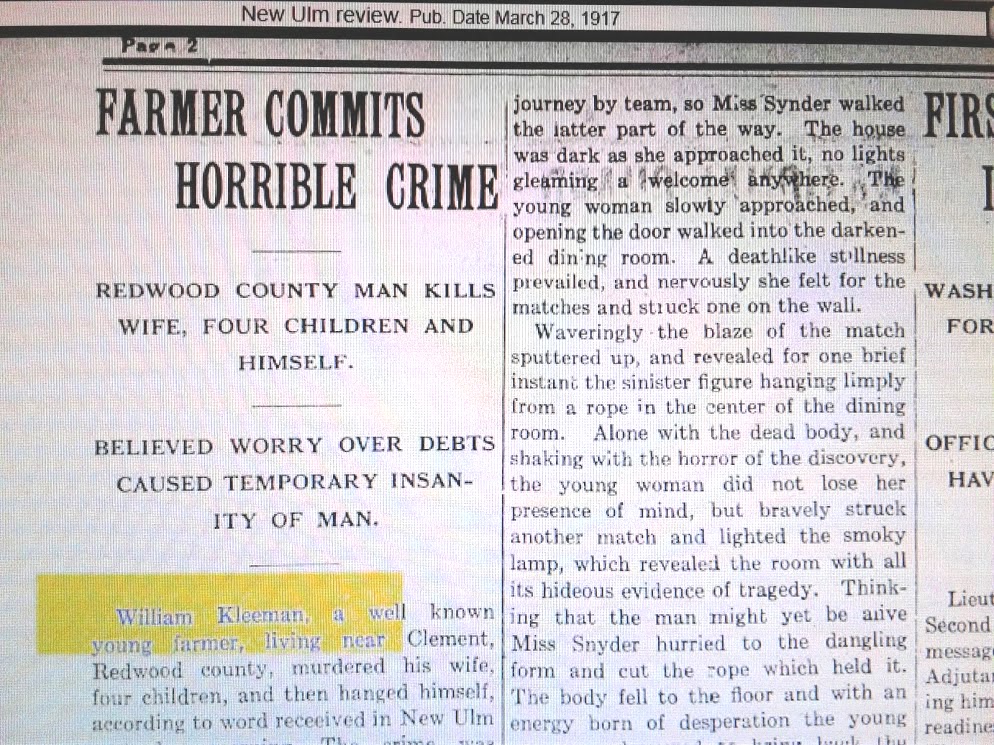
The story about the murders published in the New Ulm Review on March 28, 1917.
In reading Sundown at Sunrise, I noted specific red flags pointing to future domestic violence and an awareness of that potential. A hired hand, for example, tells Maud’s father upon her engagement to William Kleeman that, “I think Miss Petrie done deserve better.” Henry Petrie agrees.
The author also describes William Kleeman “from a young age parlaying his handsome looks and confident demeanor as ways to manipulate his mother.” That manipulative charm threads throughout the story. I appreciate that the author understands the characteristics of an abuser and writes that into this work of fiction based on fact.
And then, after the murders, the hired hand sees the Kleemans’ marriage certificate nailed above the bed where Maud and her baby lie in pools of blood. Frank Schottenbauer notes that “he’d rather look at a bloody corpse than view the license William Kleeman had used to violate Maud Petrie.”
The author many times works the appearance of garter snakes and William Kleeman’s aversion to religion into the storyline, alluding to evil.
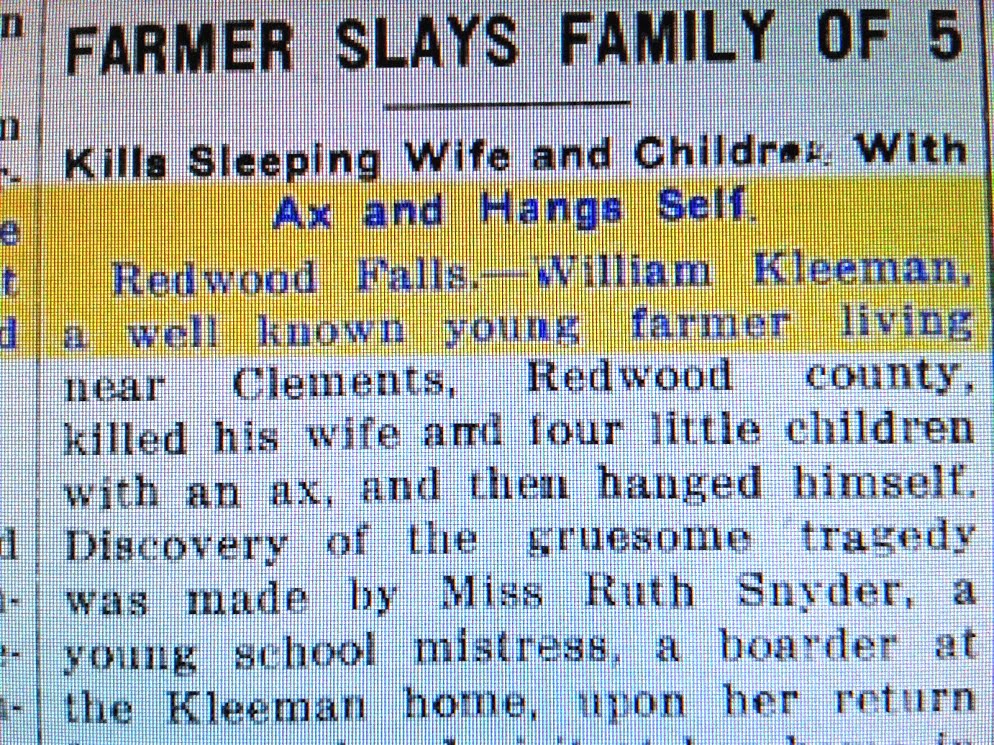
The Pine Island Record printed this story on March 29, 1917.
You can surmise what you will from this book of historical fiction. But nothing changes the fact that Maud died at the hands of her husband and Gladys, Lois, Gordon and Rosadell died at the hands of their father in an unfathomable act of domestic violence in Redwood County, Minnesota.
Today I honor the memories of that young mother and her beloved children. They deserved to live full lives on the prairie, to love and to be loved.
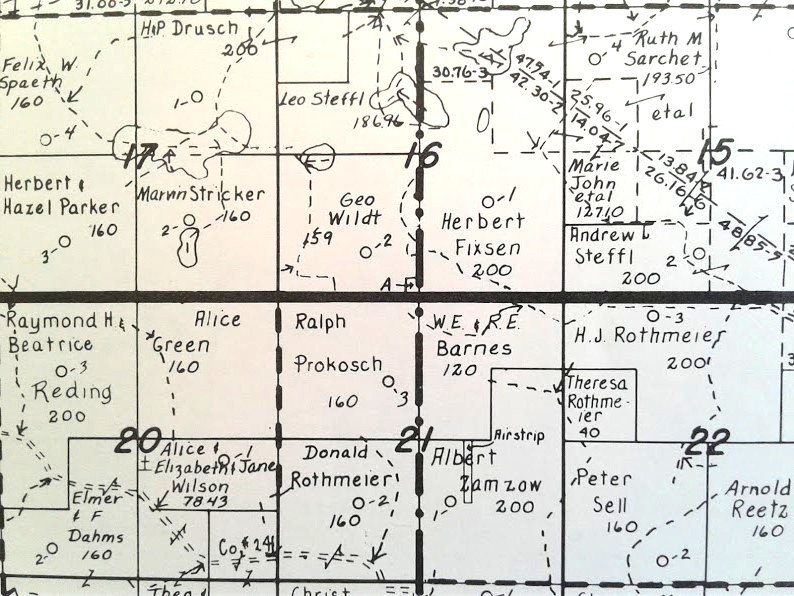
A plat of Three Lakes Township from a 1963 Atlas of Redwood County Minnesota shows the section (16) in which the crime occurred. You’ll find some of the surnames here included in Sundown at Sunrise.
FYI: The ax used in the murders is stored in the archives of the Redwood County Historical Society in Redwood Falls. For years, it was kept as evidence by the sheriff’s department before its donation to the county museum.
TODAY, AS YOUNG PEOPLE and others gather in Washington, DC, and around the world (including right here in Minnesota) for the “March For Our Lives” anti-gun-violence rally, I honor those I knew (via personal connections) who have been murdered in acts of domestic violence. Not just by gun violence, although several were shot.
Violence, whether in our schools, our homes, on the street, needs to stop. We need to take a stand, to act when we can, to say, “Enough is enough.” We need to care, to speak up, to listen, to educate ourselves, to push for change. I don’t pretend to have the answers. But I have witnessed and experienced the pain and grief of those who have lost loved ones through acts of violence. If you haven’t, consider yourself fortunate.
I’ve had to reach deep inside myself to comfort a friend whose father was murdered. I’ve had to reach deep inside myself to comfort parents whose daughter was murdered by her ex-boyfriend. I’ve had to reach deep inside myself to write about the murder of a beloved community member by her ex-husband at our local tourism office.
I’ve watched a SWAT team sweep through my neighborhood searching for a knife used in a murder within blocks of my home. I’ve talked to police many years ago about a drive by shooting involving big city gang members. A gang member purchased a car from us, failed to change the title, used the car in a shooting and then stashed the gun in the trunk. Investigators started with us, owners of the car.
Yes, I’ve been touched many times by violence. Gun and other.
Enough is enough. To those young people and others who are speaking up today, thank you for using your voice to effect change.
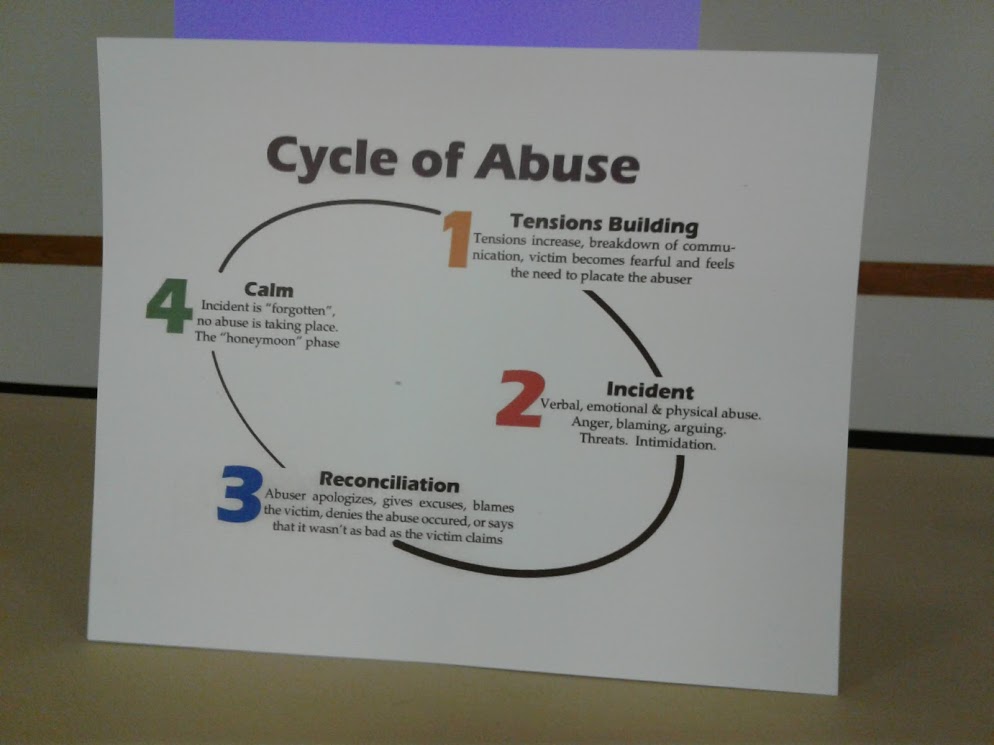
IMPORTANT: If you are in an abusive relationship and in immediate danger, call or text (if that option is available in your area) 911. If you are leaving (or thinking of leaving) your abuser, please seek help and have a safety plan in place. Talk to someone you trust like a family member, friend, c0-worker, clergy, advocate… Immediate help is available. Reach out to a local women’s shelter or advocacy center for professional help. You are not alone. You deserve to live a life free of any type of abuse whether physical, mental, emotional, psychological, financial, spiritual or technological.
Please know that you are in greatest danger when you are about to leave, are leaving or have left your abuser. Abuse is about power, control and manipulation. When abusers lose that control, they often become violent. Be safe and know that you are loved.
© Copyright 2018 Audrey Kletscher Helbling
Quoted passages are copyright of Marty Seifert and used here for review purposes only.











 Minnesota Prairie Roots
The stories of two Marthas September 19, 2025
Tags: Ariel Lawhon, books, Buckham Memorial Library, Cambodia, Camodian Genocide, commentary, Faribault, healing, historical fiction, history, Martha Ballard, Martha Brown, Minnesota, The Frozen River
HISTORY CONNECTS THE STORIES of the two Marthas. One, Martha Ballard, a midwife and the main character in a book of historical fiction, The Frozen River by Ariel Lawhon. The second Martha is Martha Brown, local author, educator, speaker, musician and political candidate for state representative in my district. She shared her personal reflections about a trip to Cambodia on Thursday evening at the Faribault library in a presentation titled “Cambodia—Healing a Broken County.”
I’d just finished reading Lawhon’s book earlier Thursday so the commonalities between a story set in the late 1700s in postrevolutionary America and Brown’s recent trip to Cambodia connected in my mind. In both stories exist violence, trauma, strength, power and resilience within an historical context.
THE CAMBODIAN GENOCIDE
I’ll start with Brown. She focused on the time before and after the 1975-1979 Cambodian Genocide in which some 2 million Cambodians were murdered under the rule of Khmer Rouge, the Communist political party then in power. She also touched on the illegal and secret bombings of Cambodia by the U.S. in 1969 against North Vietnamese forces in Cambodia. That, too, claimed untold civilian lives.
I don’t want to get into historical details here or a political discussion about the Vietnam War. Rather, I intend the focus to be on those who suffered in Cambodia and those who survived. Just as Brown focused her hour-long talk. She arrived in Cambodia expecting to see trauma from the genocide. But instead, she said, she found recovery, healing and joy. She saw survivors of the genocide as part of the healing.
A HORRIFIC HISTORY NOT HIDDEN
The history of the genocide has not been hidden nor erased in Cambodia. “They don’t bury their history,” Brown said. I jotted that quote in my notebook, mentally connecting that to current day America and ongoing efforts by the current administration to erase/hide/rewrite history. We all know the quote—”Those who cannot remember the past are condemned to repeat it”—by Spanish Philosopher George Santayana. We would do well to contemplate and hold those words close.
In her presentation, Brown did not avoid the hard topics of children recruited and indoctrinated to participate in the Cambodian Genocide killings of educators, doctors, ordinary people, even those who wore eyeglasses. Perpetrators were never punished, went back to their lives, now live among the population. This was hard stuff to hear, especially about the brainwashing of children to kill. “We need to teach our children well,” said Brown, ever the educator who cares deeply about children.
LESSONS LEARNED IN CAMBODIA
Her passion was evident as she spoke of hugging survivors, of apologizing for the U.S. bombings of Cambodia, of crying while in the southeast Asian country. She learned that how you live and treat people is more important than wealth. She learned that people can be poor and still be happy. She learned about the differences in a society that focuses on community rather than self.
When Brown’s talk ended, others shared and a few of us asked questions, including me. Mine was too political to answer in a non-political presentation. But I asked anyway about the internal and external factors contributing to the rise and fall of empires. Brown hesitated, saying only that we could draw our own conclusions from her talk.
A MUST-READ BOOK
Then I wrote “The Frozen River by Ariel Lawhon” on a slip of paper. Not to give to Brown, but rather to the local director of Hope Center serving survivors and victims of sexual assault and domestic violence and their families. I handed the paper to Erica Staab-Absher after hugging her. “You need to read this book,” I said.
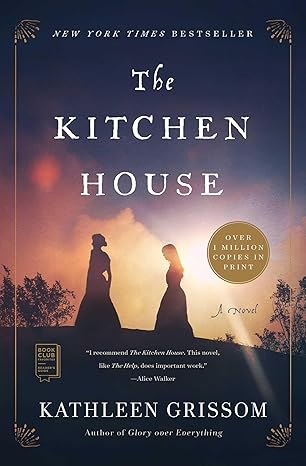
In this book of historical fiction, the author bases her writing on real-life midwife Martha Ballard, who documented her life in a journal. Ballard was witness to violence, sexual assault, injustices, secrets, manipulation, power, trauma and much more. This book will resonate with anyone who has survived a sexual assault or cared about someone who has been so viciously attacked. I cannot say enough about the value of reading this book and how empowering it was to me as a woman. It is a love story, mystery and a documentation of strength and resilience.
Resilience. Strength. Healing. Those three words come to mind as I connect the work of a New York Times bestselling author and a talk about the Cambodian Genocide at my southern Minnesota library. By reading and listening, I learned. To read a book pulled from the shelves at my public library and then to listen to personal reflections about a trip to Cambodia on the second floor of that same library are freedoms I no longer take for granted. Not today. I choose to remember and learn from the past. And hope we do not repeat it.
© Copyright 2025 Audrey Kletscher Helbling