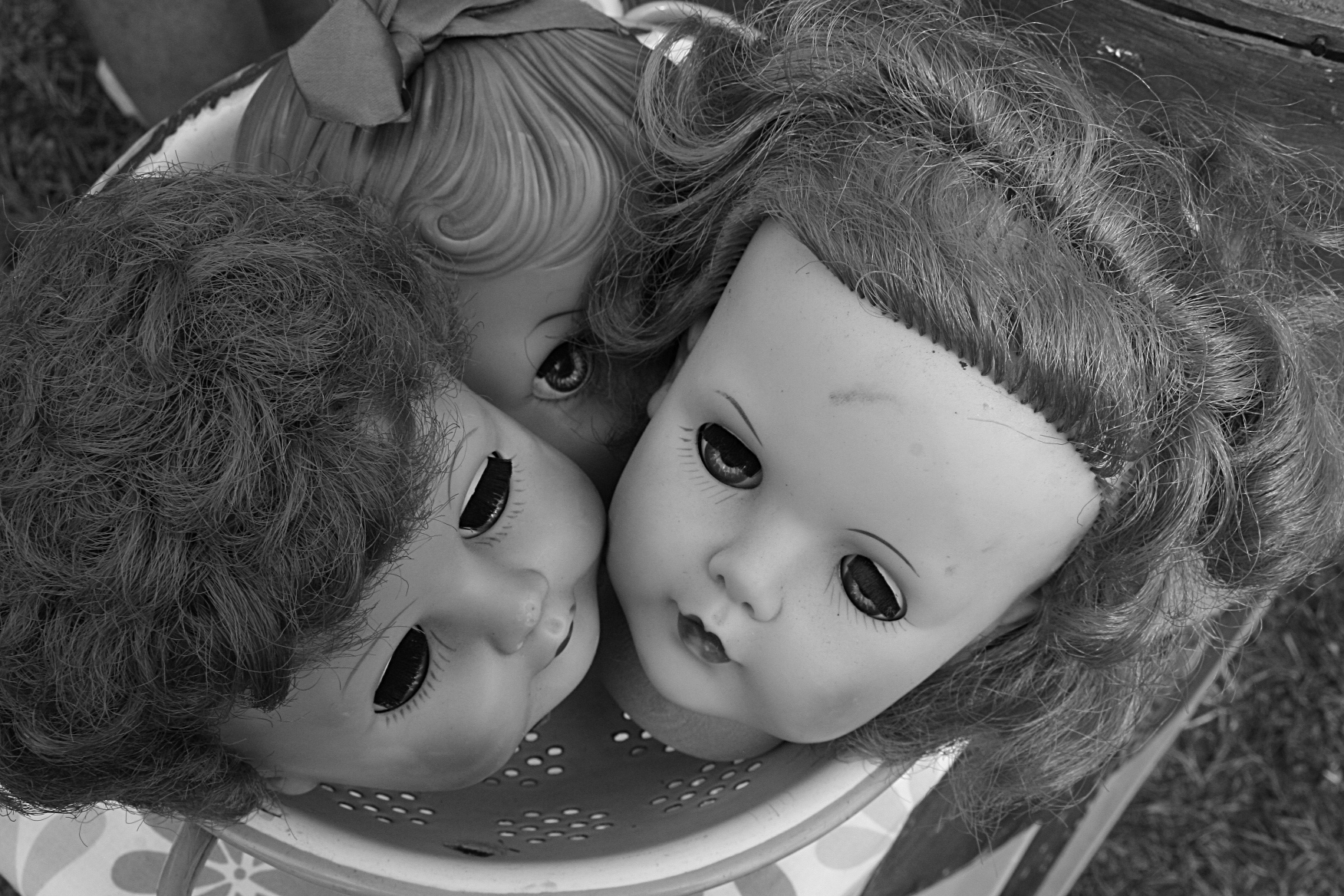
I HAVE SHOPPED many local flea markets and countless garage sales. And I’ve seen a lot of quirky, odd, unusual, unique, weird merchandise. Like doll heads in a colander.
(Minnesota Prairie Roots copyrighted file photo)
Assorted tools that appeared more art than tool collection.
(Minnesota Prairie Roots copyrighted file photo)
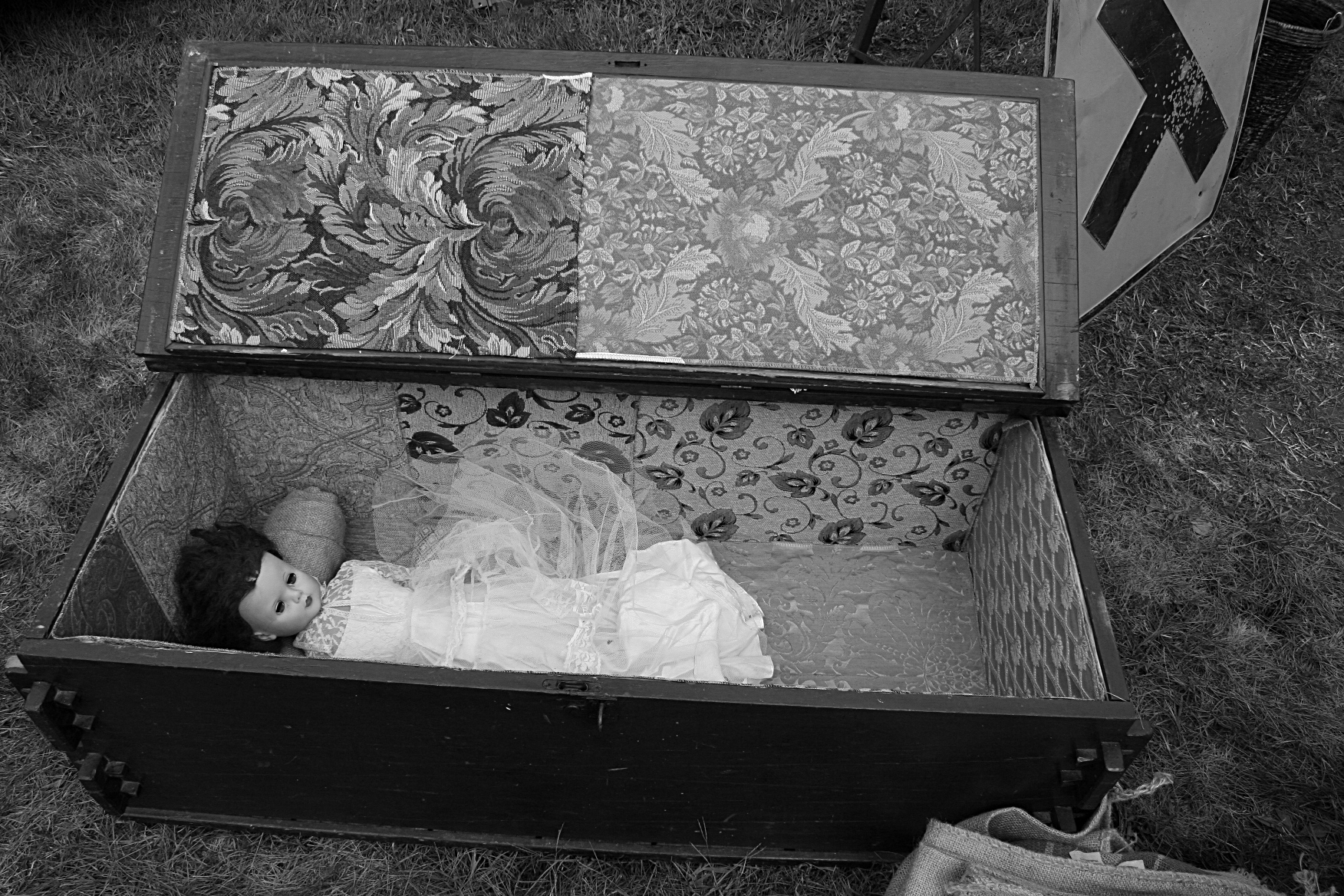
A doll in a coffin.
(Minnesota Prairie Roots copyrighted file photo)
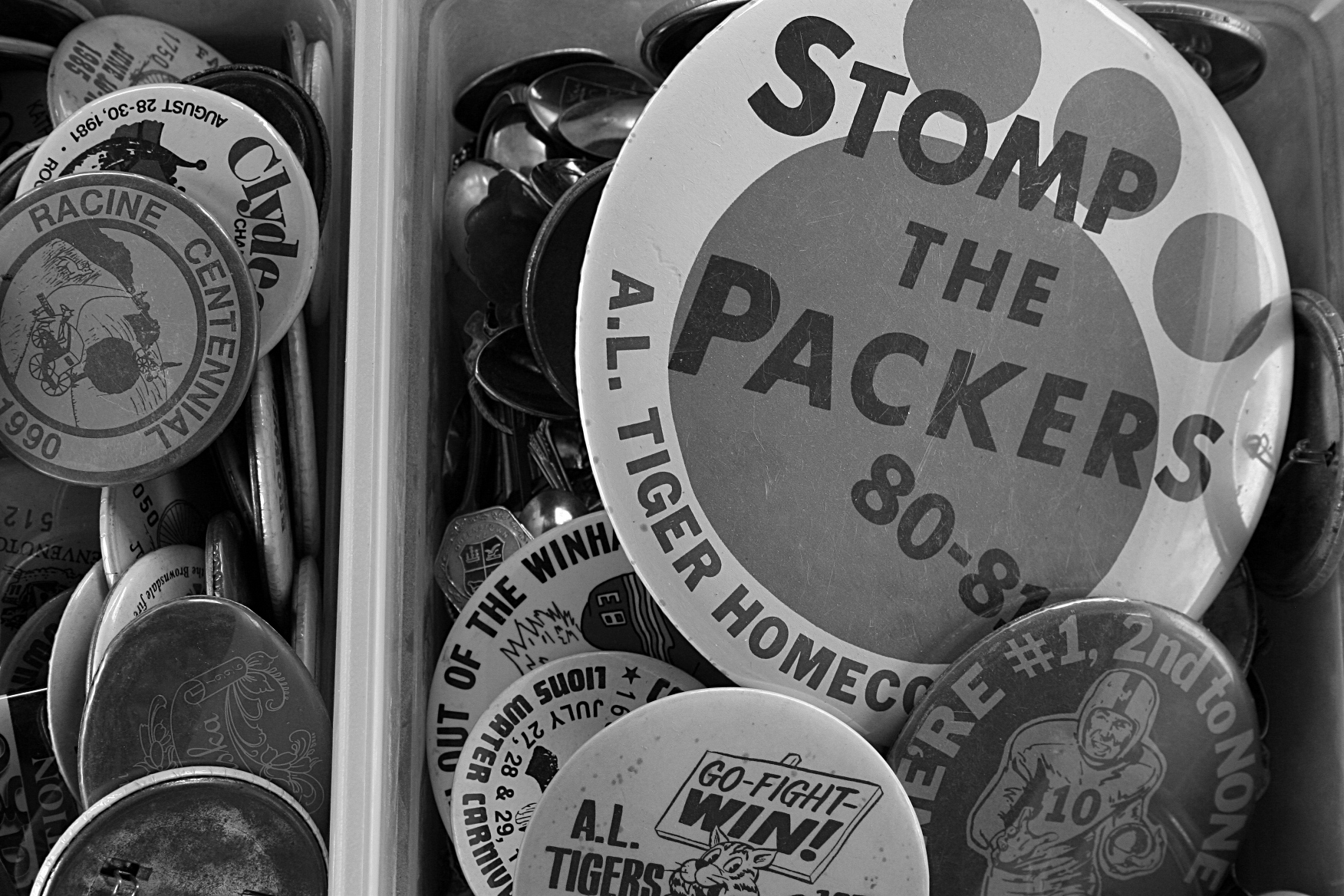
Buttons galore.
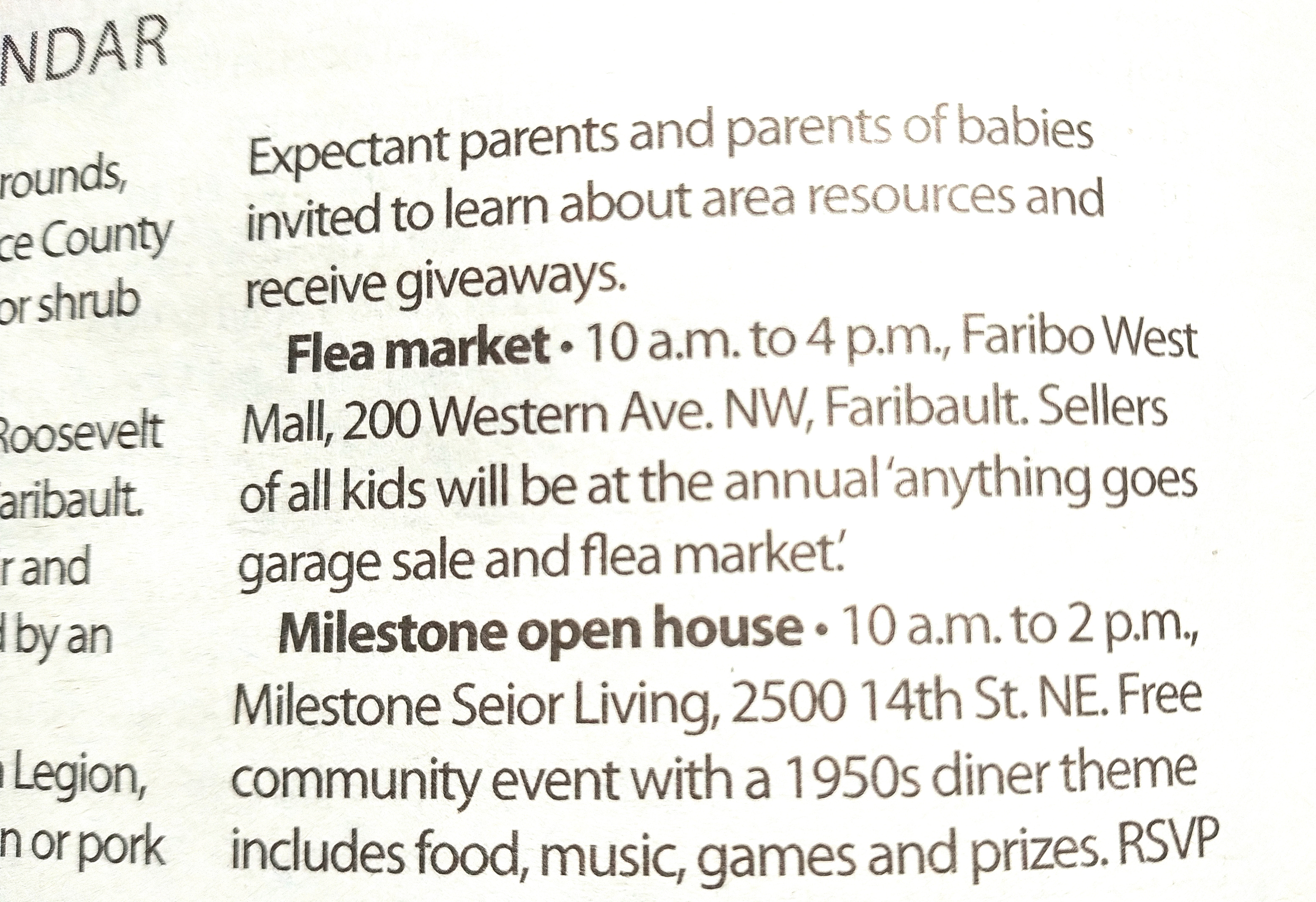
A typo, “kids” instead of “kinds,” had me laughing aloud. (From the Faribault Daily News Community Calendar)
And then there is this: Sellers of all kids will be at the annual “anything goes garage sale and flea market.” Now that’s different, I thought in decidedly Minnesota terms.
Clearly, kids will not be sold at the flea market from 10 am – 4 pm this Saturday, April 27, at the Faribo West Mall in Faribault. But the typo in the community calendar listings in the Faribault Daily News made me laugh. And, goodness, how we can all use a bit of laughter in our lives.
Happy shopping at the anything goes, sans kids, garage sale and flea market.
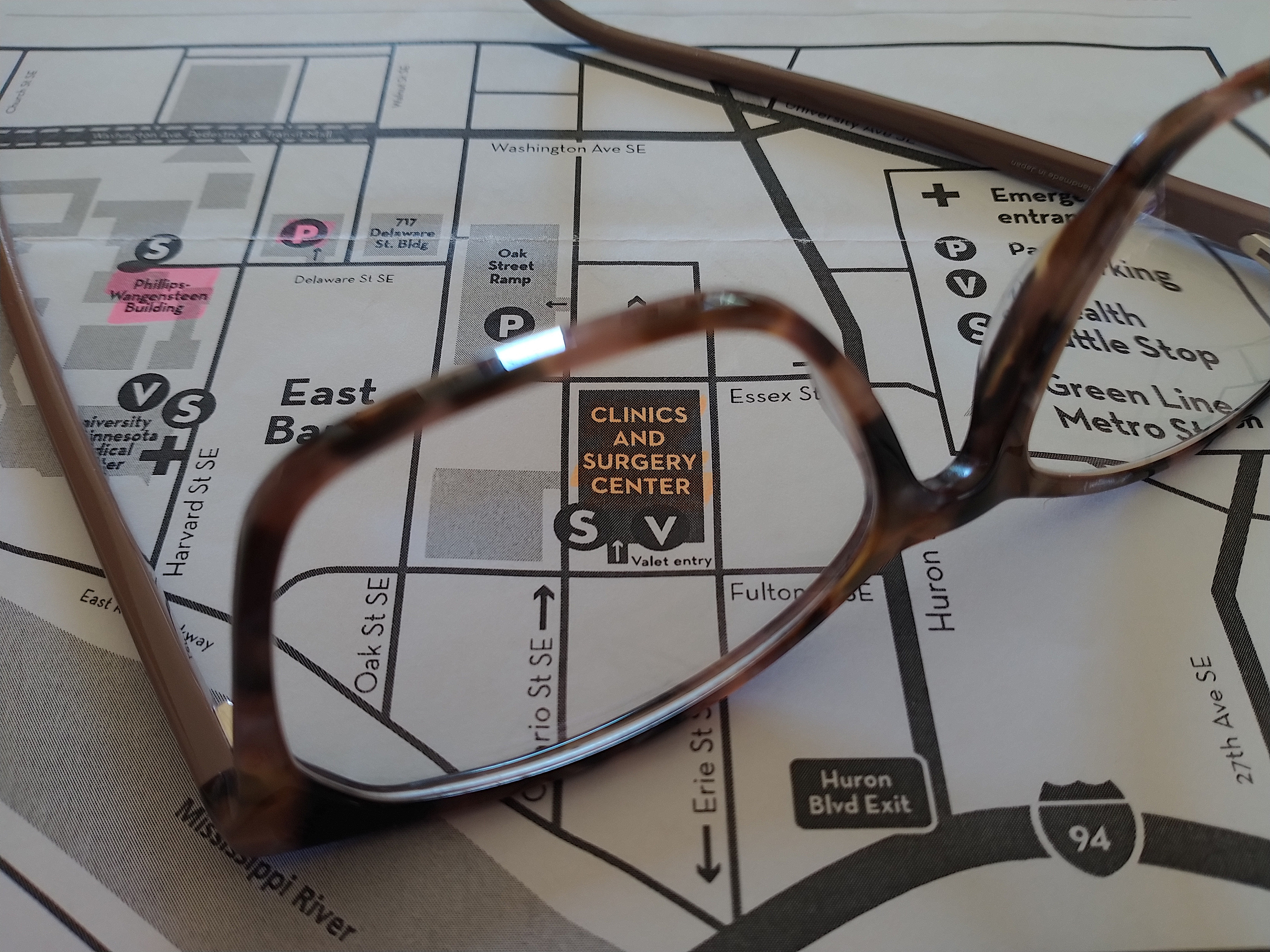
A lens on my new prism-free prescription eyeglasses circles the surgery location in Minneapolis. (Minnesota Prairie Roots copyrighted photo February 2024)
After a 1 ½-hour surgery to realign my misaligned eyes, I was still groggy. Yet, Kat noted, I was coming out of general anesthesia quickly and well. For that I felt thankful. Not everyone handles anesthesia without side effects.
Given my emerging level of alertness, I don’t recall timelines or all conversations. But I do remember the kindness of Kat. And kindness is key when you’re coming out of surgery.
There was no vodka in the recovery room (nor did I want any; I seldom drink hard liquor). (Minnesota Prairie Roots copyrighted photo February 2024)
HERE, HAVE A DRINK
In addition to compassion and care, Kat gave me food and drink. It was well after lunch and I hadn’t consumed anything (except a few sips of water with Tylenol right before surgery) for many hours. Typically I get hangry when I don’t eat on time. Ask my family. Kat brought cranberry juice along with soda crackers and graham crackers and then ginger ale which she suggested I mix with a second cup of cranberry juice, a cocktail without the vodka. (I think Kat mentioned vodka, but maybe I did.) I shared that my Bible study group has a signature cranberry drink, sans the alcohol. Kat kept a watchful eye on me. I hope she didn’t notice that I didn’t particularly like cranberry juice and ginger ale mixed. Too sweet for me.
But I appreciated the sweetness of my caring nurse, who moved to Minnesota from Missouri, who was named Katherine, called Kathy by her mom and then called Kat in college. Kat suits her, even if she owns three dogs, not cats. More on that later.
At some point, before my surgeon came to see me in recovery, Kat suggested I change from my lavender paper gown into my street clothes. I was all for that. She removed my hospital slipper socks and then helped slip my socks and shoes onto my feet. Can’t have a just-out-of-surgery patient getting all lighted-headed by bending down. I managed the rest of dressing myself, proving I was becoming more alert, alert for the next step in surgery completion.
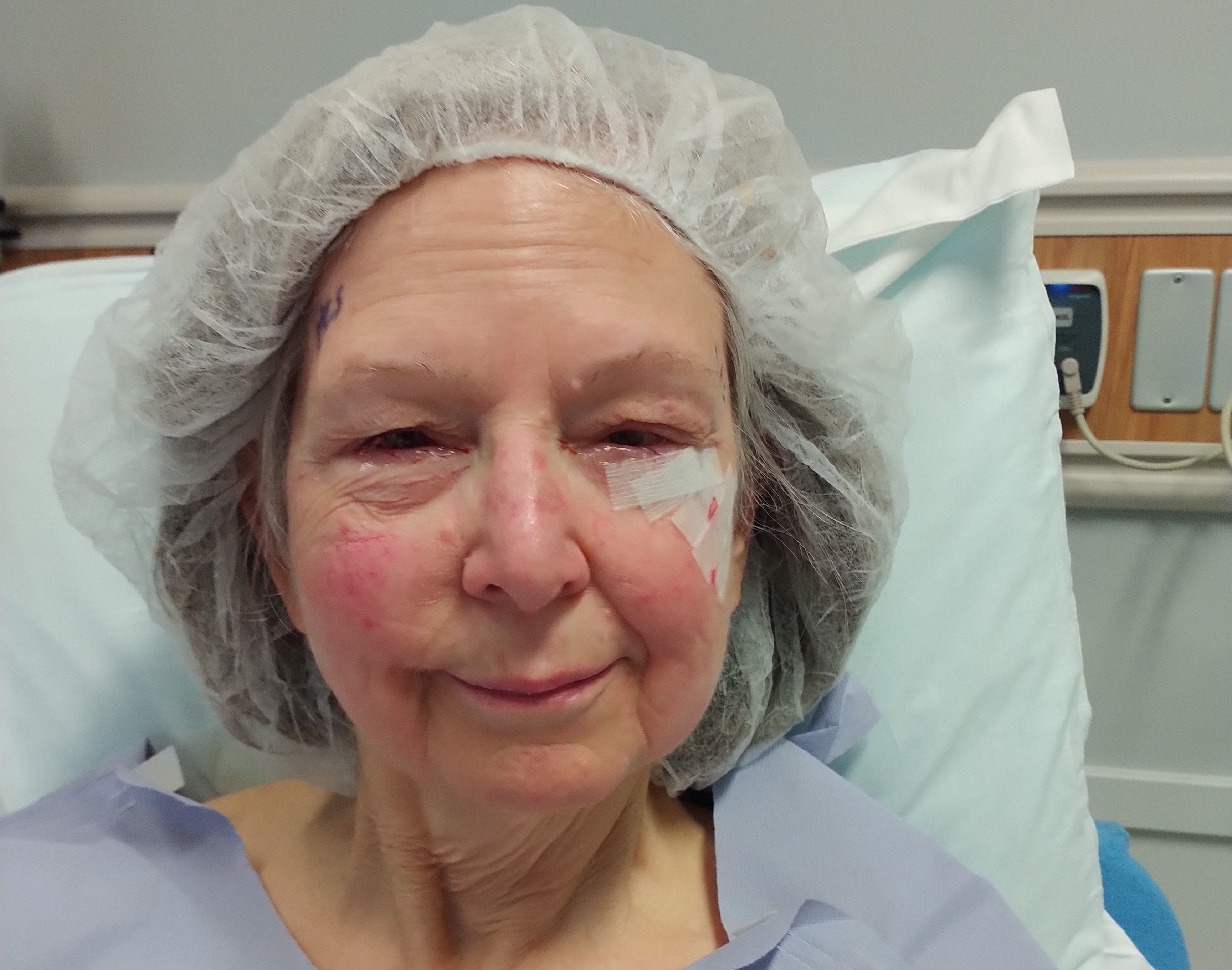
In the recovery room after eye muscle alignment surgery. (Copyrighted photo by Randy Helbling, January 22, 2024)
LOOK AT THAT “E”
Enter my neuro ophthalmologist surgeon, Dr. Collin McClelland, and a second doctor who had been in the operating room. I dreaded this moment when Dr. McClelland planned to tweak his work by pulling an adjustable suture stitched into my left eye.
Alright then. Look at that E across the room. Do you see one or two? Two. (He did some other vision checks, not just with the E, during the alignment process.) After my surgeon dropped a topical anesthetic into my left eye, he removed the steri strips adhering the suture onto my cheek. He hovered over me, his tools and face a blur. Don’t move. Look up to the left. You’re going to feel a tug. Yup. I did. OK, let’s check that E again. One or two? Two. OK, we need to do this again. Tug. Pain. You’re doing great. Check the E for the third time. Mostly one. OK, I’m going to leave it. And then my doctor worked to tie and cut that suture, simultaneously encouraging me with his gentle voice. You’re doing great. The adjustment process took 20 minutes and was made easier by my kind surgeon.
A section of a 1974 album cover from my collection. (Minnesota Prairie Roots copyrighted photo February 2024)
WE’RE OFF TO PROM
Kindness. I felt that in the care I received at M Health Fairview Surgery Center. Skilled care that came with humor and compassion and distractions that enabled me to manage eye muscle surgery. Kind Kat remained after Randy left to get the van from a nearby parking ramp. She escorted me to the restroom, our arms linking as if we were going to prom, Kat said. We needed a song, perhaps John Denver’s “Sunshine on My Shoulders,” theme for my 1970s era prom, I suggested. We laughed, Kat and I.
But I wasn’t laughing when we returned to my recovery room and I noticed Randy’s cellphone and charger lying on a chair, hidden beneath a tote bag. He was supposed to call when he reached the patient pick-up spot. But Randy was long gone, so I grabbed his phone and charger. Then Kat wheeled me onto the elevator that carried us downstairs to await Randy’s arrival, “old people” wrap-around sunglasses protecting my eyes. Thanks, Kat, for the (un)fashionable eyewear.
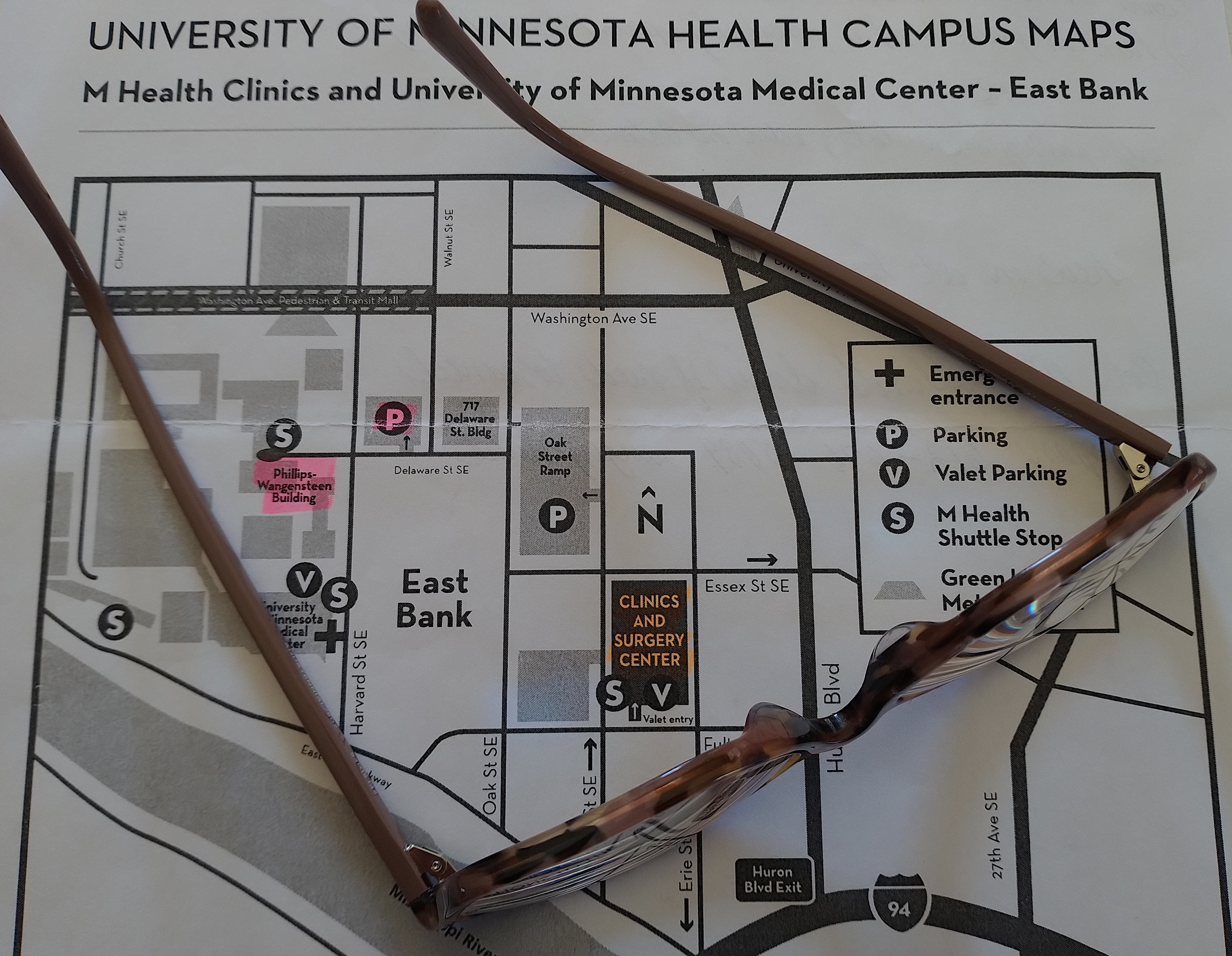
I’m becoming familiar with these two locations on the campus of the University of Minnesota in Minneapolis. (Minnesota Prairie Roots copyrighted photo February 2024)
THE LONG MINNESOTA GOODBYE, SORT OF
I expected Randy to simply drive up. He didn’t. Rather, he retraced his steps in an attempt to find his phone. Kat called someone to clarify I had his phone. As we waited, I grew restless. I just wanted to go home. Kat sensed that, pulling out her phone to show me a picture of her three dogs. Not cats. I appreciated the momentary distraction.
Eventually, Randy arrived and Kat steered me to our van, guiding me into the passenger seat. Then she hugged me. That loving gesture filled me with happiness, as if I was Kat’s sister rather than simply another patient. Happy despite the eye pain. Happy despite the long, exhausting day.
That happiness soon vanished as Randy took a wrong entrance ramp and we found ourselves aiming east toward St. Paul rather than west toward Minneapolis. I was in no mood for a longer trip, even if lengthened by only 15 minutes. But onward, back home to Faribault to rest and begin healing. Five weeks out, I am doing just that, continuing to heal. And I am remembering, too, the many kindnesses and the skilled care given to me by my compassionate medical team.
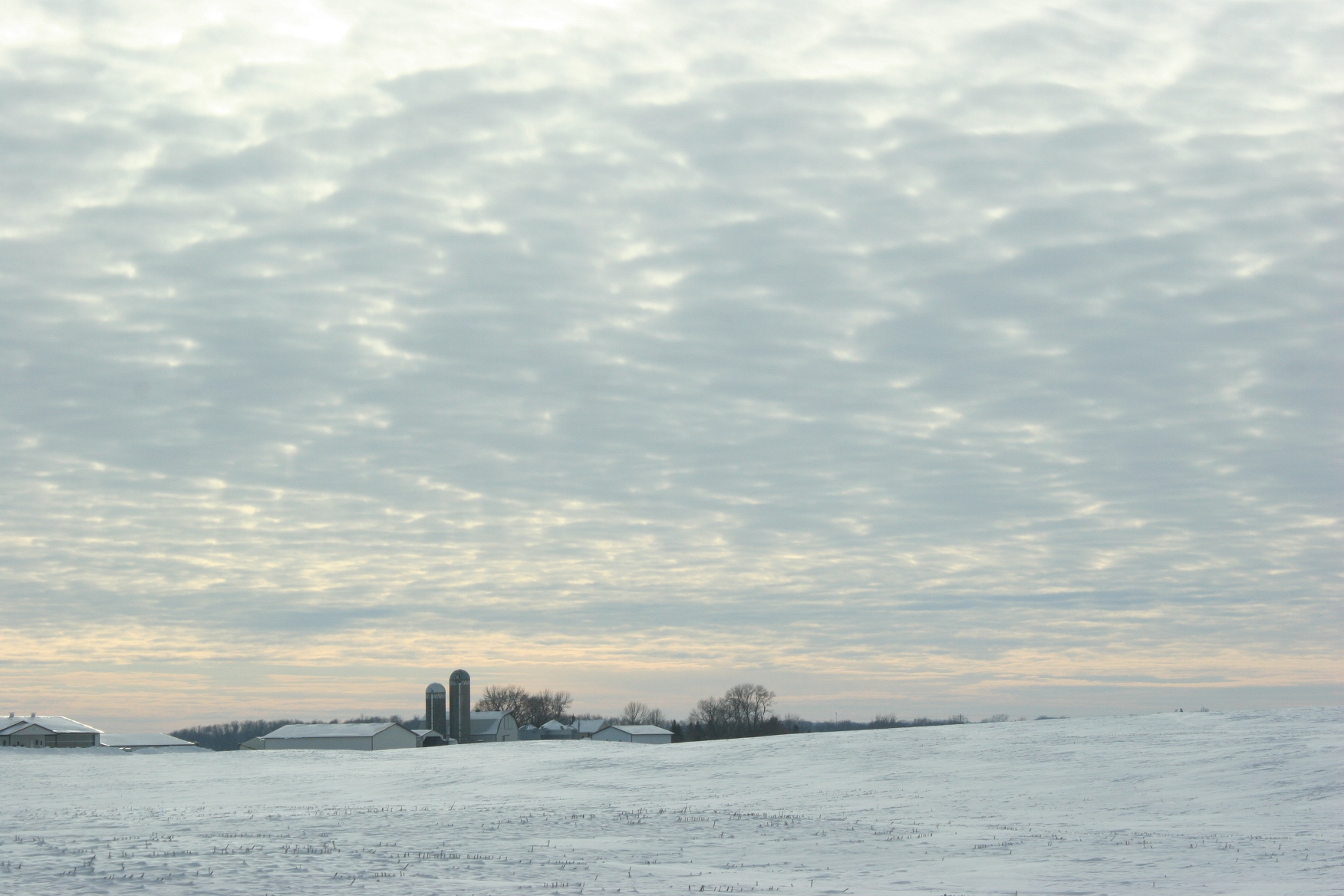
A winter scene photographed from Interstate 35 north of Faribault in 2019. Today’s landscape looks similar. (Minnesota Prairie Roots copyrighted file photo 2019)
“THERE, I LOCKED the cold outside,” he said upon securing the kitchen door before bedtime. My husband possesses a unique sense of humor. And on a brutally cold January evening with wind chills plummeting into the minus 30-degree range, humor is welcome, perhaps even necessary.
Fresh snow blown by strong winds created blizzard conditions in rural areas of Minnesota over the weekend, similar to this photographed in Rice County in January 2020. (Minnesota Prairie Roots copyrighted file photo January 2020)
This is the winter some Minnesotans have awaited in a winter that has proven primarily warm and snow-less up until now. Then winter roared into Minnesota last weekend with blizzard warnings in the western part of the state, winter weather advisories and warnings elsewhere, and a much-touted snow event that didn’t quite deliver in my area. Strong winds and sub-zero temps followed.
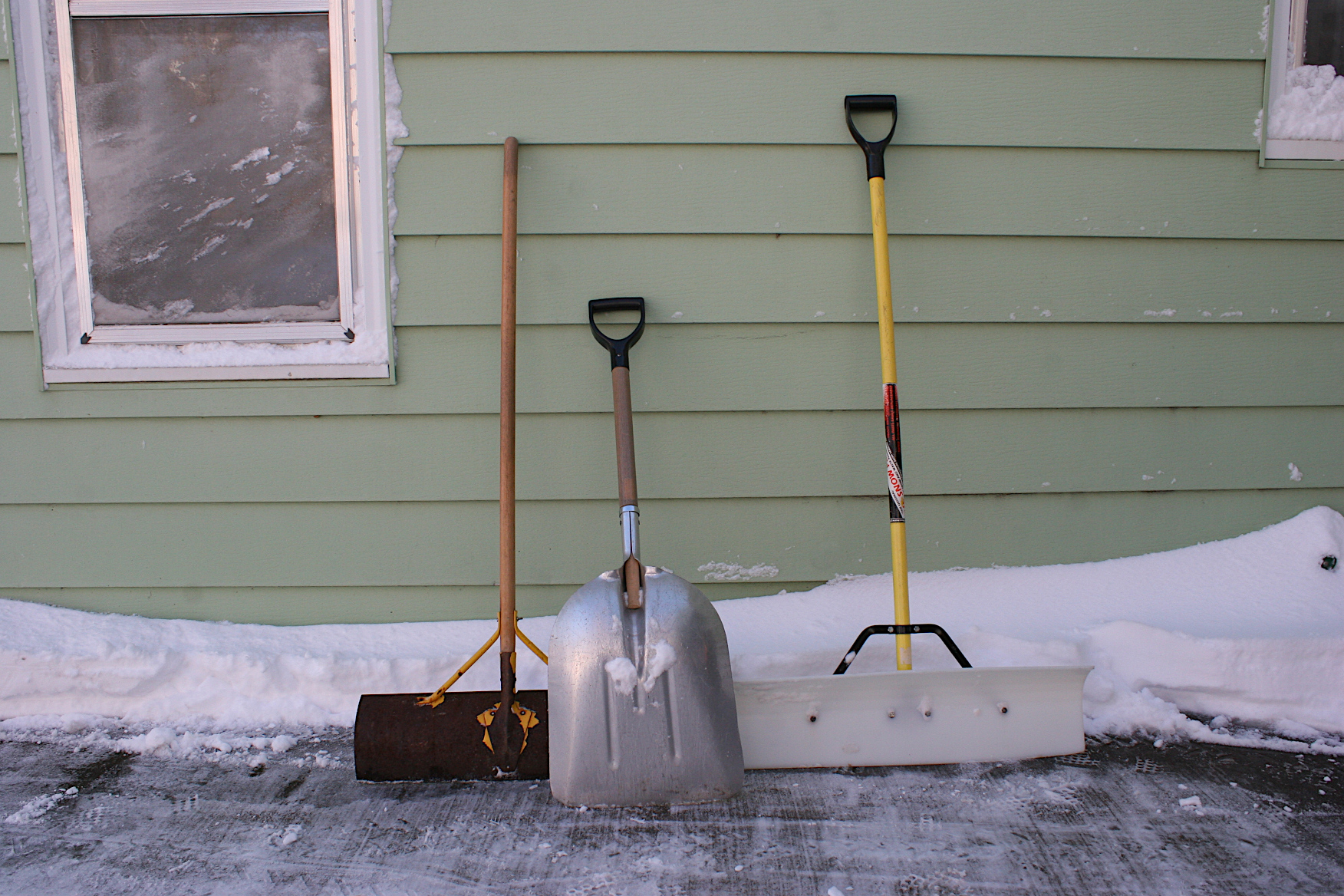
I use these shovels to clear snow from the driveway and sidewalk. (Minnesota Prairie Roots copyrighted file photo December 2021)
I felt thankful for the minimal snowfall of some four inches since I am currently the resident snow remover, a task typically handled by Randy. He is on physical restrictions for five weeks following a surgical excision on his lower back. So, by default, I must shovel snow.
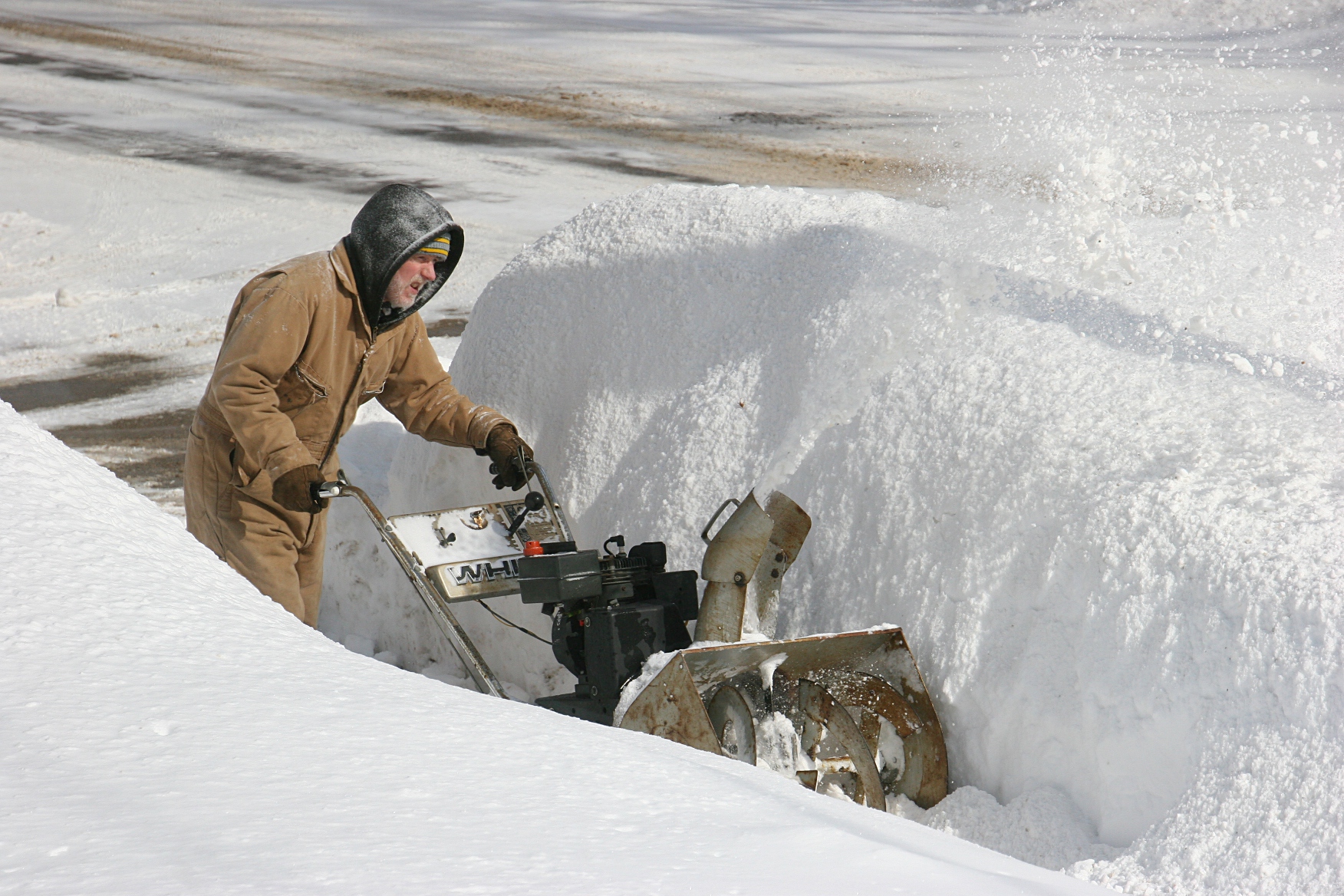
Randy blows snow with our aged snowblower following a 2019 winter storm. (Minnesota Prairie Roots copyrighted file photo February 2019)
“I should have taught you how to use the snowblower,” Randy said as I slipped on a parka, boots, warm stocking cap and mittens (with hand warmers tucked inside), and wrapped a scarf across my face. I laughed. Our snowblower is massive, aged and not a machine I feel comfortable or capable of handling or maneuvering.
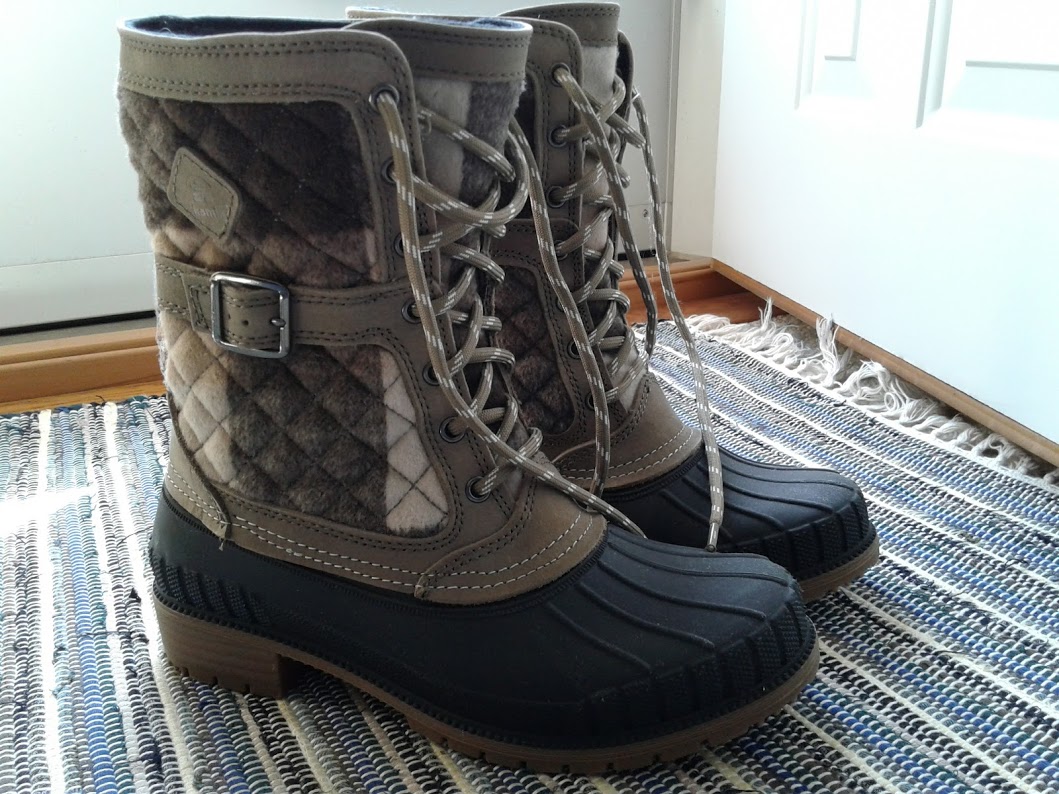
My warm winter boots. (Minnesota Prairie Roots copyrighted file photo)
Admittedly, I whined a bit. Not because of the shoveling, but rather the biting cold and bitter wind. As I pushed and tossed snow from the driveway and then the sidewalk, I felt my thumbs numbing. Soon I pulled them next to my fingers, clenching my hands into fists around the hand warmers.
As I worked, I determined I best change my attitude. Right then and there I re-framed my thoughts into one of gratitude that I could physically do this work. Not everyone my age can. Not everyone can due to other limitations. And not everyone has a partner who encourages with humor, even if I don’t always laugh.
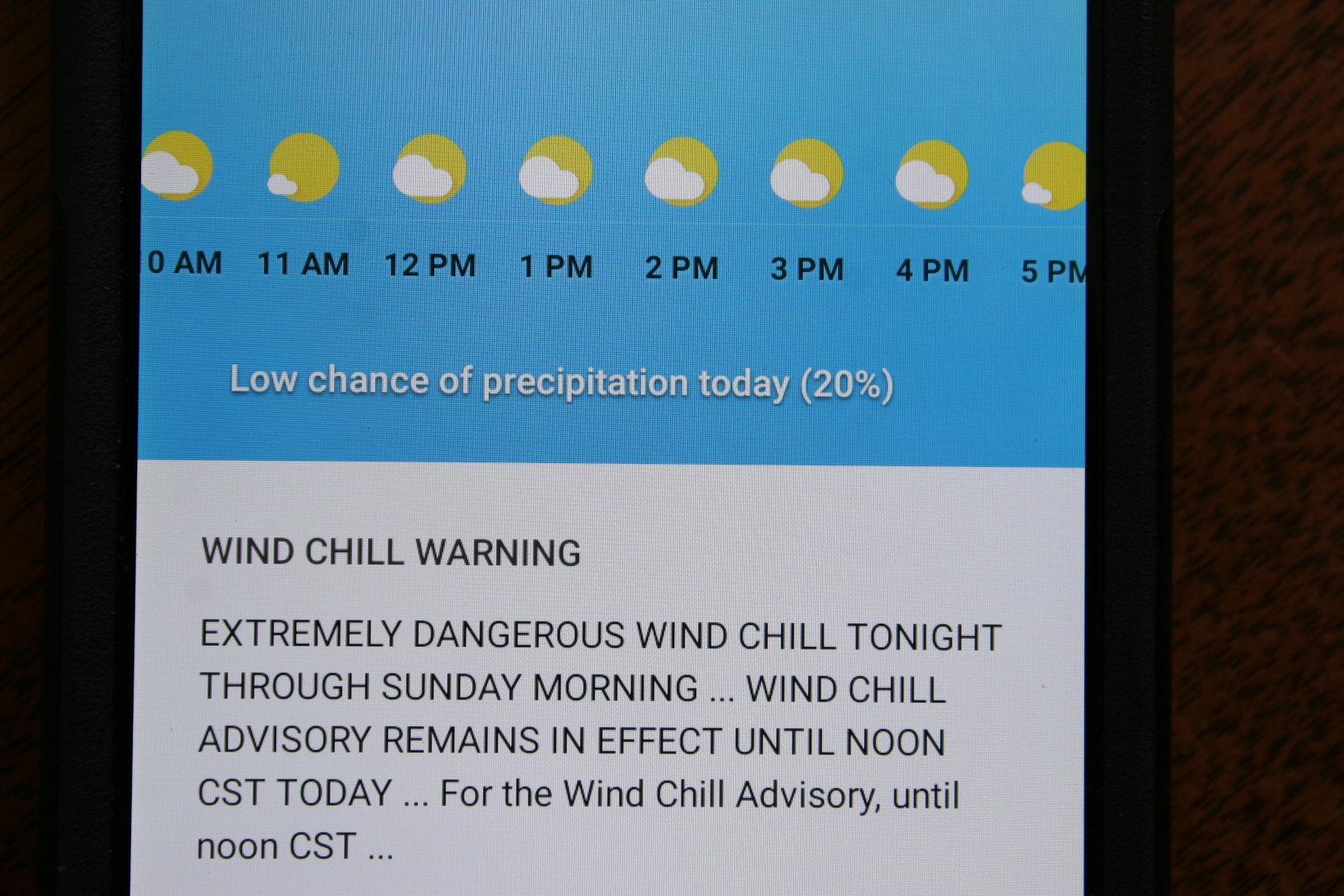
Weather warnings like this one have popped up on phones around Minnesota in recent days. This warning was sent to my phone in February 2021. (Minnesota Prairie Roots copyrighted file photo February 2021)
Monday morning dawned bright with sun dogs, a temp of minus 10 degrees and a wind chill I didn’t even want to know. I wanted to stay snug inside my warm house. But Randy and I pushed ourselves to get out and drive across town to the Shattuck-St. Mary’s soccer dome for a morning walk. On the way there, Randy noted the crunch of our van tires, a phenomena that happens in subzero temps like this. It’s a sure indication that it’s dang cold outside as are those columns of light flanking the sun.
Pulling into the parking lot, I saw a lot of vehicles. After several days of really cold weather, cabin fever becomes a real feeling. The need to get out and move, just not outdoors, becomes a priority. We looped the soccer field six times, still wearing caps and gloves. It may be warm inside the dome, but not that warm.
I usually drink coffee in my Minnesota Moments mug. I freelanced for this magazine, no longer in publication. (Minnesota Prairie Roots copyrighted file photo January 2018)
Back home, I made coffee, loaded laundry in the wash, did some online tasks and texted friends before moving on to writing. I took a break later to empty the washing machine and carry the basket of clothes from the basement to the living room where I’d strategically positioned drying racks in front of heat vents.
“You’re not going to hang the laundry outside?” Randy joked from his comfy spot on the couch.
“Ha ha, very funny,” I replied. Not even I, a diehard of hanging laundry on the line (sometimes even in January), would attempt to do so when the temp is seven degrees below zero. I would risk instant frostbite while the wet clothes froze stiff in my hands. The brilliant sun shining bright upon the snow could almost fool me into believing, though, that enough solar power shone to sun-dry laundry. Yet, the truth of winter in Minnesota—real winter—is this: A sunshine-filled day can be an illusion. It is the temperature, the wind chill, the crunch of tires on snow, the locking of the door against the cold, which reveals reality.
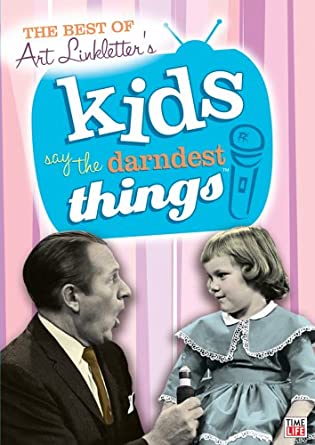
A video features episodes of the TV series. (Image sourced online)
ANYONE WHO IS A GRANDPARENT will tell you it’s the best. That includes me, grandmother of two. Grandparents have all the fun of parenting minus the everyday challenges of raising children. We are also witness to much, sort of like observers of “Kids Say the Darndest Things.” Remember that original long ago TV series by Art Linkletter in which he interviewed kids and they answered quite honestly, hilariously?
Recently, my grandson celebrated his fifth birthday with a small party that included Randy and me (his other grandparents live in Arizona), his paternal aunt and uncle, and his older sister and parents. His other aunt and uncles live too far away.
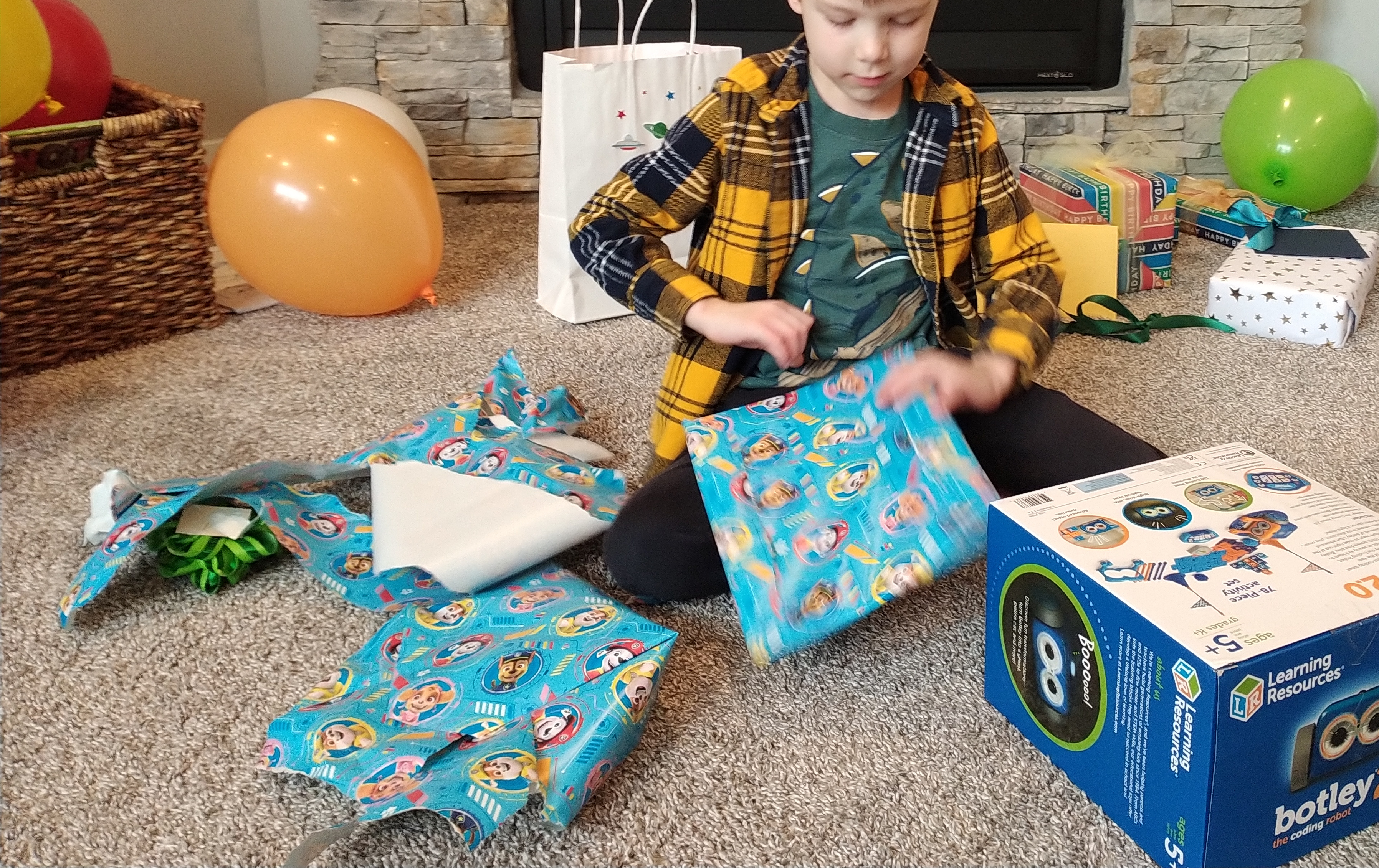
Isaac starts opening gifts. (Minnesota Prairie Roots copyrighted, edited photo January 2024)
As we gathered in the living room to watch Isaac open his gifts, I felt the love that enveloped this little boy. He was so excited as kids are wont to be about birthdays. But then if I had a pile of gifts at my feet and I was only five, I might get excited, too.
Tearing into the packages, Isaac didn’t hide his feelings. When he opened a space sticker book from Opa and Oma, he stopped and was about to start sticking stickers…until his mom politely reminded him that he should open his other gifts first. It was clear he loved the sticker book.
Last spring Isaac and his mom planted flower seeds including zinnias, like these grown by my friend Al. (Minnesota Prairie Roots copyrighted file photo September 2019 used for illustration only)
But he didn’t love the red amaryllis bulb I gave him to plant. In fact, Isaac tossed the box to the side while I hastily tried to explain to him what was inside. “I don’t like flowers!” he said, this the boy who last summer seeded flowers, tended flowers, delighted in every bloom and earned the name Farmer Isaac. Maybe my grandson will change his attitude when the amaryllis blooms in about two months.
He also tossed aside a pom pom animal craft kit. He loves doing arts and crafts and goes through so many colored magic markers that Crayola should have a rewards program for his parents.
Thankfully Isaac liked the thick pack of multi-colored construction paper and the 3-in-1 space shuttle LEGO set Randy and I gave him. Before we left the party, he’d already assembled the shuttle and told me I should give all of his Uncle Caleb’s LEGOs to him. Alright then. I would need to clear that with my son.
It was Caleb’s gift, though, that had all of us erupting in laughter. Not because it was anything unusual or humorous. Rather, it was simply cash in a card. Isaac ripped open the envelope, pulled out the substantial monetary gift and flew out of the room and upstairs to his bedroom, bills clutched tightly in his hand. No one was going to get his money.
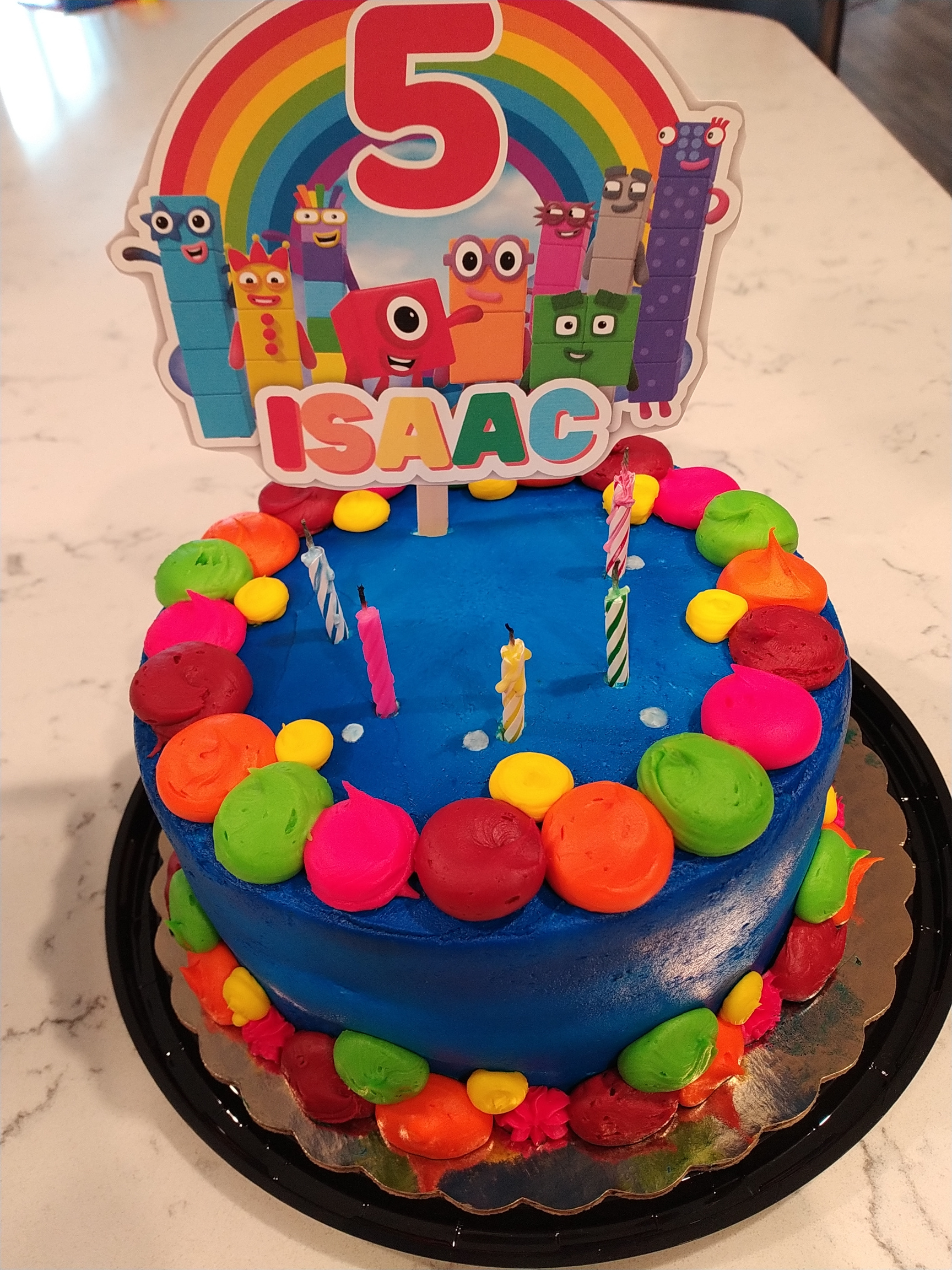
And then there was the bakery birthday cake, chocolate and frosted in bold hues, as vivid as any frosting I’ve ever seen. Isaac wanted blue frosting accented by a rainbow of colors to match the Numberblock theme of his party. “Numberblock” is an animated children’s series that teaches kids math skills via adventures. I’ve never seen it. My grandson, a math whiz, has and also has the toys spun off from the show. Ask him a math problem and he can likely solve it. I’m not talking simple addition and subtraction, but rather multiplication and other math problems well beyond his just-turned-five years. Did I mention that his dad is a math major and an actuary?
Back to that blue cake. The blue coloring of the frosting was much darker than Isaac’s mom expected. As we forked the heavily frosted cake into our mouths, our lips, tongues and teeth turned blue. The birthday boy never complained. But there was some quick wiping of teeth by adults and of the kitchen counter before the blue dye stained surfaces.
Hours after we left the party, my daughter texted with a message from Isaac. “I forgot to tell the birthday comers thank you,” he told his mom. Awwww. Melted this grandma’s heart, negating the tossed amaryllis “I don’t like flowers!” moment. Kids truly do say the darndest things.
#
TELL ME: I’d like to hear a “kids say the darndest things” quote from you. Let’s laugh this morning.
The cover of Elizabeth Johanneck’s new book features the art of her grandfather, Arnold Kramer. (Minnesota Prairie Roots photo July 2023)
DECADES REMOVED from southwestern Minnesota, Twin Cities writer Elizabeth Johanneck and I remain rooted to the prairie—the land and people and smalls towns which shaped us. We both grew up on Redwood County farms, were Wabasso High School classmates and today hold a deep respect and fondness for the place we once called home.
Beth, as she’s known to me, recently published a book,If You Can’t Make it to Heaven, at Least Get to Seaforth—The Monica Stories and Then Some. This book features short stories and snippet observations in Beth’s humorous storytelling style, plus paintings and photos. These could be my stories, my memories, just with different characters and settings. Any prairie farm kid likely will feel the same.
ABOUT SEAFORTH & MONICA
But where is Seaforth? And who is Monica? Seaforth, population 77, is a farming community located along County Road 7, south of Minnesota State Highway 19 in central Redwood County. It’s near my hometown of Vesta, seven miles to the northwest. Monica Fischer is Beth’s friend, former co-worker and a character. A baby shoe in a pot of egg coffee and pantyhose found clinging inside a pant leg during Catholic Mass are among the many entertaining Monica stories that left me laughing aloud. By the time I’d finished reading this section of the book, I felt like I knew Monica well. Everyone should have a friend like her.
GROWING UP ON THE MINNESOTA PRAIRIE IN THE 1960s
And everyone should be so fortunate to have experienced rural Minnesota life in the 1960s, as Beth and I did. It is Part 2, “Random Nonsense of a MN Country Mouse,” that I find most similar to my childhood. Both farmers’ daughters with many siblings, Beth and I share the commonalities of being raised on the land among aunts and uncles and cousins and grandparents and immediate family who loved us deeply.
As in “The Monica Stories,” Beth writes about her personal experiences in a casual conversational style. It’s as if she and I are chatting over cups of coffee, and Beth does like her coffee. I connect with her stories about “the grove,” jars of pocket gopher feet in the freezer, grab bags, bloodsuckers, The Weekly Reader, hearing corn grow and more.
Her humor-infused short stories stretch into adulthood, into becoming a parent and grandparent. These are not earth-shattering remembrances, but rather observations about everyday life and events that could be mine, could be yours, but are definitively Beth’s.
NIBBLES OF COUNTRY INSIGHTS
In a section titled “Country Mouse Nibbles,” Beth shares her thoughts on topics in a sentence or two, the first being “When You Are Raised Close to the Land.” I fully understand—the smell after autumn harvest, looking to the west for approaching storms, filled fruit jars crowding root cellar shelves… And “Holding onto Memories”—Distant cheers from a local ball game are souvenirs worth saving for winter. Truly poetic words.
FEATURING THE ART OF “MINNESOTA’S GRANDPA MOSES”
There is much to be cherished in this book beyond pages and pages of rural memories and insights. Beth also intersperses photos, most from Seaforth. But it is Part 3, “Paintings by Arnold Kramer, Minnesota’s ‘Grandpa Moses,’” which is an historic agrarian art treasure. Following his retirement, Seaforth farmer Arnold Kramer took up painting, visually documenting early to mid-1900s rural life and scenes. He became well-known for his folk art style paintings done in primary colors. Beth’s book holds the only printed collection of paintings by her grandfather. The self-taught artist created more than 400 works of art and was dubbed “Minnesota’s Grandpa Moses” by the University of Minnesota at the peak of his creativity in the 1960s.
Book signing promo courtesy of Elizabeth Johanneck.
Beth’s book is also available for purchase at Chapter Two Bookstore in Redwood Falls and online at Amazon and Barnes & Noble. Both her book and Cindy’s achieved bestseller status on Amazon following their release.
Julie Kramer, author of bestseller Stalking Susan, praises Beth’s book in her back cover endorsement, calling it “a delightful collection from a farm girl who grew up near the Minnesota home of Laura Ingalls Wilder.” I agree. Fully.
(Minnesota Prairie Roots copyrighted photo 2018 used for illustration only)
EDITOR’S NOTE: This is a true story, with some embellishments.
Following a four-hour search Tuesday, a Faribault man discovered the source of a foul odor inside his Willow Street garage—a dead critter tentatively identified as a shrew. The black mole-like creature was found trapped inside the wall behind a large shelving unit.
The discovery came just as the homeowner was about to request assistance from the Southeastern Minnesota Joint Response Team’s cadaver dog. “The stench was oppressive, more toxic than Canadian wildfire smoke,” the man told a local newspaper reporter.
Local animal control officials declined to comment on the situation, citing data privacy laws. However, a department spokesperson stated that property owners are responsible for disposing of dead shrews, mice, moles and other small animals inside buildings and in their yards when there is no risk to the public.
The homeowner, who wished to remain anonymous, removed the decomposing shrew, doused the deadly scene with bleach, then flung his garage doors wide open. He also used a box fan to circulate the air. “Even after many hours, the place still stunk,” he said. “And my garage is a mess. I had to move everything and crawl on my hands and knees trying to find the dead thing.” Bottle flies eventually helped him pinpoint the location.
“I never want to go through this again,” the man said Wednesday morning as he moved shelves and other items in his garage back in to place. “It’s not like I just have a lawnmower, snowblower, bikes and yard tools. This is a working man’s garage.”
TELL ME: Do you have a similar totally true or embellished true story?
It’s still cold enough for winter gear here in Minnesota. (Minnesota Prairie Roots copyrighted file photo January 2018)
WINTER RETAINS ITS firm grip on Minnesota, even in this official season of spring. We are in a Winter Storm Warning for Friday evening through Saturday morning with some 4-6 inches of snow forecast for my area along with wind gusts to 45 mph. Other parts of Minnesota will see more snow and wind, resulting in blizzard conditions.
Temps have also been unseasonably cold. Think below zero in some areas of our state earlier in the week. We did not reach 50 degrees in March, unusual even by Minnesota averages.
What to do? Endure. Escape. Or embrace.
The definition of endure is obvious. Don warm clothes, crank up the heat and wait.
A loon family on Horseshore Lake south of Crosslake in central Minnesota. (Minnesota Prairie Roots copyrighted file photo July 2020)
Escape means traveling to some place warm, like Arizona or Florida or California or Texas. Plenty of Minnesotans do exactly that over spring break. Or, when that’s not an option, envision the summer ahead and a Minnesota northwoods lakeside cabin. I’m picturing that in my mind, in mid-July, warm sand between my toes, water lapping, blue skies, loons calling…
A beautiful summer day at Horseshoe Lake. (Minnesota Prairie Roots copyrighted file photo July 2020)
Or, if you’re a south metro first grade teacher, you can embrace, or rather defy, the cold with Beach Day. On a 10-degree morning, my almost 7-year-old granddaughter headed off to school in a tank top and shorts, prepared to celebrate a day at the beach. An oversized sun and waves graphic defined her defiant, colorful shirt. Per her mom’s care, Izzy layered her snowpants and winter coat over her summer attire and packed a sweatshirt.
On the beach at Horseshoe Lake. (Minnesota Prairie Roots copyrighted file photo July 2020)
The wise teacher advised students they could wear shorts, “if you want to be cold.” Apparently Izzy and a few others wanted to be cold. Ah, the optimism of youth who weren’t about to allow a low morning temp of 10 degrees to spoil their day at the beach.
NEWS THAT VOTING has opened for the Minnesota Department of Transportation’s “Name a Snowplow” contest came at just the right time—as two clipper systems bring more snow into a state already overwhelmed by snowfall this winter. Voting comes also as the coldest air since mid-December is about to descend, dropping temps to below zero this weekend in most parts of Minnesota.
It’s been quite the winter. So this MnDOT contest is providing a humorous mental respite from the cold and snowy reality of January in Minnesota, with three months of winter to go.
Three years ago MnDOT launched its first snowplow naming competition, inviting the public to submit names for the big orange trucks that clear our state highways of snow and ice. This year 10,000 names were submitted, which have been narrowed down to 60 choices. Online voting is open until midnight, Friday, February 3. The winning names will grace eight snowplows in MnDOT’s eight districts.
I breezed through the names, quickly choosing my top three. Participants can vote for up to eight. I chose Blader Tot Hotdish (a reference to Minnesota’s culinary delight, Tator Tot Hotdish), Orange You Glad to See Me (picked for obvious reasons) and Spirit of ‘91 (a reference to the Halloween Blizzard of 1991, a multi-day blizzard which dumped single storm record snowfalls throughout the state; three feet in Duluth).
I love this diversion from talking solely about the weather, as we Minnesotans are inclined to do, especially in winter.
This contest also puts a positive spotlight on MnDOT, which too often delivers the bad news of road closures, crashes, road construction, impossible driving conditions and more. “Name a Snowplow” is, simply put, genius creative marketing.
When my grandchildren say the darndest things, I think of Art Linkletter’s “House Party” and his “Kids Say the Darndest Things” segment. Their answers to his questions proved honest, humorous and entertaining.
KIDS SAY THE DARNDEST THINGS. I can vouch for that. I raised three kids, cared for many others and am now the grandmother of two, one going on seven, the other just turned four.
Recently the grandkids, Isabelle and her little brother, Isaac, stayed overnight. During that short stay, Izzy elicited laughter with her honest observations and her leadership skills.
An outhouse repurposed as a garden shed at my brother and sister-in-law’s rural southwestern Minnesota acreage. (Minnesota Prairie Roots copyrighted file photo)
First the honesty. I don’t recall how we got on the topic, but at some point I shared that I grew up in a house without a bathroom. Taking a bath meant my dad hauling a tin tub from the porch into the kitchen every Saturday evening and then Mom filling it with water. Our bathroom, I explained to Izzy, was a little building outside with two holes cut in a bench. And in the winter, we used a covered pot set inside the unheated porch.
I don’t know that Izzy understood all of this. But, as she sat there listening to Grandma spin tales of the olden days, she assessed. “It sounds like a different world to me!” I laughed at her observation. She was right. Growing up in rural Minnesota in the 1950s and 1960s was, most assuredly, a different world from hers. My granddaughter lives in a sprawling suburban house with four bathrooms. In 1967, my family of birth moved into a new farmhouse with a single bathroom. And a bathtub. Today I feel thankful to live in a house with one bathroom. I wouldn’t want to clean four.
I took this award-winning photo of BINGO callers at the North Morristown July Fourth celebration in 2013. (Minnesota Prairie Roots copyrighted file photo 2013)
Then there’s BINGO, which we play nearly every time we’re together with Isabelle and Isaac. They were introduced to the game at the Helbling Family Reunion and have loved it since. The kids take turns not only playing, but also calling numbers.
Isabelle has advanced greatly in her BINGO-calling skills. This time, in addressing us, she called us “folks.” I don’t know where Izzy heard that term, but it’s certainly more rural than suburban lingo. I suggested she might be ready to call BINGO next summer at North Morristown’s annual Fourth of July celebration. Unincorporated North Morristown is a Lutheran church and school and a few farm places clustered in the middle of nowhere west of Faribault. Izzy seems well-prepared to call BINGO numbers to the folks there.
I should have shared with my granddaughter that, when I was growing up, we covered our BINGO cards with corn kernels during Vesta’s (my hometown) annual BINGO Night. I expect she would have responded as a child 60 years younger than me: “It sounds like a different world to me!” And I would have agreed.
MINNESOTA SEEMS, TO ME, a hotbed for writers. And five days ago we lost one of our most beloved, Howard Mohr. He was perhaps best-known for his wildly popular, at least in Minnesota, book, How to Talk Minnesotan: A Visitor’s Guide, published in 1987. The book was later updated and adapted into an equally popular musical.
Many years have passed since I read my copy of this entertaining, humorous, and, yes, truthful, summary of Minnesota life. In honor of Mohr, who died September 4 of Parkinson’s at Fieldcrest Assisted Living in Cottonwood, I pulled my book from the shelf and reread it.
A corn field in southwestern Minnesota. (Minnesota Prairie Roots copyrighted file photo)
That Mohr, 83, recently moved from his Lyon County farm home of 52 years to a facility called Fieldcrest seems especially fitting. He lived in farming country, my native southwestern Minnesota, the place of small towns defined by grain elevators and land defined by fields of corn and soybean. He understood the people and place of the prairie. So when I read the sentence in his book declaring the produce of Minnesota writers to be as valuable as a crop of soybeans and corn, I felt he nailed it.
A harvested field and farm site in my native Redwood County, Minnesota, where the land and sky stretch into forever. (Minnesota Prairie Roots copyrighted file photo)
I’ve long celebrated writers rooted in the prairie like Mohr, Bill Holm, Robert Bly, Frederick Manfred, Leo Dangel… My friend Larry Gavin of Faribault, too, poet and writer who studied under those writers and lived for 15 years on the prairie. Some shared their knowledge, their talents, by teaching at Southwest Minnesota State University in Marshall. That’s near Cottonwood. Mohr taught English at Southwest State. He also penned Minnesota Book of Days, How to Tell a Tornado (poetry and prose) and wrote for “A Prairie Home Companion,” also appearing on the show.
A serene country scene just north of Lamberton in southern Redwood County. (Minnesota Prairie Roots copyrighted file photo)
I’m most familiar with How to Talk Minnesotan. The content reflects my rural upbringing. The dairy and crop farm of my youth lies a mere 15 miles to the south and east of Cottonwood, thus rereading Mohr’s book is like traveling back home, a reminder of that which defines me as a native of rural Redwood County. Even after nearly 40 years of living in Faribault, in town, I still call the noon-time meal “dinner” and the evening meal “supper.” My adult kids don’t, so I/they, always clarify when invitations are extended to a meal. To me “lunch” will always come mid-afternoon or in the evening before guests leave.
This huge, hard-as-rock snowdrift blocked our Redwood County farm driveway in this March 1965 photo. I’m standing next to my mom in the back. (Minnesota Prairie Roots copyrighted file photo)
Mohr’s references to the noon whistle, Jell-O (once popular, not so much now) winter survival kits, snowbirds (those who leave Minnesota in the winter and return in the spring), hotdish (casserole), pancake feeds, seed corn caps, lutefisk, Lutherans, bullheads (smaller versions of catfish), the “long goodbye” all resonate. I especially understand his point that Minnesotans are obsessed with the weather. We are.
Bars made by Lutherans. ( Minnesota Prairie Roots copyrighted file photo)
Some 10-plus years ago, when my now son-in-law moved to Minnesota from Los Angeles after falling in love with my eldest daughter, I gifted him with Mohr’s How to Talk Minnesotan. I figured this would help him adjust to our language and state. Whether it did or didn’t, I don’t know. But Marc hasn’t moved back to his native California. And he never commented on Mohr’s statement that Californians struggle to adapt to life in Minnesota. Marc fits in just fine. I do recall, though, his comment on “bars,” a word with duo meaning here in our state. “Bars” are both a place to gather and drink alcohol and a baked or unbaked sweet treat (made with lots of sugar and often topped with chocolate) pressed or spread into a 9 x 13-inch cake pan.
Maybe I really ought to make a pan of bars, cut them into squares, plate and serve them with coffee for “a little lunch” as a way to honor Howard Mohr, writer, satirist, humorist. He yielded a mighty fine crop of writing.
FYI:I encourage you to read Mohr’s obituary by clicking here. Be sure to read the insightful and loving comments. And if you haven’t read How to Talk Minnesotan, do. If you’re Minnesotan, it will be a refresher course in our life and language. If you’re not from here, you’ll better understand us upon reading this guide.
Recent Comments