Minnesota Prairie Roots

Writing and photography by Audrey Kletscher Helbling

Inside the pearly gates of St. Peter, visitors view the notorious “corpse flower” July 26, 2010

Filed under: Uncategorized — Audrey Kletscher Helbling @ 1:15 PM
Tags: , , , ,

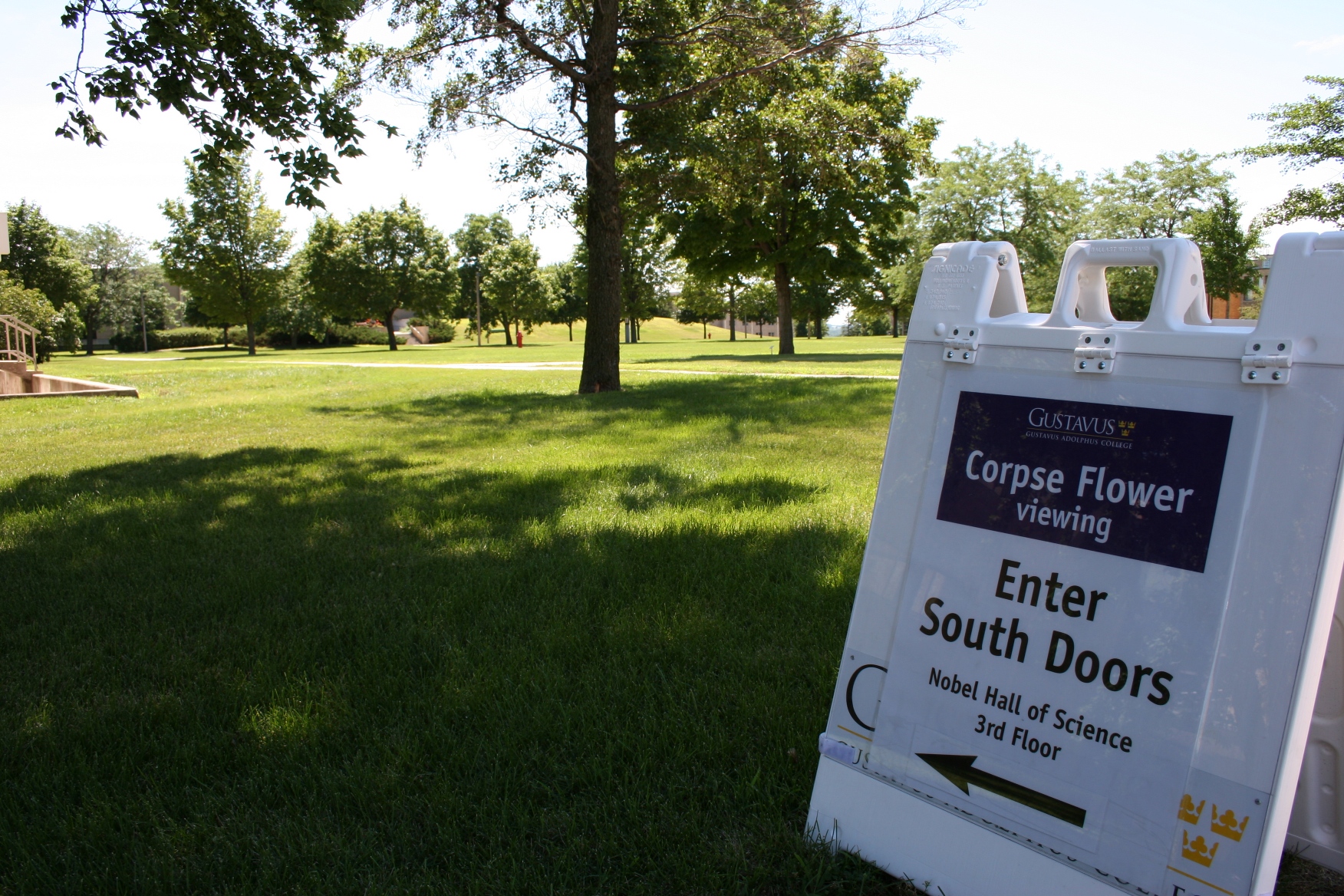
A sign at Gustavus Adolphus College directs visitors to the Nobel Hall of Science where "the corpse flower" grows.

FOR SOME, PERRY’S flesh-rotting odor proved too repugnant.

But they came prepared—they being the four Edina kids who traveled to Gustavus Adolphus College in St. Peter Friday morning to view the flowering of Gustavus’ Amorphophallus titanium, otherwise known as “Hyperion” and nicknamed “Perry.”

With perfumed bandannas in hand, the three Yang siblings and a friend trooped past Perry, the native Indonesian plant that last bloomed in this southern Minnesota college greenhouse in 2007. The large plant (this one is about six feet tall) produces an offending odor that, based on the comments I heard Friday morning, ranges from smelling like barf to fish at an Asian market to “my son’s bedroom.”

I watched with amusement through a greenhouse viewing window as the Yang kids and their friend passed by Perry, handkerchiefs clasped firmly to their faces for much of the brief encounter.
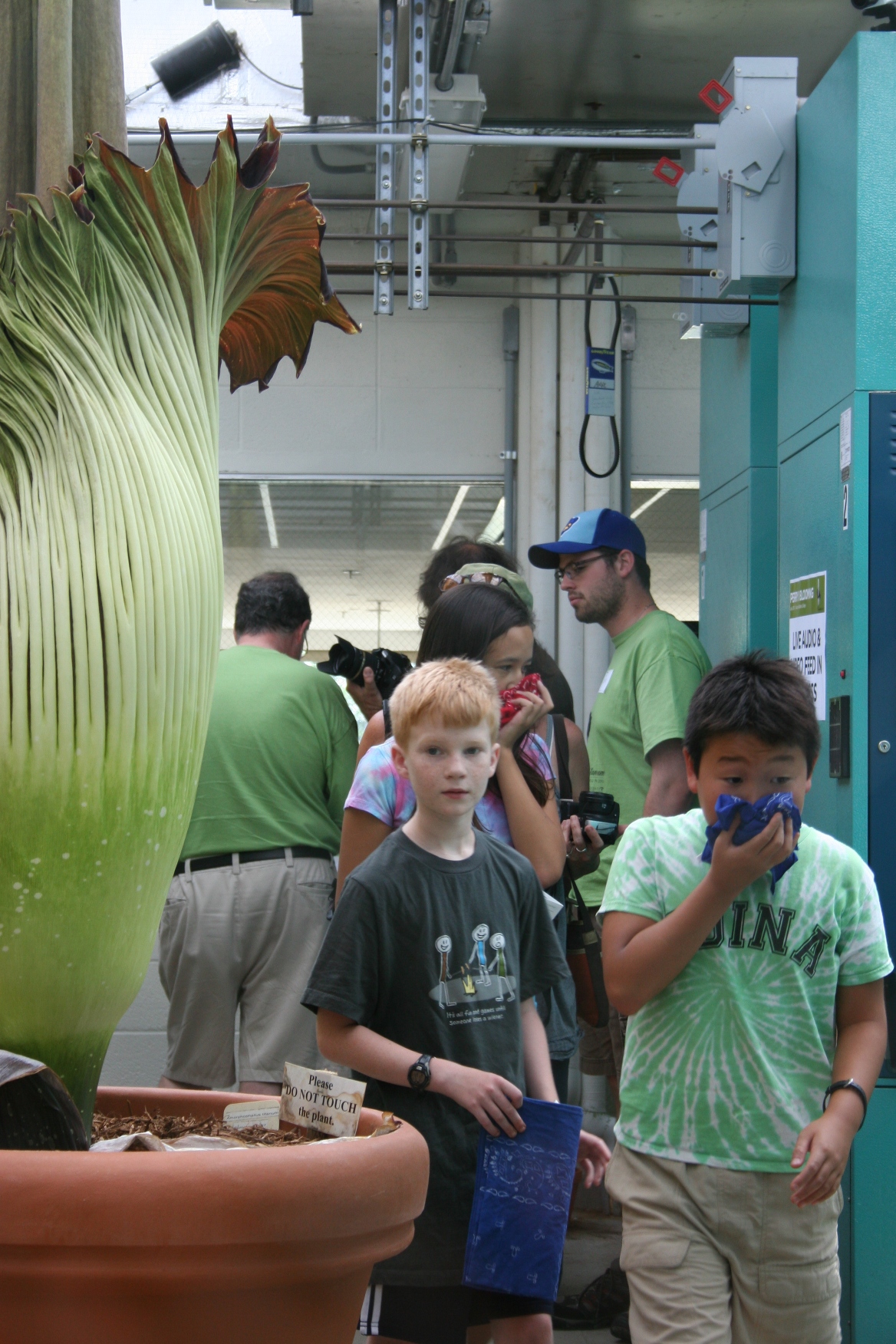
One of the Yang boys wards off the offending odor with a bandanna.

Filtering the offending odor with a bandanna.

Admittedly, Perry does stink, producing an offending odor designed to attract pollinators. This past weekend, Perry also attracted plenty of attention from the media, scientists and just plain curious visitors like my husband, son and I who stopped en route to a family reunion in southwestern Minnesota around noon Friday. About 12 hours earlier, at 11:30 p.m. Thursday, Hyperion opened.

I didn’t know quite what to expect when we reached the greenhouse on the third floor of the Nobel Hall of Science at Gustavus. Surprisingly, I was pleasantly surprised. With camera in hand—no bandanna for me—I entered the viewing area fully prepared to find a decaying smell so overpowering that I would snap a few pictures and flee.

Instead, I discovered an odor that, in all honesty, I found more tolerable than stench that sometimes wafts across the countryside from animal manure at large-scale farming operations.

Perhaps if I had returned Sunday, when Perry was at full bloom, my opinion would have changed. The odor would just get worse as the flowering progressed, we were told Friday.

Maybe then I, too, would have pressed a perfumed bandanna to my nose, filtering the odorous smell of Perry, “the corpse flower.”
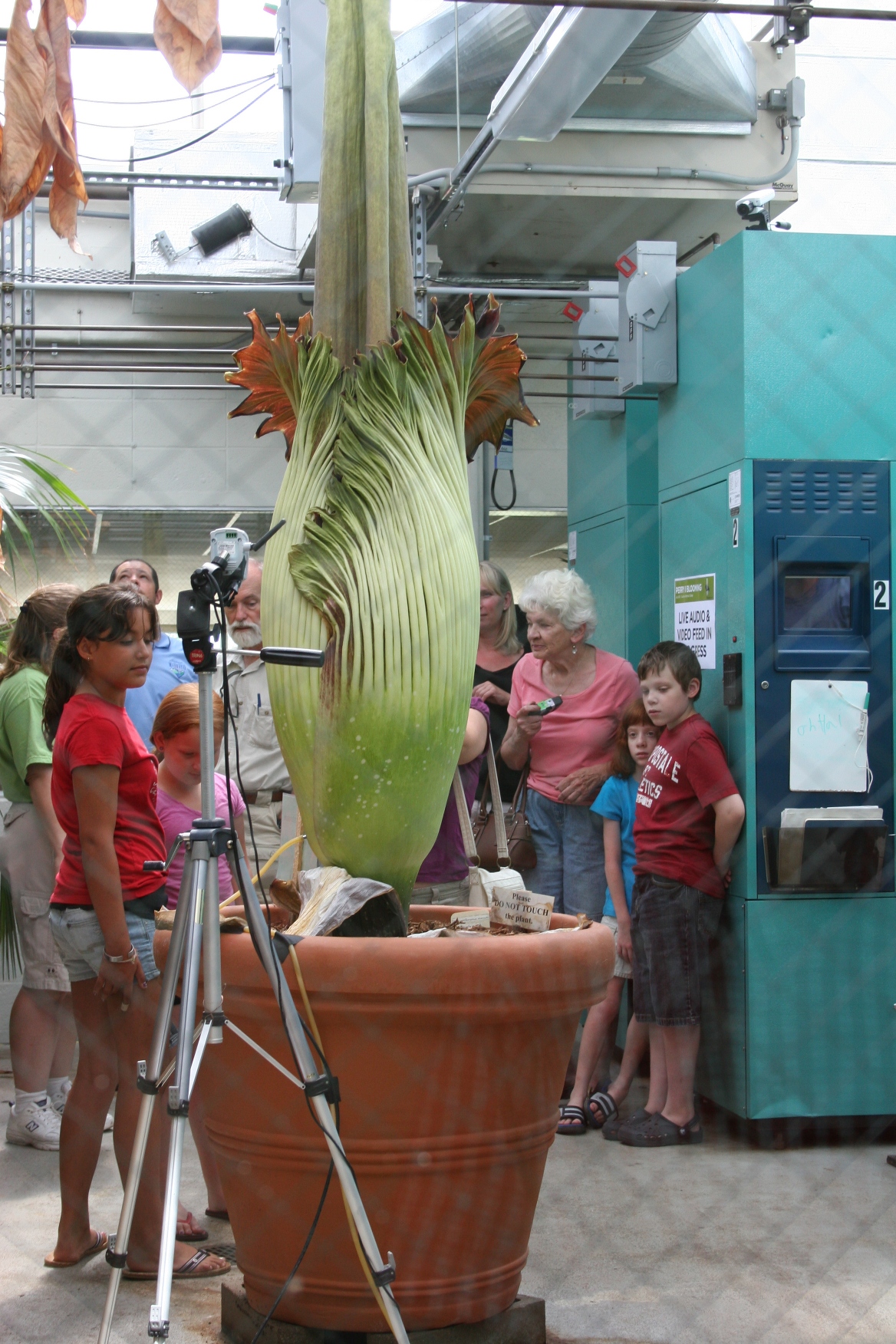
I shot this image through a window in the viewing area of the the greenhouse where the curious gathered to see Perry.
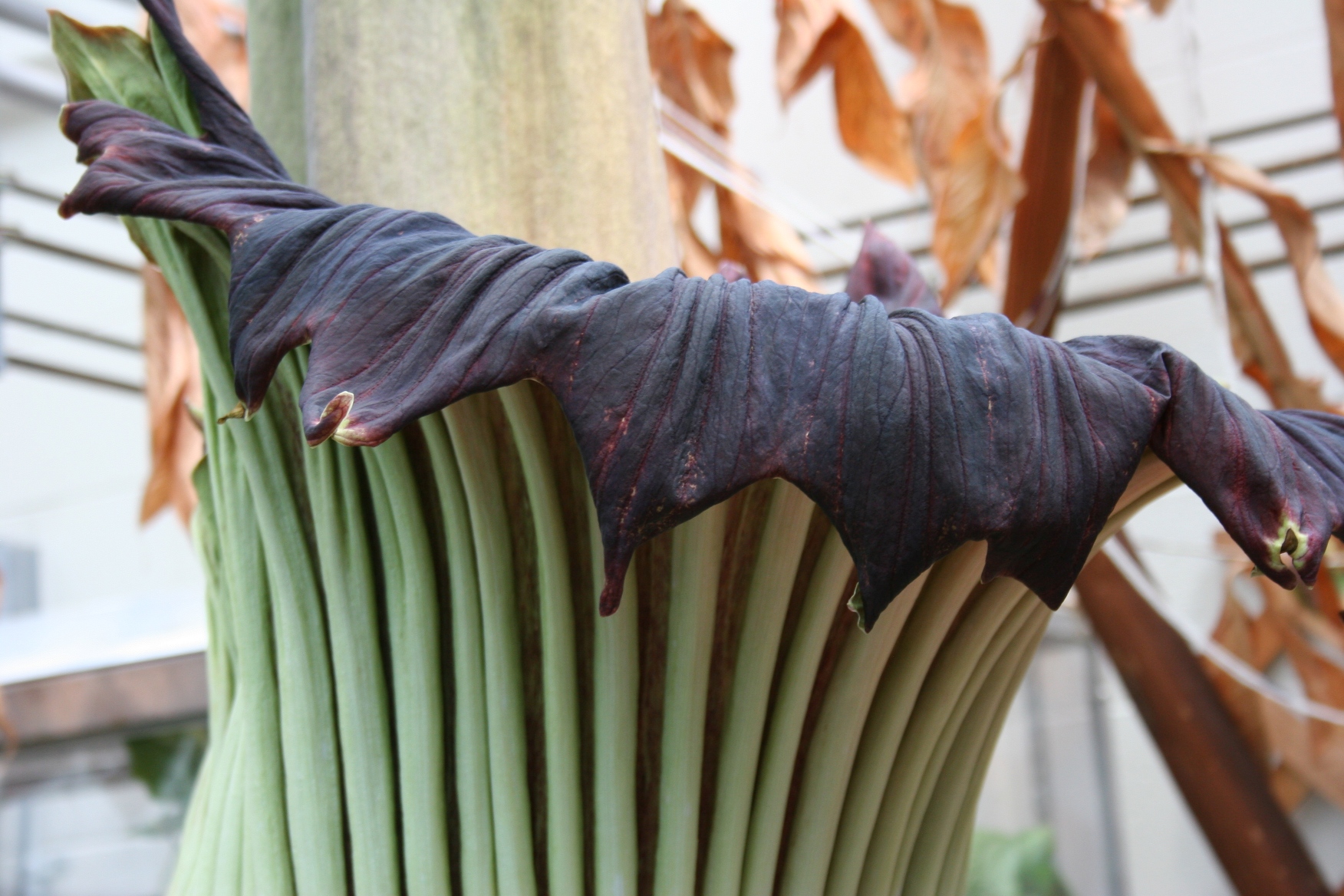
A close-up of Perry's unfolding spathe, an outer purple vase-like sheath.
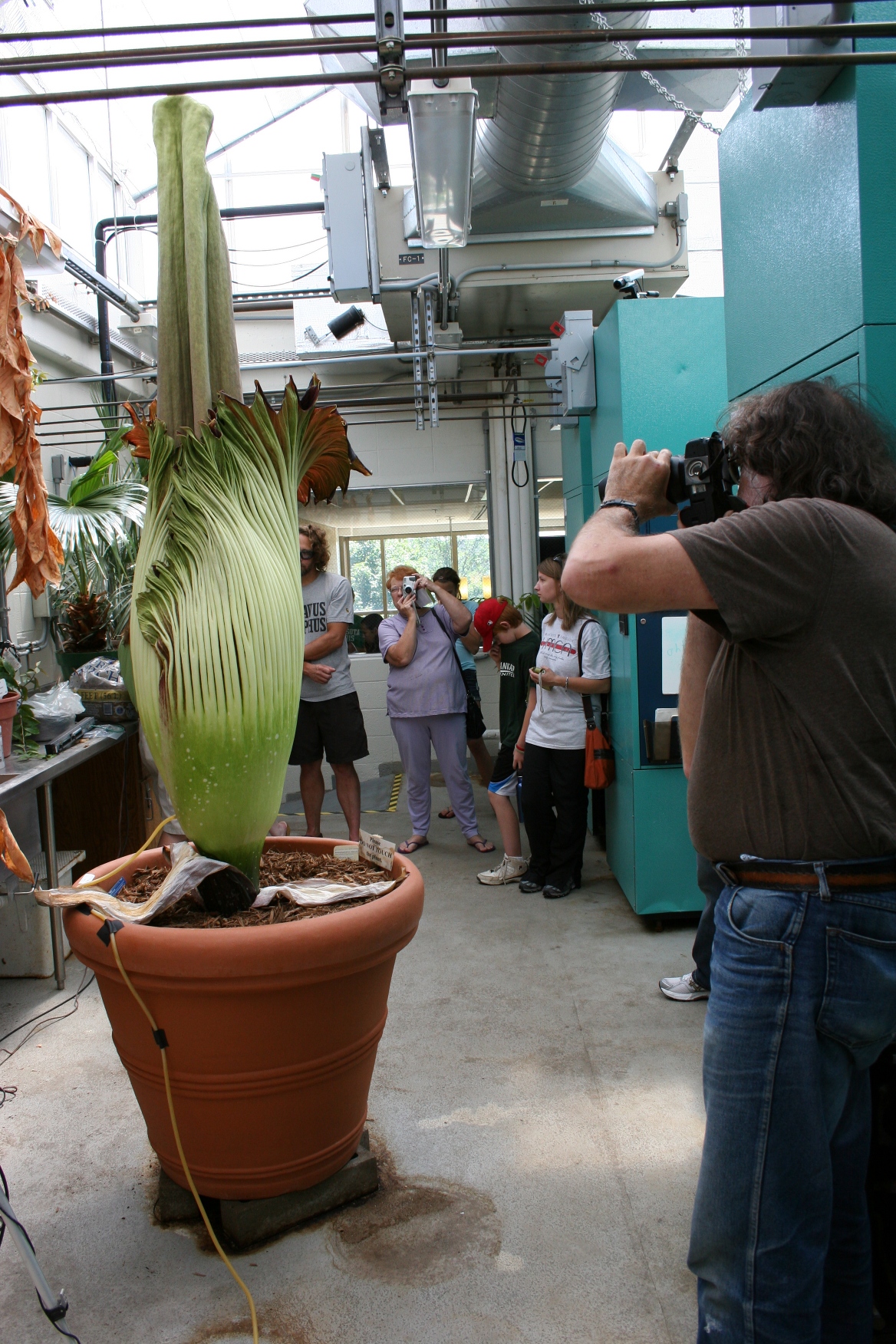
Visitors came with cameras in hand to photograph the rare blooming of Perry, which lasted until Sunday.

A close-up of the sheath that protects the inner tube-like structure called the spadix. The hundreds of small flowers are on the spadix.

A diagram explains the life cycle of "the corpse plant."
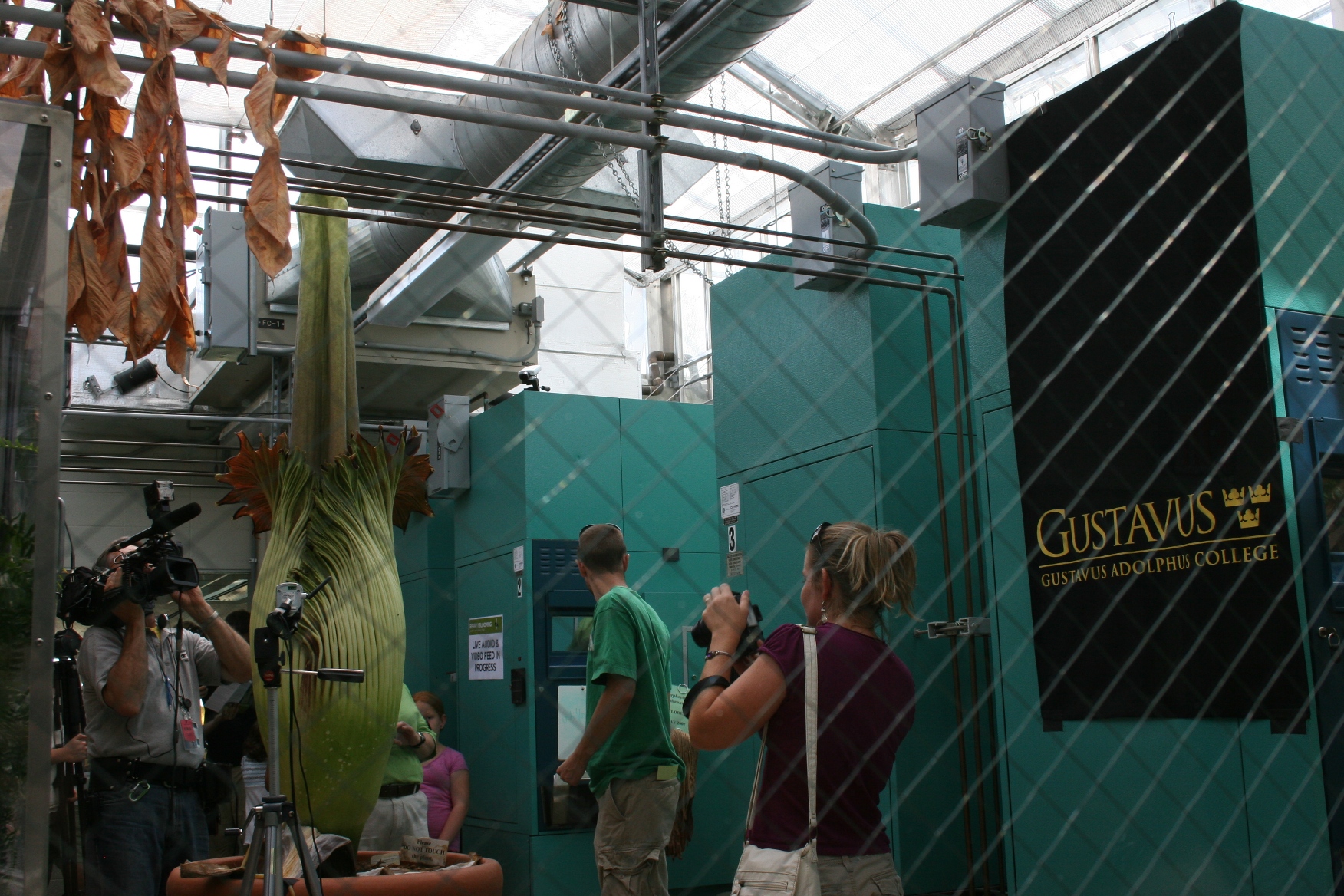
A shot through the window into the viewing area of the titan arum.
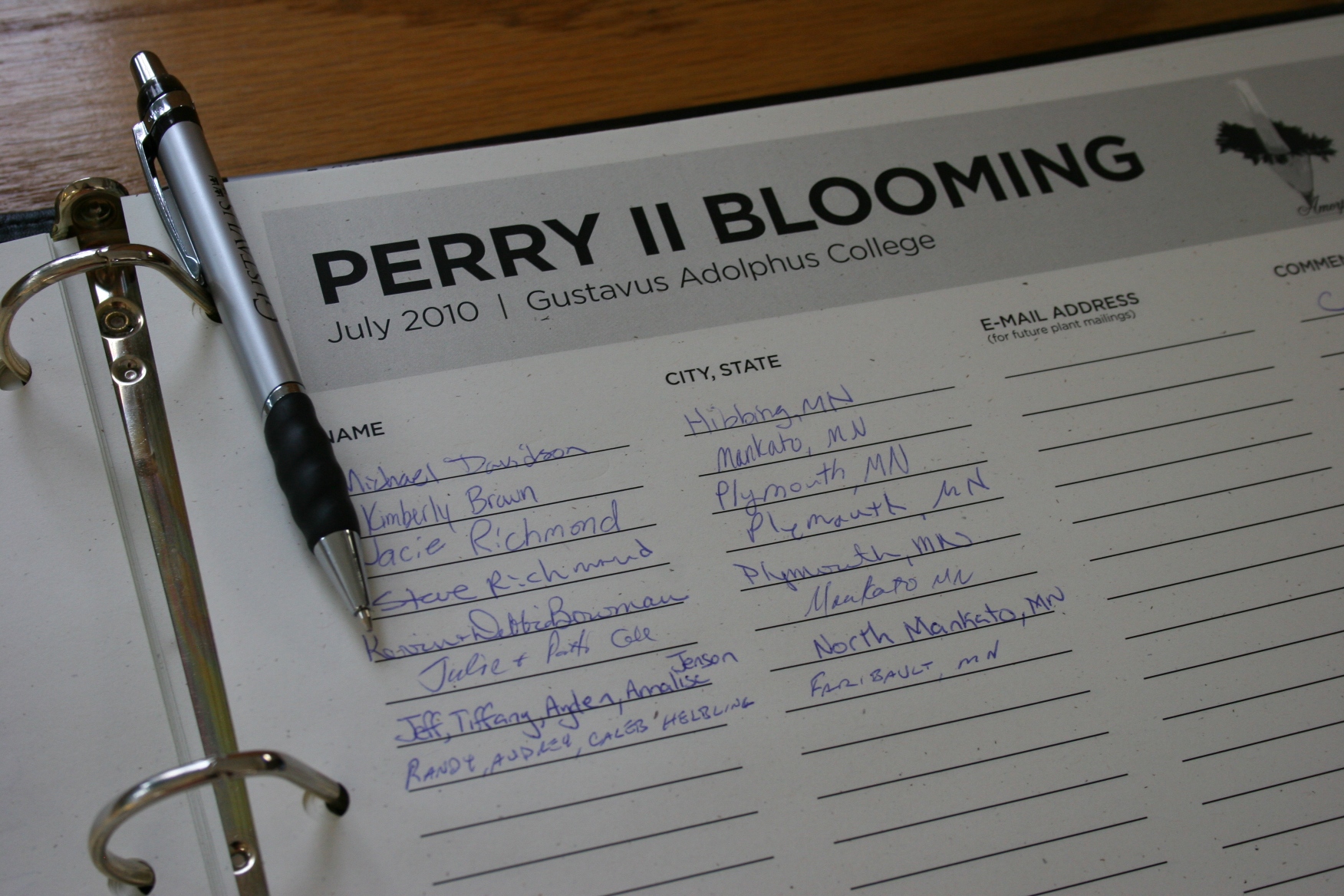
As of noon Friday, most visitors who signed Perry's guestbook came from the St. Peter-Mankato area. However, as word of the blooming spread, visitors were expected from all over--some had already come from Paris and Sweden (they were already visiting in the area). My husband added our names to the guestbook.

© Copyright 2010 Audrey Kletscher Helbling


The surprising connection between a Minnesota church and the James-Younger Gang July 21, 2010

Filed under: Uncategorized — Audrey Kletscher Helbling @ 10:30 AM
Tags: , , , , ,

WHEN MY HUSBAND AND I EMBARKED on a quest for an old country church Sunday afternoon, we fully expected a challenge. But we didn’t expect to cross paths with a bunch of outlaws.

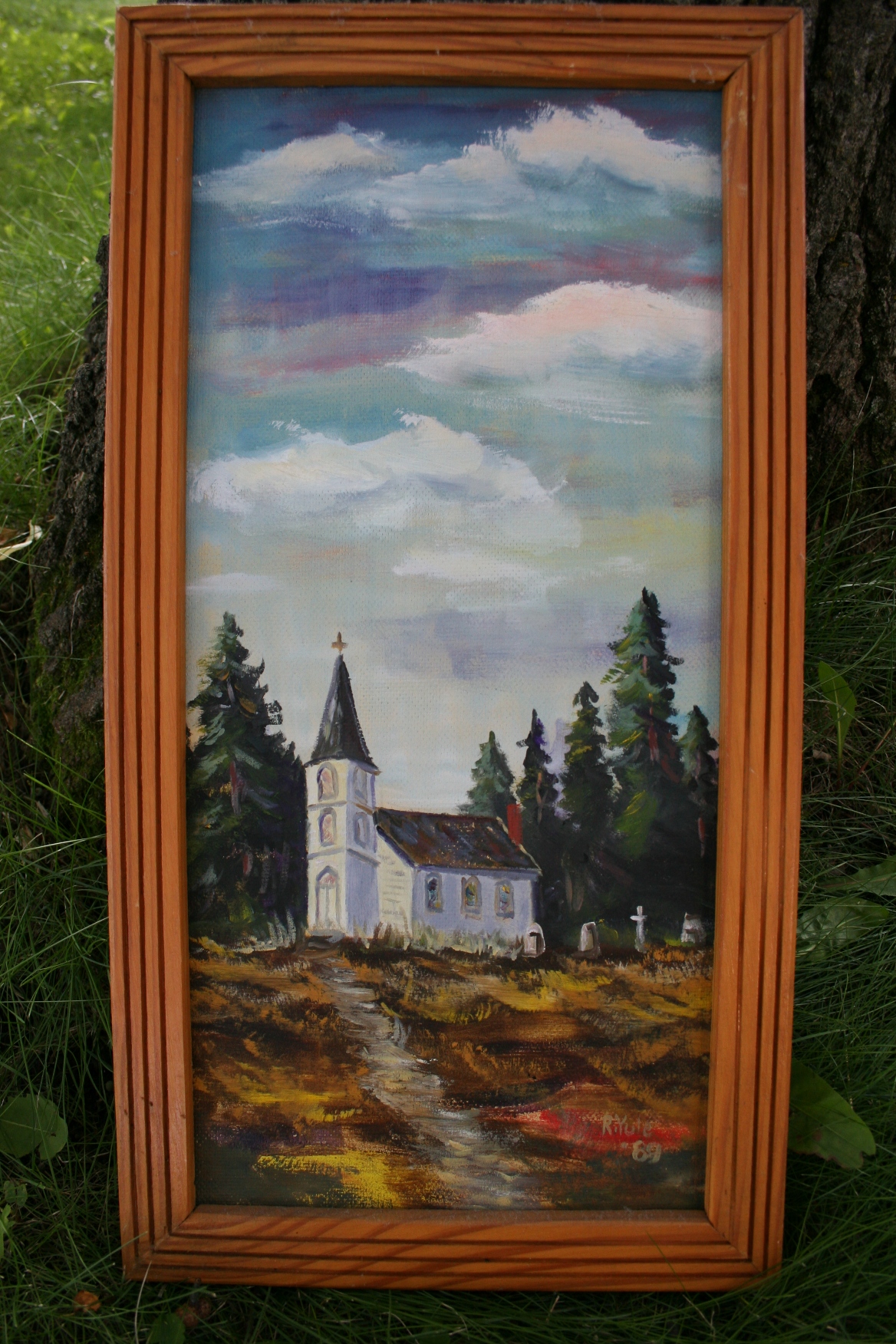
First, a little background: Several days earlier I had photographed a painting of an old Minnesota church done by our 92-year-old artist-friend, Rhody Yule, in 1969. Rhody remembered only that the church was “somewhere near Montgomery” and on the National Register of Historic Places.

I carried a photograph of this 1969 church painting by Faribault artist Rhody Yule as we set out to find the unidentified church.

With those clues, Randy and I set out on our adventure simply because we love the history and beauty of old country churches. We figured if we drove far enough and long enough, we would find this one.

So off we went, following Rice County Road 9 northwest of Faribault, driving around sweeping curves, up and down hills, past farm places, all the while searching for a steeple. I had no clue where we were, which I find unsettling. I like to know where I am and where I am going. But not the husband; he just kept driving.

Soon we approached a lake. Must be Circle Lake, we speculated. We were right. And then, just as we were about to turn onto a gravel road leading to the public access, I saw a white church high on a hill. “There’s a church!” I shouted. “I bet that’s it.”

Right then and there, I wanted to drive up to that church. But first things first. We had to stop at the lake. A quick stop and we were off to the church, which sits two miles west of Millersburg (not Montgomery) along Rice County Road 1 near its intersection with County Road 9.

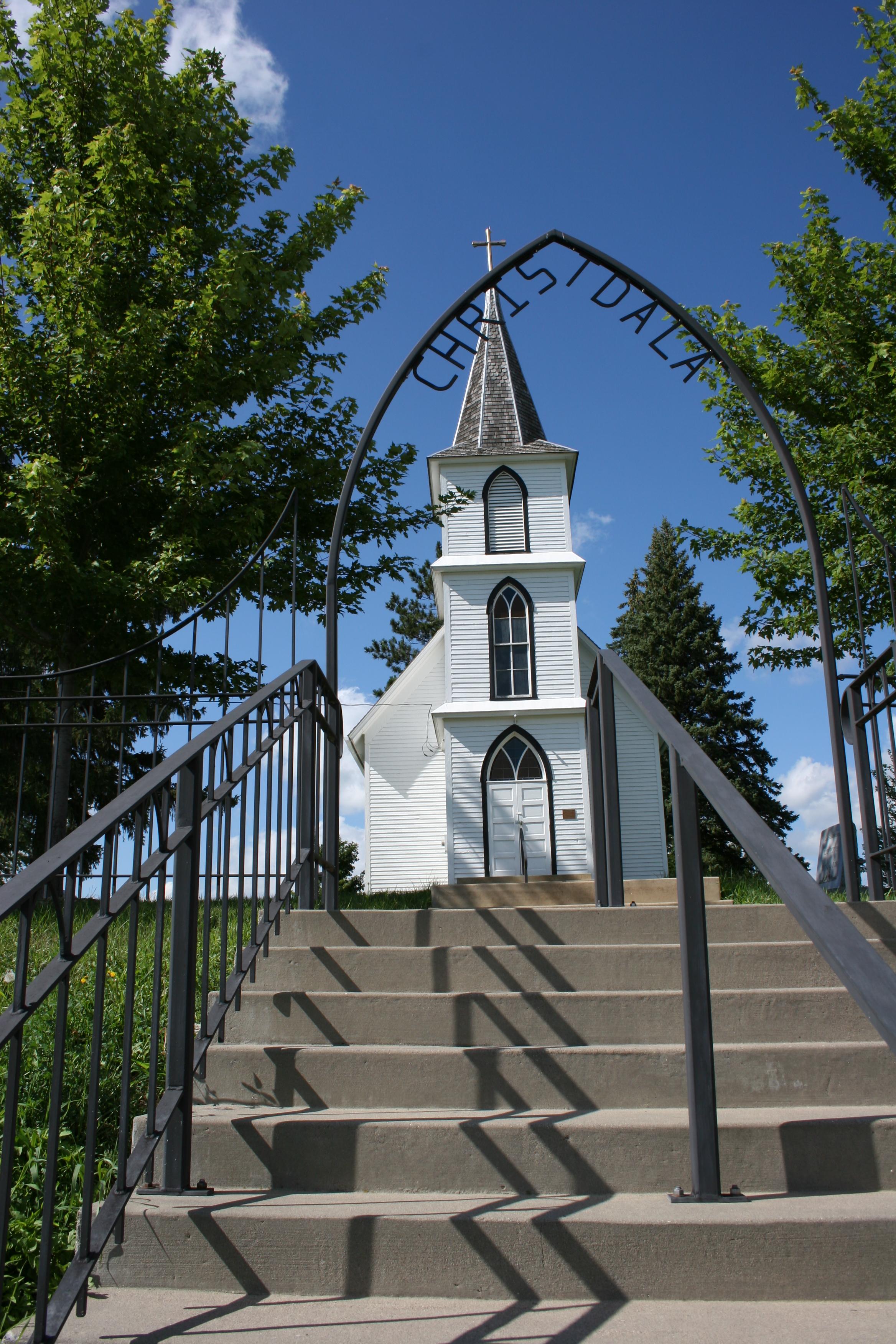
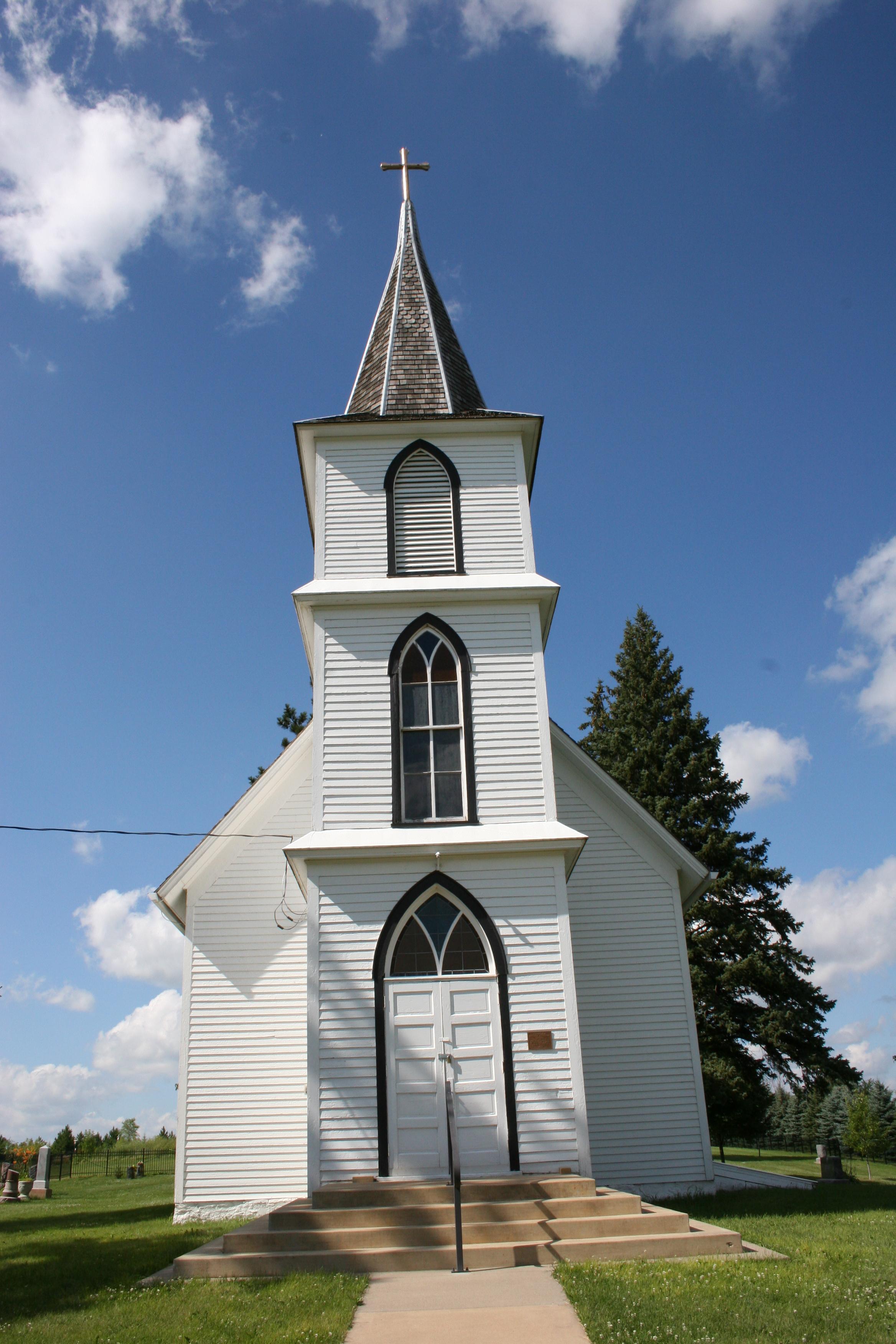
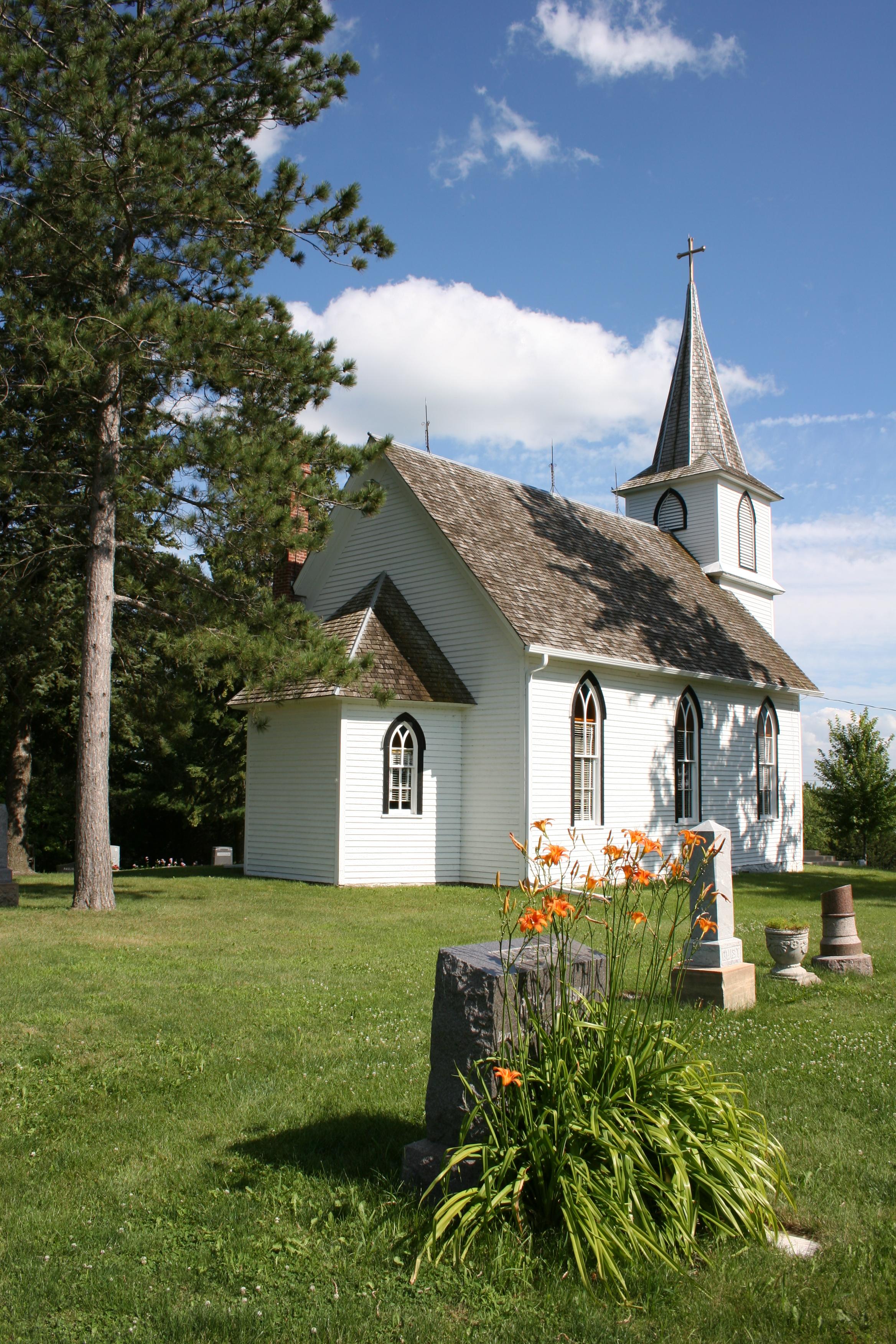
Our excitement was palpable as we pulled off the road and parked below the church. I grabbed the picture and compared the painting to the building before me. It was a match. We had found Christdala Swedish Lutheran Church, built in 1878, placed on the National Register of Historic Places in 1995 and today preserved through the Christdala Church Presevation & Cemetery Association.

Christdala Swedish Lutheran Church sits atop a hill along Rice County Road 1 just west of Millersburg.

Some 25 steps later and we reached the top of the hill, standing before this simple country church overlooking Circle Lake.

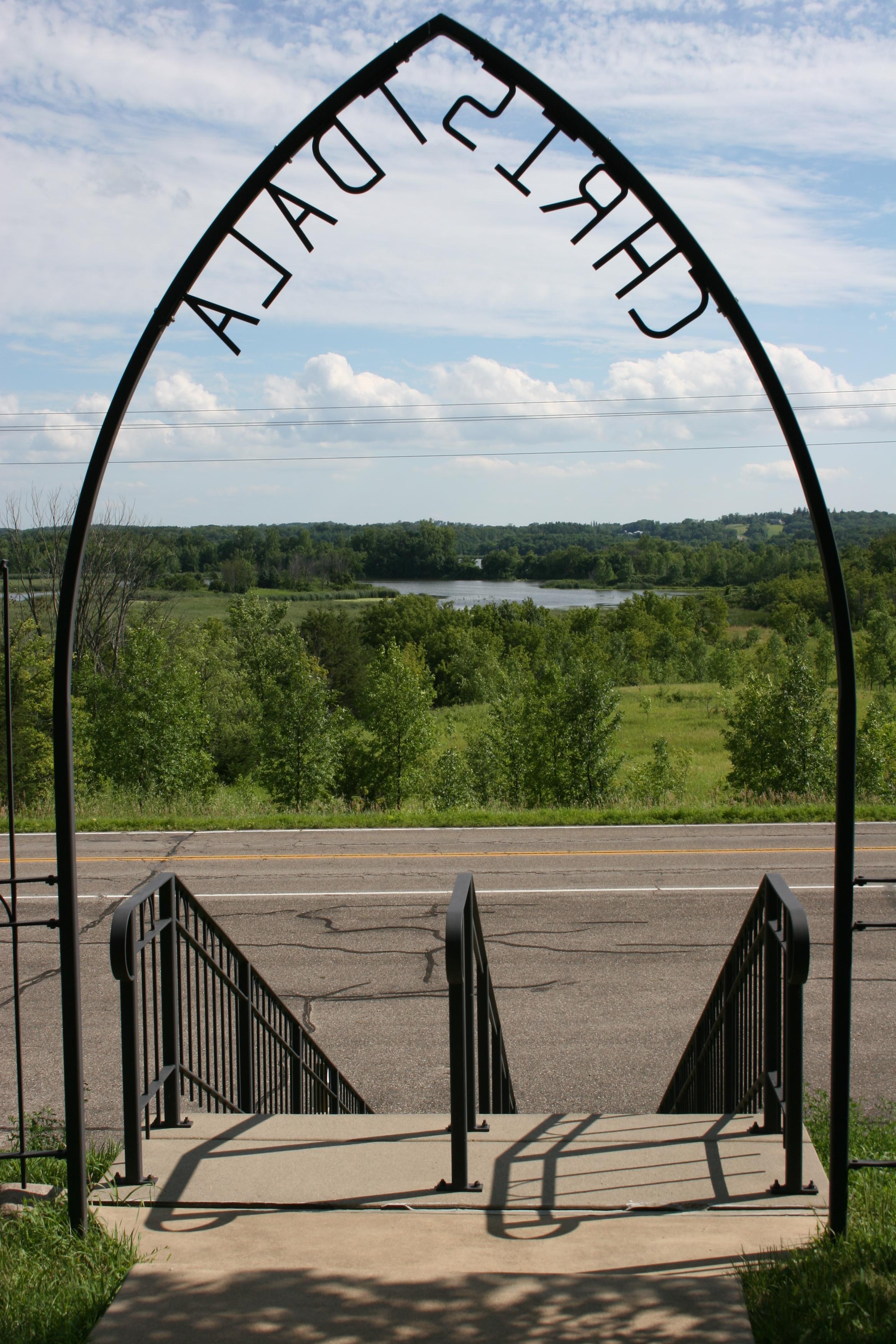
An archway at the top of the church steps frames Circle Lake and the surrounding countryside. Christdala means "Christ's Valley."

Christdala Swedish Lutheran Church, built for $230 in 1878 by John Olson and John Lundberg of Northfield and site of a fall service and open house.

And that’s where we met Phil, who was photographing Christdala and old tombstones. “Can we get inside?” I ask, hopeful that perhaps this stranger has a key. “Are you from around here?”

No and no. Phil is from California, but is president of Le Center-based ShetkaStone, a company that makes tables, countertops, moldings, office furniture and more from recycled paper. When he’s in Minnesota (which is often), this Californian explores old country churches and cemeteries in the home-away-from-home state he has grown to love.  You don’t find this kind of history in California, he says.

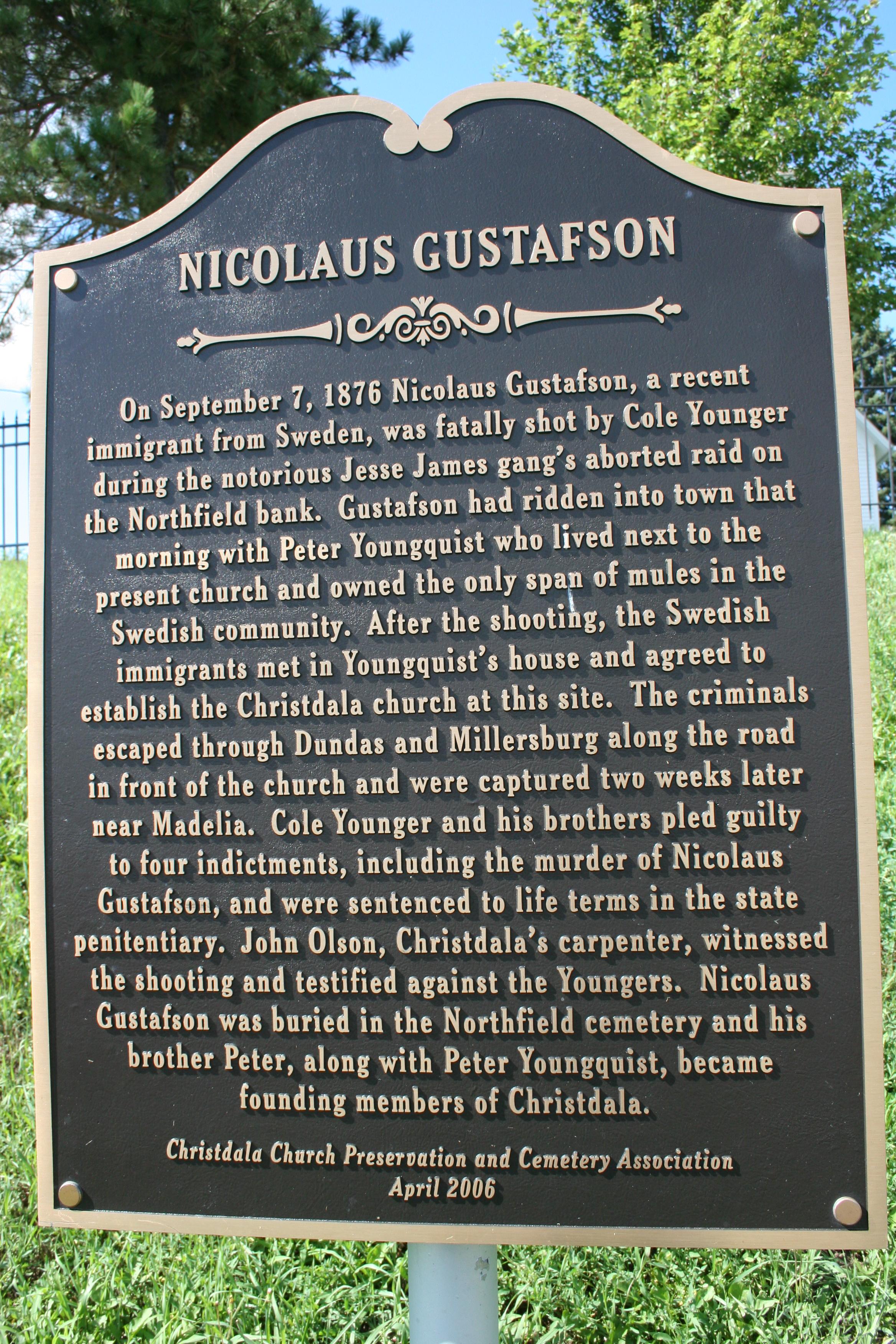
We are kindred spirits—the three of us—standing here on a sunny summer Sunday afternoon admiring this 132-year-old church with an intriguing connection to the Sept. 7, 1876 robbery of the First National Bank of Northfield by the notorious James-Younger Gang.

Swedish immigrants built Christdala after one of their own, Nicolaus Gustafson, who had traveled to Northfield on the morning of the bank robbery, was fatally shot by Cole Younger. Because the Millersburg Swedish community had no church or cemetery, Gustafson was buried in Northfield. After his death, the Swedes immediately began formulating plans for their own church and burial place, forming a congregation in July 1877 and constructing a house of worship in 1878.

Today Christdala, which dissolved as a congregation in 1966 due to declining membership, stands as a strong testament to those determined Swedes. They turned the tragic death of their friend, their neighbor, into something positive. Good triumphs over evil. Perhaps it is no coincidence that this church was built beside, and above, the road used as an escape route by the notorious outlaws.

All of this I consider while walking among the tombstones—of the Youngquists, the Swansons, the Paulsons and, yes, even the Gustafsons.

A sign at the church details the historical connection to the 1876 Northfield bank raid by the James-Younger Gang.

A cemetery surrounds Christdala Swedish Lutheran Church near Millersburg.

An honorary star in the Christdala cemetery denotes a soldier as a veteran of the Indian War.

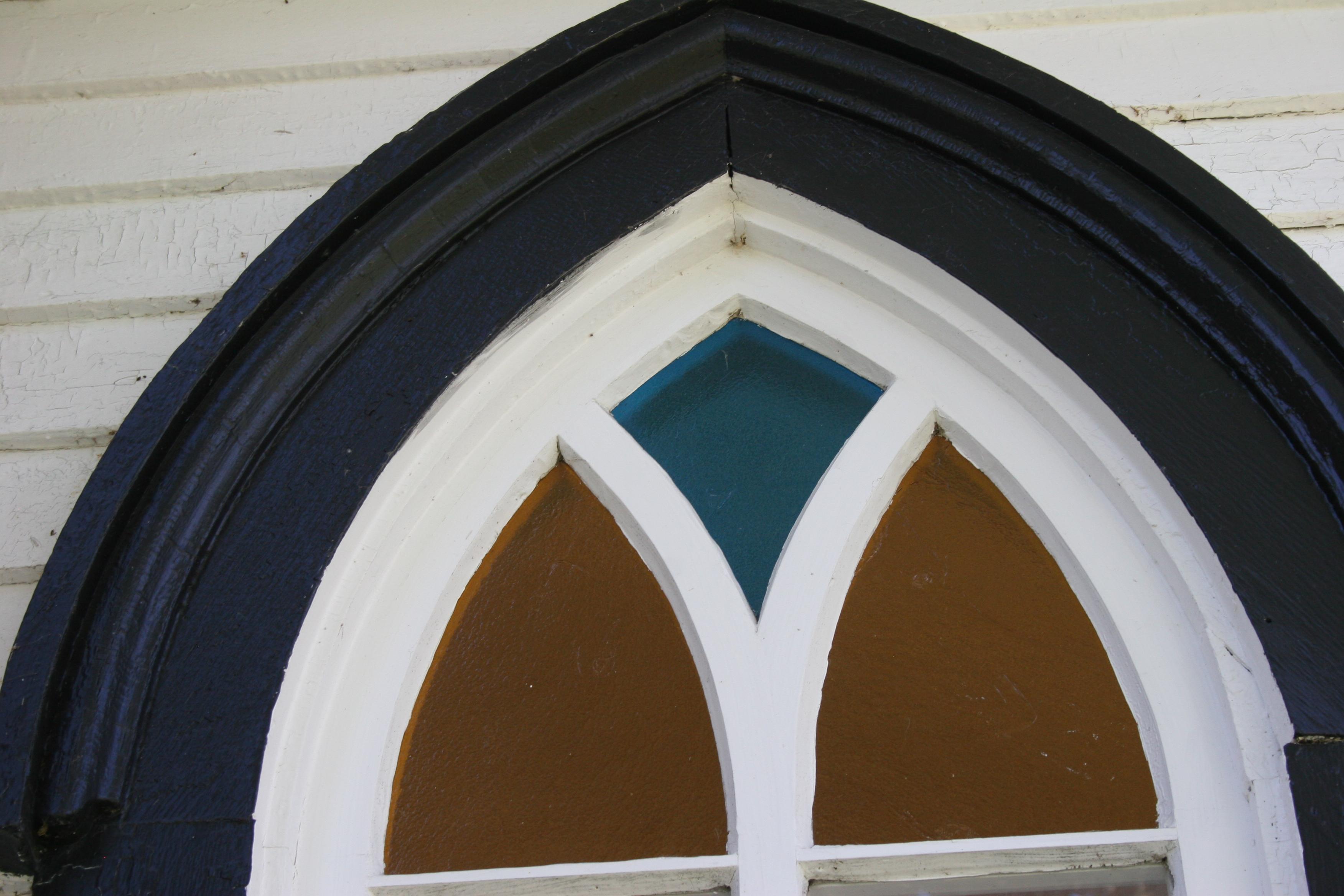
The exterior stained glass top of a Christdala window.

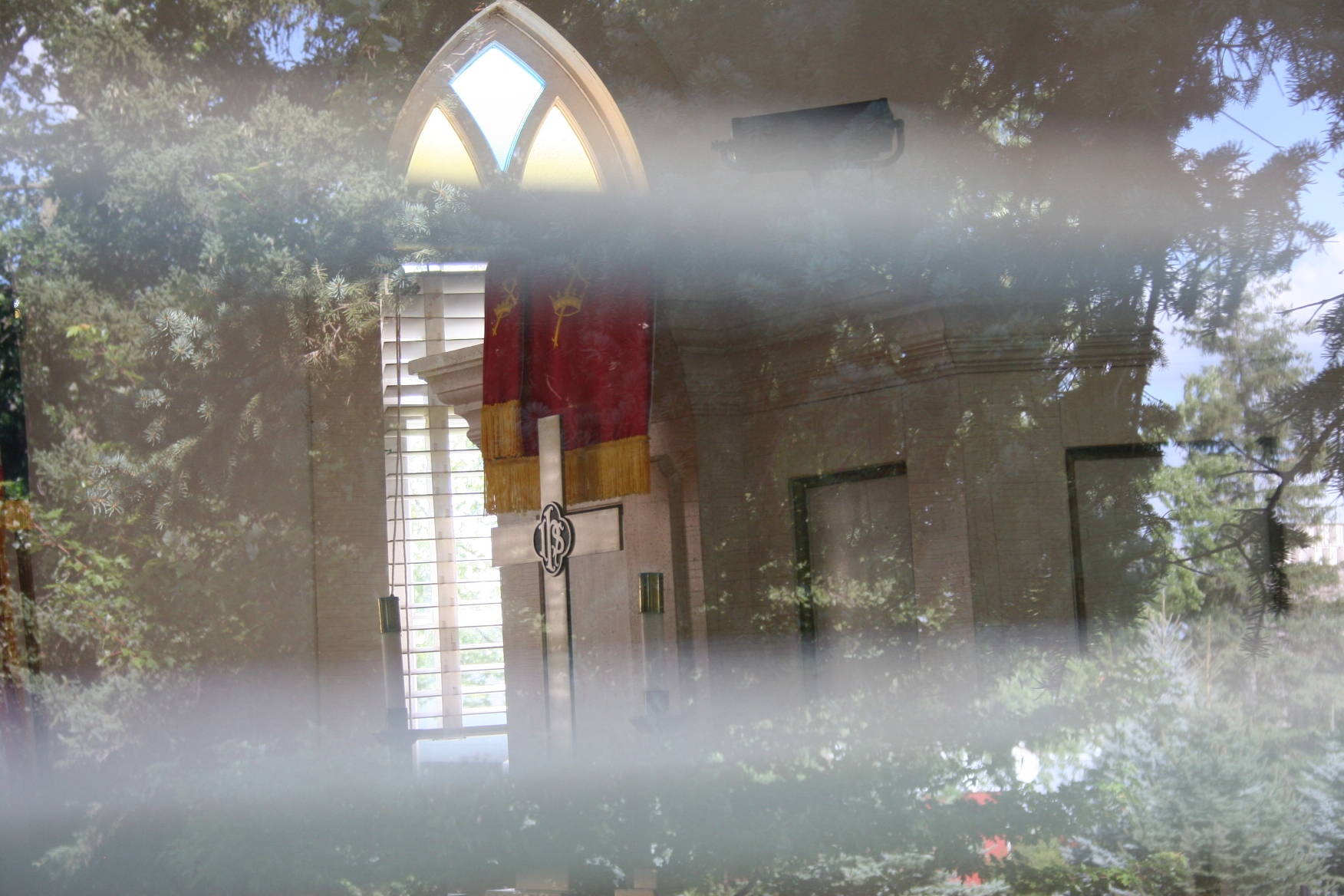
Because the church was locked, I had to settle for peering through the blinds at the altar, which sits in front of the pulpit. The cross rests on the altar. I'll have to return for the annual autumn worship service and open house.

© Copyright 2010 Audrey Kletscher Helbling
 

Memories of toiling in the Minnesota cornfields July 20, 2010

Filed under: Uncategorized — Audrey Kletscher Helbling @ 7:17 AM
Tags: , , , ,

WHAT’S THE WORST SUMMER JOB you’ve ever worked?

For me, the response to that question practically flies off my tongue. Detasseling corn ranks, hands down, as the worst job I’ve ever held, beating out picking rock and walking beans by acres.

Here’s a scenario of how that part-time summer position played out for me back in the early 1970s in southwestern Minnesota: Rise early to catch a school bus. Bounce along bumpy gravel roads with a bus full of other sleepy teenagers to the edge of a cornfield. Slide on a rain coat. Then begin your day’s work, stretching on your tiptoes to pull tassels from corn stalks.

Rows and rows of corn stretch across acres and acres of land under the hot summer sky.

Dew slides down your arm. Rough corn leaves scratch across every inch of exposed skin. You itch. You sweat. You hurry up. Sometimes you bend low to the earth to snap sucker plants that leech onto the main corn stalk. Your back aches. Your muscles scream.

And then, when you have to urinate, you squat between corn rows and hope no one is watching. Forget toilet paper, unless you’ve stashed some in your pants pocket.

As the sun moves higher in the sky, heat and humidity rise. You shrug off the raincoat. Your skin burns. (Who’s heard of sunscreen?) Sweat trickles down your face, burning your eyes. You sweat and sweat some more.

Come noon, you’re thankful for a break in the shade-tree oasis of a farm yard (if you’re lucky) or in the shade of the school bus. You grab your Styrofoam cooler, remove the cover with grimy hands, unscrew the lid of a quart jar and lift the glass to your lips, gulping Kool-Aid like a thirsty camel.

Hungry from all that physical labor, you wolf down a sandwich, inhale chips, nearly consume an entire apple in several bites.

Then it’s back to the corn for a few more hours of reaching and yanking. The oppressive afternoon heat blasts like a furnace, smothers your breath, sucks away your energy. Your feet drag. Your mind screams: How much longer must I tread this land, pull these tassels, endure this misery?

By 3:00, you are bone-weary, exhausted, thankful that your supervisor has finally hollered, “This is the last round.” You are finished, for the day, with the tug-of-war you’ve played with the corn.

You join the line of subdued teens climbing onto the bus, bodies weighted with lead-heavy weariness.

Tomorrow you’ll return to the farm fields to fight the corn again, all for $1.25 an hour.

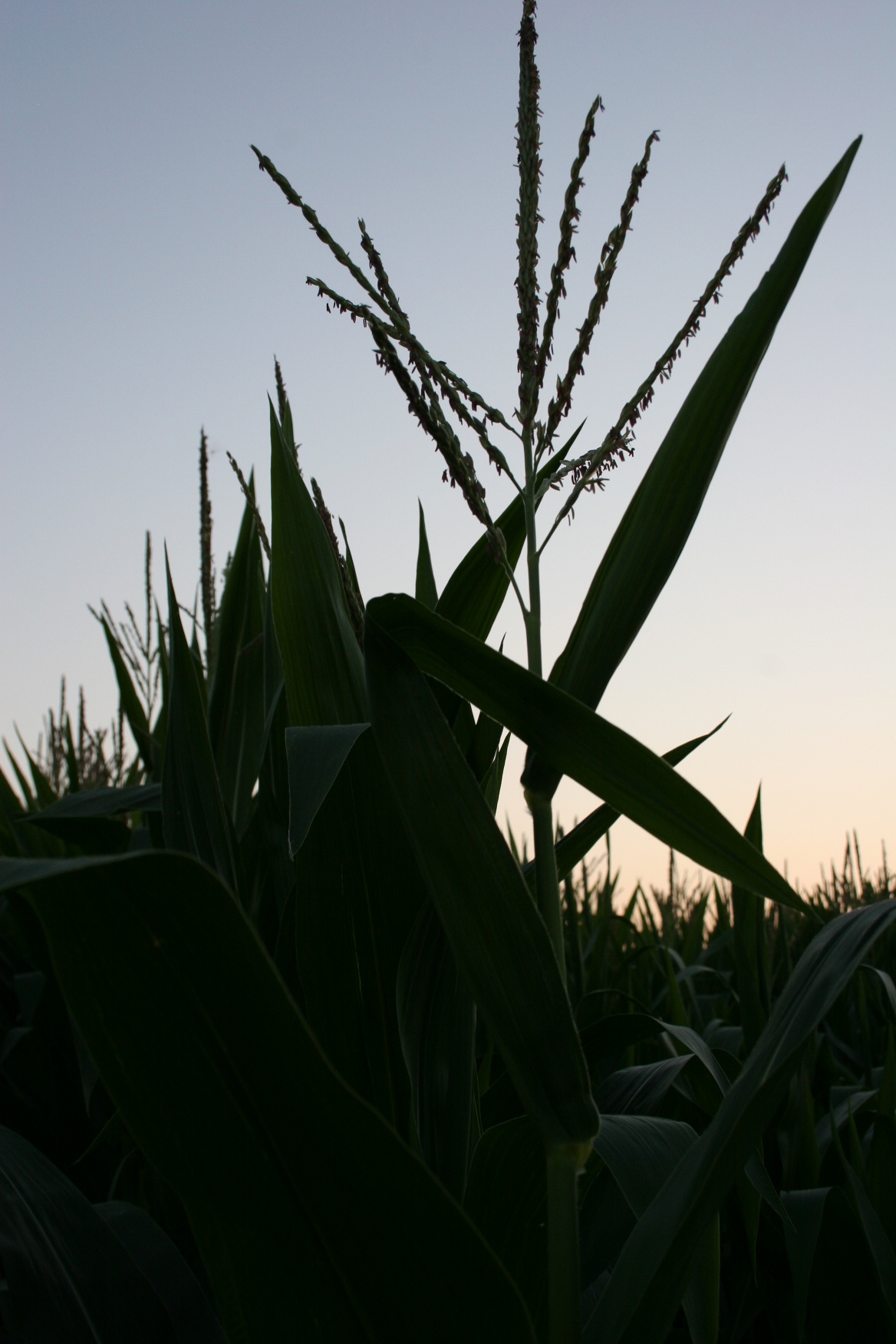
In the setting sun, a corn tassel stretches high above the corn plant.

JUST A NOTE: Working conditions in cornfields have improved dramatically since the 1970s. Today detasselers ride machines (I’m pretty sure), have access to bathrooms and certainly earn more than $1.25 an hour.

If you have a worst summer job story, submit a comment and tell Minnesota Prairie Roots readers about your experience.

© Copyright 2010 Audrey Kletscher Helbling
 

A family of the faithful at Moland Lutheran Church July 11, 2010

Filed under: Uncategorized — Audrey Kletscher Helbling @ 12:12 PM
Tags: , , , ,

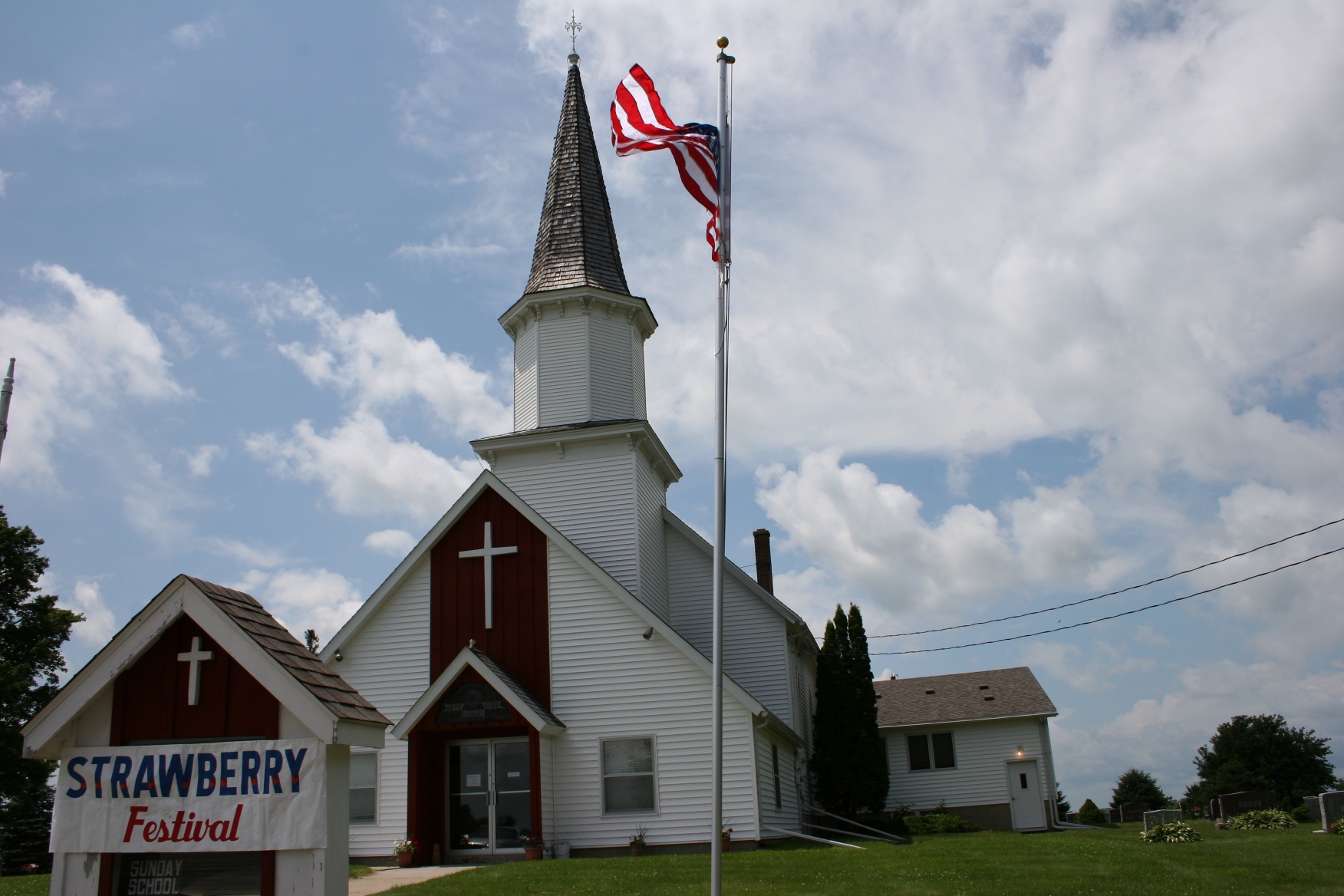
Moland Lutheran Church, rural Kenyon, Steele County, Minnesota.

IF YOU LOOK BEYOND the pews, the altar, and the stained glass windows, if you listen beyond the music and the sermon and the scripture readings, you will find, within a church, a family.

Here’s what I mean. Recently while photographing an old country church in southeastern Minnesota, I began to notice the personal touches that made me feel welcome, like I had stepped inside someone’s home.

Yes, women greeted me at Moland Lutheran Church during the congregation’s annual Strawberry Festival. But no one showed me around. I simply meandered on my own, with my camera, absorbing my surroundings. And that’s what I prefer.

Perhaps because I’m a writer and a photographer, I take note of my environment more than an ordinary person. I am drawn to that which others might simply pass by.

But rather than try to explain all of this to you, I’ll show you the discoveries I made inside and outside this 1884 Norwegian Lutheran church, the discoveries that led me to a family of the faithful.

I photographed a section of a long photo showing Moland church members gathered for the congregation's 50th anniversary celebration in 1930. The image hangs just outside the nave.

The Henry Underdahl family gifted a memorial stained glass window to the Moland Lutheran Church. Such memorials are a common way to honor family members and their legacy of faith.

I discovered this service roll in the narthex listing congregational members called to serve their country. I found this especially touching. Perhaps congregations should revive this public way of honoring those in the military.

Even after family members have departed this life, their memories are as close as the graves that surround Moland Lutheran. I imagine that many of the early members who filled the pews here also worked the land.

FOR MORE INFORMATION and photos of Moland Lutheran Church, please check my previous posts, “They serve the best food in Minnesota church basements” (posted July 1) and “In praise of preserving country churches” (posted July 7).

© Copyright 2010 Audrey Kletscher Helbling
 

In praise of preserving country churches July 7, 2010

Filed under: Uncategorized — Audrey Kletscher Helbling @ 7:16 AM
Tags: , , , , ,

Moland Lutheran Church, a Norwegian Lutheran church south of Kenyon.

ONLY IN RECENT YEARS have I begun to truly appreciate the old churches that dot the Minnesota landscape, their steeples rising heavenward directing the faithful to worship.

Whenever the opportunity arises these days, I slip inside these reverent rural respites to reflect upon the holiness that resides therein. The more churches I visit, the more I am convinced of the necessity to preserve these houses of worship for future generations.

Not only do I treasure the sacred aspect of their existence—rooted deep in the faith of immigrants who settled this land—but I also value the art and the history woven into the very fabric of these buildings.

Whether in stenciled ceilings, hand-carved pulpits, worn floorboards, hand-hewn pews, religious paintings or stained glass windows, I see care, craftsmanship, devotion to God everywhere.

I am inspired and uplifted simply stepping inside the doors of a country church.

Join me on this tour of the 1884 Moland Lutheran Church south of Kenyon in rural Steele County and see for yourself why old country churches like this are worth appreciating, and preserving.

Looking into the sanctuary of Moland Lutheran Church.

Fine craftsmanship is reflected in the handcrafted pulpit, altar and railing.

Art in the details of the Moland pulpit.

The altar painting was transported to the church by horse-drawn wagon from Faribault in 1893. A. Pederson painted this image of "Christ with outstretched arms" based on Matthew 11: 28 - 30 ("Come to me, all you who are weary and burdened, and I will give you rest...").

Norwegian words (I think from Matthew 11) are painted on the altar.

Beautiful details on the bottom of Moland's altar remind me of the altar in the church I attended as a child, St. John's Lutheran in Vesta. Sadly that church was not preserved and is today an apartment building.

© Copyright 2010 Audrey Kletscher Helbling
(Check back for additional Moland Lutheran Church photos to be posted on Minnesota Prairie Roots.)


American pride shines at the Stars & Stripes Garage in small-town Minnesota July 2, 2010

Filed under: Uncategorized — Audrey Kletscher Helbling @ 7:08 AM
Tags: , , , , ,

YOU DON’T RUN ACROSS MEN like Joel and Louie Kukacka every day. These guys—father and son—are darned proud to be Americans, proud enough to publicly parade their patriotism.

Drive through the tiny Le Sueur County burg of Heidelberg and you’ll find a smattering of houses, St. Scholastica Catholic Church and a bar. And next to that bar, you can’t miss the Stars & Stripes Garage owned by Joel Kukacka.

Painted red, white and blue and adorned with stars and a front-and-center American flag from the Harvestore silo company, this garage shouts American pride.

There’s nothing artificial about this outward display of patriotism. Joel and Louie really are as true-blue patriotic American as they come.

Several months ago I met the pair while working on a magazine feature article. They immediately impress me as men who possess a strong, independent spirit. If the word “redneck” didn’t have such negative connotations, I might even label them as such. Or I may even tag them as “mavericks,” but then I’ve got that whole Sarah Palin connection going and I’m not sure they would appreciate the tie.

So let’s just call Joel and Louie independent and patriotic small-town American businessmen.

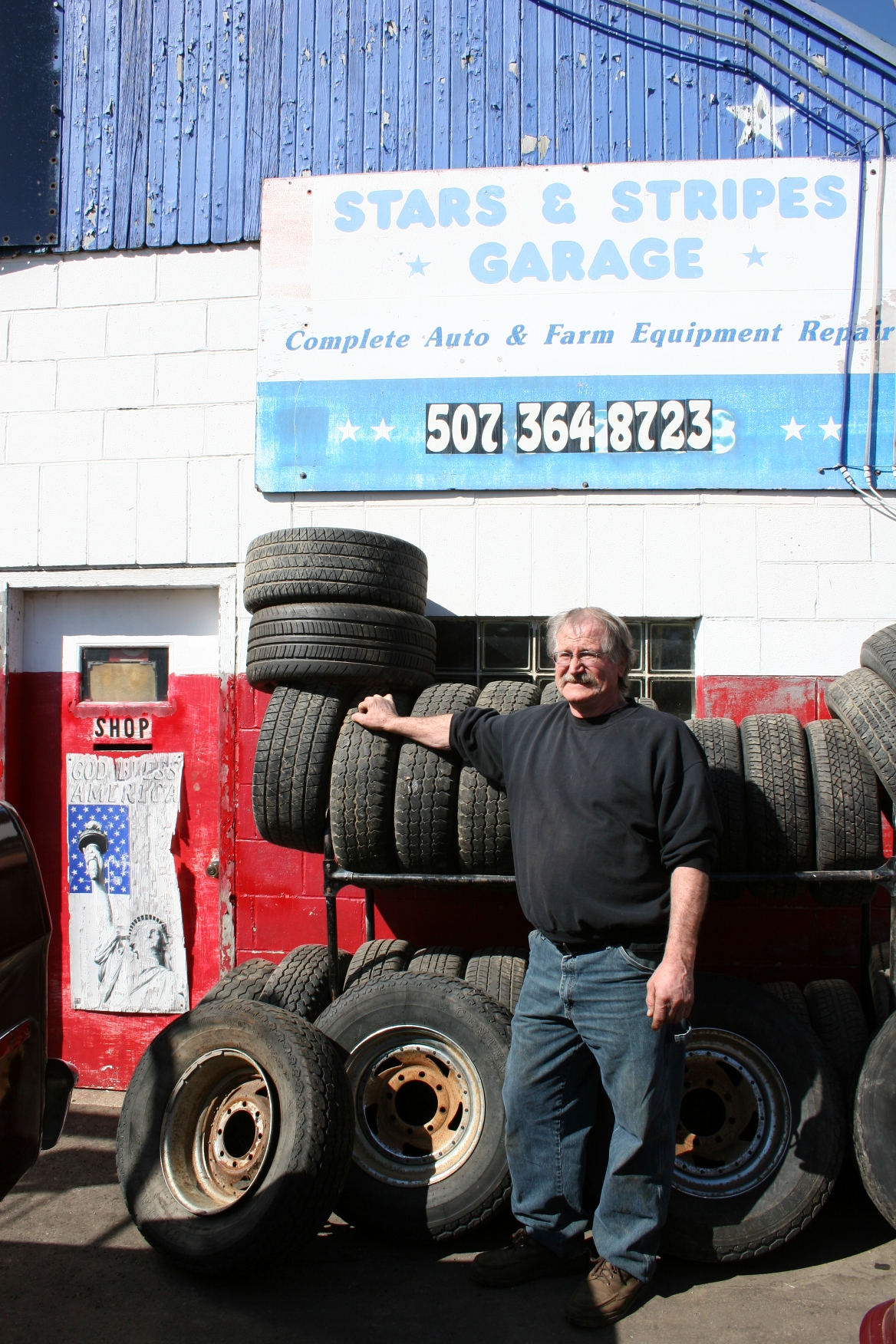
Joel Kukacka outside his Stars & Stripes Garage in tiny Heidelberg.

Joel, who is 59 and a Vietnam War era veteran (he served in Germany and not Nam) opened his auto and farm equipment repair shop in 1980. The “Stars & Stripes” moniker seems a good fit given his military service, his affinity for eagles (including the $18 eagle tattoo he got in Germany) and his preference for American-made products.

As Louie, 33, tells it, for awhile his dad refused to buy anything that wasn’t made in the U.S.A. You simply have to admire someone with that level of American loyalty. But, Louie concedes, eventually Joel had no choice but to buy foreign-made goods.

Get Louie going, and his feisty attitude emerges. It’s clear to me that Joel, who is pretty quiet, has raised a strong boy not afraid to speak his mind. About those eagles his dad loves, well, “they represent independence and freedom, what this country used to be,” the younger Kukacka says.

Not wanting to get into a heated political discussion, I don’t ask Louie to expand on “what this country used to be,” although I’m certain he would give me an earful about government programs and subsidies and a whole list of other issues.

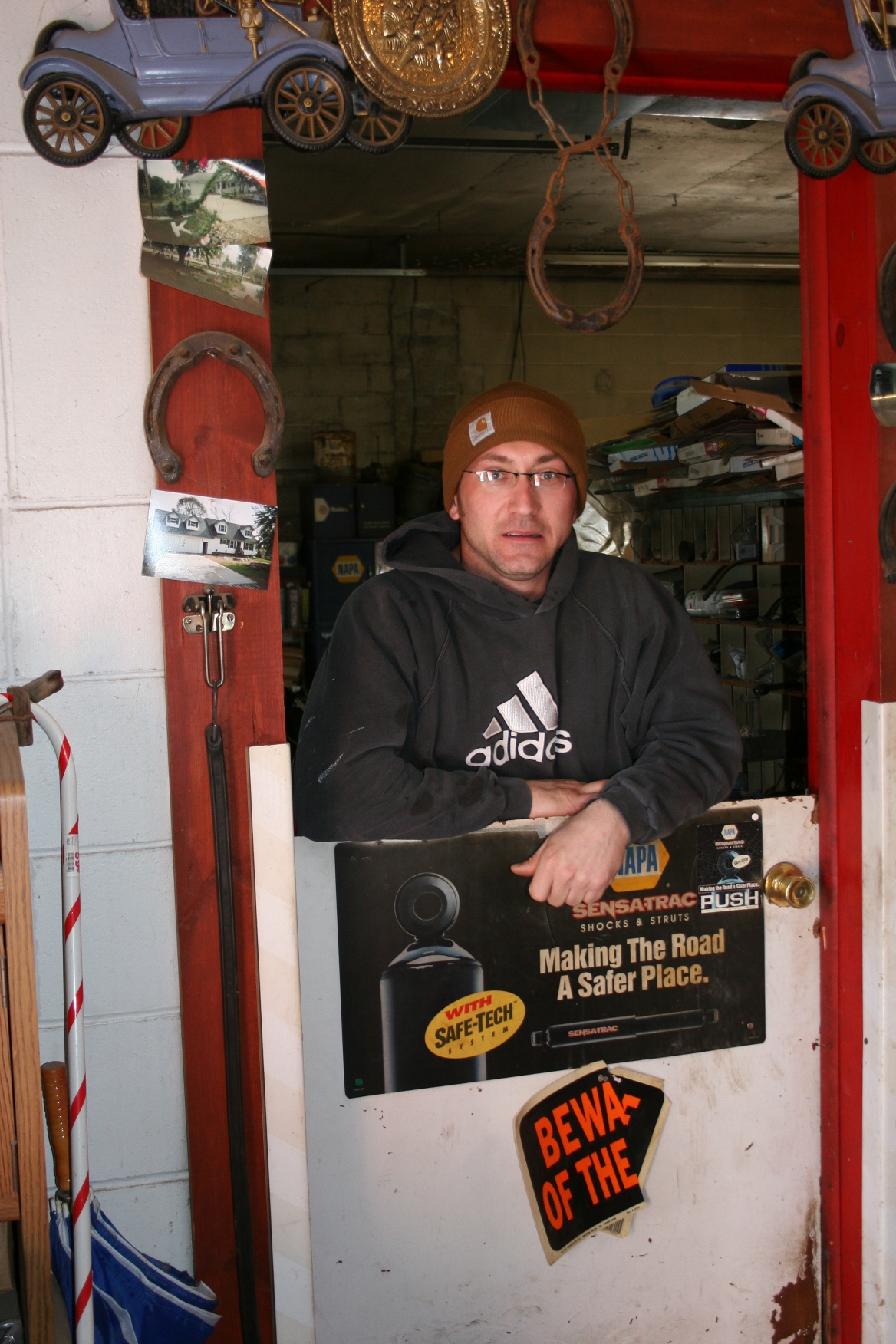
Louie Kukacka, leaning on the half-door between the garage bay and the office, speaks his mind about America and independent businessmen.

“He’s somebody that takes pride in their work,” Louie says of his dad. “That’s America, what we’re here for.”

Louie praises the independent businessmen (versus the big companies) who work long, hard hours to make a living. Joel and Louie openly admit, though, that surviving in rural Minnesota, and in the current depressed economy, isn’t always easy. During slow times, they supplement their income by collecting and selling scrap metal. These are, indeed, self-sustaining men who don’t mind getting a little dirt under their fingernails.

I admire their entrepreneurial spirits and their positive attitudes. They seem entirely content to live and work in Heidelberg, which, according to the 2000 U.S. census, has a population of only 72. Most Minnesotans likely never have driven through this off-the-beaten path town. But anyone who has traveled this section of Le Sueur County Road 30 will remember that patriotically-painted garage.

Louie is especially proud that his nearly 3–year-old daughter, Brigid, spends time in the garage and is already learning to work a wrench, getting covered head-to-toe, he says, in garage grime.

Already, I can imagine Brigid as a strong, independent woman, influenced by her outspoken father and by her Vietnam War era grandfather—a man who loves eagles, displays a photo of former Minnesota Governor Jesse Venture in his office and operates the red, white and blue Stars & Stripes Garage in the American burg with the German name.

© Copyright 2010 Audrey Kletscher Helbling
 

They serve the best food in Minnesota church basements July 1, 2010

Filed under: Uncategorized — Audrey Kletscher Helbling @ 7:36 AM
Tags: , , , ,

FOR ALL OF YOU FOODIES out there, here’s a little secret. Some of Minnesota’s best down-home food is served in church basements.

Whether a chicken and ham dinner, an annual lutefisk meal, a soup supper or simply an old-fashioned ice cream social, the faithful serve up some mighty heavenly culinary delights. I know. I’ve indulged—uh, sinfully overindulged—at plenty of these church-sponsored social events.

Take last Sunday, for example, when my husband and I church-hopped from a worship service at the Old Stone Church along Monkey Valley Road south of Kenyon to Moland Lutheran Church several miles further south and west.

“Are you going to the Strawberry Festival at Moland?” a fellow worshiper asks Randy while I’m off shooting photos of the historic stone church.

Moland Church, near the Dodge, Goodhue, Rice and Steele County lines, held its first Strawberry Festival in 1955.

After hearing this man rave about Moland’s festival and how he never misses a dinner there, Randy and I decide we’re heading south. With the clock ticking toward noon, we’re hungry and tempted to eat of the tasty, unforbidden fruit.

However, I secretly question our decision since we picked nearly 20 pounds of strawberries a day earlier and still have about five pounds sitting on the counter at home. We really don’t need more strawberries.

But the promise of pulled pork sandwiches, and for me the promise of getting inside another old country church, entices us to Moland.

I expect the fest to be held outdoors in tents strategically-placed under towering shade trees. But this church, ringed by a graveyard, stands in the full sun, exposed to the elements.

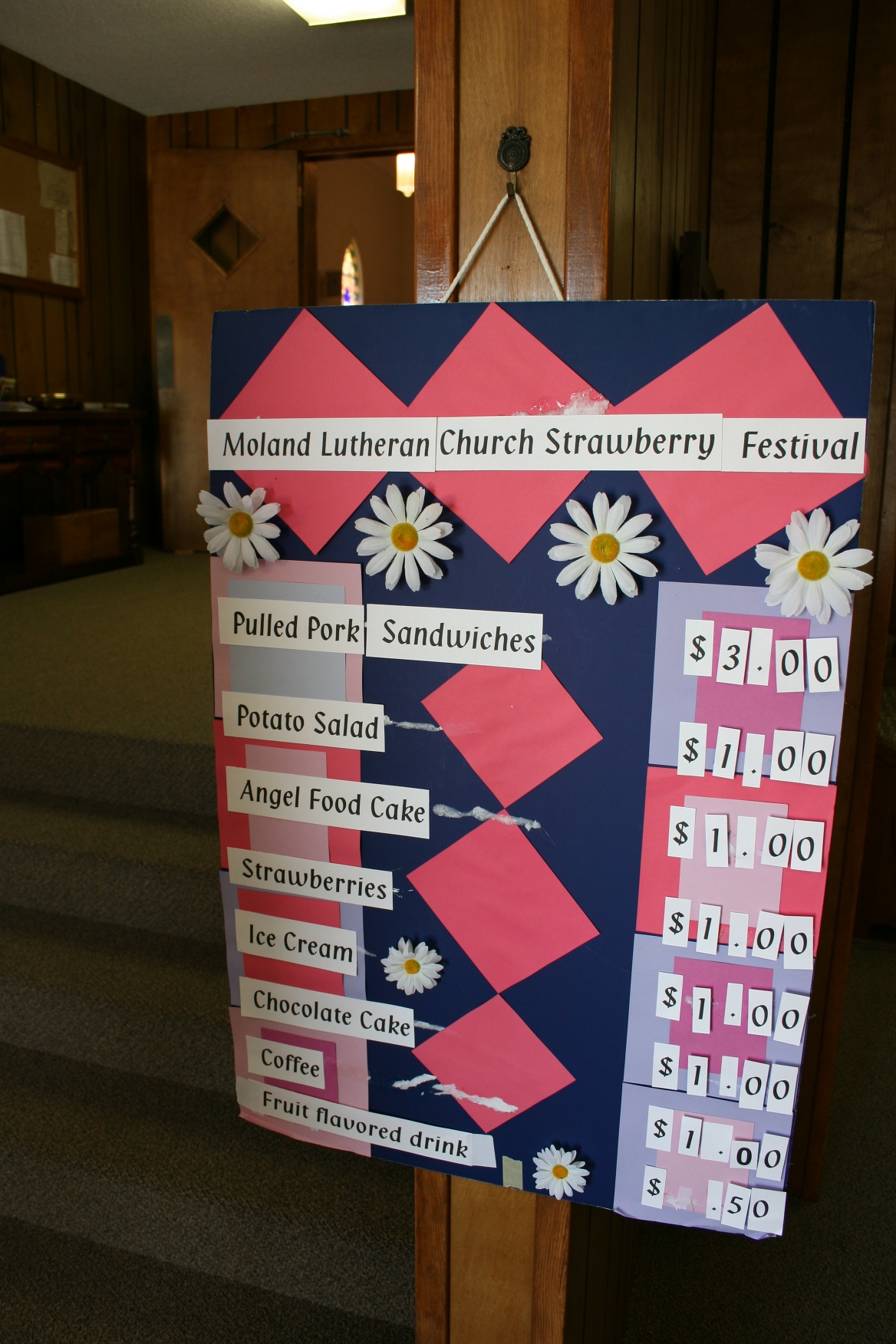
So we head inside, down the narrow stairs to the church basement where tables are crammed together and a serving line awaits us. We both choose a pork sandwich, a generous spoonful of potato salad and two scoops of vanilla ice cream (not homemade; I ask) topped with a mountain of fresh, sliced strawberries.

A sign in the church entry lists the food choices at The Strawberry Festival.

I am surprised at the quantity of strawberries, but shouldn’t be given this is a Strawberry Festival. For $12, we’ve gotten more than enough food to fill our stomachs. The two homemade baby dill pickles I spear onto my plate seal the deal for me.

We weave our way past tables and support posts to a table along the north wall. Despite the din (why is it always so hard to hear in these church basements?), we strike up a conversation with our dining companions, Angie who has driven down from Eagan to visit her aunt and uncle and the aunt and uncle from Owatonna whose names now elude me. They are a cordial trio.

We discuss church dinners, churches, pastors, computers, cursive writing, strawberry picking, diverticulosis (where food gets stuck in pockets of the colon, namely strawberry seeds in the case of the unnamed uncle) and whether it’s OK to eat our strawberries and ice cream before we eat our sandwiches.

We are served a generous amount of strawberries with two scoops of ice cream.

Randy and I agree that sampling our quickly melting ice cream before we finish our savory pulled pork sandwiches is no sin.

Before we part, our new friends make a confession. In a few hours, they’ll drive over to St. John’s Lutheran Church in Claremont for, uh, some strawberry pie.

#

IN A FUTURE POST, I’ll take you on a photographic journey inside Moland Lutheran Church.

© Copyright 2010 Audrey Kletscher Helbling
 

Preserving the past at the Old Stone Church, Kenyon, Minnesota June 29, 2010

Filed under: Uncategorized — Audrey Kletscher Helbling @ 7:41 AM
Tags: , , , ,

As part of the restoration process, the limestone at the Old Stone Church was tuck-pointed. This shows the east side of the 1870s church located along Monkey Valley Road southwest of Kenyon, Minnesota.

I CAN’T PINPOINT specifically when old country churches became a passion for me. But sometime in recent years, I realized that these rural houses of worship and their often adjoining cemeteries reflect a history and art worth appreciating and preserving.

Such is the Old Stone Church built by Norwegian immigrants near Kenyon in the late 1870s and closed in 1902. A committee of four, whom I met at a Sunday morning worship service, is working tirelessly to preserve this historic church and cemetery for future generations. Already, some $100,000 has been invested in tuck-pointing the native limestone, replastering the interior and more.

These people genuinely care about the original gathering place for members of Hauge Free Lutheran Church, which celebrated its 150th anniversary in 2009. The congregation’s current center of worship stands in Kenyon.

“I wanted to see the old Hauge church come back to life,” says Glen Rud, whose Norwegian grandfather walked several miles from town to attend services here. He appreciates the peacefulness of this secluded location in Monkey Valley, where deer and turkeys range. Here, in this place of peace, lies Rud’s burial plot.

Likewise, preservationist Bob Dyrdahl possesses strong ties to this land. He was born in a nearby log cabin. He’s planted trees around the cemetery and with his sisters donated a historical marker. His daughter was married here two years ago.

Such devotion, respect and care for the Old Stone Church impress me.

Sunday morning as I join the descendants of Norwegian immigrants (and others) in prayer and song, I feel the kinship of faithful fellowship. I feel the very presence of those early settlers who sat upon these pews and raised their voices in their mother tongue. Today, more than a century later, this congregation still sings Ja, vi elsker, the Norwegian national anthem, with the conviction of a generation determined to remember their heritage.

A view from the balcony shows the choir seated next to the beautiful altar. The choir director speaks in Norwegian, then translates, "Stand up, that means." And all rise for the Norwegian national anthem.

This Old Stone Church altar intrigues me because I've never seen one similar. I wonder whether The Last Supper painting at the center of the altar is a cherished possession transported by ship from the homeland. I wonder why replica tablets of the 10 Commandments were chosen for the altar. And, finally, I appreciate the inscription of John 3:16 in Norwegian.

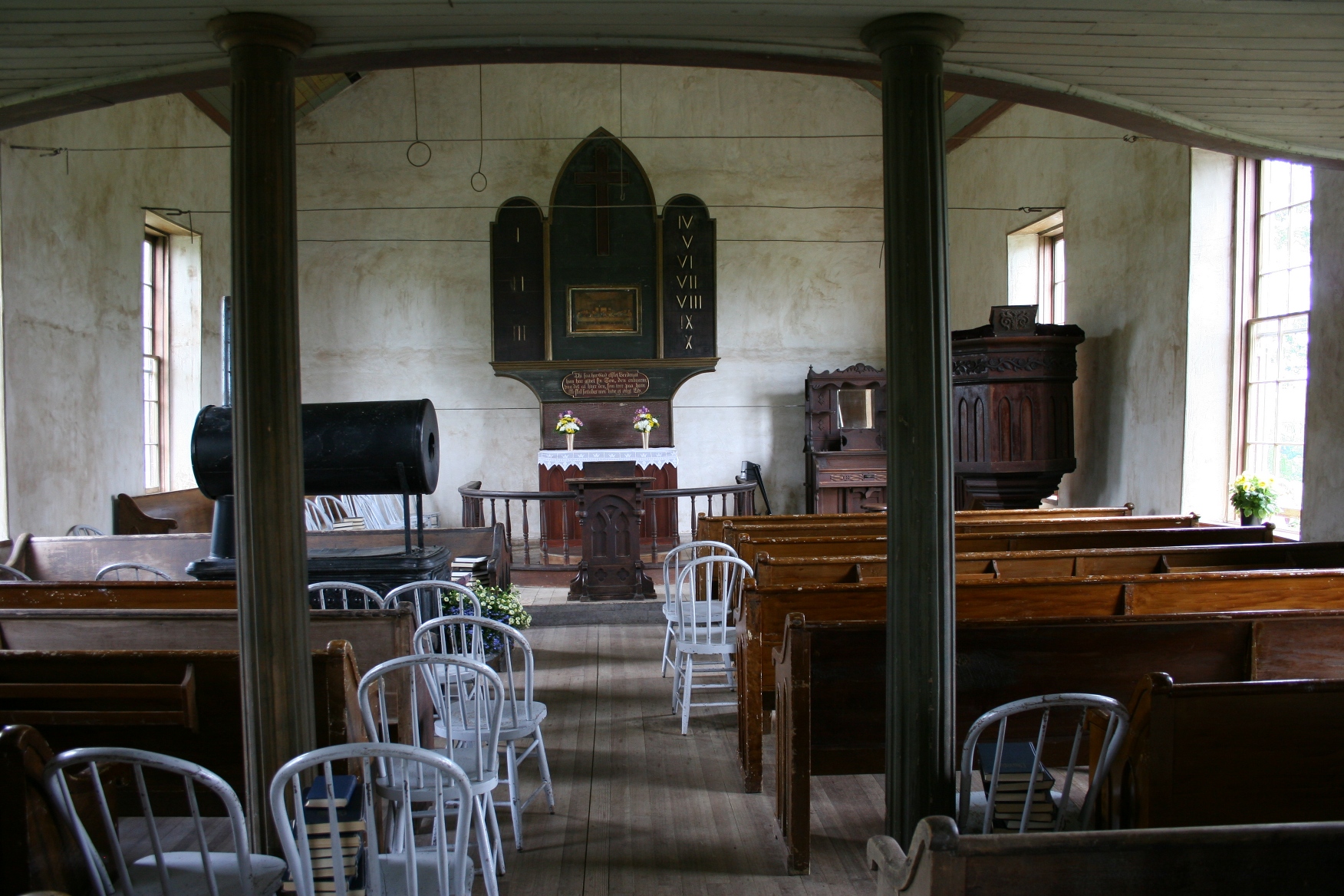
This photo gives a broad view of the sanctuary. I was seated in the chair to the right side of the balcony support post during worship services. As I take in my surroundings, I notice the knots in the back of the pew before me and the floor patched with a section of wood underneath the sandal of the woman seated next to me. And as my left shoulder brushes against the wooden column, I admire the workmanship and craftsmanship that surrounds me.

Bob Dyrdahl explains that the double-sided pew provided a place for mothers to sit with their babies next to the warmth of the wood-burning stove. Such concern, such love, for those early pioneer mothers touches me.

A steep narrow stairway, just inside the church's interior double doors, winds to the balcony. Even here, in this plainness, I can appreciate history and craftsmanship. At the bend in the stairway, is a band of stenciled wood.

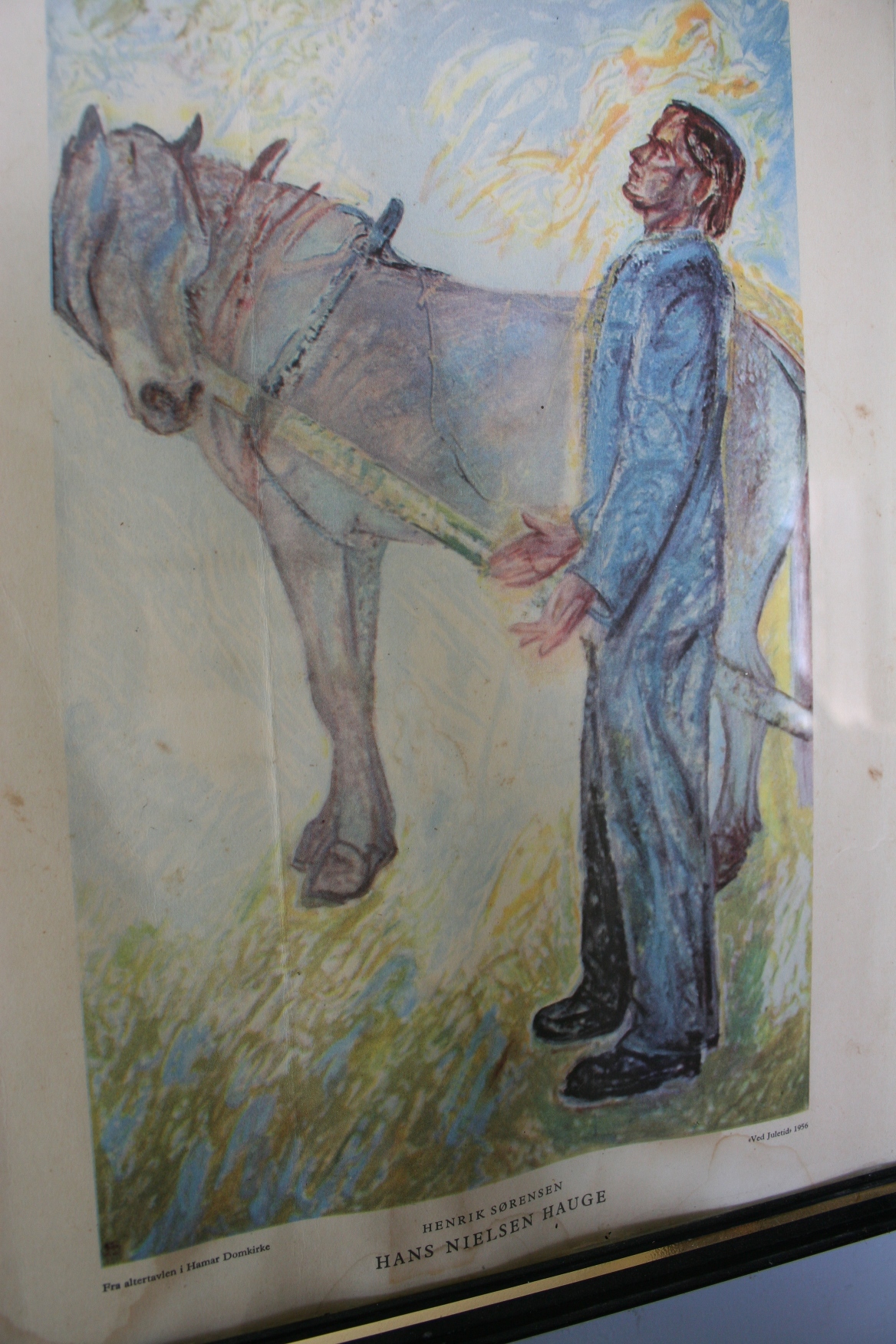
A print of Hans Nielsen Hauge, a 1700s lay leader and reformist in the Lutheran Church of Norway, hangs in the entry of the Old Stone Church. Immigrants honored this lay preacher by naming their church after him. Calling the baptized in the congregation, who have wandered away from the Lord, back to repentance is a common preaching theme among "the Haugeans," current Pastor Martin Horn says.

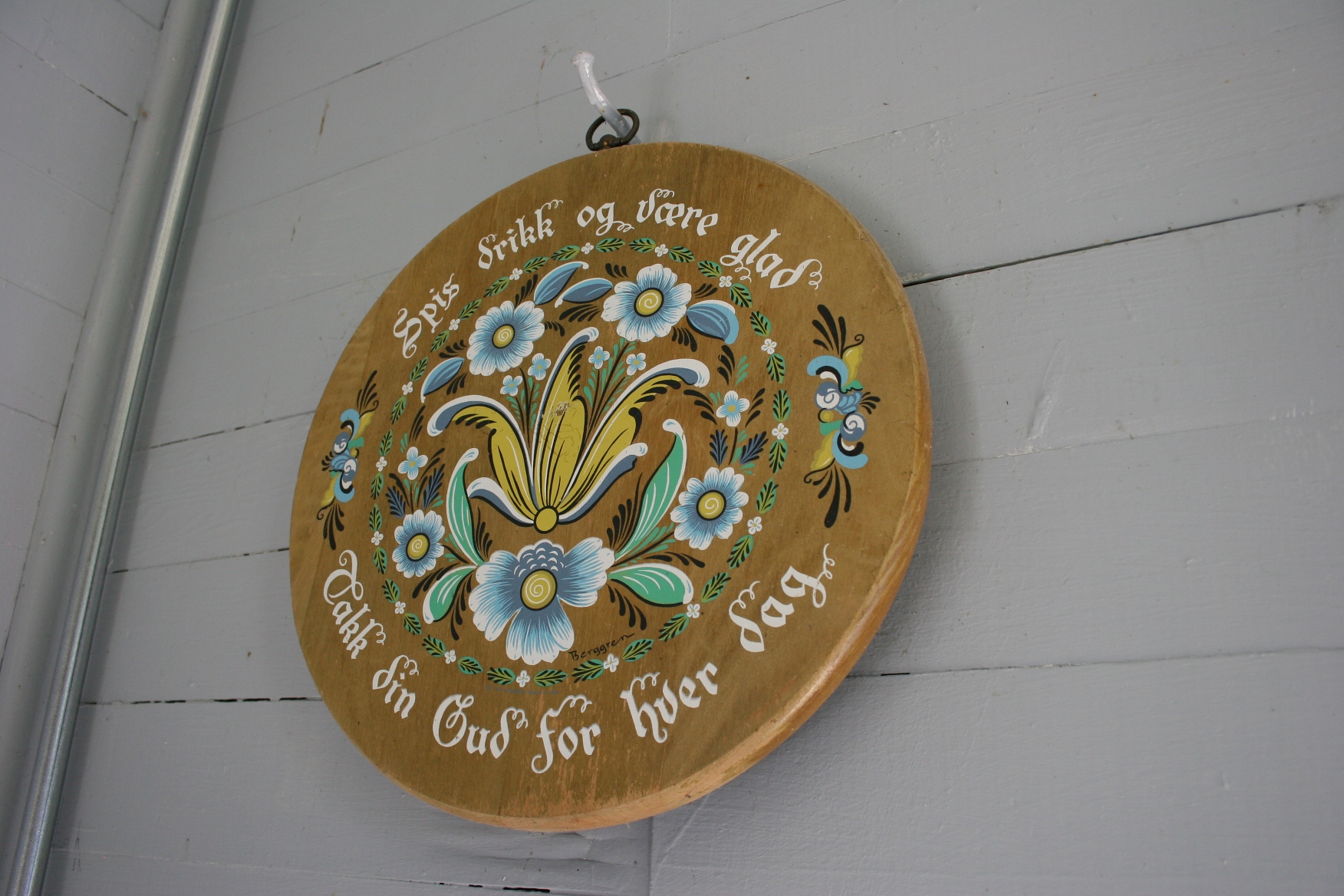
This Norwegian plaque hangs in the Old Stone Church entry. Since I'm German and not Norwegian, I rely on Google translate to tell me this sign basically thanks God for food and drink.

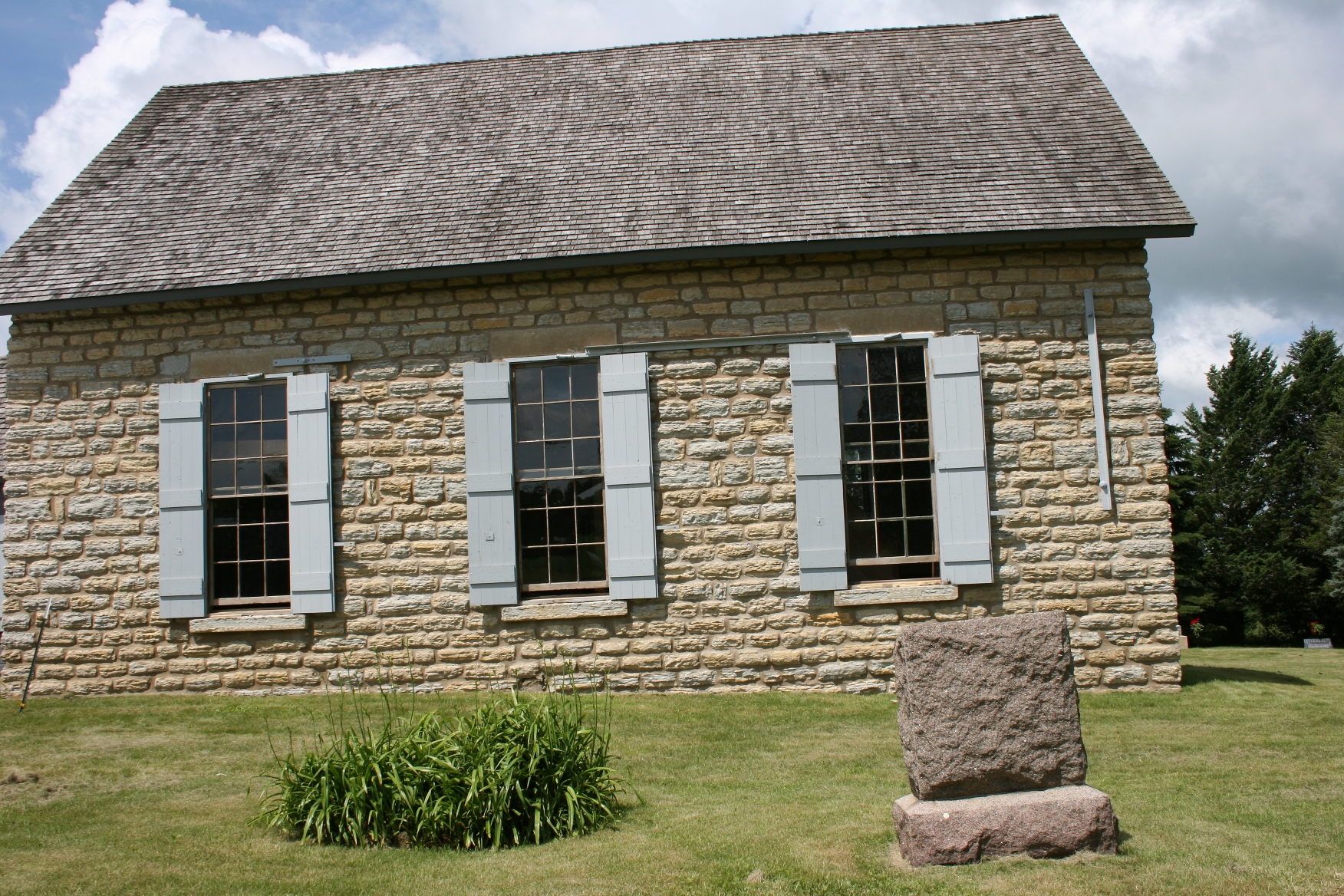
Six shuttered windows span two sides of the limestone church. The shutters are thrown open for the once-a-year church service and then battened shut.

The Old Stone Church cemetery, a final resting place for generations past and for those yet to be buried upon this land in peaceful Monkey Valley near Kenyon, Minnesota.

FOR MORE INFORMATION and additional photos of the Old Stone Church, see my June 27 Minnesota Prairie Roots blog post.

© Copyright 2010 Audrey Kletscher Helbling

 

Inside the Old Stone Church, rural Kenyon, Minnesota June 27, 2010

Filed under: Uncategorized — Audrey Kletscher Helbling @ 7:35 PM
Tags: , , ,

“DIRECTIONS: At the west end of the Boulevard of Roses, take Goodhue County 12 south for 1.3 miles and go west on Monkey Valley road for one mile.”

“Let’s go,” I tell my husband Saturday evening after reading an open invitation in the local newspaper to attend worship services at the Old Stone Church. Pair the adjectives “old” and “stone” with church and I already have one foot in the door. Add “Monkey Valley Road,” and you’ve really piqued my interest.

So Sunday morning Randy and I are on our way to Kenyon, where we turn right at the west end of the narrow boulevard lined with roses. We follow the published directions, turning right onto Monkey Valley Road, a gravel road that soon leads us to the Old Stone Church.

Once a year a worship service is held at the Old Stone Church, built by Norwegian immigrants near Kenyon.

I am expecting a church defined, as most country churches are, by a steeple. But, instead, I see before me a simple limestone building that could pass for a schoolhouse. Yet, the plain exterior, minus a steeple, seems perfect for this spot embraced by trees and rolling valleys on two sides and by flat open farm fields on the opposite sides.

Welcome to Monkey Valley.

“How did this place get its name?” I ask a group of men clustered outside the Old Stone Church.

They offer two theories. The first story goes that monkeys escaped from a traveling circus and fled into the wooded valley. The second story goes that a threshing crew arrived here and pronounced: “We’re just going to the valley and monkey around.”

Randy and I buy the monkey story, which seems probable given traveling circuses once roamed the countryside.

“I have to go,” I say, abruptly ending this monkey business. I hear the strains of my favorite hymn, Beautiful Savior, drifting through the open doors and windows. I don’t want to miss this and I am anxious to get inside the small country church.

I’ll later learn that Norwegian immigrants built this structure, beginning in 1872, with limestone cut from a nearby quarry. A historical marker dates the building, which is on the National Register of Historic Places, as 1875. And that steeple I wondered about—apparently the church founders discussed a steeple, but never had the money to erect one.

Eventually, those early members moved out of Monkey Valley and, in 1902, Hauge Lutheran congregation built a new church in Kenyon. For years the Old Stone Church stood abandoned. In 1947 restoration began, a process that continues today.

All of this written and memorized history interests me, but only to a point. I prefer, instead, to wander, to notice the details, to take in my surroundings, to appreciate for myself the beauty that this church holds.

During a service filled with music, the choir and congregation sing in Norwegian, "Ja, vi elsker." The wire rods you see anchored to the walls (running horizontally across the top of the photo) provide structural stability.

Rugged pews and rustic wood floors remind worshipers of bygone years. Copies of The Concordia Hymnal, piled on a pew, date to 1967. The hymn books are stashed in covered plastic containers after the service.

I lean forward and photograph the hands of an elderly woman in quiet meditation. This image, more than any photo I take, captures the essence of the Old Stone Church. For in these folded hands and in the back of the roughly-hewn pew, history and faithfulness meld, encompassing the importance of preserving historic churches.

Sitting near the back of the church, I study these words, thinking in German until I remember I am inside a Norwegian church. After the service, I talk with historian and preservationist Bob Dyrdahl. The scriptural quote comes from John 3:16, he tells me. "For God so loved the world that He gave His only begotten Son..." Sure enough, upon closer examination I determine that Bob knows his Norwegian.

I run my fingers across the flowers on the pulpit and imagine the rough hands of a Norwegian immigrant shaping this wood into a beautiful work of art. In the background is the top of the altar, defined by tablets, signifying the 10 Commandments and centered by a cross and a painting of The Last Supper.

In the balcony, historian Bob Dyrdahl shows me this treasure, the dated (October 30, 1894) signature of A. P. Lindgren who painted stars upon the ceiling and edged it with this stenciled border. His work also graces other sections of the sanctuary, along the stairway, for example.

A rear view of the Old Stone Church, a simple structure with three shuttered windows on each side of the building.

A stone's throw from the Old Stone Church, a view of Monkey Valley.

#

THIS IS JUST A SAMPLING of the photos I shot at the Old Stone Church. Please check back for additional images to be posted this week on Minnesota Prairie Roots.

Copyright 2010 Audrey Kletscher Helbling
 

Terrifying tornado tales from Minnesota June 24, 2010

Filed under: Uncategorized — Audrey Kletscher Helbling @ 9:22 AM
Tags: , , ,

ONE WEEK AGO TODAY, numerous tornadoes ravaged Minnesota, killing three, destroying hundreds of homes and injuring many.
This morning, thankfully, weather conditions are calm with low humidity and no indications that more storms could develop.

Even so, we Minnesotans remain unsettled, still reeling from the destruction wreaked upon this land, and upon our psyches, only seven days ago.

Memories of such devastation linger for years, if not decades. Just last night, while working on a trivia contest for an upcoming reunion, I am paging through a family history book when I come upon a story written by my Uncle Merlin, the family historian.

He writes of an F5 tornado (the most powerful) which decimated the small southwestern Minnesota farming community of Tracy on June 13, 1968, killing nine. At the time, Merlin, his wife and their two young children lived about 20 miles away just outside of Lamberton three towns directly east of Tracy along U.S. Highway 14.

My uncle had just returned home from work when the weather turned ominous. “We were watching for tornadoes as the conditions were right,” he writes. “Then to the southwest we saw it—a huge tornado. As we watched, we saw large amounts of debris lifted into the sky—we thought it hit Revere and about that time Iylene (his wife) took one-year-old Janelle and I took Ronda down into the basement. About an hour later we found out that this tornado hit Tracy causing a large amount of destruction and costing several lives.”

Reading my uncle’s story, I feel his anxiety as he rushes his young family to safety, fearing the twister is within miles of his home.

Then I flip the page of the history booklet and read of Merlin’s first tornado encounter, on today’s date—June 24—in1953 or 1954. Although only about 10 years old when a twister struck his childhood farm south of Vesta, he clearly remembers the details and that day, his sister Elvira’s wedding anniversary.

“The sky turned all kinds of colors and we kids were really scared,” my uncle remembers. “My dad and brothers were out doing the chores and milking the cows. Harold (his brother) got caught in the hog barn as it hit and my dad and one of my brothers had to hold the double doors of the barn closed on one end and two of my other brothers did the same on the other end.”

His words draw me in, placing me there in the barn with my grandfather and uncles as they hunker down, struggling against the fierce winds to hold the barn doors in place.

“There was one loud crash and then stillness,” Merlin continues. “My sister Jeanette looked out the north window of the house and shouted, ‘Mom, the whole grove is gone.’ That was really close.”

The tornado spared the house and farm buildings, but destroyed the stand of trees sheltering the farm site on the flat, open prairie of southwestern Minnesota.

Almost three decades later a twister struck nearby, on the farm where I grew up, taking down a silo, tossing wagons about in the field, ripping a railing from the house… Even though I was grown then and no longer living at home, the psychological impact of that storm still remains.

I fear tornadoes, a fear imprinted upon me after viewing the devastation wreaked upon Tracy in 1968 and then reinforced all those years later on my home farm. I sometimes dream about tornadoes.

Yet, I know my dreams, my feelings, are nothing compared to those Minnesotans who experienced the destructive tornadoes of a week ago. For them, nightmares are reality.

#

IF YOU HAVE A TORNADO story you would like to share, please submit a comment to this post.

© Copyright 2010 Audrey Kletscher Helbling