WHETHER YOU LIKE country or Celtic, you’ll find music o’plenty in Faribault on the evening of Friday, March 13.
Just days before St. Patrick’s Day, metro-based Bonnie Drunken Lad takes the stage at the Paradise Center for the Arts for a performance beginning at 7:30 pm. The five-person Irish folk band will play traditional and modern Celtic, sea shanties and pub songs. Their music is sure to get you in a dancing-with-leprechauns, Irish frame of mind.
If you can’t catch the band in Faribault, you can also hear them at Charlie’s Restaurant and Irish Pub/Water Street Inn Ballroom in Stillwater from 11 am-2 pm Saturday, March 14. They’re among a line-up of musical groups playing at a St. Practice Day event. On March 17, Bonnie Drunken Lad will be back at the Stillwater location from 2-5 pm for a music-filled St. Patrick’s Day celebration.
Another option to hear these Irish musicians is from 4-6 pm Saturday, March 14, at Kip’s Irish Pub & Restaurant in St. Louis Park.
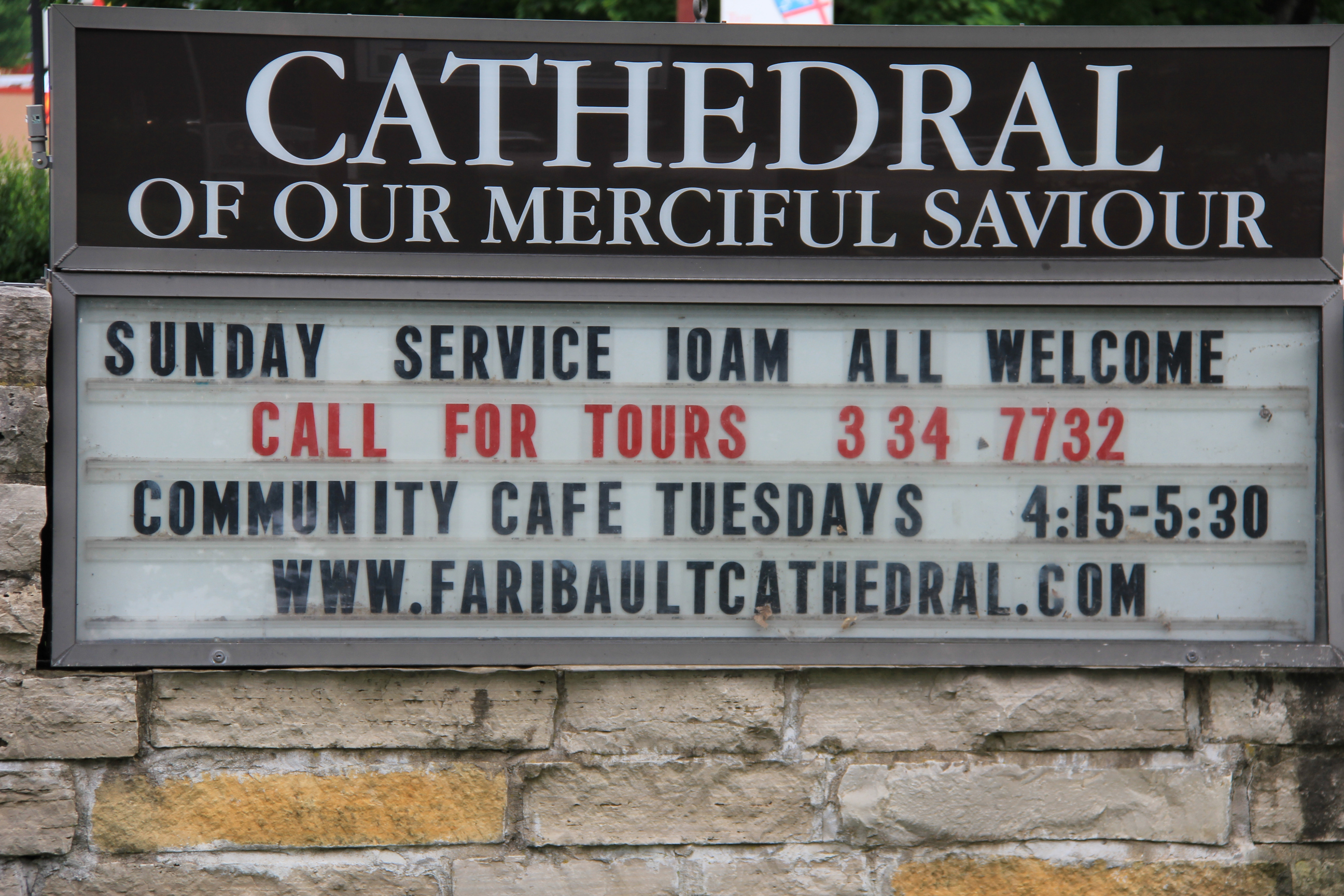
BLOCKS AWAY from Bonnie Drunken Lad’s show at the Paradise, a local four-piece country band will perform a free concert at the historic Cathedral of Our Merciful Saviour from 7-9 pm Friday, March 13.
The Old Country Boys sing with an authentic twang about daily life, love and hardship. Expect to hear songs by the likes of Merle Haggard, Waylon Jennings, Johnny Cash, George Jones, Hank Williams Sr. and Jr., Charlie Daniels, and Alabama, among others.
Although the concert is free, donations are accepted for Cathedral preservation. This event is part of the Faribault Cathedral Concert Series.
Interestingly enough, last March Bonnie Drunken Lad played at the Cathedral as part of the concert series. Now that I think about it, I’m pretty certain I attended that concert.
I’ve heard the Old Country Boys/Brothers, purveyors of old (not new) country music, play many times in Faribault, at Christ Lutheran Church’s weekly summer wood-fired pizza-concert night, Holy Smoke!
Now, on a Friday evening in mid-March, both groups will be back in Faribault performing country and Celtic music o’plenty at pre-St. Patrick’s Day concerts.
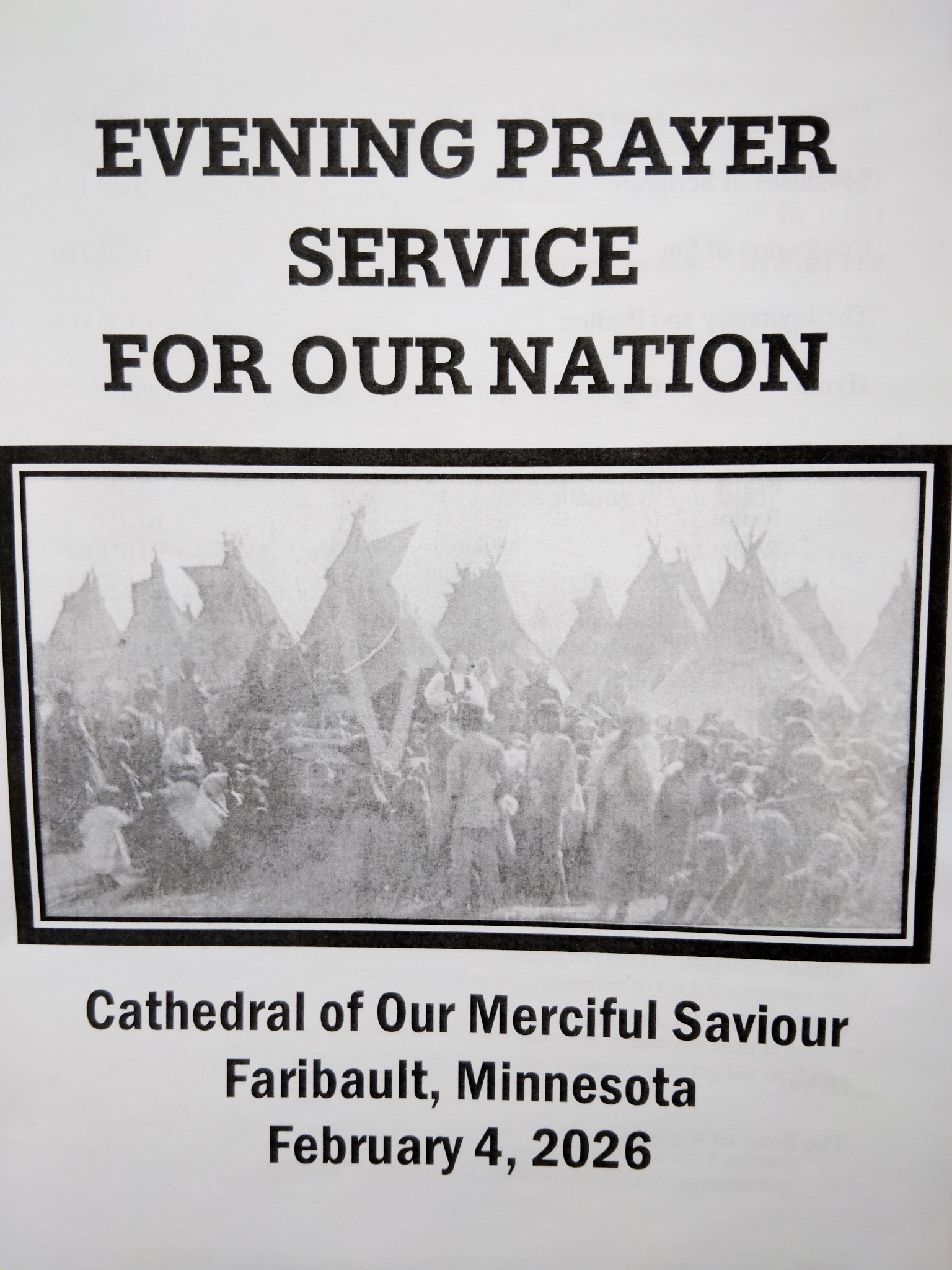
The service program cover featured an historic photo of Native Americans incarcerated at Ft. Snelling following the U.S.-Dakota War of 1862 prior to their deportation from Minnesota. (Minnesota Prairie Roots copyrighted photo February 2026)
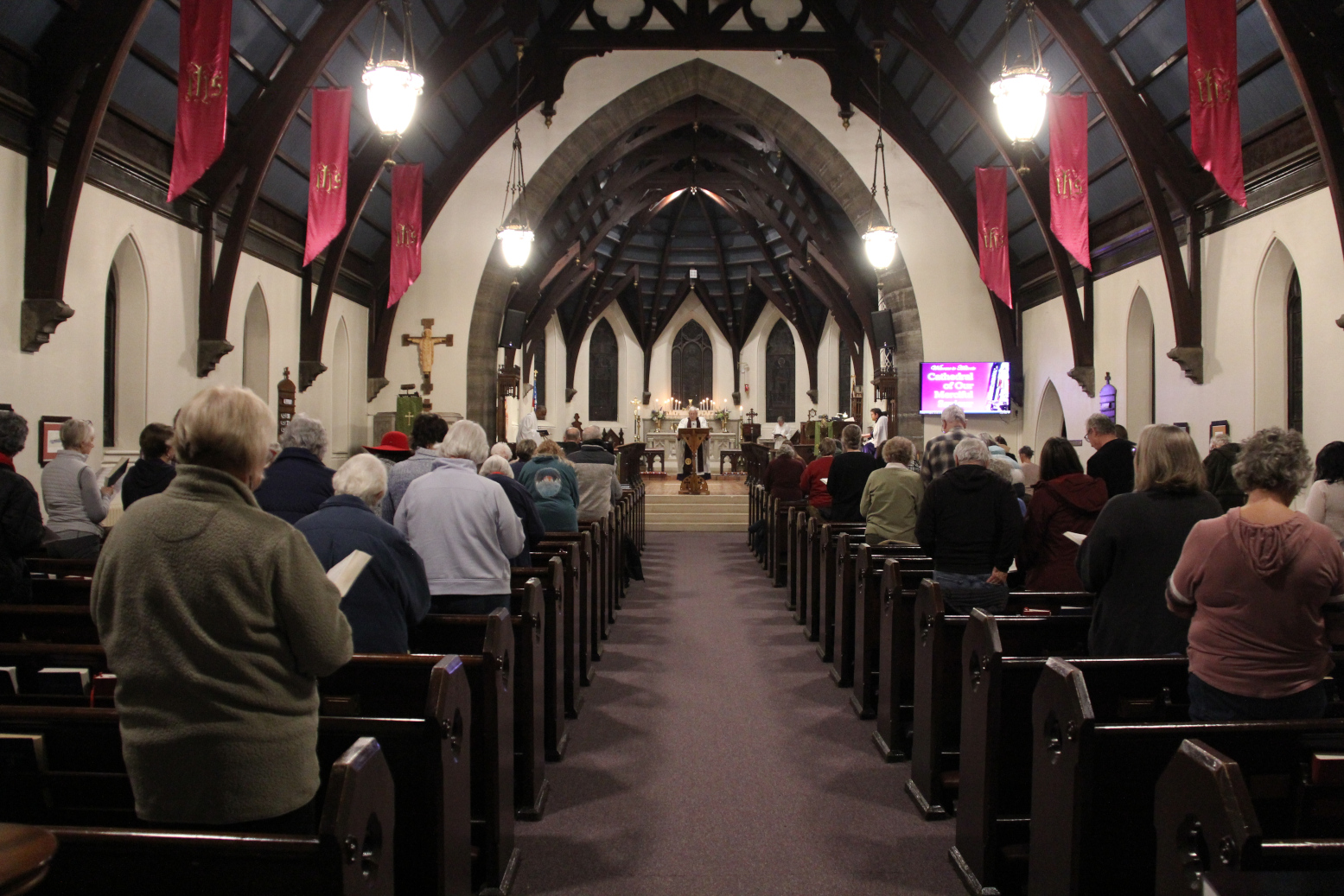
WE GATHERED. On a day when I learned that a friend, an American citizen, was recently racially-profiled and stopped by ICE. On a day when I learned that ICE vehicles have been parked in my neighborhood. On a day when several Minnesota children were released from federal detainment in Texas. On a day when the border czar announced the draw-down of 700 federal agents (out of 3,000) in Minnesota. On this early February day, 75 of us gathered for an “Evening Prayer Service for Our Nation” at the Cathedral of Our Merciful Saviour in Faribault, Bishop Henry Whipple’s church.
The prayer service was open to anyone who wanted to attend in a church I’ve always considered especially welcoming and focused on serving community. (Minnesota Prairie Roots copyrighted photo February 2026)
I needed this service of prayer, scripture, Psalms, reflection and hymns to quiet my troubled spirit. But I needed, too, to hold space, to sit and stand and sing and pray in community, in support of anyone—especially our immigrant and refugee neighbors—illegally stopped, taken and/or detained by ICE.
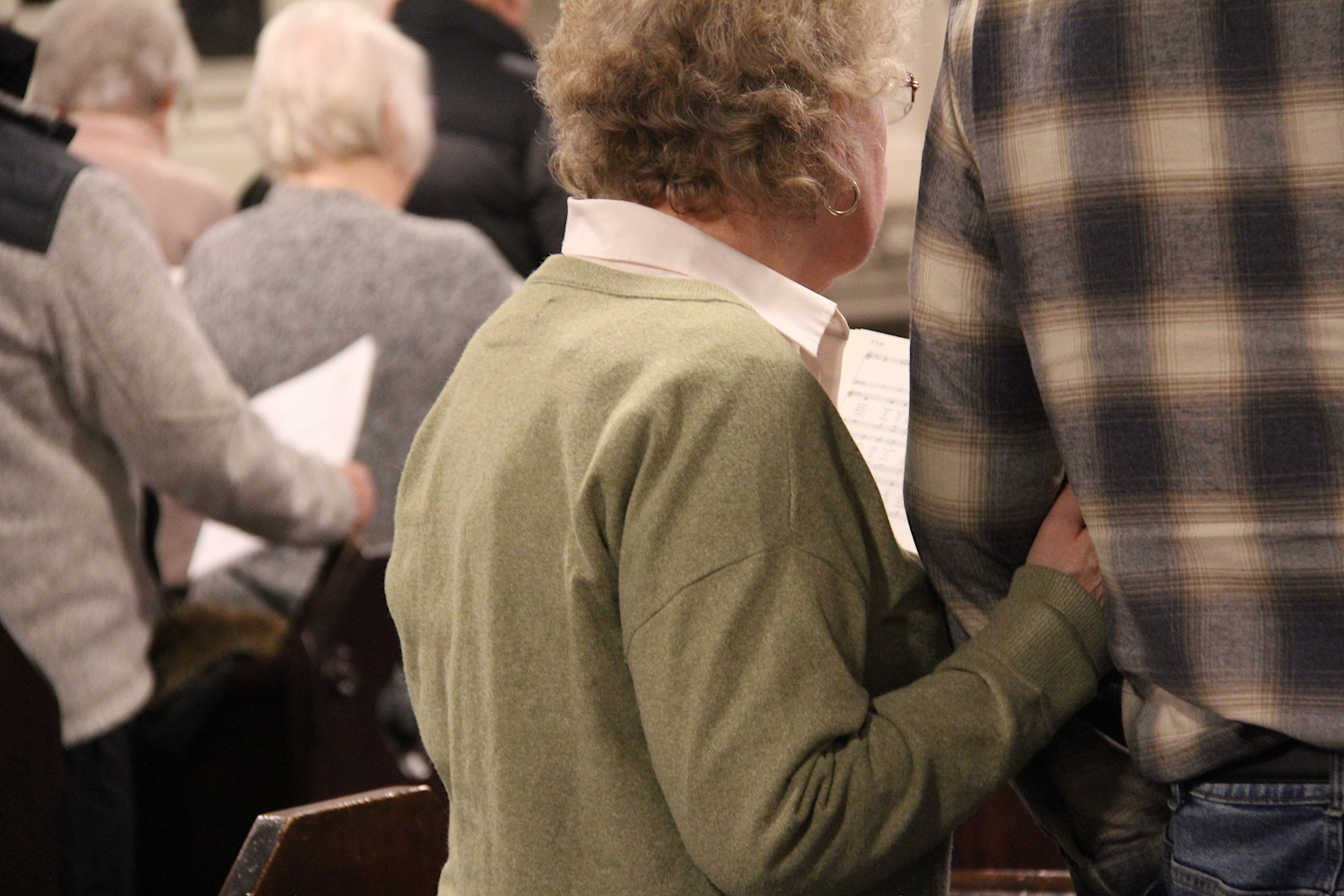
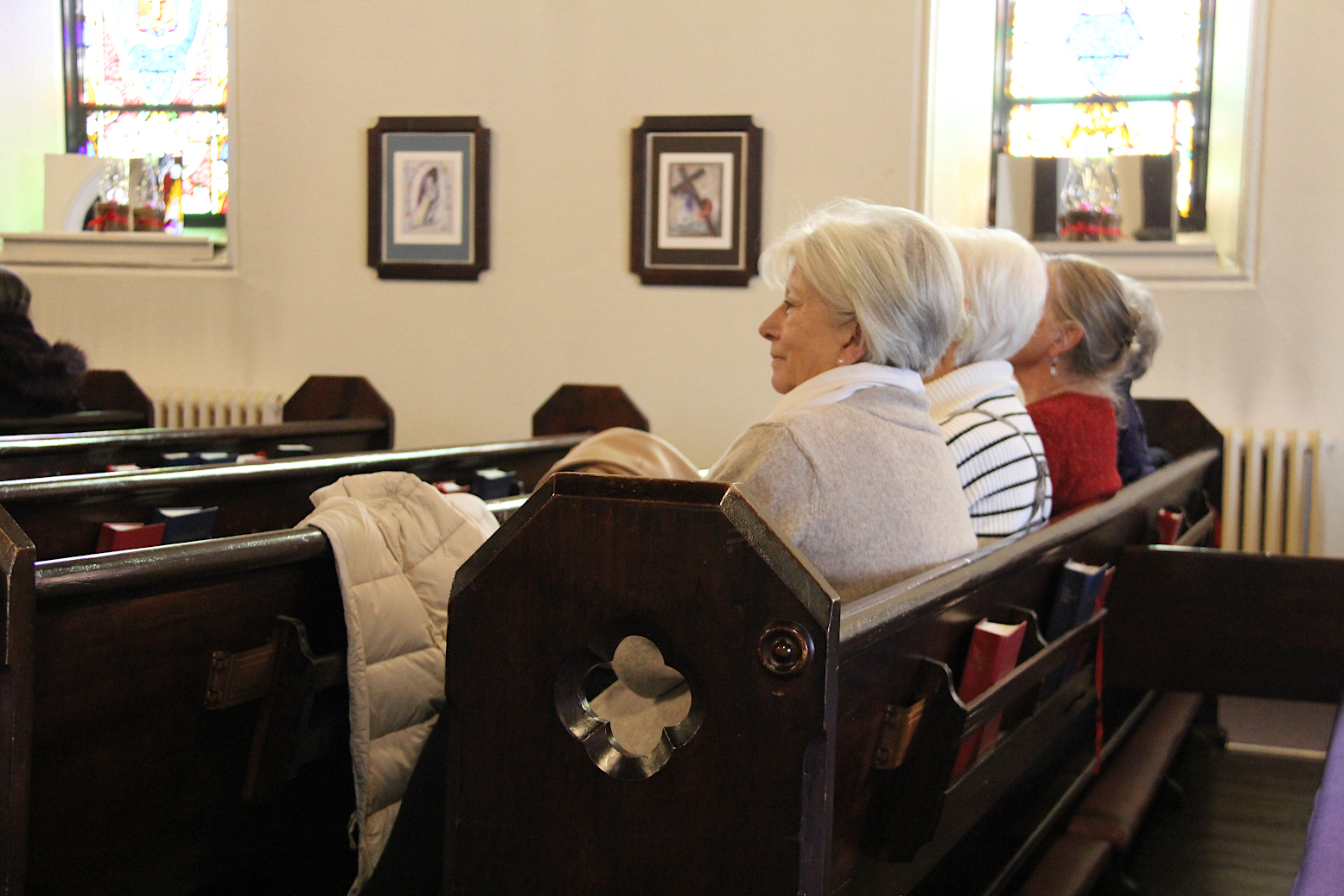
A couple leans on one another during the service. (Minnesota Prairie Roots copyrighted photo February 2026)
This was not a protest service. Rather, this was a reflective, prayerful, unifying, worshipful coming together of people in my community who care deeply about their neighbors and about this nation.
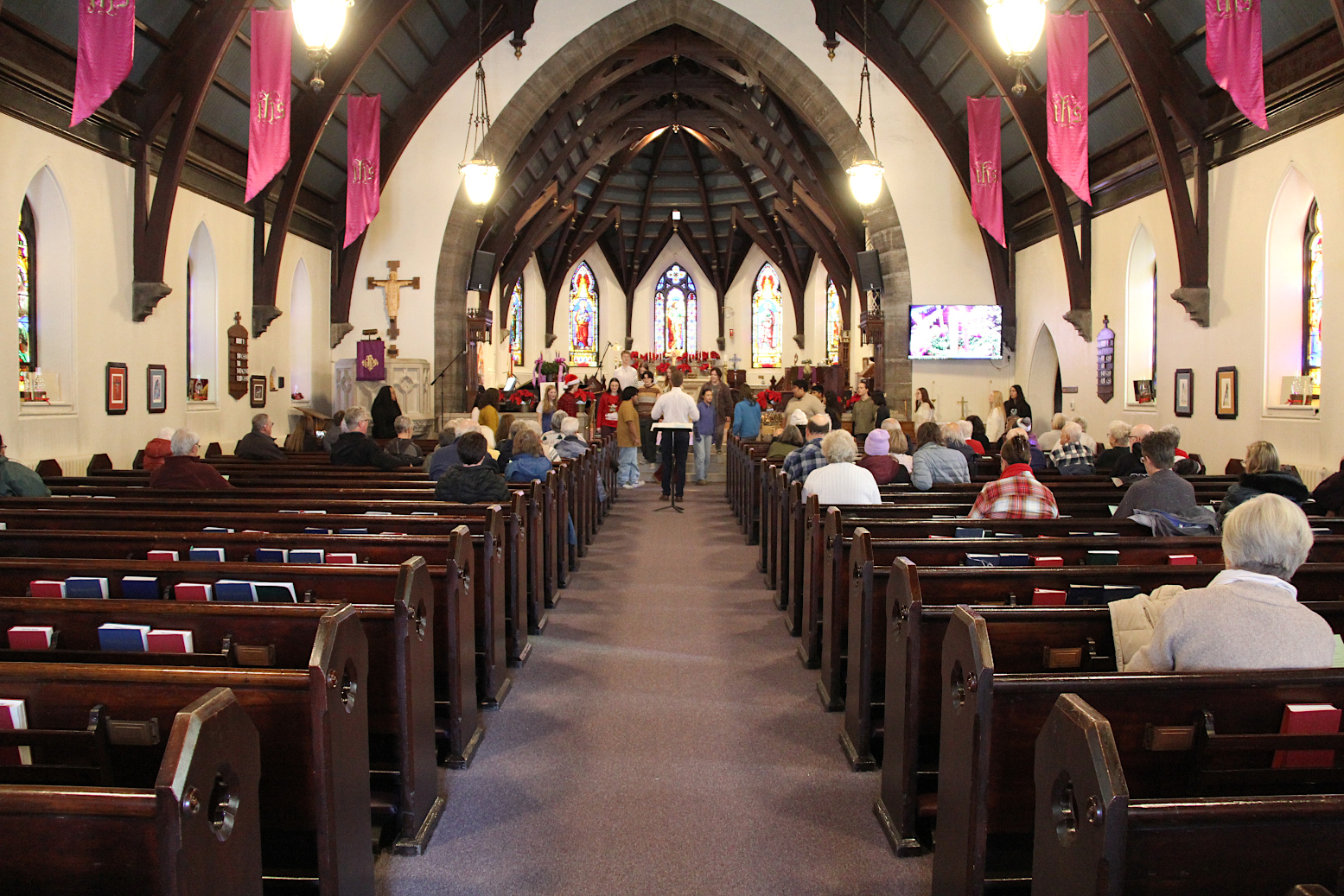
People arrive for the 7 pm service inside the Cathedral of Our Merciful Saviour, Faribault. (Minnesota Prairie Roots copyrighted photo February 2026)
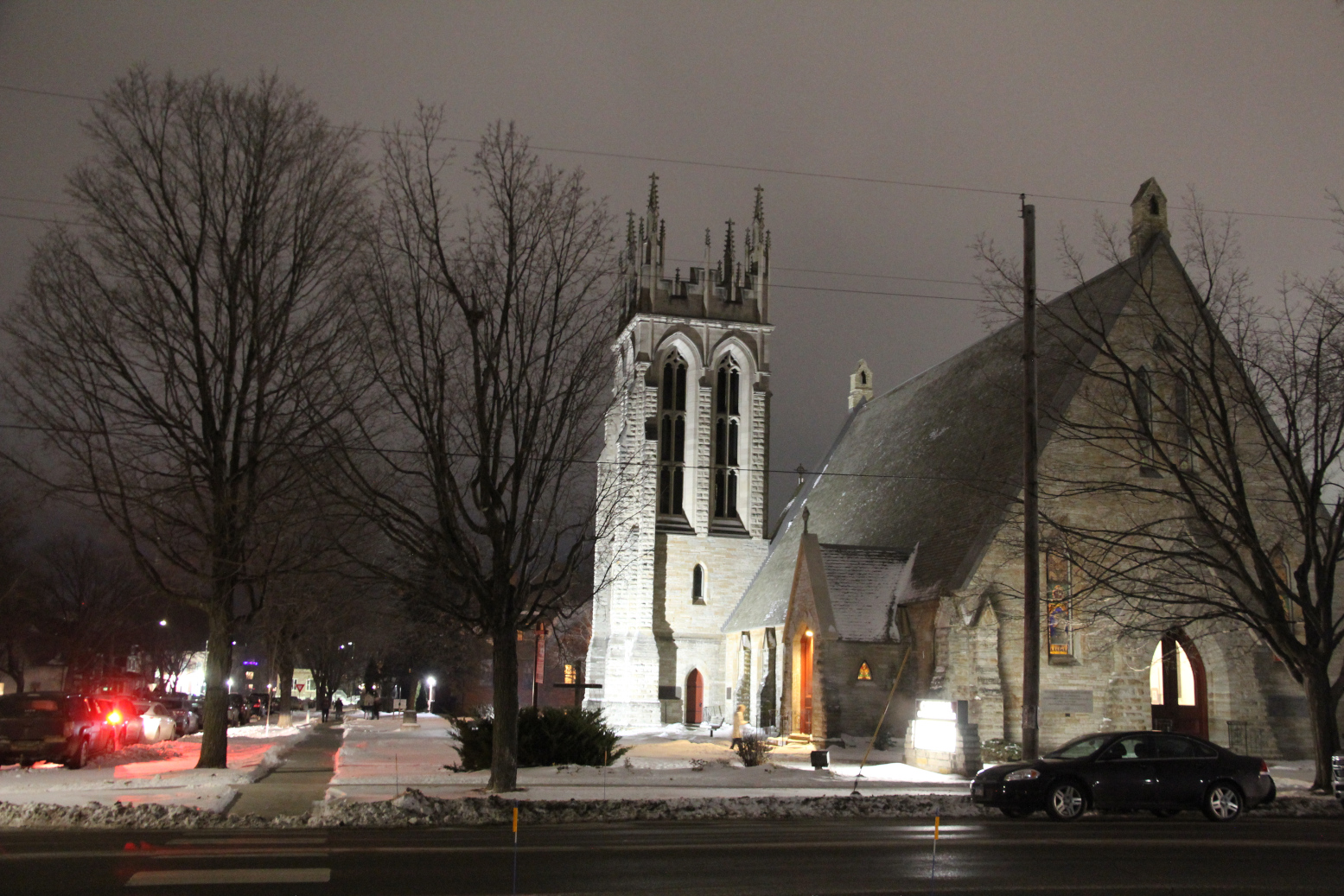
The Rev. James Zotalis welcomed attendees to the event held inside the massive Episcopal cathedral completed in 1869 under the leadership of Bishop Whipple. “Welcome to the Whipple building,” Zotalis said in opening his short homily. “This is the real Whipple building.”
Gathered inside the cathedral for the prayer service. (Minnesota Prairie Roots copyrighted photo February 2026)
He contrasted the beautiful church to the stark seven-story Whipple Federal Building 50 miles to the north that bears the good bishop’s name and which is now a temporary detention center for those detained by ICE in Minnesota. Conditions inside have been described as “inhumane” by officials who have visited the facility.
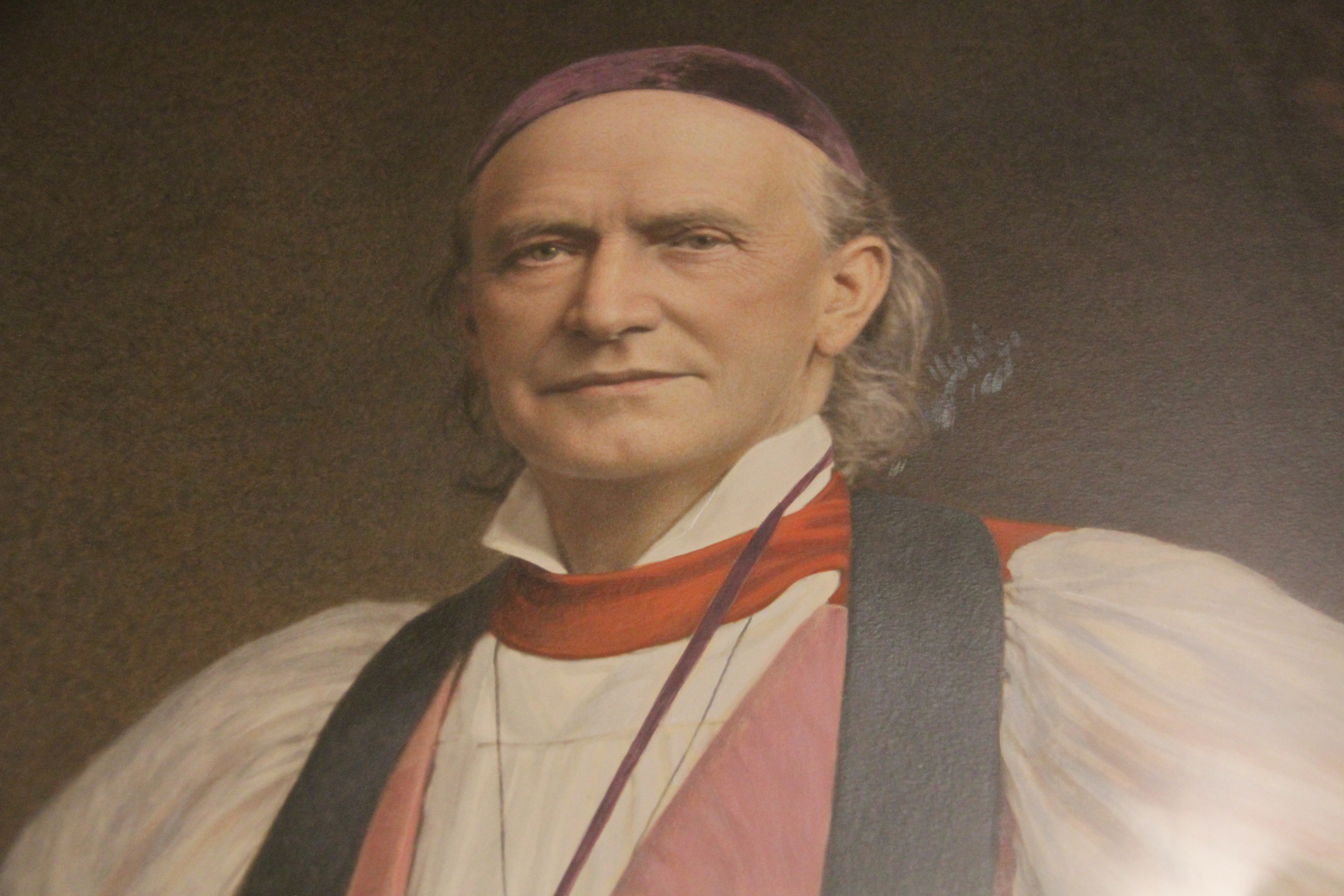
A portrait of Bishop Henry Whipple hanging inside the cathedral. (Minnesota Prairie Roots copyrighted photo February 2026)
The cathedral, Zotalis said, is a place of love and peace, its ministry modeled after that of Bishop Whipple and his first wife, Cornelia. Arriving here from Chicago in 1859, the couple had already served in dangerous areas of that city, connecting with people in tangible, helpful ways, much like we see Minnesotans stepping up and helping others today.
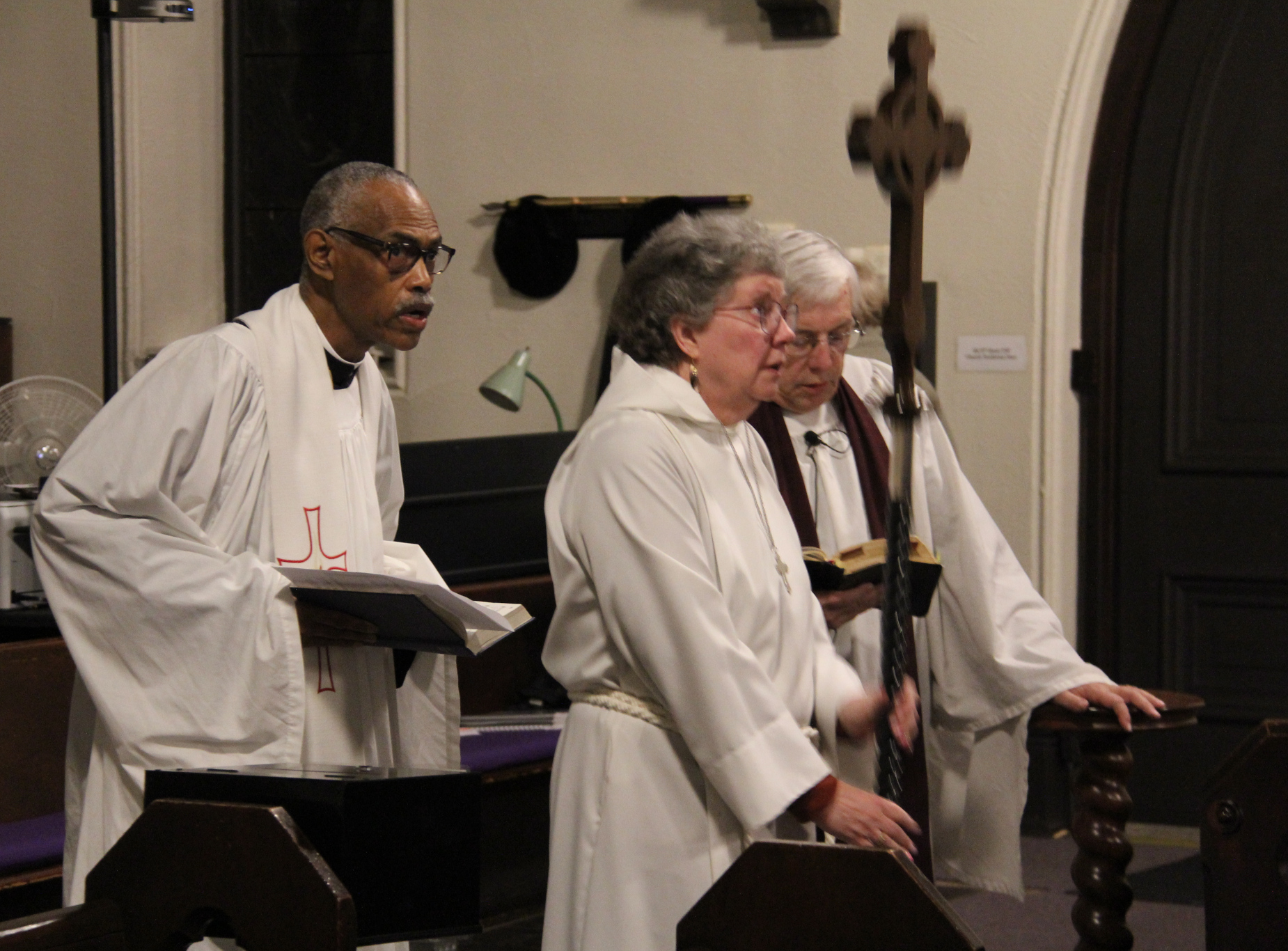
The Rev. Henry Doyle, left, a church member, and the Rev. James Zotalis, right, start the service with a processional. (Minnesota Prairie Roots copyrighted photo February 2026)
With a repeated directive to “always say no to evil,” Zotalis said Minnesotans have done just that since the invasion of our state by masked federal agents two months ago. He listed specifics: bringing food to people afraid to leave their homes, providing rides, offering free legal aid and peacefully protesting.
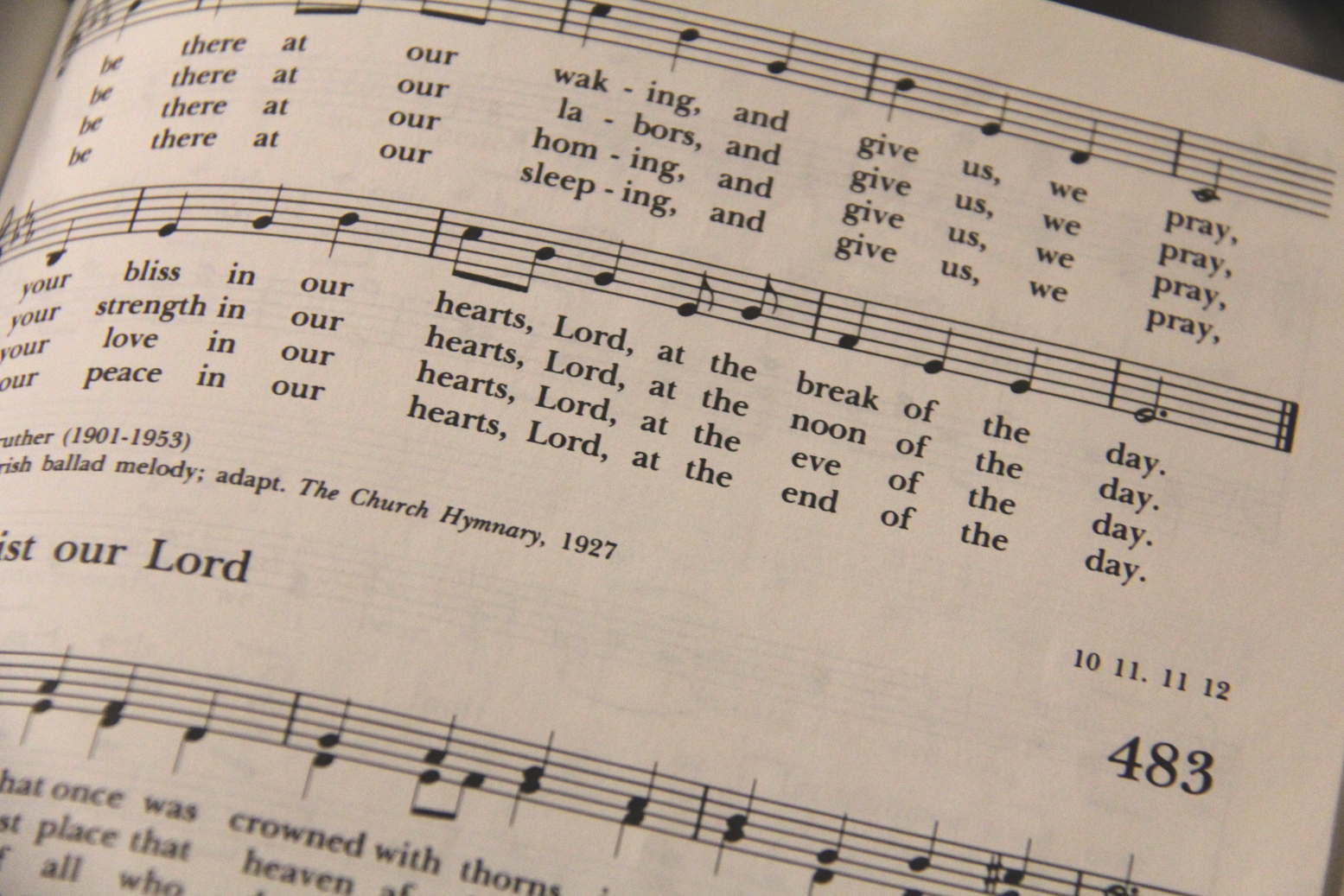
Among the many hymns we sang was #482, “Lord of all hopefulness.” (Minnesota Prairie Roots copyrighted photo February 2026)
“Love your neighbor as yourself” was emphasized often in love-themed Scripture readings (Luke 10:27, I Corinthians 13:13, I John 4:11) during the Wednesday evening service. Like the good people of Minnesota today, Bishop Whipple showed that love long ago in his ministry to the Dakota people locally, across the state and during their imprisonment after the U.S.-Dakota War of 1862 at Fort Snelling, where the Whipple Federal Building is located. Whipple faced death threats for those who opposed his compassionate work with Native Americans.
Death. In a time of remembrance during Wednesday’s service, attendees could speak the names of “deceased and alive during this time of tragedy and strife.” I spoke first: “Renee Good.” Then another voice: “Alex Pretti.” And then an attendee read the names of 32 individuals who died in ICE detention in 2025. Thirty-two.
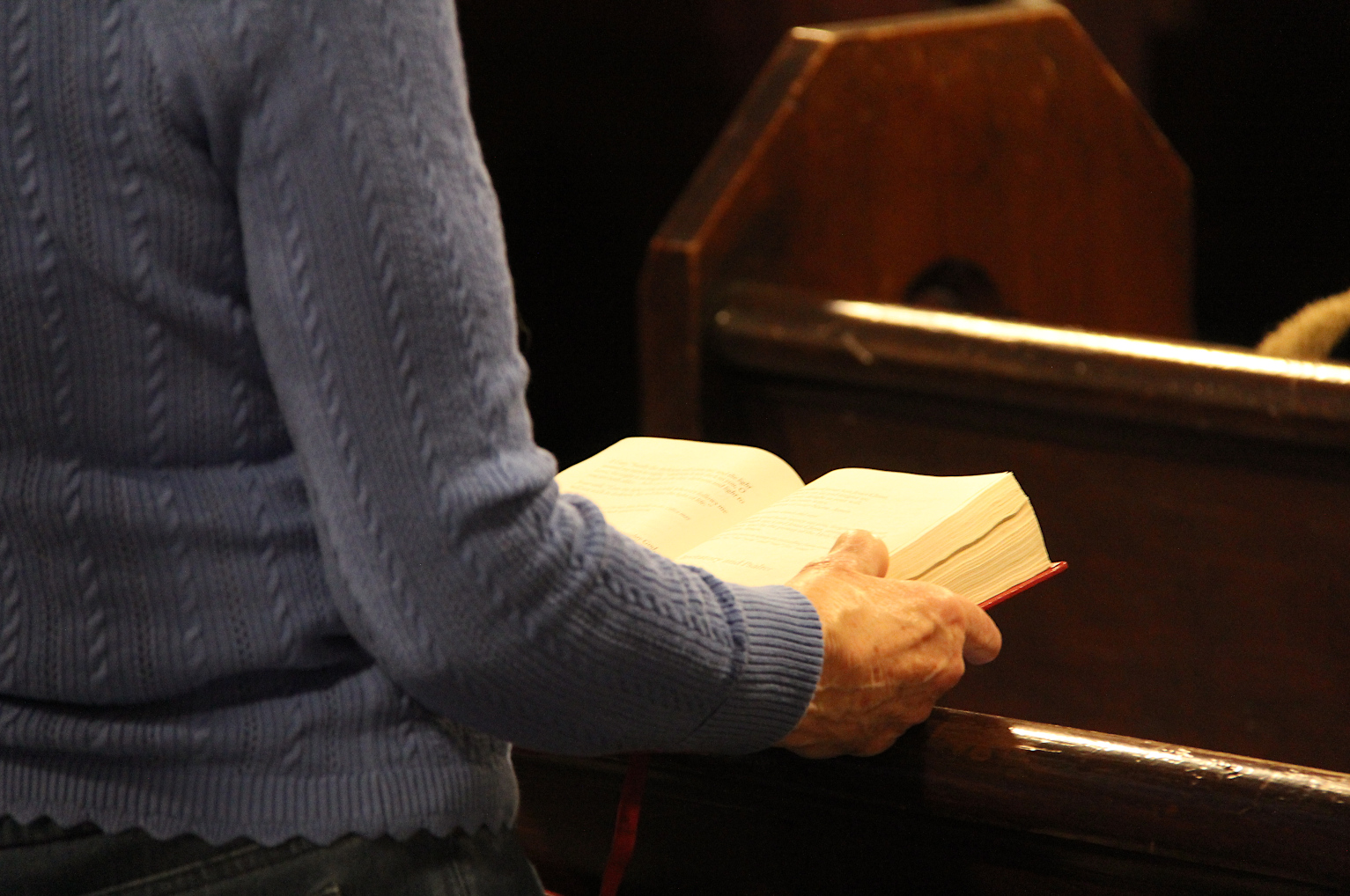
A woman holds a prayer book used often during the service. (Minnesota Prairie Roots copyrighted photo February 2026)
Many times my emotions verged on tears. As we asked, “Lord, keep this nation under your care.” As we sang “America the Beautiful.” As we prayed a Collect for Peace. As I thought of Jesus, who also lived in troubled times and who served with love and compassion.
Theme words of love, compassion, mercy and neighbor threaded throughout the service led by the reverends Zotalis and Henry Doyle. I could feel those words. And I could feel, too, the collective sense that we all needed this evening of prayer, scripture, Psalms, reflection and hymns to quiet our troubled spirits.
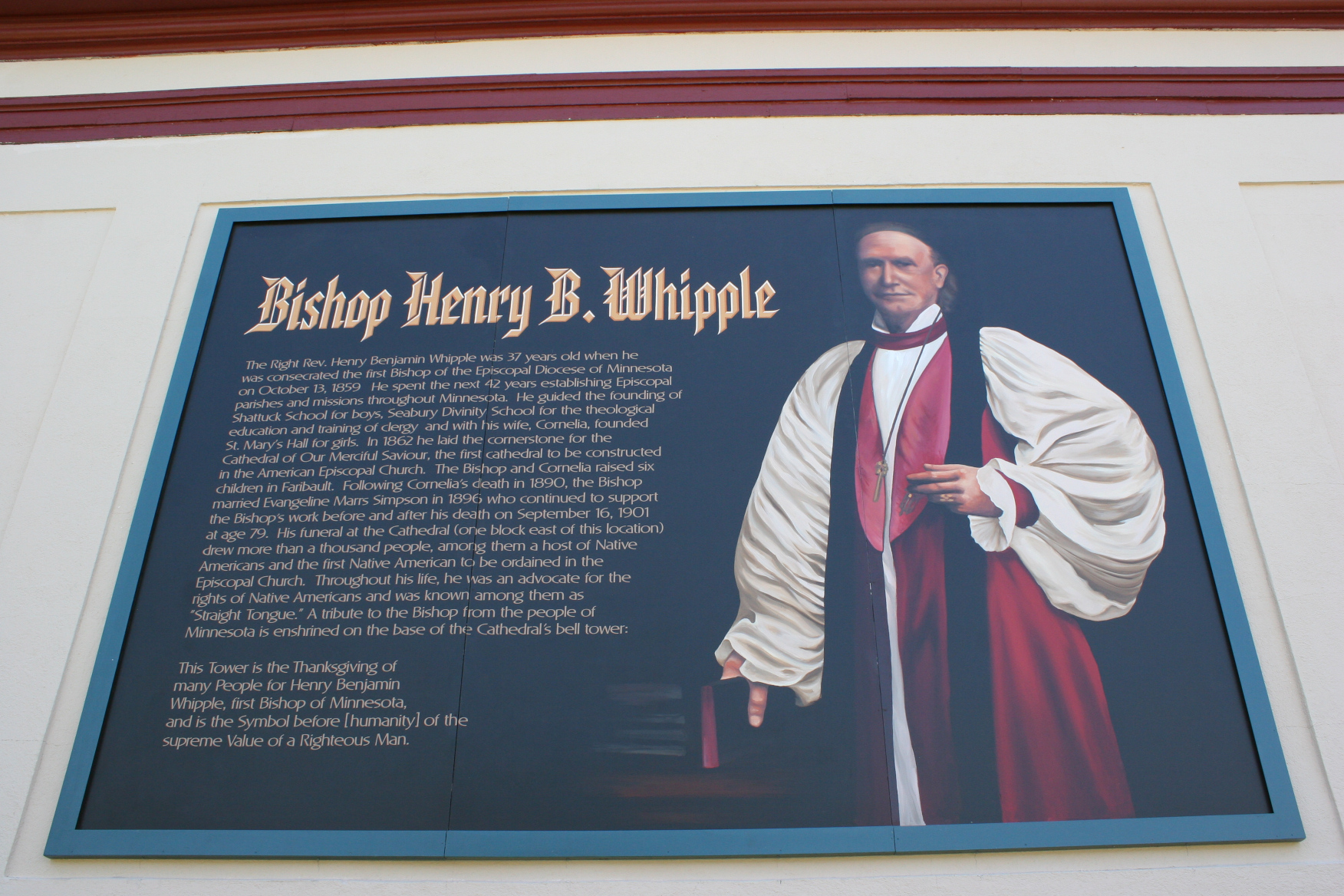
A mural on the bandshell at Faribault’s Central Park honors Bishop Henry Whipple. (Minnesota Prairie Roots copyrighted file photo)
I EXPECT BISHOP HENRY WHIPPLE may be turning over in his grave under the altar inside the Cathedral of Our Merciful Saviour in Faribault. He would be appalled by what’s happening in this community with ICE enforcement. And he would also likely be standing side-by-side with protesters outside the Bishop Henry Whipple Federal Building at Fort Snelling protesting ICE’s presence in Minnesota. The federal agents are based inside the building named after him.
Whipple was all about compassion and embracing others, especially as a friend to the Dakota in Minnesota following his arrival here in 1860 and throughout his ministry. He would not be fine with ICE violently, or non-violently, taking people from their vehicles, their homes, clinics, outside schools and churches, inside businesses…and illegally detaining them without due process. That includes those here legally and American citizens imprisoned inside the building bearing Whipple’s honorable name.
I am not OK with this. None of us should be.
HOW BISHOP WHIPPLE MIGHT REACT
As Minnesota continues to deal with the presence of 3,000 ICE agents in our state, I think of the Episcopalian bishop, known as “Straight Tongue” for his honesty, and how he would react. He would assuredly be on the streets advocating for human rights. He would be talking with the current president, just like he did in 1862 with President Abraham Lincoln. Whipple traveled to DC then to personally plead for the lives of 303 Dakota sentenced to death by hanging.
Whipple would probably also be out buying groceries for Faribault residents afraid to leave their homes. He would be walking kids to their bus stops in trailer parks. He would be preaching peace, love and compassion.
HONORING WHIPPLE’S LEGACY
Those who disliked Whipple, and the Dakota, disparagingly tagged the clergyman as “The Sympathizer.” Little has changed. There are far too many in my community who hate, and, yes, that’s a strong word, anyone whose skin color is other than white. I don’t understand. They all, unless they are Native American, can trace their presence in America back to immigrants.
If only Bishop Henry Whipple was still alive to spread love in Faribault and beyond. It’s up to us to honor his legacy by loving and helping our neighbors during these especially dark days of injustice and oppression.
#
FYI: To learn more about the bishop, I direct you (click here) to a previous blog post I wrote about him and his role in Minnesota history following a 2023 presentation at the Rice County Historical Society.
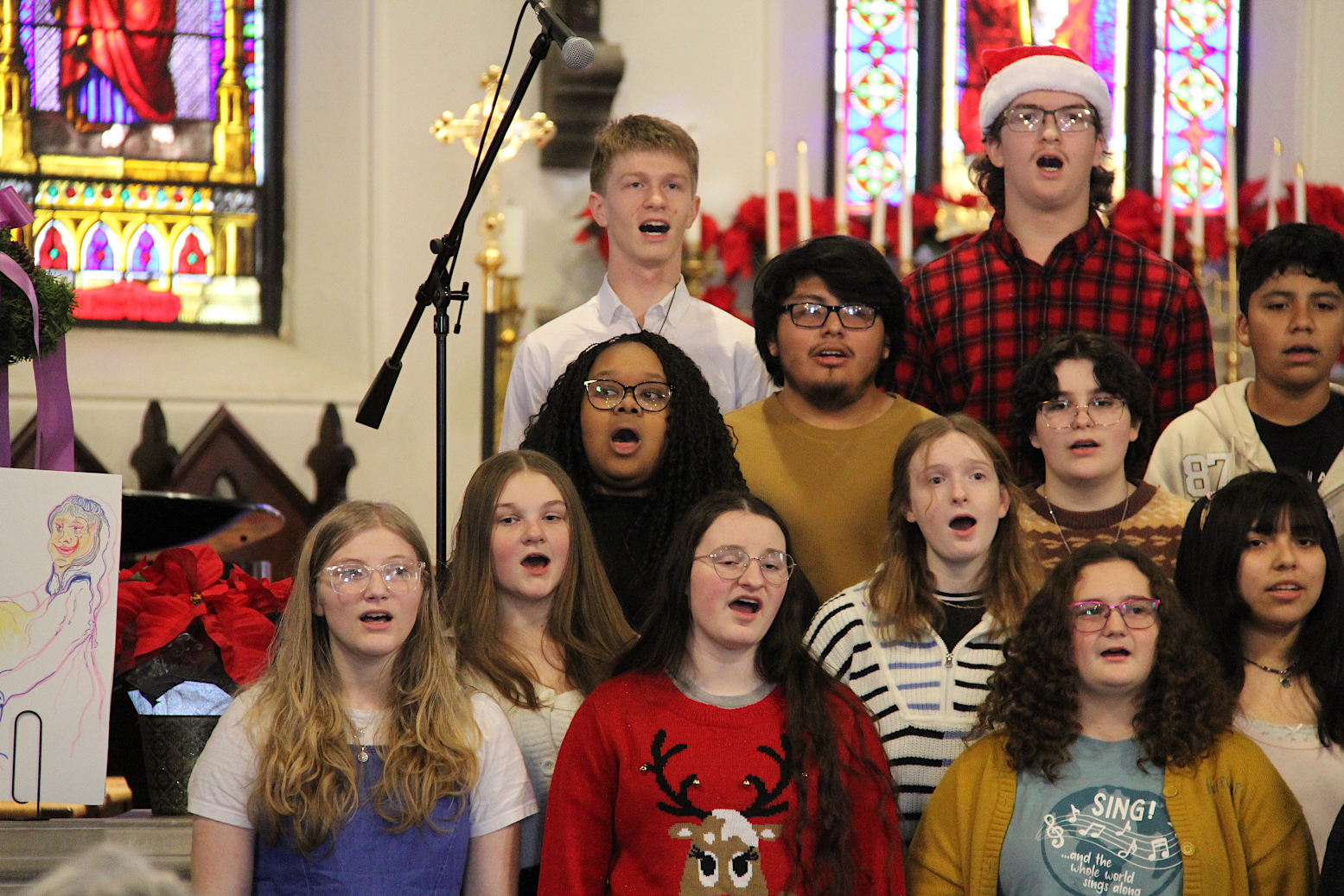
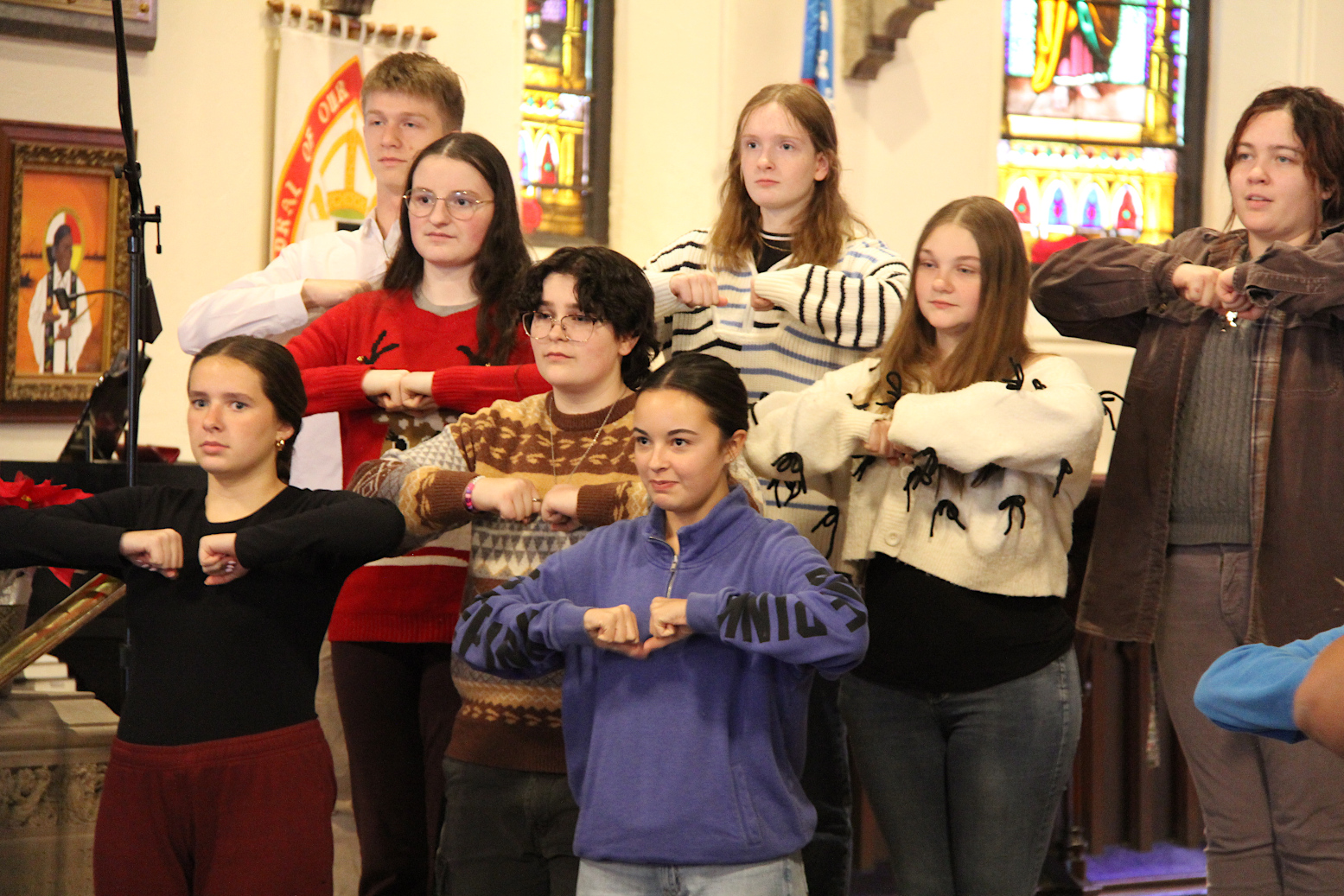
A section of the Faribault High School Choir performs Thursday at the Cathedral of Our Merciful Saviour. (Minnesota Prairie Roots copyrighted photo December 2025)
AS THEY SANG, I felt my spirits rise, moved by the rhythm of “Resilience” and its empowering lyrics.
The acoustics inside this massive, historic cathedral make it a favorite spot for musicians, like the FHS Choir, to perform. Here Choir Master Ben Beaupre directs the students. (Minnesota Prairie Roots copyrighted photo December 2025)
This upbeat music, these words, were exactly what I needed to hear Thursday afternoon inside the Cathedral of Our Merciful Saviour as the Faribault High School Choir performed a holiday concert.
Resilience, we are strong; shoulder to shoulder keep movin’ on…stand up…yes, we can…
The beat of that song composed by Minnesotan Abbie Betinis and the message it carries…,well, it fit the day. It was a day when I awakened to a vivid nightmare running rampant through my mind. A dream of ICE agents in a black sedan converging on a community and chasing people out of a building. Gathering them, taking them away and me photographing and screaming at ICE to show some compassion and humanity.
An appreciative audience listens to the students sing. (Minnesota Prairie Roots copyrighted photo December 2025)
I needed to hear “Resilience,” written by a musician who has taught at nearby St. Olaf College and elsewhere and published the Justice Choir Songbook.
One of several stained glass windows, gifted by the Dakota to the Cathedral, backdrops Christmas decorations set on a sill. (Minnesota Prairie Roots copyrighted photo December 2025)
As I watched and listened to the teens perform inside the historic Cathedral, I thought of the Native Americans who long ago worshiped here, befriended by Bishop Henry Whipple. They were not always welcome in this community. But inside the walls of this massive cathedral, they found a place of acceptance.
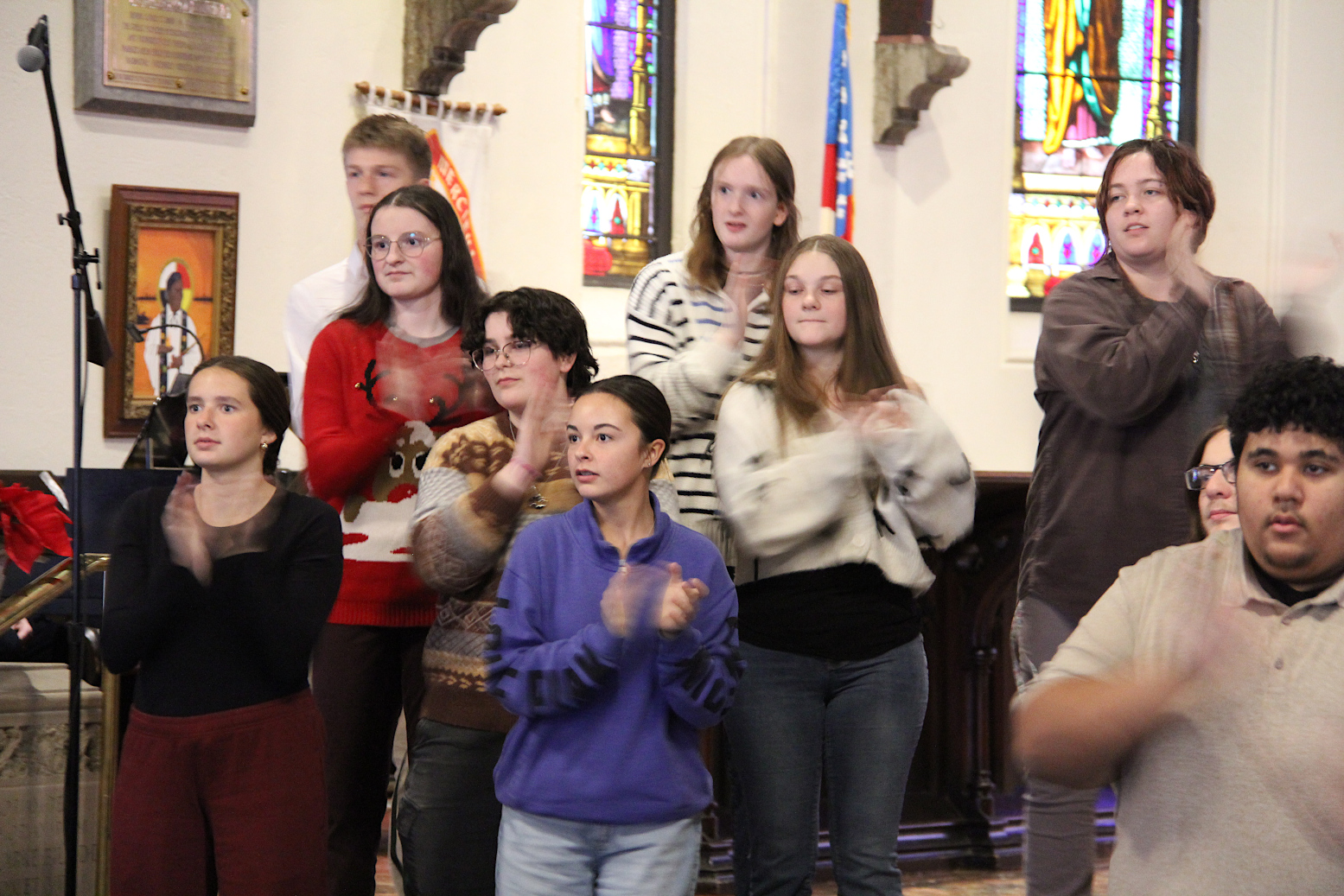
The students sang with power and joy. (Minnesota Prairie Roots copyrighted photo December 2025)
And then I thought of those young people standing before me, strong in voice, delivering a message that didn’t sound at all like a Christmas song on the surface. But really, it was. Shoulder to shoulder keep movin’ on… The song felt joyful. Uplifting. Moving. Inspirational.
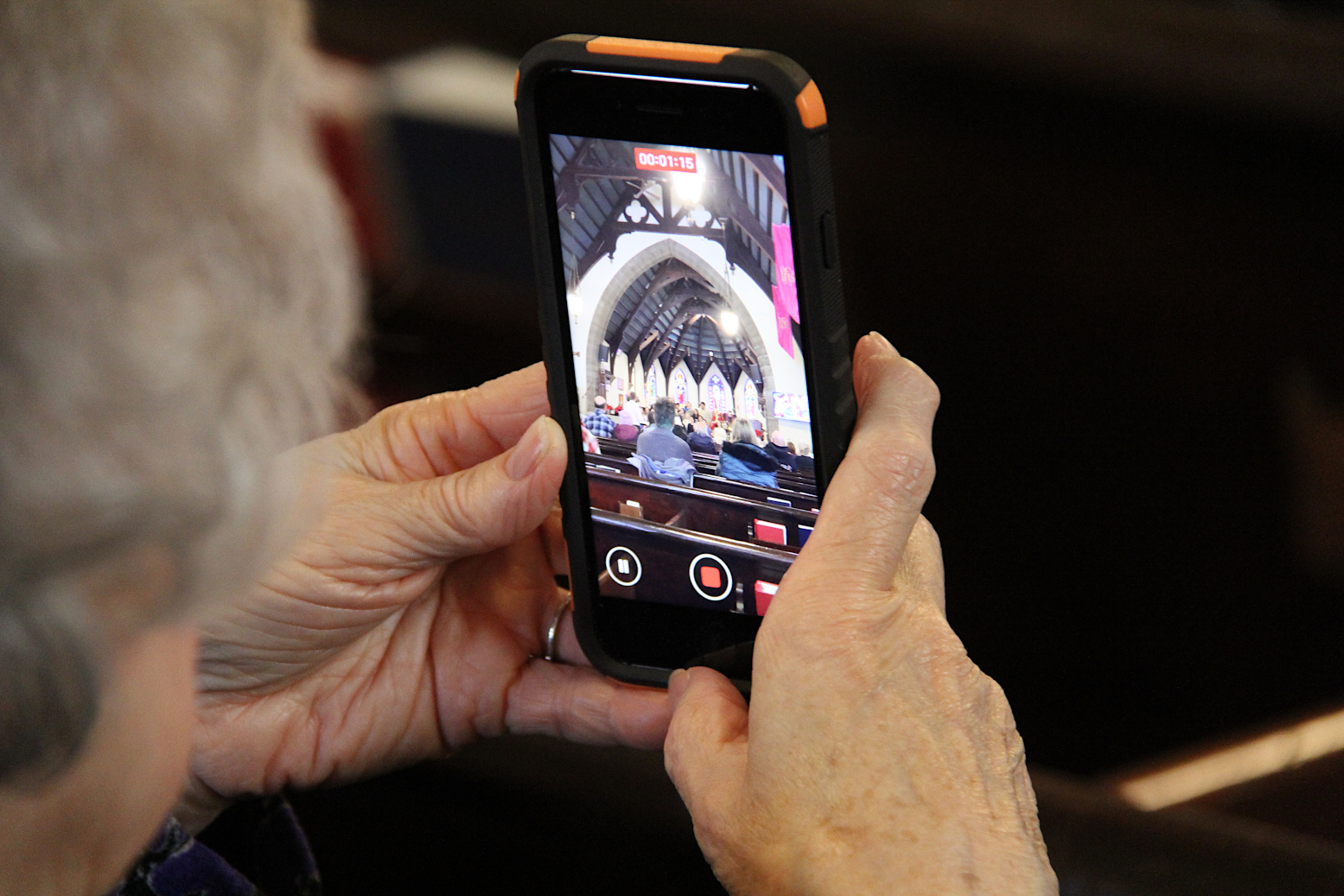
One of many audience members I spotted recording the concert. (Minnesota Prairie Roots copyrighted photo December 2025)
In a selection of songs about light, a Norwegian dala horse, decking the halls, a silent night and more, “Resilience” stood out. I suggested to the students afterwards that they should stand downtown along Central Avenue and sing of strength, resilience and standing shoulder to shoulder. I told them how much they had uplifted me, how much I appreciated and needed to hear that song. And one young man said he was glad he brought me joy via their music.
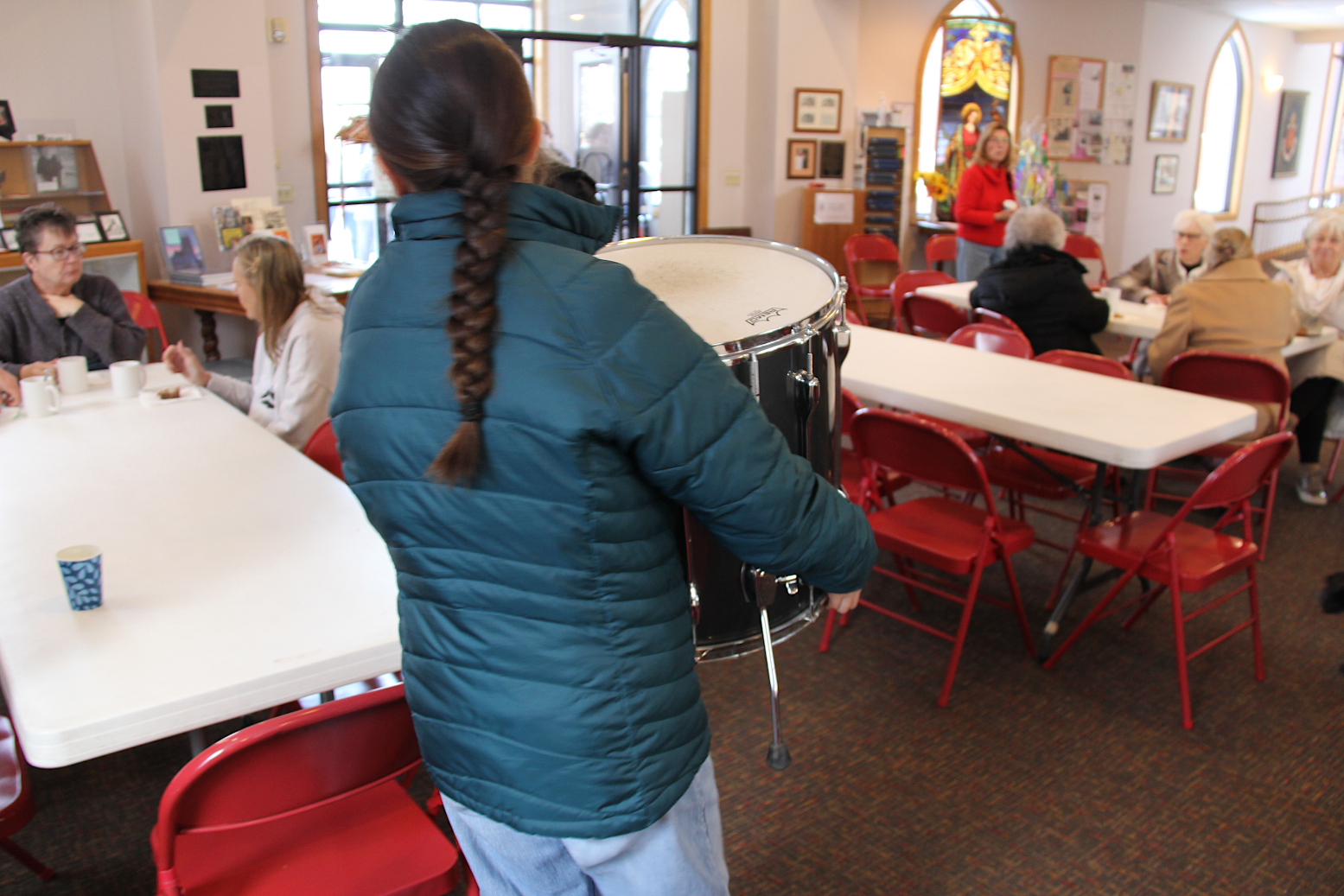
A student carries her drum through the reception space and then outside to a waiting school bus. (Minnesota Prairie Roots copyrighted photo December 2025)
After those conversations over lemonade and sweet treats, I headed home via Central Avenue. Between stops at a gaming store and a used bookshop, I popped into a corner business run by Somali Americans. Inspired by those high school musicians and deeply troubled by the hateful words directed by our president toward Somalis in Minnesota, I walked into the shop packed with colorful merchandise. “I just want to tell you how happy I am that you are here, that you are in our community,” I said. “I’m sorry for everything that’s happening.” My emotions rose. My voice cracked. Tears edged my eyes.
Then the Somali American man reached out and hugged me. He thanked me, told me it was OK, as did a woman sitting nearby. It was not my intention to cry. But everything just bubbled out. The worry. The concern. The injustice. The sorrow I feel over these Minnesotans being singled out and attacked, told they are “garbage” and are not wanted in this country. They who either fled a war-torn country or were born here and are working hard, like the two Somalis I met, to make a living and home in America.
Strength in actions. (Minnesota Prairie Roots copyrighted photo December 2025)
I left that shop feeling the strength of my neighbors. Resilience, we are strong; shoulder to shoulder keep movin’ on…stand up…yes, we can…
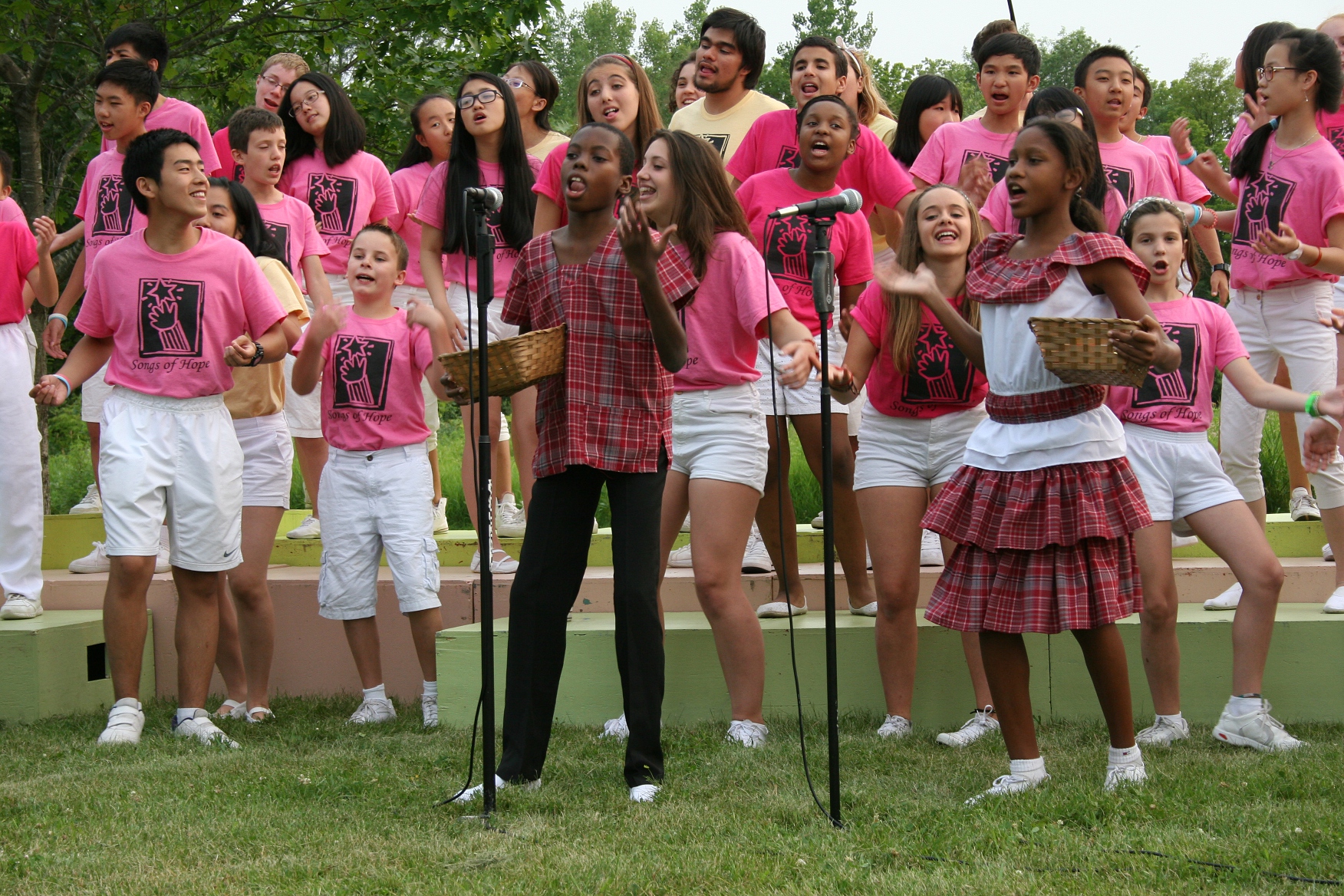
Selections from Jamaica included “Linstead Market” and “Stand Up For Your Rights” at a 2014 Songs of Hope concert in Faribault. (Minnesota Prairie Roots copyrighted file photo)
HOPE. IT’S A POWERFUL WORD. A universal word. A word that is both noun and verb. Likewise, music is universal in the power it holds.
On Tuesday, July 15, the power of those two words comes to Faribault in a 7 p.m. free performance (donations are encouraged) by Songs of Hope at the Cathedral of Our Merciful Saviour. The high-energy international performing arts group, which is part of a six-week summer camp in St. Paul, presents songs with messages of peace, love and respect. Therein lies the hope. You’ll leave this show feeling hopeful, that perhaps we can all get along if we work at it, embrace one another and our differences, and follow the lead of these young people.
Song and dance from Vietnam.(Minnesota Prairie Roots copyrighted file photo 2014)
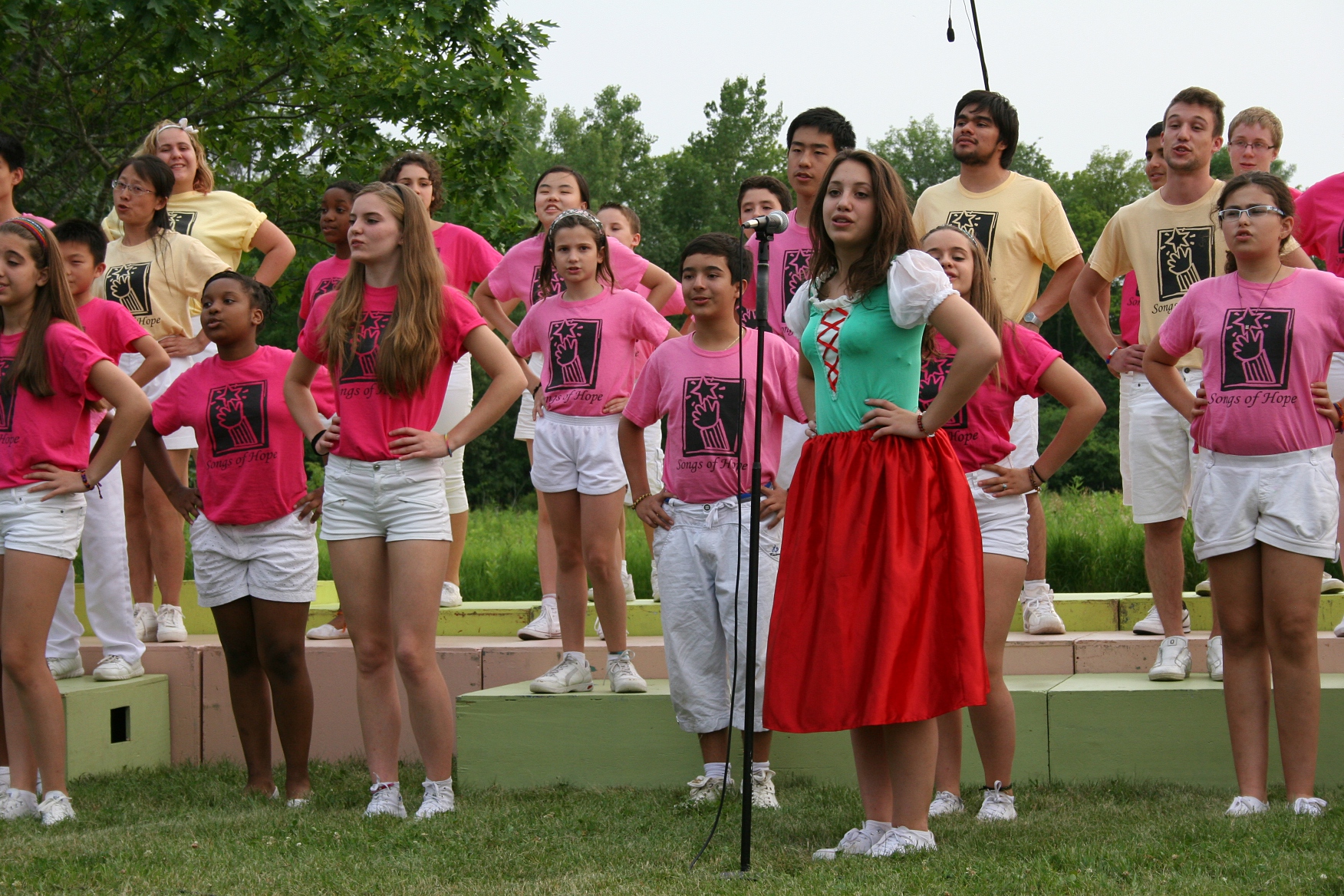
Youth performers from Italy, Vietnam, Guatemala, Jamaica, Turkey, Israel, China and the USA will sing and dance their way into your hearts. I know. I’ve seen this global group perform locally. They’ve been to Faribault multiple times on their out-state Minnesota tour. They uplifted me and gave me hope, along with joy.
The group’s mission is “to share musically the global cultures of its young singers in concerts that mix traditional and popular songs from many countries with English-language songs chosen sometimes to entertain and sometimes to provoke thought.”
Artistic Director Jeanne Junge says, “…when we’re choosing the songs in English, we are careful to include a rich mix of messages, because we feel strongly that audiences need to know that young people in every country see the violence and injustices around them, and they want a better world.”
Isn’t that what we all want? A better world. These select youth, some as young as ten, make this a better world via their concerts. Yet, that they even have to think about, witness and/or experience violence and injustices troubles me. But that is reality world-wide today.
From Italy…(Minnesota Prairie Roots copyrighted file photo 2014)
I encourage you to take in the Songs of Hope show with its song, dance and cultural dress if you have the opportunity. Additional public performances in southeastern Minnesota are set for 11:45 a.m. Wednesday, July 16, at LARK Toys in Kellogg (a 20-minute show) and full shows at 7 p.m. Thursday, July 17, at the State Theatre in Zumbrota and Friday, July 18, at Potter Auditorium in Chatfield. To see a list of all upcoming Songs of Hope concerts, click here.
This sculpture of Alexander Faribault and a Dakota trading partner stands in Faribault’s Heritage Park near the Straight River and site of Faribault’s trading post.(Minnesota Prairie Roots copyrighted file photo)
HOW DO YOU DEFINE heritage? I ask that question because this week my southern Minnesota community celebrates Heritage Days.
I would define heritage as a cultural or ethnic background. I am, for example, of German heritage.
So one would likely assume then that Heritage Days focuses on heritage. It did. Once. But no more. Not primarily. Rather, this multi-day event in Faribault seems more a June get together with the usual food, music, parade, craft fair and such of any summer community gathering.
It’s not that my city of some 24,000 lacks in cultural and ethnic diversity to theme Heritage Days. We are a bit of a melting pot with our newest residents arriving from Somalia and Sudan. Early on, the French, Irish, Germans and others settled here to shape and grow Faribault. Latinos also define a sizable part of our population. Many others have come from multiple countries to this place along the Cannon and Straight Rivers. Most are generations removed from the homeland. Some, though, are first-generation immigrants.
Jeff Jarvis created and handed out this mini booklet about the Wahpekute Band of the Dakota at a previous presentation at Books on Central. (Minnesota Prairie Roots copyrighted file photo)
But back to Heritage Days. Looking through the long list of events, I see several opportunities to learn about local heritage and history. The first happens at 6:30 p.m. Wednesday, June 11, at the Cathedral of Our Merciful Saviour. Regional artist and historian Jeff Jarvis will talk about “The Wakpekute Dakota & Early Faribault History.” I’ve previously heard Jarvis speak on the Dakota, original inhabitants of the land. He’s done his research. I highly recommend attending his presentation. I’m always surprised by how little long-time residents seem to know about the Dakota and their long ago presence in what would become Faribault. Jarvis presents an informative lesson in local Native heritage.
Likewise, the Rice County Historical Society Museum will be open, free of charge, from 10 a.m.-5 p.m. Thursday-Saturday. It’s a good place to see Native American and other artifacts, learn about our early fur trading and additional local history, learn about notable people like Chief Taopi and Bishop Henry Whipple, and more. Bishop Whipple founded and served the Cathedral where Jarvis is speaking.
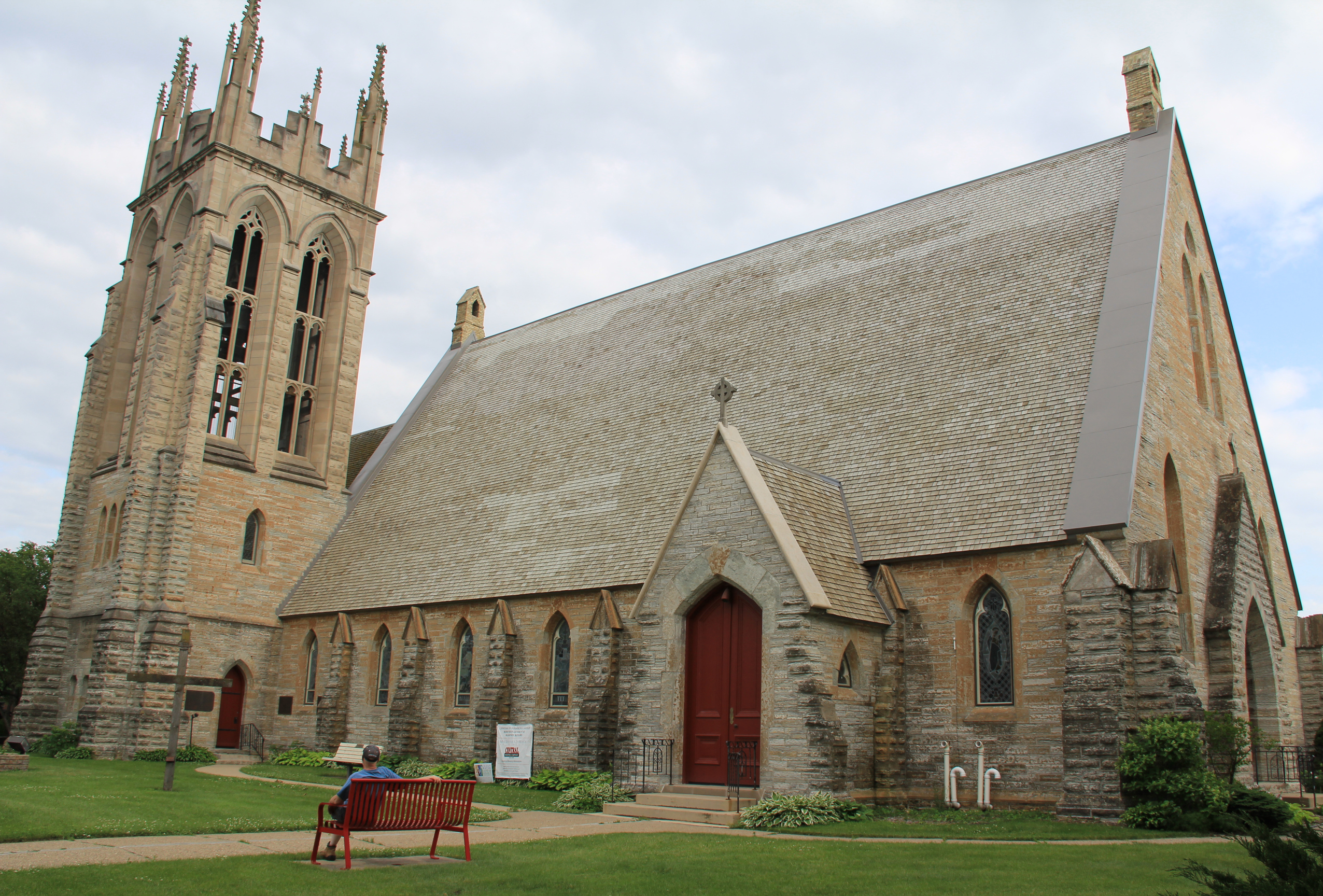
The historic Cathedral of Our Merciful Saviour sits across from Central Park and is a must-see in Faribault. (Minnesota Prairie Roots copyrighted file photo 2024)
The historic Cathedral will be open for tours at 11:30 a.m. Sunday, June 15, following a 10 a.m. Ecumenical Service including bluegrass music. This massive cathedral—and, yes, it really is a cathedral—is important in local Dakota history as the bishop worked closely with Native Americans, some of whom worshipped here.
Fur trader and town founder Alexander Faribault, who was of Dakota and French Canadian heritage, also worked closely with the Dakota. His wood-frame house will be open for free tours from 11 a.m.-3 p.m. Saturday, June 14.
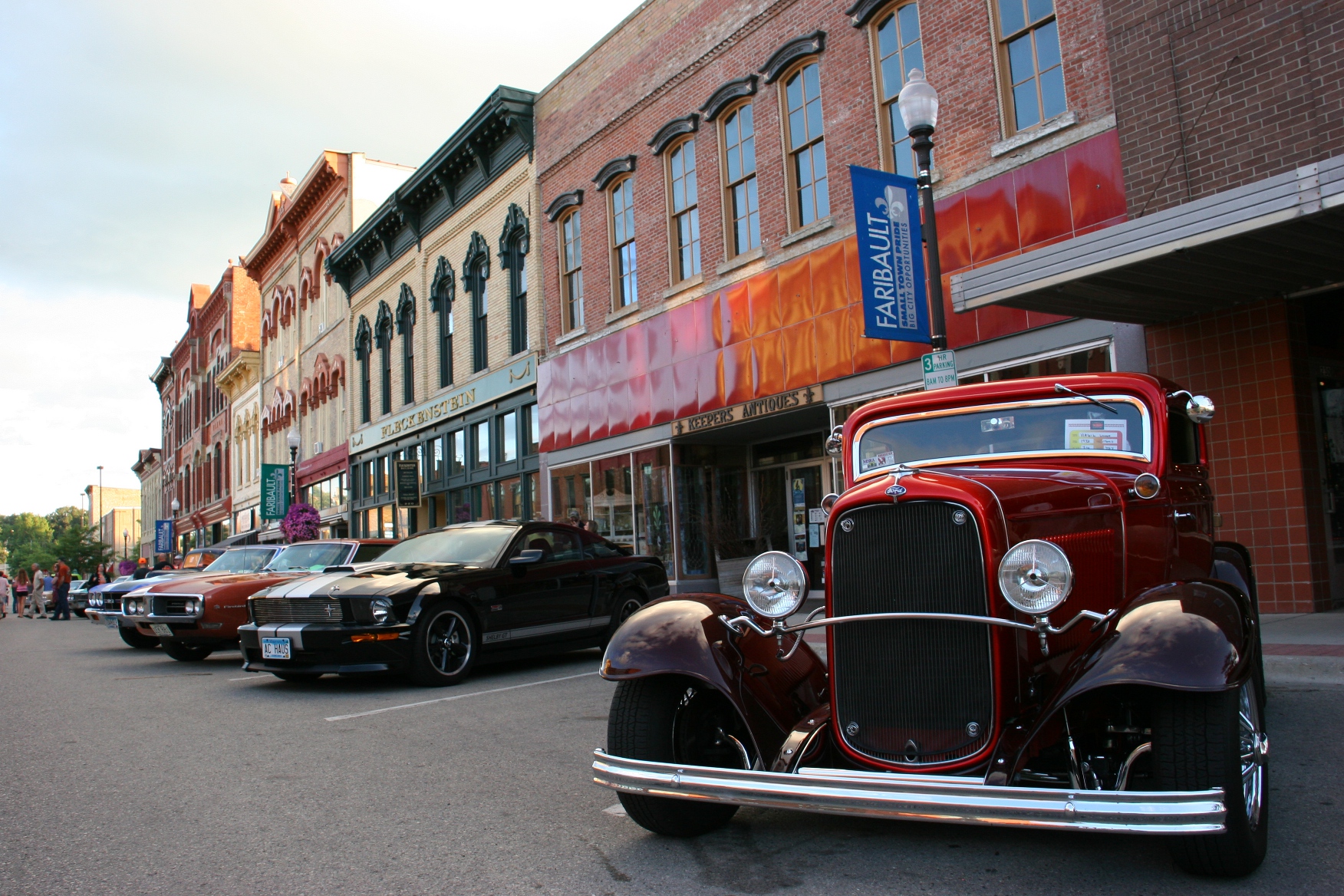
Downtown Faribault features well-kept aged buildings in our historic district. I photographed this scene during a Car Cruise Night. There’s a Car Cruise here Friday, June 13, from 6-9 p.m. (Minnesota Prairie Roots copyrighted file photo)
The Rice County Historical Society will also offer a guided Downtown Walking Tour on Friday and Saturday with two time slots of 11 a.m. and 2 p.m. The $5 tour, led by RCHS Program and Outreach Coordinator Kiran Loewenstein, begins at Central Park. Anticipated to take 1-1 ½ hours, the tour route follows Central Avenue with a focus on the historic district and buildings and early general Faribault history. I expect that will offer ample opportunity to not only learn about early history and heritage, but also to see the heritage of our newest residents in downtown core ethnic businesses.
Two more opportunities to embrace local history (although not officially part of Heritage Days) are inside the State Bank of Faribault along Central Avenue. Local streetscapes and landscapes by Father Jim Zotalis, spiritual leader of the Cathedral, are displayed in a pop-up exhibit in the bank lobby. And for those interested in Faribault’s brewing history, the bank holds an extensive collection of Fleck’s beer memorabilia form long ago Fleckenstein Brewery. Both are accessible during business hours only.
RECENTLY, I WANDERED the aisles of a Big Box retailer searching for Pokemon cards. I needed a birthday gift for my granddaughter, who collects these popular trading and game cards. After walking aisle after aisle without success, I was about to give up. But then I spotted and flagged down a store employee who directed me toward the book section to the Pokemon and other cards.
I stood in front of the display scanning the packets, my eyes never landing on the word Pokemon. My frustration level was growing. I just wanted to be done with this seemingly fruitless search. I even asked a middle schooler to help me as he, too, perused the card merch. He directed me back to the toy aisles. Long story short, I eventually found the location of those coveted Pokemon cards on an end cap. The shelf was empty. There would be no new Pokemon cards for Izzy to add to her collection.
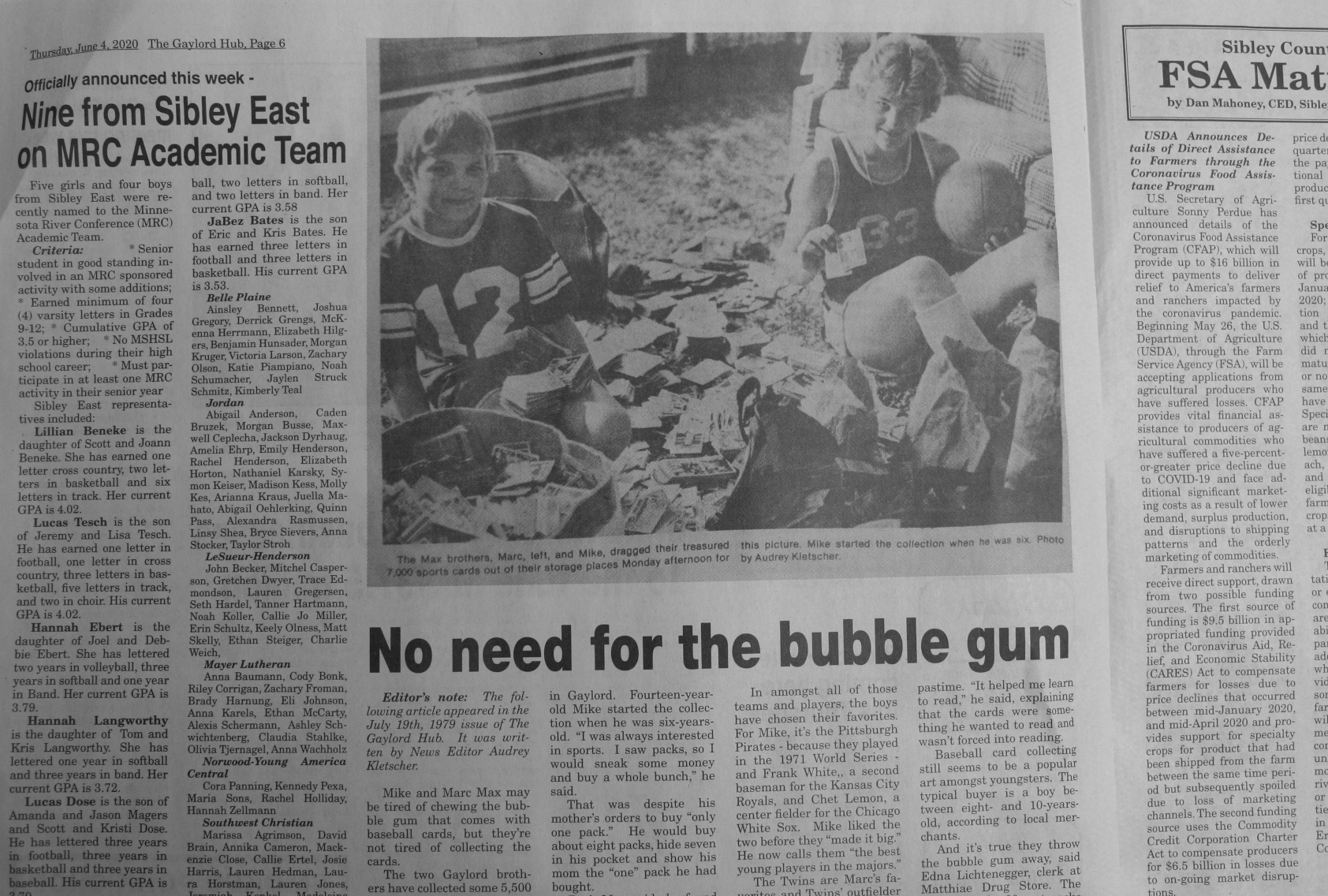
A feature I wrote in 1979 about brothers Mike and Marc Max and their collection of 7,000 sports cards was republished in the June 4, 2020, issue of The Gaylord Hub. I worked there as a newspaper reporter. Mike Max went on to become the sports director and anchor at WCCO-TV. (Minnesota Prairie Roots copyrighted file photo)
Kids have been collecting forever. Maybe not Pokemon cards, but something. Rocks. Beanie Babies. Stickers. Back in the 1960s, I collected “Lost in Space” trading cards featuring the popular sci-fi TV show. I have a few of them tucked away somewhere.
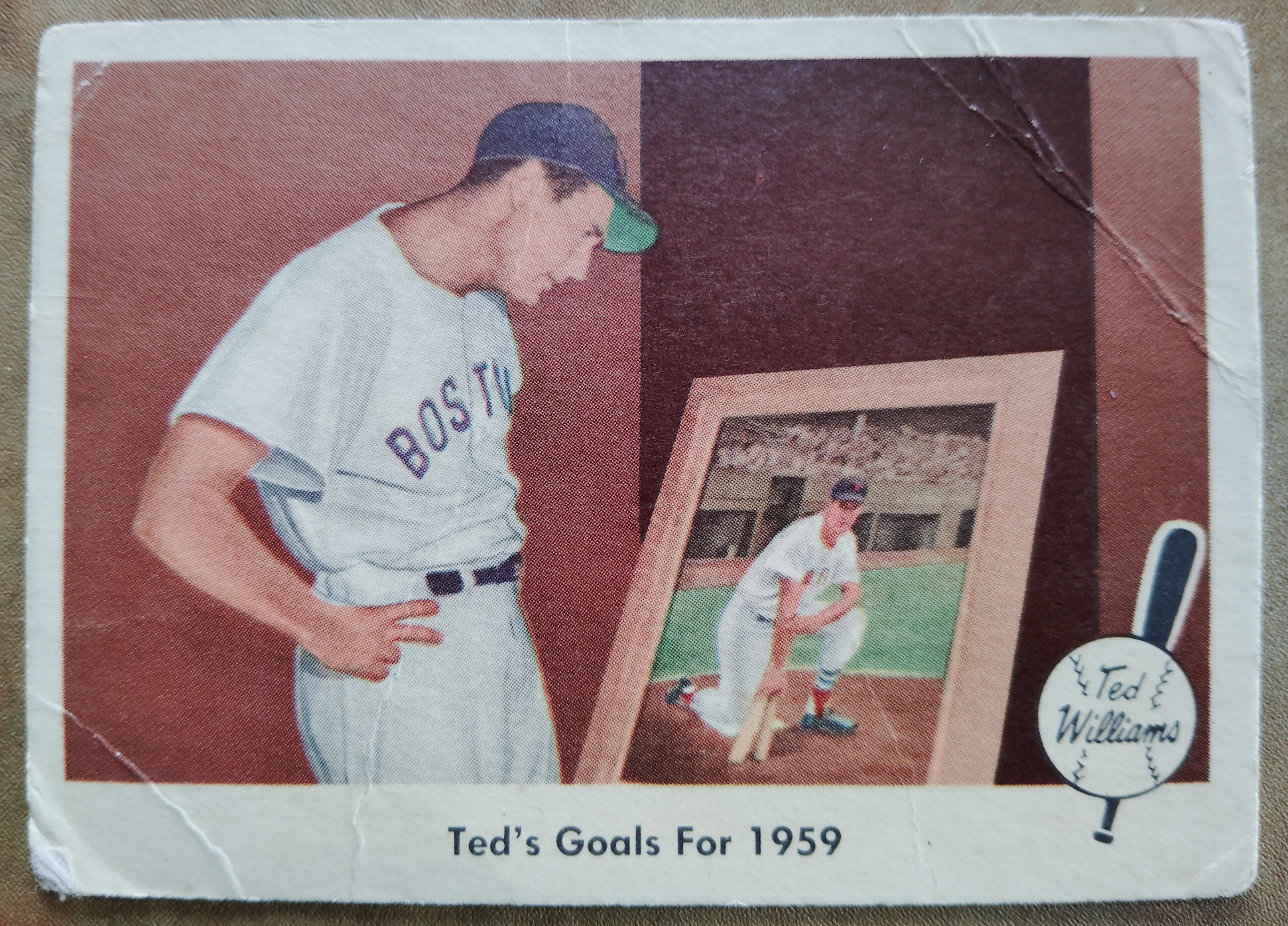
My 1959 Ted Williams baseball trading card, #80. (Minnesota Prairie Roots copyrighted photo April 2025)
My brothers, though, collected baseball trading cards, which were once packaged with bubblegum. They valued the cards more than the gum. I have a baseball card, too. A 1959 Ted Williams, card #80 of 80. He was a left fielder for the Boston Red Sox and 1966 Baseball Hall of Fame inductee. I checked its value with a top end price of $89. But with creased corners, my Williams card is nowhere near that valuable.
(Promo courtesy of The Cathedral of Our Merciful Saviour)
Some cards are, though. And if you’re a collector, you know. This weekend, there’s an opportunity to source sports cards and memorabilia locally at the 2nd annual Sports Card Show from 9 a.m.-4 p.m. Saturday, April 12, at the Cathedral of Our Merciful Saviour, 515 Second Ave. N.W., Faribault. The towering historic Cathedral is easy to find near downtown and across from Central Park.
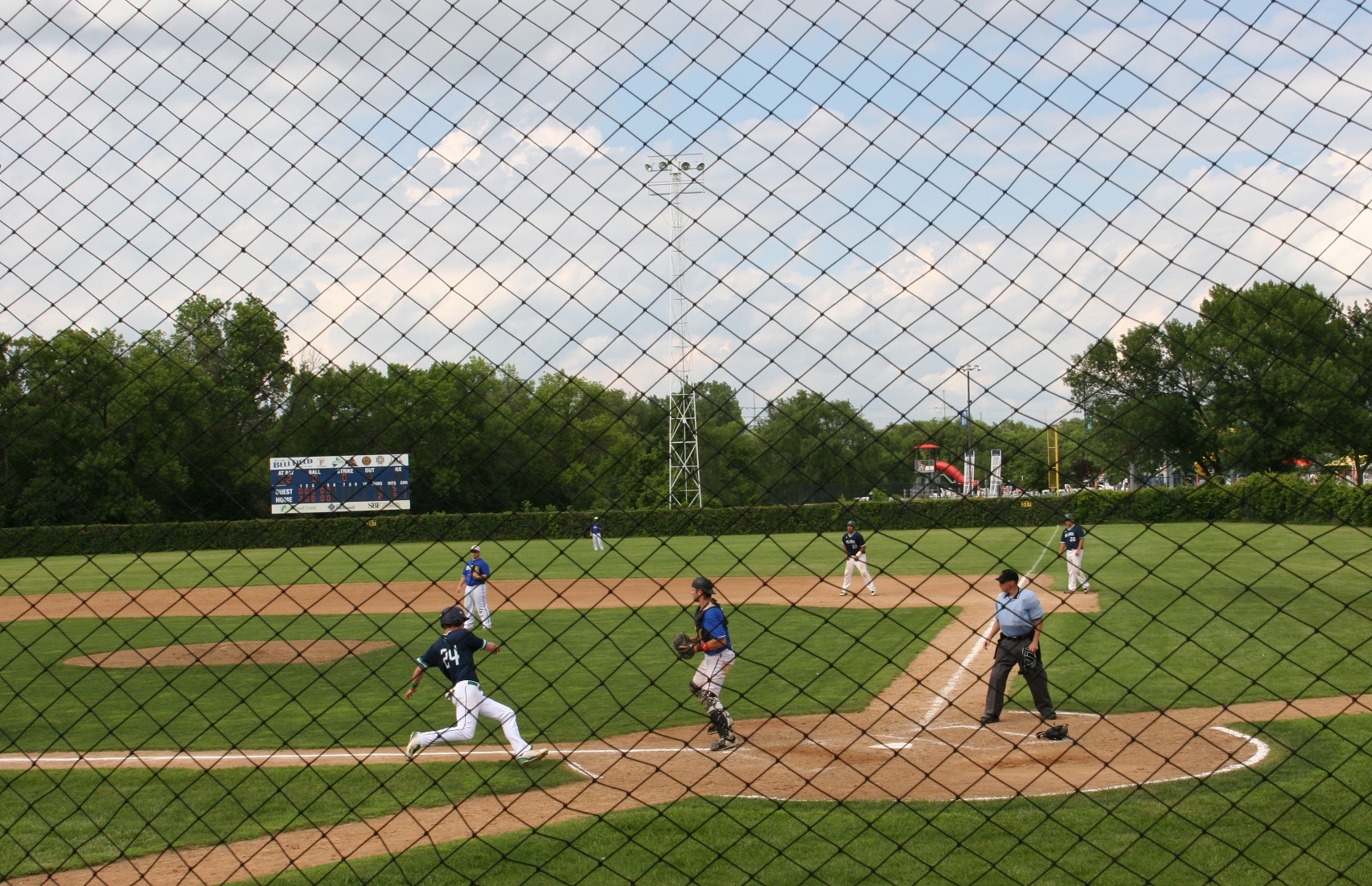
A Montgomery Mallard races toward home plate during a baseball game at Bell Field, Faribault. (Minnesota Prairie Roots copyrighted file photo)
Vendors will be setting up shop for the public to browse, trade and/or buy sports collectibles and memorabilia, according to show organizers. That’s from vintage to modern and includes autographed collectibles. I expect there to be a good turnout at the event as interest in sports and in sports merchandise remains as high as ever.
Ball and glove. (Minnesota Prairie Roots copyrighted file photo)
How well I remember my older brother, Doug, listening to Minnesota Twins games on his transistor radio back in the sixties. How well I remember playing softball in the farmyard on summer evenings after the chores were done, used disc blades serving as bases. Doug always insisted on being Harmon Killebrew or Tony Oliva. There was no arguing with him. How well I remember the play-by-play action my brothers gave of our games. How well I remember the mini wooden souvenir baseball bat that lay atop Doug’s dresser. There was no touching that collectible.
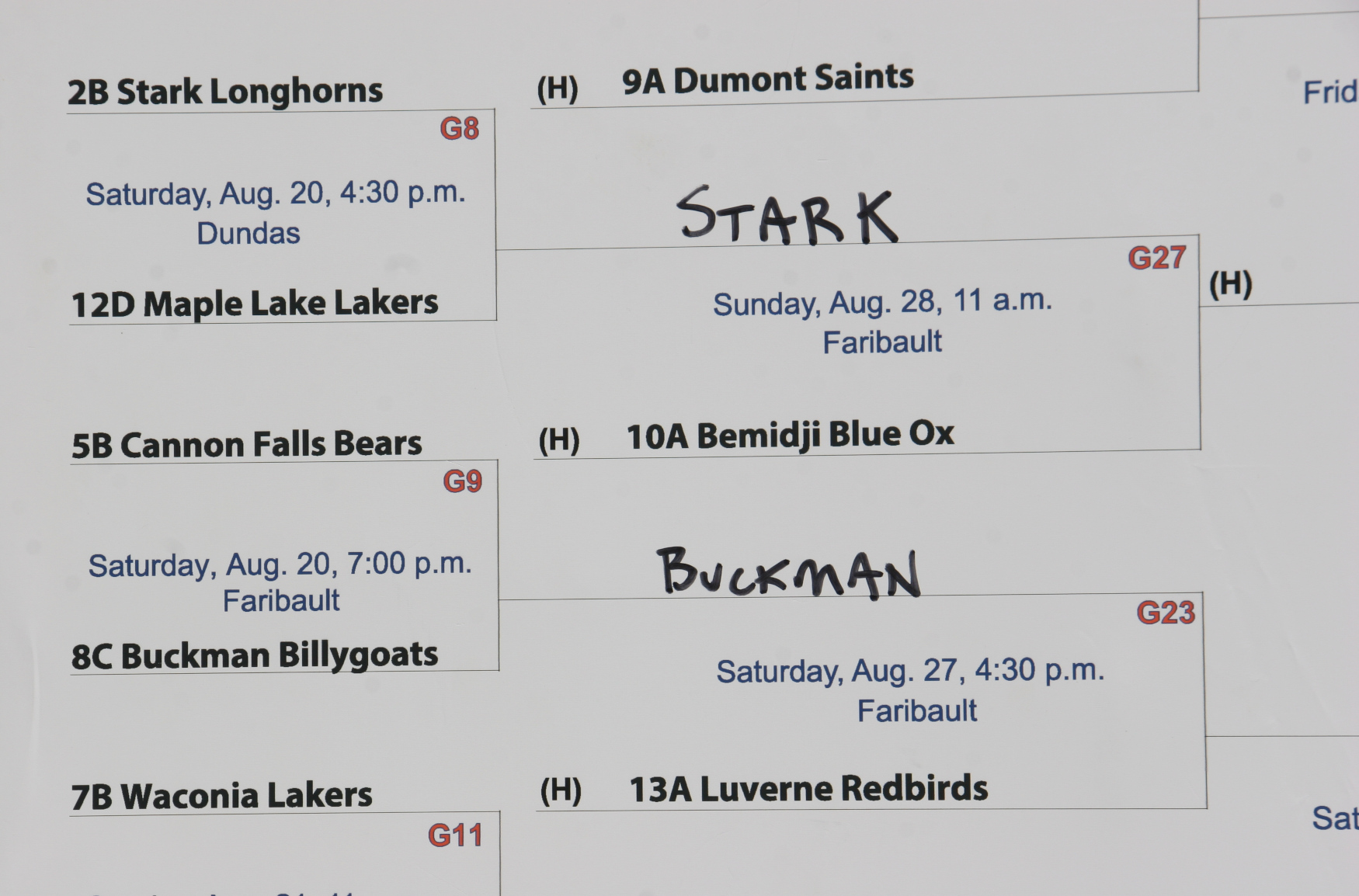
Brackets posted at Bell Field, when Faribault hosted the state amateur baseball tournament in 2022. (Minnesota Prairie Roots copyrighted file photo 2022)
All these decades later, I have minimal interest in baseball (except when my husband’s hometown ball team, the Buckman Billygoats, played in the state amateur baseball tournament). Many people, though, enjoy America’s favorite past-time and all that comes with it—like card collecting. Now, if you had a “Lost in Space” trading card, I’d be interested.
A scene from downtown Benson, Minnesota. (Minnesota Prairie Roots copyrighted file photo November 2024)
SOME 170 MILES separate my community of Faribault from Benson, a small agricultural community in west central Minnesota near the South Dakota border. At first glance, it seems the two share little in common. But they do, a discovery I made following a brief stop in Benson in late November.
Bishop Henry Whipple, featured in a mural on the bandshell at Faribault’s Central Park, across the street from the Cathedral of Our Merciful Saviour. (Minnesota Prairie Roots copyrighted file photo)
Bishop Henry Whipple, the long ago Episcopal bishop of Minnesota, links Faribault and Benson. Whipple, a missionary based in Faribault, traveled around the Minnesota frontier in the early years of statehood in an effort to spread the Christian faith. That included visits to Benson where, in 1879, Christ Episcopal Church was built for $1,650 by local carpenters. Whipple visited occasionally to lead services and confirm new members.
That early Gothic Revival style church with gray board and batten siding caught my eye during a brief drive around Benson’s downtown core. More accurately, the seven-story Parkview Manor apartment across the street from the church initially grabbed my attention. The 55-unit high-rise looks very much out of place in this prairie town. It dwarfs residential houses and the historic church. Typically grain elevators and church steeples mark small town skylines, not a towering 1967 apartment complex.
Parkview Manor, where the church was once located. (Minnesota Prairie Roots copyrighted photo November 2024)
Christ Episcopal Church once sat on the apartment land, but was moved across the street after the Housing and Redevelopment Authority bought the property in 1966. At some point the church, founded by English and Yankees (as New Englanders were once termed), closed due to dwindling membership. Today the building serves as the Swift County Drop In Center, “a safe haven for adults to go to experience life free of stigma.” I think Bishop Whipple would have liked that, knowing the former church serves as a gathering place, a safe spot to just be.
The church sits in a residential neighborhood near downtown. (Minnesota Prairie Roots copyrighted photo November 2024)
Some day I’d like to tour the aged church, which was added to the National Register of Historic Places in 1985. Perhaps I would feel the presence of Benson’s early settlers, hear the words of comfort, peace, hope and unity preached by Bishop Whipple.
While Whipple is primarily viewed as a man who befriended Indigenous Peoples, he was also part of the long ago mindset to assimilate and “civilize” them. That’s a side not often discussed when talking about a man, a missionary who shared his biblical teachings while also compassionately advocating for Native Americans. Whipple is highly-revered in Faribault, where he is buried beneath the Cathedral of Our Merciful Saviour, an historic cathedral worthy of visiting, too.
The Cathedral of Our Merciful Saviour, Faribault. (Minnesota Prairie Roots copyrighted file photo July 2024)
The immense Faribault cathedral differs vastly from the unassuming small church in Benson. Yet, history and a missionary link the two. To uncover that connection simply because I noticed an out-of-place apartment high-rise and then the old steepled church across the street reveals just how small this world really is if only we pause to notice, then uncover the connections.
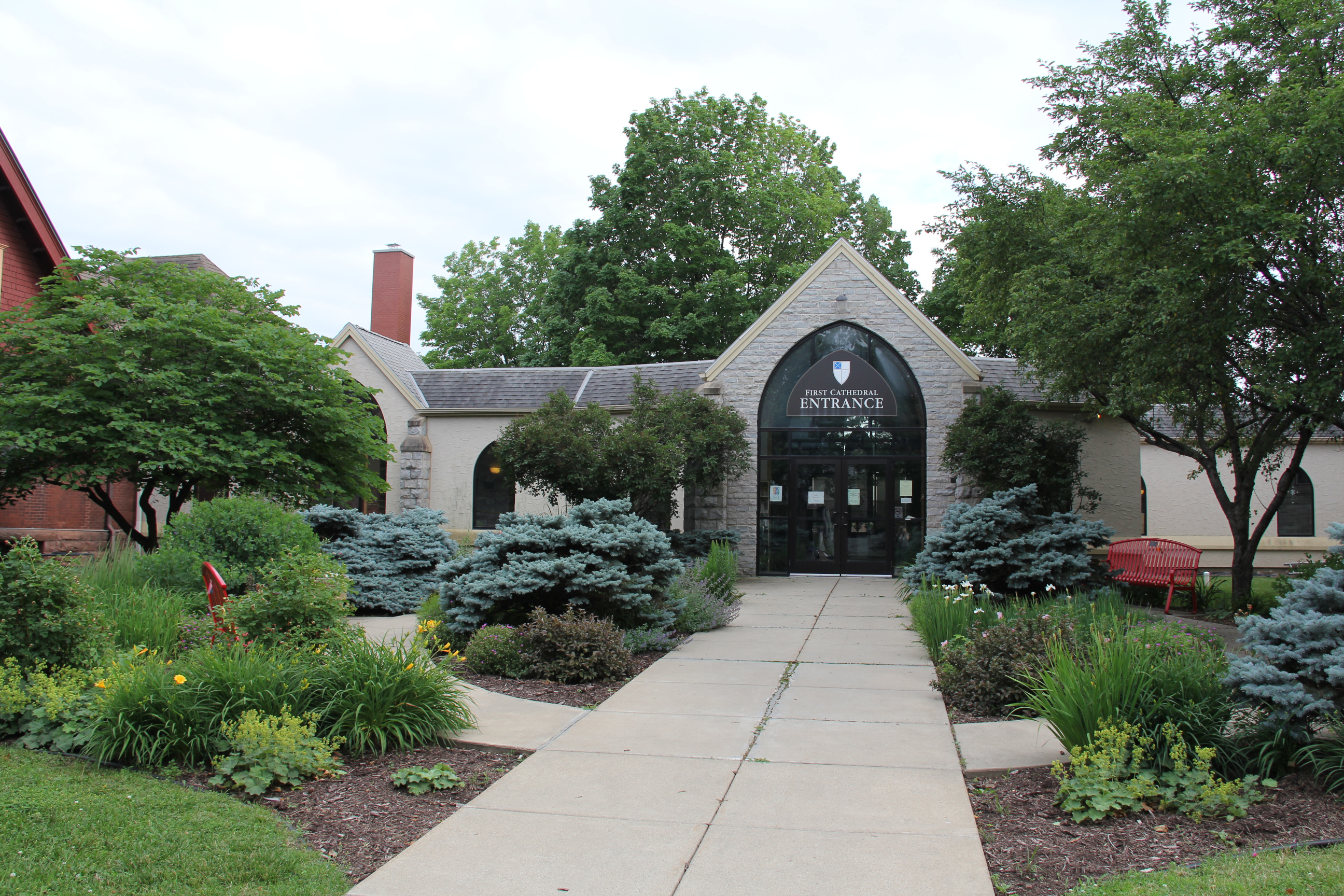
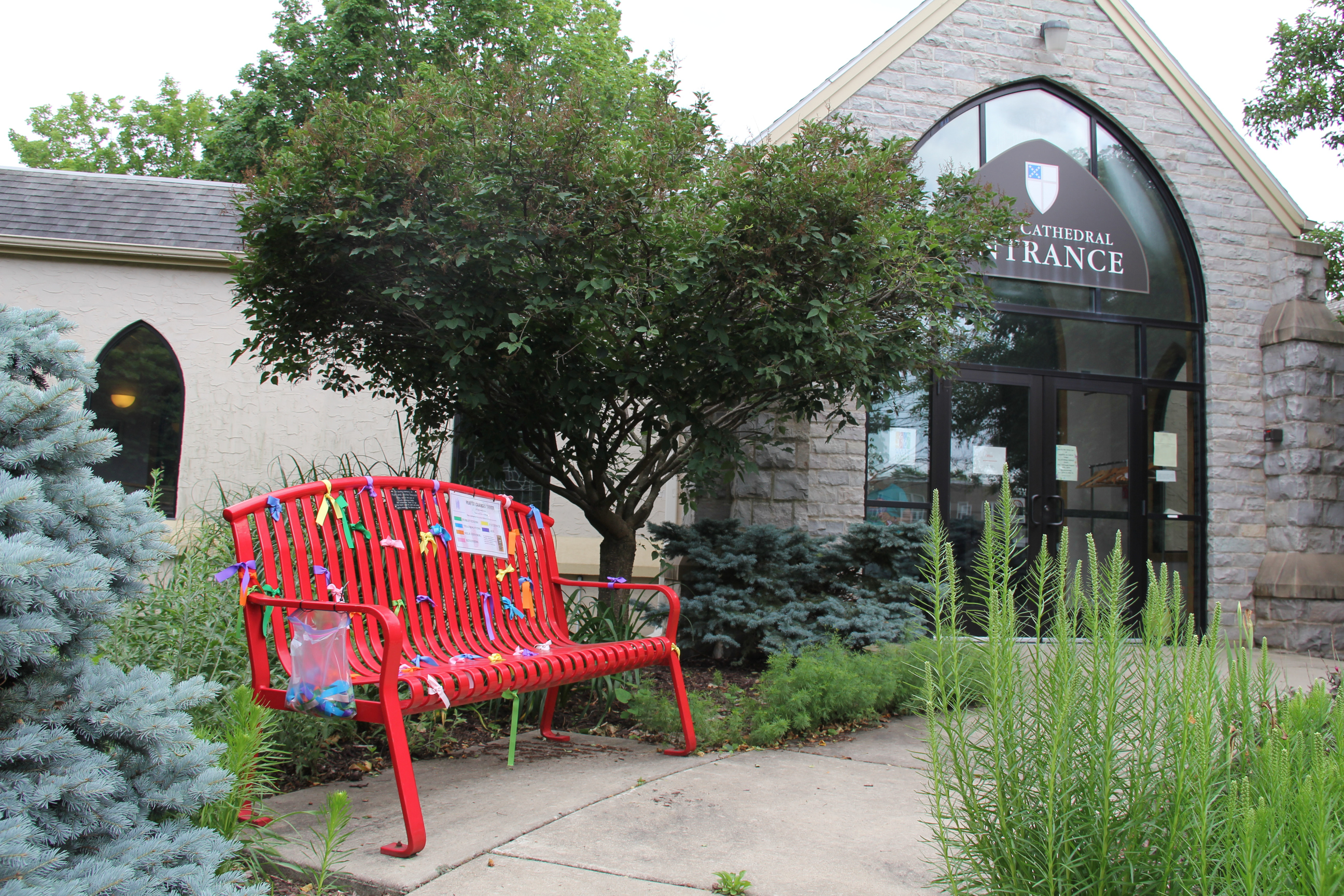
A garden graces a side entry to The Cathedral of Our Merciful Saviour in Faribault. (Minnesota Prairie Roots copyrighted photo June 2024)
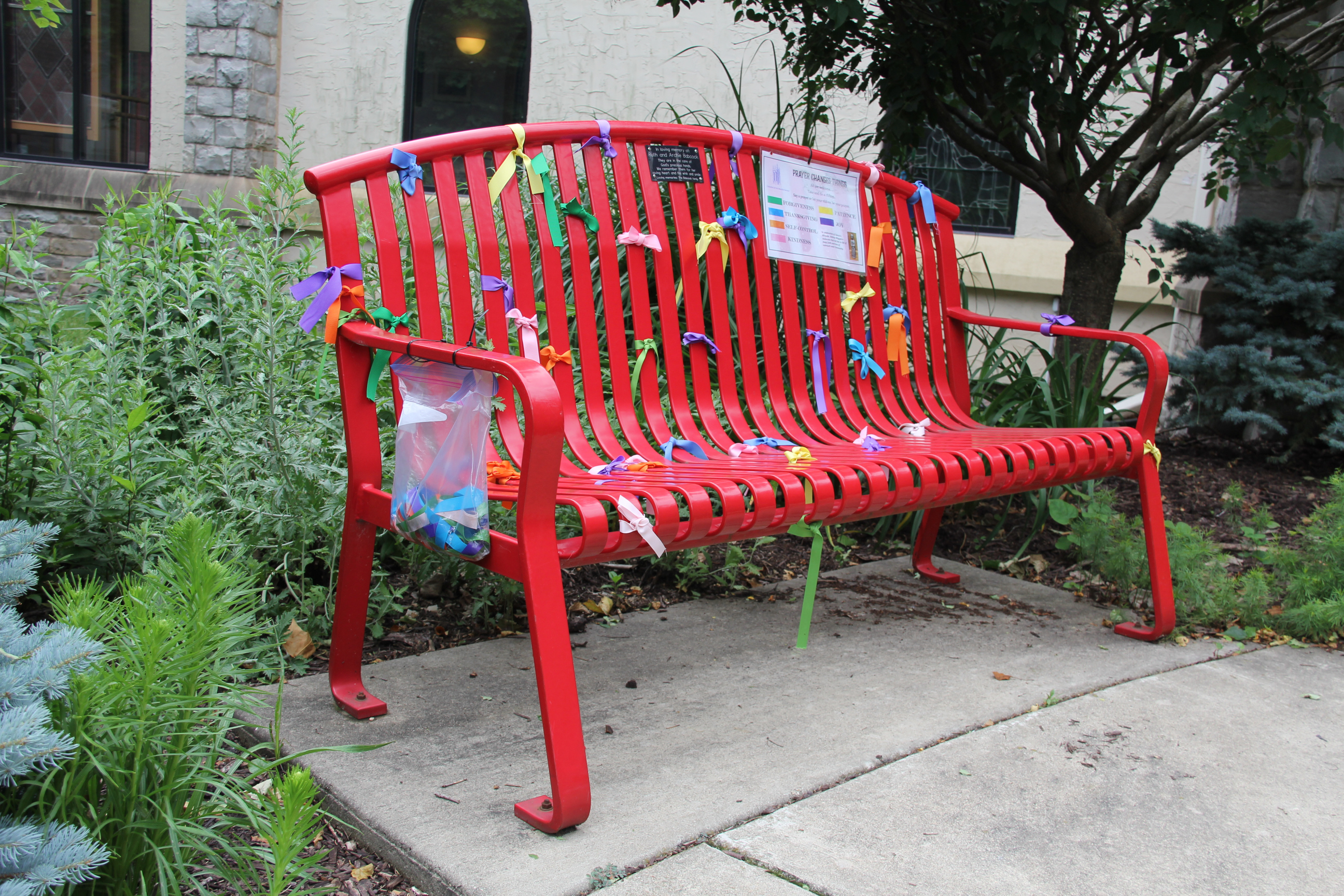
AMONG THE FLOWERS, trees and shrubbery fronting a side entry to the space that connects church to guild house, three red benches nestle. Bold. Vibrant. Statement pieces in a garden at The Cathedral of Our Merciful Saviour.
Construction on the original part of the Cathedral began in 1862 and was completed in 1869. It is listed on the National Register of Historic Places. (Minnesota Prairie Roots copyrighted photo June 2024)
But those benches outside the massive limestone church towering above the landscape along Second Avenue across from Central Park in Faribault serve as more than a place to rest. They are a place for prayers.
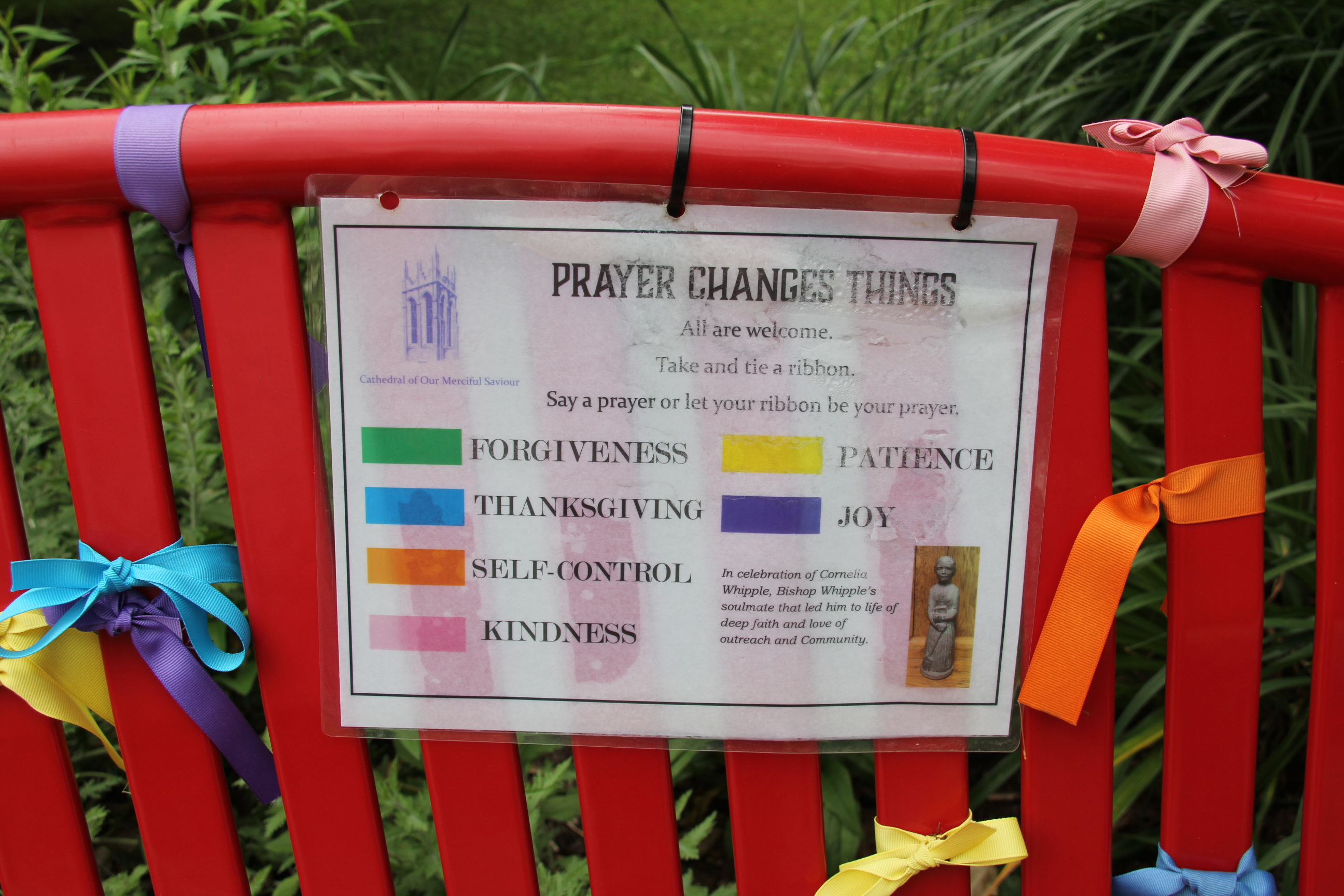
Prayer ribbon instructions posted on a bench. (Minnesota Prairie Roots copyrighted photo June 2024)
Ribbons, representing prayers, are tied to the slatted benches. A sign explains: PRAYER CHANGES THINGS. All are welcome. Take and tie a ribbon. Say a prayer or let your ribbon be your prayer.
Choose a ribbon from the bag. (Minnesota Prairie Roots copyrighted photo June 2024)
What a creative idea. A Ziploc bag of multi-colored ribbons hangs on one of the benches. Each hue represents a different prayer. Green for forgiveness. Blue for thanksgiving. Orange for self-control. Pink for kindness. Yellow for patience. Purple for joy.
One of the three garden benches is covered with prayer ribbons. (Minnesota Prairie Roots copyrighted photo June 2024)
These prompts prove soul-searching. Too often prayers focus on needs/wants/desires, not tough topics like forgiveness and self-control. And how often we forget to express gratitude and joy in prayer.
Ribbons representing prayers of joy, kindness and self-control. (Minnesota Prairie Roots copyrighted photo June 2024)
To be reminded of these traits, these feelings, these thoughts can only make us kinder, gentler, better people.
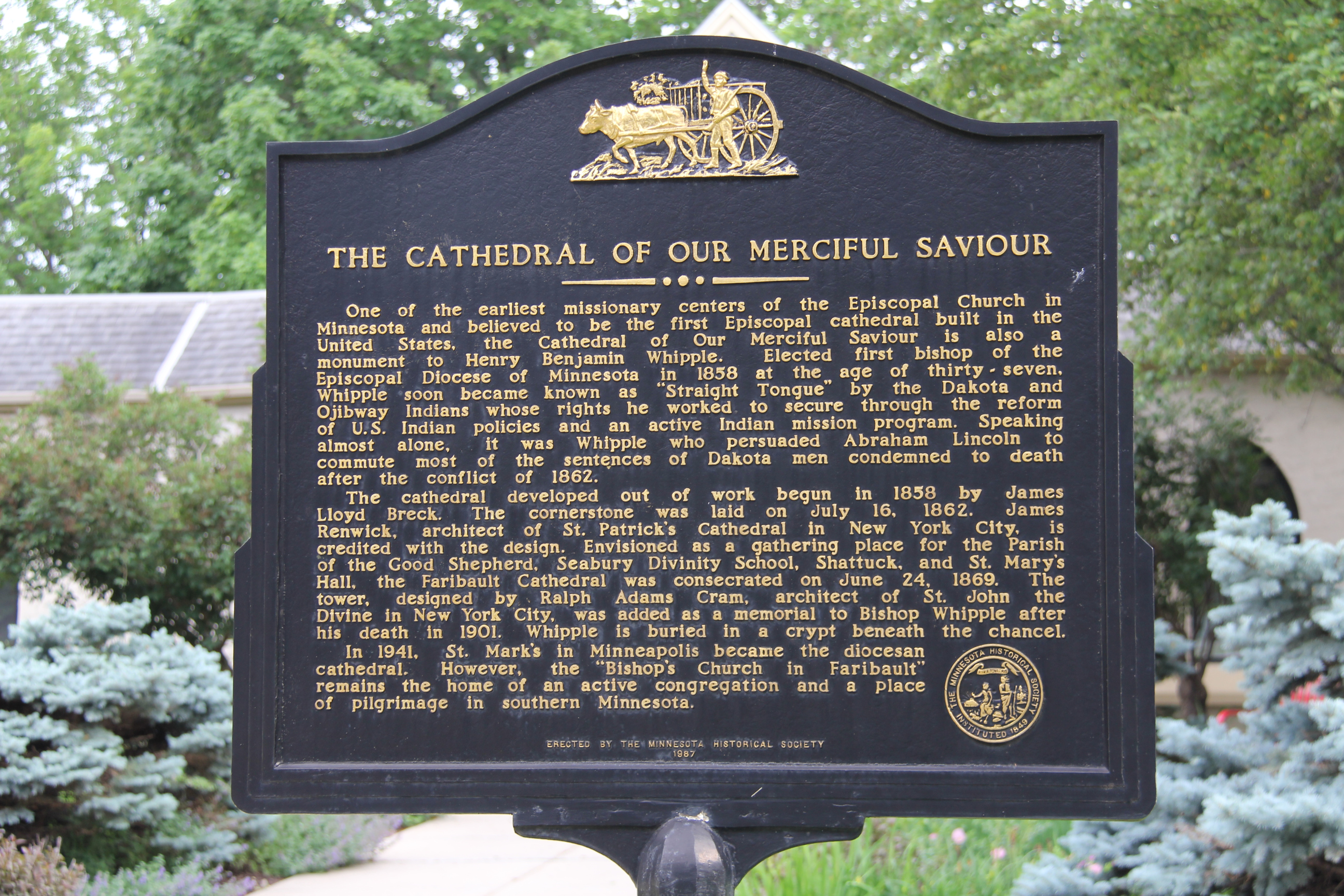
A historical marker at the Cathedral summarizes its history. (Minnesota Prairie Roots copyrighted photo June 2024)
The Cathedral sign lists community connections. (Minnesota Prairie Roots copyrighted photo June 2024)
That follows a guiding principle of the Cathedral as a place “where history meets heart.” The Cathedral, since it’s founding in the mid-1800s, has long centered on community. Bishop Henry Whipple befriended the Dakota people and many more. Today the church still opens its doors—as the site of the Community Cafe (serving free meals weekly to the community), as a venue for free concerts, as a historic site to tour, as an active participant in Faribault’s annual Heritage Days celebration, as a location for Red Cross blood drives…
Ribbons representing patience, thanksgiving and joy. (Minnesota Prairie Roots copyrighted photo June 2024)
And now this seemingly small, yet powerful thing, this beckoning to ponder and place prayers upon public benches. Prayer changes things. Just as a faith family can, when thoughts and ideas expand into actions. Actions that embrace community, providing a welcoming place to gather, to celebrate, to contemplate life.
An inviting entry garden…with prayer beribboned benches. (Minnesota Prairie Roots copyrighted photo June 2024)
We all hold the capacity to forgive, to thank, to control our thoughts, words and behavior, to practice kindness, to exercise patience, to express joy. If tying a ribbon to a red bench encourages self-reflection and positive change, then that is a good thing. We can always be better, do better, live better, in ways that improve our lives and the lives of those around us.
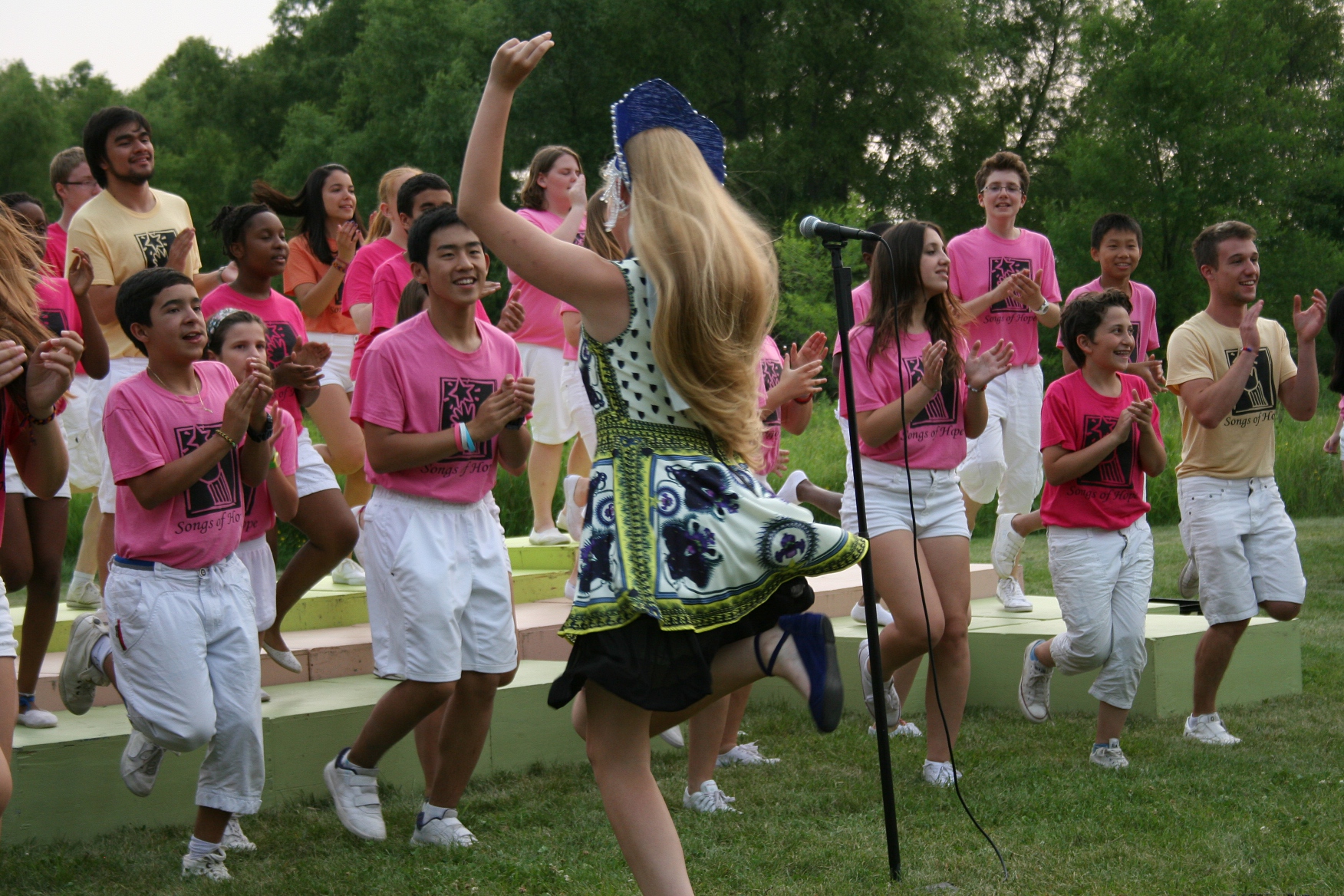
In July 2014, Songs of Hope performers presented selections from Jamaica, including “Linstead Market” and “Stand Up For Your Rights.” (Minnesota Prairie Roots copyrighted file photo July 2014)
TEN YEARS AGO, Songs of Hope danced and sang their way into my heart at River Bend Nature Center in Faribault. Now this group of young musicians and performers from around the world will be back in town, this time at 7 p.m. Tuesday, July 16, at the historic Cathedral of Our Merciful Saviour.
Song and dance from Vietnam. (Minnesota Prairie Roots copyrighted file photo July 2014)
I encourage you, if you live in the area, to attend this free 90-minute concert in the Cathedral, which boasts incredible acoustics in a remarkable setting. The concert is part of the Cathedral’s Merner Concert series offering free music to the community.
In nearly constant motion during this 2014 performance in Faribault. (Minnesota Prairie Roots copyrighted file photo July 2014)
Young people from Finland, Italy, Germany, Vietnam, Costa Rica, Mexico, Jamaica, Turkey, Madagascar and the USA will present a program that features singing, dancing and cultural dress in a high energy show. I can vouch for that. When I attended the Songs of Hope performance at River Bend in 2014, I felt, heard and saw their energy. I left feeling uplifted and incredibly hopeful about the future of this world.
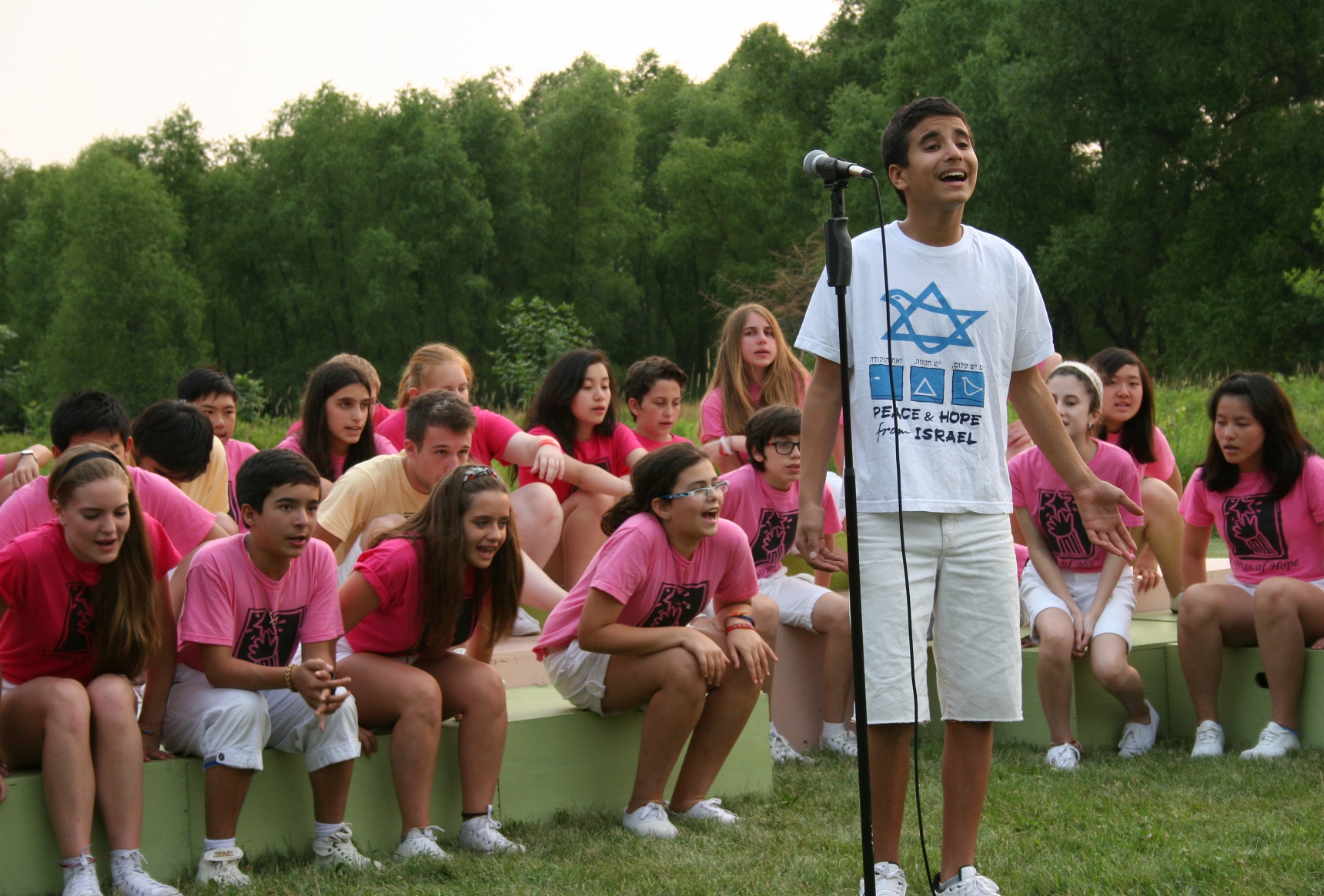
The message on this singer’s t-shirt is as relevant today as it was during this performance 10 years ago. (Minnesota Prairie Roots copyrighted file photo July 2014)
In a time when there’s so much conflict, so much discontent, so much unease, this coming together of international youth infuses hope into communities. And who doesn’t want to feel hope?
Ready to perform in traditional Chinese attire in 2014. (Minnesota Prairie Roots copyrighted file photo July 2014)
These youth are sharing their cultures via their performance art and dress. When we begin to learn about other cultures, we begin to recognize the commonalities among us, rather than that which we think divides us. We all share basic human needs of food, shelter and love.
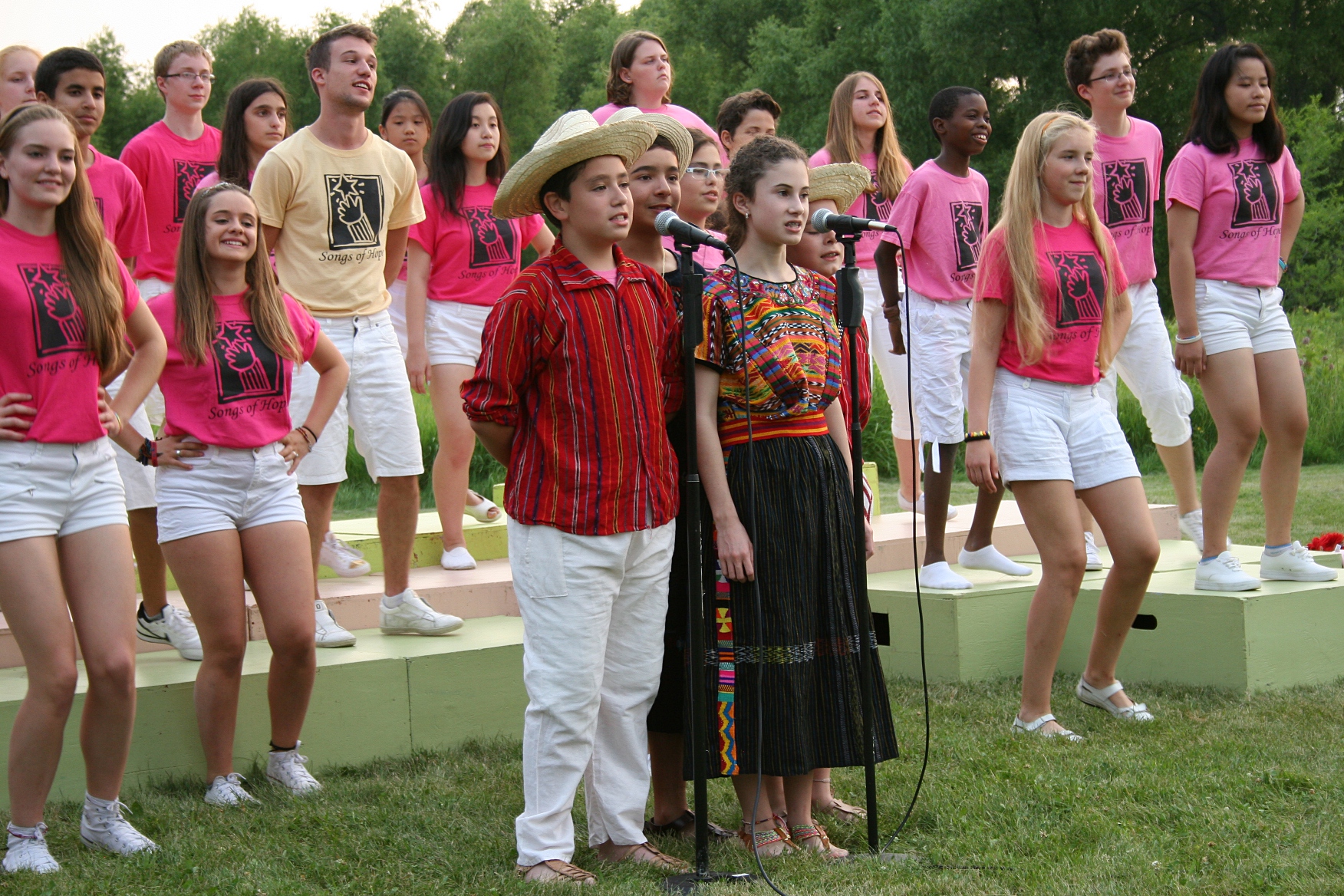
Songs from Guatemala. (Minnesota Prairie Roots copyrighted file photo July 2014)
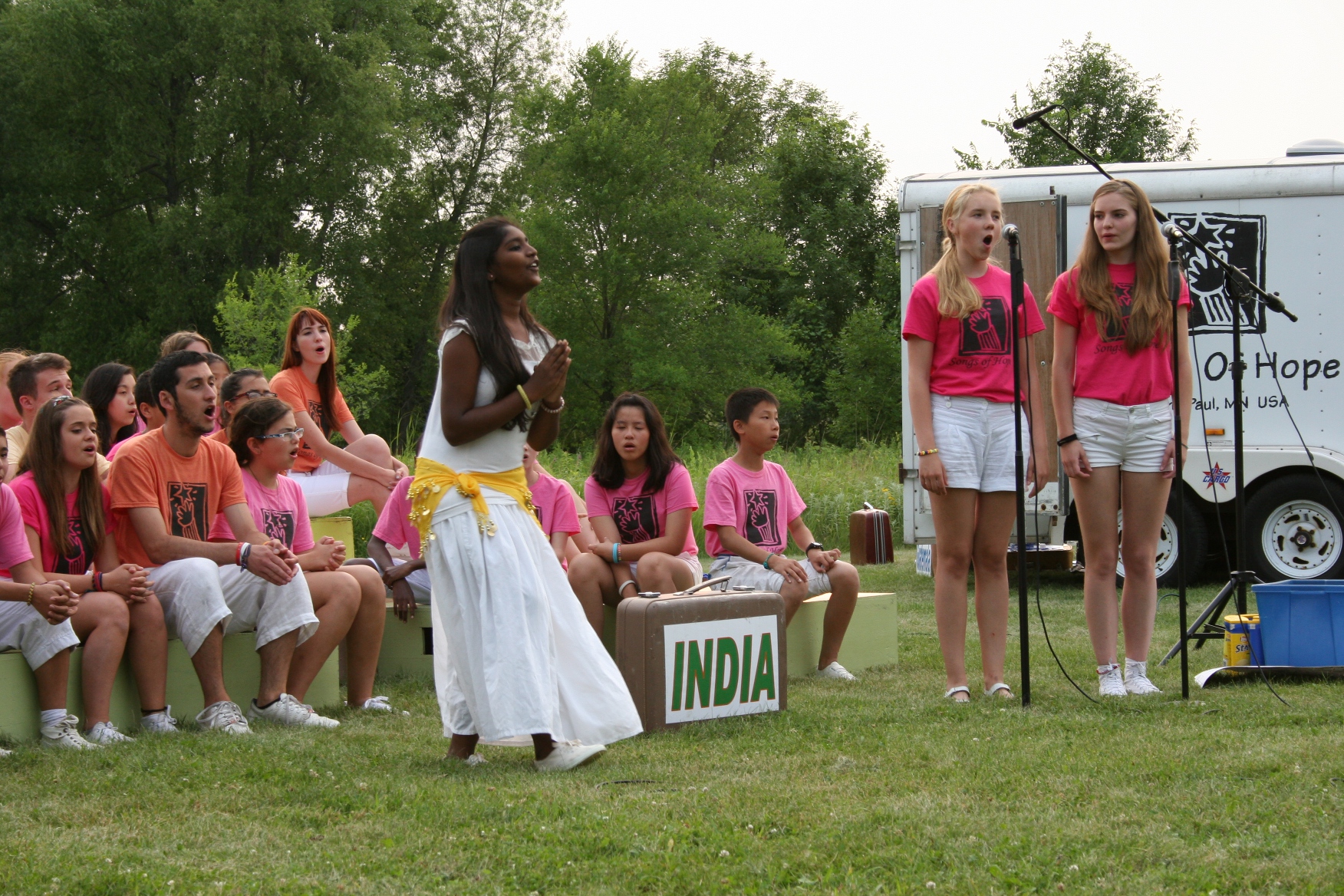
The name, Songs of Hope, fits this group, which is part of St. Paul-based Sounds of Hope. Youth ages ten and older from around the world attend a six-week overnight performing arts summer camp before heading out on a three-week concert tour. Those concerts are performed in the Twin Cities metro and in communities outside the Cities, primarily in southeastern Minnesota.
Songs of Hope performers present a selection from India. (Minnesota Prairie Roots copyrighted file photo July 2014)
To have Songs of Hope back in Faribault, a decidedly diverse, but not always united, community, is a gift to all of us.


















 Minnesota Prairie Roots
Bishop Henry Whipple, the man behind the federal building bearing his name January 16, 2026
Tags: advocate, Bishop Henry Whipple, Bishop Henry Whipple Federal Building, commentary, Dakota, faith, Faribault, history, immigrants, Immigration and Customs Enforcement, immigration enforcement, injustice, Minnesota, news, opinion, The Cathedral of Our Merciful Saviour
I EXPECT BISHOP HENRY WHIPPLE may be turning over in his grave under the altar inside the Cathedral of Our Merciful Saviour in Faribault. He would be appalled by what’s happening in this community with ICE enforcement. And he would also likely be standing side-by-side with protesters outside the Bishop Henry Whipple Federal Building at Fort Snelling protesting ICE’s presence in Minnesota. The federal agents are based inside the building named after him.
Whipple was all about compassion and embracing others, especially as a friend to the Dakota in Minnesota following his arrival here in 1860 and throughout his ministry. He would not be fine with ICE violently, or non-violently, taking people from their vehicles, their homes, clinics, outside schools and churches, inside businesses…and illegally detaining them without due process. That includes those here legally and American citizens imprisoned inside the building bearing Whipple’s honorable name.
I am not OK with this. None of us should be.
HOW BISHOP WHIPPLE MIGHT REACT
As Minnesota continues to deal with the presence of 3,000 ICE agents in our state, I think of the Episcopalian bishop, known as “Straight Tongue” for his honesty, and how he would react. He would assuredly be on the streets advocating for human rights. He would be talking with the current president, just like he did in 1862 with President Abraham Lincoln. Whipple traveled to DC then to personally plead for the lives of 303 Dakota sentenced to death by hanging.
Whipple would probably also be out buying groceries for Faribault residents afraid to leave their homes. He would be walking kids to their bus stops in trailer parks. He would be preaching peace, love and compassion.
HONORING WHIPPLE’S LEGACY
Those who disliked Whipple, and the Dakota, disparagingly tagged the clergyman as “The Sympathizer.” Little has changed. There are far too many in my community who hate, and, yes, that’s a strong word, anyone whose skin color is other than white. I don’t understand. They all, unless they are Native American, can trace their presence in America back to immigrants.
If only Bishop Henry Whipple was still alive to spread love in Faribault and beyond. It’s up to us to honor his legacy by loving and helping our neighbors during these especially dark days of injustice and oppression.
#
FYI: To learn more about the bishop, I direct you (click here) to a previous blog post I wrote about him and his role in Minnesota history following a 2023 presentation at the Rice County Historical Society.
© Copyright 2026 Audrey Kletscher Helbling