Minnesota Prairie Roots

Writing and photography by Audrey Kletscher Helbling

The craft of writing creatively, from idea to story February 11, 2025

My fiction, creative nonfiction and poetry has published in all these volumes of The Talking Stick, plus volumes 32 and 33 not pictured here. (Minnesota Prairie Roots copyrighted file photo)

WITH ONLY WEEKS until the deadline for an annual writing contest, I am stretching my mind to come up with short stories and poetry that will please not only me, but also the editors of a Minnesota-based literary anthology. It’s not easy, this creative writing. Yet, I enjoy the challenge.

I can’t always explain from whence my fictional stories spring. I’ve written some really dark stuff that has landed me publication and sometimes prizes. Stories with undertones of darkness and violence. Nothing like I’ve experienced in real life, although certainly I’ve faced plenty of dark and trying days.

When I read my second place winning fictional story, “Dear Mother,” at last fall’s Talking Stick 33—Earth Signs book launch party in northern Minnesota, I qualified my reading with “I don’t know where this dark story came from.” It was implied that the main character killed her abusive mother. The writer who followed me as the first place winner in fiction also wrote a dark story. I don’t recall if Tara or some other writer explained that, in order to reach the light, we need to go through darkness. That resonated with me.
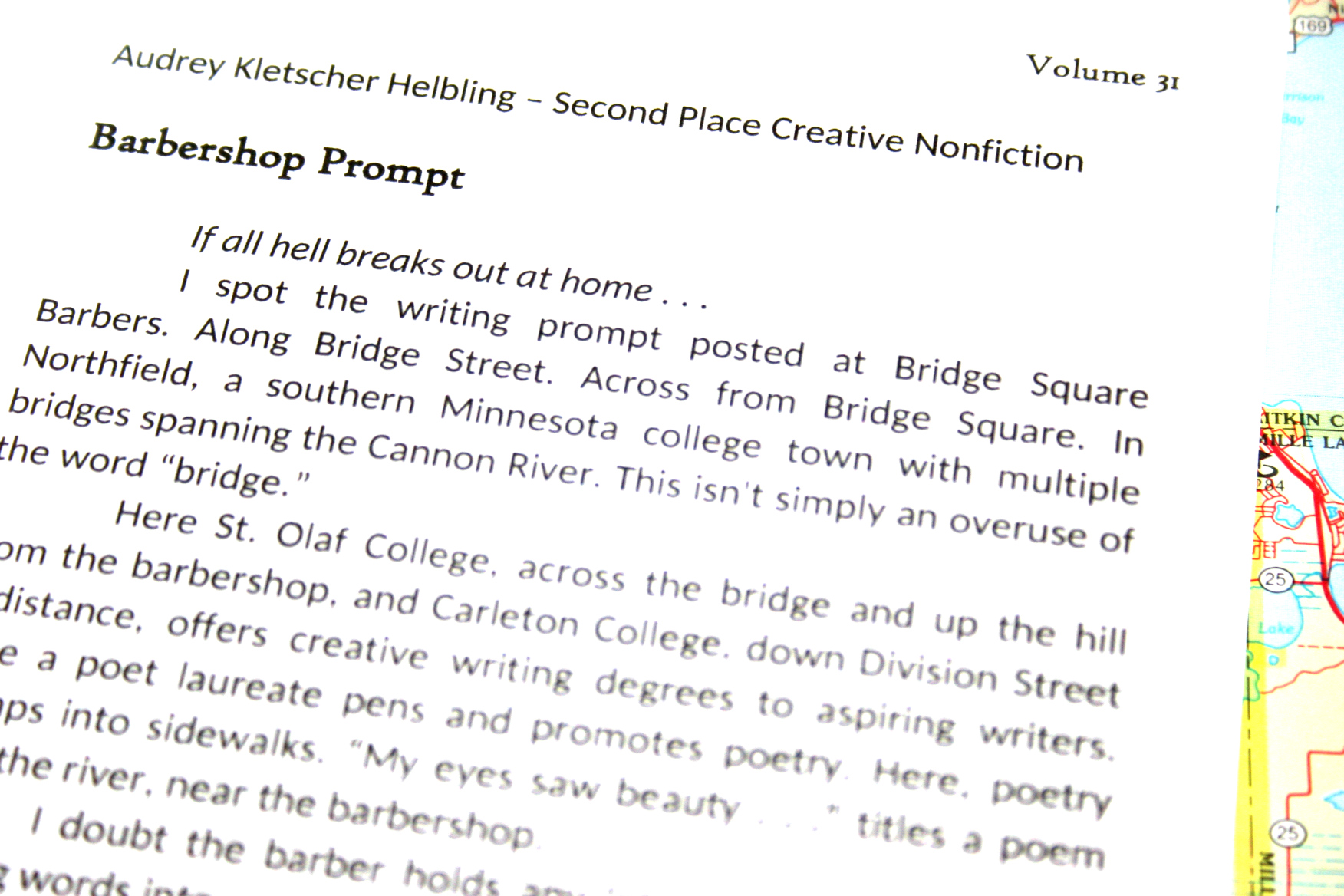
The beginning of “Barbershop Prompt,” published in Talking Stick 31–Escapes. (Minnesota Prairie Roots copyrighted file photo)

I’ve completed the initial draft of my first piece of fiction for this year’s contest. It, too, includes some dark elements. The community calendar in my local newspaper prompted the story, which I realize may seem rather odd. But, hey, inspiration can strike in the most unlikely of places. A previous work prompted by a sign at Bridge Square Barbers in Northfield earned me a second place in creative nonfiction in 2022.

Now three years later, with the printed community calendar of events lying on my office desk, I glanced from newspaper to computer screen as the idea of a story began to take shape. Once I finished the intro, words began to fly (OK, admittedly not always) from my brain to the keyboard to the screen. The draft is saved, awaiting a second look in a few days.
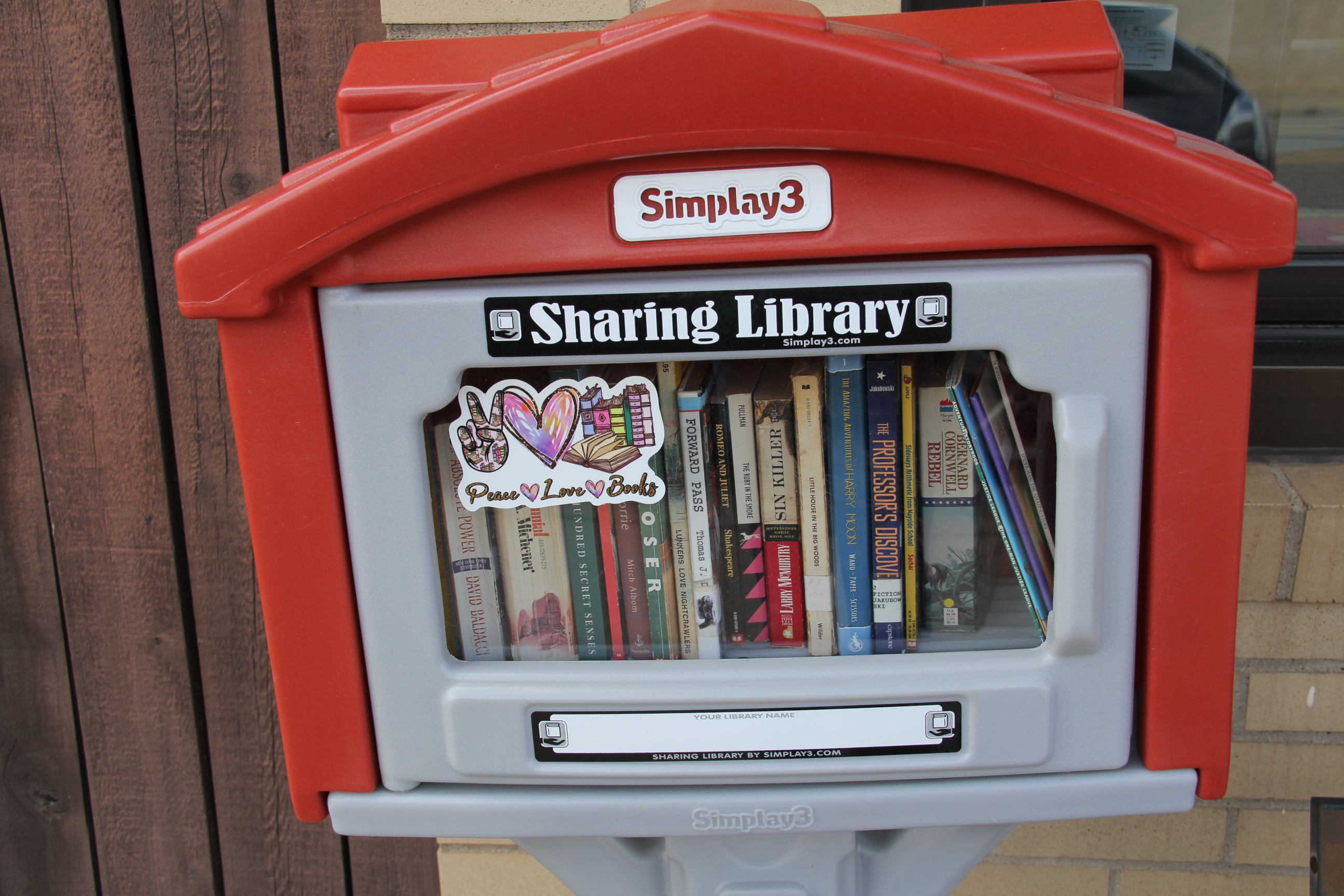
This sharing library in Pine River is inspiring my next creative work. (Minnesota Prairie Roots copyrighted photo July 2024)

Now I’m on to my next piece of writing. A photo I took of a sharing library (like a Little Free Library) in Pine River is serving as my inspiration for a story that has yet to unfold. But I see the possibilities in the many love-themed/titled books shelved inside that library adorned with a Peace/Love/Books sticker.

Romeo and Juliet by Shakespeare. Lunkers Love Nightcrawlers, author unknown to me. Tuesdays with Morrie by Mitch Albom, packed with life lessons, including that of love. Sin Killer by Larry McMurtry, a book of adventure, humor and romance on the American frontier. And then Absolute Power by David Baldacci, about a President “caught” with a billionaire’s wife. That title seems so relatable to today. Absolute power. But writing contest rules call for no political or religious rants, meaning I will need to steer clear of politics.

And so I’ll see where this idea goes. If a plot develops in my mind, if a story flows into something that may, or may not, be dark.

© Copyright 2025 Audrey Kletscher Helbling


“It was a dark and stormy night…” March 15, 2013

Snoopy's GuideJUST THINKING about the scene—my husband and kids lying belly down on the carpet reading the Sunday funnies—makes me smile.

My mother’s heart swelled with love to witness this weekly connection between father and daughters/son. Back then, I considered only that bonding aspect, that break from full-time mothering, the laughter that spilled from the living room.

I’ve never been a reader of comics, considering them a waste of time. Besides that, I’m a serious person, not inclined to reading anything remotely humorous. But now, at age 56, it is not too late to admit that I was wrong. Comics offer not only laughter, but insights into life and much more. Duh.

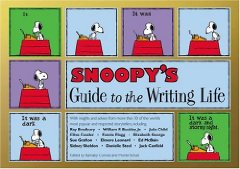
Thanks to Minnesota writer Sue Ready, who blogs at Ever Ready, I discovered the value in comic strips via her recommended reading of Snoopy’s Guide to the Writing Life, published in 2002 by Writer’s Digest Books and edited by Barnaby Conrad and Monte Schulz.

It was the title, not the comedic aspect, which grabbed my attention. I am always interested in reading about writing and this volume offers insights from noted authors like Ray Bradbury, Fannie Flagg and Danielle Steel, among about two dozen others.

Their advice, though, isn’t presented in a straight-forward manner. Rather, the selected writers are prompted by cartoonist Charles M. Schulz’s Snoopy strips, specifically featuring Snoopy the writer at his doghouse rooftop typewriter.

Why had I forgotten that Snoopy was a writer? Perhaps because I have not read all that many Peanuts cartoons.

Snoopy faces the sometime issues of writer’s bloc, criticism (from the ever present loud-mouthed Lucy), rejection and more. But the problems somehow seem funny when faced by Snoopy and not me.

The canine is stuck on beginning his stories with “It was a dark and stormy night,” or a slightly revised version. How often do we writers also become stuck, writing in the same way or, even worse, writing how we think we should write?

Author Fannie Flagg advises:

The joy about writing is that as long as you write from your heart, a thousand English degrees cannot compete with that.

How true. Readers can sense when you write from your heart.

I found Snoopy’s Guide to the Writing Life packed with pieces of useful advice, some which I already knew, some not. Here are some paraphrased gems I plucked from the book:

  • Too much time on the typewriter (translate computer) can cause double vision. (Correct.)
  • Avoid boring descriptions and heavy explanations.
  • Understand your subject and your market.
  • Surprise is an important element of humor (and writing in general, might I add).
  • Stop seeking approval and advice and trust your instincts.
  • “Try to leave out the parts that readers skip” (direct quote that I could not paraphrase).
  • Plot develops from character, a point emphasized by more than one writer.
  • Just write. Every day.

Now, one of my favorite lines comes from Monte Schulz, the son of Peanuts creator Charles M. Schulz. Monte surmises that writers write “for the music of beautiful language.” I love that phrase because I totally get what he means. As a writer, and especially as a poet, my heart rejoices when I find the exact word or line which makes my poem sing. It is a glorious moment.

Then, on the second to last page of Snoopy’s Guide, writer J.F. Freedman throws in that element of surprise, at least for me, when he writes:

 Great comic strips…are a fine introduction into literature, and are damn good writing in and of themselves…

And after reading (in this book) more than 180 “Snoopy at the typewriter” comic strips, likely more comics than I’ve read in my life, I’d agree with Freedman. Damn good writing, indeed.

WHAT WRITING TIPS can you offer? Let’s hear them.

© Copyright 2013 Audrey Kletscher Helbling