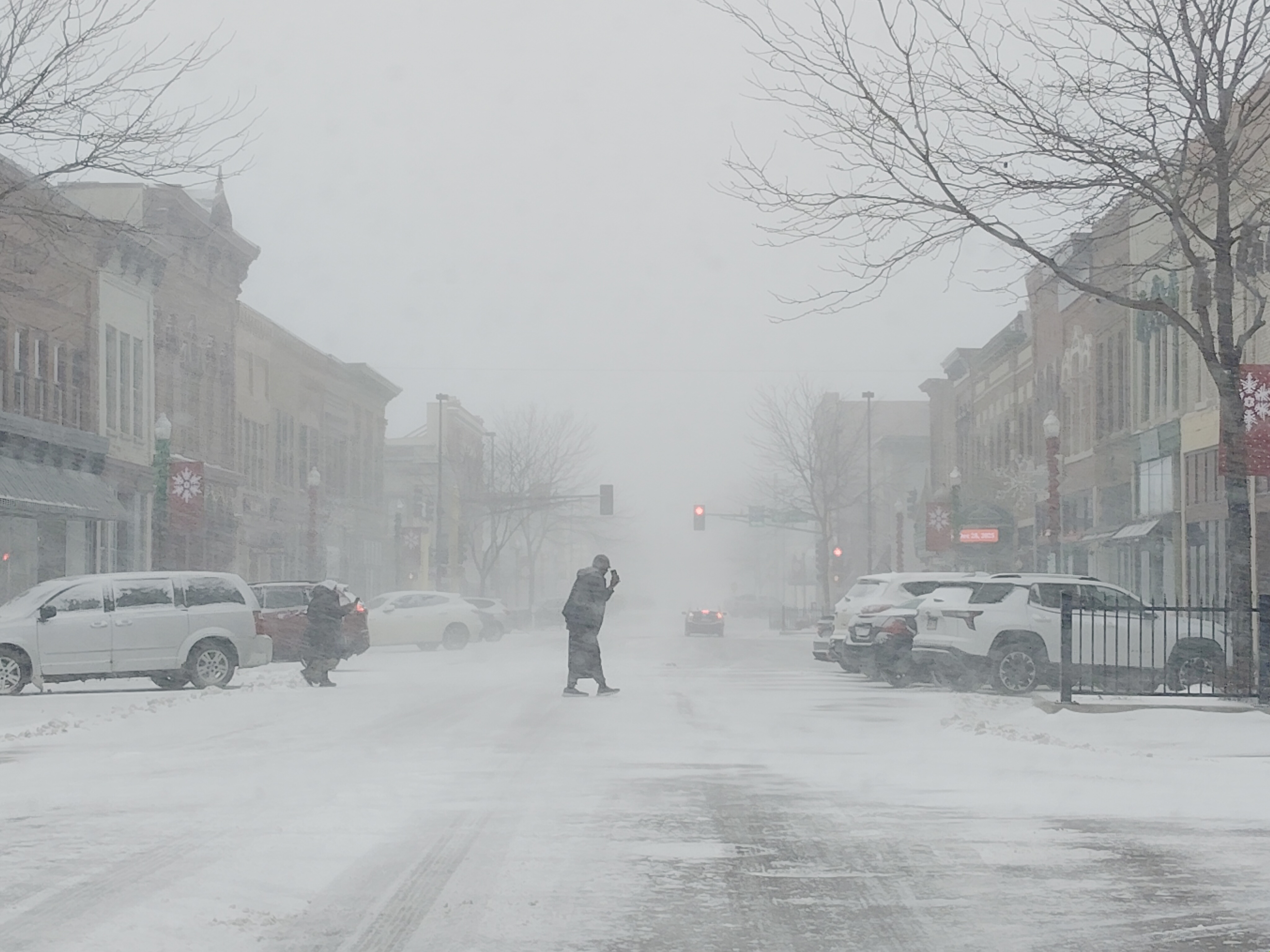
Pedestrians cross Central Avenue in downtown Faribault during a blizzard Sunday afternoon. (Minnesota Prairie Roots copyrighted photo December 2025)
IT’S LATE SUNDAYAFTERNOON and we should be on the interstate right now driving from Faribault to Minneapolis St. Paul International Airport. But instead, wicked winter weather changed everything. We are hunkered down at home, in the midst of a good old-fashioned Minnesota blizzard predicted to drop as much as 10 inches of snow on our area.
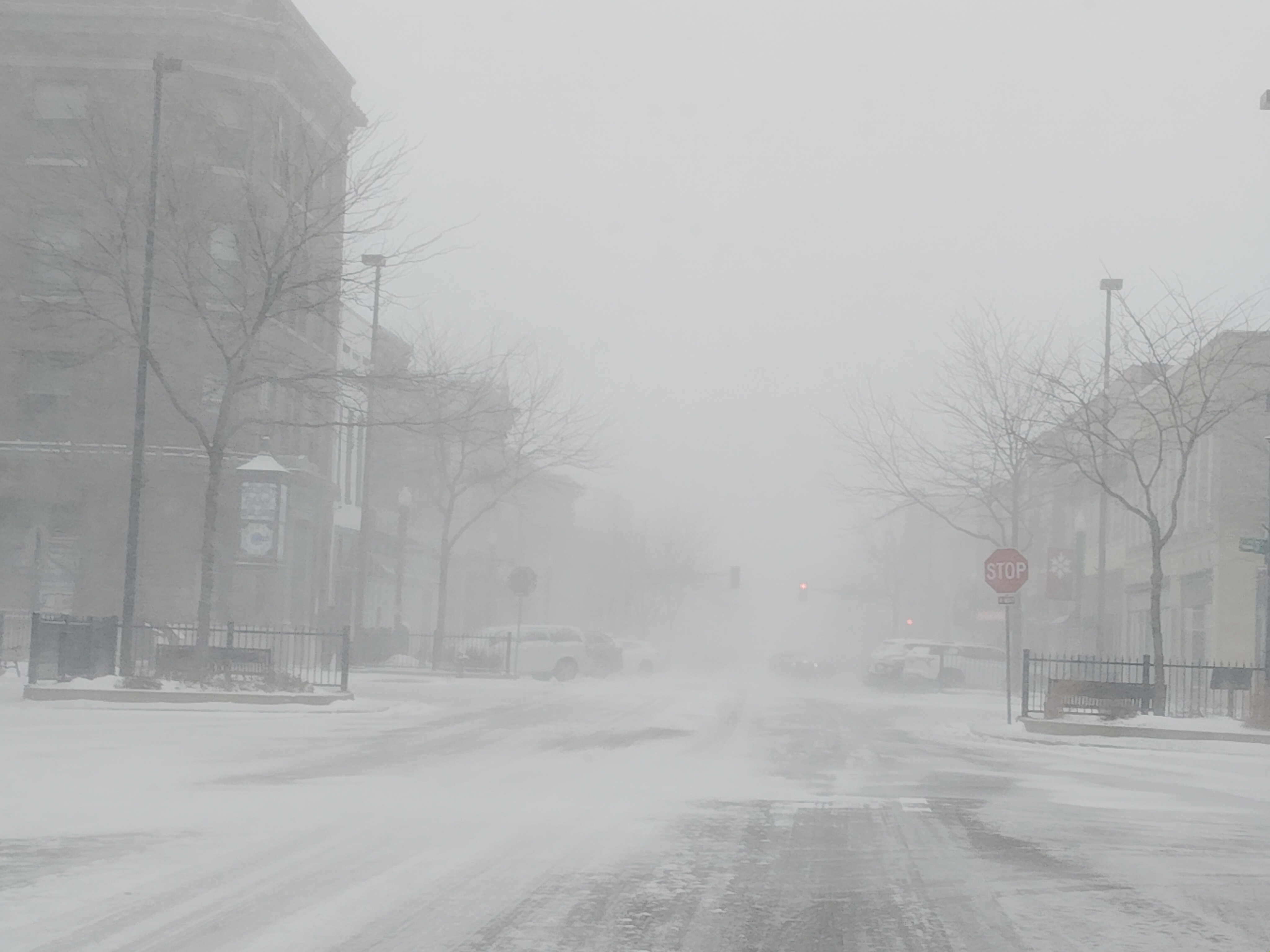
Another view of Central Avenue looking north. You can barely see the stoplight a block away. (Minnesota Prairie Roots copyrighted photo December 2025)
Fifteen minutes to the south, Interstate 35 southbound is closed from Owatonna into Iowa. Travel is not advised in many areas, including north of Faribault, the direction we would be going. There are crashes, spin-outs, jack-knifed semis. Snowplows have been pulled in some counties due to deteriorating conditions with wind whipping snow, creating white-out conditions.
And at the airport, where we should be headed to drop off our son for his 7 pm flight back to Boston, cancellations and delays are stacking up. Saturday afternoon he rebooked to an early Tuesday morning flight per our suggestion. We did not want to be driving on Interstate 35 to the airport in a blizzard.
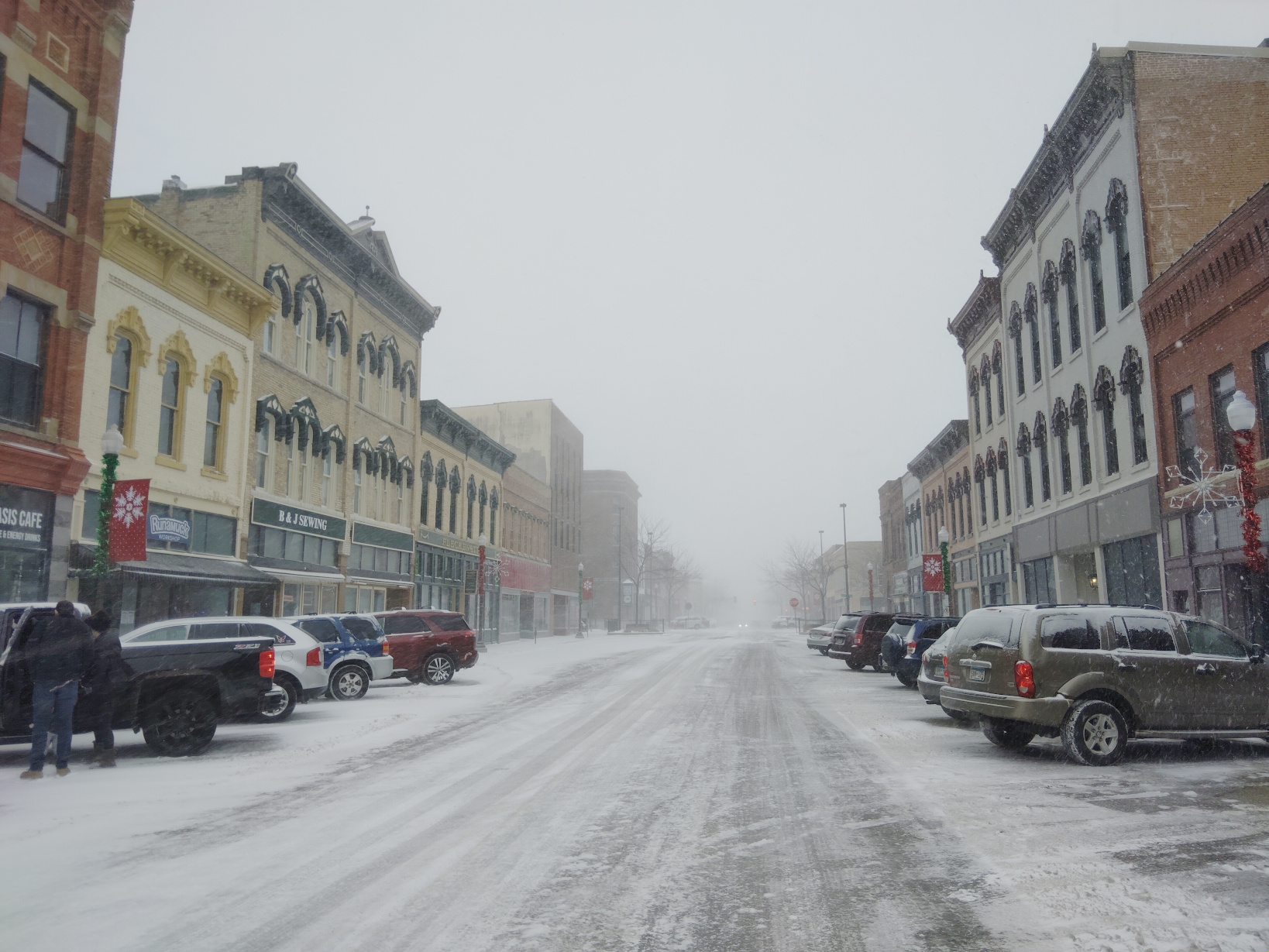
The scene as we left Gather on Central around 3:15 pm Sunday. (Minnesota Prairie Roots copyrighted photo December 2025)
But Randy and I did head downtown Faribault, a short drive from our house, to celebrate a friend’s 80th birthday earlier this afternoon. In the 90 minutes we were there, weather conditions worsened substantially. The wind picked up, swirling snow along Central Avenue. If things look this bad in town, I can only imagine how conditions are in the open countryside.
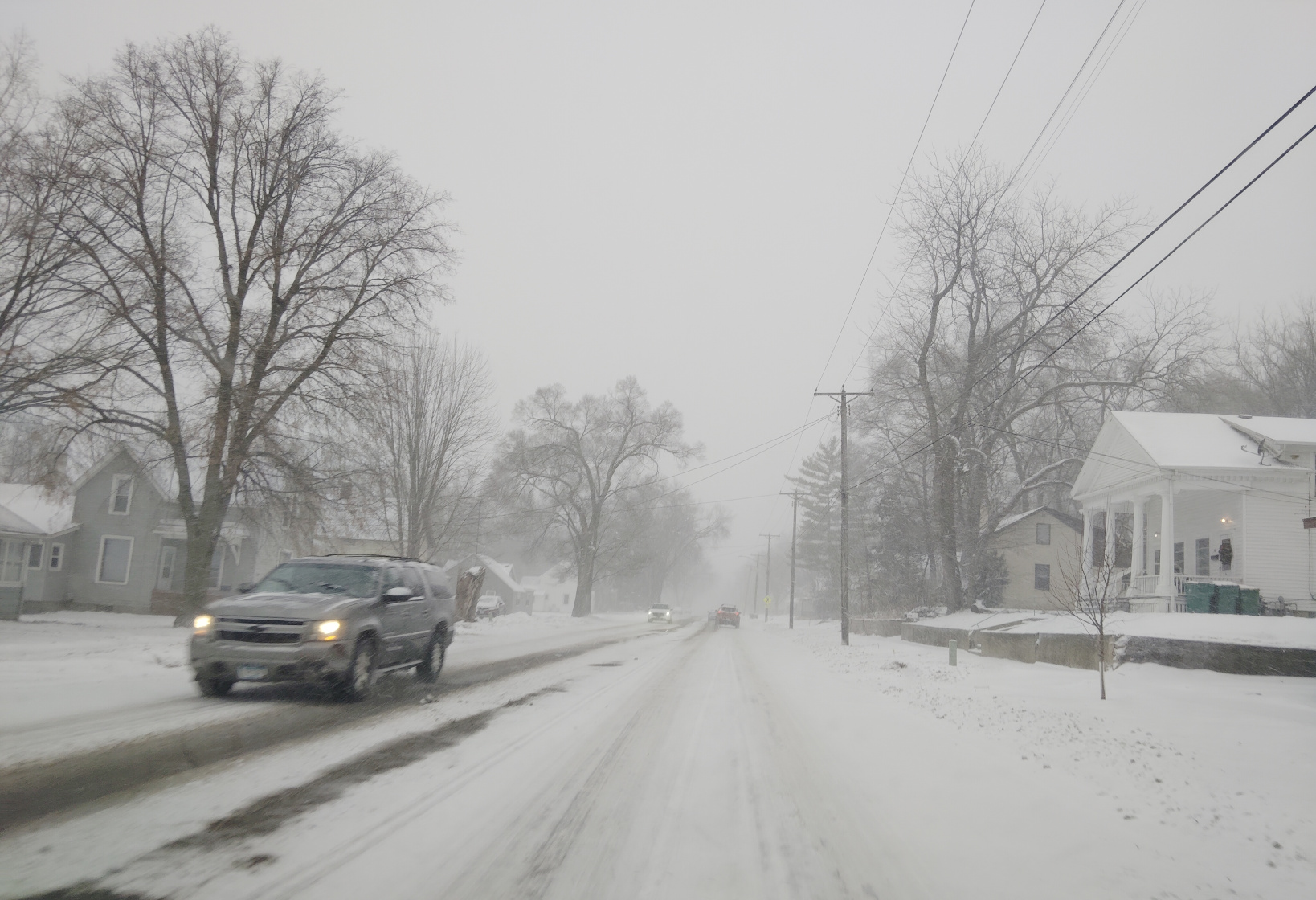
Willow Street in Faribault Sunday afternoon a block from our home. (Minnesota Prairie Roots copyrighted photo December 2025)
Yup, I’m thankful to be home and not attempting a trip to the airport. The son can work remotely on Monday. We’re all safe, sheltered inside waiting out this blizzard.
“Silent Night,” an acrylic painting by Adele Beals, for sale at the Holly Days Sale, Paradise Center for the Arts, Faribault. (Minnesota Prairie Roots copyrighted photo December 2025)
THERE’S MUCH TO PONDER this Christmas as we find our nation in turmoil. Anger simmers and boils. Discord rises. Oppression continues. Peace in our country, let alone throughout the world, feels more elusive than ever. These are difficult days.
A baby in a manger at my church, Trinity Lutheran, Faribault. (Minnesota Prairie Roots copyrighted photo December 2025)
Likewise, the newborn Jesus and his parents faced similar challenges some 2,000 years ago. They were refugees who fled their Judean homeland for Egypt under the threat of an oppressive and violent leader. King Herod ordered all baby boys in Bethlehem to be killed after learning that a “King of the Jews” was born there. He feared being replaced. When I consider a leader so cold, calculating and cruel that he would mandate the killing of any boy age two and under to retain power, well, it seems unconscionable. But it was reality. And, had I been Mary, I also would have done everything possible to save my son.
Consider that in the context of today. Here. In America. Threats to our immigrants may not be as severe as death, although some have died in ICE custody. But detention and deportation, or the threat thereof, are very real. This is happening all over the U.S., including right here in my southern Minnesota community.
Photographed several years ago along a recreational trail in Madison, Wisconsin. (Minnesota Prairie Roots copyrighted file photo)
For example, locally-based HealthFinders Collaborative, a community health center serving the underserved and uninsured in my area, has issued a statement that their patients, staff, volunteers and others do not feel safe due to visibly present federal agents in our communities. People are canceling appointments. People are afraid. In response to the very real fear people are feeling, HealthFinders is expanding virtual visits and is locking clinic doors. I expect those living in biblical times felt similar angst under the authoritarian rule of King Herod. No wonder Mary and Joseph fled with Jesus to Egypt.
This Christmas I can’t pretend everything is OK while hatred, disparaging rhetoric and injustices run rampant in this country. As a woman of faith, I look at Jesus and see how he lovingly embraced people. He showed love, care, compassion, kindness. To all. He would not be alright with certain groups of people being hated on. He would not be OK with people targeted, hunted, gathered, detained, sent away. Poof. Gone.
Among my favorite signs/messages at a No Kings protest I attended in Northfield this past summer. (Minnesota Prairie Roots copyrighted file photo June 2025)
If there’s any message to take away from Christmas this year, it’s that we need to stand up for our neighbors. Ask ourselves the once-trendy question, “What Would Jesus Do?” We need to voice our concerns. Resist. Help. Encourage. Follow Jesus’ lead of serving, loving and supporting those who need us most right now. And that’s not the King Herods who choose power over humanity.
In closing, I hold hope that we, as individuals and a nation, will stand strong against that which oppresses us, that which is inhumane and that which is just plain wrong. We all, whether people of faith or not, inherently understand the difference between right and wrong, good and evil. Let us live as people who care about goodness, kindness, compassion, love and peace.
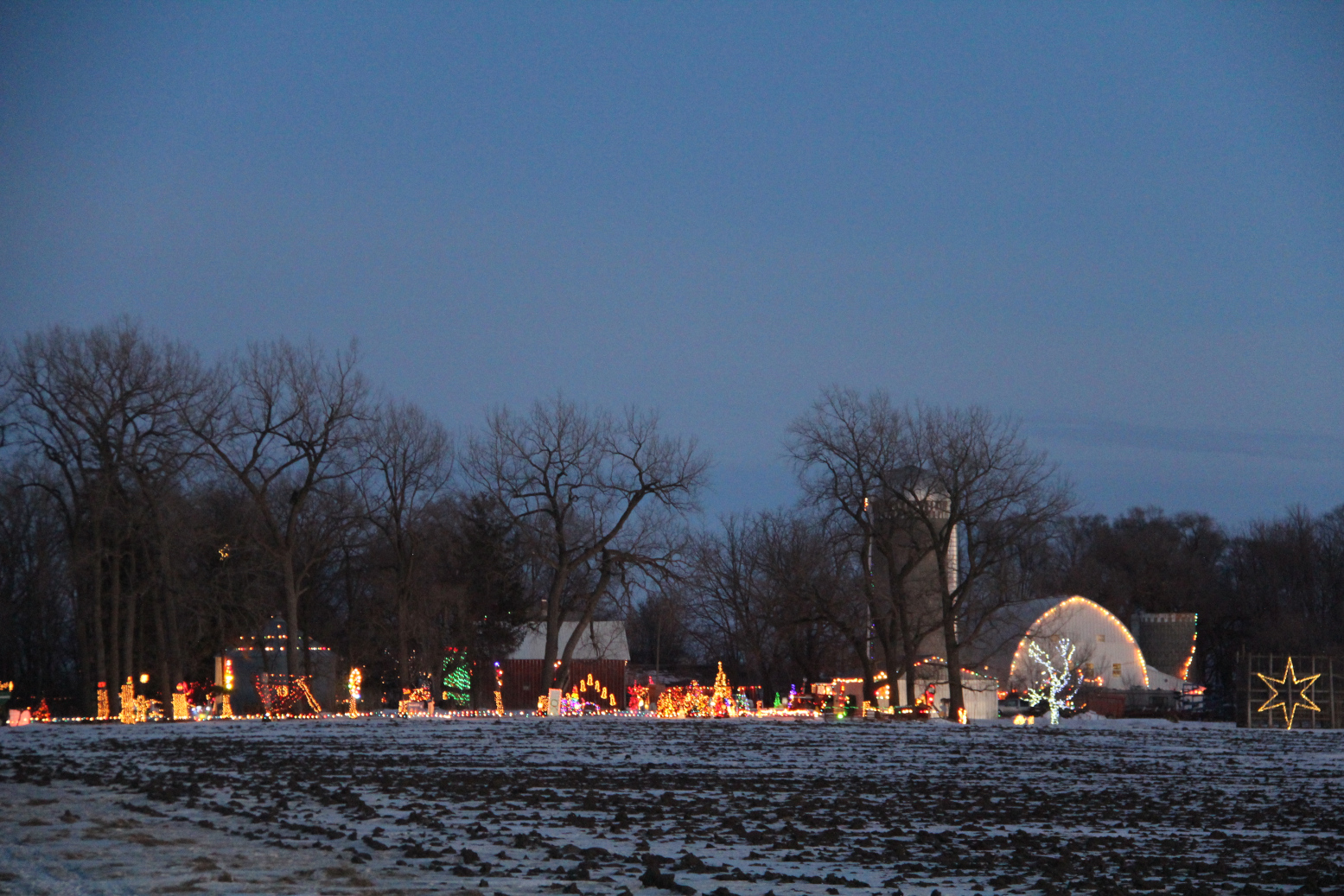
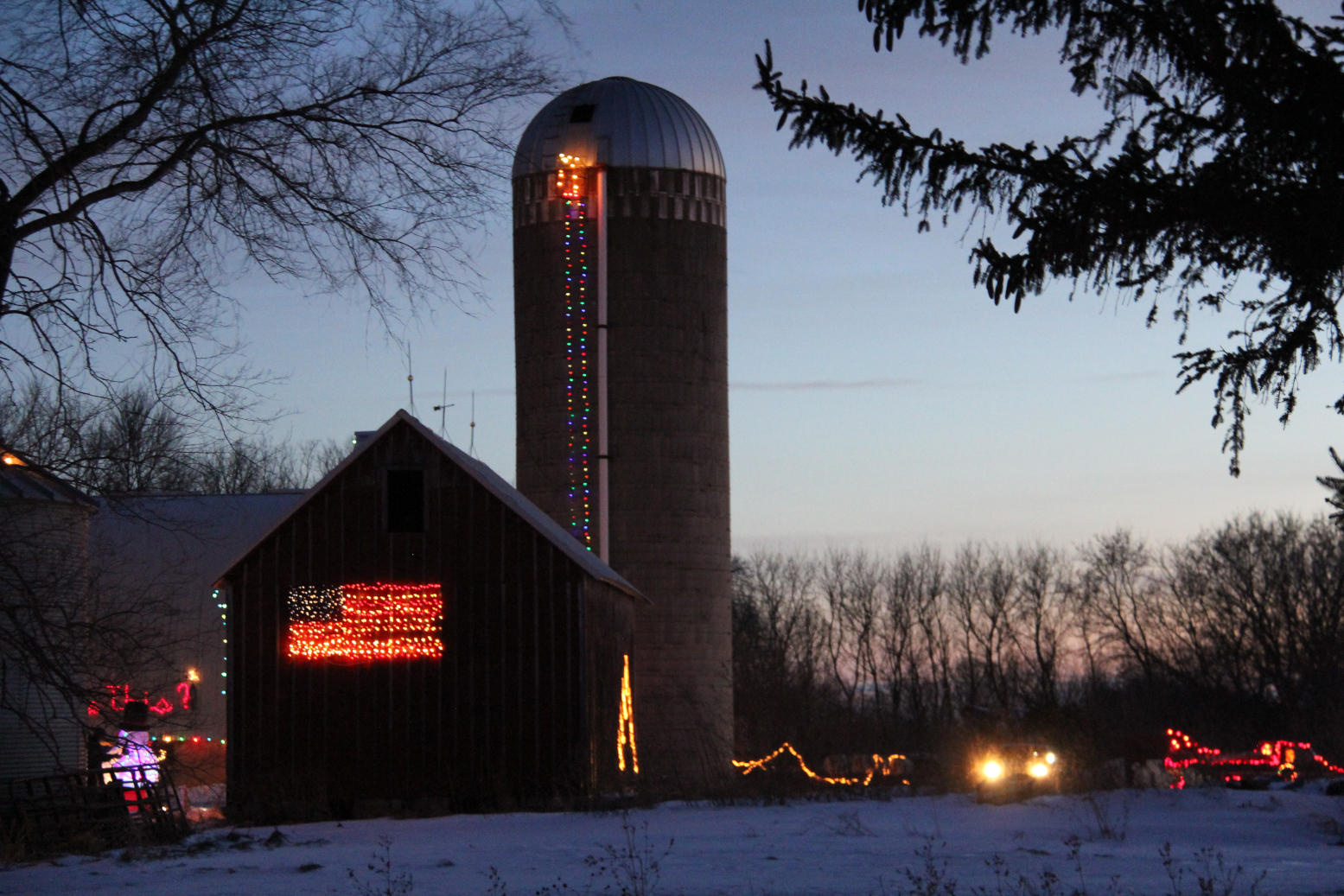
Across a farm field, the Keller farm glows with holiday lights. (Minnesota Prairie Roots copyrighted photo December 2025)
AS DUSK DESCENDS on the prairie 11 miles east of Faribault, countless holiday lights glow on the Keller farm, just down a gravel road from St. John’s United Church of Christ, Wheeling Township. In this country church, I first met members of the Keller family years ago. For more than 50 years the Kellers, rooted in faith, family and community, have decorated the home place with holiday lights and displays.
One of the first things you will see are these lighted grain wagons parked in the farmyard along the gravel road. (Minnesota Prairie Roots copyrighted photo December 2025)
The Keller Christmas Farm is a sight to behold and a must-see during the holidays. Some families have been coming here for years.
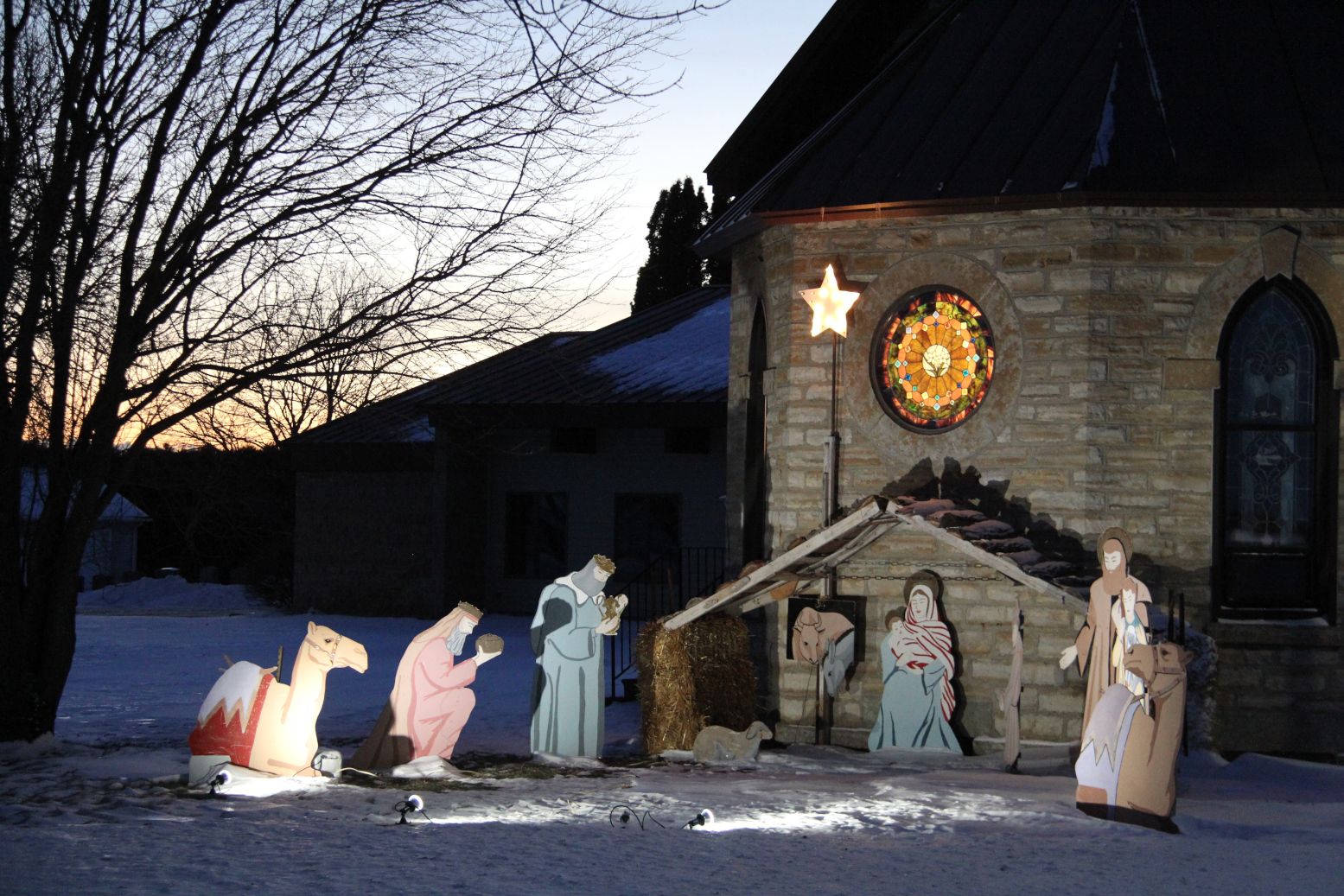
A Nativity scene outside St. John’s United Church of Christ, Wheeling Township. (Minnesota Prairie Roots copyrighted photo December 2025)
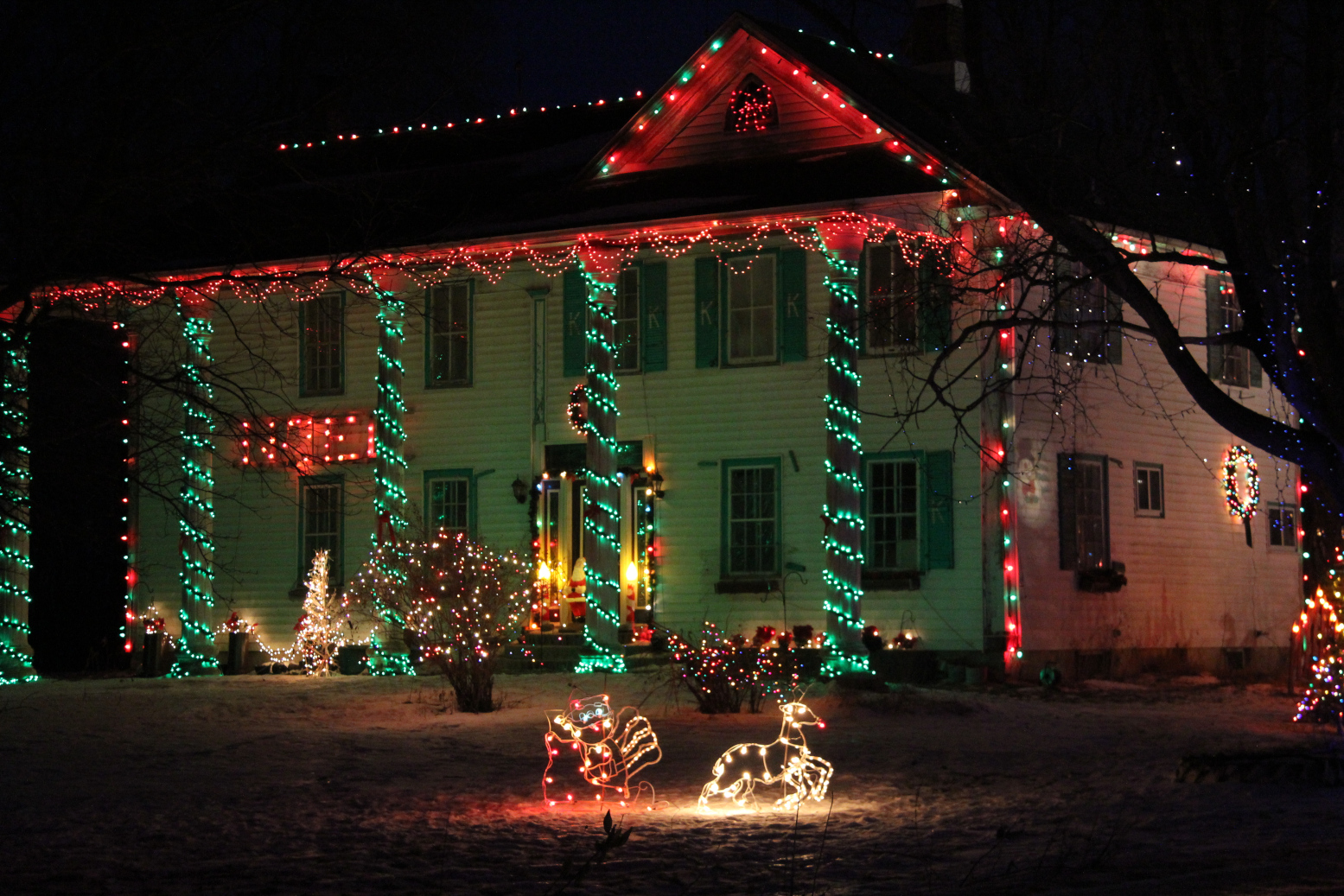
The beautifully-decorated Keller family farm home. (Minnesota Prairie Roots copyrighted photo December 2025)
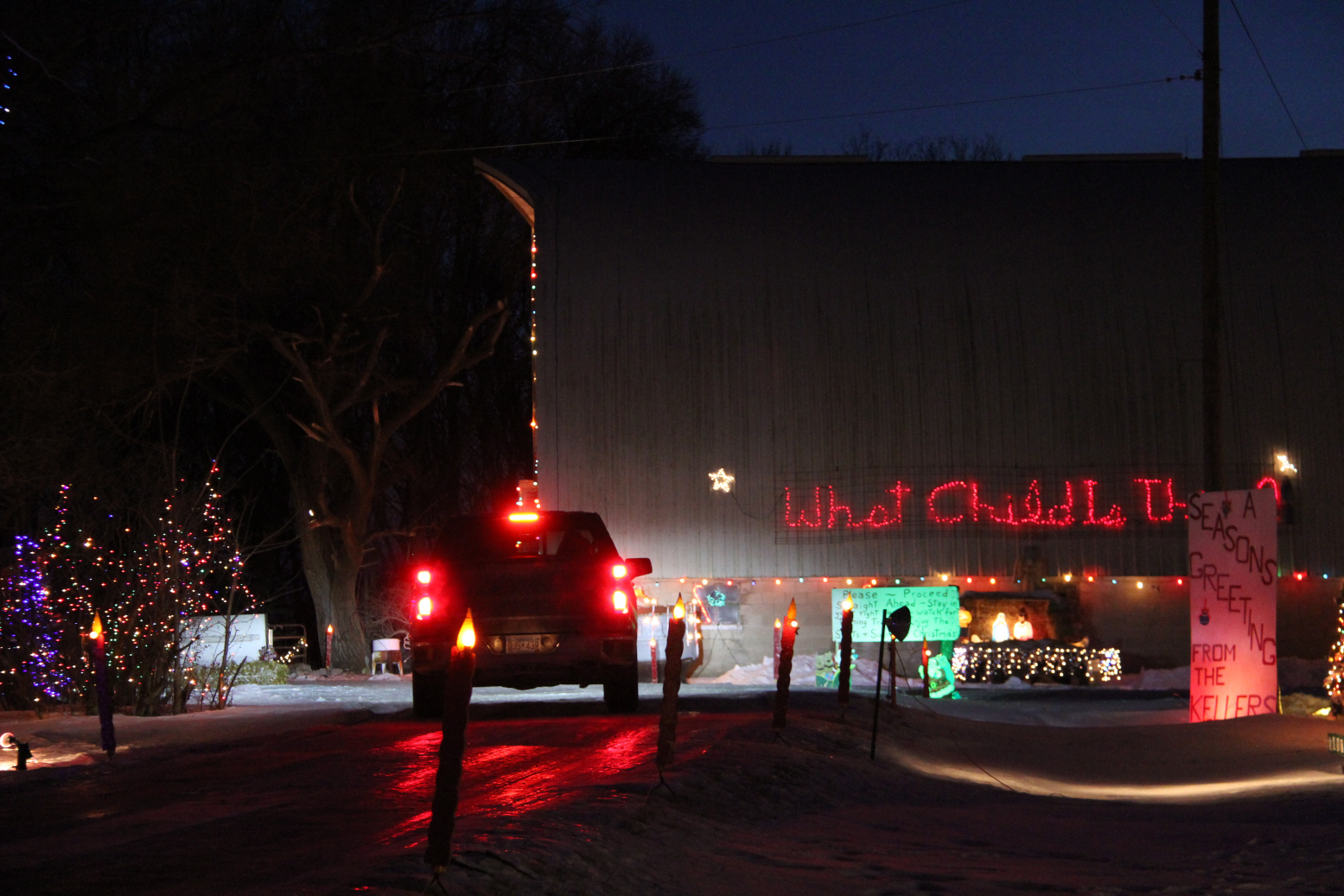
Vehicles head up the eastern driveway, circle past the barn and then back out through the western driveway.“What Child Is This?” reads the message on the barn roof. (Minnesota Prairie Roots copyrighted photo December 2025)
On a recent evening, Randy and I followed back county and township roads, past farm sites, fields layered in snow and St. John’s church, to the place where Craig Keller has lived his entire life. He and his brother Keith coordinate this annual holiday display which draws thousands to this rural location. A steady stream of vehicles followed the snow-packed, icy driveway into and around the farmyard to view the scenes as Christmas music blared.
Holiday lights glow bright atop a grain bin. (Minnesota Prairie Roots copyrighted photo December 2025)
Randy and I wound through twice since I was trying to photograph scenes and we didn’t want to slow others down. For a bit I trudged in the snow to take a few photos, not something visitors should do. But I figured Craig knows me and he would be okay with me stepping briefly outside the van for a brief walk about.
Lights are everywhere, even up the side of the silo. (Minnesota Prairie Roots copyrighted photo December 2025)
There’s so much to see here that, even if you’re not taking photos, a second drive-through seems necessary. Seemingly every building from house to barn to grain bin to sheds, even the towering silo, shines with lights and decorations.
This handcrafted Santa has been around for a while. (Minnesota Prairie Roots copyrighted photo December 2025)
I especially love that many of the decorations are homemade—painted on pressed wood and plywood and weathered by decades of Christmases exposed to the elements.
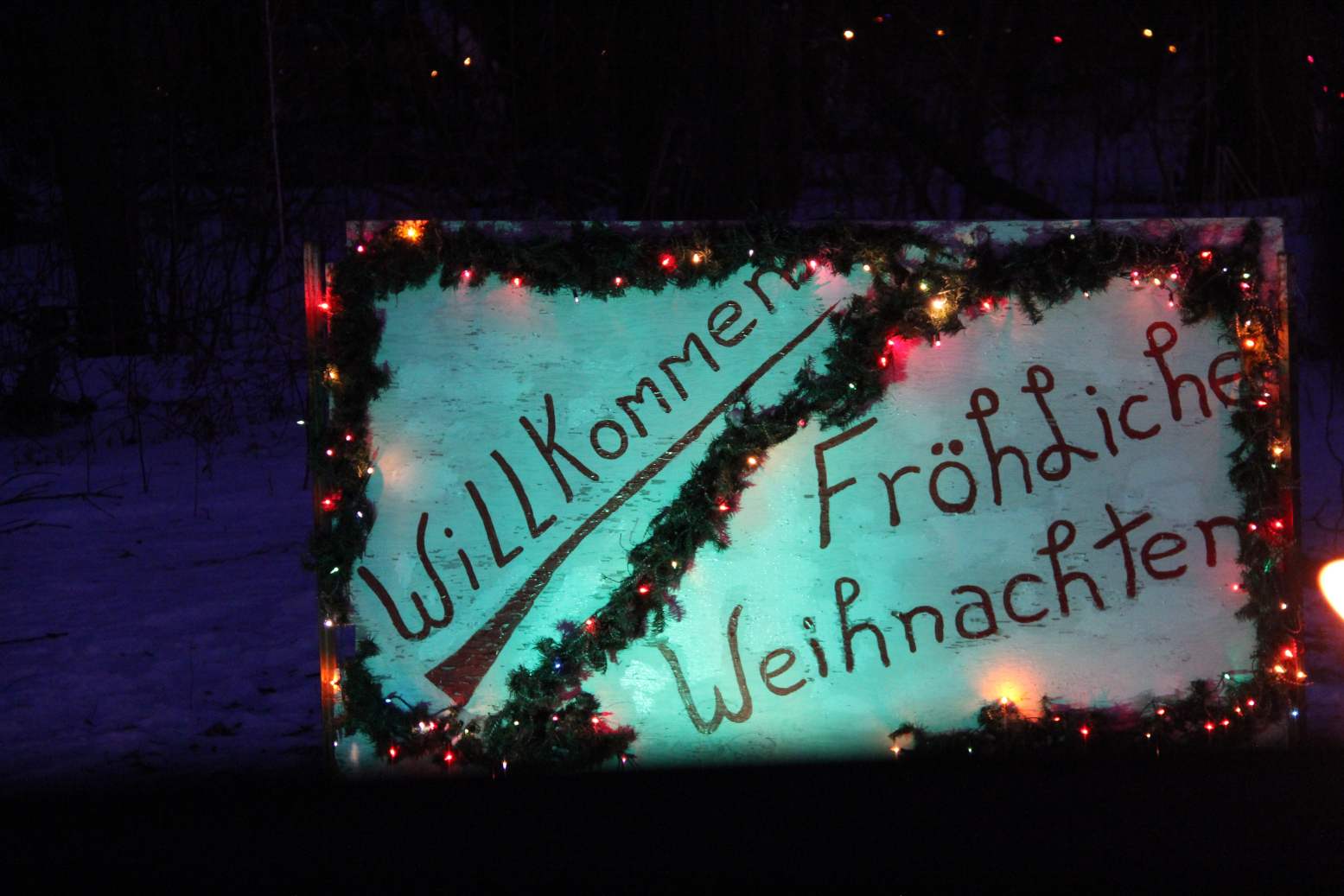
One of many signs welcoming visitors. This one, written in German, reads “Welcome. Merry Christmas.” (Minnesota Prairie Roots copyrighted photo December 2025)
I love that vintage, hard plastic holiday decorations stand aglow in the dark. I don’t recall seeing a single blow-up anything. I love the personal messages, too, written by the Kellers.
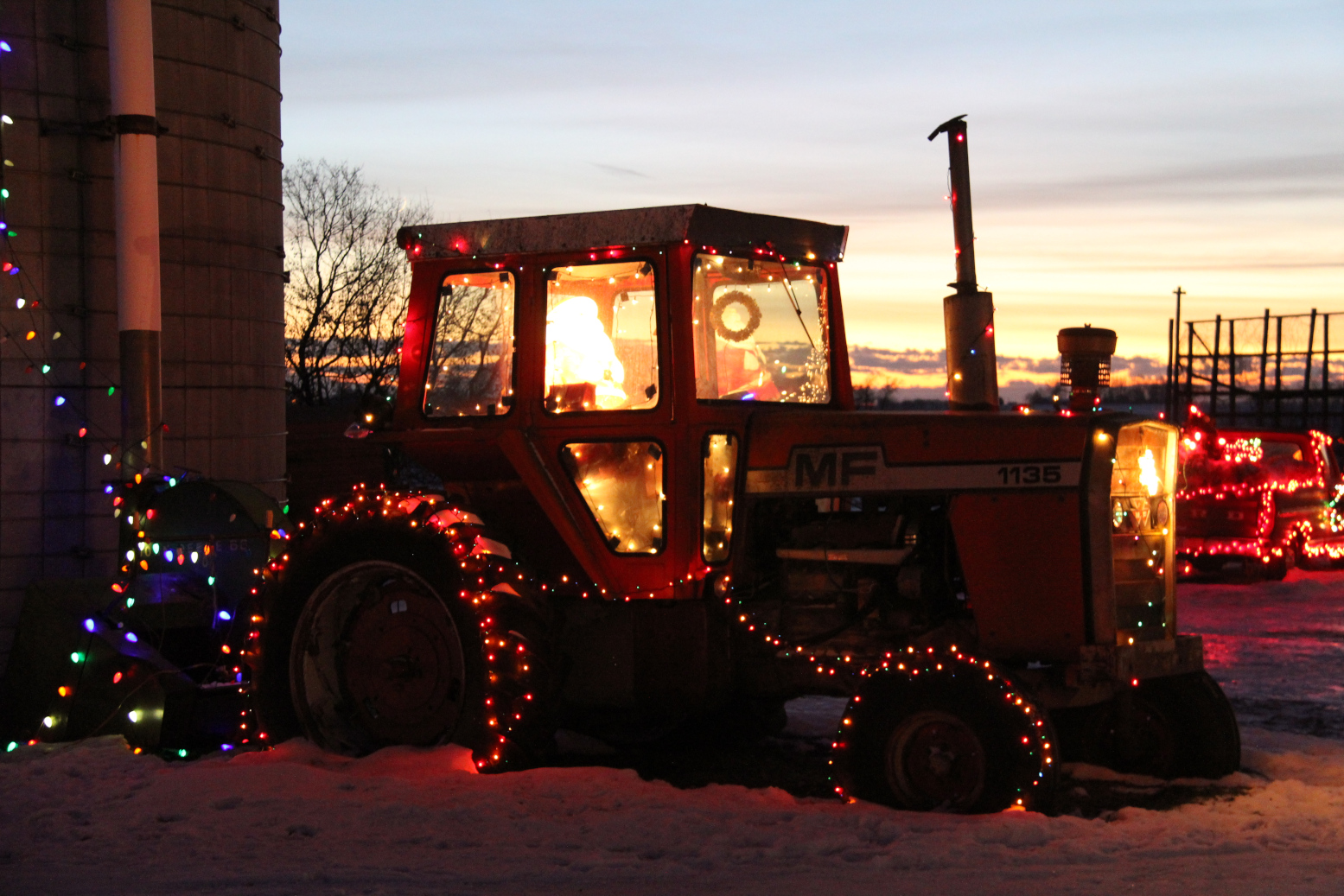
That’s Santa all aglow inside this tractor. (Minnesota Prairie Roots copyrighted photo December 2025)
I love that farm equipment, like a tractor, grain wagons, a corn planter, grain drills and more are incorporated into Christmas scenes. Even a tractor tire has been transformed into a wreath.
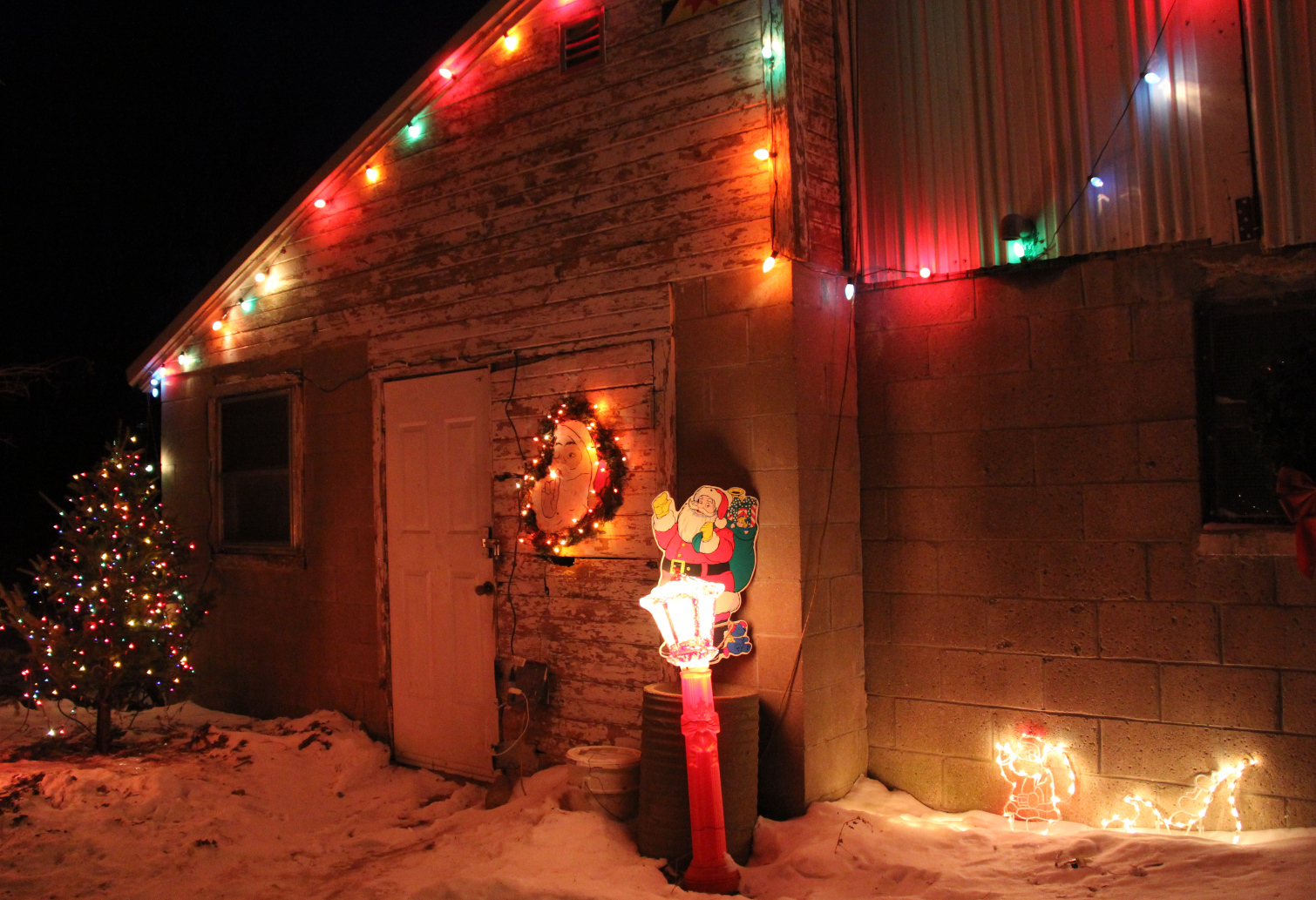
A festive corner outside the barn. (Minnesota Prairie Roots copyrighted photo December 2025)
This festive holiday display definitely looks and feels uniquely rural.
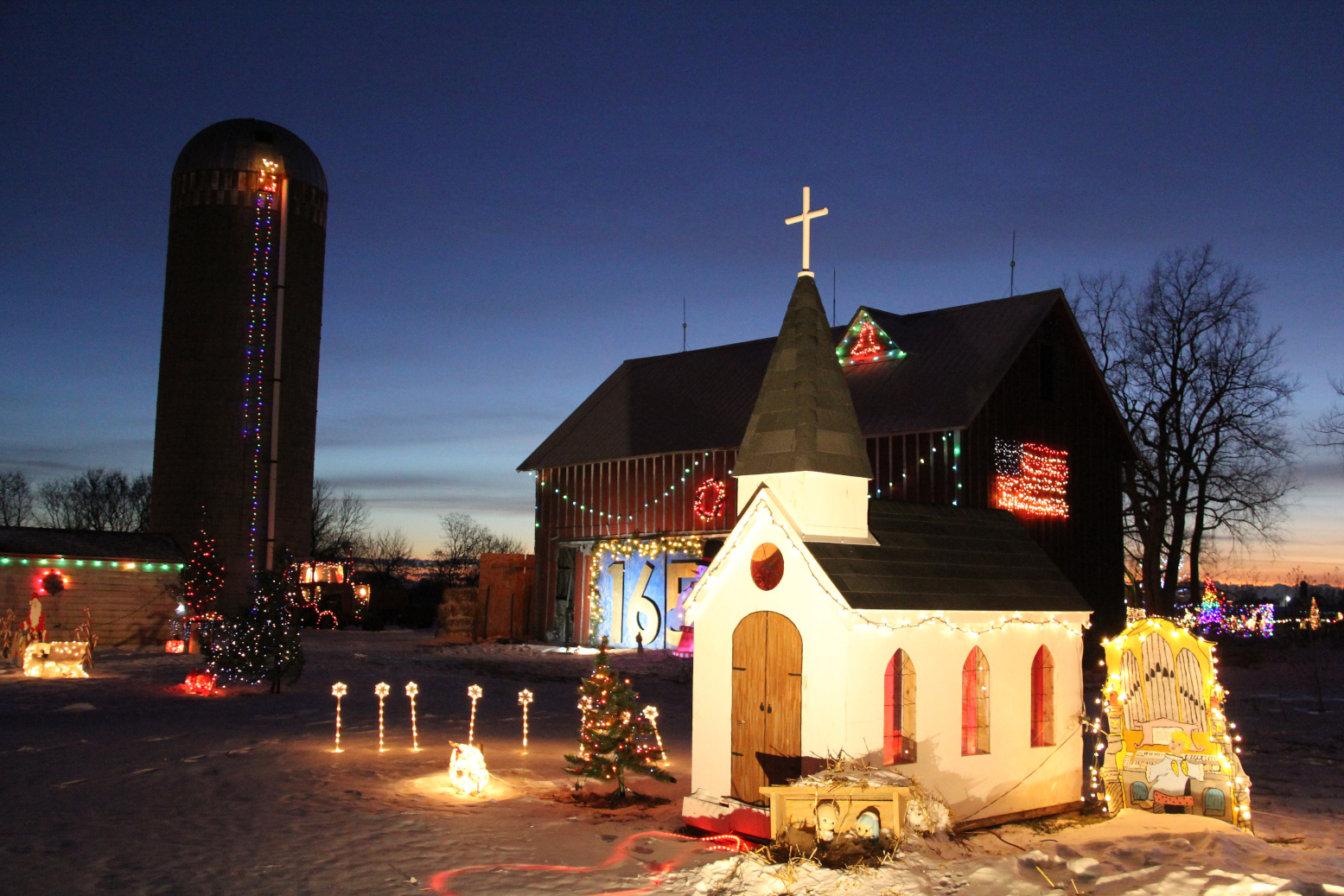
One of my favorite parts of the display is this country church. (Minnesota Prairie Roots copyrighted photo December 2025)
Here you’ll find secular aspects of Christmas—Santa, his elves, snowmen, etc.—but also, and mostly, the faith aspect focusing on the birth of Christ. I didn’t even try to count all the Nativity scenes. But there are many, including next to a mini white wooden church. Outside the church, an organist plays a massive pipe organ. In real-life, Craig Keller plays the organ at St. John’s.
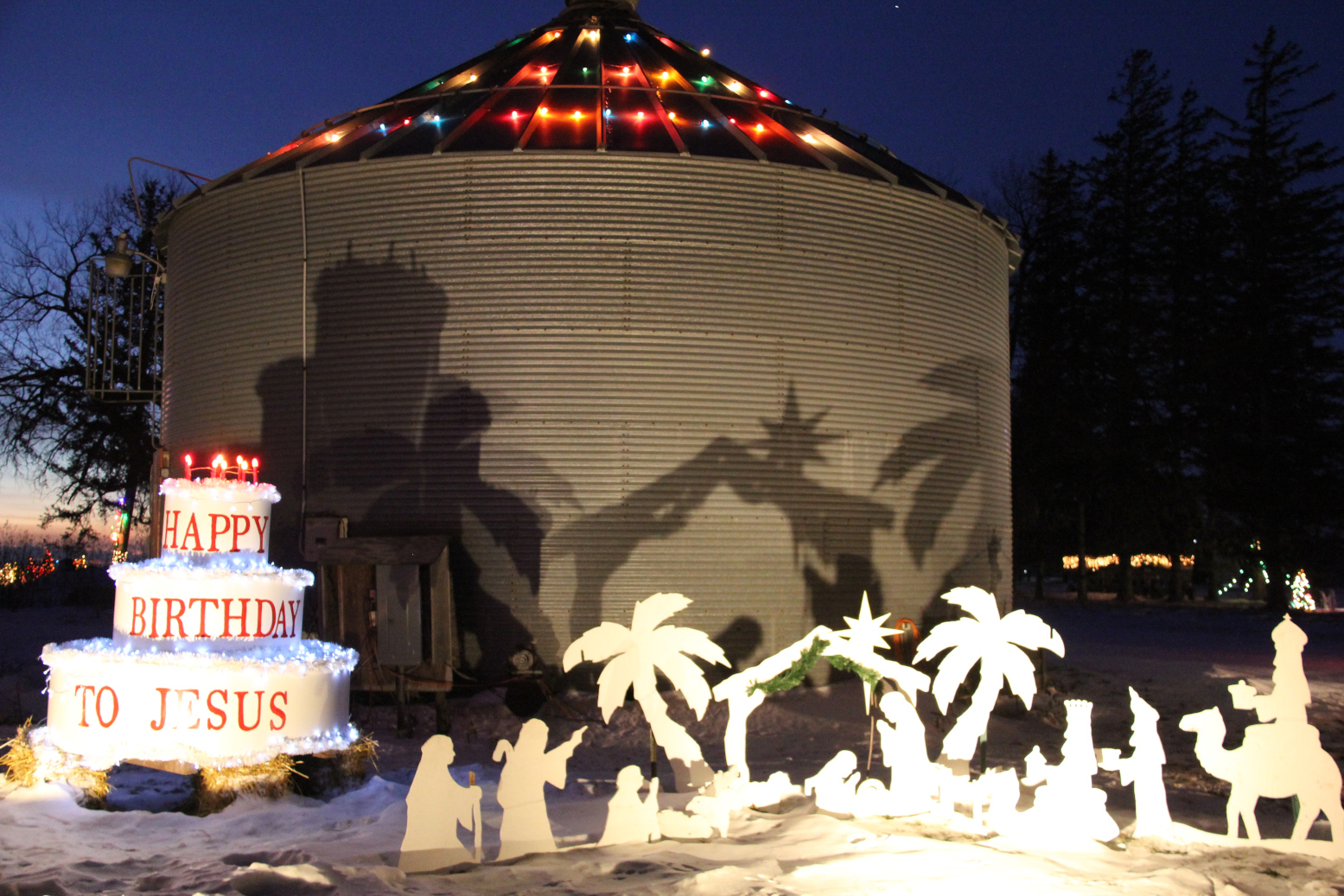
I love the birthday cake and also how the Nativity scene shadows onto the grain bin. (Minnesota Prairie Roots copyrighted photo December 2025)
A three-layered birthday cake for Jesus, complete with red candles, is strategically placed by the church, a focal point that draws attention to the real reason for Christmas—Christ’s birth.
Among the many Nativity scenes staged at the farm. (Minnesota Prairie Roots copyrighted photo December 2025)
After about 45 minutes at the Keller farm, I left with cold fingers (from taking photos), but a warm heart. Family matriarch Elsie Keller, who died in 2019 at the age of 93, would be happy that her family continues with this annual holiday lighting tradition, only a field away from the country church her immigrant grandparents helped found in 1856. The place where I met Elsie and her descendants, the family that has shared Christmas with the public for more than half a century in rural southern Minnesota.
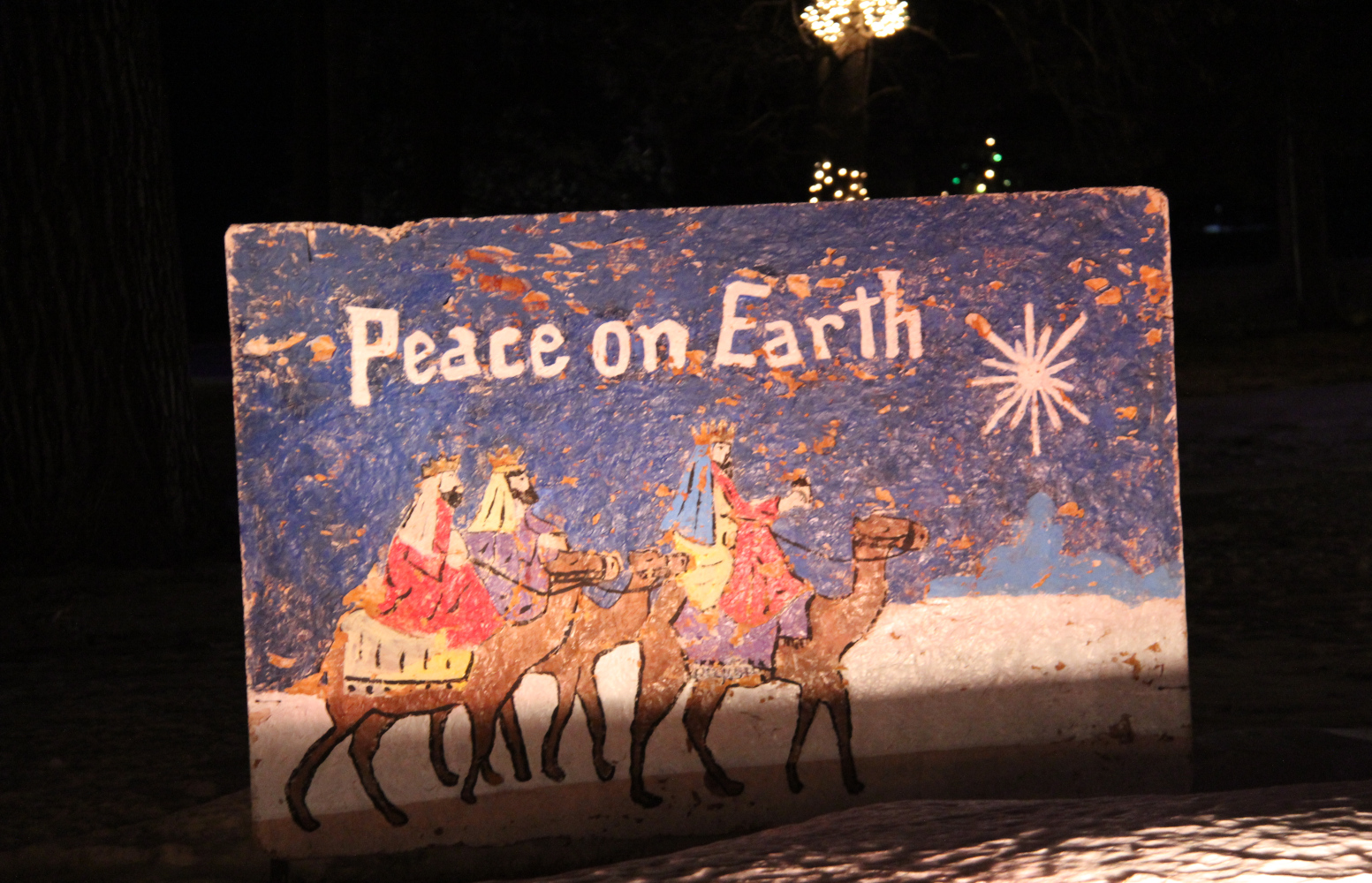
Near the exit, a final message. (Minnesota Prairie Roots copyrighted photo December 2025)
FYI: The Keller Christmas Farm drive-through holiday light display is open from dusk to 10 pm daily until January 6. To get there from Faribault, take Minnesota State Highway 60 east for 8.3 miles, turn left/north onto Jacobs Avenue for two miles and then, by the church, turn right/east onto 190th Street East. You’ll see the farm on the right at 10557 190th Street East. While the display is free, donations are accepted in a special donation box between the house and barn.
The Memory Tree at Trinity Lutheran Church, Faribault. (Minnesota Prairie Roots copyrighted photo December 2025)
WHEN THE PAPER ANGELS come off the tree, the personalized ornaments go up. From Angel Tree to Memory Tree, an artificial tree standing in the narthex of my church, Trinity Lutheran in Faribault, morphs each holiday season.
From Angel Tree to Memory Tree. (Minnesota Prairie Roots copyrighted photo December 2025)
First, my long-time Bible study group assembles and decorates the tree which serves duo purposes. From this tree, people choose paper angels upon which anonymous identifying information is printed. Age, sex and Christmas gift ideas. People who pick an angel then buy gifts and bring them back unwrapped. My bible study group wraps most with some left unwrapped as nonprofit social service organizations request.
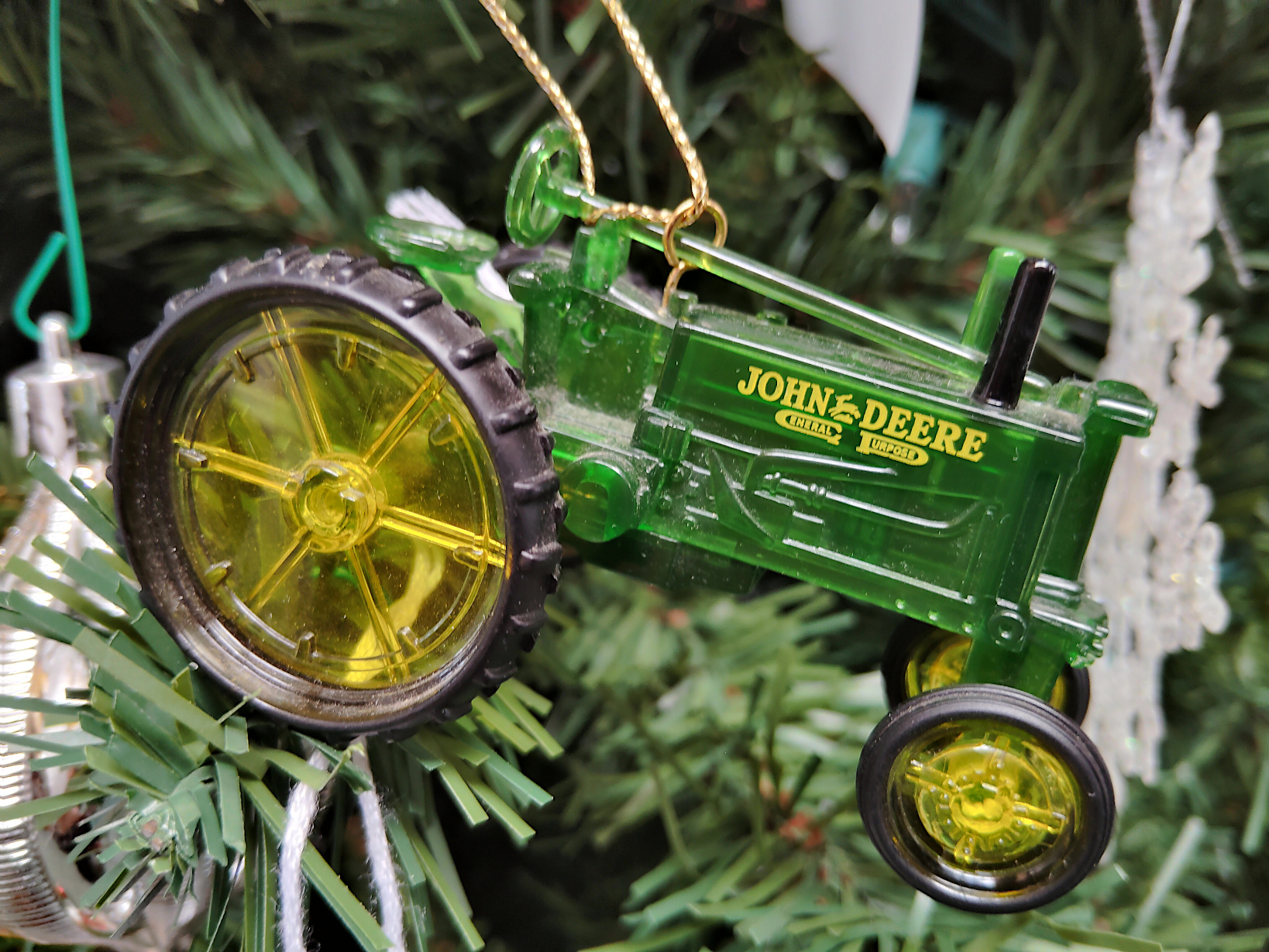
This mini John Deere tractor honors Harland. (Minnesota Prairie Roots copyrighted photo December 2025)
Once this project is done, the tree becomes a Memory Tree, a place where people can honor loved ones via a personal ornament tagged with the name of the deceased and his/her death date.
Barb ran a local hair salon. (Minnesota Prairie Roots copyrighted photo December 2025)
I love this idea because we have all lost loved ones whom we miss, especially during the holidays. The ornaments on this tree are a visual reminder of our loss and love. This tree represents communal grief. To acknowledge and share grief is to find our way toward healing.
Marv loved living in the country and farming. His youngest daughter and her family now live and farm on the family farm. (Minnesota Prairie Roots copyrighted photo December 2025)
This Christmas, may the memories you hold of loved ones now gone bring a smile to your face, joy to your heart, perhaps even tears to your eyes. We grieve because we loved. Hold onto the memories, hold onto the love.
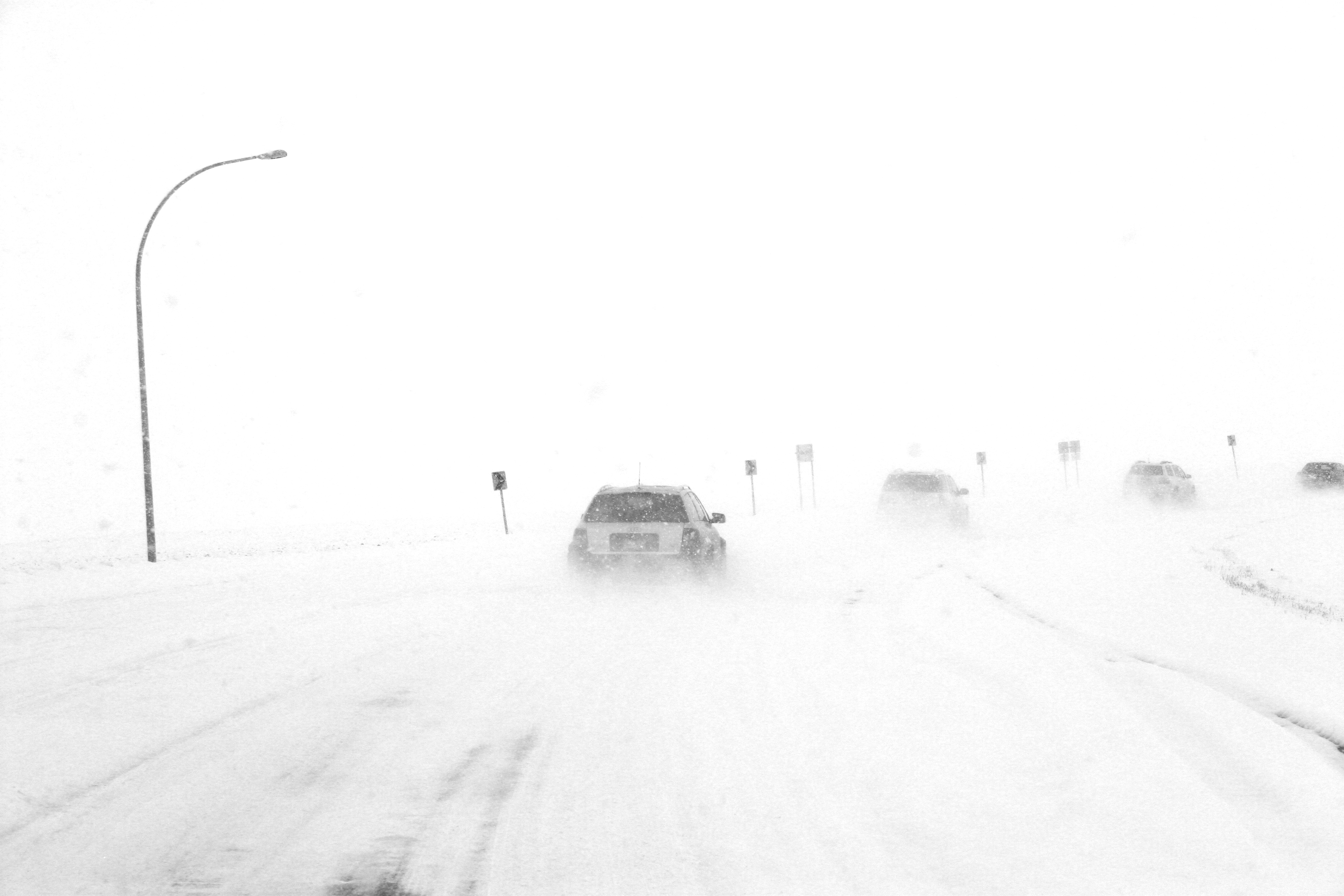
Winds and blowing snow produce near white-out conditions during a past winter storm in southern Minnesota. (Minnesota Prairie Roots copyrighted file photo)
“I DIDN’T THINK it would be that bad,” Randy said. Neither did I.
But our drive to and from Minneapolis-St. Paul International Airport Thursday afternoon to get our son, arriving from Boston, proved difficult and stressful. Let me set the scene.
As we headed out of Faribault toward Interstate 35 shortly after lunch, freezing pellets pinged our windshield and the wind blew fierce, limiting visibility. And we weren’t even out of town.
A WICKED WIND
Once on the interstate, though, the precipitation soon stopped. But the wind gusted with such ferocity that I could feel it tugging at the van and observed semi truck drivers struggling to keep their rigs in their lanes.
Yet, the wicked 40 mph winds—or whatever ridiculous speed they reached—dried the pavement of the rain that fell earlier in the morning. That rain later transitioned to intermittent snow as temps continued to drop throughout the day. The morning temp started at nearly 40 degrees.
We detoured from our airport route to stop at our nephew’s house in Apple Valley to pick up a Christmas gift and stained glass supplies. Within that 45-minute visit, the weather worsened. But, surprisingly, our son’s flight arrived 15 minutes early. Here I’d been concerned about a possible late arrival due to weather conditions.
As we got onto Cedar Avenue aiming for the airport, traffic volume increased. We blended into the traffic flow, proceeding with caution like almost everyone else. Except the usual few motorists who do not drive for conditions. Snowplows were out sanding and salting and spreading whatever to de-ice road surfaces.
WAITING & MORE WAITING
I thought we would be late and Caleb would be waiting for us inside the terminal. But no. He was waiting for his luggage. We waited in the cellphone lot for a good half hour as he waited for his bags. Yes, a lot of waiting.
Eventually we were back in bumper-to-bumper traffic as vehicles crept toward passenger pick-up. This always feels like a game of chicken to me, trying to wedge into the gridlock so your loved one can see you and get safely to your vehicle. Eventually we reached door four, spotted Caleb, hefted his mammoth suitcase into the back of the van, placed the backpack behind the driver’s seat, grabbed a quick hug and started home.
AT LEAST WE’RE MOVING
Traffic congestion continued, although we were moving. And moving is always better than not. I just wanted to get home before the weather got worse, before rush hour traffic peaked and because, well, I really had to pee. It’s not the first time I’ve wished for a porta potty in the cellphone lot.
To move this story along, once we got farther out of the metro, past Elko New Market, traffic lessened. The wind still blew fierce and snow fell. We were in wide open country, rural Minnesota. The wind swept the snow away like a broom, leaving traffic lanes clean.
SNOW GATES
All was going fine until we got about 10 miles from Faribault. Visibility wasn’t reduced to white-out conditions, but wind-driven snow diminished visibility considerably in some spots. “I bet they closed the snow gates in Owatonna,” I said in the midst of all this. Snow gates, if you’re unfamiliar with the term, are actual gates pulled across the top of entrance ramps to keep motorists off the interstate during a winter storm.
I haven’t read any media reports that Interstate 35 snow gates were closed yesterday. But I did read of a multi-vehicle crash that happened on I-35 between Owatonna and Ellendale at 3:15 pm in blizzard-like conditions. That closed the southbound lane for three hours. Owatonna is a 15-minute drive south of Faribault.
We arrived home at 3:30 pm, safe and sound with an hour to spare before dark. Soon thereafter, our eldest daughter texted that no travel was advised in Rice County. We’d gotten home just in time as our county was now among many Minnesota counties in a blizzard warning. We cozied in for the night while the wind howled, me thankful that we made it to the airport and back without incident.
This morning we awoke to sub-zero temps. And a fresh layer of snow to shovel.
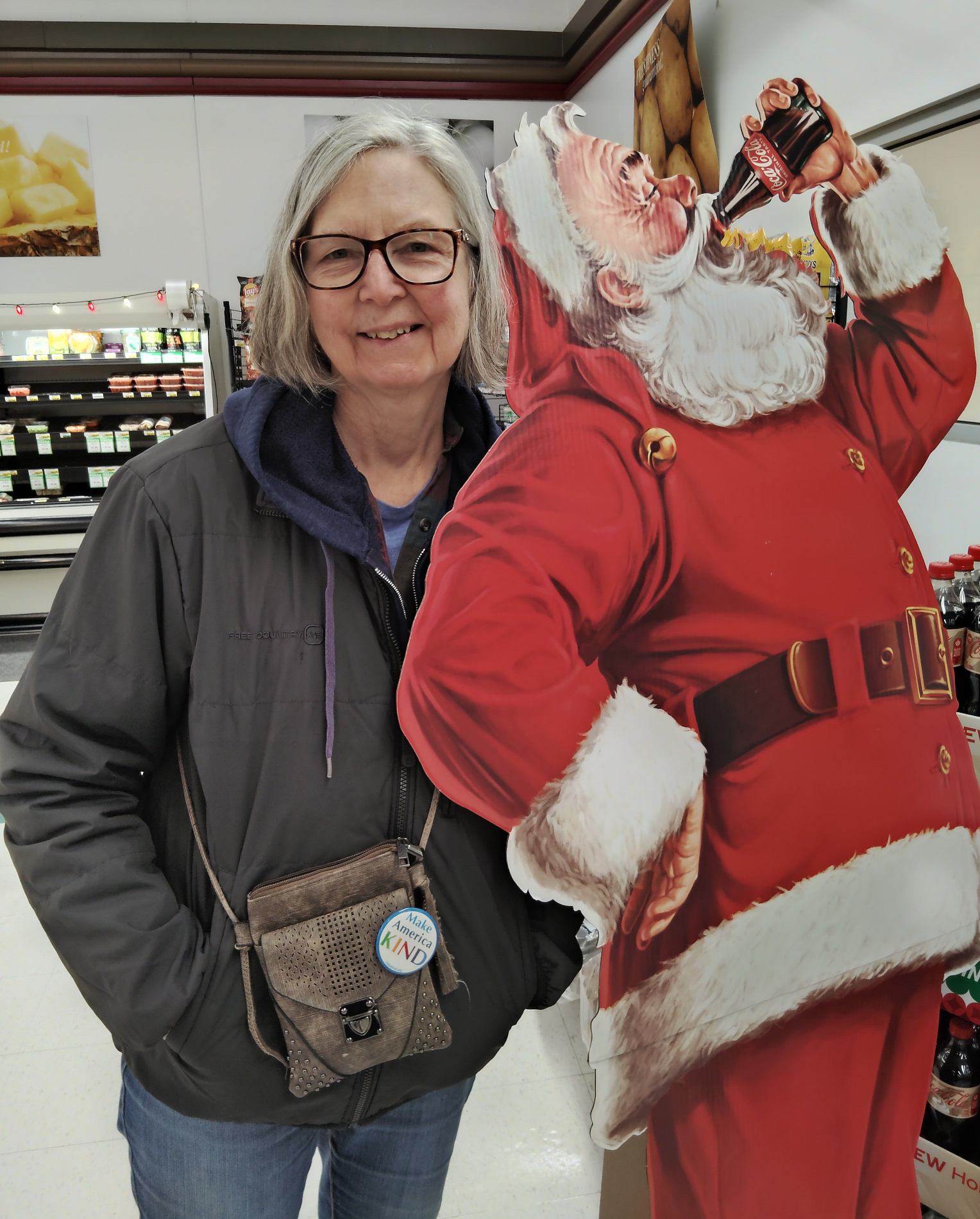
Audrey Kletscher Helbling with Santa at a Faribault grocery store. (Photo credit: Randy Helbling)
WHEN I SPOTTED SANTA at the grocery store yesterday, I decided to get my picture taken with him. You’re never too old for Santa, right? But the Jolly Old Man didn’t even notice me, so busy was he guzzling his Coca-Cola while marketing Coke products.
I hadn’t considered that Santa would need a side job, especially during the hectic holiday season. Isn’t managing the elves, feeding the reindeer, making public appearances, reviewing kids’ Christmas lists and packing the sleigh enough for one man to handle?
But I suppose Santa, like all of us, is feeling the effects of higher prices. He’s paying tariffs on parts the elves can’t make. Mrs. Claus needs baking ingredients that have skyrocketed in price. The North Pole toy workshop heating bill is likely high, even higher than in icebox Minnesota. So Santa probably welcomes the extra income from his grocery store side hustle.
Undeterred by Santa turning his back on me, I cozied up to him and asked my dear husband to snap a photo. Randy obliged, but not without a look of concern. I didn’t care. I needed a spark of fun in my day. Santa obviously paid me no mind.
Now, if the marketer of Coke products, the supervisor of elves, the giver of wonderful gifts had taken the time to chat with me, I would have handed him a Christmas wish list. What I’d really like Santa to bring to this world, especially this country, are compassion, kindness, respect, empathy, peace and love.
In all reality, Santa can’t deliver on that. Only we can.
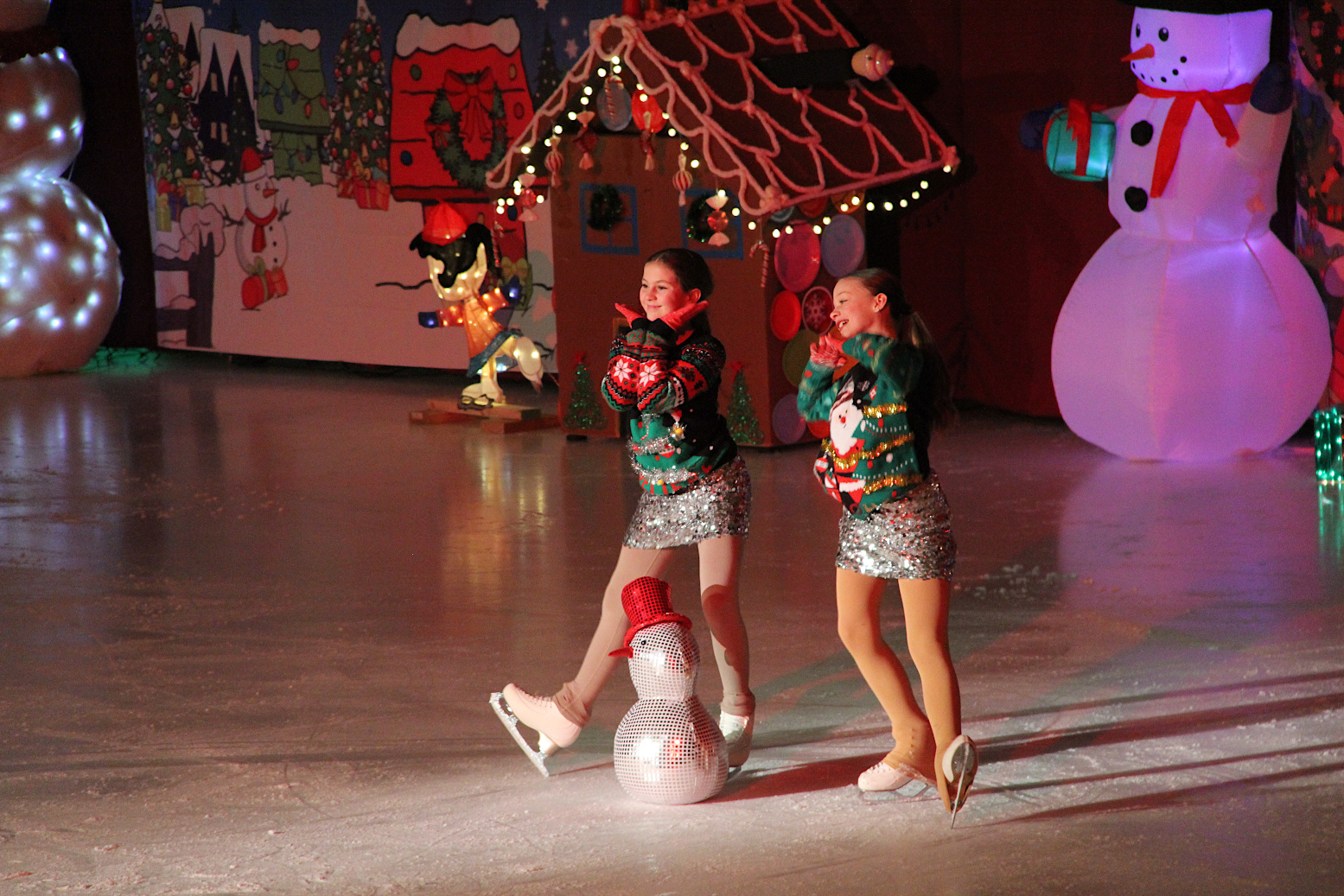
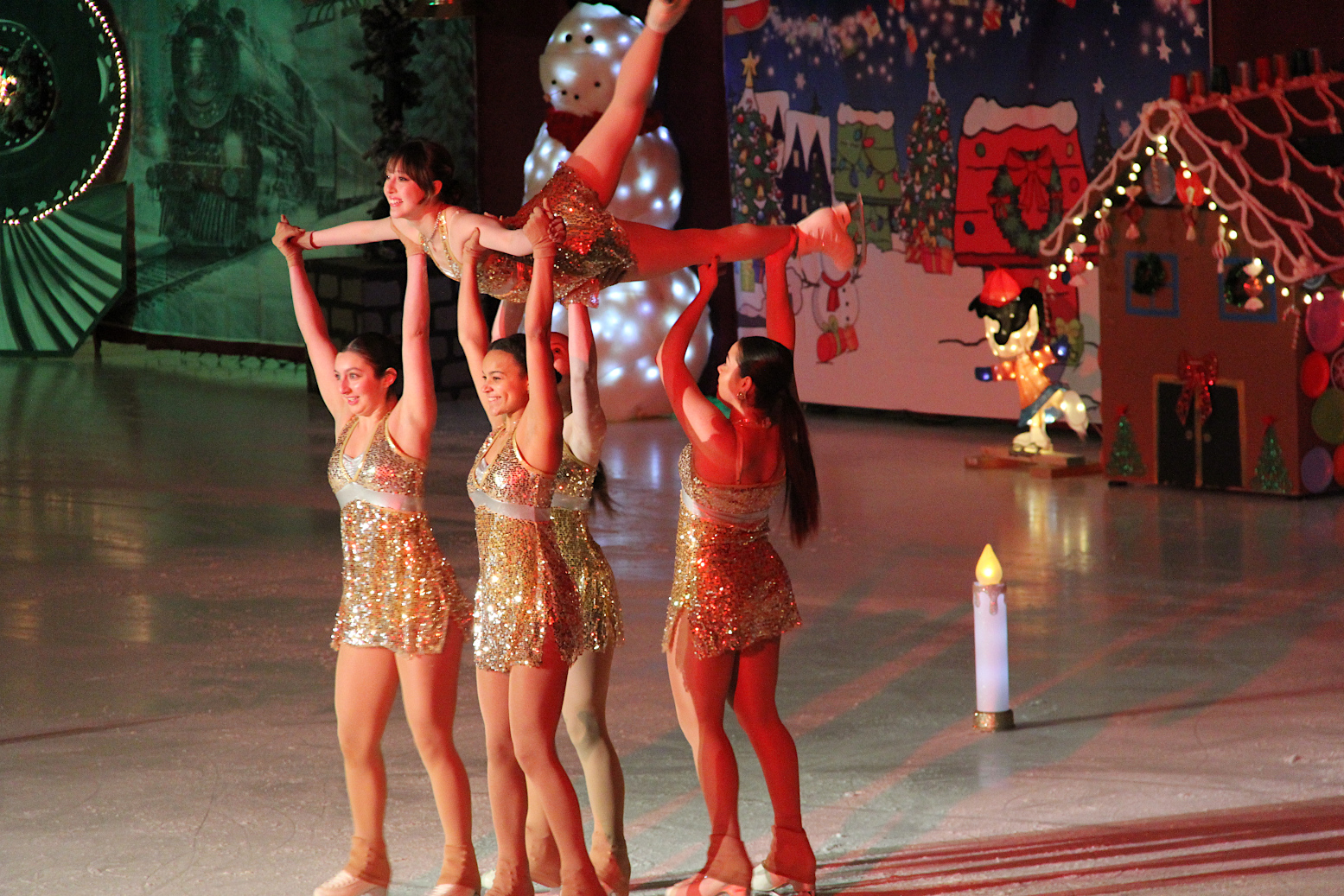
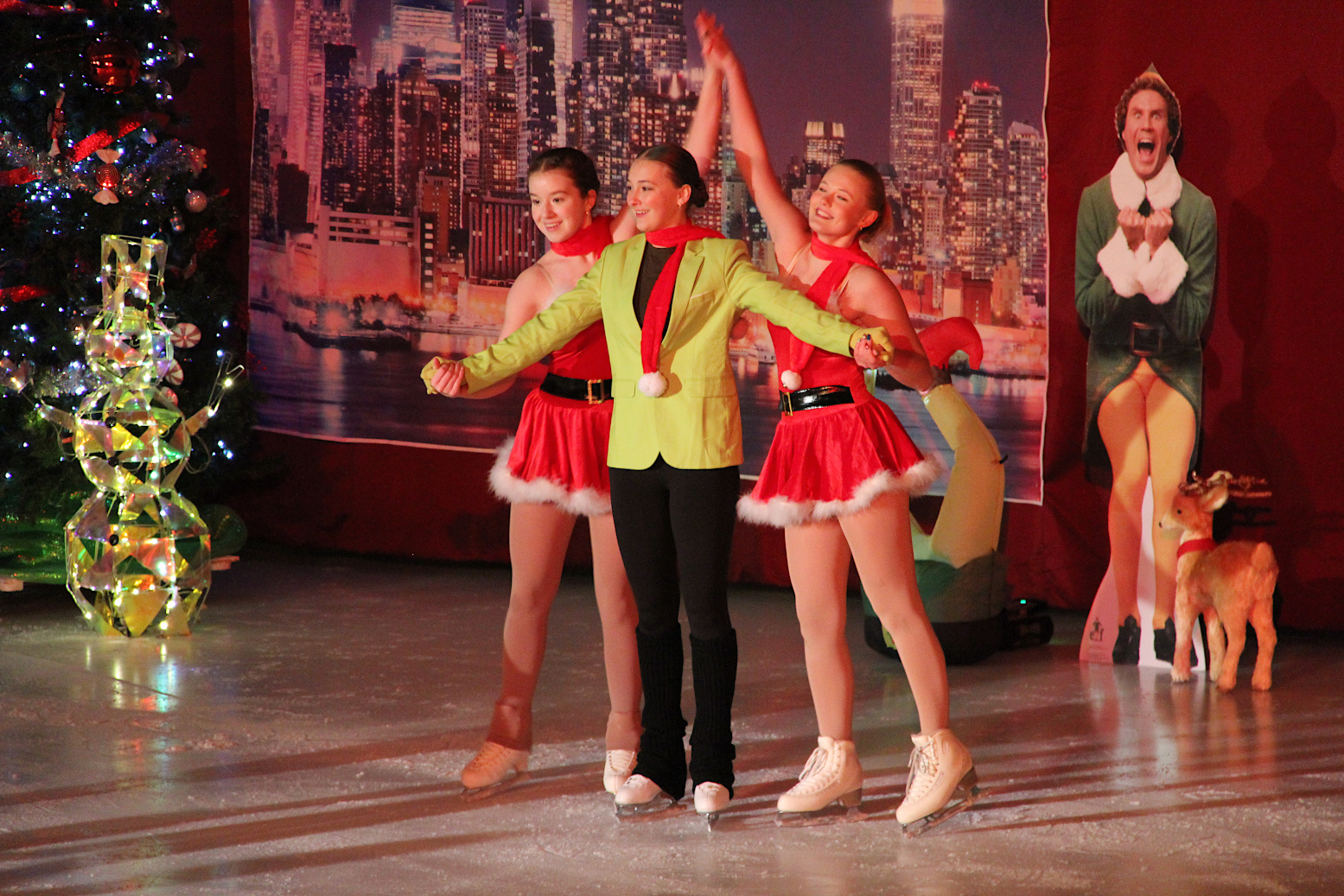
Attired in Christmas sweaters and glittery skirts, these cute skaters draw smiles. (Minnesota Prairie Roots copyrighted photo December 2025)
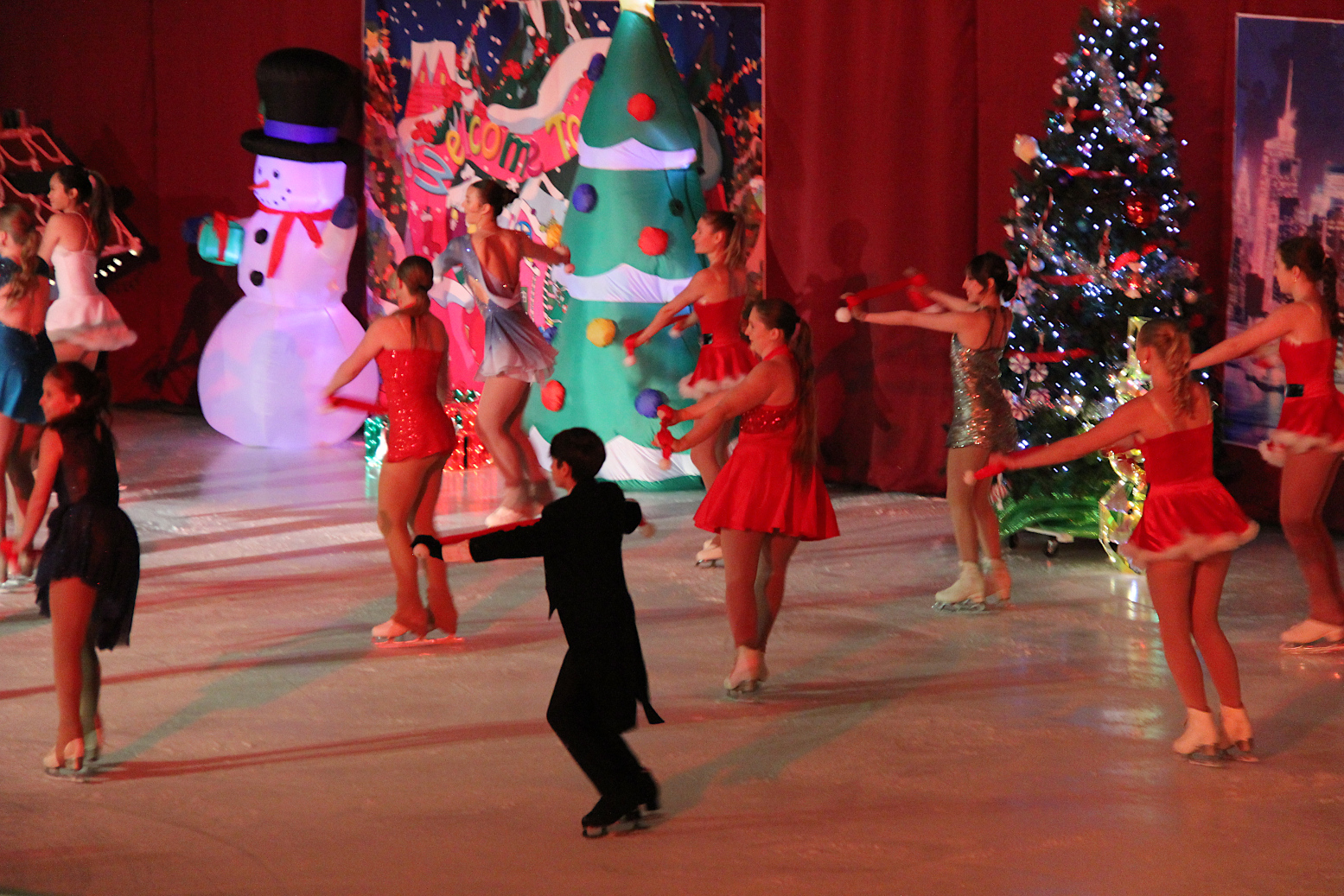
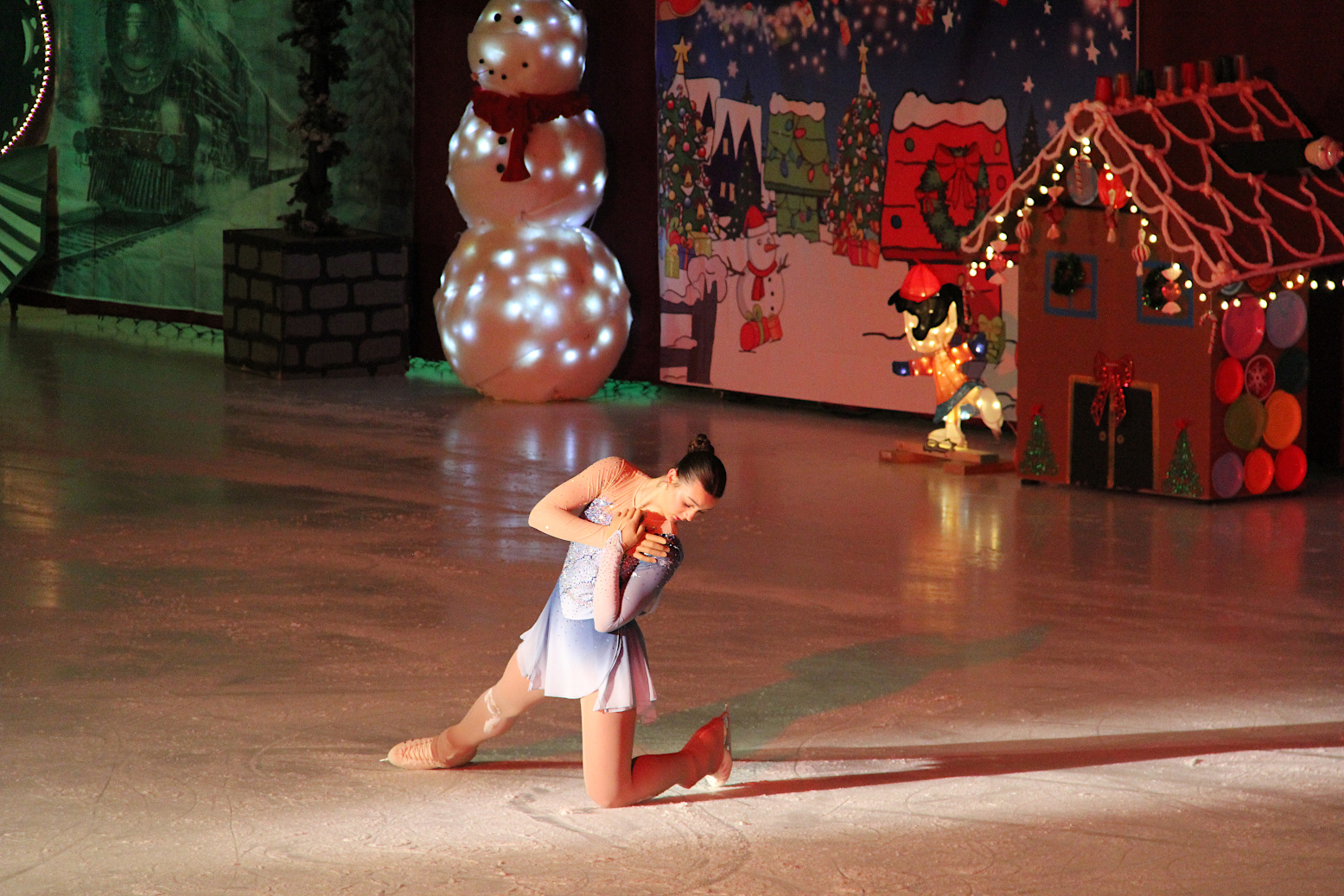
AGAINST A FESTIVE BACKDROP of The Polar Express locomotive, a gingerbread house, Frosty the Snowman, a Christmas tree and more, figure skaters at Shattuck-St. Mary’s School performed their annual holiday show on ice, “Lights, Camera, Skates! Christmas at the Cinema,” before an appreciative audience on December 13. And I was there, as I have been for many past figure skating shows that are as much an opportunity for skaters to perform as an early Christmas gift to the community.
Impressive skating by this team of skaters as they end their routine. (Minnesota Prairie Roots copyrighted photo December 2025)
I always enjoy the Campus Christmas Walk at the long-time private college prep school on Faribault’s east side. Students from around the world come here to learn, to skate, to play hockey and soccer, to participate in the arts and more. The school’s core, with its aged limestone buildings, seems more elite East Coast college than a Midwest prep school. But at the sports complex on the far north end of the campus, multiple ice arenas, a soccer dome and gym bring the modern to the historic.
Crouching and twirling on skates…amazing. (Minnesota Prairie Roots copyrighted photo December 2025)
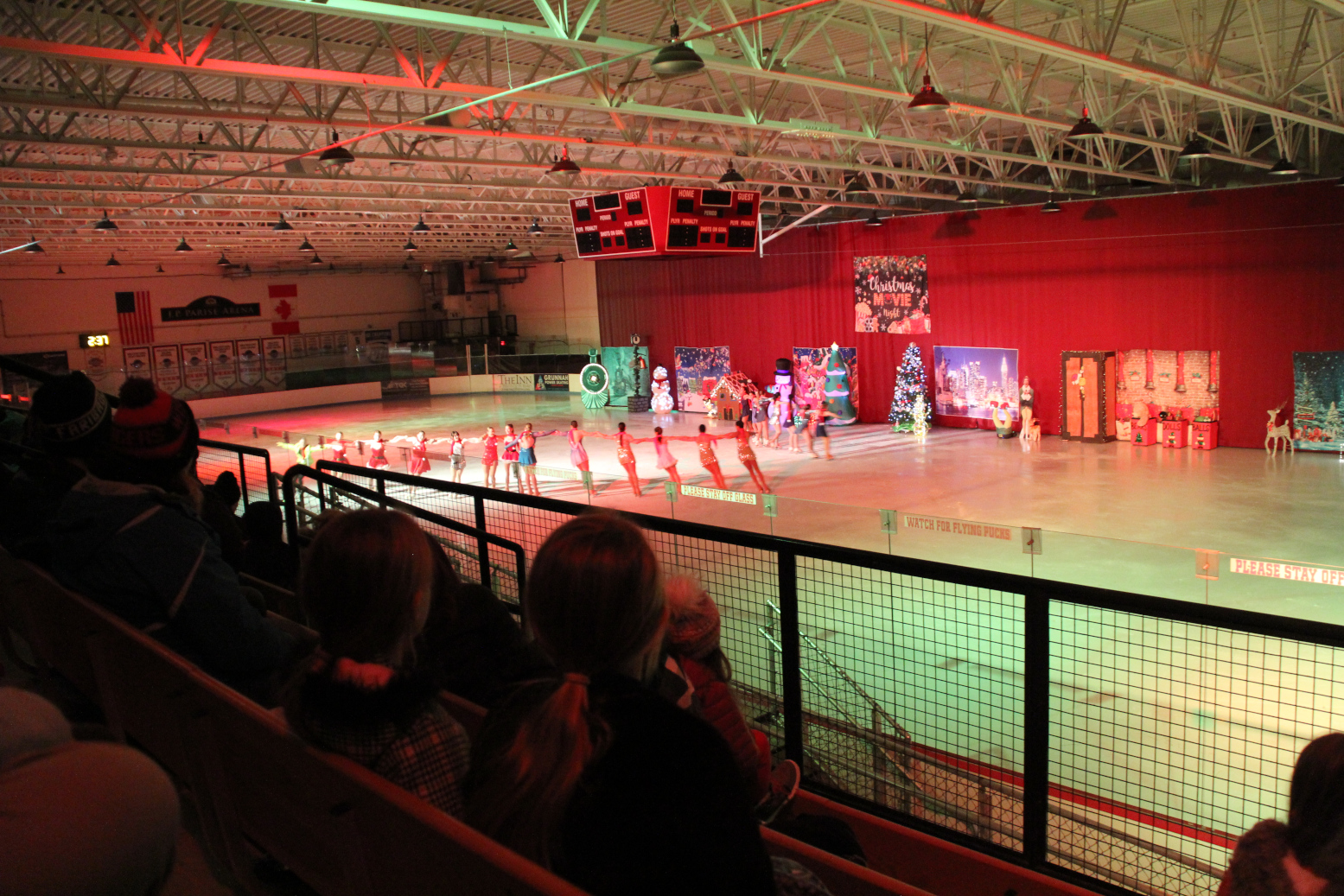
Inside the J.P. Parise Arena, yes, that Parise of National Hockey League fame and a one-time hockey coach at Shattuck, costumed skaters glided, twirled, danced and entertained those of us bundled in our winter gear on a bitterly cold December afternoon in southern Minnesota. After an hour of sitting in the ice arena, I felt the cold creeping into my bones.
At the end of the show, all of the skaters took to the ice. (Minnesota Prairie Roots copyrighted photo December 2025)
But my heart was warmed by talented skaters performing to favorite holiday tunes themed to favorite holiday movie classics. Cinematic clips played on a corner screen, introducing segments of the show, setting the mood.
A graceful bow ends a performance. (Minnesota Prairie Roots copyrighted photo December 2025)
If a sing-along had been encouraged, I expect many of us would have joined in belting out lyrics about a magical snowman, a red-nosed reindeer, a mean-spirited Grinch, wanting all of our loved ones home for Christmas…
Watching from the stands as the figure skating show nears its conclusion. (Minnesota Prairie Roots copyrighted photo December 2025)
Directly in front of me, a family of seven sat together watching the show. Five kids and their parents, the youngest a sweet 13-month-old who kept peeking around her mom to look and smile at me. I smiled back at Vivian, bundled in blue fleece with animal ears jutting out of her hood. She could have been Cindy Lou, a Who from Whoville, in disguise. So darling and precious, eyes bright with wonder and joy. What a beautiful family. In that moment, I wished my own three grandchildren could be there beside me watching the magic on ice, like the family I’d only just met.
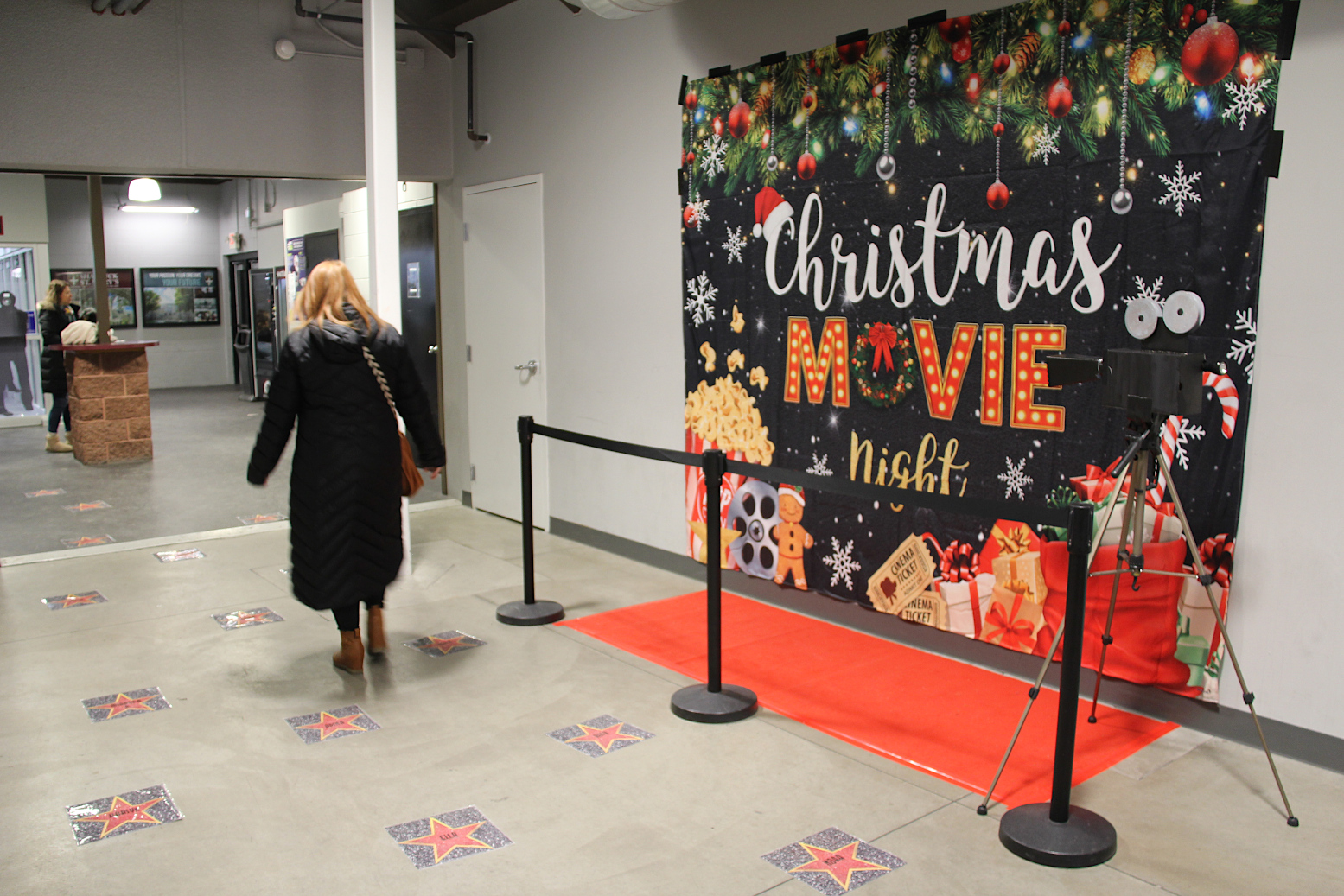
A red carpet photo op outside the arena. (Minnesota Prairie Roots copyrighted photo December 2025)
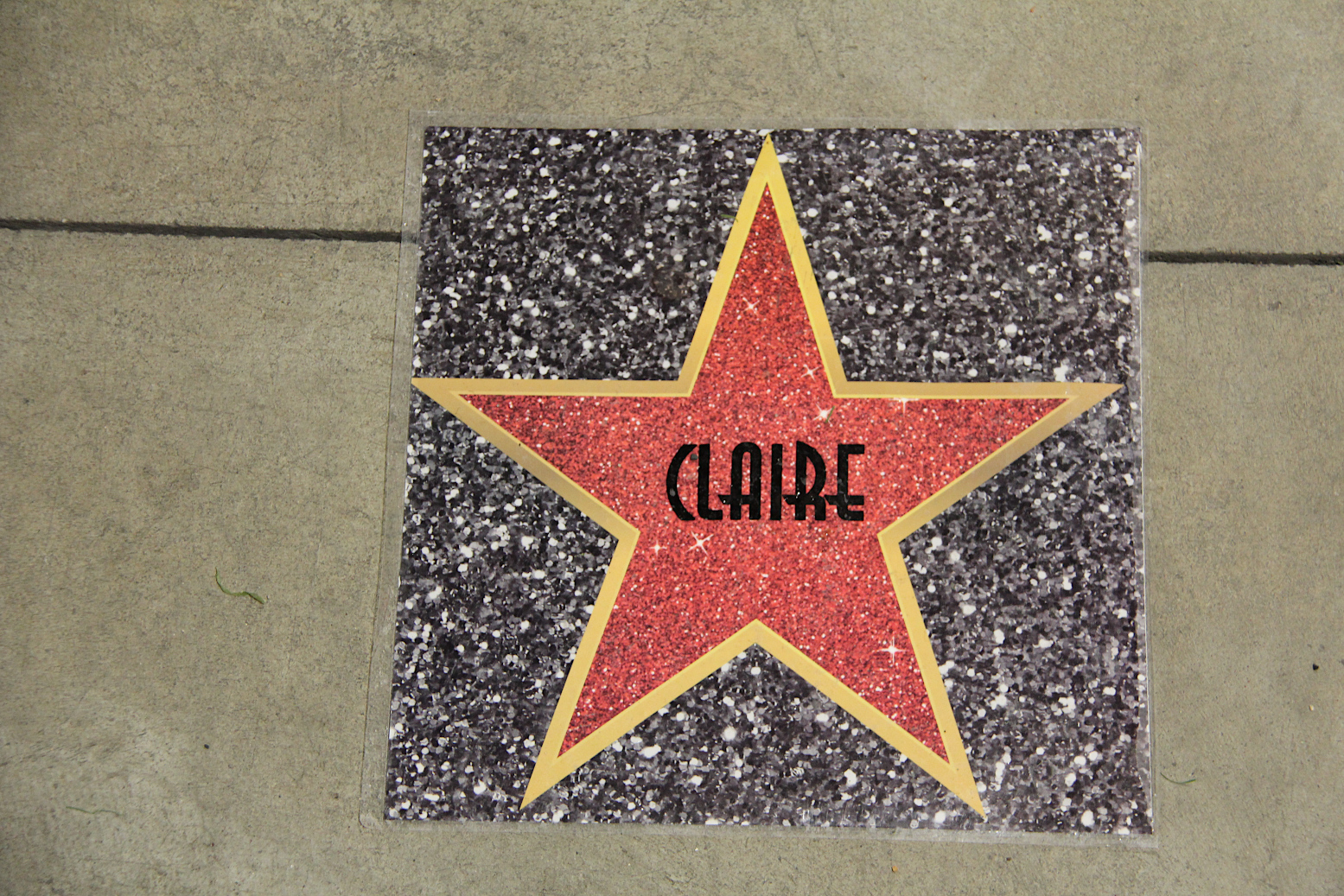
One of many stars on the hallway floor outside the ice arena. (Minnesota Prairie Roots copyrighted photo December 2025)
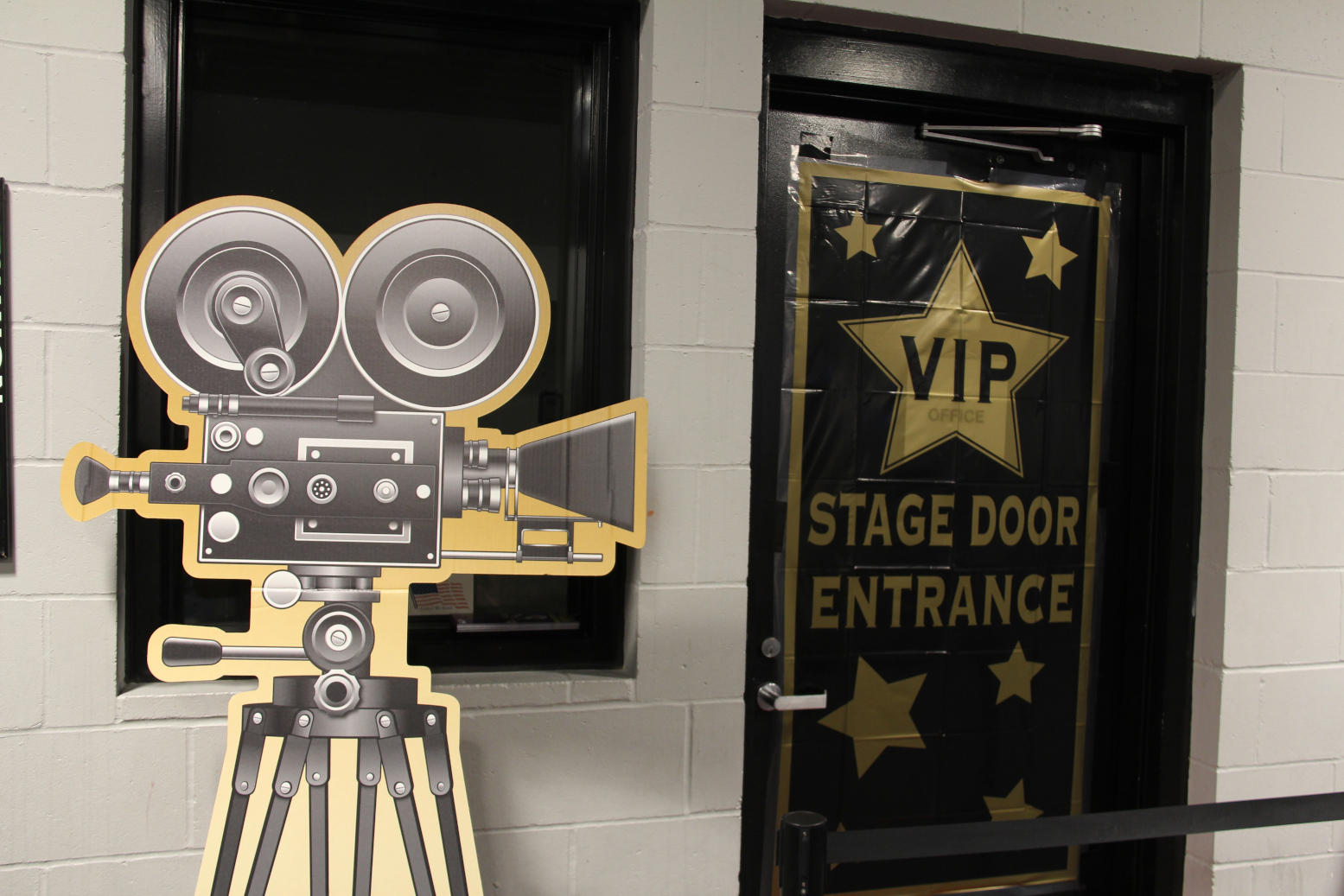
The signage on the right covered an office door outside an interior ice arena entrance. (Minnesota Prairie Roots copyrighted photo December 2025)
After the show, skaters, audience members, including families of the skaters, walked atop glitzy Hollywood style paper stars past a red carpet backdrop on the way to the gym. There a star awaited. Santa. Kids lined up to see him. They also gathered around tables to create crafts. Randy and I grabbed cookies. I drank a cup of coffee Randy mistakenly thought was hot chocolate.
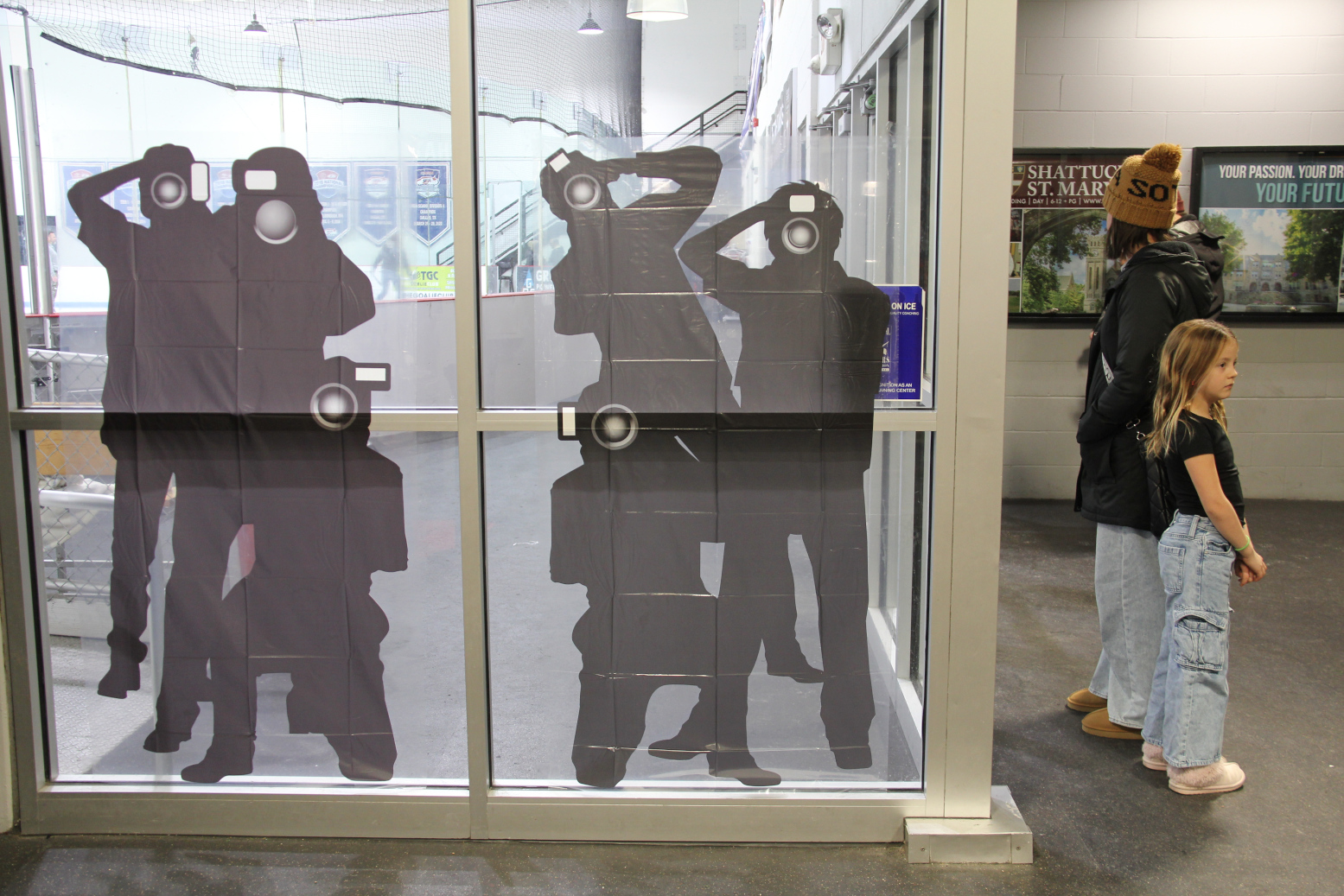
Art on an ice arena window fits the red carpet movie theme of the figure skating show. (Minnesota Prairie Roots copyrighted photo December 2025)
As in past years, I left in a cheerful mood, thankful for Shattuck’s Christmas gift to the greater community. That also included a holiday concert in The Chapel of the Good Shepherd. I have yet to attend that, but should.
The skater in the center, in the green jacket, portrayed the Grinch as she skated to “The Grinch.” (Minnesota Prairie Roots copyrighted photo December 2025)
The figure skating show, with narrated introductions, filled my spirit. I especially welcomed the encouragement to share compassion and kindness. For one hour I felt the closeness of community. I felt peace, too, as if all the mean Grinches of the world had vanished. Or perhaps their minds shifted and their hearts grew three sizes. If only everyone could sit shoulder-to-shoulder inside a Minnesota hockey arena on a bitterly cold afternoon 12 days before Christmas and feel the love, the warmth that is possible when we all come together.
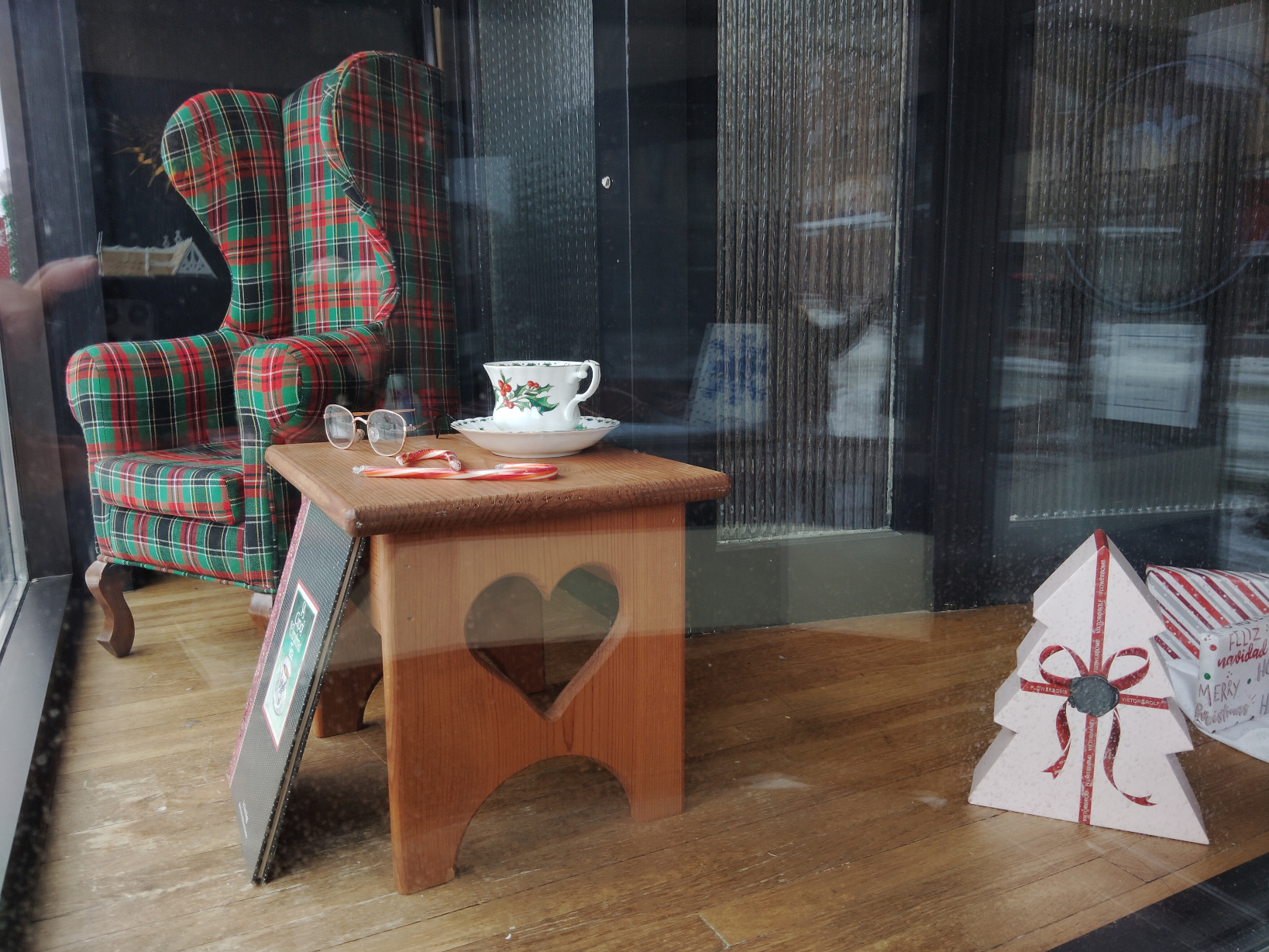
A storefront window display at Books on Central promotes an upcoming holiday reading. (Minnesota Prairie Roots copyrighted photo December 2025)
THE CADENCE AND RHYTHM of a book read aloud or a story told appeals to me. It’s as if the words become living, breathing characters, the setting vivid real-life scenes. Such is the power of the voice in interpreting words.
Wednesday evening, December 17, at 6 pm, two skilled local storytellers, Sam Temple and Tami Resler, will share their talents during a literary event at Books on Central in the heart of downtown Faribault. Holiday stories will focus their storytelling in the cozy bookshop centered by a chandelier inside a former jewelry store.
But the gems for the evening will be the stories that are sure to sparkle with the skills of Temple and Resler. I know both storytellers. They are genuinely kind, caring, joyful individuals who add much to our community.
Sam Temple, as Alexander Faribault, shares local and Minnesota history during the Riverside Rendezvous and History Festival in Faribault earlier this year. (Minnesota Prairie Roots copyrighted file photo May 2025)
Temple, who heads Steamboat Media Company and manages Northfield Public Broadcasting, is big into local history. He’s created documentaries about Faribault history with fellow creative Logan Ledman. He’s portrayed town founder, Alexander Faribault, numerous times. He’s also acted and directed and does improv comedy with Little Fish Improv. I’m sure I’ve missed something. But you get the idea. Temple brings tremendous talent and knowledge to anything he does.
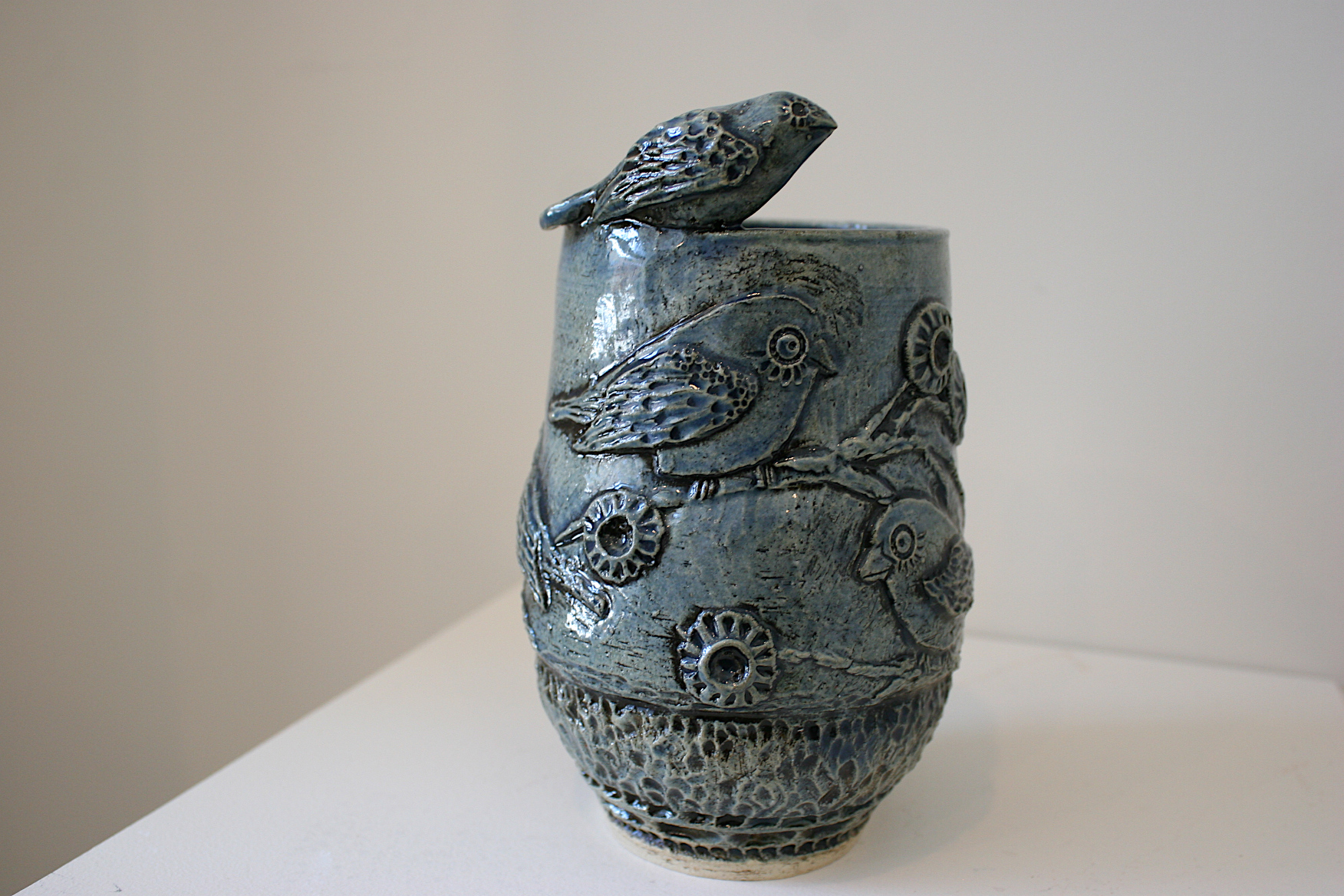
Tami Resler is a multi-talented artist. Here’s some of her pottery showcased in a gallery. (Minnesota Prairie Roots copyrighted file photo March 2021)
Likewise, Resler, a ceramics artist and educator at Shattuck-St. Mary’s School in Faribault, sparkles. I don’t think I’ve ever seen Tami without a smile. Her enthusiasm, I expect, will shine in expressive telling of holiday tales during the reading.
I encourage you, if you live in the area, to take a break from holiday preparations and settle into a chair at Books on Central this Wednesday evening. Relax. Delight in the comforts of a good story. Remember when you were read to as a child or when you read to a child. I hold fond memories of an elementary school teacher reading the “Little House” books by Laura Ingalls Wilder to our class each day after lunch. And I have read countless books to children, still do.
There is joy in books. And there is joy in listening to gifted storytellers who bring words to life with their voices.
FYI: Light refreshments will be served at this event, which is free and open to the public at 227 Central Avenue North, Faribault.
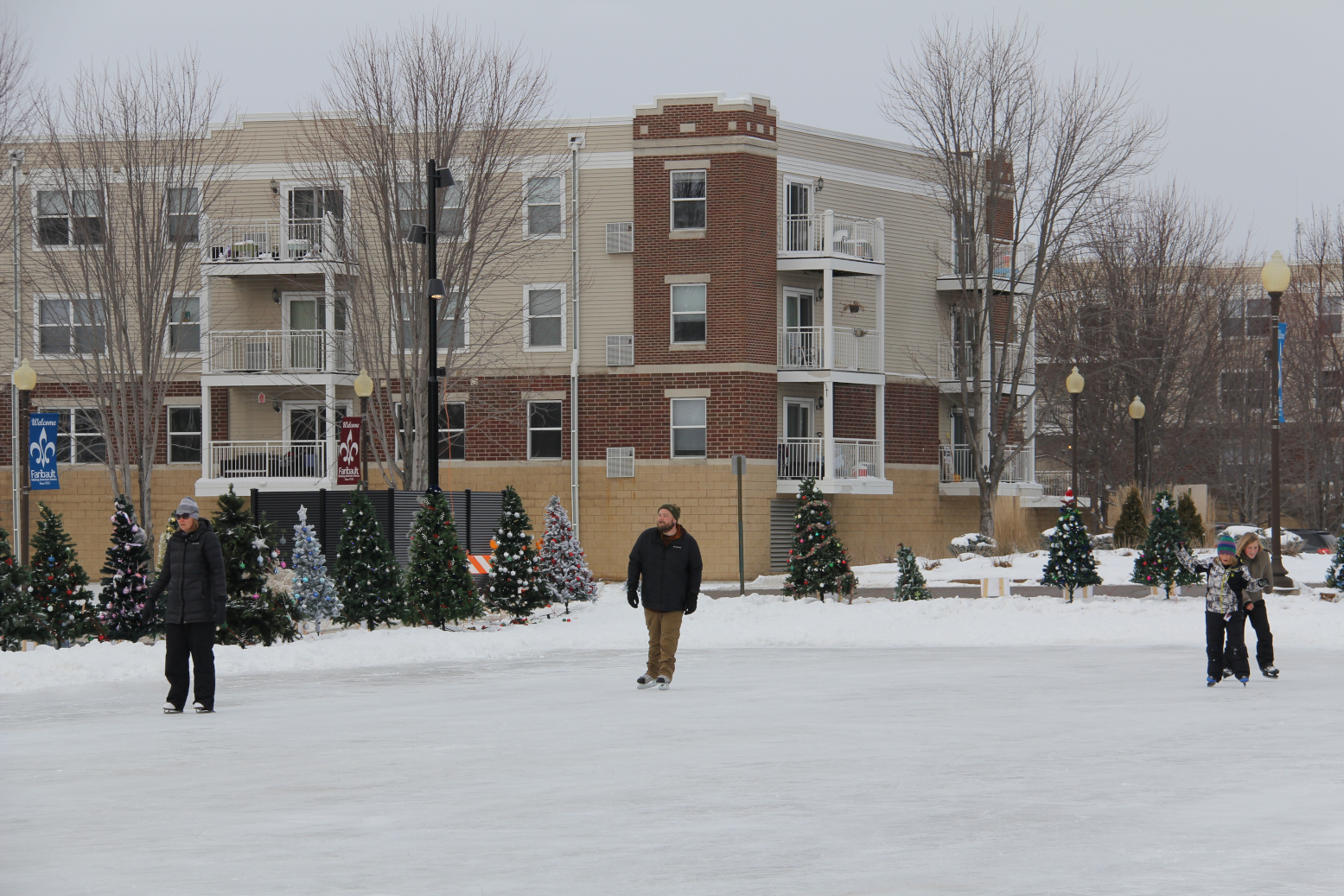
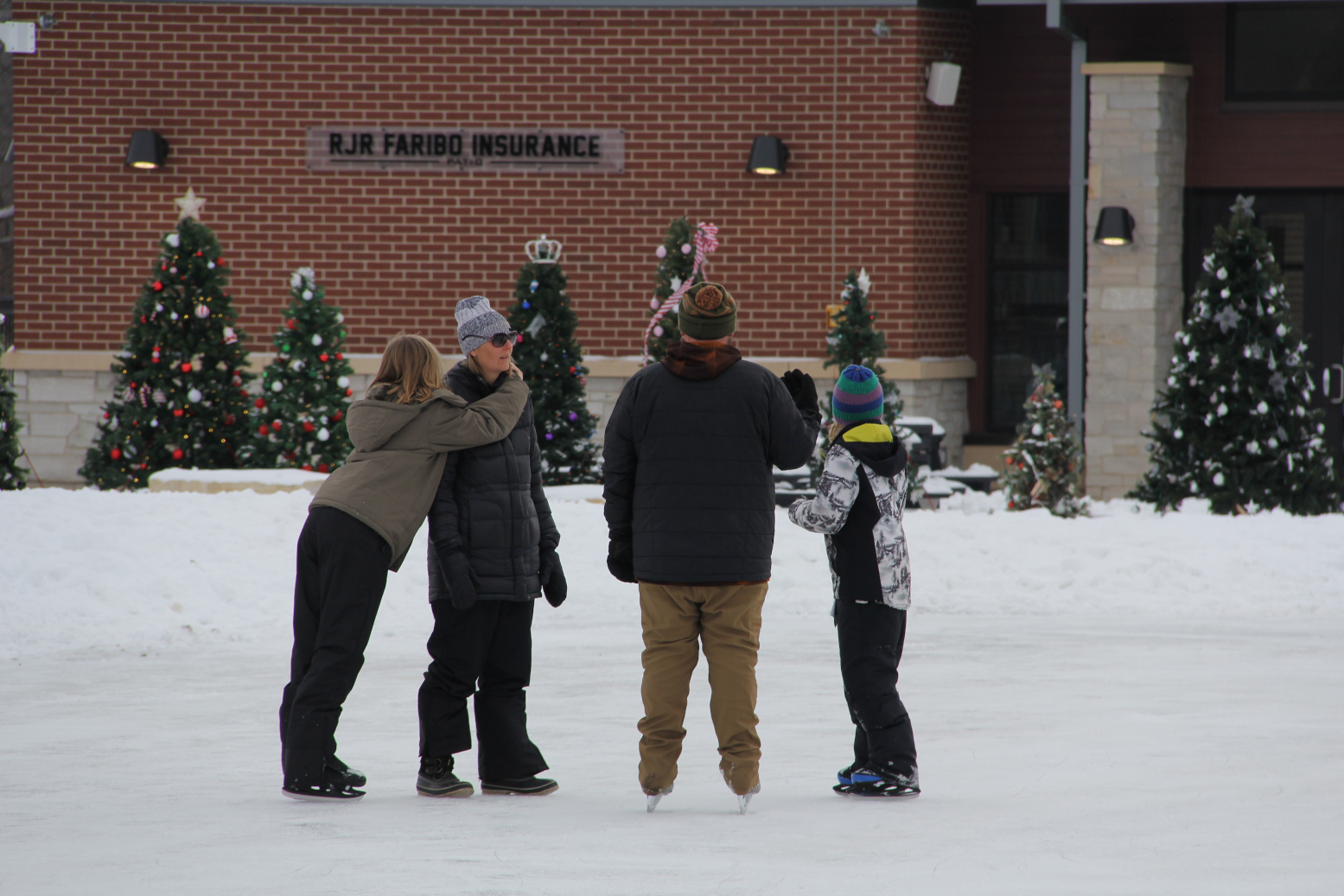
Skating at Viaduct Park in the heart of downtown Faribault with Heritage Bluff Apartments and Christmas trees from the Adopt-a-Tree program in the background. (Minnesota Prairie Roots copyrighted photo December 2025)
IF I WASN’T AFRAID of breaking a bone, I’d be out on one of our local rinks gliding across the ice on skates. But first I would need skates to replace the vintage ones I tossed years ago. Never mind. No possibility exists that I will lace up skates and take to the ice. Nope. I’d like to keep my life-time broken bone tally at two.
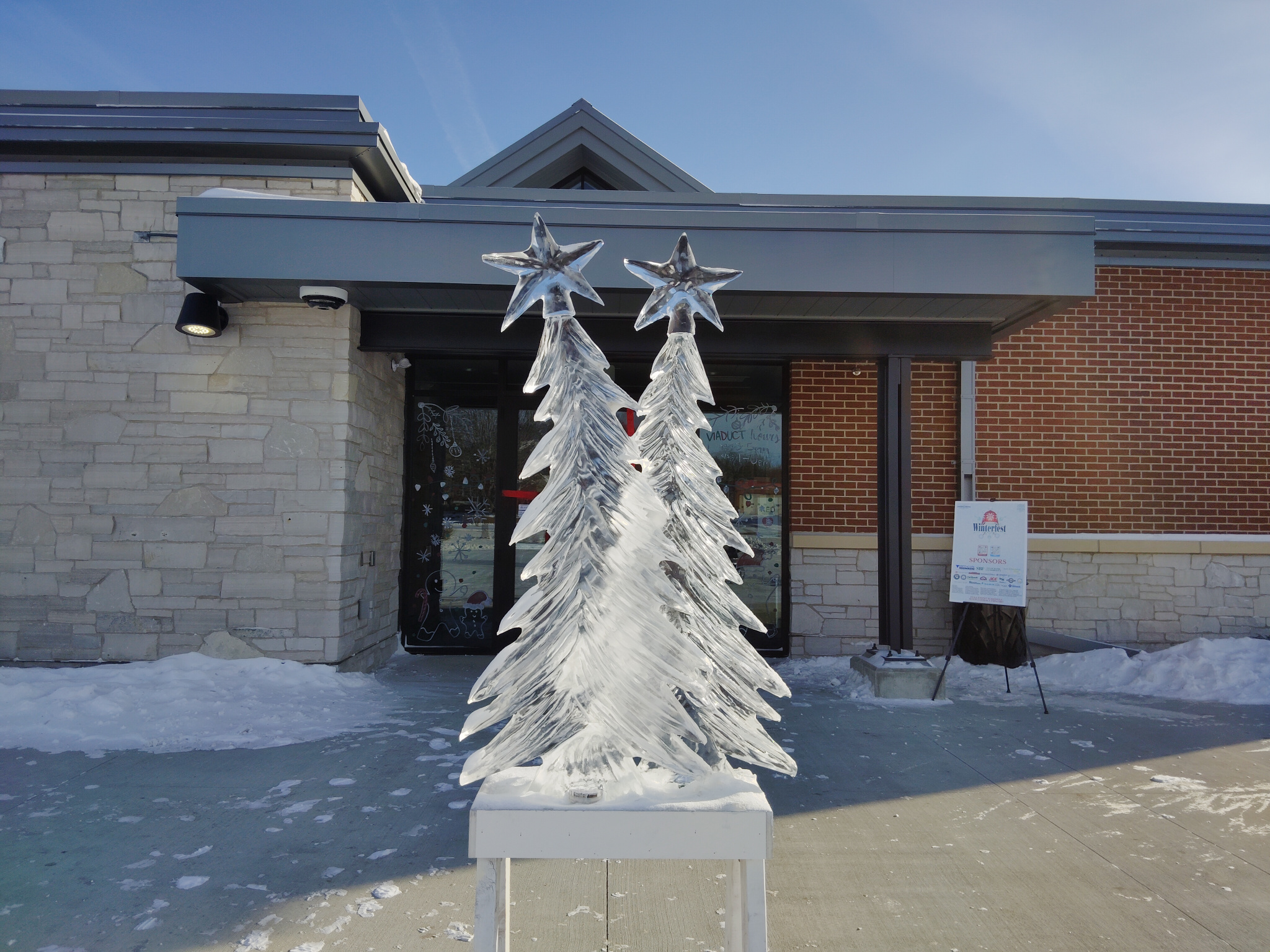
An ice sculpture, crafted for the recent Winterfest, stands outside the entrance to the Viaduct Park community space. The Park also features a splash pad, fire pit and eventually will have a refrigerated skating loop. (Minnesota Prairie Roots copyrighted photo December 2025)
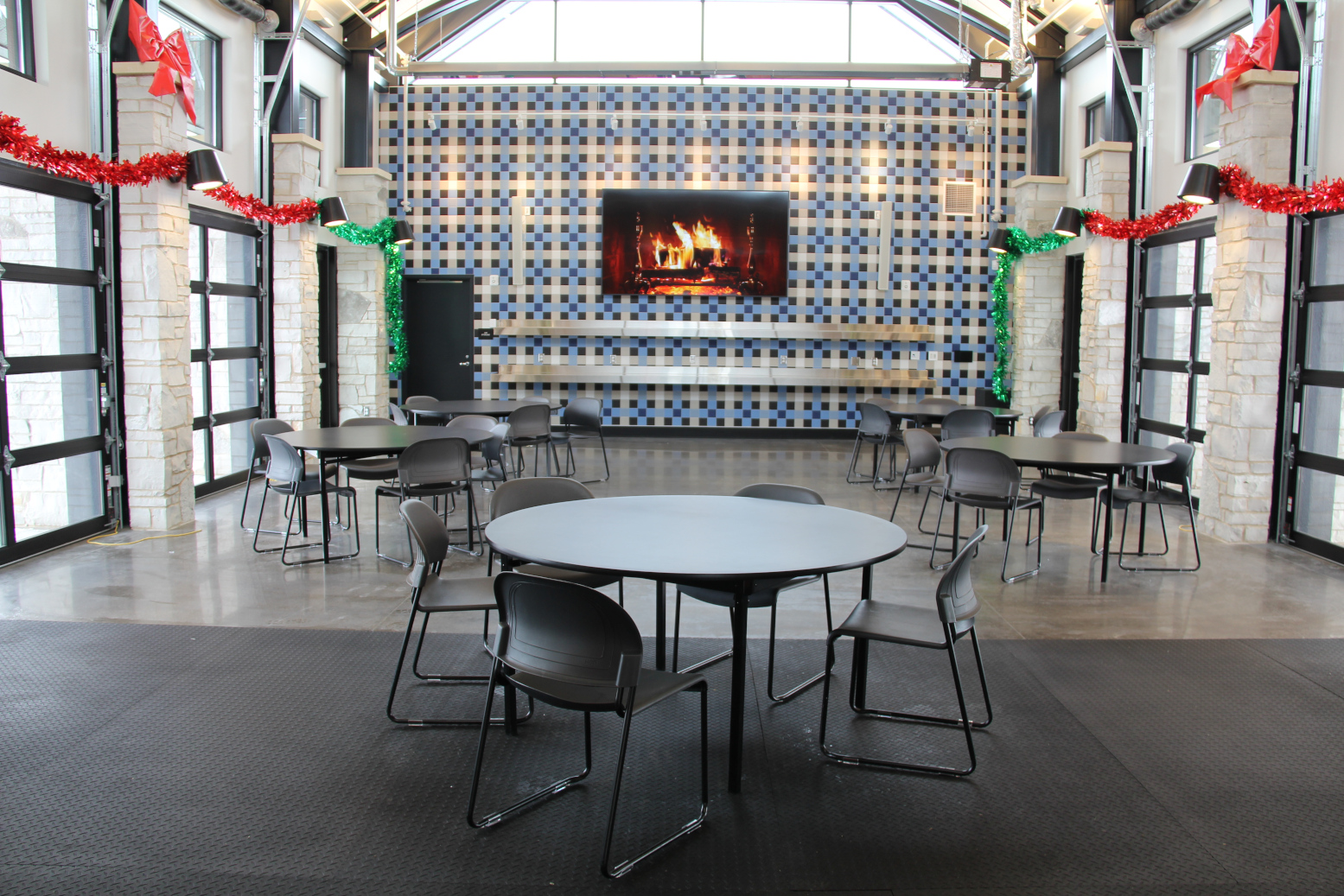
The beautiful gathering room at Viaduct Park is available for rent and will also be the site of community activities and events. (Minnesota Prairie Roots copyrighted photo December 2025)
Shattuck-St. Mary’s School students sculpted this snowflake, with the city’s signature Fleur de Lis symbol, for the recent Winterfest. It’s next to the ice rink and has proven a popular photo op backdrop. (Minnesota Prairie Roots copyrighted photo December 2025)
But for those who can skate, Faribault now offers another public outdoor rink at the city’s newest centerpiece park, Viaduct Park. Located below and next to the viaduct crossing the Straight River and train tracks, the park features a community space with a gathering room and a smaller warming room.
In the warming room, which opens to the rink, skaters can sit down to don or remove skates. (Minnesota Prairie Roots copyrighted photo December 2025)
Skaters looking for a place to lace up and later warm up can use the building, which is open from 3-5 pm weekdays and from 1-6 pm weekends. Plus, they can buy concessions like hot chocolate, coffee, popcorn and other snacks at the concession stand. The rink remains open until 9 pm as does the one near Jefferson Elementary School.
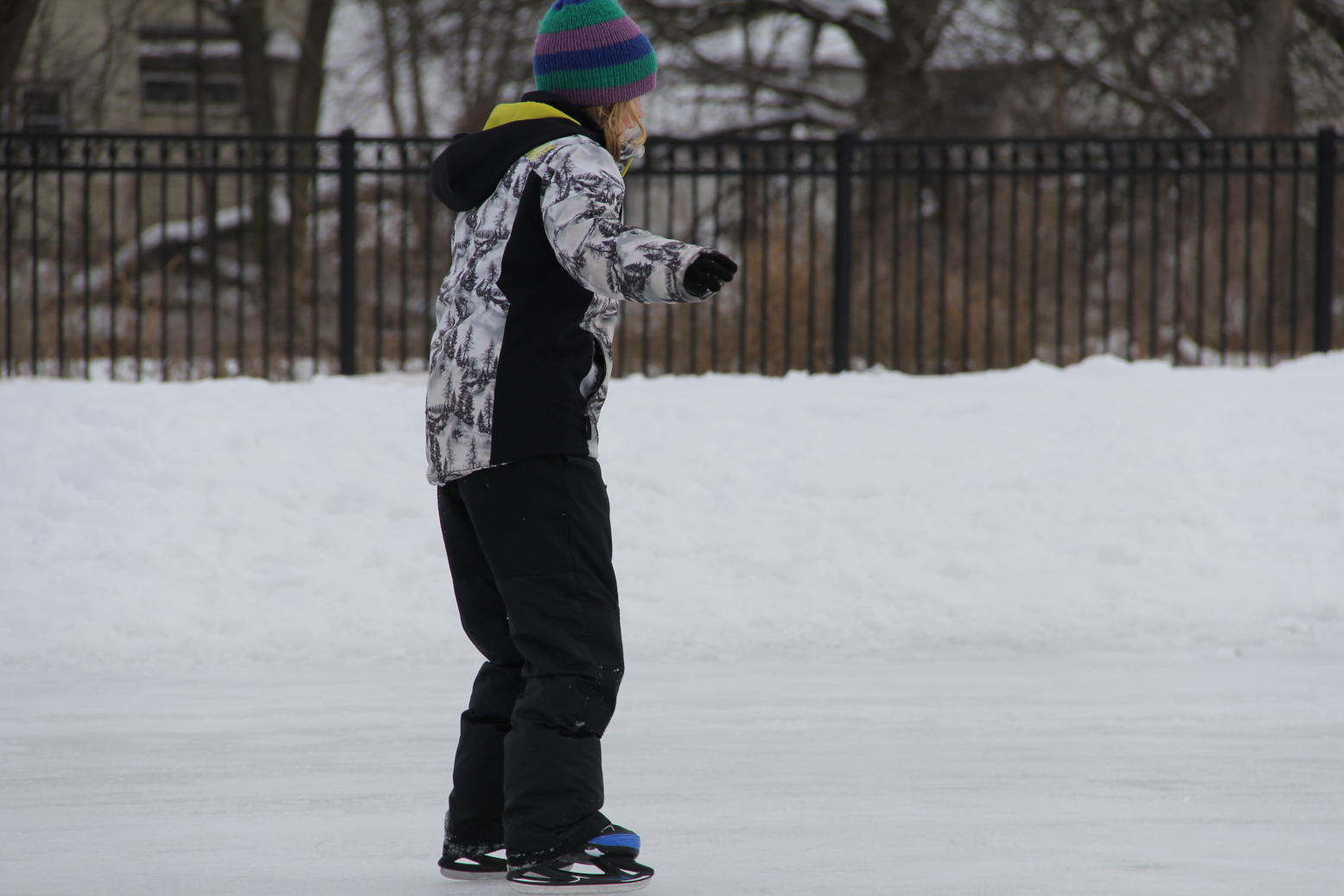
Gliding across the ice at Viaduct Park. (Minnesota Prairie Roots copyrighted photo December 2025)
Oh, how I would have appreciated a warming house like the one at Viaduct Park while skating on the pond next to the grain elevators in my small southwestern Minnesota hometown in the 1960s and 70s. We were left to the elements of cold and wind without even so much as a crude shelter. At least I don’t remember one.
My skates were passed down to me from my Aunt Dorothy and looked nothing like these modern day skates. (Minnesota Prairie Roots copyrighted photo December 2025)
If I’m sounding like an old-timer, well, it’s because I kinda am. These days ice causes angst rather than anticipation of fun. Again, it’s the falling on icy surfaces that concerns me.
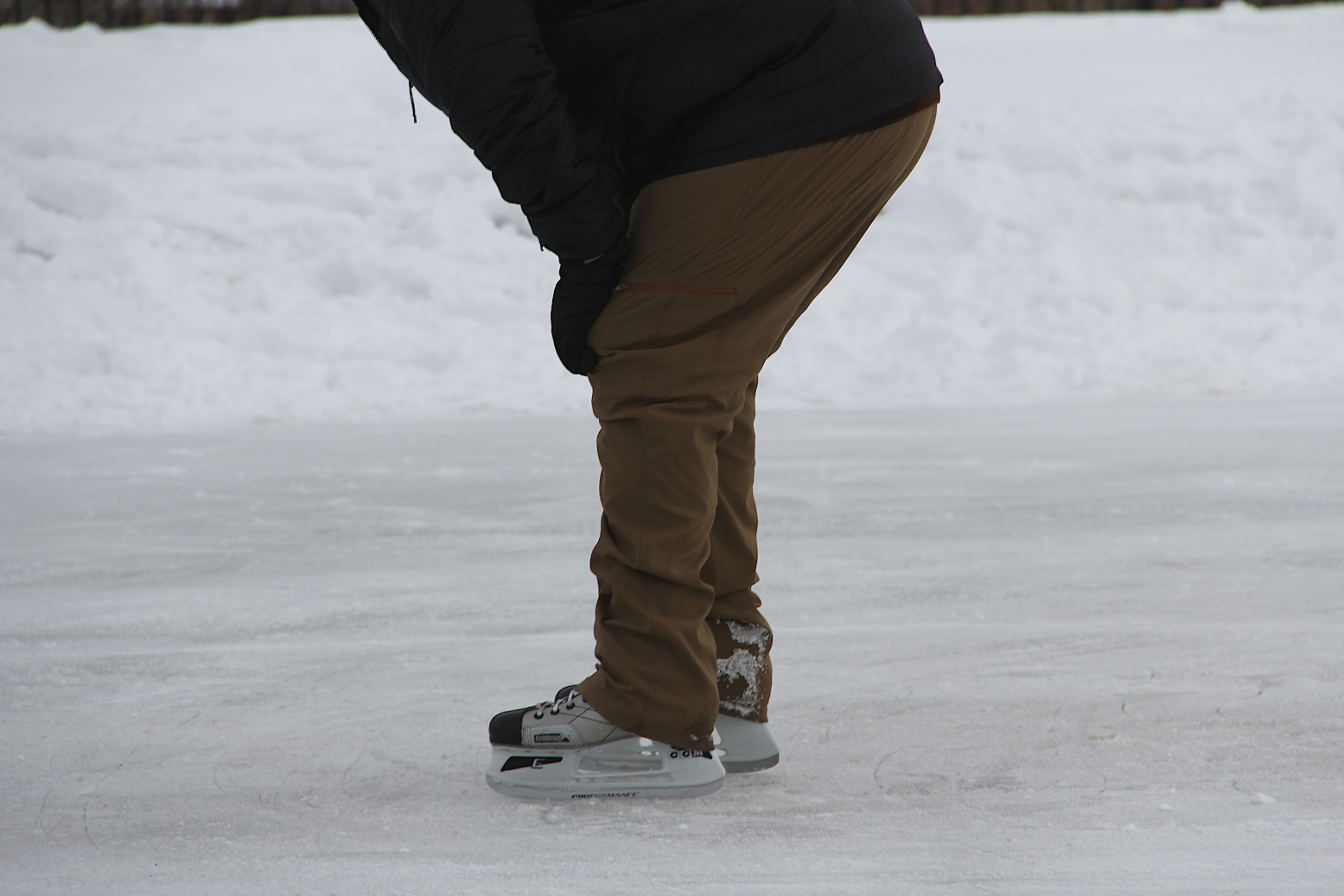
A momentary pause in skating at Viaduct Park. (Minnesota Prairie Roots copyrighted photo December 2025)
That aside, when I watched a family glide across the ice at Viaduct Park recently, I felt a tad envious. I wished that was me because I loved ice skating and rollerskating back in the day. There’s a certain freedom in flying across the ice, cold wind kissing your face, skates seemingly floating on air, speed and movement propelling you forward. It feels simultaneously exhilarating, terrifying and powerful.
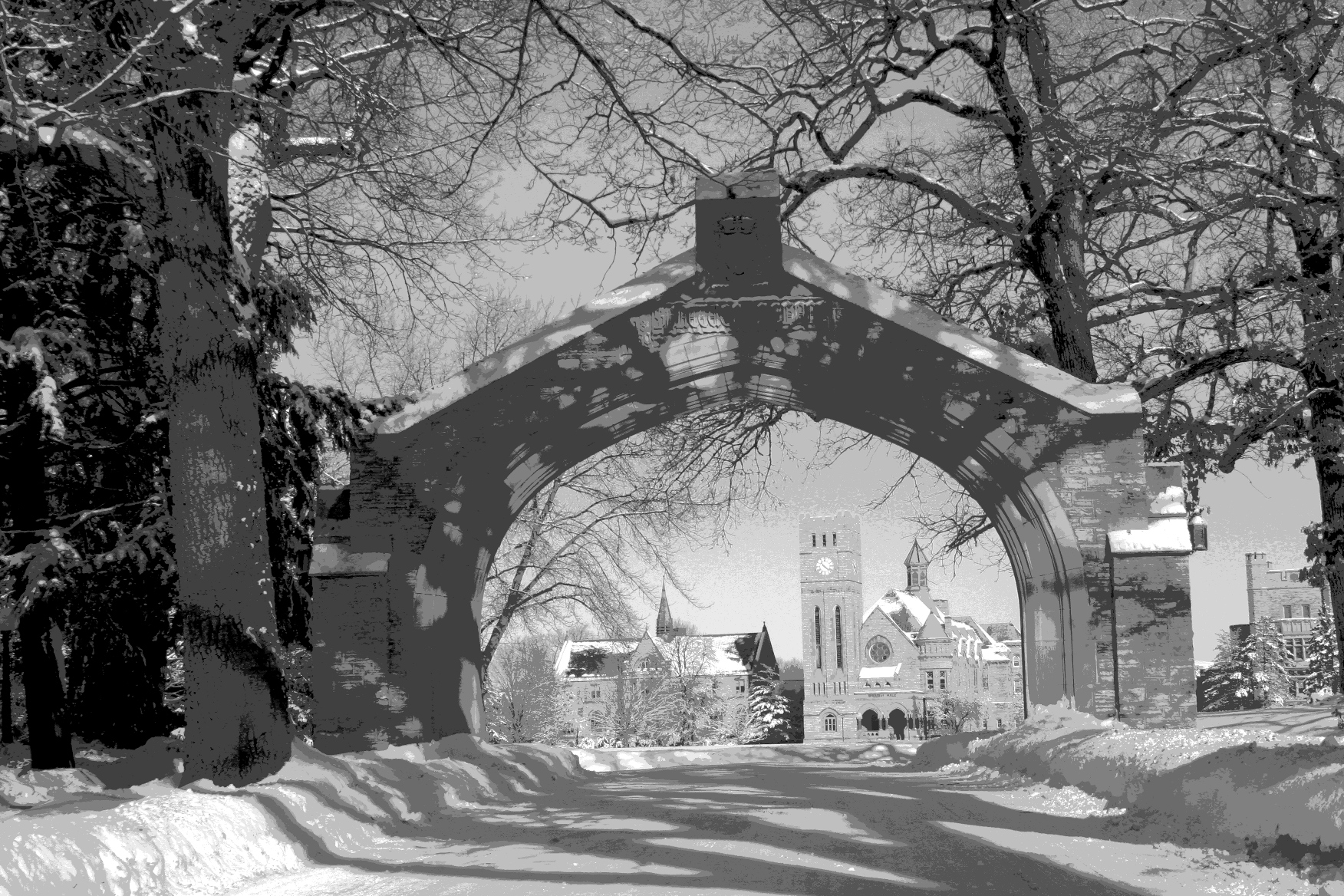
An entrance arch frames Shattuck-St. Mary’s School on Faribault’s east side. Go through this arch to find the chapel. The sports complex is on the other side of campus off Shumway Avenue. (Minnesota Prairie Roots copyrighted file photo)
These days I settle for observing skaters. That includes this Saturday, December 13, when Shattuck-St. Mary’s School, a private college prep school in Faribault, hosts its annual Campus Christmas Walk. The highlight for me has always been watching figure skaters perform a holiday show. This year’s show, “Lights, Camera, Skates! Christmas at the Cinema,” is set for 1:30 pm in the Putrah Sports Complex.
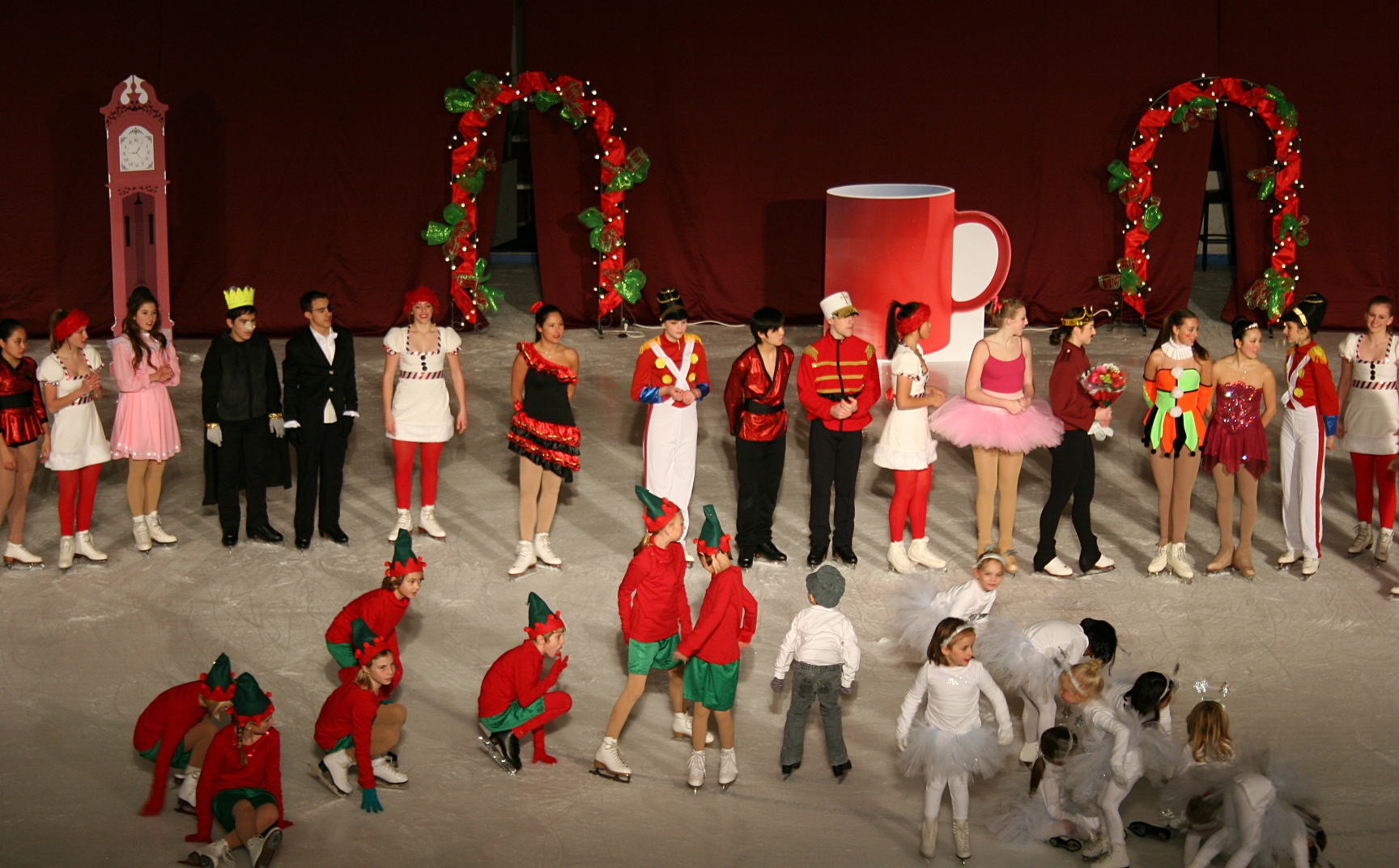
A performance of “The Nutcracker” at a previous Shattuck holiday figure skating show. (Minnesota Prairie Roots copyrighted file photo)
But before the figure skaters take to the ice, musicians will perform a noon Christmas concert in Shattuck’s historic Chapel of the Good Shepherd. Post ice skating show, attendees can gather from 2:30-4 pm in the sports complex for crafts, cookies and photos with Santa and Mrs. Claus. (Note, this is a change in location from previous years.) All events are free and open to the public.
Between now and Saturday, I’ll cautiously navigate icy surfaces, perhaps with my Snow Trax grippers clamped on my boots. I want to remain firmly grounded rather than flying across the ice, cold wind kissing my face.
Gifts for the creative grandson. (Minnesota Prairie Roots copyrighted photo December 2025)
WHEN MY ELDEST DAUGHTER sent her children’s Christmas gift wish lists to me, I wasn’t surprised to find several art-related items on first grader Isaac’s list. He loves creating. And to create, he needs supplies. So Isaac asked for giant construction paper, a Paint by Sticker book, a pixel art set and Sharpie markers, specifically a grey marker. Why grey? I have no idea. He’s getting all of those from Randy and me.
One year Isaac wanted a ream of paper for Christmas. He blew through the 500 sheets we gave him in several months. Not only does my grandson create art, but he also solves math problems far beyond what a six-year-old should be capable of doing and recently proclaimed, “I love to read!”
I’m not sharing this to be a boastful grandma. Rather, I want to emphasize the importance of encouraging children in their interests. That builds confidence and shows that we support and care about them and their passions.
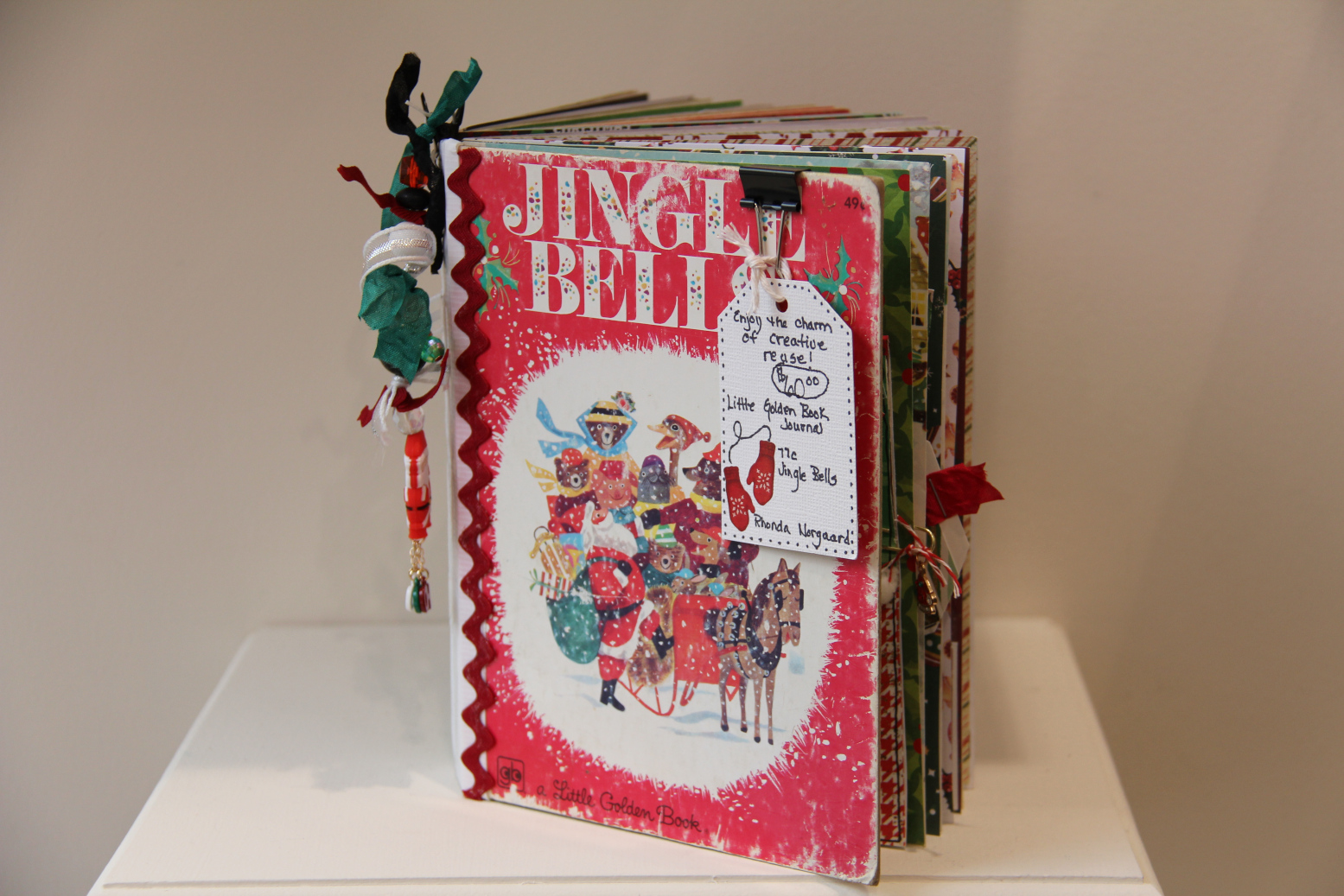
A Little Golden Book Journal, among several crafted by recycler artist Rhonda Norgaard and for sale at the Paradise Center for the Arts, Faribault. (Minnesota Prairie Roots copyrighted photo December 2025)
My 9-year-old granddaughter, who really really loves to read, and write, declared on her first day of fourth grade that she wants to become an author. That could change. But for now, Izzy embraces creativity through writing, singing and playing piano. And I enthusiastically encourage her.
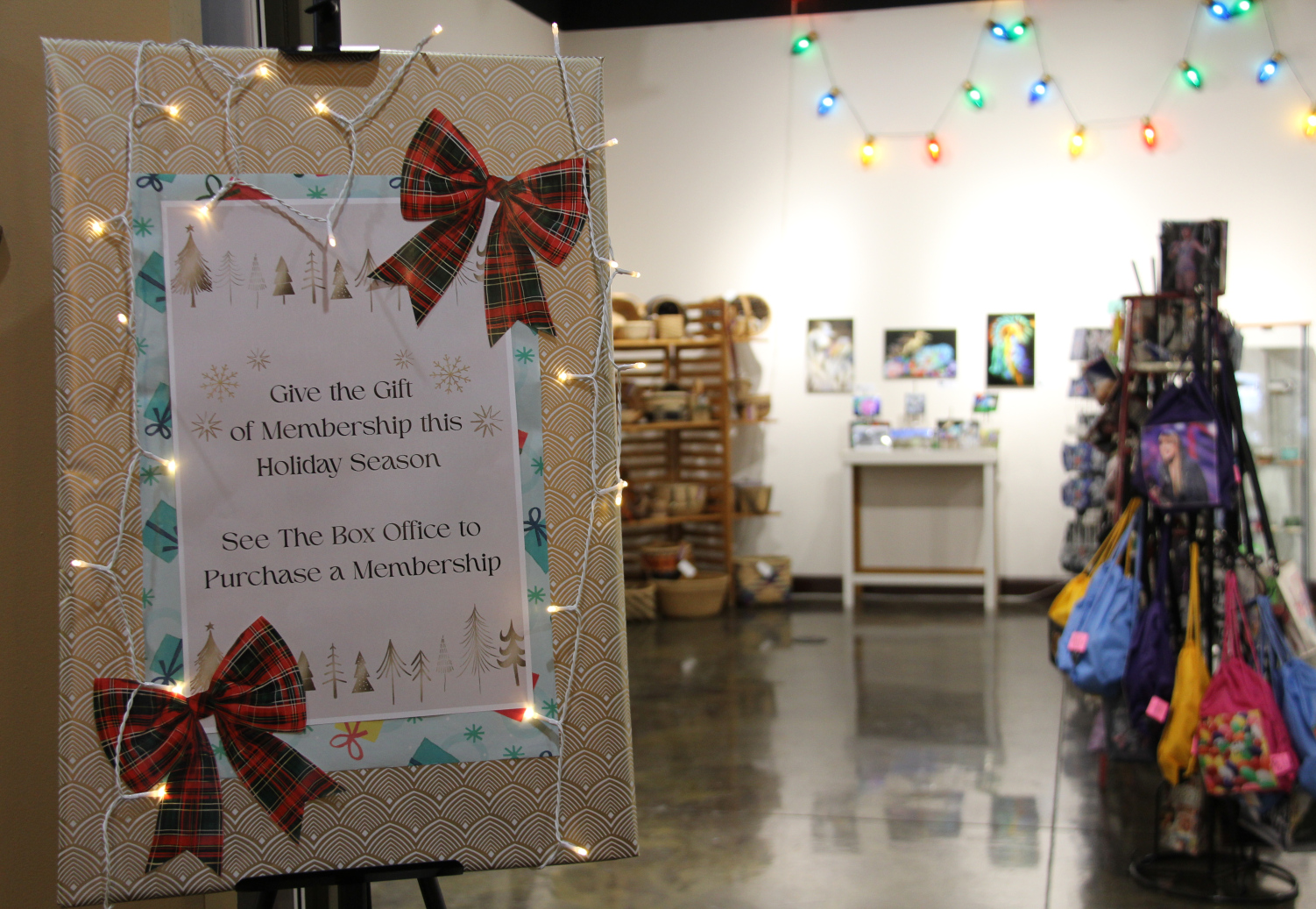
Among the many gifts for sale at the Paradise Center for the Arts is a Paradise membership. Members get discounted ticket prices among other benefits. (Minnesota Prairie Roots copyrighted photo December 2025)
In Faribault, I am an enthusiastic supporter of the arts, centered at the Paradise Center for the Arts. This downtown hub of creativity brings the visual and performing arts to my community via concerts, theatre, comedy, gallery shows, art classes and more.
Acrylic paintings by Adele Beals. (Minnesota Prairie Roots copyrighted photo December 2025)
And now, during the holiday season, 32 artists are showcasing and selling their art at the annual Holly Days Sale. I recently popped into the Paradise to peruse the artsy offerings ranging from pottery to paintings, stained glass, fiber art, mittens, jewelry, metalwork, woodwork, journals, photography, handbags and more. This is one-of-a-kind merchandise crafted with creative minds and hands by Minnesota artists.
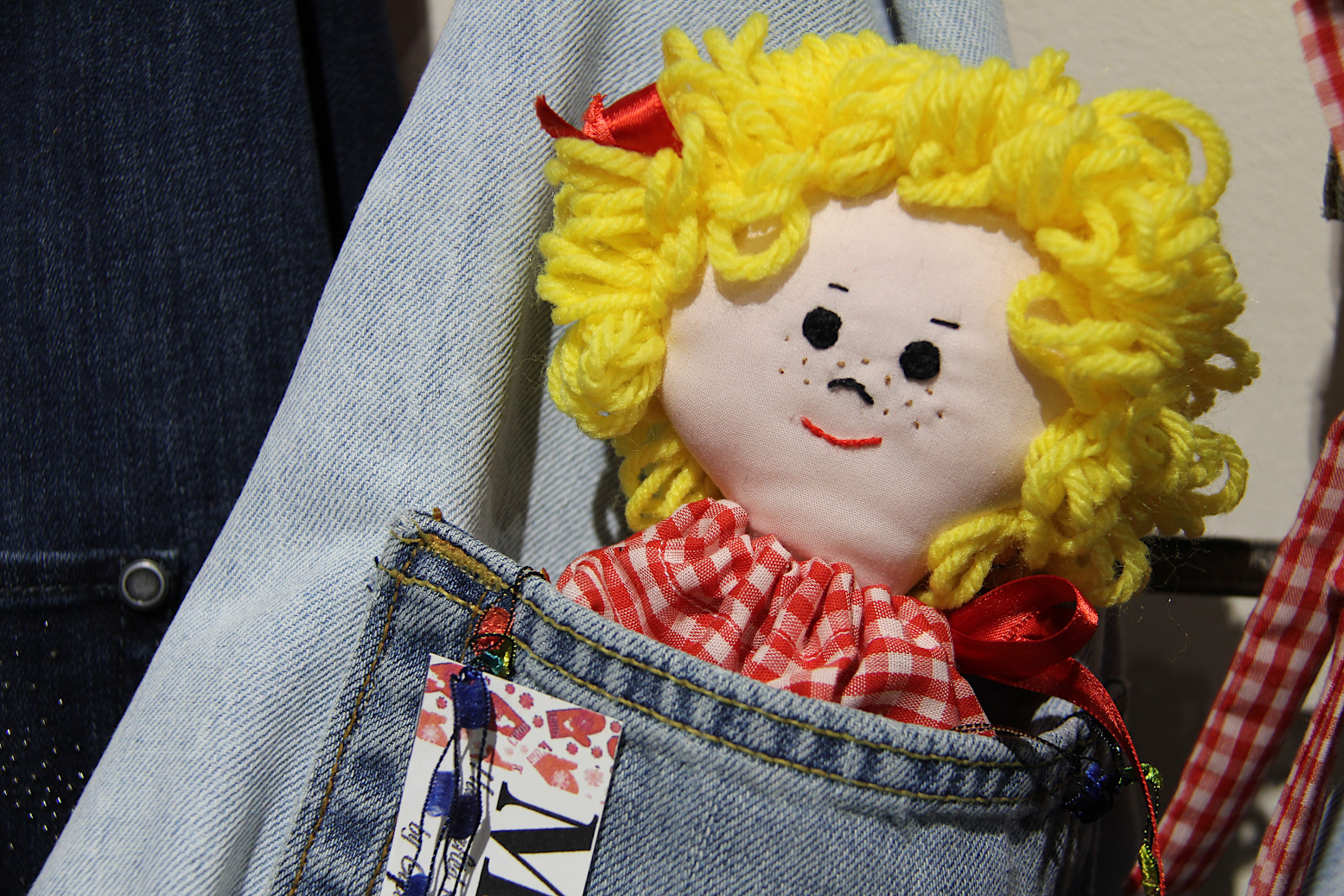
Gail Kielmeyer crafted this doll, aprons and more, tagged as Minnesota Made. (Minnesota Prairie Roots copyrighted photo December 2025)
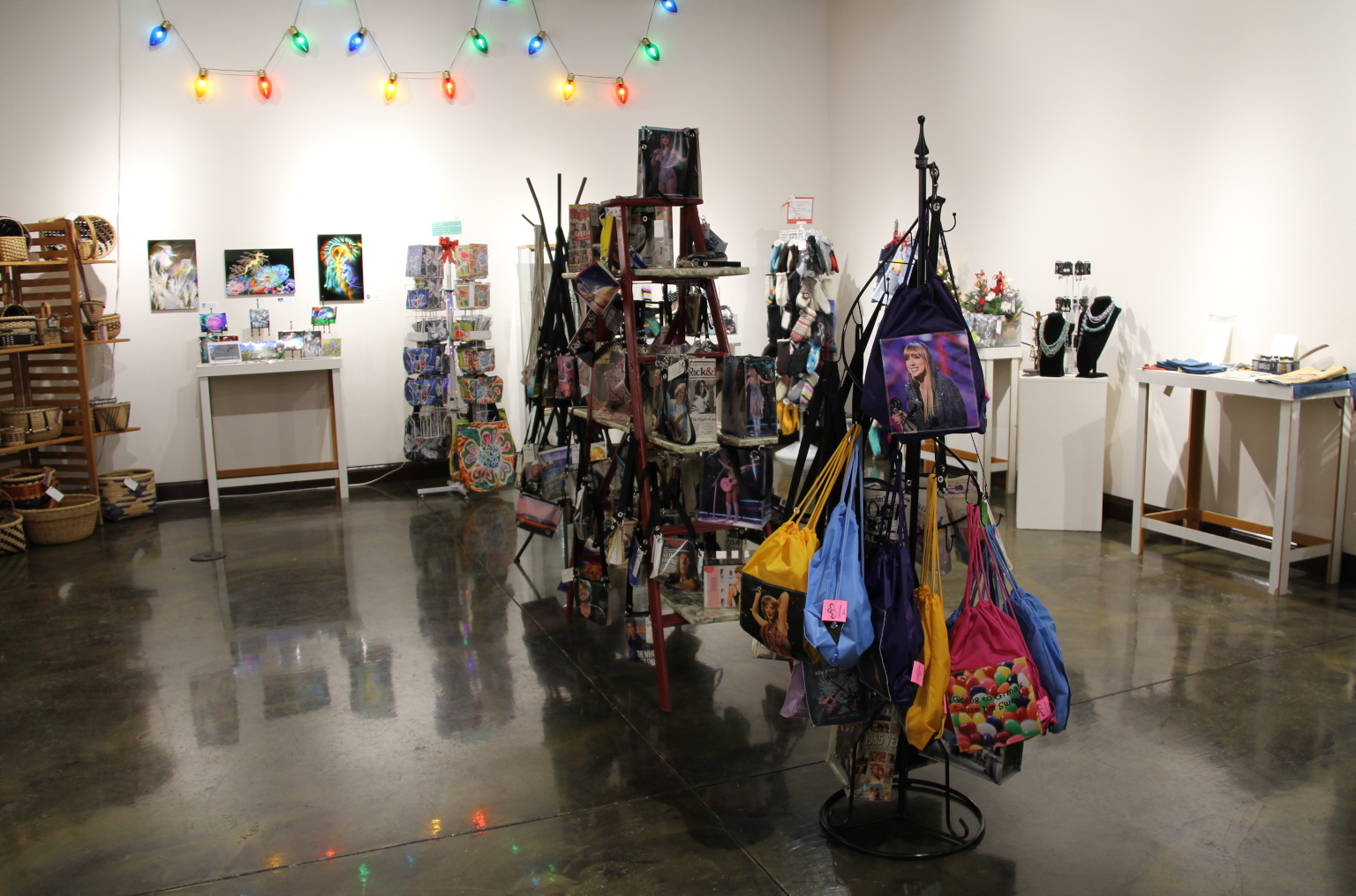
Handmade goods fill the main gallery and two smaller galleries for the Holly Days Sale. (Minnesota Prairie Roots copyrighted photo December 2025)
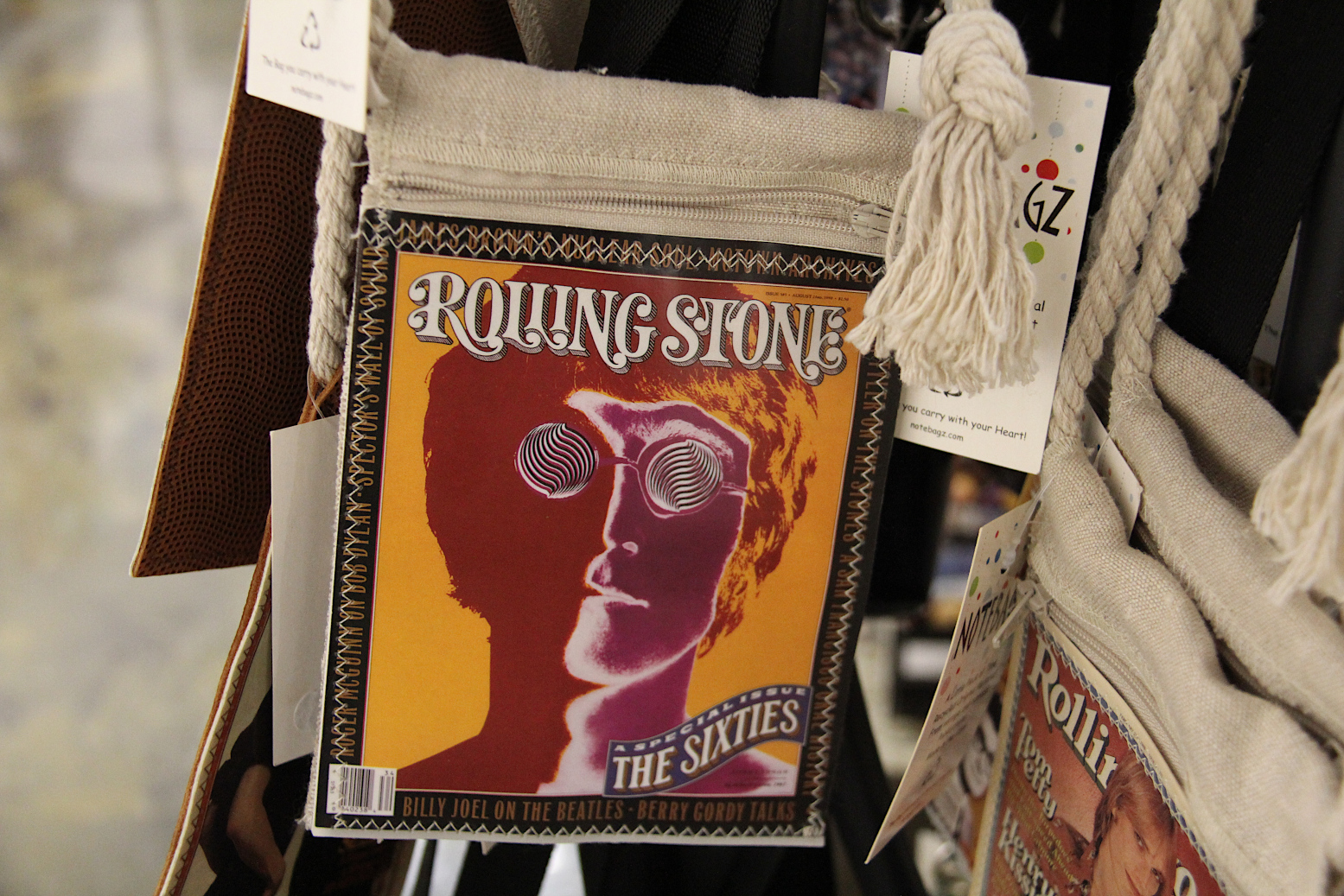
Paula Person crafts cellphone-sized and other bags and clutches for her business, notebagz. Her products are made from recycled publications. She also does custom work. (Minnesota Prairie Roots copyrighted photo December 2025)
I can’t help but wonder how many of these artists, as young children like my grandchildren, loved to create. Perhaps a grandmother taught them to sew. Perhaps they were fascinated by their grandfather’s abilities to build anything with wood. Perhaps an aunt painted. Perhaps their parents knitted or welded or journaled. Perhaps a teacher encouraged them in their creativity.
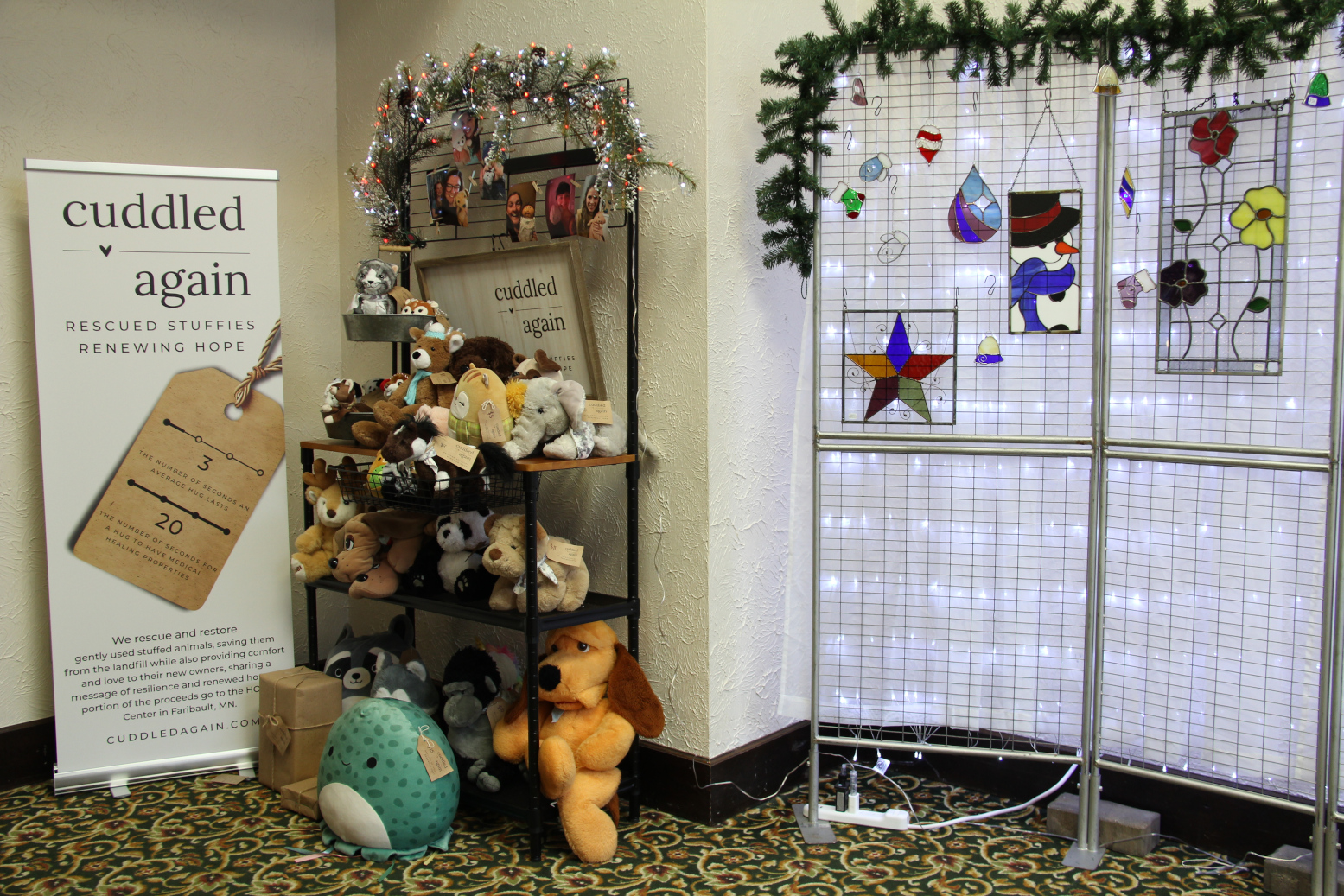
Laura O’Connor of Cuddled Again rescues and restores gently-used stuffies for resale. A portion of the proceeds go to HOPE Center in Faribault. To the right is Sandra Sargent’s stained glass art created at Bending Sunlight Glassworks. She teaches at the Paradise and also has a studio across the street in the Bachrach building. (Minnesota Prairie Roots copyrighted photo December 2025)
Whatever the reasons individuals choose to make art really doesn’t matter, although it is interesting to hear backstories. If they’re like me, they create because they haveto and can’t imagine their lives without art. No one expects to get rich in the arts, thus the term “starving artists.” Writing and photography are, for me, passions that earn me minimal income. Yet, I press on with my creative endeavors.
Oil on canvas nature scenes painted by Joannie Johnson. (Minnesota Prairie Roots copyrighted photo December 2025)
Likewise all those artists selling their goods at the Holly Days Sale clearly love creating and sharing their artwork with others. I am grateful to them and to all creatives, and to arts centers like the Paradise, for enriching our communities through the arts. Perhaps some day I will see my grandson’s art in a gallery and my granddaughter’s book on a bookstore shelf. Whatever happens, I hope they will always appreciate and embrace creativity.
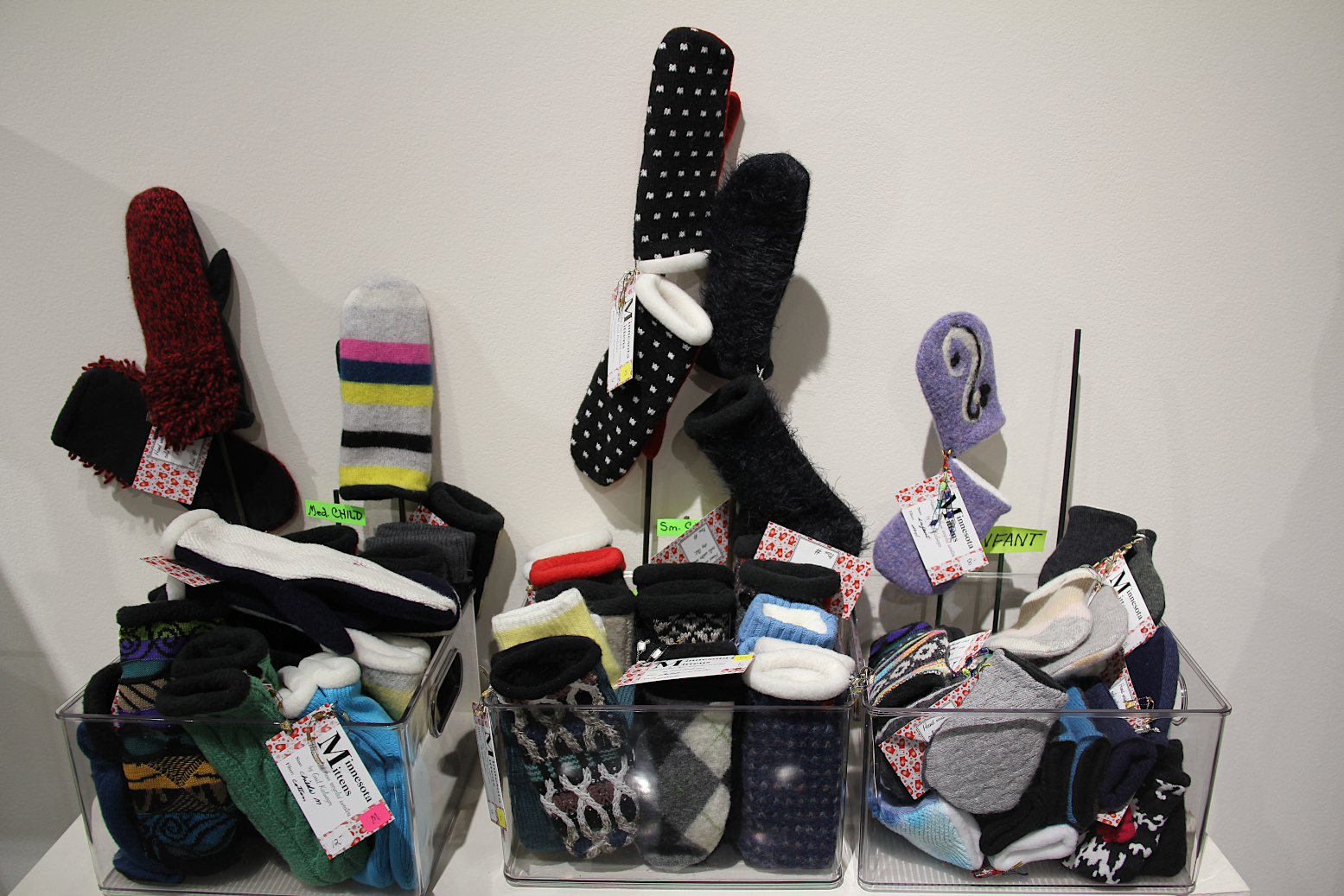
Gail Kielmeyer’s handcrafted Minnesota Made mittens. (Minnesota Prairie Roots copyrighted photo December 2025)
FYI: The Holly Days Sale continues at the Paradise from noon-5 pm Wednesday-Friday, from 10 am-2 pm Saturdays and extended hours from 10 am-5 pm December 20.
The Paradise is hosting the monthly Faribault City Council Chat at 6 pm Wednesday, December 10, as part of the city’s community engagement efforts.
The Paradise Community Theatre is currently performing “The Sound of Music” at the Paradise. Remaining performances are set for 7:30 pm December 11 and 12 and 2 pm December 13 and 14.Tickets are selling quickly, so reserve yours now.


















 Minnesota Prairie Roots
A Christmas message from southern Minnesota December 24, 2025
Tags: America, birth of Jesus, Christmas, Christmas message, commentary, history, holiday, immigrants, Jesus, King Herod, Minnesota, opinion, refugees, United States
THERE’S MUCH TO PONDER this Christmas as we find our nation in turmoil. Anger simmers and boils. Discord rises. Oppression continues. Peace in our country, let alone throughout the world, feels more elusive than ever. These are difficult days.
Likewise, the newborn Jesus and his parents faced similar challenges some 2,000 years ago. They were refugees who fled their Judean homeland for Egypt under the threat of an oppressive and violent leader. King Herod ordered all baby boys in Bethlehem to be killed after learning that a “King of the Jews” was born there. He feared being replaced. When I consider a leader so cold, calculating and cruel that he would mandate the killing of any boy age two and under to retain power, well, it seems unconscionable. But it was reality. And, had I been Mary, I also would have done everything possible to save my son.
Consider that in the context of today. Here. In America. Threats to our immigrants may not be as severe as death, although some have died in ICE custody. But detention and deportation, or the threat thereof, are very real. This is happening all over the U.S., including right here in my southern Minnesota community.
For example, locally-based HealthFinders Collaborative, a community health center serving the underserved and uninsured in my area, has issued a statement that their patients, staff, volunteers and others do not feel safe due to visibly present federal agents in our communities. People are canceling appointments. People are afraid. In response to the very real fear people are feeling, HealthFinders is expanding virtual visits and is locking clinic doors. I expect those living in biblical times felt similar angst under the authoritarian rule of King Herod. No wonder Mary and Joseph fled with Jesus to Egypt.
This Christmas I can’t pretend everything is OK while hatred, disparaging rhetoric and injustices run rampant in this country. As a woman of faith, I look at Jesus and see how he lovingly embraced people. He showed love, care, compassion, kindness. To all. He would not be alright with certain groups of people being hated on. He would not be OK with people targeted, hunted, gathered, detained, sent away. Poof. Gone.
If there’s any message to take away from Christmas this year, it’s that we need to stand up for our neighbors. Ask ourselves the once-trendy question, “What Would Jesus Do?” We need to voice our concerns. Resist. Help. Encourage. Follow Jesus’ lead of serving, loving and supporting those who need us most right now. And that’s not the King Herods who choose power over humanity.
In closing, I hold hope that we, as individuals and a nation, will stand strong against that which oppresses us, that which is inhumane and that which is just plain wrong. We all, whether people of faith or not, inherently understand the difference between right and wrong, good and evil. Let us live as people who care about goodness, kindness, compassion, love and peace.
© Copyright 2025 Audrey Kletscher Helbling