Minnesota Prairie Roots

Writing and photography by Audrey Kletscher Helbling

Country churches & more in fall issue of Minnesota Moments September 1, 2010

Filed under: Uncategorized — Audrey Kletscher Helbling @ 7:51 AM
Tags: , , , , , ,


THE FALL ISSUE of Minnesota Moments magazine has just published and I’m especially pleased with this issue.

Inside you’ll find an eight-page photo essay I’ve done on old country churches. Within the past year, I’ve been photographing rural churches in southeastern Minnesota, drawn by their history and beauty and by the peace I feel in their often bucolic settings.

Simply put, I can’t get enough of old country churches. Sometimes I’ve even been tempted to break a lock to get inside a sanctuary. But I haven’t and I won’t. That would be a sin, and against the law.

The September/October edition also includes a trio of stories from Austin, Minnesota, where I traveled in March. Downtown I discovered a kitschy little barbecue joint, Piggy Blue’s Bar-B-Que that’s a must-eat-at spot. To see the other sites I visited, you’ll need to read the magazine.

I have additional stories in this issue, plus my regular reviews of three Minnesota-authored books. As always, designer Amy Stirnkorb has worked her magic by transforming my submitted stories and photos into eye-pleasing page lay-outs.

Also, check out my Minnesota Prairie Roots promo on page 55 of the magazine. I designed it and I’m pretty proud of my work. I don’t claim to be a graphic designer. However, I had an idea, went with it and I think the promo truly projects my down-to-earth nature and style. See what you think and give me your feedback.

Of course, I’m not the only writer/photographer for Minnesota Moments. You’ll find an interesting feature about three friends who make wine, a nostalgic garage story, some entertaining essays, squash-growing tips and recipes and lots more.

Be sure to check out the ads too. Without advertising support, the magazine couldn’t exist.

Minnesota Moments should arrive in mailboxes and land on newsstands any day now, so watch for it, or look for it if you’ve never seen the publication.

© Copyright 2010 Audrey Kletscher Helbling


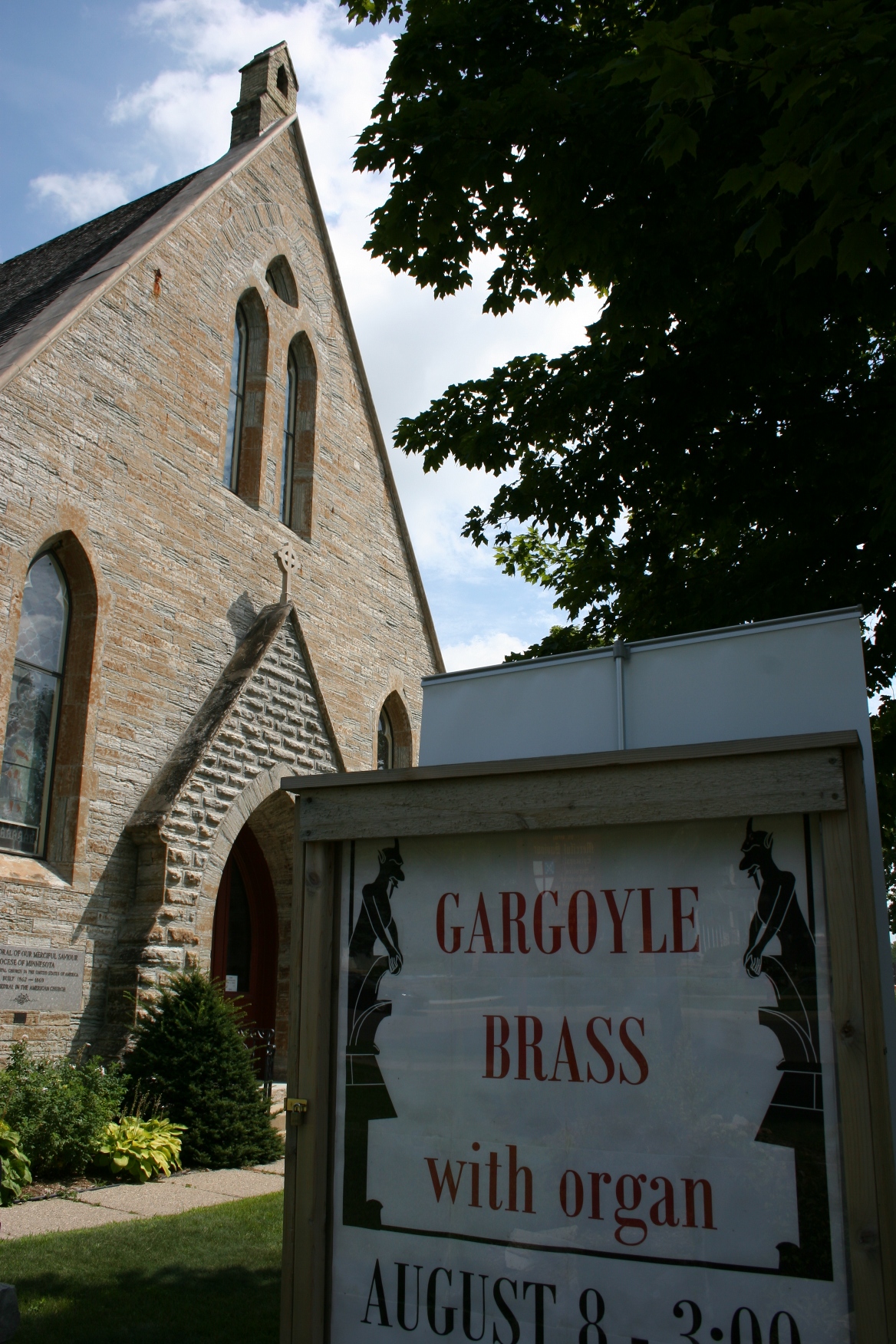
Gargoyles perform at The Cathedral of Our Merciful Saviour August 9, 2010

THE CHURCH DOOR bangs, the weight of the solid wood slamming against the frame as if decisively shutting out the hot, humid air that oppresses on this sultry Sunday afternoon in August in Minnesota.

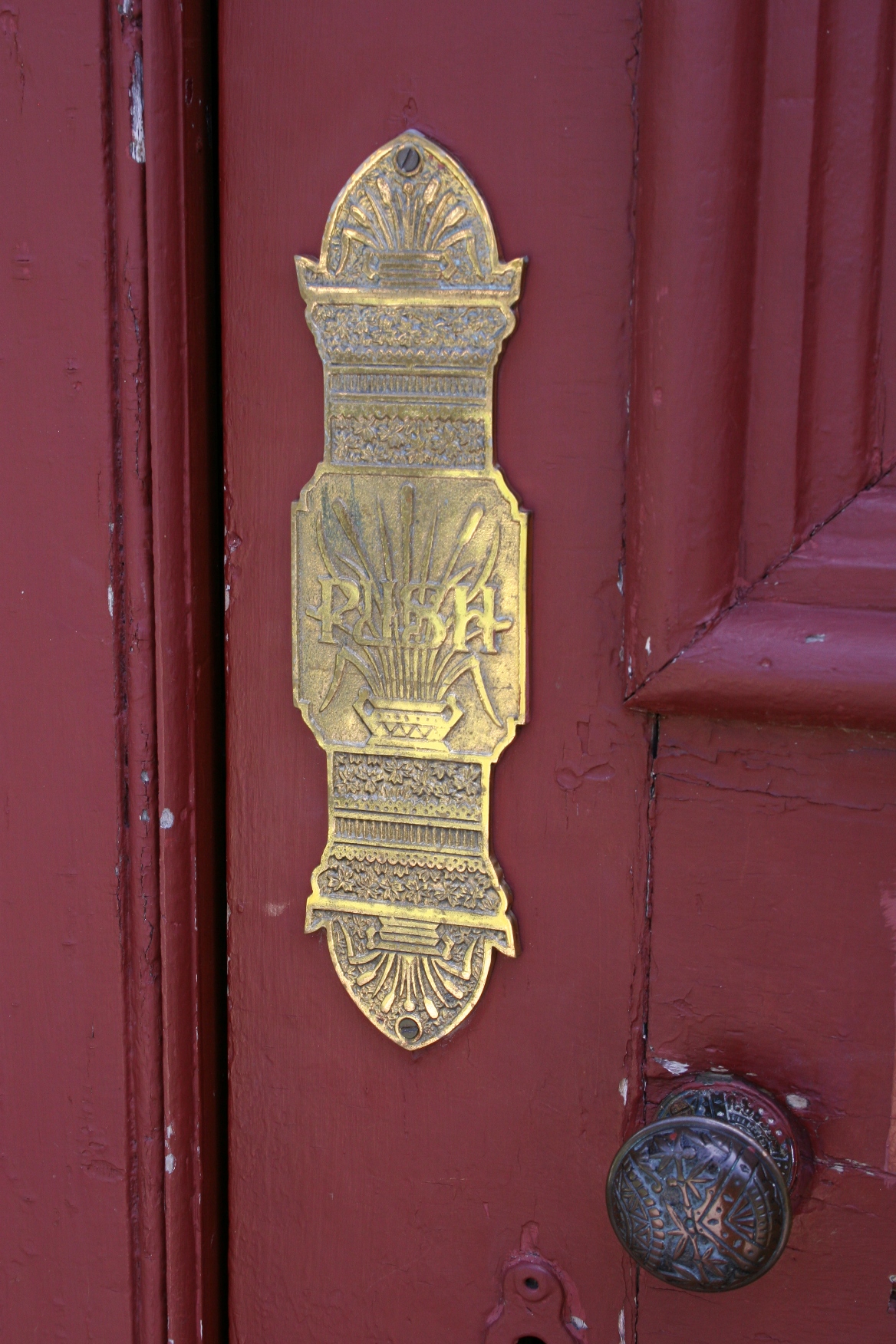
We entered The Cathedral of Our Merciful Saviour through this heavy side door, which you need to push rather than pull, we learned after waiting outside, thinking we were locked out of the church.

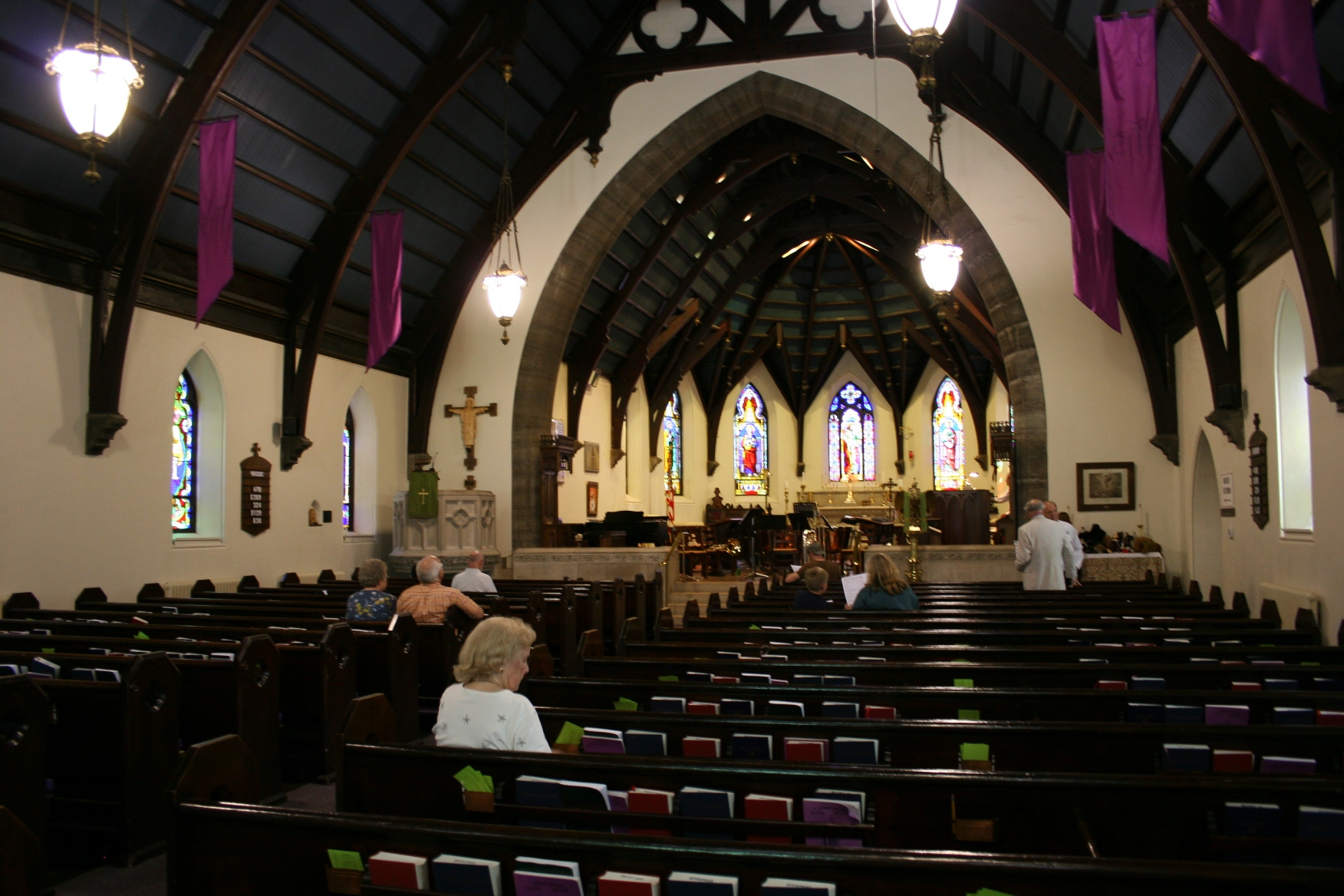
Inside the sanctuary, I seek respite from the suffocating 90-plus degree heat. I settle onto a purple cushion which softens the hardness of wood against flesh in a pew that forces me to sit ramrod straight.

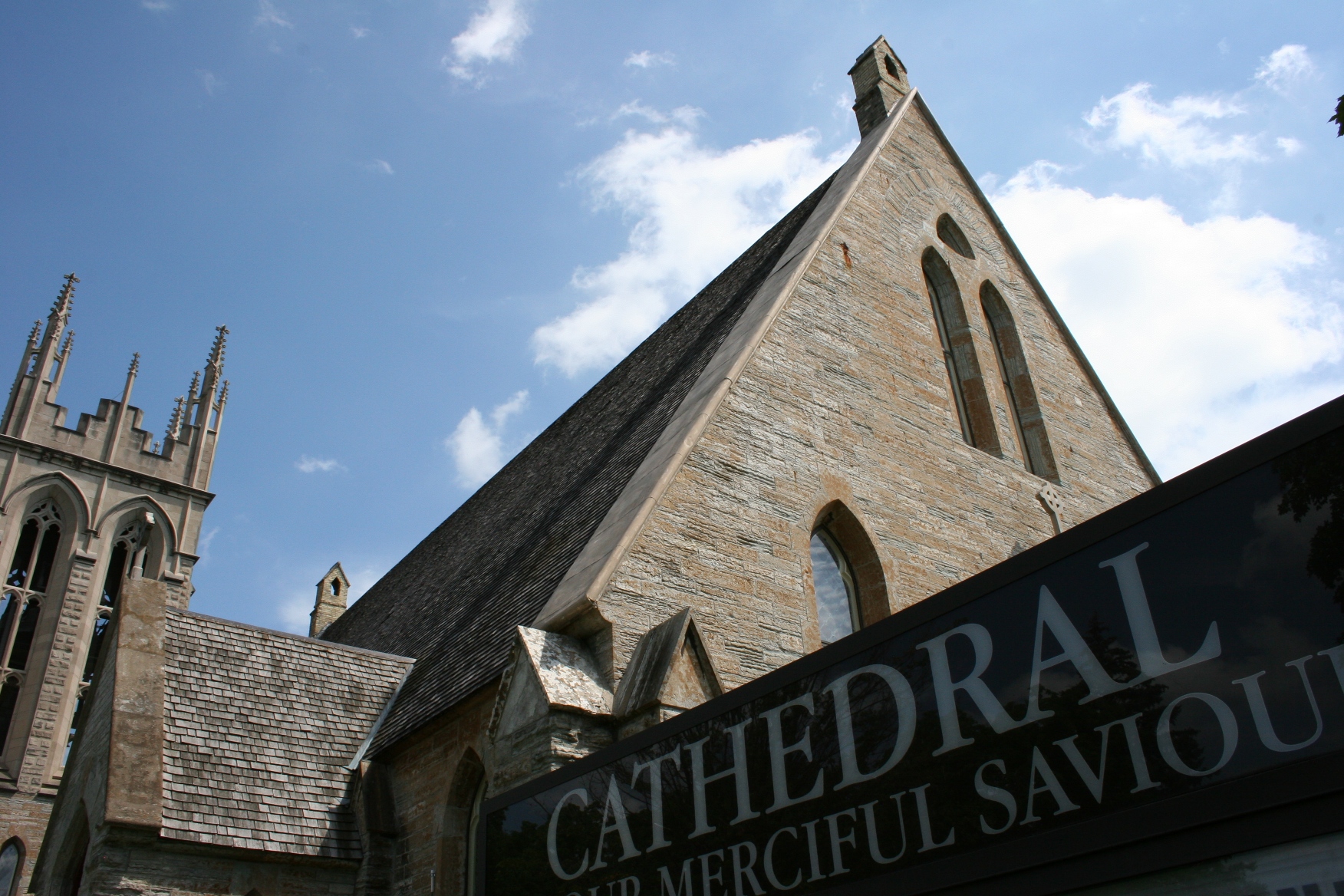
My husband and I, expecting a packed house, have arrived early for a performance by The Chicago Gargoyle Brass at The Cathedral of Our Merciful Saviour in Faribault. This massive structure with its looming tower was constructed from 1862 – 1869 as the first Cathedral of the American Church.

The Chicago Gargoyle Brass presented a Sunday afternoon concert at The Cathedral of Our Merciful Saviour in Faribault.

The Cathedral of Our Merciful Saviour sits along Second Avenue across from Faribault's Central Park.

Inside, I welcome the coolness, visually defined by stone and by the dark wood that shapes the arches of the ceiling.

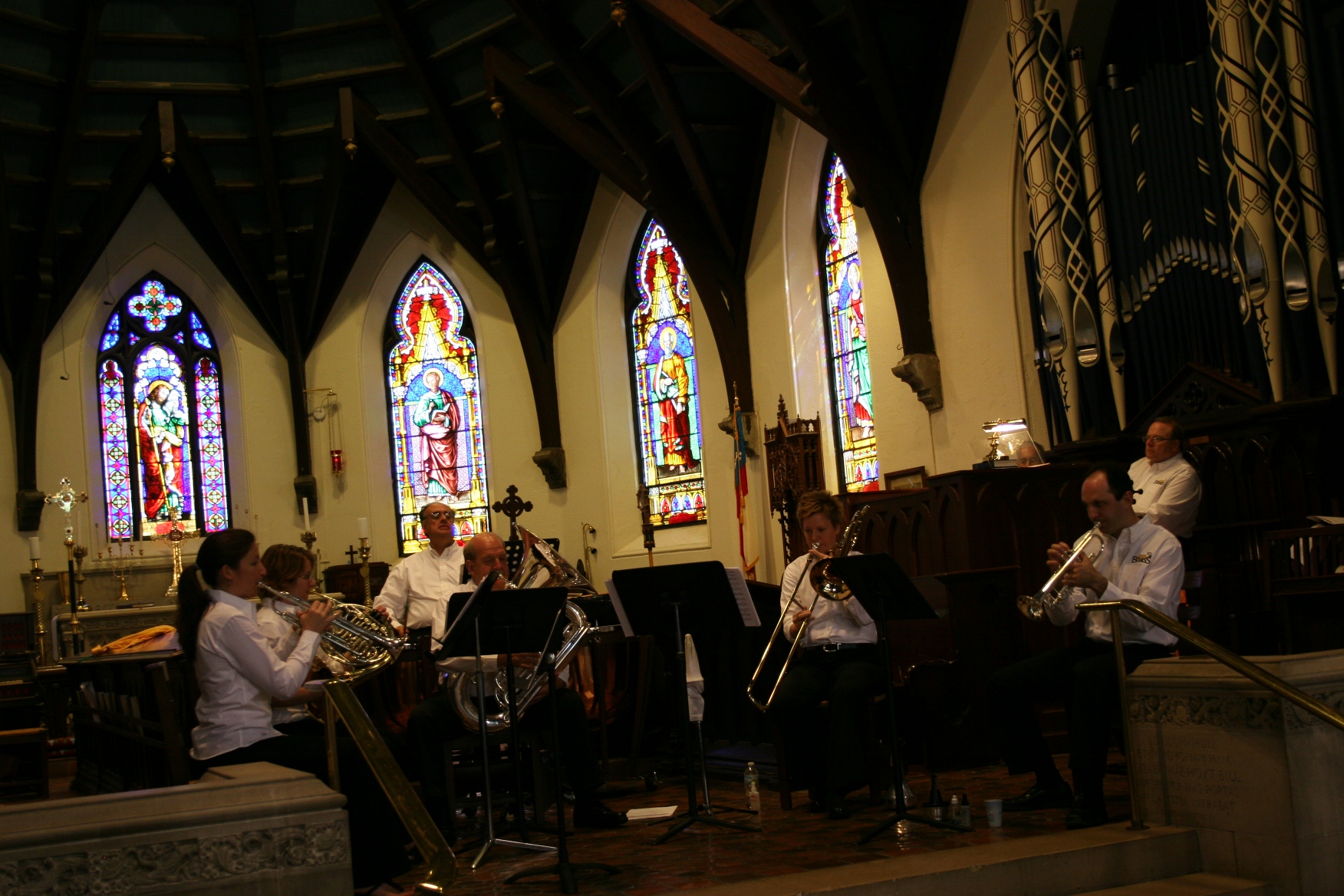
In the chancel area, which stretches an interminable distance from the pews and which is bigger than some country churches I’ve seen, Gargoyle Brass members have positioned their gleaming instruments and music stands at the forefront. Six stained glass windows embrace this “stage” with the glorious 1871 pipe organ (with more old pipes than any other in Minnesota), to the right.

Concert attendees filter into this historic cathedral made of dark wood and stone.

Truly, I am in awe of this cathedral. “This place smells old,” I whisper to Randy as I run my hand along the back of a pew. “Are these the original pews?” They are, I learn upon reading a brochure I’ve picked up. A Civil War veteran cut and planed the wood from northern Minnesota white pine.

I can’t seem to take my eyes off the brass eagle that serves as a lectern given in honor of Bishop Henry Whipple’s wife, Cornelia, who died in July 1890. Bishop Whipple settled in Faribault, oversaw construction of the cathedral and Episcopalian schools and was known for his efforts in helping and befriending Native Americans.

While I wait for the concert to begin, I contemplate the beauty and history of this place and the effort it must have taken to build this stone cathedral.

Soon the concert, part of The Vintage Band Festival hosted in nearby Northfield, begins and we are swept away by the sounds of trumpets, horn, trombone, tuba and timpani (kettledrums) melded with the organ.

The Chicago Gargoyle Brass performs at the Cathedral of Our Merciful Saviour.

I am surprised mostly that the organ does not overpower this cathedral. Often, the music sounds more sedated and muffled than majestic, as I had expected. That has nothing to do with the quality of the organists—for they are superb—but more, I think, to do with the organ placement.

At one point during the concert, a key spring on the organ breaks and a second organist must hold up the key during a performance. “Does someone have some bubblegum?” one of the musicians asks the audience. I’m not sure whether he’s serious or joking, but the concert continues without the gum.

Admittedly, I am no music expert. I can’t read notes. I barely know one instrument from another. So my enjoyment of music is purely, solely authentic, grassroots basic. When my head bobs spontaneously, when I feel the music reverberating, tingling my feet, when I feel an emotional connection, then I know I am hearing good music.

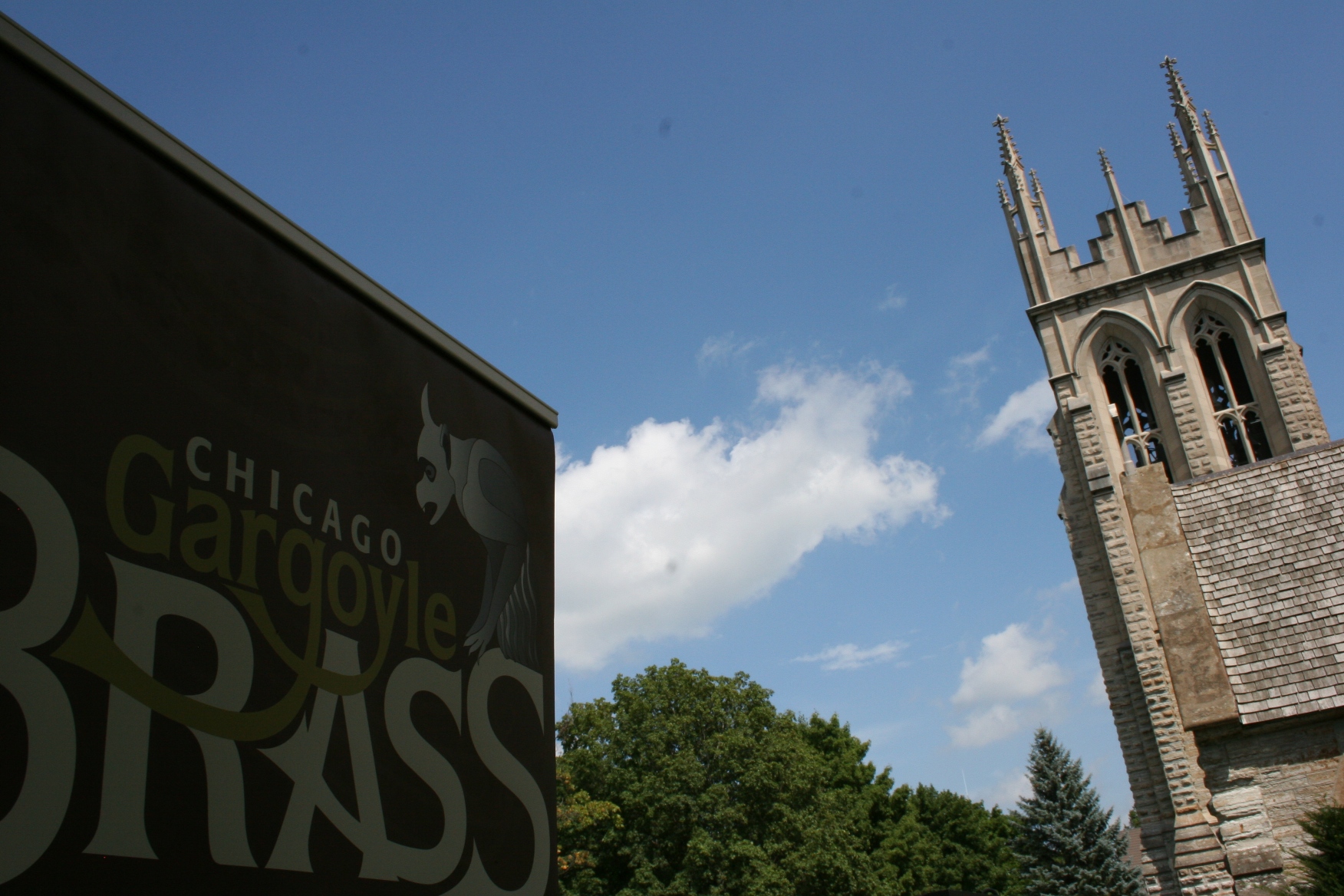
Sunday afternoon I heard good, even great, music from The Chicago Gargoyle Brass, which began in 1992 as a University of Chicago based group. The name was derived from the university’s architecture.

“I love this church,” horn player Arisia Gilmore tells us before performing “Twas a Dark and Stormy Night” with Michael Surratt at the organ. “It’s fitting for the atmosphere we’re trying to portray here.”

As I listen to the music build, like a storm, Randy leans toward me. “Does this remind you of two weeks ago?” he speaks softly into my ear. I nod. He is, like me, recalling the night of July 23 when we were caught in our car on a rural southwestern Minnesota road in the middle of a raging thunderstorm that packed 70 mph winds.

That’s the purpose of music, I think—to stir passions, emotions and, yes, even memories of dark and stormy nights when gargoyles lurk.

A looming tower marks the cathedral located along Second Avenue across from Faribault's Central Park.

© Copyright 2010 Audrey Kletscher Helbling

 

The surprising connection between a Minnesota church and the James-Younger Gang July 21, 2010

Filed under: Uncategorized — Audrey Kletscher Helbling @ 10:30 AM
Tags: , , , , ,

WHEN MY HUSBAND AND I EMBARKED on a quest for an old country church Sunday afternoon, we fully expected a challenge. But we didn’t expect to cross paths with a bunch of outlaws.

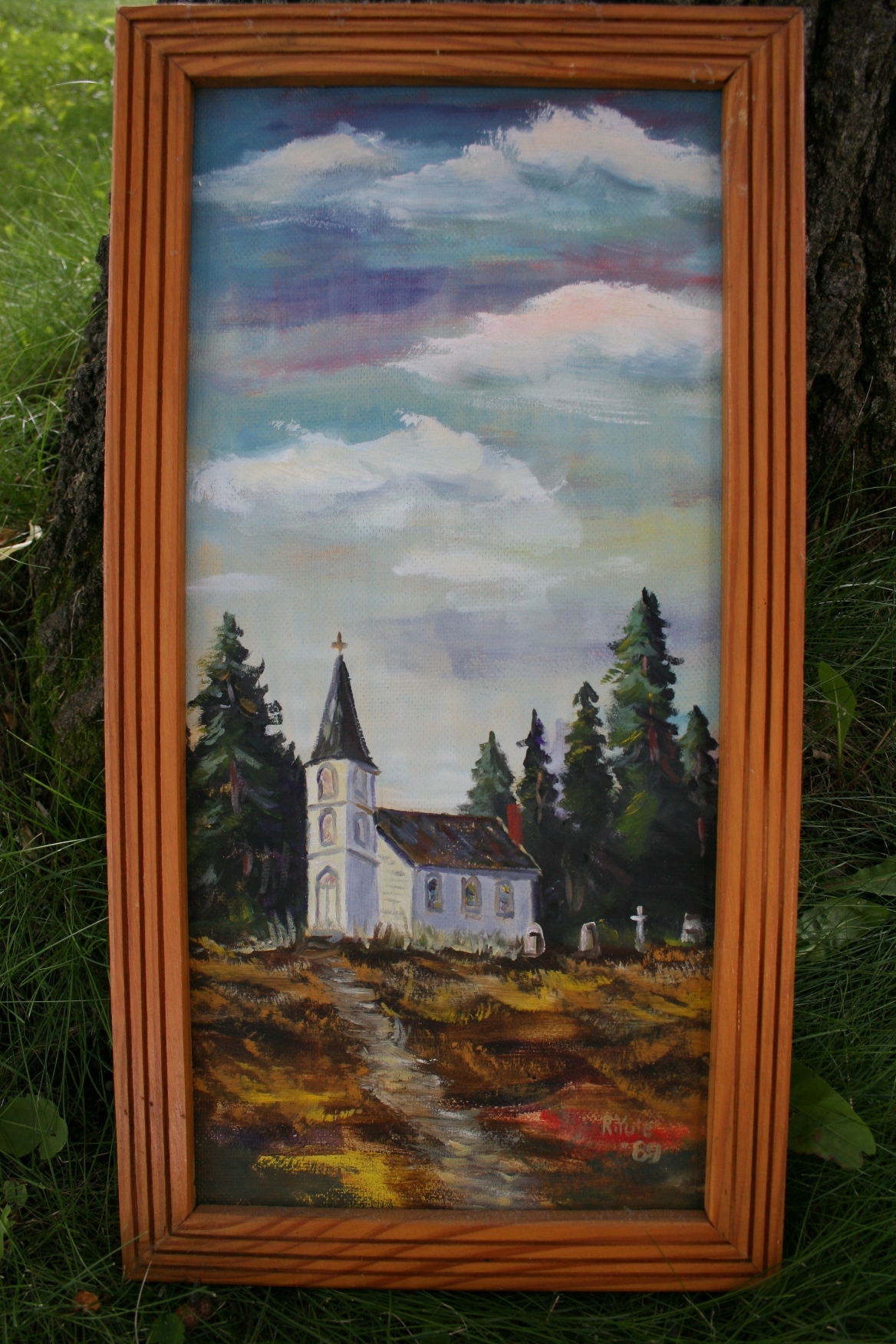
First, a little background: Several days earlier I had photographed a painting of an old Minnesota church done by our 92-year-old artist-friend, Rhody Yule, in 1969. Rhody remembered only that the church was “somewhere near Montgomery” and on the National Register of Historic Places.

I carried a photograph of this 1969 church painting by Faribault artist Rhody Yule as we set out to find the unidentified church.

With those clues, Randy and I set out on our adventure simply because we love the history and beauty of old country churches. We figured if we drove far enough and long enough, we would find this one.

So off we went, following Rice County Road 9 northwest of Faribault, driving around sweeping curves, up and down hills, past farm places, all the while searching for a steeple. I had no clue where we were, which I find unsettling. I like to know where I am and where I am going. But not the husband; he just kept driving.

Soon we approached a lake. Must be Circle Lake, we speculated. We were right. And then, just as we were about to turn onto a gravel road leading to the public access, I saw a white church high on a hill. “There’s a church!” I shouted. “I bet that’s it.”

Right then and there, I wanted to drive up to that church. But first things first. We had to stop at the lake. A quick stop and we were off to the church, which sits two miles west of Millersburg (not Montgomery) along Rice County Road 1 near its intersection with County Road 9.

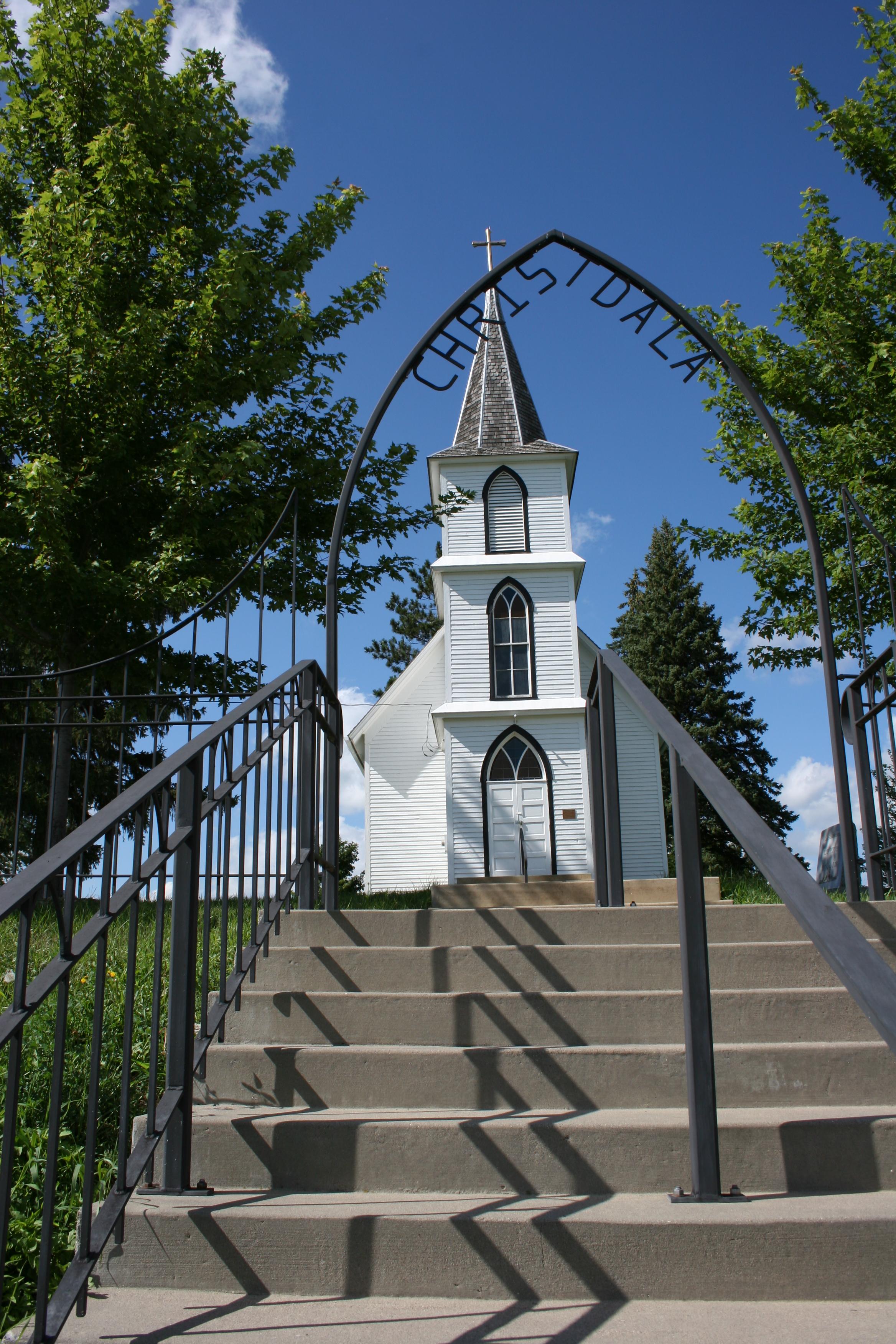
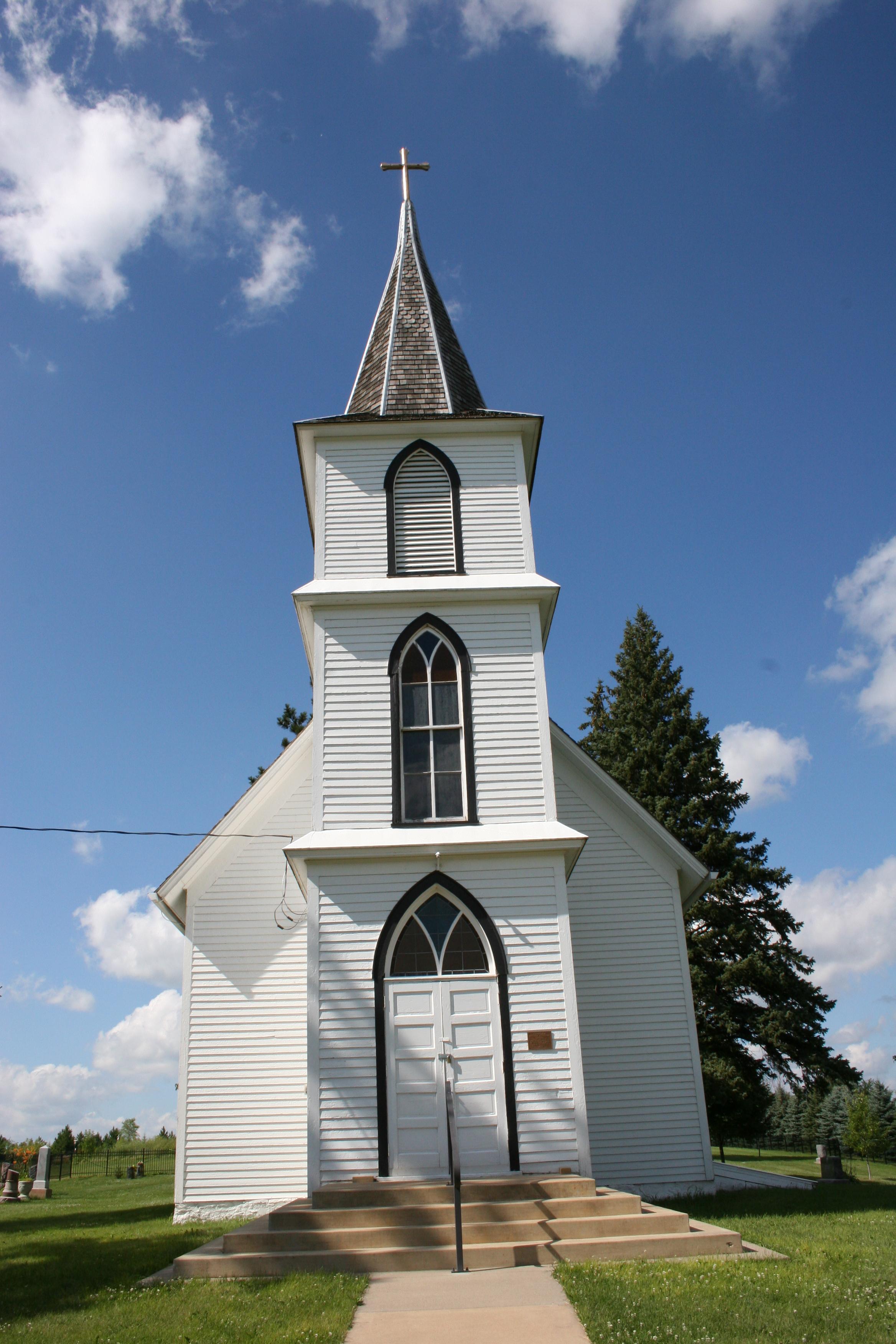
Our excitement was palpable as we pulled off the road and parked below the church. I grabbed the picture and compared the painting to the building before me. It was a match. We had found Christdala Swedish Lutheran Church, built in 1878, placed on the National Register of Historic Places in 1995 and today preserved through the Christdala Church Presevation & Cemetery Association.

Christdala Swedish Lutheran Church sits atop a hill along Rice County Road 1 just west of Millersburg.

Some 25 steps later and we reached the top of the hill, standing before this simple country church overlooking Circle Lake.

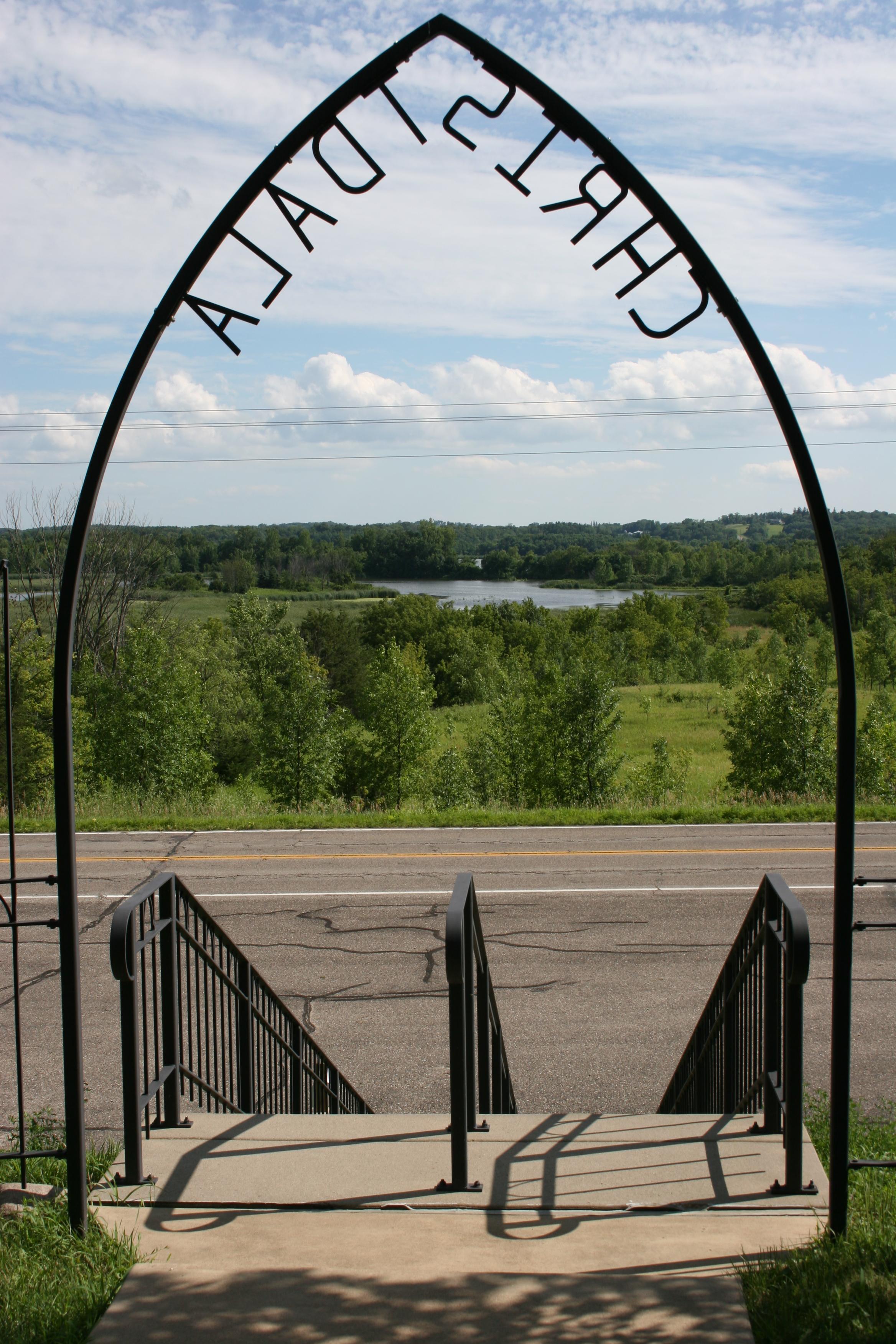
An archway at the top of the church steps frames Circle Lake and the surrounding countryside. Christdala means "Christ's Valley."

Christdala Swedish Lutheran Church, built for $230 in 1878 by John Olson and John Lundberg of Northfield and site of a fall service and open house.

And that’s where we met Phil, who was photographing Christdala and old tombstones. “Can we get inside?” I ask, hopeful that perhaps this stranger has a key. “Are you from around here?”

No and no. Phil is from California, but is president of Le Center-based ShetkaStone, a company that makes tables, countertops, moldings, office furniture and more from recycled paper. When he’s in Minnesota (which is often), this Californian explores old country churches and cemeteries in the home-away-from-home state he has grown to love.  You don’t find this kind of history in California, he says.

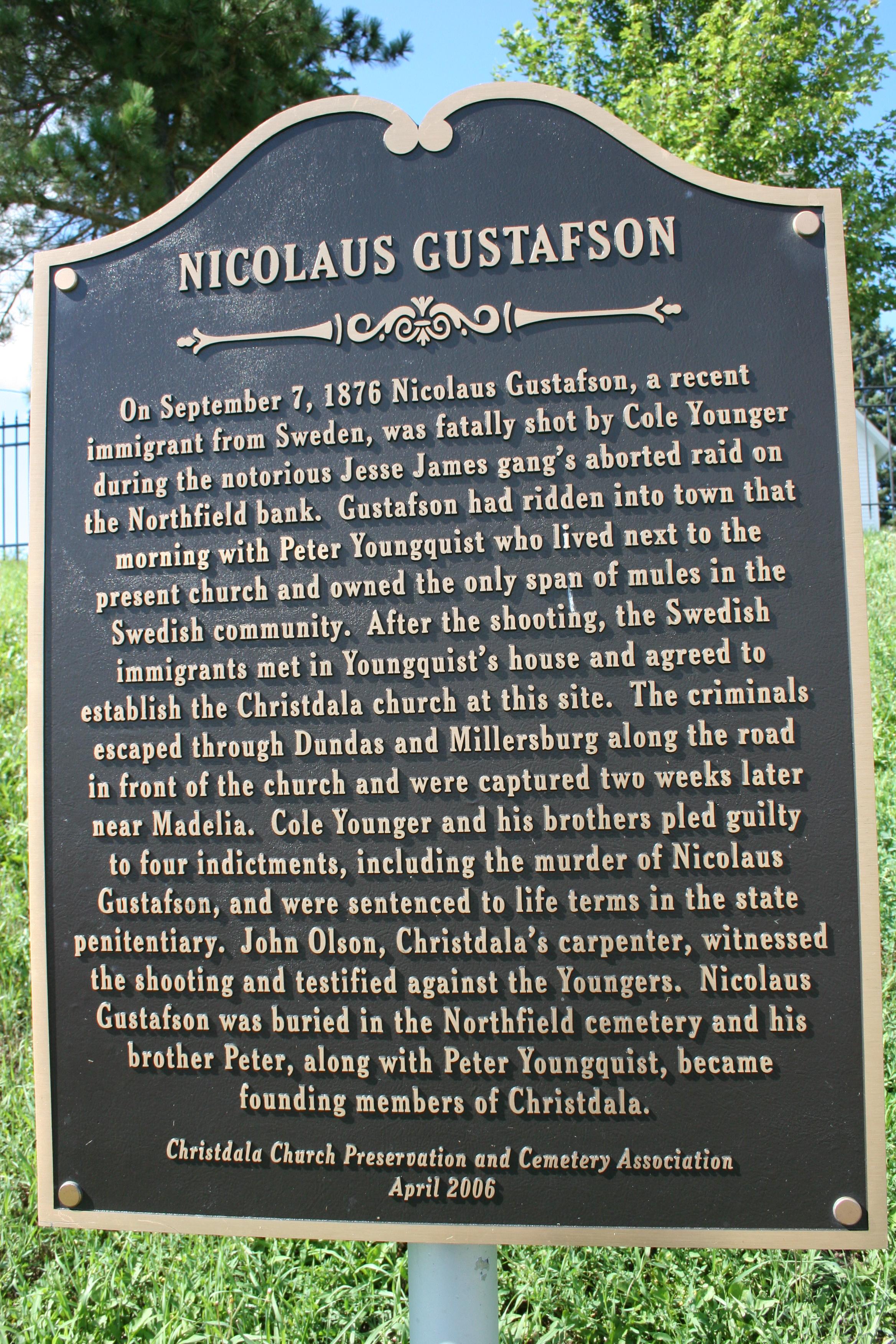
We are kindred spirits—the three of us—standing here on a sunny summer Sunday afternoon admiring this 132-year-old church with an intriguing connection to the Sept. 7, 1876 robbery of the First National Bank of Northfield by the notorious James-Younger Gang.

Swedish immigrants built Christdala after one of their own, Nicolaus Gustafson, who had traveled to Northfield on the morning of the bank robbery, was fatally shot by Cole Younger. Because the Millersburg Swedish community had no church or cemetery, Gustafson was buried in Northfield. After his death, the Swedes immediately began formulating plans for their own church and burial place, forming a congregation in July 1877 and constructing a house of worship in 1878.

Today Christdala, which dissolved as a congregation in 1966 due to declining membership, stands as a strong testament to those determined Swedes. They turned the tragic death of their friend, their neighbor, into something positive. Good triumphs over evil. Perhaps it is no coincidence that this church was built beside, and above, the road used as an escape route by the notorious outlaws.

All of this I consider while walking among the tombstones—of the Youngquists, the Swansons, the Paulsons and, yes, even the Gustafsons.

A sign at the church details the historical connection to the 1876 Northfield bank raid by the James-Younger Gang.

A cemetery surrounds Christdala Swedish Lutheran Church near Millersburg.

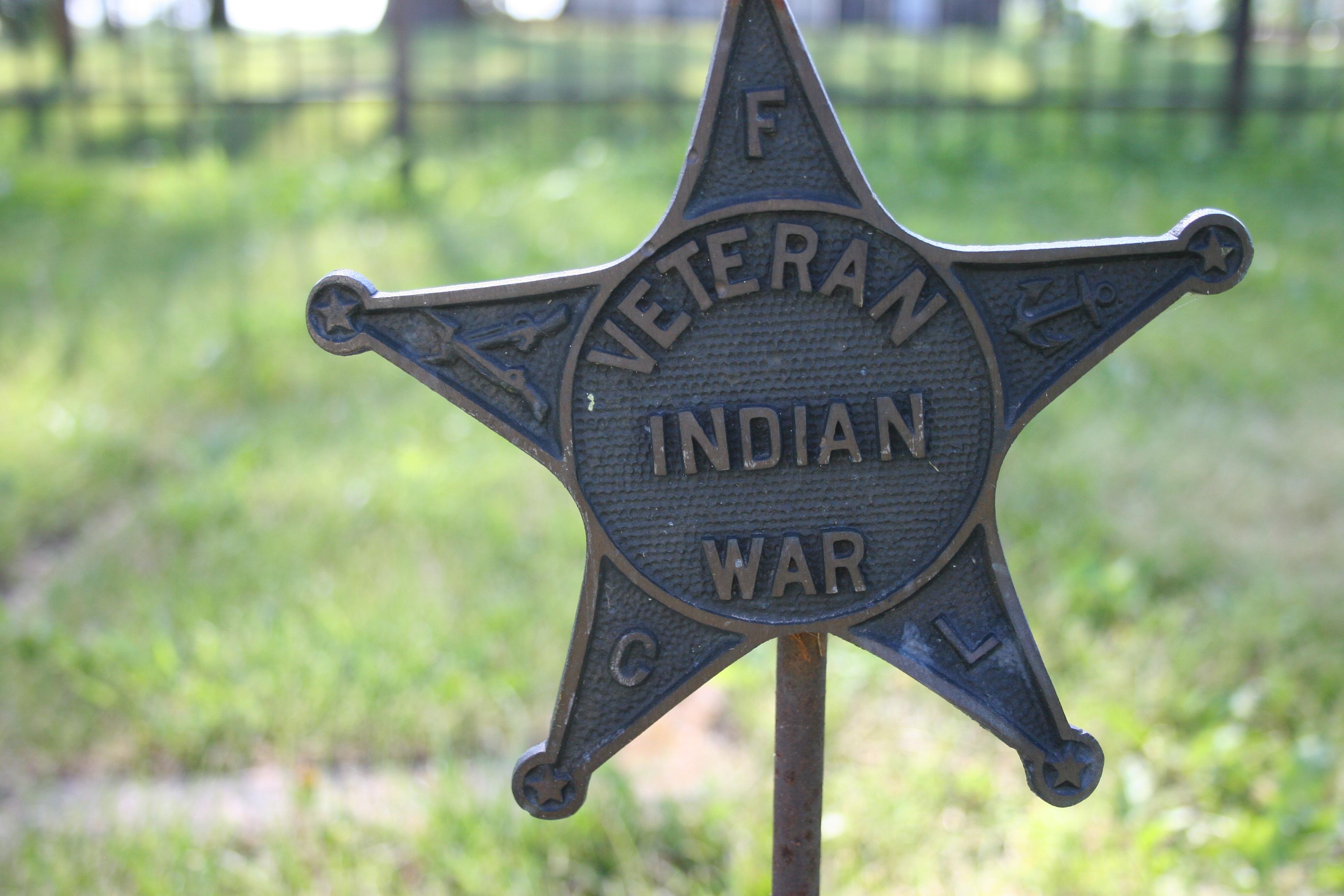
An honorary star in the Christdala cemetery denotes a soldier as a veteran of the Indian War.

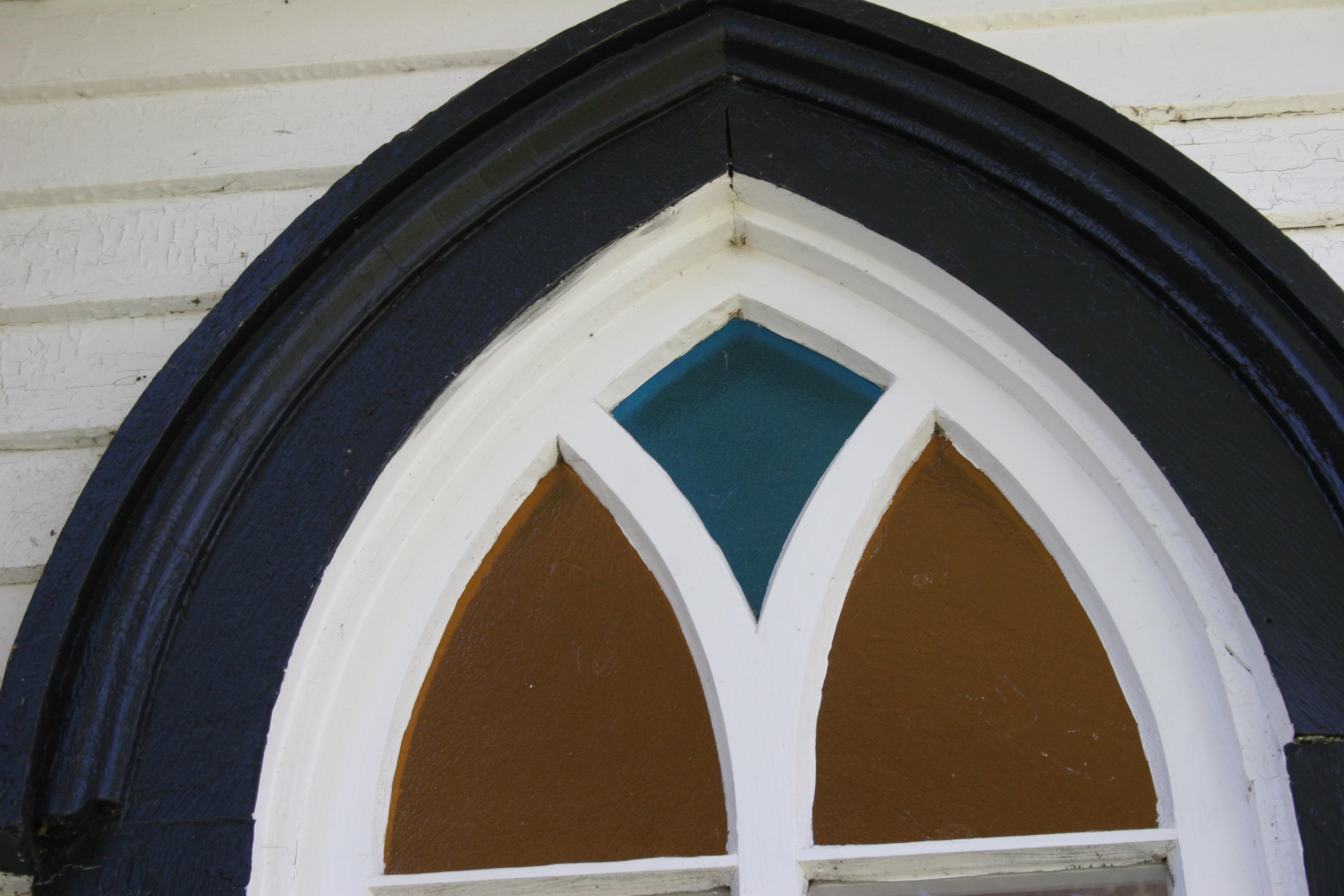
The exterior stained glass top of a Christdala window.

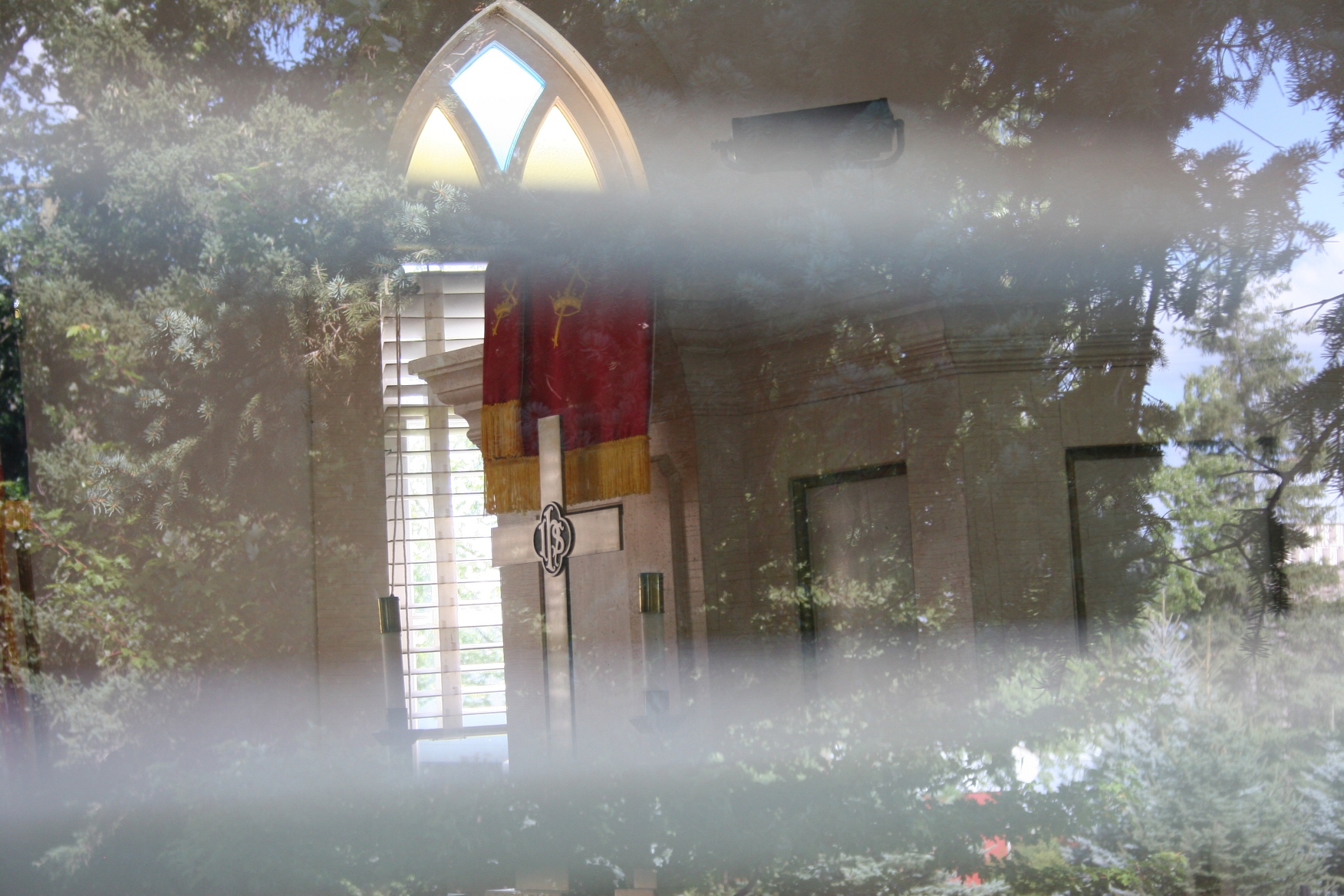
Because the church was locked, I had to settle for peering through the blinds at the altar, which sits in front of the pulpit. The cross rests on the altar. I'll have to return for the annual autumn worship service and open house.

© Copyright 2010 Audrey Kletscher Helbling
 

A family of the faithful at Moland Lutheran Church July 11, 2010

Filed under: Uncategorized — Audrey Kletscher Helbling @ 12:12 PM
Tags: , , , ,

Moland Lutheran Church, rural Kenyon, Steele County, Minnesota.

IF YOU LOOK BEYOND the pews, the altar, and the stained glass windows, if you listen beyond the music and the sermon and the scripture readings, you will find, within a church, a family.

Here’s what I mean. Recently while photographing an old country church in southeastern Minnesota, I began to notice the personal touches that made me feel welcome, like I had stepped inside someone’s home.

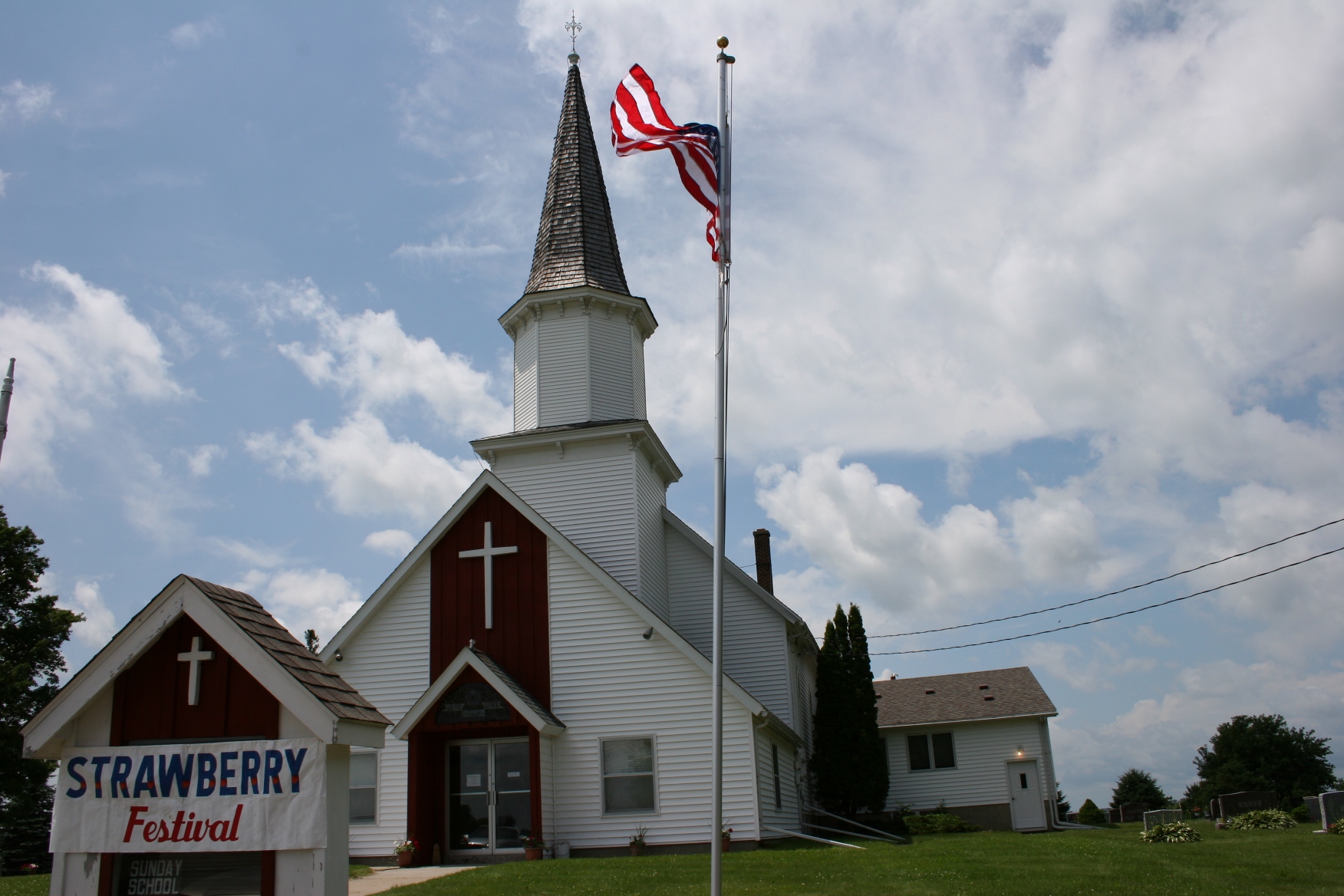
Yes, women greeted me at Moland Lutheran Church during the congregation’s annual Strawberry Festival. But no one showed me around. I simply meandered on my own, with my camera, absorbing my surroundings. And that’s what I prefer.

Perhaps because I’m a writer and a photographer, I take note of my environment more than an ordinary person. I am drawn to that which others might simply pass by.

But rather than try to explain all of this to you, I’ll show you the discoveries I made inside and outside this 1884 Norwegian Lutheran church, the discoveries that led me to a family of the faithful.

I photographed a section of a long photo showing Moland church members gathered for the congregation's 50th anniversary celebration in 1930. The image hangs just outside the nave.

The Henry Underdahl family gifted a memorial stained glass window to the Moland Lutheran Church. Such memorials are a common way to honor family members and their legacy of faith.

I discovered this service roll in the narthex listing congregational members called to serve their country. I found this especially touching. Perhaps congregations should revive this public way of honoring those in the military.

Even after family members have departed this life, their memories are as close as the graves that surround Moland Lutheran. I imagine that many of the early members who filled the pews here also worked the land.

FOR MORE INFORMATION and photos of Moland Lutheran Church, please check my previous posts, “They serve the best food in Minnesota church basements” (posted July 1) and “In praise of preserving country churches” (posted July 7).

© Copyright 2010 Audrey Kletscher Helbling
 

In praise of preserving country churches July 7, 2010

Filed under: Uncategorized — Audrey Kletscher Helbling @ 7:16 AM
Tags: , , , , ,

Moland Lutheran Church, a Norwegian Lutheran church south of Kenyon.

ONLY IN RECENT YEARS have I begun to truly appreciate the old churches that dot the Minnesota landscape, their steeples rising heavenward directing the faithful to worship.

Whenever the opportunity arises these days, I slip inside these reverent rural respites to reflect upon the holiness that resides therein. The more churches I visit, the more I am convinced of the necessity to preserve these houses of worship for future generations.

Not only do I treasure the sacred aspect of their existence—rooted deep in the faith of immigrants who settled this land—but I also value the art and the history woven into the very fabric of these buildings.

Whether in stenciled ceilings, hand-carved pulpits, worn floorboards, hand-hewn pews, religious paintings or stained glass windows, I see care, craftsmanship, devotion to God everywhere.

I am inspired and uplifted simply stepping inside the doors of a country church.

Join me on this tour of the 1884 Moland Lutheran Church south of Kenyon in rural Steele County and see for yourself why old country churches like this are worth appreciating, and preserving.

Looking into the sanctuary of Moland Lutheran Church.

Fine craftsmanship is reflected in the handcrafted pulpit, altar and railing.

Art in the details of the Moland pulpit.

The altar painting was transported to the church by horse-drawn wagon from Faribault in 1893. A. Pederson painted this image of "Christ with outstretched arms" based on Matthew 11: 28 - 30 ("Come to me, all you who are weary and burdened, and I will give you rest...").

Norwegian words (I think from Matthew 11) are painted on the altar.

Beautiful details on the bottom of Moland's altar remind me of the altar in the church I attended as a child, St. John's Lutheran in Vesta. Sadly that church was not preserved and is today an apartment building.

© Copyright 2010 Audrey Kletscher Helbling
(Check back for additional Moland Lutheran Church photos to be posted on Minnesota Prairie Roots.)


A WW II flag of honor reminds me of freedom’s price on Independence Day July 4, 2010

Filed under: Uncategorized — Audrey Kletscher Helbling @ 8:38 PM
Tags: , , , , ,

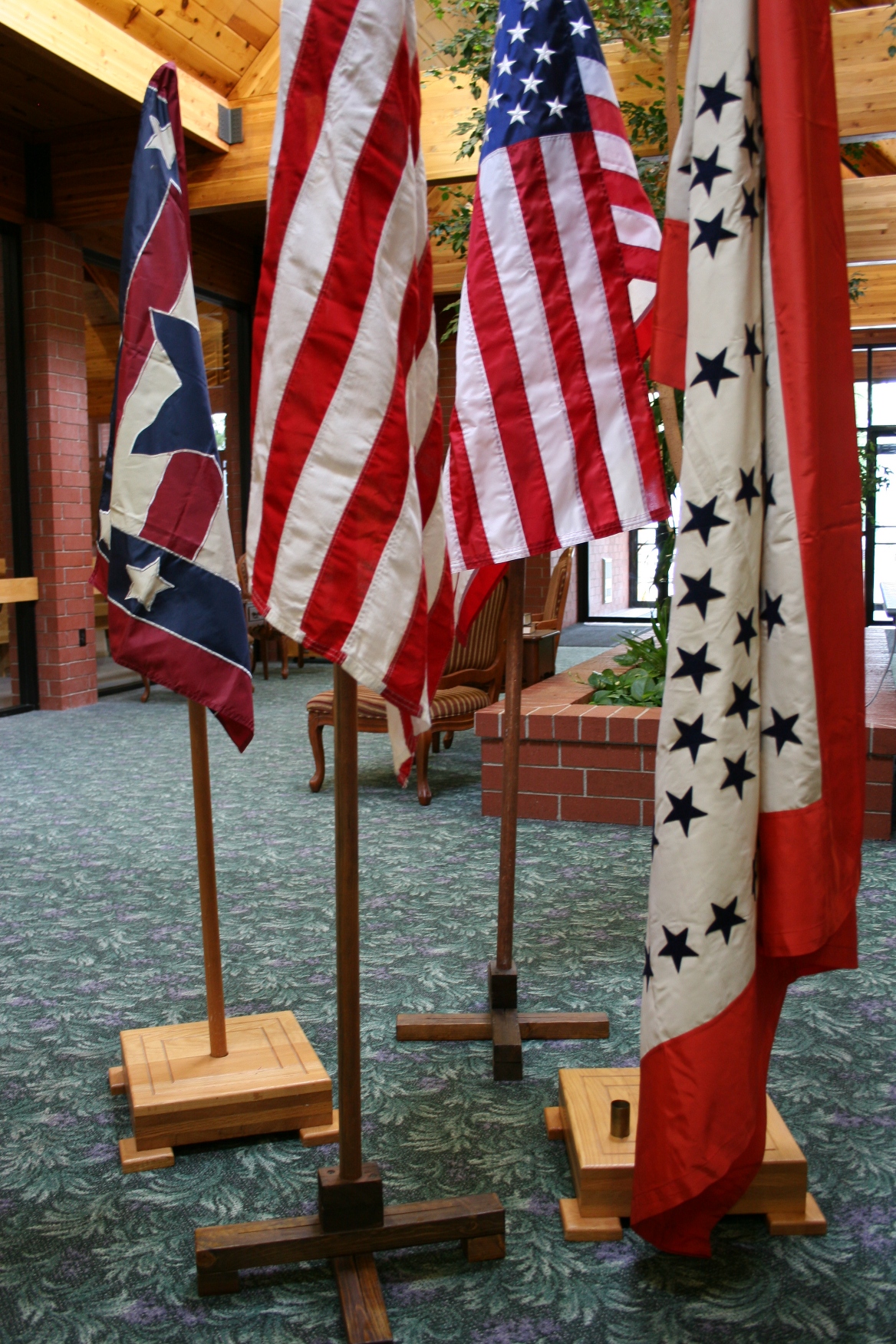
Four flags, including an American flag that flew in Iraq, stand in the narthex of Trinity Lutheran Church, Faribault, Minnesota.

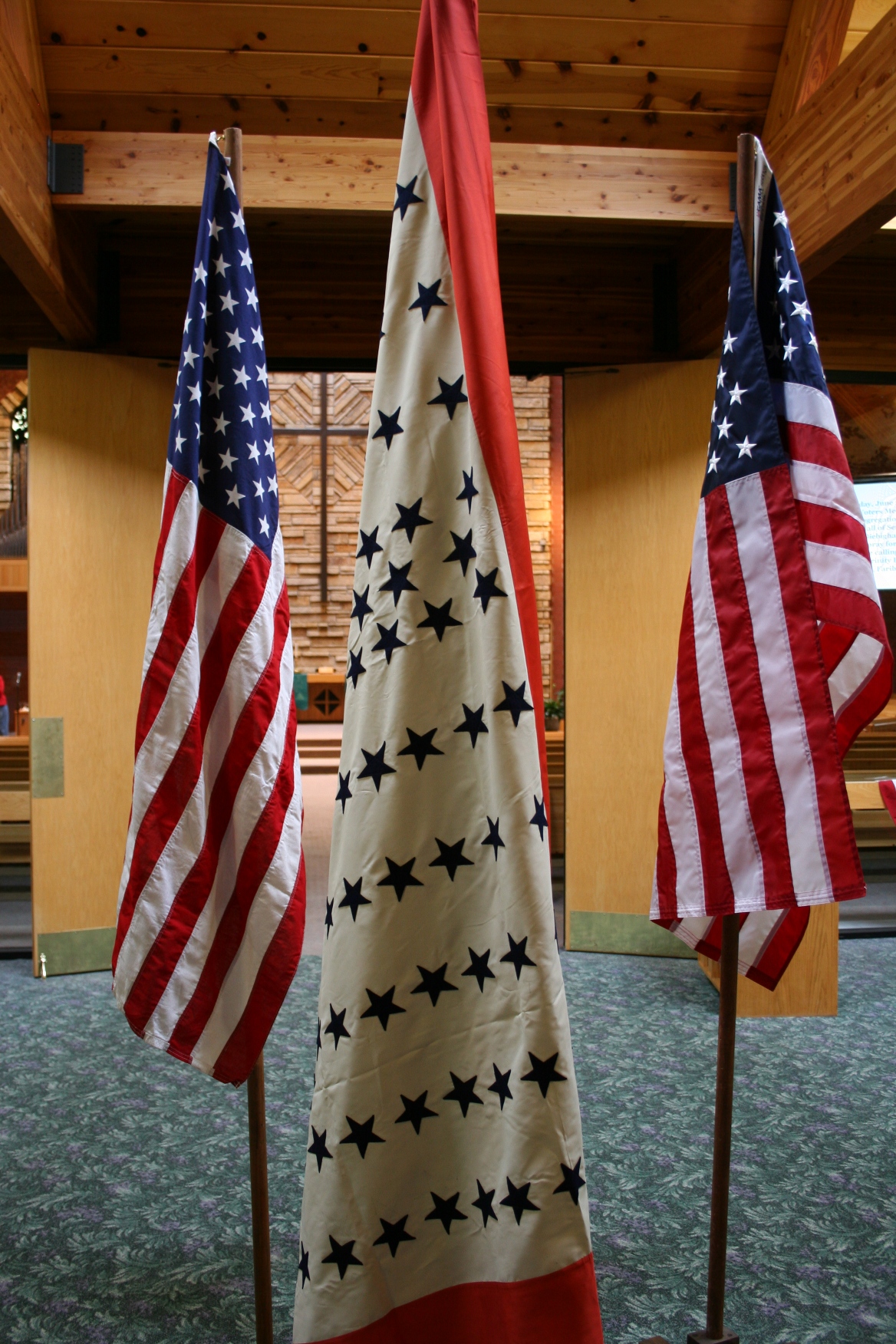
FOUR FLAGS STAND in a circle in the Trinity Lutheran Church narthex—two American flags, the other two unrecognizable to me.

So I inquire on this Sunday morning, this Fourth of July, this day we celebrate our nation’s birthday, this day of independence.

The one flag, with the big blue star in the center and the smaller white stars along the sides belongs to Kathy, who manages the church office. She knows nothing about its background, only that she purchased and proudly flies this red-white-and-blue at her home along with an American flag.

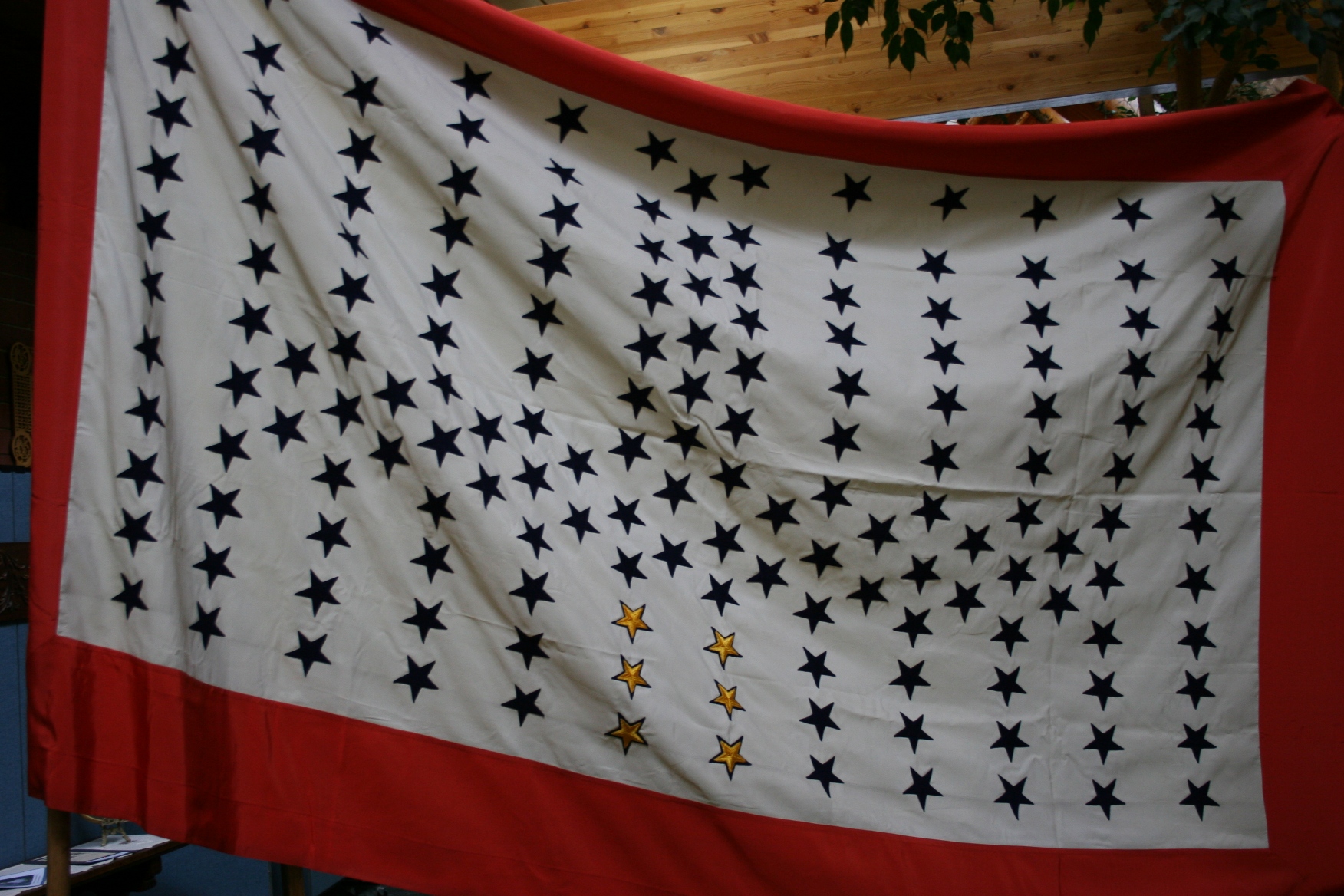
But the other flag, oh, the large star-studded flag, draws the attention of many. “What is this flag?” we ask each other as we unfold the fabric to reveal a sea of stars on white fabric bordered by red.

The women of Trinity Lutheran Church stitched this WW II honor flag.

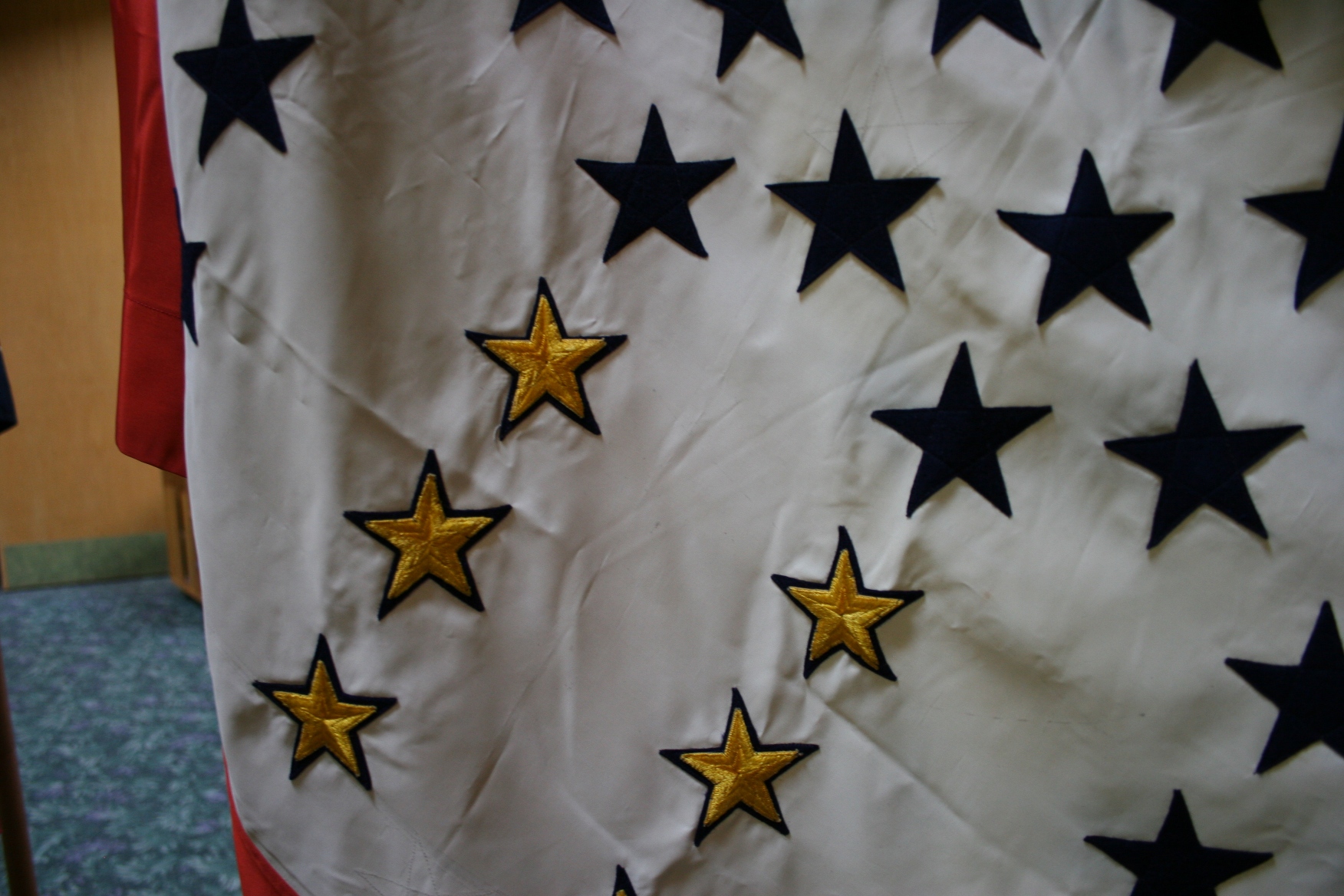
And no one knows, until Dave arrives and uncovers the mystery. It is, he says, a flag recognizing those congregational men and women who served our country during WW II. The blue stars denote all who served. The six gold stars hand-stitched atop six blue stars honor those who never came home.

Six gold stars represent the six Trinity members who gave the ultimate sacrifice, their lives, during WW II.

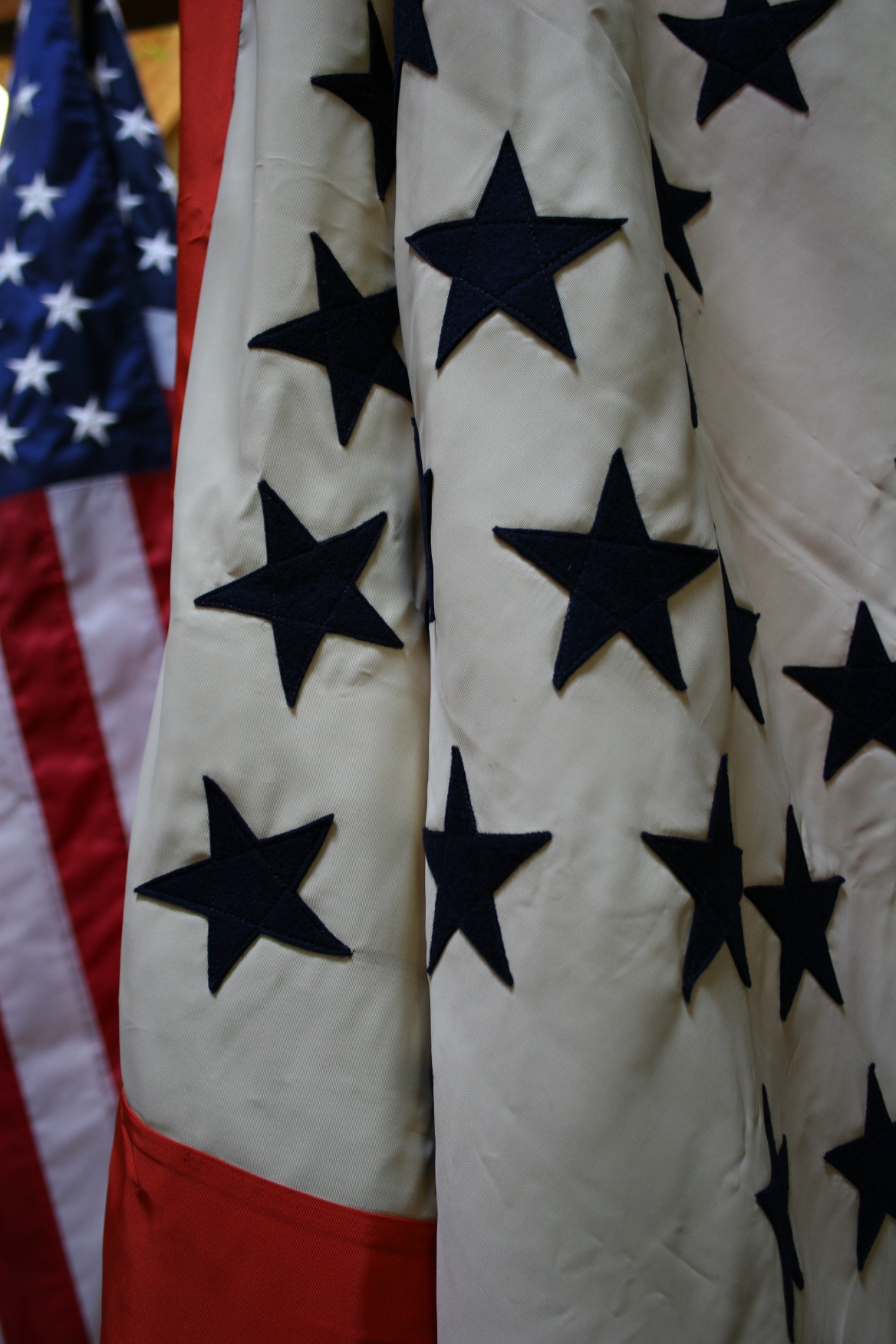
I stand there awed, really, that so many individuals from this German Lutheran church in a mid-sized Minnesota community answered the call to duty during a single war. My friend Lee and I count: 162 blue stars and six double stars of gold upon blue.

The blue stars number 162, one for every Trinity member serving in WW II.

Six young men gave their lives for their country. The thought of such grief within a single congregational family overwhelms me.

I feel now as if I am viewing a sacred cloth. I wonder how many tears fell upon this flag as the ladies of the congregation stitched these stars.

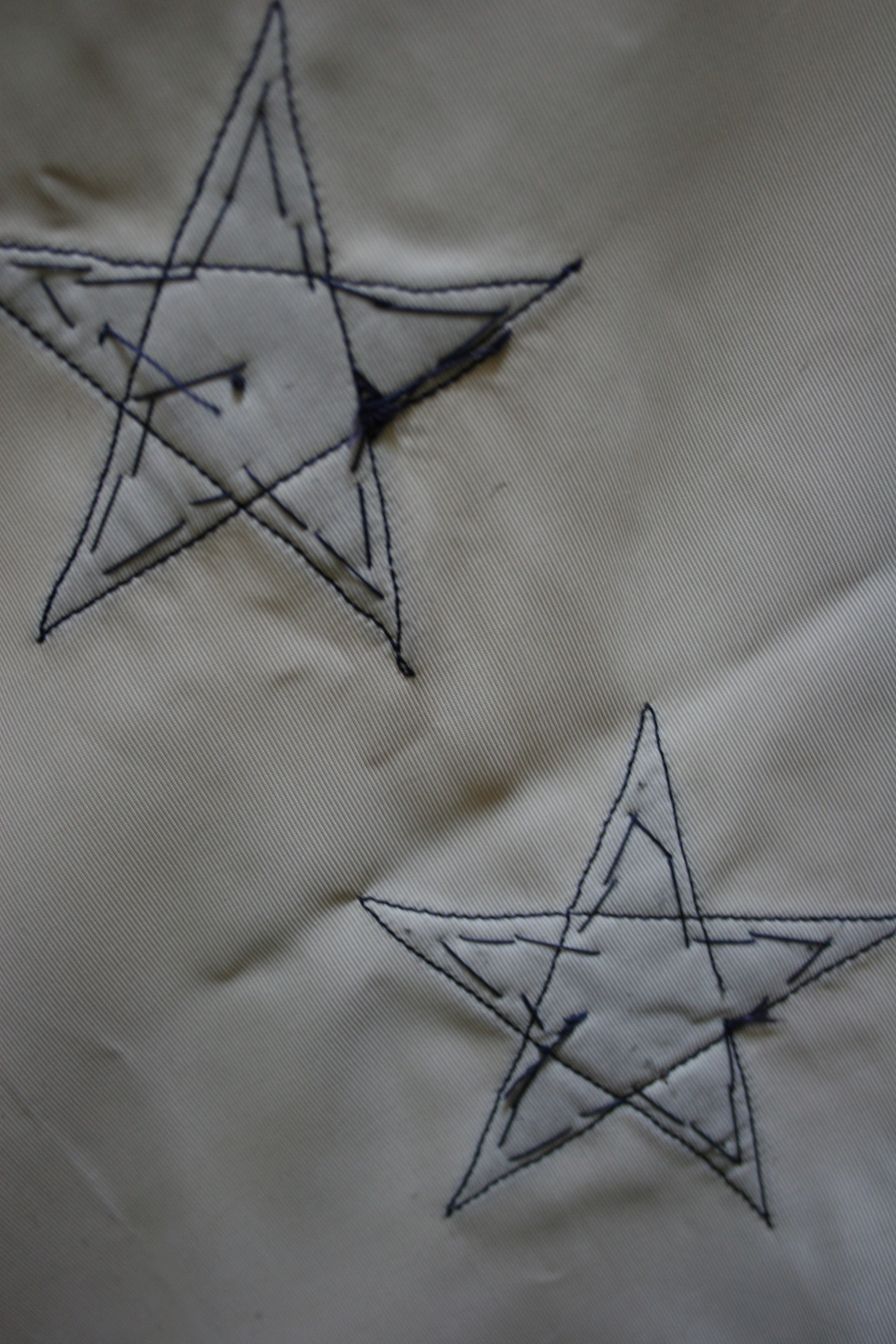
I lift the flag, gently flip the fabric to the back side and examine the even machine-stitching on the blue stars. And then I examine the long, uneven stitches on the gold stars, sewn in place by hand.

Hand-stitching on the backs of two gold stars honoring those who died. The outer row is machine-stitching, holding the blue stars in place.

Dave tells us the flag stood at the front of the church, as did similar flags at churches through-out our community of Faribault. Roger steps up, says he remembers a smaller flag in the church he attended during WW II.

And if Dave’s memory serves him right, this flag remained on display until the end of the war.

Today I am glad, even though also saddened, that this flag of honor has been taken out of storage and put on display. For this one morning, on this Independence Day, those of us gathered here freely to worship have been reminded again that freedom does not come without a price.

A view of three of the flags, looking into the sanctuary, centered by a cross.

© Copyright 2010 Audrey Kletscher Helbling
 

They serve the best food in Minnesota church basements July 1, 2010

Filed under: Uncategorized — Audrey Kletscher Helbling @ 7:36 AM
Tags: , , , ,

FOR ALL OF YOU FOODIES out there, here’s a little secret. Some of Minnesota’s best down-home food is served in church basements.

Whether a chicken and ham dinner, an annual lutefisk meal, a soup supper or simply an old-fashioned ice cream social, the faithful serve up some mighty heavenly culinary delights. I know. I’ve indulged—uh, sinfully overindulged—at plenty of these church-sponsored social events.

Take last Sunday, for example, when my husband and I church-hopped from a worship service at the Old Stone Church along Monkey Valley Road south of Kenyon to Moland Lutheran Church several miles further south and west.

“Are you going to the Strawberry Festival at Moland?” a fellow worshiper asks Randy while I’m off shooting photos of the historic stone church.

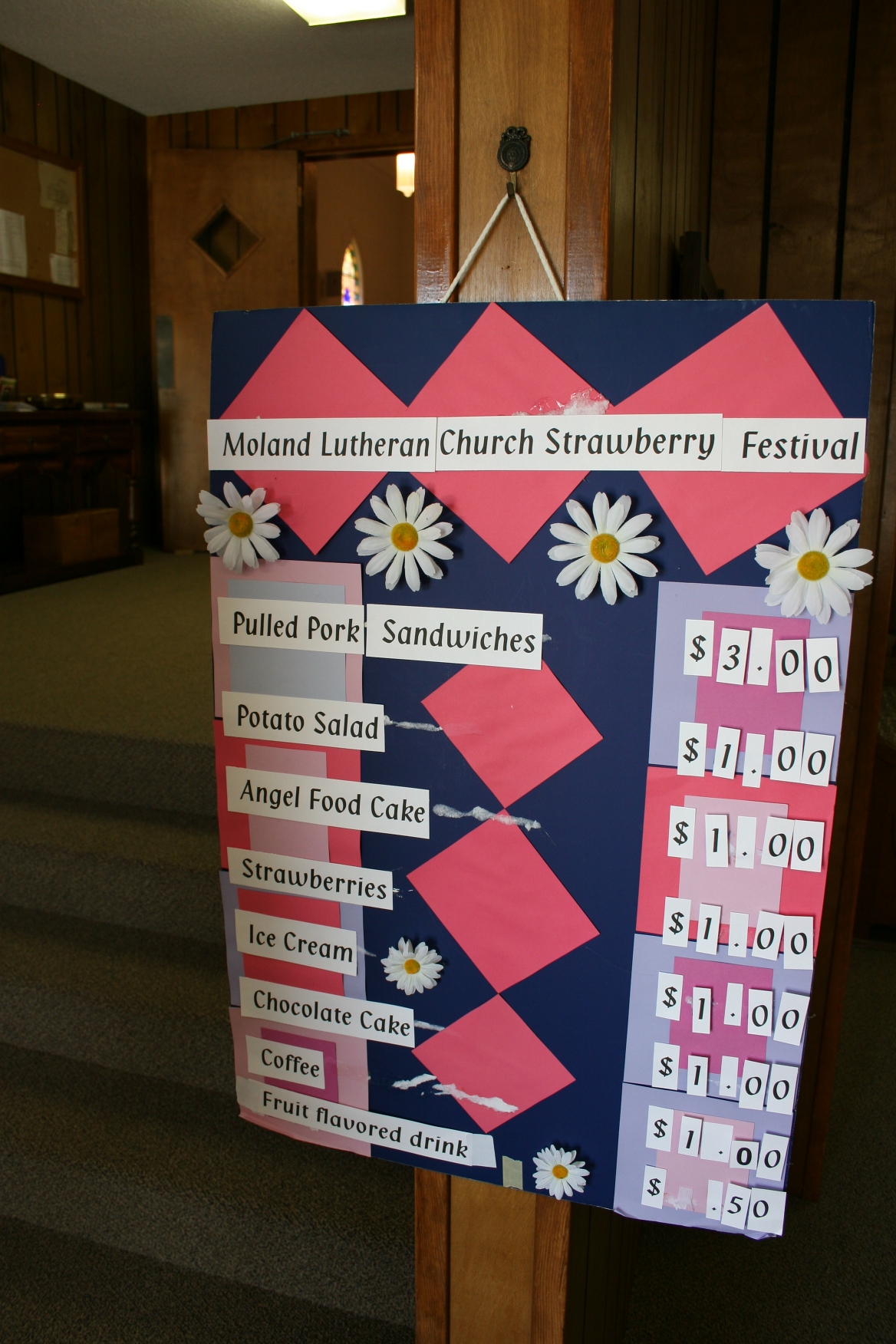
Moland Church, near the Dodge, Goodhue, Rice and Steele County lines, held its first Strawberry Festival in 1955.

After hearing this man rave about Moland’s festival and how he never misses a dinner there, Randy and I decide we’re heading south. With the clock ticking toward noon, we’re hungry and tempted to eat of the tasty, unforbidden fruit.

However, I secretly question our decision since we picked nearly 20 pounds of strawberries a day earlier and still have about five pounds sitting on the counter at home. We really don’t need more strawberries.

But the promise of pulled pork sandwiches, and for me the promise of getting inside another old country church, entices us to Moland.

I expect the fest to be held outdoors in tents strategically-placed under towering shade trees. But this church, ringed by a graveyard, stands in the full sun, exposed to the elements.

So we head inside, down the narrow stairs to the church basement where tables are crammed together and a serving line awaits us. We both choose a pork sandwich, a generous spoonful of potato salad and two scoops of vanilla ice cream (not homemade; I ask) topped with a mountain of fresh, sliced strawberries.

A sign in the church entry lists the food choices at The Strawberry Festival.

I am surprised at the quantity of strawberries, but shouldn’t be given this is a Strawberry Festival. For $12, we’ve gotten more than enough food to fill our stomachs. The two homemade baby dill pickles I spear onto my plate seal the deal for me.

We weave our way past tables and support posts to a table along the north wall. Despite the din (why is it always so hard to hear in these church basements?), we strike up a conversation with our dining companions, Angie who has driven down from Eagan to visit her aunt and uncle and the aunt and uncle from Owatonna whose names now elude me. They are a cordial trio.

We discuss church dinners, churches, pastors, computers, cursive writing, strawberry picking, diverticulosis (where food gets stuck in pockets of the colon, namely strawberry seeds in the case of the unnamed uncle) and whether it’s OK to eat our strawberries and ice cream before we eat our sandwiches.

We are served a generous amount of strawberries with two scoops of ice cream.

Randy and I agree that sampling our quickly melting ice cream before we finish our savory pulled pork sandwiches is no sin.

Before we part, our new friends make a confession. In a few hours, they’ll drive over to St. John’s Lutheran Church in Claremont for, uh, some strawberry pie.

#

IN A FUTURE POST, I’ll take you on a photographic journey inside Moland Lutheran Church.

© Copyright 2010 Audrey Kletscher Helbling
 

Preserving the past at the Old Stone Church, Kenyon, Minnesota June 29, 2010

Filed under: Uncategorized — Audrey Kletscher Helbling @ 7:41 AM
Tags: , , , ,

As part of the restoration process, the limestone at the Old Stone Church was tuck-pointed. This shows the east side of the 1870s church located along Monkey Valley Road southwest of Kenyon, Minnesota.

I CAN’T PINPOINT specifically when old country churches became a passion for me. But sometime in recent years, I realized that these rural houses of worship and their often adjoining cemeteries reflect a history and art worth appreciating and preserving.

Such is the Old Stone Church built by Norwegian immigrants near Kenyon in the late 1870s and closed in 1902. A committee of four, whom I met at a Sunday morning worship service, is working tirelessly to preserve this historic church and cemetery for future generations. Already, some $100,000 has been invested in tuck-pointing the native limestone, replastering the interior and more.

These people genuinely care about the original gathering place for members of Hauge Free Lutheran Church, which celebrated its 150th anniversary in 2009. The congregation’s current center of worship stands in Kenyon.

“I wanted to see the old Hauge church come back to life,” says Glen Rud, whose Norwegian grandfather walked several miles from town to attend services here. He appreciates the peacefulness of this secluded location in Monkey Valley, where deer and turkeys range. Here, in this place of peace, lies Rud’s burial plot.

Likewise, preservationist Bob Dyrdahl possesses strong ties to this land. He was born in a nearby log cabin. He’s planted trees around the cemetery and with his sisters donated a historical marker. His daughter was married here two years ago.

Such devotion, respect and care for the Old Stone Church impress me.

Sunday morning as I join the descendants of Norwegian immigrants (and others) in prayer and song, I feel the kinship of faithful fellowship. I feel the very presence of those early settlers who sat upon these pews and raised their voices in their mother tongue. Today, more than a century later, this congregation still sings Ja, vi elsker, the Norwegian national anthem, with the conviction of a generation determined to remember their heritage.

A view from the balcony shows the choir seated next to the beautiful altar. The choir director speaks in Norwegian, then translates, "Stand up, that means." And all rise for the Norwegian national anthem.

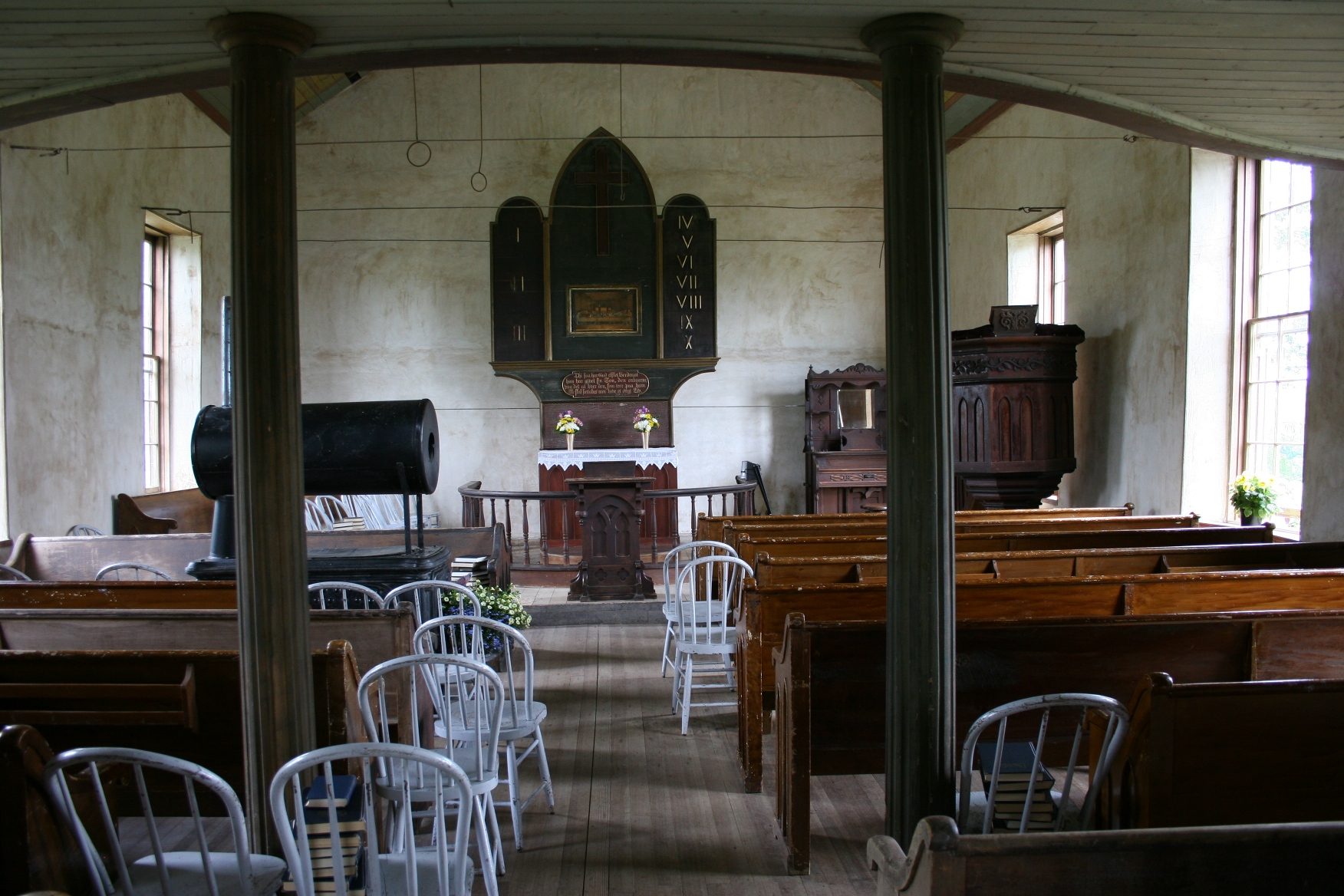
This Old Stone Church altar intrigues me because I've never seen one similar. I wonder whether The Last Supper painting at the center of the altar is a cherished possession transported by ship from the homeland. I wonder why replica tablets of the 10 Commandments were chosen for the altar. And, finally, I appreciate the inscription of John 3:16 in Norwegian.

This photo gives a broad view of the sanctuary. I was seated in the chair to the right side of the balcony support post during worship services. As I take in my surroundings, I notice the knots in the back of the pew before me and the floor patched with a section of wood underneath the sandal of the woman seated next to me. And as my left shoulder brushes against the wooden column, I admire the workmanship and craftsmanship that surrounds me.

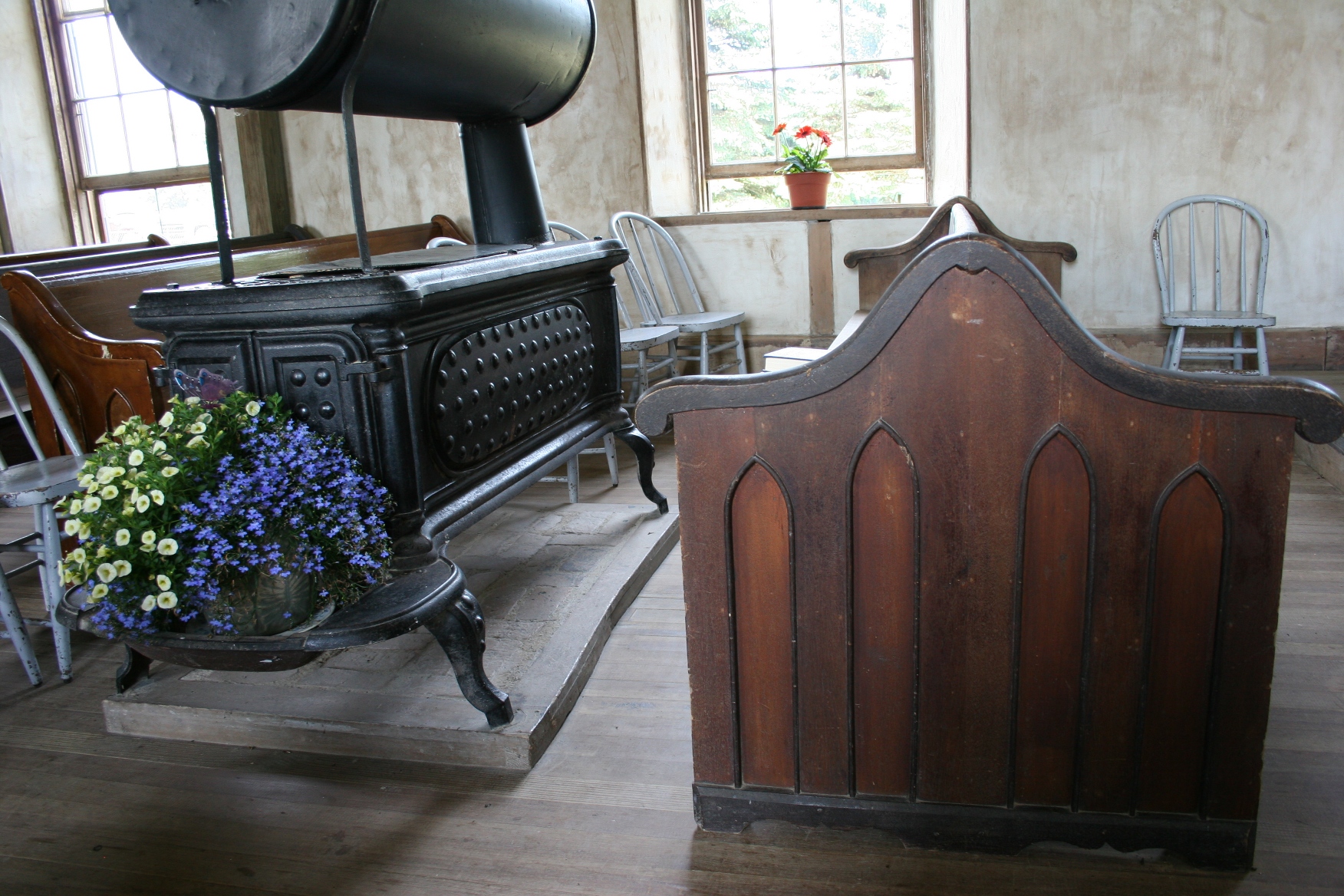
Bob Dyrdahl explains that the double-sided pew provided a place for mothers to sit with their babies next to the warmth of the wood-burning stove. Such concern, such love, for those early pioneer mothers touches me.

A steep narrow stairway, just inside the church's interior double doors, winds to the balcony. Even here, in this plainness, I can appreciate history and craftsmanship. At the bend in the stairway, is a band of stenciled wood.

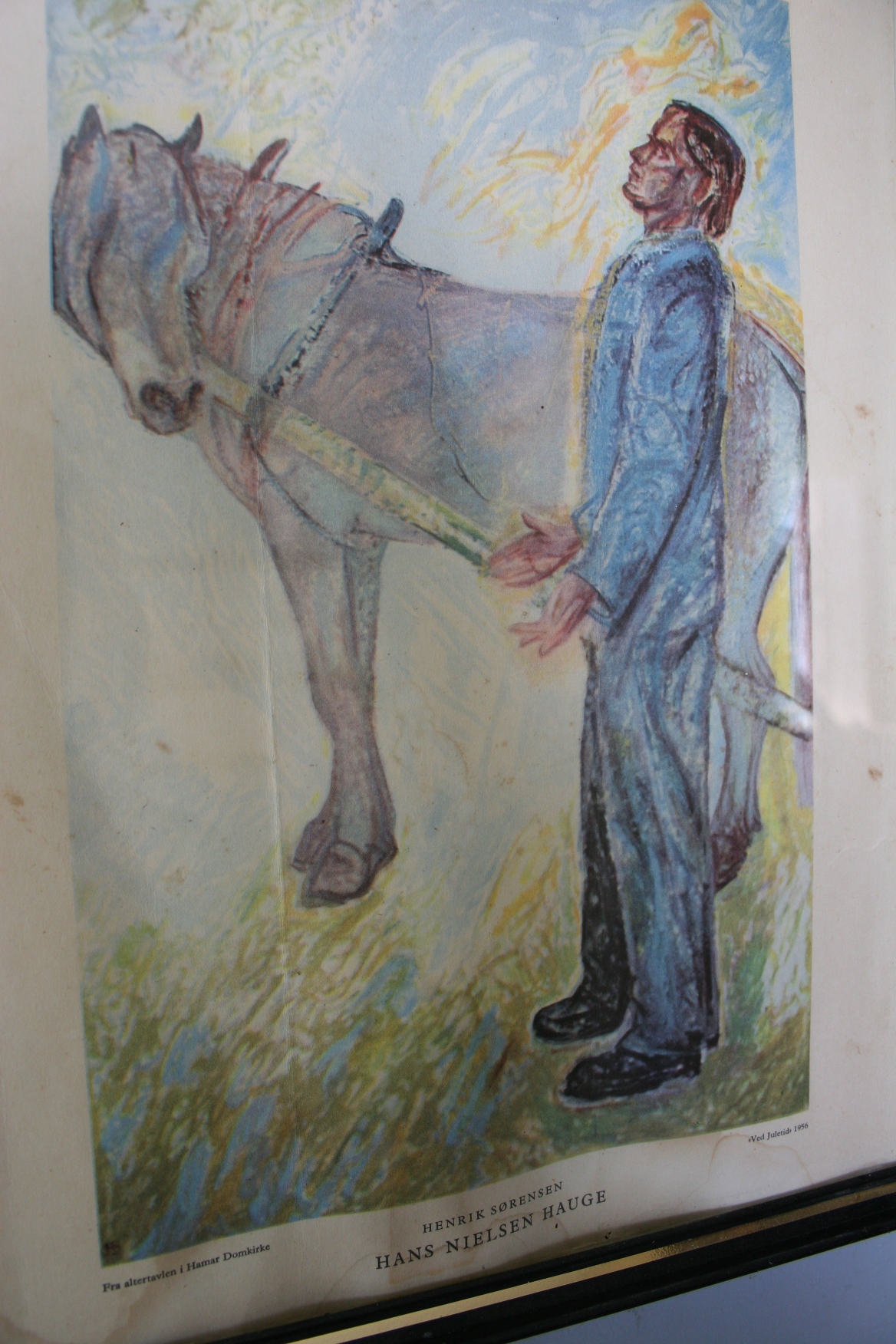
A print of Hans Nielsen Hauge, a 1700s lay leader and reformist in the Lutheran Church of Norway, hangs in the entry of the Old Stone Church. Immigrants honored this lay preacher by naming their church after him. Calling the baptized in the congregation, who have wandered away from the Lord, back to repentance is a common preaching theme among "the Haugeans," current Pastor Martin Horn says.

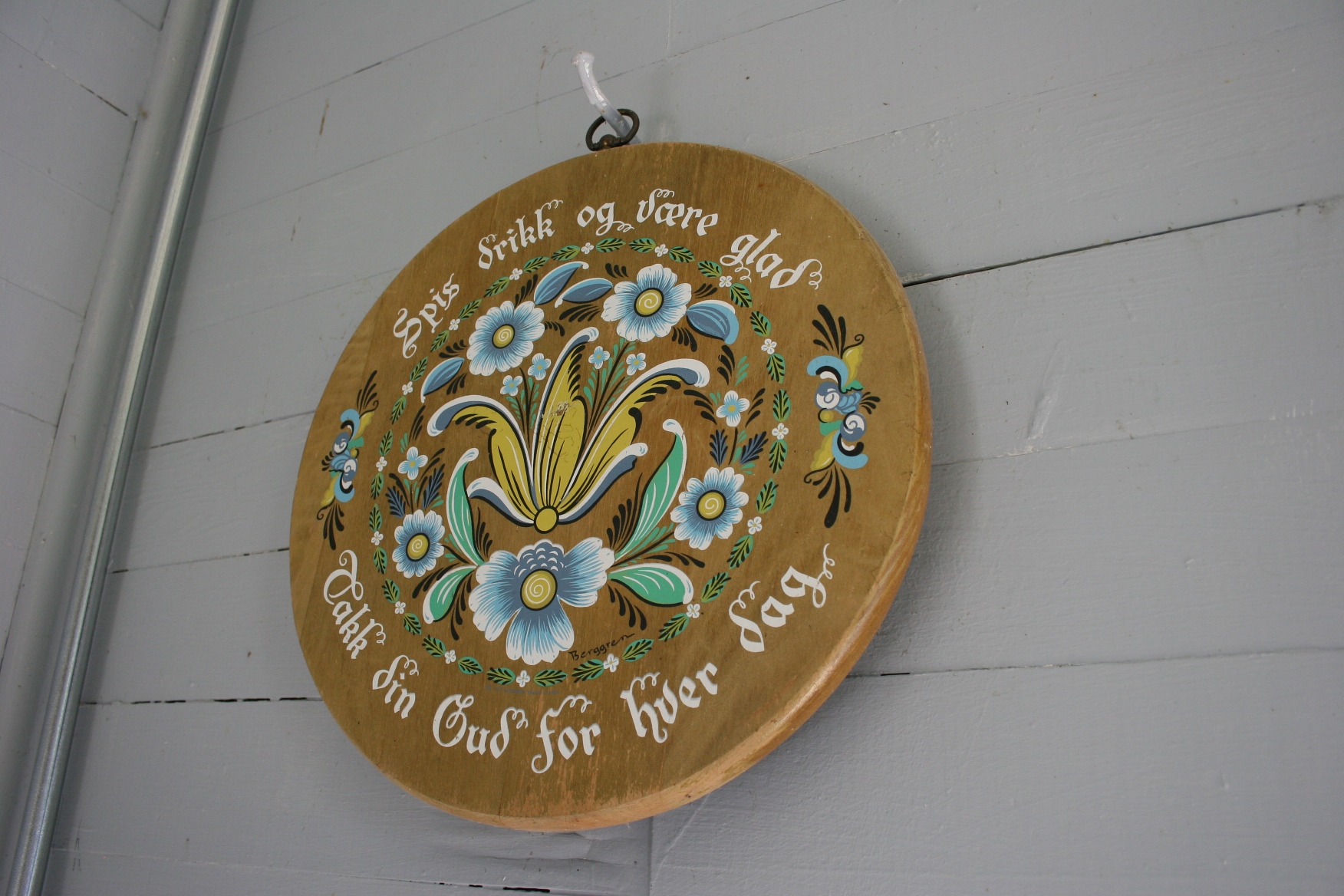
This Norwegian plaque hangs in the Old Stone Church entry. Since I'm German and not Norwegian, I rely on Google translate to tell me this sign basically thanks God for food and drink.

Six shuttered windows span two sides of the limestone church. The shutters are thrown open for the once-a-year church service and then battened shut.

The Old Stone Church cemetery, a final resting place for generations past and for those yet to be buried upon this land in peaceful Monkey Valley near Kenyon, Minnesota.

FOR MORE INFORMATION and additional photos of the Old Stone Church, see my June 27 Minnesota Prairie Roots blog post.

© Copyright 2010 Audrey Kletscher Helbling
 

Inside the Old Stone Church, rural Kenyon, Minnesota June 27, 2010

Filed under: Uncategorized — Audrey Kletscher Helbling @ 7:35 PM
Tags: , , ,

“DIRECTIONS: At the west end of the Boulevard of Roses, take Goodhue County 12 south for 1.3 miles and go west on Monkey Valley road for one mile.”

“Let’s go,” I tell my husband Saturday evening after reading an open invitation in the local newspaper to attend worship services at the Old Stone Church. Pair the adjectives “old” and “stone” with church and I already have one foot in the door. Add “Monkey Valley Road,” and you’ve really piqued my interest.

So Sunday morning Randy and I are on our way to Kenyon, where we turn right at the west end of the narrow boulevard lined with roses. We follow the published directions, turning right onto Monkey Valley Road, a gravel road that soon leads us to the Old Stone Church.

Once a year a worship service is held at the Old Stone Church, built by Norwegian immigrants near Kenyon.

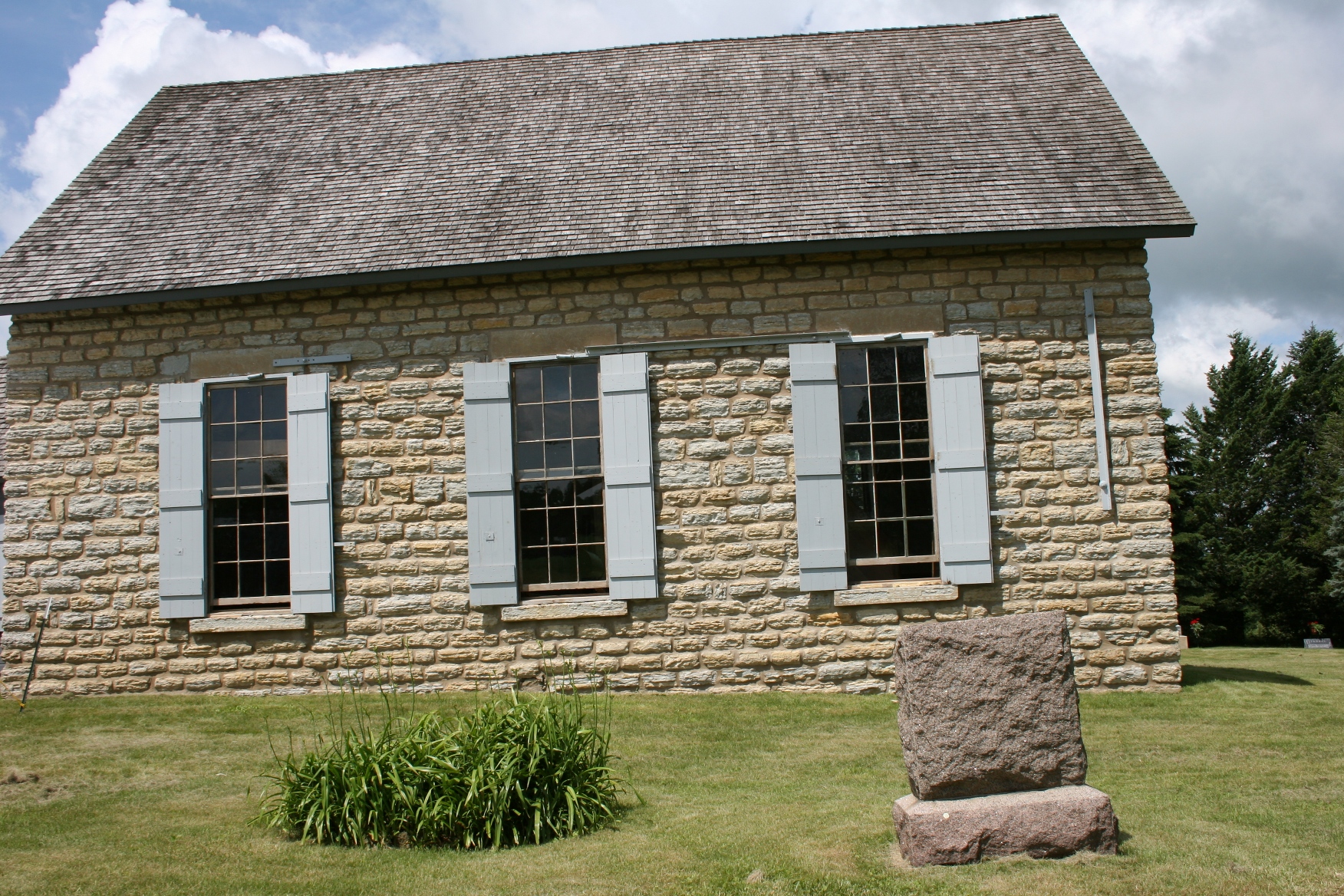
I am expecting a church defined, as most country churches are, by a steeple. But, instead, I see before me a simple limestone building that could pass for a schoolhouse. Yet, the plain exterior, minus a steeple, seems perfect for this spot embraced by trees and rolling valleys on two sides and by flat open farm fields on the opposite sides.

Welcome to Monkey Valley.

“How did this place get its name?” I ask a group of men clustered outside the Old Stone Church.

They offer two theories. The first story goes that monkeys escaped from a traveling circus and fled into the wooded valley. The second story goes that a threshing crew arrived here and pronounced: “We’re just going to the valley and monkey around.”

Randy and I buy the monkey story, which seems probable given traveling circuses once roamed the countryside.

“I have to go,” I say, abruptly ending this monkey business. I hear the strains of my favorite hymn, Beautiful Savior, drifting through the open doors and windows. I don’t want to miss this and I am anxious to get inside the small country church.

I’ll later learn that Norwegian immigrants built this structure, beginning in 1872, with limestone cut from a nearby quarry. A historical marker dates the building, which is on the National Register of Historic Places, as 1875. And that steeple I wondered about—apparently the church founders discussed a steeple, but never had the money to erect one.

Eventually, those early members moved out of Monkey Valley and, in 1902, Hauge Lutheran congregation built a new church in Kenyon. For years the Old Stone Church stood abandoned. In 1947 restoration began, a process that continues today.

All of this written and memorized history interests me, but only to a point. I prefer, instead, to wander, to notice the details, to take in my surroundings, to appreciate for myself the beauty that this church holds.

During a service filled with music, the choir and congregation sing in Norwegian, "Ja, vi elsker." The wire rods you see anchored to the walls (running horizontally across the top of the photo) provide structural stability.

Rugged pews and rustic wood floors remind worshipers of bygone years. Copies of The Concordia Hymnal, piled on a pew, date to 1967. The hymn books are stashed in covered plastic containers after the service.

I lean forward and photograph the hands of an elderly woman in quiet meditation. This image, more than any photo I take, captures the essence of the Old Stone Church. For in these folded hands and in the back of the roughly-hewn pew, history and faithfulness meld, encompassing the importance of preserving historic churches.

Sitting near the back of the church, I study these words, thinking in German until I remember I am inside a Norwegian church. After the service, I talk with historian and preservationist Bob Dyrdahl. The scriptural quote comes from John 3:16, he tells me. "For God so loved the world that He gave His only begotten Son..." Sure enough, upon closer examination I determine that Bob knows his Norwegian.

I run my fingers across the flowers on the pulpit and imagine the rough hands of a Norwegian immigrant shaping this wood into a beautiful work of art. In the background is the top of the altar, defined by tablets, signifying the 10 Commandments and centered by a cross and a painting of The Last Supper.

In the balcony, historian Bob Dyrdahl shows me this treasure, the dated (October 30, 1894) signature of A. P. Lindgren who painted stars upon the ceiling and edged it with this stenciled border. His work also graces other sections of the sanctuary, along the stairway, for example.

A rear view of the Old Stone Church, a simple structure with three shuttered windows on each side of the building.

A stone's throw from the Old Stone Church, a view of Monkey Valley.

#

THIS IS JUST A SAMPLING of the photos I shot at the Old Stone Church. Please check back for additional images to be posted this week on Minnesota Prairie Roots.

Copyright 2010 Audrey Kletscher Helbling
 

A creative contest to celebrate a church anniversary June 21, 2010

Filed under: Uncategorized — Audrey Kletscher Helbling @ 10:10 AM
Tags: , , ,

EVERY YEAR FOR AS LONG as I can remember, the Faribault Daily News has sponsored a “Lord of the Things” contest during our community’s annual Heritage Days celebration. A photographer photographs snippets of items—maybe a sign, a decorative cornice on an old building—to be published in the newspaper. Entrants then identify the objects and their public locations.
Recently I adapted that idea for a 140th anniversary celebration at my church, Trinity Lutheran in Faribault. Wanting a scriptural theme, I pegged the contest “SEEK & FIND,” based on Matthew 7:7: “Ask and it will be given to you; seek and you will find; knock and the door will be opened to you.”

I photographed half of Jesus' face in a stained glass window as a focal point for a posterboard displaying 4 x 6-inch contest photos.
I aimed to provide a fun family activity, to increase worshipers’ awareness of their church surroundings, to focus on church history and to get people to our 140th anniversary reception. All of those goals were achieved in a process that began months ago.

Back in April, before anyone knew I was planning this activity, I roamed the church campus photographing perhaps two dozen items, which I narrowed down to 14. I discovered, then, that I’ve not even noticed some of what surrounds me.

How long has that painting of Christ, gazing at a baby, hung above the drinking fountain?

How long has “Trinity Lutheran School” been chiseled in granite?

Why have I not seen that angel in the stained glass window until today?

This contest, I determined, could present a challenge to those who entered. I was right.

Dennis, one of the contest winners, shares with me on Sunday—the day SEEK & FIND winners’ names were posted at the anniversary reception—that he puzzled over a single photo. “I thought it was a window,” Dennis tells me, explaining how he searched for 45 minutes. But his story takes a humorous twist. After informing his wife, Pat, that he can’t identify the geometric pattern, she instructs him to look down. Dennis is standing on the elusive tile floor in the photograph.

That entertaining story makes all of the time and energy I invested in this contest worth the effort. But so does the story from Marilyn, who brought her three grandchildren to church—twice—to ferret out the photographed objects. The first time, a carpet cleaning crew kept the group from entering the sanctuary. The second time, they tread quietly within the church as a musician tuned a piano.

Then you have Lee and Laurel, who began hunting for the photographed items after the late church service one Sunday. With the clock ticking toward noon and morning worship volunteers wanting to go home, the couple finally had to give up and leave, or be locked inside the church.

Such stories amuse, and please, me.

I would have been even more pleased had more people entered the contest. Only 31 entries in the two divisions—adult and youth—were submitted. I expected three times that many, especially after publicizing the competition in church newsletters and bulletins, via word-of-mouth, by e-mail, via announcements and by handing entry sheets directly to church members.

But…, I tried. And I am confident that the 17 entrants who won are quite pleased with prizes that included homemade pies from the Trinity Pie-makers, gorgeous lily bouquets from Virgil and Jane’s garden, Ryan and Sara’s homemade maple syrup, Roy’s handcrafted fretwork cross, gift certificates to local businesses, and more.

I’m not discouraged by the lack of response, only disappointed.

But I’m also encouraged. Already, one contestant has asked: “Are you going to do this again next year?”

Uh, no, but maybe in 10 years, when Trinity celebrates its 150th anniversary.

© Copyright 2010 Audrey Kletscher Helbling