Minnesota Prairie Roots

Writing and photography by Audrey Kletscher Helbling

All things purple during Domestic Violence Awareness Month October 7, 2025

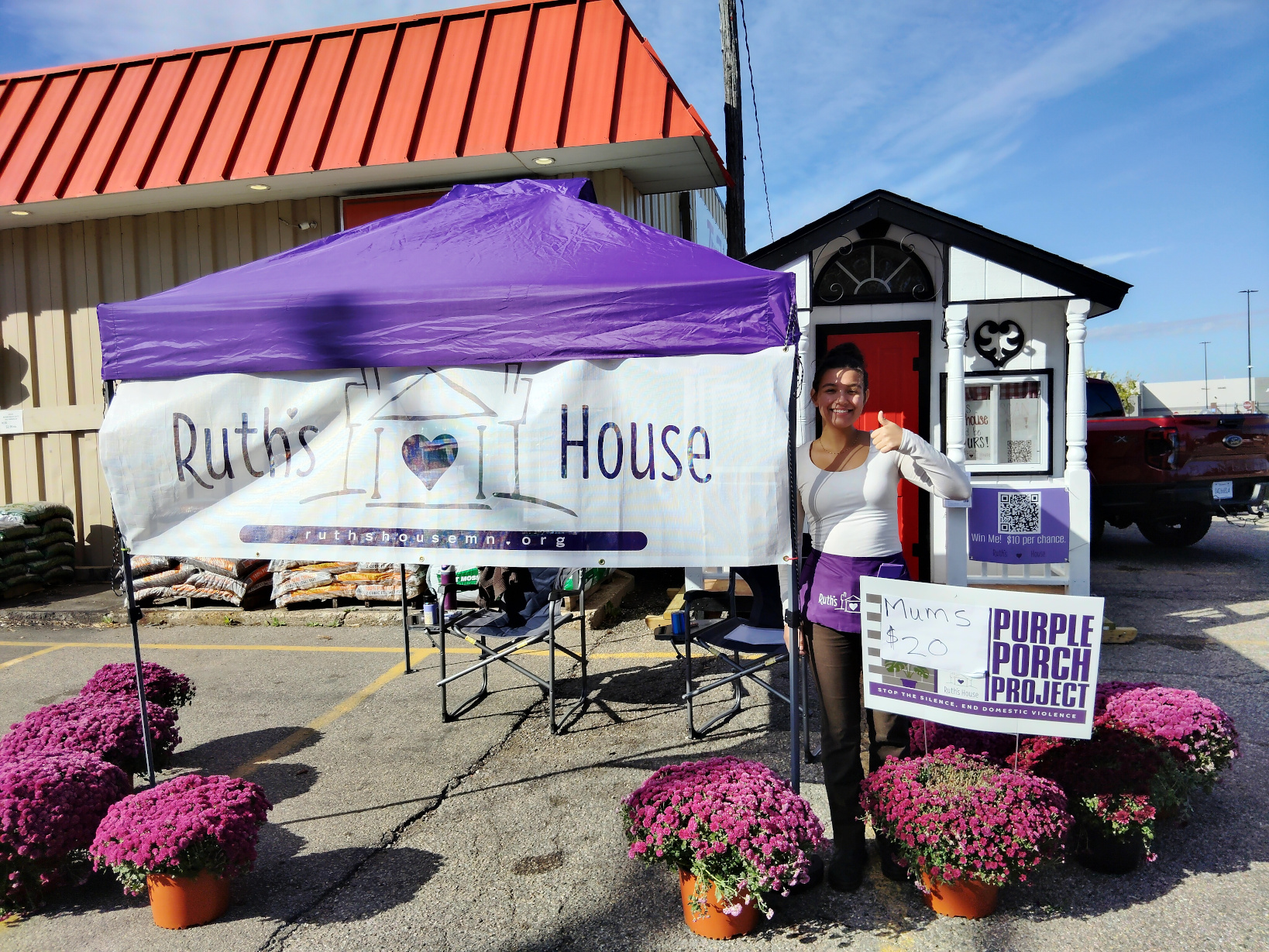
Ruth’s House sells mums and more outside Faribault Fleet Supply Tuesday morning. (Minnesota Prairie Roots copyrighted photo October 2025)

MASSIVE PURPLE MUM plants packed a wagon parked outside Faribault Fleet Supply when I stopped by Tuesday morning to pick up a multi-purpose plant spray.

Nearby, two women staged mums on the pavement next to a purple canopy bannered with “Ruth’s House.” A sign placed among the mums identified this as the “Purple Porch Project. STOP THE SILENCE, END DOMESTIC VIOLENCE.”

October marks Domestic Violence Awareness Month, a nationwide effort to raise awareness about the signs of domestic violence and ways to stop it, support survivors and advocates, and provide information and resources to those who are in positions of leadership and policy-making. Purple is the identifying color for this month-long endeavor.
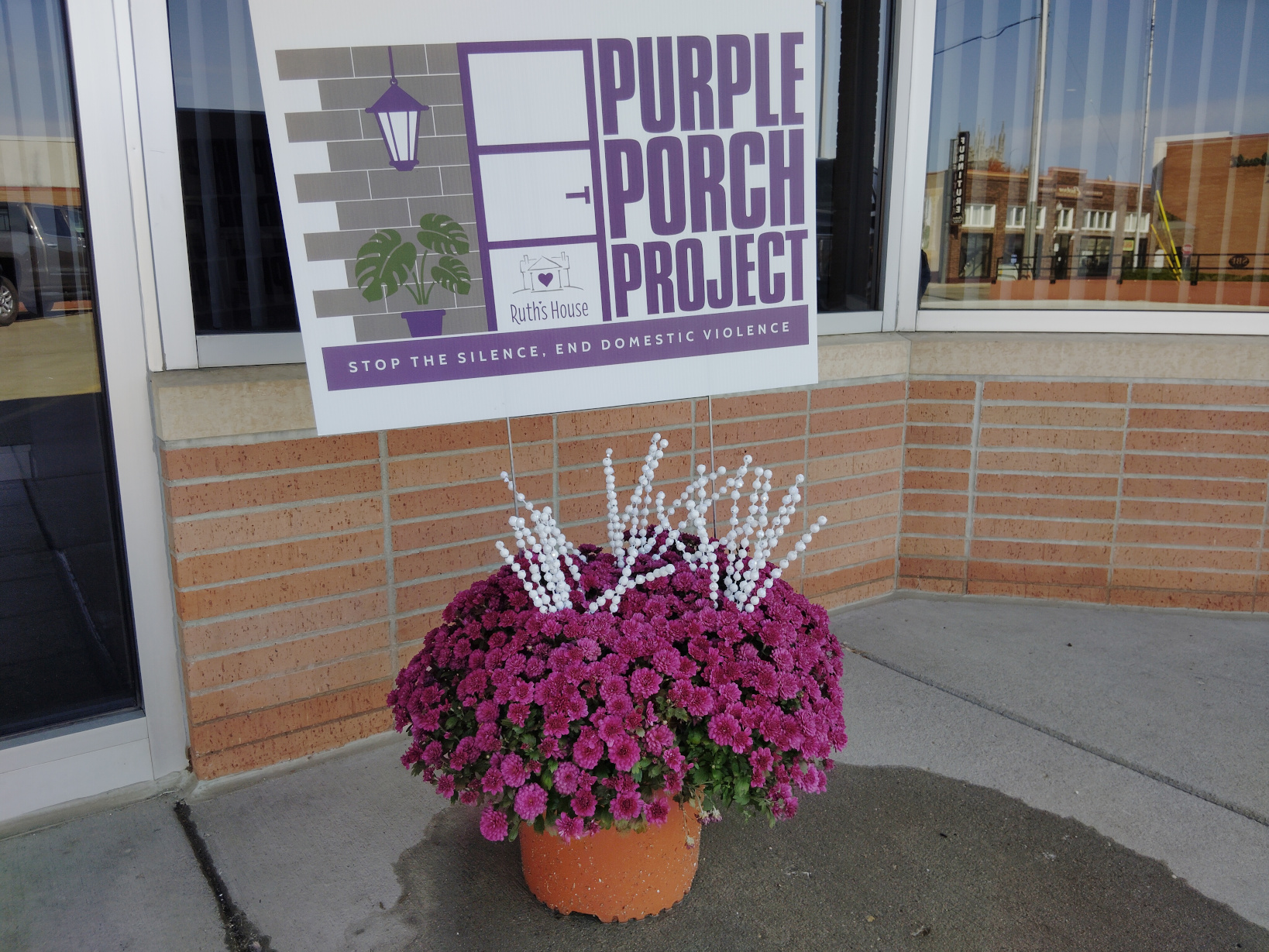
The State Bank of Faribault promotes the Purple Porch Project outside a parking lot entrance to the bank. (Minnesota Prairie Roots copyrighted photo October 2025)

Ruth’s House, marketing the purple mums, is an emergency/transitional shelter in Faribault for women and children in crisis and a sober living space for women transitioning from in-patient treatment. Those who temporarily move into Ruth’s House may be homeless due to domestic violence, poverty, substance abuse disorder, health challenges or other issues.

Whatever the reasons for their homelessness, I’m thankful my community has a house to call home for these women and their families. Likewise, I’m grateful for HOPE Center, another local organization that supports survivors of domestic violence and sexual assault with Hope, Outreach, Prevention and Education.

Both Ruth’s House and HOPE Center rely heavily on individual and community financial support, and also on government grants, to operate. And we all know that counting on government funding right now is tenuous at best. Thus fundraisers like Ruth’s Purple Porch Project are happening with the sale of $20 purple mums; a $100 Purple Porch décor kit (includes a handcrafted purple door wreath, 66 feet of purple string lights, a purple mum and a yard sign symbolizing unity); a $25 DIY purple wreath kit; and a $20 Ruth’s House yard sign.
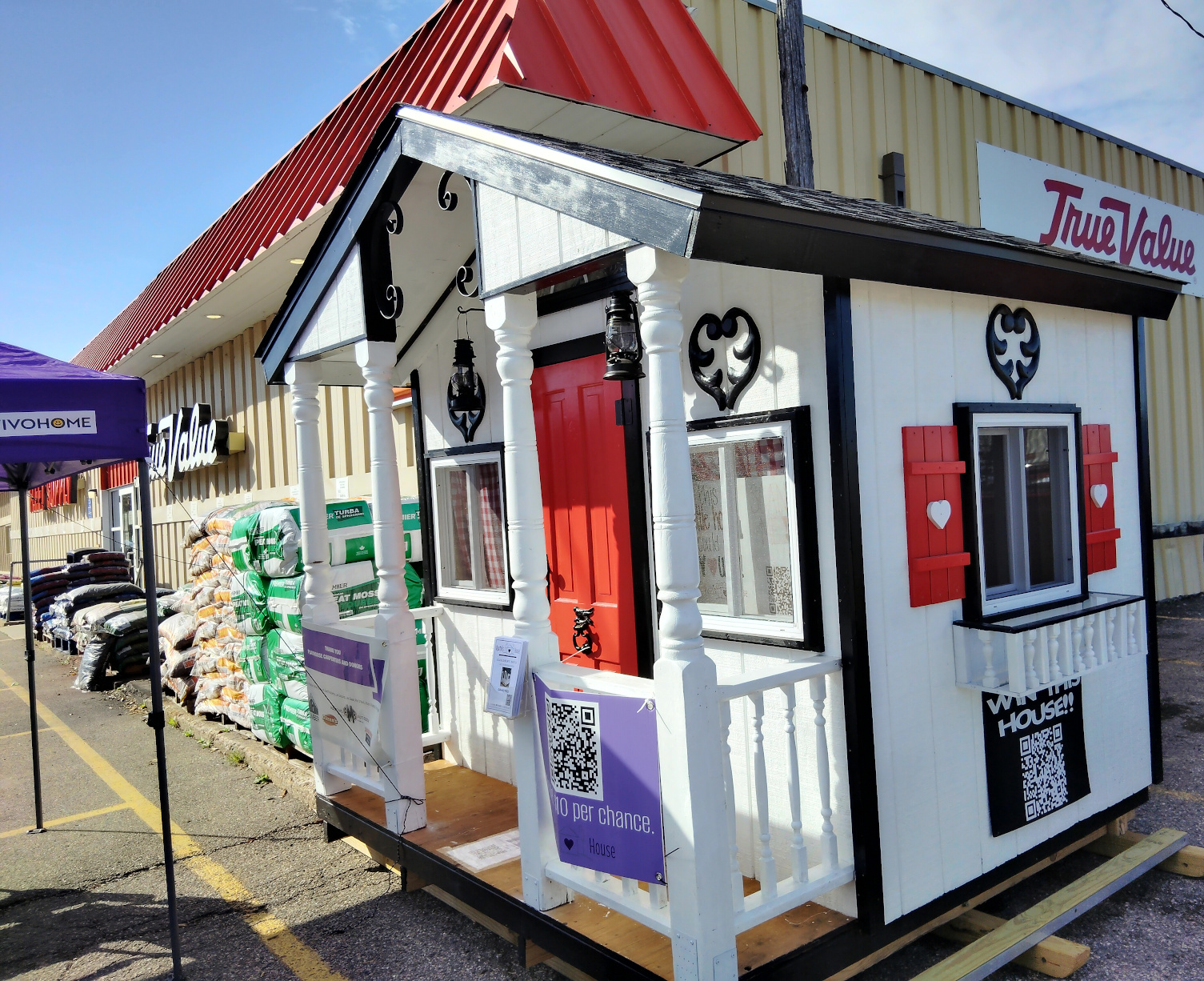
This children’s playhouse, displayed outside Faribault Fleet Supply, is the grand prize in the Ruth’s House raffle. (Minnesota Prairie Roots copyrighted photo October 2025)

Additionally, Ruth’s House is selling $10 raffle tickets for a children’s playhouse, wooden swing set, bike and helmet, arts & crafts table and chair set, play kitchen with table and two chairs; and a family game night basket. Ticket sales will help fund children’s programs at the emergency shelter.

Any of the fundraising items can be ordered/purchased online by clicking here. Or, if you live in the area, stop by Faribault Fleet Supply.

Mostly, I want you to pause for a moment and reflect on domestic violence. And if you don’t know that much about it, take time to learn. (Click here.) So many misconceptions exist about domestic violence with that oft asked question of “Why doesn’t she just leave?” It’s not that easy. It’s complicated and difficult and even potentially dangerous without a safe plan in place.

Do what you can. Support. Encourage. Love. Advocate. Be there. Listen. Help. It takes all of us, individually and collectively, to stop domestic abuse and violence.

© Copyright 2025 Audrey Kletscher Helbling


Even scarier than Halloween October 31, 2024

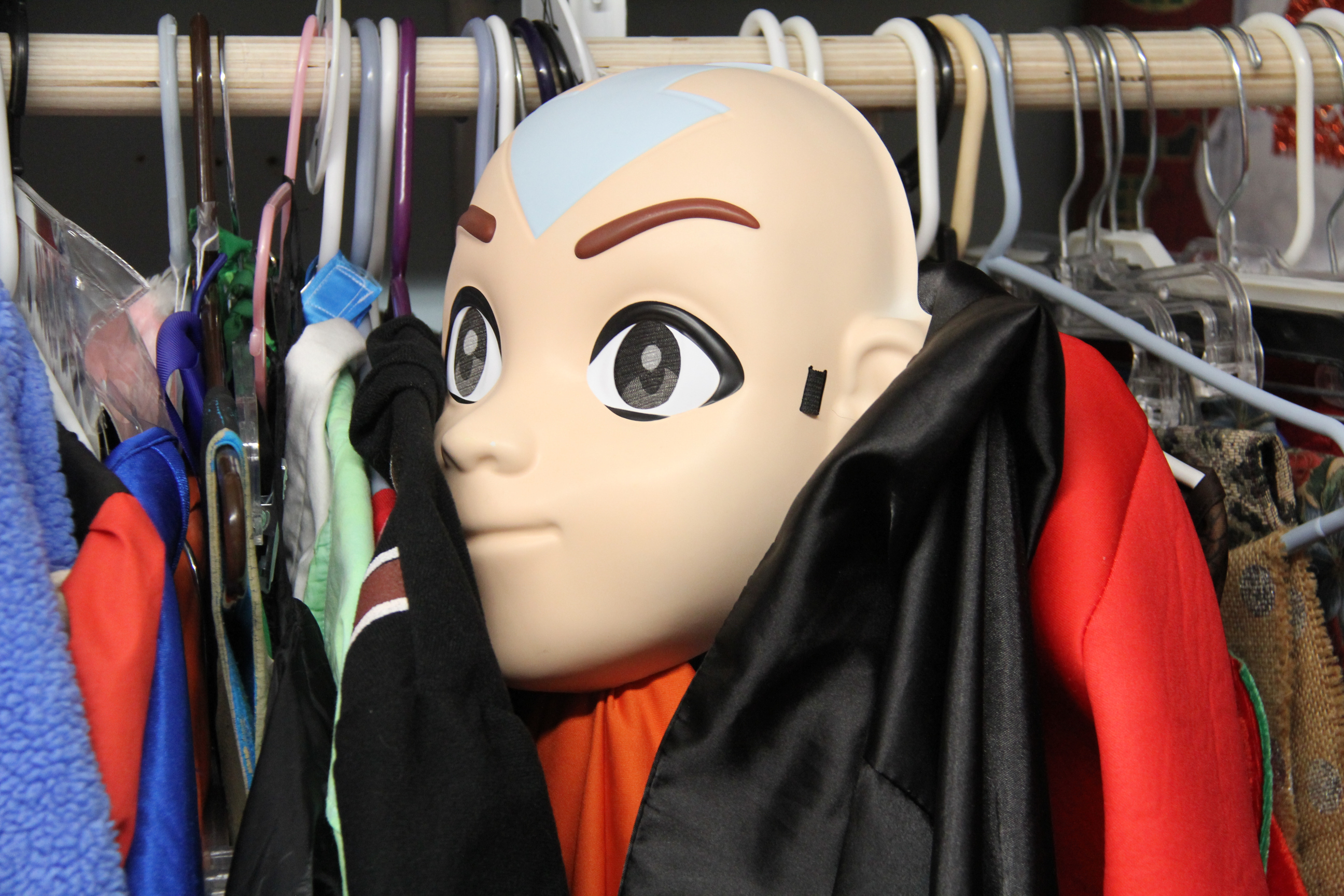
A Halloween mask and costumes for sale at Something for All, a thrift shop in Lonsdale, MN. (Minnesota Prairie Roots copyrighted photo October 2024)

OCTOBER 31. Halloween, the one day when scary is celebrated in a big way. But October 31 also marks another notable day, the final day in Domestic Violence Awareness Month. Domestic violence is far scarier than any ghoulish, frightening, unsettling costume or event. Domestic violence and abuse are real. Real scary.

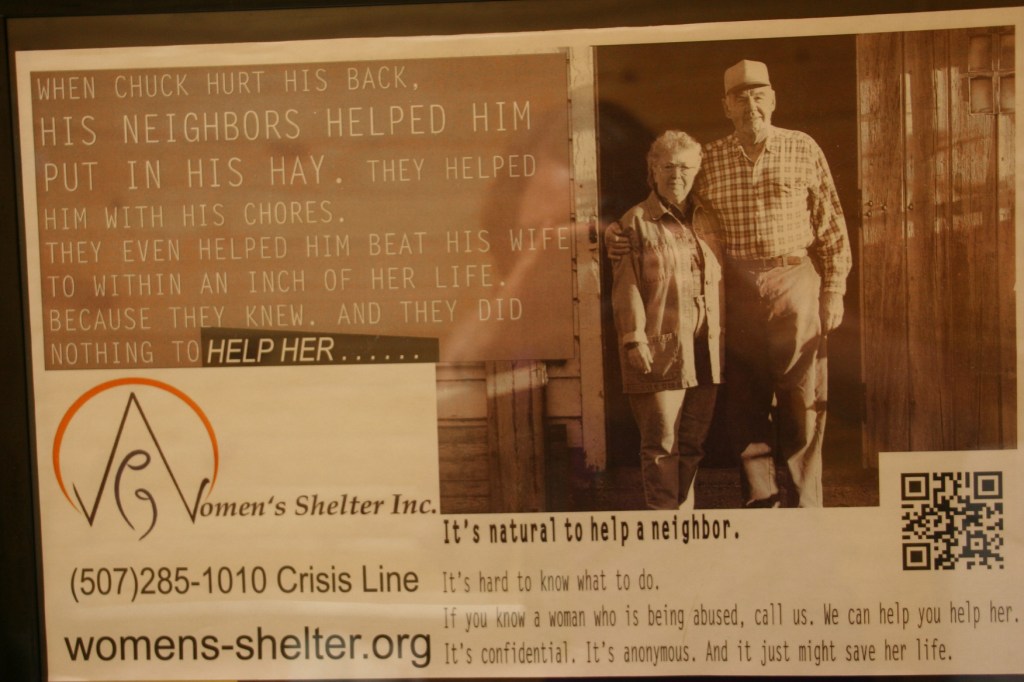
Warning signs of relationship abuse from an event held in Faribault many years ago.

Abuse can be physical, psychological/mental and/or emotional. Death, injuries, scars, trauma and so much more result from abuse which is, at its core, all about manipulation, power and control. Those can be insidious or blatant.

My fictional story, “Evidence,” is published in this anthology.

With that brief background, I am sharing a fictional story printed in Talking Stick 32—Twist in the Road, a literary anthology published by northern Minnesota based Jackpine Writers’ Bloc. I wrote “Evidence,” which won an honorable mention in the 2023 Talking Stick writing competition. Please read my story and then my comments following.

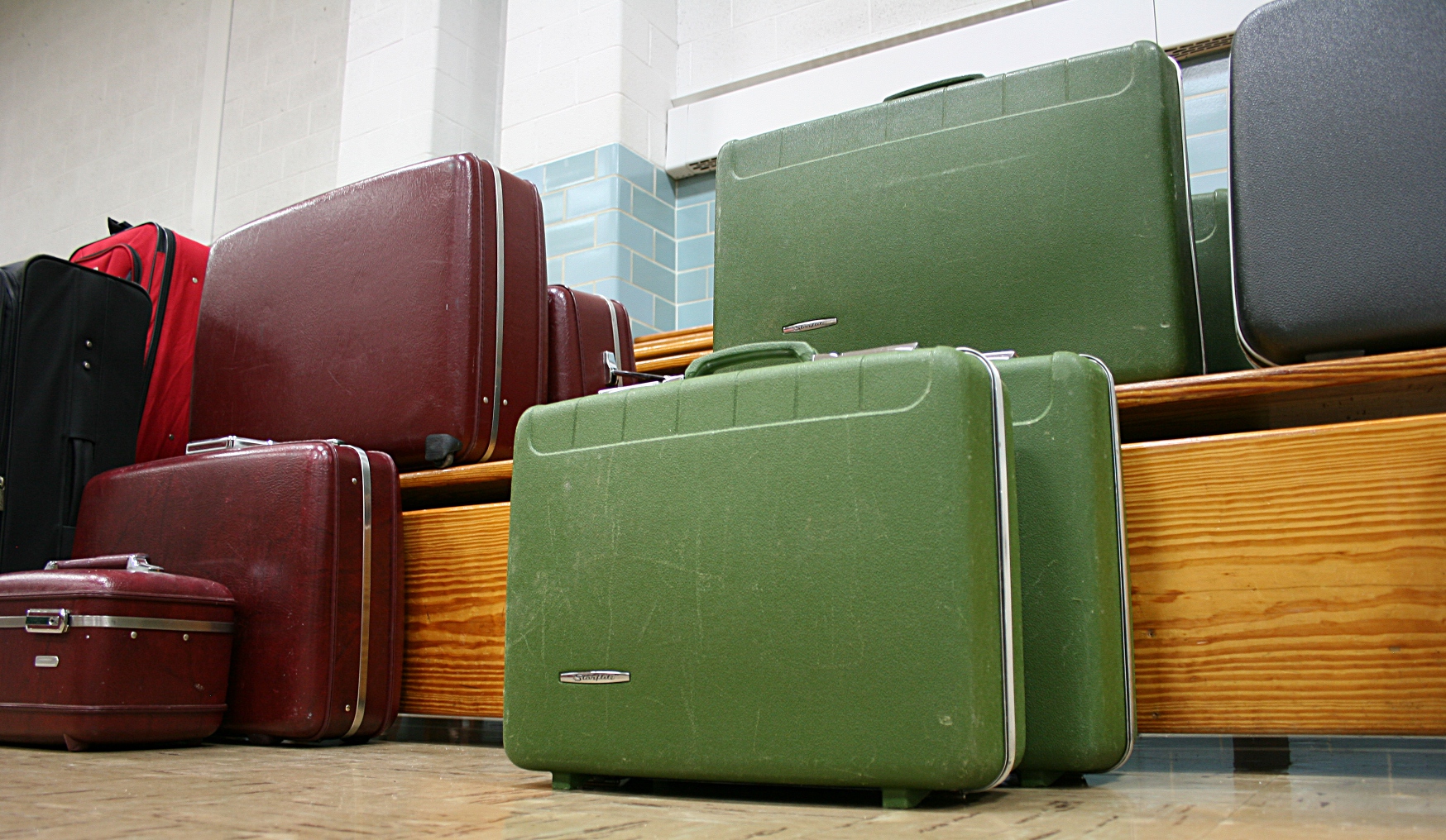
Some victims of domestic abuse/violence flee with minimal belongings in a single bag or suitcase. Some leave with nothing at all. Leaving marks the most dangerous time period when exiting an abusive relationship. (Minnesota Prairie Roots copyrighted file photo)

Evidence

She waited inside the bus station, body molded into a hard plastic chair, battered suitcase at her feet nudging shoes that needed a good polishing. Beverly felt restless, lost, as if at any moment she would awaken from her nightmare of a life. She pressed her right thumb into her sweaty left palm, a soothing habit that sometimes helped calm her. But not today.

Only hours earlier she’d fled to this place after tossing several changes of clothing alongside her diary in the bag now resting on the sticky, worn floor soiled by a thousand feet, a thousand stories. Today her story.

Her mind drifted to those first years when she wrote in flowery script, embellishing her writing with hearts. Love, so much love. He cherished her, loved her, embraced her with words and flowers and praise. Until he didn’t.

It was all so subtle, how Thomas, not Tom, chose to slip hurtful words into conversations, wearing her down. Day by day. Complaints of undone laundry and cold dinner and dirty dishes. And then the accusations flew. Where were you? Why were you speaking to him? Why can’t you ever do anything right? Then he slapped her. Repeatedly. Often.

She felt beaten. Weak. Exhausted. Trapped. Her writing reflected that, emotional words looping across the lined paper. Uneven and running together and sometimes nearly unreadable. Tears traced through the ink and wrinkled the pages.

For the longest time, she endured, pulled inside herself, determined she could do better, be better, love him more. Yet, it was never enough. Thomas continued to berate her, to find fault in everything she said and did. And she recorded it all in the journal zippered inside the suitcase stuffed in the back of their closet, the suitcase now at her feet. Evidence.

Beverly pulled herself back to reality, checked the time on the massive clock inside the bus station. Soon the Greyhound would roll in. She grabbed the worn handle of the battered bag, rose from the uncomfortable chair, and headed toward the boarding area. The momentum of hurrying passengers, their shoes slapping against the speckled linoleum, carried her. The bus doors pulsed open. Beverly stepped inside, handing her ticket to the driver. Her mood shifted, lightened with each step down the aisle until she saw him through the window, face flashing anger, fists clenched at his sides.

#

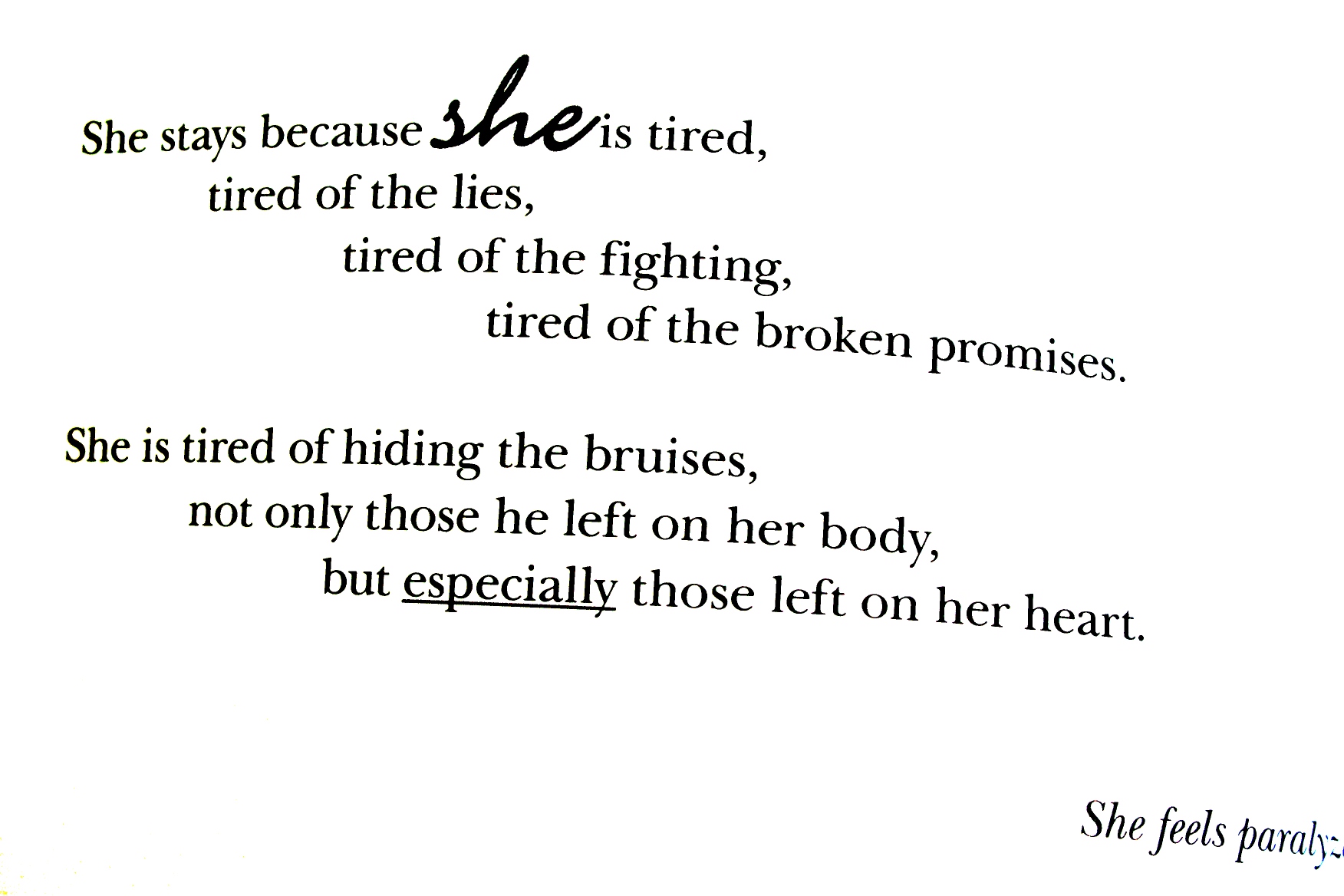
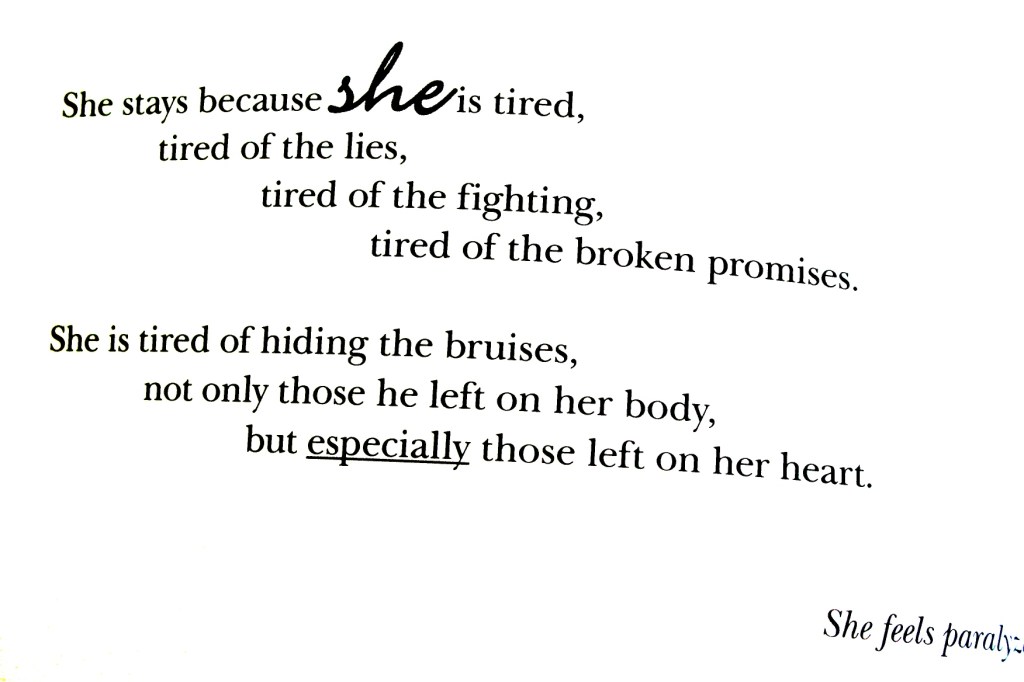
This text was published in a book, “She Stays,” by Eric Staab-Absher, director of HOPE Center in Faribault. (Text copyright of Erica Staab-Absher)

COMMENTS: If you recognize yourself or someone you love in my fictional story, first know that you are not alone. Help is available through organizations that will support you and/or your family. That may be a shelter or an advocacy/outreach organization focused on preventing domestic violence, providing education and resources, and simply being there for you. If you’re not ready for that step, talk to a trusted friend or family member. Seek help.

Leaving an abuser is not easy. It’s scary and difficult. Even dangerous. But you (or someone you love) are so worth living a life free from manipulation, control, abuse and/or violence.

VIOLENCE FREE MINNESOTA has released its “2023 Homicide Report: Relationship Abuse in Minnesota.” In 2023, there were 40 confirmed victims of intimate partner and domestic violence-related homicides in the state. That’s the highest number since tracking began in 1989. Gunshot is the leading cause of deaths. This report honors victims across Minnesota with photos and information. It’s packed with statistics and other valuable information and is well worth your read. Click here to read the full report or a summary of it.

To learn more, start by clicking here to reach the National Domestic Violence Hotline.

© Copyright 2024 Audrey Kletscher Helbling
 

Raising awareness about domestic violence because I care & so should you October 28, 2016

Filed under: Uncategorized — Audrey Kletscher Helbling @ 5:00 AM
Tags: , , , , , ,

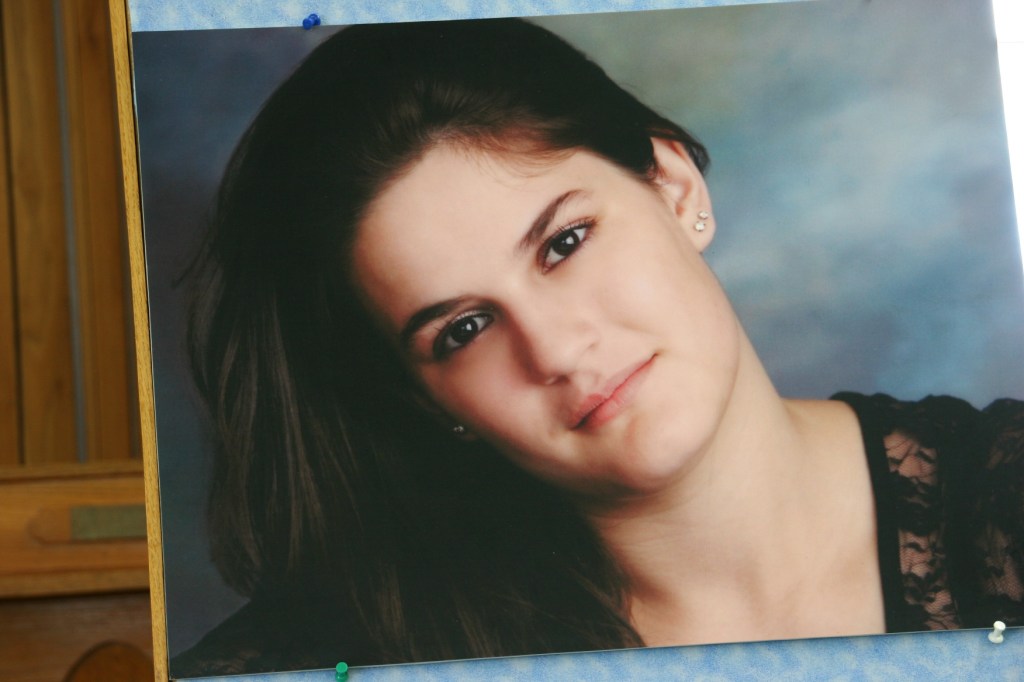
Becky Kasper's portrait.

Northfield, Minnesota, native Becky Kasper was only 19 and a student at Arizona State University when her abusive ex-boyfriend killed her on April 20, 2013. Her murderer is serving a total of 30 years in prison followed by a life-time of probation with mental health terms. Read Becky’s story by clicking here. She died in a vicious act of domestic violence. Minnesota Prairie Roots file photo.


Domestic violence thrives when we are silent; but if we take a stand and work together, we can end domestic violence.the National Network to End Domestic Violence

October marks Domestic Violence Awareness Month.


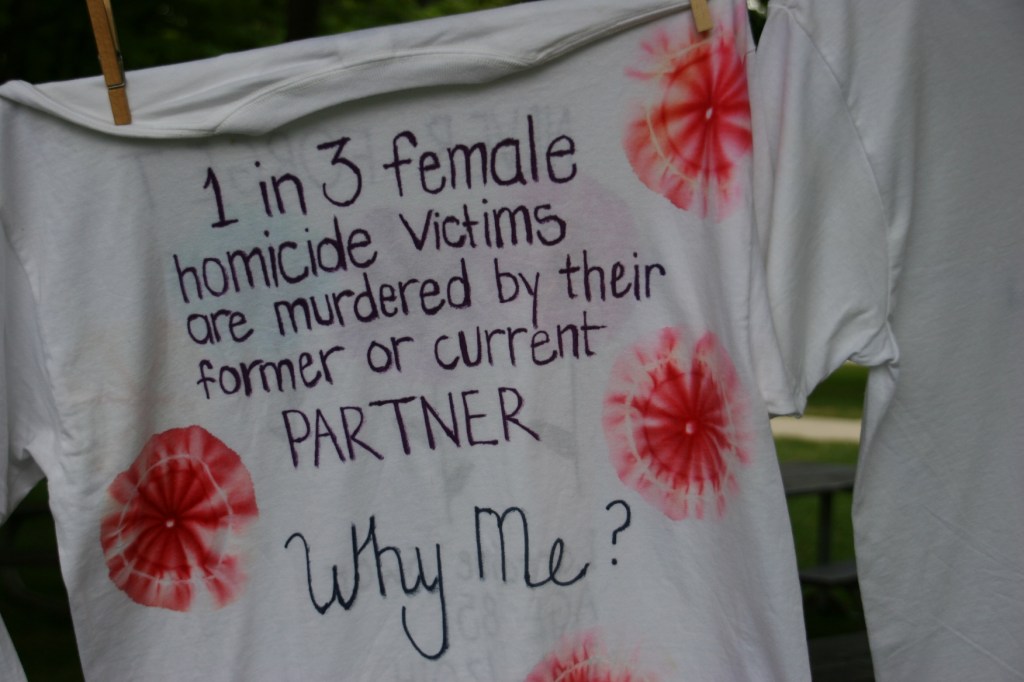
Statistics on a The Clothesline Project t-shirt from the Minnesota Coaltition for Battered Women..

“Homicide” and “murdered,” strong and accurate words on a t-shirt that is part of The Clothesline Project from the Minnesota Coalition for Battered Women. Minnesota Prairie Roots file photo 2015.


Have you thought much about domestic violence? I’ve always thought the word “domestic” minimizes the crime, as if it’s less brutal, less meaningful, less harmful. It’s not. The emotional wounds, especially, run long and deep.


Photographed on the inside of a women's bathroom stall at Lark Toys in Kellogg. Minnesota Prairie Roots file photo 2015.

Photographed on the inside of a women’s bathroom stall at Lark Toys in Kellogg. Minnesota Prairie Roots file photo 2015.


Have you been impacted by domestic abuse/violence? If you answer, no, I’d be surprised. According to the National Coalition Against Domestic Violence, one in three women will be the victims of physical violence by an intimate partner during their lifetime. Victims of domestic abuse are as close as your next door neighbor, your co-worker, the woman worshiping next to you, your hair stylist, your friend, your niece, your college roommate…you just may not realize it. I can personally list about 20 women by name (family, friends and indirect acquaintances) who have been victims of domestic violence/abuse. Several of them died. Murdered by their abusers.


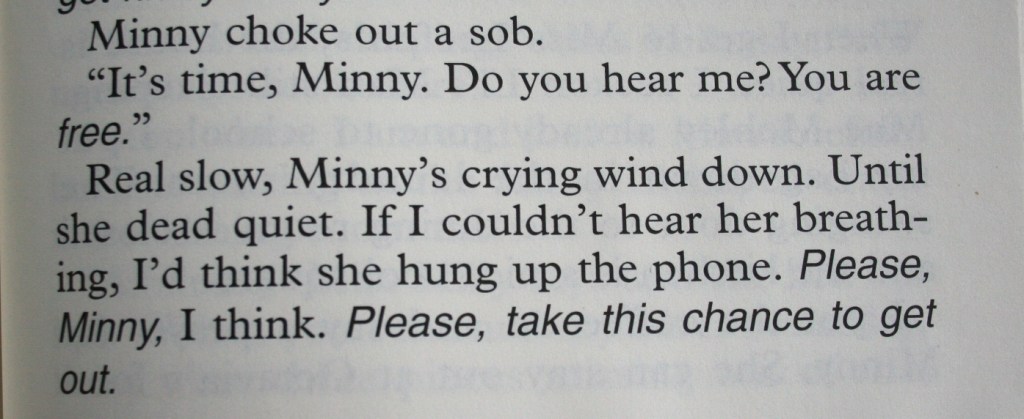
Profound words for anyone who's been abused or known someone who's been abused or is in an abusive relationship.

Profound words for anyone who’s been abused or known someone who’s been abused or is in an abusive relationship from the book, The Help. In this section, Aibileen is talking on the phone with her friend, Minny, who is hunkered down in a gas station after leaving her abusive husband.


Are you in an abusive relationship? If you are, I want you to know that you do not deserve this. You are not somebody’s property. You are stronger than you think. There are individuals and organizations who can help you. Don’t do it alone. Leaving an abuser is dangerous; have a safety plan in place before you attempt to leave. You can break free. I believe in you.


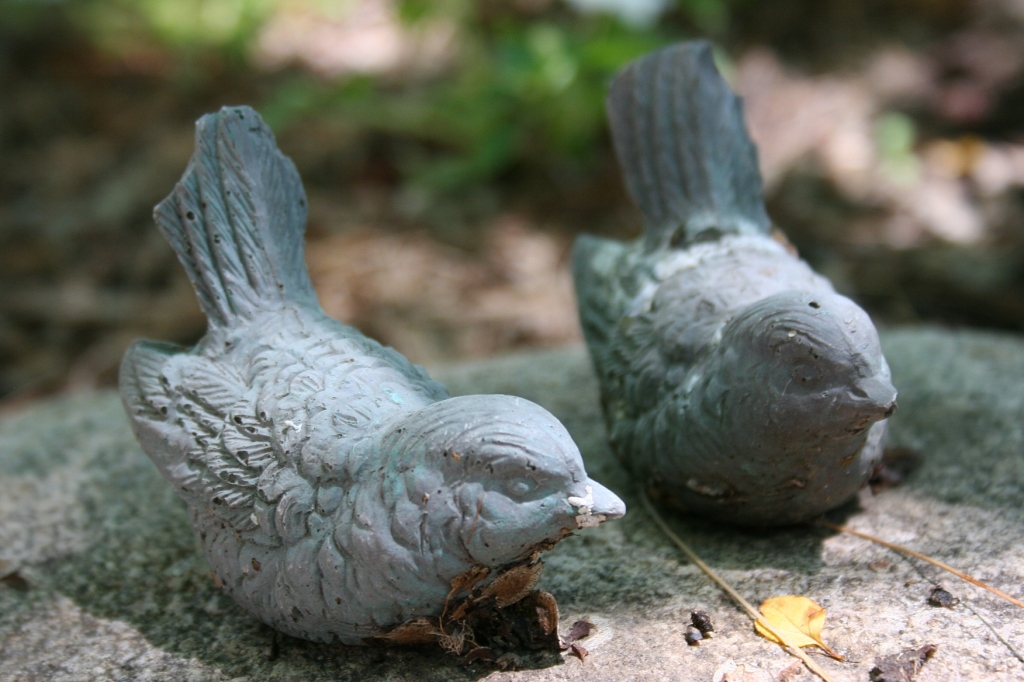
Bird art perched on a front yard rock.

Survivors are no longer birds in a cage. They are free. Minnesota Prairie Roots file photo.


Are you a survivor? I admire you and your strength. You are F-R-E-E. Your abuser can no longer claim you.


Reasons she stays, published on page 18. Text copyright of Erica Staab.

Reasons she stays, published on page 18 of She Stays, written by HOPE Center Director Erica Staab. Text copyright of Erica Staab.


Through the years, I have written on this topic, and I will continue to do so. Because we need to speak out, to understand, to educate ourselves, to support victims and survivors, to hold offenders accountable, to care.

It’s that important.

#

WHAT CAN YOU DO?

  • Trust your gut. If someone raises red flags (whether in words or behavior) in a relationship, trust your instincts. Trust yourself, not him.
  • Educate yourself. If you learn one thing about domestic abuse, it should be this: Do not blame the victim. Ever.
  • Believe her.
  • Support her. Listen. Keep the communication open. Simply be there.
  • Realize you cannot “save” a woman who is in an abusive relationship. She must decide, on her own, to leave her abuser.
  • When she is ready to leave, help her stay safe. Reach out to resources in your community. Support her. Believe her.
  • Support the victim’s/survivor’s family, too.  Listen. Encourage. Be there. The impact of domestic abuse spirals like a stone dropped in water.
  • Talk to your daughters, your sons, your grandchildren, about healthy relationships.

#

FYI:

Domestic abuse is about control, manipulation and power. It can take the forms of physical (including sexual), mental, emotional, financial and spiritual abuse. Abusers want to “own” their victims; they do not.

If you are in an abusive relationship and are in immediate danger, call 911. Leaving an abuser is an especially dangerous time.

Seek help from a local resource center or safe house. Or call the National Domestic Violence Helpline at 1-800-799-7233. You deserve to be free.

© Copyright 2016 Audrey Kletscher Helbling

For purposes of this article, I reference women as victims of domestic abuse, realizing that men and children are also victims.


Raising awareness: Much more than “just a domestic” October 2, 2014

The Clothesline

The Clothesline Project, initiated in Cape Cod in 1990, addresses the issue of violence against women. Those impacted by violence against women express their emotions via decorating a t-shirt. Those are then hung on a clothesline as a way to raise awareness of domestic violence.

SHE MAY BE YOUR DAUGHTER, your sister, your niece, your next-door neighbor, your friend or co-worker’s daughter. She may even be you.

You likely know someone who has been in an abusive relationship. Except you may not realize it. These victims, mostly women, may not bear the bruises or other physical signs of abuse. The level of abuse may not have reached that stage of a slap or a push or a hand around the neck. Or a threat to kill or to kill one’s self, which spoken by an abuser should be taken as seriously as the threat of homicide.

Domestic abuse isn’t solely (and sometimes never) about the physical. It’s first about emotional and psychological control and manipulation—the lies, the deceit, the charm, the promises/proclamations of change, the “I’m sorry; I didn’t mean to do that,” the pleading, the “I won’t ever do that again,” the intimidation, the excuses, the justification for placing a hand upon a woman.

Do you know families who have lost loved ones to domestic violence? I do. The daughter of a former neighbor. The niece of a sister-in-law and brother-in-law.

Do you know families whose loved ones have been in relationships with domestic abusers? I do.

Let’s stop for a moment. I wish domestic violence/abuse wasn’t termed as such. The word choice minimizes the crime. If a woman is killed by her husband or partner, it’s murder. Murder. If she’s physically harmed, it’s assault or attempted murder. You can agree or disagree, but the words “domestic violence/abuse,” for me, minimize the act as if a relationship lessens the crime, putting blame upon the victim.

Blame. Don’t blame the victim. Ever. If you think a woman can simply leave the man she loves, or thinks she loves, then you do not understand the very basic premise of domestic abuse. Control. Manipulation. Power.

Equally as important is remembering that you cannot “make” a woman leave an abusive relationship. That must be her decision.

October marks Domestic Violence Awareness Month. We each hold a personal responsibility to understand and educate ourselves about this crime. You need look no further than the court report in your local newspaper or to sports figures held in such (undeserved) high esteem to see how domestic violence against (mostly) women permeates our society. Maybe you need only look next door or in the mirror.

This month, determine to understand and to educate yourself, to do something in whatever way you can to honor those women who have died, those women who have survived and, yes, even those women who have no clue they are in an abusive relationship.

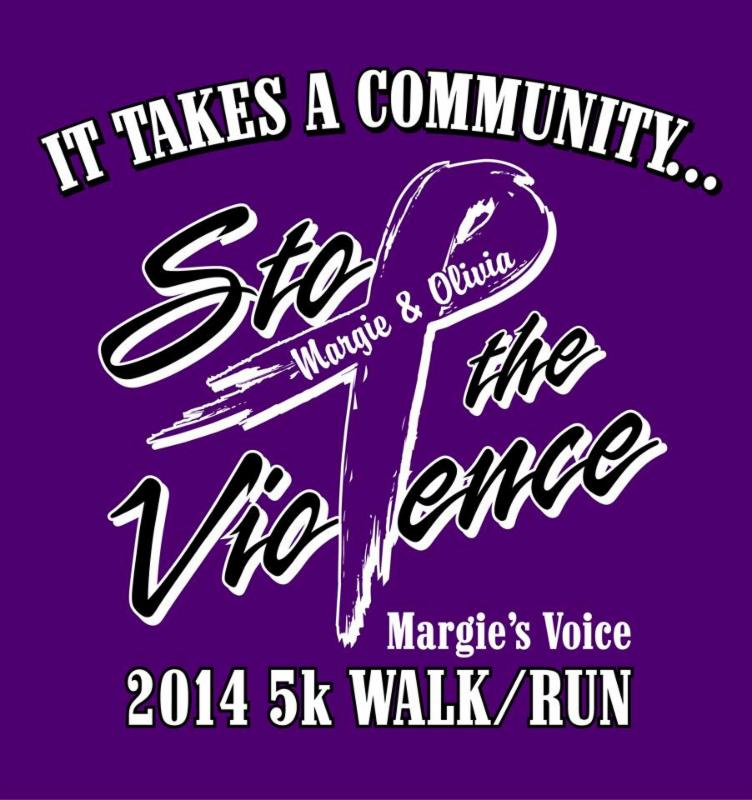
Margie's VoiceDonate monies to a local support center that focuses on assisting victims and/or survivors of domestic abuse. In my community, Ruth’s House of Hope, a shelter for homeless women and children located several blocks from my house; HOPE Center, a site offering support to those dealing with sexual and domestic violence; and Whispers of Hope, a faith-based healing center for young women, are always in need of financial gifts.

All three of those resource centers will benefit from an a capella concert fundraiser set for 4 p.m. Saturday, October 4, at River Valley Church in Faribault.

Or participate in a domestic violence awareness fundraiser like Margie’s Voice 5K Walk/Run, beginning at 8 a.m. Saturday, October 4, at the River Bend Nature Center in Faribault. Margie’s Voice honors the memory of Margie (Brown) Holland and her unborn daughter, Olivia. Roger Holland was sentenced to two terms of life in prison for the 2013 murders of his wife and daughter. Margie’s dad once lived across the street from me.

Yes.

She may be your daughter, your sister, your niece, your next-door neighbor, your friend or co-worker’s daughter. She may even be you.

FYI: If you are in an abusive relationship, seek help now by calling a local resource center or the National Domestic Violence Hotline at 1-800-799-SAFE (7233). Click here to reach the national website for more information.

© Copyright 2014 Audrey Kletscher Helbling