Minnesota Prairie Roots

Writing and photography by Audrey Kletscher Helbling

“Winter’s Song,” memories, reflections & writing from Minnesota March 21, 2024

This abandoned farmhouse once stood along Minnesota State Highway 19 east of my hometown of Vesta on the southwestern Minnesota prairie. It’s no longer there. (Minnesota Prairie Roots copyrighted file photo 2013)

A TIME EXISTED when I loved winter. The snow more than the cold. During my growing up years on a southwestern Minnesota farm, I could not wait for the first snowfall, which then piled snow upon snow upon snow for months.

This huge, hard-as-rock towering snowdrift blocked my childhood farm driveway in March 1965. (Photo credit: Elvern Kletscher)

Fierce prairie winds swept snow around outbuildings, sculpting rock-hard drifts, an ideal landscape for Canadian Mounties. Snow pushed into piles by the loader of Dad’s John Deere tractor became mountains, rugged terrain to conquer. And pristine snow presented the perfect canvas for a game of Fox and Goose.
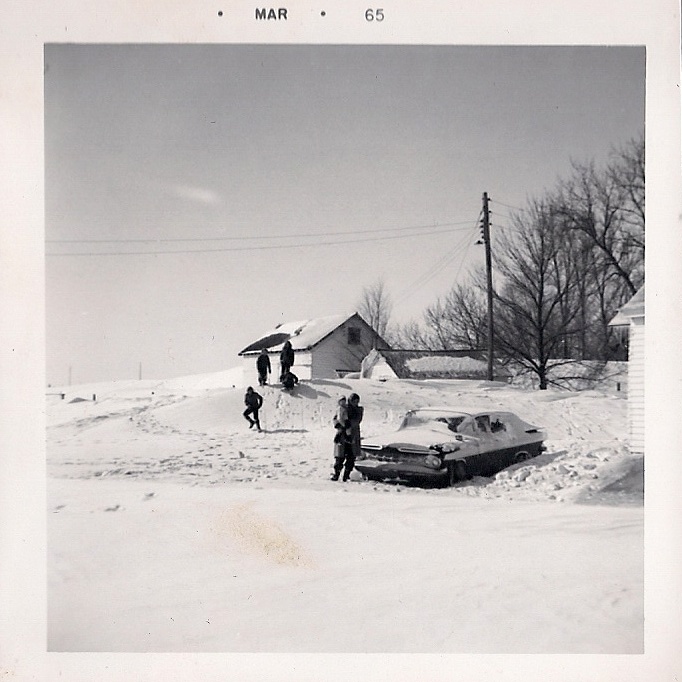
Our southwestern Minnesota farmyard is buried in snowdrifts in this March 1965 image. (Photo credit: Elvern Kletscher)

I remember, too, the crisp winter evenings of walking from barn to house after finishing chores. Packed snow crunched beneath my buckle overshoes. Frigid air bit at my nose, my mouth streaming billows of vapor. Overhead a billion stars pricked light into the immense black sky. Ahead of me, windows glowed in our tiny wood-frame farmhouse.

Those are the good memories I choose to remember. Not the near-frozen fingers. Not the pot on the porch because we had no bathroom. Not the house foundation wrapped in brown paper to seal out the cold. Not the central oil-burning stove that never kept the house warm enough.

Today I have it so much better. A warm house with a bathroom. No cows or calves to feed or straw bales to shake or manure to scoop. No dealing with cracked, chapped, bleeding hands. I have every reason today to embrace winter minus many of the hardships of yesteryear. But I find I don’t.

I’m working, though, on shifting my attitude back to that of appreciating a season which is often harsh here in Minnesota, although not in this unseasonably mild and nearly snow-less winter of 2023-2024. Last winter, now that was a record snowfall winter which tested many a life-long Minnesotan. Except perhaps my friend Jackie of Rochester, who loves winter.
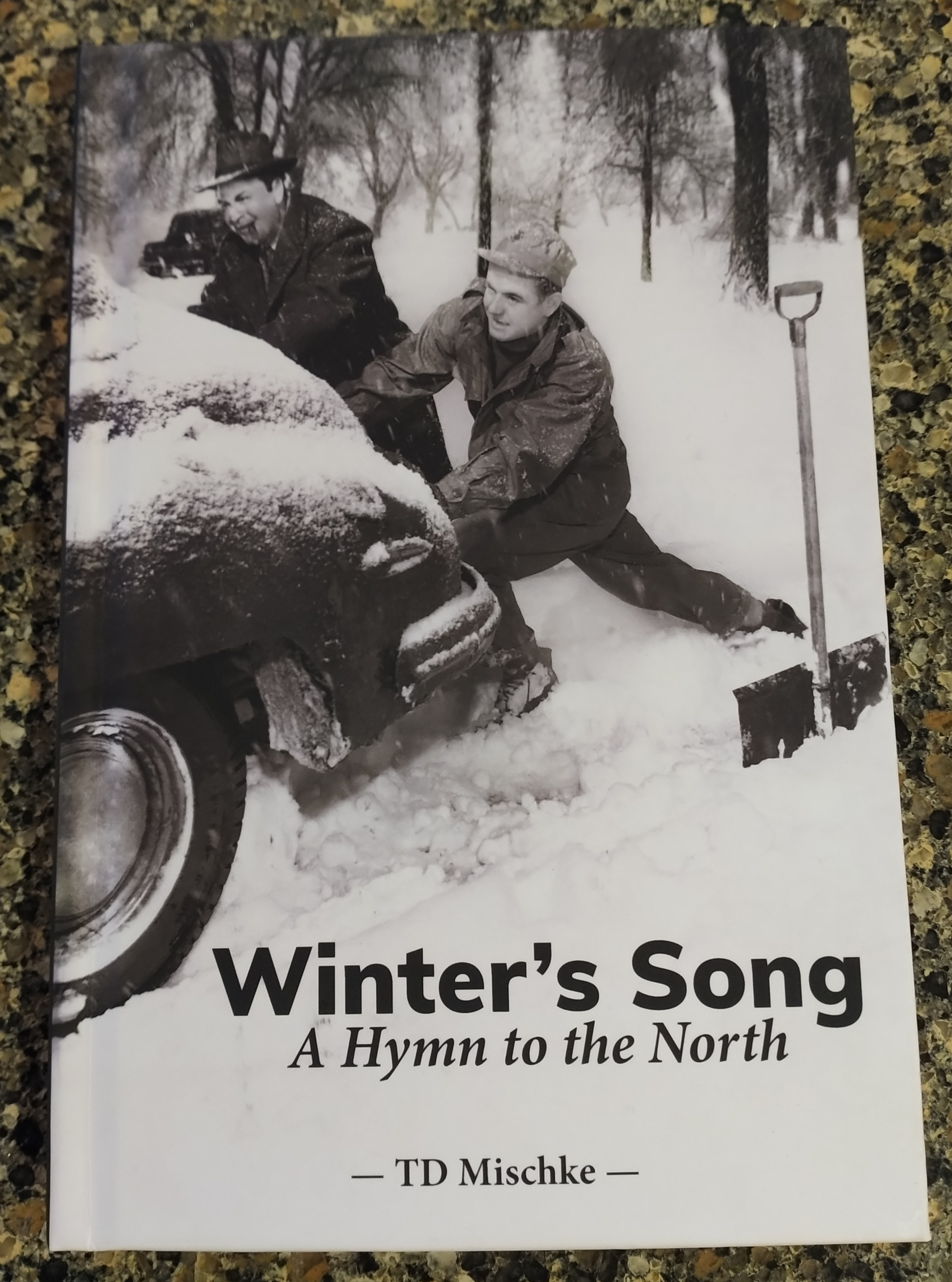
The vintage winter photo gracing the cover of Mischke’s book is from the archives of the Minnesota Historical Society. (Minnesota Prairie Roots photo)

Writer, musician, podcaster and former radio talk show host TD Mischke also loves winter (most of the time) as evidenced in his book Winter’s Song—A Hymn to the North, published in 2023 by Skywater Publishing Cooperative. I happened upon his collection of winter writing at my brother-in-law and sister-in-law’s house north of the metro. Jon is about as avid an outdoorsman as they come. Hunting. Fishing. And in the dead of winter, spearfishing on the frozen lake. This seemed a book written just for him.

Recognizing the Mischke name, I immediately inquired whether the writer, TD Mischke, was any relation to Sy Mischke, friend of my late father-in-law. Sy, a “character” by my definition, was TD’s uncle. TD Mischke certainly writes about characters in Winter’s Song.
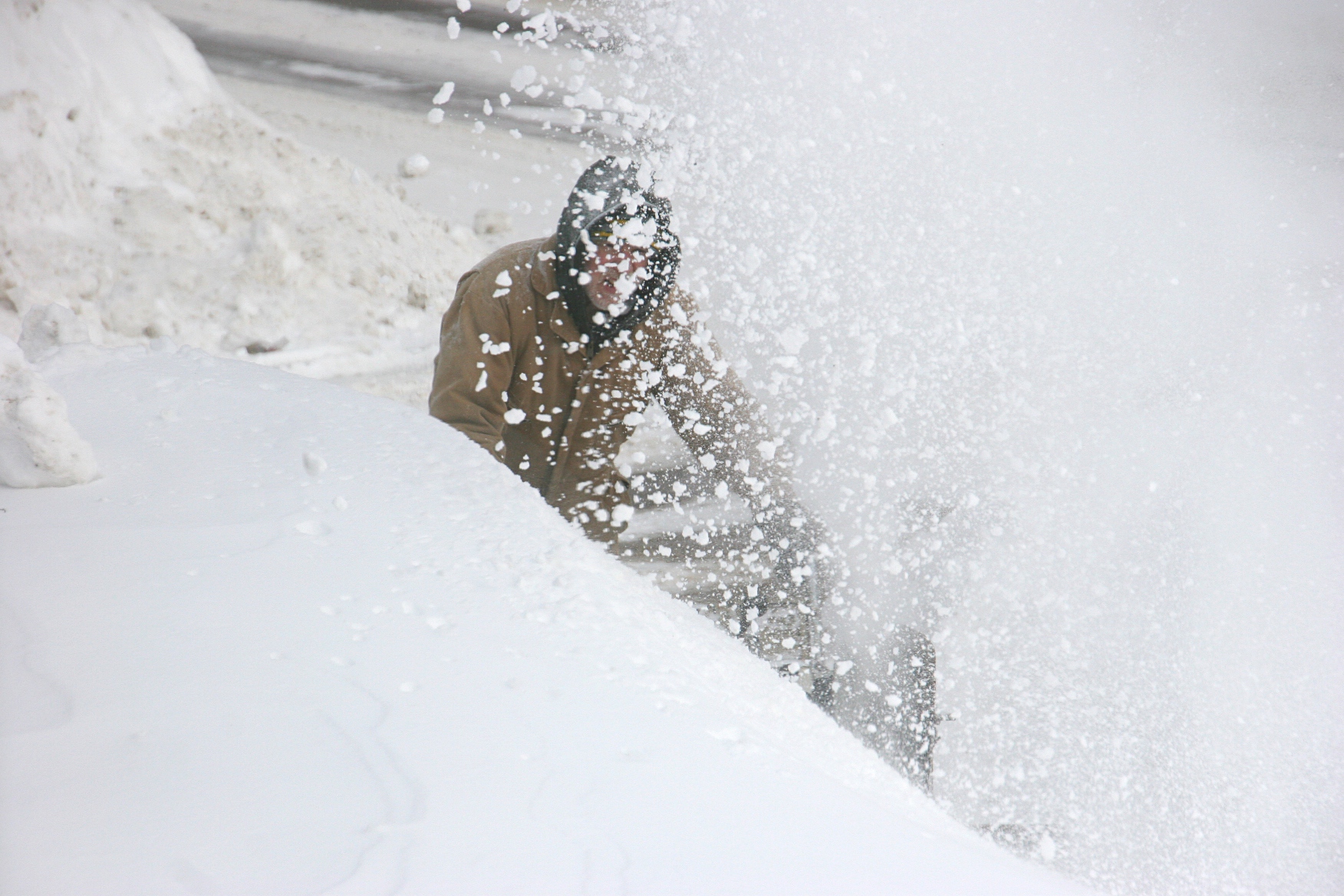
Clearing snow is a sometimes endless task during a Minnesota winter. (Minnesota Prairie Roots copyrighted file photo)

His collection of short stories, essays and three poems honors Midwest winters. Not in a fully nostalgic way, but with a mix of reality. Winters are, admittedly, brutal. But also brimming blessings. The word “hymn” in the book title fits.
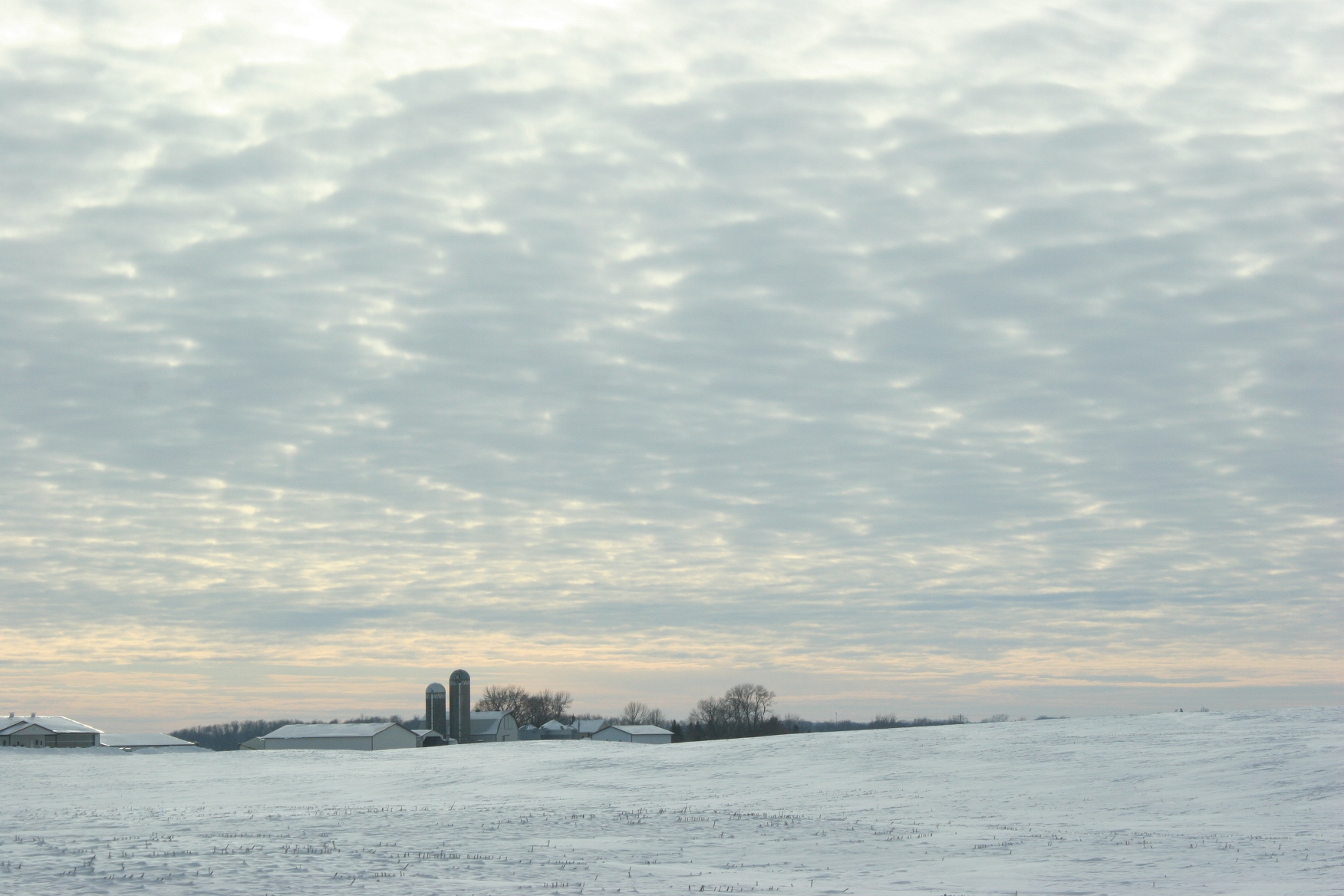
A lovely winter scene photographed in 2019 north of Faribault. It portrays the beauty of winter. (Minnesota Prairie Roots copyrighted file photo 2019)

As I read through the short chapters, I found myself liking winter more and more. And that’s thanks to Mischke’s storytelling skills, his attention to detail, his introspective writing, his humor, his honest portrayal of winter in Minnesota. Not everyone is meant to live here. That Mischke acknowledges. But he also acknowledges the toughness, stamina, strength and endurance of those who call the North home. I agree that it takes a bit of fortitude to manage some six months of winter. I felt in that moment a sense of pride as a life-long Minnesotan.

Spring erupts in budding trees at Falls Creek Park, rural Faribault. (Minnesota Prairie Roots copyrighted file photo May 2019)

That brings me to the second to last chapter of Winter’s Song—“Lessons of March.” It seemed only fitting that I was reading this chapter near the end of March on a day of predicted snow. I’ve never liked March much. But Mischke reminded me that this often grey month, which can throw in surprise snowstorms, should be appreciated for the simple reason that it makes us appreciate April even more. The arrival of spring. He’s right. Winter is often about perspective. After finishing Winter’s Song, I feel my thoughts shifting toward a renewed appreciation for this longest of seasons here in Minnesota.

FYI: Winter’s Song—A Hymn to the North is a finalist for the 2024 Emilie Buchwald Award for Minnesota Nonfiction. Minnesota Book Award winners will be announced May 7. To listen to TD Mischke’s podcast, The Mischke Roadshow, click here.


Book review: A collection of short stories & art from the Minnesota prairie by Elizabeth Johanneck July 27, 2023

The cover of Elizabeth Johanneck’s new book features the art of her grandfather, Arnold Kramer. (Minnesota Prairie Roots photo July 2023)

DECADES REMOVED from southwestern Minnesota, Twin Cities writer Elizabeth Johanneck and I remain rooted to the prairie—the land and people and smalls towns which shaped us. We both grew up on Redwood County farms, were Wabasso High School classmates and today hold a deep respect and fondness for the place we once called home.

Beth, as she’s known to me, recently published a book, If You Can’t Make it to Heaven, at Least Get to Seaforth—The Monica Stories and Then Some. This book features short stories and snippet observations in Beth’s humorous storytelling style, plus paintings and photos. These could be my stories, my memories, just with different characters and settings. Any prairie farm kid likely will feel the same.

ABOUT SEAFORTH & MONICA

But where is Seaforth? And who is Monica? Seaforth, population 77, is a farming community located along County Road 7, south of Minnesota State Highway 19 in central Redwood County. It’s near my hometown of Vesta, seven miles to the northwest. Monica Fischer is Beth’s friend, former co-worker and a character. A baby shoe in a pot of egg coffee and pantyhose found clinging inside a pant leg during Catholic Mass are among the many entertaining Monica stories that left me laughing aloud. By the time I’d finished reading this section of the book, I felt like I knew Monica well. Everyone should have a friend like her.

GROWING UP ON THE MINNESOTA PRAIRIE IN THE 1960s

And everyone should be so fortunate to have experienced rural Minnesota life in the 1960s, as Beth and I did. It is Part 2, “Random Nonsense of a MN Country Mouse,” that I find most similar to my childhood. Both farmers’ daughters with many siblings, Beth and I share the commonalities of being raised on the land among aunts and uncles and cousins and grandparents and immediate family who loved us deeply.

As in “The Monica Stories,” Beth writes about her personal experiences in a casual conversational style. It’s as if she and I are chatting over cups of coffee, and Beth does like her coffee. I connect with her stories about “the grove,” jars of pocket gopher feet in the freezer, grab bags, bloodsuckers, The Weekly Reader, hearing corn grow and more.

Her humor-infused short stories stretch into adulthood, into becoming a parent and grandparent. These are not earth-shattering remembrances, but rather observations about everyday life and events that could be mine, could be yours, but are definitively Beth’s.

NIBBLES OF COUNTRY INSIGHTS

In a section titled “Country Mouse Nibbles,” Beth shares her thoughts on topics in a sentence or two, the first being “When You Are Raised Close to the Land.” I fully understand—the smell after autumn harvest, looking to the west for approaching storms, filled fruit jars crowding root cellar shelves… And “Holding onto Memories”—Distant cheers from a local ball game are souvenirs worth saving for winter. Truly poetic words.

FEATURING THE ART OF “MINNESOTA’S GRANDPA MOSES”

There is much to be cherished in this book beyond pages and pages of rural memories and insights. Beth also intersperses photos, most from Seaforth. But it is Part 3, “Paintings by Arnold Kramer, Minnesota’s ‘Grandpa Moses,’” which is an historic agrarian art treasure. Following his retirement, Seaforth farmer Arnold Kramer took up painting, visually documenting early to mid-1900s rural life and scenes. He became well-known for his folk art style paintings done in primary colors. Beth’s book holds the only printed collection of paintings by her grandfather. The self-taught artist created more than 400 works of art and was dubbed “Minnesota’s Grandpa Moses” by the University of Minnesota at the peak of his creativity in the 1960s.

Book signing promo courtesy of Elizabeth Johanneck.

BOOK SIGNING SATURDAY IN SEAFORTH

Like her grandfather before her, Beth is also a visual artist. She illustrated a just-published children’s picture book by her lifelong friend, Cindy Bernardy Lavin, our WHS classmate. Both writers, along with Monica Pistulka Fisher, are doing a book signing from noon to 3 pm this Saturday, July 29, at the C4th Bar during Seaforth’s Hometown Days celebration.

Beth’s book is also available for purchase at Chapter Two Bookstore in Redwood Falls and online at Amazon and Barnes & Noble. Both her book and Cindy’s achieved bestseller status on Amazon following their release.

Julie Kramer, author of bestseller Stalking Susan, praises Beth’s book in her back cover endorsement, calling it “a delightful collection from a farm girl who grew up near the Minnesota home of Laura Ingalls Wilder.” I agree. Fully.

#

Disclaimer: I edited Beth’s book and advised her on the manuscript. She also included my poem, “Her Treasure,” as a companion piece in the “Country Mouse Nibbles” section. For many years, Beth hosted a blog, Minnesota Country Mouse.

© Copyright 2023 Audrey Kletscher Helbling


Heartache. Hope. Help. October 19, 2022

Sunrise on Horseshoe Lake in the central Minnesota lakes region. (Minnesota Prairie Roots copyrighted photo September 2022)

I’M FEELING A BIT INTROSPECTIVE these days. Perhaps it’s the season. Perhaps it’s the state of the world. Perhaps it’s the challenges faced by people I love, people in my circle. I can’t pinpoint a specific reason for feeling this way, only a recognition that my thoughts seem more reflective.

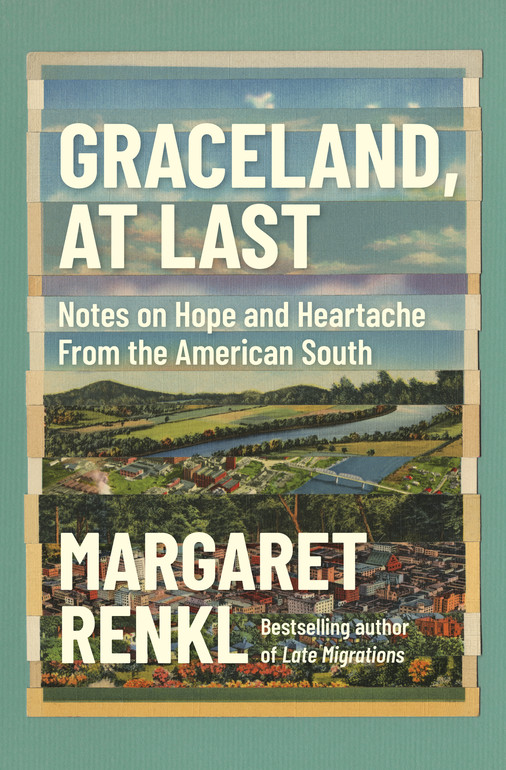
(Book cover credit: Milkweed Editions)

My reading follows that thread. I just finished Graceland, at Last—Notes on Hope and Heartache From the American South by Margaret Renkl. A friend recommended this award-winning book published by Minneapolis-based Milkweed Editions. She knew I would appreciate the essays therein which cover topics ranging from politics to social justice to the environment to family, community and more. So much resonated with me, inspired me, focused my thoughts. To read about these issues from a Southern perspective enlightened me.

Yes, this book includes political viewpoints that could anger some readers. Not me. Equally as important, Renkl also writes on everyday topics like the optimism of youth. I especially appreciated her chapter, “These Kids Are Done Waiting for Change.” In that essay on youth activists, she concludes: They are young enough to imagine a better future, to have faith in their own power to change the world for good.

Sam Temple, 21, is running for county commissioner in Rice County. (Minnesota Prairie Roots copyrighted photo July 2022)

That quote fits a young candidate running for Third District county commissioner in my county of Rice. Last week I attended an American Association of University Women-sponsored debate between the two candidates, one 21, the other 67. It’s refreshing to see a young person running for public office, someone who cares deeply about his community, about issues, about history, about humanity. He is well-informed, experienced in public service, thoughtful, a good listener, invested, and brings a new, young voice into the public realm. I felt hopeful as I listened to the two candidates answer written questions submitted by the audience. There was no mud-slinging, no awfulness, but rather honest answers from two men who seem decent, kind, respectful and genuine. Those attributes are important as I consider anyone running for public office. Candidates may disagree, and these two do on some issues, but that didn’t give way to personal or political attacks.

Among Faribault’s newest apartment complexes, Straight River Apartments. Many new apartment buildings have been built in the past year with more under construction. Yet, this is not enough to meet demand. (Minnesota Prairie Roots copyrighted file photo 2022)

Renkl, in Graceland, writes on pertinent topics of concern to many of us, including those seeking election to public office. In “Demolition Blues,” an essay on housing changes in her neighborhood, she shares how housing has become unaffordable for many who work in the Nashville metro. The same can be said for my southern Minnesota community, where high rental rates and housing prices leave lower income and working class people without affordable housing. That’s linked to a severe shortage of rentals and single family homes.

It would be easy to feel discouraged by real-life issues that flow into our days whether via a book, an election, personal experiences, media… But then I think of those young activists, the young candidate running for office in my county, and I feel hope for the future.

Among the many sympathy cards I received after my mom died. (Minnesota Prairie Roots copyrighted file photo January 2022)

I feel hope, also, within. We each possess the capacity to “do something.” That needn’t be complicated as Renkl writes in her essay, “The Gift of Shared Grief.” She reminds readers of the importance of sending handwritten condolences. I understand. My mom died in January and I treasure every single card with handwritten message received. There’s something profoundly powerful and personal about the penned word, about connecting beyond technology. It doesn’t take much effort to buy a greeting card, write a few heartfelt sentences and mail it. Yet, the art of connecting via paper is vanishing. I’d like to see more people sending paper birthday cards again…I miss getting a mailbox filled with cards.

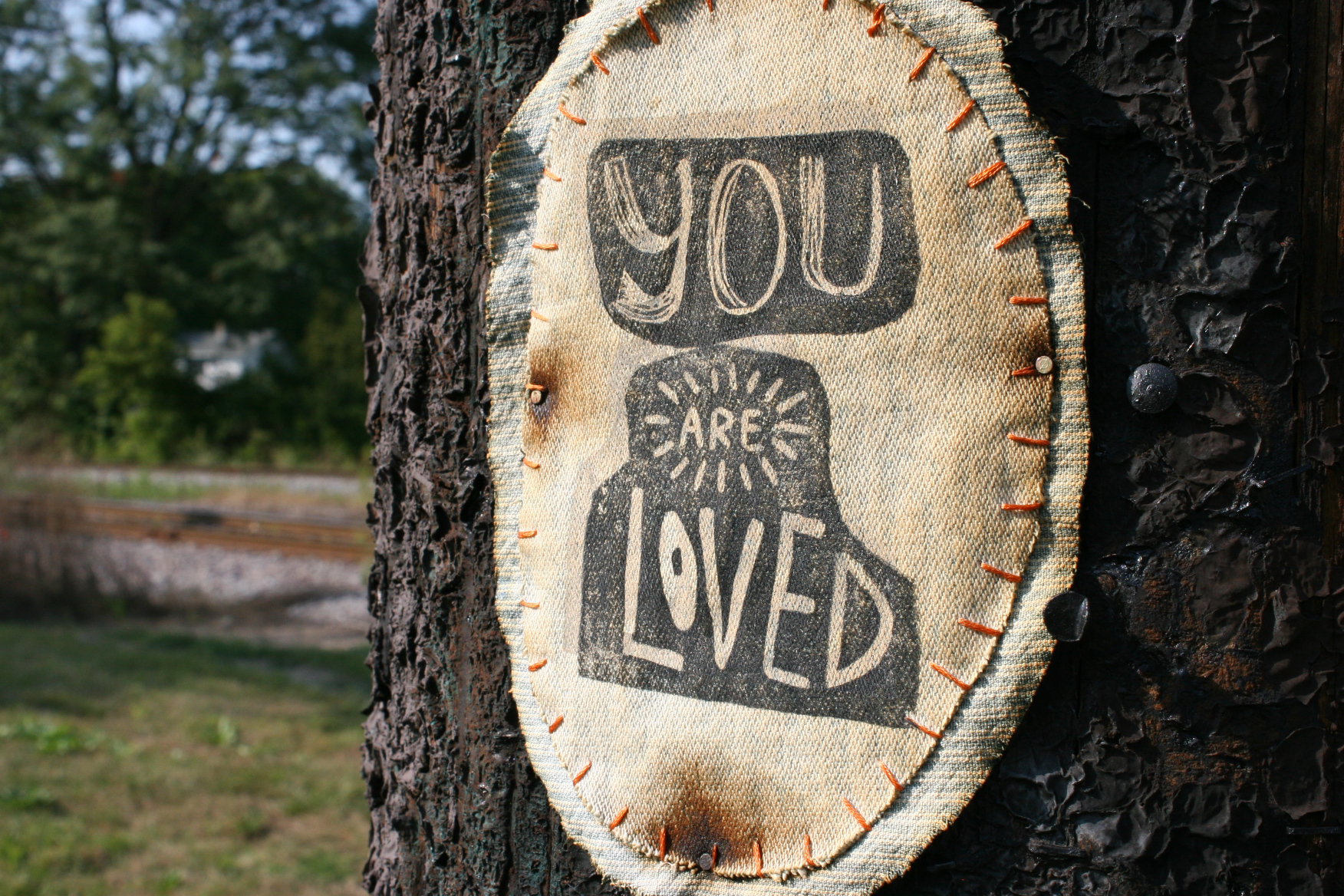
I photographed this message along a recreational trail in the Atwood Neighborhood of Madison, WI., several years ago. To this day, it remains one of my favorite public finds and photos. (Minnesota Prairie Roots copyrighted file photo)

One final essay penned by Renkl, “What It Means to Be #Nashvillestrong,” took me back to that candidate forum last Thursday. When asked to identify the most pressing issue people face locally, the younger candidate replied with “personal issues.” He’s right. No matter what we face jointly as a society (such as inflation), it is personal issues which most challenge us. Author Renkl, referencing a text from a friend, calls those—cancer, death, etc—our “private Katrina.” That in no way minimizes the death and destruction of large-scale disasters like Hurricane Katrina. But we all have something. Her friend texted: One day the sun is shining and all is intact, the next day everything is broken. And the rest of the world goes on. You’re trapped in your own crazy snow globe that’s been shaken so hard all the pieces fly loose.

And when those pieces fly loose in our circle, in our community and beyond, what do we do? We can, writes Renkl, be the hands that help our neighbors dig out.

© Copyright 2022 Audrey Kletscher Helbling


Minnesotans write about pandemics & social justice in “This Was 2020” September 8, 2021

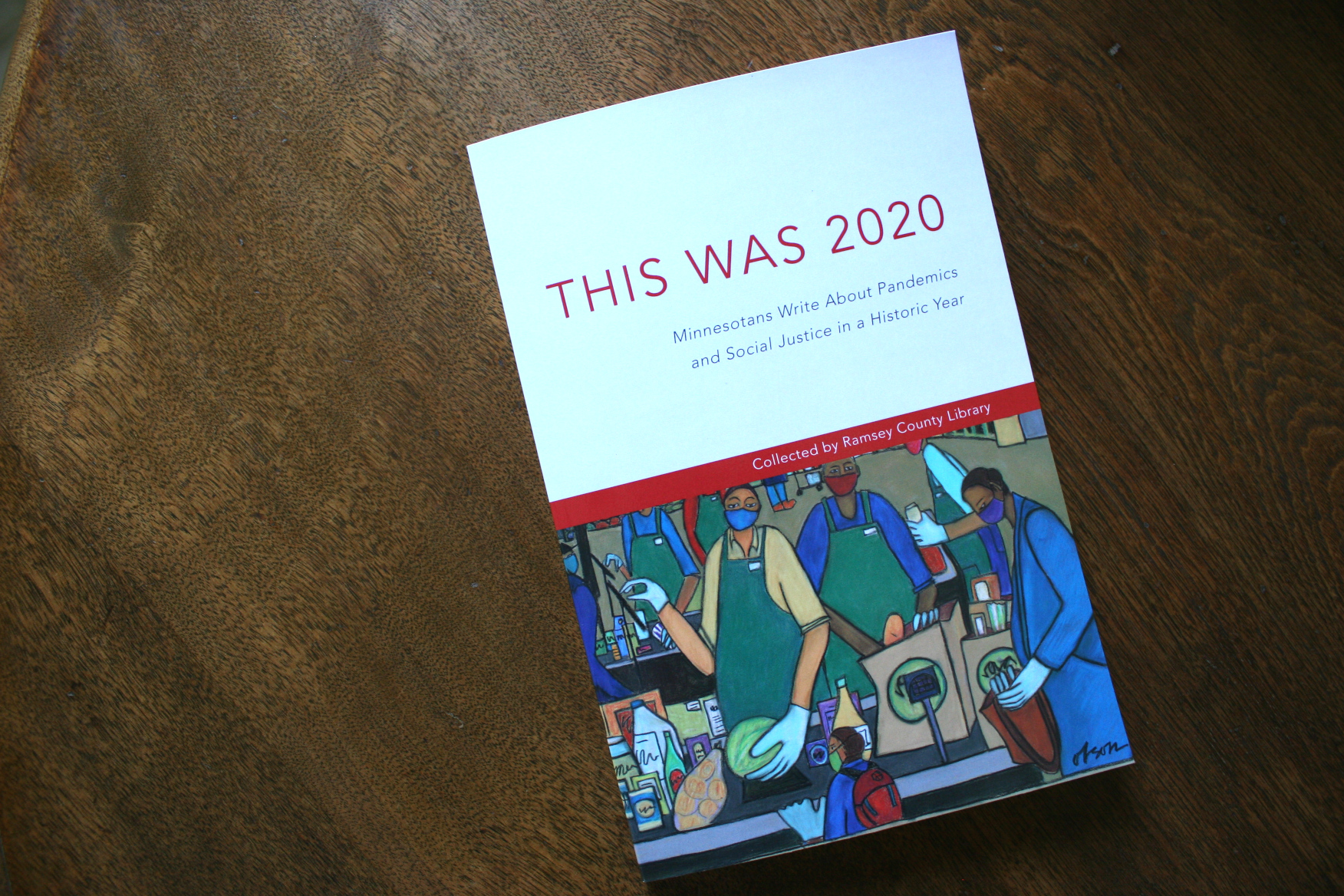
A collection of essays and poems by Minnesotans, including me. Minnesota Prairie Roots photo.

RAW. HONEST. EMOTIONAL. POWERFUL.

Those words describe This Was 2020: Minnesotans Write About Pandemics and Social Justice in a Historic Year. This collection of 54 poems and essays by 51 writers is a finalist for the Minnesota Author Project: Communities Create Award. Two other books are vying for this MNWrites MNReads honor supported by the Minnesota Library Foundation. The winner will be announced at the Minnesota Library Association’s annual conference in October.

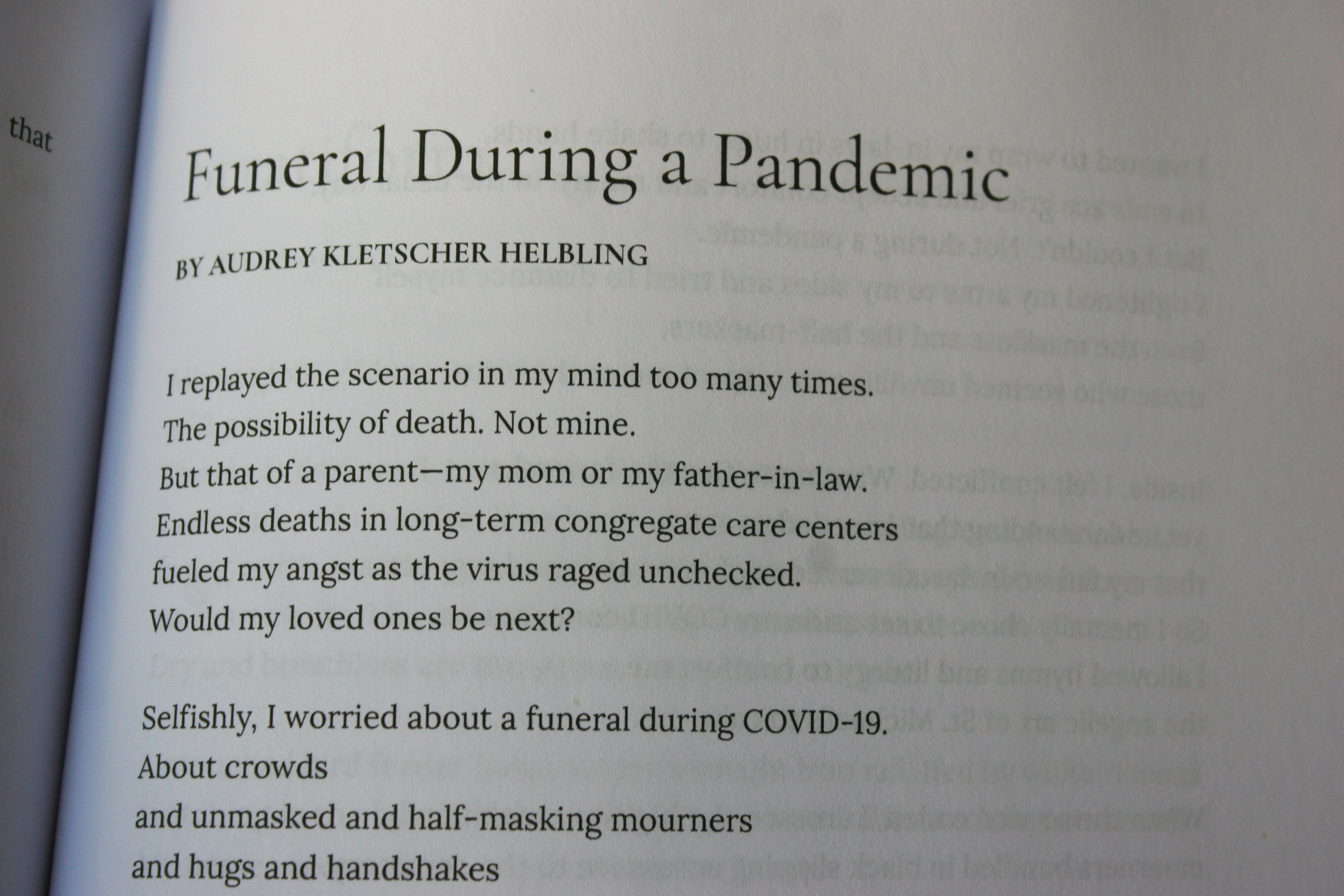
The collection includes my poem, “Funeral During a Pandemic.” Minnesota Prairie Roots photo.

I am humbled and honored to have “Funeral During a Pandemic” selected for publication in this award-nominated book. In my poem, I share my thoughts and experiences from my father-in-law’s funeral in a small rural Minnesota town. During a pandemic.

The book features short bios on each writer. Minnesota Prairie Roots photo.

As the title of this collection conveys, the 170 pages of writing focus on pandemics and social justice. Those who penned these pieces, solicited by the Ramsey County Library via a competition, are a diverse group. In age. In writing backgrounds, although many are seasoned writers with extensive writing credentials. In skin color and ethnicity. In perspective and experience. That said, most writers live in the metro with a few of us from other places in Minnesota, including several from my county of Rice.

Those from outside the metro include a 12-year-old from New Market. Evelyn Pierson, in “My Experience at the George Floyd Memorial,” writes of her emotional reaction to visiting the site where Floyd died at the hands of police on May 25, 2020. It’s heart-wrenching—to feel her torrent of emotions, to read her insights and thoughts, to envision her tears. But it’s important, even necessary, to hear the voice of this eighth grader.

Just like it’s necessary to read Brainerd resident Susan Smith-Grier’s essay, “Black in White.” I find her observations and experiences of a black woman living in a primarily white community to be particularly powerful. She moved with her parents/family to north central Minnesota in the early 70s to escape the violence in Chicago. One of very few black families in her new northern home. The death of George Floyd triggered childhood memories of tear gas and rubber bullets, fires and looting…and then, today, a bit of hope that things will change.

Hope weaves into many of the pieces. As does overcoming the fear, the loss, the grief and more that too often defined 2020.

In his poem, “The streets emptied out, but their lungs,” Moyosore Orimoloye reminds us that, despite lungs filling with fluid from COVID, lungs also filled with song on the balconies of Turin.

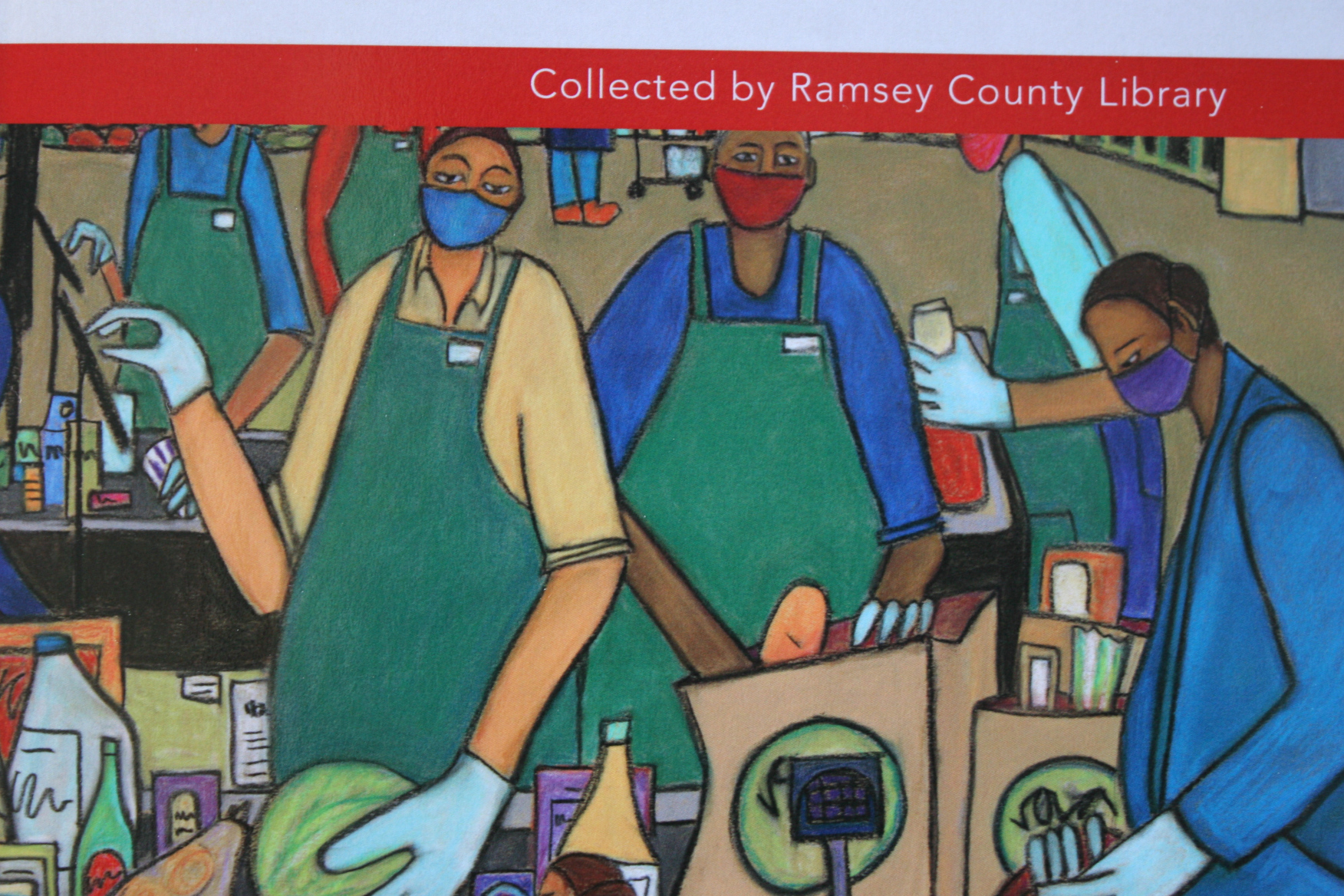
The incredible cover art features the work of Carolyn Olson, “Grocery Store Cashier and Bagger (Essential Workers Portrait Series #1). 2020, Duluth, MN. Minnesota Prairie Roots photo.

So many writers detailed how the pandemic affected them—from worries about going grocery shopping to separation from loved ones to ways in which they learned to cope. I found Dave Ryan’s “Living and Dying in Memory Care” profoundly relatable given my mom lives in a long-term care center. I’ve experienced some of the same scenarios—trying to visit through a window, for example. Before he could no longer visit his mom due to COVID restrictions, Ryan installed a video camera in her room. That connected him to her. But then the unthinkable happened. As I read the conclusion of his essay, my heart broke right along with his.

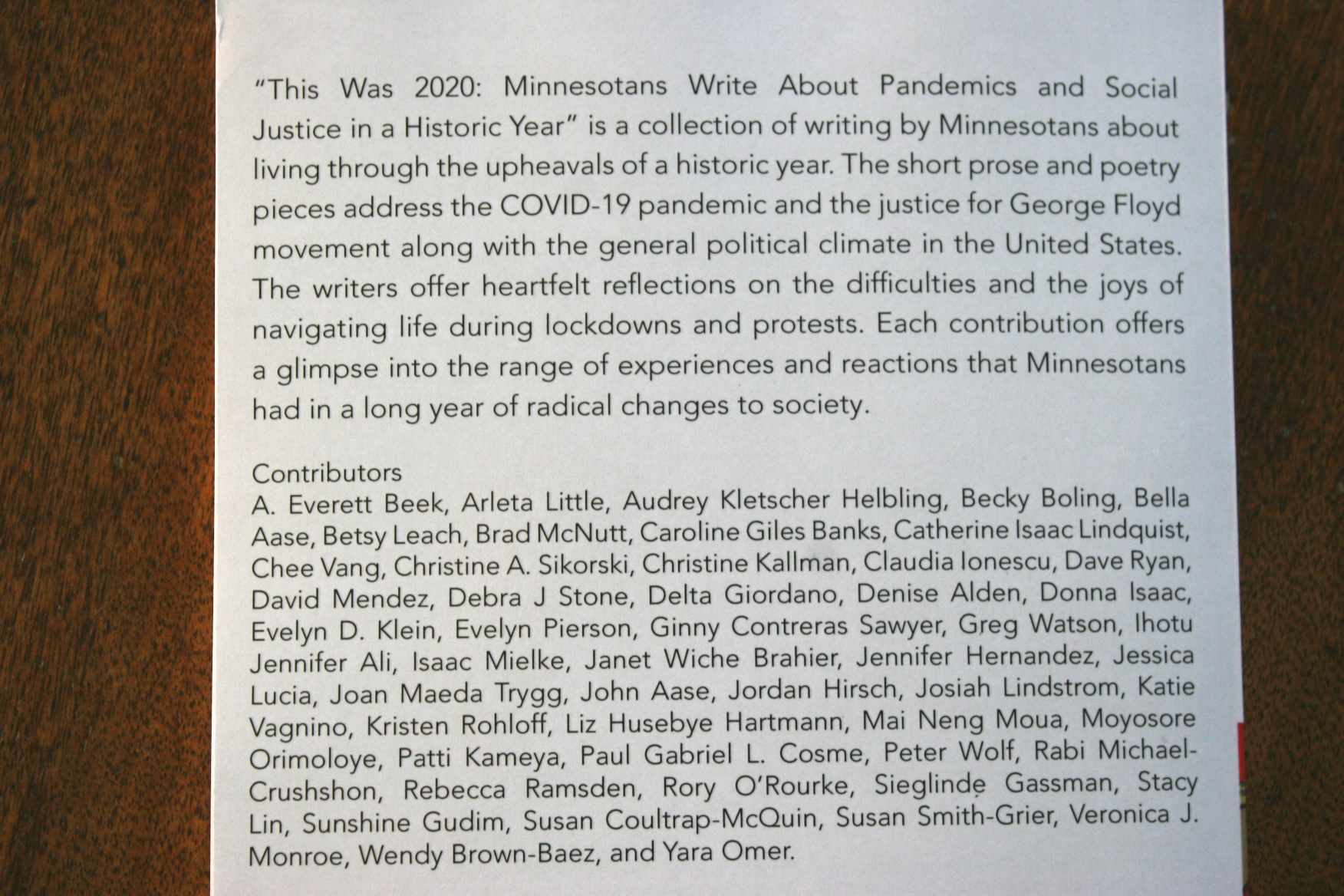
On the back cover, a summary of the book and a list of the writers whose work was selected for inclusion in this collection. Minnesota Prairie Roots photo.

These are stories you need to read. Real. Life. Authentic. Eye-opening (especially Chee Vang’s “To Kuv Niam,” about how her mother was treated upon contracting COVID). I learned so much, particularly from those writers who have experienced social injustice. From those writers, too, who live in the Twin Cities, who are widely-traveled and who have seen and experienced much more than a farmer’s daughter from southwestern Minnesota.

But I share one commonality with poet and educator Katie Vagnino of south Minneapolis. I am, like her, a Rapunzel with overgrown hair.

#

FYI: I encourage each one of you to purchase This Was 2020 by clicking here or buying it elsewhere (in print or as an e-book). Besides the 54 pieces, the book includes writing prompts, a discussion guide and a short list of grief, mental health, and anti-racism resources. This truly rates as an outstanding collection of writing that documents historical events which have forever changed us.

Publication of this book was made possible by the Minnesota Arts and Cultural Heritage Fund. Thank you, Minnesota voters, for supporting the arts. And thank you, Paul Lai of the Ramsey County Library for your hard work on, and dedication to, this book project. I appreciate you and every single writer who contributed to this exceptional must-read book.

#

© Copyright 2021 Audrey Kletscher Helbling