Minnesota Prairie Roots

Writing and photography by Audrey Kletscher Helbling

Farmer Seed mural installed as historic-themed projects underway November 12, 2025

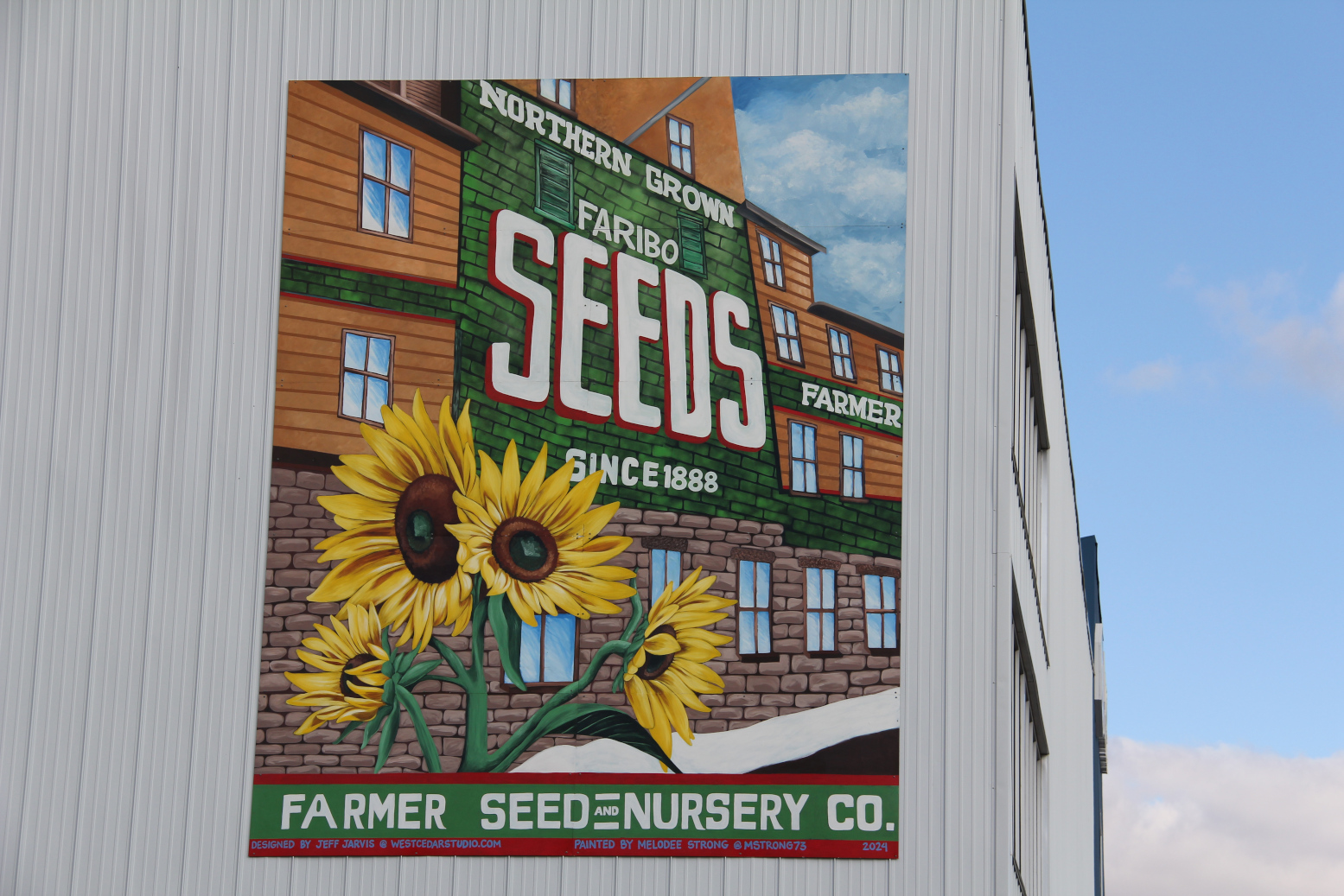
A new mural on the side of Midwest Indoor Storage celebrates Farmer Seed & Nursery’s history in Faribault. (Minnesota Prairie Roots copyrighted photo October 2025)

THE FIRST PART of a three-pronged project honoring Farmer Seed & Nursery in Faribault has been completed. Recently a 20 by 24-foot mural, designed by local historian and creative Jeff Jarvis of West Cedar Studio and painted by Minneapolis artist Melodee Strong, was installed at Midwest Indoor Storage, site of the former nursery.
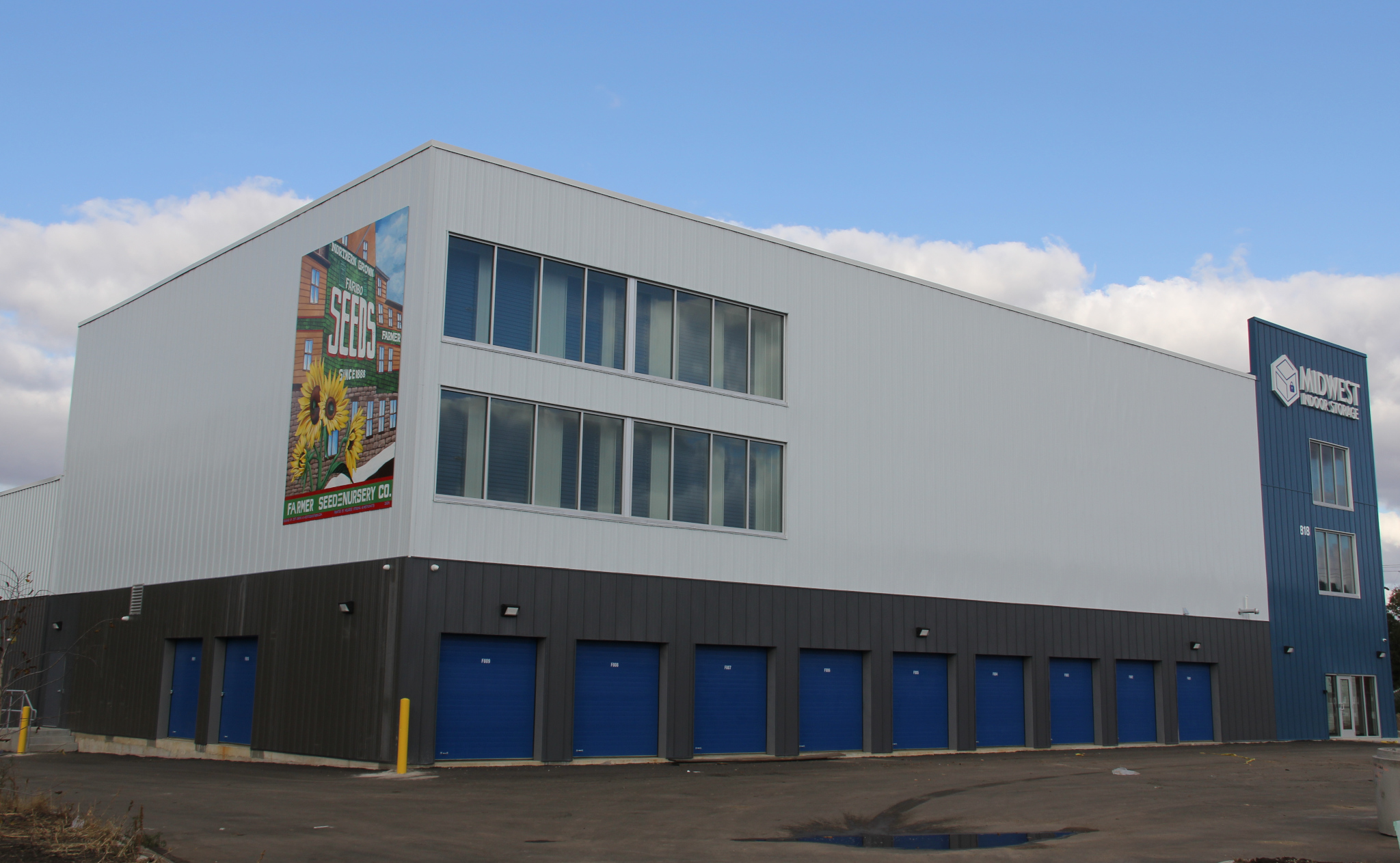
The new Farmer Seed mural hangs on an indoor storage building where Farmer Seed once stood. (Minnesota Prairie Roots copyrighted photo October 2025)

The artwork hangs on a corner of the building’s west side, visible to eastbound passersby along Minnesota State Highway 60/Fourth Street.
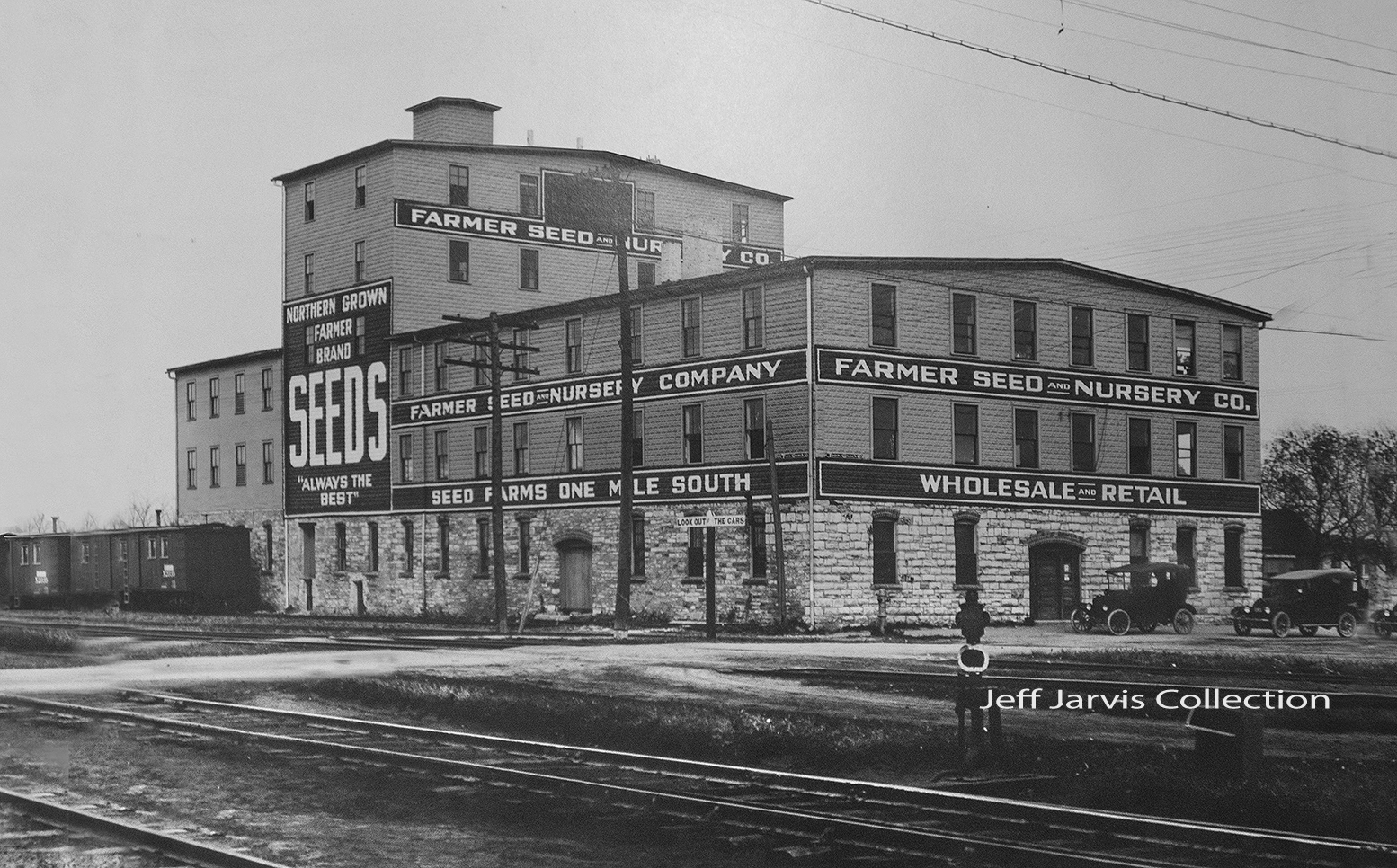
A 1920s image of Farmer Seed from the Jeff Jarvis Collection. (Photo courtesy of Jeff Jarvis)
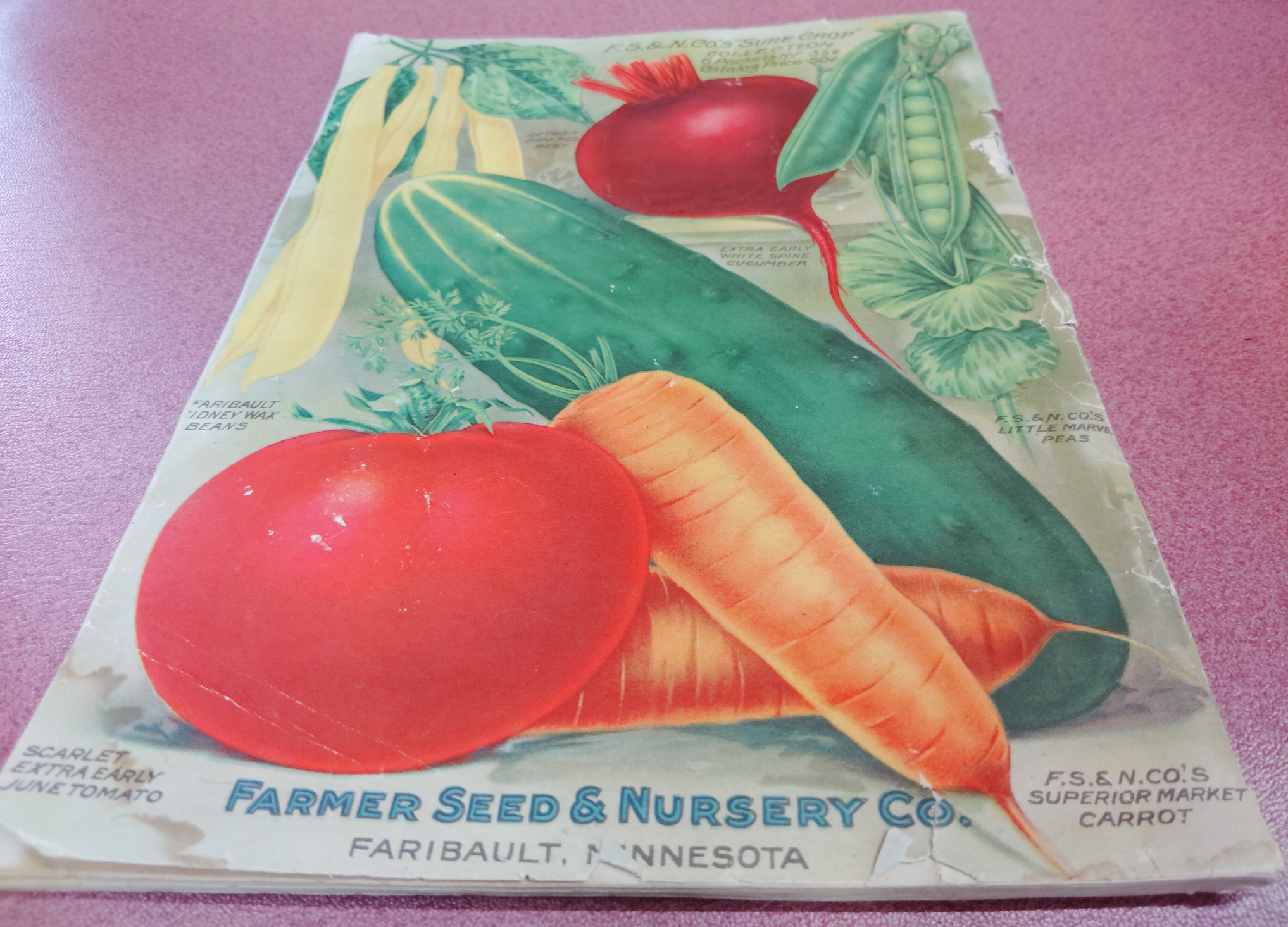
Vegetable art in a vintage seed catalog for sale at Keepers Antiques in downtown Faribault. (Minnesota Prairie Roots copyrighted photo October 2025)
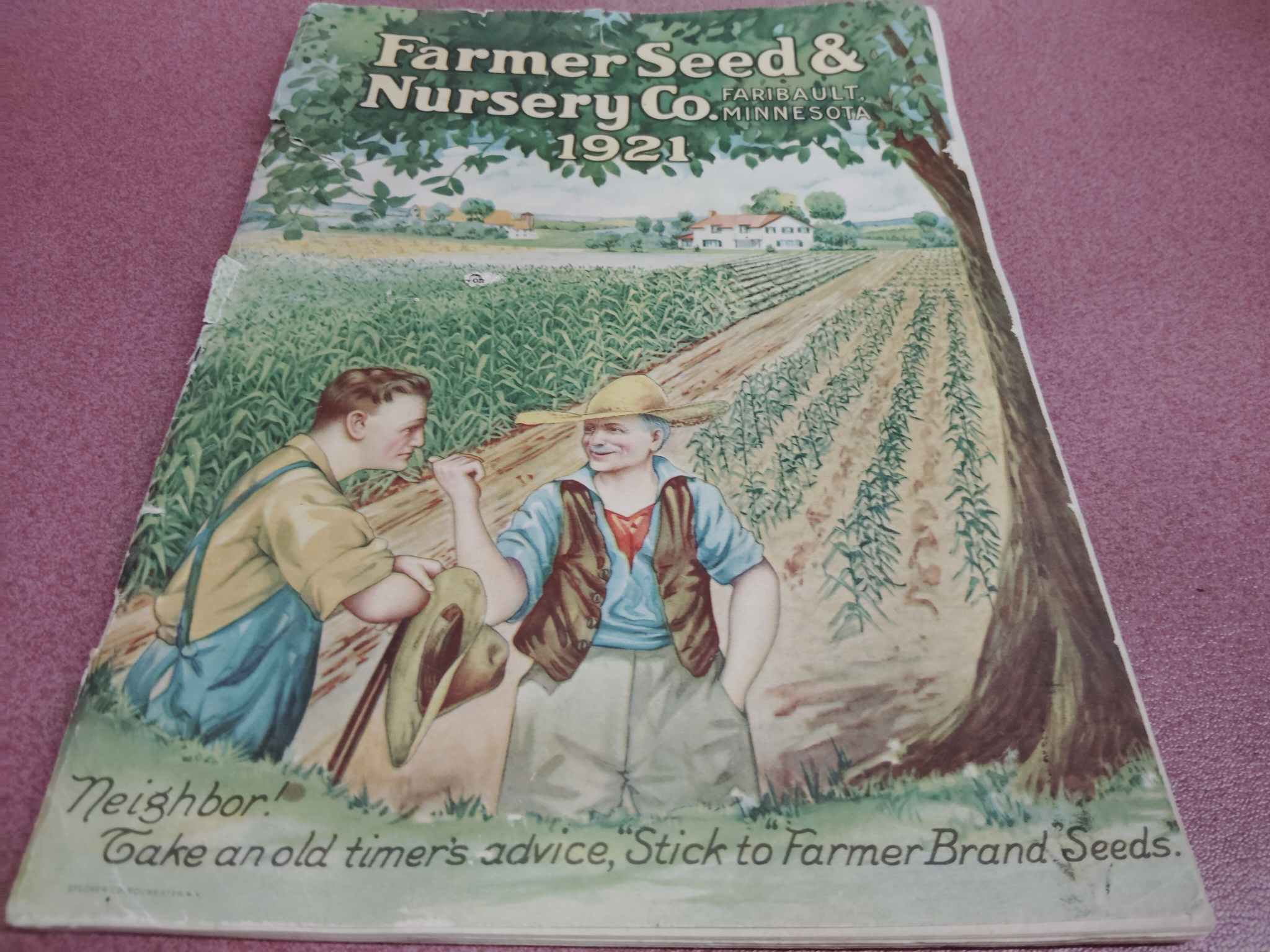
The beautiful, artsy cover of a 1921 Farmer Seed catalog found at Keepers Antiques. (Minnesota Prairie Roots copyrighted photo October 2025)

The iconic Farmer Seed and Nursery multi-level complex once rose here, an identifiable community landmark business rooted in agriculture. With nearly a 130-year history in Faribault and company roots in Chicago dating to 1888, Farmer Seed was once noted for its local seed farms, seeds, mail order seed catalog, retail store and Christmas trees. I remember paging through the company’s catalogs while growing up on a southwestern Minnesota dairy and crop farm. From vegetables to flowers to shrubs and trees, Farmer Seed offered endless options for the everyday gardener, farmer and other growers.
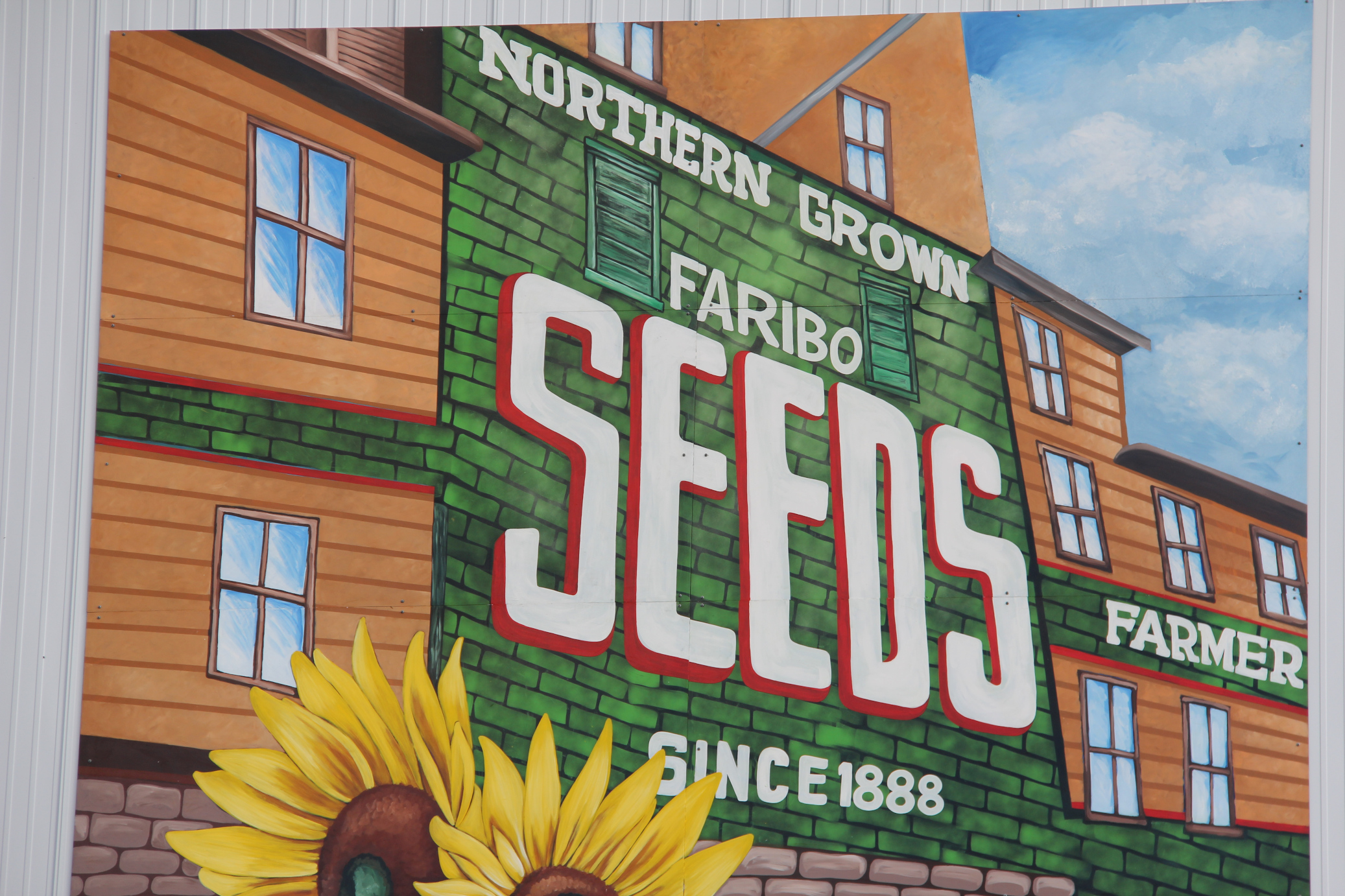
Simple, bright, bold and memorable graphics define the mural. (Minnesota Prairie Roots copyrighted photo October 2025)

Today the mural and a forthcoming kiosk and memory book will continue to celebrate this long-time Faribault business. In designing the mural, Jarvis kept it simple, focusing on the signature exterior signage that graced the historic building. He added a splash of color in a clutch of sunflowers, highly recognizable, he said, and a popular agricultural symbol.
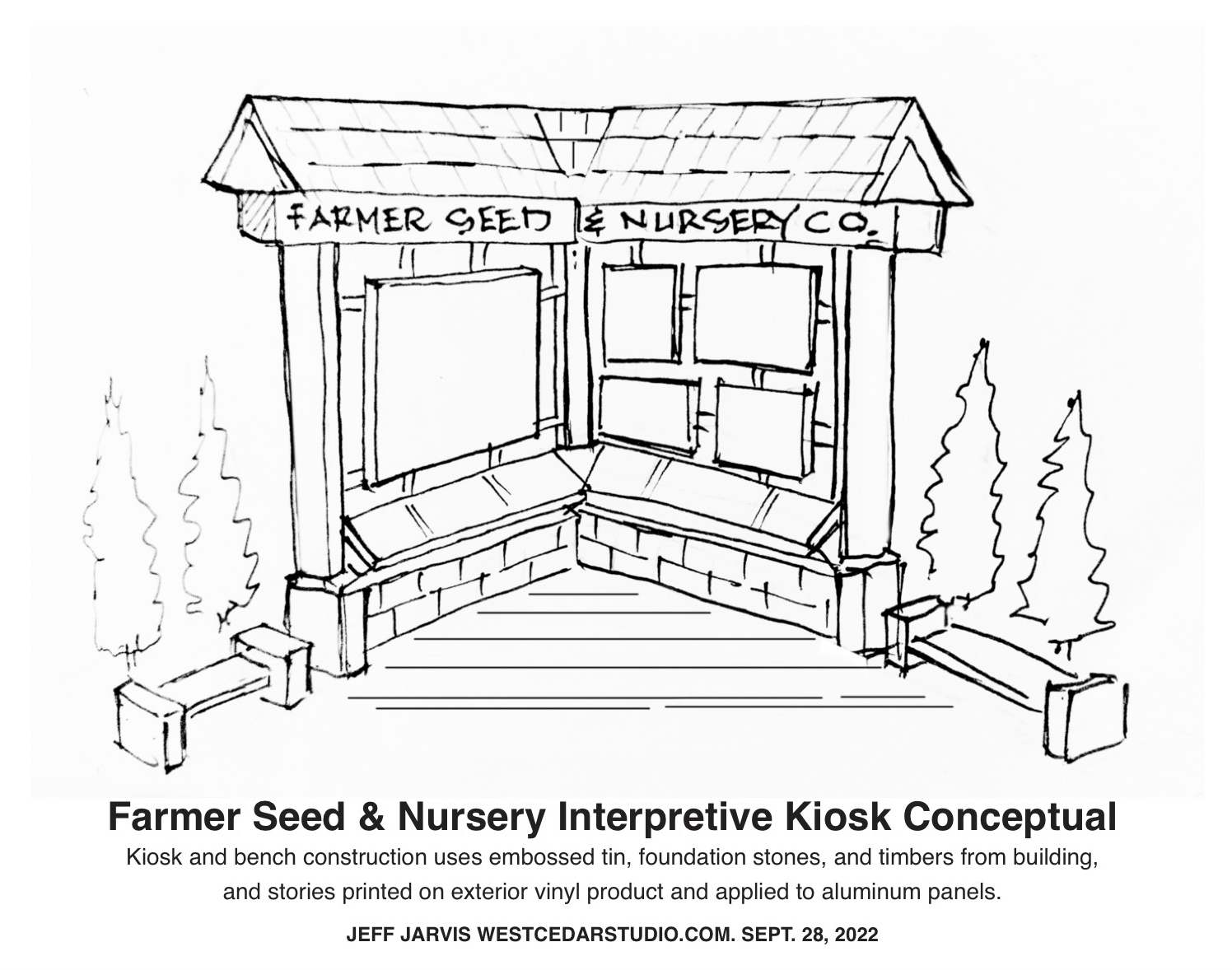
The multi-paneled kiosk will stand on the corner of Fourth Street and Eighth Avenue. (Design rendering courtesy of Jeff Jarvis, WestCedarStudio.com)

Jarvis also created conceptual sketches for the planned corner kiosk and is developing an interior graphic panel display featuring company history, little-known products and personnel information.
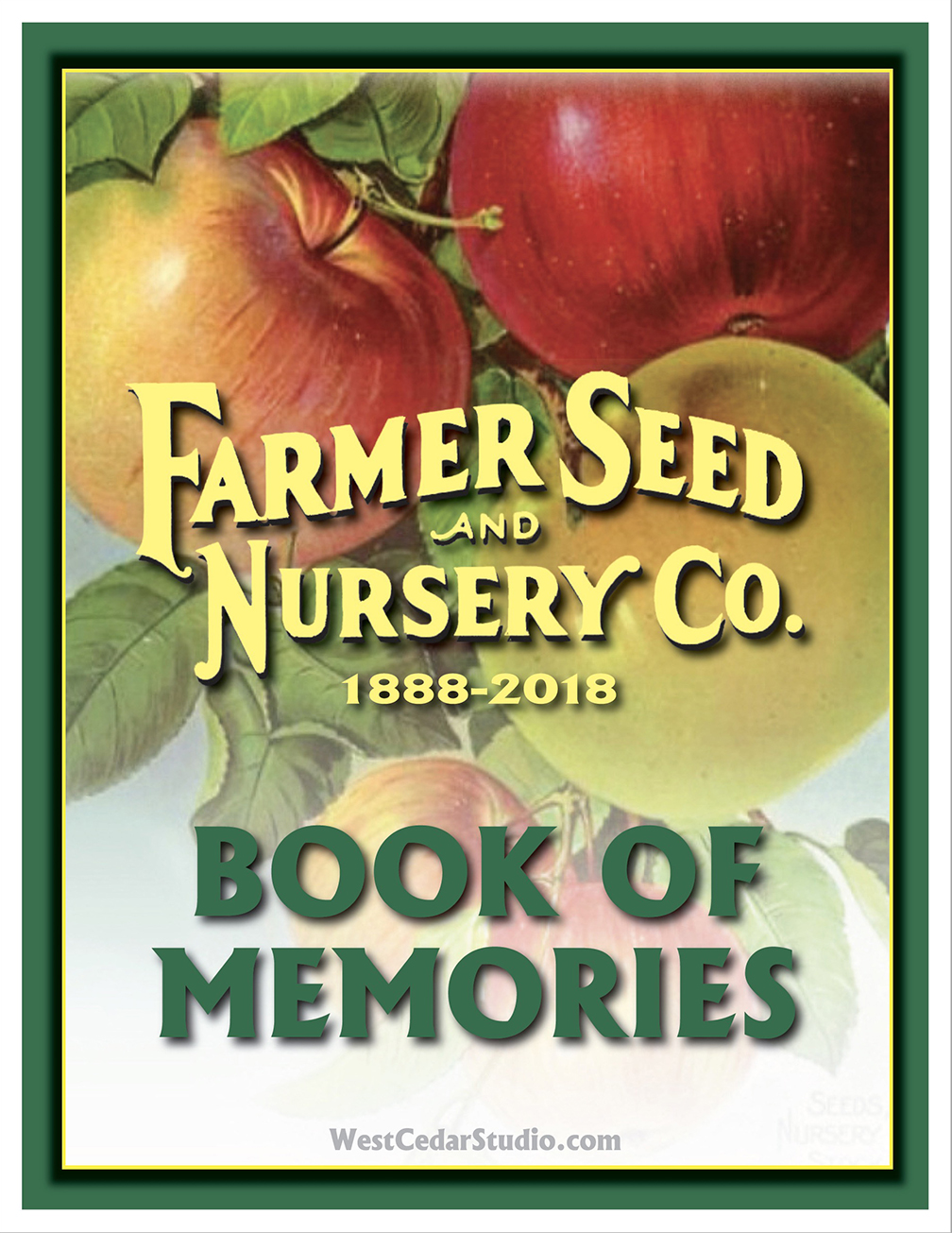
The memory book cover designed by Jeff Jarvis of WestCedarStudio.com. (Courtesy of Jeff Jarvis)

Additionally, this keeper of local history is compiling a Farmer Seed memory book of stories, historical information and photos. Jarvis has included his own childhood story about a coveted Ant Farm purchased at the retail store by his mother and gifted to him at Christmas. He’s looking for more stories and encourages submission of those via a form on his website at https://westcedarstudio.com/farmer-seed-nursery-memory-book/. Once the stories are compiled they will be available to read for free on Jarvis’ studio website or as a printed copy for a fee.
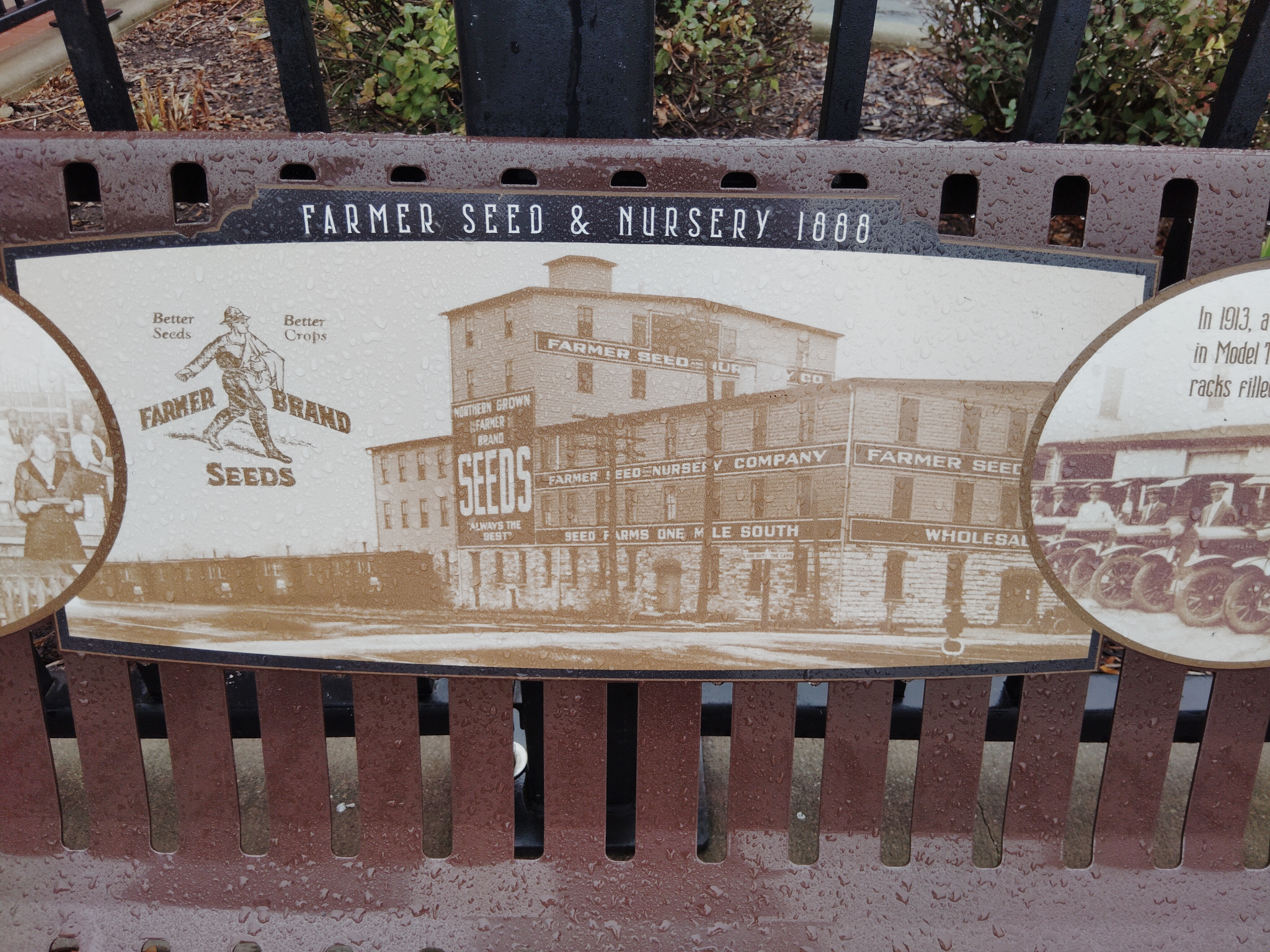
On a recent rainy morning, I photographed the Farmer Seed & Nursery historic-themed bench along Faribault’s Central Avenue, among many history benches downtown. (Minnesota Prairie Roots copyrighted photo October 2025)

I expect this trio of projects will be well-received in Faribault, where the 2018 closure, then sale and eventual complete demolition of the iconic Farmer Seed complex in 2023 raised public concern. I was among those who hoped the building, on the National Register of Historic Places, could be saved, a new use found for this long-time landmark. It was not to be. But the city, including the Heritage Preservation Commission, recognized the importance of preserving memories by requiring historical remembrance projects as part of the property sale, according to Jarvis. I’m grateful for that and for parts of the building that were salvaged for historical purposes.
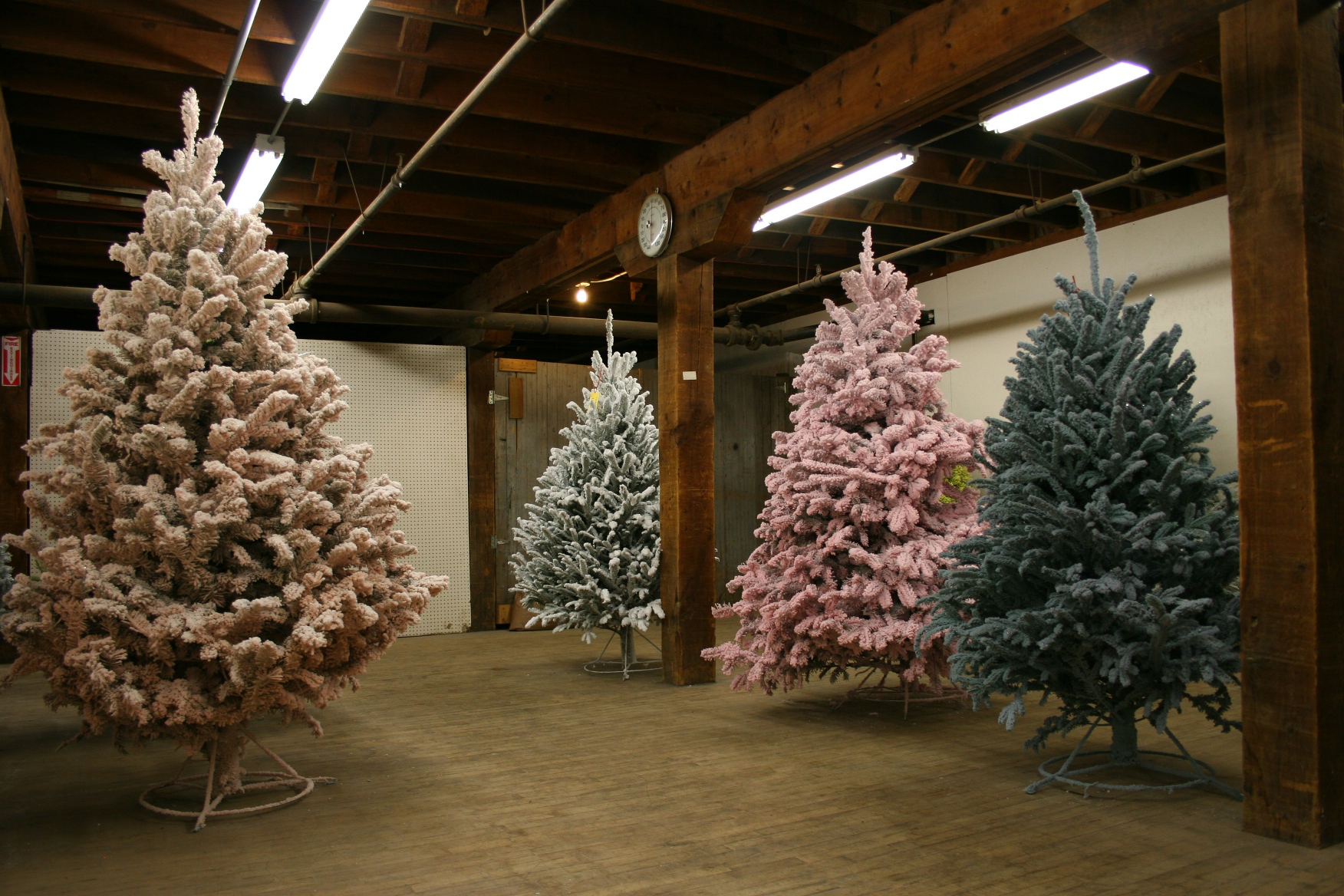
Flocked Christmas trees for sale at Farmer Seed in 2014. (Minnesota Prairie Roots copyrighted file photo 2014)

Today when I view the newly-installed mural, I think of my own Farmer Seed memories. Like so many others, those trace to Christmas. I loved to wander through the retail store to see all the trees decorated with ornaments. Sometimes my husband and I would buy our short needle short Christmas tree there. Not a flocked tree, which was a Farmer Seed specialty. One year we waited too long and, days before Christmas, got what I think may have been the last tree in town at a bargain price.
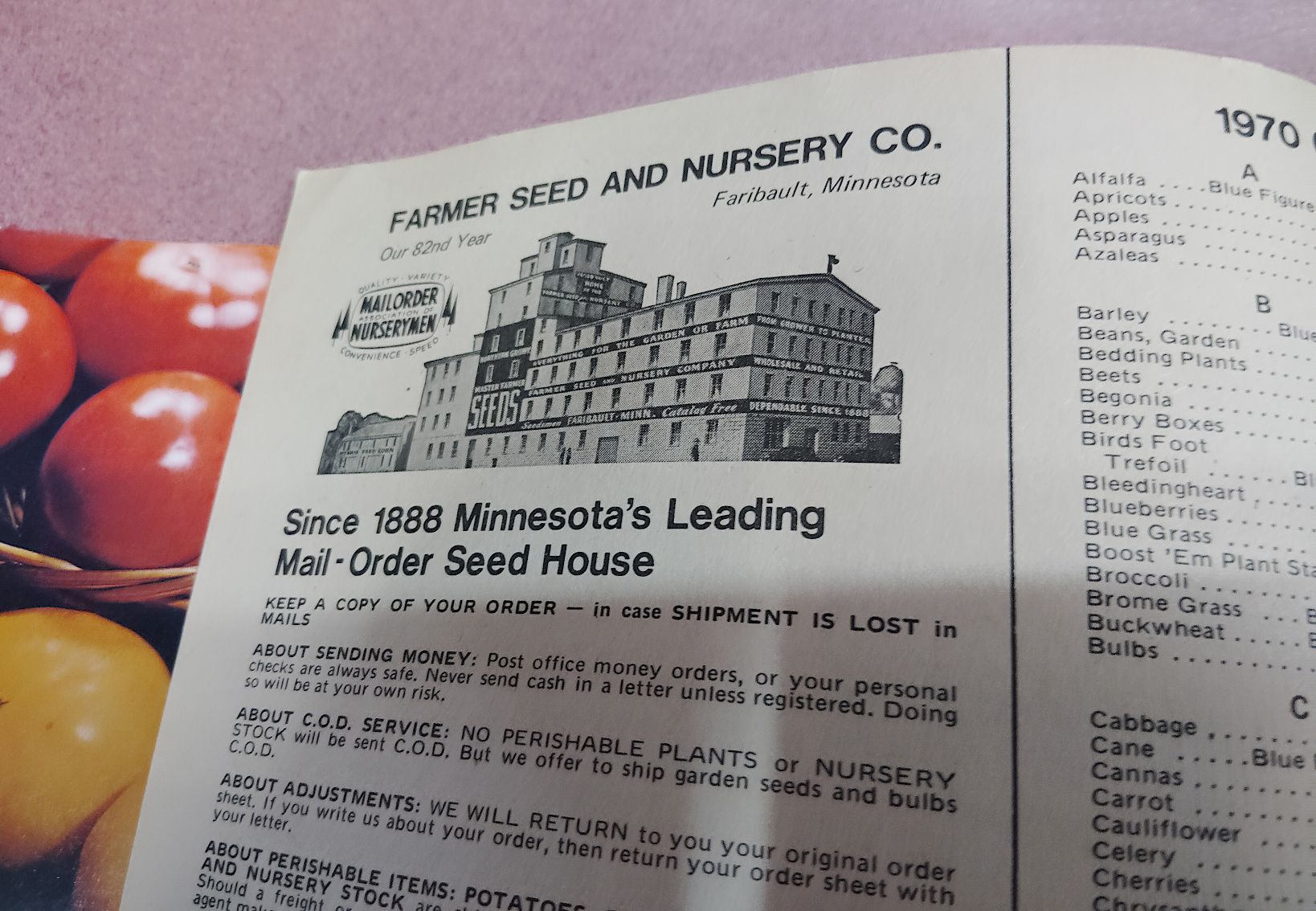
A page in a 1970 seed catalog at Keepers Antique Shop. In 1894 Farmer Seed moved to Faribault and started its seed growing operation here. (Minnesota Prairie Roots copyrighted photo October 2025)

For many area residents, Farmer Seed holds a life-time of memories. Of seed catalogs. Of seed potatoes. Of seed packets. Of lilac bushes and Christmas trees. Of wood plank floors and a building rising high along highway 60, where an indoor storage unit and an under-construction apartment building now stand on land once rooted in agriculture.

© Copyright 2025 Audrey Kletscher Helbling


Beyond just fun, finding the history & heritage in Heritage Days June 11, 2025

This sculpture of Alexander Faribault and a Dakota trading partner stands in Faribault’s Heritage Park near the Straight River and site of Faribault’s trading post. (Minnesota Prairie Roots copyrighted file photo)

HOW DO YOU DEFINE heritage? I ask that question because this week my southern Minnesota community celebrates Heritage Days.

I would define heritage as a cultural or ethnic background. I am, for example, of German heritage.

So one would likely assume then that Heritage Days focuses on heritage. It did. Once. But no more. Not primarily. Rather, this multi-day event in Faribault seems more a June get together with the usual food, music, parade, craft fair and such of any summer community gathering.

It’s not that my city of some 24,000 lacks in cultural and ethnic diversity to theme Heritage Days. We are a bit of a melting pot with our newest residents arriving from Somalia and Sudan. Early on, the French, Irish, Germans and others settled here to shape and grow Faribault. Latinos also define a sizable part of our population. Many others have come from multiple countries to this place along the Cannon and Straight Rivers. Most are generations removed from the homeland. Some, though, are first-generation immigrants.

Jeff Jarvis created and handed out this mini booklet about the Wahpekute Band of the Dakota at a previous presentation at Books on Central. (Minnesota Prairie Roots copyrighted file photo)

But back to Heritage Days. Looking through the long list of events, I see several opportunities to learn about local heritage and history. The first happens at 6:30 p.m. Wednesday, June 11, at the Cathedral of Our Merciful Saviour. Regional artist and historian Jeff Jarvis will talk about “The Wakpekute Dakota & Early Faribault History.” I’ve previously heard Jarvis speak on the Dakota, original inhabitants of the land. He’s done his research. I highly recommend attending his presentation. I’m always surprised by how little long-time residents seem to know about the Dakota and their long ago presence in what would become Faribault. Jarvis presents an informative lesson in local Native heritage.

Likewise, the Rice County Historical Society Museum will be open, free of charge, from 10 a.m.-5 p.m. Thursday-Saturday. It’s a good place to see Native American and other artifacts, learn about our early fur trading and additional local history, learn about notable people like Chief Taopi and Bishop Henry Whipple, and more. Bishop Whipple founded and served the Cathedral where Jarvis is speaking.

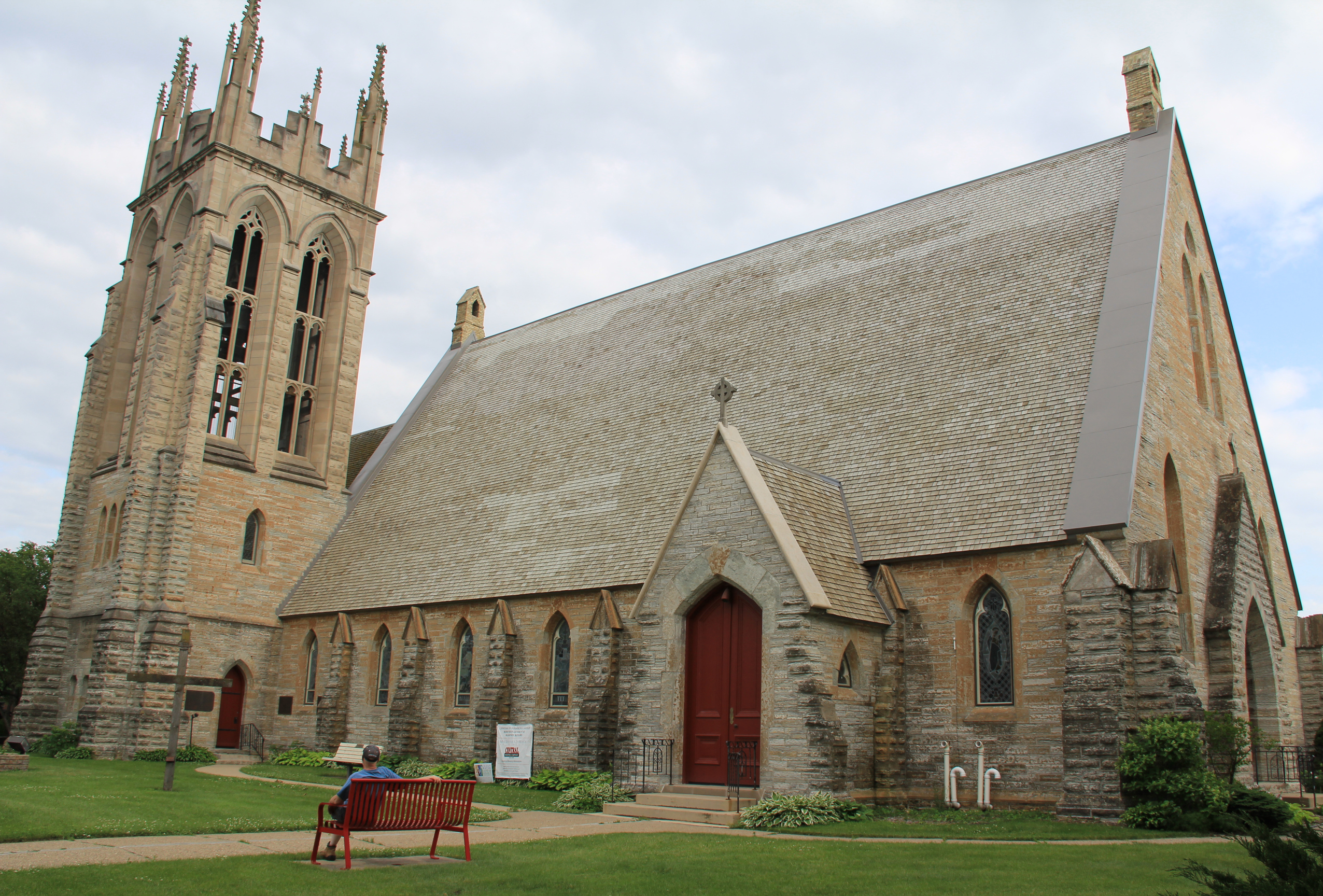
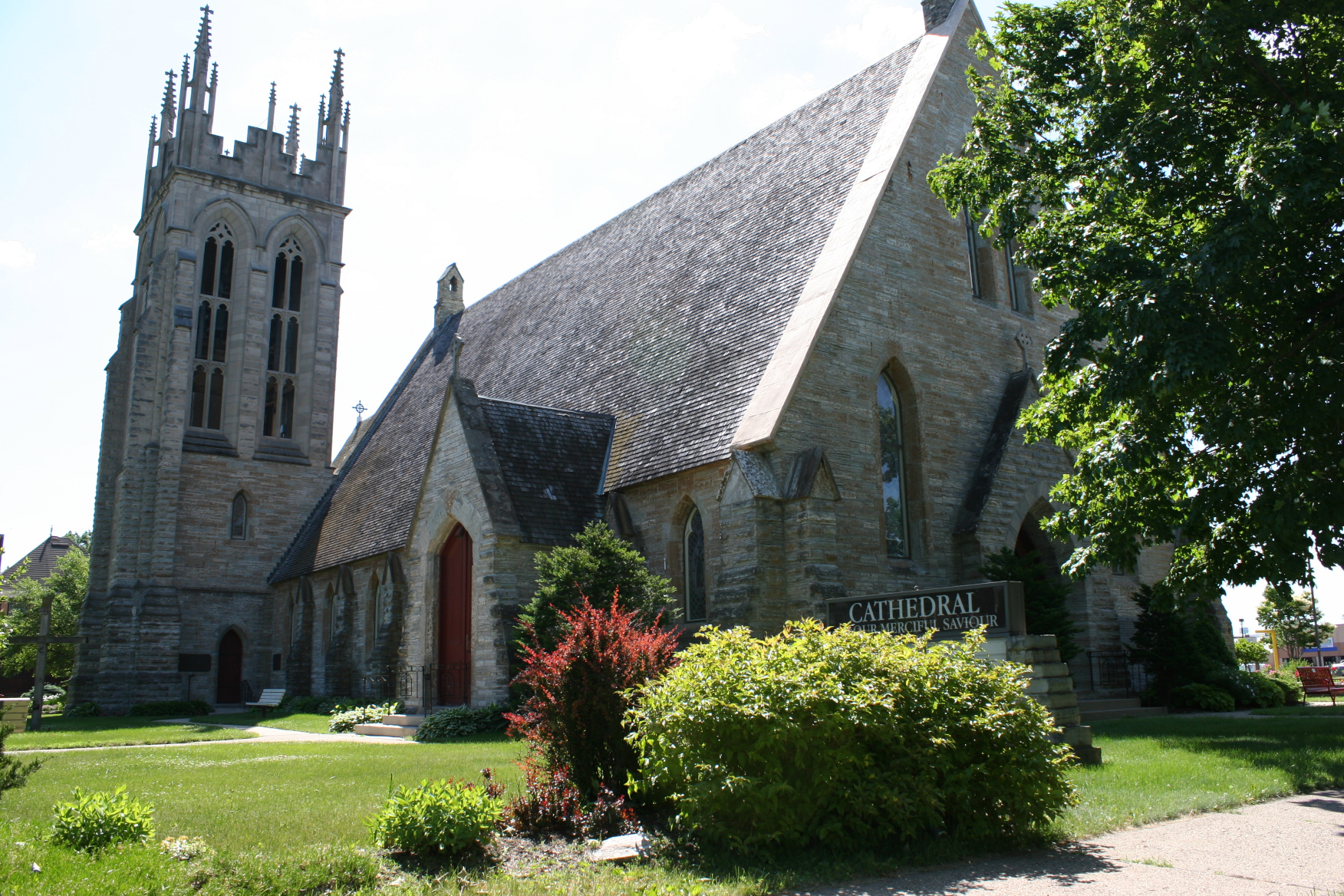
The historic Cathedral of Our Merciful Saviour sits across from Central Park and is a must-see in Faribault. (Minnesota Prairie Roots copyrighted file photo 2024)

The historic Cathedral will be open for tours at 11:30 a.m. Sunday, June 15, following a 10 a.m. Ecumenical Service including bluegrass music. This massive cathedral—and, yes, it really is a cathedral—is important in local Dakota history as the bishop worked closely with Native Americans, some of whom worshipped here.

Fur trader and town founder Alexander Faribault, who was of Dakota and French Canadian heritage, also worked closely with the Dakota. His wood-frame house will be open for free tours from 11 a.m.-3 p.m. Saturday, June 14.

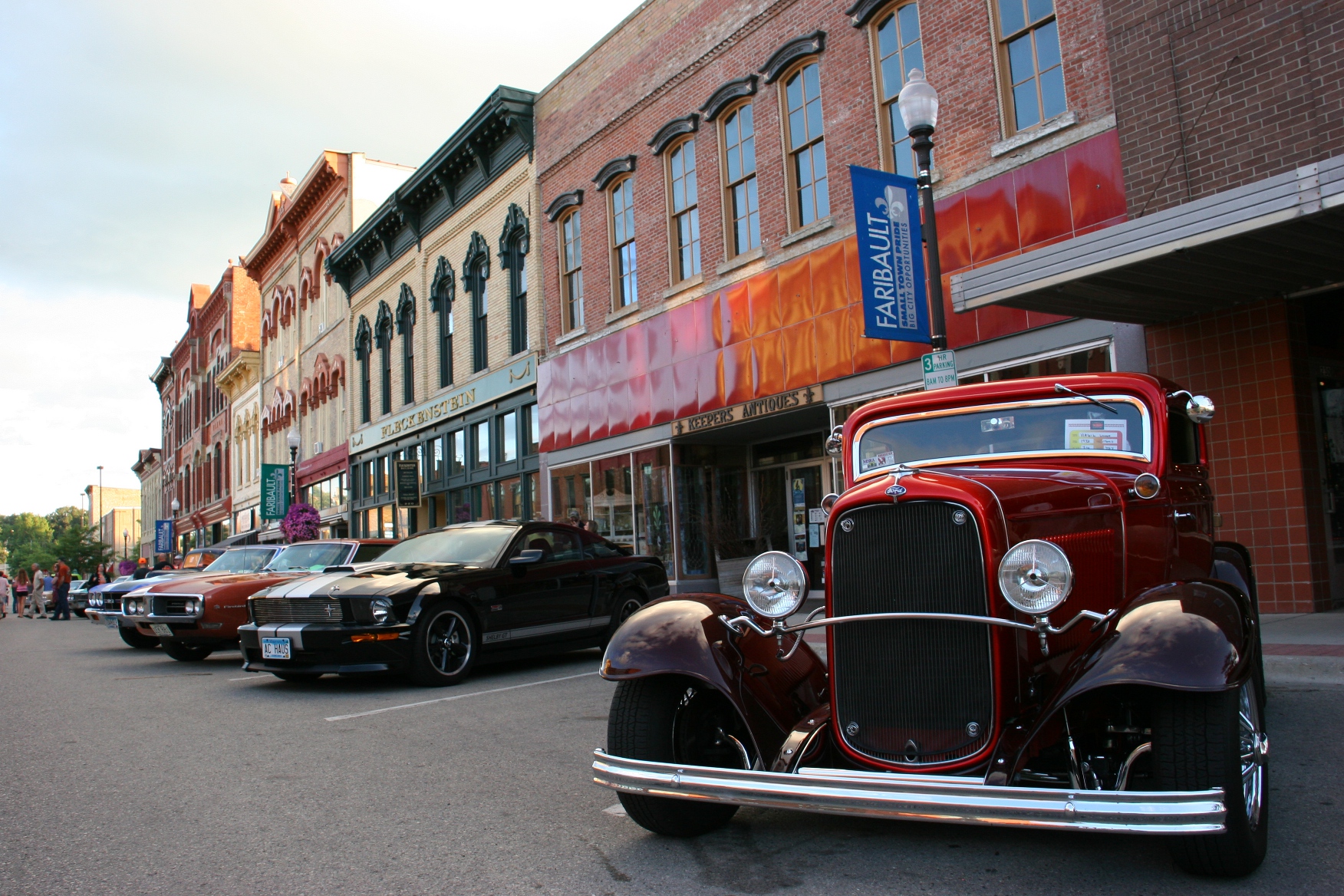
Downtown Faribault features well-kept aged buildings in our historic district. I photographed this scene during a Car Cruise Night. There’s a Car Cruise here Friday, June 13, from 6-9 p.m. (Minnesota Prairie Roots copyrighted file photo)

The Rice County Historical Society will also offer a guided Downtown Walking Tour on Friday and Saturday with two time slots of 11 a.m. and 2 p.m. The $5 tour, led by RCHS Program and Outreach Coordinator Kiran Loewenstein, begins at Central Park. Anticipated to take 1-1 ½ hours, the tour route follows Central Avenue with a focus on the historic district and buildings and early general Faribault history. I expect that will offer ample opportunity to not only learn about early history and heritage, but also to see the heritage of our newest residents in downtown core ethnic businesses.

Two more opportunities to embrace local history (although not officially part of Heritage Days) are inside the State Bank of Faribault along Central Avenue. Local streetscapes and landscapes by Father Jim Zotalis, spiritual leader of the Cathedral, are displayed in a pop-up exhibit in the bank lobby. And for those interested in Faribault’s brewing history, the bank holds an extensive collection of Fleck’s beer memorabilia form long ago Fleckenstein Brewery. Both are accessible during business hours only.

There’s lots happening during Heritage Days, activities that mostly aren’t about heritage. But some are. To see a complete listing of events, click here.

© Copyright 2025 Audrey Kletscher Helbling


Heritage Days talk focuses on the Wahpekute Dakota June 12, 2024

An exhibit at the Rice County Historical Society, Faribault, shares information on the original inhabitants of the county, the Dakota. (Minnesota Prairie Roots copyrighted file photo)

HERITAGE. It’s a word that identifies us, connects us to our families, to our ethnicity, to the way we were raised, the place of our roots. At least that’s my definition.

This week Faribault celebrates Heritage Days. I’ve never felt totally comfortable celebrating heritage in the city I’ve called home since 1982. My heritage, my home, my roots run deep in the southwestern Minnesota prairie some 2 ½ hours west of here.

But many are rooted in this community by birth, by families that trace back generations. If it’s one thing I’ve learned in four decades about the people of Faribault, it’s that many are related to one another via blood and marriage. But I’ve also learned much about the peoples who came before the French, the Irish, the Scandinavians, the Germans, the Cambodians, the Latinos, the Hispanics, the Sudanese, the Somalis… I’ve learned about the Dakota, the original inhabitants of this region.

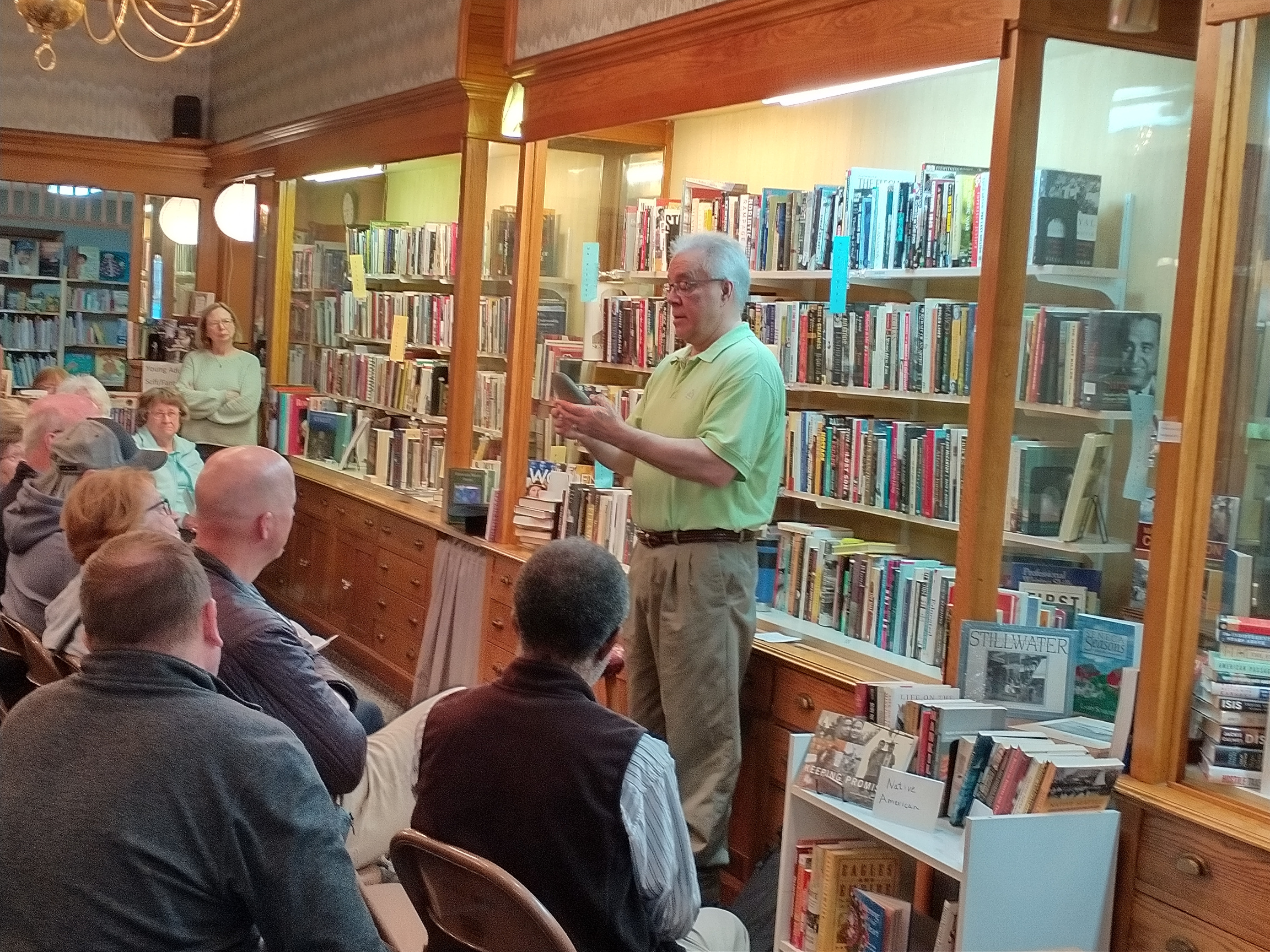
Jeff Jarvis talks about the Dakota at Books on Central. (Minnesota Prairie Roots copyrighted file photo April 2024)

That knowledge came through my own reading and via attending events focused on the Dakota. In April, I listened to local historian and artist Jeff Jarvis talk about the Dakota to a packed audience at Books on Central in Faribault. Jarvis is presenting again, speaking at 6:30 p.m., Wednesday, June 12, on the Wahpekute Dakota at The Cathedral of Our Merciful Saviour, 101 NW Sixth Street, across the street from Faribault’s Central Park.

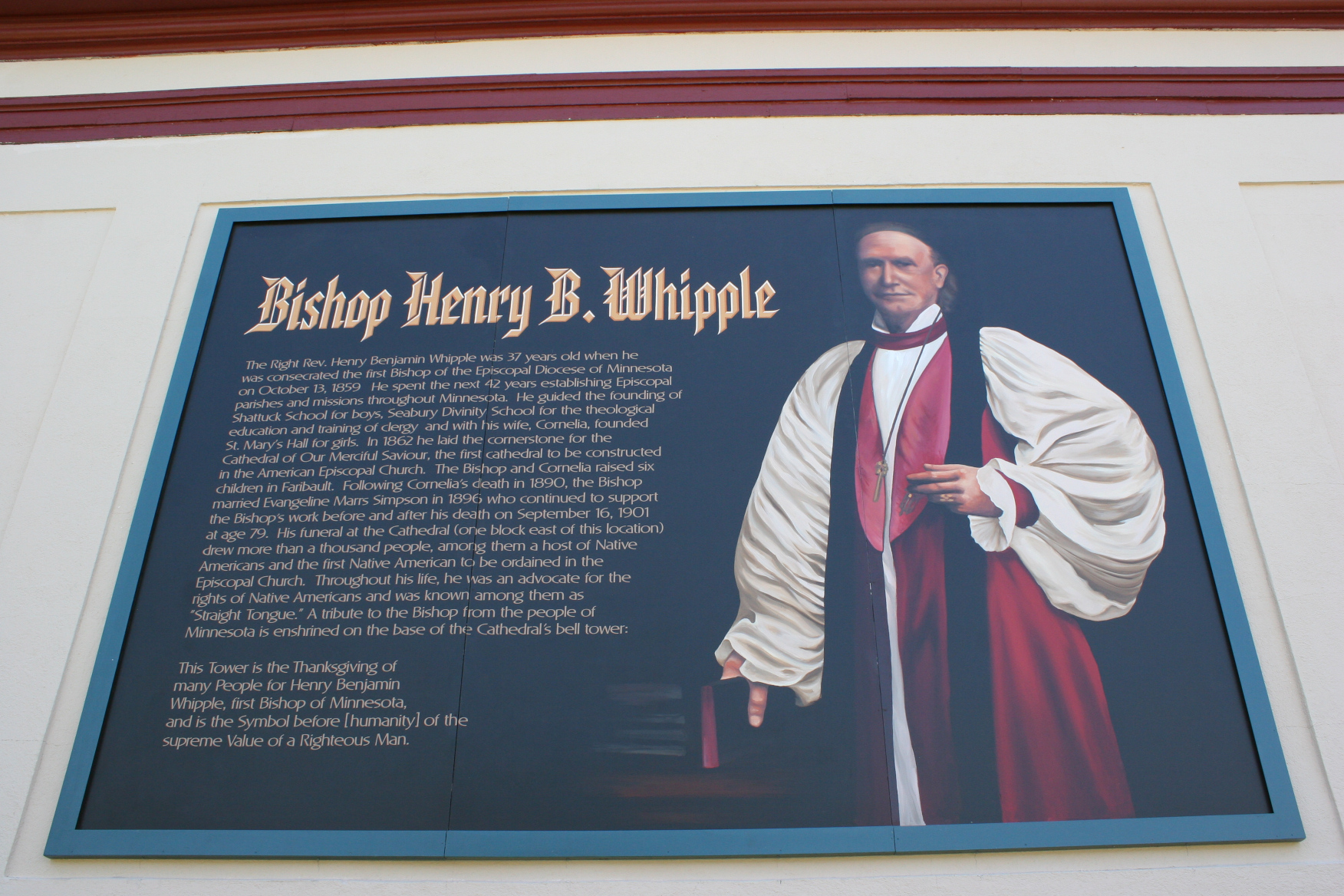
Information on Bishop Henry Whipple focuses one of the murals on the back of the bandshell at Central Park. (Minnesota Prairie Roots copyrighted file photo June 2020)

The Cathedral and its founding leader played an important part in local, state and national history with then Bishop Henry Whipple befriending the Wahpekute Dakota. He also pled with President Abraham Lincoln to spare the lives of 303 Dakota men sentenced to death by the US government following the US-Dakota War of 1862. Eventually all but 38 were pardoned, partially due to Whipple’s efforts.

The pamphlet Jeff Jarvis created about the Wahpekute Dakota. (Minnesota Prairie Roots copyrighted file photo April 2024)

I expect Jarvis will touch on that in his Wednesday evening presentation. He’s an engaging speaker, knowledgeable and passionate. He’s met with Dakota people, compiled a summary of his research in a mini pamphlet titled “The Faribault Dakota, Wahpekute Band.” It features an historic timeline, a Dakota primer of place names, his original art and more.

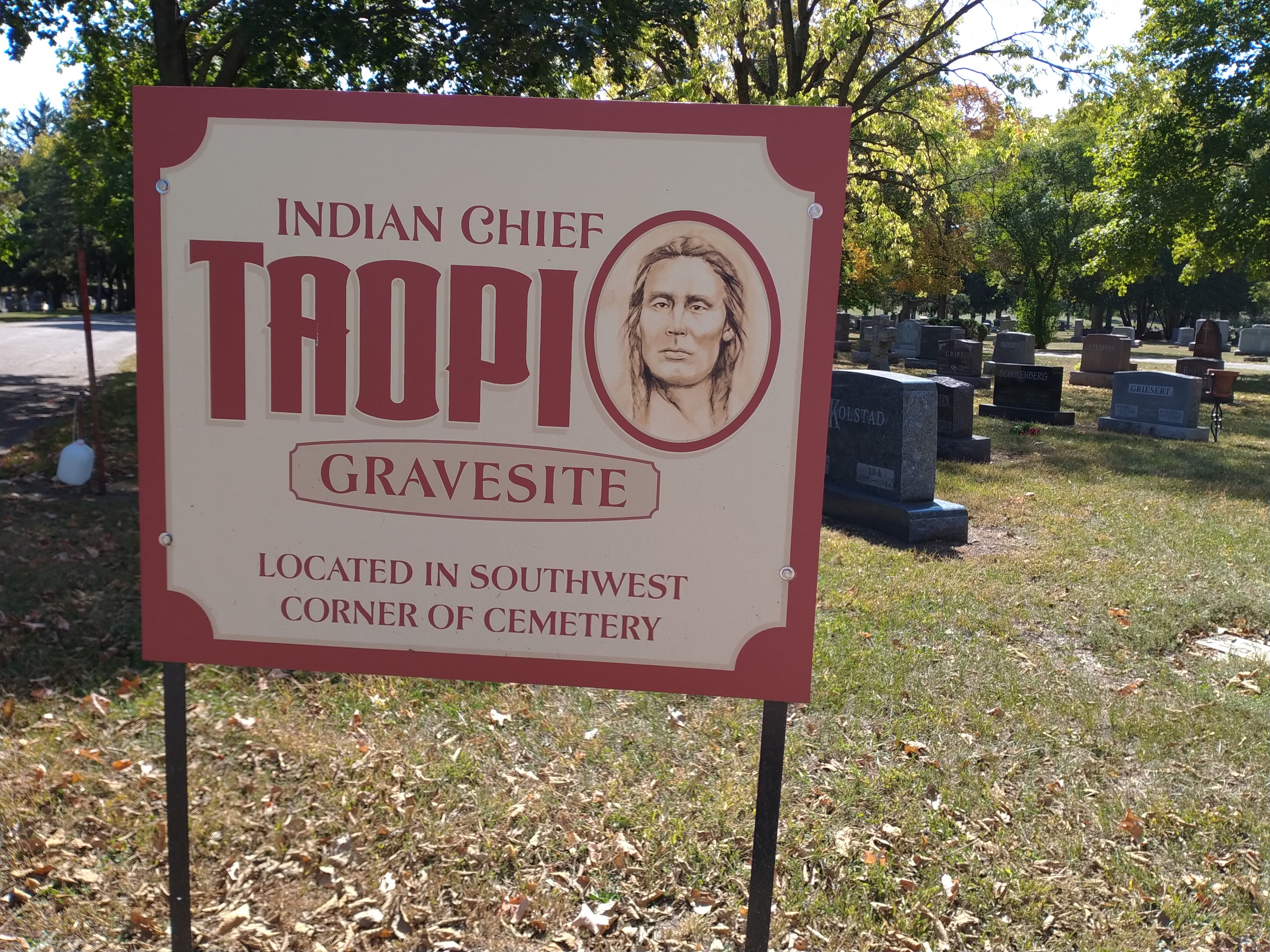
Chief Tapoi, a leader and member of the Little Crow Band of the Mdewakanton Dakota Tribe, lived in Faribault for a while and is buried at Maple Lawn Cemetery. (Minnesota Prairie Roots copyrighted file photo October 2023)

Jarvis is involved in the Faribault Dakota Project, a local endeavor that aims to increase awareness, visibility and knowledge of the original inhabitants of this land. To that end, presentations like his set during Heritage Days are important for locals to attend.

Just across the street from Central Park, the stunning Cathedral of Our Merciful Saviour. (Minnesota Prairie Roots copyrighted file photo)

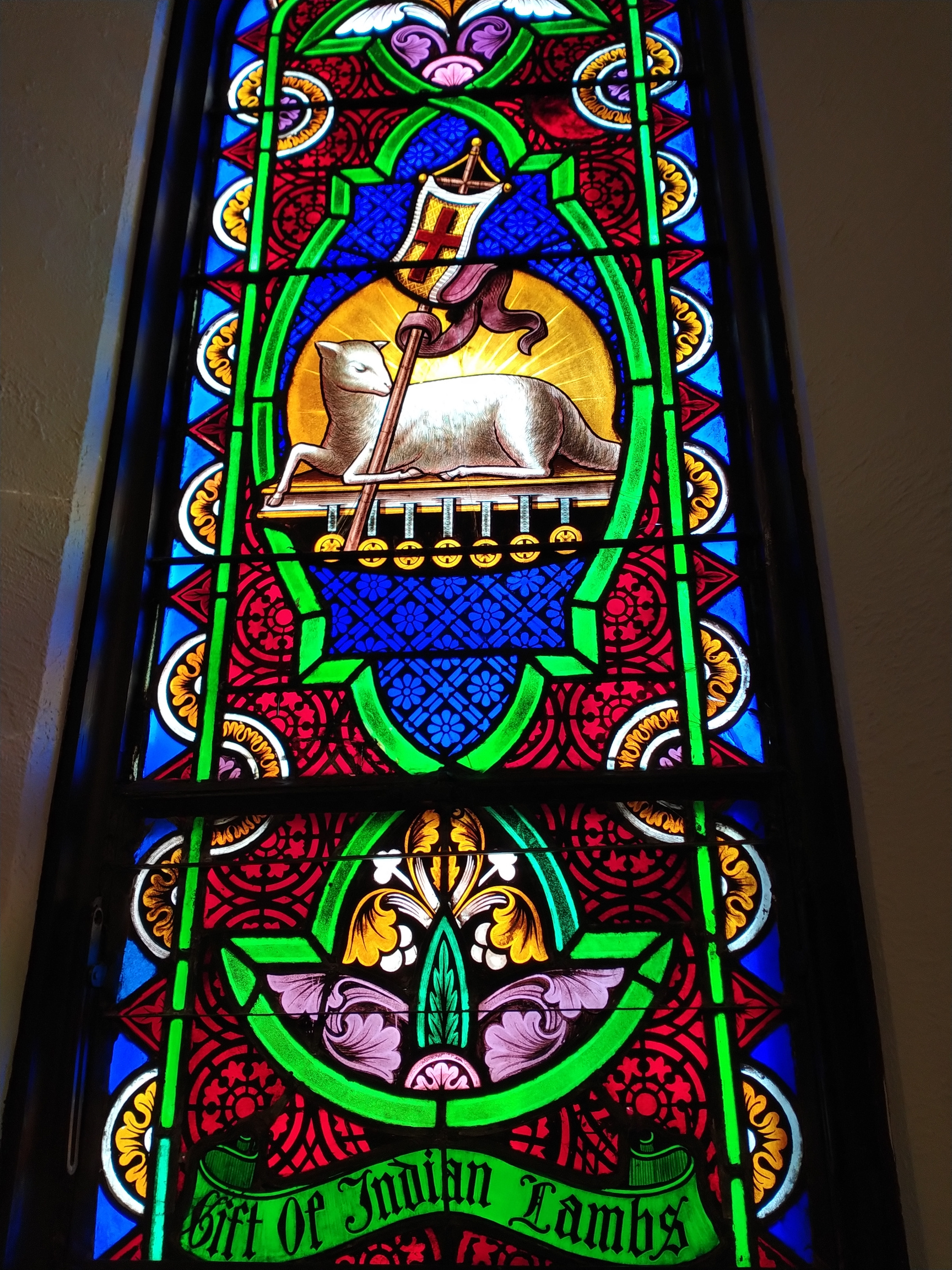
Likewise, free tours of the Cathedral at 11:30 a.m. Sunday, June 16, following a 10 a.m. ecumenical church service, likely will provide more information on the Wahpekute and their connection to Bishop Whipple and the massive limestone church. Several stained glass windows inside the sanctuary were gifted to the Cathedral by the Dakota.

This stained glass window was gifted by the Dakota to the Cathedral in honor of Dakota children. (Minnesota Prairie Roots copyrighted photo November 2023)

The Dakota and this house of worship, which focuses on connecting to the broader community, are such a vital part of Faribault’s history. That’s important to understand, to recognize, to honor no matter one’s heritage. I know locals who’ve lived here their entire lives and have never stepped inside the historic Cathedral. I find that almost unbelievable. We need to understand our past—our connections to peoples and land—to grow our future.

FYI: For a complete listing of Faribault Heritage Day events, click here.

© Copyright 2024 Audrey Kletscher Helbling


Alley-side art in Faribault May 3, 2021

Faribault’s newest mural, completed late last year.

OUTDOOR PUBLIC ART enhances a community. It provides an outlet for creativity, adds interest to place and often brings joy. At least that’s my assessment.

As someone who grew up in rural southwestern Minnesota with minimal exposure to the arts—or perhaps more accurately minimal opportunity in the arts—I deeply appreciate the arts.

This sculptor of Alexander Faribault trading with a Dakota trading partner stands in Faribault’s Heritage Park near the Straight River and site of Faribault’s trading post. Faribault artist Ivan Whillock created this sculpture which sits atop a fountain known as the Bea Duncan Memorial Fountain. Minnesota Prairie Roots file photo.

My community of Faribault, where I’ve lived for the past 39 years, embraces creativity, centered today at the Paradise Center for the Arts. Yet, the visual arts extend well beyond the walls of the Paradise to stained glass windows in our historic churches, an art collection at Buckham Memorial Library, sculptures, architecture, home-grown shops, historic-themed murals and even the graceful curves of the historic viaduct.

In this January 2016 photo taken from the viaduct, you can see the back of The Upper East Side (white stucco building) before the mural was added. The historic building originally housed W.H. Stevens Drug. Minnesota Prairie Roots file photo.

You can see Faribault’s newest addition to the outdoor art scene from that viaduct, which offers a sweeping view of the downtown area.

Visual layering is part of this mural.

But I viewed this latest public art close up from an alley. On the back and sides of The Upper East Side, an art and gallery space at 213 Central Avenue, Morristown area artist Jeff Jarvis (West Cedar Studio) painted a mural onto the stucco building.

A 1950s scene along Faribault’s Central Avenue is shown in this mural in our downtown district. Minnesota Prairie Roots file photo.

The mural differs significantly from the historic-themed murals scattered throughout our downtown as part of The Mural Society of Faribault’s ongoing mural installation efforts.

Close up, colors and graphics pop.

The Upper East Side mural, a project of owner Suzanne Schwichtenberg and Jarvis, is more modern and graphic with strong lines. Less detailed. Bold. With unexpected pops of color. I find the zipper painted into the mural to be especially creative—the unzipping of history, of stories, of past and present. The mural invites introspection rather than simple reflection on an historic place or memory.

That’s my take. Not as someone with an art education, but rather as a creative who has grown to appreciate the arts in her community and beyond.

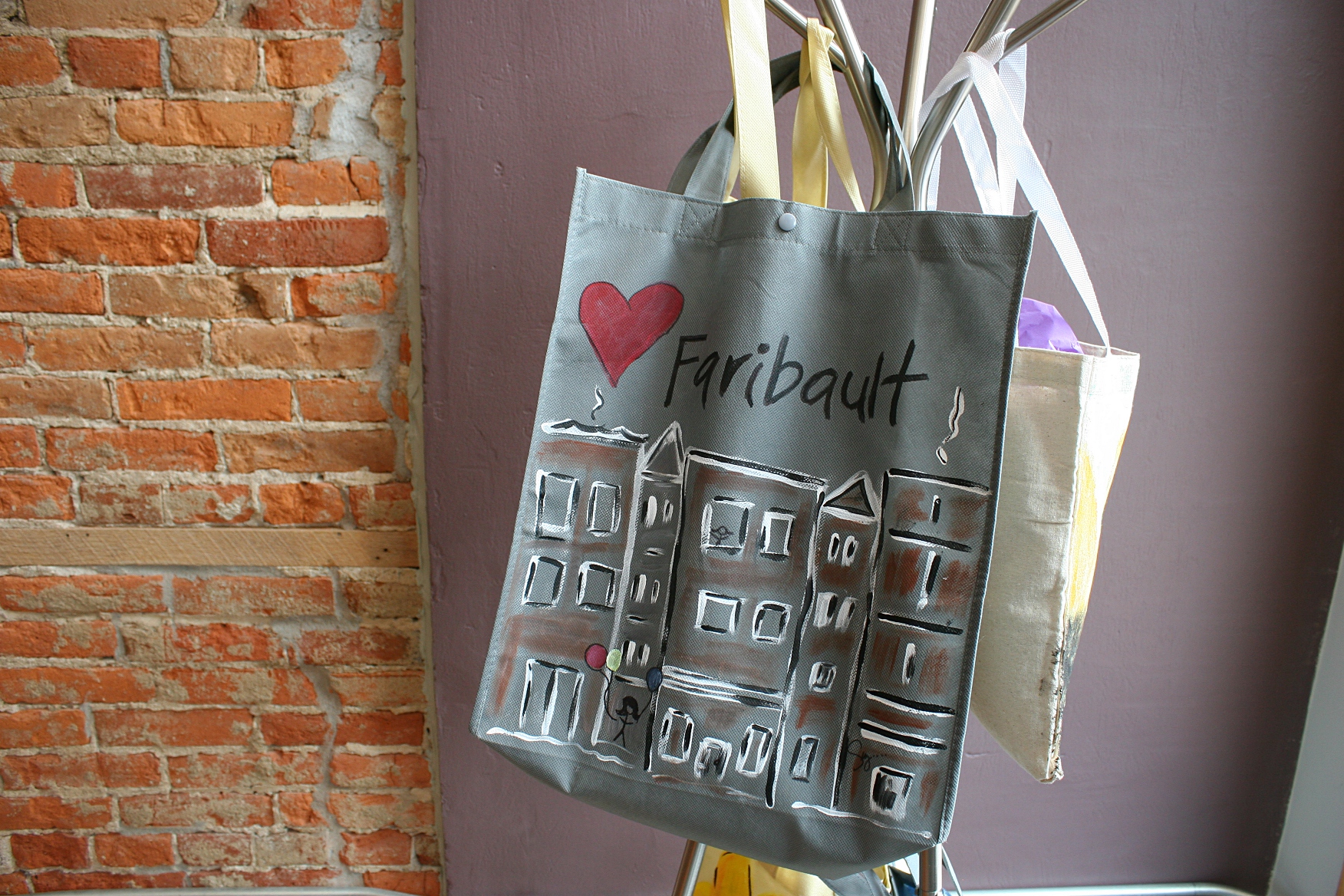
A locally-themed tote displayed at The Upper East Side. Minnesota Prairie Roots file photo September 2018.

FYI: Suzanne Schwichtenberg leads paint-and-sip events and other painting sessions at The Upper East Side and also takes painting/social gatherings on the road. Jarvis is a third-generation artist specializing in historical sketches and scenes from everyday life. He is passionate about local and regional history, authoring a book on the area’s mill history.

© Copyright 2021 Audrey Kletscher Helbling


Poster art showcases Faribault’s historic architecture December 9, 2016

TRAVEL WEST ACROSS the Highway 60 viaduct toward downtown Faribault and you likely will notice the steeples and towers poking above the landscape. Just like on the eastern side of my Minnesota community, these punctuating structures mark numerous historic buildings.


Layout 1


Now Jeff Jarvis, a local historian and artist who works as the City of Faribault’s community enrichment coordinator, has created Steeples & Towers, a photo montage. For a donation to the Concerts in the Park fund, you can purchase this 12 x 18-inch poster featuring 18 spires on educational, religious and residential structures. Places like the Cathedral of Our Merciful Saviour, the Hutchinson House, Buckham Memorial Library.

Buckham Memorial Library, Faribault, was built in 1929 with a Greek theme. Interior features include a Charles Connick stained glass window and Greek murals.

Buckham Memorial Library, Faribault, was built in 1929 with a Greek theme. Interior features include a Charles Connick stained glass window and Greek murals. Minnesota Prairie Roots file photo.

I’ve long valued the detailed architecture that defines so many aged buildings in Faribault. Jeff’s targeted and documented Steeples & Towers poster art heightens that appreciation and focuses awareness. “How dreary buildings would be if they were all square boxes,” he notes.

I agree.


Layout 1


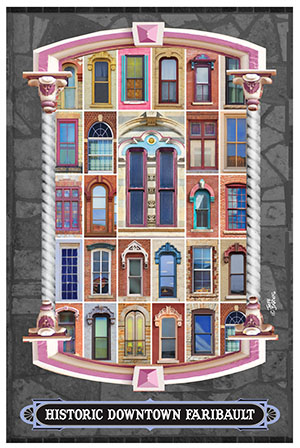
Likewise, Jeff’s artistic eye and historic awareness drew him to photograph 27 windows in historic downtown Faribault. Places like the Alexander Faribault House, the Fleckenstein Building, the post office. He’s created a Historic Downtown Faribault Windows poster, also available for purchase via a donation.

He writes:

The inspiration to do the windows downtown came initially from reading signs placed in the empty downtown buildings—“This building is not empty; it’s full of opportunity.” Reading these struck me as funny. From my point of view as an artist, I see the beauty of the intact architecture and the variety of exterior colors. It seems backward, but to me a full store is almost secondary.

The prize is being able to stroll about in respect and appreciation of the historic district. I see and imagine the stories hidden behind the facades—the limestone backsides, the alleyways with faded vintage lettering, and the add-ons that can be viewed if you look closely.

Of course, there are lots of metaphors or idioms about windows that are fun that could apply to the downtown situation like “God closes a door, then opens a window,” etc. The project itself was like seizing a window of opportunity to teach others to quit quibbling about downtown—to turn their focus instead to one of the lovelier features in town.

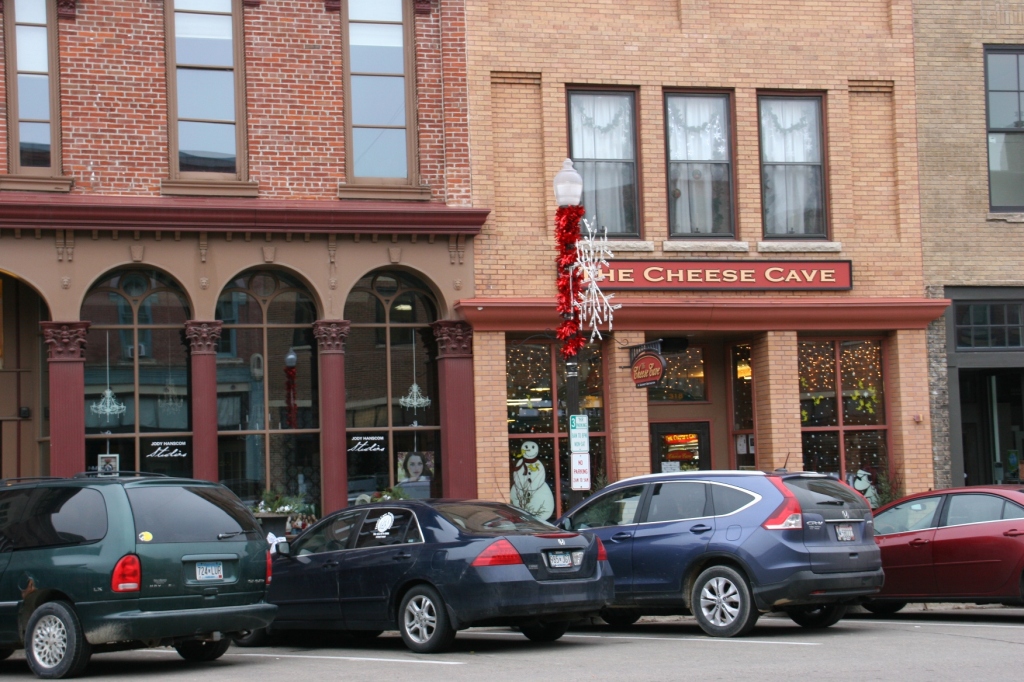
Historic buildings in downtown Faribault are decorated for the holiday season.

Restored historic buildings in downtown Faribault decorated during a past holiday season. Minnesota Prairie Roots file photo.

Jeff has it right. As a community, we need to seriously appreciate the aesthetic and historical value of the many old buildings that stand in and near the heart of the downtown and elsewhere throughout Faribault. I’m not saying that appreciation hasn’t existed. It has as evidenced in the restoration of many historic buildings, the existence of the Faribault Heritage Preservation Commission, the current interest in possible Artspace development and more. But sometimes we get sidetracked, too often complaining about perceived problems or what we don’t have rather than valuing what we do have.

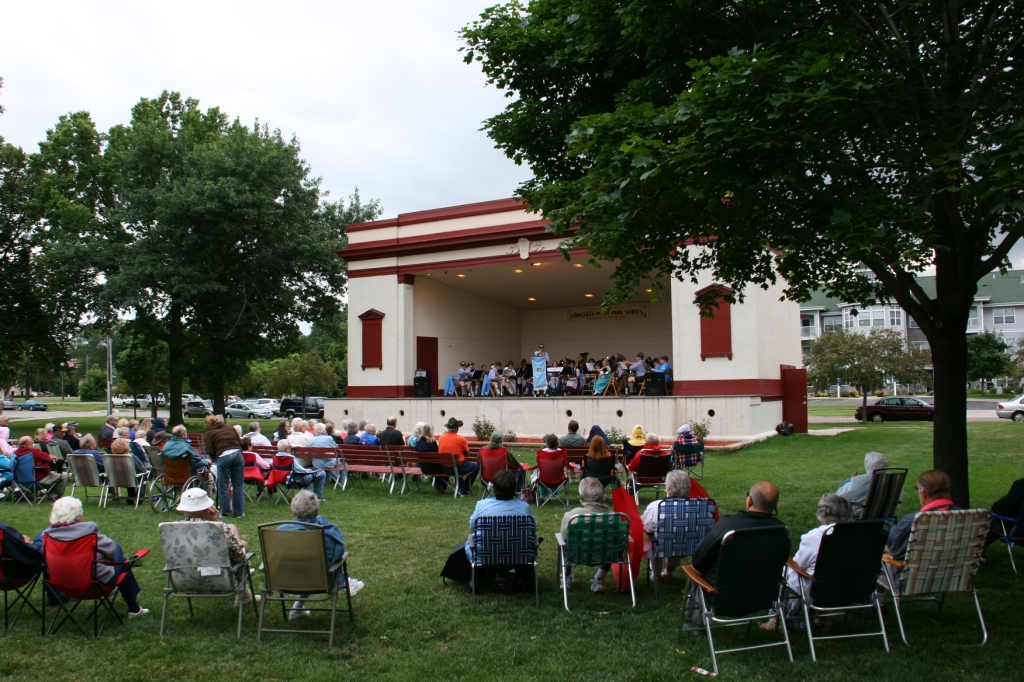
The Bavarian Musikmeisters, a 35-member band, perform on July 14 at Faribault's Central Park.

The Bavarian Musikmeisters, a 35-member band, perform on July 14 at Faribault’s Central Park. Minnesota Prairie Roots file photo.

And one of those assets—Concerts in the Park—is the benefactor of the historic posters sales. Those summer concerts are a 130-year tradition in Faribault. I’ve been attending these outdoor performances for more than 30 years, since relocating here. I’ve grown to love this Minnesota community. The traditions. The people. And, yes, the steeples, towers and windows, too.

FYI: If you are interested in purchasing these historic posters for a donation to the Concerts in the Park, stop at Faribault Park and Rec, 15 West Division Street, or email jjarvis@ci.faribault.mn.us. Donations will help underwrite concert costs.

© Copyright 2016 Audrey Kletscher Helbling
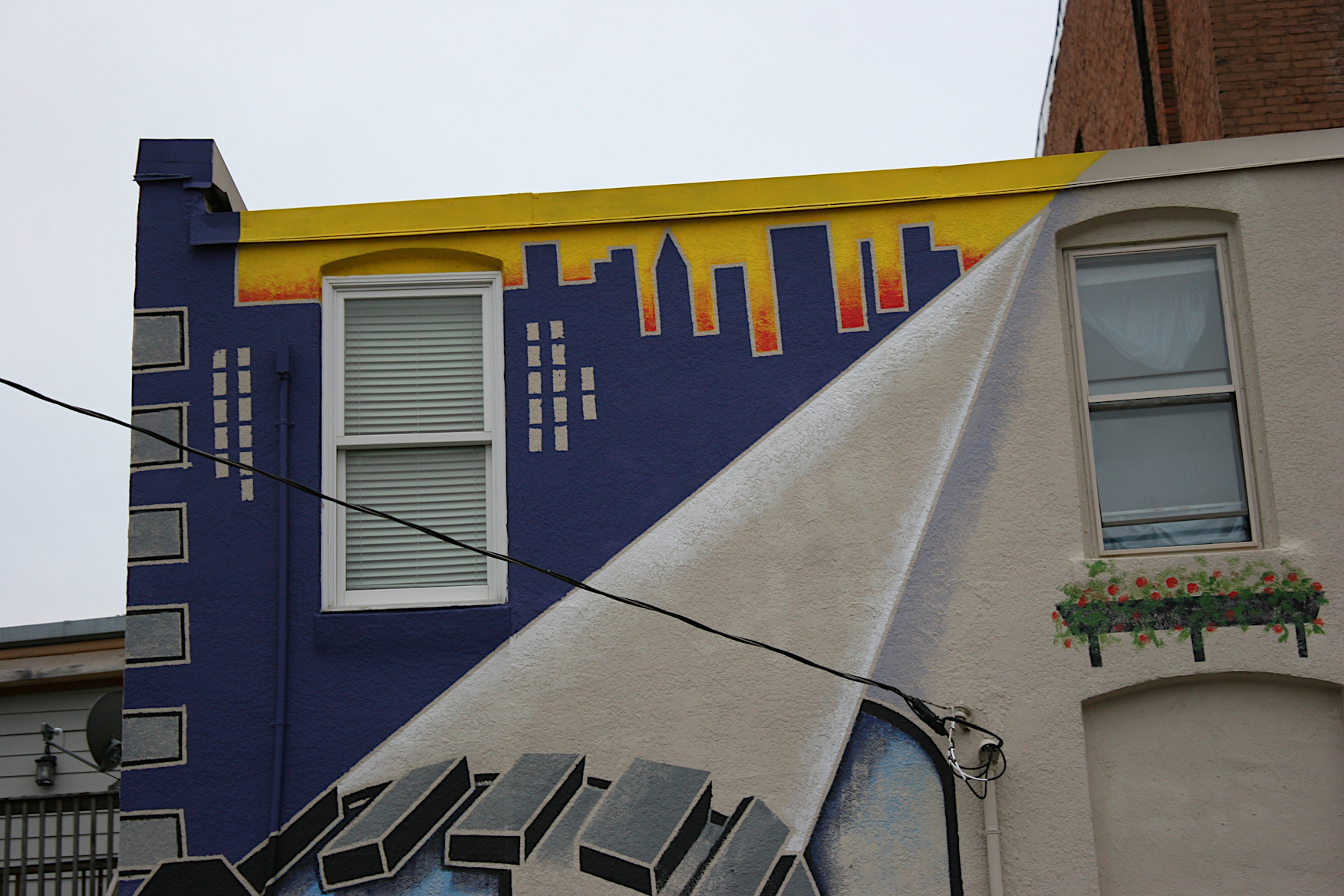
Art posters copyright of Jeff Jarvis