Minnesota Prairie Roots

Writing and photography by Audrey Kletscher Helbling

Connected by place & profession to a Minnesota tragedy June 20, 2025

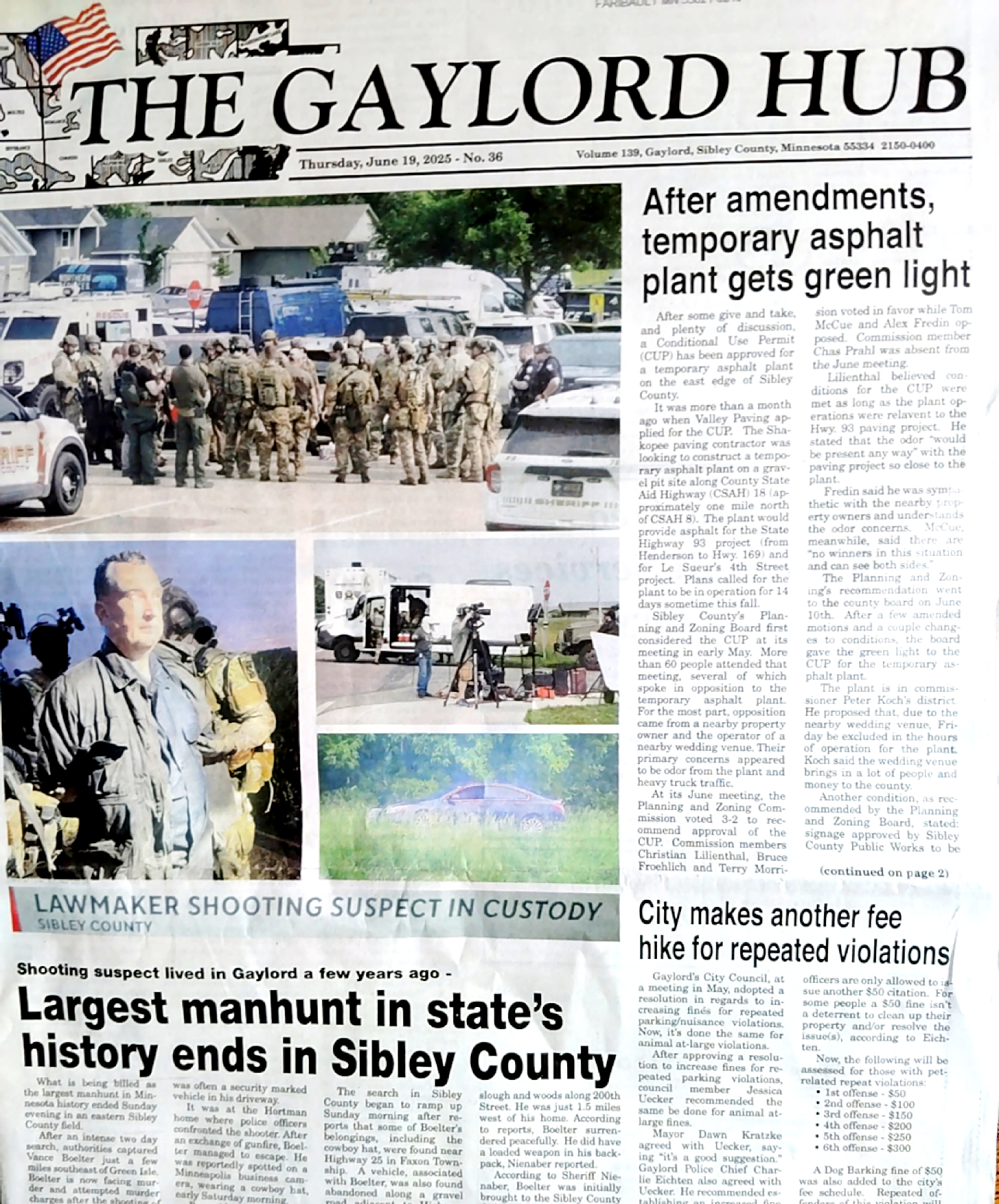
This shows an edited section of the front page of the June 19, 2025, The Gaylord Hub. (Minnesota Prairie Roots photo June 2025)

ALTHOUGH I AM DECADES removed from working as a full-time journalist, my innate curiosity remains unchanged. I still want to gather the facts, get answers, and uncover the who, what, when, where, why and how. That has never left me.

Last Saturday, June 14, memories of working as a newspaper reporter in Gaylord, the county seat of Sibley County, rushed back as the top news story in Minnesota, and the nation, unfolded. That breaking news was the politically-targeted assassinations of Minnesota State Representative Melissa Hortman and her husband, Mark, and the shootings of Senator John Hoffman and his wife, Yvette. The suspect now accused in the crimes, Vance Boelter, 57, lived near Green Isle. In rural Sibley County.

My first job fresh out of Minnesota State University, Mankato, in 1978 with a degree in mass communications, news/editorial emphasis, landed me in small town Gaylord, at The Gaylord Hub. I was affectionately dubbed “The Cub from the Hub,” or at least affectionately by those who appreciated my fair and balanced reporting. Some did not. Gaylord lies about 15 miles southwest of Green Isle, where Boelter was eventually apprehended near his home. Green Isle was mostly outside The Hub’s coverage area, although I recall writing a few stories from that part of Sibley County.
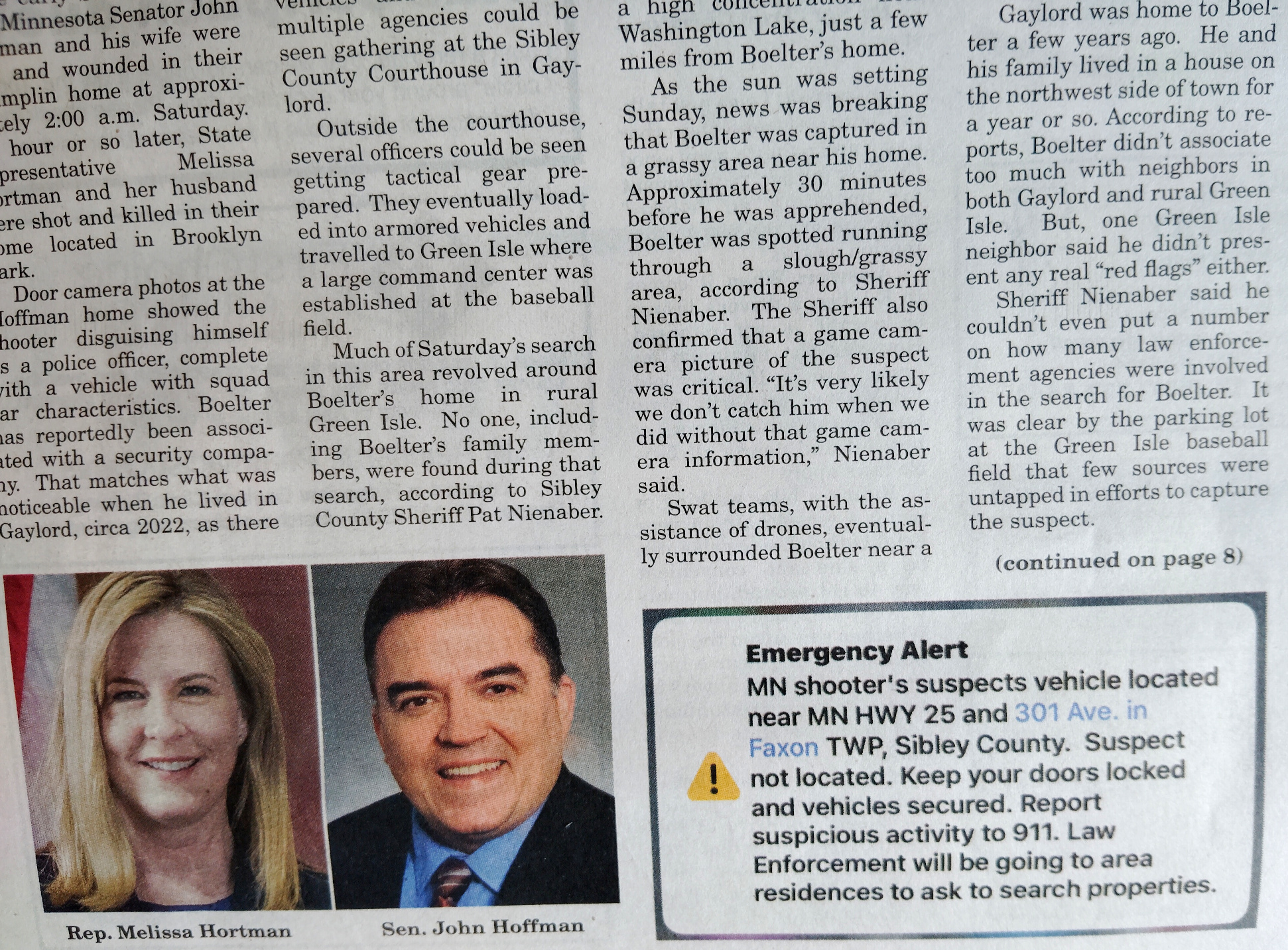
The bottom portion of the front page story written by Joseph Deis. (Minnesota Prairie Roots photo June 2025)

Today the June 19 edition of The Hub landed in my mailbox. I’d been waiting for this issue, curious to see how third-generation publisher and editor, Joseph Deis, would cover the largest news story in the paper’s history. The Hub front page headline reads: Shooting suspect lived in Gaylord a few years ago—Largest manhunt in state’s history ends in Sibley County.

I couldn’t help but think how hard Joe (he was just a kid when I worked for his dad, Jim, at The Hub) and other media have worked to cover this evolving story. It’s not easy to gather information from multiple sources and angles and keep everything straight. That said, law enforcement did an impressive job of informing the media and the public, at least from my at-a-distance perspective.

And Joe Deis did a good job of pulling everything together in a lengthy story that published in his weekly. His dad would be proud, as am I. His story included new-to-me information that Boelter and his family lived on the northwest side of Gaylord a few years ago. They mostly kept to themselves, the article states.

Now, as if the Gaylord/Sibley County connection to my past isn’t enough, there’s more. I left The Hub after several years to become a newspaper reporter at The Sleepy Eye Herald-Dispatch. The murder suspect grew up in Sleepy Eye, graduating from the public high school in 1985. (I was long gone.) Boelter returned to his rural southern Minnesota hometown, living with his family in Sleepy Eye from 2008-2011 and working at Del Monte. And he apparently preached occasionally at church services held in the high school gym, according to media reports. If I know one thing about Sleepy Eye, it’s that the community is deeply religious, with an especially strong Catholic base. I have no idea what Boelter’s childhood faith background may be. But he graduated from an interdenominational Bible college in Texas in 1990 and served as an evangelical missionary in the Democratic Republic of Congo in recent years.

These two connections to my past rattled me. But they also reminded me that, even in rural areas, a reporter’s job can be about more than covering government, sports, community events and the everyday happenings of small town life. Sometimes it can be about covering a really big, life-changing story. A story that grabs headlines locally, statewide, nationally and internationally as did the manhunt in Sibley County, in the readership area of a small town weekly newspaper where I once covered the news.

© Copyright 2025 Audrey Kletscher Helbling


Commentary: The importance of a free press in a democracy March 4, 2025

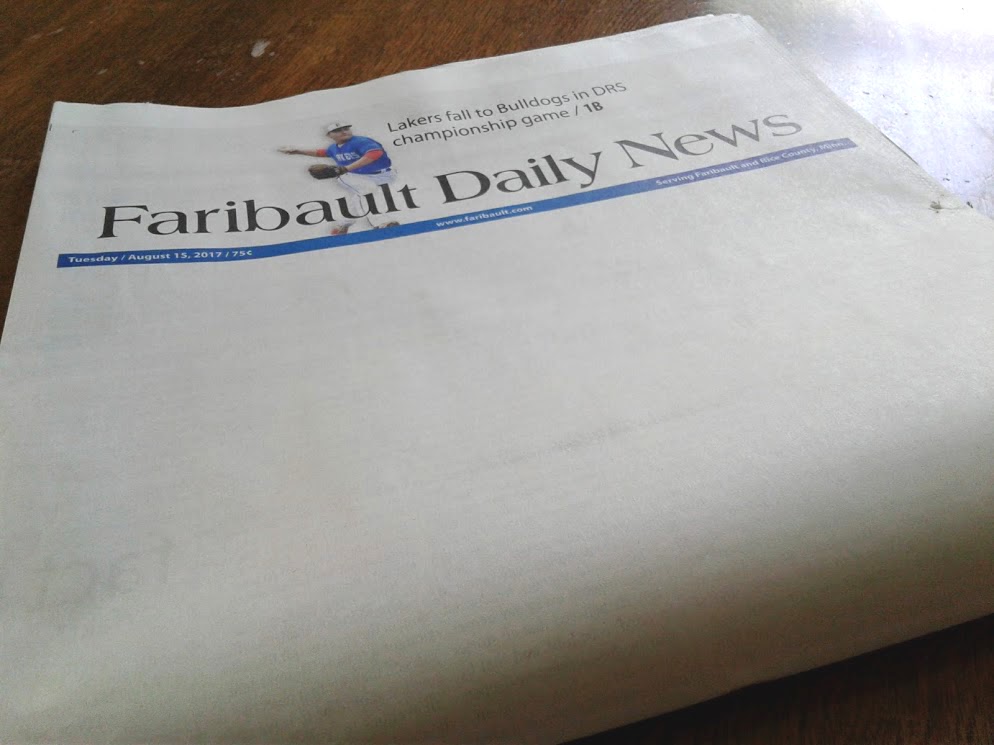
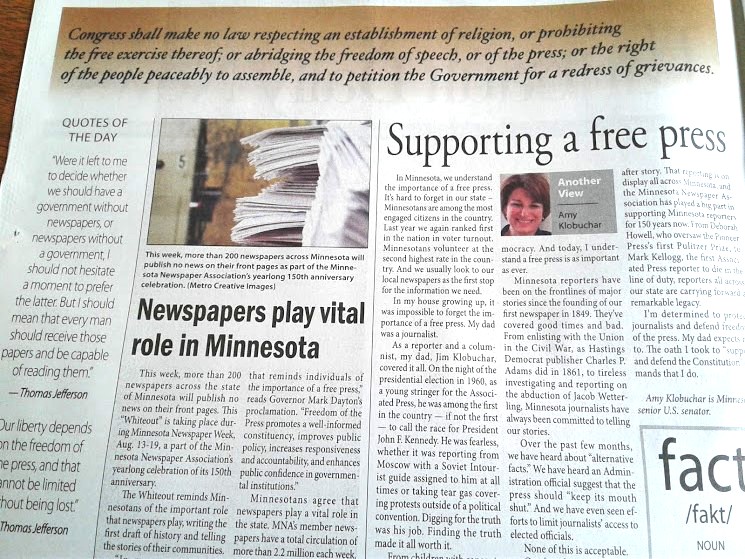
This is the front page of the August 15, 2017, Faribault Daily News. It was part of “Whiteout,” an effort during Minnesota Newspaper Week to remind readers of the importance of newspapers. Imagine if there was no free press. (Minnesota Prairie Roots copyrighted file photo 2017)

I AM WRITING THIS OPINIONATED POST with no apologies. As an American woman with a college degree in mass communications (news/editorial emphasis) and experience as a newspaper reporter, I’ve always felt strongly about a free press. Even more so today with threats to that freedom. If you are unaware of current actions against the press, research and read. A free press is a vital part of democracy.

The second page of the Daily News from the August 15, 2017, issue explains the importance of a free press and its role. (Minnesota Prairie Roots copyrighted file photo 2017)

Journalists serve, among other roles, as government watchdogs. That means they, ideally, provide accurate and balanced reporting on government, at all levels. The “fourth estate” holds the government accountable via the stories they write. Not agenda-driven stories shaped by a biased editorial perspective or by information spoon fed to them by a press secretary. But rather stories based on quotes, actions, interviews, facts. Good solid reporting. Not misinformation, disinformation and/or propaganda. I must, though, state the obvious here. Not all sources speak truth to the media. And not all media write truth.

Suppression and criticism of the press are nothing new. Some of the criticism is deserved. Much of it is not. You may like journalists or you may not. That’s not the point. The point is that we need a free press, one unsuppressed/uncensored by those who are in positions of power. If you think otherwise, then look to history and to countries under authoritarian leaders, dictators. Under those leaders, messaging is/has been carefully controlled. Manipulation, intimidation and absolute power rule.

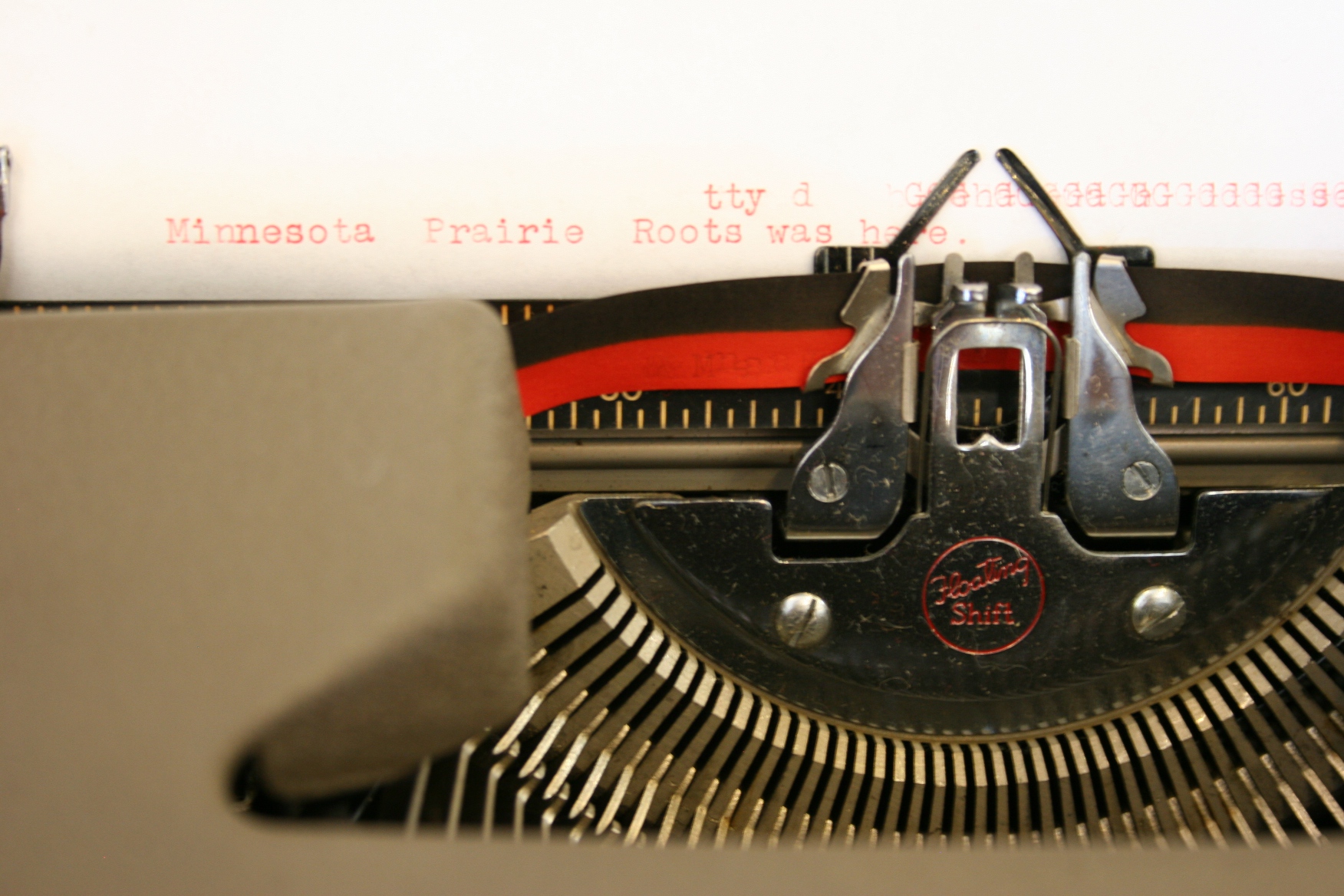
I started my newspaper career at a small town Minnesota weekly, typing my stories on a manual typewriter. This photo was taken in a Hastings antique shop, where I left a message. (Minnesota Prairie Roots copyrighted file photo)

During my journalism career, I have not been immune to those who wanted to control what I wrote. They did that sometimes in a back door way via criticizing me and my work and/or by shutting me out. Thankfully, my editors always had my back.

Let me give you some examples. While covering a school board meeting for a small town southern Minnesota weekly, a teacher said some things that were controversial. Decades out, I can’t recall details. But I do remember how this teacher fumed about my quoting him in a news story. The quote did not reflect favorably on him. But he made the statement at a public meeting. And it needed to be reported. Readers could decide what they thought of his comments.

In that same community, a local realtor called me out for quoting him in a story about a city council meeting. Again, I don’t remember details. But he was absolutely irate and verbally attacked and bullied me for what I’d written. (Sound familiar? Bullying. Fake news.) My reporting was accurate. I was not about to cave to his pressure. Once again, my editor stood up for me. He knew I demanded the best of myself in my work and that I would settle for nothing less than fair and accurate reporting.

Flash ahead to a different small town where I, once again, found myself despised. This time by a school superintendent. He didn’t like that I covered a student walk-out. It happened. I observed, interviewed him and students. And he retaliated. Every time I attended a school board meeting, he refused to give me an agenda or the packet of information distributed to board members and to the editor of the local weekly newspaper. (I worked for a regional daily.) He refused to talk to me. He made no effort to hide his disdain or to make information accessible to me. His was clearly an effort to stop me from reporting on anything school related, including school board meetings. His strategy did not work.

Published in the Faribault Daily News in August 2017 as part of the “Whiteout” campaign. (Minnesota Prairie Roots copyrighted file photo 2017)

Attacks on journalists have become more rabid in recent years. I think we can all agree on that. Don’t kill the messenger for the message he/she delivers. Respect those journalists who truly are doing their best to report fairly and accurately and who hold themselves and their work to high standards. Turn to those reliable sources for news.

Certainly, some media outlets and journalists are incredibly biased with specific agendas. They have become mouthpieces for government leaders, political parties and issues. I’m not praising those who are manipulating people to shape public opinion and to push ideas. Unfortunately, though, I see more and more government leaders, politicians and others targeting dedicated-to-the-craft journalists. These hardworking reporters are being shut out, degraded and abused because they accurately report what they see and hear in their watchdog role. Kinda like me with that small town school superintendent decades ago, just a lot more amplified and with much more serious consequences.

Thankfully, plenty of journalists committed to writing the truth still remain. They are strong men and women of integrity and morals who give a damn about democracy and a free press. Now, more than ever, we need to recognize the value of a free press, underscore FREE. Even though I no longer work as a newspaper journalist, I still strongly value freedom of the press. It is, always has been, a cornerstone of democracy.

(Book cover sourced online)

FYI: I encourage you to read Chasing Hope—A Reporter’s Life by Nicholas D. Kristof, currently an op-ed columnist for The New York Times. The two-time Pulitzer Prize-winning journalist worked as a foreign correspondent in Hong Kong, Beijing and Tokyo. He witnessed some pretty horrible atrocities—including the massacre in Tiananmen Square, the genocide in Darfur and much more—and offers remarkable insights via his experiences, observations and exceptional storytelling.

Of special note in Kristof’s book is a reference to an August 2008 campaign rally in Lakeville, Minnesota, which the author calls “one of the finest moments in American politics in my lifetime.” Kristof shares a story about Senator John McCain, who was then vying for the Republican Presidential nomination. I refer you to pages 239 and 240 in Chasing Hope. This book is worth the read for that story alone. It will give you hope. And, no, I’m not telling you more. Read the book.

© Copyright 2025 Audrey Kletscher Helbling
 

Honoring President Jimmy Carter & a related personal story January 8, 2025

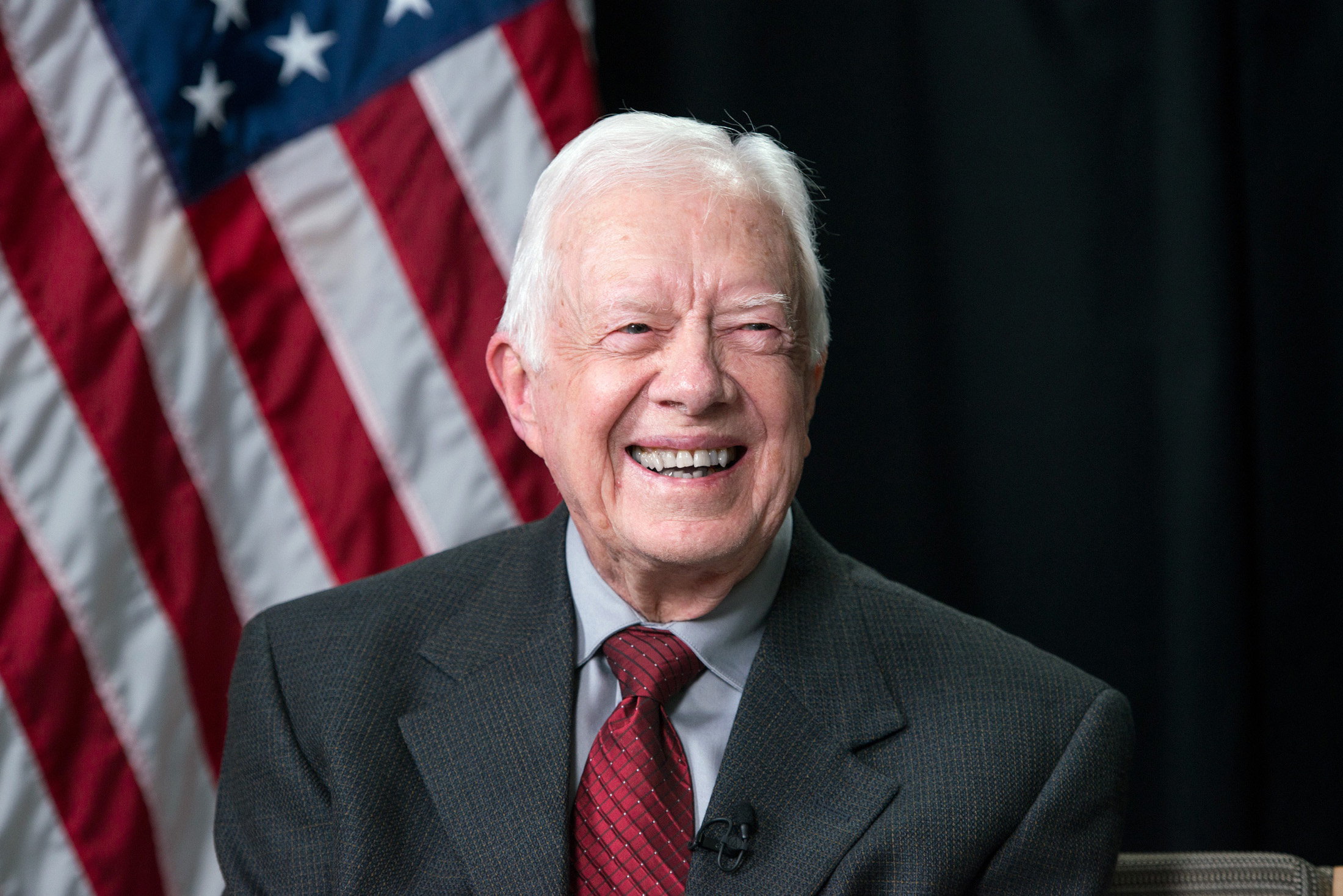
President Jimmy Carter in 2014. (Photo credit: LBJ Presidential Library)

HONEST. COMPASSIONATE. HUMBLE. All describe President Jimmy Carter, who died December 29, 2024, at the age of 100 and whose national funeral will be held Thursday at the Washington National Cathedral. A private funeral and burial will follow in Plains, Georgia.

In many ways, the name of Carter’s hometown, Plains (minus the “s”), describes this soft-spoken man. He was the son of a peanut farmer, grew up in a house without electricity or indoor plumbing, took over the family farm upon the death of this father. Having grown up on a family farm, in a home without a bathroom and closely rooted to the land, I understand Carter’s plain beginnings.

That Carter would go on to become governor of Georgia, the 39th President of the United States, winner of the Nobel Peace Prize and a beloved humanitarian proves that anyone can come from the plainest of places and make a positive difference in this world, emphasis on the word “positive.”

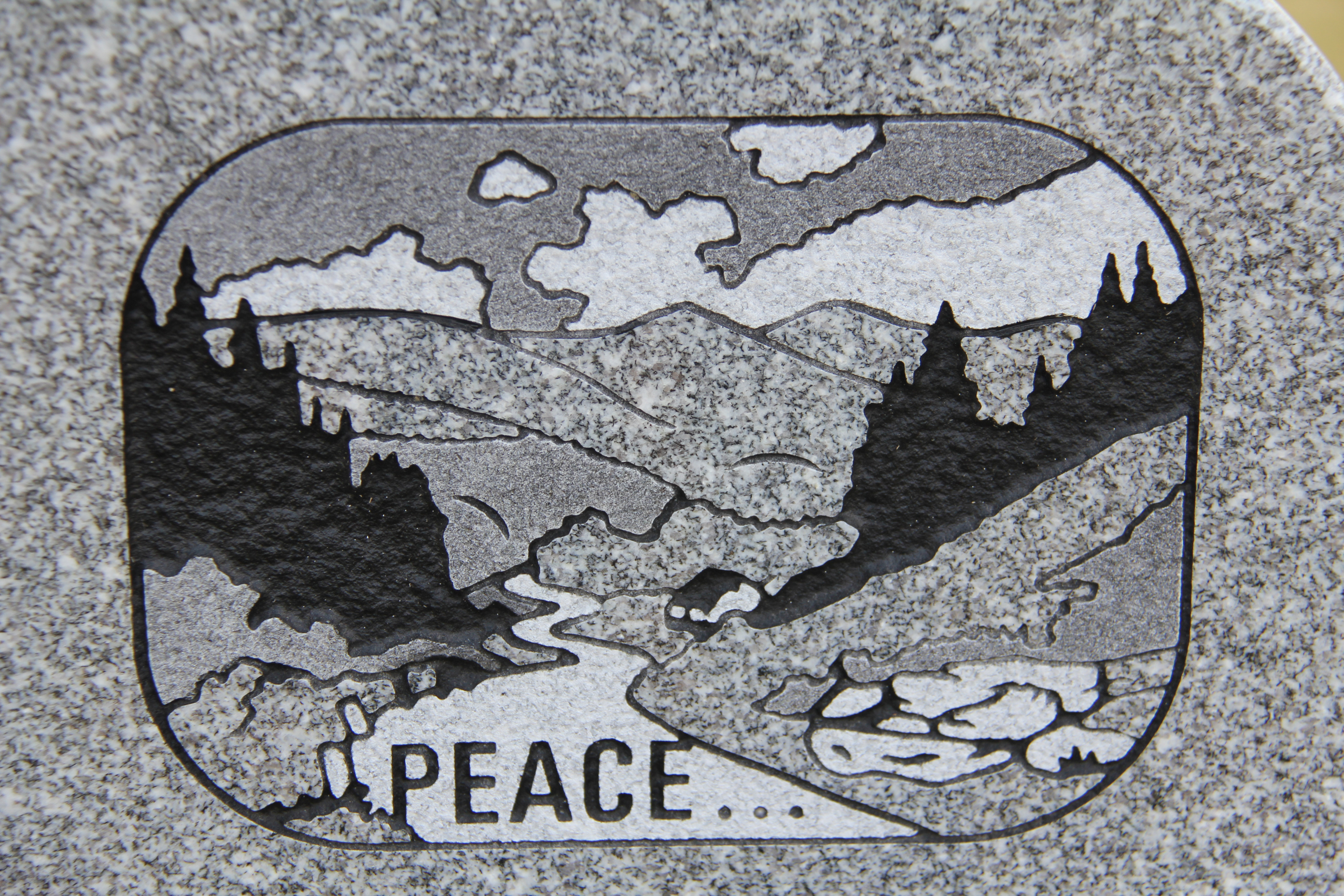
Peace on a tombstone at Valley Grove Cemetery, rural Nerstrand, Minnesota. (Minnesota Prairie Roots copyrighted file photo 2024)

BUILDING A LEGACY OF SERVICE

Certainly, Carter was not perfect—no one is—but the legacy he leaves is, at its core, that of service to others. We should all strive for that. To do good. To help others. To show love, kindness and compassion. For Carter, nowhere was that more evident than in his post-presidency work with Habitat for Humanity. He didn’t just pose for photo ops. He picked up a hammer and actually helped build Habitat houses.

He also built world peace. During his presidency, Carter helped negotiate a peace treaty between Israel and Egypt in 1979. His efforts led to signing of the Panama Canal Treaty in 1977. His work in the areas of peace, democracy, human rights, and economic and social development earned him that coveted Nobel Peace Prize.

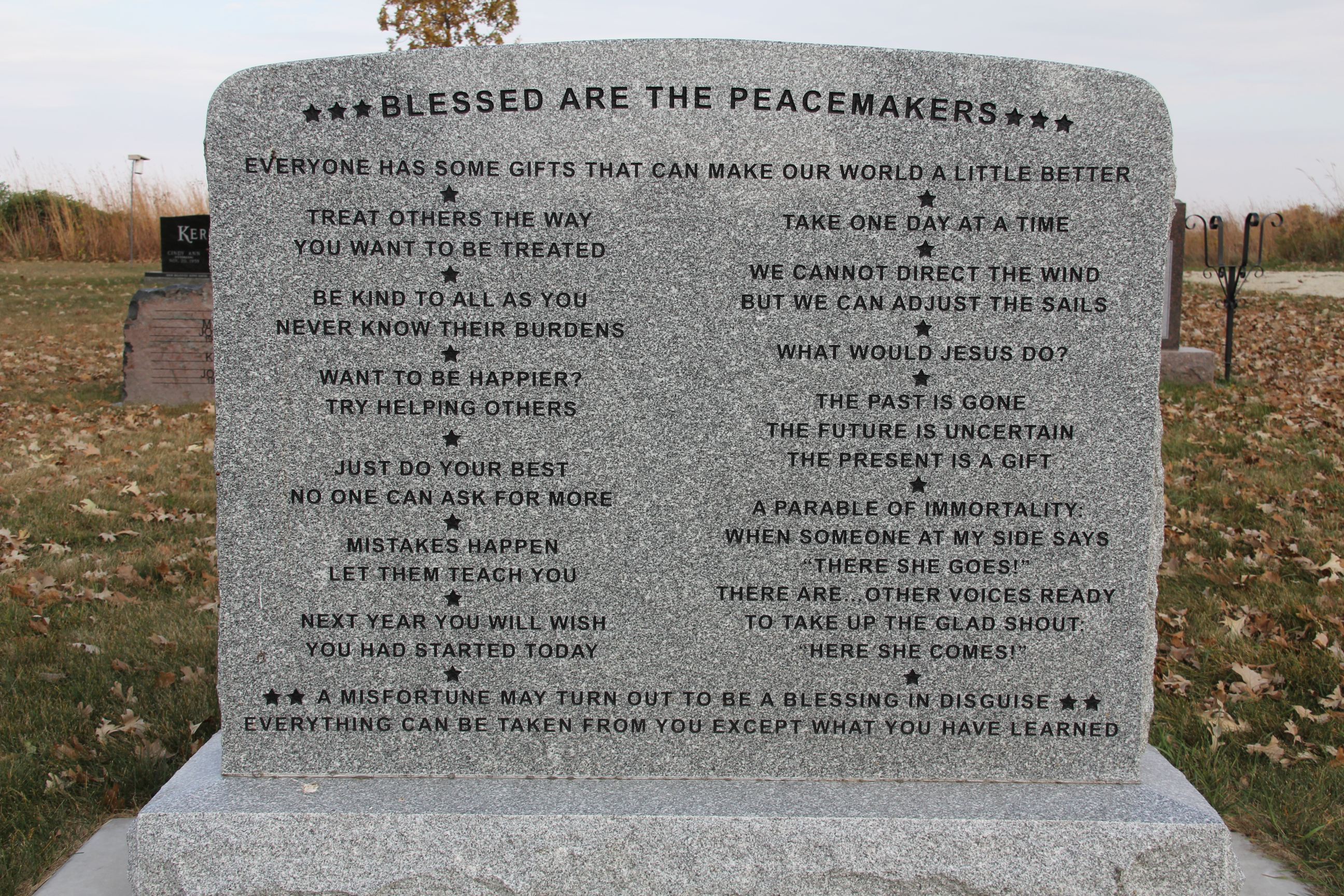
Blessed are the peacemakers” fits President Jimmy Carter. This is a tombstone at Valley Grove Cemetery, rural Nerstrand. (Minnesota Prairie Roots copyrighted file photo 2024)

AN INTERNATIONAL CRISIS & MY CONNECTION

I was just finishing college and starting my career in journalism when Carter was in and ending his presidency. In 1981, while working as a newspaper reporter for the Mankato Free Press, I covered a major national event with a Carter connection. That was the homecoming of Bruce Laingen, one of 52 Americans held hostage for 444 days in Iran. Laingen, a native of Minnesota, was the top American diplomat at the U.S. Embassy in Tehran when protesters stormed the embassy in November 1979. Carter tried unsuccessfully to get those hostages released. On January 20, 1981, the day President Ronald Reagan was sworn into office, the hostages were finally freed. The timing of that release was obviously deliberate. Carter’s re-election bid failed in part due to the hostage crisis.

In my work as a reporter for the Free Press’ St. James News Bureau (my apartment) I covered the southern Minnesota angle on that international crisis. I drove from St. James to nearby small town Odin several times to interview Arvid Laingen at his business, the Odin Feed Mill. We talked about his brother Bruce and his captivity in Iran. I remember photographing Arvid against the feed mill backdrop, American flag draped from the building. When Bruce and the other hostages were released, I joined my regional editor and a Free Press photographer in covering Laingen’s homecoming parade in Odin. Well wishers lined the streets on that cold winter day. Yellow ribbons, which had become a national symbol of hope during the hostage crisis, ringed trees.

My work as a young journalist for a regional southern Minnesota daily newspaper connects me indirectly to President Carter. I admire Carter’s efforts to free the hostages. I can appreciate how defeated he must have felt as days ticked by and the Americans remained in captivity. But he did not let defeat define him. Carter went on to do incredible work worldwide after leaving the highest office in the country. Anyone who remains humble and serves selflessly earns my respect. Carter was clearly a man of integrity, of principles, of faith, someone who never forgot his roots. If only others in public office followed his path of plainness…

© Copyright 2025 Audrey Kletscher Helbling
 

Celebrating community journalism during National Newspaper Week & my backstory October 8, 2024

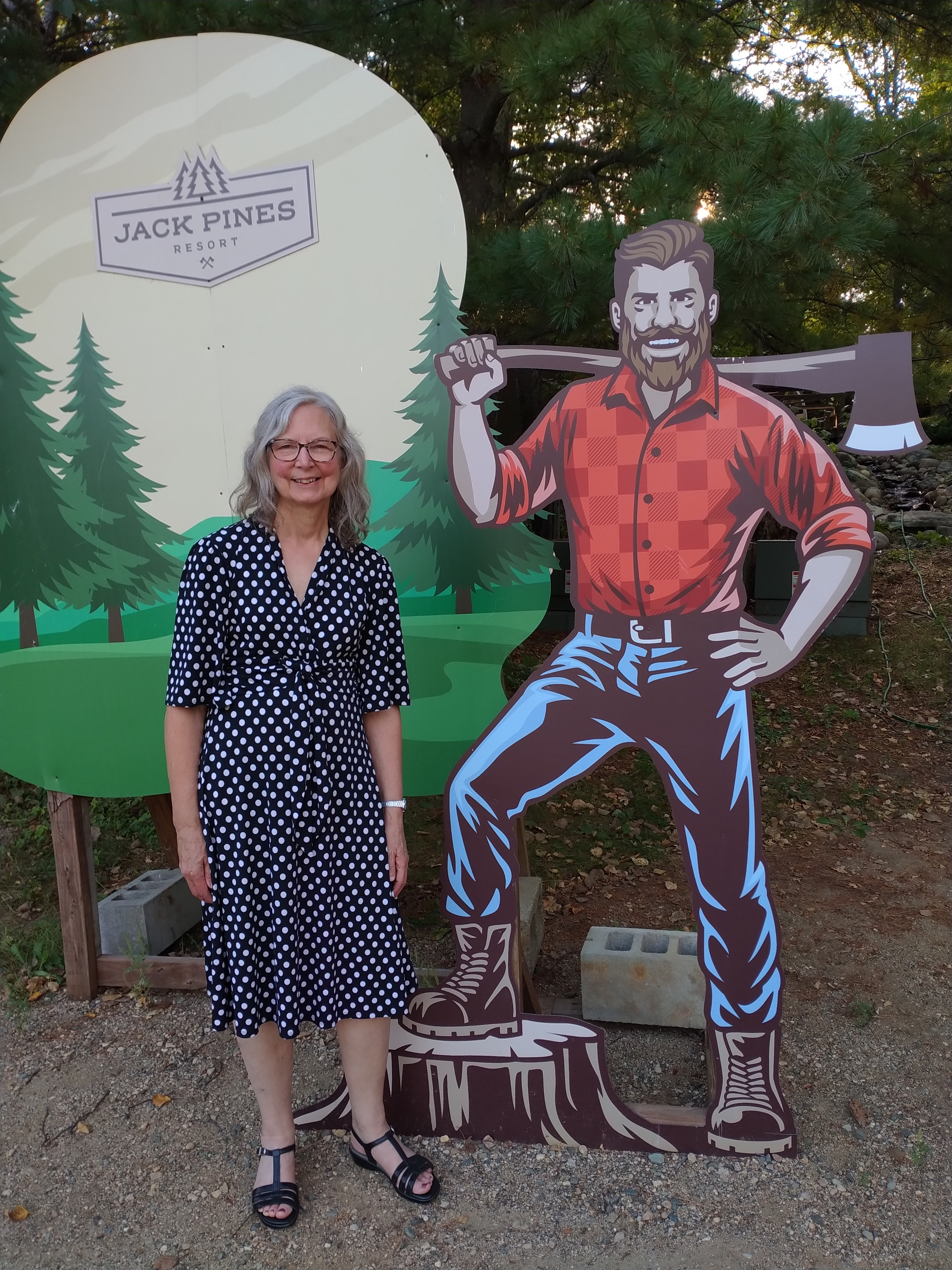
I am a down-to-earth writer who focuses on writing about people, places and events primarily in Minnesota. Here I’m pictured outside Jack Pines Resort, rural Osage. I was there attending a book launch party for an anthology in which my writing published. (Minnesota Prairie Roots copyrighted file photo by Randy Helbling, September 2024)

I’VE ALWAYS LOVED WRITING. From early on, my love of language, of words, of grammar, of, yes, even spelling, defined me. Give me a book to read. Give me a spelling test. Give me a pen and a notebook. And then a computer. Words, words and more words. I will find them, use them, create stories with them.

At one time, I wanted to pursue a degree in German. But, after a year in college, I changed direction because I didn’t want to teach. I decided to study journalism. It was absolutely the right decision for me, my interests and my skills.

With that intro, I join the many writers who are celebrating National Newspaper Week October 6-12. That includes journalists from my local paper, The Faribault Daily News, in which my writing publishes each weekend and sometimes more. I no longer consider myself a full-fledged journalist as much as a writer. These days I write from a personal perspective, more as a columnist, rather than as an objective reporter. I write fiction, creative nonfiction and poetry, too.

MY JOURNALISM EXPERIENCE

But I did work as a full-time newspaper reporter and photographer after graduating with a mass communications degree (news/editorial emphasis) in 1978 from Minnesota State University, Mankato. I worked for newspapers in Gaylord, Sleepy Eye, Mankato, Owatonna and Northfield. Eventually I gave up journalism when I started a family. The long and odd hours are not conducive to family life.

Today my three kids are long grown and gone, and I’ve found my way back to writing with an added focus on photography. What makes a good writer, a good newspaper reporter? Topping my list are the abilities to listen and focus on detail. I’ve always considered myself a good listener, a necessity for any newspaper reporter. I developed the skill of taking notes while actively listening. Organization also factors in. There’s always a bit of homework involved in prepping for an interview. Research the subject. Prepare questions, but be open to asking more as the interview progresses. Focus on details. Tell a story.

I worked in journalism before the days of cellphones, so I filled notebooks with pages of notes. I also studied and worked in the profession before computers and digital cameras. My first job out of college, I typed all of my stories on a manual typewriter, shot all my photos on film. I would never want to go back to either. Give me a computer and a digital camera. It’s much easier to create with those.

FOCUS ON LOCAL STORIES

I love sharing stories and photos of people, places and events that weave into my life, that I discover. I find joy in following a gravel road, in discovering interesting signage, in exploring small towns, in meeting ordinary people following their passions… People often tell me I find the most interesting things. I agree. And then I tell them it’s right here in their own backyard if only they pause to look, and see.

Therein lies the value of community journalism, which I want to highlight and honor during National Newspaper Week. Our local newspapers are all about local. Local reporters cover and write about the people, places and events that are happening locally. They write stories ranging from features to hard news. I covered all of those, too, while working as a full-time reporter. It’s not an easy job. People are quick to criticize, slow to praise. So I want to state right now that I appreciate our local news team. They work long, odd hours, just as I did, to gather and write the news. They care.

Everyone ought to care that freedom of the press thrives, that these journalists are covering our government meetings, writing about our neighbors, highlighting ordinary people who do extraordinary things and much more. We need newspapers as much today as ever before, perhaps even more.

Please, support your local newspaper by subscribing. And thank a newspaper reporter for their dedication to the profession. They deserve to be recognized, especially during National Newspaper Week.

© Copyright 2024 Audrey Kletscher Helbling
 

-30- April 30, 2024

(Minnesota Prairie Roots copyrighted file photo)

THE LOSS IS IMMENSE, TRAGIC—the deaths of eight prominent community members in southern Minnesota last week. I knew none of them personally. Yet I did. We all did.

If you have ever read a community newspaper, then you knew the deceased. For it is eight Minnesota newspapers, not individuals, that died. Ceased publication, only weeks after an announcement of their forthcoming funerals.

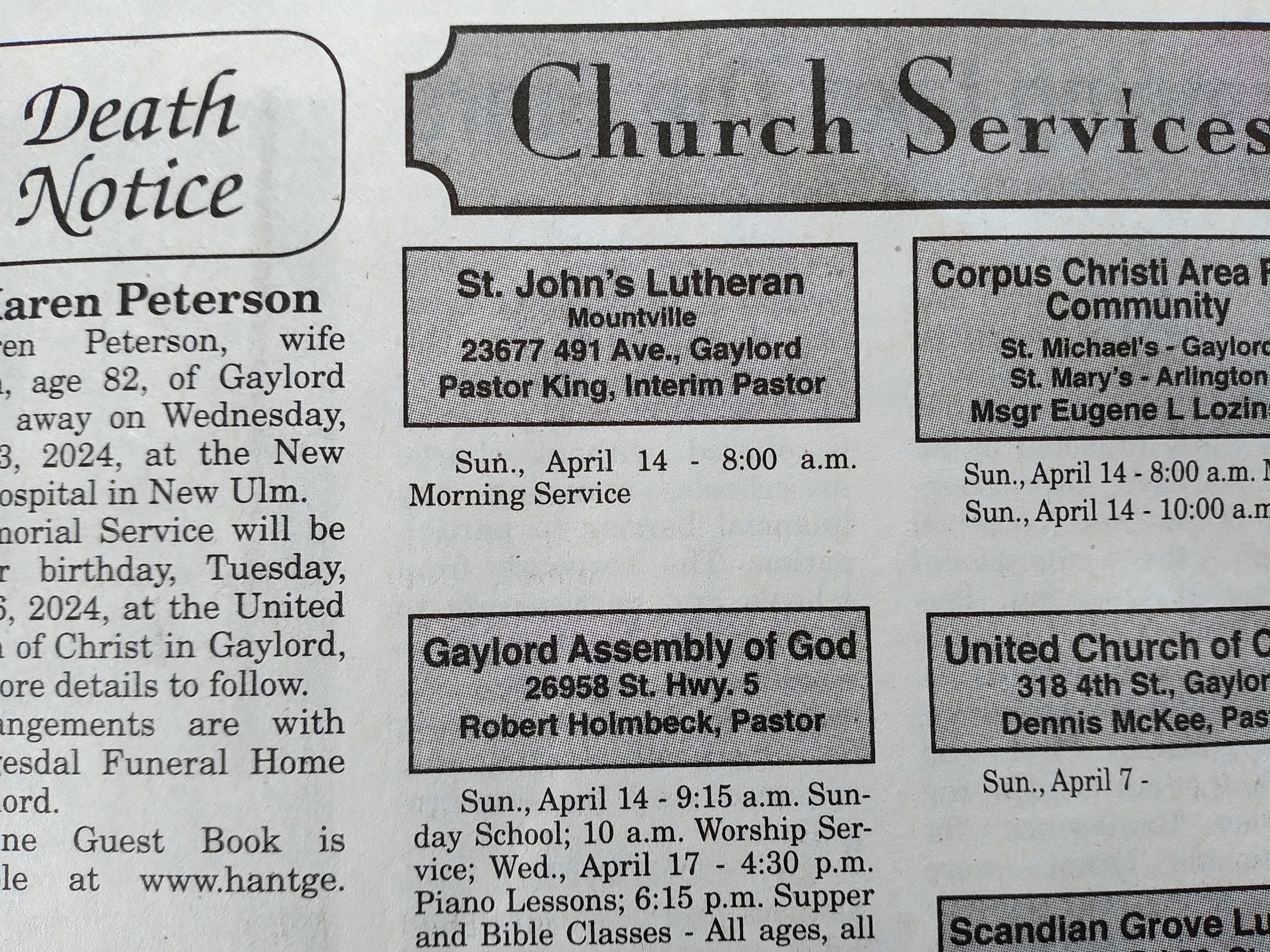
Death notices and church services, printed in The Gaylord Hub.

I am mourning the deaths of the Hutchinson Leader, Litchfield Independent Review, Chaska Herald, Chanhassen Villager, Jordan Independent, Shakopee Valley News, Prior Lake American and Savage Pacer, plus Crow River Press Printing Plant. All are owned by Denver-based MediaNews Group, part of hedge fund Alden Global Capital.

They ranged in age from 30 (Savage Pacer) to 162 (the Chaska and Shakopee papers). Five of the eight began publication between 1862-1880. That’s quite a legacy.

I am undeniably biased in reporting this news. I hold a journalism degree, have worked for community newspapers and write for publications owned by Adams Publishing Group. I believe in community journalism with the fierceness of recognizing its importance, its value, to the people who live and work in the places these papers cover. No one covers local like local.

My local paper, owned by Adams Publishing Group, still prints a special graduation section each spring.

And now that print coverage is lost in all these southern Minnesota towns, cities and rural areas: The watchdog coverage of school board, city council, county board, planning and zoning, and other government bodies. The stories about crime and tragedies. The stories about community events and celebrations. The interesting features that focus on people. Local sports and arts and entertainment stories. Community calendars, school honor rolls and lunch menus. Graduation. Obituaries and much more.

In my first journalism class at Minnesota State University, Mankato, I learned how to craft an obituary. It was our initial writing assignment, I think to impress upon all of us post-Watergate would-be reporters the importance of getting every detail correct in a story. That lesson stuck with me. Get it right.

I took that knowledge with me to The Gaylord Hub, a small town community newspaper printed at Crow River Press in Hutchinson. Each week a co-worker and I aimed north in a vintage Dodge van to deliver the newspaper lay-out sheets to the printing plant. The process of creating a newspaper in 1978 was decidedly different than today. Consider that I typed all my stories on a manual typewriter. A typesetter then typed my work into a typesetting machine. Stories were printed out in columns, then laid out and pasted onto lay-out sheets. No designing by computer. Then it was off to Crow River Press, where a co-worker and I watched the Hub roll off the press, bagged the freshly-inked papers and delivered them to the Gaylord Post Office, where subscribers eagerly waited to get their papers.

A front page story in the April 11 issue of The Gaylord Hub.

Yes, I’m feeling a tad nostalgic and sad thinking of the closure of Crow River Press. The recent shut-down left the publisher of The Gaylord Hub, and other small town newspaper owners, scrambling for a place to print their papers. Many printing plants, like community papers, have met their demise in Minnesota as large media groups acquired papers and plants.

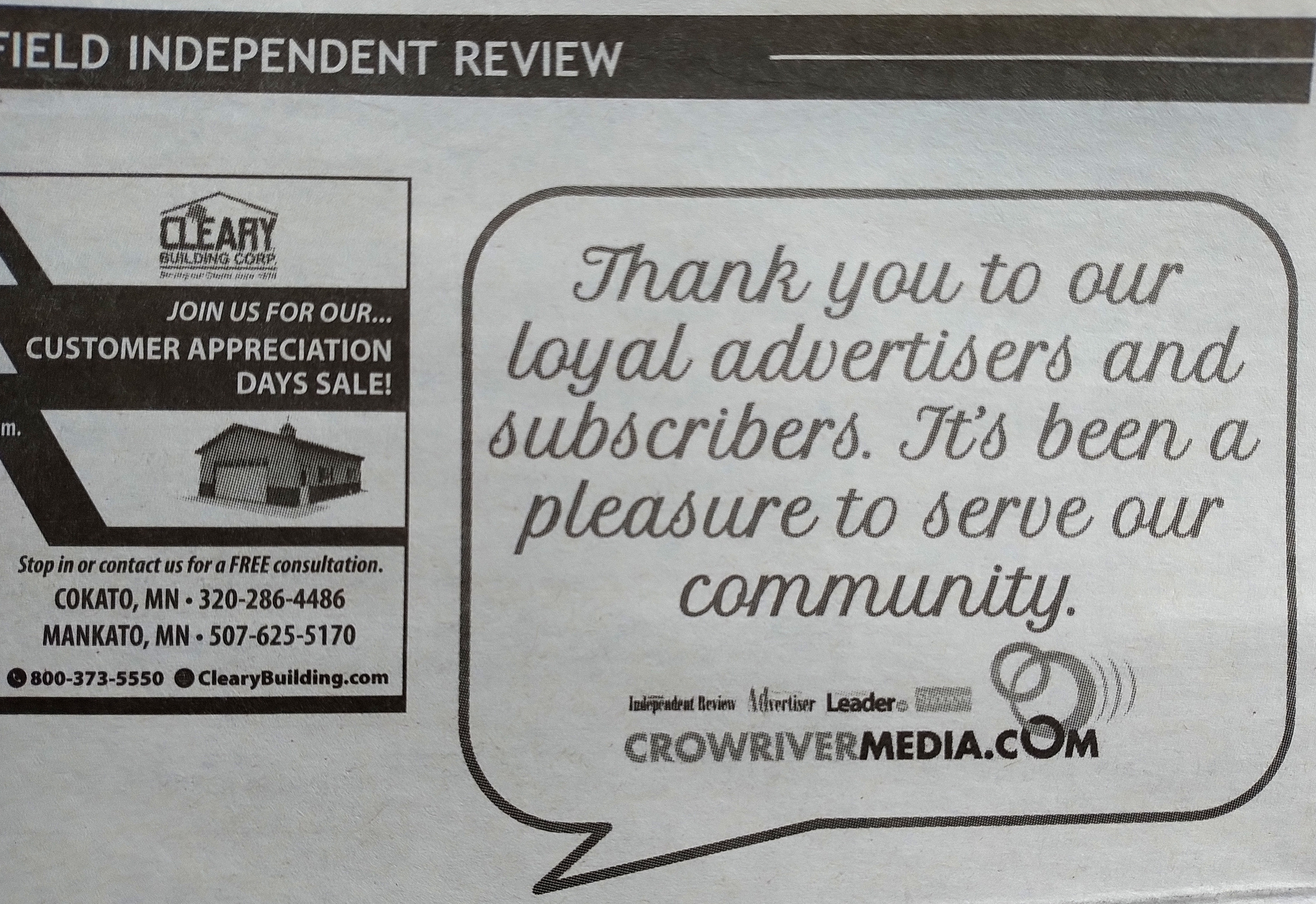
This thank you published in the April 21 final edition of The Galaxy, a supplement to eight community newspapers printed by Crow River Press.

Times change. I understand that. The economy, technology, COVID, acquisitions and much more have factored into the deaths of community newspapers. Readers find their “news” elsewhere. Businesses spend their advertising dollars elsewhere. Far-removed executives make questionable business decisions. The list of reasons and excuses and explanations is extensive.

Community members, too, hold some responsibility in the deaths of newspapers. I can’t speak to the specific papers that closed last week in Minnesota, but I can tell you what I hear locally. And that is criticism, some deserved, much not. People have always criticized the media, failing to remember that reporters are reporting, not creating, the news. But the comments have become more intense, more rabid, more frequent. Freedom of the press feels threatened in our democracy.

The community journalists I know are honest, hardworking, (probably) underpaid and devoted to the craft. Just as I was when I worked as a full-time newspaper reporter.

This full page notice/thank you, an obituary of sorts, published in the April 21 final edition of The Galaxy.

Community newspapers are no longer valued like they once were, resulting in fewer subscribers. When I hear people say they no longer subscribe to the local paper, I suggest they reconsider. Community newspapers are vital to our cities, towns and rural areas. And sometimes we don’t understand that, until it’s too late, until we’re reading their obituaries.

-30-

NOTE: Print journalists have used -30- to signify the end of a story submitted for editing. I use # to indicate the ends of my stories, except today, when the old school -30- seems more appropriate.

© Copyright 2024 Audrey Kletscher Helbling
 

Reflecting on the life of Barbara Walters, from a Minnesota journalist’s perspective January 4, 2023

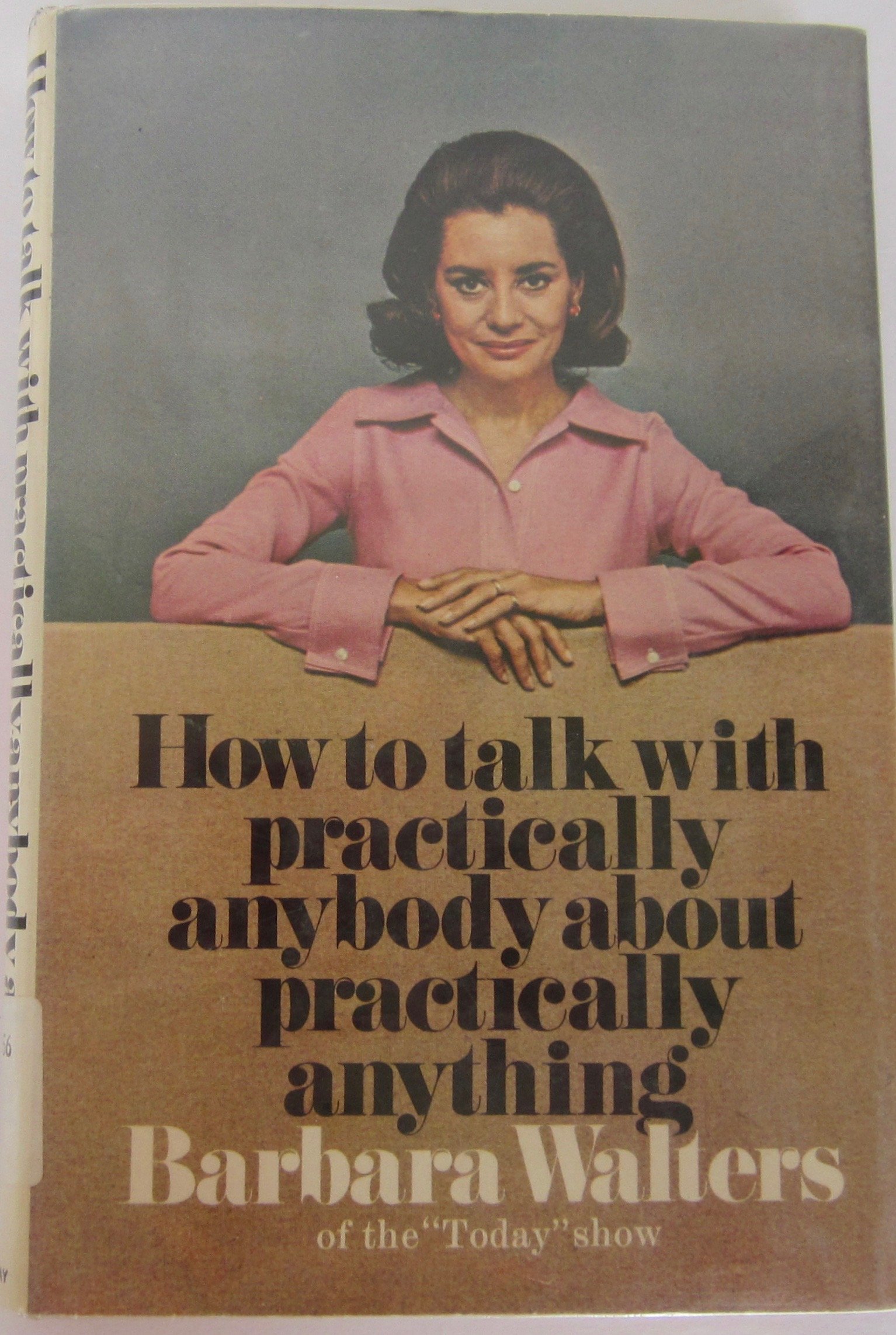
The cover of Walters’ book, published in 1970. (Photo credit: Amazon)

WHEN NEWS BROKE that broadcast journalist Barbara Walters died on Friday at the age of 93, I reacted with disbelief. I didn’t think she was 93, older than my mom would have been if she was still living.

Once I got over that surprise, I began to reflect on Walters’ career as a journalist. As an experienced journalist myself, albeit in print journalism, I connect on a professional level.

BLAZING THE WAY FOR WOMEN

I have always admired Walters, called “a trailblazer” in her field. The description fits. She blazed the way for women in a profession dominated by men. This was true for many women of her time, not just those in journalism. Even I, nearly 30 years her junior, experienced challenges as a female newspaper reporter in the late 1970s and early 1980s. I often felt the sense that men, especially those in positions of power, did not like me. They ignored me, tried to intimidate me, pressured me not to report what had been said at a public meeting. I never caved.

I felt fortunate to have a publisher/editor who backed me up every time, who supported, encouraged and mentored me in my first job at a rural Minnesota weekly. I hope, expect, Walters had the same behind-the-scenes support because some male co-workers didn’t hide their disdain for her. When I watched a clip of her co-anchor dismissively addressing her on the ABC Evening News, I cringed. That Walters maintained her composure is admirable.

SHE DID HER HOMEWORK

There are many reasons to admire Walters. She had a way with interviewees that prompted them to open up to her. Part of that came from being well-prepared. She did her homework—researched backgrounds and prepared questions (written on index cards) well in advance. I followed that same preparatory process for interviews. It works. I relied on my advanced list of questions, my listening skills, my copious note-taking (no recording an interview ever) and my observations to get a story.

Walters never backed down. She asked the tough questions. She perfected the art of the interview. To watch her interviews, especially those from her “The Barbara Walters Special(s)”, is to observe a gifted journalist. She ended each interview with an open-ended opportunity to add what may have been missed in her questioning. I did the same. We were thorough, an indication of the perfectionist trait we share.

THE LESSER-KNOWN FACTS ABOUT WALTERS

In recent days I learned other facts about Walters that reveal her personal side. She learned patience and empathy from her older sister Jackie, who had “a mental disability” (I’m uncertain what that means), Walters once said. She named her daughter Jackie (whom she adopted, following multiple miscarriages) in honor of her sister.

And one final thing. Walters sent handwritten thank you notes and other cards. I do, too. She understood, and I do also, the value in taking time to express gratitude, in the power of the word, whether written or spoken.

Walters leaves a legacy that stretches beyond her trailblazing the way for female journalists. She leaves a legacy, too, of kindness.

© Copyright 2023 Audrey Kletscher Helbling
 

Old school journalism & lessons learned June 22, 2021

In journalism school and early in my journalism career, I typed stories on a manual typewriter similar to this. MN Prairie Roots file photo.

IN A WINDOWLESS ROOM of Armstrong Hall on the campus of Mankato State University, I pounded out a fictional obituary on a manual typewriter.

The year was 1976. And I was learning the basics of newspaper reporting. Lesson number one: Always spell a person’s name correctly. Never assume. Ask for the spelling. There is no reporting sin worse than misspelling a name. I remembered that during my first reporting job out of college when I interviewed Dayle. Not Dale.

I learned from two of the best—Robert O. Shipman and Gladys B. Olson. They were old school journalists, determined to teach Woodward and Bernstein-hyped students how to gather facts and report with truth, accuracy and integrity. They taught the basics—how to write a strong lede, how to infuse interest into feature stories, how to get the story right…

But beyond that, they cared. Deeply. They cared about the roles newspapers play in communities. To report hard news. To share human interest stories. To inform. To keep tabs on government and schools and other groups entrusted with public monies and policies. To share and express opinions on the editorial page, considered the heart of a community newspaper. To publish obituaries. And much more.

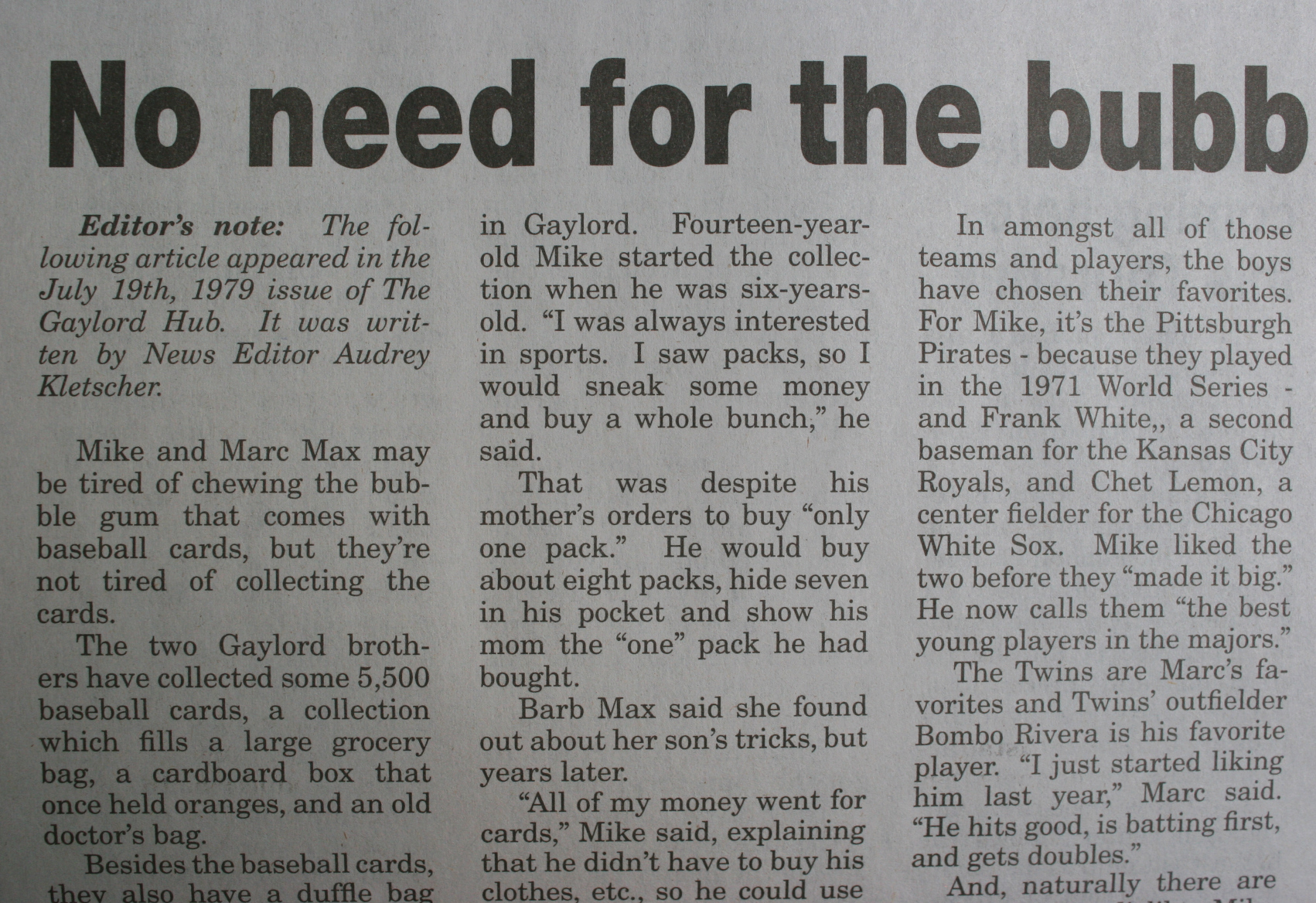
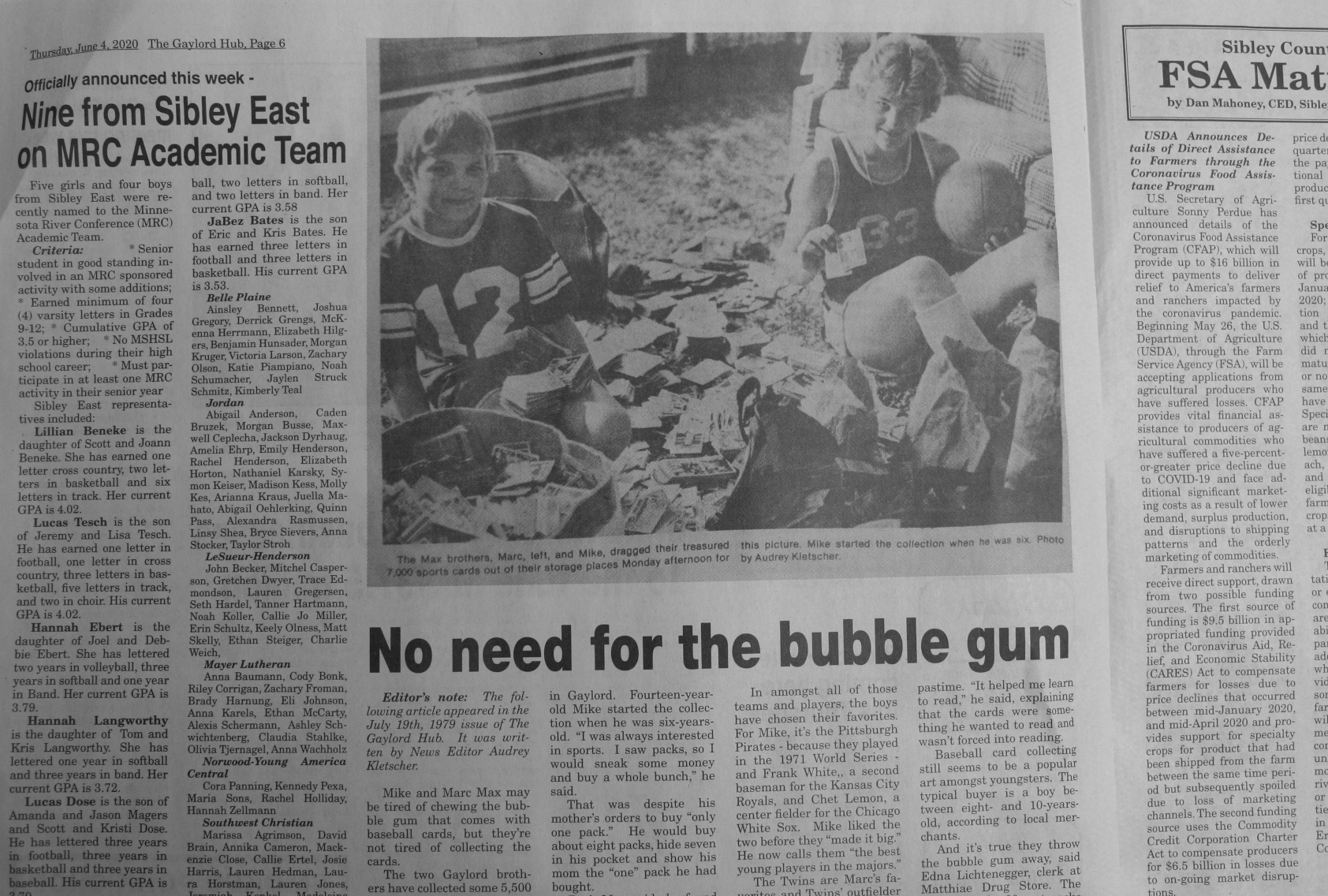
A section of a feature I wrote about Mike Max, now a sports anchor at WCCO TV. MN Prairie Roots file photo.

All these decades later, I remember those lessons learned from Shipman, Olson and others who taught mass communication classes at what is today known as Minnesota State University, Mankato. I graduated in March 1978 and shortly thereafter started working as a newspaper reporter at a small town weekly, The Gaylord Hub. My career would also take me to full-time reporting jobs in Sleepy Eye, Mankato and Owatonna, and to a short-term assignment in Northfield with freelance work also tossed in the mix.

Through the years, I’ve maintained my passion for writing and grown my passion for photography. Even while raising three children, with minimal time to write. Yet, I’ve had no desire to return to the long and odd hours of working for a newspaper at low pay with the stress and pressure of deadlines and a public that criticizes more than values the free press.

Much has changed since I typed a fictional obit in Armstrong Hall on a manual typewriter. For one, technology. Two: Newspapers charge to publish obits. I still struggle with that change. But I understand given the declines in ad revenue. Three: Attitudes. The easily flung accusation of “fake news” simply angers me as does constant criticism of responsible media. “Don’t kill the messenger,” I advise those who target the media for reporting “only bad news.”

A feature I wrote in 1979 republished in the June 4, 2020, issue of The Gaylord Hub. MN Prairie Roots file photo.

I wonder what Professors Shipman and Olson would teach students today. I expect they’d still focus on the basics. On accuracy and integrity and spelling names correctly.

While writing this post, I wanted to assure I spelled their names right, which led me to search online. It was then that I discovered some interesting facts about Olson, a petite spitfire of a woman. Shortly before she turned four, Gladys and her infant brother were orphaned as a result of the 1918-1919 flu pandemic. Their parents died within 24 hours of each other, among more than 8,000 North Dakotans who died of influenza in 1919. The siblings were raised by their paternal grandparents. I wish I’d known this when Olson taught me how to become a good, decent and fair newspaper reporter.

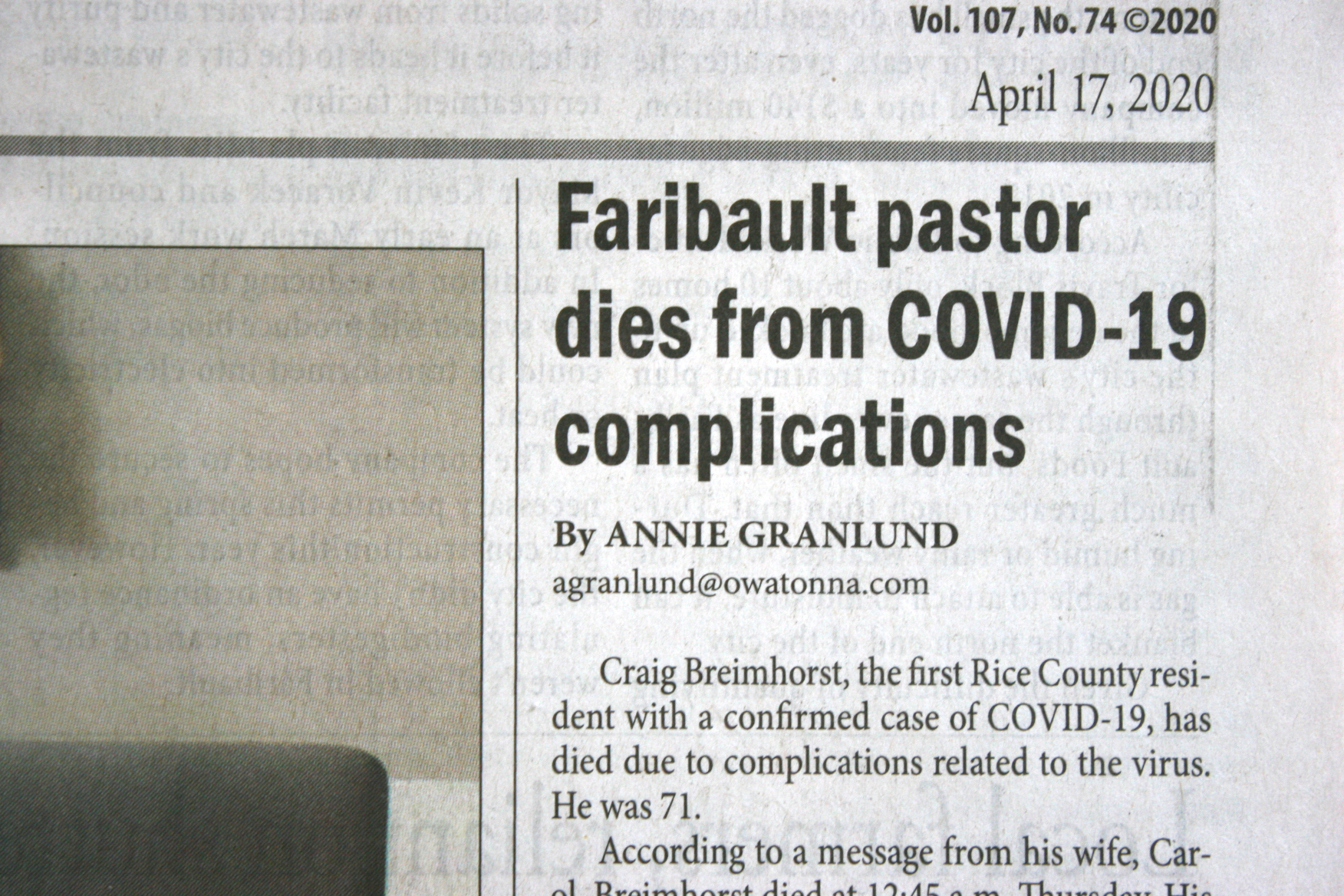
From the front page of the Faribault Daily News. MN Prairie Roots file photo 2020.

Today, as I read Olson’s 2016 obit, I understand her backstory, what shaped her strength and resilience and kindness. The list of her accomplishments beyond journalism professor emphasizes service to others. She lived to age 101. That she died only four years before the COVID-19 pandemic is not lost on me. I’m thankful she didn’t have to endure another pandemic. I’m also thankful that she, and Robert Shipman, taught me old school journalism style. To write with fairness, integrity and accuracy. And to value the role of newspapers in a democracy.

© Copyright 2021 Audrey Kletscher Helbling
 

With gratitude for community newspapers April 15, 2020

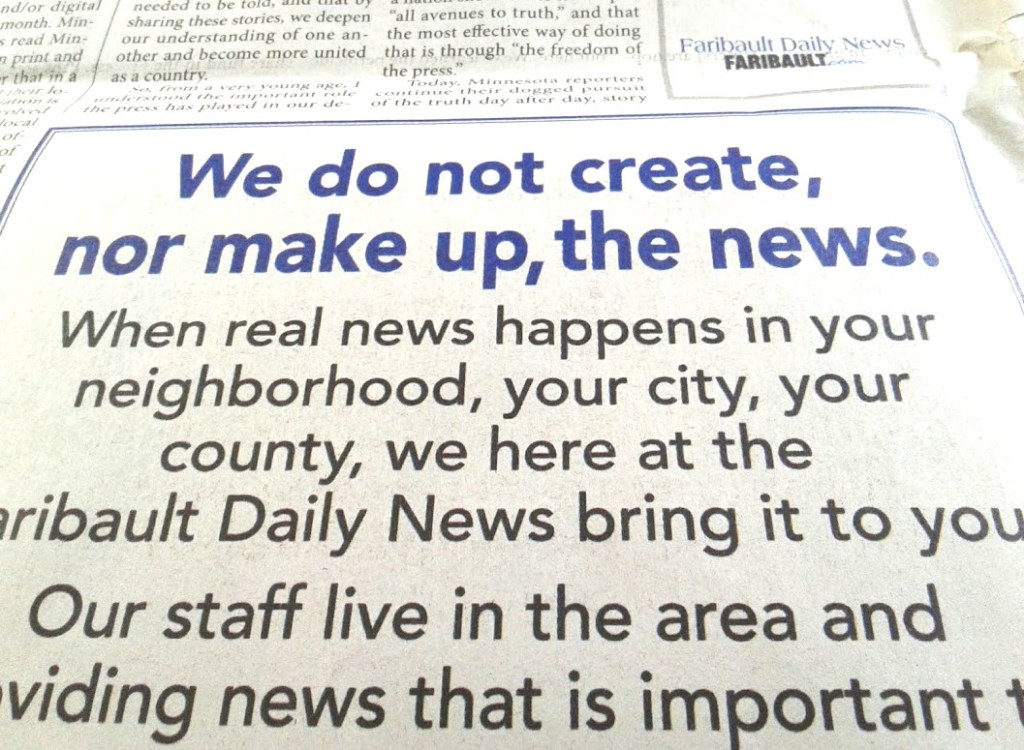
Published in the Faribault Daily News in August 2017 as part of a “Whiteout” campaign by Minnesota newspapers during Minnesota Newspaper Week. Minnesota Prairie Roots file photo 2017.


NOW, MORE THAN EVER, our community newspapers need our support. They, like so many businesses, have been negatively affected by COVID-19.

Ad revenue has plummeted due to business closures. One only need page through a local newspaper to notice the drop. Advertising, and subscriptions, pay expenses from printing to payroll.


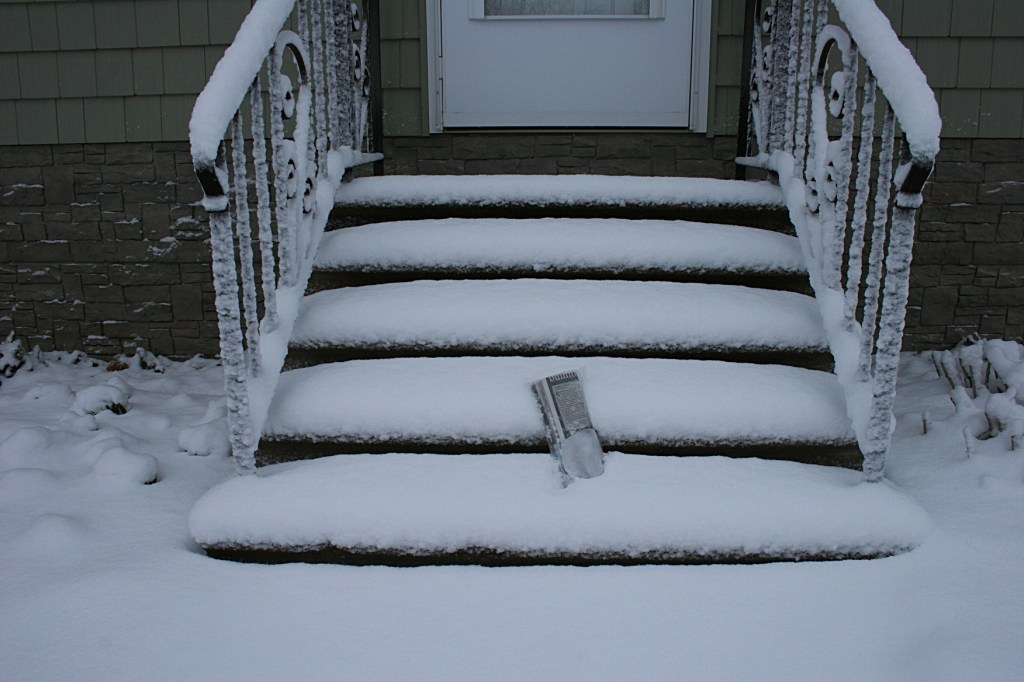
The Faribault Daily News on my front steps, when it was still delivered by carrier. Today the paper lands in my mailbox, delivered by the post office. Minnesota Prairie Roots file photo.


Already in Minnesota, several newspaper—The Hastings Star-Gazette and the Bulletin, serving Woodbury and Cottage Grove and owned by River Town Multimedia—will cease publication in early May. In Fargo/Moorhead, The Forum is no longer publishing a print paper on Mondays and Fridays.

In my community and throughout the region, Adams Publishing Group employees’ hours have been cut. And more. I’ve lost work as a freelancer and columnist for an APG arts/entertainment/lifestyle magazine that has temporarily suspended publication.

I view this issue from an insider perspective, having earned a degree in journalism and with experience as a small town newspaper reporter and photographer, albeit decades ago. I understand the importance of community journalism. I understand how hard these reporters and editors work to bring you local news. I understand the long and odd hours and the low pay. I’ve been there. Now, more than ever, newspapers are an essential business in keeping communities informed.


Published as part of the “Whiteout” campaign in 2017. Minnesota Prairie Roots file photo 2017.


Journalists commit to bringing you the stories that matter in your community. Think about that for a moment. Stories that matter in your community. The feel-good stories. The watchdog stories about public meetings. The hard news. Only in a local paper will you see those stories and photos targeted specifically for your community or region.


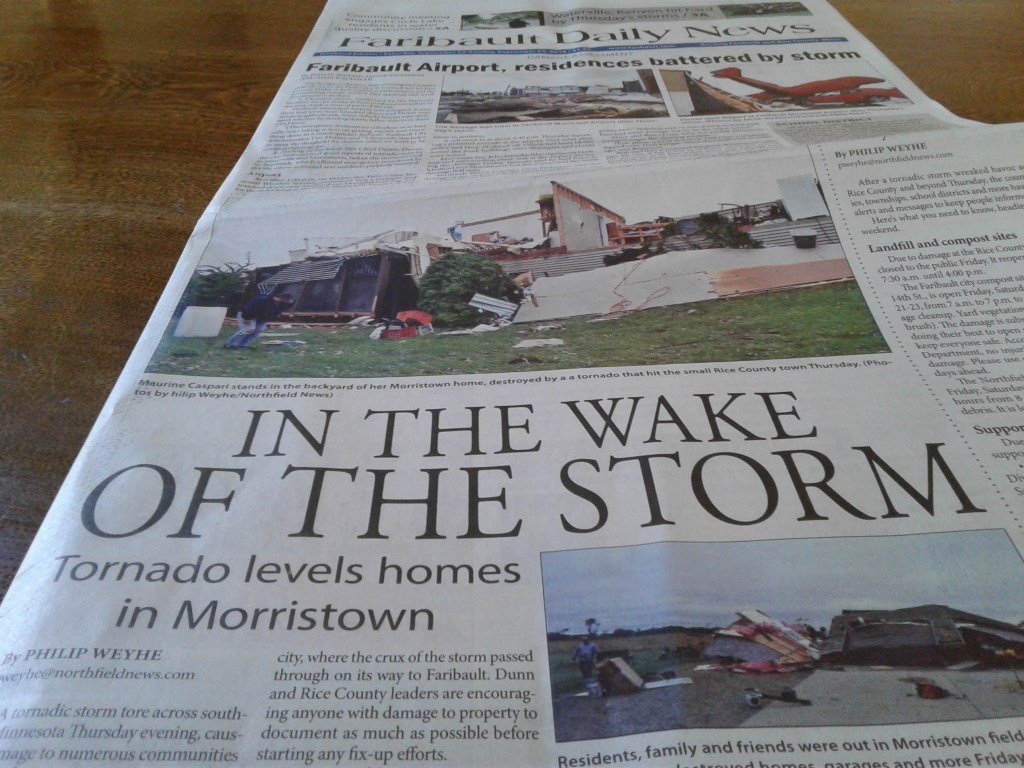
The front page of the Faribault Daily News following a devastating tornado in September 2018. Local news found only in community newspapers. Minnesota Prairie Roots file photo 2018.


I am grateful to the reporters, editors, page designers, ad reps and more at my local paper, the Faribault Daily News, who continue to invest their time and energy in community journalism. All too often, people criticize their work. Complain. Please, don’t kill the messenger who delivers bad news, along with the good. The reporter is just doing his/her job.

Rather, we should be grateful. We should thank these hard-working men and women for all they do. And today that means making sense of COVID-19 on a local level—writing about locals sewing face masks, hospital staff cuts and, yes, even the difficult stories about people infected with the virus. You won’t necessarily hear or read those stories in other media outlets. Our community newspapers are just that, all about community. Your community.

Please support community journalism by subscribing to your local newspaper, by purchasing ads (if your budget and situation allow), by saying “thank you.”


What if your community lost its newspaper? This is the front page of the Faribault Daily News during the 2017 “Whiteout” campaign. Minnesota Prairie Roots file photo 2017.


FYI: I invite you to read my August 2017 post about a “Whiteout” campaign by 200 Minnesota newspapers reminding people about the importance of local newspapers in their communities. It’s worth a read. Click here. And remember that a free press is a vital part of our democracy. We need reporters asking tough questions, gathering information and presenting the facts.

JOIN ME in expressing your gratitude for community newspapers in the comments section below. Tell me what you appreciate about your local newspaper and those who work there. Thank you.

© Copyright 2020 Audrey Kletscher Helbling
 

Whiteout, and not the kind you think August 16, 2017


MY MIND WAS ALREADY reaching for the phone, punching the number for the circulation department of the Faribault Daily News when I paused.

With a sports headline printed above the nameplate and an ad stretched across the bottom of an otherwise blank front page, I realized—kaboom—that the white space couldn’t be accidental. There was a reason the paper I grabbed from my front steps on Tuesday morning was devoid of front page news.


I flipped to page two. There I found my answer. The absence of news was intentional. According to an article published there, more than 200 Minnesota newspapers are participating in a “Whiteout” to remind readers of the importance of newspapers in their local communities during Minnesota Newspaper Week.

Brilliant, simply brilliant. What an incredible visual way to make a point.

Quotes supporting freedom of the press ran in a sidebar:

“Our liberty depends on the freedom of the press and that cannot be limited without being lost.”—Thomas Jefferson

“Freedom of the press is not just important to democracy, it is democracy.”—Walter Cronkite

“Congress shall make no law…abridging the freedom of speech, or of the press…”  First Amendment to the Constitution

As a former newspaper reporter, I especially value freedom of the press. I hope the average person realizes just how important a free press is to our democracy. When a government controls the media, we lose our freedom.

I can’t recall a time in the U.S. when the media have been more ruthlessly attacked by people in power than now.


When I think back to my years as a community journalist, though, I recall efforts by some locals to curtail my reporting in several small Minnesota towns. A high school music teacher once attempted to intimidate me after I wrote about controversial discussions at a public school board meeting. Likewise, a realtor verbally attacked me when I wrote about city council proceedings that involved him. A school superintendent in one community treated me with disdain after I covered a student walk-out. Thankfully my editors backed me up and I continued to do my job.

Being a journalist isn’t easy, especially in today’s world. I expect the pay, the long and odd hours and stress are just as awful as when I worked in the profession decades ago. And the criticism is fierce. People complain all the time about the media. Sometimes those complaints are justified. But mostly not.

I say, “Stop blaming the messenger.” Journalists do not make the news. They are only reporting it. And we should all value that they have the freedom to do so.

© Copyright 2017 Audrey Kletscher Helbling
 

And the Pulitzer Prize goes to… an editor in rural Iowa April 13, 2017

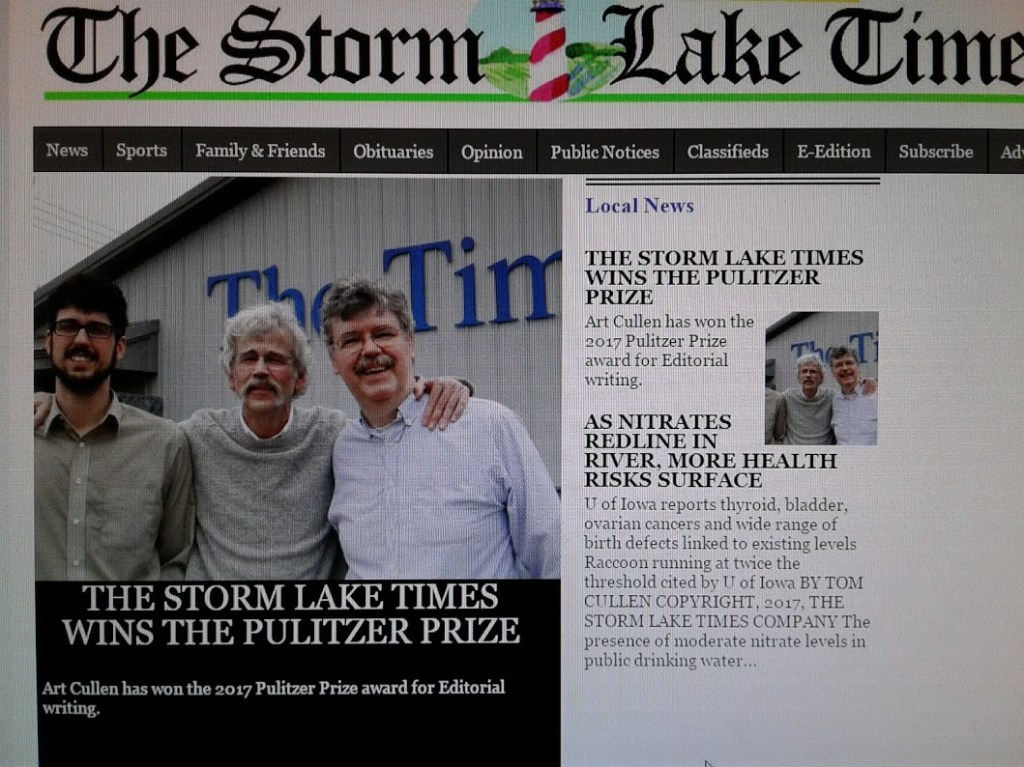
Art Cullen is in the center of this photo on The Storm Lake Times website. That’s his brother to the right, his son to the left.


HE BEAT OUT WRITERS from the Houston Chronicle and The Washington Post.

He is Art Cullen, 59-year-old editor of The Storm Lake Times. On Monday he won the Pulitzer Prize in editorial writing “for editorials fueled by tenacious reporting, impressive expertise and engaging writing that successfully challenged powerful corporate agricultural interests in Iowa.”


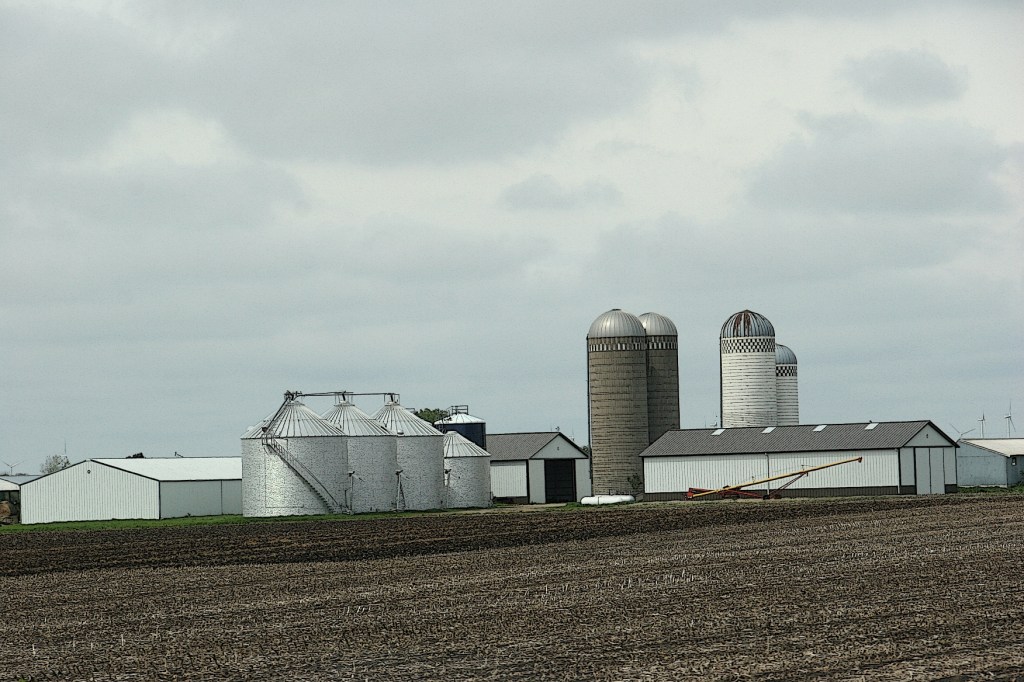
A farm site just across the Minnesota-Iowa border on the west side of Interstate 35. Minnesota Prairie Roots file photo.


That’s right. Rural Iowa. The state that welcomes visitors to “Fields of Opportunities.” The land of corn and beans and hogs. I like Iowa, just an hour south of my Minnesota home. It reminds me of my native rural southwestern Minnesota with fields, farm sites, small towns and wide open spaces.

That a writer from a northwestern Iowa community of around 10,000, from a newspaper with a circulation of 3,000, won the Pulitzer Prize delights me. You don’t need to be big city famous or work for some well-known newspaper to be recognized and honored. You just need to do outstanding work. It’s not easy being a journalist in a small town. I remember. I worked as a reporter, photographer and more at Minnesota weeklies and dailies decades ago.

To take a strong stand on the editorial page like Cullen did against corporate ag takes guts. And a deep understanding that the editorial page is the heart of the newspaper. As a journalism student at Minnesota State University, Mankato, in the late 1970s, I heard repeatedly that message of editorial importance. It ranked right up there with the basics of reporting—who, what, when, where, why and how.


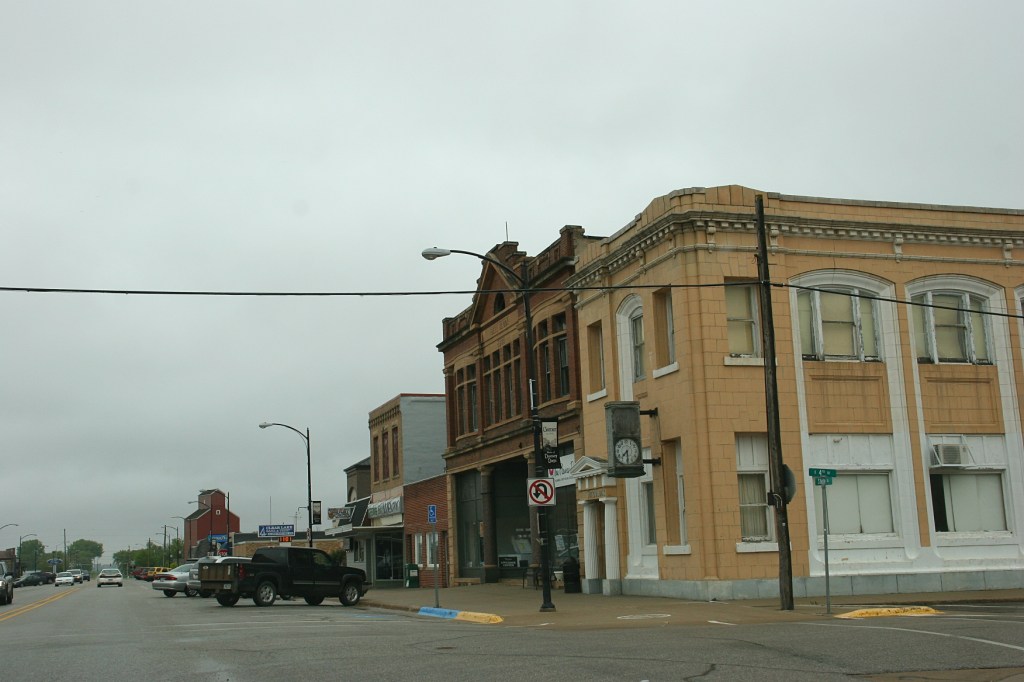
Small farming communities define Iowa. This is downtown Garner, just across the Minnesota/Iowa border. Minnesota Prairie Roots file photo.


Cullen clearly understands community journalism and the accompanying responsibilities of a strong editorial voice no matter the risks. And there are risks—financial and otherwise. Express an unpopular opinion and you risk raising the ire of advertisers, subscribers and others. Read a sampling of Cullen’s editorials, and you begin to understand why he won the Pulitzer Prize. Here’s a man determined to consider the facts and then offer his common sense opinion.

I doubt Cullen’s new-found fame as a Pulitzer Prize winner will change how he approaches his job at The Storm Lake Times, a newspaper he co-owns with his brother and where his wife and son also work. I expect he will continue to work with the enthusiasm of a man passionate about community journalism. I appreciate that family-run newspapers like his still exist in an age when too many towns/cities have lost their hometown papers to newspaper chains. When that local ownership is lost, quality and quantity of local coverage usually diminishes.

The Storm Lake Times remains undeniably local. Alongside a photo and headline announcing the Pulitzer Prize are stories about a cat sanctuary, a second grader finding a four-leaf clover and a popular area fishing spot. It doesn’t get much more down-to-earth rural, more “this is still life in Iowa even when you win the Pulitzer Prize” than that.

© Copyright 2017 Audrey Kletscher Helbling