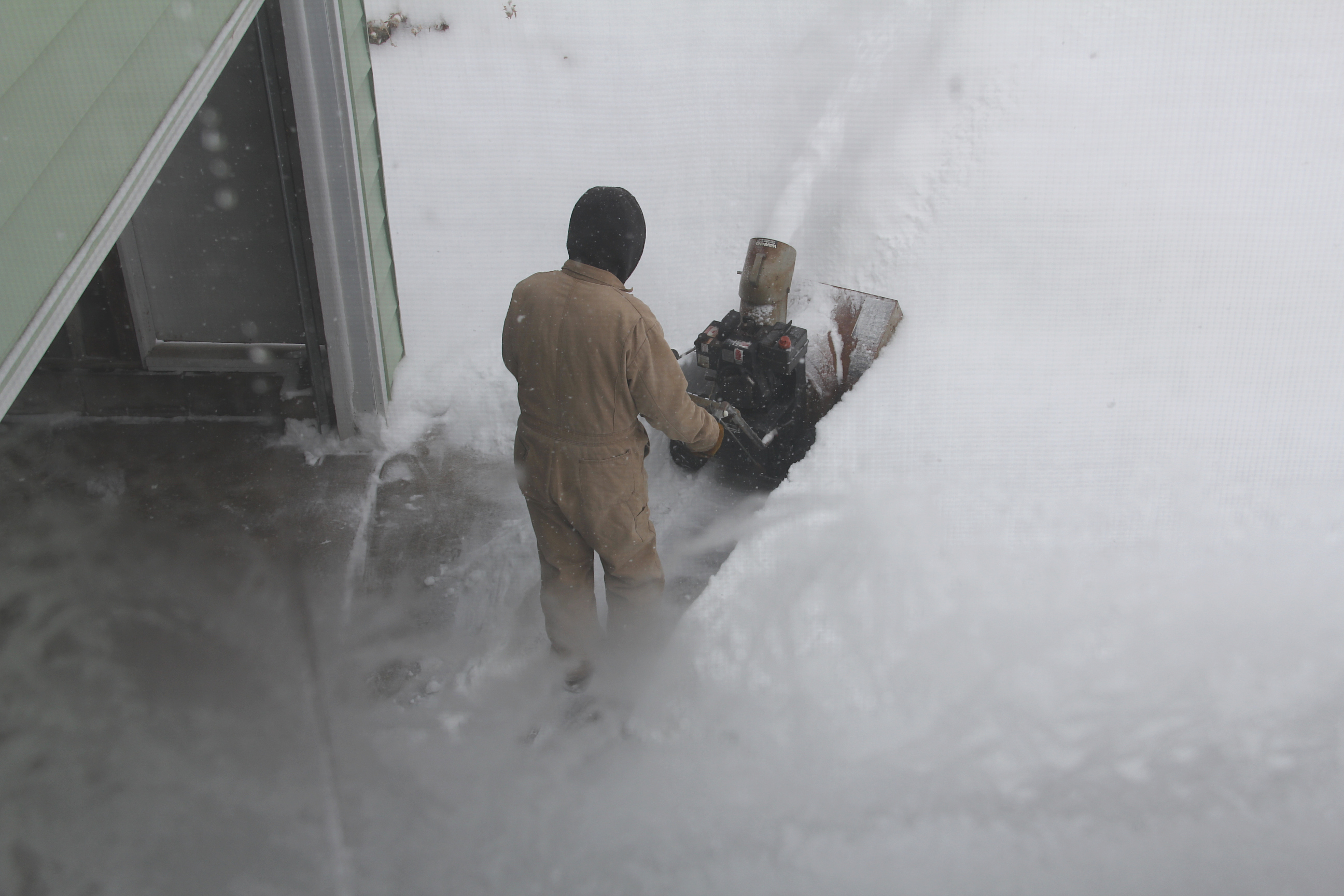
I shot this photo through a partially-frosted upstairs window as Randy began clearing snow from the driveway near the garage. (Minnesota Prairie Roots copyrighted photo February 2023)
THURSDAY MORNING, 10:30 a.m. AND SNOW is still falling here in Faribault. But the sun is breaking through and I am hopeful the snow will soon end. The unofficial yardstick reading on our patio is 14 inches from this three-day weather event.
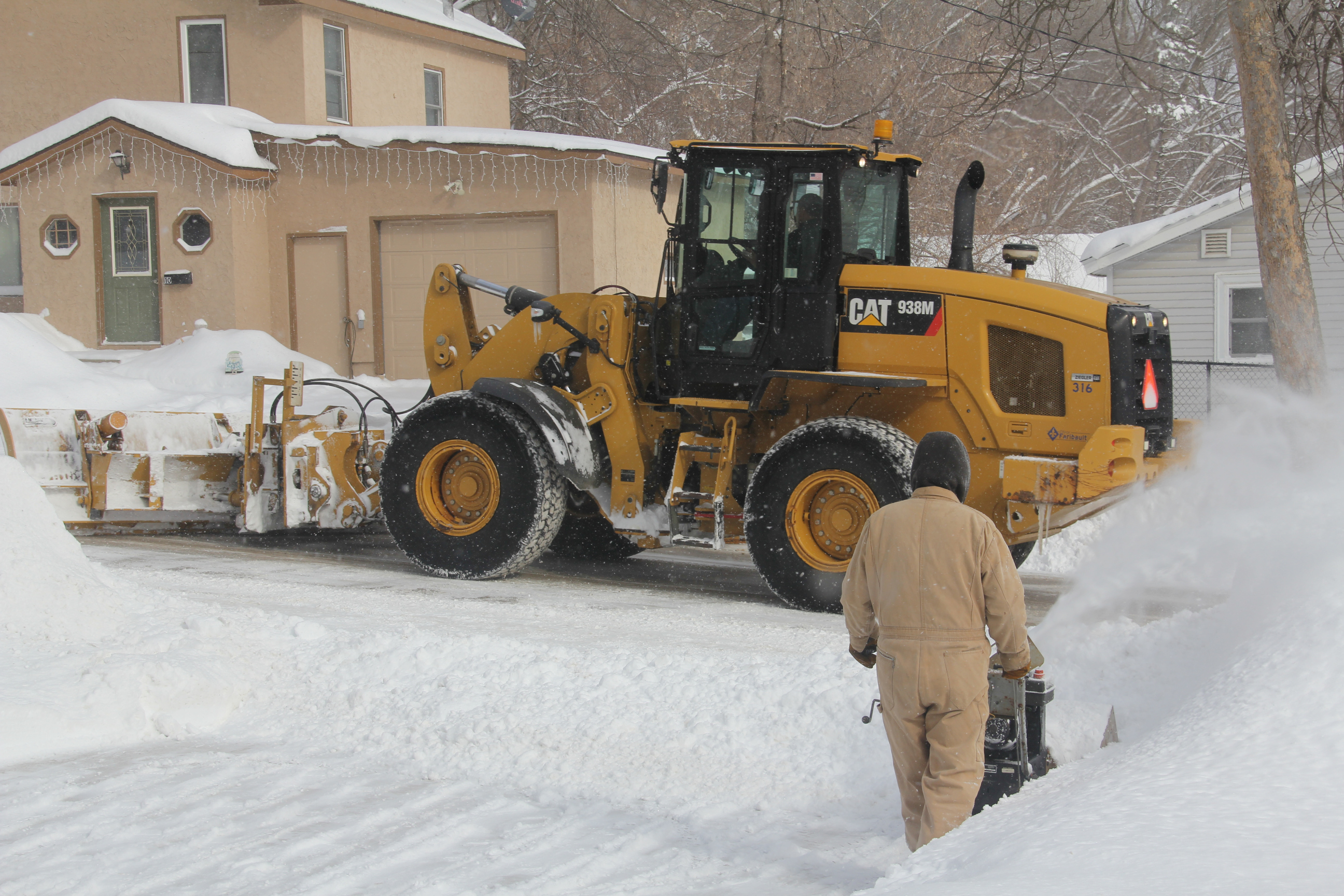
The city snow plow arrives about the same time Randy finishes clearing the driveway, leaving a new ridge of snow. (Minnesota Prairie Roots copyrighted photo February 2023)
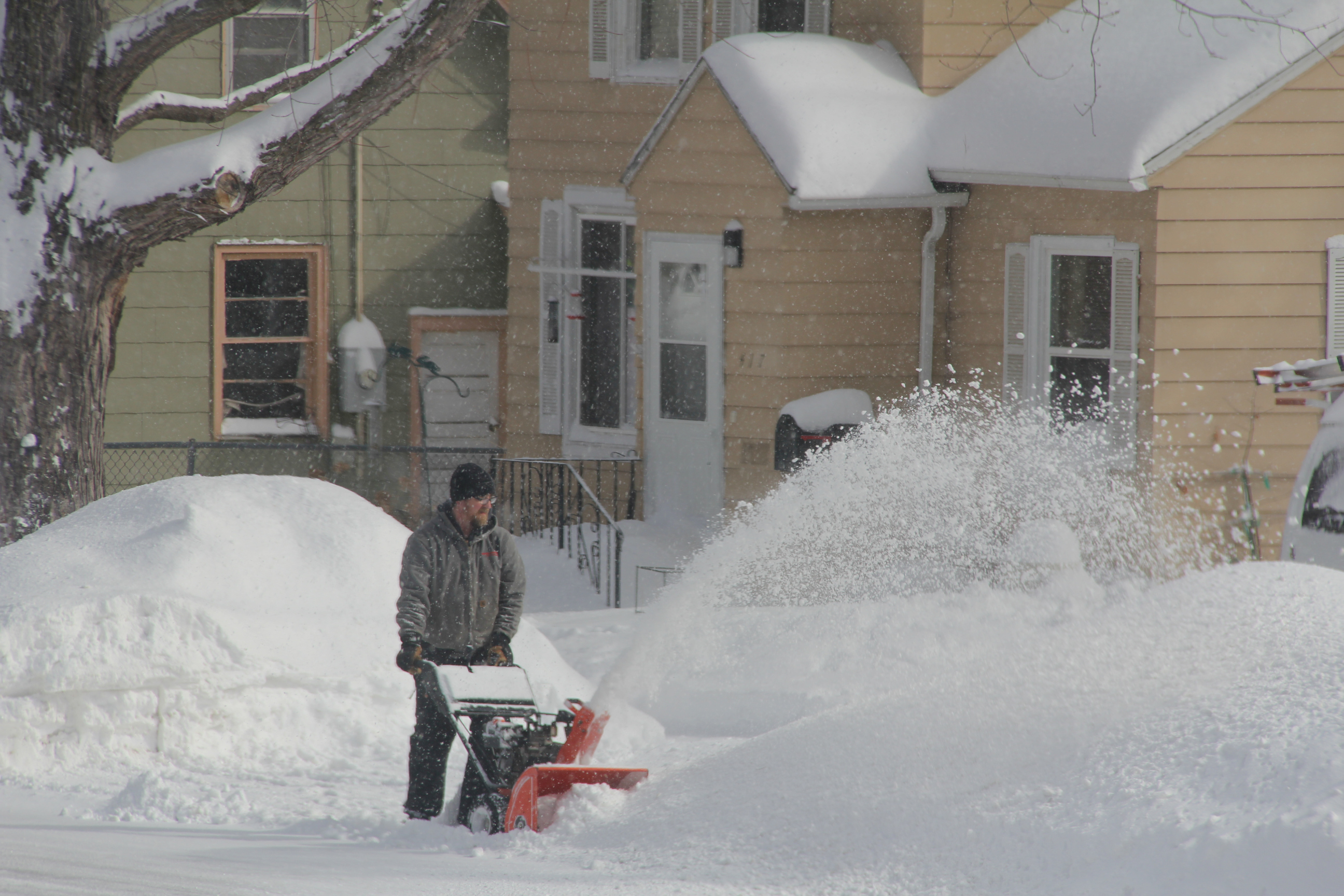
Randy is blowing the driveway open as I write. Just as he nearly finished clearing the end, the city plow arrived, blading a windrow of snow back across the driveway. Timing. Now he’s working on removing that ridge. This is not unexpected; we Minnesotans assume this will always happen.
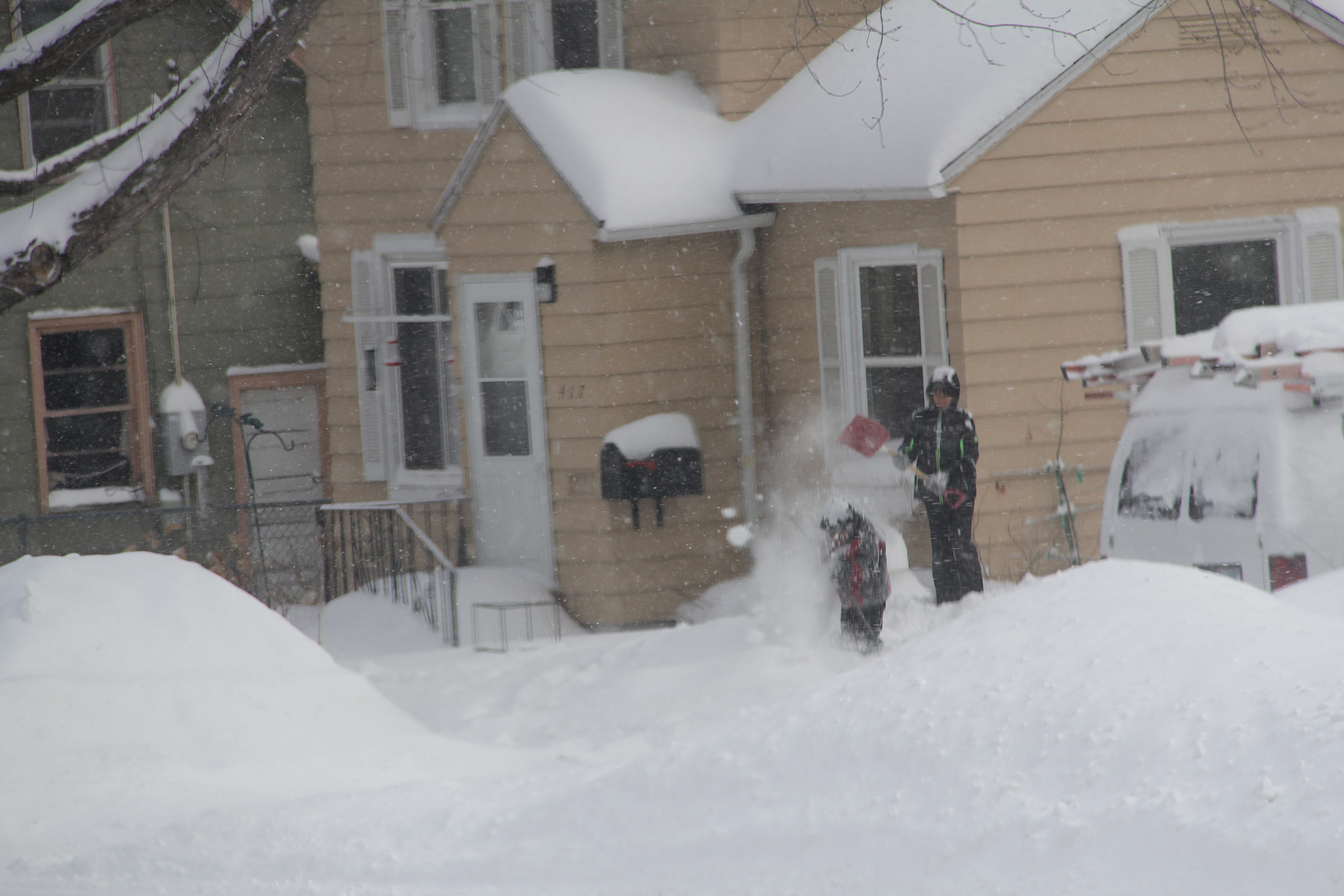
I caught the exact moment one brother dropped snow on the other. (Minnesota Prairie Roots copyrighted photo February 2023)
Neighbors have emerged, too, blowing snow from sidewalks and drives. Across the street, neighbor boys are outside playing. I watched as one scooped snow onto his shovel, waited and then promptly dumped the load onto his brother’s head. Nearby, Dad continued working the snowblower.
A snowy scene in my neighborhood mid-morning Thursday when snow was still falling at a steady pace. (Minnesota Prairie Roots copyrighted photo February 2023)
This is a snow day for Minnesota kids. E-learning and distance learning or maybe no learning at all.
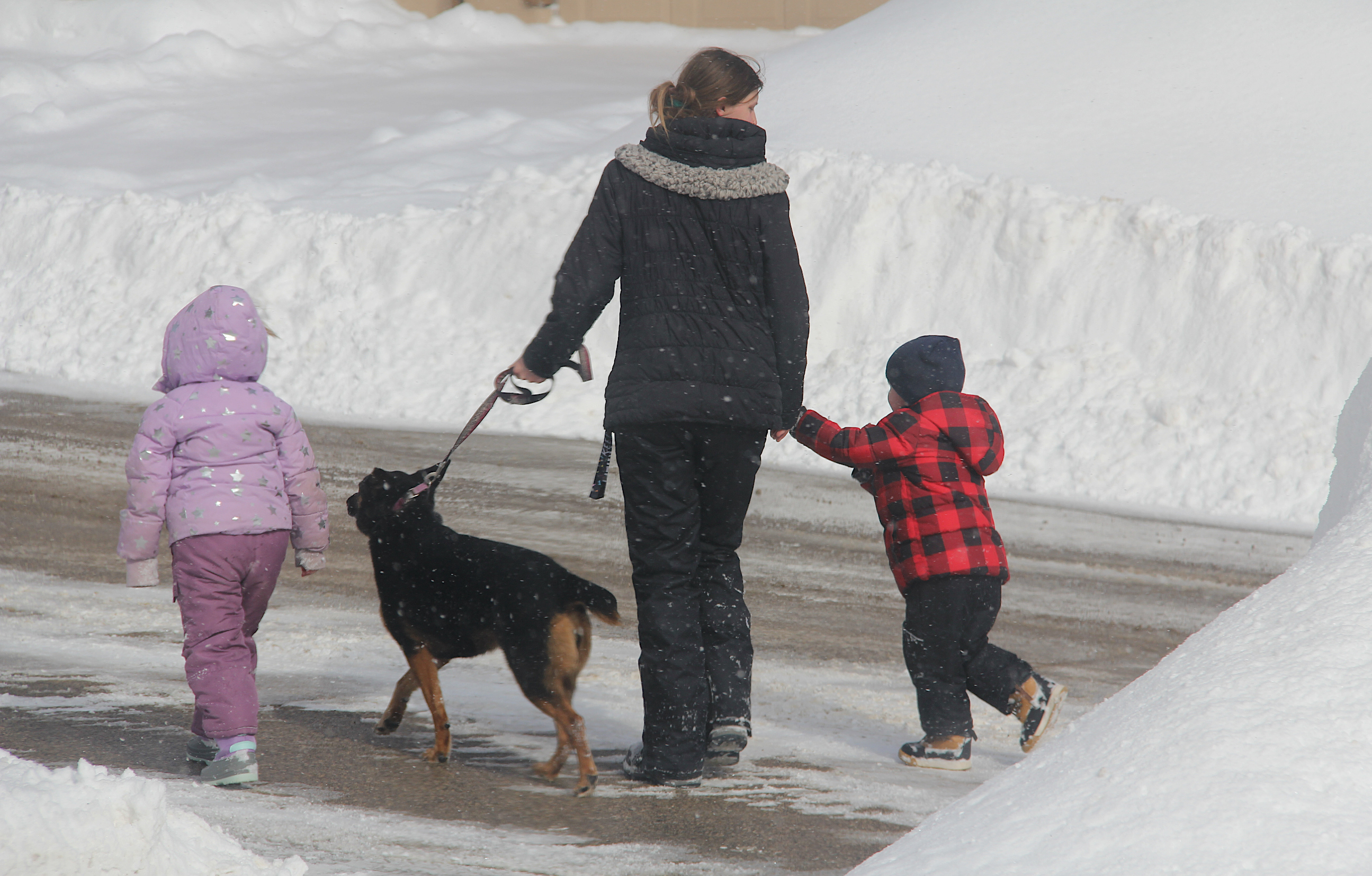
A young family walks their dog late Thursday morning along the snow-banked city street past our driveway. (Minnesota Prairie Roots copyrighted photo February 2023)
A mom and her two little ones are out walking the dog.
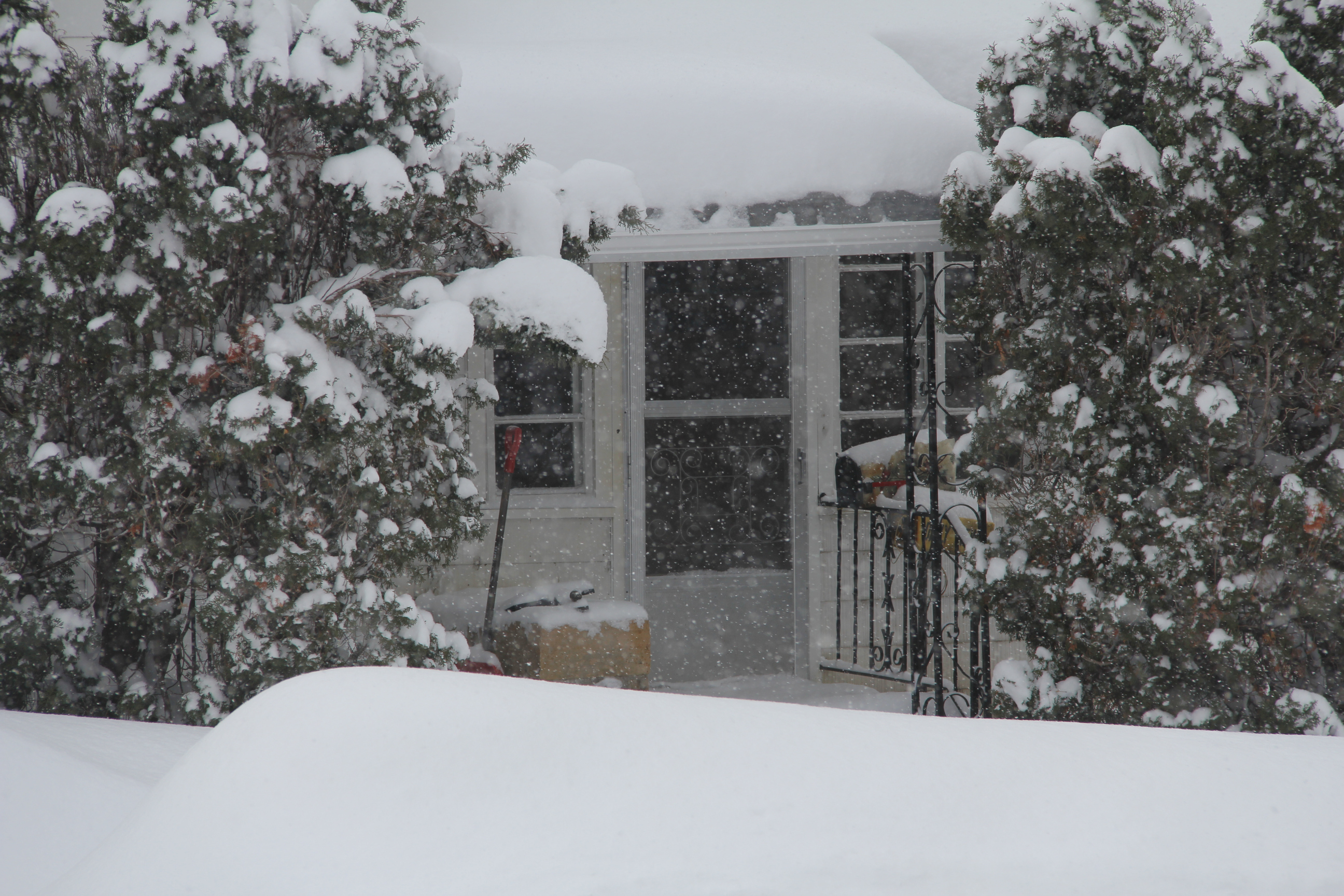
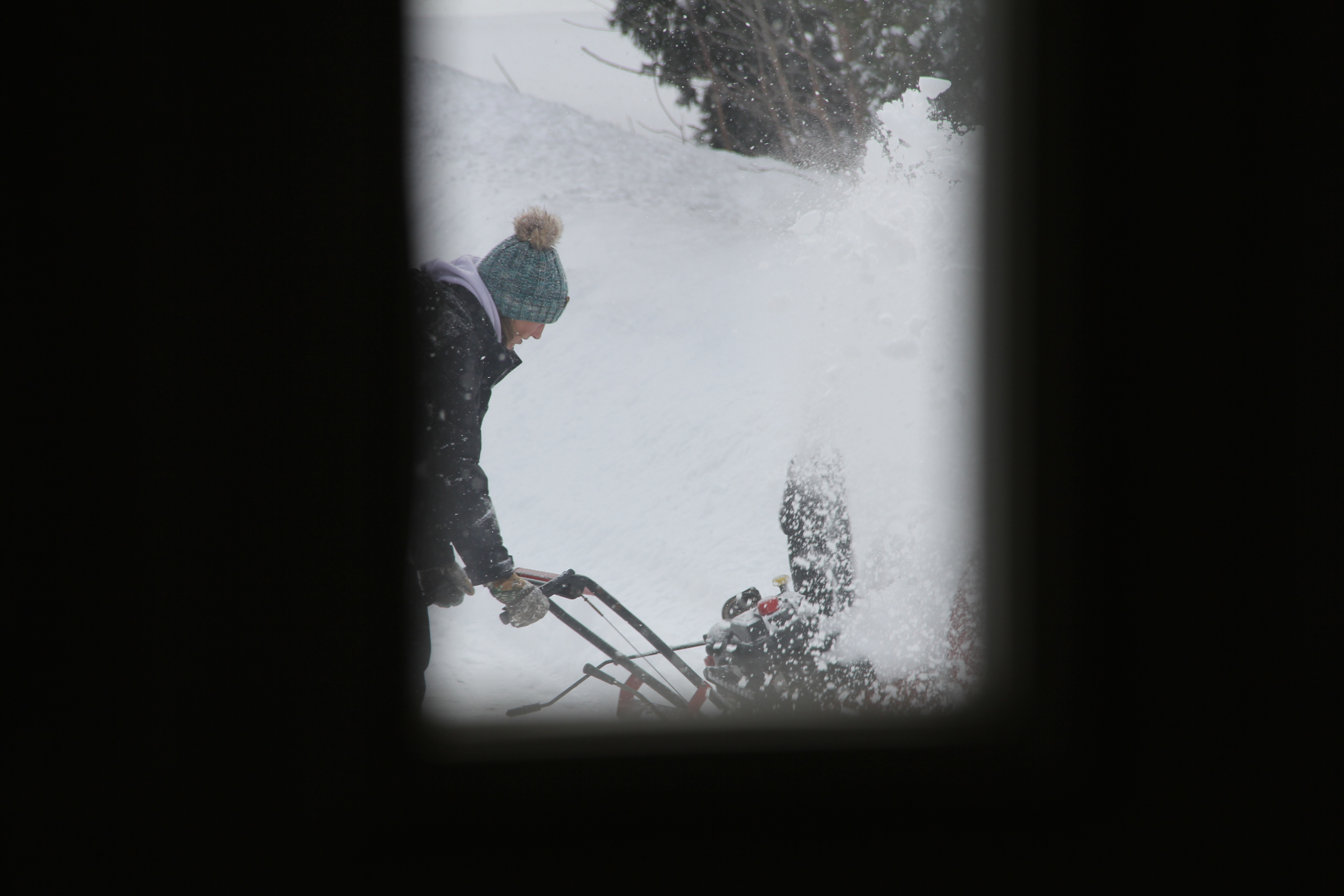
Bent into the task of blowing snow, a neighbor is framed through the window in my front door. (Minnesota Prairie Roots copyrighted photo February 2023)
Businesses and public places—the arts center, the library, the mall, the shoe store—are either closed or opening late. People seem to be heeding the warnings to stay home and off roadways. Even Randy is staying home from work today.
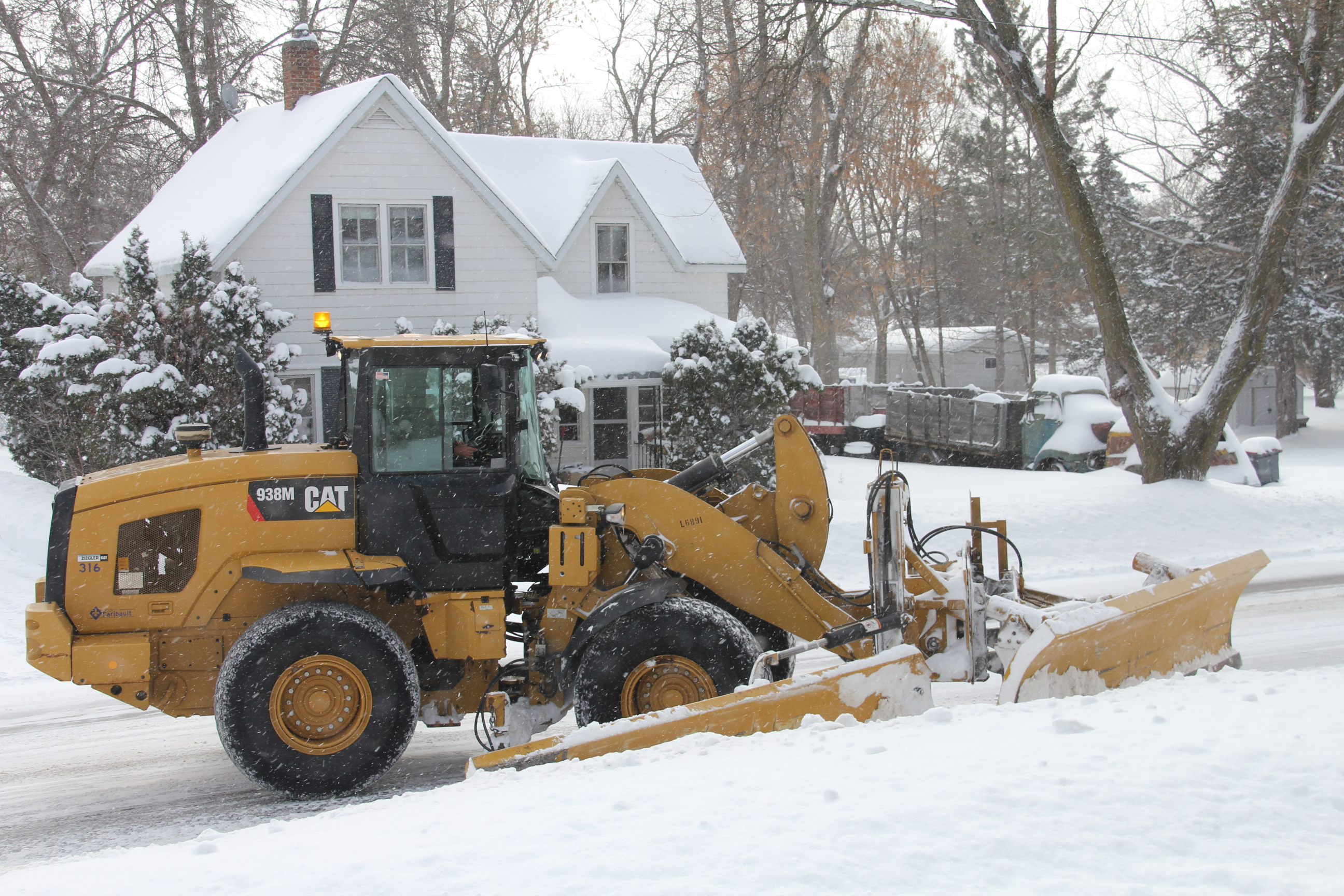
The city plow blades snow from the intersection toward the boulevard in front of our house. (Minnesota Prairie Roots copyrighted photo February 2023)
Traffic, mostly non-existent earlier, is picking up along our main arterial street. Mostly snowplows and pick-up trucks pulling trailers loaded with snow removal equipment.
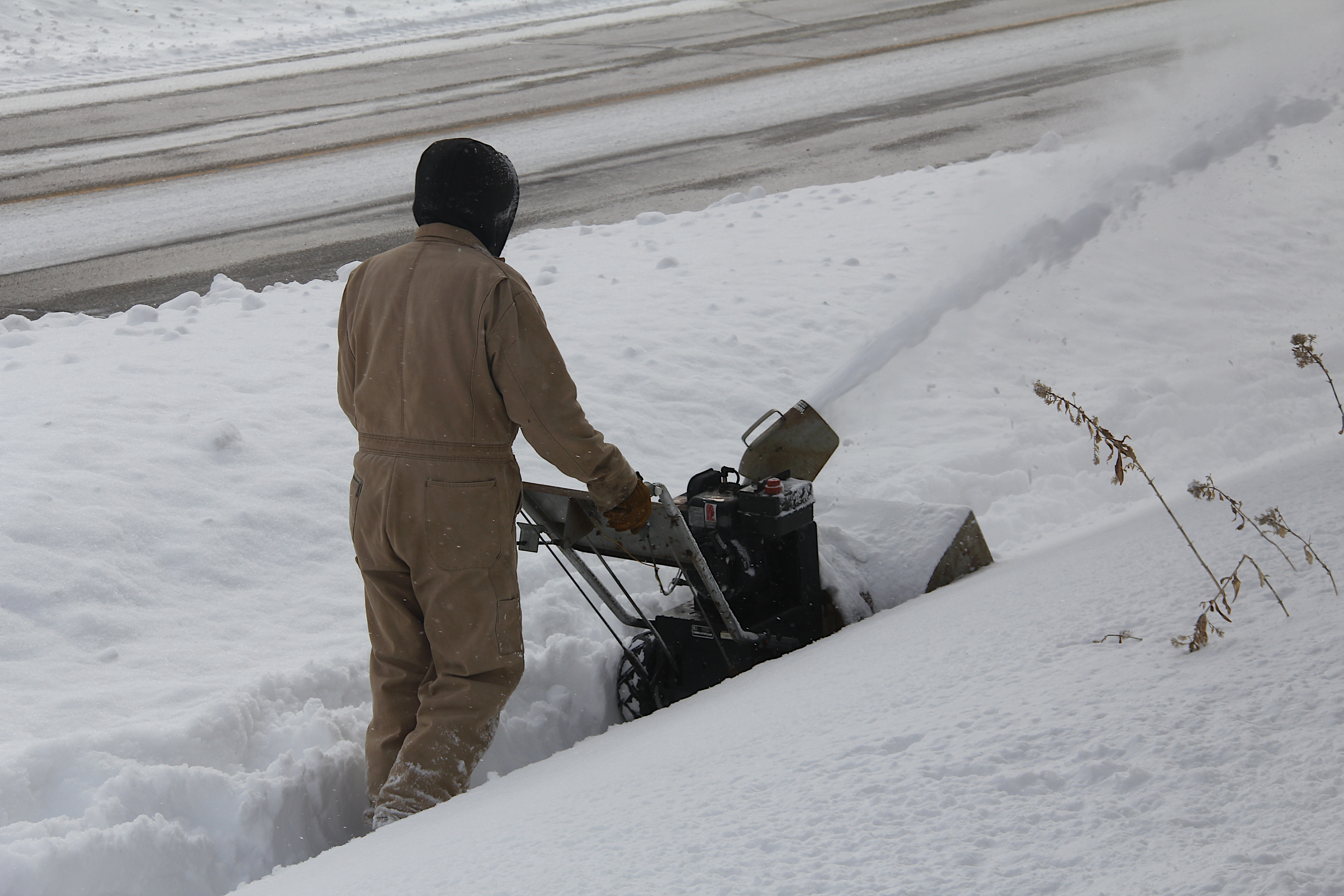
Randy guides the snowblower down the sidewalk past our house and our neighbor’s house. (Minnesota Prairie Roots copyrighted photo February 2023)
In the extreme southwestern corner of Minnesota, my native prairie, a portion of Interstate 90 remains closed along with many state highways. Wind whips this light snow, creating whiteout conditions, snowdrifts feet high and impassable roads. The National Guard is standing by to launch roadside rescues if needed.
A neighbor clears the end of his driveway. (Minnesota Prairie Roots copyrighted photo February 2023)
As snowstorms go, I’ve experienced much worse, especially as a Redwood County farm kid. I respect winter in Minnesota, understand the dangers when a major storm descends. And today, although this storm was not quite the historic storm predicted, I’m good with that. With some 14 inches of total snowfall, that’s enough for me, and Randy.
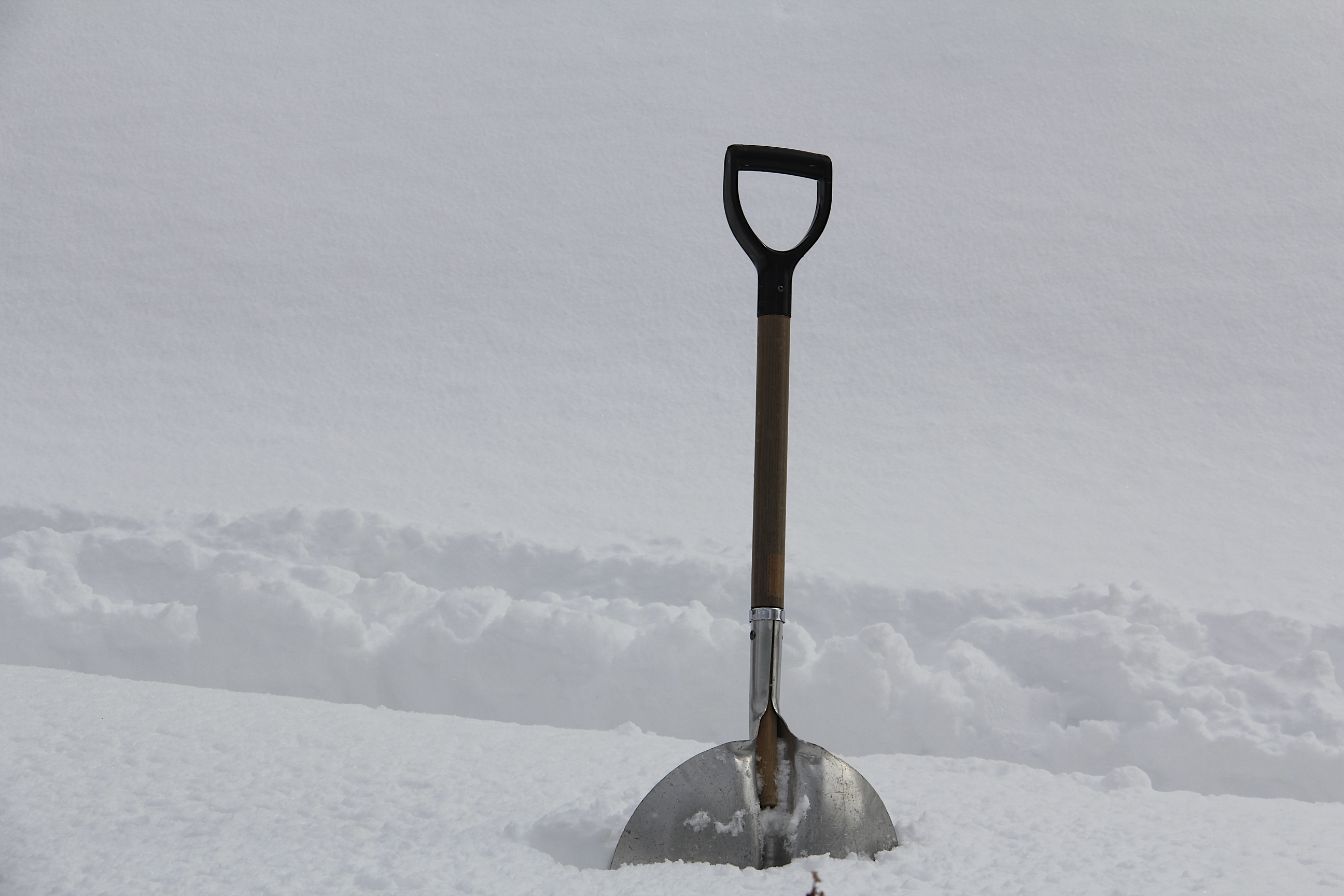
Another snow removal tool, a scoop shovel stuck here in the snow next to the sidewalk. We use it to clear our front steps. (Minnesota Prairie Roots copyrighted photo February 2023)
TELL ME: If you live in Minnesota, how much snow did you get? If you live elsewhere, are you experiencing any bad weather? I’d like to hear your stories.
Blowing snow reduces visibility along Rice County Road 25/197th Street in January 2020. I expect similar or worse conditions in Rice County later today, overnight and into Thursday. (Minnesota Prairie Roots copyrighted file photo January 2020)
AS I WRITE THIS MID-MORNING Wednesday, the view outside my office window is one of a landscape layered in new snow, about five inches. The light snow of earlier has stopped.
All appears calm, until I look closer. I notice snow sweeping off my neighbor’s roof. I see, too, treetops swaying, a trio of exposed squirrel nests nestled among branches. Another neighbor’s political flags extend in the wind, bannering messages I’m weary of seeing long after the 2020 election has ended. Buffeting my front steps, dried hydrangea heads wave in the rhythm of the morning wind.
For days now, we’ve been lectured by weather forecasters and officials alike not to be lured into complacency. This lull in an anticipated historic winter storm here in Minnesota is expected. Southern Minnesota braces for storm’s second punch after overnight snow.That Minnesota Public Radio headline and similar headlines have played across media outlets for days.
I lean into believing the National Weather Service predictions about this multi-day event that could rank among our top five winter storms. It’s not only about the quantity of snow, possibly topping 21 inches, but also about the wind. As a prairie native, I understand how quickly winds of even 25 mph can create white-out blizzard conditions, making travel dangerous and impossible. Winds are expected in some places to top 50 mph. Our governor has already declared a peacetime emergency.
When my husband left for work Wednesday morning, I asked him to remain weather aware, reminding him that this storm is about the wind as much as the snow. He works as an automotive machinist in a rural location, typically a 35-minute commute. Unlike me, Randy leans into believing storm predictions are more hype than reality. Sometimes he’s right. Time will tell. Regardless, I inquired whether his phone was fully-charged and whether a sleeping bag was still in the van. It was and it was. And I asked him to text when he arrived at work and when he leaves later today. He did and I expect he will. Roads this morning were worse in sheltered areas, he reported.
By noon our winter storm warning transitions into a blizzard warning in effect for 24 hours. It’s not often my county of Rice, just south of the Twin Cities metro along Interstate 35, enters blizzard status. I expect this designation in southwestern Minnesota and other primarily open land area parts of the state, but not here.
Whatever happens, we’ve been warned by the National Weather Service, Twin Cities, on their Twitter page Wednesday: There seems to be some confusion this morning because the sun has come out. Does this mean all we got is a measly 3-5” and it’s over? Nope! As we’ve talked about for days, round 2 is on the way and it will pack a punch! Expect an ADDITIONAL 10-15” by tomorrow morning.
WHEN A MAJOR WINTER STORM is in the forecast for Minnesota, we Minnesotans listen intently. And then we stock up on eggs, milk and bread. Or so the joke goes. But, in reality, grocery stores do experience an uptick in business. Liquor stores, too. And for anyone who owns a snowblower—and that’s most of us—having enough gas to fuel snow removal is a must, not an option.
So here we are, poised to get massive quantities of snow over several days. Faribault is in the 17 to 22-inch snowfall range, according to the National Weather Service forecast on Monday. That bull’s eye target of snow stretches from western to eastern borders across a wide swatch of southern Minnesota from around Mankato in the south to St. Cloud in the north.
And then as if the large amounts of snow aren’t enough, winds are anticipated to rage, blowing around all that light, fluffy snow. The 40-45 mph winds gusting up to 50 mph will create white-out and blizzard conditions in many regions, especially on the prairie.
This looks to be a doozy of a winter storm that begins on Tuesday afternoon, ends on Thursday evening. Forecasters seem quite confident it will play out as predicted. I expect closures of schools, businesses and more. I expect snow gates (yes, there’s such a thing) to be pulled across interstates and other highways. There will be winter storm (our warning starts at 3 pm today) and blizzard warnings, travel advisories, “no travel recommended” and most likely stranded motorists who need rescuing.
Randy and I are prepared. I have a stack of library books to read. We have 2 ½ dozen eggs (thanks to a friend who has free-range chickens), enough milk and nearly a full loaf of bread. The snowblower gas tank is topped. And the mini fridge in the basement is stocked with craft beer. Yup, we’re ready…
“I GOT PLANS! BIG PLANS, I SAY!” shouts the boy standing atop the highest hill in town, the hill he just climbed.
His plans take him to a big city, to a board room filled with MUCKETY-MUCKS, into a helicopter and onto a football field. He becomes mayor and then President. He has, he continues proclaiming, BIG PLANS.
His plans take him into space, flying in a rocket ship built by the state of Pennsylvania and wearing a space suit made of potatoes from Idaho. There is seemingly nothing he cannot do.
My grandkids, Isabelle, 6, and Isaac, 4, loved this easy reader picture book written by Bob Shea and illustrated by Lane Smith. I did, too. It’s funny, empowering and imaginative. And I loved reading it to my grandchildren as we snuggled into the recliner under a fleece throw. I lost count of how many times I read BIG PLANS during their overnight weekend stay.
As a grandma, I hold onto the moments rather than big plans for my young grandchildren. I want them to appreciate who they are now and Isaac as much as stated the same when he said he wanted to remain a kid. For now he is—a little boy whose knowledge of the solar system is not to be challenged. Likewise his sister with dinosaurs.
Saturday into Sunday afternoon, toys and books and puzzles littered the living room turned playroom. Toys pulled from totes in the basement. A Fisher Price school bus, a fire truck, a bulldozer. Matchbox vehicles, including an ambulance with doors that open, Isabelle noted. Small plastic dinosaurs and larger roaring ones. Cootie and BINGO pulled from an upstairs closet. Toys that their mom and their aunt and their uncle and a host of other children have played with through the decades, imaginations unleashed.
Isaac created art with crayons, inspired by another book we read, Jigsaw Mystery in the Mail by Bob Graham. He drew a birthday cake with two flaming candles, asked me to cut out double layers of cake and then staple the two together to form a card. He asked for an envelope, then requested I address it to United States of America. Nothing more. He expects his mom to drop the card in a mailbox, just like in the book.
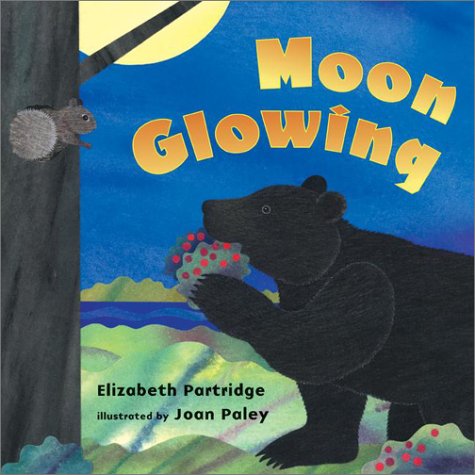
The animal-focused book Moon Glowing written by Elizabeth Partridge and illustrated by Joan Paley brought discussion about hibernating beavers, bats and bears. Maybe a bear lives inside the snow cave we discovered in the backyard, Isabelle and I considered. The snow den into which Izzy and I poked a stick three feet long, the stick easily swallowed. I considered for a moment that an animal might come raging out. Certainly not a bear, but…
So we moved onto fishing (Izzy’s idea). She dropped her line over the limestone wall, hauling in fish after fish after fish. I appreciated how creative her mind, how dry maple leaves topping the snow, mulching flowerbeds, morphed into sunnies and crappies and walleyes caught via her stick fishing pole. And then this first grader mentioned that she wished she really was fishing. And although it’s no longer truly safe to ice fish in Minnesota this season, there’s always next winter. Or fishing from the dock at the cabin this summer.
These were the moments of my weekend. No BIG PLANS. But something far better—time with these dear little ones. Time to hug and hold and hang onto the moments that matter most. Like the moment Isaac declared, “Peanut butter pancakes make me happy!”
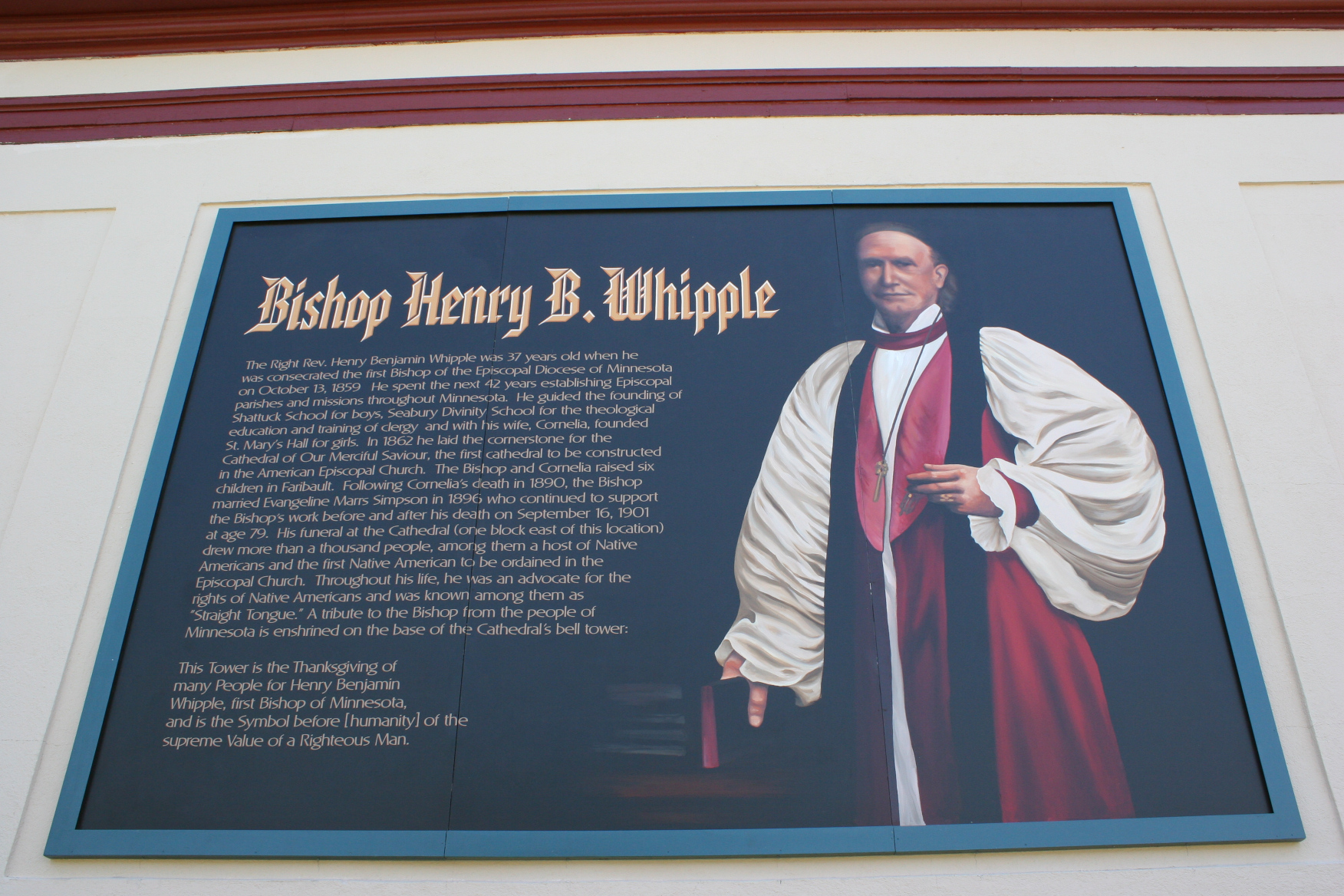
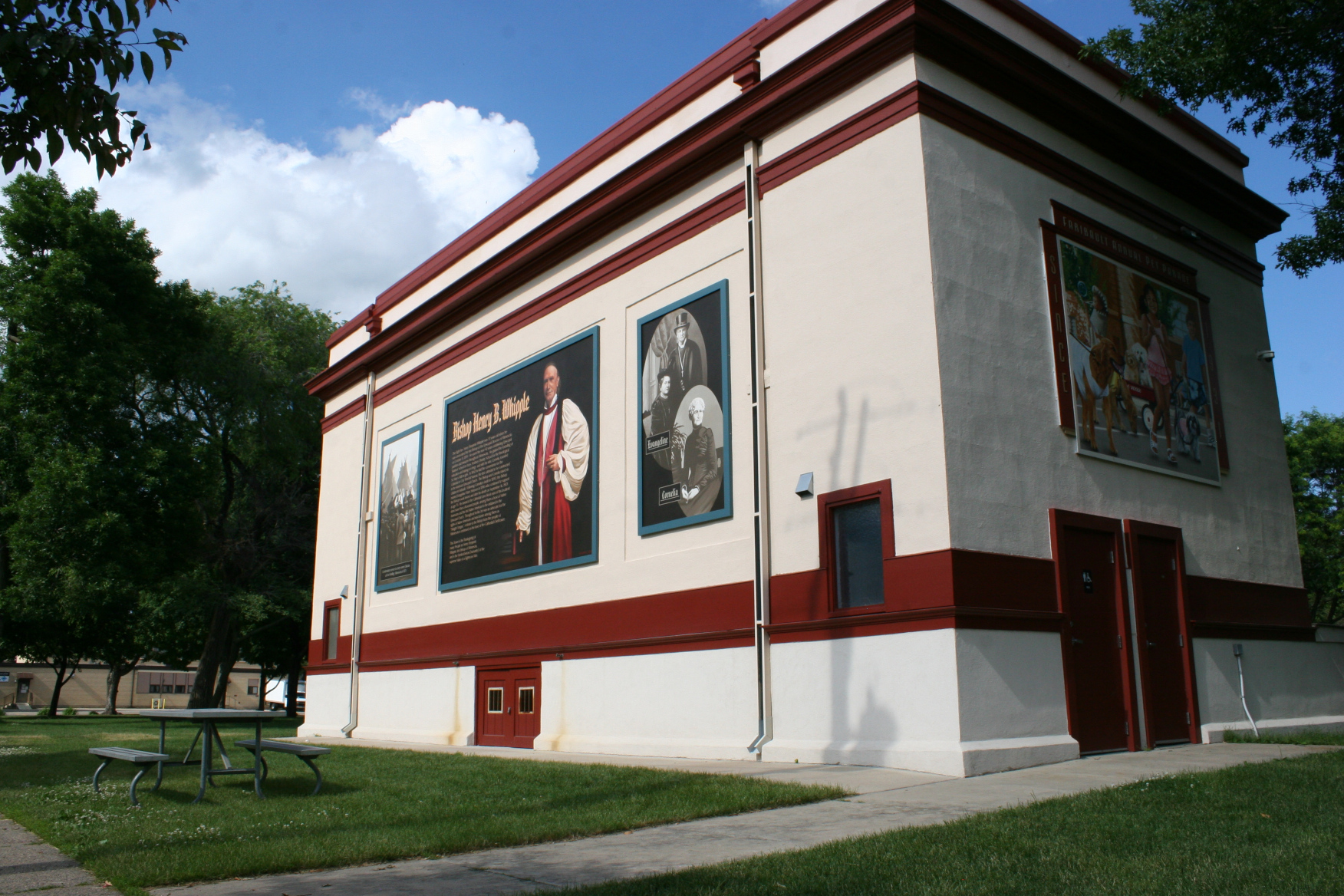
A painting of Bishop Henry Whipple and information about him grace a mural on Faribaults’ Central Park Bandshell. (Minnesota Prairie Roots copyrighted file photo June 2020)
He was known as “Straight Tongue” for his honesty. He was disparagingly called “The Sympathizer” by others for the compassion and care he held for the Dakota. He was Bishop Henry Whipple.
Thursday evening, Rice County Historical Society Executive Director David Nichols spoke to a packed room about this Episcopal priest who played such a pivotal role in Minnesota history, specifically during the time shortly before, and then after, The U.S.-Dakota War of 1862. For me, personally, Nichols’ focused talk connected my home region of Redwood County, the area in which the war centered, to my home of 40 years, Rice County.
I grew up with a limited (white) perspective of the war with no knowledge of Whipple. I only learned of this New York born clergyman upon my move to Faribault in 1982. Nichols broadened my understanding during his presentation and during a question and answer session that followed.
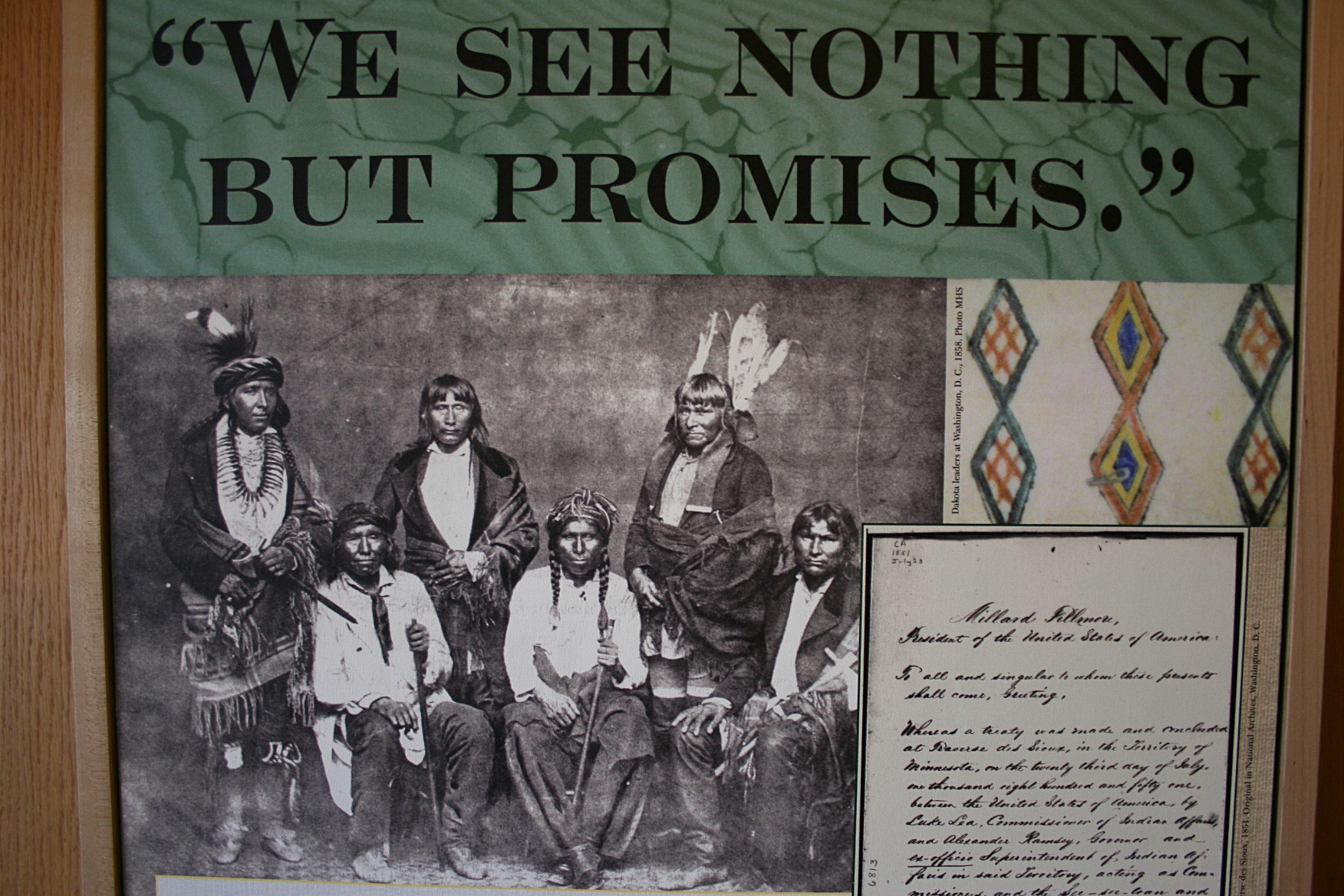
A panel at the Traverse des Sioux Treaty Center in St. Peter shows Dakota leaders photographed in Washington D.C. in 1858. The photo is from the Minnesota Historical Society. It references broken treaty promises and rising tension. (Minnesota Prairie Roots copyrighted file photo)
HIGH TENSIONS
Whipple arrived here in 1860 as the newly-elected Bishop of Minnesota, settling in Faribault. Already at that time, tensions were mounting among settlers and the first peoples of Minnesota, Nichols said. Tensions also existed between the “Farmer Indians” (those who adapted to Euro culture) and “Blanket Indians” (who maintained their Native culture, traditions and lifestyle). Conditions on reservations were terrible with disease, starvation, and dishonest agents failing to provide promised government annuities.
That is the situation Whipple found when he landed in Minnesota. It was a time, noted Nichols, of “tensions about to boil over.” And eventually they did with the outbreak of war in August 1862. It was a decidedly bloody and awful war, as all wars are. Some 600-800 died and the Dakota were eventually displaced from their land.
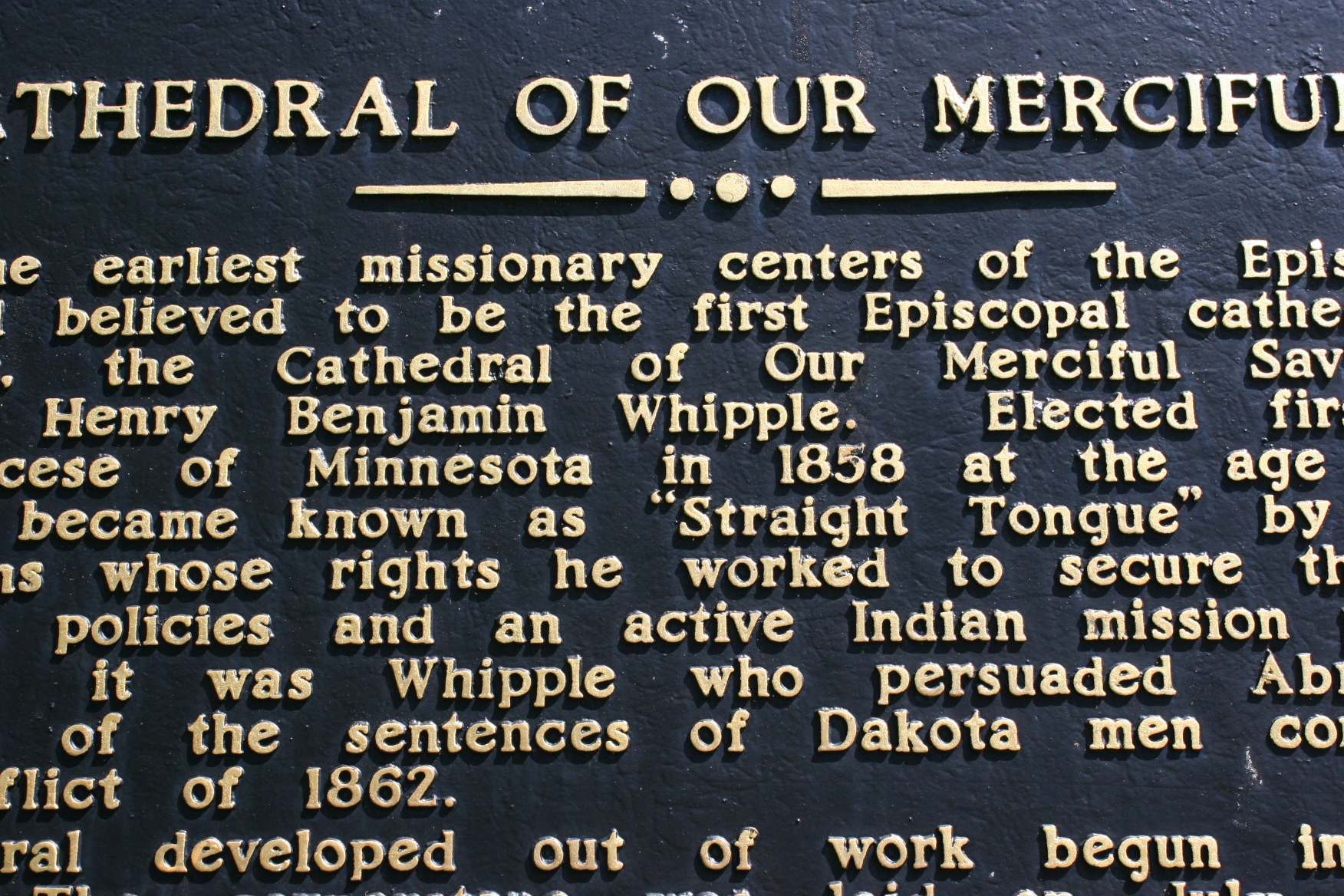
Details on a sign outside The Cathedral of Our Merciful Saviour, Whipple’s church in Faribault. (Minnesota Prairie Roots copyrighted file photo 2020)
THE SHAPING OF A HUMANITARIAN
To understand Whipple’s position and part in this, Nichols provided background. Whipple was involved in New York politics as a “conservative Democrat,” a term which drew laughter from the crowd at Thursday’s presentation. He briefly attended Oberlin College, notable because the college was among the earliest to admit women and African Americans. And Whipple was ordained in 1849, during the so-called “Second Great Awakening” with a focus on civil rights.
Learning this helped me better understand the bishop. All of these experiences shaped a man who spoke with honesty and compassion, advocated for Minnesota’s Indigenous Peoples (both the Dakota and the Ojibwe, natural enemies), called for reform and peace and understanding. Whipple was, said Nichols, a voice for calm, calling for justice, not vengeance, when the short-lived U.S.-Dakota War ended.
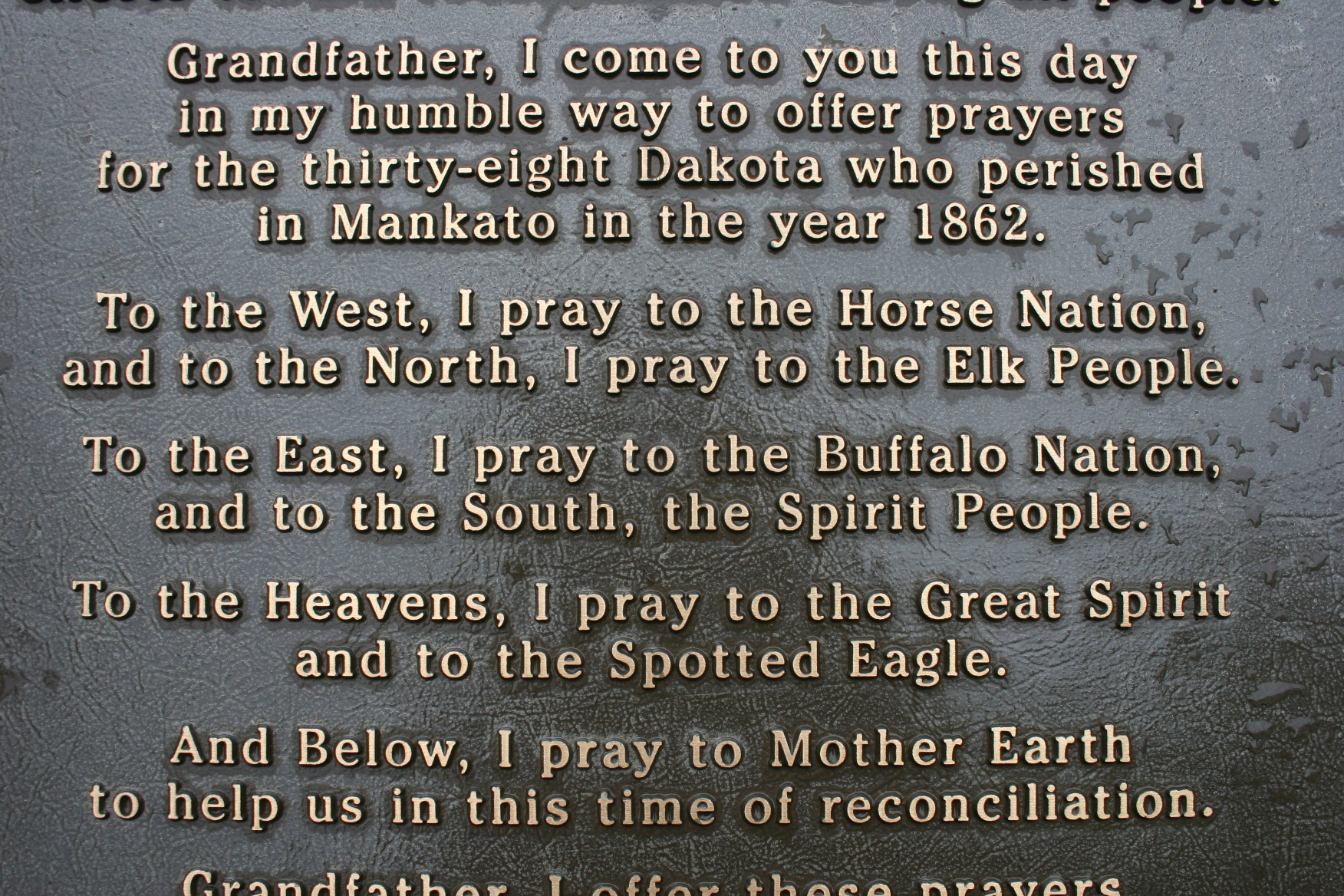
Words on a marker in Reconciliation Park in Mankato where 38 Dakota + 2 were hung on Dec. 26, 1862. (Minnesota Prairie Roots copyrighted file photo May 2012)
ADVOCATING FOR PARDONS
In his many years of missionary work and advocacy, even when his life was threatened by those who viewed him as an “Indian sympathizer,” one singular moment stands out to me. And that is Whipple’s efforts to save the lives of 303 Dakota men sentenced to death after the war. He met with President Abraham Lincoln and was “partly responsible,” Nichols said, for Lincoln’s eventual pardon of all but 38 Dakota. The 38, plus two others, were hung in a public mass execution in Mankato on December 26, 1862. It is a terrible and profoundly awful moment in Minnesota history, especially the history of the Dakota.
A full view of the bandshell mural featuring Bishop Whipple and his first wife, Cornelia, and his second wife, Evangeline. (Minnesota Prairie Roots copyrighted file photo)
ASSIMILATION
While listening to Nichols’ presentation on Whipple, I felt conflicted. Conflicted because the bishop was, he said, “a strong assimilationist.” That label bothered me until I talked further with Nichols. He explained that Whipple did not view himself and Europeans as superior to Native Peoples, but rather observed, in the context of place and time and thinking, the need to adapt versus being driven out. That helped me better understand Whipple’s approach. I recognize, though, and acknowledge the current-day struggles with assimilation, especially as it relates to Indian boarding schools. I appreciate the recognition of, and return to, culture, tradition and heritage today.
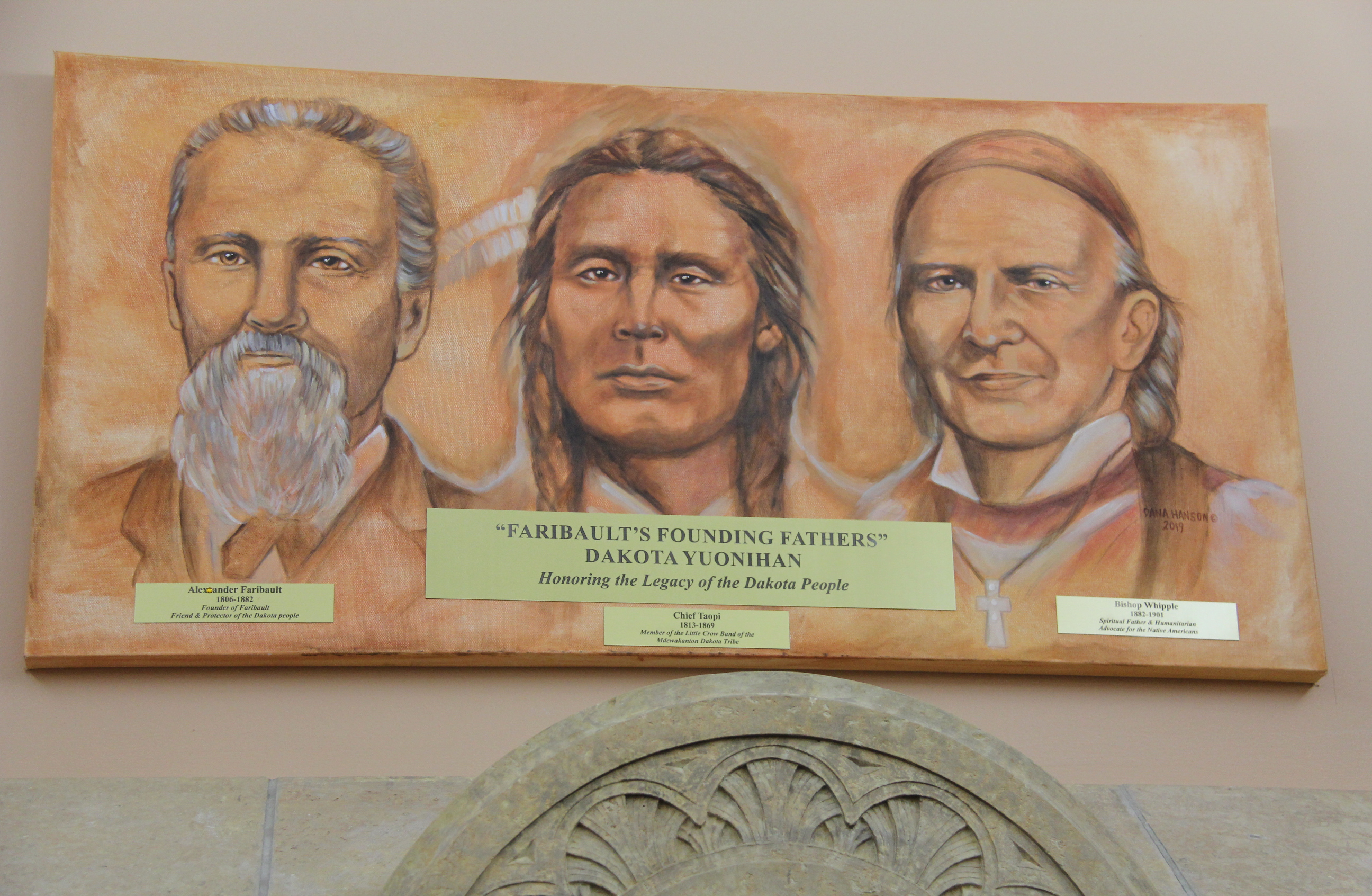
“Faribault’s Founding Fathers,” portraits of Alexander Faribault, left to right, Chief Taopi and Bishop Henry Whipple, by Dana Hanson hangs in Faribault’s Buckham Memorial Library. (Minnesota Prairie Roots copyrighted file photo November 2022)
WELCOMING THE DAKOTA TO FARIBAULT, OR NOT
Whipple, by his words and actions, embraced the Dakota and Ojibwe who called Minnesota home long before white settlers arrived, long before he moved to Faribault. My community, founded by fur trader Alexander Faribault, himself half Dakota, was a safe haven for the Dakota (“you don’t attack family”) during the 1862 war and thereafter, Nichols said. Faribault and Whipple worked together to move 180 Dakota from St. Paul’s Fort Snelling, where they were held following the war, to live on land Alexander owned along the Straight River in Faribault.
I wondered, “Were they welcomed here?” The answer, given by former RCHS Executive Director Susan Garwood, was as I expected. Mixed. While some supported the Dakota’s presence in Faribault, others were vocal in their opposition. In that moment, I thought of our ever-growing immigrant population in my community. Many welcome our newest neighbors and, like Alexander Faribault and Bishop Henry Whipple, support and encourage them. But many also want them gone. History repeats.
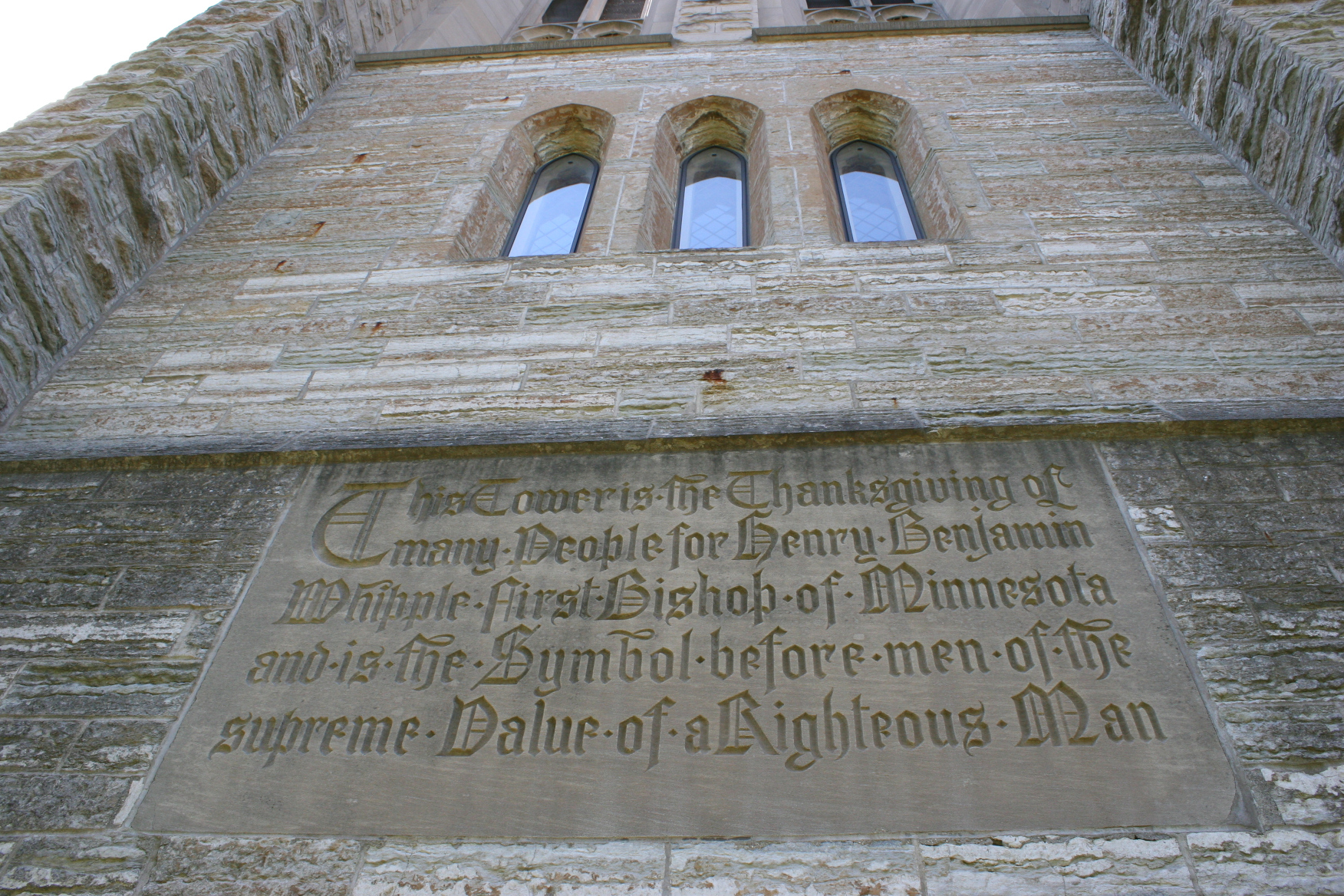
An inscription honors Whipple on the Cathedral bell tower. (Minnesota Prairie Roots copyrighted file photo June 2020)
MARKING HISTORY
Walk around Faribault today and you will see many reminders of the work Whipple did not only locally, but across Minnesota. Historical markers and inscriptions about the bishop grace The Cathedral of Our Merciful Saviour, his faith base. He’s buried under the altar there. Across the street at Central Park, Whipple-themed murals cover the west side of the historic bandshell. Downtown, one of many history-focused benches honors Whipple. And across town, at the Chapel of the Good Shepherd on the campus of Shattuck-St. Mary’s School, a marker notes his role in founding Shattuck and other schools in Faribault.
Efforts are underway now locally to recognize the Dakota as well, to publicly mark their place in the history of Faribault. I’d like to think Bishop Henry Whipple, also known as “Straight Tongue” and “The Sympathizer,” would welcome the idea, would even step up to fund raise, just as he did some 160 years ago to support the relocation of 180 Dakota from Fort Snelling to Faribault.
“Main Street,” watercolored block print by Nan Karr Kaufenberg. (Minnesota Prairie Roots copyrighted photo September 2022)
MANY DECADES AGO, in a time when gender roles factored strongly into classes a student could and couldn’t take in high school, I learned to carve a design into a linoleum block for printing. Girls and boys traded classes for two weeks with female students allowed into the male-dominated world of shop class. The guys headed to the home economics kitchens to acquire basic cooking and baking skills.
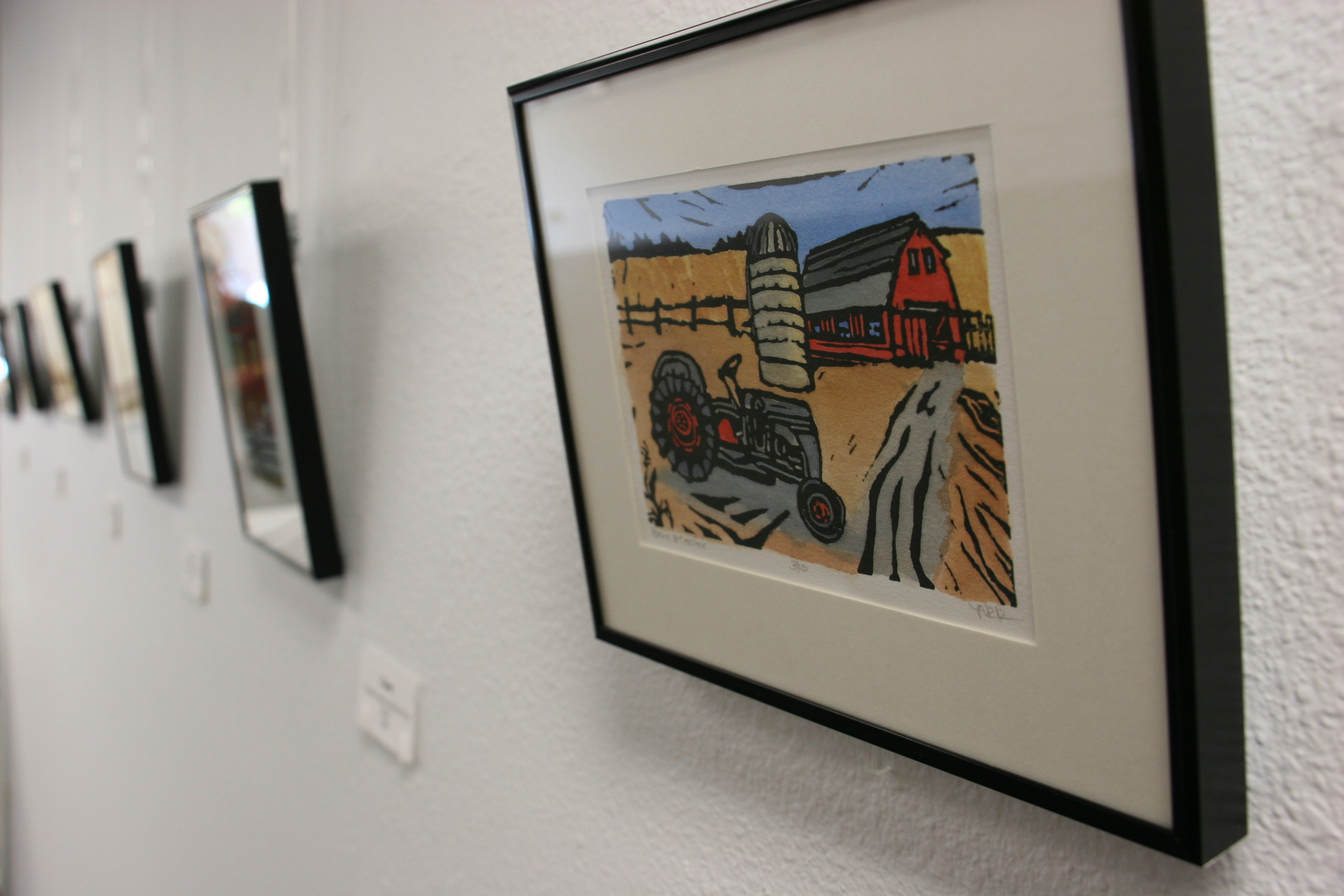
Nan Karr Kaufenberg’s depiction of a farm site. (Minnesota Prairie Roots copyrighted photo September 2022)
Oh, how things have changed since I was an early 1970s high school student briefly surrounded by saws and tools and other equipment and carving art into a linoleum block. I don’t recall the design I crafted. But I do remember feeling empowered inside that industrial arts shop, my eyes opened to possibilities that stretched beyond societal limitations.
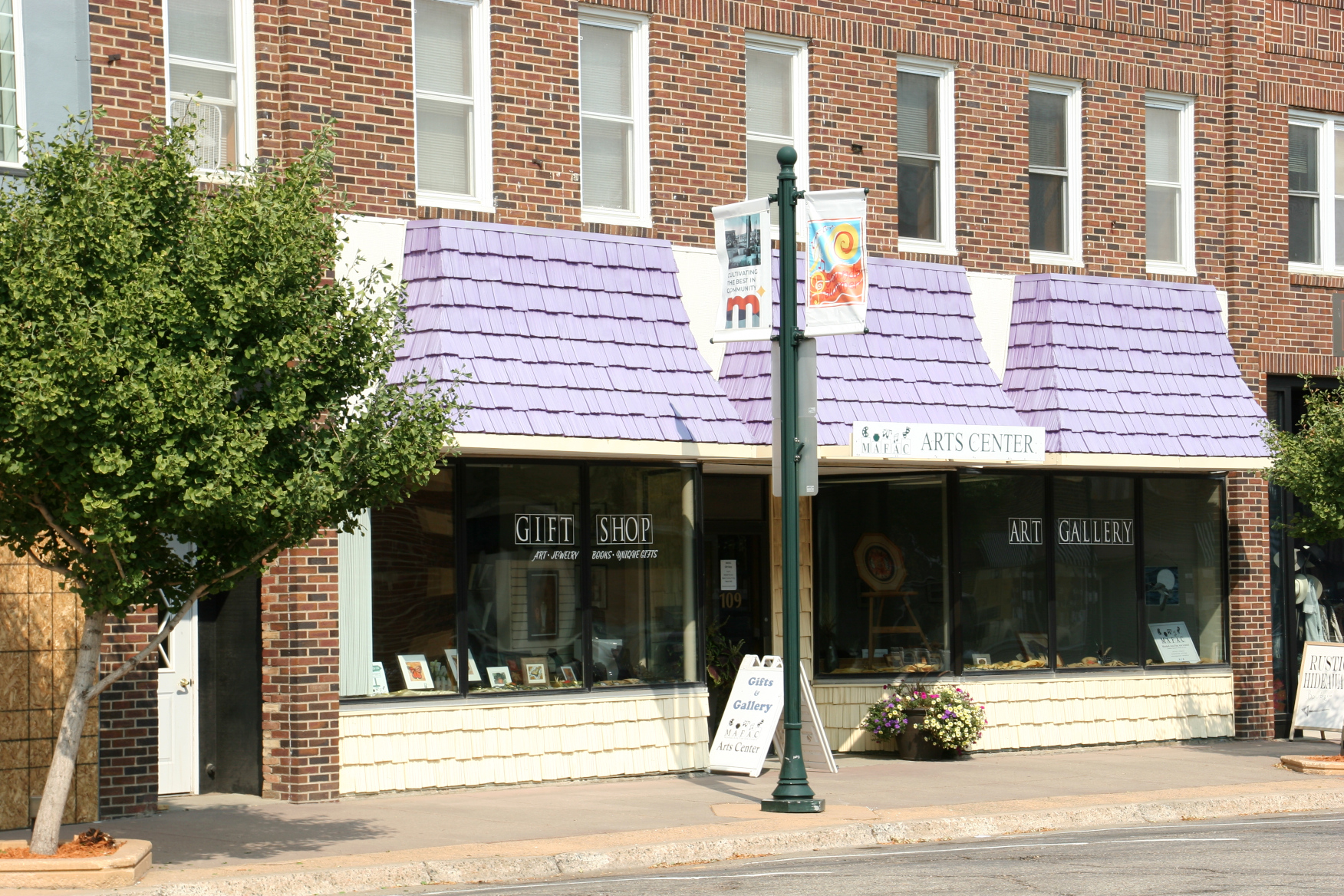
The Arts Center in downtown Marshall. (Minnesota Prairie Roots copyrighted photo September 2022)
Nan Karr Kaufenberg’s “Coneflowers.” (Minnesota Prairie Roots copyrighted file photo September 2022)
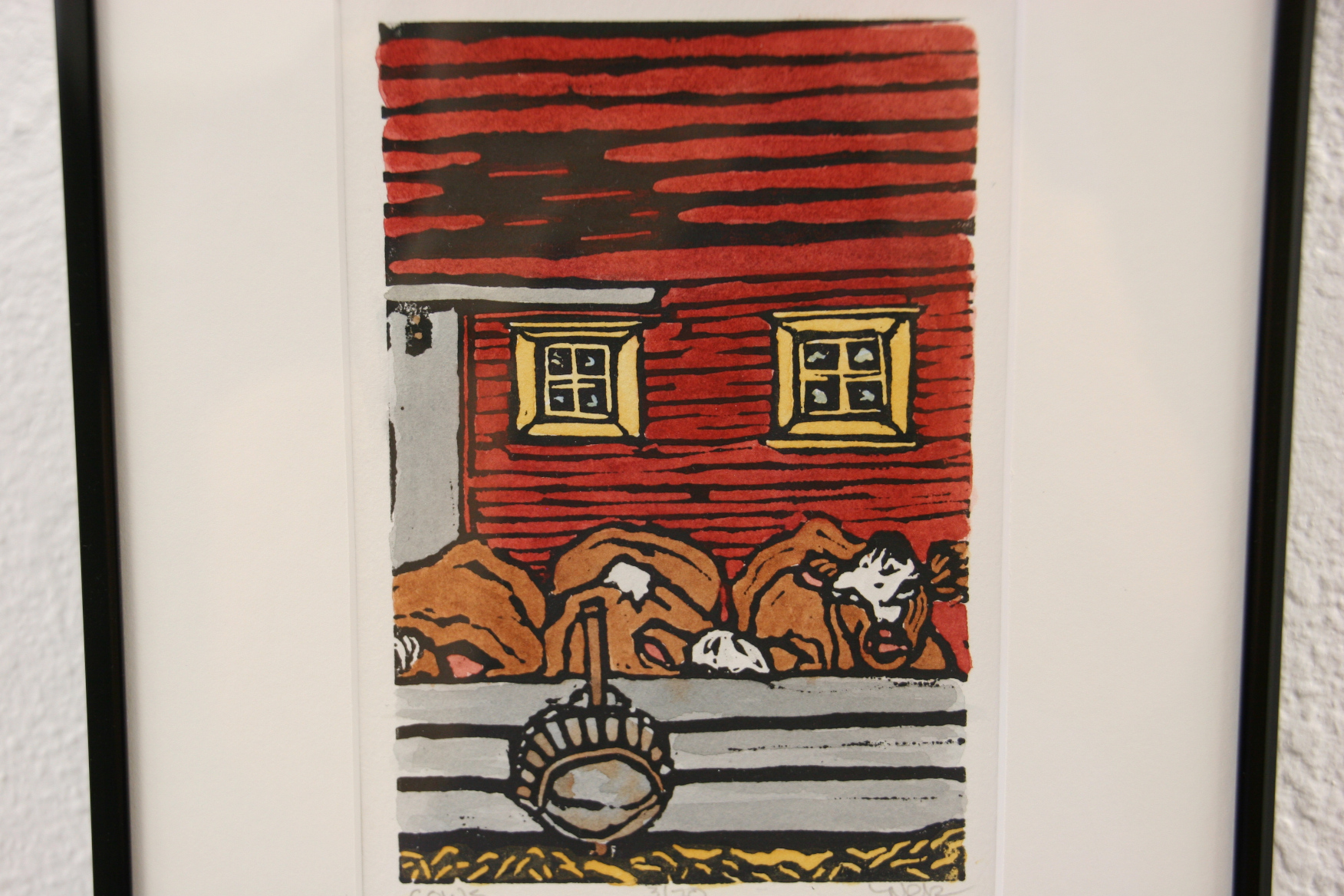
Feeding cattle focus this print by Nan Karr Kaufenberg. (Minnesota Prairie Roots copyrighted photo September 2022)
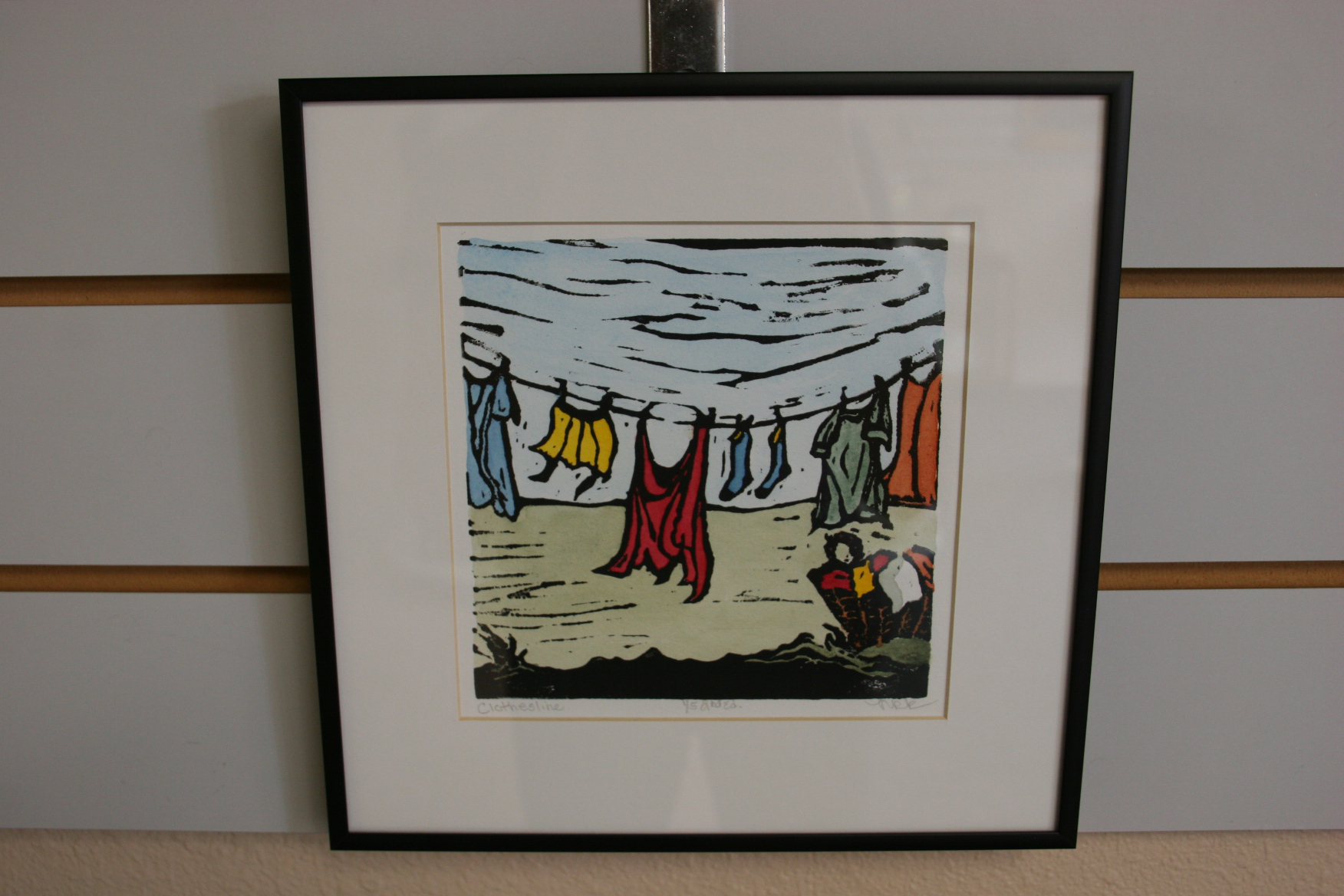
“Clothesline” by Nan Karr Kaufenberg. (Minnesota Prairie Roots copyrighted photo September 2022)
That admiration remains for this artist who observes the prairie world around her and then creates. I feel comfortably at home with her interpretations of rural southwestern Minnesota. Her depictions of prairie flowers, farm scenes, small towns, even laundry on a clothesline, touch me with that sense of familiarity, that feeling of connection to a place I called home and forever hold dear.
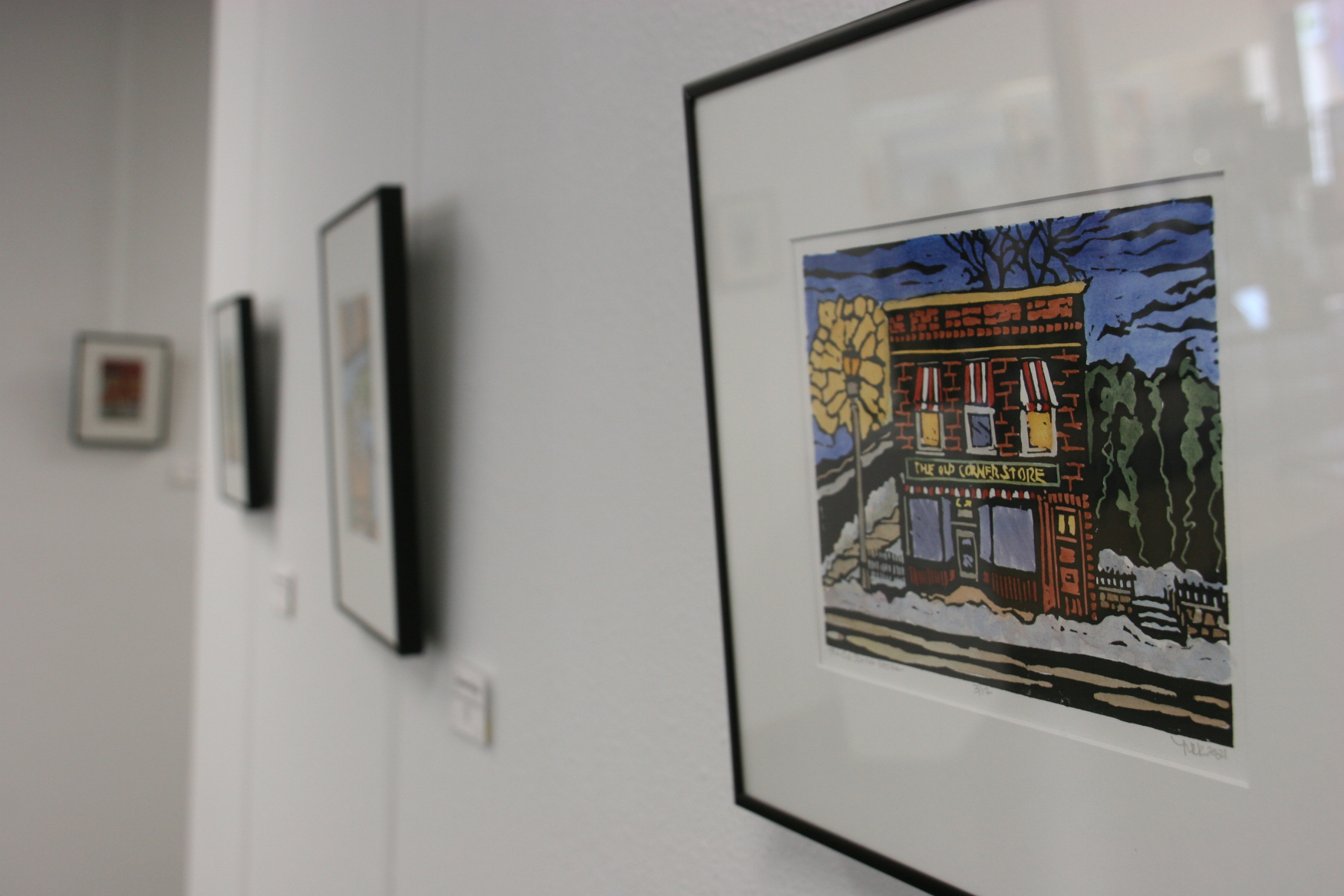
A block print by Nan Karr Kaufenberg of The Old Corner Store. (Minnesota Prairie Roots copyrighted photo September 2022)
For more than 30 years, Kaufenberg, who has art degrees (from the University of Minnesota and Southwest Minnesota State University), who once worked at a tourism center in extreme southwestern Minnesota (she moved following the 2001 high profile murder of her daughter Carrie Nelson), and who is also a realtor, has specialized in tinted linoleum block prints. She colors her printed designs with watercolors. The results are simply stunning. Bold black stamped ink softened by watercolor.
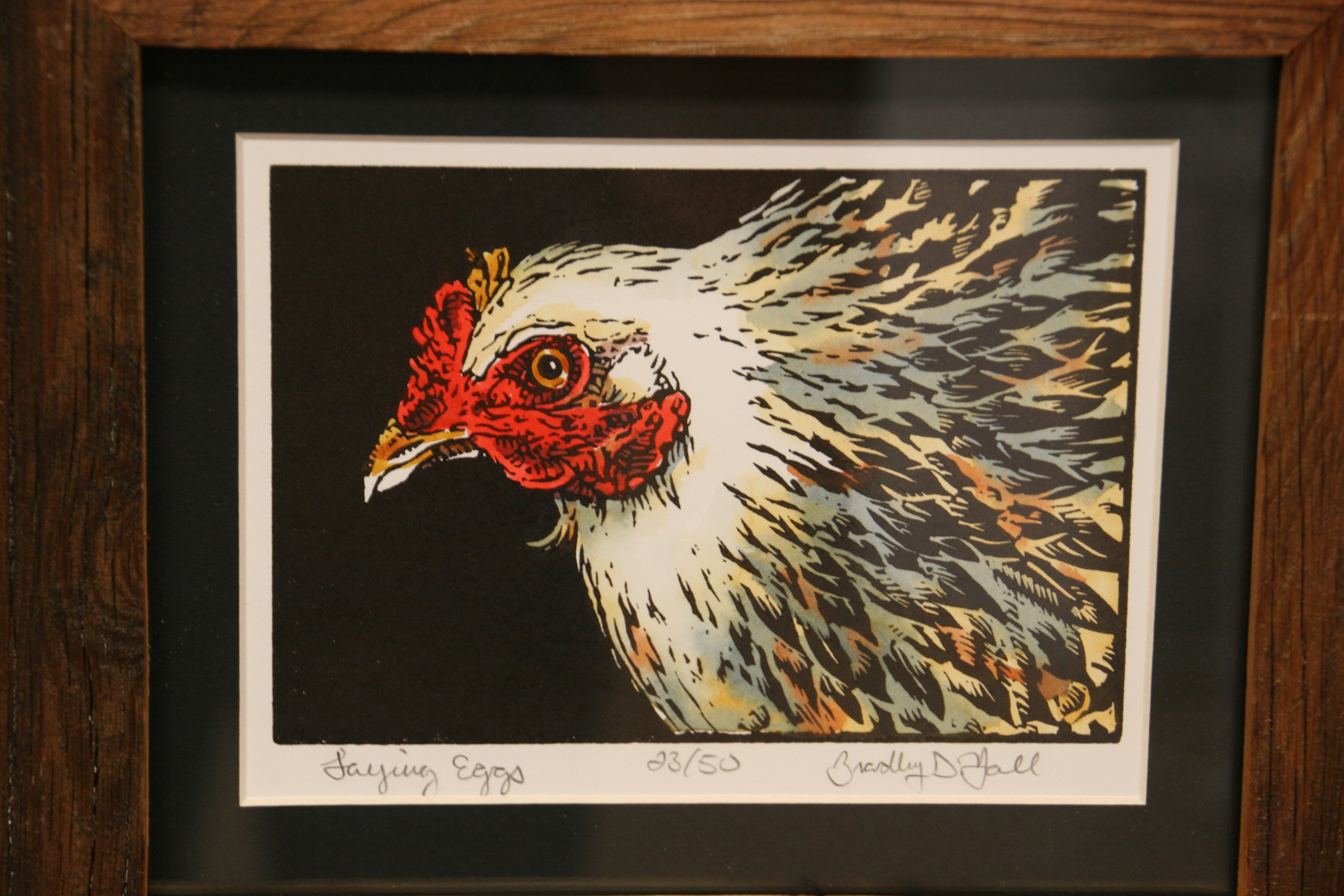
“Laying Hens” by Bradley D. Hall. (Minnesota Prairie Roots copyrighted photo September 2022)
Granite Falls artist Bradley D. Hall does the same, hand-carving linoleum blocks, then hand-printing the inked block design before hand-coloring with watercolors. I also saw his work inside the Marshall Arts Center. While similar to that of Kaufenberg in its rural themes, Hall’s art features finer black lines. Each artist has developed a certain identifiable style with the same basic art form.
A view of the Marshall Arts Center gift shop. (Minnesota Prairie Roots copyrighted photo September 2022)
Hall, who left southwestern Minnesota for Chicago and worked there for 20 years in factories, returned to his native Granite Falls in 2002 to open a studio. By then he’d already taken numerous art classes, including at the American Academy of Art in downtown Chicago. Upon his return to Minnesota, Hall connected with letterpress artist Andy Kahmann of A to Z Letterpress in Montevideo and learned the arts of linoleum block carving and printmaking. I love that these creatives shared with, and learned from, one another.
“Windmill” by Bradley D. Hall. (Minnesota Prairie Roots copyrighted photo September 2022)
More than 50 years ago, industrial arts teacher Ralph Brown shared his linoleum block print skills with me and a shop full of other teenage girls at Wabasso High School. Those two weeks of hands-on learning inside a place typically reserved for male students proved pivotal. I could see the world beginning to crack open to young women, emerging women who would ink life with their designs, their styles, their strong bold lines.
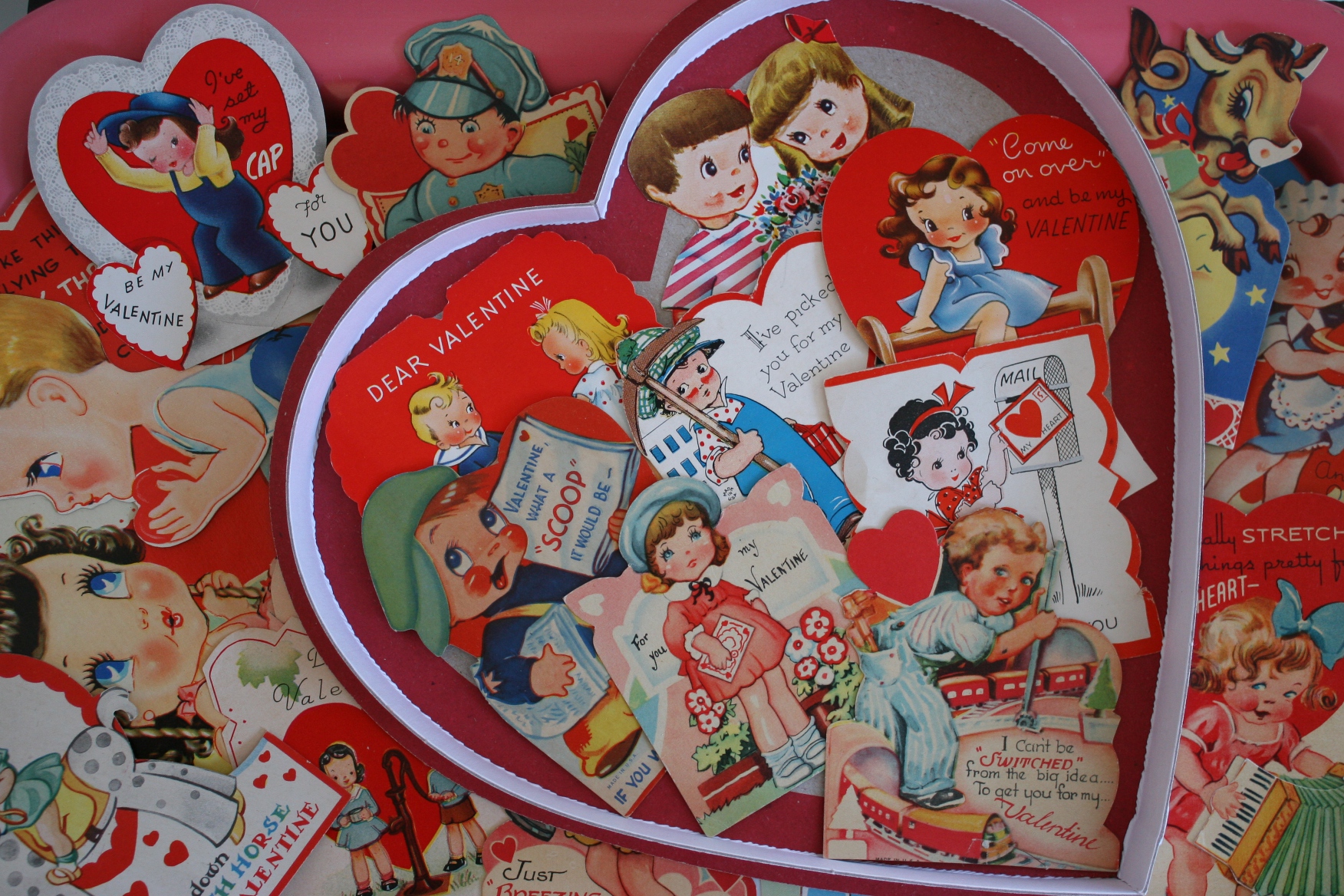
Not candy conversation hearts…buta collection of my mom’s vintage valentineswhich can also be conversation starters. (Minnesota Prairie Roots copyrighted file photo)
CANDY HEARTS. I’ve never liked their chalky texture and taste. But these hard pastel candies are as much a part of Valentine’s Day history as valentines, red roses and chocolates. And they are a starting point for conversations: Be mine. Hugs. Love.
What exactly is love? It’s not a word completely defined without context. Yet, there is a basic understanding of romantic love, of love within a family, of love between friends. But what about the everyday love that we can express in words, especially towards those not in our friends and family circles?
Let me explain as I reflect on several conversations with strangers over the weekend. There’s nothing particularly dynamic about these brief encounters. Still, they are worth noting given each exchange reaffirms the importance of connecting with others as we go about our daily lives, sort of like handing out candy conversation hearts. I should note that I am comfortable initiating conversations with people I don’t know, if it feels right.
(Minnesota Prairie Roots copyrighted file photo)
HEART HAPPY
So there I was, in the check-out lane at a local grocery store when I noticed the man behind me with a shopping cart full of healthy foods. (Yes, I do notice what others are buying.) “You eat oatmeal, too,” I said, nodding toward the two cylinders of old-fashioned rolled oats standing side by side in his cart.
“Ever since I had my heart attack 13 years ago,” he said.
While I don’t remember my exact rambling reply, it went something like this: “Oatmeal’s supposed to be good for your cholesterol and the first time I ate it I thought I can’t do this every morning and then I added fruit…”
“Lots of fruit,” he qualified, when my run-on sentence ended. We fully agreed on the need for lots of fruit.
“Good for you that you’re eating healthy.” And then I wanted to tell him about how my father-in-law hated oatmeal and stuffed it in his pockets at Catholic boarding school in North Dakota but then I ran out of time because my groceries were being scanned and I had to move on, minus any old-fashioned oats in my cart.
Heart-shaped cut-out cookies I baked on a previous Valentine’s Day. (Minnesota Prairie Roots copyrighted file photo)
HOMEMADE SWEETNESS
That same morning, I popped into the post office to mail homemade M & M cookies to my son in Indiana. He’d celebrated his birthday only days prior and I’d failed. I failed to mail him a box of goodies. He obviously expected one. The day before his birthday, Caleb texted to ask if he should be expecting a package. Uh, no. My mom guilt kicked in big time and the next morning I was in my kitchen baking cookies.
Waiting in line at the post office, I wondered how long it would take those sweets to arrive in Lafayette. I once shipped homemade cookies that somehow ended up in Montana, arriving 10 days later in Indiana. So you can understand my apprehension. As I stepped up to the window, the postal clerk asked the usual “anything liquid, hazardous, perishable…?
“Are cookies considered perishable?”
I expected the usual no, but instead got a yes. The clerk clarified by asking if I baked the cookies. When I confirmed I had, she advised me to touch “yes” on the screen, further clarifying that this didn’t mean the cookies would arrive any earlier or that they wouldn’t be diverted to Montana. But I am happy to report the package arrived in Lafayette on Monday, unbelievably fast. I appreciated that the postal clerk appreciated that homemade cookies lack preservatives and are, indeed, perishable or at least capable of going stale. I have to think that conversation with her factored into the swift delivery.
Red roses from my husband for a previous celebration. (Minnesota Prairie Roots copyrighted file photo)
LIKE GETTING A DOZEN ROSES
On to another grocery store, once again waiting in line, this time on a price check for the customer ahead of me. I decided to guess the price of the mixed bouquet of wrapped flowers he held. “I’d pay $7.99 for them,” I said. “But they’re probably lots more because of Valentine’s Day.” I was way off. They were nearly $17.
“You should have guessed higher,” he said.
“Whoever they’re for, she’ll appreciate them.” The cashier concurred.
“They’re for my daughter, for her dance recital.”
That simply made me smile in the sort of way that filled my spirit with happiness and joy. The love of a father for his daughter. Had I not initiated a conversation, I never would have experienced this everyday, love-filled dozen roses moment.
A fused glass heart created by Northfield artist Geralyn Thelen for the “Spreading the Love” sculpture, public art installed in downtown Northfield. (Minnesota Prairie Roots copyrighted file photo)
SUNSHINE ON MY SATURDAY
As I moved ahead, waiting for a teenager to bag my groceries, I noted her long hair cascading in ringlets. “I love your hair. It’s beautiful. How do you get it to curl like that?”
She explained how she rolls curlers into her hair and sleeps in them overnight. Her wide smile revealed to me just how much she appreciated my sincere compliment. As she pushed my shopping cart across the grocery store parking lot toward the van, this bubbly young woman commented on the sunny day and asked how mine was going. Her very being radiated warmth like the February sunshine. It was as if we were exchanging conversation hearts when she wished me a wonderful day and I reciprocated.
Life is filled with opportunities like this. Maybe not to talk about oatmeal or cookies or flowers or curly hair or sunny mornings. But to interact, to connect, to show others that we value them, that they matter to us in the everyday moments of our lives.
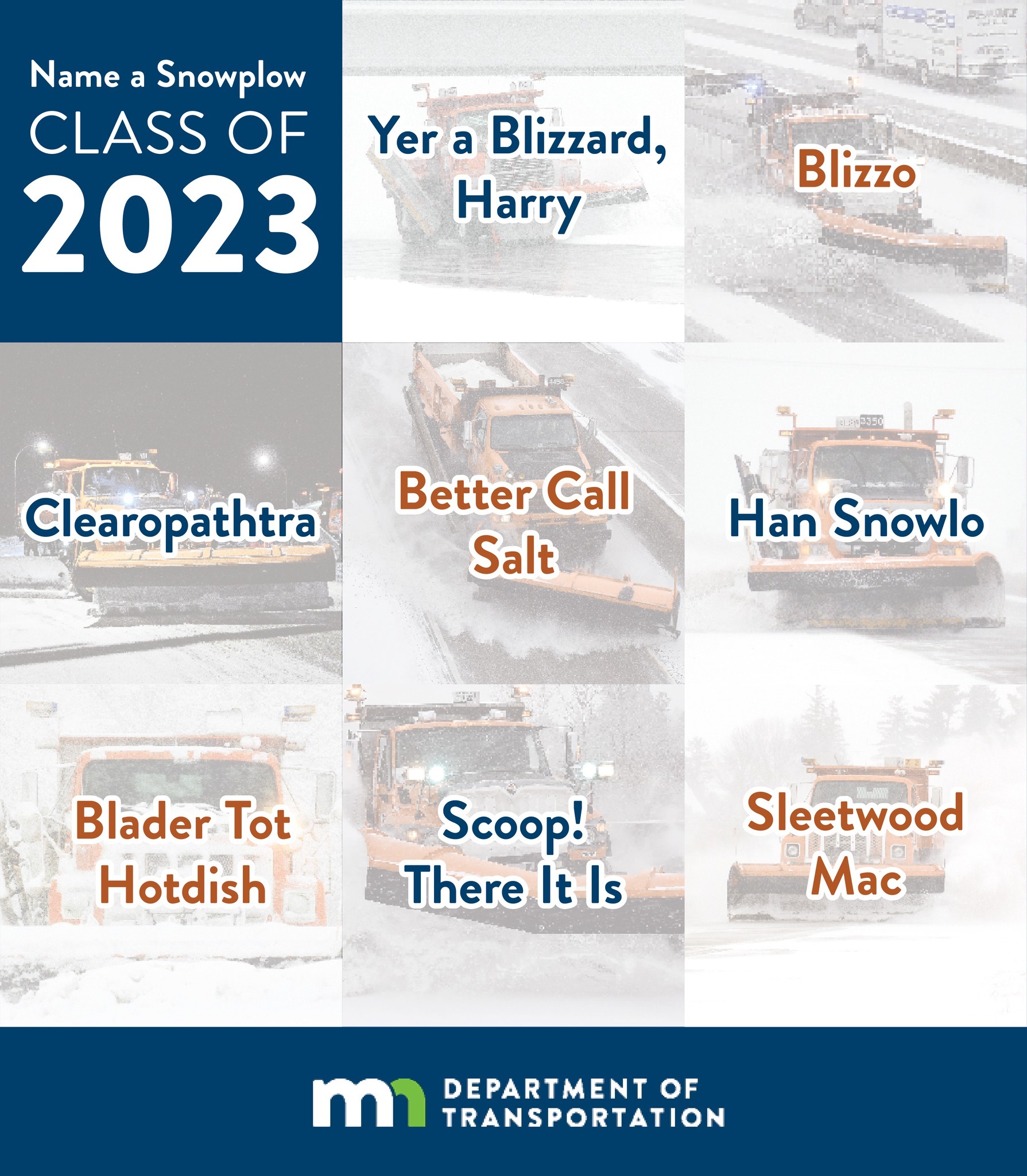
Source: Minnesota Department of Transportation Facebook page
SORRY, TAYLOR SWIFT, but you just missed getting a version of your name printed on a snowplow in Minnesota. That’s according to results of the 2022-23 Minnesota Department of Transportation’s Name a Snowplow Contest. “Taylor Drift” came in at number nine, right behind “Sleetwood Mac,” a tribute to Fleetwood Mac, a band especially popular in the 70s and 80s. With only a 476-vote difference, I suppose Swift could call for a recount.
Topping the winners’ list is “Yer a Blizzard, Harry,” a reference to Harry Potter. The name will go on a MnDOT snowplow assigned to southwest Minnesota.
Placing second is “Blizzo,” an obvious reference to superstar singer Lizzo, who lived in Minneapolis when launching her career. “Blizzo” will, rightfully so, grace an orange snowplow truck in the Twin Cities metro.
This contest, in its third year, has become quite a hit in Minnesota with 10,400-plus names submitted, then narrowed to 60 before polls opened to online voting. Suggestions that made the ballot were chosen based on uniqueness, Minnesota-specificity and frequency of submission. Some 64,000 people voted, able to select up to eight names. The top eight names will be emblazoned on eight plows in MnDOT’s eight districts.
“Scoop! There It Is” is going on a truck in my district of southeast Minnesota.
I was happy to see “Blader Tot Hotdish” coming in at number six. That was my personal favorite, a reference to Minnesota’s iconic Tater Tot Hotdish (aka “casserole” in other regions of the country). I’ll need to travel all the way to northwest Minnesota to see that moniker on a truck.
Minnesota is not the first cold weather place to have a little winter fun with snowplow tagging. Scotland apparently started this trend in 2006 seeking names for its “gritters,” as the plows are called. The Michigan Department of Transportation, the State of Vermont Agency of Transportation, and the cities of Indianapolis and Lafayette (where my son lives), Indiana, also hold snowplow naming competitions.
With winters as long as they are in places like Minnesota, I embrace the distraction of naming snowplows. When Taylor Swift rolls into Minneapolis for her sold-out concerts in late June, all the snow drifts should be gone. She’ll rank number one among fans packing U.S. Bank Stadium, fans who have likely long forgotten that “Taylor Drift” just missed going on a Minnesota road tour.
WHEN MY ELDEST DAUGHTER asked me to bake Chocolate Crazy Cake iced with peanut butter frosting for her upcoming birthday celebration, I was delighted. I’d offered to make her birthday treat, but expected Amber to choose a simplified version of cheesecake or Chocolate Tofu Pie. So when she picked Crazy Cake, I was nostalgically surprised. This is the recipe my mom used for my birthday cakes when I was growing up. And it is the same recipe I used when baking cakes for my three kids.
Although Amber never asked me to craft the cake into a shape like a Teenage Mutant Ninja Turtle, snowman or Garfield the cat as I did when she was a child, I considered it. In the end, I’m going with a basic rectangular frosted cake. Maybe I’ll add sprinkles for the grandkids.
For his eighth birthday, Caleb’s sisters created a PEEF cake for their brother. PEEF is a fictional bear featured in books written and illustrated by Minnesotans Tom Hegg and Warren Hanson. (Minnesota Prairie Roots copyrighted file photo)
February brings not only Amber’s birthday, but also that of her brother, just one day shy of eight years younger than her. Their sister, sandwiched between, is 21 months younger than Amber. Yes, I was a busy mom. I baked a lot of Chocolate Crazy Cake birthday cakes through the years, cutting them into designs typically fitting the birthday child’s interests.
A blogger friend gifted me with a copy of the cake design booklet my mom used when crafting birthday cakes. (Minnesota Prairie Roots copyrighted file photo)
My mom used the Baker’s Coconut Animal Cut-Up Cake booklet as her guide to creating animal-shaped cakes for me and my five siblings. Her handcrafted designs defined our birthdays because we didn’t receive gifts. Finances didn’t allow and the adage of you can’t miss what you never had certainly applies. My kids got gifts along with personalized homemade cakes. If I were to ask them, they would likely remember the cakes I made and not the gifts received.
Birthdays always cause me to feel reflective as in how the heck are my kids already adults and x number of years old? It seems like only yesterday that I was planning birthday parties with their classmates, mixing up Chocolate Crazy Cake and lighting candles.
And now here I am, looking through my stash of church cookbooks for a cherished cake recipe. I’m feeling all nostalgic, wishing there was a way to ship a Chocolate Crazy Cake birthday cake to Caleb in Indiana.
Chocolate Crazy Cake*
3 cups flour
½ cup powdered cocoa
2 cups sugar
1 teaspoon salt
2 teaspoons baking soda
2 cups cold water
¾ cup vegetable oil
2 Tablespoons vinegar
1 teaspoon vanilla
Stir the dry ingredients together in a large bowl. Then add the liquids and mix. Pour into a 9 x 13-inch cake pan and bake for 30-40 minutes at 350 degrees.
#
Recipe source: The Cook’s Special 1973, St. John’s Evangelical Lutheran Church, Vesta, Minnesota
The recipe is listed as “Wacky or Chocolate Cake” in the church cookbook. I’ve always known it as “Crazy Cake.”Why is it called “wacky” or “crazy” cake? I don’t know.
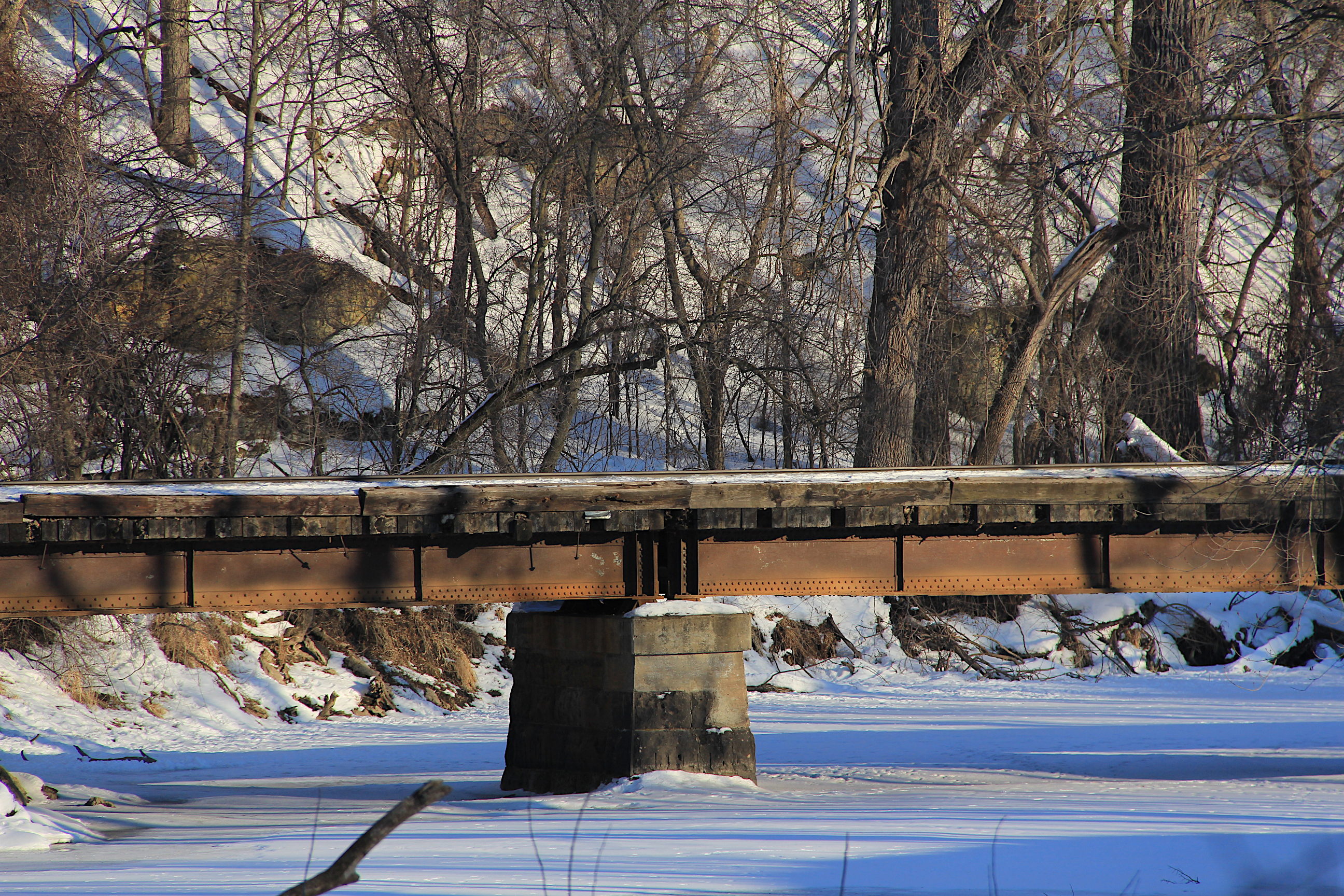
A railroad trestle crosses the Straight River by Fleckenstein Bluffs Park near downtown Faribault. (Minnesota Prairie Roots copyrighted photo February 2023)
LINES AND LIGHT INTERSECT, layering the snowy landscape on a late afternoon in February.
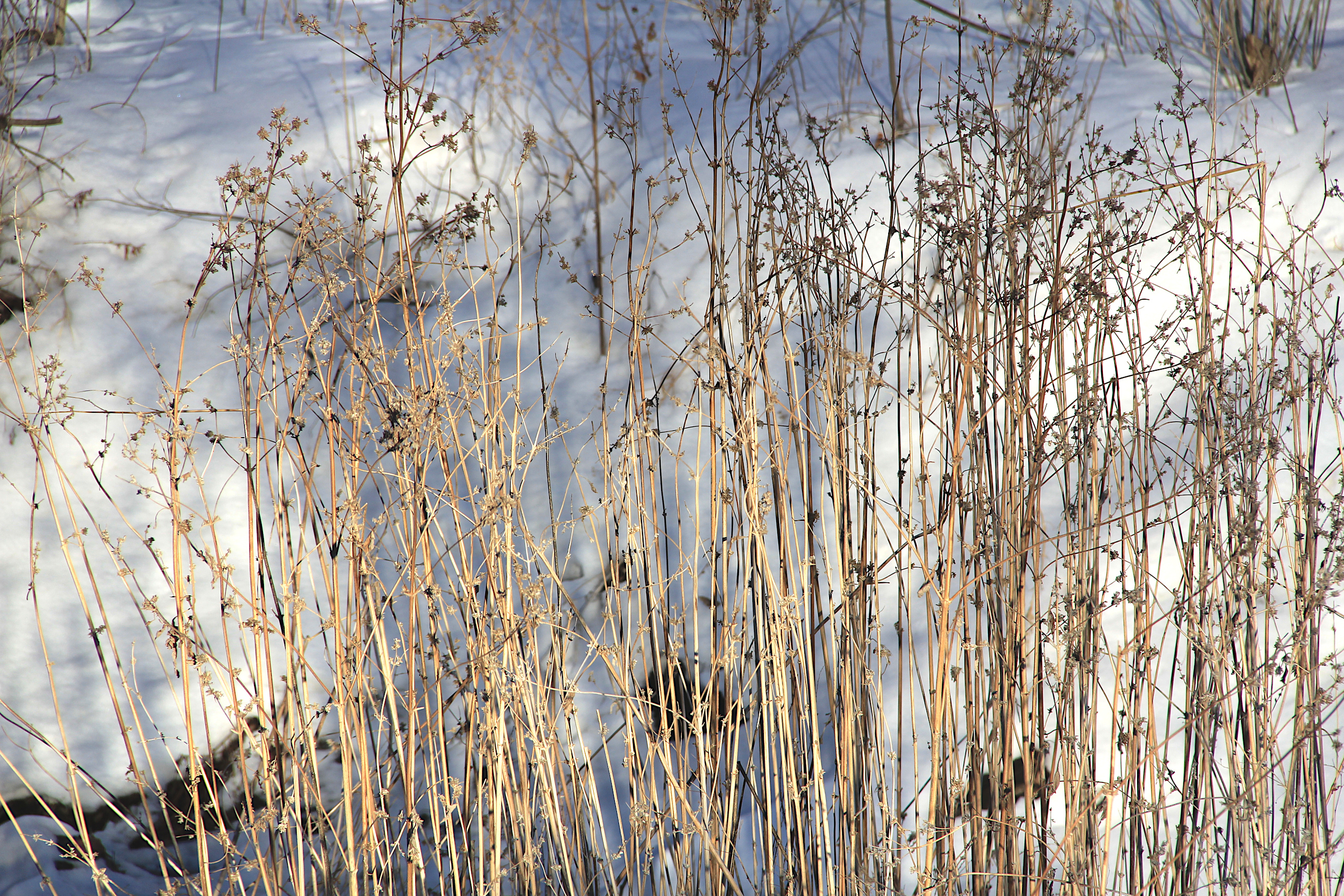
I find even dried vegetation to be visually interesting. (Minnesota Prairie Roots copyrighted photo February 2023)
I am following the Straight River Trail in Faribault from Fleckenstein Bluffs Park. Daylight presses towards early evening with sunlight slanting, shadowing, scripting as I take in the woods, the river, the dried vegetation, then the hard lines of metal and stone.
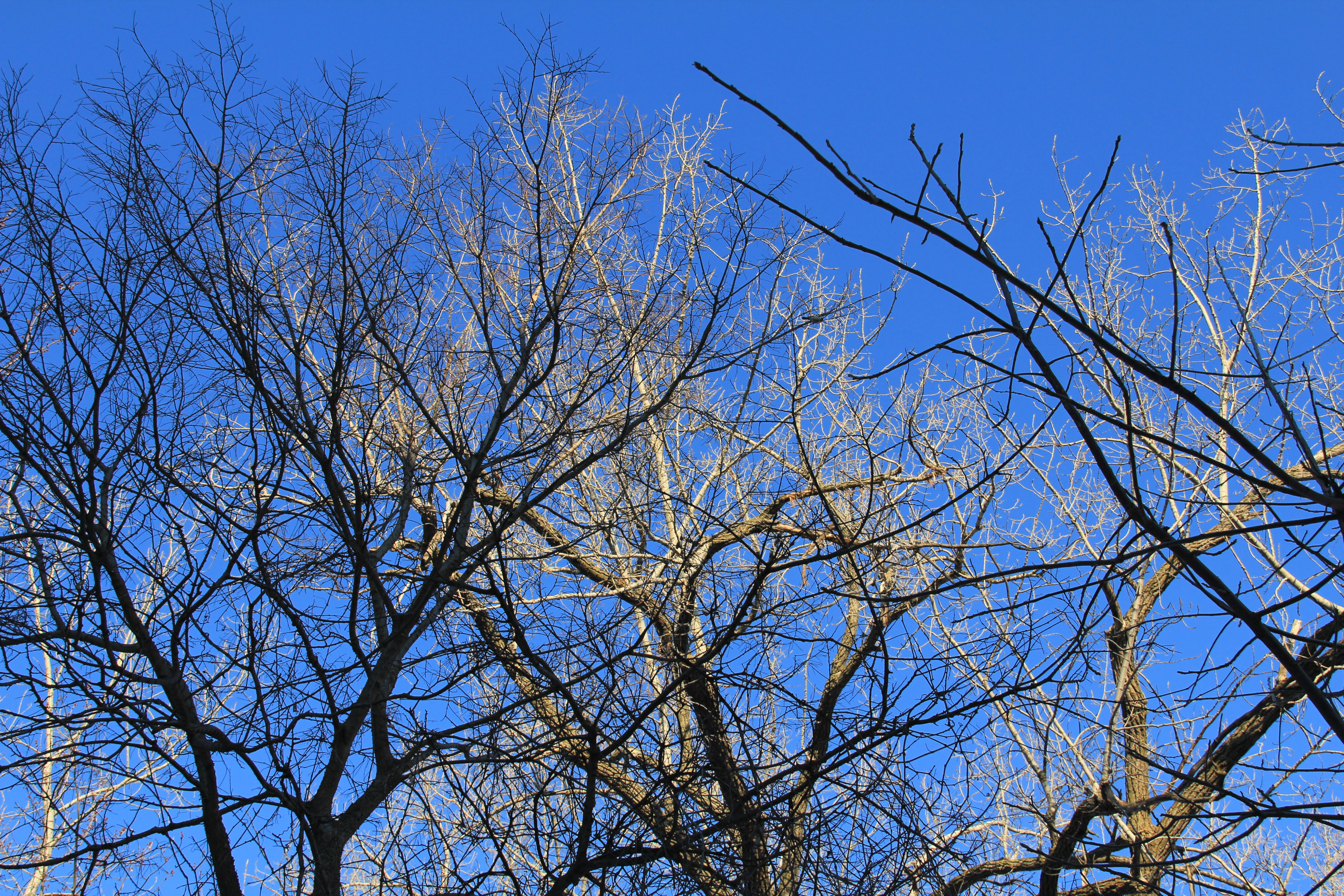
When I look up, I see a bold blue sky backdropping treetops. (Minnesota Prairie Roots copyrighted photo February 2023)
Birds chatter among the trees that border the trail, along the rambling river. I pause. Listen. Appreciate that these feathered creatures manage to survive winter in Minnesota. Even with temps reaching to 30 degrees on this day, I feel the cold.
Randy usually outpaces me as I stop often to take photos. (Minnesota Prairie Roots copyrighted photo February 2023)
I move initially at an unhurried pace. Walk too fast and I miss too much. Randy is well ahead of me, yet he also hears the birdsong, notices the robins, chickadees, a lone woodpecker.
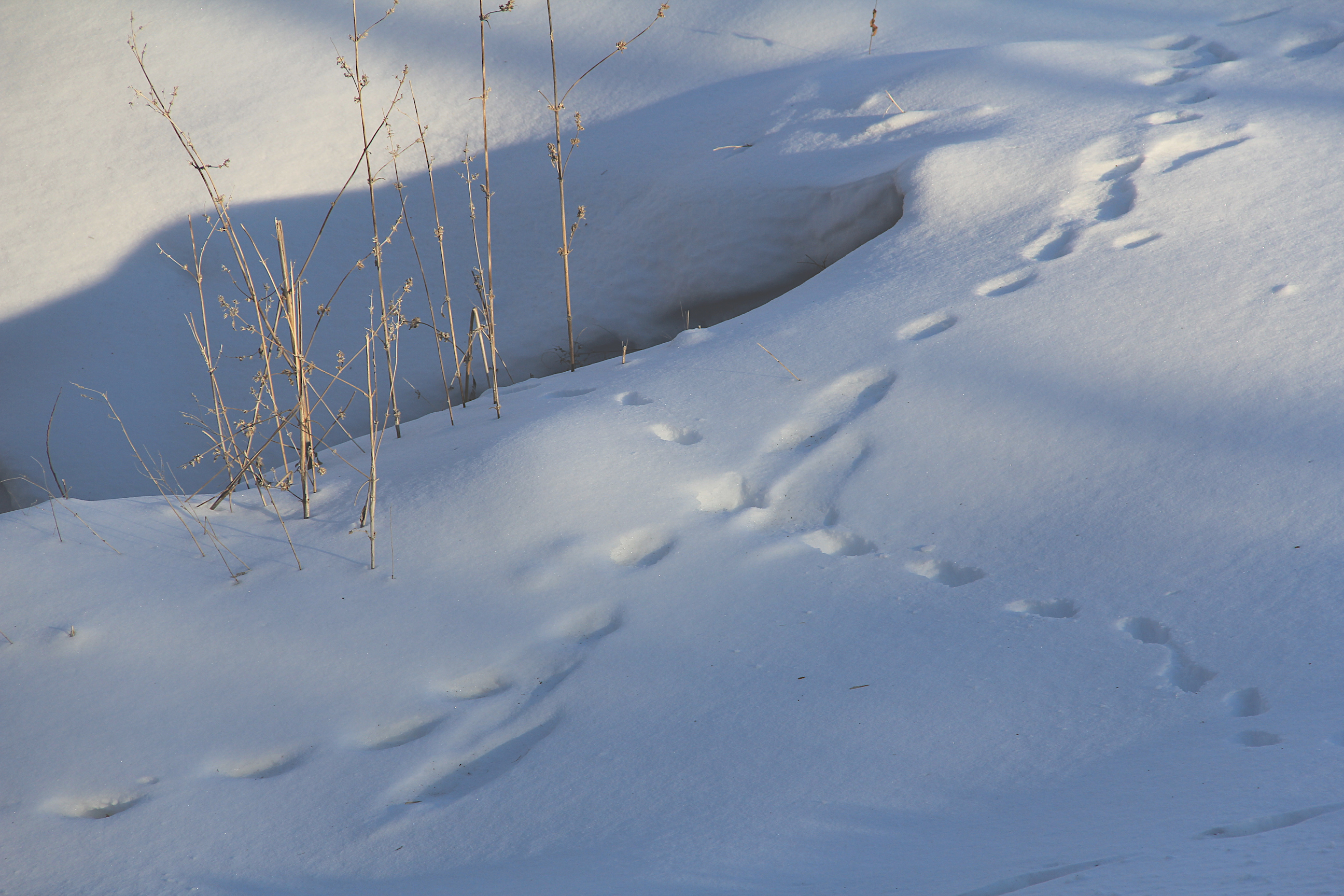
In a dip near the park, tracks in the snow. (Minnesota Prairie Roots copyrighted photo February 2023)
Tracks mar the snow. Animal and human. I wonder about the wildlife that venture onto the river where snow meets ice, meets open water.
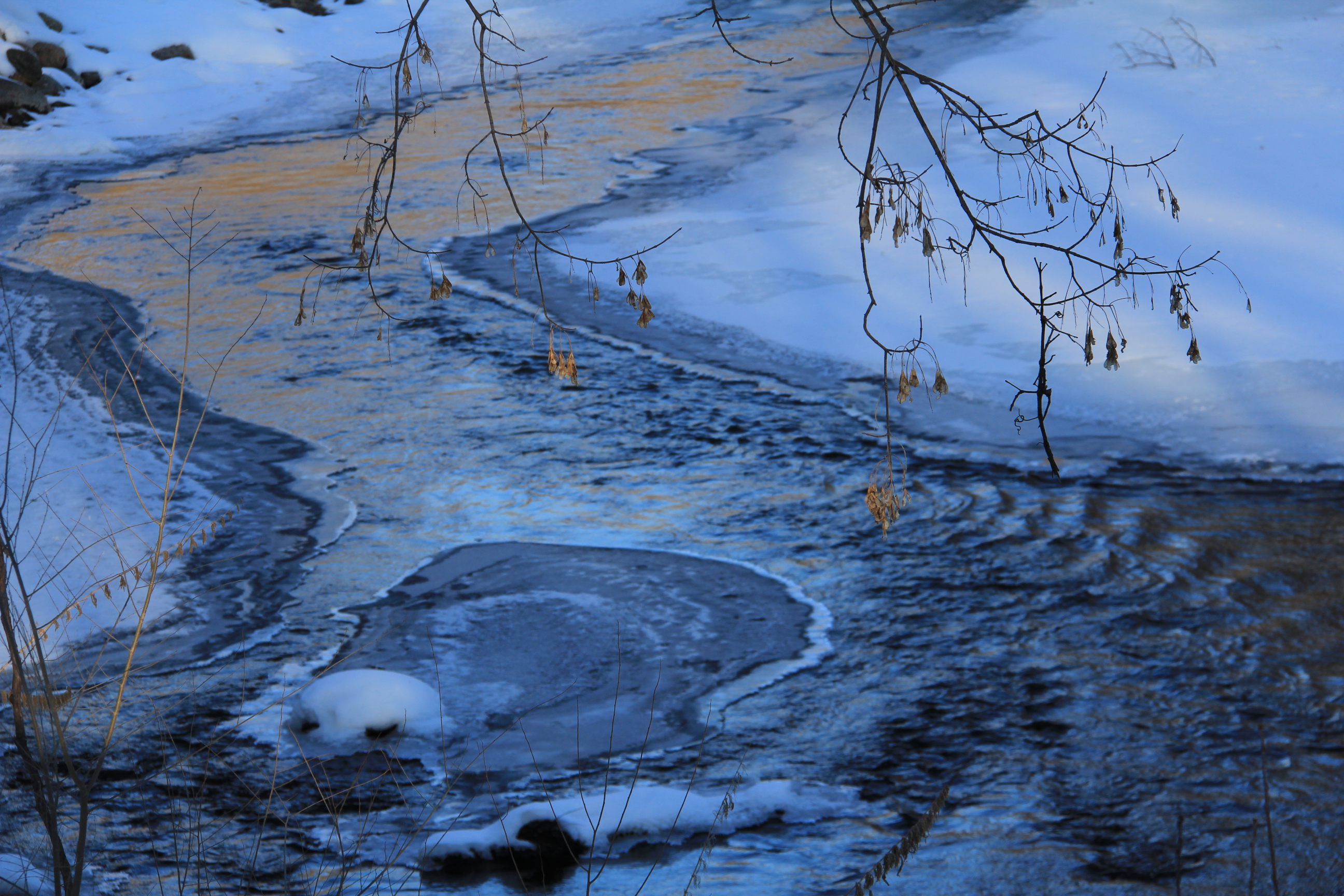
The poetic Straight River. (Minnesota Prairie Roots copyrighted photo February 2023)
A pocked layer of thin ice nudges water which flows, rippling, curving with the topography. The creative in me reads poetry in the way the water wends. I am lost in the moment, in the scene, in the setting, in the wildness.
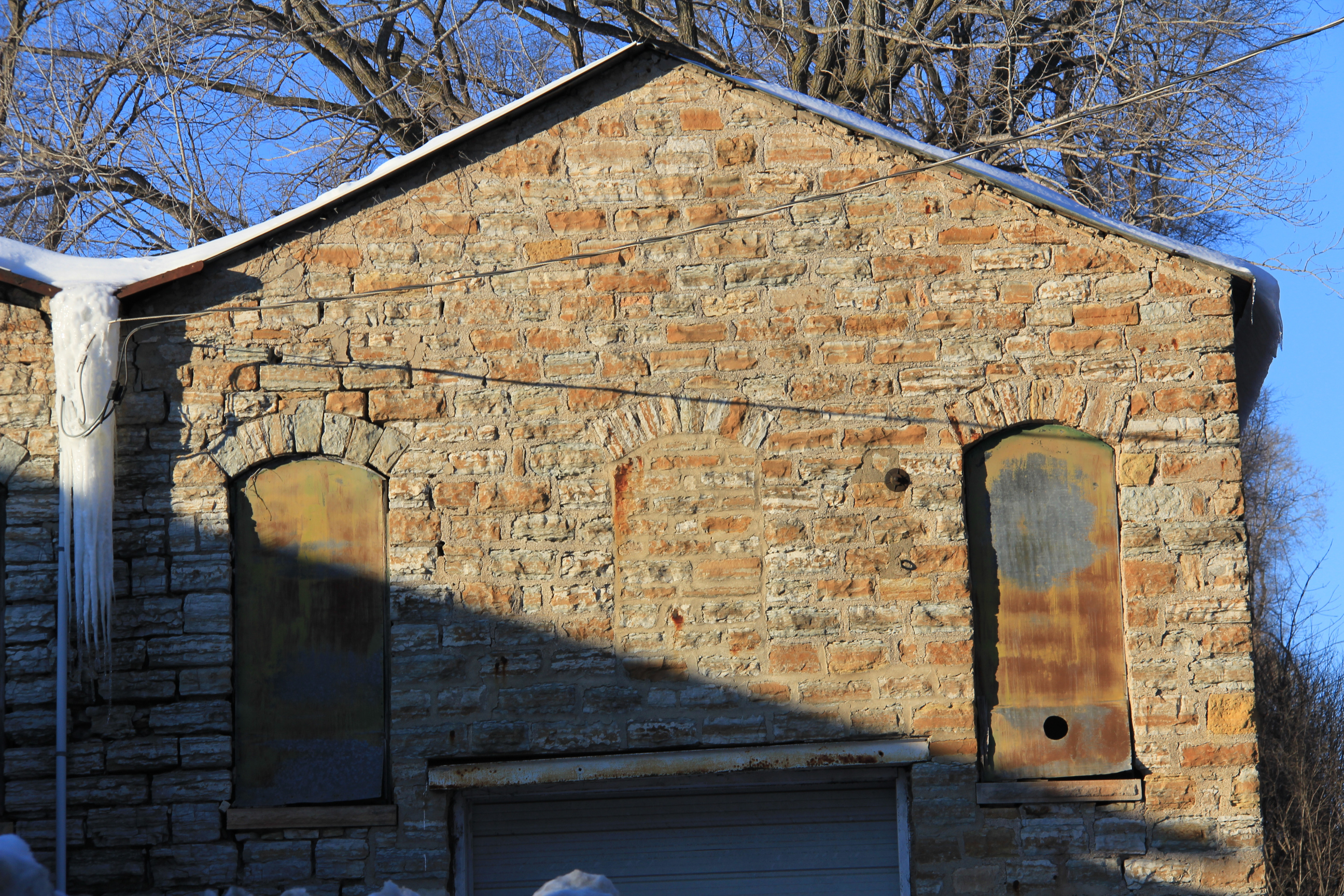
Lines cross this 120-year-old limestone building along the Straight River Trail. (Minnesota Prairie Roots copyrighted photo February 2023)
I press on, toward the aged limestone building hugging the trail. Diagonal lines—power and shadows—cross the stone on the boarded building with a misplaced modern garage door. This 1903 building originally housed Faribault Gas & Electric Company, supplier of power to Faribault via the Cannon Falls hydroelectric plant. Every time I view this building, I wish it could be restored, used in a way that celebrates its history.
The icy river is melting, opening to flowing water. (Minnesota Prairie Roots copyrighted photo February 2023)
My thoughts meander here along the Straight River Trail. Focusing on history and nature and introspective observation.
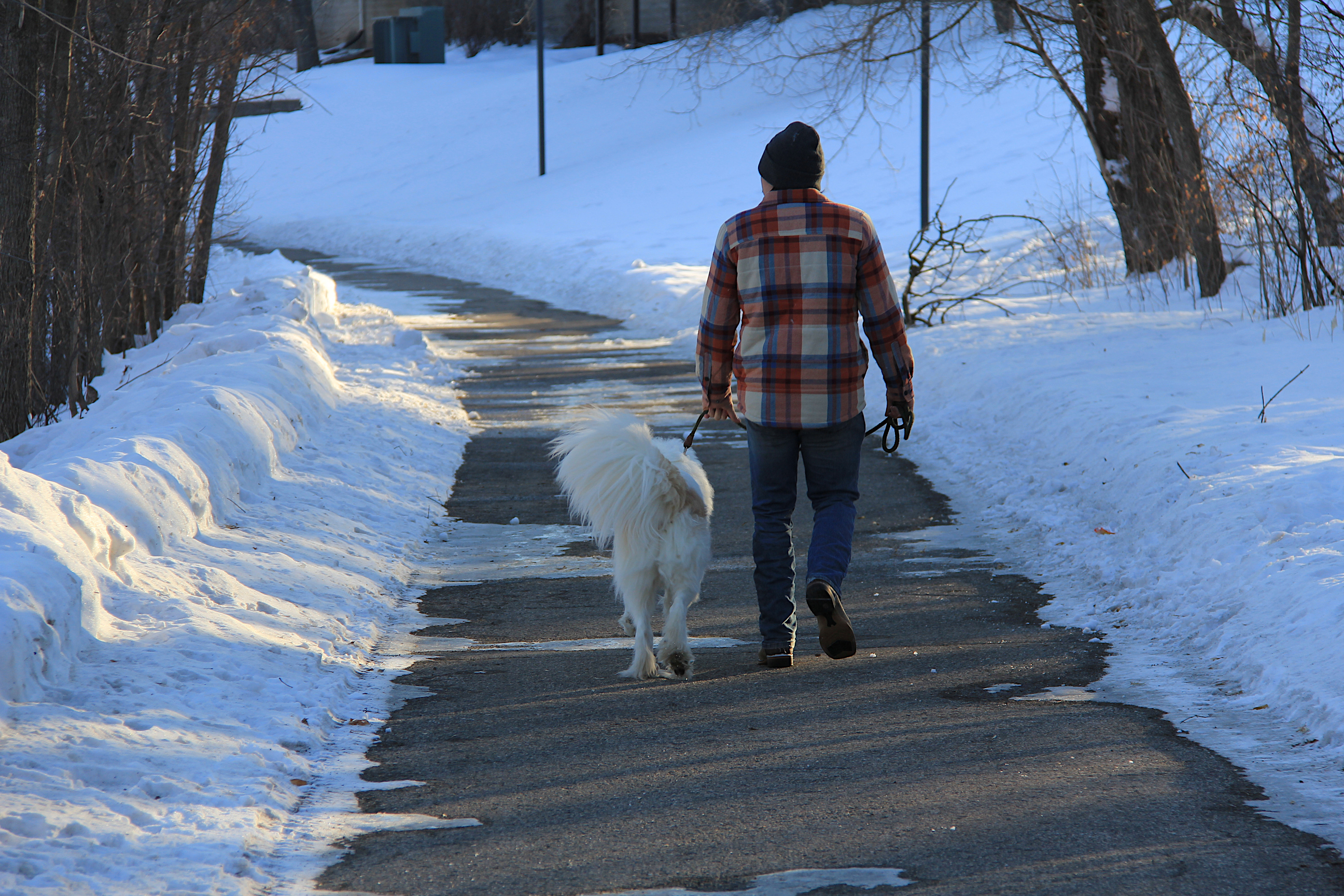
I often meet dogs and their owners while walking the trails. (Minnesota Prairie Roots copyrighted photo February 2023)
But then a dog draws me back to reality. A massive canine, fluffy and white, leashed. His owner stops, allows me to pet his Great Pyrenees with the friendly face, and gorgeous long fur. Ducky. I assess that keeping him clean must be challenging. Ducky’s owner confirms, then continues on.
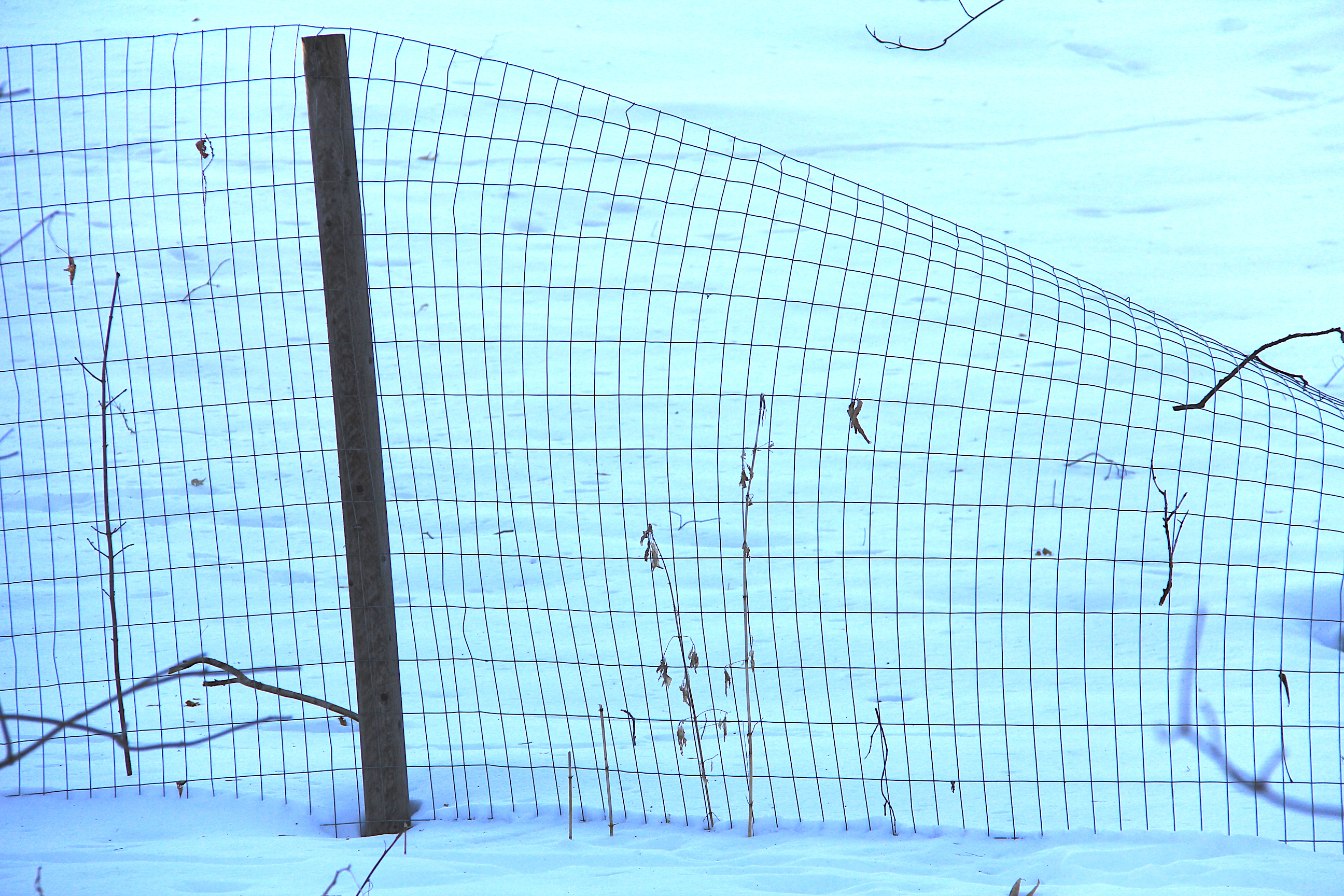
A sculpture, at least in my eyes, set against a snow-covered hillside. (Minnesota Prairie Roots copyrighted photo February 2023)
Cold bites at my exposed fingers as I retrace my path, heading back toward the park. I notice a sagging wire fence like graph paper gridding a snowy hillside. Single family homes and an apartment complex rise high above the trail, backyards revealing much in the nakedness of winter.
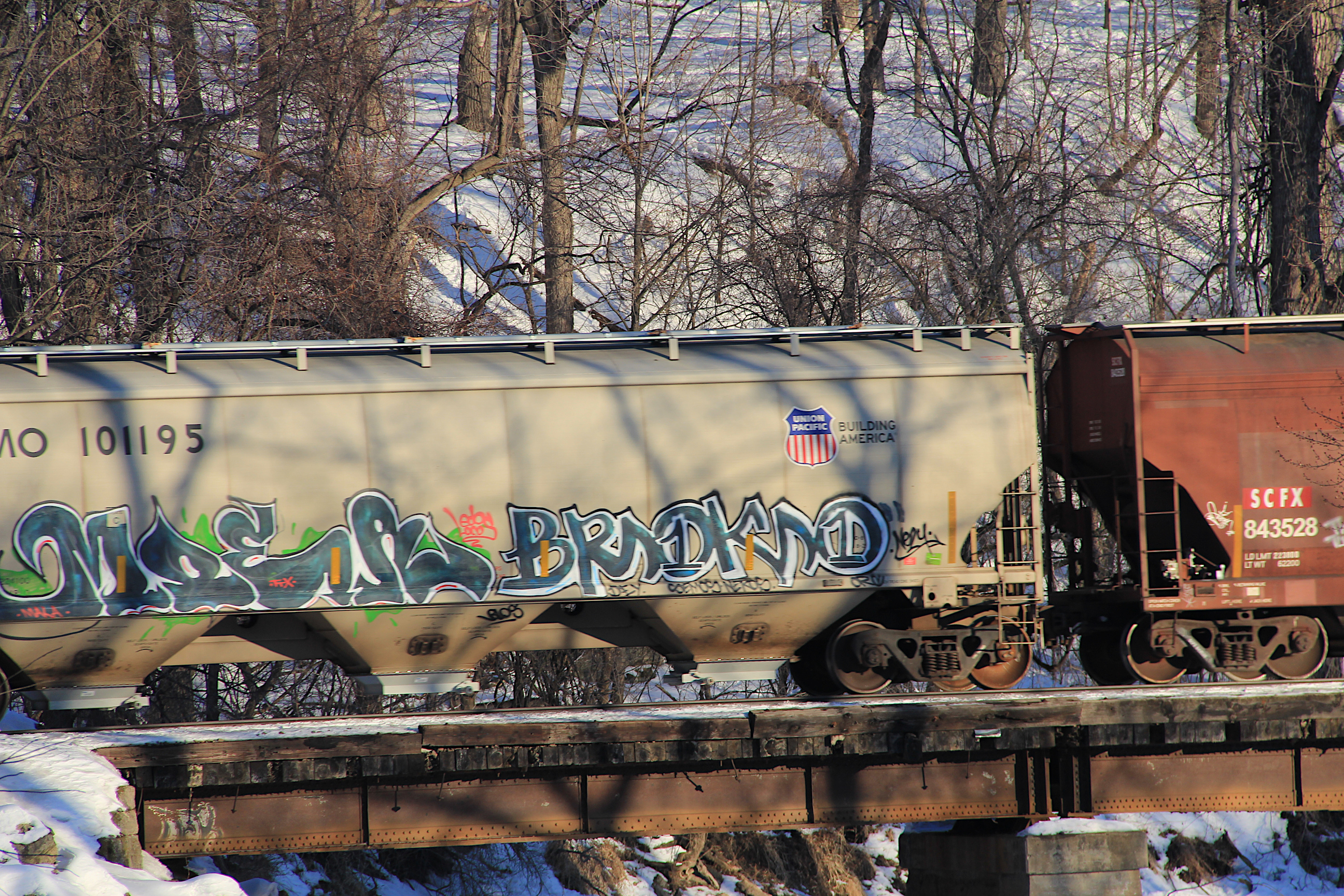
Boxcar art on exhibit as a train passes over the Straight River by Fleckenstein Bluffs Park. (Minnesota Prairie Roots copyrighted photo February 2023)
Soon a shrill whistle cuts through the bluffs. I race to reach an opening in the woods where I can photograph a train as it crosses a trestle over the river. I miss the locomotive, focusing instead on the moving canvases of art created by transient artists.
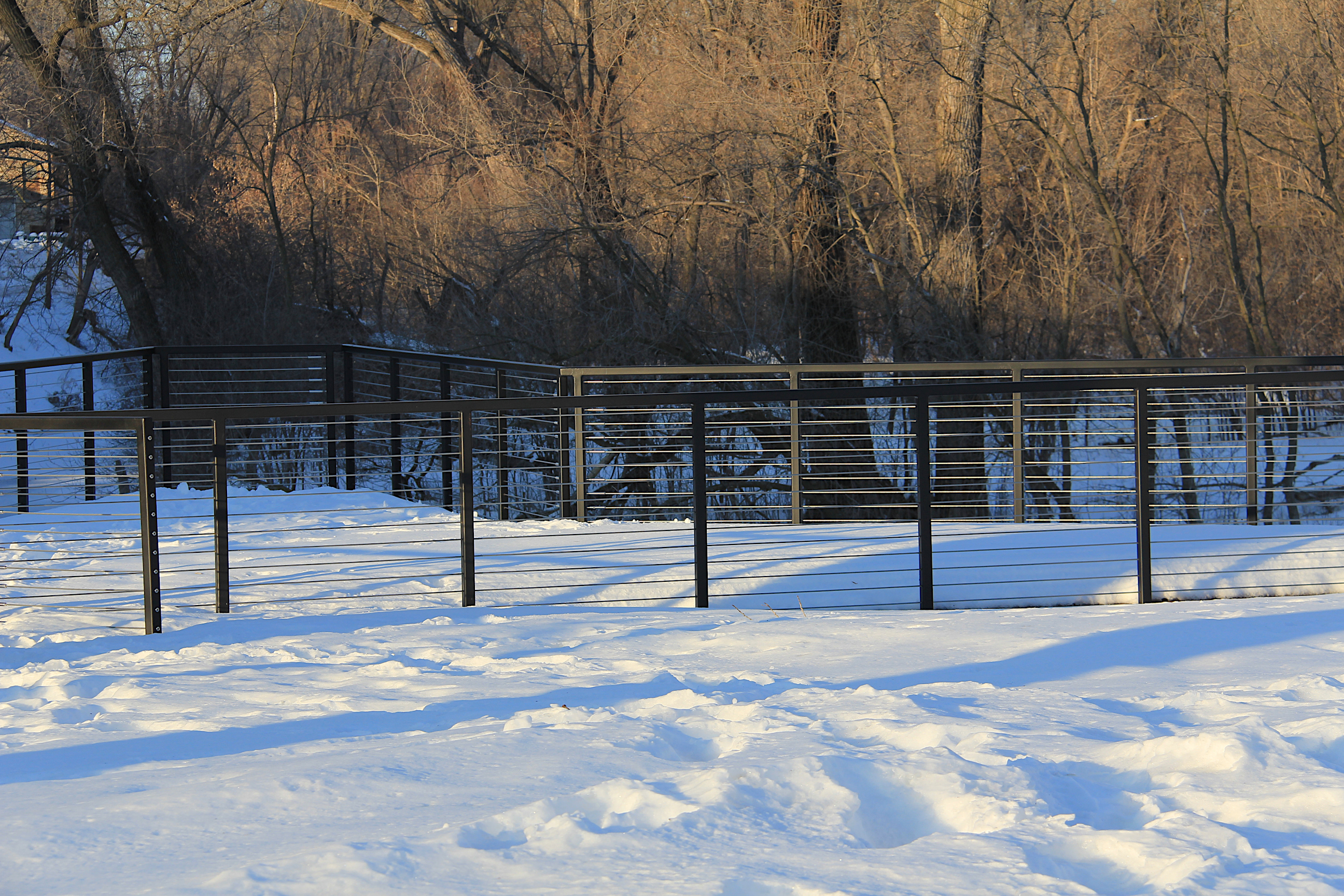
Strong fence lines border the river overlook at Fleckenstein Bluffs Park. (Minnesota Prairie Roots copyrighted photo February 2023)
I see art, too, in the fenced lines of a river overlook in the park, a space packed with snow and inaccessible in the winter.
When I’m walking, I appreciate curves in sidewalks and trails. I find them more appealing not only for following, but visually. (Minnesota Prairie Roots copyrighted photo February 2023)
Then I curve along the sidewalk that rounds the playground before aiming back to the parking lot. I notice reflections of trees in puddles of melting snow. The bold blue sky. The way light bounces off the segmented walkway. I feel invigorated by all I’ve seen, by the sharp cold air, by the essence of time outdoors on a February afternoon in southern Minnesota.






















 Minnesota Prairie Roots
Recent Comments