Minnesota Prairie Roots

Writing and photography by Audrey Kletscher Helbling
Carleton art exhibit zeroes in on guns, nuclear disarmament & nonviolence November 11, 2025

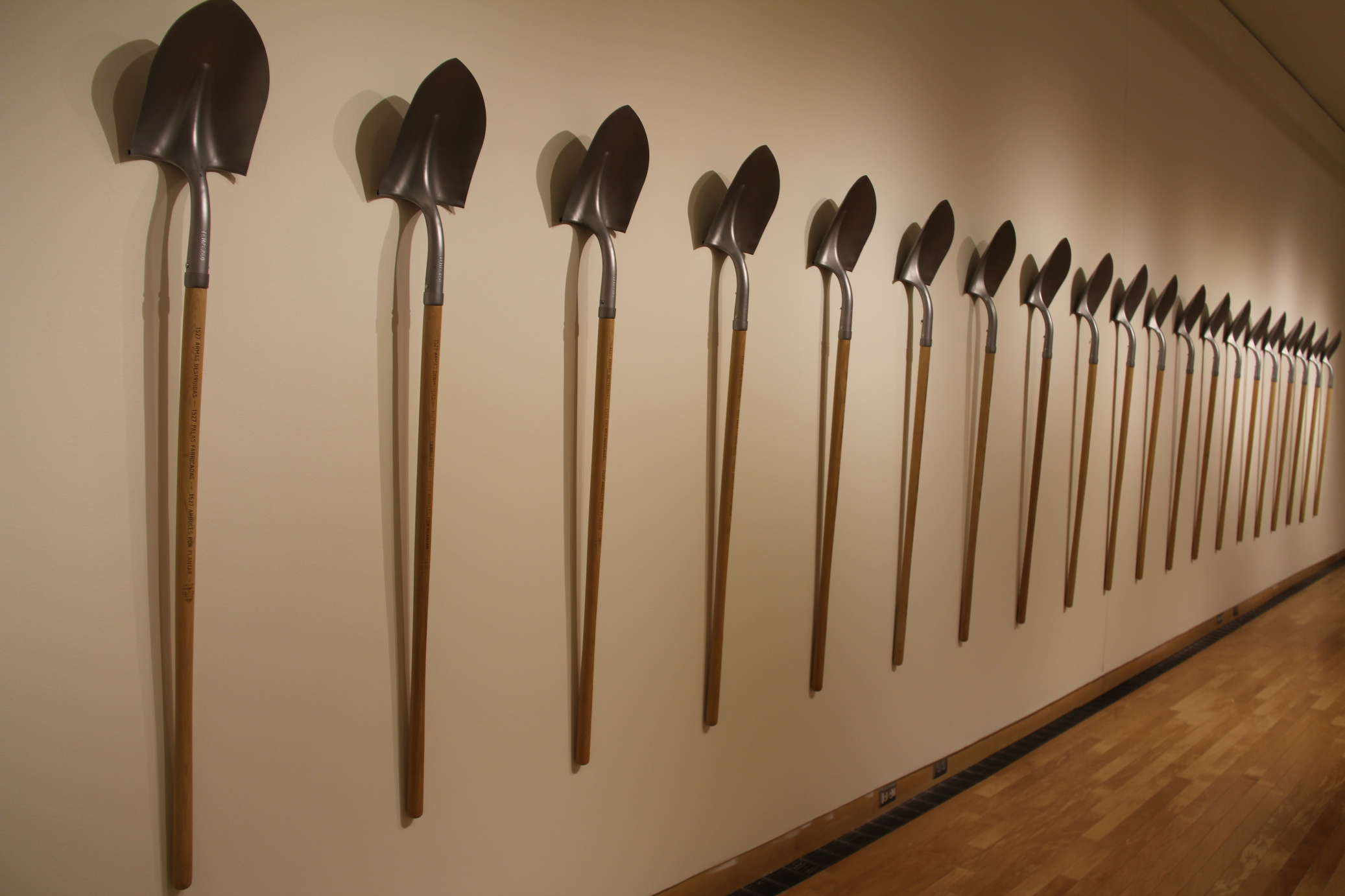
These shovels were crafted from melted guns and are part of an exhibit, “Ahimsa,” at Carleton College. (Minnesota Prairie Roots copyrighted photo October 2025)

INSIDE A GALLERY at a noted liberal arts college in a small southern Minnesota city, 20 identical shovels hang, evenly-spaced, along a beige wall. That may not seem impressive, until you read the story behind these tools.

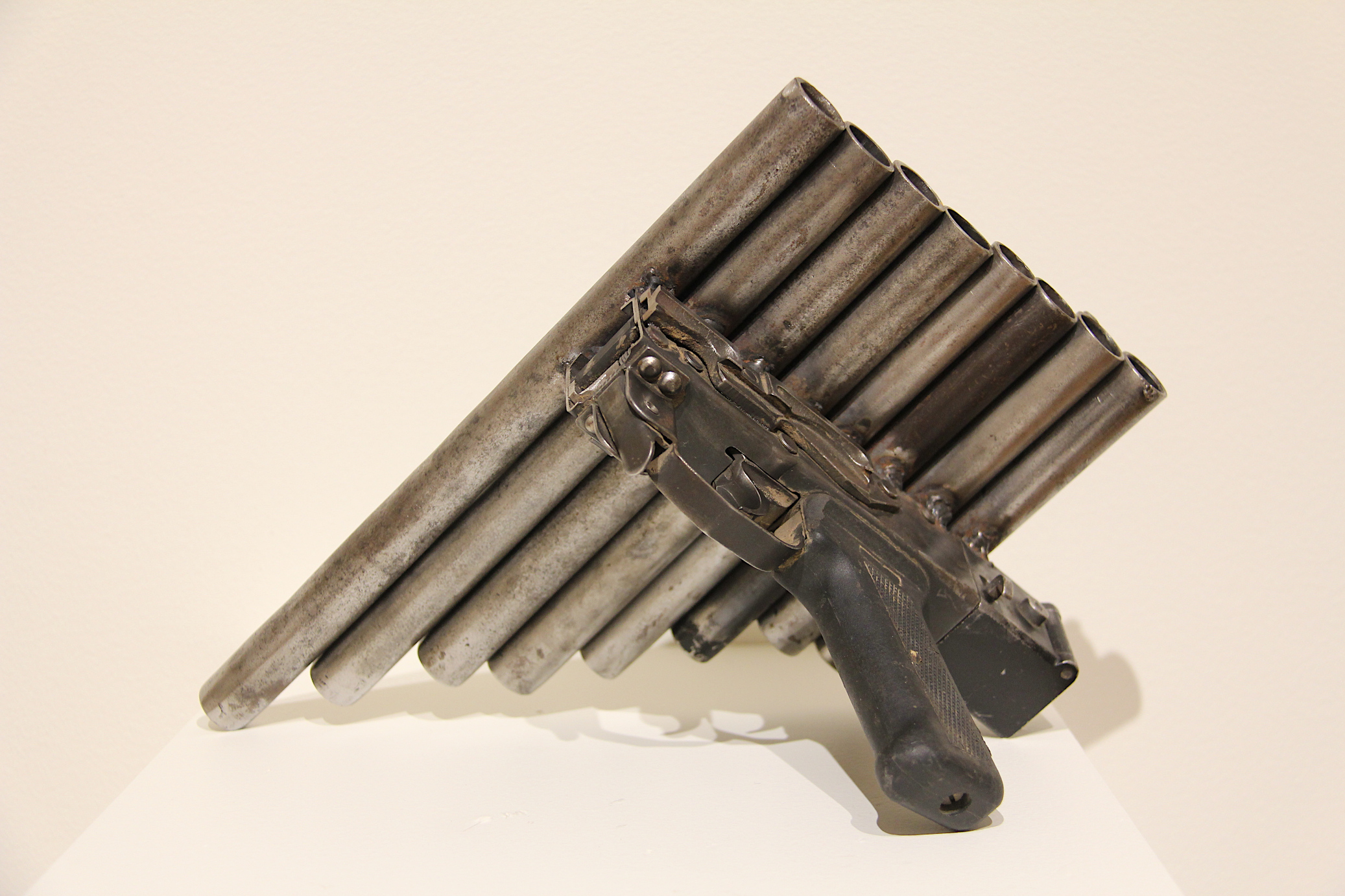
Pedro Reyes used surrendered and melted guns to create not only shovels, but also this “Disarm Pan Flute,” a playable instrument. (Minnesota Prairie Roots copyrighted photo October 2025)

These shovels were crafted from 1,527 guns surrendered in Culiacán, Mexico. Guns that were melted and made into 1,527 shovels used to plant 1,527 trees, including one at the corner of Union Street and Fourth Street East on the campus of Carleton College in Northfield.

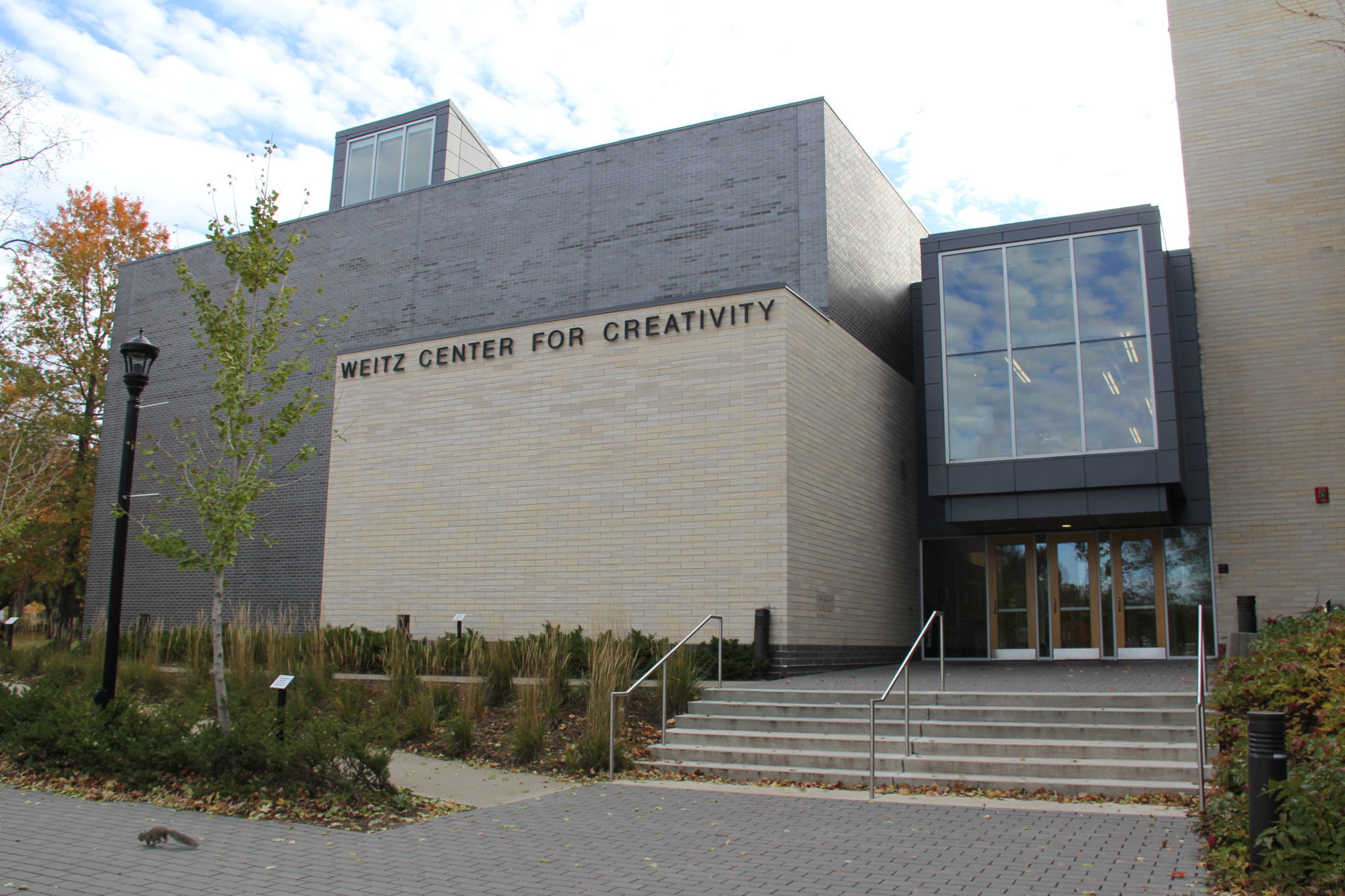
The exhibit is showcased in two galleries inside the Weitz Center for Creativity. (Minnesota Prairie Roots copyrighted photo October 2025)

Recently I stopped at this college campus to tour “Ahimsa,” an exhibition by Mexican artist Pedro Reyes in the galleries at The Perlman Teaching Museum inside the Weitz Center for Creativity. “Ahimsa” is a Sankritt word meaning “nonviolence.” That focuses this thought-provoking exhibit filling two gallery spaces.

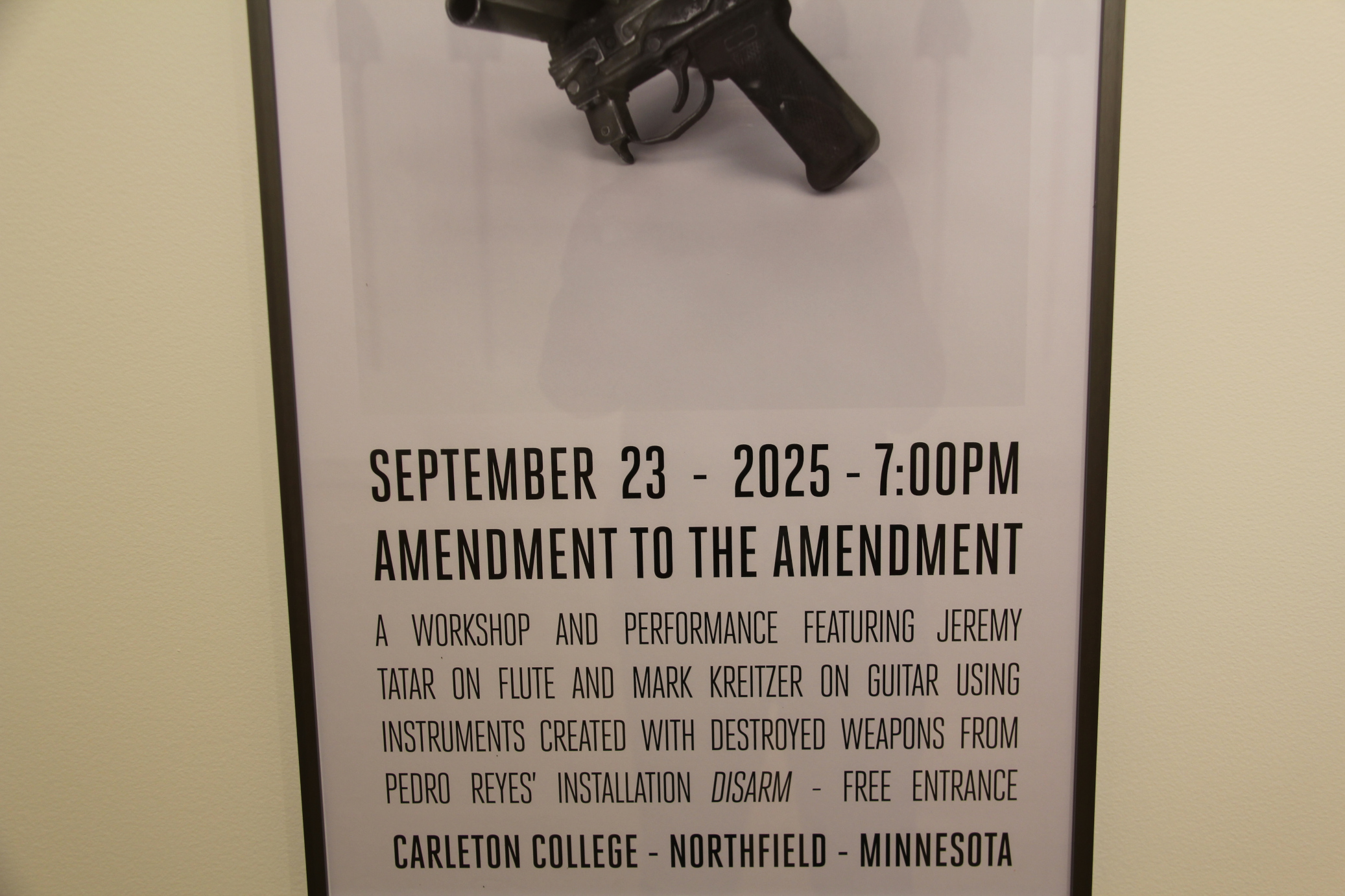
A wall of posters promoting Pedro Reyes’ exhibition shown around the world include this one from Northfield. His shows feature engaging events. (Minnesota Prairie Roots copyrighted photo October 2025)

With gun violence so prevalent in America, including right here in Minnesota with the political assassination of Minnesota House Speaker Emerita Melissa Hortman and her husband, Mark, in June and the deadly August mass shooting at Annunciation Catholic Church in south Minneapolis, I found Reyes’ exhibit profoundly relevant. I couldn’t help but think of the two Annunciation School children who were killed and the 27 other students and adults who were injured during morning Mass. Since then, voices have risen, loud and vocal, against gun violence. But thus far, nothing has changed, although discussion is ongoing with Minnesota Governor Tim Walz hosting town halls around the state on the topic.

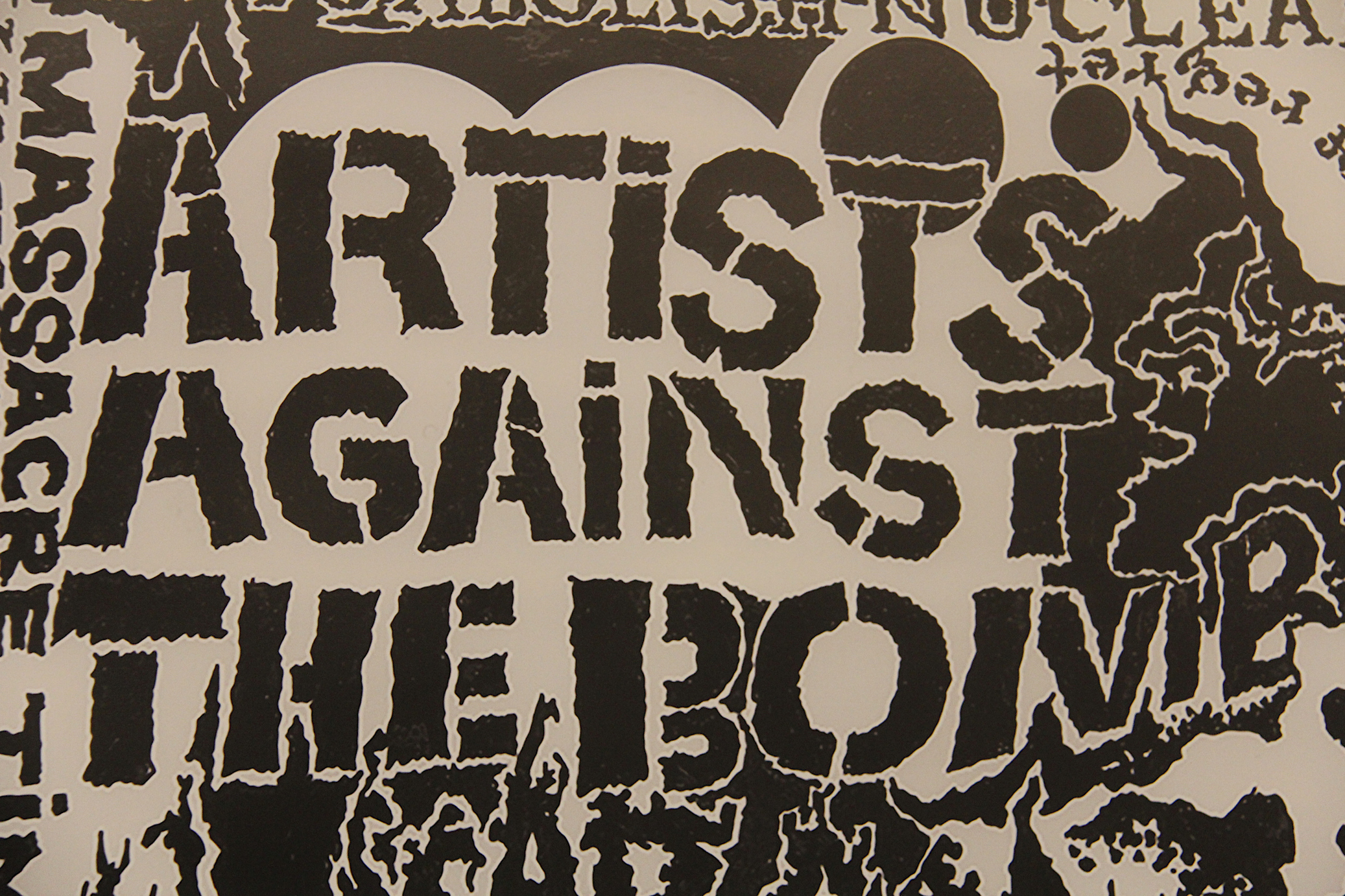
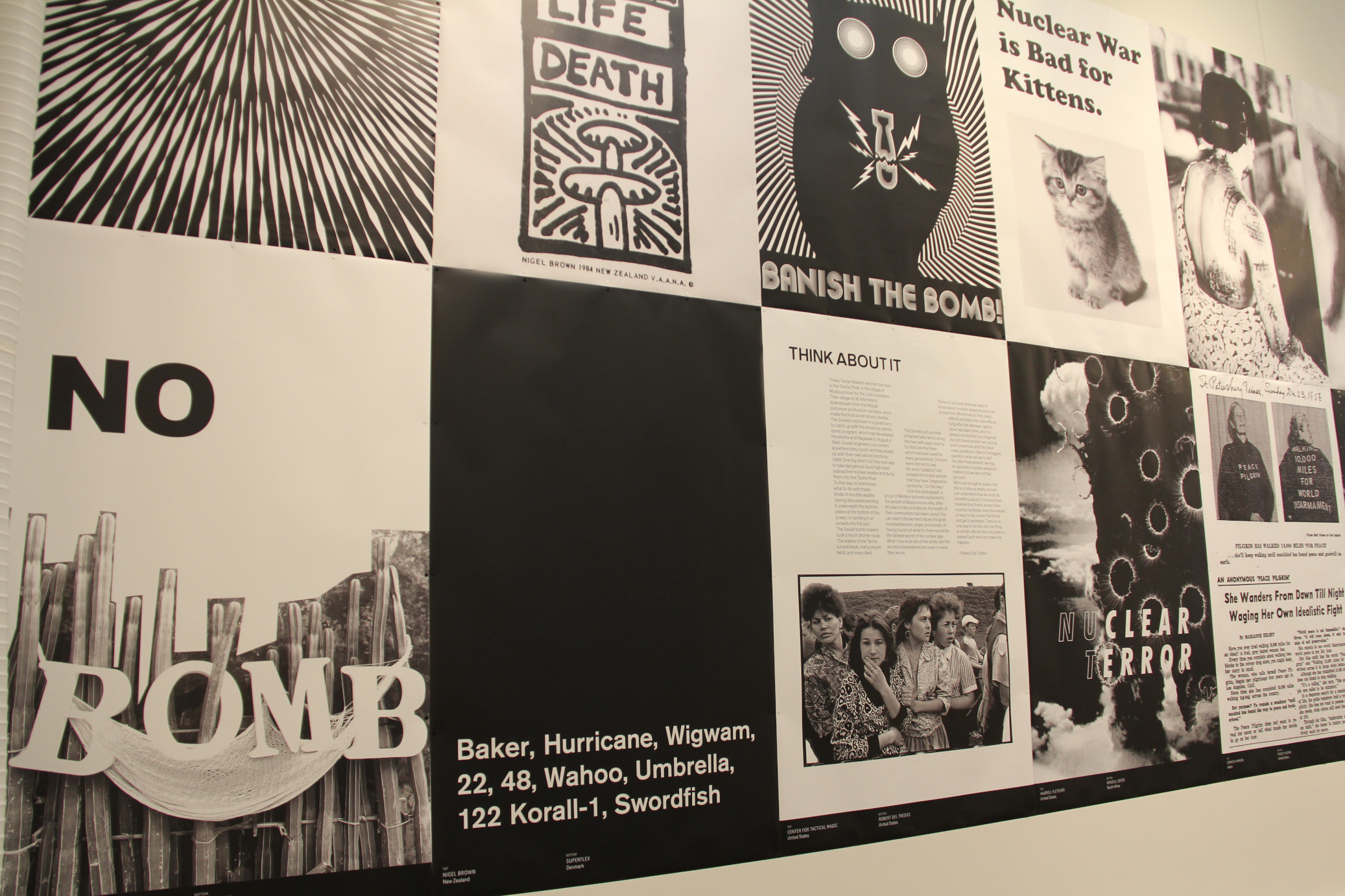
One gallery wall features posters created for “Artists Against the Bomb” by artists from around the world. (Minnesota Prairie Roots copyrighted photo October 2025)

The voice of this Mexican artist is among those rising. Upon entering the gallery, I read this: …Ahimsa reminds us that silence is complicity…

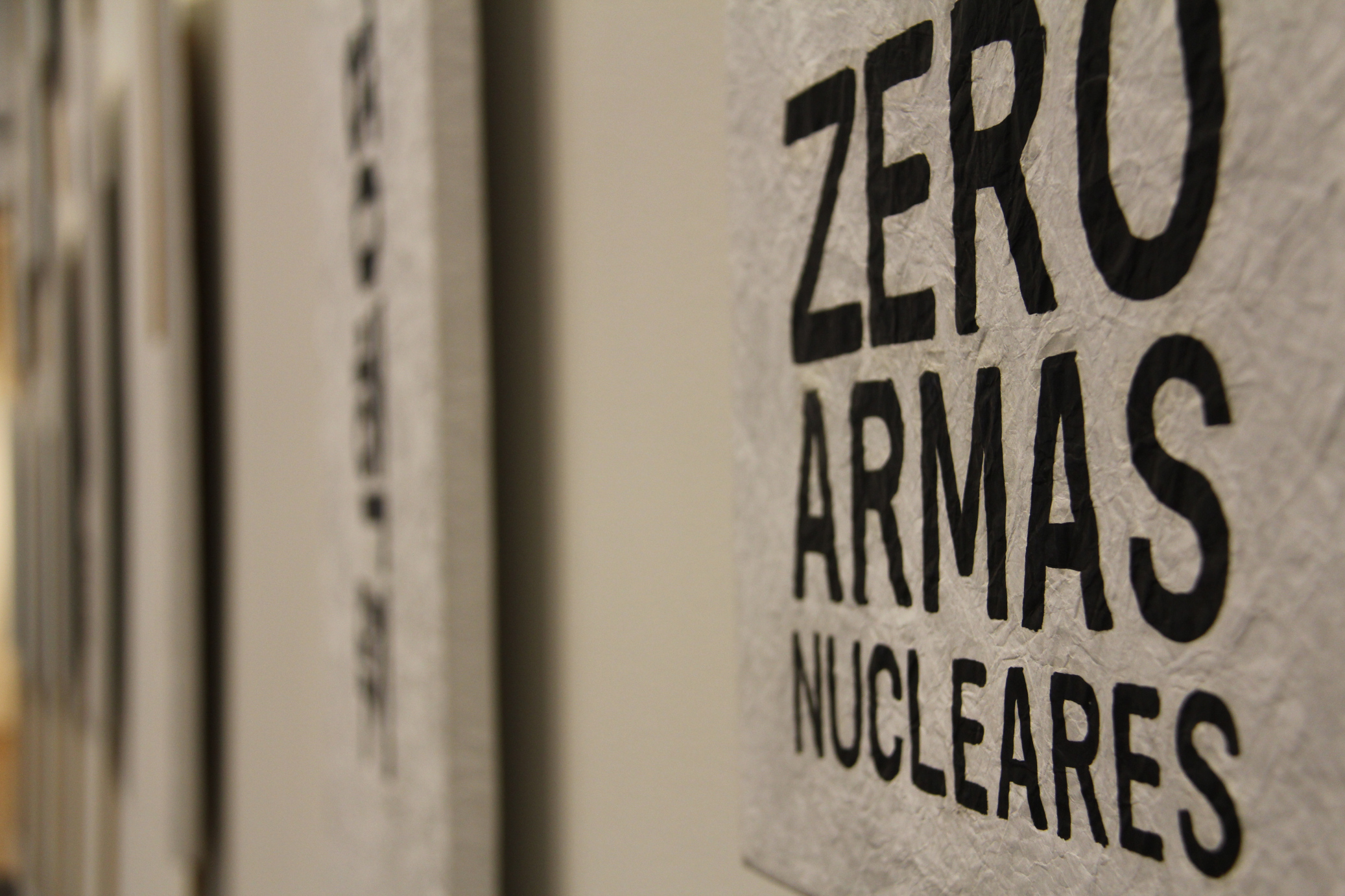
A closeup of a protest banner. A wall is covered with these signs in multiple languages with graphic symbols inspired by the conceptual element of zero. These are done in oil painting on Tyvek. (Minnesota Prairie Roots copyrighted photo October 2025)

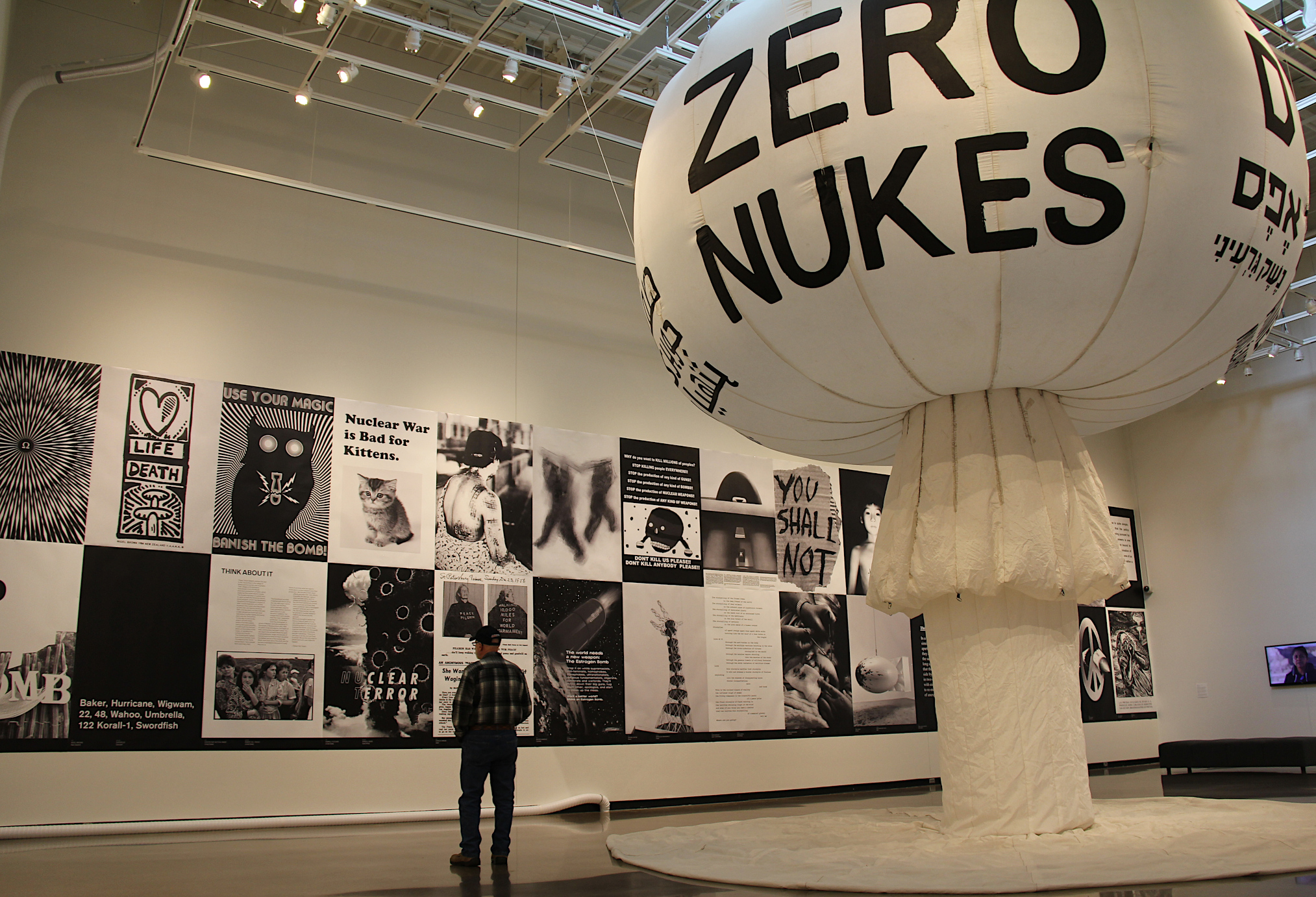
Reyes speaks out against more than gun violence in his exhibition. He also advocates for nuclear disarmament, another timely topic. And he does that in an artistically-mammoth way via a towering inflatable that overwhelms the high-ceilinged Braucher Gallery. Exactly the effect Reyes wants to make in his piece titled “Zero Nukes.”

The massive nuclear mushroom cloud centers the nuclear disarmament part of the exhibit. (Minnesota Prairie Roots copyrighted photo October 2025)

I felt minimal, small, dwarfed by the mushroom cloud upon which ZERO NUCLEAR WEAPONS is printed in eight languages.

Inflatable warheads are part of the art installation. (Minnesota Prairie Roots copyrighted photo October 2025)
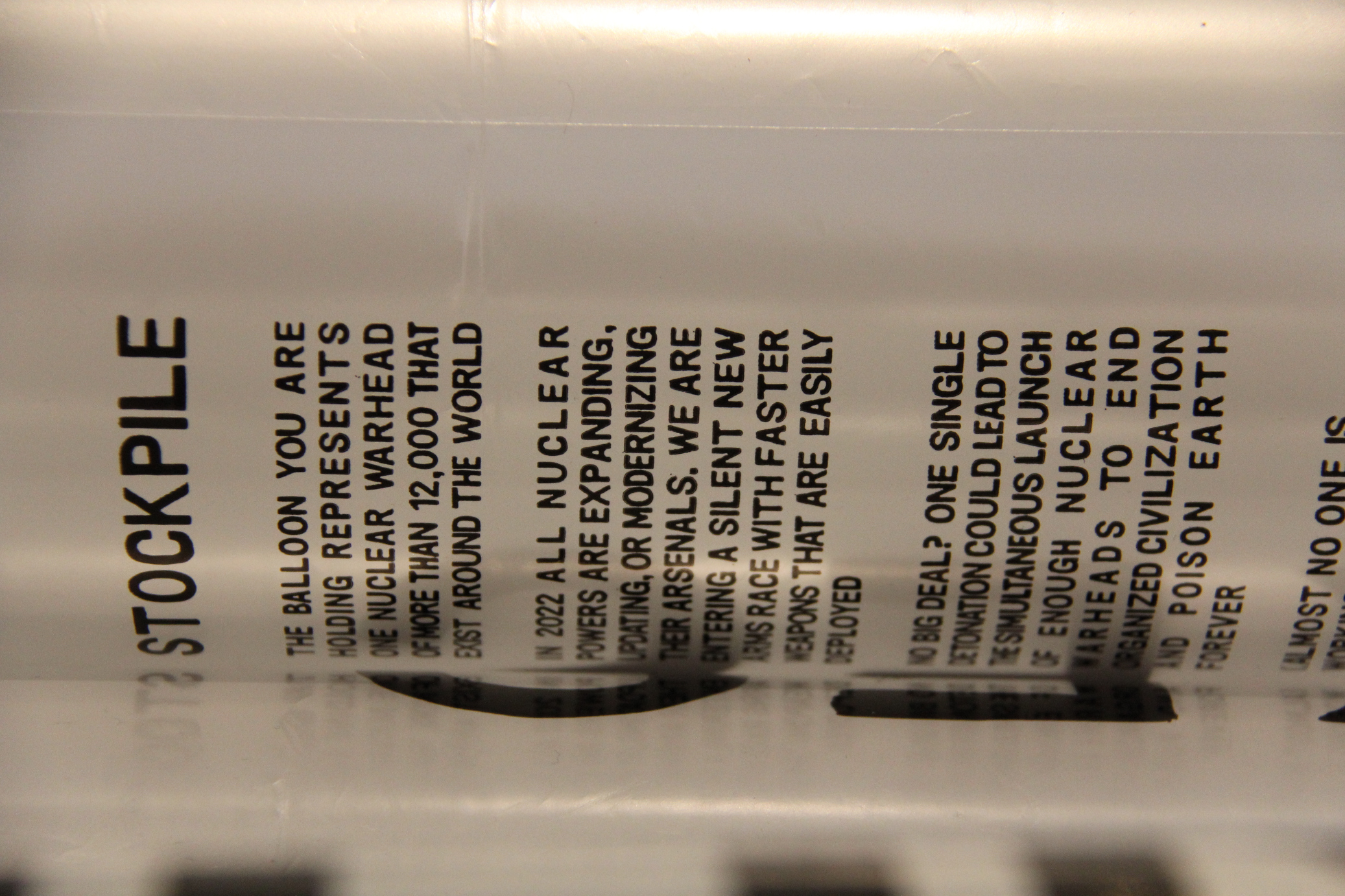
A closeup of the message printed on the inflatable warheads. (Minnesota Prairie Roots copyrighted photo October 2025)
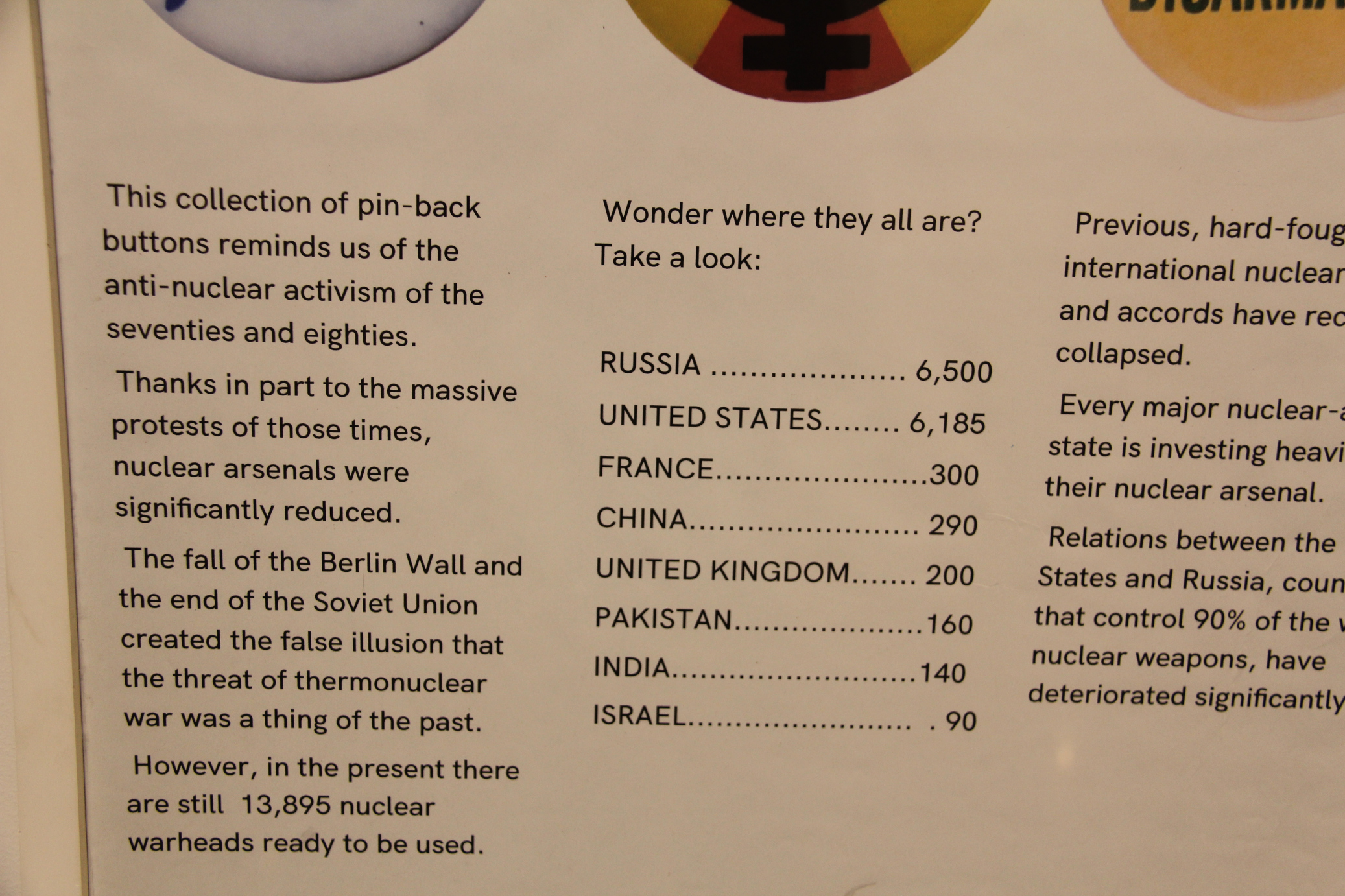
Nuclear warhead info and stats. Surprising. (Minnesota Prairie Roots copyrighted photo October 2025)

Nearby, a stockpile of inflatable nuclear warheads lies, another strong visual representing the nearly 14,000 nuclear warheads at the ready around the world. The statistics, cited as part of this display, are sobering, surprising (to me) and revealing.

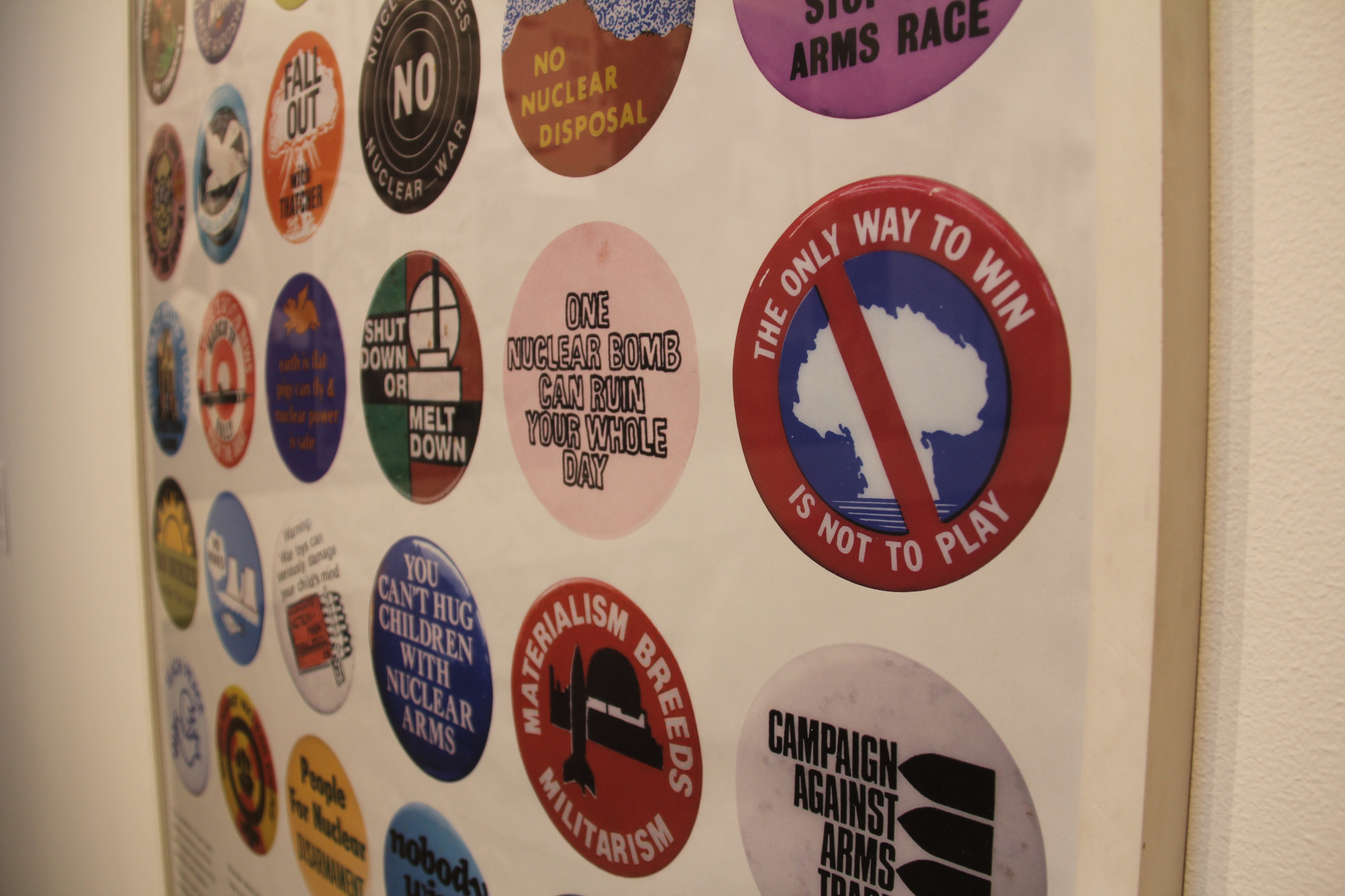
One section of the exhibit features images of buttons protesting nuclear weapons. (Minnesota Prairie Roots copyrighted photo October 2025)
One entire wall showcases the works of “Artists Against the Bomb. (Minnesota Prairie Roots copyrighted photo October 2025)
An overview of the campaign for nuclear disarmament shows the inflatable mushroom cloud, “Zero Nuclear Weapons” protest banners and a wall of protest posters, far right. (Minnesota Prairie Roots copyrighted photo October 2025)

Reyes, in his exhibit, shows us how art can be used to inform, educate, raise awareness, spark community conversation and action. He shows us via posters, buttons, sculptures, videos, inflatables and words how we can rise in protest against gun violence and nuclear weapons.

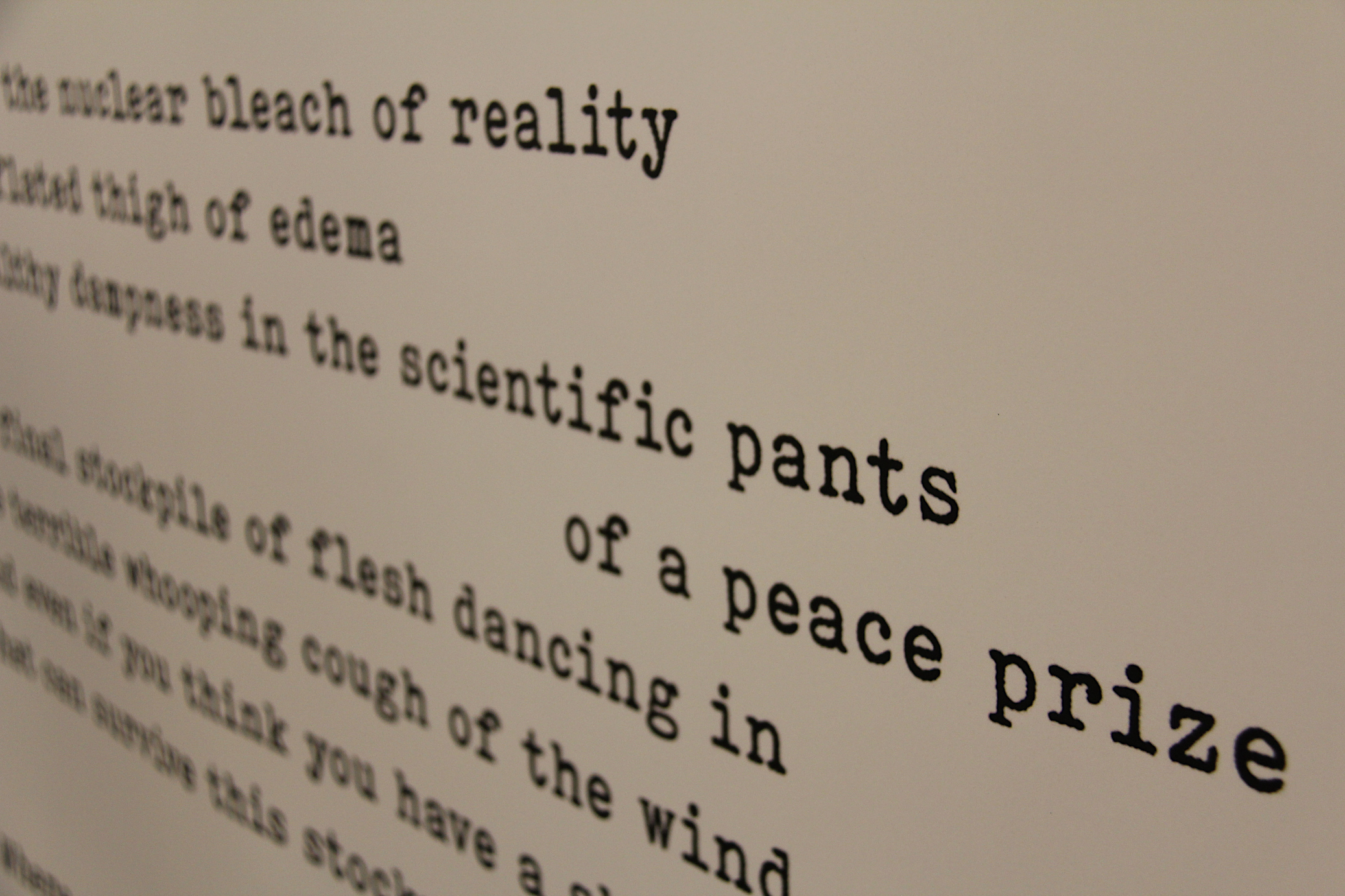
At its end, the poet asks, “Where are you going?” (Minnesota Prairie Roots copyrighted photo October 2025)

In the end we must ask ourselves the singular question posed in a poem on the protest poster wall: Where are you going? That’s in the event of nuclear war or similarly in the case of a mass shooting. I long ago stopped believing that the 1960s advice to duck and cover beneath a school desk would save me.

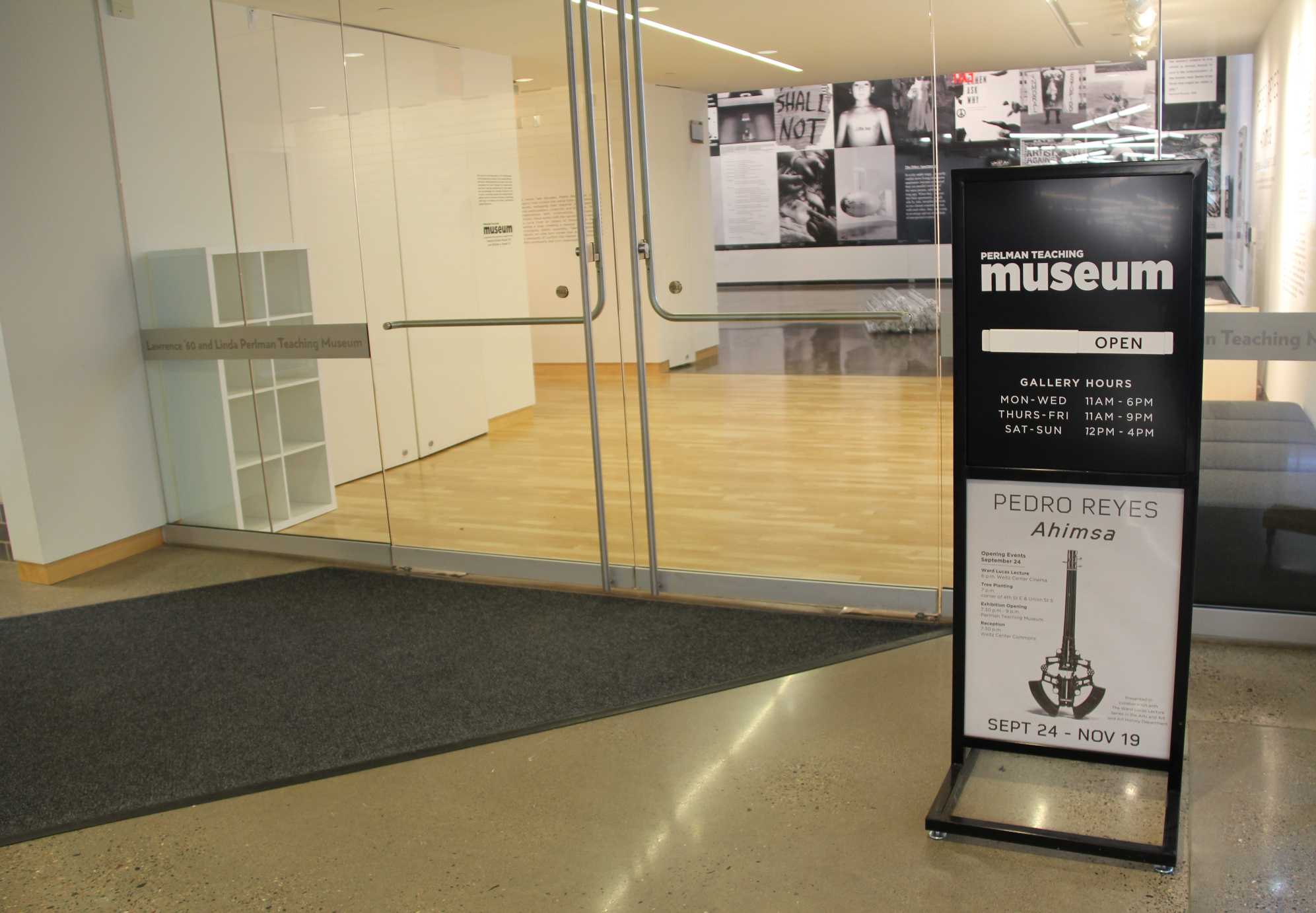
Open these glass doors and walk into the gallery showing Pedro Reyes’ “Ahimsa.” (Minnesota Prairie Roots copyrighted photo October 2025)

FYI: “Ahimsa” by Pedro Reyes is free and open to the public daily inside the Weitz Center for Creativity, 320 Third Street East, Northfield, until November 19. Hours vary. Click here for more information.

This exhibit was photographed with permission.

© Copyright 2025 Audrey Kletscher Helbling
 

Honoring the legacy of Congressman John Lewis July 15, 2025

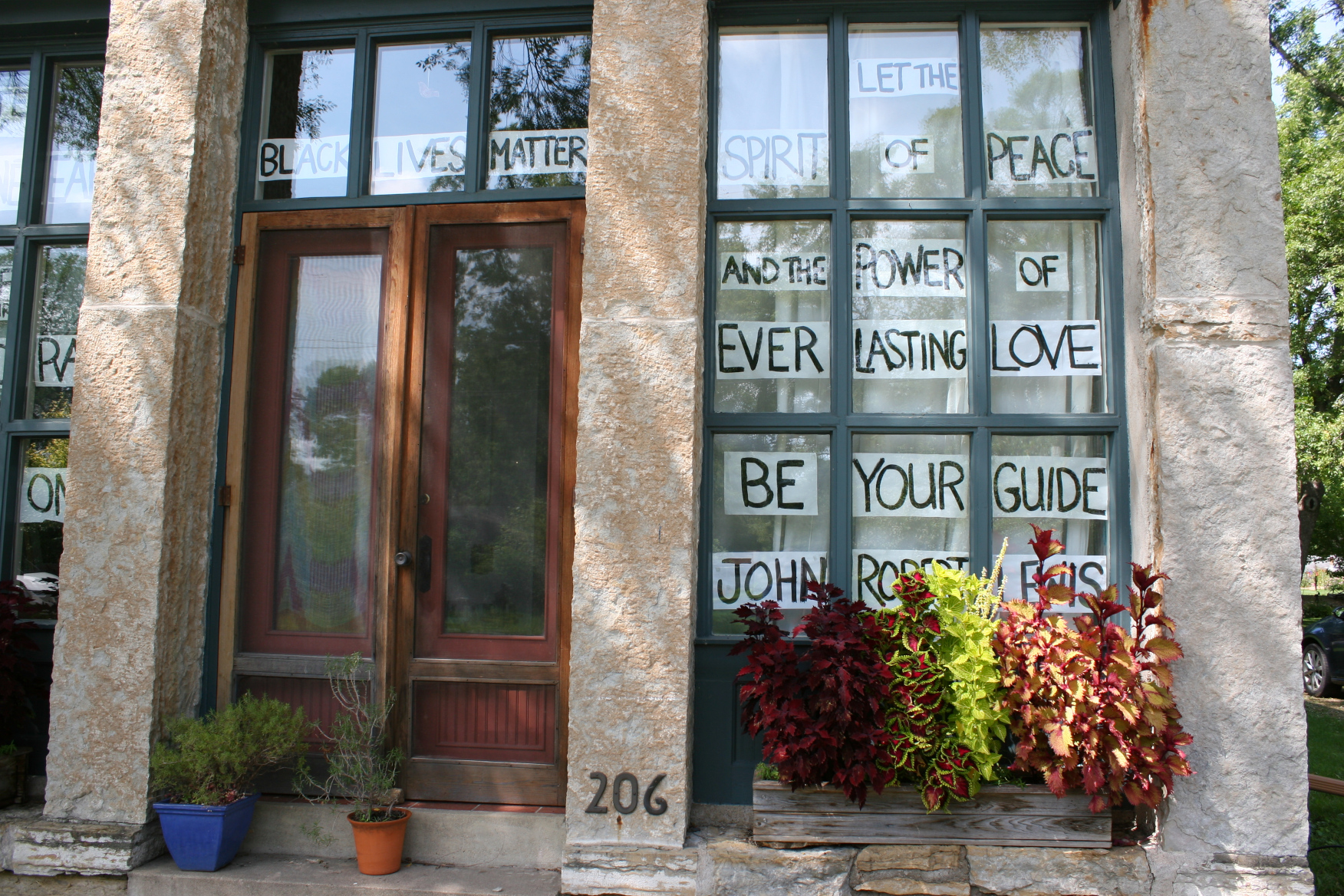
In 2020, I photographed this inspirational message, right, by John Lewis on a home in Dundas, a small town just south of Northfield. (Minnesota Prairie Roots copyrighted file photo August 2020)

HIS WORDS AND ACTIONS should inspire all of us to do better, be better, both as individuals and as Americans. “He” is Georgia Congressman and civil rights leader John Lewis, who died five years ago on July 17.

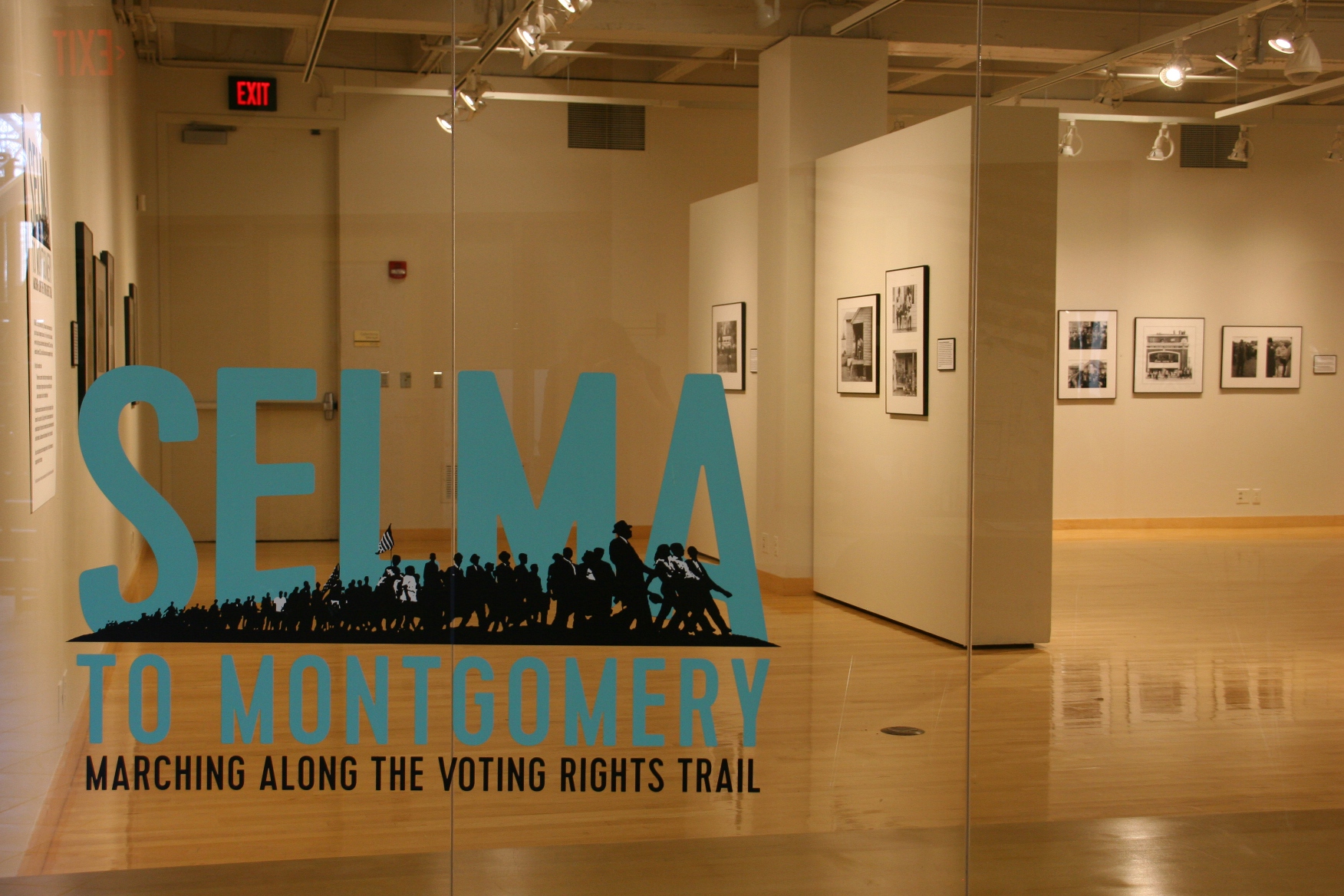
Looking through a window into an exhibit space at Flaten Art Museum at St. Olaf College, Northfield, where I toured this photo exhibit 10 years ago. (Minnesota Prairie Roots copyrighted file photo 2015)

Today I honor this man who left a legacy of strength in voice, power in actions and examples of righting racial injustices. In 1965, Lewis marched across the Edmund Pettus Bridge in Selma, Alabama, for voting rights for Blacks. He coordinated voter registration drives, led the Student Nonviolent Coordinating Committee. And in 1986, Lewis was elected a U.S. Congressman, a post he held until his death.

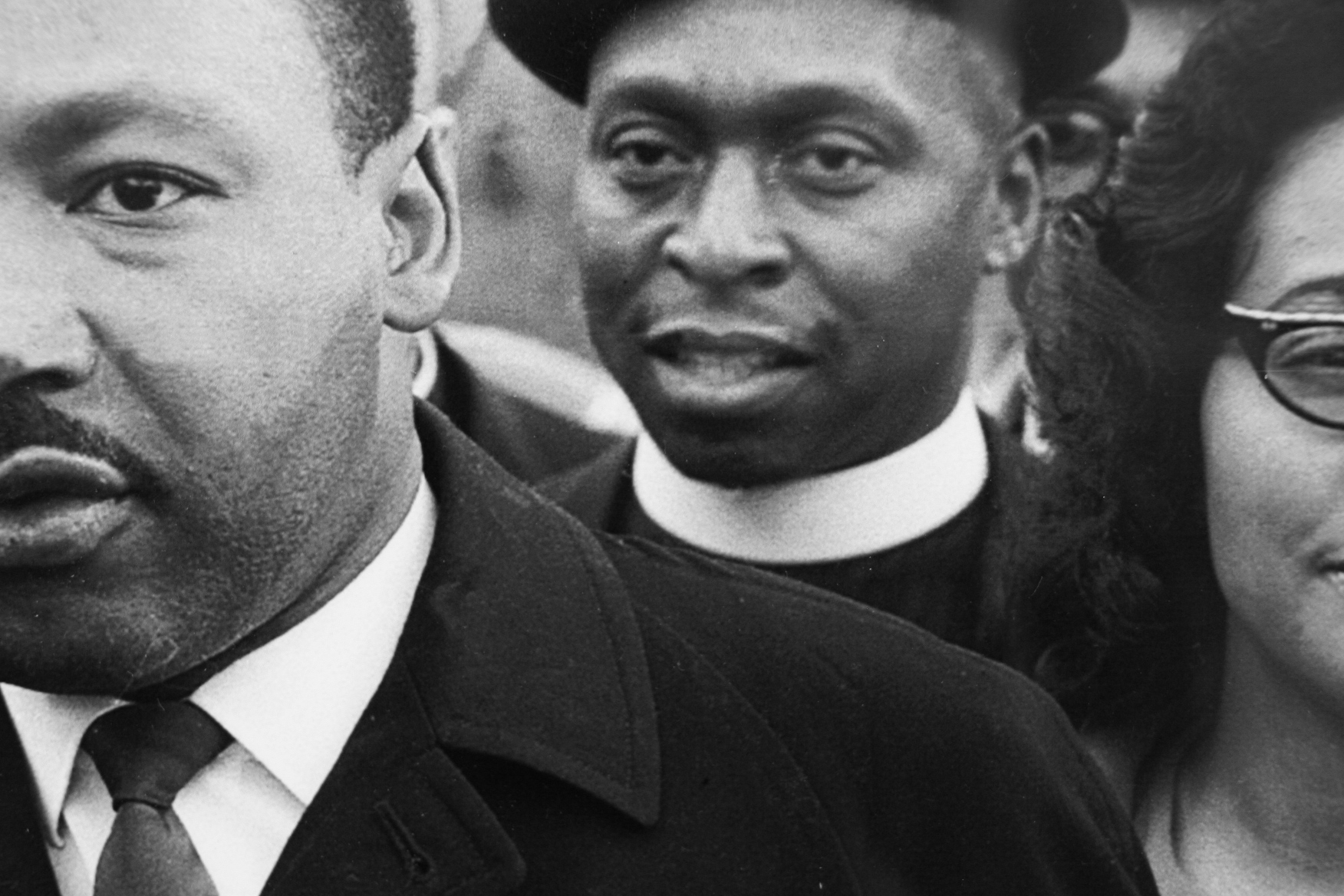
A portion of a photo by Steve Somerstein whose work focused the traveling exhibit I saw at St. Olaf in 2015)

This son of Alabama sharecroppers and recipient of the Presidential Medal of Freedom in 2011 was remarkable in his determination, in his commitment, in his desire to right wrongs and improve the lives of Blacks.

But what Lewis brought to this country extends beyond a singular issue. He understood the value of each individual voice and used his voice to make sure others understood that what they say and do matters.

In the years since his death, I’ve researched the congressman. And in doing so, I’ve discovered statements he’s made that resonate strongly. Here are a few examples:

“…get in good trouble, necessary trouble and help redeem the soul of America.”

“You must be bold, brave, and courageous and find a way…to get in the way.”

“My greatest fear is that one day we may wake up and our democracy is gone.”

“Never let anyone—any person or force—dampen, dim or diminish your light.”

I find each of those four statements especially empowering. They are calls to action. Messages meant to end complacency. Encouragement to each of us to speak up, to be heard. To shine our lights in our neighborhoods, communities, state, nation and world.

The faces of the Civil Rights Marches and Movement include Dr. Martin Luther King, Jr. This photo by Stephen Somerstein was part of the Selma exhibit.

And if we ever feel that our voice is only one, that our words aren’t heard, that our actions don’t matter, Lewis offers this message: “Do not get lost in a sea of despair. Be hopeful. Be optimistic.” Hope and optimism. Such positive words that are easy to read, but not always easy to believe. Yet, Lewis would want us to believe that things can get better.

In honor of Lewis, “Good Trouble Lives On” rallies are planned nationwide on Thursday, July 17, including here in Minnesota. The event is a national day of nonviolent action to respond to the current attacks on civil and human rights. From small towns like Madison in far western Minnesota to the Twin Cities metro and many other communities across the state, people will gather to let their voices be heard. Rallies in southeastern Minnesota are set in New Ulm, St. Charles, Winona, Stillwater and Northfield, the nearest to me. The Northfield protest is from 6-7:30 p.m. at Ames Park in the downtown area.

For more information about “Good Trouble Lives On” and to find a rally site, click here.

“Get in good trouble” and honor U.S. Representative John Lewis, a remarkable human being whose light still shines in America, strong and radiant.

© Copyright 2025 Audrey Kletscher Helbling
 

In which I protest, grieve & reflect June 19, 2025

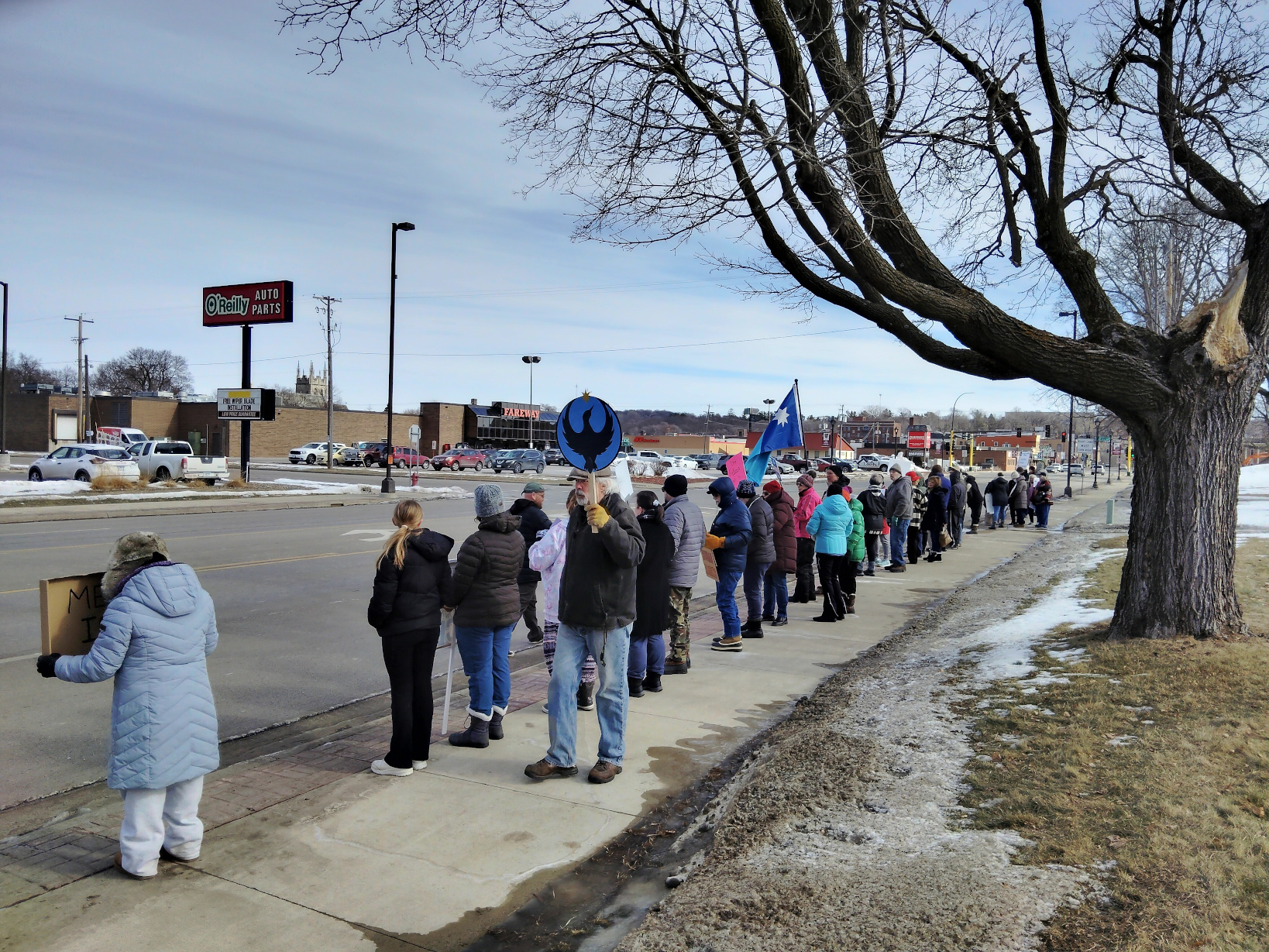
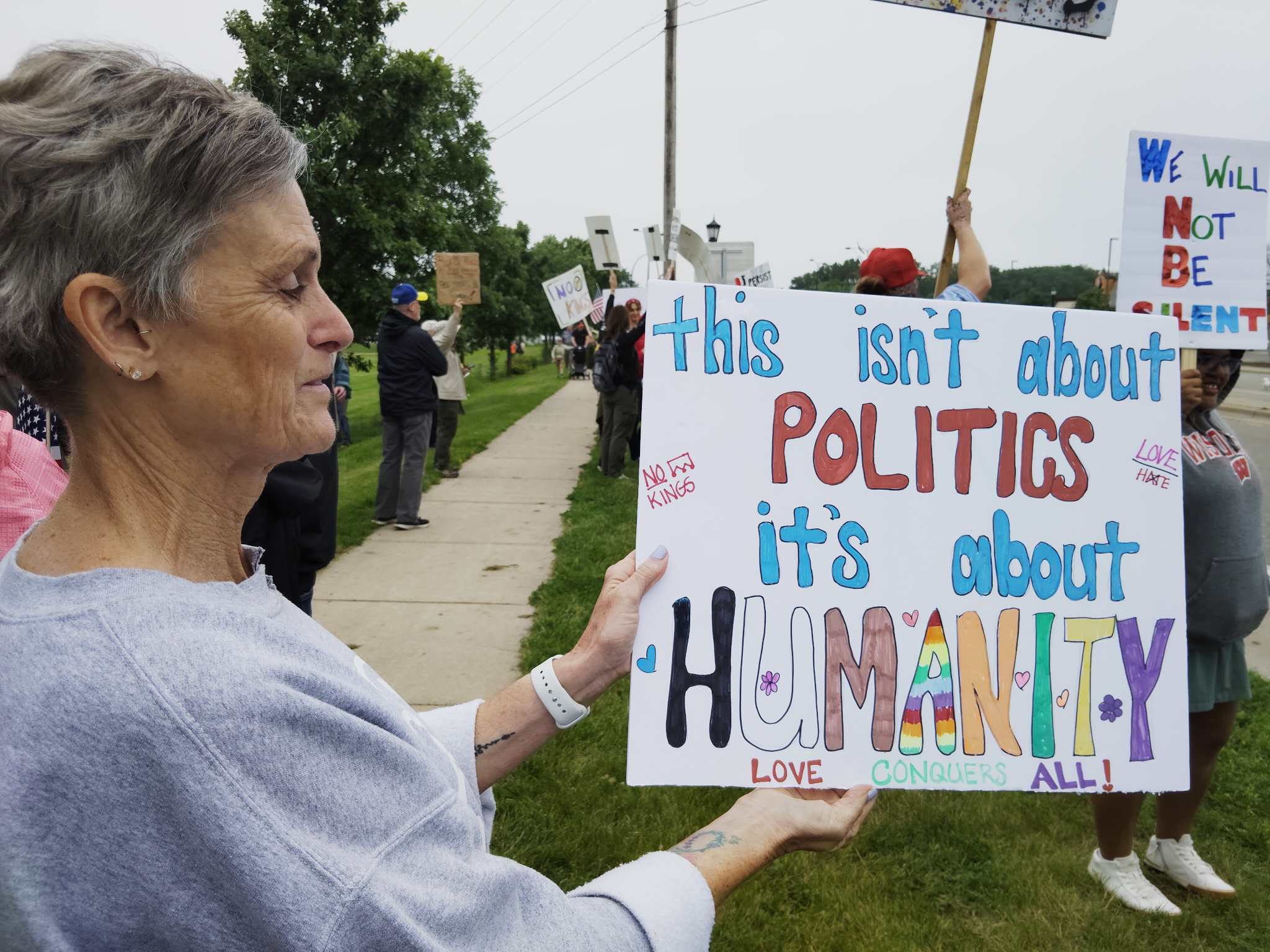
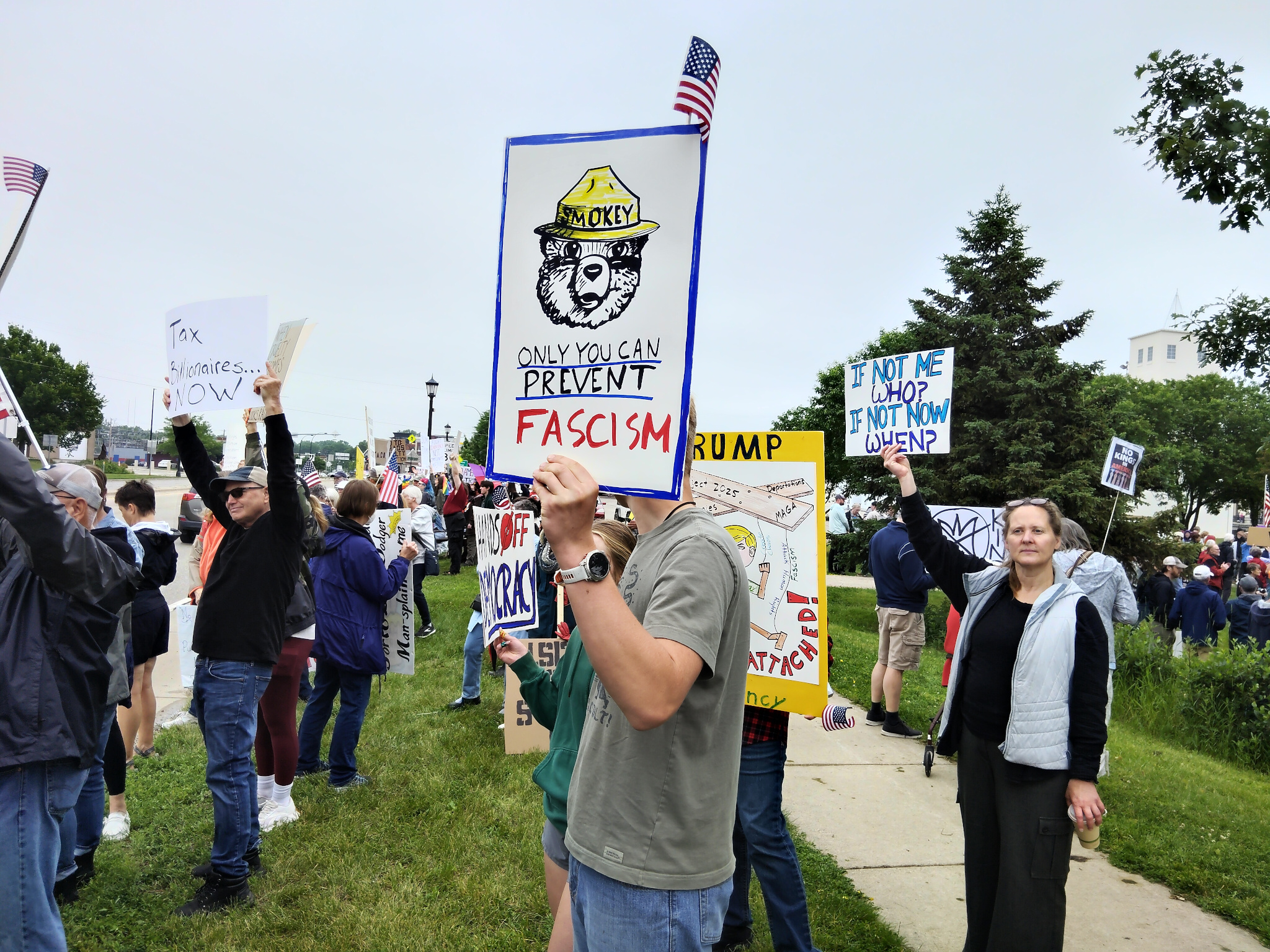
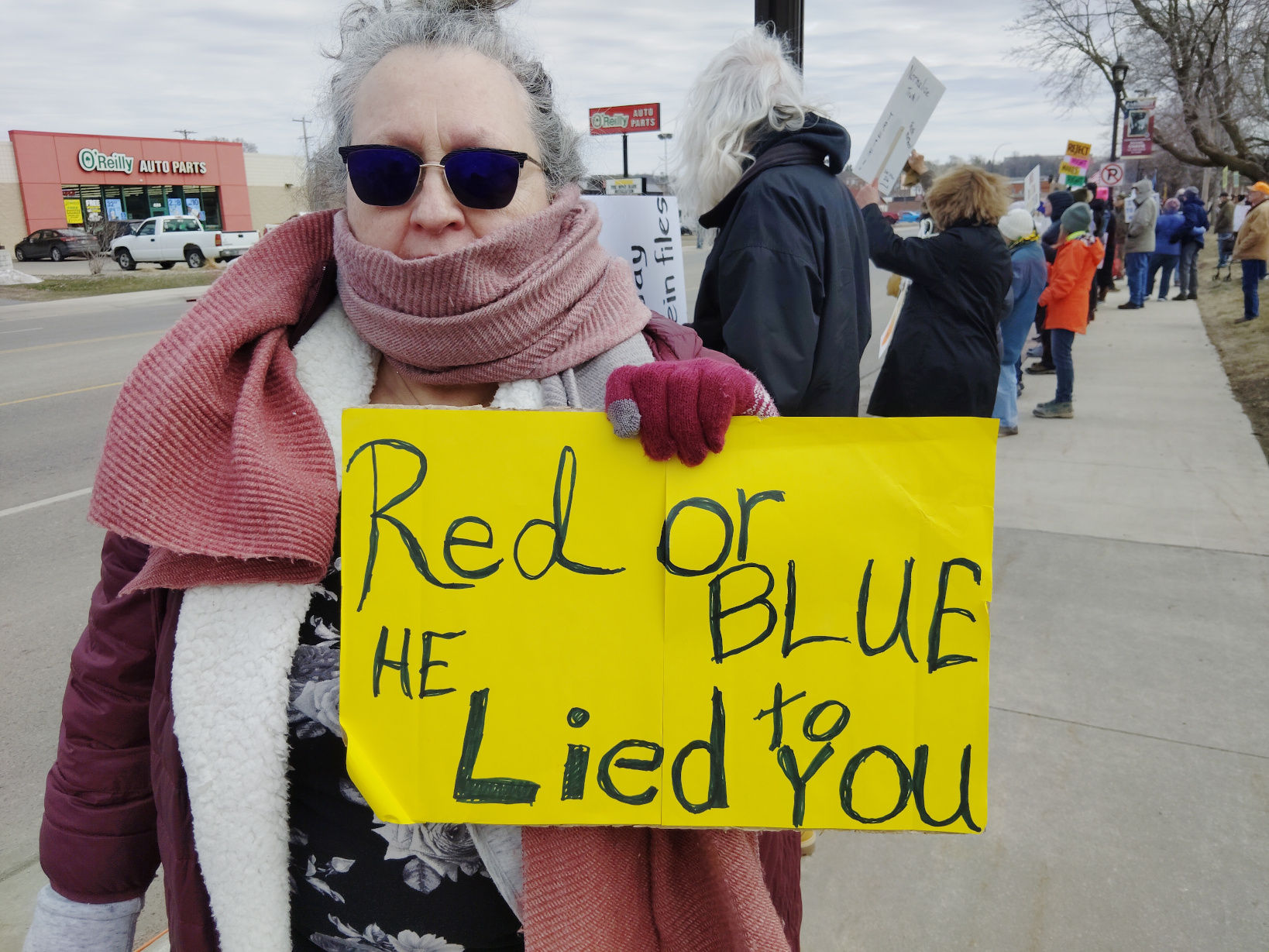
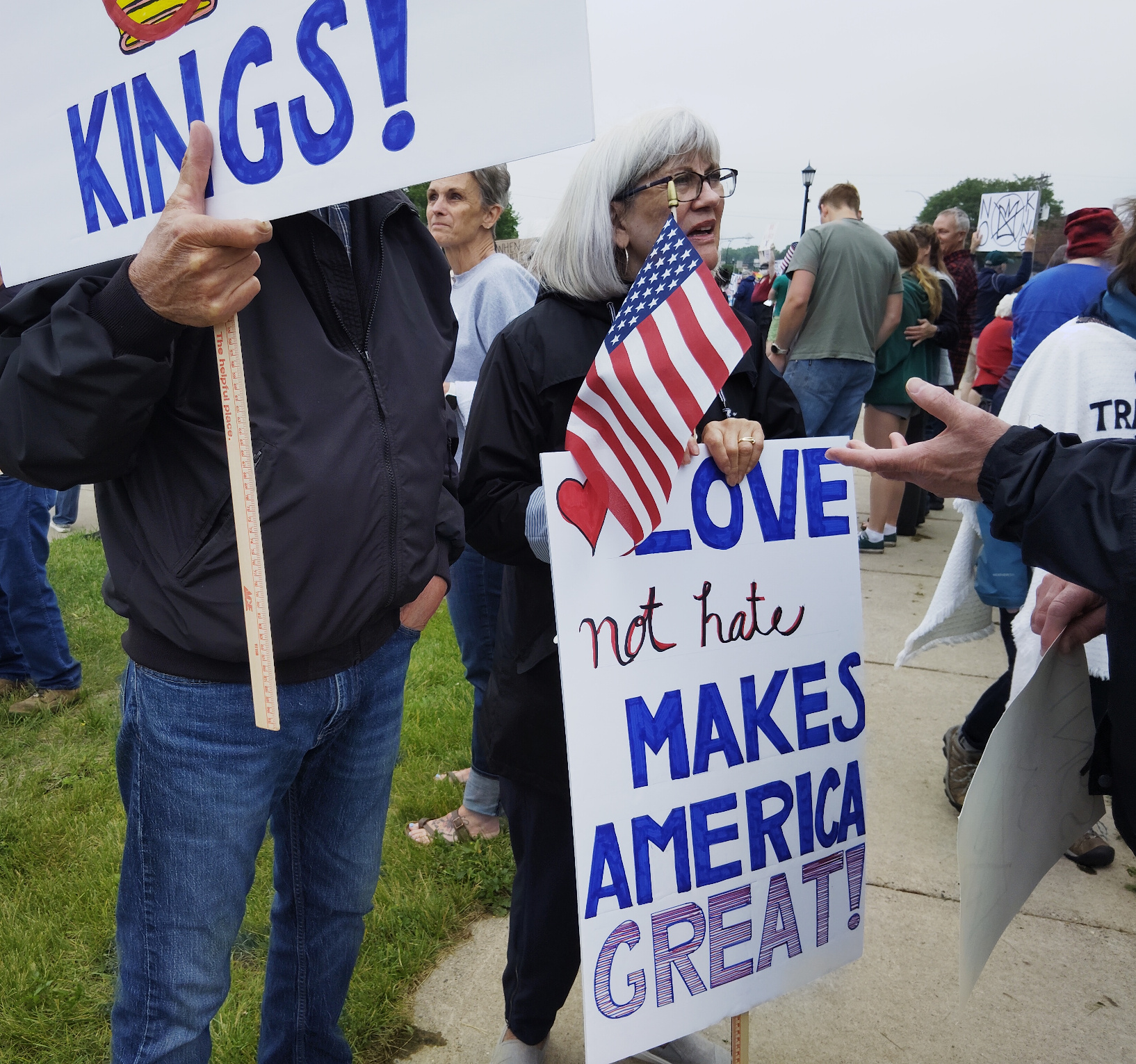
Protesters stand along Minnesota State Highway 19 by Ames Park in Northfield during the June 14 NO KINGS protest. This is one of my favorite signs among the many held by hundreds of protesters. (Minnesota Prairie Roots copyrighted photo June 2025)

I LEANED MY HEAD against Randy’s shoulder, my left hand gripping the rod of a protest sign and a small American flag. I felt such profound sadness in that moment. The moment when a pastor asked for a period of silence in honor of Minnesota State Representative/House Speaker Emerita Melissa Hortman and her husband, Mark, assassinated in their home during the early morning hours of June 14.

Flag Day. Nationwide NO KINGS protest day. A day of gathering turned tragic here in Minnesota.

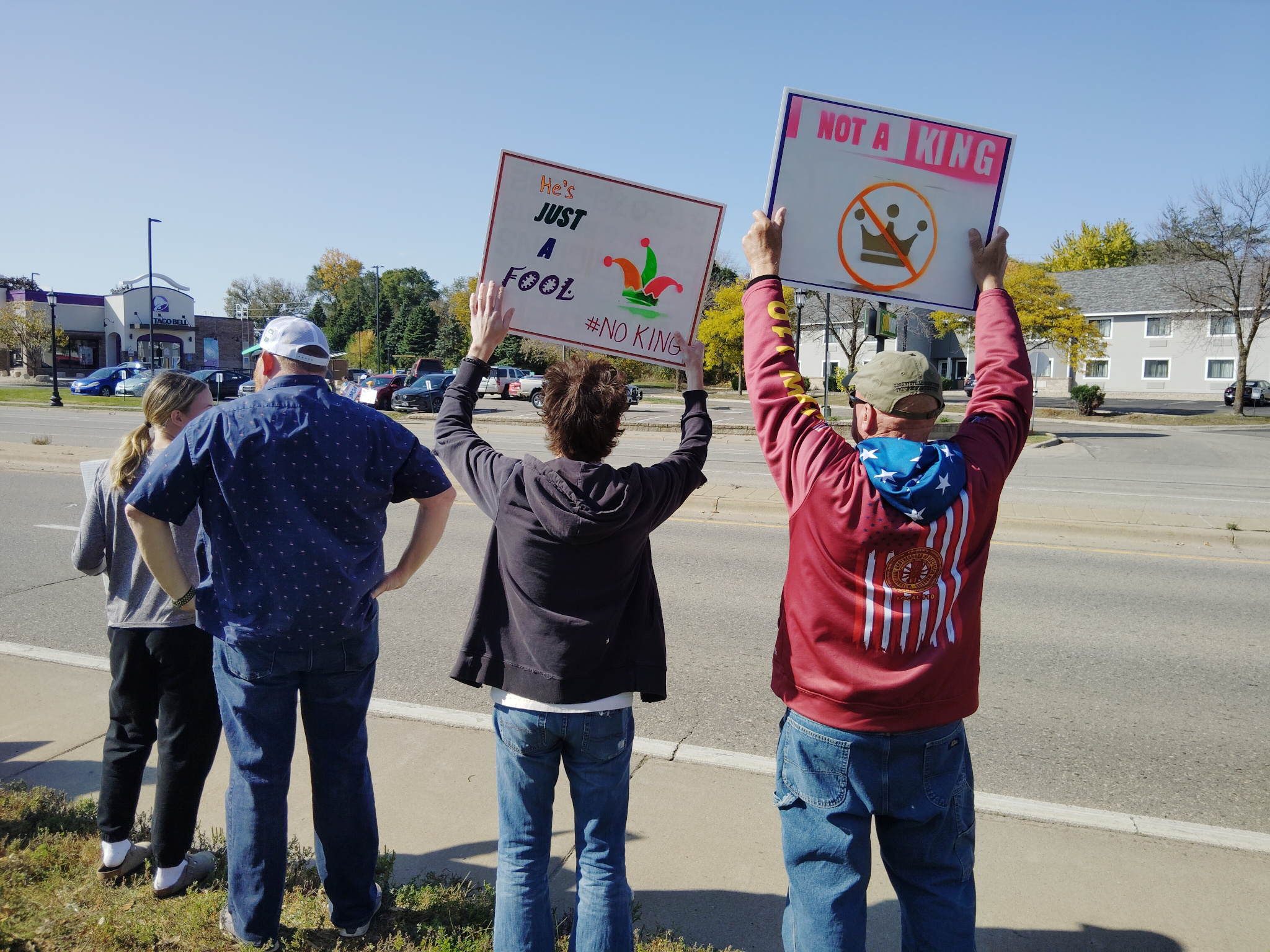
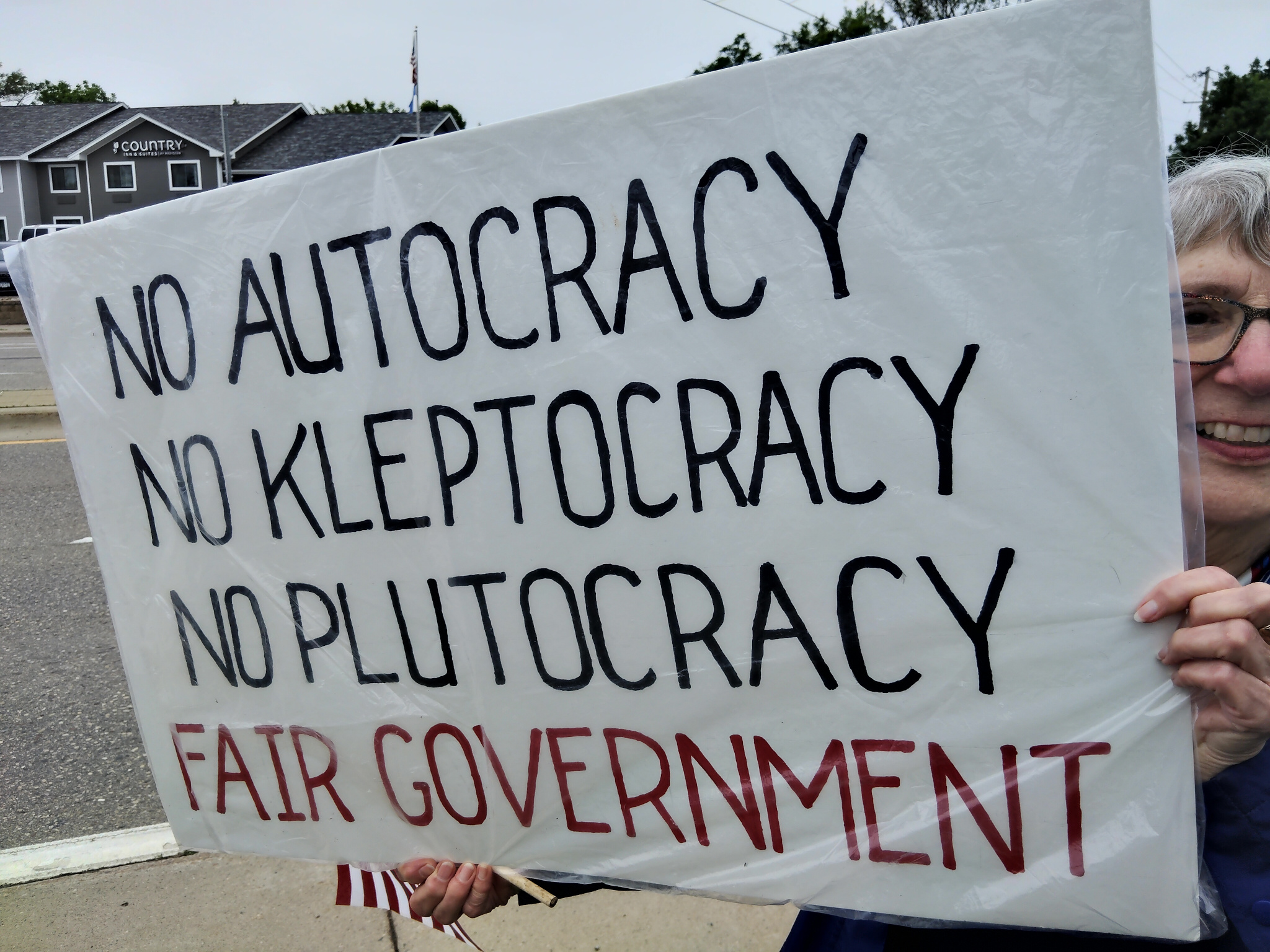
A strong statement against a system of government by one person with absolute power. I suggest you look up these words, as I had to with some. (Minnesota Prairie Roots copyrighted photo June 2025)

I alternated between leaning into my husband and leaning my bowed head against the bottom of my NO MORE KINGS protest poster held high, the sign with the cursive words, “I value freedom,” scrawled on the back side. The wind blew, swept my hair across my face like a veil covering sadness. The heaviness felt palpable here, in Ames Park in Northfield, along the banks of the Cannon River. But so did the energy.

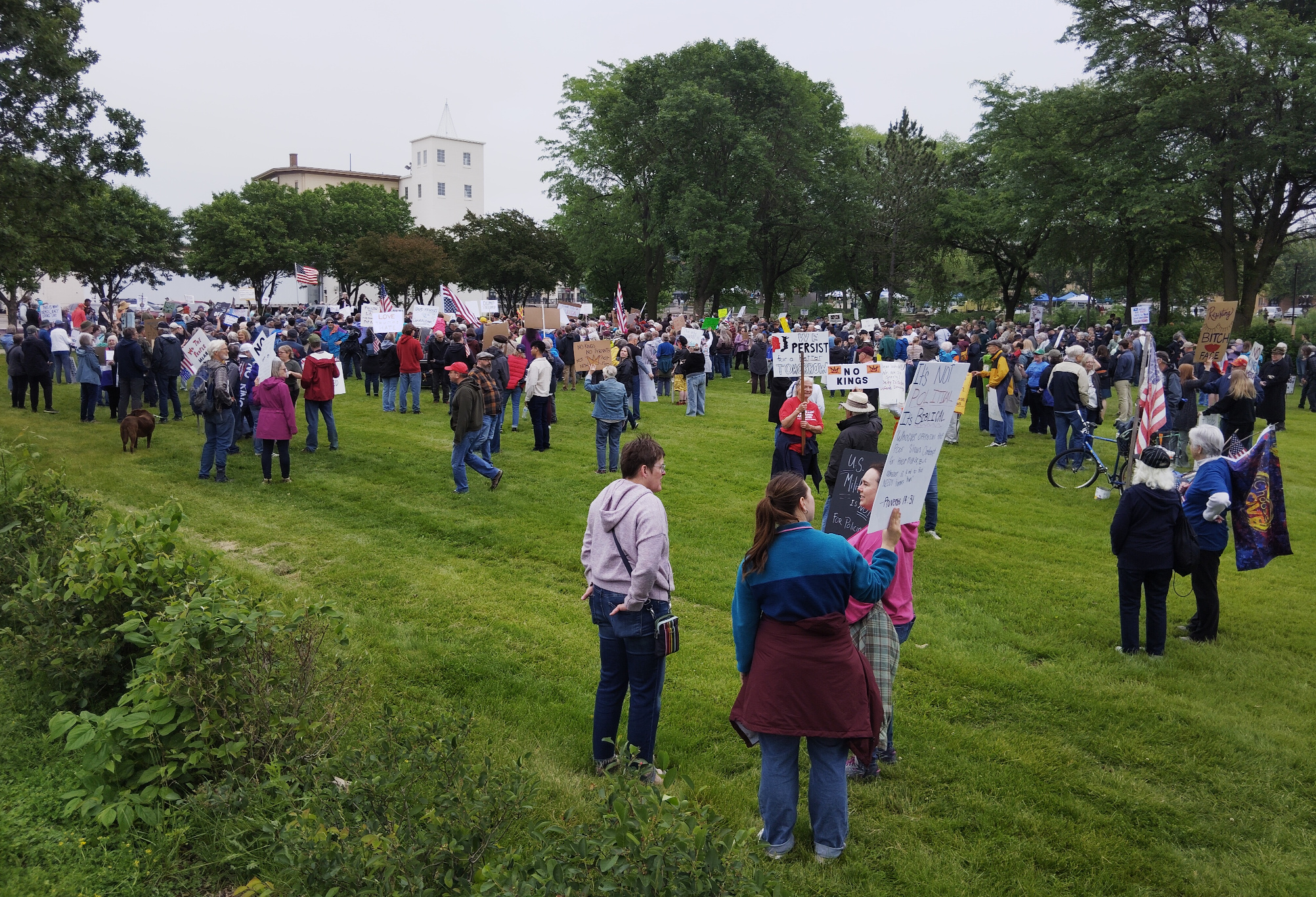
This shows just a portion of the massive crowd gathered for Northfield’s NO KINGS protest. (Minnesota Prairie Roots copyrighted photo June 2025)

We were a group of hundreds—maybe even a thousand (I’m not good at estimating crowd size)—gathered to publicly express our concerns about leadership in this country, about decisions being made that negatively affect all of us, about the state of and future of our democracy… It was my first protest. Ever. I wanted, needed, to be here. To remain silent seems complicit.

I’d already arrived when a friend texted that Minnesotans had been advised by state law enforcement not to attend NO KINGS protests. That warning linked to the suspect in the shootings of the Hortmans and of State Senator John Hoffman and his wife, Yvette. We would later learn that NO KINGS fliers were found in the vehicle of Vance Boelter, now accused in the double murders and attempted murders.

While your eyes may focus on the protest sign in the middle, look to the right. and this sign: IF NOT ME, WHO? IF NOT NOW, WHEN? (Minnesota Prairie Roots copyrighted photo June 2025)

That explained why, on the way to the riverside protest, I overheard a woman telling a couple that her police officer son had advised her not to participate in the rally. She was going home. I was not. Nor were any of the others converging on Ames Park at noon. I wasn’t scared. Vested safety people, trained in conflict resolution and de-escalation, were in place. I felt safe in the masses, which, I suppose, is an unrealistic perspective. But I refuse to be silenced by fear, by the words and actions of those who attempt to suppress voices. And intimidate.

And there were those, including the drivers of a white pickup truck and of motorcycles which repeatedly roared past the rally site, spewing their opposition in noise and in political flags bannering messages I won’t repeat. But they, too, have a right to protest. Peacefully. Just as I do. And I wrote that on the back of a second sign: FREE to PROTEST. But, mostly, passing vehicles honked in strong support.

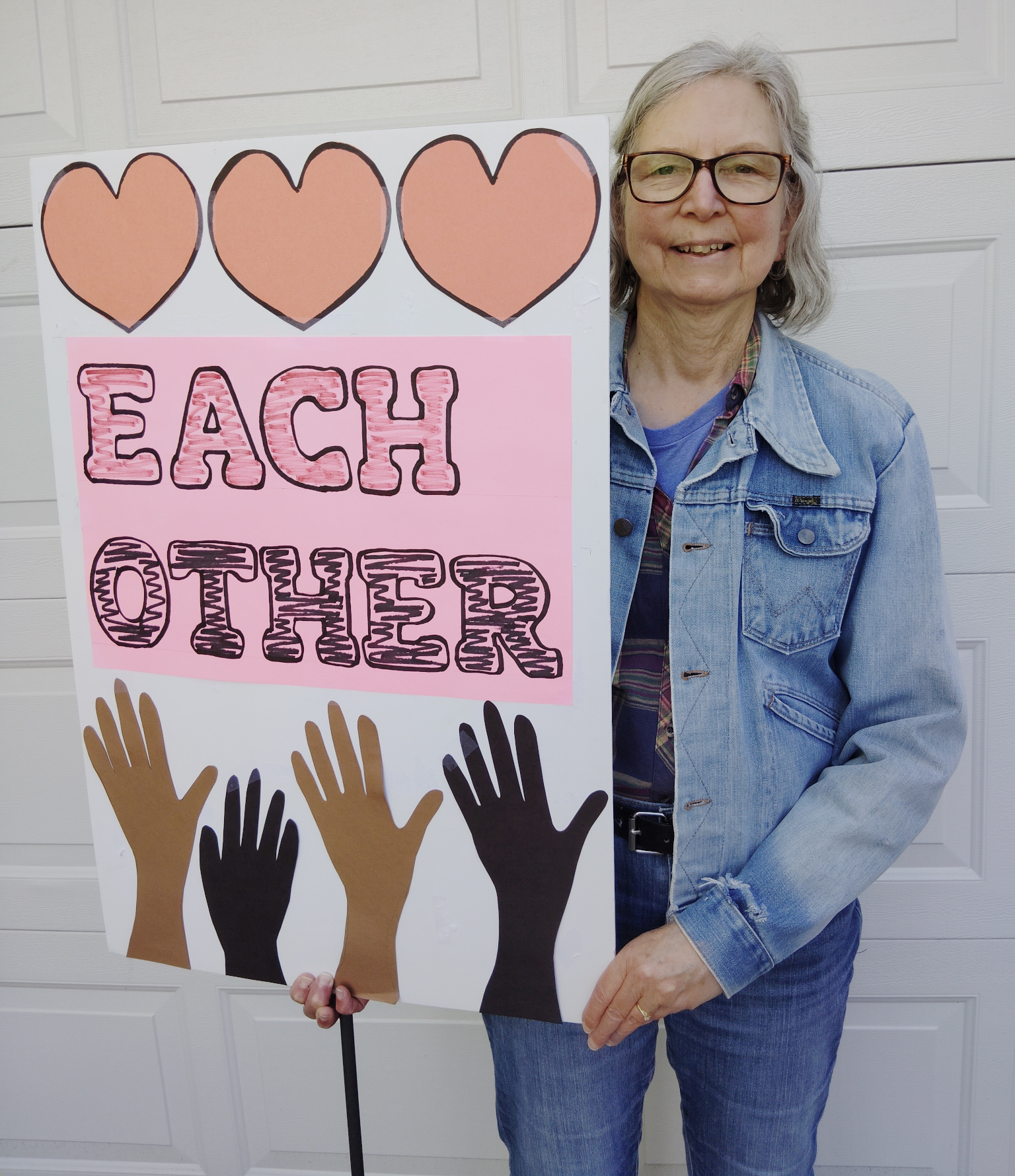
So many positive messages promoting love, compassion, care, kindness… (Minnesota Prairie Roots copyrighted photo June 2025)

At this rally of people opposing the current administration and its policies and actions, I felt a unity of purpose and a deep, cohesive concern for the future of our country. I felt uplifted, embraced, empowered. Speakers spoke (although I couldn’t hear most). The pastor led us in prayer. We sang—”The Star Spangled Banner” and “We shall overcome.” We cheered. We chanted. We waved our posters and flags. And a group held an over-sized American flag, which I couldn’t see from my vantage point deep in the shoulder-to-shoulder crowd.

We were mostly an older group. Baby Boomers. Grandparents. Even octogenarians. Perhaps some protested during the Vietnam War. Or served this country. We’ve lived a few years, enough decades to understand that we need to rise up against authoritarianism. Enough to understand what’s at stake. But there were some young people, too, like the dad behind me with his preschool daughter playing in the grass. He clearly cares, if not for himself, but then for his child.

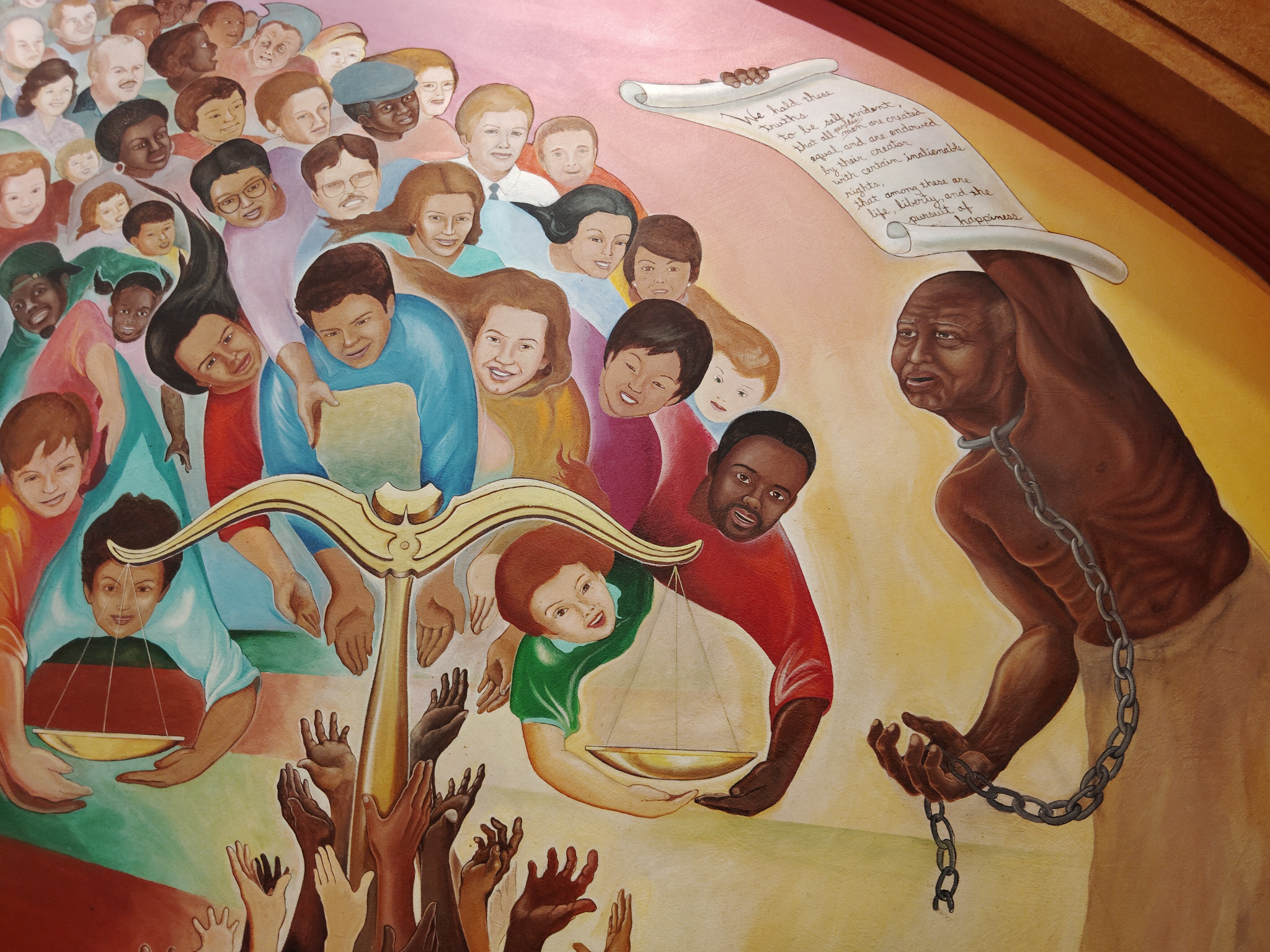
I saw this mural, “The Inheritance of Struggle,” inside the Memorial Student Union at the University of Wisconsin, Madison, Tuesday afternoon. It shows “the contributions made by people of various ethnicities and cultures in the form of tears, sweat, blood and life in the building of the United States.” It’s fitting for today, Juneteenth, and for NO KINGS day. (Minnesota Prairie Roots copyrighted photo June 2025)

The morning after the NO KINGS protest, I left for Madison, Wisconsin, to spend time with my 5-month-old grandson (and his parents). As I snuggled Everett, I thought, he (and my other two grandchildren) are part of the reason I chose to protest. Their lives stretch before them. I want them to live in a country where they are free. Free. I want them to live under a government based on a three-pronged system of checks and balances, not one ruled by a king or some version of a king or dictator. I want them to live in a kind, caring and compassionate country. Not a selfish, uncaring, divisive nation filled with hatred.

I returned to Minnesota yesterday and am catching up on laundry and writing. And, along with my fellow Minnesotans, I’m collectively grieving the assassination of an elected official and her husband. And I’m thinking, this is what it’s come to in Amercia…

© Copyright 2025 Audrey Kletscher Helbling
 

My Easter week message to you April 17, 2025

Filed under: Uncategorized — Audrey Kletscher Helbling @ 6:00 AM
Tags: , , , , , , , , , , , , ,
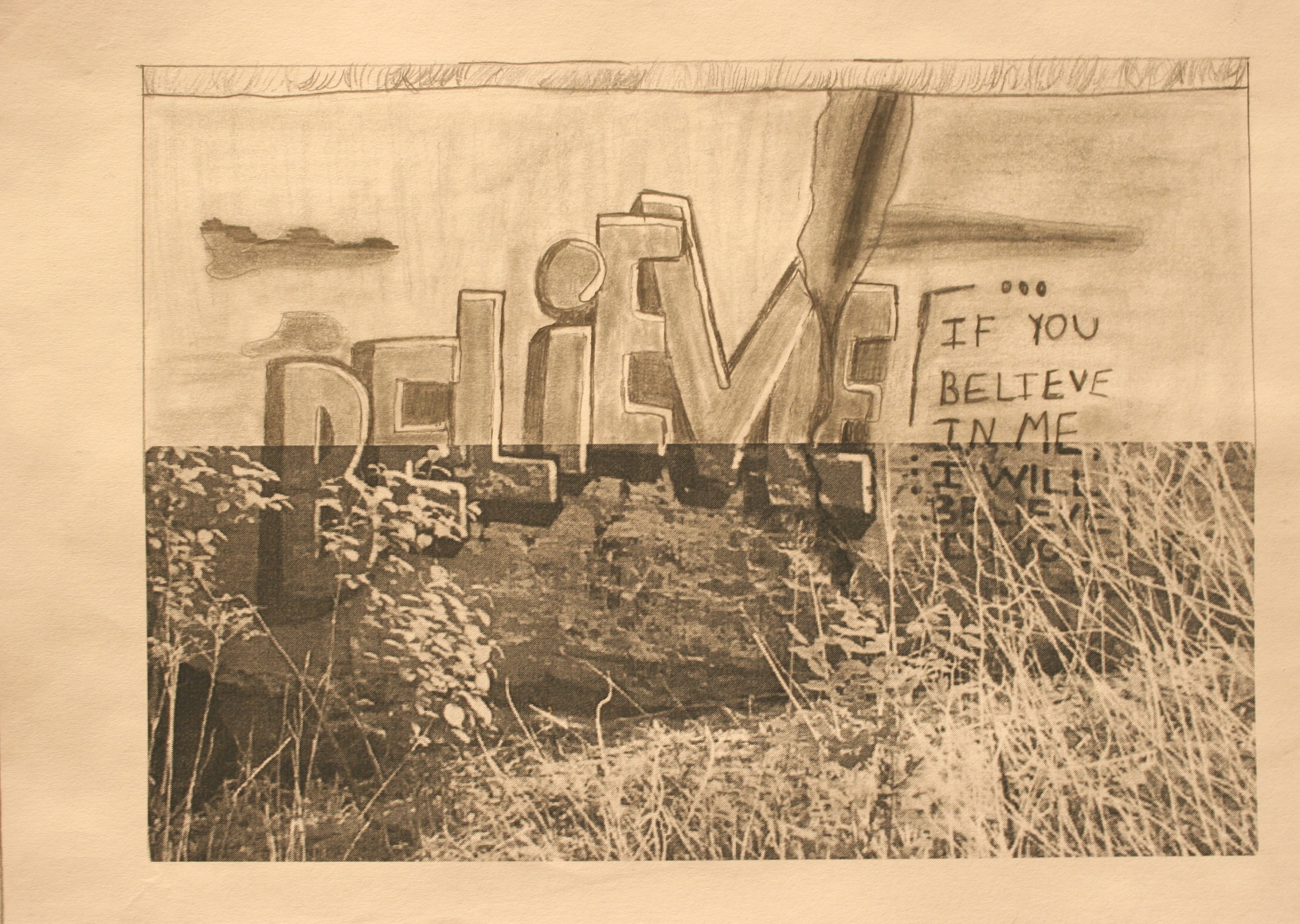
“Believe” by Mackenzie Miner, a then eighth grader at Faribault Middle School, was exhibited at a past student art show at the Paradise Center for the Arts. (Minnesota Prairie Roots copyrighted file photo)

DURING THE PAST SEVERAL DAYS, I’ve thought a lot about how to craft an Easter message about living my Christian faith against the backdrop of what’s happening in our country today. It’s tough, really tough, to feel positive and joyful. But I must believe that things will get better. Eventually.

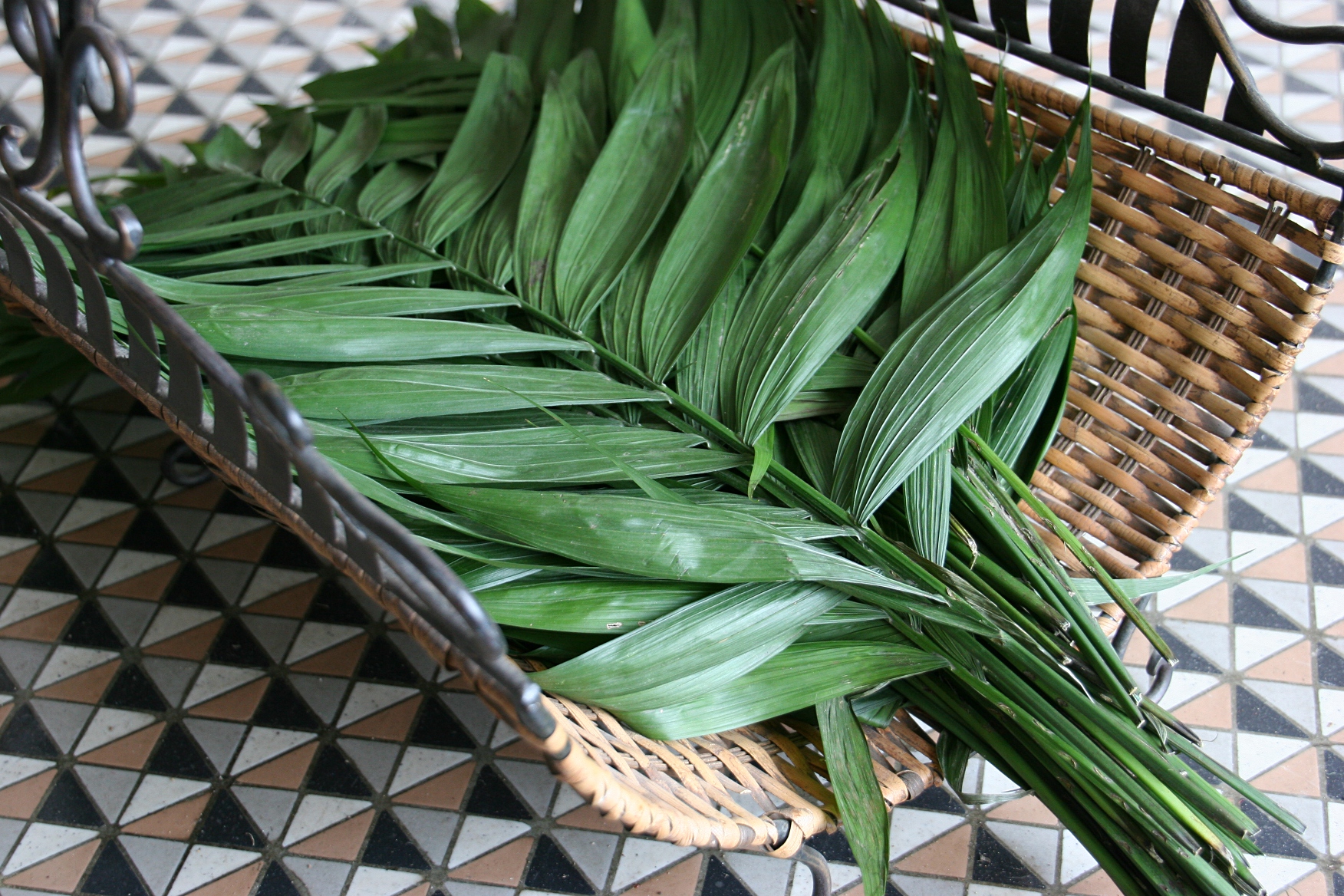
Palm branches. (Minnesota Prairie Roots copyrighted file photo)

Rather than dwell on the totality of everything negative, I decided to focus on messages I heard during a Palm Sunday worship service at my eldest daughter’s Lakeville church. Randy and I were there for a pancake breakfast fundraiser and then to listen to our grandchildren sing. We—kids and adults alike—sang the traditional processional hymn, “All Glory, Laud and Honor,” as we waved palm branches. It was an uplifting, praise-filled, reverent experience, reminding me of Jesus’ triumphant entry into Jerusalem among a joyful crowd waving palm branches and shouting, “Hosanna!” Jesus rode in on a donkey, symbolic of his humility and humanity. Days later, the people would turn on Jesus and he would die an agonizing death upon a cross.

A stained glass window inside Holden Lutheran Church, rural Kenyon, Minnesota, depicts Jesus’ crucifixion. (Minnesota Prairie Roots copyrighted file photo)

That journey to the cross, followed by the resurrection of Jesus on Easter morning, started on Palm Sunday, the beginning of Holy Week and a time of reflection. The service at St. John’s started with a blessing of the palms. That blessing set the tone for worship, at least for me. The palm branches we held represented celebration, justice and comfort. These are the words that most resonated with me: Bless these protest palms, O God of Justice…may they make us bold and brave to stand up against injustice.

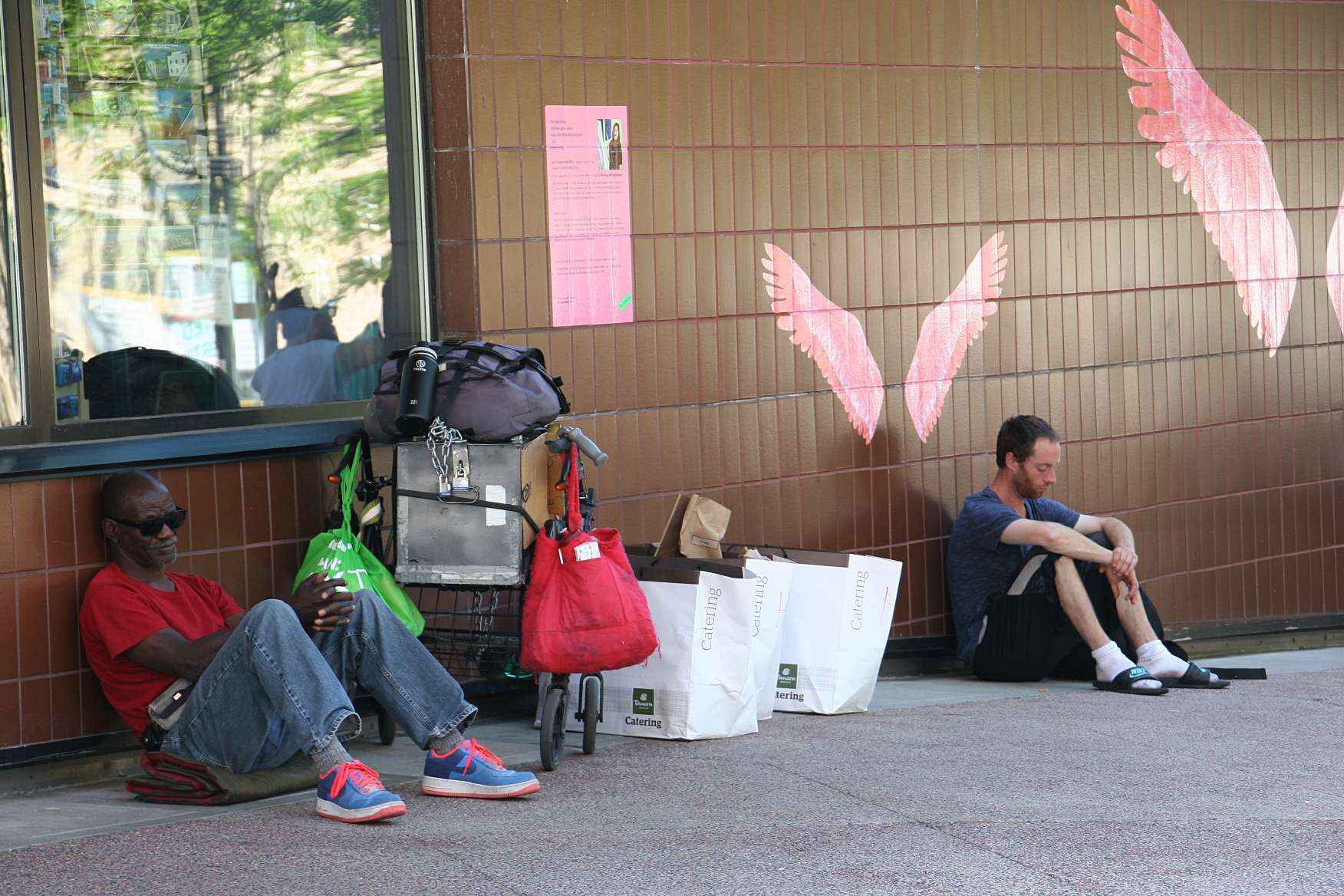
The unsheltered, photographed in downtown Madison, Wisconsin, in June 2018 near the state capitol. (Minnesota Prairie Roots copyrighted file photo)

So, as I stood at the back of the church, I waved my palm frond high like a protest sign, thoughts of injustices racing through my mind. I’ve done some protesting lately with my words. I felt encouraged and empowered to stand bold and brave against injustices. Jesus did. He called people out. He got mad. He chastised. He advocated for and helped those who suffered the most. The outcasts. The lonely. The poor and hungry. He showed compassion and love. He provided. He forgave.

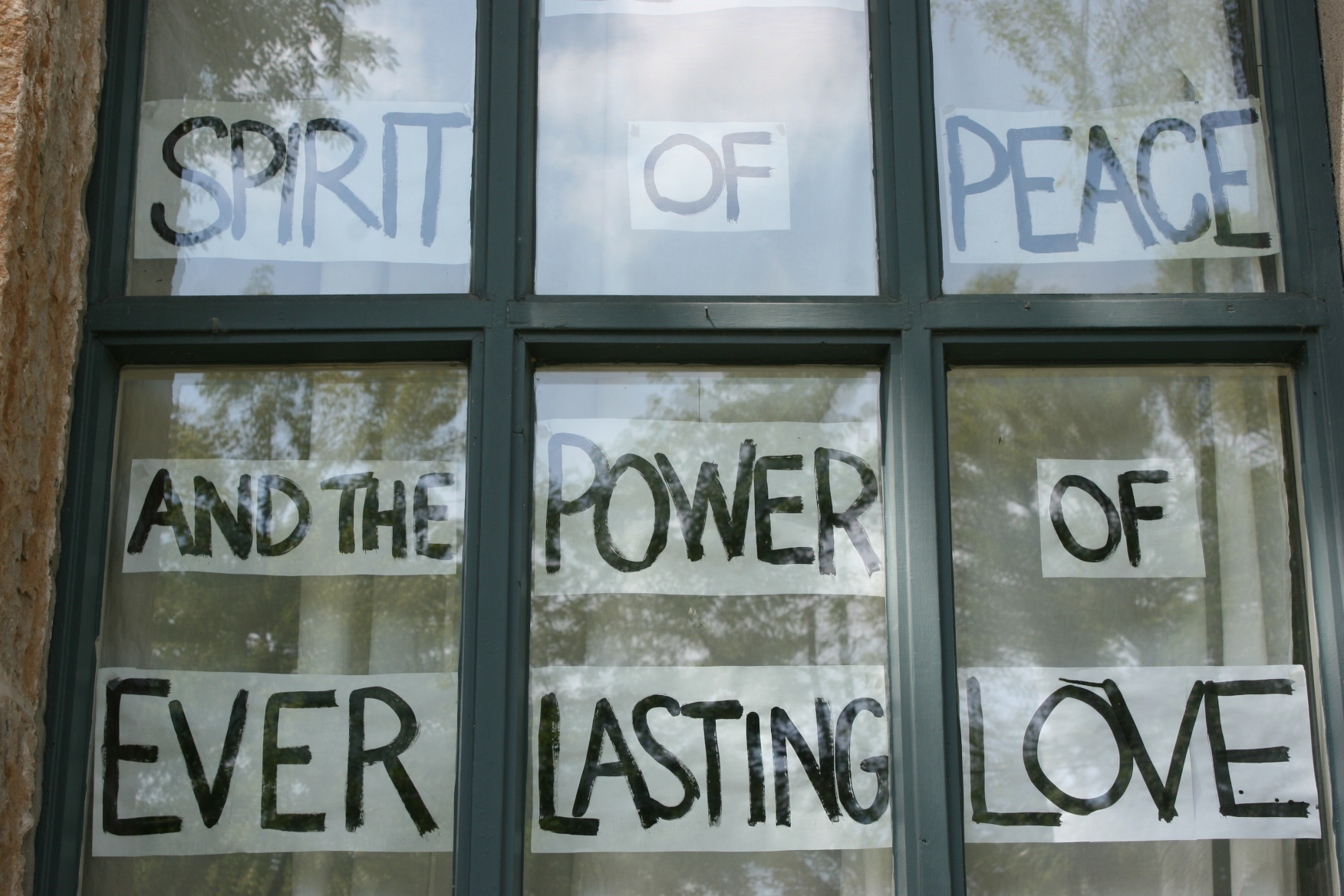
A portion of a quote by John Lewis posted in the window of a Dundas, MN., home. (Minnesota Prairie Roots copyrighted file photo)

Remember the once popular WWJD/What Would Jesus Do slogan? I think Jesus would be more than a little ticked off about the injustices today, how people are treating one another, how those in positions of leadership are abusing their power. Jesus did, after all, overturn the tables in the temple when it became a noisy marketplace for greedy vendors focused on making money rather than allowing people easy access inside for spiritual reasons.

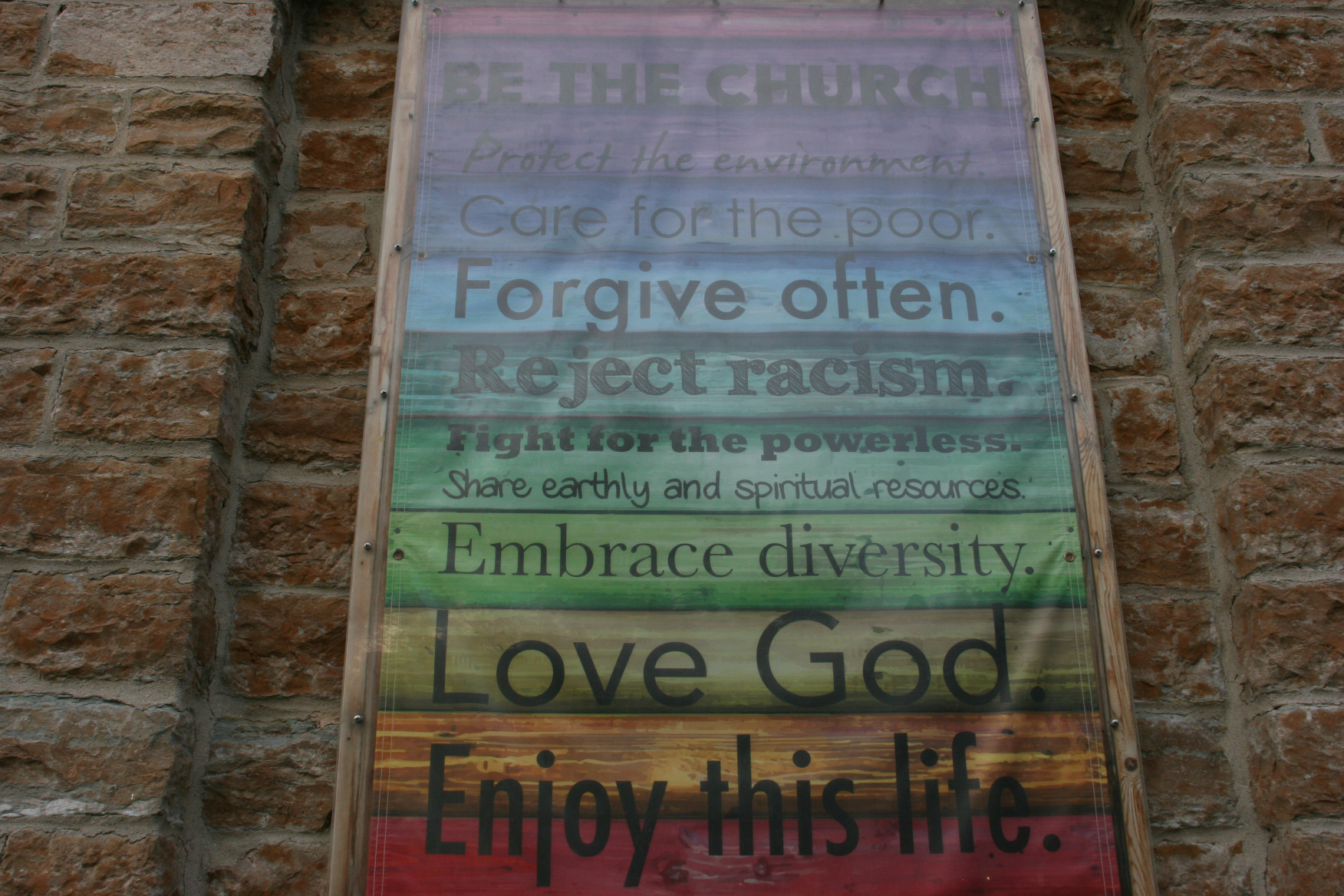
Posted on the exterior of the Congregational Church of Faribault United Church of Christ. (Minnesota Prairie Roots copyrighted file photo)

I’d like to think that Jesus wants every single one of us to be bold and brave in our words and actions. It’s easy enough to sit quietly and do nothing. Just pretend all is well with everyone when, in reality, it’s not. People are struggling. In relationships. With unexpected and unnecessary job loss. Financially. Mentally. In ways I would never have thought possible in this country—suppression, oppression, ongoing discrimination, intimidation, imprisonment… Injustices run rampant.

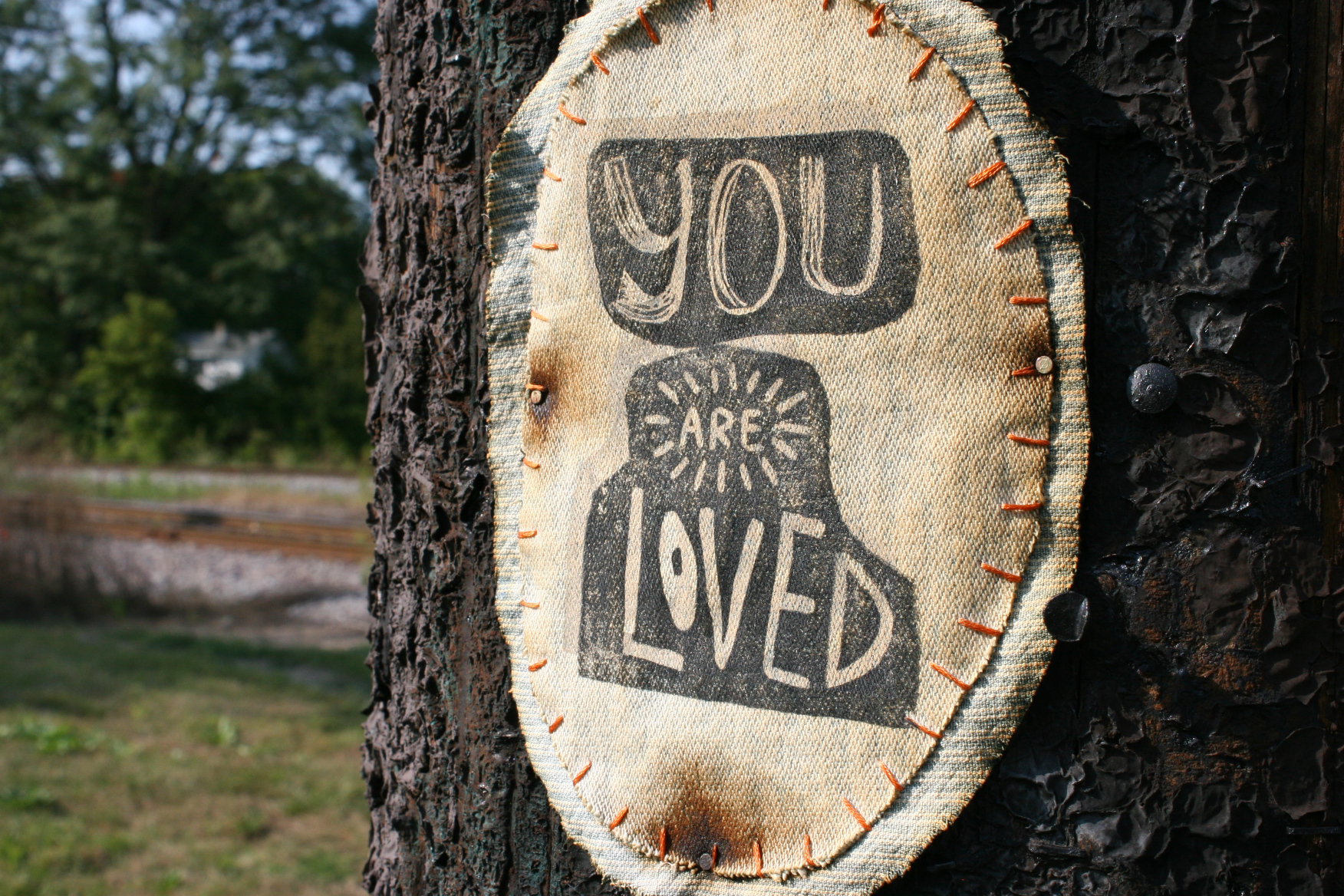
A loving message posted along a bike trail in Madison, WI. (Minnesota Prairie Roots copyrighted file photo)

We each have the power to do something about those injustices. Volunteer. Encourage. Donate money to charitable organizations or to individuals in and outside your circle who may need a little extra help right now. Smile. Be respectful. Extend small acts of kindness. Simply be a kind, decent, compassionate and loving person.

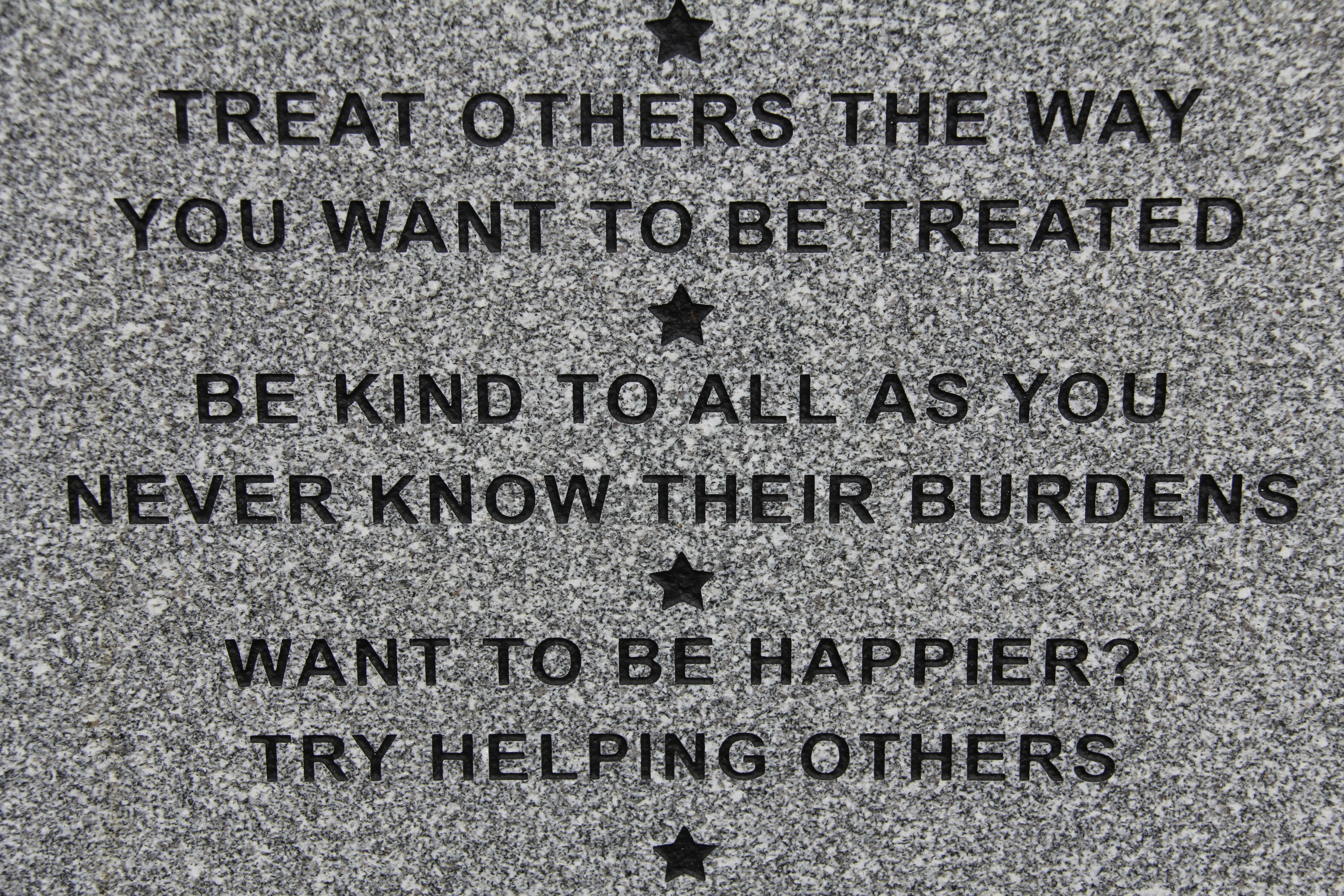
A message on a tombstone at Valley Grove Cemetery, rural Nerstrand. (Minnesota Prairie Roots copyrighted file photo)

But also don’t hesitate to be bold and brave to stand up against injustice, to wave your protest palm branch high, then higher still.

© Copyright 2025 Audrey Kletscher Helbling
 

Take two: A second look at the film “Sweet Land” & immigration issues February 6, 2017

sweet-land-envelope-copy

The letter Inge received from Olaf, in the fictional film Sweet Land.

She is not one of us. We speak a common language. We have a common background, a common culture. She is not one of us.
#

We have to be careful about this sort of thing…German nationals. German nationals engage in prostitution. They harbor dangerous political convictions. Are you aware of the Espionage Act of 1916?
#

English only in the church. English.
#

You’re German. It’s a bad influence. You’re German. It’s a disruption to my community. You make coffee that’s too black.

She makes good coffee, not like the women in church.
#

I was fearful of her differences, but I was hopeful she could join us on our path….Do not allow your good lives to be poisoned by these two.
#

This is German food?

No, just food.
#

You don’t have the papers.

sweetlandposter_mini

Promotional from Sweet Land website.

LAST WEEK I REWATCHED Sweet Land, an award-winning independent film released in 2005. The movie, based on Minnesota writer Will Weaver’s short story, “A Gravestone Made of Wheat,” and filmed on my native southwestern Minnesota prairie, rates as a favorite of mine.
sweet-land-farmhouse-copy

Olaf Torvik’s home on the prairie. The film was shot in and around Montevideo, Minnesota.

I appreciate the early 1920s setting, the music, the story and, now, its relevancy to today. The above dialogue comes from Sweet Land, which focuses on the challenges faced by Inge Altenberg, summoned to America by Norwegian farmer Olaf Torvik. He expects a Norwegian mail order bride as do others in the community. But Inge is not Norwegian; she is German.

Thereafter, the conflict begins with “She is not one of us.”

The land and love shape the story.

The land and love weave into this story. Here Inge and Olaf dance on the prairie.

I won’t give away the plot, which includes a love story. But I will tell you that I watched the movie this time from a much different perspective, in the context of current day immigration issues in our country. Sadness swept over me.

Please watch this thought-provoking, conversation-starting film. It’s a must-see whether you make coffee that’s good, judged as too black or you don’t brew coffee at all. It’s still coffee.
FYI: Sweet Land, the musical opens April 29 at History Theatre in St. Paul. It runs for five weeks, Thursday – Sunday, until May 28. Will I go? I’d love to…

RELATED: Saturday afternoon a sizable crowd gathered on the Rice County Courthouse grounds in my community for a peaceful protest. Please click here to watch the video, Faribault, Minnesota Immigration Ban Protest 2-4-17, posted by Terry Pounds. Faribault is home to many immigrants and refugees, including from Somalia.
A photographic exhibit of refugee children who fled Syria, leaving everything behind, is showing at the American Swedish Institute in Minneapolis. Photos for Where the Children Sleep were taken by award-winning Swedish photojournalist Magnus Wennman. In order to increase community access to the exhibit, the ASI is providing free admission on Wednesdays in February. The exhibit runs through March 5. Where the Children Sleep launches the Institute’s 2017 “Migration, Identity and Belonging Programming.”

Review © Copyright 2017 by Audrey Kletscher Helbling