Minnesota Prairie Roots

Writing and photography by Audrey Kletscher Helbling

Beyond just fun, finding the history & heritage in Heritage Days June 11, 2025

This sculpture of Alexander Faribault and a Dakota trading partner stands in Faribault’s Heritage Park near the Straight River and site of Faribault’s trading post. (Minnesota Prairie Roots copyrighted file photo)

HOW DO YOU DEFINE heritage? I ask that question because this week my southern Minnesota community celebrates Heritage Days.

I would define heritage as a cultural or ethnic background. I am, for example, of German heritage.

So one would likely assume then that Heritage Days focuses on heritage. It did. Once. But no more. Not primarily. Rather, this multi-day event in Faribault seems more a June get together with the usual food, music, parade, craft fair and such of any summer community gathering.

It’s not that my city of some 24,000 lacks in cultural and ethnic diversity to theme Heritage Days. We are a bit of a melting pot with our newest residents arriving from Somalia and Sudan. Early on, the French, Irish, Germans and others settled here to shape and grow Faribault. Latinos also define a sizable part of our population. Many others have come from multiple countries to this place along the Cannon and Straight Rivers. Most are generations removed from the homeland. Some, though, are first-generation immigrants.

Jeff Jarvis created and handed out this mini booklet about the Wahpekute Band of the Dakota at a previous presentation at Books on Central. (Minnesota Prairie Roots copyrighted file photo)

But back to Heritage Days. Looking through the long list of events, I see several opportunities to learn about local heritage and history. The first happens at 6:30 p.m. Wednesday, June 11, at the Cathedral of Our Merciful Saviour. Regional artist and historian Jeff Jarvis will talk about “The Wakpekute Dakota & Early Faribault History.” I’ve previously heard Jarvis speak on the Dakota, original inhabitants of the land. He’s done his research. I highly recommend attending his presentation. I’m always surprised by how little long-time residents seem to know about the Dakota and their long ago presence in what would become Faribault. Jarvis presents an informative lesson in local Native heritage.

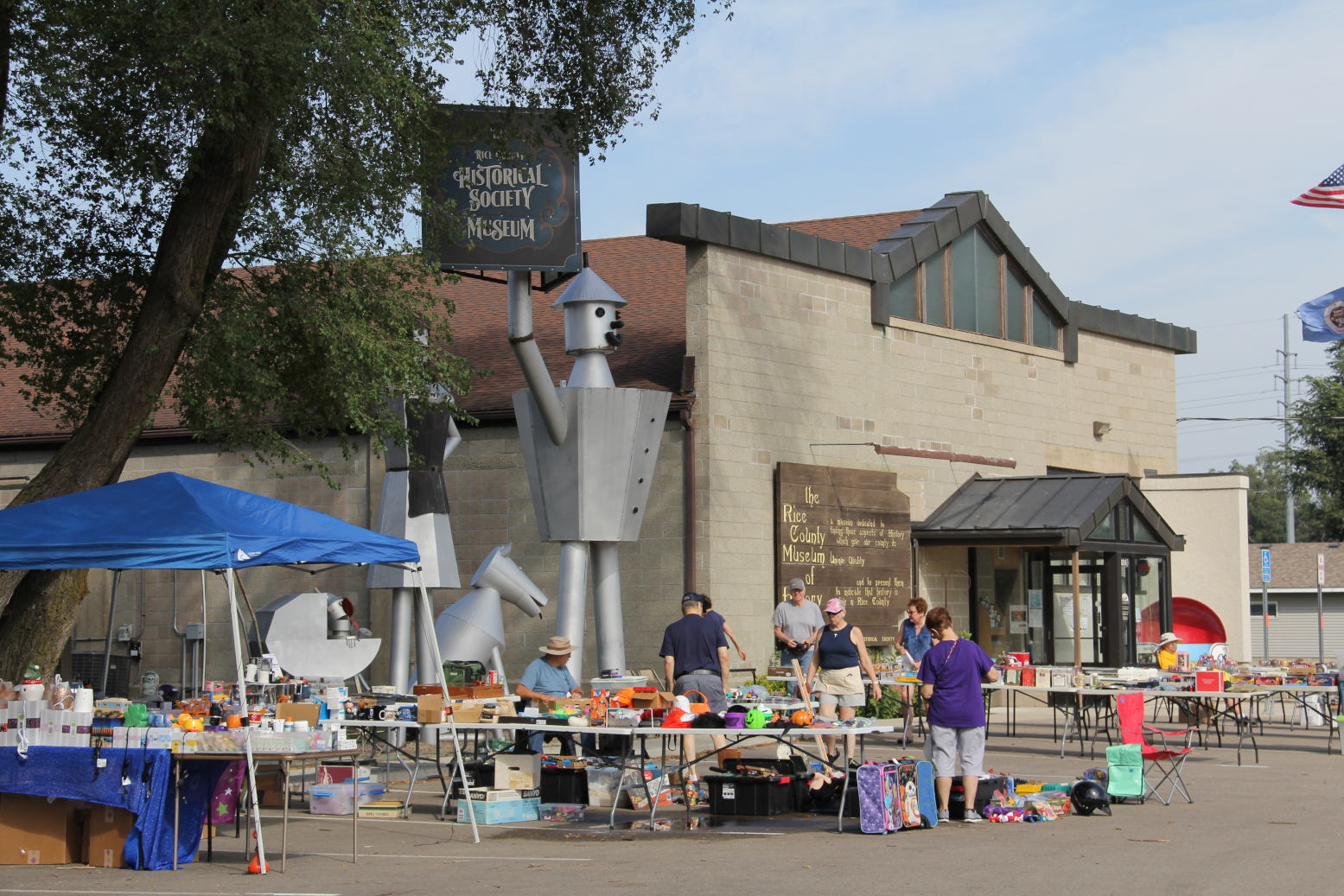
Likewise, the Rice County Historical Society Museum will be open, free of charge, from 10 a.m.-5 p.m. Thursday-Saturday. It’s a good place to see Native American and other artifacts, learn about our early fur trading and additional local history, learn about notable people like Chief Taopi and Bishop Henry Whipple, and more. Bishop Whipple founded and served the Cathedral where Jarvis is speaking.

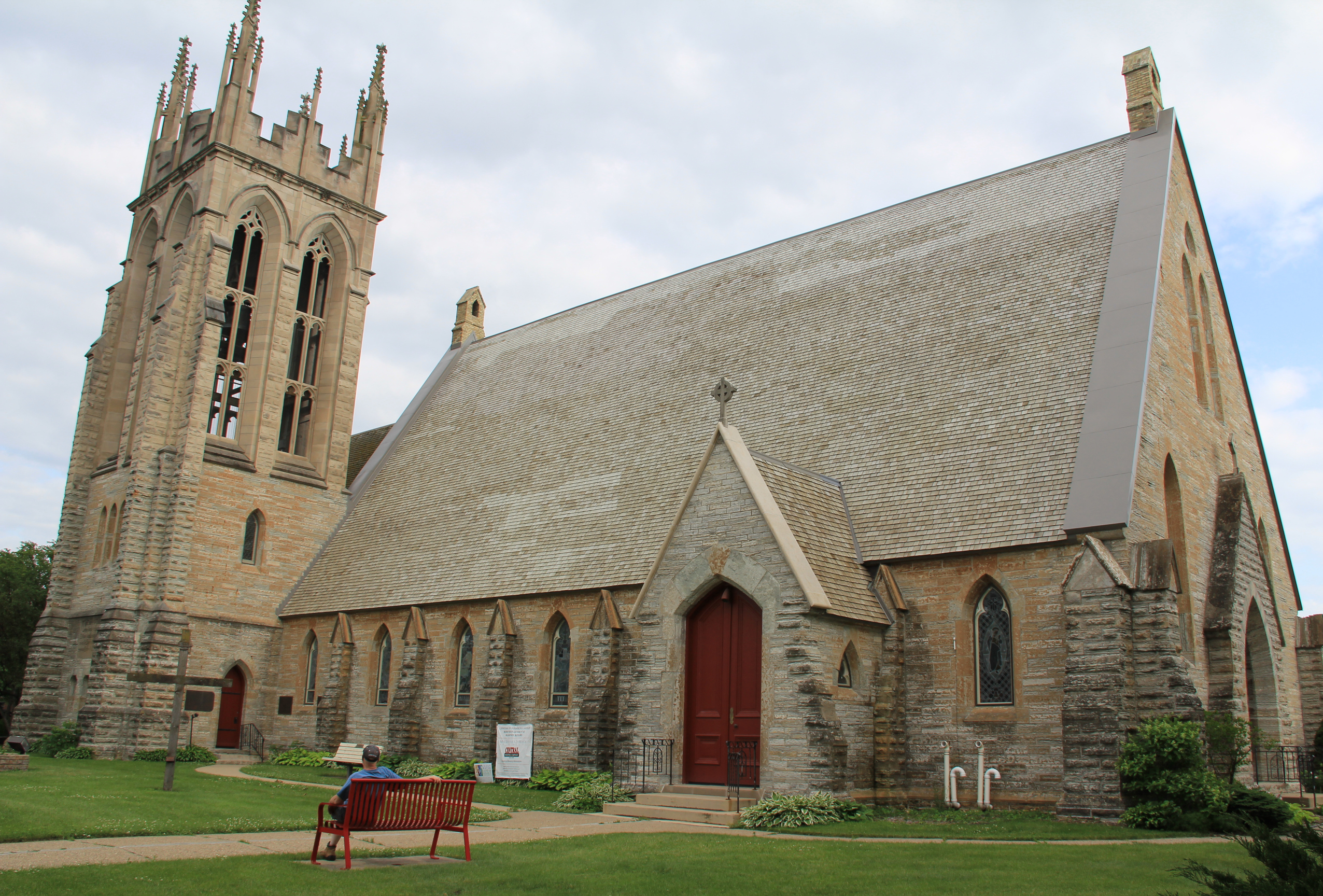
The historic Cathedral of Our Merciful Saviour sits across from Central Park and is a must-see in Faribault. (Minnesota Prairie Roots copyrighted file photo 2024)

The historic Cathedral will be open for tours at 11:30 a.m. Sunday, June 15, following a 10 a.m. Ecumenical Service including bluegrass music. This massive cathedral—and, yes, it really is a cathedral—is important in local Dakota history as the bishop worked closely with Native Americans, some of whom worshipped here.

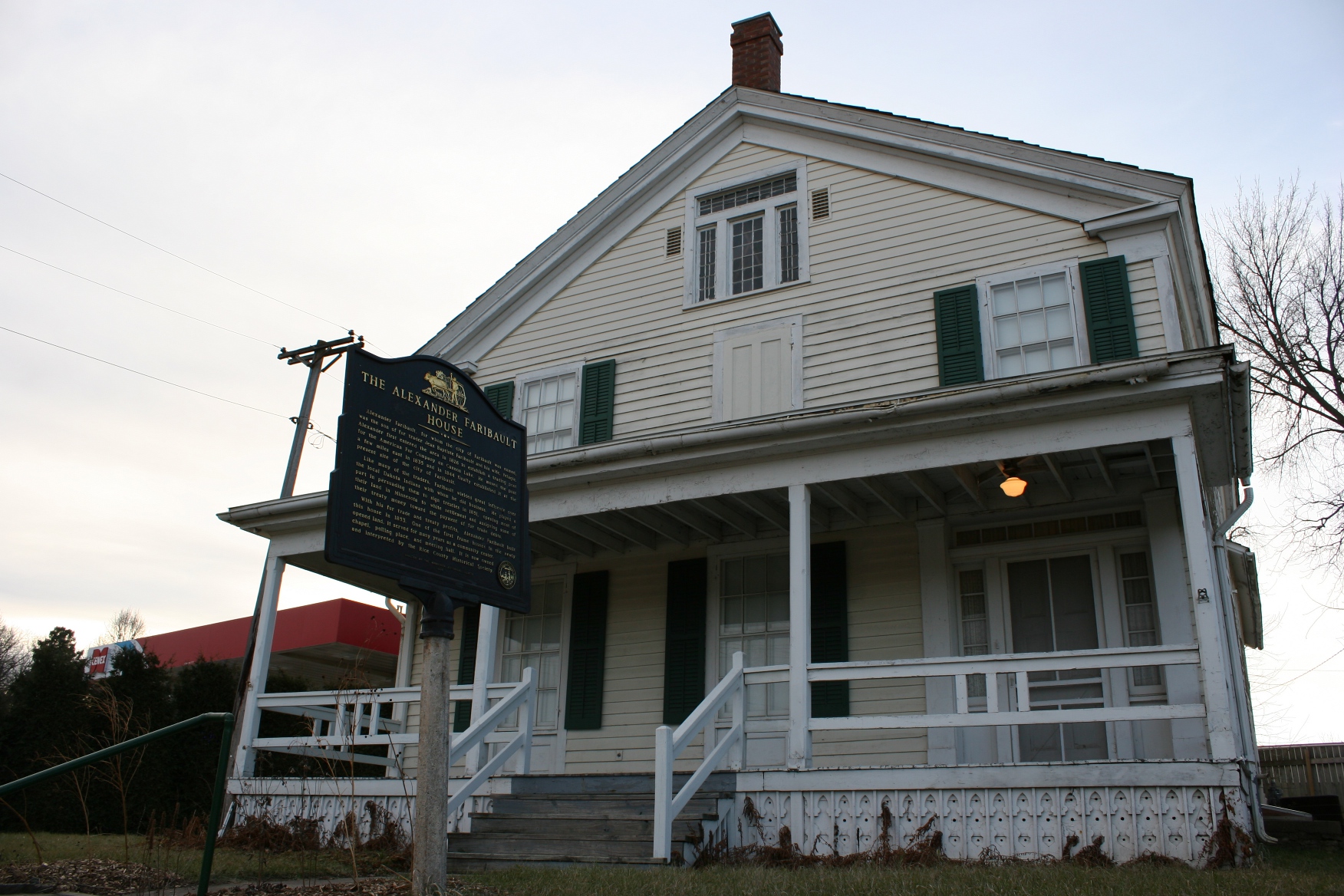
Fur trader and town founder Alexander Faribault, who was of Dakota and French Canadian heritage, also worked closely with the Dakota. His wood-frame house will be open for free tours from 11 a.m.-3 p.m. Saturday, June 14.

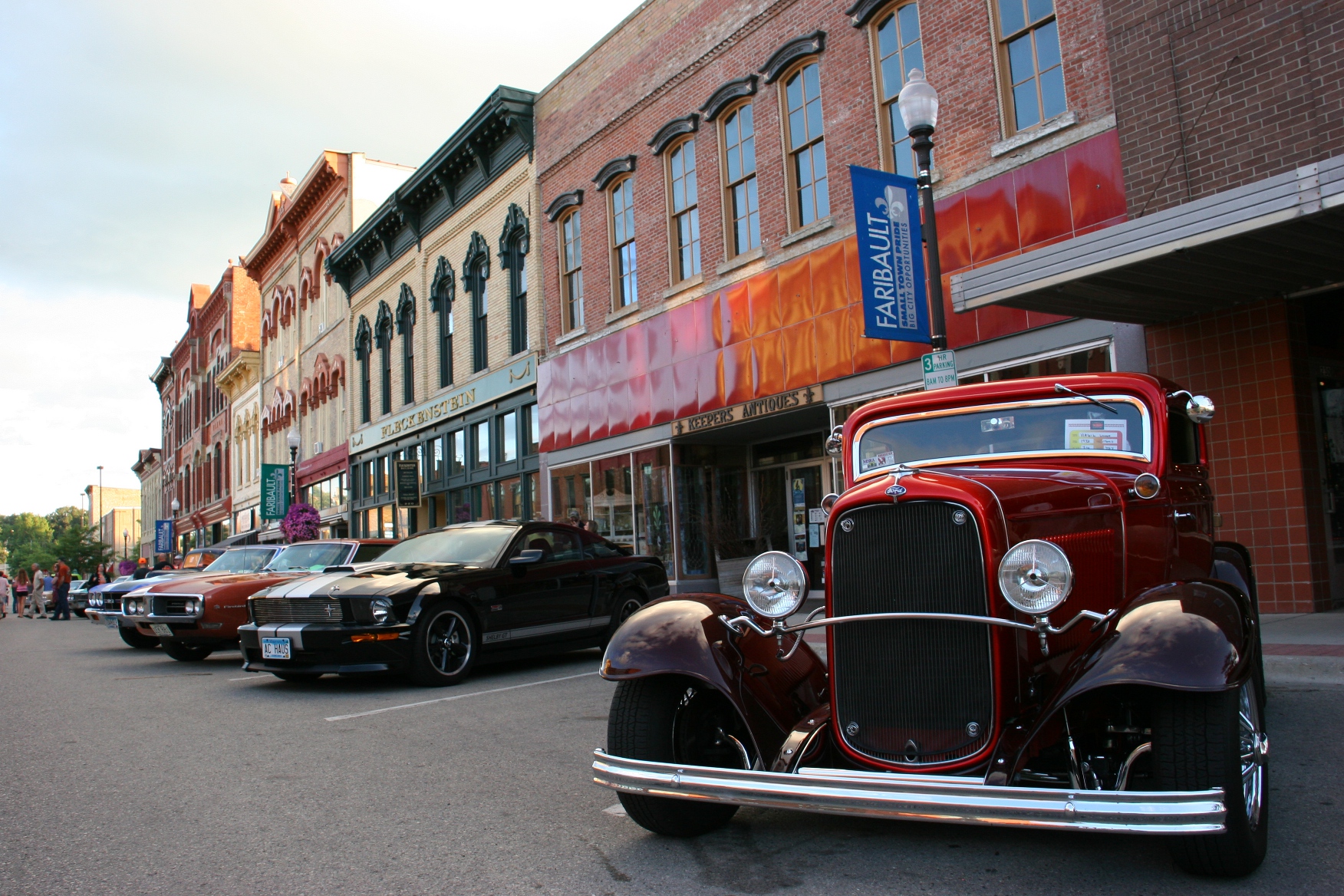
Downtown Faribault features well-kept aged buildings in our historic district. I photographed this scene during a Car Cruise Night. There’s a Car Cruise here Friday, June 13, from 6-9 p.m. (Minnesota Prairie Roots copyrighted file photo)

The Rice County Historical Society will also offer a guided Downtown Walking Tour on Friday and Saturday with two time slots of 11 a.m. and 2 p.m. The $5 tour, led by RCHS Program and Outreach Coordinator Kiran Loewenstein, begins at Central Park. Anticipated to take 1-1 ½ hours, the tour route follows Central Avenue with a focus on the historic district and buildings and early general Faribault history. I expect that will offer ample opportunity to not only learn about early history and heritage, but also to see the heritage of our newest residents in downtown core ethnic businesses.

Two more opportunities to embrace local history (although not officially part of Heritage Days) are inside the State Bank of Faribault along Central Avenue. Local streetscapes and landscapes by Father Jim Zotalis, spiritual leader of the Cathedral, are displayed in a pop-up exhibit in the bank lobby. And for those interested in Faribault’s brewing history, the bank holds an extensive collection of Fleck’s beer memorabilia form long ago Fleckenstein Brewery. Both are accessible during business hours only.

There’s lots happening during Heritage Days, activities that mostly aren’t about heritage. But some are. To see a complete listing of events, click here.

© Copyright 2025 Audrey Kletscher Helbling


Hands-on engaging history at Faribault’s Riverside Rendezvous May 14, 2025

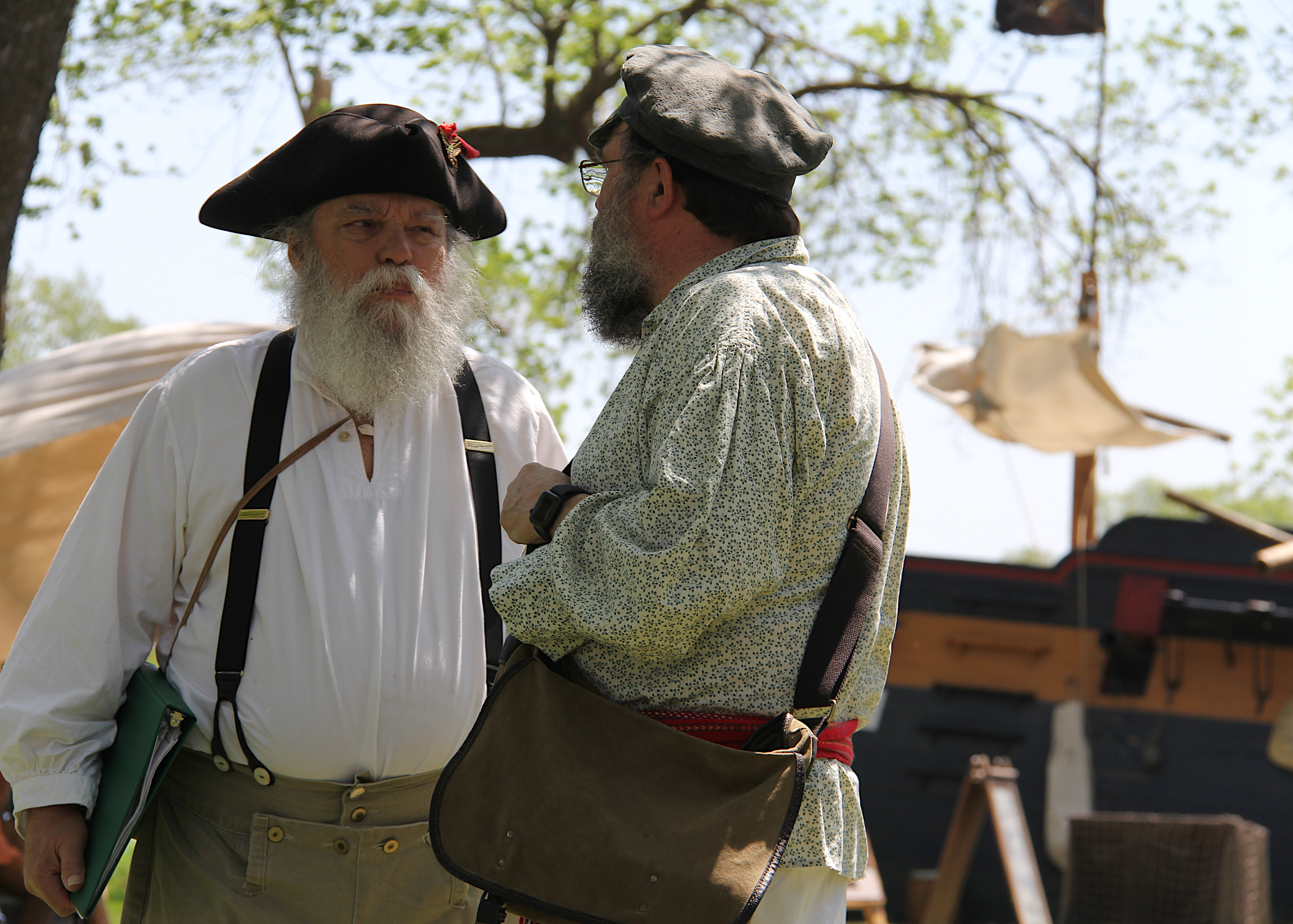
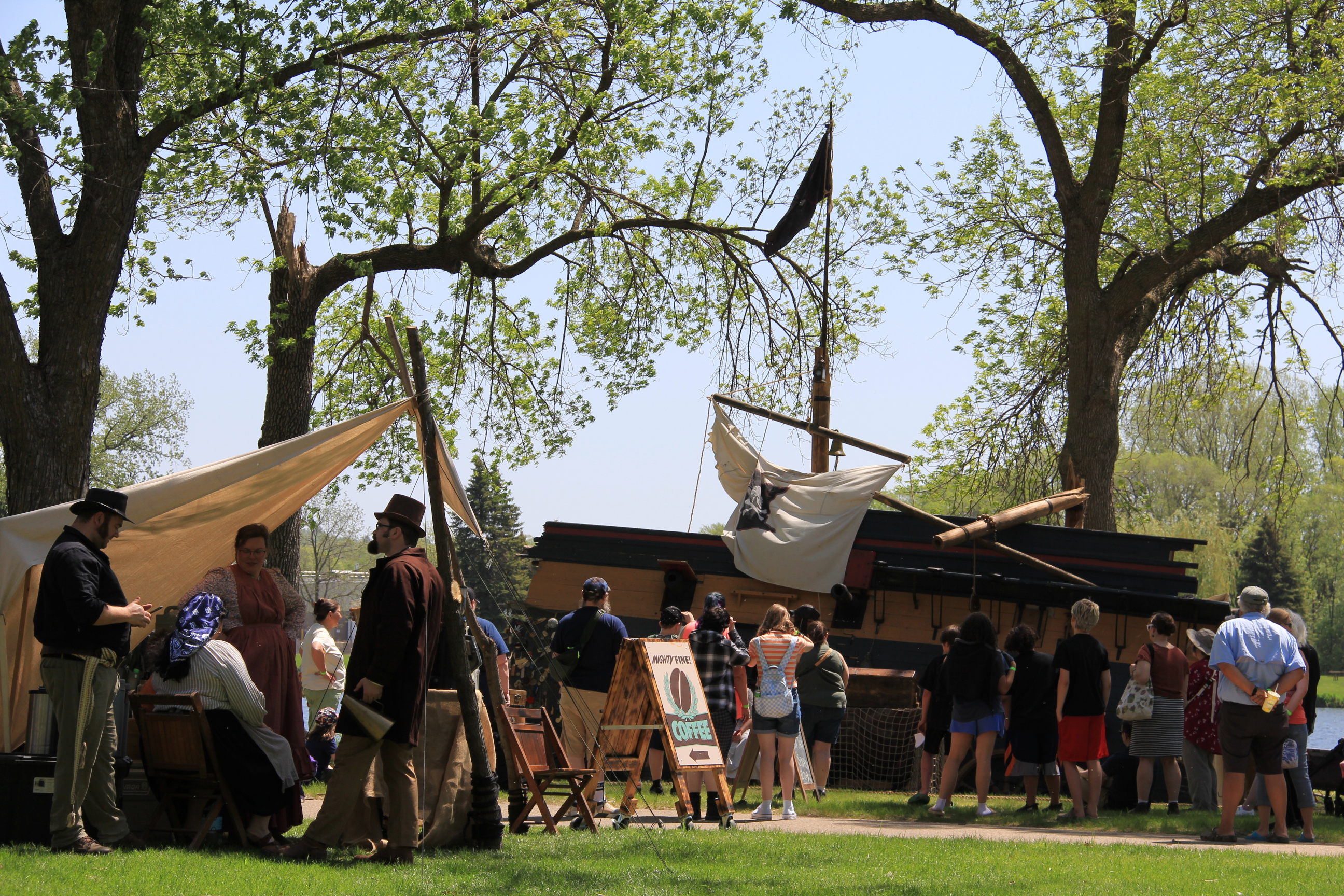
Rendezvous re-enactors visit near the pirate ship. (Minnesota Prairie Roots copyrighted photo May 2025)

I’M INTERESTED IN HISTORY, although not as much as my husband. He reads history-themed books, remembers historical dates and facts, and leaves a museum with more info imprinted on his brain than me. I learn about and retain history better when I can actually “see” and experience it. That’s why I find events like the recent Riverside Rendezvous and History Festival in Faribault especially appealing.

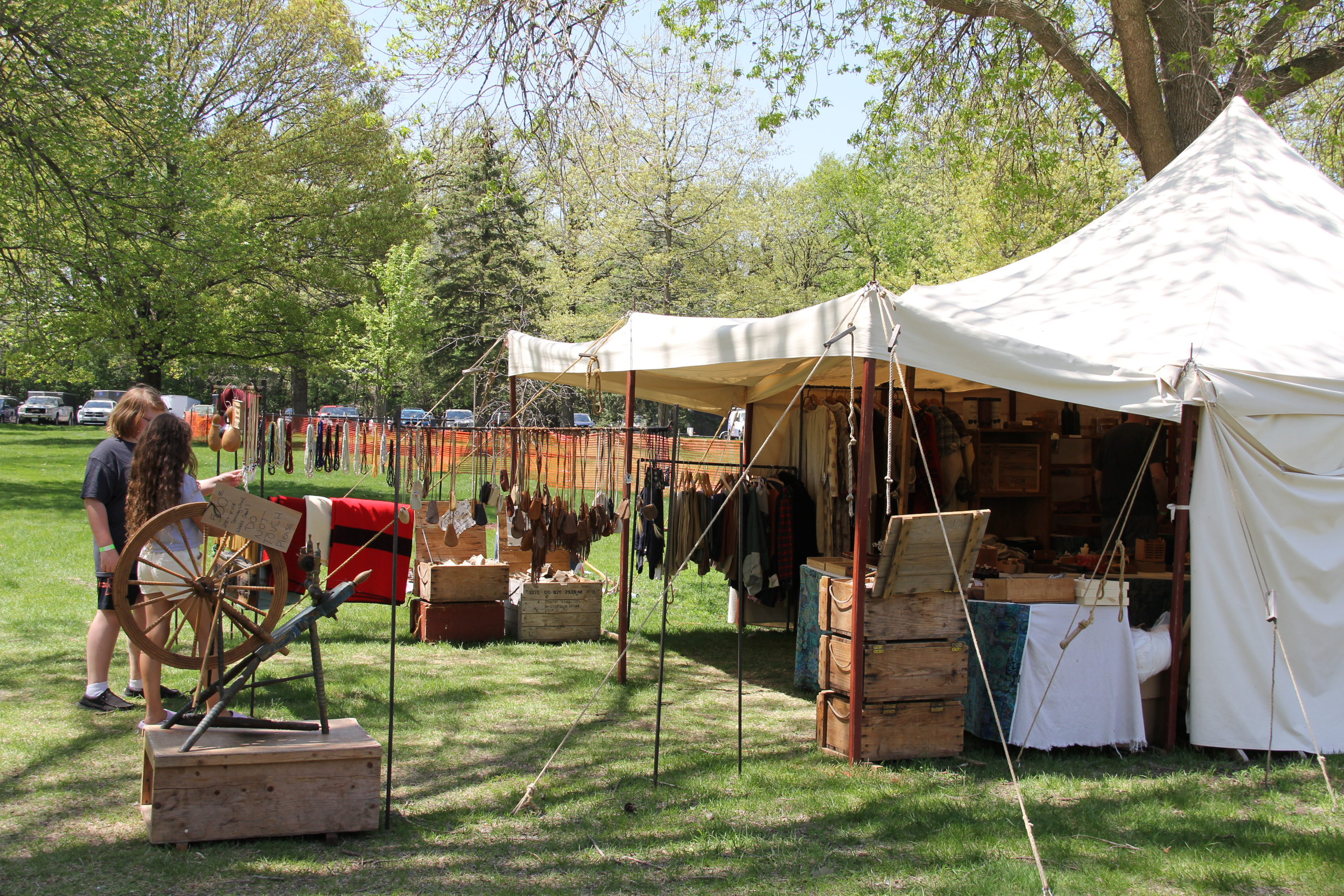
One of many tents where you could learn and also buy goods. (Minnesota Prairie Roots copyrighted photo May 2025)

That same connective shift is something I see happening more and more in history centers and museums. And that’s a good thing—to have interactive and creative exhibits that draw people into history. It is via connecting with our past that we begin to understand today.

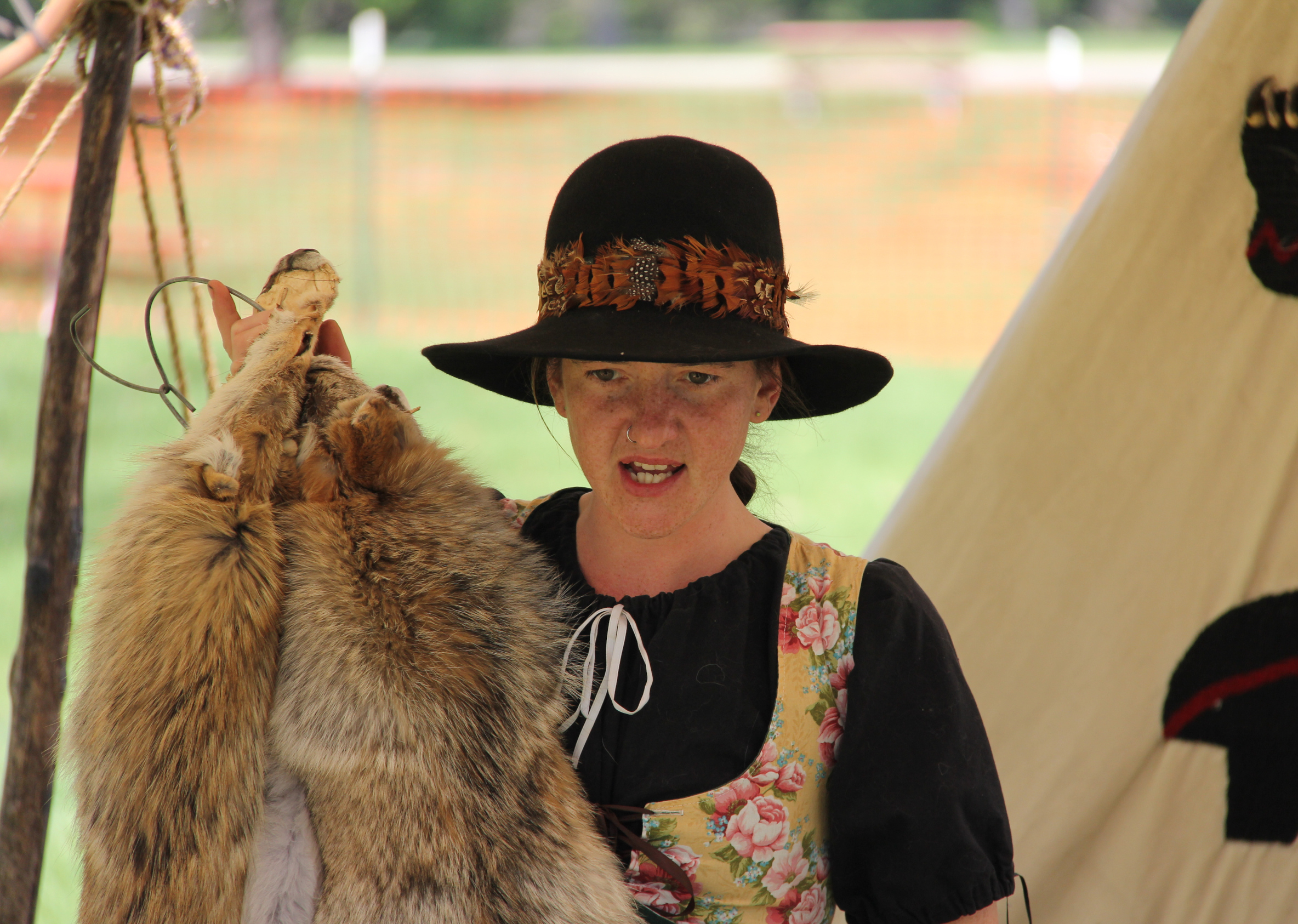
Fur pelts and hats at the Mountain Man Hat Making tent. (Minnesota Prairie Roots copyrighted photo May 2025)

After attending the Riverside Rendezvous, I hold a deeper understanding of early life in Minnesota, specifically the Faribault area. Fur trading shaped the local economy. Those long ago fur traders and Indigenous Peoples got along, realizing they could help one another by exchanging goods. It seemed to work for a long time, until European settlers moved in, pushing the Dakota off their native land. Cultures clashed. War ensued. Everything changed.

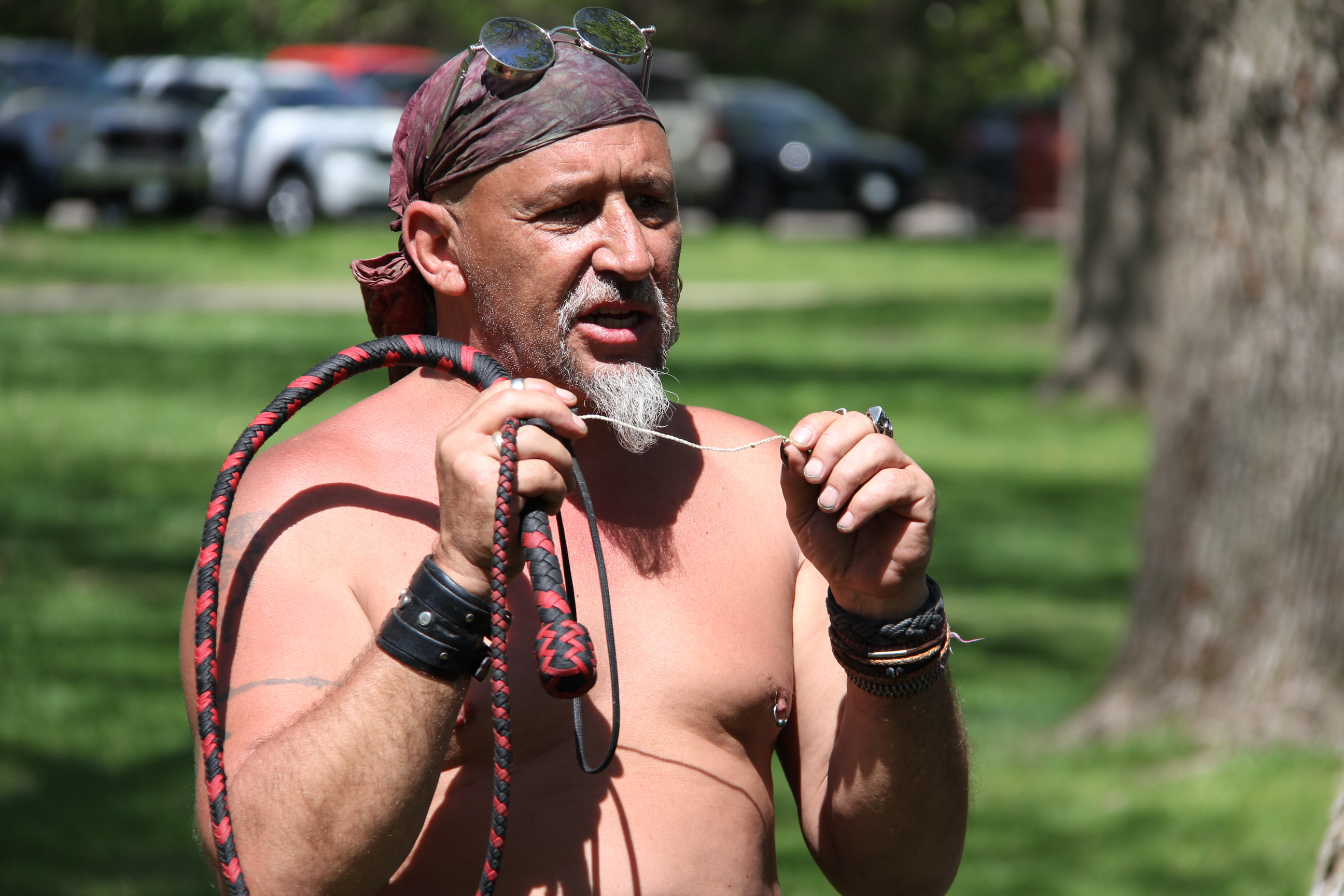
This historian talked about whip making. His partner later cracked the whip. (Minnesota Prairie Roots copyrighted photo May 2025)

Change is inevitable. The Rendezvous provided ample visual evidence of that by focusing on everyday life in the 1700s and 1800s. Each encampment participant highlighted a specific area of yesteryear. And by that I mean a skill—like pounding metal, stitching leather, shaping hats and much more.

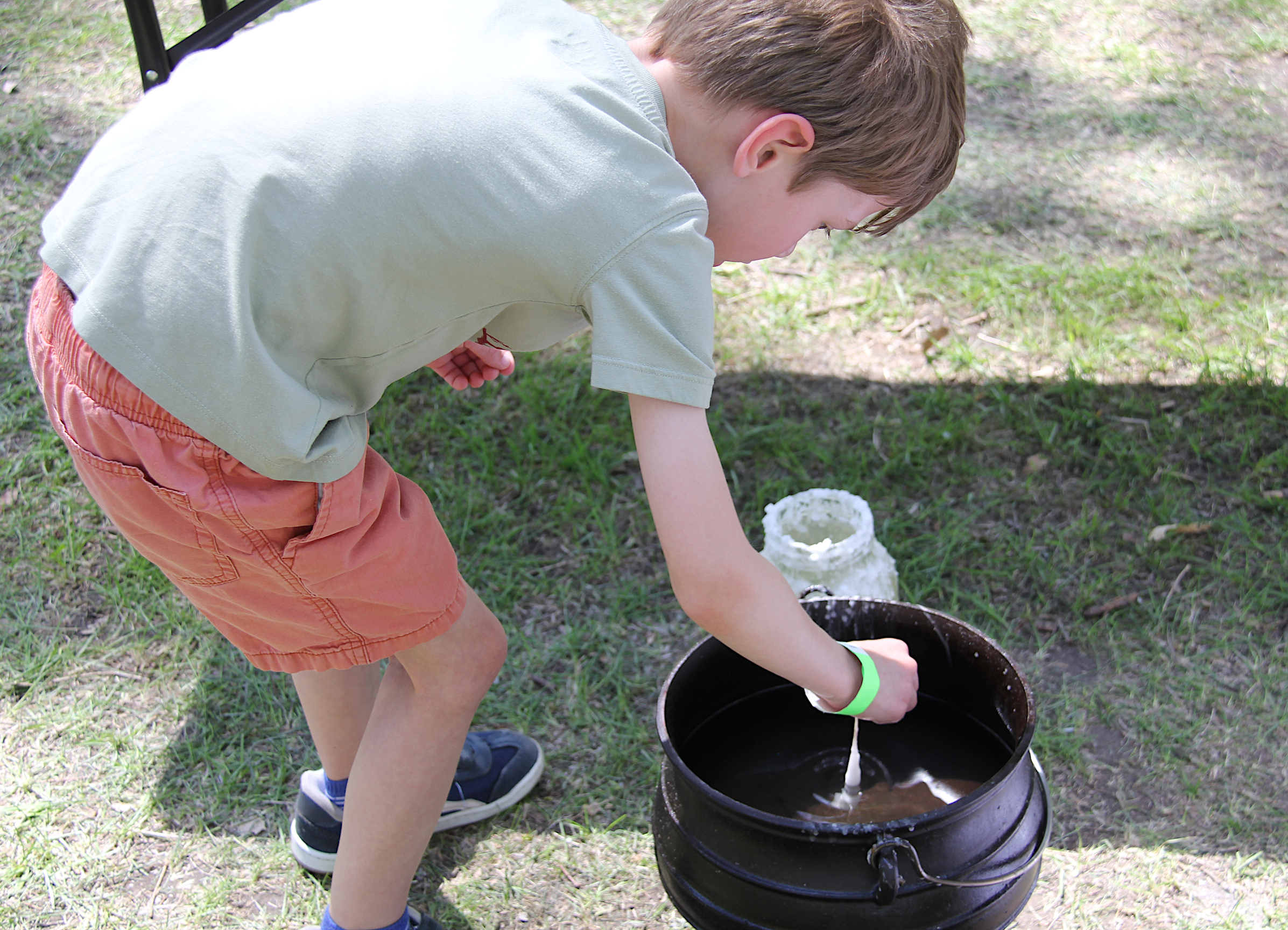
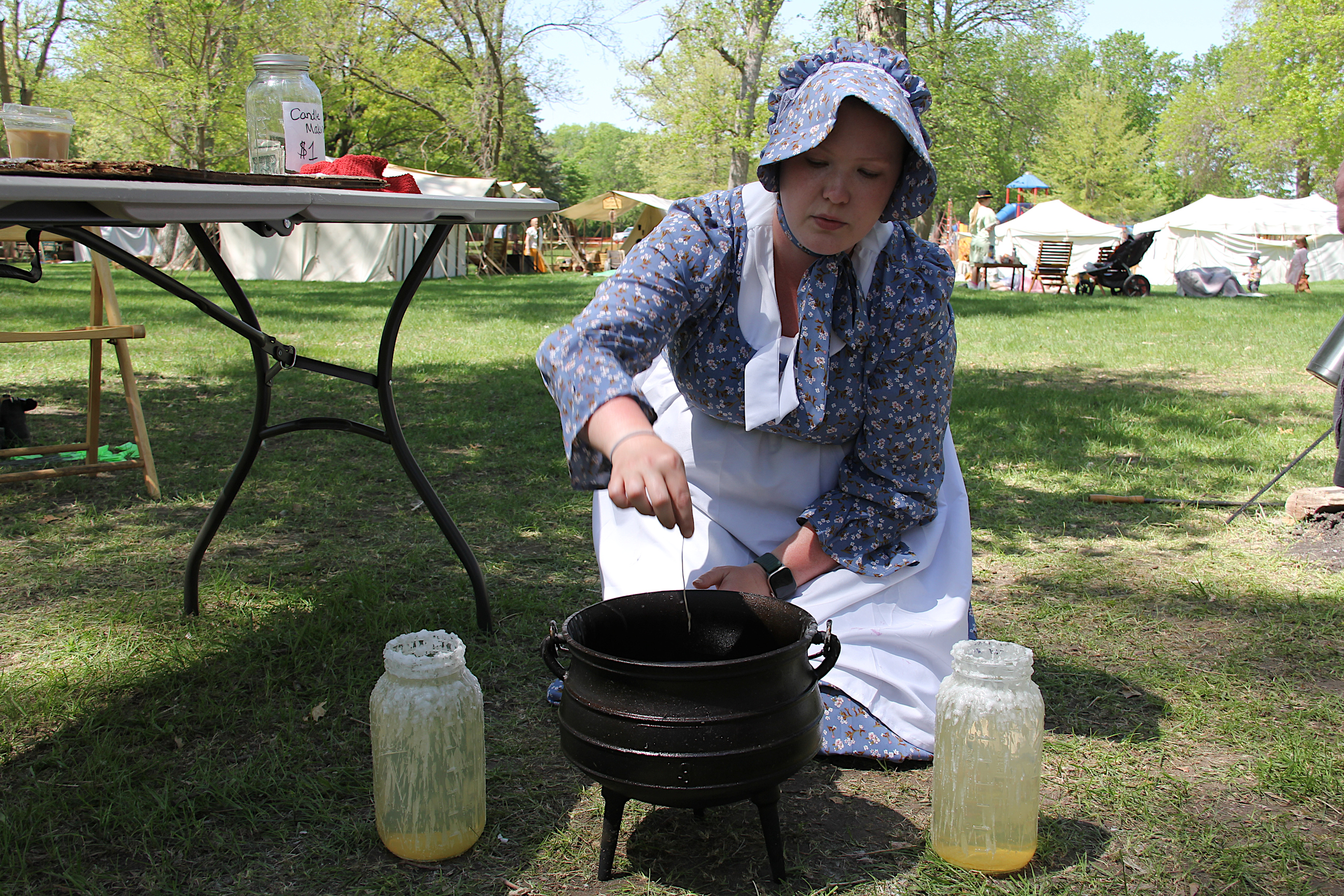
Jenna Nelson demonstrates candle making. (Minnesota Prairie Roots copyrighted photo May 2025)
My grandson layers hot wax onto a wick as he builds his candle. (Minnesota Prairie Roots copyrighted photo May 2025)

That included candle making, something my kindergarten-aged grandson tried. Under the watchful guidance of Rice County Historical Society Curator Jenna Nelson, Isaac dipped a wick into a pot of hot wax and then into a jar of cold water, repeating the process until he had a thickened candle.

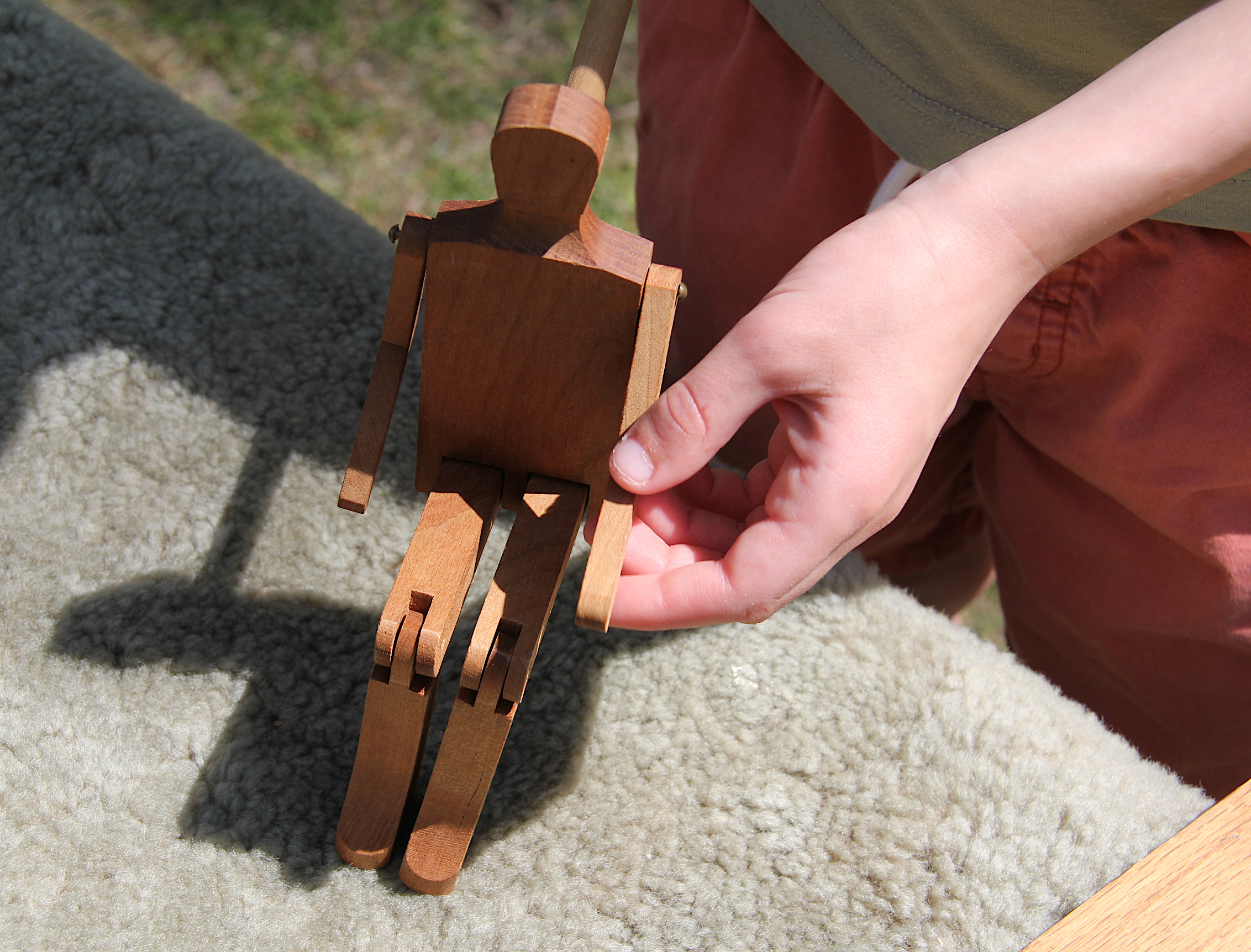
This toy of yesteryear fascinated my young grandson as he adjusted the wooden figure in varying positions. (Minnesota Prairie Roots copyrighted photo May 2025)

Isaac also tried his hand at stitching a leather pouch, rug weaving and playing with toys of yesteryear. He smiled the entire time. He is very much a hands-on kid who loves creating. His older sister, not so much.

A tent full of books. bowls and hats for sale at the Rendezvous. (Minnesota Prairie Roots copyrighted photo May 2025)

But Izzy did race to a tent full of books and happily accepted rock candy from a costumed character at the axe-throwing station.

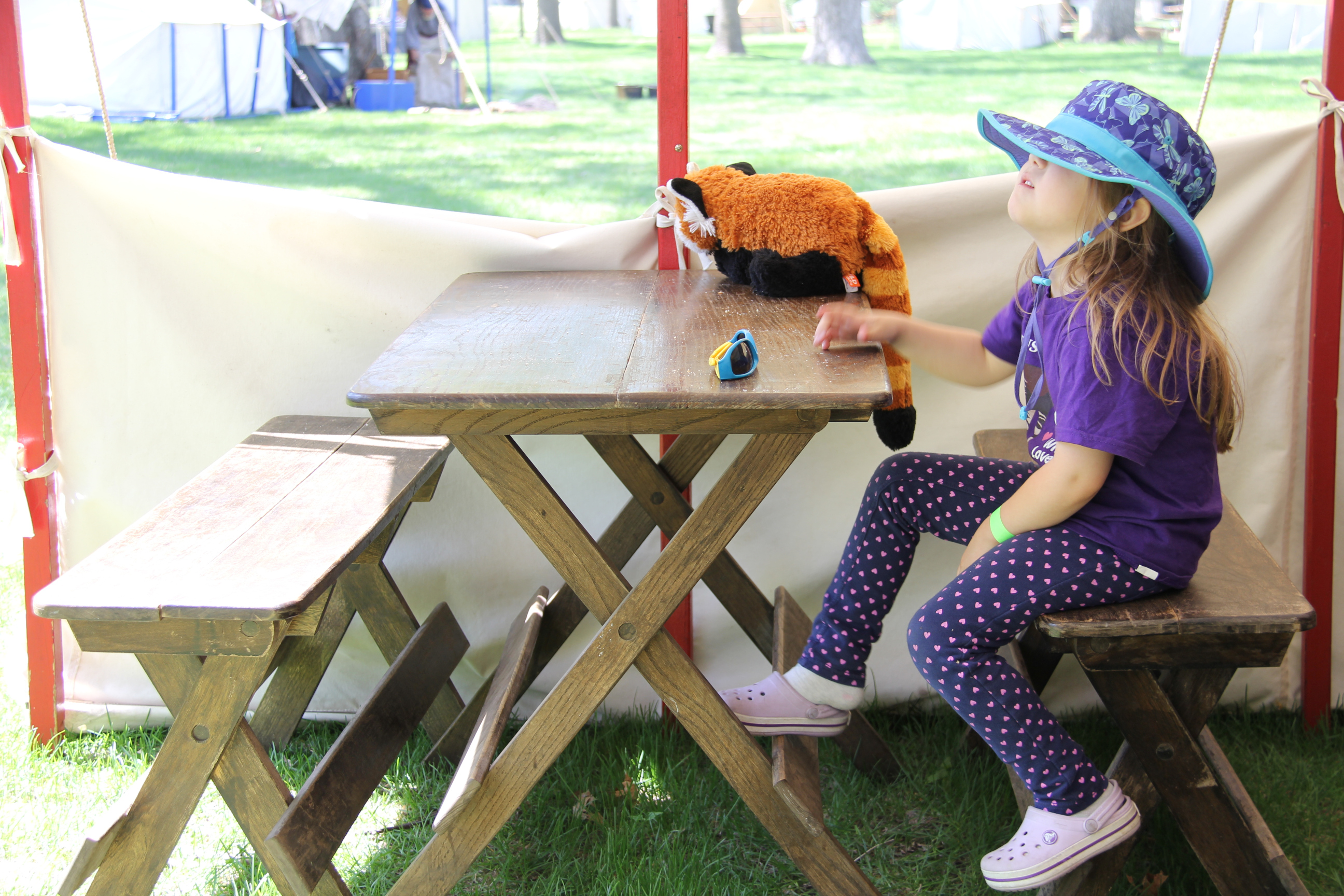
Lots of kids attended the Rendezvous. Here a young girl and her stuffed animal, wait inside Baby’s Indian Frybread tent. (Minnesota Prairie Roots copyrighted photo May 2025)

I give great credit to the Rendezvous re-enactors who engaged with all ages, who clearly know their crafts and who were excited to share their knowledge of both skills and history with attendees.

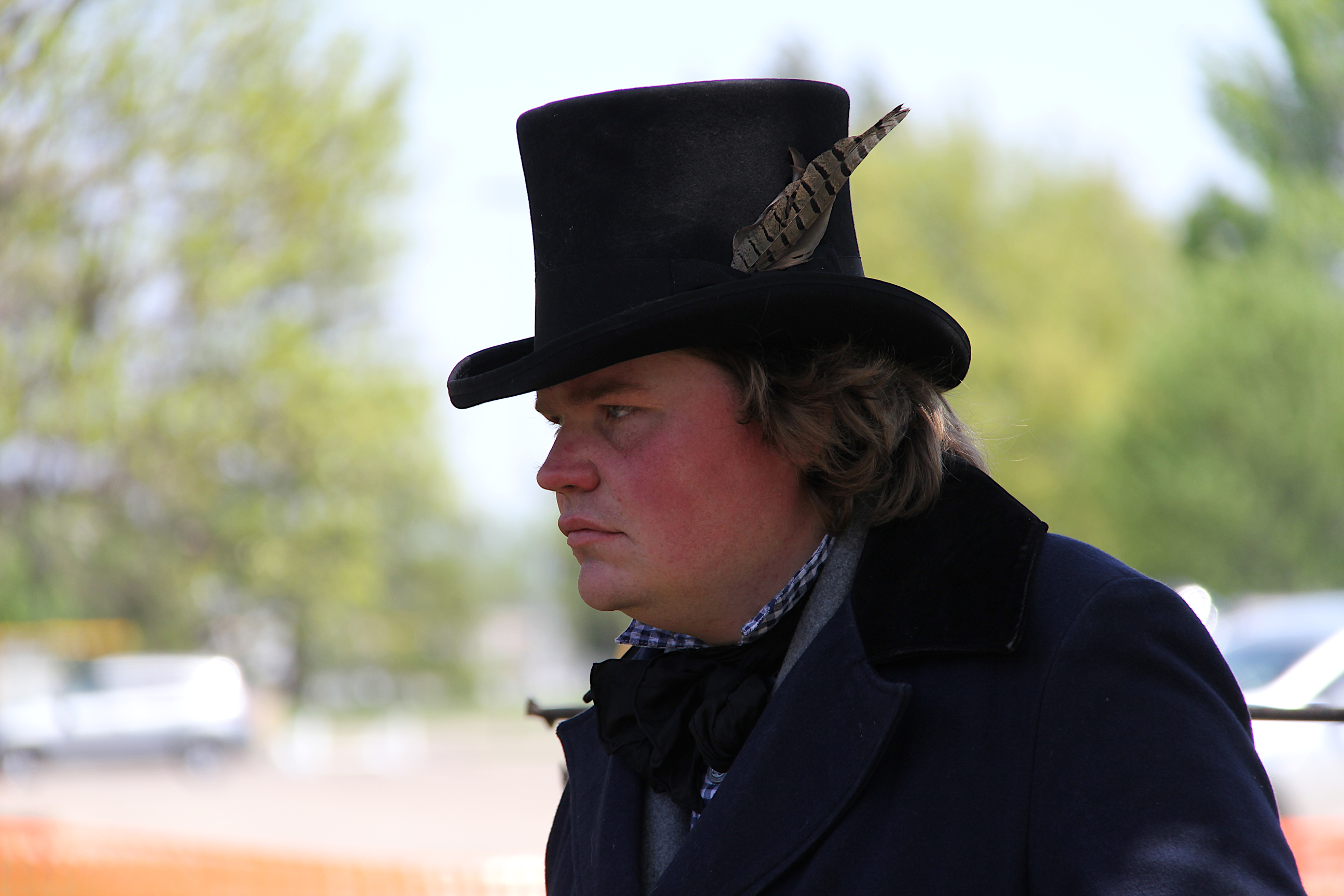
From rugged to well-dressed, period attire varied depending on character role-playing. (Minnesota Prairie Roots copyrighted photo May 2025)
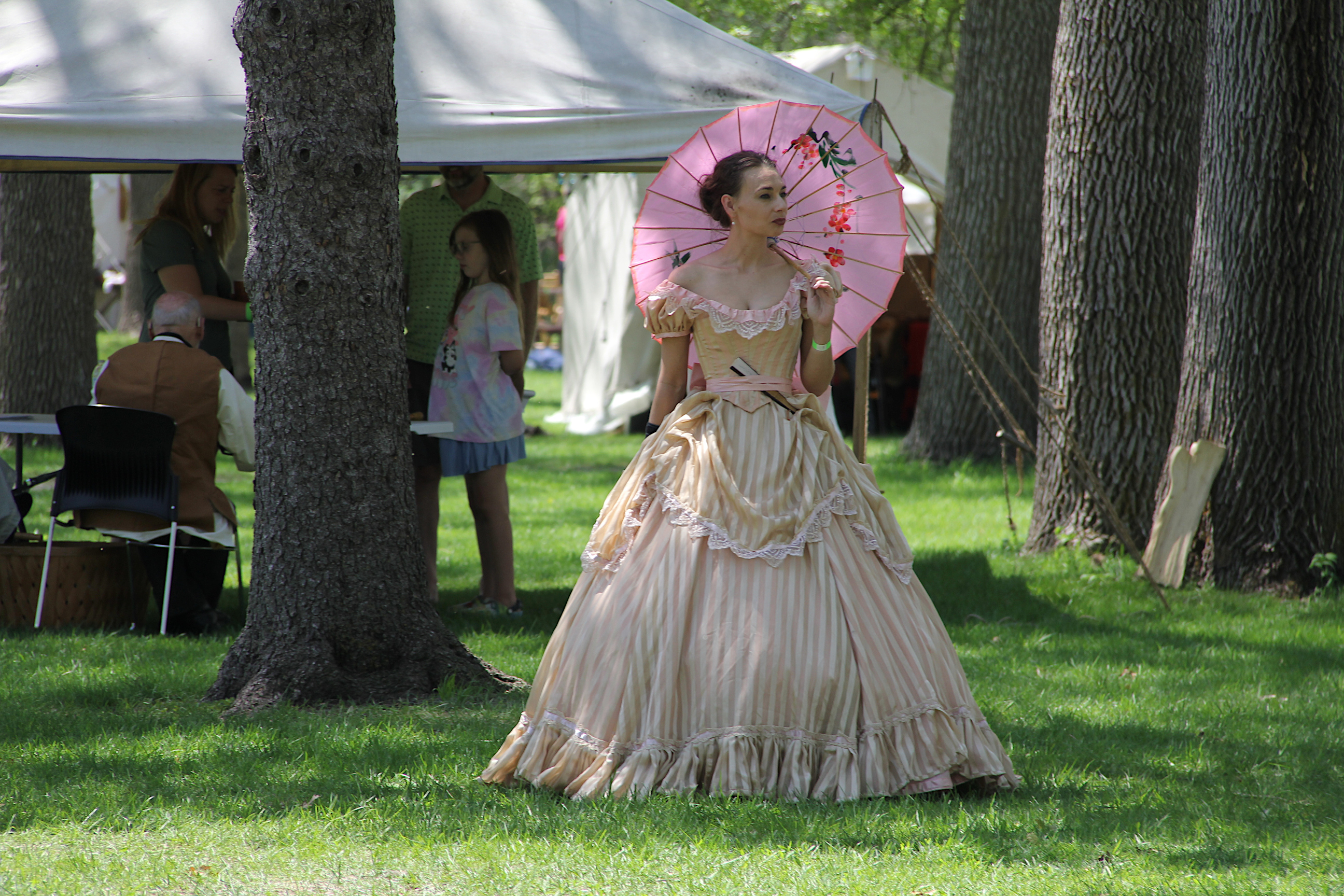
I zoomed in on this lovely lady from afar, so I don’t know her story. But she was the most fancily-dressed at the Rendezvous. (Minnesota Prairie Roots copyrighted photo May 2025)
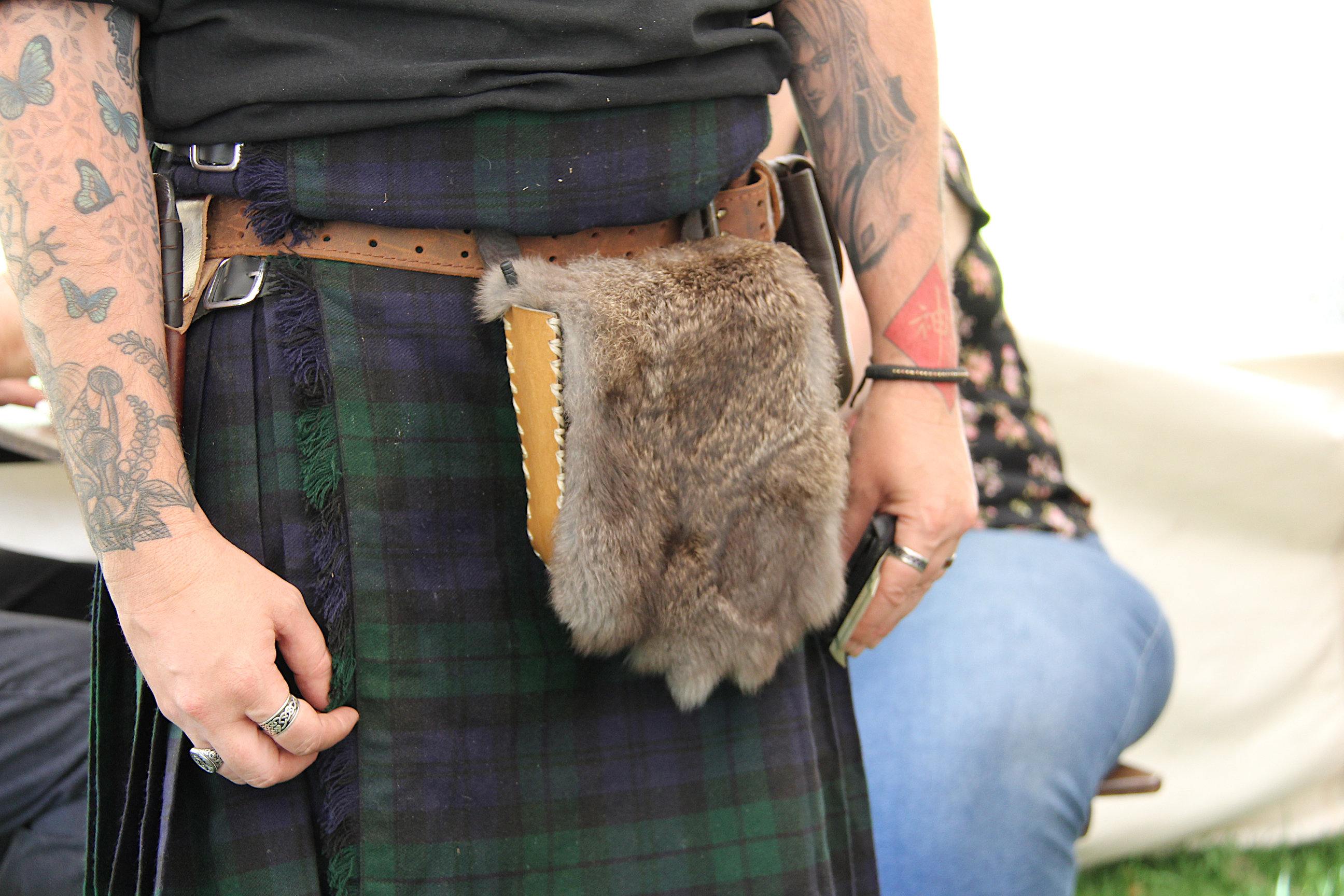
I saw lots of leather, fur, jewelry, piercings and tattoos. (Minnesota Prairie Roots copyrighted photo May 2025)

And that they played the parts by dressing in period costume certainly made the experience real, as in really stepping back in time. Just ignore the ringing cellphones.

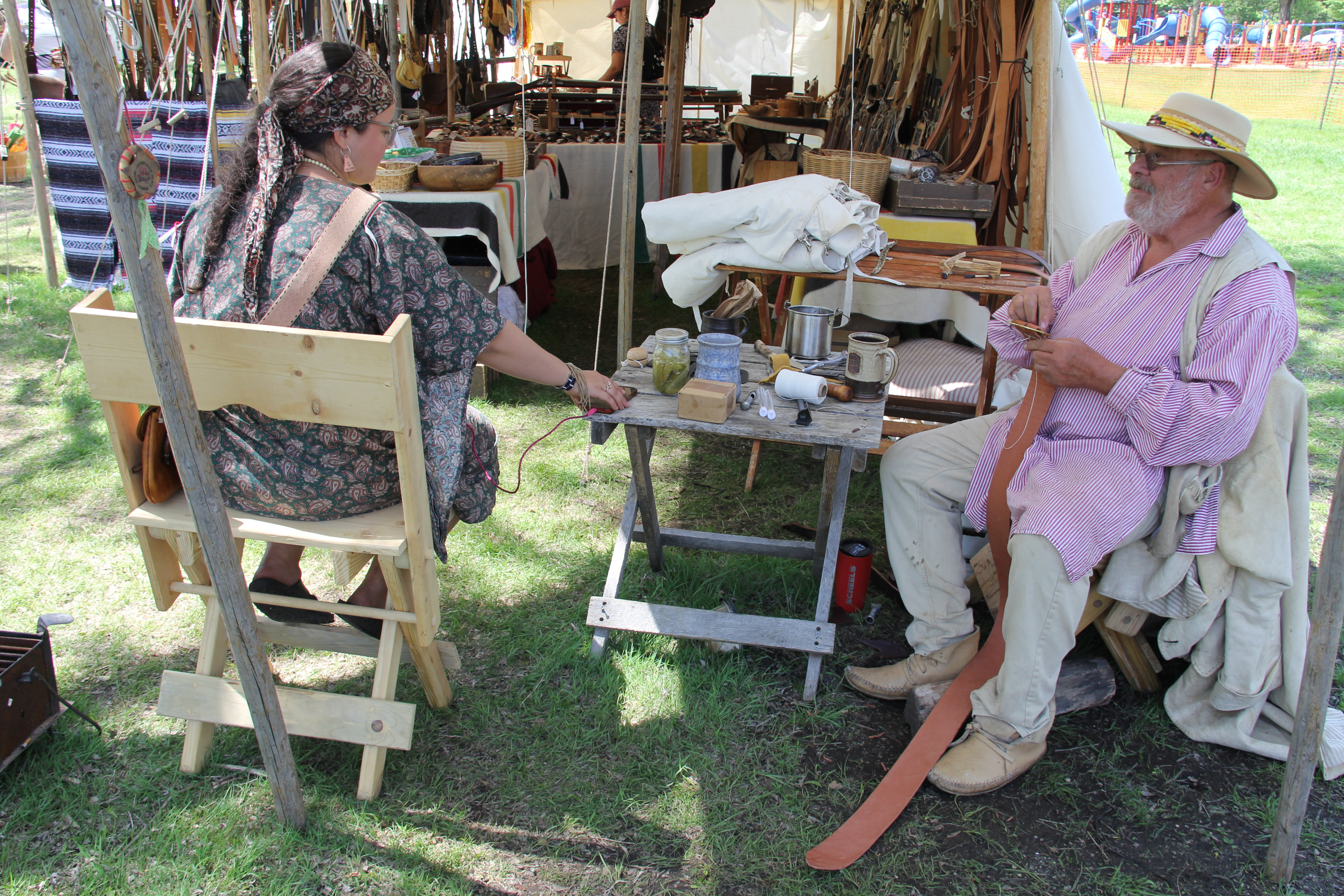
Stitching a buckle on a leather belt, right, at a trading post type tent. (Minnesota Prairie Roots copyrighted photo May 2025)

I gathered in chatting with these historians that attending rendezvous is part of their way of life. They become like family to one another. I expect their love of these history festivals grows with each experience, each interaction. They are a friendly lot. Engaging.

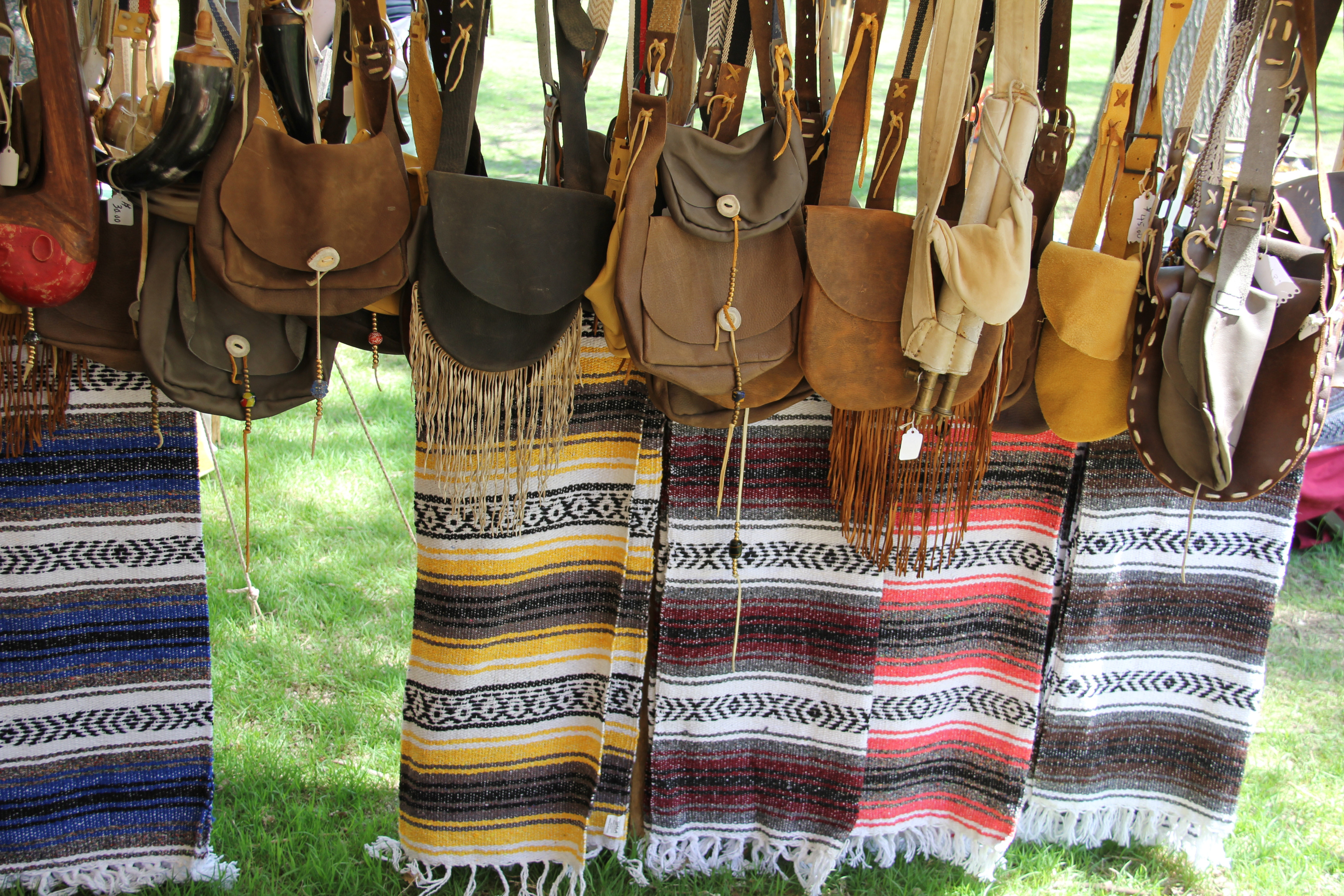
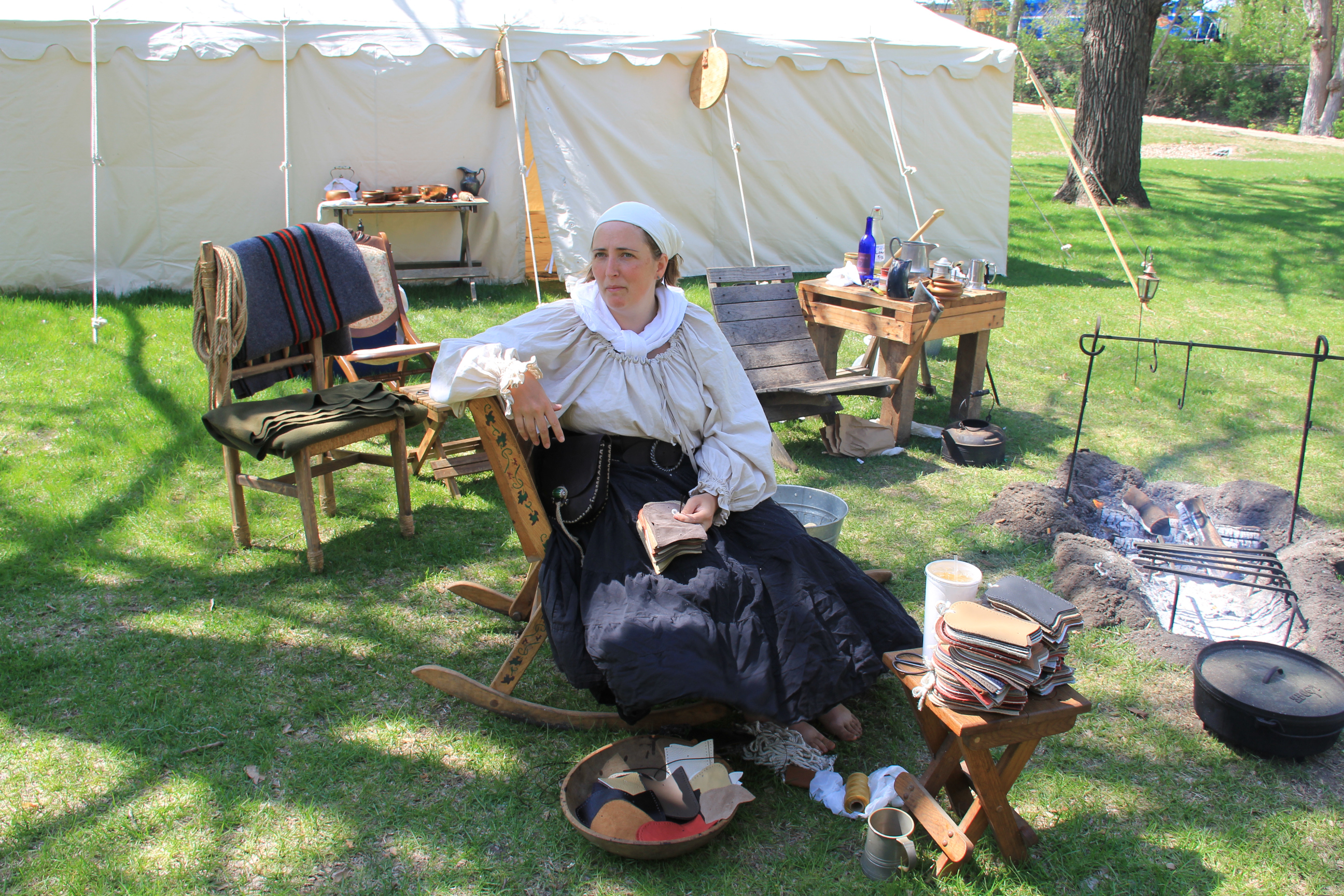
Leather bags and blankets available at the leather stitcher’s booth. (Minnesota Prairie Roots copyrighted photo May 2025)

This approach to history carried me back to the past in a way I’ve not previously experienced. Visually, I saw history unfold before my eyes at the Riverside Rendezvous. And that I’ll remember.

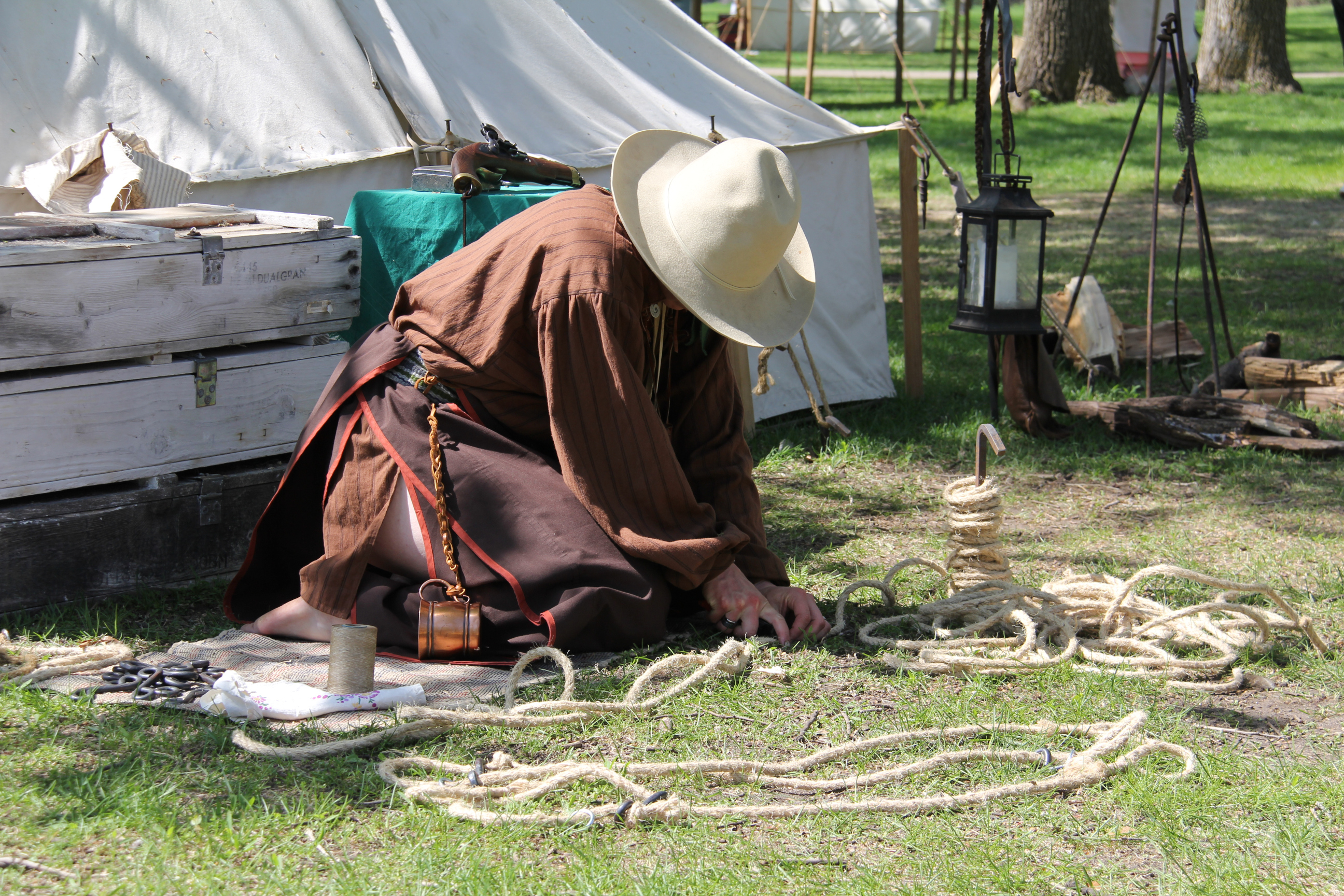
The rope maker. (Minnesota Prairie Roots copyrighted photo May 2025)

FYI: The Rice County Historical Society organized this first rendezvous along the Cannon River in Faribault’s North Alexander Park. Given the success of this year’s event, they are planning a second rendezvous in May 2026. To read my first of two posts about the 2025 Rendezvous, click here.

© Copyright 2025 Audrey Kletscher Helbling
 

Gathering beside the Cannon for history come alive at Riverside Rendezvous May 13, 2025

Learning about pirates at the pirate ship sitting near the Cannon River. (Minnesota Prairie Roots copyrighted photo May 2025)

TO READ ABOUT THE PAST is one thing. To learn about history via people passionate about the past is quite another.

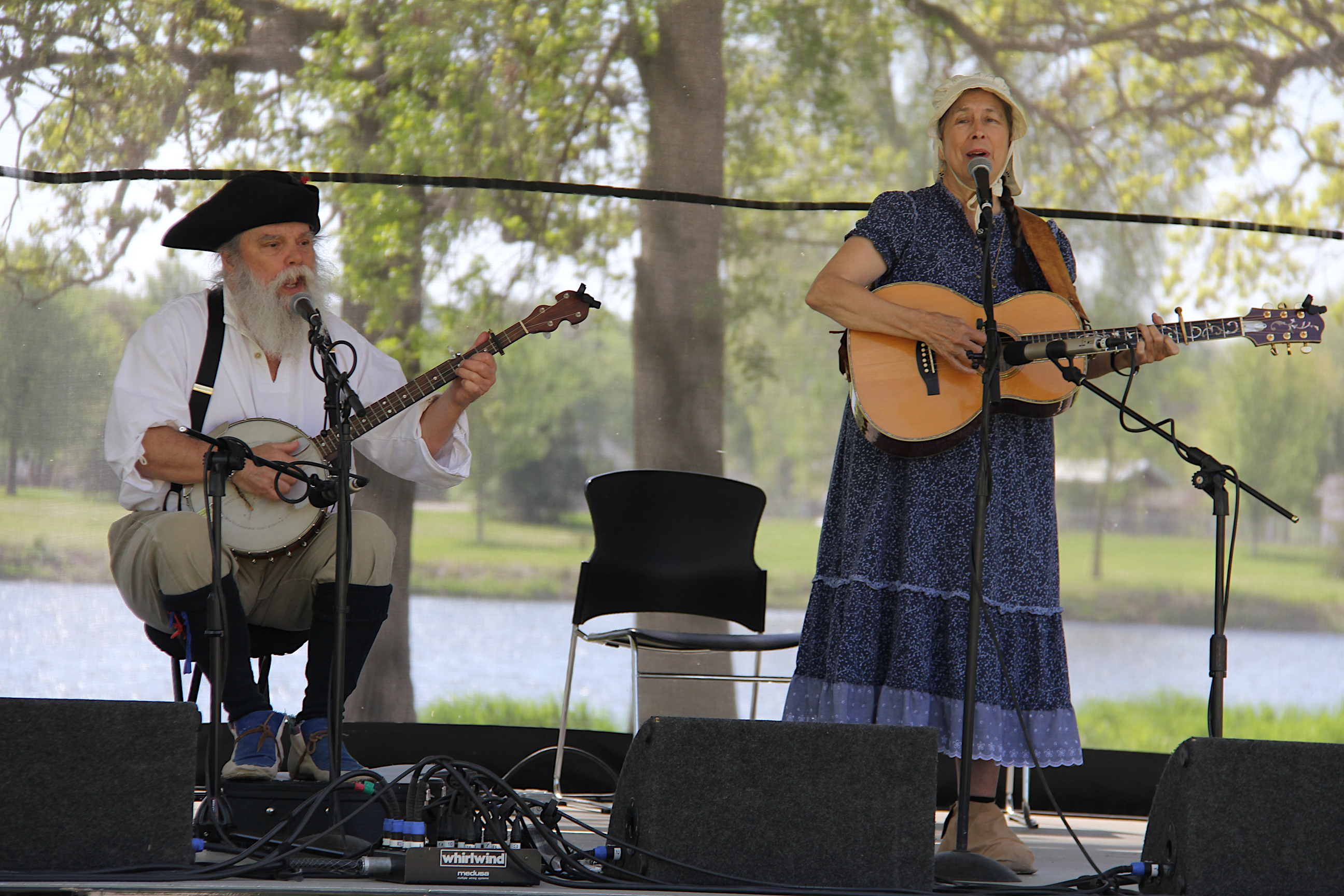
Folk singers Curtis & Loretta from Minneapolis perform Sunday morning. (Minnesota Prairie Roots copyrighted photo May 2025)

The past came alive over the weekend at the first-ever Riverside Rendezvous and History Festival in Faribault organized by the Rice County Historical Society. I spent four hours of my Mother’s Day roaming the festival grounds alongside the Cannon River at North Alexander Park. Listening. Learning. Connecting. Questioning. Observing. And photographing.

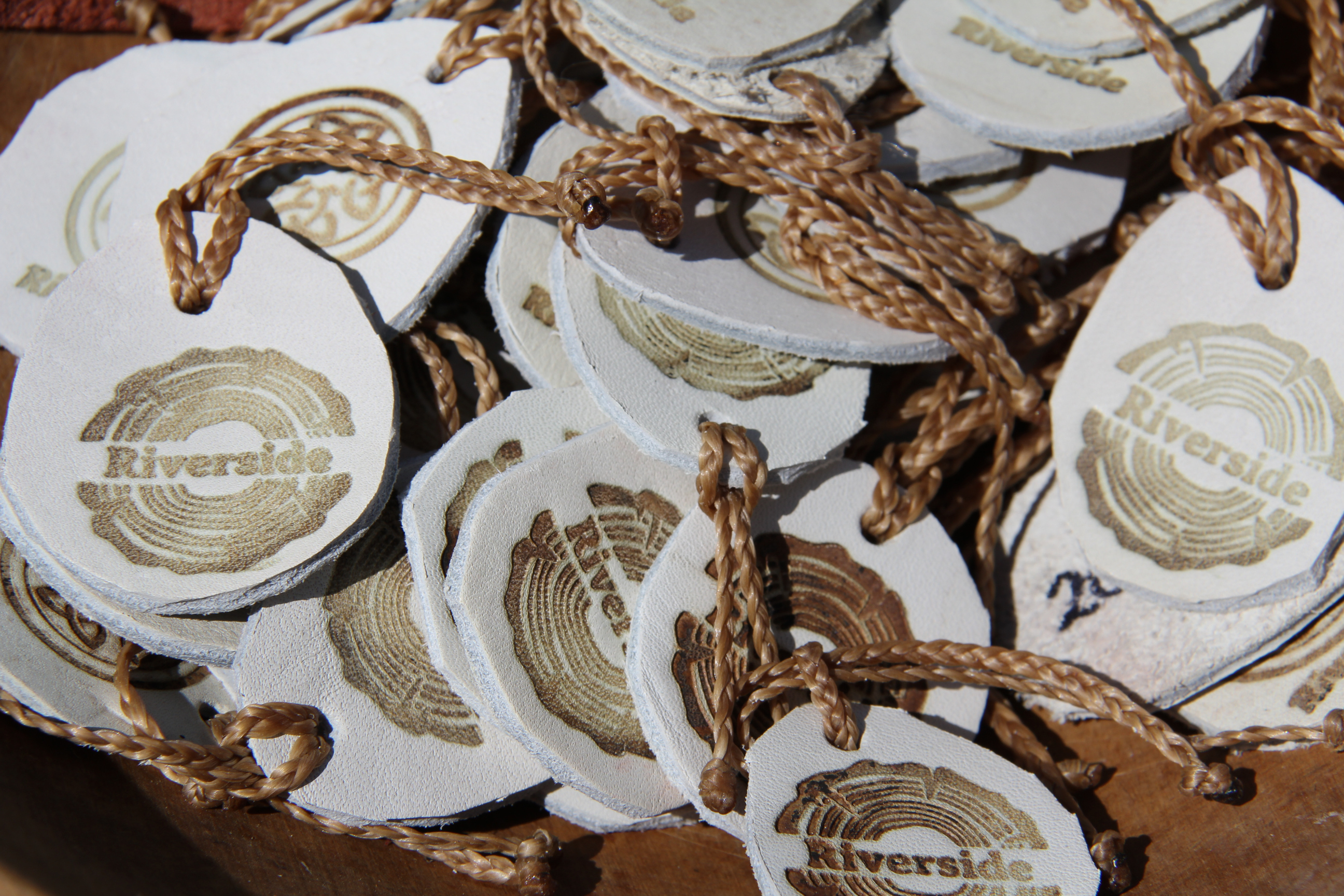
Many rendezvous feature medallions (like these for the Faribault festival) which participants post on their tents. (Minnesota Prairie Roots copyrighted photo May 2025)
This re-enactor taught kids and adults to stitch mini leather pouches. (Minnesota Prairie Roots copyrighted photo May 2025)
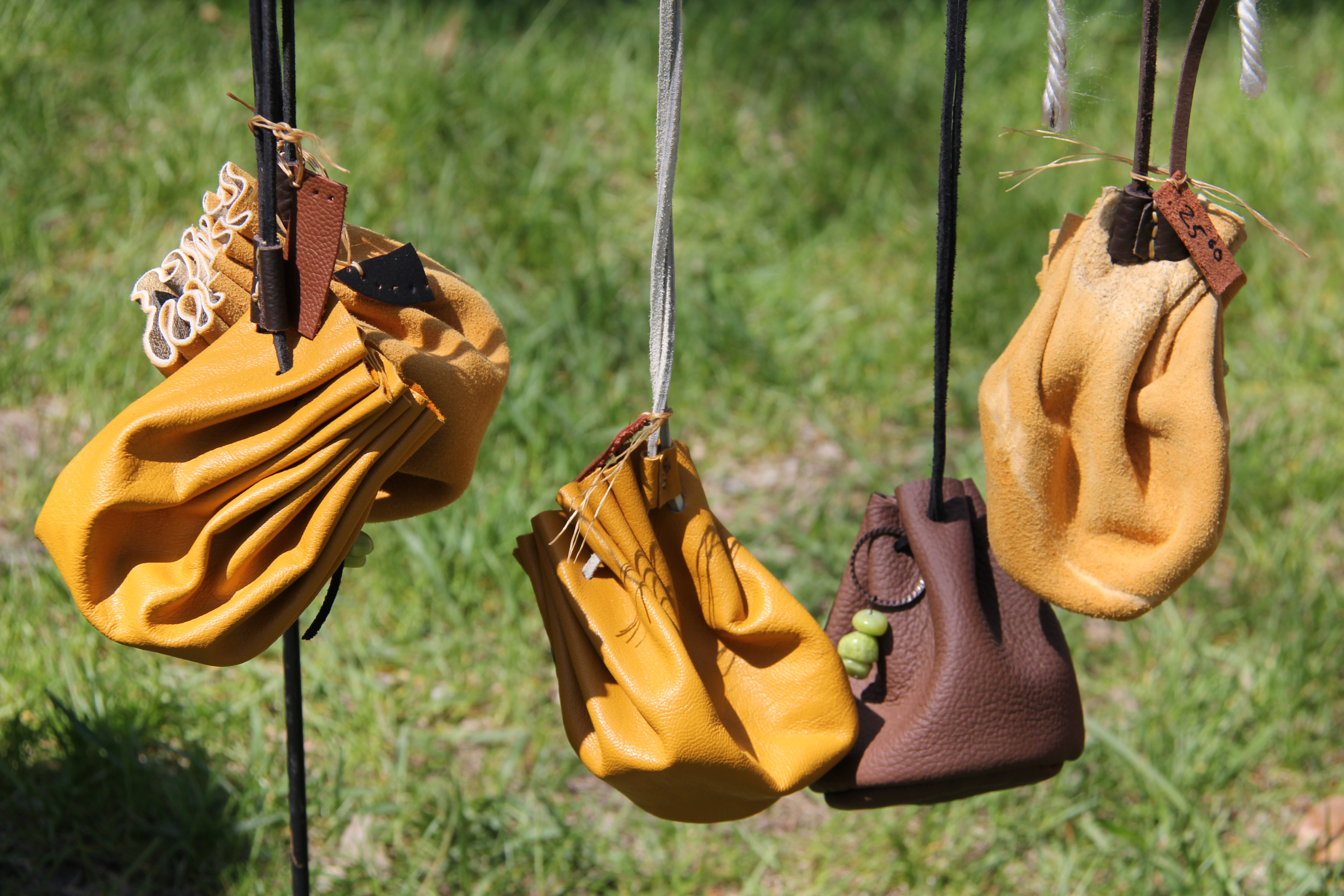
Small handcrafted leather bags for sale. (Minnesota Prairie Roots copyrighted photo May 2025)

The Rendezvous covered 1701-1900 with participants dressed in period costume. Think top hats, mountain hats, head scarves, long skirts, lots of leather and fur.

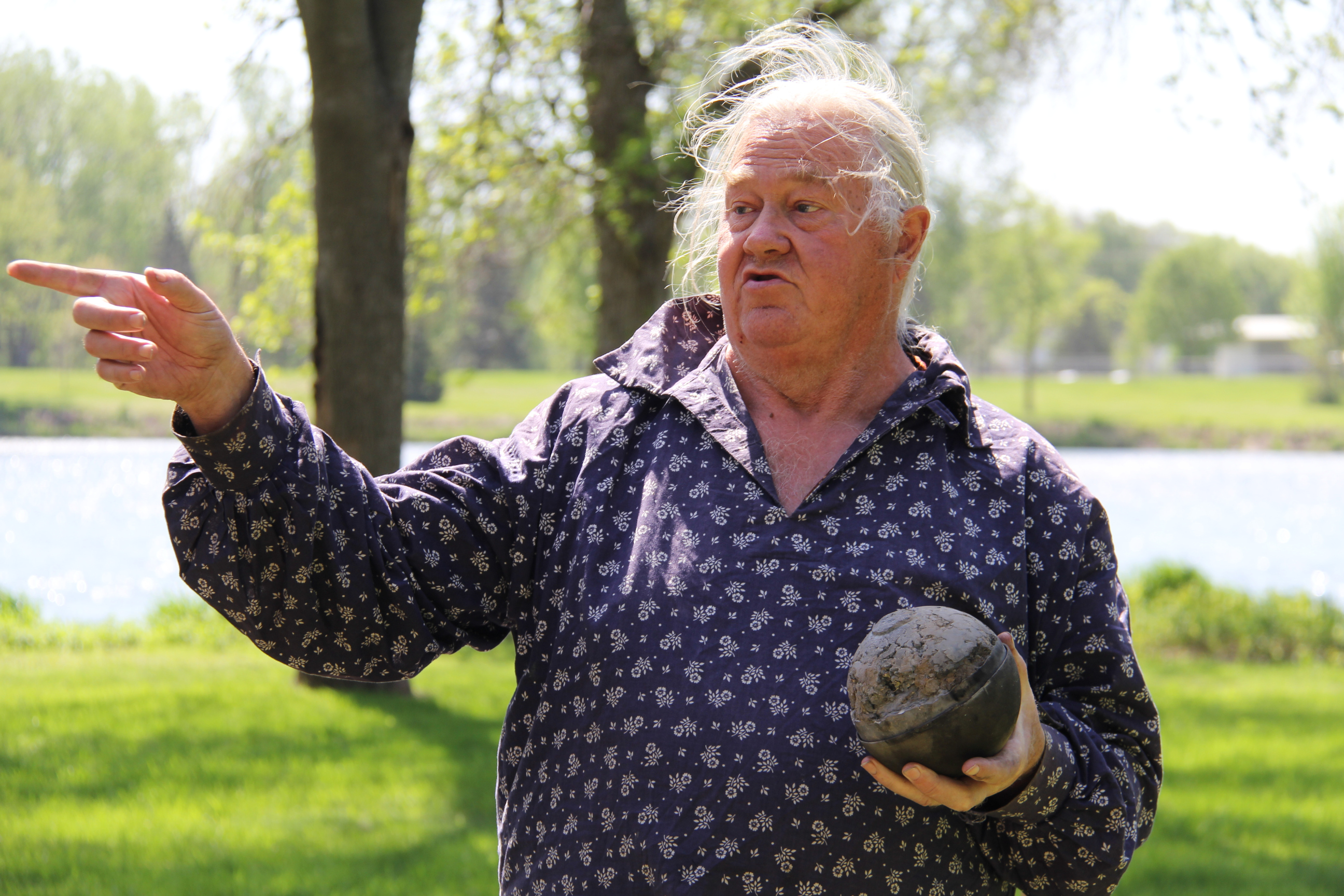
Before shooting off three cannons, this re-enactor talked about cannon balls, loading and firing a cannon, and safety. (Minnesota Prairie Roots copyrighted photo May 2025)
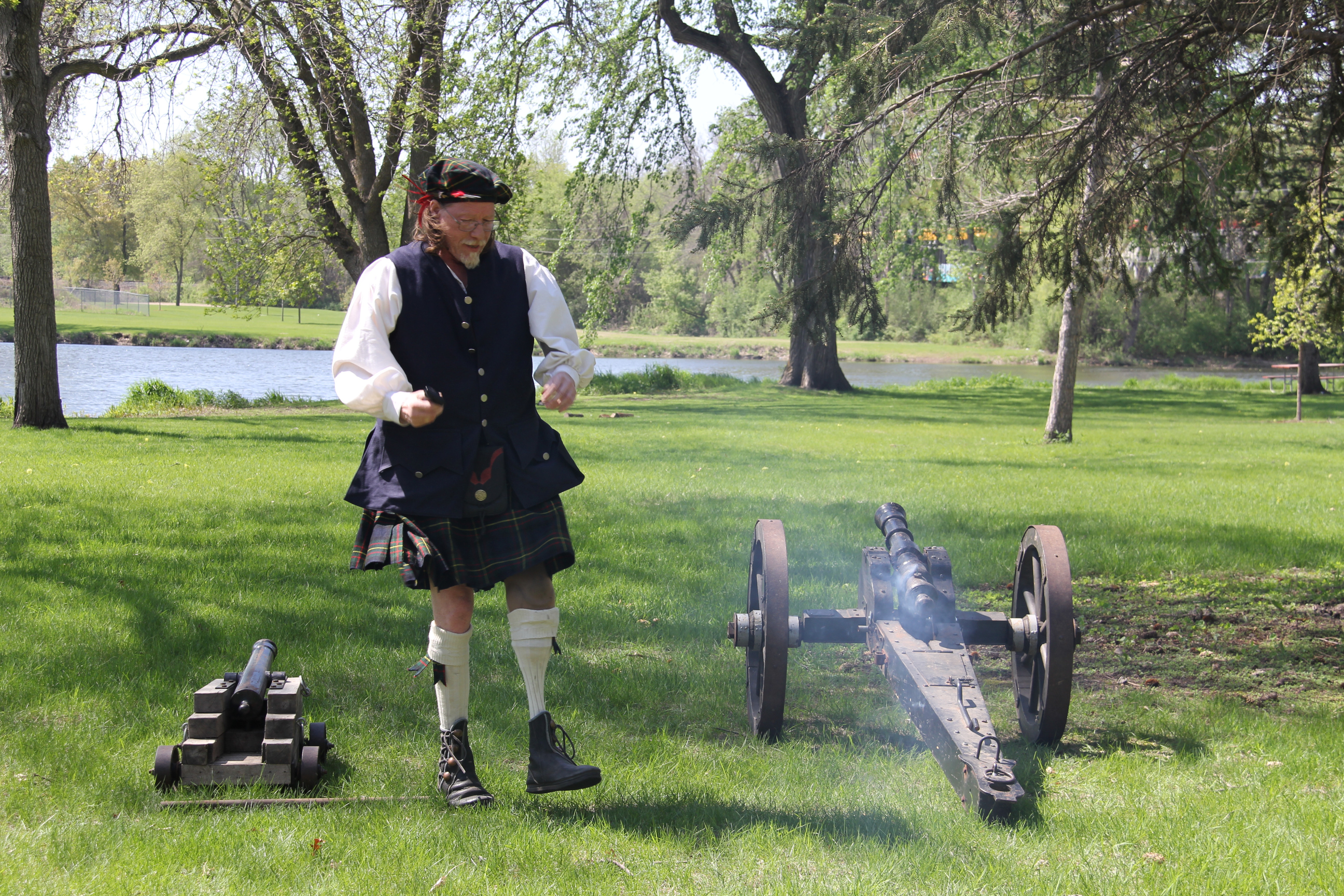
Firing one of three cannons. (Minnesota Prairie Roots copyrighted photo May 2025)
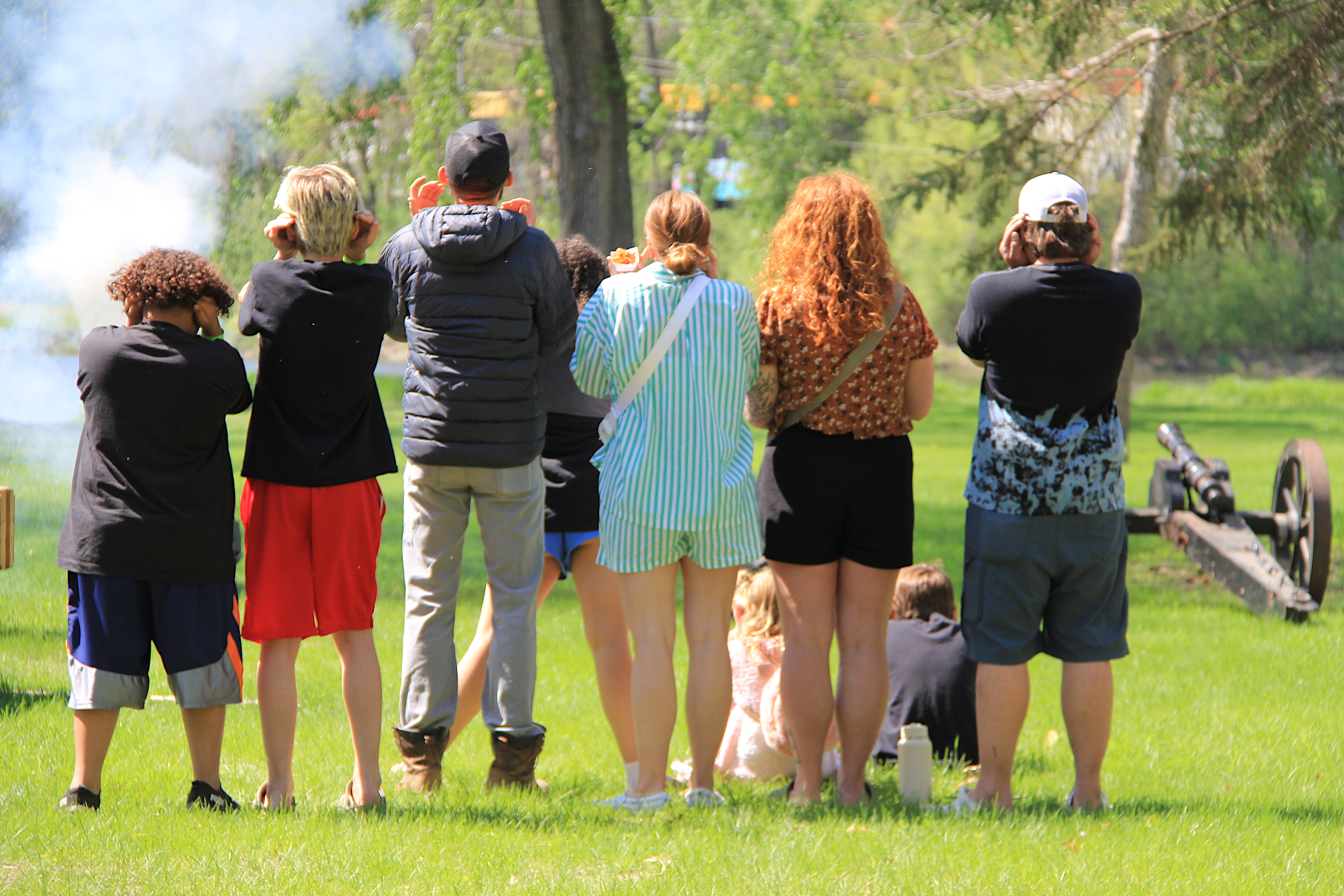
Before the cannons were fired, fest attendees were told to cover their ears “like fish.” The boom was loud. (Minnesota Prairie Roots copyrighted photo May 2025)

The re-enactors shared their period skills from blacksmithing to hat making to cannon shooting, rug weaving, leather stitching and much more. There was a lot to see, a lot to learn. And a lot to do, if you chose to participate.

Spools of colorful string for rug weaving fill a vintage suitcase. (Minnesota Prairie Roots copyrighted photo May 2025)
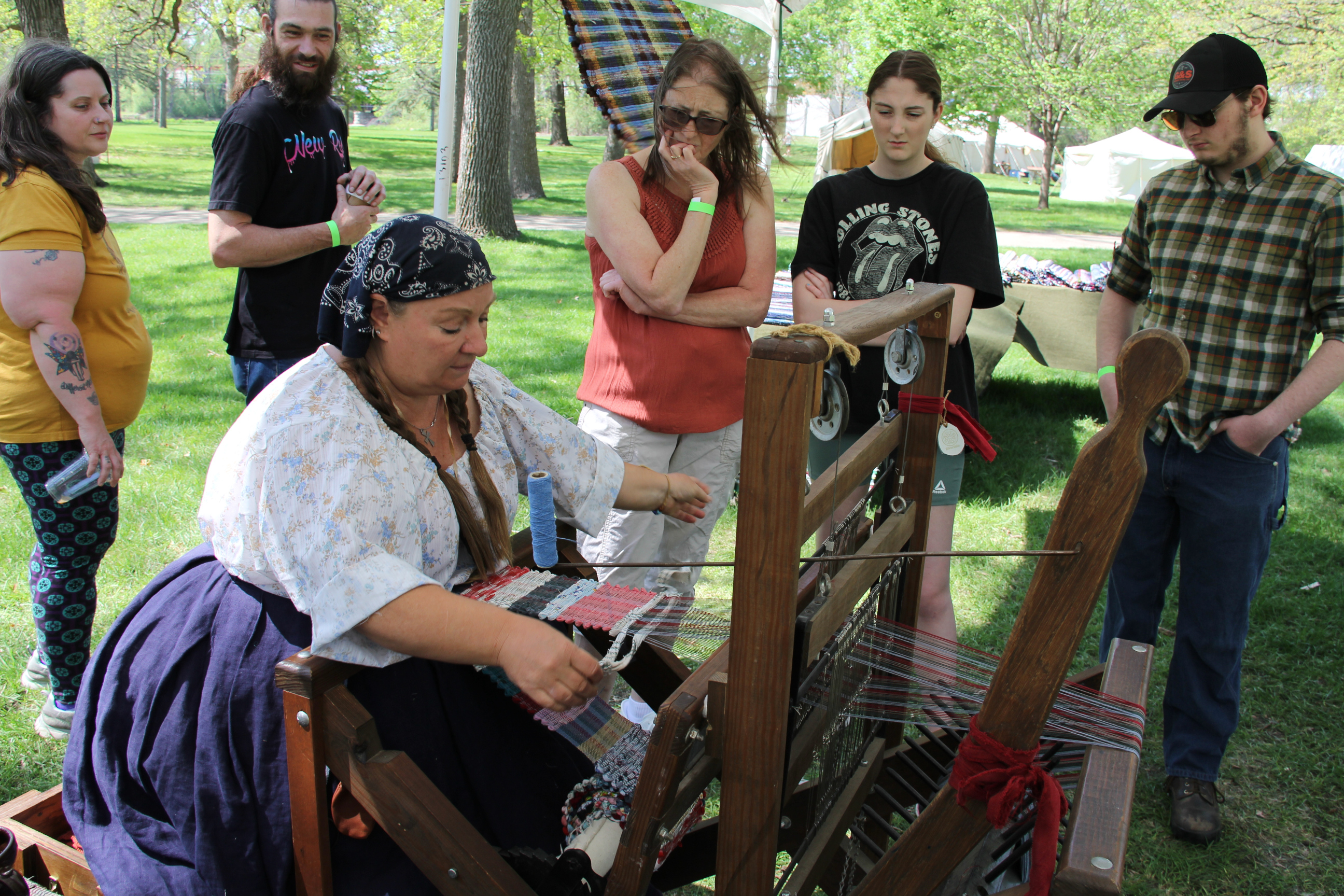
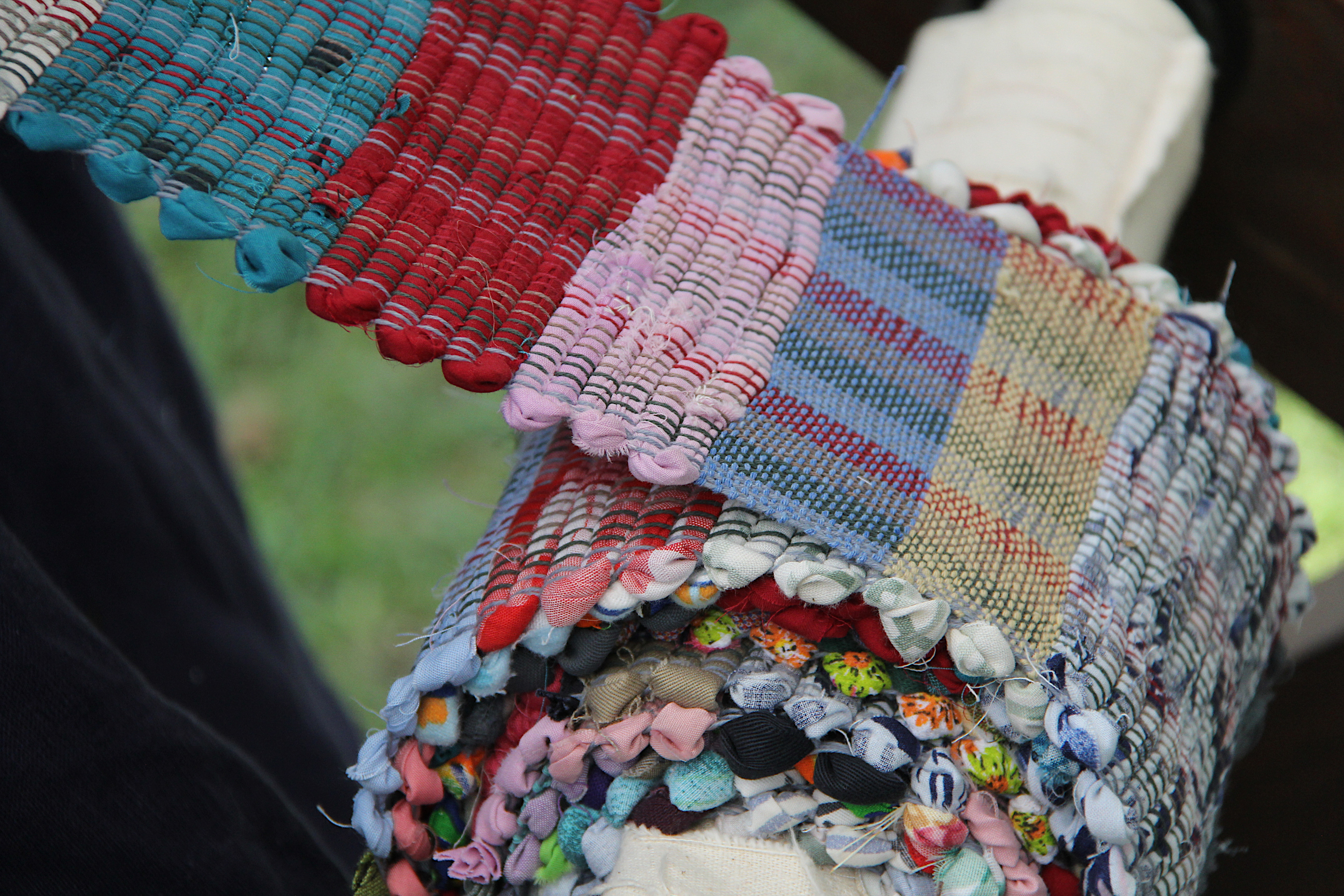
Folks gather around Lori Feltis as she weaves on her portable loom and talks about rug making. She operates Bohemian Rag Rug Studio near Stewartville. My grandkids enjoyed some hands-on weaving with Lori. (Minnesota Prairie Roots copyrighted photo May 2025)
A narrow strip woven on Lori’s loom. (Minnesota Prairie Roots copyrighted photo May 2025)

I left the hands-on activities to others, including two of my elementary-aged grandkids. They joined many kids trying out new skills, making memories. School classes attended the festival Thursday and Friday. So many lessons taught and learned.

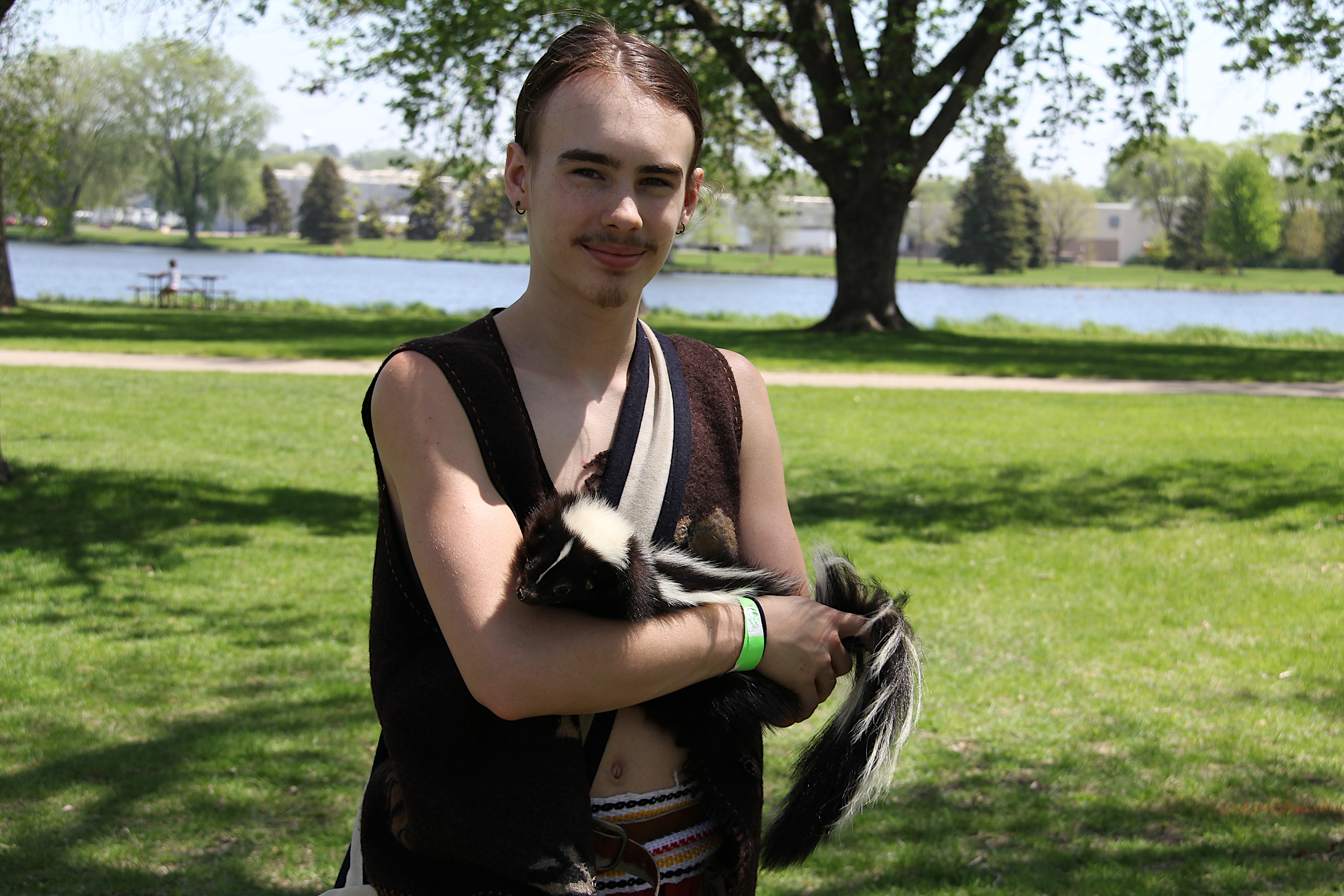
Valin with his “pet” skunk. (Minnesota Prairie Roots copyrighted photo May 2025)

My biggest personal lesson of the day came in an unexpected way, and not until I arrived home. While walking from one tent to another at the Rendezvous, I crossed paths with Valin cuddling his pet skunk. I’d never seen a real skunk up close and I was rather excited to photograph Little Stinky. I even called my husband over for a close-up look. Valin assured me Stinky’s stinky part had been removed. Back home, Randy revealed to me that Little Stinky was a pelt. “Didn’t you see his (Valin’s) hand underneath moving the skunk?” Uh, no. I can only imagine the story Valin told around the evening campfire about the lady who thought his skunk was alive. This is now the stuff of laughter and legend for my family. Lesson learned: Everything is not as it appears.

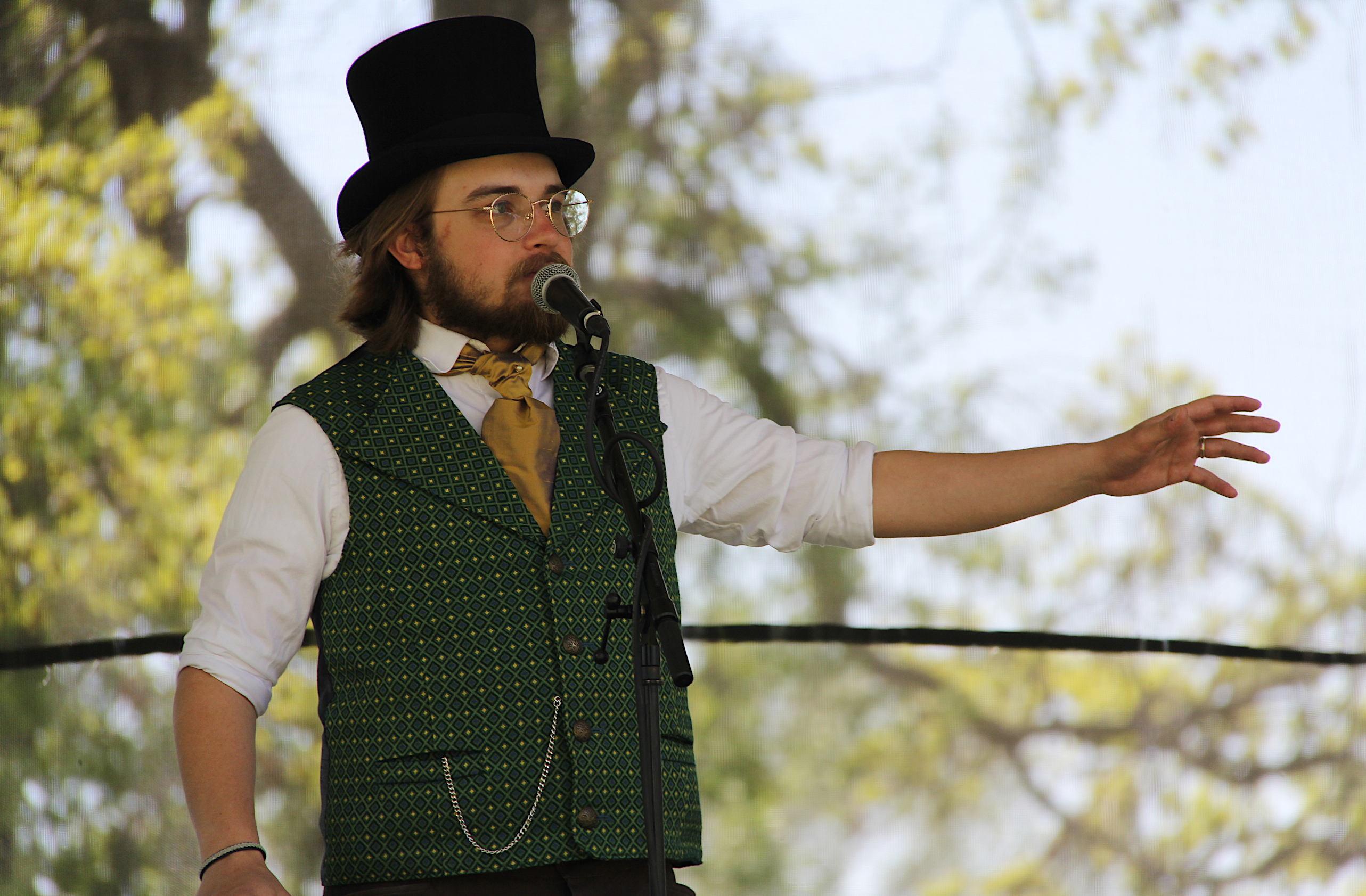
Sam Temple presented about early Minnesota history with a focus on Faribault. (Minnesota Prairie Roots copyrighted photo May 2025)

That humorous moment aside, I did appreciate the honest and informative storytelling of local historian and documentary filmmaker Sam Temple. Smartly attired in a top hat and dress clothes, he talked about early Minnesota, about Indigenous Peoples, about the illegal French Canadian fur traders who came here first—about their relationship of interdependence and co-existence with Native Peoples and how a new mixed race culture developed.

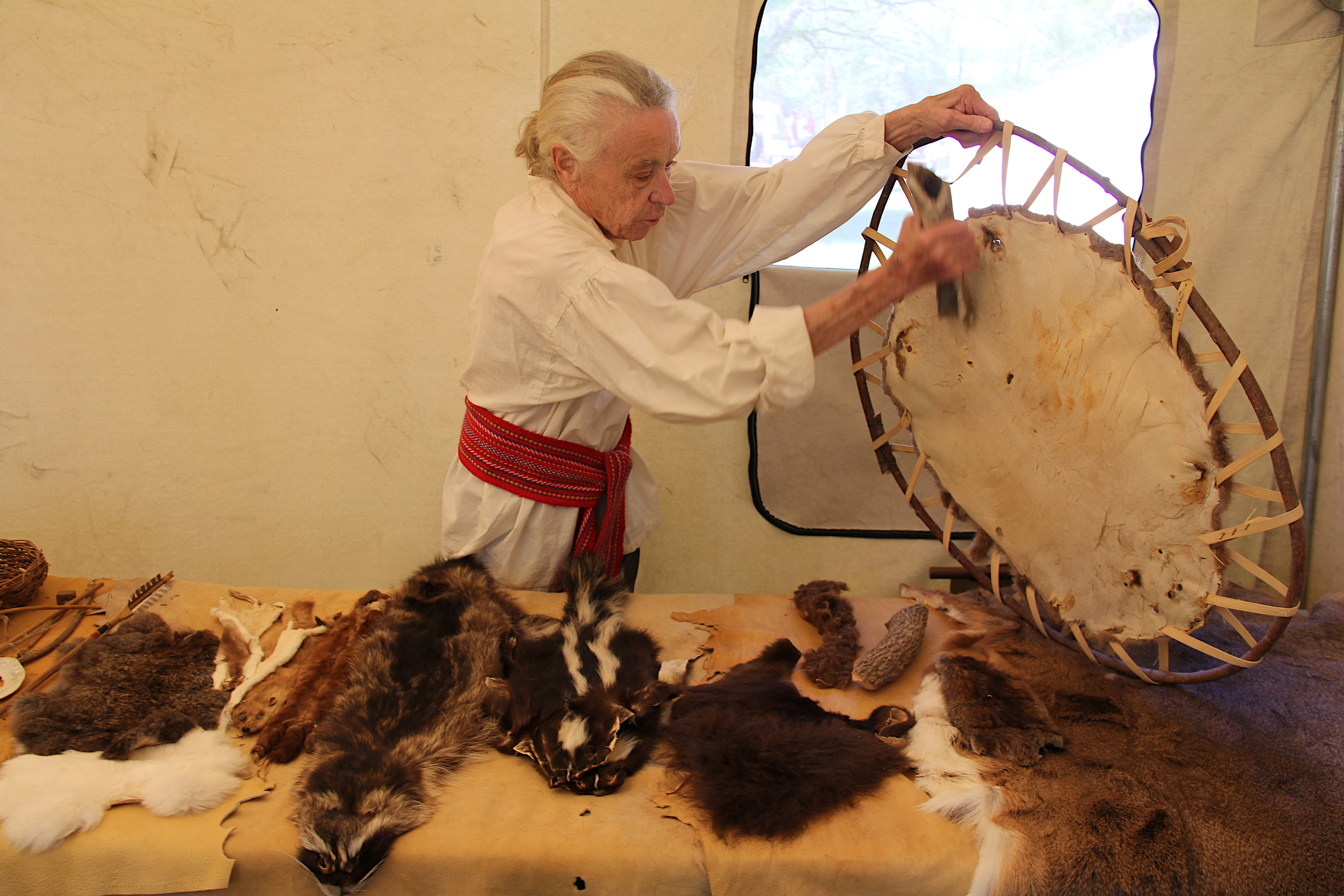
Scraping a beaver hide, the woman in this tent focused on the Dakota, their connection to nature and how that wove into their way of living. They traded furs for goods. (Minnesota Prairie Roots copyrighted photo May 2025)

Temple shared much more before shifting his focus to Faribault town founder Alexander Faribault, of mixed race (his mother was part Dakota) and a licensed fur trader by age 21. Alexander arrived in a multi-cultural community with “a foot in both worlds,” Temple said. Wood-frame houses and teepees stood side-by-side. As I listened, I considered my multi-cultural community today. Getting along, but not always. By the time Alexander Faribault, who was historically-influential both locally and state-wide, left Faribault, “the teepees were missing and his mother’s culture was gone,” Temple said.

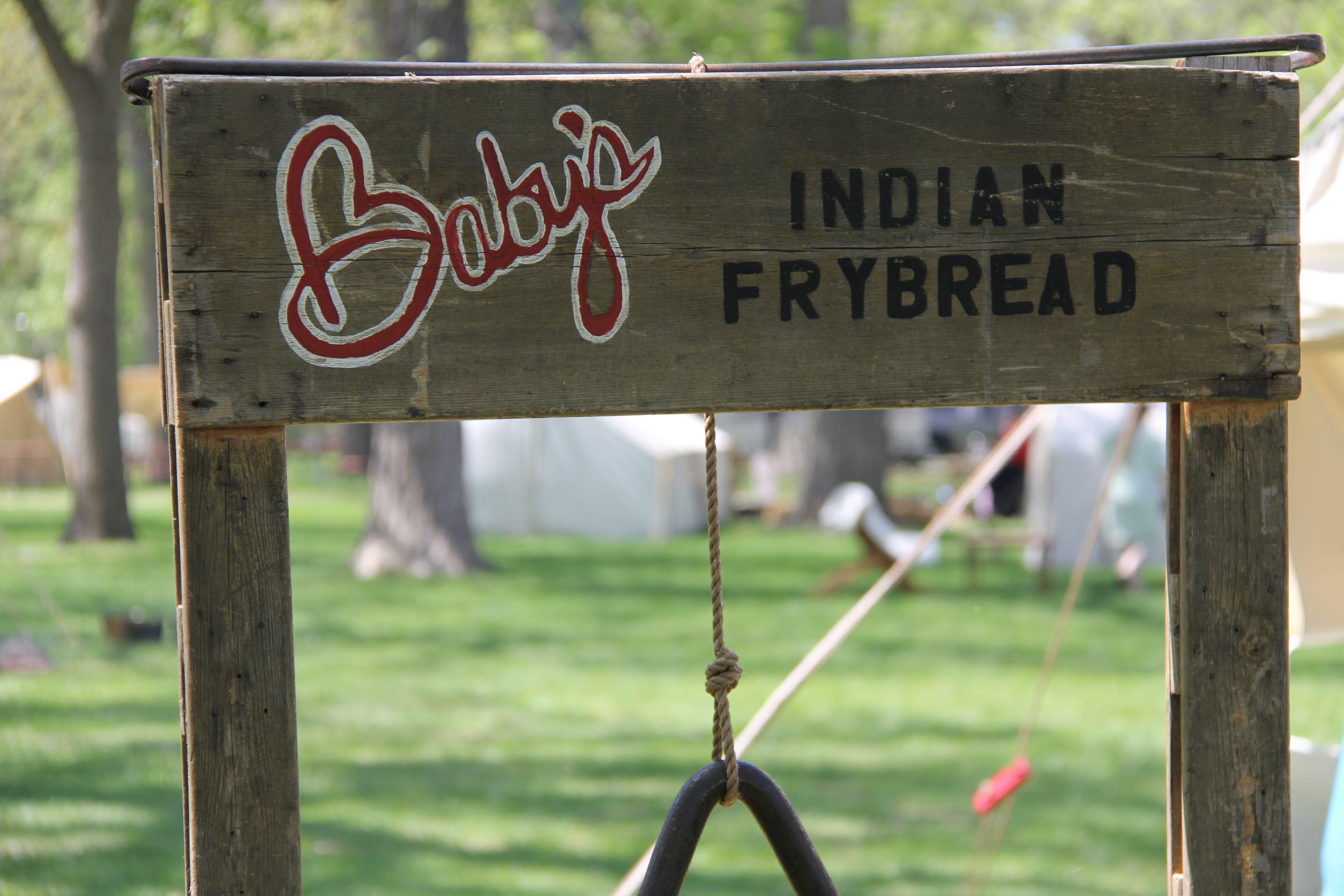
There were several food and beverage vendors on-site, with Baby’s Indian Frybread proving especially popular. (Minnesota Prairie Roots copyrighted photo May 2025)

If there’s something else I learned while attending the Rendezvous it is that I absolutely love fruit-filled Indian frybread, which I’ve not previously eaten. The sugar-topped pie-like dessert oozed blueberry filling and cream cheese. It was beyond decadent.

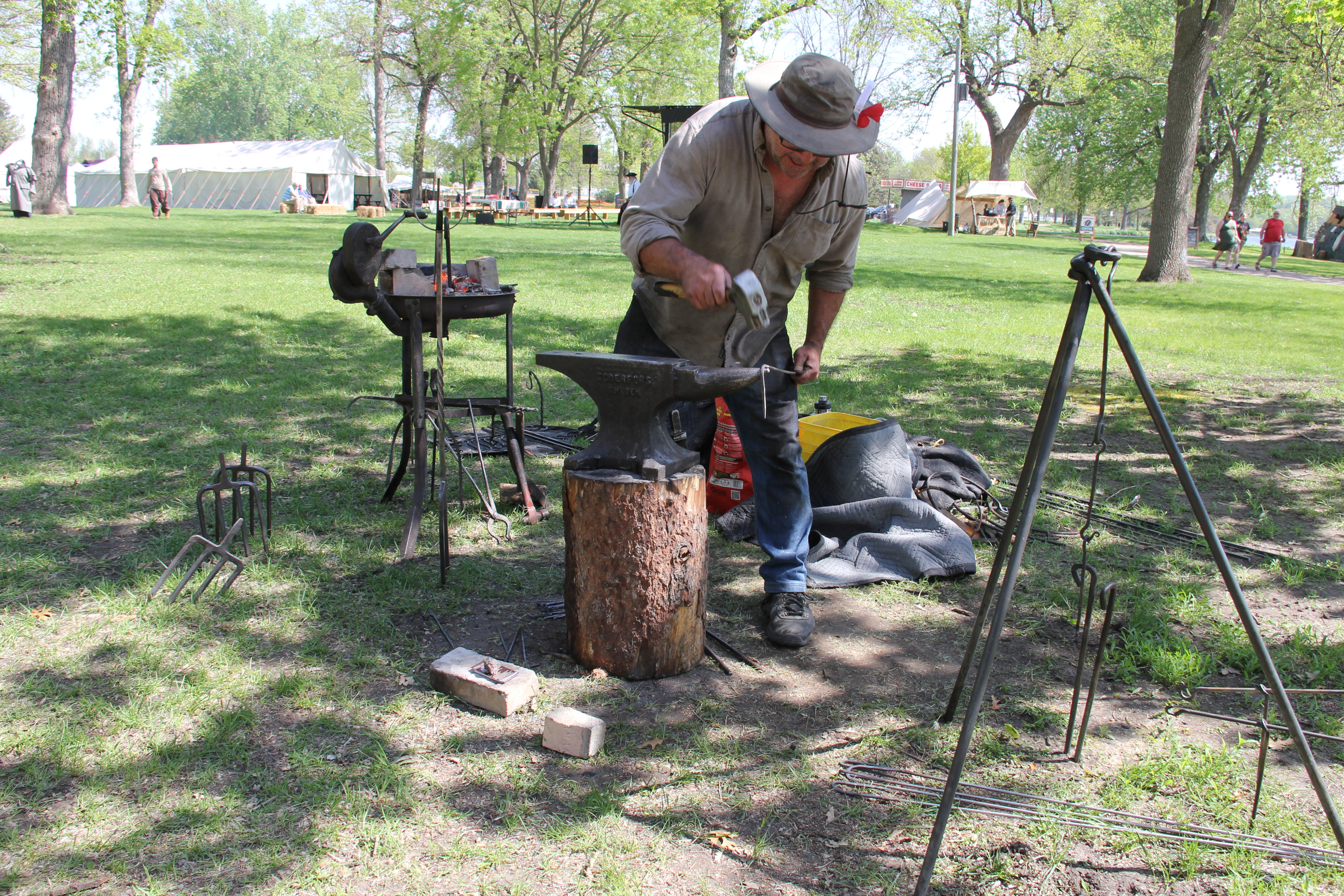
A blacksmithing demonstration. (Minnesota Prairie Roots copyrighted photo May 2025)

As much as I loved frybread and Little Stinky, the good folks who participate in history fests like the Riverside Rendezvous assuredly love stepping back in time. Their passion and desire to present the past in a way that engages people in history was something I felt, saw, heard while moving from tent to tent, space to space. To be part of this proved a cultural, historic experience, growing my knowledge and appreciation of those who shaped Minnesota and Faribault, this place I call home.

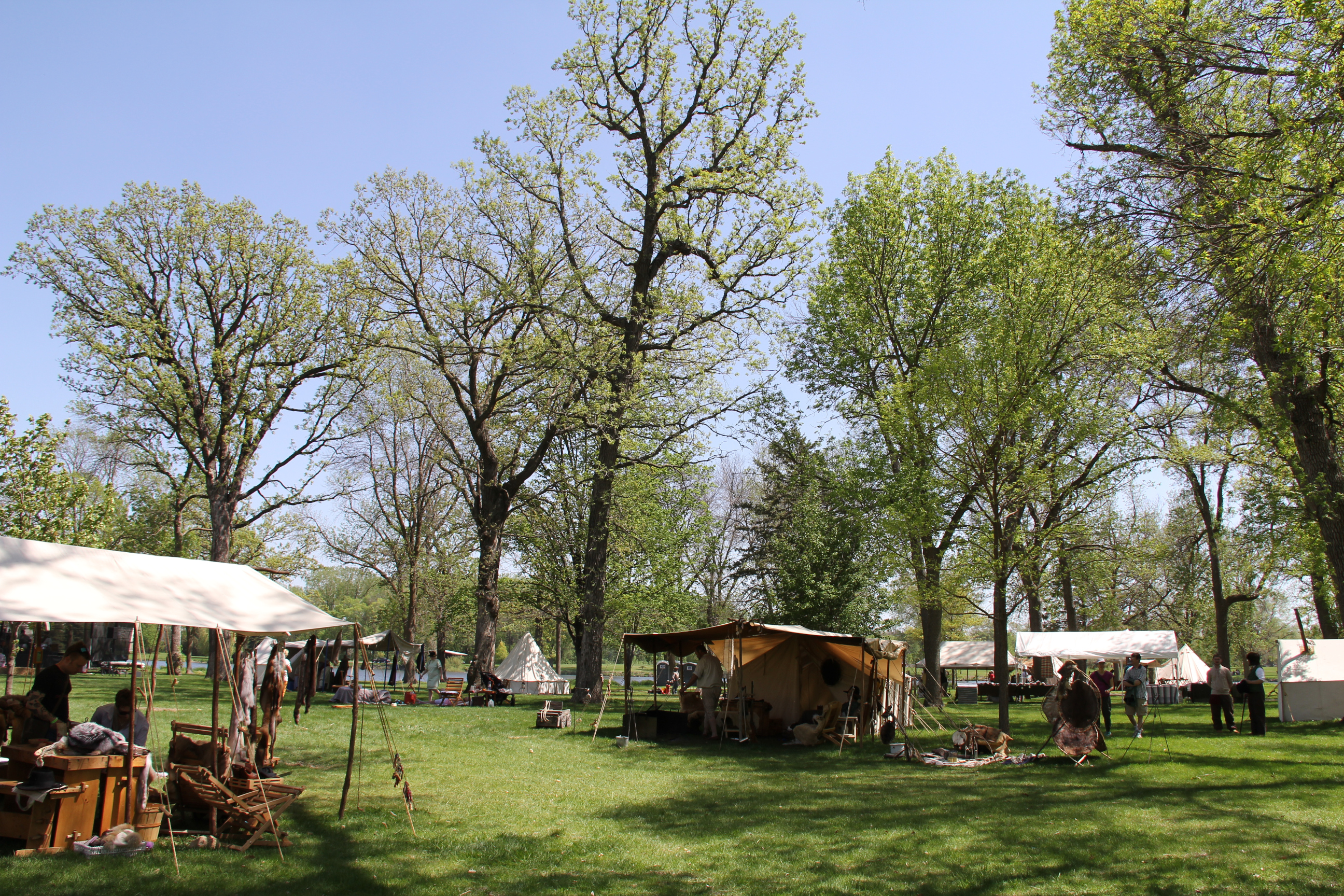
Tents were scattered across the spacious, shady grounds of riverside North Alexander Park. (Minnesota Prairie Roots copyrighted photo May 2025)

FYI: Please check back for more photos from the Riverside Rendezvous and History Festival in Faribault. This year’s Rendezvous was so successful that the Rice County Historical Society is planning a second one for 2026, but a weekend later so the event does not fall on Mother’s Day and the fishing opener weekend.

© Copyright 2025 Audrey Kletscher Helbling
 

Experience yesteryear at Riverside Rendezvous & History Festival in Faribault May 8, 2025

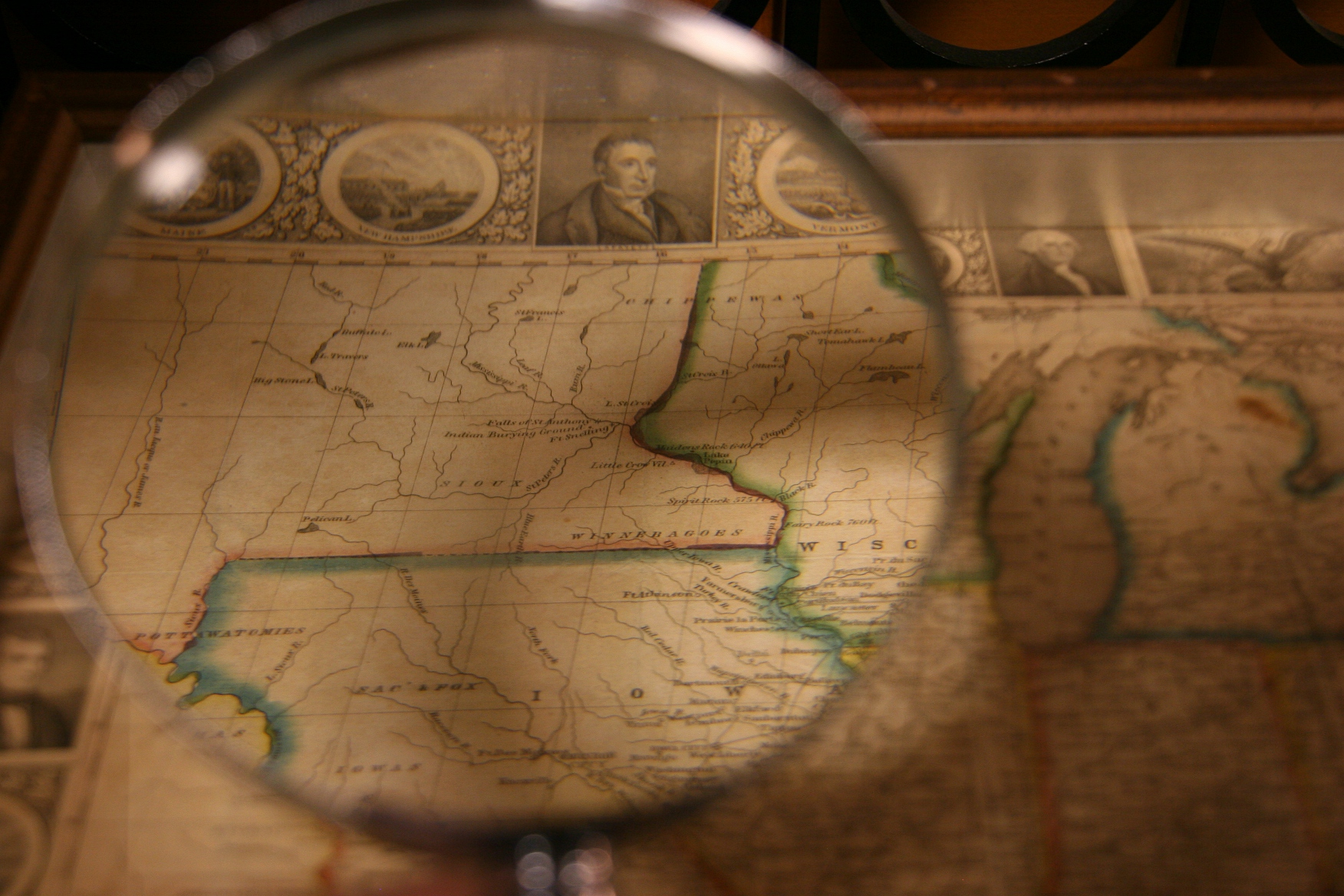
An1849 map of Minnesota Territory and more as seen through a magnifying lens inside the Rice County Historical Society Museum. Minnesota became a state in 1858. (Minnesota Prairie Roots copyrighted file photo)

HISTORY COME TO LIFE appeals to me because of the immersive experience. I learn better, retain more, when I can engage. This weekend offers ample opportunity to get into history at the Rice County Historical Society’s first-ever Riverside Rendezvous and History Festival along the banks of the Cannon River in Faribault’s North Alexander Park.

A scene inside an 1856 log cabin during a past living history event at the Rice County Historical Society. This weekend’s festival will be outdoors in a park in an encampment type setting. (Minnesota Prairie Roots copyrighted file photo)

Organizers promise that the trades, traditions and history of the 18th and 19th centuries (1701-1900) will come alive via hands-on activities, demonstrations, workshops, storytelling, music and special events. Hours are 9 a.m.-5 p.m. Saturday, May 10, and Sunday, May 11. Mothers get in free on Mother’s Day. Otherwise ticket prices are $10 for adults, $5 for children 6+ and $30 for a family pass.

Admittance buys you a whole lot of history-based entertainment, knowledge and fun. For example, the hands-on history happening all day both days includes candle making, rope making, tomahawk throwing, historic toys and games, quill making, log cutting and shops at which to shop, not trade.

This sculpture of Alexander Faribault and a Dakota trading partner stands in Faribault’s Heritage Park near the Straight River and site of Faribault’s trading post. (Minnesota Prairie Roots copyrighted file photo)

But you can learn about the fur trade at noon either day as local historian and documentary filmmaker Sam Temple talks about town founder Alexander Faribault and the fur trade. Todd Finney, a descendant of the Wahpekute band of the Dakota (original inhabitants of the land which is now Rice County), will speak at 3 p.m. Saturday and again at 11 a.m. Sunday about the Wahpekute Dakota.

On that same storytelling stage, musicians The Roe Family Singers, The Skally Line, Hannah Flowers, and Curtis and Loretta will perform at various times throughout the festival.

You can learn about hat making, pirates (yes, pirates with MN Jack Sparrow), historic clothing and weapons, things that do and don’t go boom, Civil War medical care and more during workshops and demos.

And then there are four special events, the first a Cane Pole Fishing Tournament starting at 10 a.m. Saturday. Bring your cane pole, not your rod and reel. Some cane poles will be available for participants. Saturday also brings Voyageur Games at 1 p.m. On Sunday, there’s a Tomahawk Throwing Competition at 1 p.m. followed by a Log Cutting Contest at 3 p.m.

I’ve never attended a rendezvous, so I have nothing with which to compare this event. But just reading through the schedule, I’m excited to take in this history festival with my two elementary-aged grandchildren, their parents and my husband. I expect we will all learn a lot and make some great memories.

Vendors will be selling food and beverages. (Minnesota Prairie Roots copyrighted file photo used for illustration only)

One more thing, food and beverages will be available for purchase, the food being cheese curds (no festival is complete without that deep fat fried fair food), hot dogs, corn dogs, assorted frybreads, and candy and fudge.

All in all, the Riverside Rendezvous and History Festival looks to be an interesting, informative and enjoyable event for history lovers, families and anyone who’s looking for something different to do on a beautiful spring weekend in southern Minnesota.

© Copyright 2025 Audrey Kletscher Helbling
 

Chief Taopi: Man of peace, community leader & more April 21, 2025

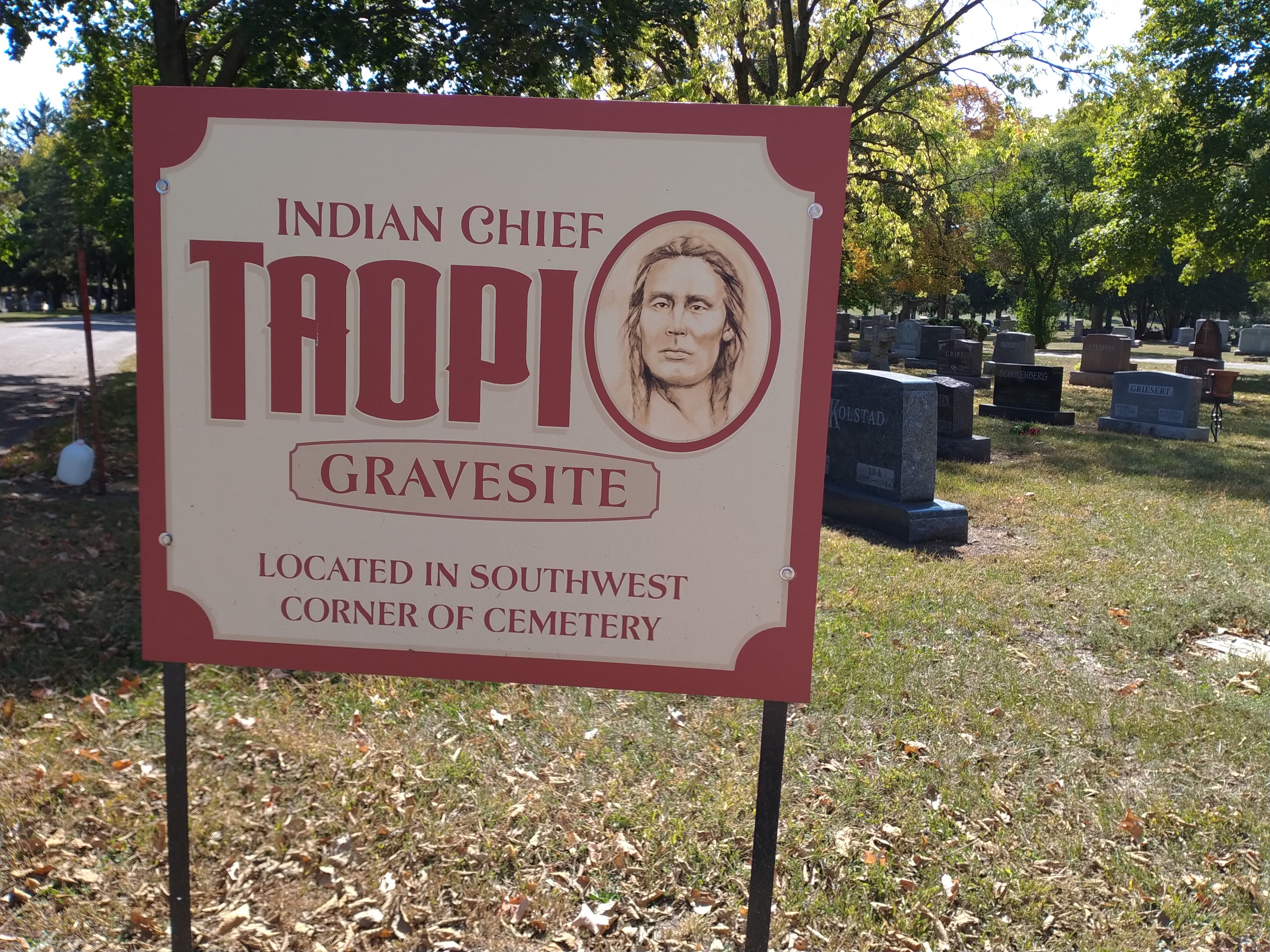
Prominent signage at Maple Lawn Cemetery directs visitors to the gravesite of Chief Taopi, “Wounded Man.” He was wounded in a battle with the Ojibwe. (Minnesota Prairie Roots copyrighted file photo)

HE FOUND HIMSELF AT ODDS with his own people. A “Farmer Indian” among “Blanket Indians.” A peace promoter among those who favored war. He was Chief Taopi, a member of the Little Crow Band of the Mdewakanton Dakota. He’s buried in Faribault, at Maple Lawn Cemetery.

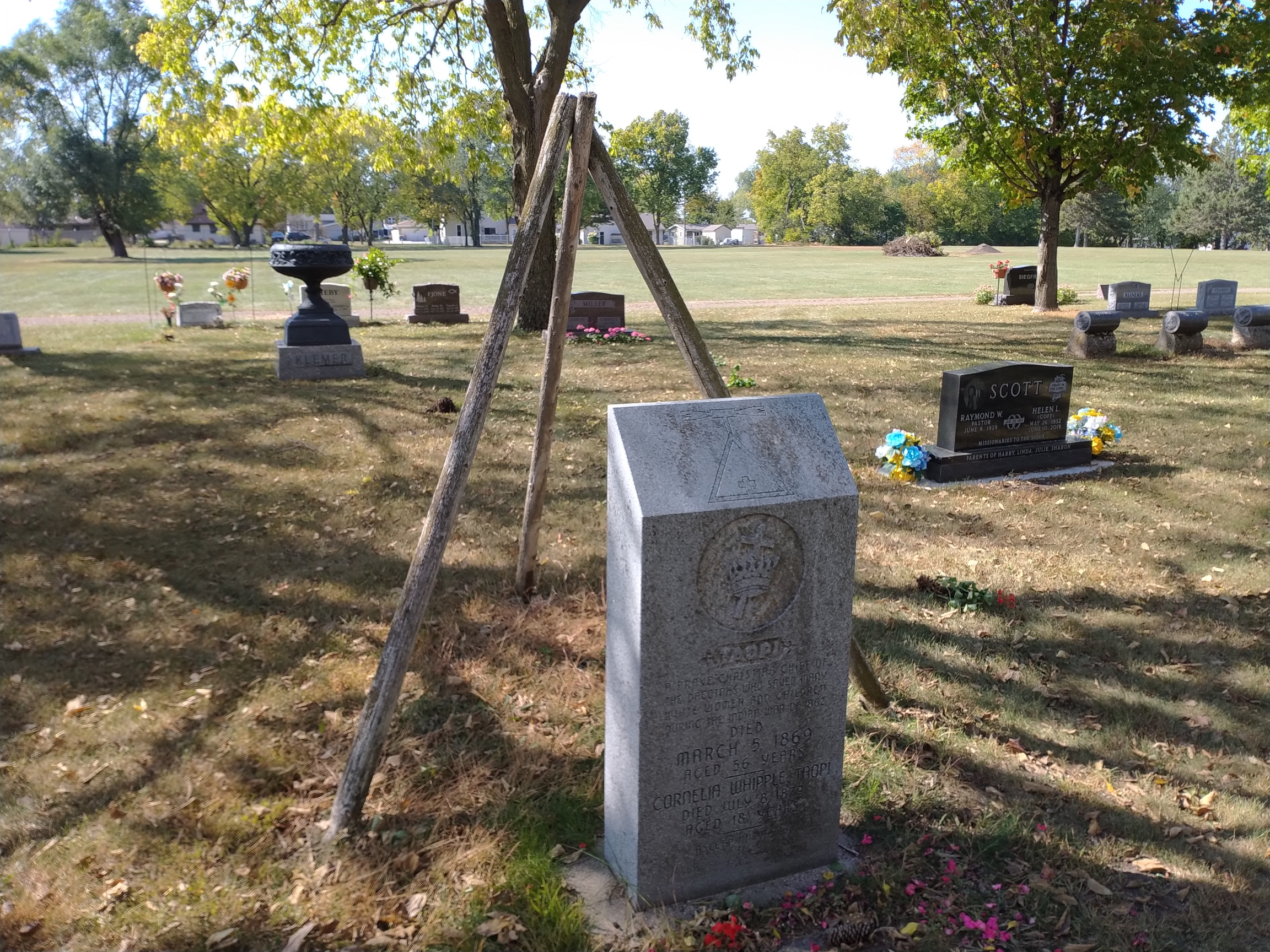
A tipi formation easily identifies the burial site of Taopi and his daughter, Cornelia Whipple Taopi. She died at age 18. He died at 56. (Minnesota Prairie Roots copyrighted file photo)

Recently, I attended a presentation about Taopi by Rice County Historical Society Executive Director Dave Nichols. It’s not the first time I’ve listened to local talks on the history of Native Americans in Minnesota, focused on those who called Faribault home. Each time I learn something new.

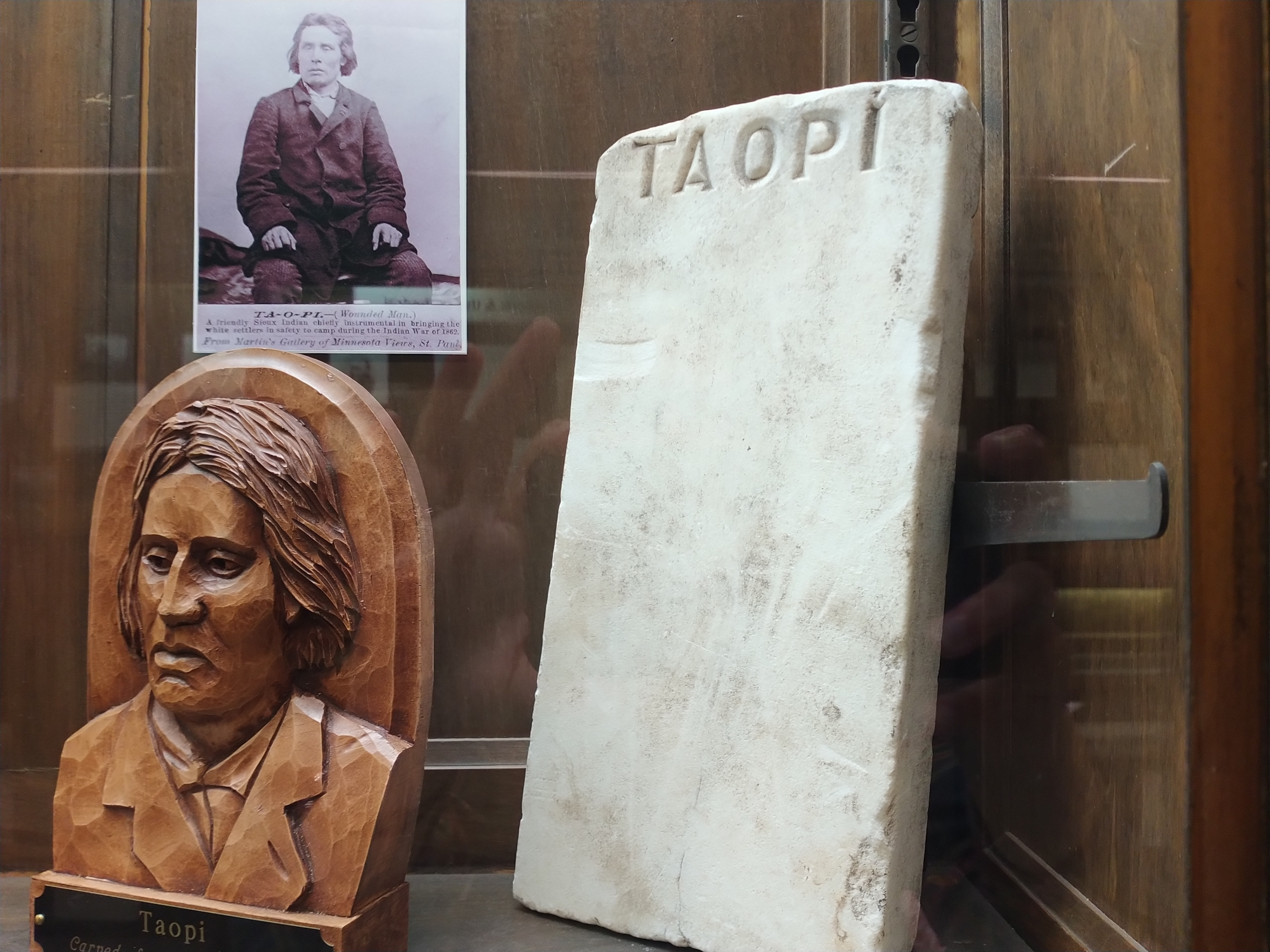
A Taopi exhibit at the Rice County Historical Society. The carving (by Ivan Whillock) and photo show Taopi with short hair as a “Farmer Indian.” (Minnesota Prairie Roots copyrighted file photo)

During his talk, Nichols called Taopi “a poster child for what an assimilated Dakota looks like.” And he didn’t mean that in a negative way. “You either assimilated or you would be destroyed,” Nichols said, qualifying that he wasn’t saying assimilation was right. Understood.

As settlers moved into Minnesota, pushing onto Native lands, the Dakota found themselves facing many challenges. Some, like Taopi, gave up their culture and adopted European ways, believing that was the only way to survive. That included learning to farm as the White man farmed. Taopi was considered the leader of the “Farmer Indians,” a term assigned during the U.S. Census. Dakota who continued in traditional cultural ways were labeled “Blanket Indians.”

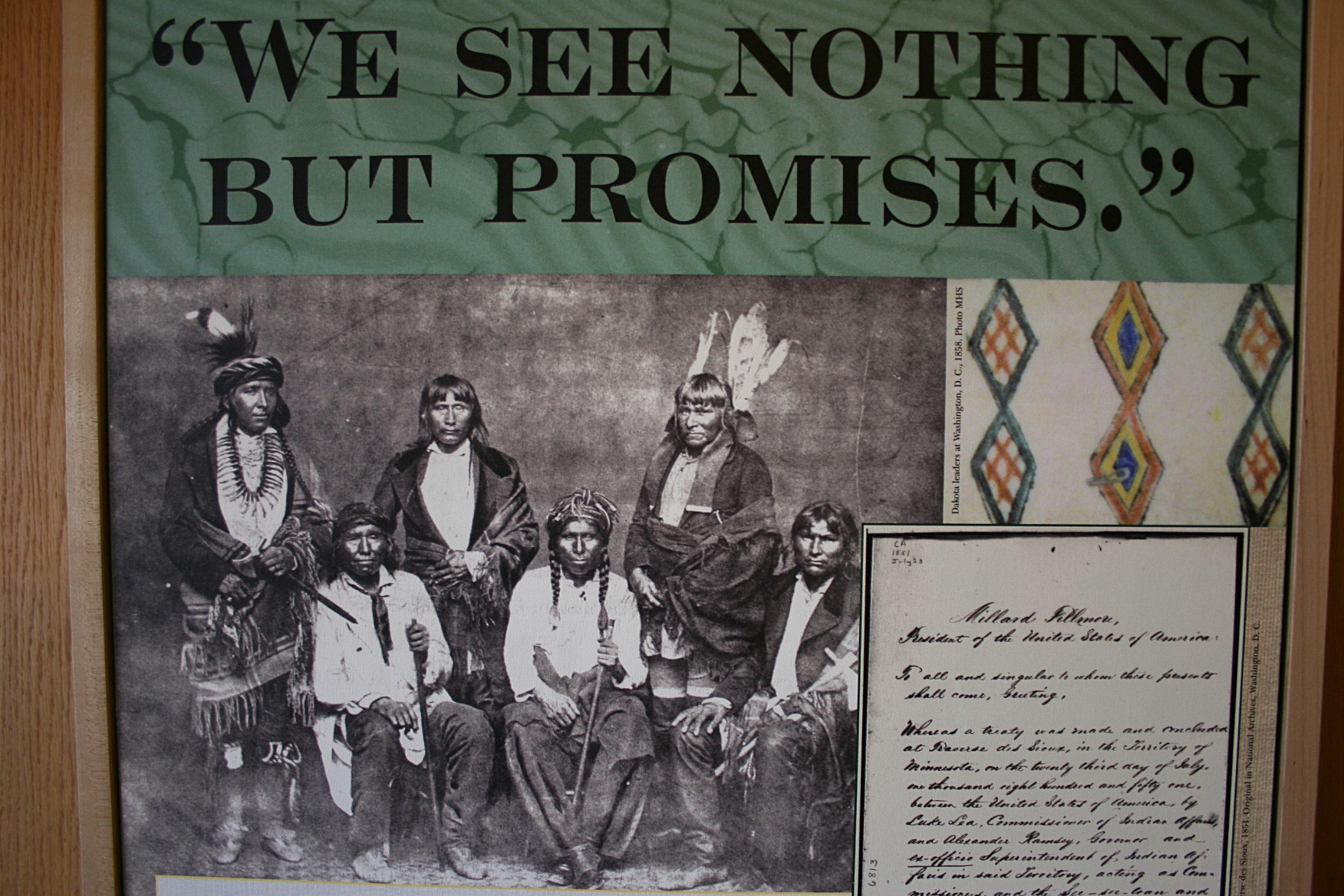
A photo panel at the Traverse des Sioux Treaty Center in St. Peter shows Dakota leaders photographed in Washington D.C. in 1858. The photo is from the Minnesota Historical Society. The war followed broken treaties. (Minnesota Prairie Roots copyrighted file photo)

Taopi farmed and established a school and mission, Hazelwood Republic, with chiefs Wabasha and Good Thunder on the Lower Sioux Reservation along the Minnesota River in southwestern Minnesota, Nichols shared. Because I grew up in that region, I’ve always been particularly interested in the Indigenous Peoples who were original inhabitants of the land, including Redwood and Brown counties. The region became the epicenter of the U.S.-Dakota War of 1862, which centered around issues of land, hunger and broken promises.

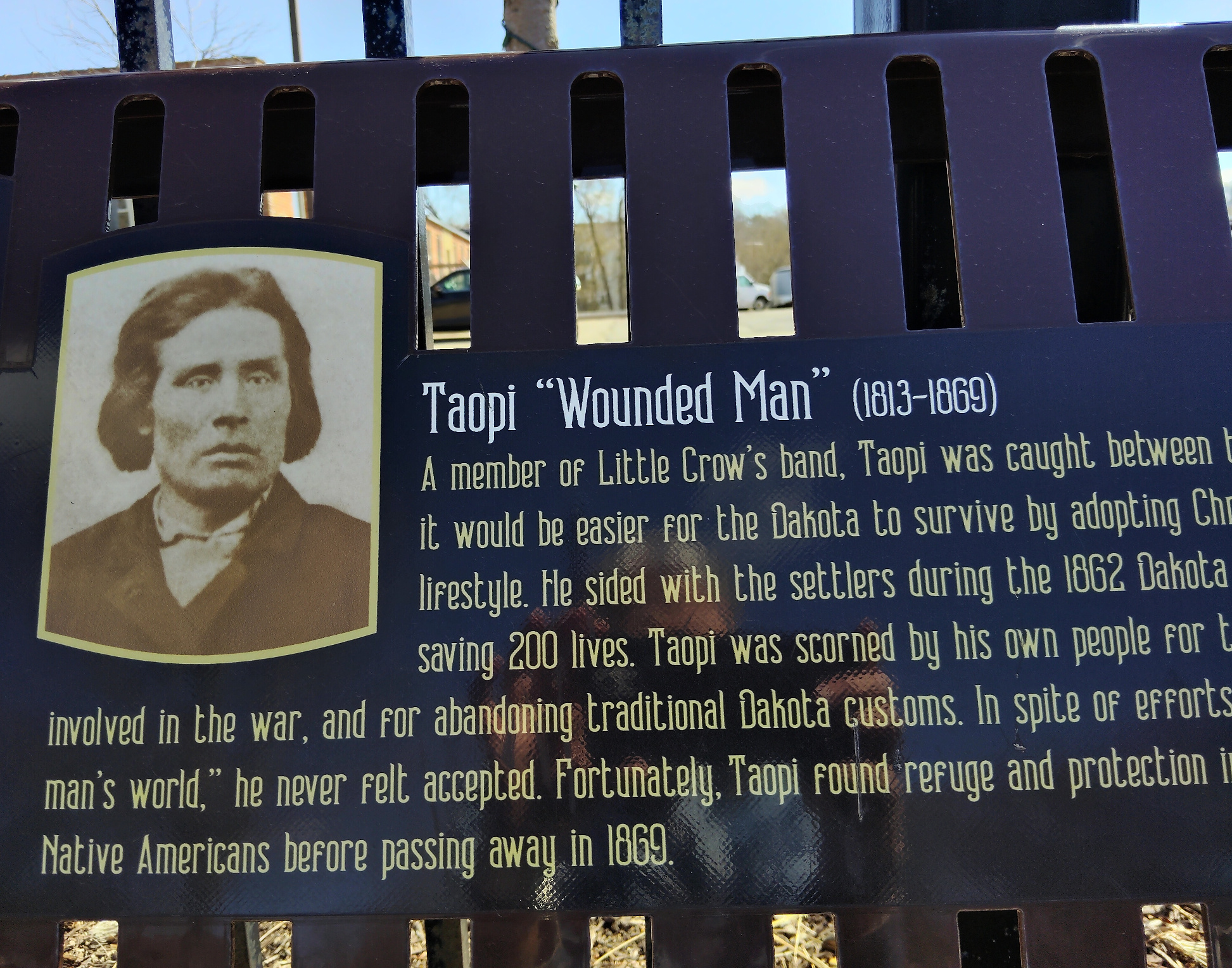
An historic-themed bench on the corner of Central Avenue and Sixth Street in Faribault highlights Taopi. (Minnesota Prairie Roots copyrighted photo April 2025)

That war facilitated the banishment of most Native Americans from Minnesota. If Taopi and other Dakota would have had their way, that war may not have happened. He led the Peace Party opposed to war, while his cousin, Little Crow, led the War Party, Nichols said. Taopi protected White settlers during the short war which claimed countless lives on both sides.

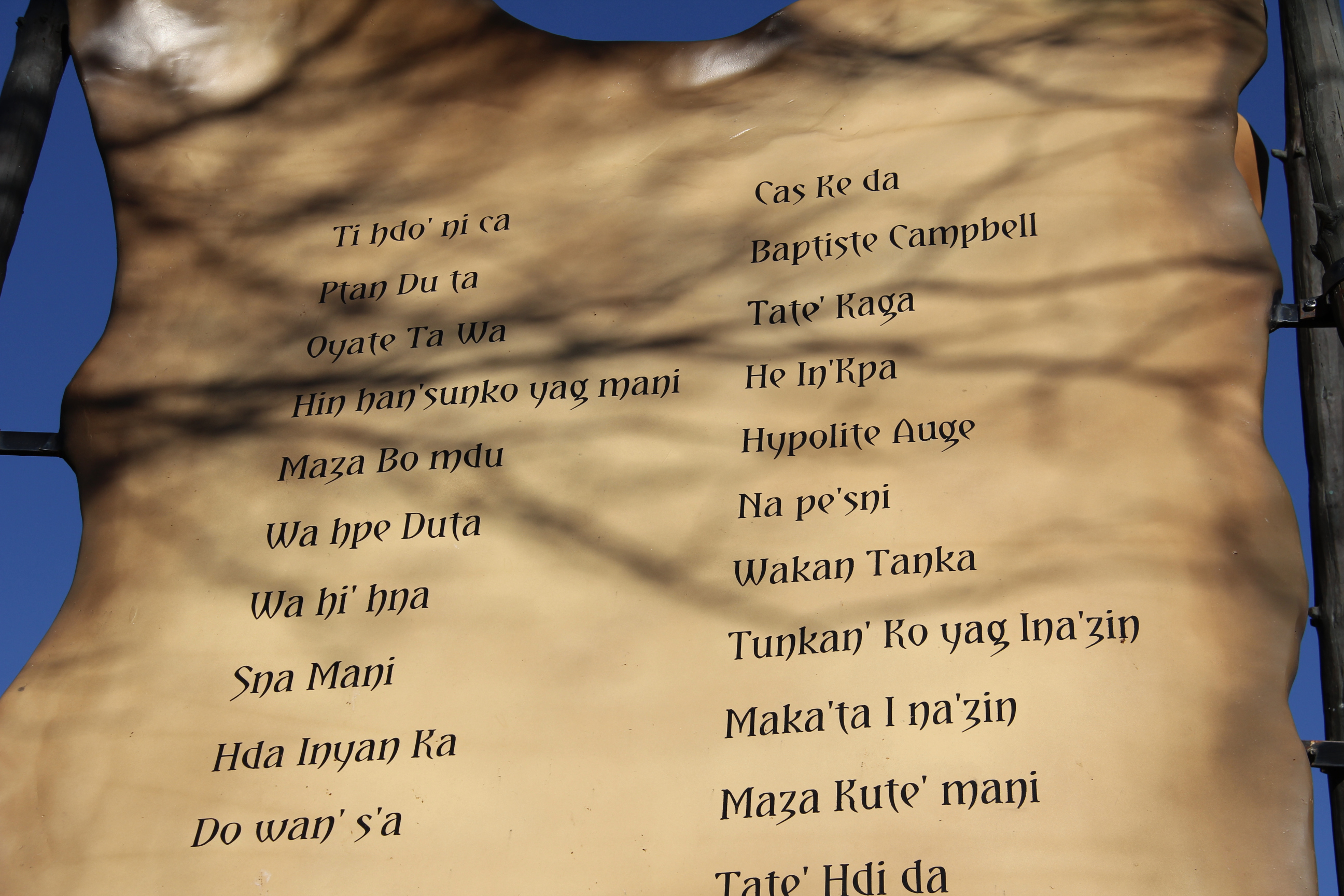
The names of the Dakota who were hung are listed at Reconciliation Park in Mankato. (Minnesota Prairie Roots copyrighted file photo)

Post-war, though, it mattered not to the U.S. government whether you were a Dakota person who opposed the war or who engaged in war, according to Nichols. All were considered guilty, imprisoned and eventually exiled from Minnesota (although not the Mdewakanton). Thirty-eight Dakota men were hung on December 26, 1862, in Mankato (40 miles from my community) during the largest mass execution ever in the U.S. It’s truly a tragic event in Minnesota history. But what multiples the awfulness is that 1,600 Dakota prisoners were marched to Mankato to watch the hangings before being marched back to Fort Snelling. That was new information I had not previously heard and it troubles me greatly.

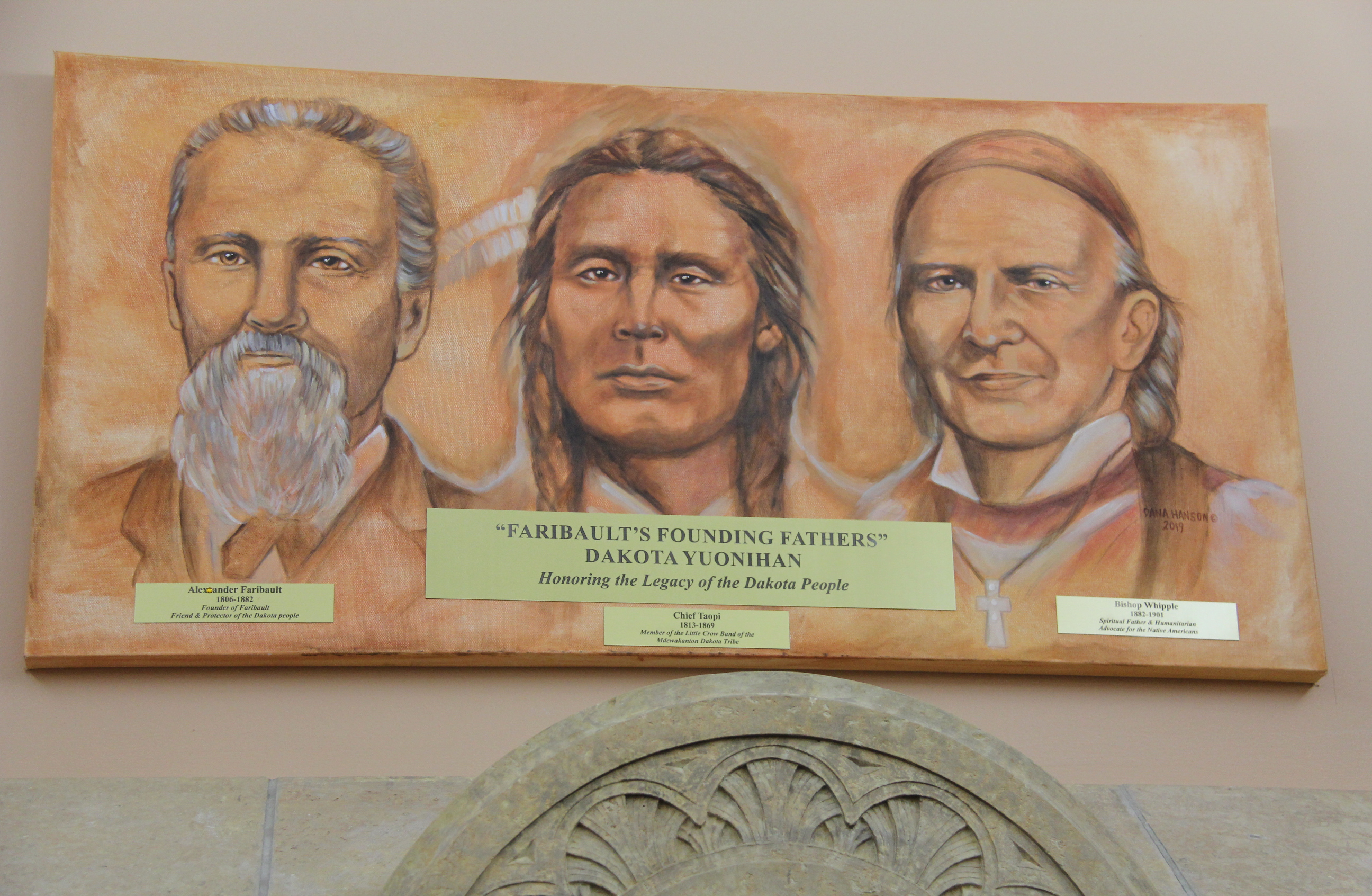
These portraits by Dana Hanson of Faribault’s Founding Fathers, Alexander Faribault (left to right), Taopi and Bishop Henry Whipple, hang in Buckham Memorial Library. (Minnesota Prairie Roots copyrighted file photo)

Taopi avoided prosecution and banishment, eventually landing in Faribault with 180 other Mdewakanton. About 80 were family members, according to Nichols. It was his friendship with Bishop Henry Whipple, who had long worked with and advocated for Native Peoples, that brought Taopi here. Town founder Alexander Faribault housed “the Peacefuls,” as the 180 were considered, on his land. They lived in tipis and lodges.

The home of fur trader and town founder Alexander Faribault. (Minnesota Prairie Roots copyrighted file photo 2017)

As you might rightly guess, not everyone in Faribault liked the Mdewakanton living among them. A wall was built in the area around Alexander Faribault’s house to protect them. Taopi became a community leader, said Nichols. As such he represented his people and mediated when necessary.

By the time of Taopi’s 1869 death, 90 of the 180 Mdewakanton who settled in Faribault had already left. But they left behind an imprint upon the land, not necessarily seen or appreciated even today. Yet, efforts are underway to change that with The Faribault Dakota Project. Nichols couldn’t speak specifically to that, only to say that local historian Jeff Jarvis has been working with the Dakota community on how to memorialize and honor the Indigenous Peoples of Faribault. That also includes the Wahpekute Dakota.

Peace Park, a protected Dakota burial site (but unmarked as such) next to the parking lot of Buckham Memorial Library. (Minnesota Prairie Roots copyrighted file photo)

Among the locales discussed by those attending Nichols’ talk was Peace Park, a triangle-shaped slice of property near Buckham Memorial Library. Alexander Faribault donated the land to the city with the stipulation that it never be developed. According to Nichols, the park is a protected burial site, where at least two Dakota are buried. Their bones were unintentionally uncovered in 1874 and then reburied. Today nothing marks that land as a cemetery. Rather a faith-based WWII monument stands in Peace Park. There is no reference to the Dakota. Perhaps some day this will be righted and the land publicly recognized as sacred ground. That is my hope as I continue to learn about the Dakota who once called Faribault home. I am grateful for every opportunity to grow my knowledge of them and their importance in local and state history.

#

FYI: Here are some suggested Dakota-connected places to visit in Faribault: the Rice County Historical Society Museum, Maple Lawn and Calvary cemeteries, the Cathedral of Our Merciful Saviour, a mural on the Central Park Bandshell and information on an historic-themed bench along Central Avenue.

Two fun facts: A small southeastern Minnesota town in Mower County near the Iowa border is called Taopi, named after the Mdewakanton Dakota chief. It suffered a devastating tornado in April 2022. The town celebrates its 150th birthday this year.

A woman attending Dave Nichols’ talk named her horse Taopi after Chief Taopi.

© Copyright 2025 Audrey Kletscher Helbling
 

A rose is not just a rose & other gravestone symbolism March 25, 2025

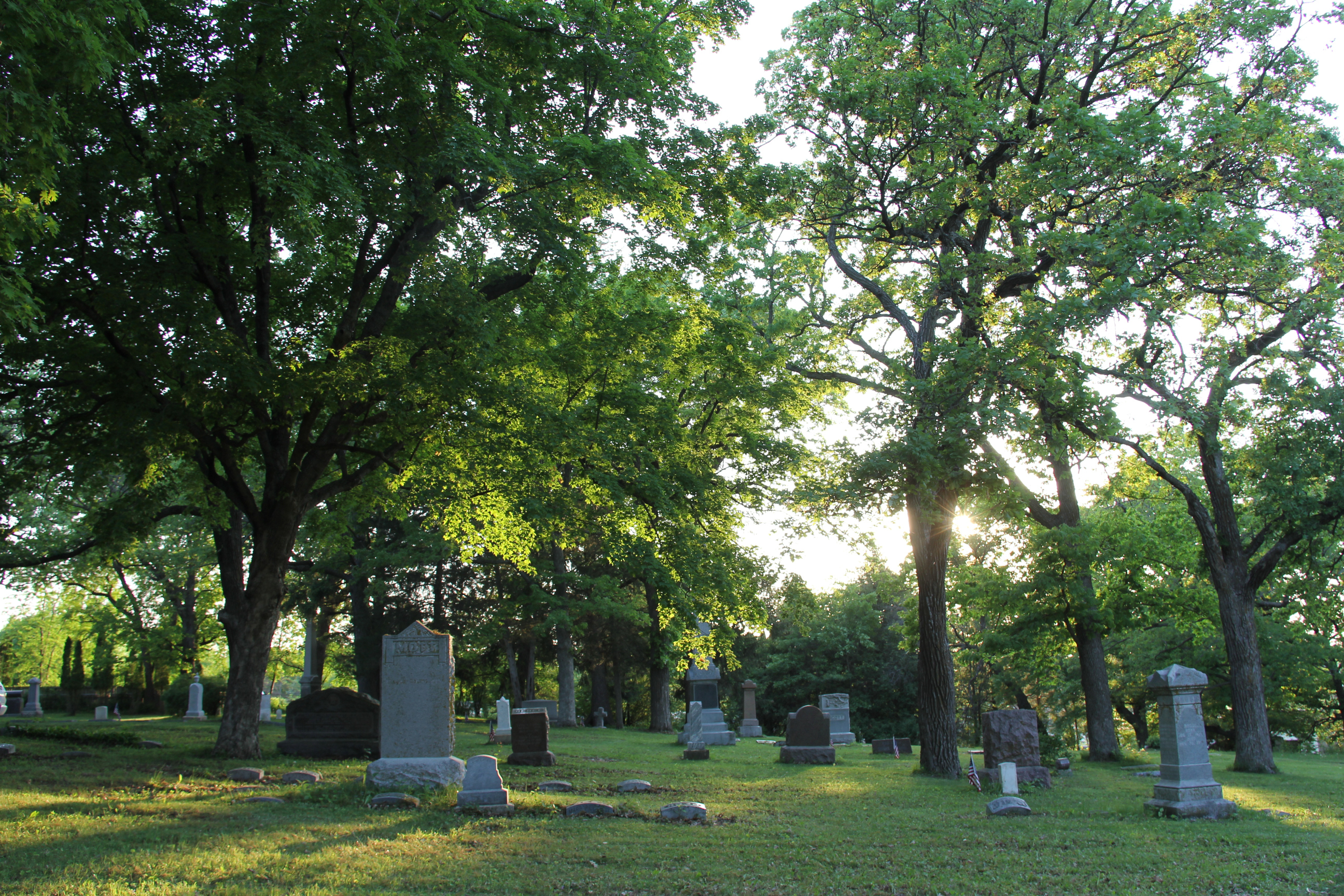
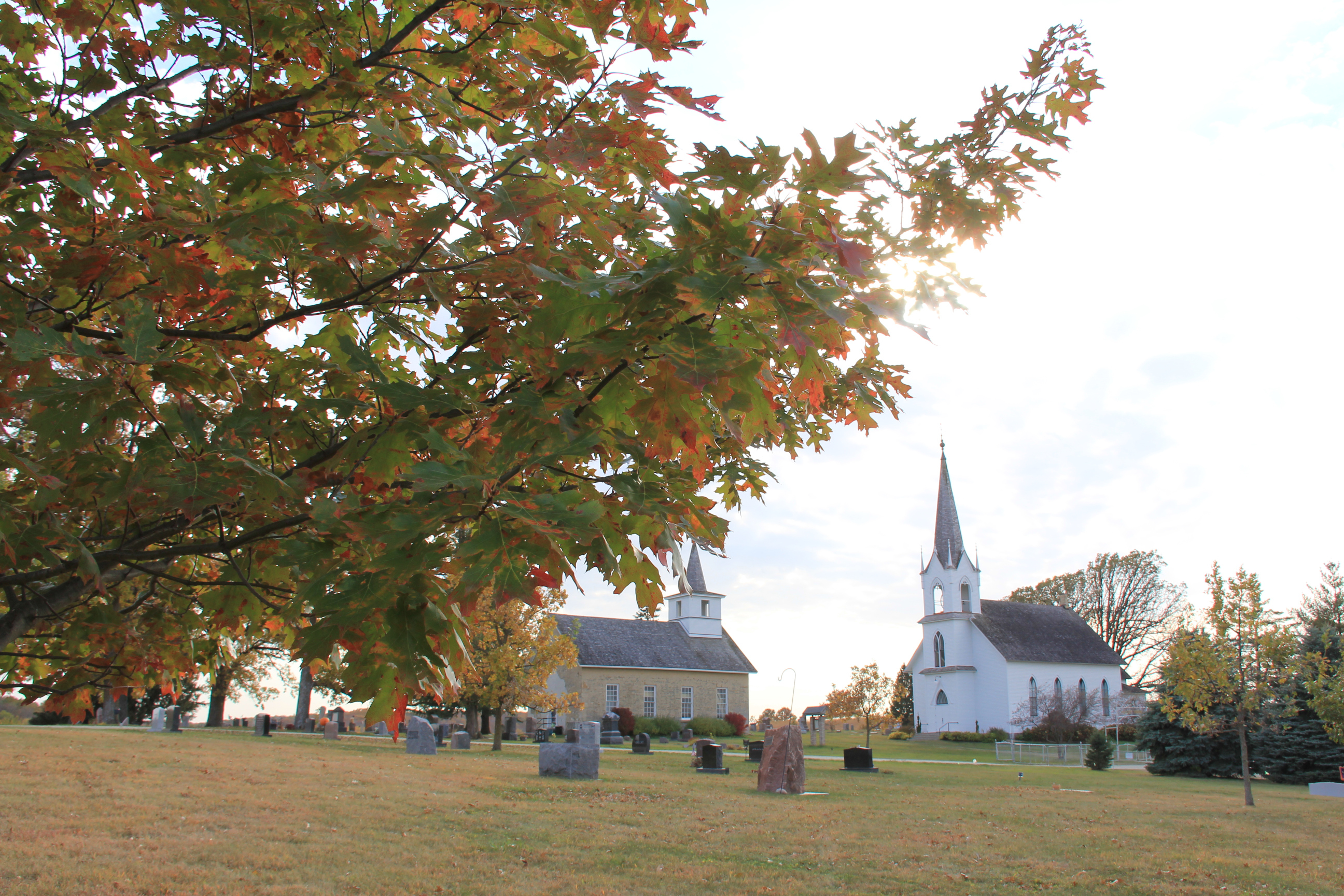
A graveyard surrounds the historic Valley Grove Churches, rural Nerstrand. I’ve walked this cemetery often. (Minnesota Prairie Roots copyrighted file photo)

I’M TRYING TO RECALL when I first began walking through cemeteries while out and about. But I think it started with my interest in old country churches. Cemeteries typically embrace historic countryside houses of worship. Baptized, confirmed, married and buried often defines those rooted in these rural churches. There’s a lot of history to uncover in a graveyard.

An angel sculpture graces the cemetery of St. Patrick Church of Cedar Lake Township, St. Patrick, Minnesota. (Minnesota Prairie Roots copyrighted file photo)

But it’s not just the history that interests me. It’s the art. And the stories, many of which remain unknown, unless you’re familiar with the deceased or connected in some way. Sometimes you can piece stories together by looking at dates, names and inscriptions.

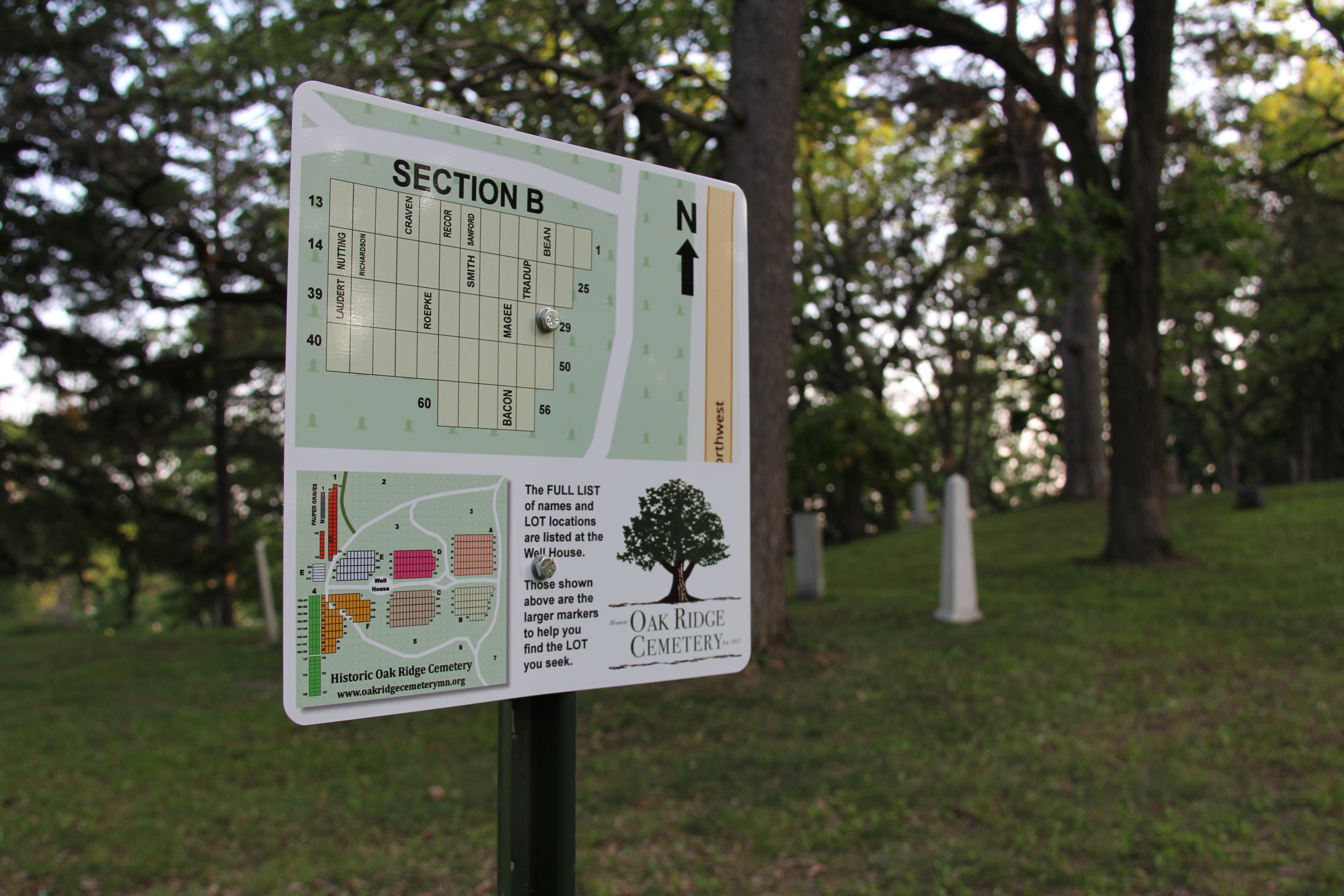
I find signage like this posted at Oak Ridge Cemetery to be helpful when visiting a cemetery. (Minnesota Prairie Roots copyrighted file photo)

As a creative, I’ve always been particularly interested in the artistic side of a cemetery, specifically the art of tombstones. Aged grave markers, most made of marble, feature images and words hand-chiseled by local stone masons. It is those long ago tombstones that focused a recent talk, “Understanding Gravestone Symbols and Icons,” by Oak Ridge Cemetery Association board member Tom Rent. An avid volunteer in the upkeep, preservation and restoration of the cemetery, Rent previously talked at the Rice County Historical Society about preserving Faribault’s oldest cemetery, one of 61 in the county.

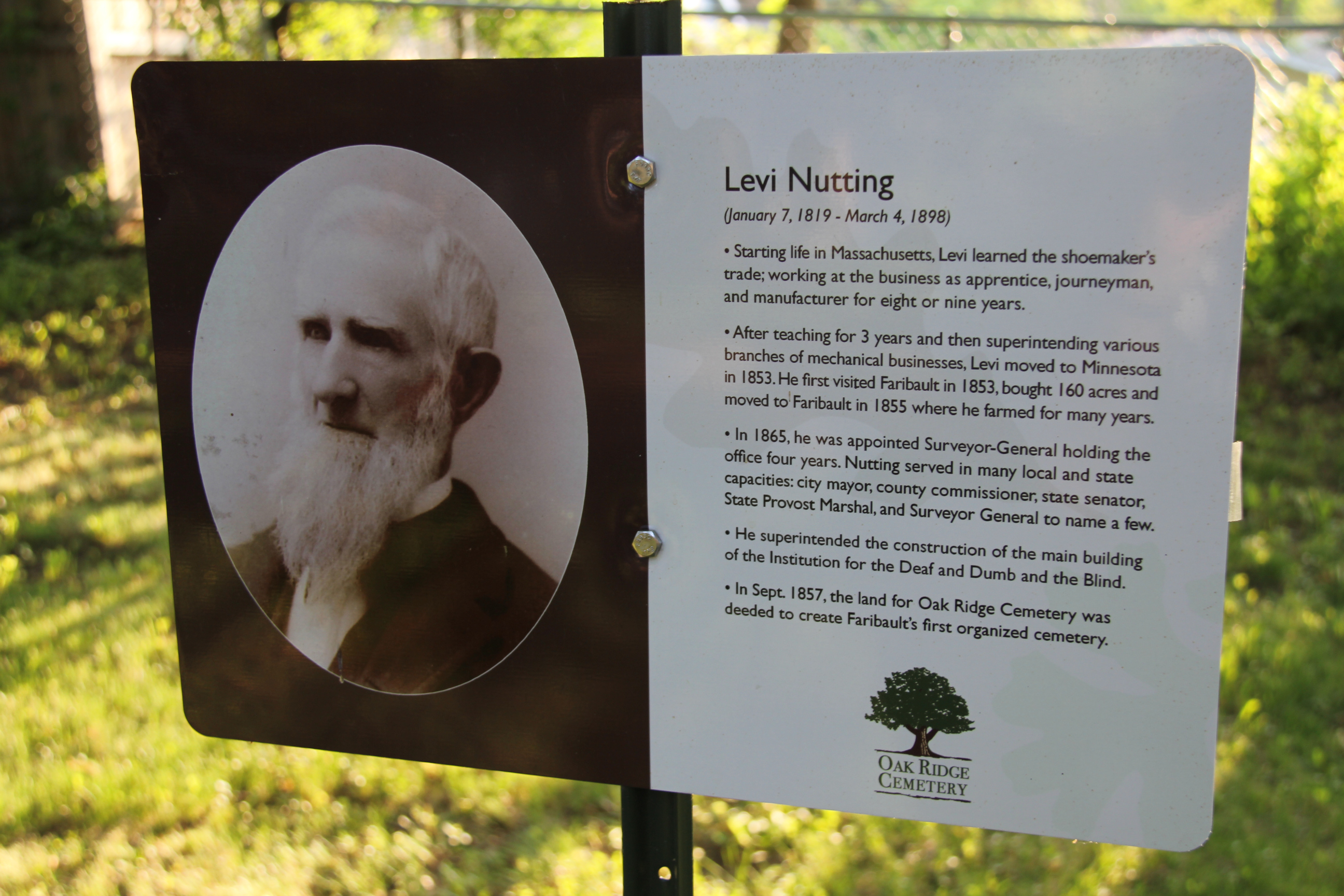
Biographical markers are posted for some notable people buried at Oak Ridge Cemetery. I really like this way of sharing history and people. (Minnesota Prairie Roots copyrighted file photo)

Oak Ridge Cemetery, founded in 1857 on land donated by Levi Nutting, encompasses 10 acres, features 371 family names and is the burial site for 111 veterans, according to Rent. Rebecca Lougee, 29, who died of tuberculosis, was the first to be buried in the incorporated hilltop cemetery in October 1857. Earlier burials occurred before Oak Ridge officially became a cemetery. Many recognizable names from the early days of the Faribault area grace gravestones here: Andrews, Batchelder, Mott, Nutting, Roberds, Sheffield…

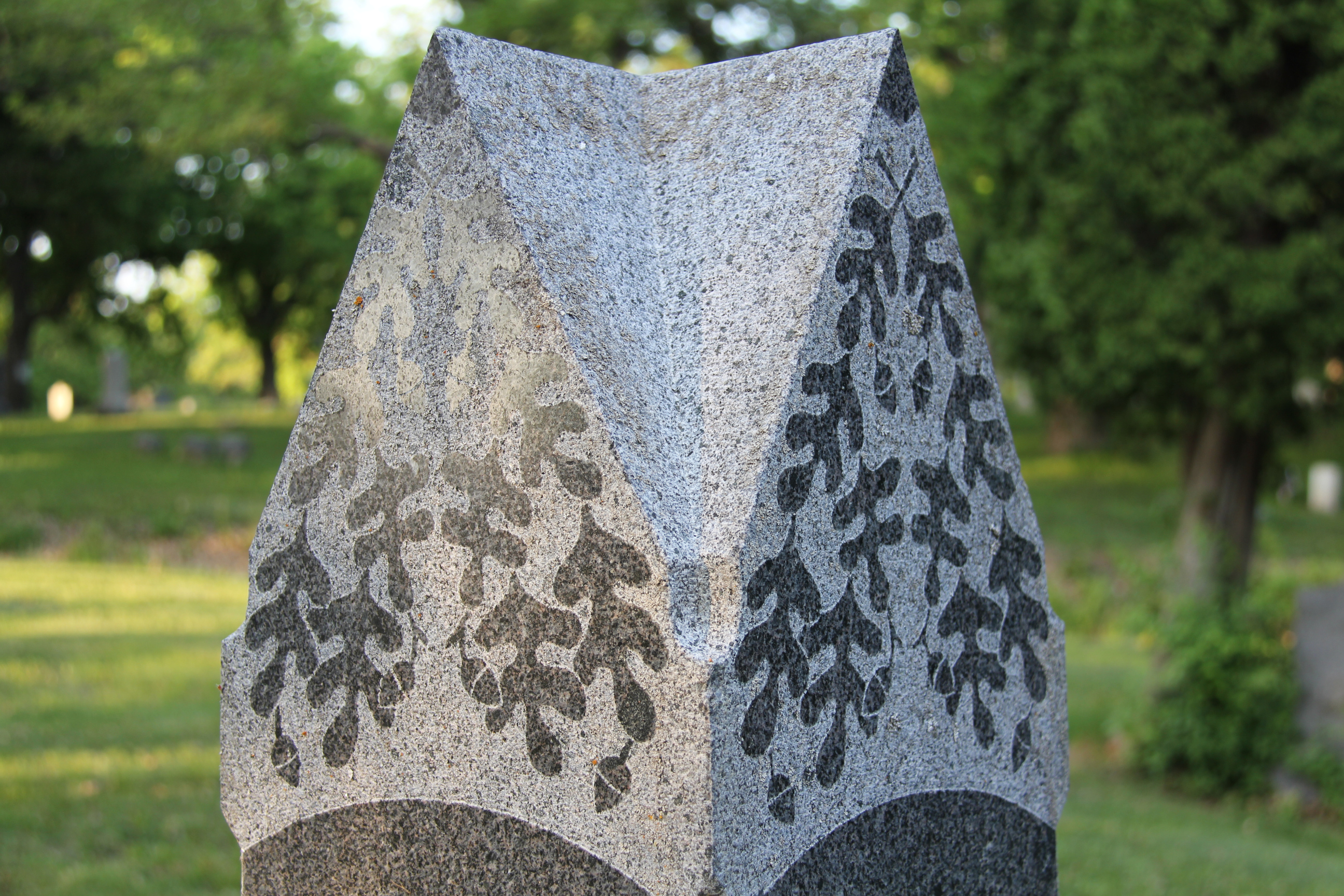
Oak leaves on a tombstone at Oak Ridge Cemetery symbolize strength and power through patience and faith. (Minnesota Prairie Roots copyrighted file photo)

And on many of those tombstones, you will find symbols, a common way of communicating messages back in the day. I’d never really thought much about the meaning of the art I’ve seen on hundreds of aged tombstones beyond recognizing that lambs are on children’s grave markers. That Rent shared his knowledge and passion has opened a deeper understanding and appreciation of cemeteries for me.

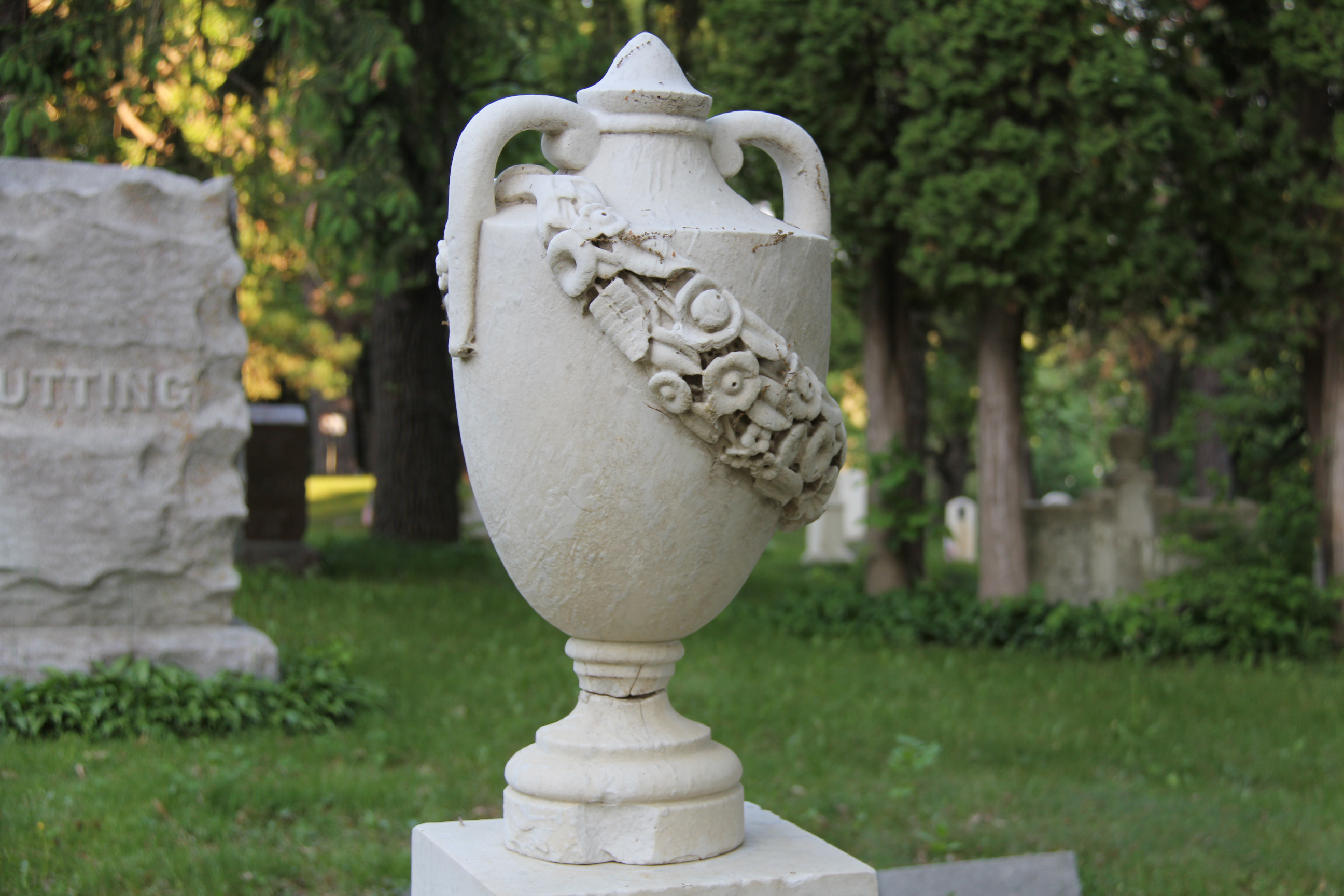
This massive urn marks a grave at Oak Ridge Cemetery. The urn symbolizes mourning and eternal remembrance. (Minnesota Prairie Roots copyrighted file photo)

He introduced his points about gravestone symbology simply by stating that symbols are something to which we have an emotional connection. For example, an eagle, a rose, a cross, are all symbols we can understand as representing freedom, love and faith. That makes sense to me.

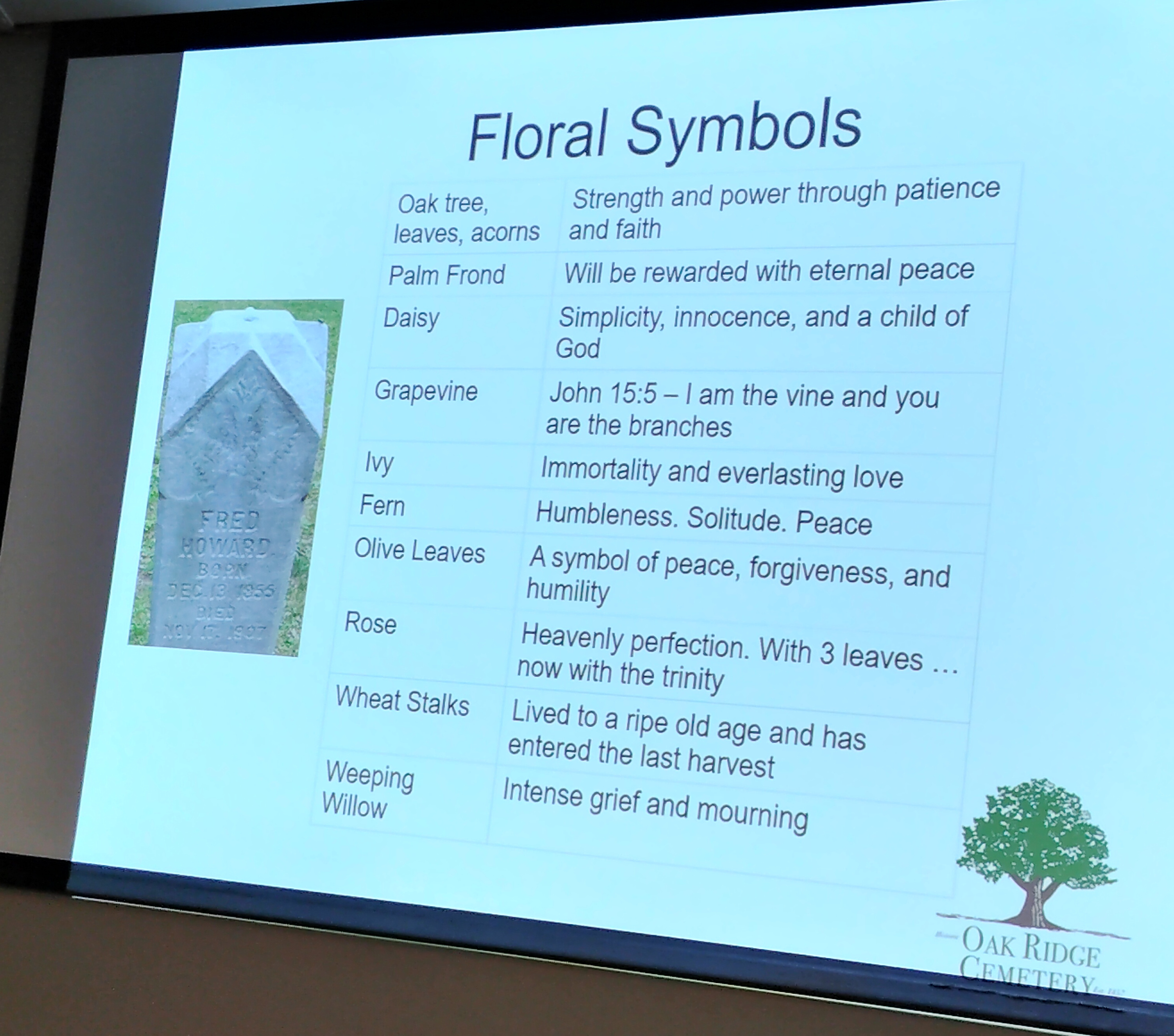
Tom Rent prepared this slide explaining floral symbols on tombstones. (Minnesota Prairie Roots copyrighted photo March 2025)

And then Rent broke it down further—into floral, hand and animal symbols. I found this particularly revealing. For example, ivy, which symbolizes immortality and everlasting love, is very popular on aged tombstones, according to Rent. So are weeping willows, although I don’t recall ever seeing one chiseled into stone. The willow, indicating intense grief and mourning, is often carved onto the gravestone of someone who has died unexpectedly, he said. He referenced the long ago drowning of a young boy in Faribault’s mill pond. A rose, which is difficult to carve, symbolizes heavenly perfection. An unopened rose bud implies a person died way too young.

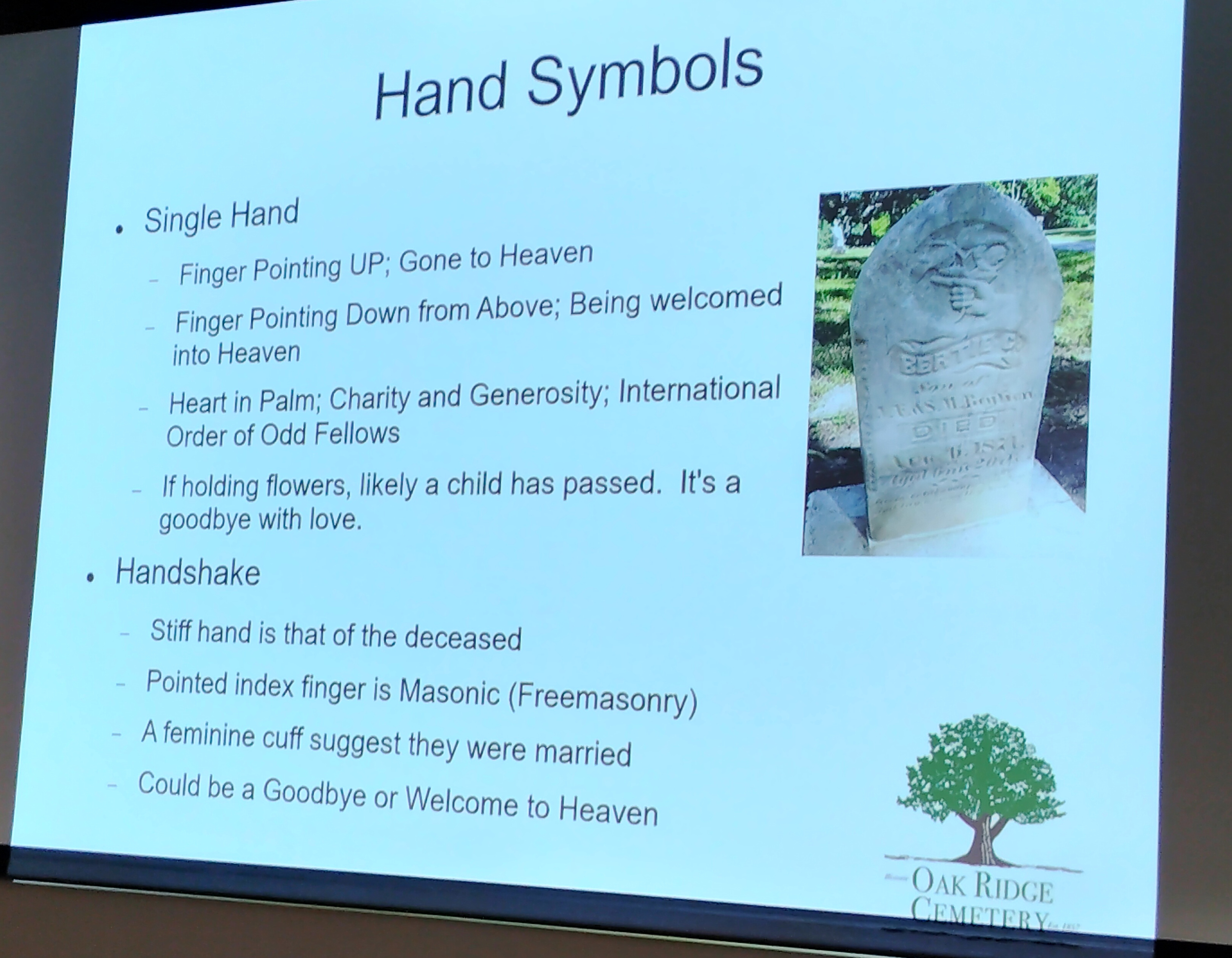
Tom Rent prepared this slide explaining hand symbology on gravestones. (Minnesota Prairie Roots copyrighted photo March 2025)

And then there are those hands, all those hands I’ve seen chiseled into marble tablet gravestones. The hand symbology traces back to Masonic handshakes mostly. Some are single hands, others handshakes, and all hold meaning. Rent shared that a heart on the palm of an open hand indicates charity and generosity. One such symbol decorates the Oak Ridge grave marker of Faribault police officer Henry Kaepernick, accidentally shot to death by a guard at the Faribault jail where the Younger brothers were held following a failed bank robbery in nearby Northfield on September 7, 1876.

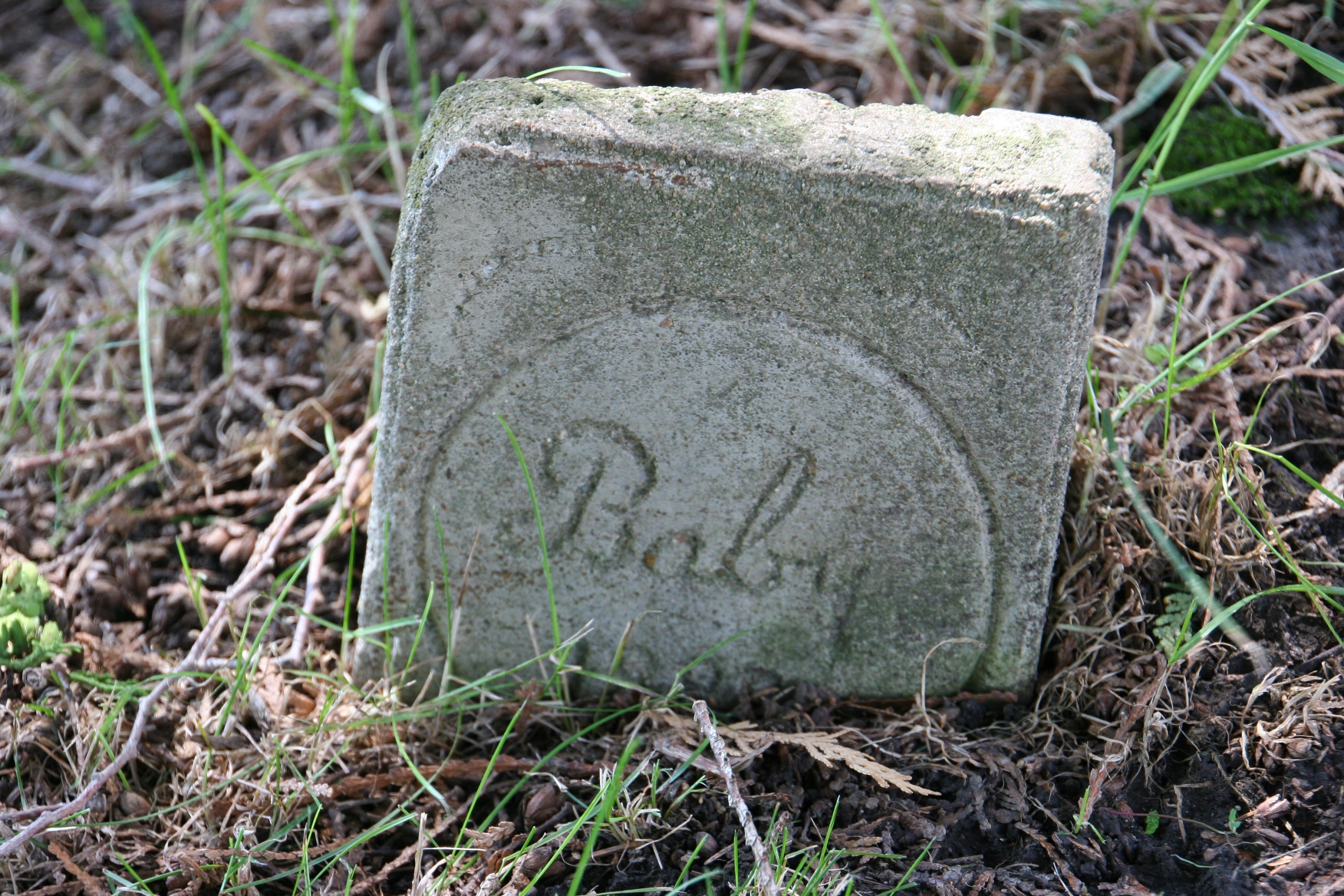
Oftentimes the graves of long ago deceased babies are unmarked or simply marked such as this one at Emmanuel Lutheran Church Cemetery, Aspelund. (Minnesota Prairie Roots copyrighted file photo)

Finally, Rent talked about animal symbols, reserved for children’s gravestones. He named lambs, sheep and doves, symbols of innocence and peace.

Before even entering Calvary Cemetery, Faribault, you can learn something about town founder Alexander Faribault on this memorial. He’s buried at Calvary. (Minnesota Prairie Roots copyrighted file photo)

Of course, Rent shared much more in his hour-long presentation. But these are highlights, information I will take with me the next time I walk through the gates of a cemetery, symbolic of a threshold into the afterlife. I will no longer see just a daisy or a rose, a hand with a finger pointing heavenward, a sheep atop a child’s grave. Rather, I will see the emotional connections in the symbology. The choices made for gravestone art and messages, past and present, hold deep meaning, if only we pause to see, consider and honor.

© Copyright 2025 Audrey Kletscher Helbling
 

Celebrating my birthday with history & art September 27, 2024

(Minnesota Prairie Roots copyrighted file photo)

NOT EVERYONE WOULD CELEBRATE a birthday by exploring historic ruins and then capping the day by creating art within an historic context. But then I am not everyone.

This week, on my closing-in-on-seventy birthday, I took a day trip to Wasioja and neighboring Mantorville. Randy and I packed our picnic lunches and then hit the road east in late morning. No need to rush and get going too early at our ages.

After a brief stop at a Kenyon thrift shop, which smelled strongly of natural gas, we made a quick exit. But not before warning the shopkeeper that he needed to check on the odor immediately. And don’t turn on a light switch, although the lights were already on, we advised. (The shop was still standing on our return route home.)

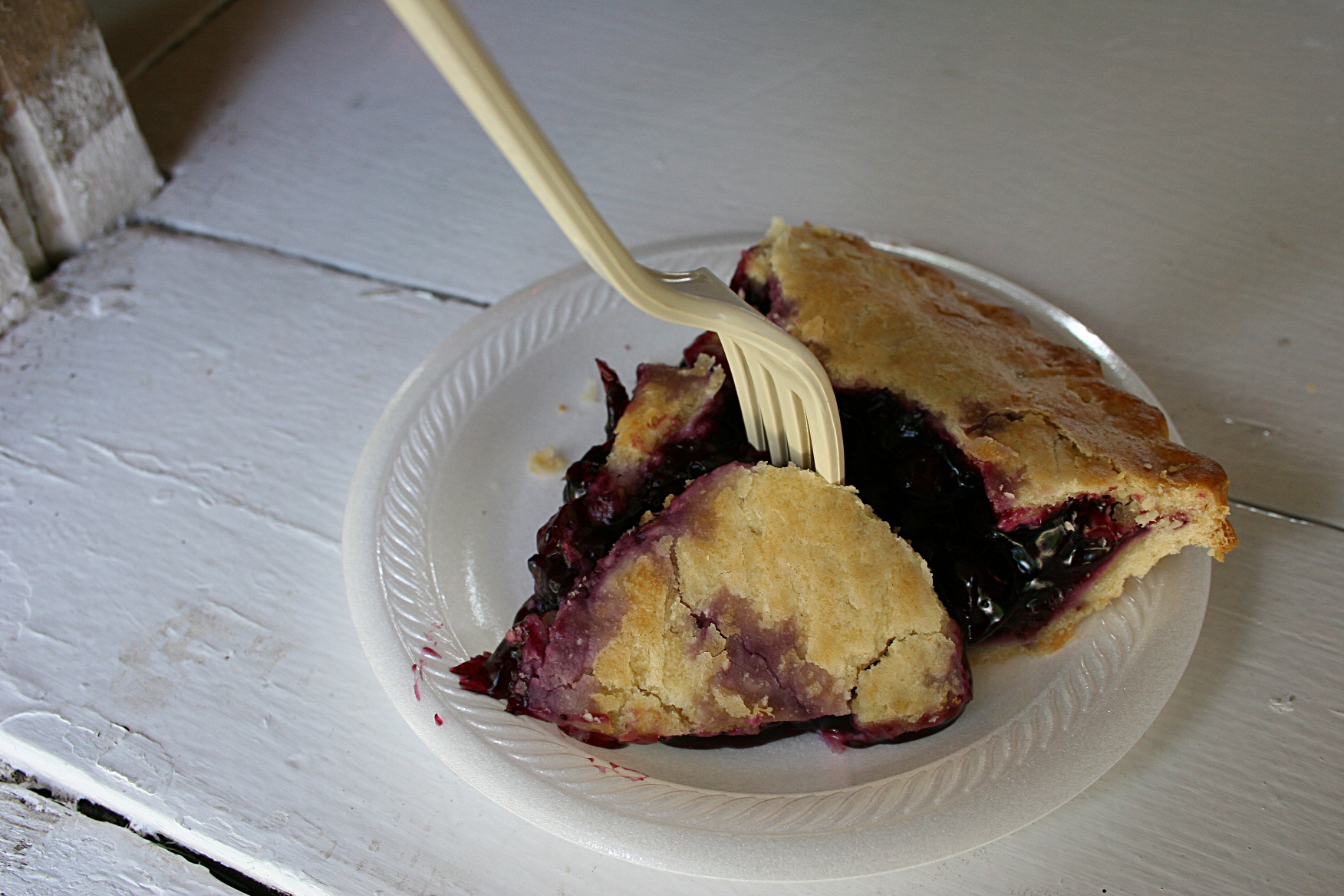
Blueberry pie. not from County Seat Coffee Shop. I didn’t photograph that pie piece. (Minnesota Prairie Roots copyrighted file photo)

GOING BACK IN TIME

I digress. In Wasioja, we discovered aged ruins and historic buildings, many connected to Minnesota’s involvement in the Civil War. I was aware of the Civil War recruiting station, but not some of the other sites. I’ll write more on our visits to Wasioja and Mantorville in future posts.

However, I should note now that Randy and I enjoyed slices of homemade blueberry and strawberry/rhubarb pie at County Seat Coffeehouse in Mantorville. It was, after all, my birthday. No sweet treat awaited me at home.

Back home by late afternoon with me feeling a bit tired after being on my feet all day (remember that broken right toe, which makes walking a tad more challenging), I put my feet up. Randy napped.

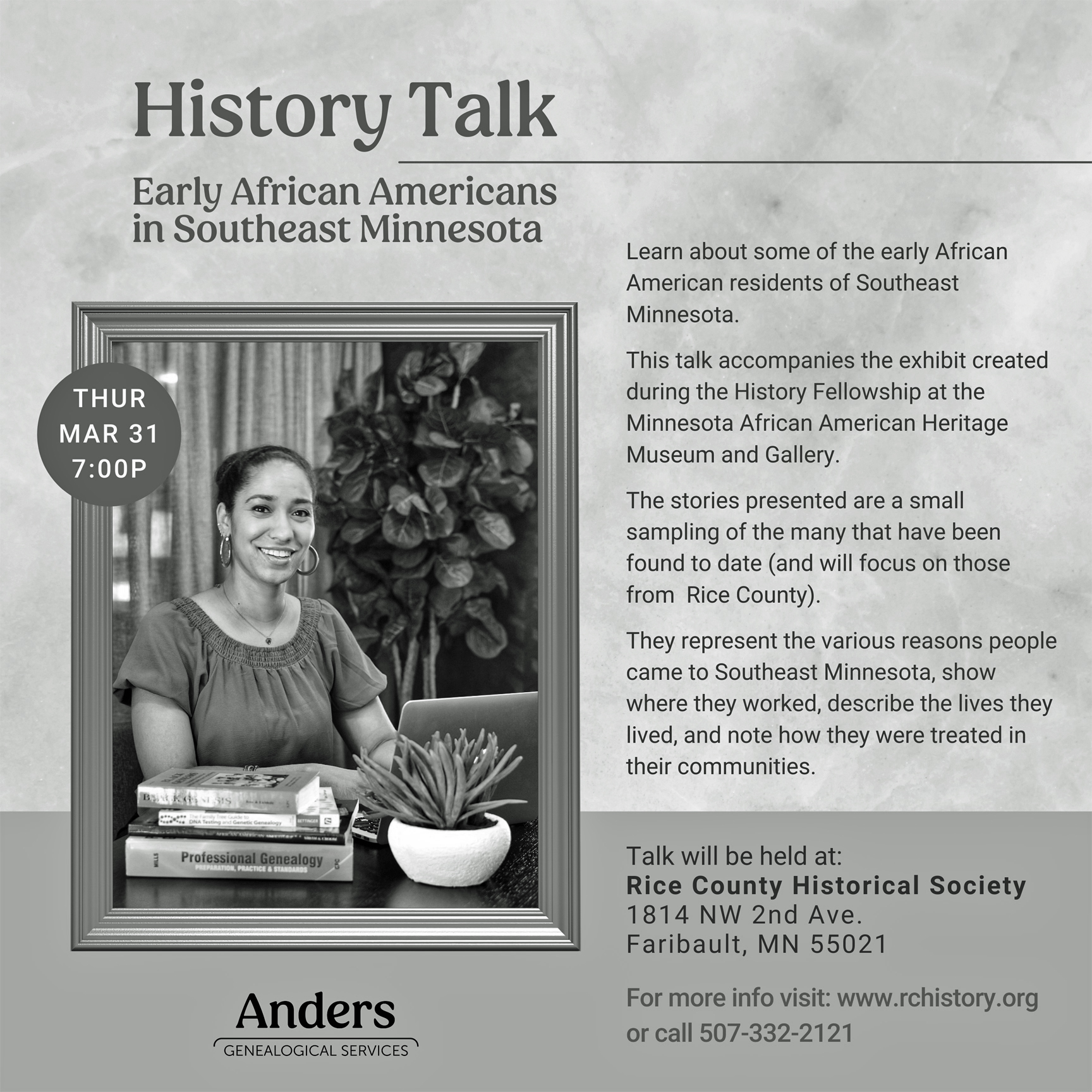
A promo for a 2022 talk by Mica Anders at the RCHS. (Promo credit of RCHS)

STEPPING BACK IN TIME WITH MICA ANDERS

And then, less than two hours later, we were off to the Rice County Historical Society for an interactive historical presentation by St. Paul genealogist and artist Mica Lee Anders. She was presenting on early (1850-1900) African American residents of Rice County. I’m always up to learning more about the history of this place I’ve called home for 42 years.

Anders made the entire event hands-on engaging by asking attendees to create flower mosaics that will honor the legacies of early African Americans. The flowers will be installed as public art at gravesites in Faribault and Northfield.

Not being especially artistic beyond creating with a camera and with words, I felt initially tentative about the whole idea. But Anders quickly put me at ease, explaining how to go about the process of creating mosaic flowers from glass tiles. We grabbed cupcake tins then scooped tiles in assorted shapes (mostly round) and colors (blues, greens, oranges and yellows) into individual holders. From there, we designed within a donut shape printed on paper. Later, we would transfer our designs onto sticky mesh.

As a perfectionist, I sorted my tiles by size and color before beginning to create. Part of me wanted to pause and take notes on everything Anders was sharing. But art won over being a journalist for the evening. I created. I listened. I asked questions. But I didn’t jot down a single word.

I heard about the success of those early African Americans who lived here. The barber. The young man who would become a doctor. The college grad. But I learned, too, of efforts to hide racial identity. Yet, races intermarried. And, said, Anders, Faribault was a welcoming place to those African Americans who settled here early on. To hear that pleased me greatly. Faribault has not always been a welcoming place for people of color.

The flower mosaic I created. Anders will finish the work. (Minnesota Prairie Roots copyrighted photo September 2024)

CONNECTING HISTORY & ART

Anders’ passion for history, genealogy and honoring the legacies of African Americans in southeastern Minnesota via her research and now her public art project coursed through the meeting room where a small group of us created colorful mosaics. It felt good to be part of something like this, a tangible way to honor those who came before us, who likely faced more struggles than I will ever know.

My mosaic was well thought out. I don’t usually randomly do anything. I used orange and yellow tiles in the outer two rings of my flower to represent the sun. The next ring featured blue round tiles representing the sky—dark blue for stormy days, lighter shiny blue for happier days. I finished my flower with an inner ring of green tiles representing the earth, growth, place.

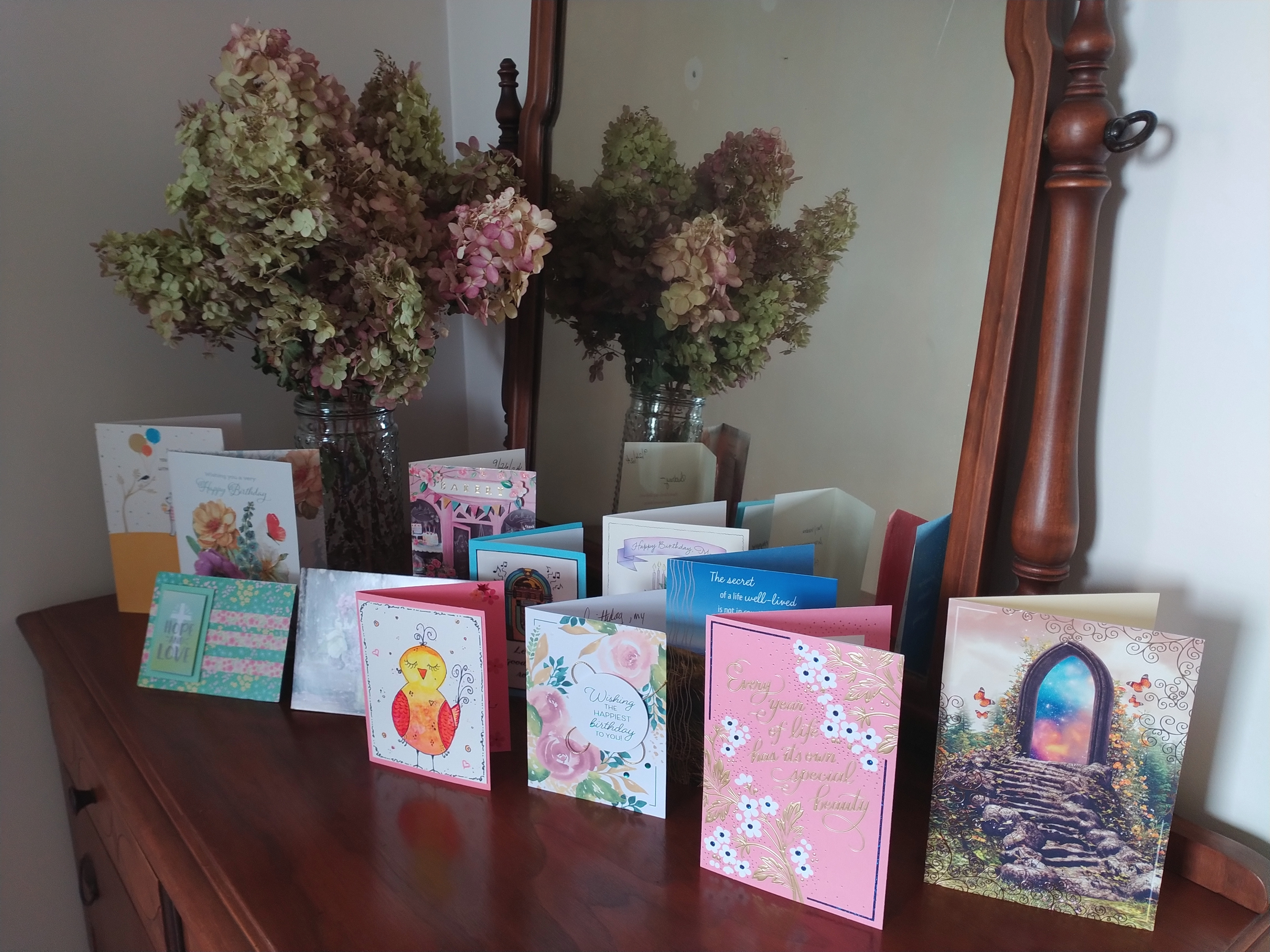
The birthday cards I received, displayed on a vintage family dresser in my dining room. (Minnesota Prairie Roots copyrighted photo September 2024)

THANKFUL

Thus I began another year of life. Learning. Creating art. Honoring. Celebrating. And feeling incredibly thankful for all the people who care about me. From greeting cards to an audio message, from texts to emails to calls (including a singing of “happy birthday”), I feel cherished and loved.

#

FYI: Mica Anders will host more workshops in Rice County (including in Northfield) to talk about early African Americans in southeastern Minnesota and to create flower mosaics. I encourage you to participate. Her project was made possible in part by Springboard for the Arts’ Rural-Urban Solidarity Initiative.

© Copyright 2024 Audrey Kletscher Helbling
 

Learn about local history & more at Oak Ridge Cemetery talk August 21, 2024

Oak Ridge Cemetery, Faribault. (Minnesota Prairie Roots copyrighted file photo)

FOR ANYONE WHO APPRECIATES local history, especially cemeteries, the Rice County History Museum in Faribault is the place to be at 7 pm Thursday, August 22. Tom Rent, an Oak Ridge Cemetery volunteer, will present “Preserving Faribault’s Oldest Cemetery, Oak Ridge.”

It’s sure to be an informative talk focusing on the cemetery’s history, operation and preservation. Rent will also share photos, stories, headstone symbology, preservation methods and future plans to maintain Oak Ridge Cemetery. Plus, he’ll talk about some of the people who helped shape Faribault and Rice County.

Oak leaves fittingly grace the top of a grave marker at Oak Ridge Cemetery. (Minnesota Prairie Roots copyrighted file photo)

As someone who did not grow up in this region of Minnesota, I’m always interested in learning more about this place I’ve called home for 42 years now. I’ve explored a lot of cemeteries, including Oak Ridge. Cemeteries fascinate me with their history, art, stories, natural beauty, peacefulness and aura of reverence.

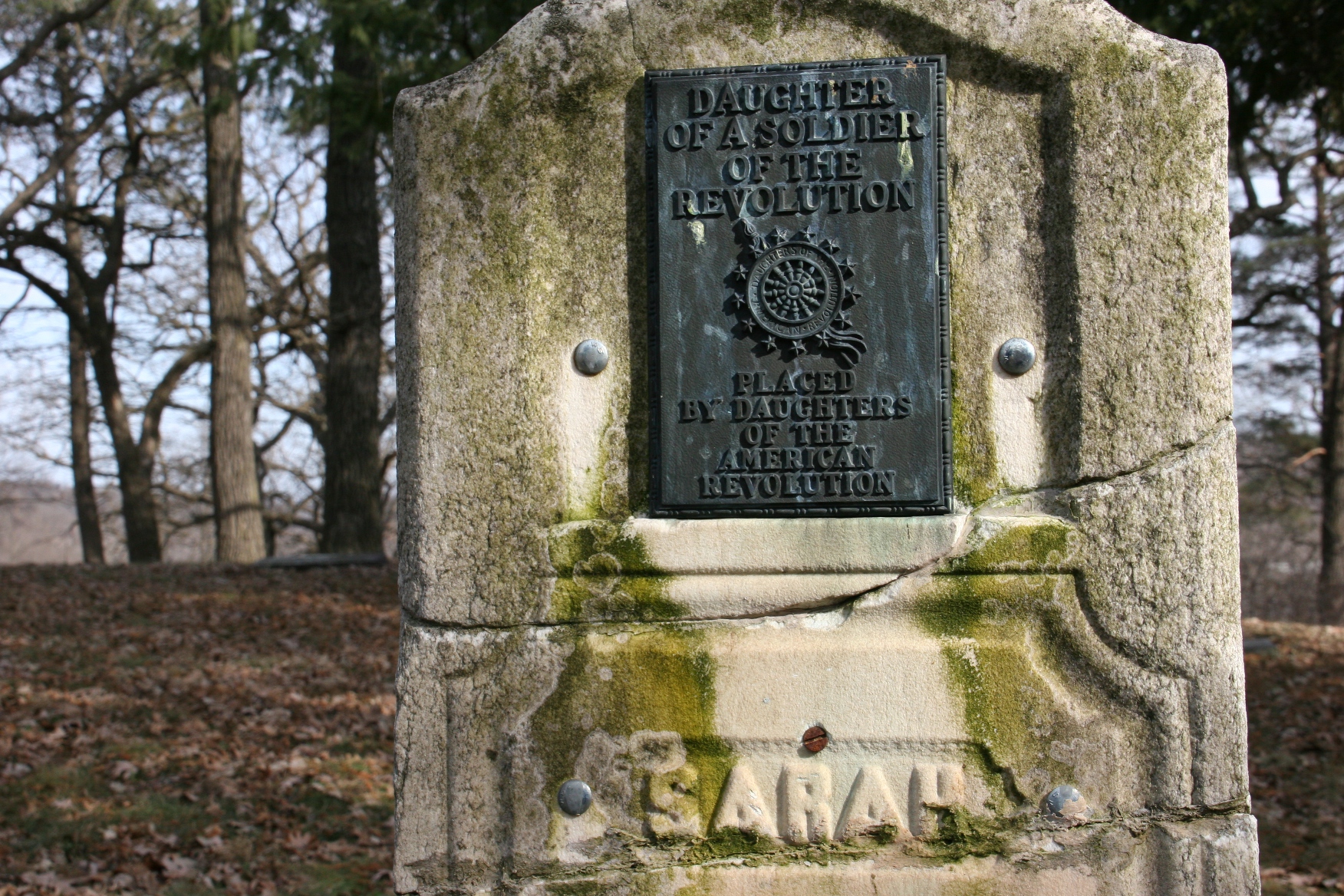
Sarah, daughter of a Revolutionary War soldier, lies buried here. (Minnesota Prairie Roots copyrighted file photo)

Oak Ridge Cemetery, founded in 1857, sits high atop a hill on Faribault’s north side just off Minnesota State Highway 3. It’s a beautiful, wooded location filled with oak, maple and spruce trees, and many aged headstones. There are names—like Nutting and Buckham—recognizable as key figures in local history. There are Civil War and Spanish American War veterans and a daughter of an American Revolutionary War soldier buried here. Senators and representatives, too. Local leaders and farmers. Immigrants and paupers and people from all walks of life. People with stories. So. Much. History.

Levi Nutting was important in early Faribault history, as noted in this cemetery signage. (Minnesota Prairie Roots copyrighted file photo)

I especially like that the caretakers/volunteers of Oak Ridge have installed signage profiling some of the people buried in the cemetery. For those like me who are curious about the stories behind the deceased, this is valuable information. I always want to know more beyond names and dates of birth and death. The Oak Ridge Cemetery Facebook page offers lots of historical info, too.

Efforts have also been underway to restore aged tombstones in the cemetery.

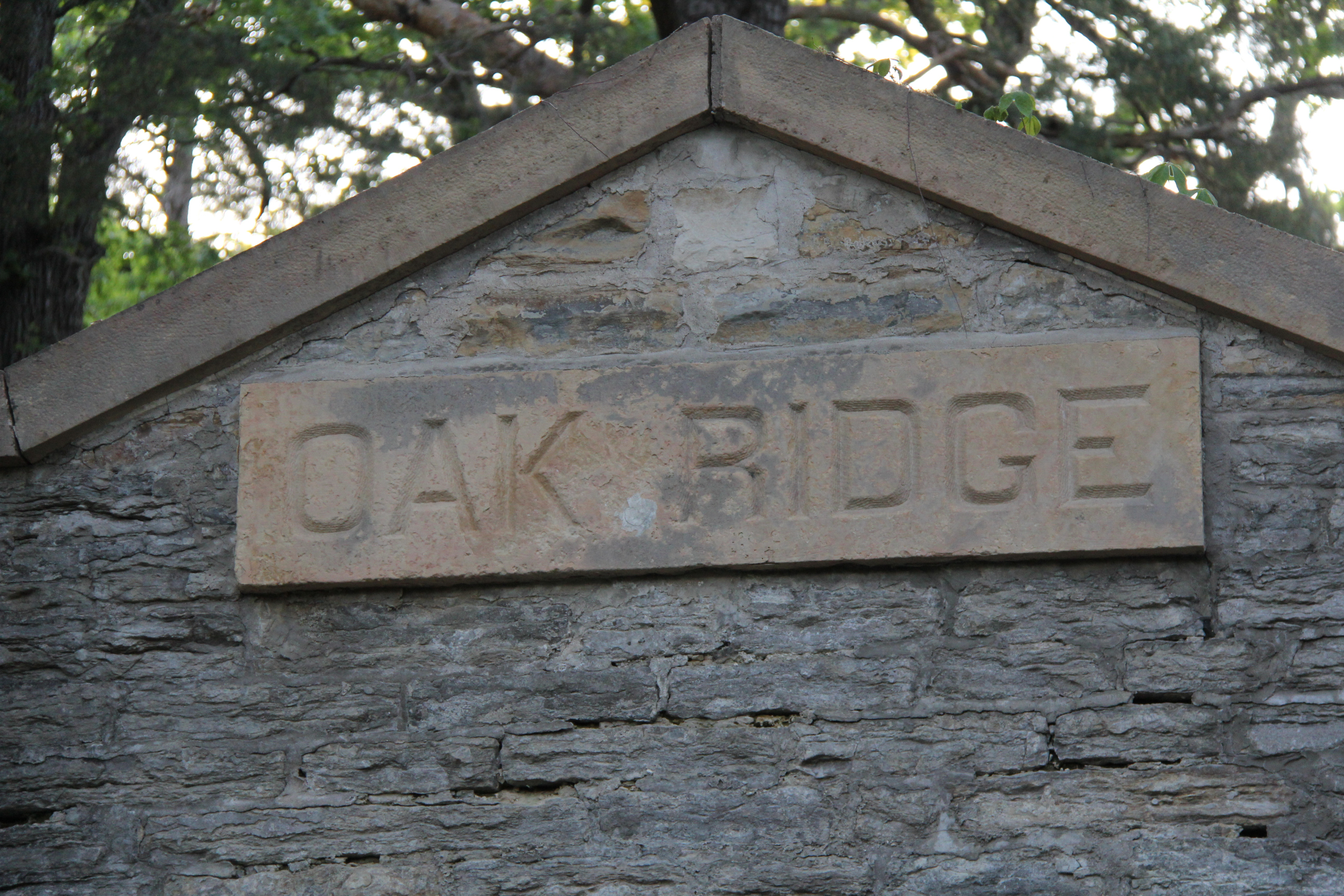
Identifying signage on the limestone crypt at Oak Ridge. (Minnesota Prairie Roots copyrighted file photo)

I expect Tom Rent will cover much of this in Thursday’s talk. He, like so many others, cares deeply about those who lie buried beneath the canopies of trees at Oak Ridge Cemetery.

FYI: To reserve a seat at Thursday’s presentation, call 507-332-2121, email rchs at rchistory.org or stop at the history museum. The program is free to Rice County Historical Society members and $5 for non-members.


Johnston Hall film screening at historical society December 15, 2023

Johnston Hall, date unknown. (Photo courtesy of Rice County Historical Society)

IN EARLY NOVEMBER, I watched a local documentary online about Johnston Hall in the comfort of my home office. The film, “Love Inwrought: Johnston Hall and the Memory of a Building,” was created by Sam Temple and Logan Ledman. The ambitious and talented young filmmakers have, since their high school days, focused on local history through their 1855 History Team (Steamboat Media Co.). Their latest project focuses on Johnston Hall, completed in 1888 as part of Seabury Divinity School. The building was demolished in 2021 after standing on Faribault’s east side for 133 years.

Sam Temple, left to right, Logan Ledman and Troy Temple. (Photo courtesy of 1855 History Team)

This Saturday, December 16, the duo will present a public screening of their film at the Rice County Historical Society in Faribault from 5:30-6:30 pm. And while I am not able to be there, I encourage anyone interested in Johnston Hall and the fine work of writers and directors Temple and Ledman to attend.

A Q & A follows the screening. Attendees are encouraged to share their stories about Johnston Hall, which saw many uses through the years.

Johnston Hall model. (Photo courtesy of 1855 History Team)

But that’s not all. A model of the building handcrafted by Rathbun Reliquilaries plus artifacts and architectural items saved by the historical society will also be available for viewing.

Saturday’s event offers an ideal opportunity to learn more about Johnston Hall and to meet members of the team that worked diligently to create the documentary. Besides Temple and Ledman those include Troy Temple, illustrator Piper Mohring, composer Sam Dwyer, and actors Steve Searl (portraying Bishop Henry Whipple) and Eli Hastings (as the Rev. Henry St. Clair).

Documentary promo. (Courtesy of 1855 History Team)

According to Sam Temple, the title of the documentary traces to a quote by Bishop Whipple: “There is an unwritten history of faith and love inwrought in every building erected here.” The Episcopalian bishop was referencing buildings (including Johnston Hall) at the schools he helped organize.

This signage stands at Johnston Hall Memorial Garden across the street from the local hospital and clinic. (Minnesota Prairie Roots copyrighted file photo August 2023)

The work of Temple, Ledman and their team is top-notch professional, outstanding and deserving of accolades. These young men are passionate about history, storytelling, filmmaking and creating an appreciation for our past. Their enthusiasm and work impress me. I can’t wait to see what they do next.

FYI: To read my review of “Love Inwrought,” click here.

© Copyright 2023 Audrey Kletscher Helbling
 

A look at Bishop Henry Whipple’s role in Minnesota history February 17, 2023

A painting of Bishop Henry Whipple and information about him grace a mural on Faribaults’ Central Park Bandshell. (Minnesota Prairie Roots copyrighted file photo June 2020)

He was known as “Straight Tongue” for his honesty. He was disparagingly called “The Sympathizer” by others for the compassion and care he held for the Dakota. He was Bishop Henry Whipple.

Thursday evening, Rice County Historical Society Executive Director David Nichols spoke to a packed room about this Episcopal priest who played such a pivotal role in Minnesota history, specifically during the time shortly before, and then after, The U.S.-Dakota War of 1862. For me, personally, Nichols’ focused talk connected my home region of Redwood County, the area in which the war centered, to my home of 40 years, Rice County.

I grew up with a limited (white) perspective of the war with no knowledge of Whipple. I only learned of this New York born clergyman upon my move to Faribault in 1982. Nichols broadened my understanding during his presentation and during a question and answer session that followed.

A panel at the Traverse des Sioux Treaty Center in St. Peter shows Dakota leaders photographed in Washington D.C. in 1858. The photo is from the Minnesota Historical Society. It references broken treaty promises and rising tension. (Minnesota Prairie Roots copyrighted file photo)

HIGH TENSIONS

Whipple arrived here in 1860 as the newly-elected Bishop of Minnesota, settling in Faribault. Already at that time, tensions were mounting among settlers and the first peoples of Minnesota, Nichols said. Tensions also existed between the “Farmer Indians” (those who adapted to Euro culture) and “Blanket Indians” (who maintained their Native culture, traditions and lifestyle). Conditions on reservations were terrible with disease, starvation, and dishonest agents failing to provide promised government annuities.
That is the situation Whipple found when he landed in Minnesota. It was a time, noted Nichols, of “tensions about to boil over.” And eventually they did with the outbreak of war in August 1862. It was a decidedly bloody and awful war, as all wars are. Some 600-800 died and the Dakota were eventually displaced from their land.

Details on a sign outside The Cathedral of Our Merciful Saviour, Whipple’s church in Faribault. (Minnesota Prairie Roots copyrighted file photo 2020)

THE SHAPING OF A HUMANITARIAN

To understand Whipple’s position and part in this, Nichols provided background. Whipple was involved in New York politics as a “conservative Democrat,” a term which drew laughter from the crowd at Thursday’s presentation. He briefly attended Oberlin College, notable because the college was among the earliest to admit women and African Americans. And Whipple was ordained in 1849, during the so-called “Second Great Awakening” with a focus on civil rights.

Learning this helped me better understand the bishop. All of these experiences shaped a man who spoke with honesty and compassion, advocated for Minnesota’s Indigenous Peoples (both the Dakota and the Ojibwe, natural enemies), called for reform and peace and understanding. Whipple was, said Nichols, a voice for calm, calling for justice, not vengeance, when the short-lived U.S.-Dakota War ended.

Words on a marker in Reconciliation Park in Mankato where 38 Dakota + 2 were hung on Dec. 26, 1862. (Minnesota Prairie Roots copyrighted file photo May 2012)

ADVOCATING FOR PARDONS

In his many years of missionary work and advocacy, even when his life was threatened by those who viewed him as an “Indian sympathizer,” one singular moment stands out to me. And that is Whipple’s efforts to save the lives of 303 Dakota men sentenced to death after the war. He met with President Abraham Lincoln and was “partly responsible,” Nichols said, for Lincoln’s eventual pardon of all but 38 Dakota. The 38, plus two others, were hung in a public mass execution in Mankato on December 26, 1862. It is a terrible and profoundly awful moment in Minnesota history, especially the history of the Dakota.

A full view of the bandshell mural featuring Bishop Whipple and his first wife, Cornelia, and his second wife, Evangeline. (Minnesota Prairie Roots copyrighted file photo)

ASSIMILATION

While listening to Nichols’ presentation on Whipple, I felt conflicted. Conflicted because the bishop was, he said, “a strong assimilationist.” That label bothered me until I talked further with Nichols. He explained that Whipple did not view himself and Europeans as superior to Native Peoples, but rather observed, in the context of place and time and thinking, the need to adapt versus being driven out. That helped me better understand Whipple’s approach. I recognize, though, and acknowledge the current-day struggles with assimilation, especially as it relates to Indian boarding schools. I appreciate the recognition of, and return to, culture, tradition and heritage today.

“Faribault’s Founding Fathers,” portraits of Alexander Faribault, left to right, Chief Taopi and Bishop Henry Whipple, by Dana Hanson hangs in Faribault’s Buckham Memorial Library. (Minnesota Prairie Roots copyrighted file photo November 2022)

WELCOMING THE DAKOTA TO FARIBAULT, OR NOT

Whipple, by his words and actions, embraced the Dakota and Ojibwe who called Minnesota home long before white settlers arrived, long before he moved to Faribault. My community, founded by fur trader Alexander Faribault, himself half Dakota, was a safe haven for the Dakota (“you don’t attack family”) during the 1862 war and thereafter, Nichols said. Faribault and Whipple worked together to move 180 Dakota from St. Paul’s Fort Snelling, where they were held following the war, to live on land Alexander owned along the Straight River in Faribault.

I wondered, “Were they welcomed here?” The answer, given by former RCHS Executive Director Susan Garwood, was as I expected. Mixed. While some supported the Dakota’s presence in Faribault, others were vocal in their opposition. In that moment, I thought of our ever-growing immigrant population in my community. Many welcome our newest neighbors and, like Alexander Faribault and Bishop Henry Whipple, support and encourage them. But many also want them gone. History repeats.

An inscription honors Whipple on the Cathedral bell tower. (Minnesota Prairie Roots copyrighted file photo June 2020)

MARKING HISTORY

Walk around Faribault today and you will see many reminders of the work Whipple did not only locally, but across Minnesota. Historical markers and inscriptions about the bishop grace The Cathedral of Our Merciful Saviour, his faith base. He’s buried under the altar there. Across the street at Central Park, Whipple-themed murals cover the west side of the historic bandshell. Downtown, one of many history-focused benches honors Whipple. And across town, at the Chapel of the Good Shepherd on the campus of Shattuck-St. Mary’s School, a marker notes his role in founding Shattuck and other schools in Faribault.

Efforts are underway now locally to recognize the Dakota as well, to publicly mark their place in the history of Faribault. I’d like to think Bishop Henry Whipple, also known as “Straight Tongue” and “The Sympathizer,” would welcome the idea, would even step up to fund raise, just as he did some 160 years ago to support the relocation of 180 Dakota from Fort Snelling to Faribault.

© Copyright 2023 Audrey Kletscher Helbling