Minnesota Prairie Roots

Writing and photography by Audrey Kletscher Helbling

Should this Minnesota country schoolhouse be saved? June 24, 2016


The Le Sueur School District 18 schoolhouse, located at 35278 141st Avenue, rural Montgomery, Minnesota.

The Le Sueur County School District 18 schoolhouse, located at 35278 141st Avenue, rural Montgomery, Minnesota.

THE WEATHERED SCHOOLHOUSE sits on a slight rise along the gravel road, surrounded by a clipped lawn bordered by farm fields.

Hardy daisies thrive next to the schoolhouse.

Hardy daisies thrive next to the schoolhouse.

On this Sunday summer afternoon when I’ve discovered the aged building just off Le Sueur County Road 26 two miles east of Montgomery in Montgomery Township, the wind is rippling grain fields and bending daises nestled into an exterior corner of the schoolhouse.

Windows need repair/replacing.

Windows need repair/replacing.

As I brace myself against the wind, I notice shingle debris scattered across the grass. I notice the weathered grey of unpainted siding, the rotted boards, the barn swallow and wasp nests. I notice how much this schoolhouse needs care and upkeep.

A rear shot of the country school.

A rear shot of the country school.

In 1888, Wencel and Mary Petricka sold this parcel of land to Le Sueur County School District 18 for $1 to build this school. In 1957, when the Le Sueur district consolidated with the Montgomery School District, the little one-room country school closed.

Consider the hands that once turned this knob opening the door to an education.

Consider the hands that once turned this knob opening the door to an education.

And here it stands, a year shy of sixty years after closure, seemingly abandoned. Except for that mowed lawn and that patch of daisies. Someone still cares. And that gives me hope. Hope that someone will find the money and the inclination to save this piece of rural Minnesota’s educational history. Before it’s too late.

#

Three rooflines: entry, classroom and bell tower.

Three rooflines: entry, classroom and bell tower.

IT’S EASY FOR ME TO WRITE, Save the School. But the issue of financing often blocks the path to such endeavors. Do you have any creative ideas to fund a repair and restoration project? Perhaps I should first ask, should the schoolhouse be saved? I don’t even know who owns it.

Perhaps an American flag will fly again some day on the corner of the schoolhouse.

Perhaps an American flag will fly again some day on the corner of the schoolhouse.

In September of 2015, Le Sueur County School District 18 held its first ever reunion. With 31 alumni and guests in attendance (including a former teacher), there’s clearly an appreciation for this Minnesota country school.

© Copyright 2016 Audrey Kletscher Helbling


How you can make a difference in one Minnesota kindergarten classroom August 24, 2013

Looking to the front and one side of the school.

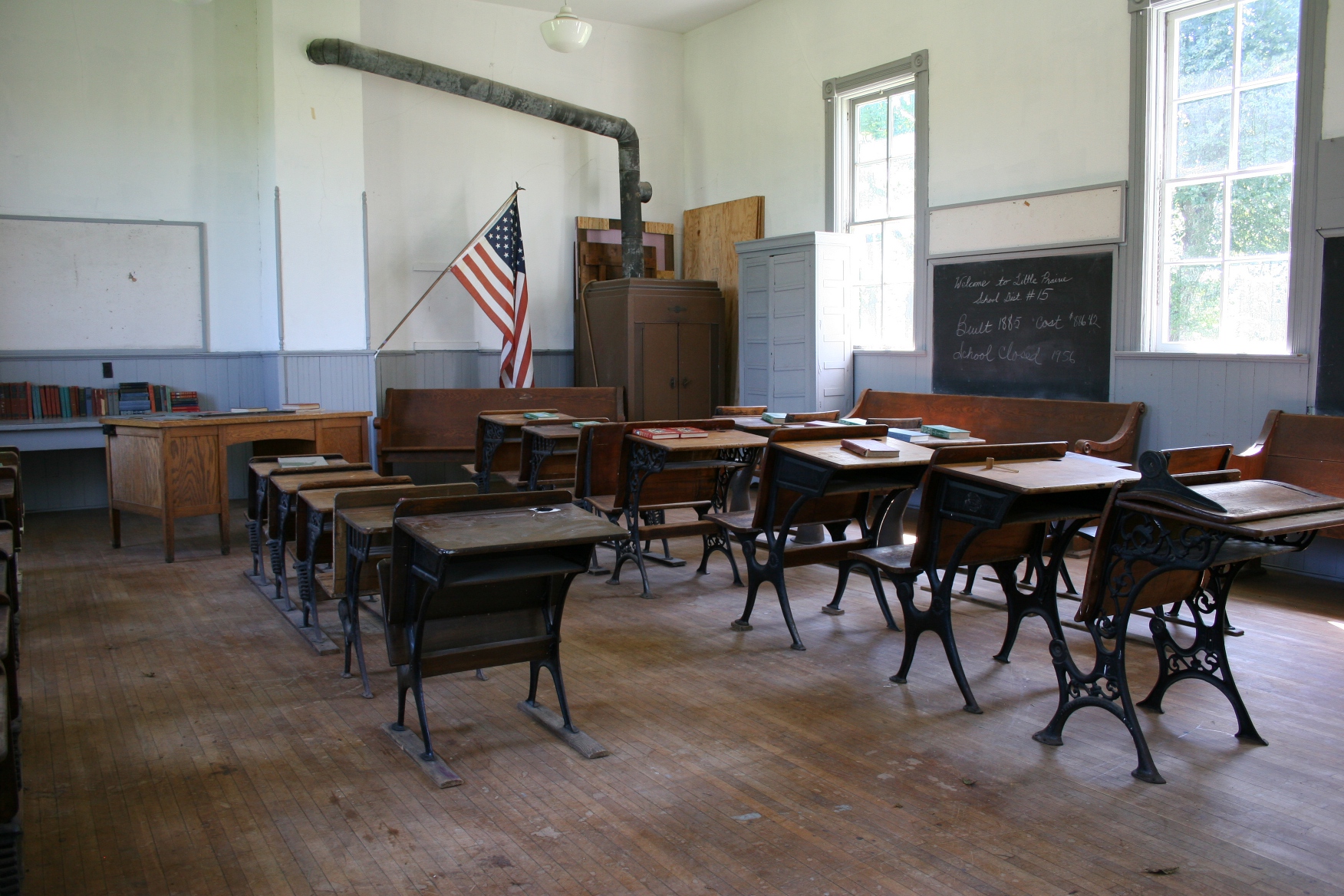
Long gone are the days of ink well desks, blackboards and Big Chief tablets.  Minnesota Prairie Roots file photo of Little Prairie School, rural Dundas, Minnesota.

MY ELDEST DAUGHTER’S friend, Laura, teaches at Earle Brown Elementary School in the north metro, in Brooklyn Center, Minnesota, Independent School District 286.

I’ve met Laura once. Mostly I “know” Laura because I follow her “These are a Few of my Favorite Things” blog. Click here to reach her blog and you will meet a young woman who is passionate about life, about teaching, about helping others (she’s been on summer mission trips to Africa), about photography, her faith and more.

Laura is the kind of person you would hope would teach your children or grandchildren. She cares. Deeply.

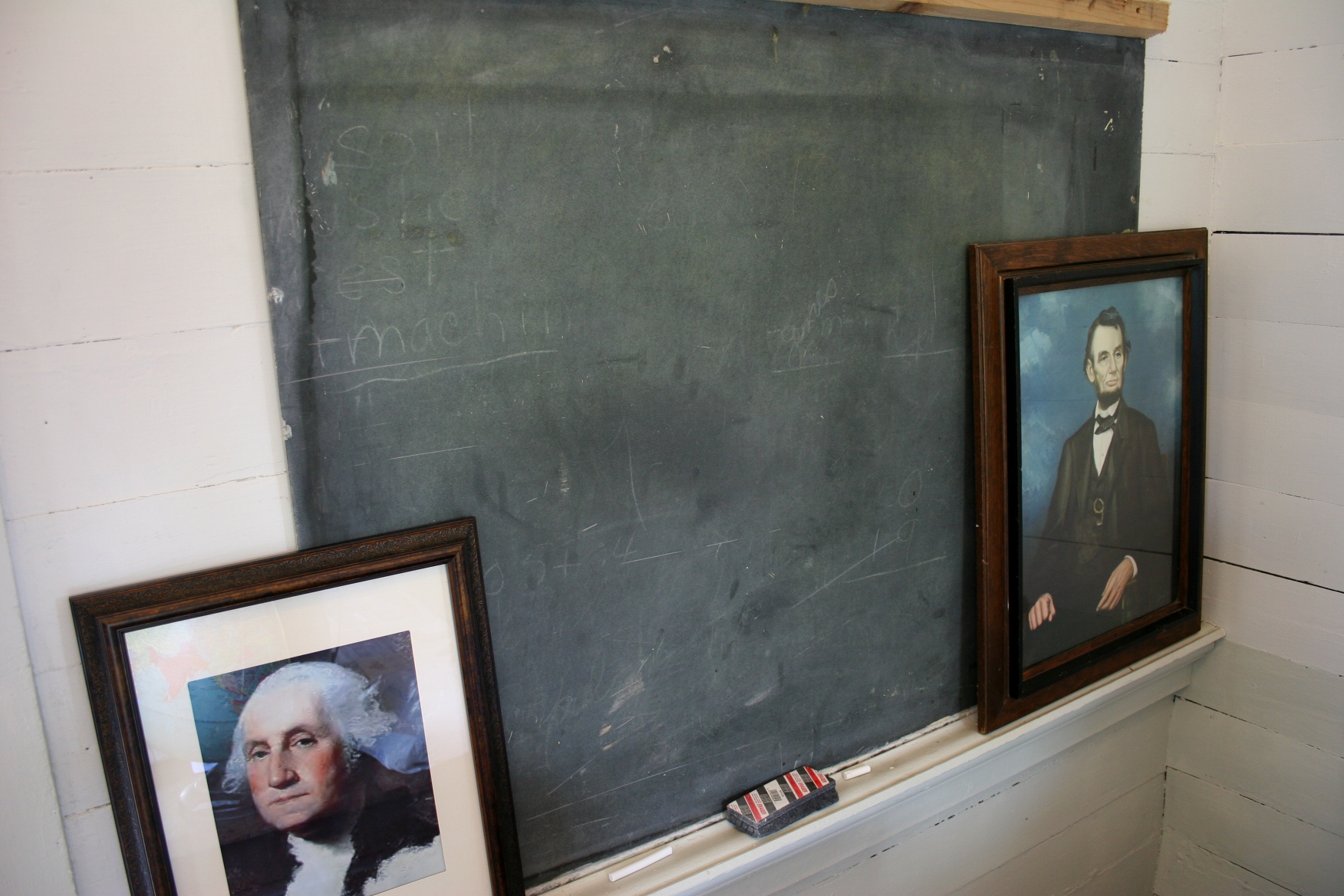
Presidential portraits grace the blackboard by the teacher's desk.

Technology long ago replaced the blackboards of my youth. Minnesota Prairie Roots file photo.

That said, this passionate teacher is looking to buy two iPad minis for her classroom to use in literacy and math centers. Her school district, she says, doesn’t have the monies for such purchases. She needs about $900 and has set up a donation venue at DonorsChoose.org. Click here to reach her Donors page, where you will find more details.

Laura writes in part:

My kindergartners start school already behind academically. Many of them have never set foot in a school environment. Others don’t come to school with clean clothes or proper school supplies. A third of my class doesn’t speak English as their first language.

But the thing is, my kids don’t know they are behind. They don’t realize the challenges they are facing. They are five, and this is life as they know it. They come in my door ready to learn, EXCITED to learn. I want to capitalize on this eagerness and provide them the best environment with the best tools at their fingertips. My goal is to have them leave kindergarten at or above grade level. My goal is for each of my students to know that they matter and they are loved. I want my students to know that they have what it takes to accomplish something in this world.

Can you sense this teacher’s enthusiasm and love for her students? I can. She wants (let’s reread this) her kids “to know that they have what it takes to accomplish something in this world.”

You should also know that the label of “high poverty,” based on the percentage of students eligible for free or reduced lunches, is attached to Earle Brown Elementary.

Please consider donating. For the sake of those five-year-olds.

Click here to link to Ms. Karsjen’s project and give.

© Copyright 2013 Audrey Kletscher Helbling


No first day of school tears here September 6, 2011

Filed under: Uncategorized — Audrey Kletscher Helbling @ 8:35 AM
Tags: , , , , , , , , ,

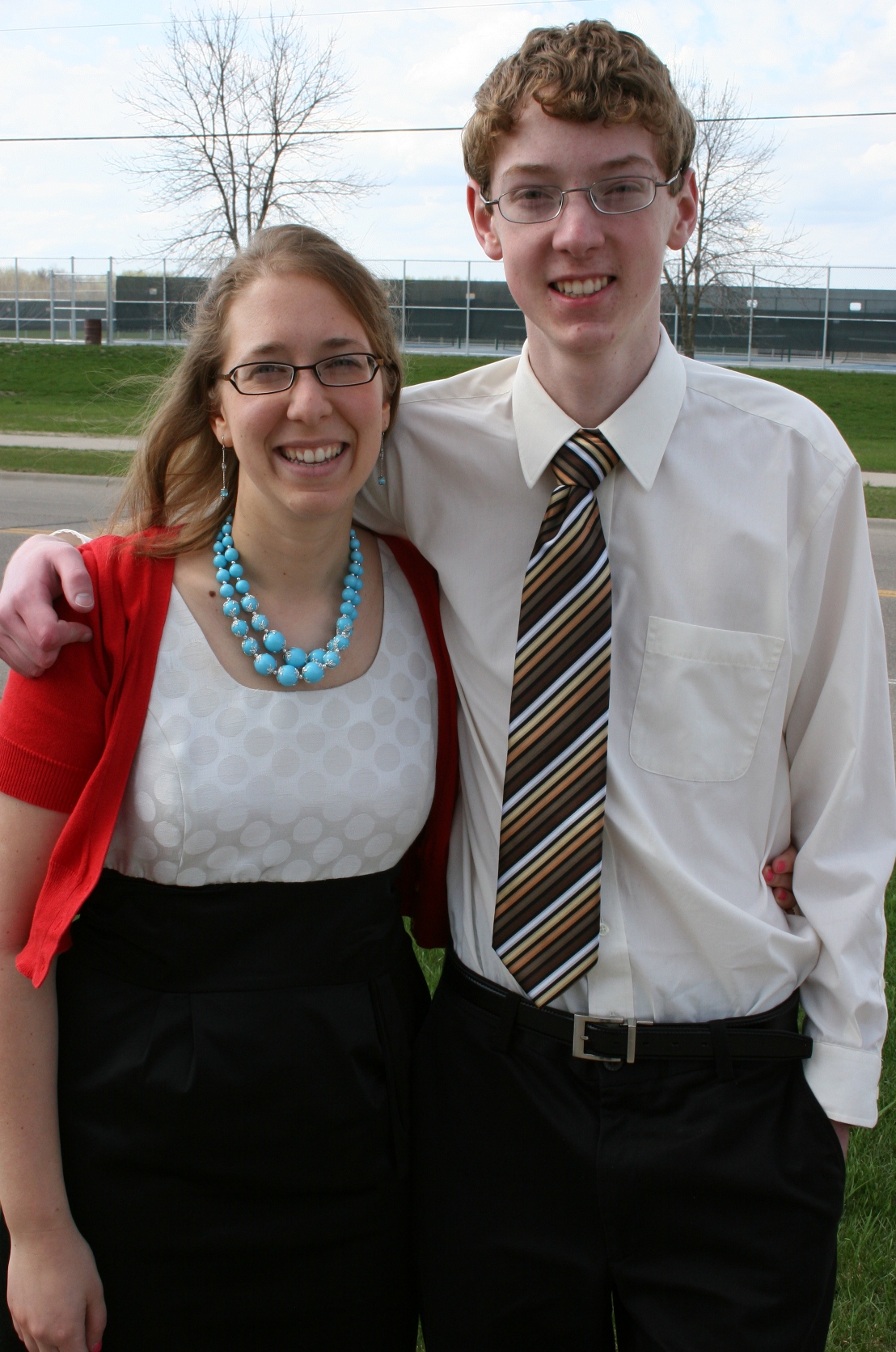
My oldest daughter and my son in a photo taken in May.

MY YOUNGEST STARTED his first day of his final year of high school this morning.

I feel as if I should be crying or something. But I’m not.

By now, by the third child, after 20 years of first days of school, it’s not such a big deal any more. The excitement and the anticipation just aren’t there.

It’s not that I’m a negligent mom who doesn’t care about her child or her child’s education. Rather, the first day of school novelty wore off long ago.

Last night in our house, there was no last-minute packing of the backpack, no pre-school-day jitters. Rather my concern leaned more toward making sure the 17-year-old got to sleep at a reasonable hour.

He is a night owl. If my teen had his way, classes would start around 11 a.m. So today, really, begins the battle of trying to get him to get enough sleep. This issue causes much strife in our household. Next year, at college, he’s on his own.

My focus right now is directed in guiding my son toward selecting a college. He has the smarts—an ACT test score of 32 and nearly a 4.0 GPA—to get in anywhere. But he certainly doesn’t have the money. However, I’ve encouraged him to apply wherever he wishes because maybe, just maybe, he’ll get a financial aid package that will allow him to afford a school he couldn’t otherwise afford.

I’ve suggested he make two college lists: a dream list and a realistic list.

In the meantime, during the first semester of his senior year of high school, my boy is enrolled in a rigorous course of study: Introduction to Economics, Advanced Placement Calculus, Advanced Chemistry and CIS Anatomy/Physiology. He’s also taking speech and logic at the local community technical college. By graduation in June, my son should have more than a semester of college credits earned.

I’ve encouraged him to pursue these college credits. They’re free, I keep telling him. Why wouldn’t you? He understands.

And so these are my thoughts this morning as my last child, who is eight years younger than his oldest sister and six years younger than his other sister, begins his senior year of high school.

No tears shed in this household. But next year at this time, when my husband and I are dropping our youngest off at his dorm, or seeing him off at the airport—if he manages to get into a college on his dream list—I expect the tears will fall fast and steady.

IF YOU’RE A PARENT with school-age children, how did the first day of school go for you? Share your thoughts and/or experiences in a comment.

© Copyright 2011 Audrey Kletscher Helbling


Reflections on Independence Day July 4, 2011

A flag and portrait of George Washington at the former District 20 Millersburg School, now a museum.

“I PLEDGE ALLEGIANCE to the flag of the United States of America and to the Republic, for which it stands, one nation under God, indivisible, with liberty and justice for all.”

As a child, my school days began with that pledge. My classmates and I arose from our desks at Vesta Elementary School, turned toward the American flag in the corner, placed our hands across our hearts, fixed our eyes upon the stars and stripes, and recited the pledge in unison.

I doubt we ever thought too much about the rote words we spoke. They were simply part of our routine, something we did, although I do recall feeling a sense of pride in speaking those words daily.

So much has changed in the decades since then. The Pledge of Allegiance, in most cases, has been banned from public schools in the name of political correctness. We are no longer one nation under God. While the U.S. remains one country, we as individuals are certainly divided in our views of anything and everything. That’s as it should be in a democracy. Liberty and justice have managed to prevail.

As we celebrate our nation’s Independence Day, it would be wise for all Americans to reflect on the Pledge and the words of other documents and songs that focus on the flag and freedom.

We hold these truths to be self-evident, that all men are created equal, that they are endowed by their Creator with certain unalienable Rights, that among these are Life, Liberty and the pursuit of Happiness.—The Declaration of Independence, signed on July 4, 1776

Vietnam veteran Joel Kukacka's patriotic garage in the hamlet of Heidelberg, Minnesota.

Oh, say does that star-spangled banner yet wave
O’er the land of the free and the home of the brave?
—The Star Spangled Banner

An American flag painted on a shed in Dundas in southeastern Minnesota.

Congress shall make no law respecting an establishment of religion, or prohibiting the free exercise thereof; or abridging the freedom of speech, or of the press; or the right of the people peaceably to assemble, and to petition the Government for a redress of grievances.—The Bill of Rights, Amendment I

Weeks after a devastating Sept. 2010 flash flood in Hammond, in southeastern Minnesota, an American flag marked a ravaged business.

God bless America,
Land that I love,
Stand beside her and guide her
Thru the night with a light from above;

From the mountains, to the prairies,
To the oceans white with foam,
God bless America,
My home, sweet home.
God bless America,
My home, sweet home.

Flags decorate a vintage tractor at the Rice County Steam & Gas Engines Show near Dundas.

© Copyright 2011 Audrey Kletscher Helbling


Pancakes for paper May 13, 2011

MY KNEE JERK REACTION went something like this: I pay taxes and now the school is hosting a pancake breakfast to buy “needed supplies.”

Because things aren’t always as they seem, I called Faribault High School to inquire about the Pancake Breakfast flier which was mailed to me on Thursday along with my son’s mid-quarter grades and information about ordering a $75 high school yearbook.

When the woman who answered the phone couldn’t help, she transferred me to Assistant Principal Dennis Germann’s voicemail. He explained everything to me in two return phone calls and now I feel much better and more informed.

Faribault Masonic Lodge #9 and Faribault Eagles Club #1460 are teaming up to raise monies for school supplies for students at FHS. Notebooks, inexpensive calculators, paper, project supplies, etc. will be given to students who can’t afford to purchase those basics, Germann told me. He added that nearly 50 percent of FHS students qualify for free or reduced school lunches. Translate that into families that could use some extra help with school expenses. The United Way has provided some assistance in the past with school supplies.

Germann welcomes the monies that will be raised at the Sunday, May 15, Pancake Breakfast from 8:30 a.m. – 12:30 p.m. at the Faribault Eagles Club. Cost of the breakfast, which includes all you can eat pancakes with a serving of sausage and eggs and milk, coffee or juice, is $7 for adults, $5 for students and free for those five and under.

It’s the first time apparently that the high school has been selected as the recipient of this Pancake Breakfast fundraiser. That’s why the flier caught me by surprise and I really didn’t understand the definition of “needed supplies.”

As the parent of a high schooler, and two FHS graduates, I’m happy to see secondary students benefiting from a fundraiser like this. Typically the focus is on elementary age kids. I know how quickly costs add up to buy school supplies for a teen. Last year, if I remember correctly, I forked out $100 for some fancy schmancy calculator my son needed for a math class. Students won’t get fancy calculators like that through this program (I think the school has some available to borrow). But at least they’ll get basic school supplies.

So much has changed in the decades since I graduated from high school and we really only needed 3-subject notebooks, pens, pencils, folders and loose leaf paper.

Now it’s way beyond paper, to needing computers and internet access at home. I bet many families out there can’t afford internet service. Thankfully free internet is available at the public library. But it isn’t always easy for students to get there when they need to do online research.

I wonder also about the cost of class field trips, if some students can’t afford even basic school supplies. I recently wrote a $27 check for my son to go on a field trip to the Science Museum to view the King Tut exhibit. I gave him another $15 for lunch, which even he told me was expensive. How do families with already stretched budgets manage these additional costs?

We shouldn’t need pancake breakfast fundraisers to supplement the cost of education. But we all know times are tough. So thanks, Eagles and Masons, for doing your part to organize this event that will help Faribault families.

© Copyright 2011 Audrey Kletscher Helbling


An aha moment at parent-teacher conferences March 5, 2011

EVER SINCE OUR TEEN stopped accompanying us to parent-teacher conferences, my husband and I have felt more open to asking candid questions about him. Not that we’re trying to talk about him behind his back, but his absence certainly allows us to ask questions we probably wouldn’t ask in his presence.

He’s a great student, near the top of his class. He’s taking rigorous courses, earns straight As and scores exceptionally well on tests. In other words, academics are not an issue.

So, then, you might wonder why we even bother to attend parent-teacher conferences. First, it’s important to show our son that we care about his education.

Secondly, it’s important for his teachers to know we care and to connect with them.

Third, I want to know what he’s learning, because I certainly don’t hear that information from him.

I’ll qualify that, though, by saying that this time, when our 17-year-old was helping me with dishes the night before conferences, I asked for an academics primer. I wanted a list of the classes he’s taking, the names of his teachers and what he is currently studying. Surprisingly, he obliged and I felt better prepared for conferences.

Just a note. I could have pulled his course information from a file, but engaging him in conversation about school seemed the better alternative. Also, I wasn’t completely oblivious to his class schedule or assignments.

When my husband and I headed off to conferences on Thursday evening, I wasn’t sure exactly what information I wanted to glean from or exchange with his teachers. Last time we focused on his future—his main interests, career options and college choices.

This time, though, a conversation with a friend several days earlier niggled in my mind. We were discussing our sons, who are both wired with strong science and math brains. Neither one cares all that much about engaging in social activities. My husband and I have worried for some time about our teen’s lack of interest in socializing and minimal participation in extracurricular activities.

About now, if you’re the parent of a teen, you’re probably thinking, how lucky to have that “problem.”

Well, as parents, we want a well-adjusted teen.

We were reassured by every teacher we asked that our son is well-liked by his peers, participates in class and socializes, has a great sense of humor that they enjoy, loves to learn, etc. In other words, they alleviated our worries.

While talking with his journalism teacher, I had one of those aha moments. My son, I realized, is confident enough in himself that he doesn’t feel the need to conform, to give in to peer pressure, to be surrounded by a group of friends. All the while I’ve been focusing on the negative when I should have been focusing on the positive, seeing the strengths in his personality.

Not everyone is interested in sports or theater or music, etc. And just because we as parents, as educators, as a society, think every kid should be intensely involved in extracurricular activities, we must also accept and realize that not every teen wants to be so involved. Not every teen is a social butterfly outside of the classroom.

My son doesn’t think like most teens. That’s OK. But he’s strong, smart, confident, inquisitive and more. When he focuses on a task, he wants his efforts to be invested in a real project, with real results. He doesn’t want to do something just to compete, although when he competes he’s very competitive. I finally understand that about him.

It just took asking the right questions at parent-teacher conferences to get there.

© Copyright 2011 Audrey Kletscher Helbling


Too cold to walk to school January 22, 2011

Filed under: Uncategorized — Audrey Kletscher Helbling @ 9:21 AM
Tags: , , , , , , , , , ,


Minnesota Highway 30 in southwestern Minnesota, photographed last winter.

MY SON STAYED HOME from school yesterday. He refused to walk the eight or so blocks to Faribault High School.

I didn’t push the issue. The temperature outside was a bone-chilling, brutal, bitter 25 degrees below zero. Factor in the windchill and the air felt even colder.

I suggested he call a friend for a ride because our car, which has been causing us some problems lately, wouldn’t start—again. And my husband was long gone to work in Northfield with the van.

But my 16-year-old, who isn’t exactly a social butterfly, didn’t know who to call.

So I called the school, explained the situation and he got an excused absence. My son excels academically, so I wasn’t too worried about him missing a day of classes.

I wondered, only briefly, if I qualified as a bad parent by allowing my boy to skip school. But that was simply a fleeting thought as I considered whether I would walk eight blocks in such frigid temperatures. I wouldn’t.

Curious as to exactly how low air temperatures and windchills plunged in southern and central Minnesota from Thursday into Friday morning, I logged onto the National Weather Service Chanhassen office.

Morris, on the wind-swept prairie, recorded the lowest windchill reading, minus 46 degrees at 4 a.m. (I would later learn that International Falls in northern Minnesota recorded an air temperature of 46 degrees below zero.)

Redwood Falls, which lies 20 miles east of my hometown of Vesta, had a minimum windchill reading of minus 39 degrees at 6 a.m. The low temperature was 24 degrees below zero.

Over in Waseca, where two of my sisters and their families live, conditions were a tad warmer with a low windchill of minus 36 degrees at 3 a.m.

Here in Faribault, we had a minus 33 degree windchill reading at 12 a.m. Our lowest temp registered at 29 degrees below zero.

While windchills and air temps vary from one part of Minnesota to the other, the results are the same—it’s simply too darned cold to walk eight blocks to school, or anywhere.

CLICK HERE for a listing of National Weather Service Chanhassen office windchill and temperature readings for central and southern Minnesota.

© Copyright 2011 Audrey Kletscher Helbling


Back to school for tired teens January 3, 2011

Filed under: Uncategorized — Audrey Kletscher Helbling @ 10:25 AM
Tags: , , , , , ,

JUST WHEN YOU THOUGHT the celebrating had ended, along comes today, Festival of Sleep Day.

I don’t know about you, but I could sure use some extra sleep. I never get enough. I blame that on aging and the necessity to get up nightly to pee, which disrupts my sleep.

But I don’t want to make me and my sleep issues the focus of this post. Rather, I want to highlight the topic of teens and sleep.

I made some interesting observations during the holiday break, when my 16-year-old son didn’t have to get up early and out the door to school. He was pleasant, actually pleasant. No crabbiness, for the most part. No disagreeable personality, for the most part. And, he willingly assisted with household tasks without resistance and complaining.

I liked, really, really liked, the teen who has lived here for the past 10 days or so. (That’s not to say I don’t like/love my boy. I do. But those of you who are parents of teens will understand exactly what I mean.)

So when this morning arrived and my son had to roll out of bed for his first day back at classes, I wondered which boy would greet me. It was the tired, I’m-not-happy-to-be-awake-this-early son. No surprise there given my high school junior stayed up late last night doing homework, although he said, “Not that late, mother.” I know what that means.

Let’s just say that he left his homework until Sunday, despite my strong, very strong, suggestion that he work on it earlier in the week. I’m going to derail again here and ask, “Why do teachers assign homework over holiday break?” Honestly, are they working on work when they’re on vacation? Maybe. My guess would be most likely not.

ANYWAY, BACK TO THAT SLEEP TOPIC. To my son’s credit, he slept in only until 10 every morning of break except for the first day and the last two days. Typically, he would slumber as late as he wished, which would be until about noon. But this time, this vacation, he set his alarm for 10 each morning and I give him credit for that self-discipline.

His dad and I have, for a long time, encouraged him not to sleep in so late, especially on weekends, because that just throws off his whole sleep cycle. He never understood that, up until now.

Based on my teen’s mood and sleep pattern, I’m convinced that, for him at least, starting school at about 9/9:30 a.m. would be a better physical and psychological fit. I’ve read and heard repeatedly that teens would do better with that later school day start. I can’t cite those sources right off the top of my head, but if you research the topic, you’ll find the studies to back up that statement. (Or just come and live at my house for awhile.)

I’m not holding my breath waiting for a change in high school start times locally. I don’t think that will happen, and certainly not in the next 1 ½ years, when my 16-year-old would benefit.

Once my son is off to college, I expect he won’t take too many 8 a.m. classes. But that’s OK. Then he can adjust his schedule to his natural sleep patterns and needs. Even without the teenage factor, he’s more of a night person, than a morning person.

That brings me full circle back to today and the Festival of Sleep Day celebration. I have no idea where this fest originated and had not heard of it until yesterday. But I think I’ll celebrate this afternoon by, maybe, taking a little nap.

© Copyright 2010 Audrey Kletscher Helbling


What should we discuss at parent-teacher conferences? October 20, 2010

Filed under: Uncategorized — Audrey Kletscher Helbling @ 8:19 AM
Tags: , , , ,

AFTER THREE KIDS and 20 years of attending parent-teacher conferences, I realized Monday evening that my husband and I are in the home-stretch. We have only three more conference sessions before our son, our youngest, graduates from high school in 2012. Yeah.

It’s not that I dislike conferences. It’s just that I feel such meetings are not always as productive as they could, should, be. Our kids have done well in school, so grades have not been an issue. We are thankful for that. Teachers have always offered high praise for our children. We are thankful for that. Our kids have always been respectful and well-behaved. We are thankful for that too.

But that leaves us with a bit of a dilemma. What do we discuss at conferences?

At Monday’s sessions, I decided to focus more on our son’s future, asking about his passion for subjects, trying to get a feel for possible career choices. He’s already decided on a career in computers. But, as parents know, young adults are apt to change their minds more than once before settling on a specific career path.

Based on the input teachers gave me, my boy could succeed in many areas. He’s gifted in math and science. I already knew that. Sometimes, though, it’s reaffirming to hear from others.

I also inquired about advanced placement classes and testing. Such opportunities never existed when I attended high school, meaning I’m uninformed. If all goes as planned, my son should have college credits on his transcript when he graduates from high school.

And, yes, our conferences did include discussion about his grades, current classes and participation. I often ask teachers, too, what they are teaching because my teen certainly doesn’t inform me.

My spouse even suggested that one teacher enlighten his students by taking them on a field trip to the next-door college. He made the same suggestion to the same instructor two years ago. The educator seemed non-committal and, as we walked away, we wondered why he didn’t enthusiastically embrace an idea that seemed so clearly beneficial to students.

That all leads me to wonder, what do teachers expect from conferences?

What don’t they want to hear? A retired elementary school teacher recently told my husband that he didn’t like the accusatory “It’s your fault” words delivered by parents seeking to affix blame. In his later years of teaching, parents were becoming less respectful and more accusatory, he said.

So that leaves this whole topic open for discussion. If you’re an educator, what would you like parents to ask you at conferences? What do you want to talk about? What would you really, truly, like to tell parents?

If you’re a parent, what do you expect teachers to share with you? What would you really, honestly, like to ask them, or tell them?

© Copyright 2010 Audrey Kletscher Helbling