Minnesota Prairie Roots

Writing and photography by Audrey Kletscher Helbling

Connected by place & profession to a Minnesota tragedy June 20, 2025

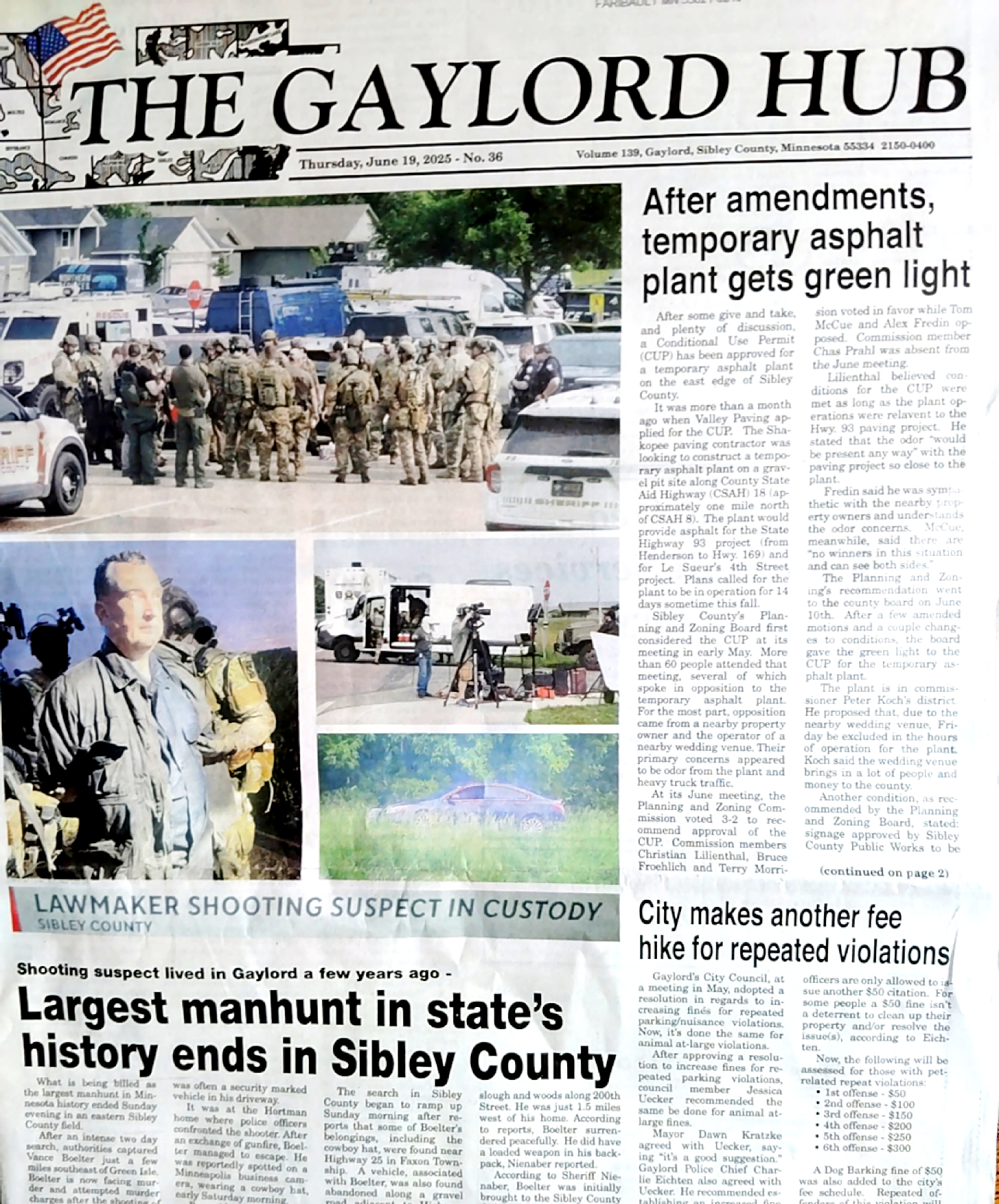
This shows an edited section of the front page of the June 19, 2025, The Gaylord Hub. (Minnesota Prairie Roots photo June 2025)

ALTHOUGH I AM DECADES removed from working as a full-time journalist, my innate curiosity remains unchanged. I still want to gather the facts, get answers, and uncover the who, what, when, where, why and how. That has never left me.

Last Saturday, June 14, memories of working as a newspaper reporter in Gaylord, the county seat of Sibley County, rushed back as the top news story in Minnesota, and the nation, unfolded. That breaking news was the politically-targeted assassinations of Minnesota State Representative Melissa Hortman and her husband, Mark, and the shootings of Senator John Hoffman and his wife, Yvette. The suspect now accused in the crimes, Vance Boelter, 57, lived near Green Isle. In rural Sibley County.

My first job fresh out of Minnesota State University, Mankato, in 1978 with a degree in mass communications, news/editorial emphasis, landed me in small town Gaylord, at The Gaylord Hub. I was affectionately dubbed “The Cub from the Hub,” or at least affectionately by those who appreciated my fair and balanced reporting. Some did not. Gaylord lies about 15 miles southwest of Green Isle, where Boelter was eventually apprehended near his home. Green Isle was mostly outside The Hub’s coverage area, although I recall writing a few stories from that part of Sibley County.
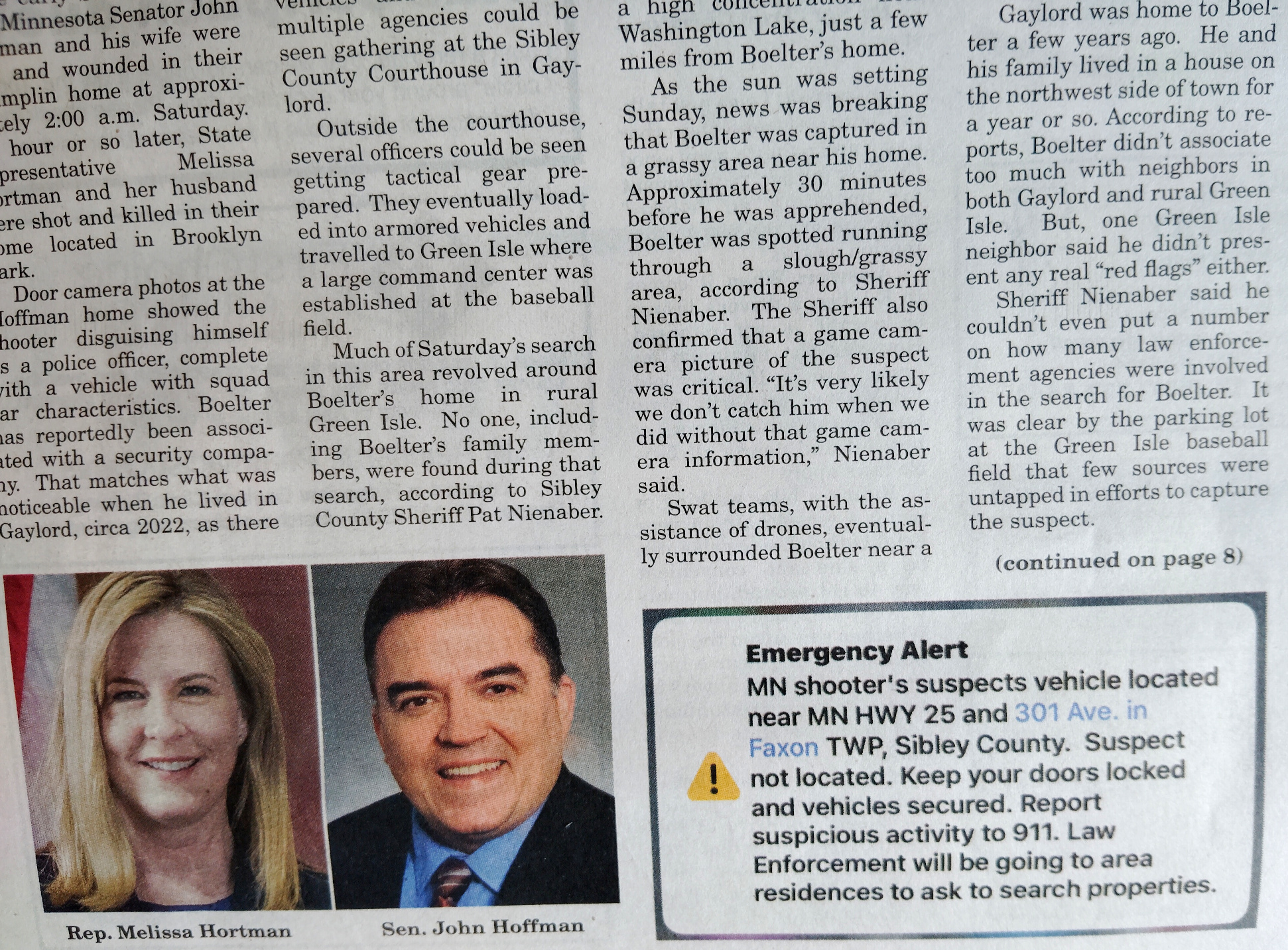
The bottom portion of the front page story written by Joseph Deis. (Minnesota Prairie Roots photo June 2025)

Today the June 19 edition of The Hub landed in my mailbox. I’d been waiting for this issue, curious to see how third-generation publisher and editor, Joseph Deis, would cover the largest news story in the paper’s history. The Hub front page headline reads: Shooting suspect lived in Gaylord a few years ago—Largest manhunt in state’s history ends in Sibley County.

I couldn’t help but think how hard Joe (he was just a kid when I worked for his dad, Jim, at The Hub) and other media have worked to cover this evolving story. It’s not easy to gather information from multiple sources and angles and keep everything straight. That said, law enforcement did an impressive job of informing the media and the public, at least from my at-a-distance perspective.

And Joe Deis did a good job of pulling everything together in a lengthy story that published in his weekly. His dad would be proud, as am I. His story included new-to-me information that Boelter and his family lived on the northwest side of Gaylord a few years ago. They mostly kept to themselves, the article states.

Now, as if the Gaylord/Sibley County connection to my past isn’t enough, there’s more. I left The Hub after several years to become a newspaper reporter at The Sleepy Eye Herald-Dispatch. The murder suspect grew up in Sleepy Eye, graduating from the public high school in 1985. (I was long gone.) Boelter returned to his rural southern Minnesota hometown, living with his family in Sleepy Eye from 2008-2011 and working at Del Monte. And he apparently preached occasionally at church services held in the high school gym, according to media reports. If I know one thing about Sleepy Eye, it’s that the community is deeply religious, with an especially strong Catholic base. I have no idea what Boelter’s childhood faith background may be. But he graduated from an interdenominational Bible college in Texas in 1990 and served as an evangelical missionary in the Democratic Republic of Congo in recent years.

These two connections to my past rattled me. But they also reminded me that, even in rural areas, a reporter’s job can be about more than covering government, sports, community events and the everyday happenings of small town life. Sometimes it can be about covering a really big, life-changing story. A story that grabs headlines locally, statewide, nationally and internationally as did the manhunt in Sibley County, in the readership area of a small town weekly newspaper where I once covered the news.

© Copyright 2025 Audrey Kletscher Helbling


Reflecting on letters from first graders: All they wanted for Christmas December 31, 2024

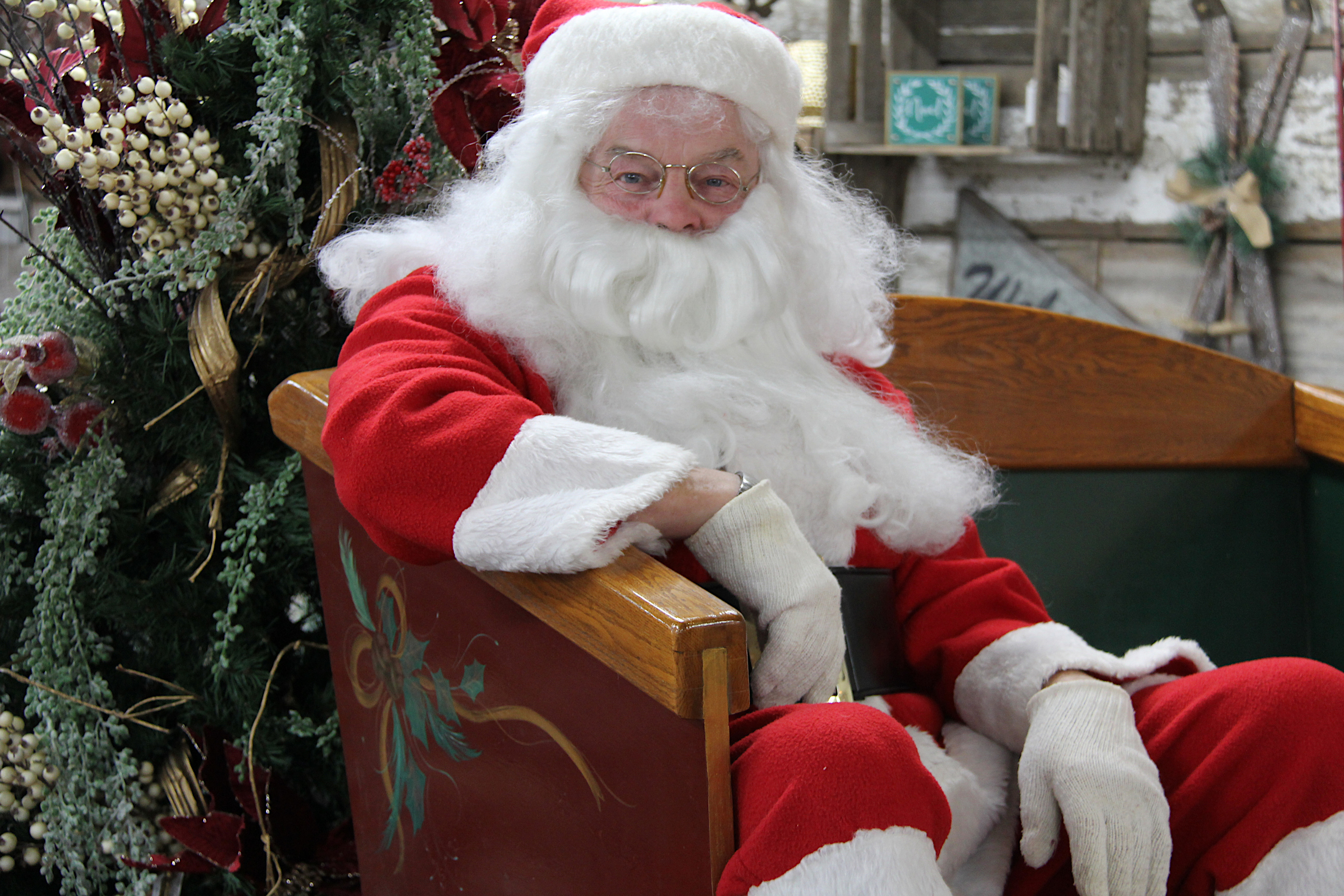
Santa at Souba Greenhouse, Owatonna, during their “Christmas on the Farm.” (Minnesota Prairie Roots copyrighted file photo December 2024)

MAVERICK WANTED ONLY THREE THINGS for Christmas, so he wrote in a letter to Santa published recently in a Minnesota weekly newspaper. The first grader wanted a sled, a “lizard that climbs up the wall” and 100 packs of Cotton Candy Bubblegum. Did he get all three? I doubt it. But what Maverick did get from me was laughter, especially for that bubblegum ask. But, hey, I understand. I loved Bazooka bubblegum as a kid. Maverick and I would get along splendidly, if he agreed to share his bubblegum.

Every year I look forward to the letters to Santa Claus published in The Gaylord Hub, a small town weekly newspaper where I worked as a reporter and photographer fresh out of college with a journalism degree in 1978. Today that paper still arrives in my mailbox weekly, much to my delight. The community where I was affectionately called “The Cub from The Hub” will always hold a special place in my heart.

And those Santa letters, oh, those letters, what joy they bring me each December They are the stuff of a small town newspaper. I imagine parents clipping the published letters and years later pulling out the yellowed newsprint to share with their grown children.

I’VE BEEN GOOD, SANTA. BUT MOM?”

“I have been good for 3 days,” writes Sibley East first grader Sophia before asking for a toy remote control plane. Three days? I wonder if Santa had to think about that statement. If anything, Sophia was apparently being honest.

But then there’s Adelyn, who wasn’t as much concerned about her behavior as her mom’s, although she claims to have been “good.” Adelyn asks Santa, “Is my mom on the naughty list?” Cue the laughter from me…and maybe Mom.

Cats and canines were a popular gift request to Santa. (Minnesota Prairie Roots copyrighted file photo)

ALL I WANT FOR CHRISTMAS…

First graders are, if anything, unfiltered and honest. And they don’t hesitate to ask for whatever they want. It seems a lot of these kids wanted pets—specifically ten asked for cats or kittens, six for dogs and one, a guiny (sic) pig. That last request came from May. My guess is that most kids did not get the animals they wanted, except those asking for a robot dog or a toy dog.

Then there were the unusual gift requests. Erik wanted a chainsaw. I expect Santa nixed that pretty quickly considering age appropriateness. Dalton asked for a diamond, a rather odd request from an elementary school student. Violett wanted a camera that looks like a unicorn. Is there such a thing? Oliver asked to “get in the Titanic for Christmas,” which I wouldn’t recommend even if the Titanic was still afloat.

Plated Christmas cookies at a holiday event in Faribault. (Minnesota Prairie Roots copyrighted file photo 2014)

Kaelyn asked Santa for an iPhone, a Barbie toy and 5 cookies. No problem there, except with the phone, which I wouldn’t give to any of the five first graders who asked for one. I think Santa may have felt the same. But the Barbie toy and cookies? No problem. Santa has plenty of cookies to share. He probably gave Kaelyn more than five. And he likely had enough Barbie goods to give away.

Alia and May’s requests for make-up, though, gave me pause and I bet it did for Santa also. No first grader needs make-up for her sweet little face.

Kids are always interested in Santa’s reindeer and the elves. (Minnesota Prairie Roots copyrighted file photo 2023)

SWEET WORDS FOR SANTA

I love how several kids proclaimed their love for Santa. “I love you, Santa!” exclaimed Holden. Such sweet words likely proved reaffirming for the overworked, underpaid Santa Claus. Kieren stepped up the compliments. “Santa, you are awesome!” he wrote. “Thank you for giving us presents.” Awww, gratitude goes a long ways with Santa as does praise for his reindeer. Gauge bravely asked if he could come to Santa’s house because he really wants to meet the elves.

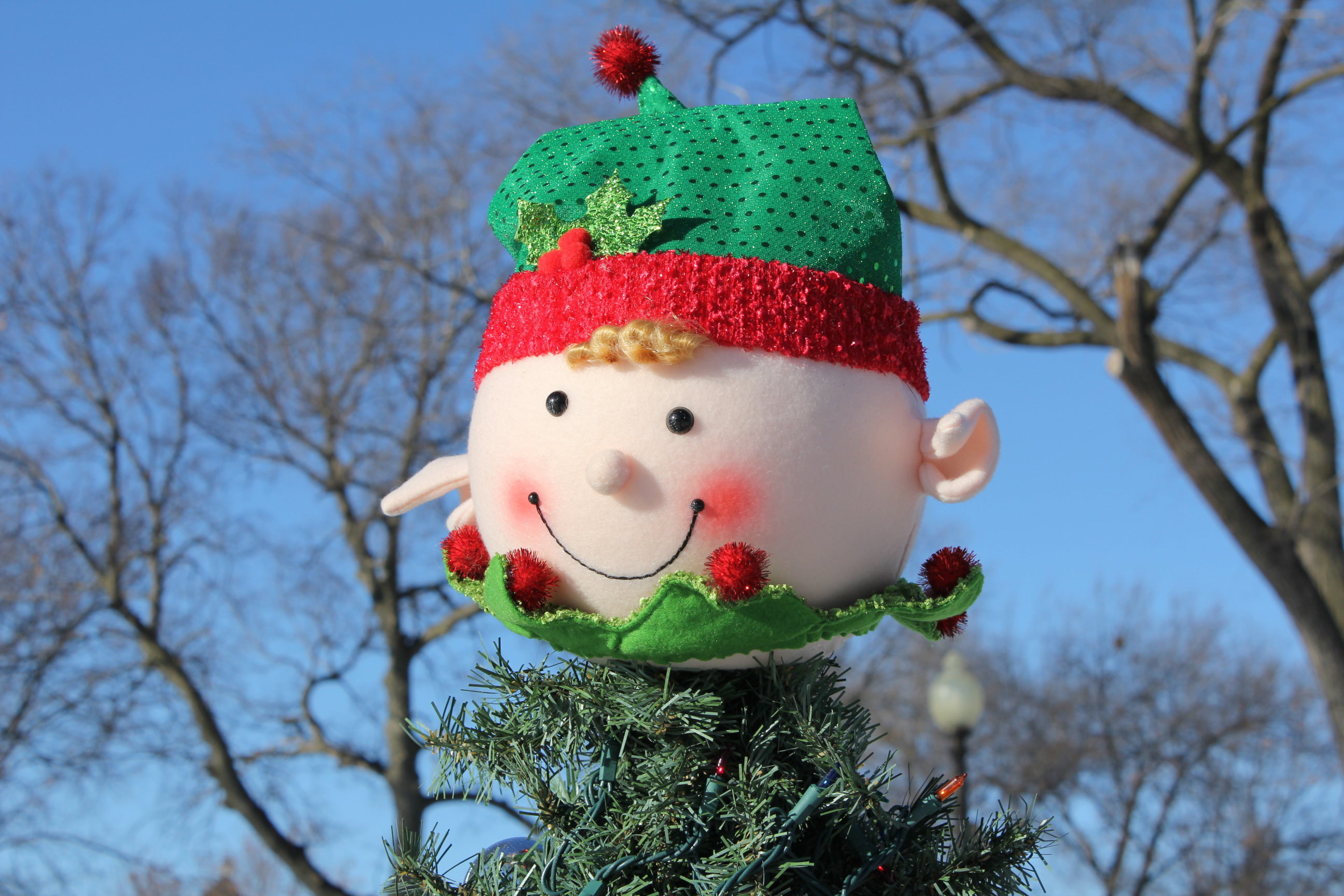
Candy canes and Christmas go hand-in-hand, here theming a Christmas tree in Faribault’s Central Park. (Minnesota Prairie Roots copyrighted file photo December 2024)

AND THEN THIS REQUEST

And then there’s the letter from Allison, who said she’s been helping her mom with the baby. She asked for only one thing—a candy cane. That broke my heart. One. Thing. I hope Santa gave her a hundred candy canes, several dozen cookies and a surprise gift that brought Allison, a good, kind (her words) and selfless soul, unfathomable Christmas joy. She, among all those letter-writing first graders, deserved a special gift.

© Copyright 2024 Audrey Kletscher Helbling
 

In Montgomery: Featuring the letterpress art of Tin Can Valley Printing February 16, 2022

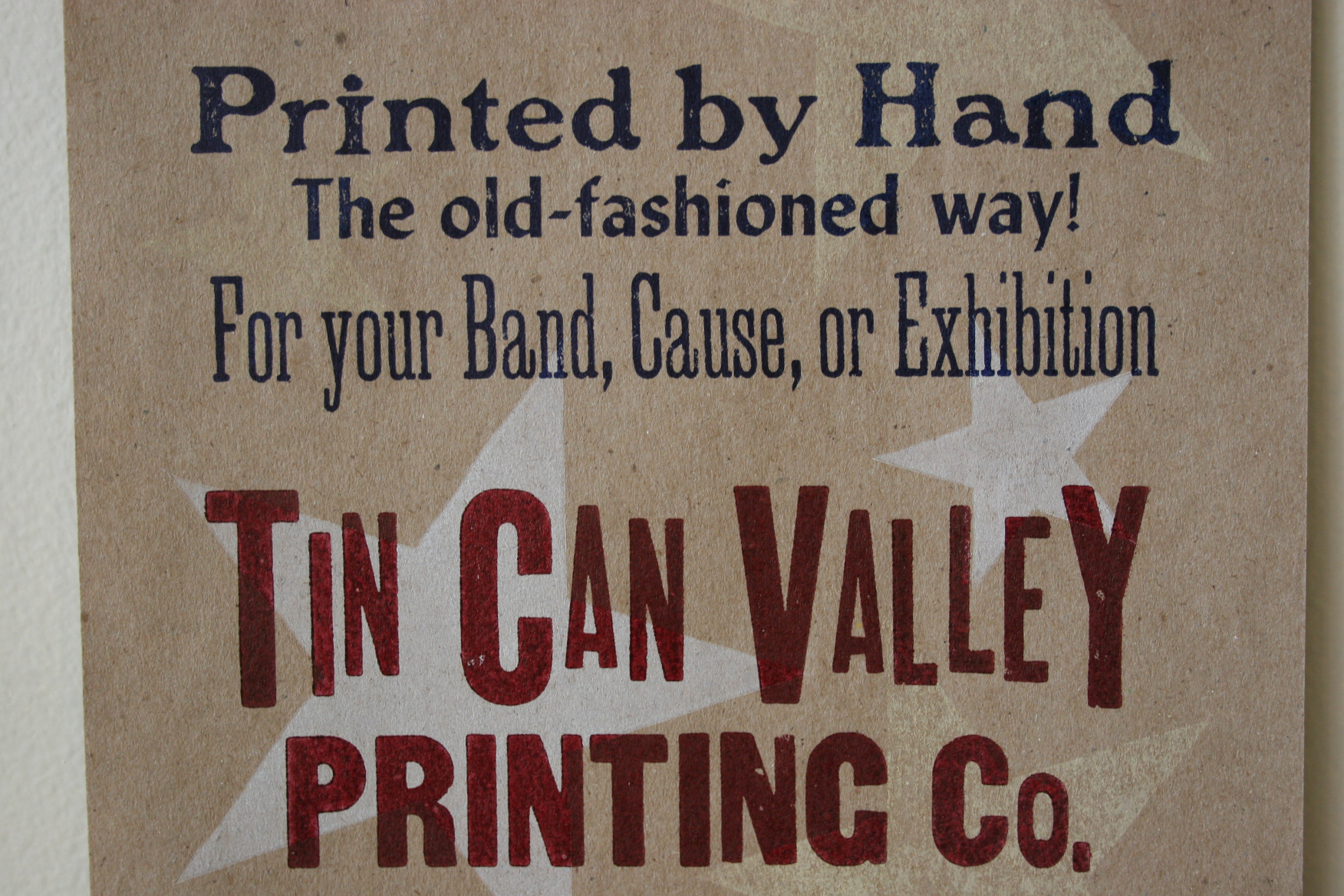
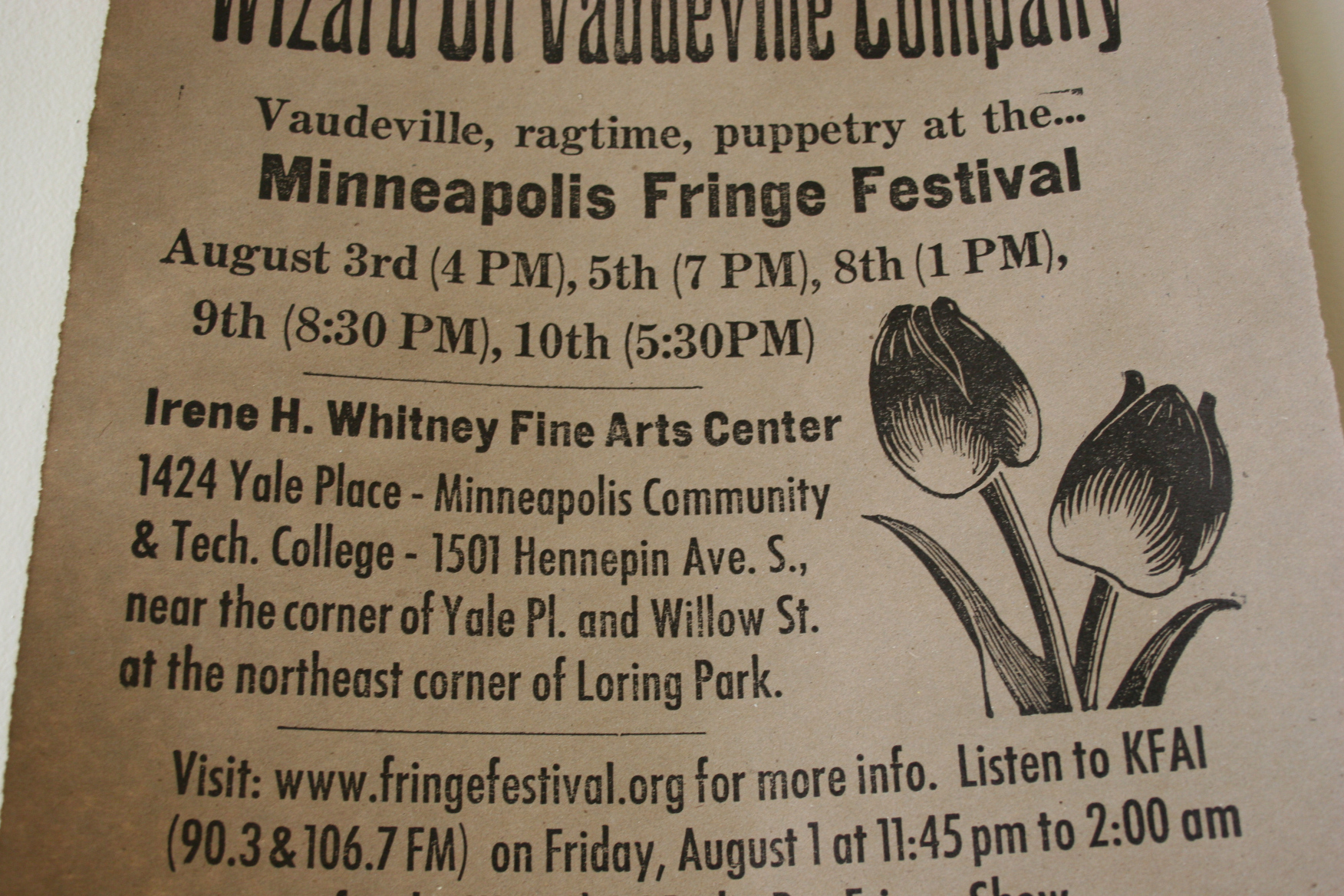
A promo poster printed by Craig Kotasek of Tin Can Valley Printing. (Minnesota Prairie Roots copyrighted photo February 2022)

INSIDE AN HISTORIC 1892 BRICK BUILDING in the heart of Minnesota Czech country, a Letterpress Print Show drew me to The Arts & Heritage Center of Montgomery. The show, continuing until February 26, features the art of Craig Kotasek of Tin Can Valley Printing Co. in nearby Le Sueur.

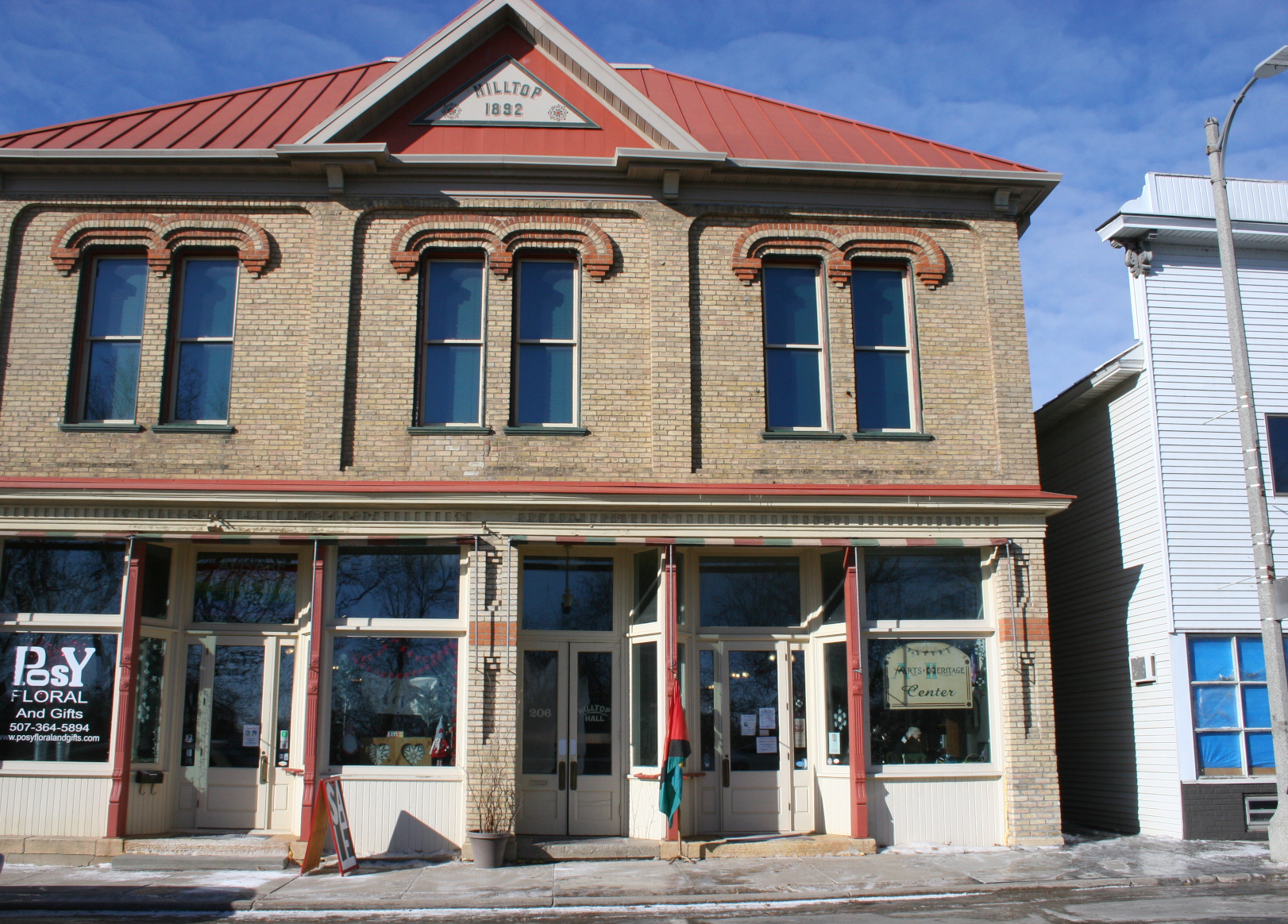
The historic Hilltop Hall houses The Arts & Heritage Center of Montgomery on the right and Posy Floral & Gifts, left. (Minnesota Prairie Roots copyrighted photo February 2022)
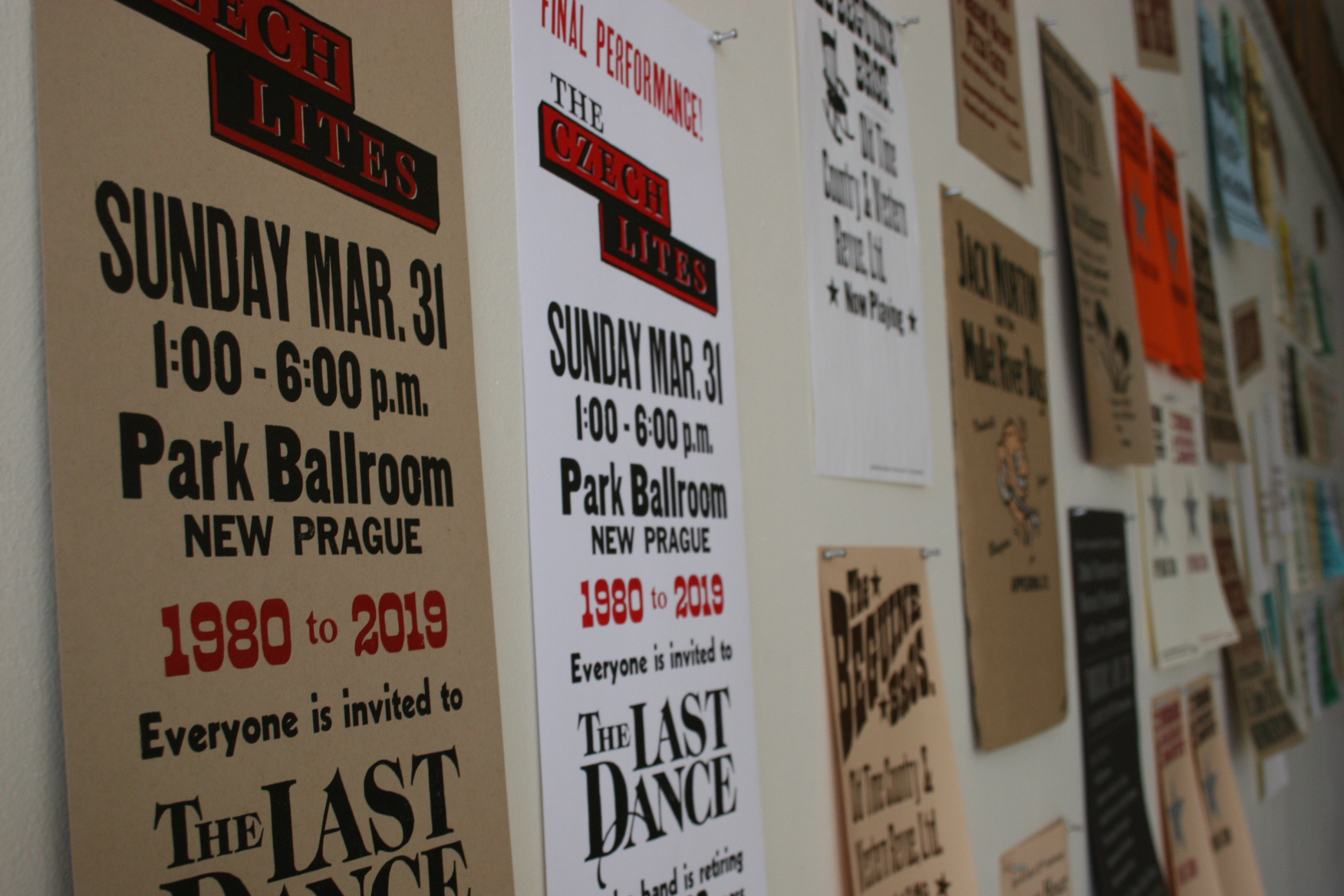
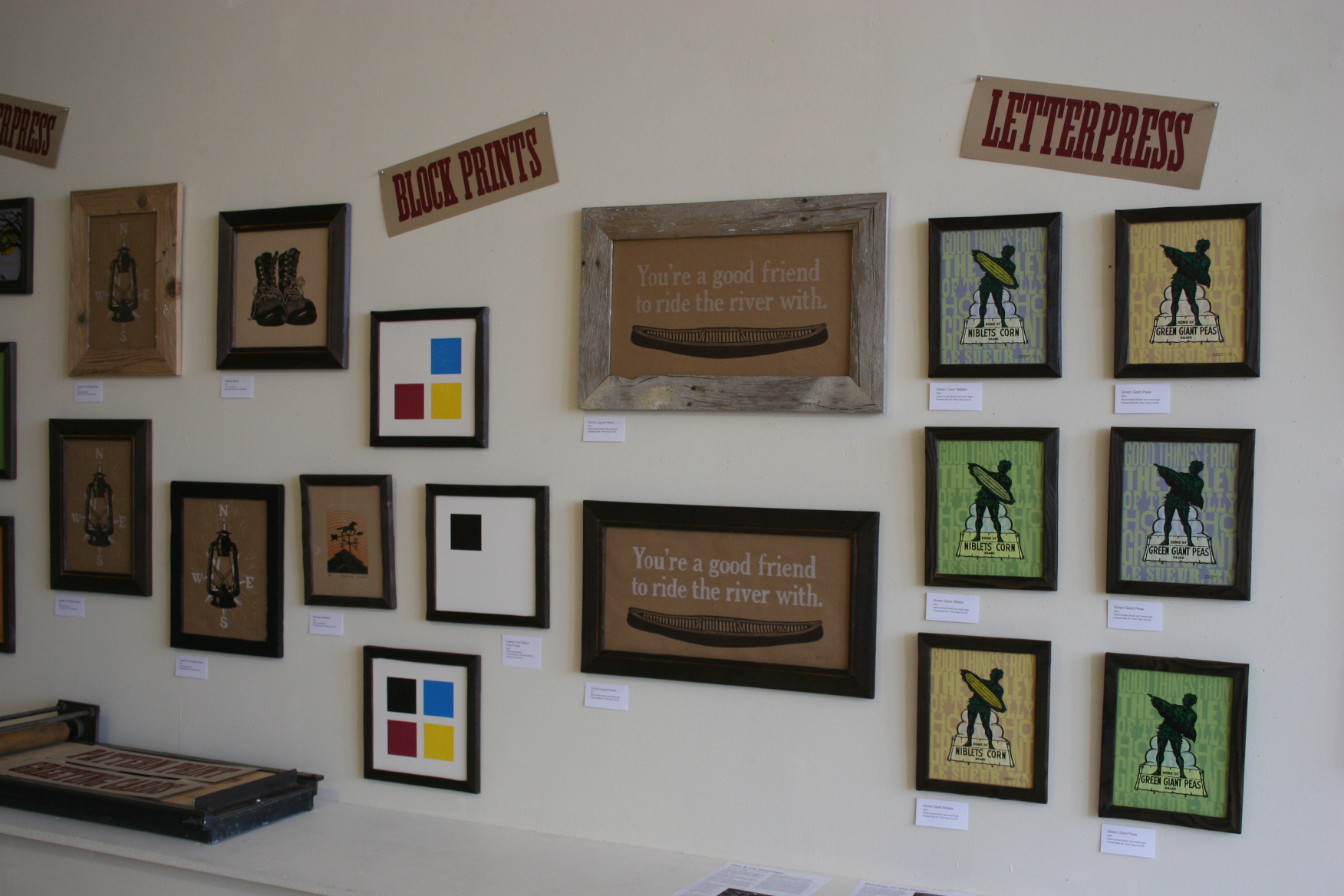
Inside the center, Kotasek’s prints plaster walls. (Minnesota Prairie Roots copyrighted photo February 2022)
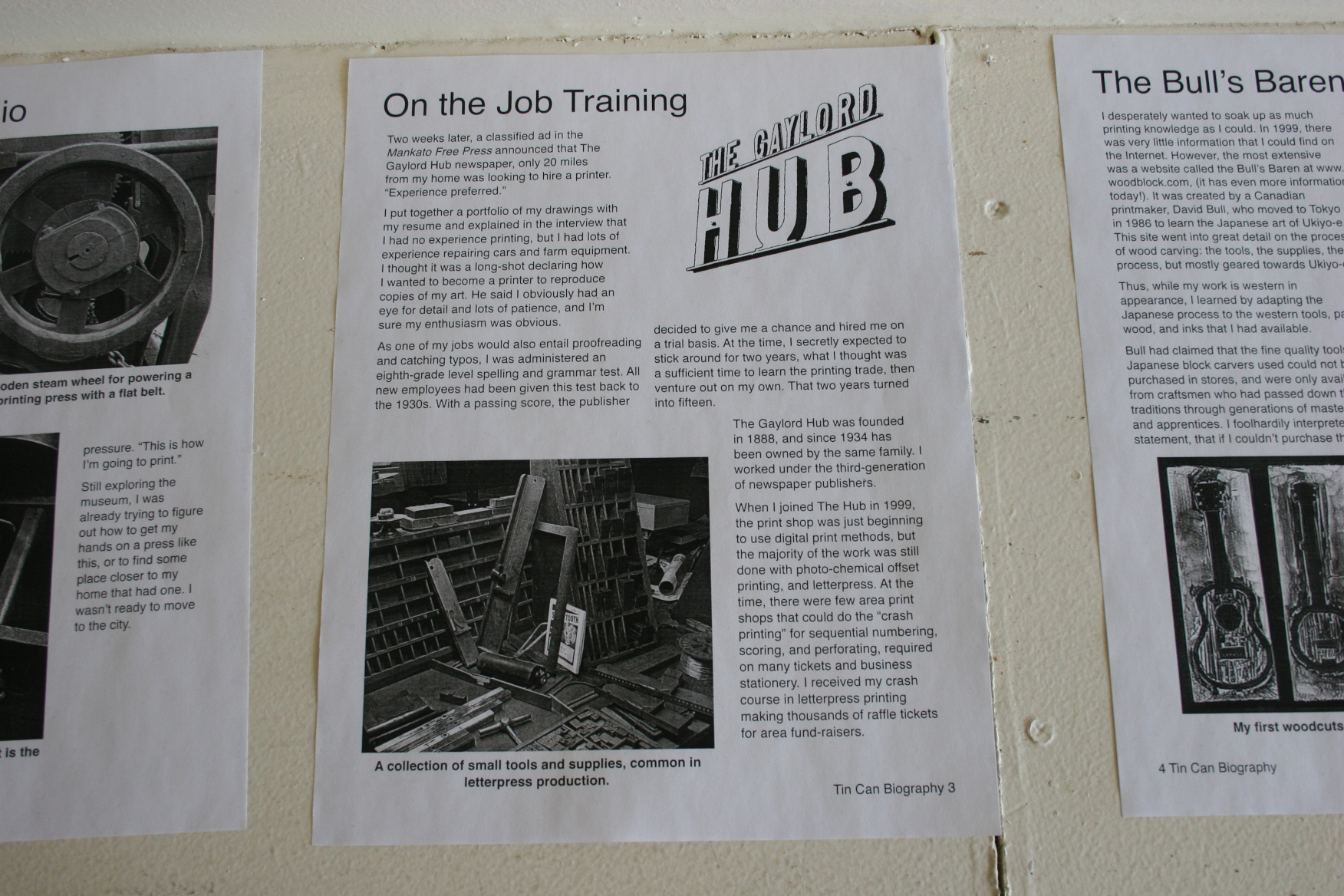
The artist includes some background info about himself, this sheet focused on his time at The Gaylord Hub. (Minnesota Prairie Roots copyrighted photo February 2022)

As a journalist and an art lover especially appreciative of letterpress printing, I delighted in this exhibit of an art now in revival. Not only that, I hold a connection to Kotasek. We both worked at The Gaylord Hub, me as my first newspaper reporting job straight out of college in 1978 and he as an apprentice printer there in 1999. We learned under the mentorship of Jim Deis, then editor and publisher of the generational family-owned newspaper. I’ve never met Kotasek, yet I feel linked via The Hub.

This shows the steps in creating a multi-hued print. (Minnesota Prairie Roots copyrighted photo February 2022)

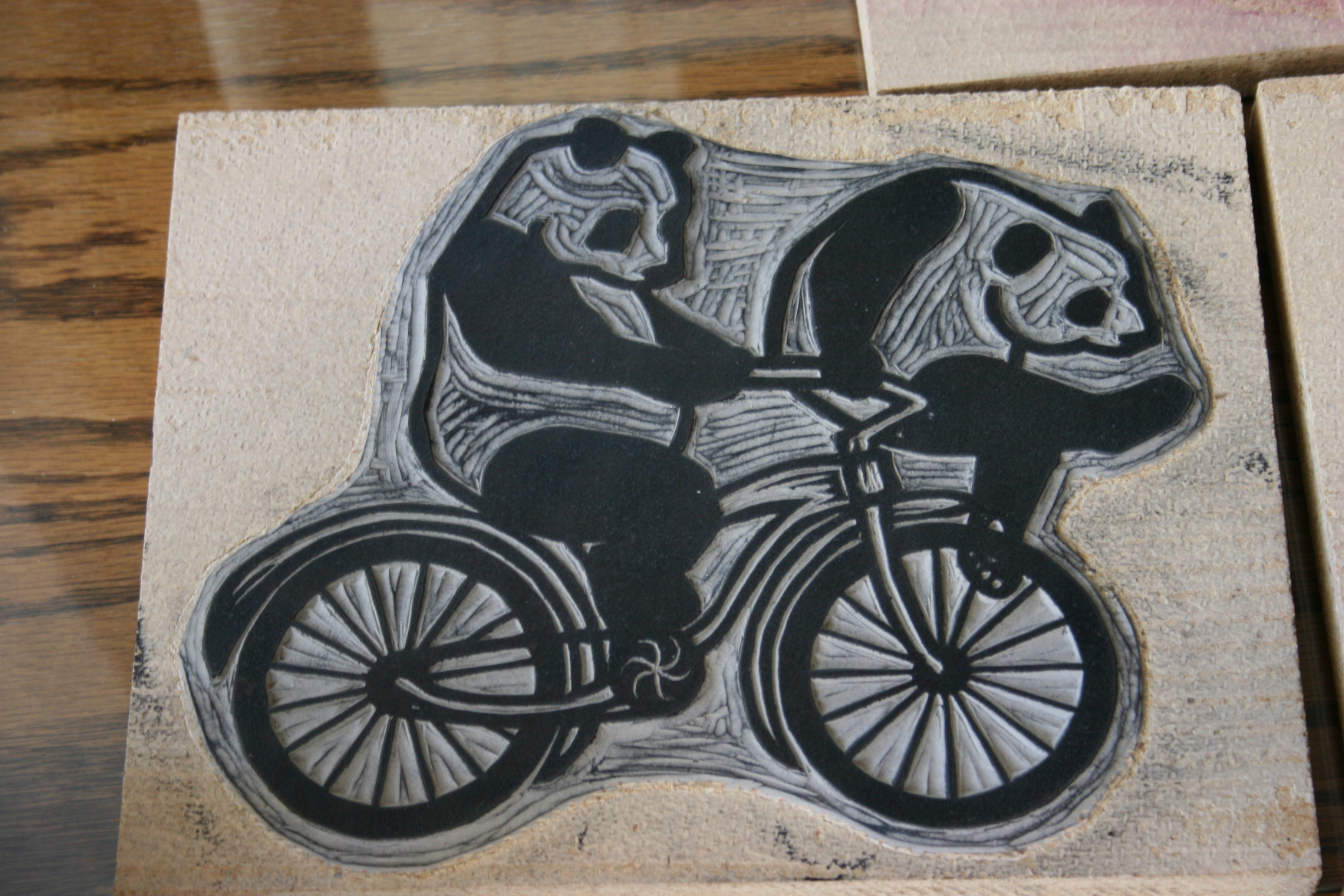
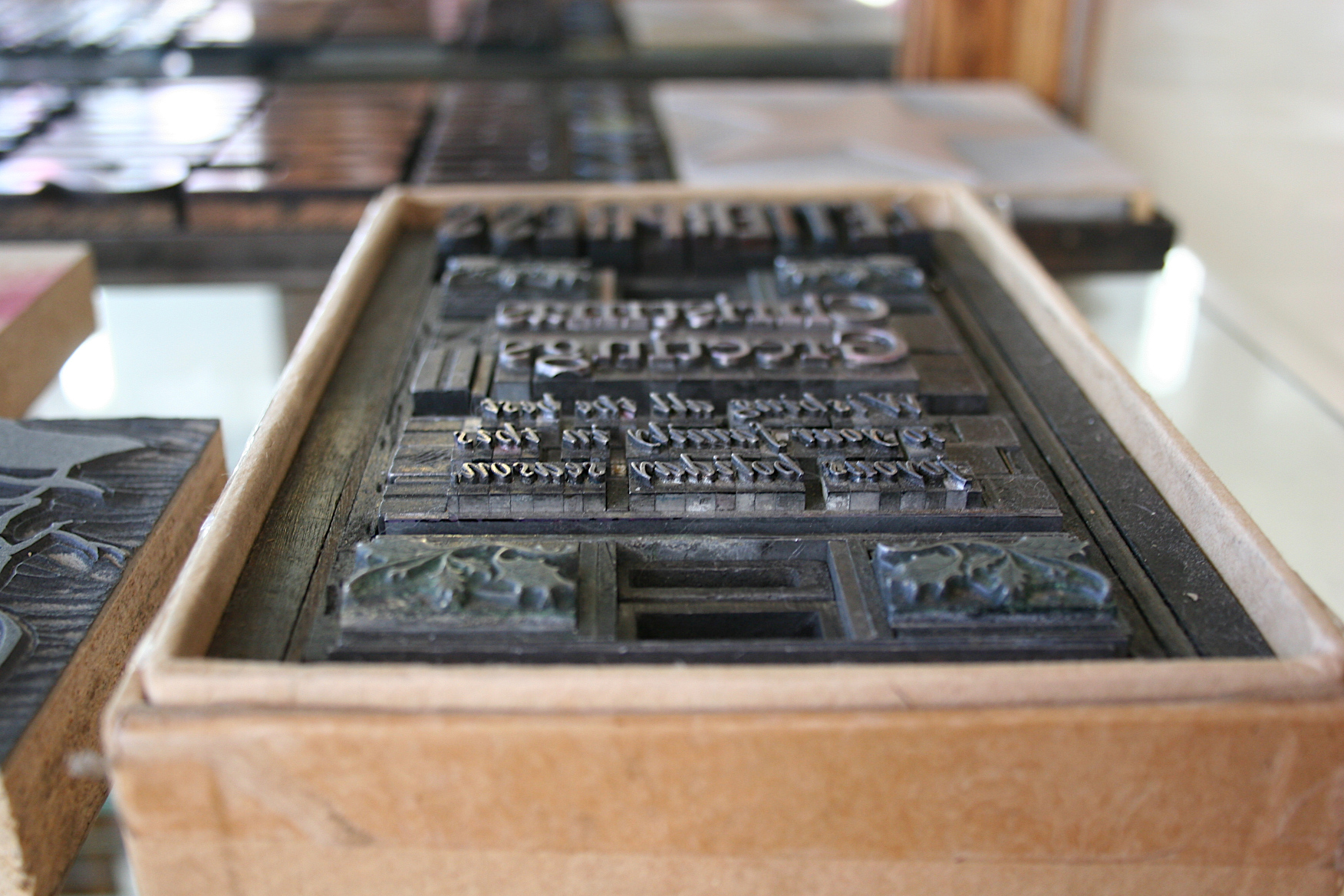
To view his art is to gain an appreciation for a past printing process. In letterpress printing, movable raised wood or lead letters/type are pieced together in a frame, then secured before inking onto paper via a printing press. That’s a simplistic explanation. If multiple ink colors are required, the process is layered, longer, more labor intensive. Likewise, art carved from linoleum or wood blocks goes through a similar process in creating fine art prints, gig posters and more.

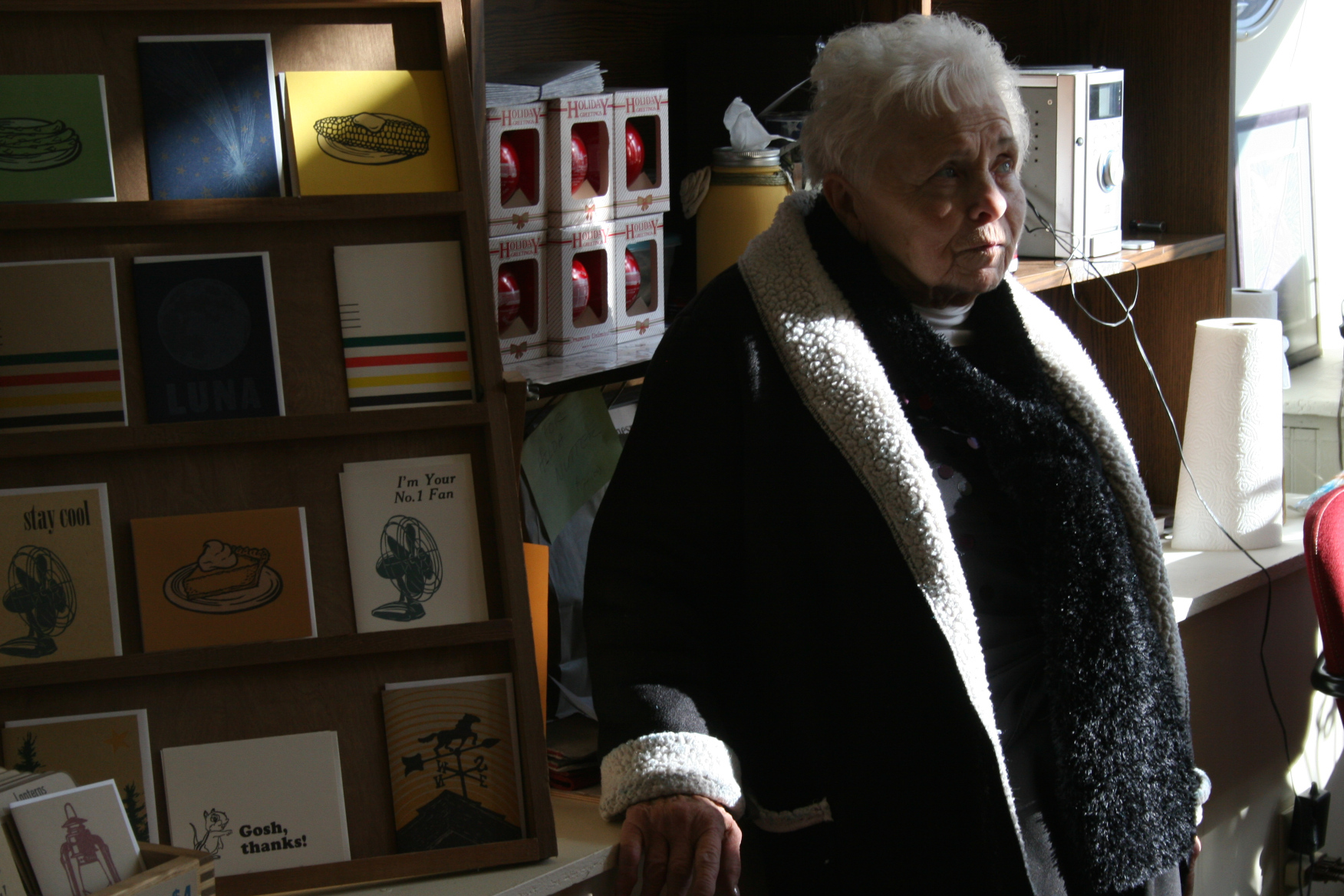
Volunteer JoAnn Petricka with Kotasek’s prints to the left. (Minnesota Prairie Roots copyrighted photo February 2022)

When I entered the narrow room which houses The Arts & Heritage Center in the small southern Minnesota community of Montgomery and saw Kotasek’s letterpress art, memories rushed back. Memories of the strong scent of ink, the clacking of noisy printing presses, scenes of printers Dale and Bucky laboring in stained printers’ aprons, me trying to hear phone conversations with sources. Me pounding out news stories on an aged manual typewriter against the backdrop of all that noise.

Hand-carved blocks were used to create this art titled “Eight-Pointed Star.” (Minnesota Prairie Roots copyrighted photo February 2022)

But on this February morning, quiet prevailed as I studied the work of this craftsman, this visual artist. Letterpress is both craft and art.

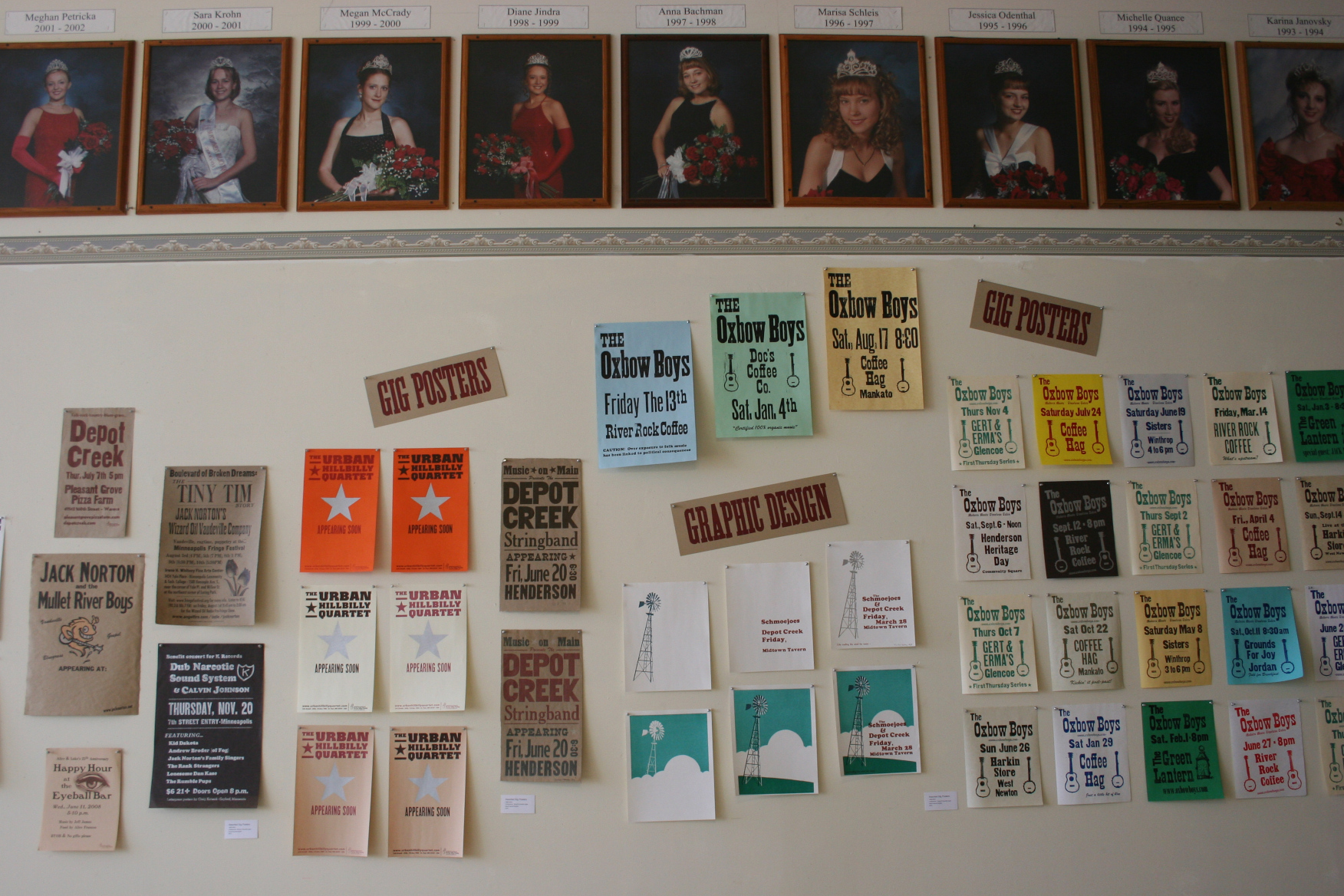
Kolacky Days queens in framed photos over prints from Tin Can Valley Printing. (Minnesota Prairie Roots copyrighted photo February 2022)
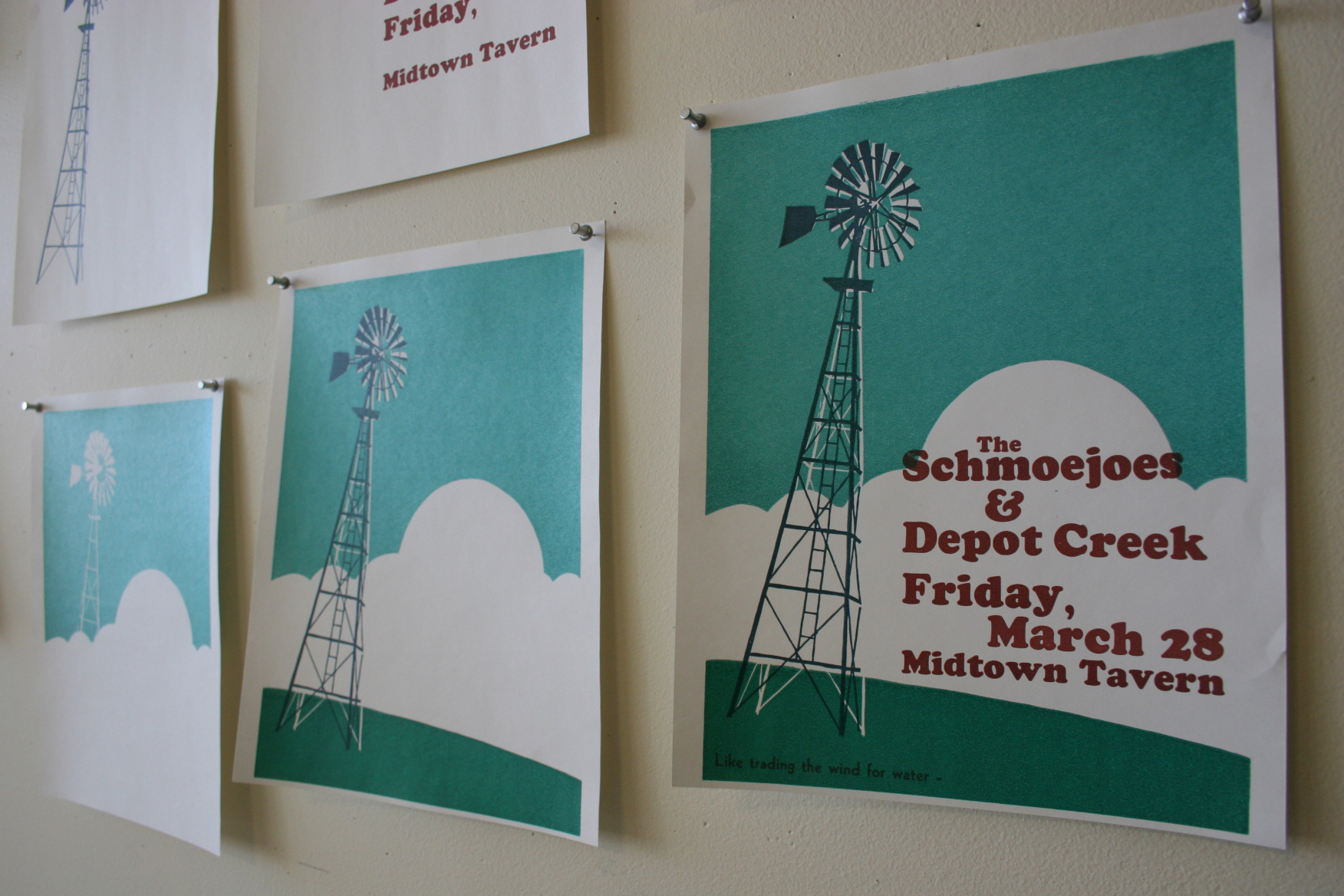
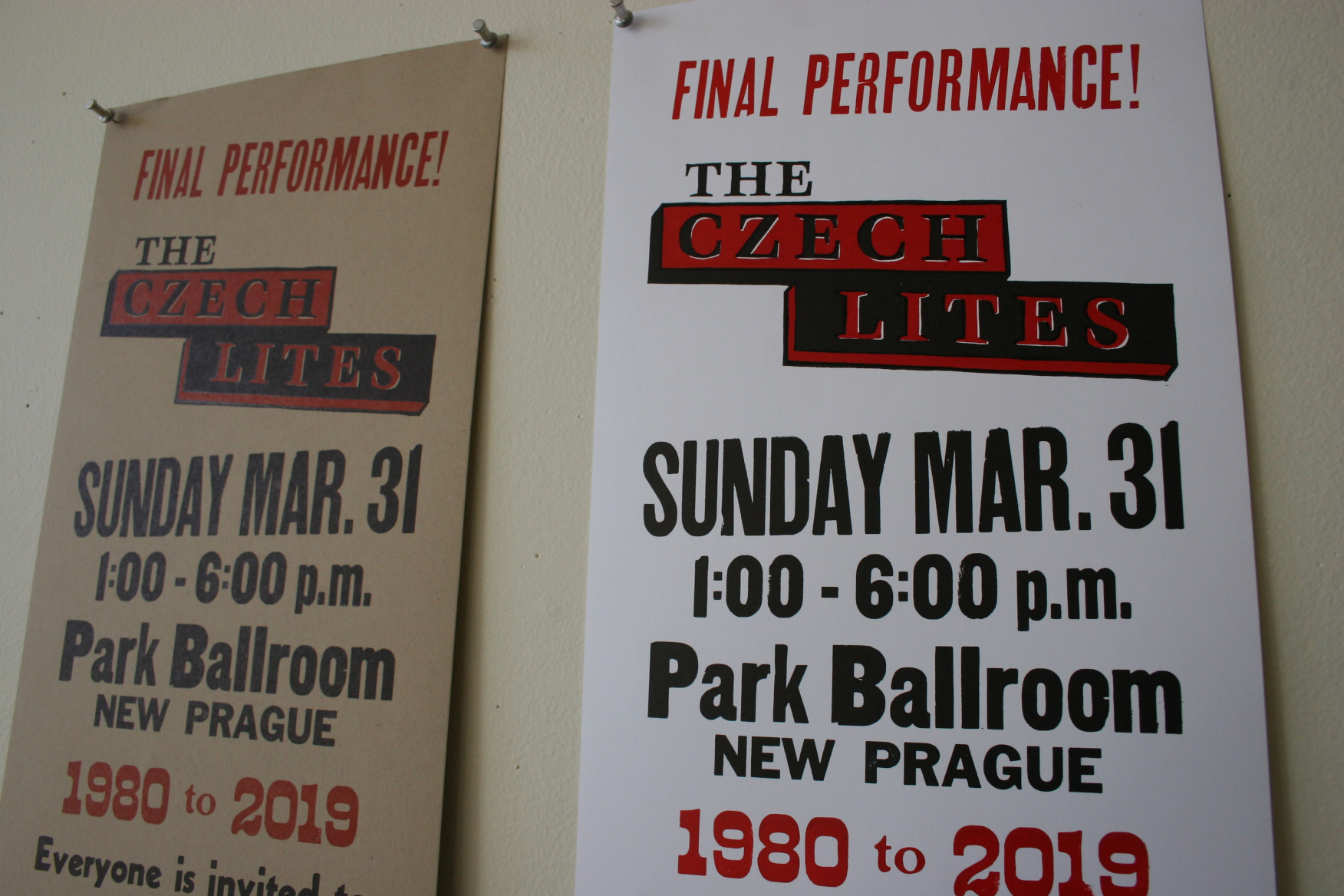
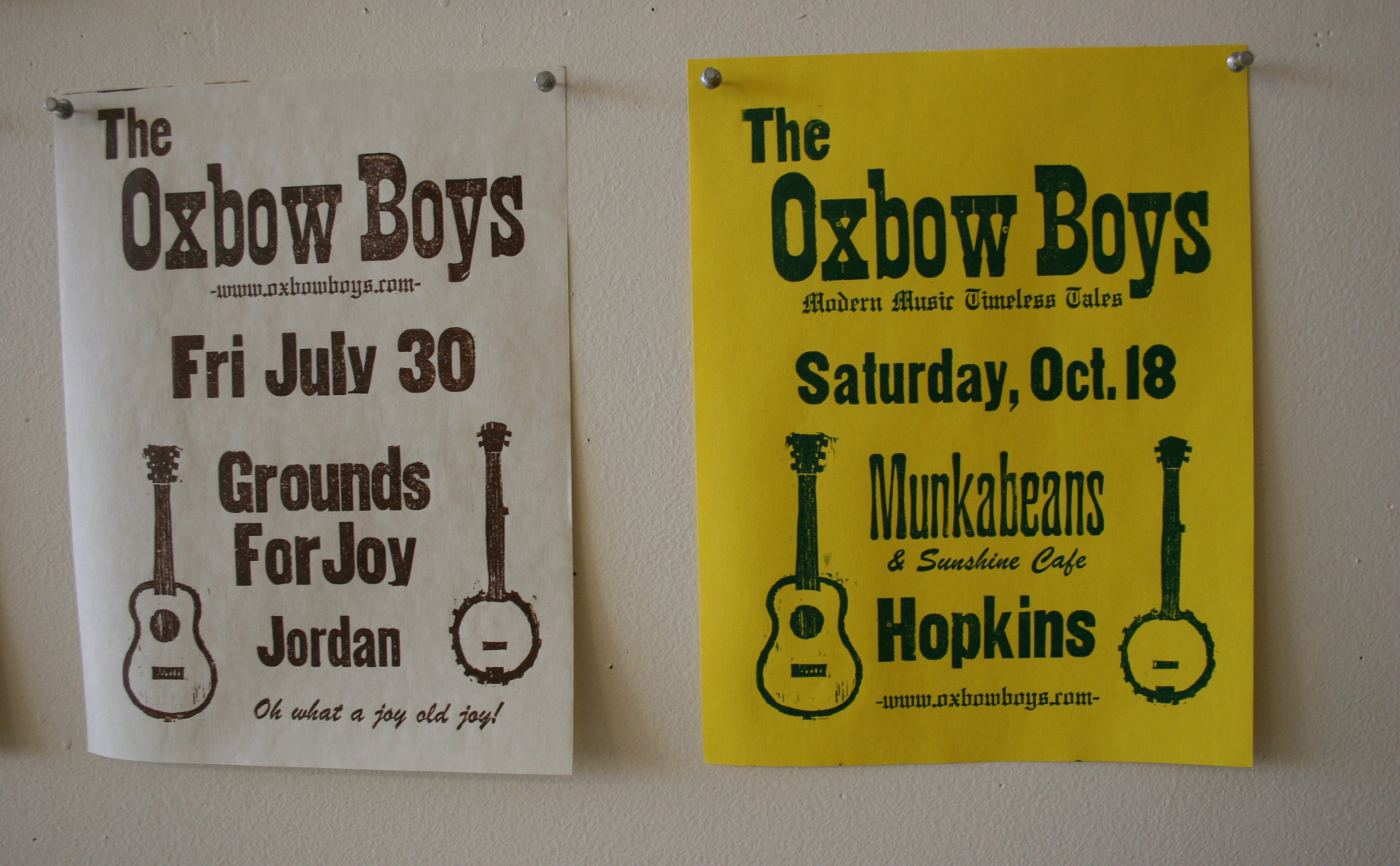
One of his specialties is creating posters for musical gigs. (Minnesota Prairie Roots copyrighted photo February 2022)

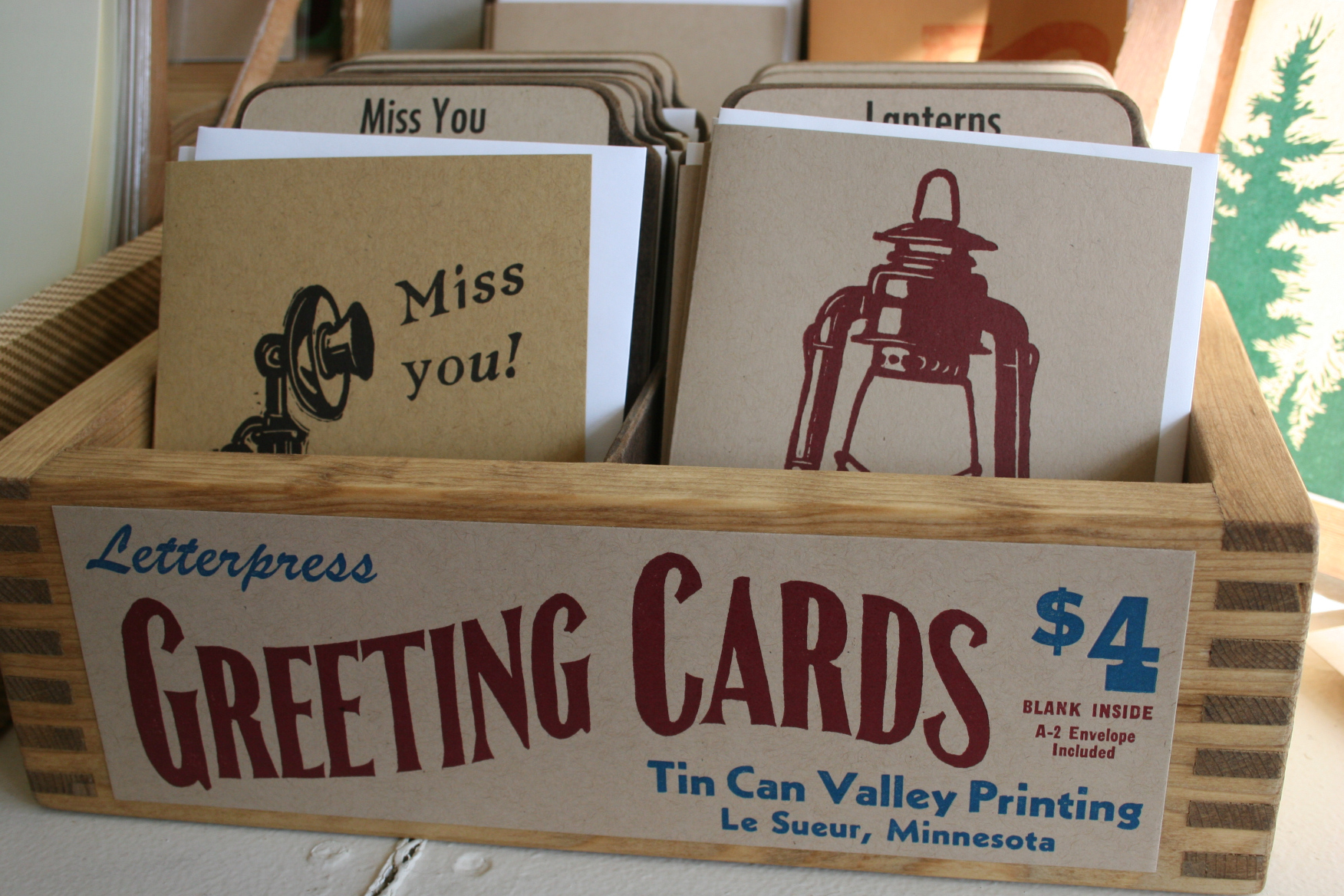
Beneath professional portraits of Kolacky Days queens, which ring this room near the ceiling, hang examples of Kotasek’s assorted creations. Gig posters for musical groups (including his own Oxbow Boys band). Fine art prints created with hard-carved blocks. A mix of letterpress and block. And on a shelf, a box of his popular letterpress greeting cards. Another display holds his $10 numbered prints.

A hand-carved block for printing. (Minnesota Prairie Roots copyrighted photo February 2022)

I feel such an appreciation for Kotasek. His love for the letterpress craft shows in his printing skills, his creativity. To get clear, crisp prints takes patience, practice, time, effort. But before that comes the visualization, the creativity, the ability to bring many elements together in hands-on work.

Type in a tray. (Minnesota Prairie Roots copyrighted photo February 2022)
Cans of ink to color his art. (Minnesota Prairie Roots copyrighted photo February 2022)
Roller and carved blocks to print. (Minnesota Prairie Roots copyrighted photo February 2022)

A tall enclosed cabinet holds some of Kotasek’s tools of the craft. Letters. Rollers. Ink. Wood-cuts. All offer a glimpse into this artist’s world. He’s gathered abandoned, about-to-be-scrapped printing presses and other printing tools from small town newspapers in Minnesota and set up shop in a renovated granary on the family farm just outside Le Sueur. His studio overlooks the valley, home of the Jolly Green Giant associated with Minnesota Valley Canning Company, later Green Giant.

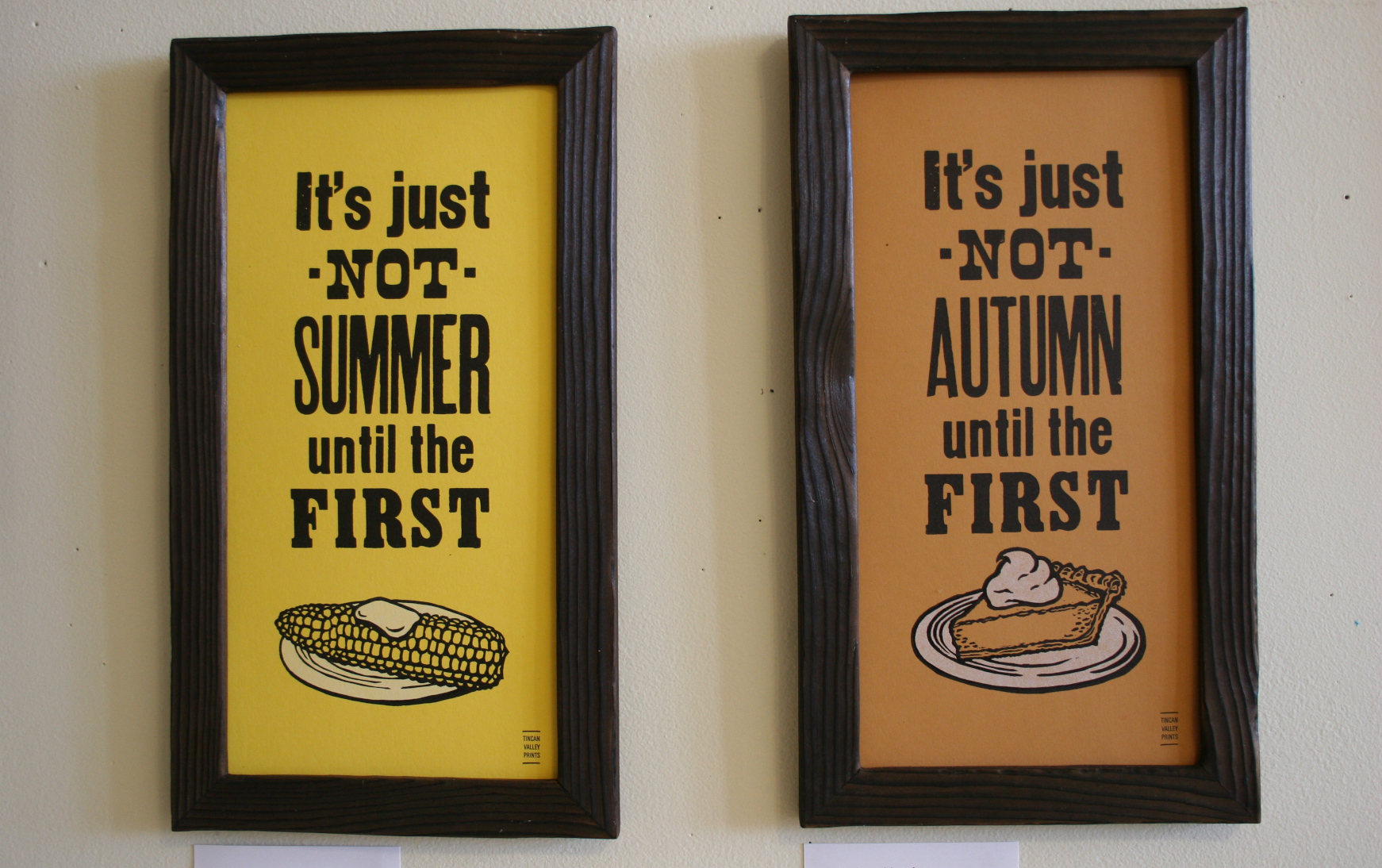
Kotasek has created numerous Green Giant prints. (Minnesota Prairie Roots copyrighted photo February 2022)

Kotasek pays homage to the vegetable canning company in the name of his printing business, Tin Can Valley Printing. On his website, he offers several explanations, one referencing a farmer who fed discarded canned vegetables to his pigs from damaged cans. As the story goes, the pig farmer tossed those empty tin cans into a ravine. During a massive flood of the Minnesota River Valley in 1965, the cans reportedly floated into town, causing an array of issues. The name Tin Can Valley stuck. I like the historic reference, the memorable moniker.

Featured art includes Jolly Green Giant prints, right. (Minnesota Prairie Roots copyrighted photo February 2022)
More food art prints. (Minnesota Prairie Roots copyrighted photo February 2022)
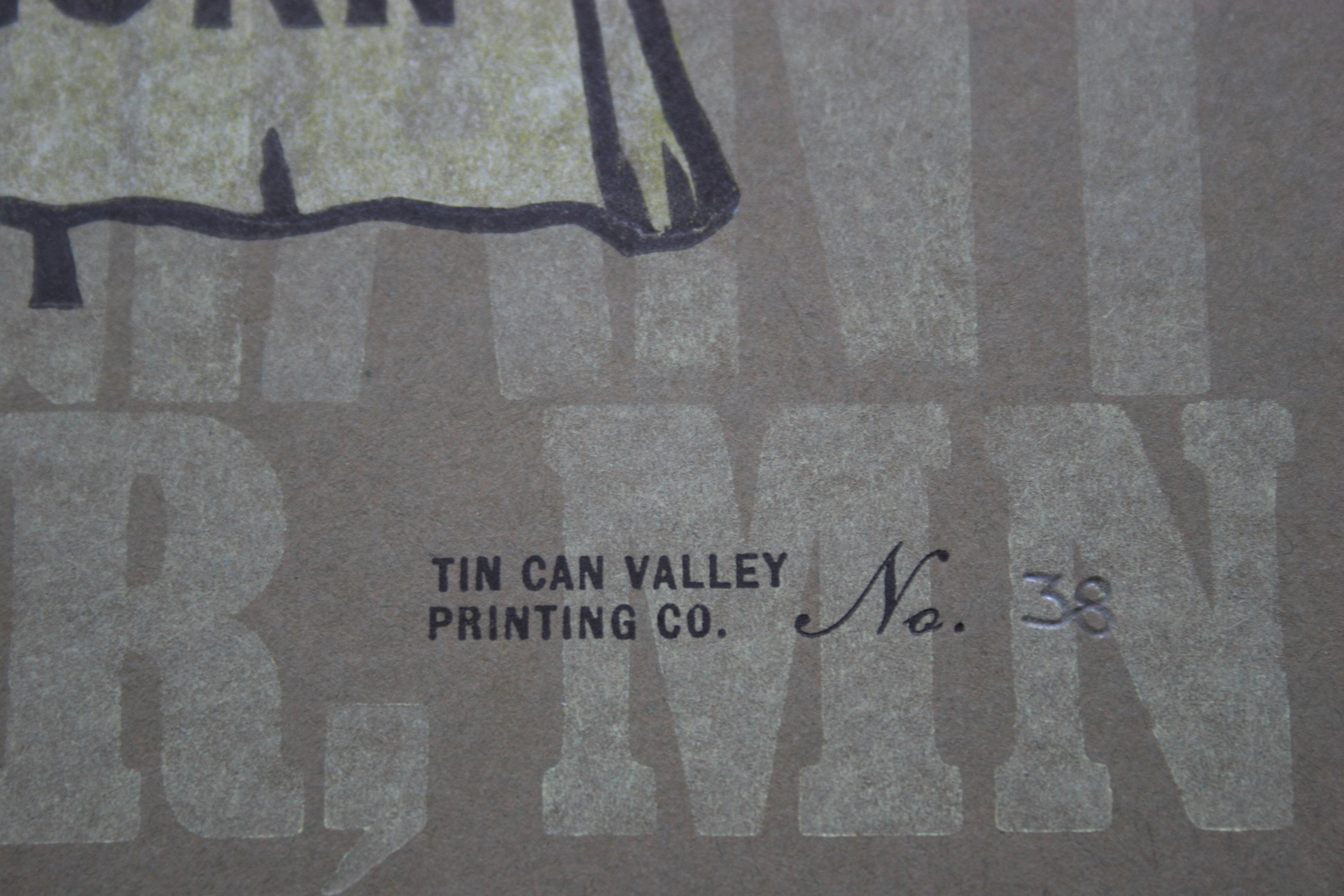
In the corner of my “Niblets of Corn Sign” print. (Minnesota Prairie Roots copyrighted photo February 2022)

I found myself drawn to Kotasek’s Green Giant-themed prints. I purchased No. 38 of his 2019 “Niblets Corn Sign” 8 x 10 card stock print. It’s a reproduction of a metal sign that once marked the Green Giant canning factory in Le Sueur. The four-color print, crafted from wood type and hand-carved wood and linoleum blocks, features the legendary Green Giant hefting a massive ear of sweetcorn. The image is iconic rural Minnesota.

This particular poster has an old style newspaper vibe. (Minnesota Prairie Roots copyrighted photo February 2022)

Kotasek represents in many ways the past of newspapers in Minnesota. Early editors printed their papers with letterpress. They also served their communities as print shops. When I worked at The Gaylord Hub, farm auction bills flew off the aged printing presses. Kotasek remembers the endless fundraiser raffle tickets he printed while learning the printing trade.

A poster fitting for the Czech farming community of Montgomery. (Minnesota Prairie Roots copyrighted photo February 2022)

If you’re interested in meeting Kotasek, visit The Arts & Heritage Center of Montgomery, 206 First Street North, between 9 am – noon on Saturday, February 26, during an artist’s reception. The center is open limited hours: from 2-5 pm Thursdays and Fridays and from 9 am-noon on Saturdays. The show closes February 26.

While in Montgomery, be sure to check out the shops (gift, floral, quilt, thrift, drugstore…) and stop at Franke’s Bakery for a sweet treat. You’ll find kolacky there in this self-proclaimed “Kolacky Capital of the World.” The town is also home to Montgomery Brewing and Pizzeria 201 (a popular local eatery with curbside pick-up only currently). I encourage you to check destination hours in advance of a visit to avoid disappointment. Also notice the historic architecture, the photo tributes to veterans and the town mural (across from the bakery). Montgomery rates as one of my favorite area small towns…because of The Arts & Heritage Center and more.

© Copyright 2022 Audrey Kletscher Helbling
 

“Dear Santa” letters from Minnesota first graders December 29, 2021

Santa, done delivering gifts at a family Christmas. (Minnesota Prairie Roots copyrighted file photo December 2015)

DAYS BEFORE CHRISTMAS, a small town Minnesota weekly newspaper published 32 letters—31 addressed to Santa and one to Elsa. The letters written by Sibley East first graders, as you would expect, are honest. Or at least honest enough to convince Santa of good behavior.

As I read through the letters to Santa published in The Gaylord Hub (where I worked as a reporter from 1978-1980), I laughed. And I nearly cried. Read on and you’ll understand as I share highlights pulled from the kids’ writings.

Many first graders assured Santa of their helpfulness and kindness among family and friends. But young Oskar hesitated. “I have been kind of good this year,” he penned before asking for Legos and books with one Lego figurine.

WISH LIST BASICS

What kids wanted for Christmas varied widely. Aleah asked for markers, glue, coloring books, crayons and Skye from Paw Patrol. Her request for glue and for crayons caused me to pause, considering she needed/wanted something so basic. I hope sweet Aleah got those gifts. Other kids asked for items like shoes, clothes, a bunk bed, a garbage can for their bedroom. Necessities.

But perhaps the most touching was Elsa’s request: “Please can you give me a picture of me for my family.”

WISHFUL THINKING

On the opposite end of the spectrum, Alex requested items that could bankrupt Santa. He not only wanted a remote control car, a gun, a kids’ motorcycle and an iPhone 11, but he also asked for $1 million. Alright then. Alex wants a sister, too. Not sure how Santa handled that.

A UNIQUE REQUEST

Perhaps the most unusual gift desired came from Angie, who assured Santa she’s been working hard in school and helping her mom with dishes. The first grader asked for a skeleton so she can study the human body. Impressed? I am. I expect Angie will accomplish anything she sets her mind to, maybe even becoming a medical professional.

Other gift lists included Nintendo games, a skateboard, not just some but “a lot of” Nerf guns, a remote control semi, a LOL doll, Pokemon cards…and the usual horse and puppy. And for one boy, dogs. Plural, not singular. He promised to share the dogs with his friends.

QUESTIONS FOR SANTA

These kids also had lots of questions for Santa. About the reindeer (What do they eat? How do they fly?). About the elves (How are they?). About Mrs. Claus (How old is she?). About the North Pole (How cold and snowy is it there?).

Santa also faced questions about himself. “Do you like cookies or not?” Cameron asked, getting right to the point. Oskar was more specific. “Do you like cookies that are bought or decorated cookies?”

Angie, who wanted the skeleton to study the human body (I sure hope she got it) wondered why Santa wears a red hat instead of a blue hat. Good question. Like I said, I expect this inquisitive first grader will achieve whatever goals she sets.

REALLY PERSONAL QUESTIONS FOR SANTA

Then two first grade boys got even more personal. “Do you have any kids?” Charlie asked Santa. Good question.

And then there’s Jaxson, concerned about Santa’s mental health. “Are you happy? Yes?” I love how this little boy’s letter opened with that question before he went on to ask for one thing, a Nintendo Switch. He even thanked Santa. We could all learn from Jaxson. About compassion and care for others. From the pencils of first graders…

#

© Copyright 2021 Audrey Kletscher Helbling
Source: December 23, 2021 edition of The Gaylord Hub


A 1979 interview with Mike Max & reflections on community journalism June 12, 2020

A CARDBOARD BOX, stacked in an under-the-roof storage space on the second floor of my house, holds layers of yellowed newspaper clippings. Not stories of personal value because they are about me or my family. But rather stories I wrote, as a community journalist.

In March 1978, newly-graduated with a mass communications degree from Mankato State (now Minnesota State University, Mankato), I started my multi-faceted job at The Gaylord Hub. I was the first-ever journalist hired at the small rural weekly in Gaylord, the county seat of Sibley County. Prior to that, family at the then second-generation family-owned paper covered all the editorial work.

I did everything from writing news stories and features to taking and printing photos to writing headlines to going to the printing plant and then swinging canvas bags full of newspapers into the back of a van for delivery to the post office. I learned nearly every aspect of community newspapers except selling and designing ads and covering sports. Under the guidance of a supportive, encouraging and kind editor and publisher, Jim Deis, I grew my skills and my passion for small town community journalism.


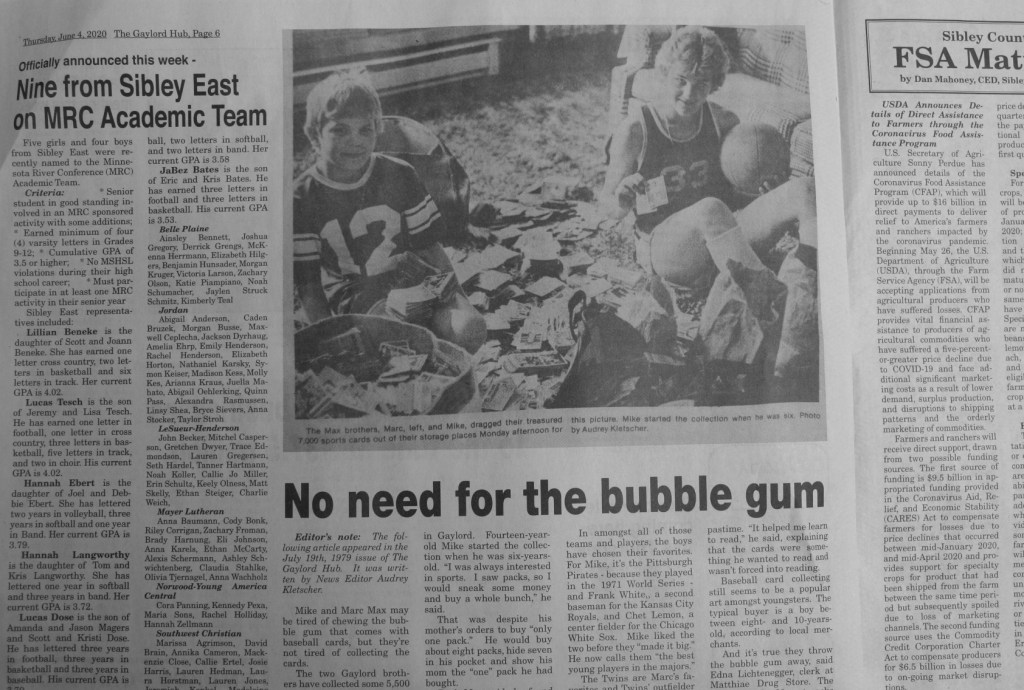
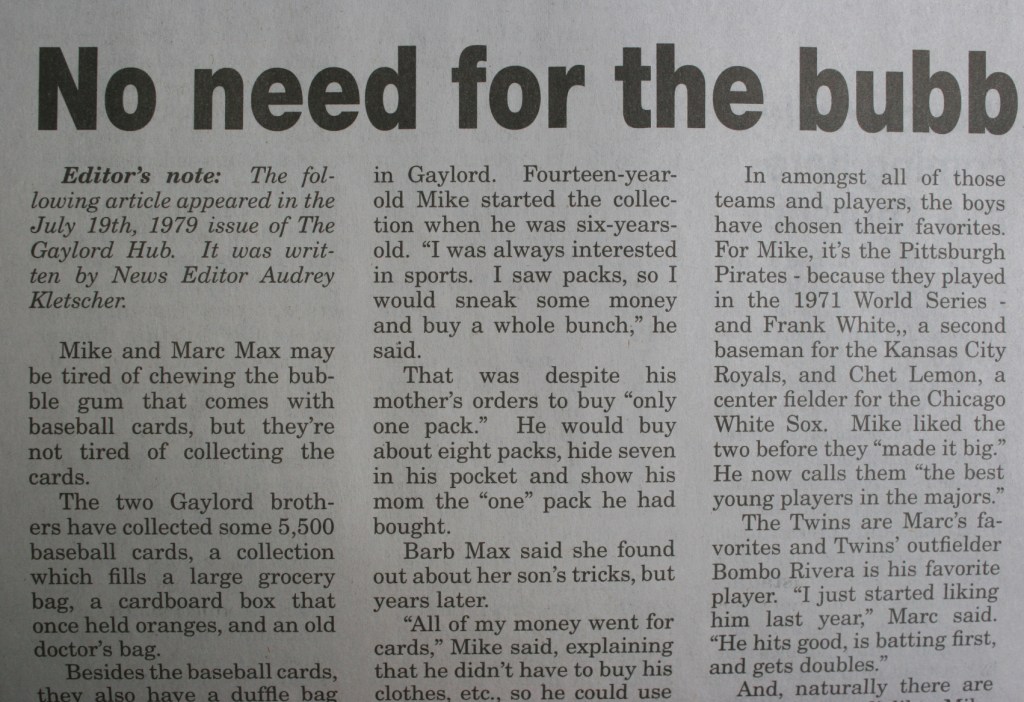
A feature I wrote in 1979 republished in the June 4, 2020, issue of The Gaylord Hub.


Forty years after I left The Hub, the newspaper still arrives weekly in my mailbox. Jim passed many years ago. His son, Joe, just a kid when I worked at the paper, now serves as the third-generation editor and publisher. And last week he republished a feature, No need for the bubble gum, I wrote in July 1979. Perhaps my one and only sports story. I interviewed the Max brothers—Mike and Marc—for a feature about their sports card collection.

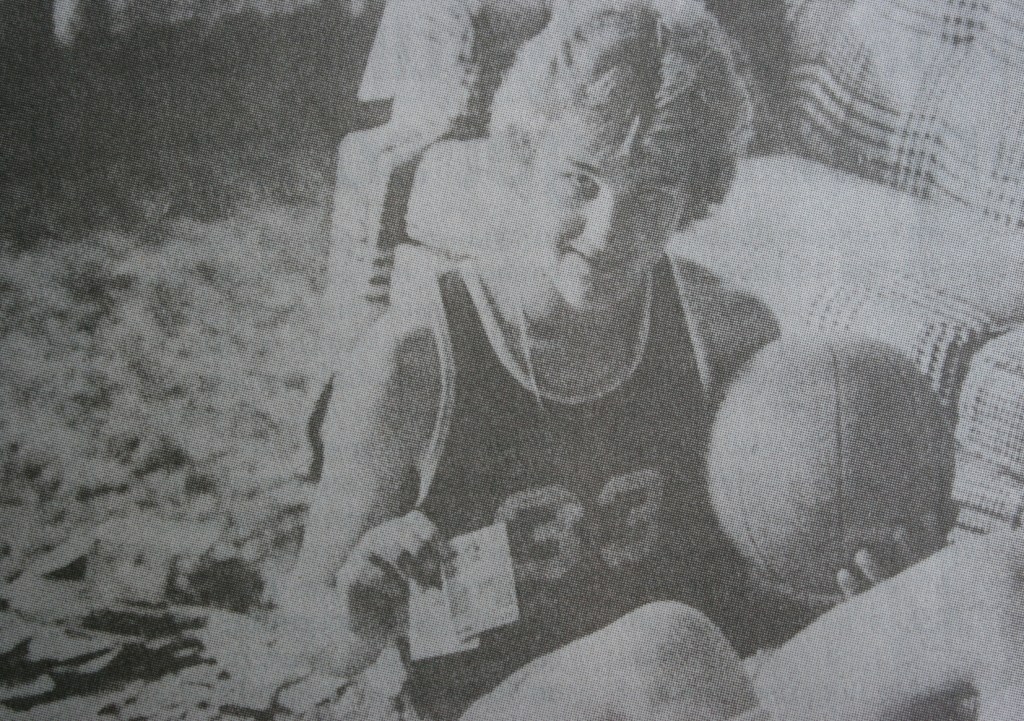
I recall going to the brothers’ home in Lakeside Acres and the piles and piles of bagged, boxed and loose cards numbering some 7,000. But I didn’t remember details of that interview with the 9 and 14-year-olds. So rereading that story I wrote 41 years ago proved entertaining, especially considering where one of those boys landed. Mike Max went on to become the sports director for WCCO-TV in the Twin Cities. And more recently, he expanded to hard news by covering the protests surrounding the death of George Floyd in Minneapolis.


WCCO personality Mike Max, up close in a photo I took in 1979. Photo by Audrey Kletscher from The Gaylord Hub.


But back to that 1979 feature I wrote. Here’s my favorite quote from Mike:

“I was always interested in sports. I saw packs (of collector cards and bubble gum), so I would sneak some money and buy a whole bunch,” he said.

That was despite his mother’s orders to buy “only one pack.” He would buy about eight packs, hide seven in his pocket and show his mom the “one pack” he had bought.

Barb Max said she found out about her son’s tricks, but years later.

I love that part of the story.

But I find equally humorous this paragraph from my feature:

The two plan on keeping their cards, but speculate on selling some of them if the price is right. “I’ll save them until I get real old,” Marc said. “I’ll save them until they’re worth more and more, but maybe someday sell them if I need money real bad.”


A section of the republished story from 1979.


Reflecting on that feature of four decades ago, I am reminded of the importance of community newspapers. These are the stories we are losing as more and more small town weekly newspapers, and even some dailies, are folding. Declines in advertising revenue and subscribers, rising expenses and the growth of online media alternatives have all factored into the demise of print journalism. I can’t even begin to tell you how much that saddens me. We are losing such a valuable part of our communities. The watchdogs. The storytellers. The historians. The source of information about public meetings, community events, deaths—news in general. The media is too often under attack, blamed for reporting too much bad news. Don’t kill the messenger, I say.

I will always remain grateful for the two years I worked as The Cub from the Hub, a name tagged to me while in Gaylord. There I learned and grew as a writer, always striving for integrity, honesty and balanced reporting. By far, feature writing proved the most enjoyable aspect of my work. From Gaylord, I would go on to report for The Sleepy Eye Herald-Dispatch, The Mankato Free Press (St. James bureau), The Owatonna People’s Press and The Northfield News. Some were temporary fill-in jobs, others full-time. But no matter where I worked, I worked long, hard hours at low pay to cover the community. I reported the hard news and attended endless city council/school board/county board meetings into the late hours of the night. And sometimes I wrote, too, about kids who collect sports cards. Kids like Mike Max and his younger brother, Marc.

© Copyright 2020 Audrey Kletscher Helbling
 

The unlucky leprechaun April 17, 2019

Minnesota Prairie Roots file photo March 2015.


NEARLY 40 YEARS after I left my first newspaper reporting job, I still receive The Gaylord Hub each week. The third-generation family-owned Hub holds a special spot in my heart. Here I initially put my journalism education to work, covering the southern Minnesota town of Gaylord and surrounding areas in Sibley County.

Part of my job included checking reports at the Sibley County Sheriff’s office where I sometimes had to push to access public records. Being young, a woman and the first full-time staff writer (outside of family) put me in the occasional challenging position of not being taken seriously. Locals quickly learned, though, that I would stand my ground and intimidation didn’t work with me. Jim Deis, the editor and publisher, always backed me up and for that I was grateful.

All that serious talk aside, I met plenty of wonderful folks who embraced my writing and photography. The diversity of my job ranged from writing a feature about current WCCO TV sports director Mike Max and his brother Marc’s sizable baseball card collection to covering massive church, school and chicken barn fires to filing through initial complaint reports.

But I don’t ever recall anything quite as unique or humorous as the story I read in the April 4 issue of The Hub under a column labeled Sibley County District Court. As I read the story aloud to my husband, I couldn’t stop laughing. Here’s the line that prompted my laughter:

According to court documents, the Sibley County Sheriff’s Office was dispatched to Westgate Apartments in Gaylord at 3:55 a.m. on March 25 for a complaint of a man dressed as a leprechaun running up and down the halls and creating a disturbance.

My first questions: Why would a man dress as a leprechaun? It wasn’t St. Patrick’s Day. And what exactly does a leprechaun wear? Green clothes, hat, pointy shoes?

I read on that the responding deputy spotted a man “with something red on his head” driving a vehicle out of the parking lot. The driver took off but was eventually stopped, admitted to drinking and also driving with a canceled license. He’s now been charged with multiple crimes.

Randy listened without interruption. Then he offered this assessment: “Sounds like his luck ran out.” And that would be right.

© Copyright 2019 Audrey Kletscher Helbling
 

When a small town Minnesota newspaper implements a “pay for” letter policy August 11, 2016

SHOULD A NEWSPAPER charge for publishing a letter to the editor?

My Minnesota State University, Mankato, journalism professor Robert Shipman would likely turn over in his grave if he read that question. He impressed upon me that the editorial page is the heart of a newspaper. A staunch supporter of community journalism, he would not advocate paying for letters to the editor. Neither do I.

I have great respect for this newspaper man who nearly 40 years ago taught me the basics of journalism—instilling in me a strong sense of fairness in writing balanced news stories. Opinion, he emphasized, should be reserved for the editorial page.


Gaylord Hub election letters policy - Copy


This brings me back to charging a fee for letters to the editor. Interestingly enough, my concern is prompted by a notice published in The Gaylord Hub, a third-generation family newspaper where I accepted a reporting job right out of college.

Decades after I left my two-year stint at this small southern Minnesota weekly, I still get The Gaylord Hub. Unlike most community newspapers, The Hub does not have a strong editorial page. Rare are the editorials. However, locals often voice their opinions in letters to the editor. There’s been significant controversy in Gaylord related to school issues.

But now the publisher/editor has established a new policy for election-themed letters. Policies for letters to the editor are the norm at newspapers. Many publications restrict length; monitor for libelous and offensive content and personal attacks, etc.; and don’t publish election-related letters in the final issue before an election. But, in a quick perusal of the internet, checking out several major dailies across the country and several Minnesota daily and weeklies, I found none with a “pay for” publication fee.

The Little Falls based The Morrison County Record, for example, states that “Letter writers are encouraged to stick to the issues and the positions on issues and qualifications of the candidates.” Letters that lean toward advertising aren’t published.

In Gaylord, though, under the new policy, if you want to write a letter supporting or opposing a candidate or a political party, you’ll have to pay for it. Thirty dollars for up to 300 words for a Paid Election Letter.

I get where the newspaper is coming from with this policy. Some people will abuse the system by viewing the editorial page as a free advertising opportunity. But to blanket apply that to all election-focused letters seems a suppression of opinions. The policies established by The Morrison County Record seem more appropriate, more balanced in curbing potential abuse while maintaining freedom of expression.

That said, there was a time when newspapers printed obituaries and engagement, wedding and birth announcements at no cost to readers. No more, at least in most publications. Would my college professor opine that change. He likely would. Robert Shipman was Old School community journalism. He was all about integrity, unbiased reporting, getting facts right and, above all, always always spelling names correctly. He taught me well. He taught me that the opinion page is the heart of a newspaper.

Thoughts?

Copyright 2016 Audrey Kletscher Helbling

The new letters to the editor policy published in the August 4 edition of The Gaylord Hub.


From small town Minnesota: When no one would be queen July 22, 2016

Filed under: Uncategorized — Audrey Kletscher Helbling @ 5:00 AM

Tags: , , , , , ,

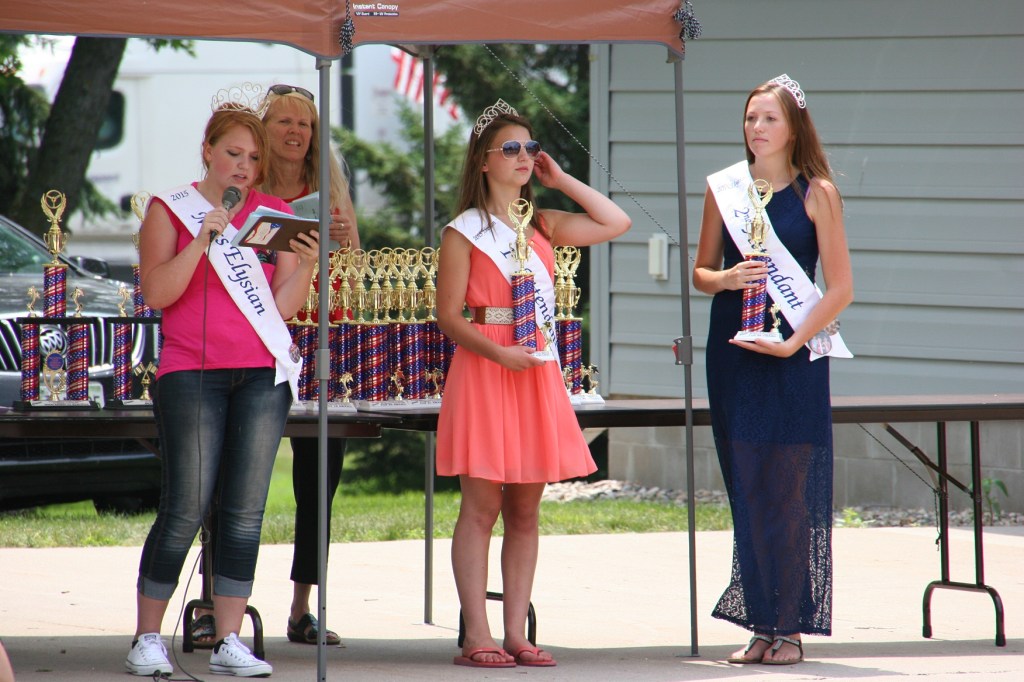
As we were leaving, Miss Elysian royalty were handing out Car Show trophies.

Miss Elysian royalty handed out Car Show trophies at the community’s Fourth of July celebration in 2015. Minnesota Prairie Roots file photo used for illustration purposes only.

ARE HIGH SCHOOL teens too busy to reign as small town royalty? That’s the assessment of one local pageant organizer.

According to an article published in the The Gaylord Hub, only one girl applied for the role of Miss Gaylord 2016. That lack of interest caused organizers to call off the coronation which is part of this southern Minnesota community’s annual Extravaganza celebration in August.

Brianna Hahn, chairperson of the Gaylord Royal Ambassadors, cited competition from sports, summer jobs and post-secondary education for the waning interest along with a smaller than usual pool of potential candidates this year. Additionally, Hahn noted that surrounding communities are facing the same problem.

I checked several neighboring towns and found the royalty tradition continuing with a Miss Winthrop at Farm City Fun Fest, Miss Henderson at Sauerkraut Days, Miss Nicollet at Friendship Days and Miss Le Sueur at the Giant Celebration.

But I expect Hahn is right—that other rural Minnesota communities are experiencing declining numbers, too, in queen candidates. Is your community one of them?

Are small town queen competitions becoming a thing of the past? Should changes be made to continue the tradition? What are your thoughts?

© Copyright 2016 Audrey Kletscher Helbling
Source cited: The Gaylord Hub


An obit: I didn’t know Jim, but now I do April 27, 2016

Filed under: Uncategorized — Audrey Kletscher Helbling @ 5:00 AM
Tags: , , , , , ,

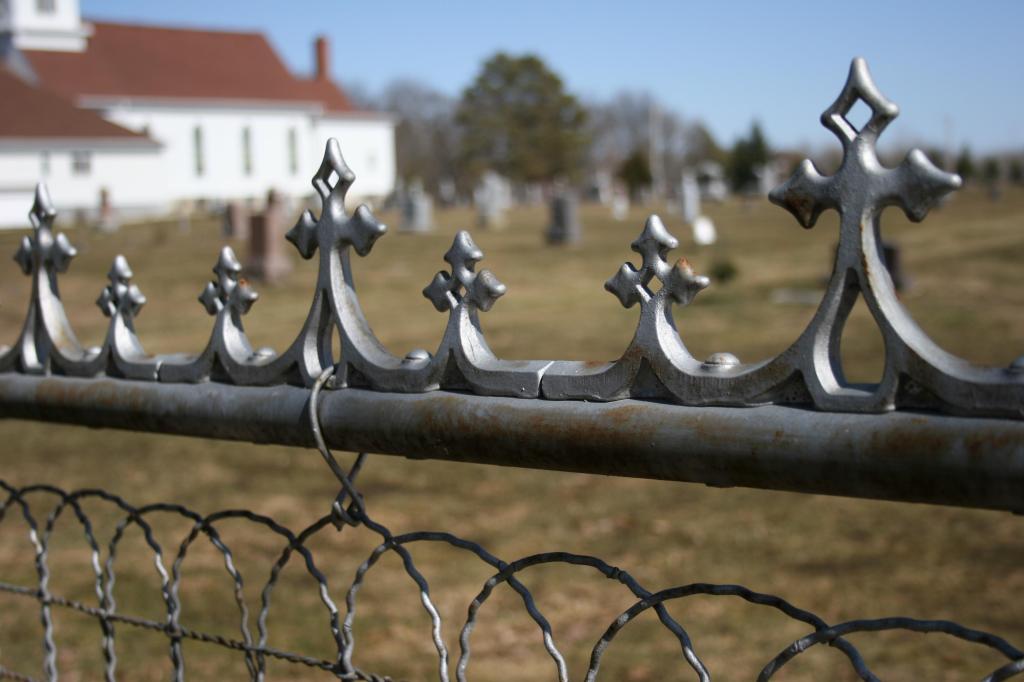
A fence surrounds the Urland Lutheran Church Cemetery in the Sogn Valley area.

A fence surrounds the Urland Lutheran Church Cemetery in the Sogn Valley area. Minnesota Prairie Roots file photo 2010 used here for illustration purposes only.

MORE AND MORE, I READ OBITUARIES. Probably because I am aging and more people I know are now dying.

I didn’t know Jim Mueller of Clearwater, though. Yet I still read his 22 column inch obit published April 21 in The Gaylord Hub, a small southern Minnesota weekly where I worked as a reporter for two years right out of college. The Hub arrives in my mailbox each week, a tangible reminder of my past and of the passage of time.

James Henry Mueller left his hometown of Gaylord in 1973, five years before I arrived. If he had still resided there, I likely would have interviewed him. He was that kind of guy. Socially active. A storyteller. A businessman. A character. He would have made for an interesting feature.

Consider this line from the beginning of his obit: Jimmy grew up doted on by his ma and arguing with his pa.

But it is the ninth and final paragraph of this lengthy obit which makes me wish I’d known this 88-year-old:

Jim’s many hats included: Veteran Navy Man, Well Driller, Grain Bin Mover, Beer Seller, Horse Wrangler, and Postmaster. He was a smooth dancer and an ace at bridge. He will fondly be remembered as a Teller of Tales, A Spinner of Yarns, and a Preacher of Sermons.

In addition, paragraph eight notes that Jim donated his body to science. Even in death, his story continues.

NOW IT’S YOUR TURN. How would you like to be remembered? What hats would others say you wore? What do you think of this trend to personalize obituaries with insights and commentary?

© Copyright 2016 Audrey Kletscher Helbling
 

The evolving art of crafting an obituary May 12, 2015

Filed under: Uncategorized — Audrey Kletscher Helbling @ 5:00 AM
Tags: , , , , ,

Even after family has departed this life, their memory is as close as the graves that surround Moland Lutheran Church.

This Moland Lutheran Church Cemetery in rural Steele County Minnesota lies next to farm fields. Minnesota Prairie Roots file photo used for illustration purposes only.

HAVE YOU NOTICED in recent years, like I have, the trend to personalize obituaries?

No longer are obits just a listing of factual information. Rather, they now often offer personal insights from loving family members. This is exactly what I was not taught in journalism school. I learned right away that nothing is more important than writing an obituary. That long ago lesson involved not a bit of commentary. Just straight facts. Birth, education, occupation, marriage, death, survivors. And, above all, spell the name correctly.

Times have changes. Most newspapers now charge for printing obituaries. Thus, if you’re paying for all those words about your loved one, you may as well write what you wish.

I find myself reading obits more often than I once did. Yes, I sadly now know a lot more people who are dying. But I’m also interested in reading the stories of those individuals whom I’ve never known.

For example, recently The Gaylord Hub, where I worked as a reporter and photographer at my first newspaper job fresh out of college and, yes, wrote my first published obits, printed three death notices that grabbed my attention. All of them were obituaries for retired or semi-retired farmers, men who devoted their lives to working the land in this rural southern Minnesota county.

I learned that Dennis Grams, 70, “enjoyed everything about farming—the equipment, animals, crops and weather. If you had a question about farming, he was the man to go to. He had a way of explaining everything so that you could understand and would not stop explaining until he was sure you understood.” Seems to me Dennis was not just a farmer, but a teacher, too. And a patient one at that.

And then there’s Kenneth Quast, 81, who lived his entire life on the farm his father purchased in the 1920s. Kenneth worked that land and milked cows. His obit states: “He enjoyed farming, it was his life.” Oh, to do what you love. Your entire life.

Finally, Elmer Otto, 93, just couldn’t stay away from his Kelso Township farm. “…even after retiring he still had to go out and make sure things were running smoothly.” Elmer clearly loved his life’s work, just like Dennis and Kenneth.

How about you? Can you say that about your life—that you did what you loved? What would you want included in your obituary?

© Copyright 2015 Audrey Kletscher Helbling