Minnesota Prairie Roots

Writing and photography by Audrey Kletscher Helbling

From a small Minnesota town: “My dad got shot” August 10, 2011

Filed under: Uncategorized — Audrey Kletscher Helbling @ 12:13 PM
Tags: , , , ,

WEEKS LATER, I STILL can’t shake her haunting words. “My dad got shot,” the darling pixie of a 6-year-old with brown eyes and long, spaghetti-straight auburn hair tells me.

I don’t want to believe her and even question the truthfulness of her statement.

But she is too quick to respond, to say that her dad, Bill, is dead, “buried in the ground.” The father who stole a car and went to jail was shot by someone who came to the house when she was only one, she says. I don’t know if she has her story spot-on correct, but I figure she’s heard it too many times to mess up the truth.

Recently, the police stopped by her house—the one across from the park with the boxspring leaning outside the front door and the stockade of a fence enclosing the back yard. “I don’t know why they came,” she says. I can see the hint of fear in her eyes.

I don’t pry. But I want to swoop her up, hug her, take her away from the bad memories and the stories of the violent death of her father, away from a life that seems not all that stable even now.

Yet, I’ve only met her as my husband and I are in a southern Minnesota small-town city park on a Sunday afternoon. I want to advise her and the boy, who isn’t her brother but lives with her because her mom and his dad “are in love,” that they shouldn’t talk to strangers in the park.

But she has already told me the dead father story and rolled her eyes at the living arrangement between parents. I can’t just tell her and the little boy to go home. Be safe. Don’t talk to strangers or accept food from them. She’s already caused my heart to ache.

So instead, we offer them food. She refuses any. But the boy, about four, gobbles up the potato chips and grapes we give him. It is 1:00 and they have not eaten lunch, although the six-year-old says they ate a late breakfast.

I’m not so sure. Maybe she’s heeding advice she once heard about not accepting food from strangers. Yet, she’s the one who approached Randy when we first arrived, when I was using the porta potty, and told him he looked like her friend Emma’s grandpa.

They seem hungry, not only for food, but for someone who cares.

“I have a dad,” the boy shares between mouthfuls of chips. And that’s when the mite of a girl tells us about her dead father.

Soon the boy’s older sister, by a few years, arrives at the park, apparently sent over to check on the other two.

“Do you want some potato chips?” I ask. She accepts a handful.

“She stole a peach,” the redhead accuses.

“From the grocery store?” I ask, thinking I may now need to teach them right from wrong.

No. The peach was stolen at home.

“I stole pop tarts,” the talkative six-year-old confesses. “She told me to.” She looks directly at the other girl, the one who may someday become her sister if the two in-love parents marry.

I don’t understand her word choice—“stole.”

“We’re supposed to ask (for food),” she explains or “get in trouble.”

Now I am worried. “You don’t get hit for taking food, do you?”

They say “no” and I inwardly breathe a sigh of relief.

Then, after we give cheese slices to the little boy and his sister, with the pixie girl still refusing food, she obeys a summons to come home. The boy is still standing near the picnic table, his sister a short distance away. He struggles to unwrap the single cheese slice.

“Here, let me help you,” I say. He hands me the cheese and I unwrap it. He shoves the slice into his mouth and runs home. His sister declines my offer to remove the cheese wrapping, determined to do it on her own. She does.

I leave the small-town park unsettled and worried about the future of these three children. Already they’ve experienced so much in their young lives: Violent death. Police knocking on the door. Food they feel they must steal.

My heart aches for these children. Will they grow up tough, hardened by the life they’ve already lived? Will they overcome the pain they’ve already experienced? Will they continue to approach strangers in the park…to talk about the dad who was shot, the food they must “steal?”

I wonder. I worry.  Should I have done something more?

THE NAMES IN THIS STORY have been changed to protect these children who thought nothing of walking up to strangers in a park. That also is the reason I am not revealing the Minnesota town where I met them. The rest of the story, sadly, is true.

© Copyright 2011 Audrey Kletscher Helbling


The armless Jesus at storm-damaged St. John’s in Vesta August 4, 2011

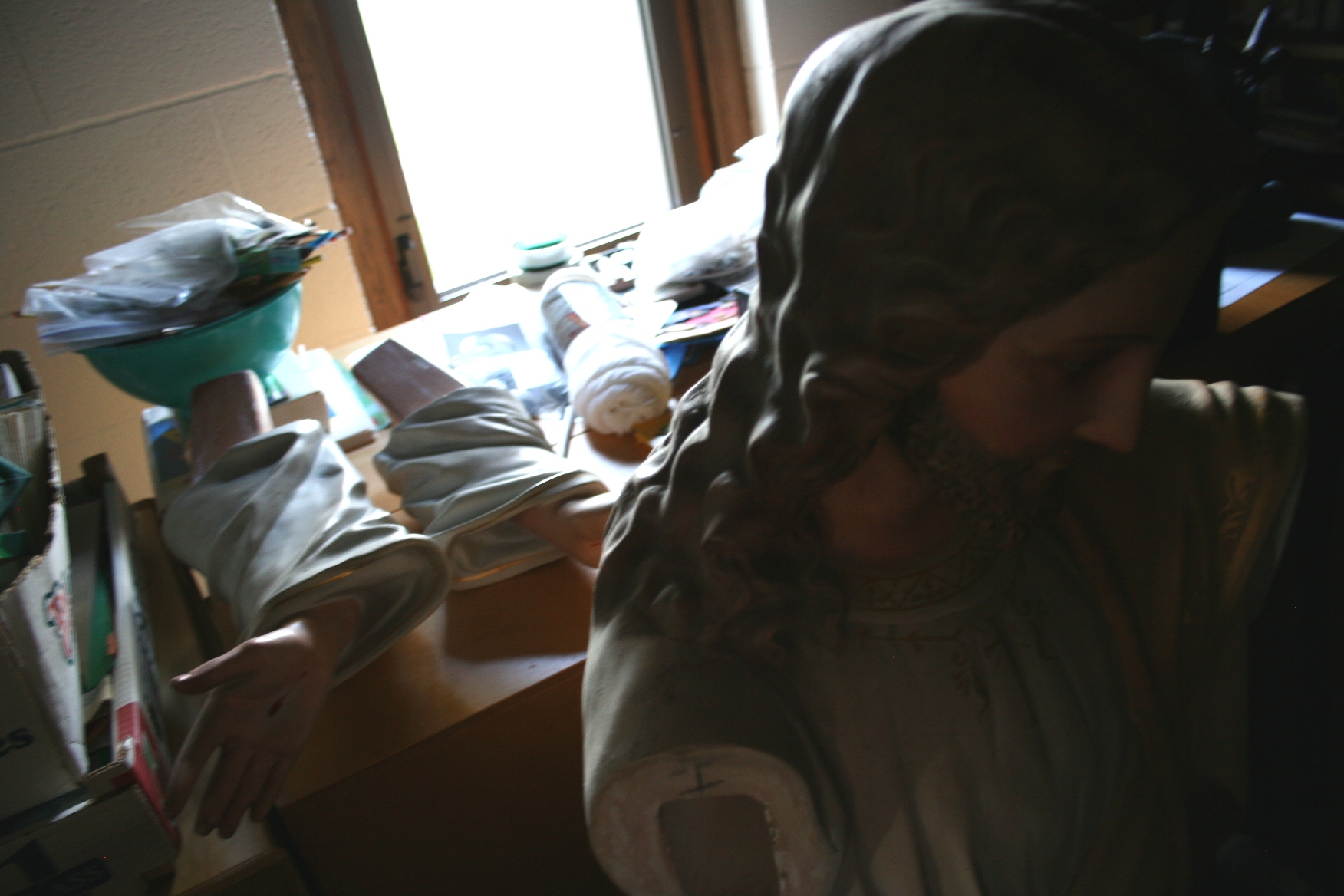
THE ARMLESS JESUS stood there, shoved into the back corner against a desk in the dark fellowship hall packed with misplaced pews.

That’s when I panicked, thought for a moment that Jesus had lost his arms in the July 1 storm, until I realized his appendages had been removed, not broken.

To the right in this photo, stands Jesus. His arms were removed and lie behind him on a desk.

The statue of Christ has been my greatest concern ever since a series of downbursts with winds of 90 – 100 mph ripped half the roof from St. John’s Lutheran Church, exposing the sanctuary and Jesus to the heavens.

One month after that strong windstorm, I returned to my hometown of Vesta in southwestern Minnesota and viewed the damage I’d only seen in photos. The town looks better than I’d feared, although I’m certain if I’d been there right after the storm, I wouldn’t be writing that.

St. John's, hours after the July 1 storm with half of the south roof ripped off by high winds. The roof fell against and cracked the bell tower, which has since been taken down. Photo courtesy of Brian Kletscher.

It’s the damage to St. John’s that I knew would impact me the most emotionally. My worries centered on that Jesus statue, the single remaining visual reminder of the old 1900 church building across town where I was baptized and confirmed and worshipped for the first 18 years of my life. In May of 1982, I was married in the new brick church built in 1974.

Jesus, who once blessed us with outstretched arms from the altar of the old church, was alright. For that I was thankful.

As St. John’s members await word from an engineer on whether the damaged building is structurally-sound or will need to be demolished, they are attending their sister church, Peace Lutheran, in Echo seven miles to the north.

That seems to be working for now. But come winter, when travel can sometimes be difficult and dangerous on the southwestern Minnesota prairie due to blowing snow, options to worship in Vesta may need to be considered. Or maybe not. Pastor Dale Schliewe doesn’t expect the church to be rebuilt by the time the snow flies.

Right now, though, church members are more concerned about getting the building process started. That could include an expansion.

No matter what ultimately happens, this congregation remains a thriving one, attended by many members of my extended family. My great grandfather, Rudolph Kletscher, helped found St. John’s. The first church service was held in his home one mile east of Vesta.

My emotional attachment to this congregation runs deep, rooted in that legacy of faith passed from generation to generation.

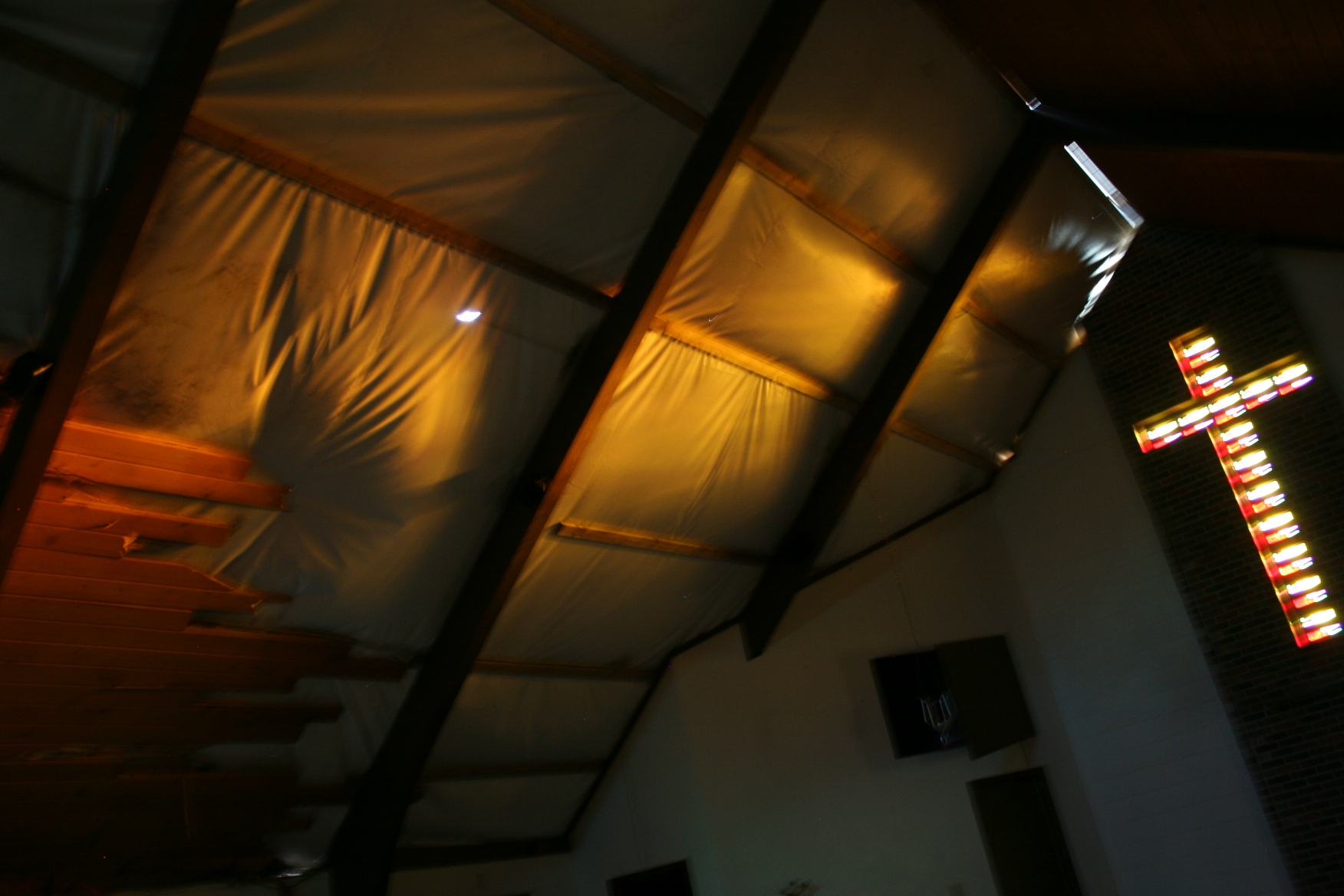
I understand that a building does not comprise a church. Yet, when I walked into the empty sanctuary of St. John’s, gazed upward at the tarp covering the missing roof, saw the splintered wood, walked around the pews jammed into the fellowship hall, noticed Jesus standing armless in the corner, spotted the hymnals stacked on a kitchen counter and skirted the pile of debris in the church parking lot, my soul ached.

Inside the sanctuary, you see the damage to the roof, now covered by a tarp. To the right, a stained glass cross centers the worship area in this photo shot at an angle.

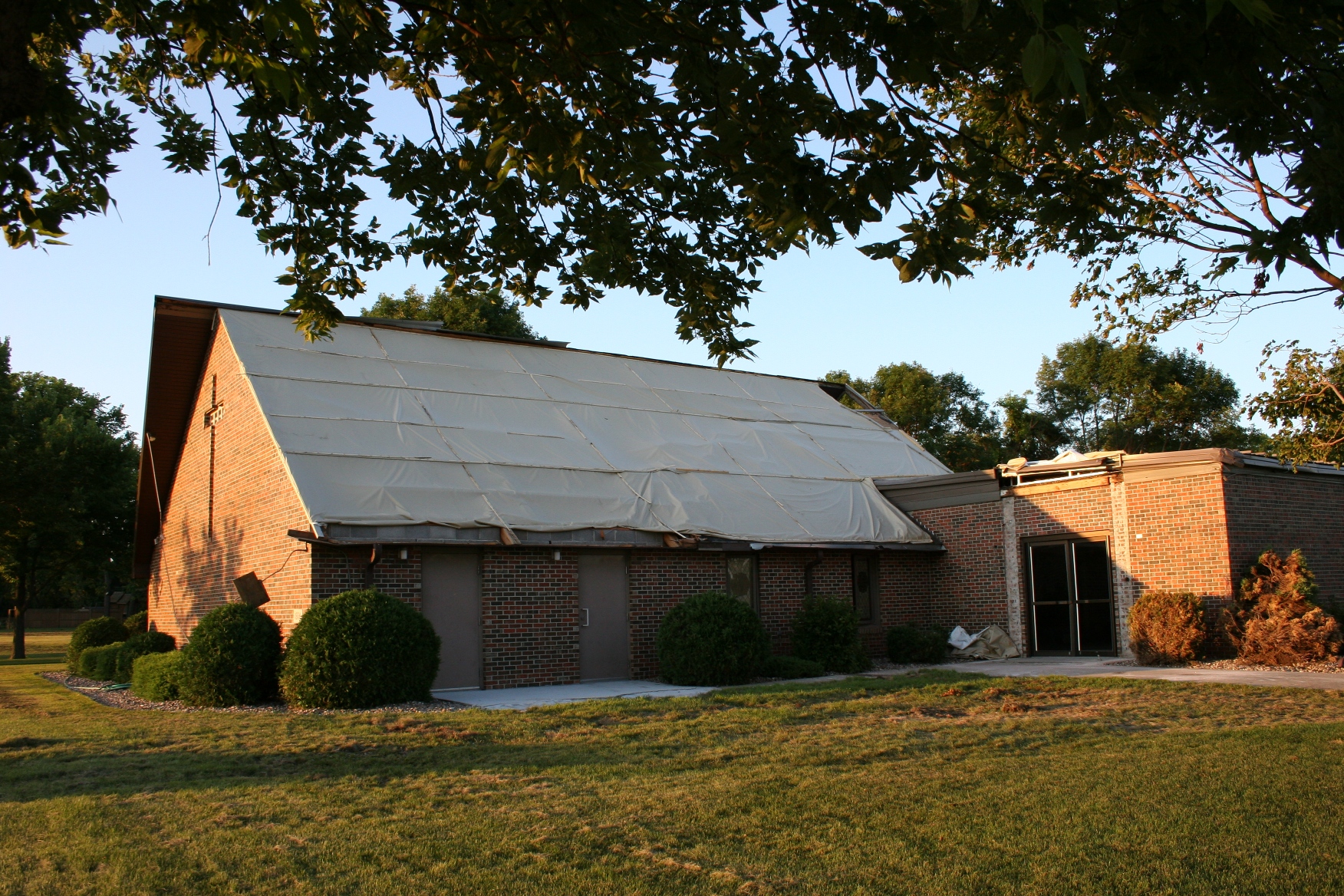
One month after the storm, the south side of the roof is covered with a tarp.

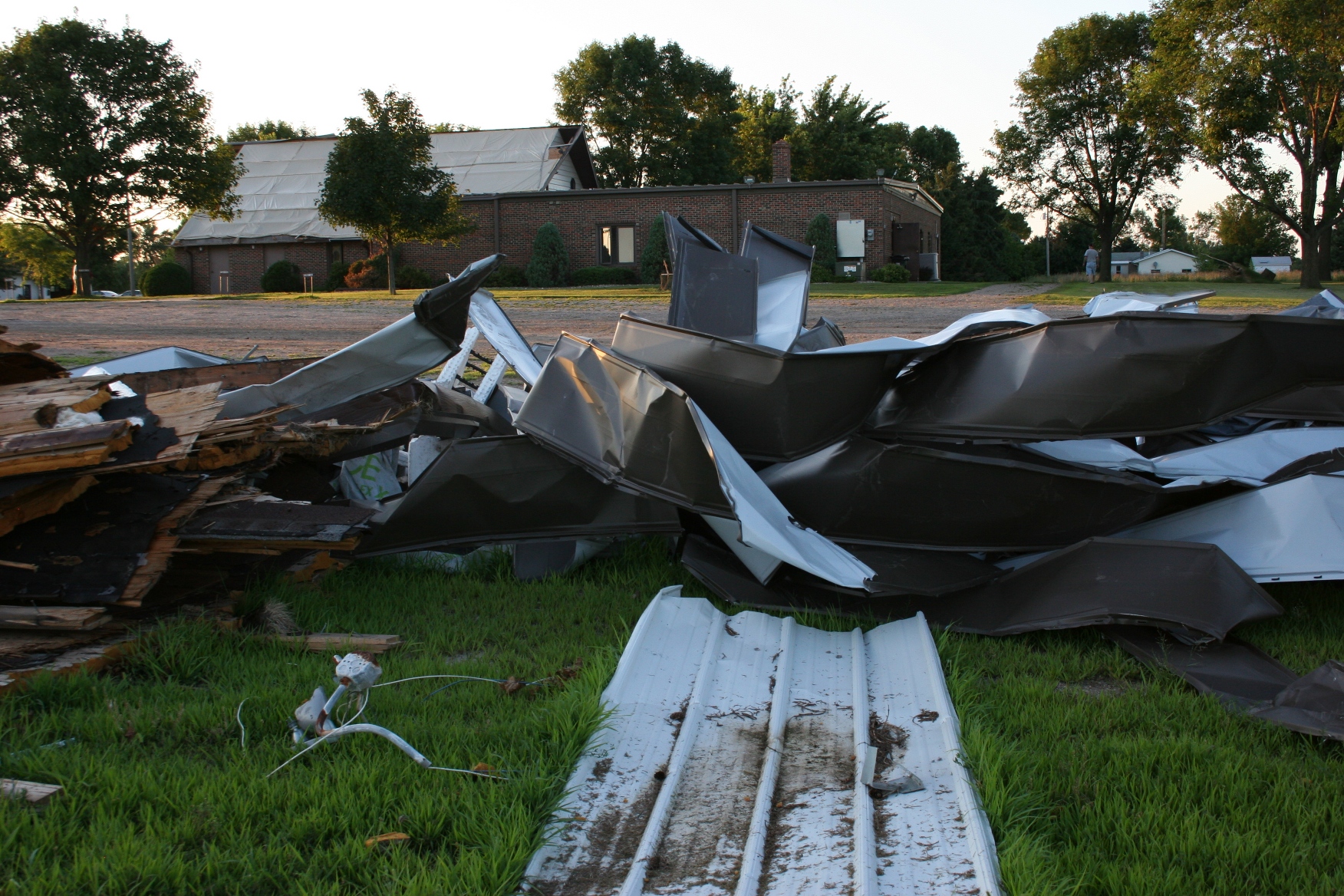
A debris pile on the edge of the parking lot includes pieces of steel from the roof and brick from the bell tower.

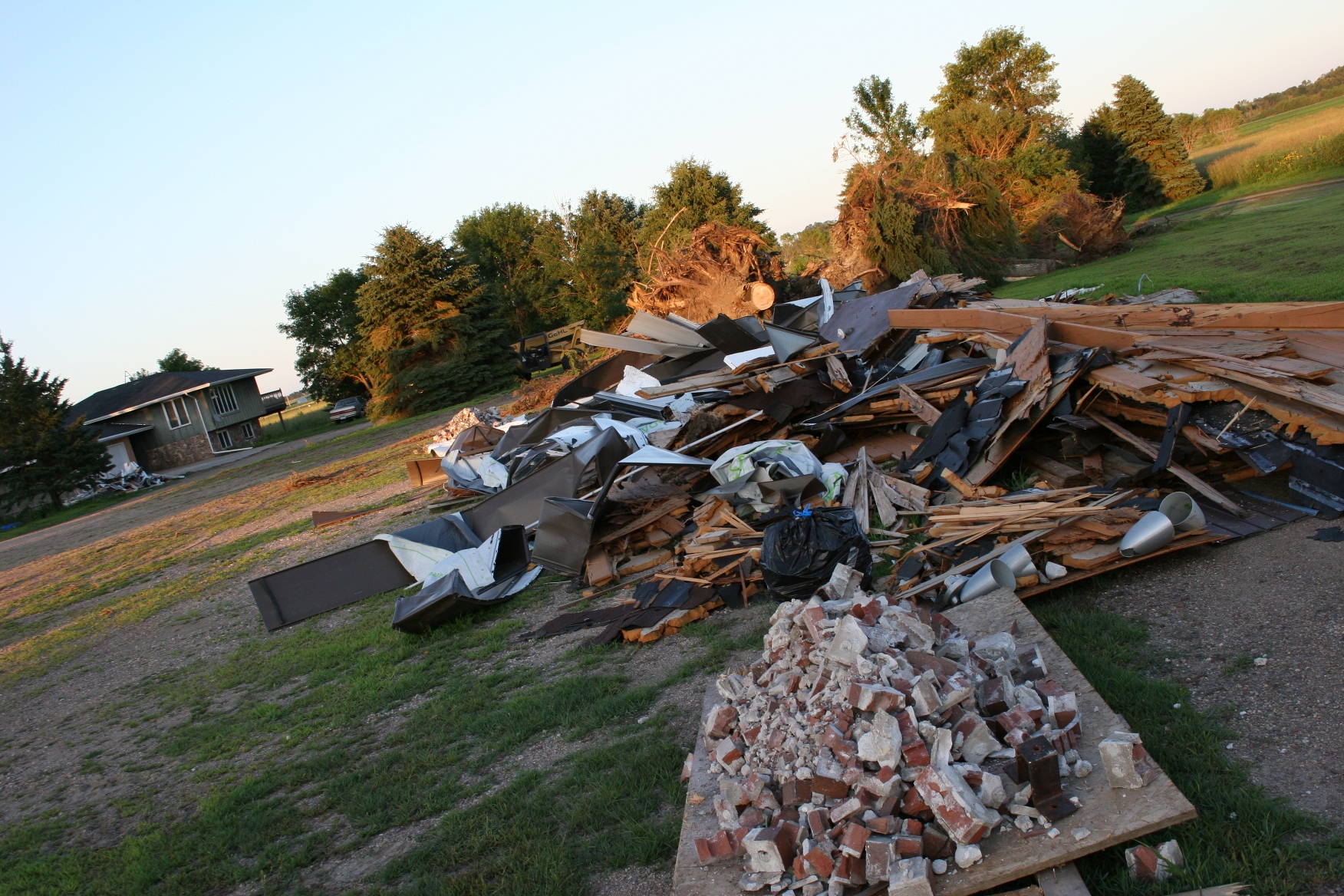
Another angle of that debris pile shows uprooted trees and, to the east, a house which was damaged.

© Copyright 2011 Audrey Kletscher Helbling
 

Zip code 56046 July 26, 2011

THE NEXT TIME YOU’RE traveling Interstate 35 south of Owatonna, instead of whipping by the Hope exit at 70 mph, pull off the freeway and check out this unincorporated community of 120 residents, probably best-known outside of Steele County for Hope Creamery butter.

Unless my husband and I missed the signage, we never saw a sign marking the creamery and simply guessed that the butter-making operation is housed in an old brick creamery on the edge of town next to a farm.

But we discovered several other places of interest after parking our car along the one main road that cuts through Hope. Yes, you need to park your vehicle, get out and walk, rather than simply driving through town thinking, “There’s nothing here.”

You would be wrong, oh, so wrong.

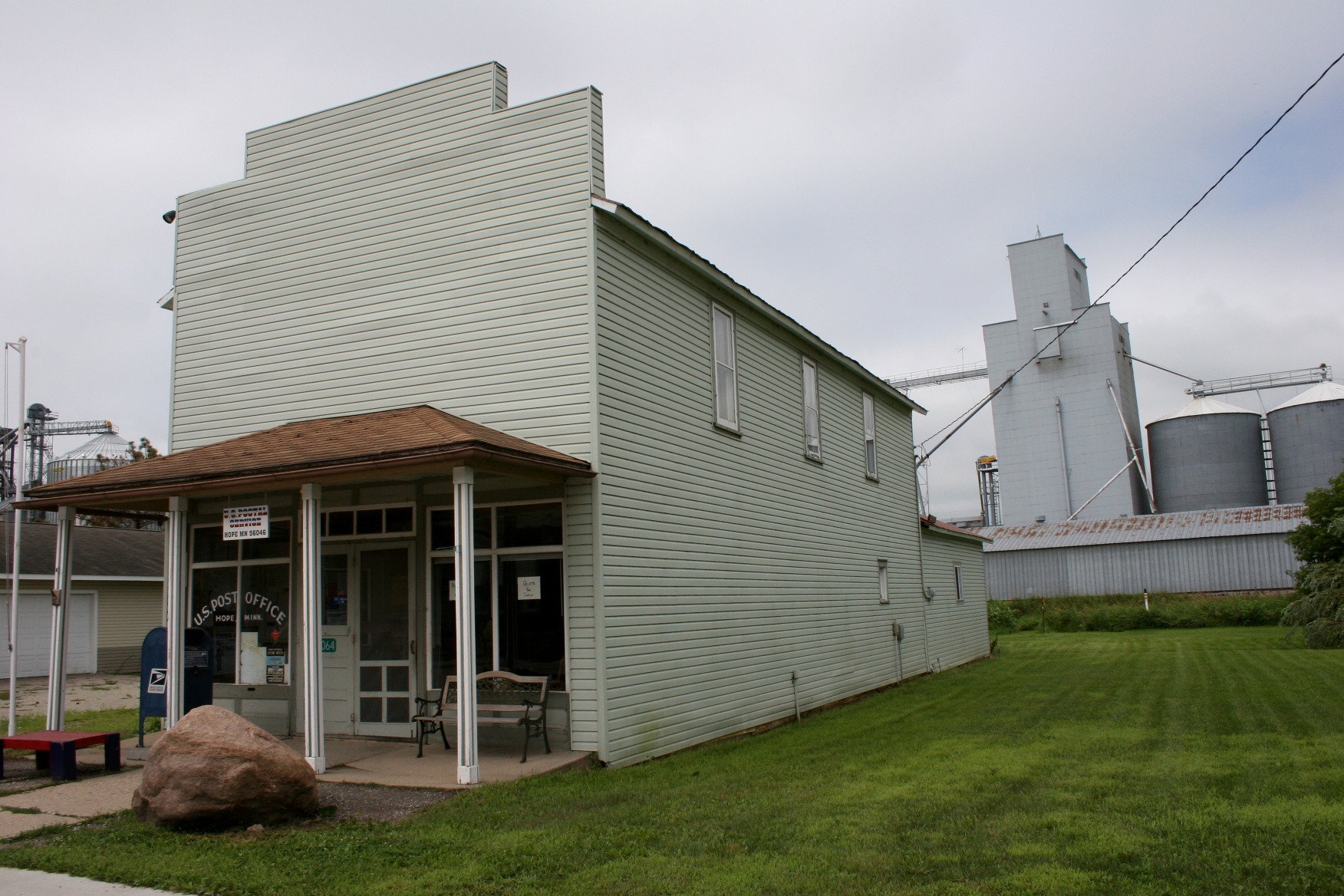
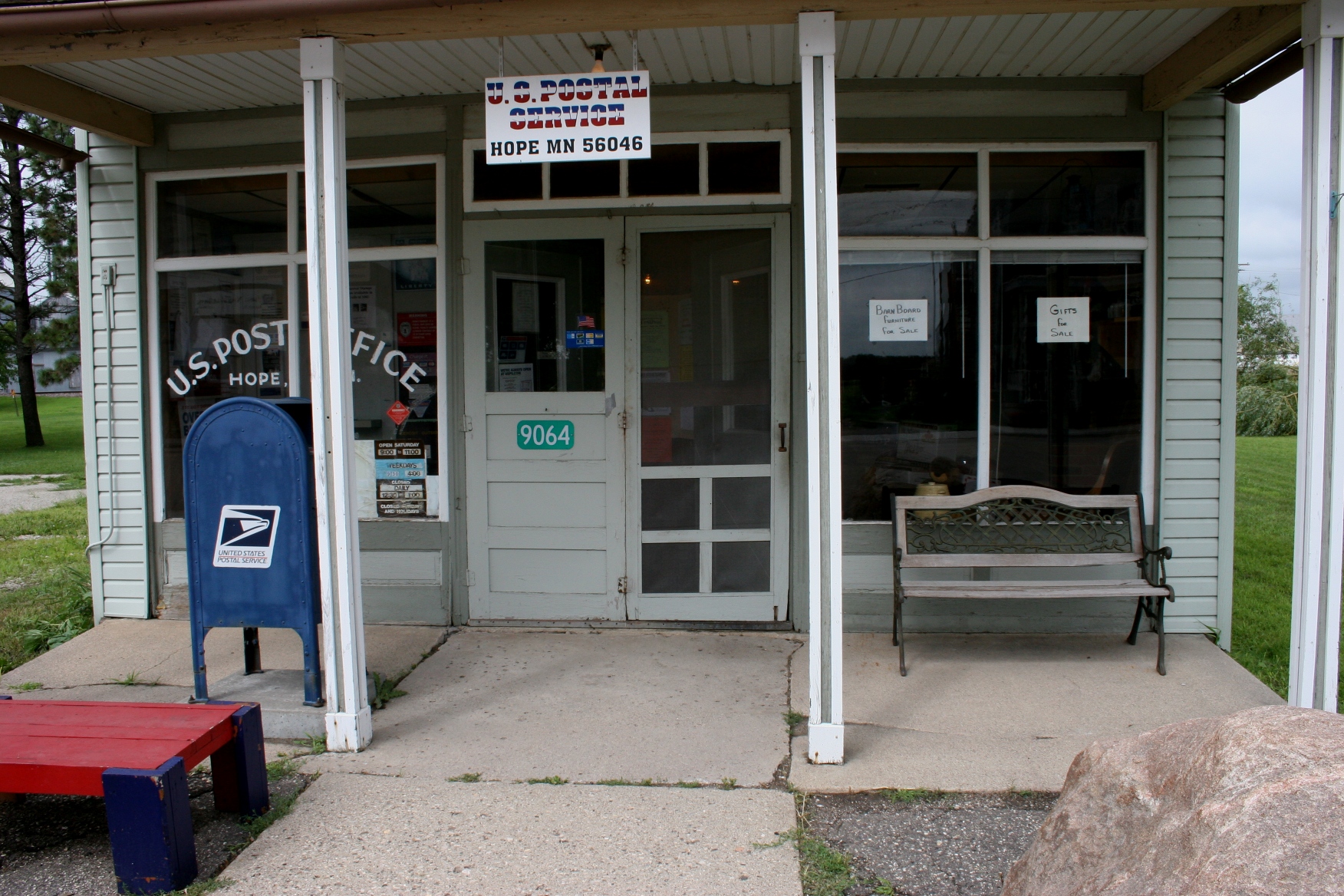
First point of interest: 56046. That would be the Hope Post Office. With a street front facade resembling the general stores of yesteryear or perhaps a building from a western movie set, this old-style structure charms.

The Hope Post Office sits along Main Street. The elevator complex in the background is just across the train tracks.

Take in the details: the red and blue bench, the double front doors, the rock out front, the welcoming porch...

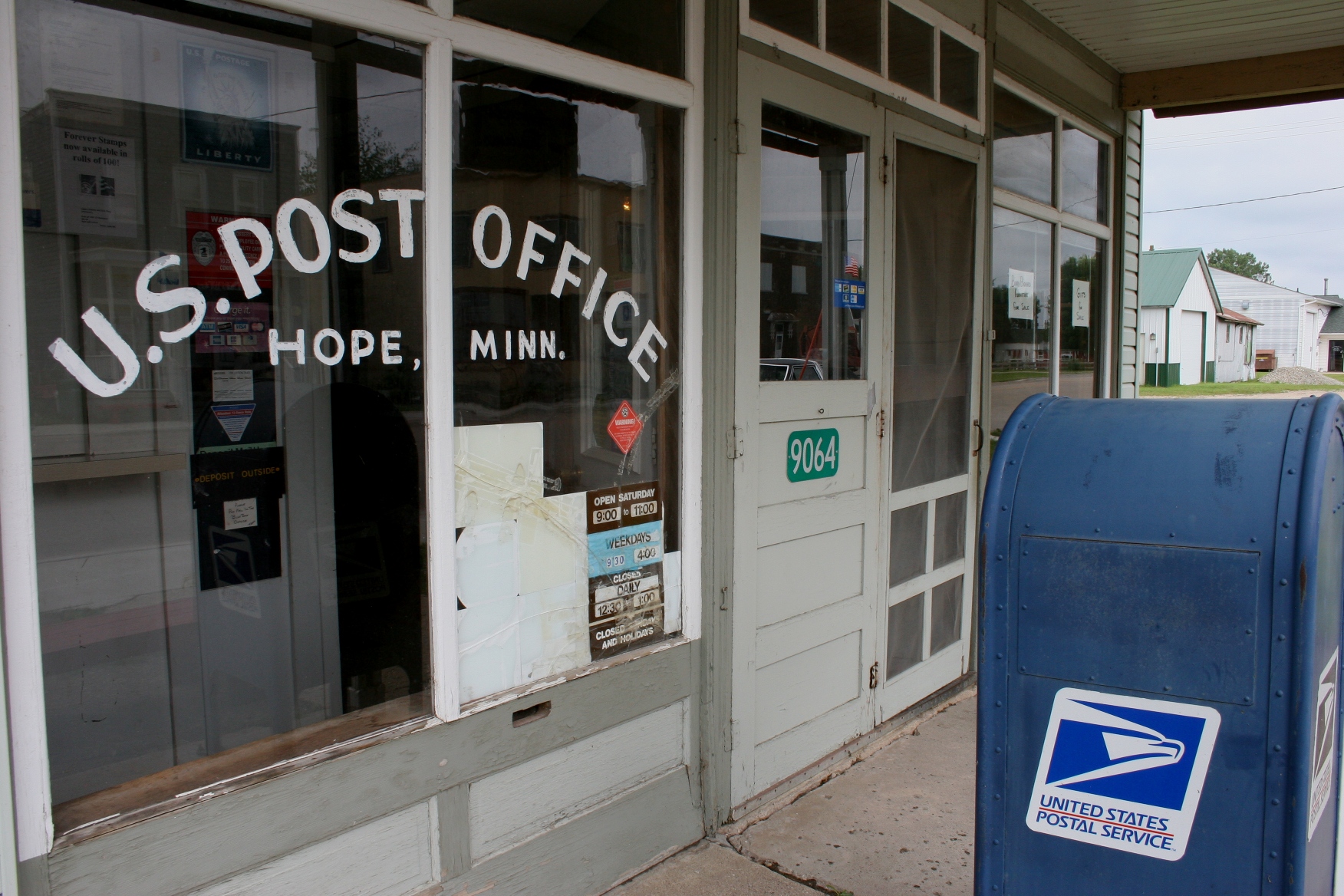
Even the lettering on the front window has old-style charm.

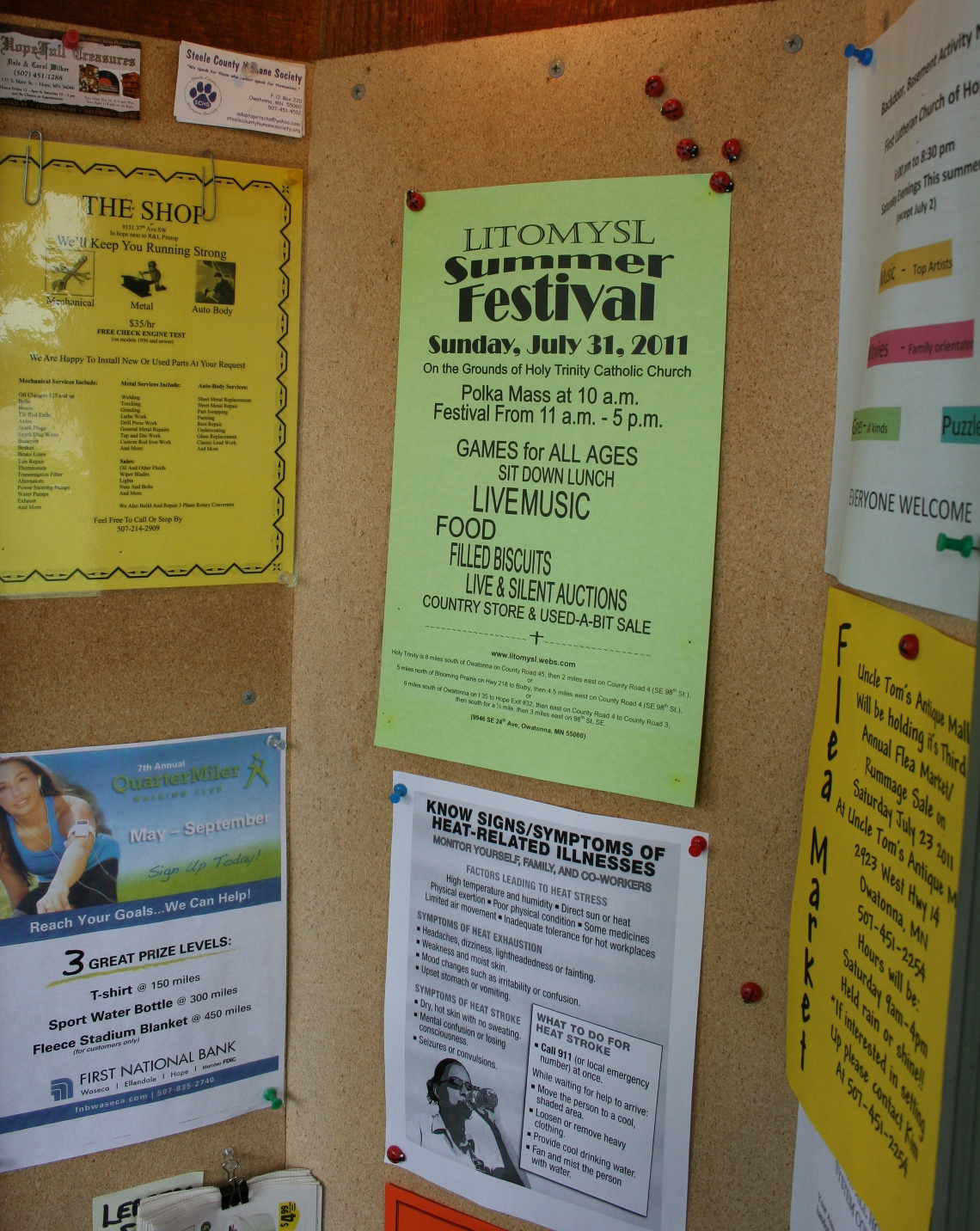
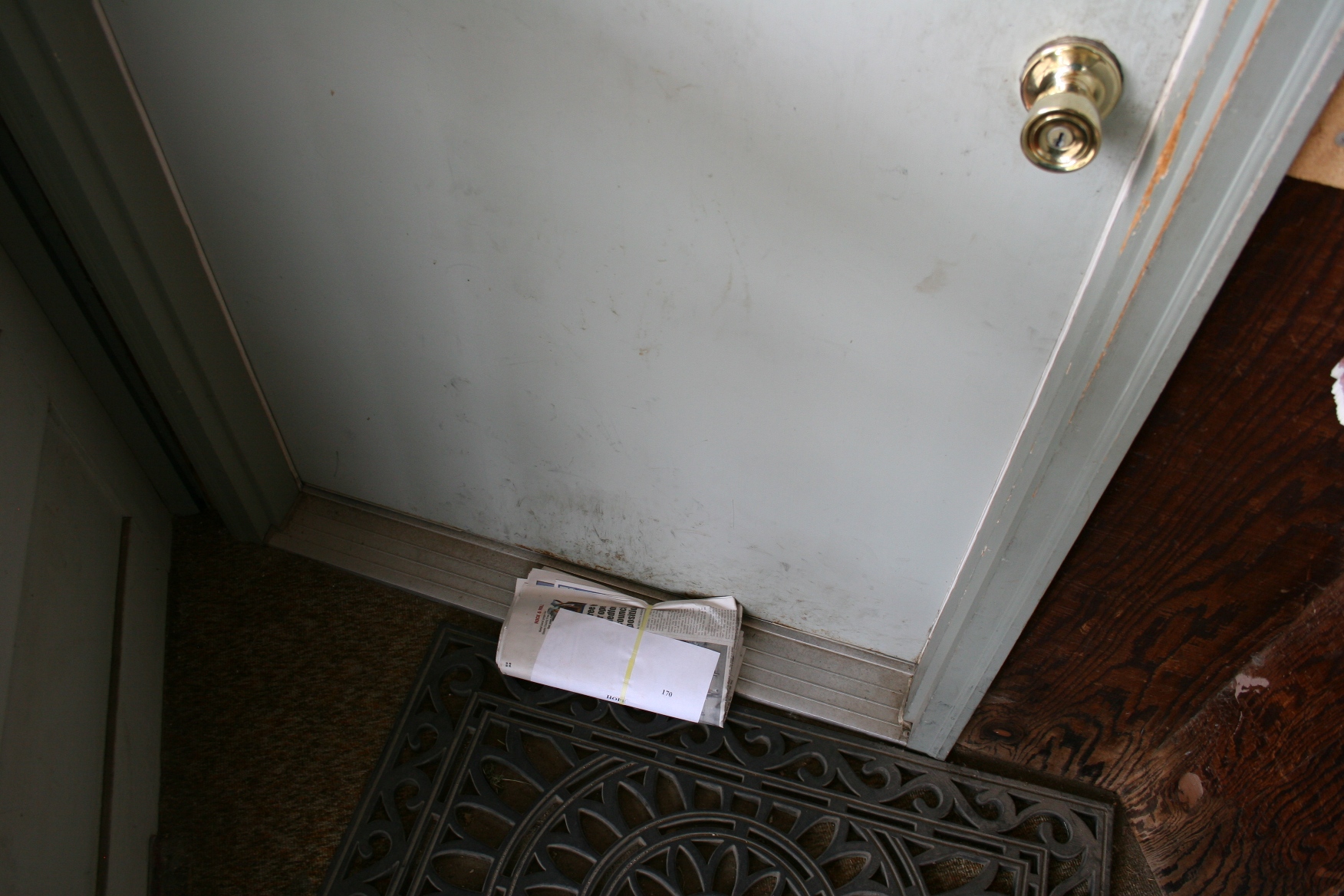
Maybe it doesn’t take much to impress me, but I appreciate buildings with character. I quickly determined that the post office serves as Hope’s community hub. I pulled open the screen door and stepped inside a closet of an entry, the door to the post office to my left, the door to a gift shop to my right. Smack in front of me, I found business cards and signs, church festival notices and other information tacked onto a bulletin board. A clutch of rubber-banded newspapers lay on the floor in front of the post office door.

The community bulletin board inside the post office entry.

A clutch of bundled newspapers outside the locked interior post office door.

From inside the post office entry, a view across the street of the bank and an antique store.

Since I was there on a Sunday afternoon, I had to settle for standing outside, peering through the large, cracked and taped front windows to view the customer service area that is smaller than most bathrooms. But it serves the purpose and I’m sure Hope folks are happy to still have their post office.

I always figure once a community loses its school, its post office and its bank, well then, you may as well close up the town. So far, Hope has only lost its school.

Today the U.S. Postal Service releases a list of 3,600-plus post offices under consideration for possible closure in a cost-cutting effort. I hope Hope is not among them.

Post office hours are listed on a cracked and taped front window.

CHECK BACK FOR MORE posts out of Hope and other area communities I recently visited while on a Sunday afternoon drive. It’s my philosophy that most of us are missing out on the treasures of small-town U.S.A. because we fail to get off the freeways, park our vehicles on Main Street and explore. Either that or we’re “too busy” to slow down and notice the details worth noticing in our small towns.

If anyone knows about the history of the Hope Post Office, submit a comment. I would like to learn more about this building.

© Copyright 2011 Audrey Kletscher Helbling


Hot as “you know what” in Minnesota July 18, 2011

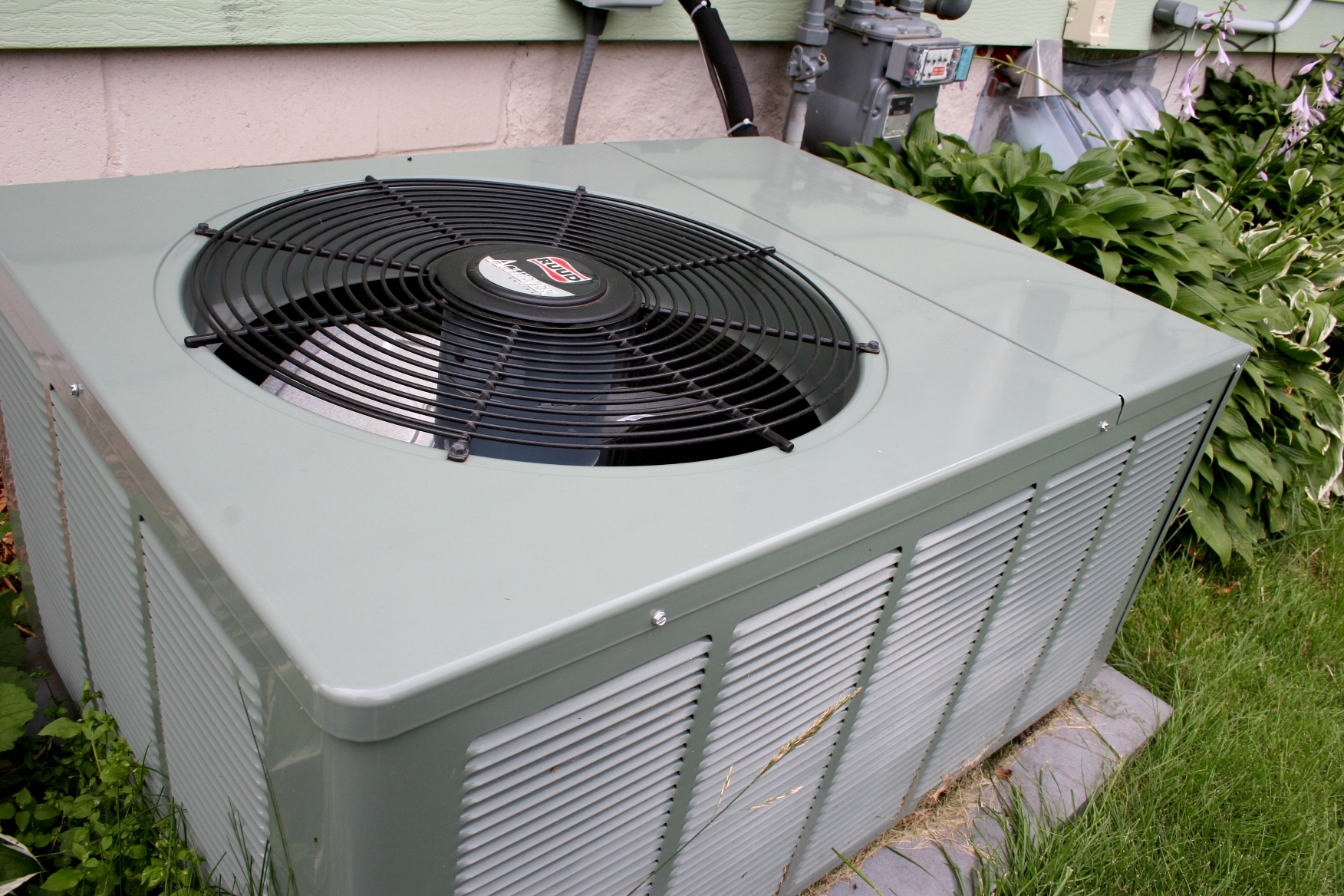
Air conditioners will be working overtime in Minnesota this week.

SO, MINNESOTANS, here’s the weather question of the day: “How hot is it outside?”

Although I’m of German heritage, I’d unequivocally state, “hotter than a Finish sauna.”

With a predicted dewpoint in the 70s (Sunday it reached an almost unheard of 81) and temperatures in the 90s today, the National Weather Service in Chanhassen has continued an extensive heat warning for central and southern Minnesota and west central Wisconsin through 9 p.m. Wednesday.

Heat indexes of more than 105 degrees (some media outlets are saying 110 – 117 degrees) are expected for several-hour stretches during the afternoon, creating “a dangerous situation in which heat illnesses are likely.” Ya think?

That means, folks, that we need to keep ourselves cool (preferably in an air conditioned building), drink plenty of fluids (and we’re not talking alcohol here) and stay out of the sun.

Don't increase your fluid intake via alcohol.

Honestly, when I stepped outside Sunday evening, I felt like I couldn’t breathe. You can guess how long I stayed outdoors. Long enough to turn around and walk back inside the house. I had been out earlier photographing the air conditioner you see above. I had a little trouble with the camera lens fogging over as soon as I stepped outdoors. The windows on our house also fogged, a phenomenon I have not previously seen except when I cook pasta. Weird stuff this weather.

All joking aside, this heat and humidity can be downright dangerous, especially for anyone working outdoors.

I know of some teens supposedly heading to the corn fields early this morning to detassel corn in the Stanton/Northfield area. Here’s my advice: Gulp water, by golly, then gulp some more. Slather on the sun screen, wear a cap and, if you’re at all feeling out of sorts, immediately tell your supervisor. Today would not be the day to tough it out. And, yes, I do know of what I write. As a teen I detasseled corn on days so hot it seemed as if the heavy air would suffocate me in the corn rows.

If you, or your teen, is starting a job this week as a corn detasseler, take extra precautions to avoid heat-related health issues. Also, don't quit. Every week in the cornfield won't be like this one and you' likely work only til noon.

Now, with those dire warnings out of the way, let’s talk about the words and phrases we Minnesotans use to describe this stretch of humid, hot weather. Let me pull out my Minnesota Thesaurus and thumb through the pages.

Here are some select synonyms for our current weather: steamy, muggy, scorching hot, sweltering, a real barn burner, so hot you could fry an egg on the pavement, like a sauna, “it’s not the heat, it’s the humidity”…

Whichever words you choose from that non-inclusive list, you might want to add, “It could be worse.” We Minnesotans like to tack that little phrase onto our statements lest, by not adding that qualifier, we leave ourselves open to worse circumstances/situations/weather. We do not want to tempt fate.

After all, come December, we could get socked with a raging blizzard that dumps two feet of snow on us followed by a week of temperatures plummeting to 20-below, and that’s without the windchill. We wouldn’t want to invite a Siberian winter by forgetting, this week, to say, “It could be worse.”

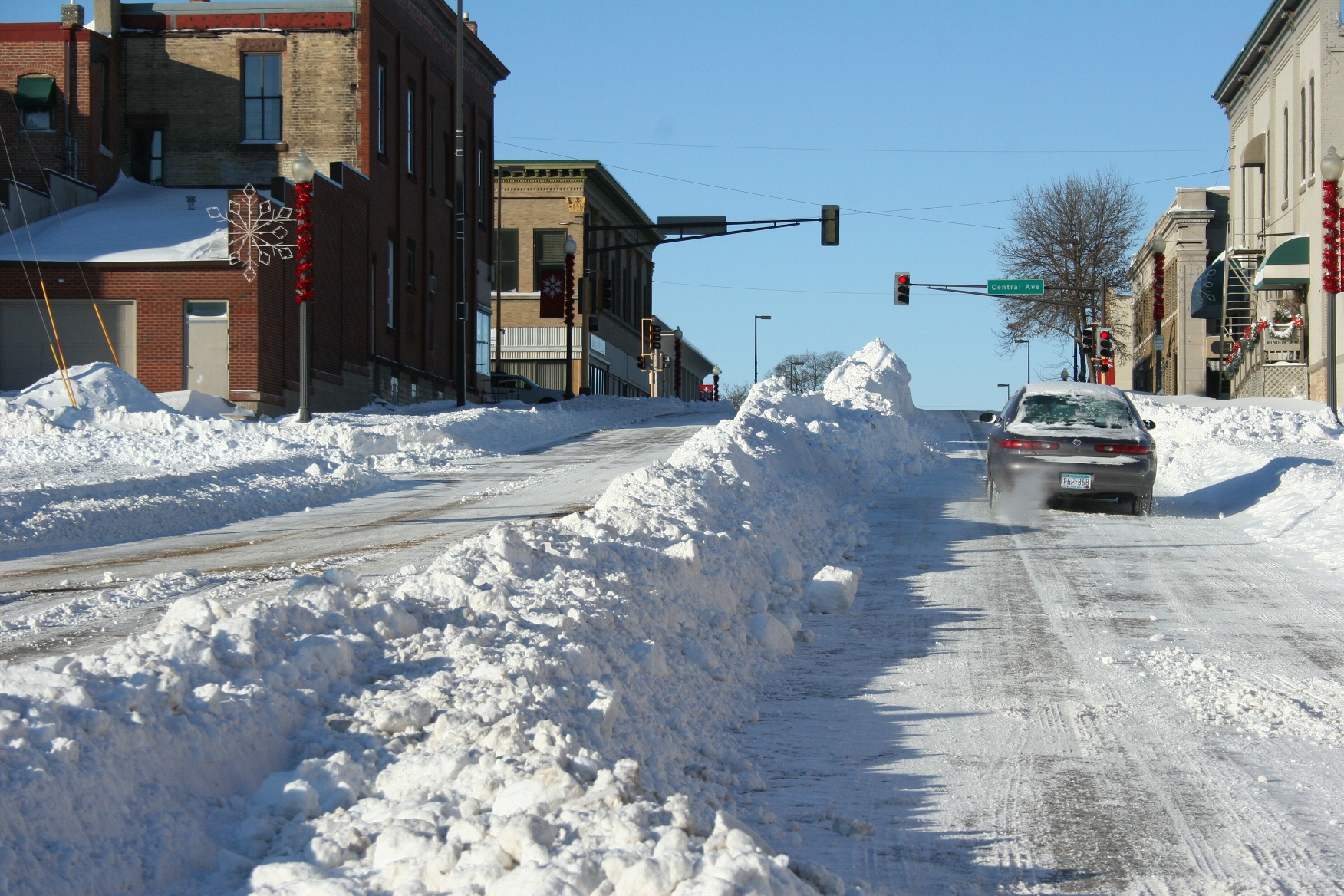
A snow pile divides traffic lanes along Fourth Street/Minnesota Highway 60 a block from Central Avenue in Faribault following a December 2010 snowstorm.

In summary, it’s best, really, not to overly-complain about the hellish, hot, scorching, stifling, steamy, sticky, sweltering, miserable, muggy, unbearable, oppressive heat and humidity. OK, then?

And, please, don’t be thinking, “Whatever, Audrey.”

IT’S YOUR TURN to speak up. How would you describe this weather we’re experiencing in Minnesota? How are you coping? Add your ending to this prhase: “It’s so hot in Minnesota that…”  Submit a comment and tell me whatever.

© Copyright 2011 Audrey Kletscher Helbling
 

St. Mary’s of Melrose, Part II July 17, 2011

STARK CHURCHES appeal to me. The ones with the simple wooden cross, the white clapboard siding, the time-worn pews settled upon plain plank floors.

But the ornate houses of worship likewise snag my soul with crosses of gold, walls of brick and gleaming, carved pews.

One of the many ornate carvings at St. Mary's Catholic Church in Melrose.

I am most comfortable with, most accustomed to, the unadorned churches of the Lutherans, my religious heritage. We keep things simple. No cluster of burning candles. No wafting incense. No pools of holy water. Minimal, if any, gold.

Perhaps for that reason, when I step into an historic Catholic church, I feel like I’ve entered a foreign land. I am often awed by the opulence, by the details that visually overwhelm me.

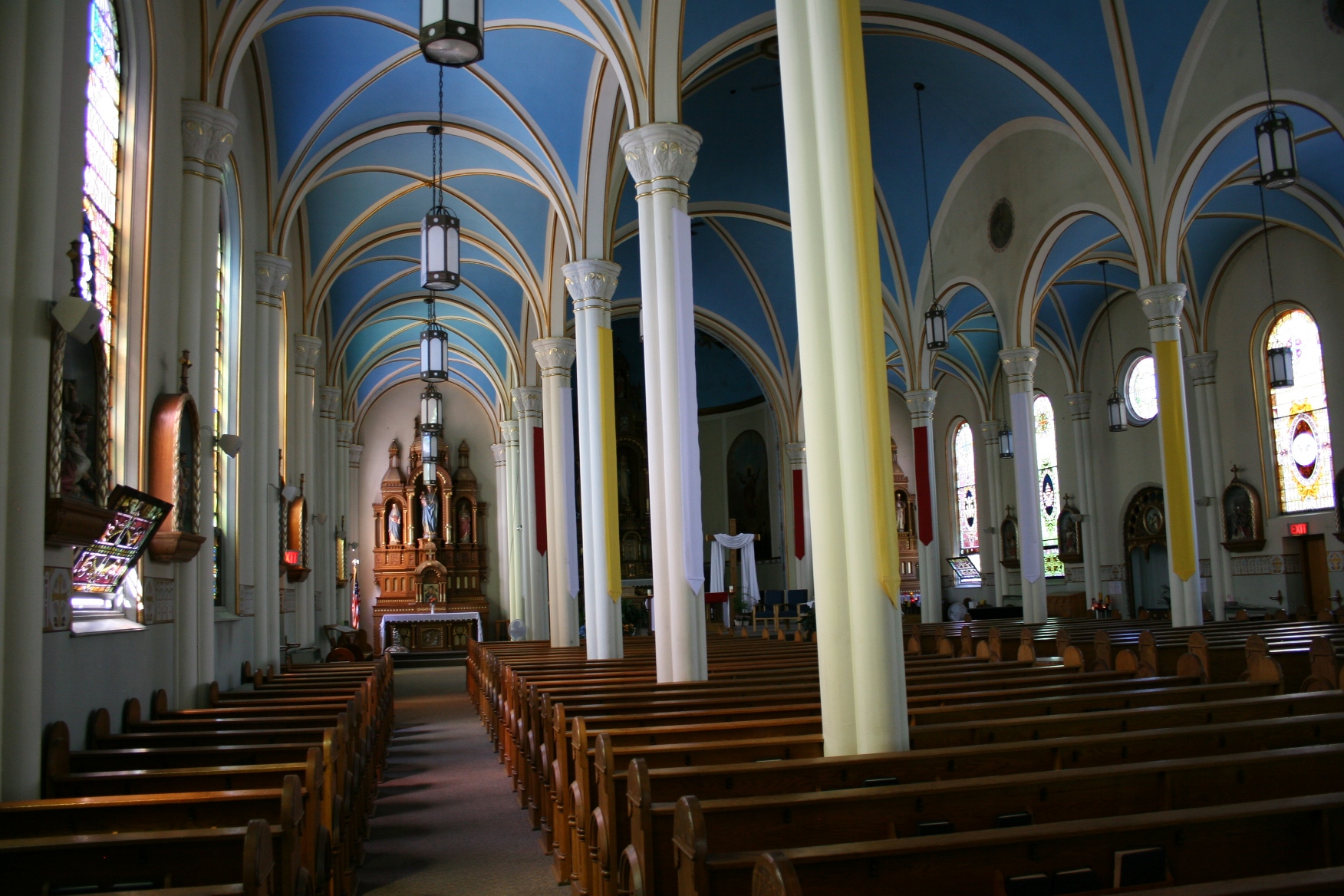
The side aisle on the left leads to an ornate altar in St. Mary's which is on the National Register of Historic Places.

That’s exactly how I felt upon entering St. Mary’s Catholic Church of Melrose, featured here in an earlier post. Overwhelmed. But good overwhelmed. Because I could not possibly present all of the images I wanted to share with you in a single post, here are the remainder.

No matter your religious affiliation, you simply have to appreciate a place like St. Mary’s. What beauty. What art. What history. What heavenly splendor.

This was the top or bottom of something. Can't recall what. But it sure is stunning.

Look at this gorgeous, carved door, will you?

Golden statues. Beautiful.

Just look at this detailed side altar. I could have spent hours in St. Mary's.

And then I discovered these collection baskets hanging from a rack. We Lutherans don't have wicker baskets with long handles. These contrast so sharply with the the ornateness in the church and that is why I so appreciated this grouping.

St. Mary's Catholic Church stands strong as a fortress in Melrose, next to the turkey plant, its towering steeples visible from nearby Interstate 94 in west central Minnesota.

© Copyright 2011 Audrey Kletscher Helbling
 

Words matter: Prejudice and acceptance in Faribault July 14, 2011

Filed under: Uncategorized — Audrey Kletscher Helbling @ 7:42 AM
Tags: , , , , , , , , , ,

Faribault is home to a sizable Hispanic population. This file photo was taken at a downtown Faribault Mexican bakery, which has since come under new ownership. The bakery was once at the center of a controversy over its exterior color and was repainted when some local businessmen donated money for a new paint job.

EVERY TIME I HEAR a derogatory comment about an ethnic group, I am still surprised. I don’t know why.

Perhaps the fact that this is 2011, and not 1960, factors into my belief that people have overcome their prejudices toward those with skin colors different than their own.

Then I hear a statement like this: “Willow Street is becoming a little fill in a Spanish word here.” I hadn’t heard the word before, which is why I can’t remember it. But I know for certain that it was unkind and derogatory and cutting toward the Hispanic population that lives in my community of Faribault, specifically along my street.

I couldn’t allow the slam to go unchallenged, especially since it was spoken just as I was about to enter, of all places, my church for Sunday morning worship.

In an immediate moment of incredible self control, I responded by telling this clearly prejudiced individual that there are “good whites” and “bad whites,” just like there are “good Hispanics” and “bad Hispanics.” I knew I had to keep my response simple so he would understand. I also told him that my Hispanic neighbors are “good neighbors.”

With those words tumbling off my tongue, I walked into the sanctuary, attempting to dismiss my anger and focus on an attitude of forgiveness.

I also consciously shifted my thoughts to an exchange I witnessed a day earlier. As a Somali mother walked into a Faribault grocery store with her adorable preschool-aged daughter, a Caucasian couple engaged the woman in conversation. They inquired about the little girl and asked her name.

“Amira,” the Somali mother answered and smiled.

“That means ‘princess,’” the man said and continued to share a story about another Amira he knew. All the while, the mother beamed. When they parted, he told the pair, “God bless you.”

I was trailing behind, thinking how my Aunt Dorothy has always called me her “Little Princess,” even now, today, when I am in my 50s. That endearing nickname has always made me feel so loved. Words can make such an impact.

As the Somali woman continued down the grocery store aisle with her daughter tagging behind, I blurted, “She’s so cute.”

The mother of the little princess turned and rewarded me with a smile, a universal human expression that bonds all humans no matter their skin color.

In this file photo, a Somali family waits to cross a downtown Faribault street.

CLICK HERE TO READ one of many posts I wrote related to the exterior colors of two ethnic restaurants in downtown Faribault. The color of the Mexican bakery, which has since changed hands, generated heated discussion within the community in 2009 and 2010.

© Copyright 2011 Audrey Kletscher Helbling
 

An update from storm-damaged Belview July 13, 2011

Entering Belview from Sacred Heart at 9 a.m. on July 2, the morning after the tornado. Photo courtesy of Merlin and Iylene Kletscher.

LESS THAN TWO WEEKS after an EF-1 tornado ravaged the small town of Belview in southwestern Minnesota, I emailed City Clerk/Treasurer Lori Ryer for an update.

I know she’s busy dealing with issues in the aftermath of the July 1 storm, so I asked only for a brief summary, with a specific request for information about Parkview Home. The nursing home, according to Ryer, received major roof damage that resulted in flooding of the building. Initially, 25 residents were evacuated and taken to care centers in nearby Wabasso, Olivia and Redwood Falls.

Since then, Parkview has closed for repairs, residents have been discharged and admitted to new nursing homes, and staff has been laid off.

When the nursing home will reopen remains uncertain as assessments are still being made. But Ryer anticipates, after talking to staff on Tuesday, that Parkview will be closed for at least several months.

This photo shows Parkview Home and mini golf in the park. Photo courtesy of Merlin and Iylene Kletscher.

Parkwood Apartments, which is attached to the nursing home, was not damaged, but was without power from Friday afternoon, July 1, until the following Monday evening. Some apartment residents left to stay with family members briefly, but everyone has now returned, Ryer says.

Bridgewood Assisted Living was not damaged, but was without power also.

Damage along South Main Street in Belview. Photo courtesy of Merlin and Iylene Kletscher.

Throughout the rest of this community of 375 residents, many home and business owners are still awaiting insurance adjusters. Many homes received minor damage, several moderate, and a few major, damage from results of the 95 – 105 mph tornadic winds, Ryer says.

Many garages and sheds were destroyed and quite a number of cars totaled due to trees falling on them, the city clerk continues.

Tom Johnson's SUV was totaled when a tree fell onto it during the Belview tornado. Photo courtesy of Tom and DeLores Johnson.

The Belview school building received major damage, resulting in relocation of the Belview Learning Center summer program. Ryer hopes that program will be up and running in the Belview school building before the new school year begins.

Despite the destruction in her community, Ryer manages to remain positive: “With all that being said, I still marvel at the fact that we had no injuries during the storm or in the days of clean-up afterwards.”

LIKE RYER, I, TOO, marvel that no one was injured or killed by this storm which swept across Minnesota into Wisconsin July 1. My hometown of Vesta, just down the road from Belview, was hit by a series of downbursts with wind speeds of 90 – 100 mph.

I have many family members living in areas affected by the storms. Damage was minimal to their properties, but most lost trees. A cousin living near Wood Lake, however, saw substantial damage to the family’s farm. My home church, St. John’s Lutheran in Vesta, had half the roof ripped off.

St. John's Evangelical Lutheran Church in Vesta with the roof half missing. Photo courtesy of Brian Kletscher.

In a few weeks I’m returning to my hometown for the annual Kletscher family reunion. I’m trying to prepare myself for what I’ll see—my little prairie town with fewer trees, the church where I was married now temporarily closed. I always look forward to worshiping there with my mom when I return home.

I expect it will be the trees, though, that I will miss the most. A friend recently told me that the small towns of southwestern Minnesota are like oasises in a land mostly devoid of trees, except for the trees in those towns and the groves that shelter farm sites. He is right.

The communities of Belview and Vesta lost many trees in the July 1 storms. This photo is along a Belview street north of the city park. Photo courtesy of Merlin and Iylene Kletscher.

But those of us who grew up on this land, and those who live there, appreciate the wide open spaces, the big sky, the fields of corn and beans and those small towns.

Prairie people are strong, caring, determined folks who come together in time of need. I’ve seen that over and over again in the stories I’ve heard and the comments I’ve received on my blog posts while covering the recent storm damage.

To the residents of Belview and Vesta, Tyler and Ruthton, and all the farm places in between, I know you’ll make it through these challenging days. Your roots reach deep into the prairie and no storm can rip away what you have—each other.

© Copyright 2011 Audrey Kletscher Helbling

 

Ominous skies near Nerstrand July 2, 2011

Filed under: Uncategorized — Audrey Kletscher Helbling @ 10:40 AM
Tags: , , , , , , , , , , ,

HAD I NOT KNOWN about the storm damage earlier that evening in southwestern Minnesota, I may not have worried so much.

Had my sister not called from Waseca and advised my husband and me to “get home,” I may not have worried so much.

Had the clouds not turned dark and foreboding, looming low enough to nearly brush the earth, I may not have worried so much.

Had my friend Fritz kept quiet and not shared her tales of tornado terror, I may not have worried so much.

But Friday evening when a strong storm hit my hometown of Vesta, when my sister warned of the approaching storm, when the sky threatened and when Fritz told her stories, I worried. I cannot help myself. Storms scare me.

And here are the images, taken at a farm near Nerstrand where I was attending a party, to prove why I was concerned.

Despite my fear, I must admit that the skies held a certain ominous beauty.

Spectacular lightning—our own fireworks show—crisscrossed the sky for hours. I attempted a few lightning shots, but could never get the timing right. And when you’re scared, holding the camera still enough for a slow shutter speed doesn’t work. Rain also kept me from pulling out my Canon.

The evening ended without any severe storms in our locale, despite skies that I swore would drop a tornado at any minute.

But in my hometown, the results were different. If you haven’t read my earlier post today about the storm in Vesta, click here. My brother was stopped twice trying to get into town to check on our mom, who is OK.

After the ominous clouds and the rain, this rainbow appeared.

© Copyright 2011 Audrey Kletscher Helbling
 

Storm rips through my hometown of Vesta

WHENEVER ONE of my siblings calls saying, “I just want you to know Mom is OK, but…,” I prepare myself mentally for her latest health crises.

But Friday evening when my sister Lanae reached me via cell phone while my husband and I were en route to a party near Nerstrand Big Woods State Park, the news was totally unexpected.

My hometown of Vesta in Redwood County in southwestern Minnesota had been struck by straight-line winds.

While my mom’s house—once the retirement home of my paternal grandparents—had gone apparently unscathed, other structures in town were damaged. But at least my mother and aunts and uncles and a niece were safe.

In my sister’s early report, which came second-hand via relatives in the area, she shared that half the roof was ripped off our home church, St. John’s Lutheran. Hours later, after arriving home from the party, I found photos in my email in-box of the storm’s destruction. I nearly broke down and cried when I saw my home church with the partially missing roof.

St. John's Evangelical Lutheran Church in Vesta with the roof half ripped off during the Friday evening storm.

The images also showed damage to the grain elevator and bins in Vesta and trees down on the home place half a mile from town.

Damage to one of the grain bins at the local elevator.

The grain elevator complex, the visual defining landmark in the farming community of Vesta, was ravaged by winds. You'll see the damage near the top of the old grain elevator.

A close-up of the damage wrought upon the old elevator.

Another shot showing some of the debris and damage at the elevator complex.

The wind toppled trees on the farm where I grew up a half mile south of Vesta.

During that phone conversation with my sister, as my husband and I drove along the gravel road toward the gathering with friends, I wanted nothing more than to turn around, pack our suitcase and drive to Vesta 2 ½ hours away.

That’s exactly how I felt more than three decades ago when I lived in Gaylord and the farm where I grew up was hit by a tornado, taking down a silo and tossing grain wagons around the field.

But on this Friday evening, with storms rolling in from the west, I knew this was not practical. I would need to rely on my siblings to keep me informed. My middle brother, who lives in Lamberton some 25 miles away, was on his way to Vesta. I called my two daughters to tell them about the storm.

I wanted so much, though, to also speak with my mom. I needed the comfort of hearing her voice. I wanted to learn about her storm experience. But the phone lines were down in Vesta. Even though Mom owns a cell phone, I doubt she remembers how to use it. She’s never quite adjusted to technology.

And so now it’s Saturday morning and I am exhausted after a night of tossing and turning. Storms do that to me.

Thoughts of my home church—where I was married and attended the funerals of my father, Grandma Kletscher, Grandpa Bode and Uncle Mike—churned through my mind. I worried about where congregants will worship, whether the interior of the church was damaged, if the church, my home church, can be repaired.

I hope today to get some answers and, if I do, I’ll pass that information along to you.

I’ll also share images I shot last night of the storm clouds hanging dark and ominous over the farm site where we gathered with friends for an early Fourth of July celebration.

Nature provided the fireworks—lightning bolt after lightning bolt zig-zagging horizontally across the forbidding sky for hours. Except for some wind and rain, our area escaped the storm that ravaged Vesta and Marshall and other communities to the west.

IF YOU HAVE STORM stories to share from last evening, please submit a comment. KLGR Radio in Redwood Falls is this morning reporting winds of up to 100 mph in Redwood County and the sightings of possible funnel clouds. Click here to read that news report.

FOR THOSE OF YOU UNFAMILIAR with southwestern Minnesota, Vesta sits along State Highway 19 half way between Redwood Falls and Marshall.

Photos courtesy of Brian and Vicki.

©  Copyright 2011 Audrey Kletscher Helbling
 

In loving memory of Rhody C. Yule June 16, 2011

Rhody's self-portrait, 1989

WEDNESDAY AFTERNOON we eulogized and buried my 92-year-old artist friend, Rhody Yule.

I have known Rhody for less than two years, having met him quite by happenstance in the fall of 2009. While driving by his rural Faribault home, I spotted celebrity portraits hanging on his garage, stopped to photograph them and then went to his front door.

There I met this sprite of a man and his yapping dog, Jo-Jo.

With his dog shut in the kitchen because I feared being bitten, Rhody shared the story of his life with me and my husband, Randy, strangers until then. I did not hesitate to ask about the paintings hung in his cozy living room and on his garage. He did not hesitate to share that he had been painting since age 16.

Even on that first visit, I learned so much about a man who would come to mean so much to me. His wife, Shirley, had fallen and was living in Hastings. Oh, how he missed her. His only child, Paul, died in a car accident in 1977 at age 23. Oh, how he missed him.

Rhody told us about his military service, including time in Nagasaki, Japan, cleaning up after the atomic bomb. He showed us photos and paintings on that first visit and grass-woven sandals from Japan snugged inside a wooden box he had crafted.

I thought to ask, thank God, if he had ever publicly exhibited his art. He hadn’t. That became my mission, to get a gallery show for this life-long artist. His first mini-show, of his religious paintings, came in September 2010, when he was invited to Christdala Church near Millersburg. He had, many years prior, done a painting of the church. Randy and I coordinated that exhibit, then loaded the paintings into our van and set them up outside this historic country church. Rhody and I spoke briefly at that event and he assured me that, despite our nervousness, we did well.

At Christdala, I distributed mini fliers for his upcoming gallery show at the Paradise Center for the Arts in Faribault. I had applied for the exhibit on his behalf and, in January, with the assistance of family and friends and volunteers, “A Lifetime of Art: The Rhody Yule Collection” opened to a packed gallery.

In typical Rhody fashion, this man of gentle spirit and quiet humility took it all in, never once boasting, but enjoying every second of his evening. This marked a shining moment for him in his 92 years of life and I was honored to have helped him achieve this public recognition of his art.

Rhody, minutes before his gallery show opened in January 2011.

RHODY’S FUNERAL SERVICE on Wednesday, while tinged with grief, also caused us to laugh out loud at his humor. We reminded each other of his forgiving attitude, his unshakable faith, his always positive attitude.

Just days before his death,  my husband Randy and I visited one last time with Rhody. Physically his body had deteriorated to a shell of the man he had been, but his mind and spirit remained strong. We saw him on a good night.

In that last hour with our friend, we reminisced about his gallery exhibit as I, one-by-one, held up photos I had taken that evening. He was too weak to grasp the images. And then we paged through several of his photo albums with pictures of a younger Rhody, a freckle-faced Paul, a beautiful Shirley.

I thought to myself, “You will be with them soon, Rhody. Soon.”

Rhody did not fear death. Yet he wished to live, even thought he might recover. I knew better. When I mentioned Millersburg, Rhody was ready for a night out and a beer at his favorite eating establishment there. Family and friends celebrated with him last fall in Millersburg at a patriotic-themed freedom party. His idea. His celebration after overcoming a recent, temporary loss of his personal freedom.

Rhody had more living to do. I learned at his funeral that this WW II veteran wanted to travel on a Washington D.C. Honor Flight to see the war memorials. It breaks my heart that he did not live long enough for that to happen.

Me and Rhody at his opening night gallery reception.

He prayed every night for the soldiers to come home.

He was smartly dressed for burial in his military uniform, which hung loosely on the gaunt body of a man who once stood strong in service to his country.

Those honoring his memory were directed to donate to the Rice County Veterans Memorial Expansion Project.

A spray of patriotic red and white flowers adorned with a blue ribbon decorated Rhody’s carved wooden casket, a casket so appropriate for a man who crafted wooden boxes and also picture frames (for his art). Had he been physically capable, I expect Rhody may have built and carved his own casket.

But Rhody is gone now and, as the eulogist, the Rev. Ron Mixer, said, Rhody is busy painting sunrises and sunsets in heaven. He suggested we look for a signature “Y” in the clouds.

Rhody has left those of us who knew and loved him with more than his legacy as an artist and the thought that he is still painting. He has gifted each of us with his spirit of forgiveness and kindness, his humor and humility, his desire for fun, a love of life and a faith that endured challenges.

I knew Rhody such a short time. But how blessed that time has been.

We drove through nearly-torrential rain Wednesday afternoon to the rural Cannon City Cemetery to bury Rhody beside Shirley. As we gathered under the tent and next to it, sheltered by umbrellas gripped tight against the whipping wind, members of the Central Veterans Association fired an honorary salute to their brother soldier. Taps mourned. An aging veteran presented a folded American flag to Rhody’s step son in a voice choking with gratitude and emotion.

Soon the rain stopped and the sun wedged through the clouds as if Rhody was there, telling us to wipe away the tears. He would have wanted us to celebrate his life, and we did, but only if we didn’t brag about him.

Rhody's favorite painting, "The Last Supper," which he painted in honor of his beloved son Paul.

© Copyright 2011 Audrey Kletscher Helbling