Minnesota Prairie Roots

Writing and photography by Audrey Kletscher Helbling

Part V from Wanamingo: Landmarks & oddities March 28, 2016

Filed under: Uncategorized — Audrey Kletscher Helbling @ 5:00 AM
Tags: , , , , , , ,
Some of the airport luggage carts still remaining in Wanamingo.

Some of the airport luggage carts still remaining in Wanamingo.

MOST SMALL TOWNS possess oddities and landmarks unique to the community. Wanamingo in Goodhue County is no exception.

A few years back, I spotted row upon row of airport luggage carts parked outdoors in a lot on the north edge of town. It was the oddest sight. Only a small cluster of carts remains now. They’re still a mystery to me.


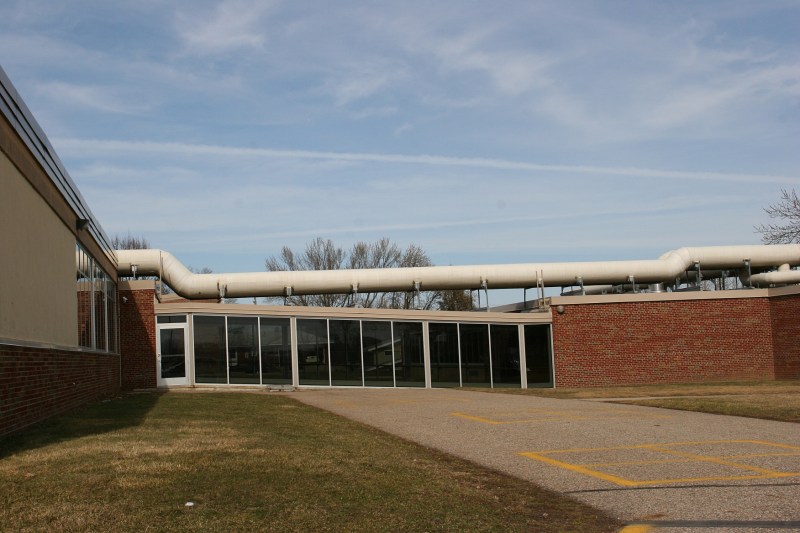
Small town Wanamingo, 47 elementary school


I am also intrigued by the massive pipes winding along the roofline of Kenyon-Wanamingo Elementary School. Typically, these heating (I presume) pipes run underground. Why are these atop the roof?


Small town Wanamingo, 44 butcher shop sign


At Wanamingo Meats and Catering, a hot pink sign and hot pink shutters draw attention to this downtown business owned by two sisters. That explains the pink. Butcher shops aren’t typically owned by women. Customers sing the praises of this business on its Facebook page.


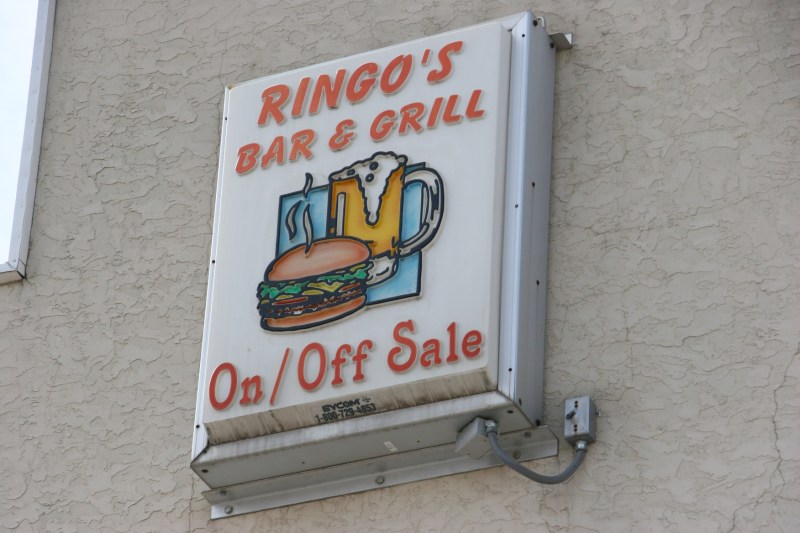
Small town Wanamingo, 38 Ringo's sign above bar


Downtown, I noticed a bar and grill with a seeming identity crisis. A sign high on the building identifies the business as Ringo’s Bar & Grill. But an over-the-door sign banners J B’s Tavern.

I would love to get inside this aged house, to know its story.

I would love to get inside this aged house, to know its story.

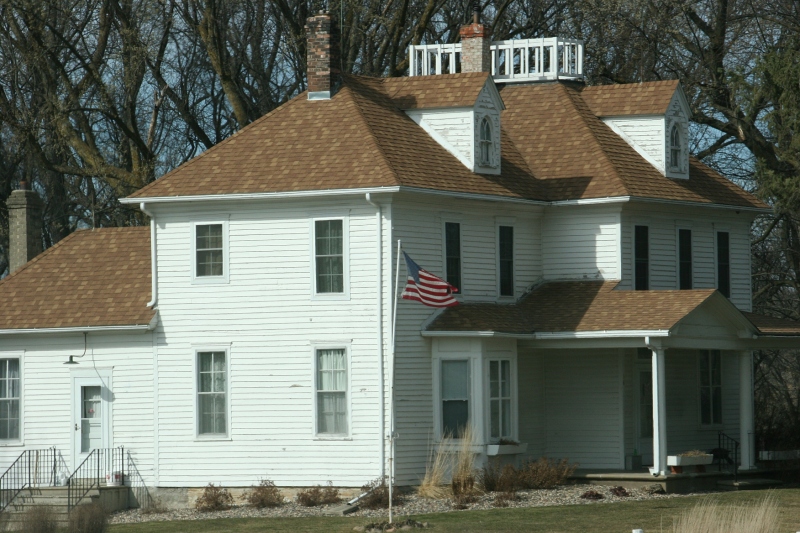
On the north end of Main Street, I photographed a hulking old house with a widow’s walk. Surely there’s a story here. I expect the original owner may have been someone of great importance in Wanamingo.

That this portion of the old creamery was saved and posted on a highly-visible corner impresses me.

That this portion of the old creamery was saved and posted on a highly-visible corner along Minnesota State Highway 57 impresses me.

Finally, on the corner of Riverside Park, angles signage for Minneola Creamery. A quick google search tells me the creamery, organized in December 1893, was one of the most successful in Minnesota. In 1908, according to information in History of Goodhue County, Minnesota by Franklyn Curtiss-Wedge, the creamery manufactured 550,00 pounds of butter selling for $125,000. Oh, the things I learn because I notice and photograph. And because I delight in touring small town Minnesota.

WHAT ODDITIES OR LANDMARKS would I find in your town/city? Let’s hear.

FYI: Check back tomorrow as I conclude my “from Wanamingo” series. To read the first four posts in this series, check last week’s archives.

© Copyright 2016 Audrey Kletscher Helbling


Part IV from Wanamingo: Touring Trinity Church March 24, 2016

Filed under: Uncategorized — Audrey Kletscher Helbling @ 5:00 AM
Tags: , , , , , , , , ,
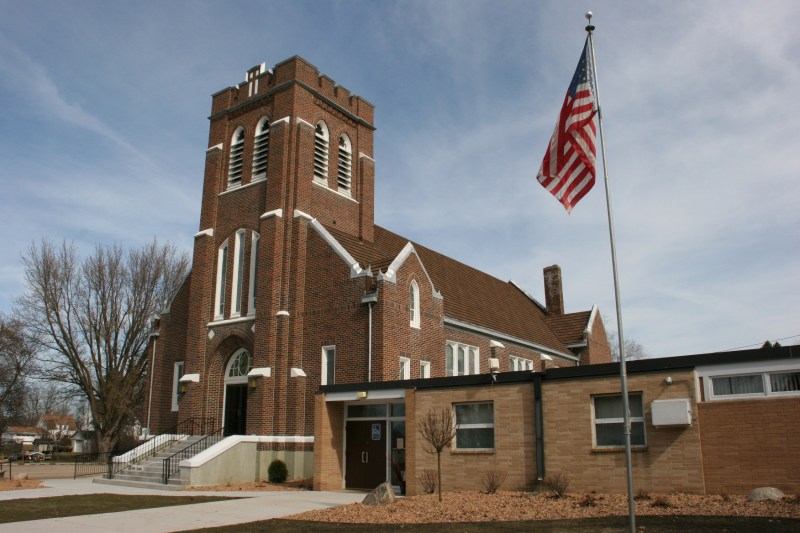
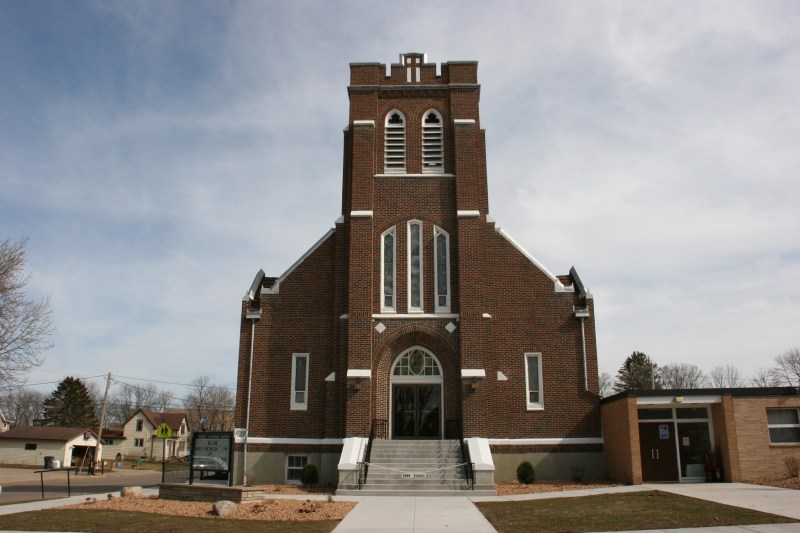
Trinity Lutheran Church, 301 Second Avenue, Wanamingo, Minnesota.

Trinity Lutheran Church, 301 Second Avenue, Wanamingo, Minnesota.

THE LUTHERAN CHURCH STANDS solid on a corner lot a few blocks off Wanamingo’s Main Street. Brick strong. Enduring strong. In the faith strong.

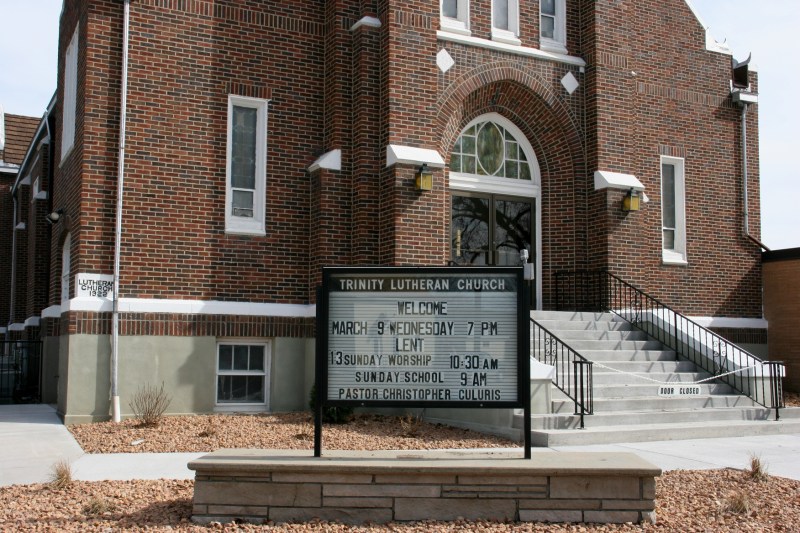
The cornerstone of this ELCA church is dated 1922, to the left in this photo.

The cornerstone of this ELCA church is dated 1922, to the left in this photo.

A cornerstone on Trinity Lutheran Church simply notes LUTHERAN CHURCH 1922. I know nothing more about the history of this congregation, of this building.

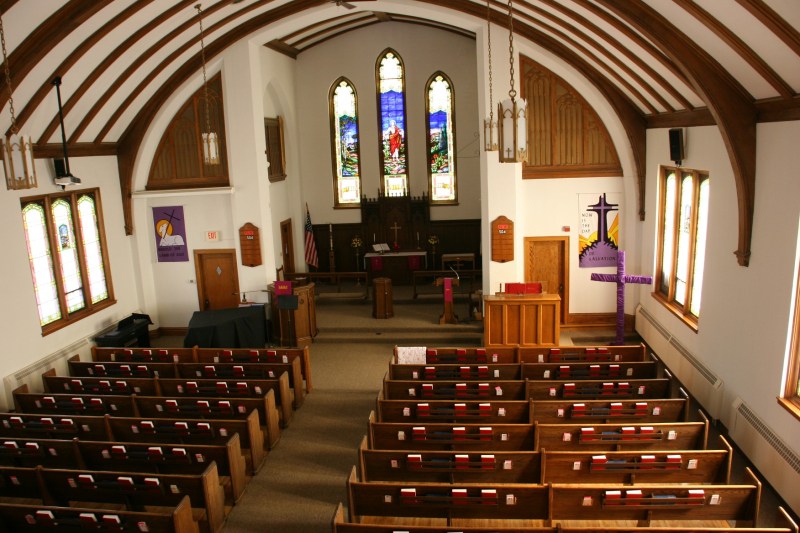
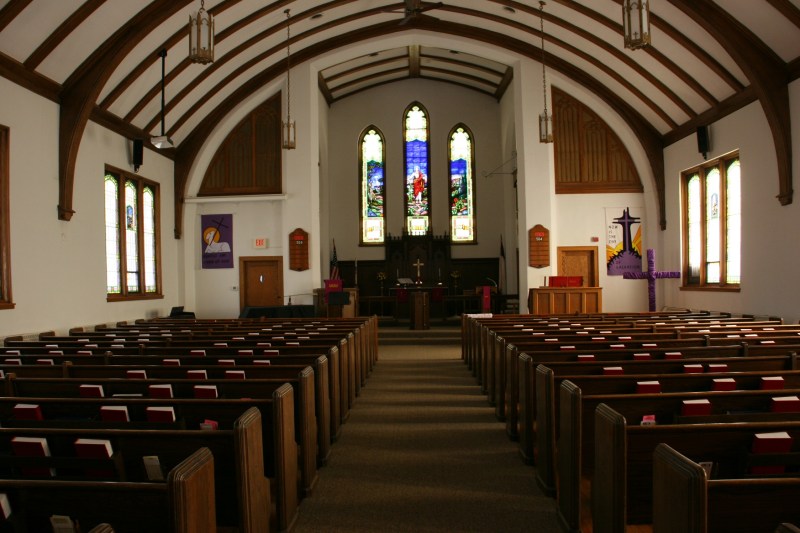
The beautiful sanctuary as photographed from the balcony.

The beautiful sanctuary as photographed from the balcony.

That matters not. For I appreciate churches like this which are lovely houses of worship. For these truly are houses to the families of faithful. Therein, worshipers, if not related by blood, are related by the commonality of faith and lives shared. They truly become family in joy and in grief.

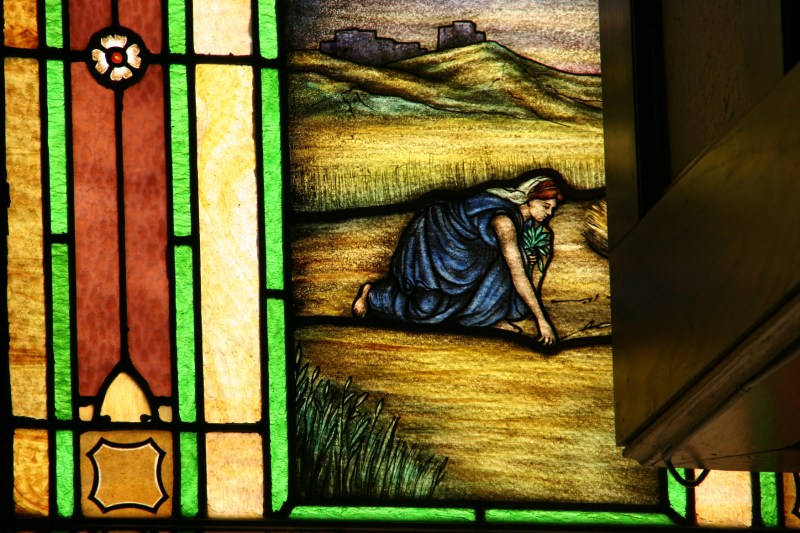
One of my favorite stained glass windows in Trinity is this one of Ruth gathering grain to help support her mother-in-law. The window is partially covered by the balcony.

One of my favorite stained glass windows in Trinity is this one of Ruth gathering grain to help support her mother-in-law. The window is partially covered by the balcony. To me, this window symbolizes deep love and devotion to family.

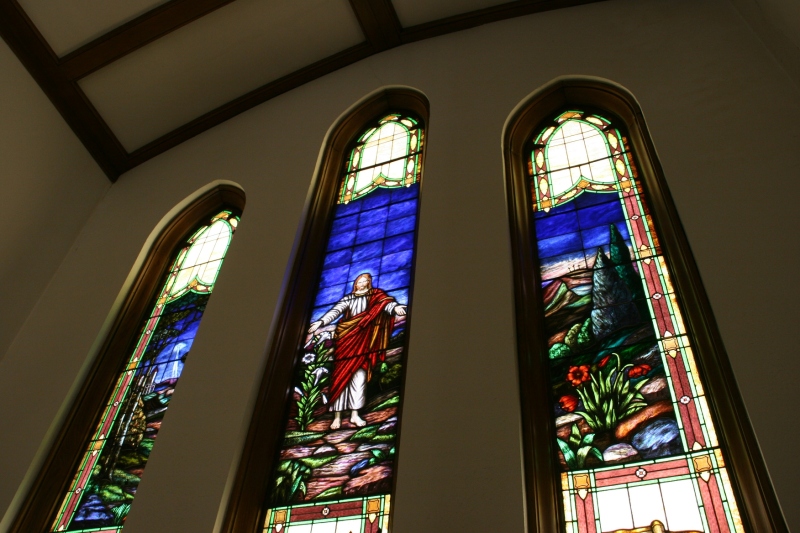
This trio of stained glass windows rises above the altar.

This trio of stained glass windows rises above the altar.

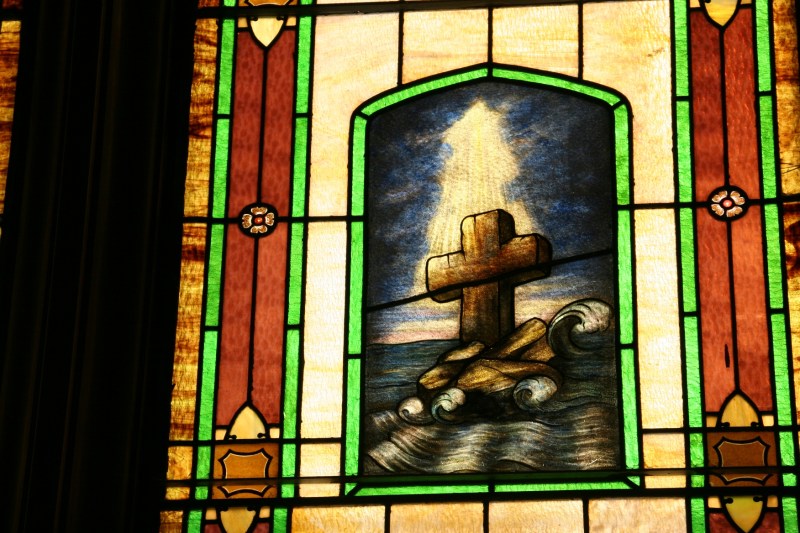
One of the windows flanking the side of the sanctuary.

One of the windows flanking the sanctuary.

Within the walls of an aged sanctuary like Trinity, visual symbols of faith embrace those who enter therein. Intricate stained glass windows shine the light of grace and of Scripture.

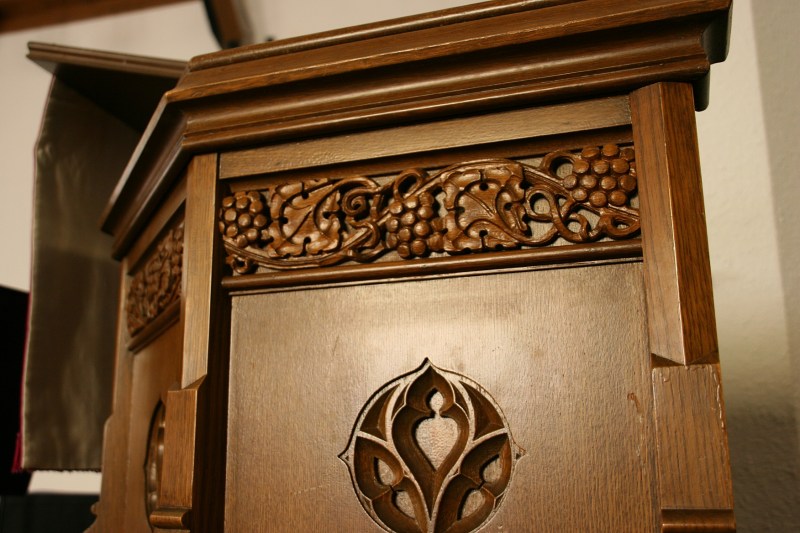
One can only imagine the messages delivered from this sturdy pulpit.

One can only imagine the messages delivered from this sturdy pulpit.

The sturdy pulpit with its handcarved trim looms as a time-honored place for preaching of the Word, the wood dulled by the hands of many preachers.

Balcony pews.

Balcony pews.

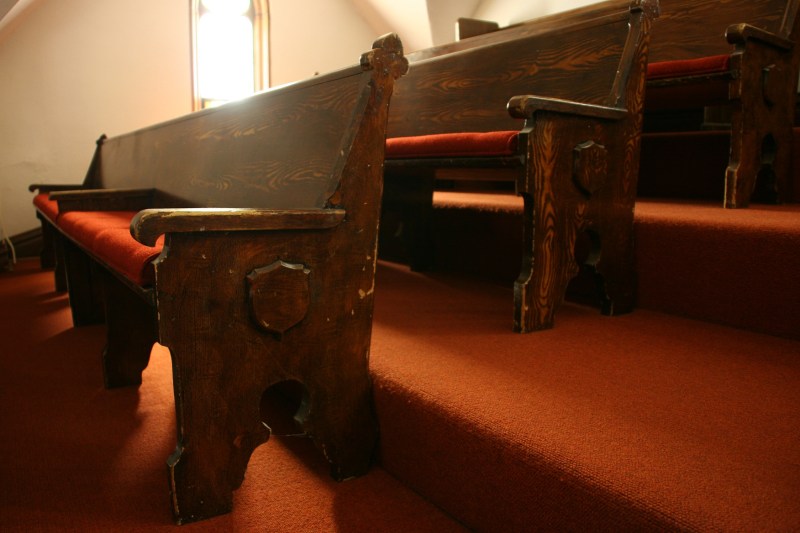
Worn pews reflect the history of generations.

Another view from the church aisle.

Another view, this from the center church aisle.

Art, history and a heavenly presence prevail. It is here, within the walls of Trinity. Visually. And in spirit.

BONUS PHOTOS:

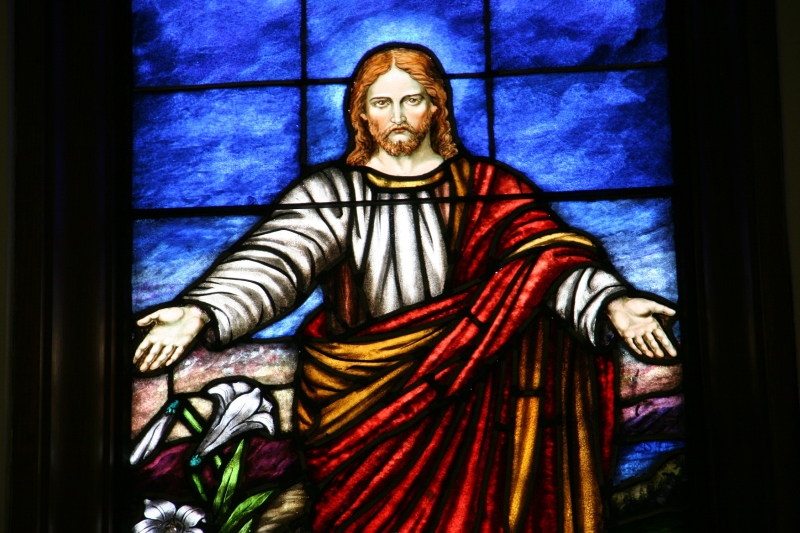
The risen Lord centers the trio of stained glass windows above the altar.

The risen Lord centers the trio of stained glass windows above the altar.

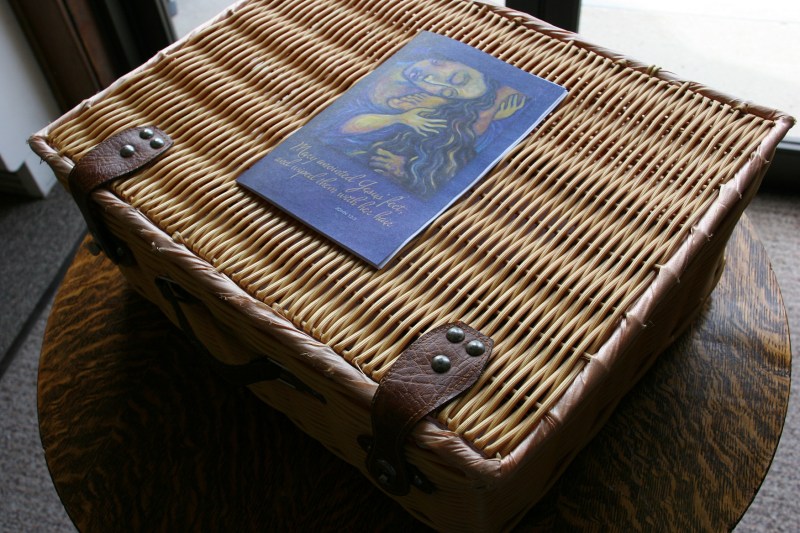
A basket holds church bulletins and other worship essentials.

A basket holds church bulletins and other worship essentials.

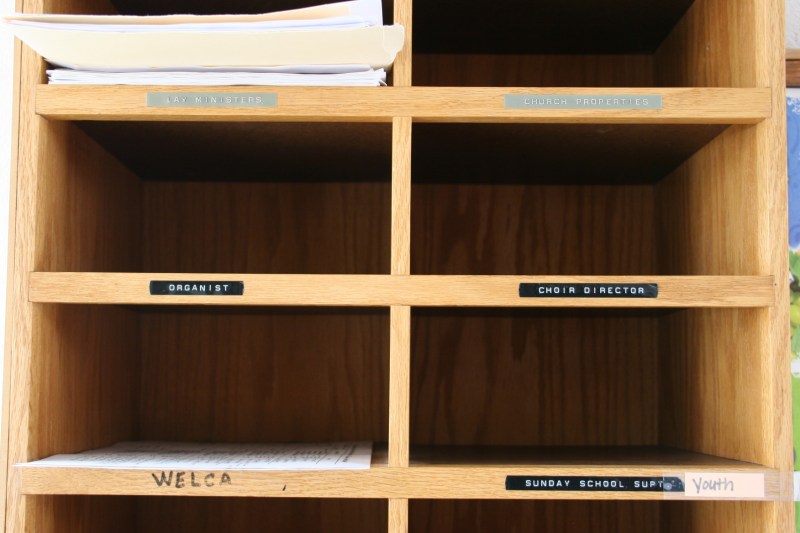
Church mail slots.

Church mail slots.

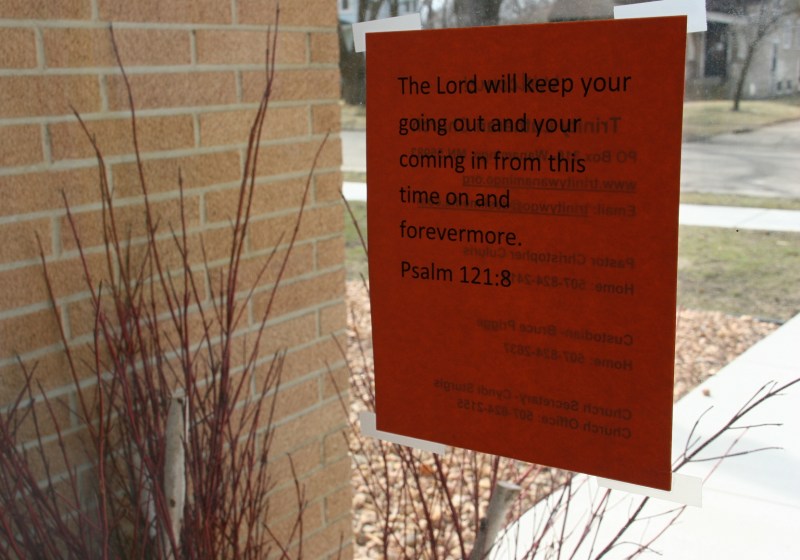
A final message for worshipers is posted on a window next to an exterior front door.

A final message for worshipers is posted on a window next to an exterior front door.

FYI: Please check back next week for more posts in my “from Wanamingo” series.

© Copyright 2016 Audrey Kletscher Helbling


Part III from Wanamingo: The connection to a beloved hymn March 23, 2016

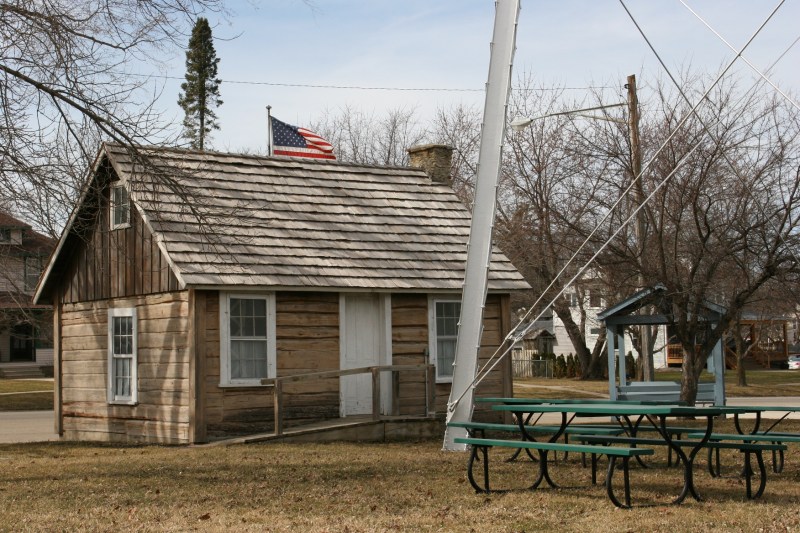
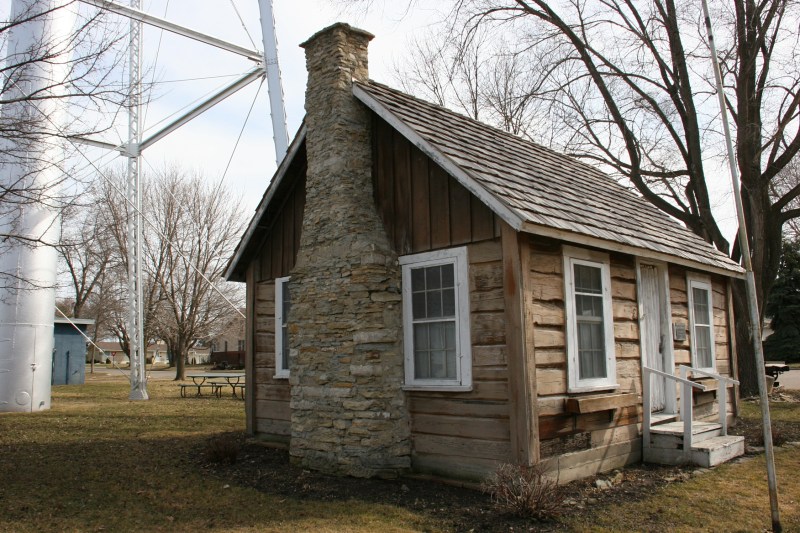
The Lars Larson log cabin sits next to the water tower in Wanamingo. The information center can be seen to the right

The Lars Larson log cabin sits next to the water tower in Wanamingo. The blue grey structure to the right is the information center.

IN THE UNLIKELIEST OF PLACES, beneath an aged water tower and next to an historic log cabin, an unexpected bit of Wanamingo’s history is revealed. It is typed on sheets of paper sandwiched under Plexiglas in a handcrafted case labeled Information Center.

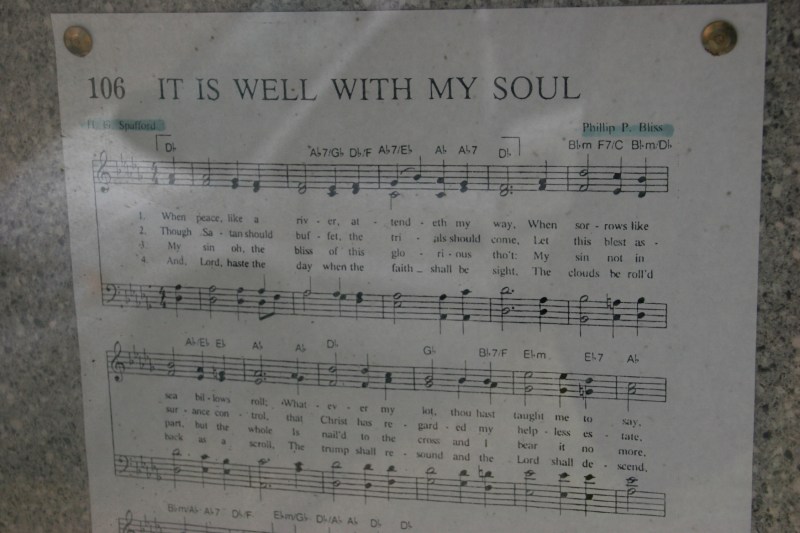
The song: It Is Well With My Soul.

The song: It Is Well With My Soul. The writer and composer’s names are highlighted in blue.

It is the story of the beloved hymn, It Is Well With My Soul, and its link to this Southeastern Minnesota farming community of nearly 1,100.

When peace, like a river, attendeth my way, When sorrows like sea billows roll; Whatever my lot, thou hast taught me to say, It is well, it is well with my soul.

My lips move in silence as I read the familiar words, the familiar melody chorusing comfort. It is well, it is well with my soul.

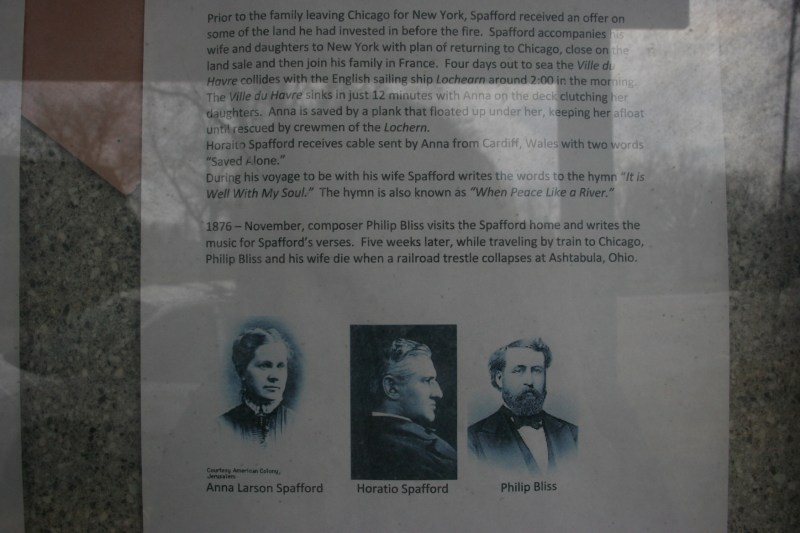
The story of the Spaffords and the hymn, along with images, is posted.

The story of the Spaffords and the hymn, along with images, is posted.

I’d never considered the story behind the words. But now that I’m reading about Horatio and Anna Spafford’s personal tragedy, I am deeply moved. The couple lost their four oldest daughters at sea when the Ville du Haure collided with an English sailing ship en route to Europe in 1873. Only Anna survived, cabling her husband, who remained back home on business, with two words: Saved Alone.

During his voyage to see his grieving wife, Horatio penned It Is Well With My Soul. Three years later, Philip Bliss composed the accompanying music.

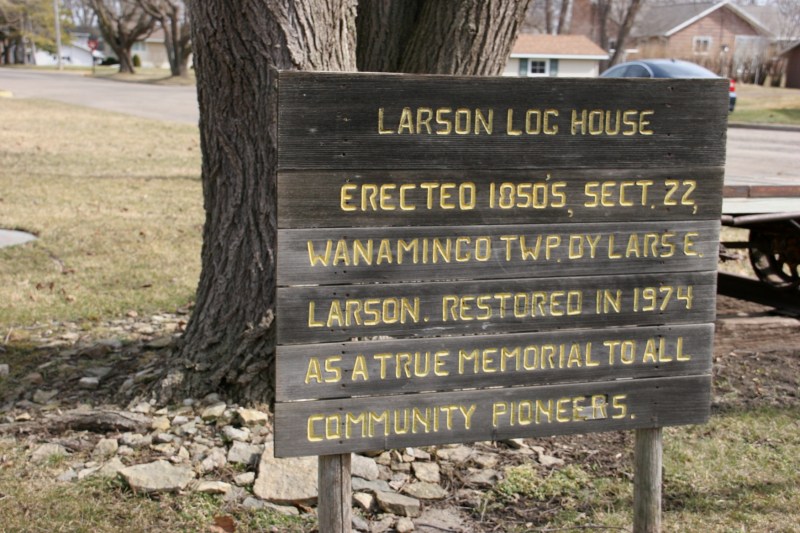
This sign marks the log cabin.

This sign marks the log cabin.

But what does any of this have to do with Wanamingo? The connection begins about two decades earlier when 14-year-old Anna Larson journeys to Wanamingo Township from Chicago to be with her ill father. Lars E. Larson moved to Minnesota the year prior in hopes farming would improve his health. He died in the spring of 1857, within a year of Anna’s arrival. That same year, Anna, 15, met her Sunday School teacher, 29-year-old Horatio Spafford. In 1861, she married Horatio, a then successful Chicago attorney.

Within 10 years, the Spaffords have four daughters. And then those girls are dead, drowned at sea. Their mother, Anna, survives, kept afloat by a plank until she is rescued.

How many people drive by this log cabin on Main Street in Wanamingo and never stop? We were tipped off by a local to the story I've shared here, thus my husband and I stopped.

How many people drive by this log cabin on Main Street in Wanamingo and never stop? I was tipped off by a local to the story I’ve shared here, thus I stopped.

Having read this story behind the familiar hymn while standing in the shadow of the Wanamingo water tower next to the Larson log cabin, I am moved. I am moved by the faith of Horatio Spafford who, in sorrow rolling like sea billows, penned such profound and comforting words. It is well, it is well with my soul.

FYI: Check back tomorrow for another post in my “from Wanamingo” series. I will take you inside Trinity Lutheran Church.

© Copyright 2016 Audrey Kletscher Helbling


Part II from Wanamingo: Lunching at Area 57 March 22, 2016

Filed under: Uncategorized — Audrey Kletscher Helbling @ 5:00 AM
Tags: , , , , , , ,
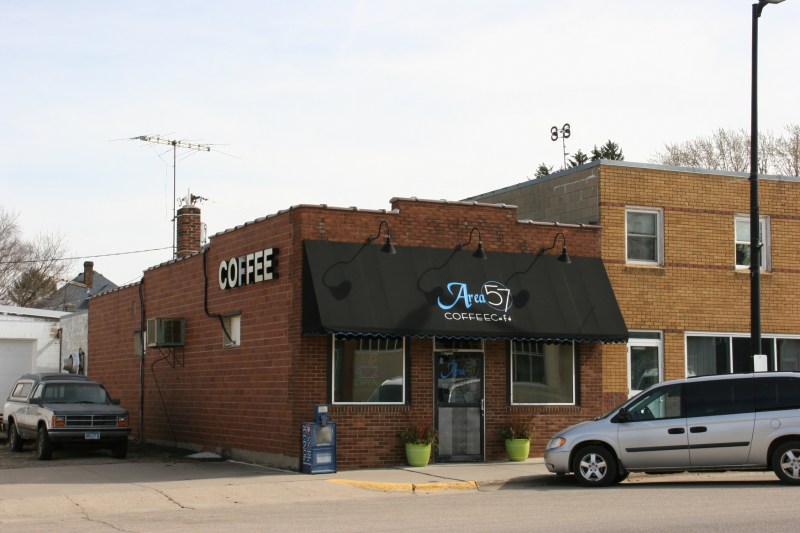
A signature classy black awning showed us we'd found Area 57.

Area 57 Coffee Cafe lies in downtown Wanamingo, Minnesota, population around 1,100.

“JUST GET THERE BY 2,” Peggy Ryland advised.

There is Area 57 Coffee Cafe, an eatery that is anything but your typical small town Minnesota restaurant.

Located in the heart of Wanamingo, which sits along State Highways 60 and 57 (thus the name), Area 57 possesses a hip and urban feel. It’s totally unexpected in a farming community with a sprawling John Deere dealership on the west edge of town and grain bins at the north end of Main Street.

Ryland, who is from nearby Cannon Falls and who runs a custom embroidery, design and printing business in Kenyon, recommended the eatery when my husband and I stopped by her shop on a Saturday morning. We were on a day trip to wherever and were seeking a good place for lunch. Peggy assured us Area 57 fit our requirement of great homemade food as she praised the soup and sandwiches, the coffee selections and the pie.
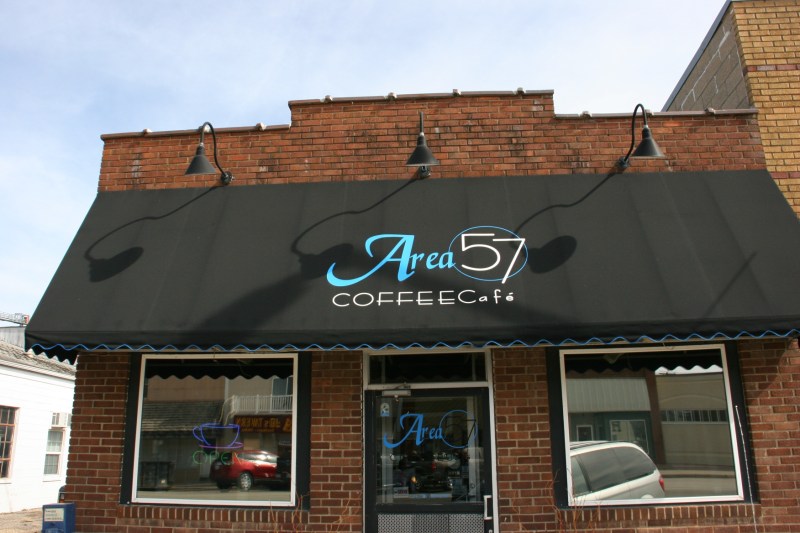
A signature black awning and classy lighting grace Area 57.

A signature black awning and classy lighting grace Area 57.

With Peggy’s notations that the restaurant is small, busy and closes at 2 p.m. on Saturdays, we hurried through two thrift stores in Kenyon and then aimed east 10 miles to Wanamingo. Once downtown, we easily found the non-descript brick Area 57 building with the black awning, just as Peggy described.
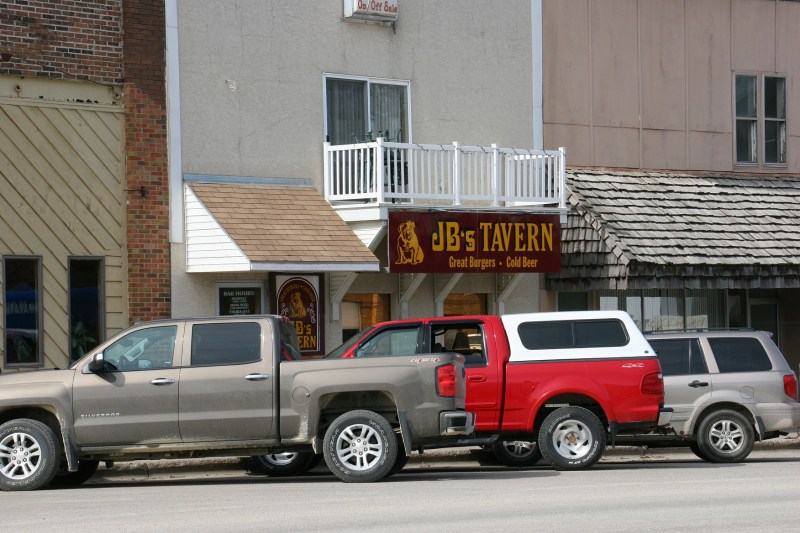
Wanamingo's source for a burger and a beer.

Wanamingo’s source for a burger and a beer. This eatery rates good reviews on Trip Advisor.

Across the street we simultaneously spotted JB’s Tavern’s sign advertising Great Burgers and Cold Beer. I observed Randy’s hesitation as we walked toward the place with soup and sandwiches. I knew he was thinking burgers and beer. I suggested perhaps we’d need to dine separately. We did so years ago while in Henderson. But this time he obliged and accompanied me to Area 57.
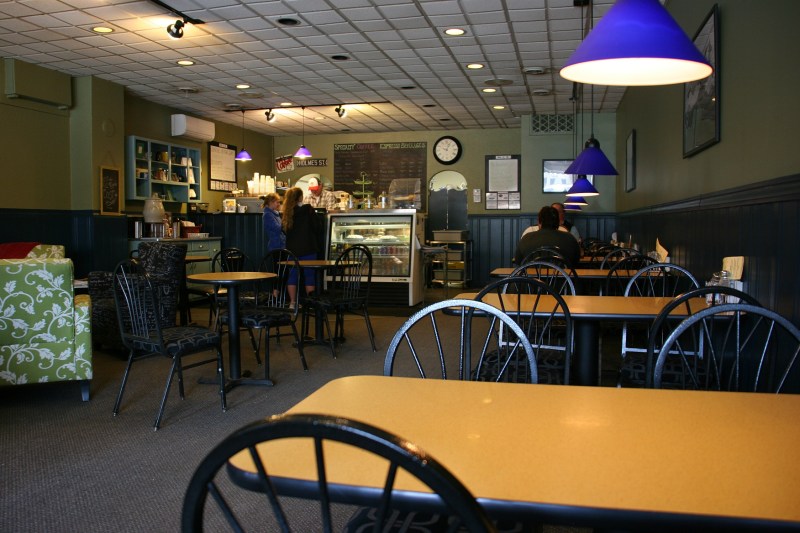
Although a small eatery, Area 57 had plenty of space when we dined there on a Saturday around noon.

Although a small eatery, Area 57 had plenty of space available for us around noon on a recent Saturday.

Once inside, I knew we’d made the right choice. I liked the setting—the sage walls accented by black wainscoting, the comfortable cluster of cozy chairs around a free-standing fireplace, the chalkboard beverage board, the artful travel décor…
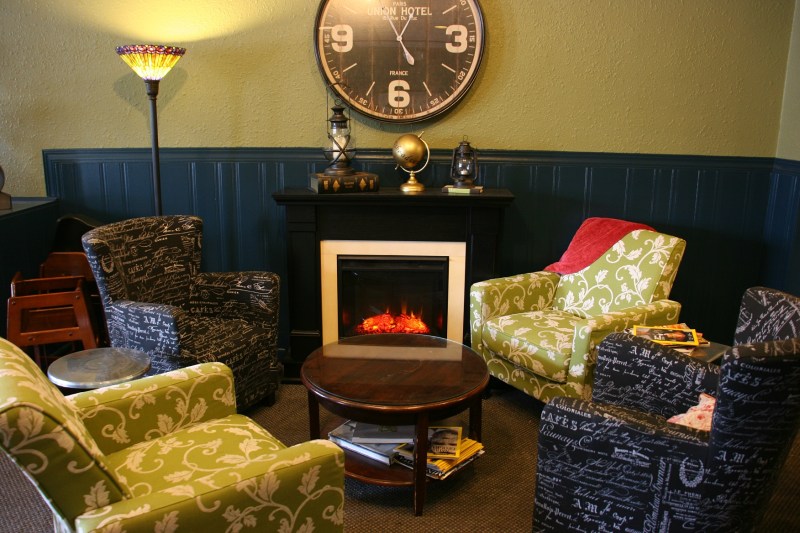
A welcoming spot inside the cafe to read, visit and/or relax.

A welcoming spot inside the cafe to read, visit and/or relax over a cup of specialty coffee.

I felt welcomed here. At home.
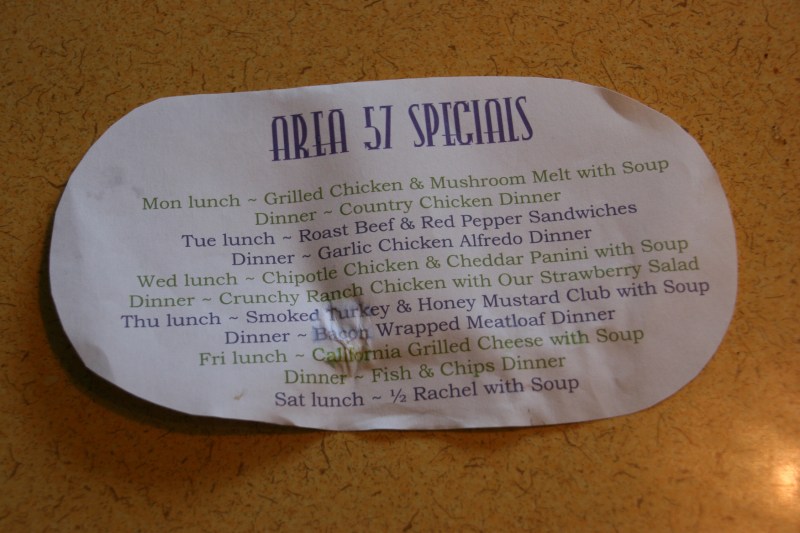
The daily specials are posted at each table.

The daily specials are posted at each table.

Perusing the menu before ordering at the counter, I eventually settled on the special of the day, half a Rachel sandwich with a cup of soup. I chose tomato soup with roasted red pepper and Gouda over beer cheese soup. Randy ordered a Philly Beef and Cheese sandwich, an atypical choice for him given the sauteed green peppers and onions. He assured me he could eat green peppers.
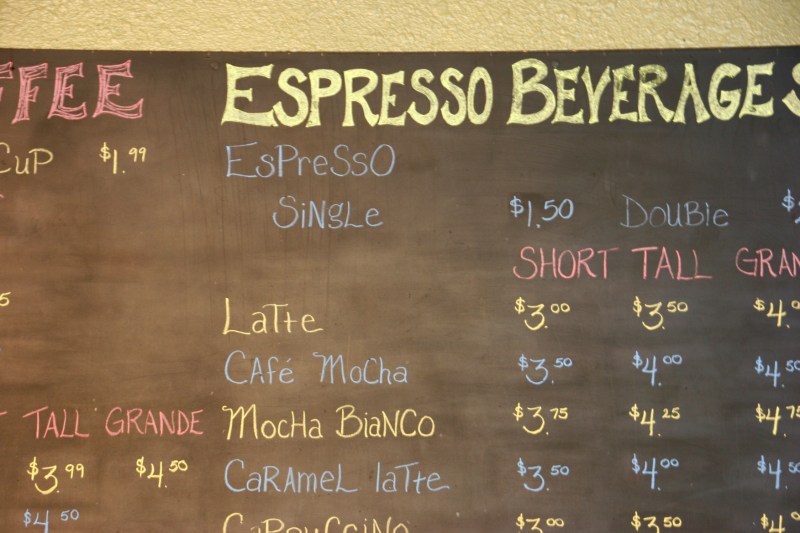
There are plenty of specialty coffee choices.

There are plenty of specialty coffee choices.

There isn’t a single burger on the menu. I later learned that Area 57 doesn’t want to compete with the bar and grill across the street in serving burgers. That’s small town nice.
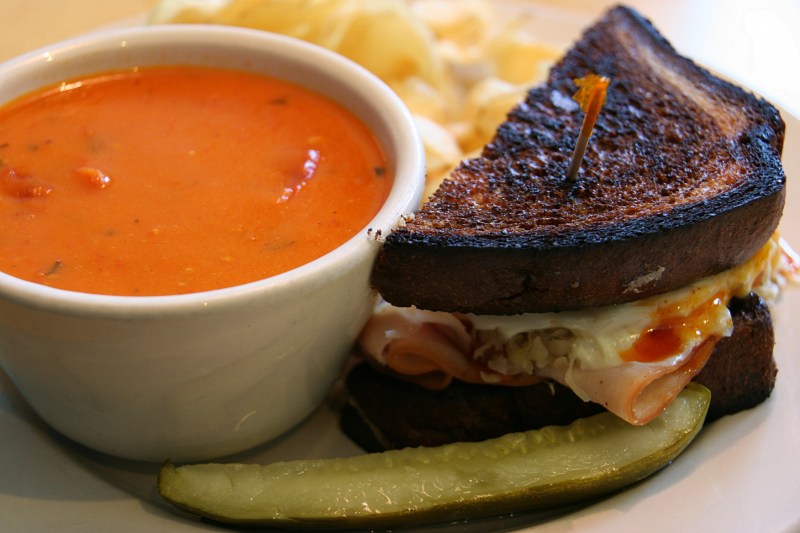
My Rachel sandwich served with red pepper tomato soup, chips and a pickle.

My Rachel sandwich served with red pepper tomato soup, chips and a pickle.

Service was quick. My smoked turkey and sauerkraut sandwich oozed with melted Swiss cheese, the flavors blending well with the house dressing. It paired nicely with the tomato soup, a customer favorite. Randy liked his Philly sandwich and the accompanying chips. He didn’t even pick off the peppers or onions.
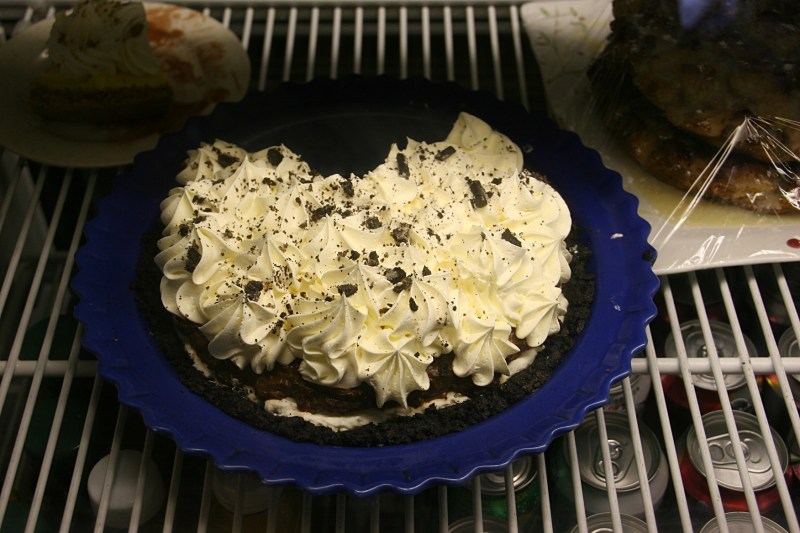
The homemade pies, like this Oreo cream, were mighty tempting.

The homemade pies, like this Oreo cream, were mighty tempting.

I contemplated dessert, eying pie choices like Oreo, coconut and banana cream in addition to mint chip and other over-sized cookies and Area 57’s bestselling homemade dessert, raspberry bread pudding with whiskey sauce. In the end, I decided I was just too full for a sweet treat. Next time.

A few doors away sits Wanamingo Meats.

A few doors away sits Wanamingo Meats & Catering.

Other menu items such as Crunchy Ranch Chicken with Strawberry Salad, Chipotle Chicken and Cheddar Panini with soup and more sound tasty. Area 57 is also known for breakfast. Omelette selections include a Farmer’s Omelette made from three eggs, cheese and fresh vegetables. That’s fitting for a community centered around agriculture, with Wanamingo Meats and Catering and grain bins within eyesight of Area 57 Coffee Cafe.
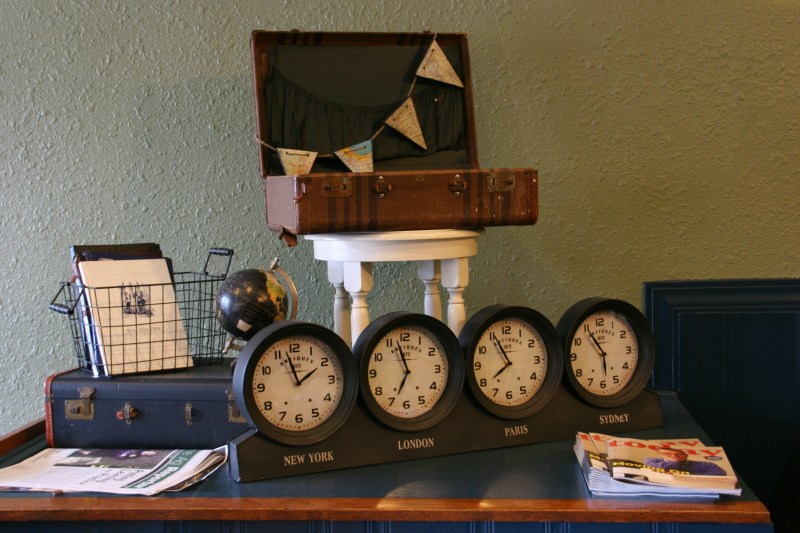
Area 57 is open 12 hours on weekdays. This artsy travel and time-themed setting is staged inside Area 57.

Area 57 is open 12 hours on weekdays. This artsy travel and time-themed setting is staged inside Area 57.

FYI: Area 57 is open from 7:30 a.m. – 7:30 p.m. Monday – Friday and from 7 a.m. – 2 p.m. on Saturday.

Check back tomorrow for my third post in this six-part “from Wanamingo” series. I’ll tell you about this community’s connection to a well-known hymn.

© Copyright 2016 Audrey Kletscher Helbling


Part I from Wanamingo, a classic small town in Minnesota March 21, 2016

Filed under: Uncategorized — Audrey Kletscher Helbling @ 5:00 AM
Tags: , , , , , ,
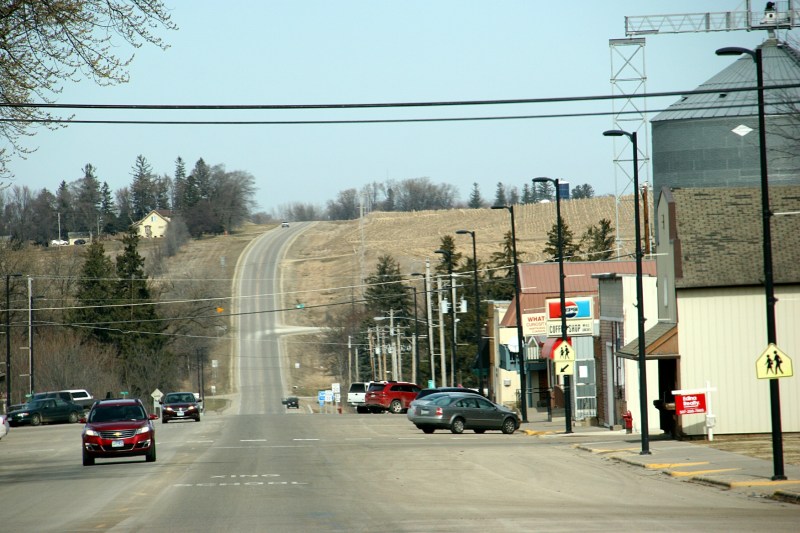
Driving into downtown Wanamingo along Minnesota State Highway 57 on a Saturday afternoon.

Driving into downtown Wanamingo along Minnesota State Highway 57 on a recent Saturday afternoon.

ON THE CITY WEBSITE, Wanamingo is described as a classic small Midwestern town in Southeastern Minnesota. That seems accurate.

What then is a classic small Midwestern town?

Visiting early Saturday afternoon in downtown Wanamingo.

Visiting early on a Saturday afternoon in downtown Wanamingo.

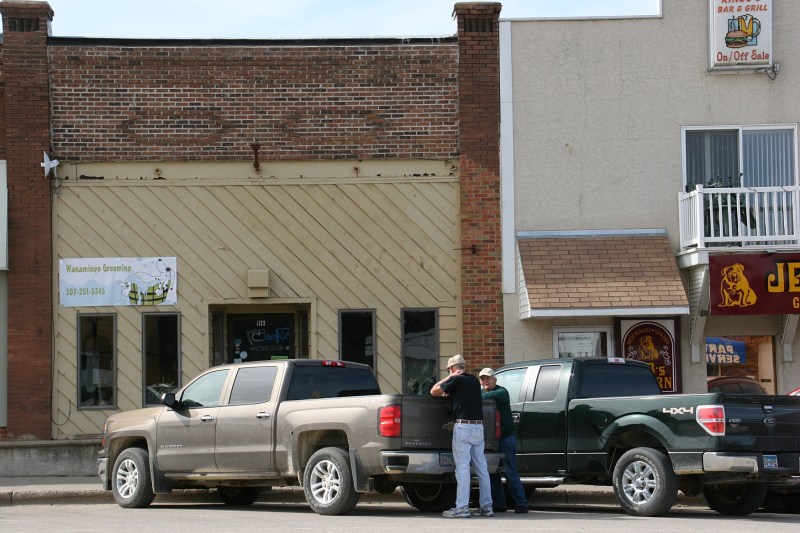
It is a place where, on a Saturday afternoon in March, two guys lean on the back of a pick-up truck and converse outside a bar and grill.

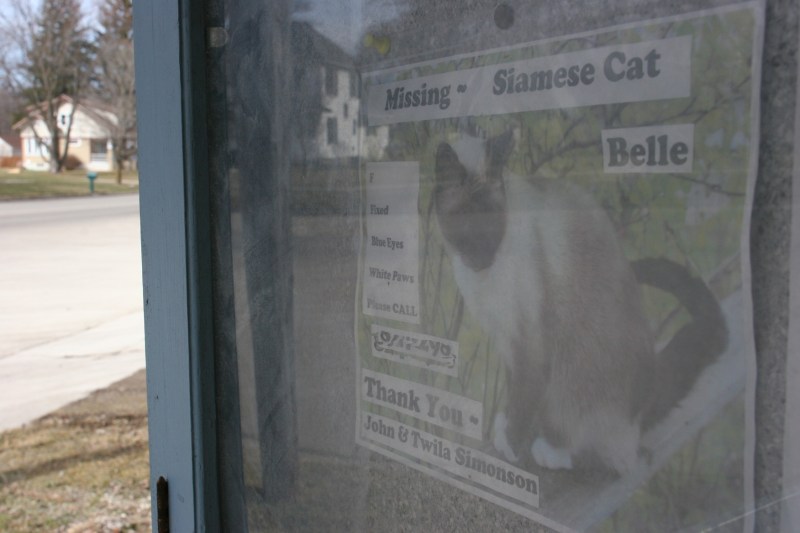
Posted at a local park. I edited the phone number from the photo.

Posted at a local park. I edited the phone number from the photo.

It’s a place where a notice in the park information center requests help in finding Belle, a missing Siamese cat.

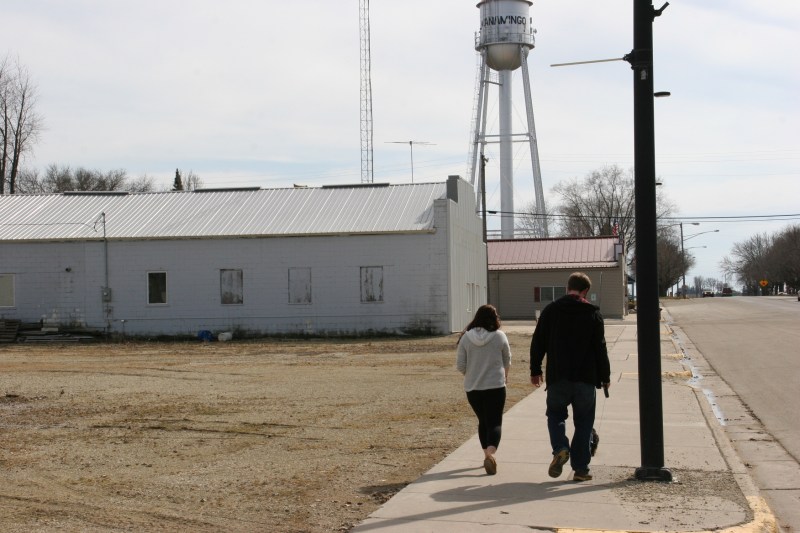
Walking the puppy downtown. Wanamingo still has an old style water tower.

Walking the puppy downtown. Wanamingo still has an old style water tower.

It’s a place where a friendly young couple walks their curly-haired puppy, allows a visitor to pet him and then wishes the out-of-towner a good afternoon.


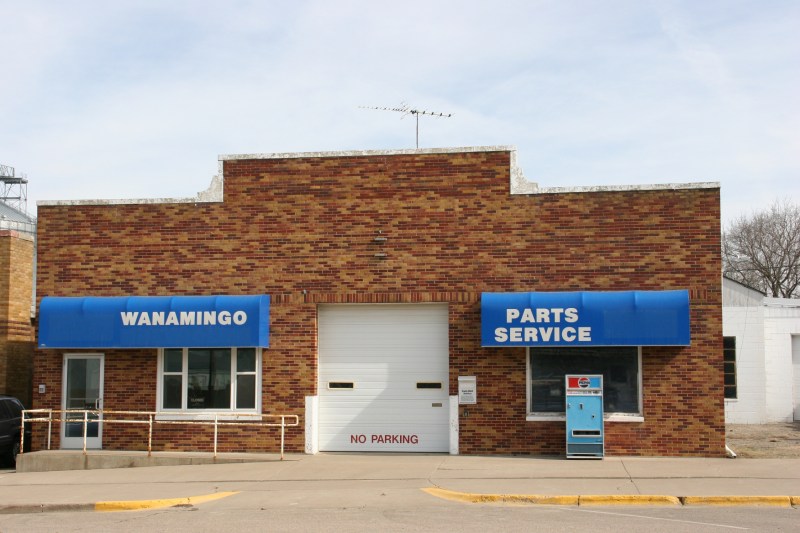
Small town Wanamingo, 37 parts service


Small town Wanamingo, 40 insurance building


Small town Wanamingo, 36 grain bins


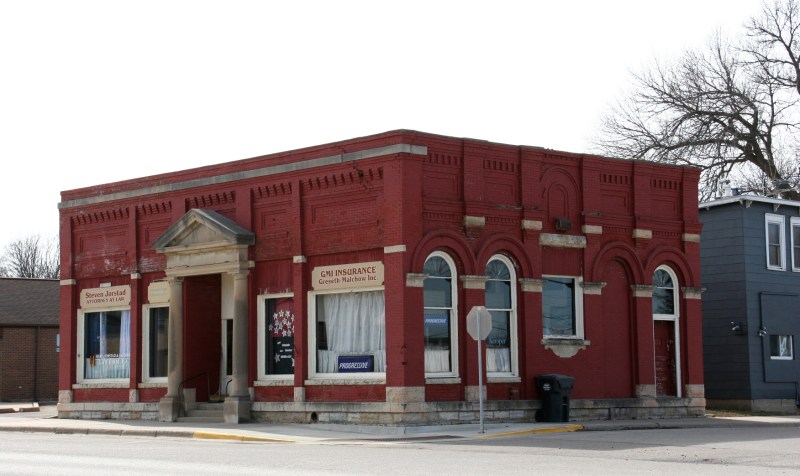
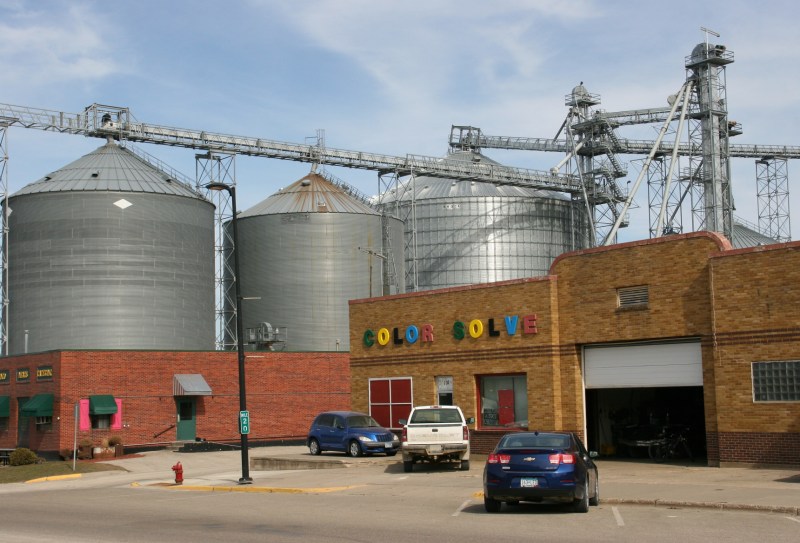
It’s a place with solid brick buildings in a downtown occupied by businesses like a meat market, a bar, a cafe, a garage, law and insurance offices, and grain bins banking the north end of Main Street.


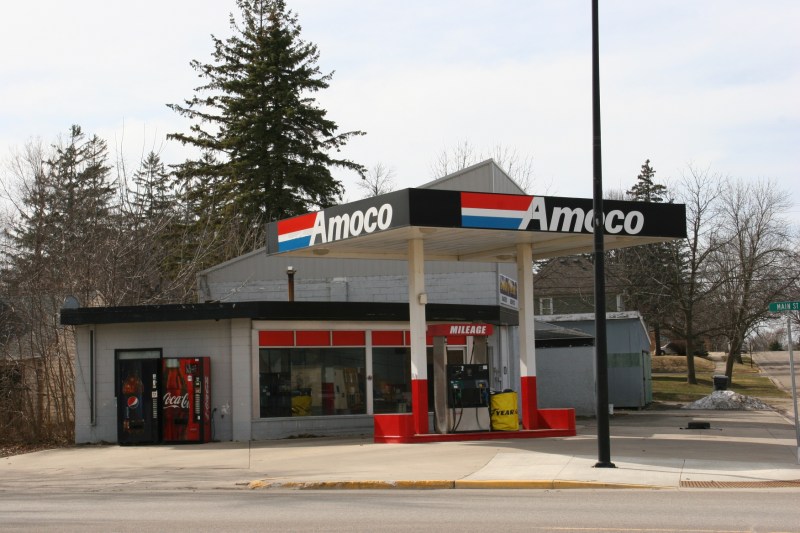
I love the classic corner angled gas station.

I love the classic corner angled gas station.

Wanamingo has that small town rural feel, that sense of life moving at a slower pace. Traffic is minimal downtown, even though Minnesota State Highway 57 doubles as Main Street. And, yes, the main street is named Main Street.


Small town Wanamingo, 46 bike in yard


In this classic small Midwestern town, kids drop bikes in yards.


Beautiful Trinity Lutheran Church. I'll take you on a tour of the church in an upcoming post.

I’ll take you inside Trinity Lutheran Church in an upcoming post.

A life-long resident tinkers with a light post outside Trinity Lutheran, a stalwart brick corner church that holds the histories of so many local families. Births, marriages, deaths.

Wanamingo, platted in 1904, is not Utopia. No place is. But it is a community of about 1,100 that seems, from outward appearances, to care, to want to look its best, to be the kind of place folks want to visit or call home. It is a classic small Midwestern town.

FYI: Check back tomorrow for the second post in my “from Wanamingo” series. I’ll take you inside the Area 57 Coffee Cafe.

© Copyright 2016 Audrey Kletscher Helbling
 

Enough to scare the blank out of you February 26, 2016

Filed under: Uncategorized — Audrey Kletscher Helbling @ 5:00 AM
Tags: , , , , ,

Semi view 1


AT FIRST GLANCE, you likely are questioning my sanity in photographing a semi seemingly headed directly at the vehicle in which I am a front seat passenger.

If I did not understand the context of this image taken in October, I, too, would be screaming at myself to get the blank out of the way.

But things are not always as they seem.

This is actually a photo of a semi cab hooked to a cab traveling along Interstate 90 near the Rochester exit in southeastern Minnesota. Now imagine if my husband hadn’t been paying close attention. He may have thought the semi was aiming toward us and took evasive action. Thank goodness someone (not me) in our vehicle was fully alert and not fooled by an optical illusion.

© Copyright 2015 Audrey Kletscher Helbling


A forever road February 24, 2016

Filed under: Uncategorized — Audrey Kletscher Helbling @ 5:00 AM
Tags: , , , , , ,
Minnesota State Highway 68 near Morgan.

Minnesota State Highway 68 near Morgan. Minnesota Prairie Roots file photo 2015.

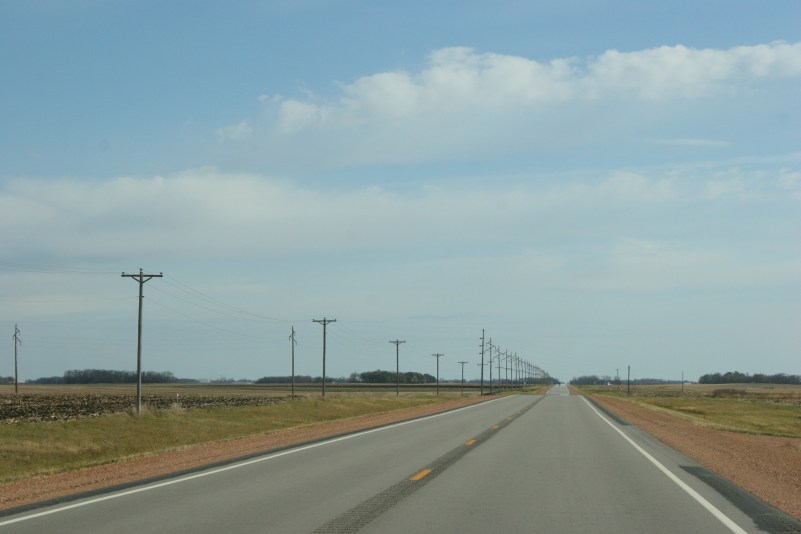
WITHIN SOUTHWESTERN MINNESOTA, I occasionally travel sections of roadway that stretch visually into forever. One is the diagonal of State Highways 67 and 68 running from Evan through Morgan to Redwood Falls. It’s a distance of about 20 miles. But it seems much farther.

After years of following a section of that route back to my native Redwood County, I’ve realized that the flatness of the land along a road as straight as a ruler lengthens the distance in my mind.

Few farm places snug the highway. Trees stand only in groves sheltering farm sites. As far as I can see down the asphalt ribbon—and it’s a long ways—utility poles guard road ditches in precise vertical lines.

And because this roadway angles across the land rather than runs straight north or south, I feel geographically unbalanced. Any sense of direction is lost.

That all said, I delight in photographing forever roads like this which draw the viewer right into the scene. It’s as if I am writing poetry with my camera.

TELL ME, WHAT SECTION of roadway evokes this same reaction in you?

© 2015 Audrey Kletscher Helbling


Utica, not New York, but Minnesota February 23, 2016

Filed under: Uncategorized — Audrey Kletscher Helbling @ 5:00 AM
Tags: , , , , , ,
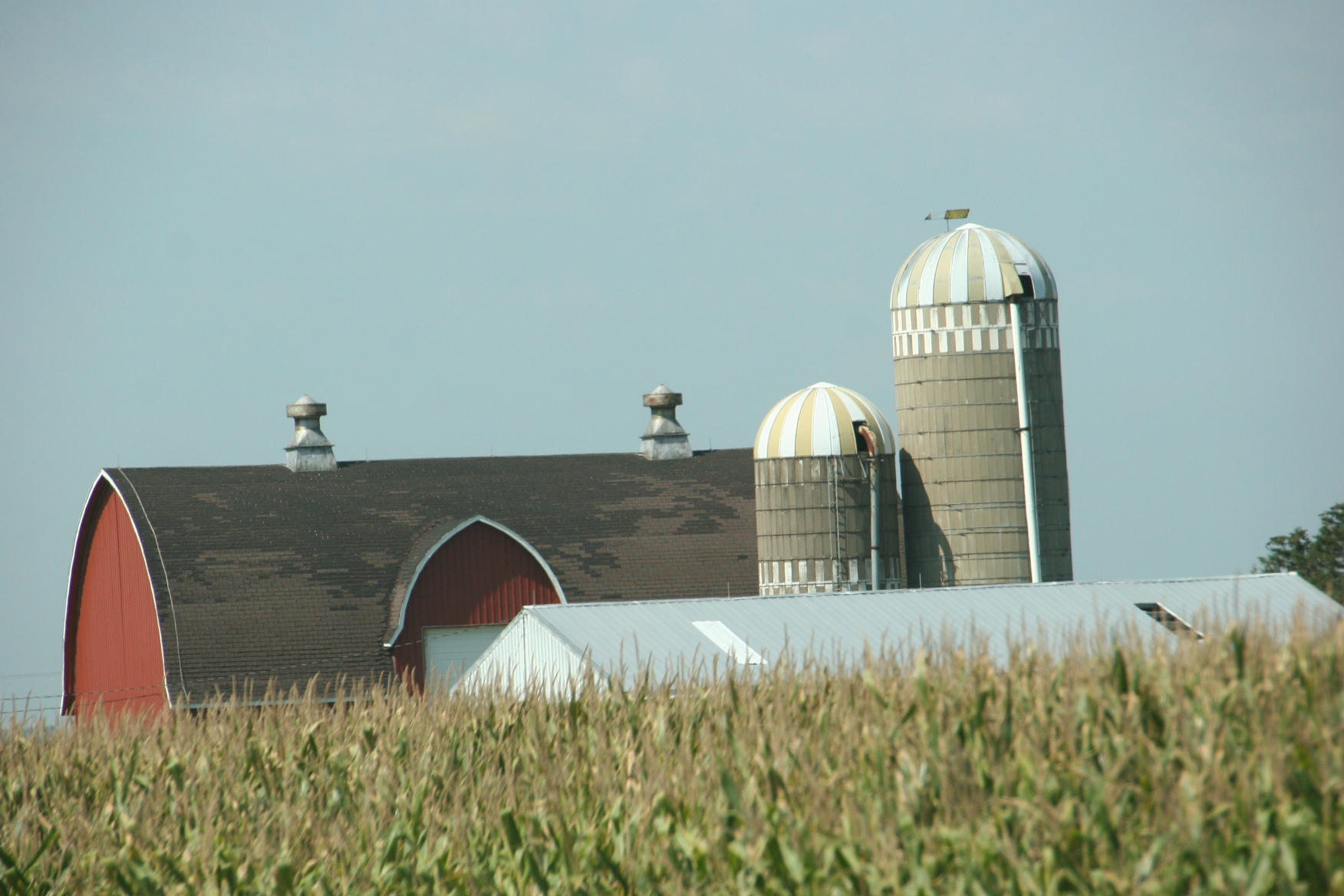
A farm site just minutes east of Utica.

A farm site just minutes east of Utica in southeastern Minnesota.

YOU NEVER KNOW what oddities will surprise you in a small town, which is precisely why I delight in exploring rural communities.

Utica, a town of about 300 located along U.S. Highway 14 between Rochester and Winona, definitely presented some attractions worth photographing this past September. I use the word “attractions” loosely. What I find interesting may go unnoticed by others.

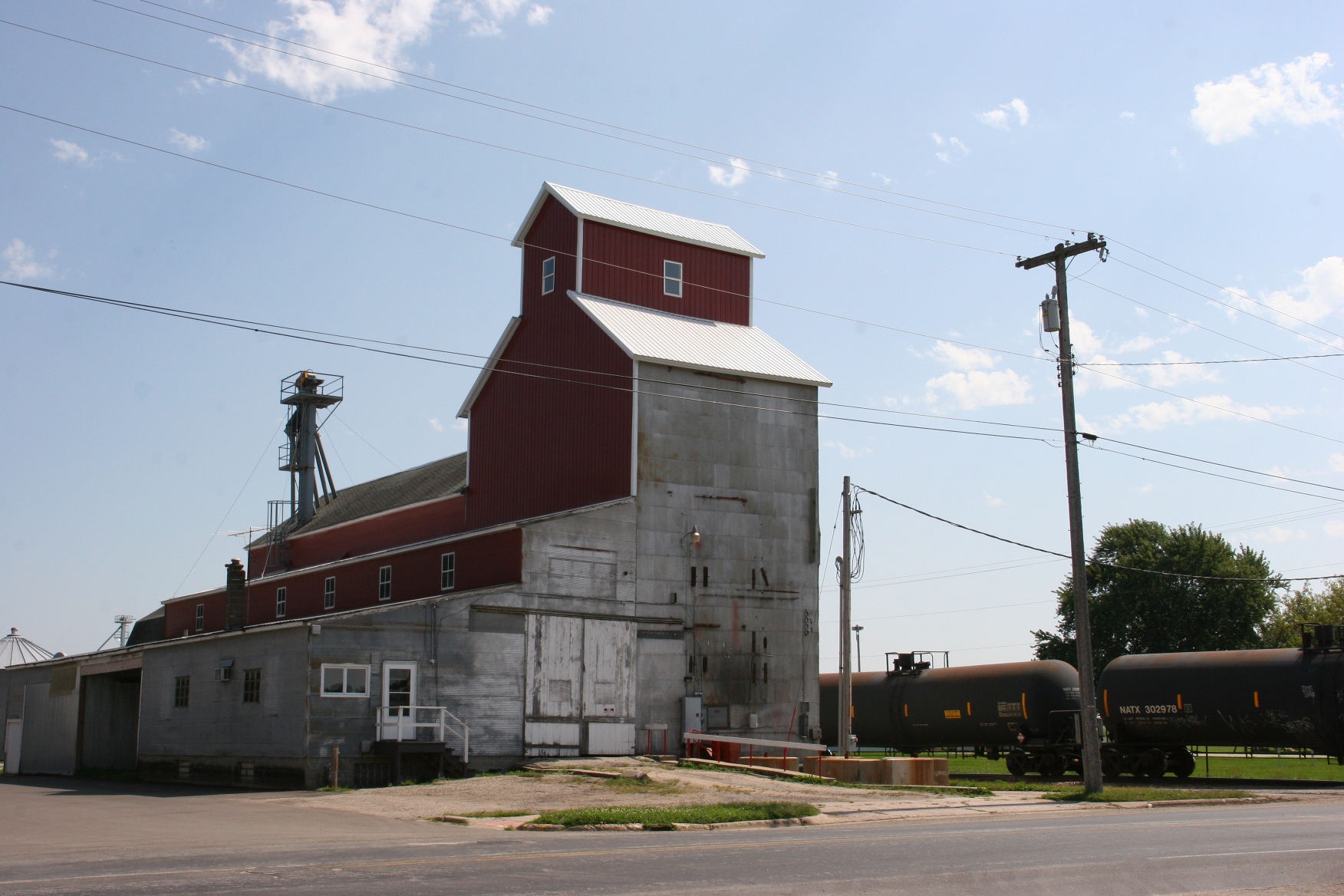
I'm always happy to see a grain elevator that has been maintained and is appreciated.

I’m always happy to see a grain elevator that has been maintained and is appreciated. These are small town treasures.

It was the red and grey grain elevator jutting above Utica that drew my husband and me off the highway and into this community as a freight train roared through town.

Utica may not have a website, but it has this sign to tell you a bit about the town.

Utica may not have a website, but it has this sign to tell you a bit about the town.

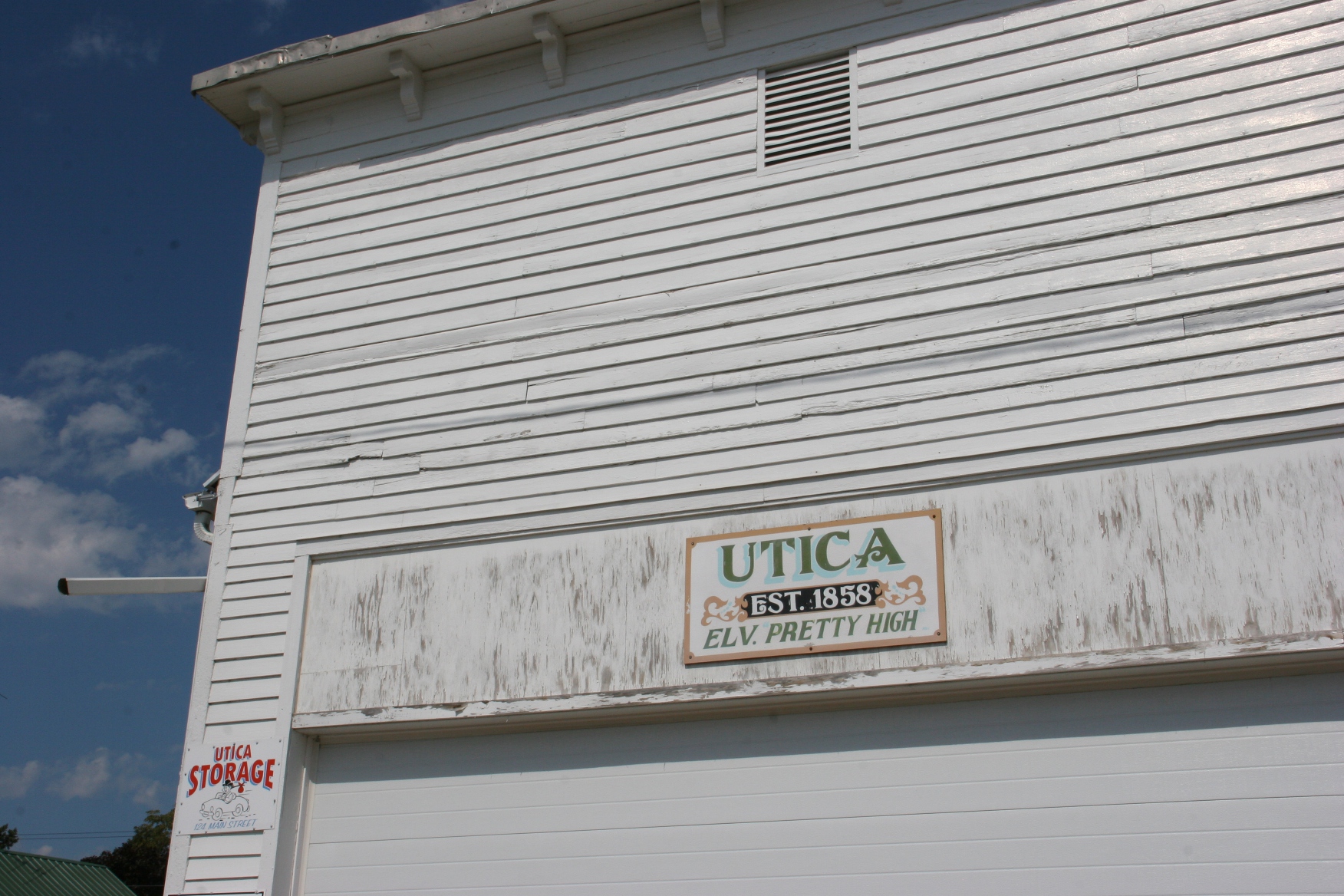
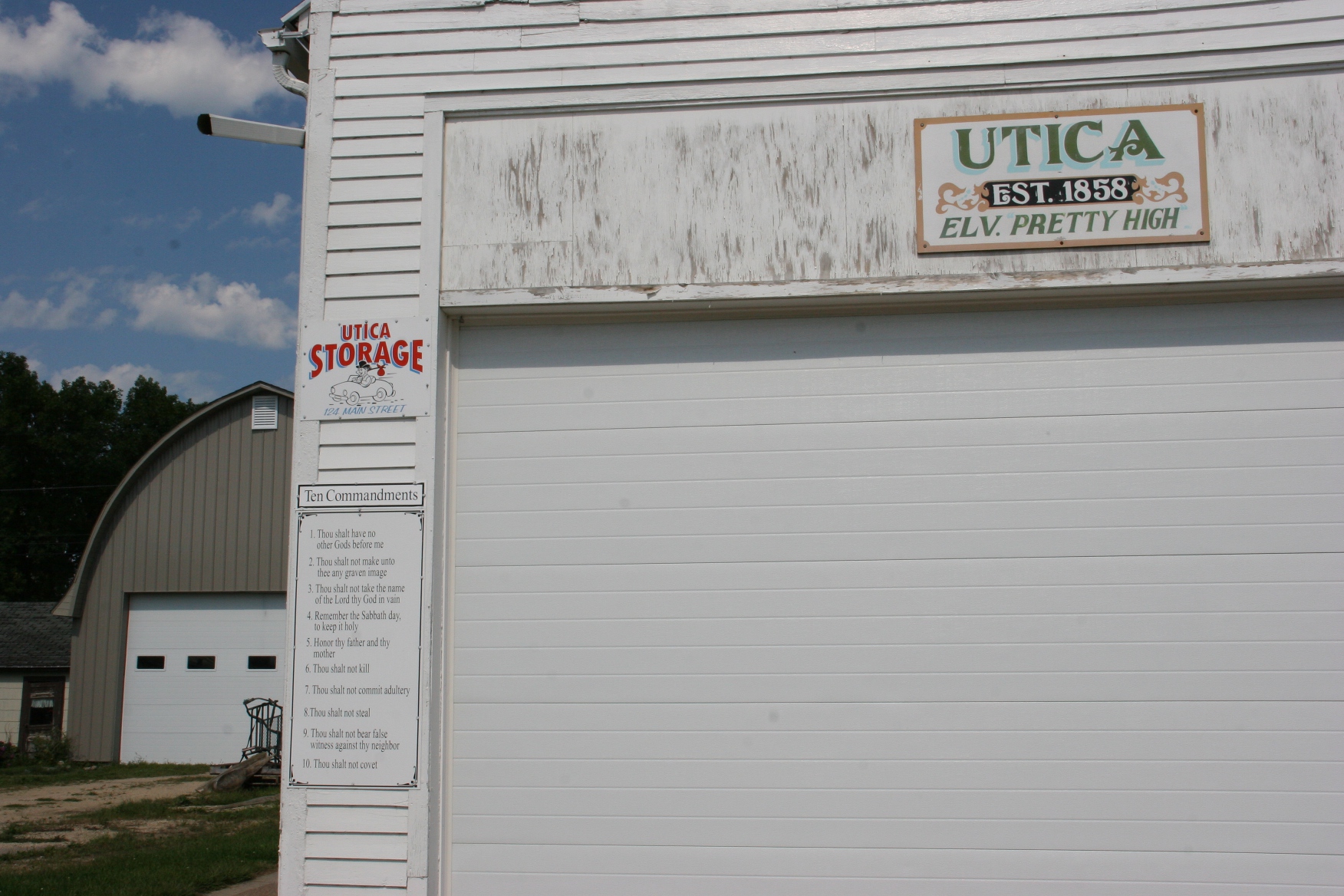
From there we swung onto Main Street and noted that Utica was founded in 1858, if the signage on Utica Storage is accurate. We laughed at the “ELV. PRETTY HIGH” notation.

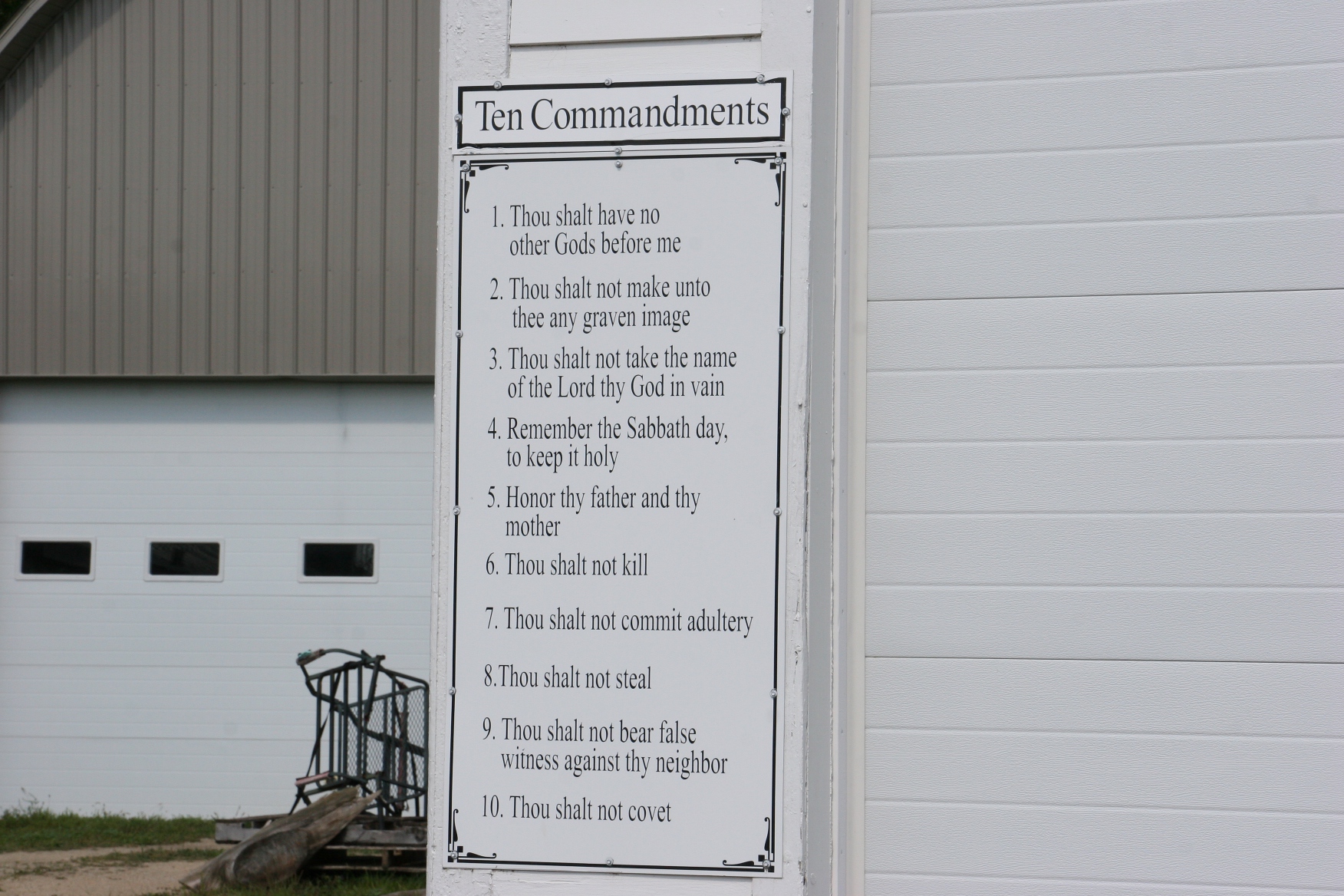
The law.

The law…

...up close.

…up close.

And, if not for Randy, I would have missed the 10 Commandments posted on the front of the building.

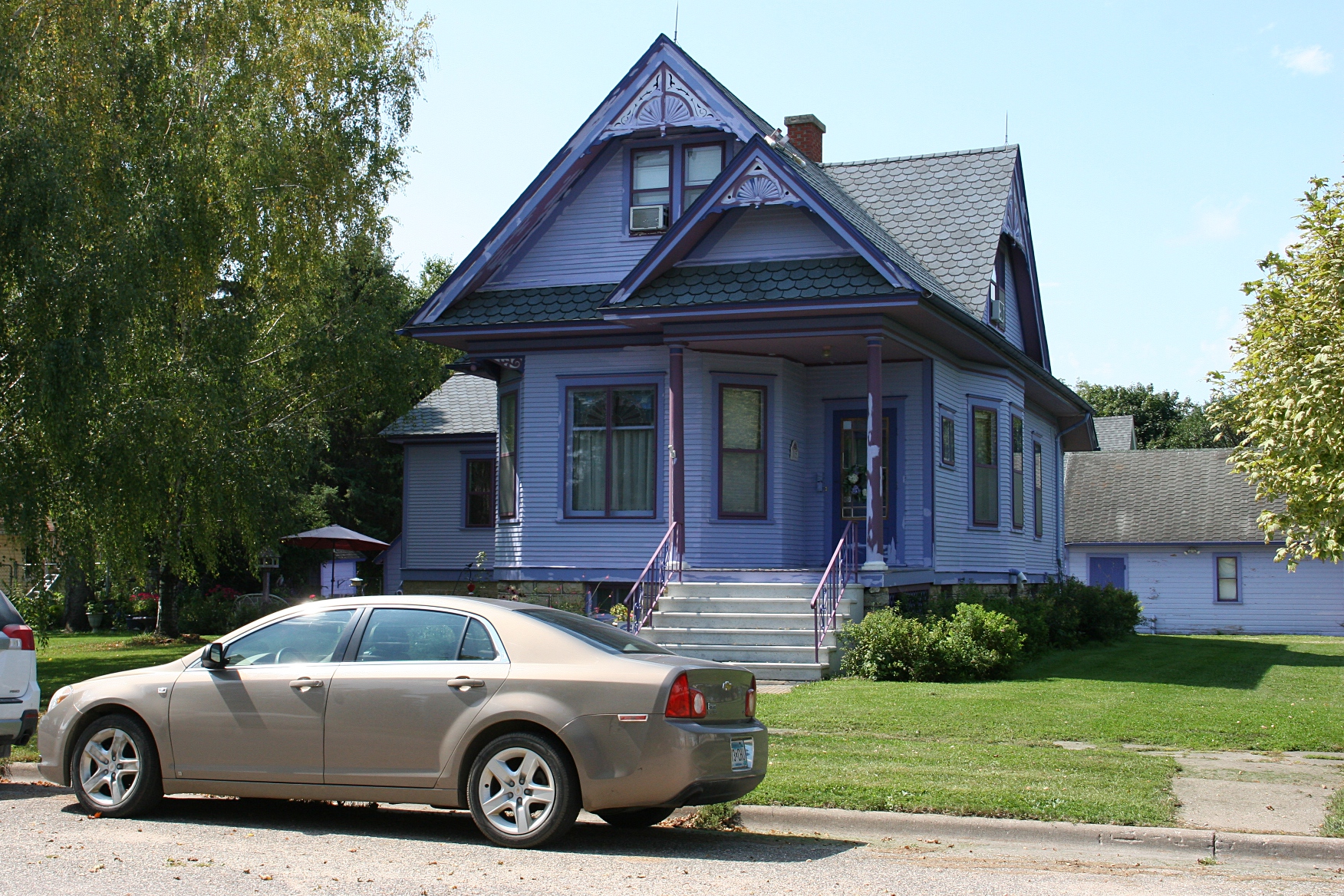
The "can't miss it" house.

The “can’t miss it” house.

Then, in a residential area, a Victorian house painted in lavender hues presided on a corner. I wondered for a second if it might be a tea house, but saw no such signage. Apparently the owner just really likes this hue given the outbuildings are also painted lavender.

This reminded me of my Aunt Marilyn, whose house is not lavender, but who loves the color. And I once worked with legendary Northfield News editor Maggie Lee, who wore only lavender.

Utica is definitely a farming community.

Utica is definitely a farming community.

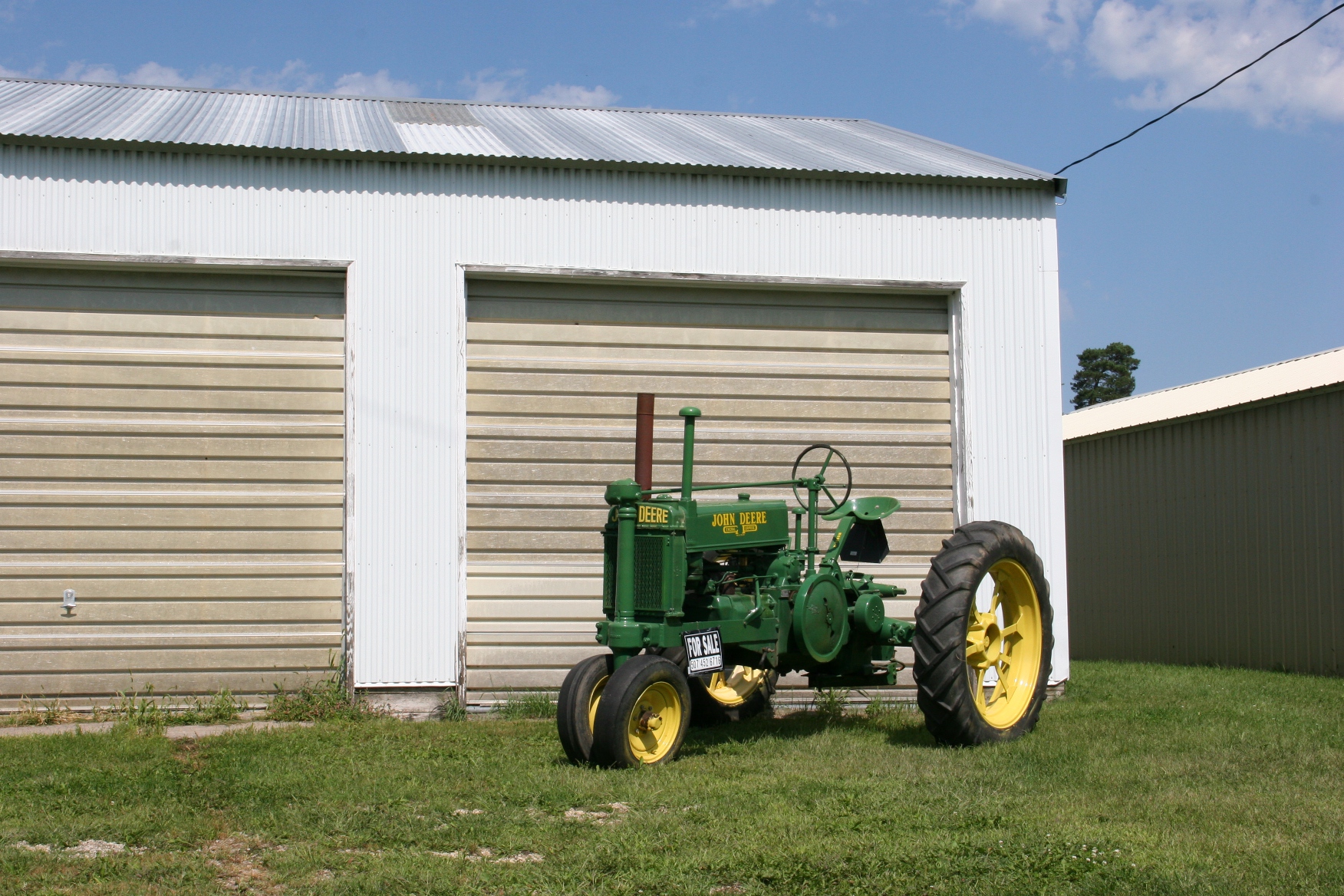
Utica’s final attractions were two tractors—a wonderfully restored John Deere and a rusting Farmall—staged for sale outside a shed.

Now, if we’d taken the fast route home via Interstate 90, we would have missed all of this. Utica would remain just a sign along the interstate. I would know nothing of its character, its individuality, its colors.

© Copyright 2015 Audrey Kletscher Helbling


Oh, the lovely historic buildings of Weaver, Minnesota February 19, 2016

Another view of Carl and Marie Noble's studio and galleries.

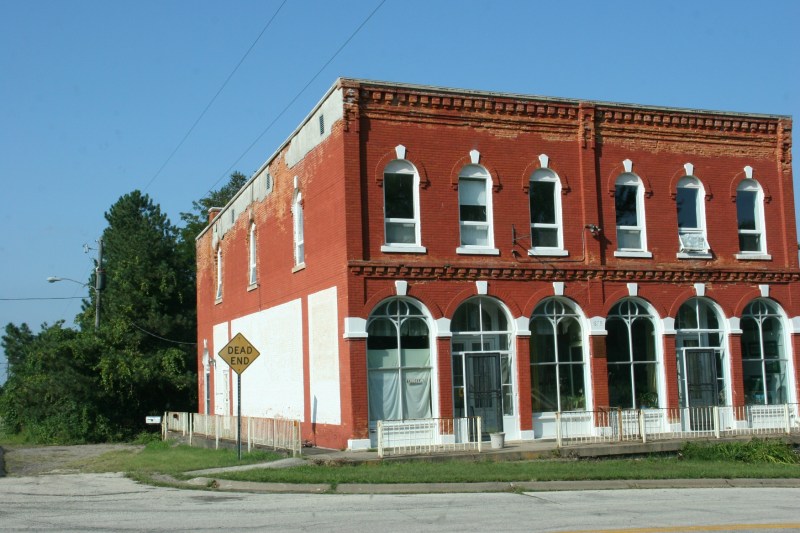
The former Weaver Mercantile anchors Weaver.

MY KNOWLEDGE OF WEAVER is limited mostly to visual impressions. Digital images taken during a brief stop last September document an unincorporated Mississippi River settlement rich in history. That history reveals itself in aged buildings, like Weaver Mercantile.

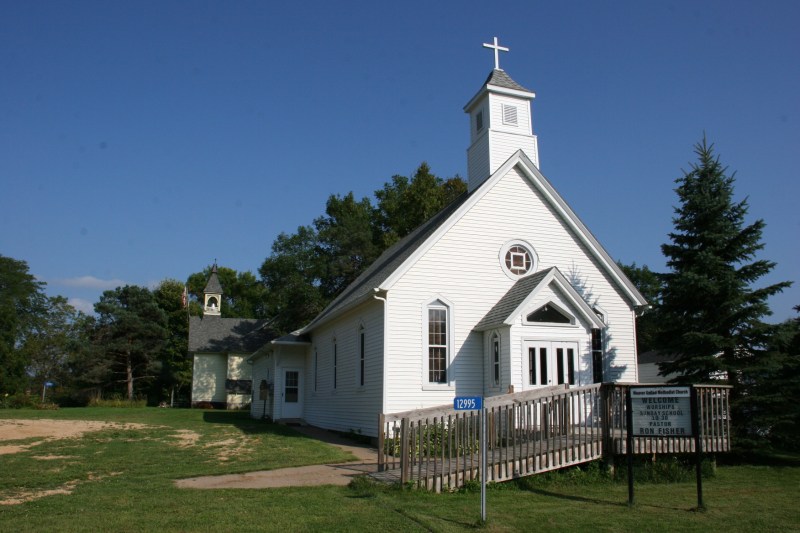
Weaver United Methodist Church with the historic former schoolhouse next door.

Weaver United Methodist Church with an historic former schoolhouse next door.

A block or so away, Weaver United Methodist Church still welcomes the faithful into the congregation’s original house of worship. Except on Sundays when the temperature plummets to 10 degrees below zero or colder. The church building maintains its historic charm with modern touches, according to the church website. Indoor plumbing was only just installed in 2008.

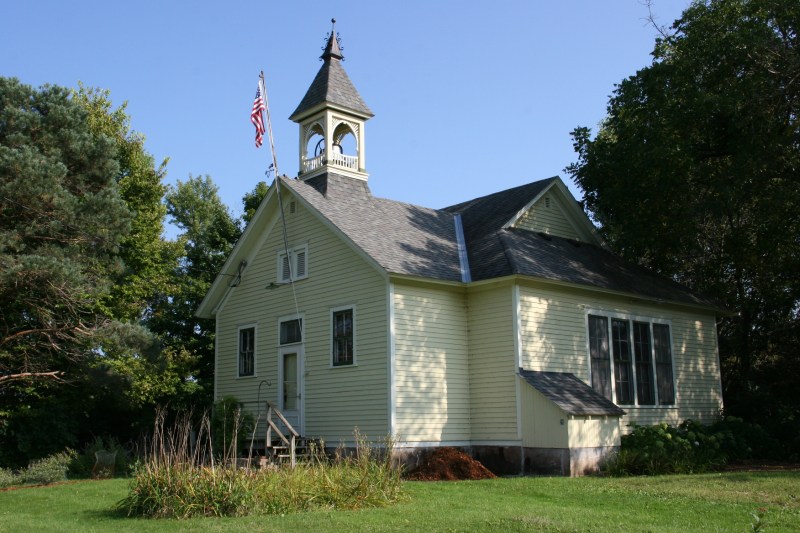
The old schoolhouse is painted a lovely buttery yellow.

The old schoolhouse is painted a lovely buttery yellow.

Next to the church rests a lovely 1910 one-room schoolhouse, restored in 2008 by a couple for use as a get-away cottage and a weaving studio.

An unidentified building near the schoolhouse.

An unidentified building near the schoolhouse.

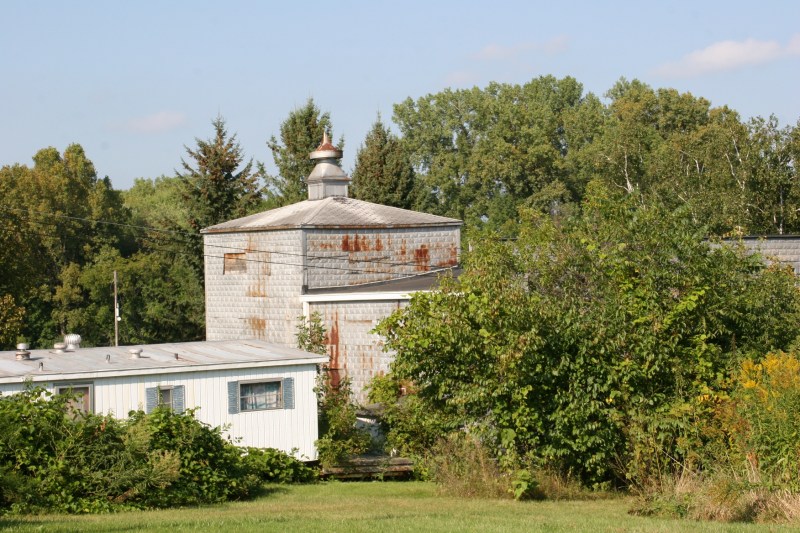
And then there’s an aged boxy building topped by a cupola. Perhaps a former creamery?

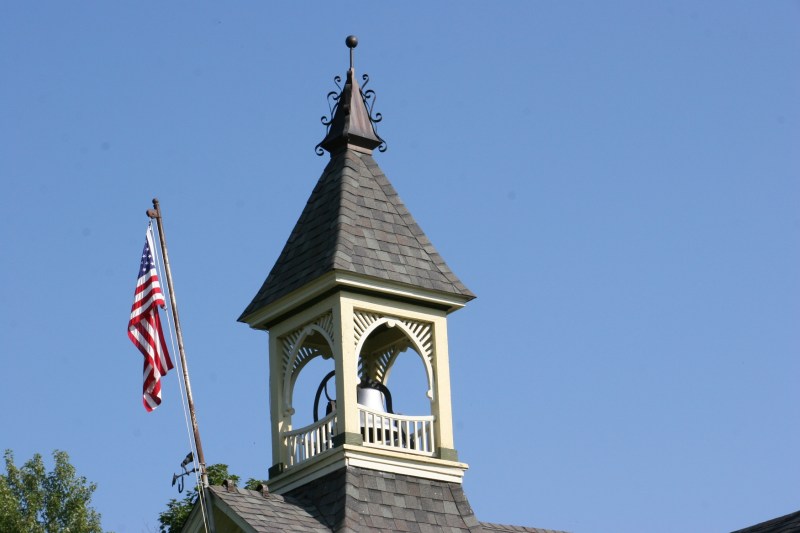
Even the schoolhouse bell tower was restored.

Even the schoolhouse bell tower was restored.

Places like Weaver—home to about 50 residents along U.S. Highway 61 north of Winona—intrigue me. I am always pleased to discover such settlements where remnants of history remain in aged buildings. I long to step inside these buildings, to open front doors like I am opening a book of stories.

© Copyright 2016 Audrey Kletscher Helbling
 

Murals & a myth at an historic mercantile in Weaver February 18, 2016

The historic former Weaver Mercantile Buiilding, once home to Noble Studio & Gallery.

The historic former Weaver Mercantile Building, once home to Noble Studio & Gallery.

AGED BUILDINGS, like one in Weaver just off U.S. Highway 61 in southeastern Minnesota, intrigue me. Initially, the architecture and photographic opportunities draw me in. But then I start thinking about the history and the stories.
Carl and Marie Noble opened Noble Studio & Gallery here in 1955.

Carl and Marie Noble opened Noble Studio & Galleries here in 1955.

As luck would have it, a local was jogging down the street toward the former Weaver Mercantile when I happened upon the historic building during an early September get-away. She tipped me off that the building last housed an art gallery. Signage confirmed that. The current owner, she added, lives on the second floor.
Historic designation came six years after Carl Noble's death.

Historic designation came six years after Carl Noble’s death.

The young woman also expressed her dream of someday transforming the place into a winery. She and her husband, she said, make wine from black caps growing wild on the hillside behind their Weaver home. Then she continued on her run through this unincorporated village of some 50 residents and I continued my exterior photographic exploration of this building listed on the National Register of Historic Places. According to the 1978 nomination for historic designation, the building is a “well-preserved example of commercial architecture in the Mississippi River Valley.” Hardware, groceries and dry goods were once sold in the first floor of Weaver Mercantile while furniture was sold on the upper floor. Additionally, the building housed the Weaver Post Office for many years.

A mural on the east side of the building denotes this as an artist's haven. Cannot you decipher the first word for me?

A mural on the east side of the building denotes this as an artist’s haven. Can you decipher the first word in the top portion, left?

Wanting to know more, I continued my internet search. In 1955, artist Carl E. Noble claimed this place as Noble Studio & Galleries (his home, studio and gallery). He died in 1972. An obituary for his widow, Marie Noble, who died 11 years ago, yielded the most information.

More signage toward the back of the building.

More signage toward the back of the building promotes Noble’s art.

Carl was, by the few accounts I found, an artist for the Federal Art Project of the Work Projects Administration in 1938. His name is listed among photos of FAP art in the Archives of American Art at the Smithsonian Institution.

Another view of Carl and Marie Noble's studio and galleries.

Another view of Carl and Marie Noble’s studio and galleries.

A muralist, cartoonist, illustrator and portrait artist, Carl Noble reportedly studied under Norman Rockwell (according to his wife Marie’s obit). I’ve been unable to verify that via a second source. However, the Nobles lived for awhile in Boston; Rockwell made his home in Stockbridge, MA.

The building was constructed in 1875 and opened as Weaver Mercantile.

The building was constructed in 1875 and opened as Weaver Mercantile.

I discovered that Carl painted six oil on canvas murals for Fire House, Southside Hose Co. No. 2 in Hempstead, New York, in 1938. The artwork depicts the history of local firefighting. Other than that, I’ve been unable to find other information of his WPA art or work at Noble Studio & Galleries. The former gallery itself, though, apparently showcases Carl’s murals on interior walls. If only I could have gotten inside to see and photograph his artwork.

One can only imagine the fun times here as guests enjoyed Marie's hospitality.

One can only imagine the fun times here as guests enjoyed Marie’s hospitality.

After her husband’s death in 1972, Marie opened a Bed & Breakfast in their home with a party area in the basement. That would explain the faded Mardi Gras Lounge sign above a back entry.

An overview of the Mardi Gras entry at the back of the building.

An overview of the Mardi Gras entry at the back of the building.

Marie reportedly regaled guests with stories, including that Jesse James robbed the Mercantile on his way to robbing the First National Bank in Northfield, Minnesota. Not believing everything I read, I contacted Mark Lee Gardner, noted historian, writer and musician on the western experience. He penned a book, Shot All to Hell: Jesse James, the Northfield Raid, and the Wild West’s Greatest Escape. He confirmed what I suspected. The story of the Weaver robbery is just that, a story.

Here’s Gardner’s response to my inquiry:

I’m afraid the story of Jesse robbing the building in Weaver, Minnesota, isn’t true. The Northfield Raid, as well as the known movements of the James-Younger gang, was heavily reported in the Minnesota newspapers at the time, and if they had been connected with a robbery in Weaver, it should appear in those papers. I never came across any mention of Weaver in my research. The other problem is that the gang didn’t go through Weaver on its way to Northfield. They are documented as having come from the west and south of Northfield.

…There are lots of Jesse James stories out there, and most of them are from someone’s imagination.

My first view of the former Weaver Mercantile and Noble Studio & Galleries.

My first view of the former Weaver Mercantile and Noble Studio & Galleries.

Still, none of this diminishes my appreciation for the Italianate style building in Weaver and my interest in the artists (Marie’s obit notes that she created many lovely paintings) who once lived and created therein.

The village of Weaver is located along U.S. Highway 61 north of Winona in Wabasha County.

The village of Weaver is located along U.S. Highway 61 north of Winona in Wabasha County.

IF YOU KNOW ANYTHING MORE about Carl and Marie Noble, their gallery and art or about the history of the building, I’d like to hear.

© Copyright 2015 Audrey Kletscher Helbling