Minnesota Prairie Roots

Writing and photography by Audrey Kletscher Helbling

Beyond just fun, finding the history & heritage in Heritage Days June 11, 2025

This sculpture of Alexander Faribault and a Dakota trading partner stands in Faribault’s Heritage Park near the Straight River and site of Faribault’s trading post. (Minnesota Prairie Roots copyrighted file photo)

HOW DO YOU DEFINE heritage? I ask that question because this week my southern Minnesota community celebrates Heritage Days.

I would define heritage as a cultural or ethnic background. I am, for example, of German heritage.

So one would likely assume then that Heritage Days focuses on heritage. It did. Once. But no more. Not primarily. Rather, this multi-day event in Faribault seems more a June get together with the usual food, music, parade, craft fair and such of any summer community gathering.

It’s not that my city of some 24,000 lacks in cultural and ethnic diversity to theme Heritage Days. We are a bit of a melting pot with our newest residents arriving from Somalia and Sudan. Early on, the French, Irish, Germans and others settled here to shape and grow Faribault. Latinos also define a sizable part of our population. Many others have come from multiple countries to this place along the Cannon and Straight Rivers. Most are generations removed from the homeland. Some, though, are first-generation immigrants.

Jeff Jarvis created and handed out this mini booklet about the Wahpekute Band of the Dakota at a previous presentation at Books on Central. (Minnesota Prairie Roots copyrighted file photo)

But back to Heritage Days. Looking through the long list of events, I see several opportunities to learn about local heritage and history. The first happens at 6:30 p.m. Wednesday, June 11, at the Cathedral of Our Merciful Saviour. Regional artist and historian Jeff Jarvis will talk about “The Wakpekute Dakota & Early Faribault History.” I’ve previously heard Jarvis speak on the Dakota, original inhabitants of the land. He’s done his research. I highly recommend attending his presentation. I’m always surprised by how little long-time residents seem to know about the Dakota and their long ago presence in what would become Faribault. Jarvis presents an informative lesson in local Native heritage.

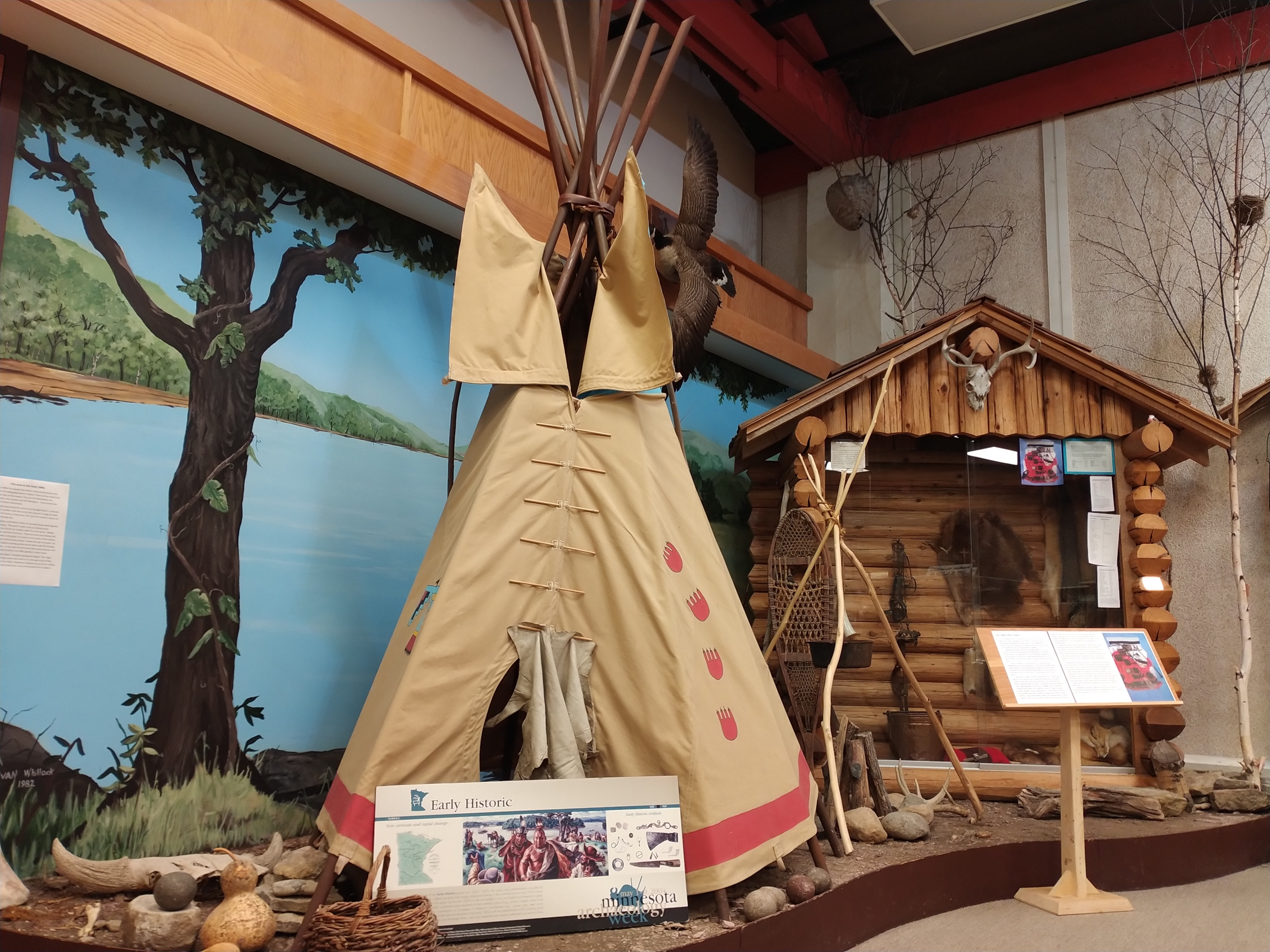
Likewise, the Rice County Historical Society Museum will be open, free of charge, from 10 a.m.-5 p.m. Thursday-Saturday. It’s a good place to see Native American and other artifacts, learn about our early fur trading and additional local history, learn about notable people like Chief Taopi and Bishop Henry Whipple, and more. Bishop Whipple founded and served the Cathedral where Jarvis is speaking.
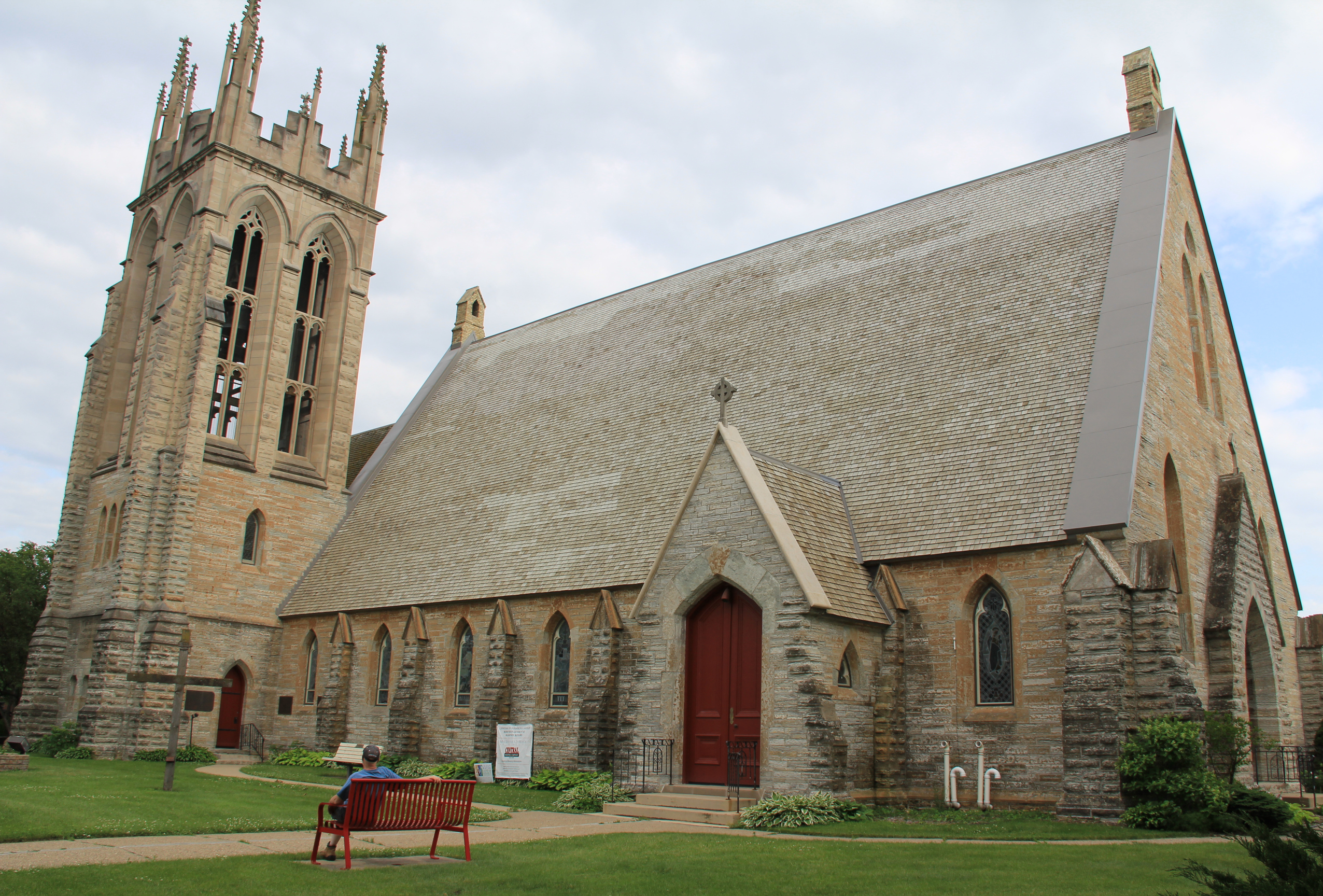
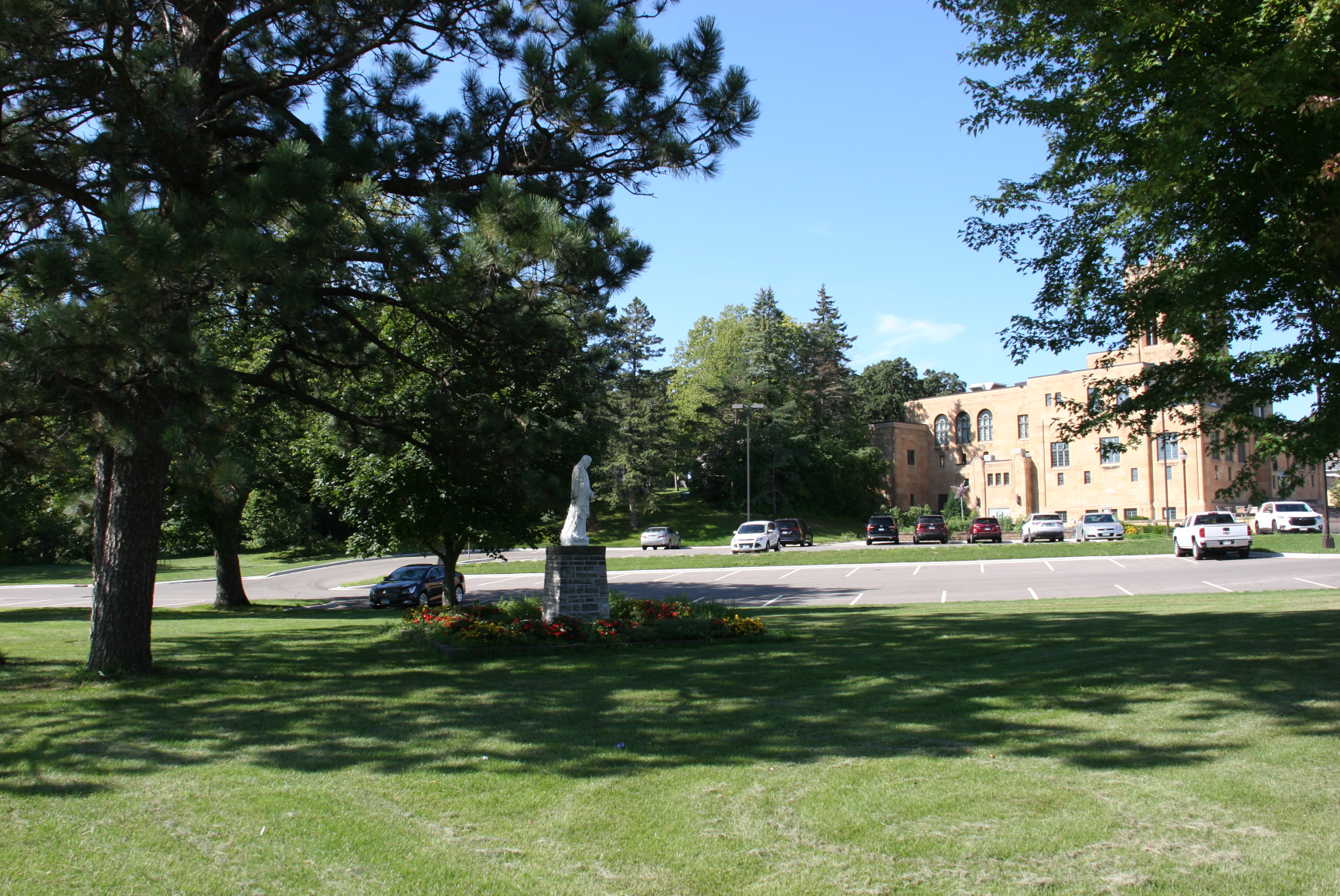
The historic Cathedral of Our Merciful Saviour sits across from Central Park and is a must-see in Faribault. (Minnesota Prairie Roots copyrighted file photo 2024)

The historic Cathedral will be open for tours at 11:30 a.m. Sunday, June 15, following a 10 a.m. Ecumenical Service including bluegrass music. This massive cathedral—and, yes, it really is a cathedral—is important in local Dakota history as the bishop worked closely with Native Americans, some of whom worshipped here.

Fur trader and town founder Alexander Faribault, who was of Dakota and French Canadian heritage, also worked closely with the Dakota. His wood-frame house will be open for free tours from 11 a.m.-3 p.m. Saturday, June 14.
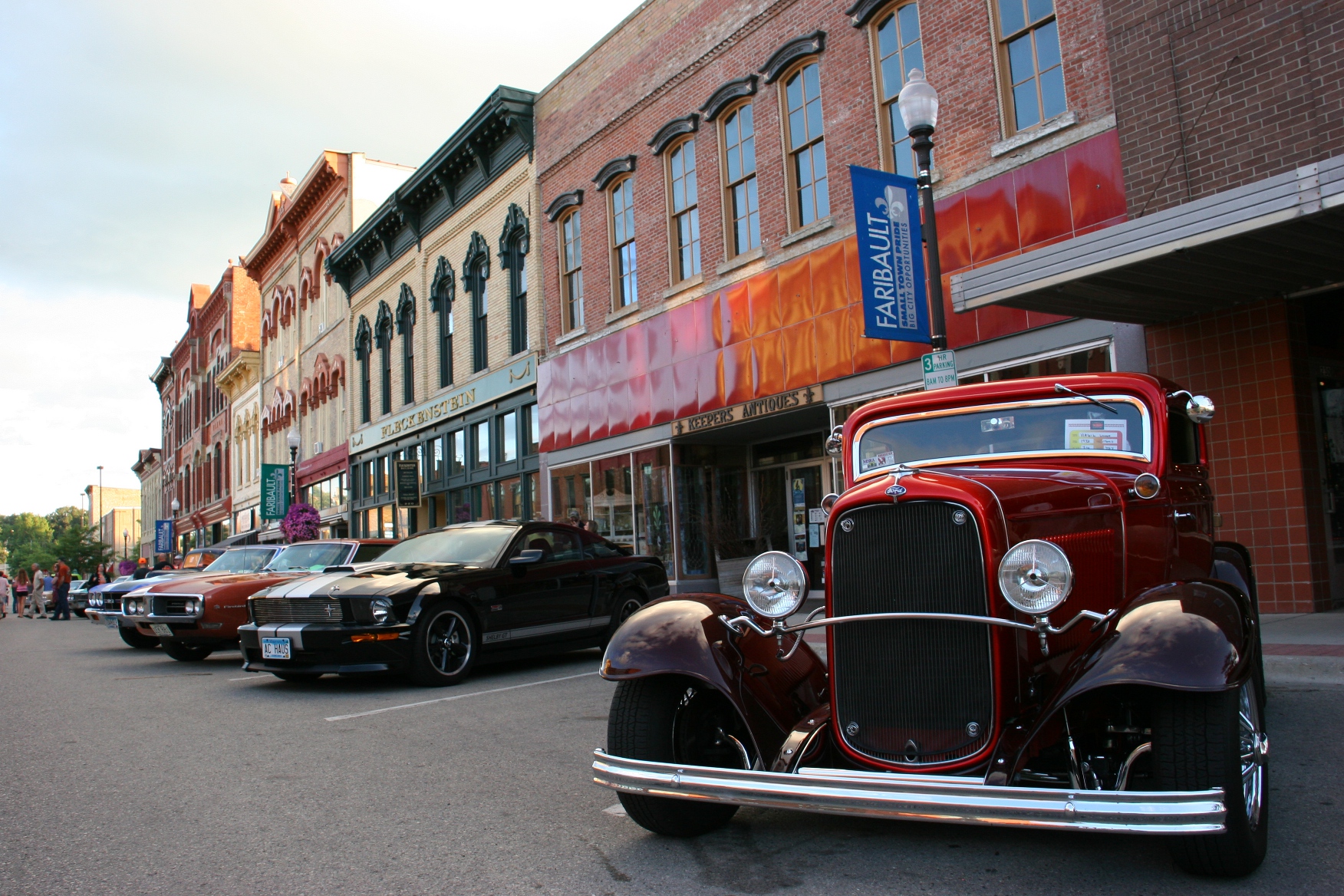
Downtown Faribault features well-kept aged buildings in our historic district. I photographed this scene during a Car Cruise Night. There’s a Car Cruise here Friday, June 13, from 6-9 p.m. (Minnesota Prairie Roots copyrighted file photo)

The Rice County Historical Society will also offer a guided Downtown Walking Tour on Friday and Saturday with two time slots of 11 a.m. and 2 p.m. The $5 tour, led by RCHS Program and Outreach Coordinator Kiran Loewenstein, begins at Central Park. Anticipated to take 1-1 ½ hours, the tour route follows Central Avenue with a focus on the historic district and buildings and early general Faribault history. I expect that will offer ample opportunity to not only learn about early history and heritage, but also to see the heritage of our newest residents in downtown core ethnic businesses.

Two more opportunities to embrace local history (although not officially part of Heritage Days) are inside the State Bank of Faribault along Central Avenue. Local streetscapes and landscapes by Father Jim Zotalis, spiritual leader of the Cathedral, are displayed in a pop-up exhibit in the bank lobby. And for those interested in Faribault’s brewing history, the bank holds an extensive collection of Fleck’s beer memorabilia form long ago Fleckenstein Brewery. Both are accessible during business hours only.

There’s lots happening during Heritage Days, activities that mostly aren’t about heritage. But some are. To see a complete listing of events, click here.

© Copyright 2025 Audrey Kletscher Helbling


Learning more about The Faribault Dakota from a local historian April 12, 2024

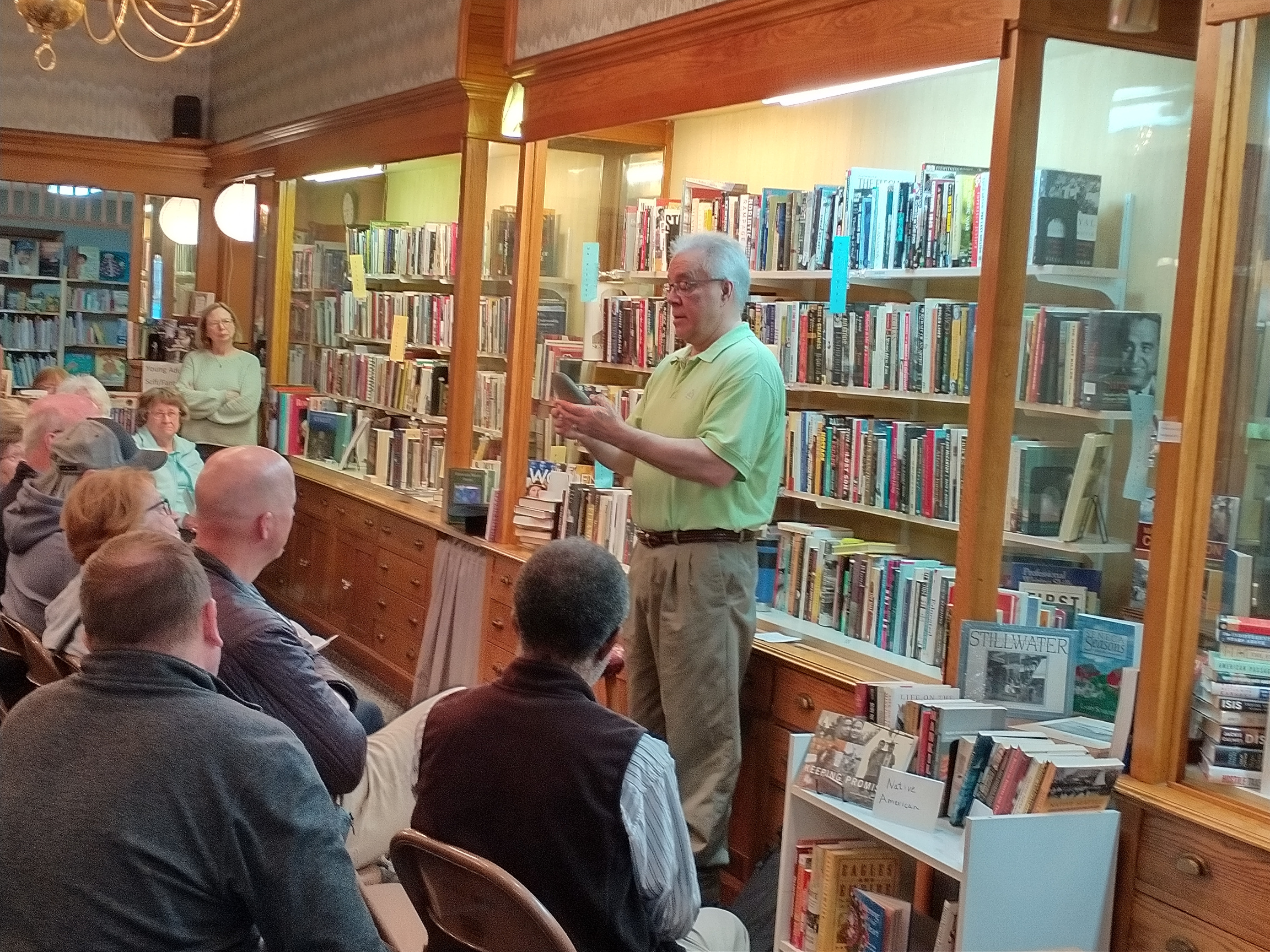
Jeff Jarvis shows an artifact while talking about the Dakota. (Minnesota Prairie Roots copyrighted photo April 2024)

WE’RE ALL CONNECTED. We’re all one.” Those closing words by local historian and artist Jeff Jarvis as he ended an hour-long presentation on “The Faribault Dakota” at Books on Central Thursday evening resonate. I’ve long been geographically-connected to Indigenous Peoples, first in my native Redwood County and now in Rice County. But Jarvis’ definition of connection stretches well beyond geography to the connection we all share simply via our humanity.

Jarvis, who is also an artist and graphic designer, handed out this mini guidebook at Thursday’s presentation. (Minnesota Prairie Roots copyrighted photo April 2024)

Jarvis spoke to a standing room only crowd packed into the Rice County Area United Way used bookstore on Faribault’s Central Avenue. The third speaker in the popular literary event series hosted by the bookshop since its fall opening, his talk was more history than literary. Interest ran high.

My interest in the Dakota traces back to the southwestern Minnesota prairie, where I grew up between the Upper and Lower Sioux Indian Reservations. Today the word “community,” references these homes of the Mdewakanton Dakota. When I moved to Rice County 42 years ago, I moved onto land once inhabited by the Wahpakute Dakota. But it wasn’t until I listened to Jarvis speak that I learned even more about the place I initially called home on the southeastern tip of Cannon Lake west of Faribault.

An Indigenous Peoples exhibit at the Rice County Historical Society. (Minnesota Prairie Roots copyrighted photo 2024)

Long before fur traders and settlers moved to this region of southern Minnesota, the Dakota called this land home, typically living along the area’s lakes and rivers, including the Cannon. I knew this; I’ve attended many presentations on the Dakota by local historians. But I wasn’t aware that the former Ackman Store, the rental home where Randy and I lived for 2 ½ years after our 1982 marriage, was near the site of a trading post opened by fur trader and town founder Alexander Faribault.

Native American artifacts found in Rice County and displayed at the Rice County Historical Society. These are not the artifacts shown by Jarvis. (Minnesota Prairie Roots copyrighted photo 2024)

Jarvis asked me after his presentation whether I saw ghosts while living there. I didn’t. And in a conversation with Lou Ackman, who grew up and lived along Cannon Lake and loaned Indian artifacts for Jarvis to show Thursday evening, I learned that people often searched the Ackmans’ farm fields for artifacts.

When Randy and I moved into Faribault, our geographic connection to Indigenous Peoples continued. We purchased a house below Wapacuta (sic) Park, where we still live today. It was upon this now park land that the Dakota placed their dead, (wrapped in buffalo robes or blankets) upon scaffolding until later burial. Jarvis also shared that the Dakota sometimes suspended wrapped bodies from trees to catch the spirits in the windy hilltop location prior to burial 1-2 years later. I’d never heard this prior to Thursday.

Peace Park, an unmarked Dakota cemetery near Buckham Memorial Library. (Minnesota Prairie Roots copyrighted file photo September 2022)

But I was aware that Peace Park, a triangle of land near Buckham Memorial Library, is an Indian burial grounds. Jarvis termed it an unfenced and unrecognized cemetery marked by a faith-based WW II monument and nothing indicating this is sacred ground of the Dakota. Several bodies were discovered buried there in 1874, he said, not wanting to delve deeper into that troubling topic at Thursday’s event.

Jarvis covered a lot more in his one-hour presentation. Most I knew. Some I didn’t. I always appreciate learning local history, especially about the 300-400 Dakota who relocated from Cannon Lake to live in elm bark huts and teepees in the area along the Straight River from Division Street to the wastewater treatment plant.

The community of Faribault, Jarvis said, had/has a lot of color and was/is “a beckoning place” to many peoples. He referenced the Indigenous Peoples of yesteryear and the immigrants of today. “We’re all connected. We’re all one,” Jarvis said. He’s right.

One of two rainbows arches over Faribault Thursday evening. (Copyrighted photo by Randy Helbling April 2024)

As I stepped outside the bookshop after Jarvis’ talk, cloudy skies opened to reveal stunning double rainbows—a symbol of promise and of hope. A symbol that we all live under the same sky, that we’re all connected.

FYI: To learn more about Jeff Jarvis’ work on the local Faribault Dakota Project, click here.

© Copyright 2024 Audrey Kletscher Helbling
 

Learning about Indigenous peoples from “The Forever Sky” November 27, 2023

(Minnesota Prairie Roots copyrighted file photo September 2022)

IN THE PAST YEAR, my desire to learn more about Native American culture has heightened. My new interest followed a talk in September 2022 by then Rice County Historical Society Director Susan Garwood about “The Indigenous history of the land that is now Rice County, Minnesota.” This county, this community, in which I live was home first to Indigenous peoples, long before the first settlers, the fur traders, the Easterners who moved west.

This sculpture of Alexander Faribault and a Dakota trading partner stands in Faribault’s Heritage Park near the Straight River and site of Faribault’s trading post. Ivan Whillock created this art which sits atop the Bea Duncan Memorial Fountain. (Minnesota Prairie Roots copyrighted file photo)

I knew that, of course. But what I didn’t know was that the Wahpekute, one of the seven “Council Fires” of the Dakota Nation, used the current-day Wapacuta Park just up the hill from my house for honoring their dead.

This Faribault city park, where my kids once zipped down a towering slide, clamored onto a massive boulder, slid on plastics sleds, was where the Wahpekute many years ago placed their dead upon scaffolding prior to burial. That ground now seems sacred to me.

That it took 40 years of living here to learn this information suggests to me that either I wasn’t paying attention to local history or that my community has not done enough to honor the First Peoples of this land.

(Book cover sourced online.)

Whatever the reason, I have, on my own, decided to become more informed about Indigenous peoples. And for me, that starts with reading. I recently headed to the children’s section of my local library and checked out the book, The Forever Sky, written by Thomas Peacock (a member of the Fond du Lac Band of Lake Superior Anishinaabe Ojibwe) and illustrated by Annette S. Lee (mixed-race Lakota-Sioux of the Ojibwe and Lakota-Sioux communities).

These two Minnesotans, in their collaborative children’s picture book, reveal that “the sky and stars all have stories.” Oh, how I value stories. And the stories shared in this book, these sky stories, are of spirits and animals and the Path of Souls, aka The Milky Way, and…

I especially appreciate the book’s focus on the northern lights, explained as “the spirits of all of our relatives who have passed on.” The descriptive words and vivid images make me view the northern lights, which I have yet to see in my life-time, through the eyes of Indigenous peoples. The changing blues and greens are their loved ones dancing in the night sky. Dancing, dancing, dancing. How lovely that imagery in replacing loss with hope and happiness.

The Forever Sky has created an awareness of Native culture previously unknown to me. Just like that talk a year ago by a local historian aiming to educate. I have much to learn. And I am learning via books found not only in the adult section of the library, but also among the children’s picture books. That writers and illustrators are covering topics of cultural importance in kids’ books gives me hope for the future. My grandchildren, even though they will never see the vast, dark, star-filled sky I saw nightly as a child of the prairie, are growing up much more informed. They will understand cultures well beyond their own heritage. And that encourages me.

© Copyright 2023 Audrey Kletscher Helbling
 

A look at Taopi, plus an overview of failures, injustices & war in Minnesota October 9, 2023

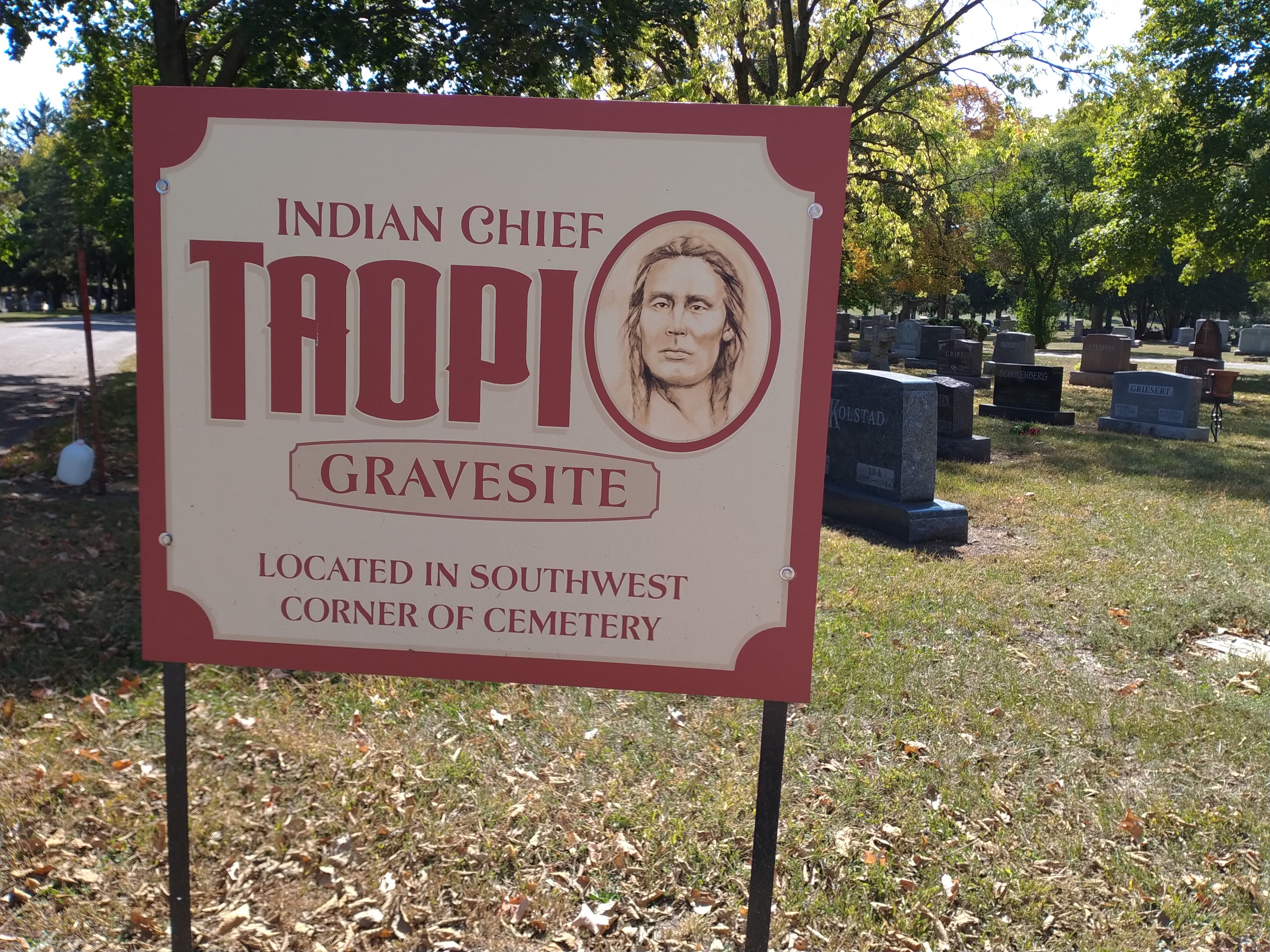
Just inside the entrance to Maple Lawn Cemetery, a sign directs visitors to Taopi’s gravesite. (Minnesota Prairie Roots copyrighted photo October 2023)

MY GOAL WAS SIMPLE—to write a piece honoring Indigenous Peoples’ Day. My focus, I initially decided, would be on Taopi, a member of the Little Crow Band of the Mdewakanton Dakota Tribe. Taopi is perhaps best known in Faribault, where he lived for a while and is buried. A small Mower County town near the Iowa border also honors him in name. But my writing expanded beyond Taopi.

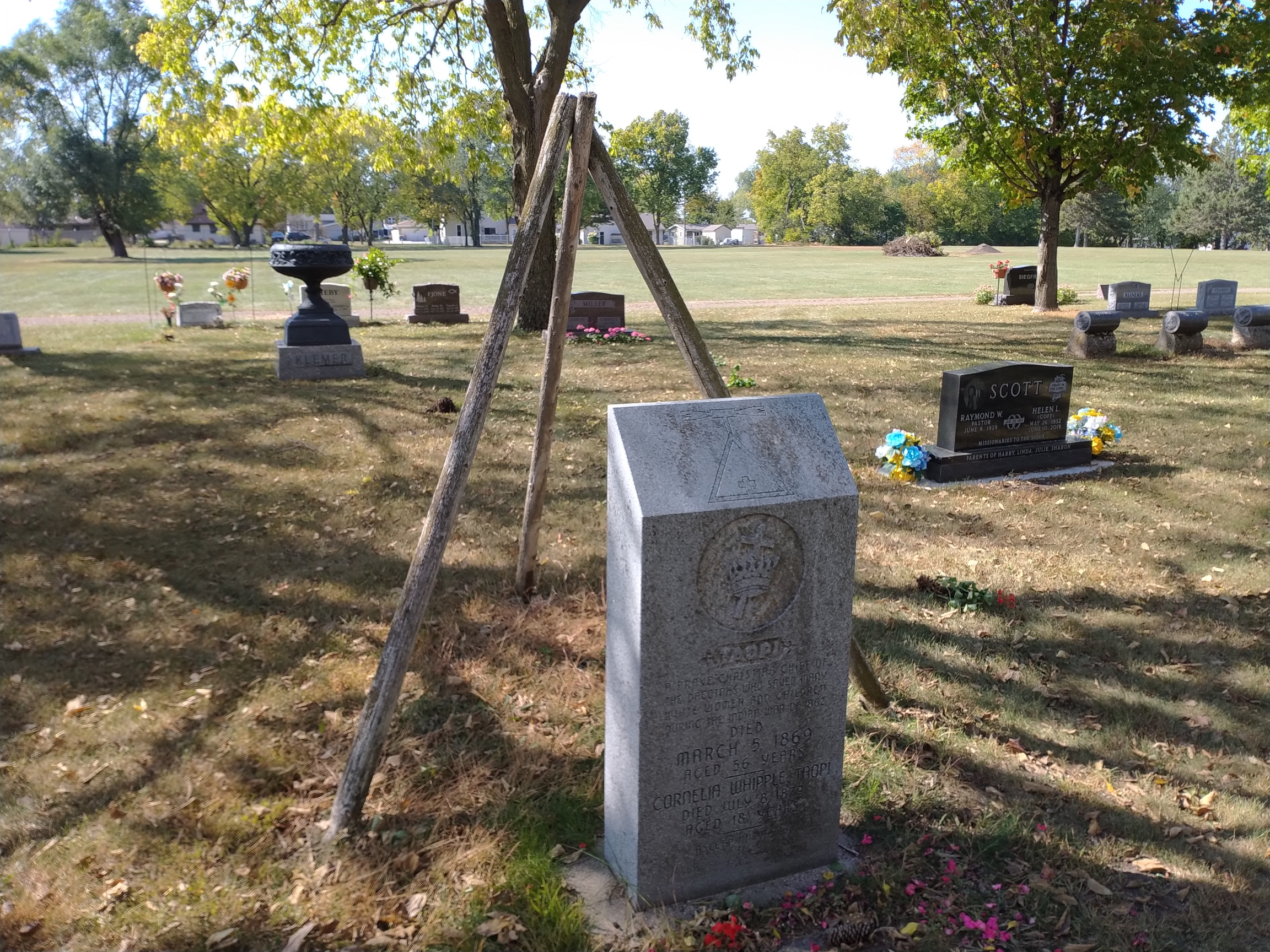
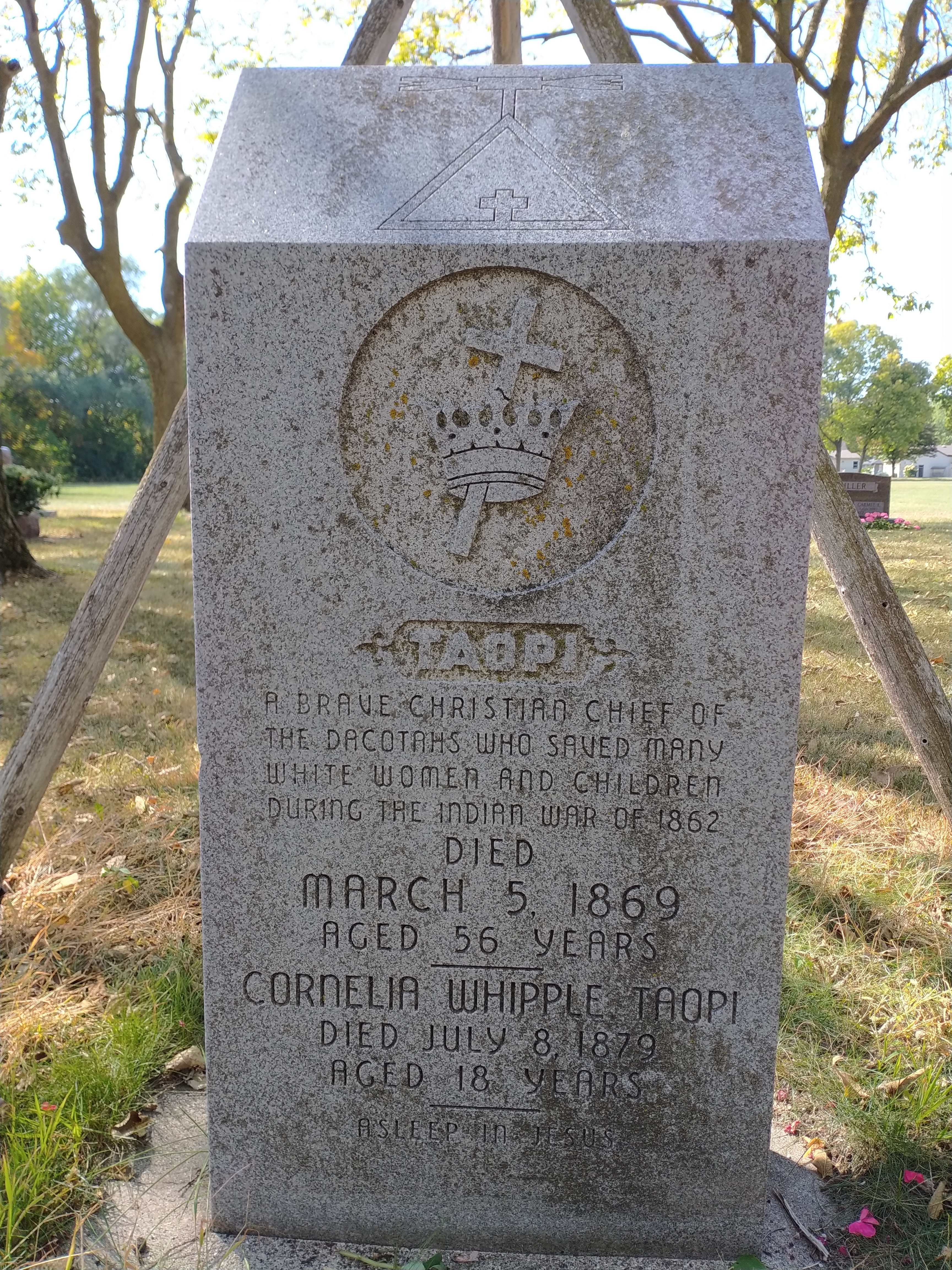
Taopi’s grave, and that of his daughter, are easily spotted via the propped poles. (Minnesota Prairie Roots copyrighted photo October 2023)

Recently I visited Taopi’s gravesite at Maple Lawn Cemetery. My interest piqued. I wanted to learn more about this Dakota leader and his importance in my community and in Minnesota history. His place in history connects to the US-Dakota War of 1862, a war all too familiar to me. My native Redwood County, where the Lower Sioux Agency was located, centered that deadly, short-lived conflict between white people and Native Peoples.

Now, viewing this war through a lens not tinted primarily by a white perspective, I understand the injustices. Decades ago, when I wrote a high school term paper on the war, I admittedly wrote a biased, unbalanced report based on biased, unbalanced research sources.

With time and maturity came the realization of the great injustices done, first when the US government acquired Indigenous Peoples’ land at a seemingly low cost and then failed to honor those treaties. The treaties opened nearly 24 million acres to white settlers. It was the Natives, the original inhabitants of this land, who found themselves cheated of government annuities, starving, pushed off their land and confined to strips of land along the Minnesota River. That includes the Wahpekute, a small band of the Dakota who lived in south central Minnesota, including the Faribault area. I live just below a Faribault city park called Wapacuta.

An exhibit at the Rice County Historical Society Museum. Artifacts from Indigenous Peoples are also displayed in cases. (Minnesota Prairie Roots copyrighted photo October 2023)

At the time of the US-Dakota War of 1862, Taopi was in the thick of all of it as a “farmer Indian,” the name tagged to Native Peoples who opted to farm, adapting the ways of the white man in occupation, dress and sometimes religion. He lived near the Lower Sioux Agency, relocated to a reservation there following the Treaty of Mendota in 1851. Those who continued with their hunting and fishing culture were known as “blanket Indians.” Taopi assuredly felt the animosity of his own people for the lifestyle and other choices he made.

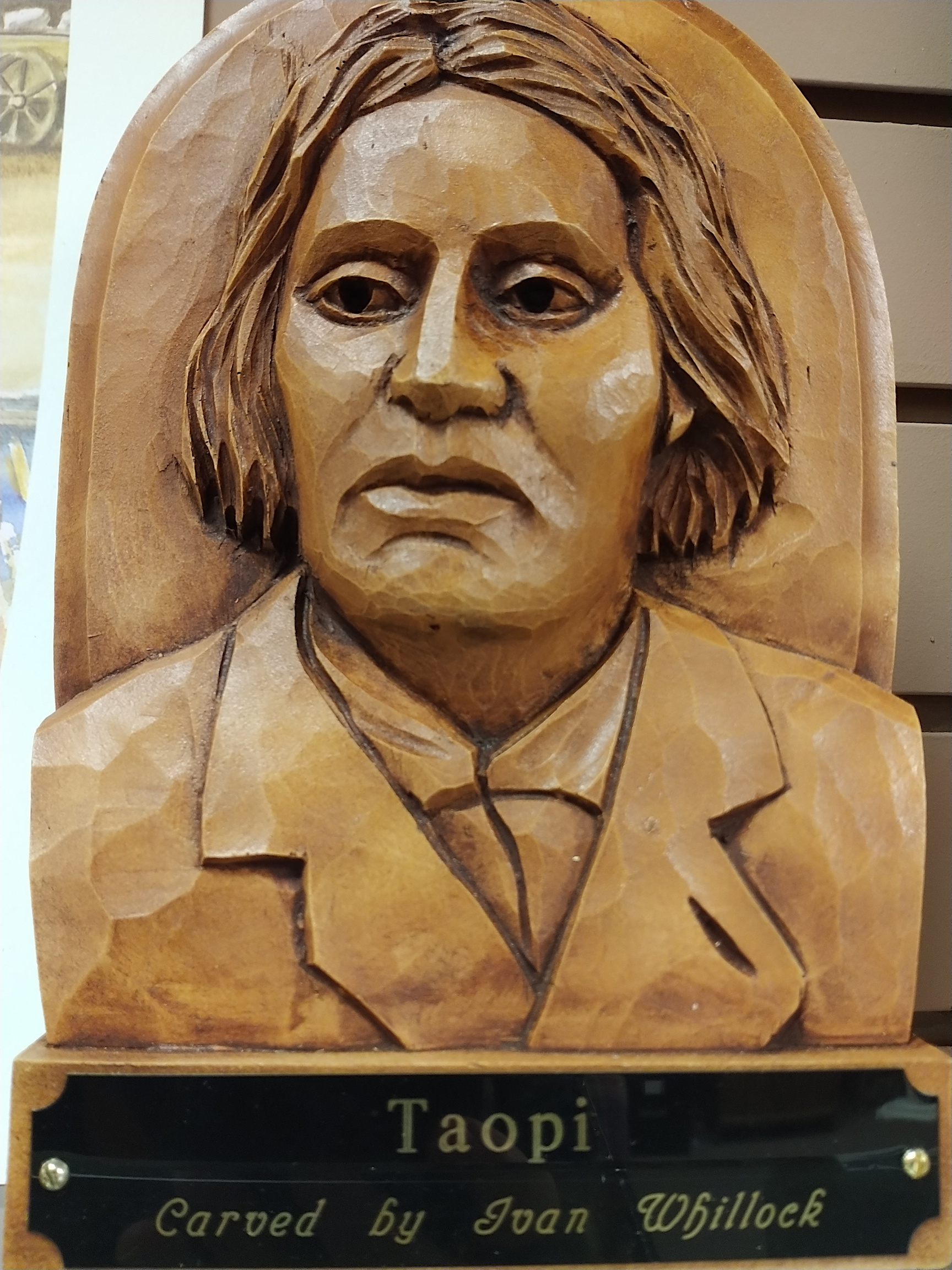
A woodcarving of Taopi by noted Faribault artist Ivan Whillock is for sale in the Rice County Historical Society Museum’s gift shop. One is also displayed in a museum exhibit on Taopi. (Minnesota Prairie Roots copyrighted photo October 2023)

I can only imagine the pressure Indigenous Peoples experienced as white settlers moved into the area. The change, at times, had to feel overwhelming. Life would never be the same. Long-time homelands were lost, tradition and culture endangered. And so Taopi and others adapted, likely accepting that change was inevitable.

The gravesite of Taopi and his daughter, Cornelia Whipple Taopi (named after Cornelia Whipple, married to Bishop Henry Whipple). (Minnesota Prairie Roots copyrighted photo October 2023)

But one thing that remained constant with Taopi was his focus on peace. He opposed the war and was a leader in the Dakota Peace Party. He is credited with saving the lives of many.

Yet, at war’s end, Taopi found himself caught—disliked by his peoples, who considered him a traitor, and disliked by whites holding a deep animosity toward any Native person. In Faribault, though, he had a friend in Bishop Henry Whipple, a strong advocate for First Peoples, and in town founder Alexander Faribault. Eventually, Taopi and other Natives moved onto land owned by Alexander Faribault, living under his protection on a bluff overlooking the Straight River. Taopi died in 1869. In 1895, the Indigenous Peoples of Faribault were displaced once again, moved to the Lower Sioux Reservation. They had always existed on the fringes in Faribault, never fully-accepted by most residents while under the protection of the bishop and town founder.

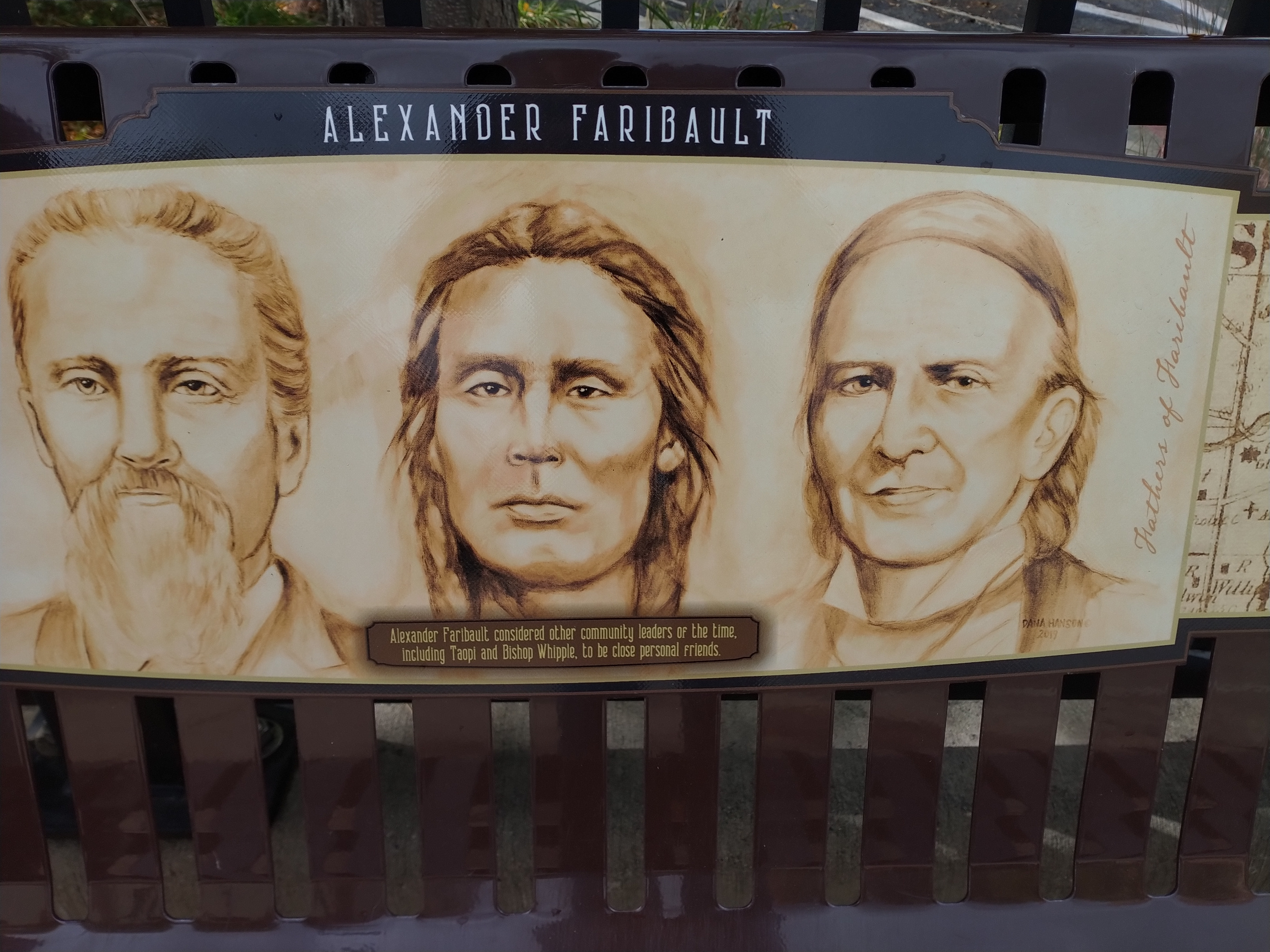
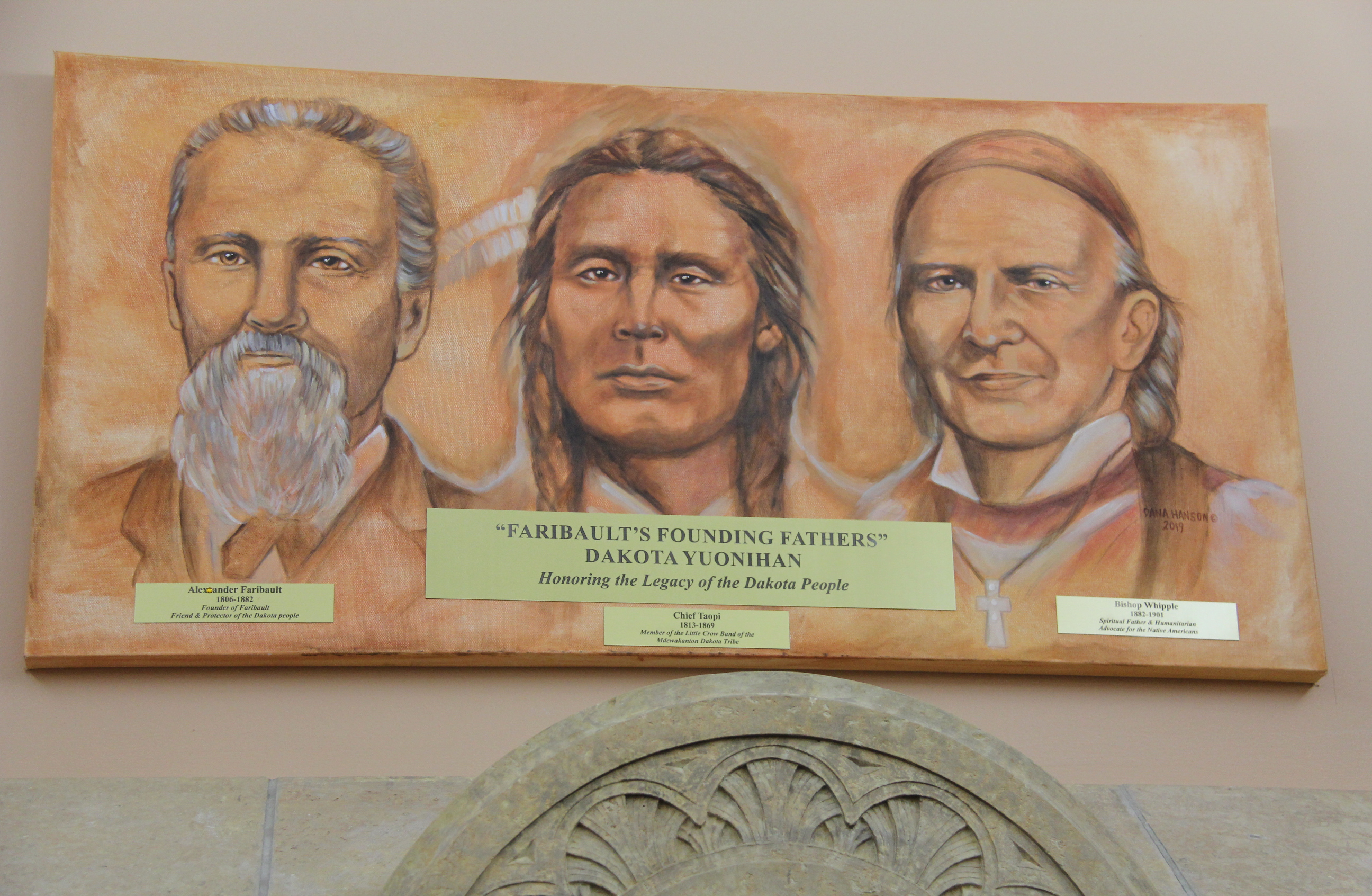
Dana Hanson’s “Father’s of Faribault” (left to right, Alexander Faribault, Taopi and Bishop Henry Whipple) featured on a bench along Central Avenue in downtown Faribault. The same artwork hangs inside Buckham Memorial Library. (Minnesota Prairie Roots copyrighted photo October 2023)

And so that is a brief look at Taopi, whose gravesite I visited. His presence remains visible elsewhere in Faribault. He’s featured in an exhibit at the Rice County Historical Society Museum. A “Fathers of Faribault” portrait of Taopi, Bishop Whipple and Alexander Faribault by Dana Hanson hangs at Buckham Memorial Library. Just a block to the north, that same artwork graces an historic-themed bench. Taopi was, most assuredly, a man of importance in local and state history. I will remember him primarily as a man of peace in a time when peace was decidedly elusive.

#

© Copyright 2023 Audrey Kletscher Helbling
Sources: The First Cathedral, an Episcopal Community for Mission by Benjamin Ives Scott and Robert Neslund; the Minnesota Historical Society website; and the Rice County Historical Society Museum’s Taopi display.


At Buckham Library: Portraits honor Faribault’s founding fathers November 21, 2022

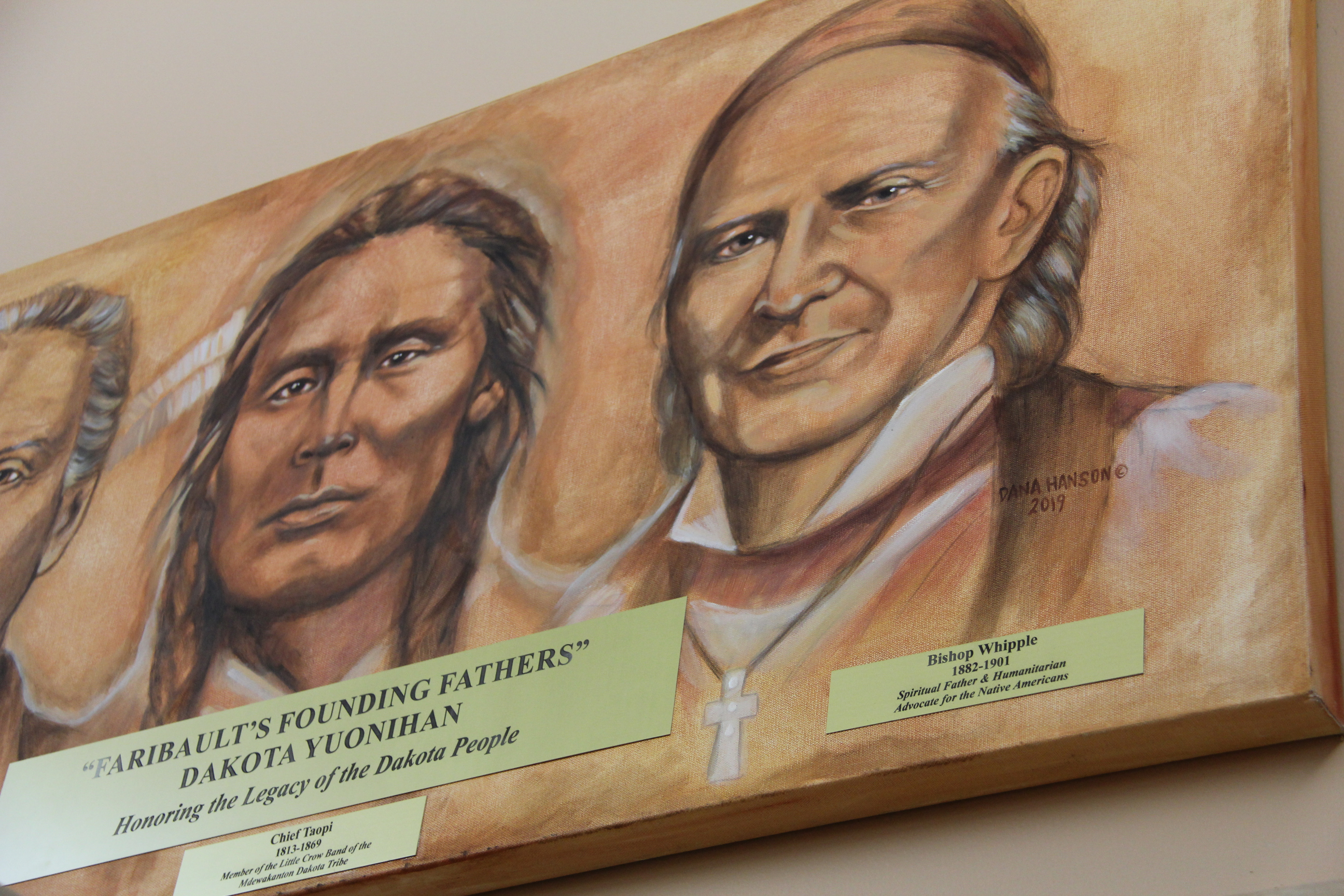
“Faribault’s Founding Fathers,” Alexander Faribault (left to right), Chief Taopi and Bishop Henry Whipple, painted by Dana Hanson. “Yuonihan” means honor or respect. (Minnesota Prairie Roots copyrighted photo November 2022. Art copyrighted by Dana Hanson.)

MY LIBRARY, BUCKHAM MEMORIAL in Faribault, features dozens of art pieces by local artists scattered throughout the building. I’ll admit that I really don’t even notice the art any more in my frequent visits to the library. Like anything, after time, familiarity begets overlooking.

But that all changed recently when I looked across the library to the west by the adult fiction and saw a work of art I hadn’t previously noticed. It’s been there for about a year. Yet, just now, I happened to see Dana Hanson’s original art piece, “Faribault’s Founding Fathers.” I strode across the library toward the high-hanging portrait piece and took pause.

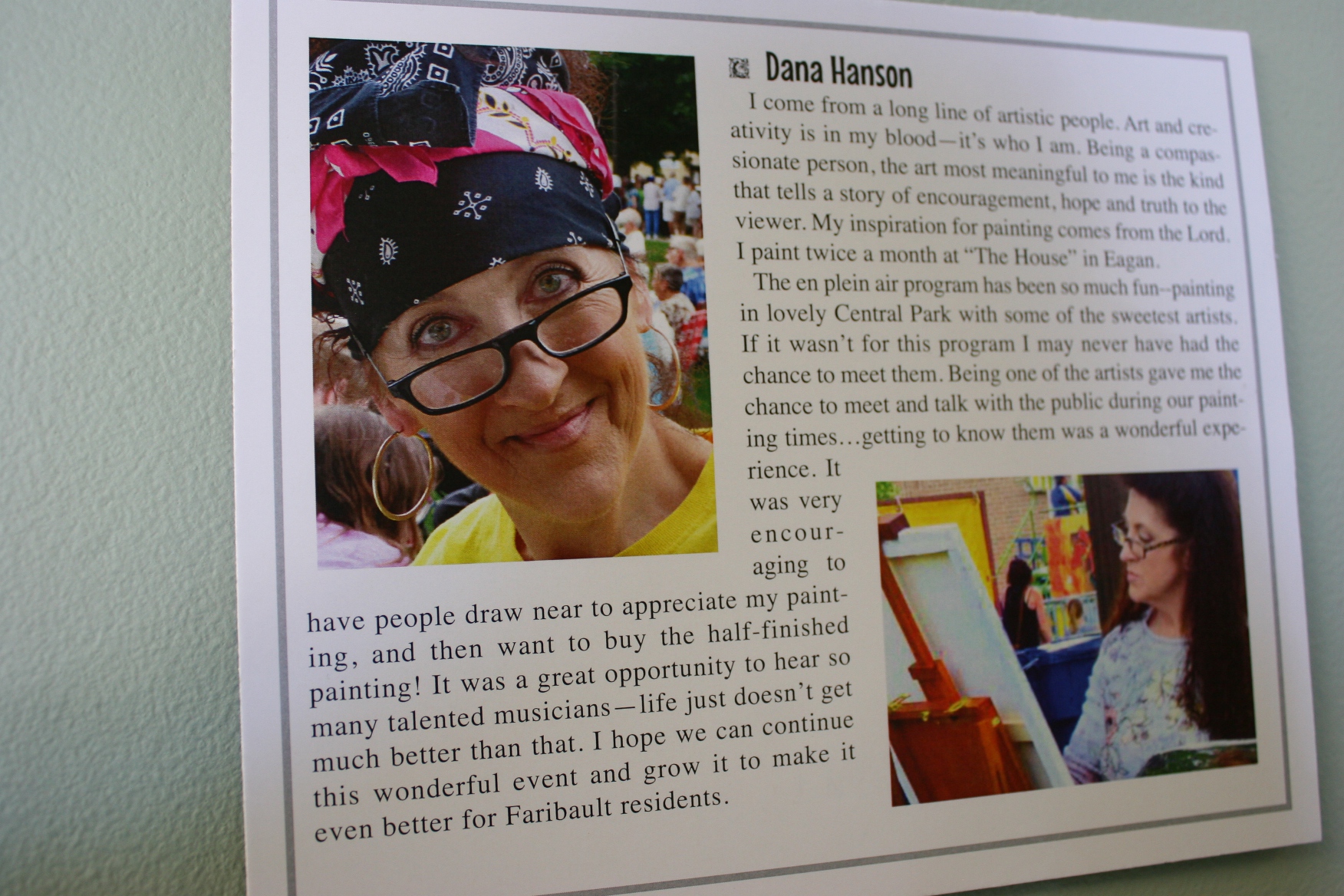
Dana Hanson’s artist statement posted at the 2016 Artgo! art show at Buckham Center. (Minnesota Prairie Roots copyrighted file photo October 2016)

I first met Dana, who specializes in portraits, in 2015 during Faribault’s summer Concerts in the Park weekly outdoor music series at Central Park. Local artists were invited to paint on-site and Dana was among them. She has since moved away from Faribault.

A close-up of Dana’s “The Native Man, His Eagle & His Chanupa,” an oil painting exhibited in Owatonna in 2018. (Minnesota Prairie Roots copyrighted file photo April 2018)

Eventually, her art started showing up in exhibits—at Buckham Center, at the Paradise Center for the Arts and at the Owatonna Arts Center. Her work ranged from faith-inspired to celebrity (like Bob Dylan, Prince and Judy Garland) and Native American portraits and more. In Owatonna, her “Healing the Land” exhibit several years ago focused on the Dakota people.

Up close with Chief Taopi, center, and Bishop Henry Whipple, right. (Minnesota Prairie Roots copyrighted photo November 2022)

So when I saw the recently-donated 2019 painting of Faribault’s founding fathers, I was not at all surprised. Dana holds a heart full of gratitude, love and compassion for Indigenous peoples. That shows in her art, including in these portraits of Chief Taopi, a member of the Little Crow Band of the Mdewakanton Dakota Tribe; town founder Alexander Faribault, “friend and protector” of the Dakota; and Bishop Henry Whipple, “Spiritual Father and Humanitarian” and “Advocate for the Native Americans.”

Another example of Dana’s art, MESSENGERS OF HOPE with the horses subtitled, from left to right, “Light,” “Passion Fire” and “Grace.” These were exhibited at the Paradise Center for the Arts in 2017. (Minnesota Prairie Roots copyrighted file photo March 2017.

Indigenous peoples were the original inhabitants of Faribault, of Rice County, a fact now only beginning to be widely-acknowledged and honored. The Wakpekute, part of the Dakota Nation, placed their dead on scaffolding on the hill just up from my house in today’s current-day Wapacuta (sic) Park, a fact I only learned this fall at an historical presentation. Eventually, they were buried in Peace Park, a triangle of land near the library. There’s so much rich local history I am beginning to learn.

“Protector of the 38 + 2,” an oil on canvas by Dana Hanson and previously displayed in Owatonna. Her art honors the 38 Dakota men who were hung in Mankato following the US-Dakota War of 1862. (Minnesota Prairie Roots copyrighted file photo April 2018)

Chief Taopi, who centers Dana’s portrait trio, was a leader among his people and a member of a Peace Party during the US-Dakota War of 1862. Eventually he landed in Faribault, living on land owned by founder and fur trader Alexander Faribault. Taopi and the Bishop forged a strong friendship also. The Dakota chief died in 1869 and is buried at Maple Lawn Cemetery in Faribault.

Now, to see these three men honored via a painting in a place of learning, a place of connection, a place where history writes onto pages, reminds me of their importance in my community. In the familiarity of the library and during this, Native American Heritage Month, I need to pause, appreciate and respect those who shaped this place I’ve called home for 40 years.

© Copyright 2022 Audrey Kletscher Helbling