A farm site between Owatonna and Claremont. (Minnesota Prairie Roots copyrighted photo March 2026)
UNDER AN IMMENSE SKY in the wide open countryside of rural southern Minnesota, I always feel small.
Three US Air Force T-38 Talon Thunderbird jets landmark Owatonna Degner Regional Airport along Interstate 35. (Minnesota Prairie Roots copyrighted photo March 2026)
Sky and land dwarf me, impressing upon me the vastness and power of that which rises above and that which stretches around me.
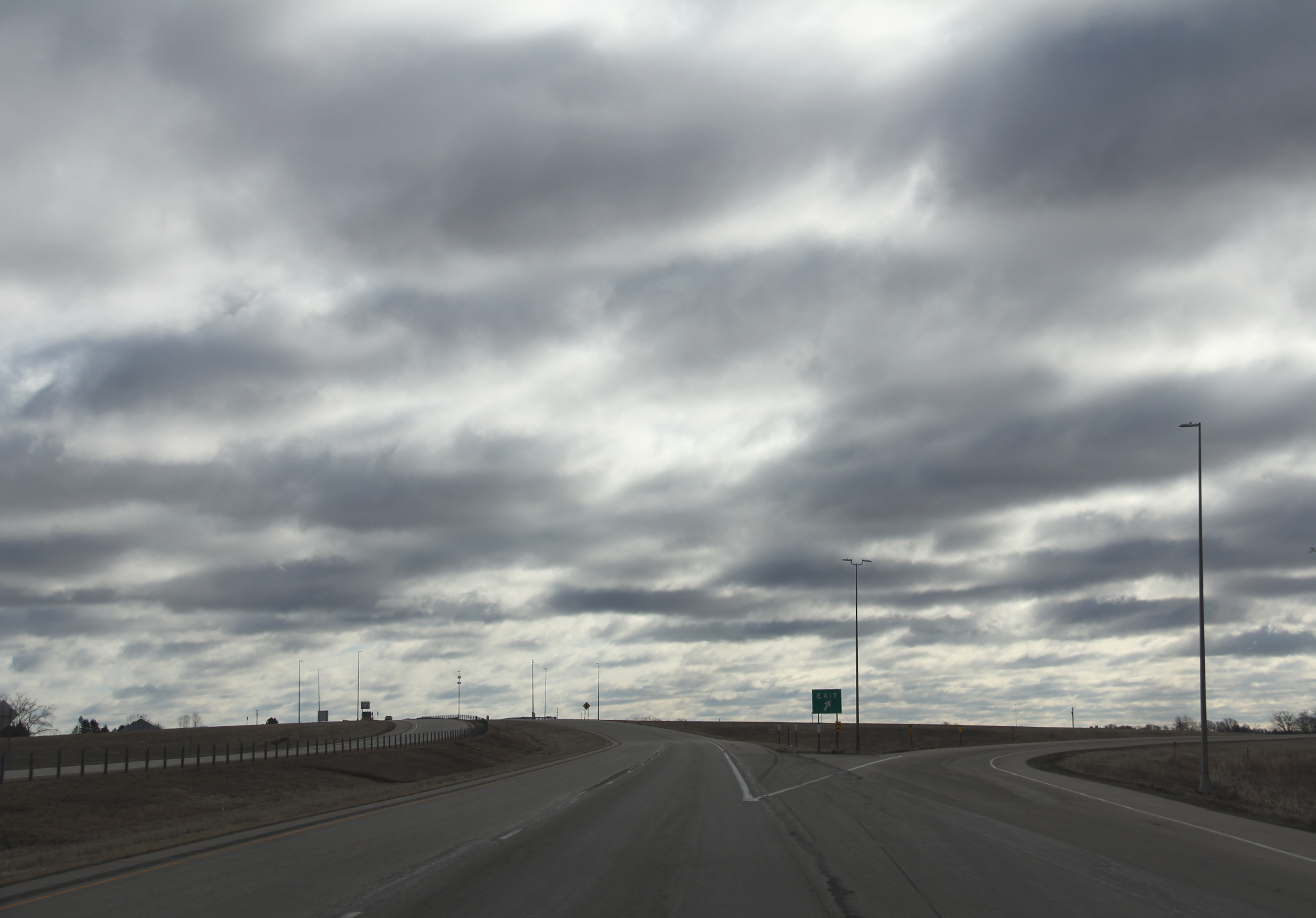
On US Highway 14 just east of Owatonna, driving into early morning grayness. (Minnesota Prairie Roots copyrighted photo March 2026)
On a recent road trip to Rochester and back, the brooding sky of mid-March appeared unsettled, threatening. Cloud after cloud after cloud nearly swiped the earth while towering in a brute mass into seemingly infinity.
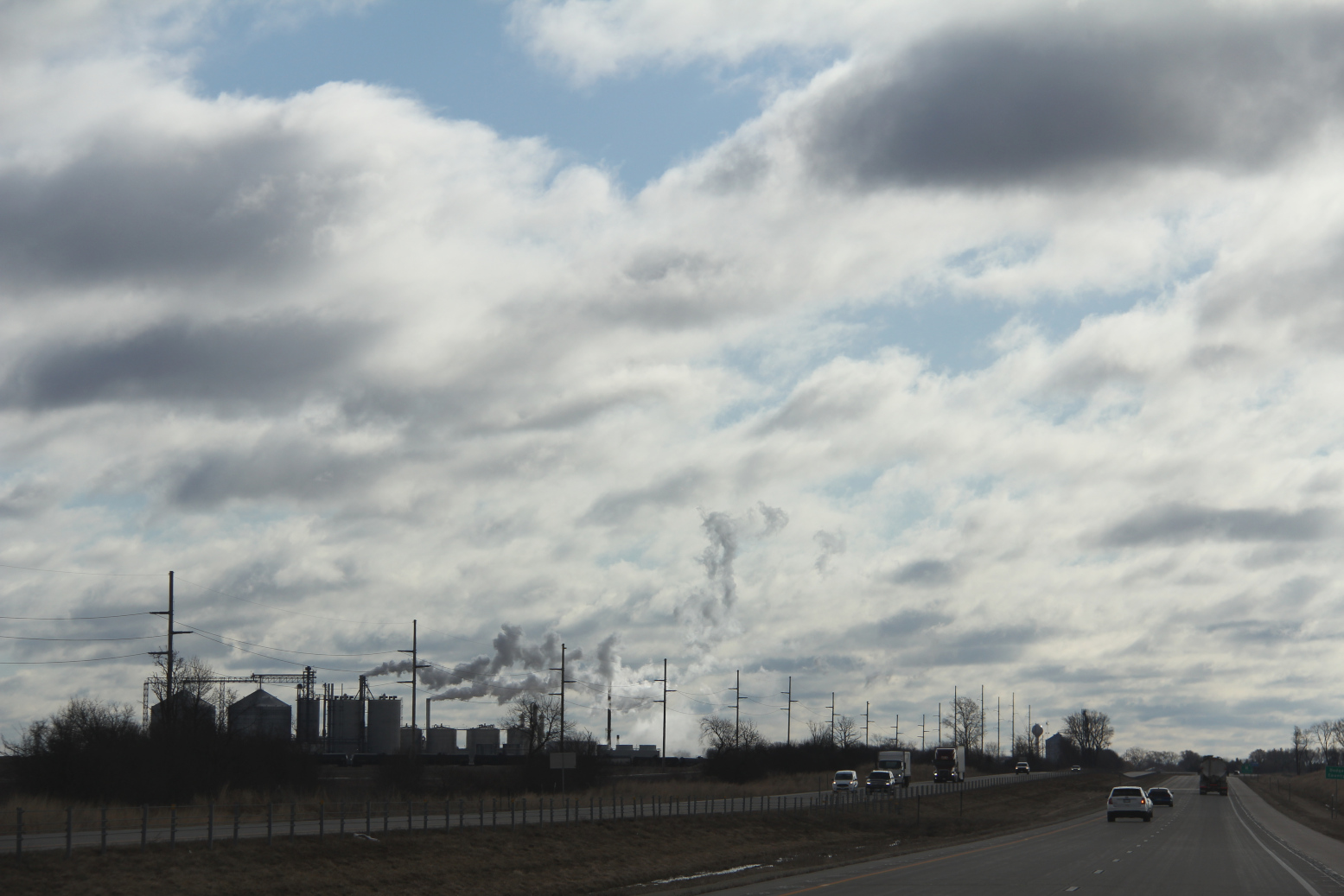
Heading east on highway 14, the All-Corn Clean Fuel ethanol plant by Claremont comes into view. (Minnesota Prairie Roots copyrighted photo March 2026)
Only occasionally did the sun fight through the clouds that darkened the day. Gray prevailed, a visual cue of the major winter storm that would arrive the next evening.
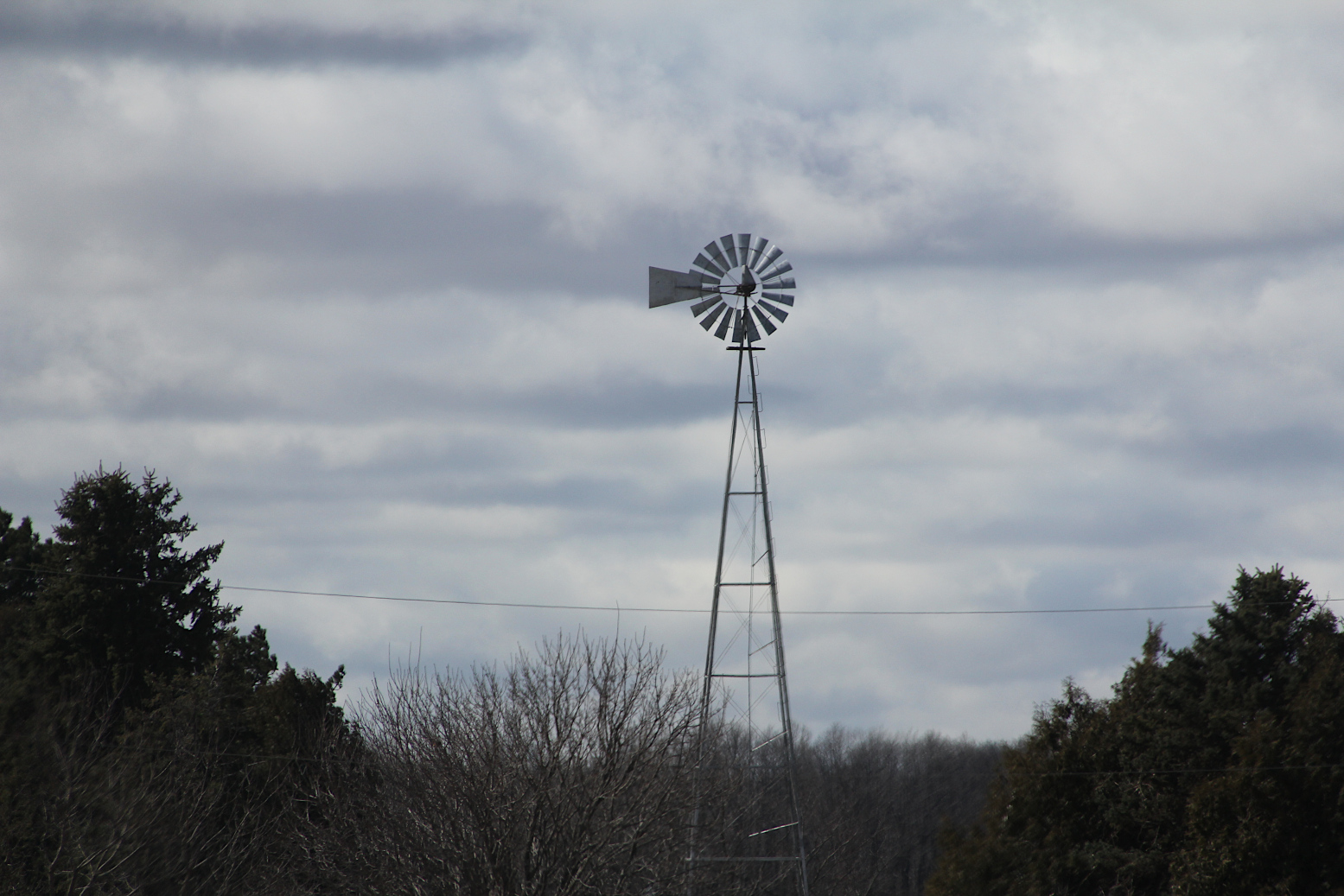
Harnessing the wind on a farm site near Claremont. (Minnesota Prairie Roots copyrighted photo March 2026)
In the flatness of the land, a strong wind bullied across the landscape. Pushing. Shoving. Bending the will of boughs. Punching at vehicles. Fearless and unrelenting.
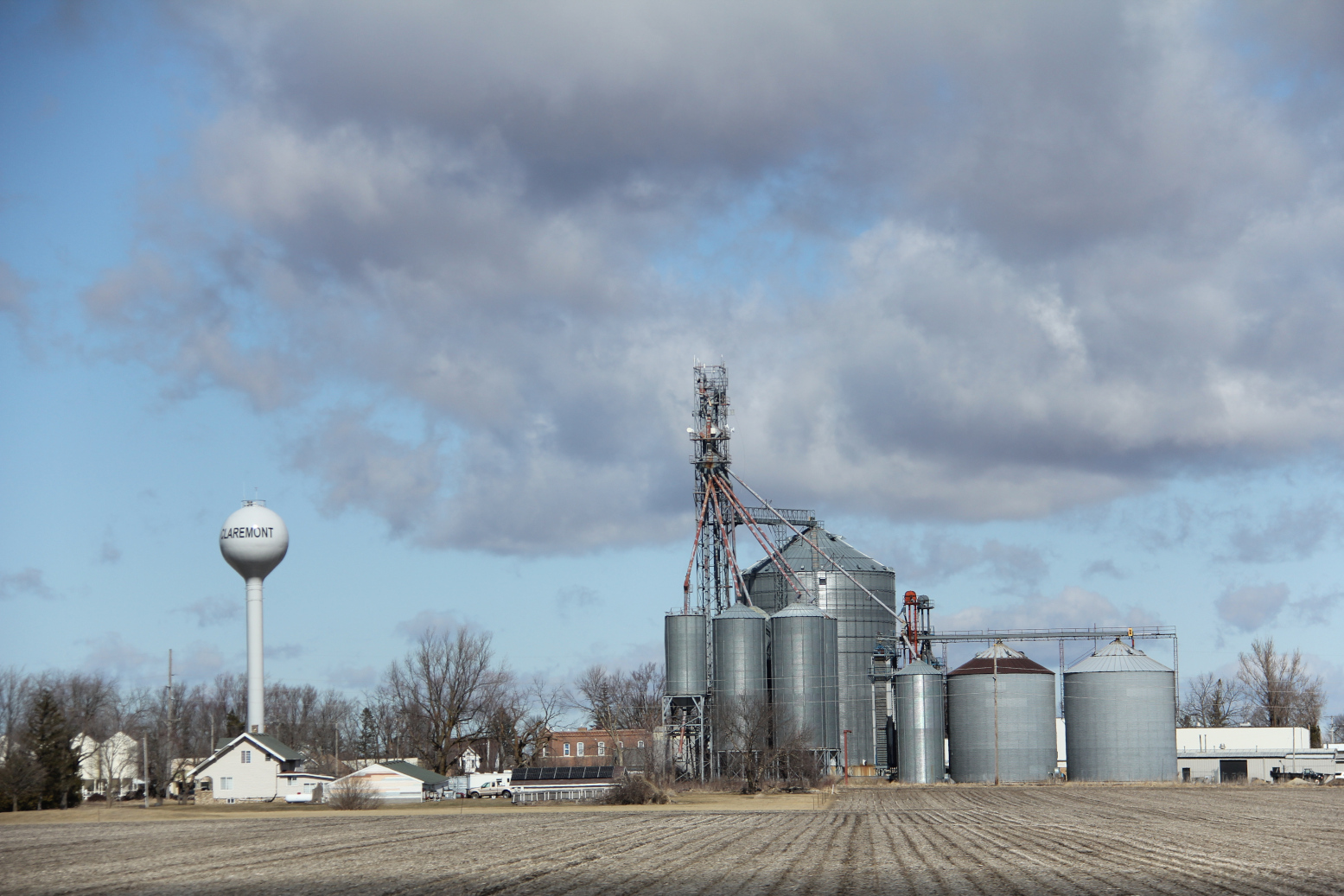
On the return trip to Faribault, the clouds partially broke, opening to blue skies over Claremont. (Minnesota Prairie Roots copyrighted photo March 2026)
This is March in Minnesota. One day angry and roiling. The next day calm, even warm, sunny and inviting. March marks the indecisiveness of sometimes spring, sometimes still winter.
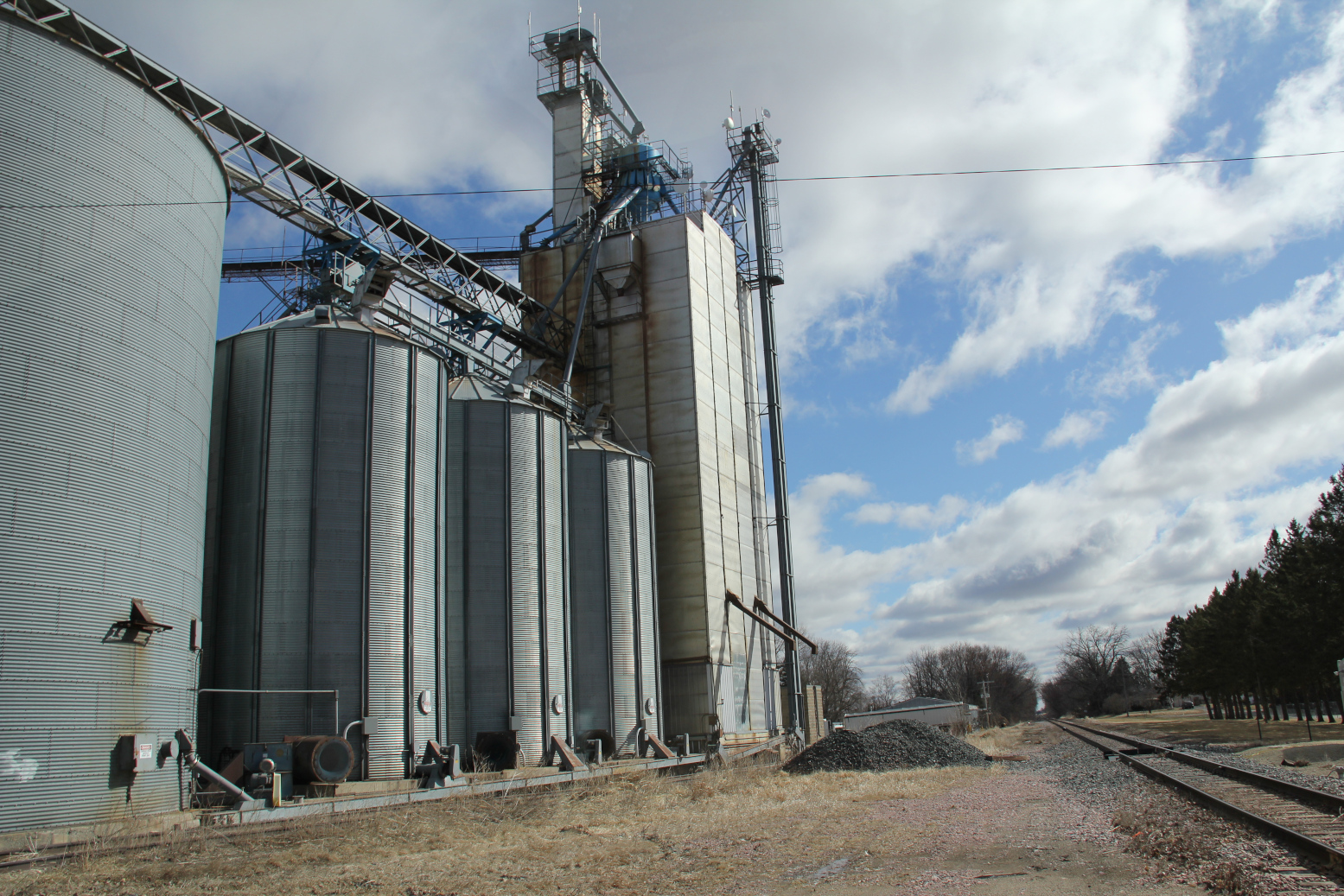
Byron Agri Center stretches skyward. (Minnesota Prairie Roots copyrighted photo March 2026)
There’s a certain restlessness this time of year among those of us who live in this cold climate state of long winters. We are weary of cold and snow, ready for real spring, not just the calendar spring. We crave sunshine, warmth and greenery.
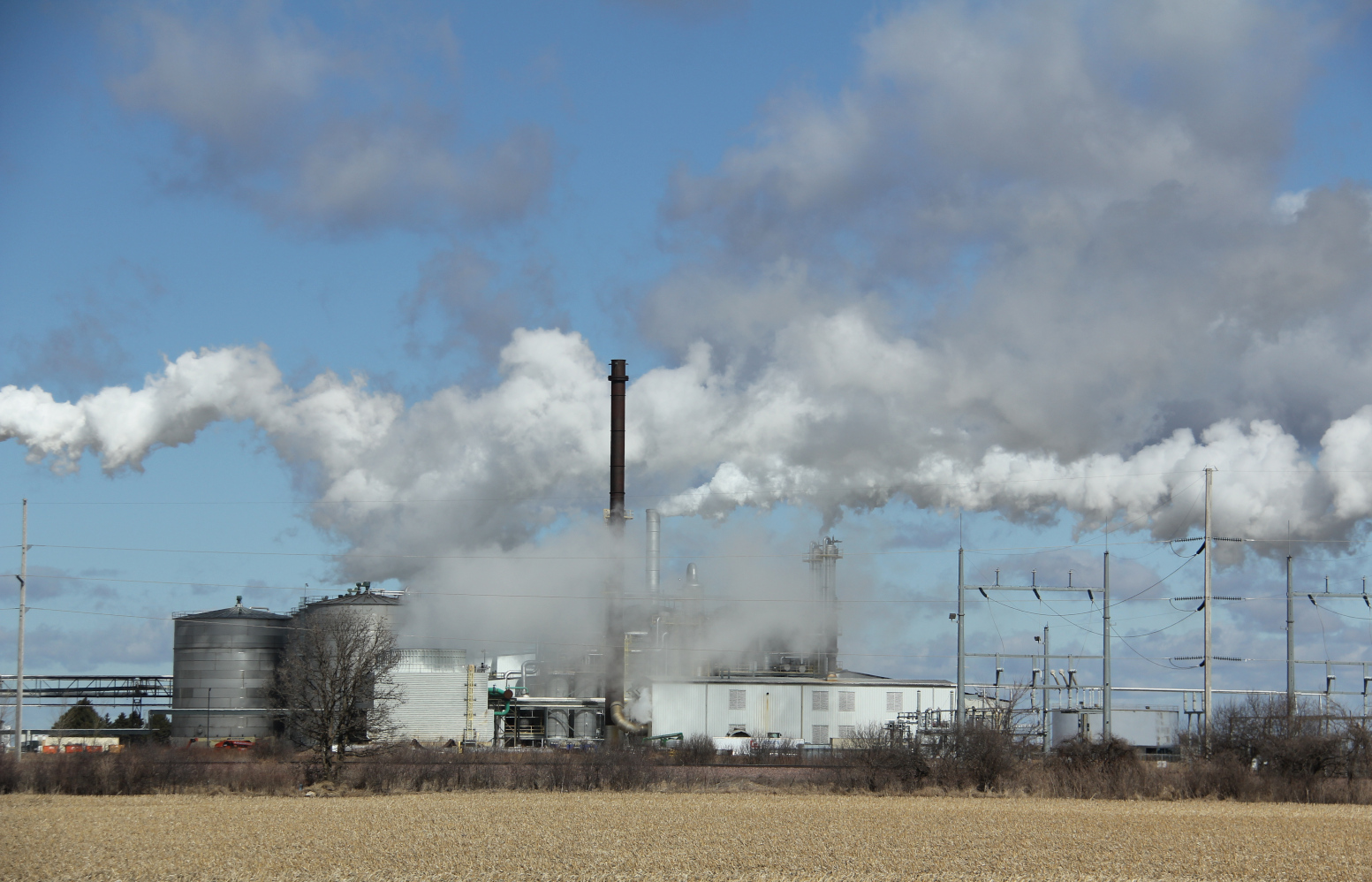
A view of the ethanol plant near Claremont on the return trip, when skies lightened. (Minnesota Prairie Roots copyrighted photo March 2026)
But realistically, Mother Nature has her own mind, deciding when a season reveals herself, not simply teases. I see that in the sky on this drive. The heavy morning sky, wrapped in a mass of clouds, refuses to bare herself to the sun.
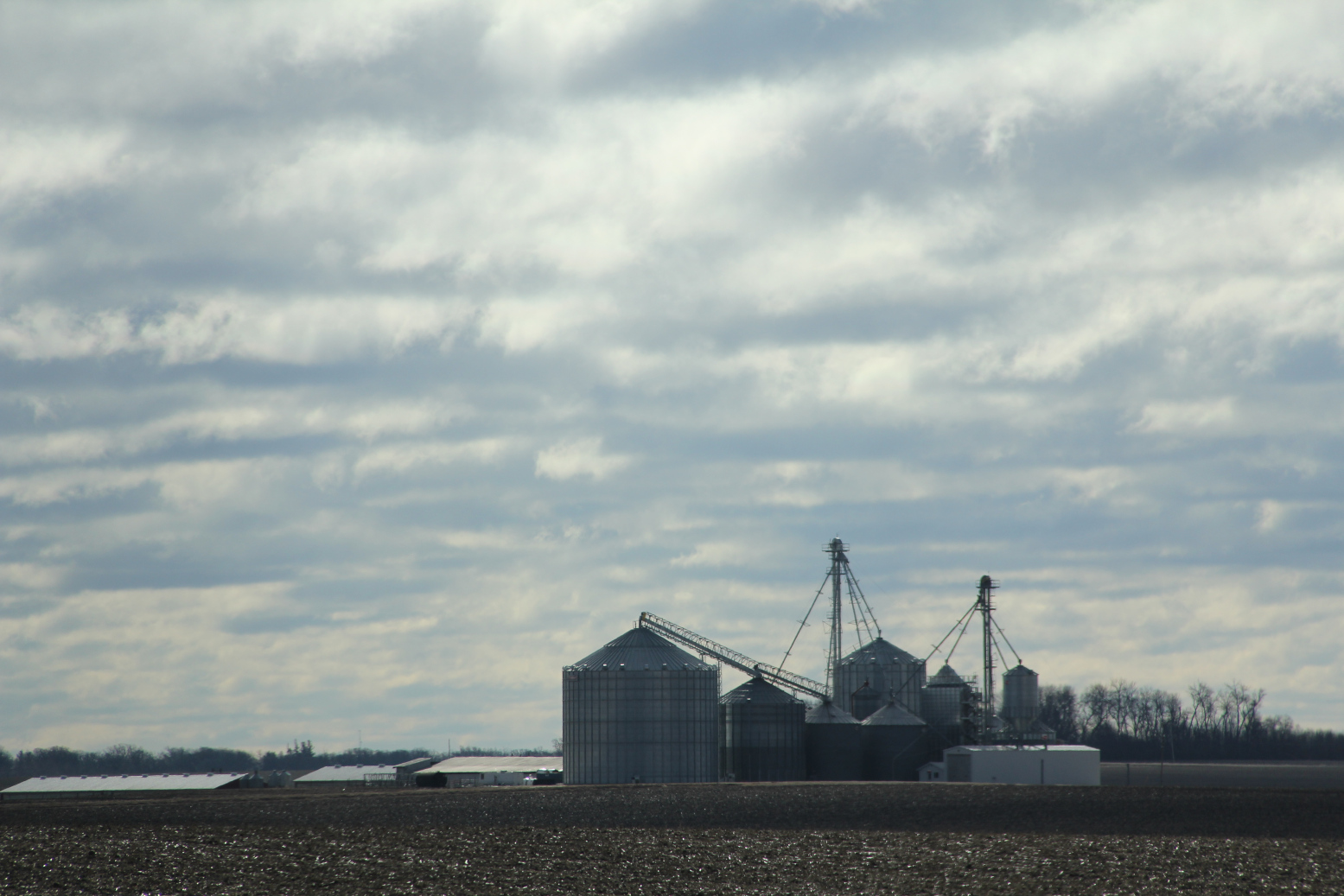
A farm site about 20 minutes west of Rochester. (Minnesota Prairie Roots copyrighted photo March 2026)
And so I feel pressed upon, diminished by sky. And land.
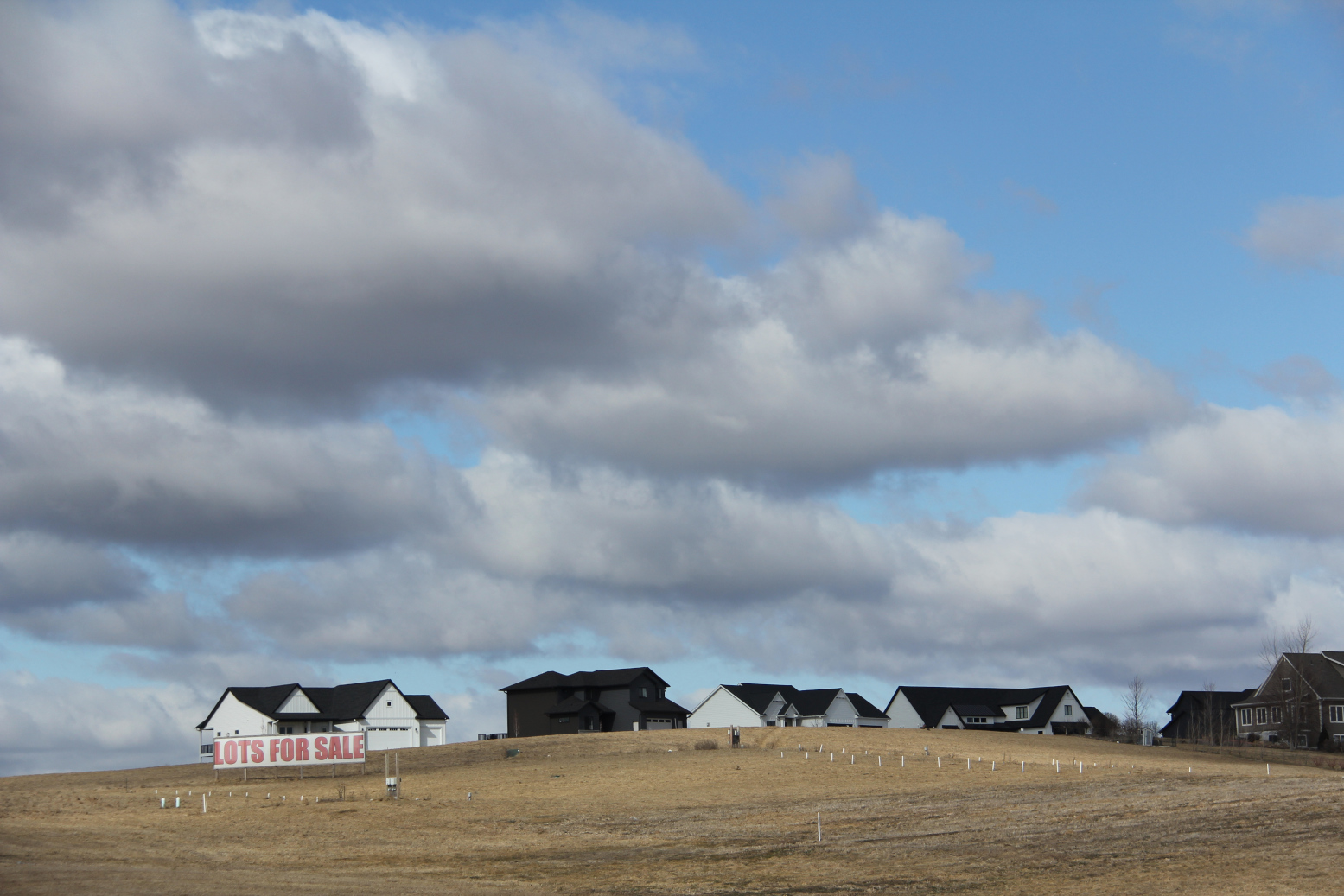
Dwarfed by the sky, a housing development atop a hill between Rochester and Byron. (Minnesota Prairie Roots copyrighted photo March 2026)
Buildings—barns and bins and houses—appear minuscule against this intimidating backdrop.
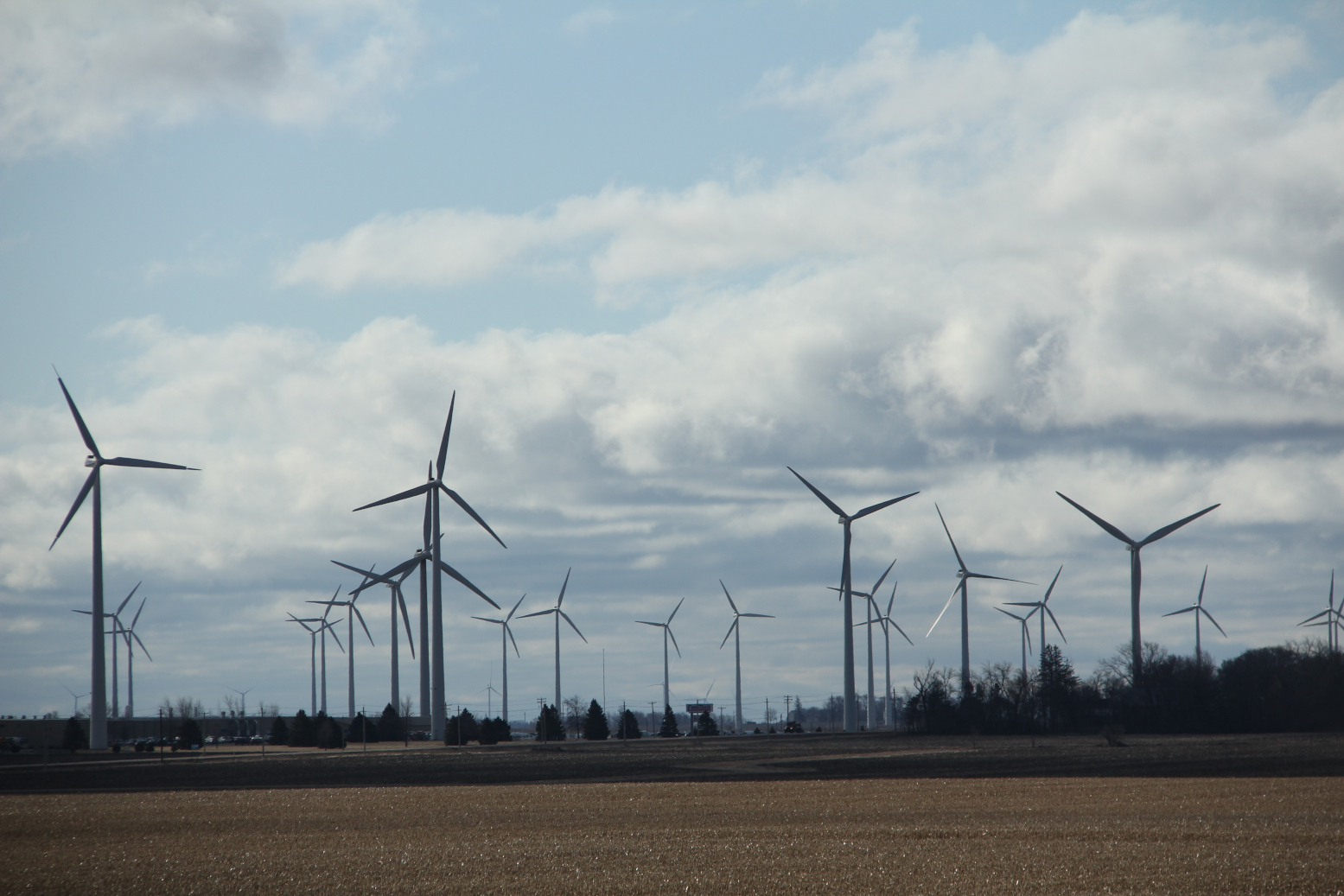
Wind turbines south of Dodge Center. (Minnesota Prairie Roots copyrighted photo March 2026)
Even wind turbines, which tower above treelines, and which I find visually unappealing, appear small-scale despite their height.
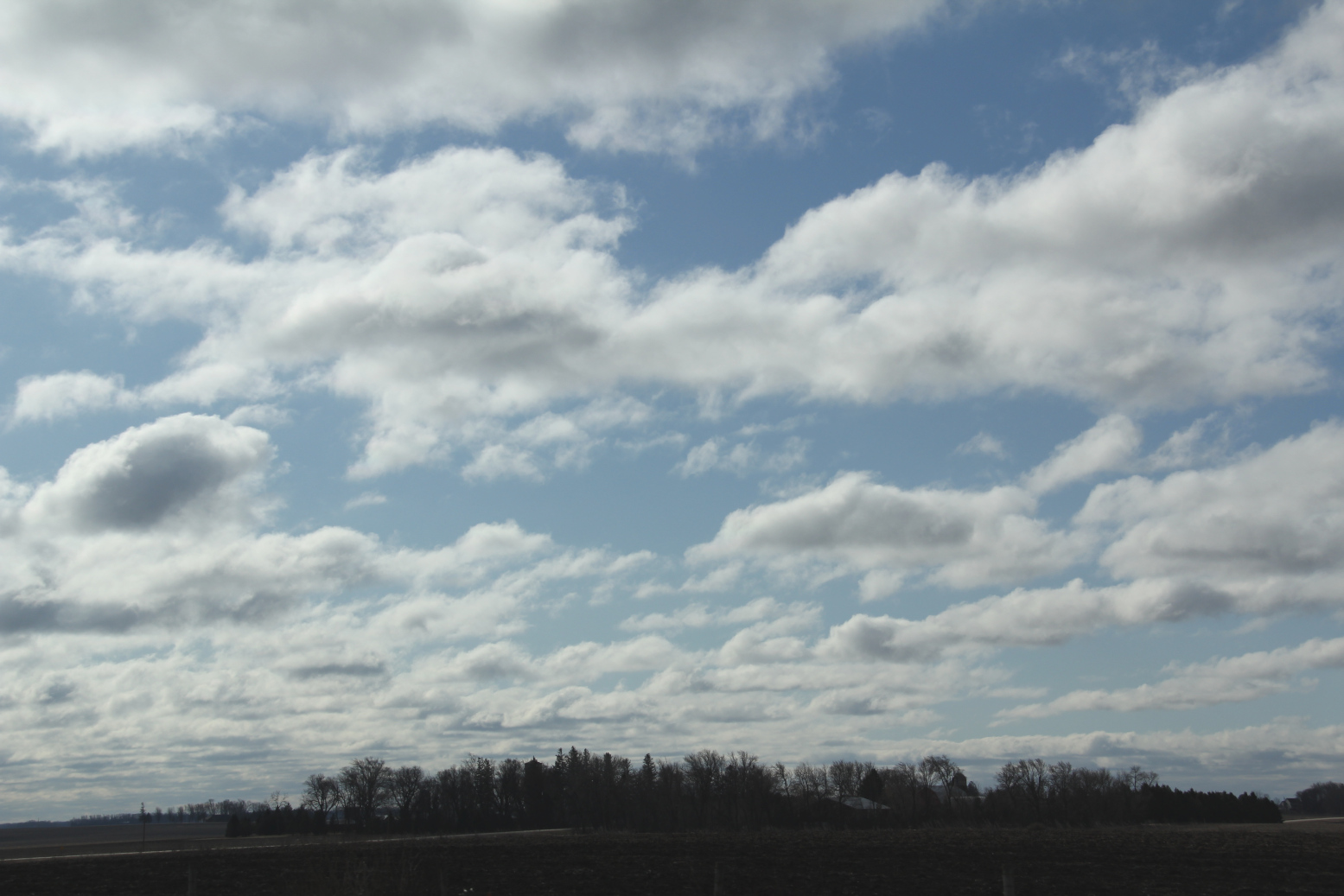
Sky and land meet in the immensity of this place. (Minnesota Prairie Roots copyrighted photo March 2026)
I suppose we really are small in the immensity of the universe. A road trip between Faribault and Rochester verifies that. The immense sky and stark, wide open land stretch before me, high and wide. And I feel small, oh, so small in the all of it in the midst of March in Minnesota.
NOTE: I took these on-the-road photos on March 13 as a front seat passenger in our van. I set my 35 mm camera at a fast shutter speedand shot images.
My husband, Randy, blows snow from our driveway Sunday morning. (Minnesota Prairie Roots copyrighted photo March 2026)
WHILE I SAT IN THE RECLINER hand-stitching loosened seams in a cuff of Randy’s flannel shirt and listening to “Face the Nation,” my husband was outdoors firing up the snowblower.
We are in the middle of a major winter storm in much of Minnesota. Snow began falling here Saturday evening and continues with some nine-plus inches of accumulation thus far in Faribault. Winds are whipping the new-fallen snow into a blizzard with no travel advised, roads closed, and more cancellations than I could possibly list. That includes cancellation of church services.
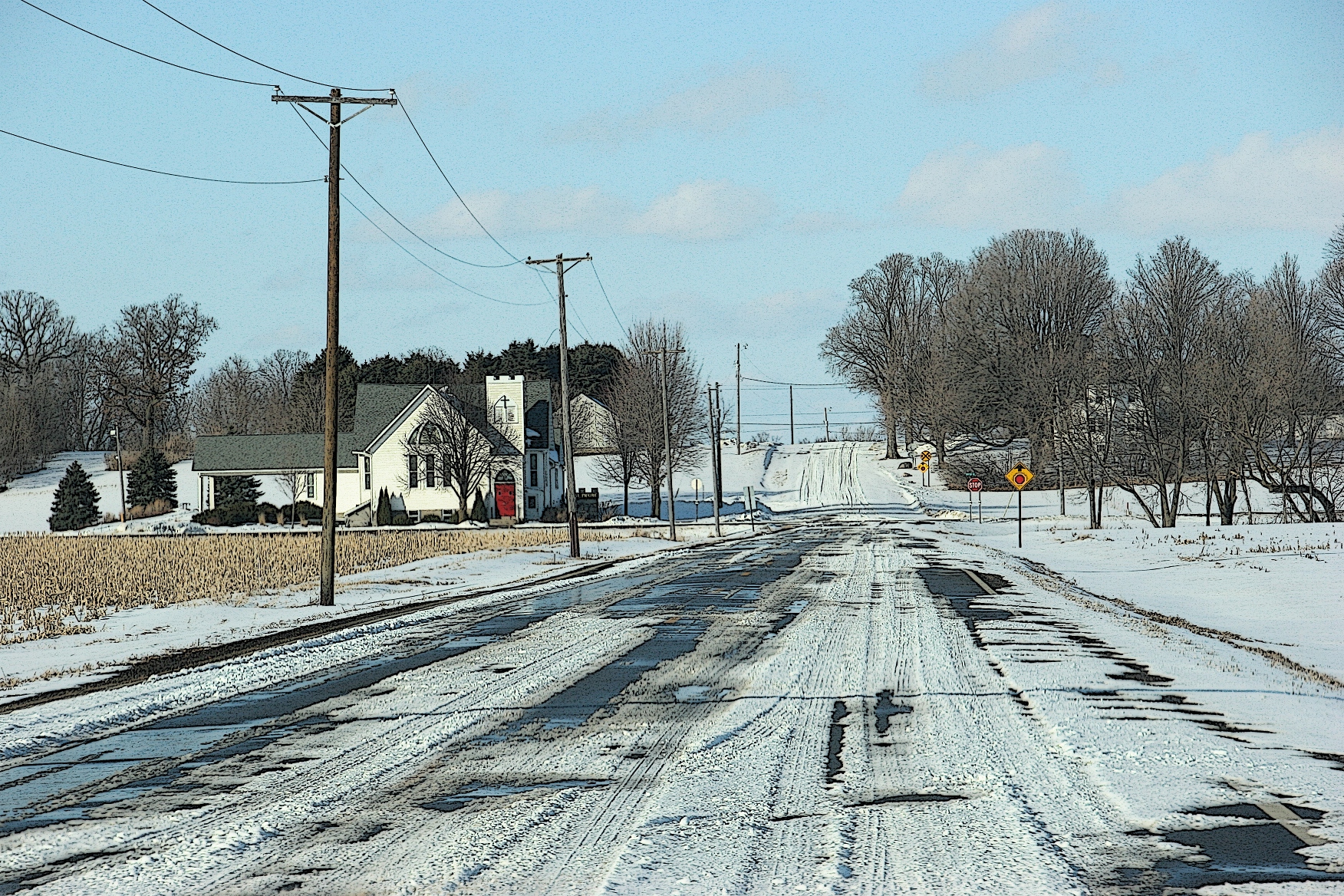
Little Prairie United Methodist Church, rural Dundas. (Minnesota Prairie Roots copyrighted file photo)
Across town, while I was stitching, then dicing celery and onions for the Chicken Wild Rice Hotdish I’ll make for supper, my friend Marian was tucked inside her home watching Little Prairie United Methodist Church services online. Broadcast not from the rural Dundas church, but from Pastor Penny Bonsell’s living room in nearby Northfield.
“She (the pastor) was in her slippers with a cup of coffee and her puppy needing to be removed from front and center!” Marian shared with me. “A close neighbor trudged through the snow to play the piano and she and her husband have beautiful voices. The puppy didn’t sing!”
Marian invited me to watch the service. I did. After I finished the breakfast dishes, ate the brunch Randy made, washed dishes again, and video chatted with my second daughter and one-year-old grandson four hours away in southeastern Wisconsin. Only light snow is falling in Madison.
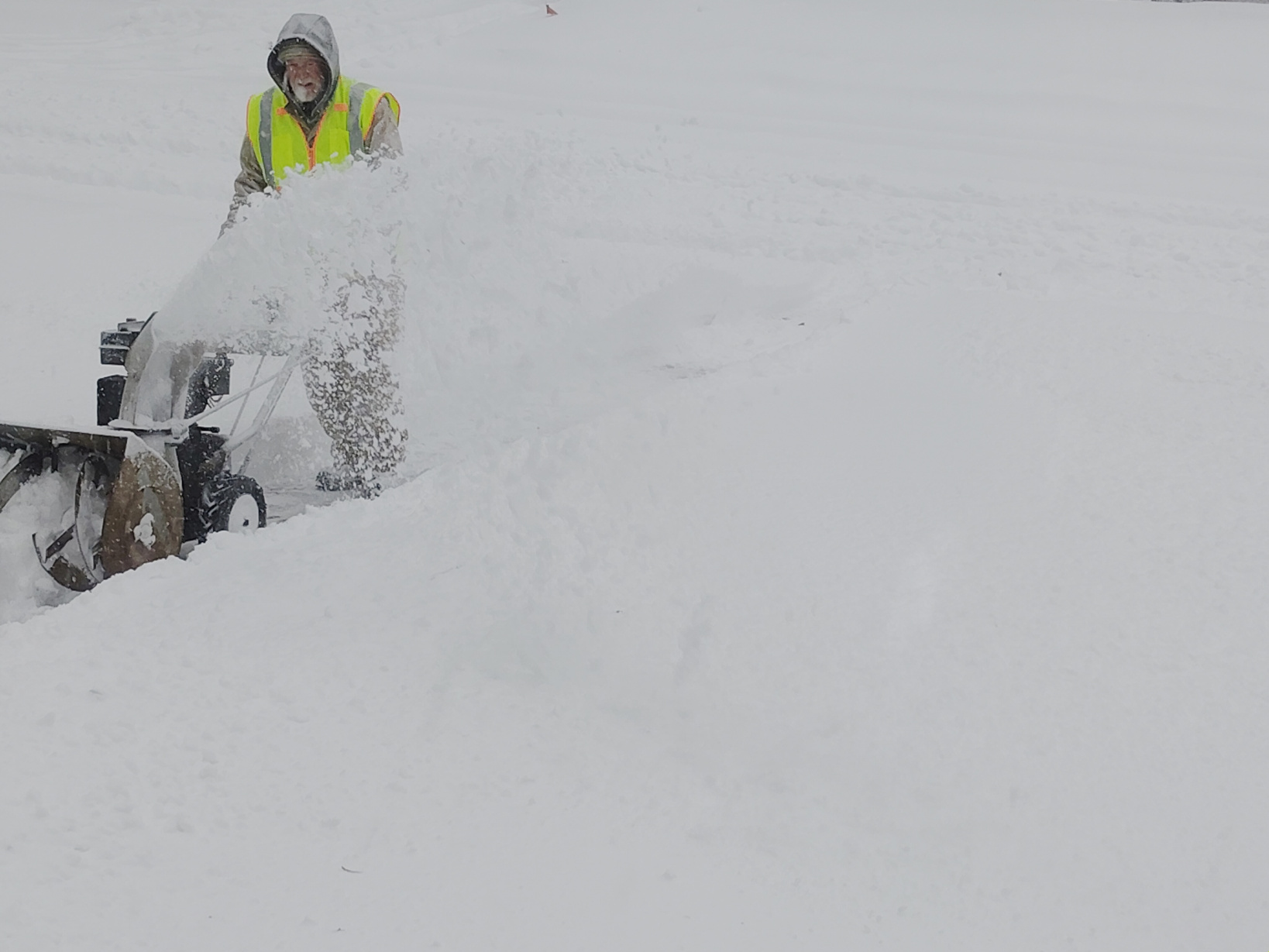
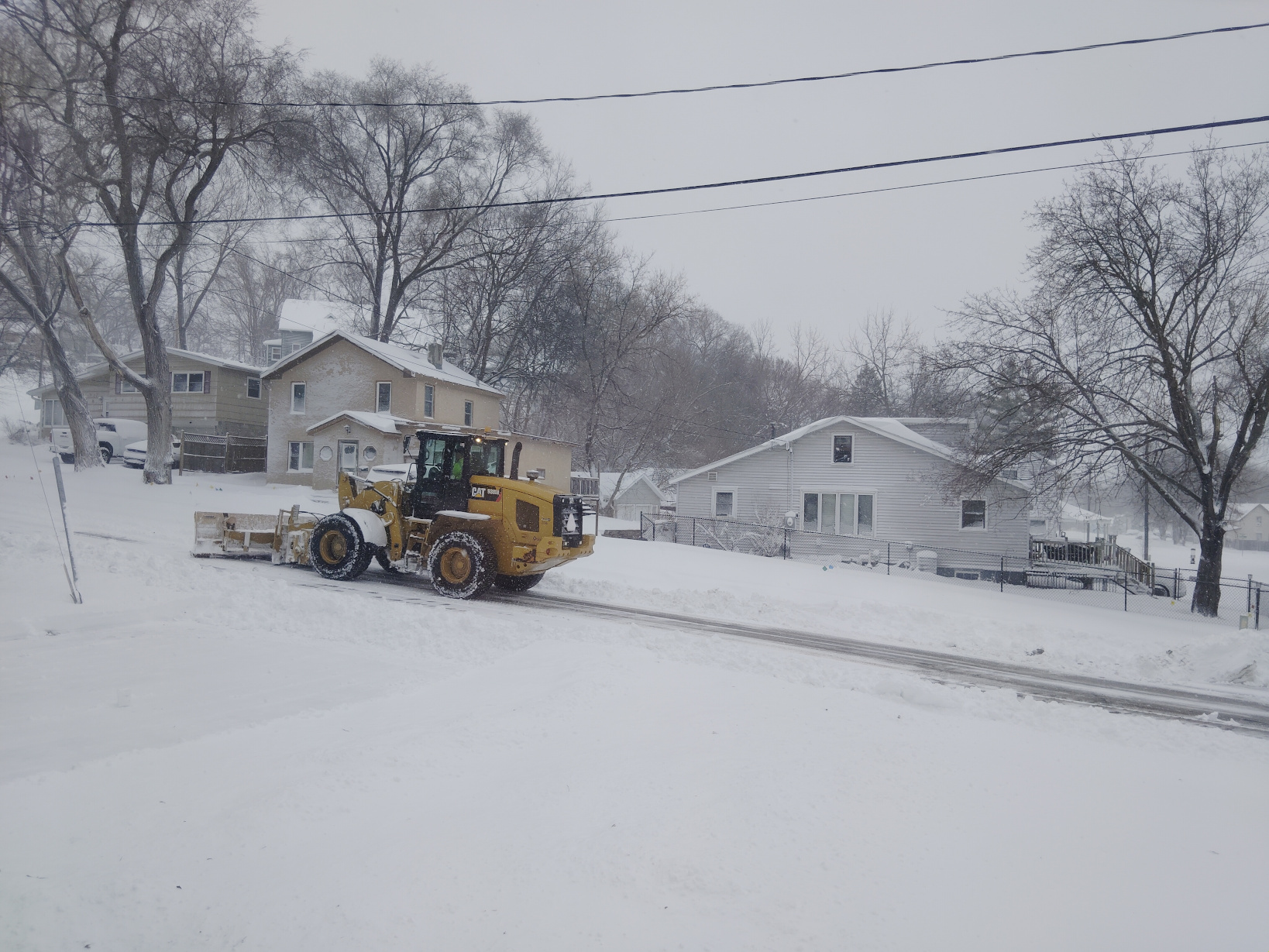
Randy had just finished clearing the driveway and sidewalk when the snowplow came by, filling in the ends of the drive and walk with a deep ridge of snow. Back to blowing. (Minnesota Prairie Roots copyrighted photo March 2026)
Snow is still piling up here, falling thick and heavy. But the Rev. Bonsell gave thanks for the new white snow, which “reminds us to be clean and make a new start in life.” I appreciated her positive perspective, which can be difficult to consider when you’re out shoveling and blowing away snow in fierce winds as Randy did for 1½ hours this morning.
But as I watched the Little Prairie UMC Church service, I felt such peace. Pastor Bonsell has a calming voice, graceful and poetic. As she led the service from her cozy living room, fire blazing in the fireplace, slippers on her feet, sipping coffee, rocking in a rocking chair, I felt the comfort of words offered in song, prayer and in her message, “Restores My Soul” (based on Psalm 23). Said the pastor, “You are never, ever alone.” She also talked about light and darkness, referencing Ephesians 5:8-14 and choosing to live in the light, to choose good.
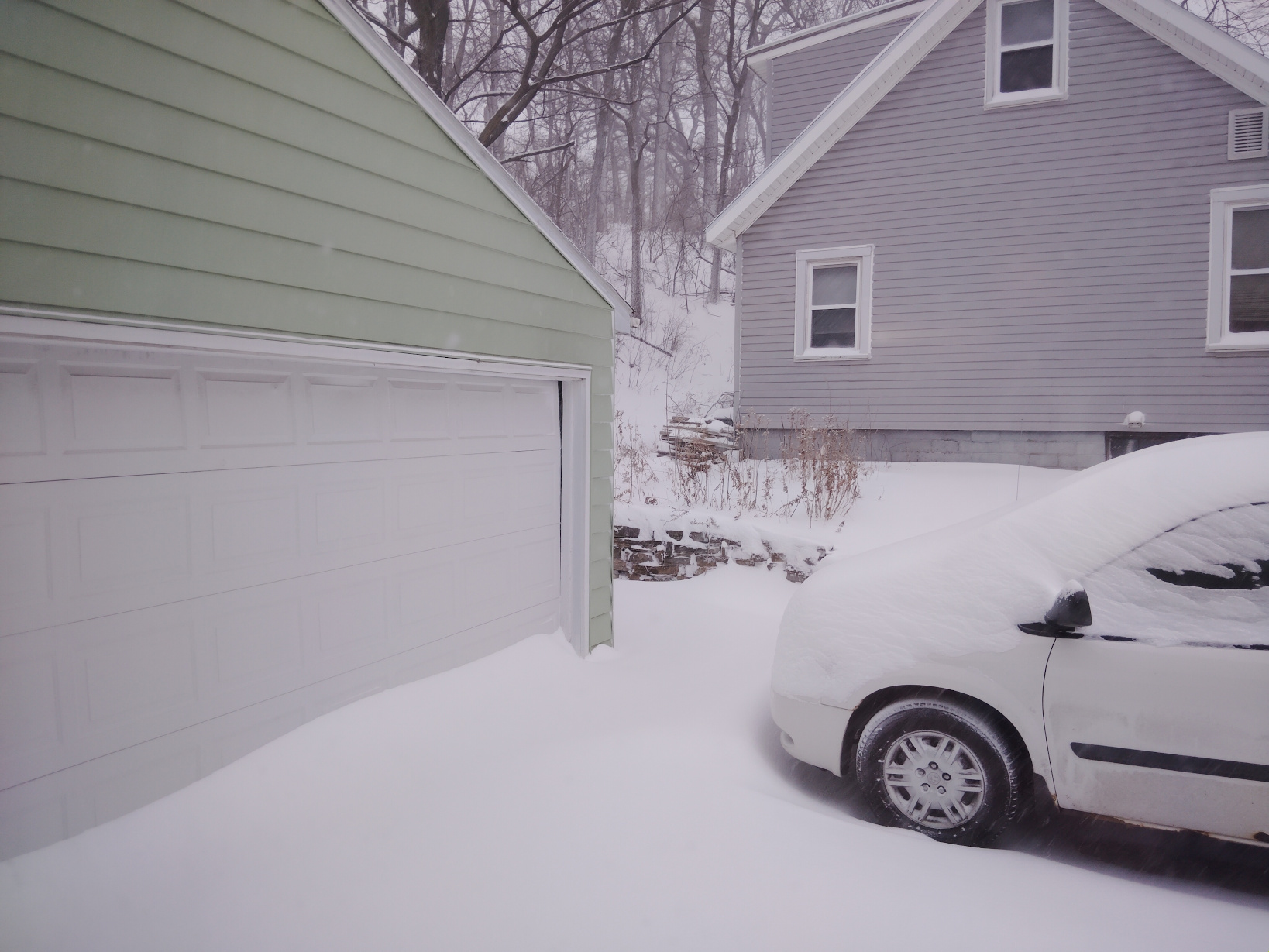
I took this photo early Sunday morning as the wind-driven snow began to pile up against the garage door. (Minnesota Prairie Roots copyrighted photo March 2026)
I didn’t intend to watch a church service when I was shaping the idea of this blog post around our winter storm. I attended worship at my church last evening given this morning’s service was canceled. But then my friend Marian’s words about the puppy and the pastor in slippers drew me to the Little Prairie UMC YouTube video.
Once online, I immediately felt at home in the pastor’s living room. I noticed a pillow with the directive to “Be Kind” positioned on a child-sized rocking chair. The fire blazed. The puppy roamed. Pianist Peter Webb sat poised at the piano.
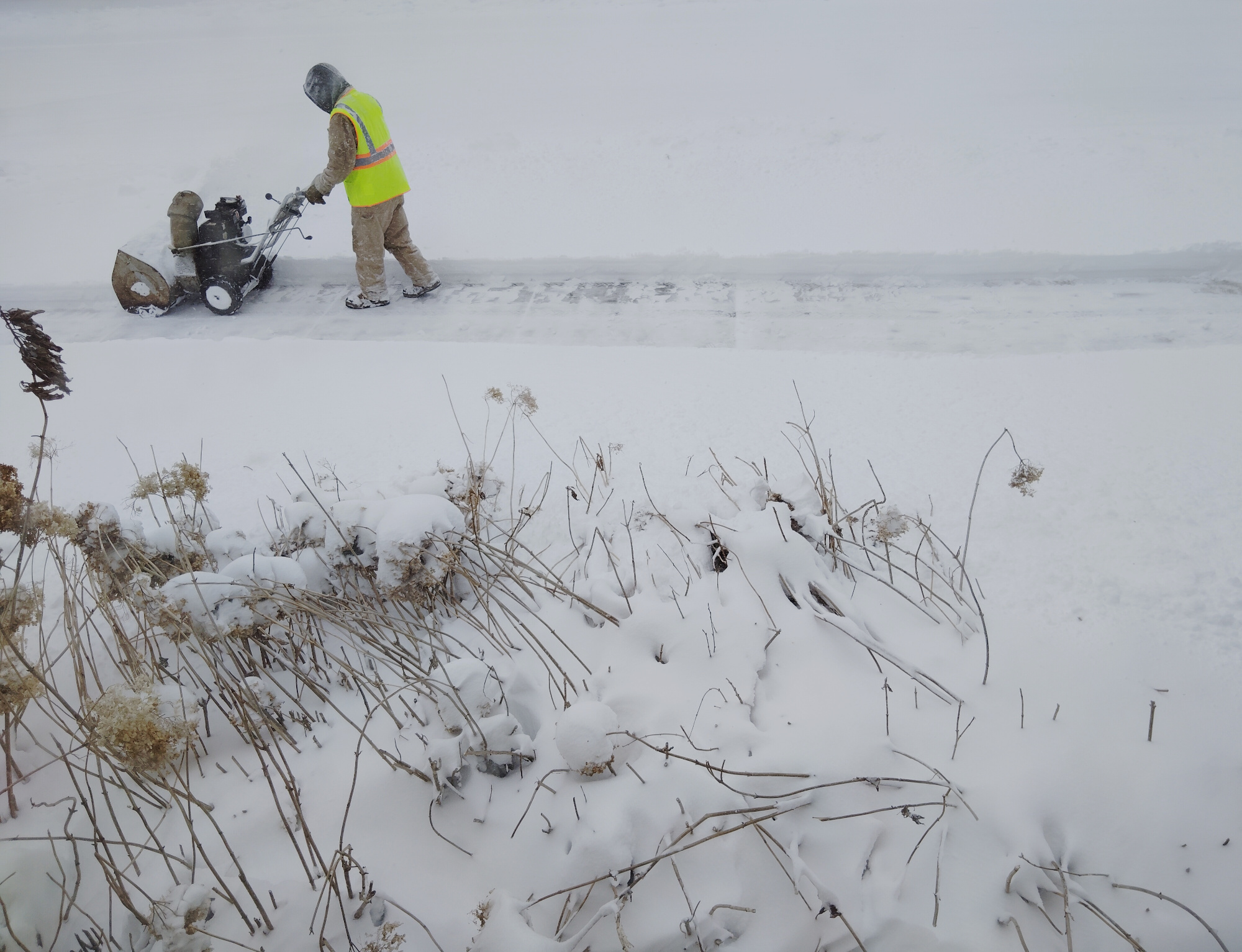
Just like the Rev. Bonsell, I advised Randy to be careful while clearing the heavy snow. Here he blows open the sidewalk with dried hydrangea in the foreground. (Minnesota Prairie Roots copyrighted photo March 2026)
And the Rev. Bonsell, in her welcome on this “snowstormy day” (her words), advised everyone to be careful when shoveling the heavy snow. Then, before beginning the worship service, she asked for more people to make pies and salads for a March 27 Fish Dinner. She announced the Holy Week schedule and a 90th birthday party open house for twins Doris and Doug, showed a video of a youth group bowling outing, and more.
And during a sharing of the peace, typically hand-shaking, the pastor and her husband, Tom, kissed. That sealed it. The snow may be falling at a rapid rate as I write. The wind may be creating chaos in the world outside. But in a small southern Minnesota living room, a pastor brought peace and love in the middle of a blizzard that won’t end until 7 a.m. Monday.
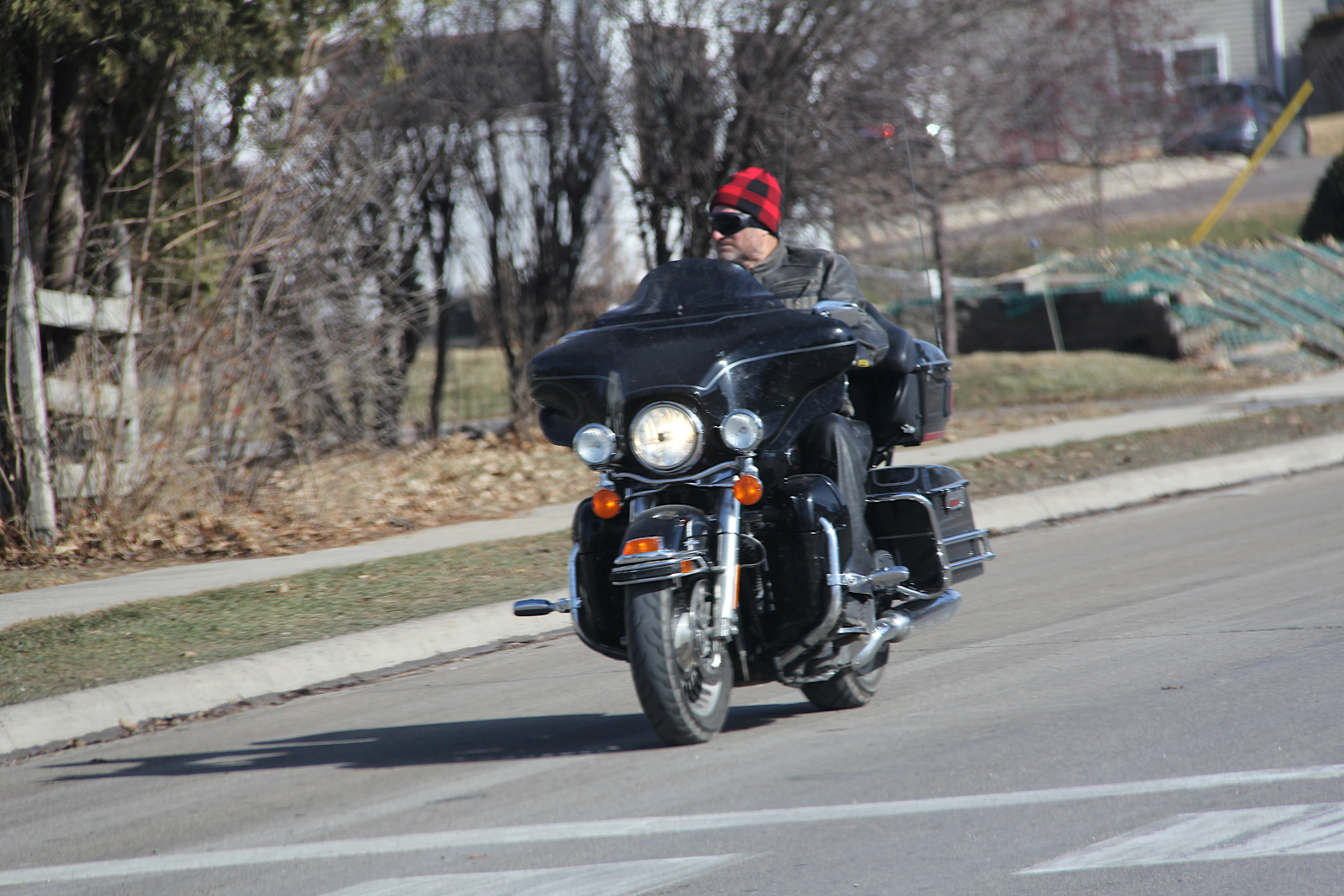
Riding a motorcycle on February 15 in Faribault, Minnesota, temps in the low fifties. (Minnesota Prairie Roots copyrighted photo February 2026)
THE JUXTAPOSITION OF A GUY in a red buffalo plaid stocking cap riding a motorcycle in Minnesota in mid-February struck me as photo-worthy. It’s not often bikers are out and about in winter. But it’s not often either that temps soar into the low fifties as they did here in southeastern Minnesota over the weekend and into Monday.
Randy and I were heading out of town when we happened upon the biker on the east side of Faribault on Sunday afternoon. I grabbed my camera, focused and shot through the passenger side of the windshield. One chance. One shot before the biker took off on Minnesota State Highway 60 toward the viaduct over the Straight River.
With the weather as warm as it was, people were outside in full force. Walking in groups. Riding scooters and bicycles. Walking the dog solo. Hanging laundry outside, me anyway. Washing their vehicles, although we never headed to the car wash.
When the sun shines and temps soar, we Minnesotans realize what a gift this is in the middle of winter. With dropping temps, rain and snow in the forecast for later this week, we understand that a day or three of extraordinary warmth and sunshine are to be savored, enjoyed, appreciated. We know that we still have a whole lot of winter ahead of us and that the weekend’s unseasonably warm temps are not real spring, only a tease.
THIS IS A TOMATO SOUP and grilled cheese kind of day in Minnesota. Or maybe a Chicken Wild Rice Hotdish kind of day, depending on your preference. With that theme, I’ll start today’s post with the weather and move on from there to a potluck of topics.
We are currently in a statewide extreme weather warning with air temps in southern Minnesota well below zero. Factor in the wind and the air temp feels like minus 30 degrees below zero, give or take some degrees depending on location. Overnight, the wind chill plunged into the -40 to nearly -60 degrees in parts of Minnesota. Exposed skin can freeze in five minutes. It’s that kind of brutal, icy cold.
Schools across the state are closed with many transitioning to online learning. Businesses, too, are shuttered, especially in the Twin Cities metro, but not necessarily due to the deep freeze temps.
A sign I crafted for a recent protest in Faribault. (Minnesota Prairie Roots copyrighted file photo)
DAY OF TRUTH & FREEDOM
Today marks a day of economic blackout and protest in Minnesota under the banner of “ICE Out of Minnesota: Day of Truth and Freedom.” Many metro businesses are closed in support of that protest, businesses that have already been negatively impacted by ICE presence in this state. Employees are afraid to come to work. Customers likewise. I’m no numbers person, but I wonder how long small businesses can survive.
ICE Out of Minnesota is a protest against federal government immigration enforcement here. The protest is a show of solidarity with the unified message of Get ICE out of Minnesota.
We are a hardy bunch. Vice President J.D. Vance, who was in Minnesota yesterday, unknowingly alluded to that when he stated, “We’re seeing only this level of chaos in Minneapolis.” Now I disagree with his word choice of “chaos.” I would use “resistance” instead. But his statement tells me that peaceful protesters, legal observers and anyone (including elected officials) who challenges the federal government spin and ICE actions are getting under his skin and that of other feds. I wonder if Vance considered for a moment that the presence of 3,000 federal agents in Minnesota is unnecessary, horrible, traumatizing, morally wrong and is raising our ire. Nah, probably not.
I’ve participated in multiple protests in Minnesota. I am not a far left agitator, a paid protester or rioter nor are any of the people with whom I’ve protested. We are concerned Americans raising our voices. We are standing up for our neighbors, calling out the federal government and showing that we care about freedom. (Minnesota Prairie Roots copyrighted file photo October 2025)
LAUGHABLE STATEMENTS
While here, the vice president called for local and state government officials to “meet these guys (federal immigration agents) half way” per the directive of the president. That’s laughable since Vance didn’t even meet with Governor Tim Walz or Minneapolis Mayor Jacob Frey while in Minnesota. You’d think he would have and could at least correctly pronounce Frey’s name. Nah, why bother?
During his talk, Vance showed anything but a cooperative spirit. Rather, he blamed—the media for lying, “far left agitators” and “rioters” for causing chaos, elected Minnesota officials and law enforcement for not cooperating, and even the family of 5-year-old Liam Conejo Ramos for his detainment. And on and on.
Vance repeatedly stated that ICE action is being taken out of context. Really? He also stated, in answer to a reporter’s question, that the federal government is not trying to send a political message via 3,000 agents sent to Minnesota, but rather trying to enforce the law. Really?
(From the Minnesota Prairie Roots files)
ONWARD WITH GRATITUDE
So onward we go here in Minnesota. I want to take a moment to thank everyone who is staying aware of what is occurring in my beloved state. This could be your city or state next, depending on political leaning. Thank you for standing in solidarity with Minnesotans. Thank you for protesting, for calling your elected officials, for helping your neighbors, for recognizing the threats to our freedom, for showing your humanity in loving words and actions. Your support matters to us in Minnesota. We are grateful.
FYI: I direct you to Minnesota Public Radio as a trusted source for ICE-related and other stories in our state.
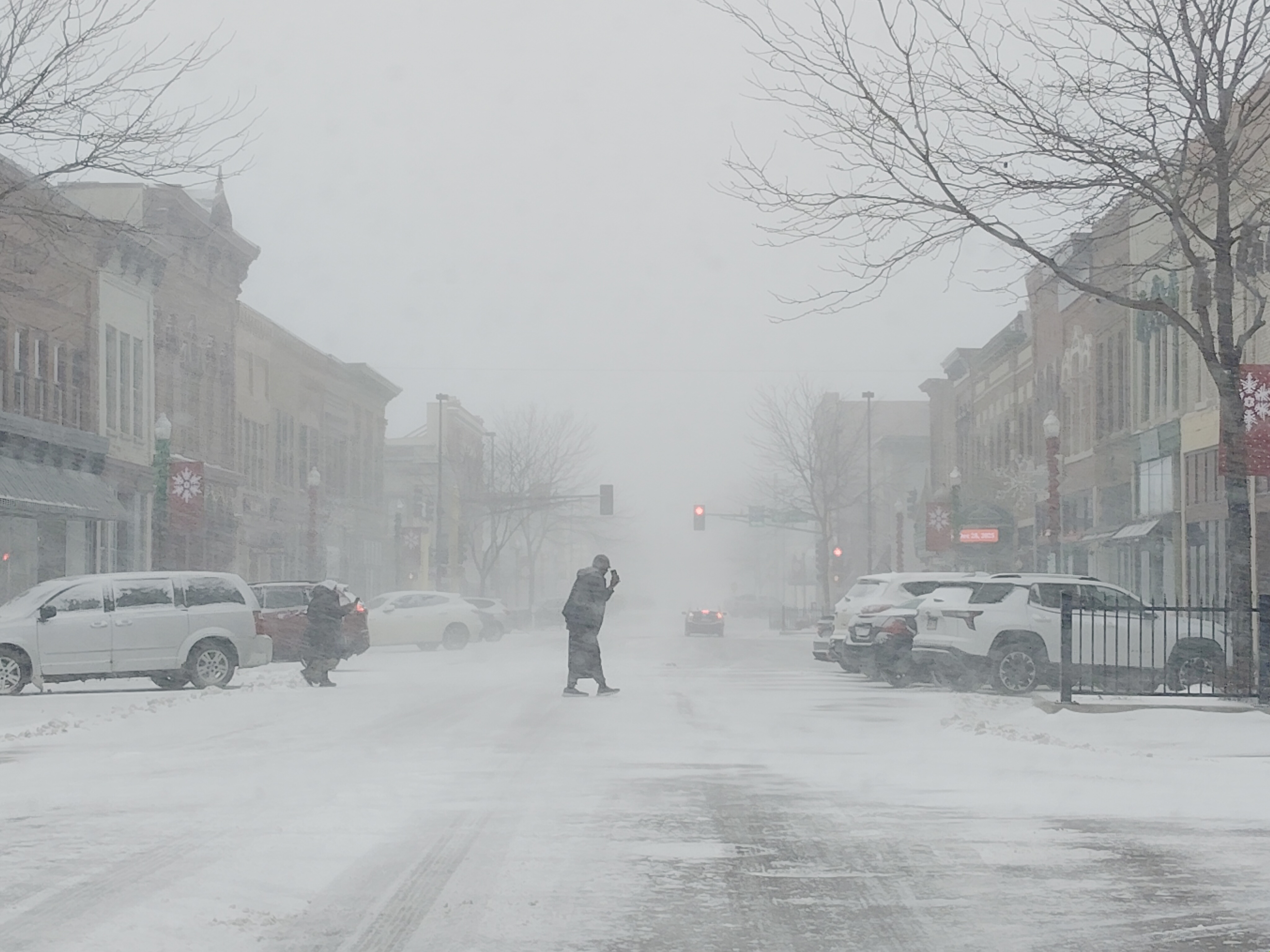
Pedestrians cross Central Avenue in downtown Faribault during a blizzard Sunday afternoon. (Minnesota Prairie Roots copyrighted photo December 2025)
IT’S LATE SUNDAYAFTERNOON and we should be on the interstate right now driving from Faribault to Minneapolis St. Paul International Airport. But instead, wicked winter weather changed everything. We are hunkered down at home, in the midst of a good old-fashioned Minnesota blizzard predicted to drop as much as 10 inches of snow on our area.
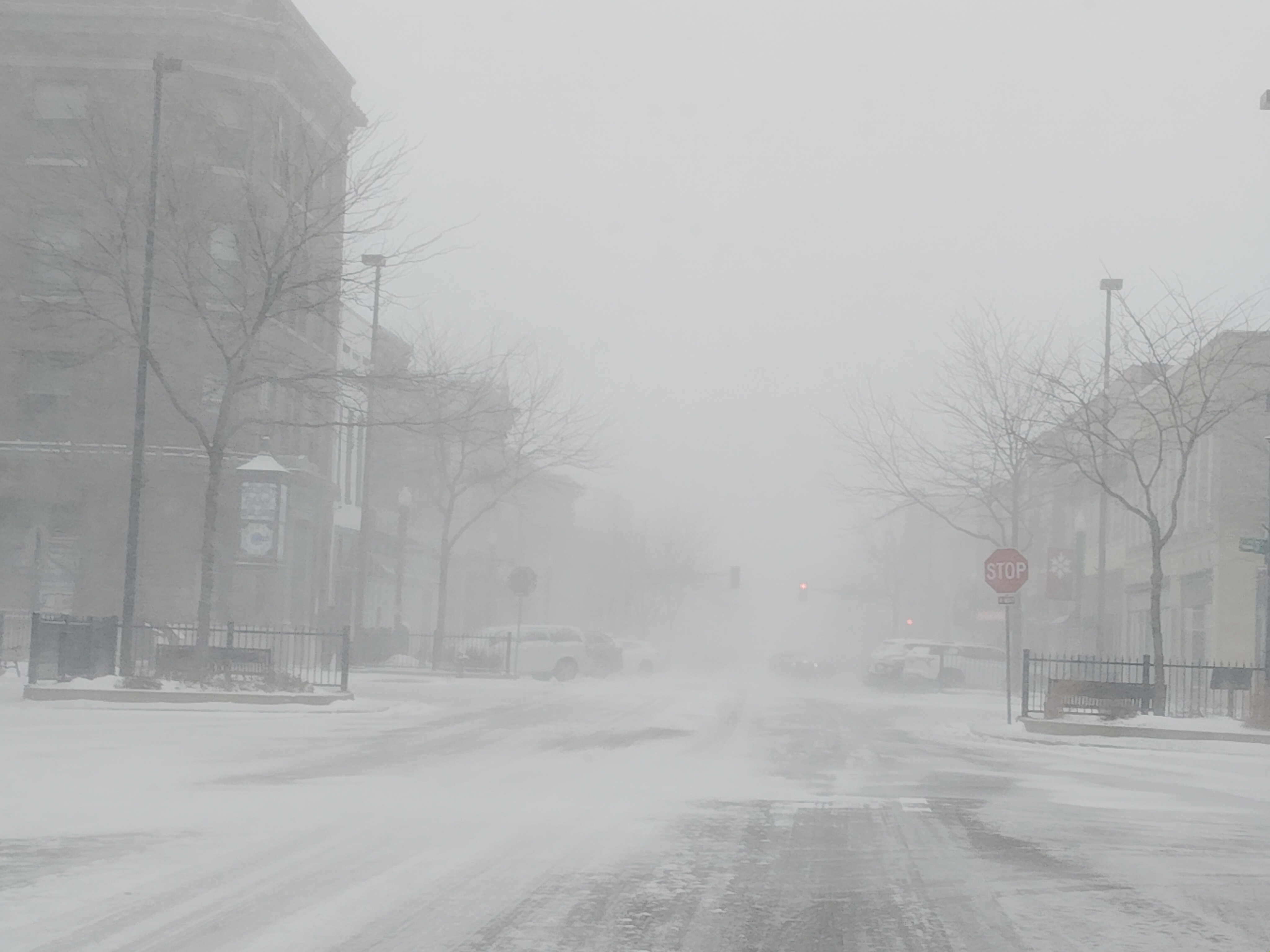
Another view of Central Avenue looking north. You can barely see the stoplight a block away. (Minnesota Prairie Roots copyrighted photo December 2025)
Fifteen minutes to the south, Interstate 35 southbound is closed from Owatonna into Iowa. Travel is not advised in many areas, including north of Faribault, the direction we would be going. There are crashes, spin-outs, jack-knifed semis. Snowplows have been pulled in some counties due to deteriorating conditions with wind whipping snow, creating white-out conditions.
And at the airport, where we should be headed to drop off our son for his 7 pm flight back to Boston, cancellations and delays are stacking up. Saturday afternoon he rebooked to an early Tuesday morning flight per our suggestion. We did not want to be driving on Interstate 35 to the airport in a blizzard.
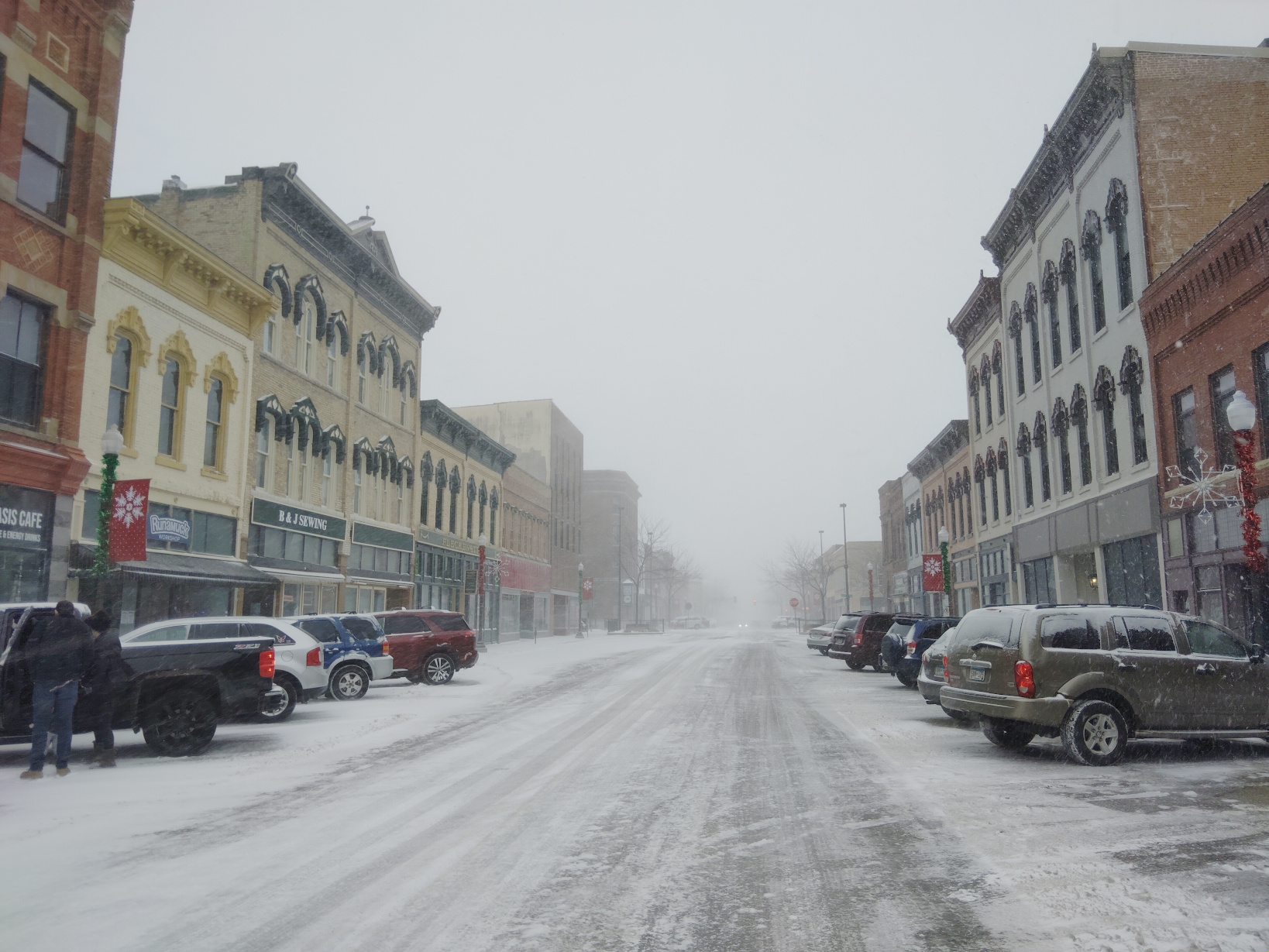
The scene as we left Gather on Central around 3:15 pm Sunday. (Minnesota Prairie Roots copyrighted photo December 2025)
But Randy and I did head downtown Faribault, a short drive from our house, to celebrate a friend’s 80th birthday earlier this afternoon. In the 90 minutes we were there, weather conditions worsened substantially. The wind picked up, swirling snow along Central Avenue. If things look this bad in town, I can only imagine how conditions are in the open countryside.
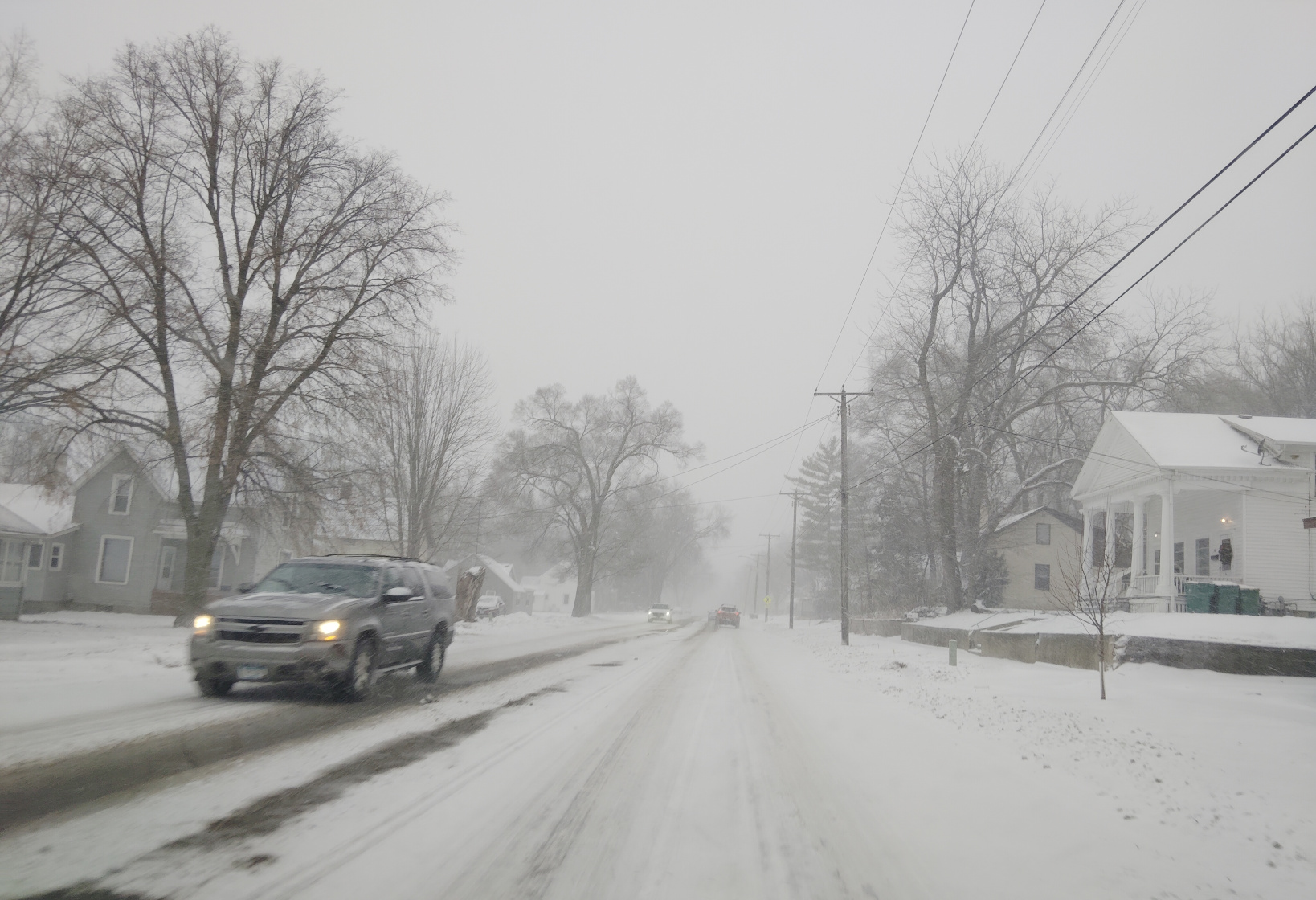
Willow Street in Faribault Sunday afternoon a block from our home. (Minnesota Prairie Roots copyrighted photo December 2025)
Yup, I’m thankful to be home and not attempting a trip to the airport. The son can work remotely on Monday. We’re all safe, sheltered inside waiting out this blizzard.
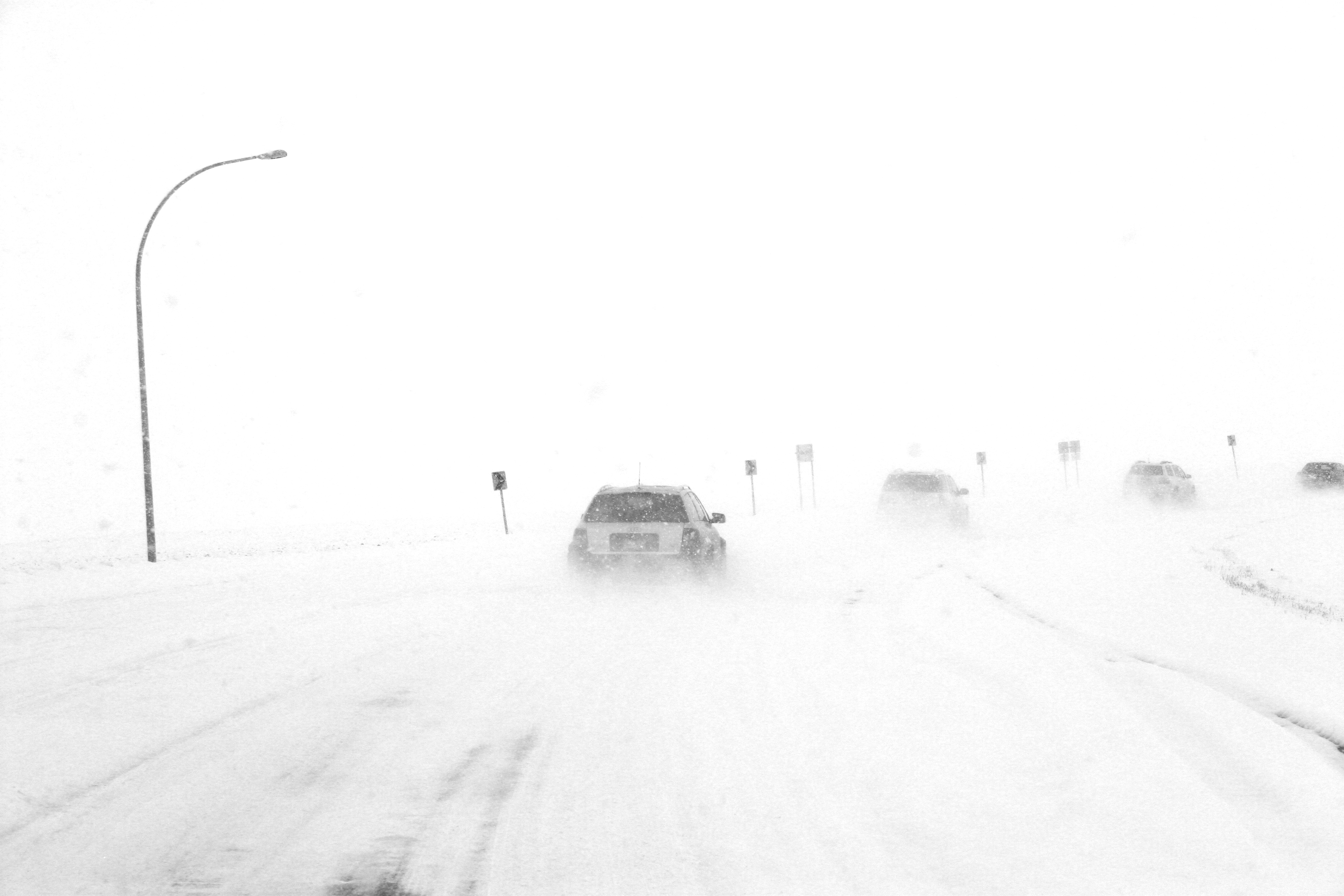
Winds and blowing snow produce near white-out conditions during a past winter storm in southern Minnesota. (Minnesota Prairie Roots copyrighted file photo)
“I DIDN’T THINK it would be that bad,” Randy said. Neither did I.
But our drive to and from Minneapolis-St. Paul International Airport Thursday afternoon to get our son, arriving from Boston, proved difficult and stressful. Let me set the scene.
As we headed out of Faribault toward Interstate 35 shortly after lunch, freezing pellets pinged our windshield and the wind blew fierce, limiting visibility. And we weren’t even out of town.
A WICKED WIND
Once on the interstate, though, the precipitation soon stopped. But the wind gusted with such ferocity that I could feel it tugging at the van and observed semi truck drivers struggling to keep their rigs in their lanes.
Yet, the wicked 40 mph winds—or whatever ridiculous speed they reached—dried the pavement of the rain that fell earlier in the morning. That rain later transitioned to intermittent snow as temps continued to drop throughout the day. The morning temp started at nearly 40 degrees.
We detoured from our airport route to stop at our nephew’s house in Apple Valley to pick up a Christmas gift and stained glass supplies. Within that 45-minute visit, the weather worsened. But, surprisingly, our son’s flight arrived 15 minutes early. Here I’d been concerned about a possible late arrival due to weather conditions.
As we got onto Cedar Avenue aiming for the airport, traffic volume increased. We blended into the traffic flow, proceeding with caution like almost everyone else. Except the usual few motorists who do not drive for conditions. Snowplows were out sanding and salting and spreading whatever to de-ice road surfaces.
WAITING & MORE WAITING
I thought we would be late and Caleb would be waiting for us inside the terminal. But no. He was waiting for his luggage. We waited in the cellphone lot for a good half hour as he waited for his bags. Yes, a lot of waiting.
Eventually we were back in bumper-to-bumper traffic as vehicles crept toward passenger pick-up. This always feels like a game of chicken to me, trying to wedge into the gridlock so your loved one can see you and get safely to your vehicle. Eventually we reached door four, spotted Caleb, hefted his mammoth suitcase into the back of the van, placed the backpack behind the driver’s seat, grabbed a quick hug and started home.
AT LEAST WE’RE MOVING
Traffic congestion continued, although we were moving. And moving is always better than not. I just wanted to get home before the weather got worse, before rush hour traffic peaked and because, well, I really had to pee. It’s not the first time I’ve wished for a porta potty in the cellphone lot.
To move this story along, once we got farther out of the metro, past Elko New Market, traffic lessened. The wind still blew fierce and snow fell. We were in wide open country, rural Minnesota. The wind swept the snow away like a broom, leaving traffic lanes clean.
SNOW GATES
All was going fine until we got about 10 miles from Faribault. Visibility wasn’t reduced to white-out conditions, but wind-driven snow diminished visibility considerably in some spots. “I bet they closed the snow gates in Owatonna,” I said in the midst of all this. Snow gates, if you’re unfamiliar with the term, are actual gates pulled across the top of entrance ramps to keep motorists off the interstate during a winter storm.
I haven’t read any media reports that Interstate 35 snow gates were closed yesterday. But I did read of a multi-vehicle crash that happened on I-35 between Owatonna and Ellendale at 3:15 pm in blizzard-like conditions. That closed the southbound lane for three hours. Owatonna is a 15-minute drive south of Faribault.
We arrived home at 3:30 pm, safe and sound with an hour to spare before dark. Soon thereafter, our eldest daughter texted that no travel was advised in Rice County. We’d gotten home just in time as our county was now among many Minnesota counties in a blizzard warning. We cozied in for the night while the wind howled, me thankful that we made it to the airport and back without incident.
This morning we awoke to sub-zero temps. And a fresh layer of snow to shovel.
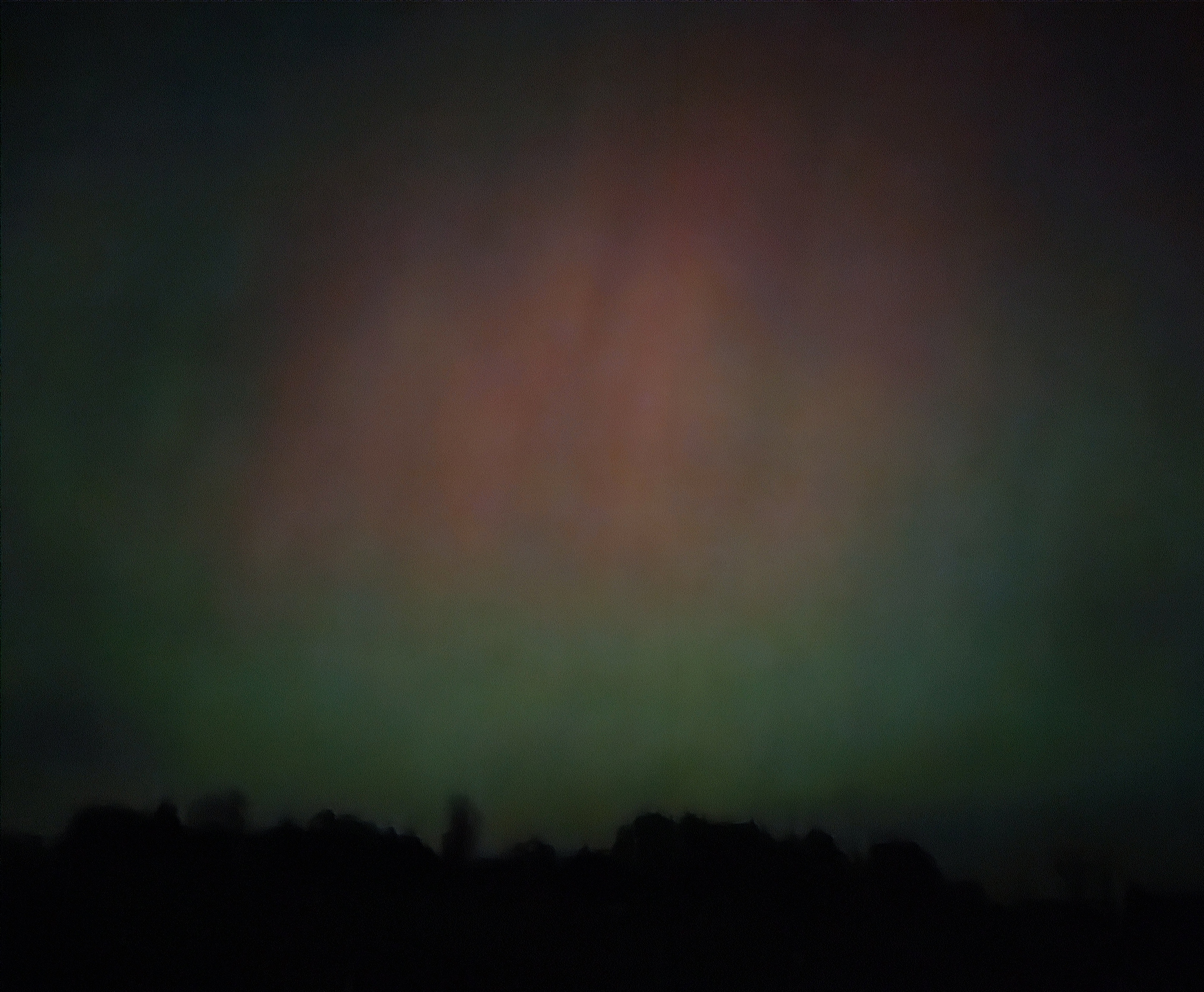
The Northern Lights, photographed northeast of Faribault near Cannon City (with a treeline in the foreground) around 9 p.m. Tuesday, November 11. (Minnesota Prairie Roots copyrighted file photo November 2025)
IT TOOK A LIFE TIME, but I finally saw the Northern Lights for the first time. Ever. And they were poetic, artistic, inspiring, incredible, wondrous, glorious…all the adjectives you can use to describe a dark night sky colored with streaks of green, red and pink.
Randy and I were sitting comfortably in the warmth of our southern Minnesota home Tuesday evening when our son texted that he could see the Northern Lights even in the city lights of Boston. A photo proved it. Then the daughter who lives 35 minutes to the north of us texted that they, too, could see the lights in Lakeville, south of the Twin Cities. Photos proved it.
We popped up, grabbed our coats and set out to see for ourselves. We didn’t have to drive far into the countryside before we noticed the first streaks of light. Turning onto a gravel road, we parked, stepped outside and turned our eyes heavenward. Then we eventually tried to figure out how to photograph the majestic scene above us on our smartphones, with only minimal success.
While I would have loved some spectacular images, what matters most is that I saw, with my own eyes, that which I’ve wanted to see my entire life. Others were doing the same. We counted about a dozen vehicles parked along rural roads, the occupants gazing skyward.
This imprinted upon me how something like the Northern Lights can bring people outdoors, appreciating this beautiful natural world that surrounds us and, which on this November evening, put on a spectacular light show.
TELL ME: Have you seen the Northern Lights? When and where? How would you describe them?
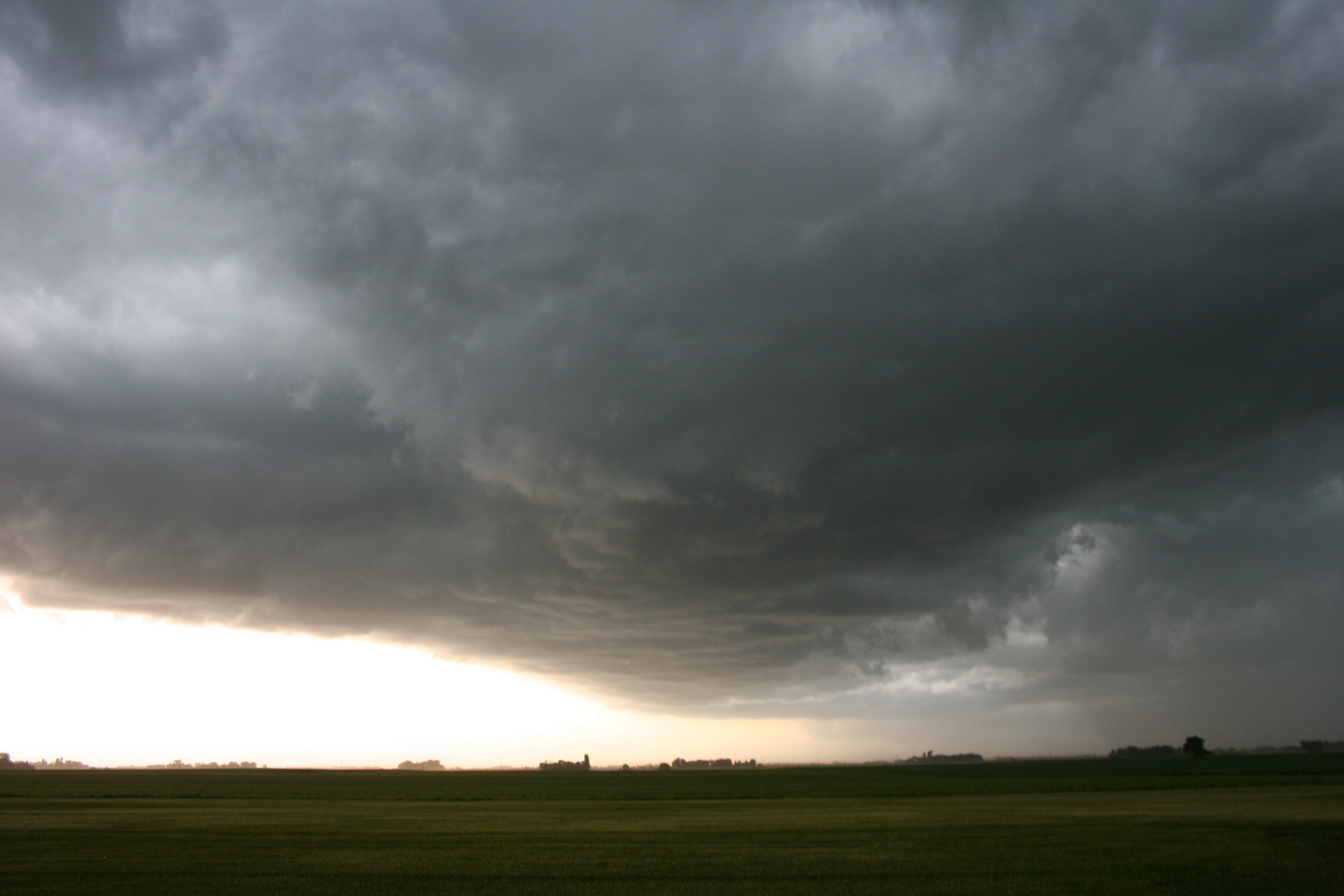
These are the most menacing (at least to me)clouds I’ve ever photographed. I shot this image in July 2011 on a friend’s country acreage between Faribault and Nerstrand. I don’t have any photos from yesterday as I was hunkered in my basement. (Minnesota Prairie Roots copyrighted file photo July 2011)
I OWE YOU a weather report.
The much-touted level 4 risk (out of 5) of severe storms here yesterday did not materialize. At least not in Faribault. But just to the east it did. A confirmed tornado touched down southeast of town in Richland Township, destroying several farm buildings and damaging a silo on a neighboring farm. That’s close enough for me. I feel badly for that farm family. Property damage was also reported by the Rice County Sheriff’s Department near Morristown, which is southwest of Faribault.
While that was happening, Randy and I were sheltering in our basement after warning sirens sounded just before 5:30 p.m. I’d prepared, earlier in the day gathering documents and items (yes, including my camera and Randy’s hearing aids) that I didn’t want blown away in a storm. My retired National Weather Service friend, who grew up in southwestern Minnesota, was keeping me updated on the weather throughout the day.
“PLEASE, JUST GET HOME.”
The biggest issue for me was that Randy was not yet home when the emergency sirens went off. I’d tried several times to reach him at work late Monday afternoon to warn him of the bad weather moving into our area. But his cellphone mostly doesn’t work inside the pole shed style garage in the countryside near Randolph. I texted and called numerous times in hopes that he might actually be in a part of the building with cell reception. I finally resorted to phoning the main garage in nearby Cannon Falls. Ideally, whoever answered could ring up Randy in the machine shop. That didn’t happen.
While I wanted Randy home, I really just wanted him safe. A pole shed, with no place to shelter, offers no protection during a storm. And I had no idea how weather-aware he was staying. Probably not too much given he’s swamped at work. He can’t hear warning sirens either.
In the end, it all worked out. Randy pulled into the driveway after sirens had been sounding for awhile. He’d stopped at the Faribault compost pile to drop off plant debris rather than driving directly home. Really? While sirens are wailing and a storm is moving in?
THREE LAUGHING EMOJIS
I recognize that Randy doesn’t fear storms. He doesn’t have the storm history that I do. I’m the one hustling us to the basement. It’s a bit of a joke with our adult kids. The second daughter, who lives in Madison, Wisconsin, texted yesterday, “Randy, get in the basement!” with three laughing emojis. Humor helps in a tense situation.
Many Minnesotans were not laughing yesterday as storms rolled in with tornado and severe thunderstorm warnings resulting in damaging winds and hail and that confirmed tornado between Faribault and Kenyon.
FEELING GRATEFUL THIS MORNING
This morning the sun is shining, popping through massive clouds in a deep blue sky. Crisp, cool air has replaced the heat and humidity of yesterday. Snow even fell in parts of northern Minnesota. Yesterday’s storms are behind us. I, for one, am thankful that strong tornadoes did not develop, that the National Weather Service and Twin Cities TV meteorologists prepared us and kept us informed, that my NWS friend, Brad, updated me and that Randy finally got home. Now, if only his cellphone would work inside that pole shed a 32-minute drive away. I’d feel much better next time severe weather rolls in.
#
TELL ME: If you live in Minnesota or a neighboring state, did you experience any storms and/or storm damage on Monday? How do you react to storms, including warning sirens going off?
Surveying the destruction at Tracy Elementary School, which was destroyed by a June 13, 1968, F5 tornado. (Photo by The Tracy Headlight Herald and courtesy of Scott Thoma)
FOR DAYS NOW WE’VE HEARD the warnings and been advised to prepare for impending bad weather in parts of Minnesota and Wisconsin. Here’s the latest from the National Weather Service website as of early Sunday afternoon: Regardless of the risk level, an episode of dangerous weather is likely Monday, with all hazards possible…
The NWS breaks that weather threat down to include tornadoes (a few strong), large hail, damaging winds and frequent lightning. OK, then. I’m listening.
I live in southern Minnesota, which is under a “moderate” risk of severe storms. Now that word choice may not sound all that threatening until you consider that “moderate” ranks as number four on a scale of one to five. “High” risk, #5, tops the scale. Central and eastern Minnesota and western Wisconsin fall in this “moderate” risk area for severe weather.
Weather forecasters seem pretty confident in their predictions. So I have to go with what they’re saying and remain watchful and informed. And stay in contact with my friend Brad, a Minnesota native who lives in North Carolina and is retired from the NWS. He’s like my personal weather forecaster. (Thanks, Brad.)
Eric Lantz, 16, of Walnut Grove, shot this award-winning photo of the Tracy tornado as it was leaving town. He often took photos for the Walnut Grove Tribune, owned by his uncle, Everett Lantz. This image by Eric was awarded third place in the 1968 National Newspaper Association contest for best news photo. (Photo credit and copyrighted Eric Lantz)
I emailed Brad that “I really really really don’t like tornadoes,” not that anyone does. But I do have a bit of history with tornadoes stretching back to June 1968. On June 13, 1968, a violent F5 tornado with wind speeds of 261-318 mph devastated the small southwestern Minnesota town of Tracy, killed nine and injured 125. Days after that deadly twister, Dad, Mom, my siblings and I piled into the car for the 25-mile drive south of our family farm to view the destruction. The imprint of those scenes has stuck with me, which is likely the reason I respect and fear tornadoes.
More recently, in September 2018, five tornadoes (the largest an EF2) swept through my county of Rice, including in Faribault. Randy and I sheltered in our basement as strong winds raged, ripping the electrical mast from our house and downing trees throughout our neighborhood and nearby. It was frightening to be huddled in the basement, to hear that roaring wind and then to be plunged into darkness. But damage to our property was minimal. And no one was killed or injured in the county. Today I can look out my office window or walk into my backyard to see visual reminders of that severe storm in what I call “tornado trees.”
Going back further, I recall seeing the destruction in St. Peter, 40 miles to the west of my community, after a tornado touched down there on March 29, 1998. A young boy died. A childhood friend lost his home. Prior to reaching St. Peter, the tornado devastated Comfrey in southwestern Minnesota.
In 1980, a tornado took down a silo, tossed a silage wagon, ripped the railing off the house and more on my childhood farm. That was literally too close to home. It was home. I was working as a newspaper reporter some 65 miles away and raced back to Vesta the next day to see the damage. While working as a reporter in Gaylord, I also reported on and photographed damage left by a tornado.
On July 7, 2011, downbursts during severe weather heavily-damaged my childhood church, St. John’s Lutheran, and caused other damage in my hometown. In neighboring Belview, an EF1 tornado touched down on that same date causing widespread destruction. My personal weather forecaster friend, Brad, grew up in Belview.
A residential street in Tracy, once covered in branches and debris, had to be plowed to allow vehicles to pass following a June 13, 1968, tornado. (Photo by The Tracy Headlight Herald and courtesy of Scott Thoma, Tracy native and author of “Out of the Blue,” a book about the Tracy tornado)
Yes, I have a history with severe storms and tornadoes. How about you?
Be alert, prepared and safe, everyone, especially my friends in Minnesota and Wisconsin.
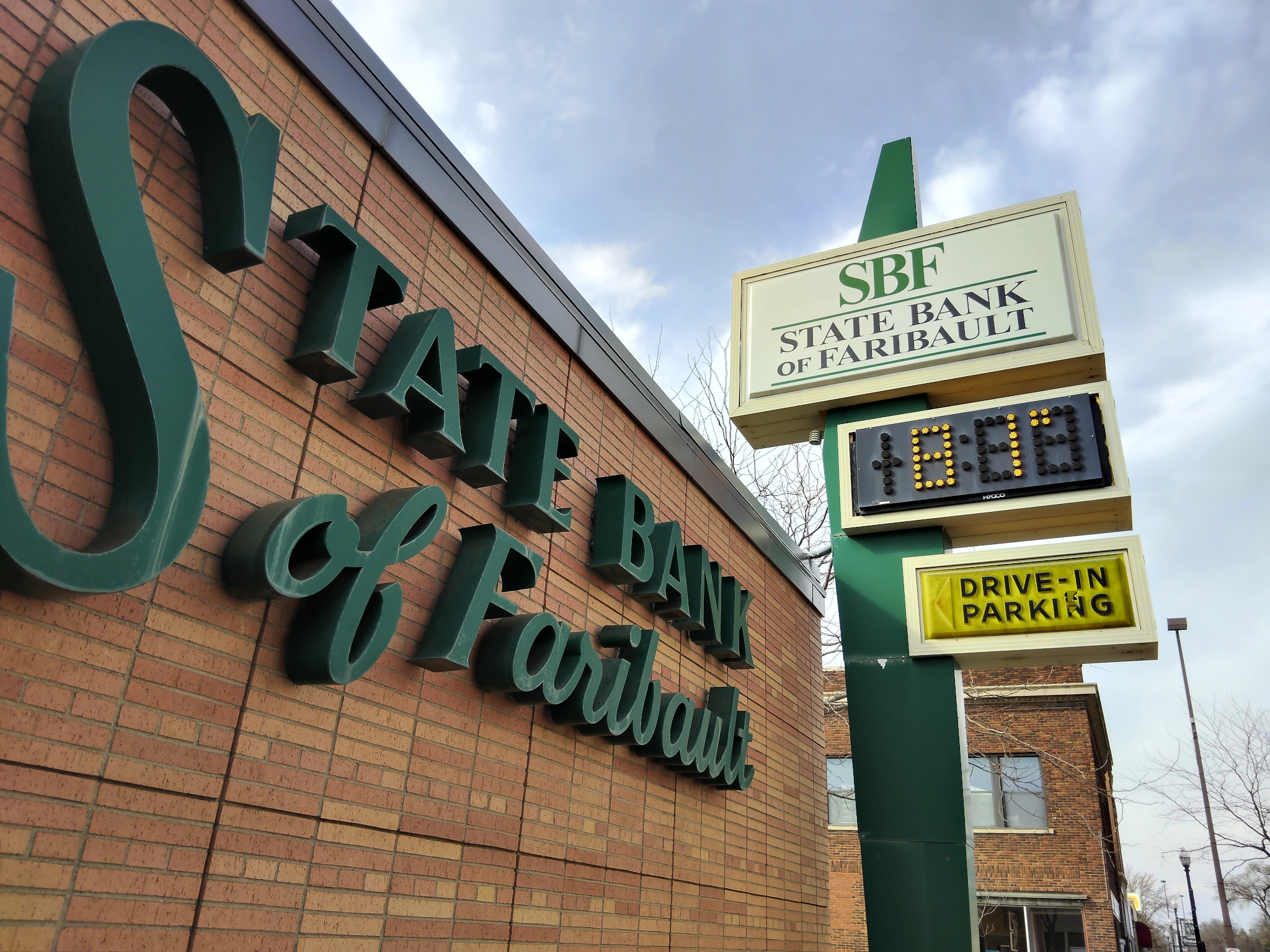
This photo taken at 4 p.m. Friday, March 28, shows the unusually high March temperature in Faribault. (Minnesota Prairie Roots copyrighted photo March 2025)
TWENTY-FOUR HOURS AGO, the temperature registered 81 degrees on the State Bank of Faribault sign in our historic downtown. At 4 p.m. Saturday, the temp read 38 degrees. That’s a 43-degree plunge. Such is the fickle nature of weather in southern Minnesota. One day summer. The next day winter.
Let’s talk that one day of summer. The two oldest of our three grandkids were here for a sleep-over Thursday into Friday afternoon. We took full advantage of the unseasonably warm temps with lots of time outdoors. Who wants to stay indoors when the sun is shining, the breeze is blowing and it feels like summer? None of us.
So out we went Friday morning, first to hang laundry on the clothesline, which didn’t interest Izzy, almost nine, and Isaac, six, quite as much as I had hoped. “We have a dryer,” Izzy informed me as she handed me clothespins. So does Grandma. But Grandma prefers hanging laundry outdoors, under the sky, under the sun, in the wind.
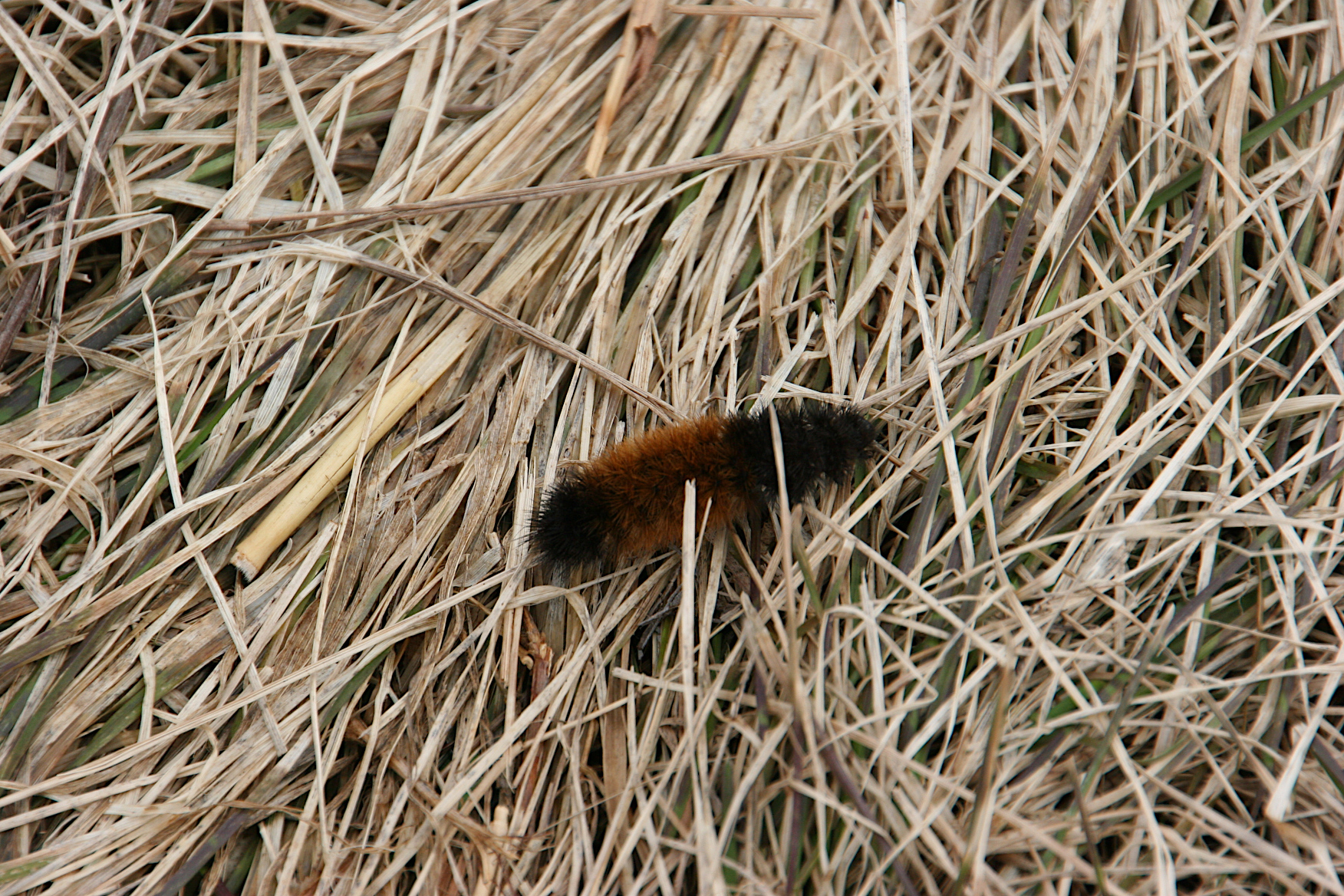
This looks just like the caterpillar found in our backyard on Friday morning. (Minnesota Prairie Roots copyrighted file photo)
A CATERPILLAR, SQUIRRELS, BRAMBLES & A ROCK
Time outdoors led to discoveries, like the woolly caterpillar Izzy found in the backyard and which she insisted was poisonous. I insisted it was not while using a dried maple leaf and a piece of bark to move the fuzzy ball to a safe place in a flowerbed. She worried and warned that I was not to touch the poisonous caterpillar. “Izzy, it’s not poisonous,” I repeated. I’m not sure she believed me.
We noted all the holes dotting the backyard, spots where squirrels dug for hidden walnuts. Empty shells littered the dormant lawn.
The previous evening, Grandpa led Izzy and Isaac up the hill through the woods behind our house. It’s a bit of a climb past fallen branches and brambles. But they were adventurous, determined to make it to the top, to Wapacuta Park. There they found the playground equipment rather scary—Grandpa concurred—but a gigantic rock a whole lot of fun as they scampered atop it. This is the same mammoth rock their mom, aunt and uncle climbed as kids. Life come full circle.
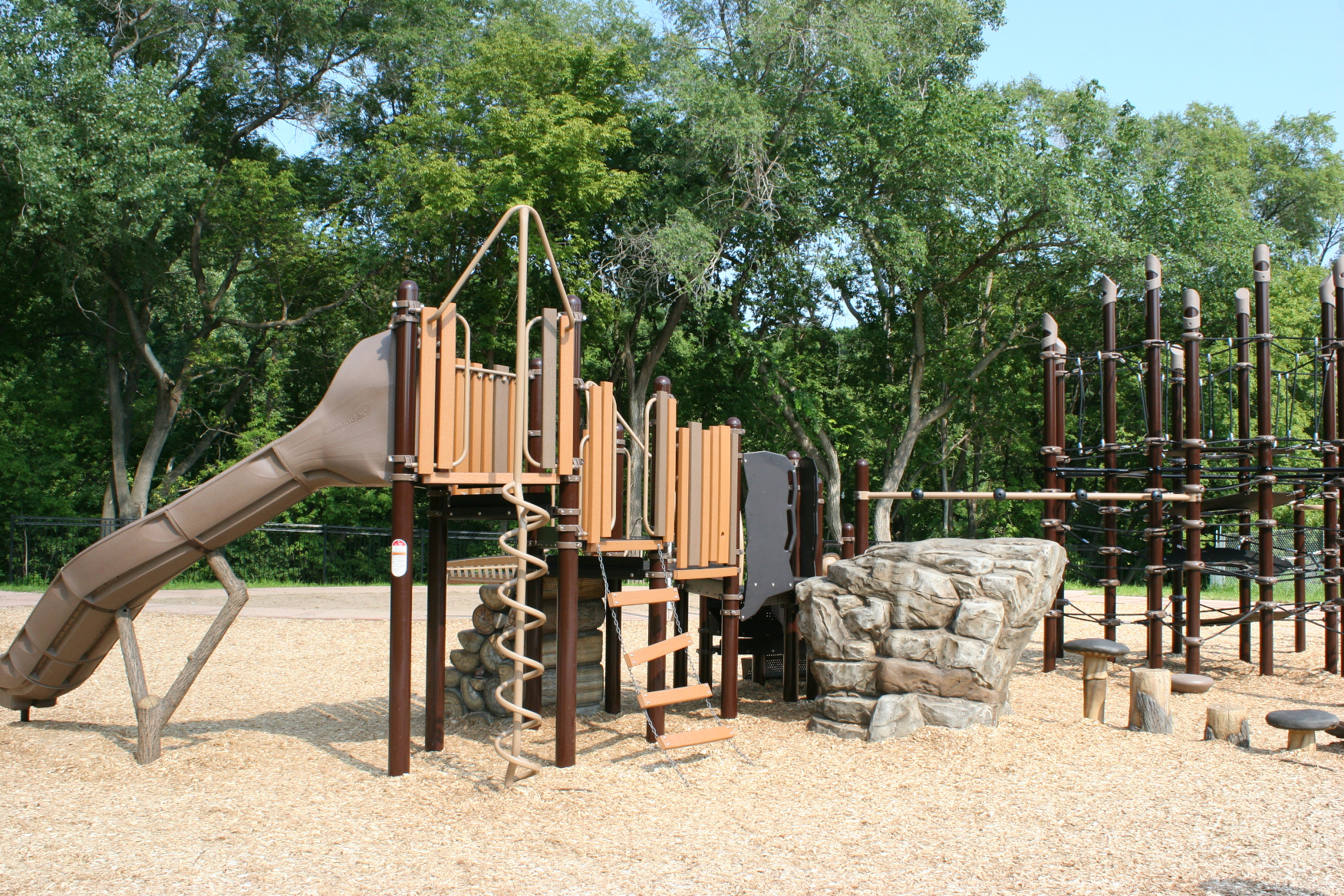
The Fleckenstein Bluffs Park playground. (Minnesota Prairie Roots copyrighted file photo)
TIME TO PLAY & TIME TO ASK SERIOUS QUESTIONS
Late Friday morning we headed to Fleckenstein Bluffs Park near downtown to a playground the kids found much more to their liking. Another rock (albeit fake) to climb, a towering climbing apparatus, musical instruments, sand diggers, mini spinning seats and more, including fossils imprinted in the fake rocks.
We spent time, too, on an overlook above the Straight River. There the grandparents had to answer questions about homelessness given the blue tent pitched alongside the river. “Why do they live in a tent?” Sometimes adults don’t have all the answers. But we tried. Izzy worried that the police were coming to arrest those living in the tent when she saw a cruiser driving down the bike trail. No, Izzy, they’re not going to arrest them.
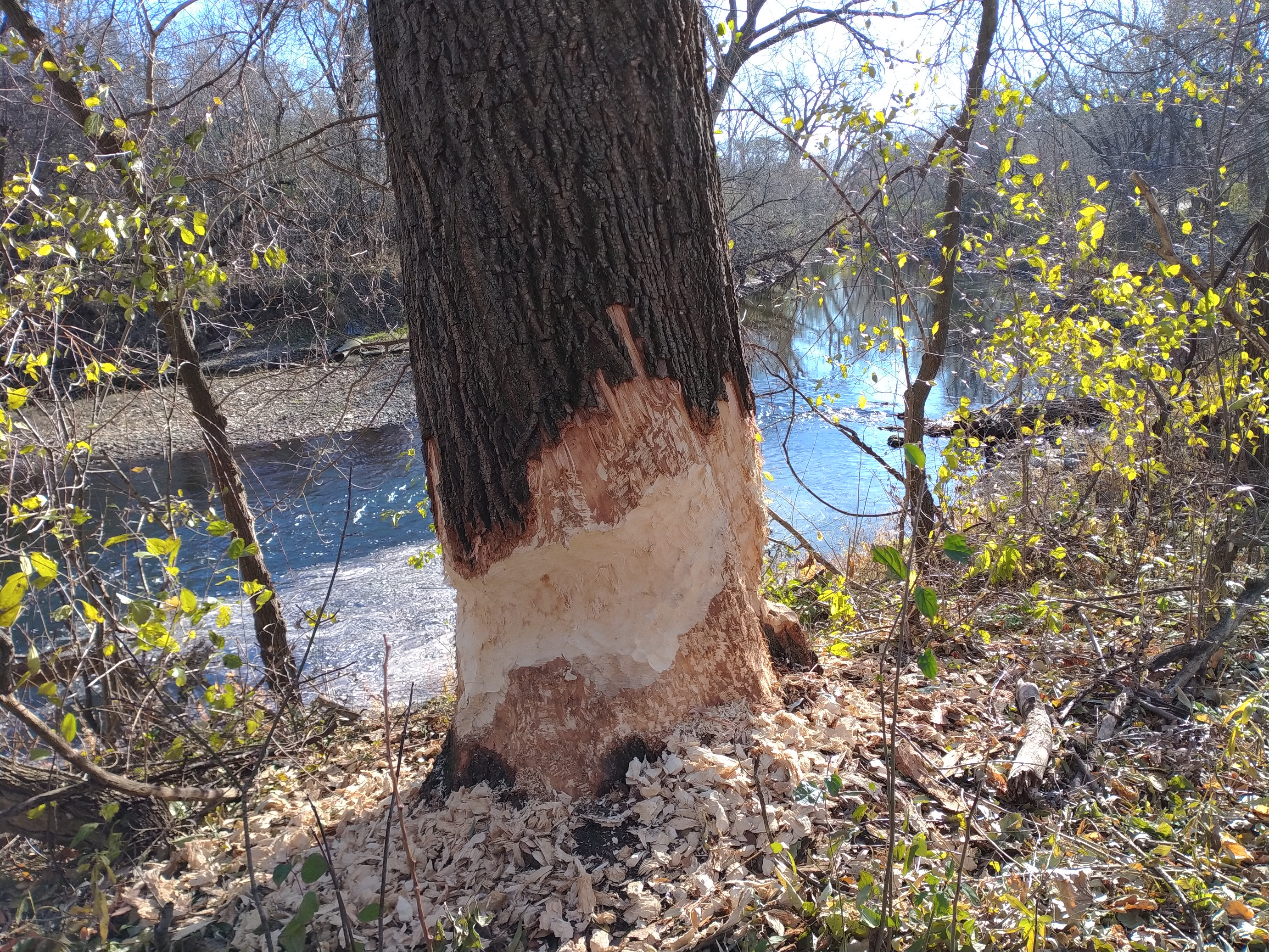
Beavers have given up chewing on this tree along the Straight River, we discovered during a walk on Friday. (Minnesota Prairie Roots copyrighted file photo)
BEAVERS, GEESE, A HERON & MEMORIES
And so we followed the Straight River Trail, noting trees chewed by beavers, a sandbar in the river, chimes on an apartment balcony clinking in the wind, a pair of geese moving from land to river, a magnificent blue heron flying low above the water…then those geese again, swimming.
Izzy stopped to pluck stones from alongside the trail, dropping them into an empty yogurt cup she’d brought with her. We walked sometimes hand-in-hand, Isaac and Grandpa well ahead of us, also clasping hands. This time together in the outdoors is the stuff of memories, of learning, of connecting with nature.
This used bookshop in Faribault is a must-stop when the grandkids visit. (Minnesota Prairie Roots copyrighted file photo)
DRAGONS, TORNADOES & THE BIG WIDE WORLD
On the drive home, we stopped at Books on Central, a used bookstore run by the Rice County Area United Way. We like to take the kids there whenever they are in town. Izzy found a fantasy book about dragons she’s read, but wanted to own. And a nonfiction book about tornadoes. Isaac was looking for atlases. Jeanne, who volunteers at the bookshop, found two, as yet unprocessed, atlases in the back room. Isaac was happy, promptly sitting down to page through the books. We also chose a book for their baby cousin, Everett, in Wisconsin.
And so that was our day together. A time of laundry hanging, backyard observing, playing, walking and enveloping ourselves in nature. But above all, it was time for us as grandparents to be with our beloved grandchildren, simply enjoying an unseasonably warm late March day in southern Minnesota, “poisonous caterpillar” and all.









 Minnesota Prairie Roots
Icy cold in Minnesota, a commentary January 23, 2026
Tags: businesses, commentary, economic blackout, extreme cold, ICE Out of Minnesota: Day of Truth and Freedom, Immigration and Customs Enforcement, Minnesota, news, opinion, protest, weather, wind chill, winter
THIS IS A TOMATO SOUP and grilled cheese kind of day in Minnesota. Or maybe a Chicken Wild Rice Hotdish kind of day, depending on your preference. With that theme, I’ll start today’s post with the weather and move on from there to a potluck of topics.
We are currently in a statewide extreme weather warning with air temps in southern Minnesota well below zero. Factor in the wind and the air temp feels like minus 30 degrees below zero, give or take some degrees depending on location. Overnight, the wind chill plunged into the -40 to nearly -60 degrees in parts of Minnesota. Exposed skin can freeze in five minutes. It’s that kind of brutal, icy cold.
Schools across the state are closed with many transitioning to online learning. Businesses, too, are shuttered, especially in the Twin Cities metro, but not necessarily due to the deep freeze temps.
DAY OF TRUTH & FREEDOM
Today marks a day of economic blackout and protest in Minnesota under the banner of “ICE Out of Minnesota: Day of Truth and Freedom.” Many metro businesses are closed in support of that protest, businesses that have already been negatively impacted by ICE presence in this state. Employees are afraid to come to work. Customers likewise. I’m no numbers person, but I wonder how long small businesses can survive.
ICE Out of Minnesota is a protest against federal government immigration enforcement here. The protest is a show of solidarity with the unified message of Get ICE out of Minnesota.
We are a hardy bunch. Vice President J.D. Vance, who was in Minnesota yesterday, unknowingly alluded to that when he stated, “We’re seeing only this level of chaos in Minneapolis.” Now I disagree with his word choice of “chaos.” I would use “resistance” instead. But his statement tells me that peaceful protesters, legal observers and anyone (including elected officials) who challenges the federal government spin and ICE actions are getting under his skin and that of other feds. I wonder if Vance considered for a moment that the presence of 3,000 federal agents in Minnesota is unnecessary, horrible, traumatizing, morally wrong and is raising our ire. Nah, probably not.
LAUGHABLE STATEMENTS
While here, the vice president called for local and state government officials to “meet these guys (federal immigration agents) half way” per the directive of the president. That’s laughable since Vance didn’t even meet with Governor Tim Walz or Minneapolis Mayor Jacob Frey while in Minnesota. You’d think he would have and could at least correctly pronounce Frey’s name. Nah, why bother?
During his talk, Vance showed anything but a cooperative spirit. Rather, he blamed—the media for lying, “far left agitators” and “rioters” for causing chaos, elected Minnesota officials and law enforcement for not cooperating, and even the family of 5-year-old Liam Conejo Ramos for his detainment. And on and on.
Vance repeatedly stated that ICE action is being taken out of context. Really? He also stated, in answer to a reporter’s question, that the federal government is not trying to send a political message via 3,000 agents sent to Minnesota, but rather trying to enforce the law. Really?
ONWARD WITH GRATITUDE
So onward we go here in Minnesota. I want to take a moment to thank everyone who is staying aware of what is occurring in my beloved state. This could be your city or state next, depending on political leaning. Thank you for standing in solidarity with Minnesotans. Thank you for protesting, for calling your elected officials, for helping your neighbors, for recognizing the threats to our freedom, for showing your humanity in loving words and actions. Your support matters to us in Minnesota. We are grateful.
FYI: I direct you to Minnesota Public Radio as a trusted source for ICE-related and other stories in our state.
© Copyright 2026 Audrey Kletscher Helbling