Minnesota Prairie Roots

Writing and photography by Audrey Kletscher Helbling

At the railroad swap meet in Randolph April 5, 2012

Filed under: Uncategorized — Audrey Kletscher Helbling @ 6:39 AM
Tags: , , , , , , ,

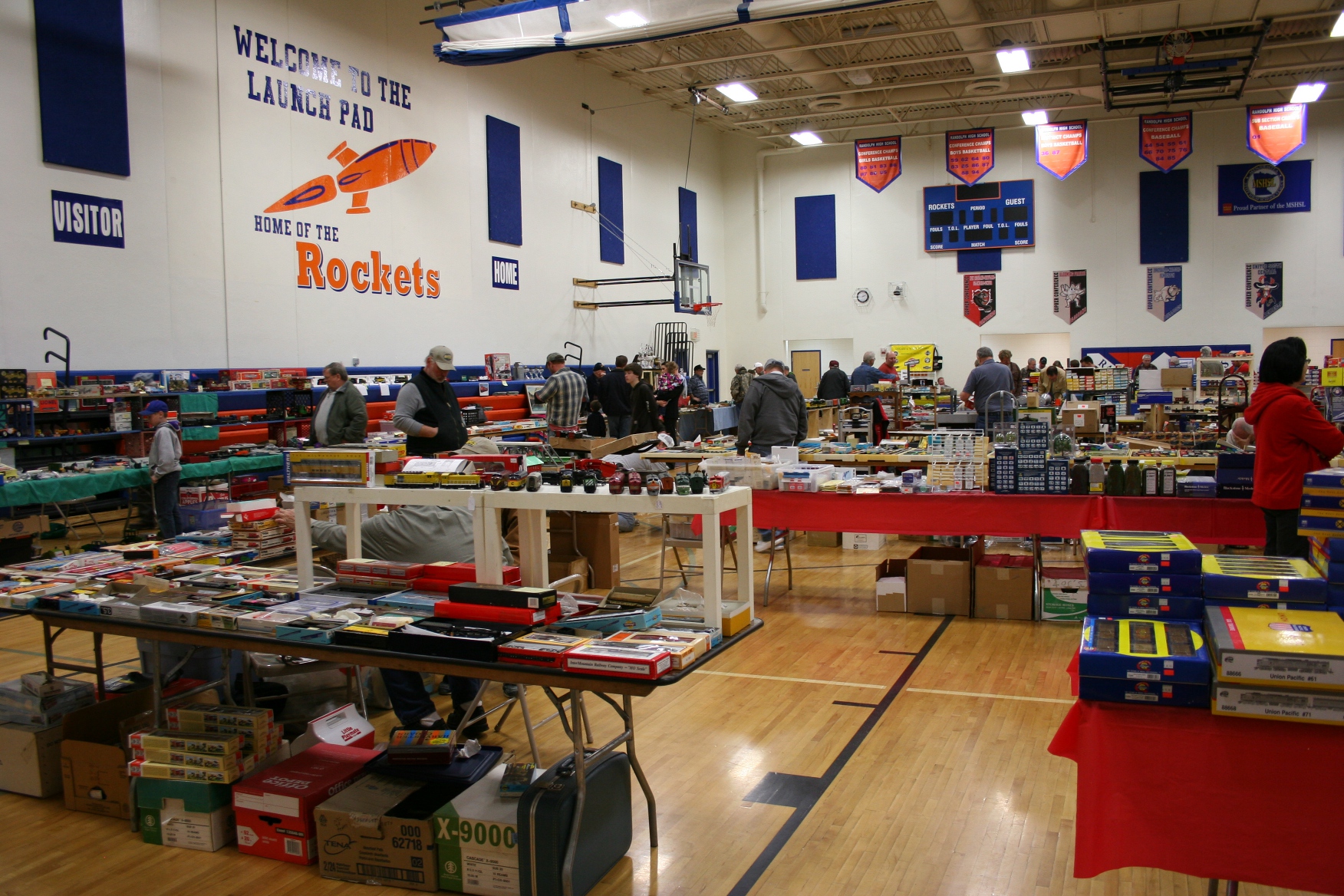
Vendors packed a gym at the Randolph School with their railroad merchandise.

IF I WAS INTO TRAINS or railroading, I could have spent hours filing through the collections of railroad-related merchandise offered at the Randolph Railroad Days Swap Meet on Saturday.

But after awhile, admittedly because I know little about this railroading hobby, the goods started to blend together. So I had to pick and choose and focus on the details to keep myself from becoming lost in the sheer volume of the offerings.

That said, join me on this select tour of the swap meet in a gym at the Randolph School. I was more than a bit distracted by the school’s icon, the rocket, displayed everywhere, even on the gym floor. I’m wondering “why Rockets?” other than the obvious connection to the “R” in Randolph. But that’s another topic because, you know, I did photograph those Rockets.
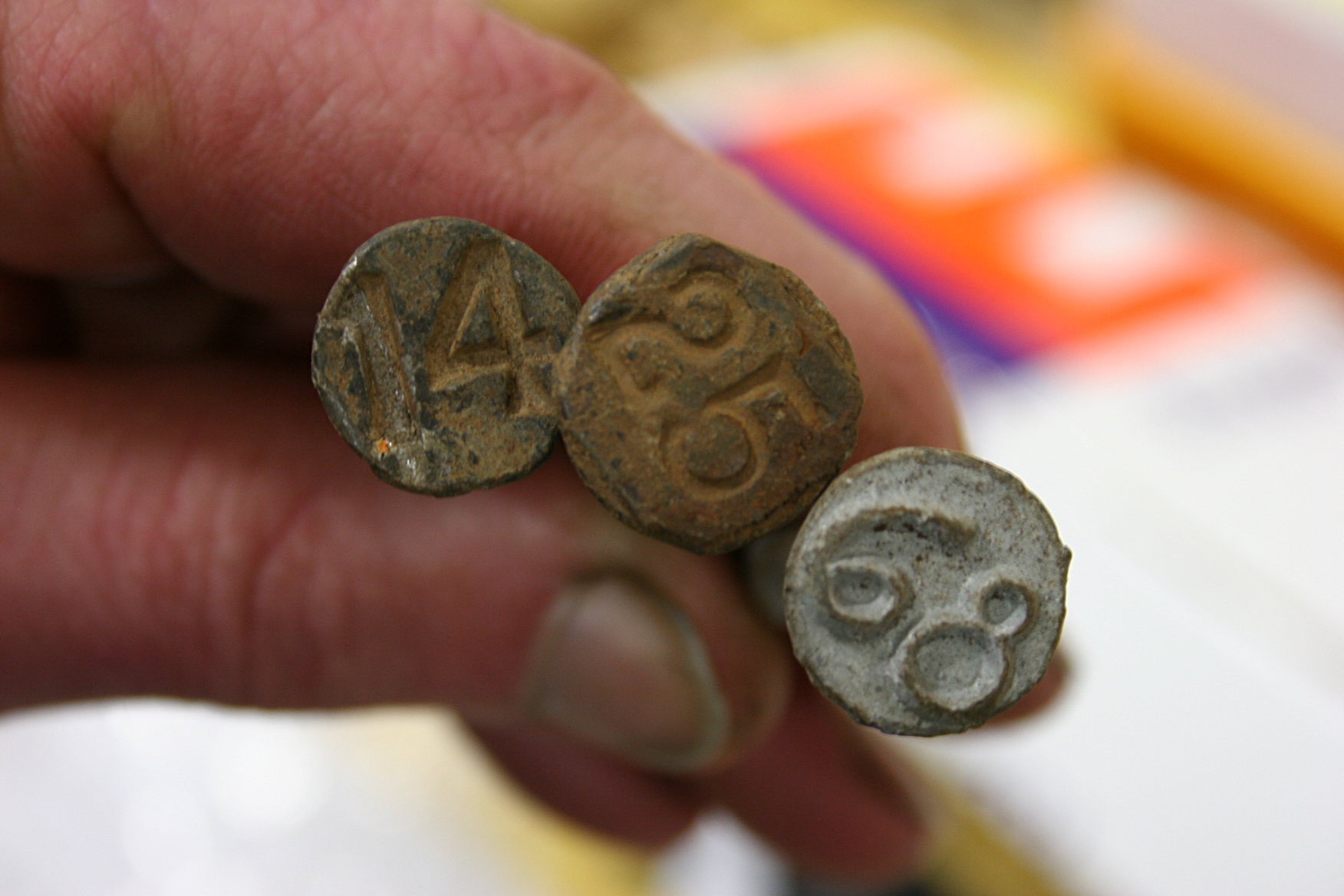
Railroad date nails drew my attention. The numbers represent the years.

Pocket-size calendars, which I choose to call "railroad art."
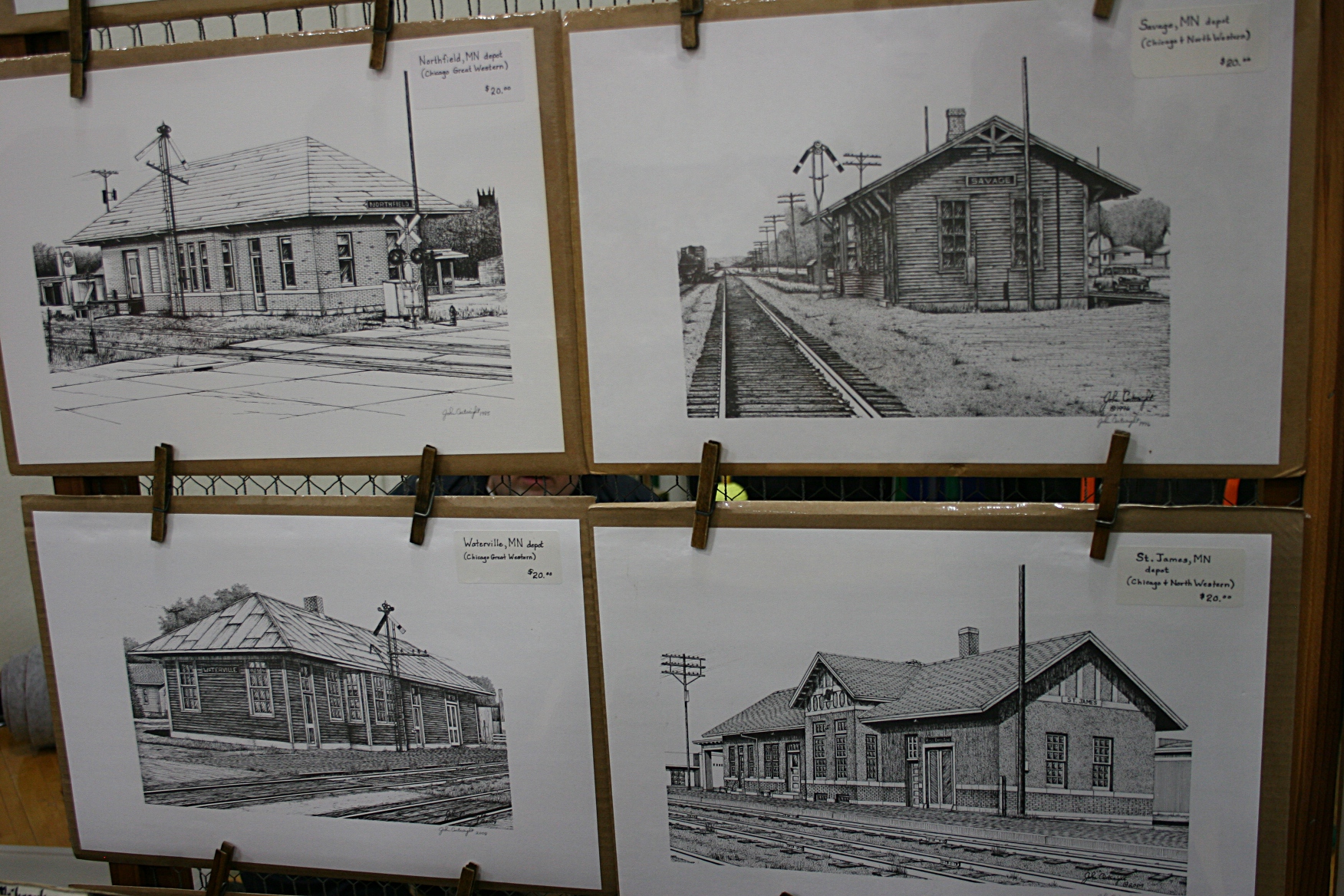
And then there's railroad art like this created by John Cartwright. The Shoreview artist was selling prints of his ink drawings. Visit his website at ArtRail.com for more information.

Toy/model trains galore were available for purchase.
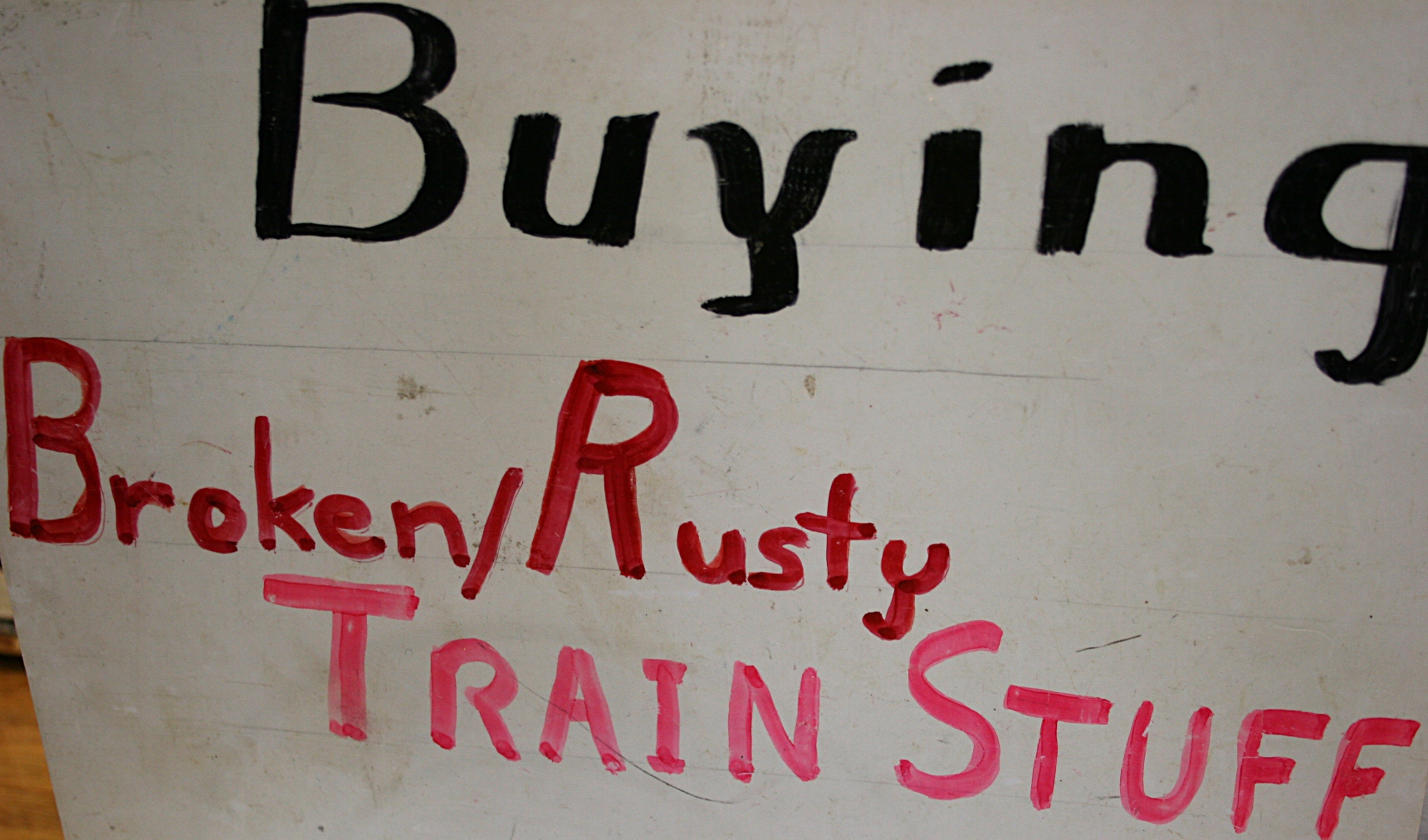
Condition doesn't matter to this swap meet buyer.

I found this attractive belt buckle among an assortment of buckles.

Yes, this hobby could get expensive. The details in train set-ups impressed me.

This replica toy depot caught my eye because it reminded me of the metal dollhouse I had as a child. Oh, how I wish my mom had kept the vintage dollhouse and not given it to my cousins.

Just the cheerful, vivid colors alone are enough to make you smile.

© Copyright 2012 Audrey Kletscher Helbling

Thank you to railroad artist John Cartwright for allowing me to photograph his beautiful ink drawing prints. You can learn more about this award-winning artist by clicking here.

 

Finally, a woman on the Steele County Board April 4, 2012

CONGRATULATIONS, STEELE COUNTY, Minnesota. You’ve finally elected a woman to serve on the County Board of Commissioners. It’s about time.

I could hardly believe the news when I heard it this morning on an Owatonna radio station. It wasn’t the election of a female that surprised me. It was the fact that it’s taken this long.

For the first time in its history, this southeastern Minnesota county will have a woman serving on its county governing board. She is Nina Huntington, a dental hygienist from Owatonna, who beat out opponent Doug Hughes in a special election on Tuesday to represent the Fifth Commissioner District.

Huntington won with 250 votes, or 60 percent, compared to Hughes’ 164 votes, according to an article in the Owatonna People’s Press. Only 10.25 percent of the district’s registered voters cast ballots.

Interestingly enough, Steele County also made headlines on Tuesday as Minnesota’s healthiest county in ratings released by the Robert Wood Johnson Foundation and the University of Wisconsin Population Health Institute. That study considers mortality, morbidity, health behaviors, clinical care, social and economic factors, and physical environment. Click here to read those study results.

So there you have it—Minnesota’s healthiest county now has a woman helping to govern it.

Huntington’s election in Steele County leads me to wonder this:

How many other Minnesota counties have never had a female serve on the county board of commissioners? If you have the answer or can direct me to that information, I’d like to hear. I would guess that number to be quite high.

Also, what do you think a woman can bring to county government that a man may not?

CLICK HERE to read an interview with Huntington published in the Owatonna People’s Press after she filed for office.

CLICK HERE to read the election results story in the OPP.

© Copyright 2012 Audrey Kletscher Helbling


The Last Supper Drama begins Holy Week at a rural Minnesota church April 3, 2012

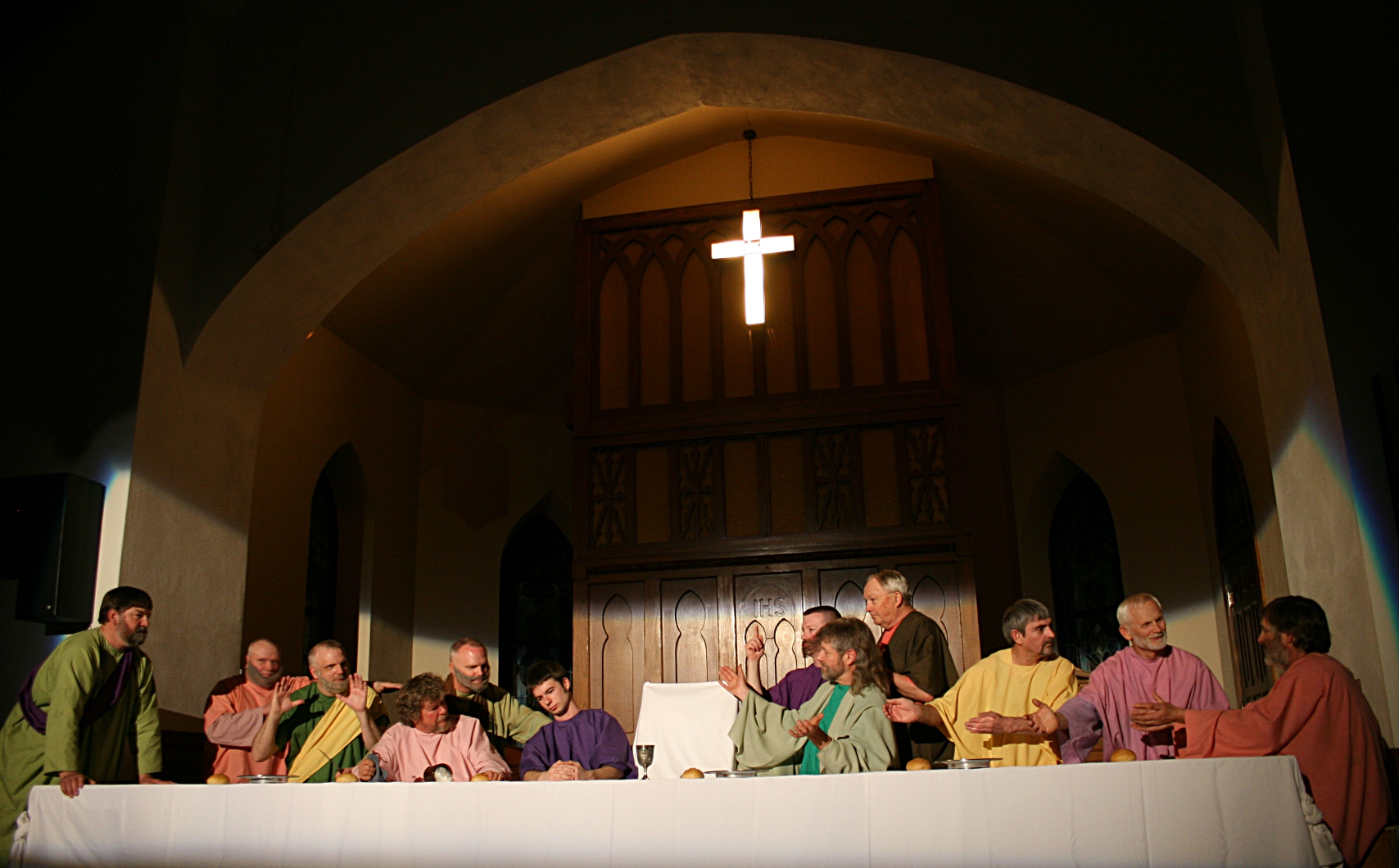
St. John's 50th presentation of The Last Supper Drama in the sanctuary with the actors positioned just as the disciples are in Leonardo da Vinci's painting. However, in the drama, an empty chair represents Christ.

THOUSANDS OF MILES from Milan, Italy, in the flat farm fields of Rice County in southeastern Minnesota, Leonardo da Vinci has left his mark on a small congregation.

For 50 consecutive years, St. John’s United Church of Christ, Wheeling Township, has presented The Last Supper Drama, a theatrical interpretation of the master artist’s most famous painting created in 1495 as a mural in an Italian monastery.

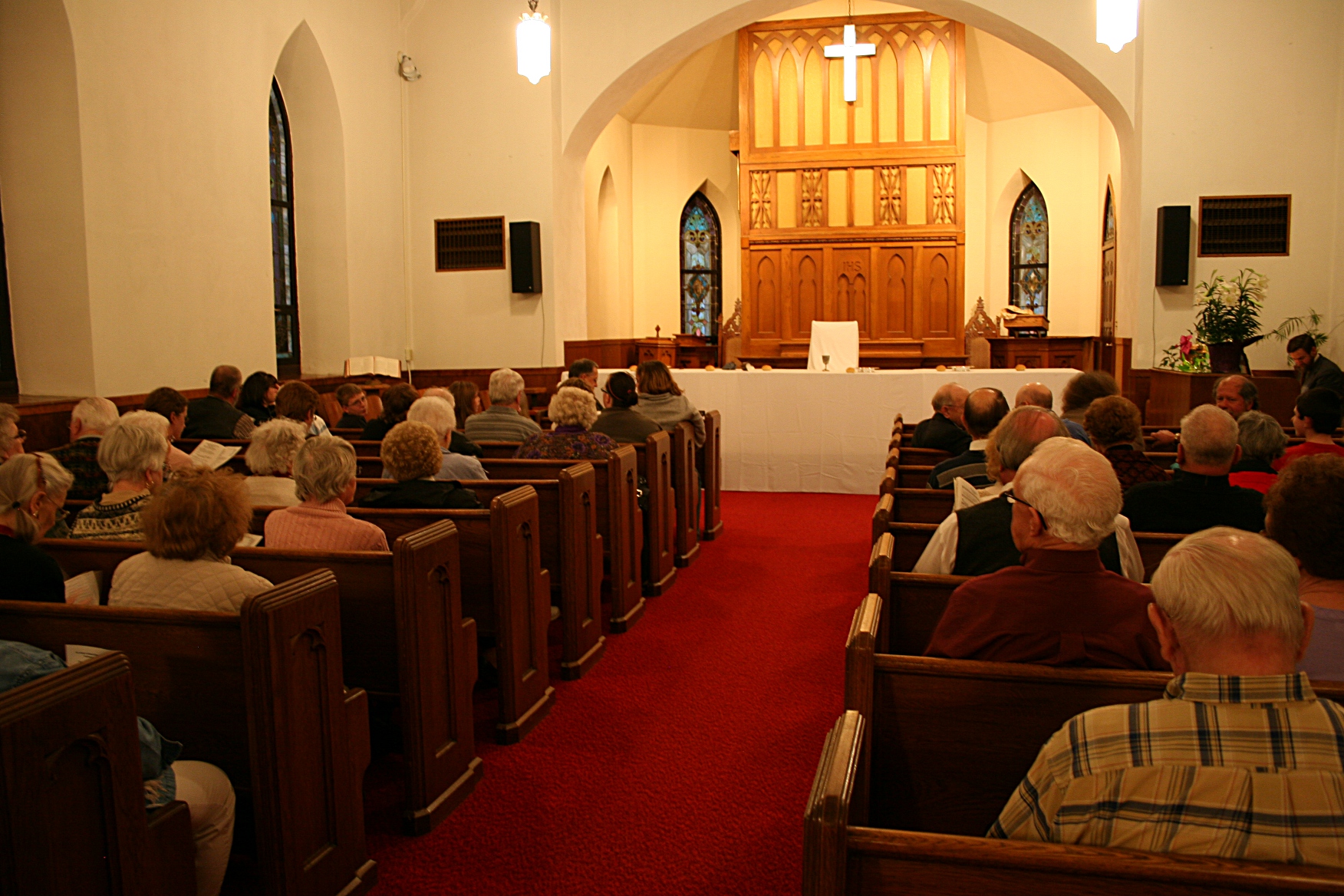
The rural Faribault church was nearly full for the golden anniversary of The Last Supper Drama.

Palm Sunday evening I joined a sanctuary full of worshipers to view the drama which inspires and moves for its touching, personal account of Christ’s last meal with his 12 disciples. In the script written so many years ago by a former St. John’s pastor, each of Jesus’ followers speaks of his personal relationship to the Lord.

In the reverent near-darkness of this late 1800s limestone church, the cast, in loud, clear, animated voices and with gestures fine-tuned by years of practice and presenting, truly bring to life da Vinci’s painting. They speak of their failures and deaths, of their love for Christ.

“Be not faithless, but believing,” advises doubting Thomas, played this evening by Thad Monroe.

Claims Don Katra as Matthew: “My life really began when I met and followed Him.”

Most of the actors are shown here as they pose for photos after the performance.

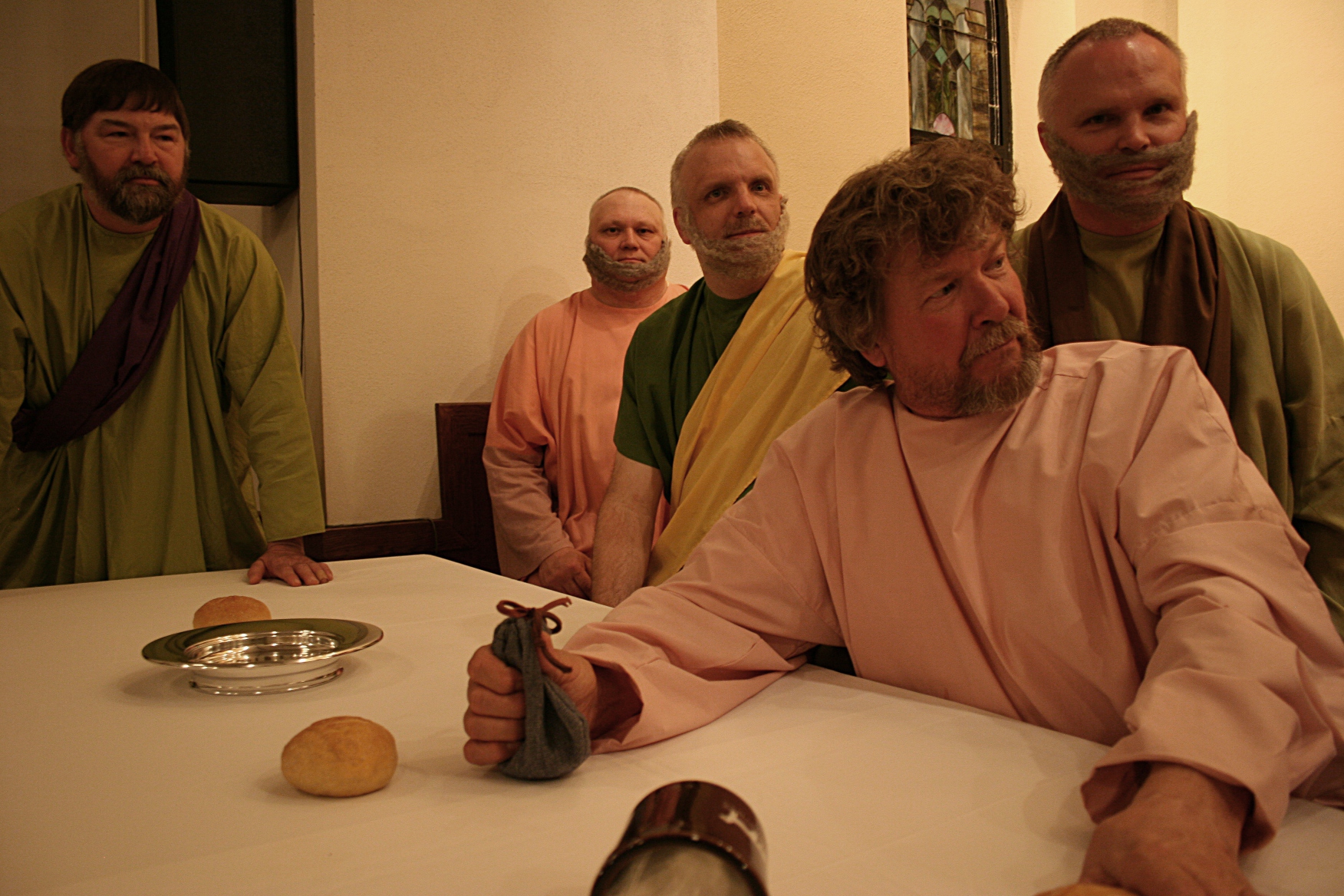
Judas grips the bag of silver, his reward for betraying Christ.

Even Gordie Wiegrefe as Judas the betrayer, admits, “It was too late. They wouldn’t take the silver back. I failed my Lord.”

The moment when Christ announces that one of his disciples will betray him is the precise moment da Vinci captures in his painting. In St. John’s performance, the defining moment of betrayal comes when Judas slams a jingling bag of 30 pieces of silver onto the table.

Later, after the drama concludes, St. John’s Pastor Lora Sturm tells worshipers, “Let us feel the light of His love as we enter the darkness of this Holy Week.”

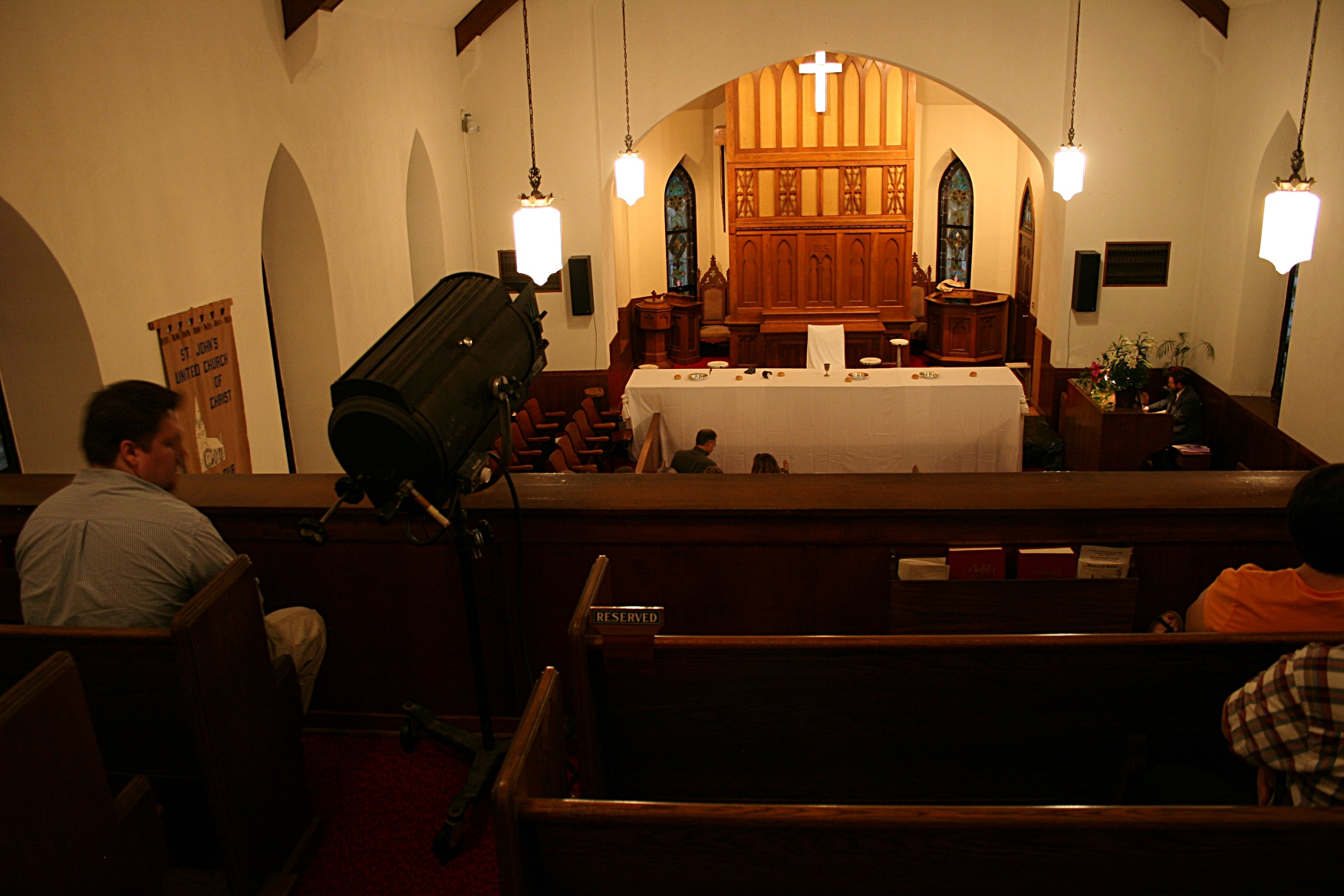
A view from the balcony before the drama begins shows the spotlight to the left and The Last Supper table below. The actors enter, spotlighted in the dark church, to take their seats at the table. There they "freeze" in place to mimic Leonardo da Vinci's painting.

That message resonates as a spotlight first illuminates a cross suspended above the altar in the dark sanctuary, then moves down to an empty chair representing Christ and finally pans out to shine upon all 12 disciples. It is how the drama opens and ends, impressing upon attendees the darkness of Holy Week which concludes on Sunday in the glorious light of the resurrected Lord.

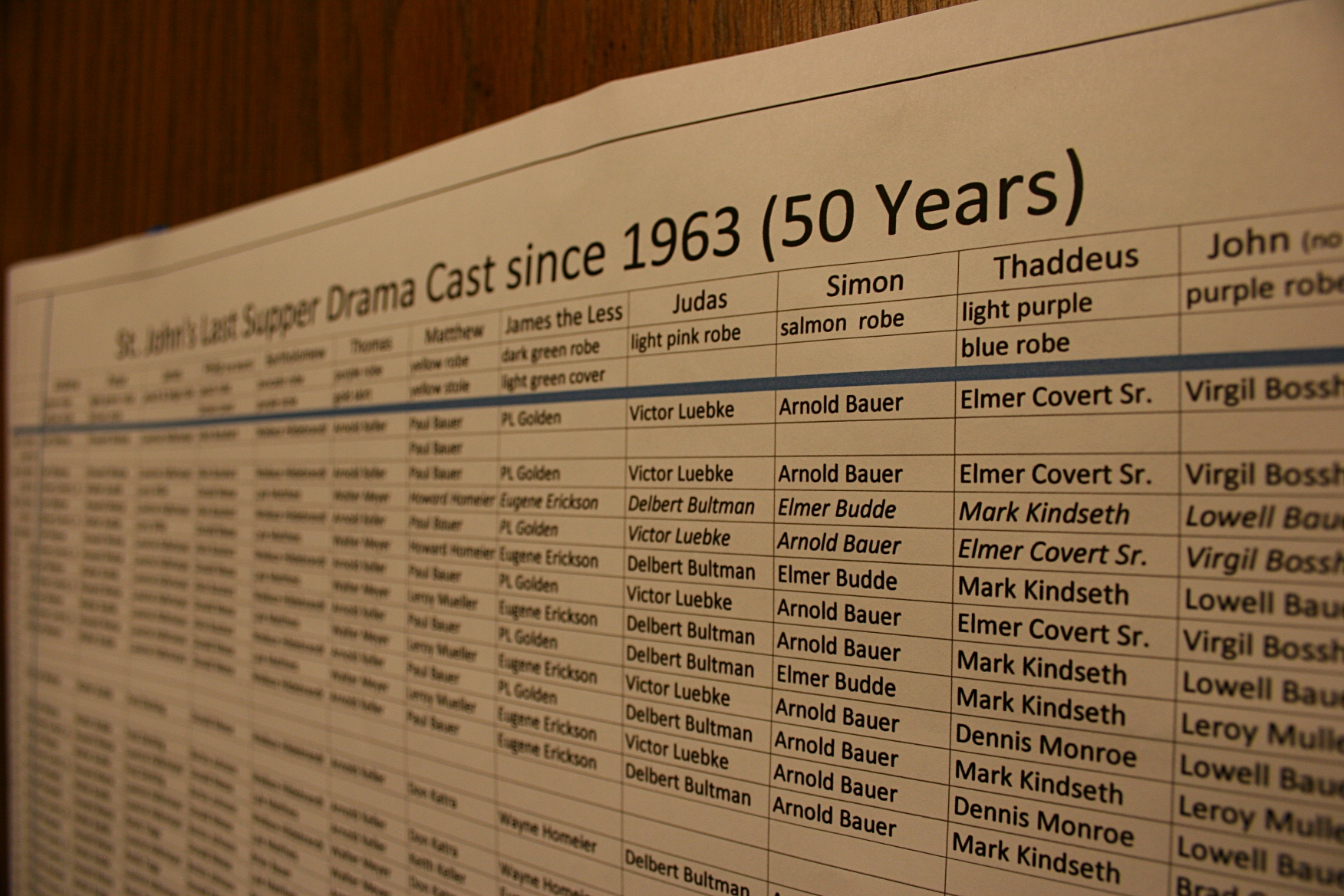
Spreadsheets on display Sunday evening listed those involved in the St. John's drama through-out its 50-year run.

FOLLOWING SUNDAY’S 50th anniversary performance, special recognition was given to those who have been part of St. John’s The Last Supper Drama. Original 1963 cast members Wallace Hildebrandt and Luverne Hafemeyer stood up to applause.

Other 50-year history trivia includes:

  • Seventy individuals have participated in the drama since 1963.
  • The role of John has been played by 10 actors.
  • The youngest actor was Kyle Keller who in 2011 assumed the role of Philip.
  • The oldest cast member was Kyle’s grandpa, Arnold Keller, who was 76 years old when he last acted in 1997.
  • Nine individuals have performed 20 or more times in the St. John’s drama.

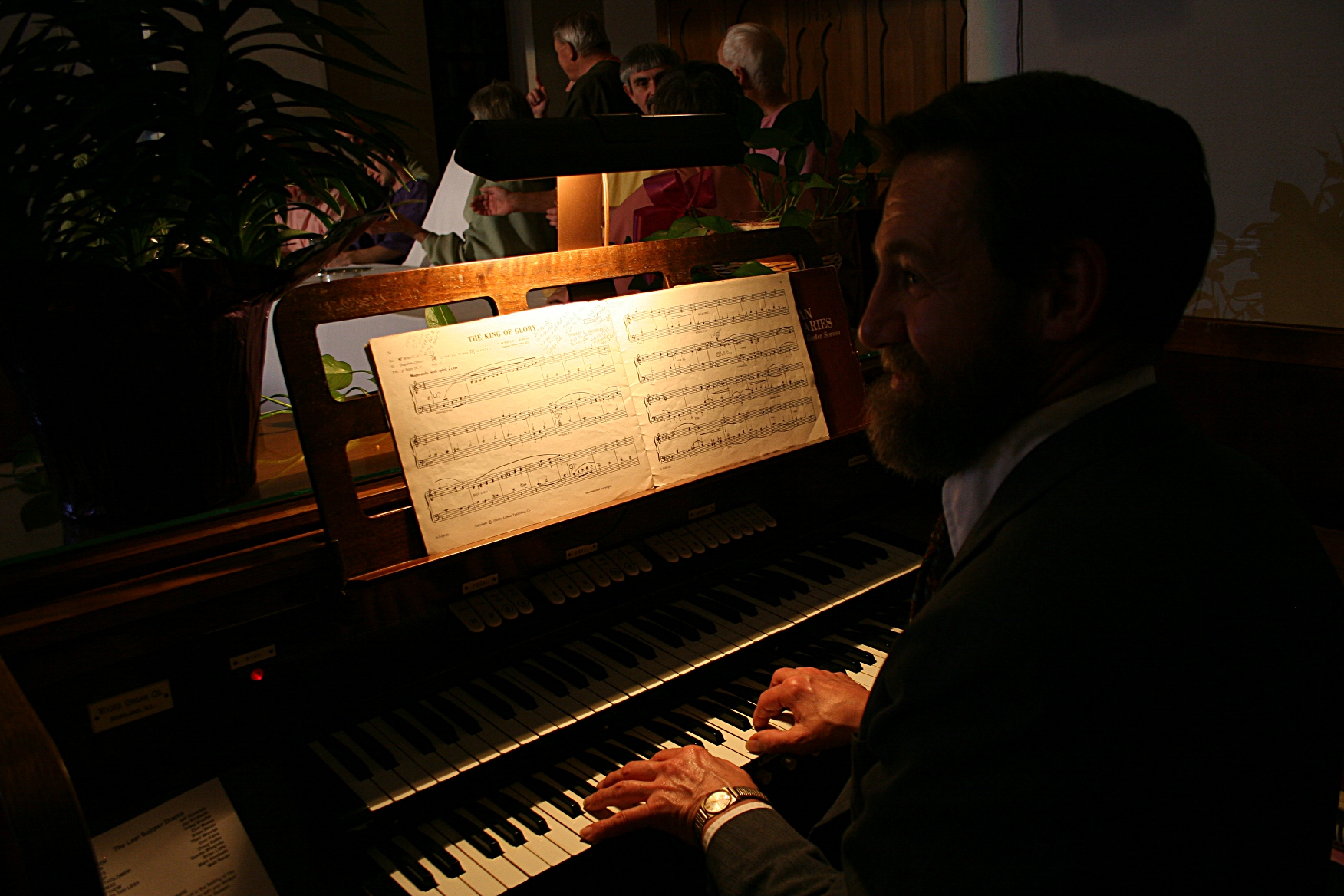
Craig Keller has been the long-time drama organist, playing the same music every year. The script and music remain unchanged in 50 years. Craig's father, Arnold, was an original cast member.

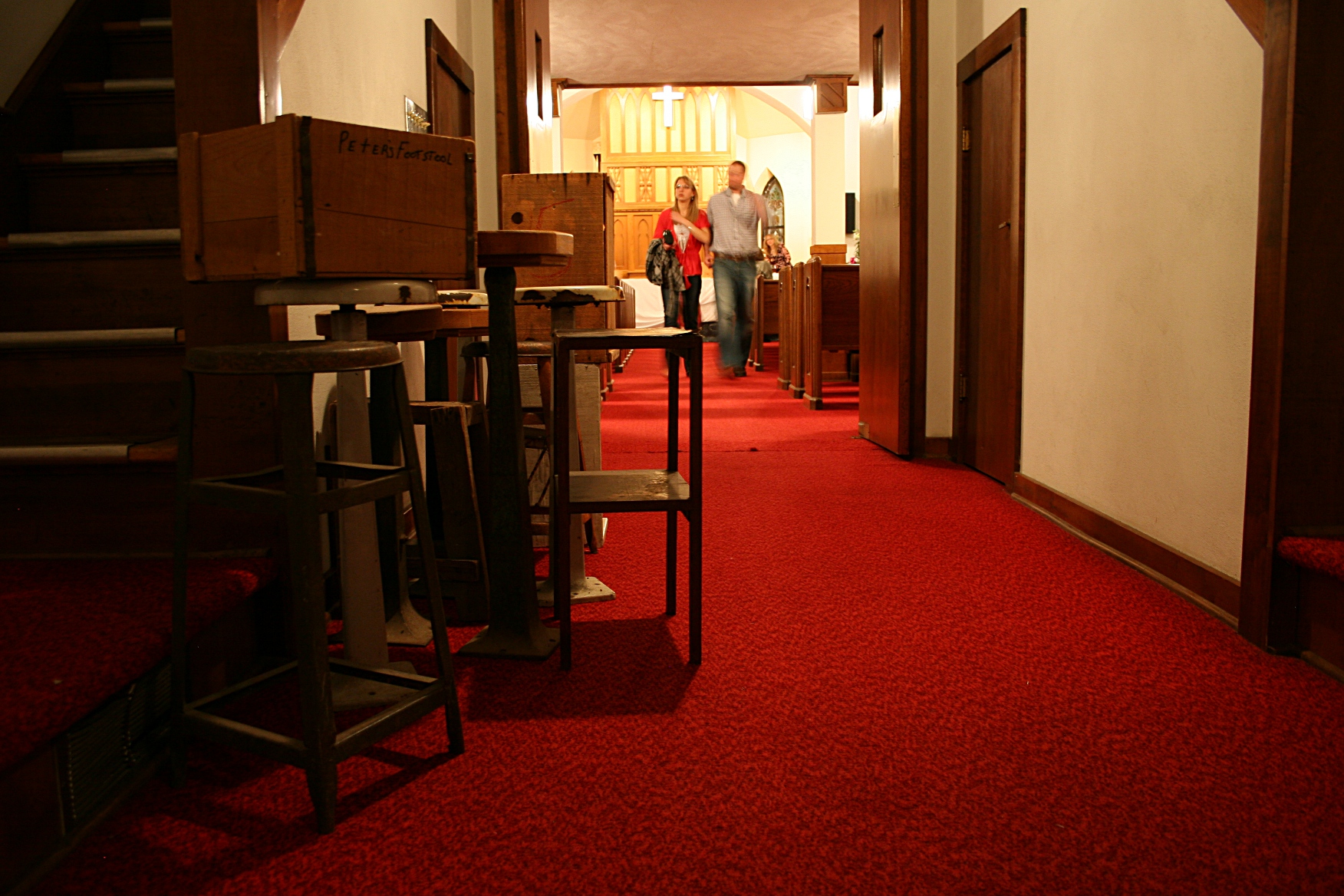
After the performance the cast took their stools and footrests out of the church, grouping them together (left) in the sanctuary entry. Later they carried the seats into a balcony storage area. Each stool is labeled with a disciple's name. They are the original stools, first used 50 years ago.

This artistic rendition of The Last Supper hangs in the St. John's Fellowship Hall.

After the performance, folks gathered in the social hall for cookies and beverages.

A tray of cookies awaits audience members and performers.

TO READ A PREVIOUS POST I wrote about the 2011 drama, click here.

© Copyright 2012 Audrey Kletscher Helbling


All aboard for the Randolph model train show April 2, 2012

Filed under: Uncategorized — Audrey Kletscher Helbling @ 7:06 AM
Tags: , , , , , ,

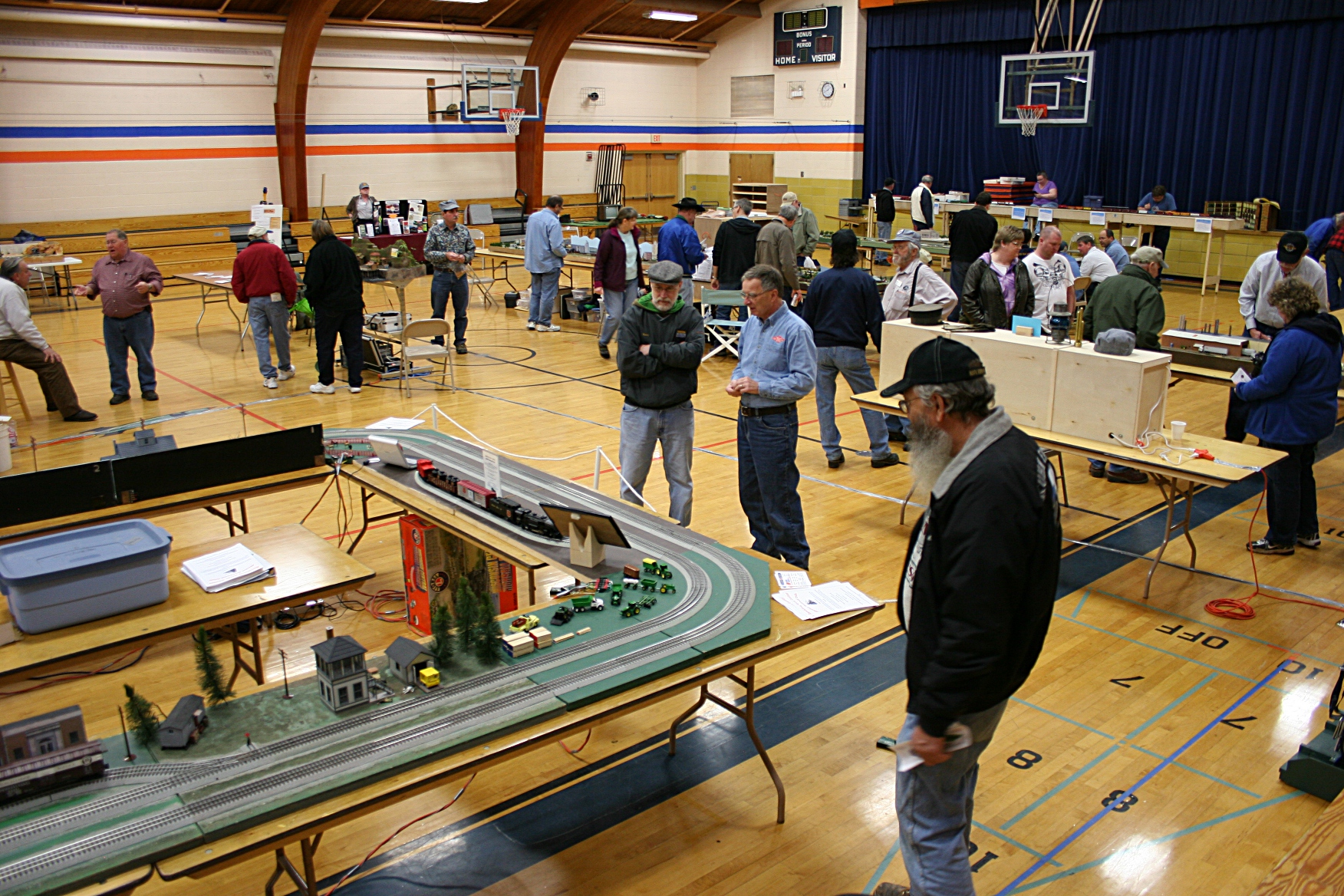
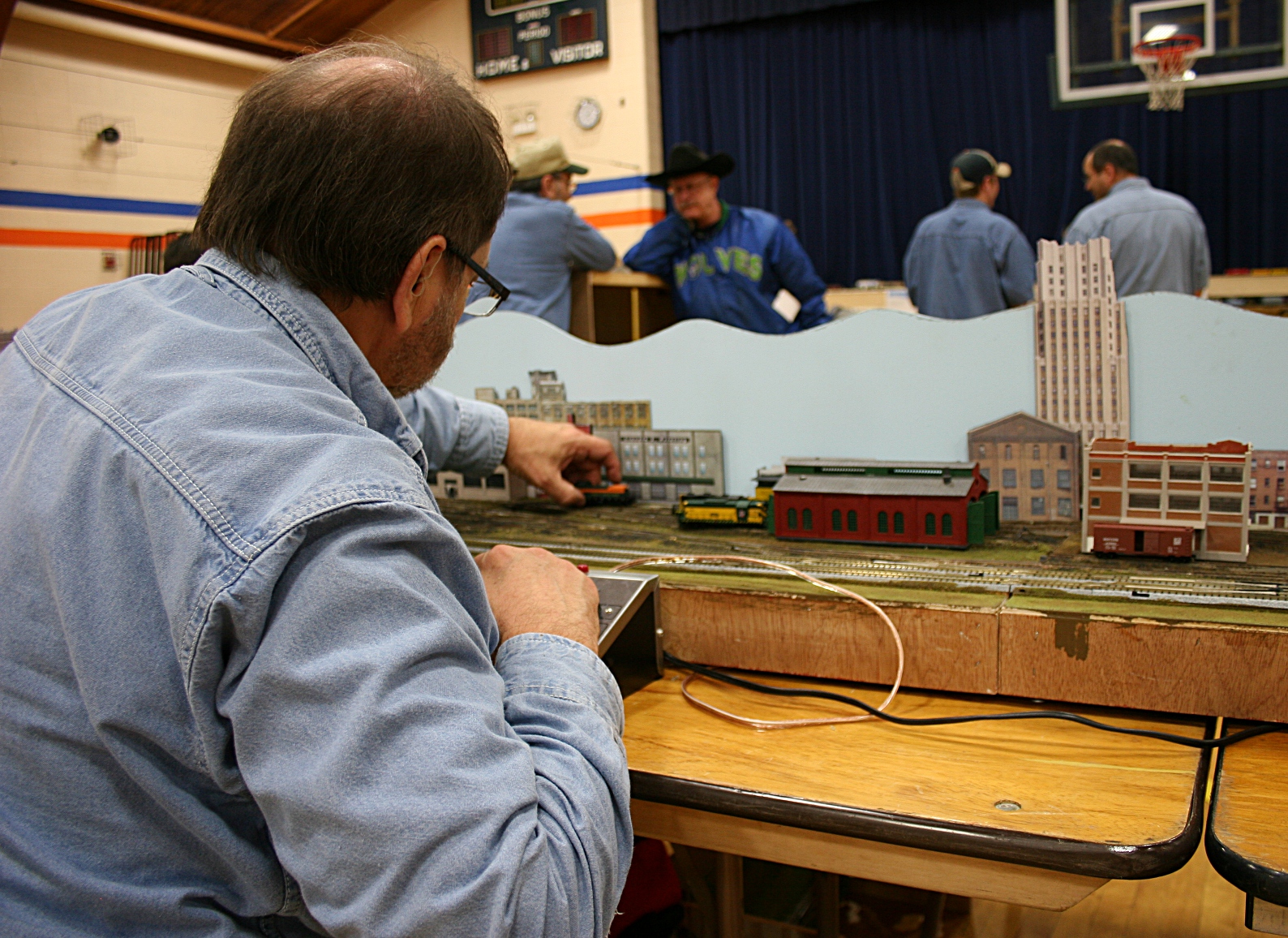
Railroad enthusiasts displayed their trains in the Randolph School gym Saturday. One participant told me he enjoys the social aspect of these gatherings. Last year he went to train shows on 16 weekends.

I WAS DEFINITELY out of my element on Saturday poking through two gyms packed with all things railroad at the annual Randolph Railroad Days.

You might even say I was overwhelmed by the sheer volume and variety of railroad-related merchandise vendors were selling and by the train set-ups hobbyists were displaying. I tried to meander on my own, unnoticed, no easy task when you’re sporting a DSLR camera and occasionally crawling on the floor. People tend to notice.

“Just pretend I’m not here,” I told at least one teen (or pre-teen), who scooted out of my viewfinder range when he spotted me aiming the lens his direction.

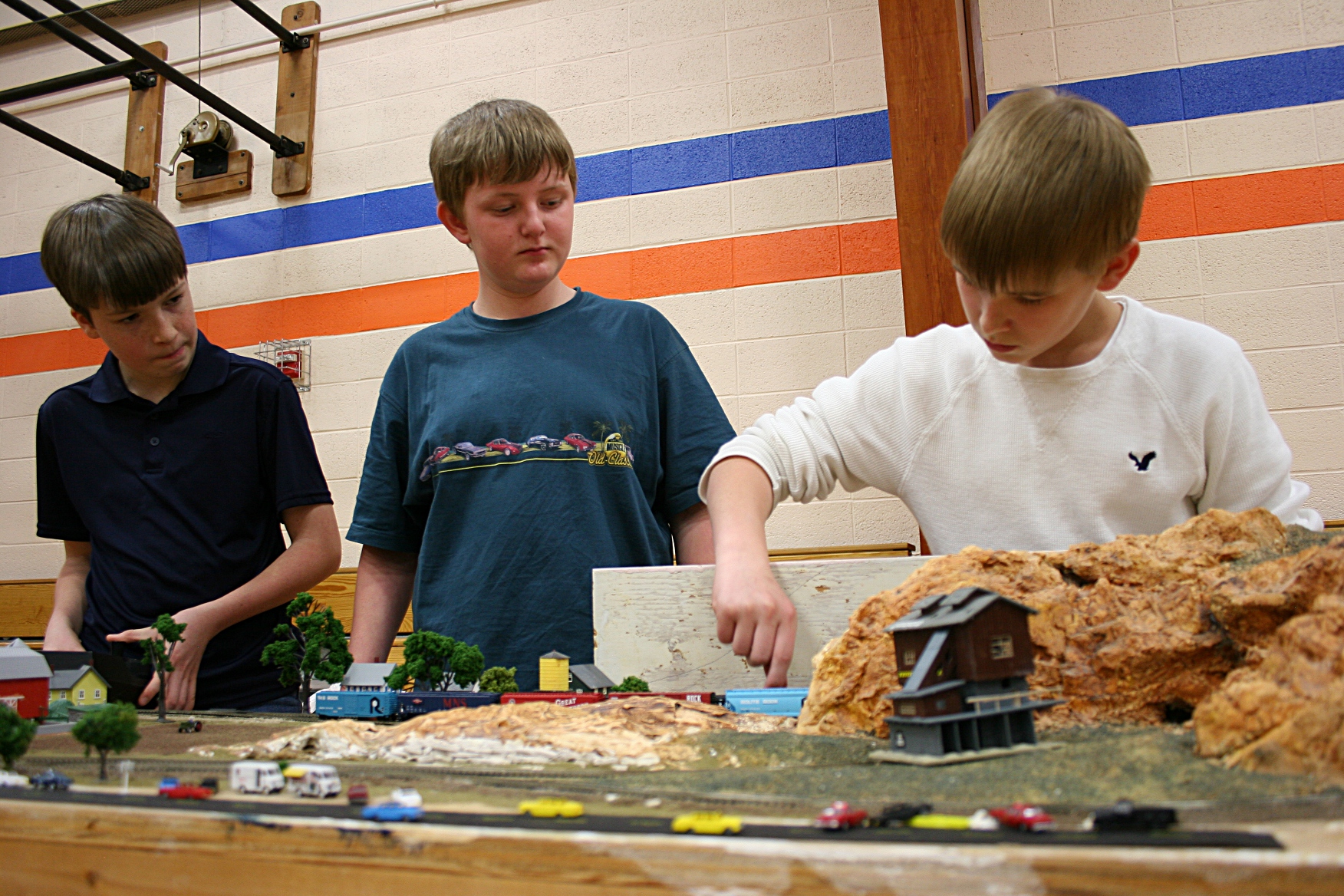
I managed to snap this photo after telling this trio to ignore me and my camera.

As for the younger elementary-aged boys, I found keeping up with them as they darted from one train model to the next an impossible pursuit.

The middle-aged men seemed mostly interested in engaging me in conversation about the details of model railroading. I decided beforehand that I wasn’t taking notes and that my attendance at this event would be more about my observations and about having fun and not about learning the intricacies of this hobby.

Like engineers, most participants tend their trains. However, I witnessed a small fire, at an unattended table, when a wire shorted. I did not respond quickly enough to either extinguish the flames or take a photo.

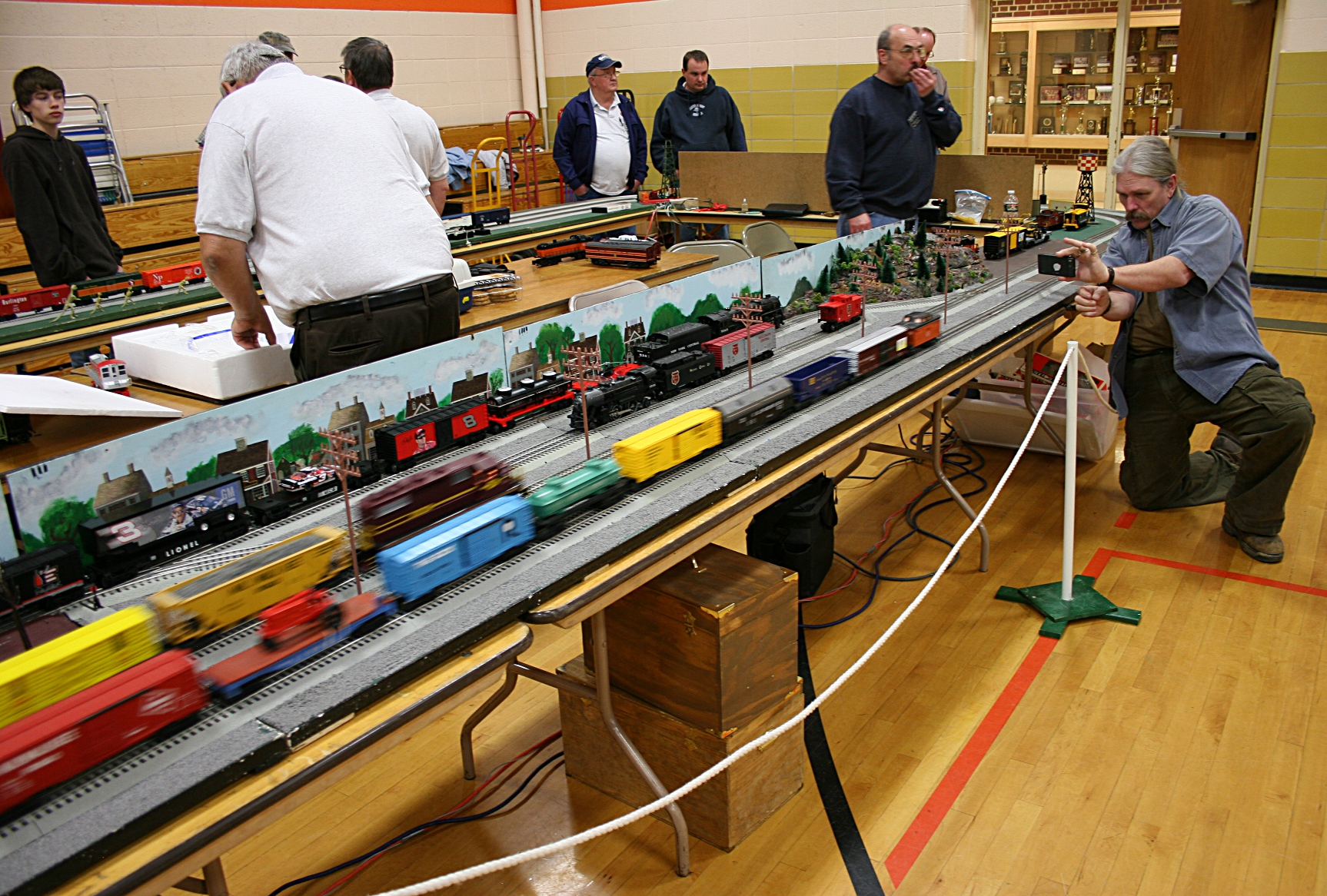
As you can see by the blurred train, these trains speed around the tracks.

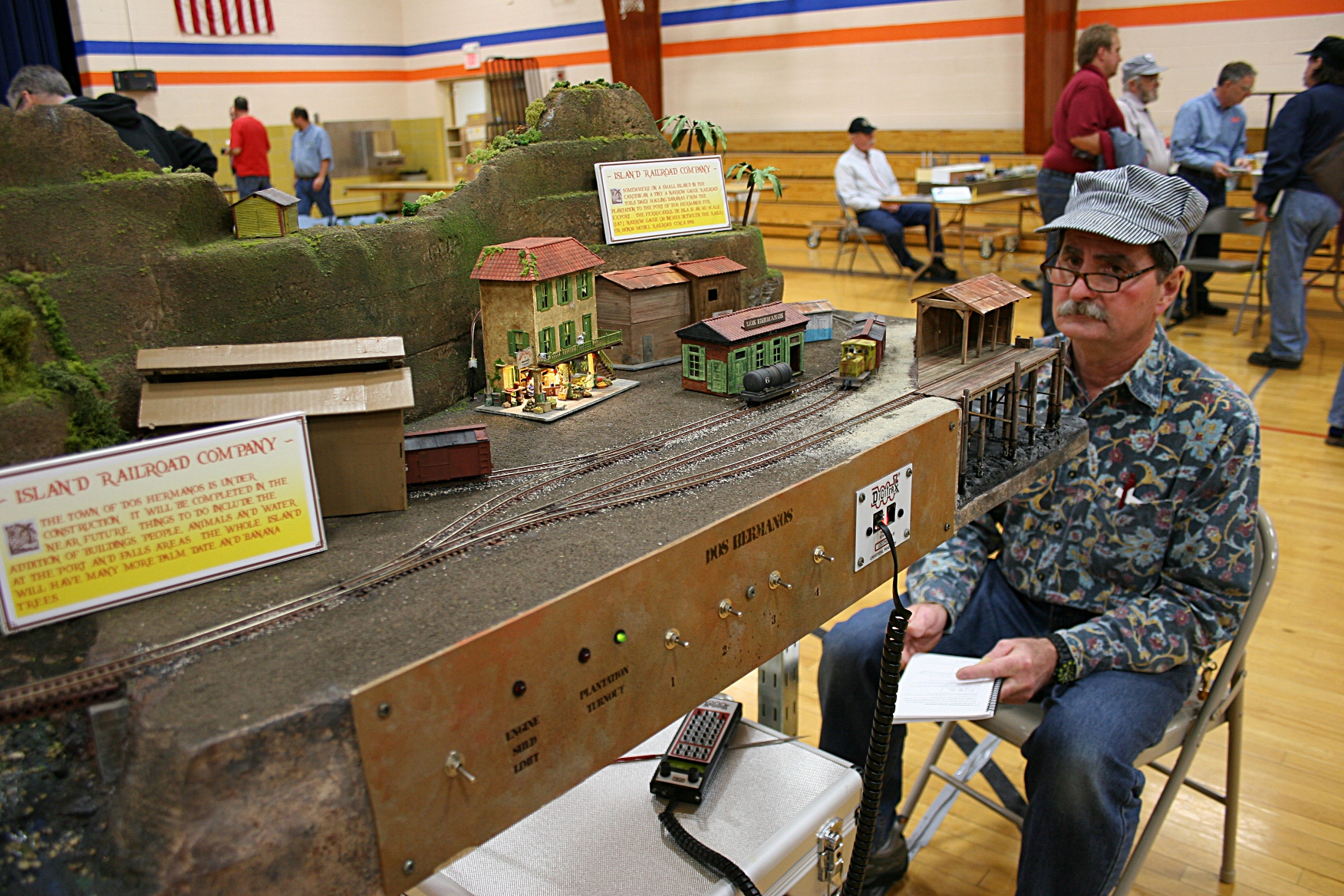
I judged this "banana train" display as the most creative with mountains and waterfalls in a tropical South American setting. I wanted to hop on board. The waterfalls are on the other side of the mountains.

The overseers—two elderly gentleman perched on bleachers and viewing the action below—were content to let the younger ones set up and run the show, they told me when I climbed to get a different perspective. (They tagged themselves “the overseers.”)

Here’s what I concluded: No matter your age, there’s something magical and mesmerizing about watching toy trains travel a track.

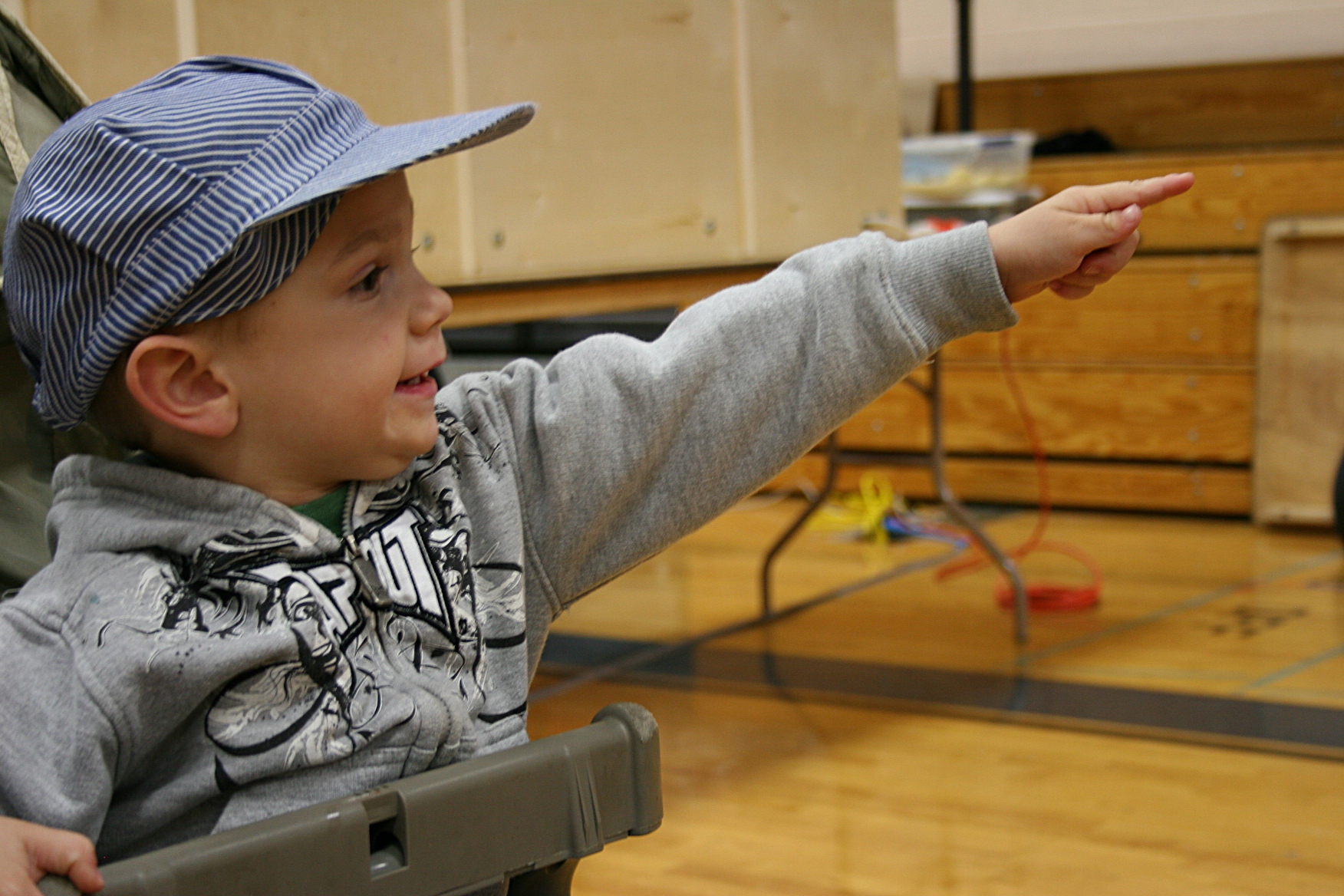
Two-year-old Eli, confined to his stroller, points to trains circling a track.

Eli was pointing to this train set-up being photographed by another railroad enthusiast with his cell phone.

The details in the train displays impressed me. One engineer asked if I saw a cat sitting on a fence outside a barn. I couldn't find it. Then he pointed to a cat so tiny I wished I had a magnifying glass.

Railroad enthusiast Jim from Northfield demonstrated the sounds, etc., that he can control on his train with the simple push of a button. Amazing.

These matching signs made me chuckle.

WHAT PULLS YOUNG and old alike to thrill in model trains?

Check back for photos from the Randolph Railroad Days swap meet.

© Copyright 2012 Audrey Kletscher Helbling


An April Fool’s Day legend April 1, 2012

Filed under: Uncategorized — Audrey Kletscher Helbling @ 10:09 AM
Tags: , , , , ,

TWENTY-TWO YEARS AGO on March 30, 1990, my cousin Jeff married Janet at the St. Louis County Courthouse in Duluth, MN. It was a small affair with only Janet’s daughters, Heidi and Amber, attending.

Jeff, who hadn’t even told his parents he was dating Janet, shared the news via a printed announcement that proclaimed “And four shall become a family.”

To say Jeff’s parents were surprised would be an understatement. Shocked would be more accurate.

As the story goes, my uncle apparently paled upon reading the news of the marriage and my aunt reacted by picking up the phone. First she called her daughter to see if she knew anything of the unexpected marriage. Dawn didn’t.

Then Marilyn phoned the Floodwood school where Jeff was teaching. I’ll let Jeff tell the story from here. And remember, this was 1990, in the days before telephones in classrooms, so Jeff was pulled out of class to take the call from his mother.

There I sat, the secretary at her desk to my right, the principal at his desk in his office to my left, both just feet away, overhearing one side of this awkward conversation about my recent wedding.

Mom, of course, had many questions—about Janet, about Heidi and Amber, about planning a wedding reception. Well, I was able to calm Mom down enough to tell her to look at the back of the card and remember what day it was, or what day had just passed.

That would be April Fool’s Day. On the back, the new groom had written: “rehcstelk ffej morf gniteerg sloof lirpa na.”

From right to left, Jeff’s message read: “an april fools greeting from jeff kletscher.”

Yes, my creative cousin had just pulled off one of the best family April Fool’s Day jokes ever, the stuff of legends. His marriage to a northwoods bride was pure fiction.

My cousin Dawn, with the help of daughter Megan, made two beautiful anniversary cakes for her brother. My Uncle Wally and Aunt Janice made and decorated the other cake with the beanie baby bears.

Twenty years after that fake marriage, we celebrated Jeff and Janet’s 20th wedding anniversary at the annual Kletscher family reunion in 2010. We decorated the shelterhouse at the park with anniversary banners, crepe paper and tissue paper bells. Relatives came bearing gifts. And there were even three anniversary cakes to celebrate the occasion.

CAN ANYONE out there top Jeff’s April Fool’s Day prank? I’d like to hear. (BTW, my cousin is still single.)

April Fool’s jokes during my childhood consisted of these:

Your toast is burning!

The bus is here!

The cows are out!

I know. Not at all creative.

© Copyright 2012 Audrey Kletscher Helbling


How I became an artist March 30, 2012

Filed under: Uncategorized — Audrey Kletscher Helbling @ 7:44 AM
Tags: , , , , , , ,

MY SKILLS AS A PAINTER are limited. I can paint a wall. I can dip a brush into a kid’s watercolor paint set and swirl colors onto a piece of paper. But I won’t promise a masterpiece.

Oh, no, if you want to see my best paintings, you will need to step back in time to more than 40 years ago. Imagine me hunched over an oilcloth-draped kitchen table in a southwestern Minnesota farmhouse dipping a thin brush into miniscule pots of paint. With great care, I brush shades of blue and brown onto cardboard as a ballerina emerges.

I have never seen a real ballerina. Her dainty features and fancy dress and perfect posture seem so foreign to me as I slump at the table in my rag-tag clothing that smells of the barn.

I imagine this ballerina smells only of flowers, like the ones I paint into the bouquet she clutches and into the wreath encircling her hair. Her bangs sweep in a fashionable style across her forehead, unlike my slanted, too-short bangs.

The paint-by-number ballerinas I painted as a young girl during the 1960s.

This ballerina’s life in New York City is so much different than mine on the farm. For the hours I am painting the flower-bearing ballerina and her sister, the twirling ballerina, I escape into their world. I dance on my tiptoes and spin and bow with grace on the stage of an opulent theater.

If not for Dan Robbins, though, I never would have experienced ballet. The Michigan artist created the first paint-by-number patterns in 1951. That led to a nation-wide obsession that allowed non-artists like me to become painters. The magazine American Profile featured Robbins in its March 25 issue. You can read the feature story by clicking here.

That story prompted me to remember the paint-by-number ballerinas I created as a child. Because my mother saves everything, I have those paintings today and they are among my most treasured childhood possessions.

TELL ME, HAVE YOU created paint-by-number paintings? Or do you collect these paintings? I would like to hear about your experiences and/or interest in paint-by-number kits.

You can learn more about the paint-by-number craze that swept the country during the 1950s by clicking here onto the Smithsonian National Museum of American History.

© Copyright 2012 Audrey Kletscher Helbling


Rural Faribault church presents 50th annual The Last Supper Drama March 29, 2012

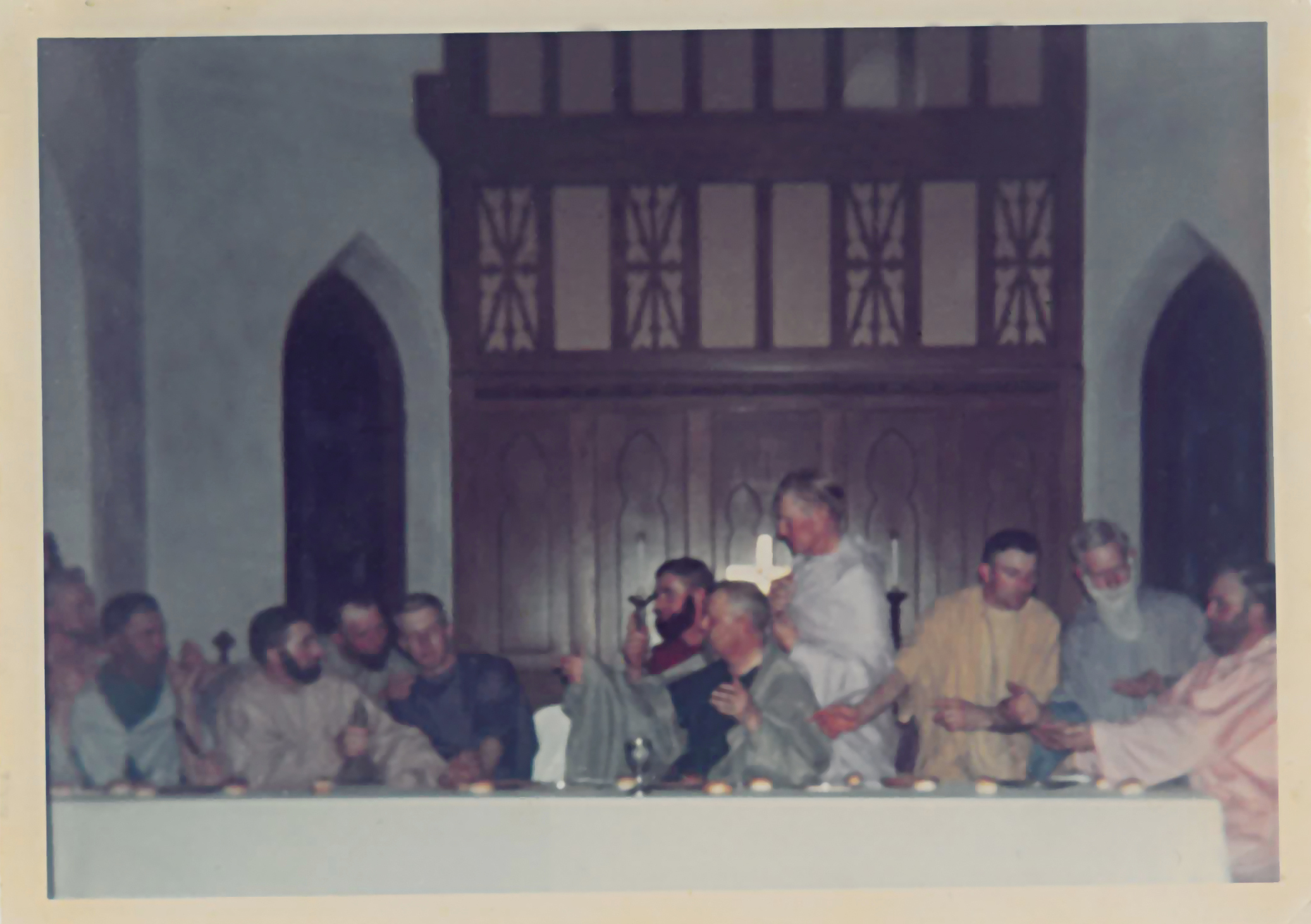
St. John's members portray the disciples in this undated vintage photo, the first record of a photograph from The Last Supper Drama. Actors, from left to right, are Luverne Hafemeyer, Earl Meese, Victor Luedke, Howard Meese, Virgil Bosshart, Arnold Keller, P.L. Golden, Alvin Bosshart, Paul Bauer, Elmer Covert Sr. and Arnold Bauer. Photo courtesy of St. John's United Church of Christ, Wheeling Township.

EVERY LENTEN SEASON since 1963, worshipers and actors have gathered inside the 1870 limestone sanctuary of St. John’s United Church of Christ—Wheeling Township, rural Faribault, for The Last Supper Drama.

It is, says 2012 co-director Pauline Wiegrefe, a moving, emotional Palm Sunday drama that puts participants and attendees “in the mindset of Holy Week.”

Sunday, April 1, marks the 50th anniversary presentation of the drama penned by long-ago St. John’s pastor the Rev. Walter C. Rasche. He wrote the script while serving in an Indiana parish and brought it with him to Minnesota. When Rasche left St. John’s in 1969, The Last Supper Drama tradition continued.

The script, which features 12 men positioned like the disciples in Leonardo da Vinci’s The Last Supper painting and then speaking individually about their relationships with Christ, has remained unchanged in five decades.

Cast members in the 2011 The Last Supper Drama, left to right: Todd Lein, Craig Mueller, Alan Meyer, Grant Meese, Martin Budde, Paul Meyer, Thad Monroe, Kyle Keller, Doug Spike, Keith Keller, Randy Tatge and Brian Little. The white pillow on the empty chair represents Christ.

Likewise, the same hymn, “Here, Oh My Lord, I See Thee Face to Face,” continues as the single participatory musical selection. Craig Keller, drama organist, plays the same taped mood-setting organ music he’s used since 1968. Prior to that, introductory music emitted from a record player stationed behind the altar.

For original cast member and life-long St. John’s member Luverne Hafemeyer, 84 of Northfield, the drama is, he says, an emotional and inspirational experience that prepares him for Easter.

As a young farmer, Luverne jumped at the opportunity to join the original 1963 cast. During his high school years, except for an annual Youth Fellowship play presented in the nearby Nerstrand Town Hall, he had never acted. Farm work and gas rationing during WW II kept him from participating in high school activities.

But once Luverne joined The Last Supper Drama cast, he stayed on for 15 – 20 performances, finally relinquishing his role as James just five years ago. (Casts alternate from year to year.) He still helps sometimes with lighting and the post performance coffee hour.

His lines, however, remain engrained in his memory: “I am James the son of Zebedee, the elder brother of John…”

Like Luverne 50 years ago, all of today’s actors at this rural church come from a farm background. Co-director Pauline remembers her father, Arnold Keller, and her brother Keith practicing their lines while milking cows.

Actors, past and present, will be recognized during the 50th anniversary presentation set for 8 p.m. this Sunday inside the old stone church.

FYI: St. John’s United Church of Christ is located eight miles east of Faribault on Minnesota Highway 60 and then two miles north on Rice County Road 24 at 19086 Jacobs Avenue.

Visit the church website by clicking here.

To read a blog I posted about last year’s The Last Supper Drama, click here. You’ll find many more images of the drama posted here.

© Copyright 2012 Audrey Kletscher Helbling


In Clintonville: I survived the 1.5 March 28, 2012

Filed under: Uncategorized — Audrey Kletscher Helbling @ 11:52 AM
Tags: , , , , ,

The Booms Are Back! Residents of Clintonville Are Reporting Very Loud Noises on Tuesday Night!

So screams the headline scrolling across the Clintonville Chronicle website today as this Wisconsin community northwest of Green Bay experiences yet more unsettling booms following a recent 1.5 magnitude earthquake that rattled residents.

Since my second daughter lives in Appleton about 40 miles to the south, I’ve taken a special interest in Clintonville. Geologists determined that a “swarm” of earthquakes, amplified by Wisconsin’s unique bedrock, caused the shaking and sonic type booms that have awakened and frightened residents in this town of 4,736.

Yes, I would be scared, too, if the earth started rattling and rumbling.

And, just for the record, my daughter has been to the small medical clinic in Clintonville for her job as a Spanish medical interpreter, although not recently.

In perusing the newspaper website, I am happy to see that Clintonville is already embracing the economic opportunities that come with being thrust into the national spotlight. T-shirts emblazoned with “I Survived the 1.5” can be purchased in Clintonville or ordered online. Click here for more information about those shirts.

T-shirt sale profits “will be used to beautify or enhance something in our City as determined by the Mayor at a later date,” promo info reads. “This is not meant to make light of a serious situation but to show that we, as a community, came together to get through the events of this week.”

Let me interject here to applaud the folks of Clintonville. This is one of the attributes I admire in small towns. Togetherness.

I expect that the earthquake marks the biggest news event ever in Clintonville. In a typical week, you’re more likely to read top stories like these from the March 20 Chronicle: “Clintonville Sheep Now Famous,” “Christus to Host Spring Luncheon” and “Sheriffs Seek Evidence of Burglary” rather than “City of Clintonville is Booming.” Click here to access the award-winning Chronicle home page.

All of that booming has also prompted some Clintonville residents to purchase earthquake insurance. (Click here to see a map of  March 19 – 21 quake-related reports from Clintonville.) My daughter mentioned the insurance sales to me yesterday during a noon-time phone conversation, just before she headed out the door to a clinic in New London, some 15 miles south of Clintonville.

WHAT ARE YOUR thoughts on an earthquake in Wisconsin, of all places?

© Copyright 2012 Audrey Kletscher Helbling


Thrifting at the mall

Filed under: Uncategorized — Audrey Kletscher Helbling @ 7:28 AM
Tags: , , , , , ,

Terry's Curiosities and Collectables offers mostly collectible glassware, not at thrift store prices, but lower than at an antique store. So for purposes of this post, I'm terming Terry's a thrift store.

LONG BEFORE thrifting became fashionable, I thrifted. I shopped primarily at garage and rummage sales because second-hand stores simply weren’t all that common nearly 27 years ago.

Yes, I’ve been thrifting that long, since before my first-born was born. Baby clothes and kids’ clothes, books and toys comprised those early bargain purchases.

As the years passed, my shopping habits shifted away from the needs of my growing-into-teenagers kids toward myself—to the vintage tablecloths, drinking glasses and prints/paintings/miscellaneous artwork I collect.

And as the years have passed and thrift stores have opened in my community of Faribault, I find myself turning more to those stores than to rummage sales to shop on the cheap.

I also focus more on nostalgia, discovering that which connects me to days gone-by. The older I grow, the more I appreciate my past.

Let me show you some of the merchandise I perused on a recent stop at Terry’s Curiosities and Collectables (sic) and the Salvation Army Store in the Faribo West Mall.

As long as you’re tagging along with me on this shopping trip, let’s play a little game. I’ll show you the goods and you guess which I purchased.

Here we go:

I remember when my mom popped these Sylvania flashbulbs into her camera.

I remember the time my son saw a rotary dial phone in a thrift store and had no clue how to use it. Heck, I remember life without a phone growing up on the southwestern Minnesota prairie.

This vintage piece is as much clock as art. I call her "The Girl with Attitude."

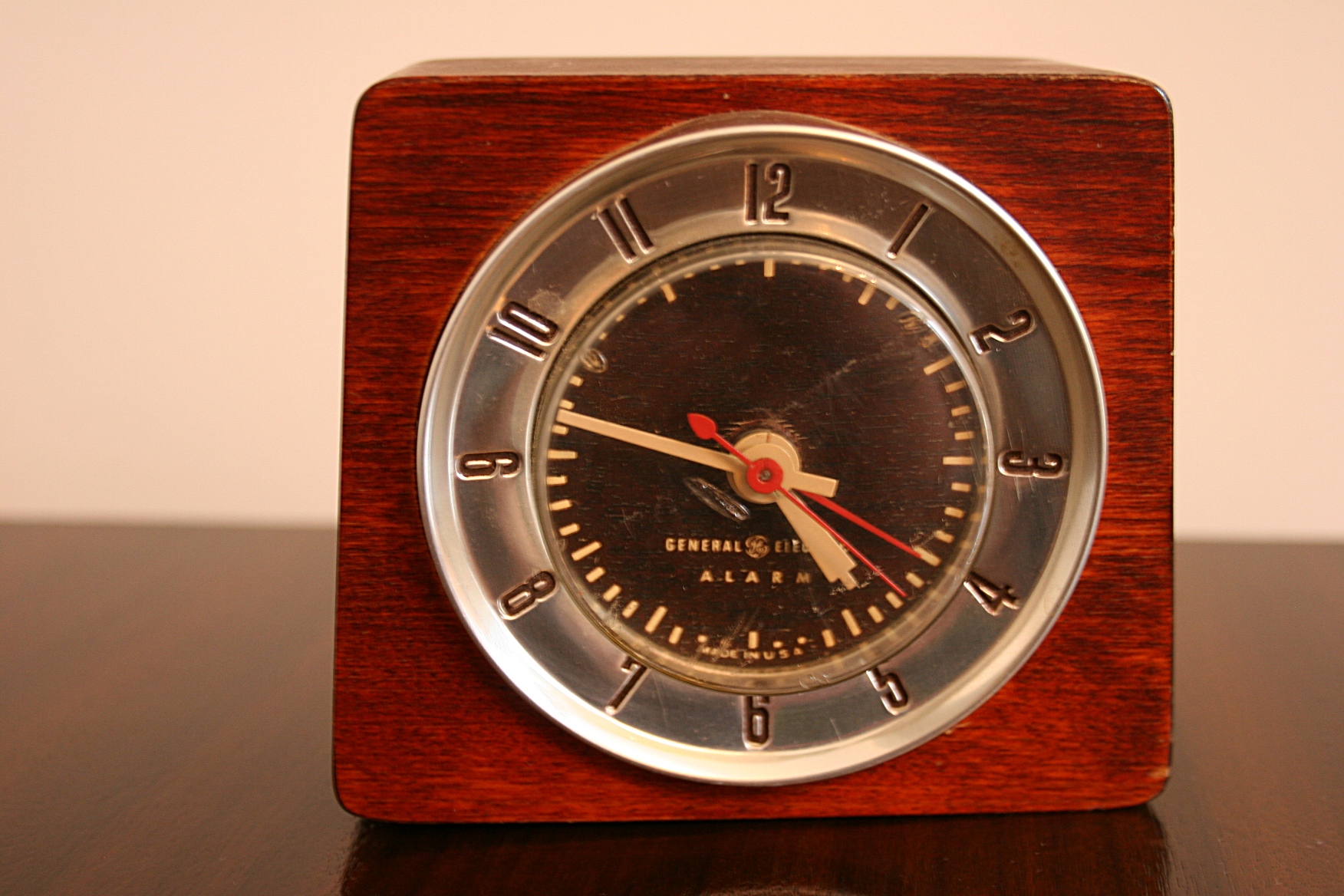
A working General Electric alarm clock made from wood.

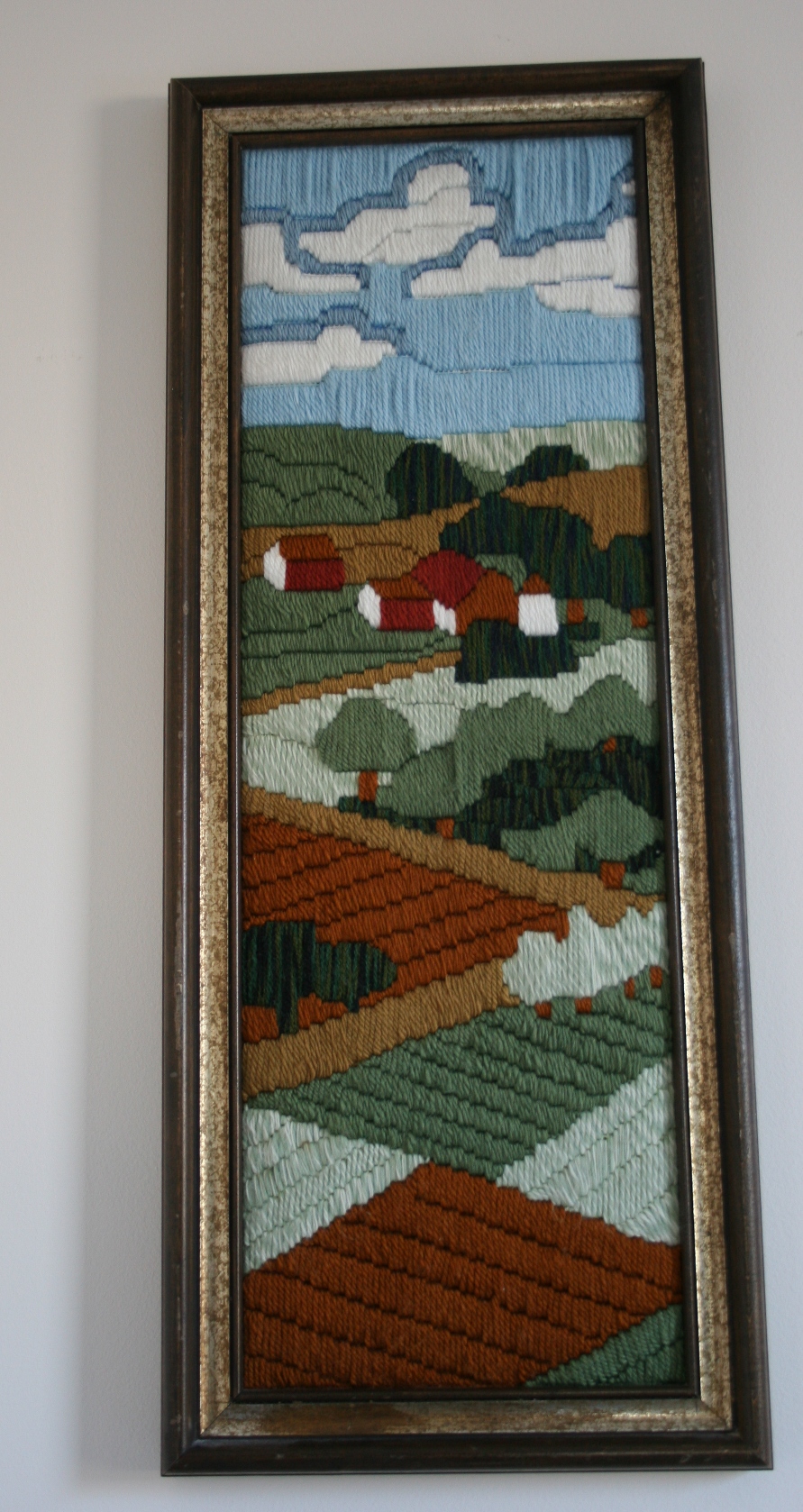
A hand-stitched rural scene.

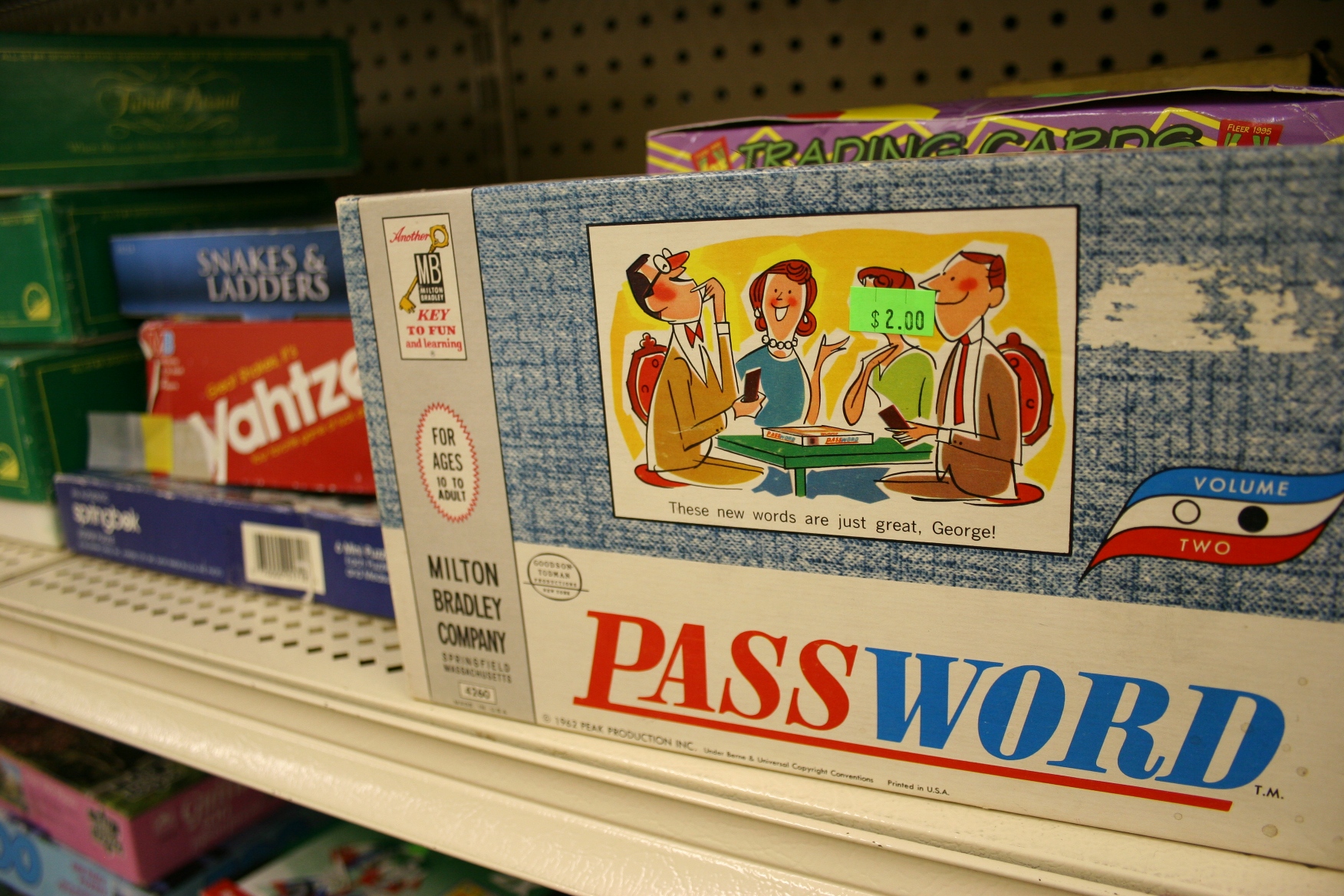
I found games packing shelves at the Salvation Army, including this vintage version of Password.

Alright then, have you made your guesses? Which of the above two did I buy?

And which of the above two did I wish I’d purchased?

PURCHASED: The General Electric alarm clock for $4 and the needlework art for $2.

SHOULD HAVE PURCHASED: The Password game at the Salvation Army and “The Girl with Attitude” clock (which I think was out of my thrifty price range) at Terry’s Curiosities and Collectables.

Would you have bought any of these items?

© Copyright 2012 Audrey Kletscher Helbling


Celebrating the regional poetry of Minnesota March 27, 2012

THREE APPARENTLY is the lucky number connected with this year’s soon-to-be-released sixth Poetic Strokes anthology published by my regional library system, Southeastern Libraries Cooperating.

At least, on the surface, with 30 poems by 30 poets from 13 communities, all those threes seem to point to that conclusion.

But I don’t bank success on luck—even if my poem of three verses—is among those that published.

Now I’m not privy to the criteria judges used to evaluate the 202 poems submitted by 202 poets from 34 communities within the 11 SELCO counties. But I trust their judgment to select the 30 best works.

Penning a poem worthy of publication takes time, effort and talent. I know. I’ve received my share of dismissals, including last year’s rejection of my three poems submitted to the Poetic Strokes competition. In retrospect, I can see now that those poems needed refining.

While none of us like rejection, it is often the best/only way to show us we can do better. On several occasions I’ve rewritten rejected poems and then had them accepted elsewhere.

I realize, too, that judges’ personal preferences in poetry and the publication itself also factor into acceptance or rejection of a poem. For example, when I’ve submitted to Lake Region Review and The Talking Stick, I’ve considered that these are Minnesota anthologies rooted in the region. I’ve successfully published in both.

Any of you who’ve read my poetry understand that I am a regional writer, with most of my poems connected to the land, specifically my native southwestern Minnesota. I am rooted to the geography of the prairie and to my experiences growing up there. That connection defines my distinct, poetic voice.

Take my poem, “Writing poetry as the sun rises,” just published in Poetic Strokes 2012. At first glance, the title seems to suggest I’ve veered from my voice. Not so. If not for my life-long deep appreciation of prairie sunrises and sunsets (even though I no longer live on the prairie), I may not have looked up from my computer one morning to appreciate the rising sun and then write about it.

Apparently my Minnesota prairie roots voice resonates with judges as I’ve entered numerous competitions and had my poems accepted for publication or display, including in the upcoming Poet-Artist Collaboration XI at Crossings at Carnegie in Zumbrota. Click here to learn more about that gallery show.

Five of my poems have also published in three volumes of Poetic Strokes. Make that six in four volumes. (This year’s competition allowed submission of only one poem.)

Copies of Poetic Strokes 2012 will be available for check-out at all SELCO libraries during the first week of April, National Poetry Month. Because the anthology was funded by the Minnesota’s Arts and Cultural Heritage Fund, the volume will not be sold. Published poets will each receive five complimentary copies.

To read a list of the poets published in this year’s Poetic Strokes—including five from my county of Rice—click here.

As long as we’re talking poetry here, SELCO will launch its Poets at the Library tour with an appearance by Morris-based writer Athena Kildegaard at 7 p.m. Monday, April 2, at the Owatonna Public Library. Kildegaard, a current Minnesota Book Award poetry finalist with Bodies of Light, has also written Rare Momentum. Both were published by the respected Red Dragonfly Press in Red Wing. Kildegaard’s third poetry collection, Cloves & Honey–love poems, has just been released by Nodin Press.

Poets Laura Purdie Salas, Barton Sutter, Su Smallen and Todd Boss—one of my personal favorites—are also part of the SELCO tour. Click here to learn more about Poets at the Library.

Now, I am not so naïve as to believe that all of you like and embrace poetry. But if you haven’t read poetry in awhile, then I’d suggest you try reading it again. Today’s poetry is not the rhyming, elitist poetry of your youth.

I will be the first to tell you, emphatically, that I find some poetry so totally out there that I have no hope of understanding it. That’s OK. Find a poet whose voice resonates with you and then listen and appreciate the words that touch your soul.

© Copyright 2012 Audrey Kletscher Helbling