Minnesota Prairie Roots

Writing and photography by Audrey Kletscher Helbling
Shopping Wisconsin style at the Appleton Farm Market October 26, 2012

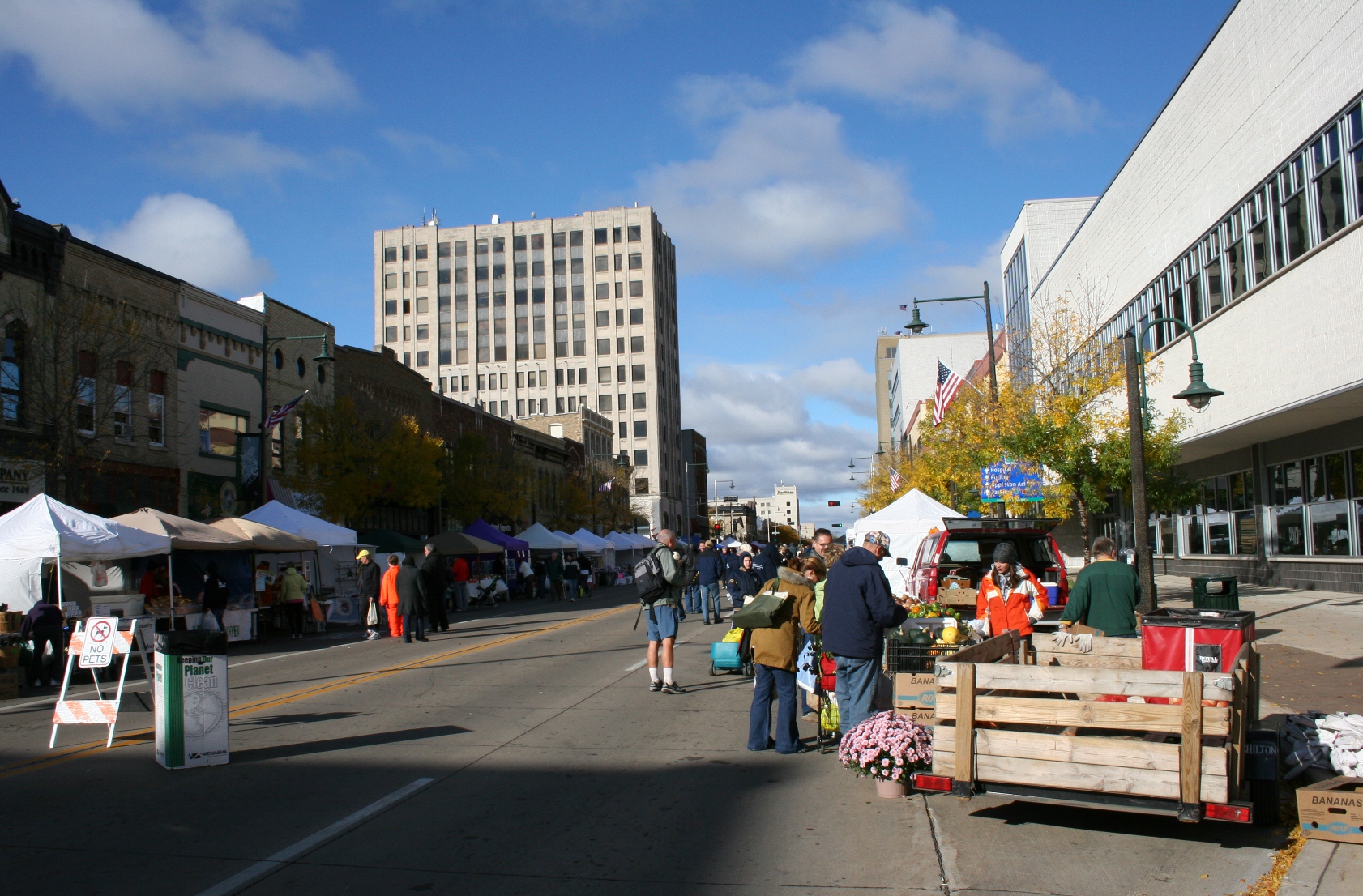
The Appleton Farm Market on a brisk, early October morning.

FOR THE PAST TWO YEARS, since moving to northeastern Wisconsin, our daughter Miranda has raved about the outdoor Appleton Farm Market. She enthuses about the trolley and the entertainment, the fresh produce and flowers and crafts in this open air market in the heart of a downtown that mixes old and modern, buildings, that is.

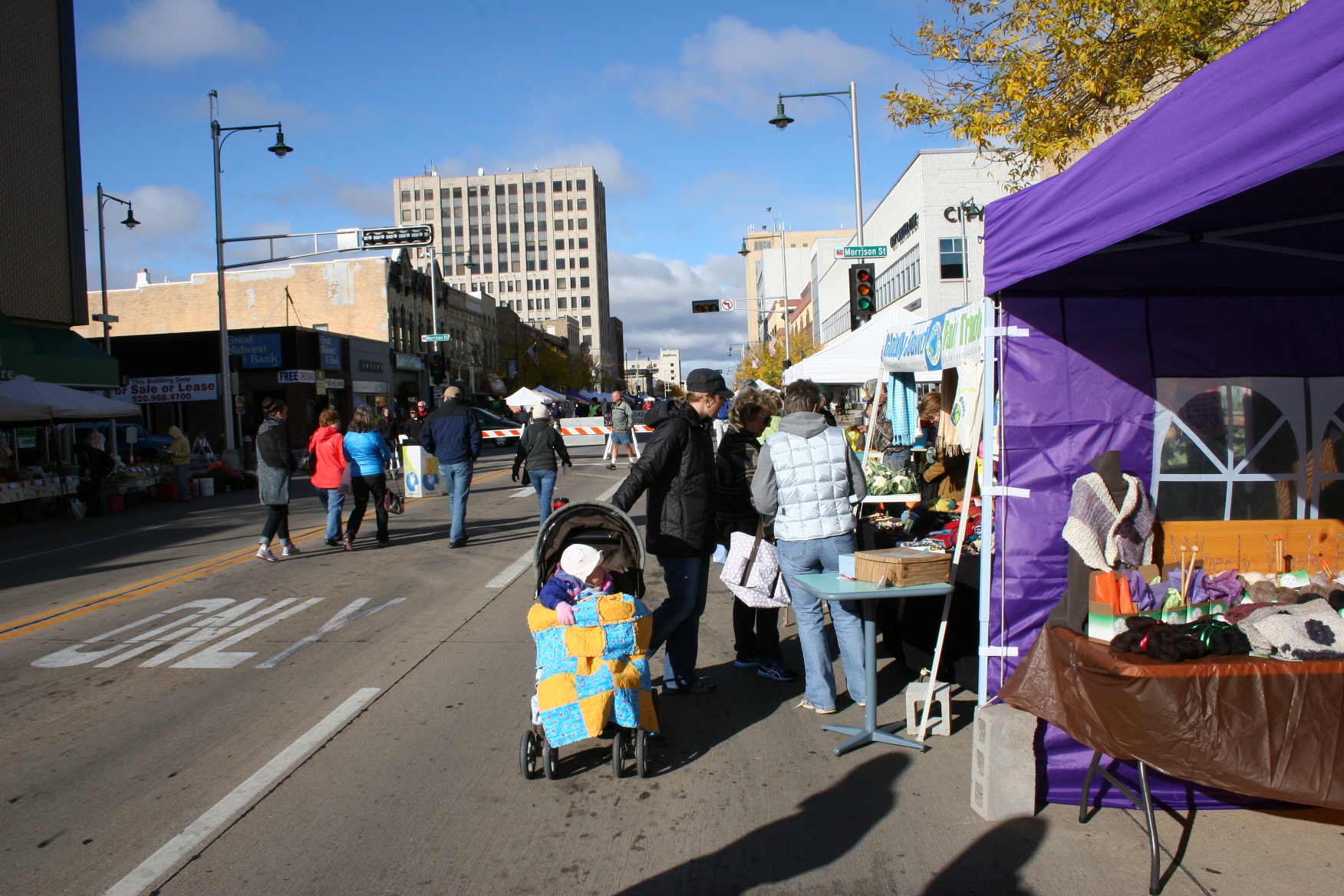
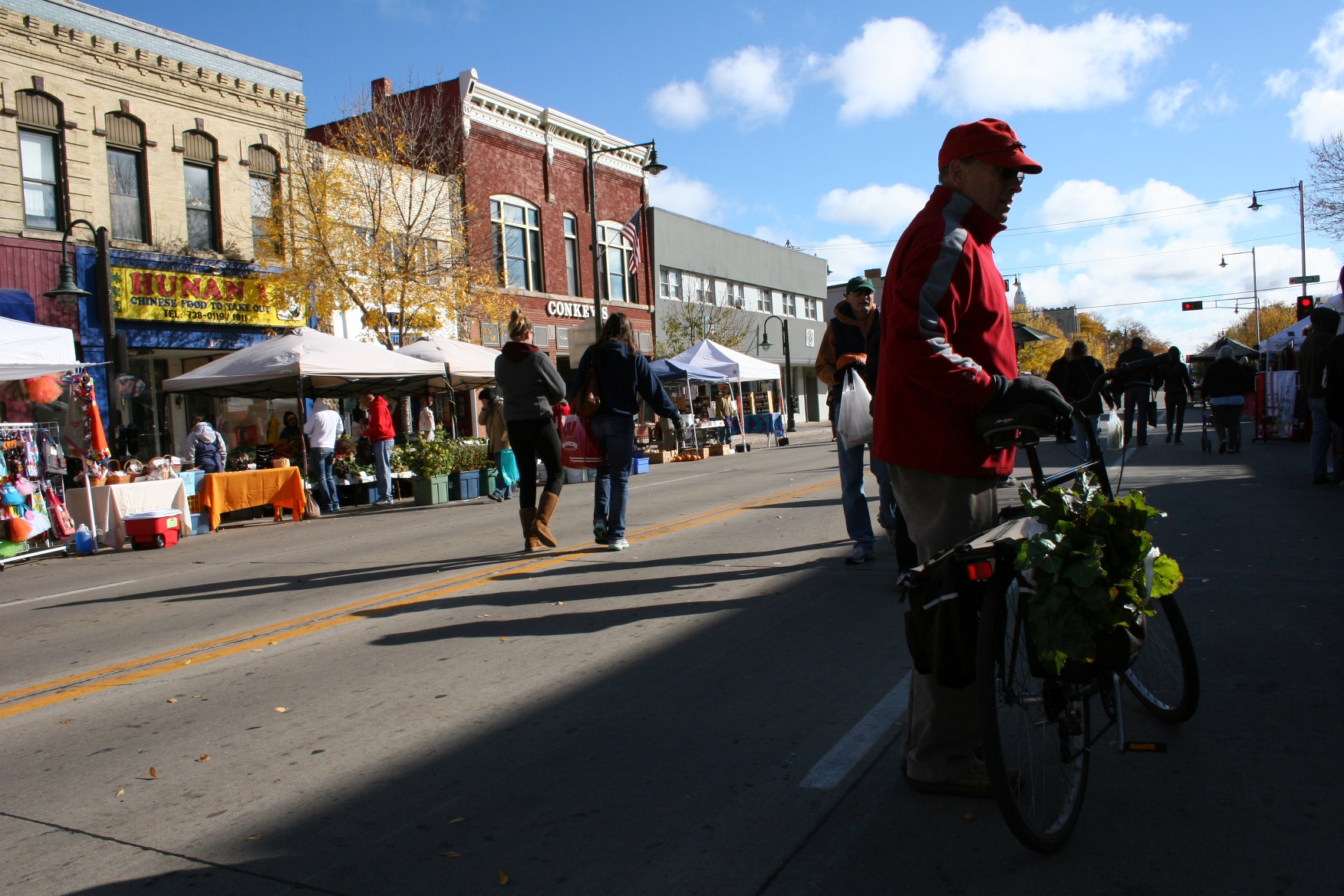
All ages, including babies in strollers, were bundled up in the blustery weather.

So on a recent visit to Appleton, which is south of Green Bay for those of you unfamiliar with the Badger state’s cities, we took in the outdoor farm market on a cold and windy Saturday morning. It was mitten and fleece-wearing weather, although we’d left both behind in Minnesota, not expecting such cool temps.

College Avenue is blocked off to vehicle traffic for several blocks.

Our daughter knows a secret, free parking spot (if you arrive early enough) just off the east end of College Avenue, the downtown street closed to motor traffic for several blocks during the market.

Pearly Grey designer Jen Nowak-Miller tries to stay warm in her booth where she marketed these eye-catching skirts and much more. I fell in love with the prints.  Jen loves them, too, and calls her  attraction to these an “addiction.” This talented designer, who holds a bachelor’s degree in Apparel Design and Manufacturing, also offers her retro/funky clothing designs online at  “It’s All Retro Baby.” She recently relocated from Oregon back to her native Wisconsin.

And so we set off from there to explore. I found myself lagging behind the daughter and husband as I chatted with vendors and took photos of this impressive market.

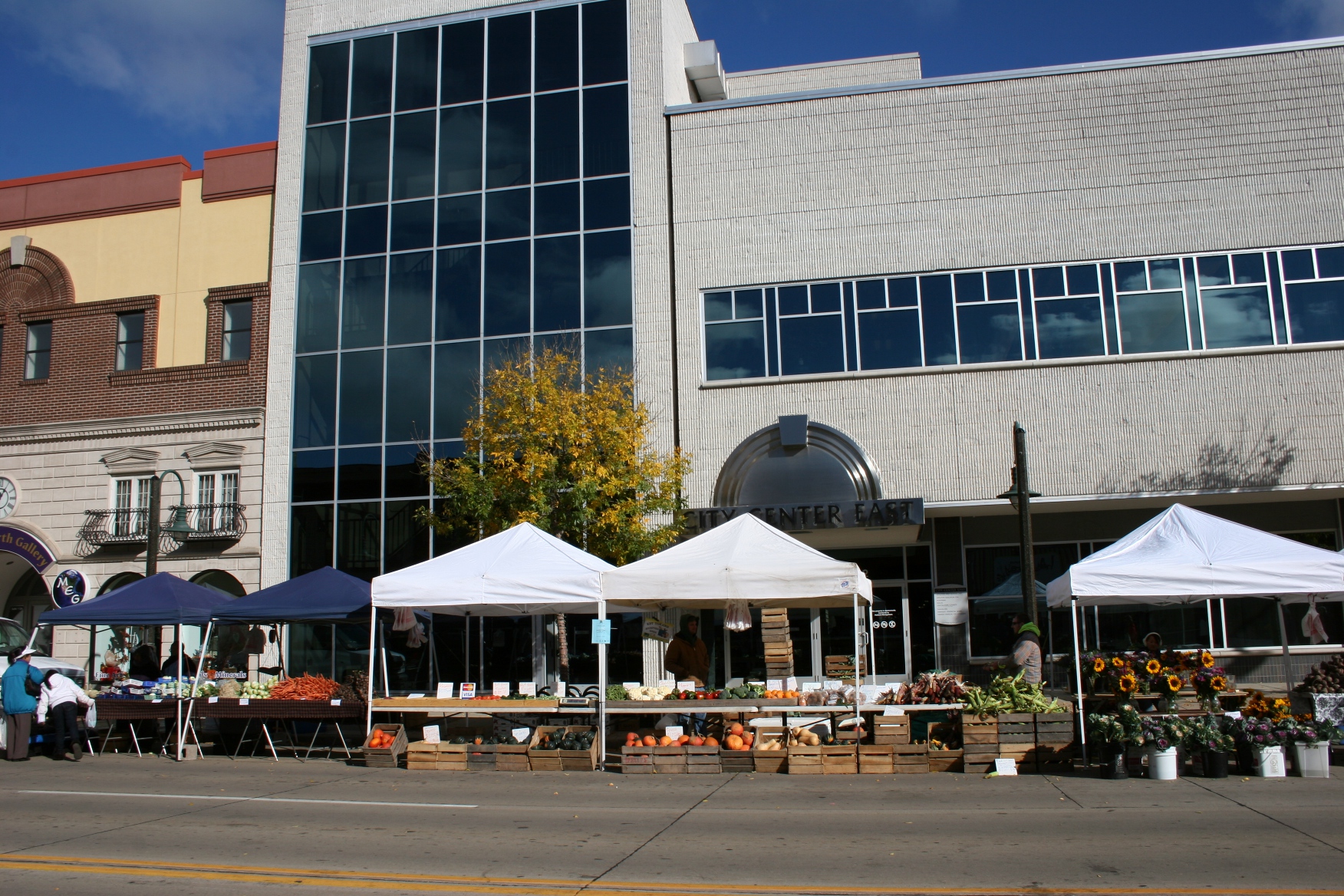
The Appleton Farm Market moves into City Center, the building pictured here on the right, beginning on the first Saturday in November.

I must qualify here that I’ve previously been to the indoor Appleton Farm Market at City Center. Although nice, you just don’t get the same vibe, the same variety, as an outdoor affair. And I think that could be said for any upper Midwest market that moves indoors in the colder, non-growing season.

This Saturday marks the year’s final outdoor venue (from 8 a.m. – 12:30 p.m.) in Appleton with the market moving into City Center from November through March (9 a.m. – 12:30 p.m.). The trolley stopped running at the end of September.

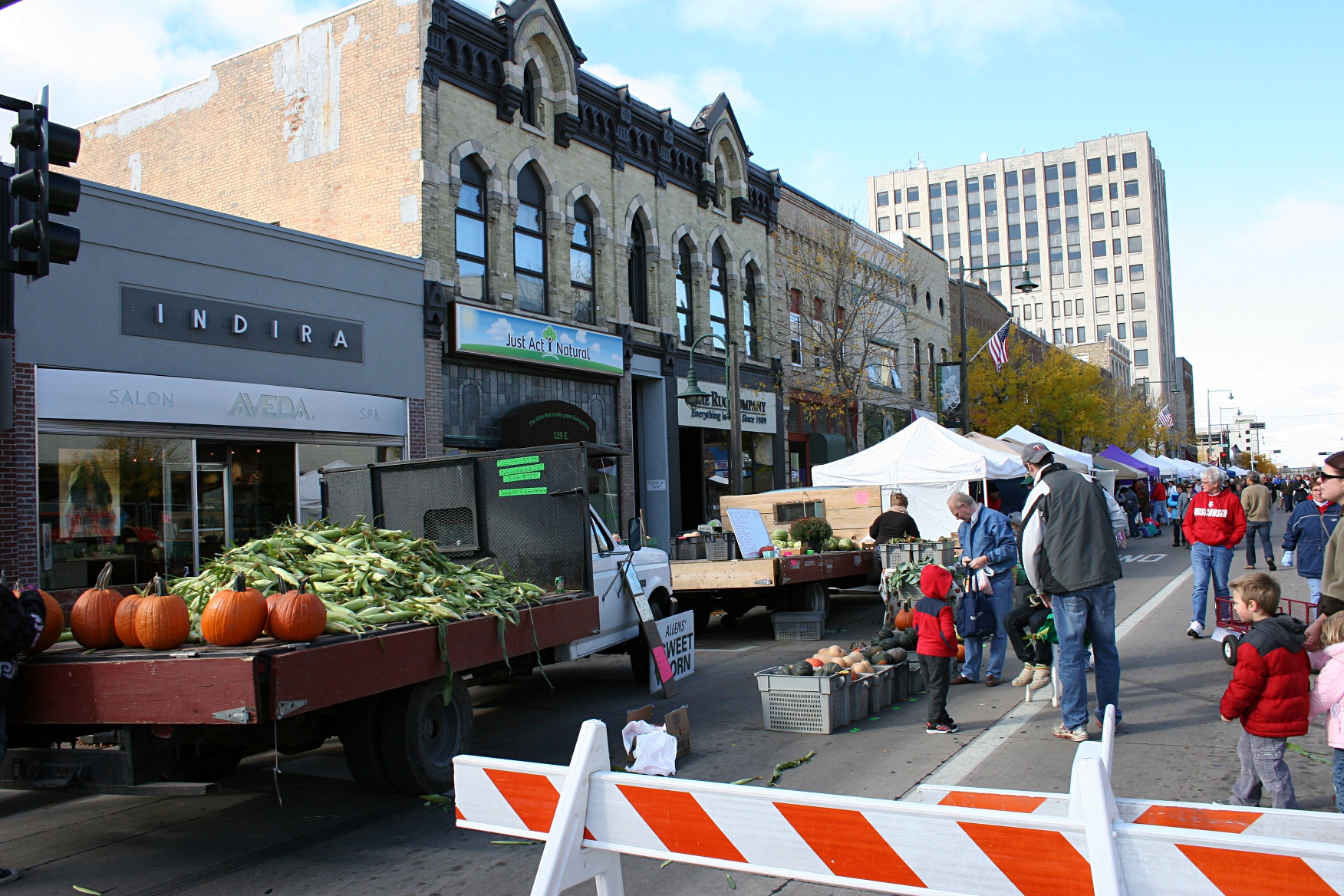
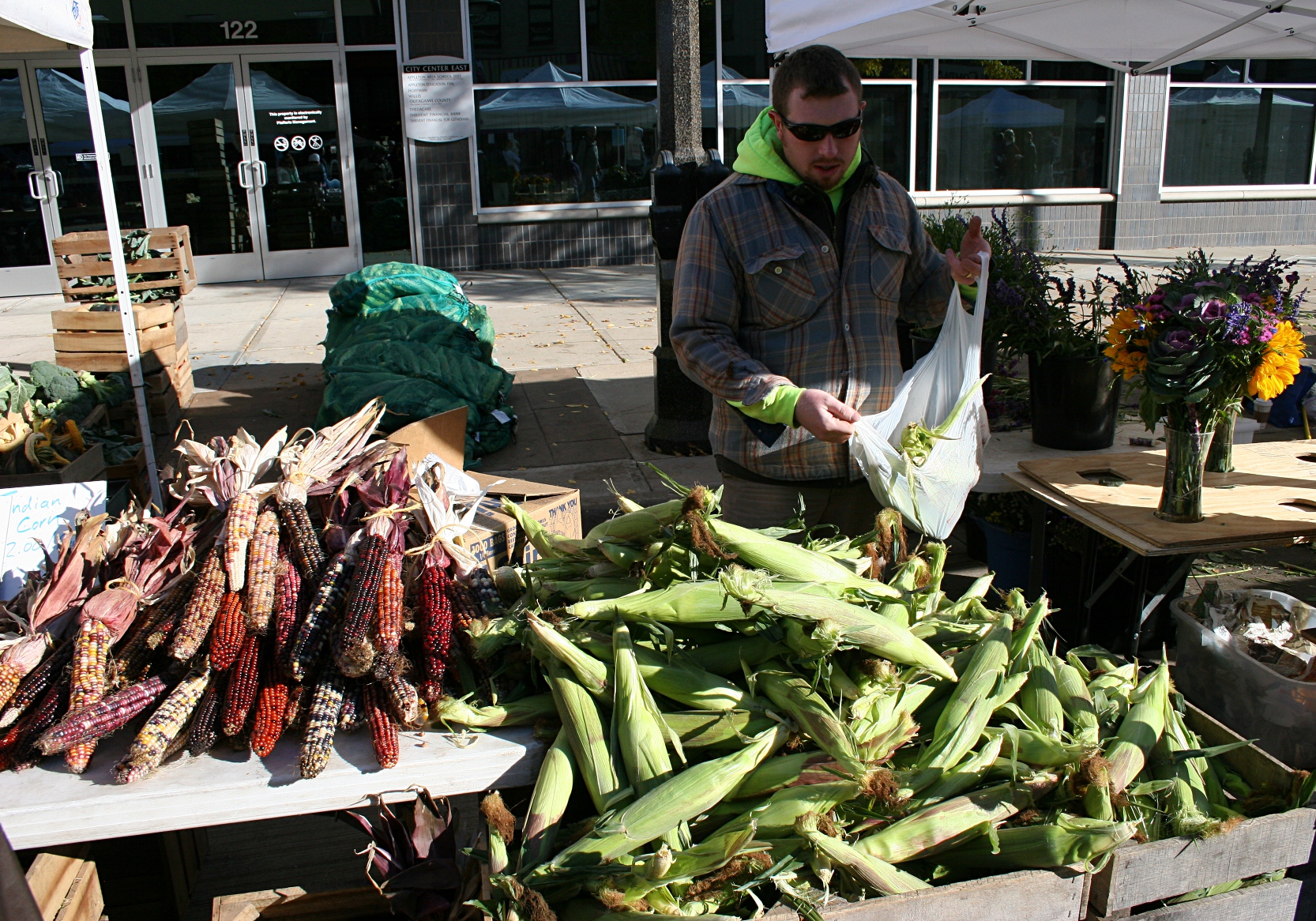
This vendor pitched something about the last sweetcorn dance, so my daughter purchased six ears.

And so we walked block after block through downtown Appleton as shoppers scooped up the last of the year’s sweet corn crop, sampled BBQ on pork, clustered at knitters’ booths to slip warm mittens onto cold hands, purchased $10 bouquets of fresh flowers, speared toothpicks into cubes of Wisconsin cheese…

Piles of fresh carrots highlighted in the morning sunshine.

A shopper arrives on his bicycle and piles on the lettuce.

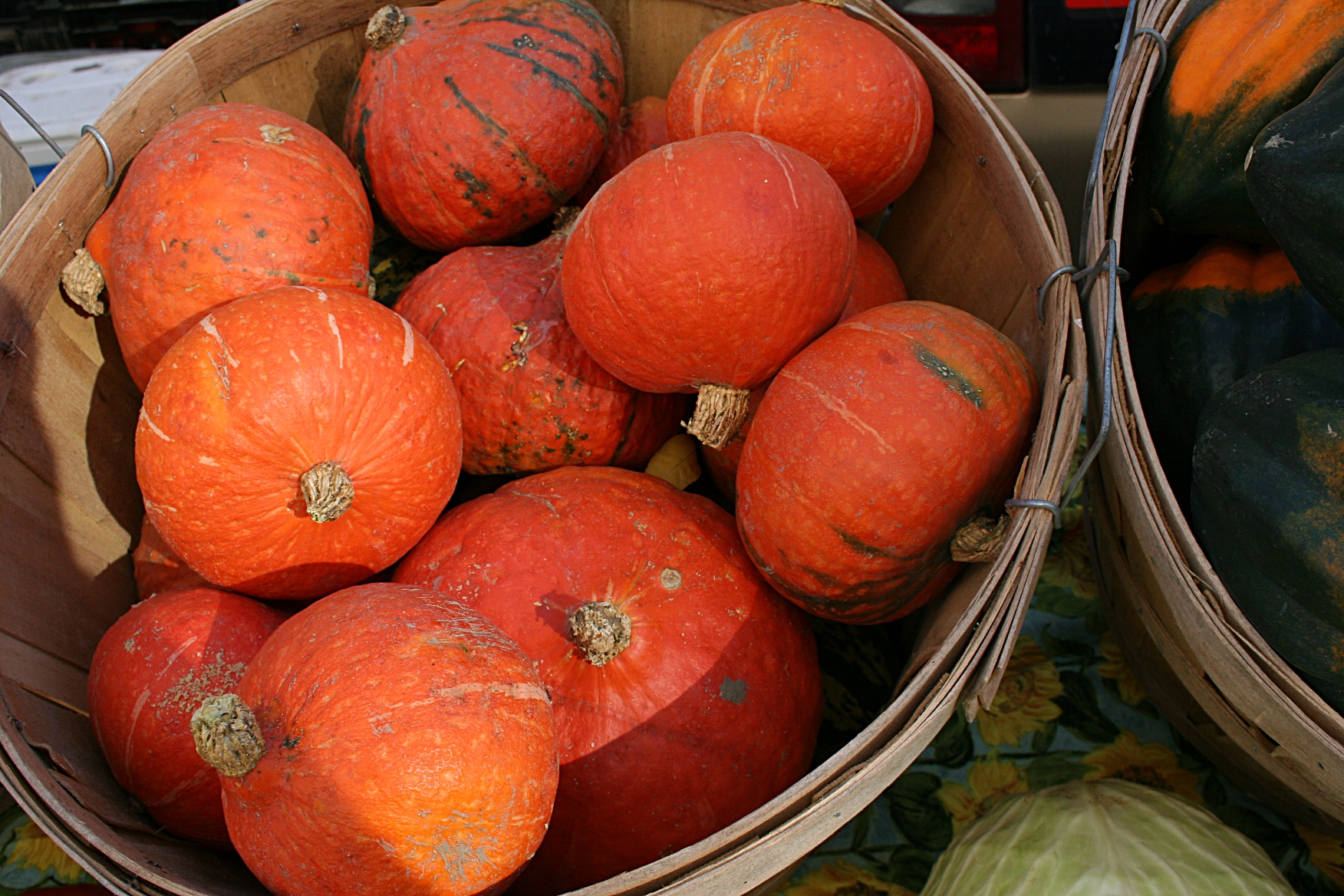
Ah, the bright colors of seasonal produce.

While the entertainment was limited to two young musicians under a canopy, our daughter says warmer weather brings more entertainers.

But on this Saturday in early October, the vendors and shoppers provided entertainment enough for this Minnesotan.

FYI: To learn more about the Appleton Farm Market and about downtown Appleton, click here and click here.

To learn more about the clothing designed by Jen Nowak-Miller, click here to link to her Pearly Grey, “It’s All Retro Baby,” website.

TO SEE MORE APPLETON FARM MARKET photos, keep scrolling:

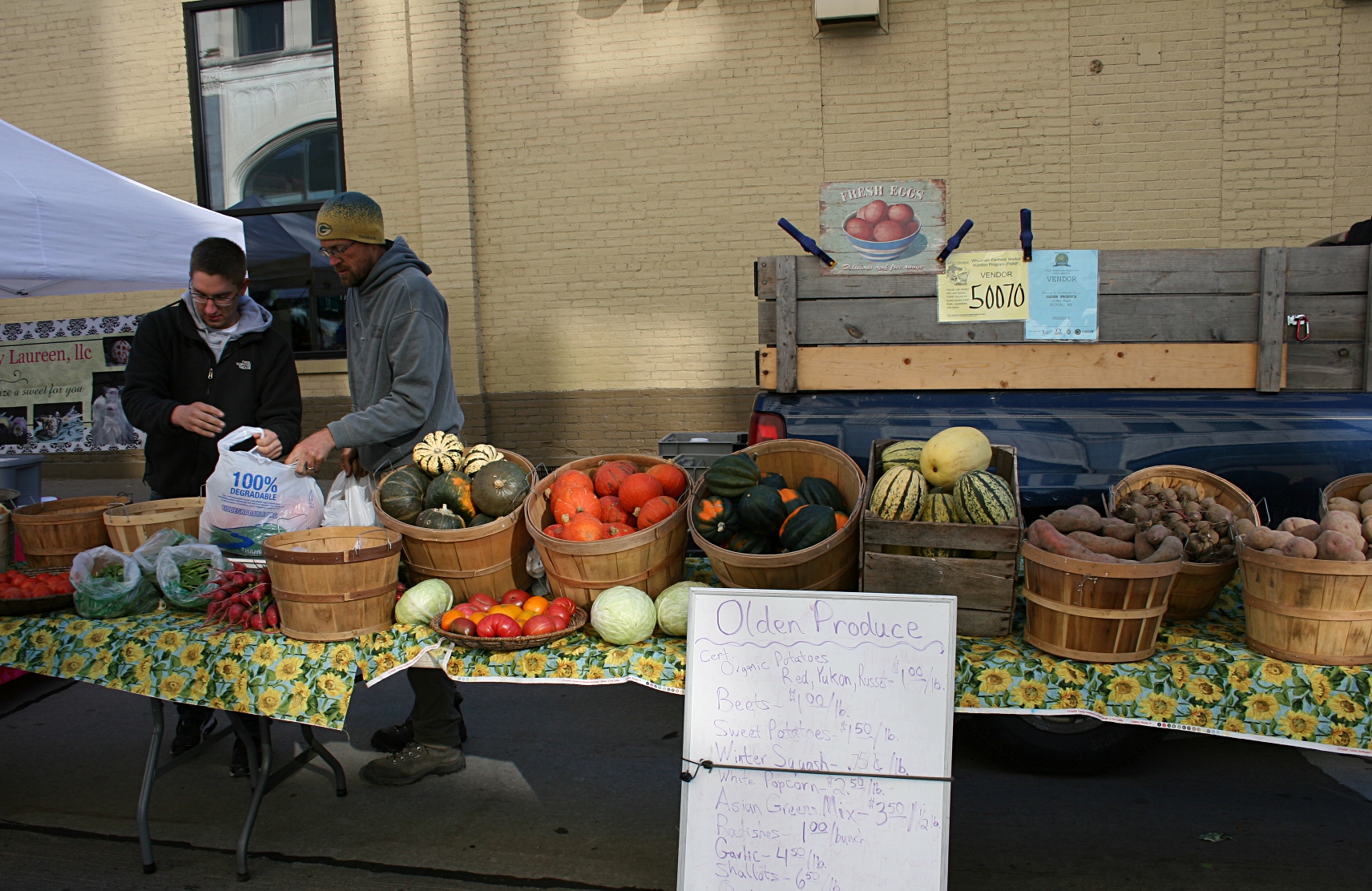
Just one of the many, many vendors offering garden fresh produce.

Several crafty types sold mittens which proved popular with shoppers on the cold, cold morning. At this booth I spotted green and gold Packers mittens and told the vendor I couldn’t buy them because I was from Minnesota. Not missing a beat, and with a huge smile spreading across her face, she reached under her table, whipped out a pair of purple mittens and told me she’d just made them the previous evening.  You should have seen the surprised look on my face.

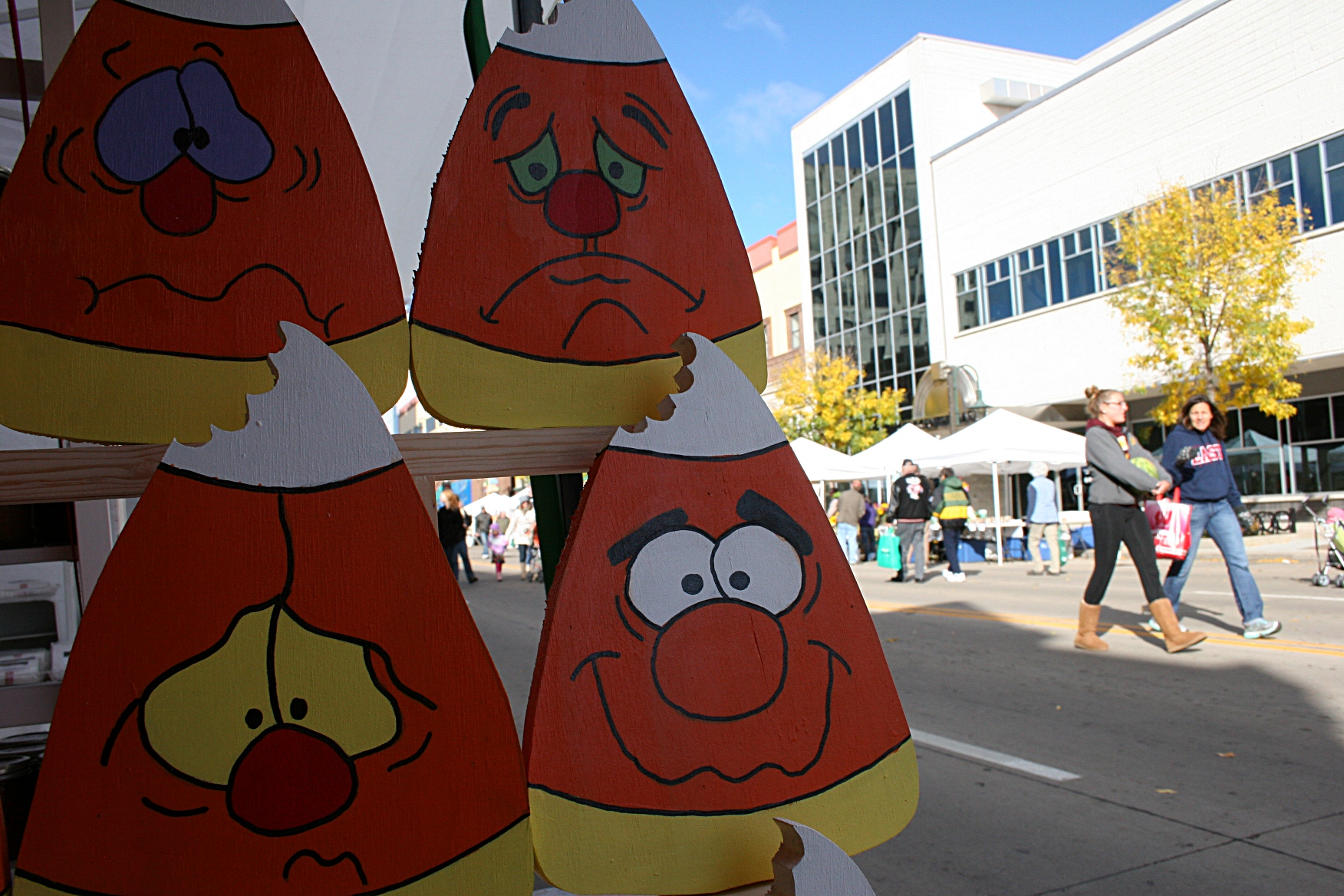
A father and son were selling these humorous candy corn faces they sawed from wood and painted.

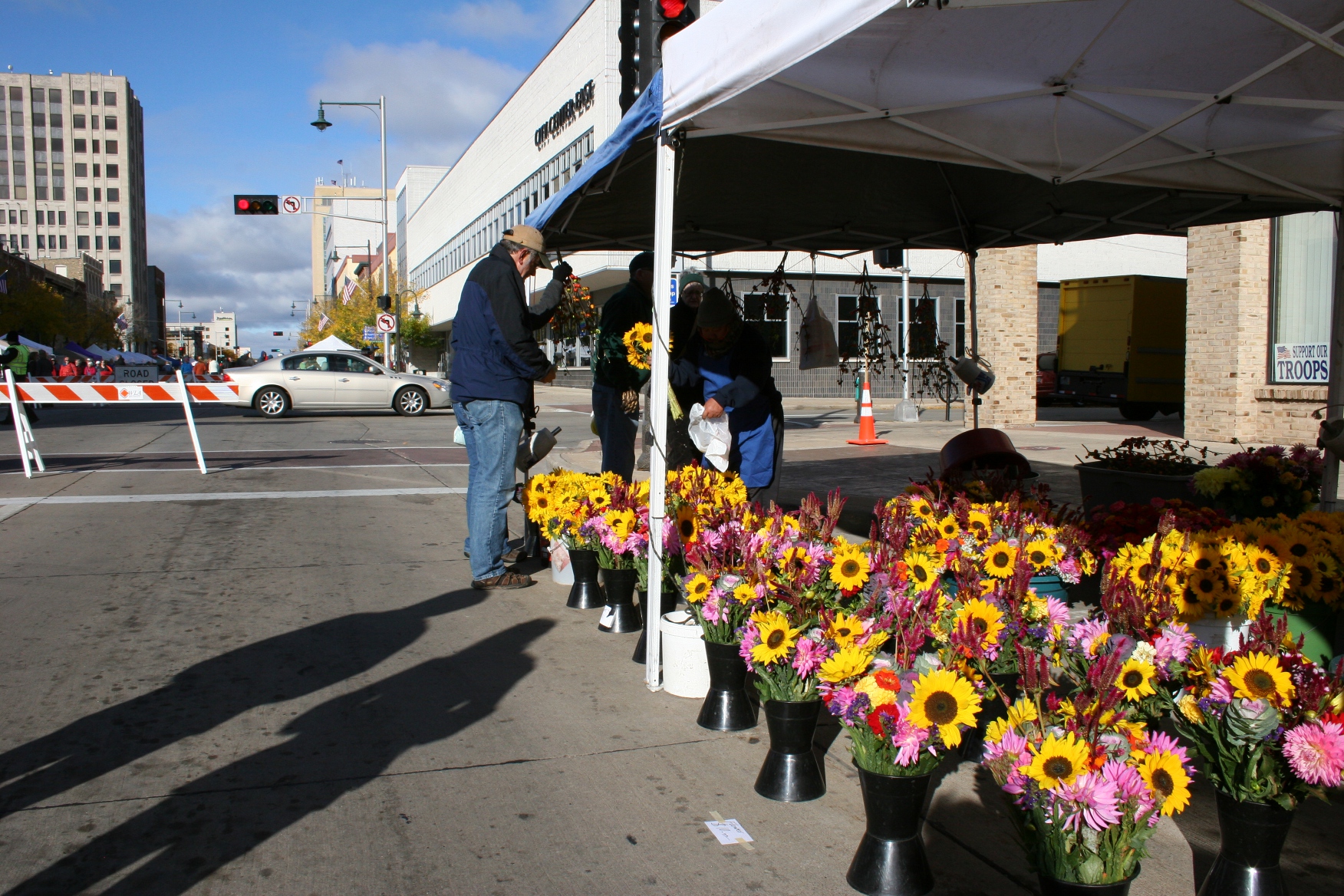
Beautiful floral bouquets and only $10. Should have bought some for my daughter.

And just because I love flowers so much, here’s a close-up shot.

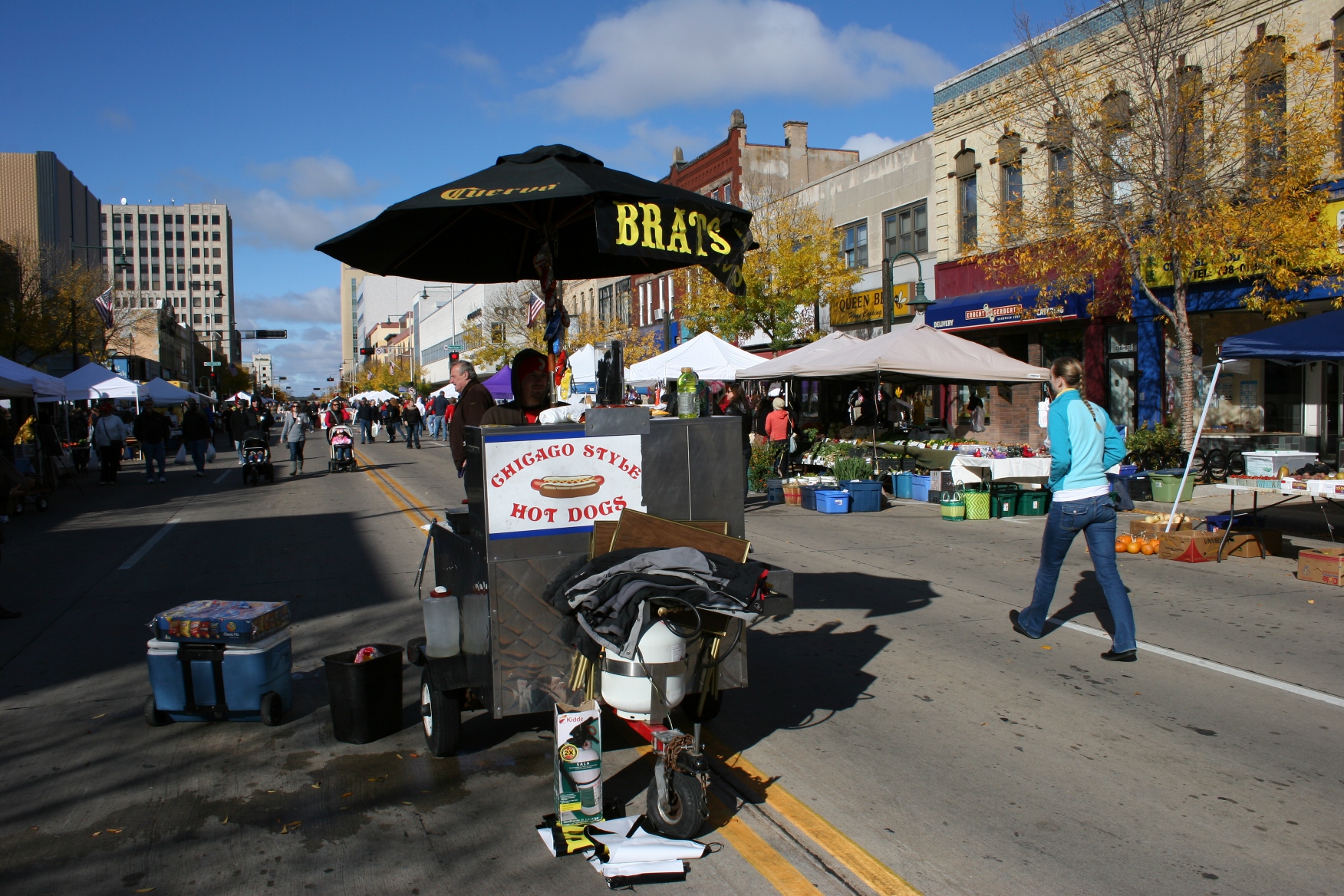
Every Wisconsin event needs brats, right?

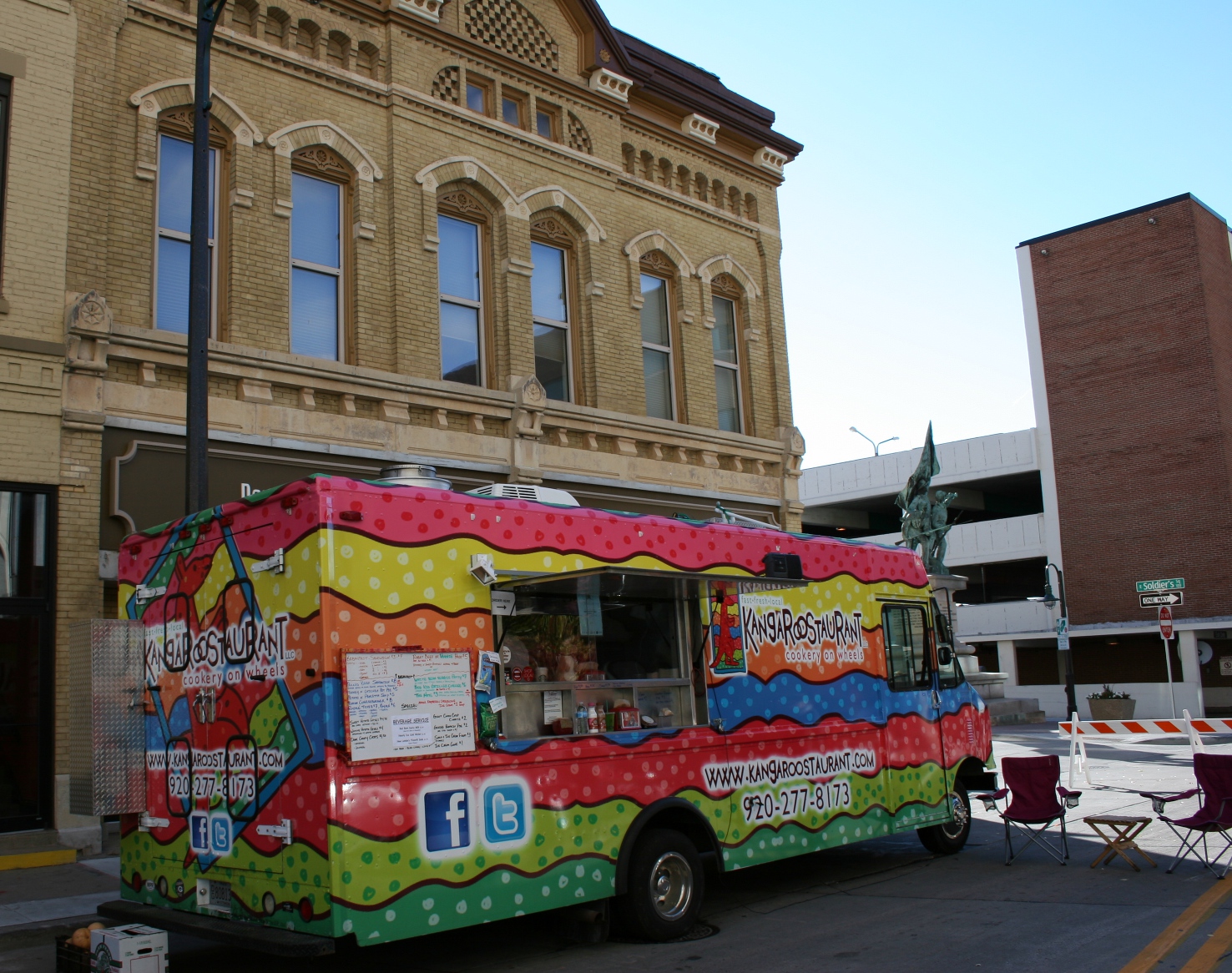
I spotted this food truck on a side street just off College Avenue. I know in other cities, food trucks have become a point of contention for local restaurants during events. I don’t know how the restaurant owners in downtown Appleton feel about the food truck’s presence.

Happy Halloween from the same father-son duo who created the candy corn faces.

DISCLAIMER: I received a gift certificate from Downtown Appleton Inc. last year after posting about a previous visit to this city. That did not affect my decision to write again about Appleton nor the content of this post. And you can expect another story coming soon from Appleton on the Leonardo da Vinci exhibit there.

© Copyright 2012 Audrey Kletscher Helbling
 

No cherry jackpot this season in Door County, Wisconsin October 13, 2012

Filed under: Uncategorized — Audrey Kletscher Helbling @ 9:12 AM
Tags: , , , , , ,

REMEMBER THAT WONDERFUL and unseasonably warm weather we embraced last March? Then remember the cold and freezing weather which followed in April, as if the two months traded spots temperature-wise. Not a good thing when you own an orchard.

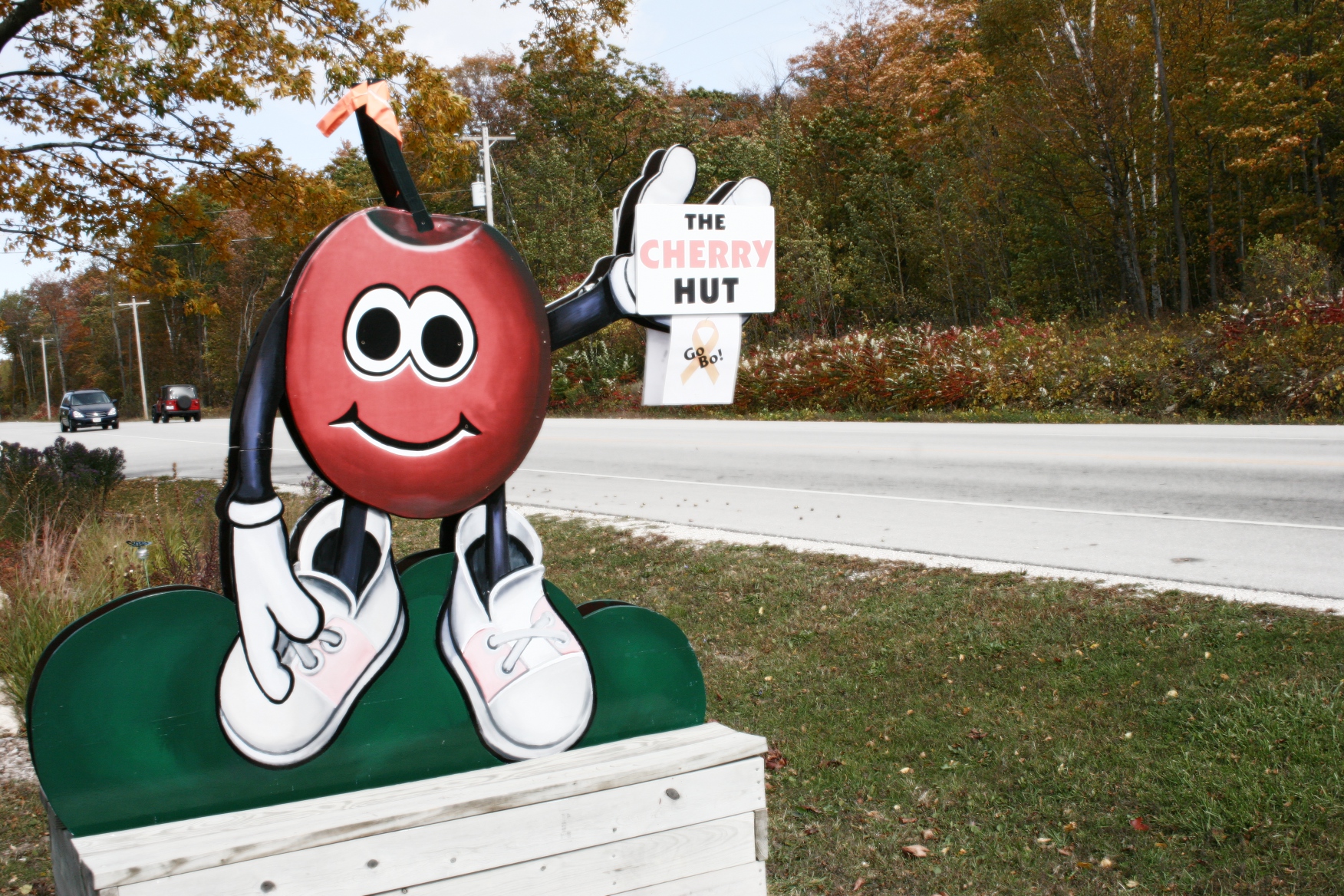
This sign along Wisconsin Highway 42 south of Fish Creek marks The Cherry Hut roadside cherry business, established in 1949.

I hadn’t thought much about that warm spring until a recent visit to Door County, Wisconsin, famous for its cherry orchards.

The northeastern Wisconsin peninsula experienced the same type of weird warm winter weather we did here in Minnesota, causing the cherry tree buds to form early and then freeze.

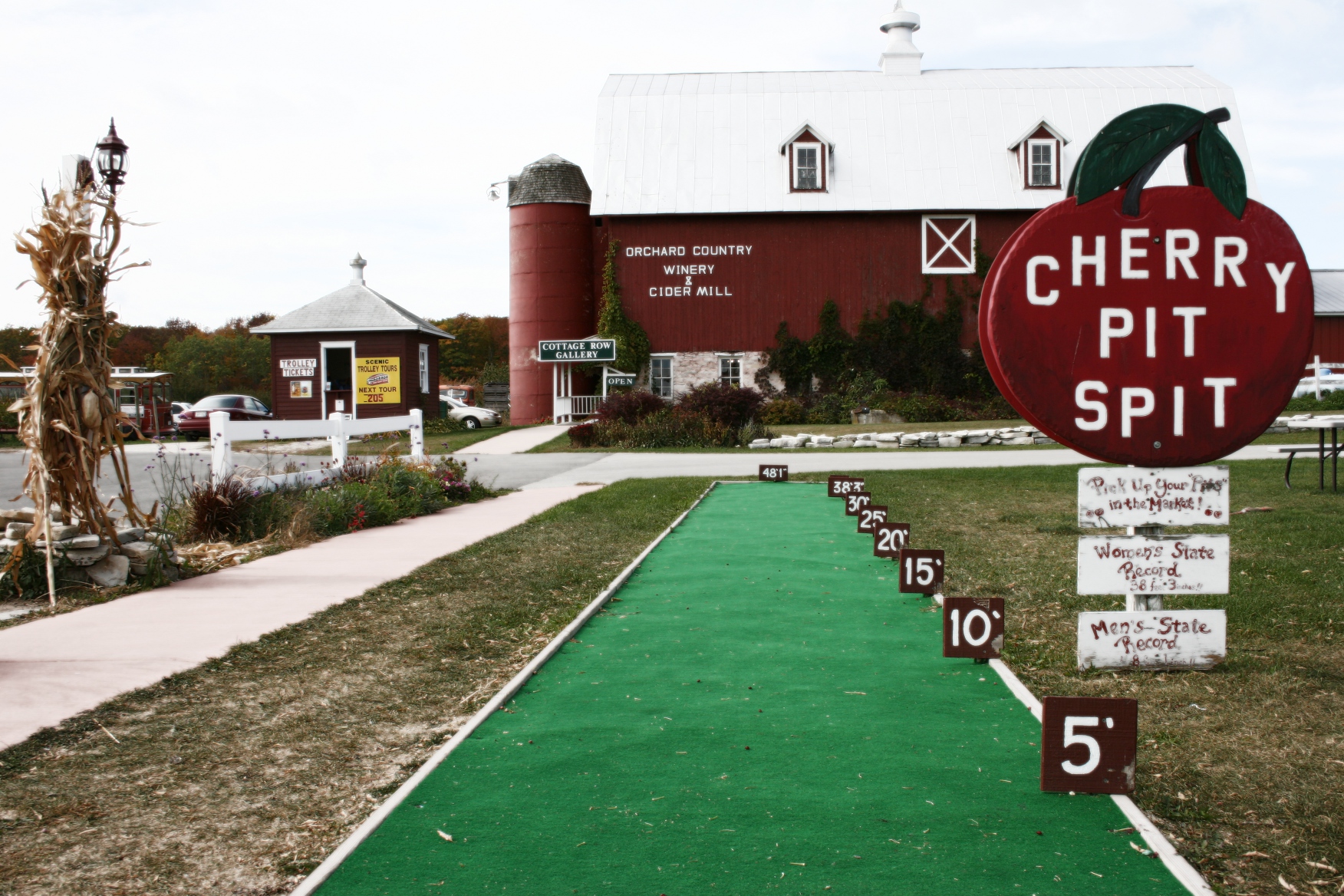
The cherry pit spit at Lautenbach’s Country Winery & Market, Fish Creek.

According to the Wisconsin Cherry Growers, Door County’s typical cherry crop of 12 million pounds was expected this year to hover around 700,000.

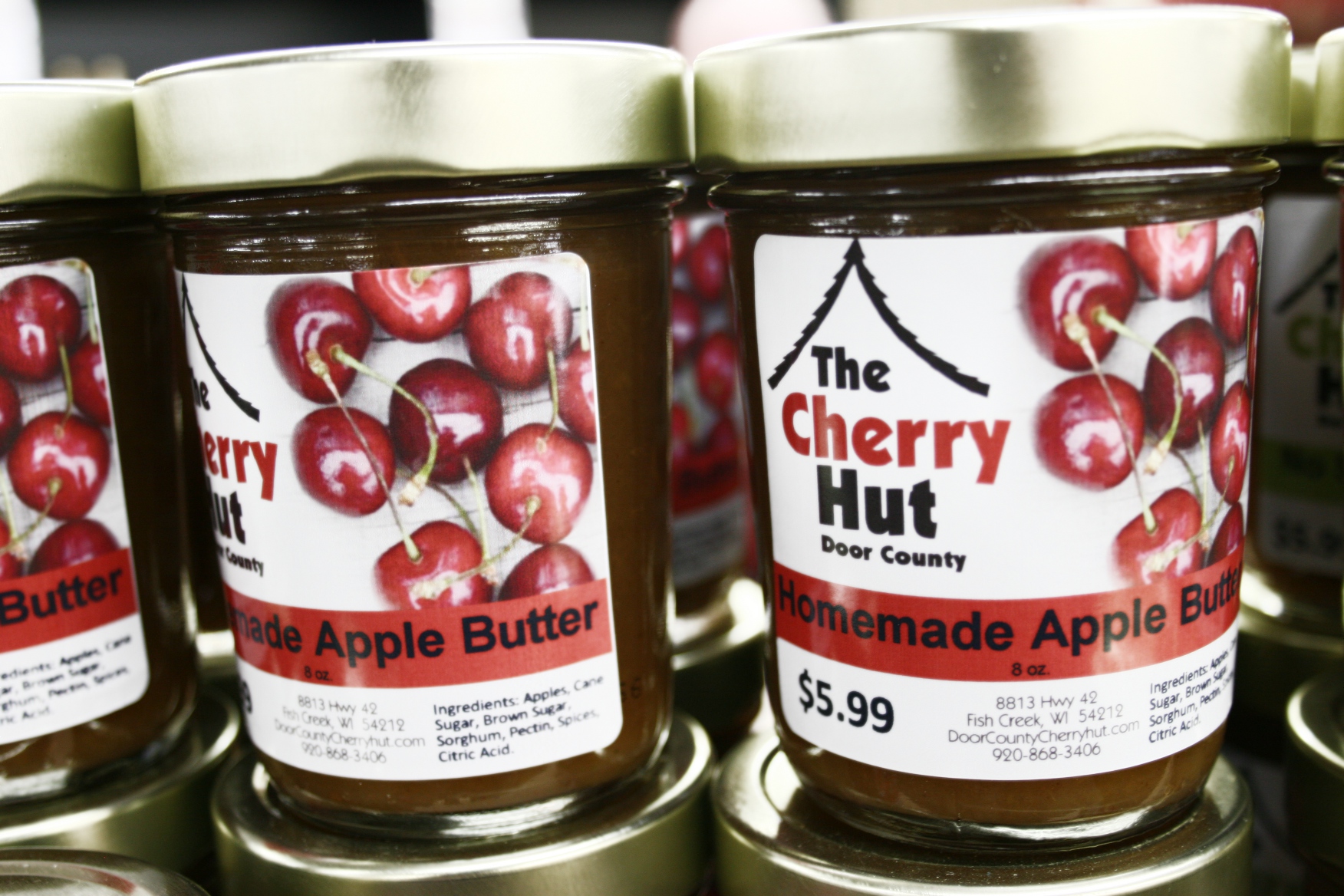
At first glance you would think this is a cherry product. Not so. This is apple butter sold by The Cherry Hut. I assume the apple crop was also down this year in Door County as it is in Minnesota.

The cherry harvest is long done in Door County. But even a poor crop doesn’t stop this tourist destination from promoting cherries and offering samples of cherry wines and juices and cherry salsa from, I presume, primarily last season’s crop.

And restaurants, like Julie’s Park Cafe in Fish Creek, were still offering up slices of delicious Door County cherry pie.

A $5 slice of tart Door County cherry pie…

…shared by three–my husband, second daughter and me.

© Copyright 2012 Audrey Kletscher Helbling
 

Missing the farm during a Minnesota harvest September 30, 2012

Filed under: Uncategorized — Audrey Kletscher Helbling @ 11:09 AM
Tags: , , , , , , , ,

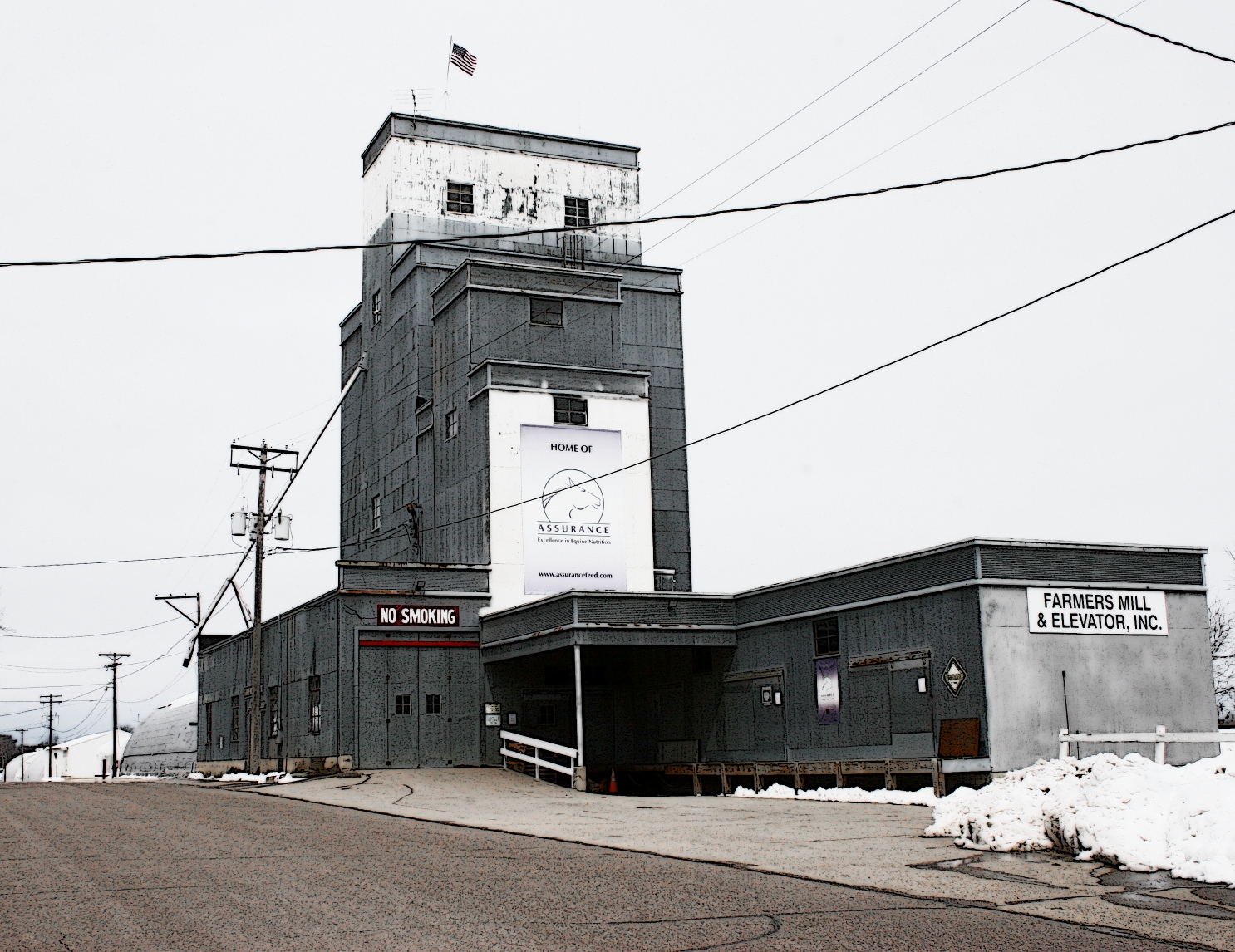
An elevator just outside of Vermillion, MN., near Hastings on Saturday morning.

DECADES HAVE PASSED since I’ve been home on the farm for harvest. My middle brother quit farming years ago and the home place is now rented out.

A harvested cornfield between Hastings and Cannon Falls.

I miss being on the farm, anticipating the bringing in of the crop, then watching the combines chomp through rows of brittle cornstalks and brown fields of ripened soybeans.

Between Hastings and Cannon Falls.

I miss the undeniable scent of earth and plant residue.

Harvesting corn just south of Hastings on Saturday afternoon.

I miss the grain wagons brimming with golden kernels.

The Vermillion Elevator, in the small town of Vermillion.

I miss living in a rural community where tractors and aged grain trucks line up at the local co-op elevator.

I miss the hum of grain dryers drying corn.

A grain truck waits on a gravel road near Cannon City, east of Faribault.

Now I view the harvest from a distance, as an observer passing by.

© Copyright 2012 Audrey Kletscher Helbling


The Smithsonian in Hanley Falls & Hanley Falls in the Smithsonian (exhibit) September 20, 2012

The Smithsonian’s Museum on Main Street exhibit, “The Way We Worked,” features snippets from Minnesota. Photo courtesy of Minnesota’s Machinery Museum, Hanley Falls, in rural southwestern Minnesota.

I DOUBT MANY of the 304 residents of Hanley Falls, rural Yellow Medicine County, Minnesota, have ever visited the Smithsonian or even traveled to Washington D.C.

But now this internationally-acclaimed museum has come to Hanley Falls via “The Way We Worked,” a Museum on Main Street project developed by the Smithsonian Institution Traveling Exhibition Service and adapted from an original exhibition from the National Archives.

Bottom line, if you can’t bring the people to the museum, bring the museum to the people.

Specifically, from now through October 20,  Minnesota’s Machinery Museum in Hanley Falls is hosting the exhibit on where, how, who and why Americans work.

But that’s not all. Hanley Falls is part of “The Way We Worked,” as are several other Minnesota places and people.

Says Museum Director Laurie Johnson: “It is an honor in itself to be hosting a Smithsonian Traveling Exhibit. To be an actual part of the exhibit traveling all over the U.S. is a very big honor.”

Hanley Falls’ place in the exhibit falls in the “Communities at Work” section and features a 1987 aerial view photo of Hanley Falls by Vincent H. Mart sourced from the Minnesota Historical Society. The MHS photographic collection includes 5,697 aerial views from around Minnesota photographed by Mart between 1962-1988.

The 1987 Vincent H. Mart photo showing a portion of Hanley Falls and now part of the Smithsonian traveling exhibit. Photo courtesy of Minnesota’s Machinery Museum.

Mart’s black-and-white shot #5,655 in the MHS archives, and now in the Smithsonian exhibit as image 196, shows the then Hanley Falls Farmers Elevator (now the Farmer’s Co-op Elevator) on the west side of town, plus Bennett Transportation (bus company) and the fourth-generation Oftedahl family farm. As a side note, the elevator celebrated its 100th anniversary this past July on Minnesota’s Machinery Museum grounds with more than 2,000 in attendance.

According to Johnson, the scene in the photograph no longer looks the same. Several of the grain bins were damaged in a wind storm and the main office was  moved and an elevator built to the southwest of the Oftedahl farm. The old elevator remains and is still used by the Farmer’s Co-op.

The exhibit copy which accompanies the Hanley Falls photo reads, in part:

The reminders of a town’s main industry imprint its landscape and identity. Silos dominate the skyline in Hanley Falls, Minnesota as they do in most small, agricultural communities.

And here’s how Johnson summarizes what the Hanley Falls photo tells us about “The Way We Worked:”

Farming is a way of life here and has been for many generations. The exhibit talks about “community” and we are definitely a community that works, worships, (has) neighborhood get-togethers and plays together.

Johnson, who lives on a farm about 10 miles north of Hanley Falls, further explains that the local elevator, banks and gas station provide jobs in town. Some residents work in neighboring towns. Many are retired.

You’ll find plenty of old tractors and farm machinery, along with vintage cars and trucks, in the museum’s outbuildings. Minnesota Prairie Roots file photo.

Already the Smithsonian show is attracting more visitors to Minnesota’s Machinery Museum, defined by Johnson as “an agricultural museum recalling farm life in stories and artifacts from how we farmed with horses to a farm kitchen, bedroom, parlor and general store…preserving our agricultural heritage for generations.”

The entrance to the portion of the museum housed in the former school, a WPA building. Minnesota Prairie Roots file photo.

The five-building Yellow Medicine County museum complex, which includes the former Hanley Falls School built in 1939 by the Works Progress Administration, rests on six acres. You’ll find antique tractors, automobiles, gas engines, threshing equipment and other machinery and artifacts in the outbuildings.

A bushel basket, one of the many ag items displayed at the museum. Minnesota Prairie Roots file photo.

Until October 20, you also can find five multi-sided kiosks featuring photos, videos, flip booklets and other interactive activities as part of the Smithsonian’s “The Way We Worked” exhibit.

Besides Hanley Falls, other Minnesota places/information in the show are a photo of women sorting sweet potatoes; quotes from Earl Bakken, founder of Minneapolis-based Medtronics, maker of the first self-contained pacemaker; a 1974 photo from Danheim Dairy in New Ulm; a SPAM Town banner; mention of the Moorhead Spuds (hometown pride for the town team); and a 1928 photo of St. Paul Gas and Light Company workers at a dance.

Johnson has no idea how the Hanley Falls photo became a part of this national touring exhibit. She discovered the town’s inclusion while vacationing in Tennessee, where she stopped to view the exhibit.

An old Hanley Falls fire truck is among vehicles housed in the outbuildings. Minnesota Prairie Roots file photo.

After leaving Hanley Falls, the exhibit will travel to five other Minnesota locations, including the Wright County Historical Society in Buffalo (Oct. 27 – Dec. 8); the Winona County Historical Society in Winona (Dec. 15 – Jan. 26); the Steele County Historical Society in Owatonna (Feb. 2 – March 16); the Virginia Area Historical Society in Virginia (March 23 – May 4); and the Depot Preservation Alliance in Baudette (May 11 – June 22).

In Hanley Falls, “The Way We Were” can be viewed between 10 a.m. – 4 p.m. Monday – Saturday or from 1 p.m. – 4:30 p.m. on Sunday. The museum season was extended to accommodate the show.

Admission to Minnesota’s Machinery Museum is free, but monetary contributions are accepted via a free will donation box.

Located in southwestern Minnesota, Hanley Falls sits nine miles south of Granite Falls or 20 miles north of Marshall along Highway 23. Go one block west of Highway 23 and then a block north to find the museum.

An old-style farm kitchen on the second floor of the museum. Minnesota Prairie Roots file photo.

“The Way We Worked” is presented in Hanley Falls in collaboration with the Minnesota Humanities Center. Funding, says Johnson, is via the Center; The Clean Water, Land & Legacy Amendment (Arts & Cultural Heritage Fund); the Smithsonian Institute; the National Endowment for the Humanities; and the United States Congress.

Minnesota’s Machinery Museum previously hosted the Smithsonian’s Museum on Main Street projects “Barn Again” and “Between Fences.”

FYI: To learn more about Minnesota’s Machinery Museum, click here to link to the museum website.

For more info about “The Way We Worked,” click here.

To view additional photos by Vincent H. Mart in the Minnesota Historical Society archives, click here.

© Copyright 2012 Audrey Kletscher Helbling
 

Meet Bob, the opinionated farmer from Madelia September 10, 2012

Filed under: Uncategorized — Audrey Kletscher Helbling @ 6:46 AM
Tags: , , , , , , ,

I met Bob Michniewicz  and his wife, Judy, selling their woodcrafts at the recent Rice County Steam and Gas Engine Show. He wouldn’t allow me to photograph his art, except for a single sign and a single cow, not wanting others to steal his ideas. However, a few other crafts got into the photo when Bob obliged my request for a portrait.

OCCASIONALLY YOU MEET a character, and you know it just looking at the person, before lips even part to utter a single syllable.

I knew, just knew, Bob Michniewicz was a character when I saw him and his set-up at the Rice County Steam and Gas Engine Show in rural Dundas. With kitschy wooden lawn ornaments—you know the kind—and wind chimes and eye-catching messages defining his space, Bob was bound to be interesting.

Just look at the poster Bob leaned front and center against a support post for the tent under which he and his wife of 50 years, Judy, were peddling their wares.

Bob was gauging interest in this sign with plans to print it on vinyl and sell it should interest run high.

Naturally, I asked Bob about that message. Seems he’s a bit worked up about all the non-farm folks moving onto farms in his area and then complaining about noise or smell or dust and such from working farms.

“Farmers were here first,” he emphasizes. And that, in this retired farmer’s opinion, should settle any matters of dispute.

All around him, Bob views the ever-changing rural Minnesota landscape. Within a three-mile radius of his farm (the home place) 3 ½ miles from Madelia, only four farmers remain. The rest are people living on the building sites.

Therein, according to Bob, lies the problem. “People don’t know where farm stuff comes from.” I’m not sure I understand what he means, but I think I do and Bob doesn’t allow me to interrupt this rather one-sided conversation.

Bob just steamrolls forward, asking if I know that potatoes in stores are sprayed to keep them from sprouting. (I don’t know this and check later to see if Bob, who is a gardener, is right, and apparently he is, although I’m not saying all potato growers, all stores, follow this practice.)

He looks me directly in the eye and says: “Next time you eat mashed potatoes, you may as well take a shot glass of Round-up with a beer chaser.”

Like I said, Bob’s a character, and an outspoken one at that.

Bob certainly possesses a sense of humor, as seen in this bovine lawn art.

© Copyright 2012 Audrey Kletscher Helbling

 

Minnesota Museums Month: The Minnesota Machinery Museum, on the prairie May 1, 2012

THINK OF MUSEUMS in Minnesota, and what pops into your mind?

Probably the Science Museum of Minnesota or the Minnesota Children’s Museum or the SPAM Museum in Austin or any other such notable museum.

During May, “Minnesota Museums Month,” I challenge you to think beyond the obvious to those small town museums that are tucked away in nondescript buildings or along back roads or are mostly unknown except to those living within a region.

The Minnesota Machinery Museum in a 1939 WPA school building in Hanley Falls.

That leads me directly to Hanley Falls, home of the Minnesota Machinery Museum.

I expect already most of you are asking, “Where the heck is Hanley Falls?”

Hanley Falls, a small farming community, sits along State Highway 23 in southeastern Yellow Medicine County, nine miles south of Granite Falls on the southwestern Minnesota prairie.

It is one of those “blink and you miss it” type towns all too often dismissed by travelers simply flying by on the highway. Let me tell you, Hanley Falls is worth several hours of your time to tour this rural life museum which opened as the Yellow Medicine County Agricultural and Transportation Museum in 1980 and in 1994 became the Minnesota Machinery Museum.

For anyone who appreciates our state’s rich agricultural heritage, this museum rates as a must-see in the heart of our state’s richest farmland. I grew up in this strong agricultural region, in Redwood County next door to the east, and toured the museum for the first time in 2009. Yes, even I was unaware of its presence, having left the prairie in 1974 for college and subsequent employment.

You'll see plenty of old tractors and farm machinery, along with vintage cars and trucks.

The Minnesota Machinery Museum, which is somewhat of a misleading name because it’s not all about farm machinery, reconnected me to my rural roots and educated me on the area’s agricultural history. During my 2009 visit, I learned that visitors will discover “the things you would find on a typical farm before the 1950s” with thousands of artifacts primarily from surrounding communities in a several-county area.

An old-style farm kitchen on the second floor of the museum.

All of those artifacts are housed in five buildings, including a sprawling two-story 1939 Works Project Administration school, on six acres. The first floor of that former school, during my visit, was packed with mostly farm-related equipment while the second floor housed the domestic side of rural life.

A vintage embroidered dish towel and old wash tubs, both familiar to me. My mother used a wringer washer with wash tubs during the early years of my life on a southwestern Minnesota dairy and crop farm.

It is the mission of the museum, according to its website, “to recapture a century of stories about farm life. Implements, tools, tractors and gas engines in mint condition along with rural art help you look back to an era when neighbors worked together to harvest their crops, raise barns and build a better life for their families.”

Read those words again. They are the essence of this place—the feeling of community, the sense of neighborliness, the embodiment of that which defined rural life at one time. Yes, that life has changed. Neighbors don’t always know neighbors. Oversized farm machinery has, for the most part, replaced the need for neighbors to work together. Barns are falling into heaps of rotting wood. This museum preserves a way of life that exists mostly in stories now.

This bushel basket in the museum brought back memories of feeding cows.

The Minnesota Machinery Museum is as impressive as any you’ll visit in Minnesota. Take time to seek it out, to turn off the highway into Hanley Falls rather than driving by without even a thought of the historical treasure that lies within this small southwestern Minnesota prairie community.

FYI: The Minnesota Machinery Museum is open May – September from 10 a.m. – 4 p.m. Monday – Saturday and from 1 p.m. – 4:30 p.m. on Sunday and is closed on holidays. Click here for more information about the museum.

© Copyright 2012 Audrey Kletscher Helbling
 

Preserving central Wisconsin’s rural heritage via on-the-road photography January 5, 2012

Each time I see this Wisconsin barn, I think of the biblical story of Joseph's coat of many colors.

ON OUR FOURTH TRIP through central Wisconsin in a year along the same route—Interstate 90 to Interstate 94 in Tomah then on Wisconsin Highway 21 to Oshkosh, up U.S. Highway 41 to Appleton—I’m getting to know the Dairyland state from her western to near eastern borders.

She’s a beautiful state of rolling hills, flat marsh land, stands of packed pencil-thin pines, too many towns whose names end in “ville,” infinite piles of stacked firewood, cranberry bogs and potato patches, muskrat mounds, cheese stores, Packers fans, small-town bars and barns—oh, the barns that I love to photograph.

One of my favorite barns along Wisconsin Highway 21 because of the stone walls.

As I’ve done on every 600-mile round trip to and from our second daughter’s Appleton home, I capture the scenery via on-the-road photography, meaning I photograph through the passenger side window or windshield of our vehicle at highway speeds. Sometimes I manage to snap a well-composed image. Other times I fail to lift my camera, compose and click in time and miss the photo op.

Journey after journey, I find my eyes drawn to the many old barns that are so much a part of Wisconsin’s landscape and heritage. And mine. Only in Minnesota.

I’ve seen every type of barn, from the well-preserved to the crumbling, pieced-together-with-tin structure. I know that any barn, once left to fall into a rotting pile of boards, will never be replaced by an equally grand structure.

A pieced together weathered barn blends into the gray landscape on a dreary winter afternoon.

A once grand barn shows the first signs of falling into disrepair.

The occasional white barn pops up among the characteristically red barns.

Majestic barns, rising sturdy and proud above the land, are seldom crafted anymore. Instead, mundane metal rectangles sprawl, without any character or beauty, across the landscape. Such structures hold no artistic, but only practical, value on the farm.

Via my barn photography, I am documenting for future generations a way of life—the family farm—which, in many places, has already vanished.

If my photos inspire you to appreciate barns and rural life and the land and our agricultural heritage and the men and women who work the soil and their importance in this great country of ours, then I will have passed along to you something of great worth.

An especially picturesque farm site along Wisconsin Highway 21.

The muted blue-grey of this old farmhouse blends seamlessly with the dreamy landscape on a snowy New Year's Day afternoon in central Wisconsin.

Contrasted against snow, red barns are particularly visually appealing.

NOTE: The above photos were taken on December 30, 2011, and January 1, 2012, along Wisconsin Highway 21 in the central part of the state primarily between Wautoma and Oshkosh.

I have applied a canvas style editing technique to most of the images, creating a quality that is more painting than photo.

© Copyright 2012 Audrey Kletscher Helbling
 

Tough tilling in Minnesota farm fields November 9, 2011

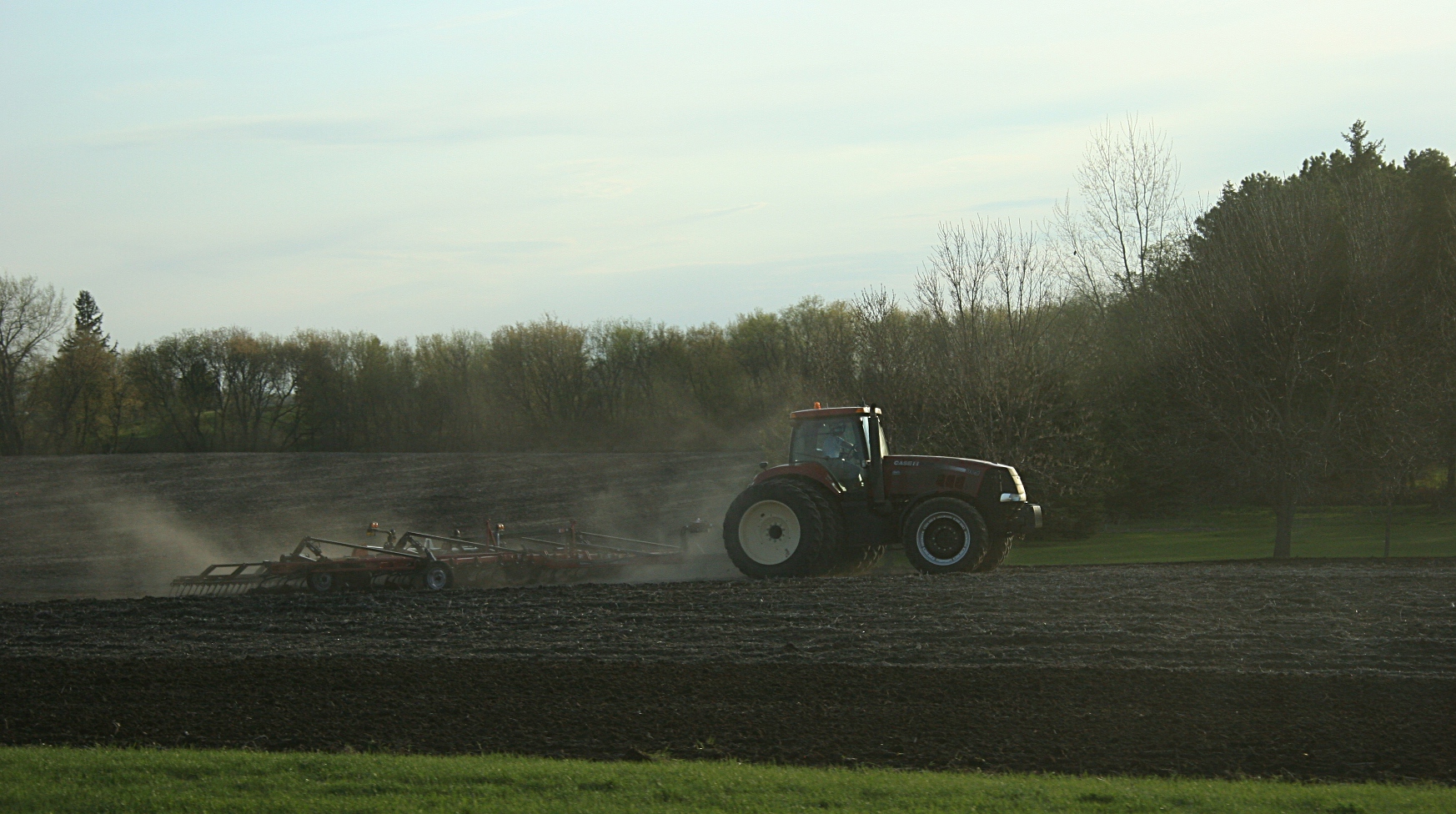
A farmer works the field recently in this scene shot in southeastern Minnesota.

HAVE YOU TRIED DIGGING into the ground lately? Takes some effort, doesn’t it? This soil in Minnesota rates as rock hard right now given the lack of moisture.

I’m hesitant to admit it, but I don’t think about soil conditions and moisture nearly as much as I once did, when I was not so long-removed from the farm.

But last week when a carpenter, who is also a farmer, was working on a project at my house, we chatted briefly about crops, soil conditions and weather.

Kenny shared how fall tillage has been especially trying this year. Farmers in his area around Owatonna in southeastern Minnesota have been breaking implement parts with all-too-often frequency in the dry, hard earth. He mentioned shanks, which he claims never break.

Some parts are in short supply, Kenny says, meaning farmers sometimes need to wait. That’s not a good thing when you’re trying to finish fall tillage before the snow flies.

Friends of mine who farm near Dundas finally halted all tillage work for the season, leaving some 300 acres, of 700, untilled. The rock hard dry soil proved too difficult to work and too tough on their equipment.

IN SOUTHWESTERN MINNESOTA, my brother Doug Kletscher, the parts manager at Westbrook Ag Power in Westbrook, confirms that tillage is tough there, too, and farmers are going through the parts. “We ran out of ripper points and they have been back-ordered for a good month. I have heard of a few farmers that have pulled their rippers in half,” Doug says. “We have sold at least five years’ worth of chisel plow spikes in one year. Bolts have also been in very high demand.”

On the flip, positive side, farmers haven’t had to deal with mud, Doug reports, and the corn has been very dry with 14 percent or less moisture content (a significant cost savings on corn drying).

However, farmers are facing another issue related to moisture-depleted conditions. “The fertilizer companies are not putting on any anhydrous as it is too dry to hold the anhydrous in the ground,” my brother continues. “Anhydrous needs moisture to adhere to keep it in the ground; also it (the soil) is pulling so hard that they would break their anhydrous bars.”

Doug reports the last rain over a half inch fell on July 14 with .78 inch. Since then any rainfall has been .10 inch or less. That makes for extremely dry soil conditions for farmers trying to prep the soil for next spring’s planting season.

LIKEWISE, IF YOU’RE a gardener, digging vegetables has been anything but easy this autumn. Take my friend Virgil Luehrs, who lives along Cedar Lake west of Faribault. Unearthing potatoes proved tough, he says. But then he got to the carrots:

“First I tried the garden spade, then a round-point shovel and then a tiling shovel. I had to dig a trench beside the rows to loosen the soil around the carrots to get them loose enough to pull out.  Finally I resorted to a pick to loosen the soil and that was easier but still a lot more work than normal.”

Tilling the garden, even with a powerful Troybuilt rear tine tiller, proved equally challenging. “I could not get down deep enough,” Virgil reports. “Hopefully next spring.”

When Virgil talks soil and weather, I listen. He’s not just your average Minnesota gardener. He’s also a retired high school science teacher with a Masters in biology, a former interim and assistant director at River Bend Nature Center in Faribault, and a volunteer rain gauge reader for the Rice County Soil Water Conservation District (SWCD) and the state Climatology Lab.

In other words, he’s a knowledgeable resource.

So then, exactly how much rainfall has Virgil recorded at his Cedar Lake home (where the lake water level is the lowest in 20 years, but not as low as in the drought years of 1988- 1990). Thus far since April, Virgil has taken these rain gauge readings:

April:  3.14”

May:  4.63”

June:  5.26”

August:  1.38”

September:  1.00”

October:  .58”

TOTAL during the past six months: 15.99”

Says Virgil: “This year we had a much wetter spring and that probably helped to carry us through the dry fall. Recall that last fall we had record rainfalls.”

His 2010 readings were as follows:

April:  1.35”

May:  2.75”

June:  4.76”

July:  5.49”

August:  3.91”

September:  9.13”

October:  1.91”

TOTAL during those six months: 29.3”

According to information Virgil passed along from State Climatologist James Zandlo and University of Minnesota Climatology/Meteorology Professor Dr. Mark Seeley, 2010 was the wettest year in Minnesota modern climate record. The 34.10-inch state average precipitation total was roughly 8 inches more than the historical average.

But here we are in November 2011, desperately short of moisture.

What will winter bring here in Minnesota? A continued shortage of precipitation? Or more snow than we care to shovel?

WHAT’S YOUR PREDICITON for snowfall in Minnesota this season? Submit a comment with a forecast and the reasoning behind your prediction.

IF YOU’RE A FARMER, an implement dealer or a gardener, have you faced any special challenges this year due to dry (or other) weather conditions? Submit a comment. I’d like to hear, whether you live in Minnesota or elsewhere.

CLICK HERE to link to climate.umn.edu for detailed statistics and information about Minnesota weather.

© Copyright 2011 Audrey Kletscher Helbling
 

Farm Rescue: Like neighbors helping neighbors November 7, 2011

NO ONE EVER expects to need help. But then an accident happens or sickness befalls us or tragedy strikes. And we suddenly realize how much we need each other.

Back in October of 1967, neighbors rallied after a corn chopper sliced off the fingers on my father-in-law’s left hand. Not just the tips, but so much that amputation was required between the wrist and the elbow.

An Allis Chalmers corn chopper like this one exhibited at the 2010 Rice County Steam & Gas Engines Show, claimed my father-in-law's left hand and much of his arm in a 1967 accident. That's my husband, Randy, who saved his dad's life by running for help.

In the week after the accident, neighboring farmers came with plows to work the fields of my father-in-law’s Morrison County farm.  Others arrived with tractors and manure spreaders to haul away a manure pile. A week or two later, the neighbors were back to pour a slab of cement at the end of the barn.

Several farmers and a high school student continued to assist the family with twice daily milkings and other farm chores while Tom recovered and adapted to farming with his prosthetic hook hand.

Neighbors helping neighbors in need.

This fall, farmers gathered south of Lucan in Redwood County to harvest corn and soybeans on the farm of their friend and neighbor, Steve, my sister-in-law’s father who was found dead at the scene of a single-vehicle accident on September 20.

Neighbors helping a grieving family in their time of need.

Stories like this are not uncommon in rural Minnesota.

Harvesting corn this fall in southern Minnesota.

But it wasn’t until this past week that I learned about Farm Rescue, “a nonprofit organization that plants and harvests crops free of charge for family farmers who have suffered a major illness, injury or natural disaster.”

Founded in 2005 by a former North Dakota farm boy, this Jamestown, North Dakota-based nonprofit has assisted 155 farm families, mostly in the Dakotas, but also in western Minnesota and eastern Montana, the states within the organization’s coverage area.

In early October, Farm Rescue harvested beans for Renville area farmer Kurt Kramin who is recovering from serious burns sustained while he burned debris following a July 1 severe storm that passed through southwestern Minnesota. (Read a story published in the Morris Sun Tribune about the Farm Rescue assistance provided to Kramin by clicking here.) 

All of this I learned from Paul Oster, a Farm Rescue videographer. Oster read my July blog posts about the tornadic and strong wind storms that swept through southwestern Minnesota and contacted me last week about using several photos in a video he was preparing about Kramin.

Before agreeing to his request, I first checked out Farm Rescue. I wanted to assure that the storm photos my brother, uncle and I had taken would be shared with a respected organization.

My photo of the July 1 storm damage at Meadowland Farmers Co-op in Vesta which Paul Oster included in his video of Kurt Kramin. Renville, where Kramin lives, is north of Vesta.

No problem there. Farm Rescue accepts applicants from farmers in need, reviews the applications and then, if approved, coordinates volunteers to plant or harvest crops. It’s like neighbors helping neighbors.

Click here to read all about Farm Rescue and how this nonprofit truly shines at neighbors helping neighbors in need.

Then, click here to see the videos about farm families aided by Farm Rescue in 2011.

If you want to contribute in any way to this worthy organization, do. Because you never know when you, too, may need your neighbors’ help.

© Copyright 2011 Audrey Kletscher Helbling
 

Snippets of rural Minnesota in photos November 1, 2011

A harvest scene along U.S. Highway 52 in southeastern Minnesota Sunday afternoon.

YOU CAN TAKE the girl off the farm, but you can’t take the farm out of the girl.

Even decades after leaving my childhood farm at age 17 to start my freshman year of college in the fall of 1974, I hold tight to my agricultural roots.

My rural upbringing shaped me as a person, defined me as a writer and photographer.
More often than not, I find myself creatively focused on the rural, on those places and memories that remind me of the farm and which hold the strongest grasp on my heart.

So I am naturally drawn to photographing rural landscapes and barns and country churches and tractors and small towns whenever I travel. These are the places and objects to which I feel the deepest connection.
I'm always and forever photographing barns like this one along Hwy 52 between Pine Island and Rochester.

Today I’ll take you along U.S. Highway 52 and Interstate 90 in the southeastern section of Minnesota. I’ll show you rural snippets photographed at highway speeds through the passenger side and front windows of our family’s cars. Yes, cars, plural. My husband and I made a quick jaunt to Tomah, Wisconsin, on Sunday to exchange vehicles with our second daughter. Hers needs repair and we met her half-way between her home and ours.

After 2 ½ hours of travel to reach Tomah, we lunched with Miranda and a friend before turning around and heading back home to Faribault.

The day rated as gloomy and dreary weather-wise. Yet, as you will see, such moody skies bring out an emotion in images that you might not feel had the day been sunny bright.

I’m always surprised, when I view the photos, to see the details I missed in the process of shooting the images. But then, along-the-highway scenes flash by in an instant and they are gone, not wholly appreciated until that second, later look in a photo.

You can barely see the distant tractor in this shot. But that's what I like about this scene, how the sheer size of the cornfield and the skies dwarf the tractor, reinforcing the thought that everything is truly small in comparison to the landscape, to the big, big world.

Every red building stood out against the grey, grey skies. Sky is always an integral part of my photos.

Even the stripes of crops are aesthetically pleasing to my photographer's eye.

This photo of Pine Island connects town and country in a seamless blend.

An historic barn and a horse...a common sight along Hwy 52 and I-90.

The red-roofed barn provides a jolt of color under heavy grey skies.

A country church, strong and sturdy, along I-90 near the Winona exit. Look closely and you'll see a sheriff's department squad car parked by the church.

Westbound on I-90, the sun begins to set. I like the contrast between the vivid yellow sign and the grey of the day.

© Copyright 2011 Audrey Kletscher Helbling