FAITH COMMUNITIES are especially busy this time of year as they prepare for the celebration of Christ’s resurrection. Mid-week Lenten services, Friday night fish fries, Palm Sunday and the beginning of Holy Week all usher in Easter morning.
Locally, you’ll find not only the usual, but also a few unique happenings at several area churches. First up, Little Prairie United Methodist Church, rural Dundas, hosts its annual Fish Dinner from 3-8 p.m. Friday, March 27. The meal features fried or baked fish, baked potatoes, salad bar and pie. Tickets must be purchased in advance. Take-out is available. Click here for details.
Also on Friday evening, the Concordia Academy Choir, based at the Christian high school in Roseville, presents an hour-long concert of inspiring music for all ages beginning at 7 p.m. at Trinity Lutheran Church in Faribault. A free will offering will be taken.
Saturday, March 28, brings more activity to Trinity with the Trinity Radio Rumble beginning at 2 p.m. in the Faribault Lutheran School gym, connected to the church. The event, a fundraiser for the congregation’s radio ministry, features family-friendly, live professional wrestling. Click here for more info and to purchase discounted tickets in advance.
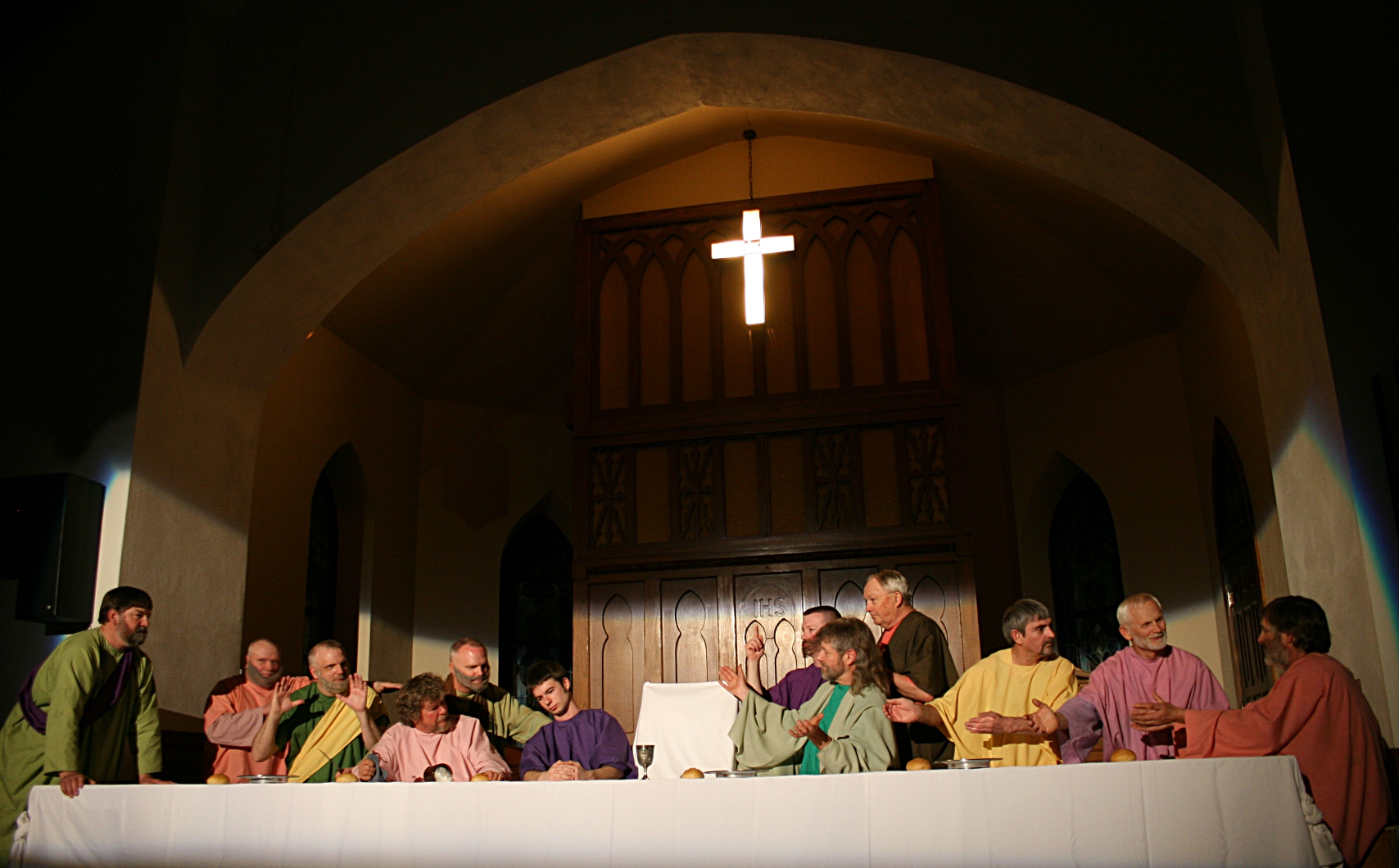
St. John’s 50th presentation of The Last Supper Drama in the sanctuary. (Minnesota Prairie Roots copyrighted file photo)
On Sunday, March 29, The Last Supper Drama comes to St. John’s United Church of Christ, Wheeling Township. The drama in the rural Faribault church has been a Palm Sunday tradition for more than 60 years. Performed in the darkness of the sanctuary by 12 actors role-playing the disciples, the drama begins at 8 p.m. Each disciple speaks individually, explaining his relationship to Christ. Refreshments follow the free performance, which will also be live-streamed on Facebook and YouTube.
So whether you like fish, music, wrestling and/or drama, you’ll find all four in faith communities in the Faribault area this coming weekend.
An affirming sign photographed in a storefront window in downtown Red Wing. (Minnesota Prairie Roots copyrighted photo October 2025)
NOT FAR FROM THE CHURCH, bannered in the window of a downtown Red Wing business, I spotted uplifting signage: you are valued. you are enough. you are worthy. you are loved. I always appreciate such positive public postings of care and affirmation.
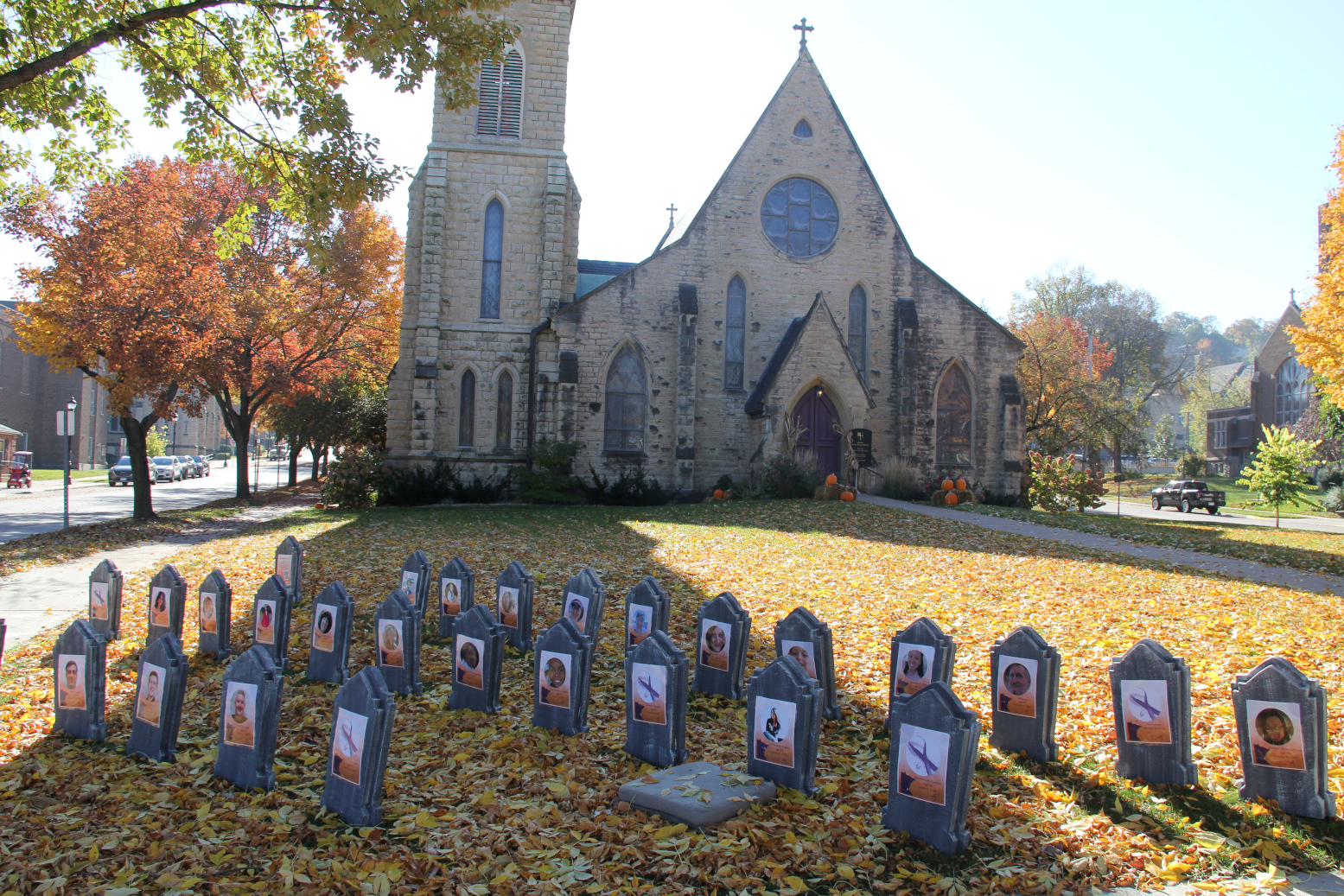
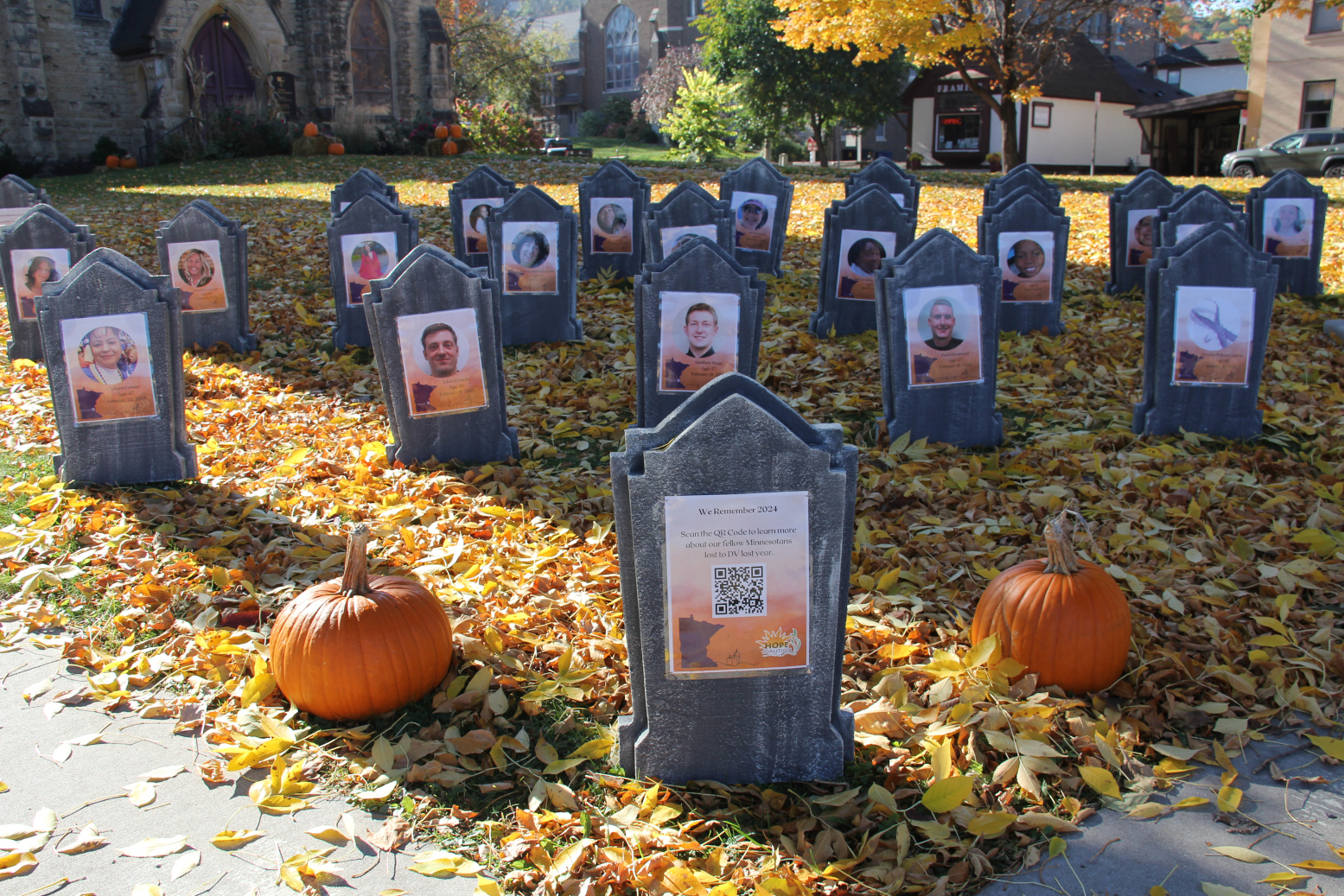
The “We Remember 2024” display outside Christ Episcopal Church, Red Wing. (Minnesota Prairie Roots copyrighted photo October 2025)
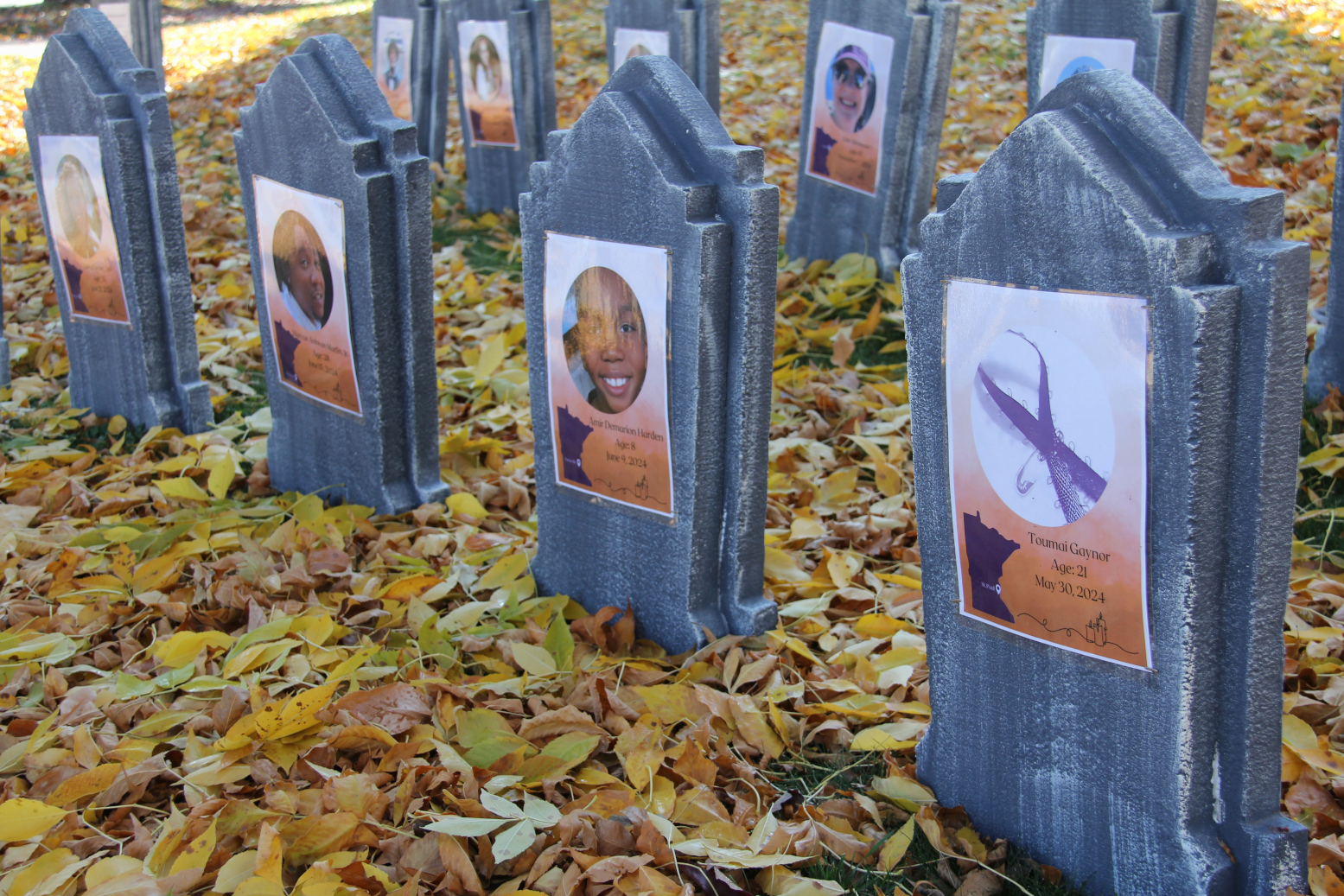
And then, just up the street across from the public library and a small park, I noticed rows of fake tombstones placed upon a corner of the Christ Episcopal Church yard. From a distance, I thought this to be part of a Halloween display. But when I got closer, I realized I was looking at something far scarier. This was a memorial to the 24 Minnesotans who died as a result of domestic violence in 2024. It also honors three others whose deaths are called “suspicious,” with many details yet unknown, but enough to be included in the Violence Free Minnesota “We Remember 2024 Report.”
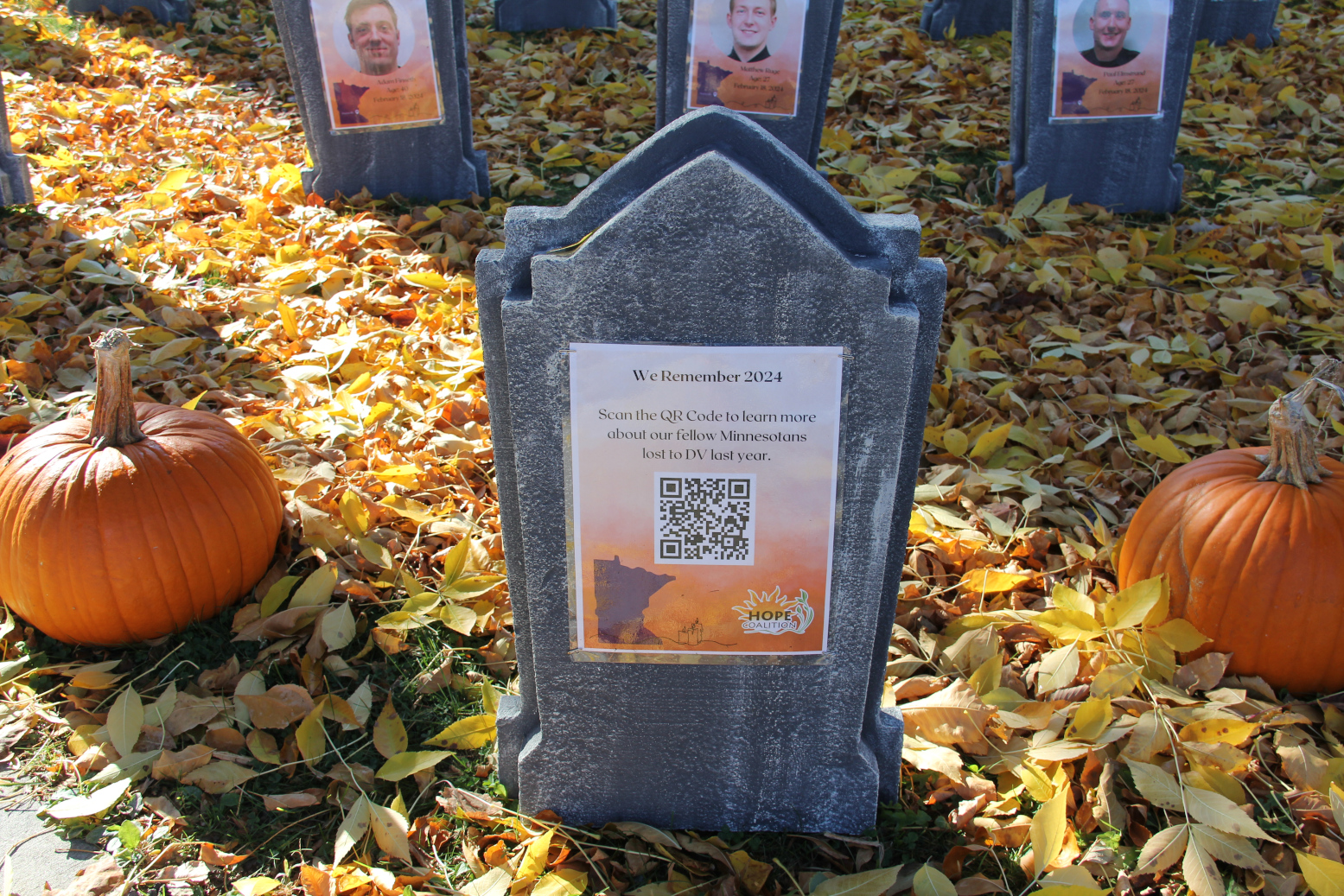
The front “tombstone” explains the project. (Minnesota Prairie Roots copyrighted photo October 2025)
It is sobering and sad to stand on a busy street corner in the heart of a beautiful Mississippi River town in southern Minnesota on a lovely October morning and ponder these lives lost. Yet, this needs to be known, to be publicly shared, especially now during National Domestic Violence Awareness Month.
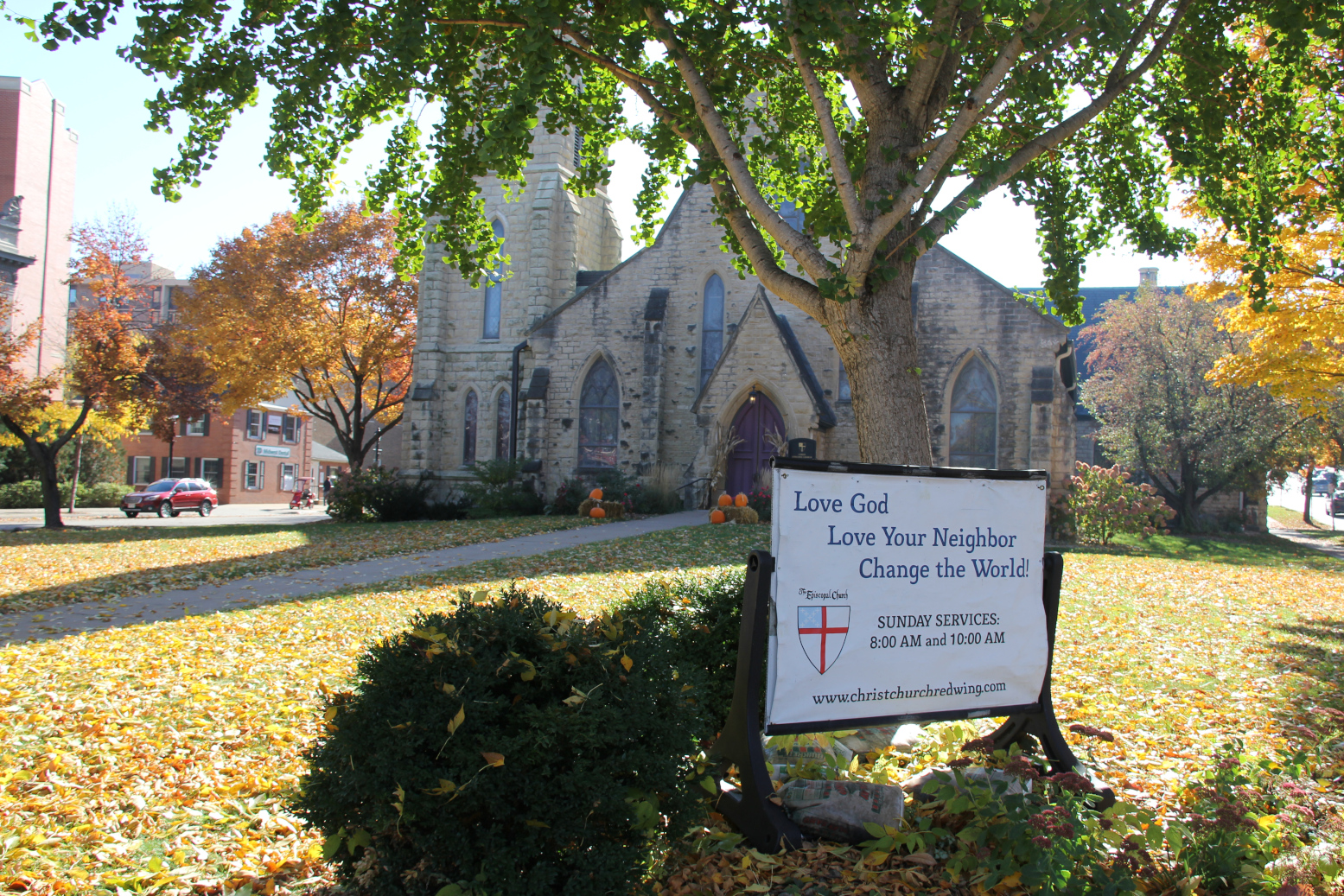
Christ Church, according to its website, actively reaches out into the community via a Coat Shed, the food shelf, a “Feeding of the 5,000” event, housing Hope & Harbor and much more. (Minnesota Prairie Roots copyrighted photo October 2025)
It’s heartbreaking to see the faces and then to go online and read the stories. (Minnesota Prairie Roots copyrighted photo October 2025)
As I paused, I felt the power of this public display revealed in photos, ages and dates. To place the faces of domestic violence victims upon fake tombstones personalizes the crime. You can’t look at those photos without understanding that these were individuals who were valued and loved.
In the second row you will see the mock tombstones of the police officers and paramedic/firefighter shot in Burnsville. Matthew Ruge, center, lived in Northfield in my county of Rice. (Minnesota Prairie Roots copyrighted photo October 2025)
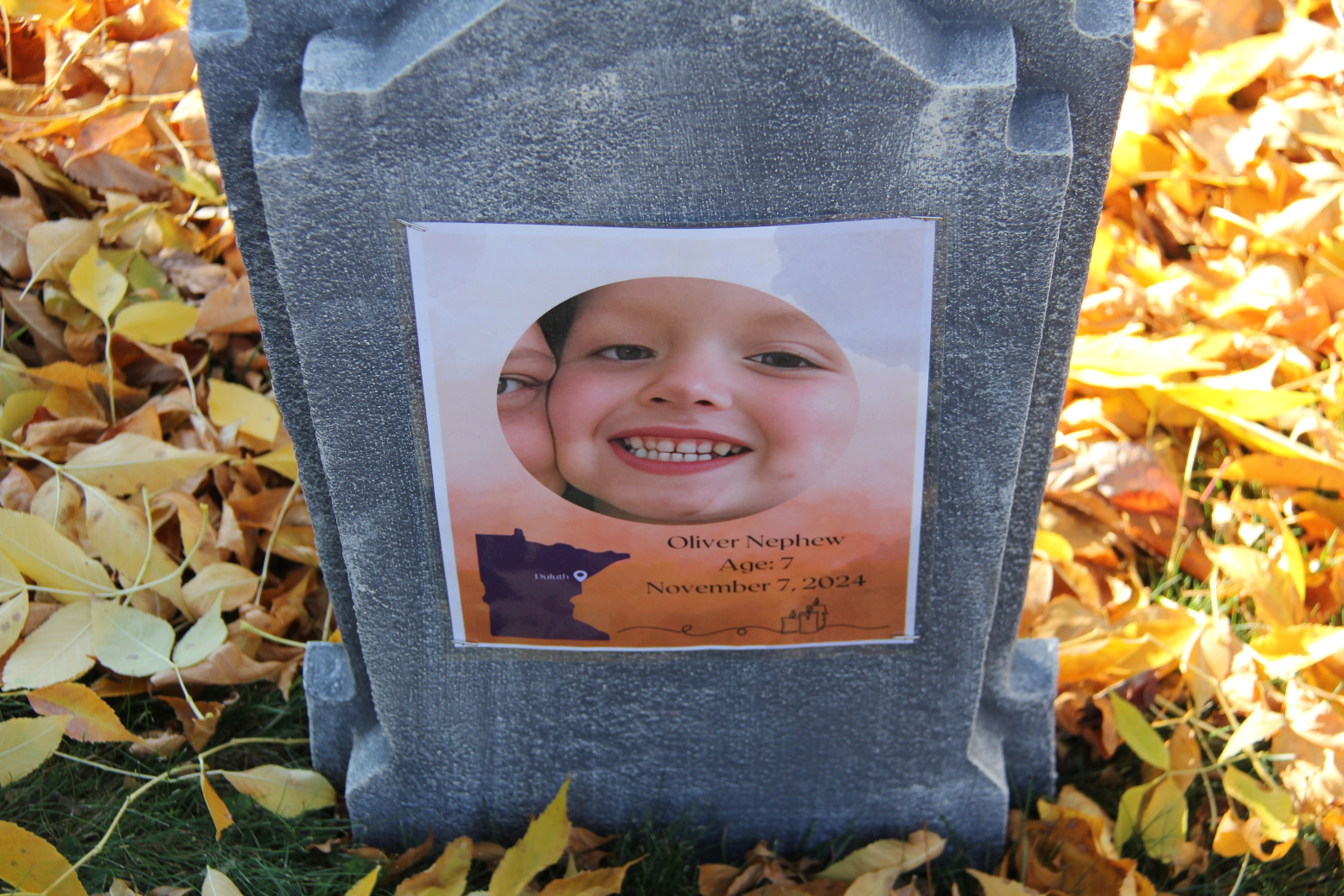
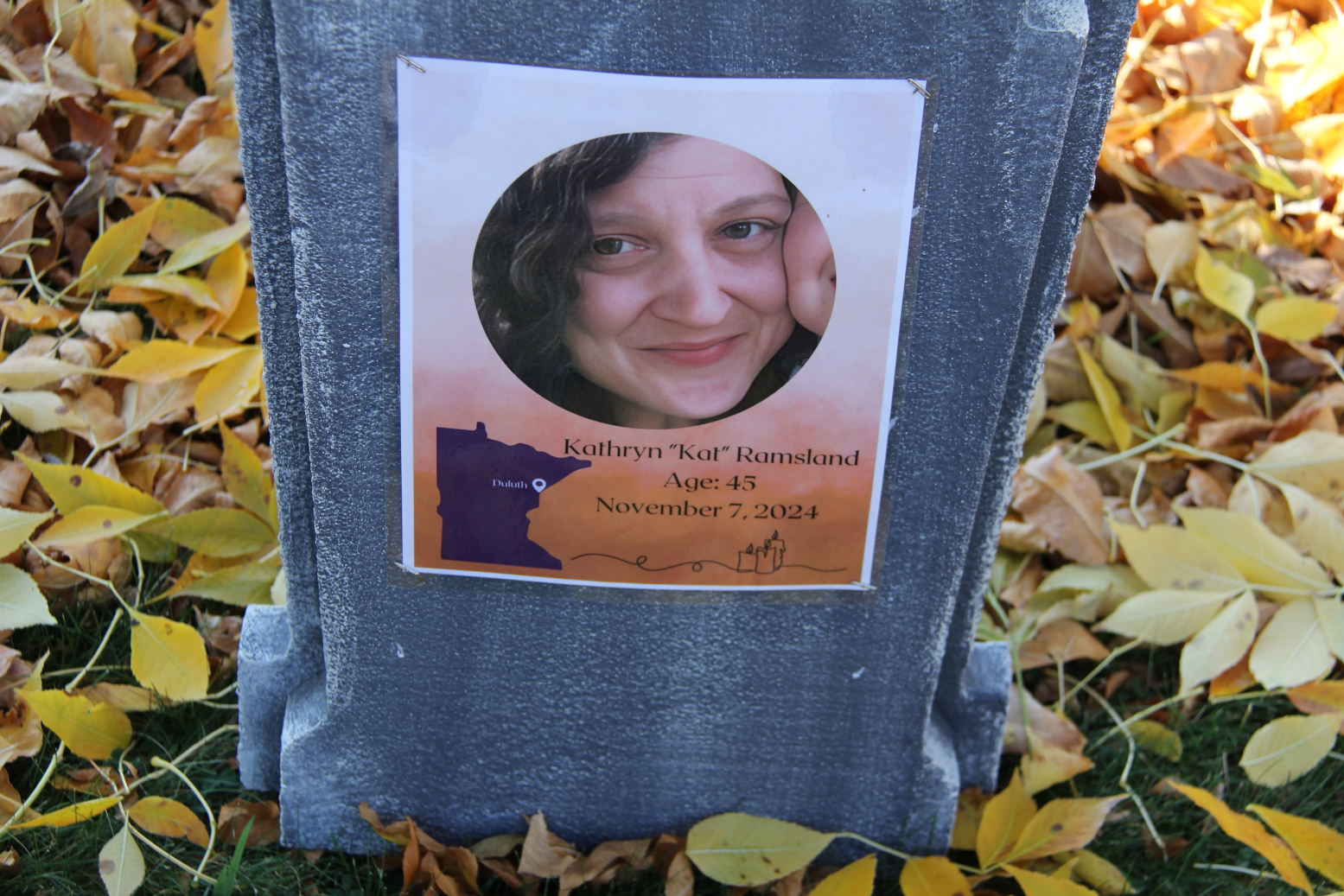
Center front were the images of three men, all killed while responding to a 911 call regarding an alleged sexual assault in Burnsville on February 18, 2024. Shot to death were Burnsville police officers Paul Elmstrand and Matthew Ruge, both 27, and paramedic/firefighter Adam Finseth, 40. It was a high profile case as were the murders of four in Duluth on November 7, 2024. Kathryn “Kat” Ramsland, 45, and her son, Oliver Nephew, 7, and Erin Abramson, 47, and her son, Jacob Nephew, 15, were shot and killed in their homes in a case of domestic violence.
Oliver Nephew was only seven when he was murdered. (Minnesota Prairie Roots copyrighted photo October 2025)
Those who died due to domestic violence in Minnesota in 2024 come from all areas of the state. Rural. Suburban. Urban. This crime knows no geographical or economic boundaries, no age limits, no educational or job status… Each life lost means someone, some family, is grieving.
That includes in Red Wing, the very city where I stood in the churchyard viewing the photos on tombstones. Andrea “Drea” Broyld, 41, who worked at a local coffee shop, was shot and killed inside her Red Wing home on November 17, 2024. The suspected shooter has been charged with second-degree murder. As the anniversary of Andrea’s death approaches, I expect a wave of grief will sweep across the community as people remember the nice young woman who wrote encouraging notes on coffee cups.
Kathryn Ramsland was shot and killed along with her son, Oliver Nephew. (Minnesota Prairie Roots copyrighted photo October 2025)
We should all encourage one another, in life in general, but especially in cases of domestic abuse and violence where listening and support are essential. If something doesn’t look or feel or seem right, it likely isn’t. Trust your gut. That’s a starting point. So is awareness. And seeking professional help.
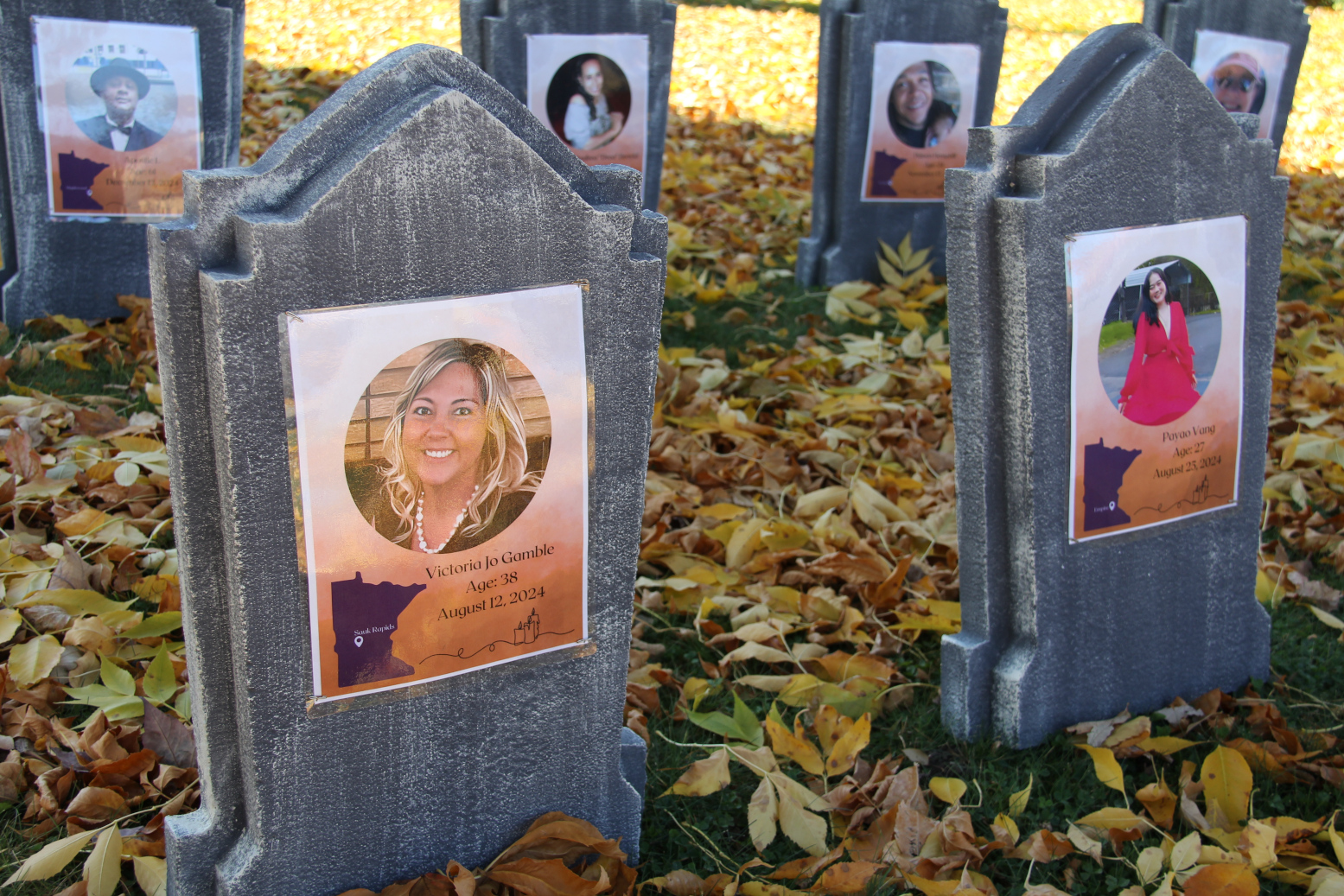
Two more victims, Victoria Jo Gamble, 38, strangled in Sauk Rapids, and Payao Vang, 27, shot and killed in Empire. (Minnesota Prairie Roots copyrighted photo October 2025)
While I never expected to happen upon a “We Remember 2024” display in a churchyard, I’m grateful I did. Photographing this gives me the opportunity to raise awareness about domestic abuse and violence. And it gives me the opportunity, too, to repeat these words: you are valued. you are enough. you are worthy. you are loved.
If you, or someone you know, is being abused (whether physically, psychologically, mentally, financially or otherwise), please seek help. Call 911 if you feel threatened and/or your life is in danger.
Faribault artist Kate Langlais painted this acrylic portrait of Pope Francis, displayed at the Paradise Center for the Arts, Faribault, in 2022. (Minnesota Prairie Roots copyrighted file photo March 2022)
HER COMMENT SUMMARIZES what many Catholics and others are likely thinking this week as they mourn the passing of Pope Francis on Easter Monday. Dorothy Storch writes this on the Facebook page of the Church of St. Patrick, Shieldsville. a rural southern Minnesota church near me: “Our Pope of peace and mercy, kindness and love. A man of God.”
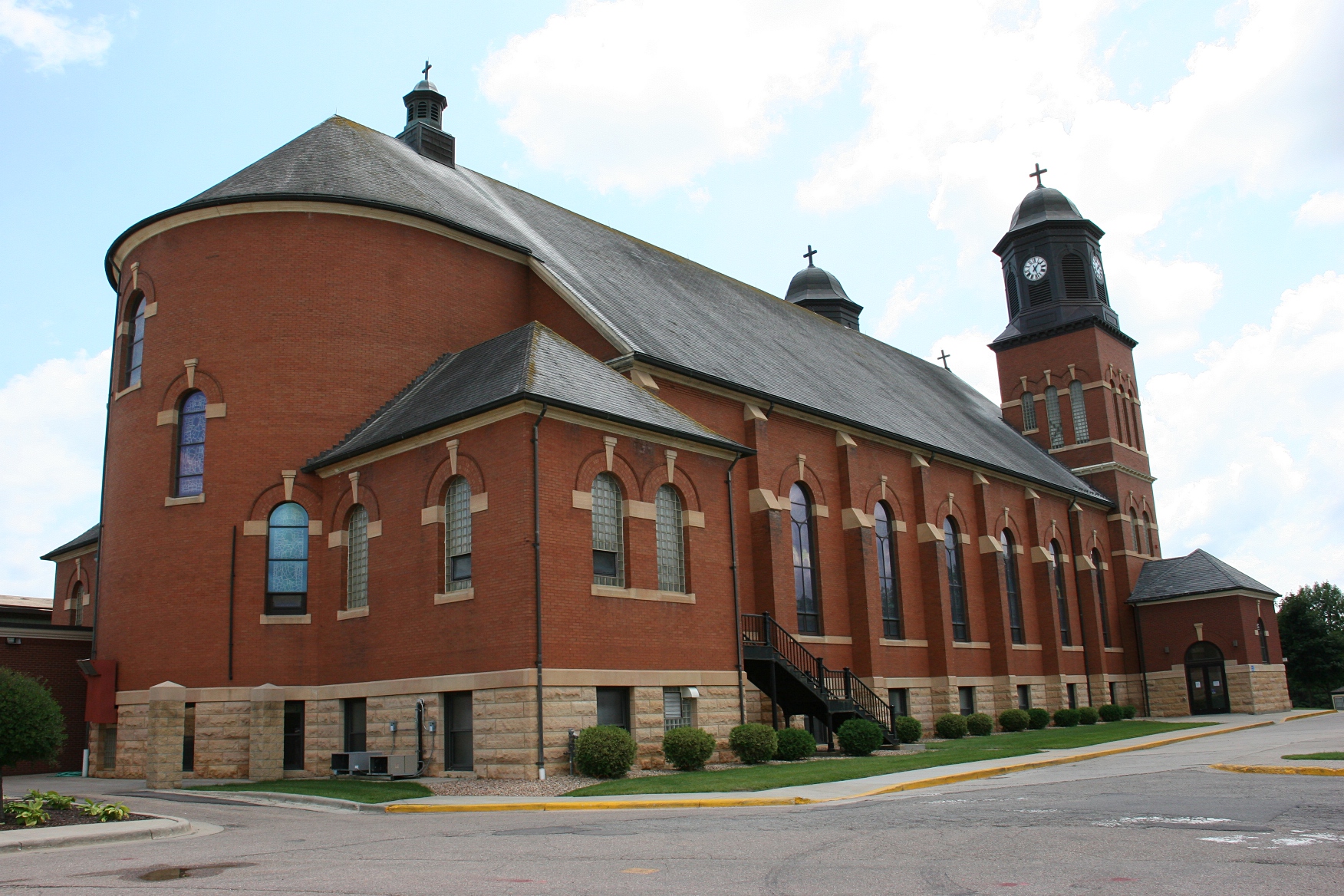
A side and rear view of St. Wenceslaus Catholic Church, New Prague. (Minnesota Prairie Roots copyrighted file photo)
Perhaps that could be written about previous popes and other faith leaders. But not always. And not with the depth of admiration for Pope Francis, often termed “The people’s pope.” He changed things up in the Catholic church, opening minds and hearts and relating to people in a way that made him seem more like one of us.
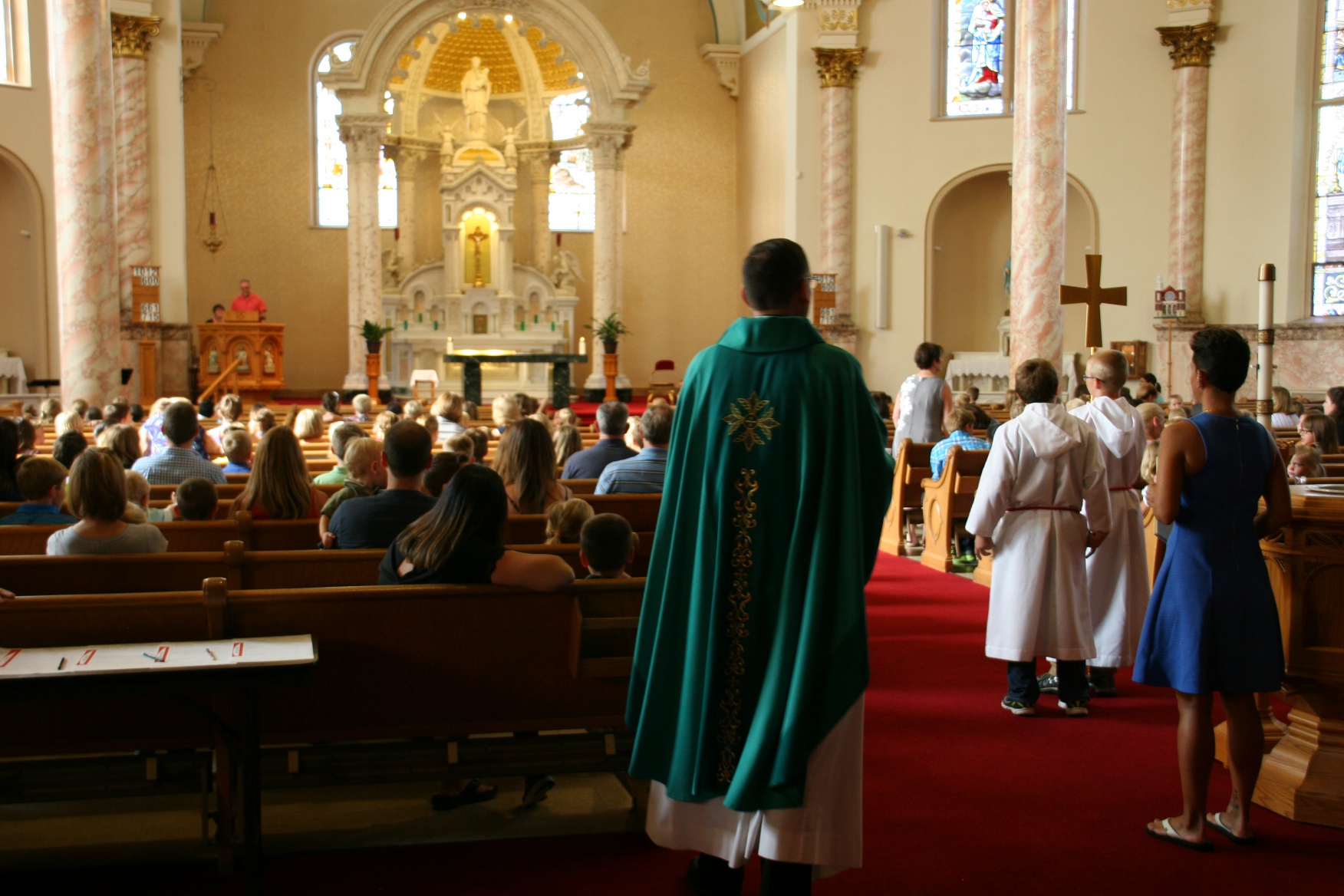
Mass, about to begin at the Basilica of Saint Stanislaus Kostka in Winona. (Minnesota Prairie Roots copyrighted file photo)
A posting on the Facebook page of the Church of St. Dominic, 16 miles to the northeast of Shieldsville in Northfield, explains: “His life was a shining example of humility, compassion, and servant leadership. Pope Francis reminded us through both word and action what it means to care for the poor, to welcome the outcast, and to live simply with a heart open to God. He walked closely with the people, always pointing toward mercy by living our faith with the same grace and humility.”
Loving words from the Bible in the heart of downtown Faribault. (Minnesota Prairie Roots copyrighted file photo)
Even though I am not of the Catholic faith, I’ve heard, read and seen enough media reports about Pope Francis to understand that he was, indeed, a compassionate man of both words and actions. Words, especially when you are a faith leader, require positive action. Pope Francis visited inmates, embraced those with disabilities, met with migrants, washed feet and much more. Washing someone’s feet is truly an act of humility and service.
“Faysel,” who fled the war in Somalia.Kate Langlais created this portrait for an “I Am Minnesota” project featuring our state’s newest immigrants. (Minnesota Prairie Roots copyrighted file photo)
Pope Francis advocated for migrants, immigrants, refugees and others, calling for compassion and care. Born Jorge Mario Bergoglio to Italian immigrants in Argentina, this first pope of the Americas understood the plight of immigrants and other marginalized populations. He wasn’t afraid to speak up, to take a stand for what he thought was right, what Jesus would have him, and all of us, say and do. He gave voice to the voiceless, to those silenced by power, policies, politics and life-altering destructive actions. He built bridges, not walls.
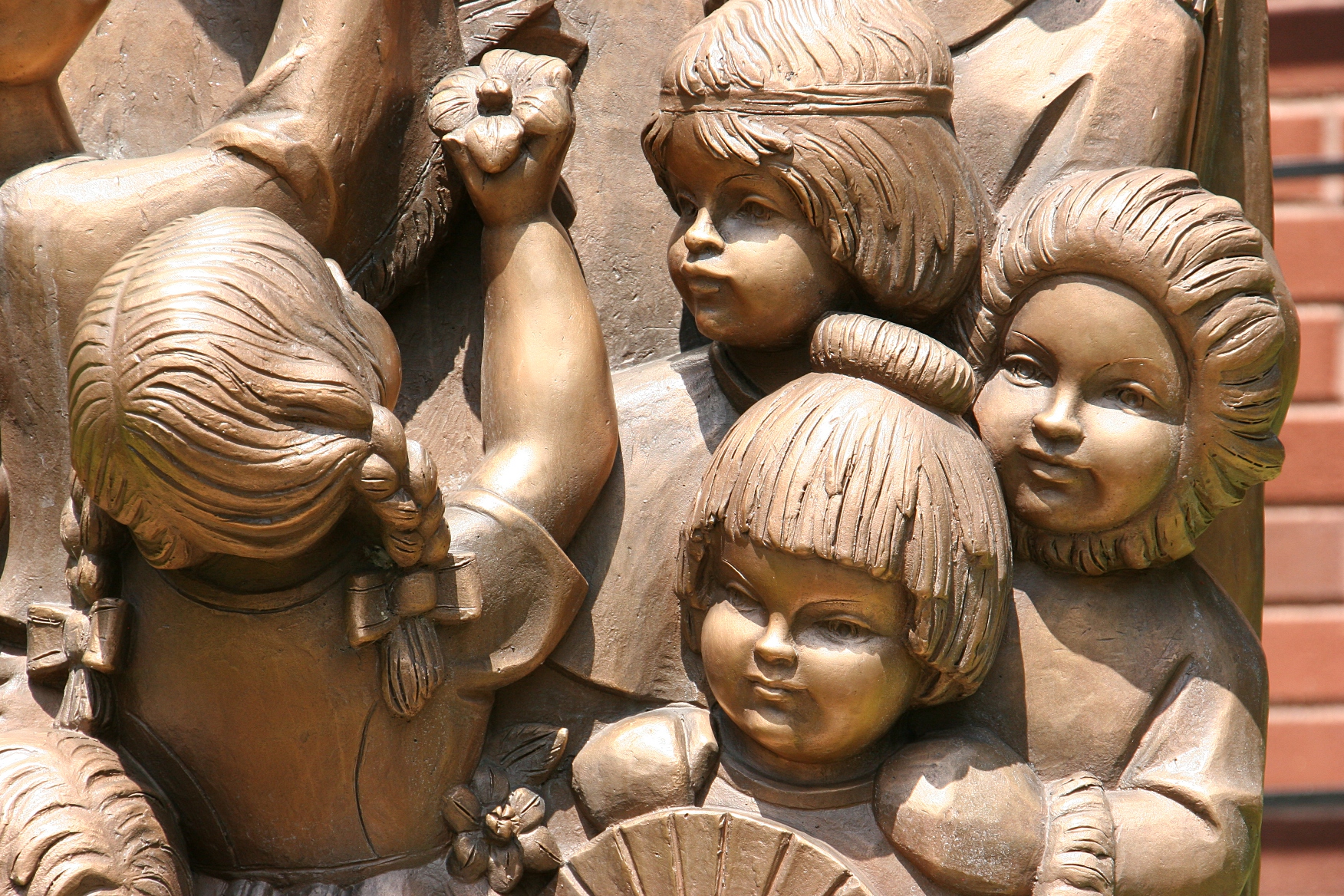
Children of many ethnicities are part of the Mary statue in Mary’s Garden at St. Wenceslaus Catholic Church, New Prague. (Minnesota Prairie Roots copyrighted file photo)
In acknowledging the passing of Pope Francis, a post on the New Prague, Minnesota, Catholic Community Facebook page calls him “a figure who has left an indelible mark on the Catholic Church and the world.” I agree with that assessment of a man who cared deeply about people, and about the environment. We could all learn from this thoughtful pope who intentionally took the papal name of Francis from Saint Francis of Assisi, a man of faith focused on poverty, peace and protecting the earth.
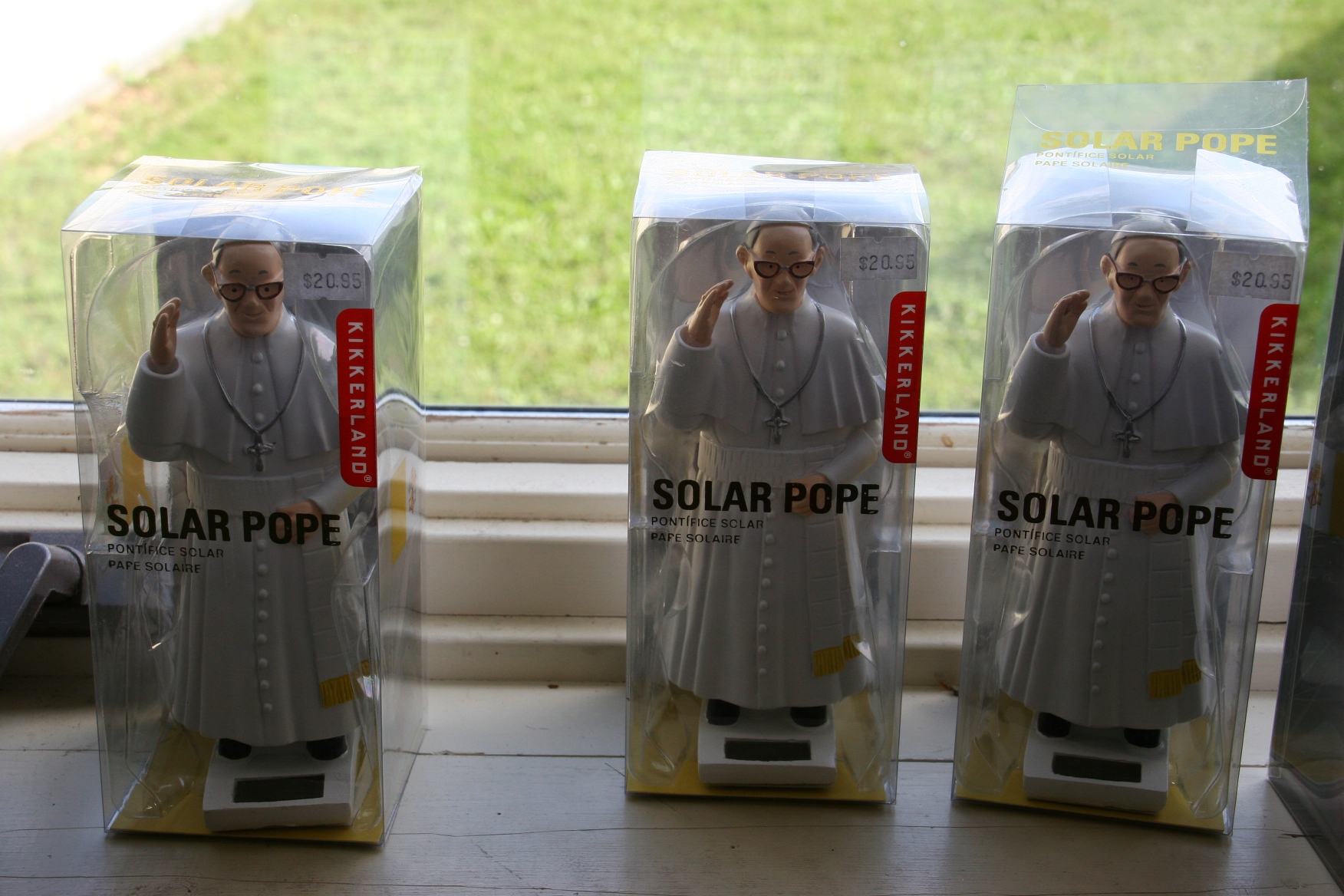
I expect Pope Francis would have laughed at these solar popes (not of him) which I photographed many years ago at LARK Toys in Kellogg, Minnesota.Minnesota Prairie Roots copyrighted file photo)
I love how Pope Francis loved. And I love how he loved to laugh. In 2024, he invited comedians from around the world to the Vatican, underscoring the importance of laughter, recognizing its healing power. I recently watched a video clip of him kissing an infant dressed in papal garb along a parade route. A member of his security team brought the baby girl to the pope riding in his Pope Mobile. His broad smile said it all. Pope Francis didn’t find the costumed infant to be disrespectful of him, but rather a reason to laugh. I need to laugh more. We all need to laugh more.
“Peace and Love,” an acrylic portrait by Angelina Dornquast. Photographed in an exhibit at the Paradise Center for the Arts, Faribault. (Minnesota Prairie Roots copyrighted file photo October 2024)
What a legacy Pope Francis leaves. It is my hope that the next pope selected by the conclave of cardinals will continue in the path of humility, compassion and kindness. I want Dorothy Storch from St. Patrick’s in rural southern Minnesota to describe the new pope as “our Pope of peace and mercy, kindness and love,” just as she did Jorge Mario Bergoglio, the son of immigrants. He who humbly served with compassionate words and actions, becoming a much-beloved and respected world faith leader.
Love at a past student art show at the Paradise Center for the Arts. (Minnesota Prairie Roots copyrighted file photo)
May Pope Francis, now lying inside a simple wooden coffin, rest in peace at the Basilica of Saint Mary Major, which sits in an area of Rome heavily-populated by immigrants. With his coffin and burial choices, “the people’s pope” makes a strong statement even in death about living with grace, humility and compassion, loving all, always.
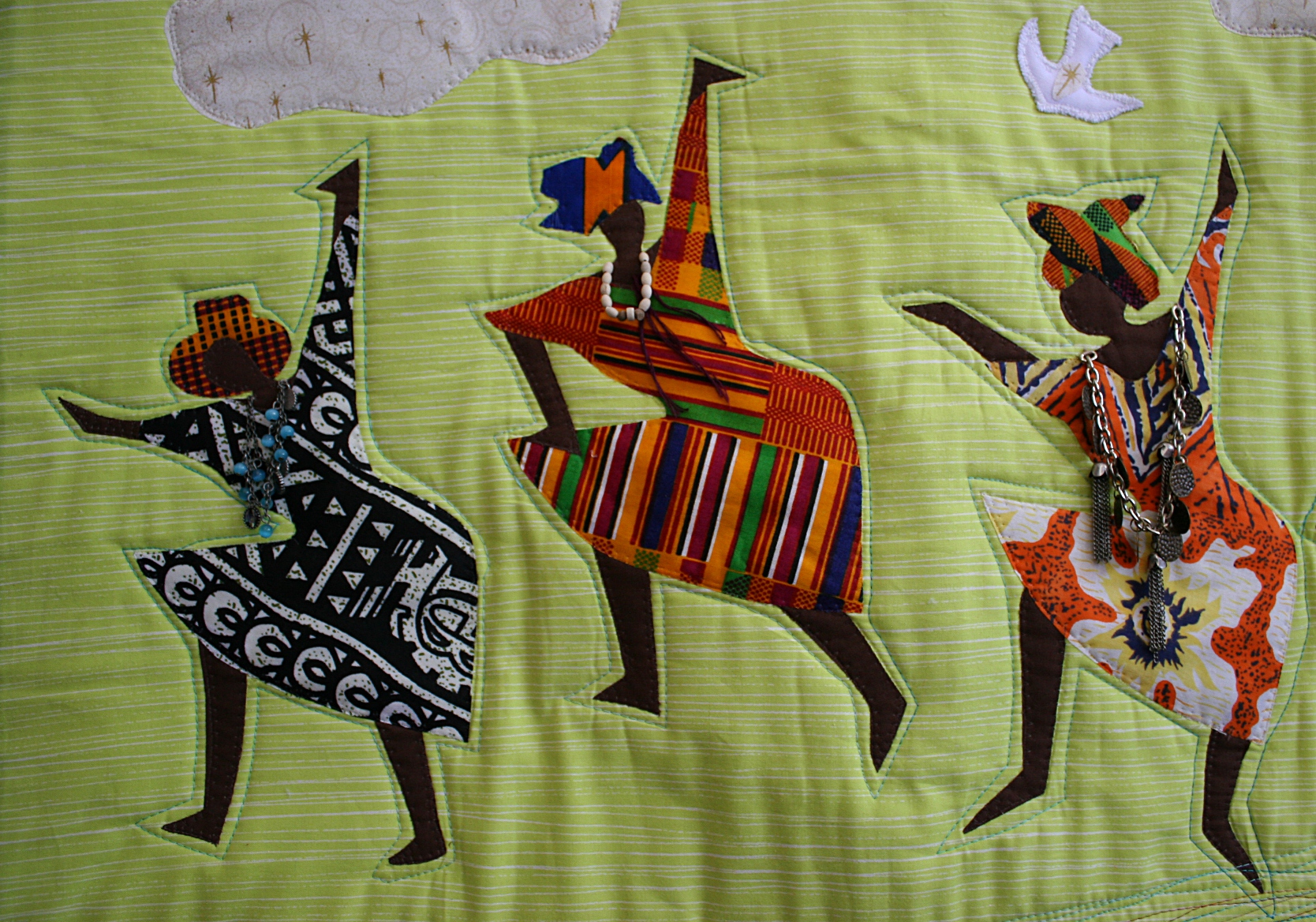
This Nigerian-themed quilt art was created years ago by my friend Susan. The art reflects to me the joy of an African spiritual. The fabric came from Nigeria, where Susan’s father-in-law served as a Lutheran missionary. (Minnesota Prairie Roots copyrighted file photo)
THE SONG WAS UNEXPECTED during Sunday morning worship at the conservative Lutheran church I attend in Faribault. But it was fitting for the day and for my feelings, which have leaned deeply into discouragement recently.
The African American spiritual, “There Is a Balm in Gilead,” proved a temporary balm for my soul. The old school word “balm” holds a healing connotation. The song’s refrain encourages: There is a balm in Gilead to make the wounded whole. There is a balm in Gilead to heal the sin-sick soul.
As I sang the refrain, I wondered, what or where is Gilead? Later research revealed that, during Old Testament days, Gilead was a mountainous region east of the Jordan River and an important source of medicinal herbs. That makes sense as it relates to the lyrics.
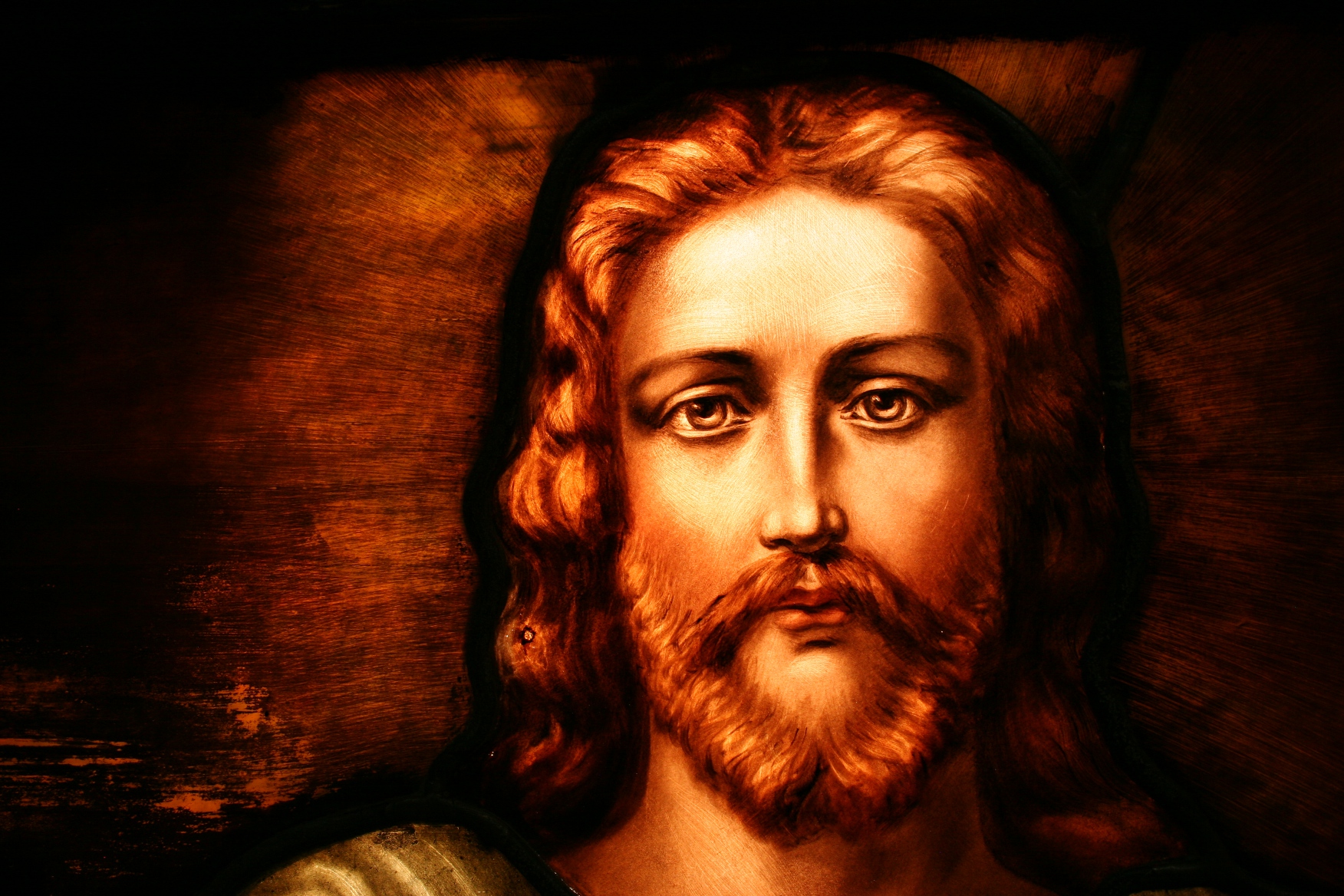
Christ’s face in a stained glass window in the sanctuary of my church, Trinity Lutheran, Faribault. (Minnesota Prairie Roots copyrighted file photo)
In the New Testament, “balm of Gilead” refers not to an herb which heals physically, but to Jesus through whom spiritual healing comes. That also makes sense as it relates to lyrics of the song printed on page 749 of the Lutheran Service Book.
Events of recent weeks in this country have me feeling apprehensive, unsettled, worried, in need of a healing balm. I know I am not alone in these feelings as we face economic challenges, upheaval, chaos and uncertainties on endless levels. Each day seems to bring something of new concern. No matter where you stand politically or spiritually, you have to feel the tension and uncertainties in this country.
A snippet of a photo by Stephen Somersteinfrom the exhibit, “Selma to Montgomery: Marching Along the Voting Rights Trail,” which I saw at St. Olaf College in Northfield, Minnesota, in 2015. (Minnesota Prairie Roots copyrighted file photo)
On Sunday, as I sang the African American spiritual, I allowed myself to be swept into the healing words of hope and comfort. It was not lost on me that, sitting on the end of my pew, was a family of mixed race—an African American father, White mother and three biracial children, one a darling baby boy of ten months. I thought of my own newborn grandson, who is mixed race. What does the future hold for these two little boys? Will they face challenges simply because of their skin color? I’d like to think not. But…
And I thought, too, of the new calendar month of February, in which we celebrate Black History Month, focusing on Black history, culture and education. I reflect on slavery, on Civil Rights leaders, on racial disparities, diversity, equity and inclusion, wondering how I, personally, can educate myself and make a difference.
A message left by a visitor to the Selma exhibit at St. Olaf College. It’s so applicable to today. (Minnesota Prairie Roots copyrighted file photo)
It truly does start with each of us standing up for what is good and right and decent and not going along with what we know in our hearts, minds and souls to be wrong. And then, maybe then, we’ll find our balm in Gilead.
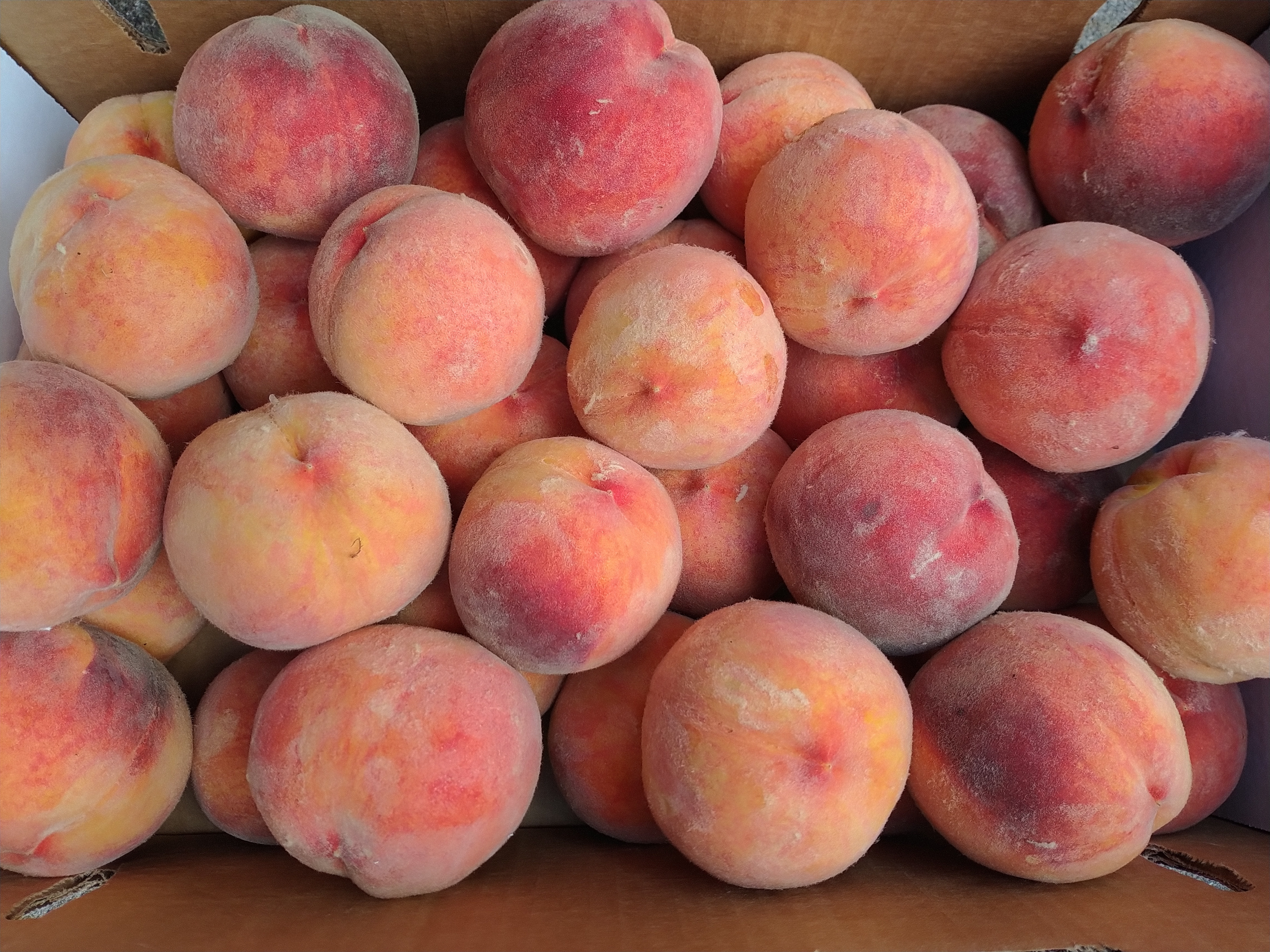
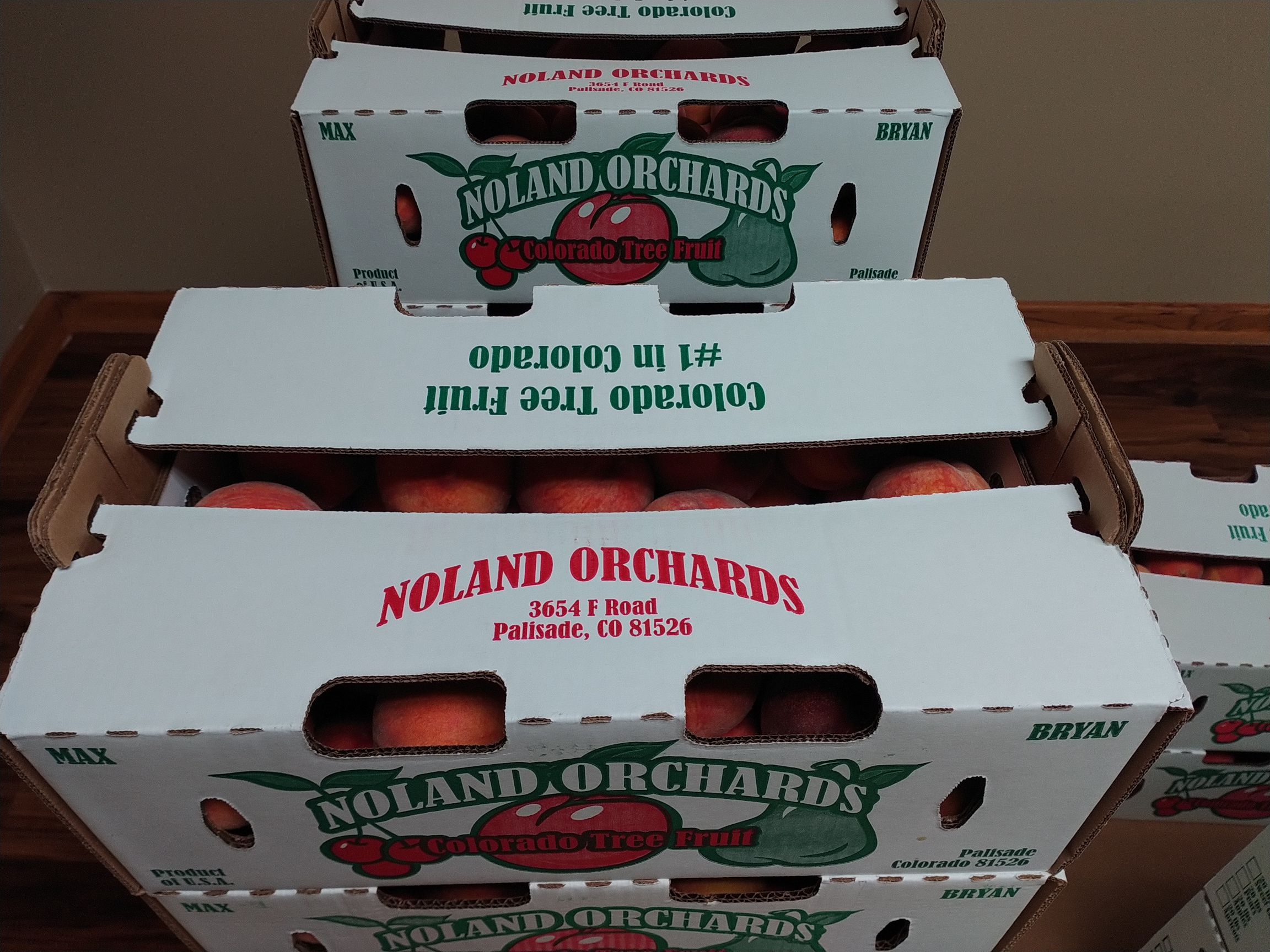
Peaches fill a box and now my fridge. (Minnesota Prairie Roots copyrighted photo August 2024)
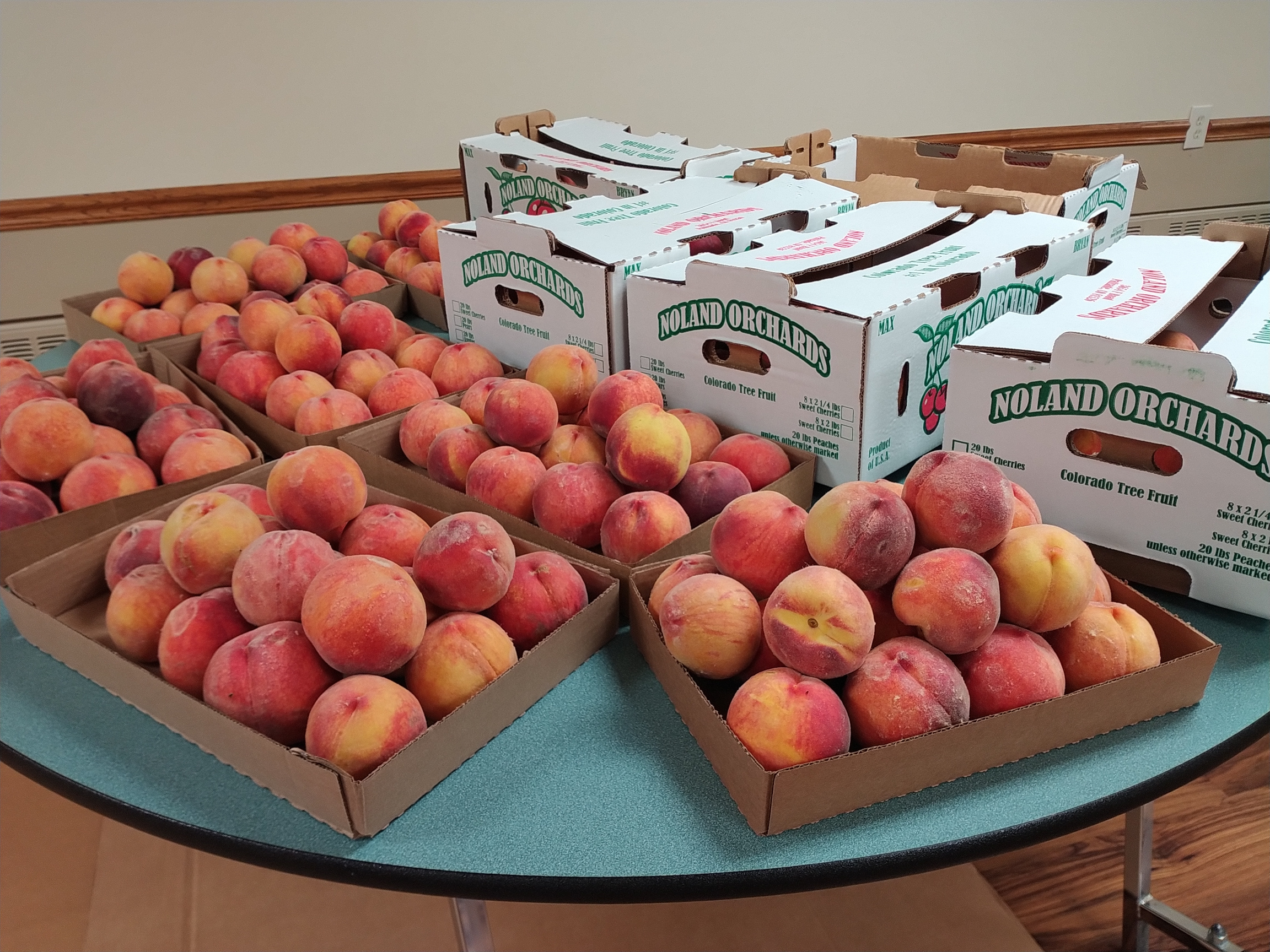
PEACHES PACK my refrigerator. Several ripen in a brown paper bag on the kitchen counter. Big, beautiful Colorado peaches.
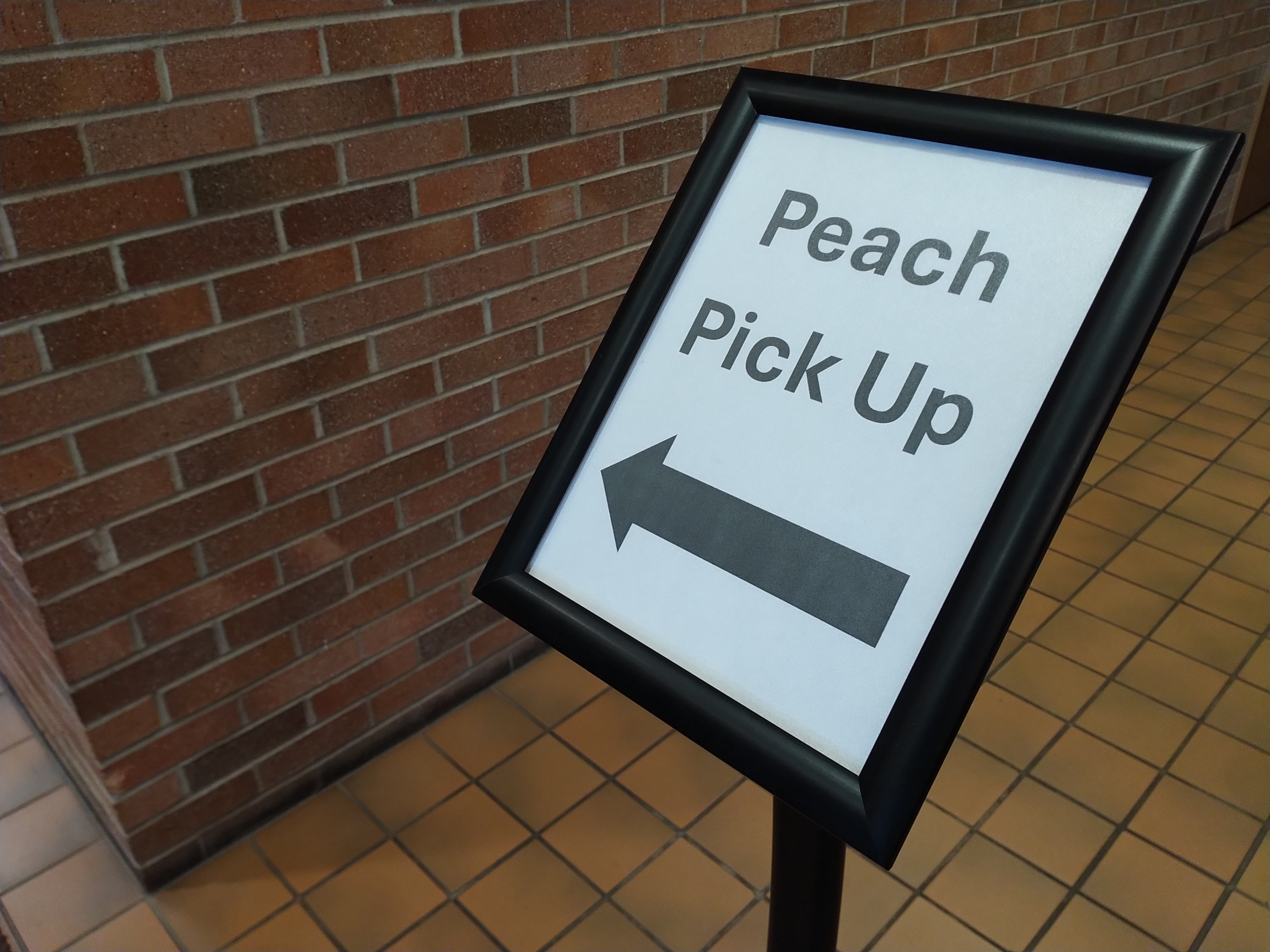
Signs directed people into the peach pick up spot in the basement. (Minnesota Prairie Roots copyrighted photo August 2024)
Earlier this week, Randy and I picked up a 20-pound case of peaches in the basement of First English Lutheran Church. That’s a lot of peaches—around 40—for two people to eat. But I love peaches. And we’ll share some with our eldest daughter and her family.
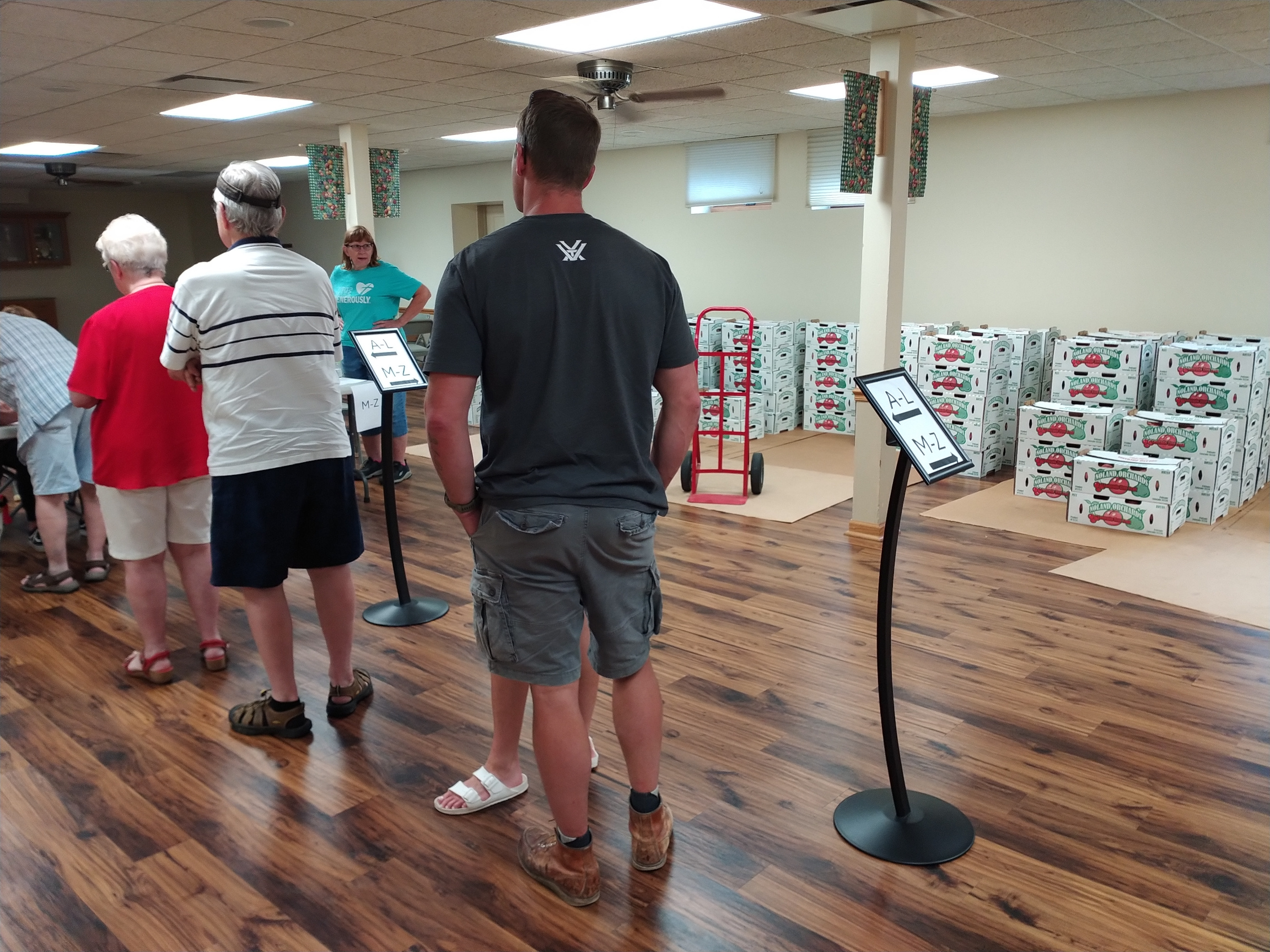
People wait in line for their peaches at First English Lutheran Church. (Minnesota Prairie Roots copyrighted photo August 2024)
A steady stream of people flowed into the cold church basement late Tuesday afternoon for their pre-ordered peaches, sold as a fundraiser by the youth group. We paid $37 for our full box. That’s $1.85/pound. I have no idea if that’s a “good” price. It doesn’t matter. I prefer peaches shipped directly from the grower. I also like supporting local church youth, because I was once that mom of kids raising monies for mission trips and youth gatherings.
Peaches no longer come in wooden crates, but in cardboard boxes. (Minnesota Prairie Roots copyrighted photo August 2024)
Peaches, though, mean more to me than simply supporting a good cause and eating one of my favorite fruits. Peaches take me back to summer on the farm, into the kitchen. There my mom pried open a wooden crate of peaches wrapped in pinkish tissue paper (saved for later use in the outhouse). Then she dropped the peaches into a large kettle of boiling water to remove the skins. Next, she halved or sliced the peaches into Mason and Ball quart jars. Topped with lids and ringed, the jars went into the pressure cooker. Once removed, the jars cooled and sealed. Then we carried the jars to the cellar.
Beautiful (and delicious) Colorado peaches sold at First English. (Minnesota Prairie Roots copyrighted photo August 2024)
I admire farm women like my mom who labored to preserve fruits and vegetables to feed their families during the winter months ahead. And winters on the prairie were long and harsh. Many a cold, snowy evening, Mom would pull open the kitchen floor trap door and send me down the open wooden steps into the depths of the dank, dark, dirt-floored cellar lit by a single light bulb. There I selected a quart jar from the wooden shelves. Whatever fruit Mom wanted. Pears, cherries, plums, apples, peaches. The preserved fruit would complete our meal of meat, boiled potatoes with gravy, a side vegetable (pulled from the freezer) and homemade bread.
We ate well. Good food without preservatives. Beef from our cattle. Vegetables from our garden. Apples from local trees. And then all those fruits, purchased in crates and preserved. No additives. Just simple, good food.
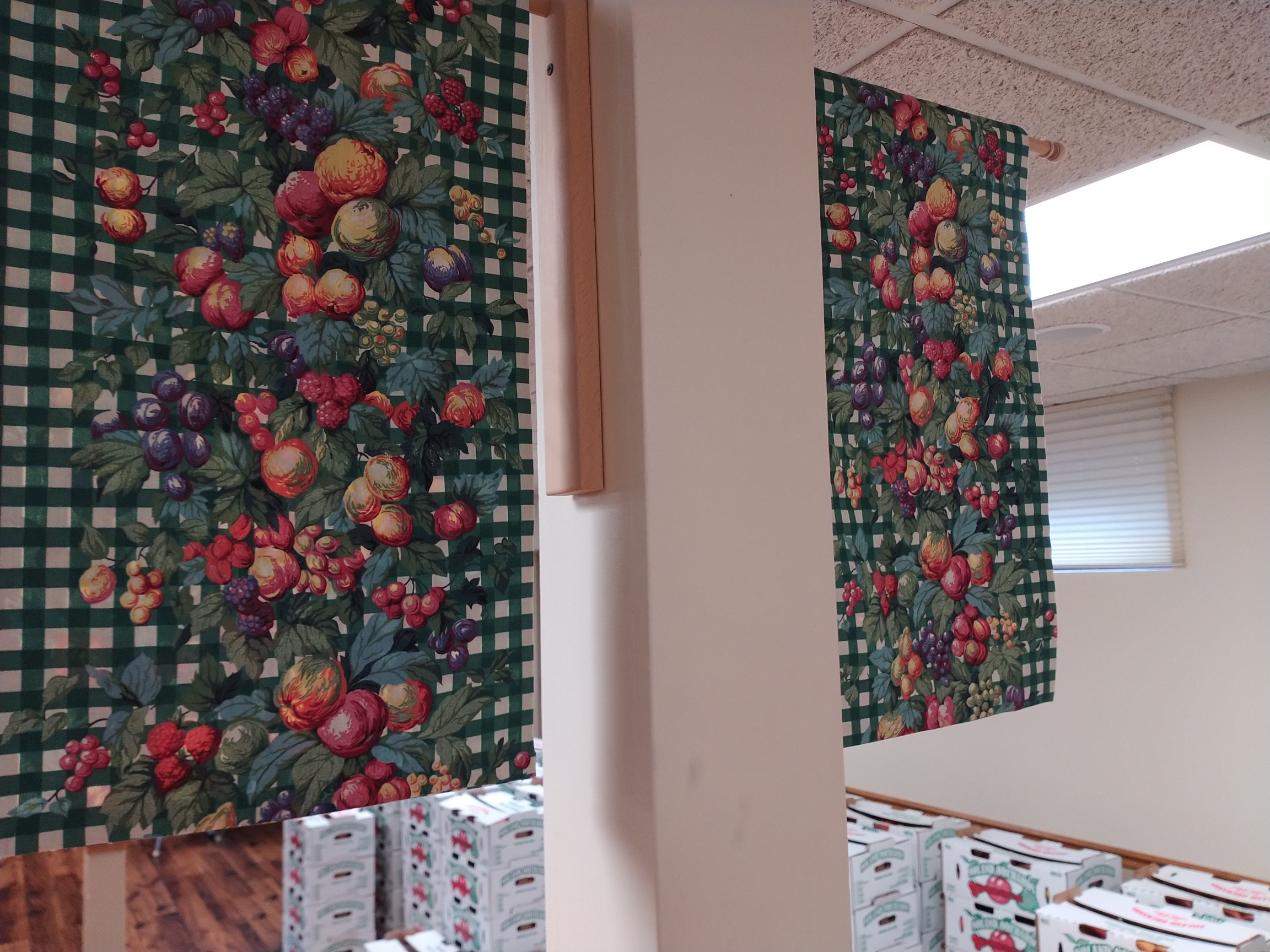
Fruit-themed banners add a festive flair to peach pick up. (Minnesota Prairie Roots copyrighted photo August 2024)
I always thought I would follow my mom’s example of planting a big garden and preserving food. But I never did. I live on a mostly shady lot in town. I raised only three children, not six like her. I have easy access to multiple grocery stores, unlike her. Fresh fruit is readily available. I prefer fresh. And, if I’m really honest with myself, I never wanted to labor in the kitchen for hours during the hot summer putting up fruits and vegetables.
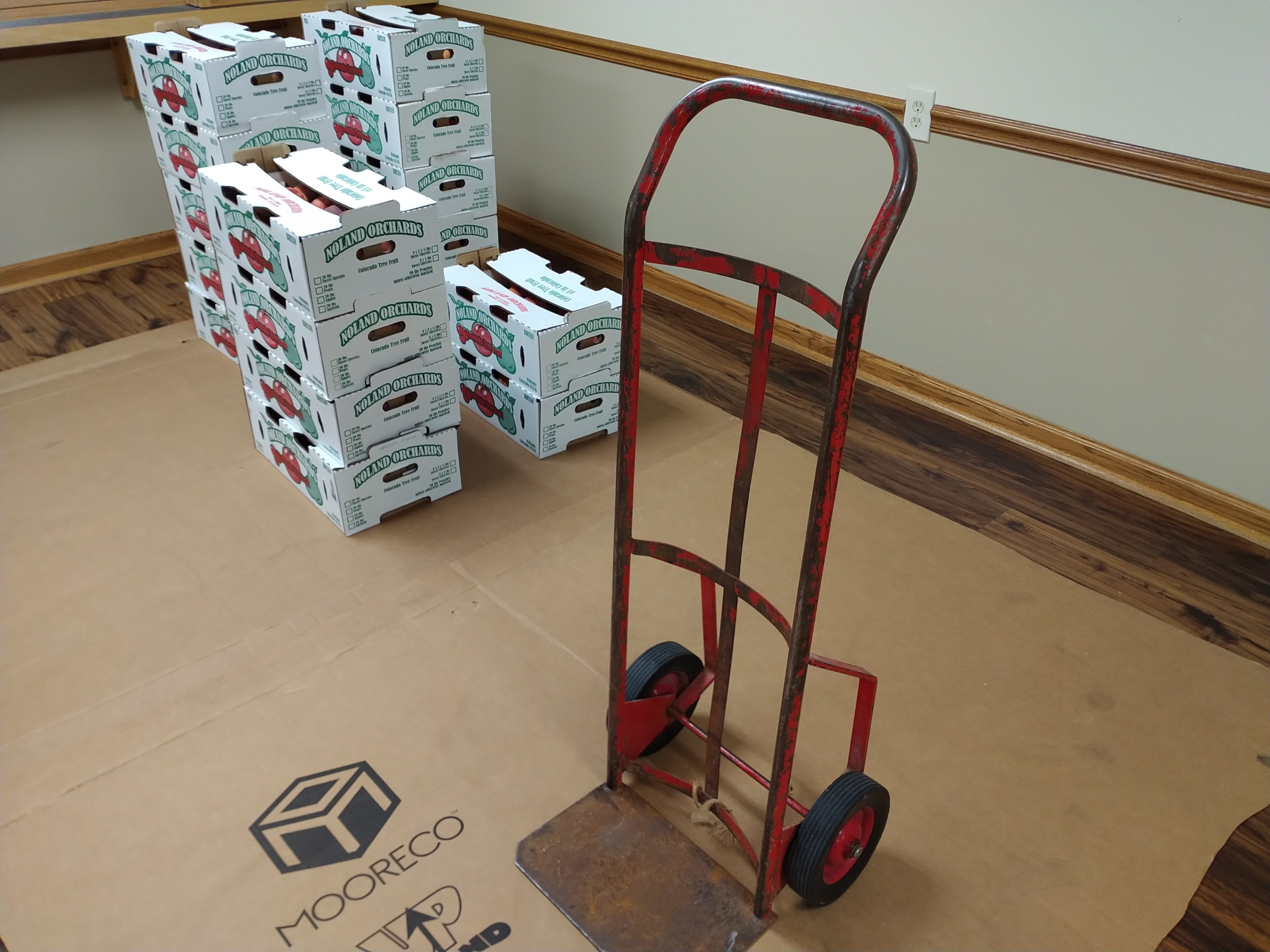
Carts were ready for volunteers to wheel peach cases to vehicles. (Minnesota Prairie Roots copyrighted photo August 2024)
Still, I buy that case of peaches from First English. All those peaches, minus the tissue paper wrappings reused in the outhouse. In many ways, I am honoring my mom, hardworking farm woman of the Minnesota prairie. As I pull ripened peaches from a brown paper bag to slice into my morning oatmeal, to eat with a meal or to incorporate into a crisp, pie or galette, I think of Mom. She, who showed her love for family not in words or hugs, but rather in rows and rows of quart jars filled with fruit. Jars shelved on planks in the dank, dark depths of the dirt-floored cellar.
Christdala Swedish Lutheran Church, rural Millersburg. (Minnesota Prairie Roots copyrighted file photo August 2020)
IN MY BACKROADS travels around Minnesota, I’ve often stopped at churches, drawn by their history, architecture and art. Churches are, to me, more than houses of worship. They are also galleries, museums, centers of praise and grief and joy.
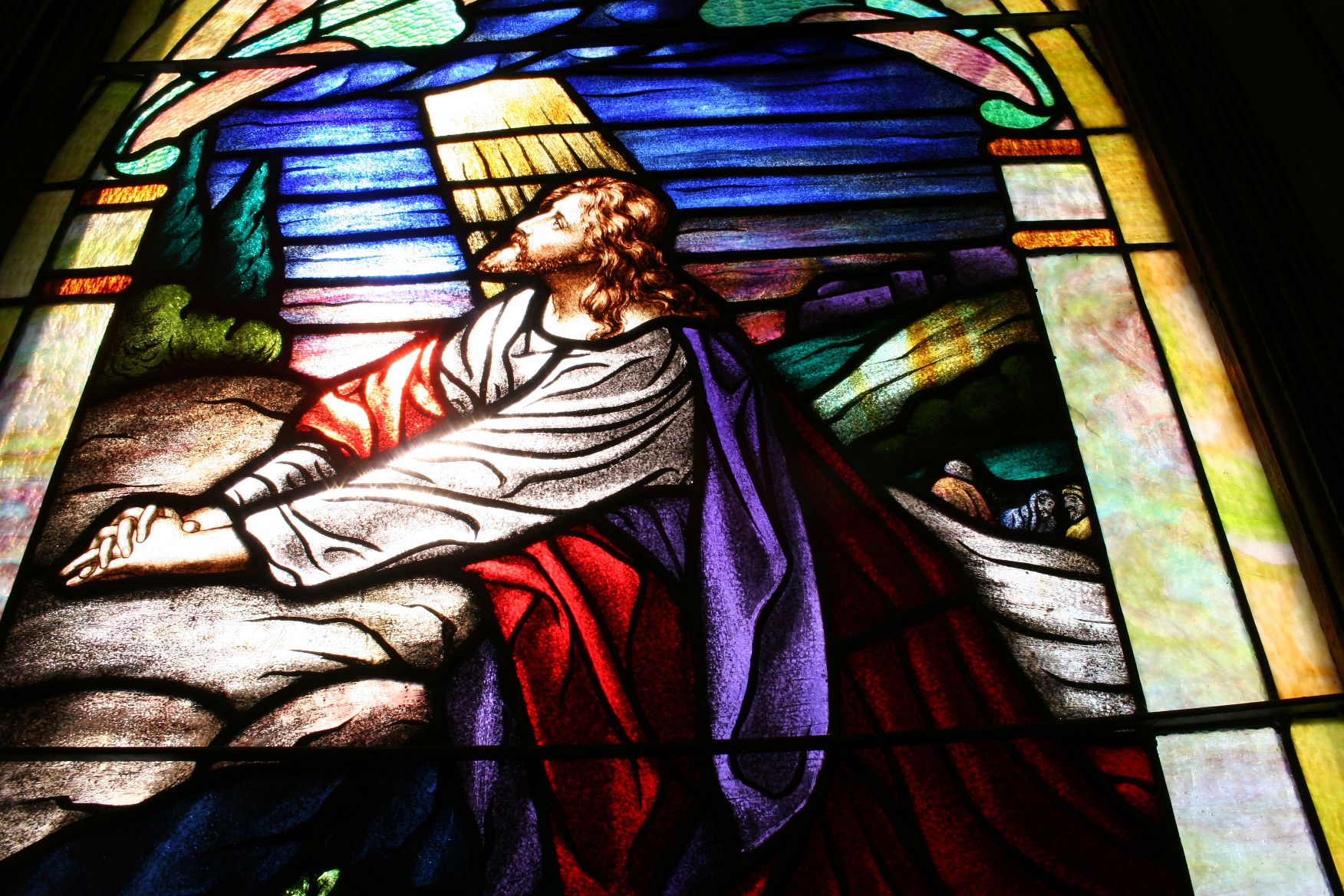
Inside Vang Lutheran Church, rural Dennison, a depiction of Jesus praying in the Garden of Gethsemane. (Minnesota Prairie Roots copyrighted file photo October 2014)
There’s almost something holy about stepping inside a church, into the quiet of a space graced by colorful stained glass windows, religious sculptures, pews worn by the hands of many.
I feel a sense of reverence in the light, in the stillness, in the peace that fills an empty sanctuary. I feel centered. Calm. Enveloped by the sheer beauty surrounding me.
Inside St. Michael’s Catholic Church in Buckman in Morrison County, stained glass art shows Jesus carrying His cross. (Minnesota Prairie Roots copyrighted file photo January 2021)
That beauty often emanates from the art. Stained glass windows, designed and built by skilled artisans, add a dimension of sacredness that appears heavenly when sunlight streams through glass.
Jesus’ crucifixion depicted in a stained glass window inside Holden Lutheran Church, rural Kenyon.(Minnesota Prairie Roots copyrighted file photo March 2016)
Themed to history, those windows visually tell stories written within the bible. Many focus on Holy Week: The Last Supper. Jesus praying in the garden of Gethsemane. The crucifixion of Jesus. And then His glorious resurrection on Easter morning.
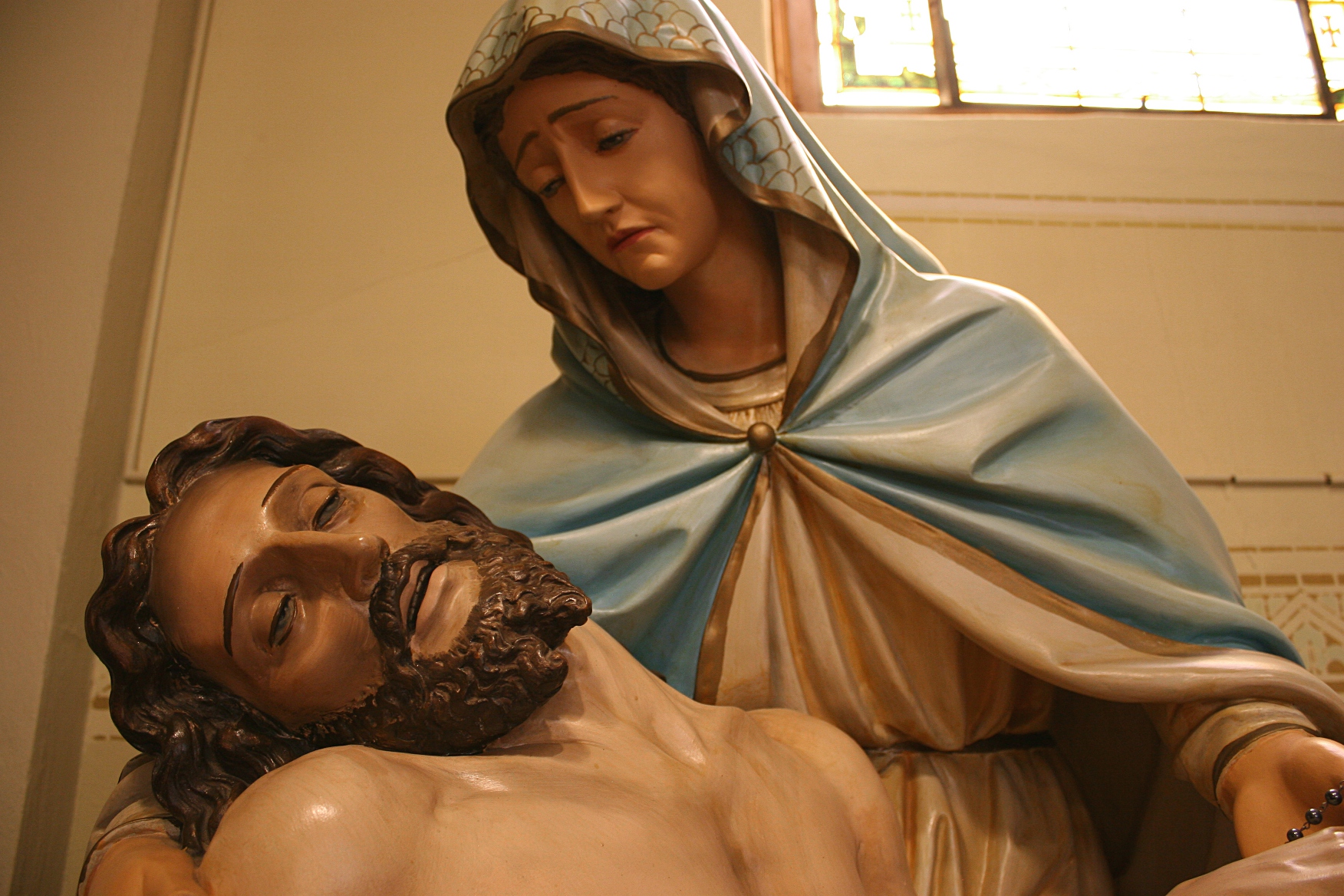
This statue of Mary grieving the loss of her son shows deep emotion. It’s inside St. Mary’s Catholic Church, New Trier. (Minnesota Prairie Roots copyrighted file photo April 2017)
Sculptures, too, depict the same in life-size statues.
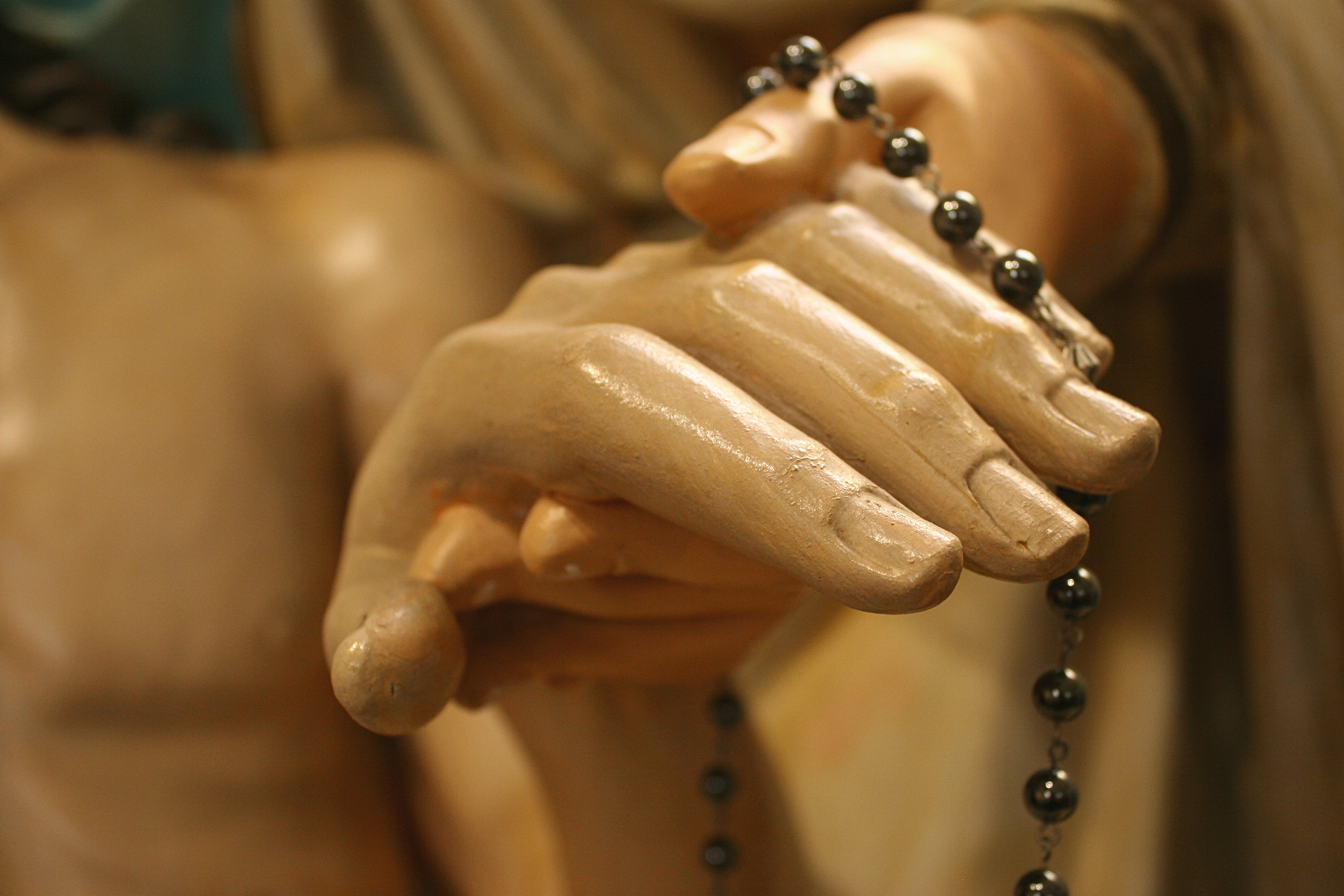
Hands convey so much love in intimate details in this sculpture of Mary holding Jesus’ hand. Photographed at St. Mary’s Catholic Church, New Trier. (Minnesota Prairie Roots copyrighted file photo April 2017)
Sacred and religious art is powerful. It evokes emotions. Inspires. Uplifts. Gives reason to pause and reflect.
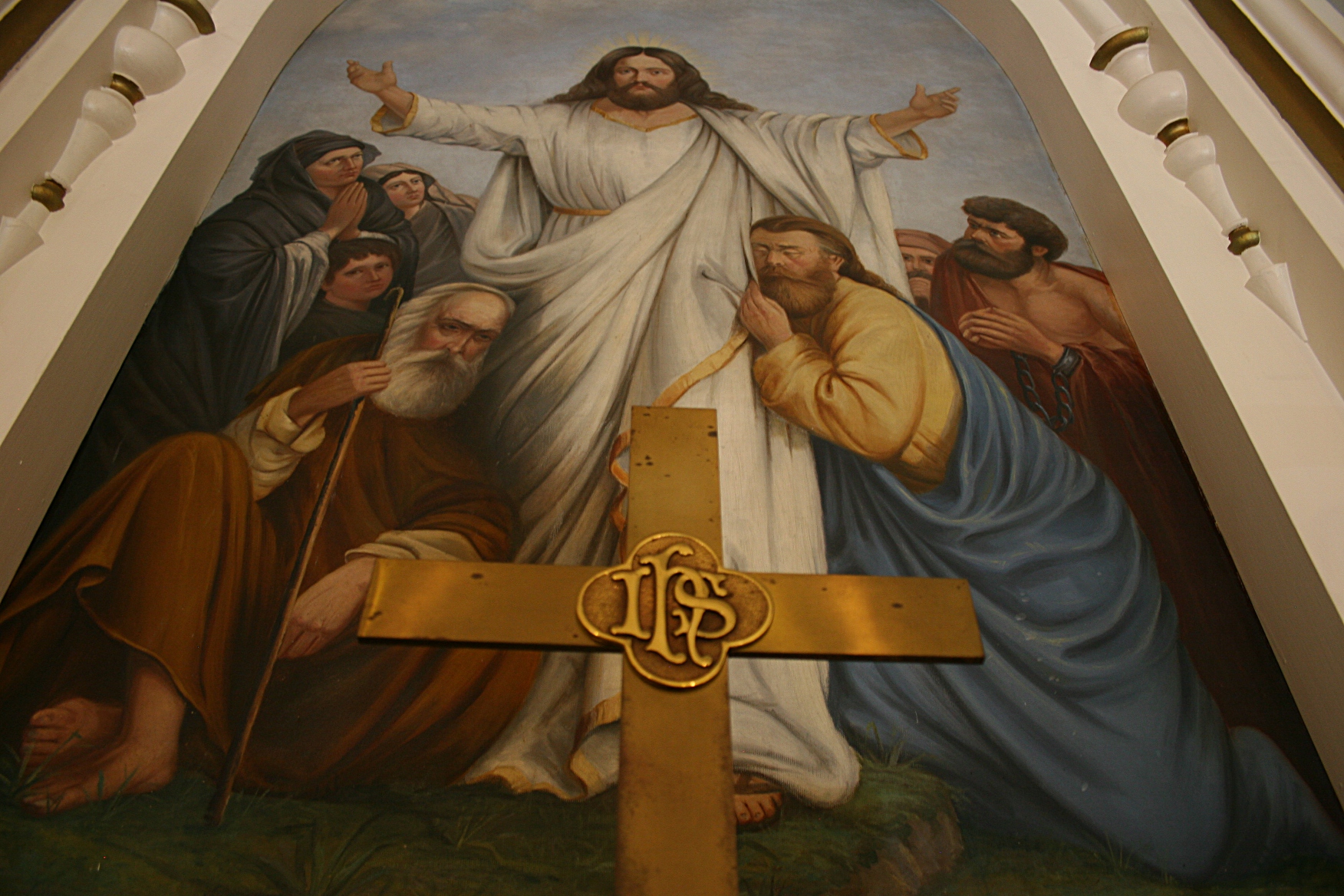
This shows a snippet of the center stained glass window in a trio above the altar at Trinity Lutheran Church, Wanamingo. It depicts Christ’s resurrection. (Minnesota Prairie Roots copyrighted file photo March 2016)
This Holy Week, as my thoughts turn more reflective and inward, I feel deep gratitude for the long ago faithful who created the stained glass windows, the sculptures and other art adorning churches. These works of art are worthy of our attention, our appreciation, no matter religious affiliation or not.
A full view of the altar painting by A. Pederson inside Moland Lutheran Church, rural Kenyon. It’s based on Matthew 11: 28 – 30. “Come to me, all you who are weary and burdened…” (Minnesota Prairie Roots copyrighted file photo June 2013)
I can only imagine how many eyes have focused on the art within sanctuary walls. During baptisms. During weddings. During funerals. And during worship services. Joy. Comfort. Peace. Blessings. They’re there, all there, within the art within these sacred spaces.
CHRISTIAN FAITH COMMUNITIES have long integrated art into their houses of worship. Whether in stained glass windows, sculptures, paintings or other art forms, this art is an important way to visually connect worshipers with Scripture, with foundational teachings.
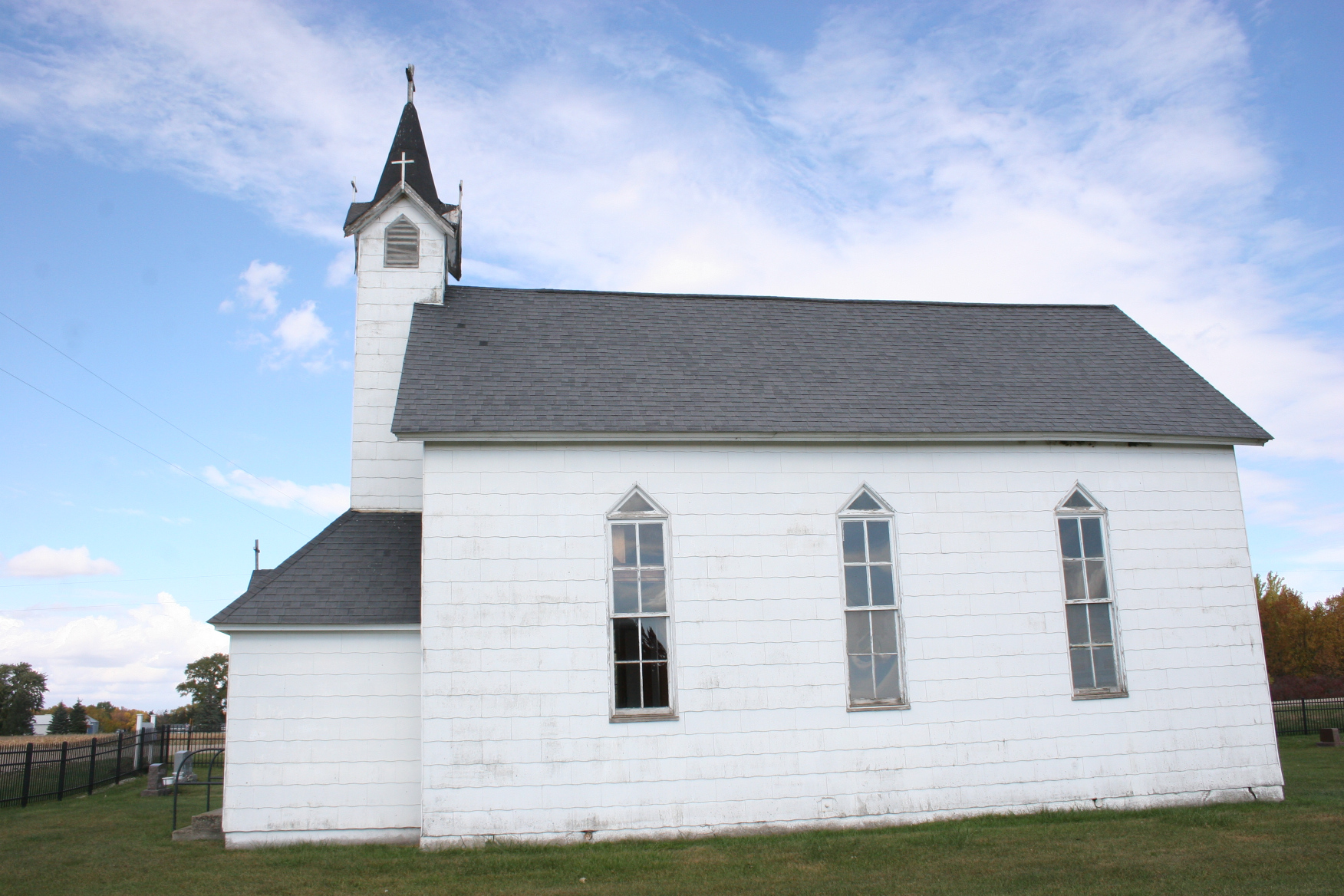
The historic Immaculate Conception of the Virgin Mary Church in Shieldsville Township, rural Rice County, sits isolated along a gravel road, edged by the Trebon Cemetery. The Czech church closed long ago and is locked. But I’ve wandered the cemetery grounds and found unusual art. (Minnesota Prairie Roots copyrighted file photo October 2022)
This week, Holy Week, I consider the art of churches I’ve visited in my area of southern Minnesota. Aged sanctuaries graced with connective and inspiring art. I never tire of stepping inside a rural church or meandering through a country cemetery to view faith-focused art. It’s beautiful in its own way, often in the visual storytelling of events documented in the Bible.
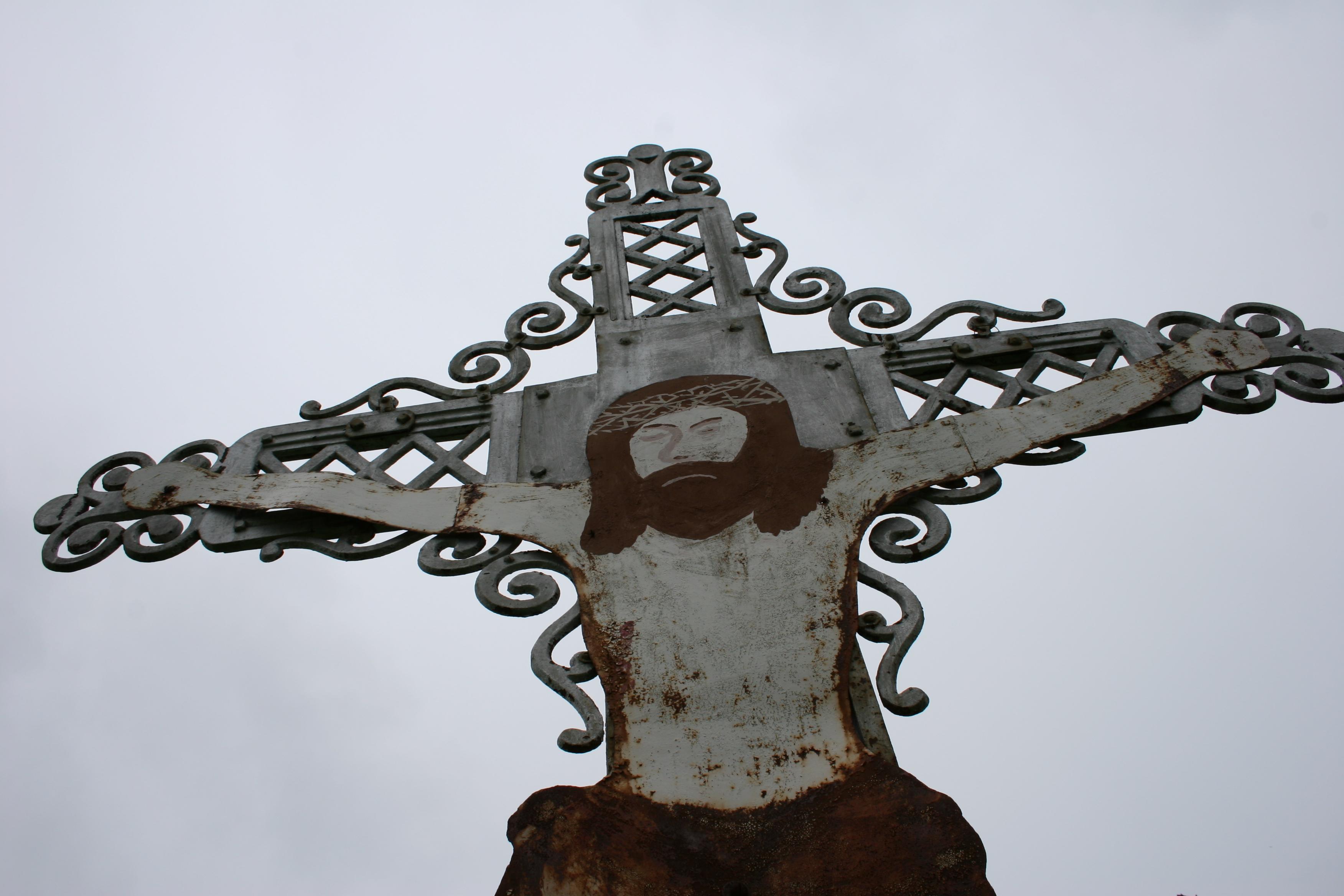
Folk art in the Trebon Cemetery honors the crucified Christ and the deceased. (Minnesota Prairie Roots copyrighted file photo April 2014)
As a woman of faith, the days leading up to Jesus’ crucifixion and subsequent resurrection on Easter morning make this week particularly meaningful.
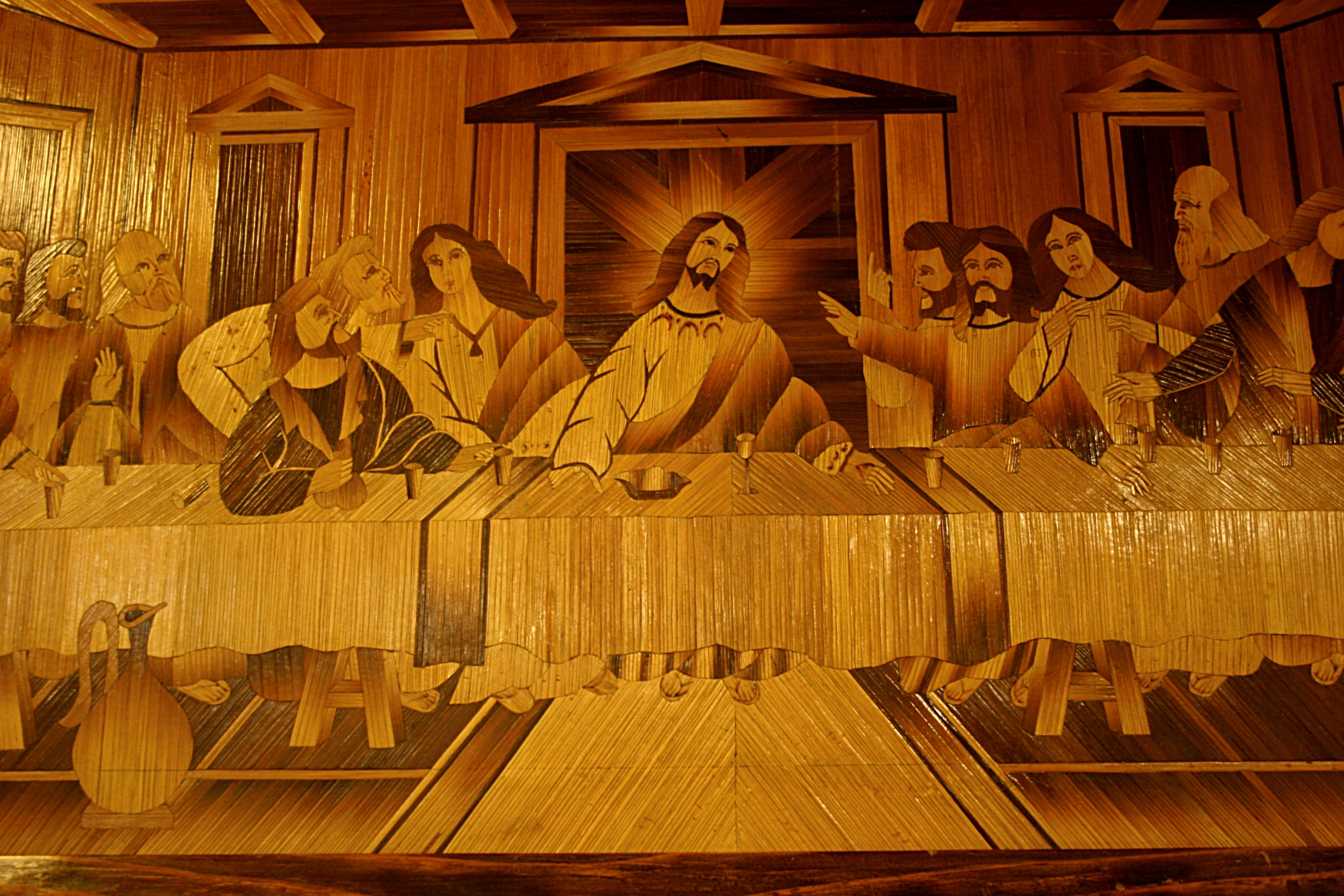
This artistic rendition of The Last Supper hangs in the St. John’s United Church of Christ, Wheeling Township, rural Faribault, Fellowship Hall. (Minnesota Prairie Roots copyrighted file photo April 2012)
From Jesus praying in the Garden of Gethsemane to The Last Supper to his betrayal by Judas and then his crucifixion and resurrection, the events of Christ’s final days unfold in art inside sanctuaries and on cemetery grounds.
Inside Vang Lutheran Church, rural Dennison, a stained glass window shows Christ praying in the Garden of Gethsemane. (Minnesota Prairie Roots copyrighted file photo 2014)
I feel a certain reverence for the artists who designed and crafted stained glass windows that rise high inside sanctuaries, sunlight streaming through colorful glass. It’s almost as if the beauty therein beams directly from heaven, filling dark souls with light.
In the face of Mary, I see profound grief in losing her son. This statue is inside St. Mary’s Catholic Church, New Trier. (Minnesota Prairie Roots copyrighted file photo)
Likewise, statues, most often found in Catholic churches, add a down-to-earth human element in their life-sized presence. I have the urge to reach out, to touch a hand or a face, to offer comfort, to extend compassion. Art, especially faith-based art, holds that power.
Centering the altar is this depiction of Jesus’ crucifixion inside St. Mary’s Catholic Church, New Trier. (Minnesota Prairie Roots copyrighted file photo)
Whether centering an altar or hanging on a church fellowship hall wall, biblically-based artwork is an important part of Christianity. I appreciate the ornate and the simplistic. The oversized and the understated. The all of it, uplifting, inspiring, moving me.
This shows the resurrected Christ in a snippet of the center stained glass window in a trio above the altar at Trinity Lutheran Church, Wanamingo.(Minnesota Prairie Roots copyrighted file photo March 2016)
During this Holy Week, I reflect on the art gracing churches throughout my region. Art that truly is a spiritual treasure. Art that carries a heritage of faith.
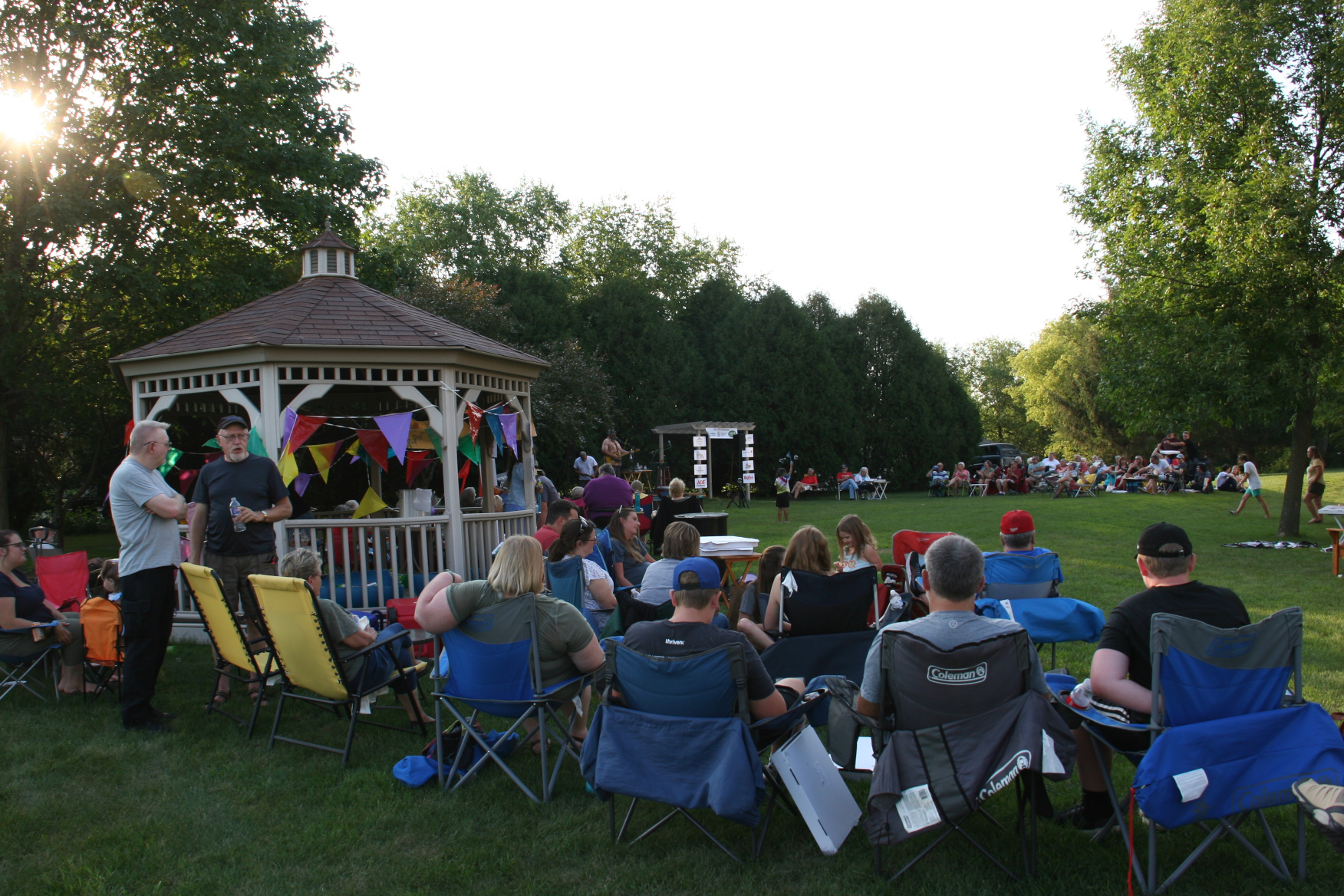
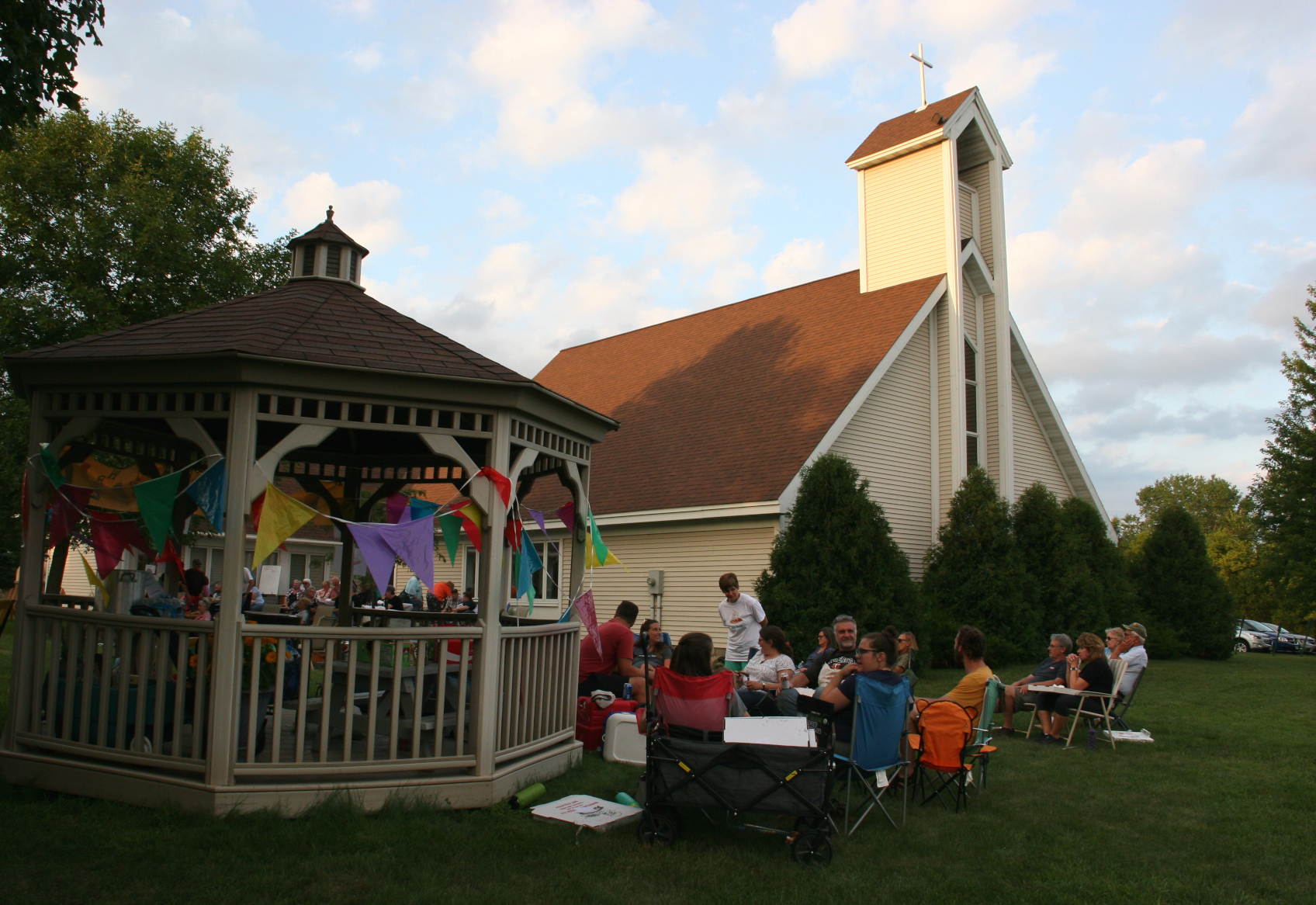
On a perfect summer evening, a crowd gathers for music, pizza and conversation at Christ Lutheran Church. (Minnesota Prairie Roots copyrighted photo August 2022)
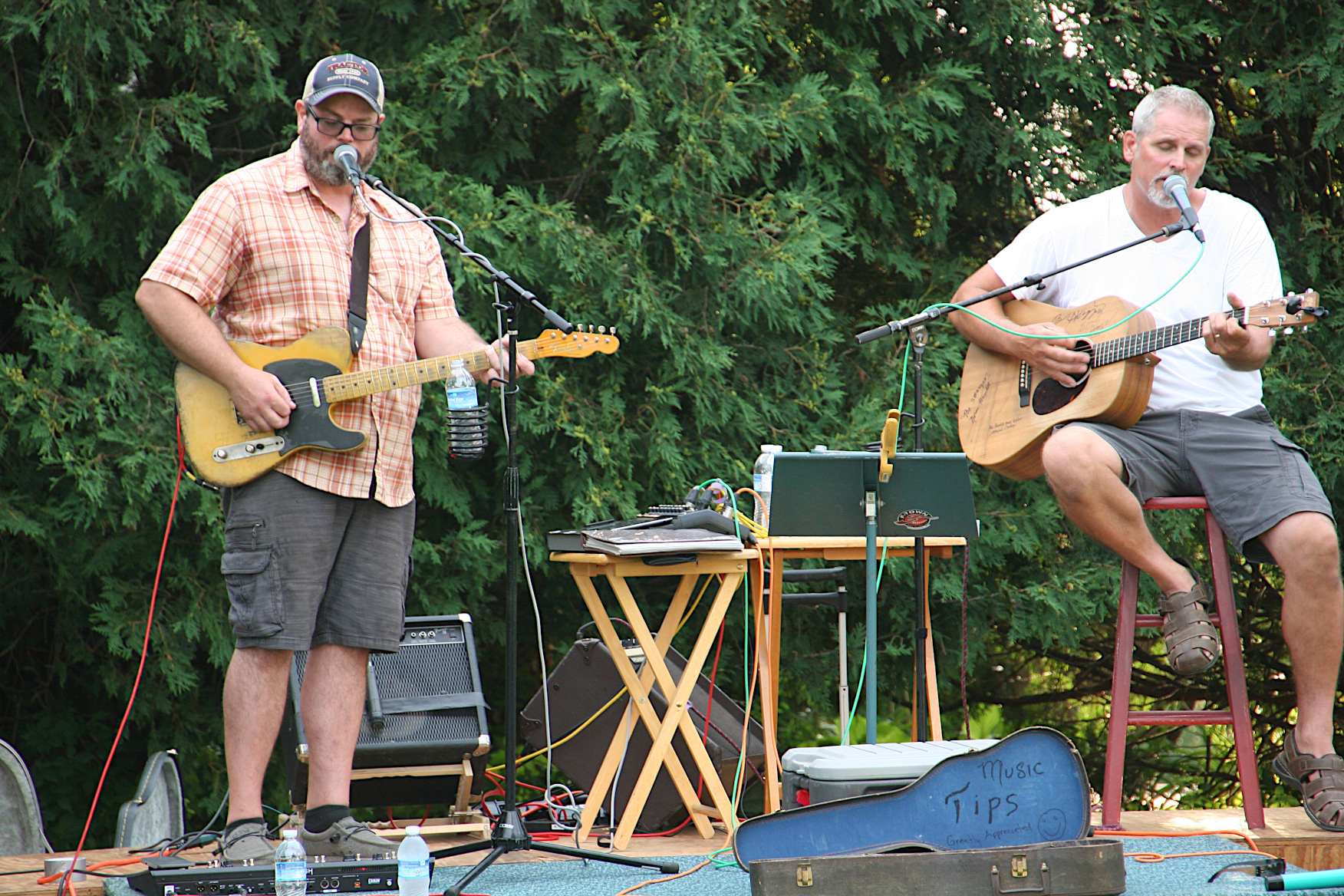
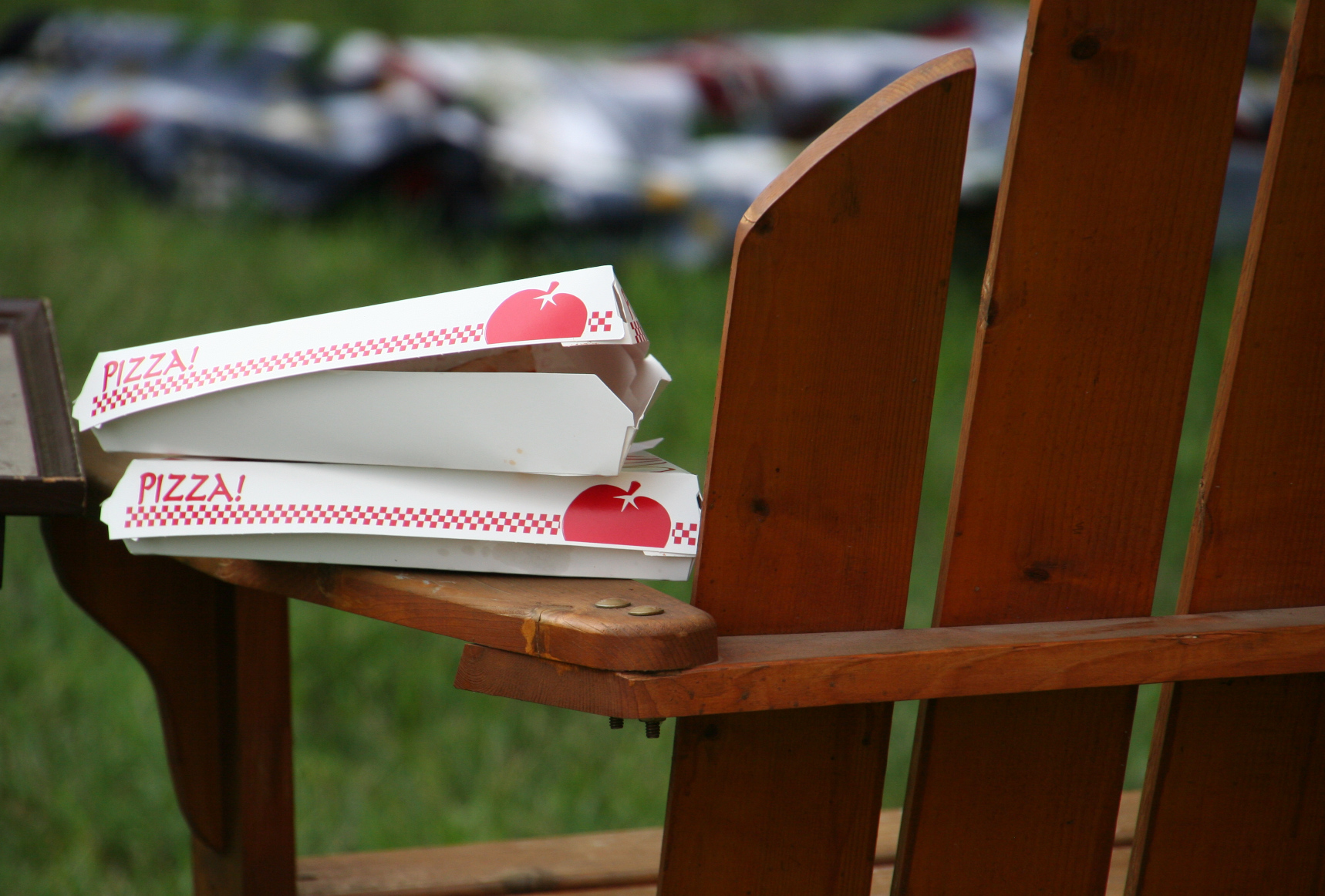
AS OLD COUNTRY BROTHERS belted out popular songs from The Eagles, Johnny Cash, Johnny Horton and many others, volunteers across the backyard of Christ Lutheran Church created, baked and delivered homemade wood-fired pizzas to an appreciative crowd. Randy and I were among those attending the last of the summer Holy Smoke concert series and pizza nights Wednesday at the church on the hill on Faribault’s east side.
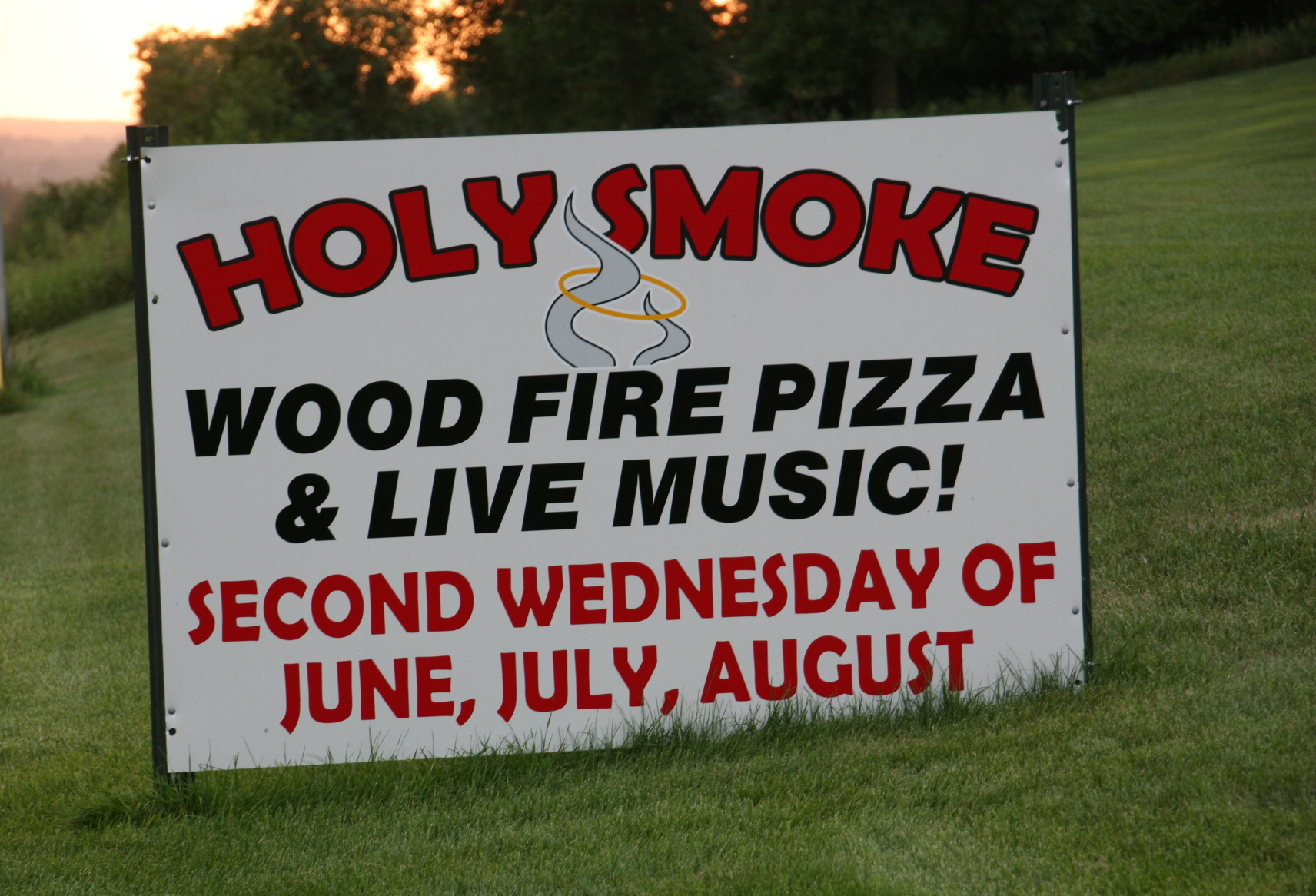
The roadside sign posted along Minnesota State Highway 60 by the driveway into Christ Lutheran. (Minnesota Prairie Roots copyrighted photo August 2022)
Old Country Brothers Gregg and Jeff Sartor perform on August 10. (Minnesota Prairie Roots copyrighted photo August 2022)
Smoked brisket pizza. (Minnesota Prairie Roots copyrighted photo August 2022)
In its sixth year, Holy Smoke is about more than excellent thin crust pizza and music. This is also about a coming together of community on a perfect August evening in southeastern Minnesota. This is also about giving back. Proceeds from the three summer gatherings benefit Big Brothers Big Sisters, Habitat for Humanity and HOPE Center.
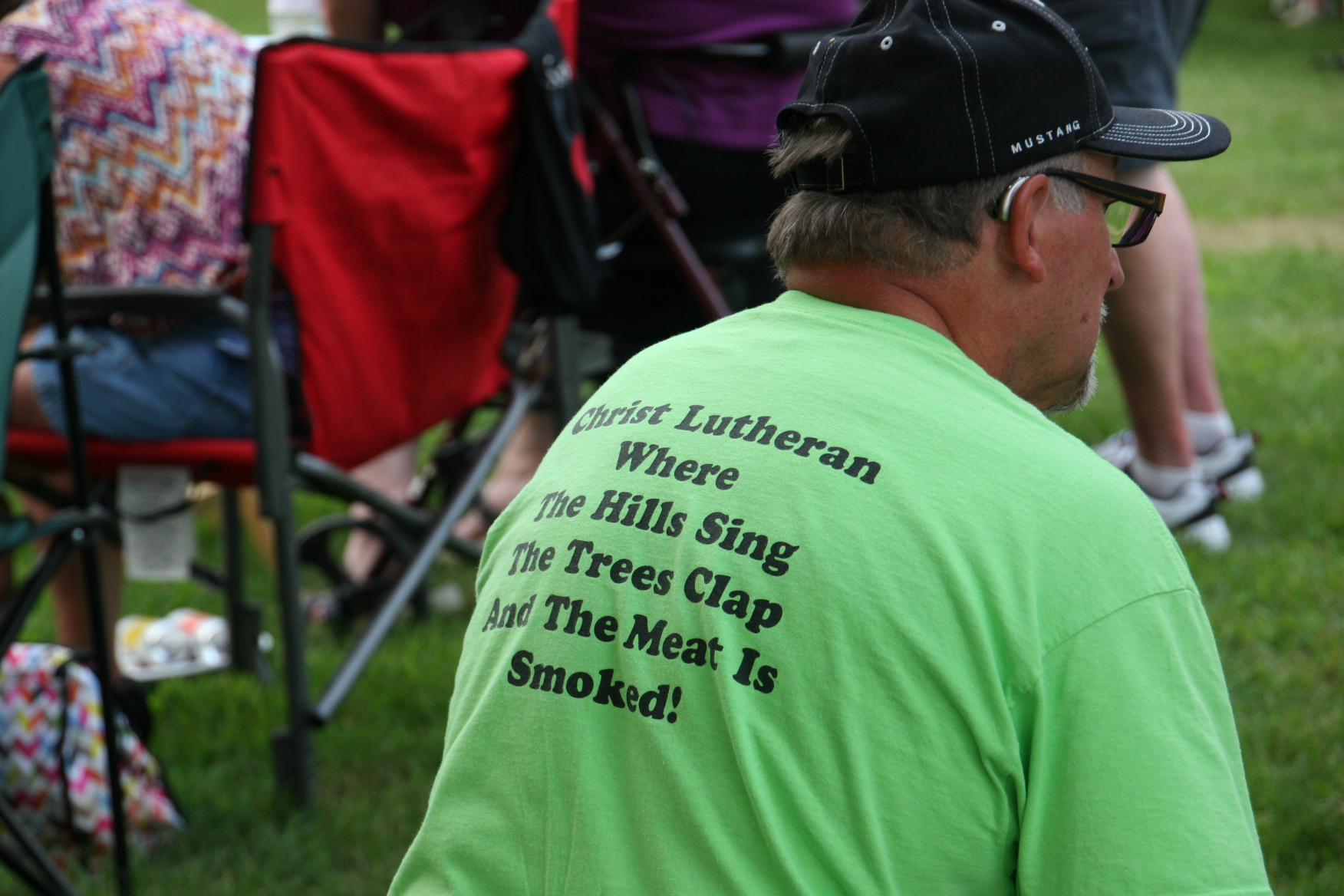
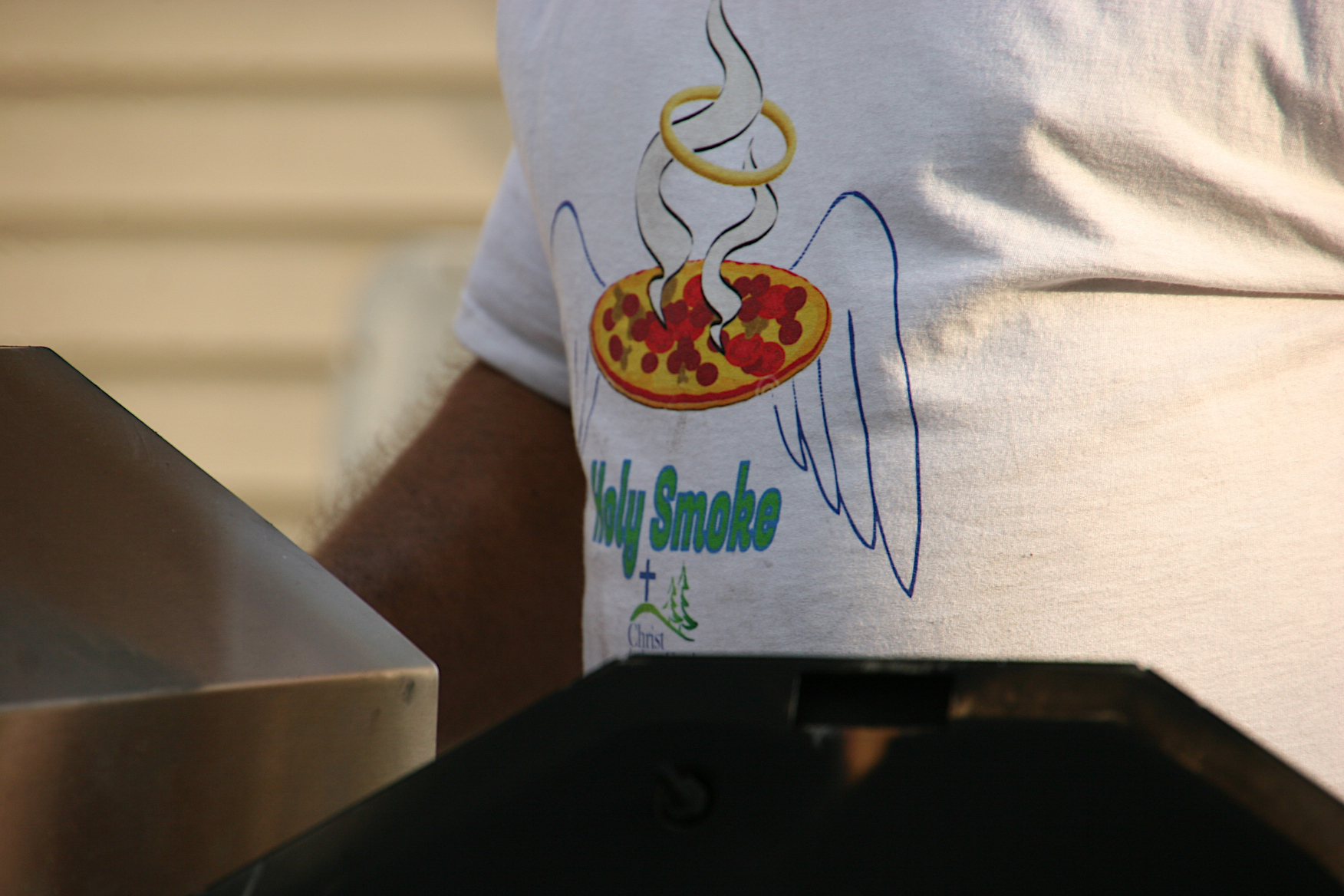
A themed t-shirt sported by a volunteer who paused to visit with attendees. (Minnesota Prairie Roots copyrighted photo May 2022)
A message printed on some volunteers’ t-shirts and on a bench dedicated to Pastor Craig and Carol Breimhorst (the pastor died of COVID-19; the first death in our county) references Isaiah 55:12, fitting Scripture for this hilltop church edged by trees and a sweeping lawn descending to Minnesota State Highway 60.
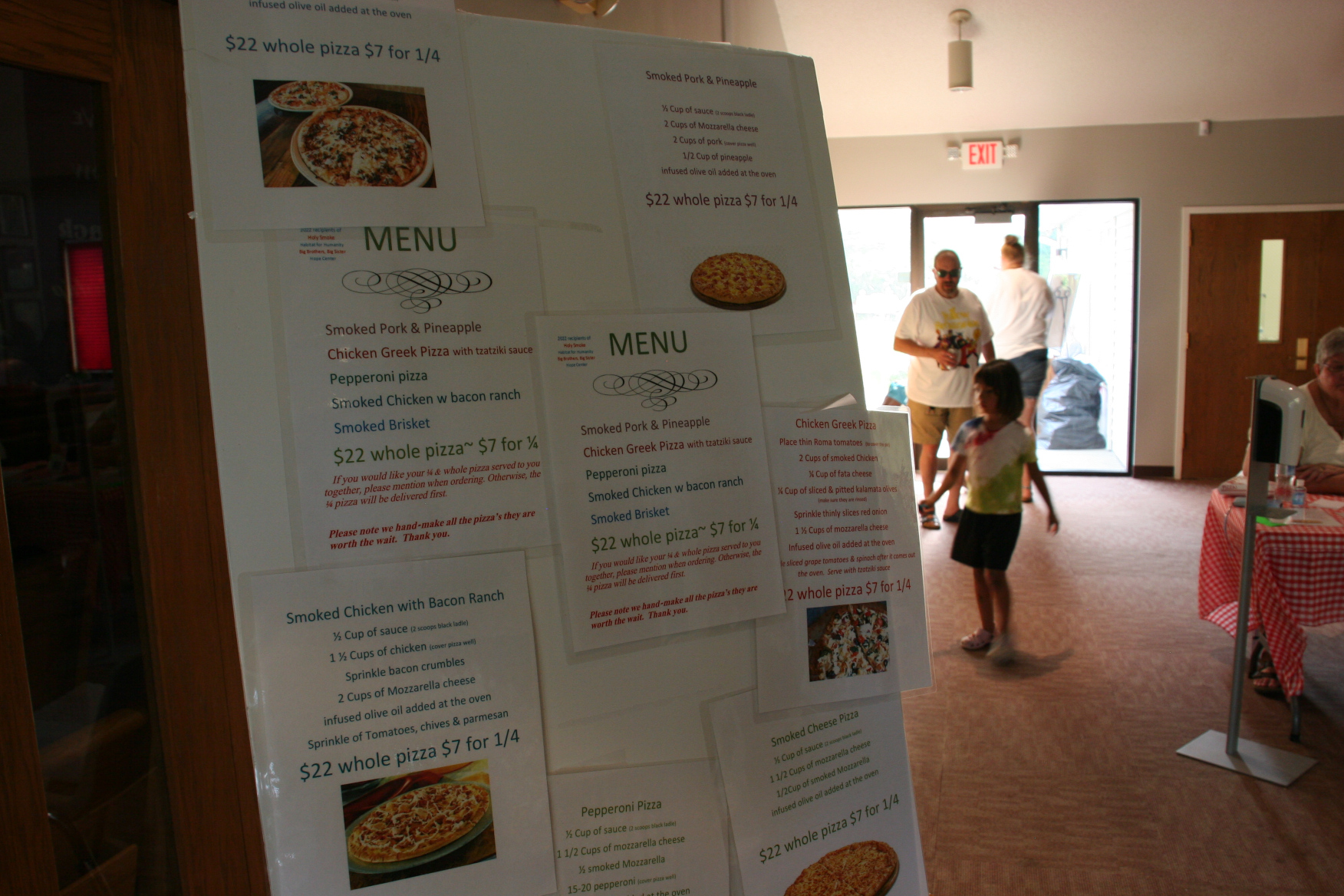
The menu posted just inside the front door, ticket table to the right. (Minnesota Prairie Roots copyrighted photo August 2022)
There’s joy in that biblical reference just as there’s joy among those who make Holy Smoke happen. A ticket taker, whom I thanked, tapped her hand to her heart, showing me from whence her joy rises.
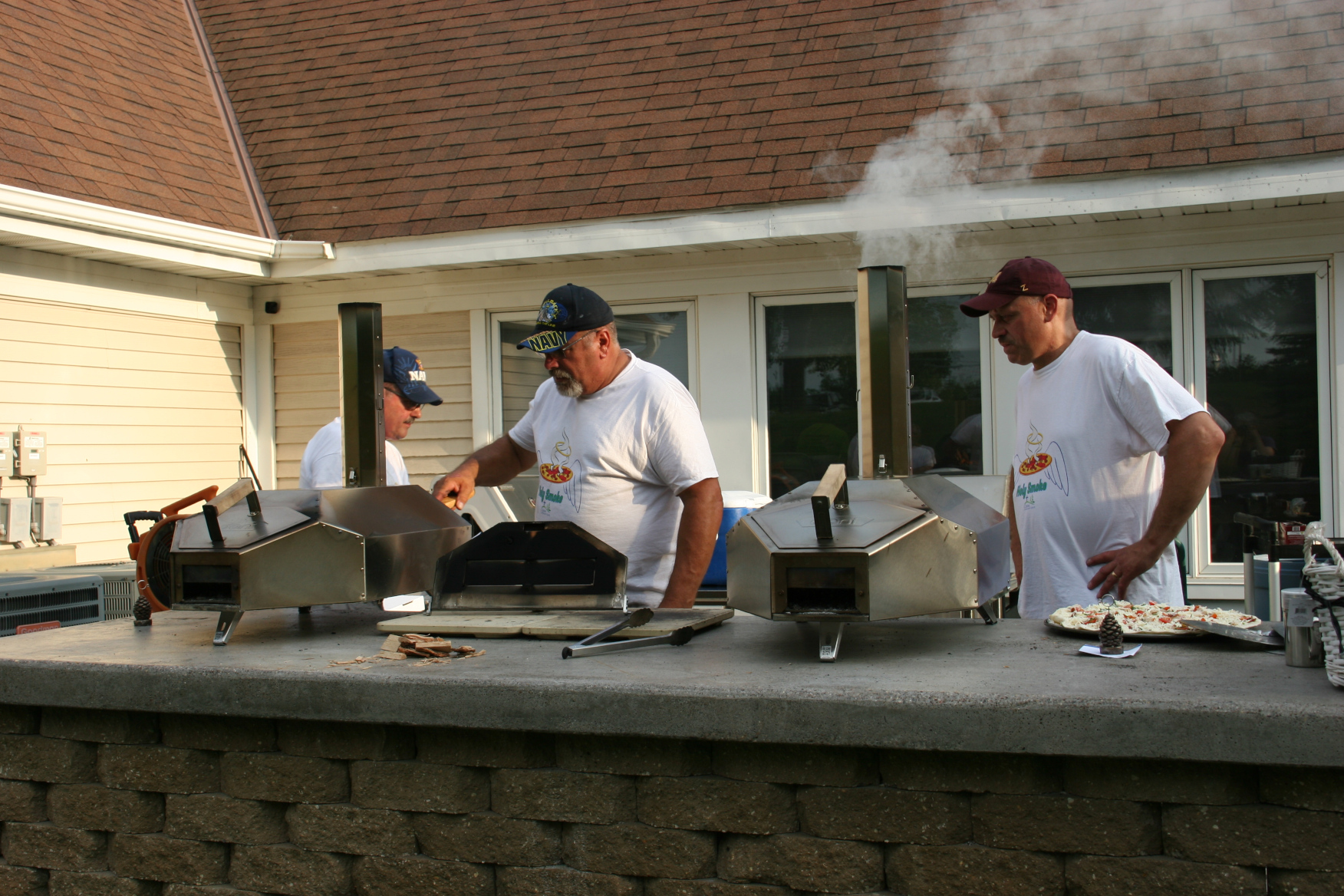
The pizza bakers at the wood-fired oven just outside the church. (Minnesota Prairie Roots copyrighted photo August 2022)
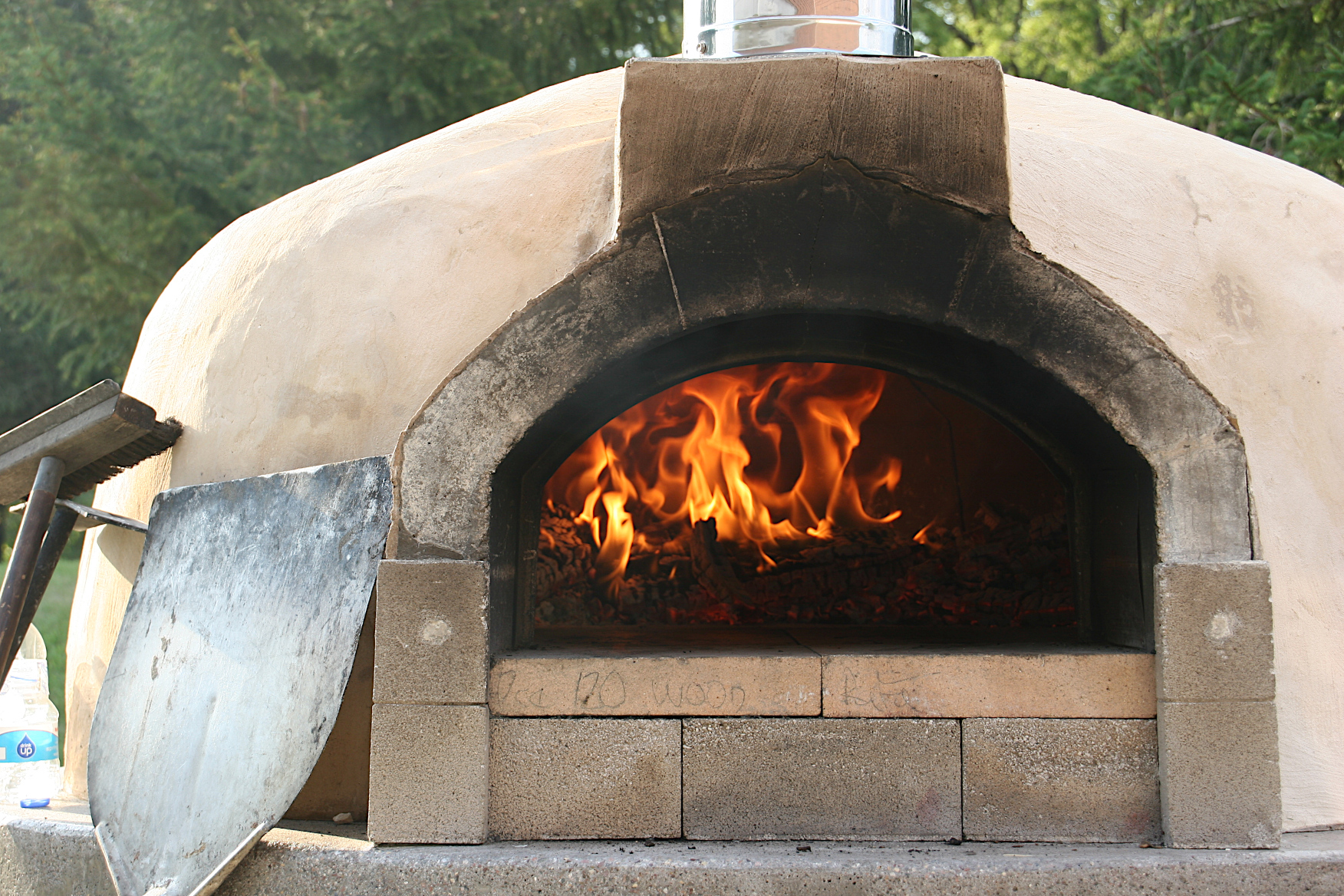
Plenty of heat here. (Minnesota Prairie Roots copyrighted photo August 2022)
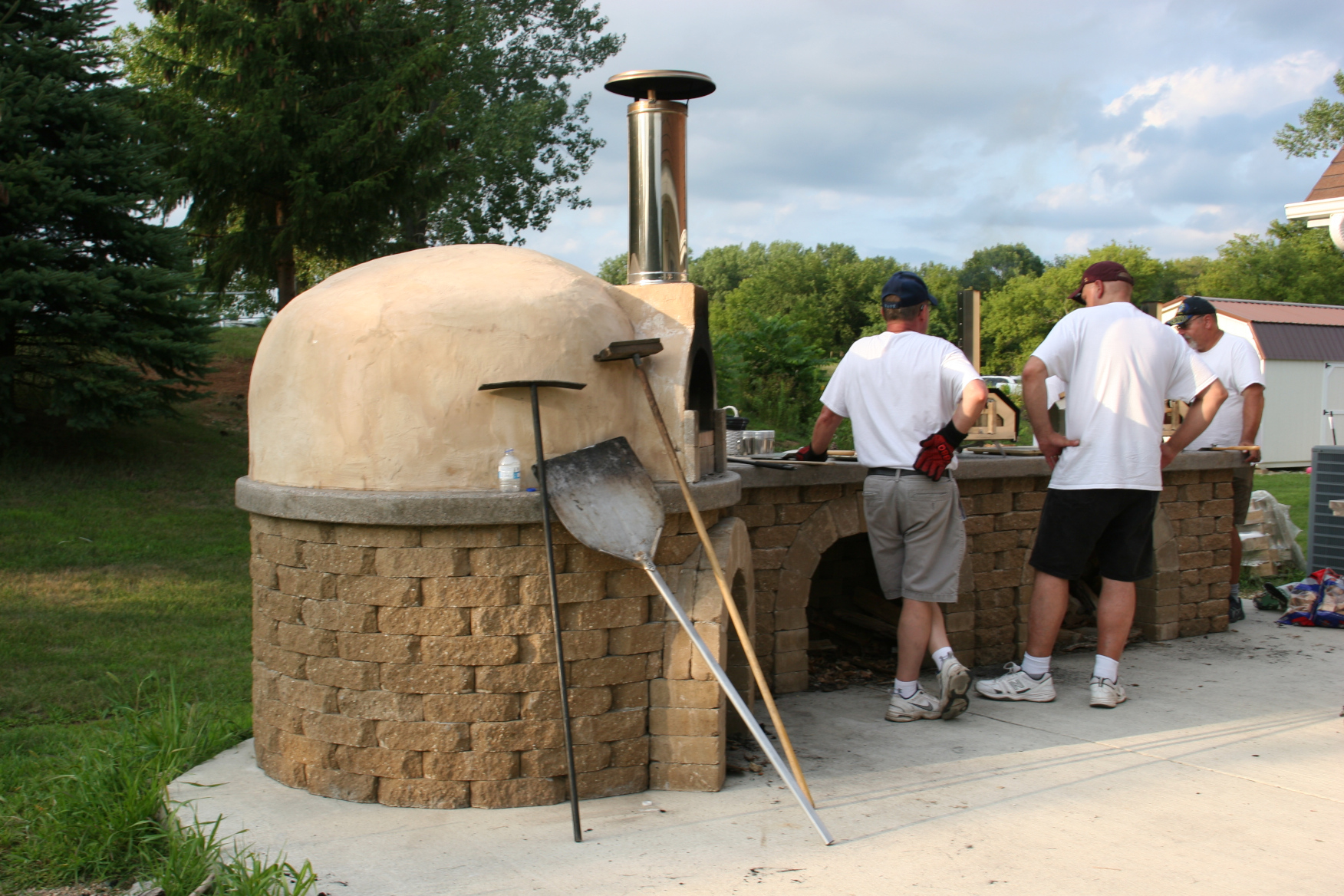
An overview of the wood-fired oven system. (Minnesota Prairie Roots copyrighted photo August 2022)
I found the same enthusiasm among the crew tending the wood-fired pizza oven. The heat flaming inside to 700-plus degrees made the work station at times uncomfortably hot. But they forged on, baking pizzas.
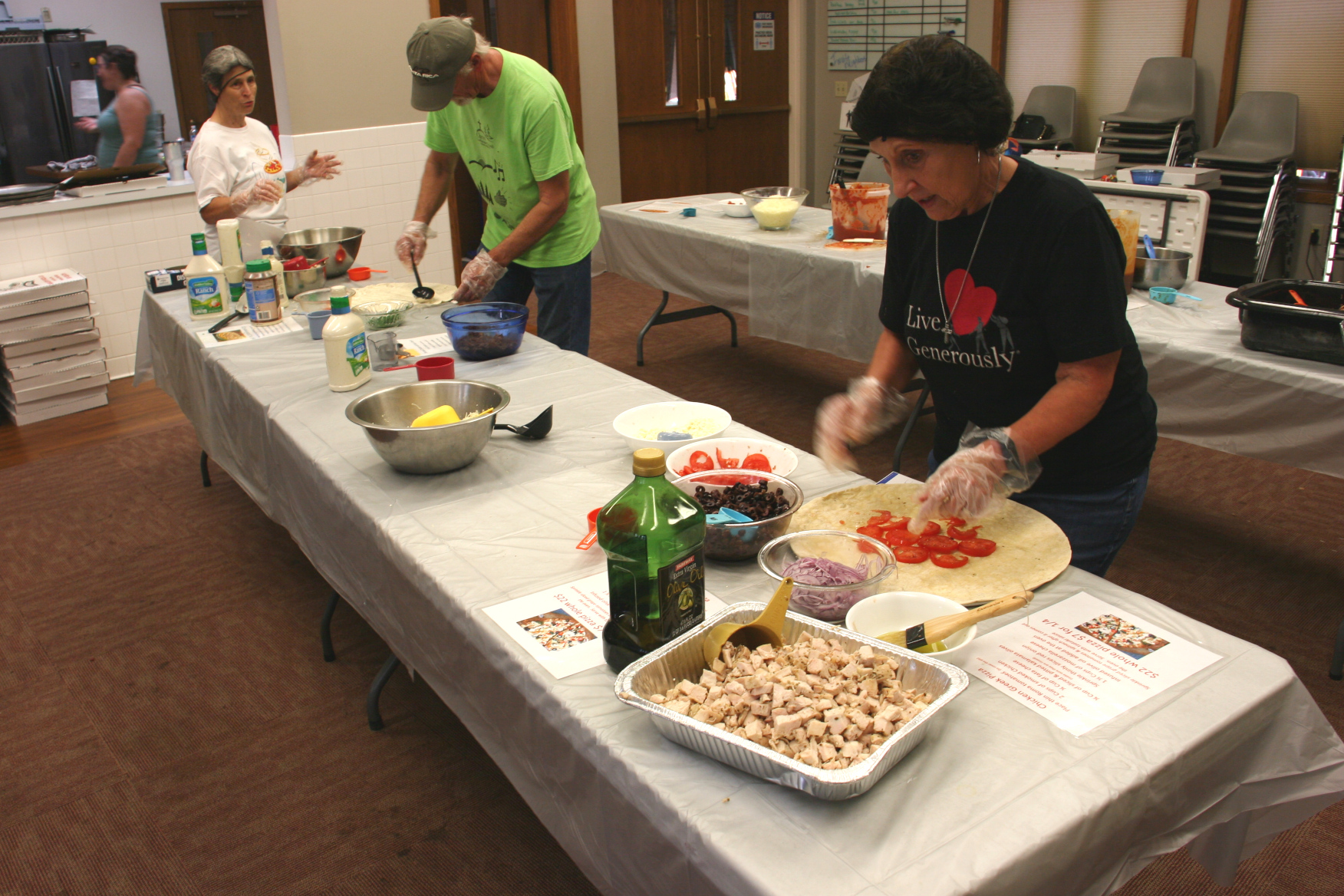
Volunteers assemble pizzas. (Minnesota Prairie Roots copyrighted photo August 2022)
Chicken bacon ranch pizza ready for the wood-fired oven. (Minnesota Prairie Roots copyrighted photo August 2022)
Inside the fellowship hall, other volunteers layered sliced tomatoes, meat toppings, cheese and more onto rounds of dough.
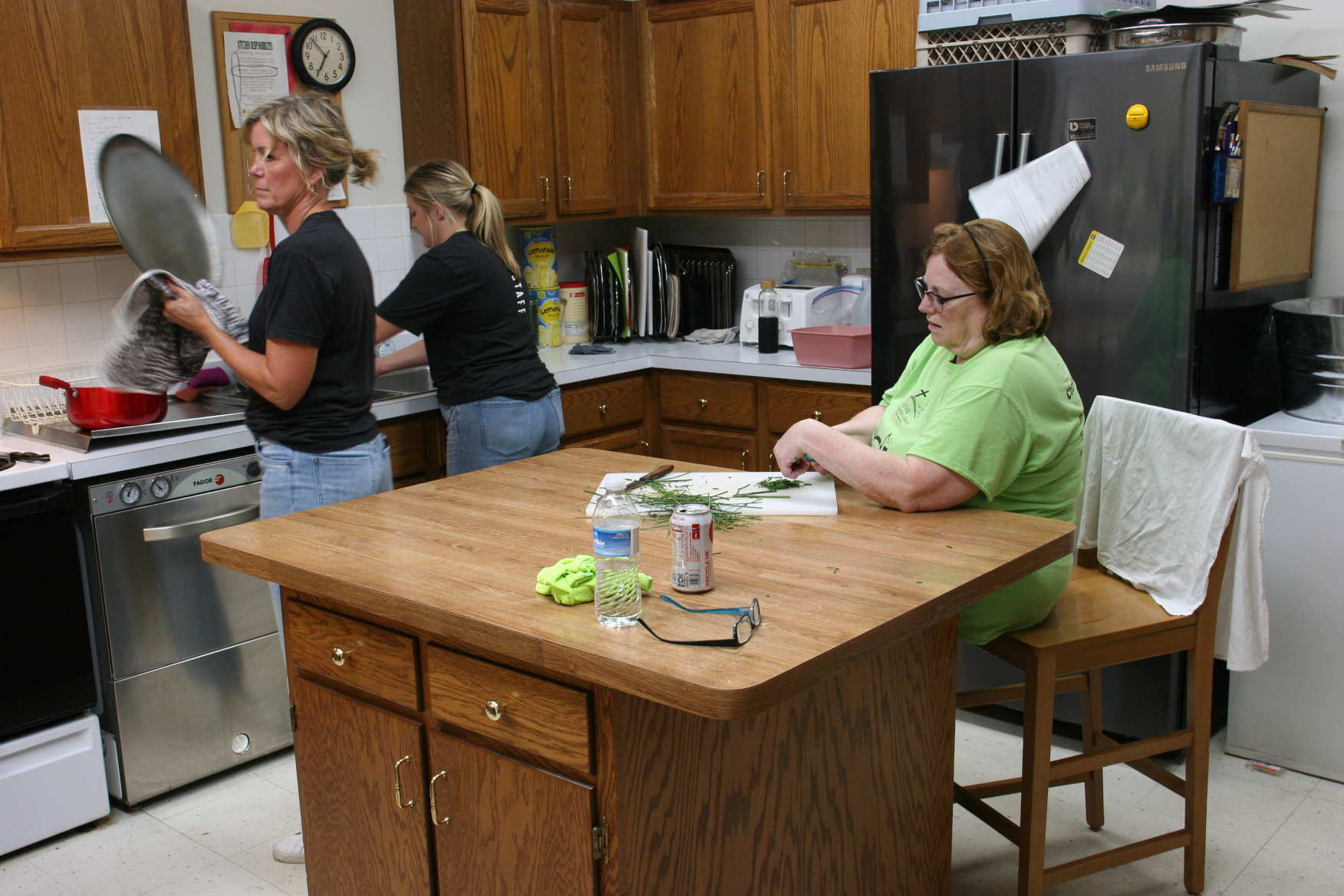
The busy kitchen crew. (Minnesota Prairie Roots copyrighted photo August 2022)
In the kitchen, three women worked, two doing dishes, the third snipping chives.
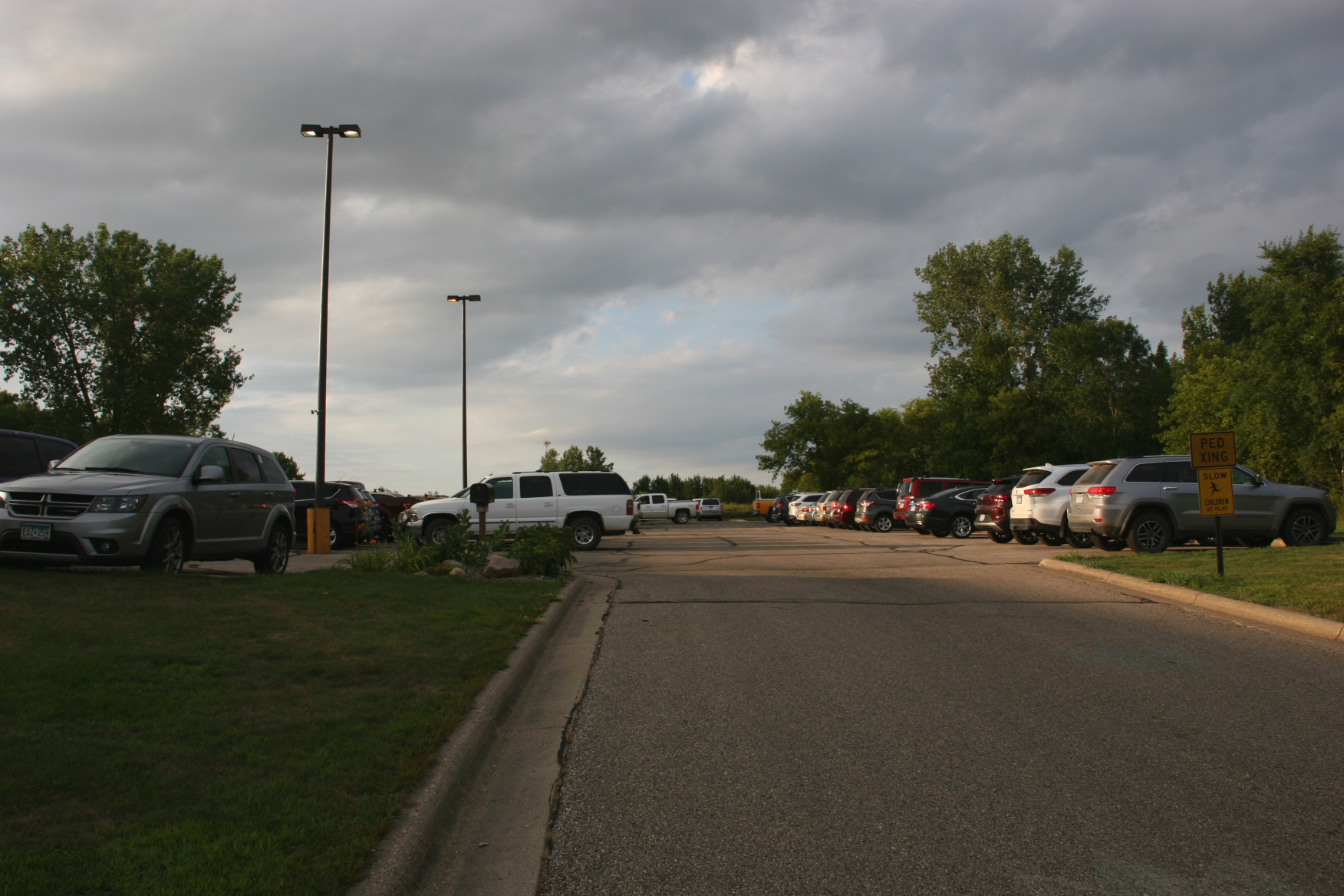
When we arrived at around 5:45 pm to find the parking lot overflowing, I thought the wait would be long. It wasn’t. (Minnesota Prairie Roots copyrighted photo August 2022)
Still others rolled pizza cutters across pizzas hot from the oven, pizzas ready for more volunteers to carry to hungry customers. The wait time is short, especially if you order a quarter of a pie.
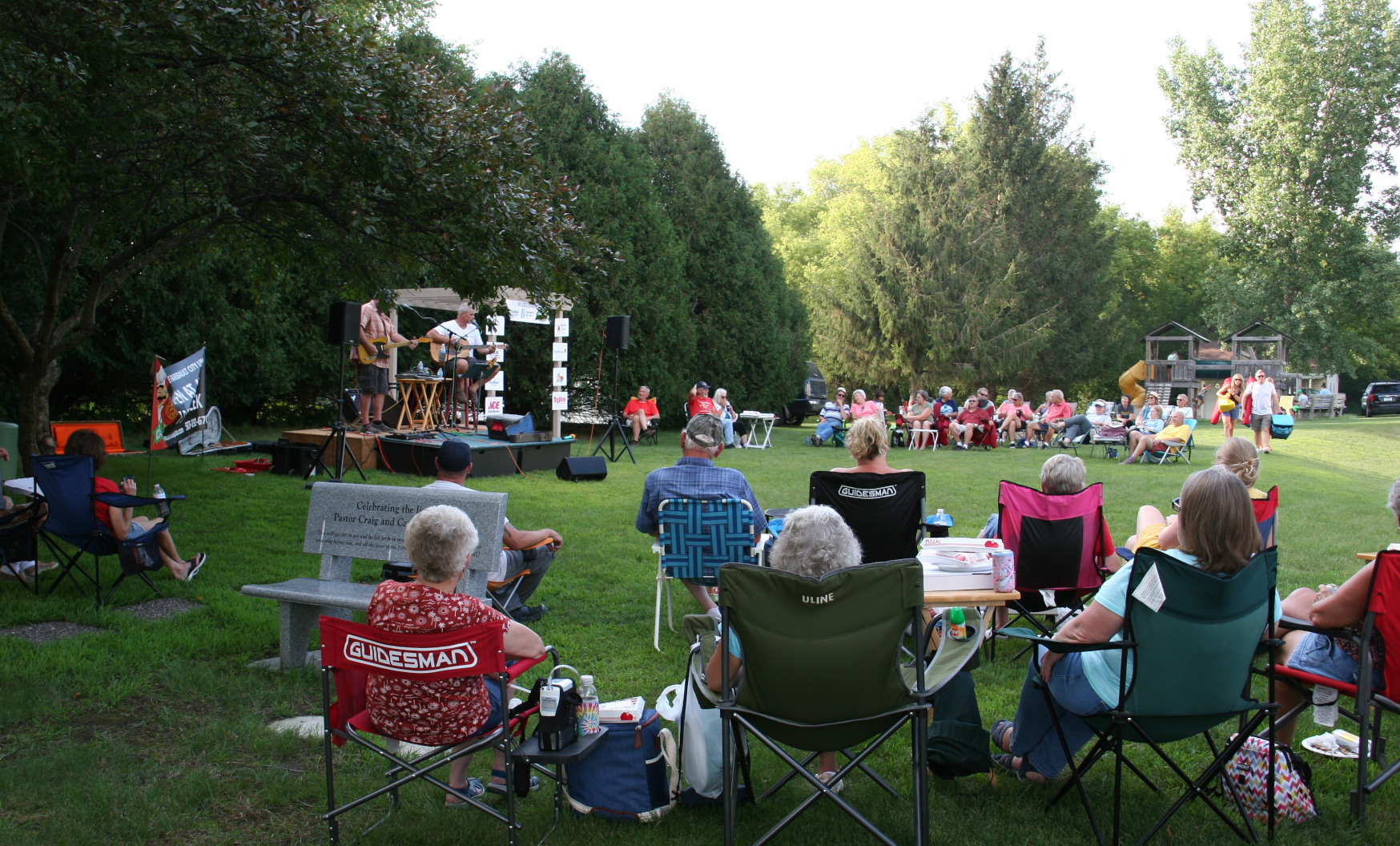
Attendees spread out across the backyard to listen to Old Country Brothers and to enjoy pizza. (Minnesota Prairie Roots copyrighted photo August 2022)
From my observations, the entire pizza-making and delivery process runs smoothly. Everywhere I saw smiles. Smiles on the faces of volunteers, beginning with the greeter who met us at the door. And smiles among those eating pizza and enjoying the music of Gregg and Jeff Sartor. I felt the joy.
Kids blew and caught bubbles, ran free… (Minnesota Prairie Roots copyrighted photo August 2022)
Families and friends gather at Holy Smoke. (Minnesota Prairie Roots copyrighted photo August 2022)
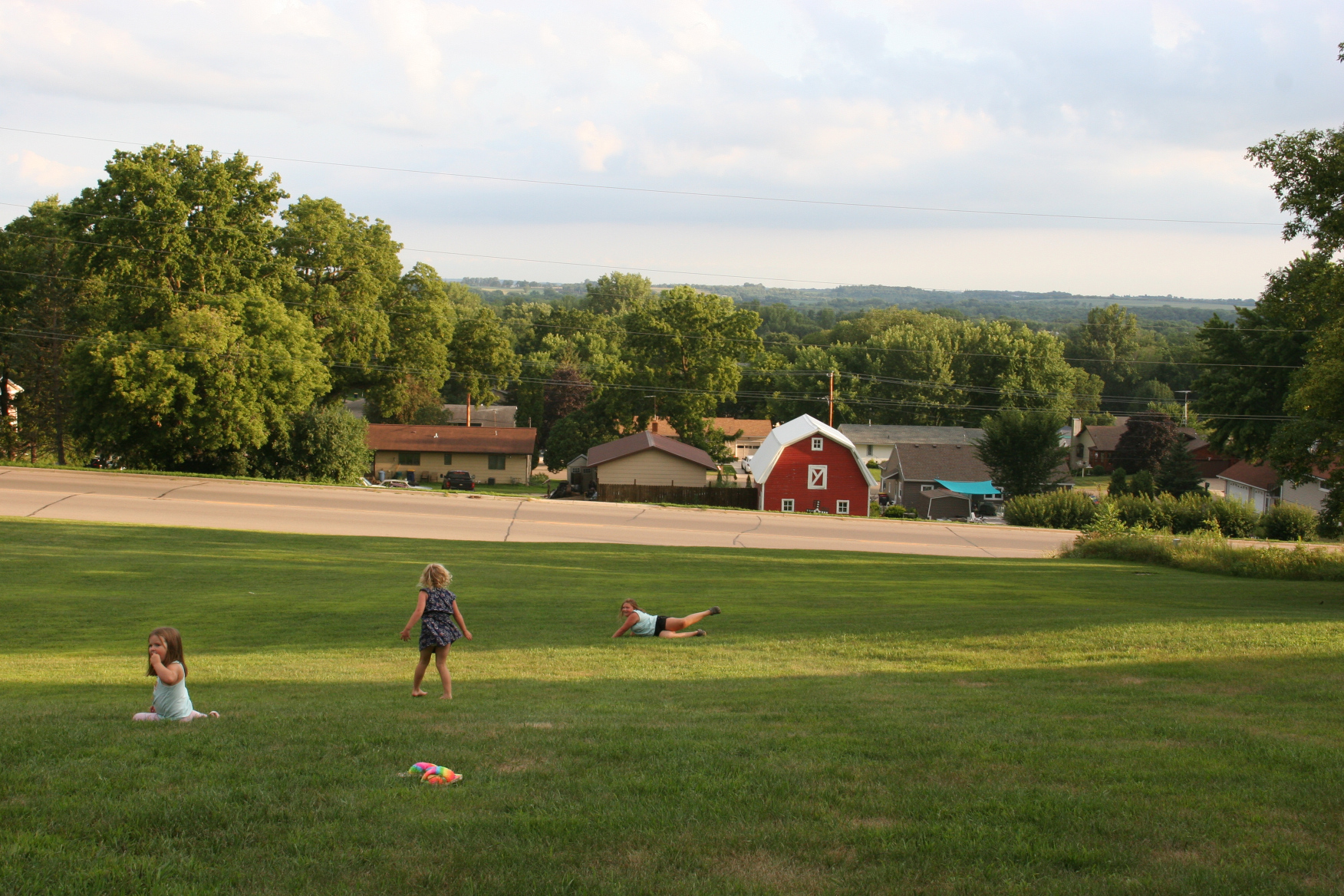
Kids roll down the steep hillside. (Minnesota Prairie Roots copyrighted photo August 2022)
Holy Smoke is an event for all ages, from kids blowing bubbles, rolling down the hillside, running across the lawn and climbing on rocks ringing a tree to older folks relaxing in lawn chairs.
There is some on-site seating. (Minnesota Prairie Roots copyrighted photo August 2022)
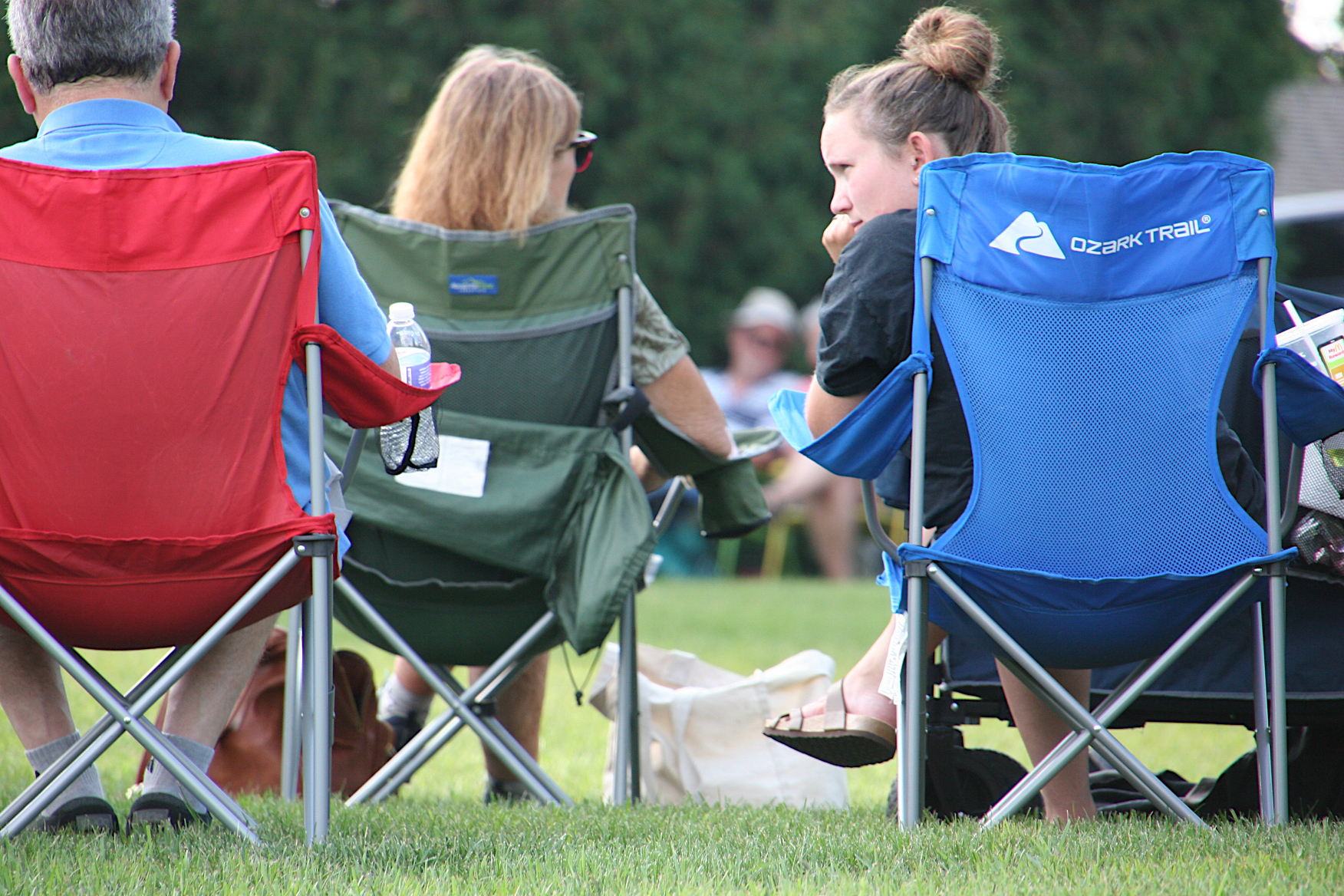
This is a mostly bring-your-own chairs, own napkins (I’d also advise paper plates, wet wipes and a portable side table) event, although limited picnic table space is available.
Connecting in conversation. (Minnesota Prairie Roots copyrighted photo August 2022)
Mostly, Holy Smoke seems about community. About connecting. About conversations. About supportive businesses. About joy.
Printed on a t-shirt worn by a pizza baker. (Minnesota Prairie Roots copyrighted photo August 2022)
In the loveliness of the summer evening, I heard the hills sing. I heard the trees clap. And I tasted some “holy smoke, this is good” smoked brisket pizza.
The birth of Christ depicted at St. Michael’s Catholic Church, Buckman, Minnesota. This is my husband’s home church. (Minnesota Prairie Roots file photo September 2020)
STAINED GLASS ART graces many a church. Most often that art depicts the history of Jesus’ birth, death and resurrection.
This stained glass window inside the Mother of Good Counsel Votive Chapel at The Shrine of Our Lady of Guadalupe, La Crosse, Wisconsin, depicts Mary and Jesus. I often think of Mary during Holy Week and how great her loss in losing her son. (Minnesota Prairie Roots copyrighted file photo 2015)
So it’s fitting that this week, Holy Week, I share some images from my archives of beautiful stained glass windows discovered in my wanderings. As a woman of faith, an art appreciator and one who values churches, I am drawn to this art form.
Jesus prays in the Garden of Gethsemane. Stained glass window in the sanctuary of Vang Lutheran Church, rural Dennison, Minnesota. (Minnesota Prairie Roots copyrighted file photo 2014)
My husband, Randy, has dabbled in stained glass art and I know from watching him that creating this art takes time, patience, skill and dedication. He took a stained glass class locally decades ago, has crafted several sun catchers and also repaired aged windows at our church, Trinity Lutheran in Faribault. I hope that when he retires, he can more fully embrace this art form.
Jesus carries his cross to Golgotha. Stained glass at St. Michael’s Catholic Church, Buckman. (Minnesota Prairie Roots copyrighted file photo September 2020)
That sidebar aside, I feel such gratitude to those long ago craftsmen who labored to create stained glass windows for churches. Such windows enhance worship, infusing a sanctuary with beauty and a visual telling of biblical stories. Like the birth of Jesus. The agony of his suffering, death and glorious resurrection.
Like illustrations in a book, the art of stained glass adds to the words, opens our eyes to better see that which we hear and read.
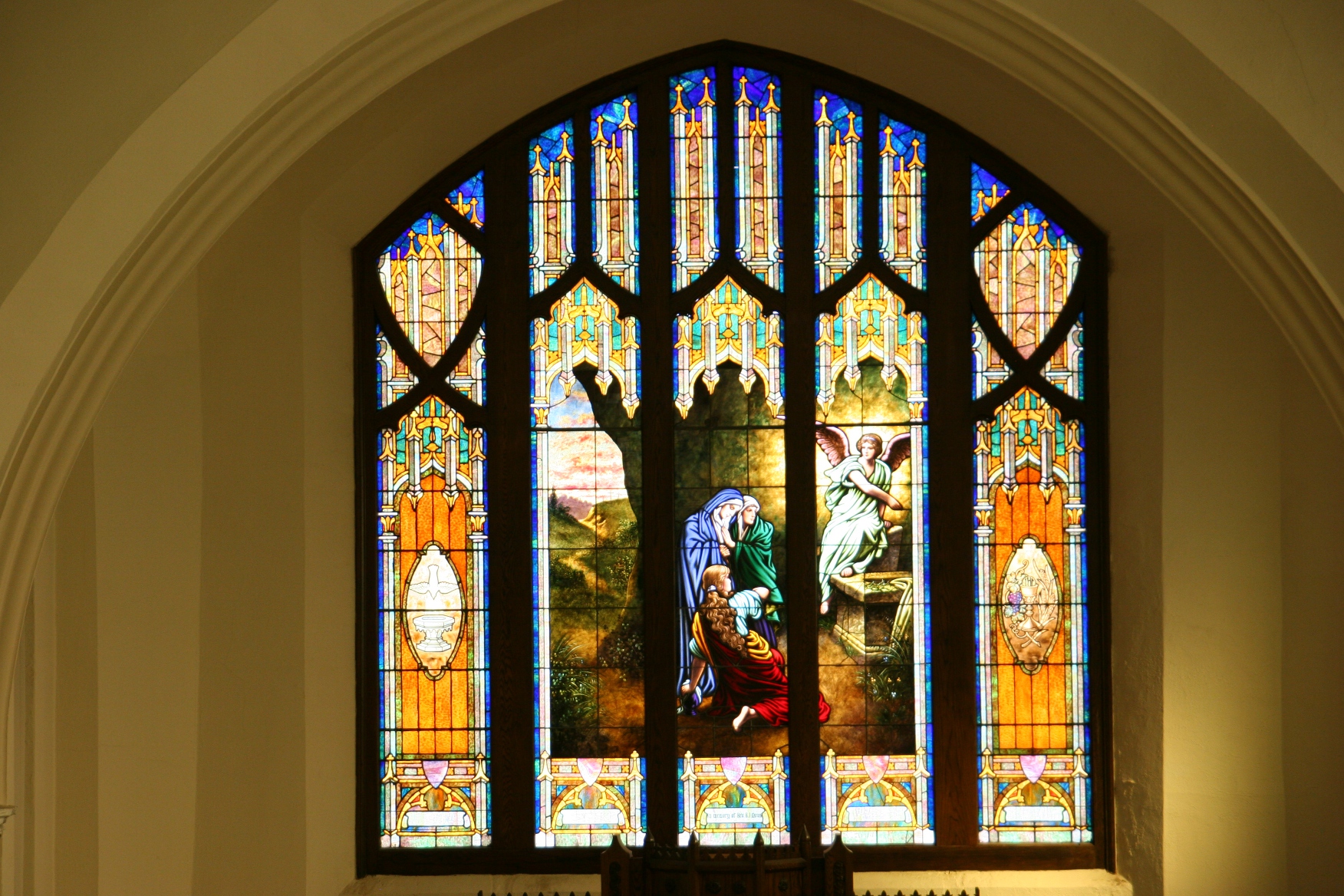
This stained glass window of the women and angel at Jesus’ empty tomb rises above the altar at Holden Lutheran Church, rural Kenyon, Minnesota. (Minnesota Prairie Roots copyrighted file photo 2016)
Art adds a depth to my understanding and to my faith.
This shows a snippet of the center stained glass window in a trio above the altar at Trinity Lutheran Church, Wanamingo, Minnesota. This section shows Jesus risen from the dead. (Minnesota Prairie Roots copyrighted file photo 2016)
As we near the end of Holy Week, please take time to reflect on the stained glass art here or within your own community.
A photo of Christ’s face from a stained glass window in my church, Trinity Lutheran, Faribault. (Minnesota Prairie Roots copyrighted file photo 2012)
And may this art bless you as it has me. Have a joyful and blessed Easter!
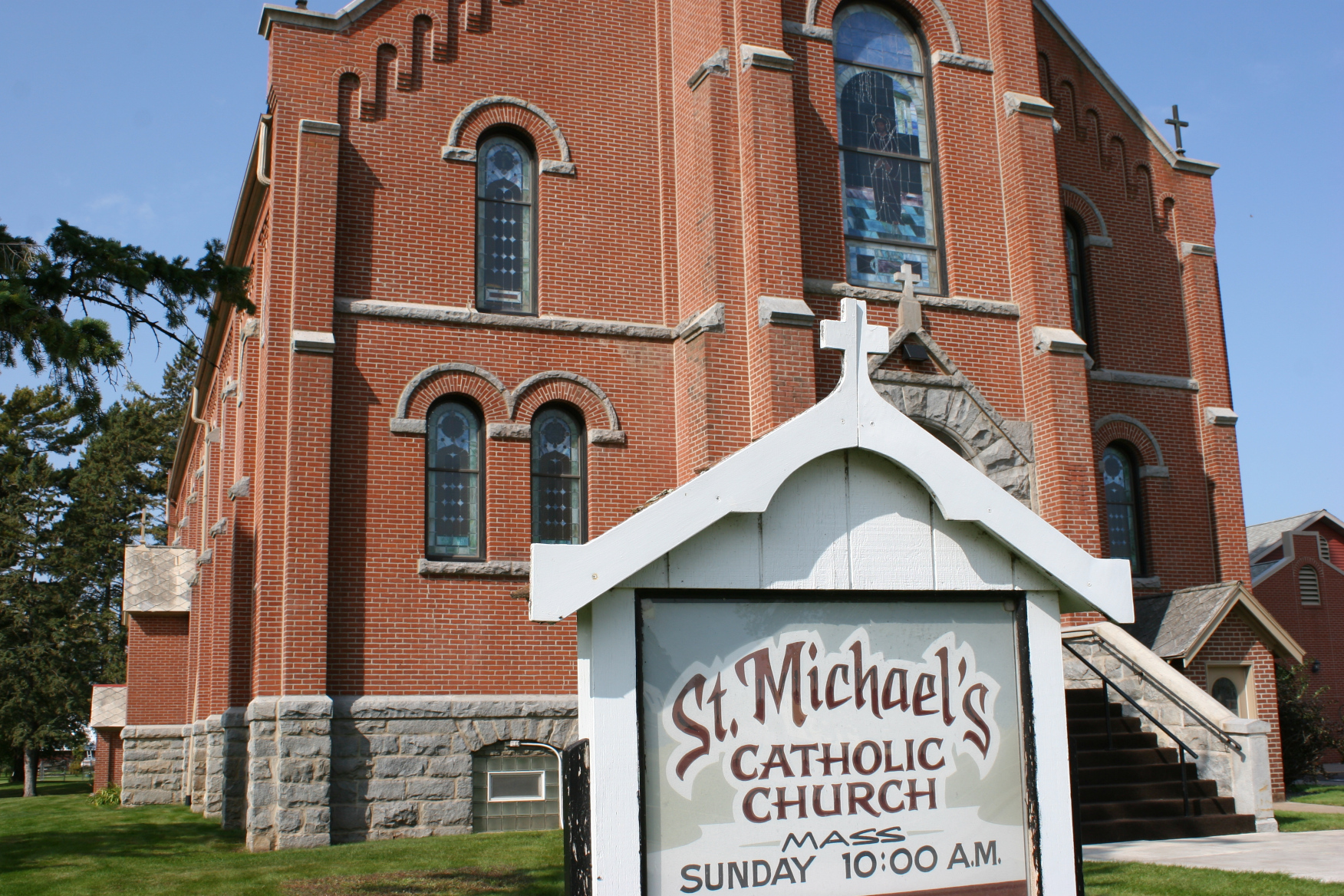
Outside my husband Randy’s home church, St. Michael’s in Buckman. Minnesota Prairie Roots file photo September 2020.
FOR MANY, THE WORD “church” prompts visions of a physical structure, a place where people of faith gather to worship. Certainly, that’s part of the definition. But, even more important, “church” is the people. That’s why, in times of natural disaster or fire or whatever may render a physical building unusable, the “church” continues.
This sign marks a back pew. Minnesota Prairie Roots file photo September 2020.
For 118 years, the faithful have gathered at St. Michael’s Catholic Church in Buckman. Even during COVID-19, Mass happens three mornings a week. On the September weekday Randy and I visited, not a soul was around, giving us ample opportunity to explore this beautiful aged sanctuary.
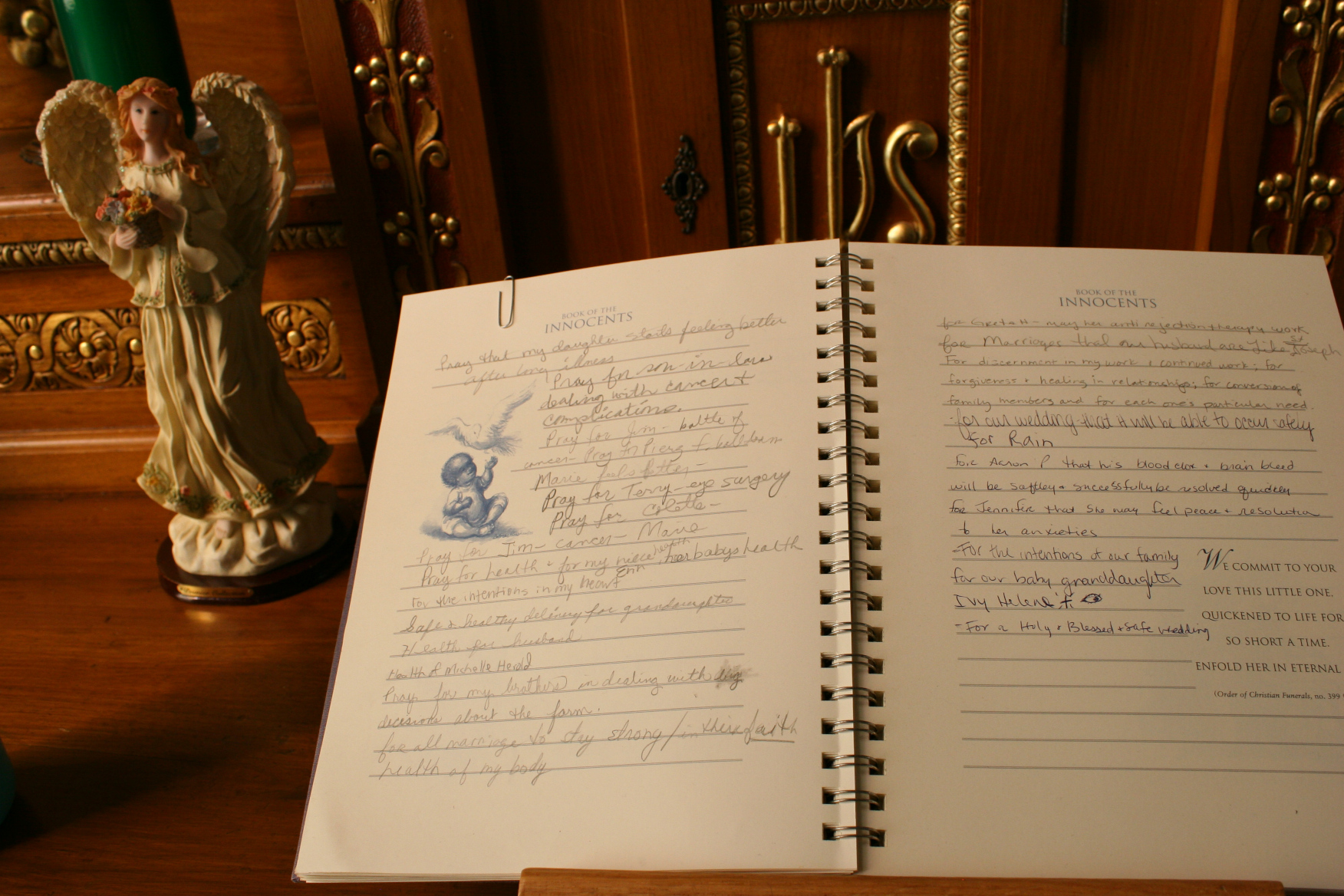
Book of the Innocents photographed at St. Michael’s. Minnesota Prairie Roots file photo September 2020.
Despite the absence of people, I experienced the presence of those who call St. Michael’s their church home. I saw the human spiritual connection in handwritten prayers recorded in The Book of Innocents.
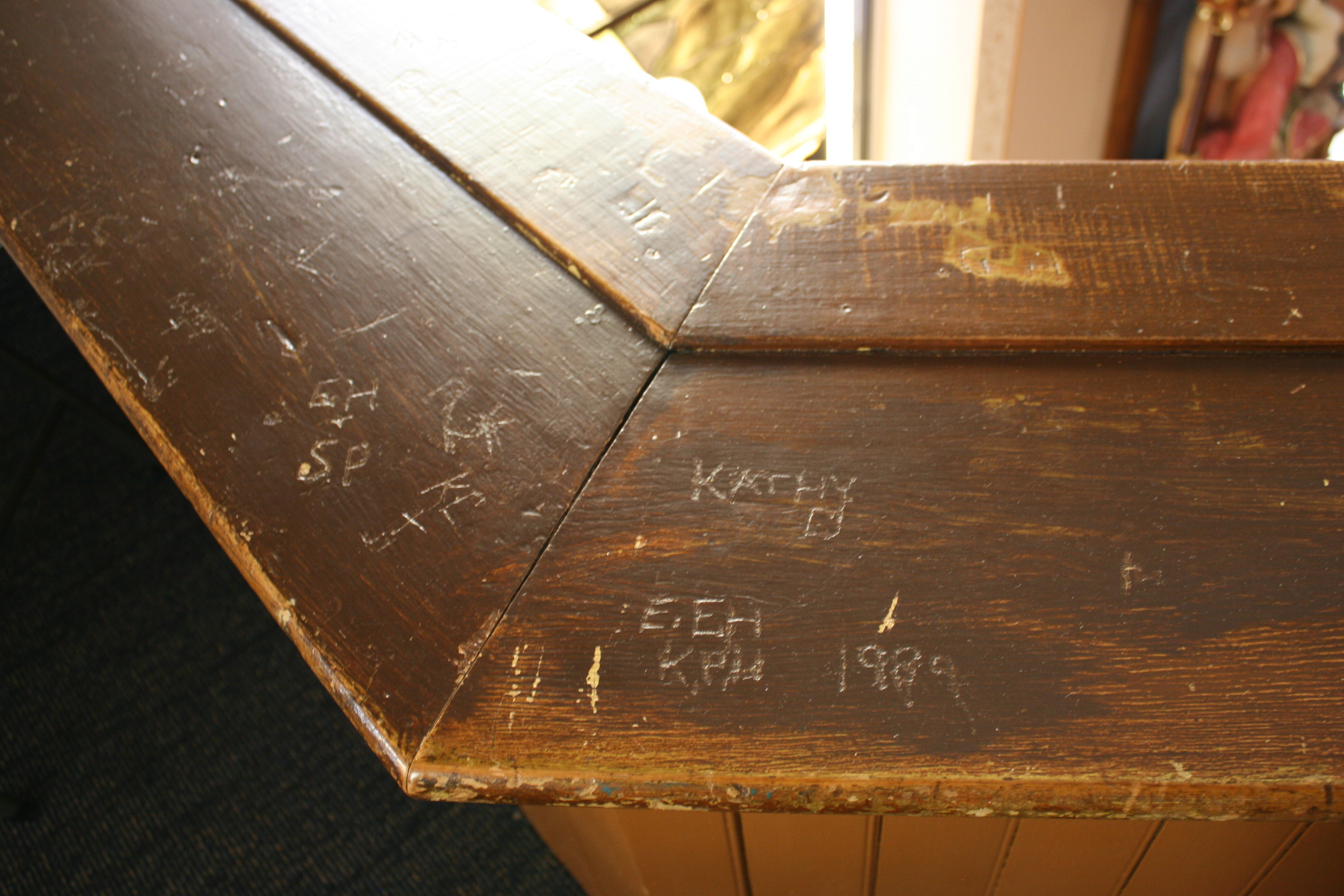
They left their mark… Minnesota Prairie Roots file photo September 2020.
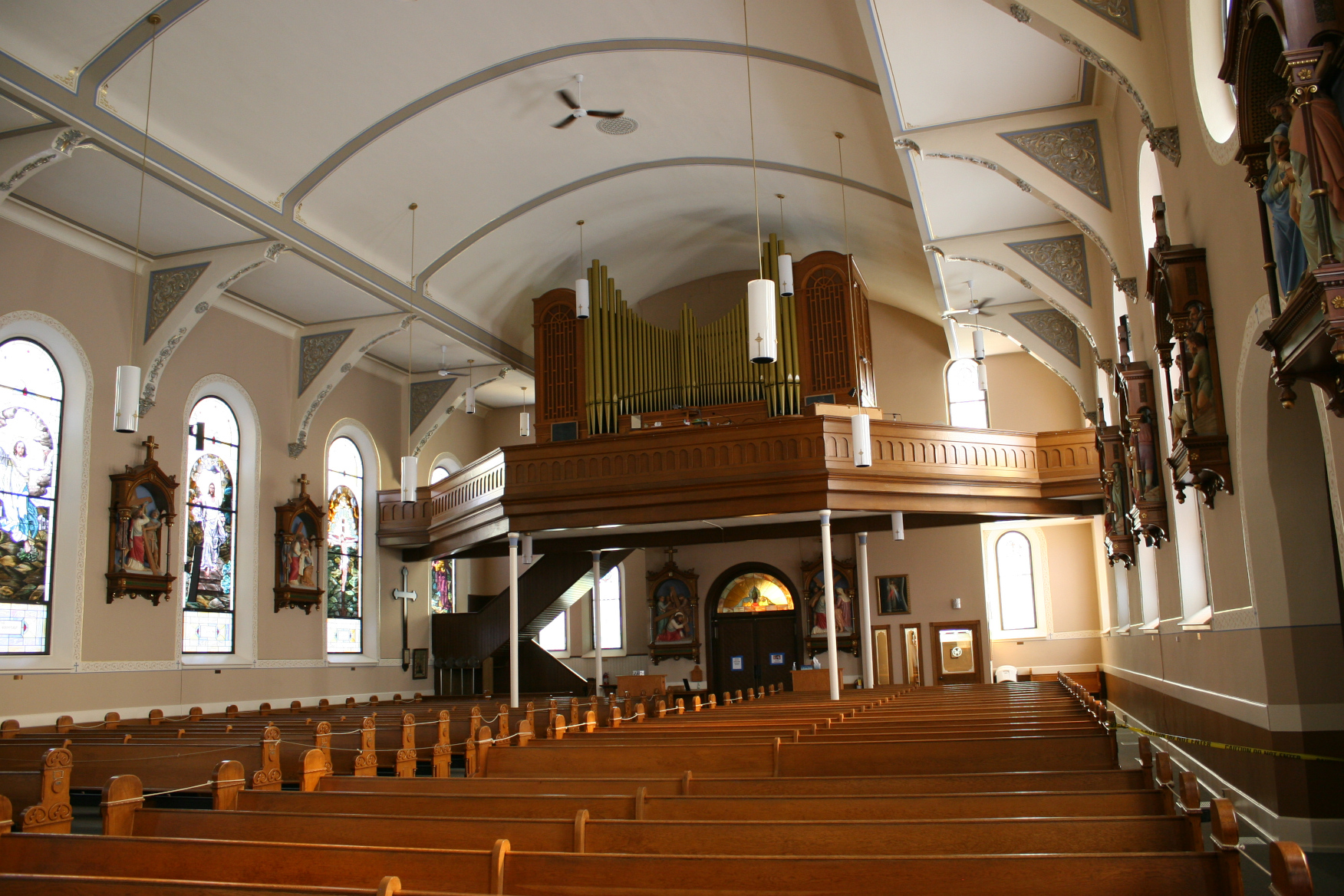
Upstairs, atop the balcony wall ledge, I noticed initials, names and dates etched in wood. Another human notation, albeit probably not appreciated by all. But the scratchings are part of St. Michael’s history.
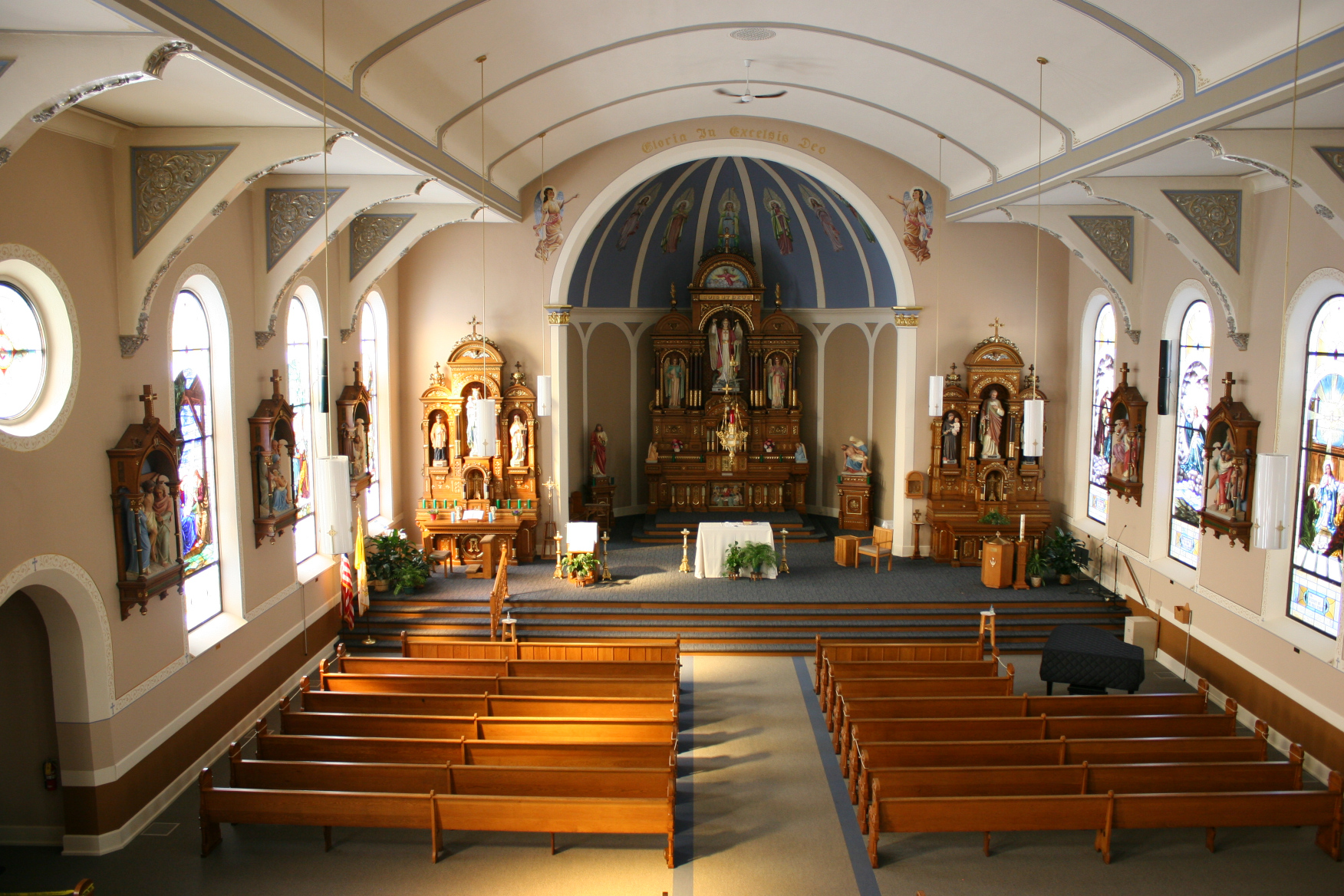
A view from the balcony. Minnesota Prairie Roots file photo September 2020.
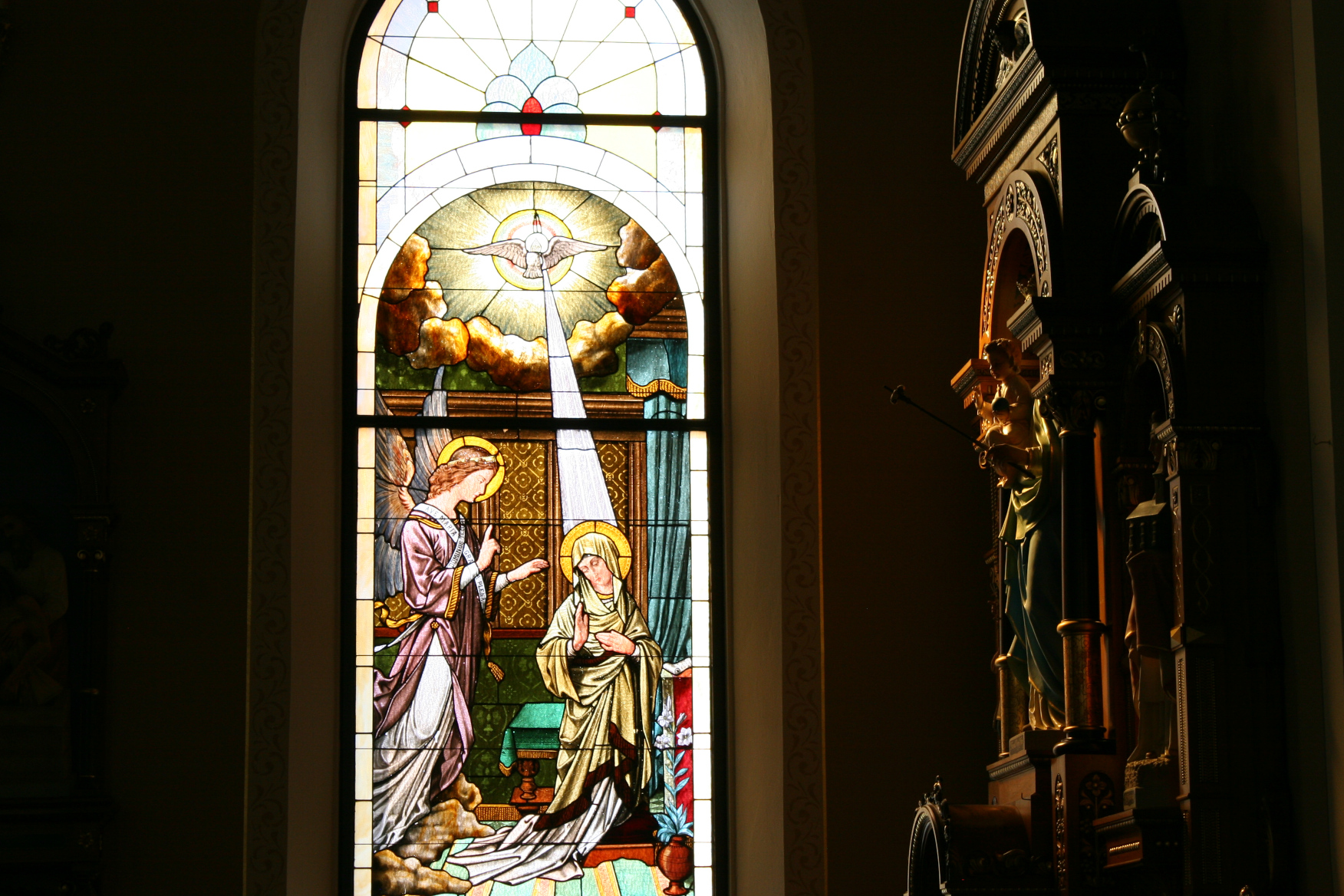
Stained glass windows abound, this one next to a side altar. Minnesota Prairie Roots file photo September 2020.
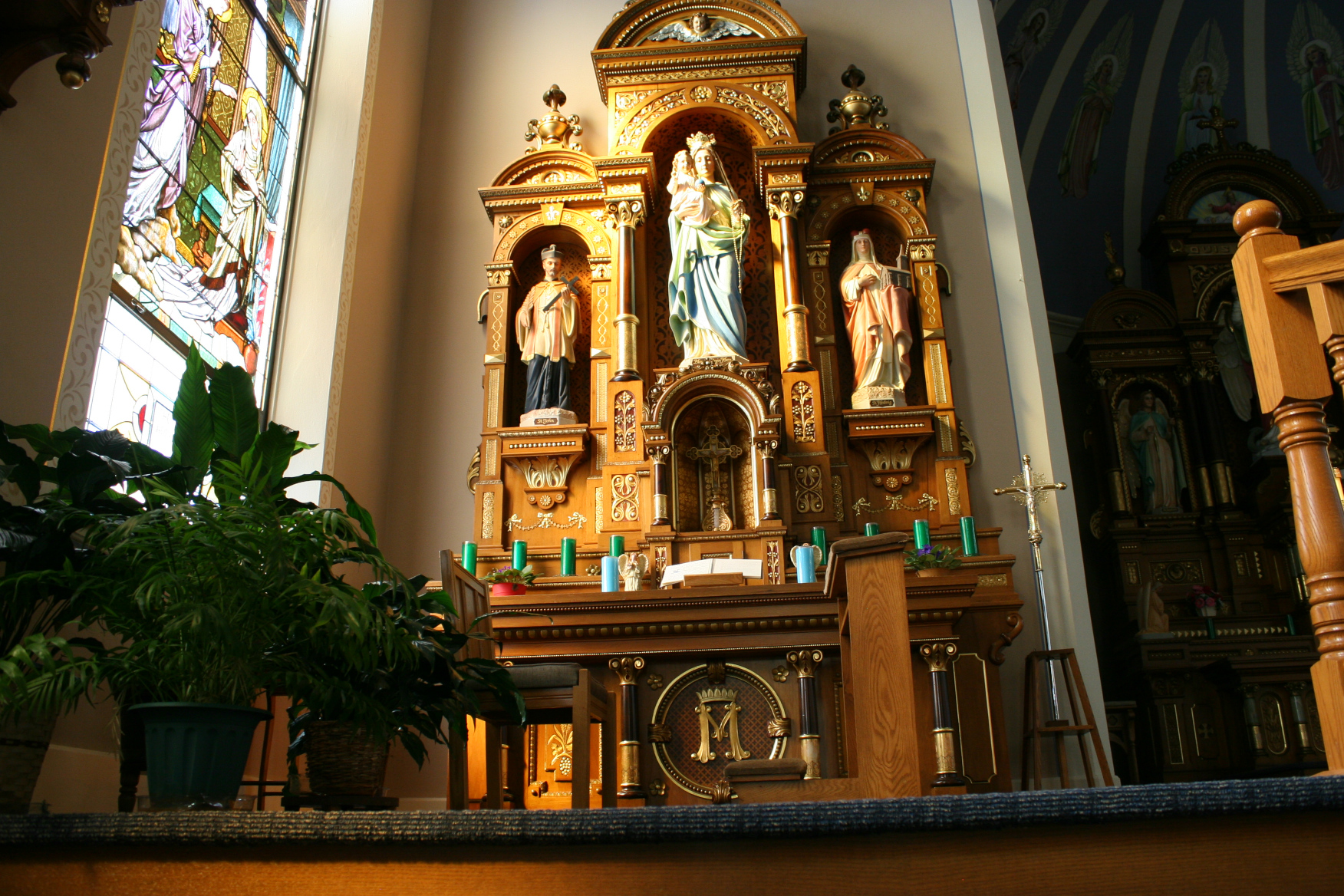
The beautiful side altar. Minnesota Prairie Roots file photo September 2020.
As I looked down upon the massive sanctuary defined by stained glass, sculptures, woodcarvings, paintings and other impressive art, I considered the humanity of this place. Baptisms. First Communions. Weddings. Funerals. Events—joyful and sad—which brought/bring people together to celebrate or to mourn. Mass, too, with singing and praying and forgiving and worshiping and growing in faith.
Looking toward the back of the church and the balcony. Minnesota Prairie Roots file photo September 2020.
Generations have gathered here, within these walls, as a faith family.
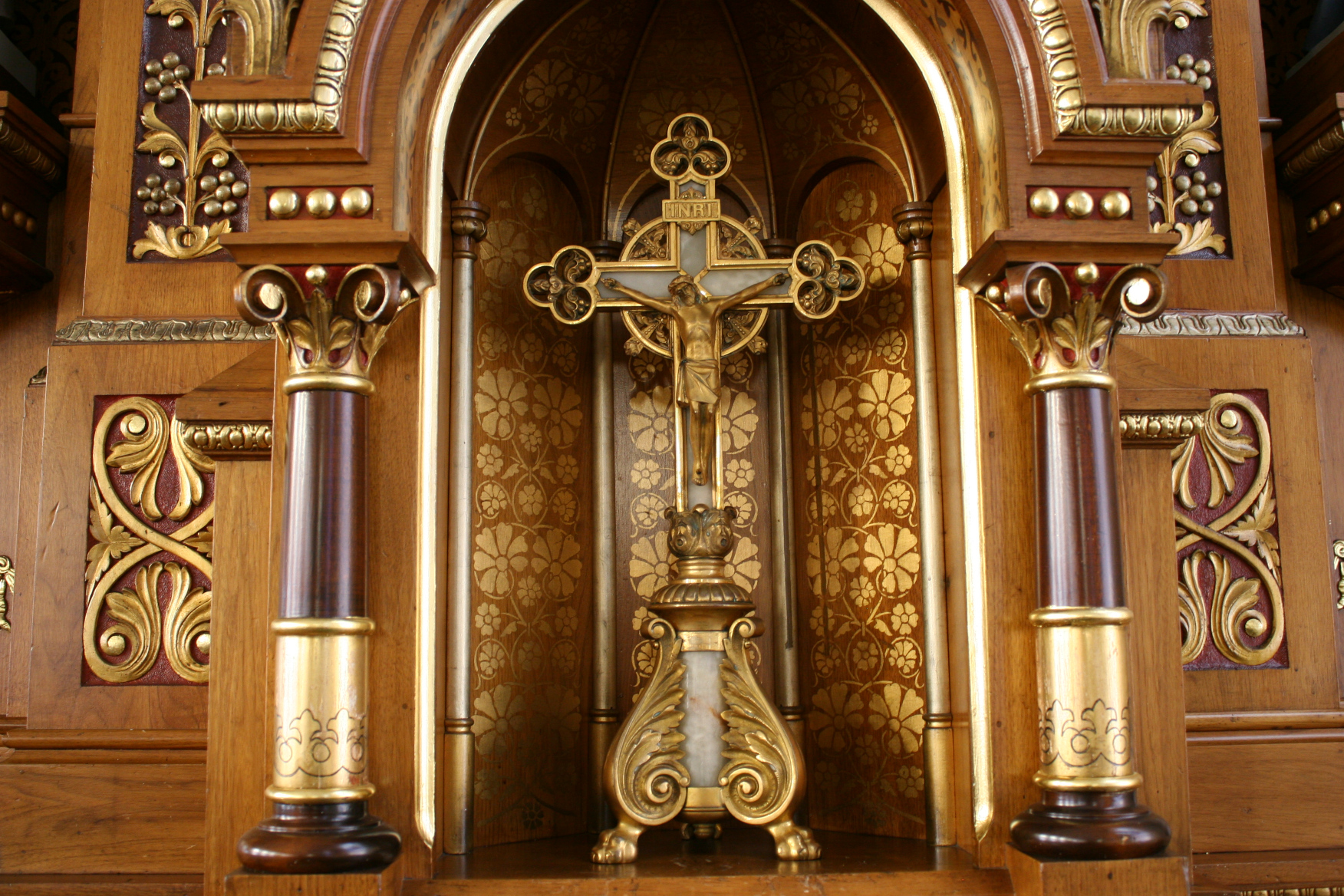
This stunning cross stands in the center of the main altar. Minnesota Prairie Roots file photo September 2020.
I’ve found comfort and joy here, too, celebrating the marriage of my father-in-law and a sister-in-law and grieving the loss of a brother-in-law and then my mother-in-law 27 years ago. Since then, the church has been restored and a side entry and fellowship hall added, making the building much more accessible.
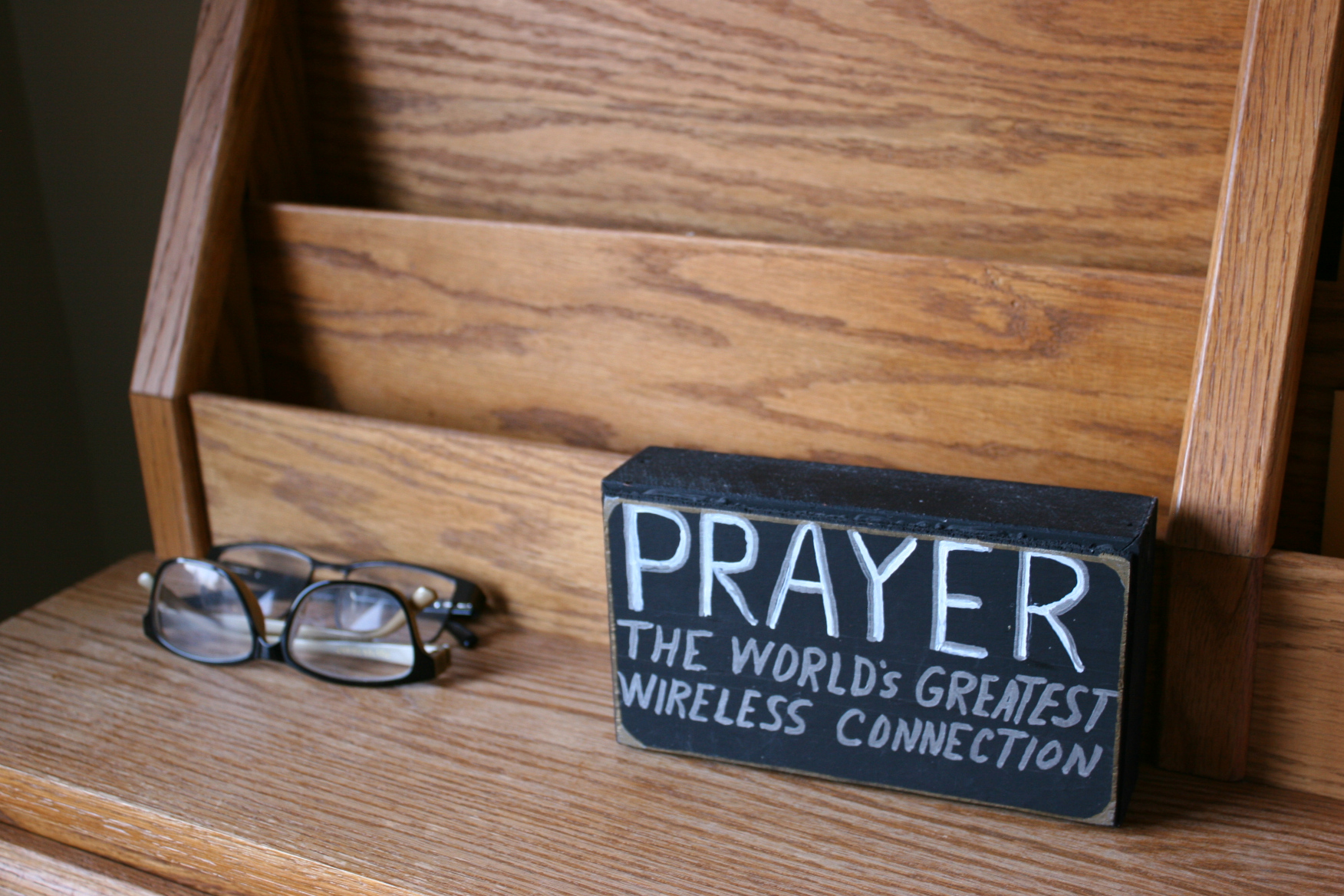
Spotted on a table in the entry. Minnesota Prairie Roots file photo September 2020.
In the new entry, I paused to read a small sign: PRAYER THE WORLD’S GREATEST WIRELESS CONNECTION. I laughed and thought, so true while simultaneously considering how much the world has changed since the construction of this church in 1903.
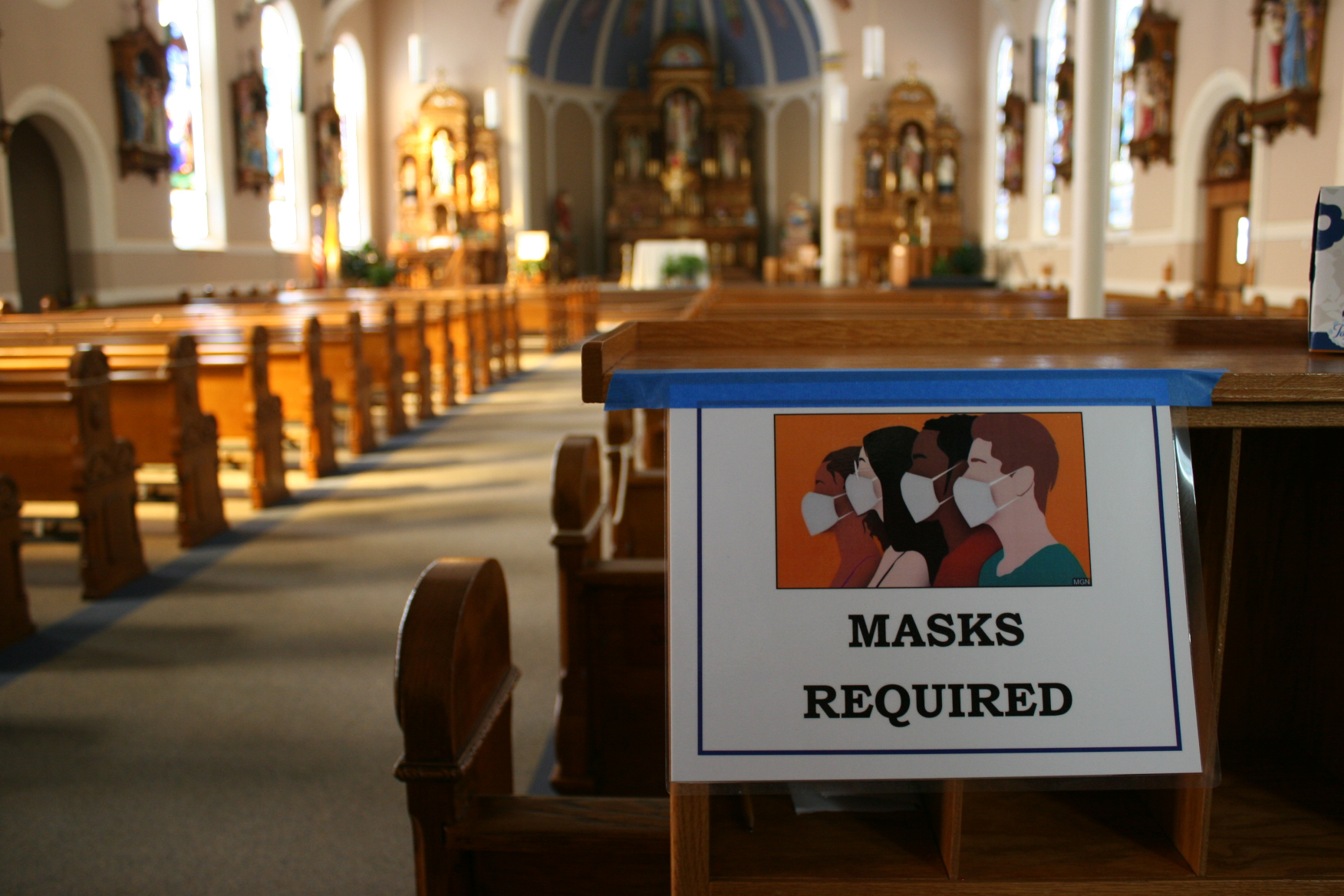
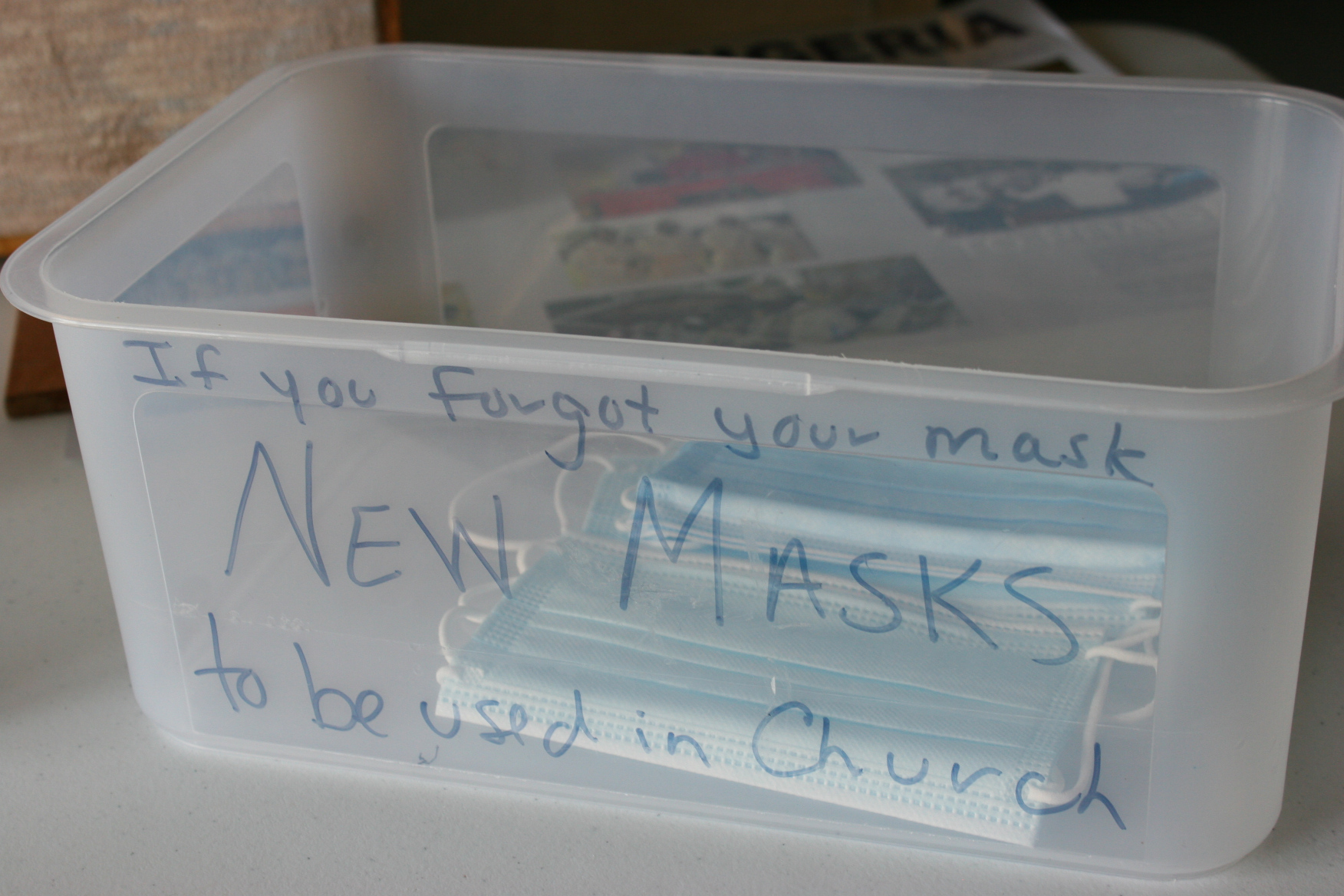
Masks are available for worshipers inside the entry. Minnesota Prairie Roots file photo September 2020.
Yet, little has changed. People still define St. Michael’s. They gather here—as they have for generations—within this art rich sanctuary, embracing liturgy steeped in music and tradition, to worship God. And to connect, heart-to-heart, with one another and with their Savior. Even during a global pandemic.
This is the final post in my three-part series on St. Michael’s Catholic Church, Buckman, Minnesota.





















 Minnesota Prairie Roots
Recent Comments