Minnesota Prairie Roots

Writing and photography by Audrey Kletscher Helbling
My thoughts as a Faribault resident on the alleged crimes at Shattuck-St. Mary’s School October 10, 2012

Filed under: Uncategorized — Audrey Kletscher Helbling @ 9:07 AM
Tags: , , , , , ,

In the distance you can see the clock tower on Shumway Hall at Shattuck-St. Mary’s School in Faribault, photographed last fall from City View Park.

I’D LIKE NOTHING BETTER today than to ignore the horrible, unspeakable allegations which have thrust my community of Faribault into the headlines.

In fact, Tuesday morning, I wanted to hide the Faribault Daily News from an overnight house guest from California and told him as much.

I mean, would you want your guest, a first-time visitor to Minnesota, to read this major news headline about the southeastern Minnesota community in which you’ve lived for 30 years: Former Shattuck teacher faces child porn charges.

All but one-fifth of the newspaper’s front page was devoted to coverage of the still unfolding story about alleged sexual misconduct involving at least six victims at a prestigious private college prep school on Faribault’s east side. Former Shattuck-St. Mary’s drama teacher Lynn Seibel (from 1992 – 2003) has been charged with 17 felonies, including 10 of sexual misconduct, and is being held in the Los Angeles County Jail, according to the news report.

This morning I awoke to these front page news headlines: Report: Another Shattuck teacher had sexual relationship with student—police reviewing 2008 investigation; New witness comes forward in Seibel case; Shattuck St. Mary’s has positive—and significant—impact on Faribault’s economy.

There are also accusations from law enforcement that school officials failed to report the discovery of child pornography on Seibel’s computer in 2003, the same year the former drama teacher lost his job at the school. Shattuck officials say they reported their discovery to authorities. I don’t know who’s telling the truth and who isn’t in this part of the case. That’s not for me to decide.

What I do know is this: Awful, horrible allegations like this make you realize that no place, no place at all, is immune from unspeakable crimes against our children by those in positions of authority. If, indeed, there has been any sort of cover-up—remember my wanting to hide the Faribault Daily News from my California house guest—then the case takes on additional significance. Thoughts of the Jerry Sandusky case can’t help but flit through my brain.

That all said, let me tell you what connection I, as a Faribault resident, have had to Shattuck-St. Mary’s and how I’ve viewed the school up until now. Mostly, I’ve always thought of Shattuck as a boarding/day school where rich people send their kids. (Current tuition ranges from $26,950 for domestic day students to $42,450 for international students.) Although that “rich people” conclusion probably is not entirely accurate, that is what I, and I expect many Faribault residents, think. I’m just being honest here with my opinion.

Landmark Shumway Hall at Shattuck during the annual Christmas Walk.

Shattuck is also an internationally-known hockey school, turning out winning teams and youth who go on to play professional hockey. I’ve attended one hockey game there and also enjoyed a figure skating show during the school’s annual Christmas Walk.

If one place captures the beauty of Shattuck, it would be the grand stairway in Morgan Hall photographed during the Christmas Walk.

In addition to the open house holiday event for the community, Shattuck hosts an annual Easter egg hunt and numerous arts-related performances that are open to the public.

A hallway leads to the 1889 Morgan Hall, photographed during the Christmas Walk.

And then there’s the physical campus itself. Founded in 1858 as an Episcopal mission school, the school’s two campuses feature some of the most gorgeous stone buildings in Faribault. The clock tower and archway entrance to the Shattuck main campus are notable city landmarks. Locals are married here, in this beautiful setting.

To think that this lovely and historic place of strong stone walls could hold secrets of alleged sexual abuse against the children sheltered here is nothing short of heartbreaking and horrible.

TO READ LOCAL NEWS coverage on the case, click here.

© Copyright 2012 Audrey Kletscher Helbling
 

Scenic southeastern Minnesota on a Sunday afternoon in autumn September 30, 2012

West of Faribault on Sunday afternoon.

I NEVER TIRE OF IT. Never. Autumn in Minnesota is stunningly beautiful. Stunning.

A Sunday afternoon drive took my husband and me west of our Faribault home along Cedar Lake Boulevard and then on Old Dodd Road, all the way to Kilkenny.

Lake Francis, Elysian

From the Irish settlement, we continued west and then south and west and south and, well, I don’t navigate, until we entered Elysian from the north.

Tetonka Lake, Waterville

We then aimed back east and north along a dusty gravel road and then a tar road to Waterville.

Northeast of Waterville.

We traveled through the North Morristown area and, nearing Faribault, skirted Cannon Lake on the north and east.

It was, for us, a leisurely horseshoe drive to view lovely Autumn, dressed in her Sunday best.

North and east of Waterville somewhere, maybe closer to North Morristown.

A lovely treeline somewhere on the eastern end of our route.

Along Seventh Street in Faribault….my community has stunning autumn colors along many, many residential streets.

A block away up the hill from my house are some of the most blazing gorgeous trees in town lining Second Avenue Southwest by Bethlehem Academy.

© Copyright 2012 Audrey Kletscher Helbling
 

A painting from my dear friend Rhody September 28, 2012

IN LIFE, RHODY YULE, impressed me with his humble spirit, deep faith and artistic talent. He thought the best of everyone. He appreciated life so much that, even up until days before his June 2011 death when he was but a shell of his former physical self, he desired to live beyond his 92 years.

Celebrity portraits Rhody Yule painted and hung on his garage, where I first discovered his work in the fall of 2009 while driving past his rural Rice County residence.

Losing my friend of only a few years—the man I met because I photographed the portraits he had painted and hung on the side of his garage in rural Rice County—was difficult for me. Yet, I knew Rhody’s legacy would live on in the hundreds of paintings he created through the decades.

Rhody, minutes before his gallery show opened in January 2011 at the Paradise Center for the Arts, Faribault.

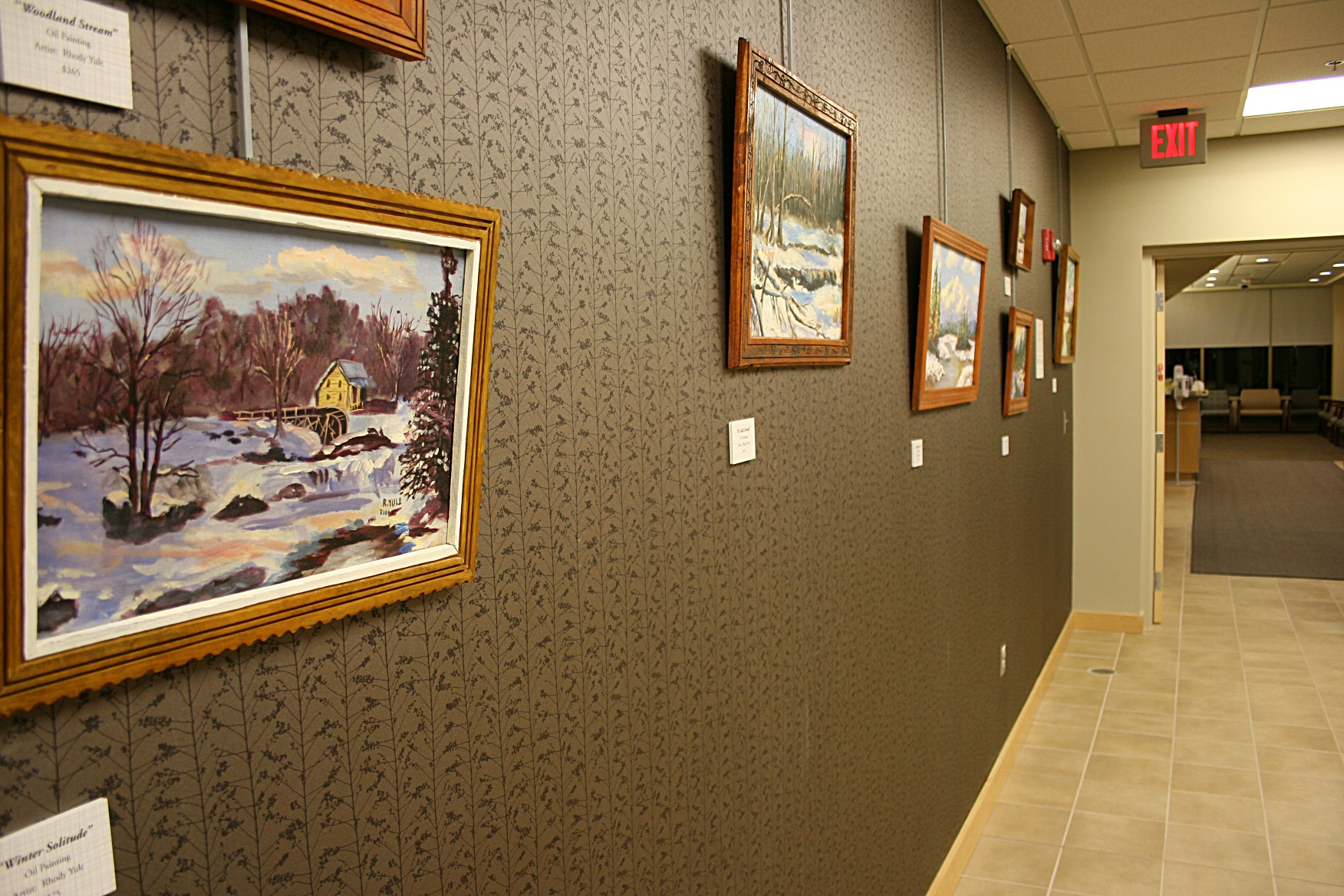
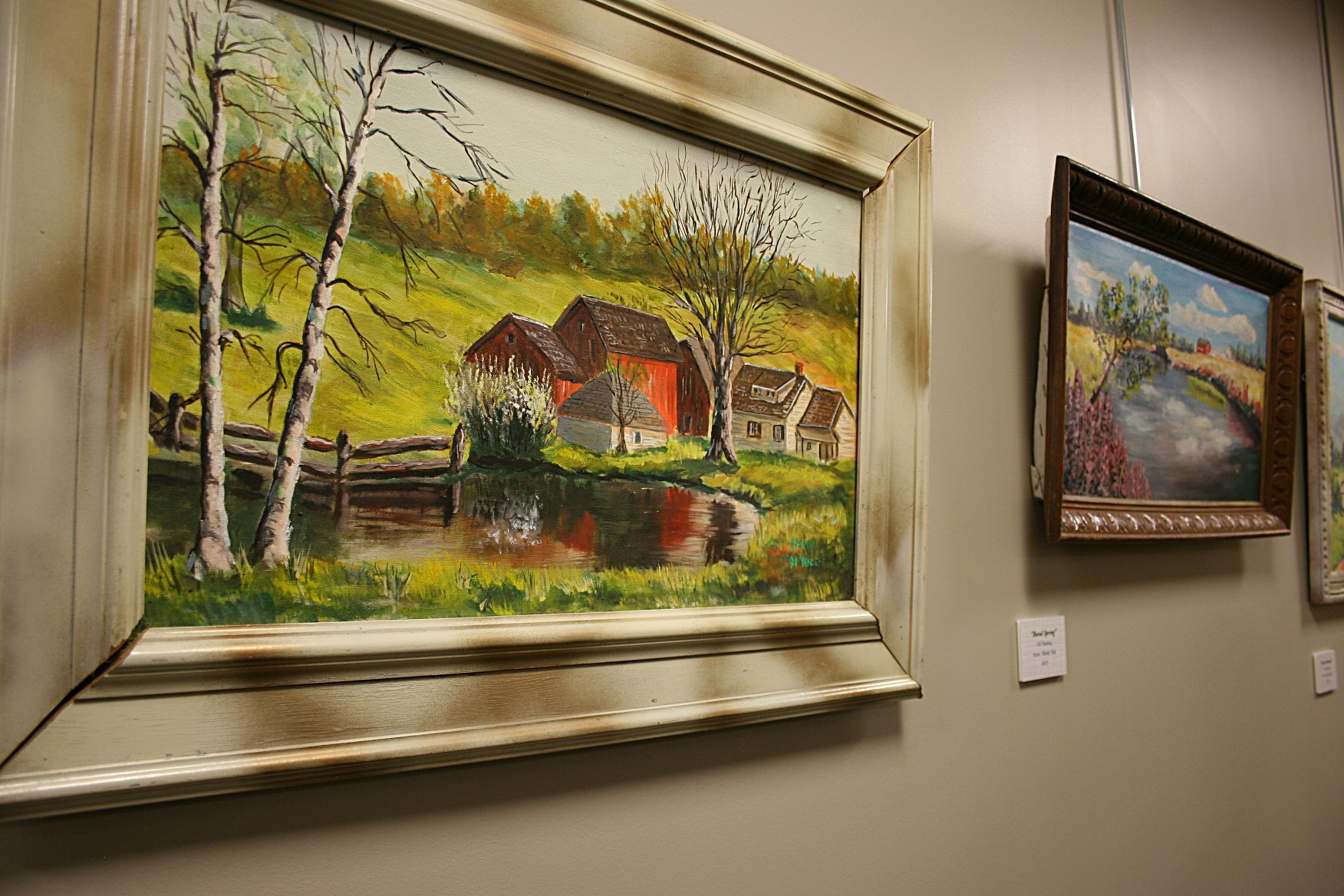
It was my absolute honor, after discovering Rhody’s work, to bring his paintings to the public via a mini art show at Christdala Evangelical Swedish Lutheran Church, rural Millersburg, and then during a much larger gallery exhibit at the Paradise Center for the Arts in Faribault.

And now Rhody, in death, has blessed me with the gift of one of his paintings, the painting he knew I most favored.

A sampling of the religious paintings Rhody exhibited at a mini show at Christdala on September 26, 2010. The painting on the right is the one Rhody gifted to me.

On Tuesday evening, the day before my 56th birthday and just a day shy of the two-year anniversary of that mini exhibit at Christdala—yes, I spent my 54th birthday setting up that art show for Rhody—I picked up the painting Rhody wanted me to have.

I’d known for a few weeks that I was to receive the painting I’ve come to call “Woman in Reverent Prayer.” Tuesday I phoned Rhody’s stepson, Bob, asking if my husband, Randy, and I could come over and pick up the piece of art in a half hour. That would work, Bob said.

“Woman in Reverent Prayer” by Rhody Yule

Over at Bob and his wife Kathy’s condo, Rhody’s prayerful woman painting leaned against the living room wall as we reminisced about the man we had each loved.

And as I remembered Rhody, I felt myself slipping into sadness. I missed him and wished I had known him longer.

Then, when Bob told me how Rhody wanted me to have that particular painting and how Rhody’s gallery show at the Paradise was the highlight of the last year of his life, the tears seeped from my eyes. To be able to give someone like Rhody such a gift, to realize how much this meant to him, prompts the most humbling and joyful of emotions.

Shortly thereafter as I caressed the painting, Bob suggested that I might want to replace the dinged frame. No, I would keep the frame Rhody crafted, I said, running my fingers along the wood.

Bob lifted the four-foot by 2 1/2-foot painting onto the dining room table then so we could examine the date under Rhody’s signature. We could barely decipher the faint curve of double sixes, meaning Rhody painted “Woman in Reverent Prayer” in 1966 when I was just 10 years old.

I know nothing, really, about the oil painting except Rhody once sharing that it was based on another painting or photo, minus the rosary beads clasped in the kneeling woman’s prayerful hands.

Now, each time I view Rhody’s painting, which will soon grace a wall in my living room, I am reminded of my friend’s deep faith. And I am reminded of how very much his friendship meant to me and likewise my friendship to him.

To realize that Rhody wanted me to have this painting simply touches my heart with gratitude and love.

Rhody and me at his opening night gallery reception in January 2011 at the Paradise Center for the Arts, Faribault.

FYI: To read about Rhody’s mini art show at Christdala Evangelical Swedish Lutheran Church, click here.

To read about Rhody’s January 2011 gallery exhibit at the Paradise Center for the Arts, Faribault, click here.

To read my tribute to Rhody upon his death, click here.

© Copyright 2012 Audrey Kletscher Helbling
 

A Minnesota arts collage, from theater to poetry September 15, 2012

FOR A FEW SECONDS THERE, I searched the dictionary of my brain for that word which temporarily eluded me. Collage. That would be it.

Remember when that art form was especially popular, when, as a school assignment, you had to scrounge up ten zillion magazines and then snip out images themed to a specific subject and glue it all in a jumbled mess onto a piece of paper?

Today I present a collage—not a jumbled mess, though—of art.

Let’s take the biggest focal piece first. A Hudson.

A Hudson, like this one I photographed several years ago at a Faribault car show, centers “The Car.” Do not expect, though, to see a real Hudson on stage, only the shape of one.

The Hudson centers the stage at the Paradise Center for the Arts during a production of The Car by Carol Wright Krause. My husband and I saw this play by the Faribault-based The Paradise Community Theatre Friday evening. I’d rate it as one of the best I’ve ever seen performed locally.

Here’s a summary of the play written by director Gabe Talamantes:

The Car is about a family’s car, which as Ed (a character in the five-person drama) puts it “is a miracle of modern American engineering.” This miracle car is a character in itself, a highly theatricalized version of a 1954 Hudson. It takes us on a journey into the lives of the Banners and the challenges an all American family faces as they struggle through two decades of change at home and abroad. We will see how they choose to overcome such difficulties.

Now, why am I so enthusiastic about The Car? Because it moved me to tears. When a theatrical performance can evoke such a strong emotional reaction from me, I will embrace it with unbridled enthusiasm.

That break-down moment for me came near the end of the play, when Vietnam War veteran Hal Banner (played by Todd Ginter), broke down in the arms of his father, Ed Banner (Chuck Larsen). He was no hero, Hal said, pointedly telling his father that he (Ed) would never understand the horrors of war. And then Hal got specific, talking about seeing the eyes of those he killed.

That’s when the tears trickled down by cheeks and I struggled mightily to keep from sobbing. In that moment, I heard my Korean War veteran father, not Hal/Todd. My dad, too, spoke of seeing the eyes of those he killed on the front lines in Korea.

Later, when I congratulated Todd on his performance, he told me that he had talked to several veterans in preparation for his role. And it was the eyes which they spoke of and which he knew he needed to emphasize in that heartrending father-son conversation. It is easily the most powerful moment in the play.

I wondered how many audience members might be veterans and at that moment suppressing war memories and feelings, as my father did.

But this play is about so much more than war. It also addresses the issue of prejudice when Hal brings home a Japanese wife, portrayed by Carrie Jendza whose mother came here from Korea some 40 years ago. Carrie presents a stunning performance as do Susan Dunhaupt as Ed’s wife, Geneva, and Faribault High School sophomore Emily Remmey as Beth Banner, Hal and Sumiko’s daughter.

The prejudice starts right away when Ed Banner insists on calling Sumiko the Americanized “Sue.” He slides in references to “slant eyes” (there’s the “eye” thing again) and other derogatory comments.

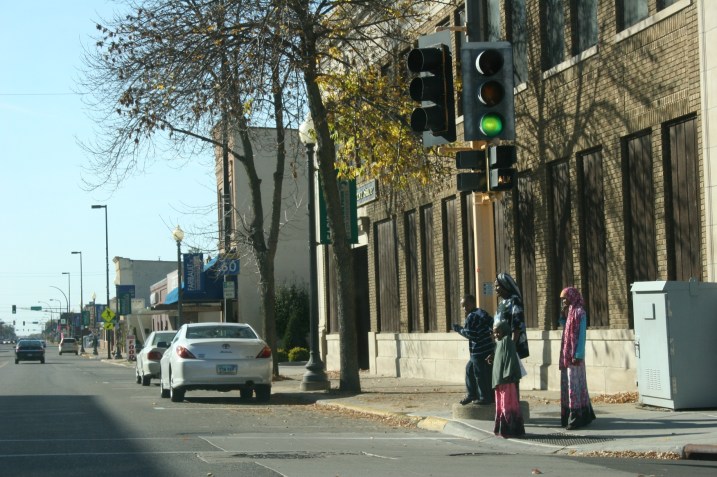
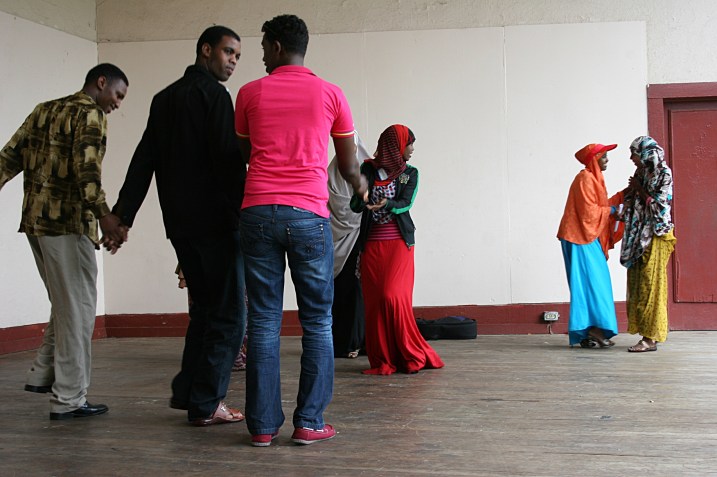
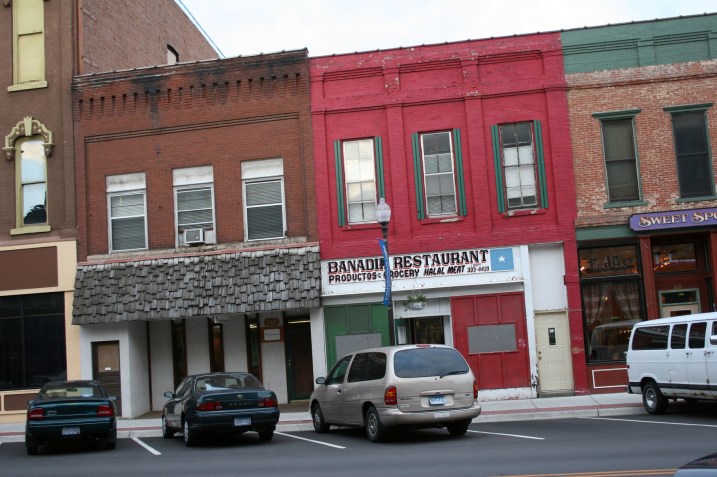
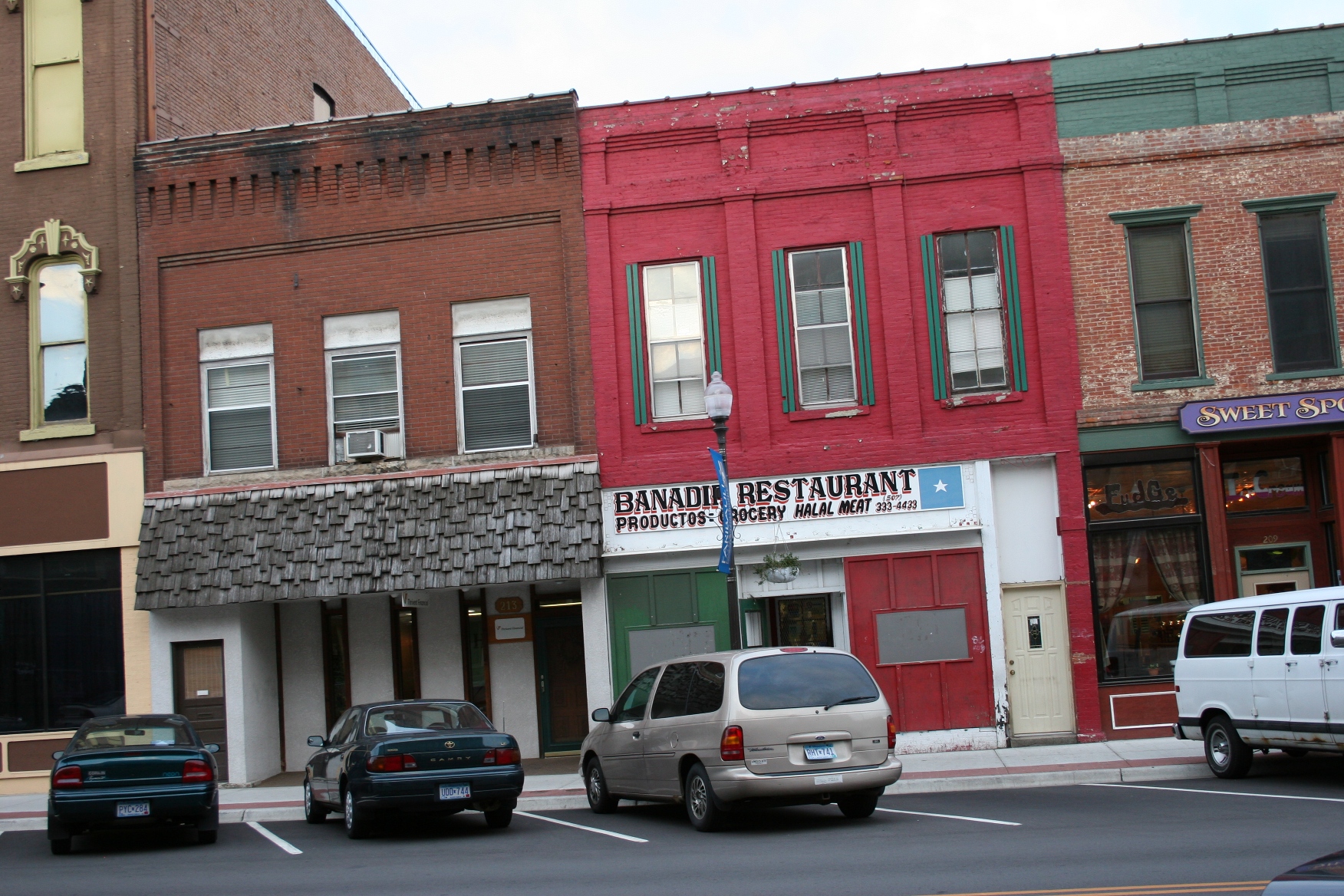
In real-life, prejudice is an issue in Faribault, home to many Latino, Somali and Sudanese family. It is no secret that prejudice exists in my community. You can read about it in a previous post by clicking here.

I didn’t spot a single minority in the audience Friday evening,  not unusual despite Faribault’s sizable minority population.

There, that’s all I’m telling you about The Car, other than to advise you to see this powerful and memorable production. It’s community theater at its best for the superb acting and the unforgettable messages delivered.

Faribault artist Vivian Jones created this watercolor, “It Was Grandma’s Car,” for the current “car pARTS” show.

Additional performances of The Car at the Paradise, 321 Central Avenue, Faribault, are set for 7:30 p.m. on September 15, 20, 21 and 22 and at 2 p.m. September 16. Call (507) 332-7372 or click here to reach the Paradise website. According to info published in the theater program, production of The Car is made possible through a Minnesota State Arts Board Operating Support Grant.

While you’re at the play, be sure to check out the exhibit, “car pARTS,” in the Carlander Family Gallery.

The Beat logo.

NOW LET’S PLACE another piece in that art collage. On-air poetry.

In July, Northern Community Radio began airing poetry on its weekday morning show during a segment called The Beat.

On Monday my poem, “Her Treasure,” will air on 91.7 KAXE (89.9/Brainerd) and on 90.5 KBXE. Now I won’t be able to listen to whomever reads my poem between 7:30 a.m. – 8 a.m. and again between 3:30 p.m. – 4 p.m. Faribault is well outside the coverage area which extends from Thief River Falls to Hermantown to Pierz. Eventually, though, I’ll be able to listen to the reading of my poem online.

You can listen to The Beat via online streaming. (I’m not smart enough to figure that out and my former in-house techie now lives at NDSU in Fargo.)

I’m in the company of some mighty fine poets, from novices to Minnesota’s 2011 poet laureate, Joyce Sutphen, to well-known Minnesota writer Will Weaver. You can check out the current listing of The Beat poems/poets by clicking here.

The poems chosen for airing were selected through a juried process.

Connie Ludwig, right, and I pose for a photo with her watercolor, “Pantry Jewels” (above my head) inspired by my poem, “Her Treasure.” This photo was taken in April at Crossings at Carnegie in Zumbrota.

Just, FYI, “Her Treasure” is the same poem featured in “Poetry Artist Collaboration XI” at Crossings at Carnegie in Zumbrota last April. To read my poem, click here.

I love this whole concept of The Beat, of Northern Community Radio’s “daily reminder that, in Minnesota, poetry matters, and Minnesota poets prove that every day.”

You can expect a forthcoming detailed post from me on this project funded by Minnesota’s Arts & Cultural Heritage monies.

The cover of last year’s The Talking Stick 20.

NEXT, LET’S PLACE the third piece in this arts collage. More poetry, plus fiction and creative nonfiction.

Today I’m missing out on a book release party for The Talking Stick 21 in the Park Rapids area. This anthology, published by The Jackpine Writers Bloc, represents some fine writing by Minnesota writers. You can, referencing back to The Beat, listen to the poetry of Sharon Harris, a Jackpine member and one of the key producers of the collection.

I’ve been published in two previous volumes of The Talking Stick (including receiving an honorable mention for my poem, “Hit-and-Run,” in volume 19) and will be published again in this newest volume. My poem, “Broken,” was chosen from among 275 submissions for publication.

To learn more about The Talking Stick, click here. To learn more about The Jackpine Writers’ Bloc, click here.

THAT’S IT. Now, go ahead, add your own pieces to this art collage via your comments.

© Copyright 2012 Audrey Kletscher Helbling


The winter whisperers September 8, 2012

Filed under: Uncategorized — Audrey Kletscher Helbling @ 8:13 AM
Tags: , , , , , , ,

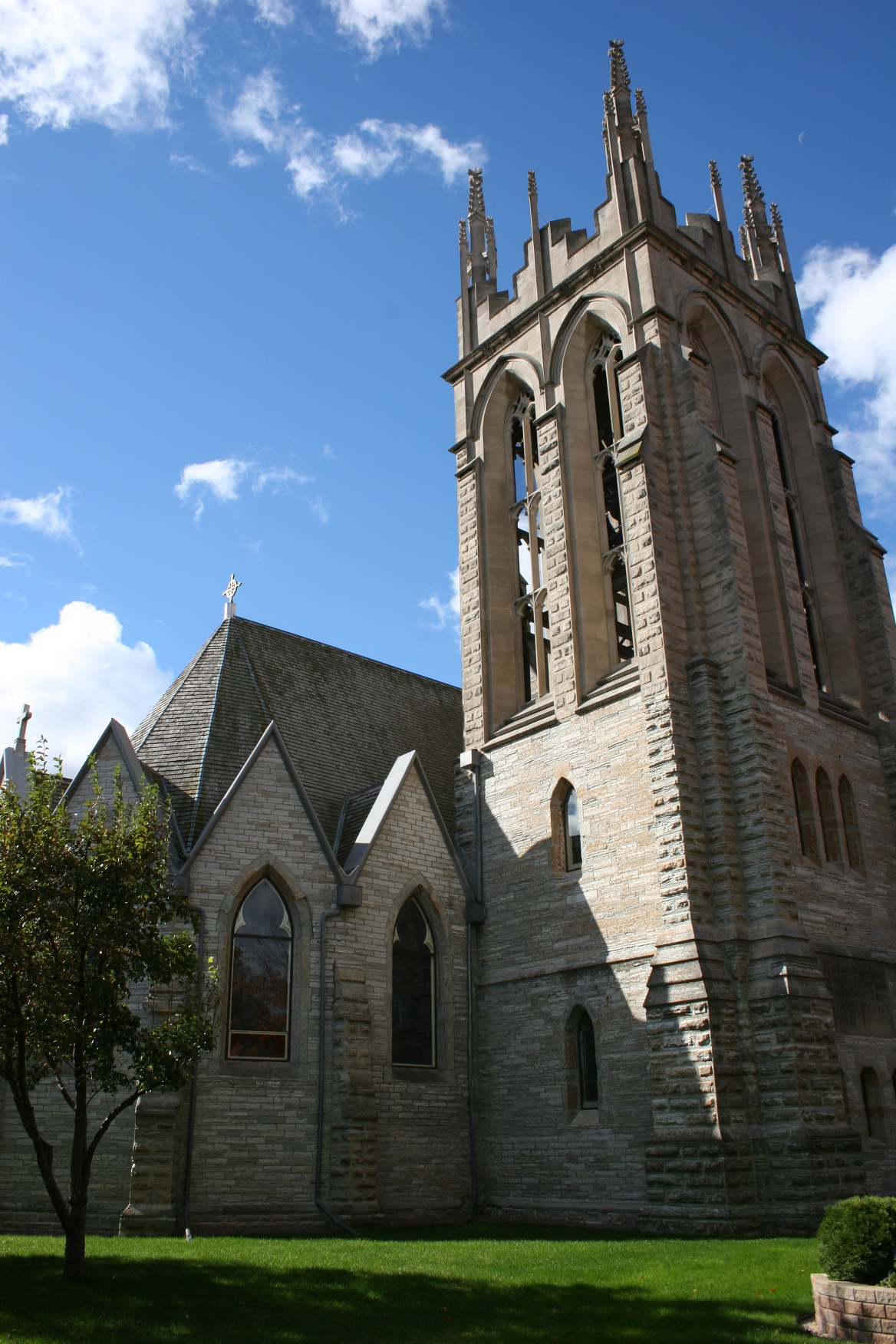
I CAN HEAR THEM. The whisperers.

They rustle through the cornfields, fingertips brushing brittle leaves.

They swish through the tall prairie grasses, hips not just swaying, but sashaying, in the bending breeze.

Their voices drone like a billion buzzing busy bees.

In the woods, I strain to hear them as my flip flops crunch leaves strewn upon the path. I know they are there, hiding among the trees.

When two bikers pedal past me, the whisperers think I cannot hear them whispering. But I can.

At 4:28 in the morning, when the owl’s hoot awakens me from sleep, I cannot hear the whisperers. But I feel their chilling presence slide through the open bedroom window, brushing my bare shoulders with icy fingers.

They cloak themselves in glorious golden robes…

hide among the grasses…

tempt me with wine.

Their distractions and disguises don’t fool me. I hear them whispering of winter in these early days of autumn.

FYI: All of these photos, except the vineyard and the cornfield, were taken at the River Bend Nature Center in Faribault on Monday, September 3. The other two were shot a day earlier east of Waterville.

© Copyright 2012 Audrey Kletscher Helbling


In Faribault: Scholar to address Lincoln’s response to the U.S.-Dakota War of 1862 September 5, 2012

A Lincoln postcard which a collector brought to a Cannon Valley Civil War Roundtable meeting several years ago.

THE FIRST TIME I ATTENDED a Cannon Valley Civil War Roundtable meeting nearly three years ago, I arrived expecting to view slave documents. The presenter, however, left the papers at home and brought, instead, memorabilia specifically related to Abraham Lincoln.

He did not disappoint. I viewed vintage postcards and original photos of Lincoln, Civil War buttons and replicas of Mary Todd Lincoln’s White House china, among many other items.

An 1840 Philadelphia Derringer, like the pistol used to assassinate President Abraham Lincoln.

What impressed me the most, however, was the collector’s 1840 Philadelphia Derringer, exactly like the pistol with which John Wilkes Booth assassinated Lincoln. The weapon was nearly small enough to hide in the palm of my hand.

Visuals like that teach me more about history than any textbook ever will. So do guest speakers. They address the monthly meetings of the Roundtable whose 25 members are interested in preserving and interpreting the Civil War.

Now the Faribault-based Cannon Valley Civil War Roundtable is bringing in a scholar of Abraham Lincoln to kick off its eighth year as an organization. You needn’t be a Roundtable member to attend; I’m not.

Bryce Stenzel of Mankato portraying President Abraham Lincoln. Stenzel, among other things, directs Lincoln’s Traveling Troupe, a group of students and community actors who bring Lincoln’s life and legacy to life via a dramatic, living history portrayal and authentic re-enactment.

Bryce Stenzel of Mankato, who developed a first-person portrayal of Abraham Lincoln in 1989 and since has traveled around the country presenting, will present “1862: Lincoln Trials by Fire” at 7:30 p.m. Thursday, September 20, at the Faribault American Legion, 112 Fifth St. N.E.

He will address, Stenzel says, “the ‘State of the Union’ as it existed in 1862 and Lincoln’s response to the U.S.- Dakota War, against the backdrop of the American Civil War and the issuance of the Preliminary Emancipation Proclamation on September 22, 1862.”

It’s a timely topic given this year marks the 150th anniversary of the U.S. – Dakota War.

Specifically, Stenzel details, his upcoming program “is a means for Faribault to acknowledge its unique connection to the U.S. – Dakota War by paying homage to its native son, Bishop Henry Whipple. Even though no fighting took place in Faribault, your community played an active role in influencing the final outcome.”

This historian, who has authored eight books on local historical and Lincoln-related topics, possesses an advanced history degree and has taught social studies/history at all levels, including college, has long taken a personal interest in the U.S. – Dakota War. His great-great grandmother and her two-year-old daughter escaped a band of Dakota warriors by hiding in tall prairie grasses. And his great-great grandfather served with the Fifth Minnesota Regiment and fought in the decisive Battle of Nashville in 1864.

Stenzel grew up in Mankato, where 38 Dakota were hung in the largest mass execution in U.S. history. President Lincoln commuted the death sentences of 265 Dakota.

Says Stenzel:

The central question of my presentation is why did Lincoln feel compelled to intervene at all, when he didn’t have to? In fact, from a political standpoint, Lincoln committed political suicide—most Minnesotans at the time believed it was both right and necessary to hang the Indians as a means of preventing such a tragedy from ever happening again. It is useful for the modern audience to consider that what was “politically correct” in the 19th century, is no longer. Historical interpretation changes with time.

Dan Peterson, a member of the Cannon Valley Civil War Roundtable who has heard Stenzel speak, fully endorses him: “(Stenzel)) reminds me of my love for Abraham Lincoln just to be in his audience or close to him. Lincoln is on our money, our named streets, one state capitol, highways, buildings, businesses, cars and more. You just cannot get away from him.”

FYI: Tickets to the dinner and program are on sale now at the Rice County Historical Society in Faribault or from Chuck Peterson (507-301-2470), Jan Stevens (507-244-0500) or Dan Peterson (507-459-3140). Cost is $22 for non-members and $20 for paid-up members of the Cannon Valley Civil War Roundtable.

Tickets for the meal of pork ribs with trimmings must be purchased by Saturday, September 8. The event begins at 5 p.m. on September 20 with a social and then dinner at 6 p.m.

If you want to attend just the Lincoln presentation by Stenzel, the cost is $10 for adults, $5 for students 16 and older, and free for those under 16. The program begins at 7:30 p.m.

The Cannon Valley Civil War Roundtable meets the third Thursday of each month at 7 p.m. at the Faribault Senior Center with a speaker at each meeting. In October, the topic will be the New Ulm raid as part of the U.S. – Dakota War; in November, the Antietam Battlefield; and in December, the annual Civil War food potluck (probably with possum soup, hardtack and more, Peterson promises).

© Copyright 2012 Audrey Kletscher Helbling
Bryce Stenzel photo courtesy of Bryce Stenzel


New exhibit highlights Rice County in the U.S.-Dakota War of 1862 September 2, 2012

IT IS EASY TO FORGET SOMETIMES, because I grew up in the region of Minnesota where the U.S.-Dakota War of 1862 was centered, that residents of the county in which I now live also played an integral role in the conflict.

Specifically, Rice County residents Bishop Henry Whipple and Alexander Faribault, after whom my community of Faribault is named, are key persons often noted in historical information written about the war.

I am always surprised that relatively few people from outside of southwestern and central Minnesota know so little about the bloody, six-week war between the Dakota and the white settlers and soldiers given it is a major, defining event in Minnesota history.

An overview of 1862, Through Rice County’s Eyes, which opened August 22 in Northfield.

However, awareness has grown considerably this year on the 150th anniversary of the war, including right here in Rice County. The Northfield Historical Society, partnering with the Rice County Historical Society, is currently showcasing an exhibit, 1862, Through Rice County’s Eyes.

I recently checked out the Northfield exhibit, which features mostly memorable quotes, volumes of summarized information and copies of photos. It’s a lot of reading.

But if you’re interested in educating yourself, it’s worth the time and concentration needed to absorb the information presented in this exhibit. And I’ll admit to occasionally skimming the postings because I am more of a visual, multi media, show-and-tell kind of history learner. I also had a pretty good background of knowledge going into the exhibit.

This sculpture of Alexander Faribault trading with a Dakota trading partner stands in Faribault’s Heritage Park near the Straight River and site of Faribault’s trading post. Faribault artist Ivan Whillock created this sculpture which sits atop a fountain known as the Bea Duncan Memorial Fountain.

I knew, for example, that fur trader Alexander Faribault was one-quarter Dakota and married to Mary Elizabeth Graham, whose mother was a family member of a Dakota chief. I knew, too, that Faribault was involved in the negotiating and translating of land treaties between the government and the Dakota before the war and that he benefited financially.

I was aware that Alexander Faribault sheltered the Dakota.

Above the photos and info is this quote by Bishop Henry Whipple to President Buchanan in August 1860: “In my visits to them, my heart had been pained to see the utter helplessness of these poor souls, fast passing away, caused in great part by the curse which our people have pressed to their lips.”

But I had forgotten that Bishop Henry Whipple, a long-time advocate for the rights of the Dakota and known to them as “Straight Tongue,” worked to find a safe refuge for them in the city of Faribault.

Alexander Faribault opened his land to the Dakota. Information in the exhibit states:

This land was the only safe-haven of its kind in a state now prejudiced in fear and anger against anyone with Dakota blood.

According to info in the exhibit, Alexander Faribault, whom you recall was one-fourth Dakota, also experienced prejudice against him. By 1869, this once successful fur trader, flour mill owner and politician had to sell his land and assets, including the land occupied by the Dakota.

Equally interesting is the quote, below, attributed to Mary Whipple. Even though her husband, the bishop, worked tirelessly to help the Dakota, fear still existed in his home community.

A quote from a letter written by Mary Whipple to her sister during the U.S.-Dakota War.

Perhaps the most interesting fact I learned relates to that of Lt. Rollin Olin, a decade-long resident of Northfield. He was second in command of the Third Minnesota Regiment at the Battle of Wood Lake—the final battle of the war—and a member of a five-man military tribunal which tried the Dakota following the war. He signed more than 300 death sentences for nearly 400 Dakota charged with murder, rape and/or robbery.

For me, that raises the obvious question: How could someone who fought against the Dakota judge them without bias? All members of the tribunal, in fact, had fought the Dakota. The answer, of course, is that Lt. Olin and the other four could not.

Likewise, the Northfield Historical Society is wisely careful to indicate that its new, temporary exhibit may not please everyone or include everything on the topic of Rice County’s connection to the war. On the NHS website, you’ll read this disclaimer:

As varied as these and other local perspectives may be, any exploration of the U.S.-Dakota War of 1862 suffers from the inevitable limitations facing every historical examination—limitations such as scope and biases, past and present, which impact the telling and perception of the stories and data. In presenting the exhibit 1862, Through Rice County’s Eyes this fall, NHS endeavors to draw visitors into thoughtful interest and discussion of this momentous event and its aftermath by sharing local connections. Come and critically examine this exhibit.

The exterior of the Northfield Historical Society, 408 Division Street, Northfield.

FYI: To learn more about 1862—Through Rice County’s Eyes, click here to the NHS website.

To learn more about the Minnesota counties, county by county, involved in the U.S.-Dakota War of 1862, click here.

© Copyright 2012 Audrey Kletscher Helbling
 

The Peach Project August 29, 2012

I GREW UP WITH DIRT under my fingernails, banishing weeds from the garden and then, later, harvesting and preparing veggies to eat fresh or preserve.

My mom canned some, froze some, storing away freezer boxes plump with green beans and beets, corn and other vegetables.

She also preserved fruit in quart jars, with the assistance of us kids, for the long Minnesota winter ahead. Applesauce and cherries. Peaches and pears.

A juicy Colorado peach, from which I must remove the skin because I can’t tolerate the fuzz (feels like a cotton ball) in my mouth.

And then, on a brisk winter evening, when Dad was about to come in for supper after finishing barn chores, she would lift the trap door in the kitchen and send one of us clomping down the creaky, rugged wooden steps to the dirt-floored cellar for a jar of sauce. Dessert. I would tug on the frayed cotton string to switch on the single bare light bulb. Then I would tiptoe reach for a jar of my favorite cherries or peaches.

We got a single box of freshly-picked Colorado peaches. When I was growing up, the peaches came in a wood-slat box that was nailed shut. Each peach was wrapped in tissue paper, which we recycled for use in the outhouse.

Those were my thoughts on Saturday when my husband and I picked up a 20-pound crate of peaches I’d ordered several weeks ago through the Cathedral Community Cafe, a Faribault soup kitchen which every Tuesday offers a free meal to those in need and/or seeking fellowship.

It is a worthy cause with some 9,000 dinners served in 2011 and averaging 150 a week this year. The effort involves about 140 volunteers, 12 churches and four teams of workers.

The Community Cathedral Cafe and First English Lutheran youth pre-sold 260 boxes of peaches and ordered an additional 60 to sell to walk-in customers. The peach project has been an ongoing fundraiser for around five years for the cafe and First English youth. About 50 boxes already had been picked up when I photographed this scene.

But like any such organization, the cafe needs money to keep going. The peach project will channel funds into the cafe’s coffers and I’m happy to support the fundraiser by purchasing a $30 crate of fresh Colorado peaches.

A sign outside the Cathedral Guild House directs customers to the peach pick-up point.

Now, what to do with all those fresh peaches. Thus far I’ve eaten many straight from the box. One evening I blended a peach and vanilla ice cream into a smooth shake. This morning I sliced one into my oatmeal. And I’ve also used thinly-sliced peaches to make a ham and peach panini.

I found the adapted sandwich recipe on Sue Ready’s blog and then tweaked it a bit.

Ham and Peach Panini

2 bread slices

deli ham

1 slice provolone cheese

1 thinly-sliced peach

1/2 teaspoon honey

Djon or spicy brown mustard

chopped fresh basil

Spread mustard and 1/2 teaspoon honey on one bread slice. Top with ham, cheese and thin peach slices. Top with chopped basil. Place other piece of bread on top and brush lightly with olive oil. Also brush other bread slice with oil. Grill in frying pan until golden brown, flip and grill other side.

Love, love, love this sandwich. My husband not so much. But he’s more an ordinary sandwich guy and I really had to persuade him to even take a bite.

Now, I expect when I bake a peach crisp or a peach cheesecake later this week, he won’t hesitate to scoop up a sizable helping.

Tyler Welander, 14, who’s raising monies for youth activities at First English, delivers boxes of peaches to vehicles. I suggested to the peach sellers that perhaps they could bake the pies, too, for me to pick up. But one man said, “Oh, that would be down the street at Trinity.” And he would be right. The Trinity Piemakers are currently selling fresh peach, among other, pies.  And since I attend Trinity, I can vouch for the delicious goodness of Trinity pies.

An elderly couple from Farmington ordered nine crates of peaches, seven of which they will deliver to friends.

WHAT’S YOUR FAVORITE peach recipe and what’s the best way to freeze peaches? I’d like to hear.

Click here to reach the website of the Cathedral of Our Merciful Saviour in Faribault, home to the community cafe.

Also, please click here to read a post which features a poem I wrote about canning and the watercolor Zumbrota artist Connie Ludwig created based on my poem. Oh, how I wish “Pantry Jewels” was hanging on my dining room wall.

Copyright 2012 Audrey Kletscher Helbling
 

Connecting, conversing and celebrating cultural diversity at Faribault festival August 28, 2012

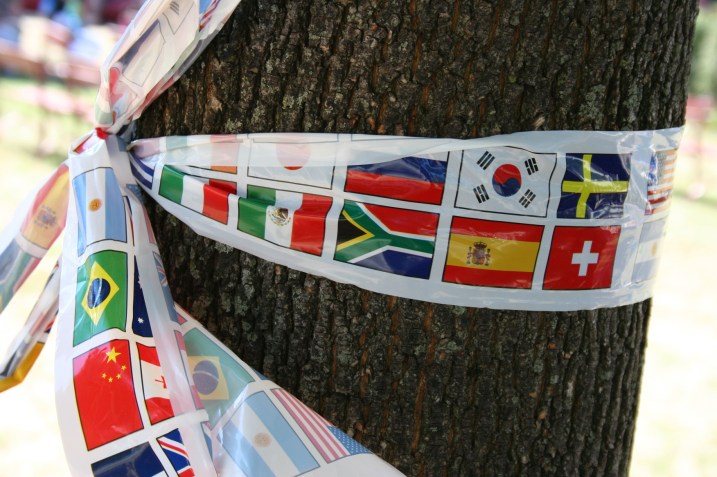
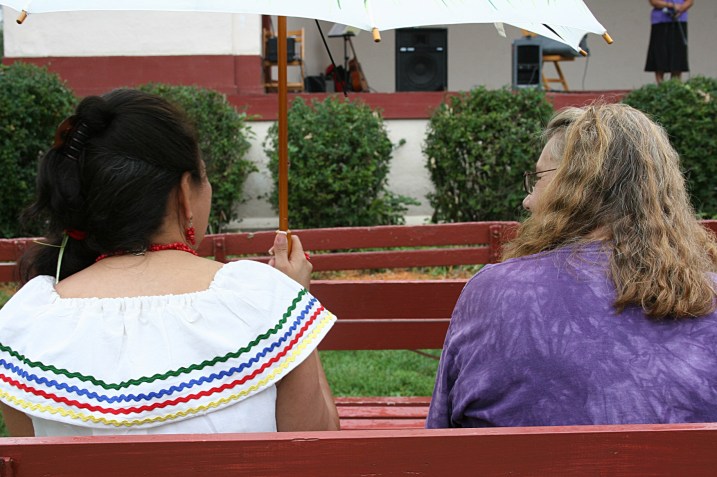
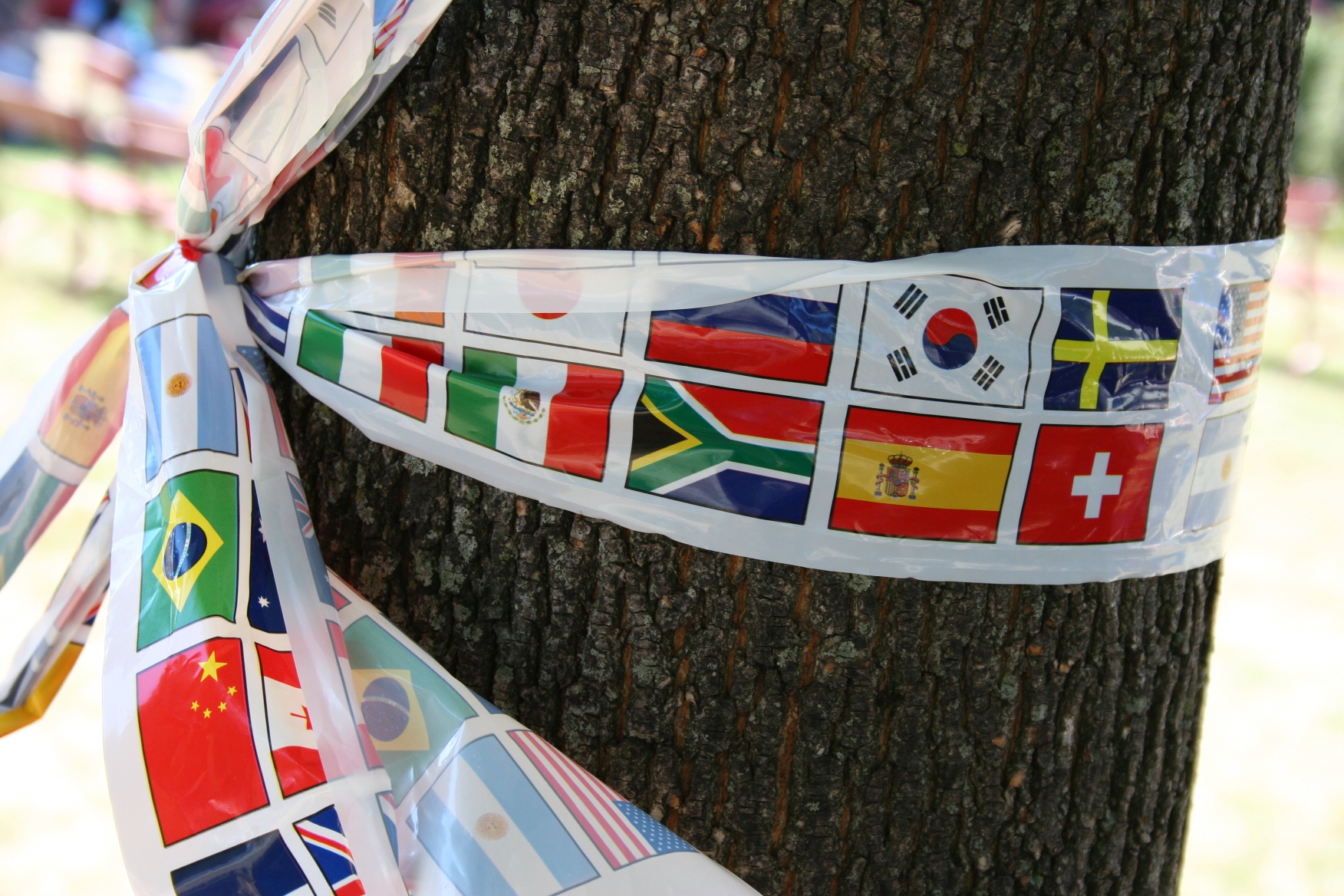
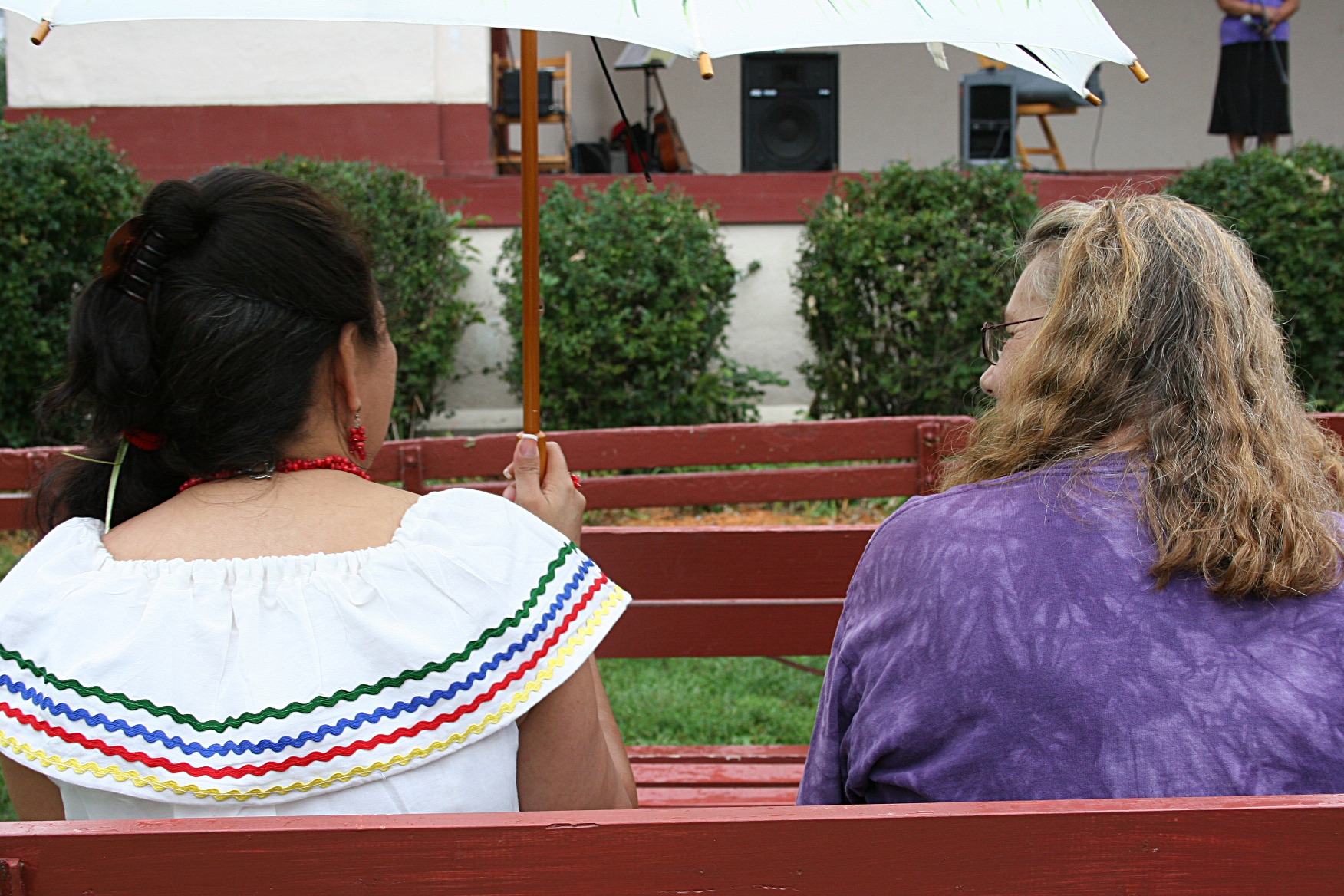
This woman represents El Salvador during the International Festival Faribault on a drizzly Saturday. Flags suspended from the Central Park band shell in the background show the countries participating in the event.

DESCRIBING AN EVENT like International Festival Faribault within the confines of a blog post or two seems daunting. How do I adequately convey the essence of this fest celebrating the cultural diversity of my community?

You can view my first effort by clicking here and reading “Yearning for respect & equality, ‘no matter what color you are.’”

Now, as I scroll again through the many photos I took during the fest (when rain wasn’t drizzling upon my camera), I ponder which images to share, what words to pen.

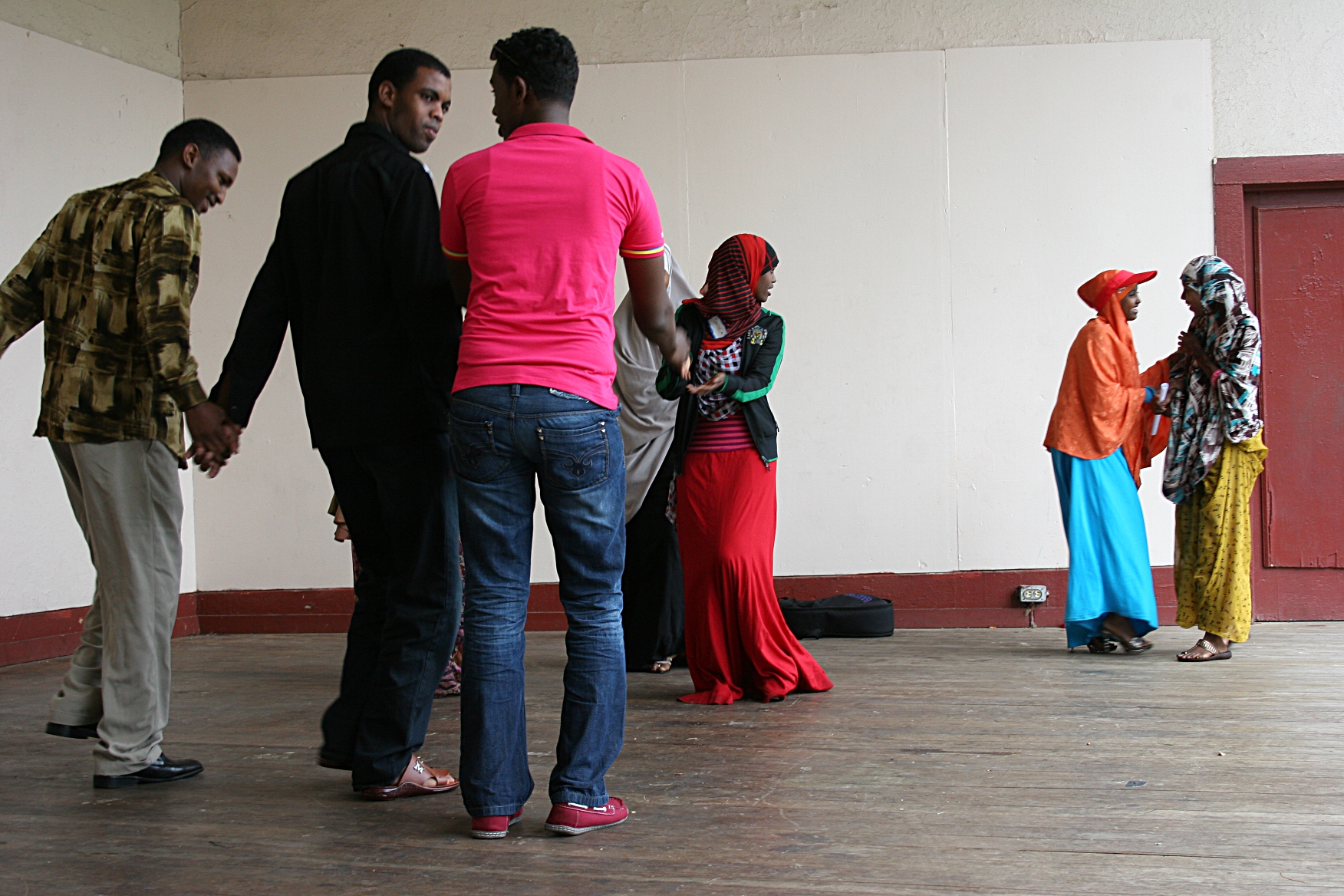
Cultures connecting on the band shell stage between musical acts.

And “c” words—like color, connecting, communicating, conversation, coloring, candy, culture, care, colorful clothing—pop out at me as I view my photos.

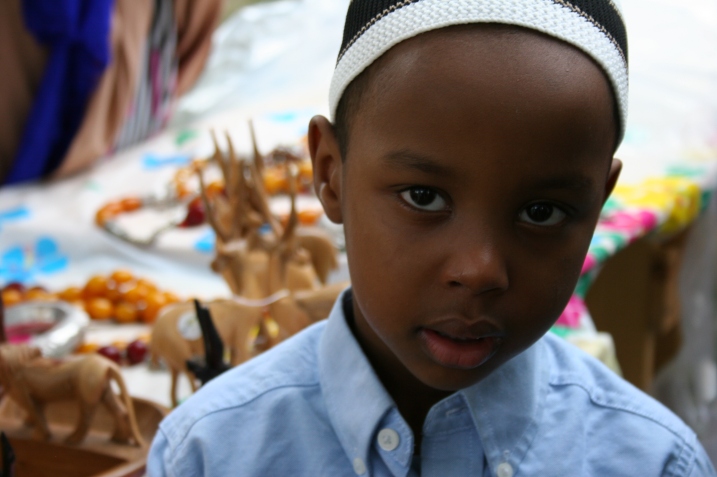
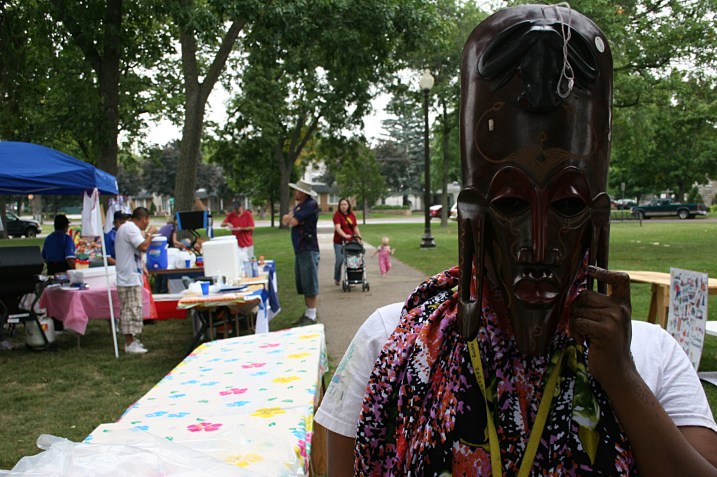
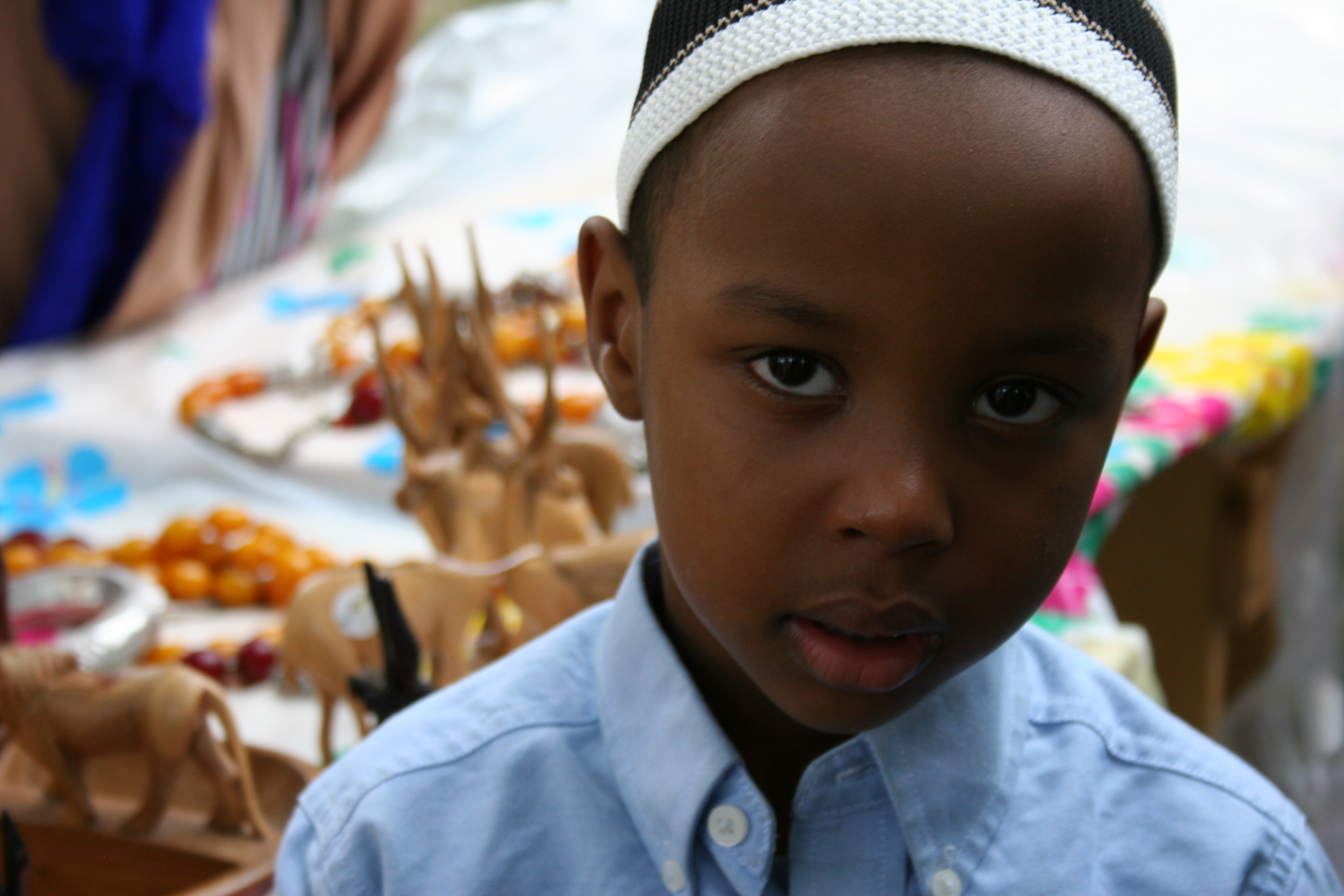
I should perhaps add “confusing” to that list because I felt overwhelmed when trying to photograph the wood carvings from Somalia and Kenya peddled by Bashir Omar and Asher Ali.

A woman, without prompting, took this mask from the table manned by Bashir Omar and Asher Ali and asked me to photograph her.

Suddenly, it seemed, everyone wanted to pose for a picture. And I much prefer candid to set up shots. I obliged, though, because it seemed the easiest thing to do.

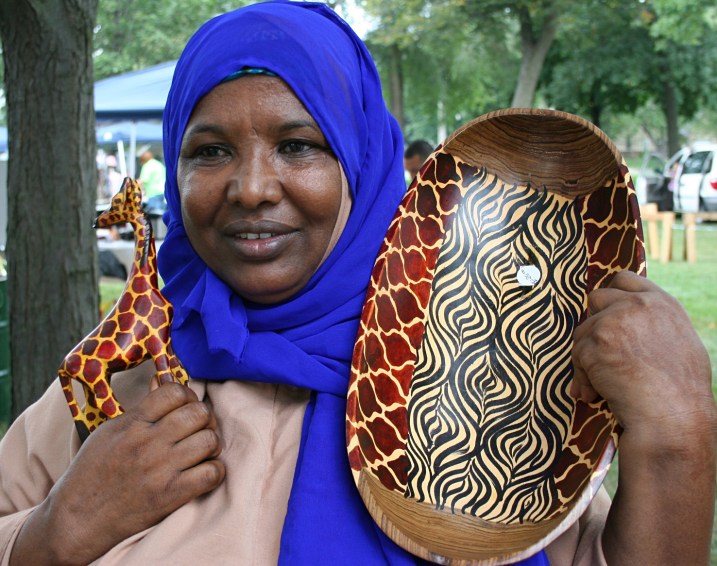
Lul Abdi shows off beautiful wood crafts from Kenya and Somalia.

Then Lul Abdi, who had grabbed a wooden platter and giraffe, and held them up for me to photograph, asked me to write in my blog that an election is coming up in Somalia and I should tell everyone to vote for whomever it is she supports. Bashir Omar translated my answer—I don’t write about international political issues.

While this back-and-forth translation was occurring, I felt befuddled because, when too much noise (in this instance lots of conversation going on around me and music in the background), is coming my way, my brain doesn’t process anything. That issue is related to the 70 percent hearing loss in my right ear.

Despite the difficulties, this muddle served as an aha moment. Imagine if I was Lul, struggling on a daily basis to understand those around me. Life would be challenging.

Busy artists at the kids’ activity table.

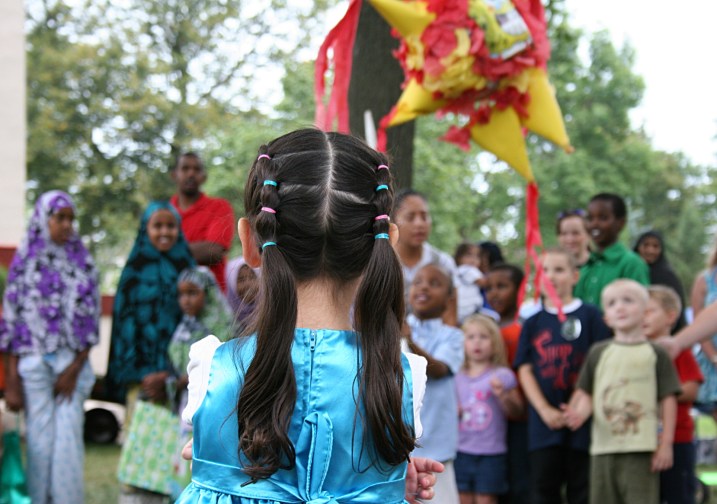
But sometimes we all speak the same language. And I saw, rather than heard, that on Saturday, at the festival, especially among the children. They sat side-by-side painting at the kids’ activity table, bounced side-by-side in the bouncy tent, stood side-by-side in line to take turns swinging at pinatas.

A little girl stands on the opposite side of the group of children waiting to swing at the pinata.

Differences in color and culture and language mattered not to these children. They shouldn’t matter to any of us. Therein lies the message I most want to communicate to you today and which was communicated so well via International Festival Faribault.

Happy children all focused on the same goal: breaking the pinata.

All around me, children and adults of all colors mingled.

The boy on the right was biking past Central Park and stopped to watch the activities at a distance.

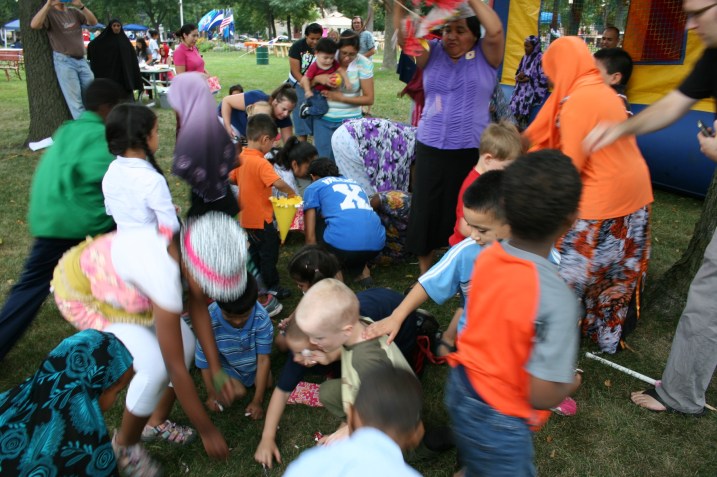
The scramble for candy once one of three pinatas is broken.

AND HERE ARE SOME ADDITIONAL BONUS PHOTOS:

Masks displayed at the food vendor representing El Salvador.

Waiting at the bouncy tent.

A Mexican dish (help me out if you know, but I think tortillas) was wrapped in banana leaves. My husband and I tried this.

Conversation and connecting…, no other words necessary.

Necklaces and other jewelry from Kenya and/or Somalia and for sale at the festival.

Kids painted and colored, etc., elbow to elbow at the always busy kids’ activity table.

Some mischievous face painting was also part of the fun.

© Copyright 2012 Audrey Kletscher Helbling
 

Yearning for respect & equality, “no matter what color you are” August 26, 2012

I HAVE PHOTOGRAPHED them from a distance, their long skirts swaying as they walk across Central Park toward me.

Now the young women are standing before me and I am confused for a moment until Nasteho Farah tells me she wants to look her best and asks me to photograph them again.

Friends, Nimo Abdi, a sophomore at Faribault High School, left, and Nasteho Farah, a senior.

I agree as I already envision the portrait possibilities—the expressive brown eyes, the warm skin tone, the way Nimo Abdi leans toward her friend, her hijab brushing Nasteho’s cheek. They are beautiful young women and I take only one shot, knowing I’ve captured a memorable portrait.

I love this image of  a fest performer and her single audience member for the message it portrays– the one on one connection that helps us understand one another, no matter our culture or skin color.

These Faribault High School students are among those participating in the International Festival Faribault on Saturday, an event designed to connect cultures through music, arts and crafts, kids’ activities, international cuisine, education and, on a personal level, conversation.

That same little boy who was so intently focused on the musician performing in the band shell.

After I photograph the friends, we talk about their experiences living in Faribault. And what Nasteho shares with me so upsets me that I apologize to her for the utter disrespect shown to her and her friend, who stands silently listening.

The native of Kenya, a Faribault resident for five years and prior to that a resident of Rochester, Owatonna and Waseca, says she is criticized for the scarf she wears, for her culture, for her…

“They assume I’m a terrorist.”

Her words temporarily stun me and I can feel my jaw drop.

She doesn’t define “they” specifically, but says the insults, the prejudice, happens randomly—in school, in the streets, even at work.

A group of young Somali dancers perform on the band shell stage during the festival.

When I ask for examples, Nasteho mentions the middle-aged man who comes through the drive-through at McDonalds in Faribault where she works. He tells her she should stop wearing her head scarf. She’s talked to her manager about it and he’s been supportive. For now, she mostly tries to ignore the customer’s spiteful comments.

When she walks into other businesses, like the grocery store, she feels the stares. When driving, she’s been flipped off.

“There is no respect for Somalis,” Nasteho assesses.

Yet, she doesn’t seem visibly angry, choosing instead to speak up or to take the position that those who choose to attack her or her culture do not know her or understand her.

I admire Nasteho’s positive attitude. She tells me she didn’t experience prejudice living in Rochester—a larger and more diverse community—but that it’s been much harder in a smaller town like Faribault. She was too young to remember what life was like in Owatonna or Waseca.

Faribault High School seniors Shukri Aden, left, and Khadra Muhumed.

Faribault High School students Shukri Aden and Khadra Muhumed, who are volunteering with STOPS, Students Together Offering Peer Support, at the International Festival, have also been subjected to hurtful comments from those who tell them to go back to their own country or that they smell.

“I try to talk to them,” says Shukri, who has lived in Faribault for seven years, since she came to the U.S. at age 12.

She wants everyone “to be equal no matter what color you are…to get to know each other.”

Lul Abdi shows off beautiful wood crafts from Kenya and Somalia for sale at the fest.

And this FHS senior has dreams—of going to college to become a nurse and then returning to Somali to help those in need.

On this Saturday, at this International Festival, the words of these young Somali women evoke mixed emotions within me. I am saddened by those in my community who fail to see beyond the scarves, the culture, the skin color, the language.

Mother and daughter check out the artwork from Kenya and Somalia.

These women are not terrorists. They are someone’s daughters. They are high school students. They live here, work here, shop here, worship here.

Despite the clear prejudice which angers me, I feel hope. These young women possess a maturity and poise beyond their teenage years. They yearn for understanding, for respect, for the personal connections that define them as individuals.

And on this Saturday afternoon they are trying, through their volunteerism at the International Festival Faribault, to, as Nasteho says, “bring everybody together.”

A mother’s love and care, the same in any language, any culture, any skin color.

CHECK BACK FOR A FUTURE post with photos from the seventh annual International Festival Faribault. Thank you to the organizers and participants in this festival who are trying to connect cultures, to make Faribault a better place to live, no matter your culture, skin color or country of origin.

© Copyright 2012 Audrey Kletscher Helbling