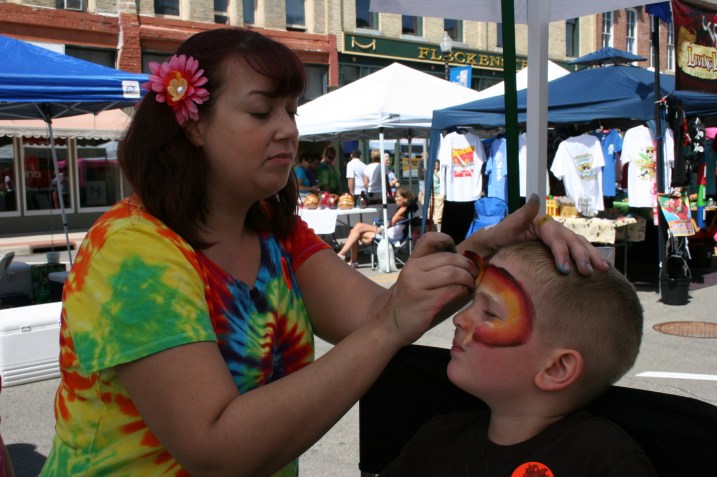
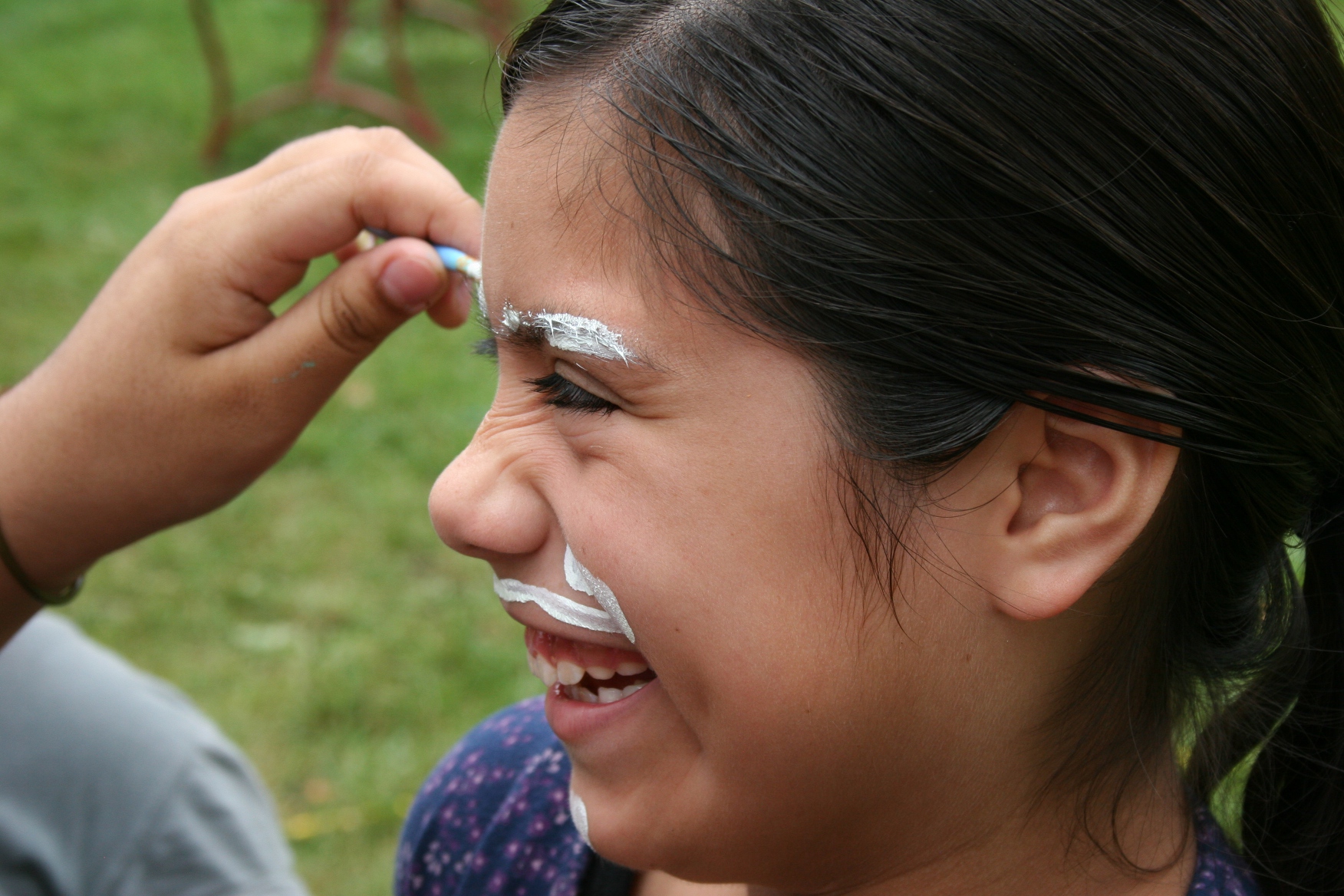
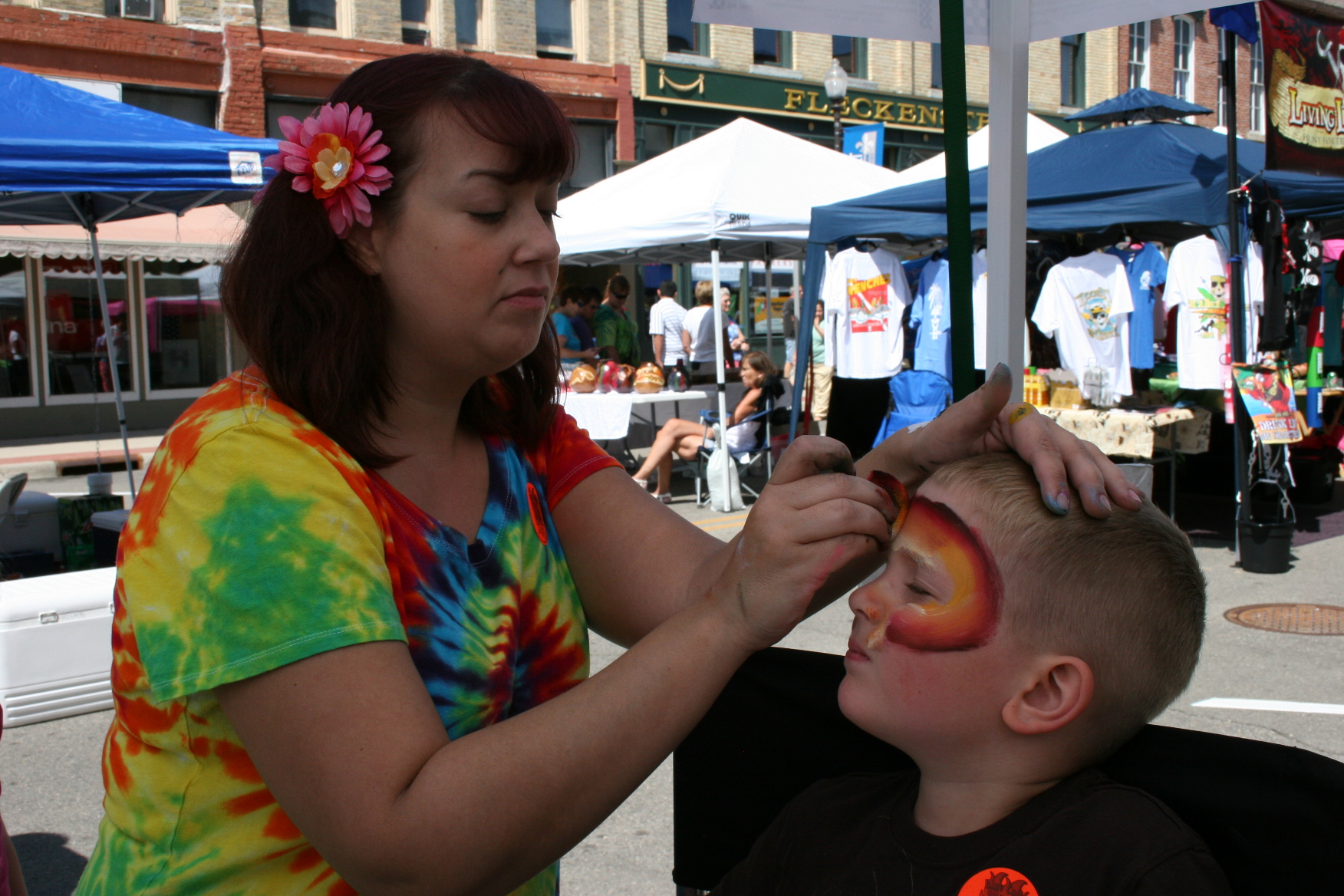
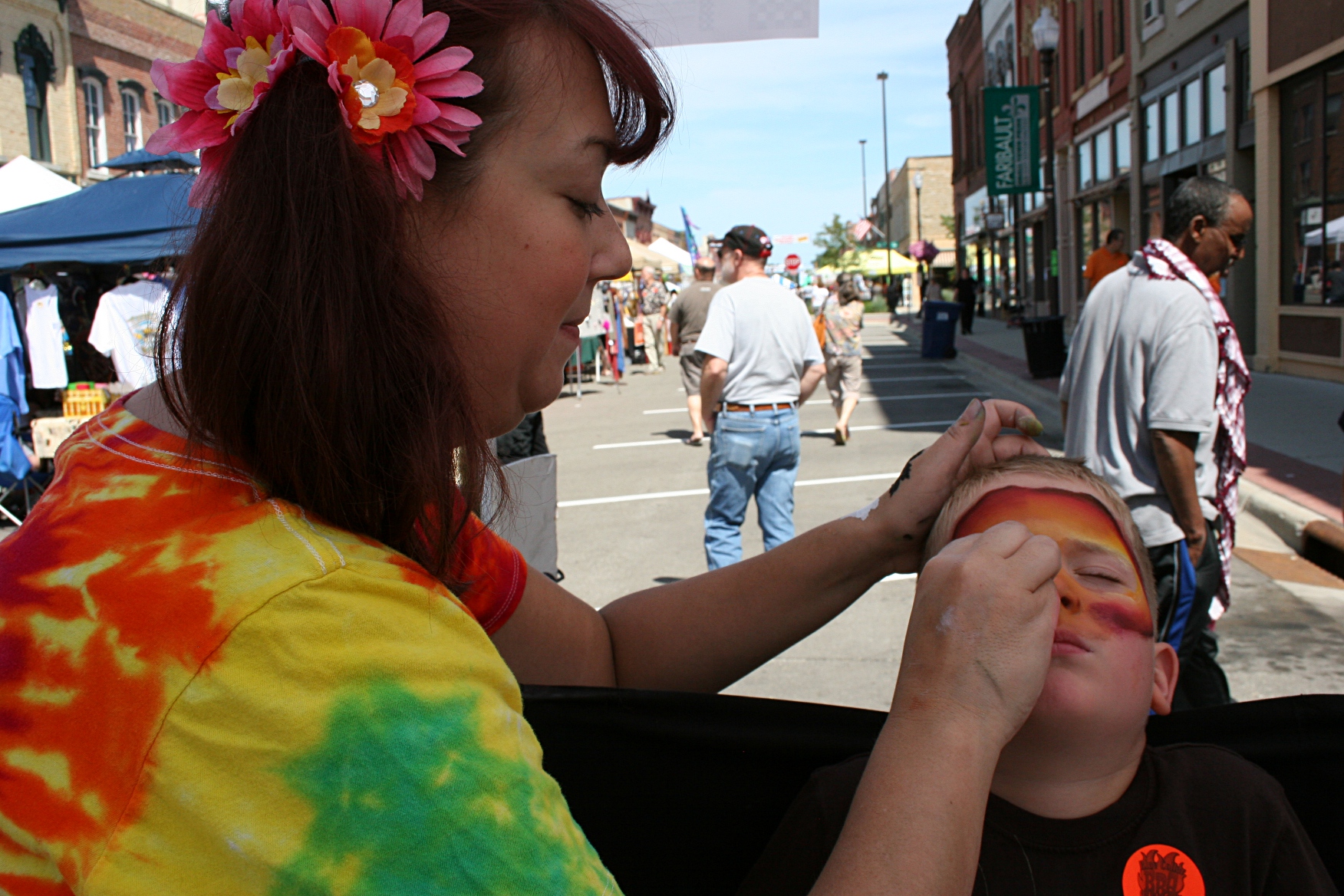
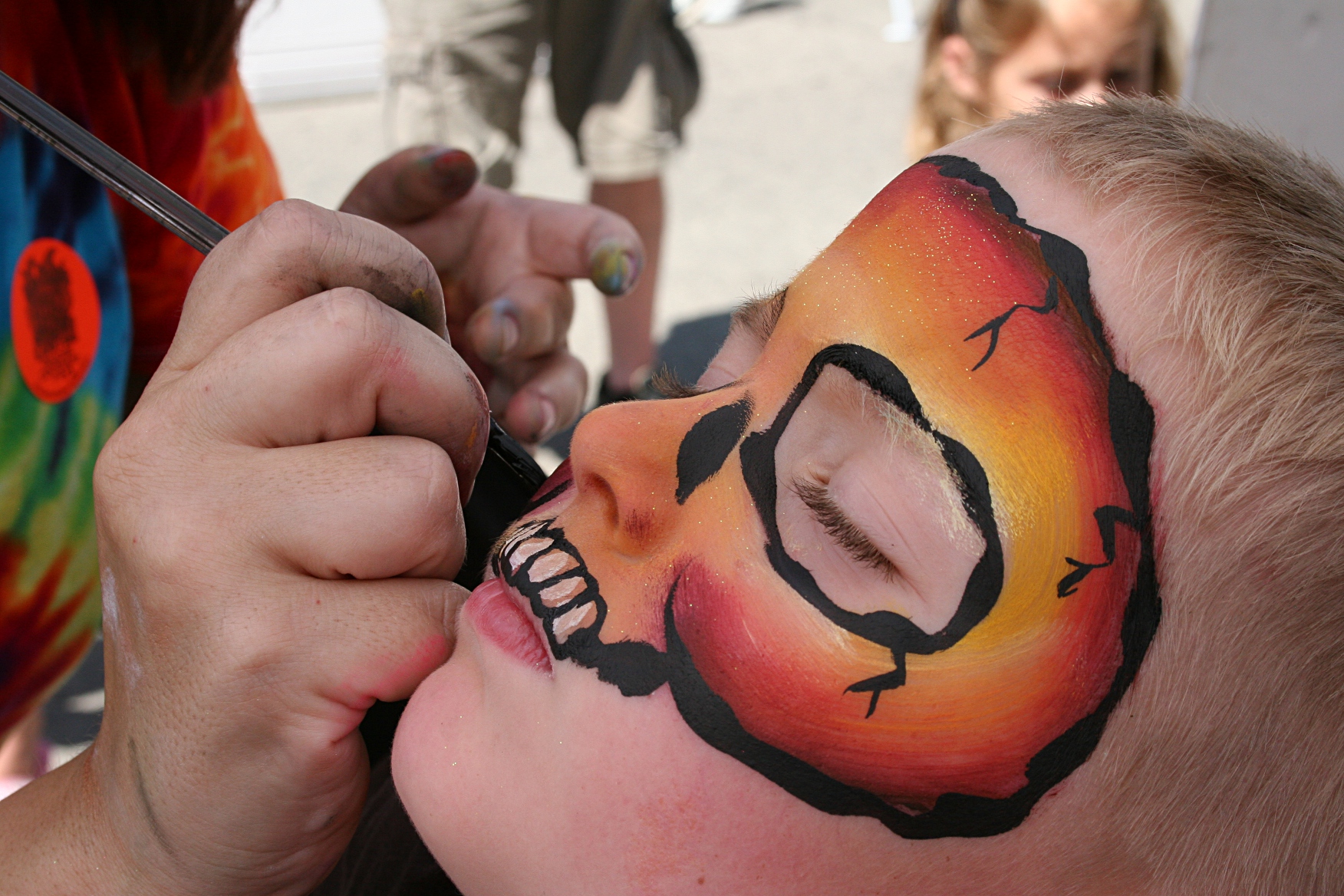
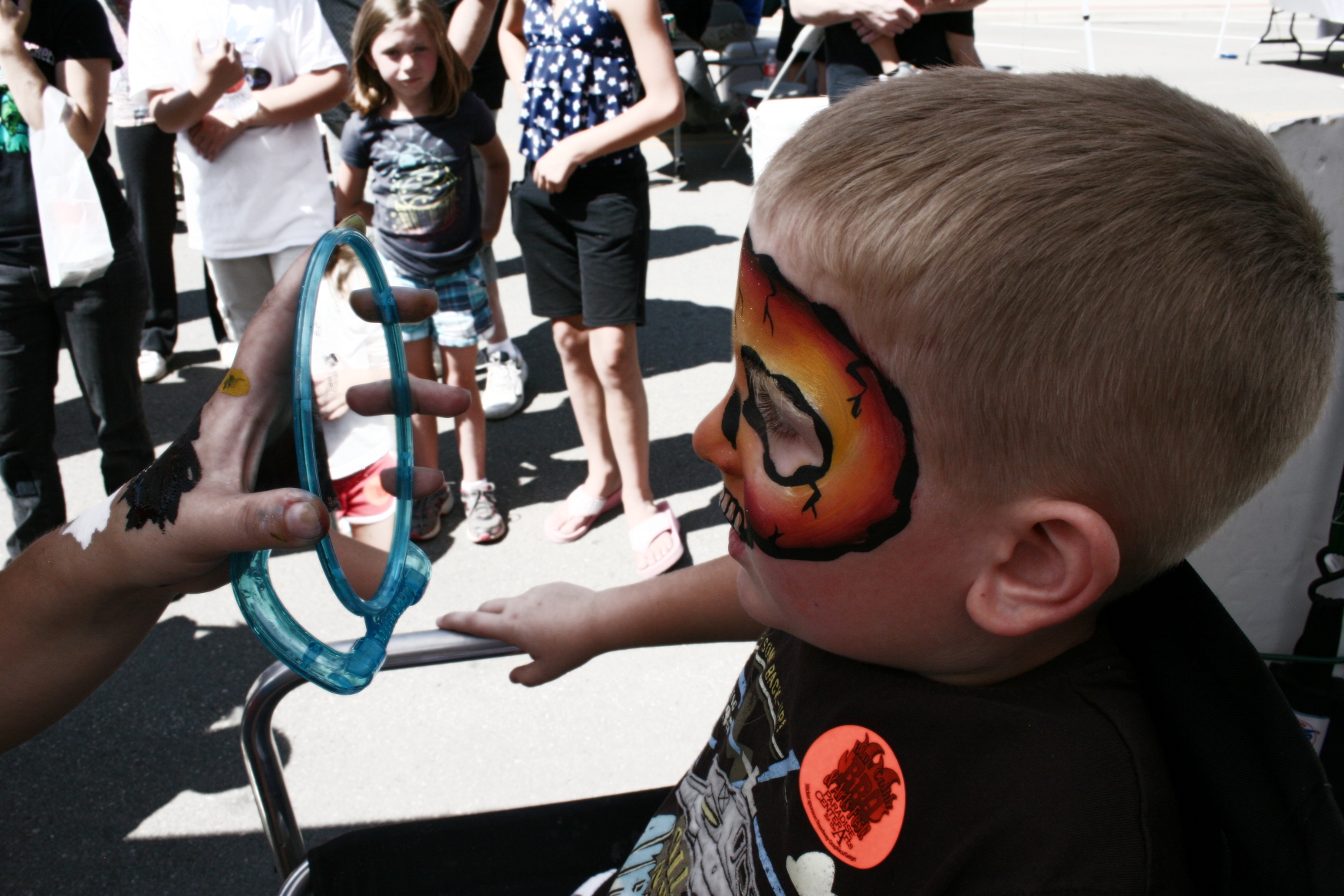
Jodi Gustafson of Big Shoe Entertainment begins transforming young Owen’s face into a Ghost Rider’s skull mask at the recent Blue Collar BBQ & Arts Fest in Faribault.
IMAGINING 37-YEAR-OLD JODI GUSTAFSON—also known as Lollipop the Clown, Jenius Strangeways or the proprietor of Big Shoe Entertainment and Jodelle’s Finery—as a once shy teen weaving down the hallways of Richfield and Coon Rapids high schools seems an impossibility.
But this vivacious and confident small business owner, whom I met at the recent Blue Collar BBQ & Arts Fest in Faribault where she was transforming faces through her stunning full face painting, reveals an adolescent timidness that contradicts her very public professions.
“I hated being shy,” said Gustafson, who recalls turning red if anyone so much as said “hi” to her. Determined to overcome that shyness, she eventually, and purposefully, chose a job with the United Way which involved public speaking.
“I knew I would never change if I didn’t get out of my comfort zone.”
That decision proved pivotal for Gustafson when a company wanted a carnival theme for its campaign but couldn’t afford to hire a clown. Gustafson volunteered, thinking clowning couldn’t be all that difficult. She was wrong, but continued anyway with the clowning which led to painting cheek art and then, with the encouragement of Cindy Trusty of Cindy’s Creative Celebrations, to full face painting and finally the official formation of Big Shoe Entertainment in the early 2000s.
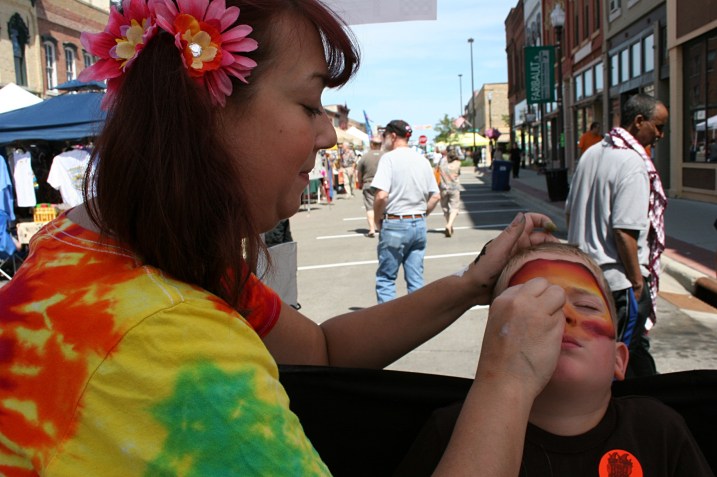
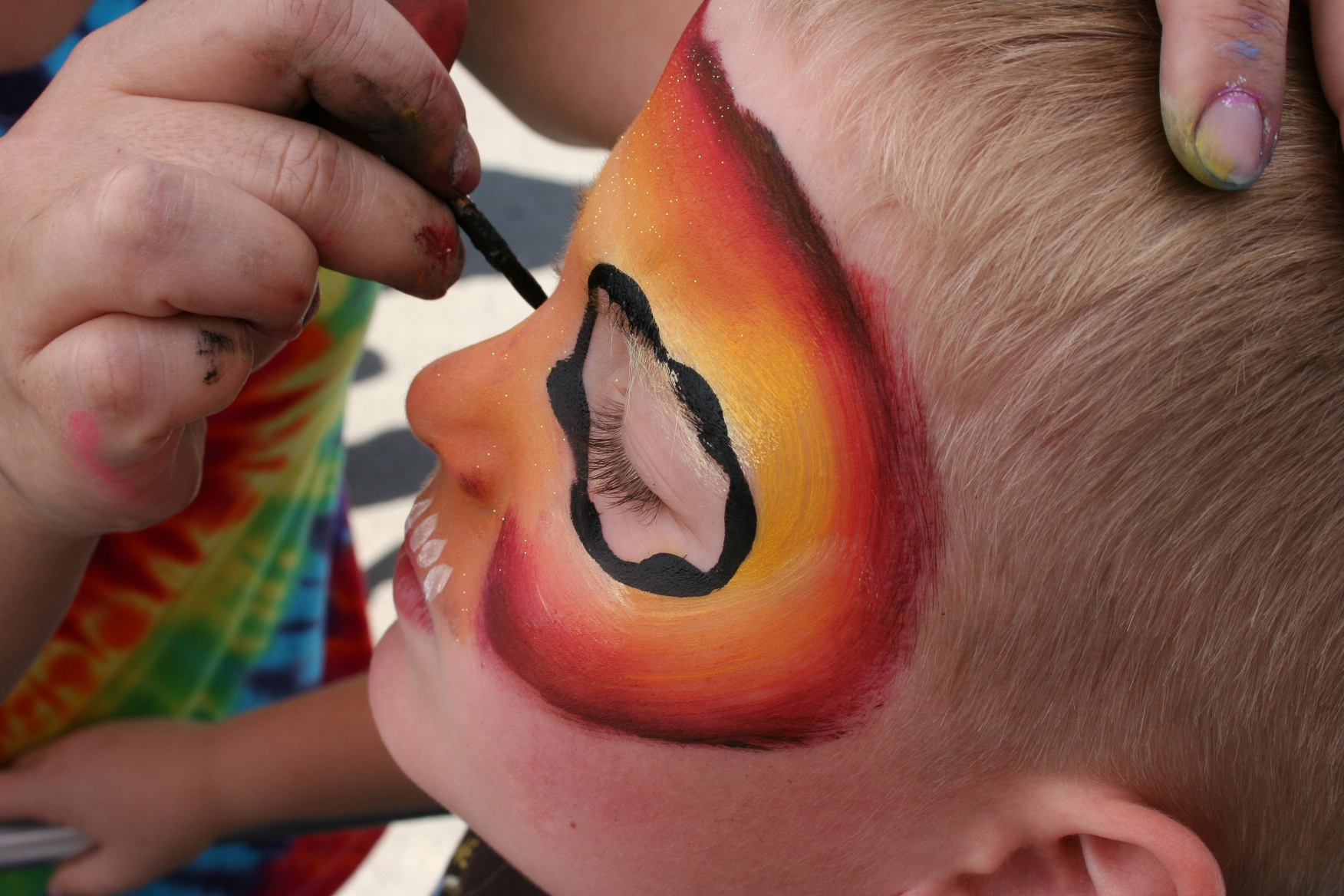
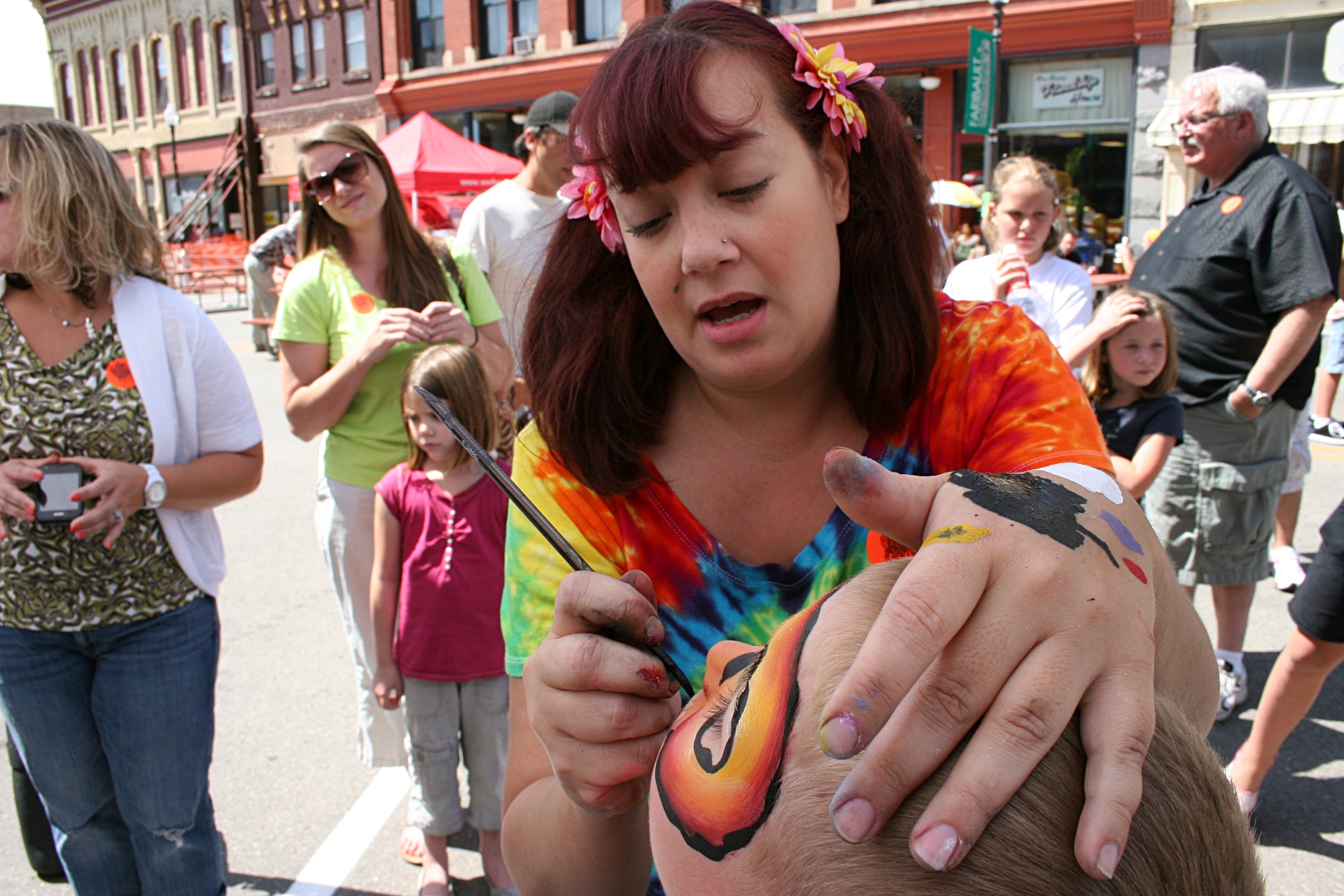
Owen’s half-mask skull evolves under Gustafson’s skillful hands. She contracts her work for community and private events (such as birthday parties) and with corporations (such as for company picnics).
Today this mother of three (ages three to 17) operates two successful small businesses from her Bloomington home. Big Shoe Entertainment, encompassing clowning, balloon twisting, airbrushed and glitter tattoos, henna and crazy hair, but primarily full face painting, keeps her crazy busy, especially during the summer, with gigs throughout Minnesota, Iowa and Wisconsin. The pace slows during the other seasons.

An assortment of the make-up, all with FDA-approved ingredients and meant to be used on the body and face, which Gustafson uses for face painting.
In anywhere from one to five minutes Gustafson, with brushes and make-up pads and an array of colorful make-up, can transform a face into a work of art. She’s morphed five billion faces, she exaggerates, into butterflies, and also creates lots of flowers and princesses, and masks such as skull, dragon and Mardi Gras.
She especially enjoys painting “gore” faces, but seldom has the opportunity.
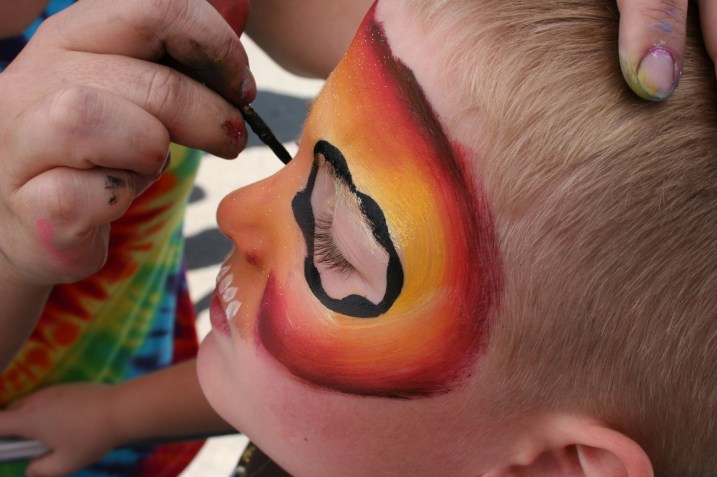
Owen sits perfectly still as Gustafson paints. Some kids squirm or won’t close their eyes, meaning she sometimes needs to adjust her work to eliminate painting around the eyes or needs to explain step by step what she is doing. Typically, Gustafson doesn’t talk while painting faces.
She’s always learning—from videos, books, classes and practice. That practice includes painting designs all over her arms and legs while relaxing at home in front of the television. Gustafson puts her own spin on existing patterns via color choices and painting style, defining her work as her own in a profession that’s becoming more saturated. Yet, most are not at her level of expertise, she says, in an honest, but not boastful, way.
Gustafson works with two agents and occasionally hires independent contractors to assist at events where she can’t handle the volume solo. She’s picky, though, and chooses only the best artists.
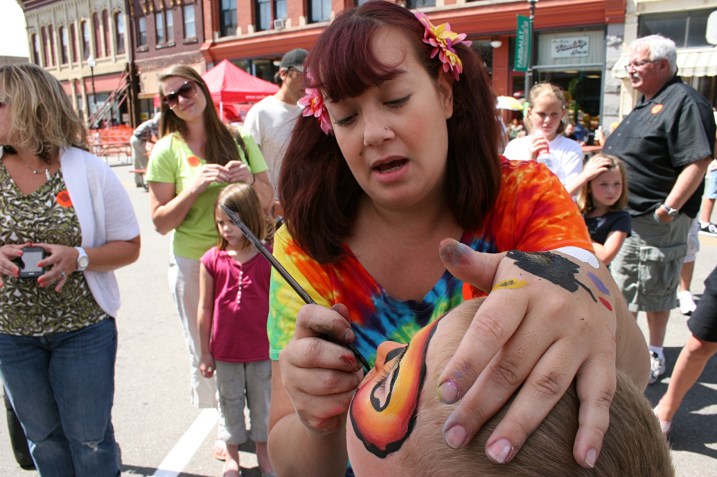
American Family Insurance of Faribault sponsored free full face painting by Gustafson at the recent Blue Collar BBQ & Arts Fest. Lines were long. Gustafson painted for five hours, averaging 20 – 25 faces per hour. If she returns next year, she’ll bring another painter, she says, to shorten those lines.
All of this is interesting given Gustafson early on was intimidated by full face painting. Clearly she’s not anymore as she works with the swiftness and assurance of a skilled artist. She always had an interest in art, she says, but not the confidence. She took art classes in high school and moved on to painting still lifes in acrylic on canvas, something she has no time for now.
Besides mothering and operating Big Shoe Entertainment, Gustafson also owns Jodelle’s Finery, specializing in Renaissance and Victorian “garb.” That’s her term, “garb,” referencing the durable period clothing she fashions, as opposed to “costumes,” for the Minnesota Renaissance Festival and steam punk events. (Steam punk fashion, since I didn’t know and perhaps you don’t either, is Victorian clothing with a technological, sci-fi twist.)
Even Jodelle’s Finery, in typical Gustafson fashion, has an interesting beginning. When pregnant with her middle child, Gustafson was feeling quite domestic and taught herself to sew. Her first project was a baby quilt. Today she’s advanced to sewing that garb for others and for her role as the street performer Jenius Strangeways at the Minnesota Renaissance Festival.
Yes, this once shy teen morphed into an actress too—role playing at the Renaissance and on the stages of community theaters in Faribault (where she lived until moving to Bloomington in June), Owatonna and Northfield.
“I don’t like to be still,” claims Gustafson, who before she took on the Renaissance acting gig two years ago, worked in shops at the Minnesota festival.
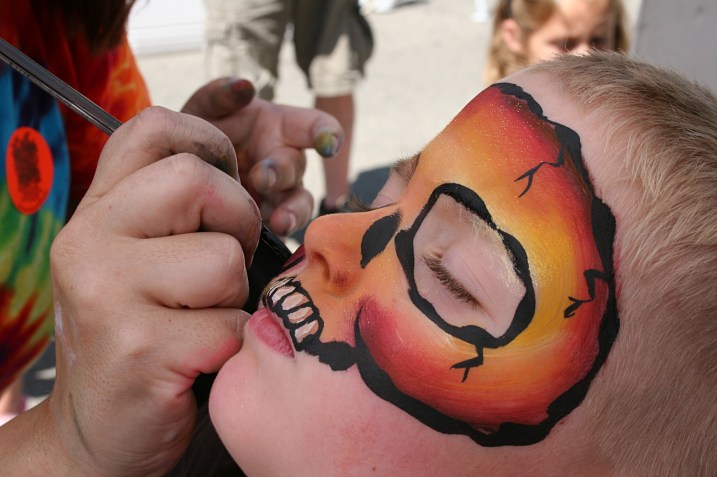
Owen’s skull face mask is almost done.
Yet, in the middle of all that public busyness of painting faces and clowning and acting, Gustafson says she still occasionally slips back in to the quiet, nervous and shy Jodi of years past. That happens, she explains, if she’s not role-playing and doesn’t know anyone at an event she’s working.
Mostly, though, she’s made a choice to get past her shyness, to be the strong and confident woman who paints faces, entertains and clothes entertainers via her two successful businesses.
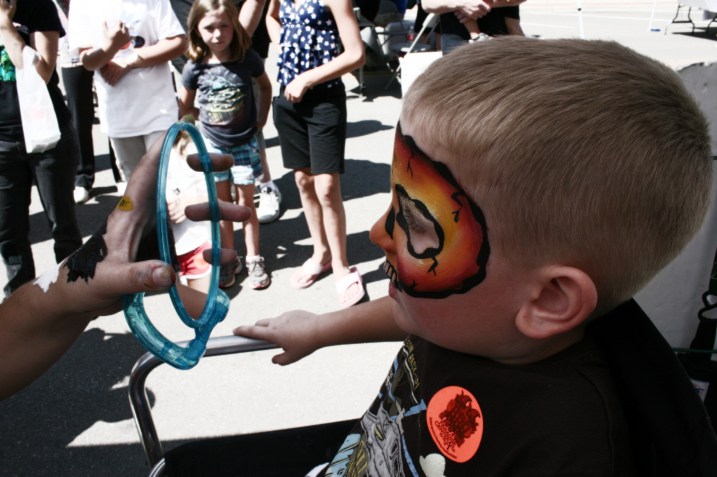
Owen opens his eyes for the great reveal.
FYI: Jodi Gustafson doesn’t have a website for Big Shoe Entertainment, so don’t bother trying to find one. You may contact her via email at gusjodi@gmail.com or call her at (952) 215-4544. You can also check out her Jodelle’s Finery Facebook page by clicking here.
I initially developed this post idea to showcase Gustafson’s full face painting because I was so impressed by her work. But when I interviewed her about a week later and learned how she overcame her shyness, that became the real story. I hope you will be inspired, as I am, by Gustafson’s determination to overcome an obstacle, change and pursue her passions in life as her professions.
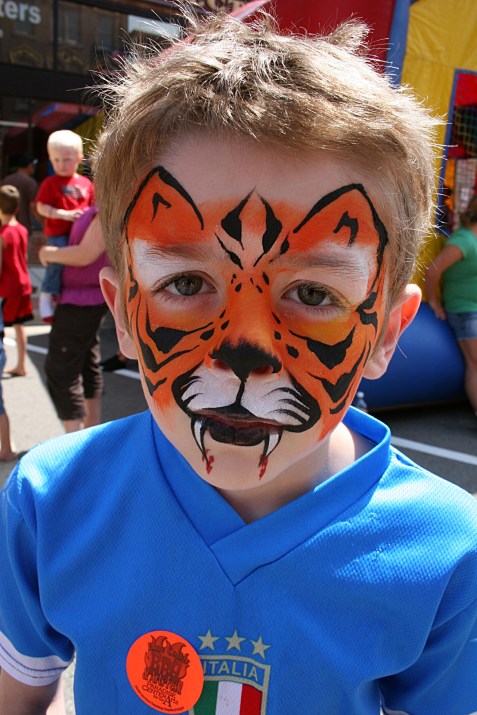
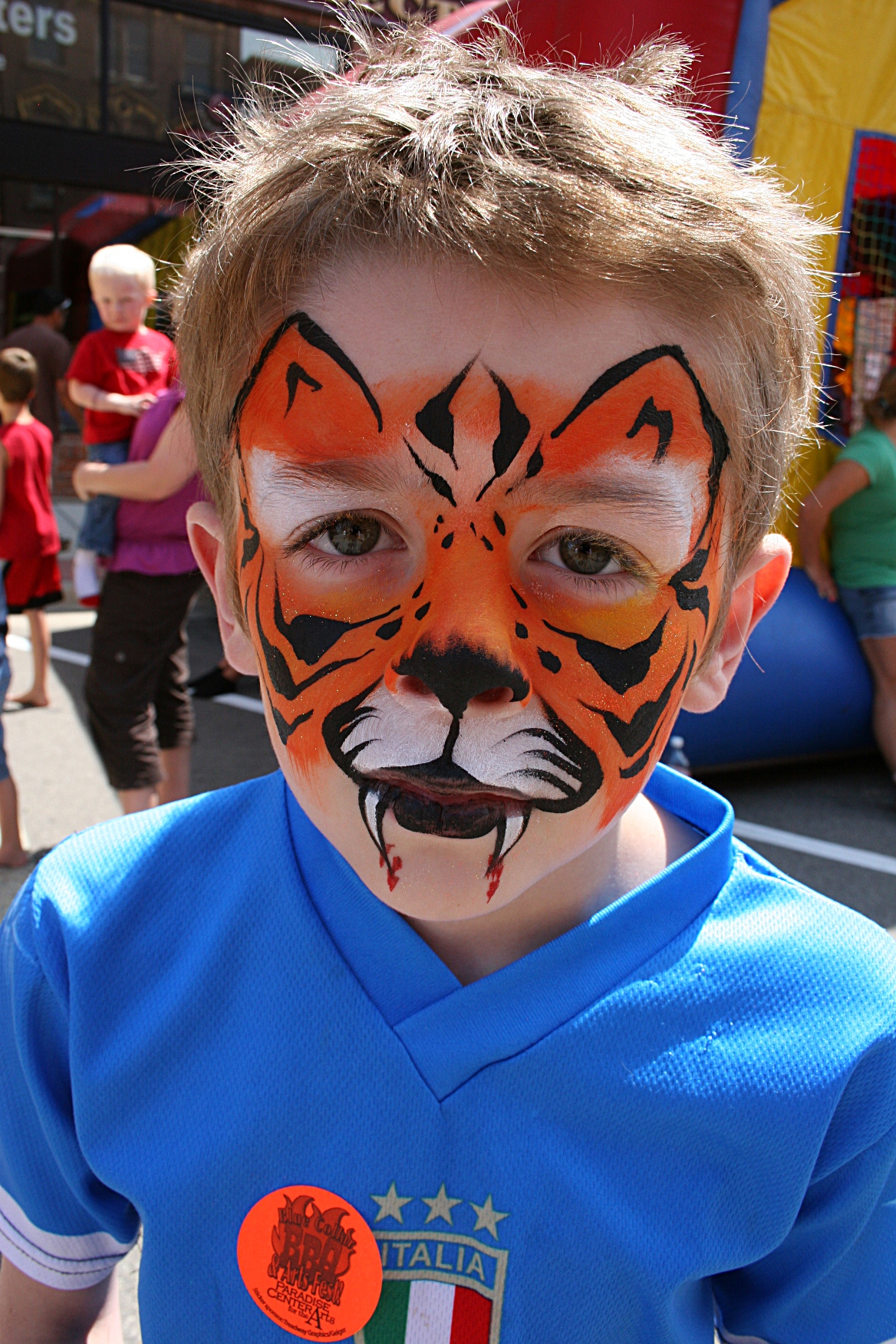
Gustafson transformed Isaac into a tiger at the Faribault festival.
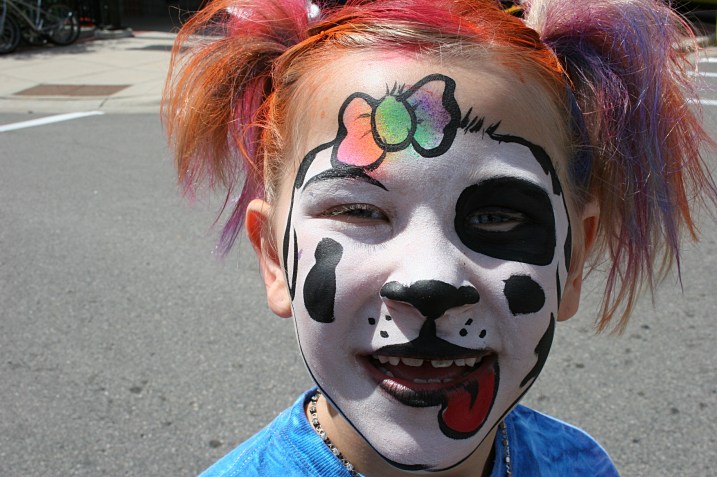
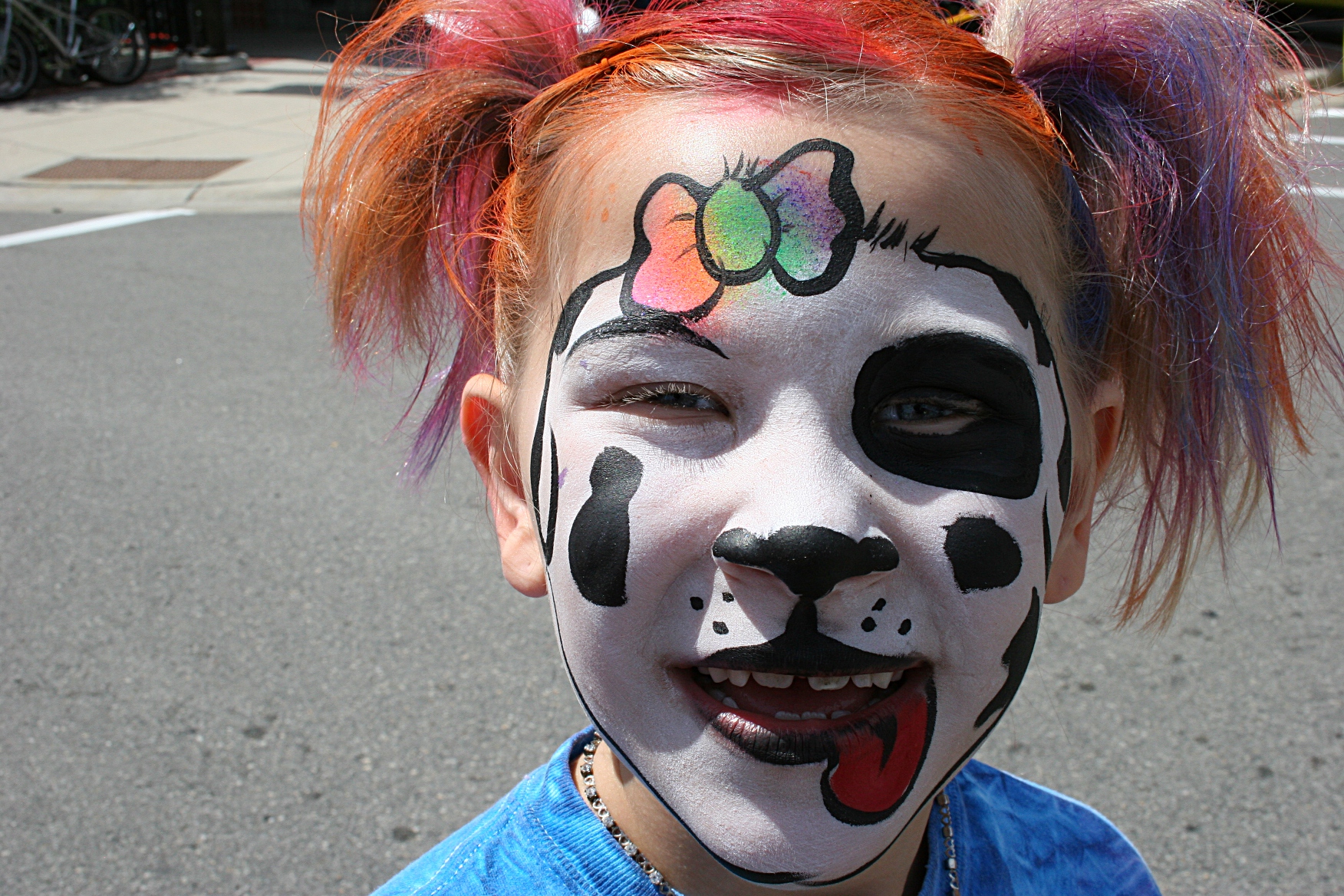
Isabella, 7, of Faribault, became a dalmatian under Gustafson’s crafting. Butterflies and dalmatians proved the most popular paintings chosen by attendees at the Faribault fest.
© Copyright 2012 Audrey Kletscher Helbling

























Recent Comments