Minnesota Prairie Roots

Writing and photography by Audrey Kletscher Helbling

Minnesota mining disaster up close & personal at Milford Mine Memorial Park September 2, 2021

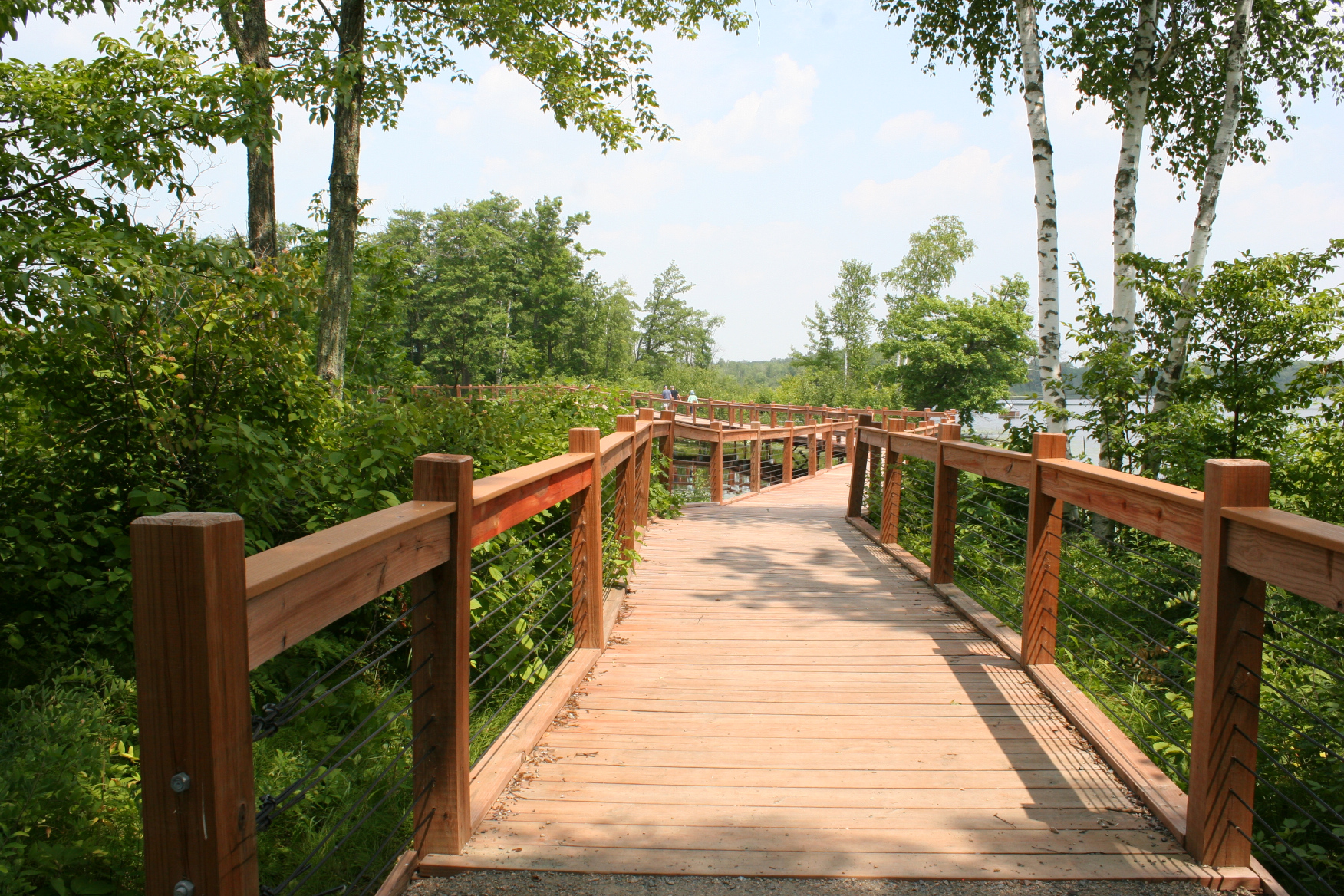
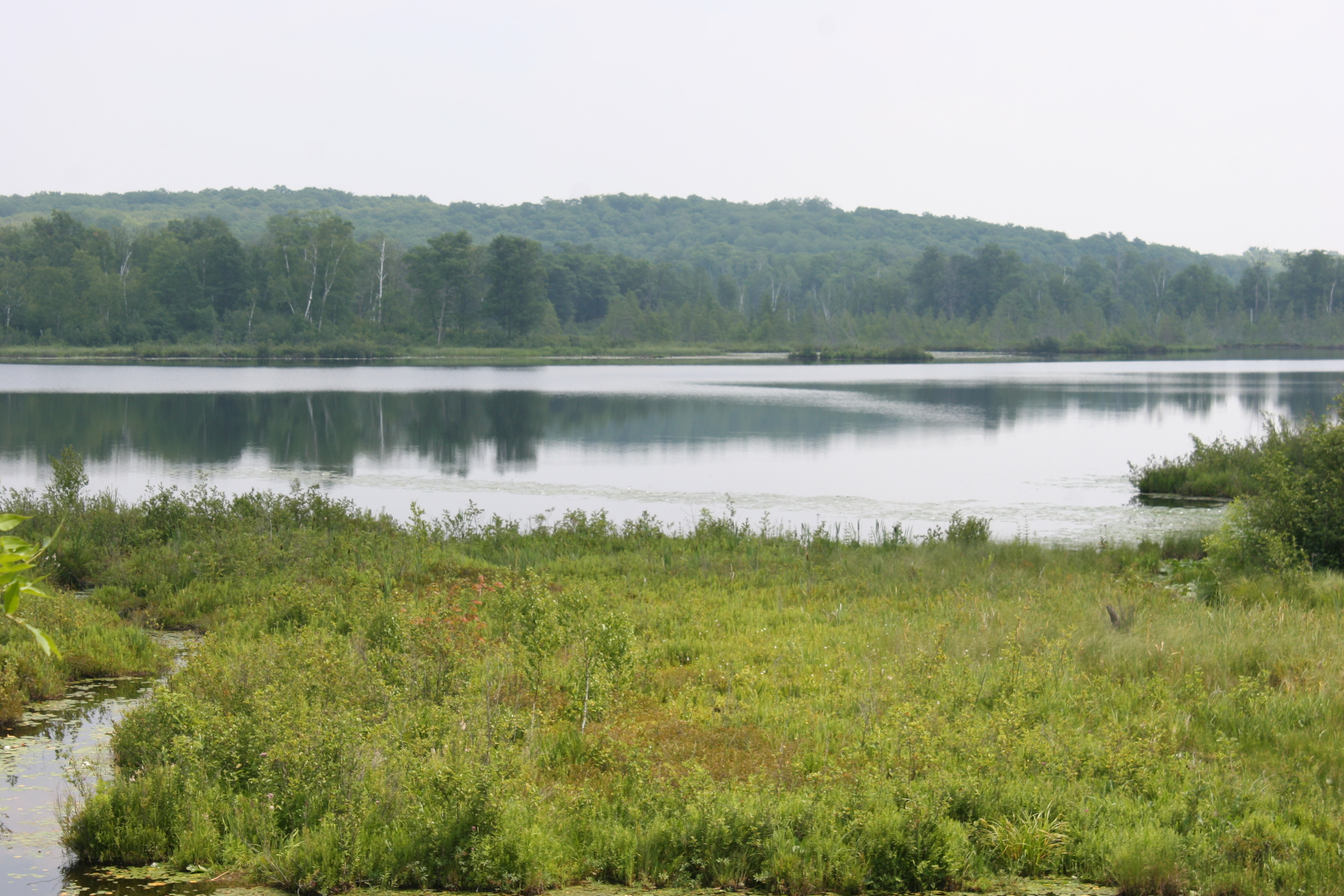
A peaceful and lovely scene at Milford Mine Memorial Park on a hazy July afternoon, rural Crosby. Minnesota Prairie Roots copyrighted file photo July 2021.

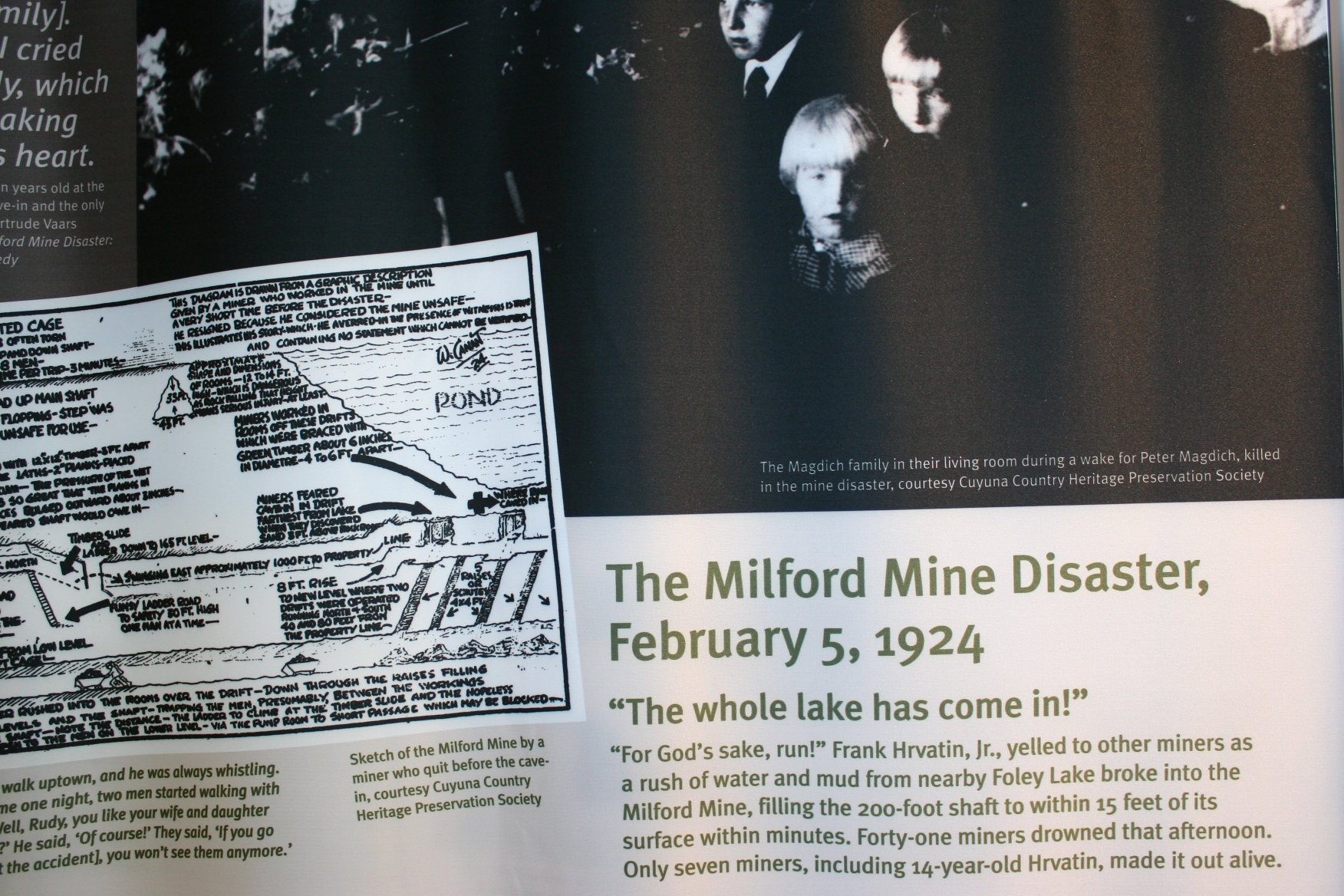
IN A BEAUTIFUL NATURAL SETTING, among the woods and water and wetlands, an American tragedy unfolded nearly 100 years ago on the Cuyuna Iron Range. In the late afternoon of February 5, 1924, water seeped into and then flooded the Milford Mine near Crosby, killing 41 miners in Minnesota’s worst mining disaster.

Information about the mine disaster is included in a traveling exhibit from the Minnesota Historical Society. I photographed this at the Steele County History Center in Owatonna several years ago. Minnesota Prairie Roots file photo.

Their deaths left 38 women without husbands. And 83 children without fathers.

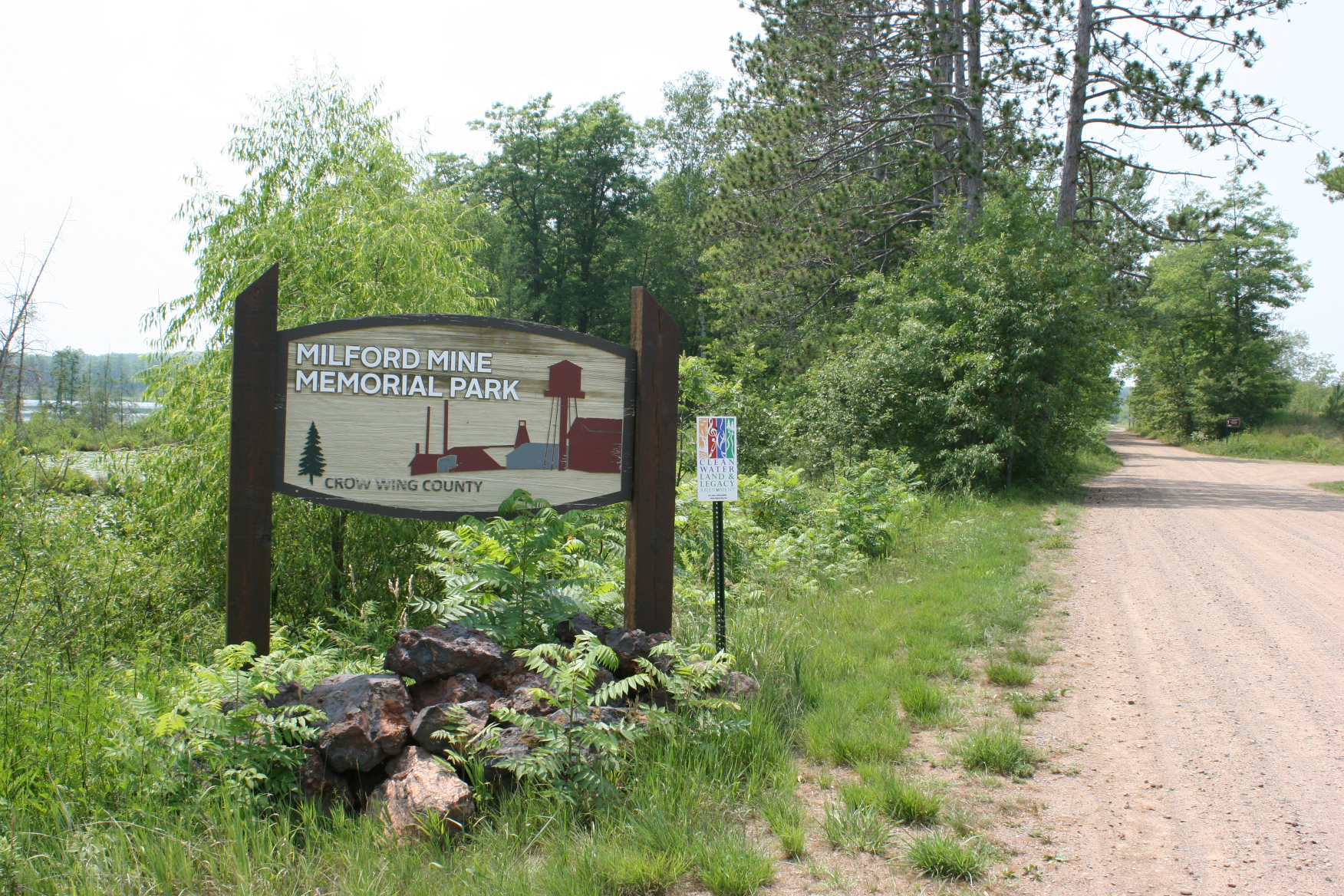
This sign marks the gravel road entry to the memorial park. Minnesota Prairie Roots copyrighted file photo July 2021.

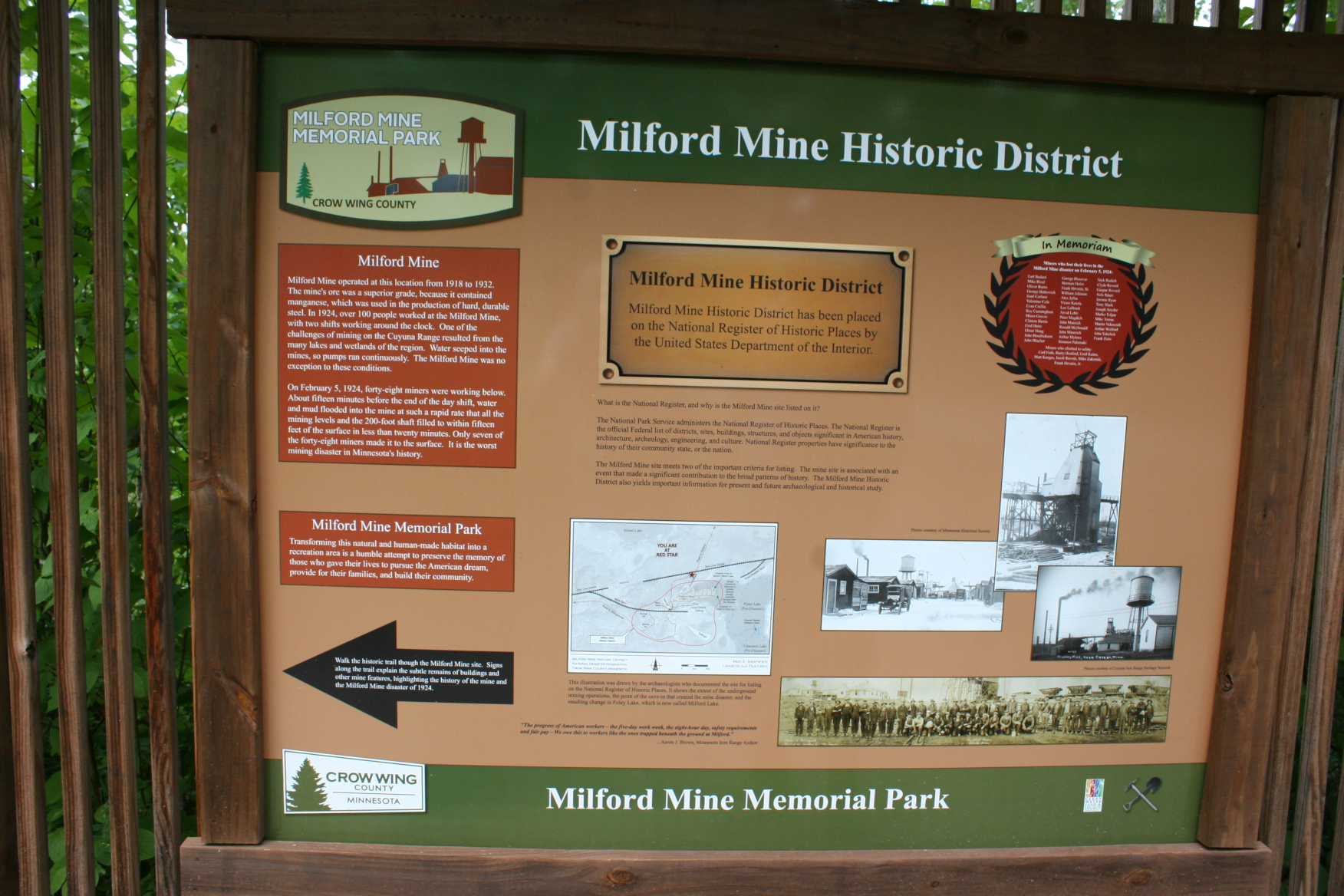
Today the memories of those 41 hardworking iron ore miners, and the seven who survived the mine collapse, are honored at Milford Mine Memorial Park. The Crow Wing County Park is located four miles north of Crosby, just off County Road 30. The Milford Mine Historic District is on the National Register of Historic Places, so important is this to the region’s mining history.

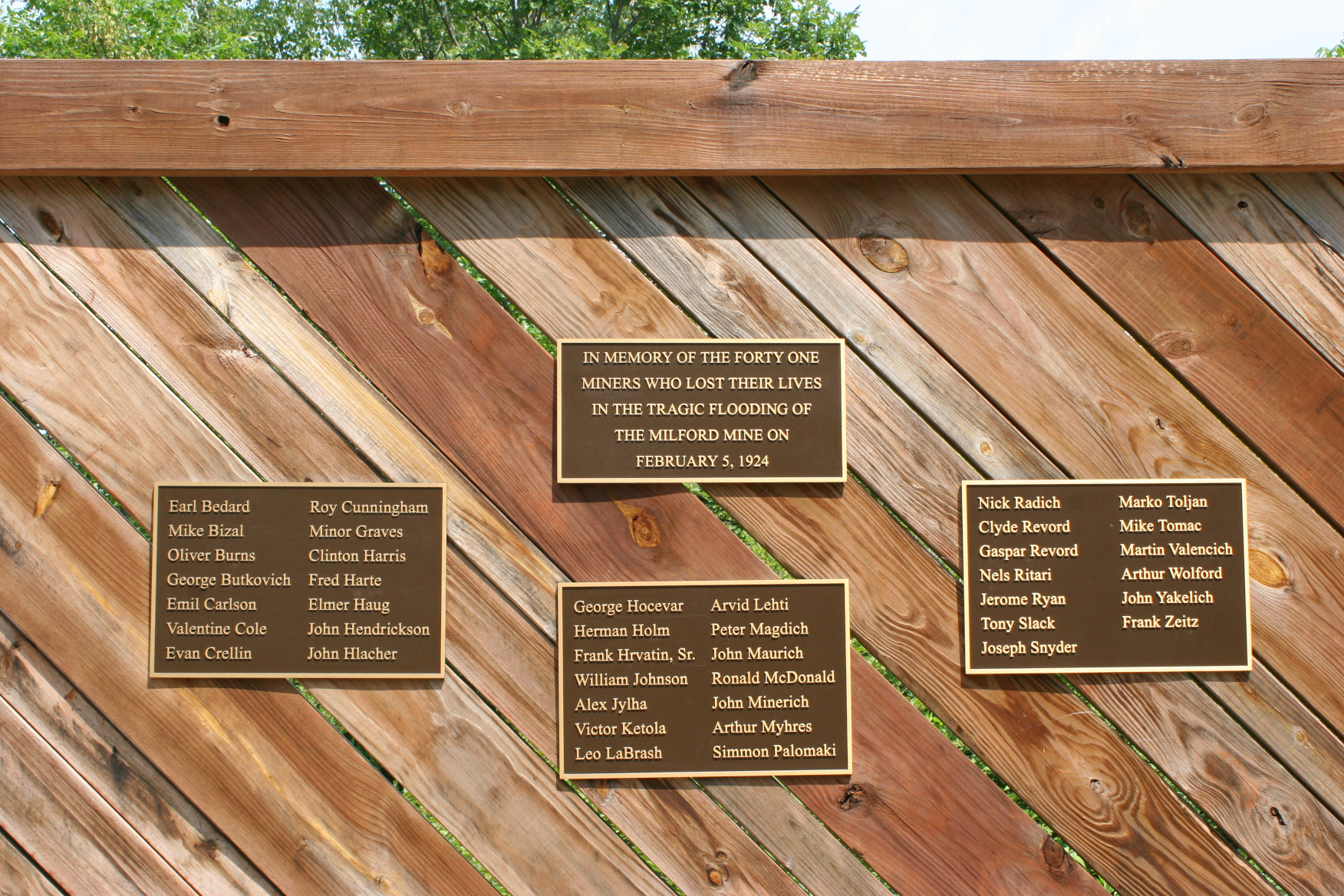
Those who died in the mine. Minnesota Prairie Roots copyrighted file photo July 2021.
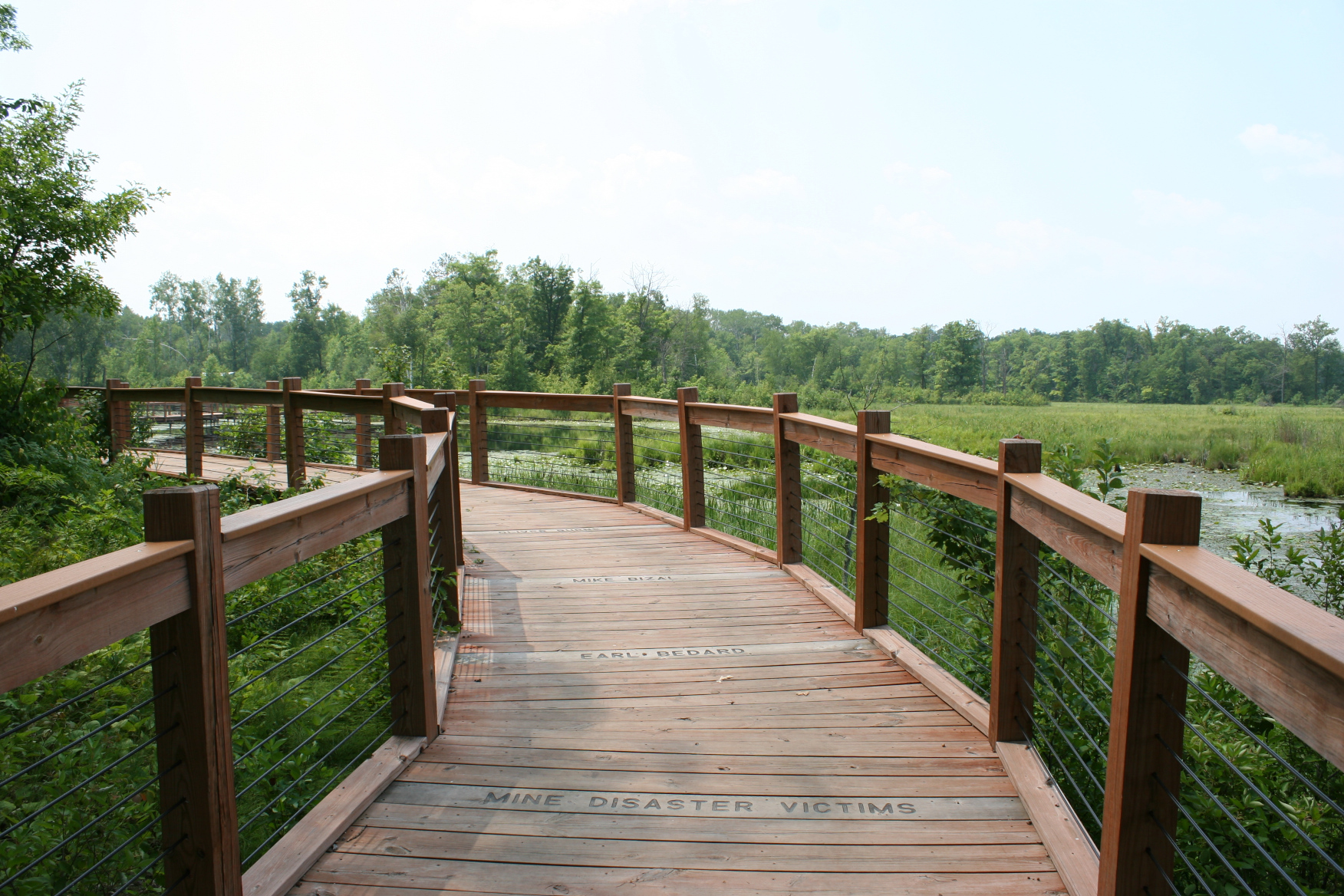
The first boardwalk lists the victims’ names, spaced along the path. Minnesota Prairie Roots copyrighted file photo July 2021.
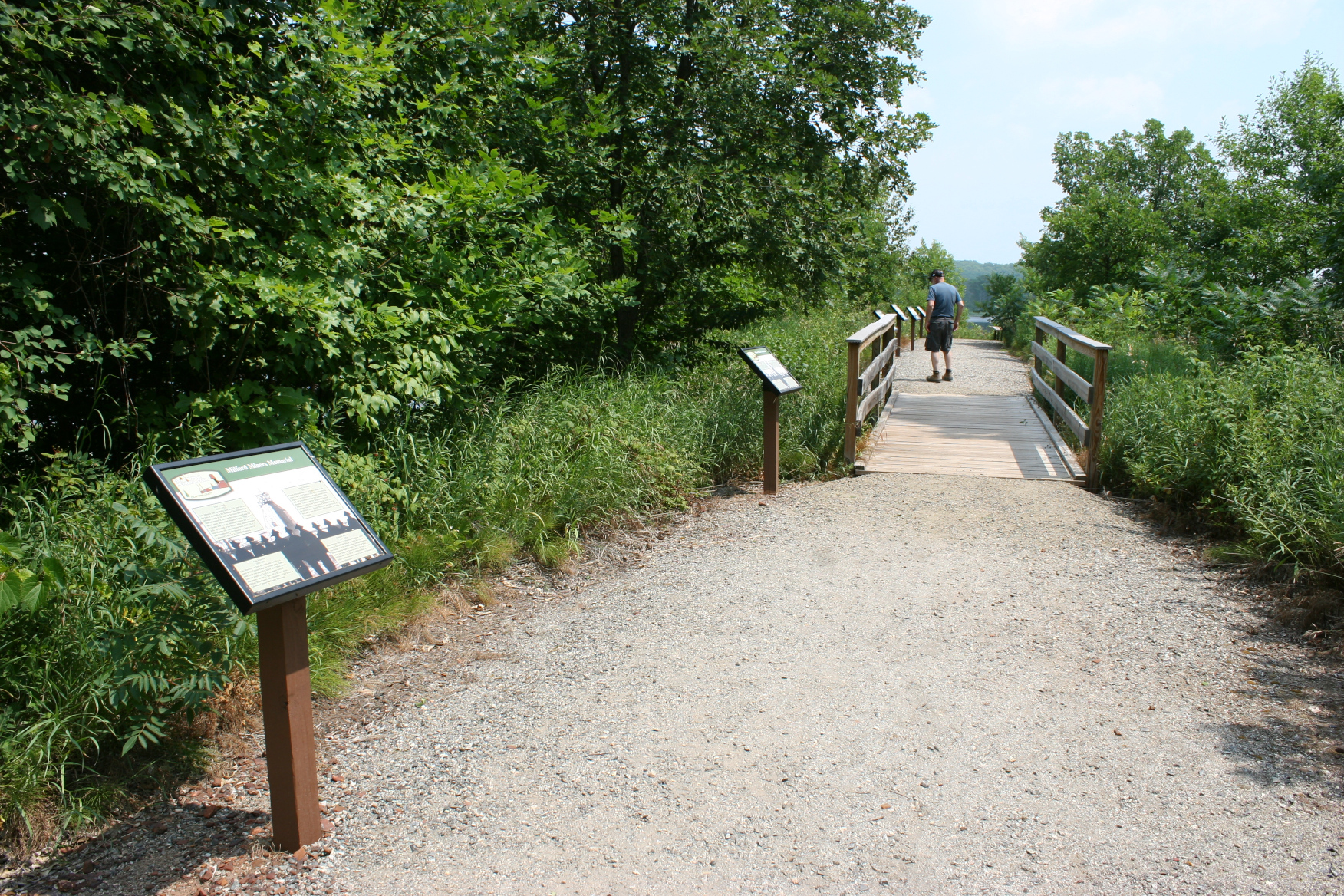
Signs along the trail honor each miner. Minnesota Prairie Roots copyrighted file photo July 2021.

This is truly a remarkable park that covers the history of this event in a deeply personal way. Through names on boardwalks and brief bios on signs, this park moves this disaster beyond statistics. Only then do we begin to understand, to feel the loss.

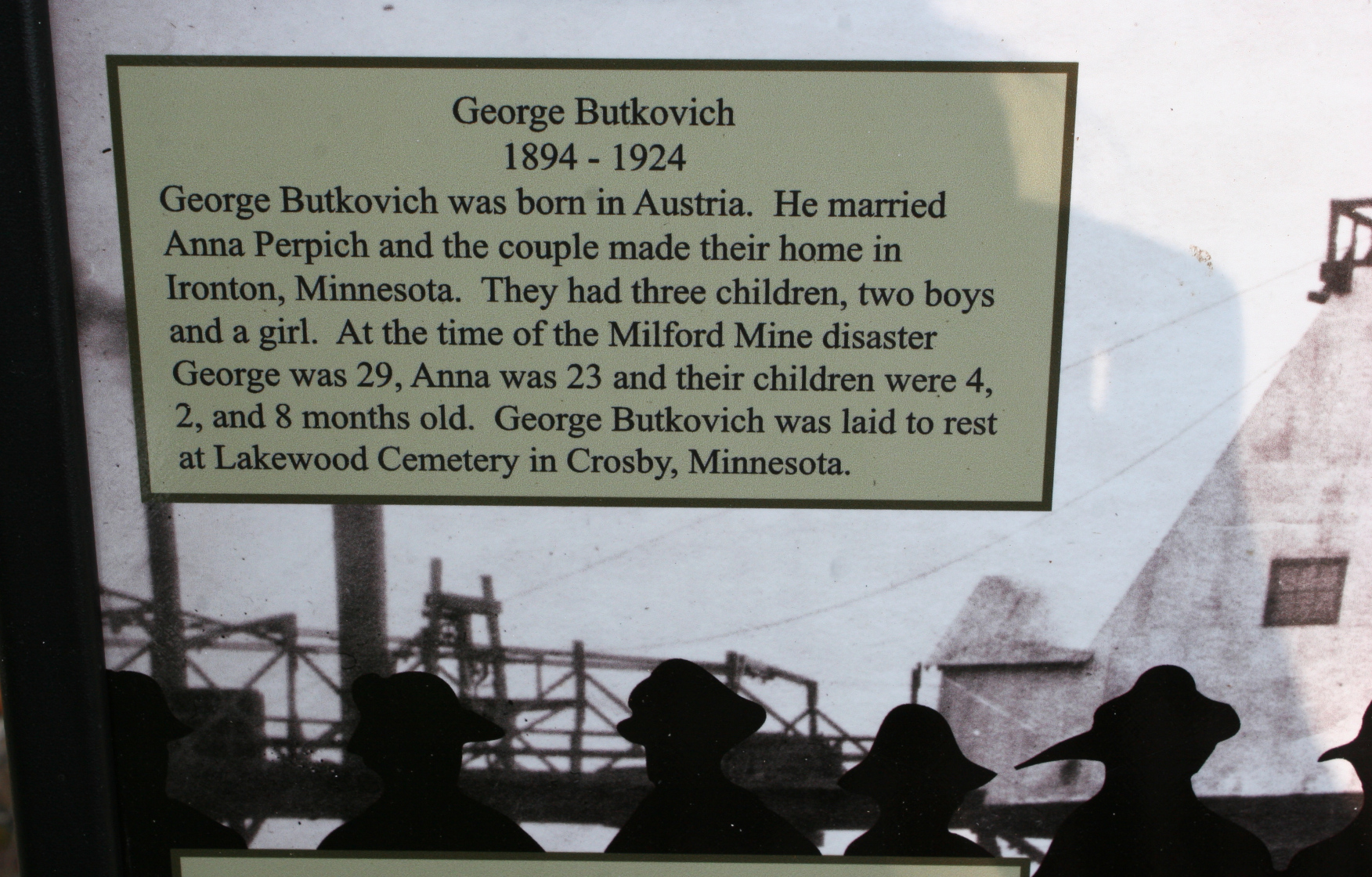
Honoring George Butkovich. Minnesota Prairie Roots copyrighted file photo July 2021.

George Butkovich, 29, an Austrian immigrant married to Anna Perpich (a well-known name to Minnesotans who remember our 34th and 36th governor, Rudy Perpich, a native of the Iron Range) died in the mine. He lived with Anna and their three children in Ironton.

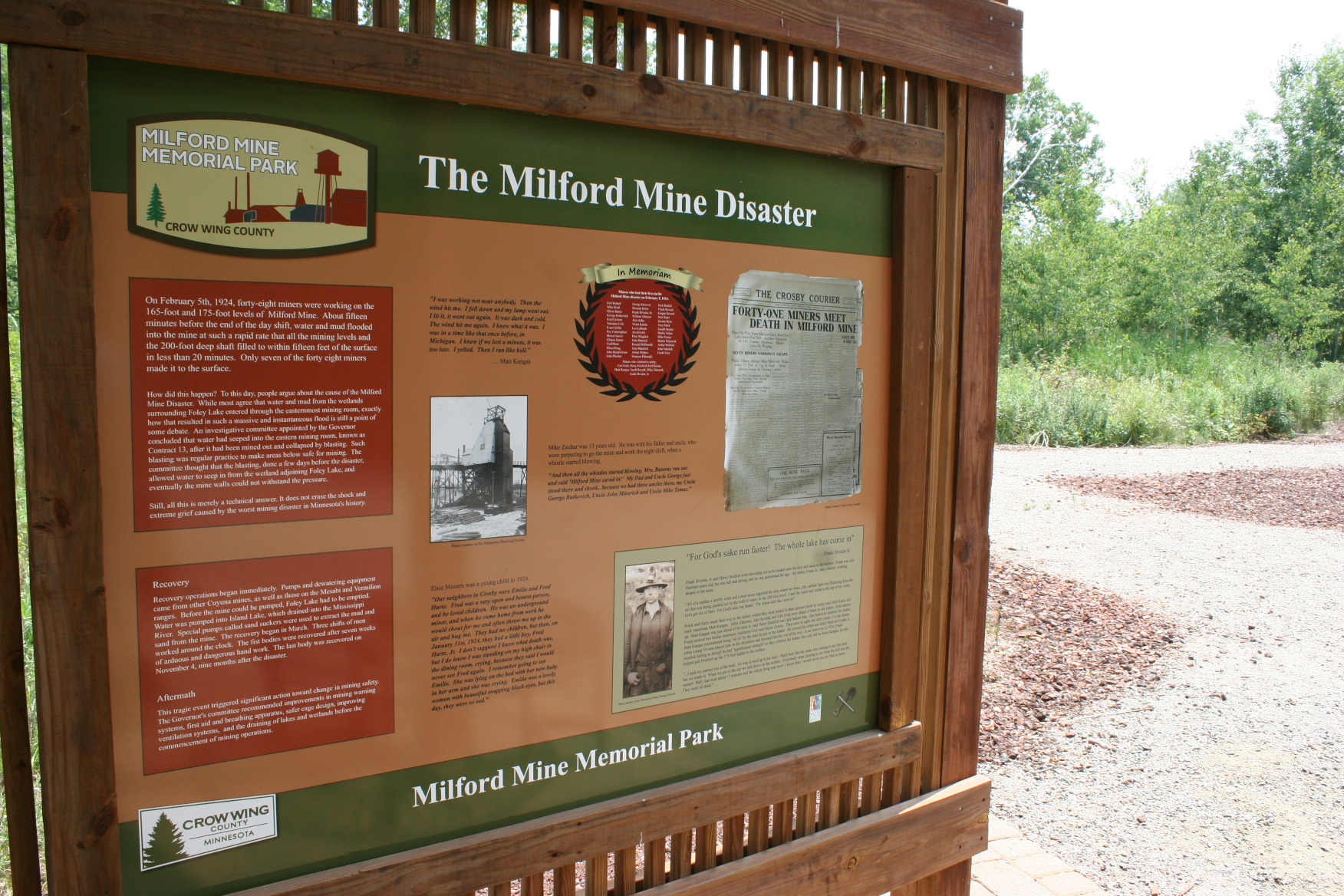
A summary of the disaster. Minnesota Prairie Roots copyrighted file photo July 2021.

Emil A. Carlson, 29, from Finland, was the father of four and married to Elma. They lived in Crosby.

The bios of four who died in the mine. Minnesota Prairie Roots copyrighted file photo July 2021.

Nels R. Pitari, 37, also a Finnish immigrant, was married to Hilda. They lived in Brainerd and had four children, one only five months old at the time of his father’s death.

The park is not only a great place to learn about history, but also a great place to hike and enjoy nature.
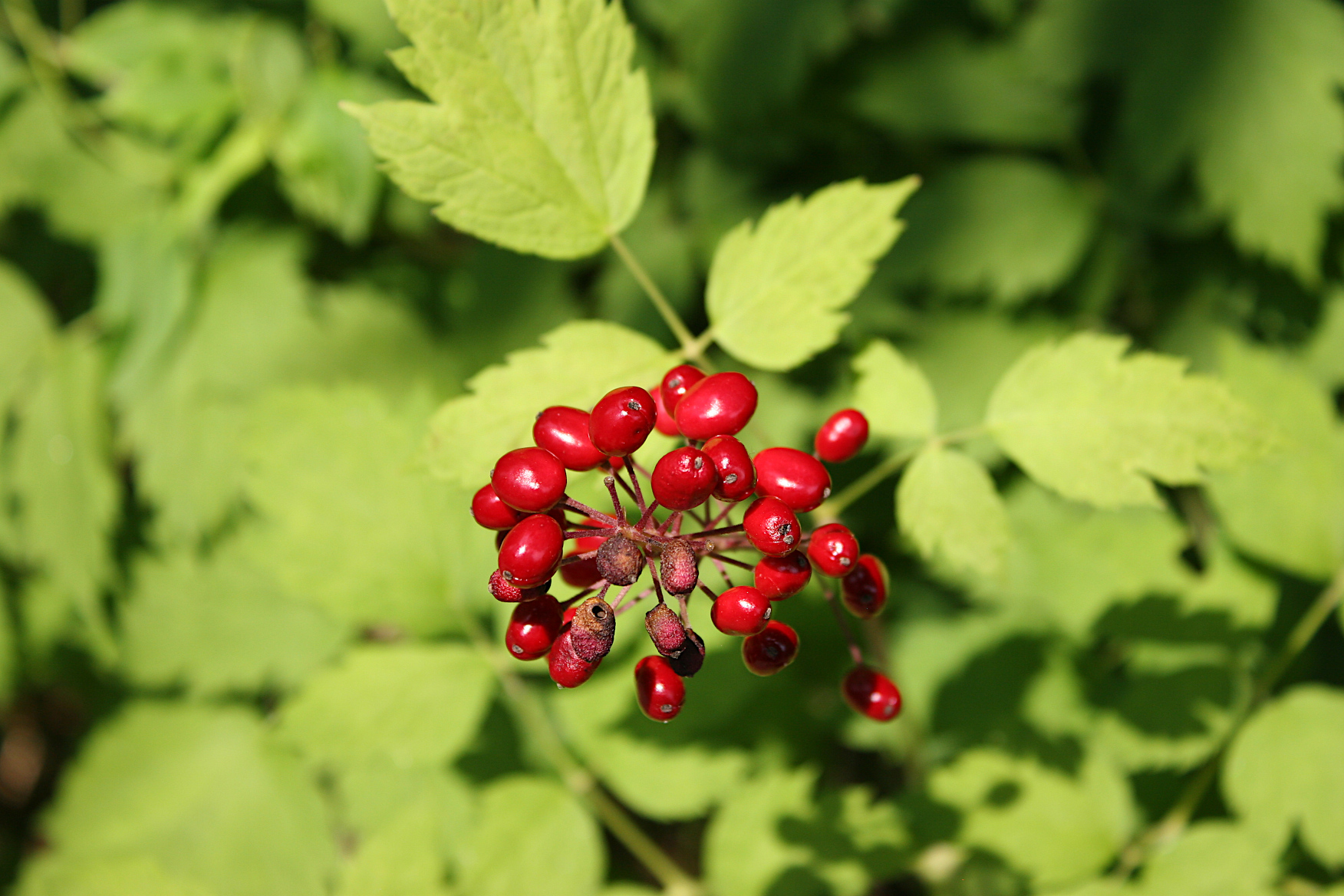
Bold berries pop alongside the trail. Minnesota Prairie Roots copyrighted file photo July 2021.
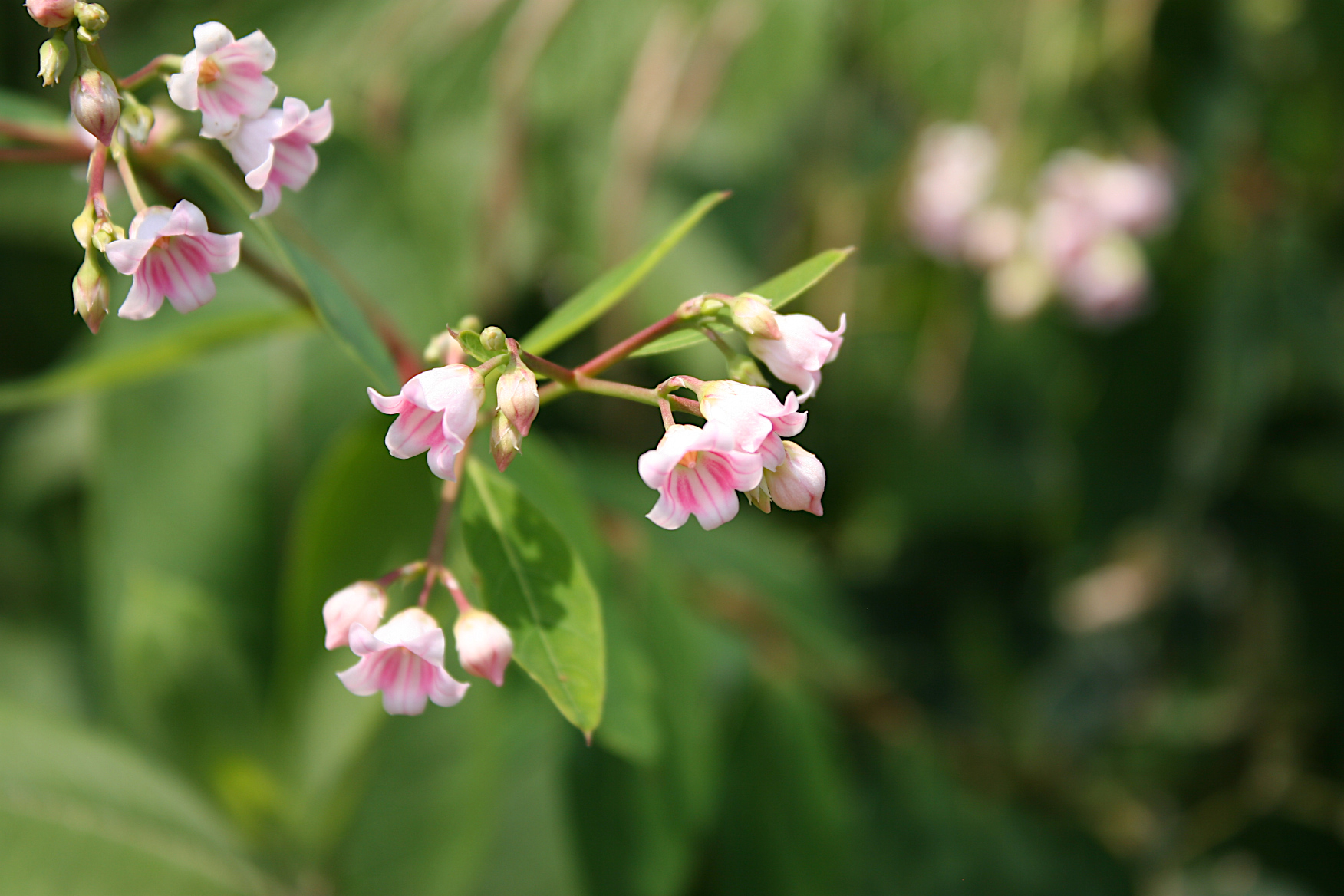
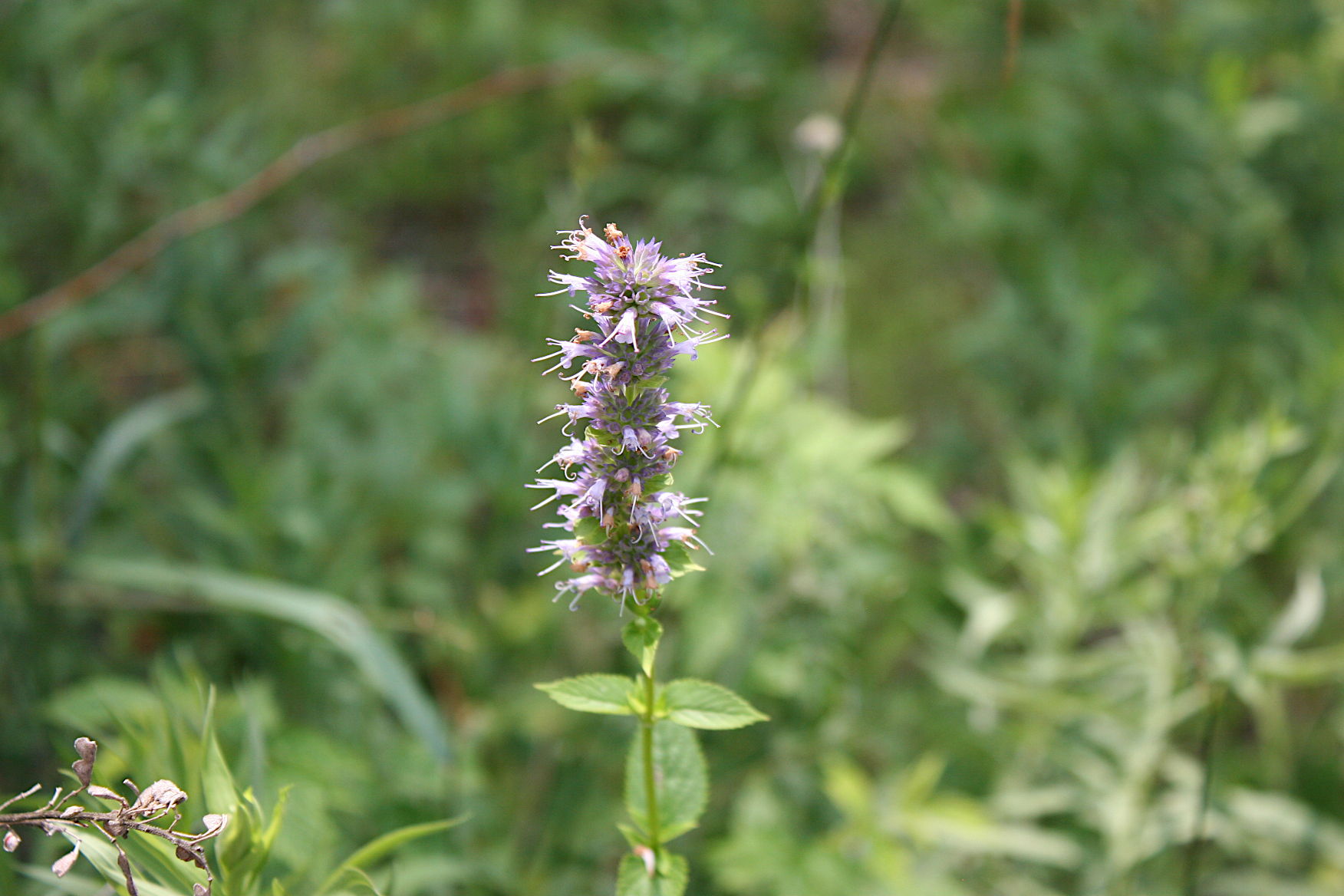
Not to be missed, the many wildflowers gracing this park. Minnesota Prairie Roots copyrighted file photo July 2021.

According to signage at Milford Memorial Park, the park “is an attempt to preserve the memory of those who gave their lives to pursue the American dream, provide for their families and build their community.” That’s necessary to understand given the importance of iron ore mining in this region. The high grade ore from the Milford Mine was used in the production of steel. This region of Minnesota was built around iron ore mining.

History honored and shared… Minnesota Prairie Roots copyrighted file photo July 2021.

Many who came to this area arrived from across the US, Canada and the European continent. They were a diverse group, looking to better their lives, to raise their families in a new place, to build strong communities.

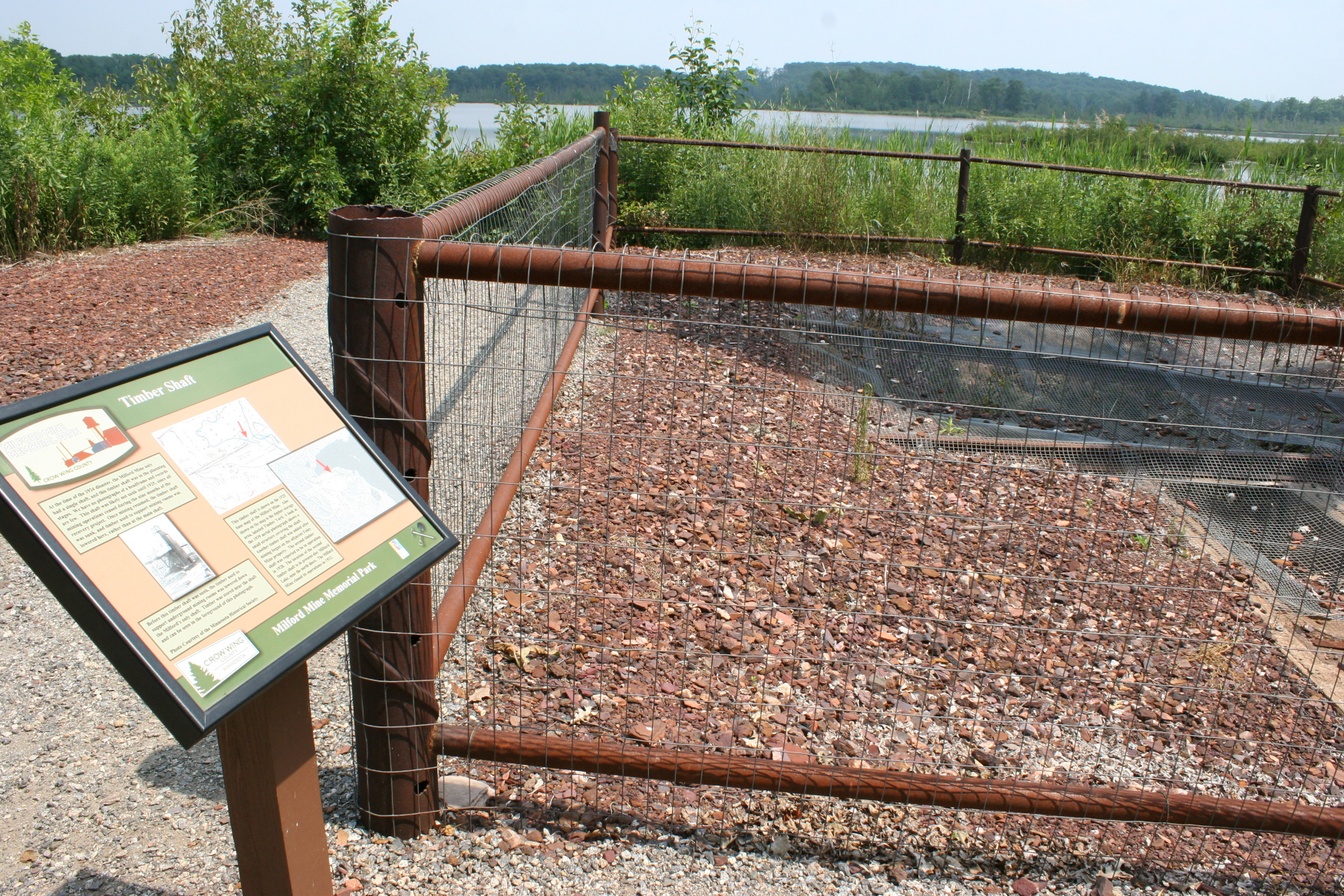
Site of the timber shaft. Minnesota Prairie Roots copyrighted file photo July 2021.
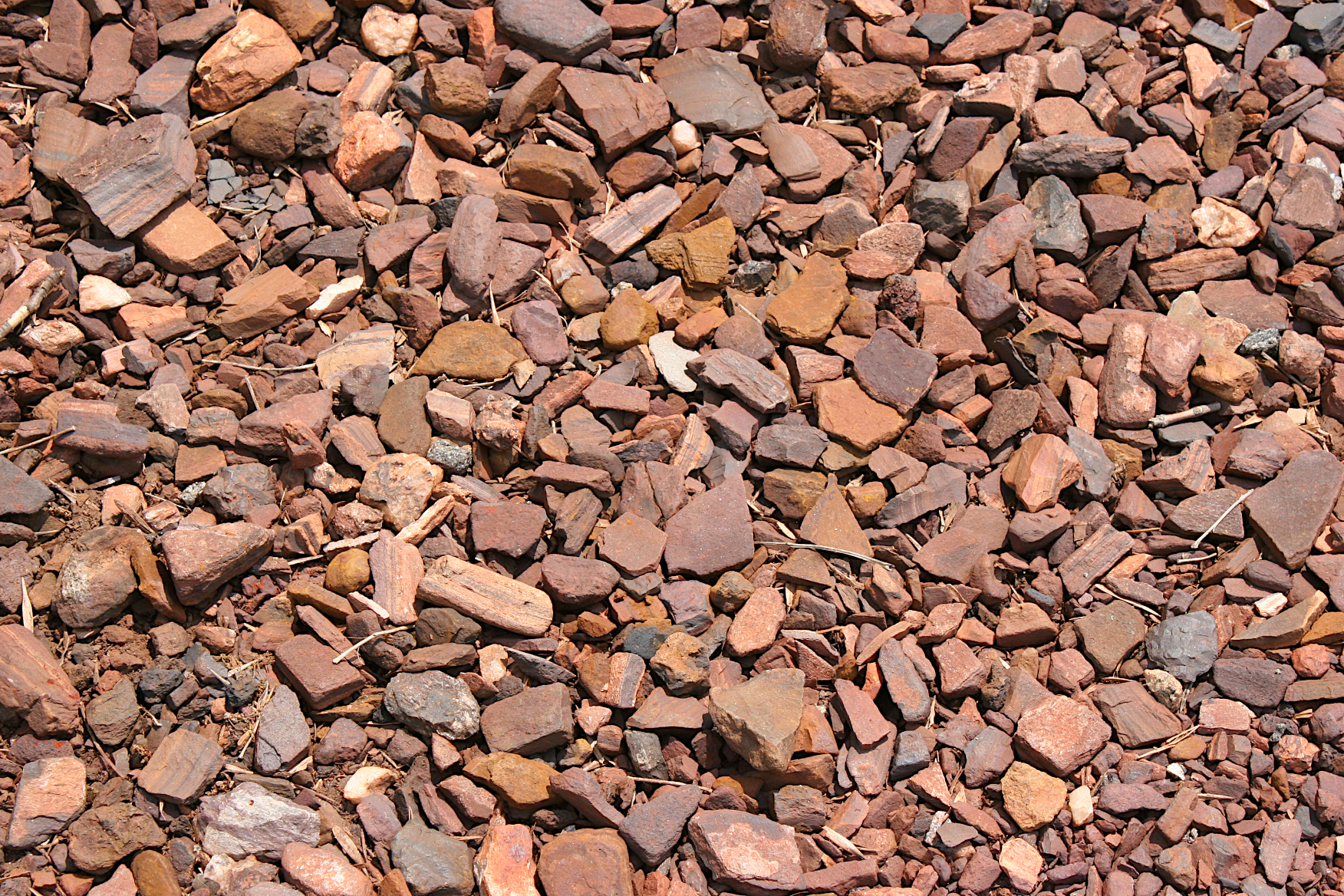
What I presume to be iron ore. Minnesota Prairie Roots copyrighted file photo July 2021.
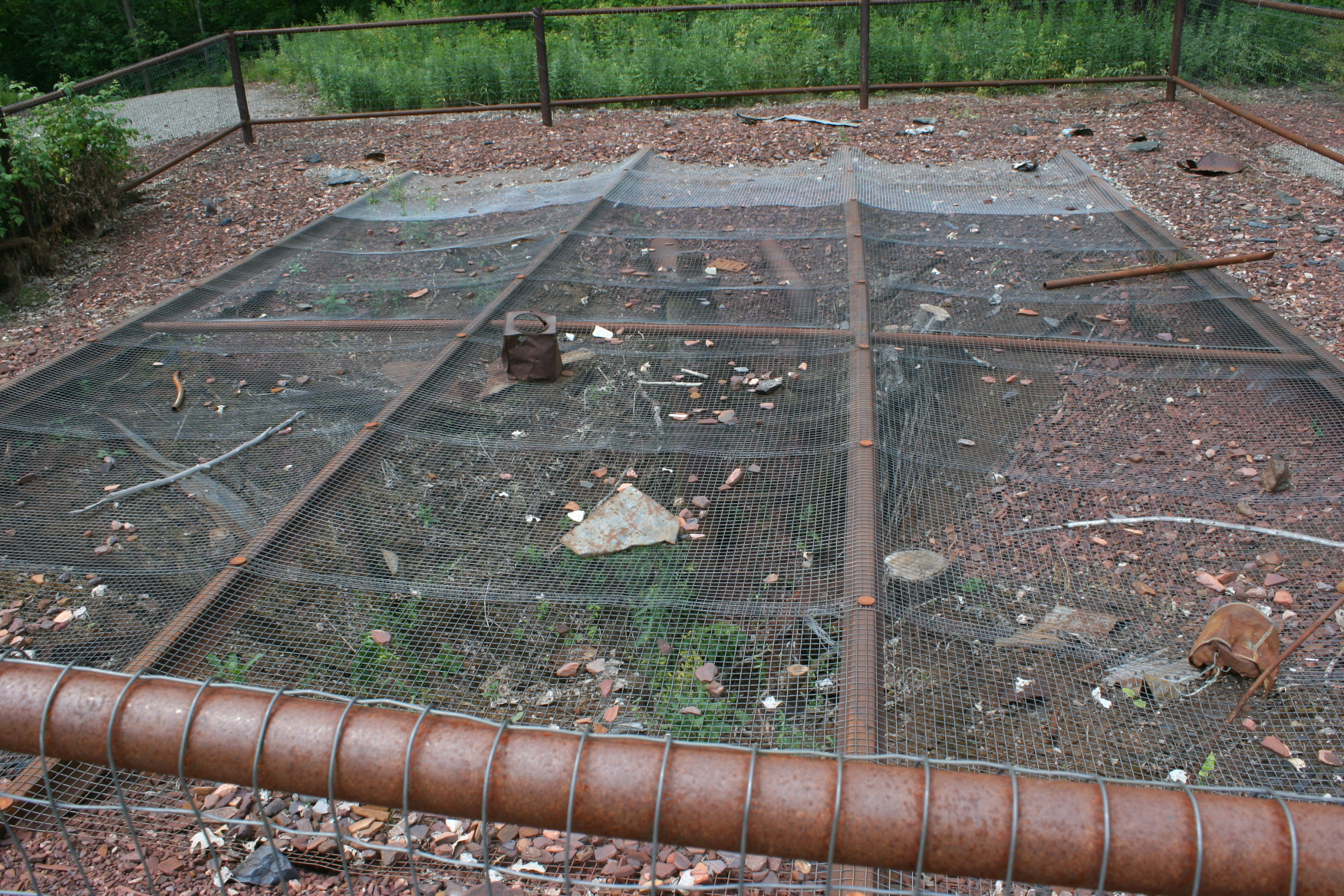
The entry to the mine shaft is fenced around and over. Minnesota Prairie Roots copyrighted file photo July 2021.

In walking through the park, pausing often to read the history of this place and to view marked sites like the machine and blacksmith shops and the mine and timber shafts, I felt a sense of reverence, a sense of understanding of the loss connected to this land.

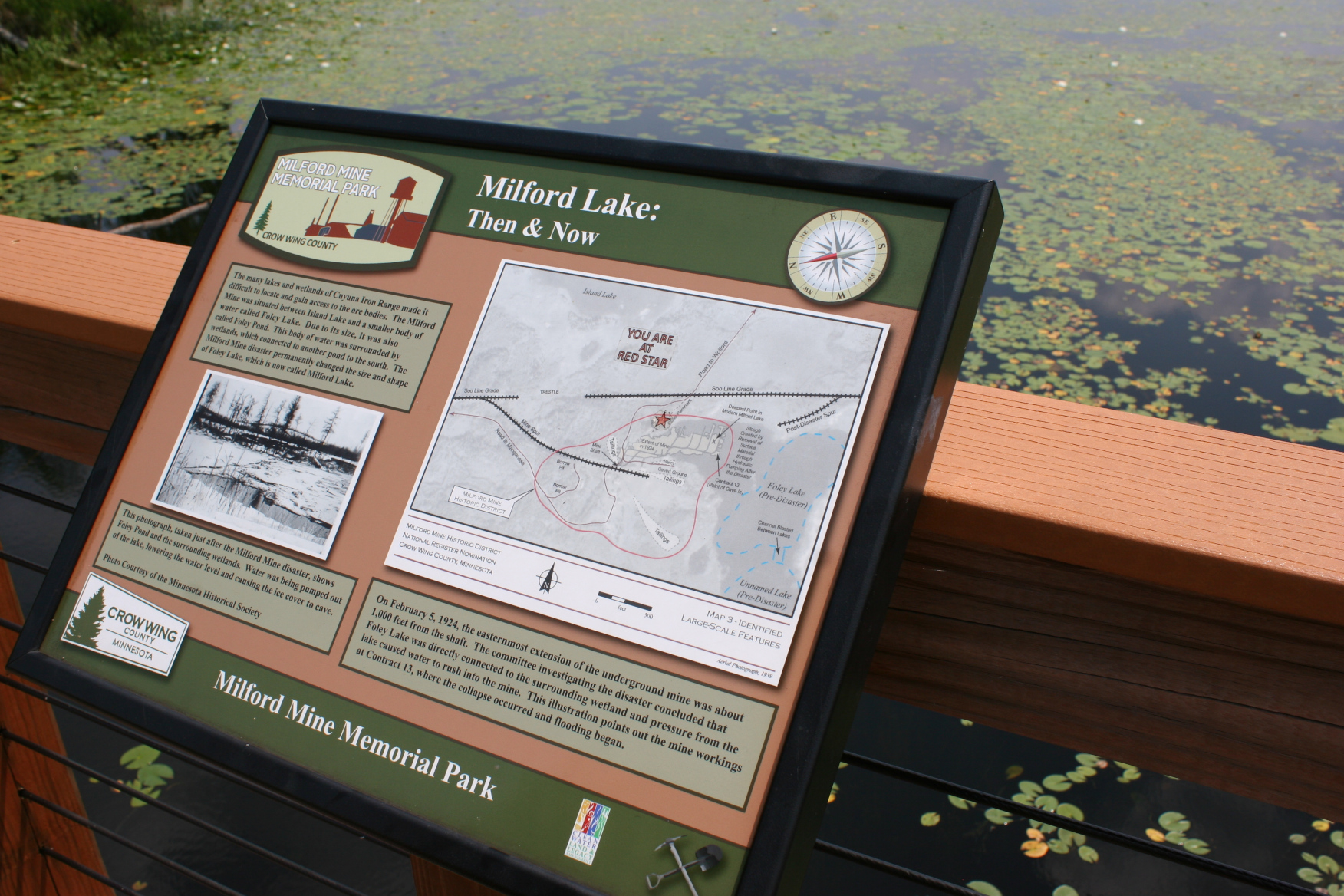
Originally named Lake Foley, the lake has since been renamed Milford Lake. Minnesota Prairie Roots copyrighted file photo July 2021.
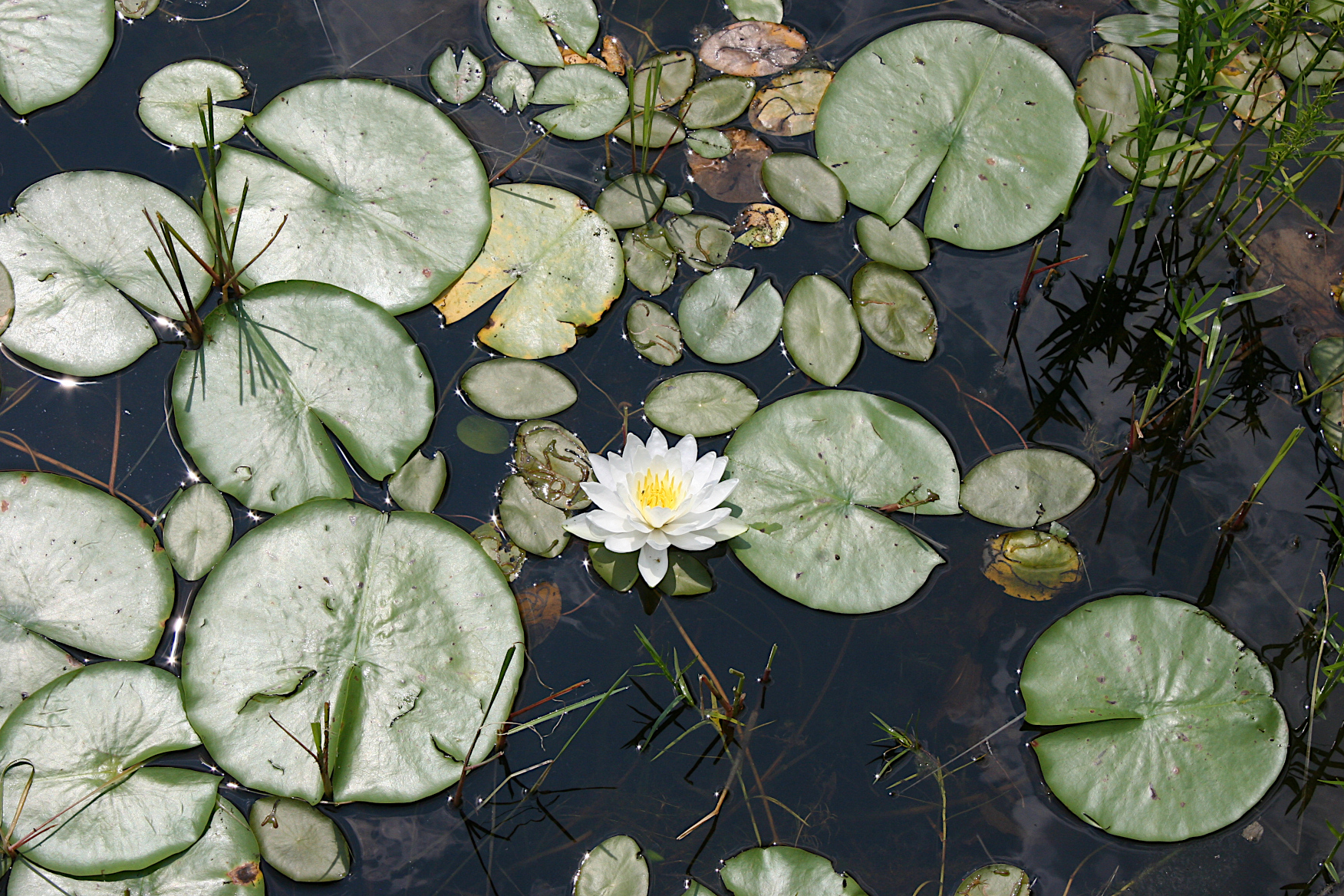
Water lilies in Milford Lake, Minnesota Prairie Roots copyrighted file photo July 2021.
A flower brightens woods’ edge near the lake. Minnesota Prairie Roots copyrighted file photo July 2021.

Investigators determined that pressure from Lake Foley, connected to adjoining wetlands, caused water to rush into the mine resulting in the collapse of the mine’s walls. Within 20 minutes of that occurrence, the 200-foot deep mine shaft filled to within 15 feet of the surface. That allowed only minimal time for the miners to attempt an escape. Only seven got out. They, too, are recognized at the memorial park on a survivors’ boardwalk: Carl Frals, Harry Hosford, Mike Zakotnik…

Lengthy memorial boardwalks curve into the park. Minnesota Prairie Roots copyrighted file photo July 2021.

As I walked the boardwalks and trails, I felt sometimes overwhelmed by the sheer tragedy of the Milford Mine Disaster. So much loss. So much grief and pain. So many father-less children. And it is that, perhaps, which touched me the most.

NOTE: Milford Mine Memorial Park is open daily from sunrise to sunset. I encourage you to visit, to experience this important part of Minnesota history.

© Copyright 2021 Audrey Kletscher Helbling


In Deerwood: Water tower on the range August 30, 2021

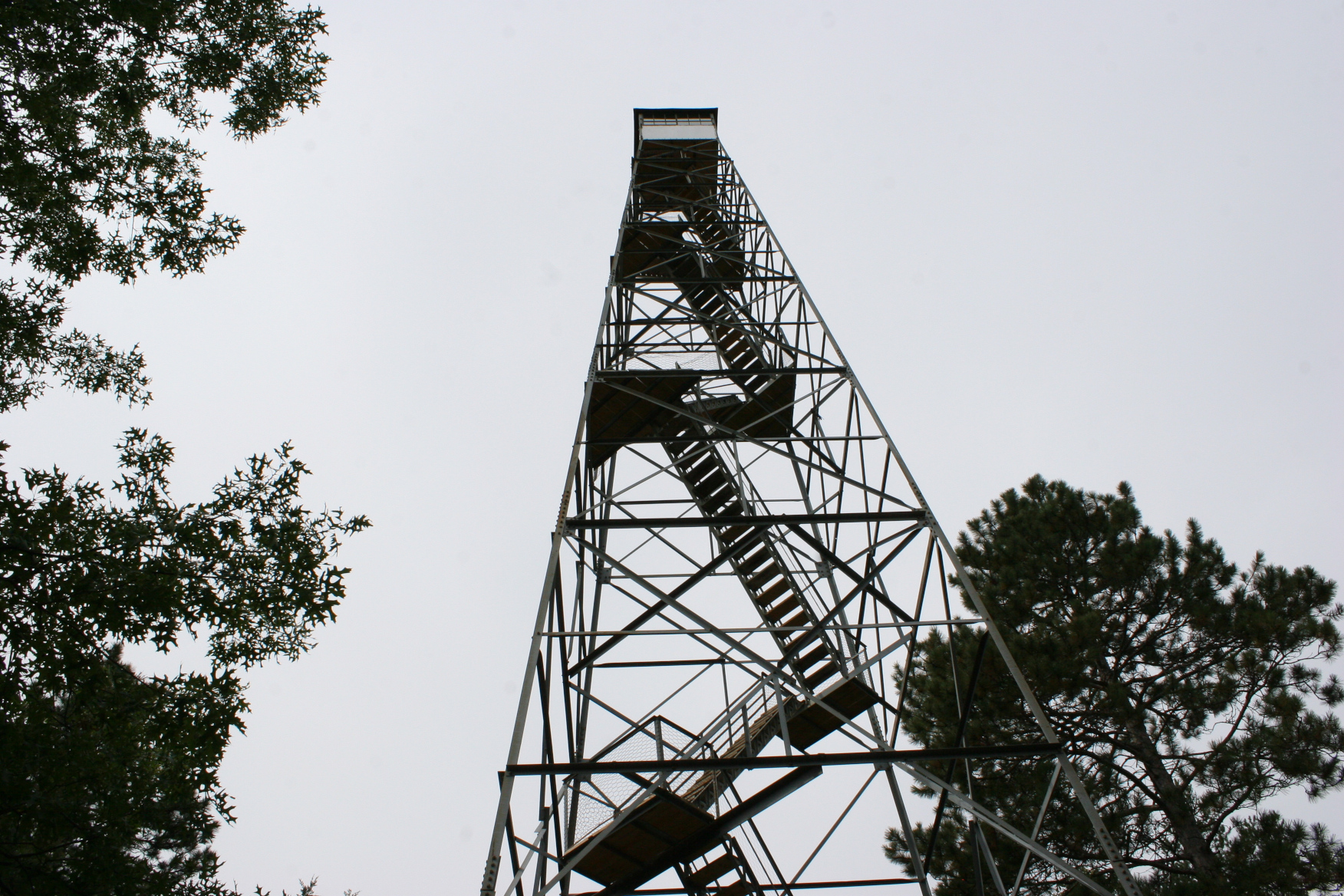
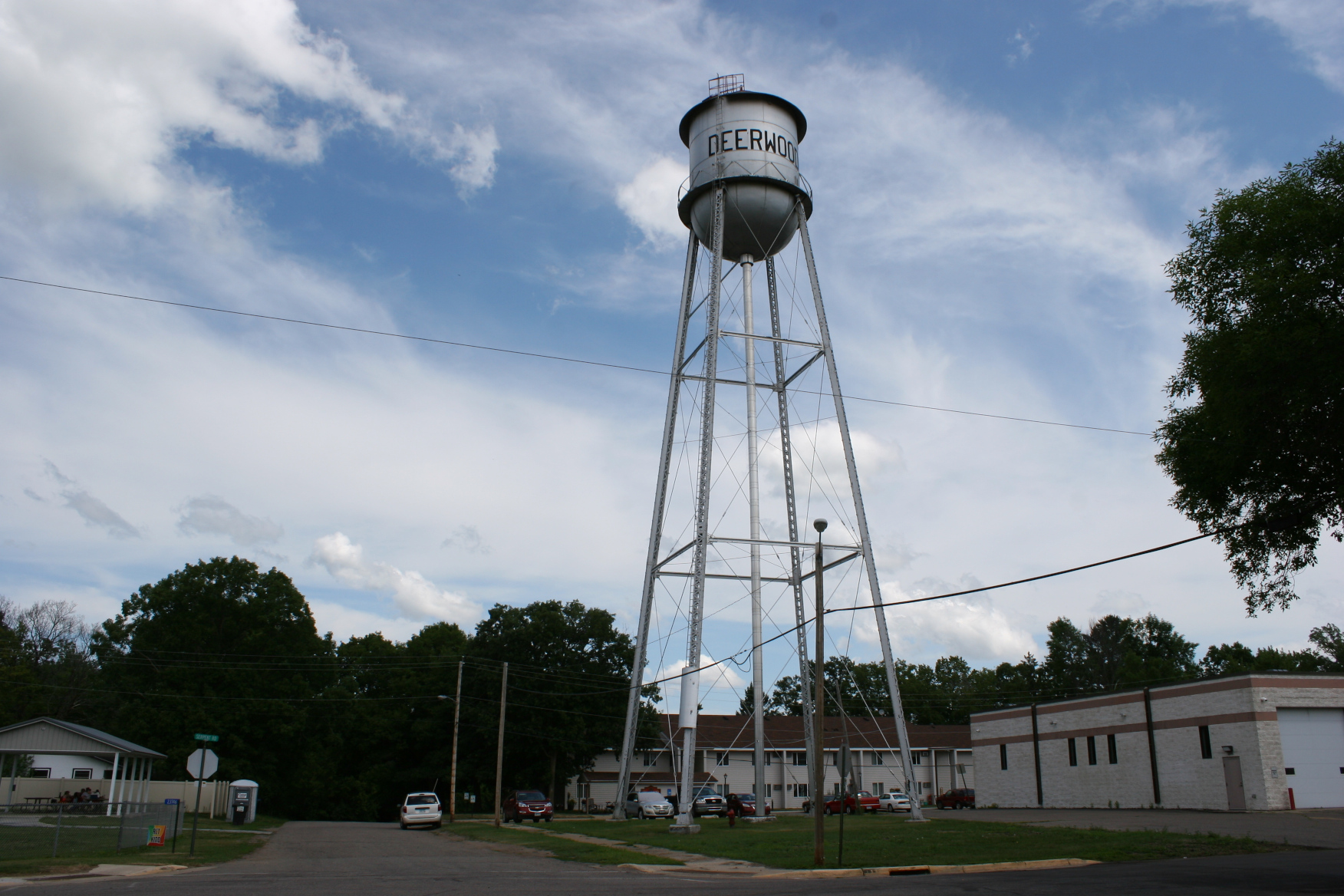
An historic 1914 water tower in Deerwood, Minnesota. Minnesota Prairie Roots copyrighted file photo July 2021.

A TIME EXISTED WHEN I PAID minimal attention to water towers. They all looked the same. Simple silver metal structures rising on leggy supports above prairie towns, dwarfed only by grain elevators.

Through the decades, those standard water towers have mostly vanished, replaced by more modern holding tanks. I understand the need to upgrade, to improve, to advance. Communities grow. Needs change. My city of Faribault is currently planning a new water tower, which will be visible from Interstate 35. If Faribault ever housed a simple metal tower, it was long before I moved here.

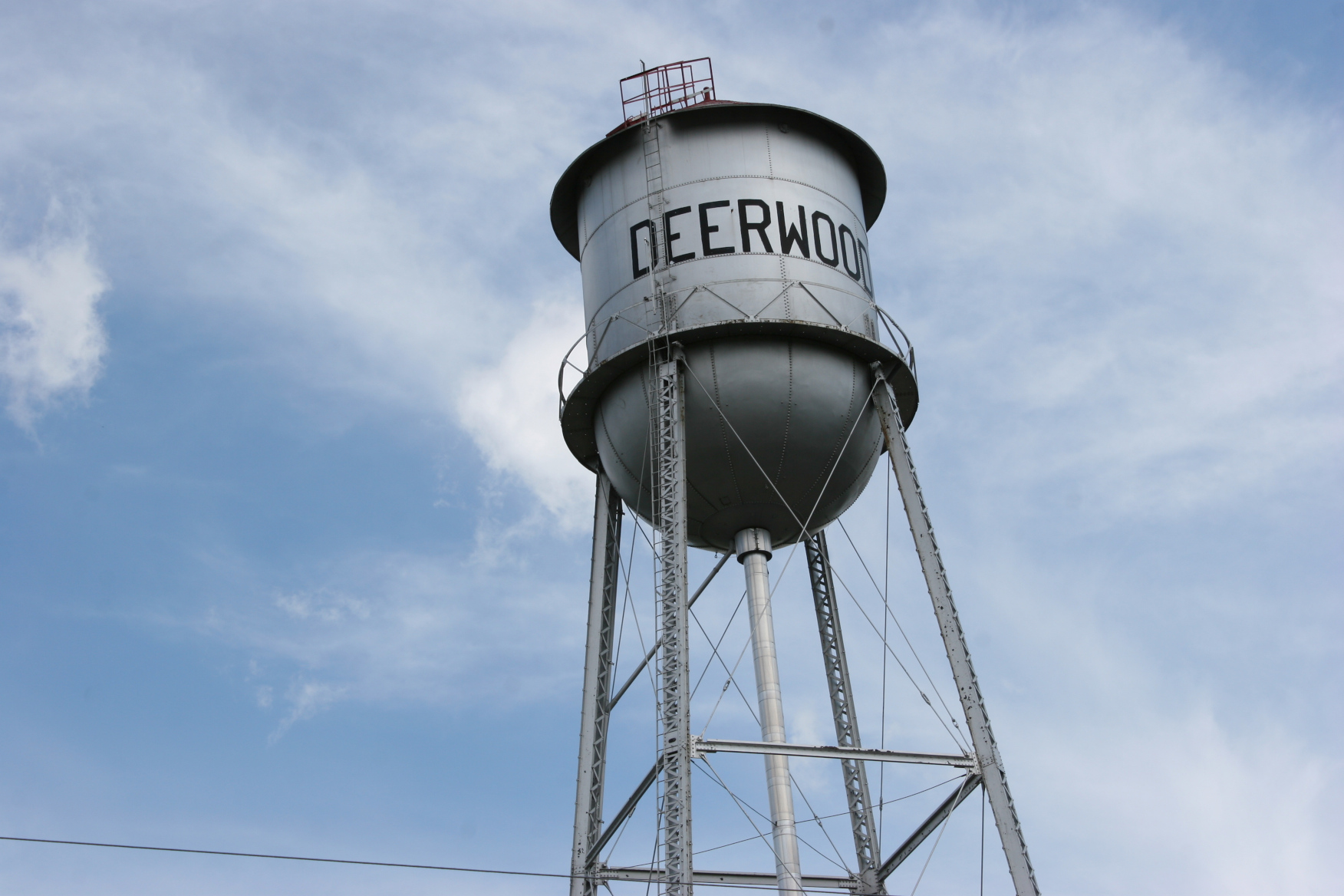
Community identifier. Minnesota Prairie Roots copyrighted file photo July 2021.

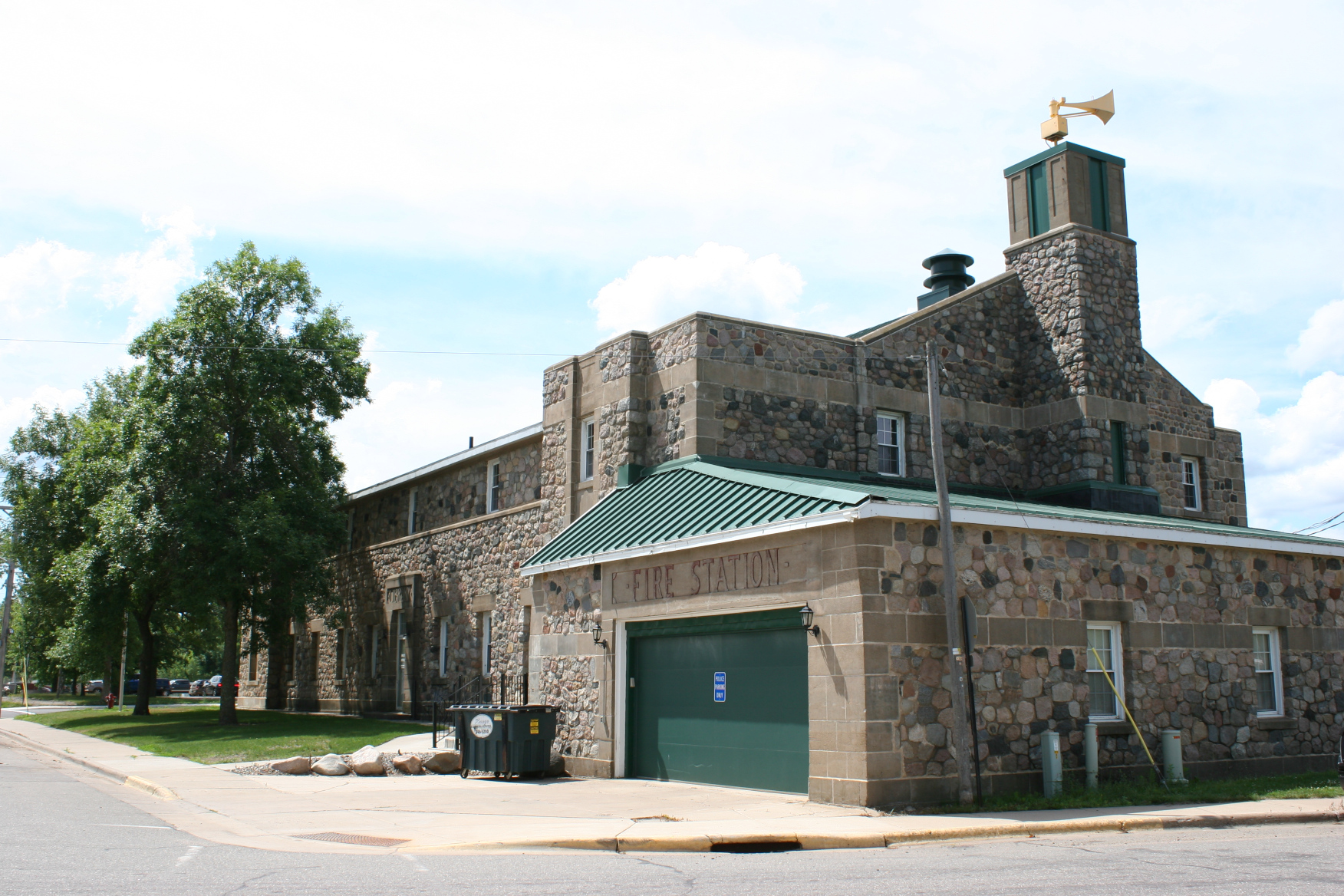
But in the small town of Deerwood in Crow Wing County, a vintage water tower still stands, by a city park with picnic shelter and splash pad, near an apartment complex, next to the fire station and across the street from the historic Deerwood Auditorium (city hall and police department).

Randy and I discovered the 1914 water tower when we stopped for a picnic lunch en route to a family lake cabin on a Saturday afternoon in July. Previous drives north, we drove right through Deerwood without pause. In a hurry to get to our destination.

That’s problematic. That word, hurry. By hurrying, we too often miss simple delights. Like the historic Deerwood water tower.

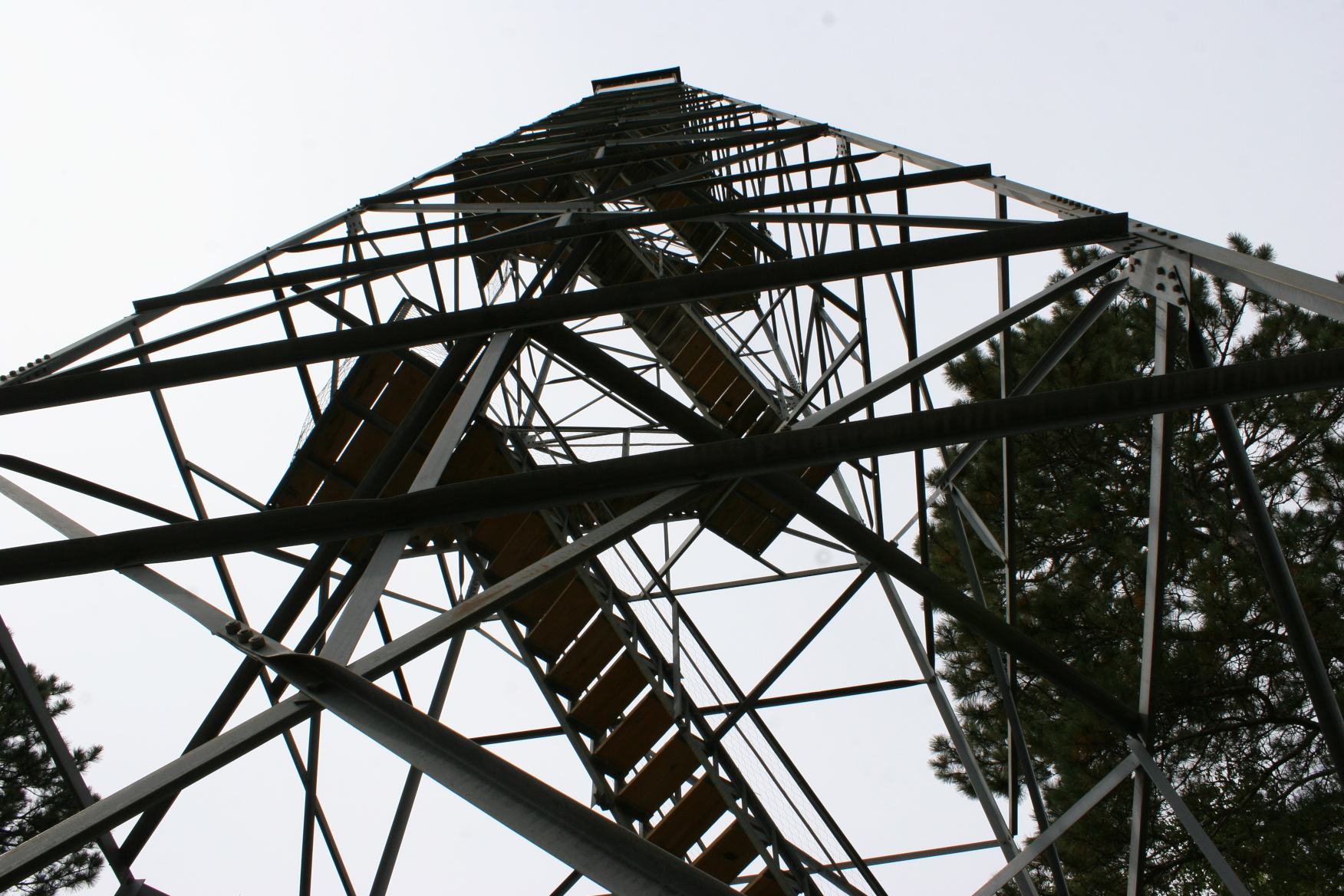
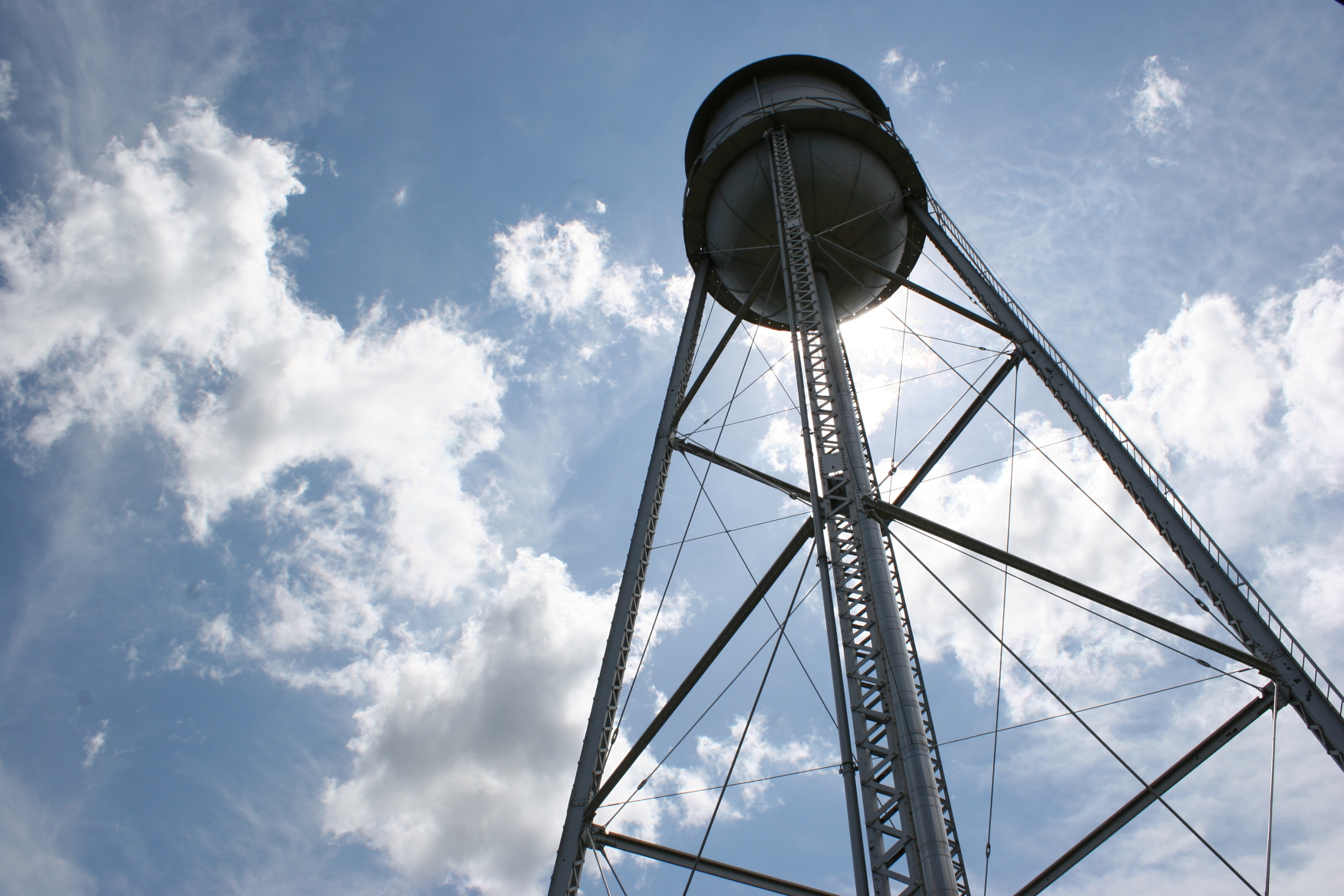
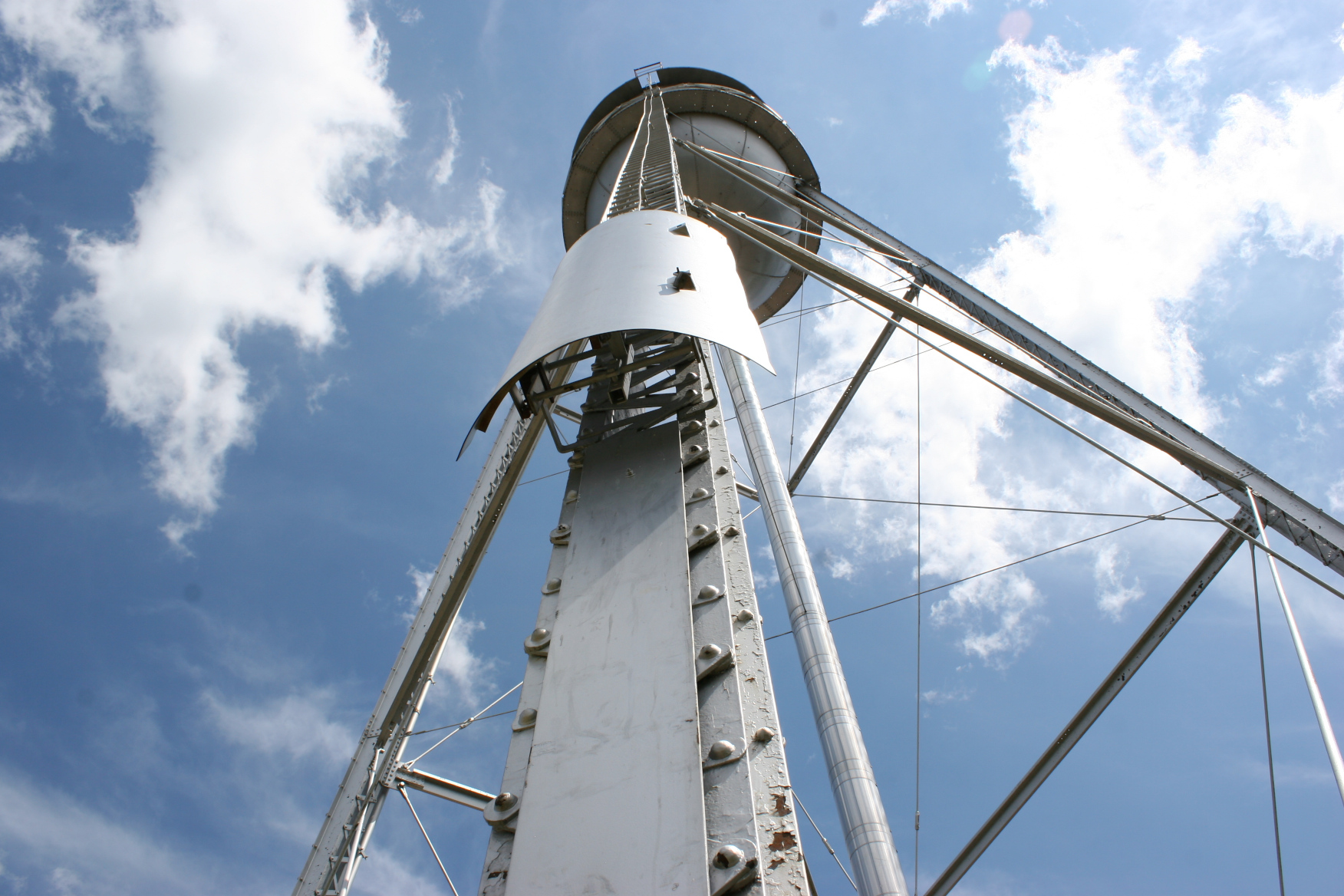
Looking up at the tower offers artistic and architectural angles. Minnesota Prairie Roots copyrighted file photo July 2021.

I grabbed my camera to photograph the tower, attempting to document it from multiple perspectives. Architecturally. Artistically. Historically.

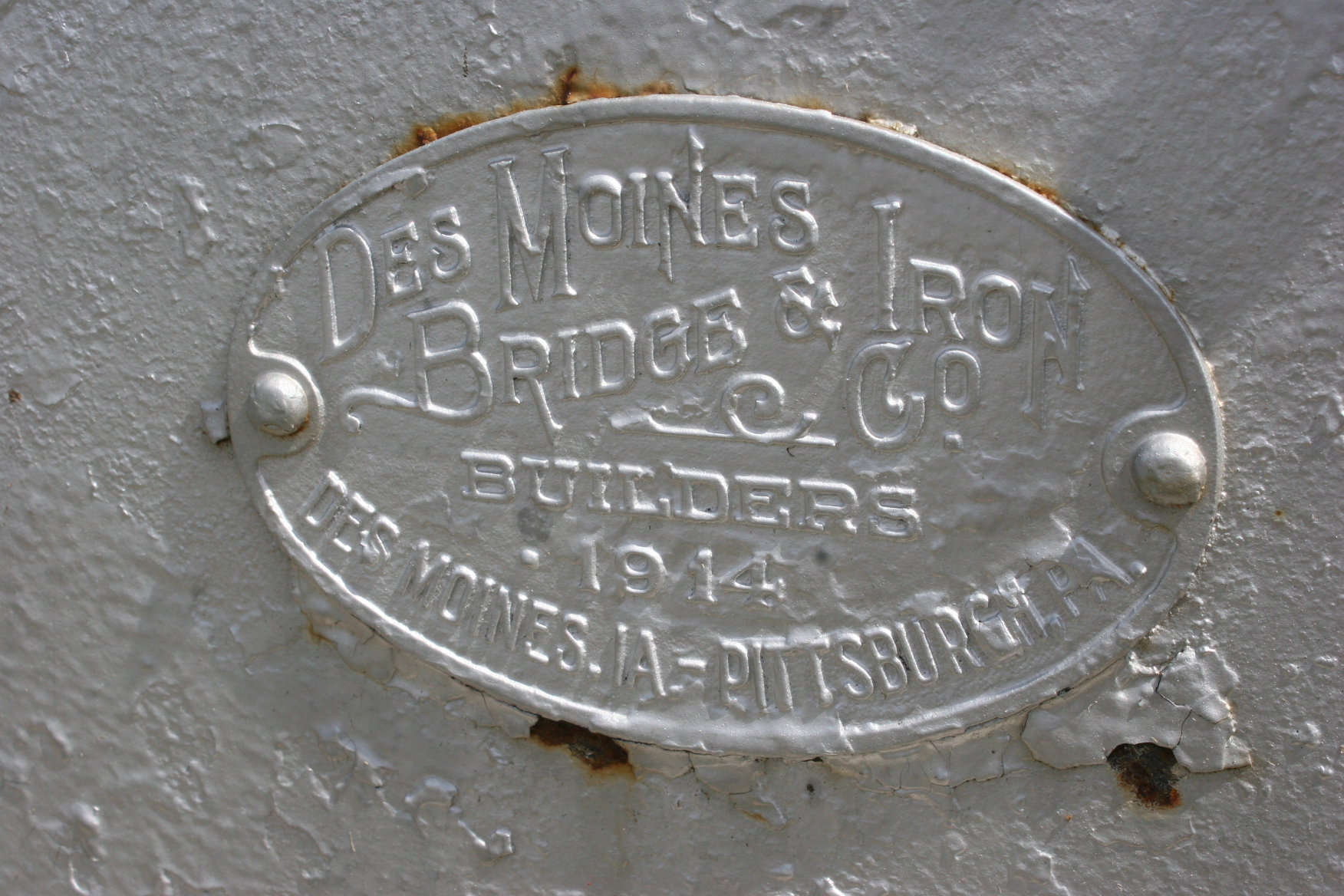
Identifying construction information at the base of the Deerwood water tower. Minnesota Prairie Roots copyrighted file photo July 2021.

Upon later researching the Deerwood water tower, built by the Des Moines Bridge & Iron Co., I learned it is one of five such Cuyuna Iron Range water towers on the National Register of Historic Places. Added in 1980, the other towers are located in Crosby, Cuyuna, Ironton and Trommaid. They are known collectively as the “Cuyuna Range Municipally-Owned Elevated Metal Water Tanks.”

Just another underneath view. Minnesota Prairie Roots copyrighted file photo July 2021.

The towers, erected between 1912-1918, were of historical importance in development of the Cuyuna Iron Range. Tax revenue generated from the iron ore mines funded their construction.

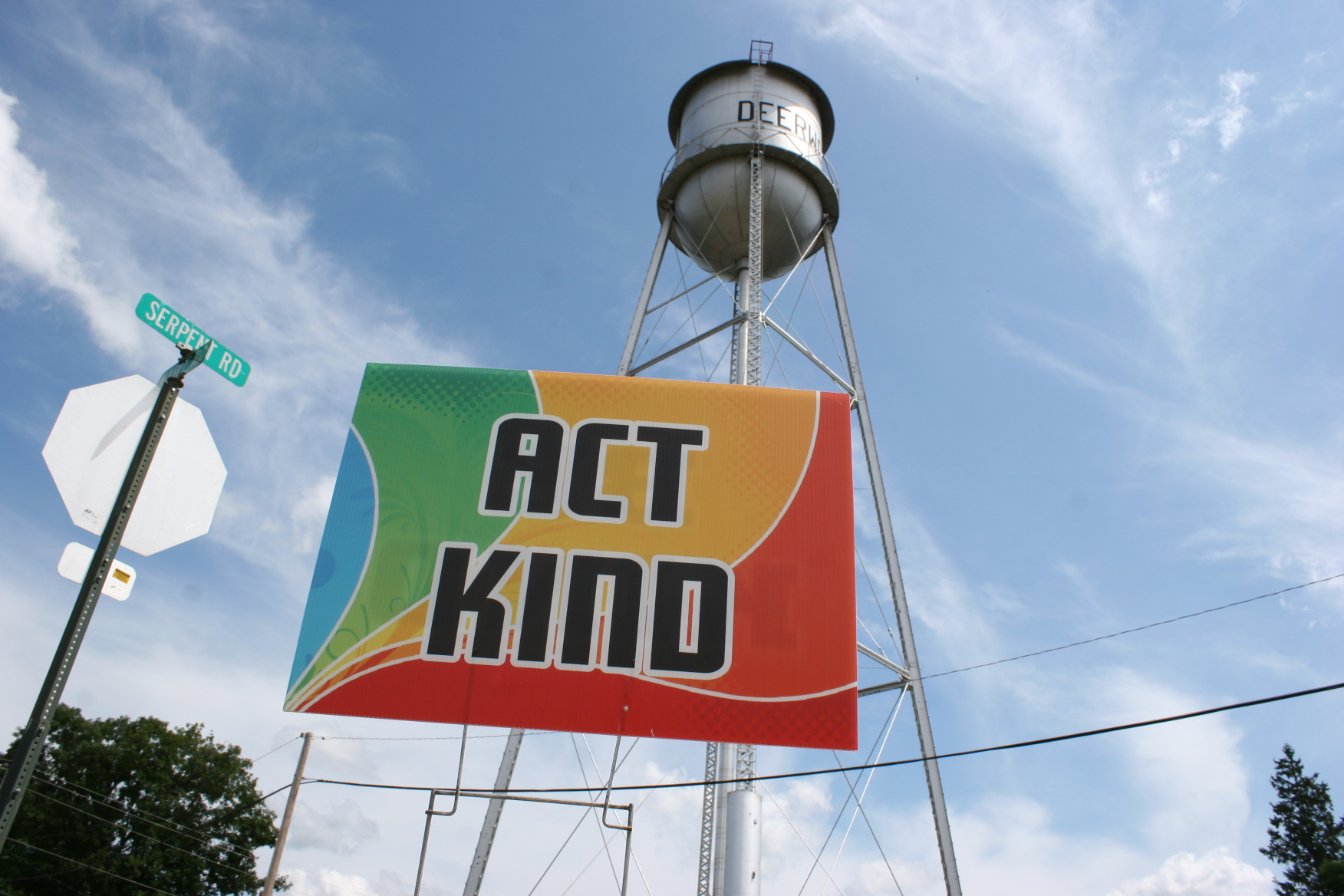
Posted on a street corner by the water tower, a positive message. Minnesota Prairie Roots copyrighted file photo July 2021.

I appreciate that these five towns on the iron range valued their aged water towers enough to pursue and acquire historical designation. The water towers represent a time in Minnesota history. They represent, too, the architecture and art of yesteryear.

TELL ME: I’d like to hear of vintage water towers you’ve noticed and appreciate. Tell me, too, why you value them.

Please click here to read my previous post about the historic Deerwood Auditorium. And click here to read my post about the town’s deer sculpture in Elmer Park.

© Copyright 2021 Audrey Kletscher Helbling
 

About that auditorium in Deerwood August 27, 2021

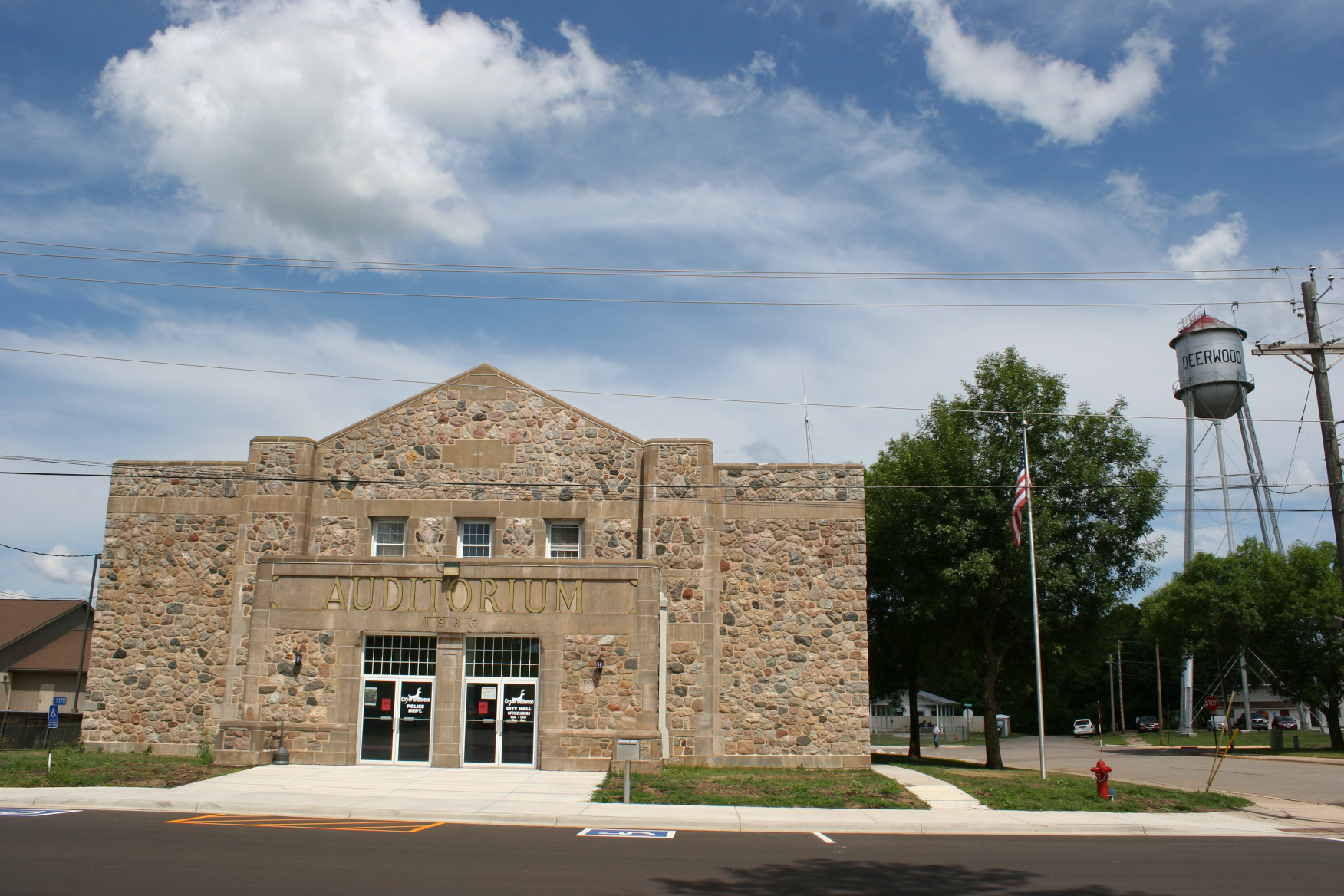
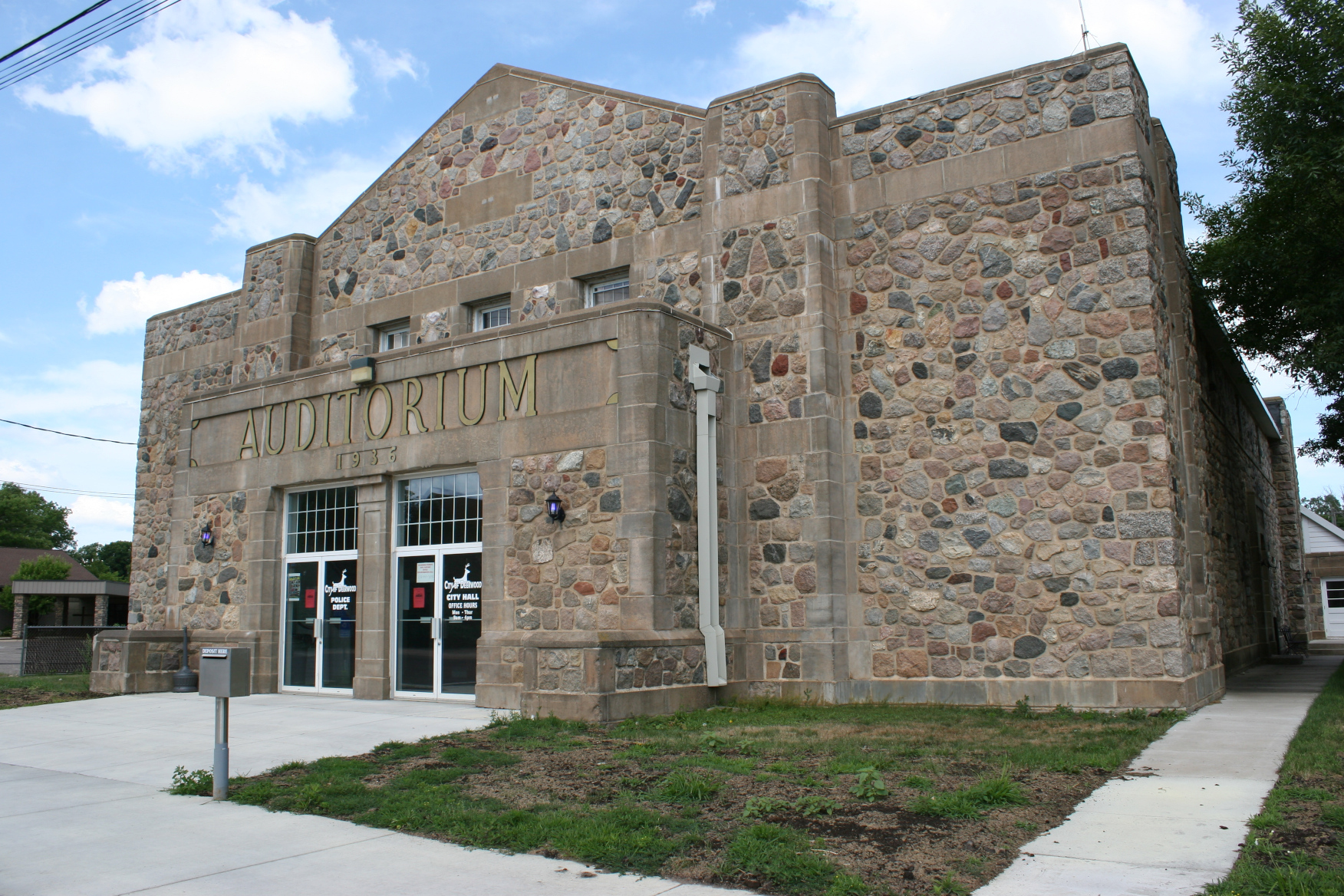
Deerwood Auditorium, located a block from the water tower. Minnesota Prairie Roots copyrighted file photo July 2021.

THE STURDY STONE STRUCTURE anchoring a corner in Deerwood drew my photographic and historic interest during a recent stop in this central Minnesota community in Crow Wing County.

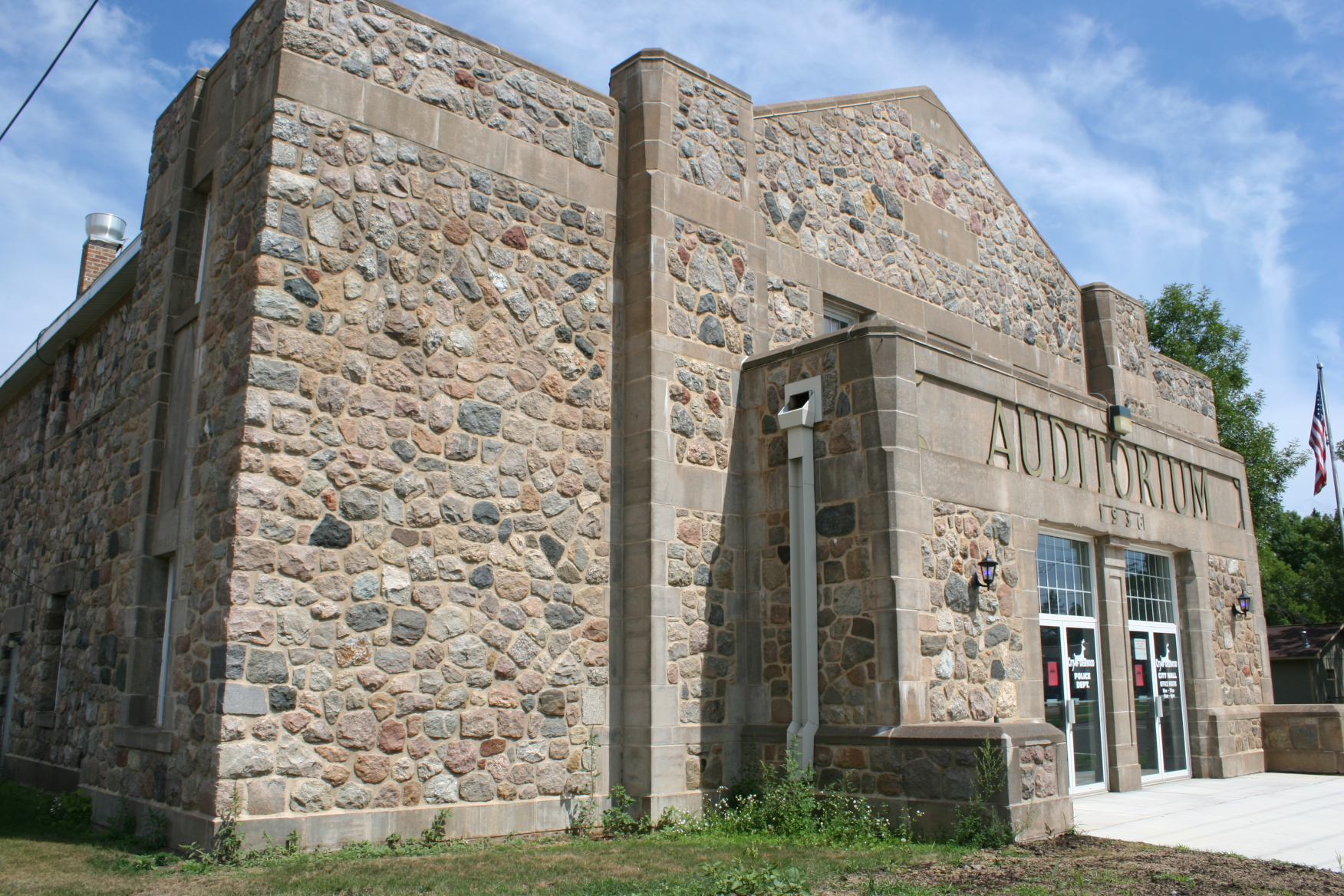
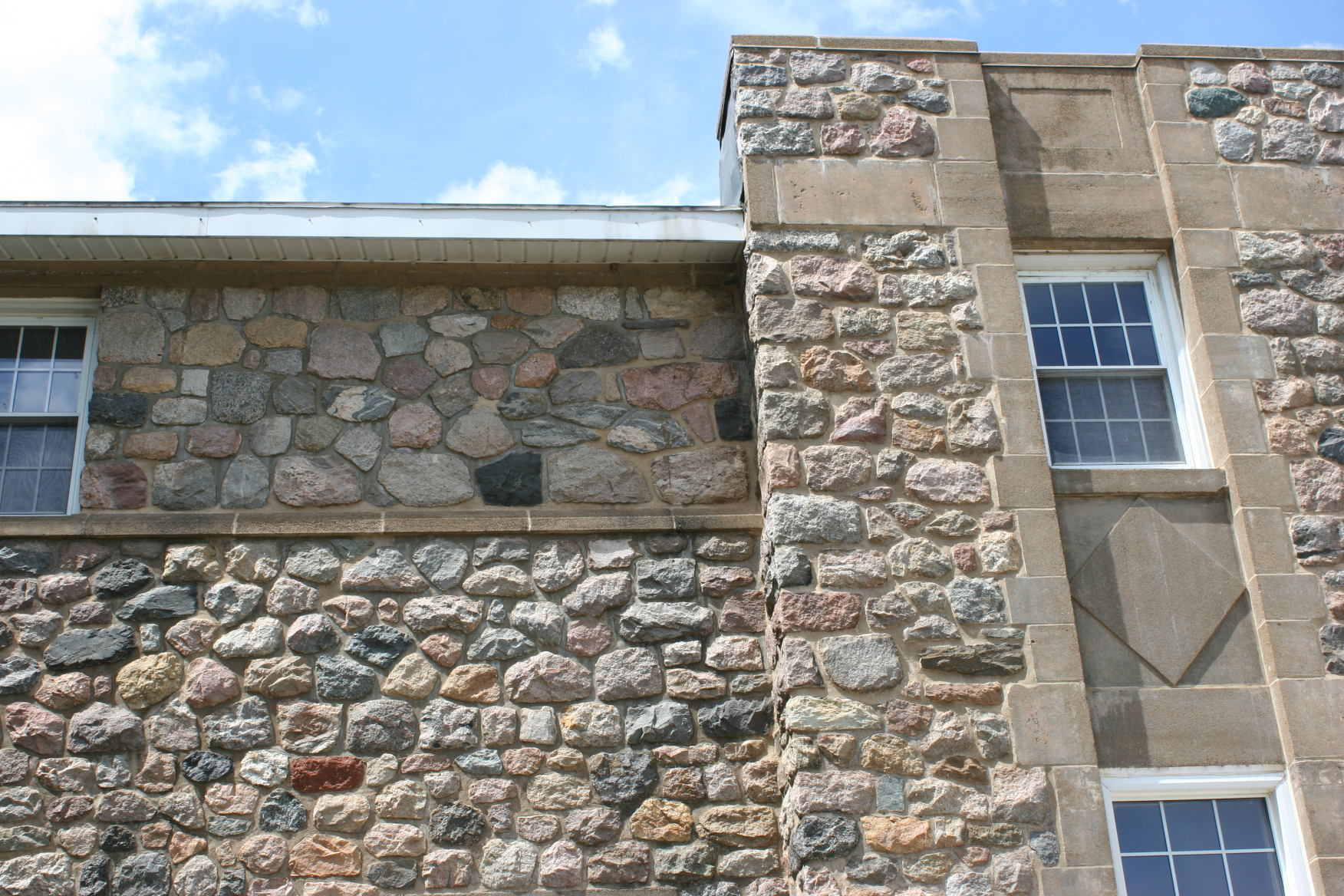
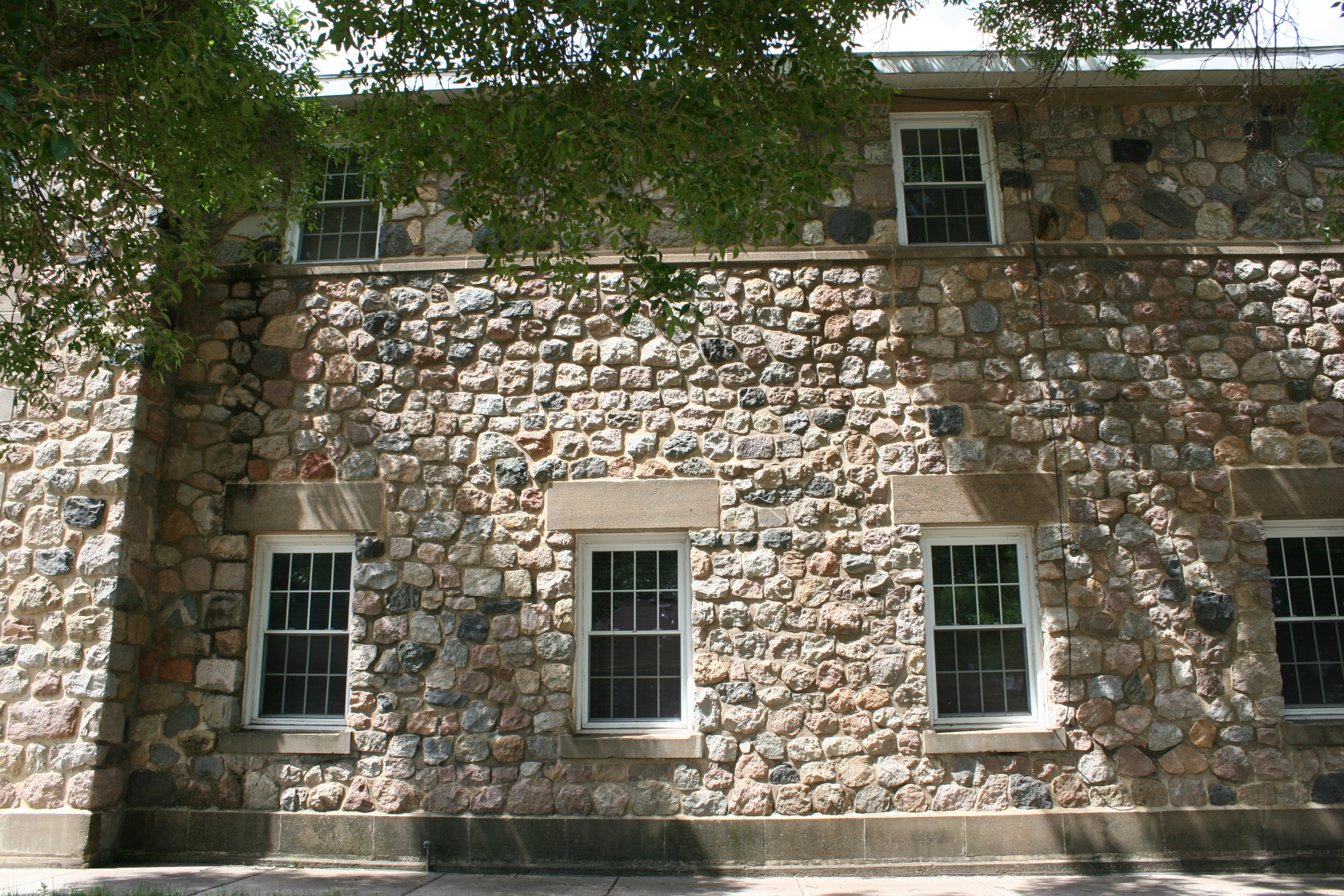
What craftsmanship in this stone-faced building. Minnesota Prairie Roots copyrighted file photo July 2021.

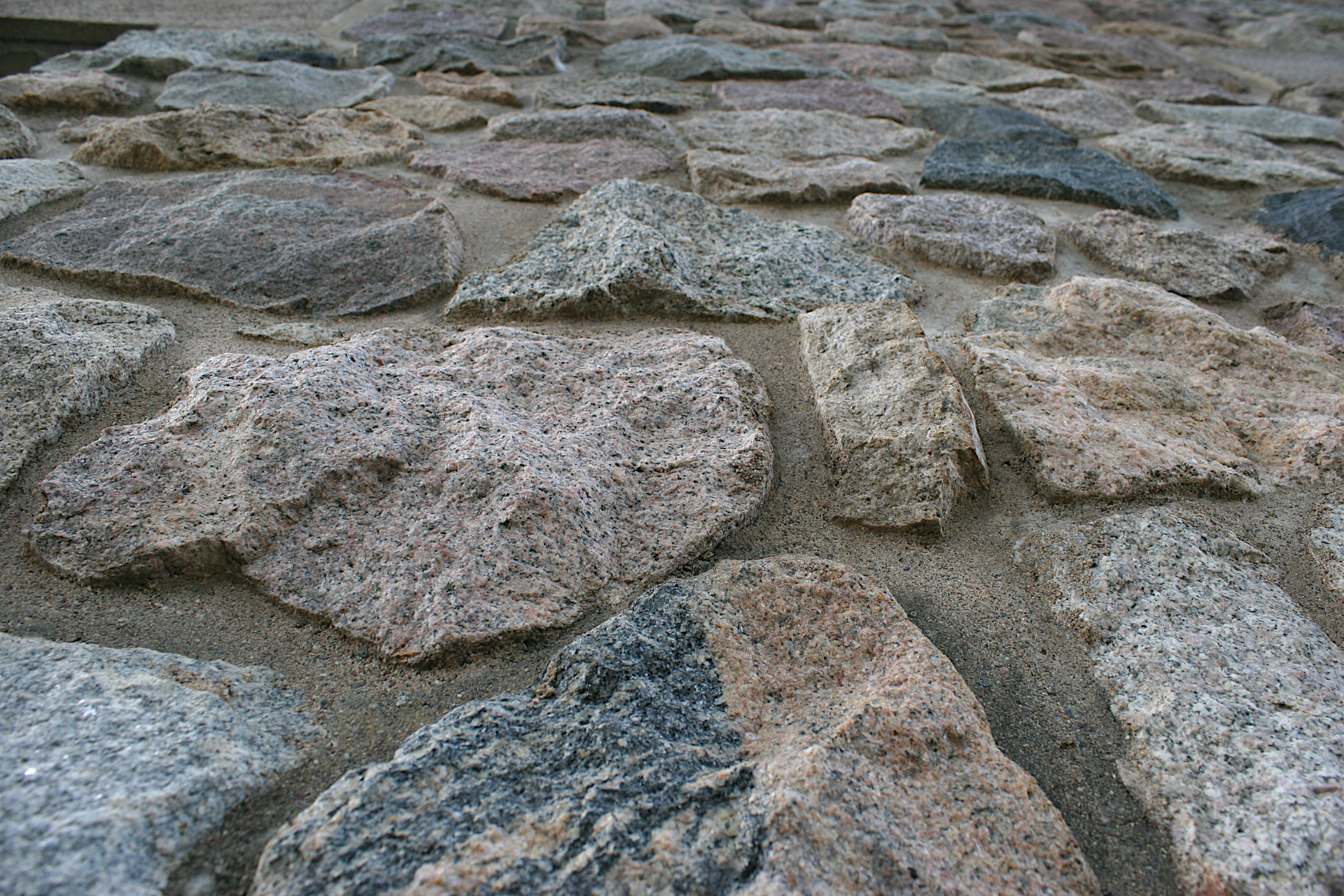
How could it not? Buildings like this with a fieldstone facing hearken from a bygone era, from days when intense hands-on labor factored in to construction. Workers hauled 800 tons of fieldstones from the site of the Cuyuna Country Club to build the Deerwood Auditorium between 1935-1936.

So many fieldstones harvested and used in construction of the auditorium. Minnesota Prairie Roots copyrighted file photo July 2021.

That’s a lot of rocks. I understand, not because I ever hauled that much stone anywhere. But, as a child, I spent many a summer plucking rocks from farm fields in southwestern Minnesota and tossing them into a wagon. Picking rock is hard work. Darn hard.

Imagine the time, labor and effort involved in constructing these walls. Minnesota Prairie Roots copyrighted file photo July 2021.

I admire the tenacity, determination and ingenuity of our forefathers. They relied on local natural resources to build buildings. And, in the case of the Deerwood Auditorium, materials also from the old Meacham Mine machine building to incorporate into the structure.

The building is listed on the National Register of Historic Places. Minnesota Prairie Roots copyrighted file photo July 2021.

Donations and Works Progress Administration funding and labor were also part of this project.

A side and rear view of the building. Minnesota Prairie Roots copyrighted file photo July 2021.

The completed building included village council chambers, a kitchen, locker rooms, library, space for fire fighting equipment and that all-purpose 38 x 80-foot gym with overlooking second floor balconies. Today the auditorium, on the National Register of Historic Places, serves as a community center and gathering spot for celebrations like weddings, birthdays and family reunions.

Another side view of the historic Deerwood Auditorium. Minnesota Prairie Roots copyrighted file photo July 2021.

Back during construction, locals aimed to have the building finished in time for the community’s annual fall lutefisk dinner. It was completed for the event, which drew an estimated 1,000 diners to feast on the lye-soaked cod of Norwegian culinary delight.

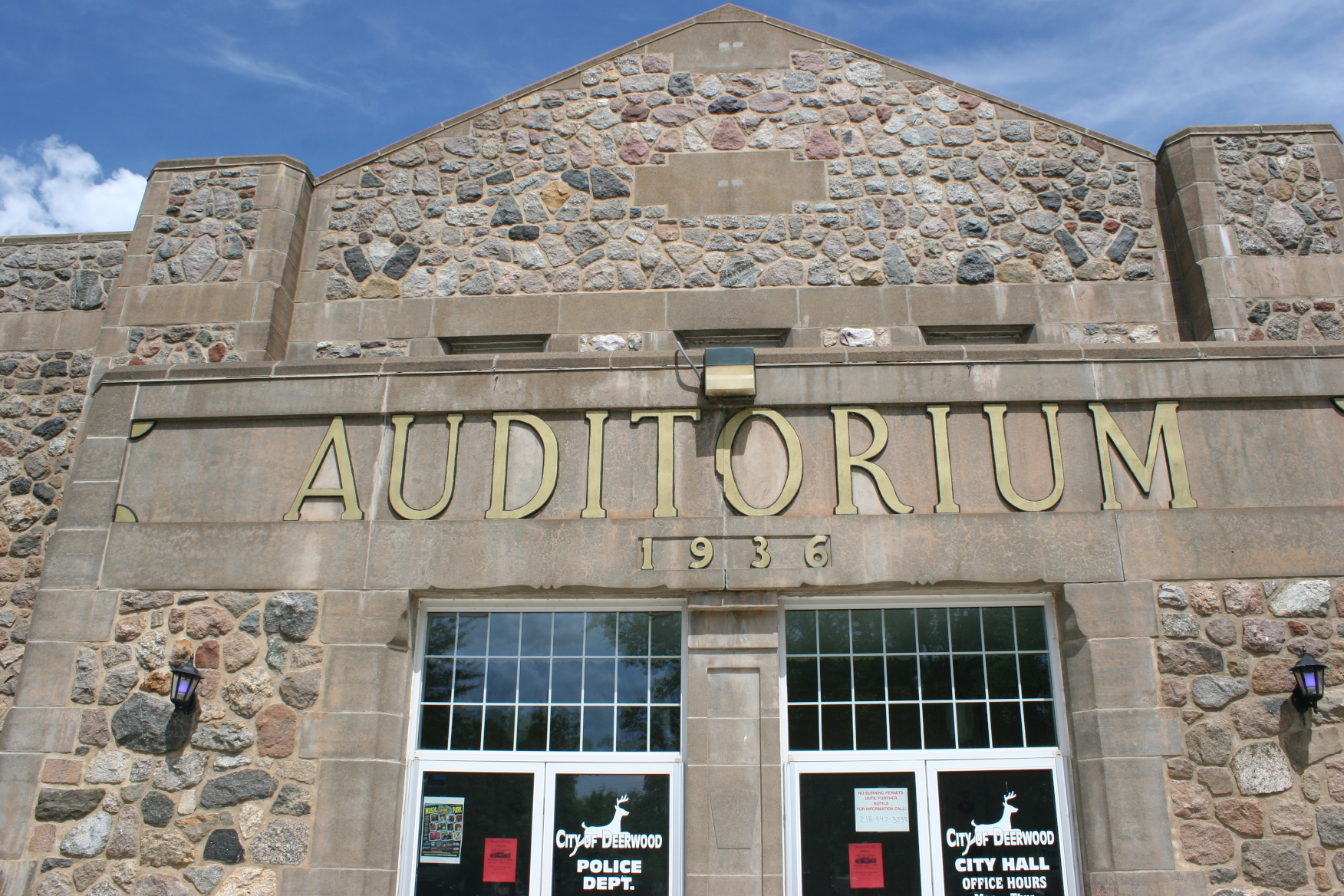
The front entry with identifying usage information. Minnesota Prairie Roots copyrighted file photo July 2021.

On the July Saturday I paused to photograph this WPA building, I knew none of these historical details. I couldn’t get inside the Deerwood Auditorium, today home to city hall, the police department and community center. Oh, how I wish I could step inside. To take in the history of this place. To imagine locals packed shoulder to shoulder forking down slippery, smelly lutefisk, their conversations creating a deafening din.

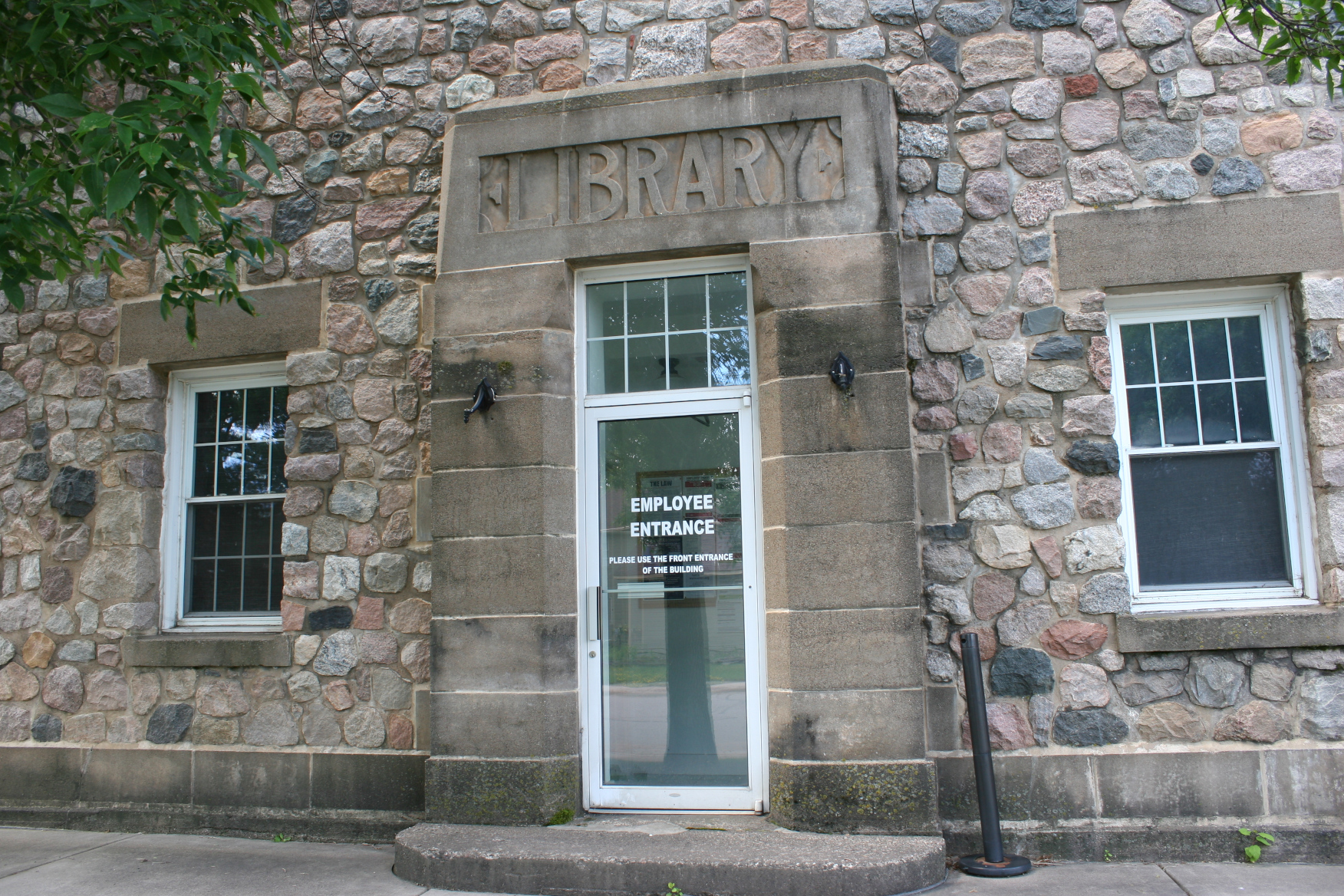
Once the library entry… Minnesota Prairie Roots copyrighted file photo July 2021.

I settled instead for appreciating the exterior workmanship, the talent and strength required to build this remarkable building. The craftsmanship. The hours and hours of labor. That shows in a structure that exudes strength, that honors those who work with their hands, for their work endures.

Please check back next week for one final (of three) post from Deerwood.

© Copyright 2021 Audrey Kletscher Helbling
 

An architecturally historic bridge in Waterford Township November 9, 2020

NOTE: This post features photos from a mid-August stop at the historic Waterford bridge near Northfield, Minnesota.

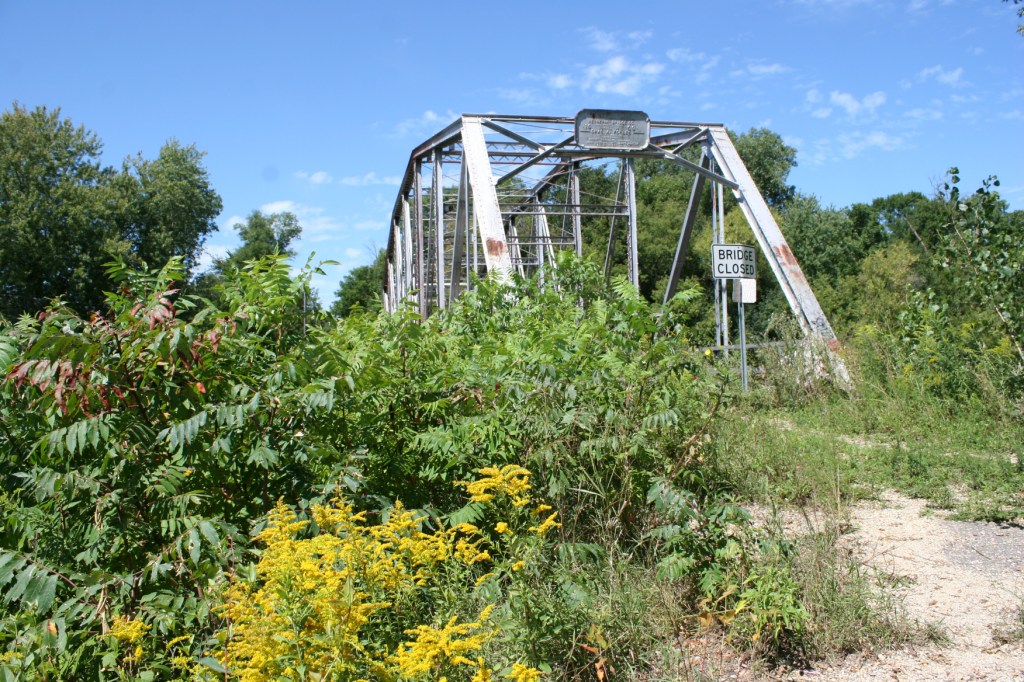
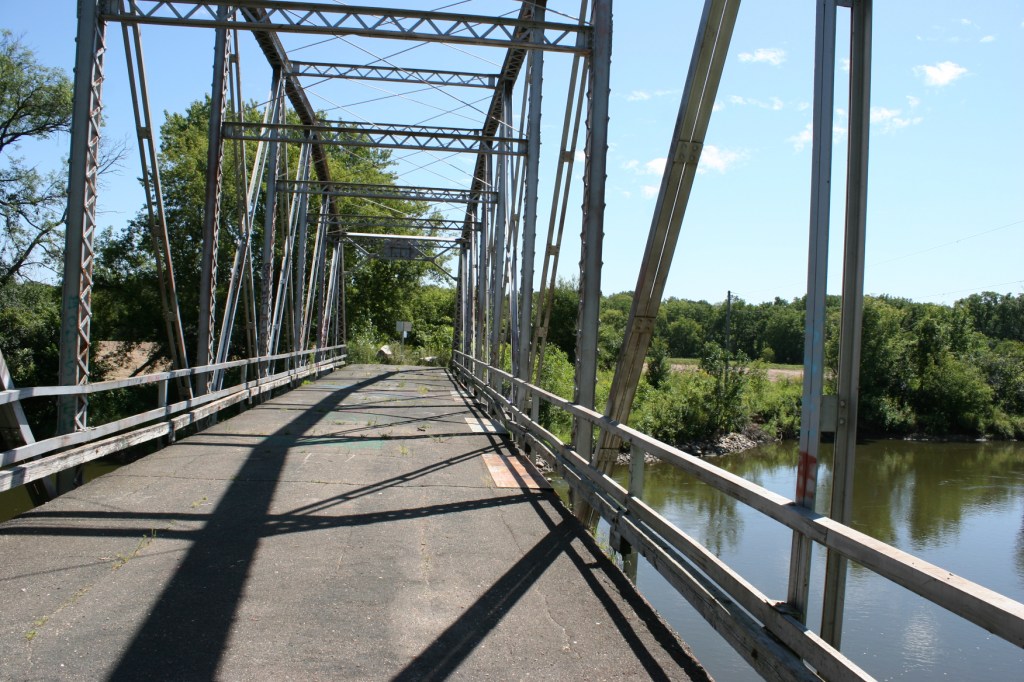
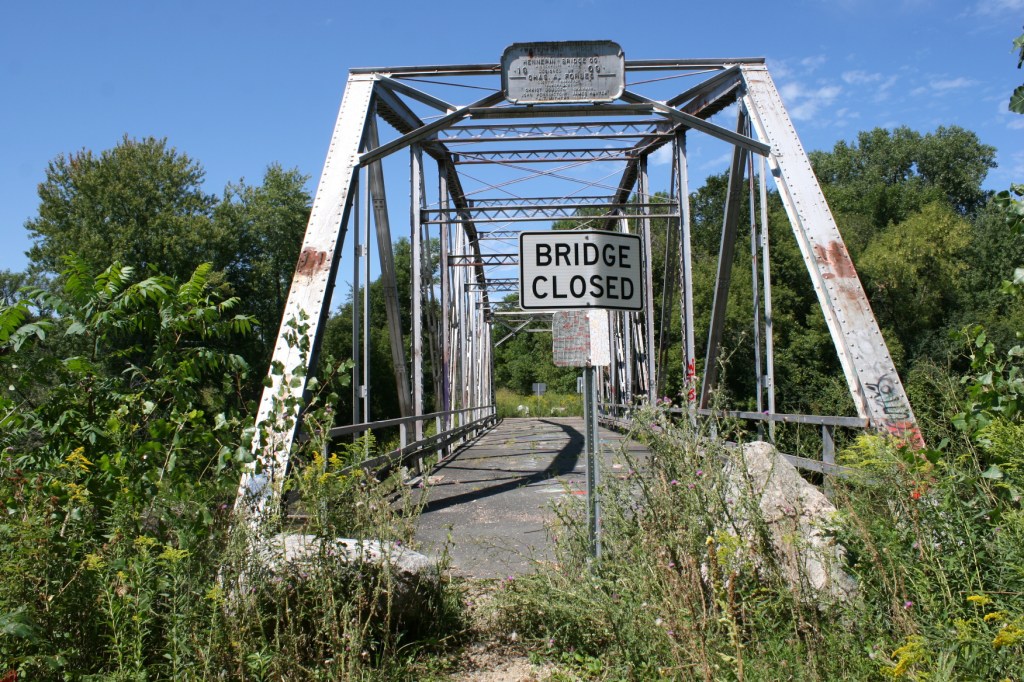
The historic Waterford Bridge, located in Waterford Township in Dakota County, Minnesota.


TO THE MINNESOTA DEPARTMENT of Transportation, the historic Waterford Bridge some two miles northeast of Northfield is tagged as bridge number L3275. I suppose bridges, like roads, require such numerical identifiers.


This is truly an artful and unique bridge in southern Minnesota.


Much more than a name or number, this “140-foot, steel, riveted and bolted, Camelback through truss on concrete abutments” bridge, according to MnDOT, stands as an historic bridge spanning the Cannon River.


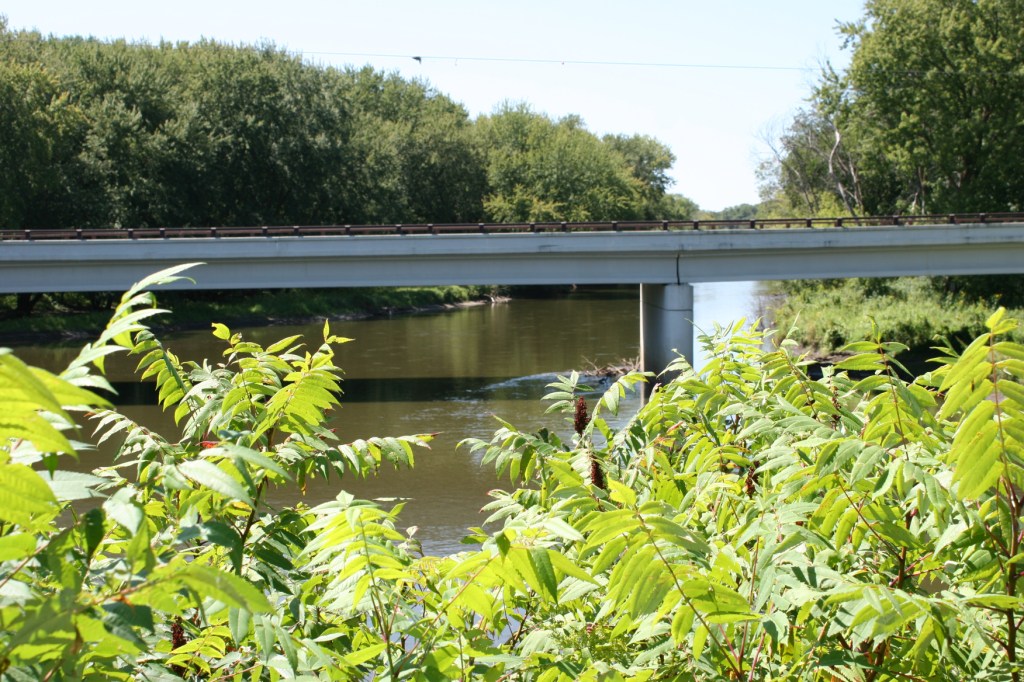
The new plain-looking bridge.


Rare in design here in Minnesota, the 1909 bridge closed to vehicle traffic in 2009 and was rehabilitated in 2014. A new, non-descript modern bridge replaced it.


Weeds, wildflowers and other plant growth surround the bridge.


I’ve long wanted to see the old bridge in Waterford Township as it reminds me of a similar truss bridge from my childhood. That bridge took US Highway 71/Minnesota State Highway 19 traffic across the Minnesota River near Morton. When my dad drove our family Chevy across the bridge en route to Minneapolis once a year to visit relatives, my siblings and I pounded on the interior roof to scare any trolls lurking underneath at water’s edge. That all seems silly now, reflecting as an adult. But, back then, it was great fun.


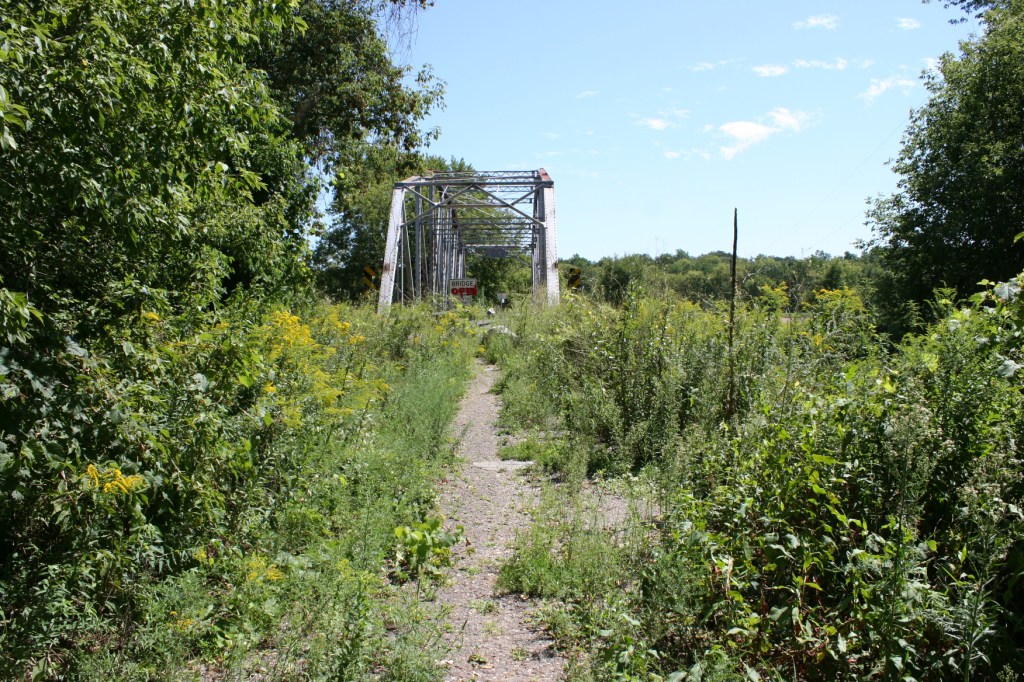
The narrow path to the bridge.


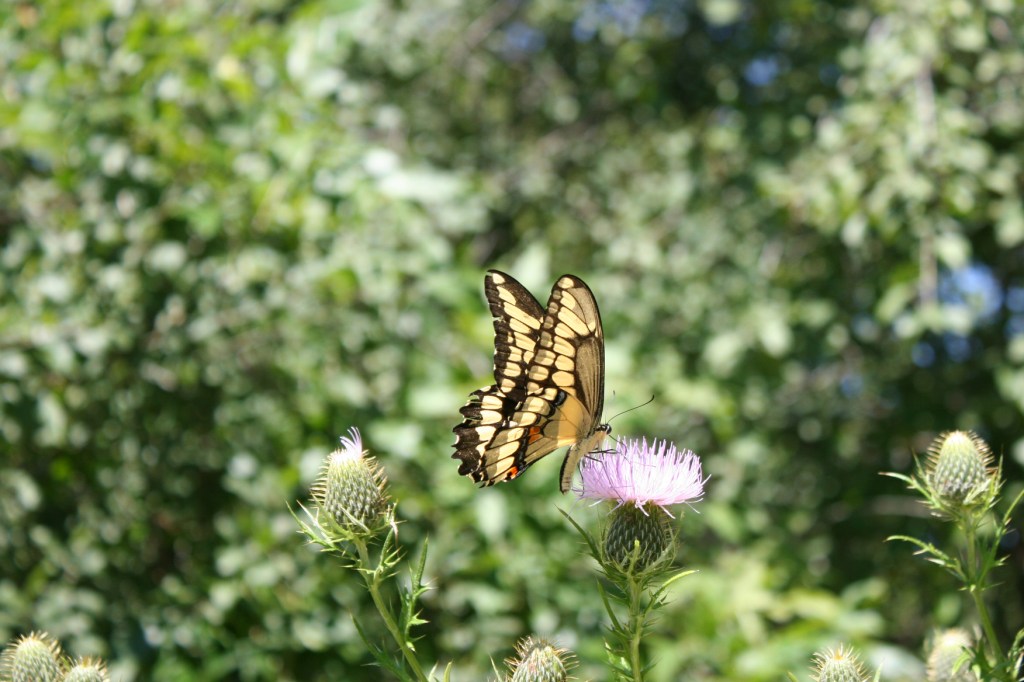
I stopped along the path to photograph a butterfly atop a thistle. I saw multiple butterflies.


Fast forward to today and my desire to see a similar-in-design bridge. Randy had actually driven across the Waterford Bridge at one time while doing some automotive repair work for a farmer in the area. So he easily found it. After parking, we set out to reach the bridge, weaving through a narrow pathway bordered by trees, thistles, goldenrod, wildflowers and other plants. Boulders blocked the deteriorating paved trail to motor vehicle traffic.


I hesitated, but only for a moment.


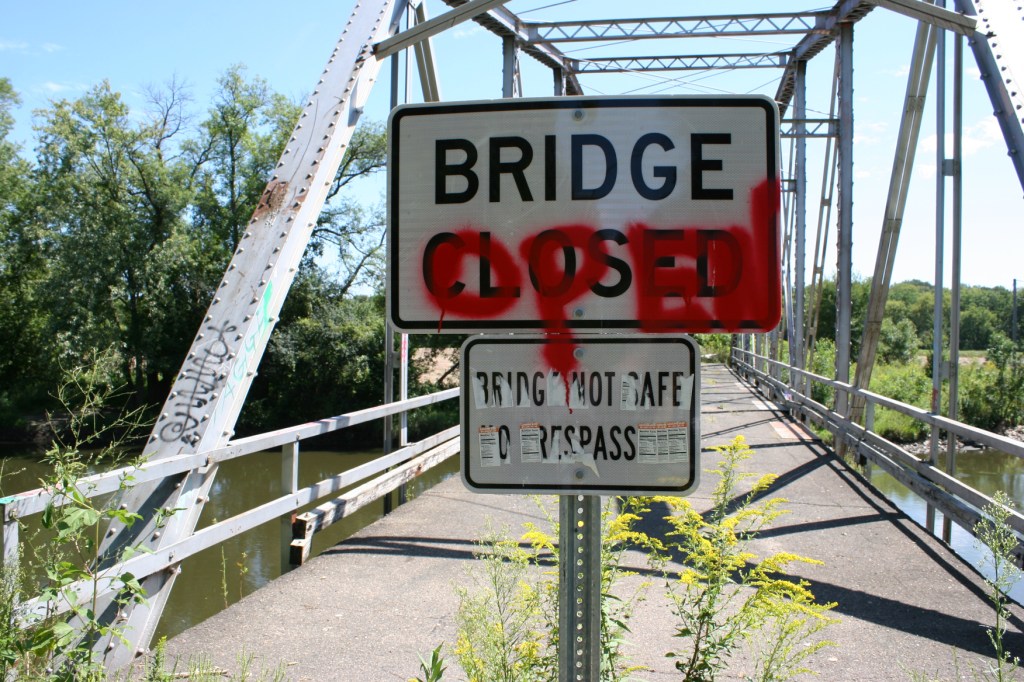
Upon reaching the bridge, I wondered if we should even venture onto it given the BRIDGE CLOSED—BRIDGE NOT SAFE NO TRESPASSING signage. But the deck looked safe…and many others had obviously been here before us.


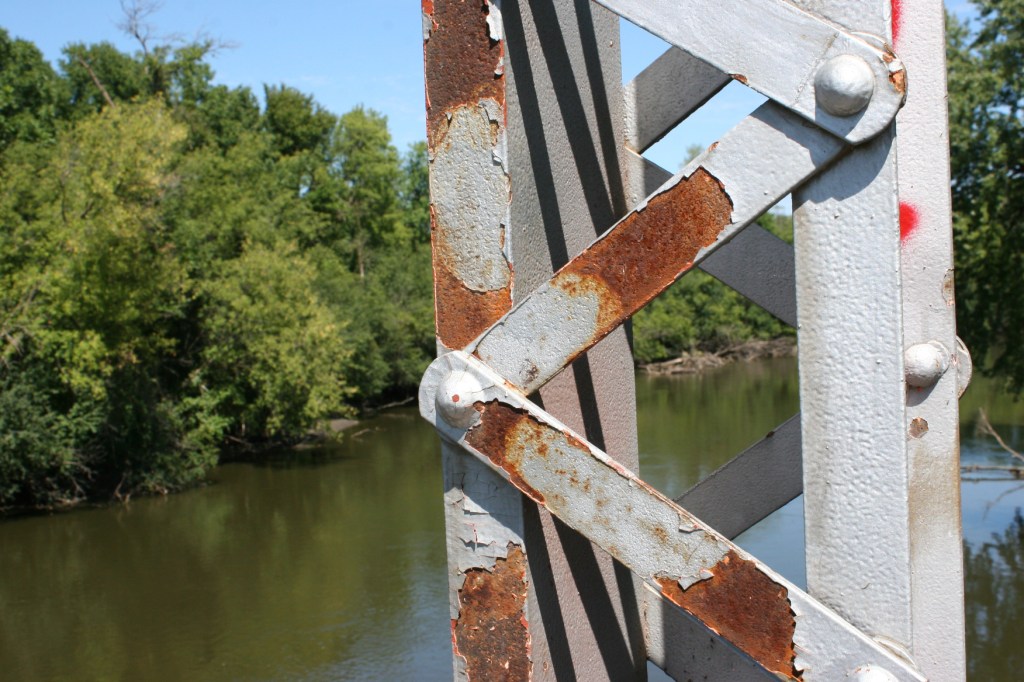
In need of paint, or perhaps replacement.


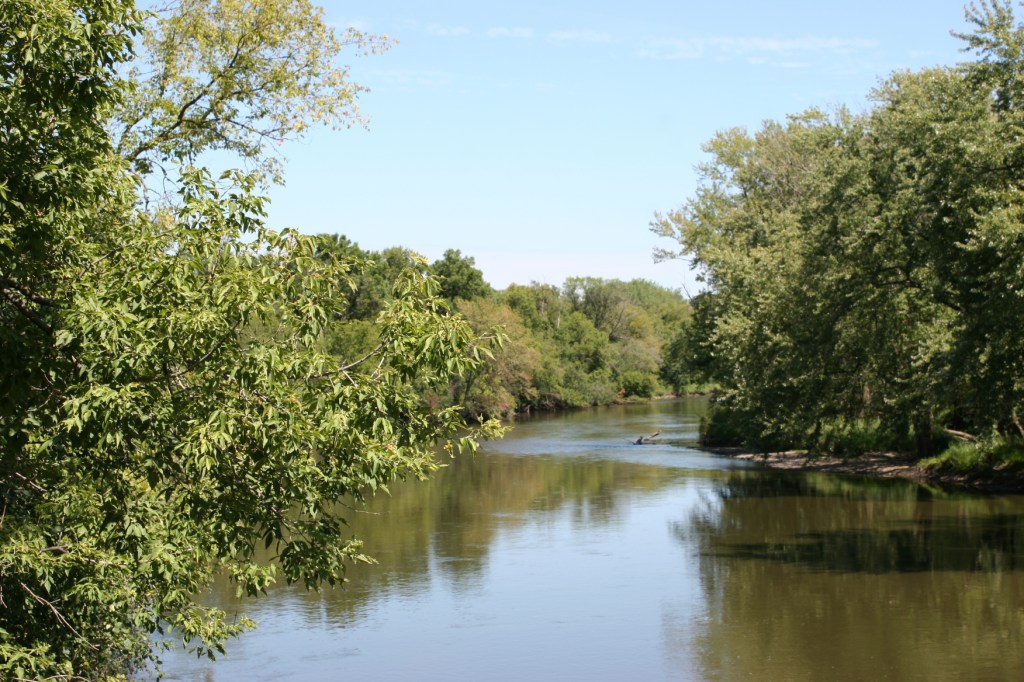
The Waterford Bridge spans the Cannon River.


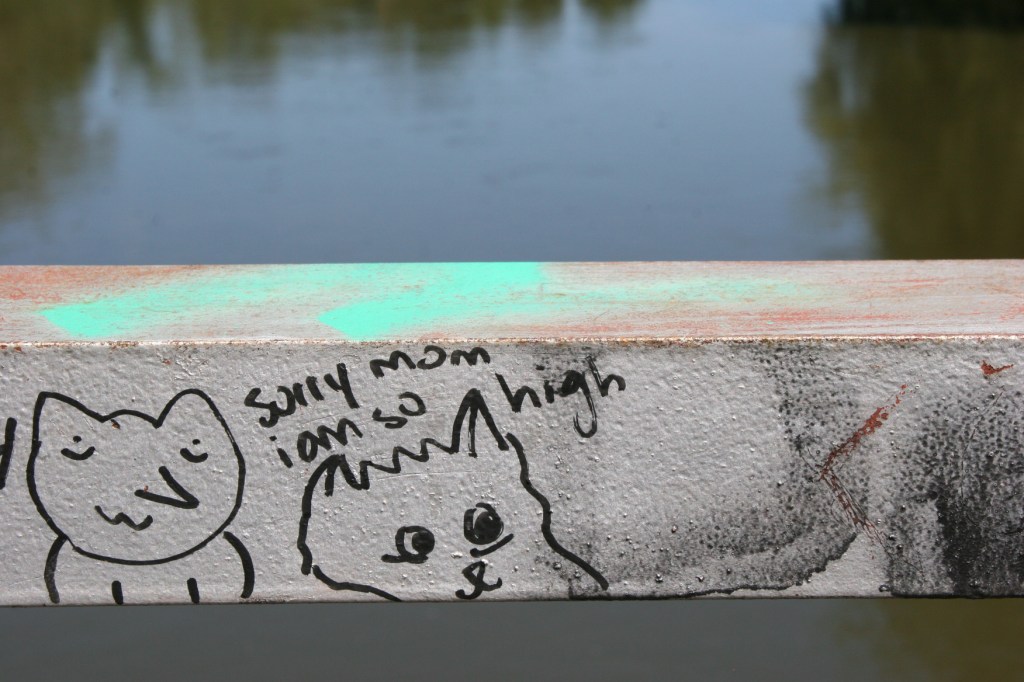
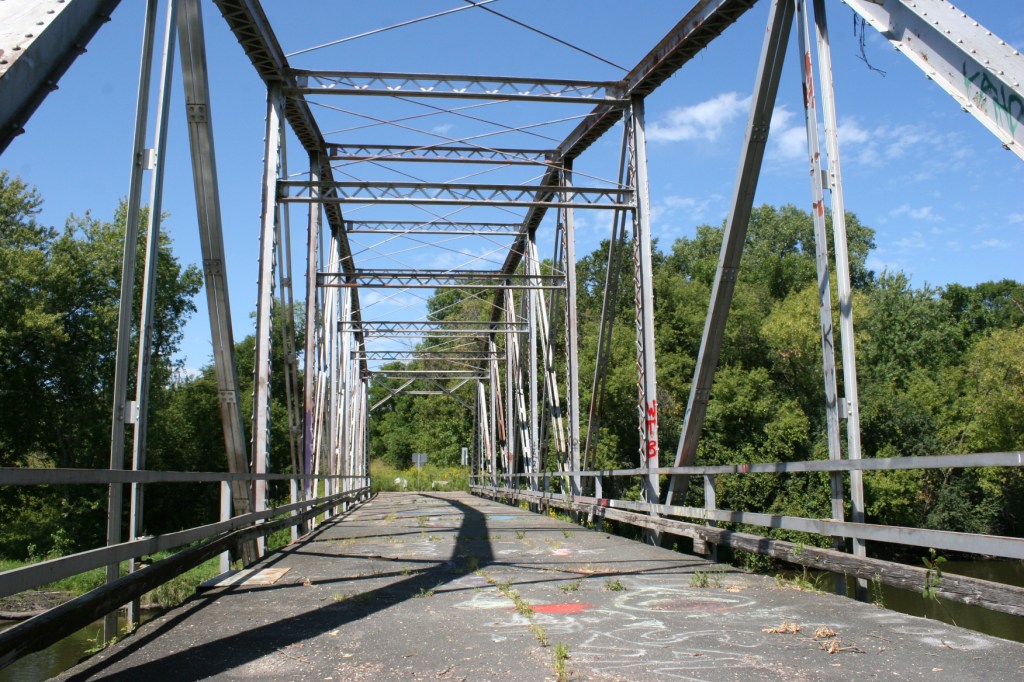
There’s lots of graffiti on the bridge.


Once on the bridge, I was surprised at its condition. Rusting metal. Flaking paint. Weathered boards. Graffiti. Vandalized signage. Cracked pavement.


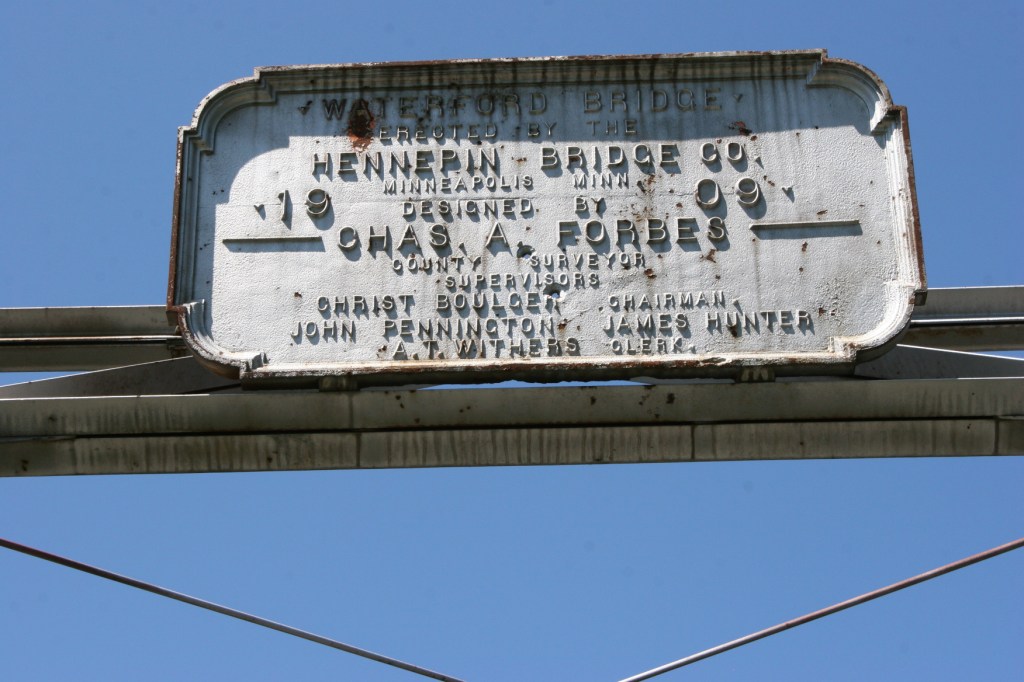
Historical details on a sign posted high above the bridge deck.


As I walked, dodging dog poop, I considered the condition of the bridge built by the Hennepin Bridge Company with Dakota County Surveyor Charles A. Forbes leading the project design. His name and that of other government officials are listed on a plaque atop one end of the bridge which now appears abandoned to the elements. The bridge is also on the National Register of Historic Places.


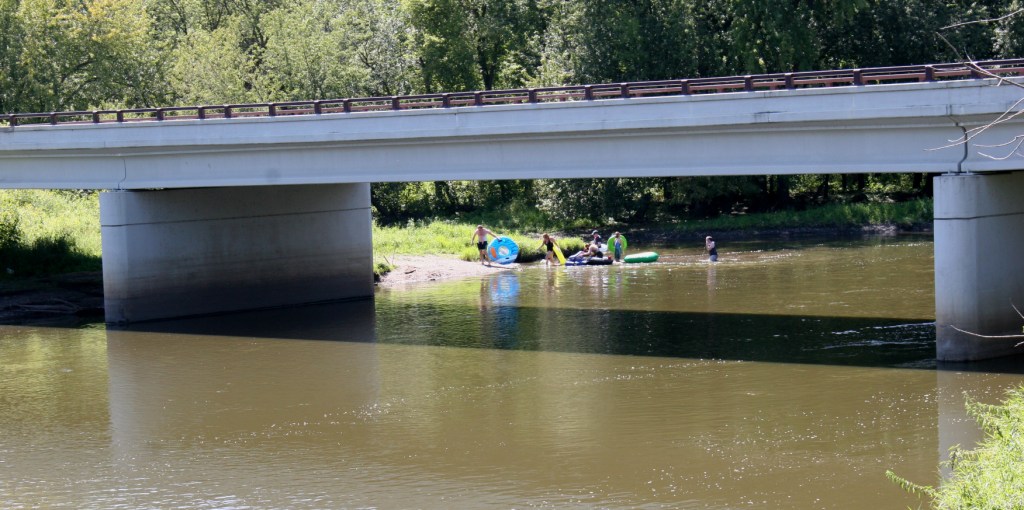
Tubers exit the Cannon River near the new Waterford Bridge.


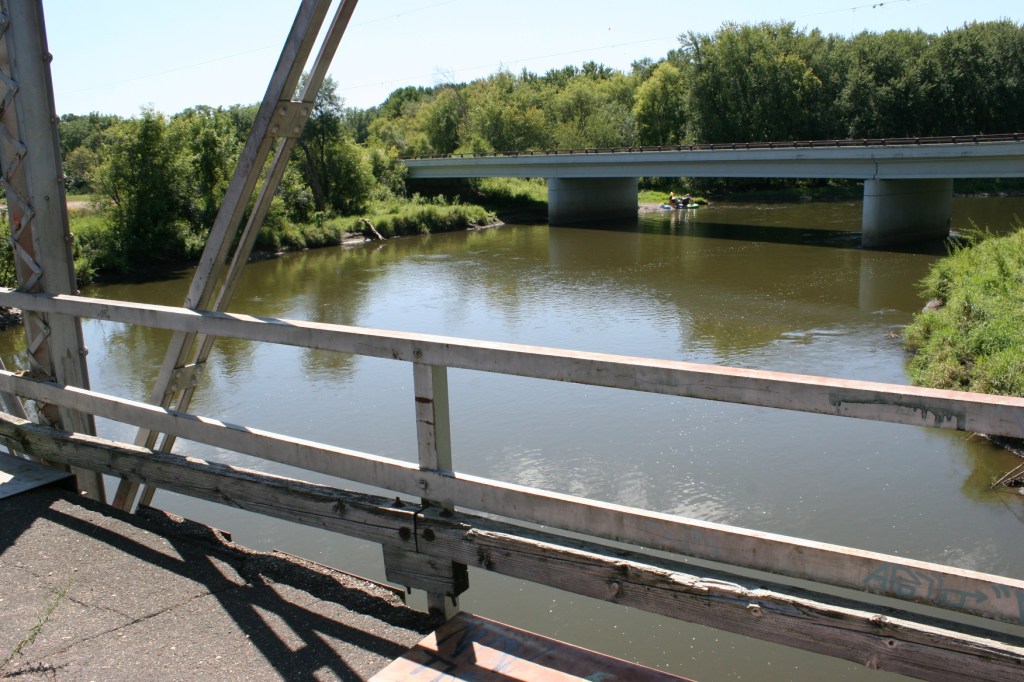
The new Waterford Bridge photographed from the old bridge with tubers in the distance at river’s edge.


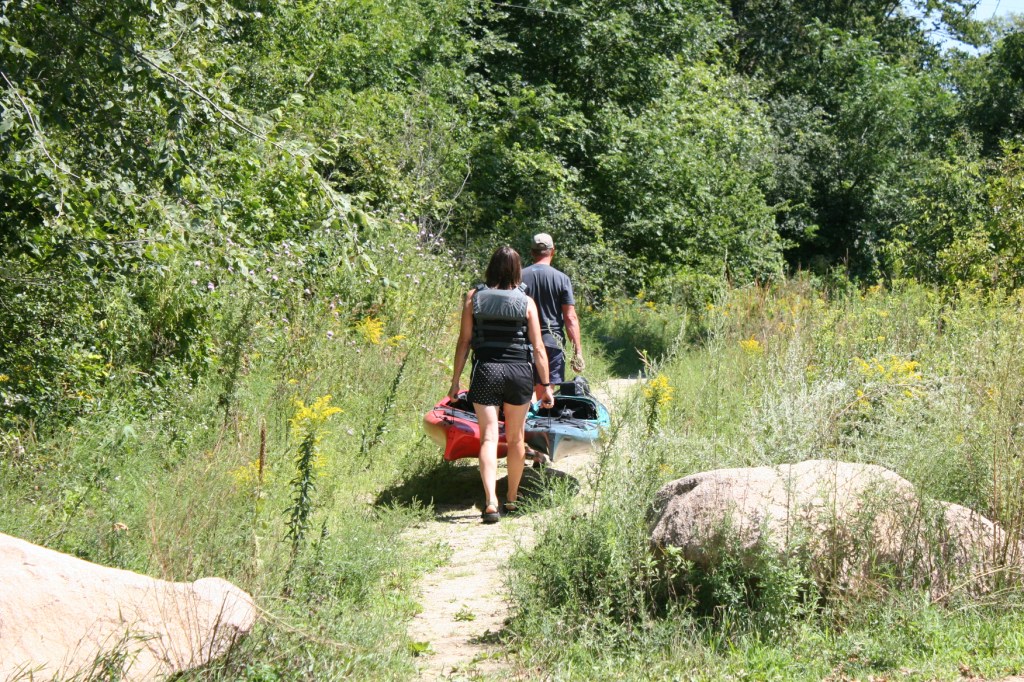
A couple carries their kayaks along the narrow path leading to the historic Waterford Bridge.


Under that bridge, the Cannon River flows, muddy and brown, carrying tubers, canoeists and kayakers—we met two of them, saw others—to places eastward. We watched as one couple carried their kayaks along the narrow path to the bridge with plans to travel eight miles to Randolph, a journey they expected to take three hours.


The muddy Cannon River, a popular waterway for water sport enthusiasts.


It was a lovely summer day to be on the water. Or, like us, to walk across an historic bridge that, for me, bridges past to present via childhood memories.

© Copyright 2020 Audrey Kletscher Helbling
 

Let peace & love guide us August 26, 2020


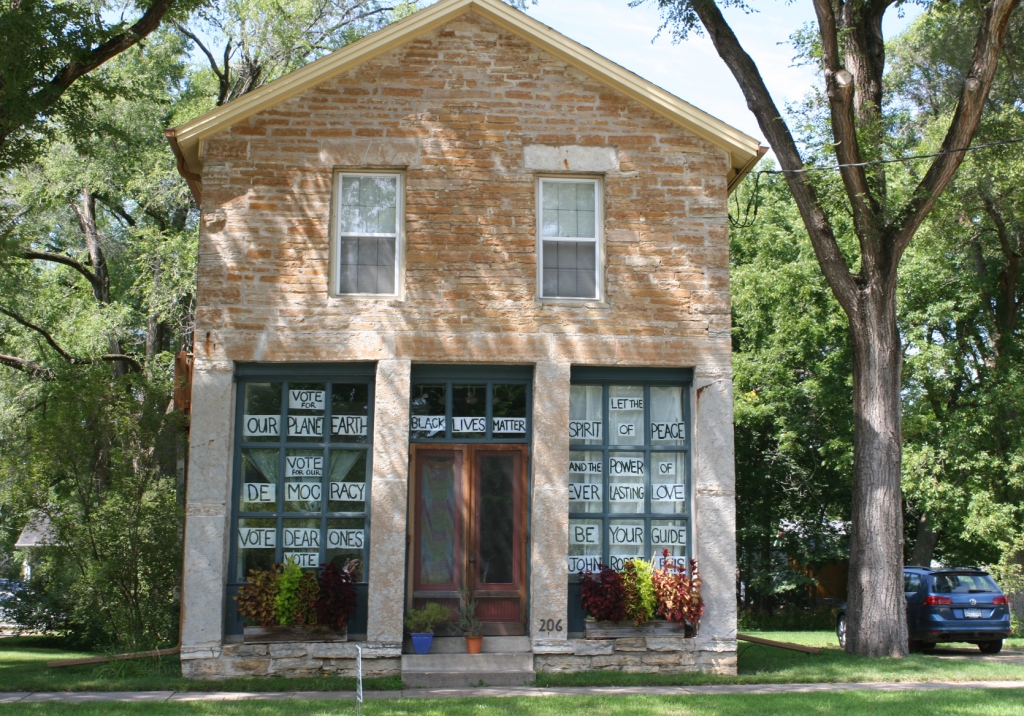
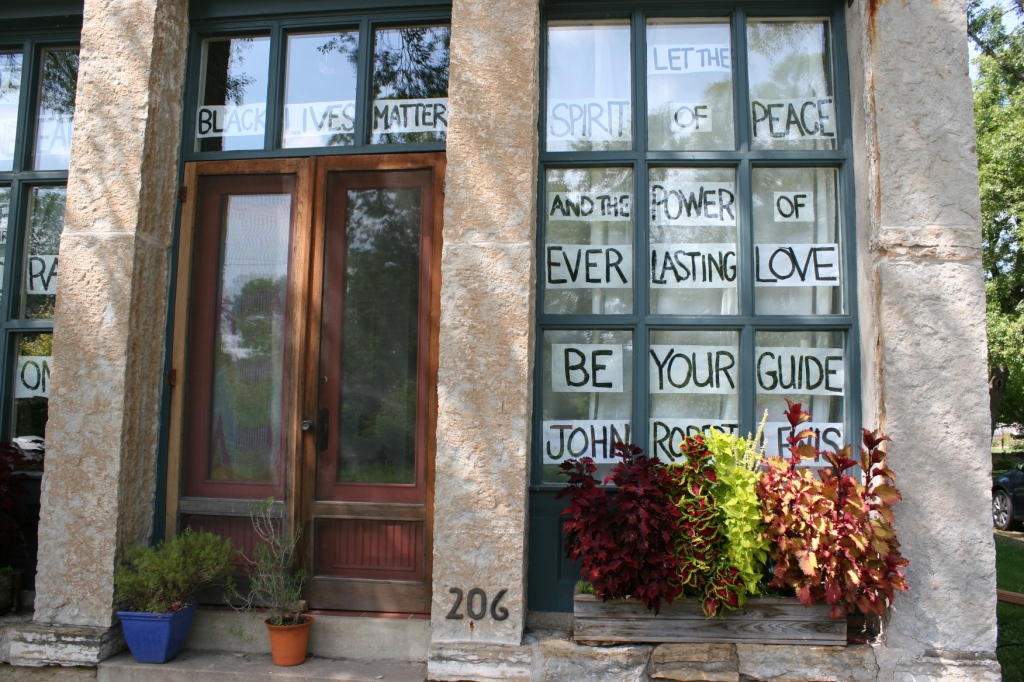
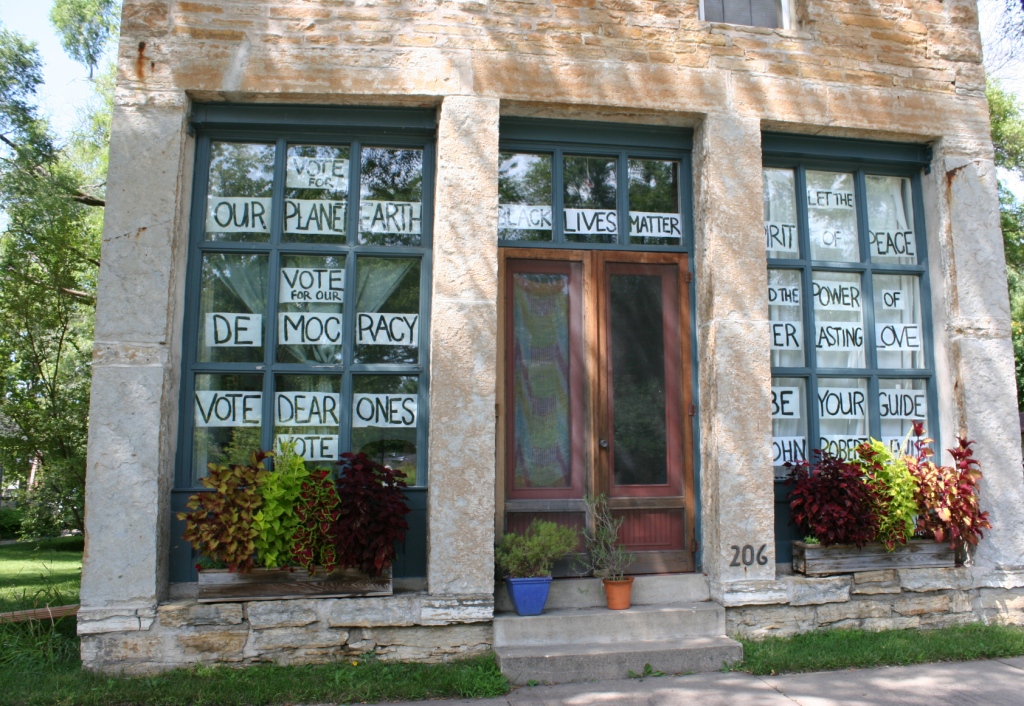
It’s truly timely. The message posted in windows spanning the front of an historic building in Dundas.


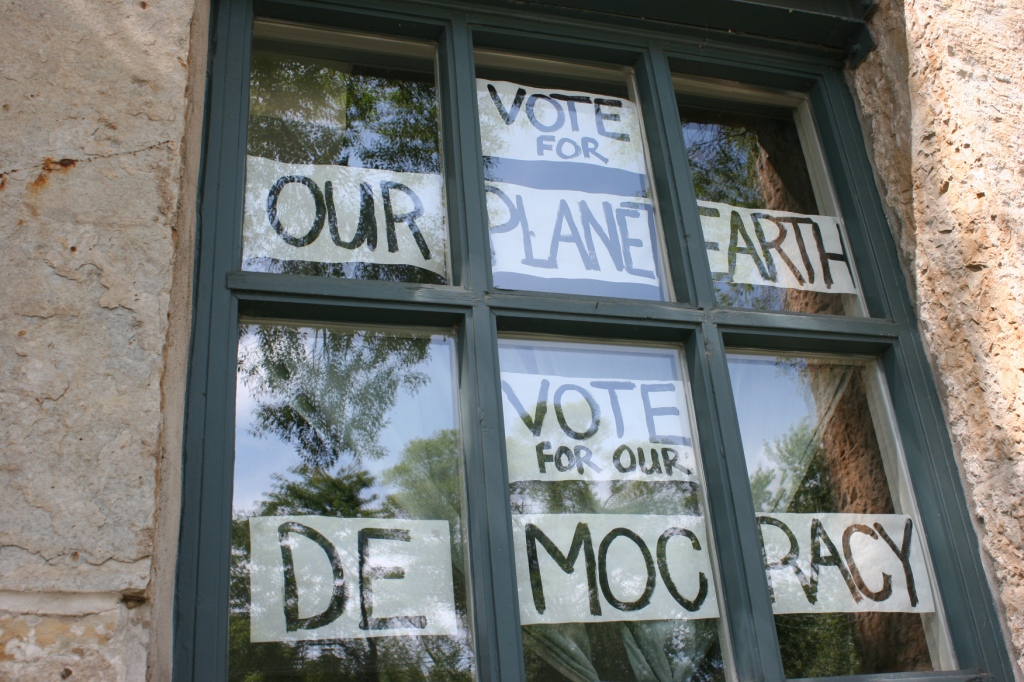
VOTE FOR OUR PLANET EARTH

VOTE FOR OUR DEMOCRACY

VOTE DEAR ONES VOTE


And then in the windows to the right side of the front door:

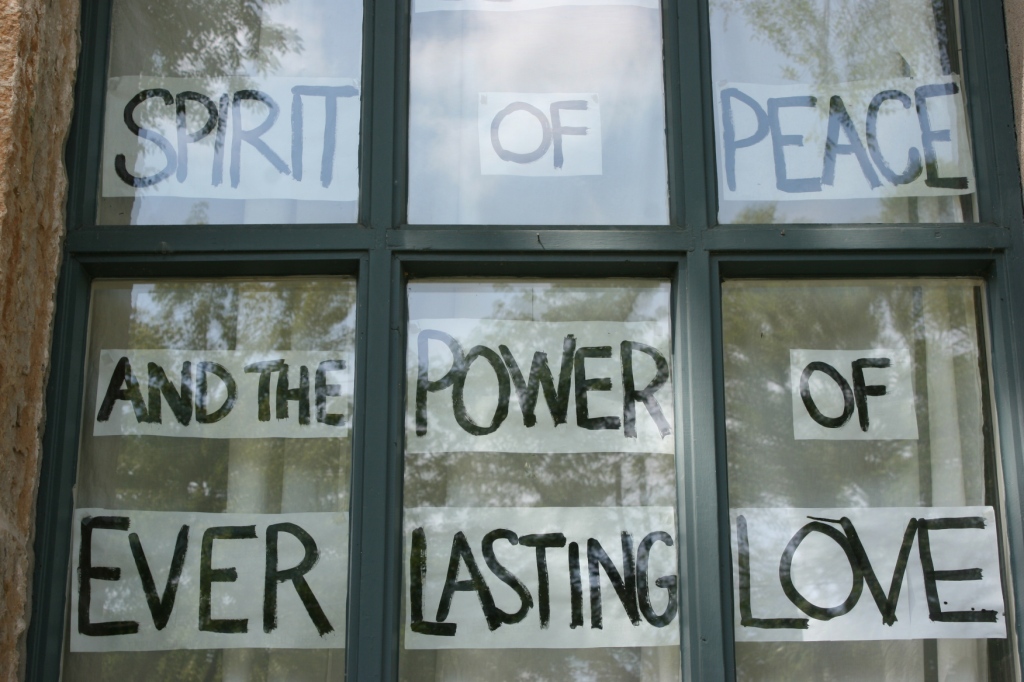
LET THE SPIRIT OF PEACE

AND THE POWER OF EVERLASTING LOVE

BE YOUR GUIDE

—JOHN ROBERT LEWIS


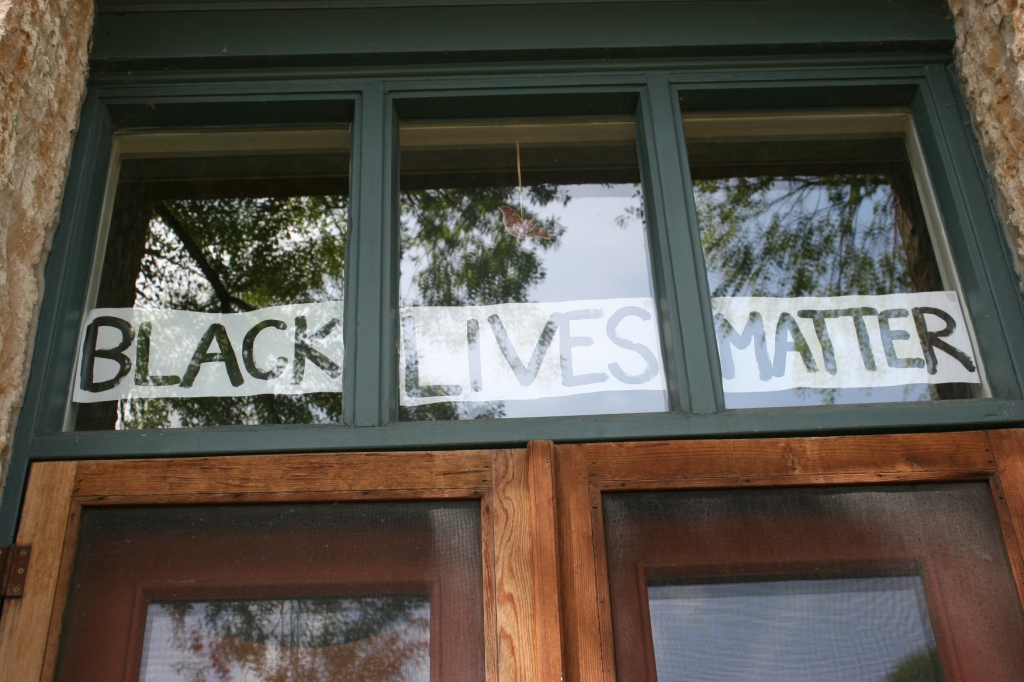
And then above the door:

BLACK LIVES MATTER

I spotted these powerful words while in this small southeastern Minnesota community on Saturday for a history cruise. And I felt compelled to stop and photograph the scene, to share this with you before continuing on to the tour.

As someone who grew up after and near the end of turbulent times—the Civil Rights movement (with its racial injustices) and the Vietnam War and an increasing awareness of environmental issues—I get it. The teenage me embraced the peace symbol, wrapped my wrist in a POW bracelet, wore Earth shoes. That was decades ago. Yet, it seems sometimes that little has changed.


And so those words resonate with me in their familiarity. I appreciate the gentleness of the selected words, yet the power behind them. Urging people to vote by calling them “dear ones” feels intensely personal and loving. Now, more than ever, we must exercise our right to vote. Men and women have died for our freedom, ensuring our democracy and the right to vote. Others have marched for the right to vote, including long-time Georgia Congressman and Civil Rights leader John Lewis, who died in July from cancer.

The quote from Lewis that peace and love should prevail is something we can all aspire to in this deeply divided nation in need of healing. I appreciate the positive message. The words uplift, rather than press down. They enlighten rather than oppress. They encourage rather than attack.


And, yes, black lives do matter. As does every life. I recognize the frustration, the anger, the desire for change. I don’t condone the violence, the looting, the destruction, which detract from the cause. Let peace and everlasting love be our guide.

John Lewis marched for voting rights for blacks across the Edmund Pettus Bridge in Selma in 1965 and suffered a skull fracture at the hands of police. He organized voter registration drives and participated in lunch counter sit-ins. And here we are, so many decades later, with root cause issues unresolved, people still struggling, hurting, protesting.


If only we remember how “dear” we are to one another, how the words we choose, the actions we take, matter, affect others. Let peace and the power of everlasting love be our guide.


FYI: The building where these messages are posted was built of locally-quarried limestone in 1866 as the Ault General Store and is on the National Register of Historic Places. It is the only remaining structure from Dundas’ original commercial district, which ran along Second Street. When the railroad came to town, businesses moved to the west side of the Cannon River near the new train station. That included the Ault Store.

The local newspaper, the Dundas News, was housed here from 1876-1979 as was the town’s first library on the second floor. Today the old store is in a residential neighborhood and a residence. But it still retains that feel of community, of centering knowledge and of expressing opinion.


© Copyright 2020 Audrey Kletscher Helbling
 

From milling flour to drinking whiskey in Rice County, history tour Part II August 25, 2020

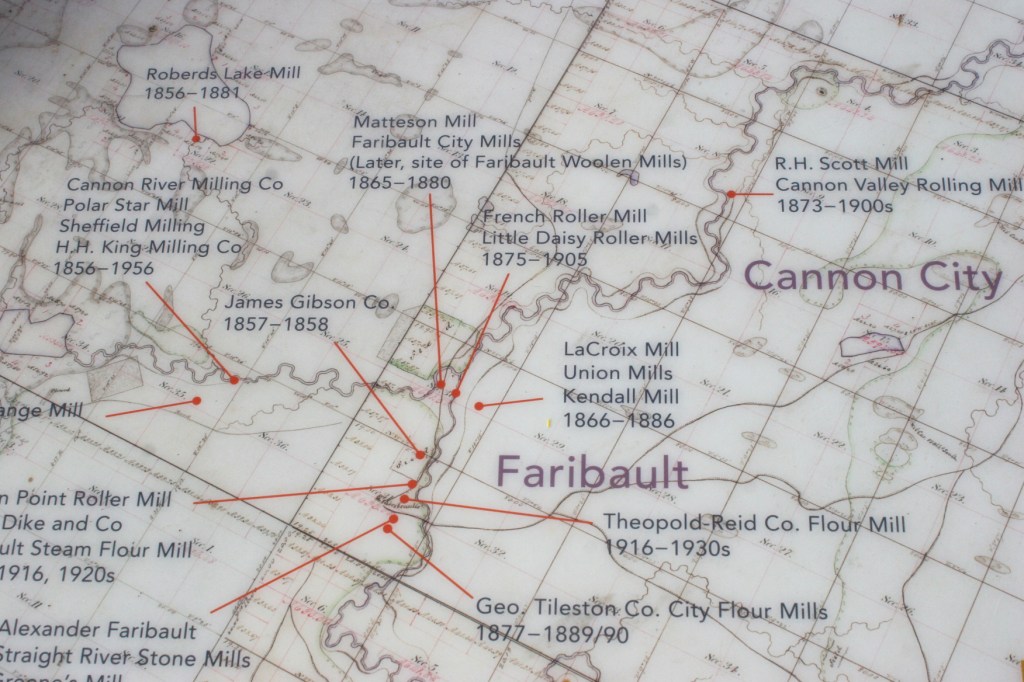
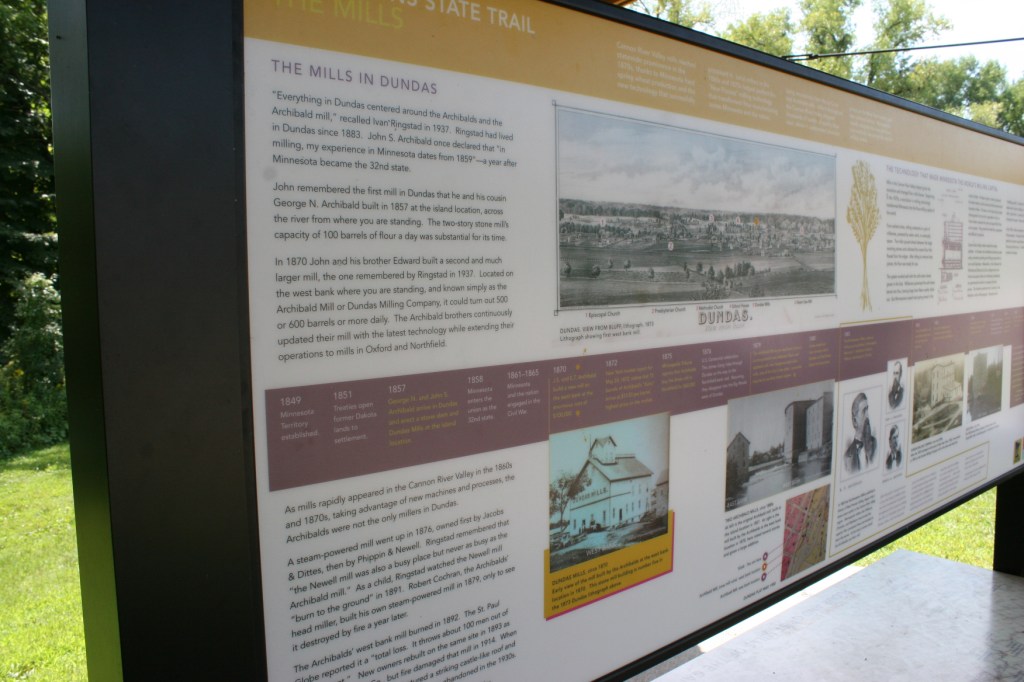
At the ruins of an historic flour mill in Dundas, a kiosk provides historical info, including this map of flour mills in the area.


RICE COUNTY IS RICH IN HISTORY, especially in historic buildings. I value that about this region of Minnesota. I appreciate that many aged structures remain, well cared for and treasured. I appreciate, too, those who share their knowledge of the past.

I grew up 120 miles west of here, on the prairie. Given the difference in landscape and settlement time and other factors, the history of southwestern Minnesota differs considerably from southeastern Minnesota. I am still learning about Rice County, the place I’ve called home for 38 years.


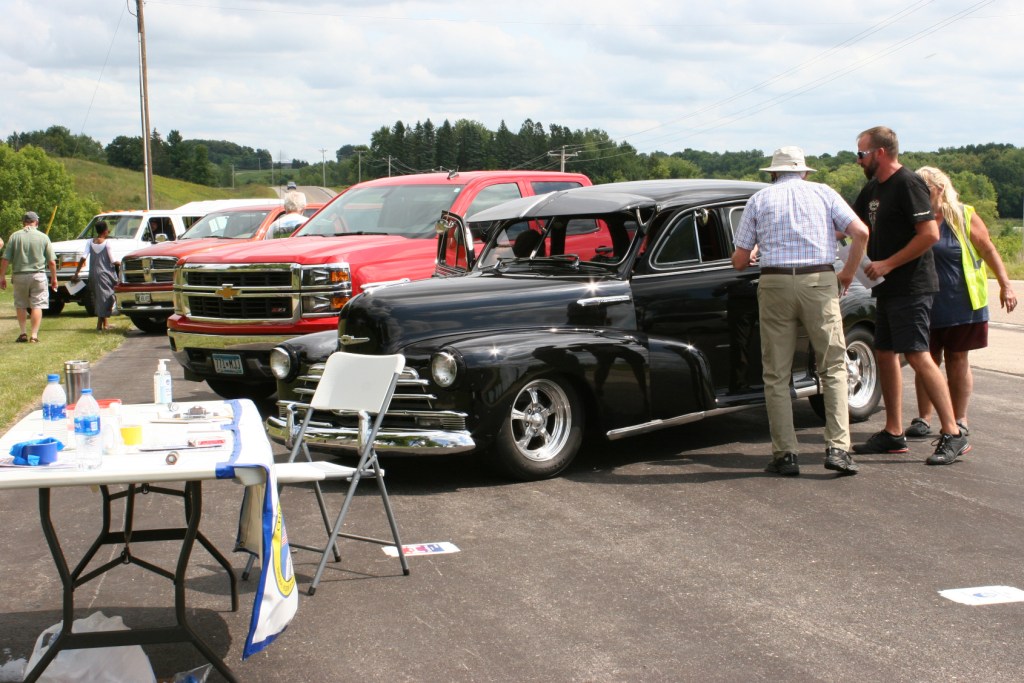
Vintage vehicles were among those on the history cruise, here at Christdala Swedish Lutheran Church near Millersburg.


On Saturday I expanded my understanding of this area by attending the first ever “Cruising Rice County History” tour, an event that took attendees through the county to seven historic sites. In yesterday’s post, I covered three of those places—Prairieville Church, Nerstrand City Hall and Valley Grove Churches.


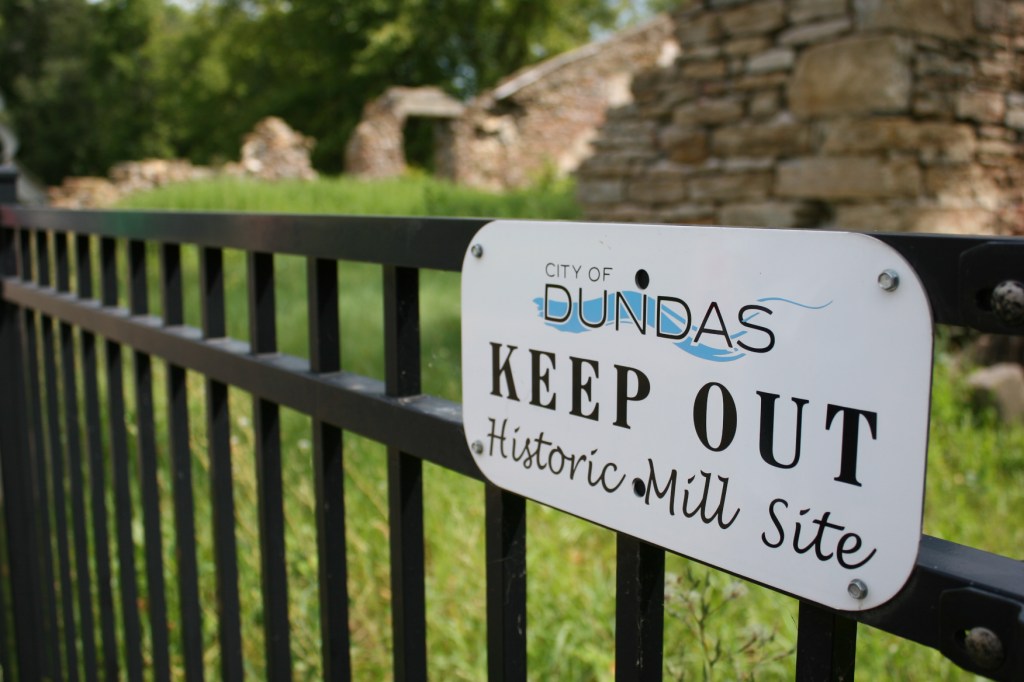
The Archibald Mill ruins are fenced to keep people from wandering onto the historic site.


Today we head west to the small town of Dundas, just outside of Northfield, and then even farther west to the even smaller settlement of Millersburg. Pre-tour, I was familiar with each point of interest on the cruise. But I still picked up tidbits of information either new to me or forgotten over the years.


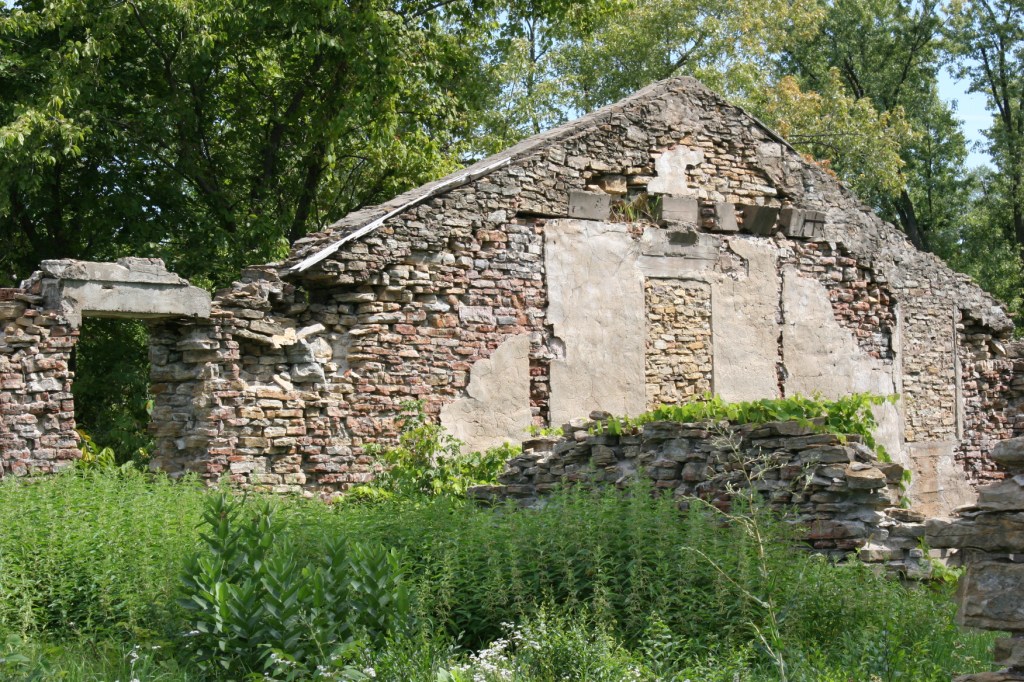
A few walls remain of the once flourishing flour mill on the west side of the Cannon River in Dundas.


Kiosk info details flour milling history here.


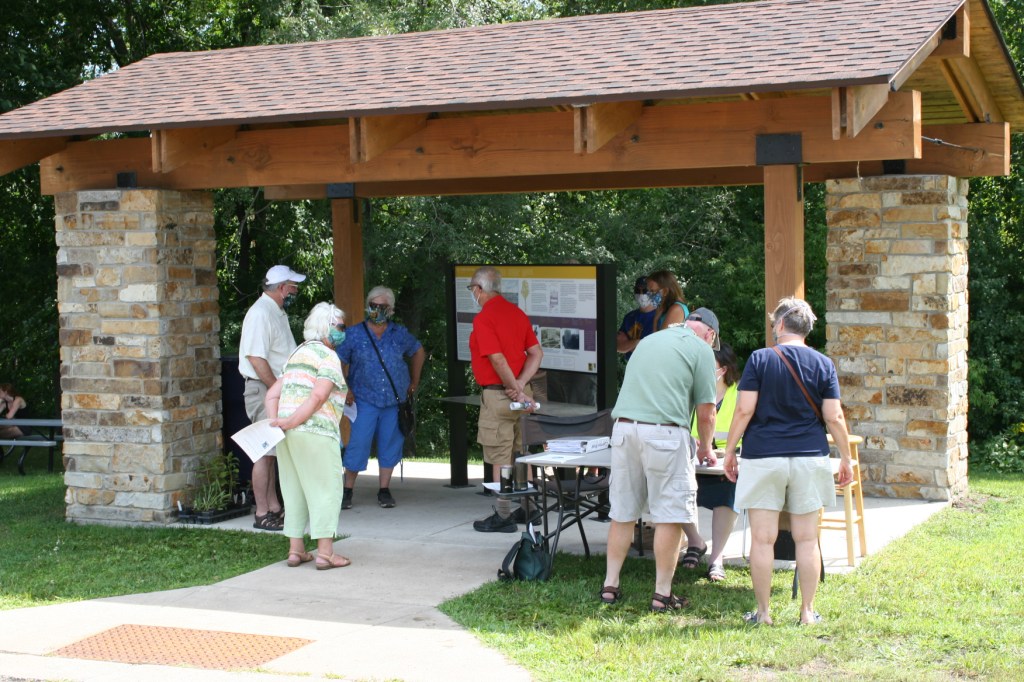
Tour participants check in at the flour mill ruins, where they could learn more about Rice County flour mills from local historian Jeff Jarvis, Susan Garwood (director of the RCHS) or read printed info.


In Dundas, the ruins of a long-gone flour mill, destroyed by fire, focused the third stop. I learned of the mills the Archibald brothers, from Canada, built here around the 1860s along the banks of the Cannon River. Their flour was world-renowned and their flour patent eventually sold to what is now General Mills. It’s quite a history in a region once known for its flour mills. If only one remained…


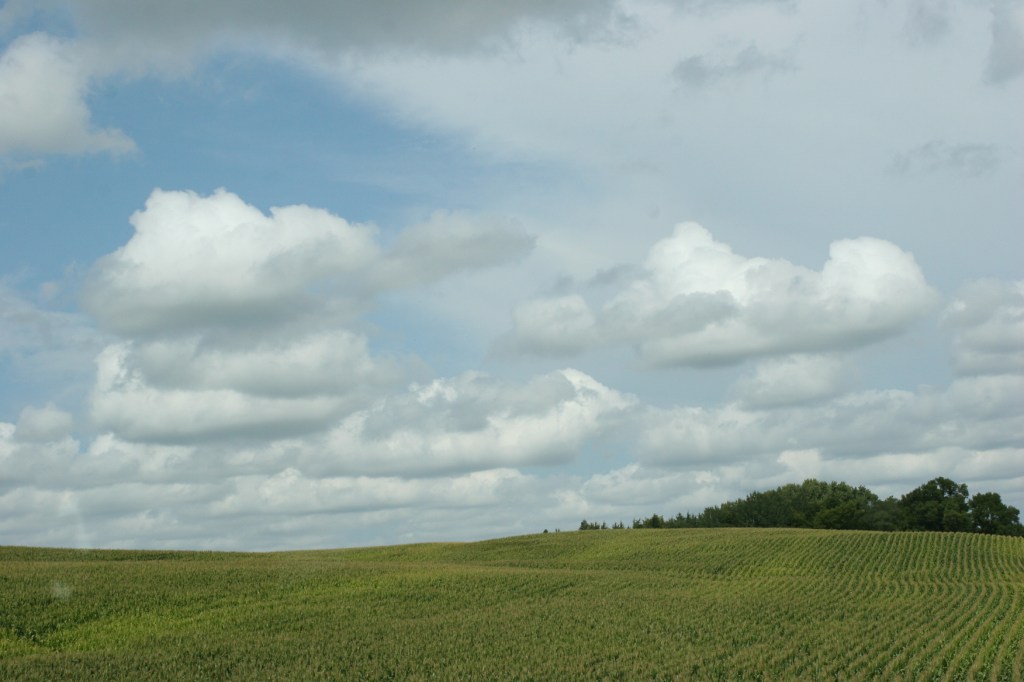
The history cruise took us throughout rural Rice County. This farm field lies along Rice County Road 1 on the way to Millersburg from Dundas.


Before heading to the next stop, Randy and I picnicked at Memorial Park in Dundas. That left us a bit crunched for time as we aimed out of town along Rice County Road 1 past farm sites and farm fields to the Millersburg District #20 School House Museum. We’ve been here before, toured the museum.


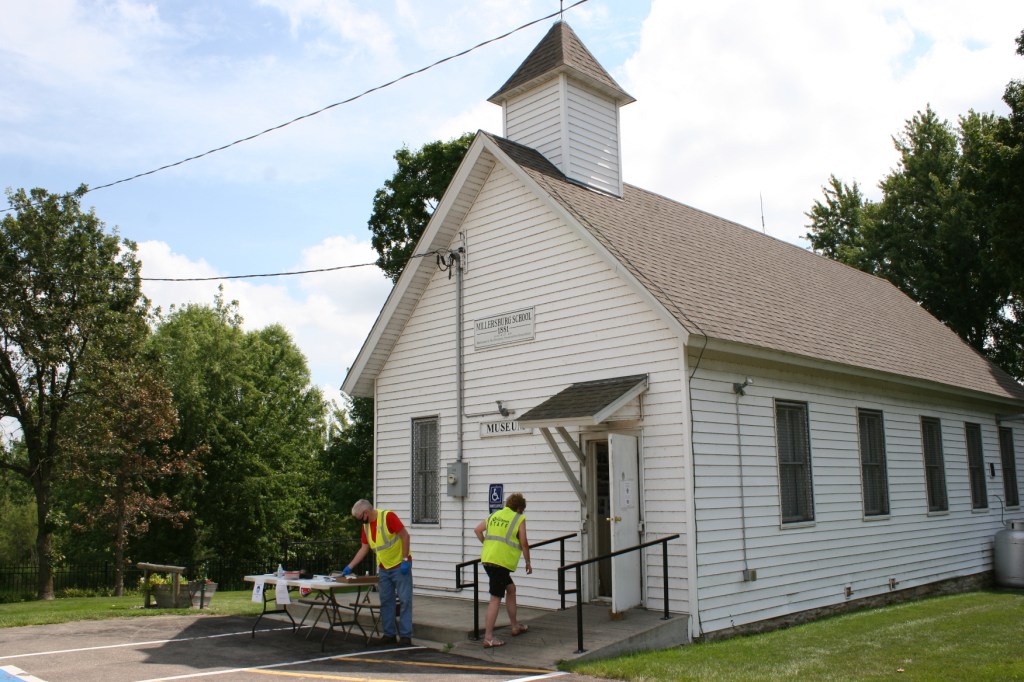
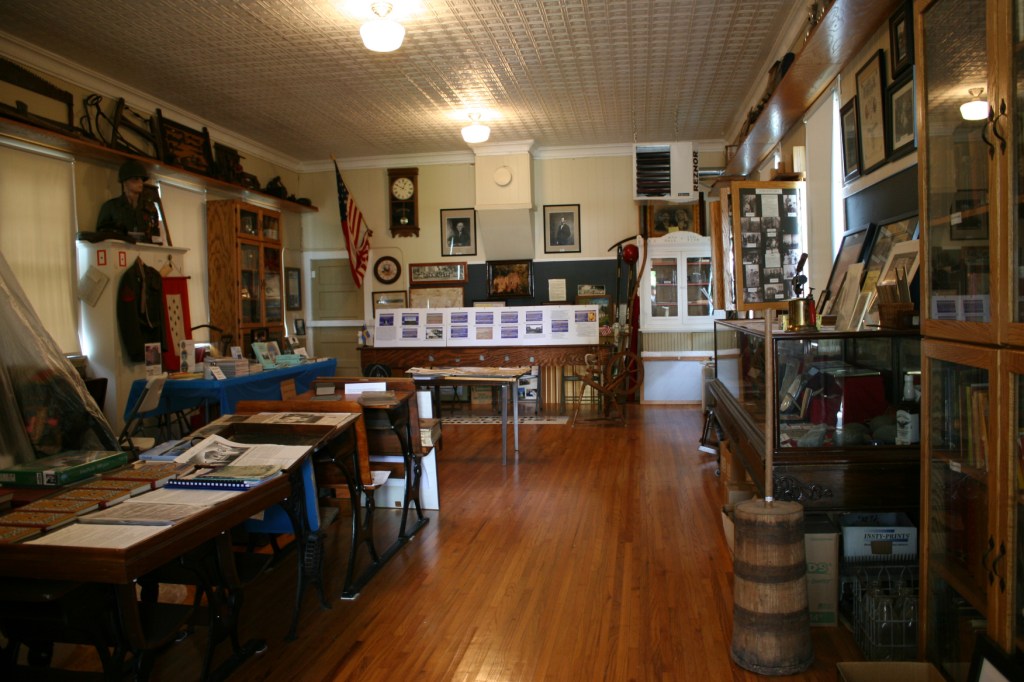
The former Millersburg School now houses a museum operated by the Christdala Preservation & Cemetery Association. Exhibits include school and church items, tools and info related to the James-Younger bank robbery.


While we couldn’t go inside the schoolhouse, we could peek our heads in the door.


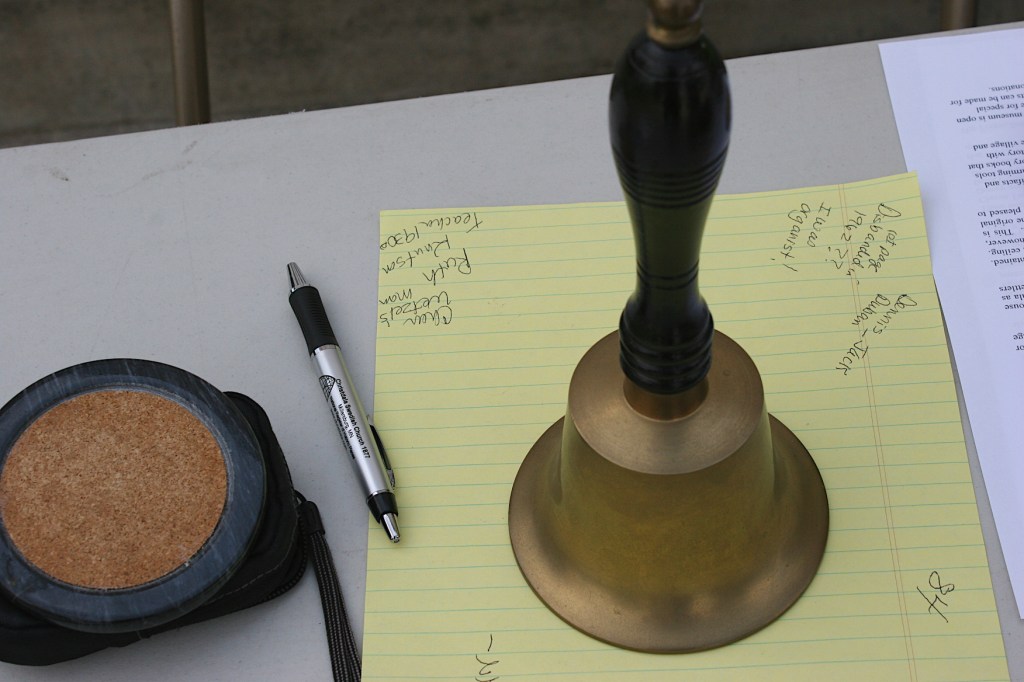
Appropriately, a bell sat on the check in station at the schoolhouse.


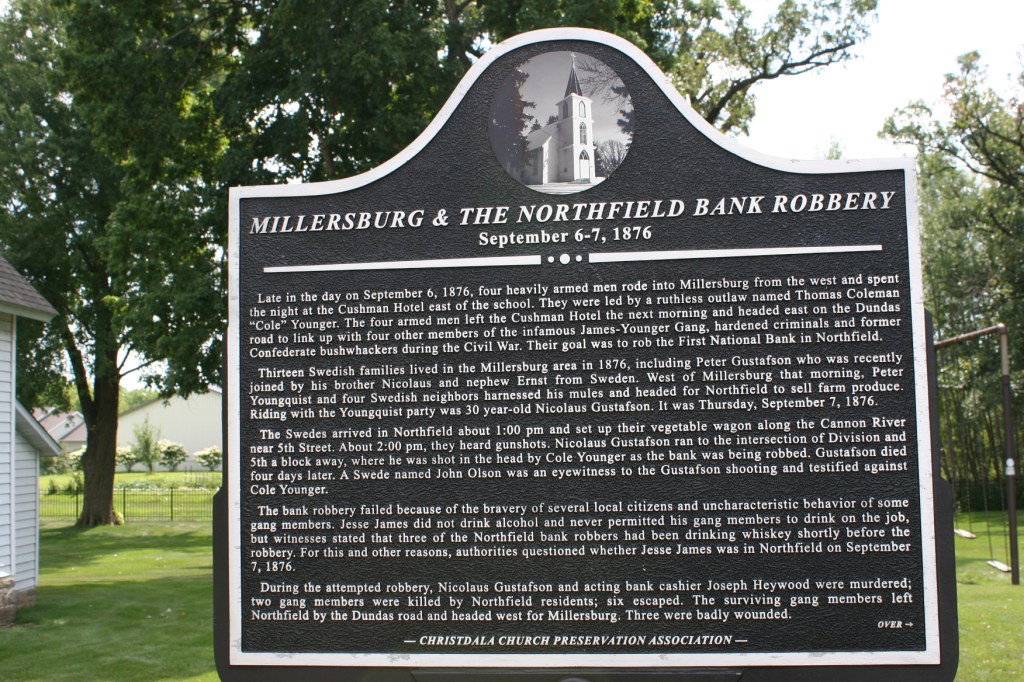
An historic marker outside the schoolhouse. You can also see the swings, remaining from the playground, to the right in this photo.


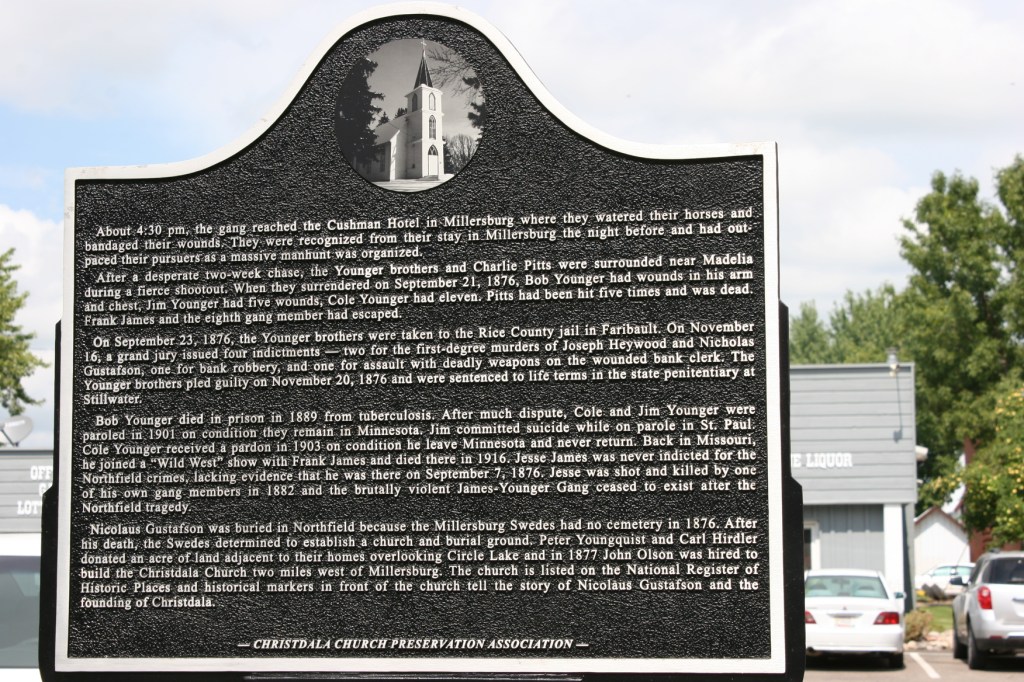
The back side of the historical marker outside the schoolhouse.


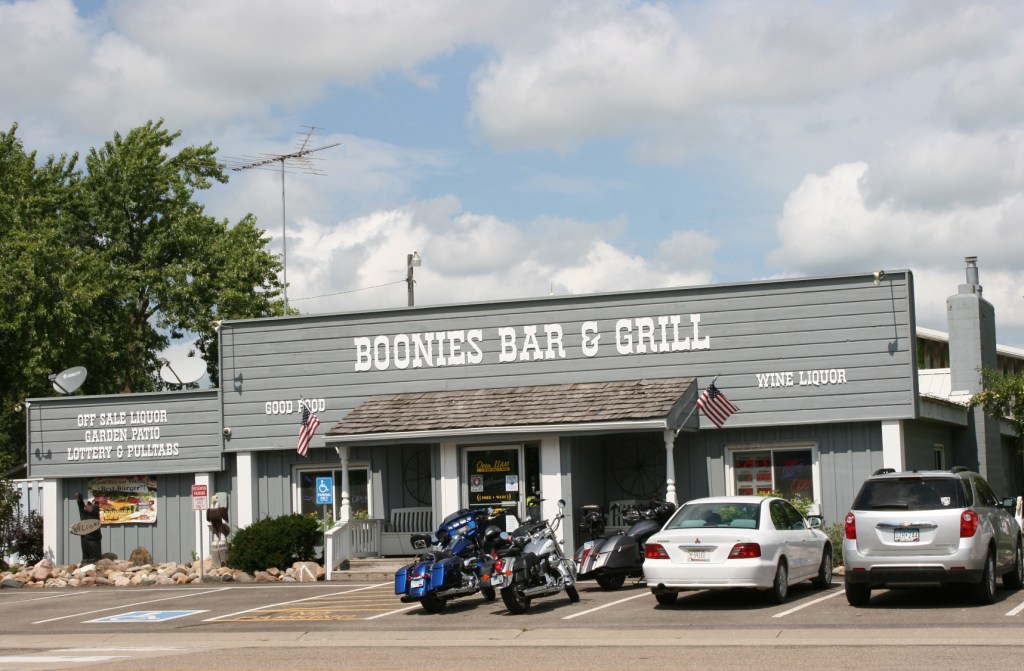
As the story goes, the Younger gang stopped for whiskey at the Millersburg store in September 1876 at the current location of Boonies.


But this visit I picked up some info not necessarily related to the 1881 school, but to the 1876 robbery of the First National Bank in nearby Northfield. Here, four members of the James-Younger Gang stopped for whiskey at the then Millersburg Store (today Boonies Bar & Grill across from the schoolhouse), stayed at the Cushman Hotel just down the road and the next day met up with fellow outlaws in Dundas.


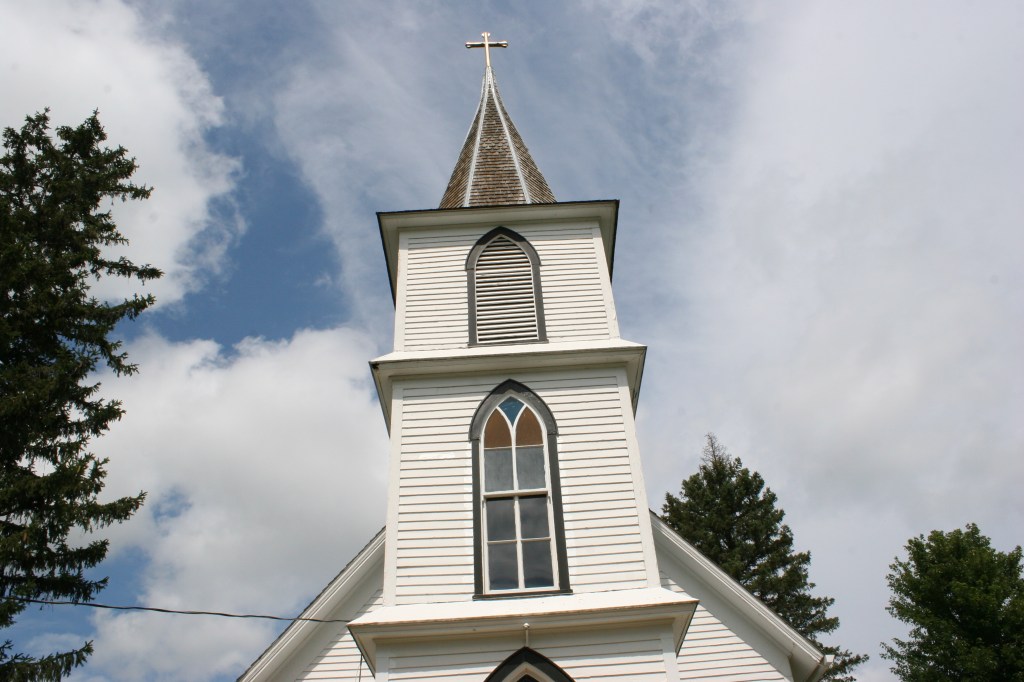
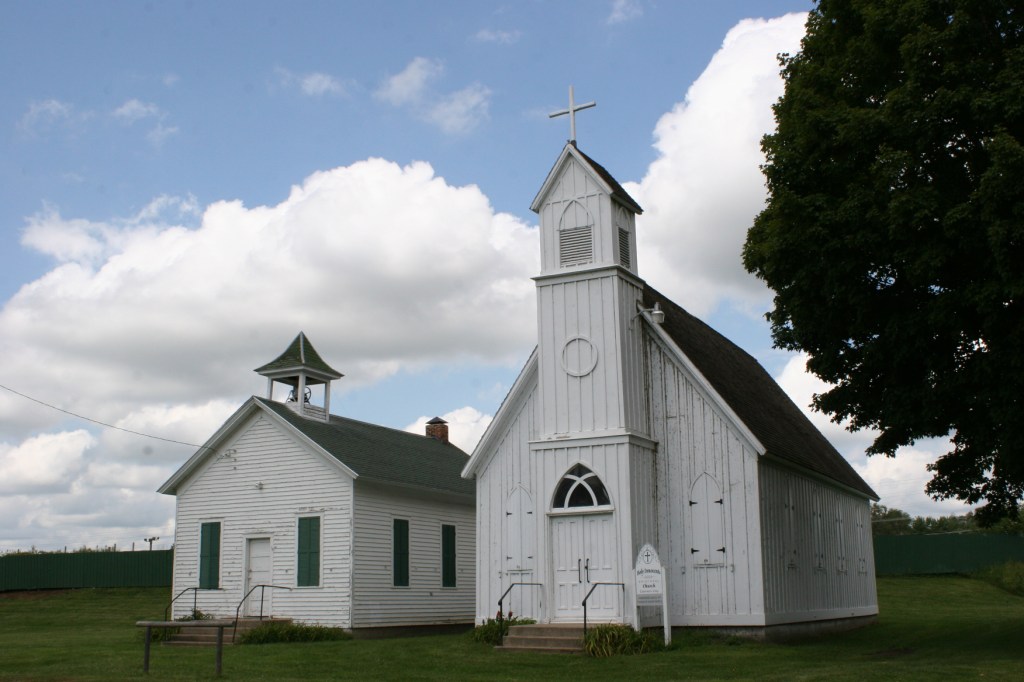
Christdala’s defining steeple. The church is on the National Register of Historic Places. Randy and I recently picnicked on the front steps of Christdala.


I was delighted to find the doors open to Christdala Swedish Lutheran Church.


And on their way back from robbing the bank, the gang followed the same route, taking us to the next stop on our tour, Christdala Swedish Lutheran Church. I’ve also visited here many times, including just a few weeks ago. Swedish immigrants built this church in 1878 high atop a hill, spurred by the death of friend and neighbor Nicolaus Gustafson. He was an innocent bystander killed in a shoot out during the Northfield bank raid. Because the Swedish community had no cemetery, Gustafson was buried in Northfield.


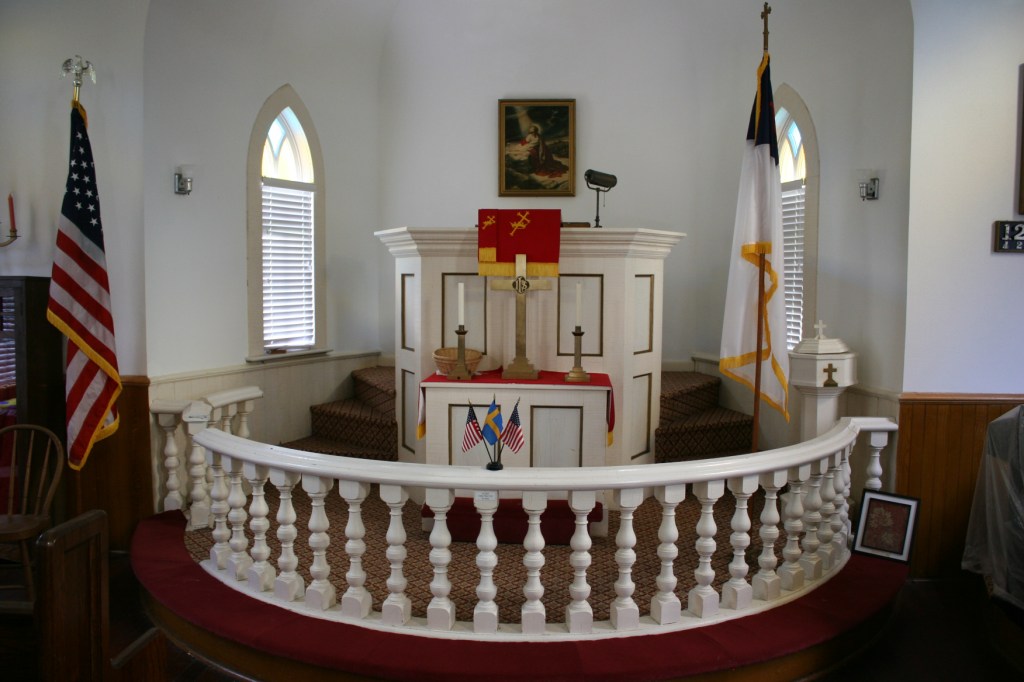
Simple stained glass windows inside Christdala in colors of the Swedish flag.


Today you’ll find Gustafsons buried in the Christdala graveyard along with many others whose surnames end in “son.” This long-closed church was open during the history tour. Although I’ve previously been inside, I wasn’t about to miss another opportunity to step inside this small Swedish church, complete with Swedish flags and stained glass windows in the Swedish colors of blue and yellow.


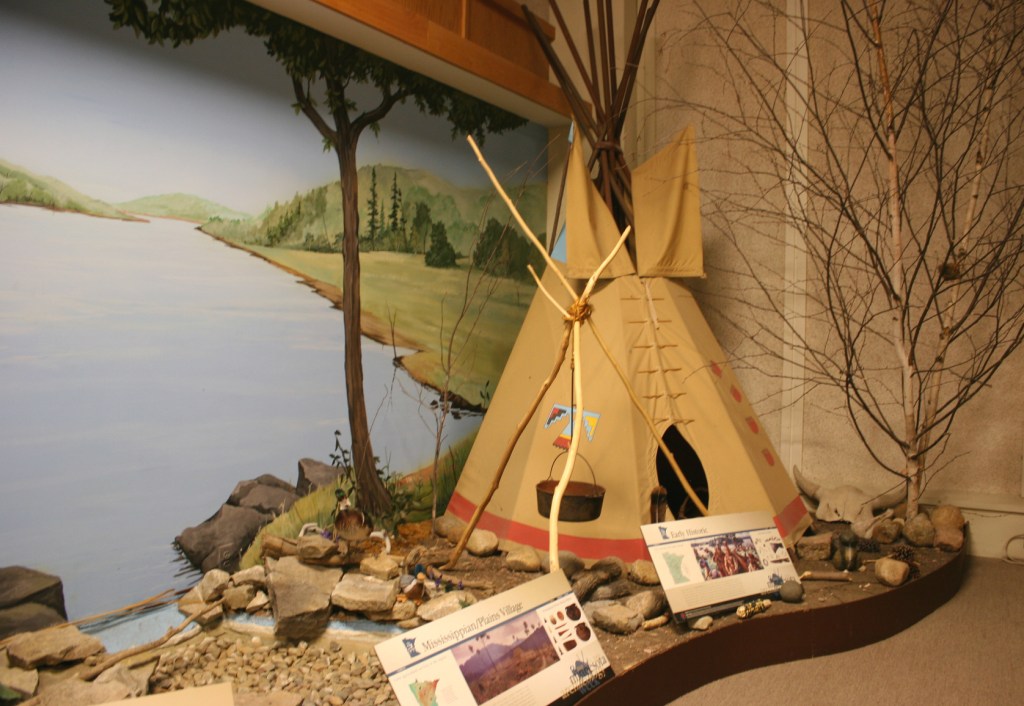
One of the many displays inside the Rice County Historical Society Museum, this one honoring Native Americans who lived in the county.


The RCHS recently acquired metal art sculptures from Lockerby Sheet Metal, a long-time Faribault sheet metal fabrication company no longer in business. Those pieces are being restored. This knight currently stands in the museum entry.


On the historical society grounds are these two historic buildings: the Pleasant Valley School District #22 schoolhouse (educating children in Bridgewater Township in the late 1850s) and Holy Innocents Episcopal Church, built in Cannon City in 1869 and later moved here.


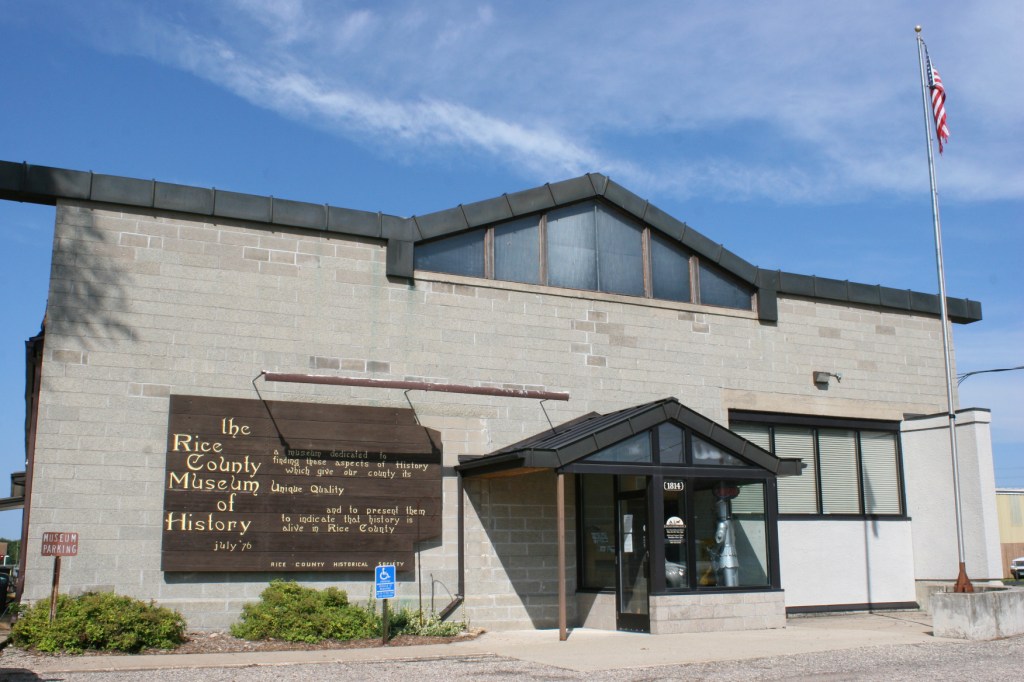
With time pressing to get back to (event sponsor) the Rice County Historical Society Museum in Faribault, Randy and I didn’t linger for long. We needed to turn in our poker run cards and look around the museum and grounds before everything ended. While Randy handed in our losing poker hand, I breezed through the museum exhibits and took a few photos inside and out.


Many of these historic places still exist thanks to preservation groups and history enthusiasts.


And I considered what a lovely day it had been. Out and about, enjoying and appreciating local history, thanks to the hard work and efforts of those who value Rice County history enough to preserve and share it.


Please check back for a follow-up post on an historic building I discovered in Dundas, and not on the tour, but with a powerful and timely message posted.

© Copyright 2020 Audrey Kletscher Helbling
 

“Cruising Rice County History,” Part I August 24, 2020

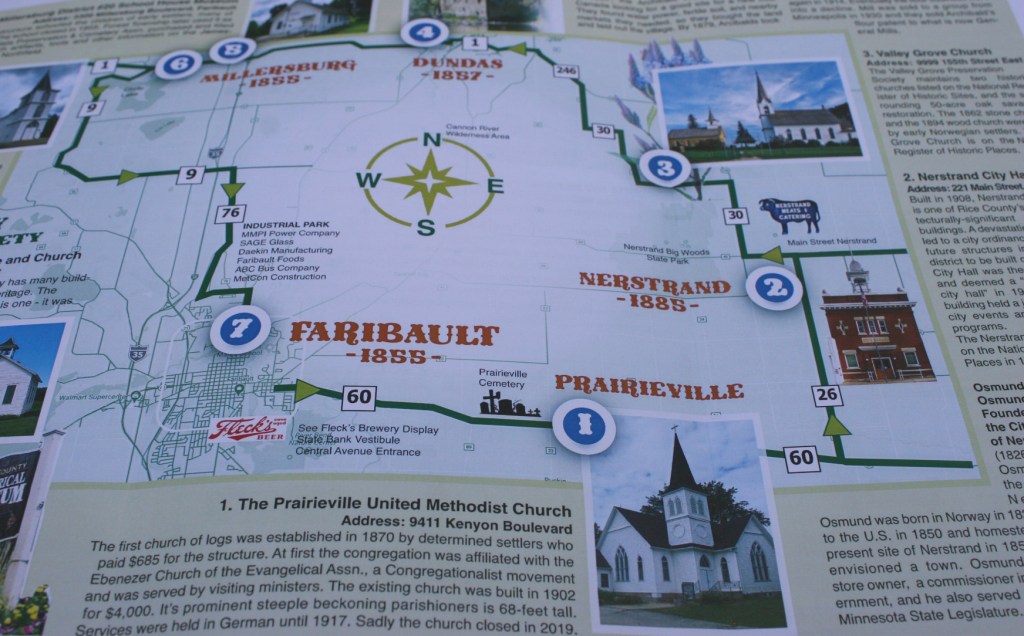
This shows a portion of a guide, designed by Jeff Jarvis of West Cedar Studio, for “Cruising Rice County History.”


WE CONSIDERED WHETHER WE SHOULD take the tour, expecting that we’d likely visited all of the historic places featured in “Cruising Rice County History,” the first ever cruise of historical sites in our county. But, in the end, because Saturday was beautiful weather-wise and COVID-19 has left us with few leisure options, Randy and I opted to attend the event sponsored by the Rice County Historical Society.


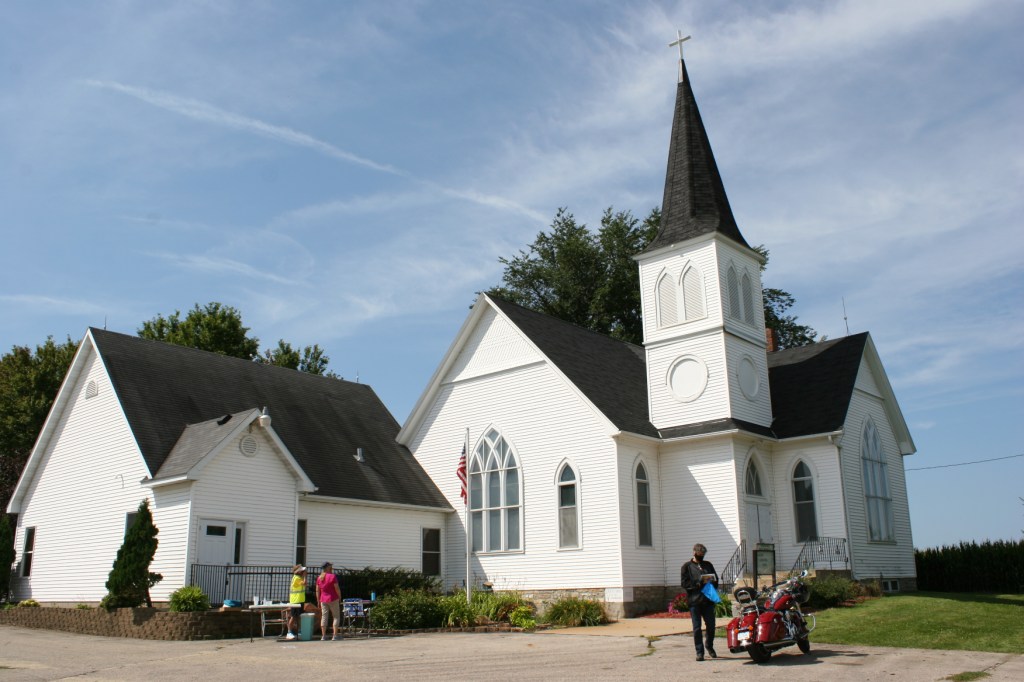
First on the tour, Prairieville United Methodist Church, founded in 1870; existing church built in 1902; and congregation dissolved in 2019.


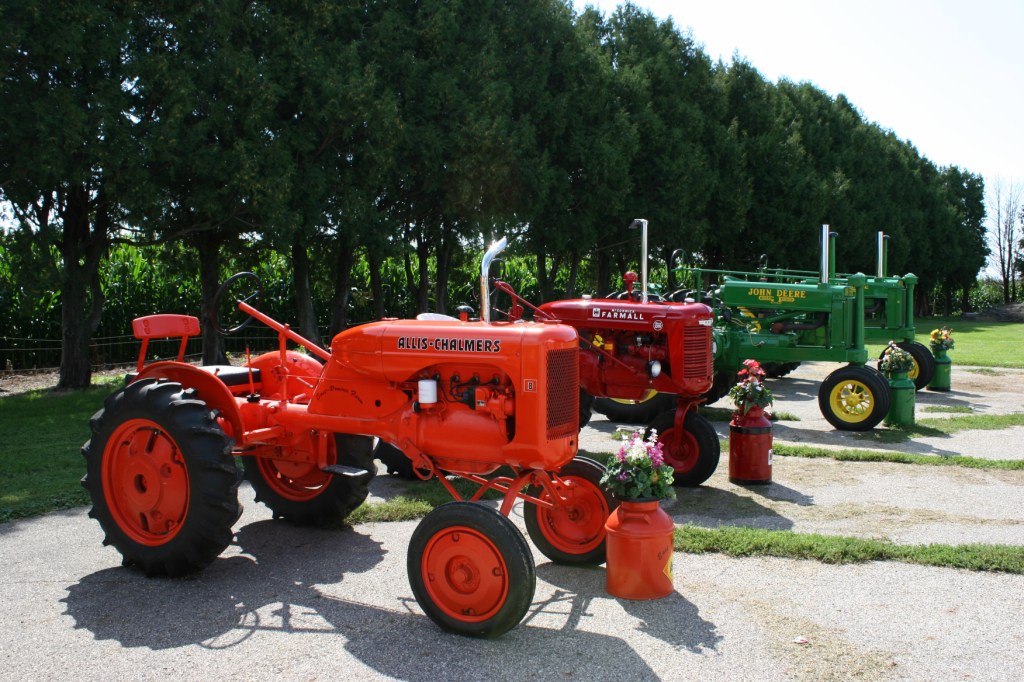
Vintage tractors added interest to the stop at the Prairieville country church.


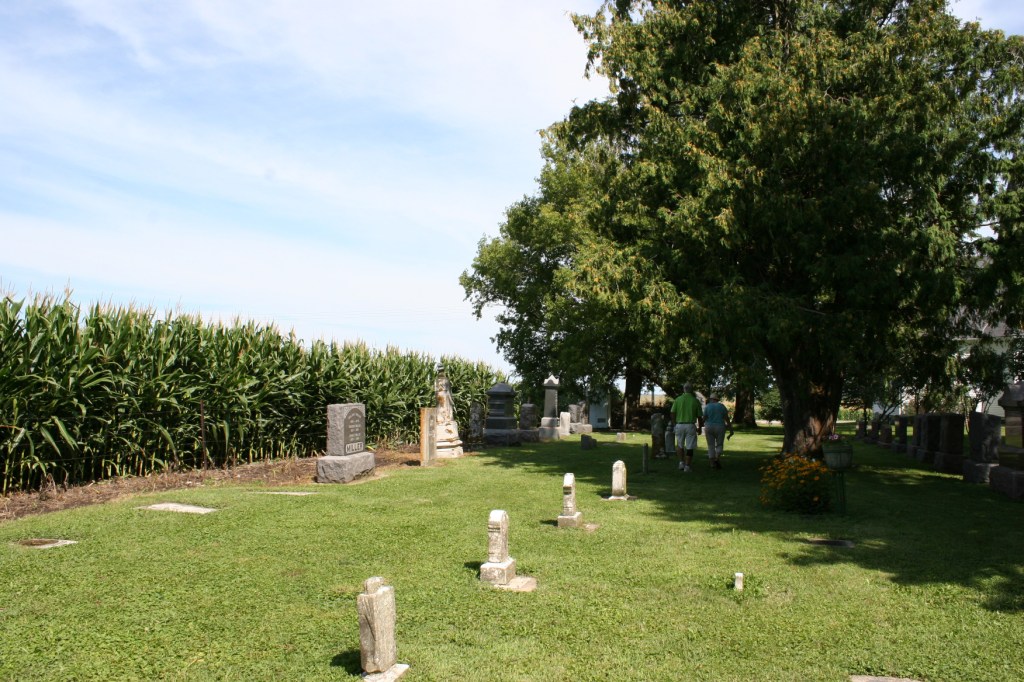
A cornfield snugs right up to the Prairieville Cemetery behind the church.


We joined 84 other vehicles on the tour, which took us east of Faribault, then north and west and, finally circling back to the RCHS in Faribault. Only one of the seven featured spots—Prairieville United Methodist Church and Cemetery—was a new to us point of interest, although we’re certainly familiar with the country church along Minnesota State Highway 60.


First stop: The Rice County Historical Society to pay our $20/vehicle tour fee and pick up our map and other info.


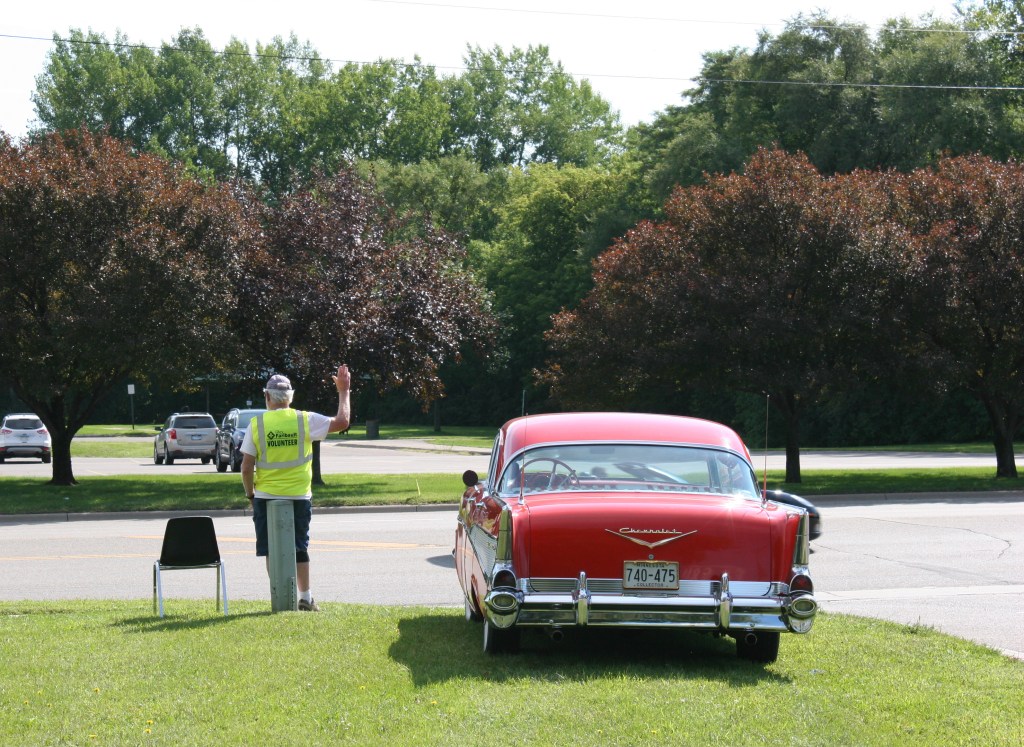
Many volunteers worked the event, including this guy who welcomed tour participants at the historical museum.


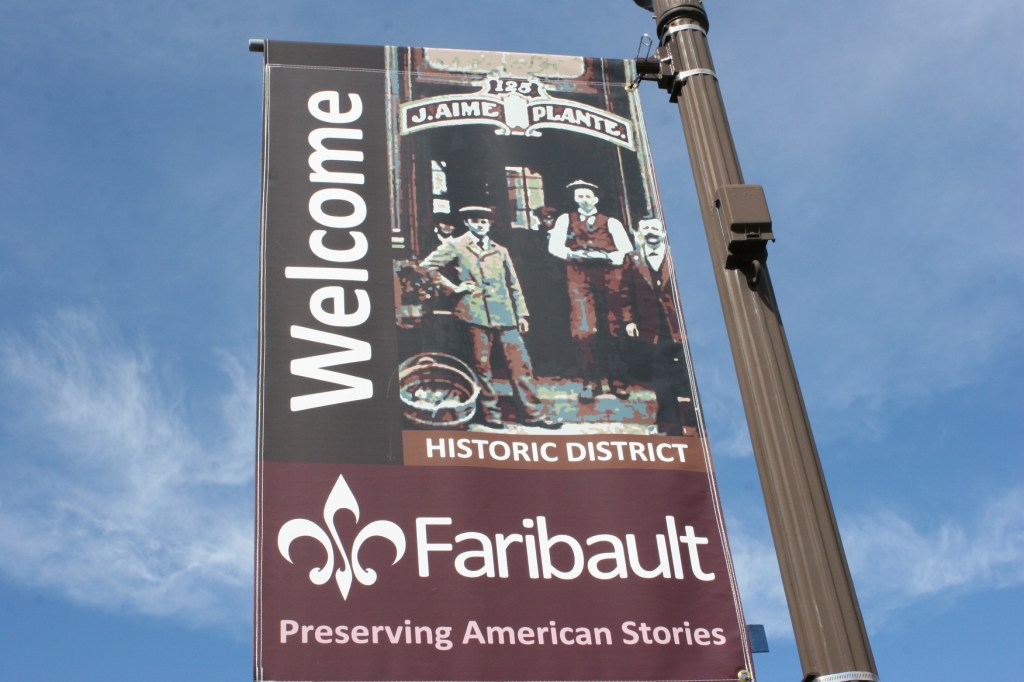
Before heading out of town, the tour took us through historic downtown Faribault, where I thought we were going to see a display of historic brewery items at a local bank. But apparently we are supposed to view this on our own sometime. Anyway, I photographed this banner outside the State Bank of Faribault.


Yet, at each stop, from two country churches to flour mill ruins to an old schoolhouse and an historic town hall, we learned new information, both from site hosts and from educational hand-outs.


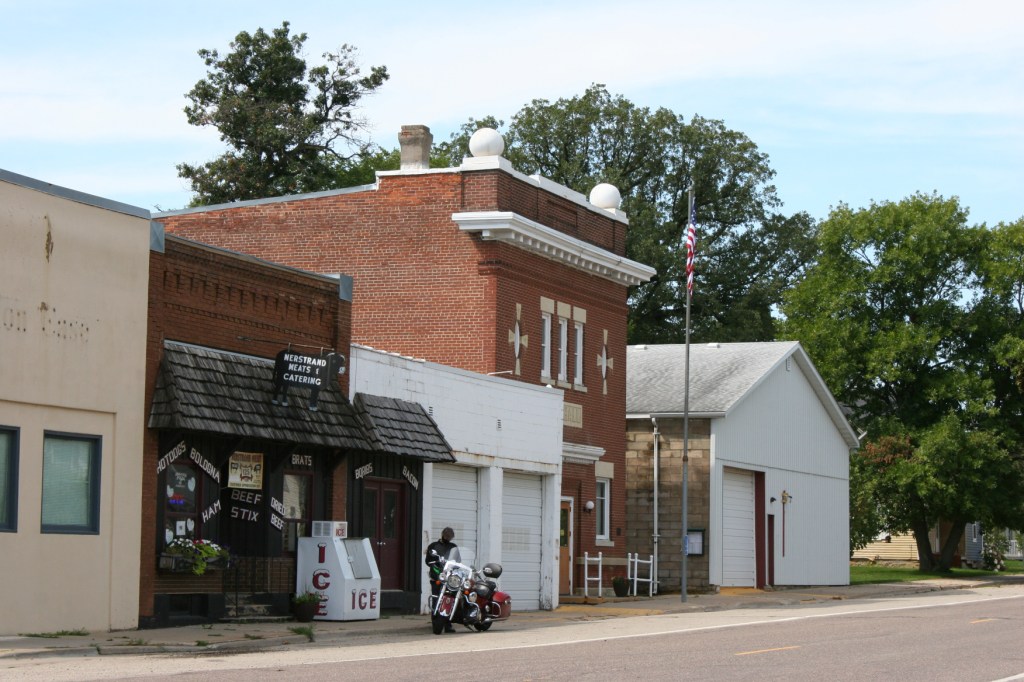
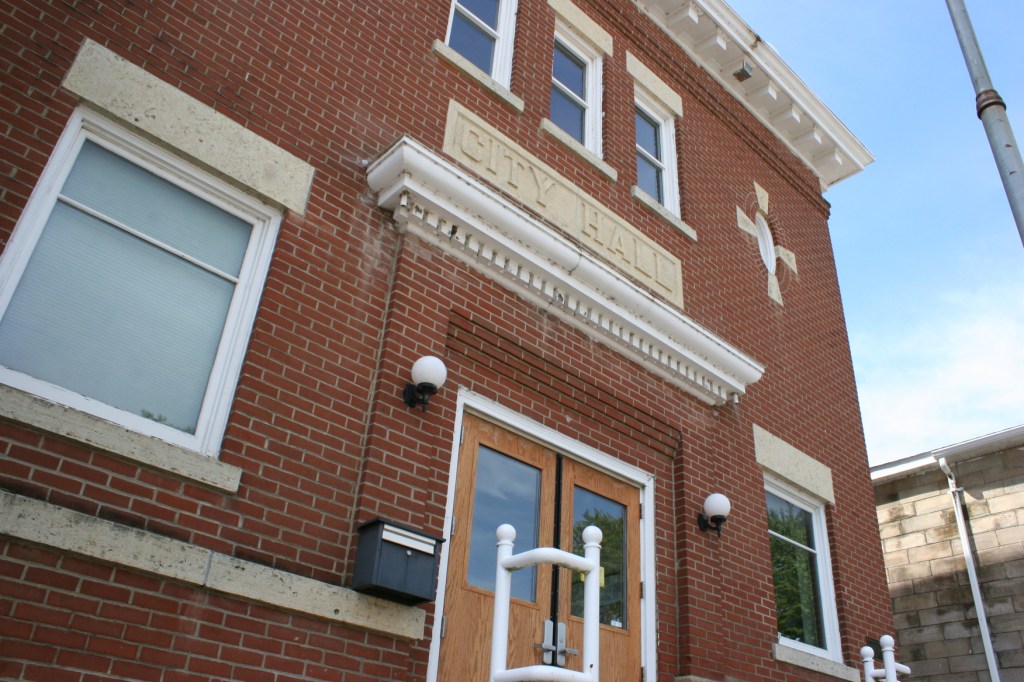
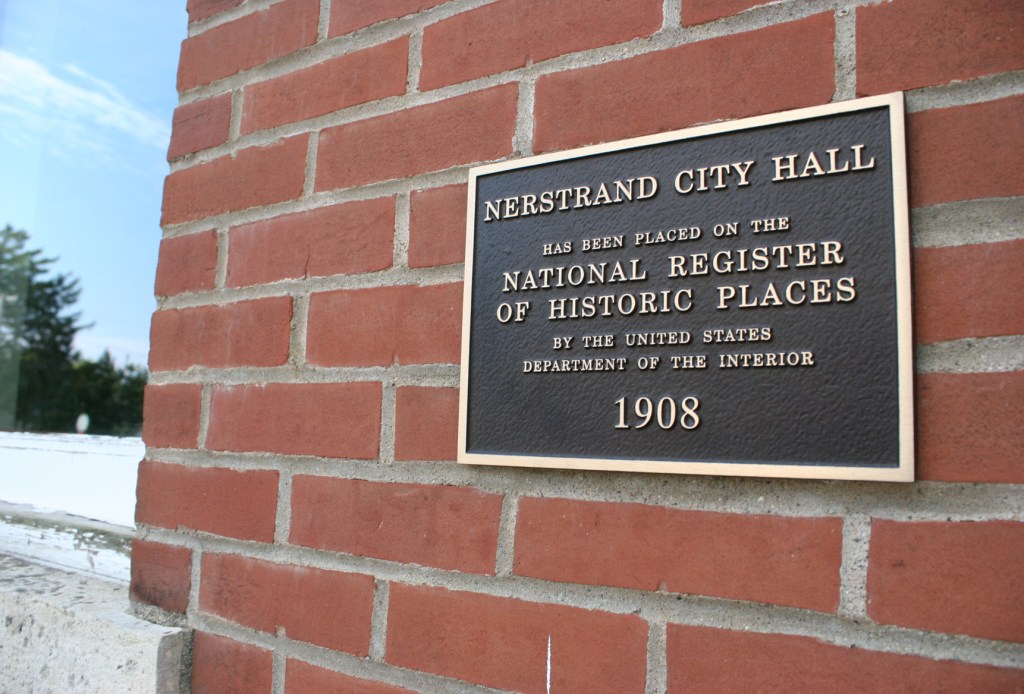
The Nerstrand City Hall (tall brick building)l, built in 1908, is on the National Register of Historic Places. After three wooden buildings were destroyed by a major fire in 1904, the city required all future buildings in the business district to be made of brick or stone and with firewalls between.


Nerstrand City Hall, up close.


A plaque marks the Nerstrand City Hall as an historic structure.


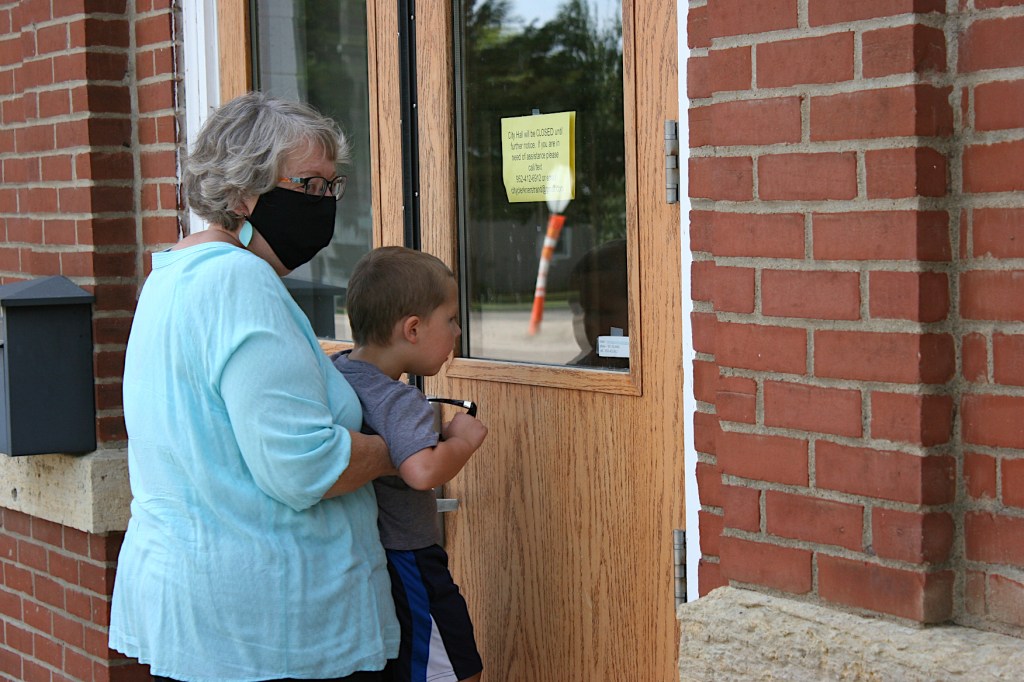
Peering in the windows of the locked city hall.


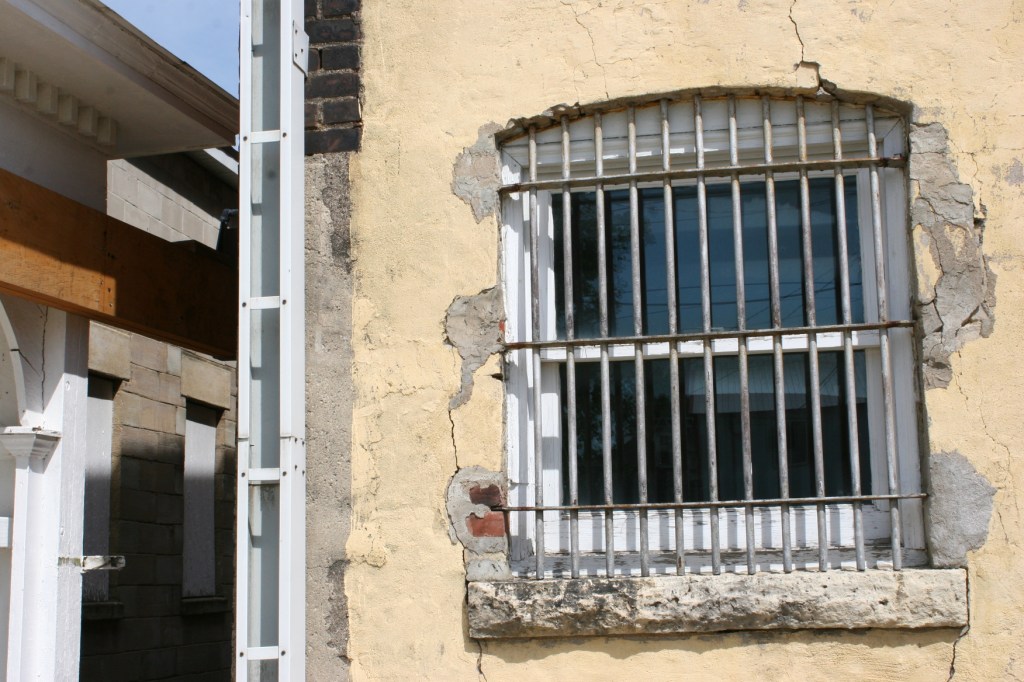
On the back of Nerstrand City Hall, bars cover a window, a reminder that a jail was once housed here.


We were disappointed we couldn’t get inside some of the historic buildings, but expect safety concerns factored into closed doors. Participants in the Saturday event were asked to mask up and social distance. And they did. So we felt comfortable.


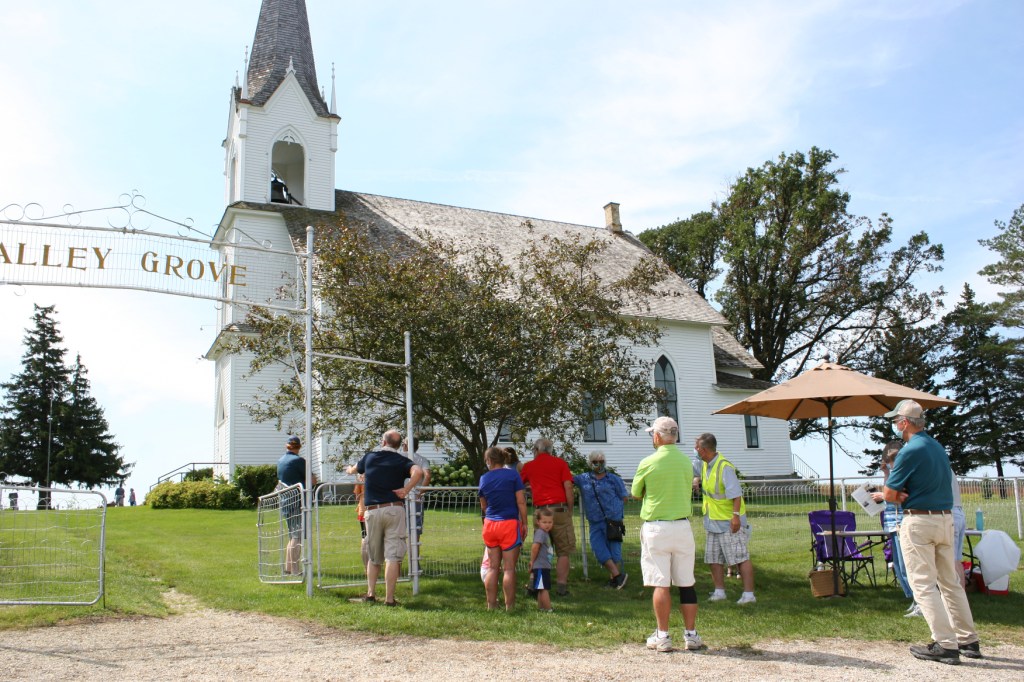
One of the two historic churches at Valley Grove, near Nerstrand Big Woods State Park. Randy and I have been to this site many times, thus didn’t linger here. It’s one of our favorite spots in rural Rice County. So peaceful and beautiful atop a hill. The woodframe church pictured here and a stone church directly across from it were built by Norwegian immigrants.


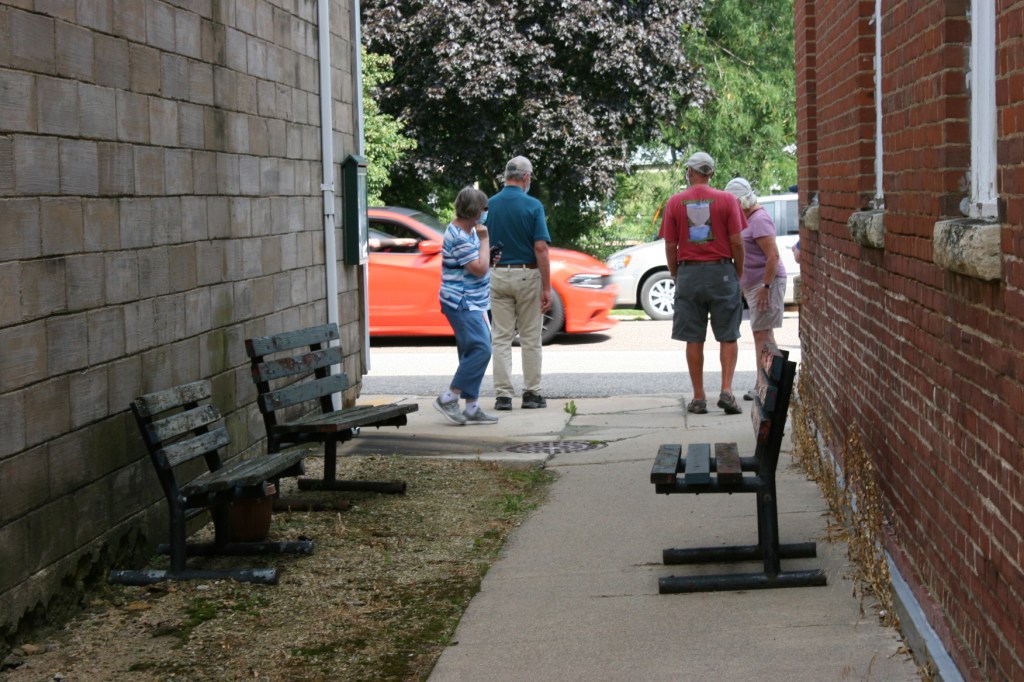
Two couples, including friends of ours (left), visit outside Nerstrand City Hall. This alley runs between the hall and the fire department.


We also chatted from a distance with friends, either hosting site stops or on the tour. What a joy to see familiar faces after months of minimal social interaction. Even if their smiles were hidden behind masks.


Driving toward Nerstrand.


Driving through rural Rice County, we saw lush fields of towering corn and acres of soybeans among farm sites.


The route followed only paved roads, with plenty of gravel roads to see alongside.


I also enjoyed the rural route given my love of the country. There’s something freeing about traveling along paved back roads bordered by acres of cropland, intersected by gravel roads, punctuated by farm sites.


Young and old attended the “Cruising Rice County History” tour. This photo was taken at Valley Grove.


Thank you for joining my photo tour of “Cruising Rice County History,” Part I. Check back for Part II tomorrow.


© Copyright 2020 Audrey Kletscher Helbling
 

From Lonsdale: Reading, ‘Riting & ‘Rithmetic August 21, 2020

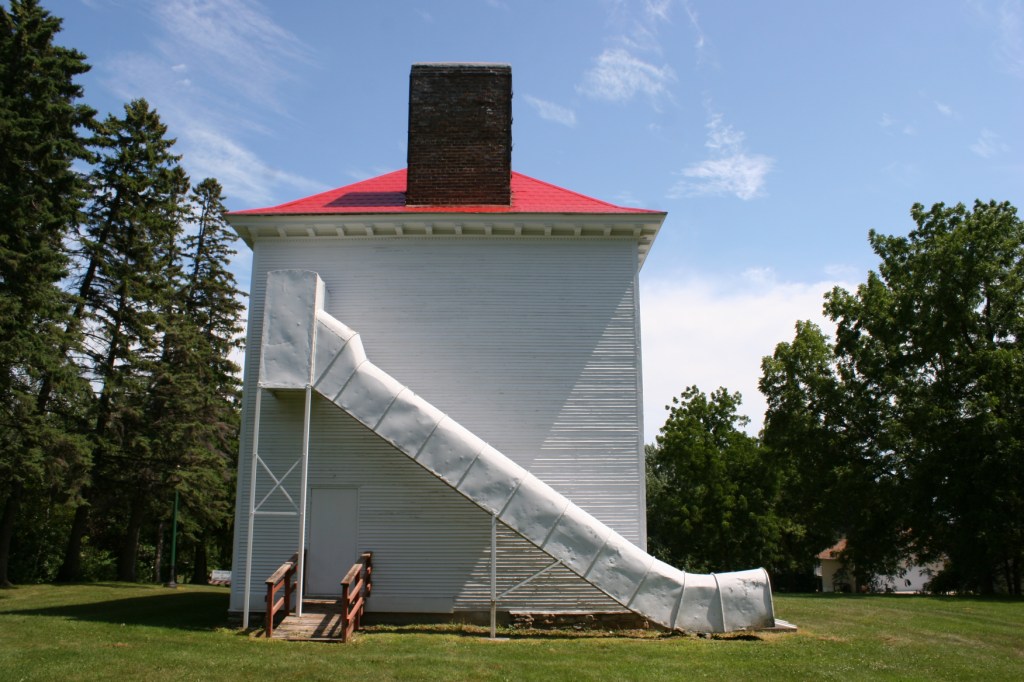
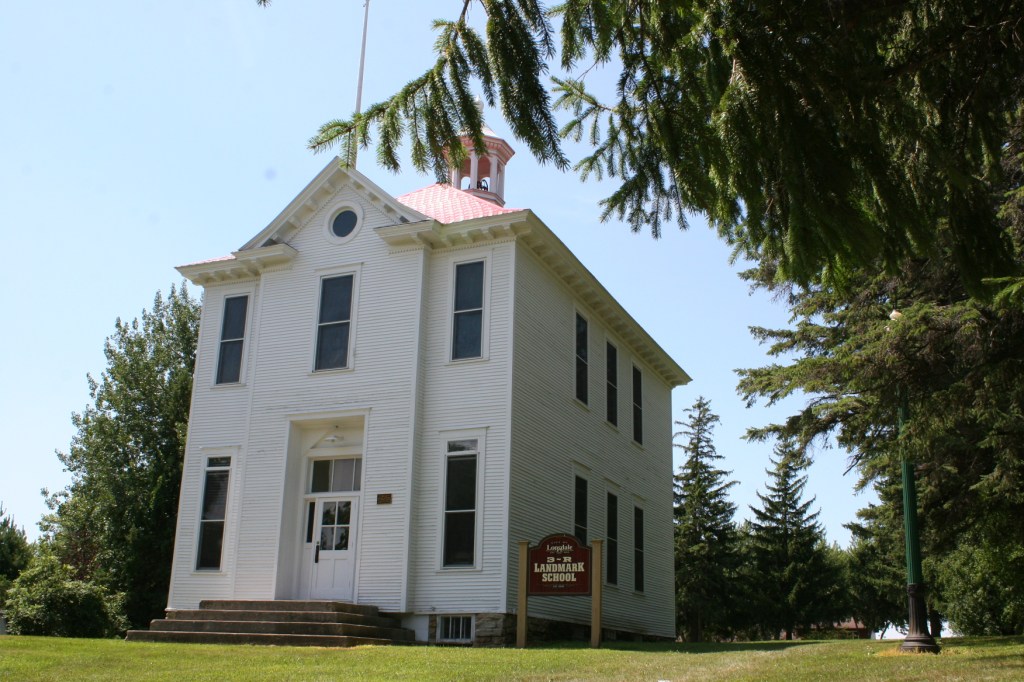
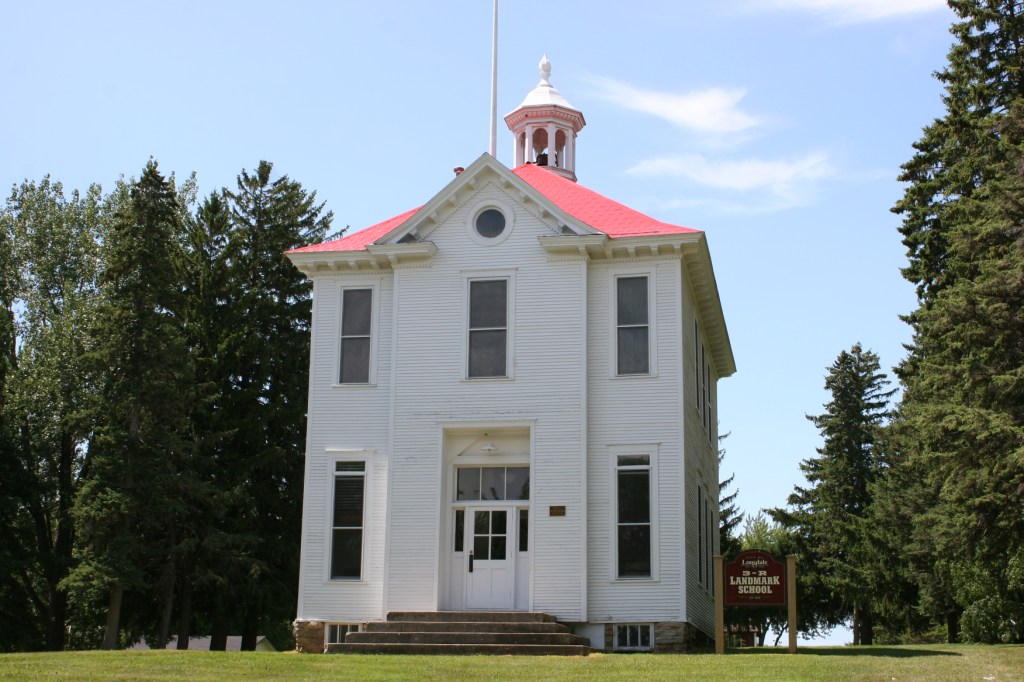
My first view of the 3-R Landmark School, Lonsdale, Minnesota.


MANY TIMES I’VE BEEN TO LONSDALE, a small, but growing, community in far northeastern Rice County only a 30-minute drive from the metro. I’ve even stopped to shop at antique and thrift shops there. And, decades ago, Randy and I attended a wedding at Immaculate Conception Catholic Church.


But during all those visits, I’d never seen the 3-R Landmark School, once home to Independent School District #76 Lonsdale Public School. Until recently.


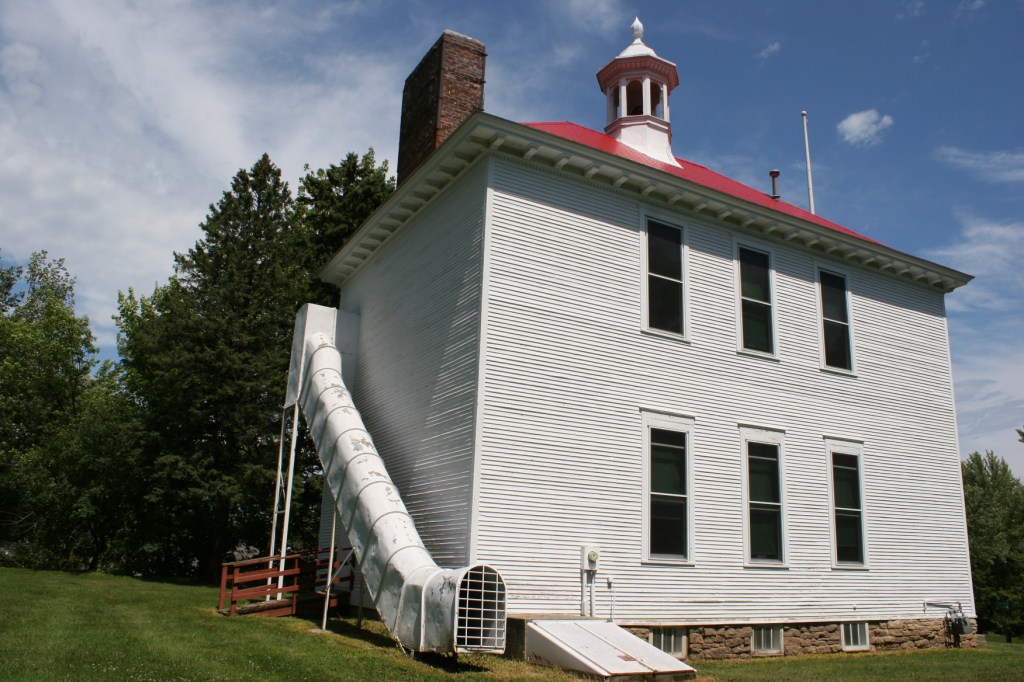
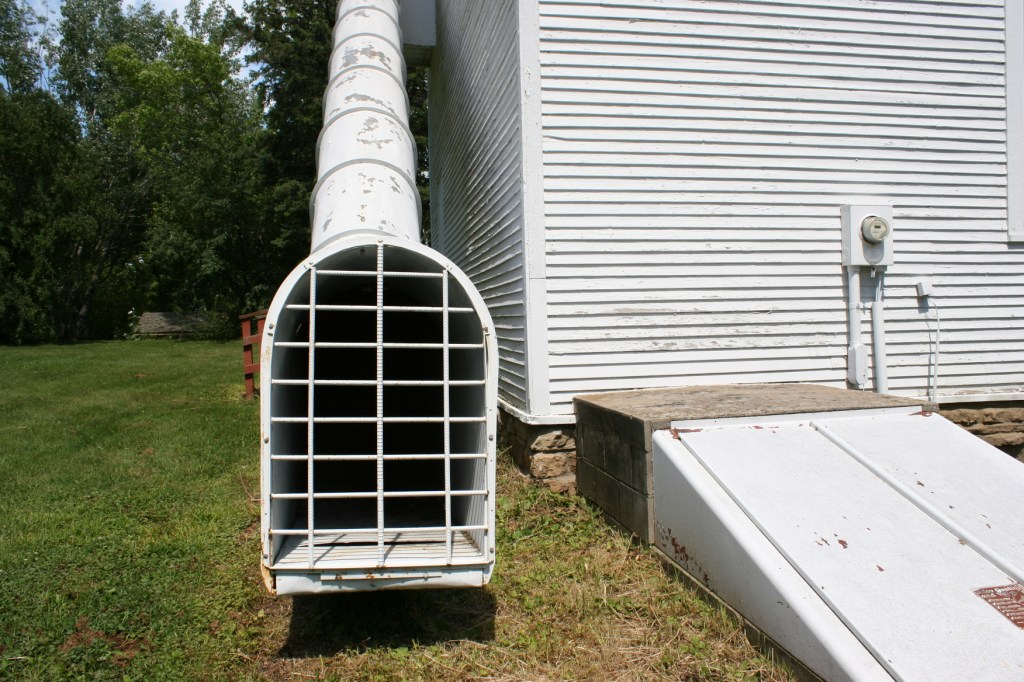
A view from the back of the school shows the bell tower cupola, chimney (is there a fireplace inside?) and the top of the second story fire escape.


A side and back view of 3-R Landmark School.


The bottom of the fire escape, left.


As is our habit on random Sunday afternoon drives, Randy and I set out from Faribault to explore the countryside and small towns. This day our route led us to Lonsdale, and eventually a turn onto Third Avenue Southwest. And there, smack in the middle of a residential neighborhood, sits a stately two-story structure complete with bell tower cupola and bell in place.


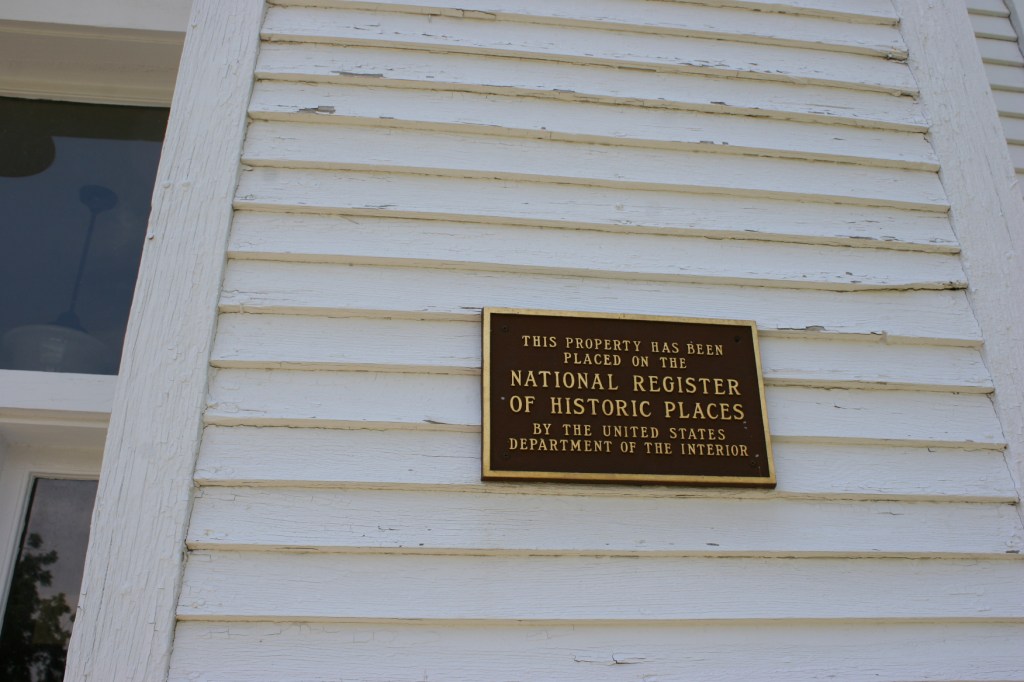
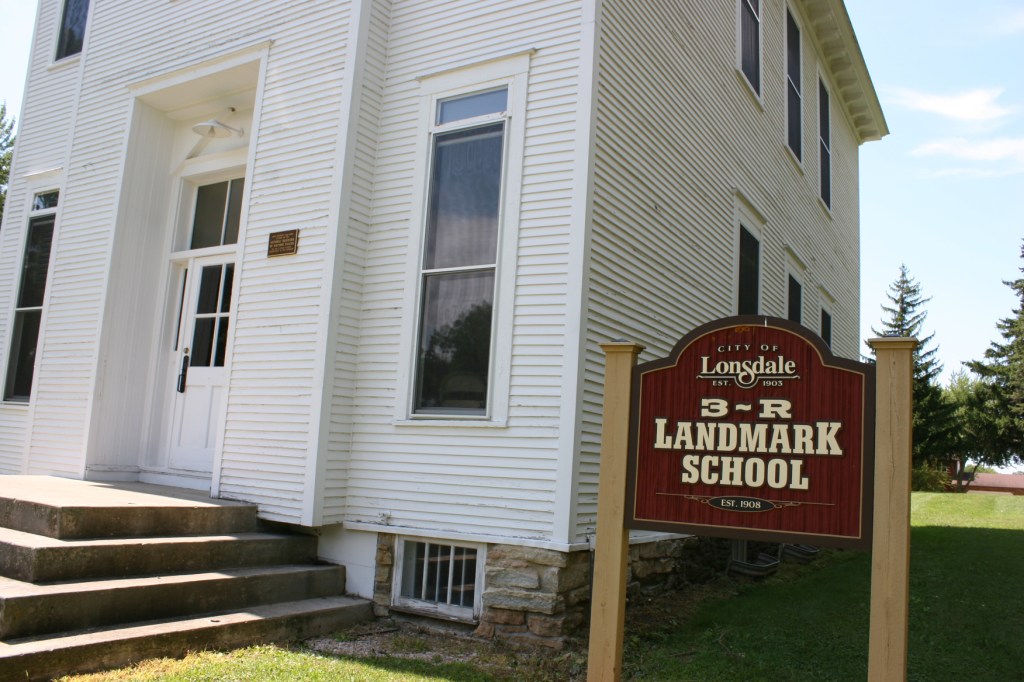
You can only imagine my excitement at this discovery given my fondness for historic buildings. This 1908 school, designed and built by Patrick Sullivan and on the National Register of Historic Places, is a gem. From the exterior, the building with long, lean windows appears well cared for.


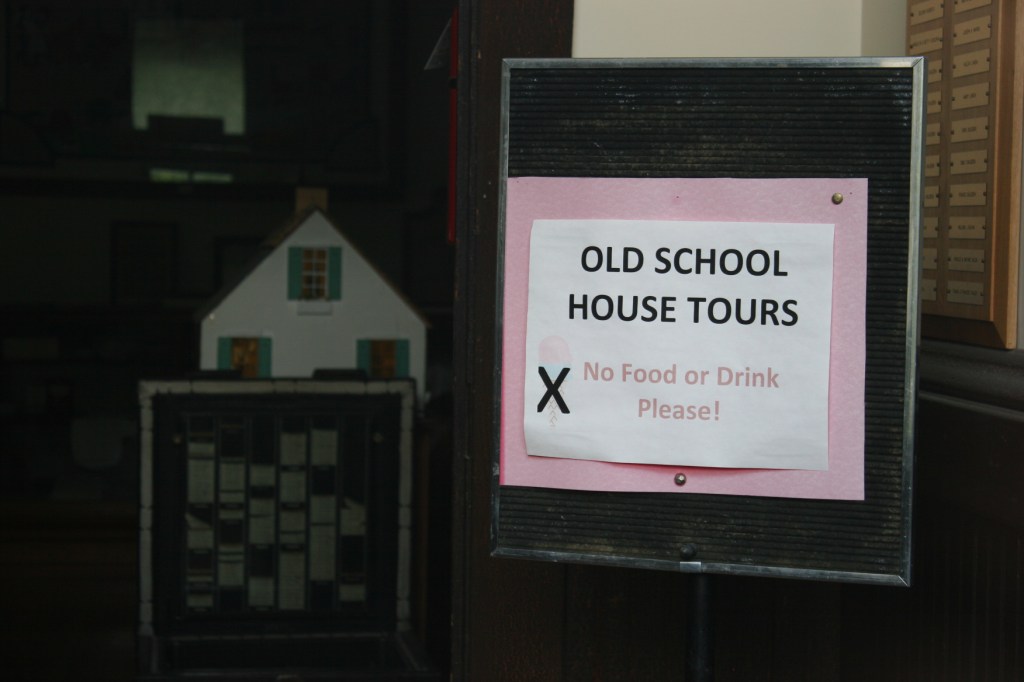
I peered through the windowed front door, not seeing much except the sign advertising OLD SCHOOL HOUSE TOURS (No Food or Drink Please!). I wished I could get inside. But this visit I had to settle for an exterior tour and only imagine the Reading,’Riting and ’Rithmetic that happened inside this center of education.


Once the center of education in Lonsdale.


From those three “Rs” comes the name, 3-R Landmark School. I like that creative tag tracing back to the basics of education—reading, writing and arithmetic.


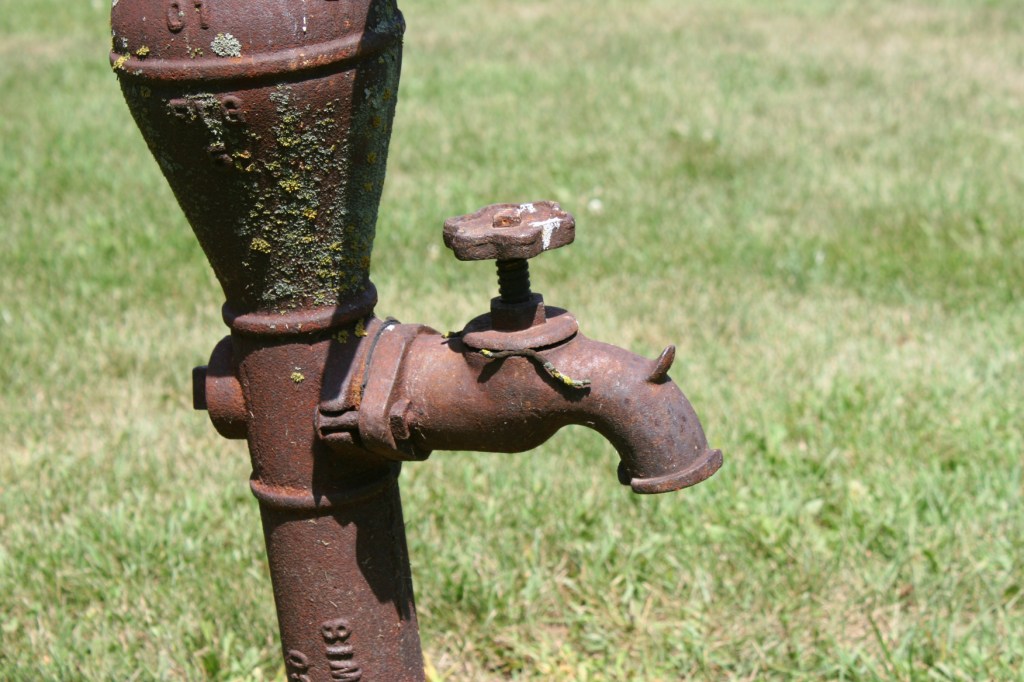
Near the schoolhouse, a water source.


I found little information online about this school, which one source says was abandoned in 1946, the other 1948. The City of Lonsdale acquired the school property in 1963 after the Lonsdale school district consolidated to become Montgomery-Lonsdale Independent School District #394.


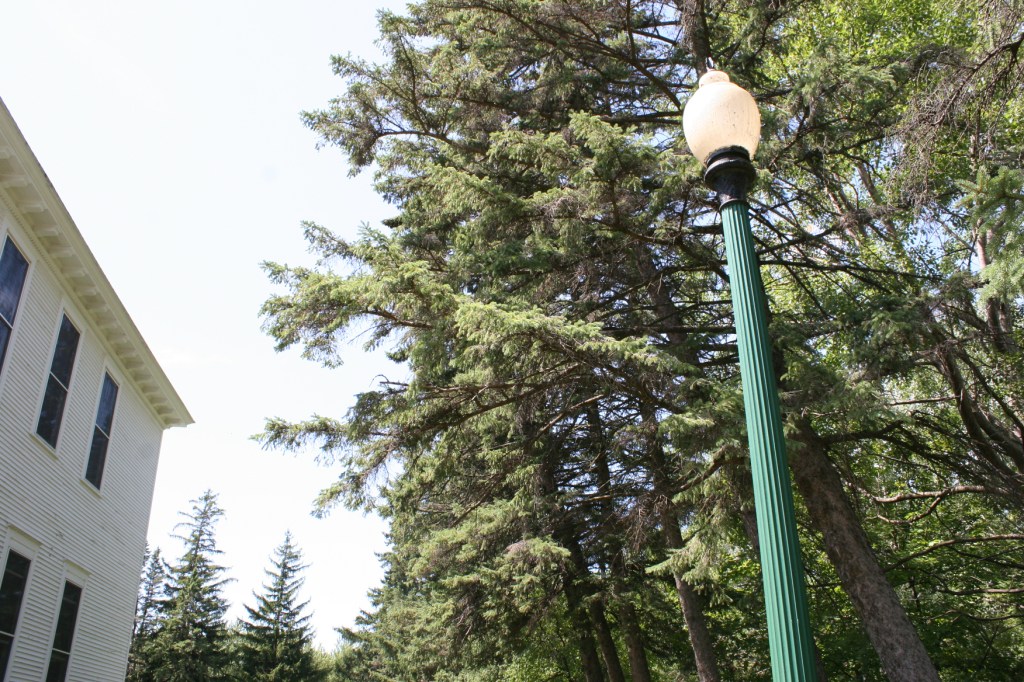
On the grounds are two vintage lamp posts.


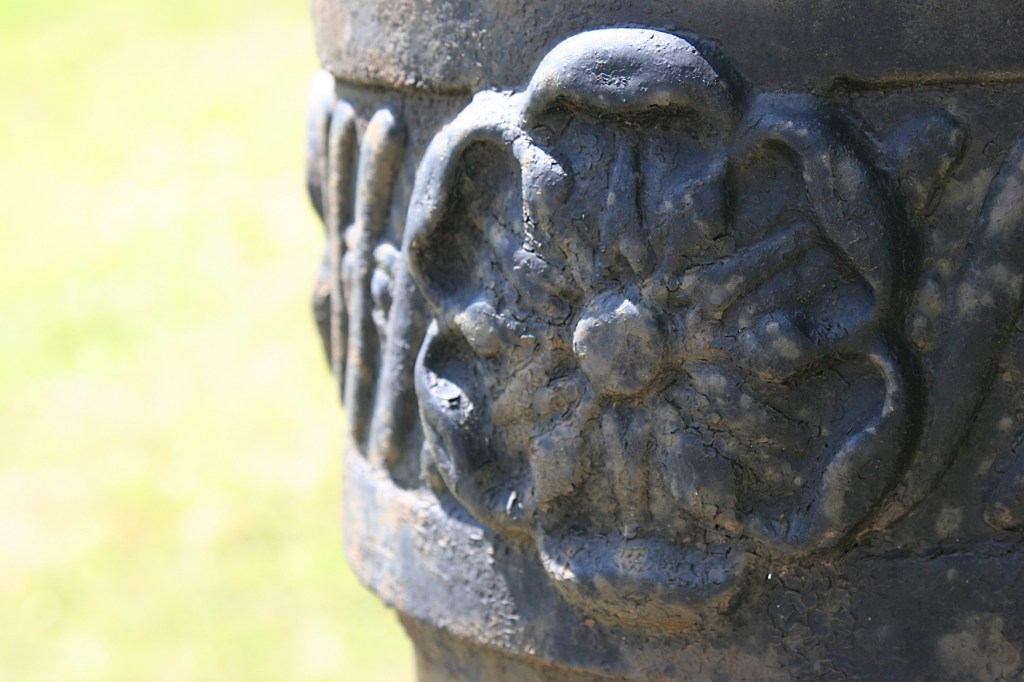
Lamp post details.


Additional information reveals that a grassroots nonprofit formed in the late 1970s to restore the old schoolhouse. That group apparently dissolved in the mid 1980s following the school’s re dedication in 1986. Today this historic schoolhouse houses a museum and is open occasionally for community events.


Trees frame 3-R Landmark School, which sits on a one-acre grassy site. Plenty of outdoor play space for kids back in the day.


Perhaps once COVID-19 ends, the museum will reopen and I can walk through the front door into a classroom of yesteryear.


RELATED: The Steele County History Center in Owatonna is currently offering an exhibit, Country Schools: The Beating Heart of Rural Community. I toured that exhibit in June and will post on it at some point.

This Saturday, August 22, from 10 am – 2:30 pm, the Rice County Historical Society in Faribault is hosting Cruising Rice County History, a tour that will take participants on a self-drive to seven historic sites in the county. Cost is $20 per vehicle. Maps will be handed out at the historical society in Faribault on Saturday morning.

© Copyright 2020 Audrey Kletscher Helbling
 

Stone windmill symbolizes strength of Minnesota immigrants August 29, 2019

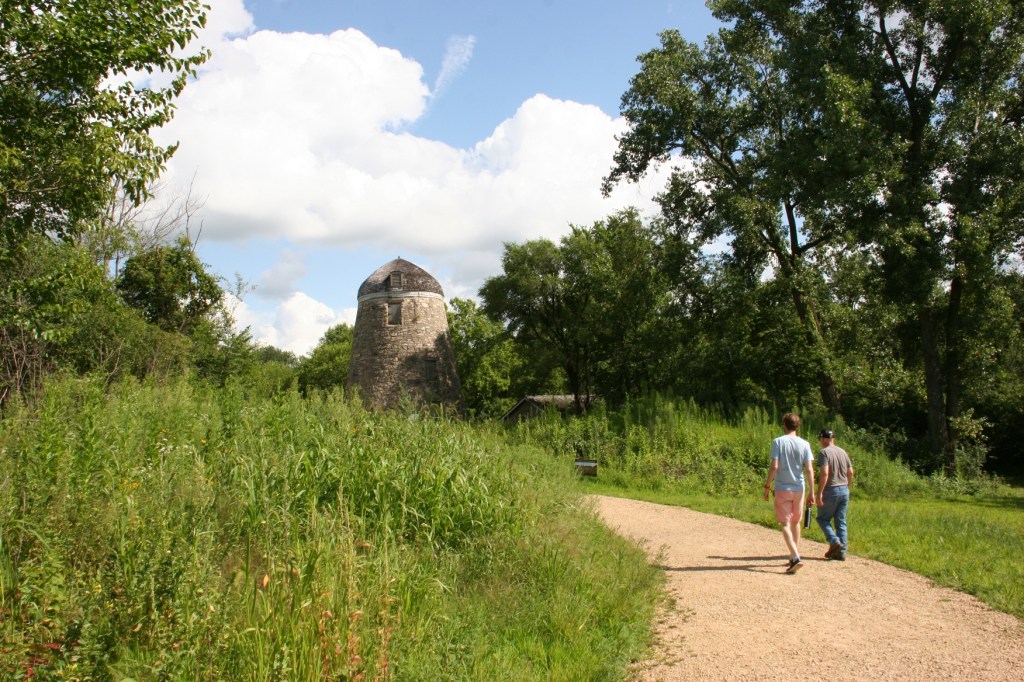
Walking toward Seppman Mill, located just outside a fenced area holding bison at Mnneopa State Park, rural Mankato, Minnesota.


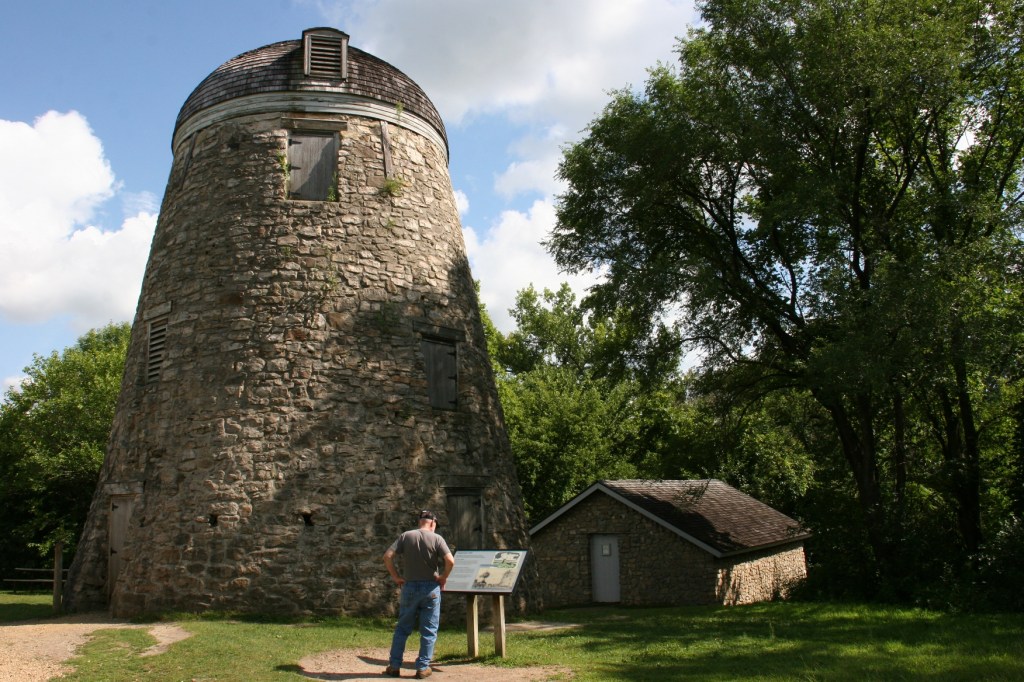
IN THE PRAIRIE PART of Minneopa State Park where the bison roam, an historic stone windmill stands tall on the prairie’s edge. Minus the blades.


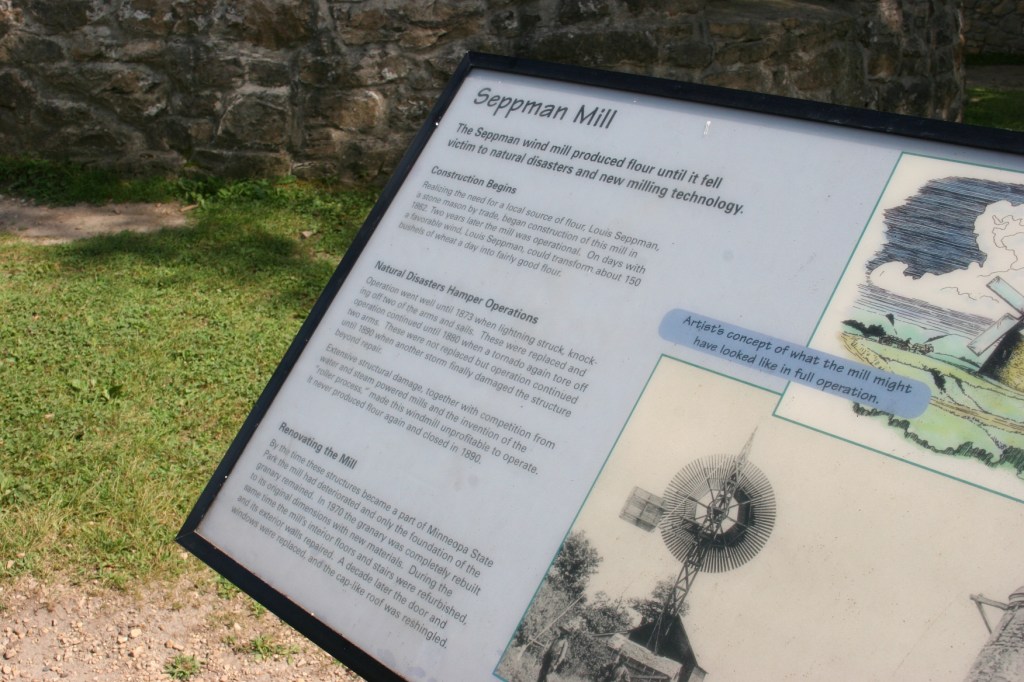
Interpretive signs detail the mill’s history.


The granary was rebuilt in 1970 to its original size.


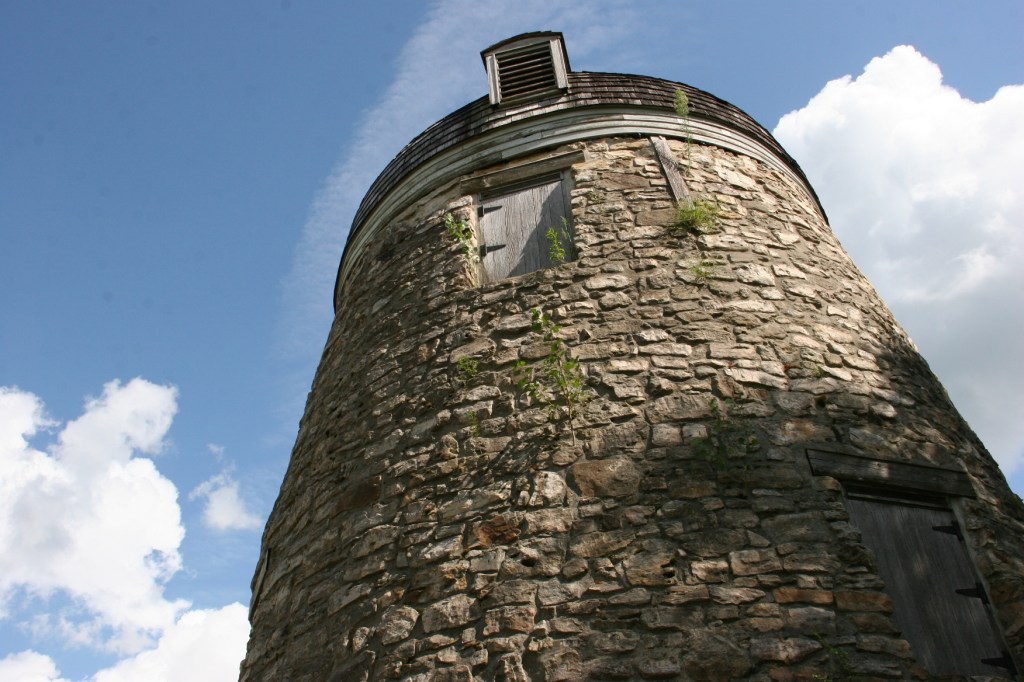
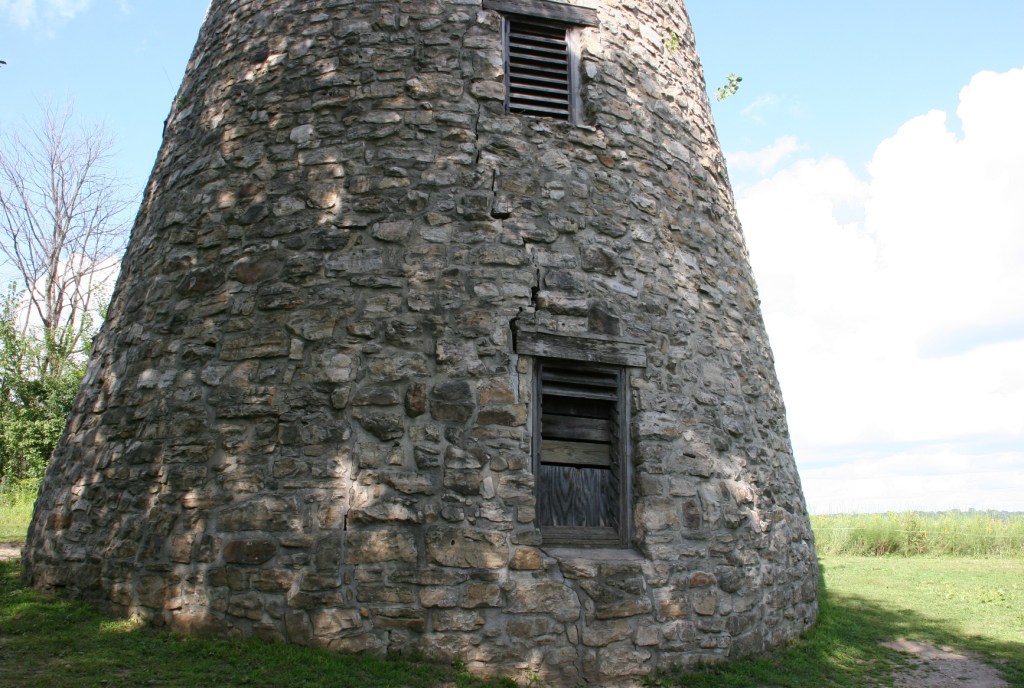
The Seppman Mill symbolizes the strength and grit of the early immigrants, among them Louis Seppman. Seeing a need for a local flour mill, this stone mason started crafting the mill in 1862 from local stone hand-carried or transported in wheelbarrows to the site, according to the book, Minnesota: A State Guide.


The task of constructing the windmill patterned after those in Seppman’s native Germany took two years. Eruption of the U.S.-Dakota Conflict in the region in 1862 delayed construction. Once operational, the mill could grind 150 bushels of wheat into flour on a day of favorable winds.


While the wind powered the arms of the 32-foot high windmill, it also proved the mill’s ultimate demise. In 1873, lightning struck and knocked off two of the arms and sails. Seven years later, tornadic winds ripped off the replacement arms. And, finally, in 1890, a third storm damaged the mill beyond repair.


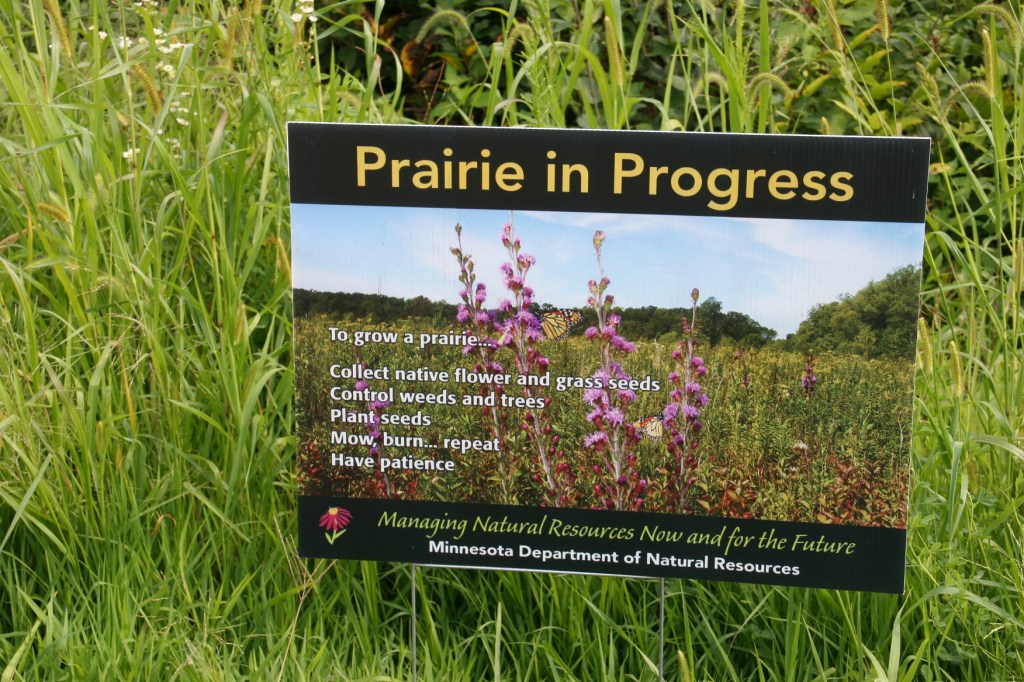
A prairie restoration is underway here at Minneopa as noted in this sign posted near the windmill.


I can only imagine the frustration of Seppman and others who tried, tried and tried again to keep the mill operating. Three strikes and you’re out seems applicable.


Coneflowers, with their deep roots, thrive among the prairie grasses.


But then I consider all they did to even get the mill built. Those early settlers truly exemplify hard work and determination. How many of us would carry all those stones up an inclined roadway and then seemingly puzzle-piece the stones together? It’s remarkable really.


Black-eyed susans.


I’m thankful this windmill has been mostly restored and was placed on the National Register of Historic Places in 1971. It is a visual tribute to the early settlers of Minnesota, a reminder of the value these immigrants brought to this land, to this state, to this prairie place they called home. Then. And still today.


A sign along the prairie’s edge near the mill informs about bison in Minnesota.


Here, where the bison once roamed.


© Copyright 2019 Audrey Kletscher Helbling
 

When a prairie native sees Mille Lacs Lake for the first time November 28, 2017

Near shore, a seagull wings across Mille Lacs Lake, water and sky melding in vastness.


AT MY REQUEST, Randy and I took an indirect route from Faribault to Brainerd on a mid-September Up North vacation. I wanted to see Mille Lacs Lake, Minnesota’s second largest inland lake covering some 200 square miles. It just didn’t seem right that, as a life-long Minnesotan, I’d never viewed this expansive body of water.

As a native of the landlocked prairie, my youthful exposure to Minnesota’s lakes included occasional fishing for bullheads, swimming in Cottonwood Lake once a year and a trip at age four to Duluth along the shores of Lake Superior. When you grow up on a dairy farm, there are few vacations; mine during childhood totaled two.


Tethered along Mille Lacs.


Without the typical Minnesota background of going up to the lake on weekends, of boating and swimming and fishing in the Land of 10,000 Lakes, I was eager to see Mille Lacs. I’ve heard so much about the lake, especially in recent years given the controversial restrictions on walleye fishing.


My first view of Mille Lacs Lake.


Our route took us along US Highway 169 along Mille Lacs and into Garrison.


I focused on a nearby shoreline until I mentally adjusted to the size of Mille Lacs Lake.


My first glimpse of Mille Lacs from U.S. Highway 169 presented no surprises. It was as I expected—a visual vastness of blue. As our van rounded into Garrison, the view opened and I anchored my eyes to the nearby shoreline. Until I adjust, I find the initial infinity of such large lakes a bit unsettling.


The concourse provides a lovely view of Mille Lacs. But there’s seagull poop everywhere.


Soon we pulled off Highway 169 and into the Garrison Concourse, a roadside scenic overlook built between 1936- 1939 by the then Minnesota Department of Highways and the Civilian Conservation Corps. On the National Register of Historic Places, this space features a rock retaining wall that, while impressive, was also unappealing for all the dried seagull poop streaking the wall, benches, sidewalk and pavement. I had no desire to sit here, linger and enjoy the view.


So I focused my attention on the 15-foot fiberglass walleye statue, built in 1980 for a local parade, and now a kitschy roadside attraction for a town that claims to be the Walleye Capital of the World (along with Baudette and several out-of-state locations).


An oversized walleye couldn’t just land here on its own. A sign posted on the statue base, next to the one that warns to PLEASE KEEP OFF THE WALLEYE THANK YOU, credits legendary lumberjack Paul Bunyan for the trophy catch. You gotta appreciate a good story.


Randy and I did the typical tourist thing and posed for selfies next to the mega walleye.


If not for my observant husband, I would have missed another attraction—a small stone marker honoring William A. Tauer, a local hotel owner who drowned while trying to save boaters during a June 10, 1927, storm on Mille Lacs Lake. Engraving credits THE PEOPLE OF MORGAN, MINN for the memorial marker. That drew my interest. Morgan sits some 175 miles away to the southwest in my home county of Redwood. Later online research revealed little more. I expect William grew up in Morgan, where the Tauer surname is still common. I’d like to know more.


All in all, the overwhelming size of Mille Lacs impressed me. But not enough that I need to return. My disappointment came in the sense of—there’s the lake, now what? Perhaps further exploration beyond just this area by Garrison would change my perspective. Or, as others suggested, a return in the winter to see the thousands of fish houses on the frozen lake would impress me.


I have no desire to board a boat in a body of water this large. Randy has done so and I’ve heard his seasick stories. Nor do I desire to fish here in the winter when the ice cracks and anglers have been stranded on ice floes.


Still, I enjoyed the view and the iconic walleye. I can now say, “I’ve been to Mille Lacs.” But I can’t say, “I’ve patronized the Blue Goose.” The iconic restaurant and bar, my husband noted and lamented, is gone.


© Copyright 2017 Audrey Kletscher Helbling