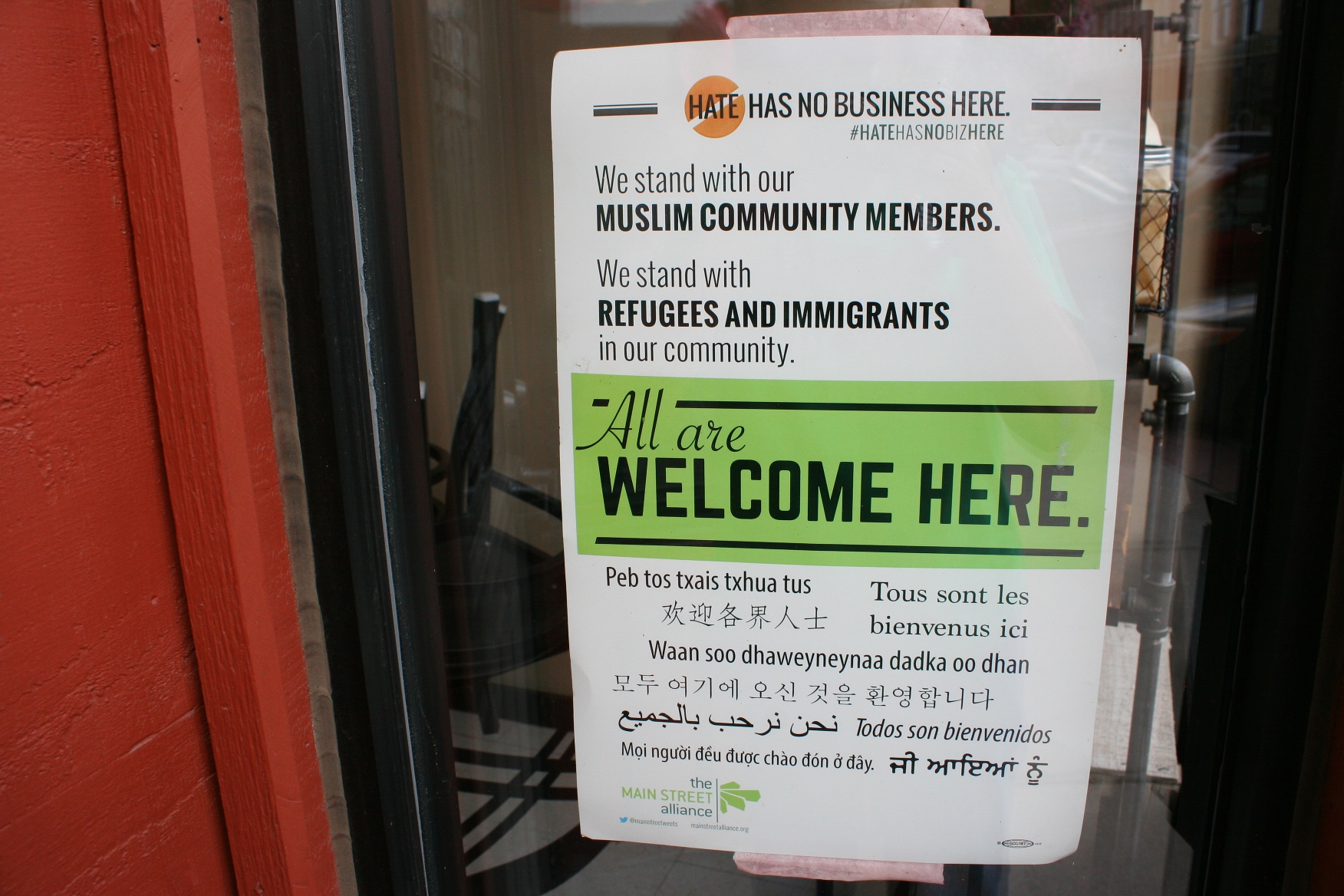
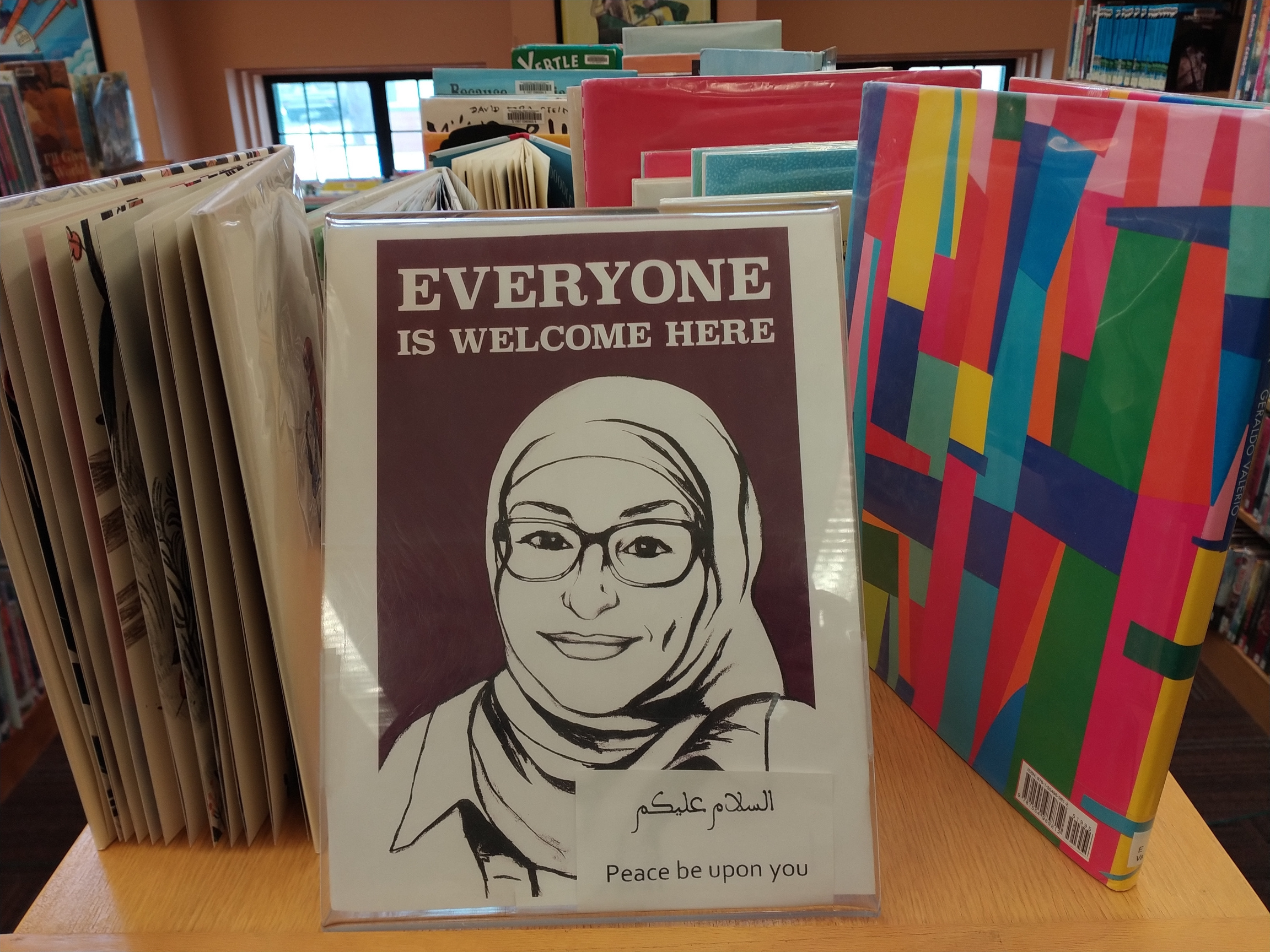
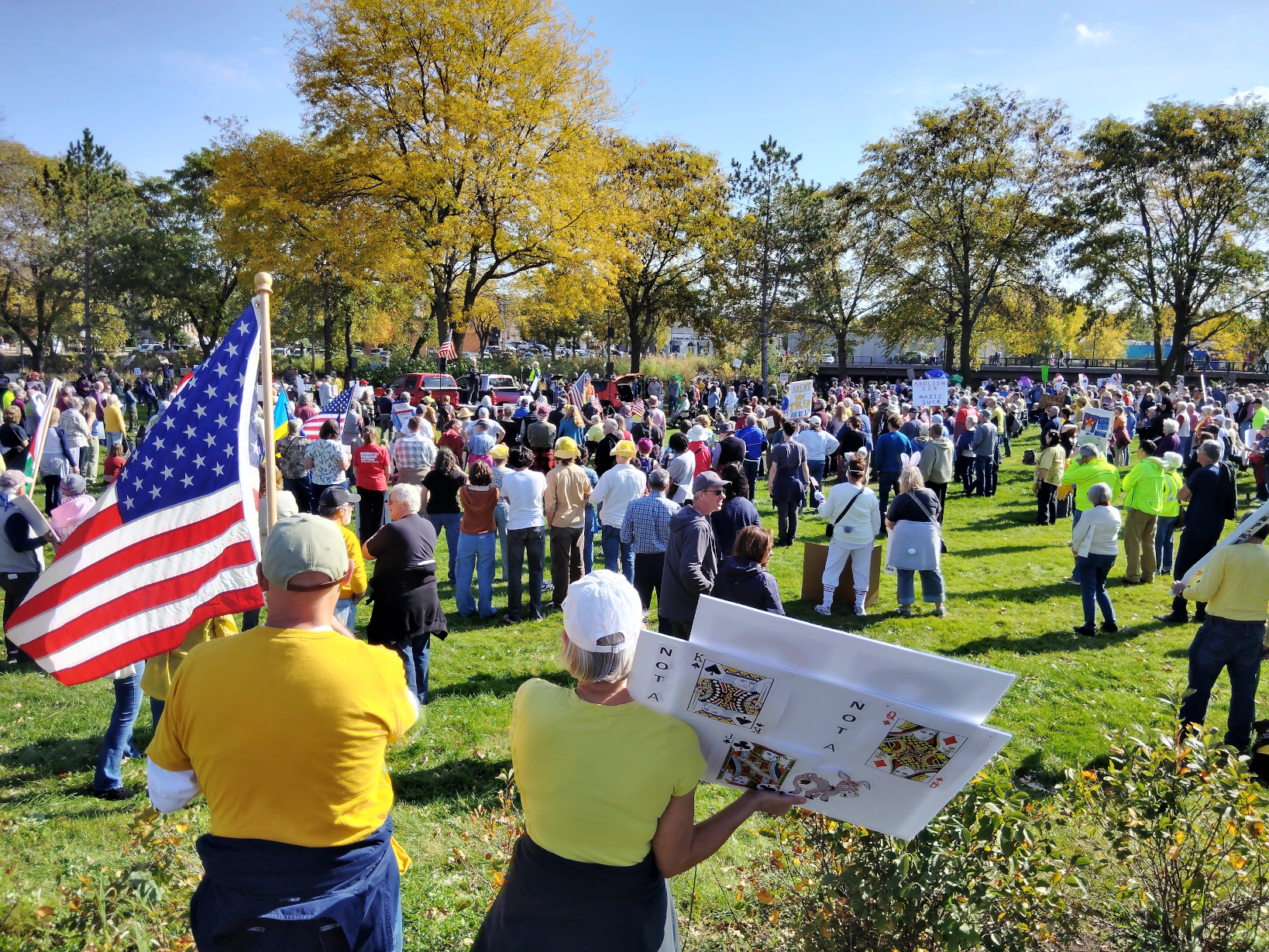
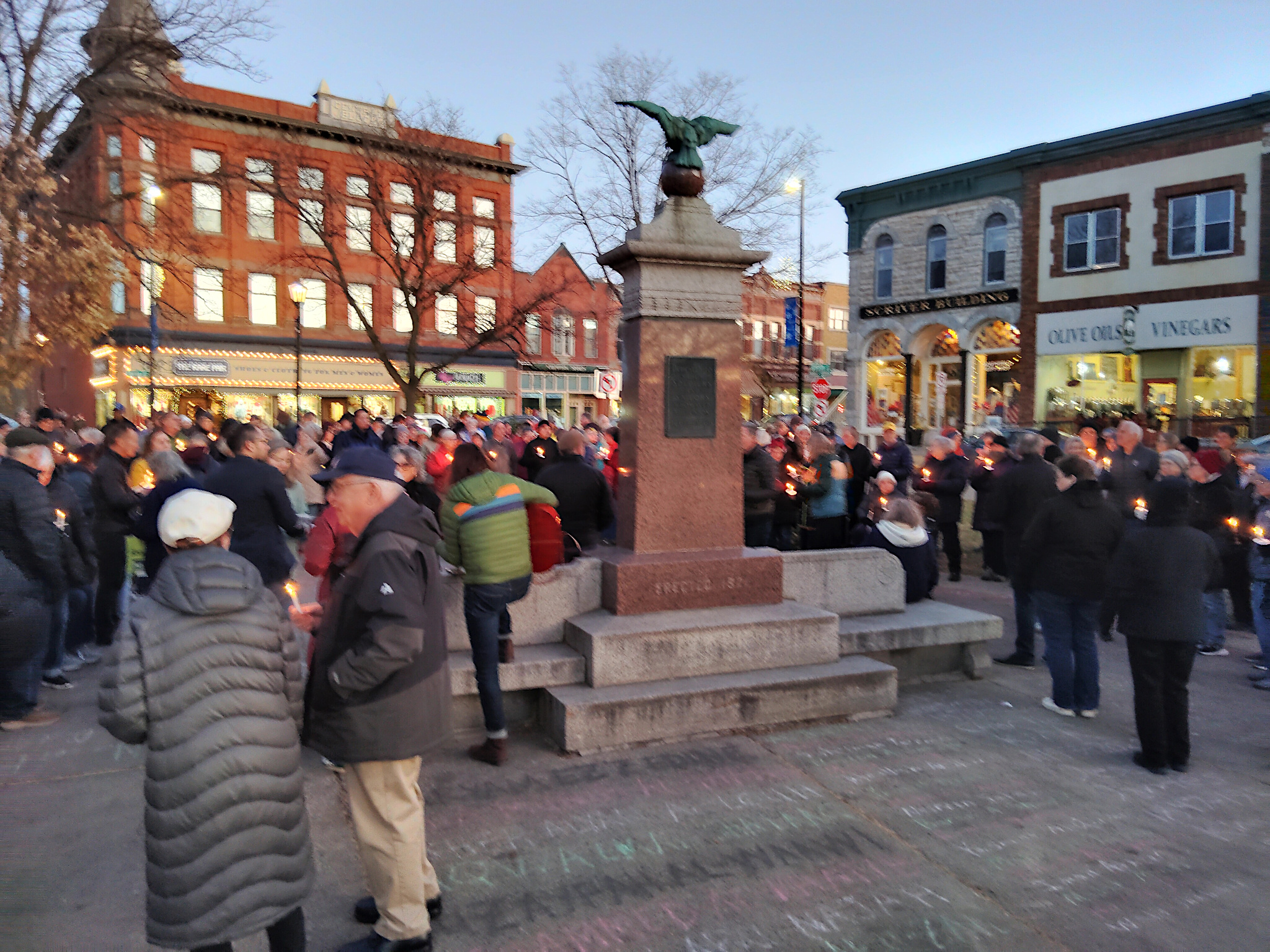
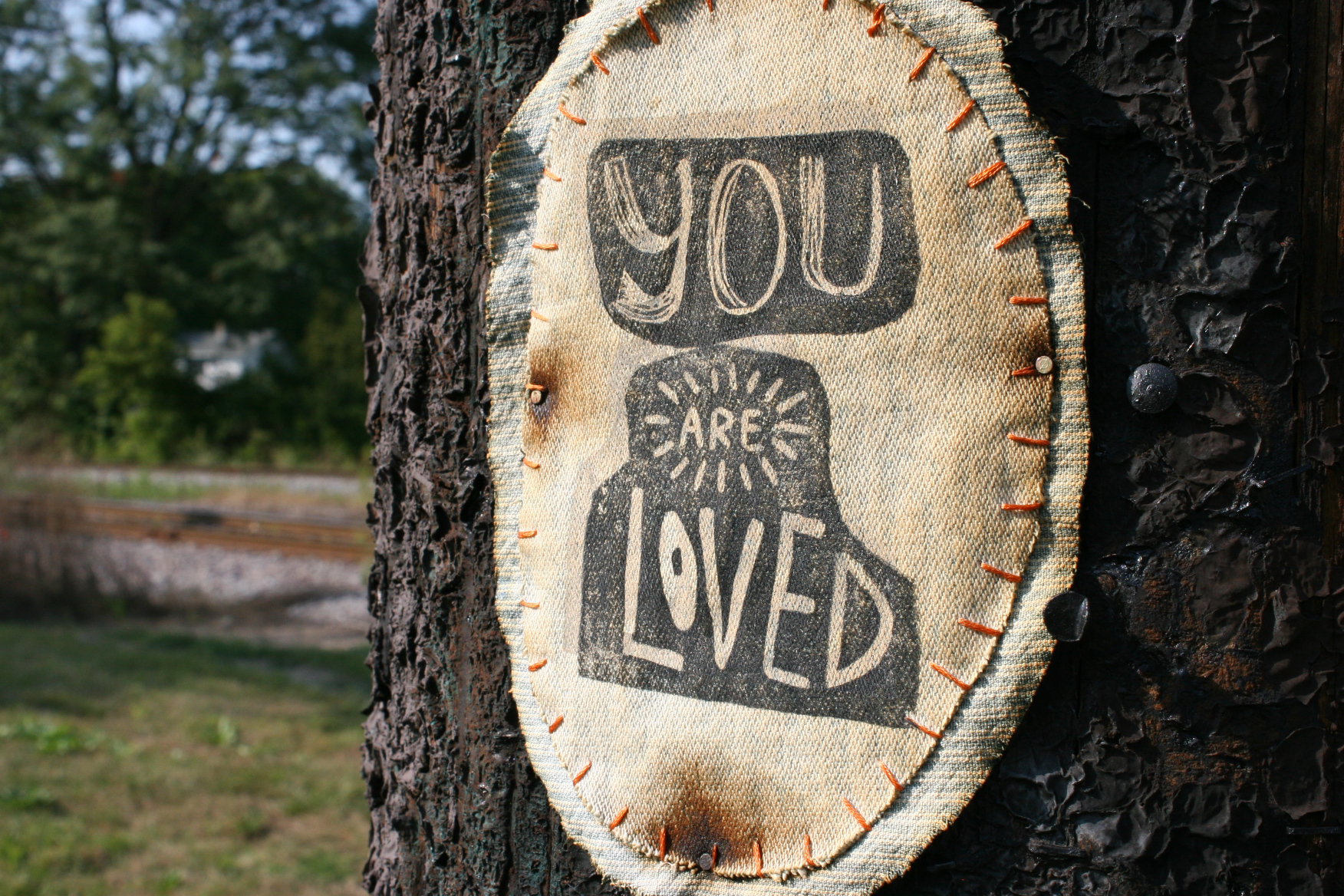
An inspirational word in an art installation honoring Barb Larson, shot and killed in 2016 inside her workplace, the Faribault Area Chamber of Commerce & Tourism. Used here for illustration only. (Minnesota Prairie Roots copyrighted file photo)
IN MY BIBLE, I highlight verses that resonate with me, that inspire, that uplift and offer hope. Those include Jeremiah 29:11. It reads: For I know the plans I have for you, declares the Lord, plans to prosper you and not to harm you, plans to give you hope and a future. In faith communities, this specific scripture is often directed to youth, who are our future.
On Wednesday morning those words written by the prophet Jeremiah were shared by Matt DeBoer, principal of Annunciation Catholic School in south Minneapolis, following a mass shooting at the adjacent church. The shooter fired from outside through stained glass windows into the church, killing two students and wounding 18 others, including three parishioners in their eighties. All were attending a back-to-school morning Mass.
The churning Straight River, visually reflective of what we’re feeling now in Minnesota. (Minnesota Prairie Roots copyrighted file photo)
“NEVER AGAIN”
This act of gun violence is nothing short of horrific. No one can deny that. Fletcher, 8, and Harper, 10, are dead. Seven others were critically injured, taken to a level 1 trauma center. All are expected to survive. The level of pain and grief and anger, yes, anger, we are feeling collectively in Minnesota right now is palpable.
In all the media coverage I’ve watched and read, I keep circling back to Principal DeBoer and his message at a late Wednesday morning press conference hours after the shooting. He shared the school’s Jeremiah 29 based theme for 2025-2026 of “a future filled with hope.” Hope happens to be one of my favorite words, but not one I personally relate to a mass shooting. Yet on Wednesday morning, the principal called for all of us to look to the future with hope, because we can’t change the past. I listened. I heard. I heard him say, “Never again.” I heard DeBoer ask us to commit those two words to our speech pattern. “Never again.”
And I heard, too, his call for action as he referenced this African proverb: When you pray, move your feet.
As the day progressed into evening vigils, I continued to watch television coverage. Clergy led a prayer service at the Academy of Holy Angels, a nearby private Catholic high school that Annunciation students often attend beginning in ninth grade. In a message also themed to hope, Archbishop Bernard Hebda mentioned the broad support received from those of all faiths—Protestants, Jews, Muslims… And from Pope Leo XIV. I would expect nothing less. We are all hurting.
Another vigil followed at Lynnhurst Park. As I watched television coverage begin, I focused on the diverse crowd. A young girl seated on the ground clutching a teddy bear. A priest in a wheelchair. Attendees sheltering flickering candles with their hands. People in bright orange t-shirts emblazoned with “Protect Minnesota.” Photographers working. A woman in a black tee with the simple word, “Enough,” and a slash drawn through a circled gun. Instrumental music played—”Bridge Over Troubled Water”—setting an introspective mood.
“Doing something” must be about our kids. Photo used for illustration only. (Minnesota Prairie Roots copyrightedfile photo)
“WE NEED TO…”
And then the line up of speakers stepped up, addressing the crowd. The mood at this vigil was decidedly different. This gathering focused on a call to action in oftentimes fiery and emotional speeches by politicians and local leaders calling for stronger gun laws. In all the thoughts shared, Minnesota Lieutenant Governor Peggy Flanagan’s message rose to the top for me. While she spoke the usual “You are not alone” and “Enough is enough,” here’s the one soundbite that sticks with me: “We need to love our babies and our children more than our guns.” That bears repeating. “We need to love our babies and our children more than our guns.”
On this, the morning after the murder of two children and wounding of 17 others at Annunciation Catholic Church less than an hour from my Faribault home, I reflect on Flanagan’s words. And I think of my own two elementary-aged grandchildren starting the new school year on Tuesday. I want them to feel, to be, safe. I want this gun violence to end. As the mayor of Minneapolis said, his is “a city united in grief,” which must now become “a city united in action.”
I hold hope that perhaps this time something will change. I understand that gun violence is complicated, that it involves addressing the root causes of such violence. Yet, if not for the guns—three used in the Minneapolis shooting—two children would still be alive.
#
This story has been updated to include the first names of the two children killed in the shooting. Their names were released late Thursday afternoon. The number of injured has also been updated to 18.
I’ve photographed many stained glass windows in churches. I looked through my archives and found this image of a window at Mother of Good Counsel Votive Chapel, LaCrosse, Wisconsin and it struck me as fitting for this post. (Minnesota Prairie Roots copyrighted file photo 2015)
I HAD MY MORNING PLANNED. Wash sheets and towels and hang them on the line. Pay bills. Write a blog post. I finished the laundry. But then all activity stopped and my attention focused to breaking news—a mass shooting in south Minneapolis.
For hours I’ve watched media coverage of events unfolding at Annunciation Catholic Church and School in south Minneapolis. Early today two school children were shot and killed during morning Mass. Seventeen others were injured, among them two adults. Four required surgery. Seven were in critical condition at Hennepin County Medical Center, a level one trauma center. Several went to other hospitals.
My heart breaks for the families, friends and classmates of the eight and 10-year-olds who were killed. My heart breaks for all who were part of and witness to this violence. Minneapolis Mayor Jacob Frey and Minneapolis Police Chief Brian O’Hara, who spoke at a press conference, echoed the same. Their pain and anguish were evident in their words, their voices breaking with emotion.
I was especially touched by Mayor Frey’s message that we must go beyond simply saying “thoughts and prayers” because, as he stated, these kids were literally in church praying. He’s right. I believe in prayer. But I also believe that caring and compassionate action must accompany prayer. Frey called upon all of us to wrap our arms around the affected families, to love and support them. These are not only Minneapolis families affected, but American families, he said, adding that these shootings happen far too often.
According to officials, the gunman, dressed in black and armed with a rifle, shotgun and pistol, fired from the outside through church stained glass windows, hitting victims sitting in the pews. The man, in his early 20s and with no known criminal record, is dead from a self-inflicted gunshot wound, according to the police chief.
Both the mayor and police chief used the word “evil” when describing this morning’s shooting. They also used words like “deliberate act of violence,” “unspeakable act,” and “unthinkable tragedy.” We’ve heard those words way too often following mass shootings that have occurred way too often. Once is too often.
My day goes on, not as I planned, but tinged now with deep sadness. I can’t shake the images of children emerging from Annunciation School with their parents, hands clasped, faces showing the deep pain they are feeling. They are forever changed.
IF I LISTEN CLOSELY, I can hear the incessant chirp of crickets beneath the steady drone of traffic rushing past my house. I live along a busy street, where noise is a constant except in the deep hours of the night. Even then, though, the lone blare of a siren may pierce the night silence, enough to awaken me.
I hear lots of sounds. But that’s not the same as listening. There’s a difference. Hearing is simply taking in sound waves. But listening requires intentional focus. Not only physically hearing, but also paying attention, picking up on verbal and non-verbal cues, remaining quiet.
Many of us are not particularly good at listening. It requires discipline, silence and an understanding that whatever we hear holds significance. Chirping crickets signal the end of summer. Screeching sirens indicate an emergency. And when someone is speaking to me, it means they have something to say. And I need to listen.
I consider myself to be a pretty good listener. As a journalist, I really honed my listening skills, a necessity in covering any news story, doing any interview. And on a personal level, I’ve always been more interested in what others are saying than in hearing my own voice.
Therein lies the problem. Too many of us like the sound of our own voices. If someone starts sharing their own story, their own challenges, we tend to interject our own stories. That’s when a push “pause” seems appropriate. Our listening skills need to kick in as we clamp our lips in silence and remember that the conversation is not about us.
So all of this leads me to the meeting between President Donald Trump and Russian President Vladimir Putin on Friday in Anchorage, Alaska, to discuss the war in Ukraine. Noticeably absent will be Ukrainian leader Volodymyr Zelenskyy. Now you’d think, given the war is raging in Ukraine, that Zelenskyy should be at the table. He asked to be there. But, if the two other leaders heard, they didn’t listen. A pre-meeting conversation between Trump and Zelenskyy isn’t the same as including the Ukrainian president in the summit.
From all accounts, the Trump administration is now billing Friday’s meeting as a “listening exercise.” I find that to be an interesting choice of words. I can’t imagine that either Trump or Putin will really be “listening,” based on past meetings between the two and observations I’ve made about them. But, hey, maybe this time they really will hear the crickets chirping above the drone of war, the blaring of sirens.
I RUSHED HOME from the grocery store late Saturday morning to watch the live broadcast of the funerals of Melissa and Mark Hortman, shot to death in their Minnesota home two weeks ago during an apparent politically-motivated assassination. Melissa was Minnesota’s Speaker of the House, a respected politician, but, more importantly, a beloved wife, mother, daughter, friend, neighbor and more. Much more.
The private service at the Basilica of Saint Mary in Minneapolis revealed the professional and personal sides of the Hortmans with stories shared during eulogies after the Catholic Mass. Laughter rang through the massive church, filling the spaces between grief.
I jotted down 3 ½ pages of notes, not only to share information with you, but also because I focus better, retain more, by doing that. It’s also the reporter in me emerging.
HERE FOR EACH OTHER IN OUR GRIEF
So what stood out? A lot.
First, it was a recognition that we are all grieving. Individually. Collectively, as a state. “Nothing conveys love and support more than presence,” presiding pastor, Father Daniel Griffith, told those packing the pews. That included former President Joe Biden and former Vice President Kamala Harris, sitting in the front row next to Minnesota Governor Tim Walz and Gwen Walz. The Hortmans’ adult children, Colin and Sophie, and other family sat just across the aisle.
LIGHT & HOPE IN DARKNESS
The remarkable strength of Colin and Sophie continues to stand out. Rev. Griffith noted the courage and grace of the two, saying they are “a source of light and hope in the darkness.” In a message earlier released to the public, the siblings called for each of us to make our communities better for someone else. Plant a tree. Pet a dog. Stand up for justice and peace. And more.
“GROUND ZERO” FOR CHANGE
Father Griffith, with permission of the Hortman family, spoke candidly. The nation, he said, is “in need of deep healing.” He referred to Minnesota as a past “ground zero” for racial injustice in the 2020 killing of George Floyd and now for political violence and extremism in the murders of the Hortmans and the shootings of Senator John Hoffman and his wife, Yvette, on the same morning. The Hoffmans are recovering, John still hospitalized. Minnesota, Griffith said, can now be the “ground zero” for restoration, justice and healing. If we work together. And strongly decry injustice and violence.
“Peace & Love,” an acrylic painting by Angelina Dornquast exhibited at the Paradise Center for the Arts, Faribault. (Minnesota Prairie Roots copyrighted file photo October 2024)
LET THERE BE PEACE
Words like hope, goodness and kindness were repeated often during the lengthy service. Likewise justice and peace. The gospel reading of The Beatitudes from Matthew 5 seemed especially fitting: Blessed are those who mourn…blessed are the merciful…blessed are the peacemakers…
Peace. Father Griffith shared that Melissa’s mother found a worn copy of the prayer of St. Francis of Assisi in her daughter’s purse. I expect it’s familiar to most of you. Lord make me an instrument of your peace… Colin later read that prayer, a moment I found profoundly moving. In his grief, he had the composure to share those powerful words of where there is hatred, let me sow love… I can only imagine how proud his parents would have been.
DOING GOOD
Governor Walz said Melissa’s goal in life was “to get as much good done for as many people as possible.” He pointed to her legislative efforts that resulted in fewer kids living in poverty, safe and secure housing for Minnesotans and more trees. She loved trees and gardening. Earlier, the priest referenced much the same, calling service and community the Hortmans’ guiding lights.
LAUGHTER IN STORIES
But it was close family friend and former co-worker (at the Legal Aid Society of Minneapolis), Robin Ann Williams, who brought laughter to the Basilica with her personal stories. She shared about a call from Melissa to help choose a paint color for her kitchen. When Williams arrived, she found all the paint samples were shades of beige. The kitchen is still beige. The kitchen centered gatherings, like the “Gourmet Supper Club” dinners with law school friends. Mark Hortman’s sour dough bread was better than his home-brewed beer, she said. Laughter erupted often, especially when she held up a souvenir photo placard of vice presidential candidate, Minnesota Governor Tim Walz, which Melissa brought home for her friend from the national DFL convention.
Photographed in downtown Faribault. (Minnesota Prairie Roots file photo August 2019)
JOY & MORE ARE POSSIBLE
On this Saturday, the funeral was not about politics, though. It was about coming together to celebrate the Hortmans, to honor their memories, to reflect on their public and private lives, to collectively grieve. The day prior, some 7,500 people converged on the Minnesota State Capitol to pay their respects as the couple and their dog, Gilbert, lay in state.
“We are buried in sorrow right now,” family friend Williams said, adding that joy will come.
I have to believe it will, if we begin to follow the advice of the Hortman children, the prayer of St. Francis of Assisi, the teachings of The Beatitudes and the directive of Father Griffith to work together for restoration, justice and healing.
This shows an edited section of the front page of the June 19, 2025, The Gaylord Hub. (Minnesota Prairie Roots photo June 2025)
ALTHOUGH I AM DECADES removed from working as a full-time journalist, my innate curiosity remains unchanged. I still want to gather the facts, get answers, and uncover the who, what, when, where, why and how. That has never left me.
Last Saturday, June 14, memories of working as a newspaper reporter in Gaylord, the county seat of Sibley County, rushed back as the top news story in Minnesota, and the nation, unfolded. That breaking news was the politically-targeted assassinations of Minnesota State Representative Melissa Hortman and her husband, Mark, and the shootings of Senator John Hoffman and his wife, Yvette. The suspect now accused in the crimes, Vance Boelter, 57, lived near Green Isle. In rural Sibley County.
My first job fresh out of Minnesota State University, Mankato, in 1978 with a degree in mass communications, news/editorial emphasis, landed me in small town Gaylord, at The Gaylord Hub. I was affectionately dubbed “The Cub from the Hub,” or at least affectionately by those who appreciated my fair and balanced reporting. Some did not. Gaylord lies about 15 miles southwest of Green Isle, where Boelter was eventually apprehended near his home. Green Isle was mostly outside The Hub’s coverage area, although I recall writing a few stories from that part of Sibley County.
The bottom portion of the front page story written by Joseph Deis. (Minnesota Prairie Roots photo June 2025)
Today the June 19 edition of The Hub landed in my mailbox. I’d been waiting for this issue, curious to see how third-generation publisher and editor, Joseph Deis, would cover the largest news story in the paper’s history. The Hub front page headline reads: Shooting suspect lived in Gaylord a few years ago—Largest manhunt in state’s history ends in Sibley County.
I couldn’t help but think how hard Joe (he was just a kid when I worked for his dad, Jim, at The Hub) and other media have worked to cover this evolving story. It’s not easy to gather information from multiple sources and angles and keep everything straight. That said, law enforcement did an impressive job of informing the media and the public, at least from my at-a-distance perspective.
And Joe Deis did a good job of pulling everything together in a lengthy story that published in his weekly. His dad would be proud, as am I. His story included new-to-me information that Boelter and his family lived on the northwest side of Gaylord a few years ago. They mostly kept to themselves, the article states.
Now, as if the Gaylord/Sibley County connection to my past isn’t enough, there’s more. I left The Hub after several years to become a newspaper reporter at The Sleepy Eye Herald-Dispatch. The murder suspect grew up in Sleepy Eye, graduating from the public high school in 1985. (I was long gone.) Boelter returned to his rural southern Minnesota hometown, living with his family in Sleepy Eye from 2008-2011 and working at Del Monte. And he apparently preached occasionally at church services held in the high school gym, according to media reports. If I know one thing about Sleepy Eye, it’s that the community is deeply religious, with an especially strong Catholic base. I have no idea what Boelter’s childhood faith background may be. But he graduated from an interdenominational Bible college in Texas in 1990 and served as an evangelical missionary in the Democratic Republic of Congo in recent years.
These two connections to my past rattled me. But they also reminded me that, even in rural areas, a reporter’s job can be about more than covering government, sports, community events and the everyday happenings of small town life. Sometimes it can be about covering a really big, life-changing story. A story that grabs headlines locally, statewide, nationally and internationally as did the manhunt in Sibley County, in the readership area of a small town weekly newspaper where I once covered the news.
Protesters stand along Minnesota State Highway 19 by Ames Park in Northfield during the June 14 NO KINGS protest. This is one of my favorite signs among the many held by hundreds of protesters. (Minnesota Prairie Roots copyrighted photo June 2025)
I LEANED MY HEAD against Randy’s shoulder, my left hand gripping the rod of a protest sign and a small American flag. I felt such profound sadness in that moment. The moment when a pastor asked for a period of silence in honor of Minnesota State Representative/House Speaker Emerita Melissa Hortman and her husband, Mark, assassinated in their home during the early morning hours of June 14.
Flag Day. Nationwide NO KINGS protest day. A day of gathering turned tragic here in Minnesota.
A strong statement against a system of government by one person with absolute power. I suggest you look up these words, as I had to with some. (Minnesota Prairie Roots copyrighted photo June 2025)
I alternated between leaning into my husband and leaning my bowed head against the bottom of my NO MORE KINGS protest poster held high, the sign with the cursive words, “I value freedom,” scrawled on the back side. The wind blew, swept my hair across my face like a veil covering sadness. The heaviness felt palpable here, in Ames Park in Northfield, along the banks of the Cannon River. But so did the energy.
This shows just a portion of the massive crowd gathered for Northfield’s NO KINGS protest. (Minnesota Prairie Roots copyrighted photo June 2025)
We were a group of hundreds—maybe even a thousand (I’m not good at estimating crowd size)—gathered to publicly express our concerns about leadership in this country, about decisions being made that negatively affect all of us, about the state of and future of our democracy… It was my first protest. Ever. I wanted, needed, to be here. To remain silent seems complicit.
I’d already arrived when a friend texted that Minnesotans had been advised by state law enforcement not to attend NO KINGS protests. That warning linked to the suspect in the shootings of the Hortmans and of State Senator John Hoffman and his wife, Yvette. We would later learn that NO KINGS fliers were found in the vehicle of Vance Boelter, now accused in the double murders and attempted murders.
While your eyes may focus on the protest sign in the middle, look to the right. and this sign: IF NOT ME, WHO? IF NOT NOW, WHEN? (Minnesota Prairie Roots copyrighted photo June 2025)
That explained why, on the way to the riverside protest, I overheard a woman telling a couple that her police officer son had advised her not to participate in the rally. She was going home. I was not. Nor were any of the others converging on Ames Park at noon. I wasn’t scared. Vested safety people, trained in conflict resolution and de-escalation, were in place. I felt safe in the masses, which, I suppose, is an unrealistic perspective. But I refuse to be silenced by fear, by the words and actions of those who attempt to suppress voices. And intimidate.
And there were those, including the drivers of a white pickup truck and of motorcycles which repeatedly roared past the rally site, spewing their opposition in noise and in political flags bannering messages I won’t repeat. But they, too, have a right to protest. Peacefully. Just as I do. And I wrote that on the back of a second sign: FREE to PROTEST. But, mostly, passing vehicles honked in strong support.
So many positive messages promoting love, compassion, care, kindness… (Minnesota Prairie Roots copyrighted photo June 2025)
At this rally of people opposing the current administration and its policies and actions, I felt a unity of purpose and a deep, cohesive concern for the future of our country. I felt uplifted, embraced, empowered. Speakers spoke (although I couldn’t hear most). The pastor led us in prayer. We sang—”The Star Spangled Banner” and “We shall overcome.” We cheered. We chanted. We waved our posters and flags. And a group held an over-sized American flag, which I couldn’t see from my vantage point deep in the shoulder-to-shoulder crowd.
We were mostly an older group. Baby Boomers. Grandparents. Even octogenarians. Perhaps some protested during the Vietnam War. Or served this country. We’ve lived a few years, enough decades to understand that we need to rise up against authoritarianism. Enough to understand what’s at stake. But there were some young people, too, like the dad behind me with his preschool daughter playing in the grass. He clearly cares, if not for himself, but then for his child.
I saw this mural, “The Inheritance of Struggle,” inside the Memorial Student Union at the University of Wisconsin, Madison, Tuesday afternoon. It shows “the contributions made by people of various ethnicities and cultures in the form of tears, sweat, blood and life in the building of the United States.” It’s fitting for today, Juneteenth, and for NO KINGS day. (Minnesota Prairie Roots copyrighted photo June 2025)
The morning after the NO KINGS protest, I left for Madison, Wisconsin, to spend time with my 5-month-old grandson (and his parents). As I snuggled Everett, I thought, he (and my other two grandchildren) are part of the reason I chose to protest. Their lives stretch before them. I want them to live in a country where they are free. Free. I want them to live under a government based on a three-pronged system of checks and balances, not one ruled by a king or some version of a king or dictator. I want them to live in a kind, caring and compassionate country. Not a selfish, uncaring, divisive nation filled with hatred.
I returned to Minnesota yesterday and am catching up on laundry and writing. And, along with my fellow Minnesotans, I’m collectively grieving the assassination of an elected official and her husband. And I’m thinking, this is what it’s come to in Amercia…
A BILL IS BEING INTRODUCED in the Minnesota Senate today that should alarm everyone, whether you live in Minnesota or not. That’s the addition of “Trump Derangement Syndrome” to the definition of mental illness under current state law.
Apparently this term has been floating around for awhile, although I just learned of it on Sunday. My jaw dropped. I could not believe what I was hearing on an evening newscast. Five Republican senators from central Minnesota have authored the bill, which will be introduced today in the state Senate and then referred to the Health and Human Services Committee. It reads in part as follows:
Subd. 40a. Trump Derangement Syndrome.
“Trump Derangement Syndrome” means the acute onset of paranoia in otherwise normal persons that is in reaction to the policies and presidencies of President Donald J. Trump. Symptoms may include Trump-induced general hysteria, which produces an inability to distinguish between legitimate policy differences and signs of psychic pathology in President Donald J. Trump’s behavior. This may be expressed by: (1) verbal expressions of intense hostility toward President Donald J. Trump; and (2) overt acts of aggression and violence against anyone supporting President Donald J. Trump or anything that symbolizes President Donald J. Trump.
My reaction was immediate and emotional. Why? First, this proposed legislation is an affront to anyone who has ever dealt with/deals with a mental illness or who has a family member or friend who has ever dealt with/deals with a mental illness. The National Alliance on Mental Illness lists 12 mental health conditions, including anxiety, ADHD, bipolar disorder, depression, OCD, postraumatic stress disorder, schizophrenia and more. One in five U.S. adults experience mental illness in a given year, according to NAMI. My guess is that each of the five senators proposing this change in state law has been touched in some way by mental illness, whether they admit it or not.
Now, just as we’ve been making strides in raising awareness about mental health and reducing the stigma, along comes a bill like this which stigmatizes, degrades and demoralizes. It’s insensitive, absolutely unnecessary and is politicizing mental health conditions.
The other component of this proposed change in state law which really concerns me is the wordage “verbal expressions.” Yes, that’s further defined as “intense hostility.” But who defines “intense hostility?” And what happens if you’re found to be “hostile” by whomever simply because you disagree? Perhaps you’re just “passionate.” There’s a lot to think about here.
I support free speech. We have the right to criticize, voice our opinions, speak our minds in a democracy. Or so I thought. Note that I don’t condone acts of aggression and violence against anyone, even if I don’t care for the individual or his/her policies.
A graphic of the original coronavirus. (Source: CDC 2021)
I FEEL VALIDATED. The Minnesota Department of Health now recognizes long haul COVID as an official, diagnosable illness (even with its own insurance code), according to media reports citing the MDH. I am thankful. This has been a long time coming for someone like me who lives with this illness.
I have often felt that people don’t necessarily understand the severity of long COVID, how it impacts the lives of those of us affected. It’s real. Not in our heads. Debilitating. Long-lasting. Results of a survey by MDH confirm that.
Thankfully, my primary care doctor listened to me, showing great care and compassion when we were trying to figure out what was going on with my body in early 2023. My many symptoms followed an illness that was assuredly COVID, even though I never tested positive for the illness. COVID tests, if not done at the right time or done incorrectly, can give inaccurate results.
When I look at the MDH’s long COVID check list, I see many of the long-lasting symptoms I experienced: fatigue, brain fog, trouble sleeping, headaches, heart palpitations, tightness in chest, dizziness (balance issues) upon standing, skin issues, hair loss, mood changes, and changes in taste and smell (for me intensified). And in the “other” category, I experienced sensory overload, which continues to plague me.
After many tests to rule out a tumor or other health issues, my doctor settled on long haul COVID as my diagnosis, although that’s not in my official health records. I need to get that changed with this new MDH determination.
Some of the initial exercises I did in vestibular rehab therapy to regain my sense of balance. (Minnesota Prairie Roots copyrighted file photo 2023)
I will feel forever grateful to Dr. Todd Sykora of Allina Health for listening to me, for his persistence, for prescribing a medication that eased some symptoms and for his suggestion that I try physical therapy.
I’ve written numerous times about my long COVID experience and treatment in an effort to raise awareness, educate and offer hope to those dealing with the illness. For me, the “help” was six months of vestibular rehab therapy to retrain my brain. My therapist treated me like I’d experienced a traumatic brain injury. He was spot on with that approach. I will feel forever grateful to Ryan Iverson at Courage Kenny Rehabilitation Institute in Faribault for getting me through some really challenging months and helping me reach my goal of “getting my life back.” That also came with lots of hard work on my part and the incredible support of my loving husband.
This hope stone, painted by a great niece, sits on my office desk. (Minnesota Prairie Roots copyrighted file photo)
Today I am using my experience to spread the message about long haul COVID and to also personally support a young man in my community dealing with its devastating affects. J, as I will call him, has been struggling for much longer than me and with much more severe symptoms. I’ve encouraged J (and his mom), offered hope and referred J to my physical therapist. He is making progress.
As for me, I’ve learned to mostly manage the few long haul COVID symptoms that persist, albeit less severe than in 2023. When I got sick with COVID again in December 2024 and then rebound COVID, some symptoms flared. But, for the most part, I’m OK. Like any health issue, you learn to live with it and manage. And when a state agency recognizes your illness as real, it feels validating and empowering.
President Jimmy Carter in 2014. (Photo credit: LBJ Presidential Library)
HONEST. COMPASSIONATE. HUMBLE. All describe President Jimmy Carter, who died December 29, 2024, at the age of 100 and whose national funeral will be held Thursday at the Washington National Cathedral. A private funeral and burial will follow in Plains, Georgia.
In many ways, the name of Carter’s hometown, Plains (minus the “s”), describes this soft-spoken man. He was the son of a peanut farmer, grew up in a house without electricity or indoor plumbing, took over the family farm upon the death of this father. Having grown up on a family farm, in a home without a bathroom and closely rooted to the land, I understand Carter’s plain beginnings.
That Carter would go on to become governor of Georgia, the 39th President of the United States, winner of the Nobel Peace Prize and a beloved humanitarian proves that anyone can come from the plainest of places and make a positive difference in this world, emphasis on the word “positive.”
Peace on a tombstone at Valley Grove Cemetery, rural Nerstrand, Minnesota. (Minnesota Prairie Roots copyrighted file photo 2024)
BUILDING A LEGACY OF SERVICE
Certainly, Carter was not perfect—no one is—but the legacy he leaves is, at its core, that of service to others. We should all strive for that. To do good. To help others. To show love, kindness and compassion. For Carter, nowhere was that more evident than in his post-presidency work with Habitat for Humanity. He didn’t just pose for photo ops. He picked up a hammer and actually helped build Habitat houses.
He also built world peace. During his presidency, Carter helped negotiate a peace treaty between Israel and Egypt in 1979. His efforts led to signing of the Panama Canal Treaty in 1977. His work in the areas of peace, democracy, human rights, and economic and social development earned him that coveted Nobel Peace Prize.
“Blessed are the peacemakers” fits President Jimmy Carter. This is a tombstone at Valley Grove Cemetery, rural Nerstrand. (Minnesota Prairie Roots copyrighted file photo 2024)
AN INTERNATIONAL CRISIS & MY CONNECTION
I was just finishing college and starting my career in journalism when Carter was in and ending his presidency. In 1981, while working as a newspaper reporter for the Mankato Free Press, I covered a major national event with a Carter connection. That was the homecoming of Bruce Laingen, one of 52 Americans held hostage for 444 days in Iran. Laingen, a native of Minnesota, was the top American diplomat at the U.S. Embassy in Tehran when protesters stormed the embassy in November 1979. Carter tried unsuccessfully to get those hostages released. On January 20, 1981, the day President Ronald Reagan was sworn into office, the hostages were finally freed. The timing of that release was obviously deliberate. Carter’s re-election bid failed in part due to the hostage crisis.
In my work as a reporter for the Free Press’ St. James News Bureau (my apartment) I covered the southern Minnesota angle on that international crisis. I drove from St. James to nearby small town Odin several times to interview Arvid Laingen at his business, the Odin Feed Mill. We talked about his brother Bruce and his captivity in Iran. I remember photographing Arvid against the feed mill backdrop, American flag draped from the building. When Bruce and the other hostages were released, I joined my regional editor and a Free Press photographer in covering Laingen’s homecoming parade in Odin. Well wishers lined the streets on that cold winter day. Yellow ribbons, which had become a national symbol of hope during the hostage crisis, ringed trees.
My work as a young journalist for a regional southern Minnesota daily newspaper connects me indirectly to President Carter. I admire Carter’s efforts to free the hostages. I can appreciate how defeated he must have felt as days ticked by and the Americans remained in captivity. But he did not let defeat define him. Carter went on to do incredible work worldwide after leaving the highest office in the country. Anyone who remains humble and serves selflessly earns my respect. Carter was clearly a man of integrity, of principles, of faith, someone who never forgot his roots. If only others in public office followed his path of plainness…
I’ve been to Madison, Wisconsin, many times, taken many photos there. This is one of my favorites, taken along a bike trail in the Atwood Neighborhood on Madison’s east side. (Minnesota Prairie Roots copyrighted file photo)
SHORTLY BEFORE I SAT down to write a blog post earlier this afternoon about not mailing Christmas cards this year, I checked my local newspaper’s website and read this headline: “5 dead, others injured in a shooting at a private Christian school in Wisconsin.” Then I clicked on the story.
In the second paragraph, I read that the shooting happened in Madison, Wisconsin, where my second daughter, who is eight months pregnant, and her husband live. A moment of fear pulsed through me. Miranda delivers mail in Madison. In reality, the likelihood of her working a mail route near Abundant Life Christian School at the time of the shooting seemed slim. Yet, I didn’t know where the school is located or where her routes take her. And it is a lack of information that can lead the mind to places you don’t want to go.
So I googled and found that the school sits on Madison’s east side, an area familiar to me since my son lived and worked on the east side of the capitol city for awhile. Next, I texted Miranda on a family group thread. Yes, during her work day. She had just learned of the shooting. And, yes, she was OK, and delivers mail on the west, not the east, side of the city. But, she noted, a co-worker’s child attends Abundant Life.
My heart broke. Not only for that child and parent, but for all the children, families and staff connected to this K-12 school along East Buckeye Road. They have been forever traumatized.
The initial report of five dead, as shared by law enforcement, proved incorrect. As I write this, a teacher, a teenage student and the teen suspect are dead. Six other students were injured, two with life-threatening injuries. My heart hurts for those families, especially.
As I watched an afternoon news conference led by Madison Police Chief Shon F. Barnes, himself a former teacher, tears trickled down my face. Grief rose. And the words of the chief and other officials who stood before the media sounded all too familiar. Just different faces, different voices in a different city on a different date in time.
“Enough is enough,” said the police chief in three succinct words that likely summarize how many of us are collectively feeling. Gun violence in our schools, anywhere, is unacceptable.
On this day, answers to many questions about the shooting in Madison remain unknown as the investigation begins. But I think we can all agree that something needs to change. I don’t have answers on how to prevent this from happening again in some other school. And it seems no one else really does either as these shootings continue. But it’s not for a lack of trying—by controlling access to schools, by offering more resources to help troubled students, by pushing for gun reform…
On this Monday, only 10 days before Christmas, the people of Madison are experiencing the unthinkable tragedy of a school shooting. They are a community collectively reeling and grieving, searching for answers. I feel for my daughter’s co-worker, for her child and for every single student, teacher, staff and family connected to Abundant Life Christian School.
Suddenly the fact that I’m not sending out Christmas cards this year just doesn’t seem all that important.
The day after a mass shooting…thoughts from Minnesota August 28, 2025
Tags: Annunciation Catholic Church & School, commentary, crime, gun violence, Matt Deboer, Minneapolis, Minneapolis Mayor Jacob Frey, Minnesota, Minnesota Lieutenant Governor Peggy Flanagan, news, shooting, thoughts, vigils, violence
IN MY BIBLE, I highlight verses that resonate with me, that inspire, that uplift and offer hope. Those include Jeremiah 29:11. It reads: For I know the plans I have for you, declares the Lord, plans to prosper you and not to harm you, plans to give you hope and a future. In faith communities, this specific scripture is often directed to youth, who are our future.
On Wednesday morning those words written by the prophet Jeremiah were shared by Matt DeBoer, principal of Annunciation Catholic School in south Minneapolis, following a mass shooting at the adjacent church. The shooter fired from outside through stained glass windows into the church, killing two students and wounding 18 others, including three parishioners in their eighties. All were attending a back-to-school morning Mass.
“NEVER AGAIN”
This act of gun violence is nothing short of horrific. No one can deny that. Fletcher, 8, and Harper, 10, are dead. Seven others were critically injured, taken to a level 1 trauma center. All are expected to survive. The level of pain and grief and anger, yes, anger, we are feeling collectively in Minnesota right now is palpable.
In all the media coverage I’ve watched and read, I keep circling back to Principal DeBoer and his message at a late Wednesday morning press conference hours after the shooting. He shared the school’s Jeremiah 29 based theme for 2025-2026 of “a future filled with hope.” Hope happens to be one of my favorite words, but not one I personally relate to a mass shooting. Yet on Wednesday morning, the principal called for all of us to look to the future with hope, because we can’t change the past. I listened. I heard. I heard him say, “Never again.” I heard DeBoer ask us to commit those two words to our speech pattern. “Never again.”
And I heard, too, his call for action as he referenced this African proverb: When you pray, move your feet.
As the day progressed into evening vigils, I continued to watch television coverage. Clergy led a prayer service at the Academy of Holy Angels, a nearby private Catholic high school that Annunciation students often attend beginning in ninth grade. In a message also themed to hope, Archbishop Bernard Hebda mentioned the broad support received from those of all faiths—Protestants, Jews, Muslims… And from Pope Leo XIV. I would expect nothing less. We are all hurting.
Another vigil followed at Lynnhurst Park. As I watched television coverage begin, I focused on the diverse crowd. A young girl seated on the ground clutching a teddy bear. A priest in a wheelchair. Attendees sheltering flickering candles with their hands. People in bright orange t-shirts emblazoned with “Protect Minnesota.” Photographers working. A woman in a black tee with the simple word, “Enough,” and a slash drawn through a circled gun. Instrumental music played—”Bridge Over Troubled Water”—setting an introspective mood.
“WE NEED TO…”
And then the line up of speakers stepped up, addressing the crowd. The mood at this vigil was decidedly different. This gathering focused on a call to action in oftentimes fiery and emotional speeches by politicians and local leaders calling for stronger gun laws. In all the thoughts shared, Minnesota Lieutenant Governor Peggy Flanagan’s message rose to the top for me. While she spoke the usual “You are not alone” and “Enough is enough,” here’s the one soundbite that sticks with me: “We need to love our babies and our children more than our guns.” That bears repeating. “We need to love our babies and our children more than our guns.”
On this, the morning after the murder of two children and wounding of 17 others at Annunciation Catholic Church less than an hour from my Faribault home, I reflect on Flanagan’s words. And I think of my own two elementary-aged grandchildren starting the new school year on Tuesday. I want them to feel, to be, safe. I want this gun violence to end. As the mayor of Minneapolis said, his is “a city united in grief,” which must now become “a city united in action.”
I hold hope that perhaps this time something will change. I understand that gun violence is complicated, that it involves addressing the root causes of such violence. Yet, if not for the guns—three used in the Minneapolis shooting—two children would still be alive.
#
This story has been updated to include the first names of the two children killed in the shooting. Their names were released late Thursday afternoon. The number of injured has also been updated to 18.
© Copyright 2025 Audrey Kletscher Helbling