Minnesota Prairie Roots

Writing and photography by Audrey Kletscher Helbling

When watching high school football is about more than just the game November 2, 2015

The St. Croix Valley Crusaders and the Jackson County Central Huskies line up before the game starts Saturday afternoon.

The St. Croix Lutheran Crusaders and the Jackson County Central Huskies line up on the football field before the game starts Saturday afternoon.

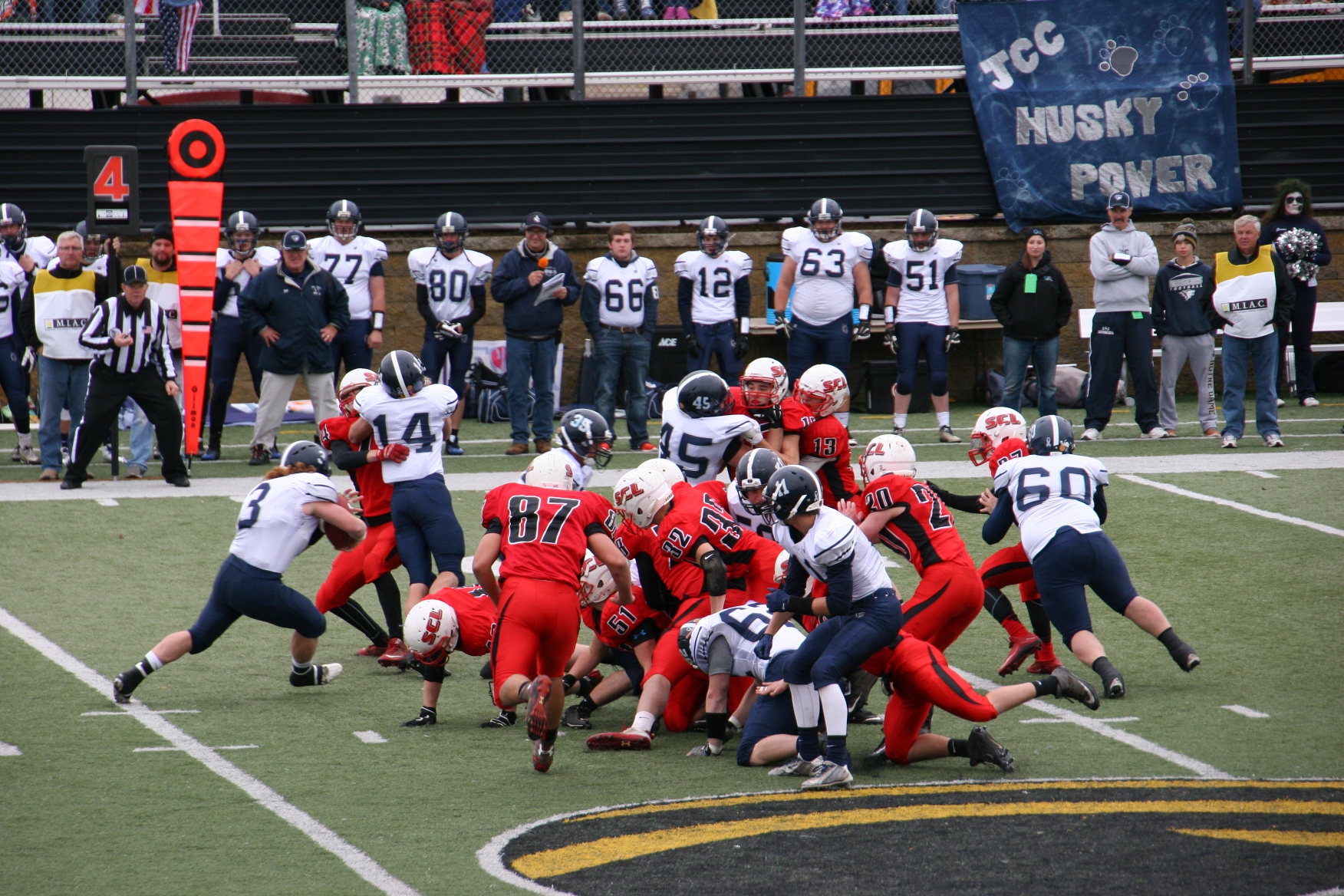
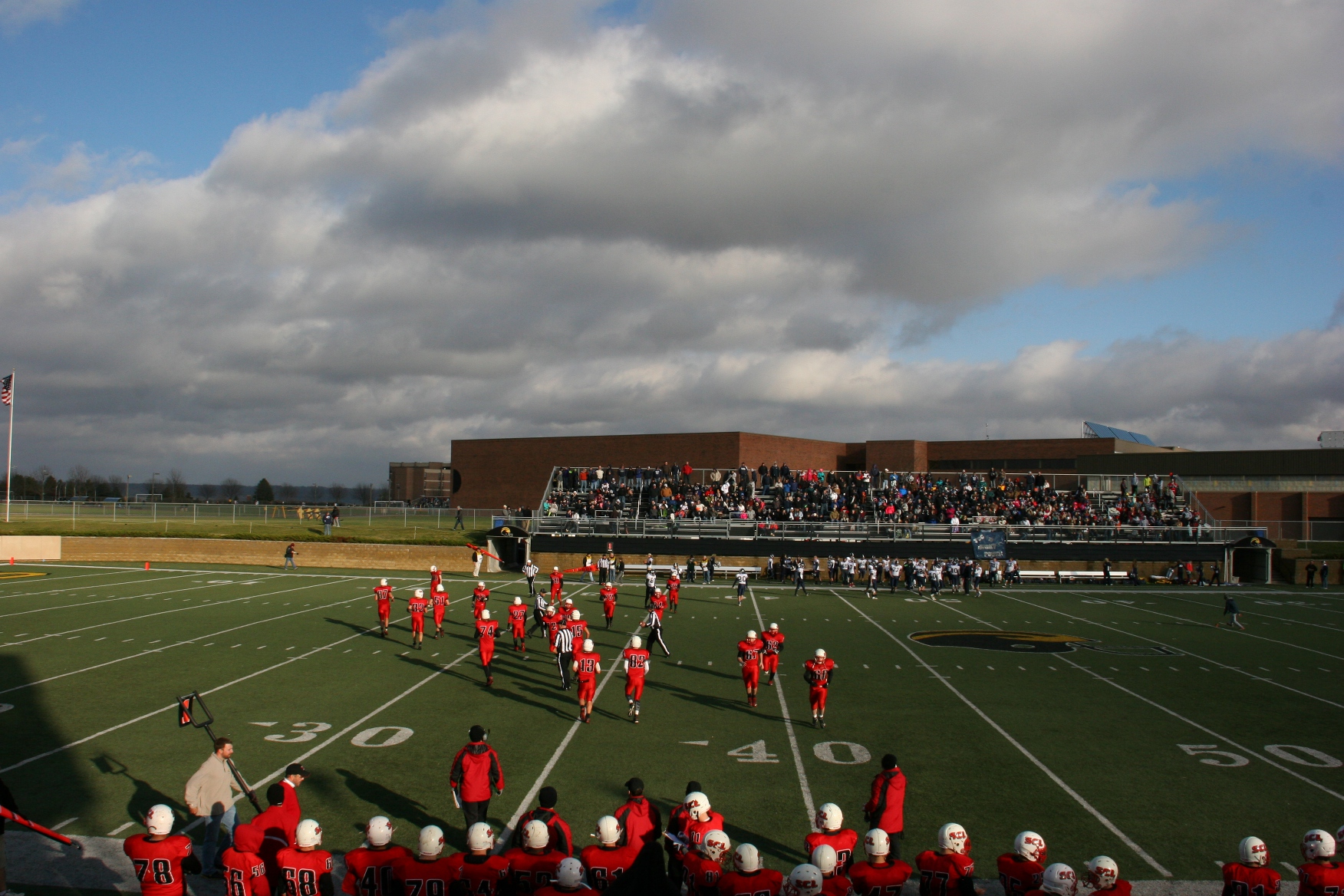
I DRESSED IN MY BUFFALO PLAID red and black on Saturday. Not because I wanted to portray Mrs. Paul Bunyan on Halloween. Rather, I was showing my support for the St. Croix Lutheran High School football team which Saturday afternoon competed against Jackson County Central in state play-offs. My nephew, Stephen (number 87), plays tight end for the red-attired Crusaders.


Football, 120 scoreboard


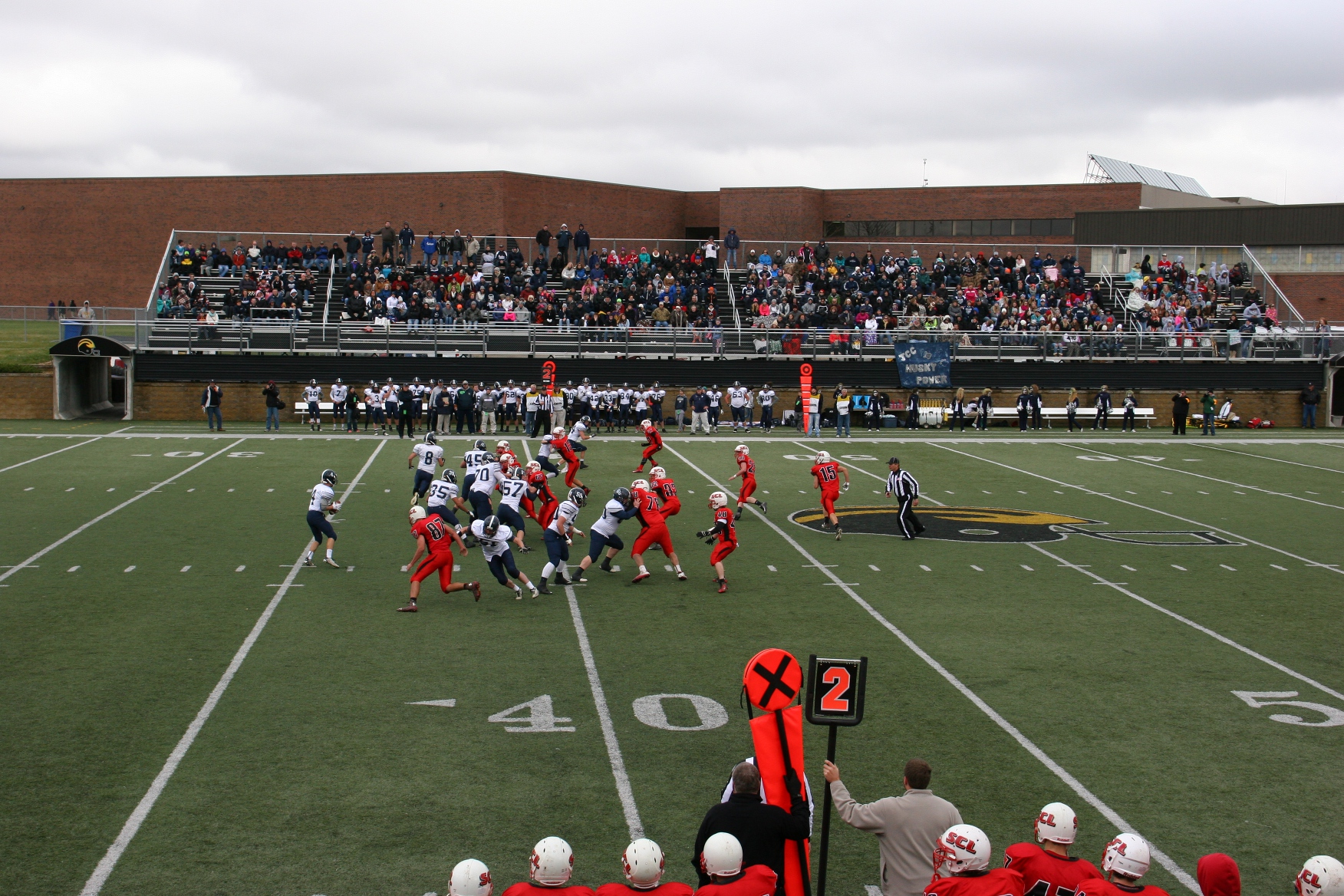
Sometimes the action looked like nothing but a pile of players to me.

Sometimes the action looked like nothing but a pile of players to me.

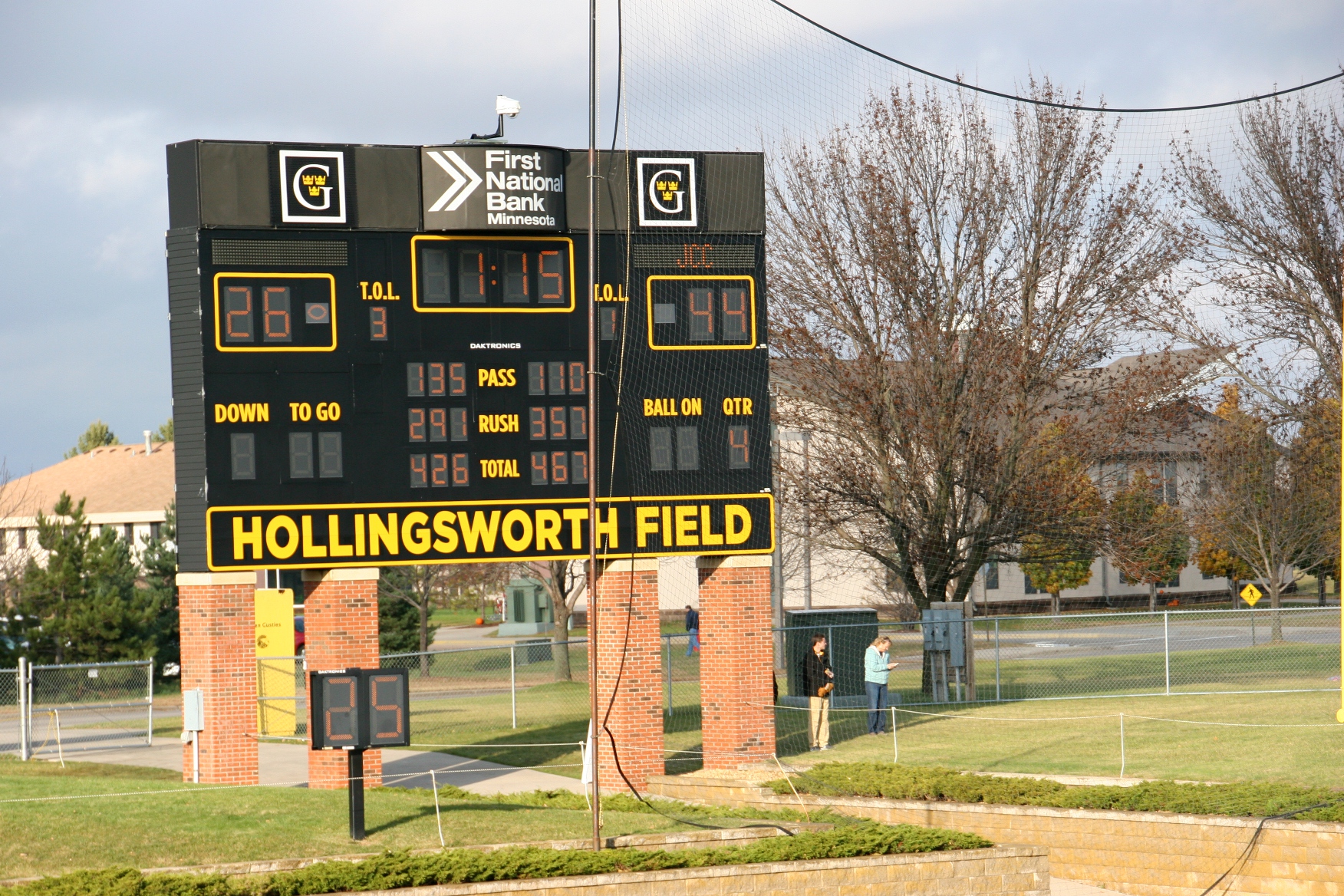
While the St. Paul based school pushed hard to win, they couldn’t defeat the Huskies, a husky and formidable team from southwestern Minnesota. The final score: 44 – 26.

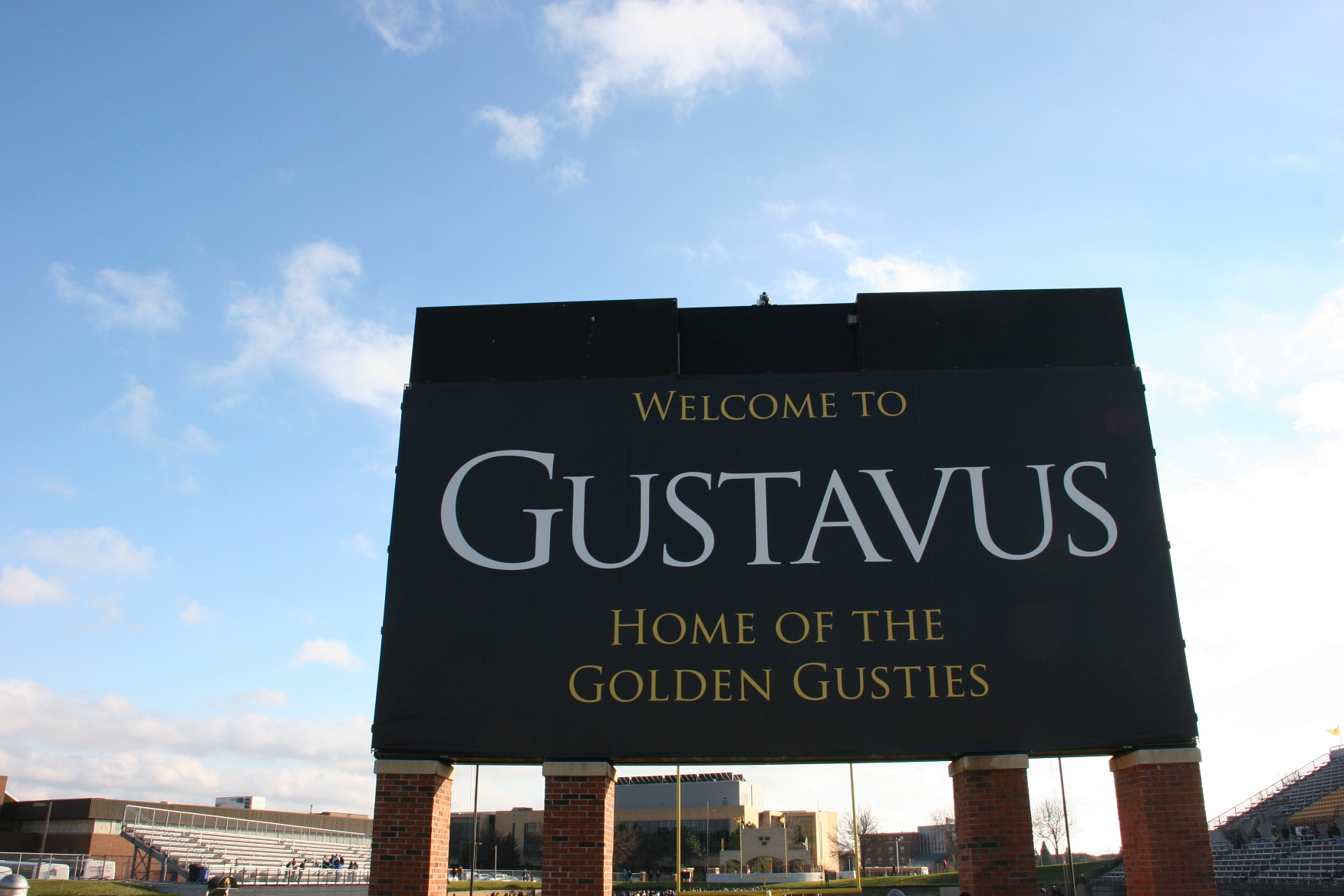
Gustavus Adolphus College in St. Peter hosted the game.

Gustavus Adolphus College in St. Peter hosted the game.

The Halloween themed sign held by the JCC cheerleaders.

The back of the Halloween themed sign held by the JCC cheerleaders.

JCC players run through the sign and onto the field for the start of the second half.

JCC players run through the sign and onto the field for the start of the second half.

Certainly, seeing my nephew’s team win on the football field at Gustavus Adolphus College in St. Peter would have been a Halloween treat. But, JCC dominated, proving the truth in the words the players busted through before starting the second half:

Trick or treat, smell our cleats. The Huskies can’t be beat.

JCC cheerleaders fire up the crowd.

JCC cheerleaders fire up the crowd.

Crusaders fans, including Winnie the Pooh. Some students dressed in Halloween costumes.

Crusaders fans, including Winnie the Pooh. Some students dressed in Halloween costumes.

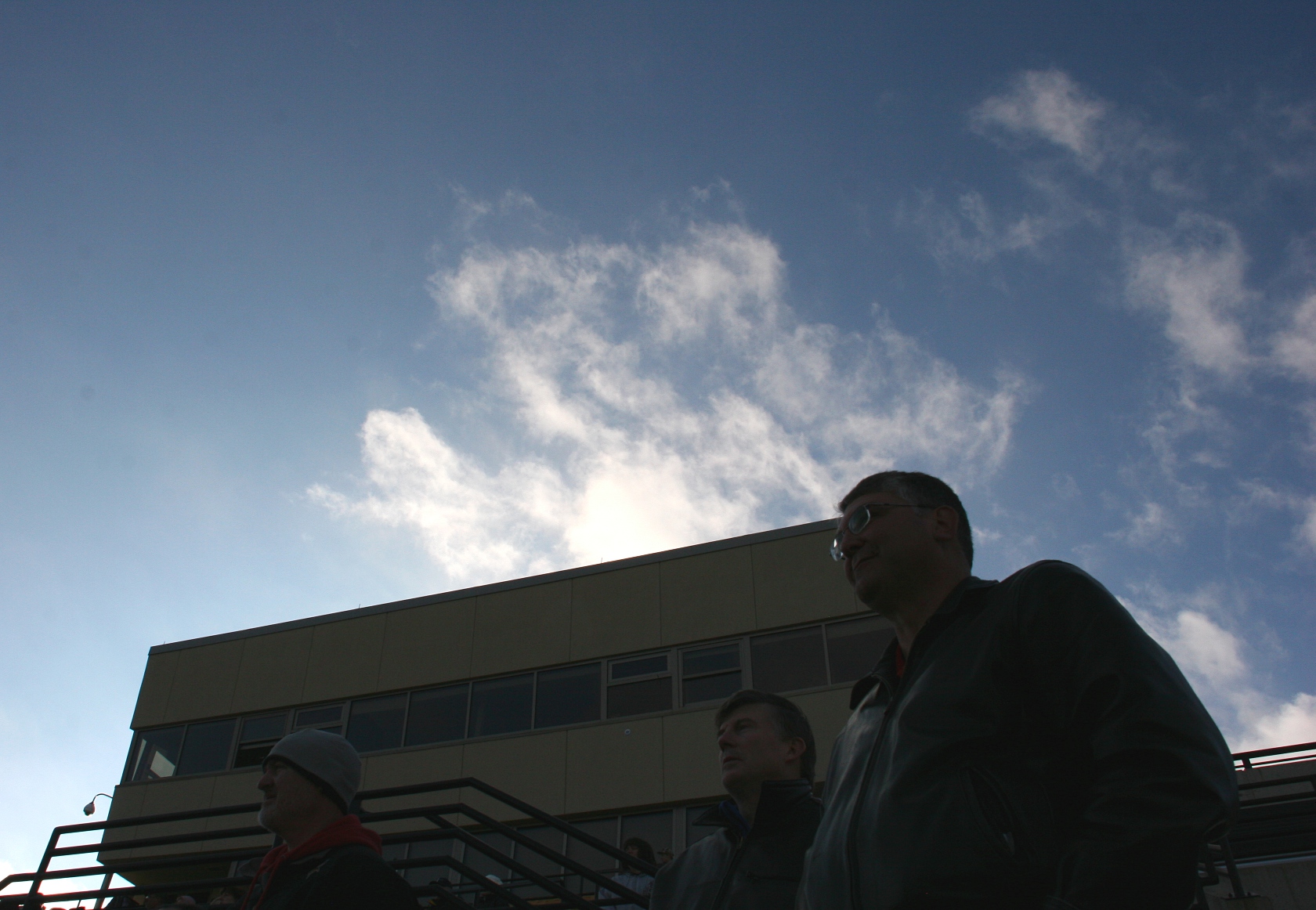
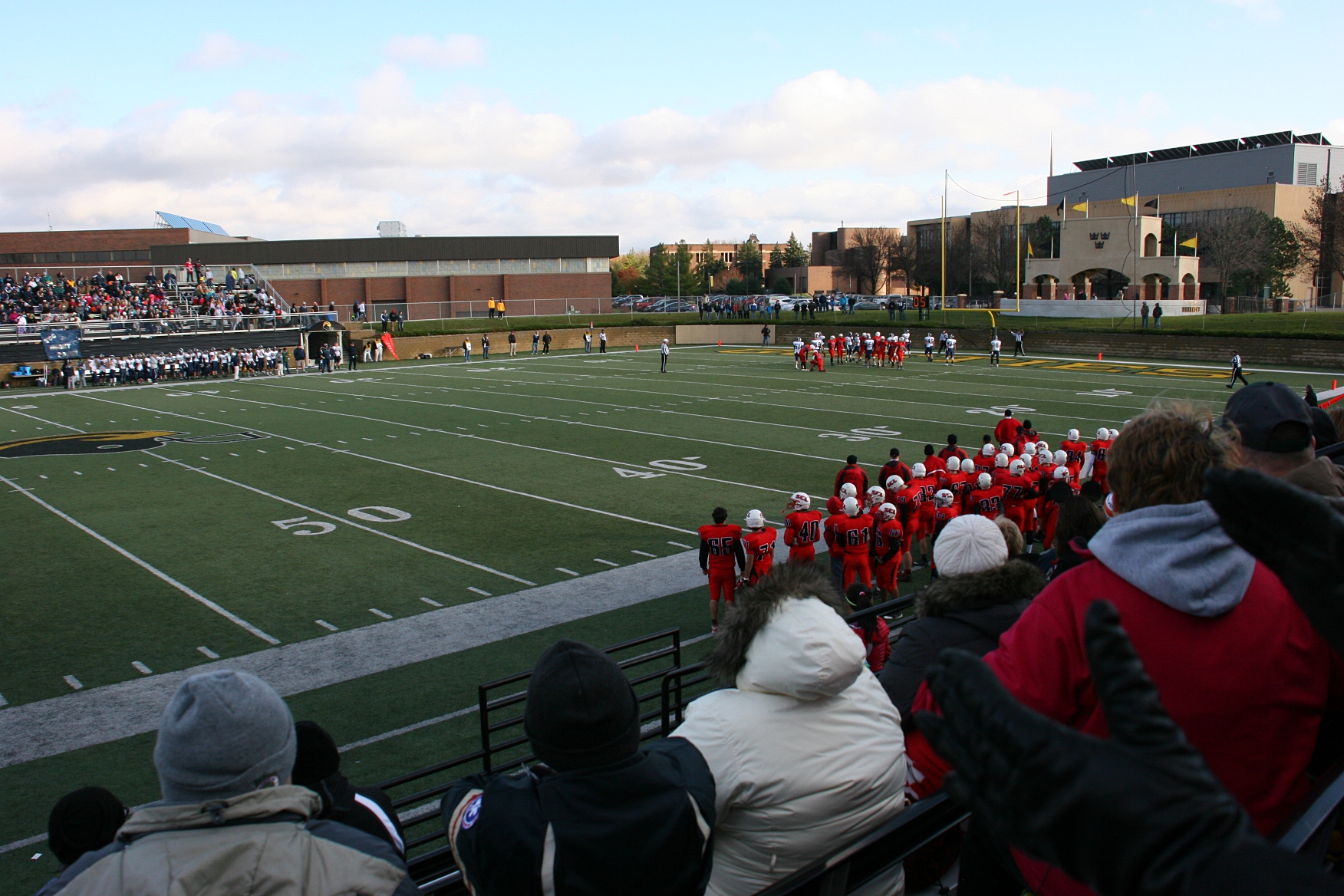
My brother, right, and friends watch the game.

My brother, right, and friends watch the game.

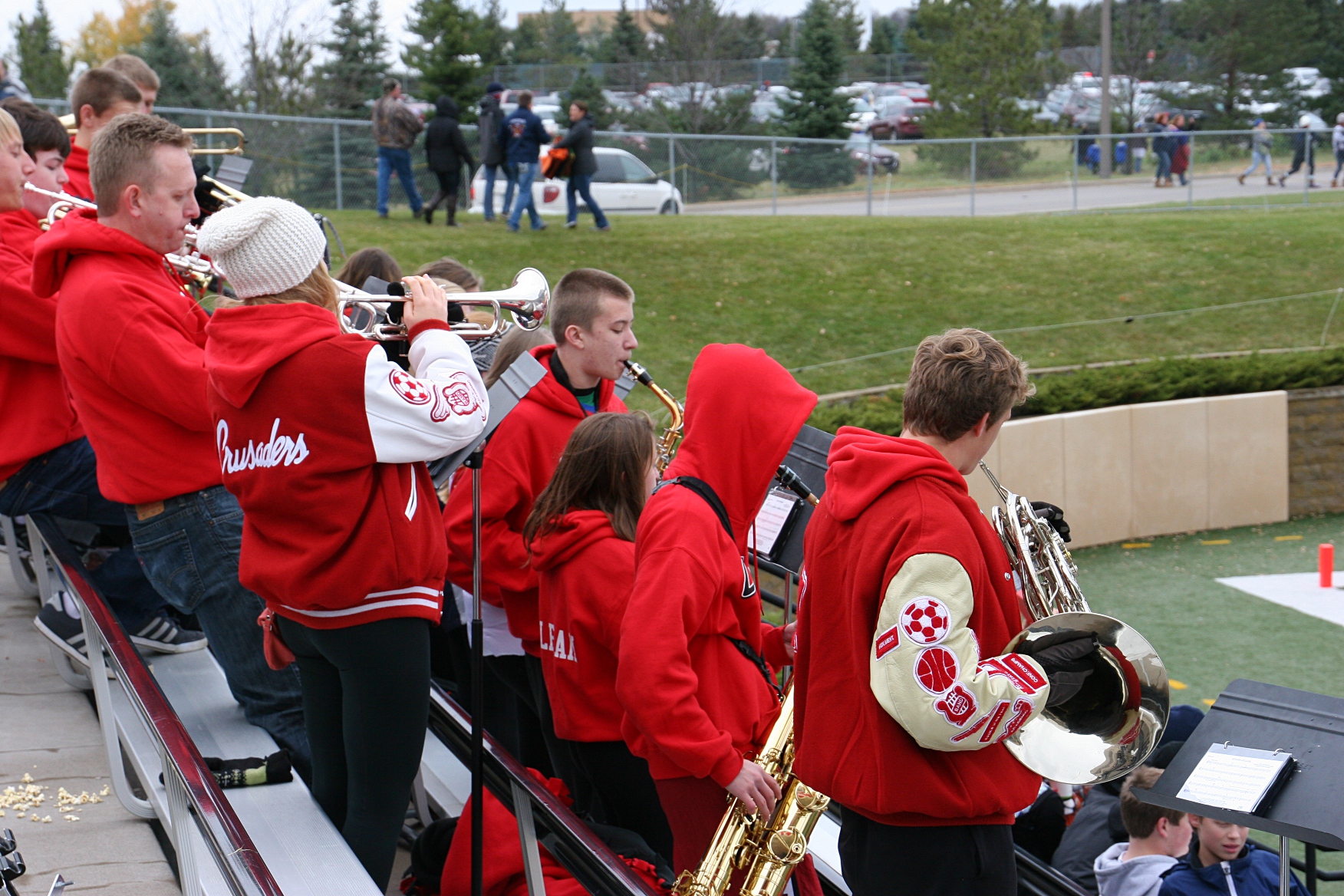
The Crusaders pep band infused school spirit.

The Crusaders pep band infused school spirit.

The spirit of JCC fans, led by enthusiastic cheerleaders, impressed me. Not that Crusaders fans weren’t supportive. We were. I can vouch for my sister-in-law’s continual encouraging screams. My youngest brother stood behind us, several bleacher rows away in an aisle, chewing gum super fast and focusing his eyes on the field the entire game. St. Croix Lutheran came with a pep band. But no cheerleaders. Students seemed subdued for a play-off game.

Occasionally, the clouds parted and sunshine shone upon the football field.

Occasionally, the clouds parted and sunshine shone upon the football field.

Ready for action...that's my nephew, Stephen, #87 in the front.

Ready for action…that’s my nephew, Stephen, #87 in the front.

Crusaders fans cheer on their team.

Crusaders fans cheer on their team.

I’m a quiet fan, too. I was here on this Saturday to support my nephew. Not in a super vocal way. Simply by my presence. If his team won, good. If they didn’t, they didn’t.

The Crusaders huddle.

The Crusaders huddle on the sidelines.

A ref makes a call.

A ref makes a call.

I found myself studying the varying footwear and leggings.

I found myself studying the varying footwear and leggings.

Repeatedly during breaks in the action, the announcer emphasized respect as highly-important in competition. I value respect; both teams showed respect for each other. But, bottom line, these teams play to win. That’s why they’re on the field.

A sign proclaims Husky Power.

A sign proclaims Husky Power.

It is easy, when you are as far behind as the Crusaders were during the game, when plays just aren’t working, when the other team repeatedly scores, to give up. I felt that in a sense Saturday. JCC was the stronger team. Even I, someone who does not watch football much, could see the Huskies’ dominating power.

Stephen, #87, tackles the JCC player carrying the football.

Stephen, #87, tackles the JCC player carrying the football.

ft

St. Croix Lutheran and Jackson County Central in action.

A JCC player prepares to throw the football, left.

A JCC player prepares to throw the football, left.

This is the first football game I’ve attended in probably 40 years. I don’t know many of the nuances of the game. But that’s OK. I understand the basics.

Several Crusaders players left the field with injuries.

Several Crusaders players left the field with injuries. Here teammates support one another.

And I understand the value in being with family—on this Saturday four of my five siblings and their spouses—to support Crusaders number 87. This is what families do. They support and encourage one another. In good times and difficult times.

© Copyright 2015 Audrey Kletscher Helbling


A Halloween treat: Perry the corpse flower blooms at Gustavus Adolphus College October 31, 2013

THE TIMING COULDN’T BE BETTER.

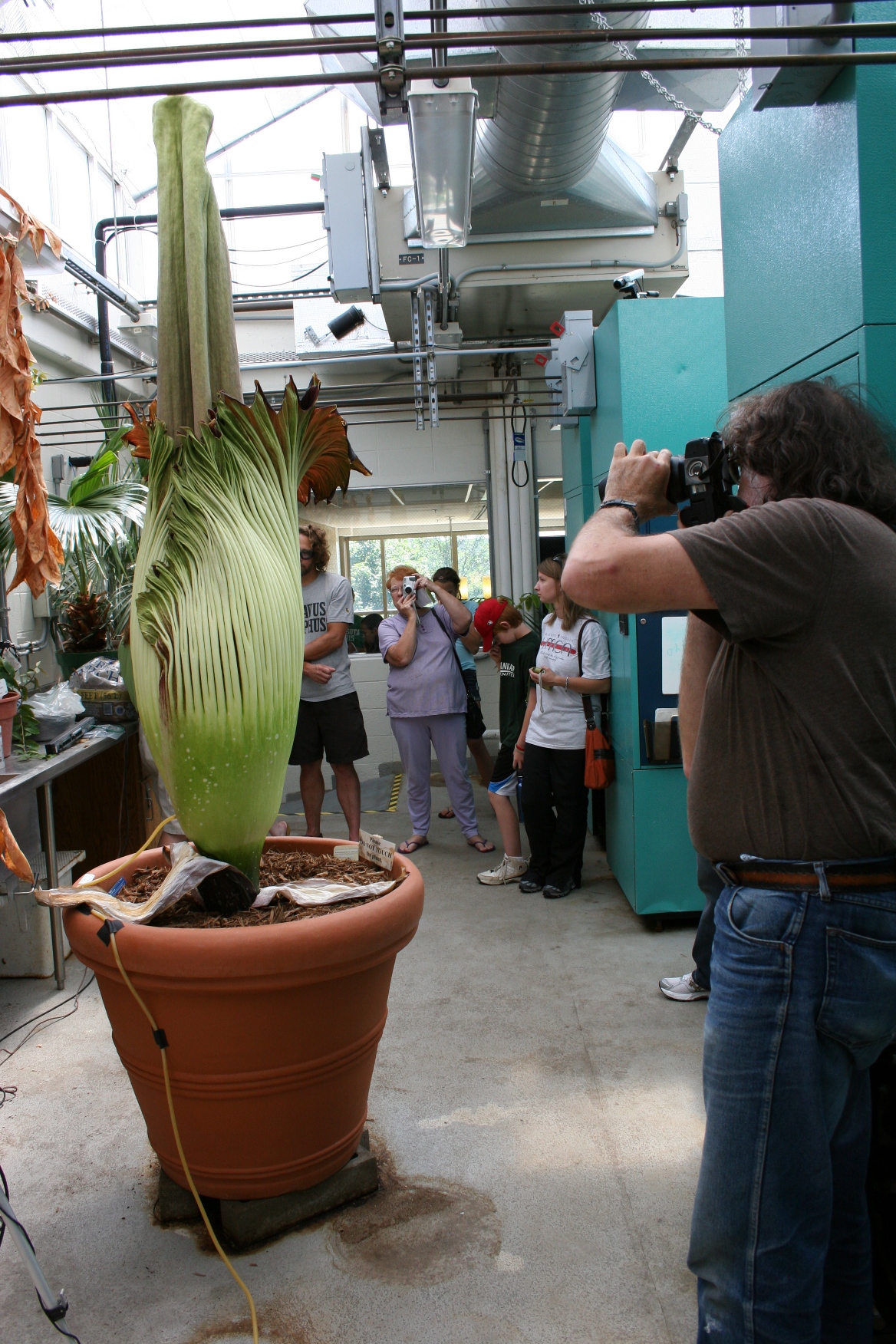
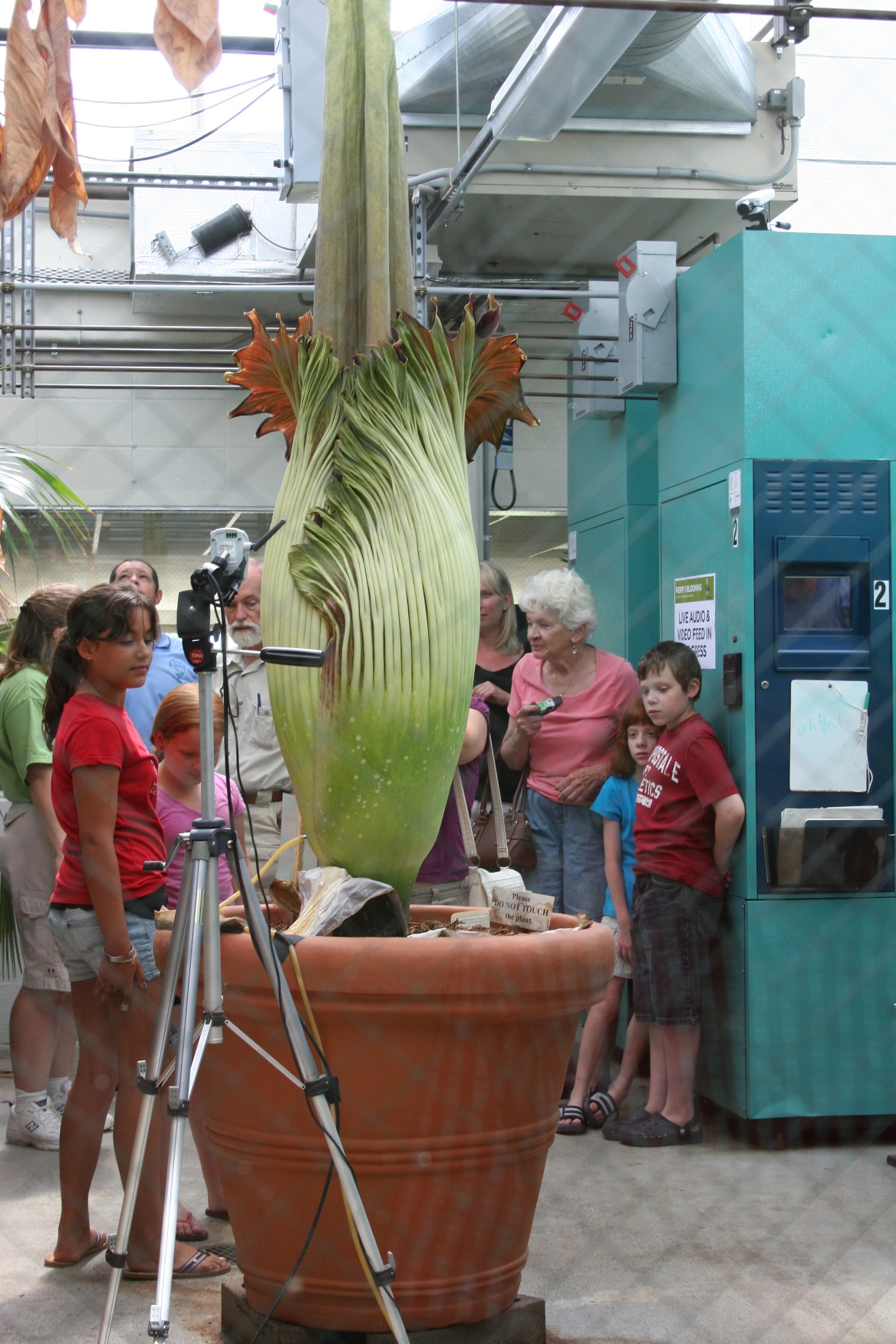
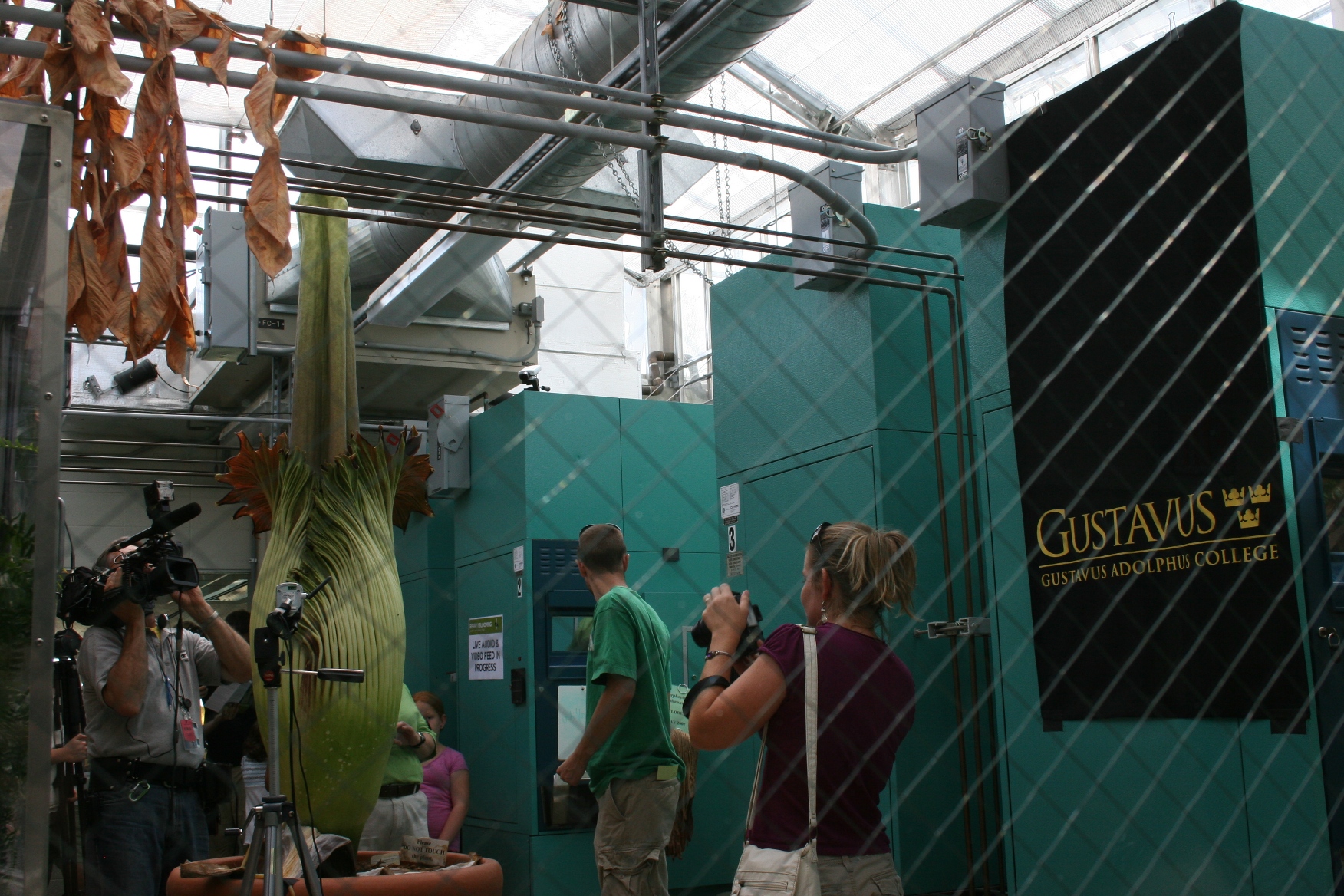
Visitors came with cameras in hand to photograph the rare blooming of Perry, which lasted until Sunday.

Visitors came with cameras in hand to photograph Perry in July 2010.

At 2 a.m. today, Perry the corpse flower began blooming in a third floor greenhouse in the Alfred Nobel Hall of Science on the campus of Gustavus Adolphus College in St. Peter.

What better day than Halloween for the rare blossoming of this rare tropical plant emitting the stench of death or rotting meat, depending on your nose and opinion.

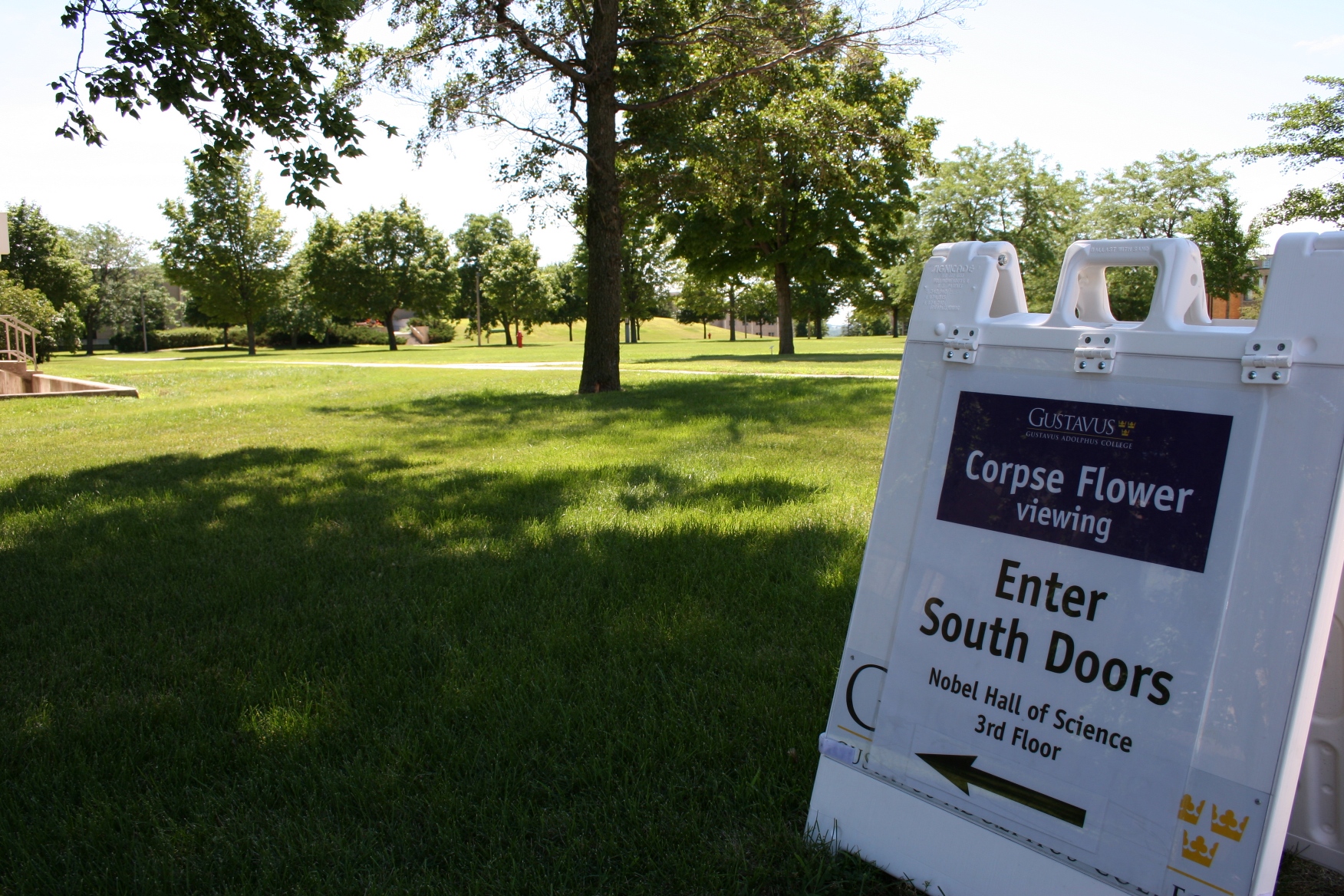
A sign at Gustavus Adolphus College directs visitors to the Nobel Hall of Science where "the corpse flower" grows in a third floor greenhouse.

A sign at Gustavus Adolphus College directs visitors to the Alfred Nobel Hall of Science where “the corpse flower” is blooming in a third floor greenhouse. Minnesota Prairie Roots file photo 2010.

You can view, and smell, this mammoth Amorphophallus titanum, nicknamed Perry, from 2 p.m. – 9 p.m. today (Halloween) or from noon to 8 p.m. on Friday, November 1.

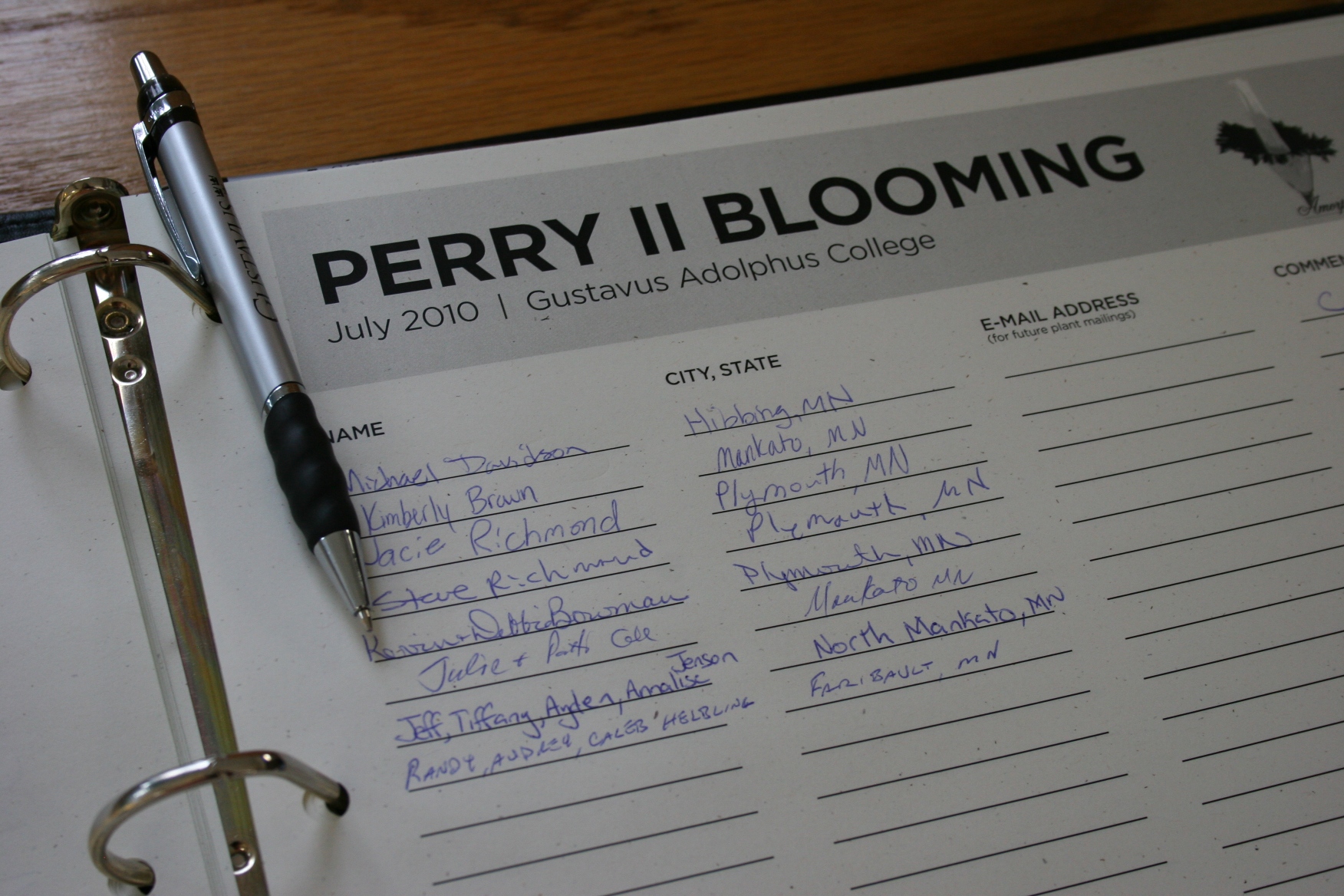
As of noon Friday, most visitors who signed Perry's guestbook came from the St. Peter-Mankato area. However, as word of the blooming spread, visitors were expected from all over--some had already come from Paris and Sweden (they were already visiting in the area).

The Petty guestbook signed by visitors in 2010. Minnesota Prairie Roots file photo.

I saw Perry when the plant bloomed in 2010.  (You can view photos from that visit by clicking here.)

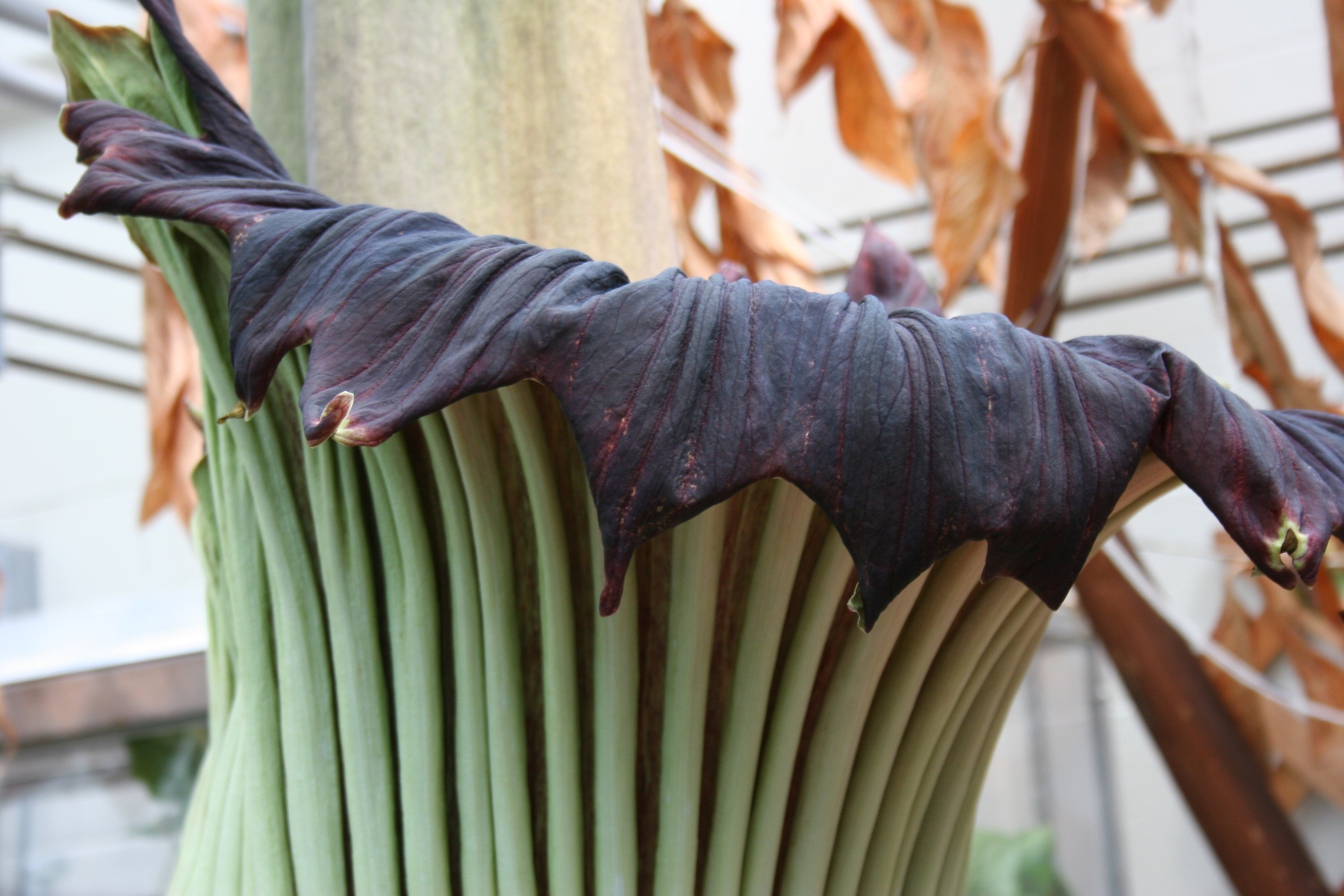
A close-up of Perry's unfolding spathe, an outer purple vase-like sheath.

A close-up of Perry’s unfolding spathe, an outer purple vase-like sheath. Minnesota Prairie Roots file photo 2010.

If you plan to see Perry in person, make haste. If you can’t get to St. Peter, then click here to watch Perry via web cam.

Happy Halloween!

Copyright 2013 Audrey Kletscher Helbling


In St. Peter: Waiting for the corpse flower to bloom October 29, 2013

PERRY MANIA is invading Gustavus Adolphus College in St. Peter.

A shot through a window into the viewing area shows Perry beginning to open.

A shot through a window into the viewing area shows Perry beginning to open in late July 2010.

OK, that may be a bit of a stretch. You decide, But interest in the predicted early November blooming of Perry, otherwise known as the “corpse flower,” is strong.

Think web cams, “featured news” on the college website, headlines in the St. Peter Herald, a Perry blog and even Perry themed t-shirts, cap, mugs, tote bag, bumper sticker and other merchandise available for purchase.

A close-up of Perry's unfolding spathe, an outer purple vase-like sheath.

A close-up of Perry’s unfolding spathe, an outer purple vase-like sheath. Minnesota Prairie Roots file photo 2010.

And all of this because the rare tropical plant, a native of Sumatra in Indonesia and with the largest unbranched inflorescence in the world, is about to blossom.

This mammoth plant, which can reach heights of eight to 10 feet and a life span of 40 years, is noted for its distinct rotting flesh/rotting meat odor.

A shot through the window into the viewing area of the titan arum.

A shot through the window into the viewing area of the titan arum shows the high level of interest in the corpse flower. Minnesota Prairie Roots file photo 2010.

Three years ago, my husband, son and I were among the 5,000 plus curious who flocked to the third floor greenhouse in the Nobel Hall of Science to view, and smell, the Amorphophallus titanum, aka Titan Arum. Gustavus named its plant, seeded in 1993, after the Titan Hyperion, associated with intellectual curiosity. That would be Perry, for short.

I don’t recall the precise smell of Perry only 12 hours after the plant began blooming in late July 2010. But I do remember thinking the odor was not nearly as bad as I had imagined and that I’ve smelled worse (like a slurry pit being emptied) while traveling through rural Minnesota.

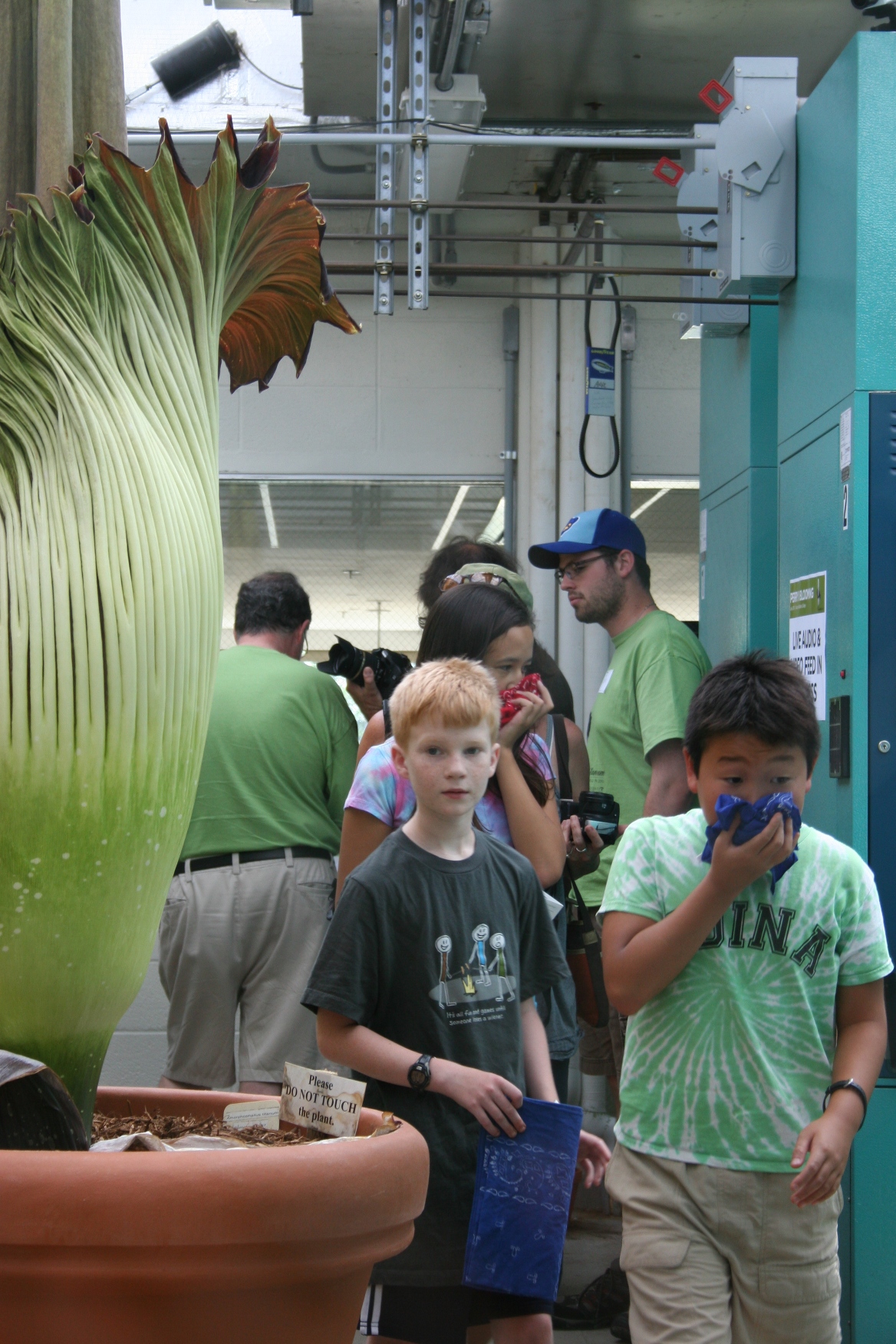
One of the Yang boys wards off the offending odor with a perfumed bandanna.

The odor was too much for this boy, who covered his face with a perfumed bandanna when visiting Perry in 2010. Minnesota Prairie Roots file photo.

But others, such as elementary-aged kids from Edina, pressed perfumed bandannas to their noses.

A diagram explained the life cycle of "the corpse plant."

A diagram explains the life cycle of “the corpse plant.” Minnesota Prairie Roots file photo 2010.

To see, and smell, a corpse flower in bloom is a rare opportunity, one limited to only a few days. This marks Perry’s third blooming. And there isn’t exactly an abundance of these plants in the world, one of the reasons Gustavus botanists are invested in conservation of the Titan Arum. Gustavus received 20 Titan Arum seeds from a San Francisco physician  in 1993 and Perry is the result.

Visitors came with cameras in hand to photograph the rare blooming of Perry, which lasted until Sunday.

Visitors came with cameras in hand to photograph the rare blooming of Perry in July 2010. Perry has previously bloomed in 2007 and 2010. Minnesota Prairie Roots file photo 2010.

Is Perry worth seeing, worth smelling, worth photographing? Definitely.

If you’re hypersensitive to odors, though, pack your perfumed bandanna.

FYI: As early November nears, be sure to check the Gustavus Adolphus website (click here) often for updates on Perry and the precise date when blooming is expected. Some Facebook fans are predicting blossoming on Halloween or even earlier.


Shopping for antiques in St. Peter is like way cool March 14, 2013

IF YOU HAD PREDICTED 40 years ago that I would be poking around antique stores someday, celebrating the past, remembering the days of my youth, I would have rolled my eyes.

The mere suggestion of such behavior would rate as totally uncool.

But long ago I discovered that antiquing is, indeed, cool, if not downright groovy. Just to be clear, I categorize 1970s merchandise as collectibles, not antiques.

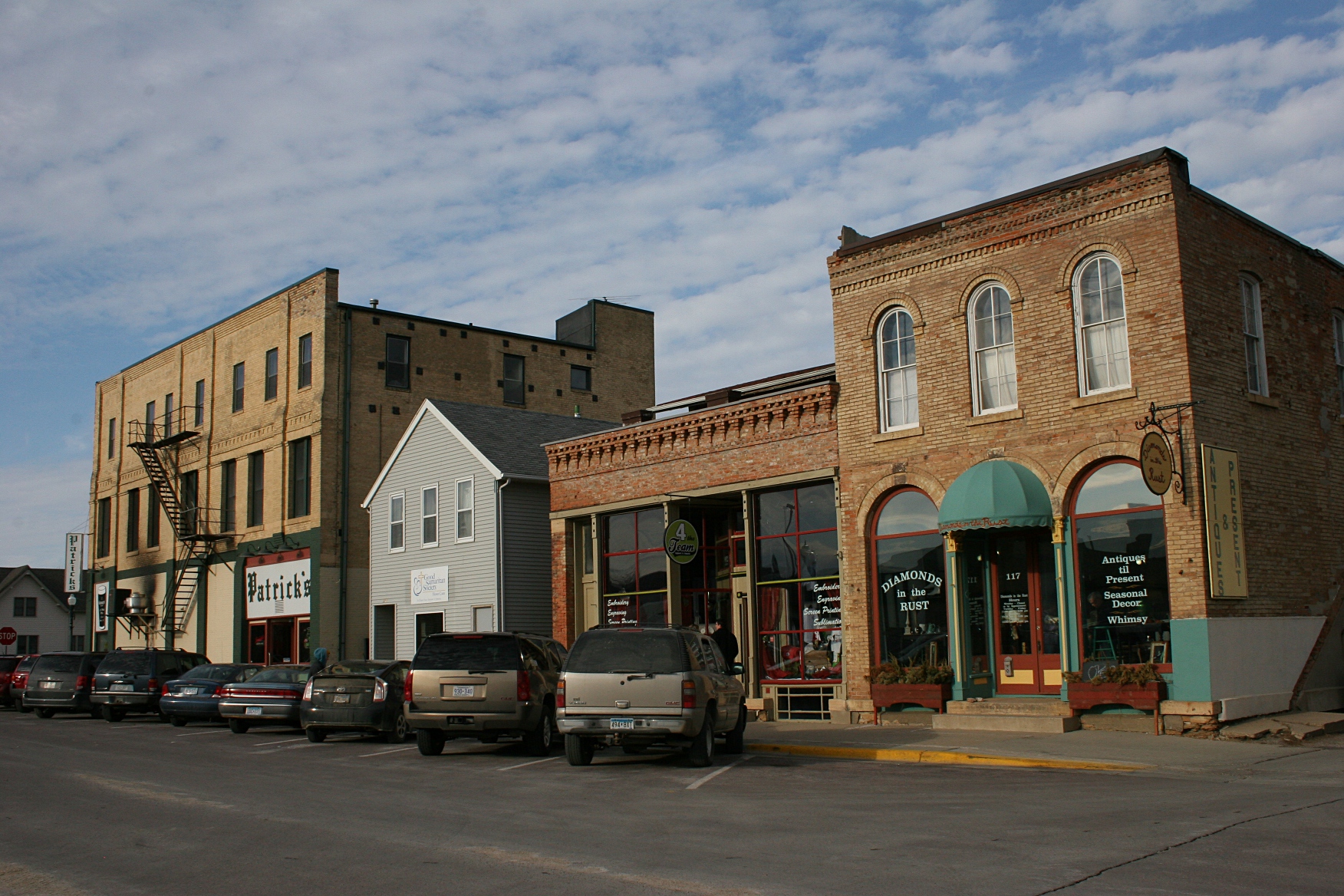
Patrick's on 3rd anchors the corner on the left with Diamonds in the RUST on the right. Diamonds sells merchandise from antiques to present. Love that name.

Patrick’s on 3rd (bar and restaurant) anchors the corner on the left with Diamonds in the RUST on the right. Diamonds sells merchandise from antiques to present. Love that name.

That said, when I entered the charming Diamonds in the RUST shop along Park Row Street three doors down from Patrick’s on 3rd, which I’m told makes the best burgers in St. Peter, I automatically fell in love with the place.

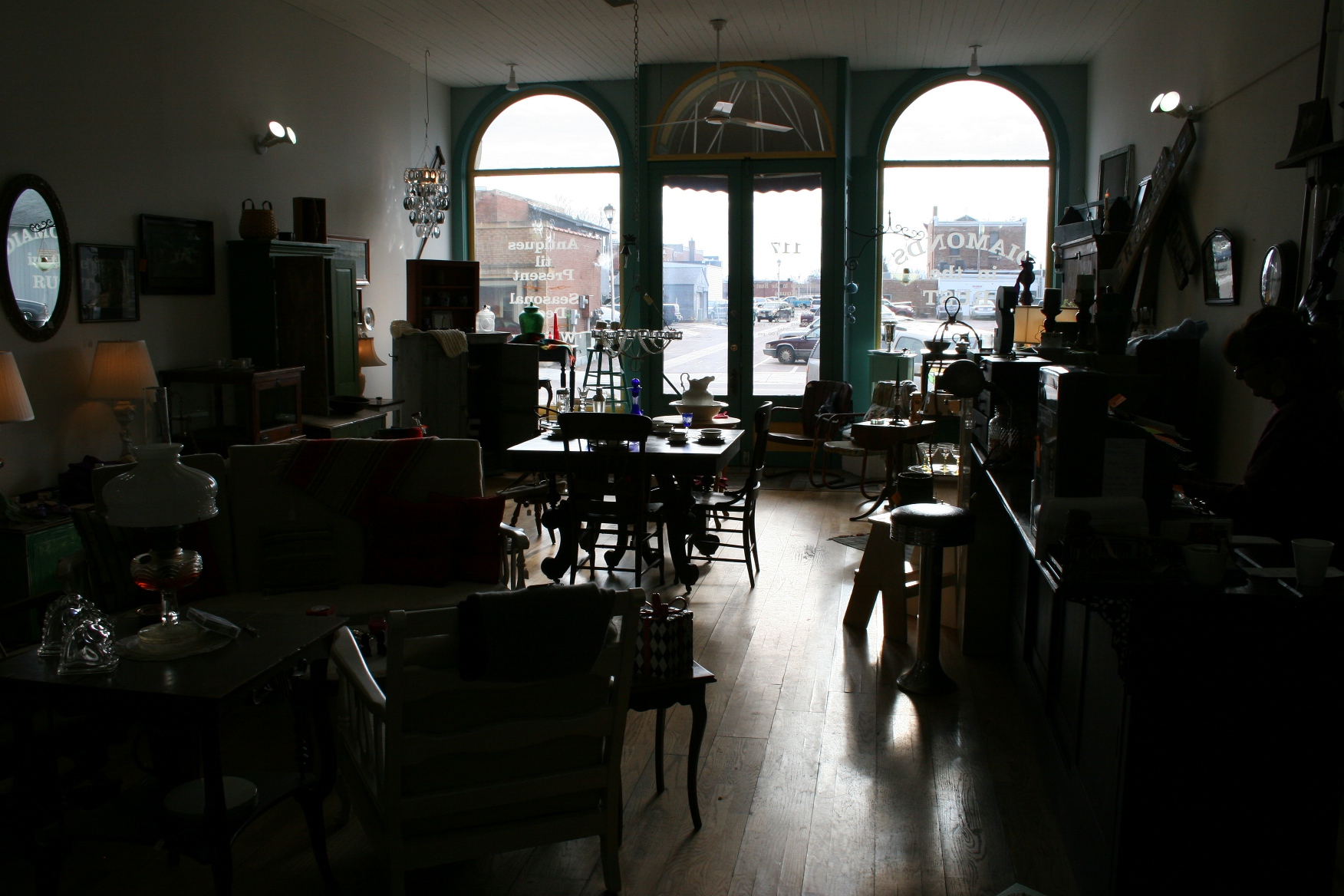
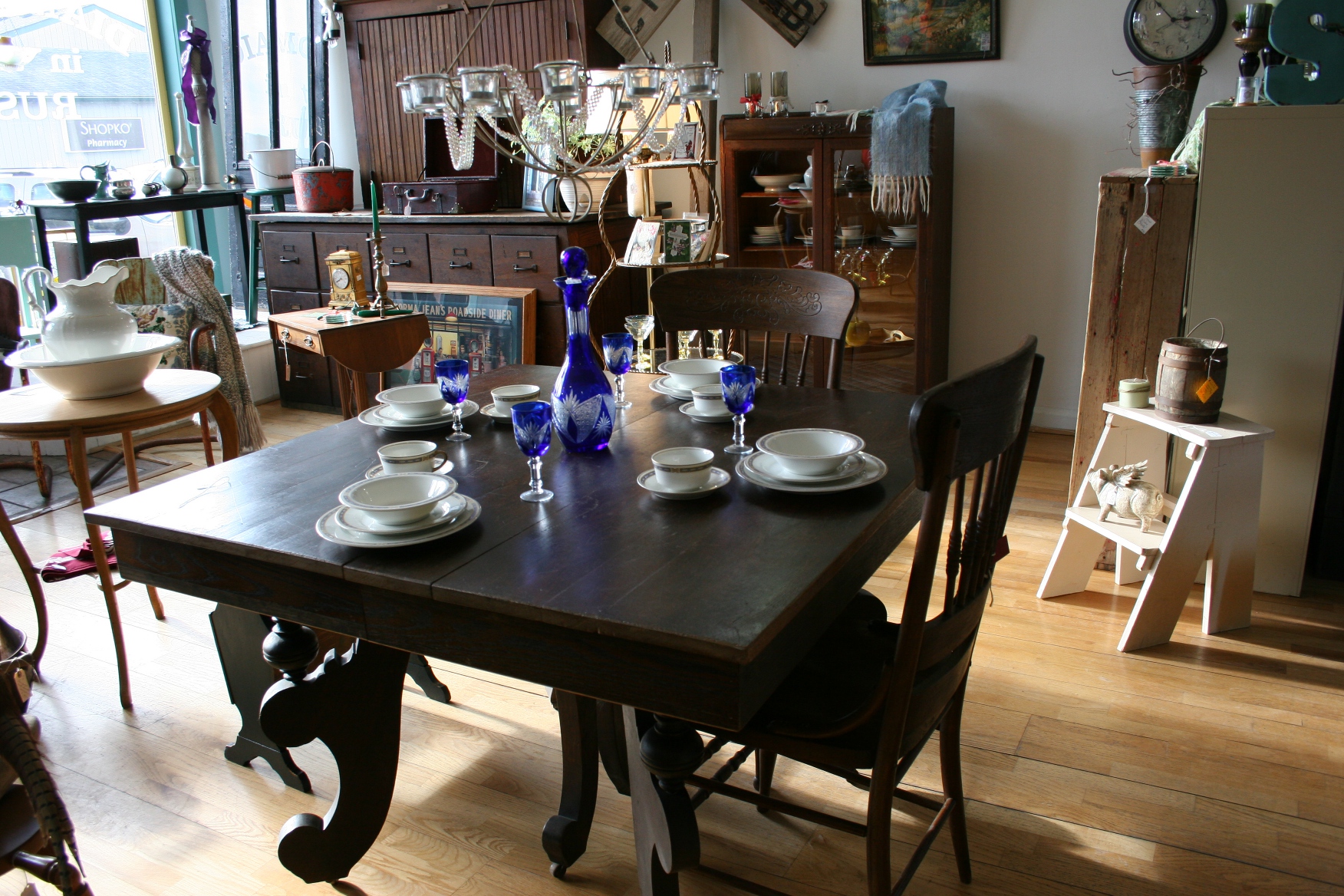
Diamonds in the RUST, looking toward the front of the store.

Diamonds in the RUST, looking toward the front of the store.

See how the sunlight streams through those windows and onto the floor and merchandise.

Love how the sunlight streams through those windows and onto the floor and merchandise.

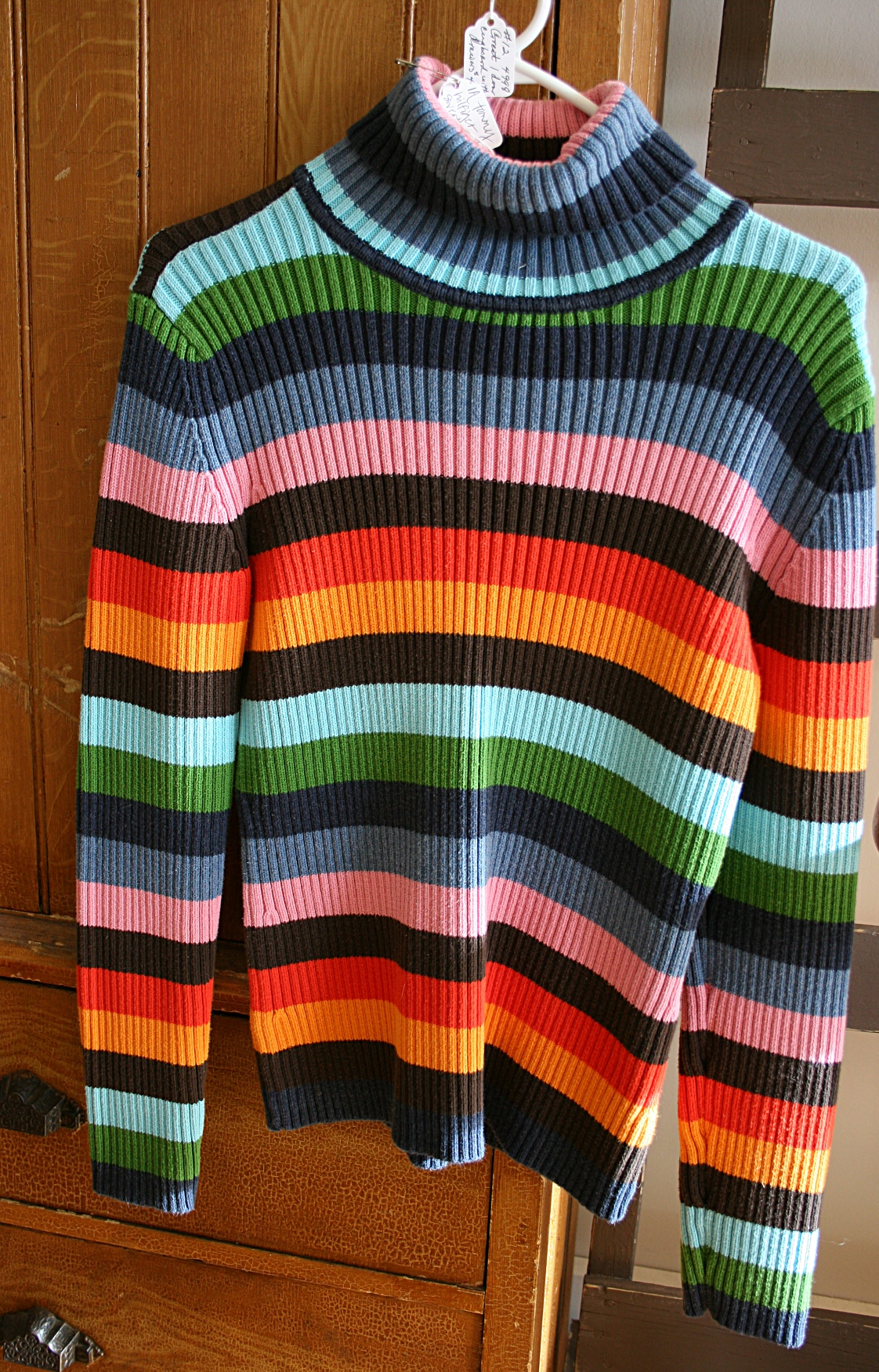
Light flooding through a street-side bank of tall windows, patches of sunlight slipping across the wood floor, artfully arranged merchandise and then, that most fabulous find of all, a Joseph’s coat of many colors sweater, defined this as one happin’ place.

Seventies coming of age child that I am, my eyes connected with that multi-colored sweater like a hippie drawn to a peace symbol.

The sweater similar to one I wore in the 70s.

The sweater similar to one I wore in the 70s.

“I had a sweater just like that,” I shared with the shopkeeper, although, on closer inspection, I discovered this to be a Tommy Hilfiger replica and not exactly like the sweater I paired with my hip huggers. Oh, well, I thought, and then wondered aloud if my mom, the keeper of everything, had saved that groovy sweater from my teen years. It’s possible; I recently retrieved lime green cuffed, flared pants, with about a size 18-inch waist (was I really that tiny once?), from her basement.

Ah, how antiquing prompts memories…

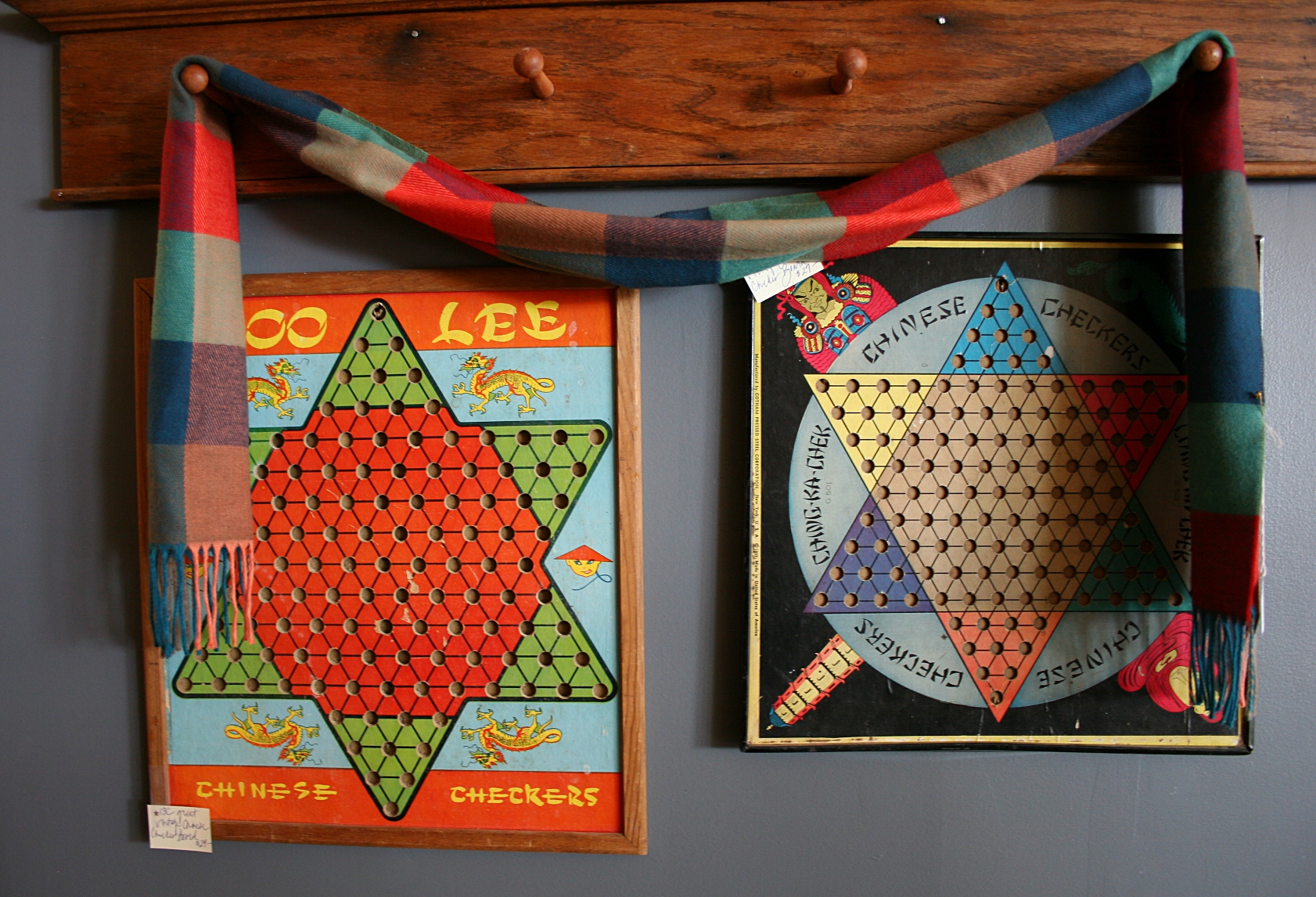
I own a vintage Chinese checkers board similar to these, found at a garage sale 30 years ago.

I own a vintage Chinese checkers board similar to these, one I found at a garage sale 30 years ago.

Then I spotted two Chinese checkers boards flaunting their psychedelic hues. I always connect Chinese checkers with my farmer dad, gone 10 years now. He never had time for board games. But pull out the metal Chinese checkers game and he was right there with the rest of us gathered around the Formica kitchen table, his clumsy fingers guiding marbles into place.

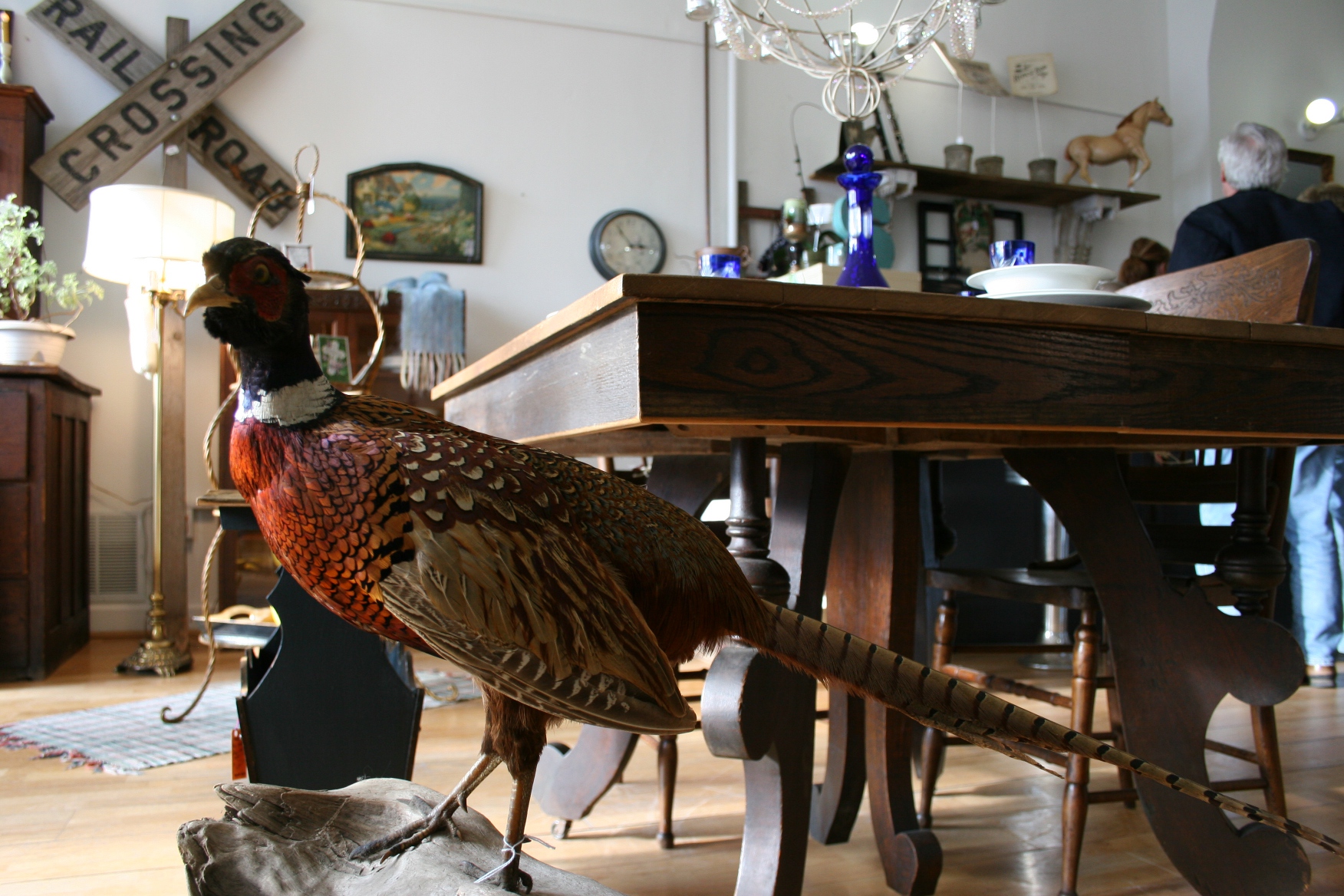
I would never buy a dead (or live) pheasant, but someone might.

I would never buy a dead (or live) pheasant, but someone might.

More memories of my dad surfaced when I sighted a taxidermy pheasant perched on a slip of wood set upon that beautiful wood floor. I am not a hunter. But, as a child, I would occasionally accompany Dad on his way to the slough—a grassy waterhole long ago drained and converted to farmland—to hunt for pheasants. It wasn’t the actual act of walking the land, searching for pheasants, that appealed to me. Rather, it was the rare opportunity to be with Dad when he was not in the barn or field that drew me to the hunt. I did not understand that then. But I do now.

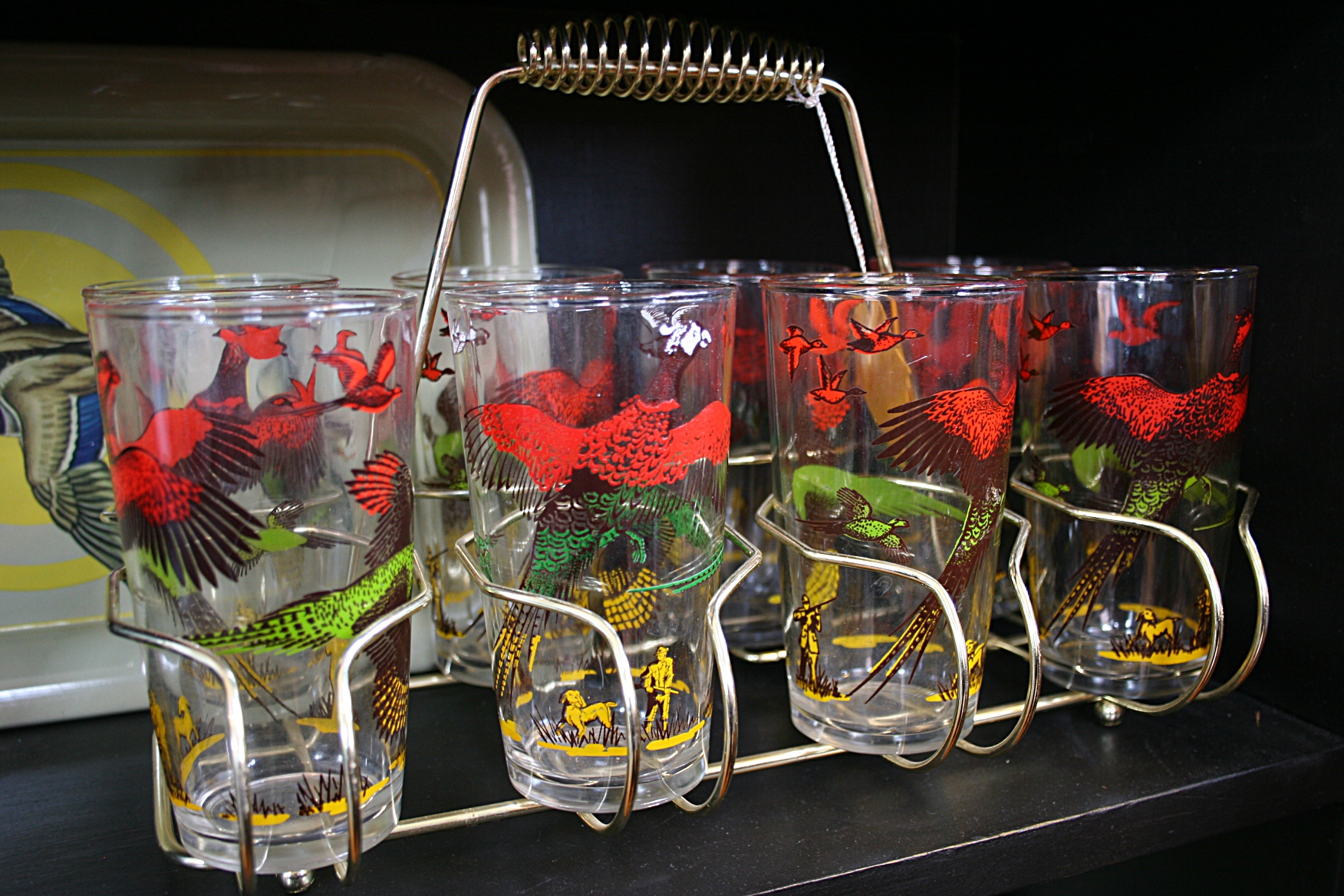
Pheasant glasses like this are coveted by some members of my extended family.

Pheasant glasses like this are coveted by some members of my extended family.

I didn’t purchase any of those memory items at Diamonds in the RUST, only snapped photos, including one of a set of pheasant glasses that would interest my middle brother or niece’s husband.

A snippet of downtown St. Peter, along Highway 169.

A snippet of downtown St. Peter, along busy U.S. Highway 169.

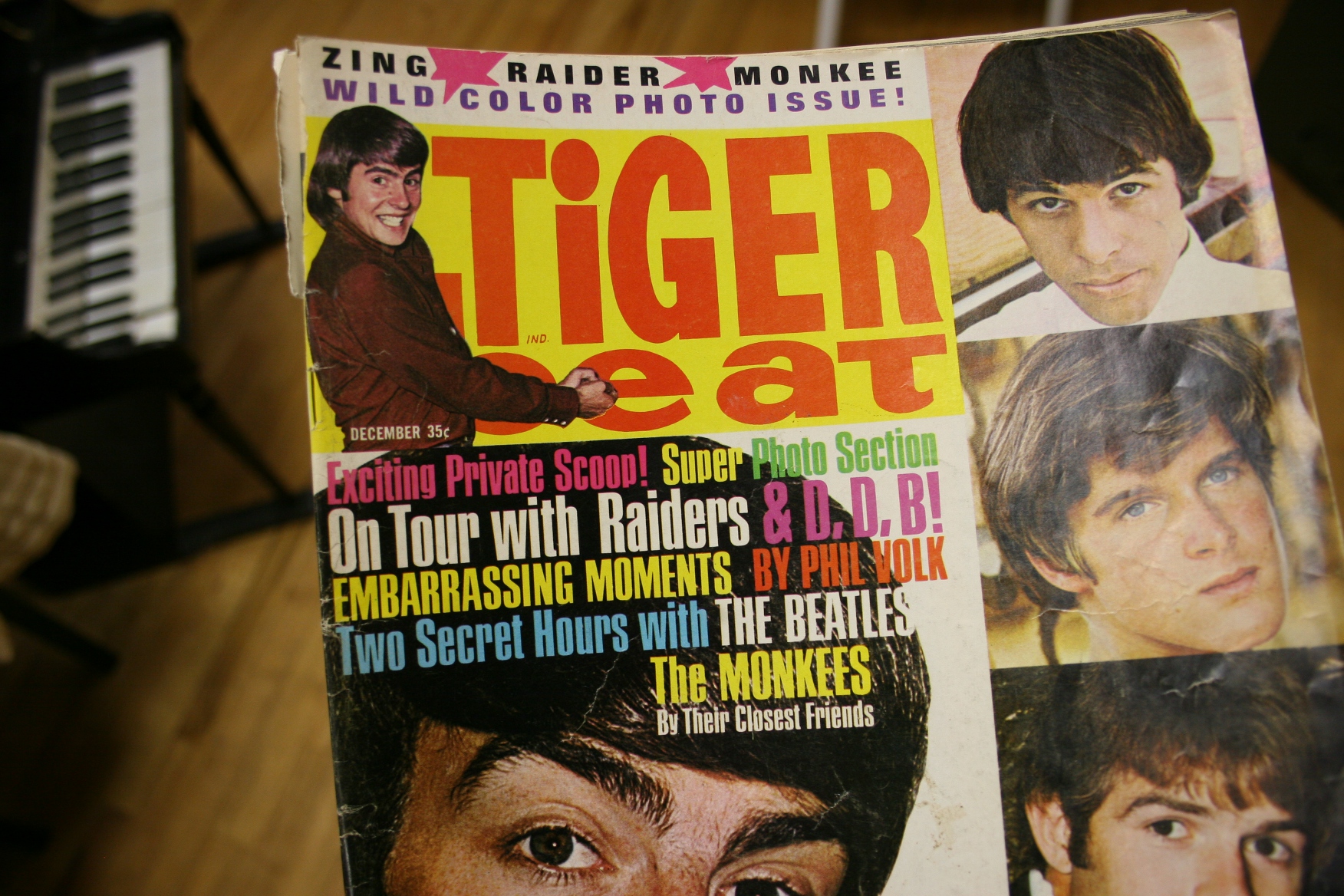
Down the block and around the corner, walking St. Peter’s main drag, I slipped into a memory lane high when my husband discovered copies of Tiger Beat magazine in another antique store. Oh, my heart. The Beatles. The Monkees.

My beloved Tiger Beat magazine.

My beloved Tiger Beat magazine.

Cousin Joyce, who was two months younger than me, but way more worldly because she had two older sisters and therefore knew about stuff like boys, green eye shadow, David Cassidy and fishnet stockings long before me, introduced me to Tiger Beat. Back in the days when relatives still “visited” each other, Joyce and I would stretch out on her bed stomach side down, knees crooked, feet rocking, paging through the pages of Tiger Beat. And for a few hours I felt like I was hip and, mostly, totally, in love.

BONUS PHOTOS:

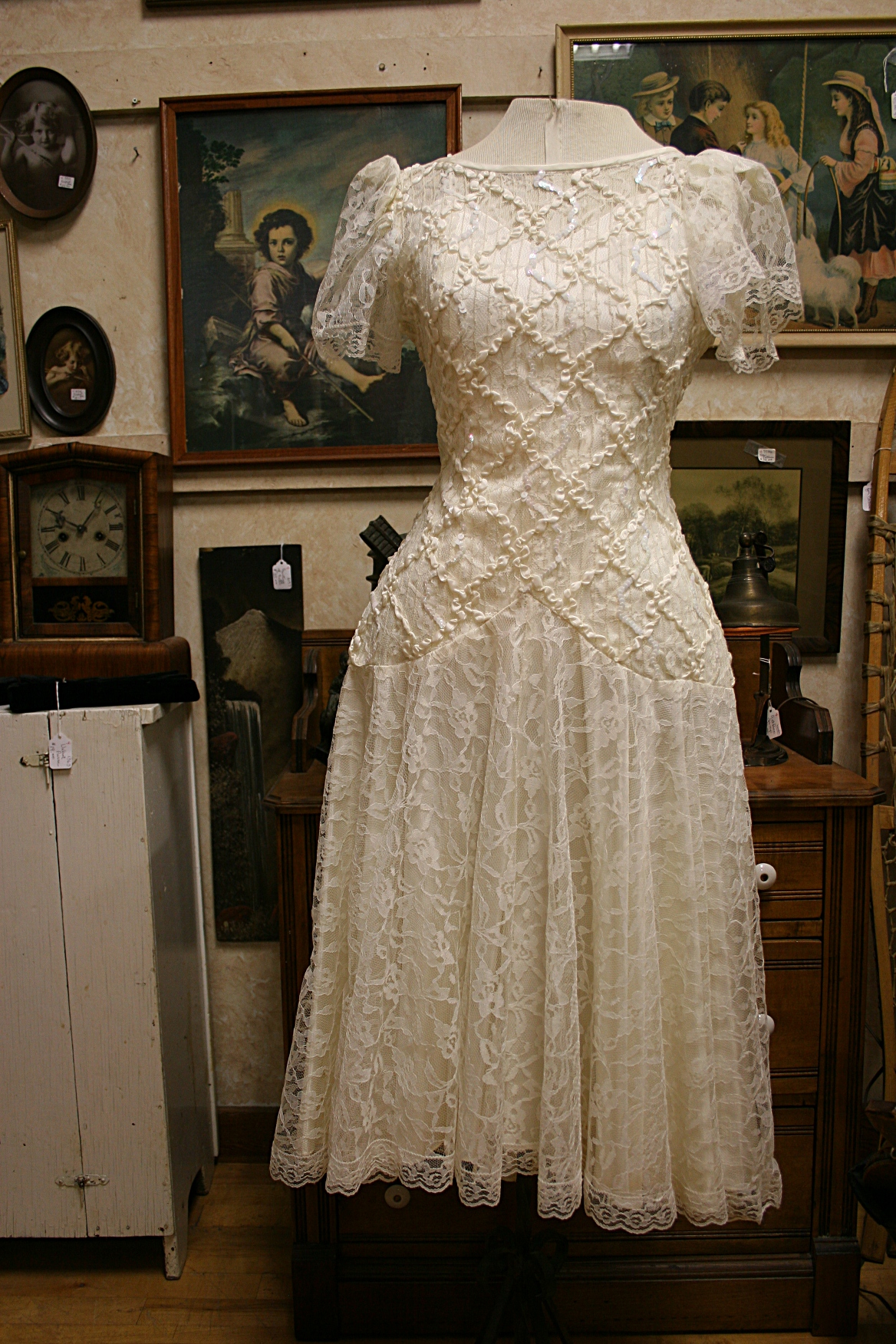
Another 70s find in an antique store that was closing for good on the day we shopped there.

A 70s bridal gown found in an antique store that was closing for good on the day I shopped there.

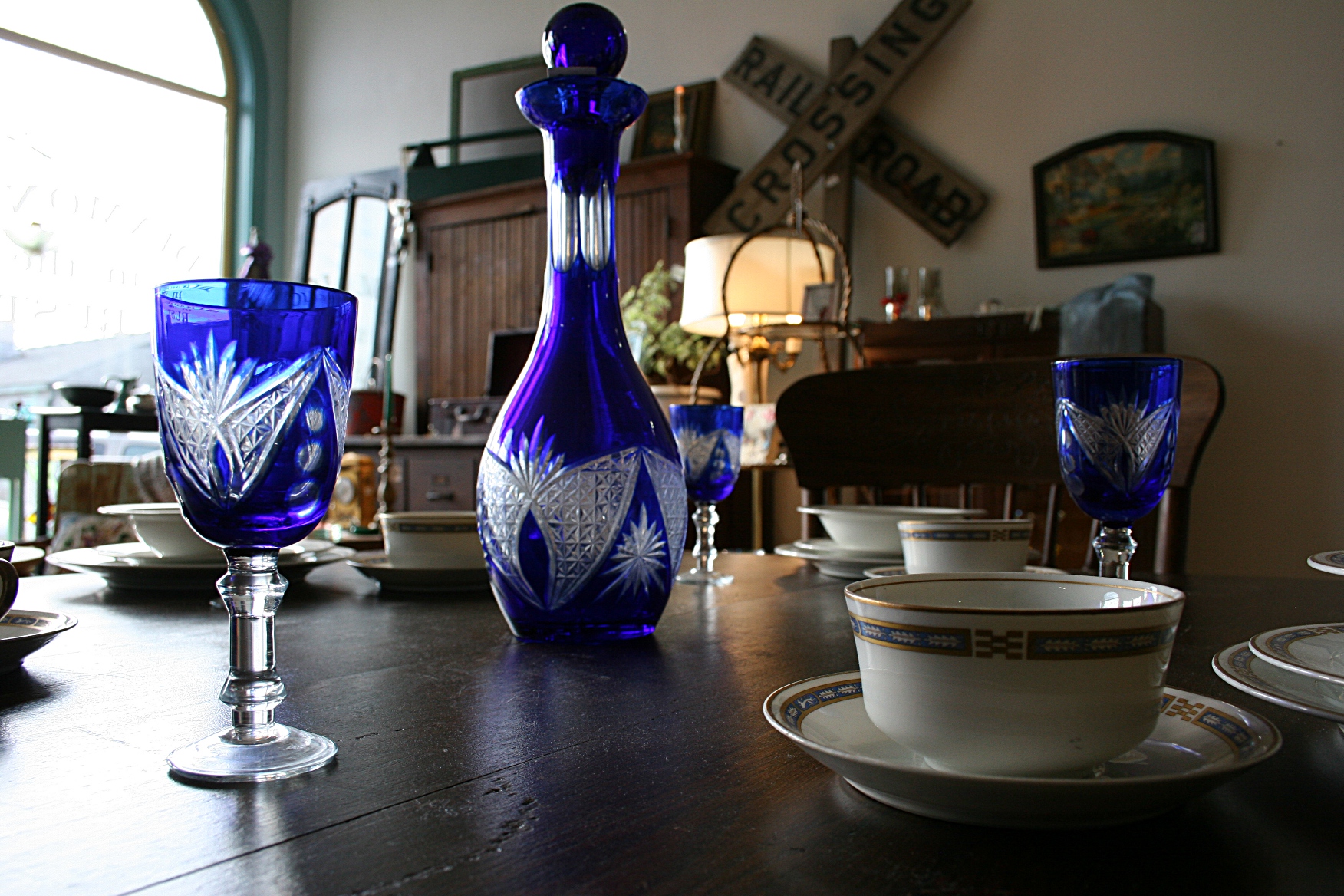
Love that cobalt blue in glassware showcased at Diamonds in the RUST.

Love that cobalt blue in glassware showcased at Diamonds in the RUST.

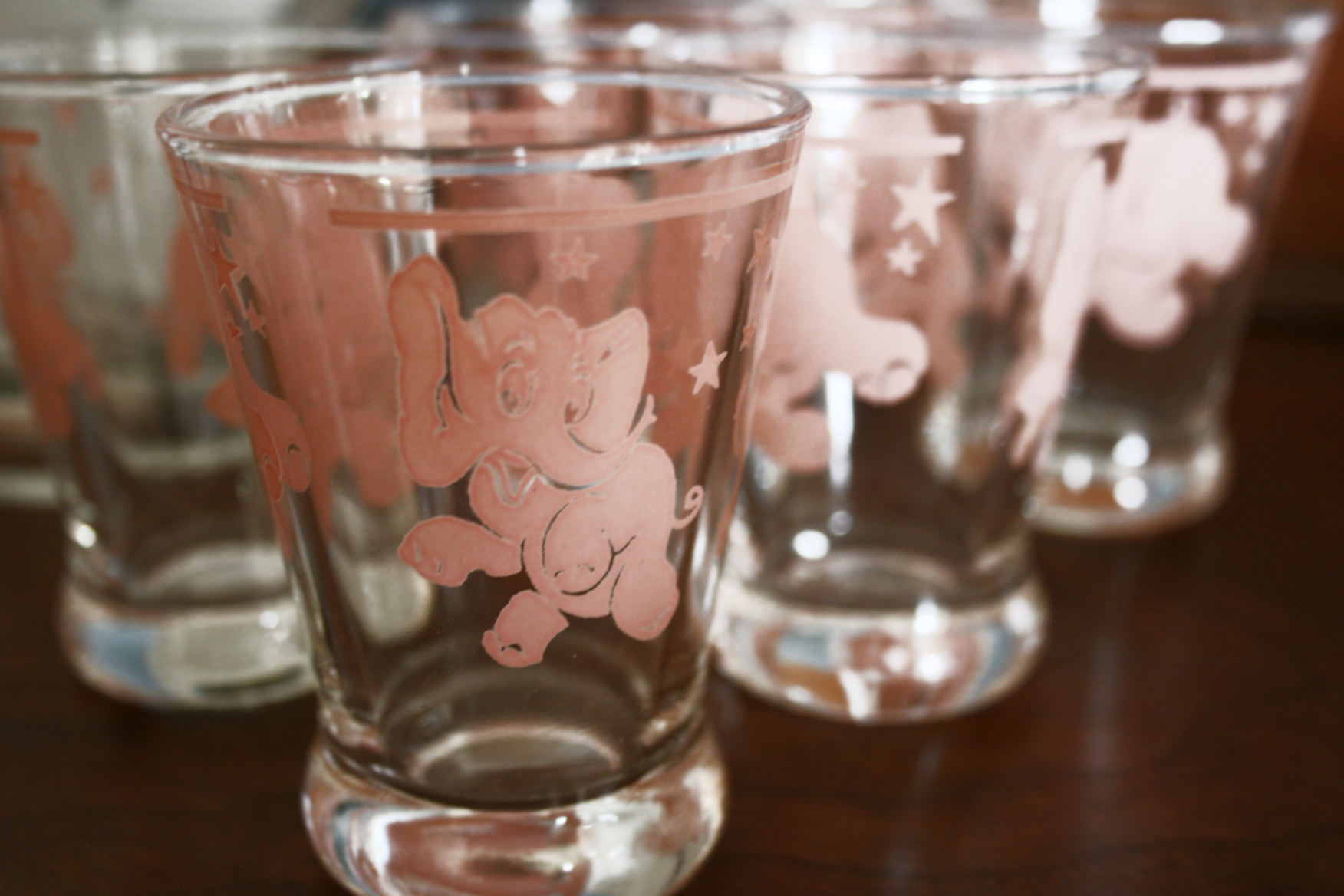
The whimsical design of these elephant glasses (shot glasses/juice glasses?) caught my fancy at Diamonds in the RUST.

The whimsical design of these elephant glasses (shot glasses/juice glasses?) caught my fancy at Diamonds in the RUST.

© Copyright 2013 Audrey Kletscher Helbling


Strange but true: Abolish the privy-pit & use the dry earth closet March 13, 2013

DURING THE FIRST 11 years of my life, I lived in a cramped three-bedroom farmhouse in southwestern Minnesota with my parents and four siblings, my third brother not yet born.

The house, albeit aged and plain, provided necessary shelter for our family. But, unlike most rural homes in the area, ours did not have a bathroom. Instead, we used a two-hole outhouse during the warm months and a pot on the porch during the winter.

It was not the outhouse, but rather the red-rimmed white enamel porch pot which I remember with particular disdain. Cold nipped at my butt in the frosty uninsulated and unheated porch. And the pot, naturally, reeked of feces and urine. I couldn’t remove the lid and slap it back on fast enough.

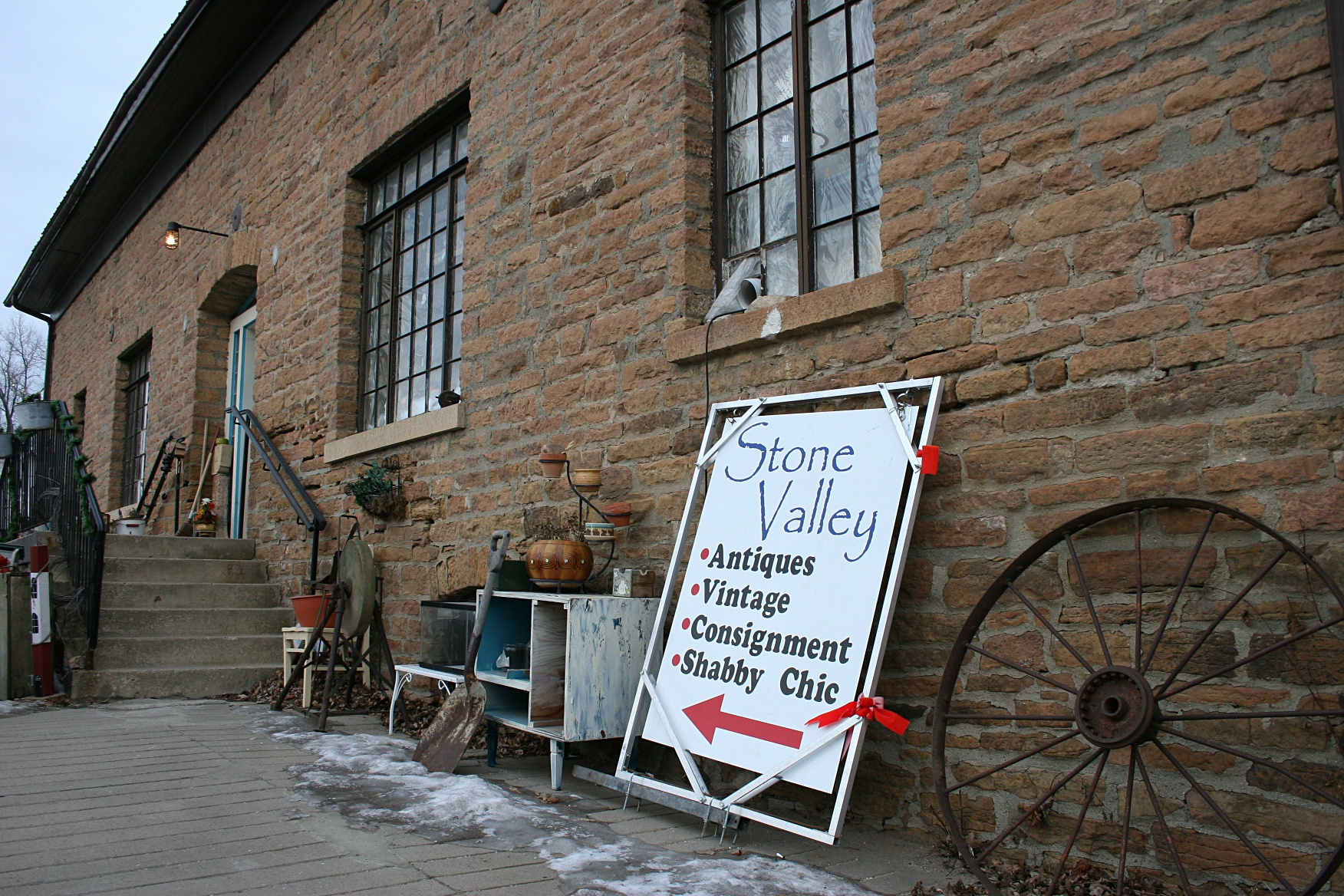
Stone Valley General Store, 110 Pine Street, located in the old Engesser Brewery on the south side of St. Peter.

Stone Valley General Store, 110 Pine Street, located in the old Engesser Brewery on the south side of St. Peter.

With that memory, you will understand why I was especially fascinated by the Heap’s Patent Dry Earth Closet I found recently at the Stone Valley General Store, an antiques/collectibles/consignment shop in St. Peter.

And we’re not talking clothes closet here.

We’re talking water closet, minus the water.

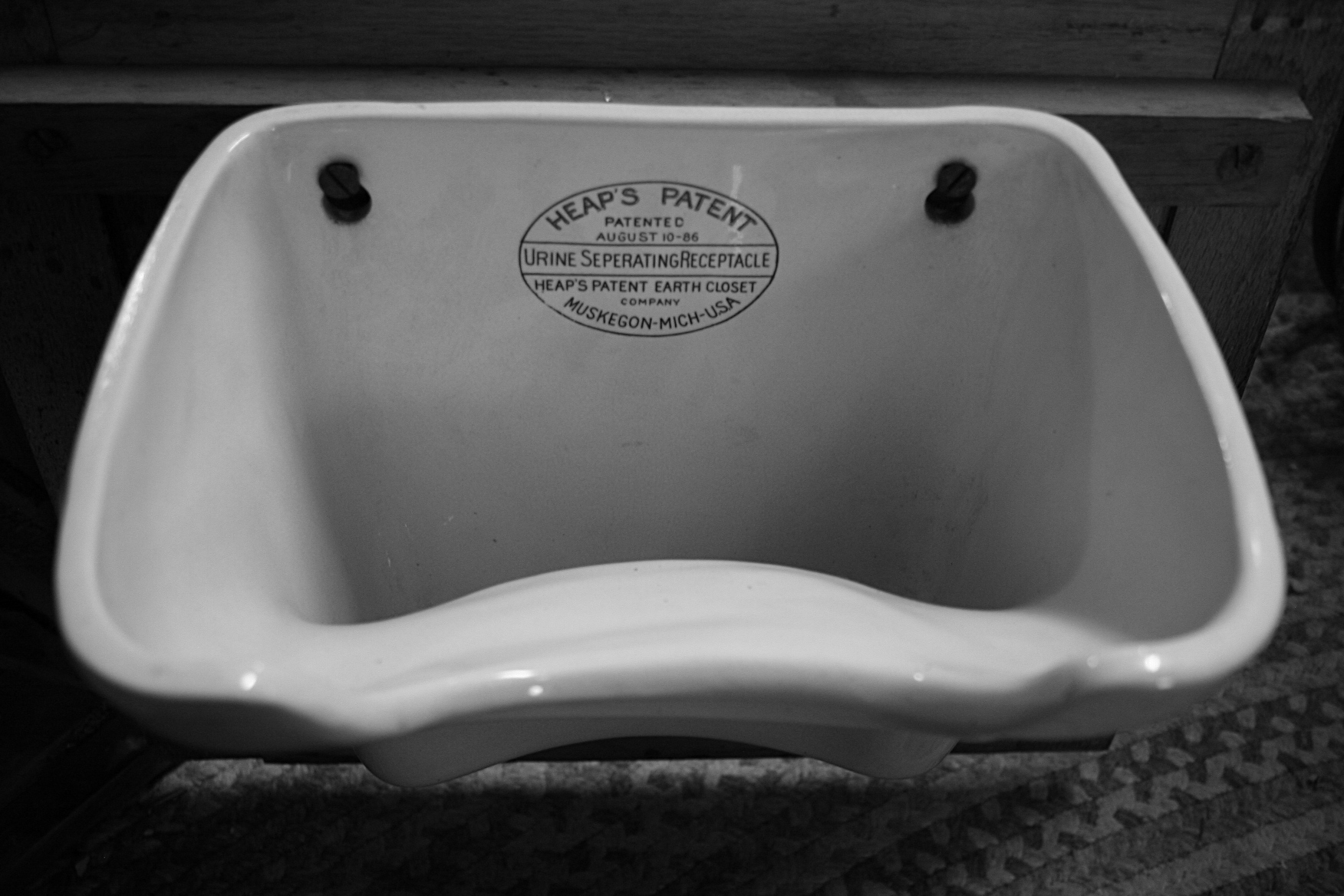
Not just a fine piece of furniture, but a toilet. The door opens to reveal a urine receptacle on the inside of a door and a pail tucked underneath.

Not just a fine piece of furniture, but a toilet. The door opens to reveal a urine receptacle on the inside of the door and a pail tucked underneath.

William Heap & Sons of Muskegon, Michigan, so my research reveals, patented this stylish bedroom commode in 1886 and promoted it as “perfectly inodorous.” The idea was to sprinkle odor absorbing ash or earth into the galvanized bucket which came with the unit before doing your duty. A separate porcelain receptacle on the closet door collected urine.

The urine collector which hangs on the door.

The urine collector which hangs on the door.

In theory it all sounds so wonderful:

No water! No drain! They are simply invaluable… ABOLISH THE PRIVY-PIT!…Secure health, comfort and cleanliness…

You can almost hear the infomercial, can’t you, with these units priced from $8 – $13 and “25,000 already in use.” That’s the pitch in an ad placed in the “Household Necessaries” section of The Cosmopolitan.

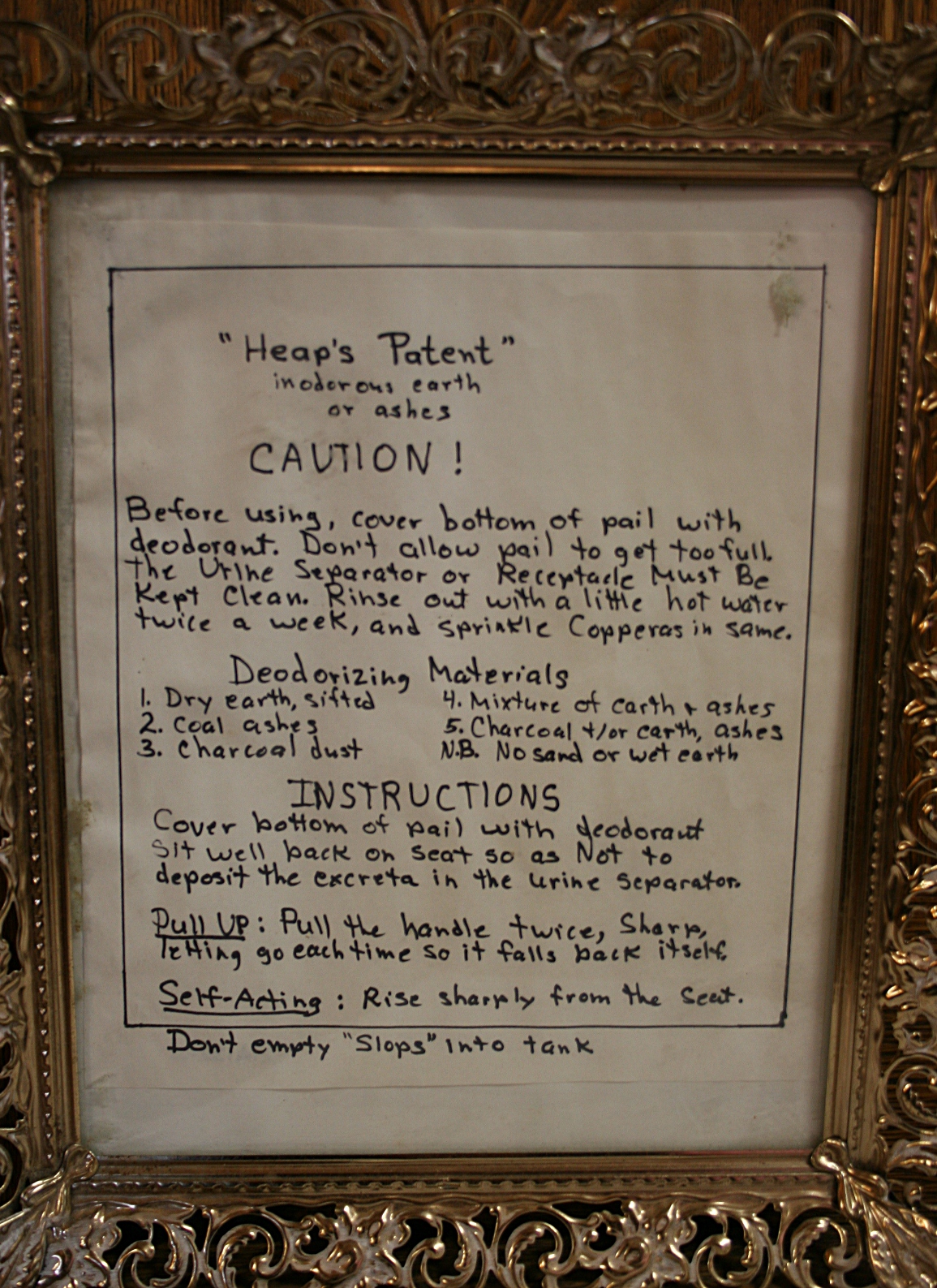
Jackie posted these instructions with the dry earth closet.

Jackie posted these instructions with the dry earth closet.

According to Jackie Hoehn, owner of the Stone Valley General Store, the Heap’s Dry Earth Closet she is selling for $1,500 was used at the Mayo Clinic and the State Hospital in St. Peter.

No trying out the dry earth closet in Jackie's shop.

No trying out the dry earth closet in Jackie’s shop.

Now, I didn’t ask Jackie how she acquired this toilet or when. But I expect she may be sitting on it for awhile. Not literally, of course.

© Copyright 2013 Audrey Kletscher Helbling


“Mending generations of bad feelings” in Redwood County during “The Year of the Dakota” February 28, 2013

WILL THE DIVIDING LINES ever connect into a complete circle of healing?

A century and a half after the U.S.-Dakota War of 1862 ended, can the Dakota and descendants of white settlers, and others, ever fully reconcile and forgive?
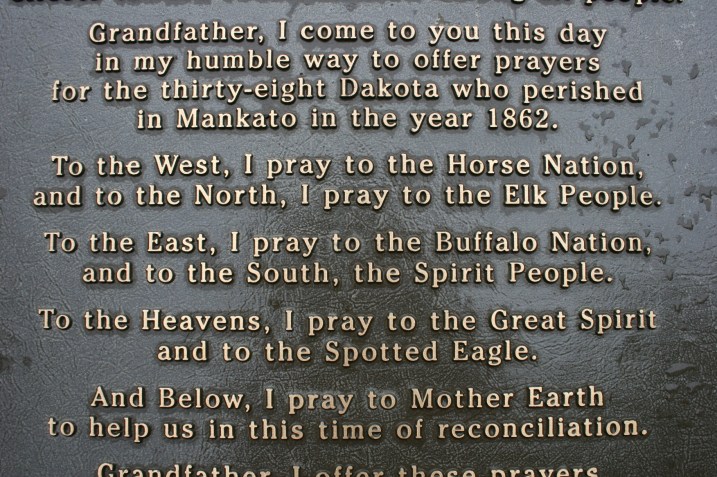
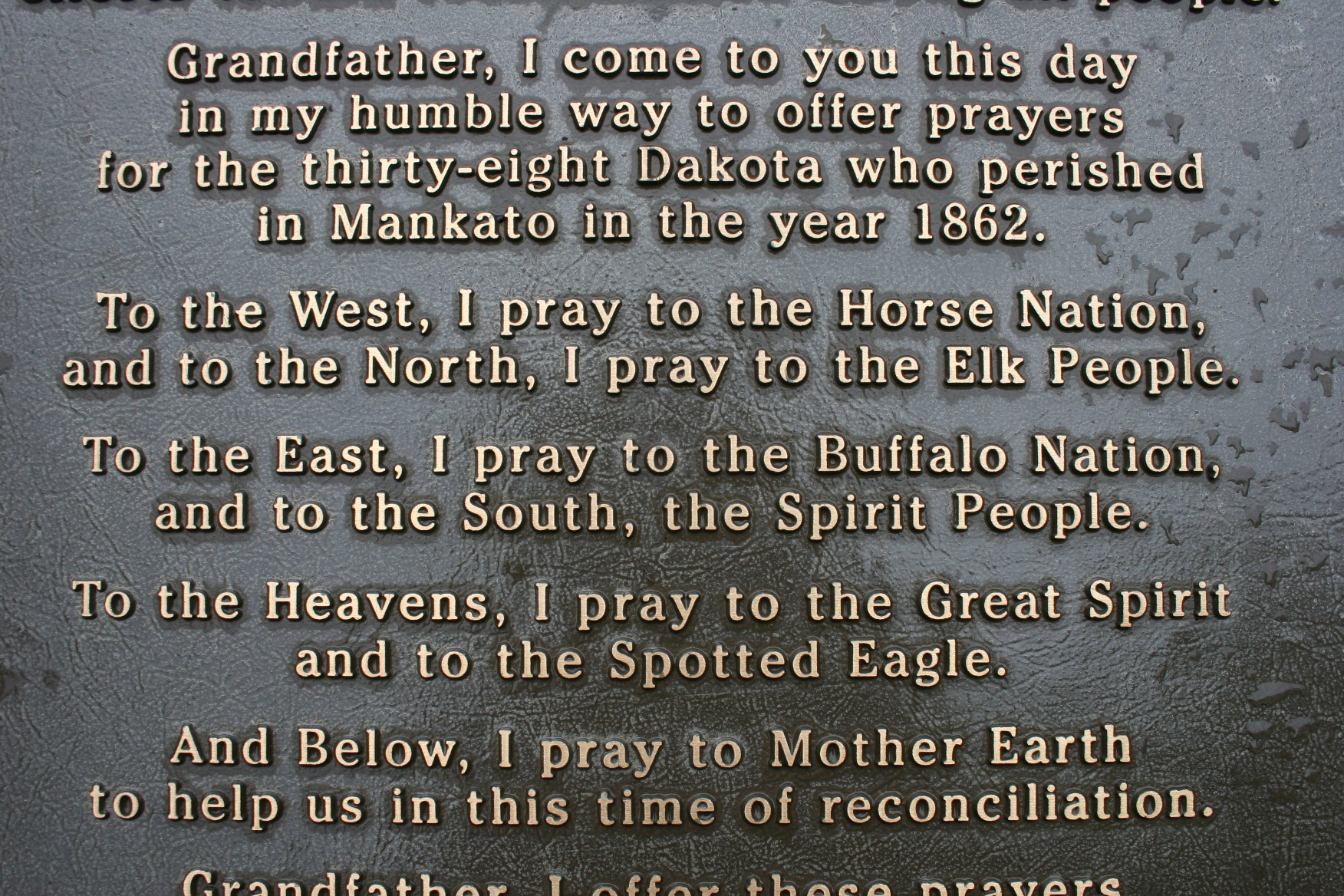
Words on a marker in Reconciliation Park in Mankato where 38 Dakota were hung on Dec. 26, 1862.

Words on a marker in Reconciliation Park in Mankato where 38 Dakota were hung on Dec. 26, 1862.

The issues that divide—of blame and of animosity, of death and of punishment, of land and of banishment, and more—remain, sometimes subtle and below the surface, sometimes exposed.

As a native of Redwood County in southwestern Minnesota and as a descendant of settlers who fled their New Ulm area homestead during the U.S.-Dakota War, I have always been especially interested in this conflict.

So when I learned that the City of Redwood Falls on January 15 joined the cities of Minneapolis and St. Paul in adopting resolutions “recognizing the 150th anniversary of the Dakota-U.S. War of 1862 and declaring 2012-2013 the Year of the Dakota,” I took note.

The resolution states, in part in paragraph two:

WHEREAS, much has yet to be learned about issues revolving around land, reparations and restitution, treaties, genocide, suppression of American Indian Spirituality and Ceremonies, suppression on Indigenous languages, bounties, concentration camps, force marches, mass executions and forcible removals; and…

For my home county, at the geographical center of the war and home to the Dakota, then and now, passage of this resolution reflects a desire to understand, to educate, to heal.

Now you wouldn’t think, after 150 years, that such a resolution would even be needed. Trust me. Hard feelings still exist. But because I have not lived in Redwood County for decades and am therefore only an outside observer, I contacted Redwood Falls Mayor and avid local historian Gary Revier with a few questions.

I posed this question, among others, to Revier: All these years after the Dakota War ended, what, if any, tensions still exist between the Dakota and Whites in Redwood County?

As I expected, the mayor, who could have danced around my question with political rhetoric, told it like he sees it:

To answer your question about tensions between the Dakota and White communities, I would have to say emphatically “yes.” I believe it is more of a trust issue for the Dakota. On the White side, I would have to say there is a lot of envy because of the success of the gaming industry among the various Indian communities.

When I hear from my fellow members of the White community, they almost always begin by saying, “I am not prejudiced, but…” They then go on to explain some good deed they did for a Native American or some distant cousin three times removed who they are related to.
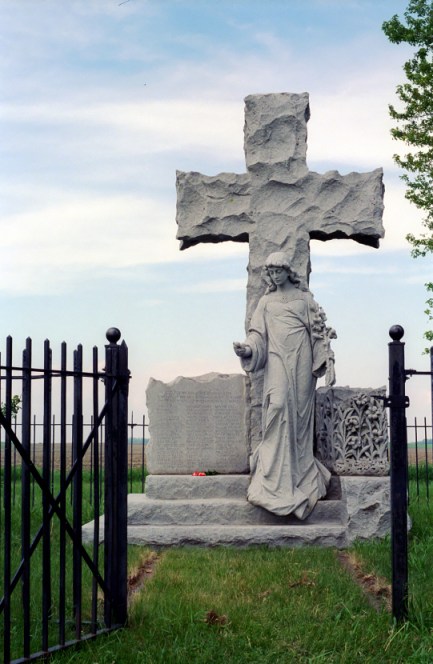
The Milford State Monument along Brown County Road 29 west of New Ulm commemorates the deaths of 52 settlers who were killed in the area. Located along the eastern edge of the Lower Sioux Reservation, Milford had the highest war death rate of any single township.

The Milford State Monument along Brown County Road 29 west of New Ulm commemorates the deaths of 52 settlers in Milford Township during the U.S.-Dakota War.

Revier, who also happens to be a descendant of white settlers impacted by the U.S.-Dakota War, endorses the resolution which calls for presenting the Dakota perspective through discussion; efforts by the City of Redwood Falls to promote the well-being and growth of the American Indian Community; and that such efforts “will mark the beginning of future dialogues and efforts to rectify the wrongs that were perpetrated during, and since, the year 1862, a tragic and traumatic event for the Dakota People of Minnesota.”

Says Revier:

I do support the resolution for many reasons, but the one that provides me with the most satisfaction really starts mending generations of bad feelings between the two nations. The first step towards reconciliation is admitting to the aggrieved party that there were atrocities committed. Once again this is more complex than can be explained in one or two sentences.

The mayor is right. Summarizing and defining issues spanning 150 years would be a difficult undertaking, especially in the context of a blog post.

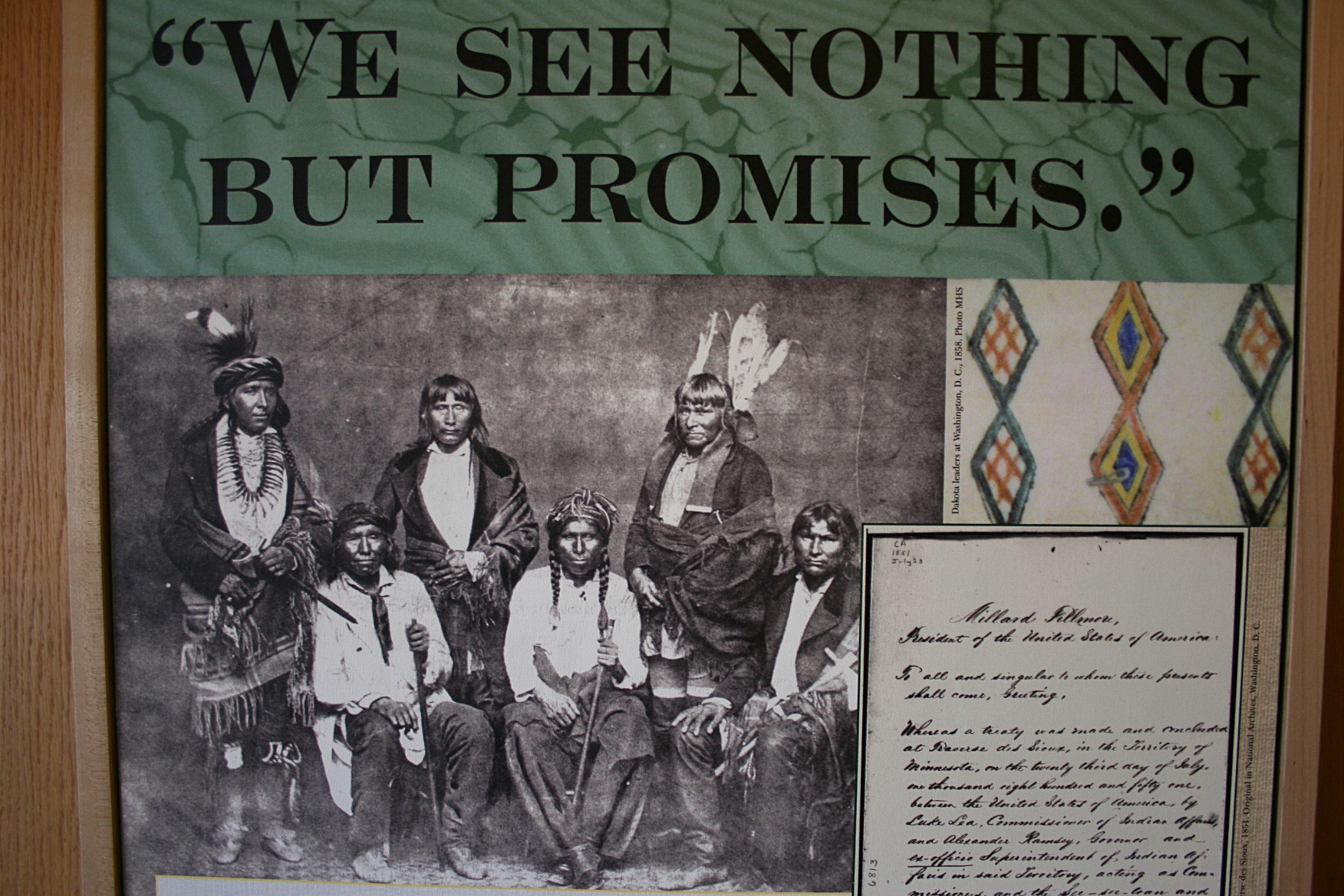
A photo panel at the Traverse des Sioux Treaty Center in St. Peter shows Dakota leaders photographed in Washington D.C. in 1858. The photo is from the Minnesota Historical Society.

A photo panel at the Traverse des Sioux Treaty Center in St. Peter shows Dakota leaders photographed in Washington D.C. in 1858. The photo is from the Minnesota Historical Society.

Now, though, through adoption of the “Year of the Dakota” resolution, the City of Redwood Falls, in discussion with the Dakota community and others, is aiming to “open additional dialogue and create better communication and feelings among the citizens of both communities,” Revier says.

While methods of accomplishing this have not yet been fully defined, the Redwood Falls community has already hosted roundtable discussions, author visits, video showings, presentations and historic site tours related to the U.S.-Dakota War during the war’s sesquicentennial in 2012.

Ramsey Falls in Alexander Ramsey Park. Minnesota Prairie Roots file photo.

Ramsey Falls in Alexander Ramsey Park. Minnesota Prairie Roots file photo.

Additionally, Revier notes that when the city celebrates the dedication anniversary of its 219-acre Alexander Ramsey Park this year, the event will also be “a celebration of the Dakota who consider it a very special place.”  The Dakota once lived on the land (which eventually became the park) and the name Redwood comes from the Dakota word Can-say-api, meaning “where they paint the tree red,” the mayor says. A “101st Celebration and Ramsey Park Jamboree” is set for June 5 at the Redwood Area Community Center, according to the Alexander Ramsey Park Facebook page.

The park is named after first Minnesota Territorial and (second) Minnesota Governor Alexander Ramsey who negotiated treaties with the Dakota and was accused, but later cleared, of fraud in those negotiations. Revier is interested in possibly renaming the park, he says, “to something that would be more descriptive of the area which is home to so many indigenous people.”
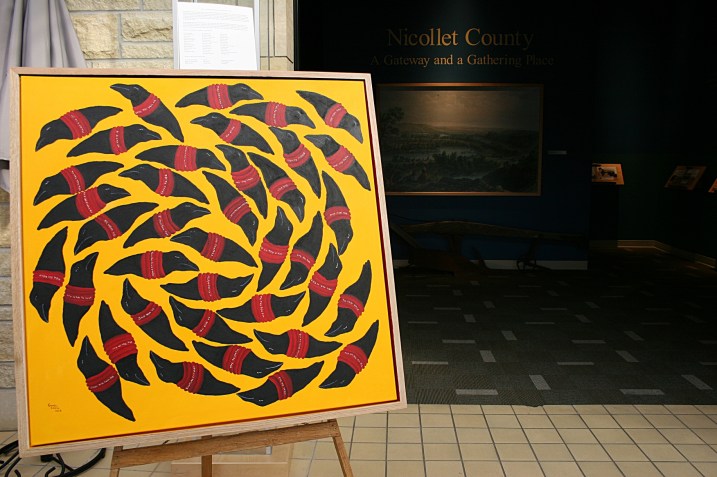
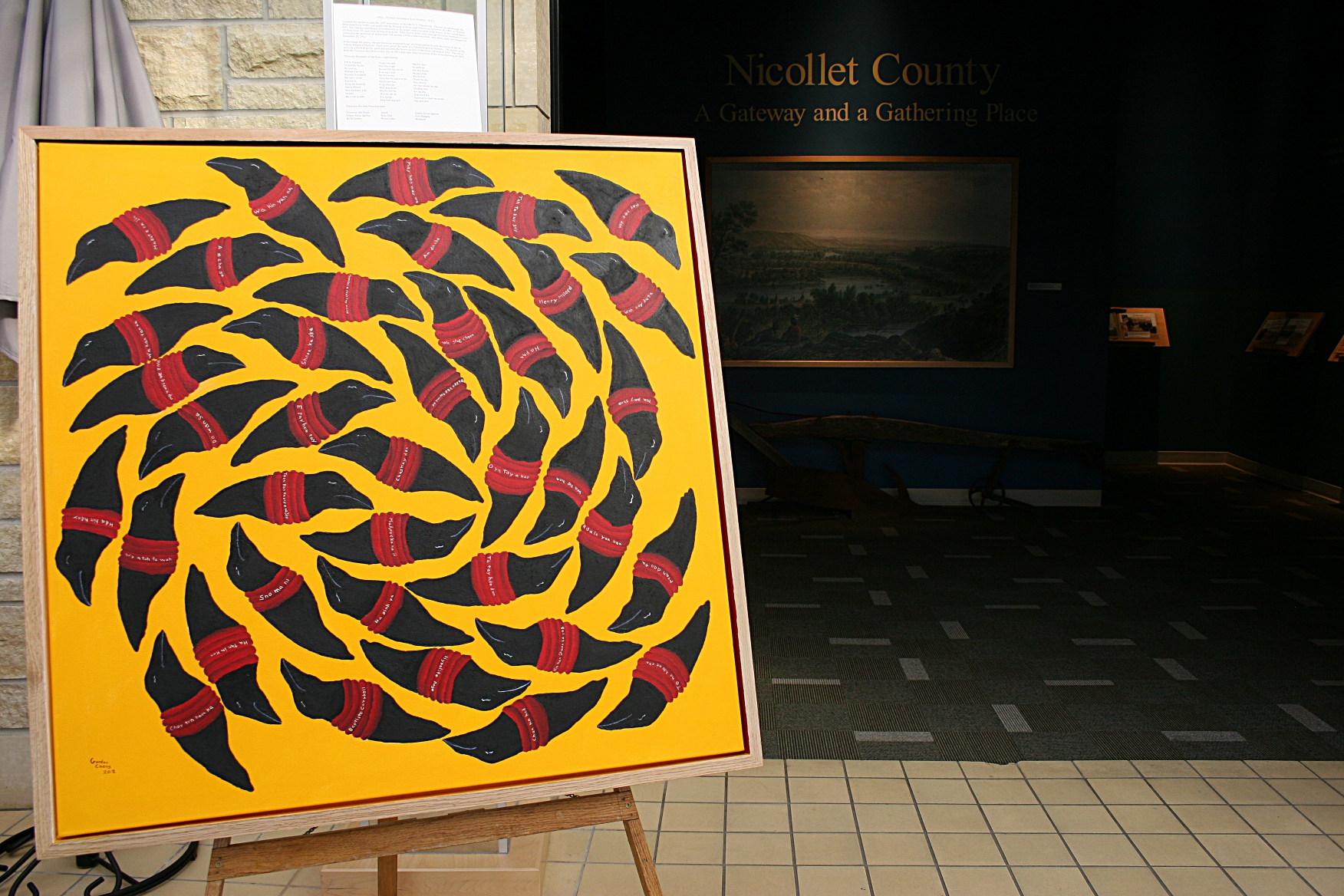
This artwork by Gordon M. Coons, which was on recent temporary display at the Traverse des Sioux Treaty Center, marks the 150th anniversary of the U.S.-Dakota War of 1862. According to information posted with the piece, "...the crows, known as messengers, are silent and unable to carry the stories of the 38 Dakota hanged in Mankato. Each crow carries the name of a Dakota hanged in Mankato. The texture on the crows is a blend of acrylic paint and soil from the historical sites of the Sioux Uprising of 1862. The soil is from the Traverse des Sioux treaty site of 1851 and eight other locations of the Sioux Uprising of 1862."

This artwork by Gordon M. Coons, which was on recent temporary display at the Treaty Site History Center in St. Peter, marks the 150th anniversary of the U.S.-Dakota War of 1862. According to information posted with the piece, “…the crows, known as messengers, are silent and unable to carry the stories of the 38 Dakota hanged in Mankato. Each crow carries the name of a Dakota hanged in Mankato. The texture on the crows is a blend of acrylic paint and soil from the …Traverse des Sioux treaty site of 1851 and eight other locations of the Sioux Uprising of 1862.” Coons is an enrolled member of the Lac Courte Oreilles Tribe of northern Wisconsin and now lives in Minneapolis.

WHILE COMMUNICATING with Revier and researching for this post, I noticed that the “Year of the Dakota” resolution passed by the city of Redwood Falls varies from those approved in Minneapolis and St. Paul. One difference comes in the number of Dakota who were executed, a figure referenced in the first paragraph of the resolution. The Twin Cities resolutions note the number of executed Dakota—those hung in a mass hanging in Mankato—at 38. The resolution from Redwood Falls defines the number as 38+2 Dakota.

I asked the mayor to clarify. Revier added the “2” to represent Medicine Bottle and Little Six (Shakopee), Dakota leaders who were hung at Fort Snelling for their roles in the U.S.-Dakota War.

When I consider all the mayor has shared with me and my own knowledge of the tensions that have existed in Redwood County for 150 years, I wonder how reconciliation will ever be achieved. But I have to hold onto hope—hope that this newly-adopted resolution will foster discussion and understanding, hope that each side can stop blaming the other, hope that forgiveness will come…
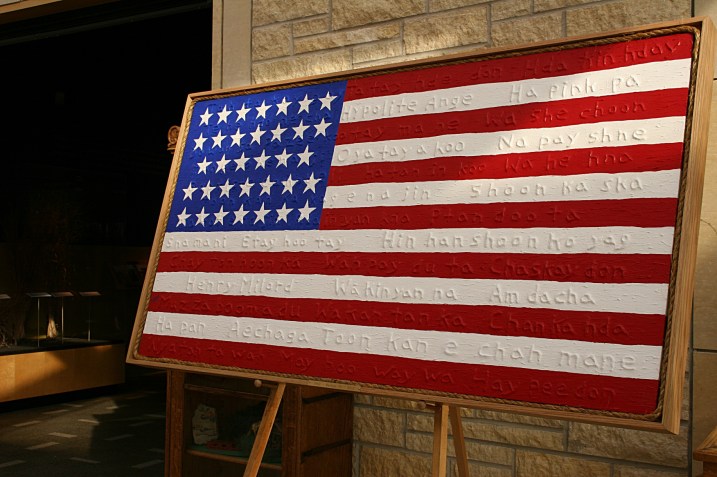
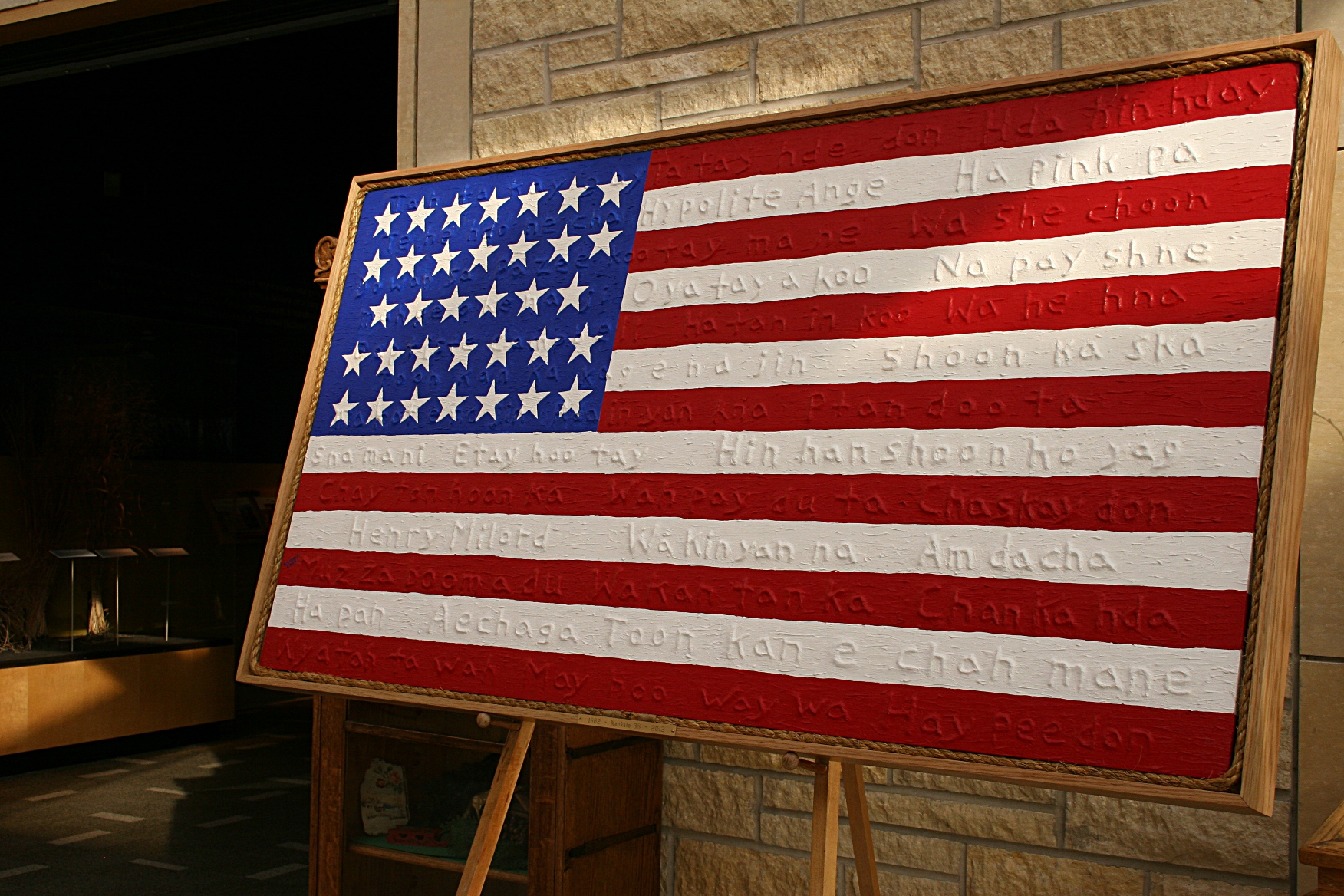
Gordon M. Coons also created this 1862 U.S. flag which features the names of the 38 Dakota who were executed during a mass hanging in Mankato. "...the 38 Dakota are woven into the history of the U.S. and appear to be woven into the flag," information posted with the display at the Traverse des Sioux Treaty Center states.

Gordon M. Coons also created this 1862 U.S. flag which features the names of the 38 Dakota who were executed during a mass hanging in Mankato. “…the 38 Dakota are woven into the history of the U.S. and appear to be woven into the flag,” information posted with the display at the Treaty Site History Center in St. Peter states.

NOTE: I contacted Dr. Chris Mato Nunpa,  retired former associate professor of Indigenous Nations and Dakota Studies who authored the resolution along with other Dakota people and supporters. He declined to comment.

To read the entire resolution adopted by the Minneapolis City Council, click here. The Redwood Falls version varies only in the number of Dakota specified (38+2) and, of course, in the council name stated in the resolution.

The Saint Paul City Council resolution differs from that of the other two cities as the city’s parks and recreation department  is directed to “work with the Dakota Bdote Restoration Consortium to identify, name and interpret sacred Native American sites at and nearby the sacred Bdote…” You can read the entire resolution by clicking here.

© Copyright 2013 Audrey Kletscher Helbling


Photo art magic February 1, 2013

IF THERE’S ONE THING I’ve learned about photography, it’s that you never stop learning.

Take, for example, my recent discovery that even not-so-good bad images can be salvaged via the magic of digital editing.

Well, you’re probably thinking right about now, “Duh, Audrey, everyone knows that.”

Sure I am aware photos can be cropped, sharpened, contrast changed, etc. I’ve used all of those basic editing tools.

But how about transforming a ho-hum, out-of-focus and/or low-light photo into a work of art? It can be done with minimal effort. I basically just play around with artistic and other editing tools until I achieve results which please my eyes and fit whatever mood or effect I’m trying to achieve.

Most important, I approach my photos from an artistic, rather than a purely photojournalistic, perspective.

Now I know everyone is not going to like artsy photos. When I gushed to my husband about the images I’d edited, he viewed the “before” and “after” and stated emphatically that he preferred the originals. I wasn’t about to sway his opinion. He was clear on that.

That said, here are some original and reworked photos from Louie’s Toy Box Farm Toy Show held recently in St. Peter. I aimed primarily for a more vintage look, in most instances, given the subjects are vintage collectibles. With other photos, I emphasized strong lines and colors, or lack thereof, for a more modern art approach.

BEFORE:

Problem: Focus and glare issues.

Problem: Not bad, but some focus and glare issues.

AFTER:

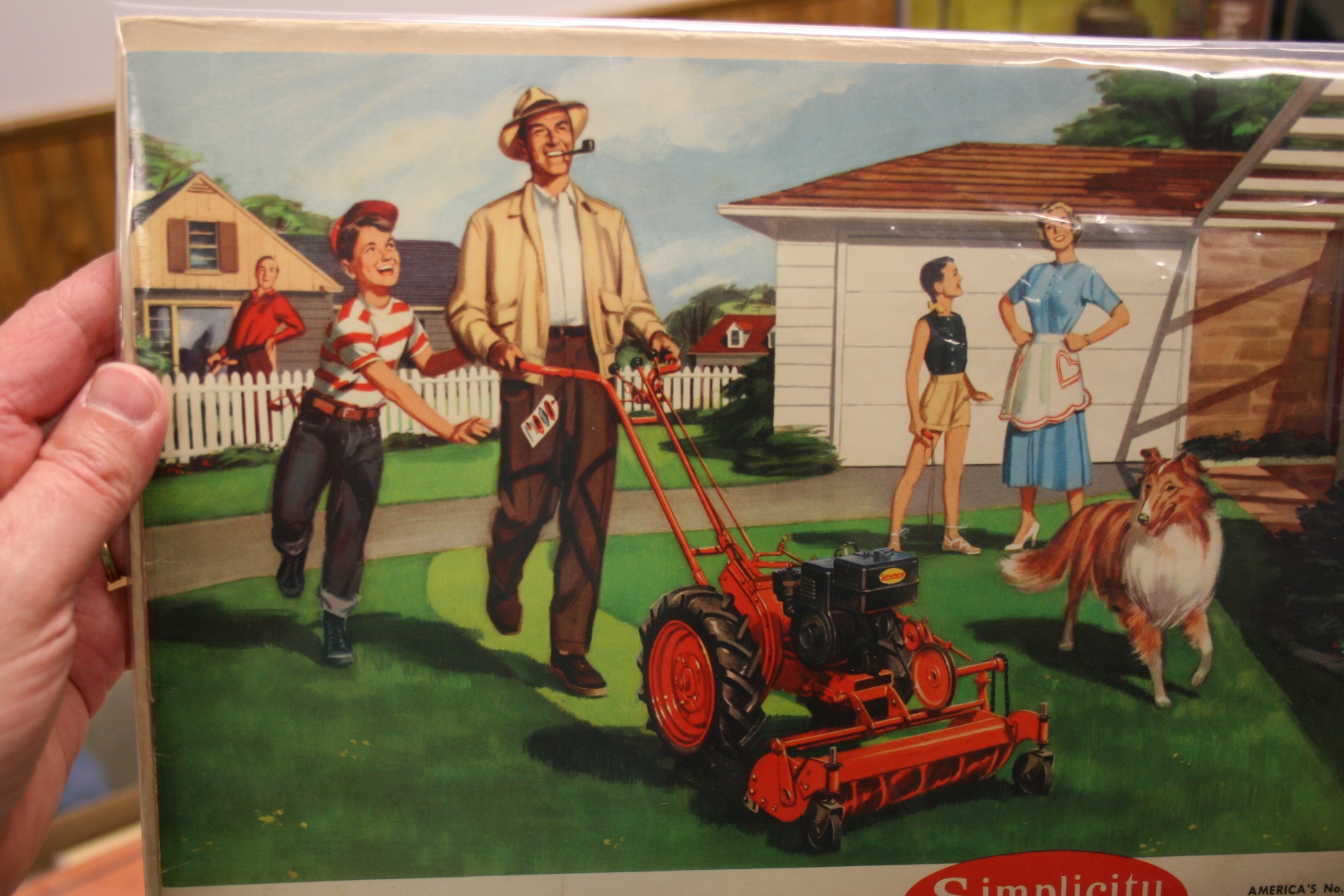
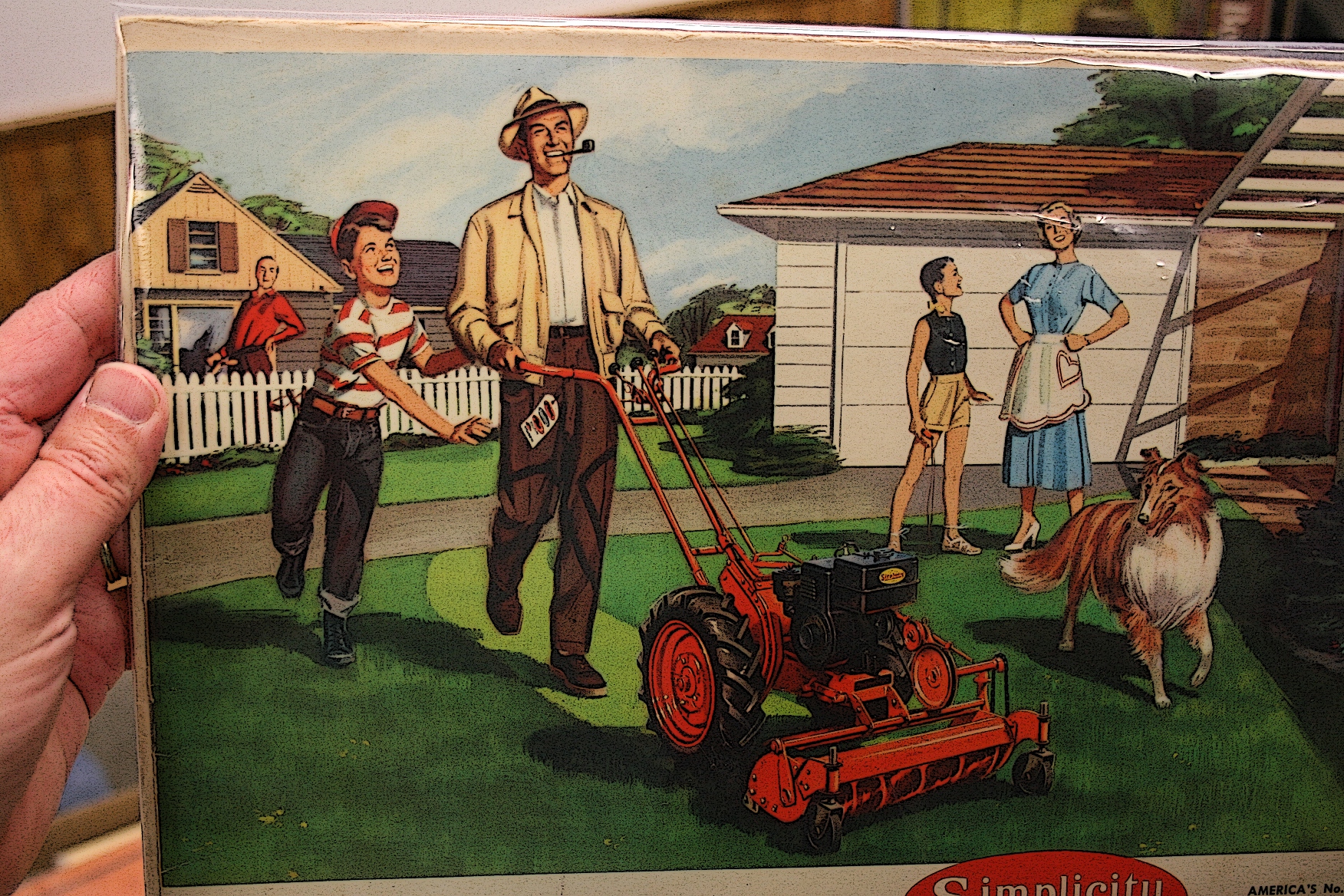
Solution: Apply cartoon tool to reduce glare and lend a more vintage look.

Solution: Apply cartoon tool to reduce glare and lend a more vintage look. (That’s a rotary lawnmower, BTW.)

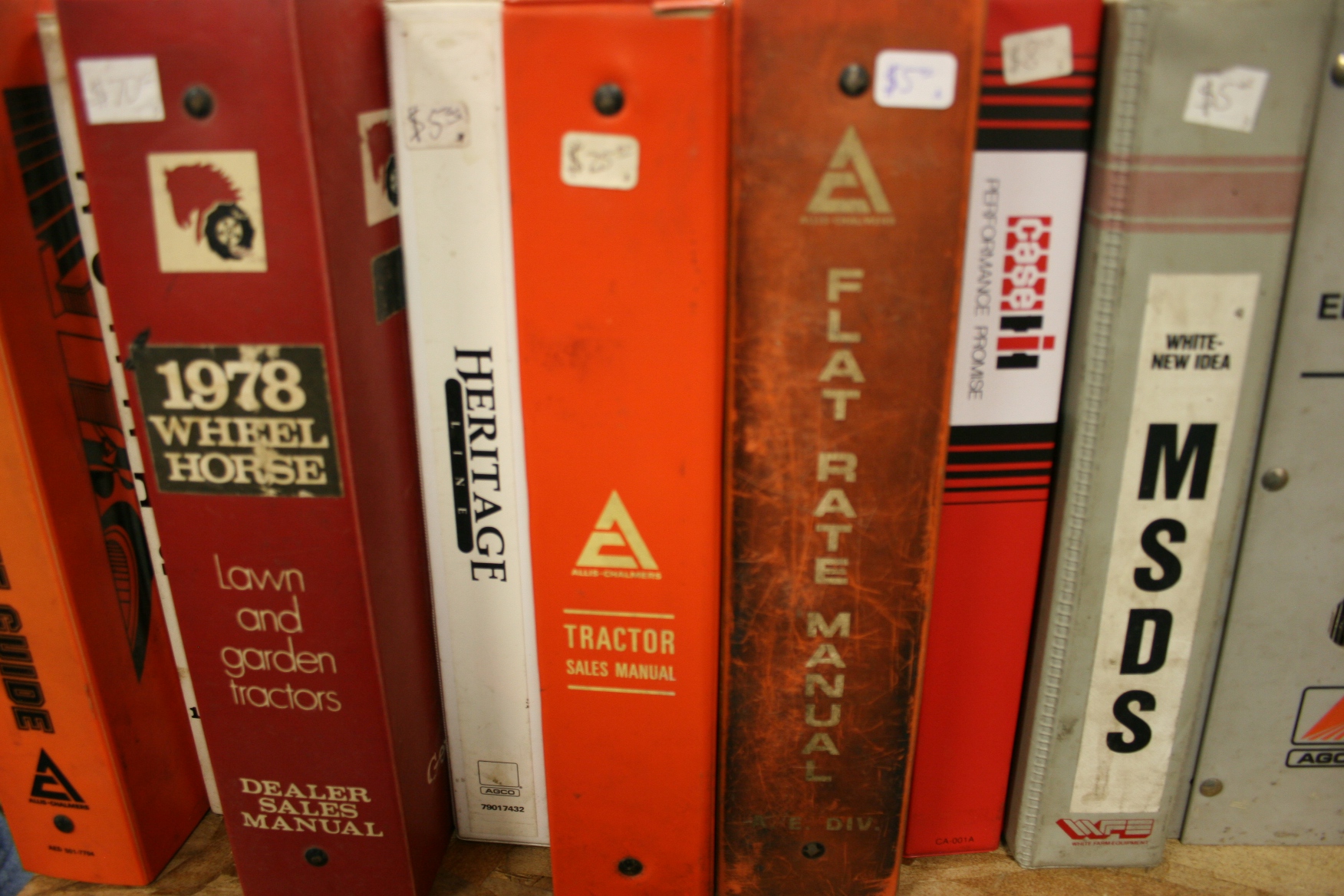
BEFORE:

Problem: Out-of-focus and boring photo.

Problem: Out-of-focus and boring.

AFTER:

Solution: Simplify by converting to black-and-white and then apply the posterize tool. This emphasizes the element  of strong lines.

Solution: Simplify by converting to black-and-white and then applying the posterize tool. This emphasizes the element of strong lines without the distraction of color.

BEFORE:

Problem: Totally out of focus and in need of cropping.

Problem: Totally out of focus and in need of cropping.

AFTER:

Solution: Apply the posterize tool to divert the eyes from focus problems, thus emphasizing the interesting lines and strong colors in this image. Also crop.

Solution: Apply the posterize tool to divert the eyes from focus problems, thus emphasizing the interesting lines and strong colors in this image. Also crop.

BEFORE:

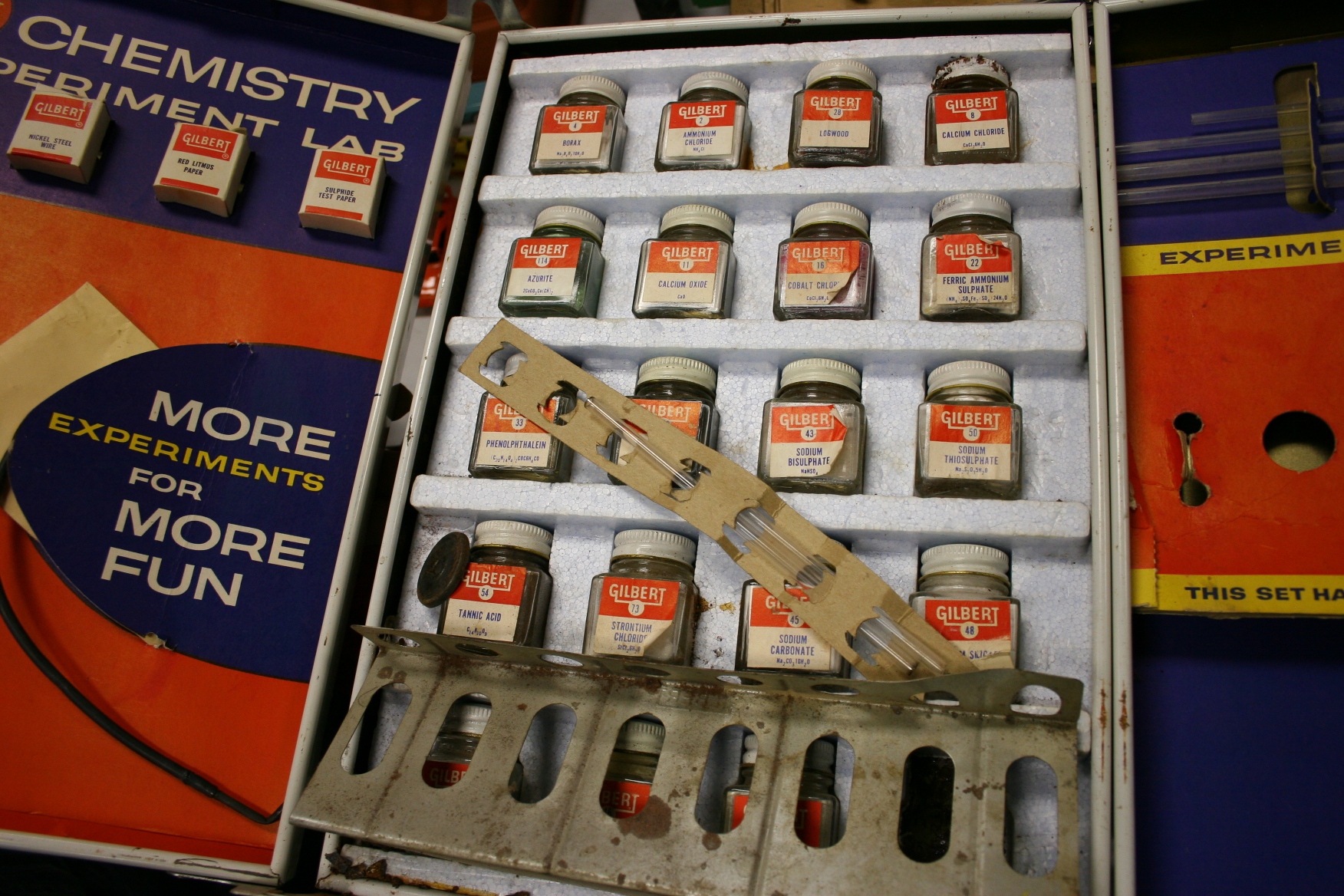
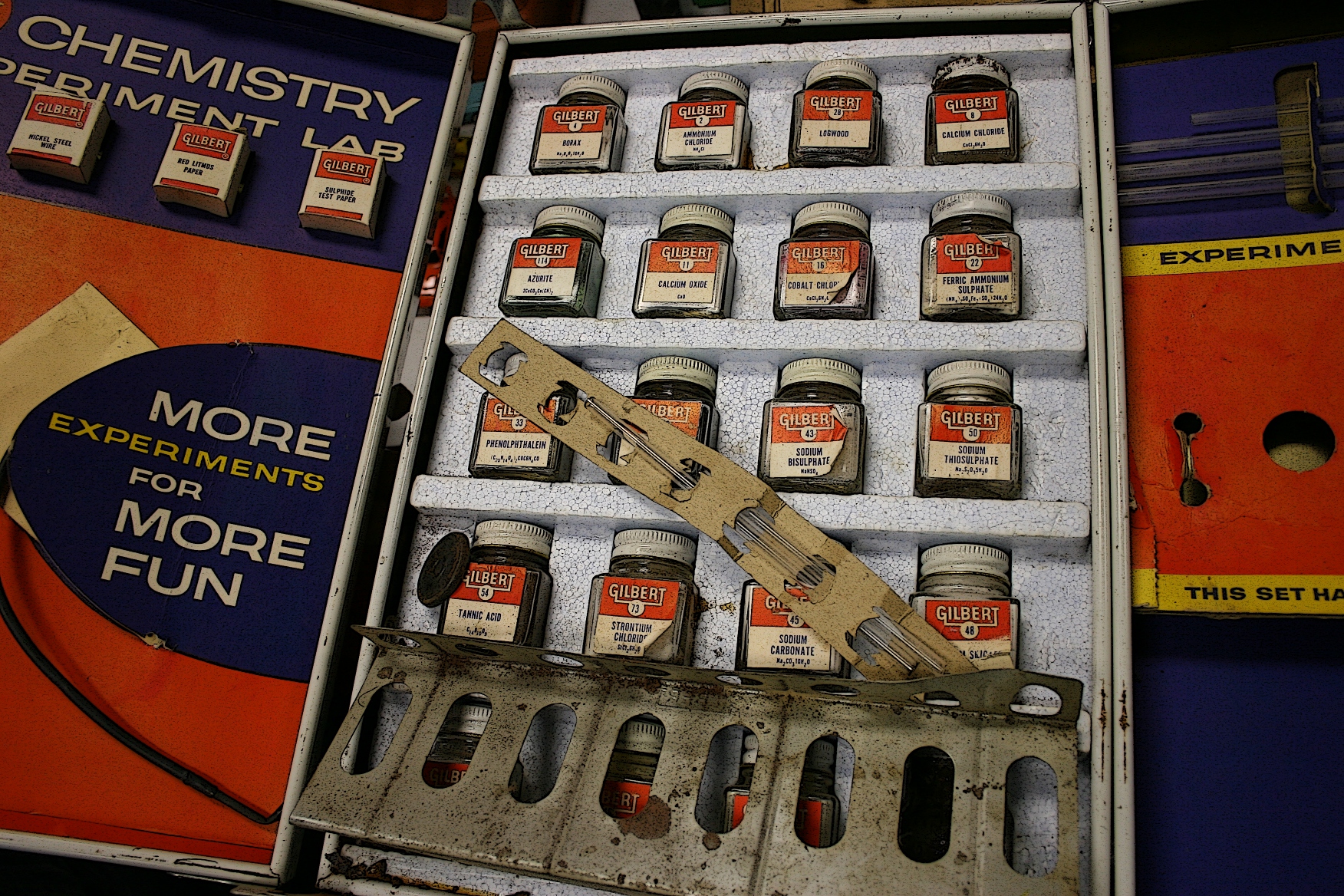
Problem: This photo of a child's Gilbert Chemistry Experiment Lab does not have issues and could be published unedited.

Problem: This photo of a child’s Gilbert Chemistry Experiment Lab does not have issues and could be published unedited. But I wanted to give it a more vintage look.

AFTER:

Solution: With the cartoon tool application, I added a subtle vintage vibe to the image.

Solution: With the cartoon tool application, I added a subtle vintage artsy vibe to the image.

Now if I was particularly tech savvy, which I am not, I’d be capable of producing even more creative photo art. But I’ve much to learn still and that keeps photography interesting.

THOUGHTS?

© Copyright 2013 Audrey Kletscher Helbling

 

Where the men & boys shop: At a rural Minnesota farm toy show January 31, 2013

OH, TO BE A FARM KID again, steering toy tractors through imaginary fields, corralling cattle into a replica barn, pretending to be a farmer just like Dad.

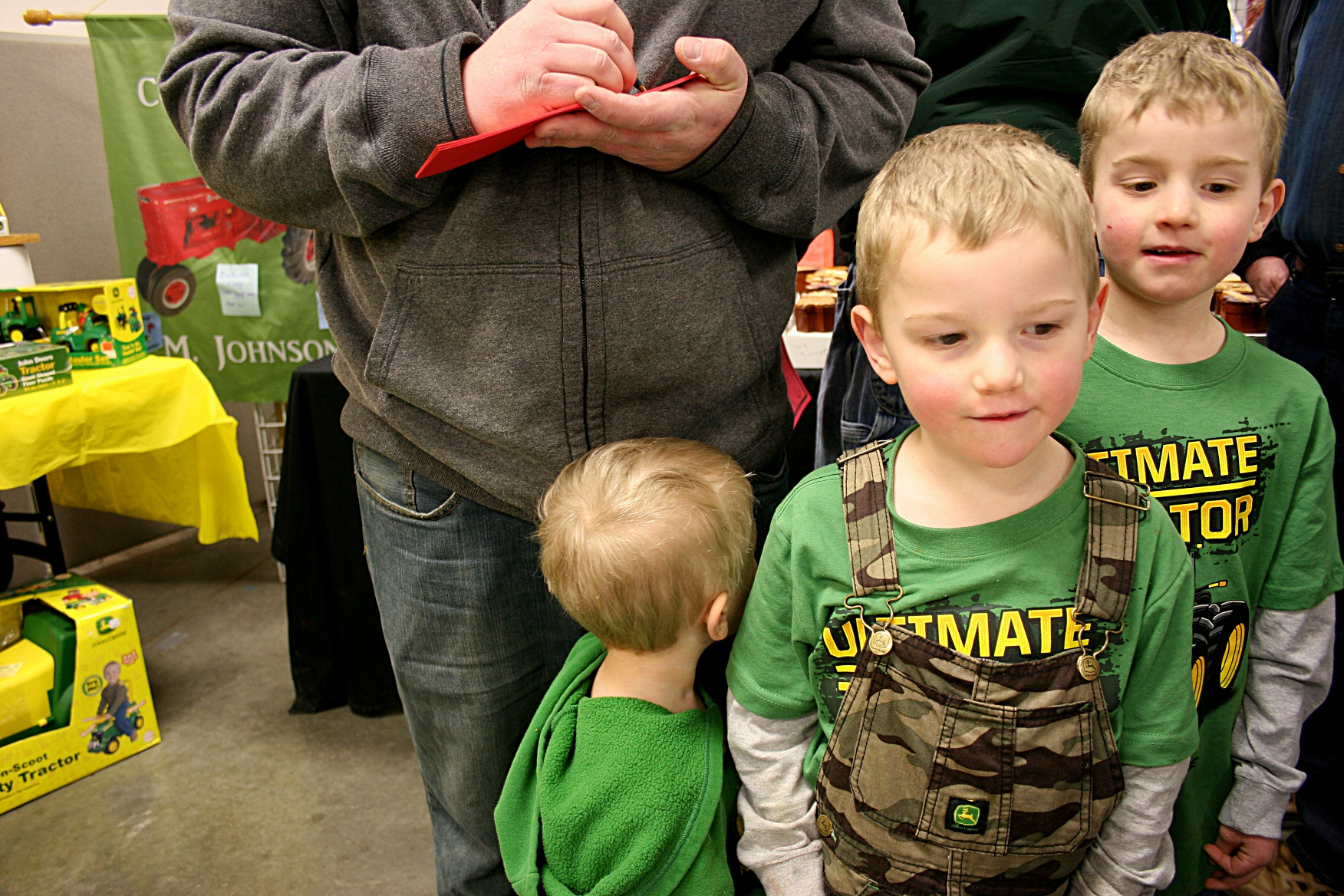
A trio of brothers dressed in John Deere attired waited while their dad signed up for a Massey Harris tractor raffle from Rice County Steam & Gas Engines, Inc.

A trio of brothers dressed in John Deere attire wait while their dad signs up for a Massey Harris tractor raffle from Rice County Steam & Gas Engines, Inc. The youngest was camera shy.

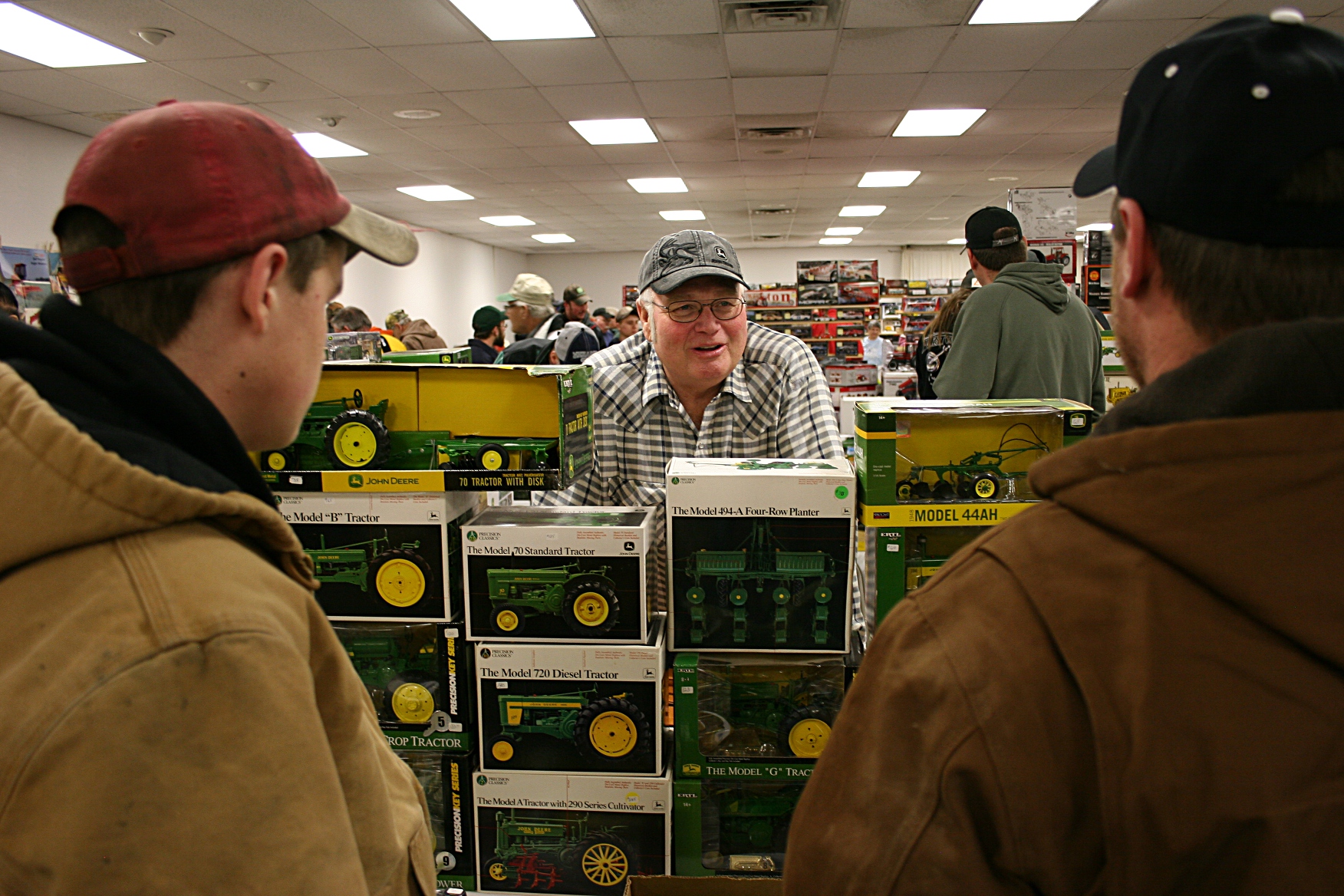
I imagine many of the kids tagging along with Grandpa or Dad to Louie’s Toy Box Farm Toy Show at the Nicollet County Fairgrounds in St. Peter last weekend were farm kids wishing for a new toy tractor or other piece of farm equipment to role-play their futures, or their ancestral pasts.

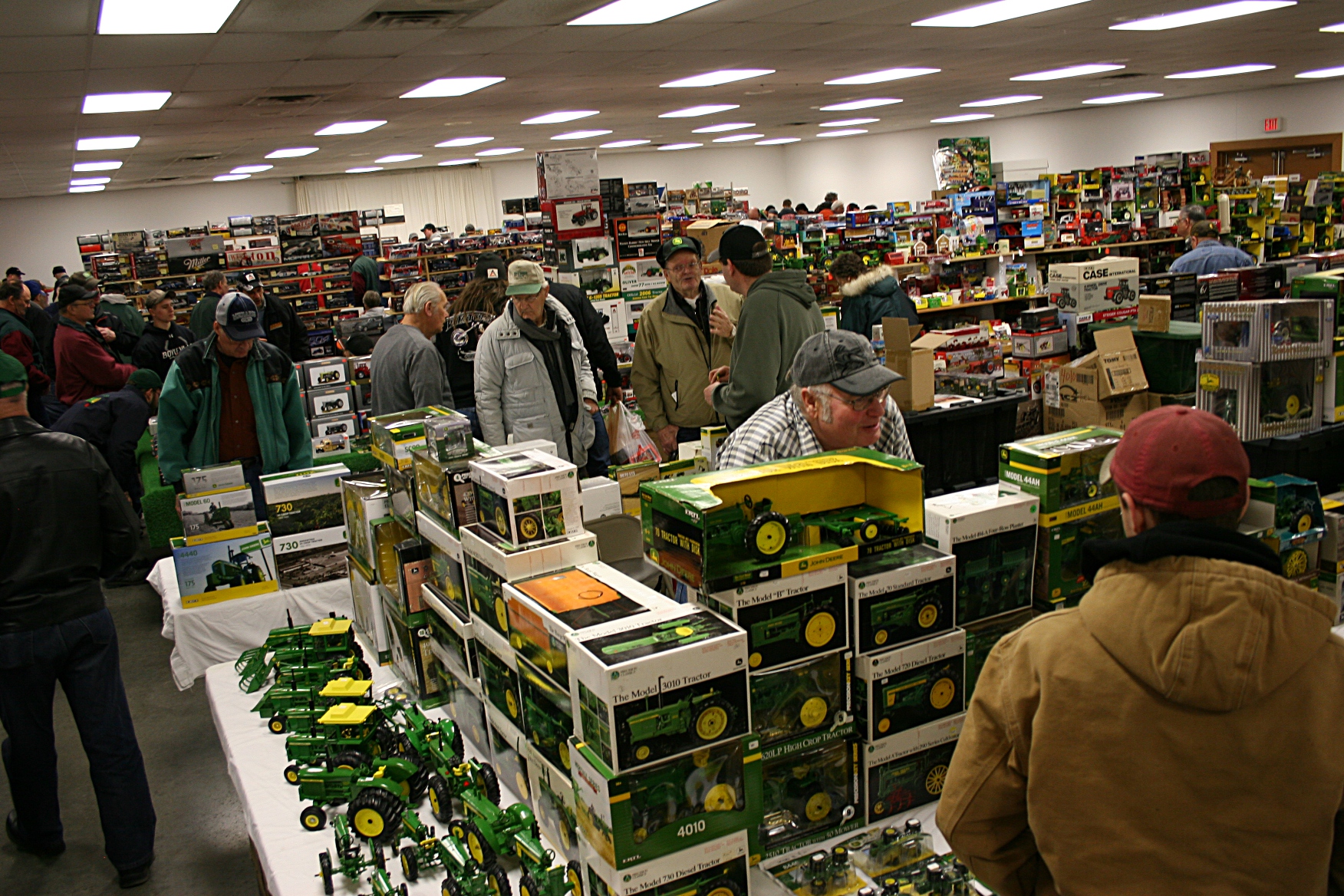
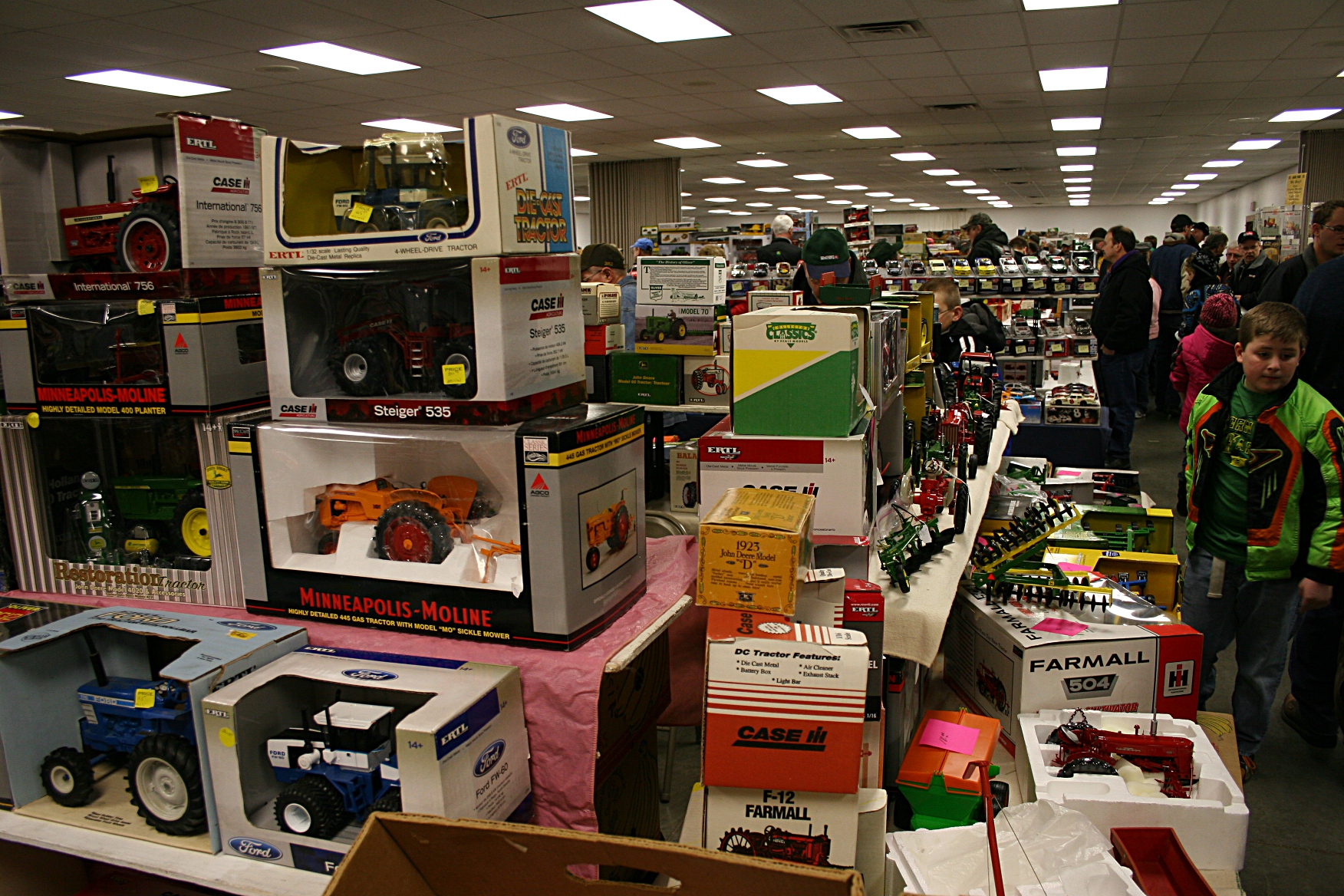
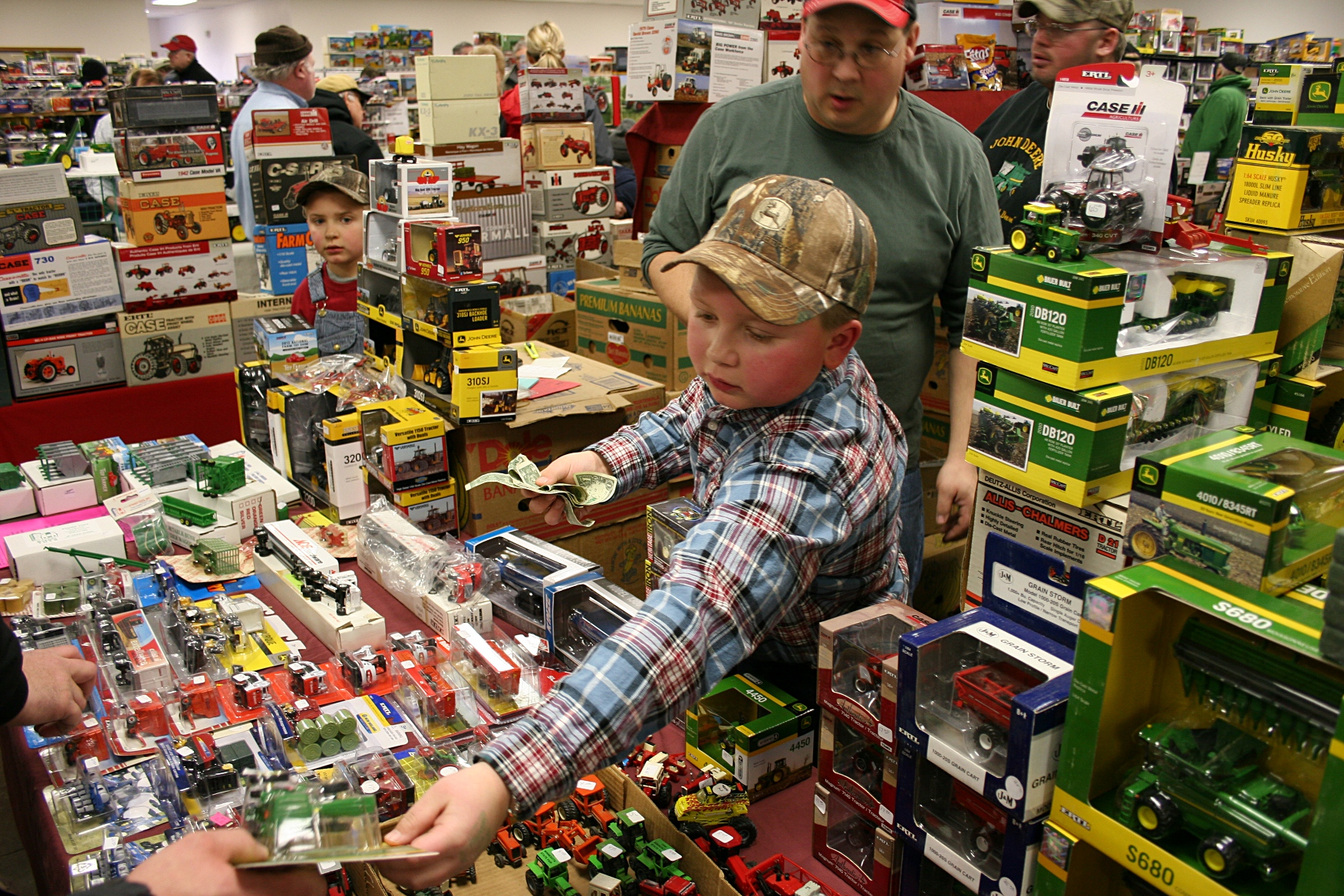
Masses of shoppers among a mass of merchandise.

Masses of shoppers among a mass of merchandise.

Shouldering my way through packed aisles Saturday morning, I couldn’t determine who seemed more excited—the men or the boys. And they had every reason to thrill in the mass of ag-related merchandise displayed by 43 vendors from Minnesota, South Dakota, Wisconsin, Iowa and Illinois.

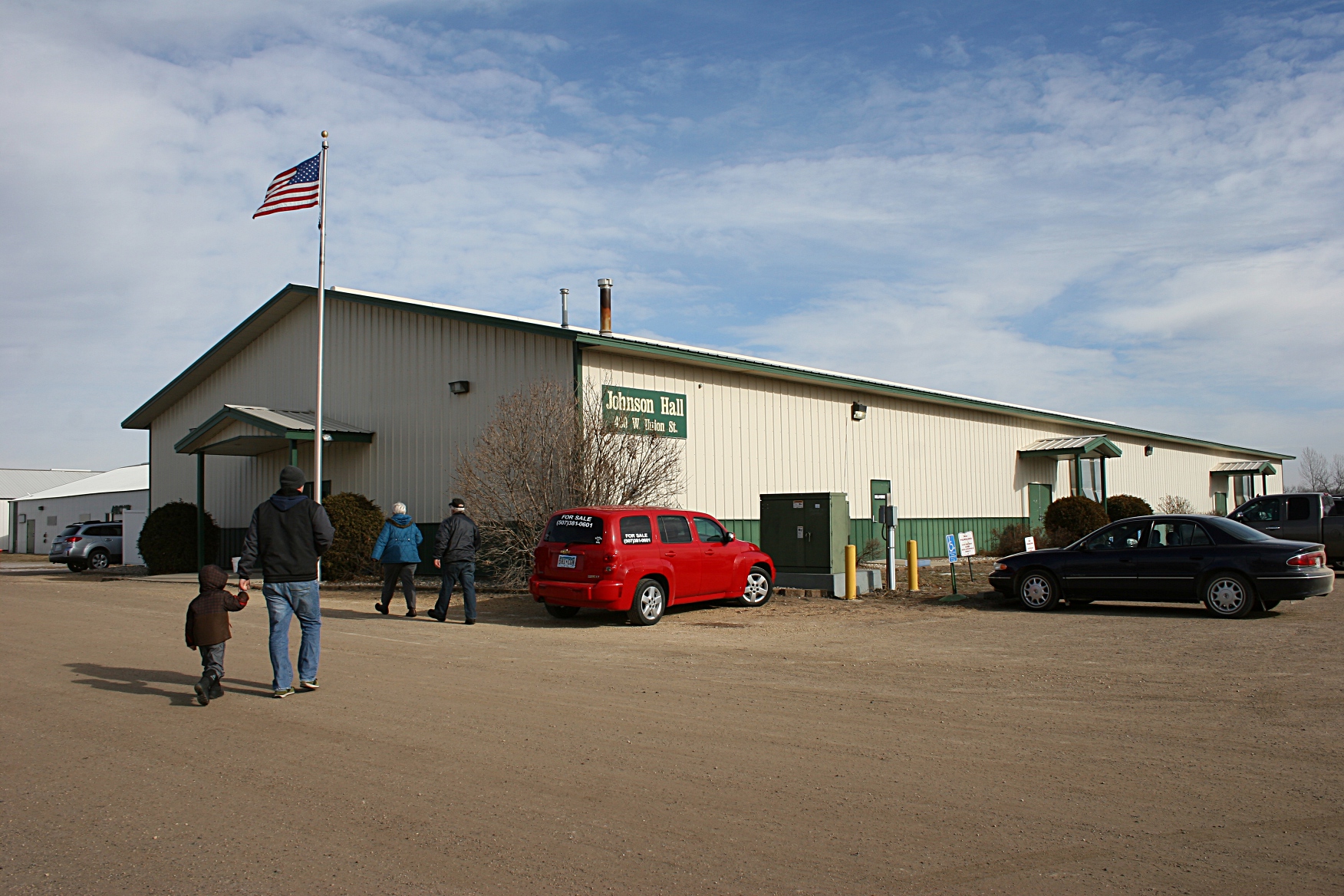
Johnson Hall, site of Louies' Toy Box Farm Toy Show.

Johnson Hall, site of Louie’s Toy Box Farm Toy Show.

I didn’t know quite what to expect when I entered the unassuming pole-shed style Johnson Hall at the fairgrounds. But I didn’t expect to find so many people (an estimated 2,000 weekend attendees), so many vendors and so much merchandise crammed into such a tight space. This venue is definitely too uncomfortably small for a toy show of this size.

Vending John Deere toy tractors.

Vending toy John Deere tractors.

That aside, I managed to wiggle my way through mostly throngs of men sporting caps and sweatshirts advertising ag companies. John Deere, which marked its 175th anniversary in 2012, showed a dominating presence in apparel.

But when it came to merchandise, I expect every line was represented.

My first look at the farm toy show left me feeling overwhelmed.

My first look at the farm toy show left me feeling overwhelmed.

Upon first entering the toy show, I just stood there, overwhelmed by the stacks and stacks and stacks of boxed tractors and other toys stretching out before me. Honestly, I thought I’d made a mistake suggesting to my husband that we come here. I may have played with toy farm equipment as a kid, but it doesn’t especially interest me as an adult.

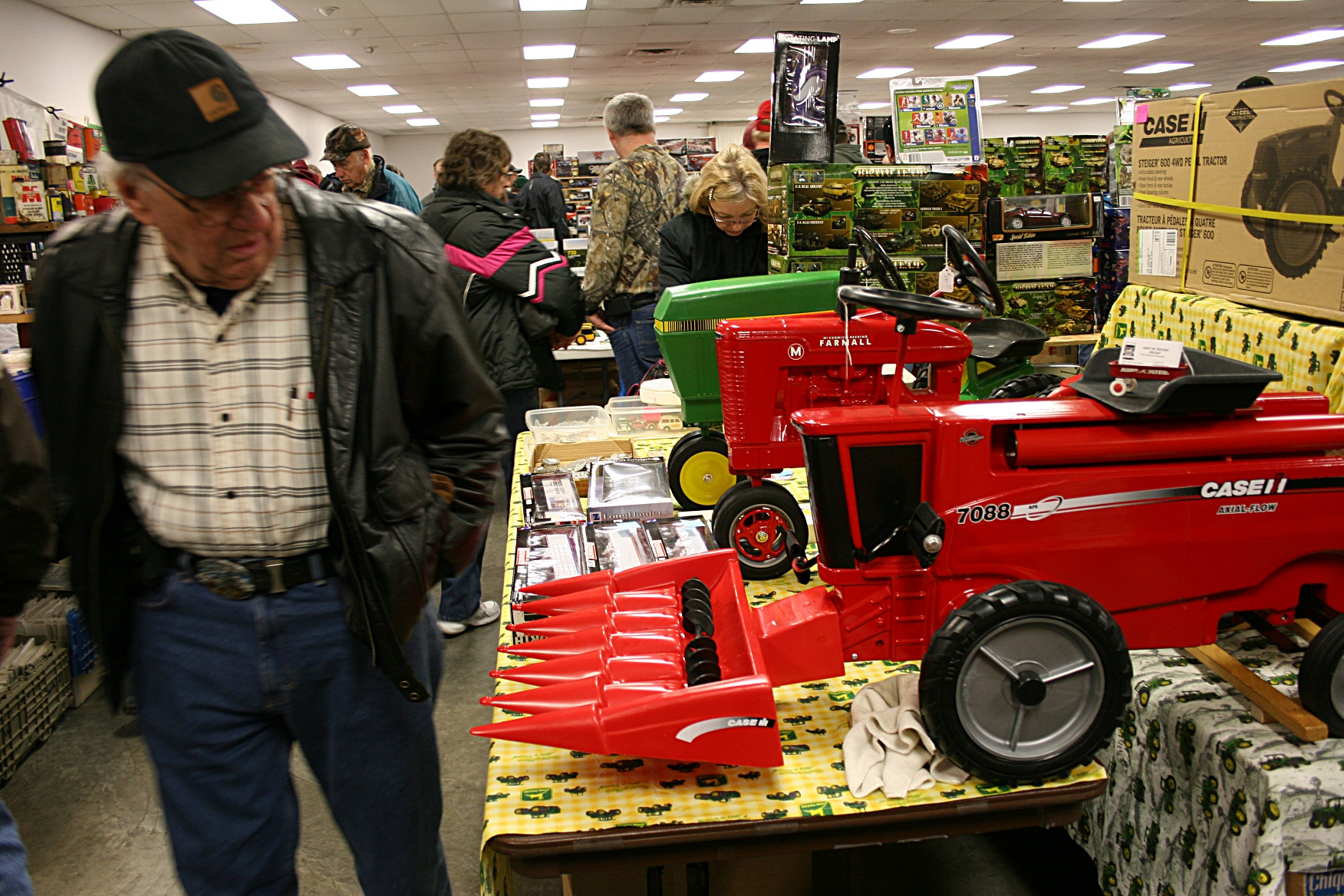
Maneuvering the aisles proved challenging.

Maneuvering the aisles proved challenging, especially with a camera bag on my hip and a camera in hand.

I wandered for awhile like a lost sheep, wondering where to focus, how to best work my way through the crowd. Arrows taped to the floor to direct traffic flow would have helped. But eventually I figured it out and backtracked the other direction, easing into the line of shoppers (which did include some women and girls).

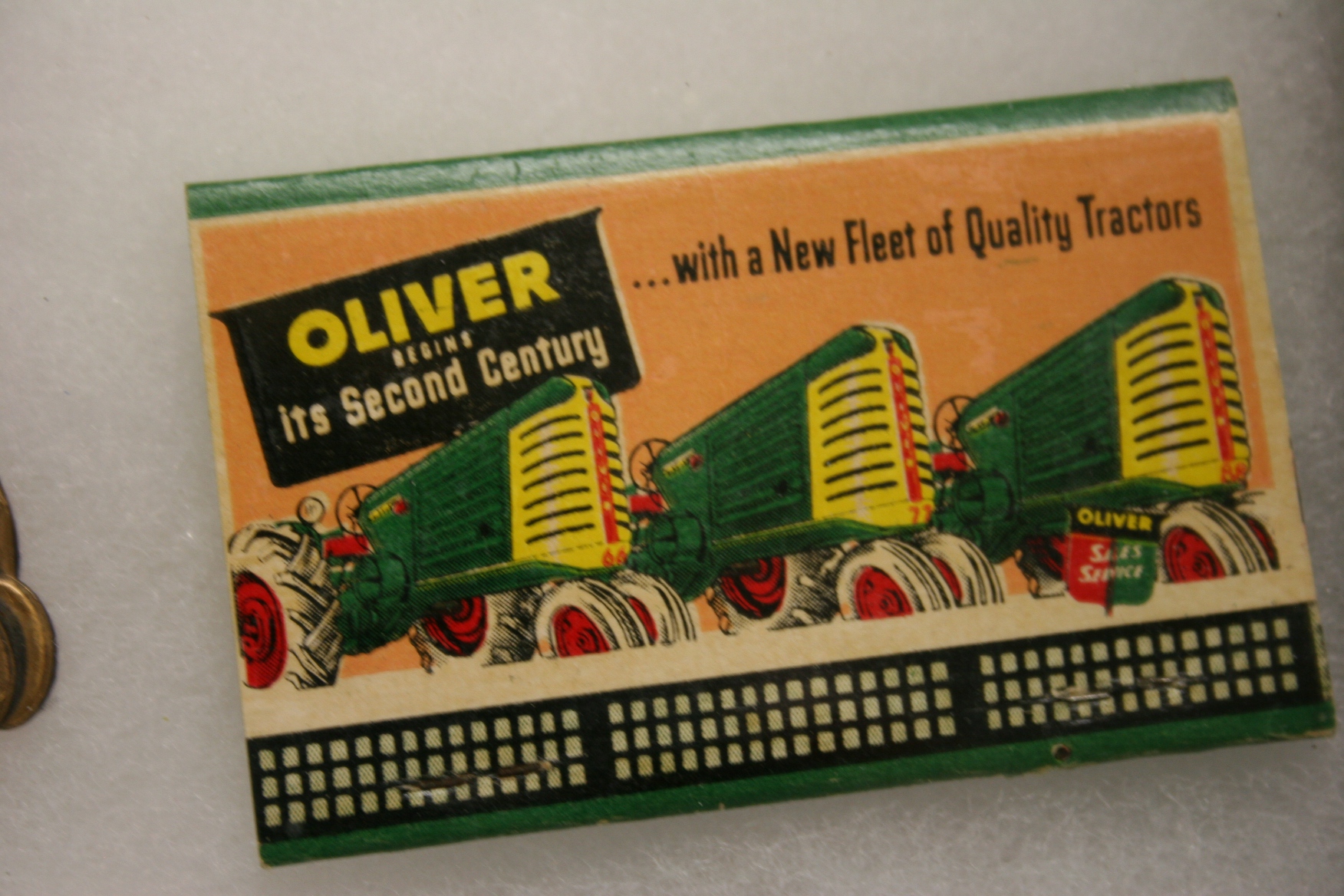
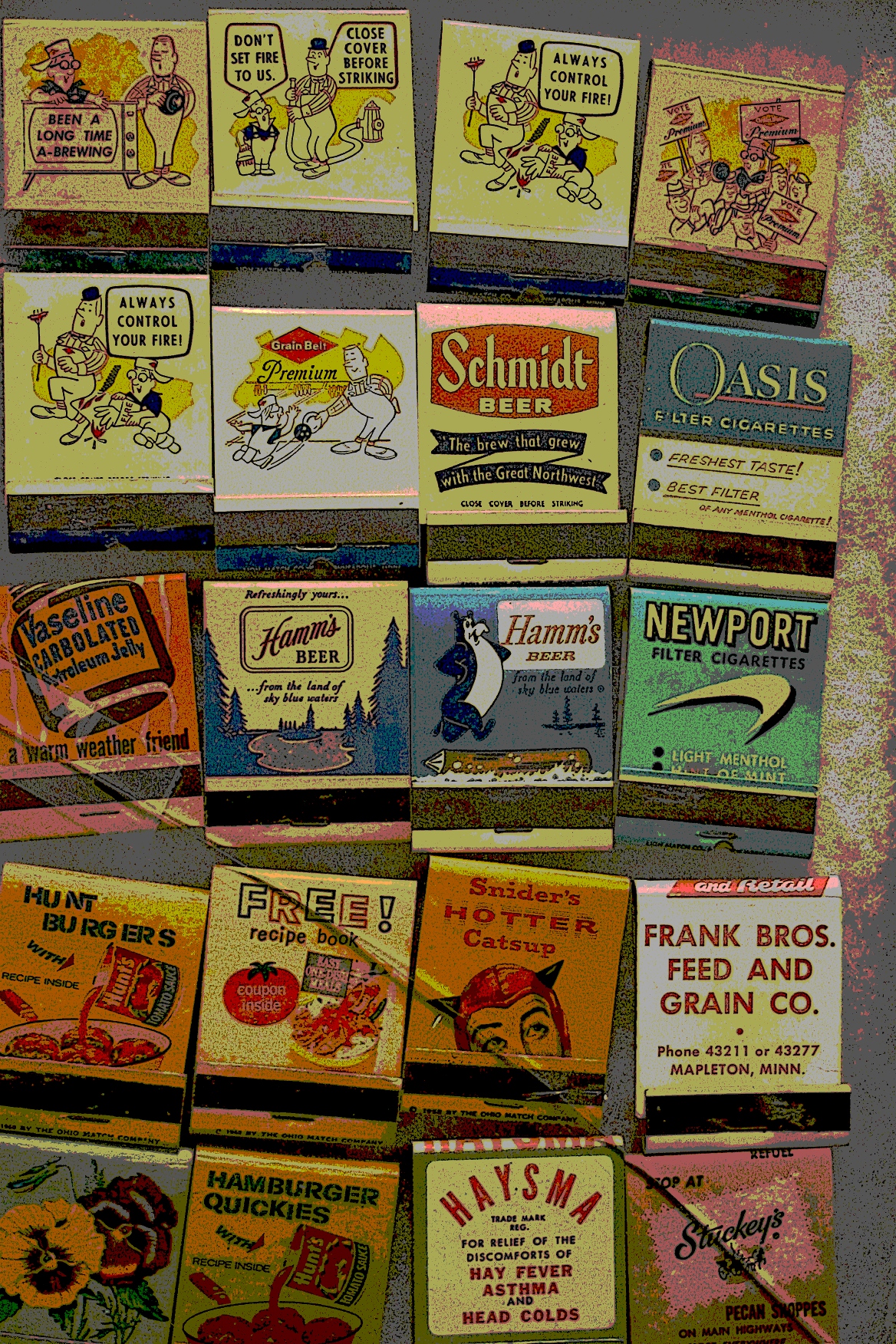
An edited photo of vintage matchbooks. Love those graphics.

An edited photo of vintage matchbooks. Love those graphics.

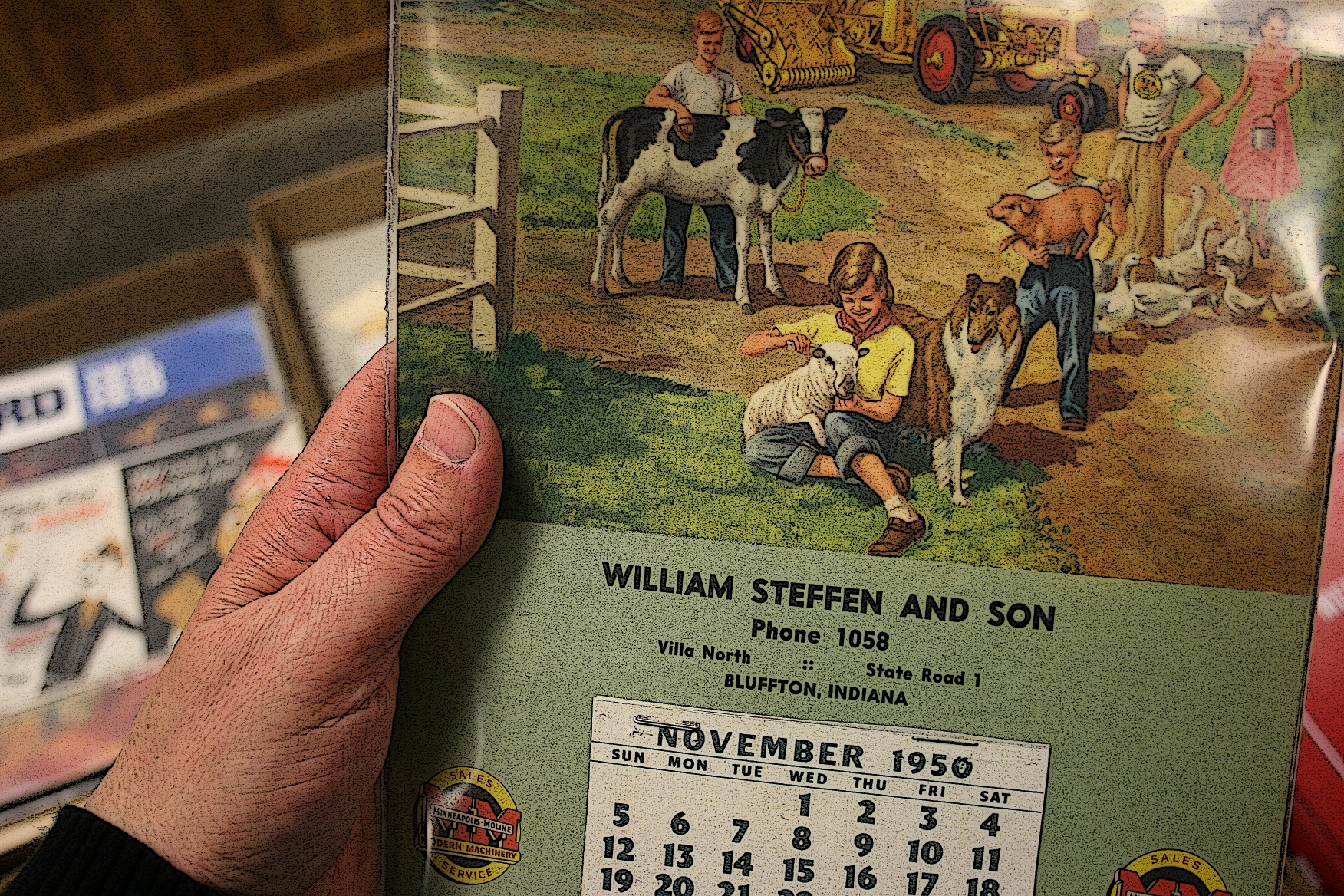
Another edited photo, of a 1950 calendar.

Another edited photo, of a 1950 calendar.

Eventually I found my niche, not in the toys, but in graphics gracing vintage matchbooks, calendars, literature and other advertising items. When I examined a 1950s vintage calendar and balked aloud at the $98 price tag, the vendor informed me that 10 years ago he would have asked even more. I couldn’t bring myself to shell out that kind of money or even $10 for a teeny tiny matchbook. I’d need to be a serious collector to justify such expenditures.

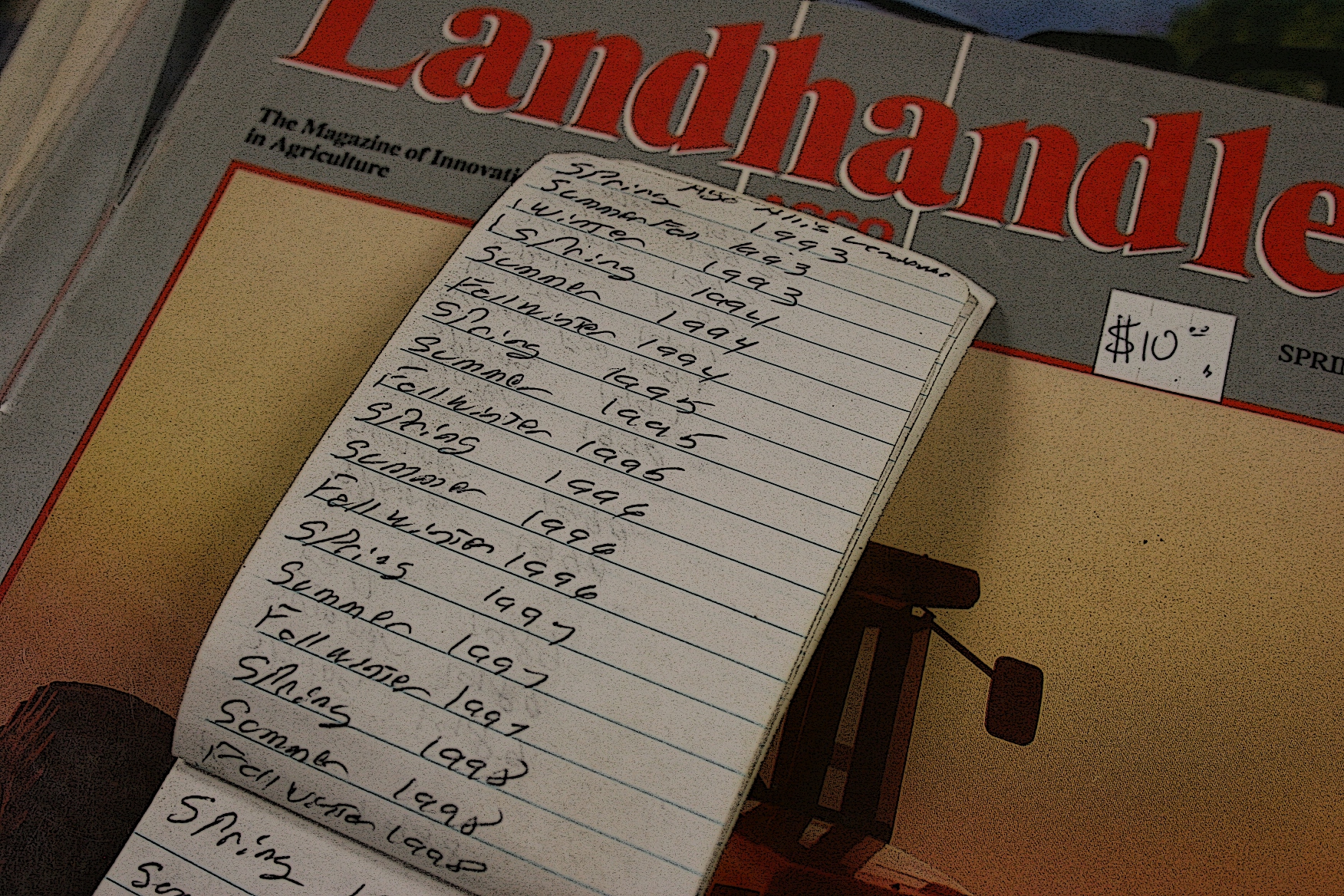
Shortly thereafter I met a serious collector, Wendell Bakker of Renville, whom I observed filing through stacks of magazines, about a half-dozen notebooks stuffed in a back pants pocket and another open notebook in his hand. Because I’m nosy, and I admitted that to Wendell, I initiated a conversation. This former crop, dairy and hog farmer and recently-retired field rep for the Minnesota Farmers Union has been collecting issues of the Allis Chalmers Landhandler and other farm magazines for 50 years.

One of Wendell's notebooks, noting which magazines he already has in his collection.

One of Wendell’s notebooks, noting which magazines he already has in his collection.

“Everybody has a bad habit,” Wendell surmised, not that I would term collecting magazines a bad habit.

I didn’t question any of the other shoppers about their reasons for attending the farm toy show. But, based on the bulging bags most carried out of Johnson Hall, I’d guess many are collectors. As for me, I didn’t purchase anything, just added 94 images to my photo collection in 1 ½ hours. Total cost: the $3 admittance fee.

BONUS PHOTOS:

Toys, sign

A vendor’s sign.

A vendor in training.

A vendor in training.

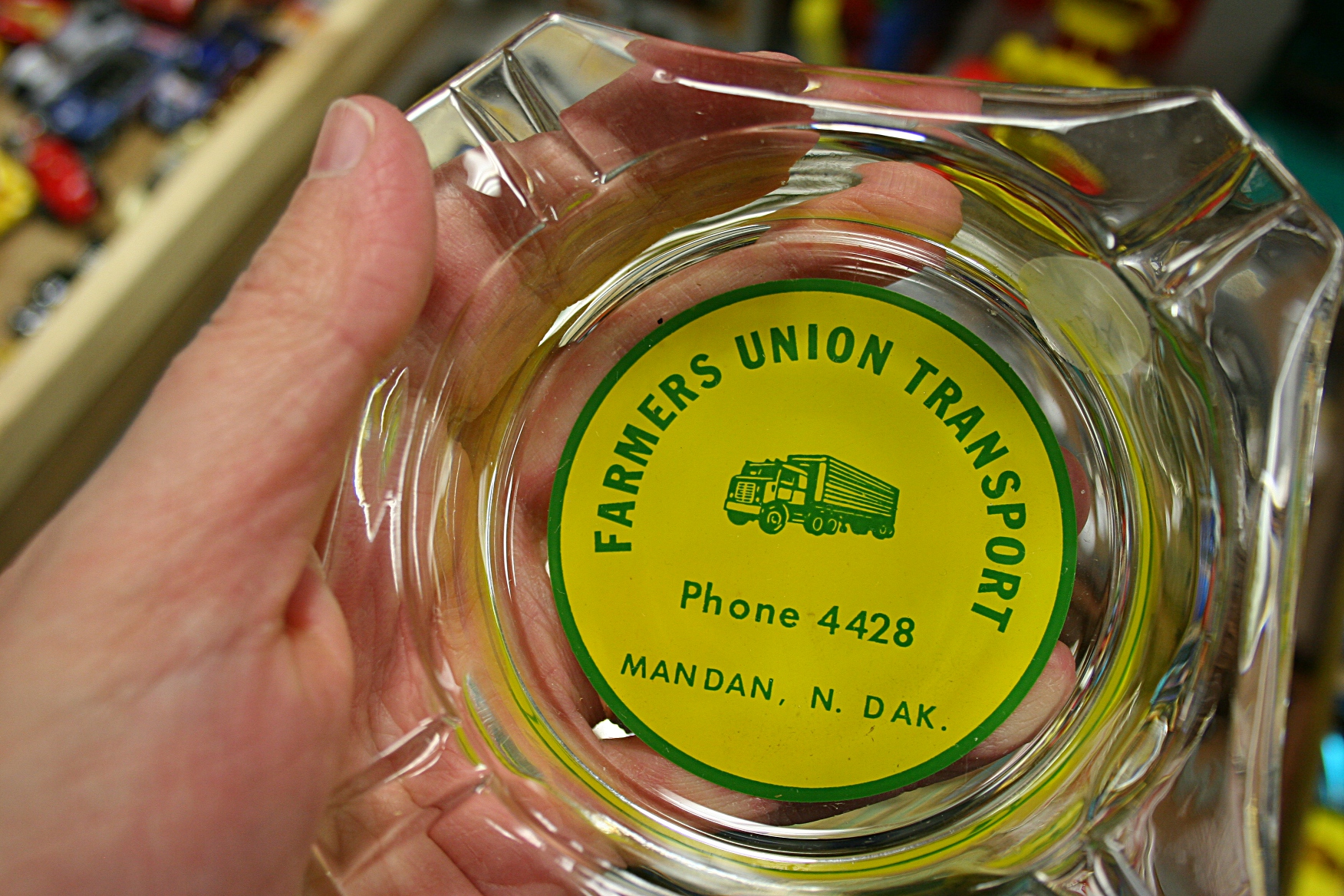
I don't smoke and don't like smoking. But I sure do I like vintage ash trays like this one from my husband's birthplace.

I don’t smoke and don’t like smoking. But I sure do I like vintage ash trays like this one from my husband’s town of birth.

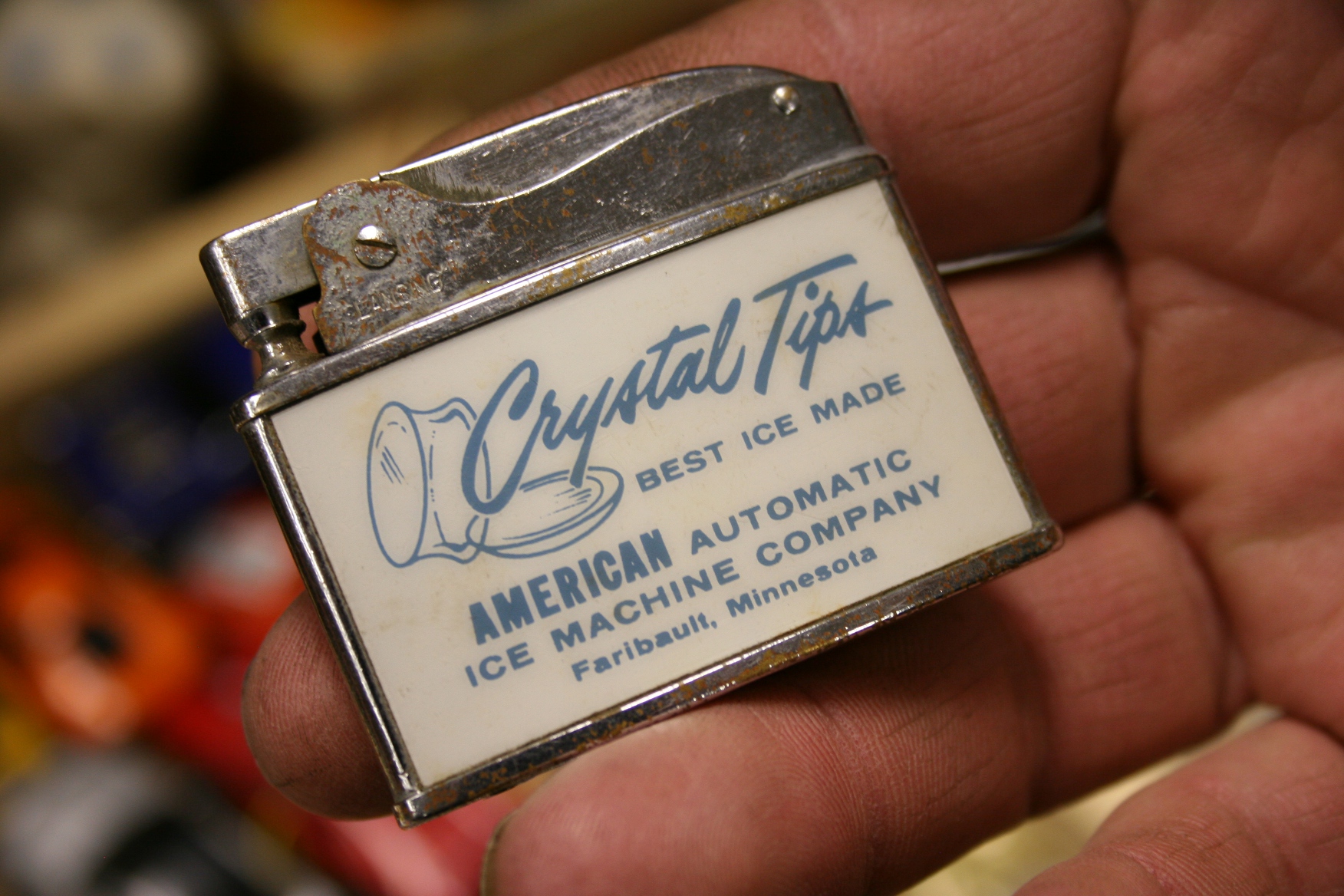
We were tempted to buy this lighter from Faribault, for a business we'd not heard of, but the $18 price was more than we wanted to pay.

We were tempted to buy this lighter from Faribault, for a business we’d not heard of, but the $18 price was more than we wanted to pay.

FOR MORE INFORMATION about show organizer, Louie’s Toy Box, click here.

Check back for more photos from the toy show.

© Copyright 2013 Audrey Kletscher Helbling
 

Saint Peter’s version of the Super Bowl January 29, 2013

IN THIS WEEK of Super Bowl XLVII, at least one Minnesota community has already tapped into the super sporting event hype to benefit the local arts community. And that happened in a way you likely would not expect, via Souper Bowl VII.
The hand-thrown pottery bowl I chose at the Souper Bowl for my chicken wild rice soup.

The hand-thrown pottery bowl I chose at the Souper Bowl for my chicken wild rice soup.

Saturday afternoon, my husband and I joined arts-loving diners at the St. Peter Community Center for soup served in hand-thrown pottery bowls. And the bowls were ours to keep at a cost of $12 each (or $8 per kid) for the art and the meal.
Six local potters gave of their time and talents to create 240 soup bowls for the luncheon of donated breads and soups—tomato basil, chicken wild rice and chili—cookies and beverages.

Joel Moline and Thalia Taylor kneading clay during a visit to the Clay Center in March 2012..
Joel Moline and Thalia Taylor kneading clay during a visit to the Clay Center in March 2012..

While I really do like soup, a lot, I appreciate even more the whole Souper Bowl concept. What a creative way to expose the arts to the general public while raising monies for the Arts Center of Saint Peter Clay Center programming. (Read a previous post about the Clay Center by clicking here.) The goal is to keep arts center activities “accessible, affordable and vibrant to the St. Peter community and surrounding region,” according to promotional information.

The selection of bowls remaining when we arrived at noon, an hour after doors opened.

The selection of bowls remaining when we arrived at noon, an hour after doors opened.

Choosing a bowl added a fun  element to the event. Here’s how the process worked for me: I narrowed my selection to my favorite color, green. But with only a few green bowls on the table and the hue I liked best in the hands of a debating diner, I faced a dilemma. Should I pick my second favorite green bowl or wait for this woman to decide between the two bowls she balanced in her hands?

A few green bowls sat among the mostly brown and blue ones.

A few green bowls sat among the mostly brown and blue ones.

I opted to wait, to hover, but not so close as to call attention to my interest in the green bowl. My game plan paid off when the woman finally set the green bowl down and walked away. I moved in for the fumble, snatching up the coveted prize. Touchdown.

Diners line up for soup or chili. Seconds could be had for a freewill donation.

Diners line up for soup or chili. Seconds could be had for a freewill donation.

My ever patient spouse waited nearby as I took a few photos before we entered the dining area and washed our bowls which were then filled, his with chili, mine with chicken wild rice. A volunteer behind the serving counter even heated my soup in the microwave when I told her it wasn’t hot enough. How’s that for Saint Peter nice? And Randy was invited to return for more soup since his bowl was somewhat small; he tried tasty tomato basil in the second quarter.

A soup server heated my soup in the microwave and then placed the hot bowl on a plate.

A soup server heated my soup in the microwave and then placed the hot bowl on a plate.

A few more photos later and we were dining, in the fine company of arts center board member Harry Hunt and his wife, Bonnie. Harry, who works in financial services, shared that he isn’t an artist, seeming even a bit apologetic about his lack of artistic talent. But I was quick to tell him he could certainly contribute to the arts board with his financial expertise.

The Arts Center of Saint Peter, 315 South Minnesota Avenue, St. Peter, Minnesota.

The arts center in downtown St. Peter, photographed on a visit there in March 2012.

Eventually, I turned our table talk to the March 1998 tornado in St. Peter which caused an estimated $300 million in property damage and claimed one life. I wanted to know if the Hunts had been affected by the tornado.

Bonnie recalled how they had been visiting family in the metro when they learned of the bad weather in southern Minnesota. “Well, let’s see if we have a home left,” she joked as the couple drove back toward St. Peter, unaware that a tornado had ravaged their community. They arrived to find their home on the edge of town destroyed. The Hunts rebuilt.

Today they laugh at an incident shortly after the disaster. Harry was working in the basement of their destroyed home when someone called down to announce the arrival of then Minnesota Governor Arne Carlson. Harry emerged from the basement and greeted the Governor: “Welcome to our open house.”

You can bet Randy and I appreciated the winning company and humor of the Hunts as much as the soup and the hand-thrown pottery bowls we took home from Saint Peter’s Souper Bowl.

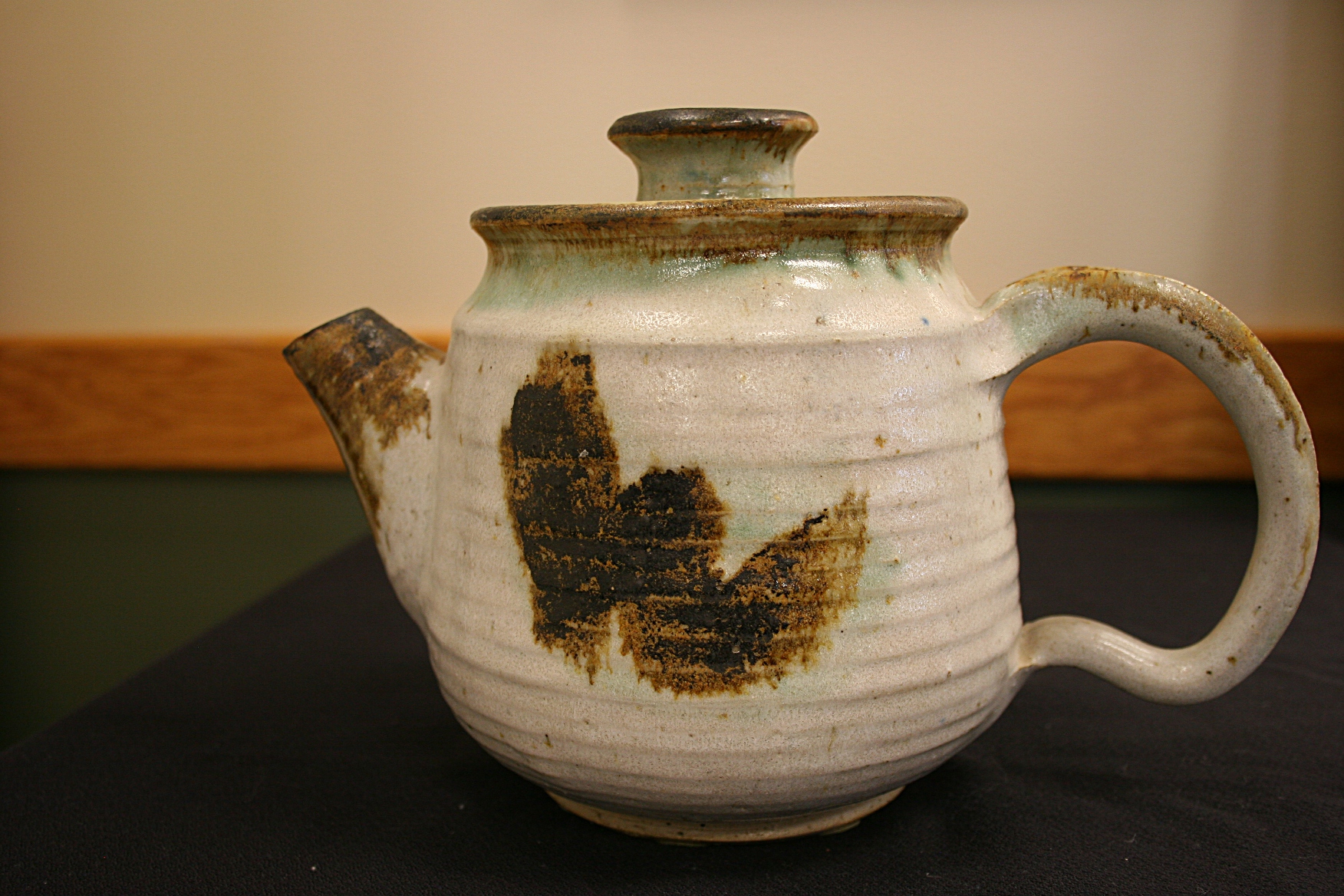
Potter Missy Wood created this teapot for the Souper Bowl silent auction.

Potter Missy Wood created this teapot for the Souper Bowl silent auction.

HAVE YOU ATTENDED a fundraiser like this? Please share your experiences, thoughts and ideas. We can all learn from one another.

© Copyright 2013 Audrey Kletscher Helbling