Minnesota Prairie Roots

Writing and photography by Audrey Kletscher Helbling

Thirty years together May 15, 2012

Filed under: Uncategorized — Audrey Kletscher Helbling @ 8:09 AM
Tags: , , , , ,

Audrey and Randy, May 15, 1982. We were so young then, only 25 1/2.

THUMBING THROUGH THE PAGES of our wedding album, I can barely believe that 30 years have passed since my husband and I exchanged vows on May 15, 1982.

Where did the past three decades go?

And who are those kids in over-sized glasses with more hair (him) and shorter hair (me) and both pounds lighter?

Could that possibly be us, newlyweds on the cusp of married life, grinning with the exuberance of young love?

That is, indeed, us.

Together then.

Together now.

Friends asked me Saturday night for tips to a lasting marriage. The question caught me by surprise and I simply told them they didn’t need my advice because they are doing well on their own.

Later, though, I considered how we’ve kept our marriage going strong for 30 years. For Randy and me, the fact that we were just friends before we even began dating set the tone for our relationship.

Friendship and trust. Shared values and a shared faith in God. All have been integral in our marriage.

Many times I think, too, that the similarities in our childhoods—both from farm families with little money—have curbed disagreements over finances. We live a simple, basic life and are content with what we have.

Yet, the differences between us have also benefited our marriage. Randy possesses a quirky sense of humor. He makes me laugh, lightens the moment, causes me to smile when I’d rather not. Without him, life would simply be less fun.

I am the serious one. I can organize and focus and keep everyone on task.

But I can’t handle medical situations. Our three kids have always known that they should go to Dad, not Mom, with any health issues. Need a sliver pulled? Take the tweezers to Dad. Wonder if that cut needs stitches? Consult Dad.

And when I faced health issues—a severe, three-month case of whooping cough in 2005, surgery four years ago to replace my arthritic right hip and most recently the sudden loss of hearing in my right ear—my husband was right there. I could not have managed without him. He took seriously those vows, “in sickness and in health.”

He’s also good with numbers and excels as an automotive machinist. (Get in line if you want him to work on your car or truck or van or tractor or…) This man of mine is a hard worker and has always kept his family sheltered, clothed and fed. For that I am grateful.

I’m also grateful for his strong support of my writing and photography.

For 30 years we’ve had this balance, this give and take, this relying on each other (and God) and tapping into our strengths to make our marriage work.

And, yes, most assuredly that love quotient remains, as strong, if not stronger, than 30 years ago.

© Copyright 2012 Audrey Kletscher Helbling


Thank you, Mr. Postmaster, for finally hearing the voice of rural America May 14, 2012

Filed under: Uncategorized — Audrey Kletscher Helbling @ 10:33 PM
Tags: , , , , , ,

FINALLY, AN IDEA that makes sense for continuing postal service in parts of rural America.

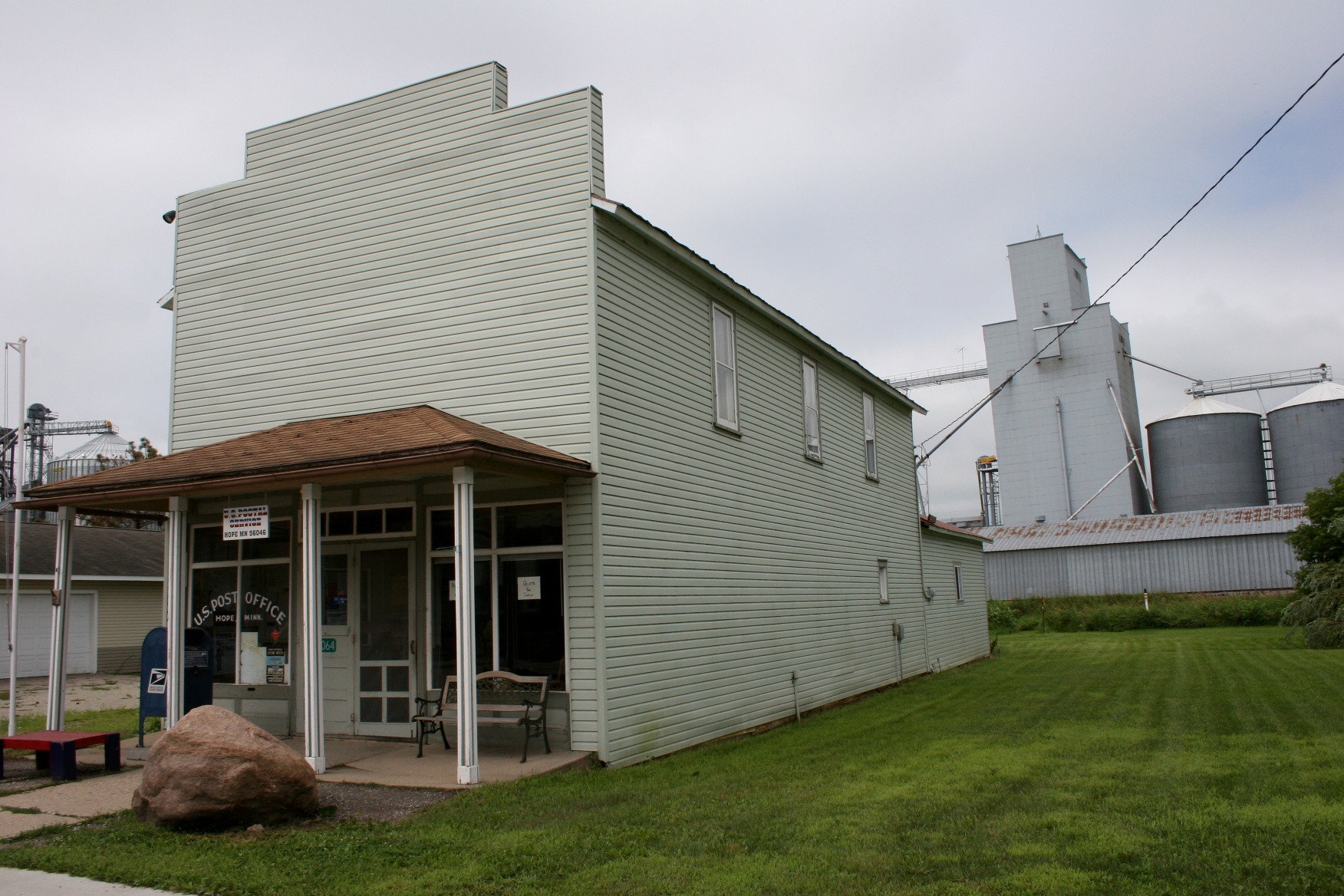
The United States Postal Service revealed a plan last week that could keep thousands of small-town post offices open by reducing hours. That’s certainly better than the alternative for places like Hope, Minnesota, an unincorporated community just off Interstate 35 south of Owatonna in Steele County. Last summer Hope’s 120 residents learned that their post office, like thousands of others across the country, likely would close in a cost-cutting measure.

Under a proposal, the Hope Post Office will remain open with daily window hours cut from eight to two.

Residents of Hope didn’t simply give up and accept their fate.  Instead, they circulated petitions and attended meetings and voiced their opinions and filed an appeal. To no avail. The postal service announced in April that the Hope Post Office would close. But now it appears the Postal Service has had a change of heart about closing thousands of small-town post offices nation-wide.

Postmaster General and CEO Patrick R. Donahoe said in part last week: “…we’ve listened to our customers in rural America and we’ve heard them loud and clear—they want to keep their post office open. We believe today’s announcement will serve our customers’ needs and allow us to achieve real savings to help the Postal Service return to long-term financial stability.”

So what does all that official talk mean? Some 13,000 post offices are now on “a preliminary list (for modified hours) that requires additional review, analysis, and verification and is subject to change.” Of those, 407 are located in Minnesota.

Well, the Postal Service is certainly covering all of its bases with that language, leaving room to tweak proposals and change plans/minds. I suppose one can never be too careful and cautious when one is a government entity. Meetings will be held in the affected communities to review options, which could take more than two years to implement.

Additional alternatives, according to the Postal Service, include mail delivery to affected customers via rural carrier or highway contract route; contracting with a local business for a village post office; and offering service from a nearby post office.

In a news release issued May 9, Postal Service Chief Operating Officer Megan Brennan says: “The post offices in rural America will remain open unless a community has a strong preference for one of the other options. We will not close any of these rural post offices without having provided a viable solution.”

Good.

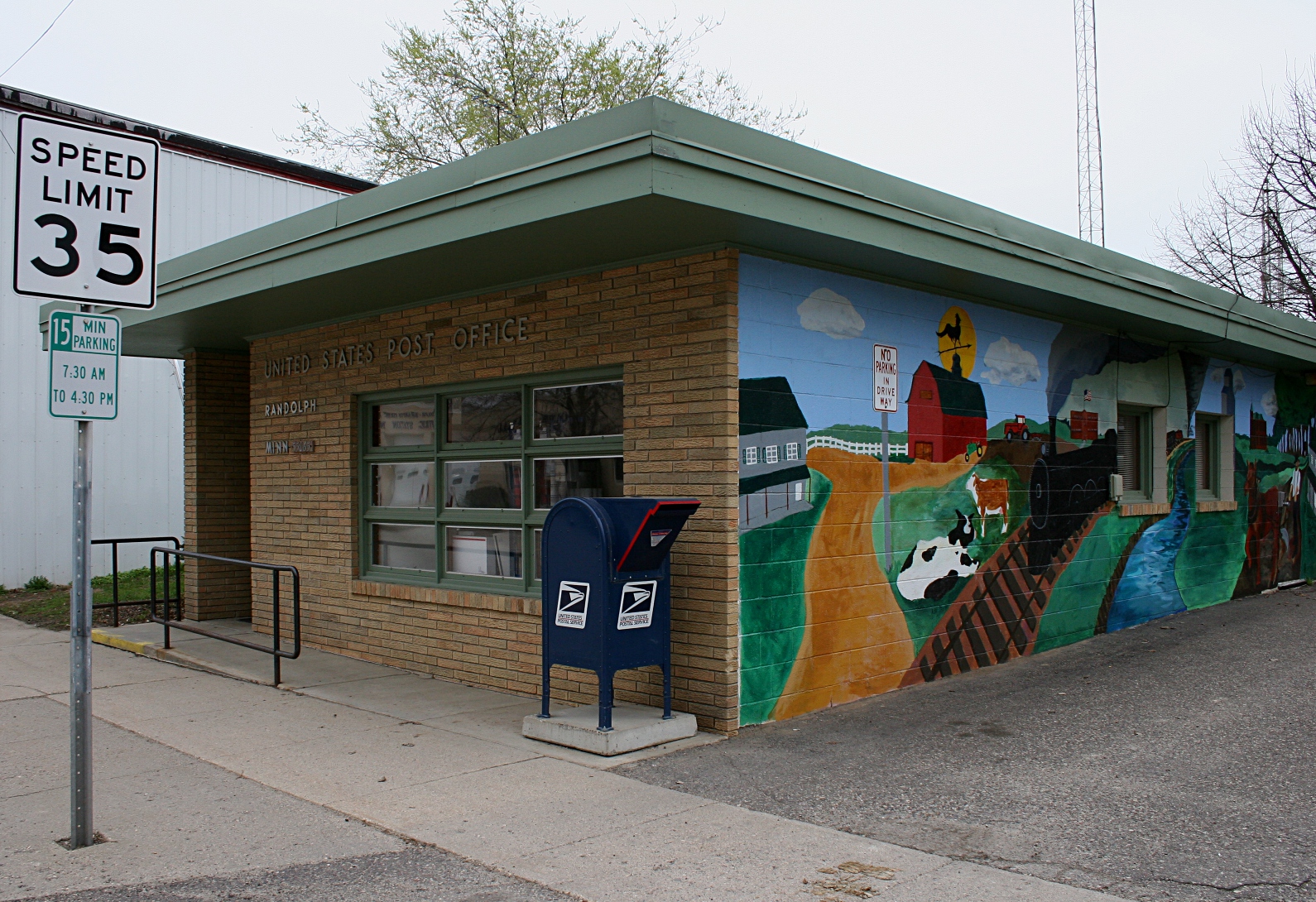
The post office in Randolph is facing reduced hours, dropping from eight daily to four.

This certainly comes as welcome news to the folks in Hope and in many other Minnesota communities. In my region, post offices in Morristown, Warsaw, Kilkenny, Webster, Nerstrand, Dennison, Hampton, Castle Rock and Randolph are facing possible reduced hours.

My hometown of Vesta 120 miles to the west, along with nearby Wabasso, Wanda and Wood Lake, also made the modified hours list.

In every corner of Minnesota and hundreds of places in between, you’ll find those 407 small-town post offices where window service is likely to be trimmed. The Minnesota list fills slightly more than eight pages on a 260-page document that includes some 13,000 post offices across the U.S. To read that list, click here.

The Mantorville post office, where this photo was taken, is on the preliminary list of southeastern Minnesota post offices slated to have daily hours cut from eight to six.

It’s never a good thing, to reduce service in a small town. But closing the post offices would be worse.

I sometimes wonder if the decision-makers have ever set foot in these small towns, if they grasp the importance of a post office as an integral fiber in the fabric of community. Post offices are more than a place to pick up mail, to purchase stamps, to send a package. In these small towns, they are also community gathering places, a locale to exchange news, a spot to reach out to neighbors and a symbol of community identity.

I’ve witnessed, first-hand, how losing a school, a church, a business, can impact a rural community. In Vesta, for example, the town’s 330 residents can’t even buy a loaf of bread or a gallon of milk; they must travel some 20 miles for those staples. I remember when my hometown’s Main Street was lined with businesses, including a grocery store, two hardware stores and more.

Yes, times have changed. We are a more mobile society. We communicate via cell phones and e-mail and Facebook and other social media. But not everyone. In these small towns—the ones where the Postal Service initially considered shuttering post offices—many elderly residents don’t own computers, relying instead on old-fashioned mail delivery to pay bills and send letters and hear from loved ones. The post office is vital to their system of communication.

That the U.S. Postal Service finally heard the loud and clear voice of rural America, and perhaps understood that voice, pleases me as it should thousands of other Americans.

© Copyright 2012 Audrey Kletscher Helbling
 

My mother’s hands May 13, 2012

Filed under: Uncategorized — Audrey Kletscher Helbling @ 8:29 AM
Tags: , , , ,

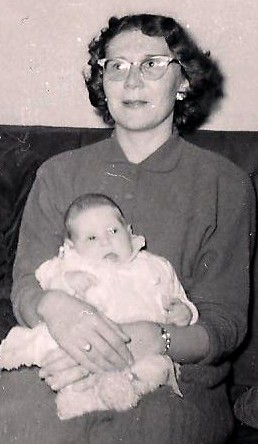
My mother, Arlene, and me.

IT IS THE EARLIEST SNAPSHOT of me and my mom, dated January 1957.

Photos with her are rare; the next comes four years later. Yet, it matters not that my childhood photos fill only a few pages in an album. They are enough to see my mother’s love.

I see it in her hands, always the hands—clasping a baby or holding a toddler or encircling a child.

Hers are the hands that wrapped six babies in blankets, including me, her eldest daughter.

Hers are the hands that guided soiled cloth diapers and my dad’s grimy barn clothes into a Maytag wringer washer.

Hers are the hands that dumped buckets of water into the old tin bath tub on Saturday nights.

Hers are the hands that held books and rocked babies and swiped mecuricome onto skinned knees.

Hers are the hands that seeded seasons of gardens and hoed weeds and preserved the bounty of the earth.

Hers are the hands that peeled potatoes and stirred gravy and fried hamburger into blackened hockey pucks.

Hers are the hands that pressed coins into tiny hands for Sunday School offerings.

Hers are the hands that folded in prayer–for children and husband and her own healing.

Hers are the hands that reached out in love, always, to soothe, to calm, to protect. For nearly 57 years she has been a mother. It has been her life, her calling, and I have been blessed to be her daughter.

These are the hands of my mother, the mother I love always and forever.

© Copyright 2012 Audrey Kletscher Helbling


A mother’s perspective on the Amy Senser hit-and-run case May 8, 2012

Filed under: Uncategorized — Audrey Kletscher Helbling @ 7:09 AM
Tags: , , , , , , , ,

YOU NEVER FORGET. That day. That defining moment when your world stops and panic sears your soul.

My moment occurred six years ago, the morning my then 12-year-old son was struck by a car while crossing the street to his school bus stop within a block of our Faribault home.

May 12, 2006. The day I became all too familiar with the term “hit-and-run driver.”

At approximately 7:40 a.m. a blue 4-door car, possibly a Chevrolet Cavalier or Corsica, struck my boy whose body slammed into the side and/or front of the vehicle, somersaulted through the air and landed alongside the street.

The driver never stopped. Nor has the driver ever been found.

Fortunately my son suffered only minor injuries, although we do not know what the long-term impact will be on his physical health as he ages.

And what about that driver? Why did he/she fail to stop? It is the question which occasionally still haunts me, which early on angered me. It is the question which led me to ask a local philanthropist and the head of the local bus company to contribute money toward a $1,000 reward (which BTW has expired as has the statue of limitations on the hit-and-run).

Why did the driver of the car fail to stop after hitting my child?

I don’t ask myself that question all that often anymore, except around the anniversary date or when I hear of a hit-and-run. Like the case of Amy Senser, wife of former Minnesota Viking Joe Senser, convicted last week in the August 2011 hit-and-run death of Anousone Phanthavong. She was found guilty of leaving the scene of the accident and failure to promptly report an accident, both felonies, and of misdemeanor careless driving.

Ten days after the accident, Amy Senser finally admitted that she was the driver of the vehicle. Senser maintained during her trial, however, that she thought she hit a construction barrel or a pothole around 11 p.m. on that fateful night. Instead, she struck Phanthavong who had pulled to the side of an interstate exit ramp when his car ran out of gas. He was filling the car’s gas tank when he was hit and killed. By a hit-and-run driver. Amy Senser. Who thought she hit a construction barrel or pothole?

Early on in the investigation into my son’s 2006 hit-and-run, local police investigators maintained that the driver of the car fled because he/she had something to hide: driving drunk, driving without a license, driving without insurance, prior conviction…

Six years ago I couldn’t fathom those as “good enough” reasons to drive away from a child you’d just slammed into with your car. I still can’t justify those excuses. As the years have passed and I’ve heard of more and more hit-and-runs, I’ve come to believe the police theory that the driver in my son’s case had something significant to hide.

Yet, I will never, never understand how anyone, in good conscience, can strike someone with their vehicle and then simply drive away. Drive. Away.

#

SEVERAL YEARS AFTER my son’s hit-and-run, I wrote a poem about the incident and eventually entered it into The Jackpine Writers’ Bloc annual writing competition. “Hit-and-Run” subsequently earned an honorable mention in poetry and published in 2010 in The Talking Stick, Volume 19, Forgotten Roads. That book title seems so appropriate.

My poem focuses on my emotional reaction, making this poem especially powerful.

#

Hit-and-Run

In that moment, I know,
as the rivulets of water course down my body,
as I step from the tub
dripping puddles onto the linoleum,
that the sirens wail
for you,
my boy, my only son.

You, who tossed your backpack
over your bony shoulders,
then hurried
toward the street,
toward the bus stop.

While I showered,
you crossed carelessly,
your fragile body bouncing
off the car
you had not seen,
flailing in a somersault,
landing hard on the pavement.
Sirens scream, and I know.

Panic grips,
holds tight my heart,
my very soul,
as I race from the bathroom,
wrapped in a bath towel,
stand immobile,
watching the pulsating red lights
of the police car
angled on the street,
blocking the path to you.

#

ANYONE WITH INFORMATION on the May 12, 2006, hit-and-run case involving my son should contact the Faribault Police Department or Crime Stoppers of Minnesota at 1-800-222-8477. A local investigator told me a year ago that the case remains open and that police will follow up on any tips and leads.

© Copyright 2012 Audrey Kletscher Helbling


Yes, Faribault is a diverse community May 3, 2012

Filed under: Uncategorized — Audrey Kletscher Helbling @ 7:11 AM
Tags: , , , , ,

In this file photo, a Somali family waits to cross a downtown Faribault street.

ON ANY GIVEN DAY, I can drive on a street in Faribault, walk along the sidewalk, glance out my office window or go shopping and see a racial diversity of people.

I can stand in my side yard and look toward the home of an Asian couple. I can glance up the hill and watch two preschoolers, the daughters of a white mother and an African American father, play outside. In my front yard, I can see, several houses down, the Hispanic family that has lived in my neighborhood for years.

Yes, Faribault, population 23,352, is a community of diversity. Thirteen percent of our residents are Hispanic/Latino and another 7.4 percent, black or African American, according to the 2010 U.S. Census. All totaled, about one-fifth of our residents identify themselves as “non-white.”

As my husband would say—and this is not meant at all as derogatory—shopping in at least one local grocery store is like walking into the United Nations. We shop side-by-side with Spanish-speaking Latino families and with Somali women clothed in billowing dresses and head scarves.

Just the other evening, as I entered the local public library, a Sudanese man held the exterior library door open for me while his pre-teen son opened the interior door. It’s been a long time since a young boy held a door for me and I expressed to him my appreciation for his respect and good manners.

The other day, while waiting in the car for my husband to pick up milk at a local convenience store, I observed a cluster of teenaged Somali girls, dressed in head scarves and flowing dresses, move along the sidewalk while, just across the street, a 60-something white woman clad in a jacket resembling an American flag pushed a cart of groceries. It was a unique visual illustrating diversity in Faribault.

Several Latinos lead in singing of Mexico’s national anthem last September during the International Festival at Faribault’s Central Park. Flags represent the birthplace nations of those participating.

The diversity of my community bubbled to the surface Tuesday after I read a comment on City Pages, an online Minneapolis-based information source. A post I published last week about jewelry store thefts in Faribault and elsewhere in Minnesota was linked to in “The Blotter” section as was an article in the Faribault Daily News which identified the jewelry store thieves as “black males.”

Now I don’t want to get into the issue of whether the news reporter should have racially-tagged the suspects. But I was miffed by the first Blotter comment on the blog post.

It looks like “diversity” has now spread to Hastings and Faribault.

That comment was followed by a reply I won’t print here because of the language. But you can read it by clicking here.

So why did the initial diversity comment rile me? Well, I’m tired of over-generalizations that those of us living outside the Twin Cities metro area reside in closed-up communities comprised mostly of Anglo-Americans. We are not just a bunch of white descendants of Scandinavians or Germans or Irish or French… We are racially diverse and growing in diversity.

If you ask the residents of Willmar or Worthington, St. James or Madelia, or many other Minnesota towns, they’ll tell you the same. Latinos, Asians, Somalians, Sudanese and others call outstate Minnesota home.

Diversity spread to Faribault decades ago. Just stroll through my neighborhood.

How diverse is your neighborhood, your small town, your suburb, your city? Let’s hear.

© Copyright 2012 Audrey Kletscher Helbling


Unlocking the poetry within an abandoned farmhouse April 30, 2012

An abandoned farmhouse along Minnesota State Highway 19 east of Vesta on the southwestern Minnesota prairie.

Abandoned Farmhouse

My old bones rattle in the winter wind,
grown weary from years of standing,
bitter cold encompassing my body.

Despair surrounds me
like rot in the weathered heap of the barn,
like rust consuming the junk pile.

Alone, all alone now, abandoned
except for the dying circle of trees
that embrace me, holding me close.

The years have broken my spirit—
too much silence within my walls,
too many tears shed upon my floors.

Left here, without laughter, without hope.
Dreams shattered in my broken windows.
My door closed, locked with a skeleton key.

Abandoned. Desolate. Alone.
Leaning only on the prairie sky,
in a circle of dying trees.

#

IN 2001, THIS POEM published in Poetic Strokes, A Regional Anthology of Poetry from Southeastern Minnesota, Volume 3. To this day, it remains one of my favorite poems among all those I’ve penned.

“Abandoned Farmhouse” retains that status because the poem connects to my past, to rural southwestern Minnesota where I grew up in a cramped 1 1/2-story wood-frame farmhouse. When I was 11 years old, my parents built a rambler with a walk-in basement a stone’s throw across the circular gravel driveway from the old house. They needed the space for their growing family as the sixth, and final, child arrived in August of 1967.

The summer after we moved into the new house, we tore down the old house, board by board. Memories of dismembering that house lath by lath, nail by nail, imprinted upon my memory. Decades later I would recall the bones of the old house, the skeleton key that unlocked the porch door, the grove of trees that sheltered it from the strong winds that swept across the prairie.

I would write this poem, personifying an abandoned farmhouse.

My poetic words reach beyond my childhood home, though, to embrace the many abandoned farmhouses that dot the prairie landscape. I often wonder about the families that lived in these houses and about the stories they would tell.

Returning to an even earlier time period, my poem also reflects a pervasive loneliness that often troubled early pioneer women in a land that could feel desolate, harsh and inhospitable.

This past March, I captured that desolation in an abandoned farmhouse photo (above) taken within five miles of my childhood home. It aptly illustrates my poem.

To this day, I see both beauty, and despair, in abandoned farmhouses.

©  Copyright 2012 Audrey Kletscher Helbling

Shared with you in celebration of National Poetry Month, which ends today, April 30.


Prairie lines April 26, 2012

Filed under: Uncategorized — Audrey Kletscher Helbling @ 6:31 AM
Tags: , , , , , ,

Crisp, straight roof lines define buildings on this farm site along U.S. Highway 14 just minutes west of Springfield in southwestern Minnesota.

I NEVER TIRE of the crisp lines that cut across the southwestern Minnesota countryside. The razor sharp edge of a barn roof. The thick, defined rails of train tracks. The precise spacing of orderly crop rows.

This rich farmland, more familiar to me than any place on this earth, has always been defined by lines. It is the visual perspective I hold of this land that holds my heart.

Crop lines along U.S. Highway 14 west of Springfield in a field that awaits planting.

I cannot view this prairie place without seeing those strong, bold and definitive horizontal lines.

It is the expanse of the sky and of the land in this visually uncluttered place that naturally draws my eyes to rest upon the lines, to lock onto a spot that connects me to a concrete object or to the earth.

This barn stands strong and sturdy between Sleepy Eye and Springfield along U.S. Highway 14.

Consider this perspective the next time you travel through western Minnesota. Forget your preconceived notion of this as a place you simply must pass through to get from point A to point B. View the land and the sky, the small towns and the farm sites, the endless vistas with your eyes wide open, appreciating all that unfolds before you.

A farm site with a smiley face on the barn, between Sleepy Eye and Springfield.

Just west of Springfield off U.S. Highway 14, a gravel road and an orange snow fence cut horizontal lines across the prairie as do the low-slung farm buildings.

A pastoral hillside scene on the edge of Courtland along U.S. Highway 14.

Railroad tracks edge past this farm site along U.S. Highway 14 between Essig and Sleepy Eye. To the right in the photo, a tractor awaits the planting season.

© Copyright 2012 Audrey Kletscher Helbling
 

Minnesota Prairie Roots blog post 1,000 April 15, 2012

Filed under: Uncategorized — Audrey Kletscher Helbling @ 8:33 PM
Tags: , , , , , ,

The prairie just outside of Walnut Grove in southwestern Minnesota, the first photo I published on my blog.

TODAY MARKS a memorable occasion for Minnesota Prairie Roots.

This very story—the one you’re reading right now—marks my 1,000th post.

On July 15, 2009, I published my first piece here on WordPress, introducing a new audience of readers to my blogging which began 18 months earlier at a Minnesota magazine.

The publisher/editor of that magazine decided he couldn’t keep up with my daily blogging. So he cut the blog. While at the time I was upset and disappointed, I see in hindsight that it’s the best thing that could have happened to me as a blogger. My blog has reached new readership levels that I never could have attained within the confines of blogging for the periodical. I was freed to write whenever, and about whatever, I chose.

Let’s look at the statistics to see how my readership has grown. In 2010, my first full year of writing here at Minnesota Prairie Roots, I averaged 201 views per day. A year later, that number reached 442. And this year I’m averaging 697 daily views. In March, I reached a new monthly readership high of 24,484 views. I have no idea how that compares to the stats of other bloggers, but I’m pleased.

Sometimes even I am amazed that so many people are drawn to my stories. They hail from all over the world, to places I haven’t even heard of such as Qatar and Mauritius.

I am grateful for every reader and especially for those who take the time to comment. An exchange of ideas and expressions of thought are integral components in any blog.

Through the nearly three years of blogging at Minnesota Prairie Roots, I have never once struggled with writer’s bloc. Often times I have more material, in words and photos, to share than I have time to post. I write here nearly every day. Not because I “have to,” but because I “need to.”

Rachel Scott, the inspiration for Rachel's Challenge. Photo courtesy of Rachel's Challenge.

What interests readers? Consistently, my top post remains “Rachel’s Challenge: Start a chain reaction of kindness.” I wrote the story in November 2009 after Rachel’s Challenge, a national non-profit that travels the country promoting kindness, presented a program at Faribault High School. The organization is named after Rachel Scott, 17, the first person killed in the 1999 Columbine High School shootings. The presentation made a powerful impact on me and I wrote an equally powerful post that has now been read by thousands.

I am proud of that piece as I am of a series of posts I wrote about the flash flooding in Zumbro Falls in October of 2010. The stories were unplanned, but happened after my husband and I drove into the flood-ravaged community on a Sunday afternoon. Our intentions to view the autumn colors along Minnesota Highway 60 that day vanished when we saw the devastation. I pulled out my camera and notebook and recorded the stories of several women,all flood survivors, both in Zumbro Falls and neighboring Hammond. They showed incredible strength and determination. I still keep in touch with Katie Shones of Hammond, whose home was spared but whose community was nearly destroyed.

When I met Tracy Yennie in downtown Zumbro Falls, the 31-year-old mother of four young boys was living in a shed on her property along the Zumbro River. Her home was flooded during the late September 2010 flash flood. I often wonder what happened to Tracy, who called herself "a redneck," and her family.

To share those stories, to give those women a voice, to publicly recognize their fortitude moved me deeply. There is power in words and images shared with honesty and passion.

Writing is my passion. It is the reason I blog.

I savor sharing my discoveries with you in words and photos. My blog has been termed “probably the best ‘place’ blog in the state,” by respected Iron Range blogger Aaron Brown at Minnesota Brown. He nails it with that “place” tag. My writing has always been rooted in the land. I consider myself an unpretentious, down-to-earth, honest writer.

My blogs have been featured online at Minnesota Public Radio in the News Cut column crafted by Bob Collins. At MinnPost, you’ll find my work often in Minnesota Blog Cabin, which daily features the best work by bloggers from around Minnesota. I’m honored to be part of these respected publications, to offer a glimpse of life outside the metro area.

Beyond that, I have connected with other bloggers and non-bloggers. This world, despite all the negativity, is still brimming with good people. Finding individuals who, like me, possess a passion for writing has been a bonus of blogging.

With that, I want to thank each of you for reading Minnesota Prairie Roots. It is my hope that, through my words and images, I will take you to places you’ve never been or offer you insights you’ve never considered or cause you to pause and savor the simple things in everyday life.

I’ve always appreciated the basics of life and landscape: the fiery glow of a prairie sunset, the scent of freshly-mown alfalfa, a row of just-laundered clothes snapped onto a clothesline, the weathered wood of a once-majestic red barn, the handmade sign marking a Main Street business, the tight clasp of a tulip bud, the unexpected hug of my teenage son, the surprises along a back gravel road…

My writing and photography remain firmly rooted in my rural upbringing on the southwestern Minnesota prairie, the place that inspired my blog name and the place that still holds my heart.

CLICK HERE TO READ my first post on Minnesota Prairie Roots, published 1,000 posts ago.

Copyright 2012 Audrey Kletscher Helbling
 

Where there’s smoke, there’s fire April 6, 2012

Filed under: Uncategorized — Audrey Kletscher Helbling @ 1:50 PM
Tags: , , , , , ,

MY SWEATSHIRT REEKS of smoke, as if I’ve been sitting around a campfire for hours.

But in reality, I’ve only stepped into my backyard for several minutes, into the strong scent of smoke drifting from across the street a few houses away.

Honestly, I could not believe my eyes. Who, in their right mind, would burn leaves in tinder dry conditions like this? Apparently my neighbor.

Only an hour ago, I heard a local radio broadcaster announce a burning ban issued by the sheriff in Rice County. Given the dry conditions, only recreational campfires and grilling are allowed.

Recreational campfires like this one are still allowed. I gathered with extended family around this campfire in Waseca on March 24. This photo is for illustration purposes only.

The National Weather Service has issued a “red flag warning” for the western half of Minnesota from the northern to southern borders. Gusty winds and low relative humidity in an already dry landscape are creating “critical fire weather conditions,” according to the NWS.

Heed the warning, Minnesotans. Use common sense. It doesn’t take a rocket scientist or a warning from the NWS or a directive from the sheriff to tell you that burning leaves, or anything else for that matter, today or anytime soon would be a very bad idea.

I kept expecting to hear the wail of fire trucks racing to my neighbor’s house. I live along a heavily-traveled street. It’s happened before that a passerby has called the fire department when a neighbor has been burning leaves.

HAVE YOU HAD any fires in your neighborhood today or recently? If so, send me a report via a comment.

© Copyright 2012 Audrey Kletscher Helbling
 

Finally, a woman on the Steele County Board April 4, 2012

CONGRATULATIONS, STEELE COUNTY, Minnesota. You’ve finally elected a woman to serve on the County Board of Commissioners. It’s about time.

I could hardly believe the news when I heard it this morning on an Owatonna radio station. It wasn’t the election of a female that surprised me. It was the fact that it’s taken this long.

For the first time in its history, this southeastern Minnesota county will have a woman serving on its county governing board. She is Nina Huntington, a dental hygienist from Owatonna, who beat out opponent Doug Hughes in a special election on Tuesday to represent the Fifth Commissioner District.

Huntington won with 250 votes, or 60 percent, compared to Hughes’ 164 votes, according to an article in the Owatonna People’s Press. Only 10.25 percent of the district’s registered voters cast ballots.

Interestingly enough, Steele County also made headlines on Tuesday as Minnesota’s healthiest county in ratings released by the Robert Wood Johnson Foundation and the University of Wisconsin Population Health Institute. That study considers mortality, morbidity, health behaviors, clinical care, social and economic factors, and physical environment. Click here to read those study results.

So there you have it—Minnesota’s healthiest county now has a woman helping to govern it.

Huntington’s election in Steele County leads me to wonder this:

How many other Minnesota counties have never had a female serve on the county board of commissioners? If you have the answer or can direct me to that information, I’d like to hear. I would guess that number to be quite high.

Also, what do you think a woman can bring to county government that a man may not?

CLICK HERE to read an interview with Huntington published in the Owatonna People’s Press after she filed for office.

CLICK HERE to read the election results story in the OPP.

© Copyright 2012 Audrey Kletscher Helbling