Minnesota Prairie Roots

Writing and photography by Audrey Kletscher Helbling

Discovering New Ulm’s Goosetown, across the tracks and down by the river August 2, 2012

DISCOVERING SOMETHING totally unexpected rates, for me, as the plum, the prize, the most interesting aspect of travel.

And you needn’t journey far to find these places. Last Saturday while driving to southwestern Minnesota, my husband and I stopped in New Ulm because I wanted to see the Defenders and German-Bohemian historical monuments. Well, we never did get to the Defenders marker.

The German-Bohemian sculpture and marker in German Park.

But we eventually got directions for and located the immigrant sculpture overlooking scenic German Park. As lovely and manicured as that park is, and I’ll share photos in a future post, it was not the highlight of our visit.

Rather, it was Goosetown which captured my fancy.

We drove across the railroad tracks and past the old Valley Grain Co. to reach Goosetown.

Goosetown is that side of New Ulm—across the tracks and down by the river—where mostly Catholic German-Bohemian immigrants began settling in the late 1800s. They were primarily farmers or retired farmers, of peasant stock. And they kept geese, which wandered and fed along the banks of the Minnesota River.

Goosetown residents worked at the local roller mills, including the Eagle Roller Mill. That mill and the New Ulm Roller Mill once made New Ulm the third largest milling center in Minnesota. The New Ulm flour millers had elevators in three states.

And so the name Goosetown became attached to southeastern New Ulm, specifically to South Front and South Valley streets. The immigrants who lived here labored in nearby roller mills and breweries and worked as carpenters, masons and cigar makers. Women supplemented the family income by making Klöppel lace and/or sewing feather-filled bedding. Families also gathered clam shells from the river for pearl buttons.

At first thought, it all seems rather romantic, this stretch of Gȁnseviertel next to the railroad tracks and river. But I expect life there was hard as families, many of them living in two-room houses, struggled to survive. I also expect, and New Ulmers can correct me if I’m wrong, that this area of town wasn’t always embraced by the community at large. You know that thing about “the other side of the tracks.” Every community seems to have that part of town perceived as less than positive whether due to poverty or people who are different from the majority. Riverside land (and Goosetown is no exception) was once the site of town dumps, which should tell you something, too.

Sisters Amber, 8, and Kiera, 4, pose with Gertie the Goose, a statue donated by Dr. Ann Vogel of New Ulm and located in Riverside Park.

I likely could have learned even more about the history of Goosetown had the Regional River History & Information Center, 101 South Front Street, Riverside Park, been open. The center is housed in the former Franklin School.

Kiera showed me another goose tucked into a flowerbed in front of the river center.

Today New Ulm embraces the heritage of Goosetown with a plaque and statue in Riverside Park. There’s also an occasional Goosetown reunion and Victor “Fezz” Fritsche, leader of the one-time Goosetown Band, was inducted into the Minnesota Music Hall of Fame in 1991.

The logo for the Goosetown Roller Derby Girls who have names like Deutschland Dolly and SoUr Kraut.

Most recently, in January, a flat track roller derby team, Goosetown Roller Girls, was founded.

Goosetown Storage, once the home of Minnesota Seed Company.

A side view of Goosetown Storage, with signage pointing to its original use as the location of Minnesota Seed Company. Anyone know the history of Minnesota Seed?

At least one building is labeled Goosetown Storage and the New Ulm Fire Department has a Goosetown Fire Station next to the train tracks.

Engine House No. 3, commonly known as the Goosetown Fire Station, was established in 1890. The newer station pictured here houses two pumpers. A 47-foot drill tower (not shown here) stands nearby.

Even so, I was unaware of this ethnic treasure until we happened upon Goosetown on Saturday. New Ulm is best known to the touring public as the site of a major battle during the U.S.-Dakota War of 1862; for the August Schell Brewing Co.; the Hermann the German Monument;  the childhood home of author and illustrator Wanda Gag; the Minnesota Music Hall of Fame;  the Glockenspiel; the Cathedral of the Holy Trinity; Way of the Cross stations; the home of Minnesota’s 14th governor, John Lind; and most certainly as a city that features all things German. You can see how historic Goosetown could get lost in that long list of New Ulm attractions.

If you’re like me and appreciate the lesser-known, less touristy aspects of a community, drive across the tracks and down by the river in Anytown. Perhaps you’ll discover a place like Goosetown, rich in heritage and sturdy brick buildings and stories stitched into the land, if only you knew those stories.

FYI: Please check back for more posts from New Ulm.

© Copyright 2012 Audrey Kletscher Helbling

Goosetown Roller Girls image comes from the team’s website.


Darwin and Alma once owned a 1957 Chevy Bel Air July 27, 2012

Filed under: Uncategorized — Audrey Kletscher Helbling @ 7:18 AM
Tags: , , , , , ,

A 1957 Chevrolet Bel Air, parked along Central Avenue in downtown Faribault during the July 20 Faribault Car Cruise Night.

DARWIN LINGERS, gripping the handles of his wife’s stationary wheelchair as he admires the 1957 India Ivory and Matador Red Chevrolet Bel Air.

Alma seems equally mesmerized, transported back in time to the days of early motherhood and mobility—of youthful legs and a Chevy that hauled her family from farm to town and beyond and back home again.

When the family grew too large, the couple ditched the Bel Air and upgraded to a roomier station wagon.

Admiring the popular 1957 Chevy Bel Air in downtown Faribault.

But on this Friday evening so many decades later with the kids grown, one deceased, the aging farmer and his wife lock their eyes on the Bel Air waxed to a glossy shine. They remember the days of kids piling into the backseat of the 57 Chevy.

Darwin wishes out loud for that Chevy, just like the one parked on a Faribault city street on a late summer evening. Alma, hands clasped in her lap, nods ever so slightly in silent agreement.

I placed my camera on the sidewalk and angled it up to capture this rear view shot of the 57 Bel Air. And, yes, the date on the license plate says 1956. My husband insisted the car is a 57 and I checked numerous sources to verify the year.

I wonder, as I wander away, how many other such memories are sparked by the old cars and trucks parked along Central Avenue during Faribault Car Cruise Night.

As treasured as those vintage vehicles are for their monetary worth, it is the memories which hold the most value. Just ask Darwin and Alma.

Just another shot of the 57 Bel Air because it was so photogenic and I simply fell in love with this Chevy.

© Copyright 2012 Audrey Kletscher Helbling
 

One couple’s affection for a vintage ambulance July 26, 2012

HAVE YOU EVER WONDERED about the types of individuals who own vintage ambulances and hearses. Why? Why would you want a vehicle associated with medical emergencies and/or death?

Craig and Kathy Schuster arrive in their 1969 Cadillac ambulance on Faribault’s Central Avenue.

Craig Schuster of Faribault partially answered that question after he and wife Kathy pulled onto Central Avenue in their 1969 Cadillac ambulance during the recent Faribault Car Cruise Night. I practically pounced to get answers from the couple who are members of The Professional Car Society, Northland Chapter, and have also owned a hearse.

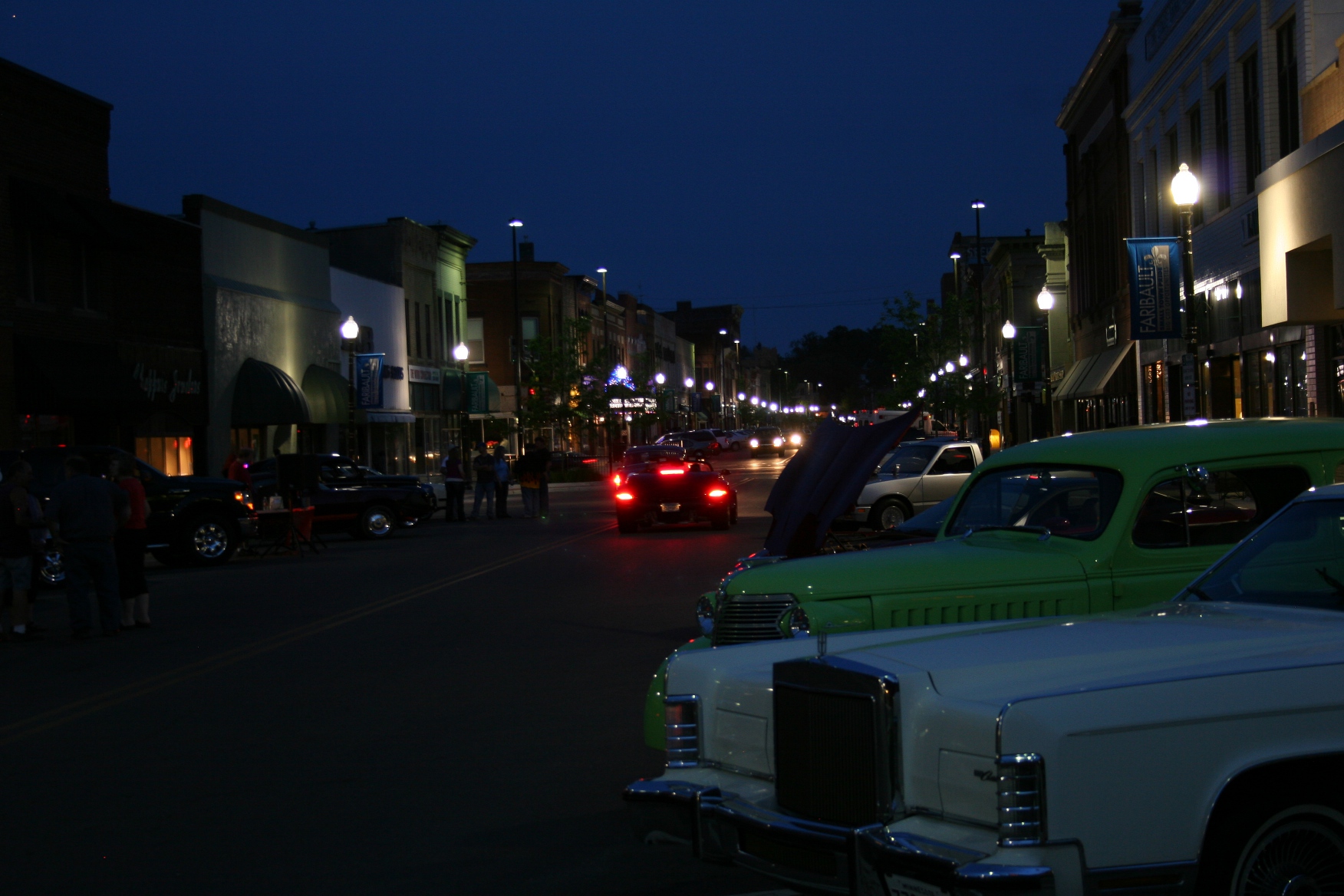
Looking for a parking spot during Faribault Car Cruise Night, held on the third Friday of every month, May – September.

For Craig, the interest in ambulances stretches back to his youth. Growing up in Waseca during the 1950s and 1960s, he admired the ambulances driving through town on their way to Rochester.

“They just tripped my trigger,” says Craig. “I always said, ‘I’m going to work in, drive and own one.’”

And he did—all three. Craig is a casual EMT, plus a barber, although his wife laughs and admits that’s hard to believe given her husband’s long silver pony tail.

Yes, the lights and siren still work. Craig obliged my request to turn on the lights.

The couple’s attachment to ambulances, specifically the 1969 Cadillac, is assuredly one of devotion. They sold the Cadillac in 2006 after four years of ownership, then bought it back this spring. Why? Says Kathy: “We like it.”

Part of Craig’s affection for this particular ambulance likely comes from his belief (or perhaps more accurately, wishful thinking) that this could be the very same ambulance used in the 1977-1983 television drama CHiPS. His ambulance, he claims, is identical to the one seen in the show which features the adventures of two motorcycle-riding California highway patrolmen. I really remember only the handsome and macho Erik Estrada in his role as Frank “Ponch” Poncherello. The ambulance? What ambulance?

As Craig tells it, his 1969 Cadillac ambulance came from southern California and was on the verge of being crushed in a salvage yard when it was rescued and brought to Minnesota.

“I wish this thing could talk,” Craig says. “Maybe it would say, ‘Yes, I’m the one (from the ChiPS show).’”

A peek at the drug overdose patient inside the vintage ambulance.

Though Craig doesn’t know the detailed history of his ambulance, he can tell you about the patient he’s transporting. The man overdosed on bad acid at Woodstock, the 1969 music festival in New York which attracted more than half a million attendees and went down in music history.

My husband, Randy, helps Craig Schuster, left, unload the patient.

Or if you prefer the truthful version, the mannequin comes from a Northfield barbershop and is placed in the front window during that community’s annual Defeat of Jesse James Days celebration in early September.

So there you go—one man’s fun with his vintage ambulance and the reason he owns it.

This could have been a scene straight out of the 70s, minus the modern car on the right.

© Copyright 2012 Audrey Kletscher Helbling
 

For your entertainment: Two perspectives on Faribault’s Car Cruise Night July 24, 2012

Filed under: Uncategorized — Audrey Kletscher Helbling @ 7:26 AM
Tags: , , , , , , ,

A Ford Model A drives into downtown Faribault on Central Avenue during the July 20 Faribault Car Cruise Night.

I NEVER THOUGHT I would find old cars and trucks interesting. Not in a million years.

But I’ve acquired, in recent years, an appreciation for the vehicles of yesterday displayed at local car shows. I credit my smart and talented automotive machinist husband, who is like a walking Wikipedia when it comes to knowledge of vehicles, for my interest. Randy finally convinced me to tag along once to a car show and that was it.

HIS VIEW: Not my color, not at all.  MY VIEW: The graceful curves of a swan hood ornament draw my eye to this street rod.

Our reasons, though, for appreciating these cars and trucks of the past differ. He’ll peer under the open hoods and such while I’m admiring hood ornaments and emblems, the curve and sweep of metal, paint colors and more.

HIS VIEW: Lotta teeth there.  MY VIEW: Can you see my reflections in the shiny, curvy bumper art on this car?

My interest springs from an artistic and photographic perspective. His is more mechanical and practical.

And as a bonus, if I overhear or discover a story or two at these shows, I value the displayed vehicles even more. Watch in upcoming days for several interesting stories from the July 20 Faribault Car Cruise Night. It was quite a night for stories, as you will read. Until then, enjoy these photos.

HIS VIEW: Let’s buy one, but not a yellow one.

MY VIEW: Look how the setting sun glints across the hood as I photograph those magnificent, detailed wheels.

HIS VIEW: That would be a nice old pickup to own.  MY VIEW: Loving the stylish sweep of the front end.

HIS VIEW: Why are you photographing that taillight?  MY VIEW: Just look at those shimmering reds, the honeycomb effect and that royal art.

HIS VIEW: A good cruisin’ car.  MY VIEW: It’s the stripes, the stripes, oh, yes, the stripes that lead my eye across the trunk and beyond.

HIS VIEW: I’d love to own that 1930s vintage Chevy truck.  MY VIEW: I know you would, dear. It is pretty sweet.

HIS VIEW: I didn’t know grasshoppers grew that big.  MY VIEW:  Thanks for making me laugh and bringing back memories, for me at least, of all those grasshoppers on the farm when I was growing up.

HIS VIEW: That’s the inside of a 1967 Chevy Impala Super Sport.  MY VIEW: Look at all those circles, circles, circles.

HIS VIEW: A good looking Pontiac Firebird.  MY VIEW: Art.

HIS VIEW: Insert key here.  MY VIEW: I’ve never noticed a rocket emblem before on a car (Oldsmobile Ninety Eight).

HIS VIEW: Check out the motor.  MY VIEW: One sweet Chevy.

HIS VIEW: Just the front of a Buick.  MY VIEW: Vertical lines on the front of the car and the building behind create a pattern.

MY VIEW and maybe HIS VIEW, too: Nice curves.

MY VIEW: A fancy, schmancy MG with a royal air. HIS VIEW: I never cared too much for British cars.

OUR VIEW: Lost in the 50s, 60s, 70s…on a Friday evening in downtown Faribault.

© Copyright 2012 Audrey Kletscher Helbling
 

Driving into a ghost town on Hogsback Road July 23, 2012

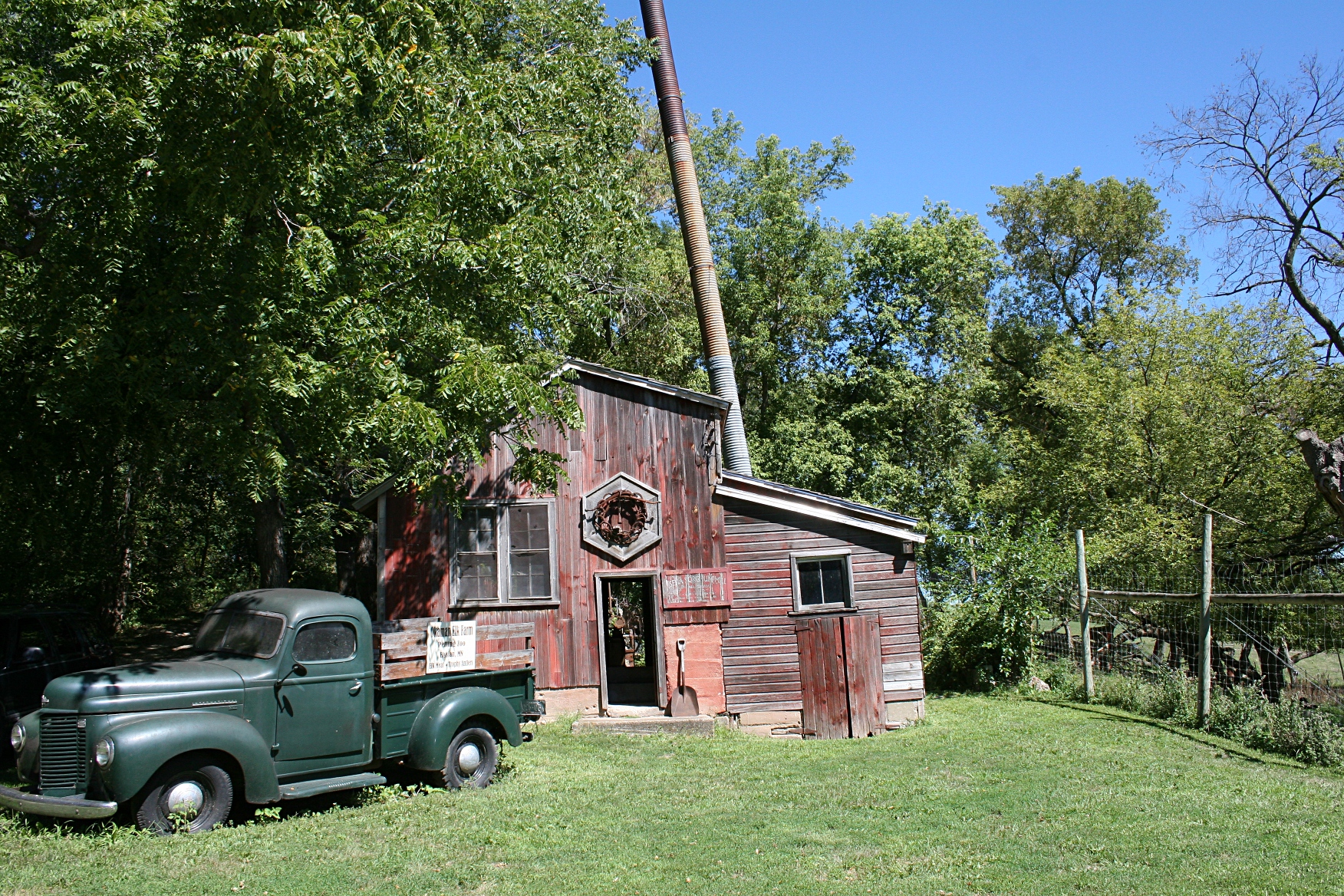
An old building, perhaps a former blacksmith shop, in Belvidere Mills.

GHOST TOWNS INTRIGUE ME. I wonder—who lived in these places and were these towns once thriving and why did people leave?

Often, placement of the railroad determined which Minnesota town survived, which did not.

Recently my husband and I, on one of our day trips, turned off Goodhue County Road 3 about 10 miles south of Red Wing, onto Hogsback Road and into Belvidere Mills.

Yes, Hogsback Road. When you read a street sign like that, you just know there’s a story somewhere that’s been passed down from generation to generation. If only I knew the right old codger to consult for a little history lesson on the road that now also is called Wellscreek Trail. I’ll travel on Hogsback Road, thank you.

The former Belvidere Mills creamery, modernized into a garage.

The first view we got of the lovely old barn in Belvidere Mills.

And so we did, up the hill on Hogsback Road past a handful (or less) of houses and the old creamery and a stately red barn and past another old building (perhaps a blacksmith shop), around a curve in the gravel road and we were already out of Belvidere Mills. We turned around and backtracked.

Our second view, the side, of the barn as we backtracked into the ghost town.

And back again past the old building in the top photograph, this a side shot. What is it, readers?

Thanks to signage placed by the Goodhue County Historical Society along the county road, we knew this was the site of the former Belvidere Mills, established in 1858.

The historical society has marked some 60 ghost towns in Goodhue County with signage to “preserve their history and to recognize their historical contribution.” All either once had, or currently have, post offices.

They also have intriguing names like Black Oak, Cannon Junction, Featherstone, Roscoe Centre, Skyberg and White Willow.

And then there are the Goodhue County Minnesota ghost towns of—ready for this—Lena, Norway and Miami.

© Copyright 2012 Audrey Kletscher Helbling
 

The old blacksmith is watching, just ask John July 20, 2012

A sign tacked onto the blacksmith shop at the Village of Yesteryear in Owatonna reads: It reminds us of the “horse and buggy” days gone by. A lot of horseshoes, buggy and wagon wheels came in and out of the Bixby shop, as well as other blacksmith shops throughout the county. These shops were an essential part of all villages, towns and cities in the 1800’s.

INSIDE THE OLD BLACKSMITH SHOP, John Styndl is reading the newspaper on a lazy summer Sunday afternoon. He has no intention of firing up the forge or picking up the tools to demonstrate how his great great grandfather, Frank Styndl, once pounded hot metal into useful equipment or shaped shoes for horses.

Instead, he takes pride in telling visitors about the blacksmith shop Frank built on his farm east of Bixby in 1896, ten years after the Styndl family immigrated to the U.S. from the Czech Republic. Frank worked as a blacksmith in the Old Country and then in his own shop in Steele County, Minnesota, until his death in 1931.

Today that blacksmith shop sits on the grounds of the Steele County Historical Society’s Village of Yesteryear in Owatonna which, on a recent Sunday, hosted an historical extravaganza. John was volunteering in the blacksmith shop when I entered through double sliding doors into a dark room illuminated by the blinding glare of a bare light bulb and sunlight filtering through doors.

John in Frank’s blacksmith shop where, “all the equipment in the shop such as wheelbenders, drill presses, bench vises, foot grinders, files, hammers, tongs and other equipment were used by Frank.”

Rusty tools and horseshoes cling to the walls and a cut out, near life-sized photo of Frank leans next to an anvil draped with horseshoes as great great grandson John speaks about his interest and work in preserving the blacksmith shop.

He remembers biking past the abandoned blacksmith shop as a kid, asking his father about the faded signage on the building. His father and a great uncle did occasional blacksmithing, but nothing like that of three generations of the Styndls prior who earned their livelihoods as blacksmiths.

John dreamed of someday moving Frank’s shop to the Village of Yesteryear. Eventually that became a reality and, from 1991 – 1996, his family and neighbors worked to restore the building. He even found an old house chimney from the appropriate time period, knocked off the mortar and rebuilt the 240 bricks into a new chimney.

Family photo of John and Frank Styndl.

“I’m glad to be able to preserve it,” John says of F. Styndl’s blacksmith shop. He’ll tell you, though, that he gets a bit uneasy with Great Great Grandpa Frank’s likeness watching his every move.

About that time in our conversation, another visitor steps into the blacksmith shop and shares how he remembers, years ago, observing his local blacksmith, bent over, toiling in the heat of his shop. “He was always cranky,” he notes.

The three of us laugh and figure we’d be crabby, too, in such uncomfortable working conditions.

It is stories and remembrances like this which make a building like the old blacksmith shop more than just a structure occupying space at a site such as the Village of Yesteryear.

Stories connect buildings to people and to the past.

You need only take the time to pause and ask, to listen and to observe, if you are to understand the history that has molded lives and communities and is still shaping the future.

CLICK HERE TO READ a previous blog post about the Steele County Historical Society’s Extravaganza at the Village of Yesteryear. Then click here to read a second post on the event.

© Copyright 2012 Audrey Kletscher Helbling


Five things to do this weekend in the Faribault area July 19, 2012

FROM TEA TO TRACTORS and plenty of in-between interesting attractions, you’ll find lots to do this weekend in my region of southeastern Minnesota.

I shot this image at the Rice County Free Fair several years ago.

Already underway and running through Sunday is the Rice County Free Fair in Faribault. Evening grandstand shows include Enduro Auto Races on Thursday, an All-Star Pro Rodeo on Friday, a National Truck & Tractor Pull on Saturday and a Demolition Derby on Sunday. Besides the entertainment, you’ll want to stroll through the barns, the midway and the exhibit buildings, plus sample some fair food.

John Deere tractors galore lined up at the 2009 Rice County Steam & Gas Engine Show. I have never attended the Credit River Antique Tractor Club Show near New Prague.

In nearby Scott County, tractors take center stage (or rather space) at the annual Credit River Antique Tractor Club Show which runs from 8:30 a.m. – 7 p.m. Friday, July 20, through Sunday, July 22. To get there, take Exit 76 on Interstate 35 and go west on Scott County Road 2 for about 11 miles.

From a tractor parade to flea market, entertainment and more, this promises to be a family-friendly event in a beautiful rural setting. My friend Nancy Fredrickson of Lakeville tipped me off to the tractor show. Says Nancy: “It’s set up at Cedar Lake Farm Regional Park outside of New Prague where the tractors and vendors are scattered under big beautiful trees on hillsides that lead past the old barn and down to Cedar Lake shore.”

Nancy and her husband, Gordon W. Fredrickson, will be there, near the entrance, selling their collector series Farm Country Tales and If I Were a Farmer books. Readers, Nancy and Gordon are two of the finest, down-to-earth people you will meet. Plus, their rural-themed picture books are about as real and honest and authentic as they come. I highly-recommend these books to anyone interested in farming from years past.

Hanging out along Central Avenue during Faribault Car Cruise Night in May.

If classic cars are your thing, then take in, or participate in, the Faribault Car Cruise Night from 6 p.m. – 9 p.m. Friday in the 400 and 500 blocks of Central Avenue in the heart of historic downtown Faribault. According to the group’s Facebook page, “…if you have a cool car or truck or motorcycle, bring it down.”

The Paradise Center for the Arts theater, this photo from several years ago and the set for “South Pacific.”

Also on Friday, but in the 300 block of Central Avenue, the fractured fairy tale, “Into the Woods,” opens at 7:30 p.m. at the Paradise Center for the Arts. The Faribault theater and the Northfield Arts Guild are collaborating on the musical which continues on selected weekdays and weekends through August 5.

Betsy cuts Tacy’s hair in this snippet from a mural by artist Marian Anderson in the Maud Hart Lovelace Children’s Wing at the Blue Earth County Library in Mankato.

Finally, 40 miles away in Minneapolis and Mankato, the Betsy-Tacy Society is holding its annual convention. The organization focuses on celebrating the Betsy-Tacy children’s book series written by Mankato author Maud Hart Lovelace. I love, love, love these books about three friends growing up in Deep Valley (Mankato) in the late 1800s and early 1900s. I read the series to my young daughters two decades ago and we, even to this day, occasionally call my second daughter Tib, after Tib from the books.

It’s probably too late to get into the convention, but you can still join in on some of the fun by attending the free Betsy-Tacy Storytime Tea from 10:30 a.m. – noon Saturday at the Barnes & Noble Bookstore, River Hills Mall, Mankato. A Maud Hart Lovelace interpreter will read from Betsy-Tacy and photos can be taken with Betsy and Tacy. Visitors can also shop at the Betsy-Tacy Bookfair at Barnes & Noble.

The childhood home of Maud Hart Lovelace (aka Betsy), author of the Betsy-Tacy series first published in 1940.

The houses where Lovelace (Betsy in the books) and her friend Frances “Bick” Kenney (Tacy) grew up are owned by the Betsy-Tacy Society and are open to the public. They are a must-see for any fan of Lovelace’s books, although this weekend may not be the best time to tour the homes if you prefer elbow room to crowds.

There you go. Five things you can do within 40 miles of Faribault this weekend.

What are your plans?

FYI: You probably already know this, but just in case you don’t…  By clicking on the highlighted phrases/sentences within the post, you will be directed to more detailed information about the featured events.

© Copyright 2012 Audrey Kletscher Helbling


Oh, the places I should have visited in Lake City

A side street in the downtown business district of Lake City Minnesota.

SO…YOU DRIVE into a town you’ve never been to and you and your traveling companion wonder where to eat, what to do, which places to visit.

How do you decide?

Trust the locals? Trust your instincts? Just start walking and see where the sidewalk leads you?

I suppose those thoughts run through any visitor’s mind upon arrival in an unfamiliar community. To my list I add the decision of what to photograph, made easier by ownership of a DSLR camera. As long as I have space on my CF cards, and a patient husband, I keep shooting.

Then back home, upon review of those images, I can see the places I missed because of time constraints or another restaurant chosen or a business closed for the day and I have visible reasons to return.

Here is photographic evidence for returning to Lake City, a southeastern Minnesota Mississippi River town my spouse and I recently visited on a way too hot summer afternoon in early July.

I’m not a boater, nor a swimmer. But the water still draws me close to gaze upon, to appreciate, its mesmerizing beauty. Next trip back to Lake City, my husband and I need to find a park along Lake Pepin where we can simply sit and enjoy the water or perhaps stroll along a beach. That treeline across the lake/river is Wisconsin.

The Lake Pepin Pearl Button Co. antique shop features a little nook of a room off the spacious main shop area, exterior pictured here, in which I need to spend more time poking around. Poke, poke, poke.

The entry to Bronk’s Bar and Grill angled into a downtown Lake City street corner caught my attention. Was this once a movie theater? No matter, Bronk’s claims “the best hamburgers in Lake City” made from only local fresh meat. Anyone eaten here?

Unfortunately, Rabbit’s Bakery was closed on the Tuesday I was in Lake City or I surely would have stopped in here. Any business with “Rabbit” as part of its name naturally draws me to it given I graduated from Wabasso High School, home of the white rabbit. This photo was also encouraged by my husband who once (and still occasionally) called one of my sisters Rabbit. Love the graphic.

© Copyright 2012 Audrey Kletscher Helbling
 

Antiquing with my husband in Kenyon and Lake City July 17, 2012

A sweet little gallery and antique shop, The Kenyon Gallery in Kenyon.

I AM ONE OF THOSE ANTIQUE SHOPPERS, emphasis on the word those.

Allow me to explain. I enjoy browsing through antique stores, but I seldom buy. Why? I am cheap and prefer to find my collectibles and antiques at thrift stores and rummage sales.

Perhaps that word cheap isn’t quite right. Let’s change that to budget conscious. Yes, that’s better.

It’s not that I haven’t ever made an antique store purchase. I have. Just not that often. I am sorry, antique dealers. I do appreciate you and all the effort you put into finding, displaying and selling your merchandise.

Loved this unassuming casual country style table setting inside The Kenyon Gallery.

I’ve always wondered, though, how can you bear to part with your treasures? If I had to give up one of my two dozen or so vintage tablecloths, I would struggle. Oh, yes, I’ve done that, loaning several to my eldest daughter. The emphasis here would be on the word loan.

Recently my husband and I took a day trip to Lake City, which is on Lake Pepin (aka a wide spot in the Mississippi River). But before we reached that southeastern Minnesota town, we stopped in Kenyon at The Kenyon Gallery, a shop that markets a mixture of merchandise including $5 frames, framed prints, antiques and collectibles.

Here are three particularly interesting items I eyed up with my camera until my husband said, “We’ve gotta keep moving along here.” He was right and out the door we went, still aiming for Lake City.

The design on these chair backs intrigues me; I’ve never seen anything like these chairs. Readers, do you know anything about these chairs or their value?

I call it art although both pieces really have to do with something involving the making of furniture. I think.

I grew up on a dairy farm. What can I say?

Before we got there, though, we had to stop in Bellechester and check out a cornfield.

And then we were back on the road to Lake City. The husband might have repeated, “We’ve gotta keep moving along here.”

The Lake Pepin Pearl Button Co, a must-stop antique store in Lake City.

If you’re into antiquing, you’ll like the shopping in this riverside town. The Lake Pepin Pearl Button Co., located in a former button factory and dry goods store and with around 40 antique dealers, will easily occupy you for hours, if your spouse is patient. Not that I window-shopped for hours. But I could have.

A nickel for your fortune and a nickel for the foodshelf at the Button Co.

Pop art style graphics and my childhood fondness for 7-UP made this sign a tempting purchase at the Button Co.

So onward we traipsed in the heat and humidity.

A 1957 pen and ink drawing print by M.M. Swanston.

In the basement of Mississippi Mercantile (don’t you love the names of these antique stores?), I spotted this unusual portrait of Abraham Lincoln.

On to the Antique Shopper, I found plenty of appealing merchandise on the main level and in the basement of this multi-dealer venue.

My mom used snack sets to serve company when I was growing up, the reason I am typically drawn to these fancy dishes.

I had a tough time passing up these vintage bowls in the Antique Shopper. I have this thing for bowls, as my husband and kids will tell you. And these are beauties, unlike any I’ve seen.

Simply a graceful display highlighted by that Greta Garble photo.

Just as we were heading for the door, my spouse spotted an antique Grain Belt beer cooler under a table and paused to admire it.

My husband lingered at this Grain Belt cooler in Antique Shopper.

The oppressively hot, humid and smothering weather coupled with a strong desire to swig a cold one compelled both of us to just stand there for a few seconds and stare.

But then I snapped out of my heat-induced stupor. “We’ve gotta be moving along,” I muttered and out the door we went.

CLICK HERE TO LINK to a previous post about Lake City, specifically its pearl button-making history.

© Copyright 2012 Audrey Kletscher Helbling


Discovering a historic gem (pearl) in Lake City July 16, 2012
A view of downtown Lake City, Minnesota.

DRIVING INTO LAKE CITY on a recent sultry summer afternoon, I expected to learn about water skiing in this Lake Pepin side community which calls itself the birthplace of that water sport.
Lots and lots and lots of sailboats are moored in Lake City.

After all, the popularity of water sports is evident in the sailboats crammed and tethered in the harbor on a weekday, waiting to be unleashed on the weekend.

I wanted to check out the sculpture (an anchor?) along Lake Pepin, but no parking was allowed and the weather was too hot to walk any distance. That’s Wisconsin across the lake. Beautiful scenery here in this busy water sport area.

And around the bend, fancy yachts—at least that’s what I call boats so big that one arrived on a semi—float in the bay. And a bit farther, boaters enjoy a summer afternoon on the lake.

Nautical-themed merchandise perched on a window on the second floor of Treats and Treasures. The “treats” are homemade candy, found downstairs in the treats section.

Offshore, too, you’ll catch the nautical theme of this Mississippi River town in business names and merchandise.

A side view of the Lake Pepin Pearl Button Co., now an antique store featuring merchandise from some 40 dealers.

But, if you happen to walk into the Lake Pepin Pearl Button Company, which is today a place of “the old, odd and unusual,” you will learn the gem of history I found most interesting about Lake City. Dave Close, who along with his wife, Juleen, runs the aforementioned antique store, will educate you about Lake City’s role in making pearl buttons.

It’s fascinating to hear about clammers who once harvested freshwater clams from Lake Pepin, delivering them to the Lake Pepin Pearl Button Company and The Wisconsin Pearl Button Company (according to Steve Swan at Swan Jewelers). Both Swan and Close can offer detailed oral histories about local button making.

The Closes have this display of clam shells and button blanks in their shop.

According to Close, about 50 percent of the buttons in the world once came from the Upper Mississippi River, north of Ohio. That included Lake City, where factory workers sawed button “blanks” from clam shells before shipping the 50-pound burlap bags of clam shell cut-outs downriver to button finishing houses in La Crosse, Wisconsin, and Muscatine, Iowa.

Old photos and more pay homage to this building’s former use as the Lake Pepin Pearl Button Co.

Next to the still operating original freight elevator, the Closes have posted vintage photos and other items, including these clamming bar hooks. Note also the beautiful original wainscoting from the building.

Dave Close, co-owner and in-house historian at the Lake Pepin Pearl Button Co.

Close has created a mini museum about this side of Lake City’s history behind the counter and in a corner of the 1866 former dry goods store which housed the button company from 1914 – 1920. It is the building’s history and Close’s clear appreciation for that history, which set his business apart from your typical antique shop. You need only notice the clam shells on the counter, the rainbow of buttons secured to his straw hat and the Pearl Button signage, inside and outside, to inquire about the Lake Pepin Pearl Button Company.

Two freshwater pearl rings crafted by jeweler Steve Swan of Swan Jewelers in Lake City.

Nearby, Swan also honors Lake City’s button past via a display in his jewelry store that includes jewelry he’s crafted from the pearls of freshwater clams. Up until about a dozen years ago, when the Minnesota Department of Natural Resources halted clamming operations on the river, this jeweler was buying from clammers.

However, the once thriving pearl button making industry ended long before that, in the late 1930s, when plastic buttons replaced pearl buttons, according to Swan.

All of this I learned on a sultry summer afternoon in Lake City, the birthplace of water skiing.

WATCH FOR ANOTHER POST from this southeastern Minnesota community of some 5,000 residents and many, many, many boats.

© Copyright 2012 Audrey Kletscher Helbling