Minnesota Prairie Roots

Writing and photography by Audrey Kletscher Helbling

Help Heather thank our veterans November 7, 2011

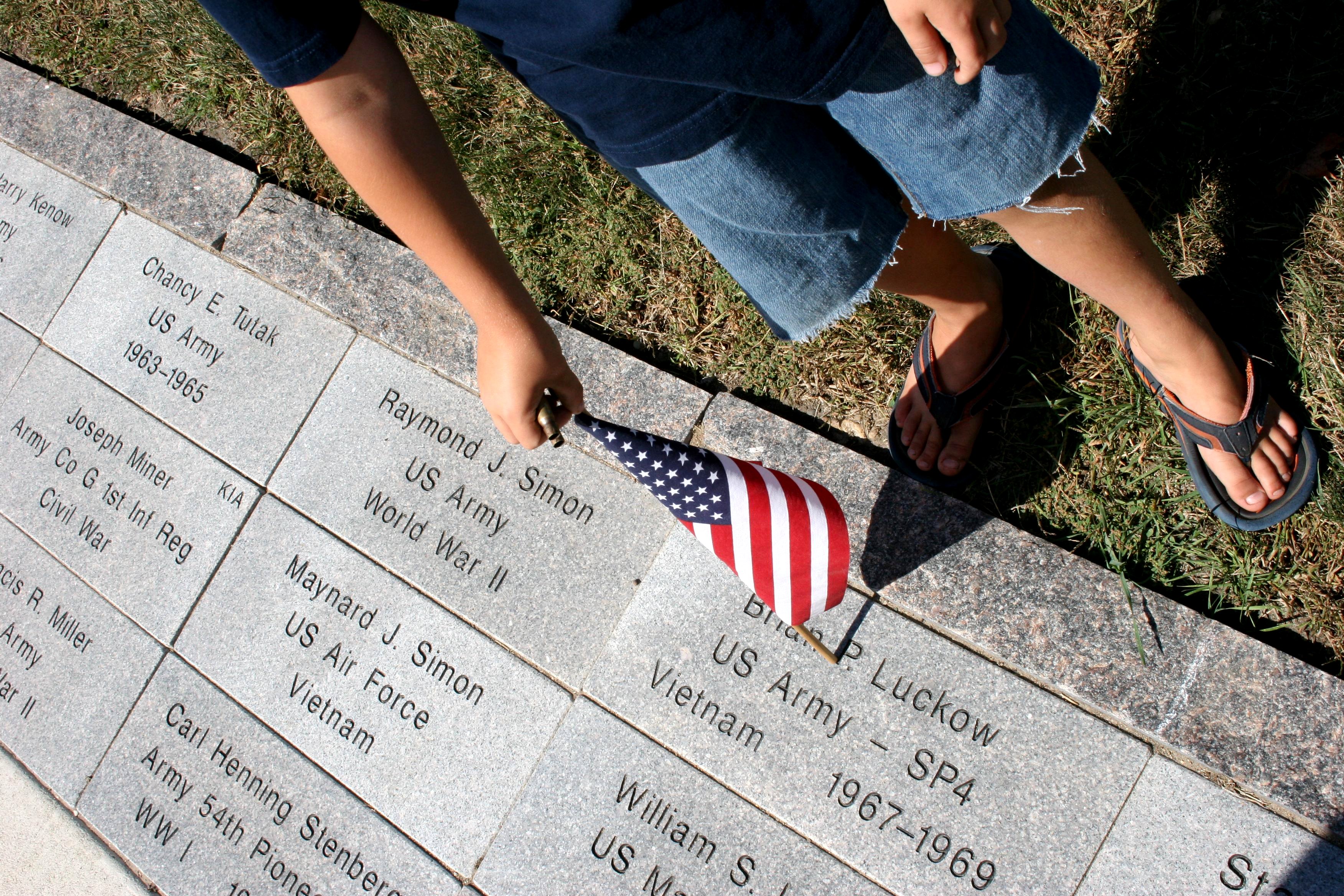
A young boy peruses the pavers at the Rice County Veterans Memorial in Faribault on September 11.

SOMETIMES I HEAR SNIPPETS of news that truly touch me.

Take the piece I caught today about 13-year-old Heather Weller of New York Mills. For the past two years, she’s made and collected thank you notes to share with veterans on Veterans Day. She’s engaged classmates, family, friends and even strangers in her “Thank a Veteran” project.

Heather has hand-delivered the thank you notes to the Minnesota Veterans Home in Fergus Falls where her great uncle, Korean War veteran Philip Andrie, lived until his death on Christmas Day 2010.

Now, with only days remaining before Veterans Day on Friday, November 11, Heather put out this plea yesterday on her Facebook page:

I’m feeling sad… I have hardly received any Thank you e-mails yet this year. PLEASE just a quick second to e-mail a thank you! Whats a few seconds compared to years of sacrifices that our Veterans made for us?
It is important to Thank our Veterans all year around but right now I especially work on my e-mail campaign to collect as many Thank yous as possible to take the Veterans Homes for Veterans Day. Please send an e-mail thank you to veteranthankyou@gmail.com or to kristiweller@yahoo.com or leave a message on this page by November 9th. I will take the messages to Veterans Homes on Nov 11th. It so important to remind our Veterans & their families that they are Never forgotten! Thank you!

Will you help by leaving a message on Heather’s Facebook page or e-mailing a thank you note that she will deliver to veterans? Heather would like these messages by Wednesday, November 9.

Click here to go to Heather’s “Thank a Veteran” Facebook page.


Honoring veterans with a little R & R October 28, 2011

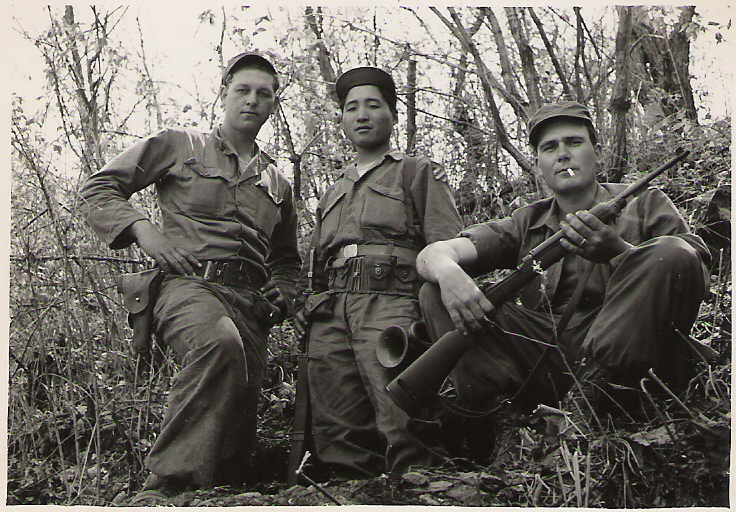
My father, Elvern Kletscher, left, with two of his soldier buddies in Korea.

MENTION KOREA and my thoughts automatically flip to my father, a veteran of the Korean Conflict, or Korean War, or whatever title you want to attach to that hellish war.

My dad, Elvern Kletscher, fought on the frontline in the cold, cold mountains of Korea. He killed men so close he could see the whites of their eyes. He saw a buddy blown apart in front of him, the day before Ray was to return home to the States, to Nebraska, to see his baby daughter for the first time.

Shrapnel struck my dad at Heartbreak Ridge and embedded into his neck. Just like all those awful experiences that embedded into his memory. Horrible, nightmarish memories he could never shake. Never.

So I am thinking of my dad today as I pull together this post about how the Historic Hutchinson House Bed and Breakfast in Faribault is honoring qualifying veterans by giving away a free night’s stay in the B & B’s five guest rooms on November 10.

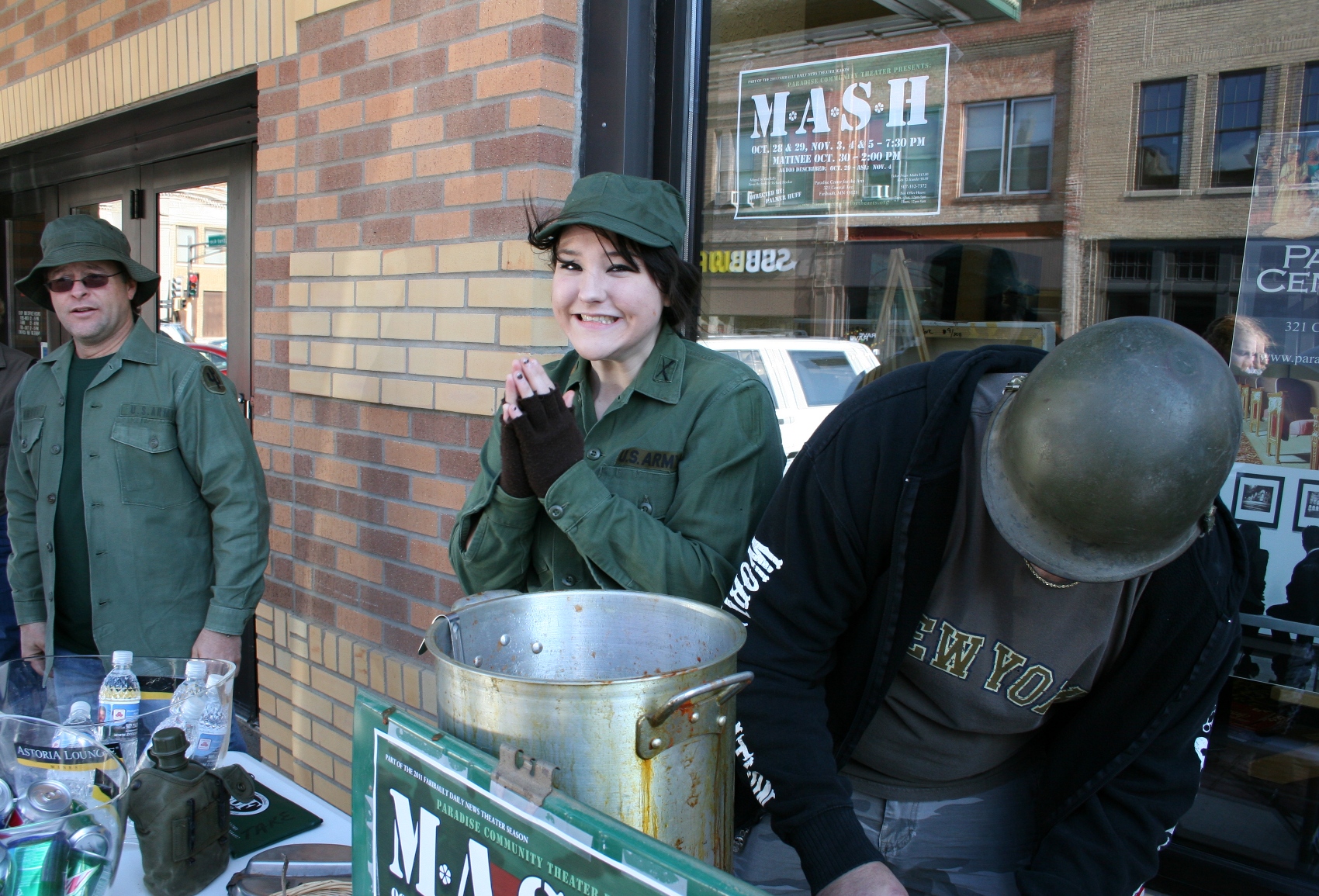
The give-away coincides with the Faribault Community Theatre’s production of M.A.S.H., which opens tonight and continues at 7:30 p.m. October 29 and 30 and November 3, 4 and 5 and then at 2 p.m. on October 30 at the Paradise Center for the Arts.

Volunteers at the Paradise Center for the Arts promoted M.A.S.H. and served chili samples at the recent Faribault Fall Festival and Chili Cook-Off.

Tami Schluter, who co-owns the Hutchinson House B & B with her husband Doug, came up with the give-away idea after M.A.S.H. director Palmer Huff asked his cast for a way to honor veterans as part of the theatrical performance.

M.A.S.H. tells the story of the 4077th Mobile Army Surgical Hospital based in South Korea during the Korean War and Tami plays the part of chief nurse, “Hot Lips” Houlihan.

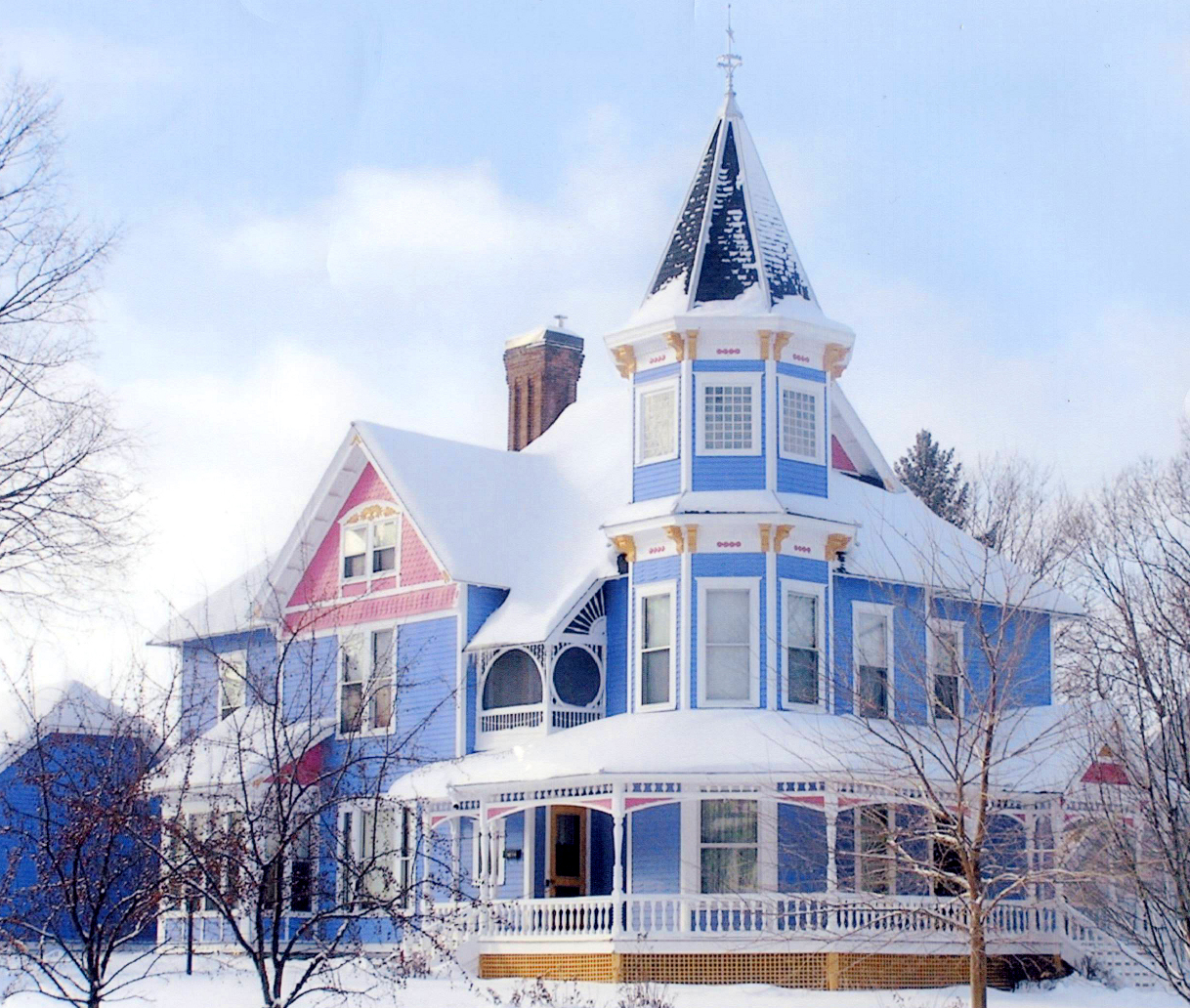
The Historic Hutchinson House B & B in Faribault

The Schluters last year participated in a program among North American B & Bs offering free rooms to veterans on November 10. So it was a natural to open their 1892 Queen Anne-style Victorian home again to veterans at no cost for one night “to say thank you to all those who have served our great country,” says Tami.

Those selected for the complimentary one-night Hutchinson House R & R (with a guest), and a three-course breakfast the following morning, will come from among qualified active and retired military personnel. To qualify, registrants must attend the M.A.S.H. production at the Paradise and leave their contact information in the theater lobby drop-box. Proof of veteran status will also be requested.

Winners’ names will be drawn on Sunday, November 6.

Then, on November 10, the honored veterans and their guests will meet “Hot Lips” Houlihan, aka Tami, at her B & B.

If my dad was still alive—he died in 2003—I’d invite him to attend M.A.S.H. with me and try for that free night at the Historic Hutchinson House B & B. My Purple Heart-pinned father would have been so deserving given all he’d been through on the battlefields of Korea.

Instead, I’ll just cross my fingers and hope a Korean War veteran is among those who win the one-night get-away and awaken on 11-11-11, Veteran’s Day, to that three-course gourmet breakfast served by the Schluters.

FYI: Three other Minnesota B & Bs are participating in the B & Bs for Vets Program: Hillcrest Hide-Away B & B in Lanesboro, Deutsche Strasse B & B in New Ulm and Classic Rosewood Inn in Hastings. According to online information, rooms for vets are already filled at the Lanesboro and New Ulm B & Bs.

To check out the Historic Hutchinson House B & B, click here.

For information on the M.A.S.H. production at The Paradise Center for the Arts in downtown Faribault, click here.

TO READ A STORY I wrote about my father’s time in Korea, published in 2005 in God Answers Prayers Military Edition–True Stories from People Who Serve and Those Who Love Them, click here. This collection of military stories was compiled by Allison Bottke and published by Harvest House Publishers.

© Copyright 2011 Audrey Kletscher Helbling

Historic Hutchinson House photo courtesy of Tami Schluter


Remembering 9/11 in Faribault, Minnesota September 11, 2011

WE CAME. We listened. We prayed. We remembered.

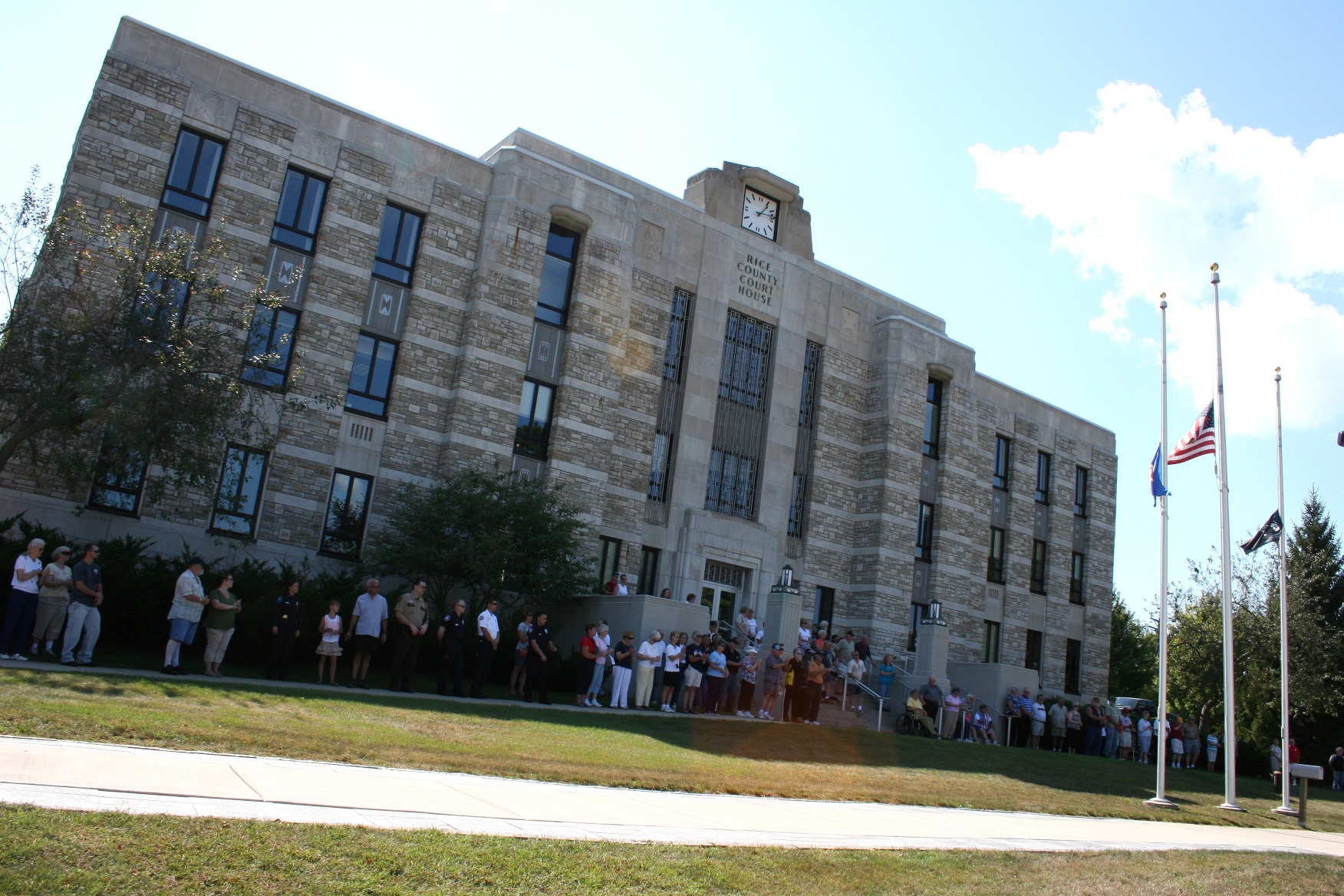
This afternoon my husband and I were among perhaps 100 individuals who gathered outside the county courthouse at the Rice County Veterans Memorial in Faribault to remember September 11, 2001.

A view of the crowd in front of the Rice County Courthouse and veterans memorial.

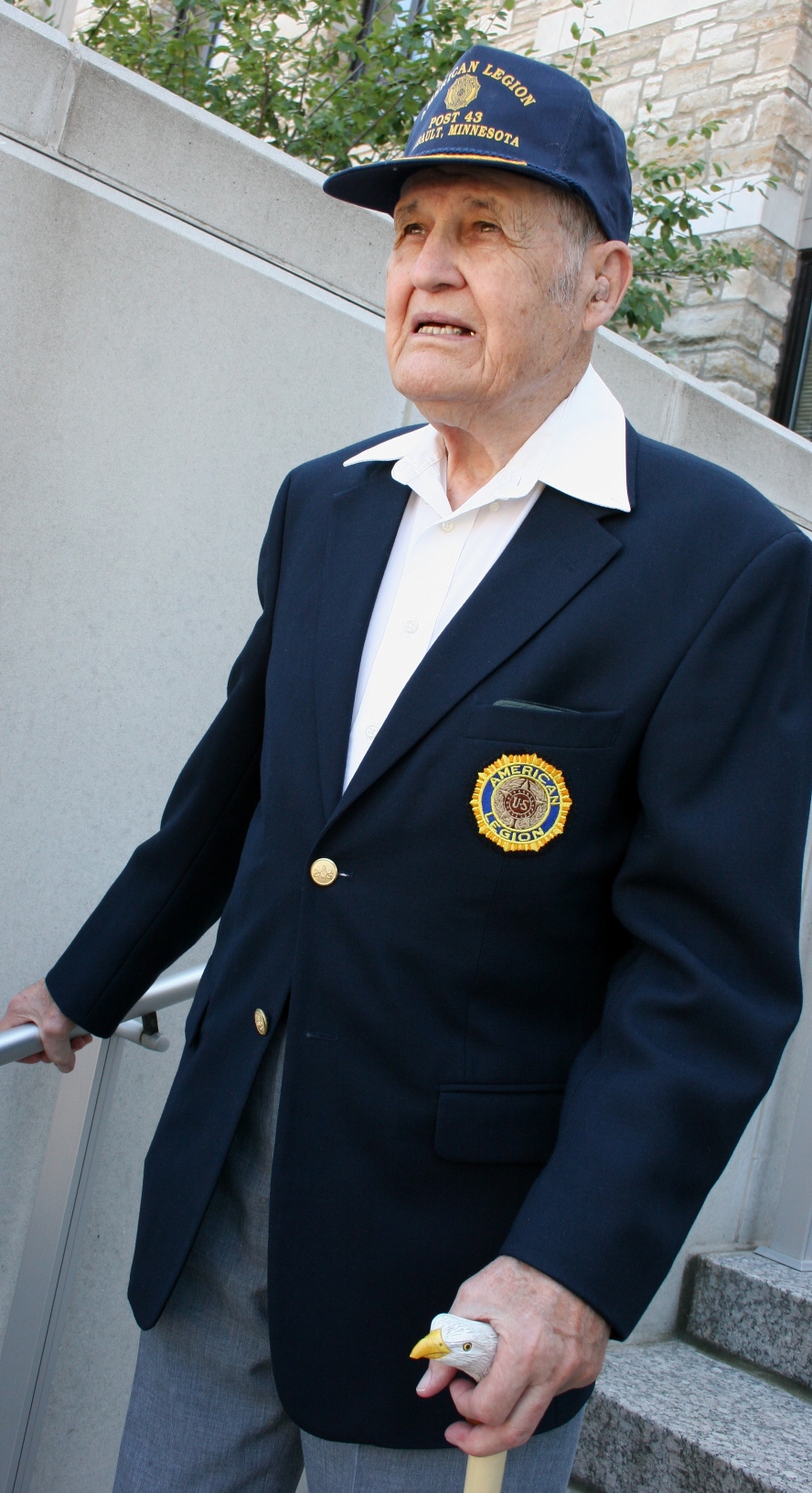
WW II veteran George DeLay, among those in attendance, waits on the courthouse steps for the program to begin.

As traffic whizzed by on busy Fourth Street, aging veterans stood or sat, their heads bowed in quiet contemplation.

Representatives of local law enforcement and emergency personnel stood attentively.

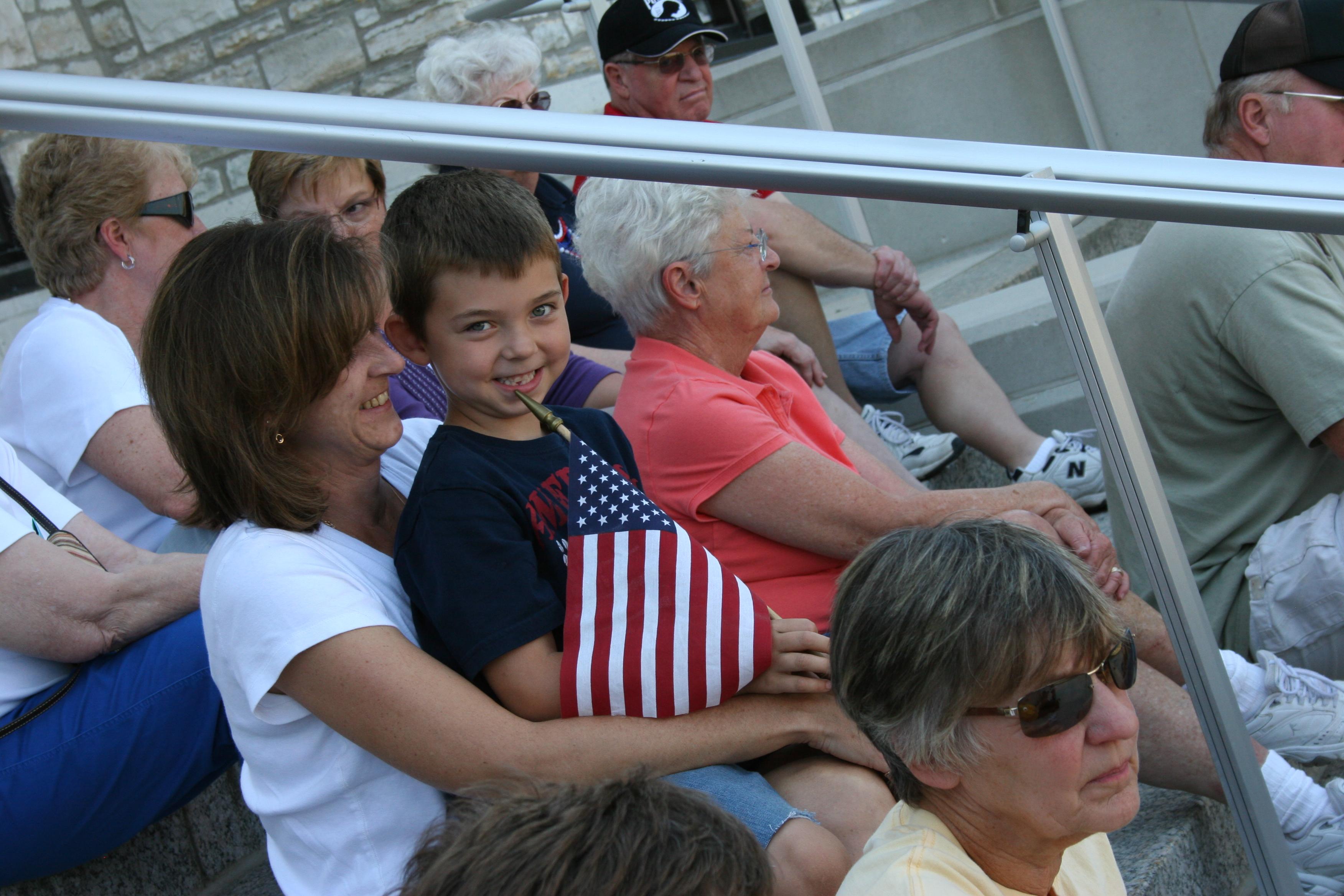
Six-year-old Dakota, son of Faribault American Legion Post 43 Commander and Desert Storm veteran Kirk Mansfield, perched on his mother Paula’s lap on the courthouse steps clutching an American flag. Too young to have lived through this day, he is learning about 9/11 from his parents, from ceremonies like those held today.

We are all still learning, experiencing and understanding how that attack on our nation 10 years ago has affected us, changed our thinking, our perspectives on life.

“Freedom is our greatest asset and our greatest export,” former Sheriff Richard Cook, who has been active in expanding the veterans’ memorial, said. “Freedom will live and flourish.”

Veteran and chaplain Roger Schuenke led the crowd in prayer: “May the faith of our fathers guide, protect and sustain our people.”

But it was the names read by Kirk Mansfield and American Legion Auxiliary representative Louise Flom that most impacted me, that caused me to pause, to settle onto the lawn of the courthouse with my camera in my lap and to listen, just listen, instead of photographing the scene.

For nearly 10 minutes the pair read the names of 94 Minnesotans who have been killed in action since 9/11:

Chester W. Hosford of Hastings, Corey J. Goodnature of Clarks Grove, Brent W. Koch of Morton, Randy W. Pickering of Bovey, Edward J. Herrgott of Shakopee, Andrew J. Kemple of Cambridge…

Familiar names, like Jesse M. Lhotka of Alexandria (originally from Appleton), David F. Day of  Saint Louis Park (originally from Morris) and Jason G. Timmerman of Cottonwood/Tracy—all National Guard members killed on February 21, 2005, in Iraq, and whose families I interviewed several years ago for a feature published in Minnesota Moments magazine.

I remembered how speaking with Lhotka’s widow had been one of the most emotionally-challenging interviews I’d ever done in my journalism career.

This I thought as Commander Mansfield and Flom read for nearly 10 minutes. Ninety-four men whose families grieve.

This is how I remembered 9/11 today, by honoring those who have given their lives for freedom.

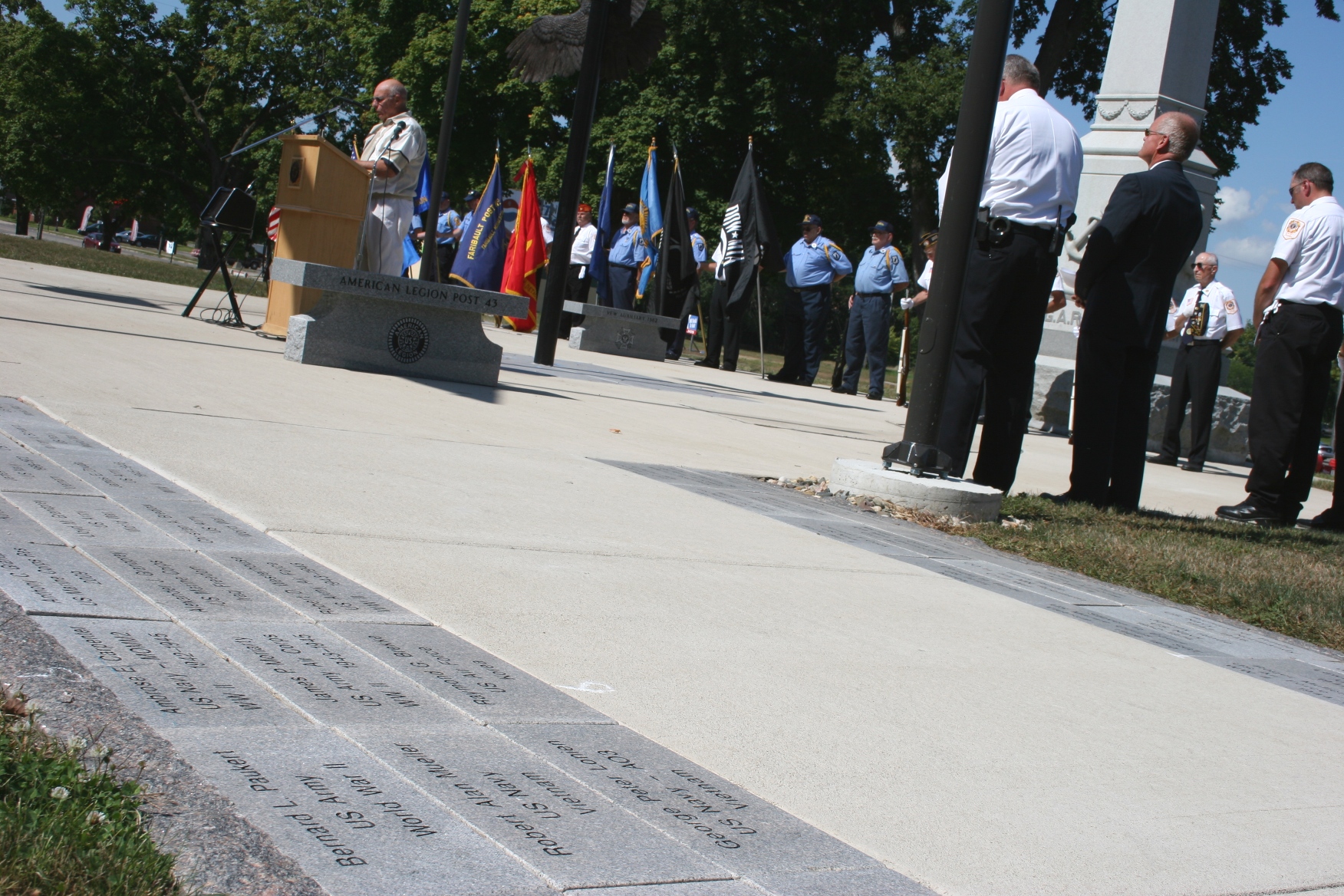
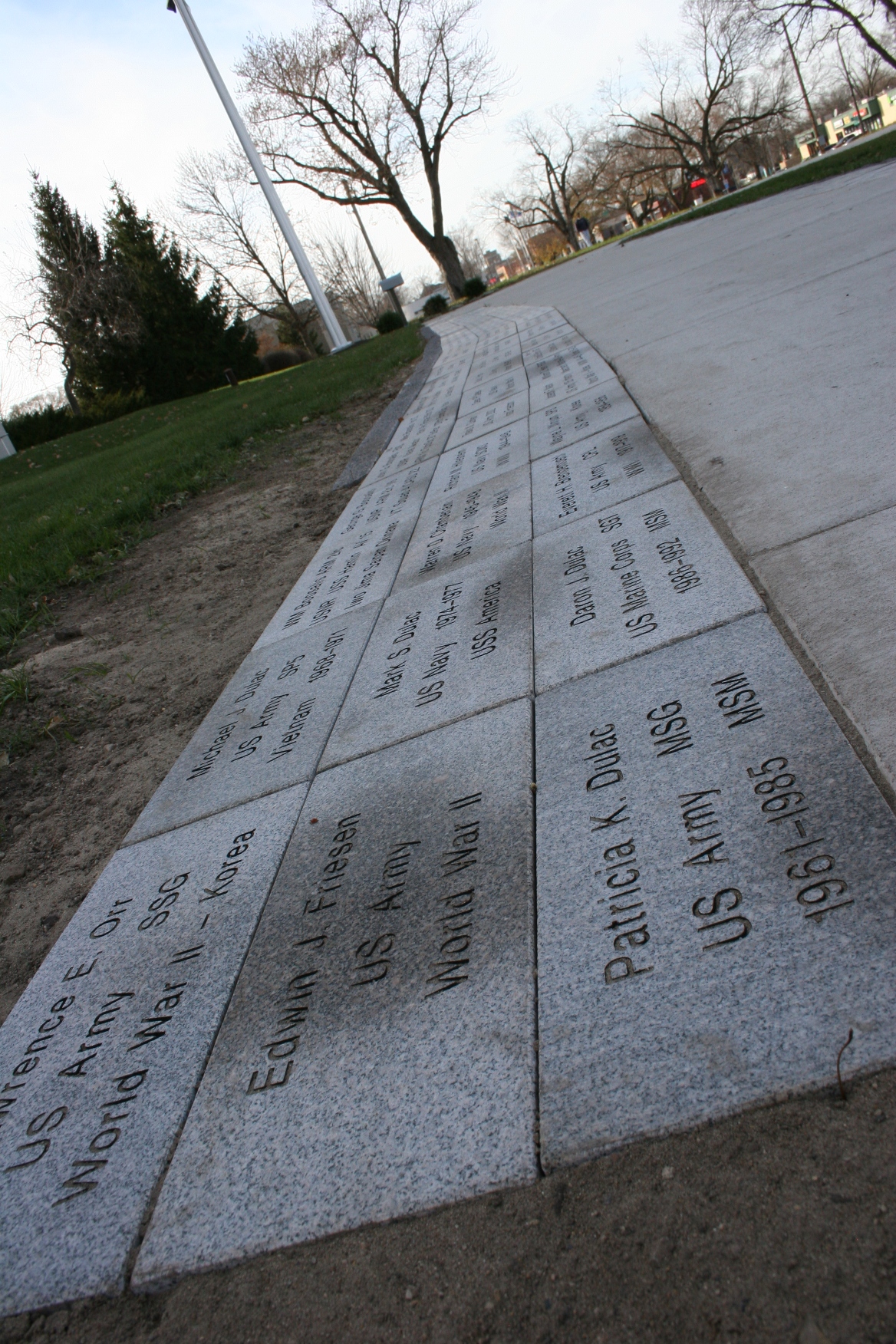
Veterans' names are engraved in pavers edging the Rice County Veterans Memorial, the site of today's ceremony.

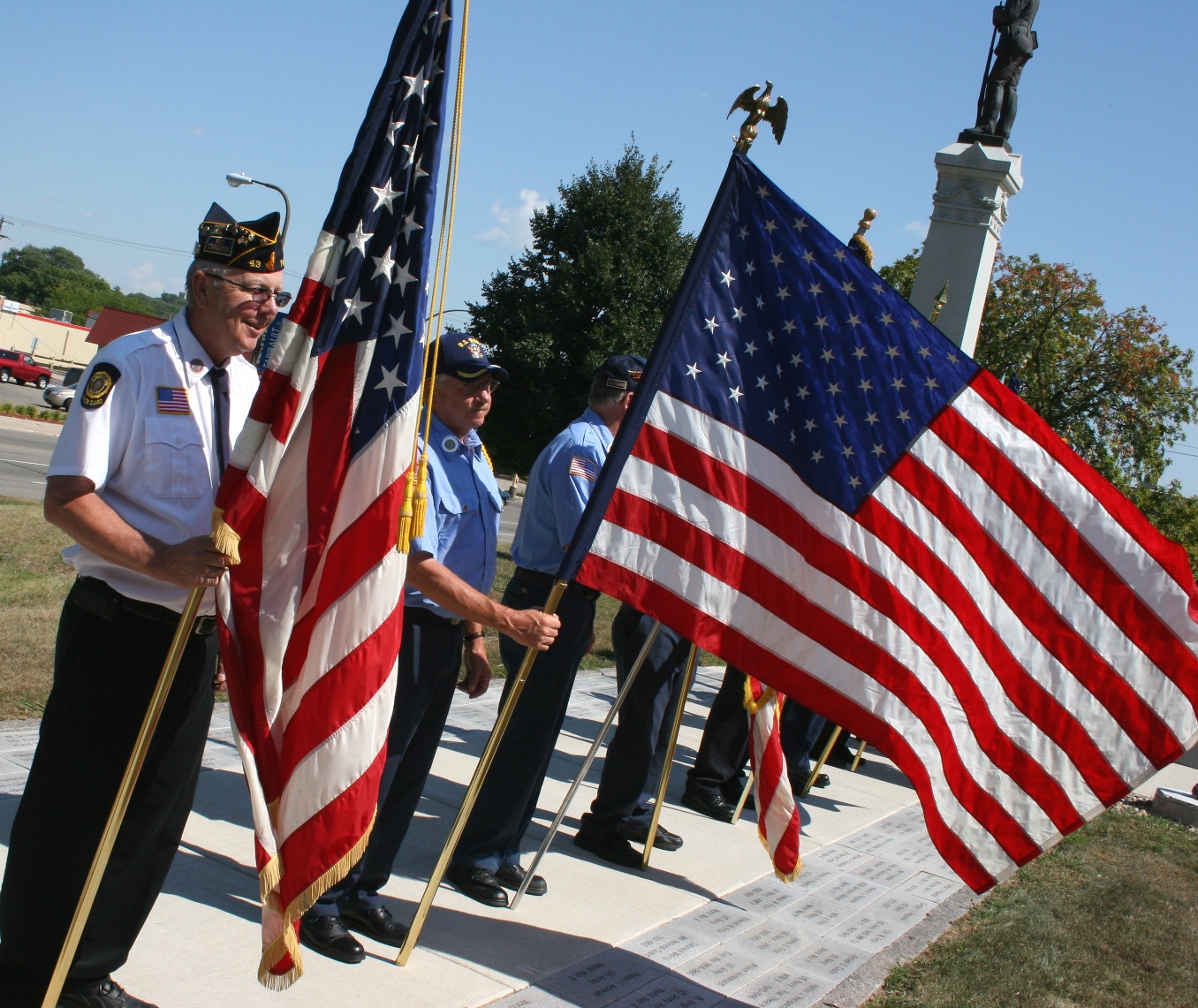
Some of the 20-plus veterans who stood in a line flanking the memorial.

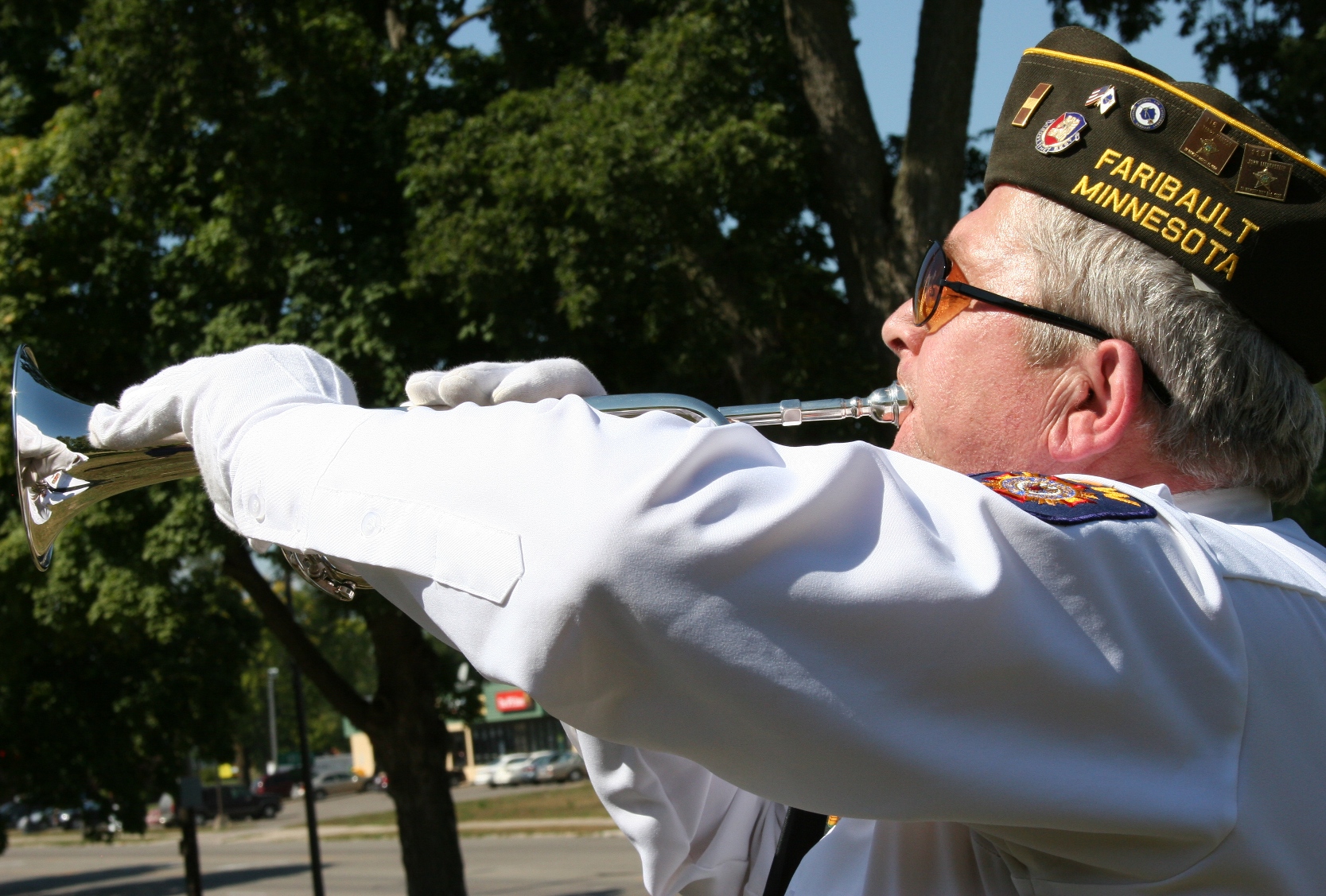
Jim Kiekeknapp, who served in Vietnam, played taps.

Dakota with him mom, Paula, watched from the courthouse steps.

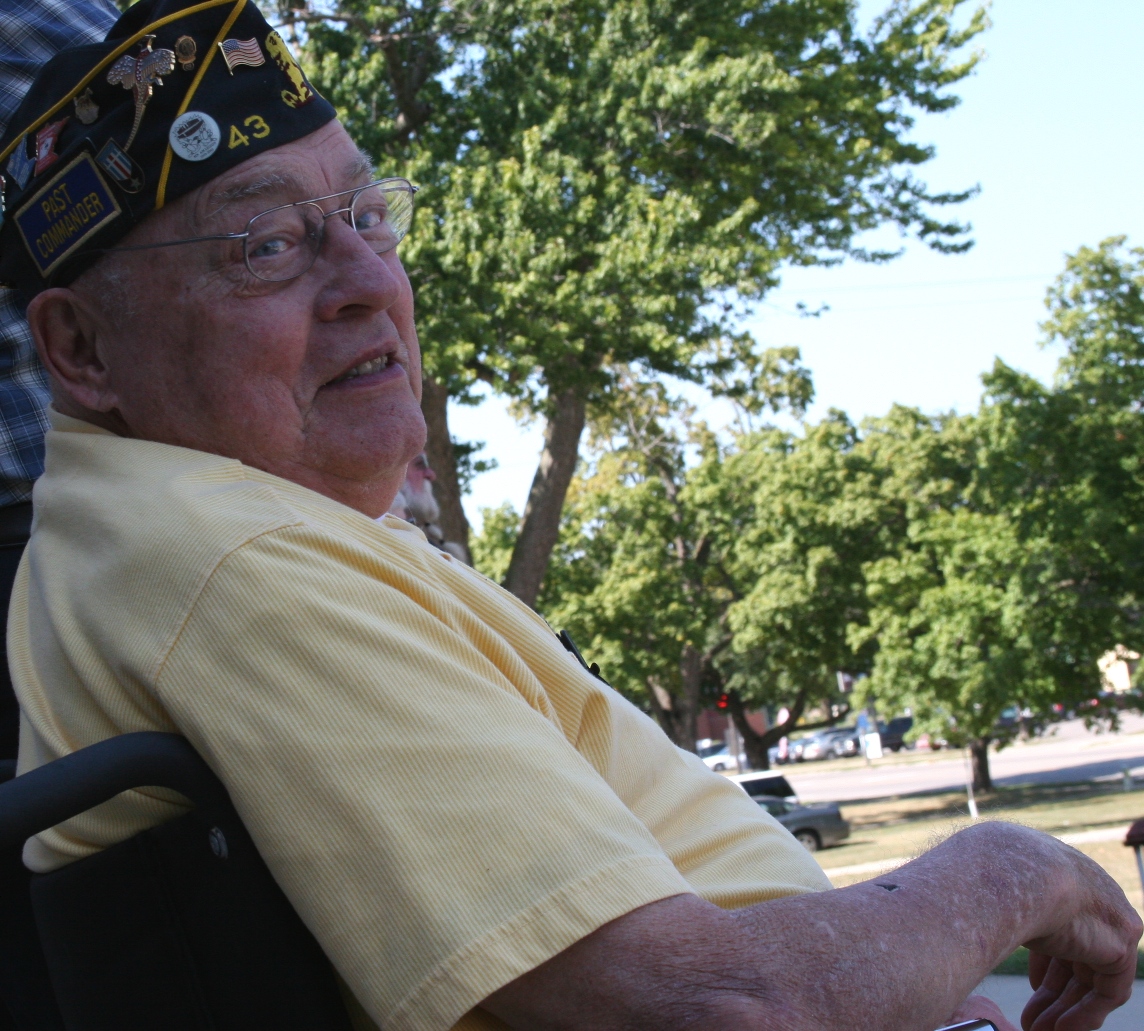
WW II veterans Bill Korff and past commander of the local Legion came in his wheelchair.

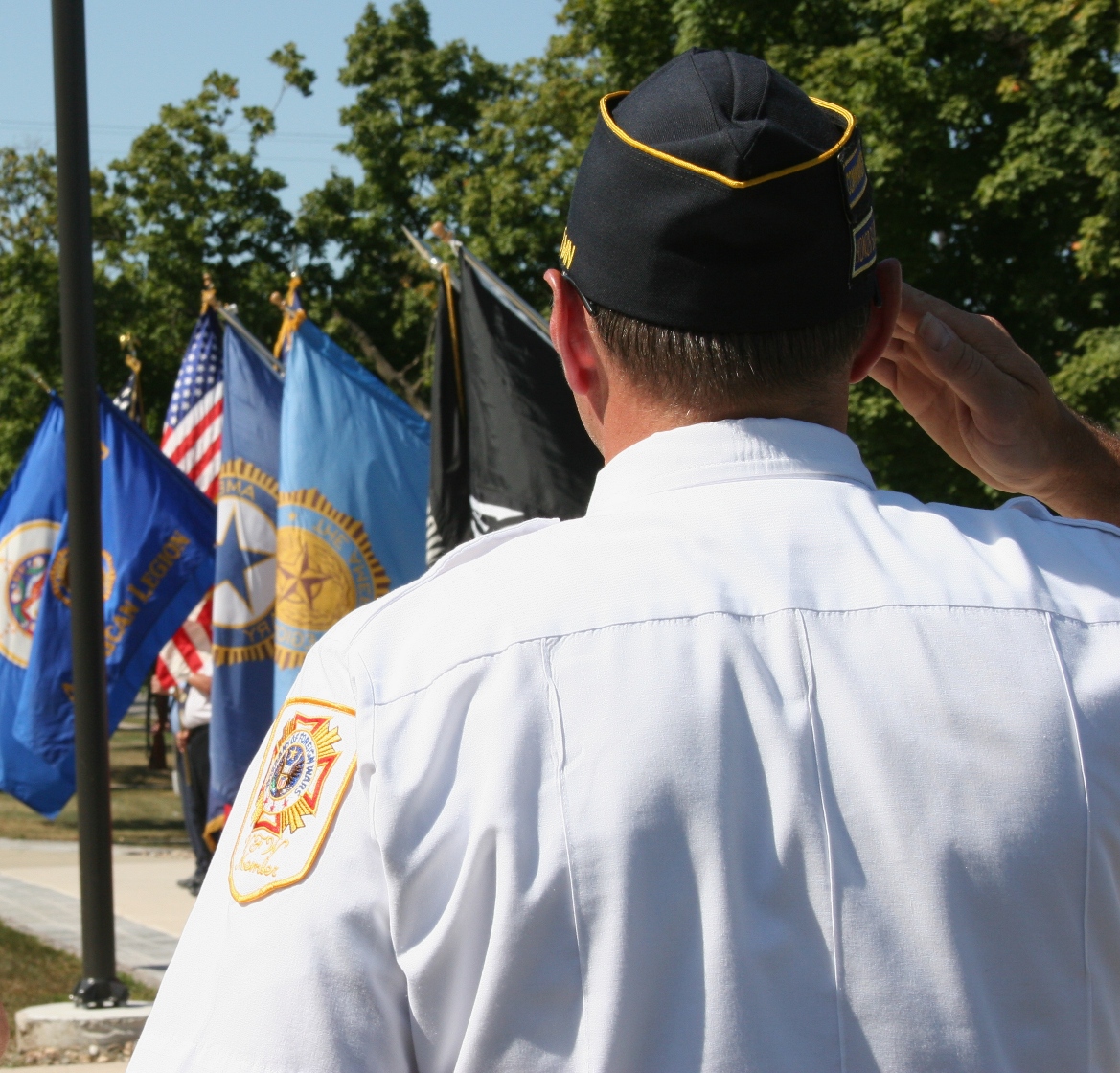
A veteran's salute.

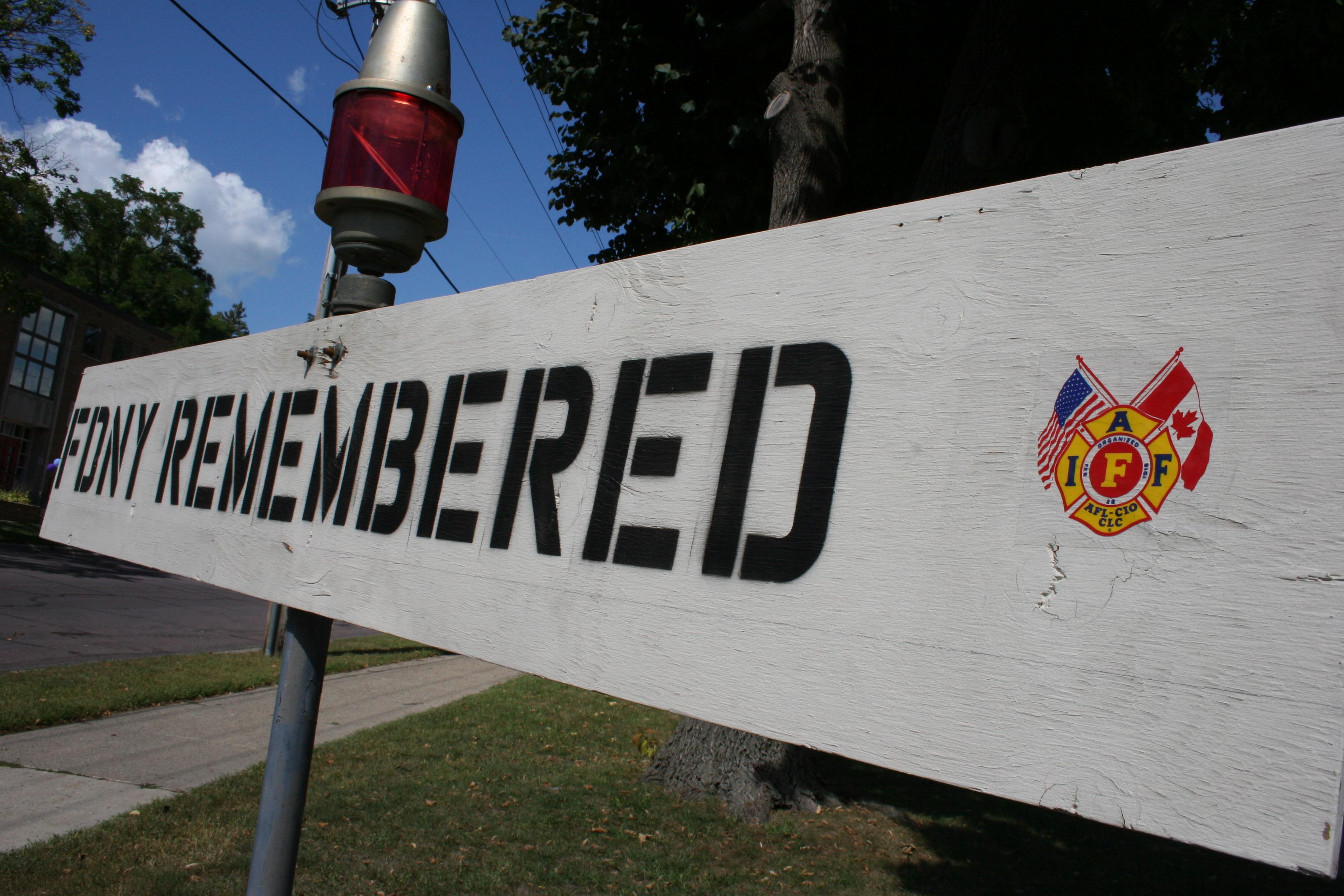
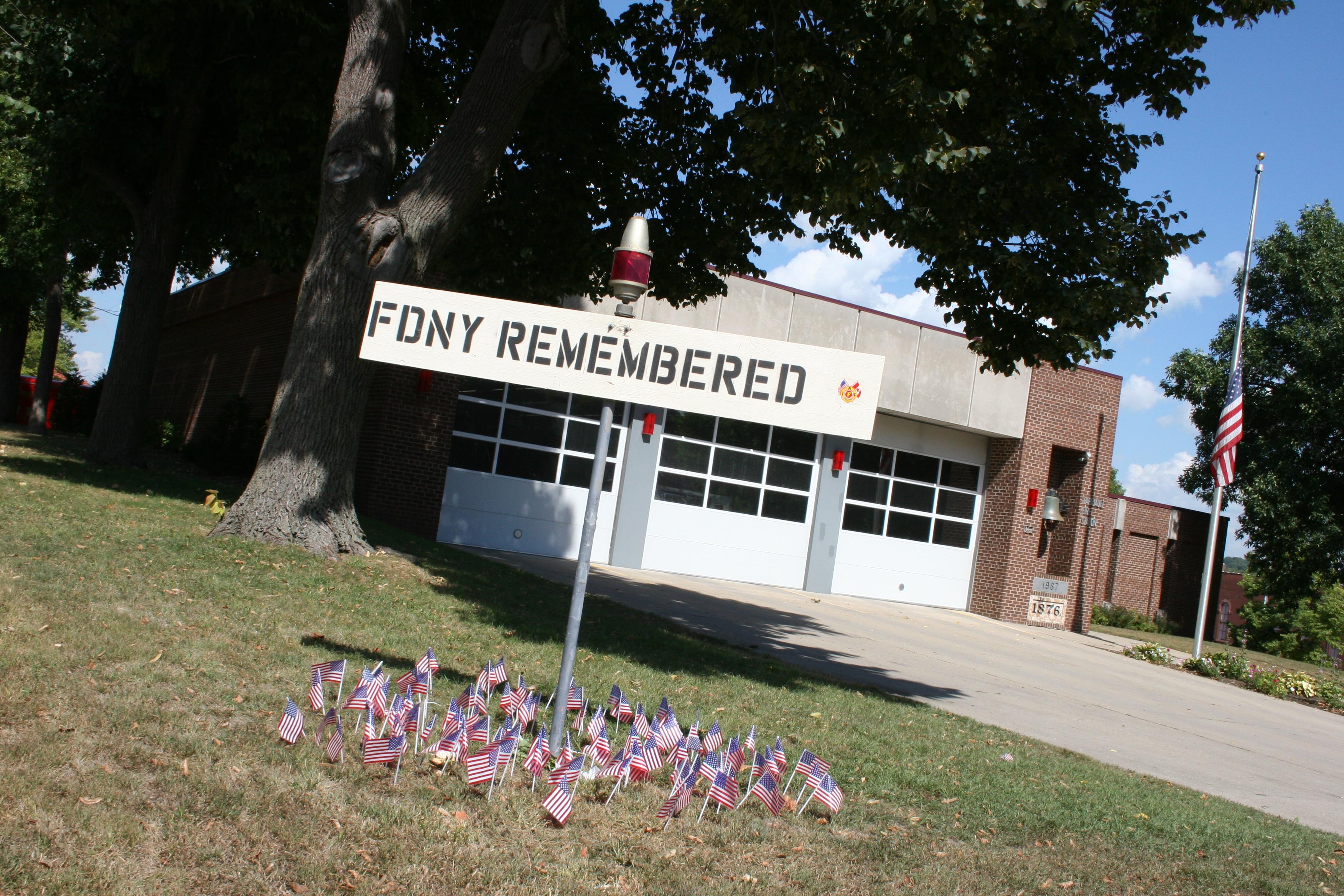
AND THEN ON THE WAY HOME from the courthouse, I stopped at the Faribault Fire Department to photograph the memorial there honoring the New York City firefighters who died in the Twin towers.

A memorial at the Faribault Fire Department, where a short service was also held this morning.

The Faribault firefighters pay special tribute to the fallen New York firefighters on their memorial sign.

TO BACKTRACK EVEN FURTHER in my day, when my husband and I were at a local nursing home leading a morning church service, I insisted that the eight of us gathered there sing “America, the Beautiful.”

I found verse 3 especially fitting for this day when we as Americans pause in our lives to remember September 11, 2001:

“O beautiful for heroes proved

In liberating strife,

Who more than self their country loved,

And mercy more than life!

America! America! May God thy gold refine

Till all success be nobleness

And every gain divine!”

Six-year-old Dakota and others in attendance perused the veterans' pavers after the ceremony.

© Copyright 2011 Audrey Kletscher Helbling


A misplaced torch at a veterans’ memorial July 1, 2011

TYPICALLY, I WOULD NOT criticize a veterans’ memorial project. I respect those who have served our country and those who lead efforts to honor them via public memorials.

However, last week when I saw the latest addition to the in-progress Rice County Veterans Memorial Expansion Project at the county courthouse in Faribault, I could not believe what I was seeing.

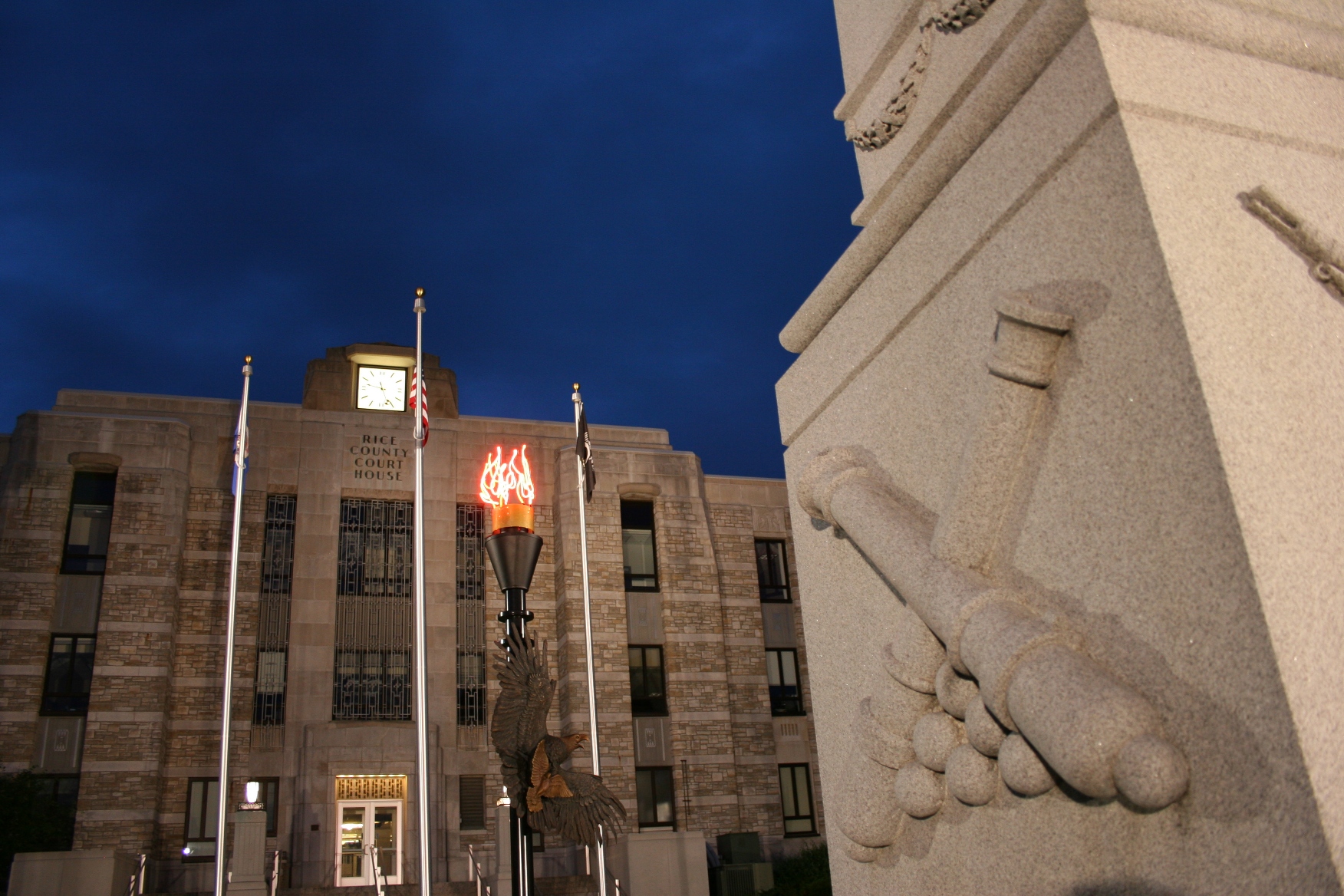
There, guiding my eyes toward a center bronzed eagle and dove, was a flashing neon flame depicting “our never ending vigilance.”

The new, fake torch at the Rice County Veterans Memorial at the courthouse in Faribault. Here you see the wing tip of the bronzed eagle below the torch. I have not edited this image taken one evening last week.

My initial reaction has not changed since I stopped that night to closer inspect and photograph this neon torch better suited for a casino—anything but a veterans’ memorial.

As we all know, first impressions count. In this case, the neon flame certainly does not fit. This is supposed to be a place of reverence, of quiet meditation, of respectful honor for those who have served the United States of America. A fake, flickering fire does not portray that message of honor.

I am disappointed.

Prior to installation of this imitation torch, a fuel-fed torch burned near the historical Civil War statue which has long graced the courthouse lawn. Apparently that flame went out all too often, leading to its removal and installation of the Vegas style torch.

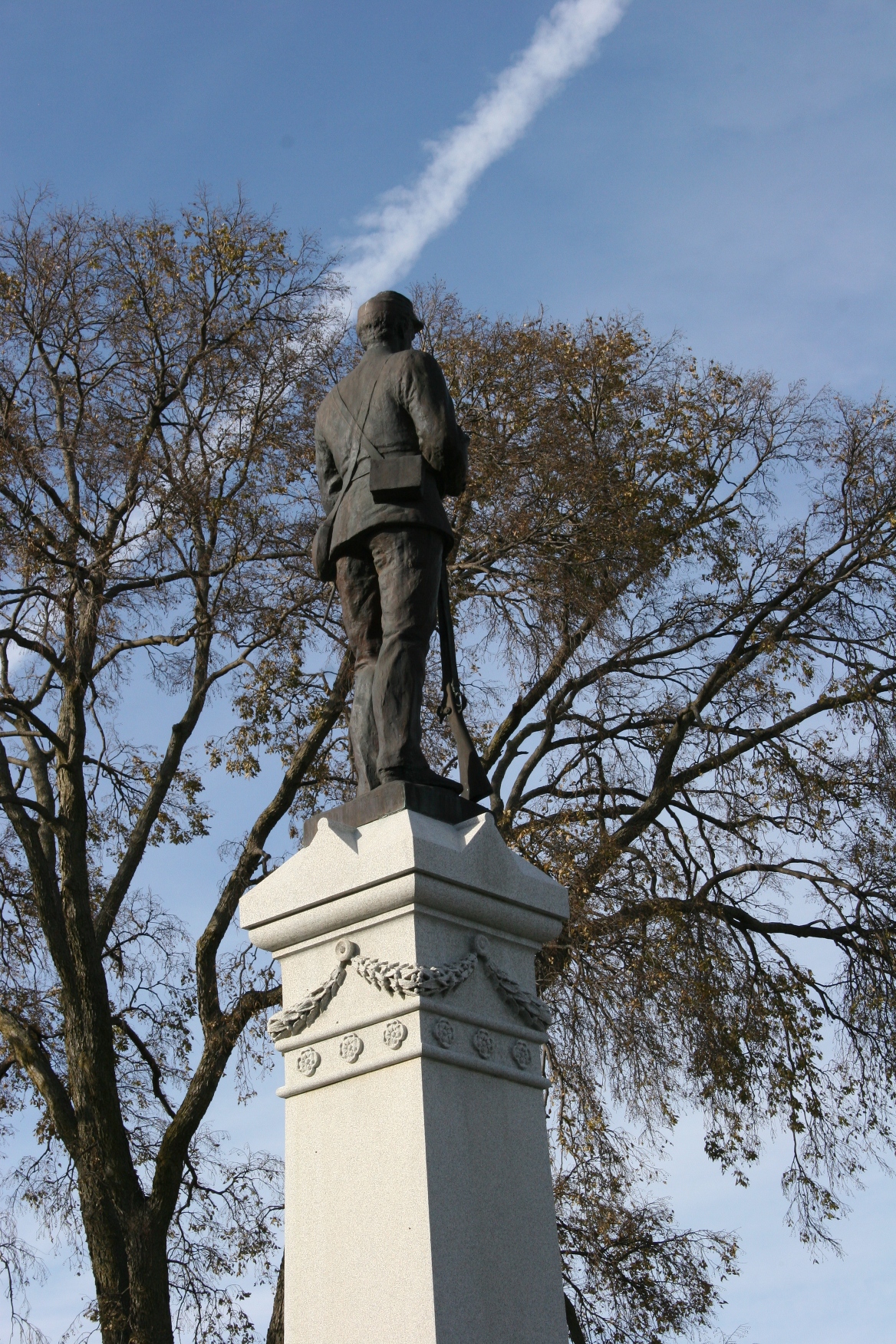
The long-standing Civil War statue sets a historical mood for the Rice County Veterans Memorial. I shot this image last fall.

To the right, in this unedited photo, you'll see a side view of the historical Civil War marker. In the center is the torch and the bronzed eagle and dove with flags and the courthouse in the background.

I could go on and on about how much I dislike this cheapening alternative, how it fails to fit the historical context of this place, the courthouse architecture or the long-standing Civil War marker. I won’t because I’ve said enough.

View my photos and tell me what you think. I’d like your opinion.

But even more, if you agree that this style of torch does not belong at a veterans’ memorial, offer a solution. I have none. Except to pull the plug.

Honorary pavers line sidewalks leading to the center of the Rice County Veterans Memorial in this image taken last fall.

© Copyright 2011 Audrey Kletscher Helbling


The patriotic traditions of Memorial Day in Minnesota May 31, 2011

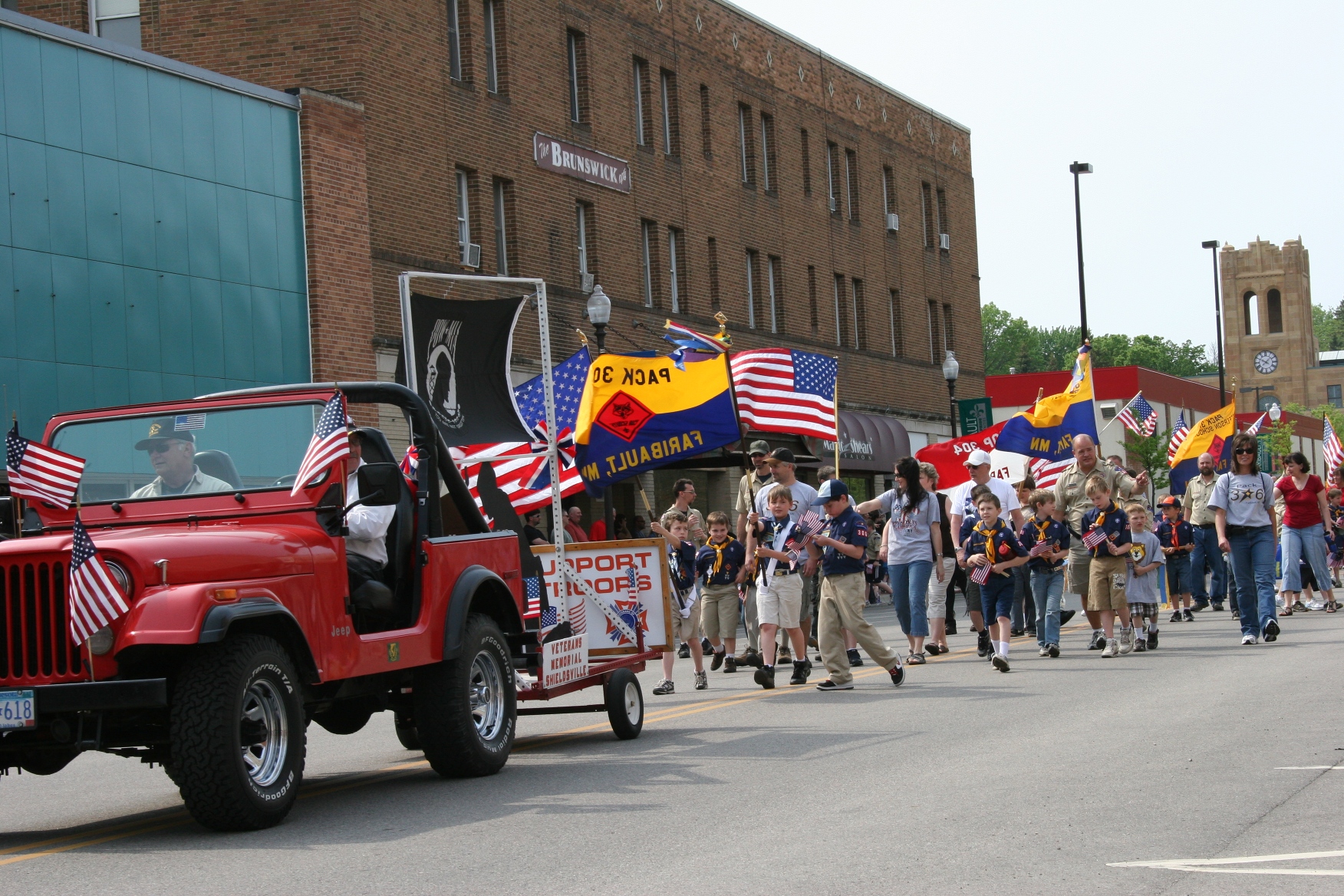
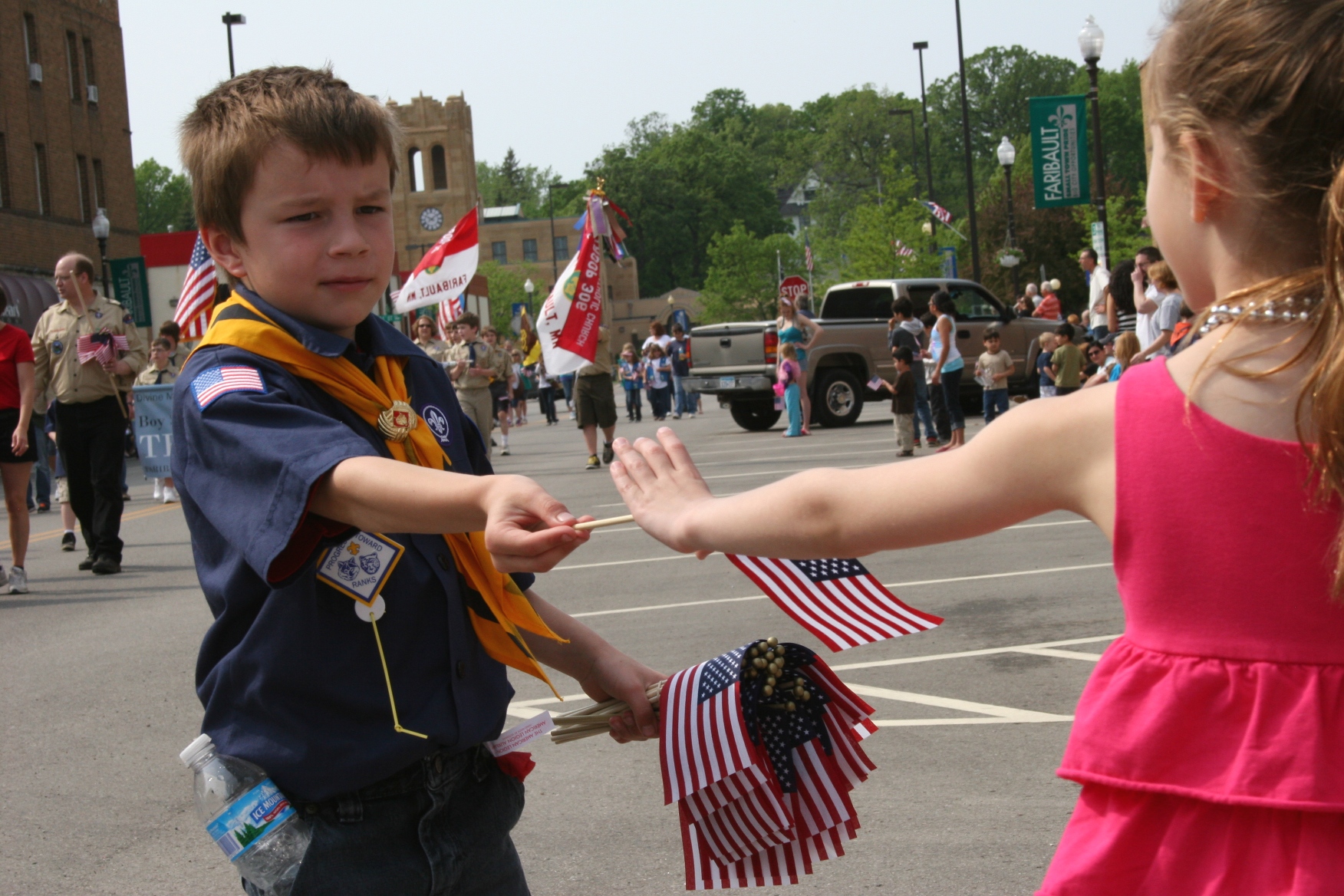
Boy Scouts march down Faribault's Central Avenue, giving away small American flags, on Memorial Day.

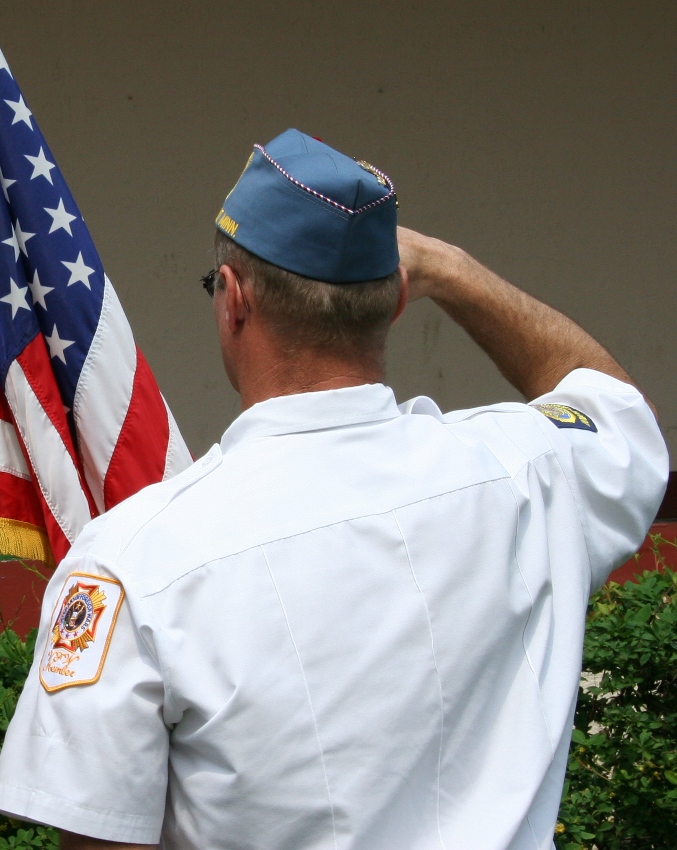
A member of the Color Guard salutes at the Memorial Day program in Central Park.

YES, DEAR READERS, I have yet another Memorial Day post to share with you. But I cannot help myself. My parents reared me to respect this day as a time to honor our war dead.

Every year of my childhood, we attended the Memorial Day program in my hometown of Vesta on the southwestern Minnesota prairie. I continued that tradition with my children by taking them each year to the Memorial Day parade in Faribault.

It is a tradition my husband and I continue, minus the kids—two of whom are grown and gone and the third a teen that cannot be roused from bed for the 10 a.m. parade.

Now I smile at the young families who gather along the curb in downtown Faribault to watch the veterans and Boy Scouts, the old cars and horses, the Girl Scouts and the Shattuck-St. Mary’s crack squad, the police cars and fire truck and marching bands.

Little hands reach for American flags distributed by the walking, sometimes running, Boy Scouts.

Clutched fists wave American flags.

It’s all so patriotic.

After the parade, the crowd gathers at nearby Central Park for more patriotism and I am reminded of my dad, a Korean War vet, who marched so many times with his Color Guard in parades and programs.

In the park bandshell, the guests of honor sit, rise and tell us they have little to say before offering these words:

“Your wars aren’t all won on the battlefield. They’re also won at home.”

“If you know a veteran, just say, ‘thank you.’ It means so much to them—something Vietnam vets were short of.”

“I salute all veterans here.”

“God bless everybody.”

“God bless America.”

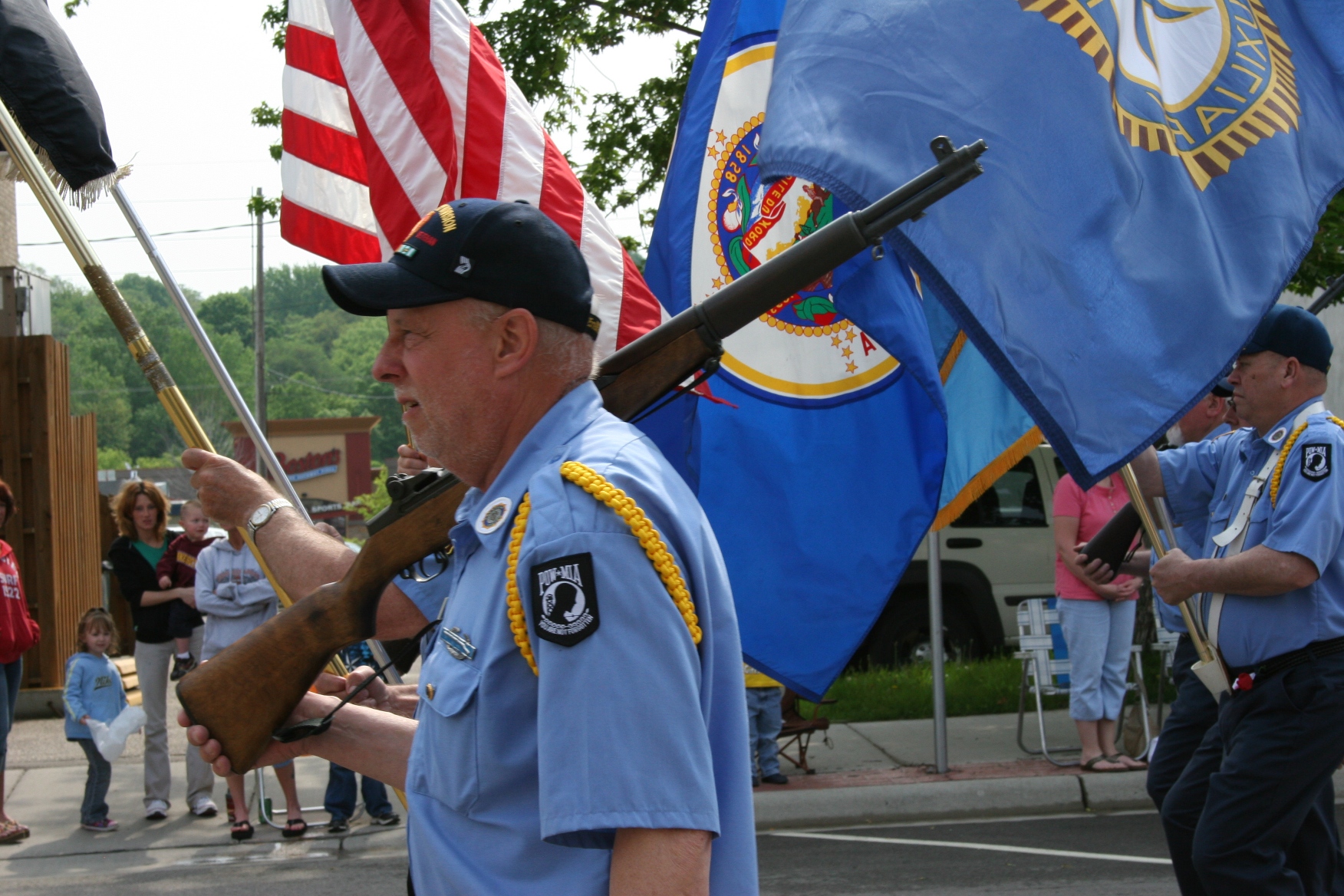
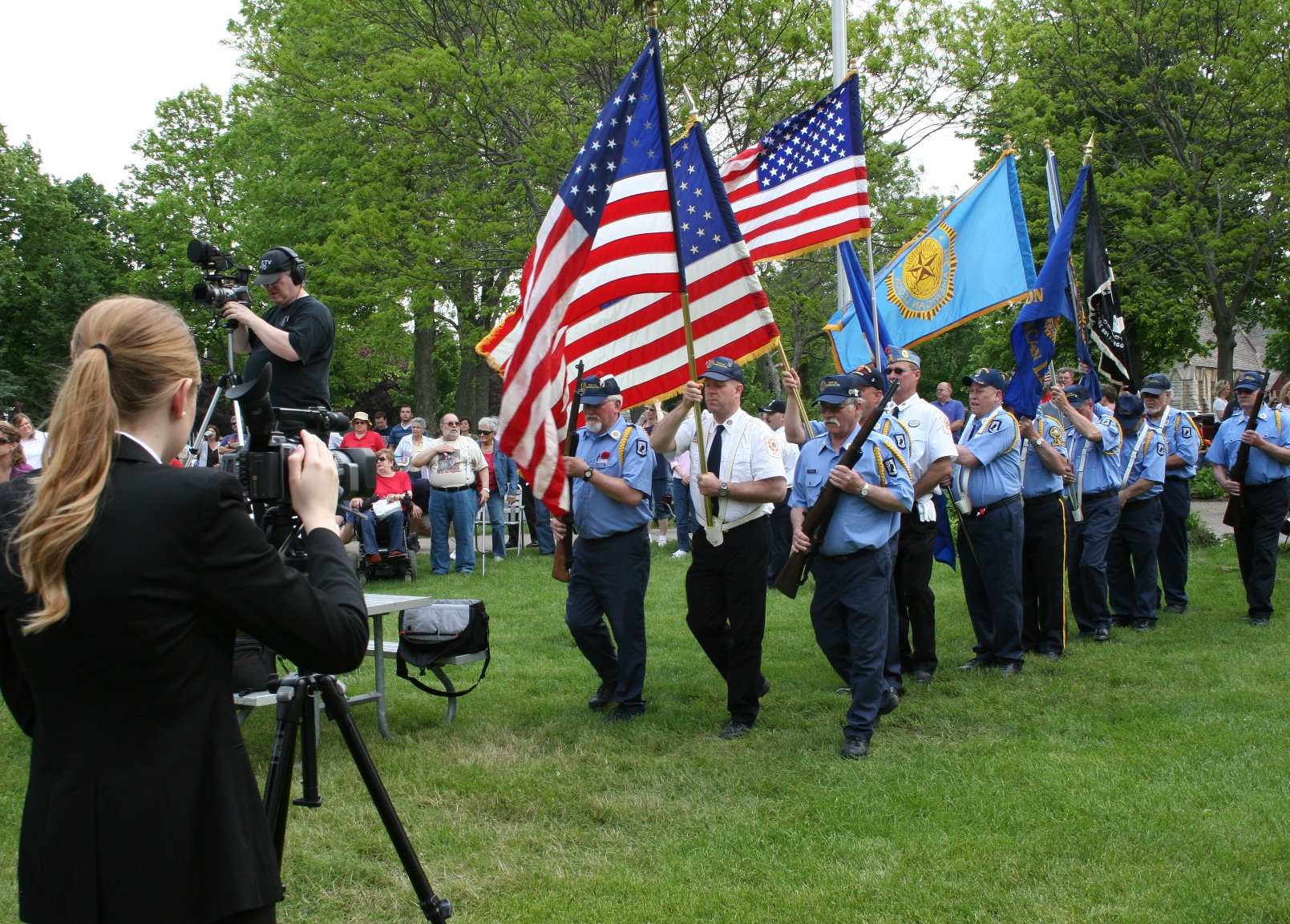
The Color Guard leads the way in the Faribault Memorial Day parade.

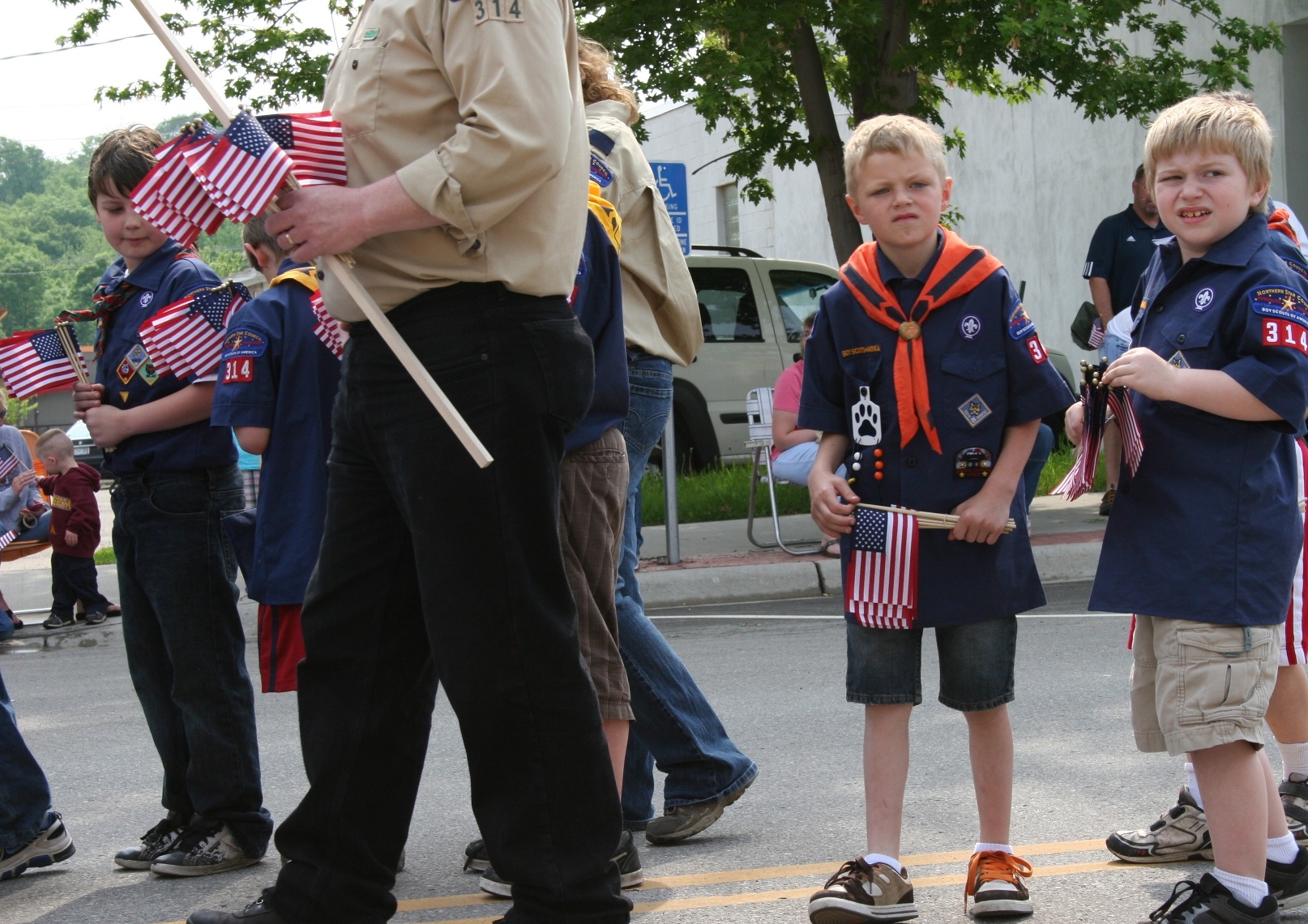
These Boy Scouts seem a bit indecisive, while other Boy Scouts race toward the crowd to hand out American flags.

Every year the Boy Scouts give away flags during the parade.

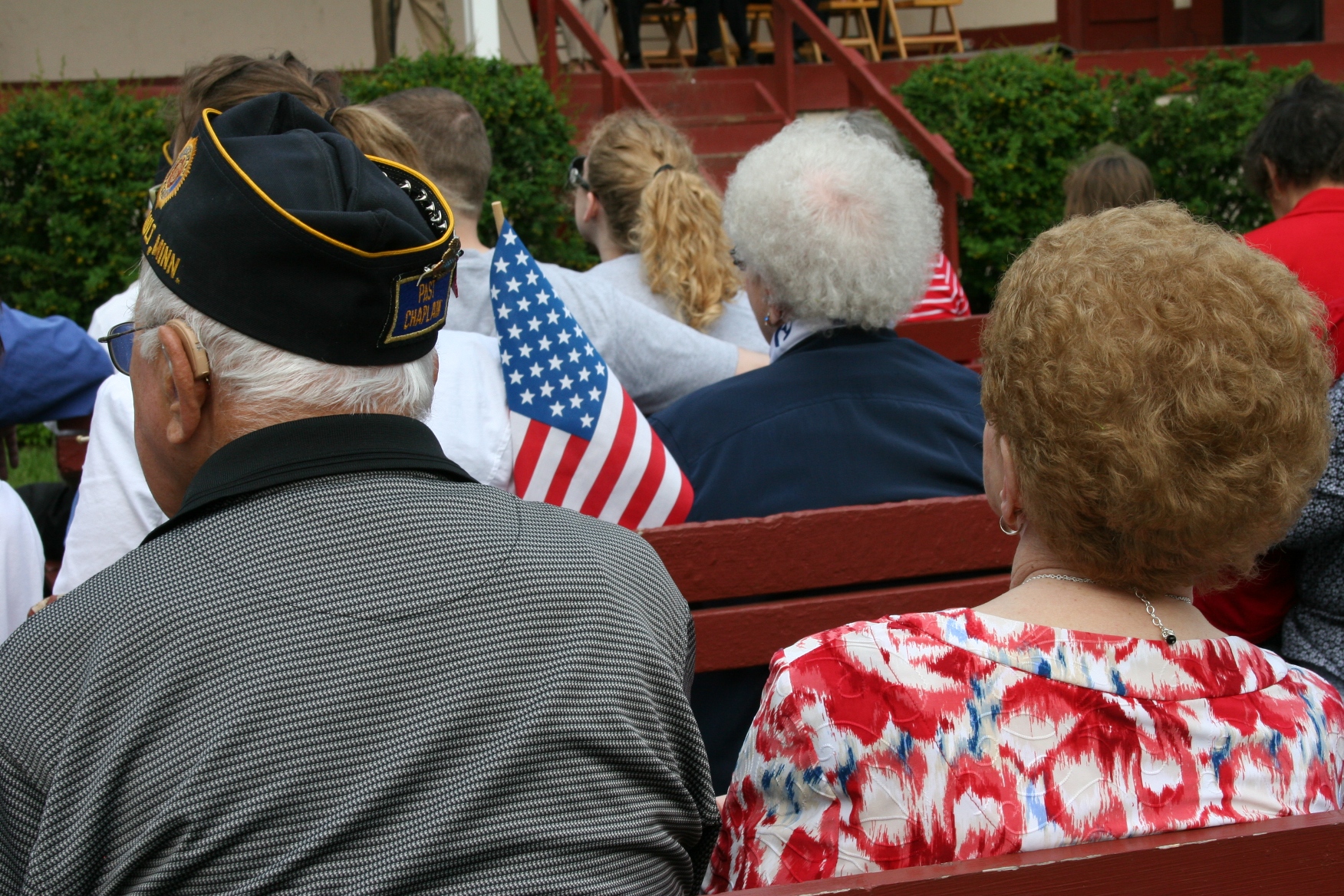
A veteran and others wait for the Memorial Day program to start at Central Park.

The Color Guard advances and the Memorial Day observance begins in Central Park.

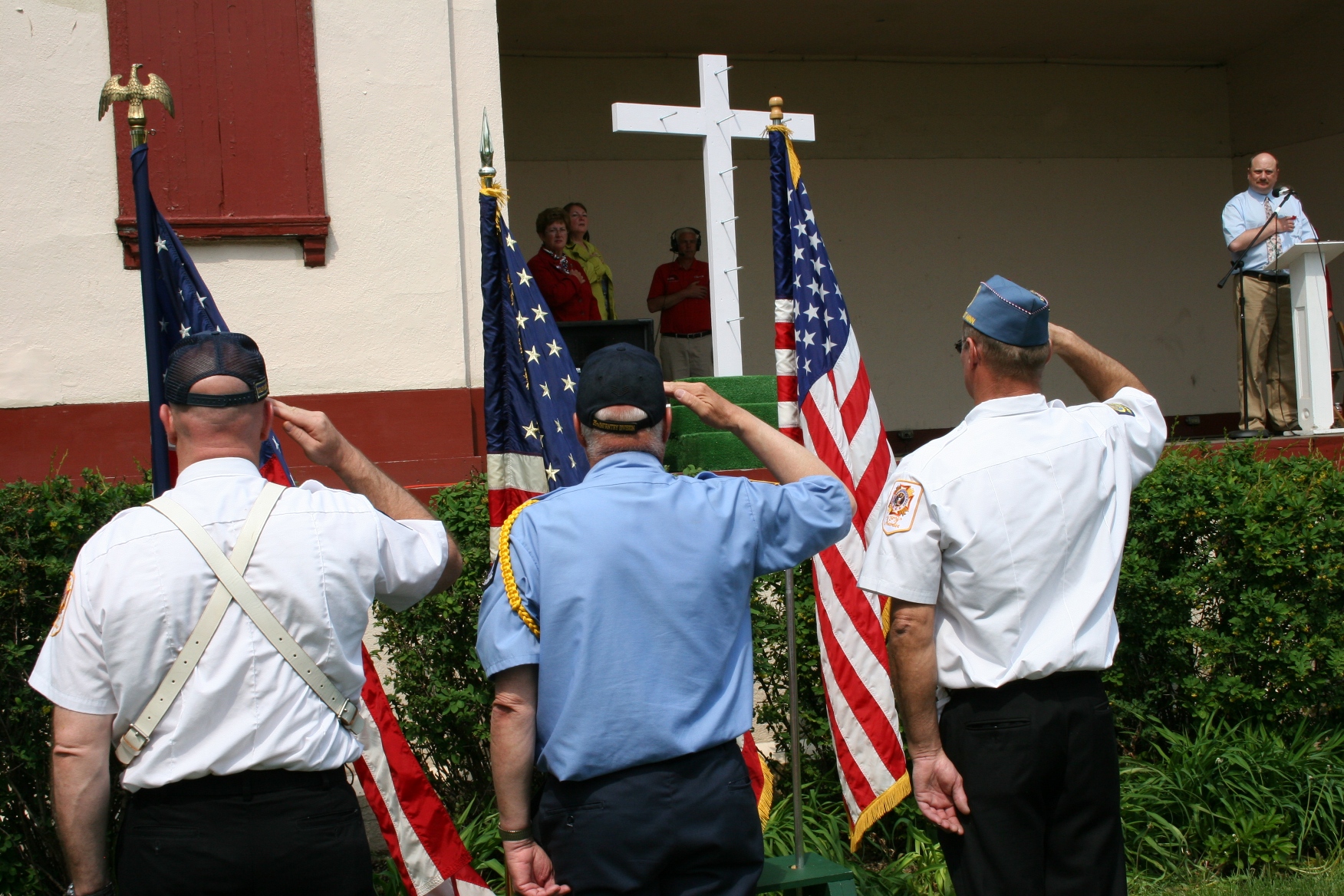
The Color Guard soldiers salute. Emcee and radio announcer Gordy Kosfeld, on stage at the podium, will later tell us: "Memorial Day should be a time of reflection, not a holiday."

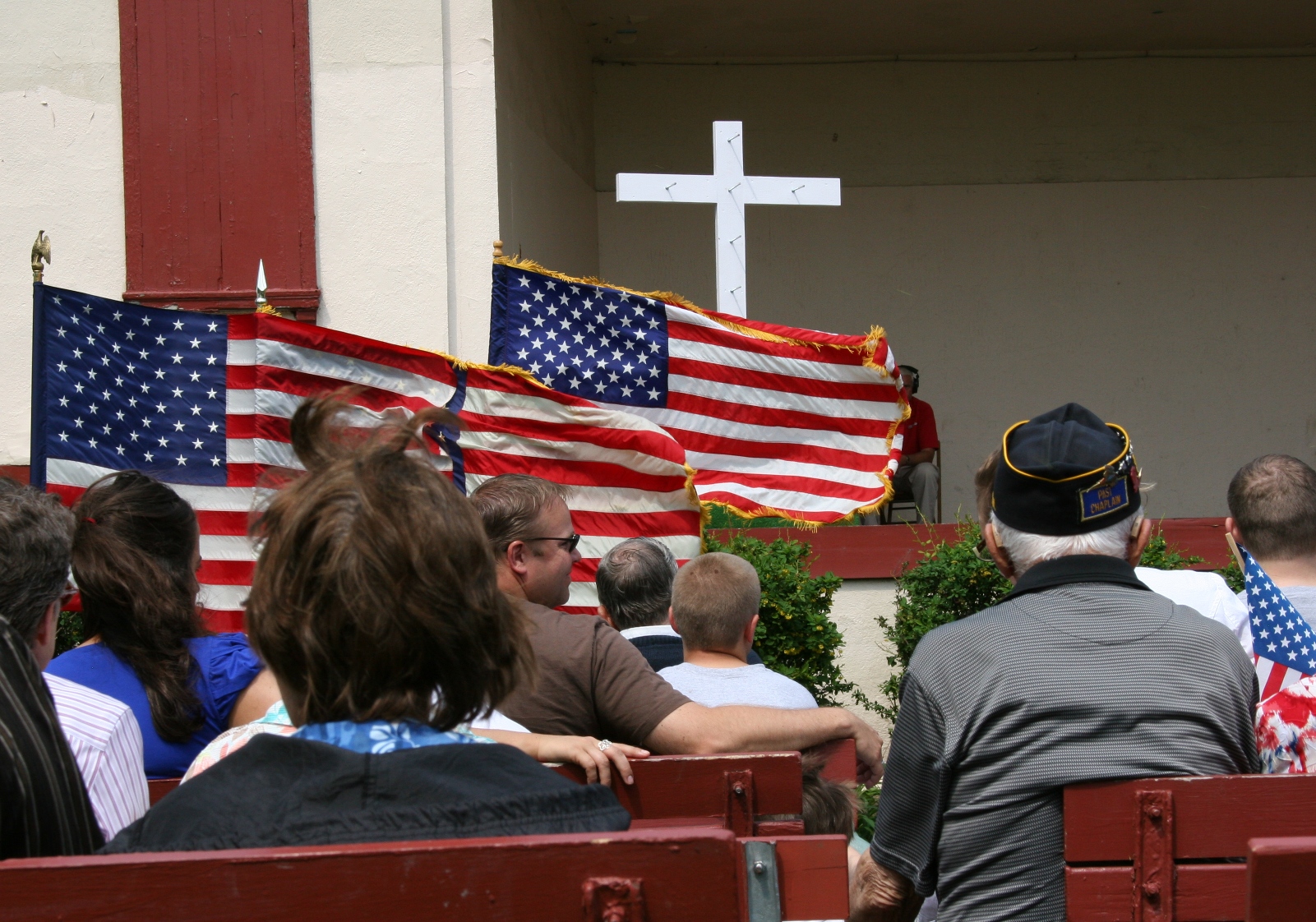
A strong wind blew the Color Guard flags set next to the bandshell stage at Central Park.

© Copyright 2011 Audrey Kletscher Helbling


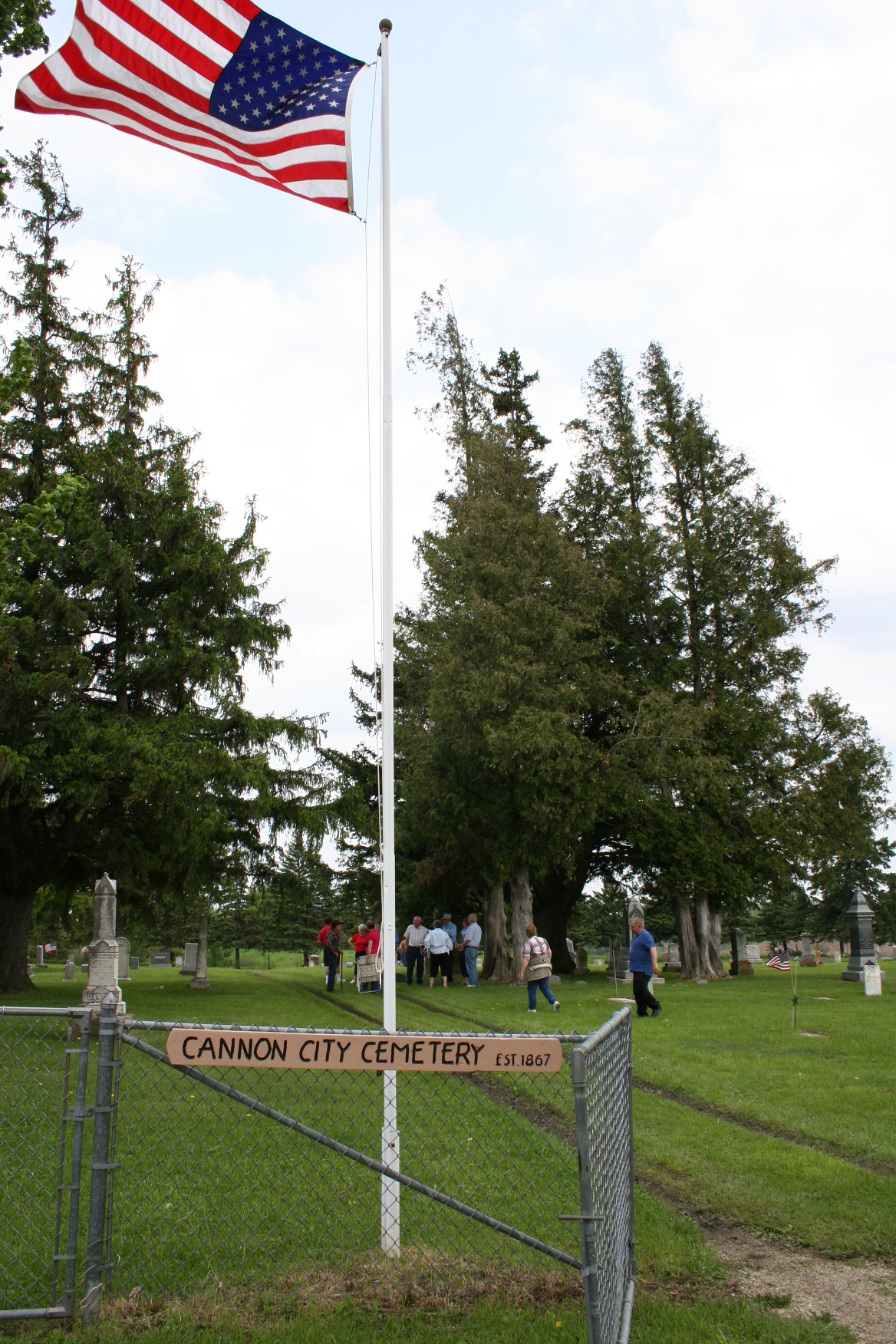
Memorial Day at Cannon City May 30, 2011

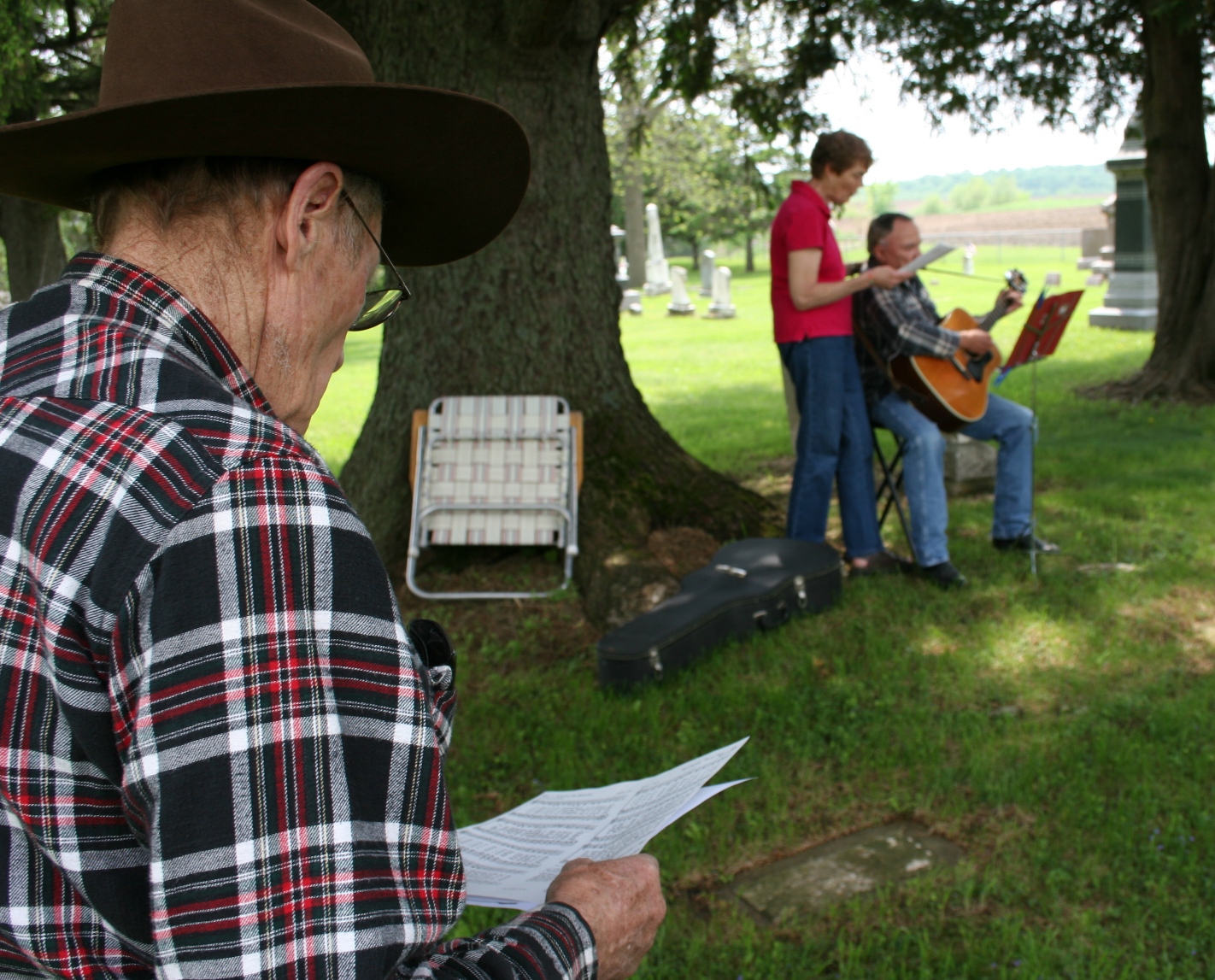
About 30 people gather at the Cannon City Cemetery for an afternoon Memorial Day observance.

IN THE SHELTER of the spruce, of the pines, we formed a semi circle, clustered together in this small country cemetery to honor the veterans buried here, 22 of them from the Civil War.

Ezekiel and Samuel. Spencer and Charles. Henry and Theodore. Emcee Mel Sanborn read the list of names as the wind whipped his words into sometimes inaudible, unintelligible syllables at the Cannon City Cemetery.

Since the late teens or early 1920s, folks have gathered in this Rice County cemetery every Memorial Day, initially called “Decoration Day,” to honor the war dead. Civil War veteran Elijah Walrod was quoted as saying that his son Luther “would strike up the Death March and lead the procession” from the nearby Cannon City School, along the country road to the cemetery.

School children—some of them in attendance at the 2011 Memorial Day observance—once marched with flags and flower bouquets and lilac wreaths and then, afterward, celebrated at the school picnic.

When the school closed in the 1960s, the Cannon City Cemetery Board took over the annual Memorial Day observance, a tradition that continues today, minus the Death March from the country school. It is an unpretentious, informal program that is touching and moving and heartfelt. Americana through and through.

My husband and I came here on this muggy afternoon to experience a small-town Memorial Day observance. We were the strangers among those who had grown up here and had loved ones buried in this ground butted against the rich black soil of farm fields.

Yet, we were welcomed like family and I felt as if I had stepped back in time to the Memorial Day observances of my youth—the days of patriotic songs and playing of taps and reading of “In Flanders Fields.” I mouthed the words silently: “In Flanders Fields the poppies grow between the crosses row on row…” These poetic lines I knew nearly from heart, having recited them as a young girl on the stage of the Vesta Community Hall some 125 miles from this cemetery.

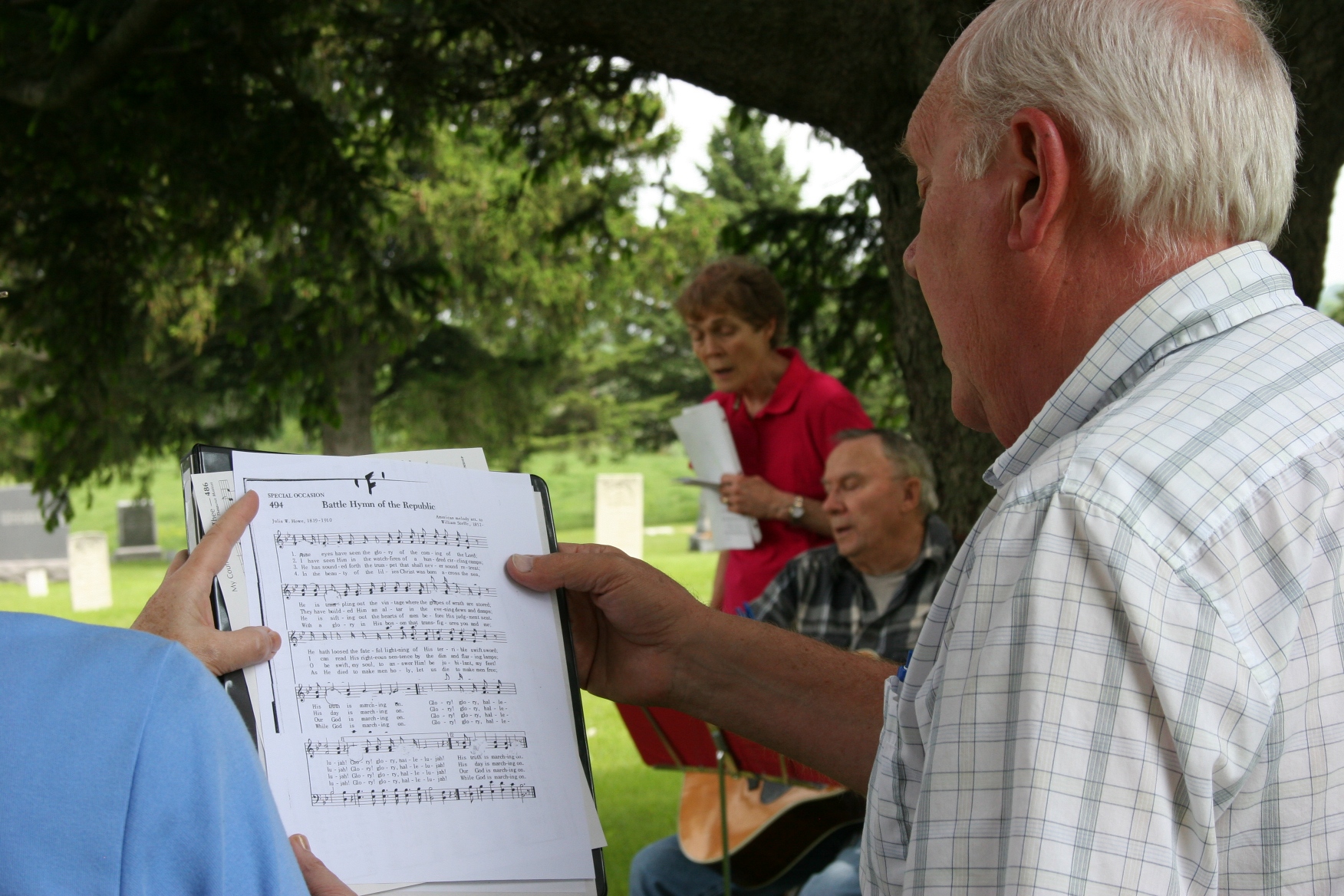
As Don Chester strummed his guitar and clamped his harmonica, we sang “My country, ‘Tis of Thee” “The Battle Hymn of the Republic” and other patriotic songs.

Bob (didn't get his last name) sings as Don and Judy Chester lead the group in song. Bob attended Cannon City School and participated in Memorial Day programs here as a student.

Song sheets were handed out to attendees. Here Mel Sanborn sings "The Battle Hymn of the Republic."

When Steve Bonde blasted “The Star Spangled Banner” on his trumpet, we sang along, turned toward the flag at the cemetery entrance, the brass quelling voices that drifted away with the word-flogging wind.

It mattered not how well or how loudly the 30 or so of us sang. It mattered not that a young girl darted inside the semi circle to pluck a dandelion from the grass. It mattered not that the occasional airplane droned out our voices. We were focused on the songs, “The Gettysburg Address” read by Audrey Sanborn Johnson, and, finally, Bonde’s mournful playing of taps.

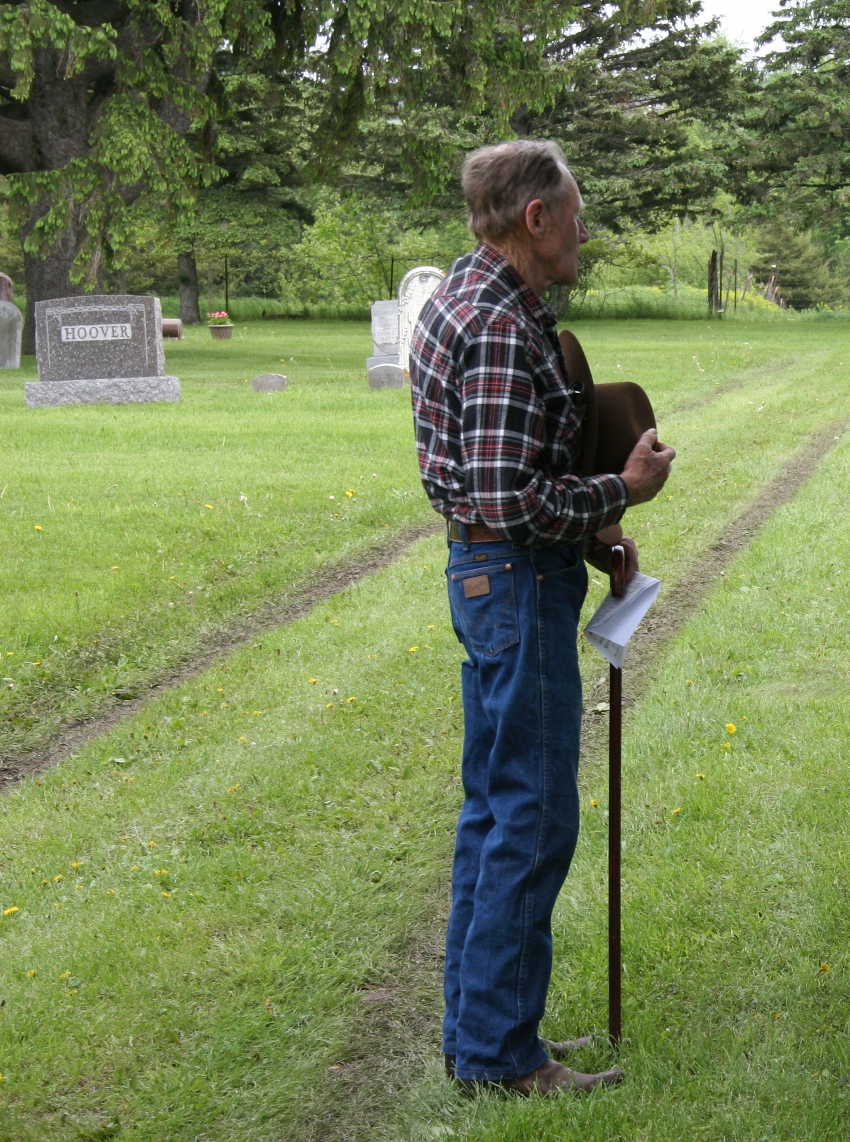
Long-time Cannon City resident Bob respectfully removes his cowboy hat during the playing of taps, a tribute that moves me to tears.

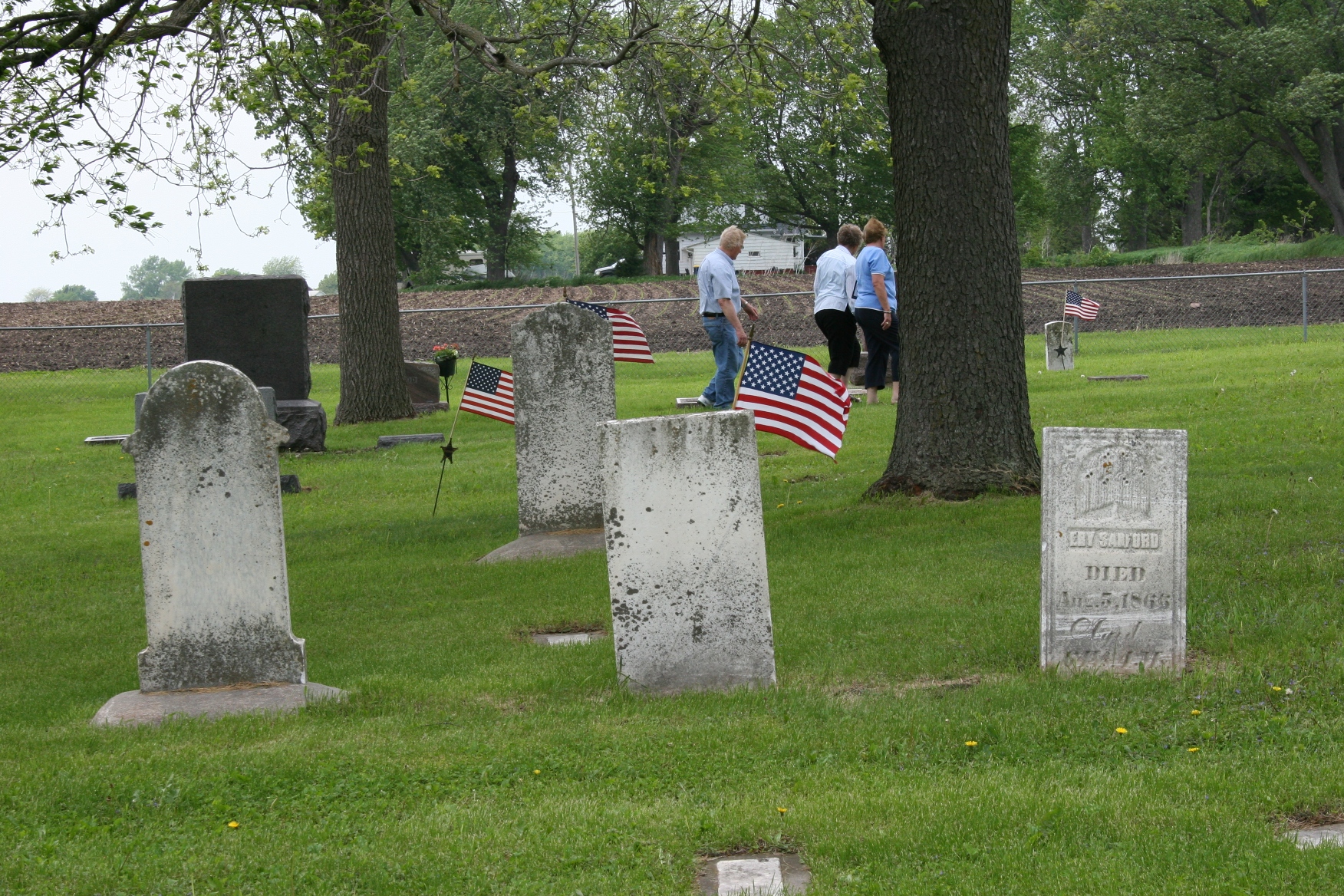
When the final note ended, the small group drifted, scattering across the cemetery to visit the graves of loved ones. I wandered, drawn by American flags to the final resting places of veterans. Names I did not know in an unfamiliar cemetery I was walking for the first time.

After the program, attendees visited gravesites.

Yet, despite the unfamiliarity with this place or these people, I felt connected to them by the reason I was here—to reflect upon the sacrifices made by so many American men and women in defense of our freedom. America. Land of the free and home of the brave.

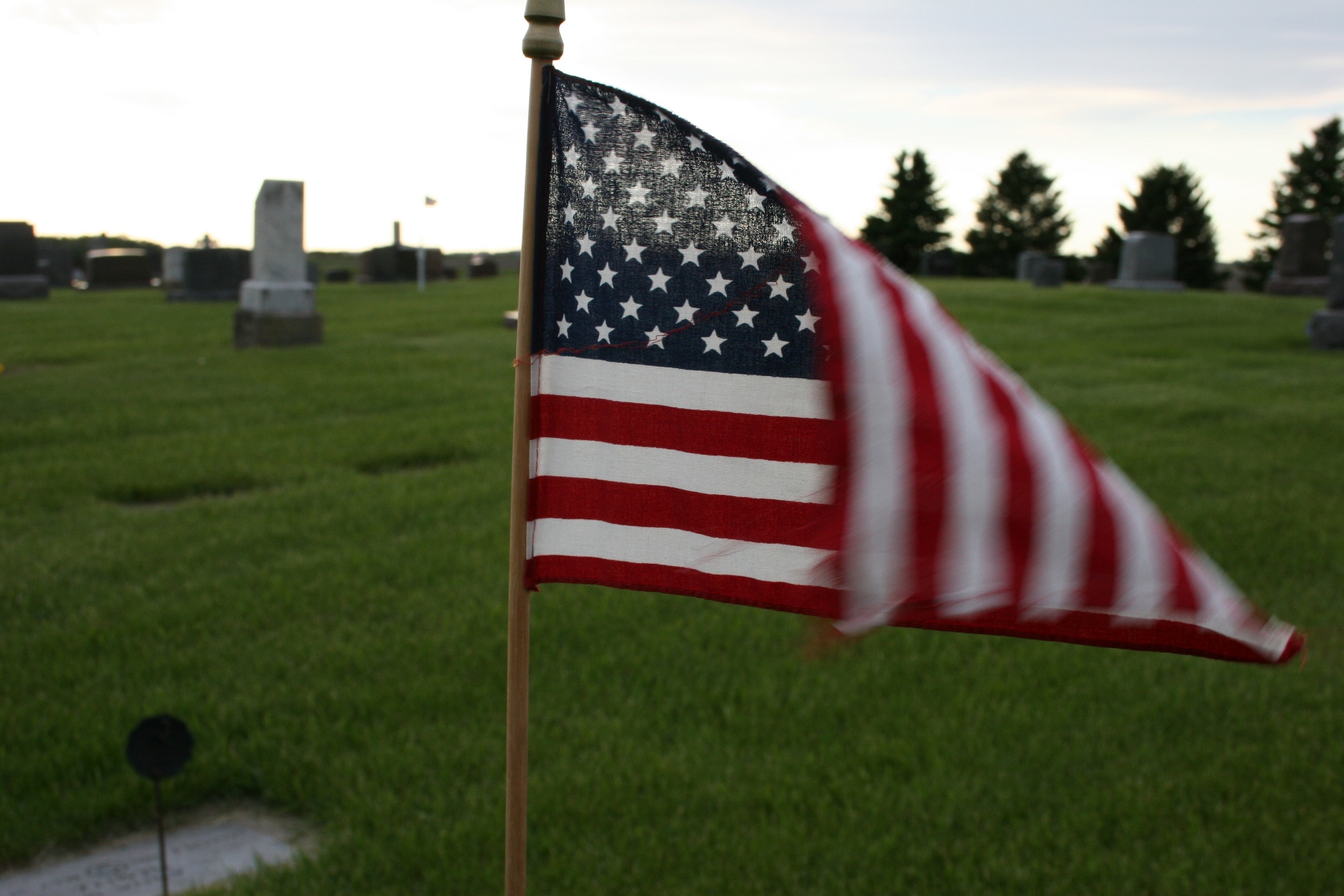
A flag waves in the wind on a soldier's grave.

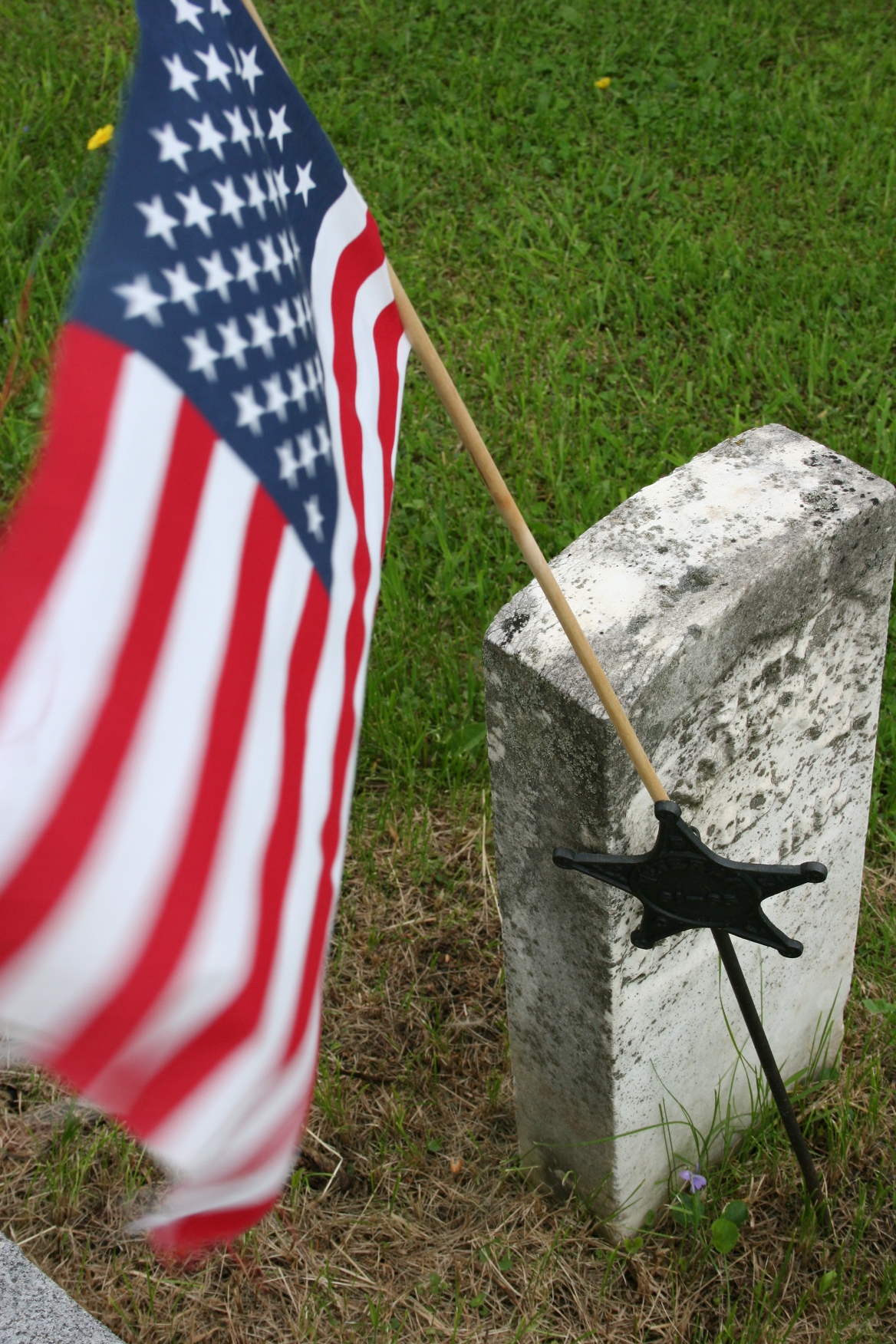
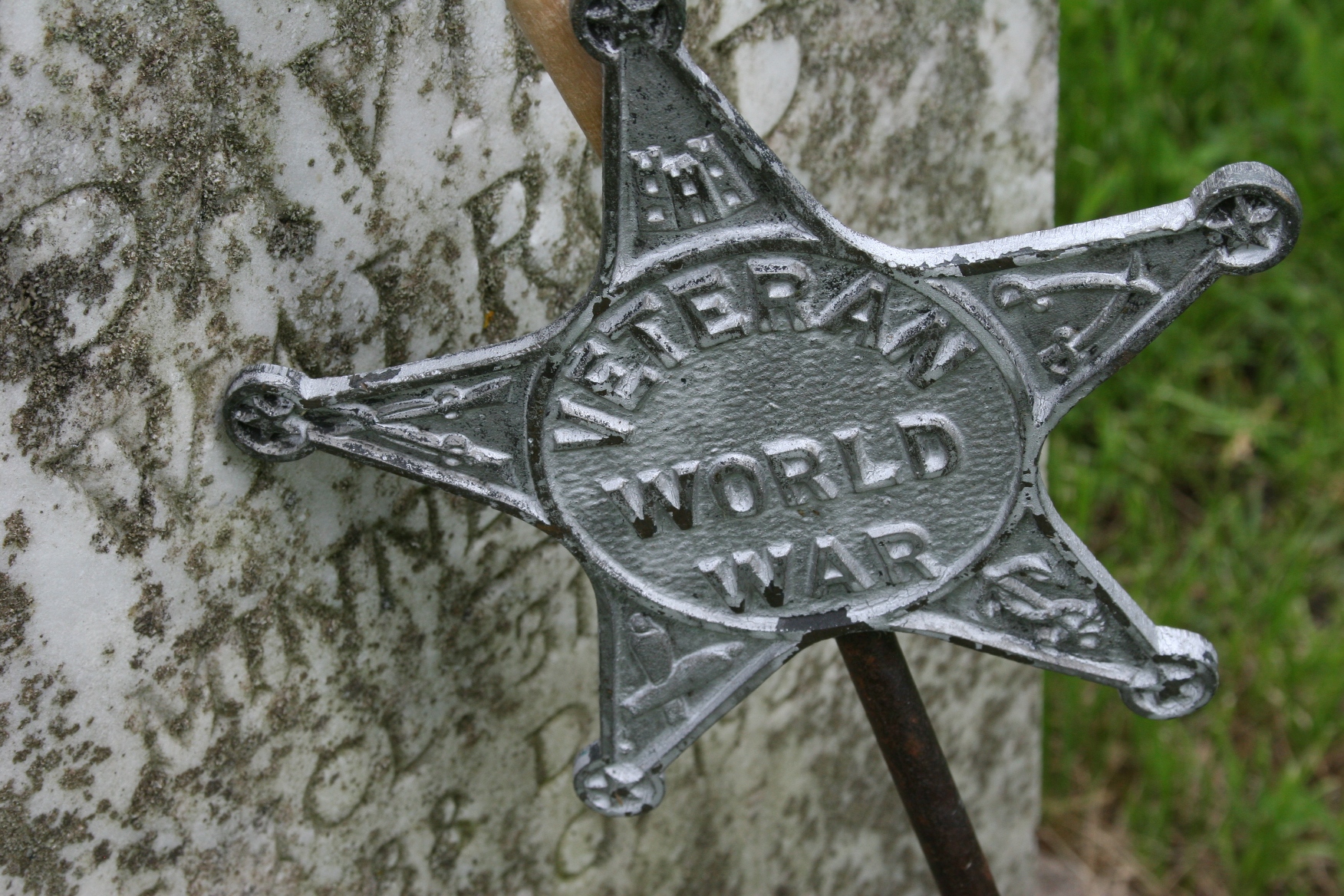
A star marks a veteran's tombstone.

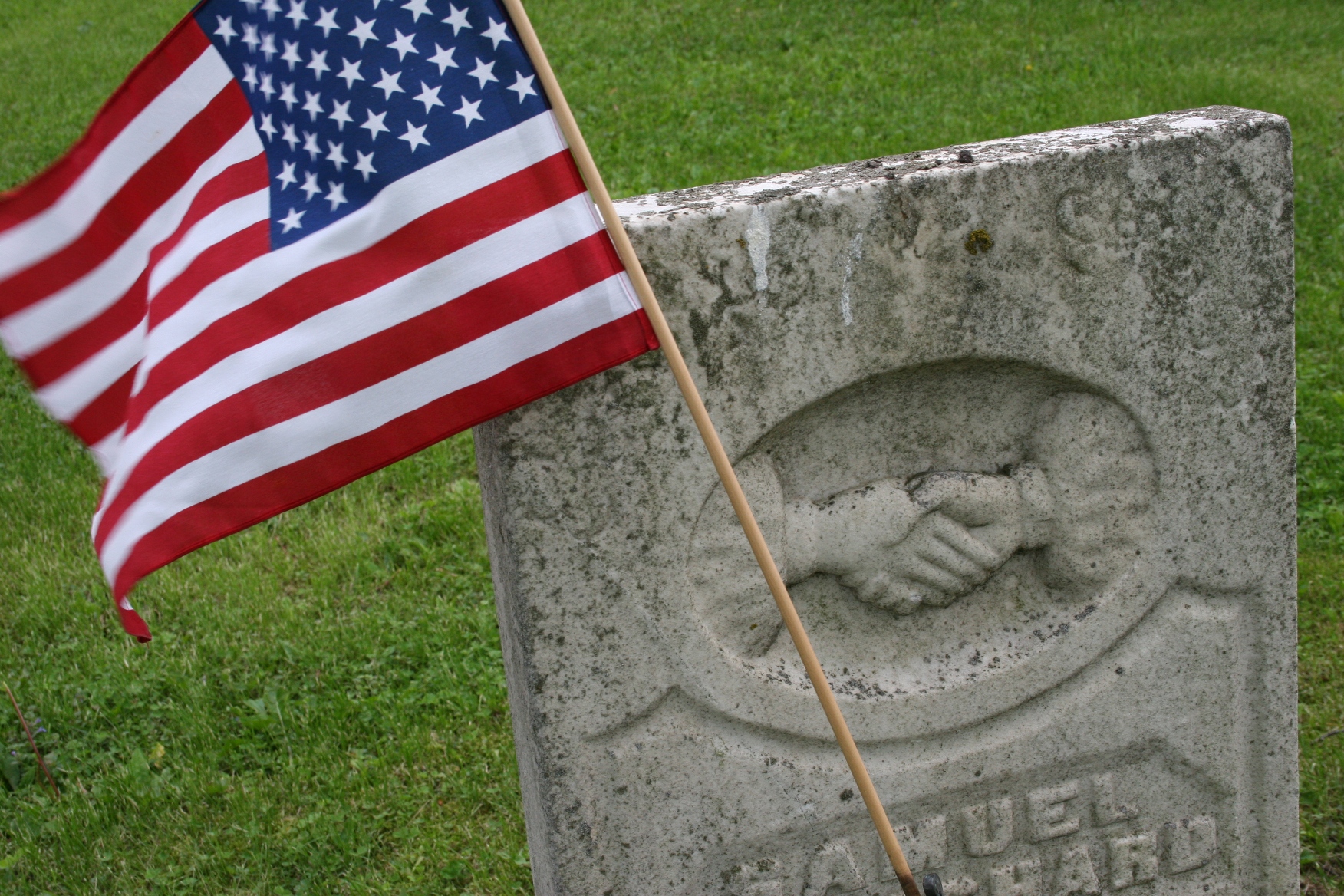
Can anyone explain the symbolism of these clasped hands on a veteran's grave?

A flag marks the entrance to the Cannon City Cemetery.

© Copyright 2011 Audrey Kletscher Helbling


The veterans of Vesta

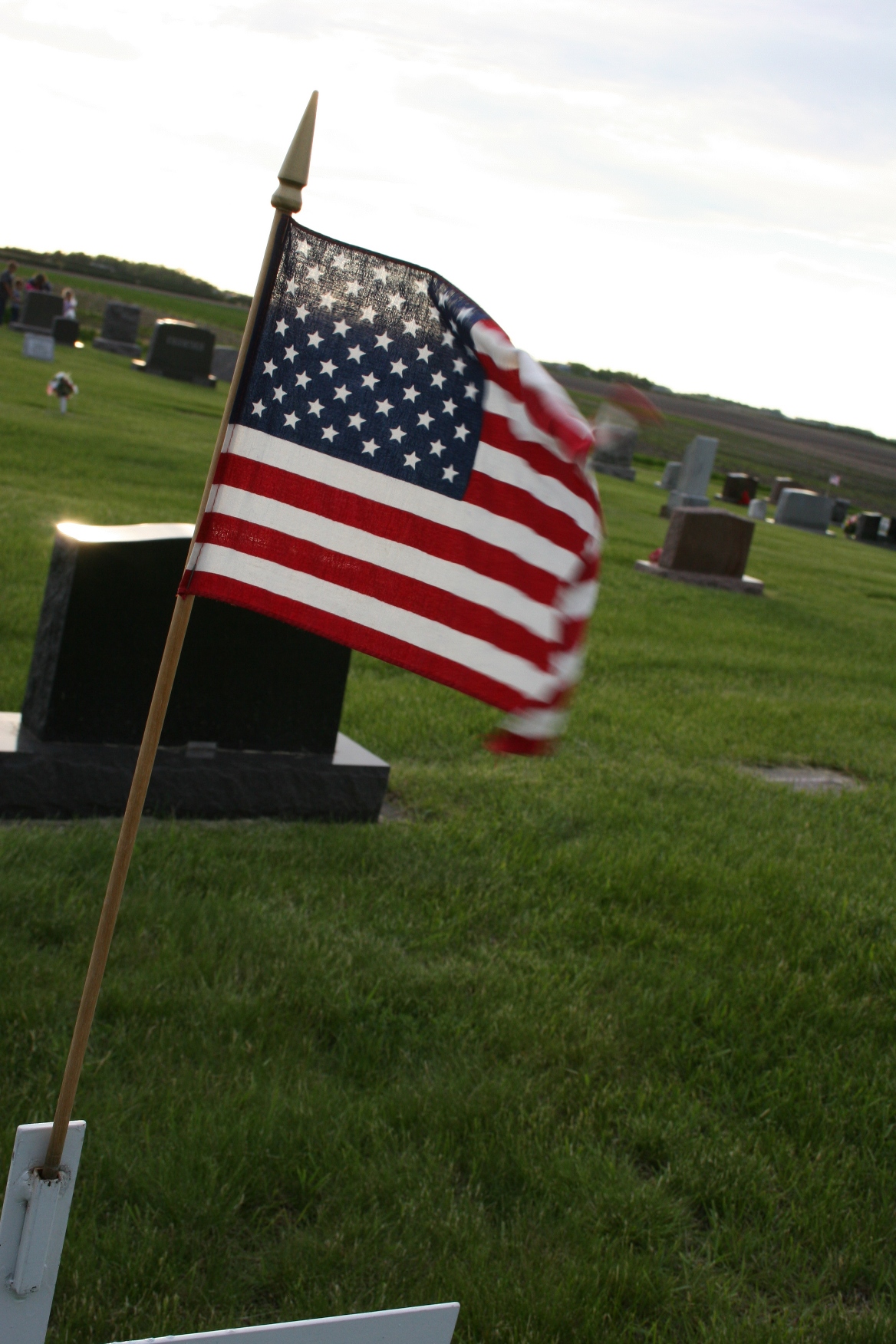
A flag placed on a veteran's grave at the Vesta Cemetery in southwestern Minnesota.

EARTH MEETS SKY HERE.

On this Memorial Day weekend, I have come to this hilltop cemetery outside of my hometown of Vesta in southwestern Minnesota to remember.

I walk the rows, between the tombstones, lean in close, read the names, memories only a thought away.

My focus is on my father and the other veterans buried here whose names I know, whose stories of war I will never fully know.

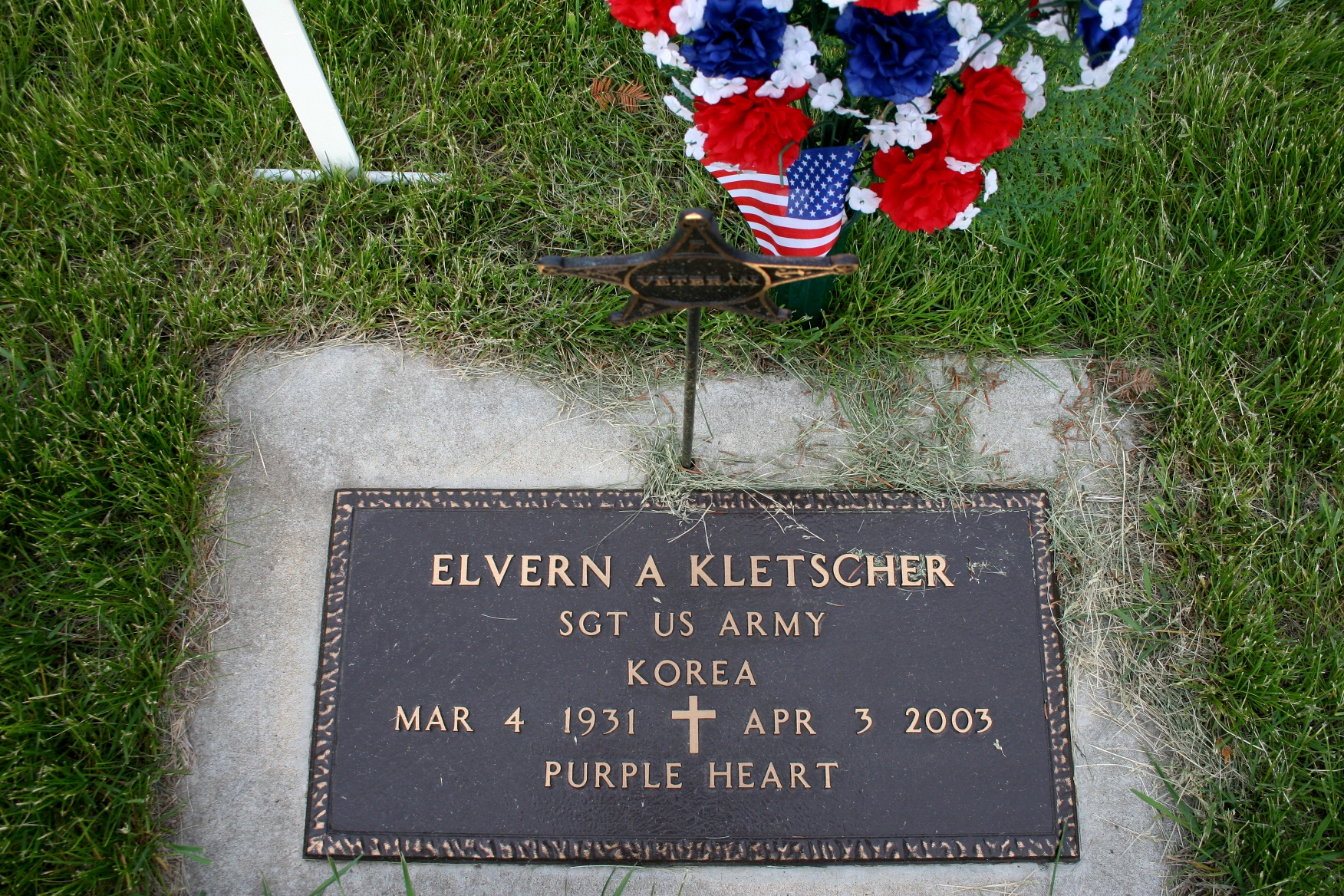
An in-ground marker honors my father, Elvern Kletscher, a Korean War veteran and recipient of the Purple Heart for wounds he suffered at Heartbreak Ridge in Korea.

How did they feel leaving family and farm? Were they scared? Were they honored to serve their country? Did they yearn for home as they shouldered their weapons? Did they leave as boys, come home as men? Were they scarred by war, forever changed?

I wondered as strong prairie winds whipped flags attached to white wooden crosses. So many flags. So many graves of men who’ve served.

If only I’d asked them to tell me their stories, these men whom I’d never thought of as soldiers, until I saw their graves marked by crosses and stars and American flags.

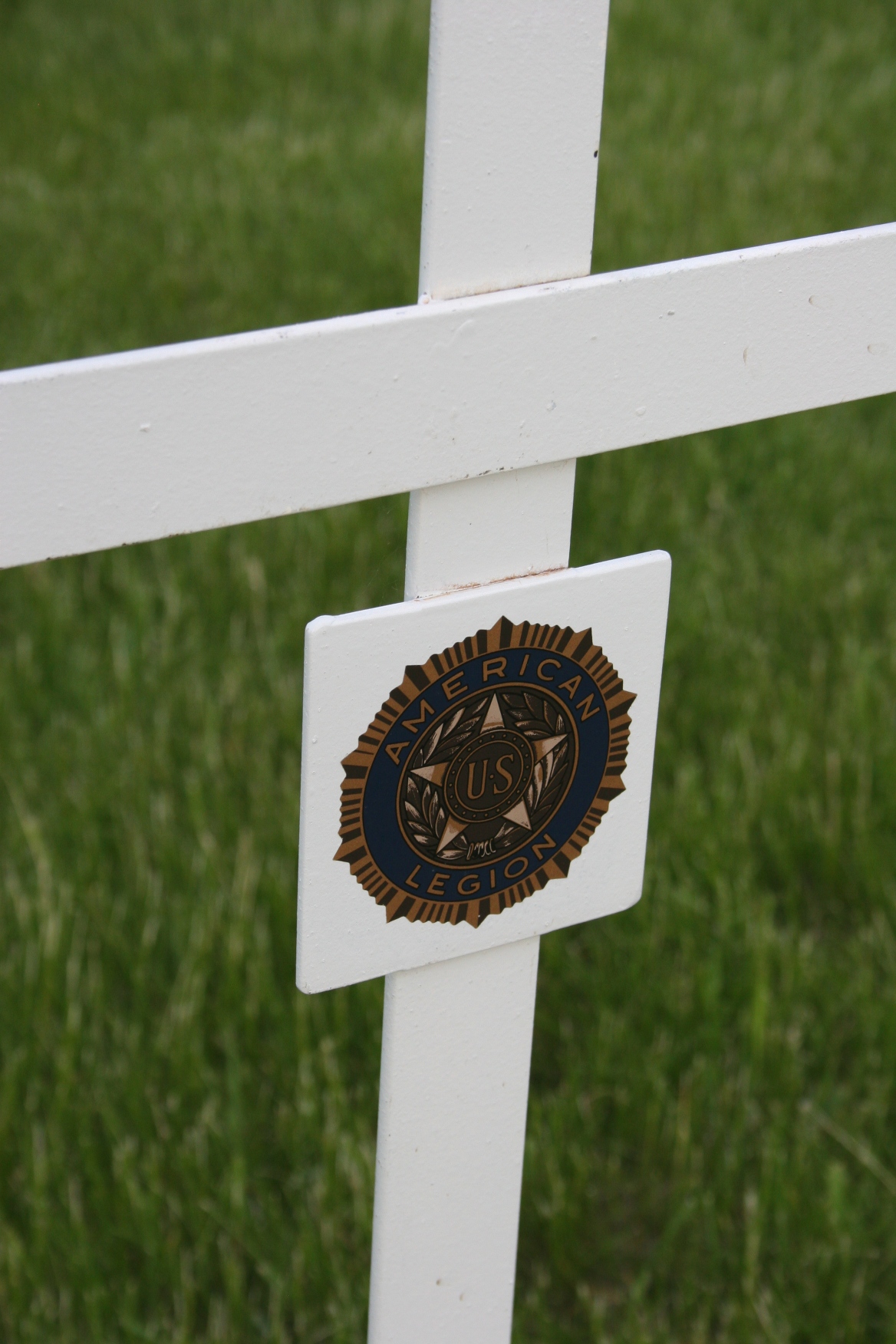
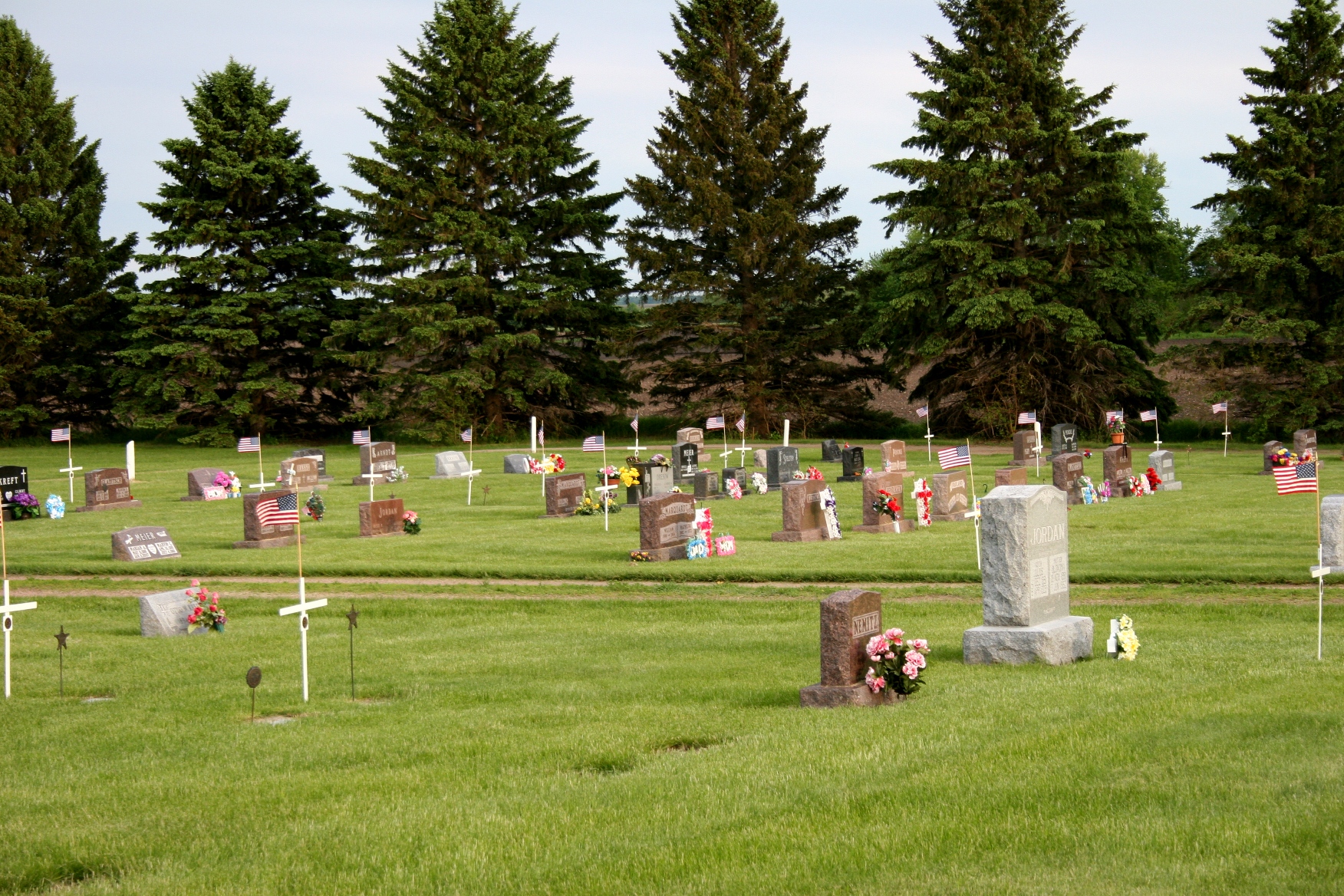
The local American Legion marks veterans' graves with white crosses.

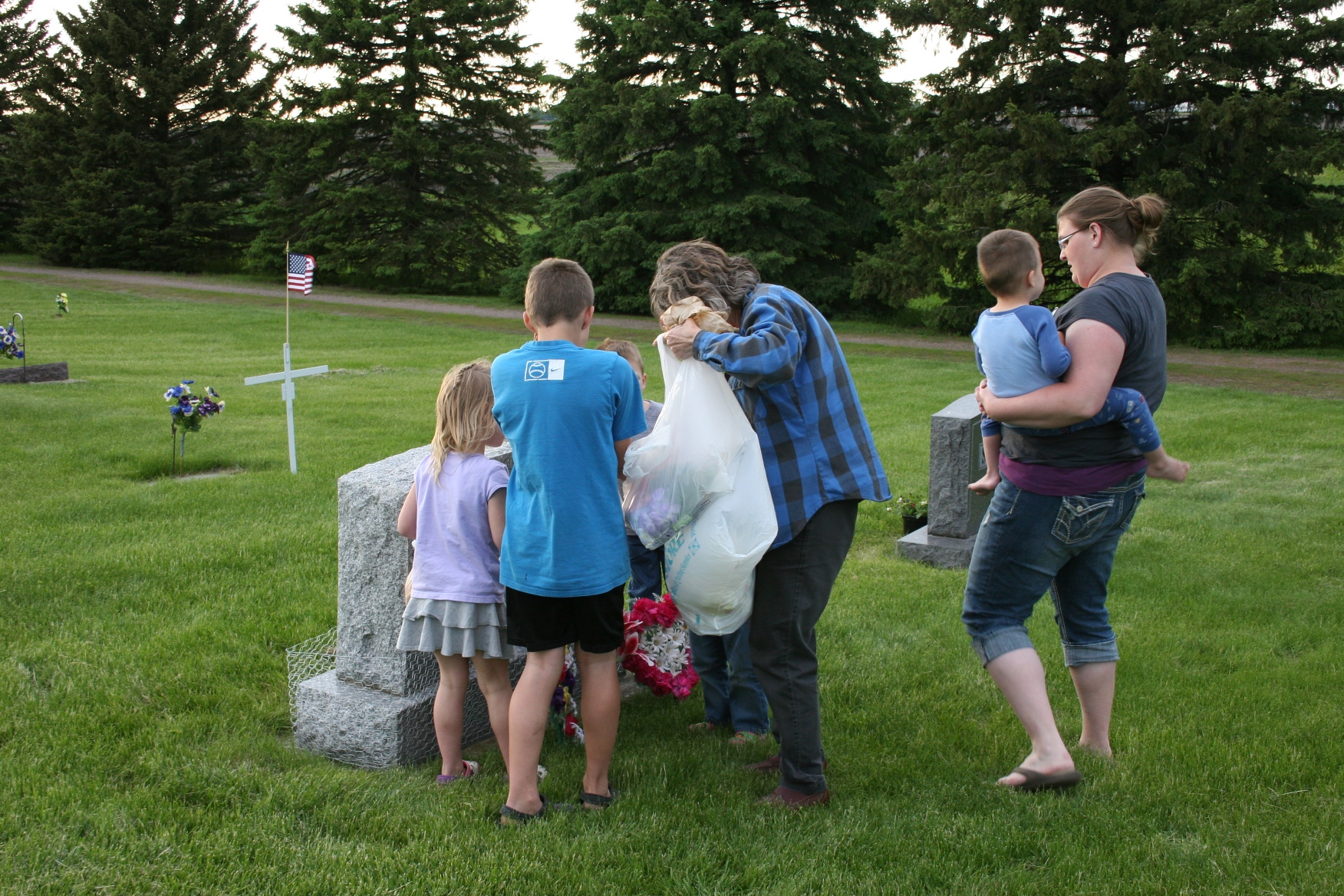
Barb Schmidt teaches her grandchildren about their ancestors as they place flowers on the graves of loved ones Saturday evening at the Vesta Cemetery.

Set atop a hill, the wind catches the flags marking vets' graves.

I was surprised by the number of veterans buried in the Vesta Cemetery, their graves marked by small flags attached to white crosses. This photo shows only one small portion of the graveyard.

© Copyright 2011 Audrey Kletscher Helbling


BibleSticks and battle prayers May 28, 2011

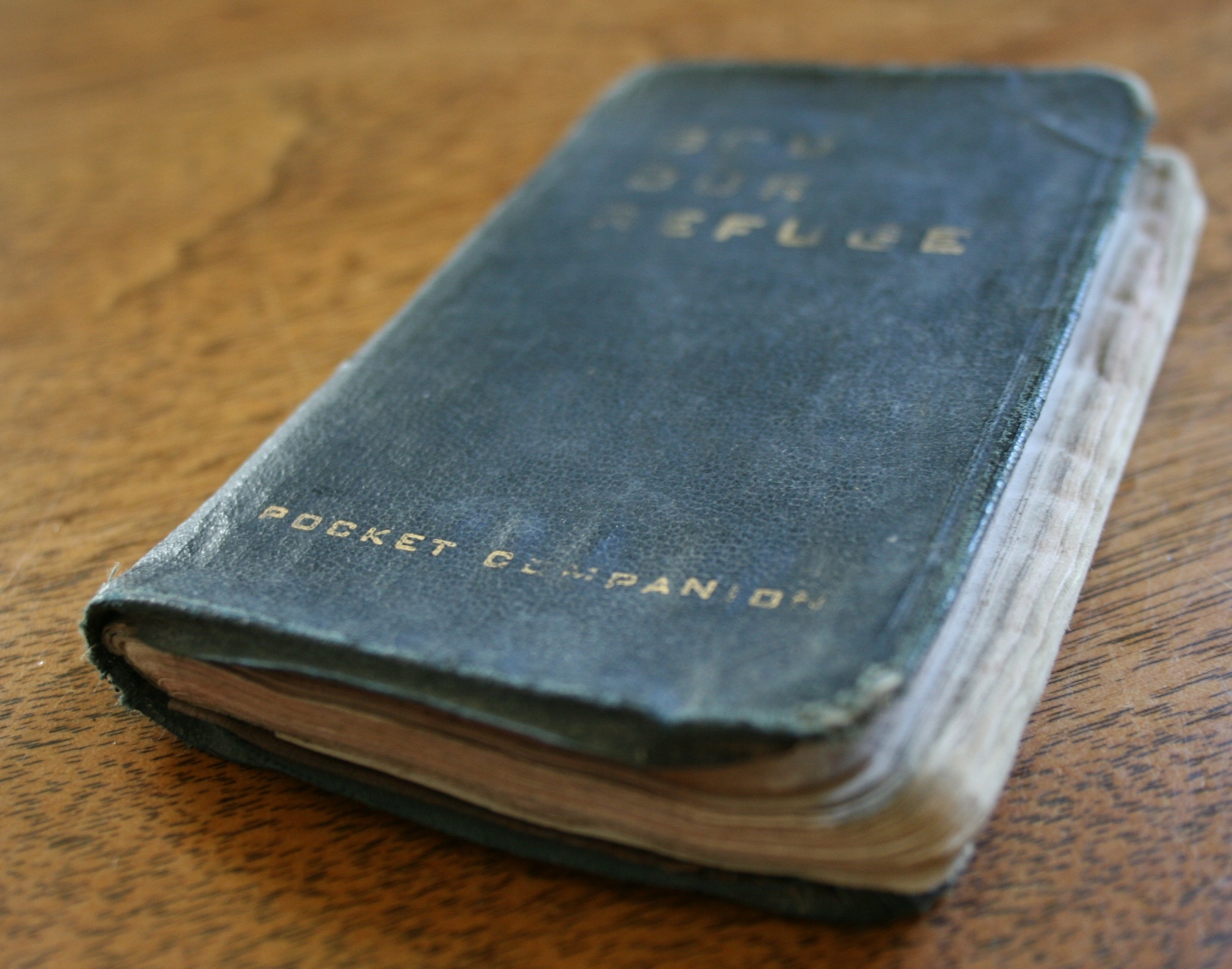
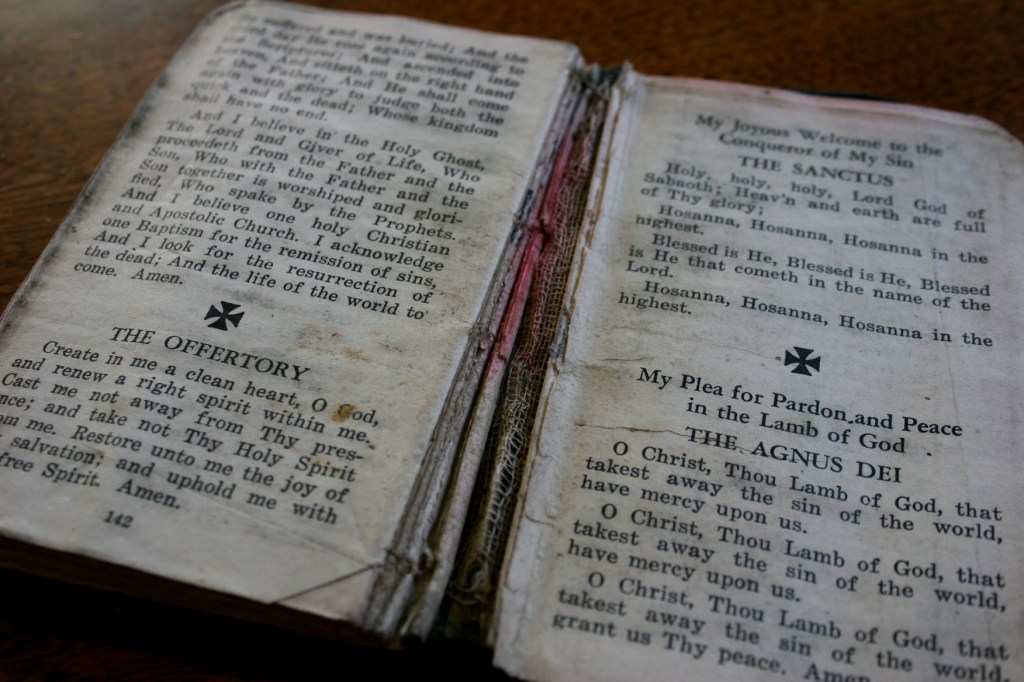
A tattered prayer book carried by my father to Korea, where he fought on the front lines during the Korean Conflict. Touching these pages, I feel the faith of my soldier father.

LAST SUNDAY AFTER SERVICES at my church, Trinity Lutheran in Faribault, we watched a brief video about BibleSticks.

Never heard of them? I hadn’t either, until viewing that clip.

“The Military BibleStick is a digital audio player that is pre-loaded with a dramatized recording of the entire New Testament,” according to the Faith Comes by Hearing website. The organization, dedicated to getting the Word of God into the world, “offers 557 Audio Scripture recordings in 553 languages reaching more than 5 billion people in more than 185 countries.”

Part of that outreach includes the U.S. military. Demand is great for the 3 ½-inch long, less than one inch thick, camouflaged, battery-operated BibleSticks, I learned via the video. For whatever reason, the BibleSticks must be processed through military chaplains.

With a $25 donation, we could give a slip-in-the-pocket, portable New Testament to military men and women.

Although I personally don’t know of anyone who has used a BibleStick, I do understand the importance of access to Scripture, especially for our soldiers.

Flashback to February 1952, when my father, Elvern Kletscher of Vesta, was drafted. Less than a year later, he found himself in the mountains of Korea, a U.S. military infantryman fighting on the frontline during the Korean Conflict.
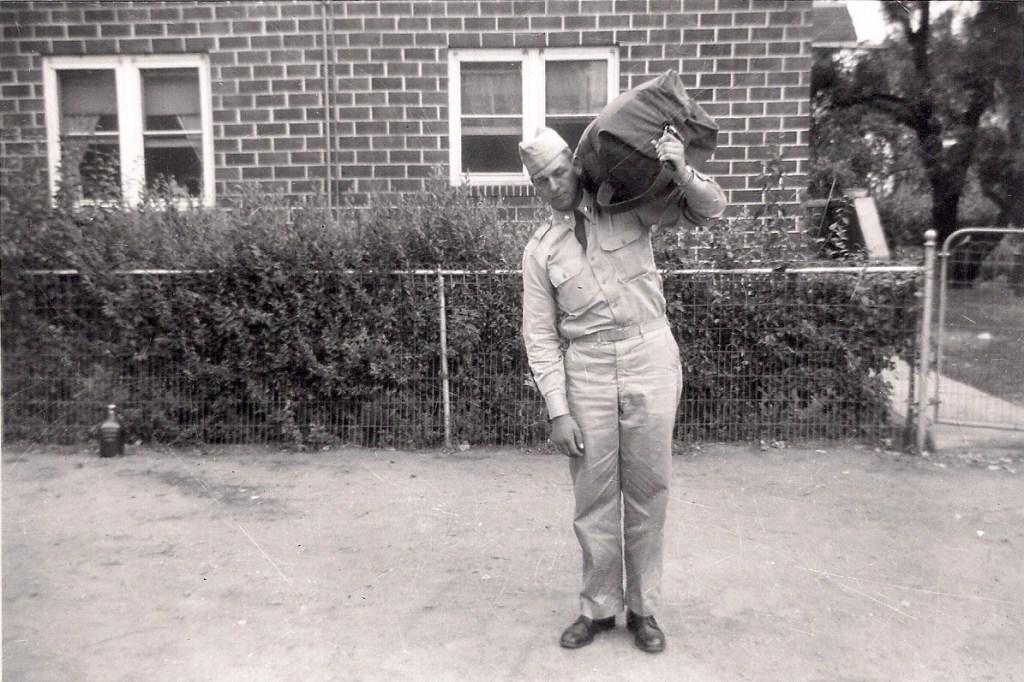
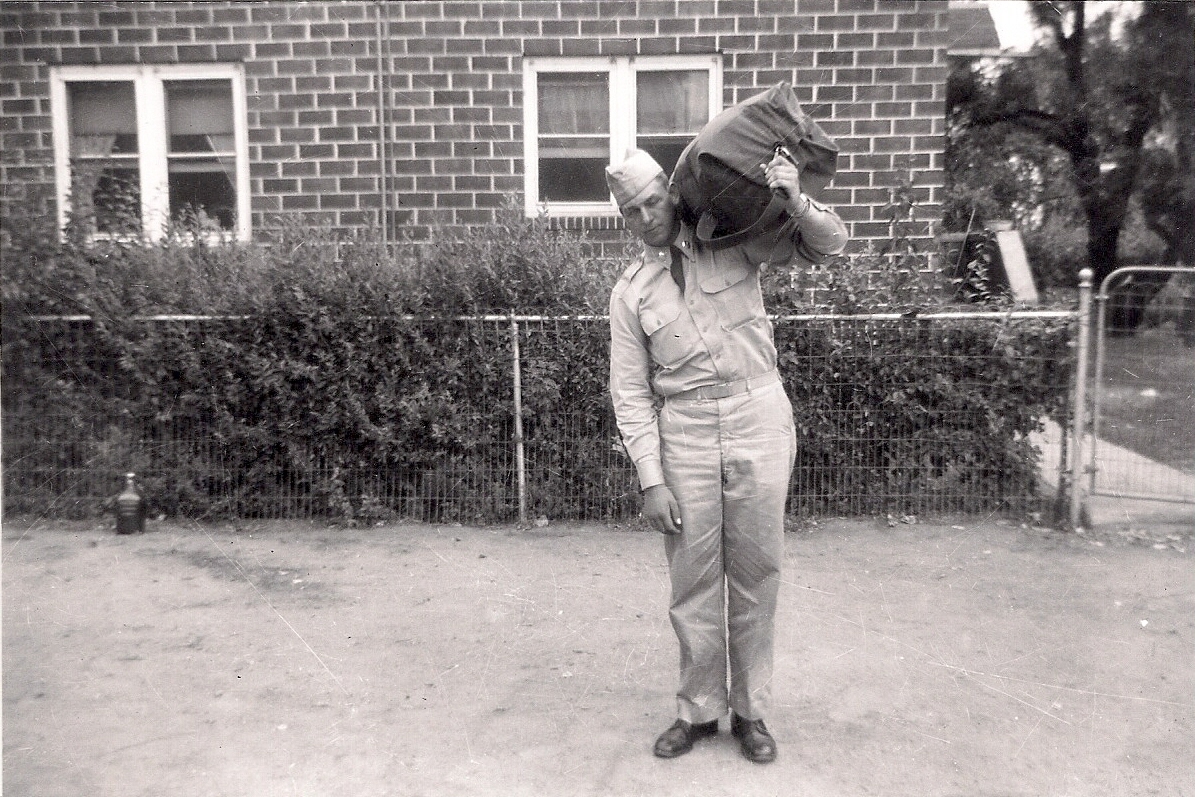
My father, Elvern Kletscher, preparing to leave his Vesta farm home in April 1952, six weeks after he was drafted.

On February 26, 1953, he was struck in the neck by shrapnel at Heartbreak Ridge. Later, he would be awarded the Korean Service Medal with 3 Bronze Service Stars, the National Defense Service Medal, the United Nations Service Medal, the Combat Infantry Badge and the Purple Heart.

During those combat days, when my dad feared for his life, when he was forced to shoot the enemy or die, he relied on his deep faith in God.
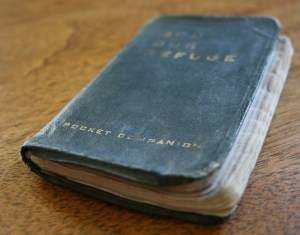
My Dad's worn copy of God Our Refuge.

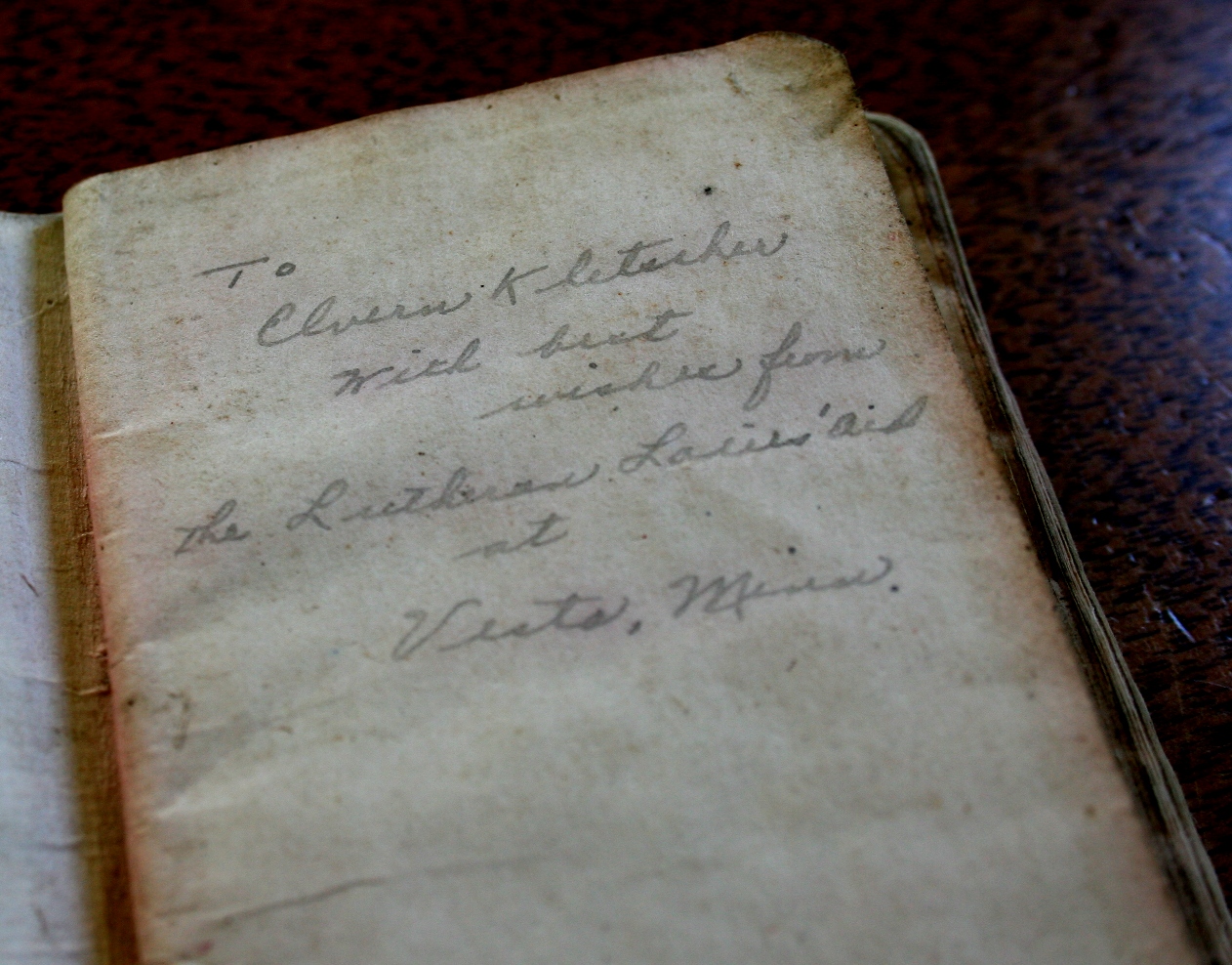
And he carried with him a 3-inch by 4 ½-inch black book, God Our Refuge. A gift from the St. John’s Lutheran Ladies’ Aid of Vesta, the book includes gospel readings, devotions, meditations, prayers, hymns and more.

Within the pages of that volume, my dad found solace, hope and comfort in the face of constant death.

Now eight years after his death, I cradle the tiny book in my palm, brush my fingers against the brittle, black leather covers, open the curled pages that are loosening from the binding. I think of my father, how he carried this book in his pocket, how he flipped and read the 144 pages, how he prayed while trapped inside the cold earth of a foxhole, while engaging in battle, while lying inside his tent at night.
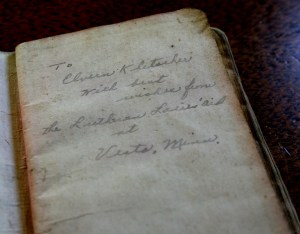
The inscription reads: To Elvern Kletscher with best wishes from the Lutheran Ladies' Aid at Vesta, Minn.

As I turn to page 117 of my dad’s tattered copy of God Our Refuge, I feel forever connected to him, my fingers touching the paper he touched, reading the words he read 58 years ago as a young soldier in battle:

“In Thine arms I rest me;

Foes who would molest me

Cannot reach me here.

Though the earth be shaking,

Every heart be quaking,

Jesus calms my fear.

Lightnings flash and thunders crash;

Yet, though sin and hell assail me,

Jesus will not fail me.”

HAVE YOU OR SOMEONE you know used a BibleStick? If so, I’d like to hear about your experience with this audio version of Scripture and what it meant to you.
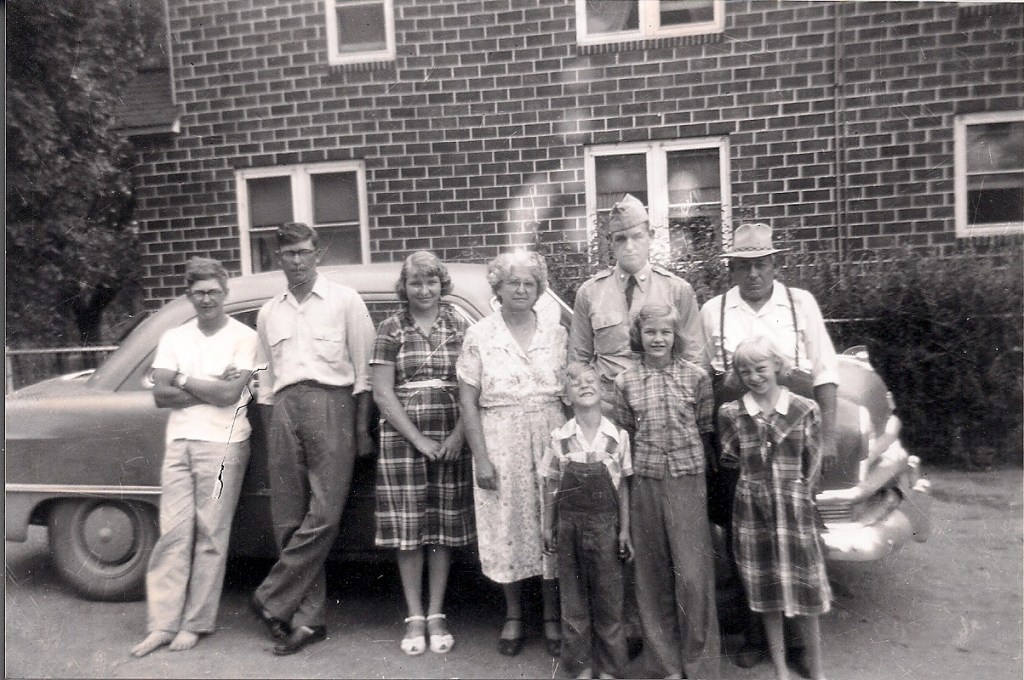
My grandparents, Ida and Henry Kletscher, posing with some of their children, flank my father, Elvern Kletscher, who is about to leave for military service in 1952. My uncle Merlin is the youngest, standing in the front row wearing the bib overalls.

BEHIND EVERY PICTURE, there is a story, including stories about the images of my father and his family, above.

My uncle, Merlin Kletscher, found these two photos in the winter of 2010 while researching for a family reunion. They were tucked inside a worn copy of The Lutheran Hymnal, copyright 1941, published by Concordia Publishing House. That hymnbook belonged to my grandfather, whose name, Henry Kletscher, was inked in gold on the cover. He had taped the edges and binding of the much-used songbook.

The two photos were sandwiched between song 409, “Let Us Ever Walk with Jesus,” and song 410, “Jesus Lead Thou On.”

The latter was one of my Grandpa Henry’s favorite hymns, Uncle Merlin recalls.

“I have not found any other photos or negatives which leads me to think that these pictures were very dear to him,” my uncle says.

Now those photos are also very dear to me. When Merlin handed copies to me last summer, I teared up. Little did my father know then what horrors awaited him on the battlefields of Korea, how his life and death experiences would forever change him.

And my heart ached for my Grandma Ida, standing there beside her soldier son. I wish I had asked her how she felt, how they all felt. Now I have only these photos to show me the close love of a family sending their boy off to war.

© Copyright 2011 Audrey Kletscher Helbling


Remembering Pearl Harbor from Minnesota December 7, 2010

MY MOM WAS ONLY nine years old when the Japanese attacked Pearl Harbor 69 years ago today.

I asked her about this shortly after 9/11.

She shared how frightened she was because, in her small world and for all she knew, Hawaii was as close as a few towns away from her Minnesota home.

Imagine how terrifying the attack must have been for children, and adults, in a world where communication was not instantaneous.

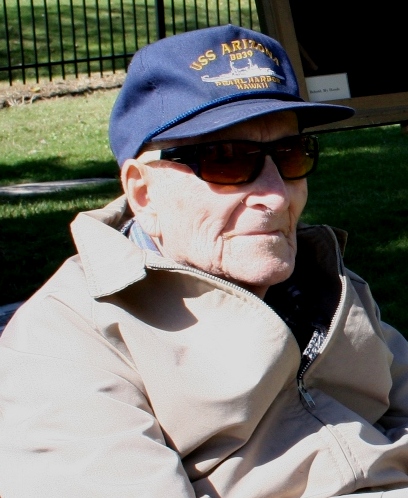
Rhody Yule wearing his USS Arizona cap.

EVERY DAY THE NUMBER of WW II veterans dwindles. And with the deaths of these former soldiers, a bit of our living history dies too. Some of their stories will never be told for many cannot speak of the horrors of war. Others share their stories only with family members and/or their brothers in arms.

I am fortunate to have met one particular WW II veteran about a year ago. He is 92-year-old Rhody Yule, a truly remarkable man. Rhody, while small in stature, is big in heart. He possesses humbleness, strength of spirit, a sharp mind and gentleness of character that we should all emulate. I cannot say enough good things about my friend.


Rhody’s military experience included serving in Nagasaki, Japan, cleaning up after the atomic bomb. He won’t say much about his time there, calling the situation “a mess.” Clearly, he saw more than anyone should ever witness.

I asked Rhody once about the possibility of radiation exposure. He had to do what he had to do, he told me.

I’ve seen photos my soldier-friend brought home from Japan. The utter obliteration of the landscape can only be compared to the most powerful and devastating storm times 100 or maybe 1,000.

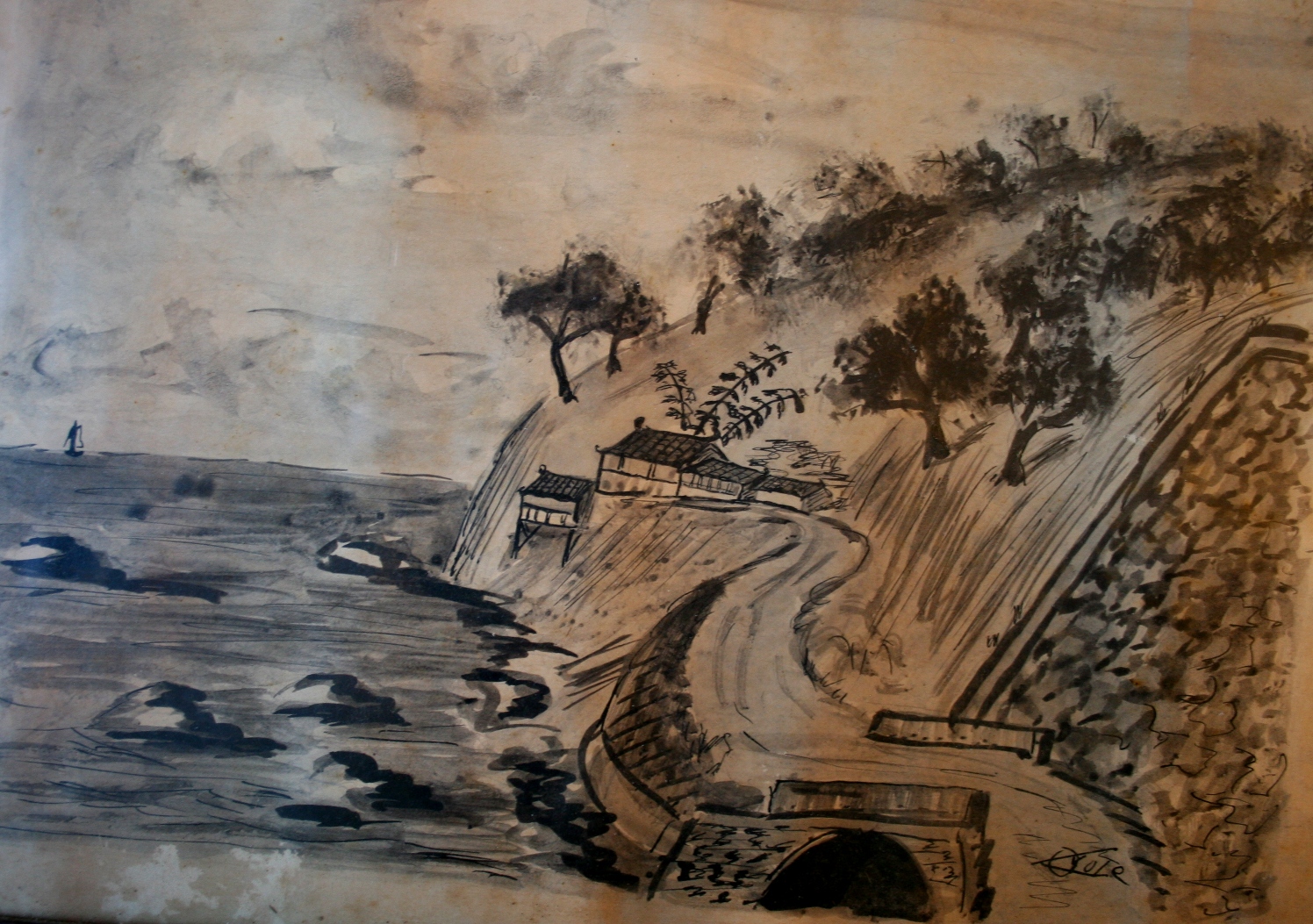
Rhody, who is a former sign painter and an artist, created a trio of sketches from his time in Japan. The public will have an opportunity to see those during an upcoming exhibit at the Paradise Center for the Arts in Faribault.

One of Rhody's sketches from Japan during WW II. In the bottom right, you will see an opening into a cave, where Rhody said the Japanese worked on military machining projects.

Another one of the three sketches Rhody did while stationed in Japan during WW II.

I, along with many others, have been working for the past several months to make this show, “A Lifetime of Art, The Rhody Yule Collection,” a reality. The exhibit opens with a reception from 5 p.m. – 7 p.m. on Friday, January 14, and closes on February 26.

In addition to the Nagasaki sketches and many other pieces of art, Rhody is showing a painting he did on a piece of old tent canvas while stationed in Nome, Alaska. He had no other material on which to paint the 1944 circa image of snowplows clearing snow from the military runway. Imagine the history on that piece of canvas, the stories held within the threads of that fabric.

WE ALL HAVE STORIES to tell. Today, the anniversary of the bombing of Pearl Harbor, let us hear the stories of those who remember this day that shall forever live in infamy. And more importantly, let us listen.

Text and photos © Copyright 2010 Audrey Kletscher Helbling
Artwork © Copyright 2010 Rhody Yule


Reflecting at a veterans’ memorial November 12, 2010

Filed under: Uncategorized — Audrey Kletscher Helbling @ 12:10 PM
Tags: , , , , , , , , , , ,

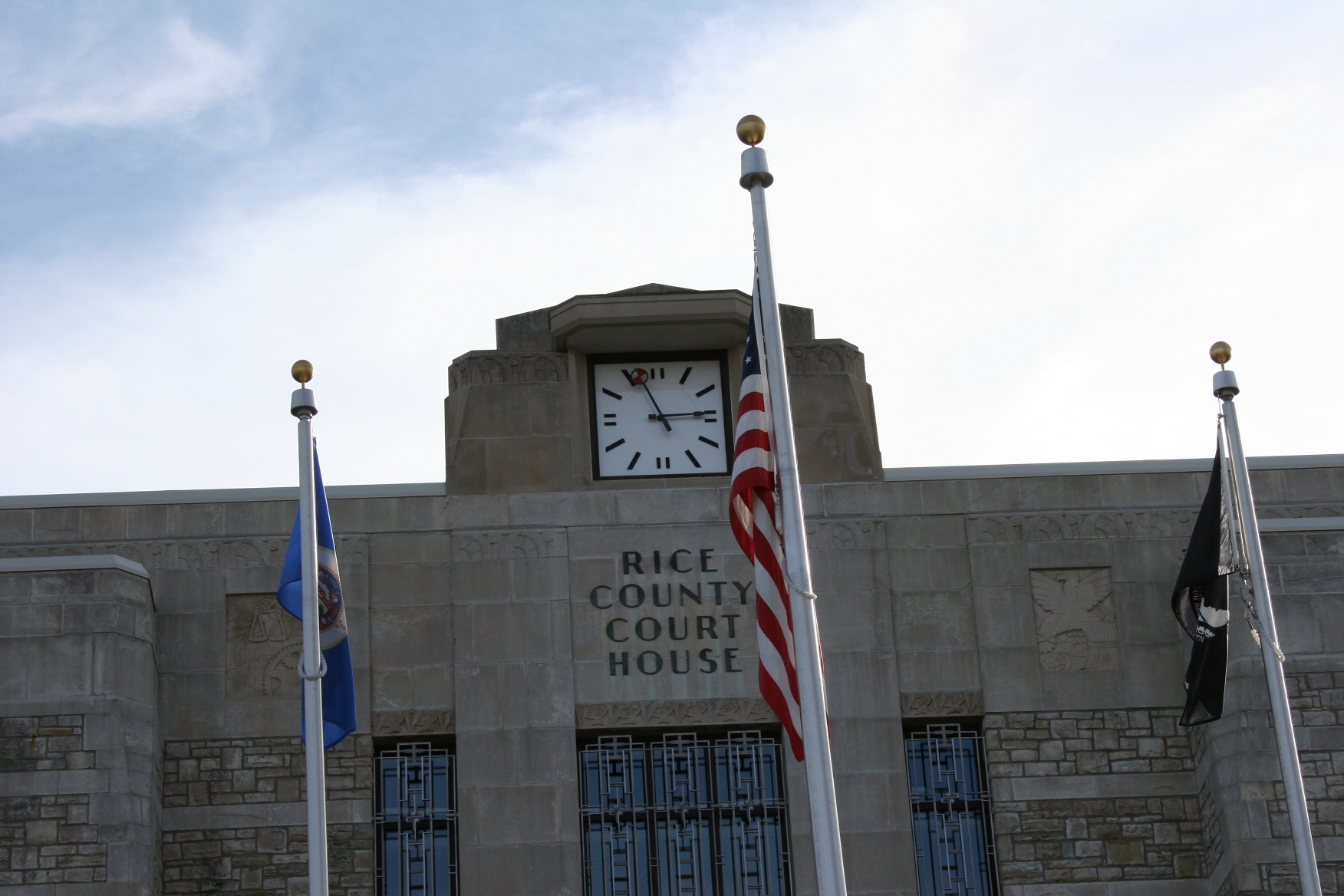
Rice County Courthouse, Faribault

I DIDN’T ATTEND any Veterans Day ceremonies yesterday, and perhaps I should have. But several days earlier, I paid my own quiet tribute by walking the grounds of the Rice County courthouse where a veterans’ memorial expansion project is underway. For years a lone Civil War statue has stood there honoring those who served.
Today new sidewalks edged by honorary pavers lead to the memorial plaza which will eventually feature that Civil War statue, a torch, bronze eagle, dove, granite columns, flags, benches and gardens. I expect a place for quiet reflection, a place of honor, a place to cry.

Honorary pavers line sidewalks leading to the center of the Rice County veterans' memorial on the courthouse lawn in Faribault.
Veterans’ memorials often move me to tears because they always, always, bring thoughts of my dad, a Korean War veteran. I remember how, months after his 2003 death, my emotions overcame me while viewing the veterans’ memorial in Winona. With grief still gripping my soul, I simply wept.

Such strong emotions did not pervade my thoughts at the site of the new Rice County Veterans Memorial in Faribault. Yet, words and images triggered memories in a quiet, deeply personal way of honoring those who have served our country.

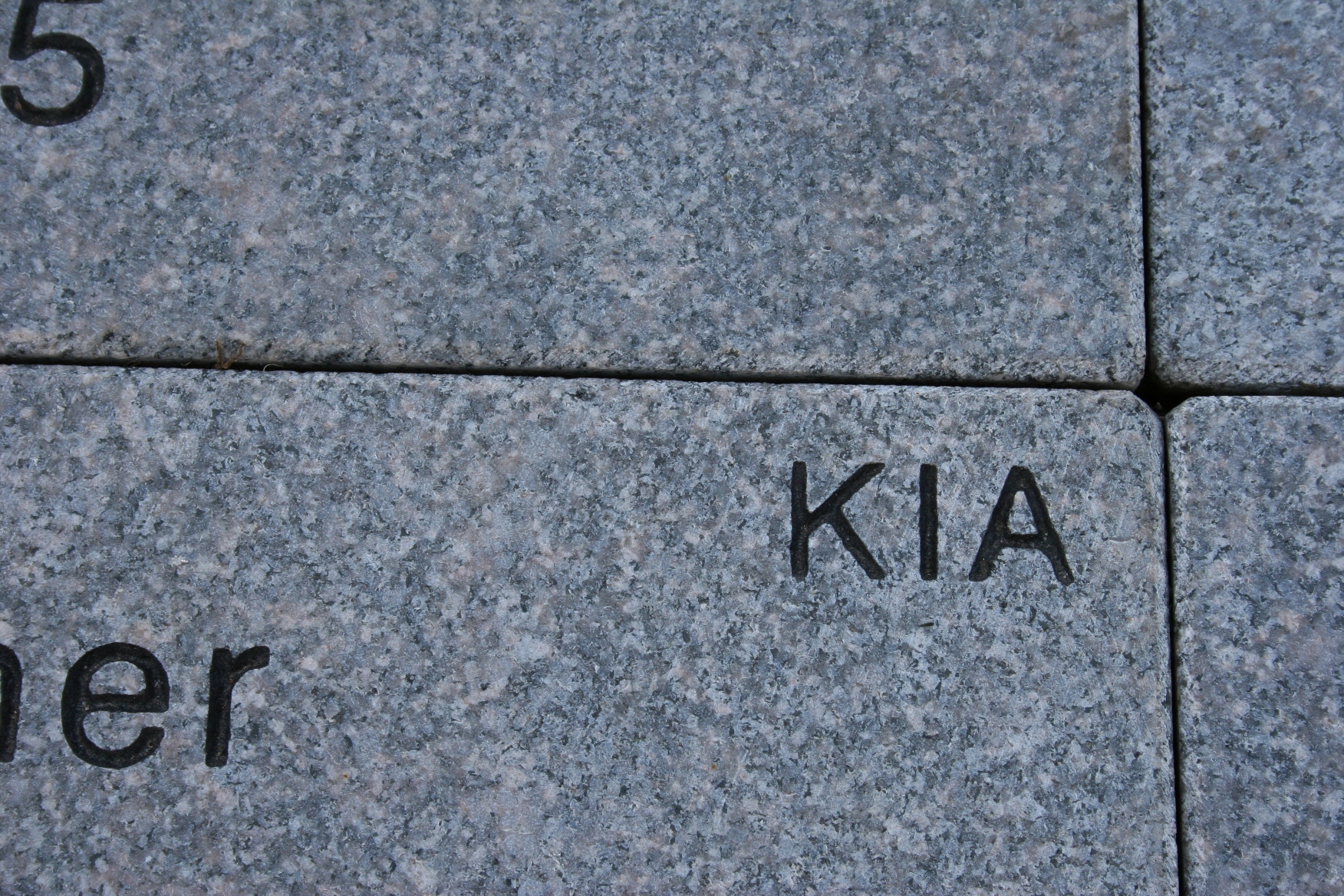
Three letters, KIA, imprinted upon a paver signify the ultimate sacrifice. Killed in action. I thought of my dad's soldier-buddy, Ray Scheibe, who was blown apart by an incoming shell on the day before he was to leave Korea. My dad never got over this loss and was forever haunted by the horrible image of Ray's death.

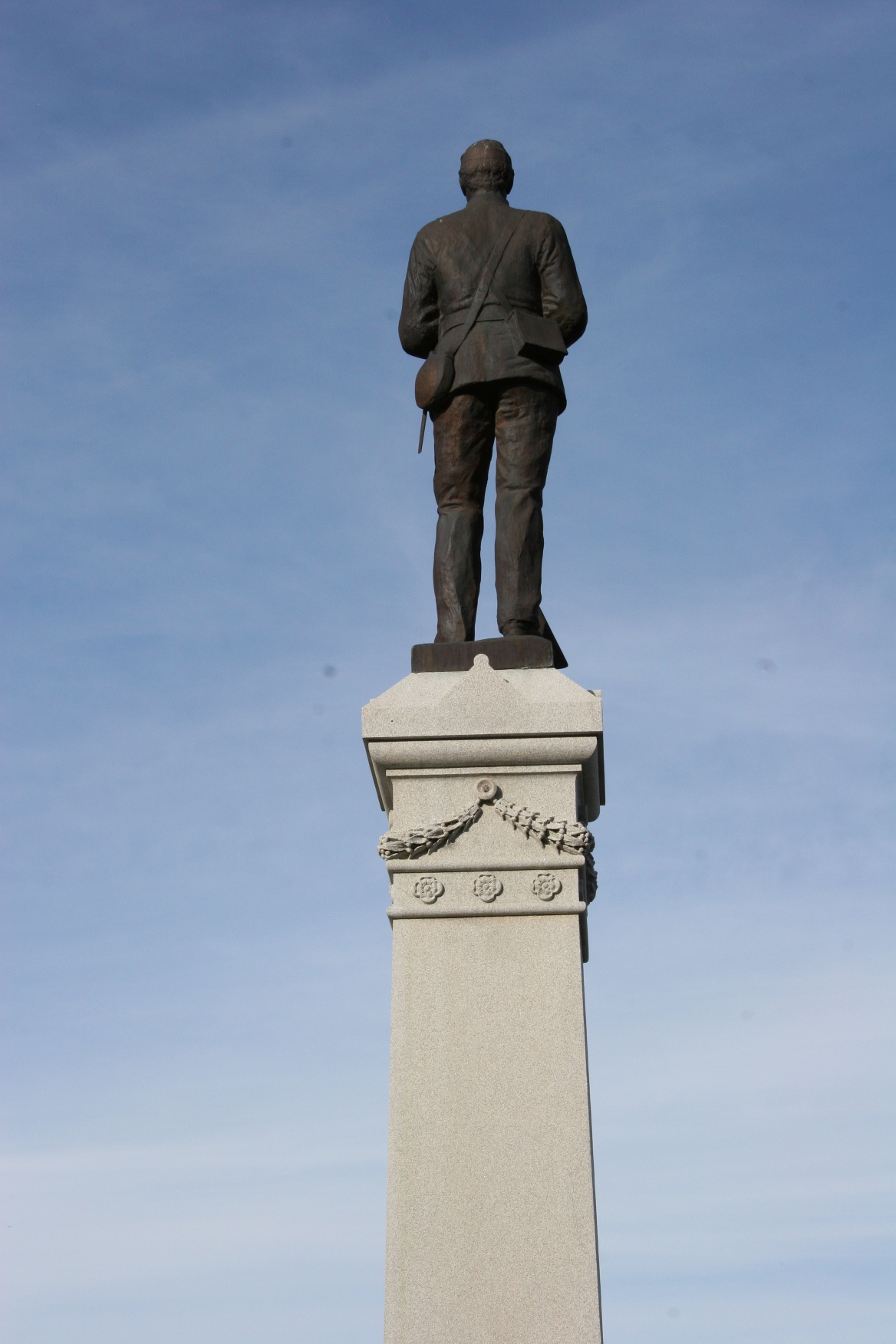
Even though I knew the trail of white in the sky came from an airliner, I imagined this to be the smoke of gunfire or of bombs or of shells as I took this image of the Civil War statue in Faribault.

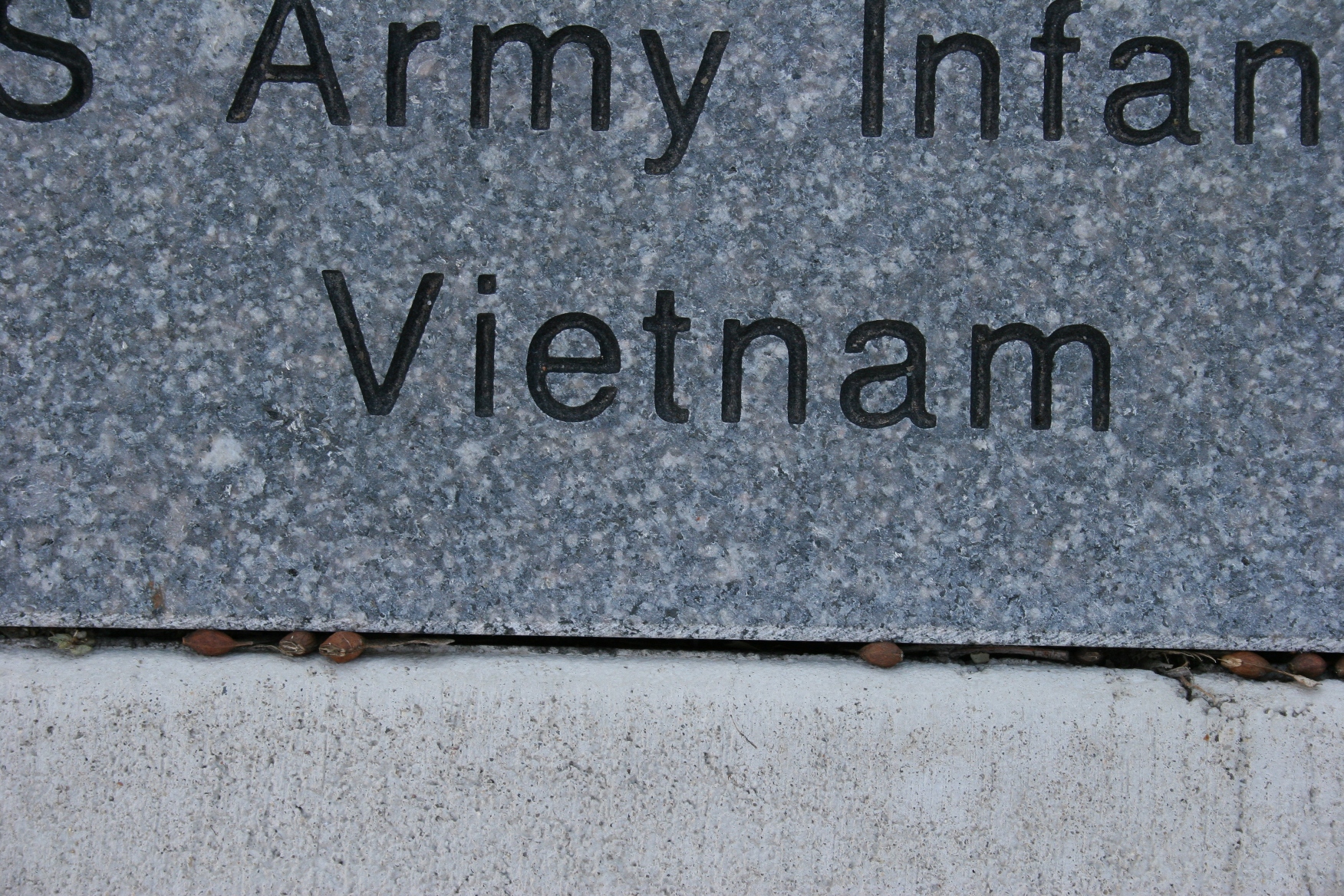
I was coming of age during the Vietnam War. I remember the protests, the anger, the peace signs, all of it...

When I look at the MIA/POW flag, I recall the metal bracelet I wore in high school, the bracelet engraved with the name of a soldier held as a prisoner of war during the Vietnam War. Sadly, I don't remember his name or even know if I still have that bracelet tucked away somewhere in a cardboard box.

When I composed this image, the back of the Civil War statue, I thought about how a soldier must sometimes feel so alone, so vulnerable.

© Copyright 2010 Audrey Kletscher Helbling