Minnesota Prairie Roots

Writing and photography by Audrey Kletscher Helbling

Flood updates from southern Minnesota March 23, 2011

AS YOU WOULD EXPECT, Minnesotans are keeping a close watch on rising rivers, creeks and streams as rain and snow continue to fall across much of our state.

Here in Faribault, sandbagging has begun at the wastewater treatment plant, which flooded during last September’s flash flood. Sandbags have been filled and are available to property owners. The city has an emergency plan in place to deal with any flooding.

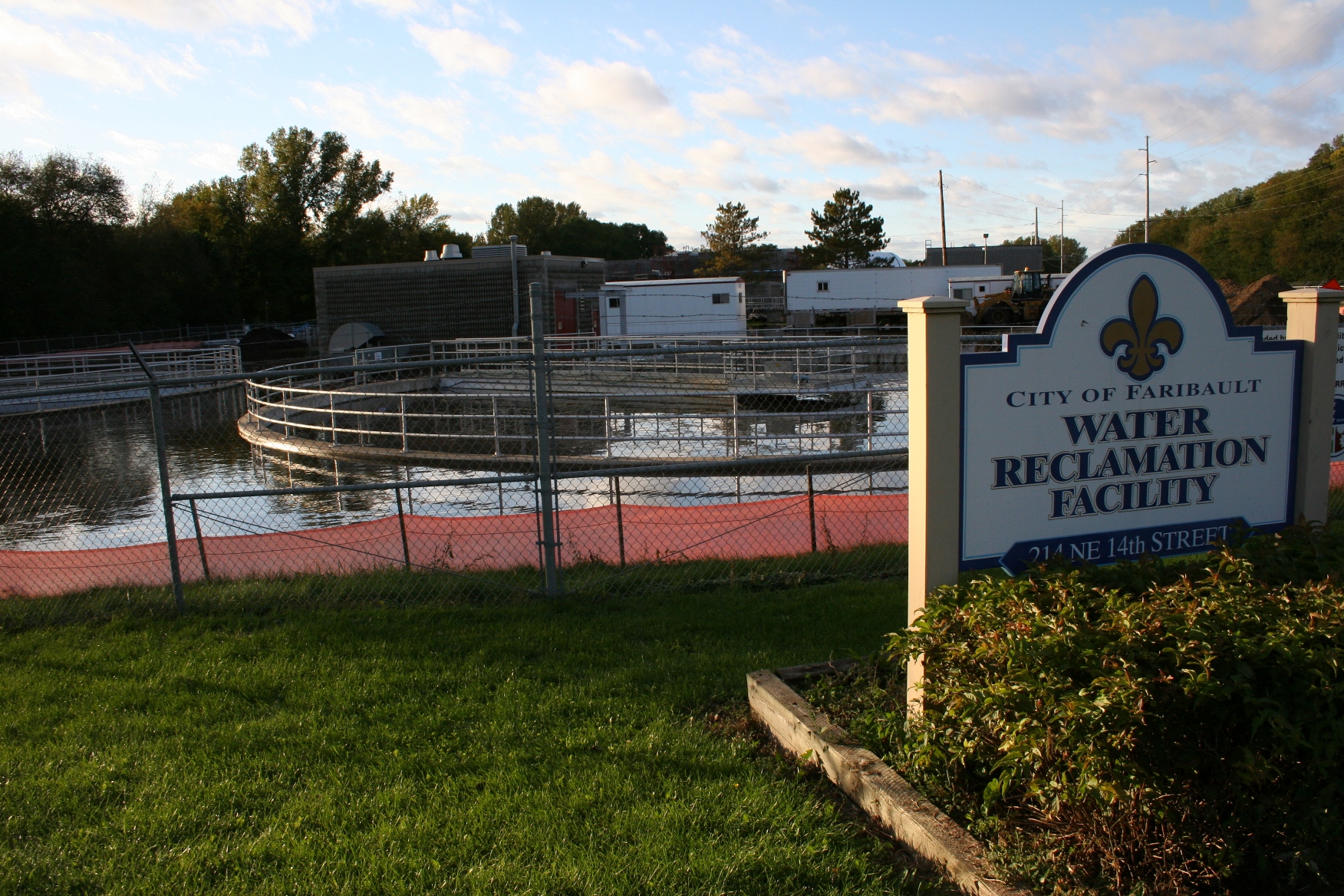
Faribault officials are working to protect the city's water reclamation plant which sits along the Straight River and which was flooded in a September 2010 flood. This photo is from September 2010.

Thankfully, the precipitation—rain, sleet and then snow overnight—have stopped in Faribault.

Further to the south, I’ve heard from Katie Shones of Hammond, a Wabasha County village nestled along the Zumbro River. Last September Hammond and nearby Zumbro Falls were devastated by the same flash flood that occurred in Faribault.

Katie updated me just this afternoon on the situation in Hammond. “So far, no sandbagging in the area,” Katie writes. “We are under a flood warning in Wabasha County, just as much of southern Minnesota. The Zumbro is high, but it is still contained in its banks. People are watching the river closely as you can well imagine.”

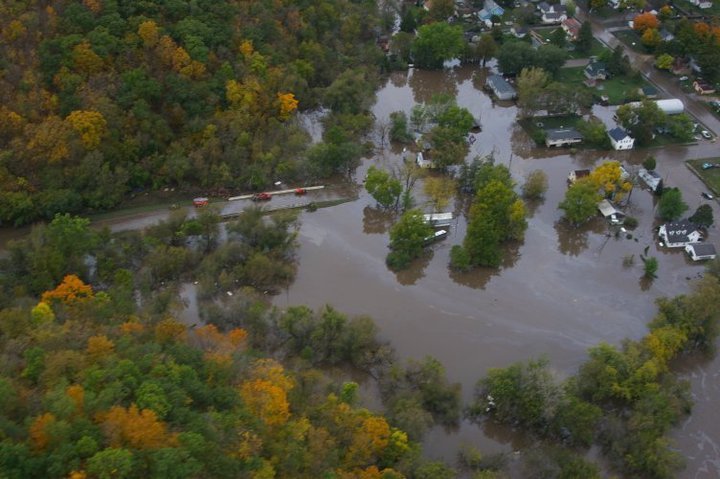
Looking down on Hammond during the September 2010 flash flood. Photo courtesy of Hammond residents Micheal Mann and Tina Marlowe.

Sadly, yesterday the spring floods claimed the life of a Minnesota Department of Transportation worker who was swept away by floodwaters after his backhoe tipped into Seven Mile Creek, which feeds into the Minnesota River. The accident happened between Mankato and St. Peter along U.S. Highway 169 when Michael Struck 39, of Cleveland, was attempting to clean out flood debris, according to an article in The Free Press, Mankato. His body was found today in Seven Mile Creek County Park.

Please be careful out there, and if you have any reports you would like to share about flood preparedness, flooding or other weather in your area of Minnesota, please submit a comment.

© Copyright 2011 Audrey Kletscher Helbling


Back in Faribault, Minnesota, from Japan

FIVE DAYS HAD PASSED since a young Faribault woman posted on her blog from earthquake and tsunami stricken Japan.

And now I know why. She was on her way back from Fukushima to Minnesota for her brother’s wedding.

Haidee, a Christian outreach worker and English teacher, has been safely reunited with her family at their rural Faribault home.

But her decision to leave Japan did not come without struggle. Read Haidee’s insightful post by clicking here. She reveals, in a March 22 post, the emotional turmoil she experienced, being torn between wanting to stay in Japan and returning to the United States.

Her words are honest, poignant and touching. They also point to an unshakable faith and an undisputed belief that God directed her onto the path that would take her to the airport and then back to Minnesota.

God, clearly, was watching over and guiding her on this journey.

A snippet of Jesus' face in a stained glass window at Trinity Lutheran Church in Faribault, where Haidee's father serves as the pastor. I'm certain that many times since the disaster in the Pacific, Haidee has been especially cognizant of God watching over her.

SHOULD I HAVE the opportunity to speak with Haidee, I’ll share that information with you. Click here to read my first post about Haidee, shortly after the disaster devastated Japan.


© Copyright 2011 Audrey Kletscher Helbling


The not-so-surprising results to a diversity question


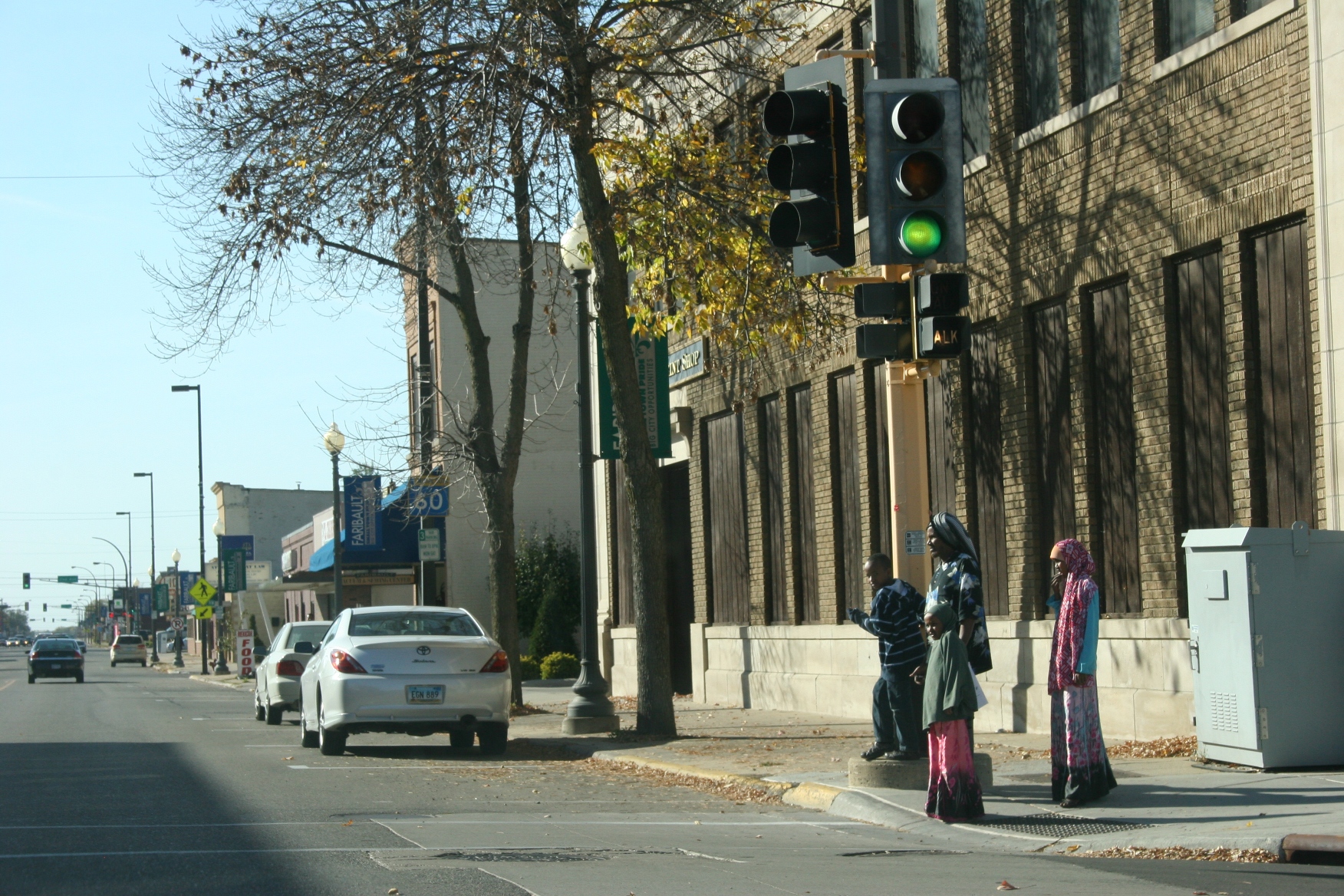
An immigrant family in downtown Faribault represents the changing face of our community. I took this photograph in October 2010.

I DON’T KNOW WHY I was surprised. I should have expected the results given the many racist comments I’ve heard through the years.

Yet, when results of an online poll conducted by The Faribault Daily News were published in Tuesday’s edition, I was still shocked or, more honestly, embarrassed by the numbers.

The newspaper, after publishing stories on changing demographics in Faribault,  polled readers on this question: “Do you enjoy the increased diversity in Faribault?”

An overwhelming majority, 70.2 percent, responded with a “No.”

Only 20.8 percent voted “Yes.”

The other nine percent checked the “What increased diversity?” option.

Granted, polls like this, printed in each issue of the paper and then open for online voting, are not scientifically controlled and therefore could be substantially flawed. We have only the number of respondents, 312 for this question, and the tallied results, from which to draw conclusions.

However, when you live in a community long enough—I’ve been in Faribault for 29 years—you know how people feel. And, I think it would be fair to say that many residents in my community are not all that welcoming of minorities.

I hear it in the off-the-cuff negative comments about Somali men hanging around downtown or about the Hispanic family that moved in down the street. I hear it in the warning to avoid certain retail destinations at night. I hear it in the spewed words, “I don’t want any Somalians moving in next door.”

I read it in the comments submitted to the local newspaper whenever race or diversity is the subject of an article.

The words are mean, cutting, derogatory, and, most definitely, prejudiced.


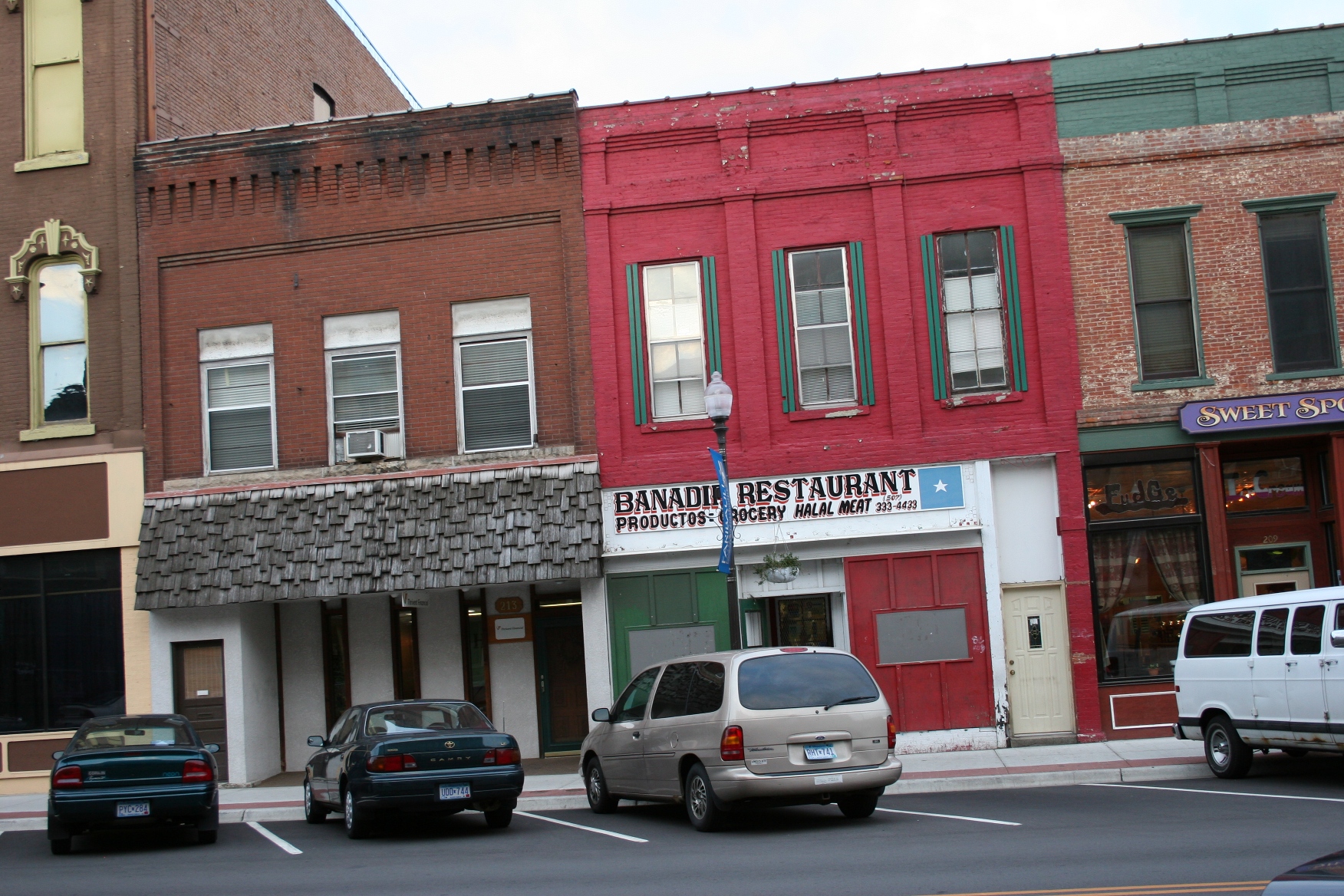
Downtown Faribault businesses include Banadir Restaurant, a Somali restaurant.

Many times I find myself defending the Hispanic, Somali and Sudanese people who comprise most of the nearly 17 percent of minorities living in my community of 23,352.

My standard answer is something like this, “There are good white people and there are bad white people, just like there are good Hispanics (or fill in the blank with another race) and bad Hispanics. The only bad experiences I’ve had are with white people.”

That is almost true. Several years ago my husband and I, unbeknown to us, sold a car to a Minneapolis-based Latino gang member who then used our vehicle in a gang-related shooting.

I really struggle with individuals who negatively label an entire ethnic group. It is unfair and unjustified.

That said, many individuals, churches, schools and organizations in Faribault are working hard to welcome and assist our minority population. Such examples are the Society of St. Vincent de Paul Center for Charitable Services and The Faribault Diversity Coalition. Unfortunately, The Welcome Center closed late last year.


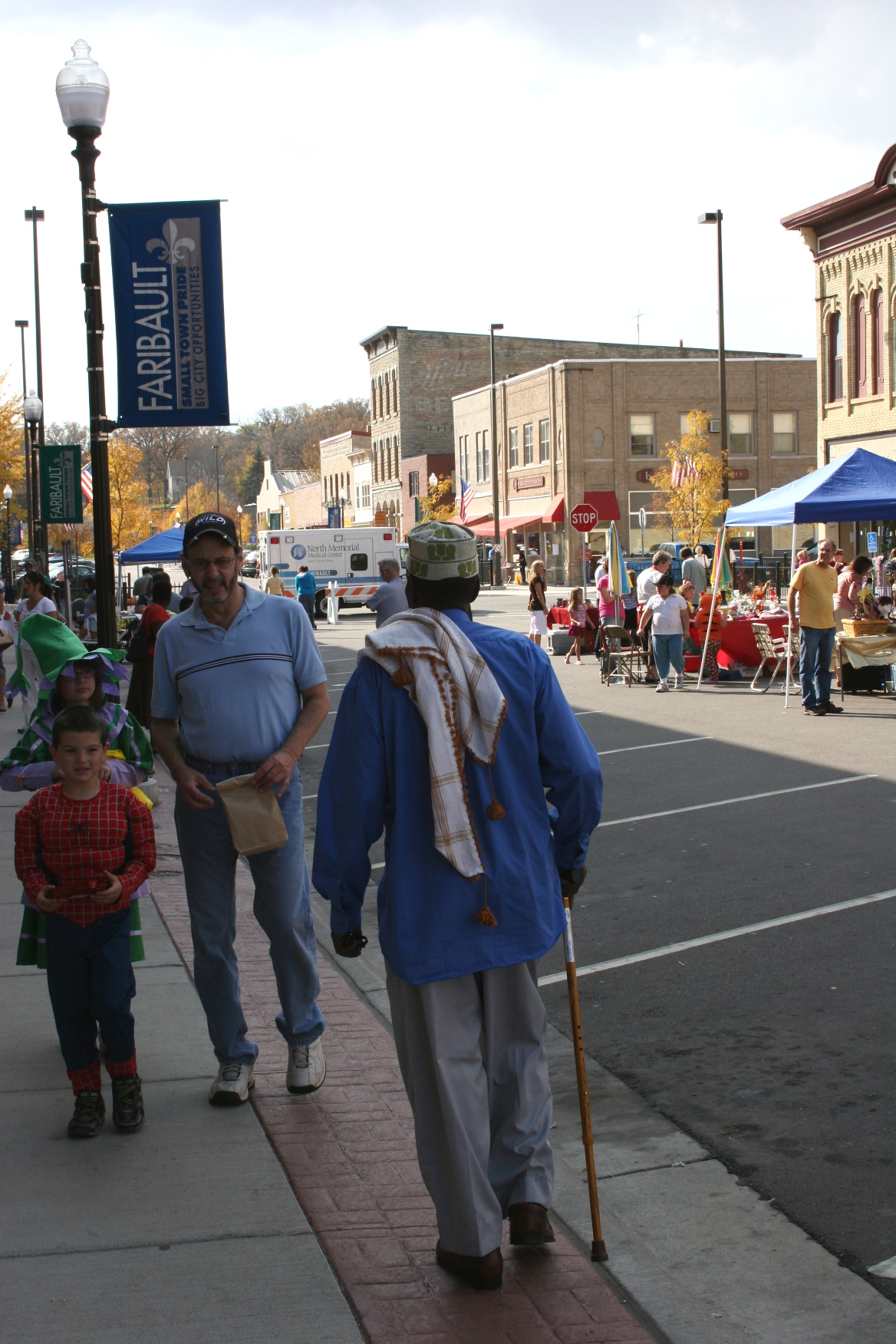
Different cultures, all the faces of today's Faribault, mingled during the Fall Festival in October 2010. Our town's current Black or African/American population is 7.5 percent.

But, really, efforts to embrace the newcomers in our community begin with each of us, on a personal level, in our hearts.

On my personal level, I’ve come to better understand other cultures because my second daughter is a Spanish language major who has lived and studied and done mission work abroad. She is currently a Spanish medical interpreter.

I try to attend ethnic events in Faribault like the annual summertime International Market Day celebration.


A member of Ollin Ayacaxtli dances at Faribault's International Market Day celebration. Faribault's Hispanic or Latino population numbers 3,026, according to the 2010 U.S. Census.

I’d like to see The Paradise Center for the Arts, reach out to minority artists, and that is a project I hope to help the local art center pursue.

I’ve wondered, too, and this might seem odd to mention, but why do I seldom, if ever, see obituaries published in the local newspaper for minority members of our community? We need to recognize these seemingly small things that set us apart.

If we take small steps, first as individuals, in educating ourselves, then our attitudes toward each other can change. We will have a stronger, better community that is built on understanding and acceptance rather than on differences.


A family matriarch oversees the making of pupusas from her chair at the International Market Day in Faribault in 2009. This is one of my all-time favorite portraits that I've ever taken.

CLICK HERE for 2010 U.S. Census results from Minnesota. Scroll down to Rice County, which includes Faribault, and shows a county minority population of 9,576 or 14.9 percent. Statewide, our minority population is 16.9 percent.

© Copyright 2011 Audrey Kletscher Helbling


As rain and snow fall, the flood threat rises in Minnesota March 22, 2011

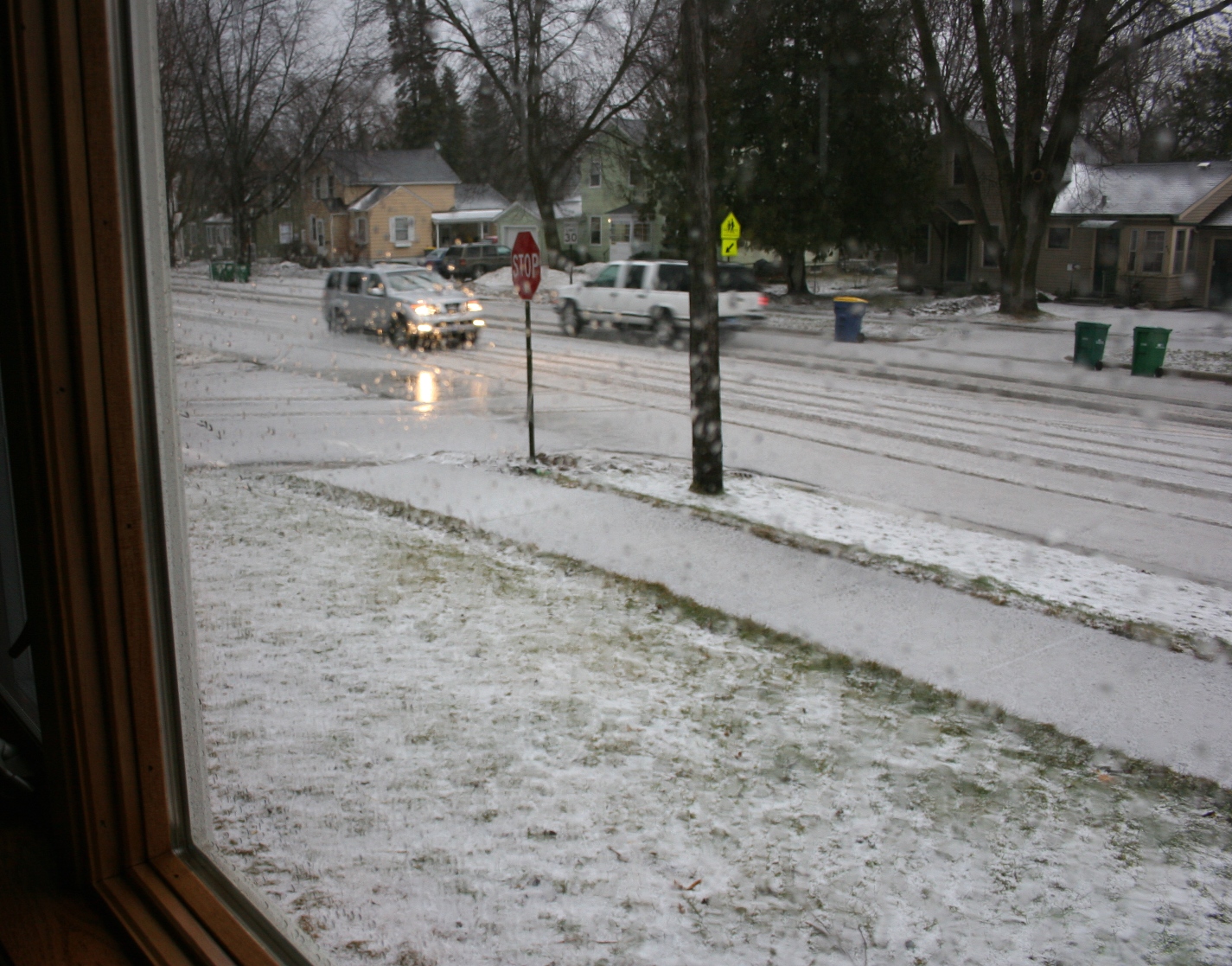
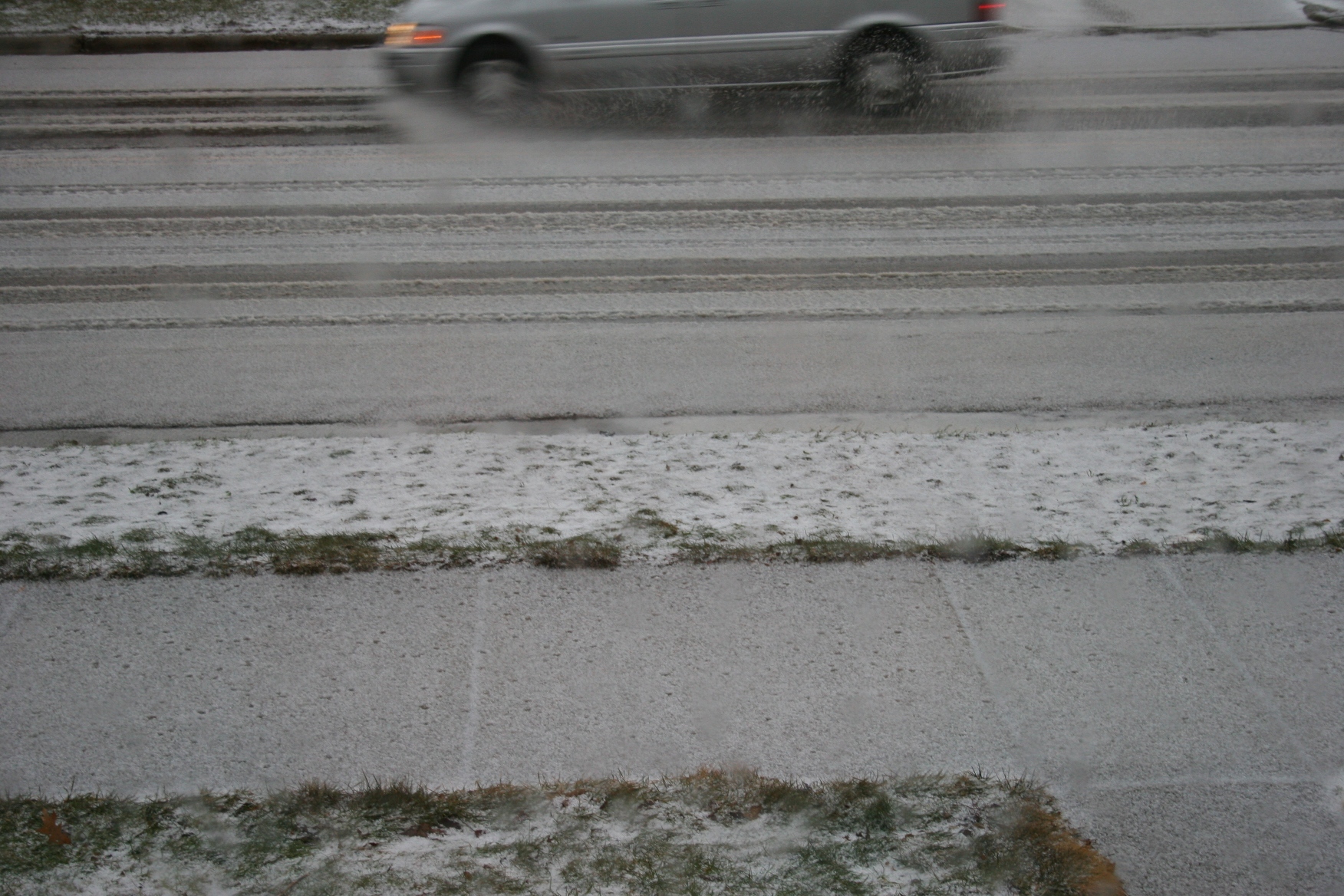
The view from my front window at 8 a.m. today as sleet pelted Faribault.

I AWOKE THIS MORNING to a world of gray and white and sleet pelting in sheets against the windows.

So much for spring…

When I plucked the The Faribault Daily News from the front steps, shook off the water droplets soaking the paper’s plastic sleeve, removed and opened the paper, I read this headline: STILL RISING—National Weather Service declares flood warning for Rice County as Straight River closes in on 10 feet.

And so the spring flood season has begun here in Minnesota with road closures in the Henderson area southwest of the Twin Cities, between Windom and Fulda in southwestern Minnesota and probably other places of which I am unaware.

Here in Faribault, officials are keeping a close eye on the rising Straight and Cannon Rivers. Sandbags are filled and plans are in place to put them in place should the need arise. Of major concern is the riverside wastewater treatment plant which was flooded during a flash flood last September. During that flood six months ago, many homes and some businesses were inundated with floodwaters. A local riverside park, which often floods in the spring, was also under feet of water.

Upon checking the National Weather Service Twin Cities, MN., website map, I see most of the southern half of Minnesota falls under a flood warning.

For the north, winter storm and blizzard warnings have been issued. The last I heard, several inches of snow are expected to fall in my area sometime today and/or into tomorrow.

A car passes by my home at 8 a.m. as heavy sleet fell. Sleet also pelted Faribault during the night.

Rain continues to fall here as we approach the noon hour with temperatures hovering several degrees above freezing.

Personally, I’ve been affected by this wet weather with some minor water seeping into a corner of the basement—enough to soak up, move belongings and turn on the fans. It’s a hassle, but certainly nothing compared to the issues some folks will face as the snow and rain fall and the rivers rise.

PLEASE SUBMIT a comment with any information you have about rising rivers/creeks/streams and/or flooding in your area of Minnesota. I would like to share your stories with Minnesota Prairie Roots readers.

© Copyright 2011 Audrey Kletscher Helbling


Time for Santa to return to the North Pole

Filed under: Uncategorized — Audrey Kletscher Helbling @ 7:16 AM
Tags: , , , , , , , , , , ,


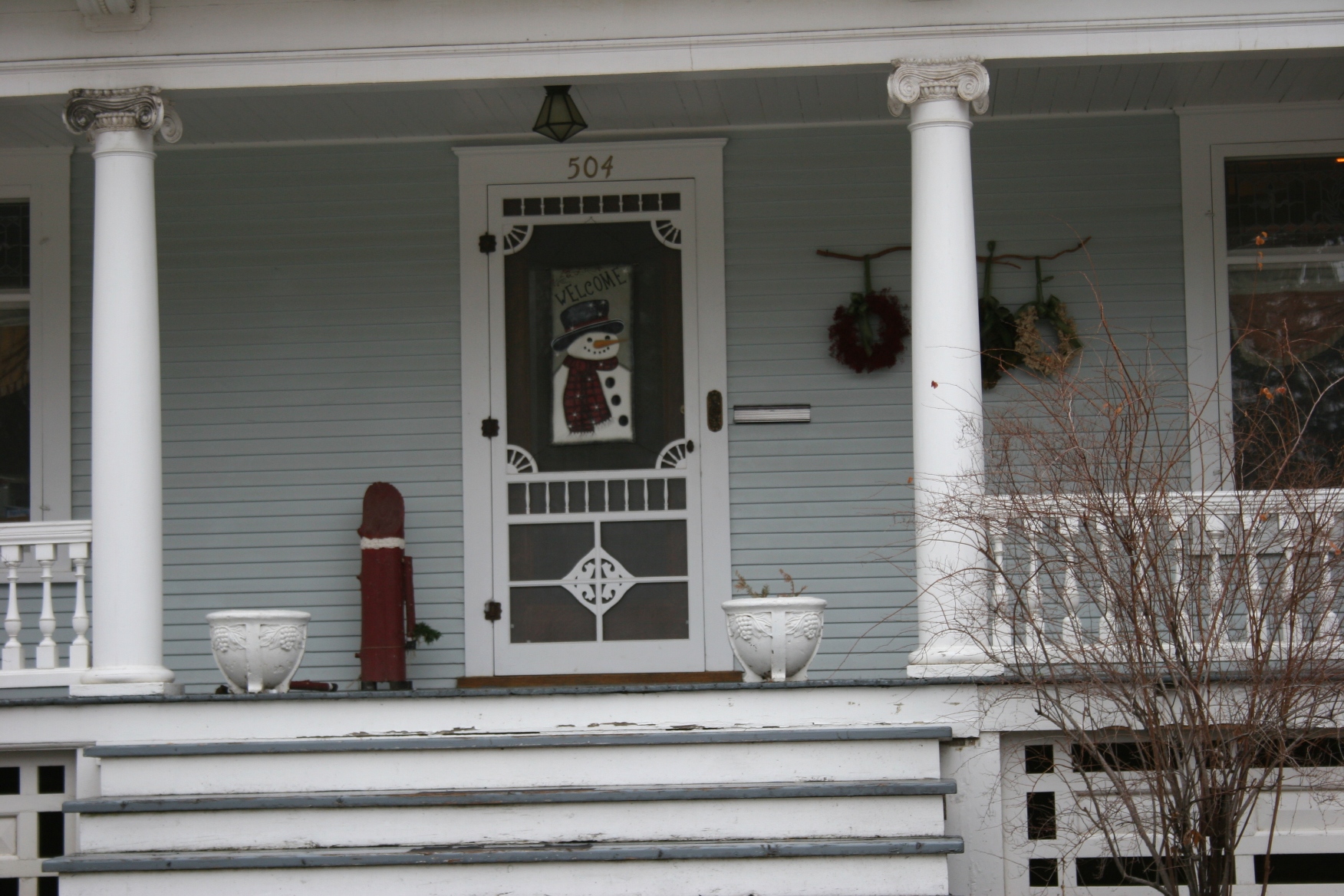
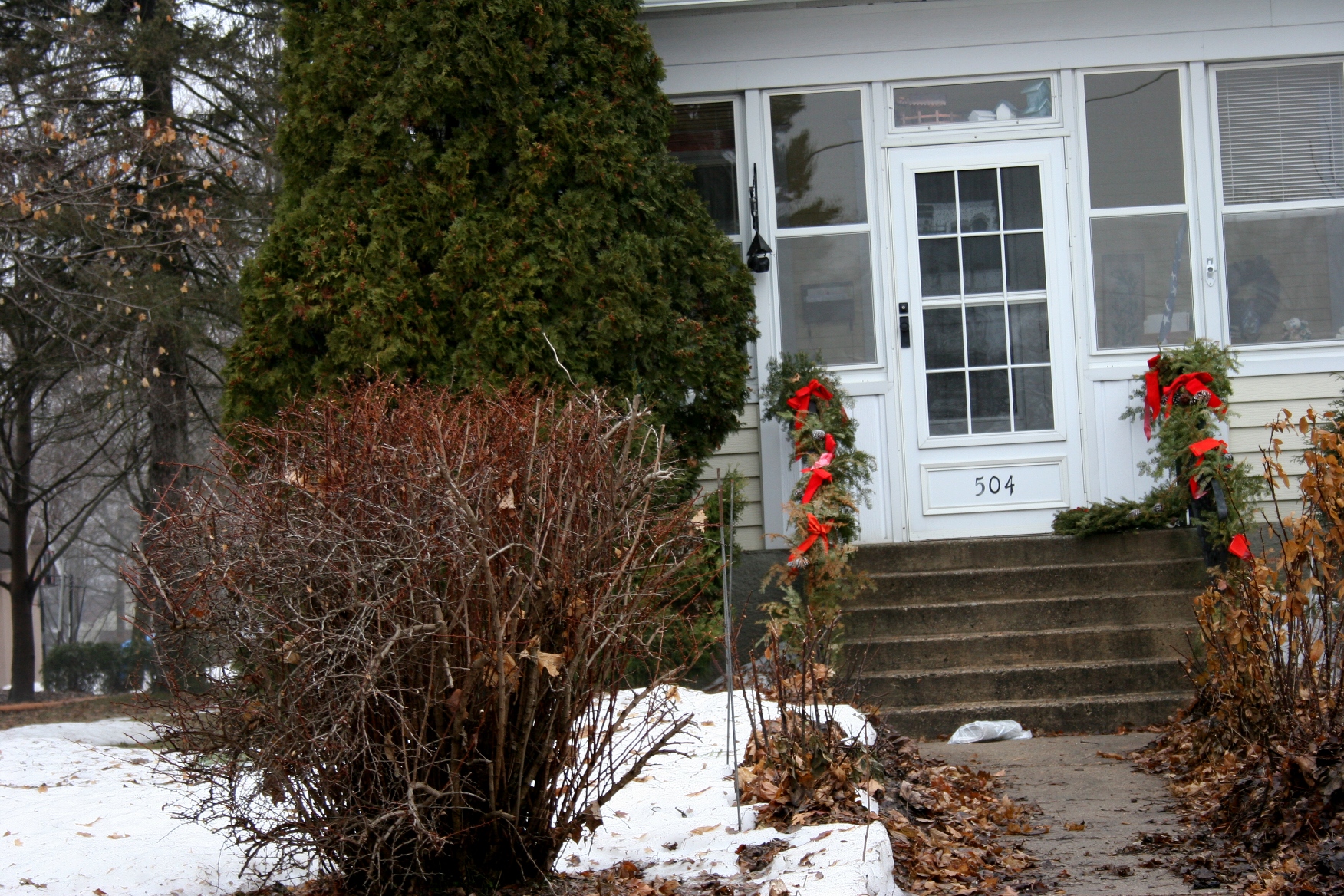
Apparently, the elf (or Santa) to the left of the door has turned his back on winter. I love this vintage style door, the inviting front porch, the look of this house. But, time to put away the Christmas decor and decorate for spring.

HERE IT IS, three months after Christmas and already three days into spring and many houses in my southeastern Minnesota community are still decorated for Christmas.

Drive through nearly any neighborhood and you’ll spot holiday lights sagging from roof lines, once-green evergreen wreaths and garlands aging to dried, brown perfection, and reindeer prancing on rooftops.


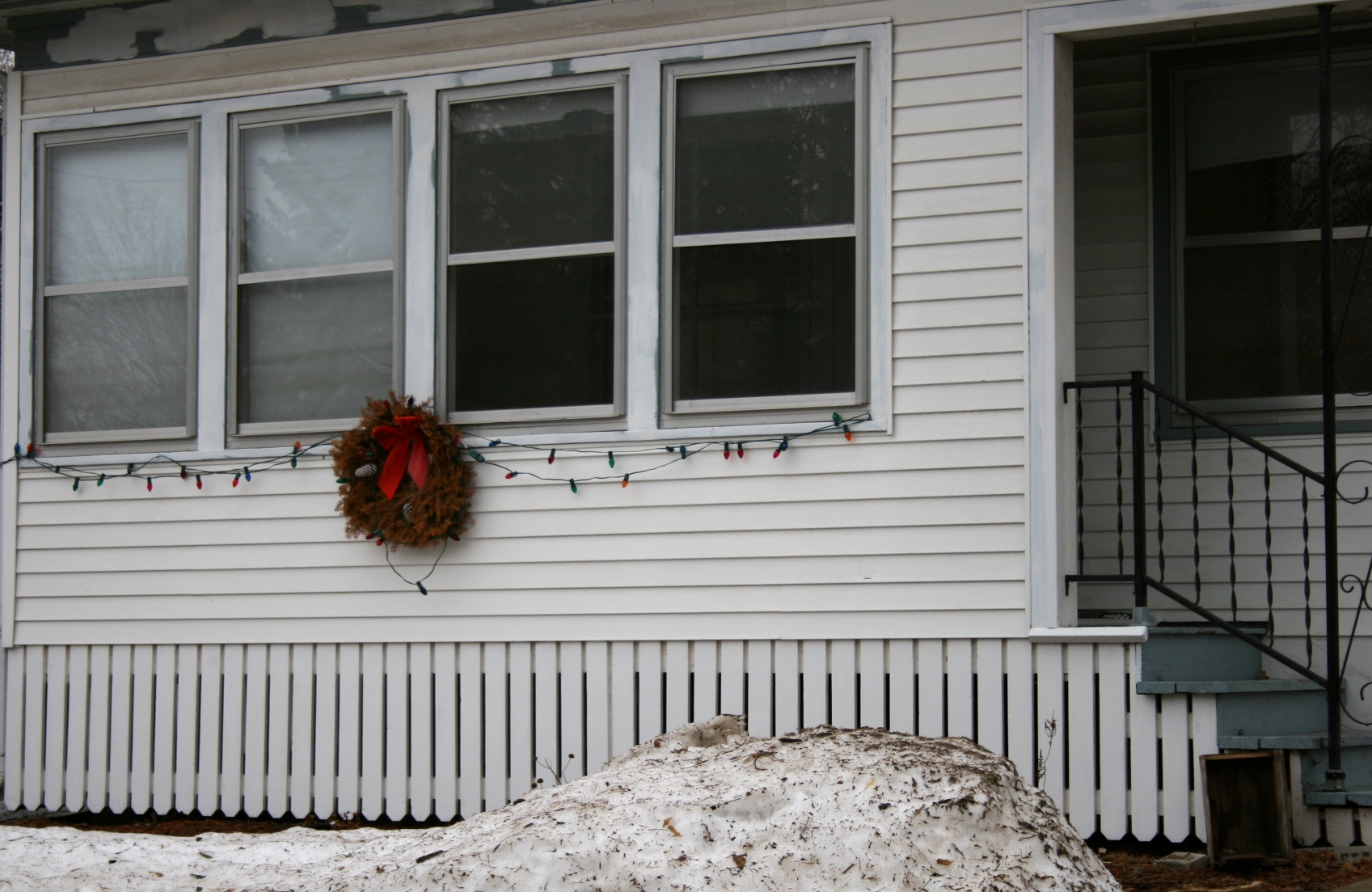
A wreath well past its prime decorates the front of a Faribault house along with a string of holiday lights.

I even saw a Christmas tree tossed onto a front porch. Ours is buried somewhere under a melting snow bank.

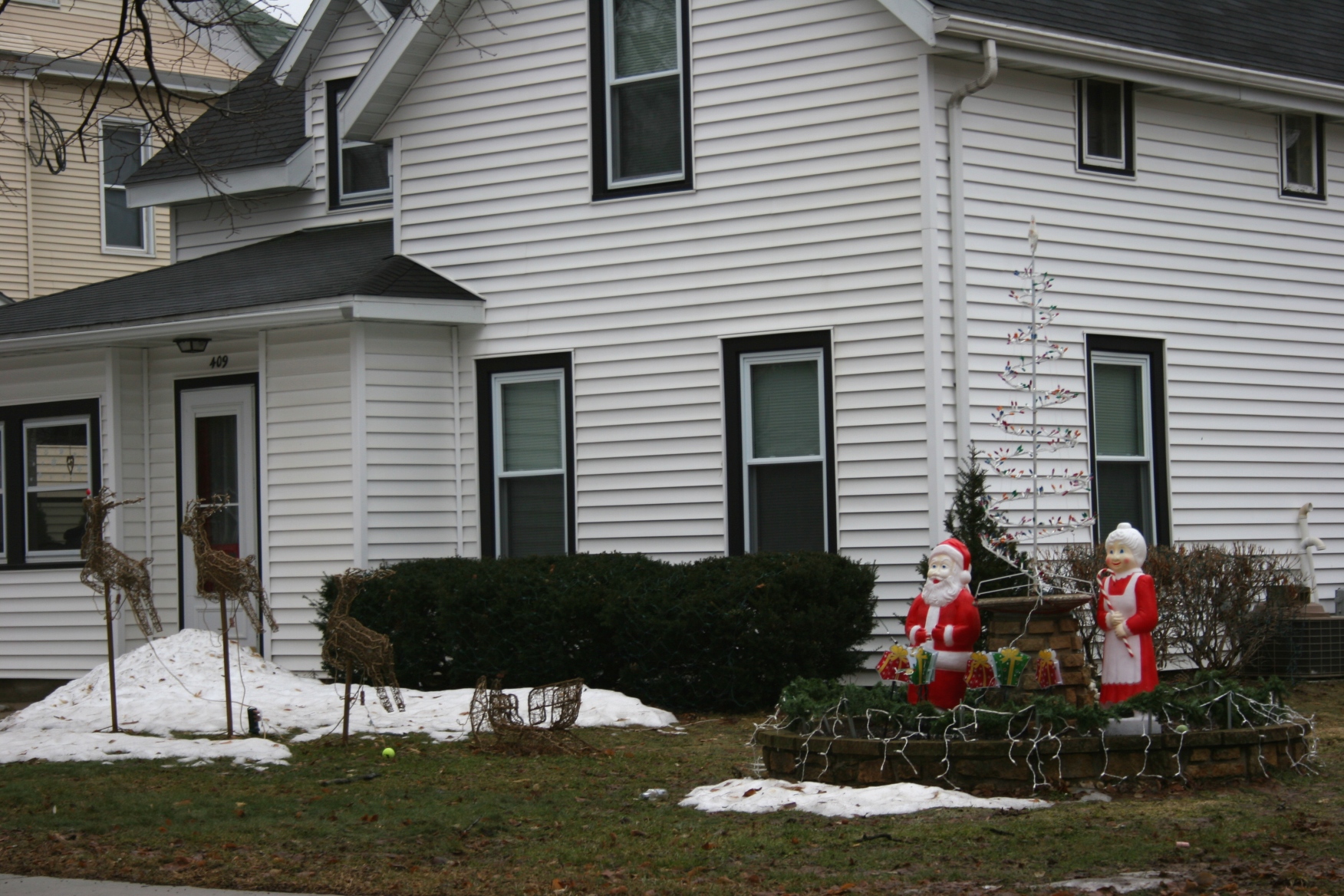
Santa and Mrs. Claus, perhaps finding our Minnesota winter remarkably like that at the North Pole, have been vacationing here since early December.


Time for Santa and Mrs. Claus to pack it up and leave Faribault.

Surprisingly Mary and Joseph have not retreated to the Holy Land either as I saw them in a front yard only blocks from my home.

So what gives here? I mean, doesn’t it seem ridiculous to you that Christmas decorations are still up in late March? It’s spring, for gosh sakes.


The wreath has fallen from the door onto the steps, but the holiday garland and ribbons remain in place.

But this year I expect the lengthy display of Christmas holiday cheer has more to do with the weather than laziness on the part of Faribault residents. Because of the heavy snowfall we’ve had this season, residents couldn’t get to their Santas and Holy families and reindeer herds that were buried in deep, deep snow.

Who wants to trudge through thigh-high snow in sub-zero temps to rescue Santa after blowing or shoveling out the driveway, sidewalk and car more times than you can remember? It’s easier just to leave all of the holiday decorations until the snow melts and temperatures reach a comfortable level.

Well, Faribault residents, with the snow disappearing and temperatures rising into the 40s, now would be the time to muck your way across the lawn, pluck Santa from the ground and stow him away until November.

For those of you tempted to leave your Christmas lights on your house year-round, I have one word for you. Don’t.


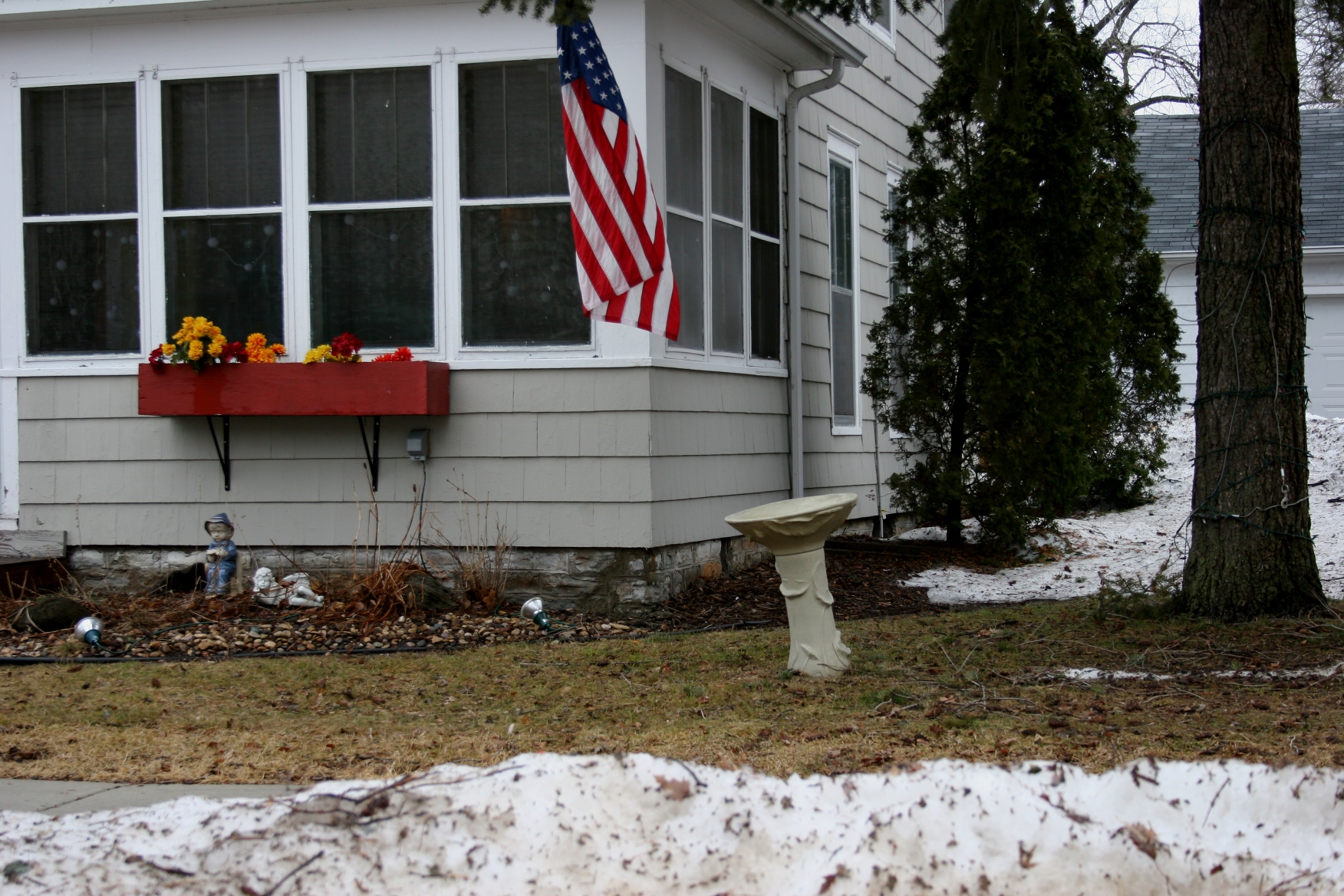
And just when I thought I had seen everything, I came across this Faribault home, where Christmas lights still ring a tree trunk, flowers "bloom" in a window box and snow covers the ground. Oh, and if you look closely, you'll see Christmas bulbs strung inside, along the windows.

Now, time to fess up. On Saturday, the day before spring started, I removed this holiday decoration from my back door.

© Copyright 2011 Audrey Kletscher Helbling


Suddenly going nearly deaf in one ear March 21, 2011

THE ELDERLY COUPLE stood in line next to me at the pharmacy gripping their skinny white canes.

He fidgeted, a plastic grocery store bag rustling in his hands. I wondered how much he could see through the thick lenses of his glasses.

She waited beside him. Calm. Steady. Sure. I doubted she could see me, only sense that I was there, close by.

I considered for a minute allowing them ahead of me. But I’d already returned for the second time to the pharmacy and didn’t want to give up my spot.

So I stood there, health insurance and debit cards clenched in my right hand, arms folded across my chest. I did not want to be there sandwiched between the mom with a clearly sick child and the visually-impaired couple. But, mostly, I did not want to be there because I did not want the prescription drugs I was picking up.

Eight hours earlier I laid on my back, head strapped down, face covered with a mask, as my head and upper body slid inside a magnetic resonance imaging machine.

Several hours after that, I sat in a sound-proof booth getting my hearing tested.

A half hour later I braced myself for the MRI results, hoping for the best, semi-prepared for the worst. The news was good. No tumor. No stroke. No anything abnormal, the ear specialist told me. I breathed deeply, the release of tension in my body palpable.

But the hearing, that was different. I had lost most of the hearing in my right ear. I had “one shot,” the doctor told me, to restore some of my hearing. There were no guarantees.

That is when I cried, although the tears had been building since the audiologist pointed to a graph showing that I had lost 70 percent of the hearing in my right ear. I verged on tears when she told me, too, that a hearing aid would not help me.

I listened to the doctor tell me that a 10-day mega dose of steroids could possibly restore some of my hearing. No promises. The Prednisone is most effective within 48 hours of symptom onset. Four days had passed since my symptoms—sudden hearing loss and eight hours of dizziness and nausea—began.

“You’ll cry some more,” he said, explaining that the steroid will throw me into emotional mood swings, cause insomnia, make me jittery, maybe even nauseated. He minced no words: The treatment course “will be difficult.”

And then I asked, “Is it worth it?”

He told me this was my “one shot” to regain some of my hearing.

Do you know how difficult it is to photograph one's ear? This is my best shot after many attempts. I could have done without the photo, but images always add to a blog. So there you have it, my right ear that I am hoping, praying, will be healed. Yes, I see the wax. Yes, I know my ear is not petite. Typically it's draped by my hair. But I don't care about lack of prettiness right now. I care only that I get some, or all, of my hearing back.

AND SO I FOUND MYSELF waiting in line at the pharmacy, next to the visually-impaired couple. As I watched them, I asked myself, “Would you rather be blind or deaf?” I don’t mean to offend any of you readers, but that is, honestly, what I was thinking.

The debate swirled briefly through my brain. As the store clerk placed the visually-impaired woman’s hand on a bottle and told her it was fish oil, I chose deafness. I determined that I would rather deal with the loss of hearing in one ear than lose my ability to see.

And so the next 10 days will reveal whether a portion of my hearing can be salvaged. Ten days. I am trying to steel myself for the negative physical and emotional side effects I am certain to experience from the high steroid dosage. I’ve been on the drug before, for whooping cough. I hate it.

I am trying to prepare myself, too, for the very real possibility that this course of treatment will not work—because I waited too long. I did call my clinic within an hour of the symptom onset, but was advised only to come in if my condition worsened. Within several hours, I was feeling better, although my hearing had not improved.

I thought I might be suffering a Meniere’s disease attack related to a previous ear trauma as my symptoms matched those of Meniere’s.

I am writing this post because I need your prayers for healing and strength through my treatment.

I am also writing to warn you that, should you ever experience sudden hearing loss, see a doctor immediately. Don’t wait. Ever. I waited four days to schedule a clinic appointment, another day to get in and then another day to have the MRI and get the diagnosis.

My ear doctor saw several patients just this week with the same sudden sensory hearing loss, leading him to believe a viral infection of some type is going around the Faribault community.

Since developing this issue, I’ve had several friends tell me of acquaintances who’ve suffered the same snap-of-the-finger hearing loss. One regained her hearing; two did not.

The cause of my sudden sensory hearing loss has not been determined. I’m following up with another specialist in several weeks, the same expert I’ve seen since that traumatic ear injury at a Wisconsin water park several years ago.

In the meantime, I am adjusting to the ringing and static (like a bad transistor radio) and partial deafness that are now a part of my world.

I am learning to position myself with my “good” left ear to anyone who is speaking to me.

And I am holding on to hope.

FOLLOW-UP: Today I started my fourth day of steroid treatment. Thus far I’ve noticed no improvement in my hearing. But I am still hopeful that some of my hearing may be restored. Many family and friends are praying for me and for that I am grateful.

I am feeling the effects of taking the Prednisone. Yesterday afternoon and into the evening, I was unsettled and sat twirling my hair, which is not a regular habit of mine. I had trouble falling, and staying, asleep.

Yet, through all of this, I remain cognizant that this diagnosis could have been something far worse than a hearing loss. In the realm of possible medical issues, this is minor.

If, by telling my story, I can prevent one person, even one, from delaying treatment for a sudden sensory hearing loss, then something good will have come from this.

Seven more days to go…

© Copyright 2011 Audrey Kletscher Helbling


Take this snow and shove (shovel) it March 20, 2011

Filed under: Uncategorized — Audrey Kletscher Helbling @ 9:23 PM
Tags: , , , , , , , , , , , , , ,

ON THE FIRST DAY OF SPRING in Minnesota, my true love gave to me…chicken on the grill.

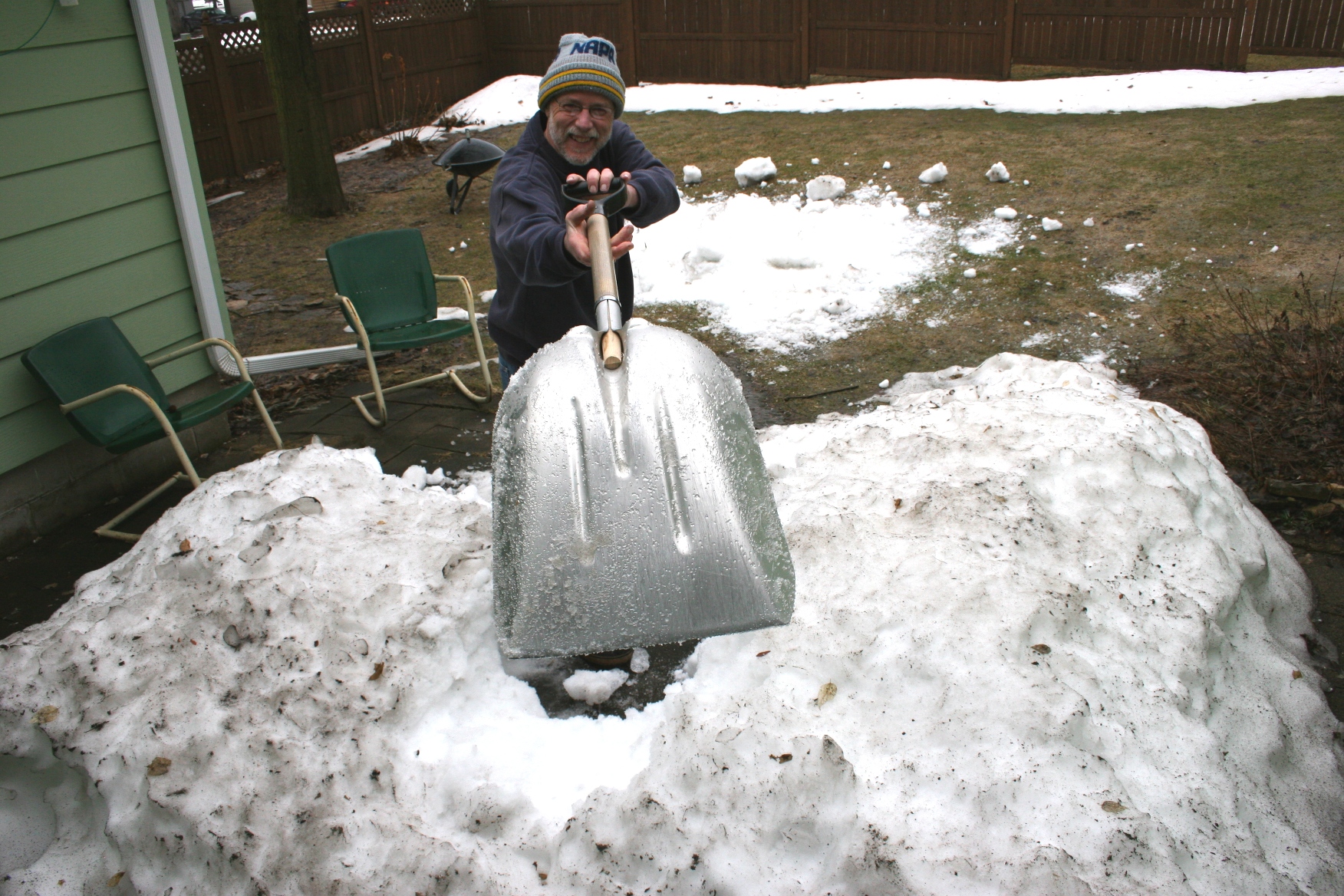
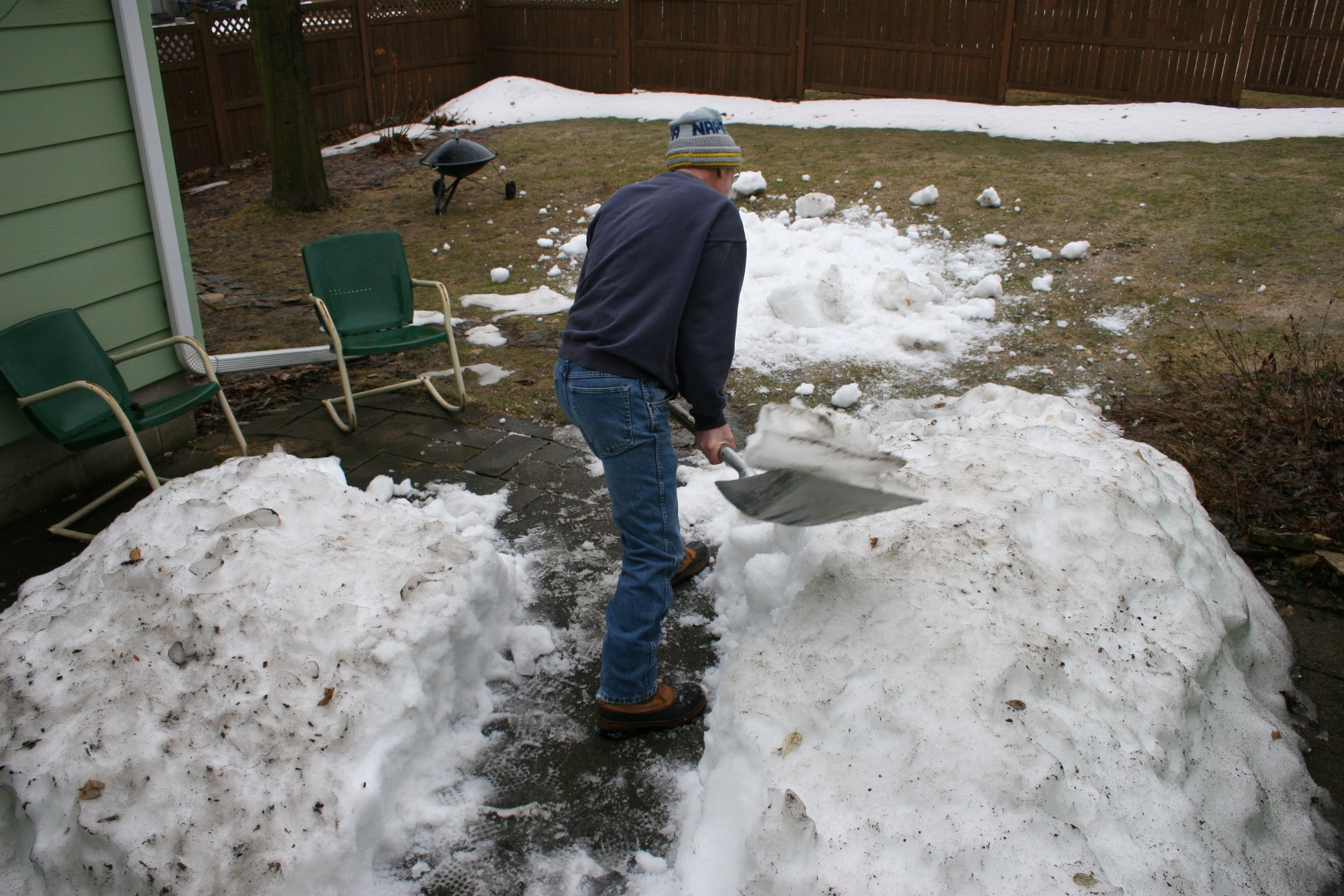
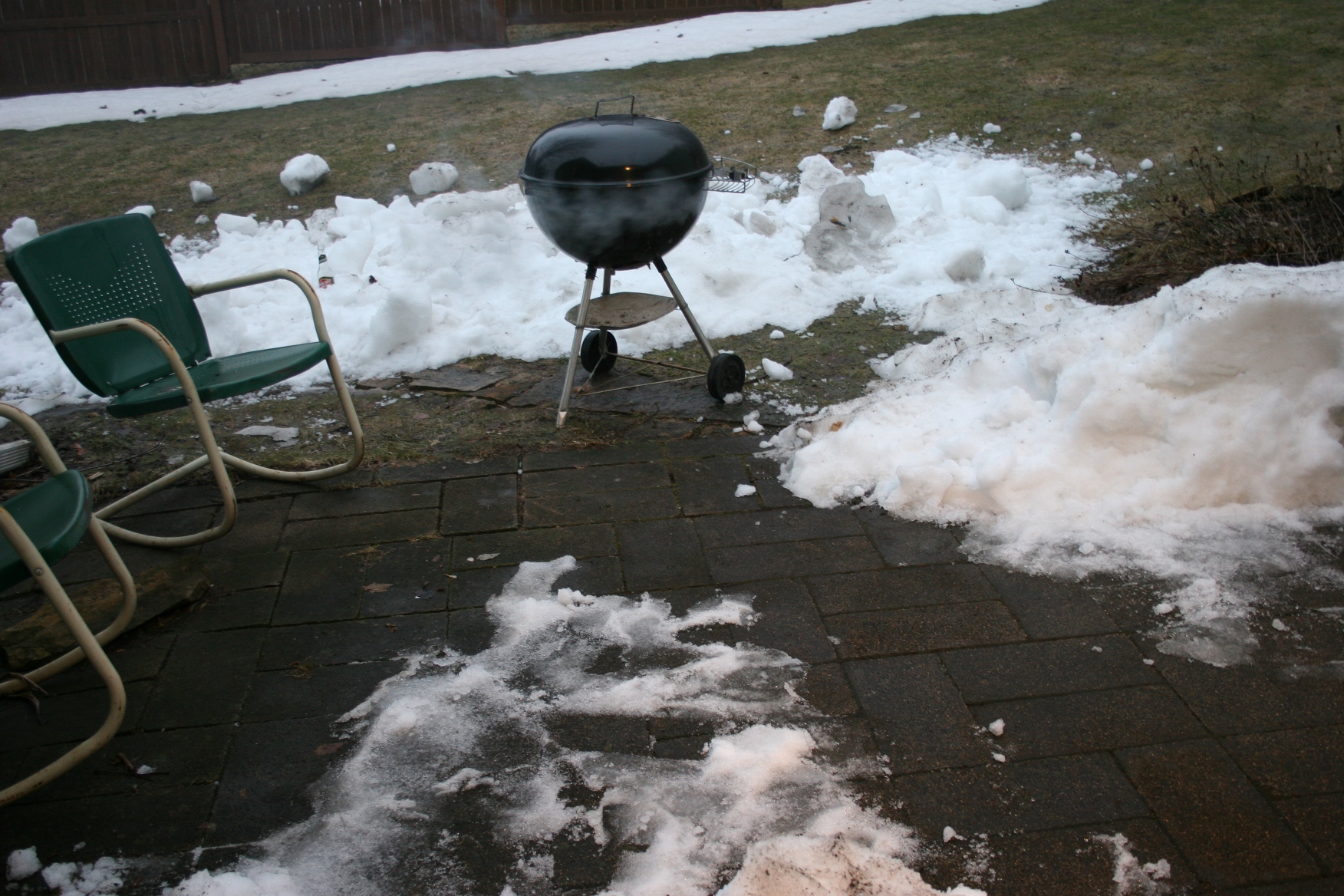
But, before he could cook the chicken, he shoveled 2 ½ feet of snow from the patio to access the Weber. That would be the grill which, until yesterday, lay tipped on its side, having toppled off a melting snow mountain.

After shoveling his way to the grill, he fired it up.

But, as anyone knows, even in winter-spring, a man cannot grill without beer. So my true love chiseled a bottle of Nordeast into an icy snow bank to reach icy perfection. By the time I photographed the chilling beer, the bottle was nearly empty.

Later he iced a bottle of Grain Belt Premium.

And so on the first day of spring in Minnesota, I did not get five golden rings or a partridge in a pear tree. Yes, I am well aware that I am referencing The Twelve Days of Christmas here. But with all the snow still remaining in our northern state, December 25 seems like yesterday.

Rather, on this fine spring day (if you call 40-plus degree temps, rain and thunder in the morning, and snow-blotched lawns and boulevards “fine”), I got chicken, and potatoes, on the grill.

© Copyright 2011 Audrey Kletscher Helbling
 

The promise of spring in a seed packet

Filed under: Uncategorized — Audrey Kletscher Helbling @ 10:29 AM
Tags: , , , , , , , ,


A few of the flower seed packets I have stashed away for the upcoming gardening season.

WHEN MY FRIEND MANDY offered me a pick of flower seed packets recently, I snatched up the cosmos. Next to zinnias, they are my favorite flower to grow from seed.

The simple sight of photographed blooms on a seed package lifted my spirits on a night when snow was falling. Again.

It has been an incredibly long winter here in Minnesota with more snow than I can recall in years. Thus, the possibility of spring seems as unlikely as state high school basketball tournaments without a blizzard.

But for now, a gardener can dream of cupping tiny seeds in her palm and scattering them upon soil that holds the promise of summer. She can dream of snipping stems, of gathering colorful blooms into beautiful, bountiful bouquets.

I WROTE THIS POST 10 days ago and simply didn’t get around to publishing it until today, the first day of spring. This morning, while in church, I heard the boom of thunder. It is raining here, with a brisk wind.

Snow mountains are melting. Wide swatches of muddied grass lie exposed to the elements, a welcome sight after this long and weary winter. But then again, snow is forecast for later this week, as tips of tulip plants push through the soil. This is Minnesota, after all, and we are never quite certain when spring will officially arrive. We mark the season by the arrival of warmth and bared grass and emerging flowers, not by a day on the calendar.


A bouquet of wildflowers plucked from a public garden (not by me) in Fulda, Minnesota, last summer.

Copyright 2011 Audrey Kletscher Helbling
 

Part VI: The future for Hammond and Tina March 19, 2011

EDITOR’S NOTE: This post marks the final in a series of six stories that focus on a Hammond, Minnesota, family forced from their home during a September 2010 flash flood. Today we look at Hammond, its recovery and how you can help.

“WE HAVE A LONG ROAD ahead of us and none of it can really start until spring,” says Tina Marlowe, assessing the work that still needs to be done in Hammond. Her family returned to this town of (once) 230 residents shortly after Christmas.

This southeastern Minnesota community exists in limbo as residents await the arrival of warmer weather, and money, to begin rebuilding their community. Many homes must be gutted and rebuilt or torn down. Hammond needs a new city hall and new maintenance equipment. The river bank, river bed, parks and canoe landing need to be cleaned and rebuilt.

“Everything…everything is left to be done,” says Tina, who plans to help form a park committee that will raise $200,000 to update and rebuild the town’s parks. Tubing, canoeing, a horseshoe tournament, camping, fishing, motorcycling and more draw locals and visitors to this quiet river valley, “a beautiful gift of nature that we like to call ‘Our Valley’,” Tina says.

She and good friend Katie Shones will be setting up a Park Fund for donations to rebuild the parks.


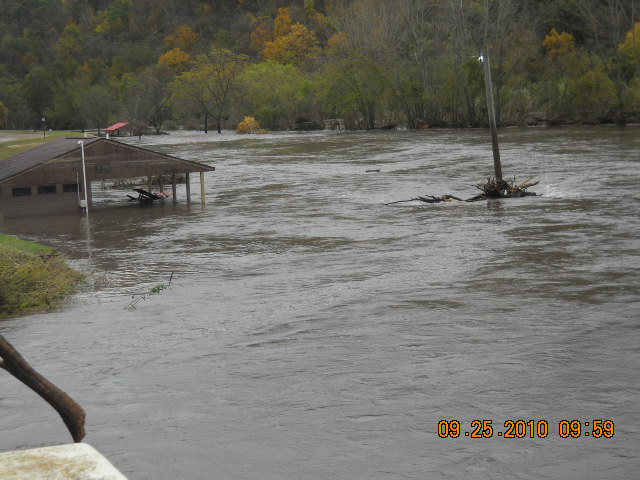
Hammond's riverside park was all but destroyed by the flood. Marks on the shelter roof show how high the water rose. A baseball field next to the shelter, with a fence around it, is covered by receding floodwaters. Jenny Hoffman took this photo at 10 a.m. on Saturday, September 25, 2010.

HOW YOU CAN HELP?

“SINCE OCTOBER, Lutheran Social Service of Minnesota has been very involved in the long-term recovery efforts in the Pine Island – Oronoco area and in Wabasha County,” says Caitlin Hughes, LSS Disaster Services administrative specialist.  “LSSMN assisted in the development of two community supported long-term recovery committees. These committees are working with the LSSMN Southeast Minnesota Disaster Response Team to help families locate the precious resources to rebuild their homes and their lives.  Presently LSSMN has a local staff of three disaster case managers, a volunteer and resource coordinator and a reconstruction manager.

Currently, the disaster case managers are working with over 250 families/ individuals and the rebuild team is assisting 25 clients in using volunteers to make their homes habitable once again.”

St. John’s Lutheran Church is serving as a base for LSS relief operations in Hammond. Contact LSS caseworker Mary Walker at 507-753-3057 business days. St. John’s has served, among other functions, as a site for distribution of food, clothing and other essentials to flood survivors.

INDIVIDUALS INTERESTED in helping with Hammond’s recovery should contact LSS Volunteer Coordinator Dan Kalstabakken at 651-741-7234.

Go to this link for the most up-to-date information on LSS efforts in southeastern Minnesota: http://www.lssmn.org/disaster/

Also visit the Zumbro Valley Disaster Relief Fund.

Tina says flood survivors could use cash donations and that skilled laborers are still needed to help with the ongoing rebuilding efforts.

HELPING THE CHILDREN

LSS also provides support for children who have been through disasters like the Hammond flood.

Camp Noah is a day camp for children impacted by disaster that offers children a safe, caring and fun environment where they can heal and process their disaster experience, according to LSS. The five-day camp is based on a curriculum that celebrates each child’s unique gifts and talents and provides them with an opportunity to share their story.

For more information about Camp Noah, call 612-879-5312 or go to http://www.lssmn.org/camp_noah/


This photo shows the destroyed road that goes from Wabasha County Road 11 to the business area on the east side of Hammond. A bar, bank, cafe, city hall and homes are located along this street. Waters are receding in this photo taken mid-morning on Saturday, September 25, 2010. All of the businesses, city hall and most homes along this road were flooded.

THE FUTURE FOR TINA

Tina and her fiancé, Micheal Mann, are planning a June 25 wedding. The bride will wear the wedding dress she saved from the floodwaters.

“I don’t know how we will get the wedding paid for now…it certainly won’t be all that I planned it to be,” Tina says.

But, despite the financial hardship, the setbacks, the challenges, this determined woman wants to move forward. And that means proceeding with the wedding as planned. Her wedding will give people a break, a reason to “take one night to celebrate all that is real in this life: friends, family and love.”

THIS CONCLUDES my six-part series of stories told through the voice of Hammond flood survivor Tina Marlowe. Thank you, Tina, for the privilege of sharing your story. I admire your strength, your determination and your resiliency.

Thanks also to Katie Shones, who has been my main contact in Hammond since last October. She is one strong, kind woman.

Thanks, too, to Susie Buck for pulling together the many photos featured in this series and to those who allowed their images to be published here.

Sheri Ryan, I am grateful to you also for the use of your photos, but, more importantly, for a deeply personal look at how this flood affected your mom. All too often we view blurs of faces and piles of debris, but we fail to see beyond, to the real hurt that runs deep.

I appreciate every one of you who have so willingly worked with me to tell the story of the people of Hammond through words and photos.

I also appreciate volunteers like Gary Schmidt from the Twin Cities who worked with a Woodbury church to bring volunteers to Hammond in late January and then again one day in March. Gary learned of the need through this blog. I hope to share Gary’s experiences with you in a future post.

I am grateful also to the folks over at Minnesota Public Radio who have plugged my flood series online. In the “Minnesota Today” section, Michael Olson included a reference to my stories in his March 16 statewide blog round-up. My post, “She just wants to hug her house,” was also featured in MPR’S “Blog Box.”

MPR columnist Bob Collins summarized my series and linked to my blog in the “5×8” section of his March 18 “News Cut” column. Bob also publicized my first set of flood stories back in October 2010, when I toured Hammond and Zumbro Falls about two weeks after the flash flood. Thank you, MPR, for helping Hammond’s story reach an even wider audience.

It is my hope, Minnesota Prairie Roots readers, that the flood stories I’ve shared with you this week will touch you. I hope you will be moved to help the residents of Hammond recover from a flood that may have damaged their homes, but has not destroyed their spirits.

These are strong, strong people who continue to need our support, our prayers and our help even six months after the flood.

© Copyright 2011 Audrey Kletscher Helbling


Part V: Help after the Hammond flood March 18, 2011

EDITOR’S NOTE: Minnesotans help one another. So when Tina Marlowe and her family needed assistance after a devastating autumn 2010 flash flood severely damaged their Hammond, Minnesota, home, volunteers were there to assist.

Today, in this fifth in a series of stories, read about the people who helped Tina’s family and the gratitude she feels toward them.


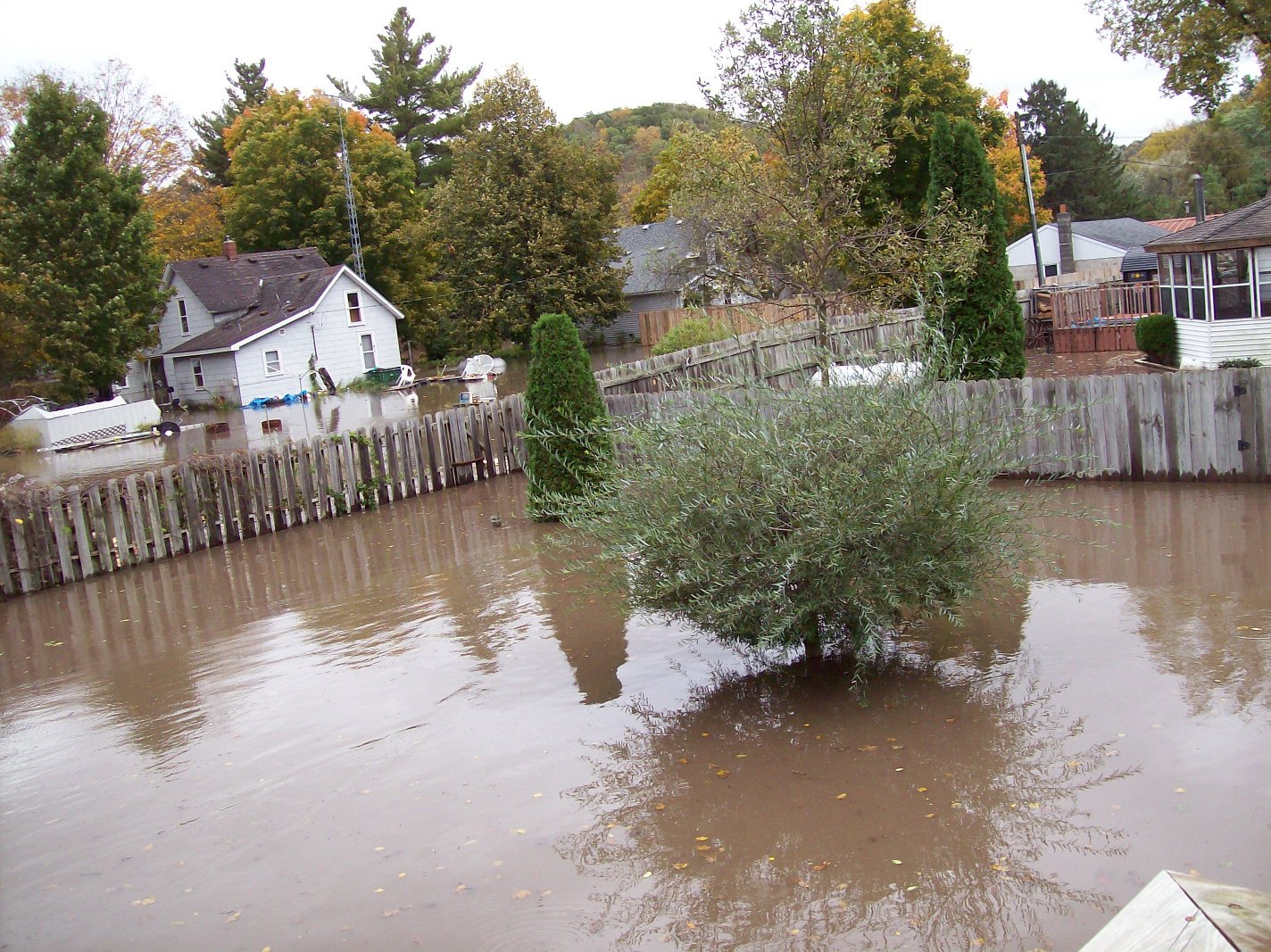
John Bemmert took this photo from the front deck of his house. It shows his flooded yard within the fence, his neighbor's house to the left and his father-in-law's yard on the right. This image was taken on the afternoon of Friday, September 24, 2010.

Floodwaters approach the home of John Bemmert in this photo he took the afternoon of Friday, September 24, 2010. He was one of the lucky ones. The water rose only to the base of the skirting on his home.

WITH A FLOODED basement and several inches of water on the main level, Tina, her fiancé, two children and future in-laws were forced from their home. When the floodwaters receded, volunteers pitched in to help the family move their belongings and gut their home.

The Sons of Silence Motorcycle Club immediately dispatched a crew to move furniture, clean the basement, and rip out flooring and drywall. A retired couple from the Rushford area, Sentence-to-Serve members and others helped the family. The Rochester Med City Crew MC treated the family to a Thanksgiving dinner.

“I am grateful they took care of us with such dignity and respect,” Tina says of all who assisted them.

Once their house was emptied and dried out, they immediately began the process of rebuilding.

NO FLOOD INSURANCE, BUT HELP CAME

Without flood insurance on their home which lies in the 500-year flood plain, Tina and her family depended on others and sought out programs that could assist them. They accepted a Quickstart Grant, shopped around, made good choices and spent money as wisely as they could to stretch it as far as they could, Tina says.

They also tapped into Cathy Mann’s retirement fund to buy appliances.

Yet, there is nothing to pay for replacing their personal belongings.

In the spirit of giving, people have pitched in—a grant from Tina’s company to help pay hotel bills; co-workers donating money and holding a bake sale and chili feed to cover hotel and food costs; the Plainview-Elgin-Millville School District, through a drive, provided clothes, bedding, other essentials and cash; and a cash donation from Cathy Mann’s (Tina’s future mother-in-law) co-workers helped pay hotel bills.

Through Lion’s Club, Eagles Club, church group and individual donations to the Zumbro Valley Disaster Relief Fund, the family received intermittent assistance with gas and grocery cards.

“The amount of help we received from the community is unbelievable and is something every Minnesotan can, and should, be proud of,” Tina says.


The floodwaters had receded when John Bemmert took this photo on the morning of Saturday, September 25, 2010. It shows the intersection of Wabasha County Road 11 and Second Avenue. The flood tore out the wooden fence. A waterline is visible on the house.

Susie Buck took this photo as floodwater from storm sewers began backing up from the street into her yard before 8 a.m. on Friday, September 24, 2010. Motorists had to drive through her yard to get out of town on the west side of the Zumbro River in Hammond.

PLEASE JOIN MINNESOTA PRAIRIE ROOTS for one last visit with Tina Marlowe as she tells us what remains to be done in Hammond and how you can help.

© Copyright 2011 Audrey Kletscher Helbling

Photos Copyright 2011 by Susie Buck & John Bemmert