Minnesota Prairie Roots

Writing and photography by Audrey Kletscher Helbling

Veterans Day reflections: “Returned from hell,” my father’s story November 8, 2023

Among my Dad’s papers, etc.: A letter home to his parents, a page of military instructions he carried into war, a newspaper clipping and his dog tag, circling the words “hell hole” in his letter. (Minnesota Prairie Roots copyrighted photo November 2023)

I RUN MY FINGERS across his dog tag, thumb caressing the raised letters and numbers stamped into metal. His name, KLETSCHER, ELVERN A. B blood type. P for Protestant. His Selective Service number, the same number on his Armed Forces of the United States Geneva Convention Identification Card, the laminated card he carried with him into war. Just like the duplicate dog tags that would identify him if he was injured or killed in action.

This photo from my dad’s collection is tagged as “Kim, Rowe, Allen & me, May 1953 Machine Gun Crew.” That’s my father on the right.

Seventy-one years ago, my dad was a fresh-faced young Minnesota farm boy fighting in the Korean War as a combat soldier for the U.S. Army. Each November, around Veterans Day, I pull out two shoeboxes filled with photos, letters, documents and more from Dad’s time in the service. And although I’ve looked through the contents many times in the 20 years since Dad died, I still feel the same overwhelming sense of sadness in all he experienced. The death of combat buddies. His killing of the enemy. Orphan children begging for food across barbed wire fences. The cold and hunger and fear. And then the Post Traumatic Stress Disorder he suffered upon his return home to southwestern Minnesota.

My dad brought this 7 x 9-inch cloth “RETURNED FROM HELL” patch home with him after serving for nearly a year in Korea. (Minnesota Prairie Roots copyrighted file photo)

I feel all of that as I touch his dog tag, run my fingers along the short chain like fingers worrying rosary beads in prayer. War is hell.

On the back of this photo, my dad simply penned “a letter from home.” I appreciate this photo of my dad taken by an unknown buddy in Korea.

Hell. Dad used that word in a March 4, 1953, letter to his parents and siblings. He criticized the draft board, his anger fueled by the possibility that a younger brother might also end up in Korea. He wrote, in part: “Do they know what it’s like over here? Hell no. Why the heck don’t some of them come over here and look this over? They’d probably come to there (sic) senses…” Not everything he wrote is printable. But his anger and frustration are palpable. And I don’t blame him.
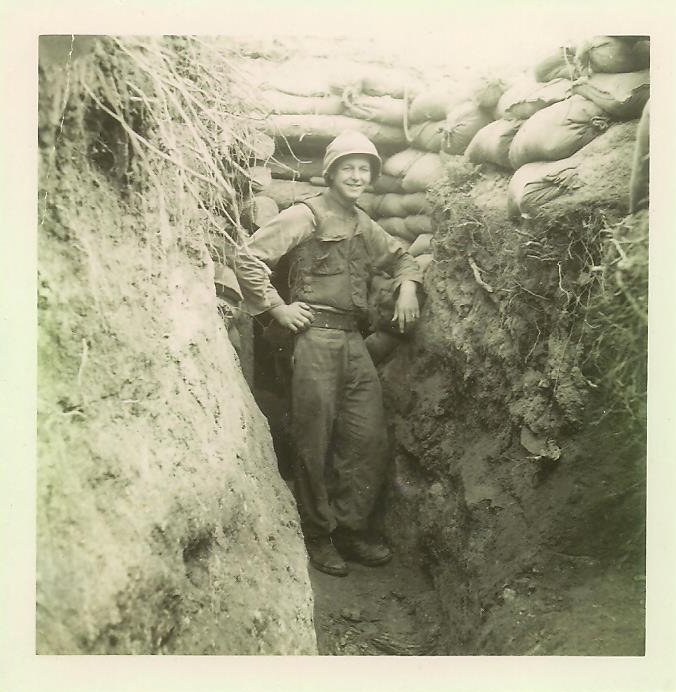
U.S. Army Cpl. Elvern Kletscher, my father, in the trenches in Korea.

War is hell. I try to imagine my dad penning that letter on his 22nd birthday. Missing his family. No cake, no nothing to celebrate. But rather worry about whether he would live to the next day. He had reason to fear for his life. Only a week prior, he was wounded in action at Heart Break Ridge while engaged in mortar firing with the enemy. Shrapnel struck him in the face and he was hospitalized for several days.

My grandparents, Ida and Henry Kletscher, posing with some of their children, flank my father, Elvern Kletscher, who is about to leave for military service in 1952.

Interestingly enough, Dad mentions none of that in his letter home. Rather, he closes with these sentences: “I’m feeling fine and don’t worry about me. I’ll write again soon.” I don’t believe Dad was “feeling fine,” in a place he called a “hell hole” in his letter.
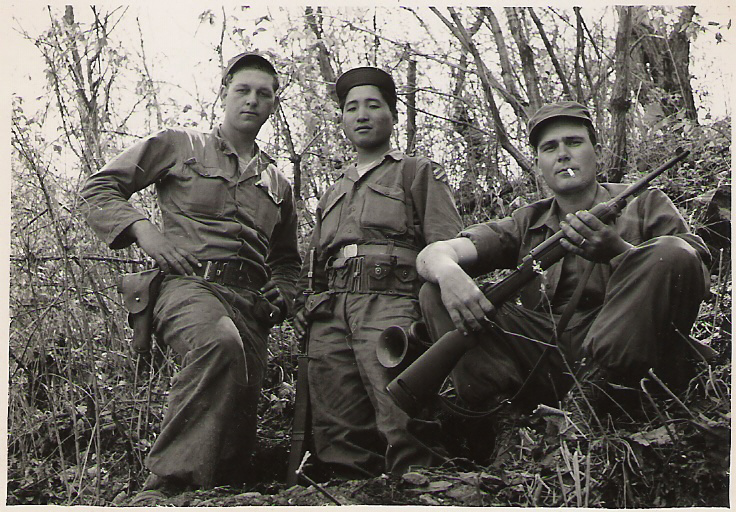
My father, Elvern Kletscher, on the left with two of his soldier buddies in Korea.

As I filter through the shoeboxes holding his military belongings, I pick up a hardcover 4 x 6-inch black book. It’s tattered, bent, dirty, obviously well-used. When I open the cover to read the words Dad penciled across lined paper, the realities of war strike me full force. Here are details and instructions on weaponry—60 mm mortars, submachine guns, tank mines, smoke screens, chemical warfare… He writes about reconnaissance, combat and security patrols and “avoid contact with enemy—may have to fight in self defense.” There are diagrams and fire commands and details I don’t understand, and don’t necessarily want to understand.

My dad carried home a July 31, 1953, memorial service bulletin from Sucham-dong, Korea. In the right column is listed the name of his fallen buddy, Raymond W. Scheibe.

But “Conduct on lines” and the details that follow need no deciphering: “1) Hold fire until enemy is within 500 yards. 2) Listening post must have cover and concealment, must have good route for withdrawal…” I expect Dad carried this book into war. Just as he carried deep trauma home from “The Forgotten War,” as the Korean War has been dubbed.

Words imprinted on the Veterans’ Memorial in Northfield, Minnesota. (Minnesota Prairie Roots copyrighted file photo May 2023)

War is hell, even if done for the right reasons—to defend democracy and freedom and country. For his time in the Army in 1953, Dad was paid $266.27. It’s documented on his federal income tax return. So little for so much given, not that there’s ever enough payment for a combat soldier.

My dad’s military marker in the Vesta City Cemetery. (Minnesota Prairie Roots copyrighted file photo)

I wish I could wrap my arms around Dad, hold him, tell him how deeply sorry I am for the horrors he endured while fighting as an infantryman on the front lines during the Korean War. Mostly, I wish I could simply listen, sitting quietly as I finger the chain of his dog tag, the beads providing tactile comfort as he talked (if he would talk) about the personal hell that is war.

The Rice County, Minnesota, Veterans’ Memorial in Faribault. This photo and five others I took now grace public spaces in the newly-opened State Veterans Home in Bemidji. (Minnesota Prairie Roots copyrighted file photo)

NOTE: Please use this Veterans Day as a time to thank those who have served our country. But more than thanking, listen, support and encourage. The voices of our veterans need, and deserve, to be heard.

© Copyright 2023 Audrey Kletscher Helbling


New film focuses on the people & stories of Johnston Hall November 7, 2023

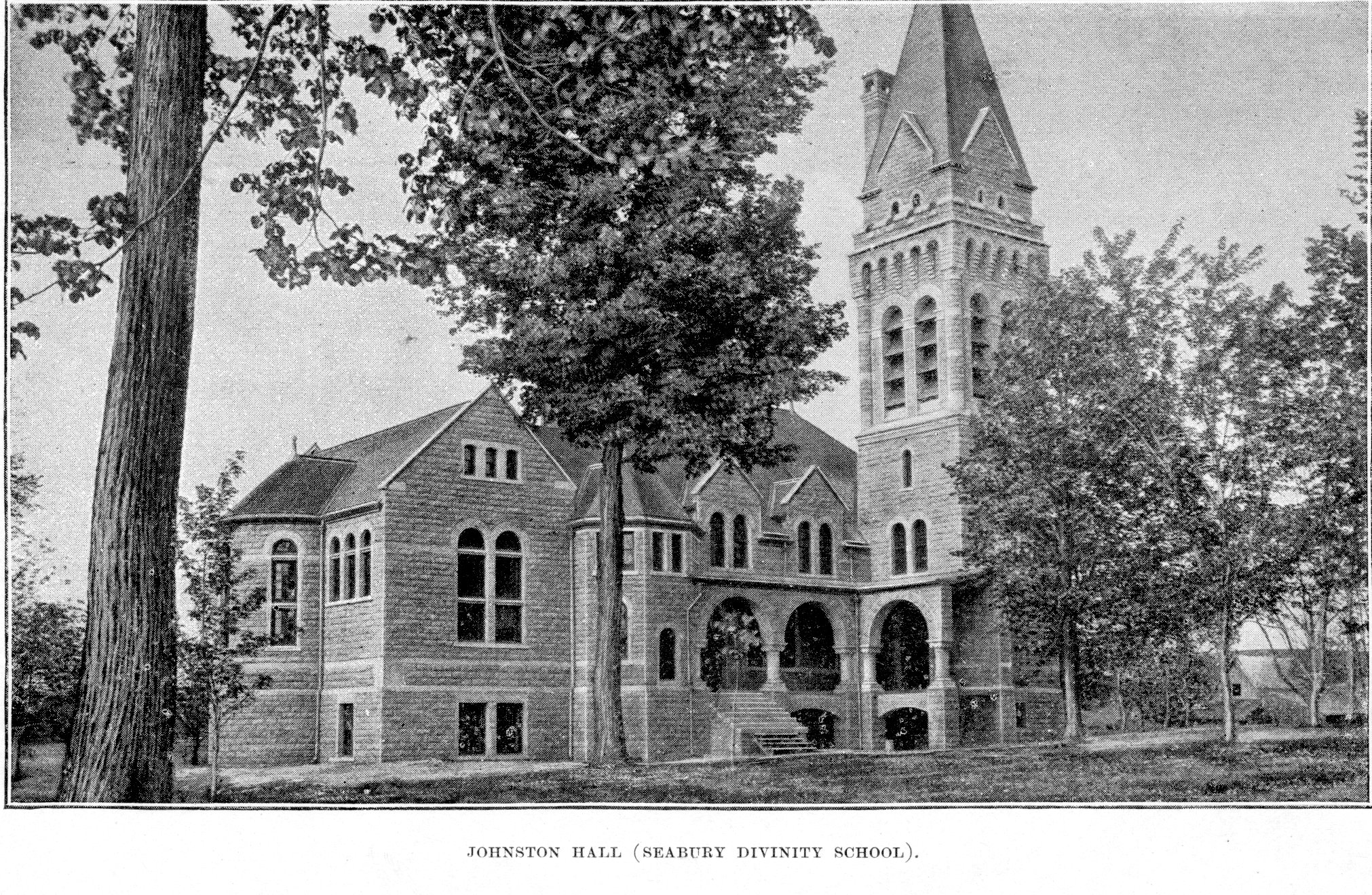
This undated photo of Johnston Hall is courtesy of the Rice County Historical Society.

AS A WRITER AND PHOTOGRAPHER, I understand the power of storytelling. That focuses my work. I strive to connect with readers in a meaningful and personal way via images and words.

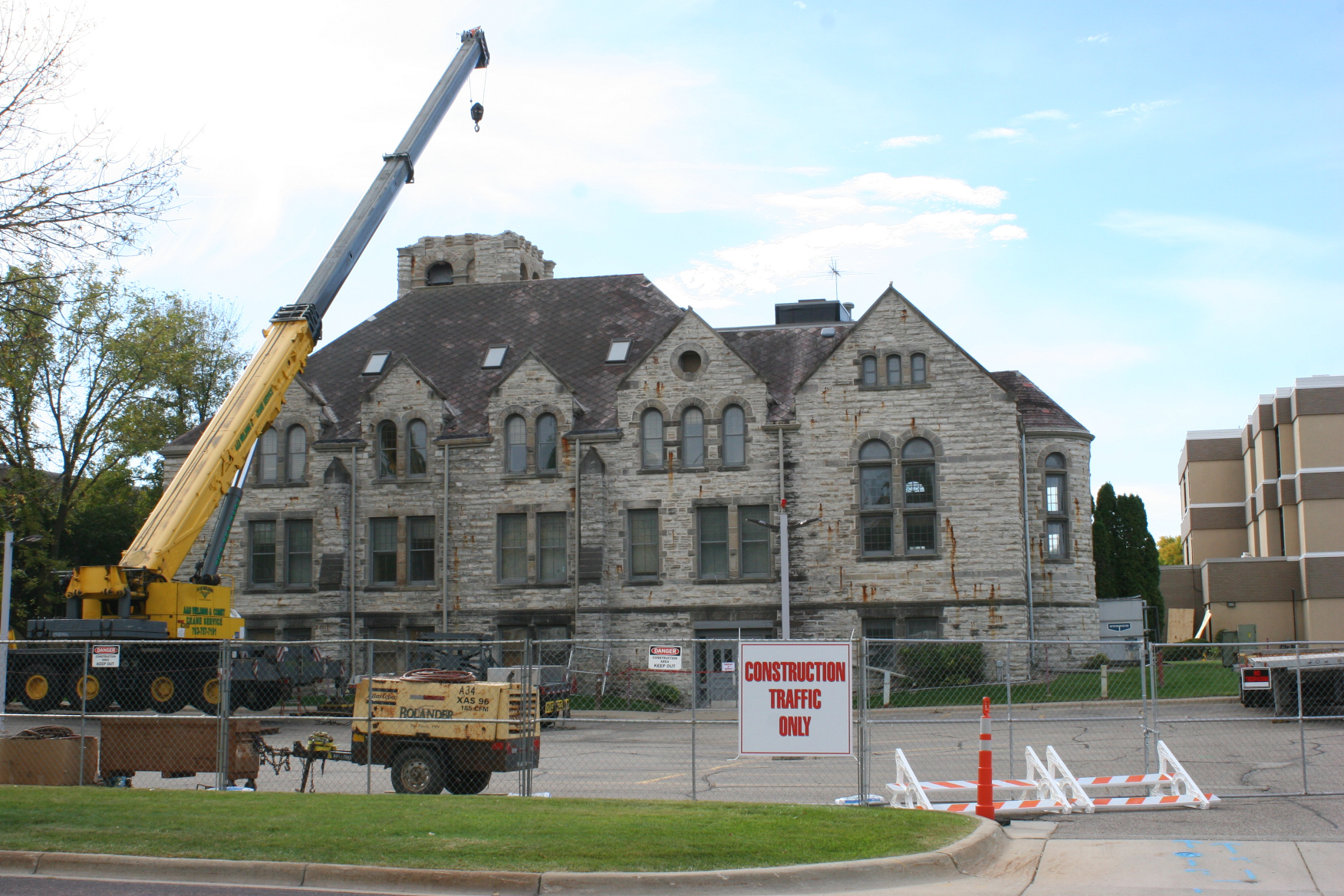
Johnston Hall, photographed shortly before it was demolished. (Minnesota Prairie Roots copyrighted photo September 2021)

And so storytelling is the approach I intended to take in writing about Johnston Hall. A building constructed in 1888 on Faribault’s east side. A building which once centered learning, then healthcare. A building placed on the National Register of Historic Places. A building that did not, physically, withstand the ravages of time and weather. A building which in 2021 was demolished, but not without efforts to save it.

The QR code on the sign links to the new documentary on Johnston Hall. (Minnesota Prairie Roots copyrighted photo August 2023)

Johnston Hall is not only part of my family’s story, but of the larger community, of Faribault’s history for 133 years. Now filmmakers Samuel Temple and Logan Ledman of the local 1855 History Team (Steamboat Media Company) have released their newest documentary, “Love Inwrought: Johnston Hall and the Memory of a Building.”

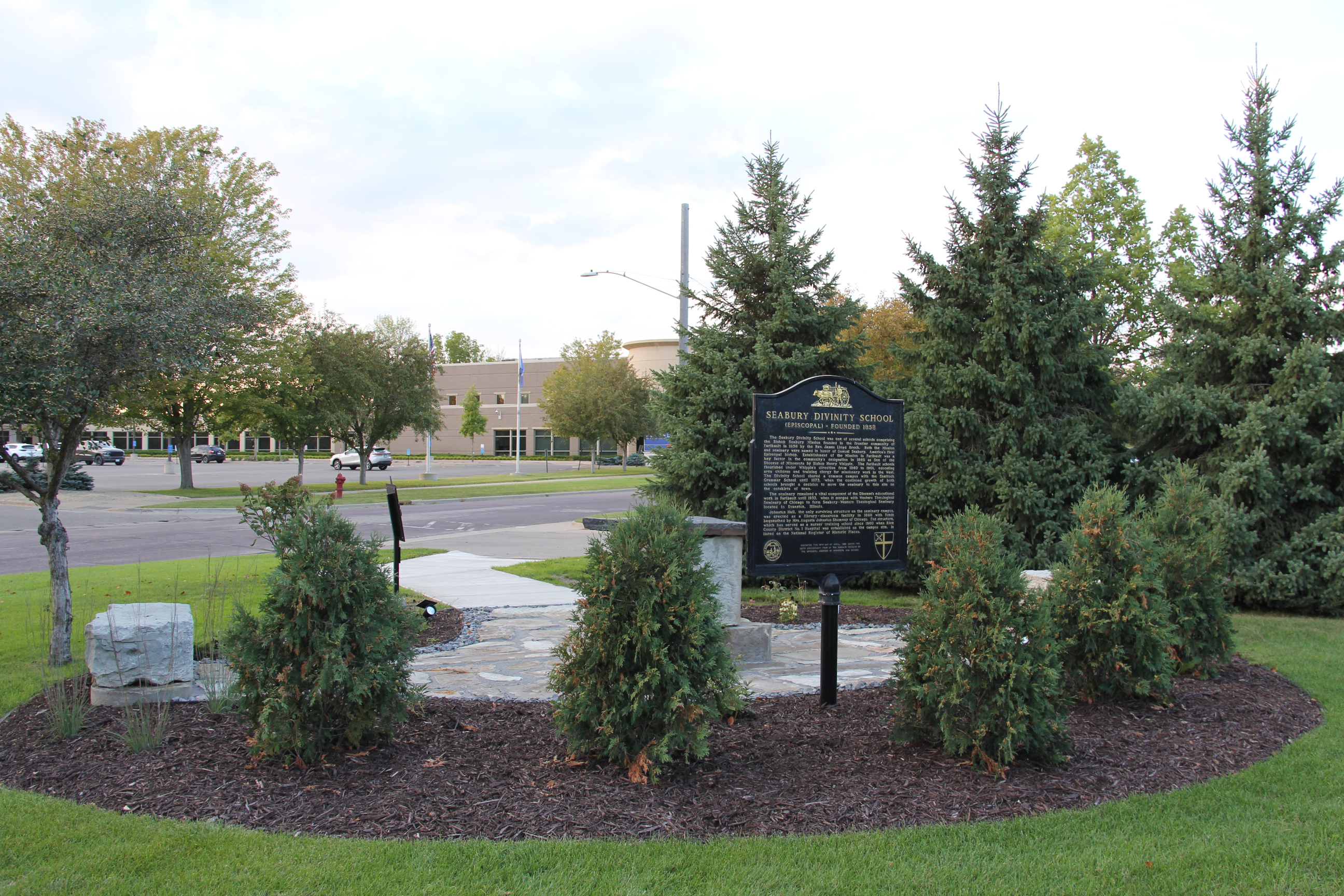
This shows the back of Johnston Hall Memorial Garden, looking toward Allina Health Faribault Medical Center. The garden is next to an employee parking lot. The bronze Seabury Divinity School plaque was saved from the hall and focuses the garden. (Minnesota Prairie Roots copyrighted photo August 2023)

I need to backtrack for a moment, though, to late August, when I photographed Johnston Hall Memorial Garden, located along State Street on the campus of the Allina Health Faribault Medical Center. The recently-completed garden honors the history of Johnston Hall and provides a contemplative space to reflect. For me, that’s remembering the time I spent, along with loved ones, in the aged building that once sat north of the hospital and clinic, northwest of the new garden.

Image credit: 1855 History Team Facebook page

In their Johnston Hall documentary, the filmmakers weave together history, memories, stories. Temple states that “…each soul passing through a building is a part of its memory, its identity and its legacy.” That is the singular line which stands out for me, the line defining Johnston Hall as more than a building that once stood tall, grand and strong, initially as part of Seabury Divinity School. Johnston Hall is part of so many personal stories, including mine.

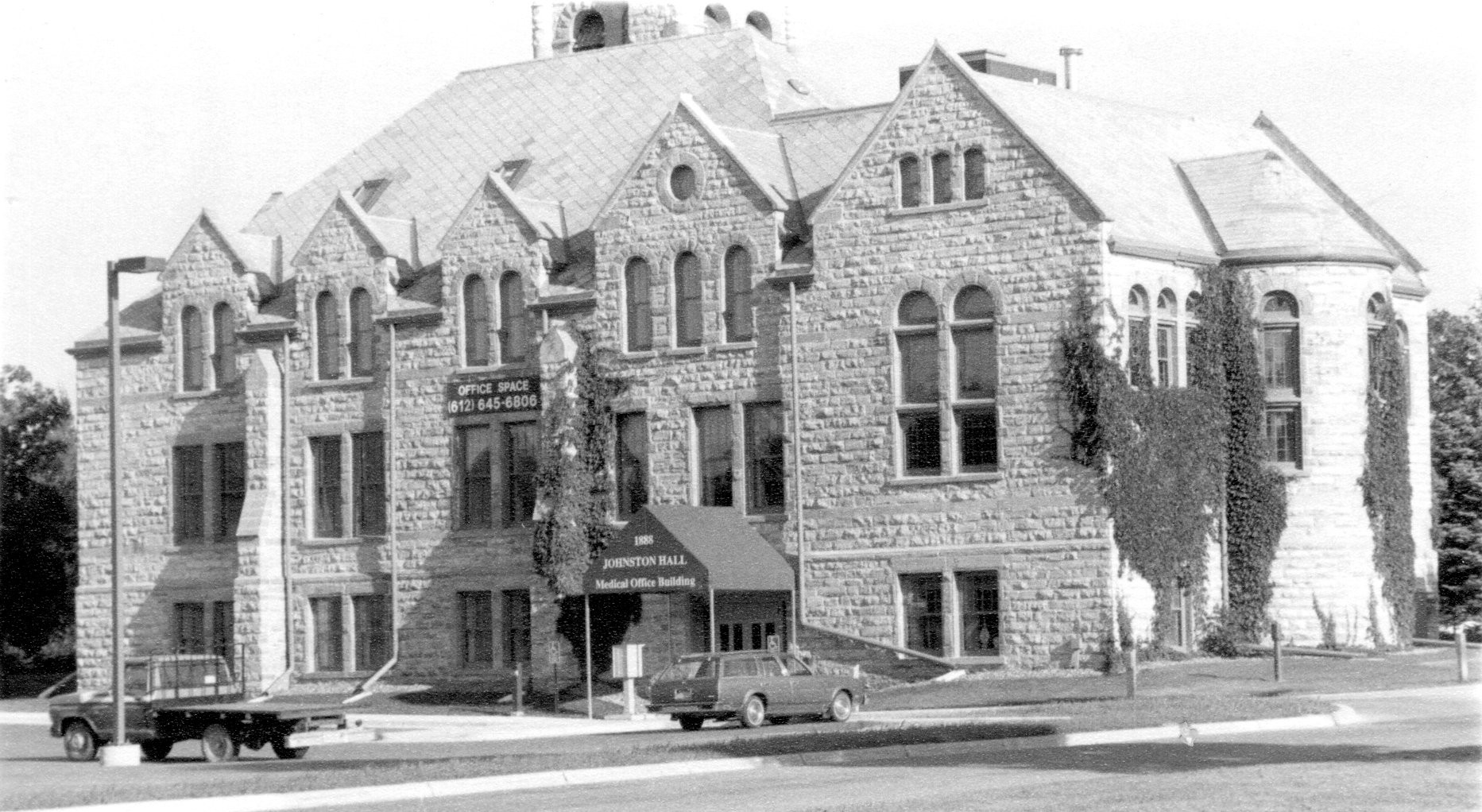
Johnston Hall in a 1990 image, as a Medical Office Building. (Photo courtesy of the Rice County Historical Society)

While I don’t recall the exact year I first walked through the doors of this stately limestone Romanesque architectural style structure, it was after an orthopedic and fracture clinic moved into the building. That followed histories of usage as the divinity school (closed in 1933) library and classrooms, a nurses’ training school and then a vocational-technical school.

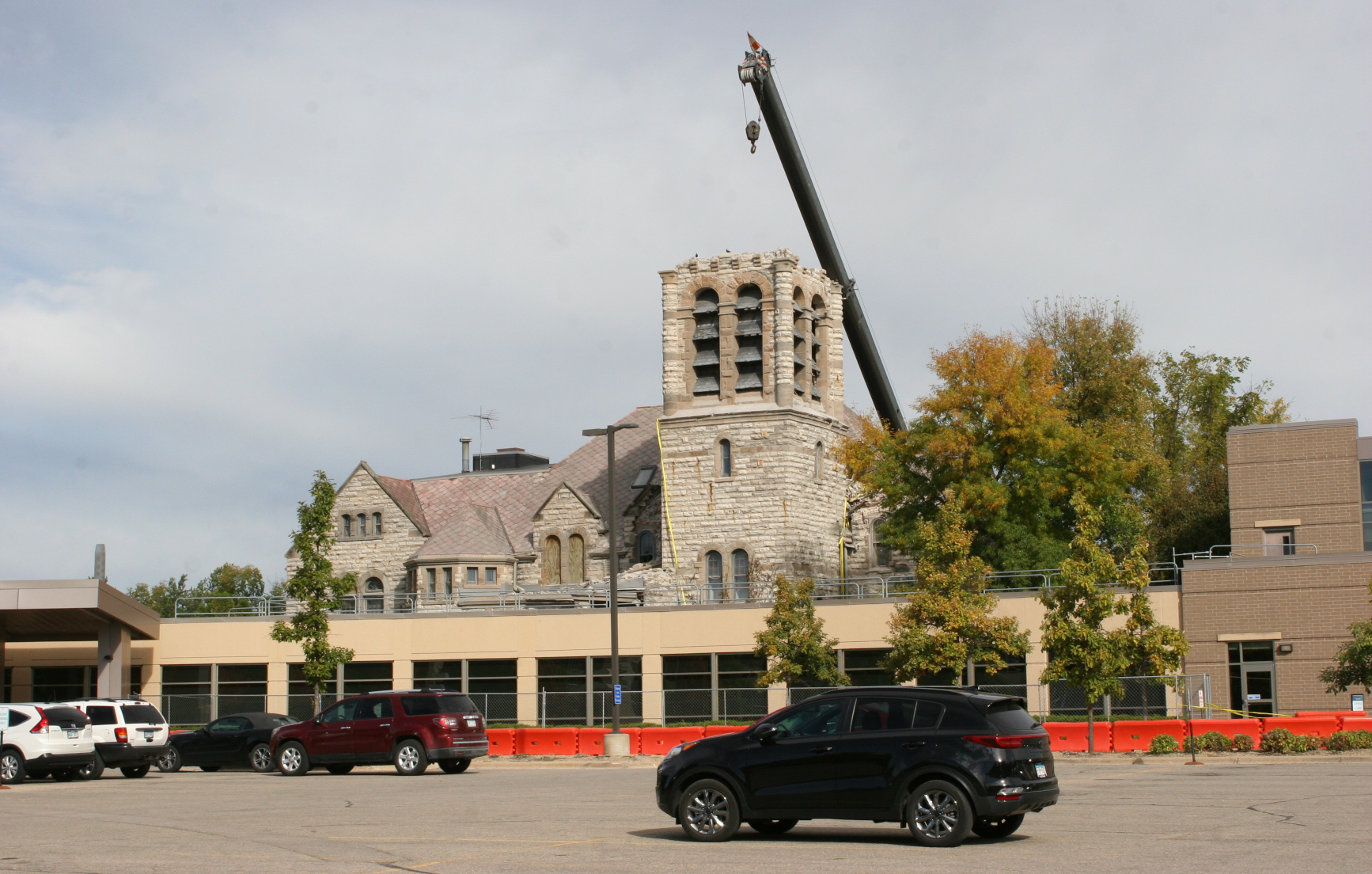
Johnston Hall photographed from the parking lot of the hospital and clinic. (Minnesota Prairie Roots copyrighted photo September 2021)

Broken bones and other health issues landed me and my family inside Johnston Hall. As a grade schooler, my son broke his little finger while unicycling in our driveway. In 2006, he was back at Johnston Hall, this time with a rib fracture and a broken bone in his hand after a hit-and-run driver struck him while he crossed the street to his bus stop. The same morning of that May 2006 scare, while my husband and son were in the hospital emergency room, I wound my way to nearby Johnston Hall for an appointment with an orthopedic doctor. I had waited too long to cancel my appointment, although I desperately wanted to stay by my son’s side in the ER.

On that May morning, I learned that I would eventually need right hip replacement surgery due to osteoarthritis. I delayed that surgery until 2008. The stairway and waiting room and exam rooms of Johnston Hall soon grew all too familiar.

To my second daughter also, who was screened for scoliosis in junior high and then referred to the medical team at Johnston Hall. Eventually her spinal curvature required wearing a customized, full body, hard plastic back brace 24/7 for a year. It was the first time I cried at Johnston Hall.

Stone was saved from Johnston Hall and incorporated into the memorial garden, including stone marking the hall as a gift from Augusta Huntington. (Minnesota Prairie Roots copyrighted photo August 2023)

In many ways, Johnston Hall and tears are intertwined. As the filmmakers share in their documentary, funding for the hall came from Augusta Huntington, formerly Augusta Shumway. Horatio Shumway left tens of thousands of dollars to his grieving widow. She used his gift to fund construction of Good Shepherd Chapel and then Shumway Hall in honor of Horatio. Both sit on the campus of the current-day Shattuck-St. Mary’s School, a private college prep school. In 1888, construction of Johnston Hall was completed, the cornerstone laid. The hall was a final bequeath from Augusta, who died in 1884. The building honors her father, William Johnston.

Up close, historic Johnston Hall shortly before its demolition. (Minnesota Prairie Roots copyrighted photo September 2021)

“Love Inwrought: Johnston Hall and the Memory of a Building” features much more in-depth history, including the connection between Minnesota’s first Episcopal bishop, Bishop Henry Whipple (who called Faribault home), and Augusta Shumway. The filmmakers also highlight Henry St. Clair, a Dakota man who attended Seabury Divinity School, studying inside the library and classrooms of Johnston Hall. He became an ordained deacon and then a pastor. Indigenous peoples are an integral part of Faribault’s history and I appreciate that these filmmakers focus on that, too, in their latest work.

Incorporated into Johnston Hall Memorial Garden, the 1888 cornerstone. (Minnesota Prairie Roots copyrighted photo September 2023)

In their well-researched documentary, Temple and Ledman use historical photos, illustrations, even a building model, actors, original music (composed by Sam Dwyer) and narration to tell the stories of Johnston Hall. Theirs is, indeed, a work of love, revealing how love inwrought takes a building beyond wood and limestone to memories abiding within the souls of those who’ve passed through its doors.

FYI: To view this documentary film, click here.

Please check back for a follow-up story featuring a closer look at Johnston Hall Memorial Garden.

© Copyright 2023 Audrey Kletscher Helbling
 

On the hunt for deer November 6, 2023

Deer photographed at River Bend Nature Center, Faribault. (Minnesota Prairie Roots copyrighted file photo April 2022)

MANY MINNESOTANS hold a love-hate relationship with deer. We love watching them in the wild. But when they devour our flowers and other plants, then deer are not quite so cute. Or, if they dash onto a roadway, slamming into our vehicles (or perhaps us into them), then the hate factor amps up considerably.

Leaping across a path near the nature center parking lot. (Minnesota Prairie Roots copyrighted file photo 2013)

And then there are the deer hunters, including many in my extended family. While I’ve never asked why they hunt, for some it’s a food source, others tradition, a challenge, a sport, camaraderie and the joy of time spent in the woods, fields and prairie.

Spotted on a back country road near Mazeppa. (Minnesota Prairie Roots copyrighted file photo May 2022)

Right now is prime deer hunting season in Minnesota with the recent firearms deer hunting opener. It’s a big deal with even our governor donning his blaze orange attire. The Minnesota Department of Natural Resources regulates hunting with detailed rules for firearms, muzzleloader and archery hunts plus a whole lot of other specifics for ages and regions. Way too complicated for me. But then I don’t need to understand given I don’t hunt.

A hunter in bright orange roamed fields during the opening weekend of deer hunting in Minnesota in 2018. (Minnesota Prairie Roots copyrighted file photo 2018)

But I do need to be aware. I prefer not to go on leisurely country drives during firearms hunting. Bullets can travel a long way. While I know most hunters are careful, not all are. Being sure of your target before firing is a basic rule of hunting. Even I, a non-hunter, understand that.

Spotted along a trail at River Bend while hiking on Sunday. (Minnesota Prairie Roots copyrighted photo November 2023)

I also understand the need to heed warning signs like the one I spotted while hiking at River Bend Nature Center late Sunday morning. The nature center will be closed Thursday, November 9, through Sunday, November 12, for an archery management hunt. It’s a necessary event to manage the deer population. Coyotes do some of that, but clearly not enough.

The muted autumn landscape at River Bend, the path leading back to the woods or onto the prairie. (Minnesota Prairie Roots copyrighted photo November 2023)

I appreciate River Bend for its diverse landscape of woods, prairie, wetlands and river. To walk the trails within is to connect with nature, to feel peace, to experience a sense of awe and wonder at the intricacies and beauties of the natural world.

One of my favorites at River Bend, grass that stretches 10 feet and bends poetically in the wind. (Minnesota Prairie Roots copyrighted photo November 2023)

Here sky meets prairie. Here woods shelter. Here river twists. Here milkweeds flourish and grasses stretch and snakes slither. And here deer roam, too, in this land that is more theirs than ours. Yet, we claim it also.

Deer nearly camouflaged in the dried grasses at River Bend. (Minnesota Prairie Roots copyrighted photo April 2022)

And even though I intellectually recognize the need for an archery management hunt, part of me wants to shout a warning: “Run, deer, run!”

© Copyright November 2023 Audrey Kletscher Helbling


Two Minnesota authors talk craft, share insights in Faribault November 3, 2023

Buckham Memorial Library, Faribault. (Minnesota Prairie Roots copyrighted file photo December 2022)

I DIDN’T INTEND to write a follow-up about an author event Thursday evening at my local library. So I didn’t take notes initially. I planned to just sit back, listen and maybe ask a few questions. Turns out I asked a lot of questions of Jess Lourey and Nicole Kronzer. About then I decided I best start taking notes.

I found kindred spirits in Jess Lourey and Nicole Kronzer, in the commonality of needing to write. (Minnesota Prairie Roots copyrighted file photo 2012)

What energy, knowledge and passion these writers brought to the Buckham Memorial Library Great Hall. It’s clear they love the craft of writing. I could feel, as much as hear, their passion.

To be in their presence, to recognize that I was among wordsmiths who deeply love the written word, writing and reading, energized me.

The promo for Thursday’s event. Author John Lee Clark was unable to attend.

I actually pulled myself away from Lourey’s riveting crime thriller/mystery The Taken Ones to attend the author event, Moving Words: Writers Across Minnesota. It’s part of The Friends of the Saint Paul Public Library’s program to bring Minnesota Book Award-winning authors to communities like Faribault. I, for one, appreciate this programming, which included a Friends moderator. She asked questions of Lourey and Kronzer and invited the seven audience members to do the same.

Lourey has 28 books to her credit, mostly fiction, but also nonfiction and children’s books. Kronzer has published two young adult novels. I’ve read many of Lourey’s books and will soon read Kronzer’s. She’s a relatively-new author.

Yet, they share similar experiences and didn’t sugarcoat the difficult process to publication, which starts first with an idea, then outlining, then writing and research and rewriting and rewriting some more and editing and… They struggled to find agents, had their queries and manuscripts rejected by publishers, Lourey some 400 times. But she persisted. And today she’s an accomplished award-winning author. Kronzer holds the same determination to get her work in print. Her best work. They both acknowledged some of their writing hasn’t been all that good. Lourey even went so far as to steal her master’s thesis from her university’s library…until her Minnesota guilt kicked in and she returned it.

Book cover sourced online. This is Kronzer’s second young adult novel, published in January.

Both have taught/teach writing. Kronzer draws on her interactions with teens as a high school English teacher and her theatrical experience in shaping her books. She enthuses about today’s teens, noting she feels hopeful in this generation. In response to a question, Kronzer said the take-away from her books is a sense of belonging, the theme in Unscripted and The Roof Over Our Heads. She was, she said, bullied. I can relate. We write what we know.

Book cover sourced online. The cover is similar to the real-life scene of abandoned bikes found in a rural road ditch at the site of Jacob Wetterling’s abduction.

Lourey, who is inspired by dark true crime, centers her fictional books on secrets. She grew up in Paynesville in central Minnesota, where eight boys were attacked and assaulted in the late 1980s. (Secrets.) Authorities investigated a suspect who later pled guilty to the 1989 kidnapping, assault and murder of Jacob Wetterling in nearby St. Jospeh. Lourey’s fictional book, Unspeakable Things, is based on what happened in Paynesville. Her experiences as a pre-teen and teen at the time weave into Unspeakable. Write what you know.

Even though her books theme around secrets, Lourey wants readers to take away the importance of community. “Find your people and tell your truth,” she said.

This was posted in a recent display on banned books at my library. (Minnesota Prairie Roots copyrighted photo September 2023)

And for Kronzer, her stand-out statement of the evening, at least for me, was this: “Reading makes you nicer.” In saying that, she referenced the diversity of characters found in books. (Both authors emphasized character development in their writing.) Kronzer’s statement really resonated with me as I thought of a recent banned books display in my library. Not books banned from Buckham Memorial Library, but rather books that have been banned elsewhere. I chose one from the shelf, Lawn Boy by Jonathan Evison, and read it. It’s not a book I would otherwise have chosen. But I needed to read it, to learn, to widen my world, to put myself in the shoes of others.

We can learn so much by reading, by writing, by asking, by listening. And sometimes we are validated. When I asked Lourey and Kronzer whether they eavesdrop (specifically in grocery stores), they admit they do. Some of what they’ve overheard has made it into their books. Just as some of what I’ve overheard has woven into my writing. Write what you know. And sometimes, write what you hear.

Book cover sourced online.

FYI: Lourey and Kronzer suggested two must-read books on the craft of writing: Save the Cat! Writes a Novel—The Last Book on Novel Writing You’ll Ever Need by Jessica Brody and Stephen King’s On Writing—A Memoir of the Craft. I’ve read King’s writing guide and highly-recommend it. I also highly-recommend attending author events, whether you’re a writer, a reader or both.

© Copyright 2023 Audrey Kletscher Helbling
 

Music & more music on Sunday in Faribault

Concert promo courtesy of Jeff Jarvis, The Cathedral of Our Merciful Saviour.

TWO CONCERTS at two Faribault churches. Same day, November 5. Overlapping times. That’s the dilemma for someone like me who would like to attend both concerts Sunday afternoon in my community. Perhaps I can listen to an hour of one before dashing off to the second. Whatever I decide, I realize how fortunate we are to have these local musical offerings.

My friends Gary and Barb ring bells during a past Red Kettle Campaign in Faribault. (Minnesota Prairie Roots copyrighted file photo December 2013)

The first concert, featuring the music of the popular Jivin’ Ivan and the Kings of Swing, begins at 2 pm and continues until 4 pm at Hope United Methodist Church, 3166 197th St. E. It’s a benefit concert kick-off for the Salvation Army’s 2023 Red Kettle Campaign in Rice County. Donations will be accepted at the event. As someone who’s rung bells for the Salvation Army, I fully support this mission to help those in need within my county.

Inside The Cathedral of Our Merciful Saviour, where CVRO performs on Sunday. (Minnesota Prairie Roots copyrighted file photo 2010)

The second concert, “Atmospheres,” begins at 3 pm at The Cathedral of Our Merciful Saviour, 515 Second Ave. NW, across from Faribault’s Central Park. The Cannon Valley Regional Orchestra will perform in the historic cathedral, which has incredible acoustics. This free concert is part of the Merner Concert Series.

A highlight of Sunday’s orchestra concert is the world premiere of “Where the Waters Run,” a tone poem for harp and orchestra by Timothy Mahr featuring harpist Elinor Niemisto. Mahr is a retired professor of music at St. Olaf College, Northfield, and a renowned composer and conductor. Niemisto is also recently-retired from St. Olaf, but continues to teach harp at Carleton College across the river in Northfield.

Now…to try and make both concerts. Choosing one over the other is, well, simply too difficult.

© Copyright 2023 Audrey Kletscher Helbling


Experiencing fall colors in Faribault one final time (maybe) this season November 2, 2023

Individual leaves, like this maple, are works of art. (Minnesota Prairie Roots copyrighted photo October 2023)

TEMPS DIPPING INTO THE LOW 20s definitely feel more like winter than autumn here in southern Minnesota. I pulled on my parka, stocking cap and mittens earlier this week for my morning walk.

A still colorful treeline behind Pollard Hall. (Minnesota Prairie Roots copyrighted photo October 2023)

But the weekend, oh, the weekend, even if only in the 30s, was a wonderful one for final fall walks. I wanted one last glimpse of the foliage. Leaves have dropped from many trees, but some remain, like stubborn, defiant kids refusing to leave the playground.

A solitary oak set against the backdrop of Noyes Hall is simply stunning. (Minnesota Prairie Roots copyrighted photo October 2023)

Per our usual weekend walking route, Randy and I headed to the campus of the Minnesota State Academy for the Deaf on Faribault’s east side. I love walking here. It’s quiet, secluded and just plain achingly beautiful. From aged limestone buildings to green space to a wooded area behind the buildings, there’s much to appreciate. Nature and old architecture always appeal to me as does a safe, unimpeded place to walk.

The woods I was drawn to explore. (Minnesota Prairie Roots copyrighted photo October 2023)

Typically we stick to following sidewalks or crossing parking lots. But this time we diverged into the wooded area behind Pollard Hall, a boarded up building and the HVAC and maintenance headquarters. I’d previously seen people with their dogs tracking across the grass near woods’ edge. But we’d never detoured to explore, mostly because in the summer and early autumn the woods appear a dense forest. Now with most leaves fallen, the space opened up, drawing me in.

We followed a leaf-strewn, narrow dirt path for a ways into the woods. (Minnesota Prairie Roots copyrighted photo October 2023)

Since I’m directionally challenged in a town that is not prairie grid straight, I wondered what lay beyond the woods, below the bluff. After a bit of crunching over leaves, dodging branches and skirting trees, I saw the answer. Below lay the river and train tracks and Straight River Apartments next to Fleckenstein Bluffs Park. Finally, I understood my geographical placement.

Woods, hills, fallen leaves and creek bed meld behind MSAD. (Minnesota Prairie Roots copyrighted photo October 2023)

Mostly I took in the topography of hills bumping into each other, a dry creekbed twisting between. Yellow leaves covered the hillsides as thick as shag carpeting, but much lovelier.

Oak leaves blanket the lawn. (Minnesota Prairie Roots copyrighted photo October 2023)

Once out of the woods, Randy alerted me to two deer near the HVAC building. A third had already run away upon spotting us. But the other two stood still as statues, fully aware of our presence. We mimicked them, opting to stand quietly and appreciate their unexpected appearance. As much as I dislike deer along roadways, I find them endearing in any other location. Finally the pair decided they’d had enough of this stare off. They white-tailed it across the grass, disappearing over a hill.

Sometimes you have to look up, directly up, to see the beauty, like this oak tree. (Minnesota Prairie Roots copyrighted photo October 2023)

And so we continued on, me pulling out my cellphone once again to snap photos of the remaining colorful trees. My mind understands that soon this landscape will be devoid of color, transformed to the black-and-white of winter. But on this weekend, I pushed those thoughts mostly aside, focusing instead on autumn’s lingering beauty.

© Copyright 2023 Audrey Kletscher Helbling
 

Eye-opening walks through the park November 1, 2023

A box of food left inside the band shell at Central Park. (Minnesota Prairie Roots copyrighted photo October 2023)

A SHARP OCTOBER WIND cut across Central Park, chilling me as I walked. For several months now, Randy and I have power walked here and in the surrounding neighborhood as part of a new exercise routine. But these daily outings have proven to be more, much more, than an effort to raise our heart rates, build strong bones and stay in shape. They have opened our eyes to sides and peoples and challenges previously unseen by us in Faribault.

Left on a park bench, bedding and a bag. (Minnesota Prairie Roots copyrighted photo October 2023)

That includes homelessness. I’ve come to recognize those without housing security. And although I’ve never stopped to ask their stories, I’ve wondered. I wonder if they have enough food, where they sleep, why they are homeless. And I wonder, what are we as a community doing to help them find housing and more?

In the darkness of early evening, I found this box of food sitting next to a tree. (Minnesota Prairie Roots copyrighted photo October 2023)

On the evening I noticed a cardboard box aside a tree and investigated, I had even more questions. Food filled the box. Unopened boxes of Raisin Bran and baked goods mostly. Why was this box of food placed there, next to a tree near the band shell?

Bread simply dropped on the grass. (Minnesota Prairie Roots copyrighted photo October 2023)

The next morning the box sat inside the band shell, a single loaf of French bread lying on the grass. And three days later, when I noticed a cardboard box edging over a trash can, I investigated again. To my dismay, I found the food dumped, a head of cabbage, hazelnuts, baked goods and more inside the garbage barrel. I didn’t dig deeper. Why this unnecessary dumping of food?

A whole lot of food packed these abandoned boxes. (Minnesota Prairie Roots copyrighted photo October 2023)
A variety of foods fill two of the boxes. (Minnesota Prairie Roots copyrighted photo October 2023)

Several weeks later I spotted boxes of food again, this time three boxes left by a picnic table on the band shell’s north side. Inside were half-gallons of milk, eggs, dried lentils, cereal, baked goods, crackers, salad and, at the bottom, rotten pears. The temperature hovered at 60 degrees, not nearly cold enough to keep perishables. I expect someone had good intentions in leaving the food there.

St. Vincent de Paul, a charitable nonprofit located across from Central Park. (Minnesota Prairie Roots copyrighted photo October 2023)

I’ve observed people waiting in line for food, clothing and more across the street at The Society of St. Vincent de Paul Center for Charitable Services. I’ve observed, too, volunteers’ vehicles parked outside The Cathedral of Our Merciful Saviour, home to the Community Cafe, which every Tuesday evening serves a free meal. The church sits across from the park, next to a bank, a block from St. Vincent.

Signage posted outside the entrance to St. Vincent de Paul. (Minnesota Prairie Roots copyrighted photo October 2023)

An acquaintance, whom I suspect is homeless and whom I haven’t seen in the park since I asked if he has a home (I did so respectfully), told me he got food from St. Vincent, ate at the Community Cafe and at Buckham West Senior Center. So I know these outreaches are working.

Central Park, band shell in the background, during the light of early evening. (Minnesota Prairie Roots copyrighted photo October 2023)

Then there was the evening Randy and I witnessed a drug deal, or more accurately, a suspected drug deal. A motorbike drove into the center of the park and an exchange occurred between two young men. There was a bit of yelling before one of the guys (the one who’d been waiting on a park bench) dashed toward an empty parked car that we’d noticed idling upon our arrival. We’d been warned about drug deals at Central Park. But to be warned differs from witnessing.

And the day I found a small pack lying on the sidewalk, then opened it to check for identification, I discovered a stash of marijuana secured in plastic wrap, along with prescription eyeglasses and a large print Sudoku book. Randy reminded me that pot is now legal in Minnesota when I suggested turning the drugs in to police. So we left the bag, hanging it on a low lying park fence. Days later it was gone.

A empty bottle of alcohol discarded on a picnic table. (Minnesota Prairie Roots copyrighted photo October 2023)

There’s plenty of drinking happening at Central Park, too, even if consumption is banned, allowed by permit only. I’m no teetotaler. But I am a rule follower. And it troubles me to see this drinking and then alcohol bottles and cans and boxes strewn about. A liquor store sits right across the street. I once saw a young homeless man charging his cellphone in an exterior outlet of the liquor/grocery store. And I recently witnessed a woman, seated at a picnic table, chugging a Hamms beer too early in the day.

Food dumped in the trash at Central Park. (Minnesota Prairie Roots copyrighted photo October 2023)

All of this—the suspected drug deal, the abandoned food boxes and trashed food, the homelessness (including the person sleeping on a picnic table inside the band shell, bike nearby), and substance abuse—leaves me feeling melancholy. I don’t know the circumstances, the stories, the situations behind anything or anyone I’ve observed. I only know how I feel. And that is helpless, sad and with a whole lot of questions.

Left inside the band shell, a twin-sized mattress. We’ve also seen a flat screen TV left here. (Minnesota Prairie Roots copyrighted photo October 2023)

I recognize, though, that we each are likely only a financial, health or other crisis away from hunger, homelessness, addiction, despair. And that is, perhaps, what imprints upon me most. We are human. And to be human is to face challenges that can lead into the darkest of places. To be human is also to take an eye-opening walk through a city park to see that previously unseen and in the seeing to recognize the need is great among us.

© Copyright 2023 Audrey Kletscher Helbling