Minnesota Prairie Roots

Writing and photography by Audrey Kletscher Helbling

Farmer Seed mural installed as historic-themed projects underway November 12, 2025

A new mural on the side of Midwest Indoor Storage celebrates Farmer Seed & Nursery’s history in Faribault. (Minnesota Prairie Roots copyrighted photo October 2025)

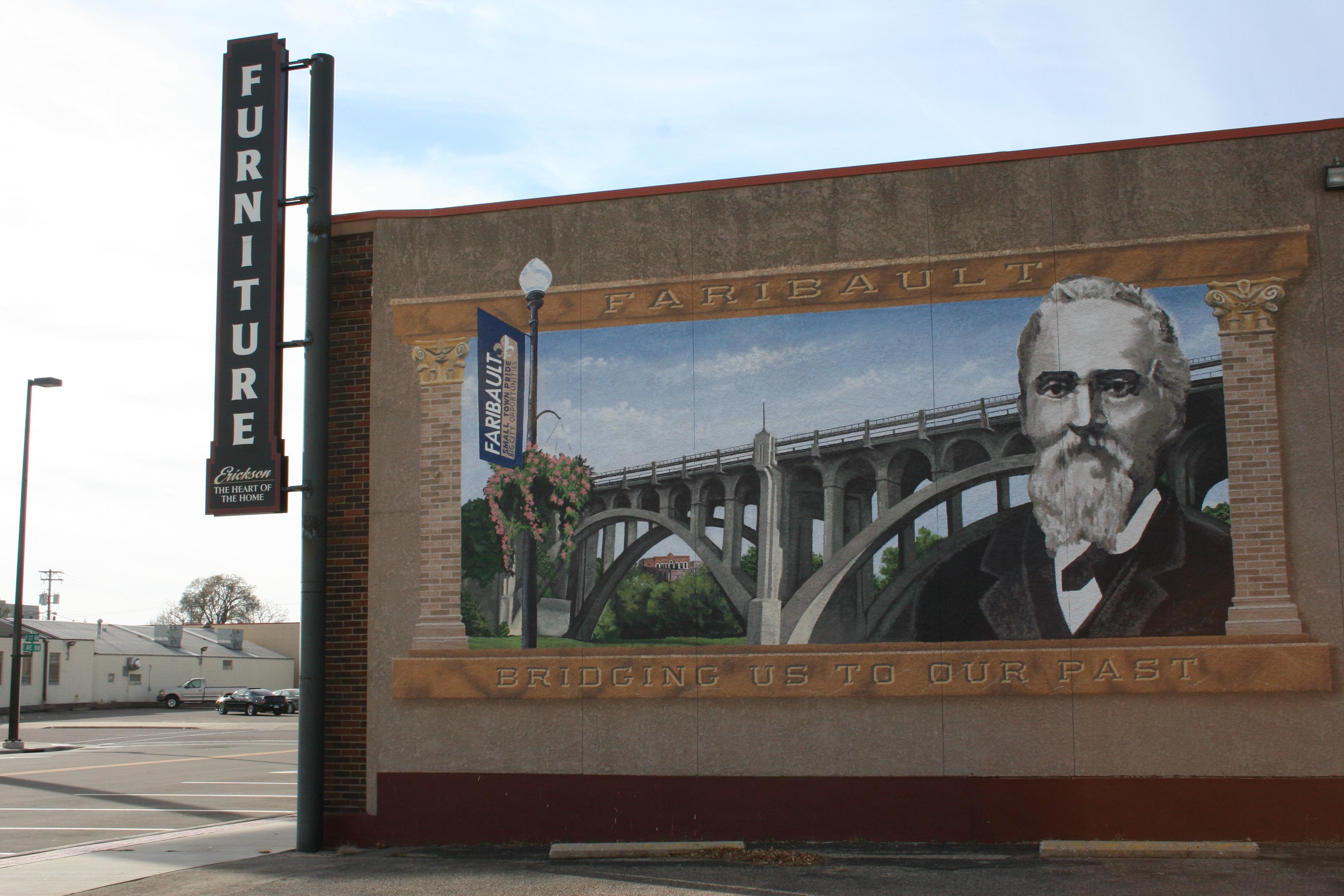
THE FIRST PART of a three-pronged project honoring Farmer Seed & Nursery in Faribault has been completed. Recently a 20 by 24-foot mural, designed by local historian and creative Jeff Jarvis of West Cedar Studio and painted by Minneapolis artist Melodee Strong, was installed at Midwest Indoor Storage, site of the former nursery.

The new Farmer Seed mural hangs on an indoor storage building where Farmer Seed once stood. (Minnesota Prairie Roots copyrighted photo October 2025)

The artwork hangs on a corner of the building’s west side, visible to eastbound passersby along Minnesota State Highway 60/Fourth Street.

A 1920s image of Farmer Seed from the Jeff Jarvis Collection. (Photo courtesy of Jeff Jarvis)
Vegetable art in a vintage seed catalog for sale at Keepers Antiques in downtown Faribault. (Minnesota Prairie Roots copyrighted photo October 2025)
The beautiful, artsy cover of a 1921 Farmer Seed catalog found at Keepers Antiques. (Minnesota Prairie Roots copyrighted photo October 2025)

The iconic Farmer Seed and Nursery multi-level complex once rose here, an identifiable community landmark business rooted in agriculture. With nearly a 130-year history in Faribault and company roots in Chicago dating to 1888, Farmer Seed was once noted for its local seed farms, seeds, mail order seed catalog, retail store and Christmas trees. I remember paging through the company’s catalogs while growing up on a southwestern Minnesota dairy and crop farm. From vegetables to flowers to shrubs and trees, Farmer Seed offered endless options for the everyday gardener, farmer and other growers.

Simple, bright, bold and memorable graphics define the mural. (Minnesota Prairie Roots copyrighted photo October 2025)

Today the mural and a forthcoming kiosk and memory book will continue to celebrate this long-time Faribault business. In designing the mural, Jarvis kept it simple, focusing on the signature exterior signage that graced the historic building. He added a splash of color in a clutch of sunflowers, highly recognizable, he said, and a popular agricultural symbol.

The multi-paneled kiosk will stand on the corner of Fourth Street and Eighth Avenue. (Design rendering courtesy of Jeff Jarvis, WestCedarStudio.com)

Jarvis also created conceptual sketches for the planned corner kiosk and is developing an interior graphic panel display featuring company history, little-known products and personnel information.

The memory book cover designed by Jeff Jarvis of WestCedarStudio.com. (Courtesy of Jeff Jarvis)

Additionally, this keeper of local history is compiling a Farmer Seed memory book of stories, historical information and photos. Jarvis has included his own childhood story about a coveted Ant Farm purchased at the retail store by his mother and gifted to him at Christmas. He’s looking for more stories and encourages submission of those via a form on his website at https://westcedarstudio.com/farmer-seed-nursery-memory-book/. Once the stories are compiled they will be available to read for free on Jarvis’ studio website or as a printed copy for a fee.

On a recent rainy morning, I photographed the Farmer Seed & Nursery historic-themed bench along Faribault’s Central Avenue, among many history benches downtown. (Minnesota Prairie Roots copyrighted photo October 2025)

I expect this trio of projects will be well-received in Faribault, where the 2018 closure, then sale and eventual complete demolition of the iconic Farmer Seed complex in 2023 raised public concern. I was among those who hoped the building, on the National Register of Historic Places, could be saved, a new use found for this long-time landmark. It was not to be. But the city, including the Heritage Preservation Commission, recognized the importance of preserving memories by requiring historical remembrance projects as part of the property sale, according to Jarvis. I’m grateful for that and for parts of the building that were salvaged for historical purposes.

Flocked Christmas trees for sale at Farmer Seed in 2014. (Minnesota Prairie Roots copyrighted file photo 2014)

Today when I view the newly-installed mural, I think of my own Farmer Seed memories. Like so many others, those trace to Christmas. I loved to wander through the retail store to see all the trees decorated with ornaments. Sometimes my husband and I would buy our short needle short Christmas tree there. Not a flocked tree, which was a Farmer Seed specialty. One year we waited too long and, days before Christmas, got what I think may have been the last tree in town at a bargain price.

A page in a 1970 seed catalog at Keepers Antique Shop. In 1894 Farmer Seed moved to Faribault and started its seed growing operation here. (Minnesota Prairie Roots copyrighted photo October 2025)

For many area residents, Farmer Seed holds a life-time of memories. Of seed catalogs. Of seed potatoes. Of seed packets. Of lilac bushes and Christmas trees. Of wood plank floors and a building rising high along highway 60, where an indoor storage unit and an under-construction apartment building now stand on land once rooted in agriculture.

© Copyright 2025 Audrey Kletscher Helbling
 

I saw the Northern Lights! November 11, 2025

Filed under: Uncategorized — Audrey Kletscher Helbling @ 11:32 PM
Tags: , , , , , , ,
The Northern Lights, photographed northeast of Faribault near Cannon City (with a treeline in the foreground) around 9 p.m. Tuesday, November 11. (Minnesota Prairie Roots copyrighted file photo November 2025)

IT TOOK A LIFE TIME, but I finally saw the Northern Lights for the first time. Ever. And they were poetic, artistic, inspiring, incredible, wondrous, glorious…all the adjectives you can use to describe a dark night sky colored with streaks of green, red and pink.

Randy and I were sitting comfortably in the warmth of our southern Minnesota home Tuesday evening when our son texted that he could see the Northern Lights even in the city lights of Boston. A photo proved it. Then the daughter who lives 35 minutes to the north of us texted that they, too, could see the lights in Lakeville, south of the Twin Cities. Photos proved it.

We popped up, grabbed our coats and set out to see for ourselves. We didn’t have to drive far into the countryside before we noticed the first streaks of light. Turning onto a gravel road, we parked, stepped outside and turned our eyes heavenward. Then we eventually tried to figure out how to photograph the majestic scene above us on our smartphones, with only minimal success.

While I would have loved some spectacular images, what matters most is that I saw, with my own eyes, that which I’ve wanted to see my entire life. Others were doing the same. We counted about a dozen vehicles parked along rural roads, the occupants gazing skyward.

This imprinted upon me how something like the Northern Lights can bring people outdoors, appreciating this beautiful natural world that surrounds us and, which on this November evening, put on a spectacular light show.

TELL ME: Have you seen the Northern Lights? When and where? How would you describe them?

© Copyright 2025 Audrey Kletscher Helbling
 

Veterans Day 2025: Reflecting on Dad’s letter home from the frontline in Korea

On the back of this photo, my dad simply penned “a letter from home.” I appreciate this photo taken by an unknown buddy while they were in the service. (From the Elvern Kletscher photo collection)

A SHORT BIT AGO, I reread a letter my dad wrote home to his parents in southwestern Minnesota on his 22nd birthday in March 1953. Dad penned the letter thousands of miles away in Korea, where he was fighting on the frontline during the Korean War.

Among my dad’s “Korea stuff” are a book of military instructions he carried into the battlefield, a newspaper clipping about him, and his dog tags atop his letter home, the chain circling the words “hell hole.” (Minnesota Prairie Roots copyrighted file photo November 2023)

One long paragraph of that missive stands out for me on this Veterans Day. That is Dad’s anger at the draft board and at those who thought it necessary to send young men like him into what he termed a “hell hole” and a war against Communism that he didn’t think could be won.

This photo from my dad’s collection is tagged as “Kim, Rowe, Allen & me, May 1953 Machine Gun Crew.” That’s my father on the right. (From the Elvern Kletscher photo collection)

I expect many others thought like Dad. How could you not after shooting, killing, watching your buddies die in battle? After living with hunger and bone-chilling cold in a mountainous land far from home.

At the time of his letter, Dad was especially concerned that his younger brother, Harold, would be drafted. He vowed revenge if that happened. I suppose when you’re an older brother and you’ve seen war like he has, you don’t want someone you love to experience the same. Dad’s words were just that. Words. Words written by a combat soldier weary of war. A soldier frustrated. A soldier counting the months until he could leave Korea and then be discharged from the Army.

Dad vented to his parents. He called for those in positions of power to come to the Korean battlefields, to see for themselves the realities of war. I imagine many a soldier wished the same, that officials, leaders and decision-makers understood the results of their policies, actions, decisions, orders.

My dad came home from Korea with the wounds of war. Mental, emotional and physical. He was wounded by shrapnel at Heartbreak Ridge. He experienced depression and post traumatic stress disorder.

Yet, he returned to America still patriotic, a proud American whose sacrifices and service were not then recognized. He served in what would become known as “The Forgotten War.” How demeaning, to be ignored, unsupported, just like Vietnam War veterans. Only decades later did Dad receive the Purple Heart he earned on the battlefield.

The Rice County Veterans’ Memorial in Faribault. This photo and five other vet-themed photos I took hang in public spaces at the new State Veterans Home in Bemidji. (Minnesota Prairie Roots copyrighted file photo)

Dad went on to become an active American Legion member, serving as commander of the local post. He taught me and my siblings to respect veterans and those who died in battle. We attended every Memorial Day program in my hometown of Vesta. Afterwards we gathered at the cemetery for the playing of taps, prayer and a gun salute. We wandered among the tombstones.

I joined the Junior American Legion Auxiliary, which mostly involved selling poppies on Poppy Day. I also read “In Flanders Fields” at the community Memorial Day program and placed paper poppies on a wreath. My mom was an active American Legion Auxiliary member.

Dad integrated back into life in rural Minnesota upon his return from Korea as if nothing had changed for him. But it had. And it did. Going through his box of “Korea stuff” 72 years after he wrote that birthday letter home to his parents, I glimpse the “hell hole” of war he experienced. My anger rises, too, for all he endured and suffered on the battlefield and upon his return home to rural Minnesota.

© Copyright 2025 Audrey Kletscher Helbling
 

Carleton art exhibit zeroes in on guns, nuclear disarmament & nonviolence

These shovels were crafted from melted guns and are part of an exhibit, “Ahimsa,” at Carleton College. (Minnesota Prairie Roots copyrighted photo October 2025)

INSIDE A GALLERY at a noted liberal arts college in a small southern Minnesota city, 20 identical shovels hang, evenly-spaced, along a beige wall. That may not seem impressive, until you read the story behind these tools.

Pedro Reyes used surrendered and melted guns to create not only shovels, but also this “Disarm Pan Flute,” a playable instrument. (Minnesota Prairie Roots copyrighted photo October 2025)

These shovels were crafted from 1,527 guns surrendered in Culiacán, Mexico. Guns that were melted and made into 1,527 shovels used to plant 1,527 trees, including one at the corner of Union Street and Fourth Street East on the campus of Carleton College in Northfield.

The exhibit is showcased in two galleries inside the Weitz Center for Creativity. (Minnesota Prairie Roots copyrighted photo October 2025)

Recently I stopped at this college campus to tour “Ahimsa,” an exhibition by Mexican artist Pedro Reyes in the galleries at The Perlman Teaching Museum inside the Weitz Center for Creativity. “Ahimsa” is a Sankritt word meaning “nonviolence.” That focuses this thought-provoking exhibit filling two gallery spaces.

A wall of posters promoting Pedro Reyes’ exhibition shown around the world include this one from Northfield. His shows feature engaging events. (Minnesota Prairie Roots copyrighted photo October 2025)

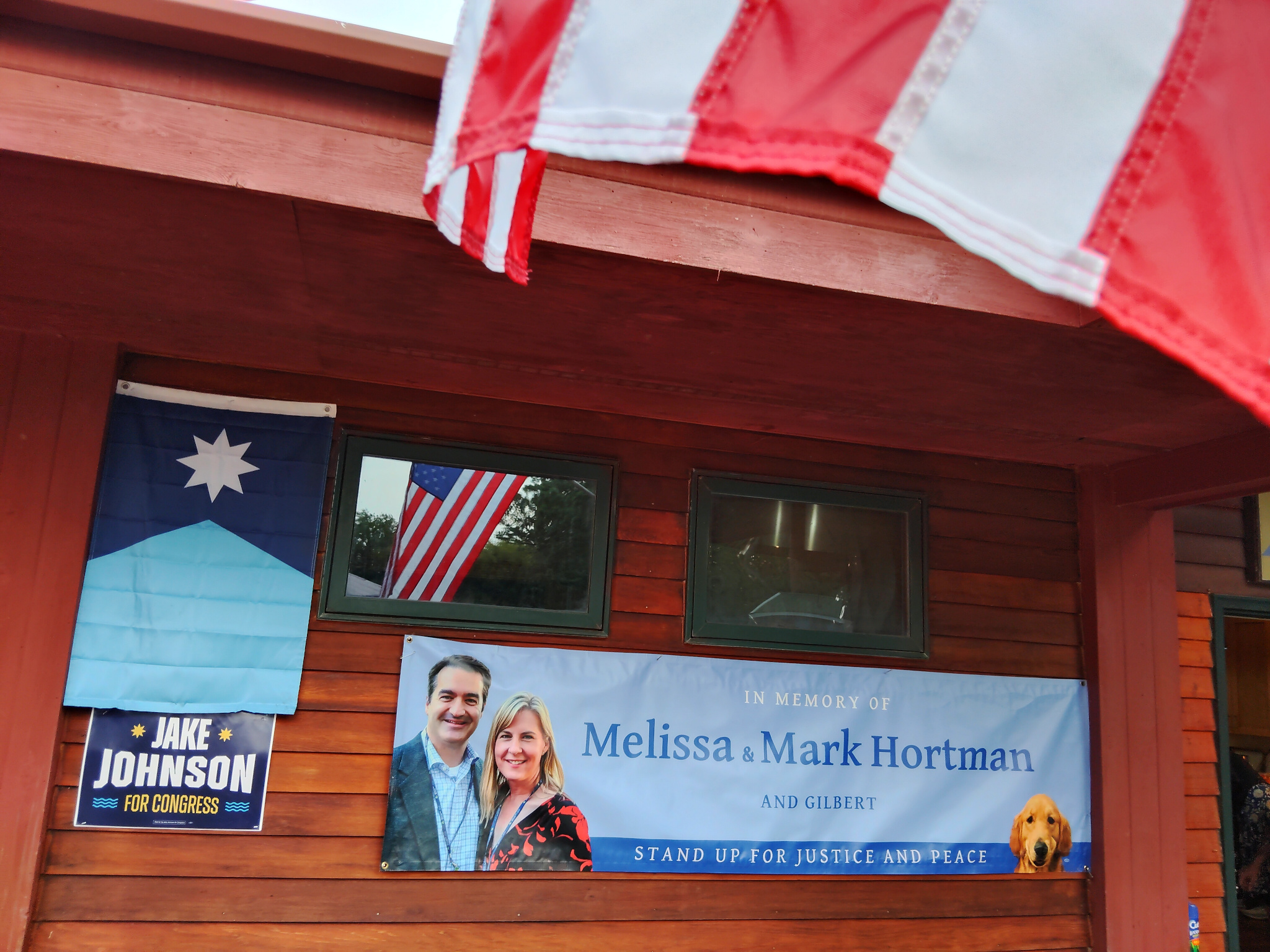
With gun violence so prevalent in America, including right here in Minnesota with the political assassination of Minnesota House Speaker Emerita Melissa Hortman and her husband, Mark, in June and the deadly August mass shooting at Annunciation Catholic Church in south Minneapolis, I found Reyes’ exhibit profoundly relevant. I couldn’t help but think of the two Annunciation School children who were killed and the 27 other students and adults who were injured during morning Mass. Since then, voices have risen, loud and vocal, against gun violence. But thus far, nothing has changed, although discussion is ongoing with Minnesota Governor Tim Walz hosting town halls around the state on the topic.

One gallery wall features posters created for “Artists Against the Bomb” by artists from around the world. (Minnesota Prairie Roots copyrighted photo October 2025)

The voice of this Mexican artist is among those rising. Upon entering the gallery, I read this: …Ahimsa reminds us that silence is complicity…

A closeup of a protest banner. A wall is covered with these signs in multiple languages with graphic symbols inspired by the conceptual element of zero. These are done in oil painting on Tyvek. (Minnesota Prairie Roots copyrighted photo October 2025)

Reyes speaks out against more than gun violence in his exhibition. He also advocates for nuclear disarmament, another timely topic. And he does that in an artistically-mammoth way via a towering inflatable that overwhelms the high-ceilinged Braucher Gallery. Exactly the effect Reyes wants to make in his piece titled “Zero Nukes.”

The massive nuclear mushroom cloud centers the nuclear disarmament part of the exhibit. (Minnesota Prairie Roots copyrighted photo October 2025)

I felt minimal, small, dwarfed by the mushroom cloud upon which ZERO NUCLEAR WEAPONS is printed in eight languages.

Inflatable warheads are part of the art installation. (Minnesota Prairie Roots copyrighted photo October 2025)
A closeup of the message printed on the inflatable warheads. (Minnesota Prairie Roots copyrighted photo October 2025)
Nuclear warhead info and stats. Surprising. (Minnesota Prairie Roots copyrighted photo October 2025)

Nearby, a stockpile of inflatable nuclear warheads lies, another strong visual representing the nearly 14,000 nuclear warheads at the ready around the world. The statistics, cited as part of this display, are sobering, surprising (to me) and revealing.

One section of the exhibit features images of buttons protesting nuclear weapons. (Minnesota Prairie Roots copyrighted photo October 2025)
One entire wall showcases the works of “Artists Against the Bomb. (Minnesota Prairie Roots copyrighted photo October 2025)
An overview of the campaign for nuclear disarmament shows the inflatable mushroom cloud, “Zero Nuclear Weapons” protest banners and a wall of protest posters, far right. (Minnesota Prairie Roots copyrighted photo October 2025)

Reyes, in his exhibit, shows us how art can be used to inform, educate, raise awareness, spark community conversation and action. He shows us via posters, buttons, sculptures, videos, inflatables and words how we can rise in protest against gun violence and nuclear weapons.

At its end, the poet asks, “Where are you going?” (Minnesota Prairie Roots copyrighted photo October 2025)

In the end we must ask ourselves the singular question posed in a poem on the protest poster wall: Where are you going? That’s in the event of nuclear war or similarly in the case of a mass shooting. I long ago stopped believing that the 1960s advice to duck and cover beneath a school desk would save me.

Open these glass doors and walk into the gallery showing Pedro Reyes’ “Ahimsa.” (Minnesota Prairie Roots copyrighted photo October 2025)

FYI: “Ahimsa” by Pedro Reyes is free and open to the public daily inside the Weitz Center for Creativity, 320 Third Street East, Northfield, until November 19. Hours vary. Click here for more information.

This exhibit was photographed with permission.

© Copyright 2025 Audrey Kletscher Helbling
 

Remembering the Edmund Fitzgerald 50 years after it sunk in Lake Superior November 10, 2025

PBS did a documentary on the Edmund Fitzgerald. (Minnesota Prairie Roots copyrighted file photo 2014)

SHORTLY BEFORE 8 THIS MORNING, I listened to “The Wreck of the Edmund Fitzgerald” by Gordon Lightfoot pulse from my radio. It was an auditory reminder that today marks the 50th anniversary of the sinking of that freightliner on November 10, 1975, in Lake Superior some 17 miles from Whitefish Point, Michigan.

Some 26,000 tons of taconite pellets, like these, filled the cargo holds of The Edmund Fitzgerald as it journeyed across Lake Superior on November 9 and 10, 1975. (Minnesota Prairie Roots copyrighted file photo 2014)

This shipwreck holds great interest in Minnesota as the Edmund typically left loaded with taconite from Silver Bay, on the Minnesota side of Lake Superior, headed for the steel mills of Detroit and Toledo. But on this last fateful trip, the Edmund departed from Superior, Wisconsin, aiming for Detroit.

My husband’s copy of Gordon Lightfoot’s greatest hits, which includes “The Wreck of the Edmund Fitzgerald.” (Minnesota Prairie Roots copyrighted file photo)

The ship sank in the gale force raging winds and waves of a November storm claiming the lives of all twenty-nine aboard. That tragedy has been forever immortalized in Lightfoot’s 1976 ballad.

Today, in ceremonies both in Minnesota and Michigan, those who perished in this disaster on an inland “sea” will be honored. At 2 pm, the Great Lakes Shipwreck Museum in Whitefish Point, Michigan, holds a public remembrance service. At 7 pm, a memorial service is set, but for Fitzgerald family members only with the museum closing at 5 pm in preparation for that event.

Here in Minnesota, the 50th anniversary focus today happens at the Split Rock Lighthouse Historic Site located along the shore of Lake Superior southwest of Silver Bay, which is north of Duluth and Superior. The Annual Memorial Beacon Lighting ceremony, beginning at 4 pm, is sold out.

For those able to secure tickets, the Minnesota ceremony is sure to be emotional as the names of the twenty-nine crew members are read aloud to the tolling of a ship’s bell. Lighting of the lighthouse beacon follows with the light shining for two hours.

Many years have passed since I’ve visited the lighthouse. Decades have passed since I first heard Gordon Lightfoot’s ode to the Edmund Fitzgerald as a young adult. Despite the passage of time, this tragic story remains imprinted on my mind, as it does the collective memories of Minnesotans old enough to remember this November 10, 1975, tragedy on Lake Superior.

FYI: I’ve previously written about the Edmund Fitzgerald. That includes a 2014 blog post about a presentation at the Rice County Historical Society by a diver who explored the wreck of the freightliner. Click here to read that story. The presentation coincided with the opening of the play, “Ten November,” at the Paradise Center for the Arts in Faribault. Click here to read an introspective piece I also wrote.

© Copyright 2025 Audrey Kletscher Helbling


A tribute to Simon & Garfunkel coming to Faribault

(Image courtesy of the Cathedral Concert Series)

WHEN I WRITE about music, it’s not with any expertise. I can’t read a single musical note. I can’t carry a tune. But I do know when I like a song. And most of my “likes” hearken to my youth, when music boomed from the radio. Or, in the case of Simon & Garfunkel, flowed.

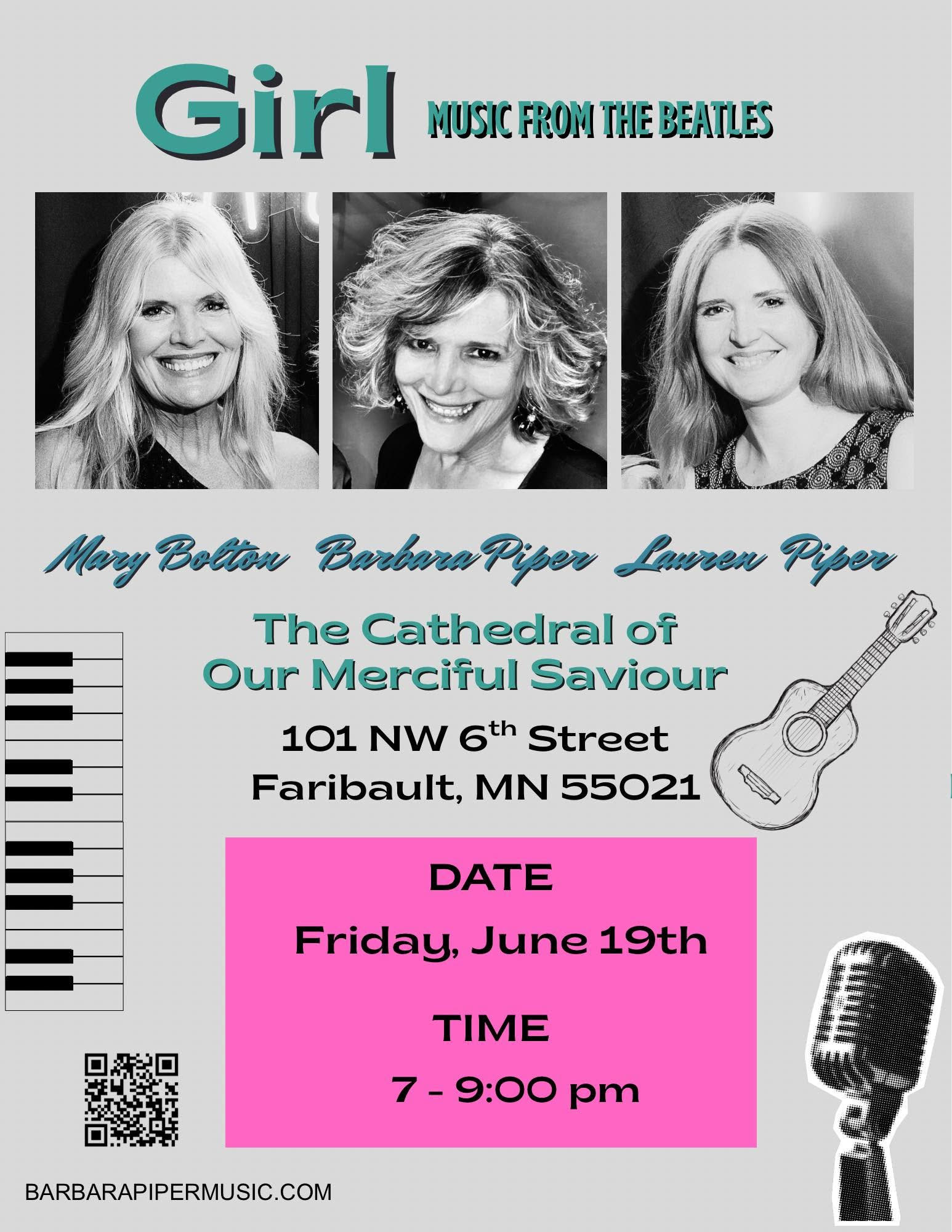
Fast forward more than 50 years to a 7 pm Friday, November 14, concert at the historic Cathedral of Our Merciful Saviour, 515 Second Avenue Northwest in Faribault. Vocalists Barb Piper and Pauline Jennings will present “Feeling Groovy: A Simon & Garfunkel Tribute with a Twist.” The “twist” is that the vocalists are women, not men. But four men, Craig Wasner, Mike Legvold, Mike Graebner and Steve Jennings, back the pair.

From my favorites “The Sound of Silence” and “Bridge over Troubled Water” to many more, this group performs a lengthy list of Simon & Garfunkel songs in addition to some Paul Simon favorites. I’ve never heard this tribute band, but I’ve been told, and read, that they are outstanding. Or, in 1960s and early 1970s lingo, I might say they are cool, groovy, far out.

The Cathedral of Our Merciful Saviour. (Minnesota Prairie Roots copyrighted photo 2024)

The Feeling Groovy tribute to Paul Simon & Art Garfunkel is part of the Cathedral Concert Series. While the concerts are free, donations are welcomed for the Cathedral Preservation Fund. The massive stone cathedral, built between 1862 and 1869, is on the National Register of Historic Places. Bishop Henry Whipple, prominent in local and state history for his outreach to Indigenous Peoples, led the church at the time.

It’s a beautiful structure. And the acoustics inside the massive sanctuary are perfect for a concert that also features audience participation. I expect when Barb Piper and Pauline Jennings step up to sing, the audience will feel immersed in the lyrics and in the groovy sound of music, not of silence.

© Copyright 2025 Audrey Kletscher Helbling
 

Critical overwatch focuses on helping veterans, raising awareness about suicide November 9, 2025

My father, Elvern Kletscher, on the left with two of his soldier buddies in Korea. (Photo from Elvern Kletscher’s collection)

WHEN I CONSIDER THE TRAUMA of war, I think of my dad. A combat veteran of the Korean War, he struggled with undiagnosed depression and post traumatic stress disorder. Not until the later years of his life did he find support among other veterans. They met to share their stories, trauma and struggles. Therein he found empathy and compassion. As a child and young adult, I admittedly and sadly failed to understand the emotional pain my dad experienced. If only I had, I would have listened, given him the compassion he deserved.

Memorable photos from the Vietnam Memorial traveling wall while in Faribault. The words on the soldier’s helmet reminded me of my dad. He brought home a souvenir patch from Korea which read “RETURNED FROM HELL 1952 KOREA 1953” (Minnesota Prairie Roots copyrighted file photo 2016)

Today I get it. I recognize that Dad’s time on the front lines in the mountains of Korea, where he killed the enemy and was wounded by shrapnel that would later earn him the Purple Heart, were life-changing. He returned to the farm fields of Minnesota a completely different young man than the one who sailed across the ocean to war.

A scene from the 2023 Critical Overwatch at the Rice County Veterans Memorial. (Minnesota Prairie Roots copyrighted file photo November 2023)

Thankfully, the passing of time has brought positive change and much-needed help for our veterans, plus increased awareness. In my community, that awareness includes an “Operation: 23 to Zero Critical Overwatch” vigil at the Rice County Veterans Memorial beginning at noon on Monday, November 10, and continuing for 23 hours until Tuesday, November 11. The vigil concludes with an 11 a.m. Veterans Day program followed by a noon luncheon for veterans at American Legion Post 43 in Faribault.

Boots for Damian Wilson at the 2024 Critical Overwatch vigil. (Minnesota Prairie Roots copyrighted file photo November 2024)

I’ve attended this vigil, now in its ninth year, multiple times. Verbs like honor, cherish, reflect, help, support and encourage come to mind when I consider this event aiming to curb veteran and military suicides. That’s the core premise of this visually-impactful overwatch. Every hour at the bottom of the hour, a pair of boots is placed on the veterans memorial plaza. Those boots represent a veteran lost to suicide. Attached to the boots are names, photos and dates of the deceased. Personal. Powerful. Emotional. Each set of boots represents a soldier from the area or connected to someone from the area.

The number 23 is also intentional, reflecting the number of veterans who daily commit suicide. One active military member also does the same each day.

This sign was posted at the vigil in 2024. (Minnesota Prairie Roots copyrighted photo November 2024)

It’s sobering to see all those boots ringing the veterans plaza. But it’s also heartening to see the support at this vigil—to know that veterans are standing by, literally, to listen, encourage and provide resources and help to anyone who needs it. I’ve seen and felt the compassion. Overheard the conversations.

We need to keep talking. I’m grateful to the Operation: 23 to Zero Southern Minnesota Chapter for their ongoing efforts to raise awareness about suicide and to work toward suicide prevention. They listen. They care. They stand at the ready to serve those who’ve served.

FYI: If you or someone you know is contemplating suicide, immediate help is available via the Suicide and Crisis Hotline at 988. Text or call that number. Or call 911. Please also seek additional professional help.

NOTE: Faribault Harley Davidson, 2704 West Airport Drive, is hosting a post Veterans Day Chili Cook Off on Saturday, November 15, with all proceeds benefiting Operation: 23 to Zero. Chili tasting costs $10 and runs from 11 am-2 pm. Prizes awarded. For more information, click here.

© Copyright 2025 Audrey Kletscher Helbling
 

A look at the arts in Faribault with a focus on visual art November 6, 2025

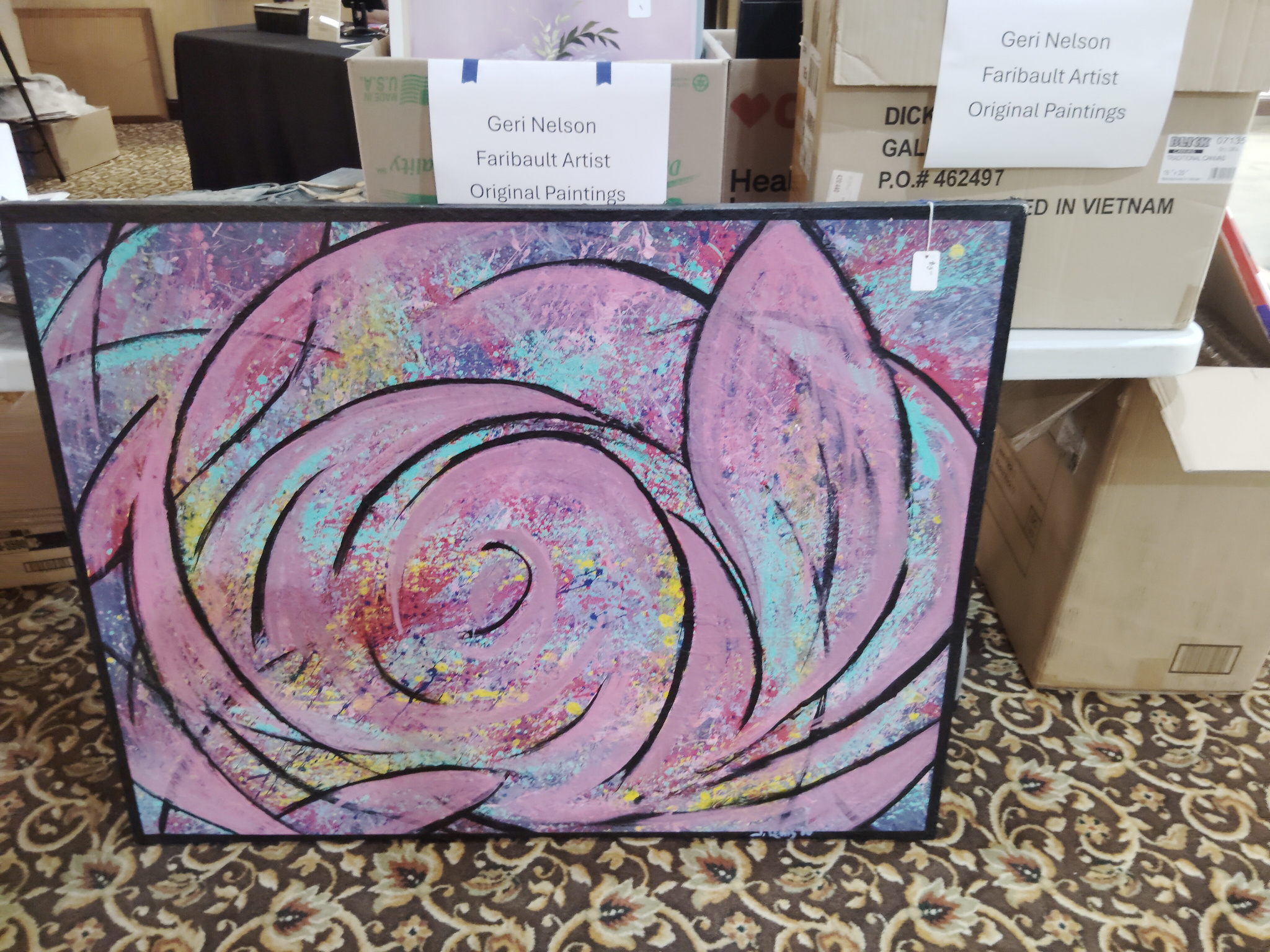
A portion of an acrylic on canvas painting, “Crazy Minds,” by Bethlehem Academy senior Payton Eckhardt. (Minnesota Prairie Roots copyrighted photo October 2025)

I LOVE LIVING in a community with a thriving arts center and arts scene. Why? First and foremost, I love the arts. Second, the arts connect and build community. Third, the arts are a form of expression, a source of entertainment, a way to learn more about each other and the world around us. Simply put, we need the arts to feed our spirits, to uplift, encourage and grow us, especially in turbulent times such as these.

“Ducks,” acrylic on hardboard by Julie Fakler. (Minnesota Prairie Roots copyrighted photo October 2025)

I need only grab my camera or put my fingers on my computer keyboard to create. I am driven to create not because it’s something I have to do. Rather I love to create with images and words and I cannot imagine my life without either.

The Paradise Center for the Arts in Faribault recently featured Comedian C. Willi Myles. (Minnesota Prairie Roots copyrighted photo October 2025)

Ask any visual, literary or performing artist and you will likely get similar comments about creativity and the importance of access to the arts. I don’t take for granted that Faribault has a hub for the arts in the Paradise Center for the Arts located in our historic downtown. It’s a gem—a place to attend theater, a concert or a comedy show; take a class; create art; display art; view art; perform art…

An overview of the “I Am Minnesota” exhibit by Kate Langlais in the main gallery. (Minnesota Prairie Roots copyrighted file photo October 2025)

Recently I popped into the Paradise to view four gallery exhibits, including “I Am Minnesota” by Kate Langlais in the main gallery. It features the portraits of first and second-generation immigrants in Faribault and their stories. I wrote about that exhibit in an earlier post. (Click here.)

“St. Olga of Kiev” an acrylic on canvas by Varvara Meshkova, Bethlehem Academy tenth grader. (Minnesota Prairie Roots copyrighted photo October 2025)

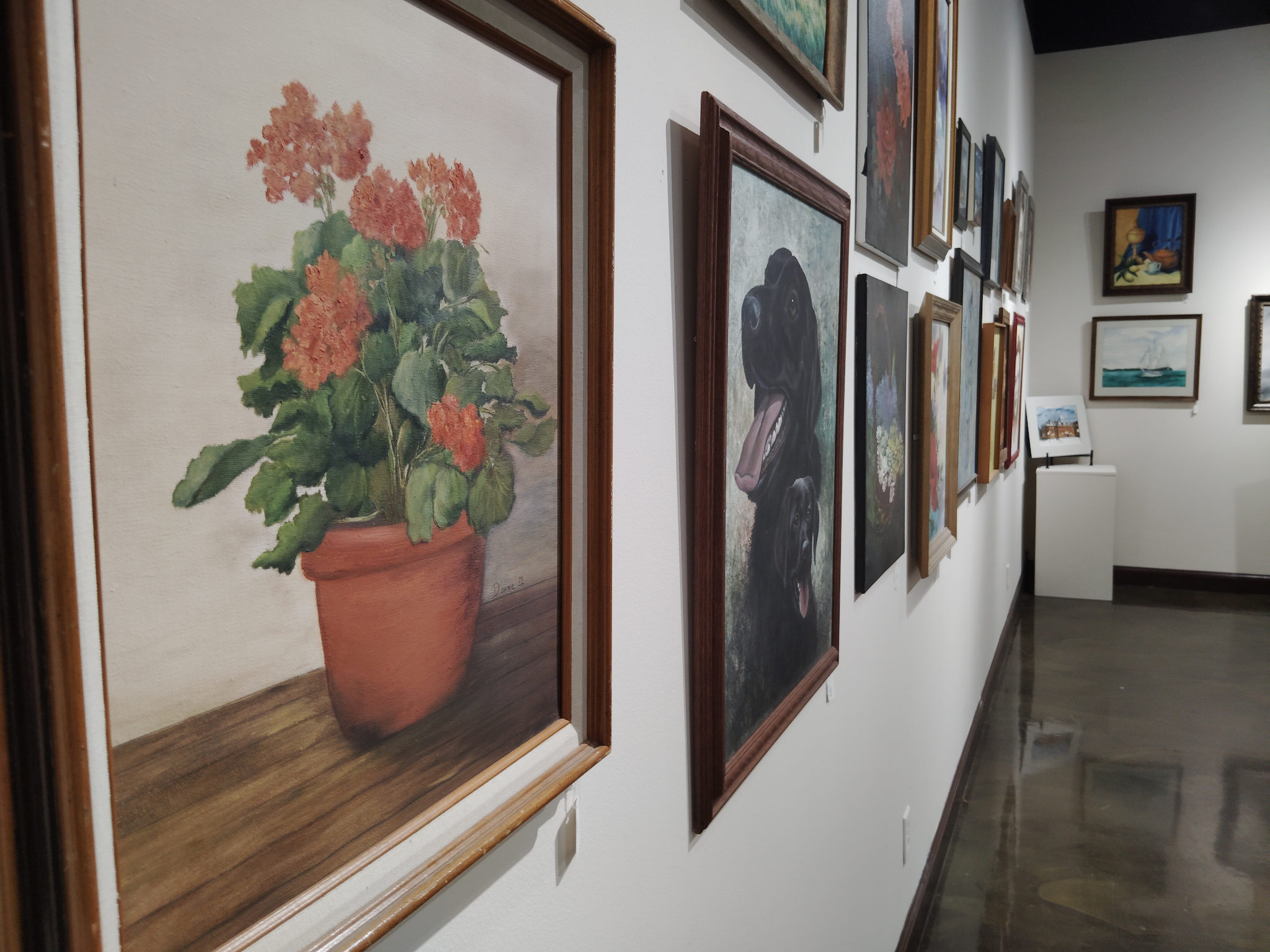
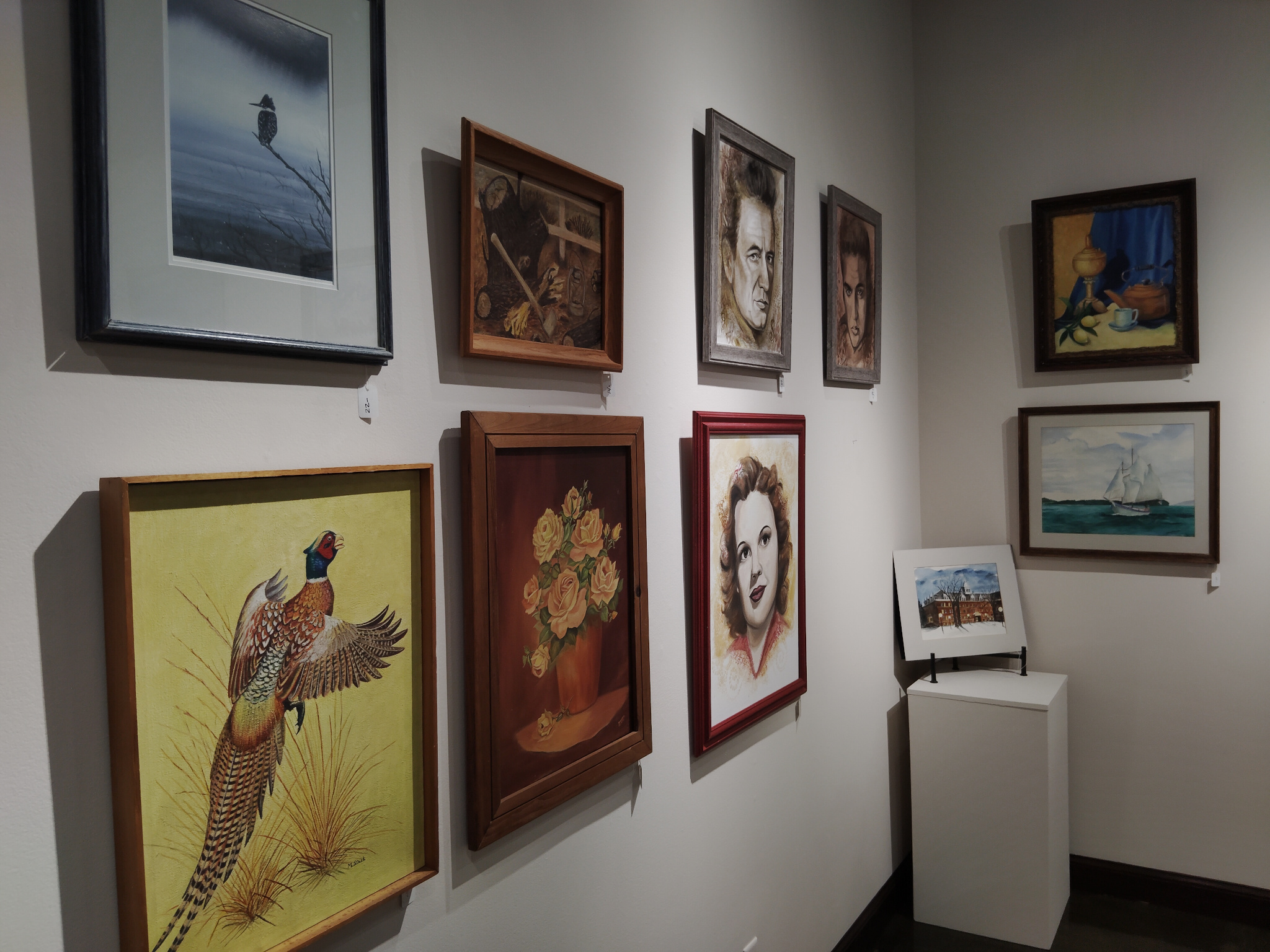
In the Paradise’s three other much smaller galleries I found equally impressive art, which will be on display until November 15. Four of the artists participated in the recent Studio ARTour of South Central Minnesota while the rest are students at Bethlehem Academy in Faribault.

A close-up of Kathy Weed’s textile art, “Songflowers” Sunflowers. (Minnesota Prairie Roots copyrighted photo October 2025)

What I saw was a whole lot of talent. From the textile art of Northfielder Kathy Weed to the pet portraits of Paradise Executive Director Julie Fakler to the pottery of Johnnie Walker, visual arts department chair at Shattuck-St. Mary’s School, to the fiber and clay art of Char Johnson to the assorted artworks of high school students, I delighted in it all. To view these collective works is to see an artist’s hand, an artist’s mind, an artist’s spirit and inspiration on display.

A sampling of Kathy Weed’s textile art currently displayed at the Paradise. (Minnesota Prairie Roots copyrighted photo October 2025)

Quilter Weed, for example, clearly loves nature as it themes her textile art recreations of the natural world.

“Happy Goat,” raku clay by Julie Fakler. (Minnesota Prairie Roots copyrighted photo October 2025)

Fakler shows her love for animals in vivid animal portraits done in acrylic and clay. Her art is signature recognizable to me. I’ve often thought Fakler’s colorful animals would be perfect in a children’s picture book or splashed upon a tee shirt. They always make me feel happy.

A mug crafted by Johnnie Walker. (Minnesota Prairie Roots copyrighted photo October 2025)

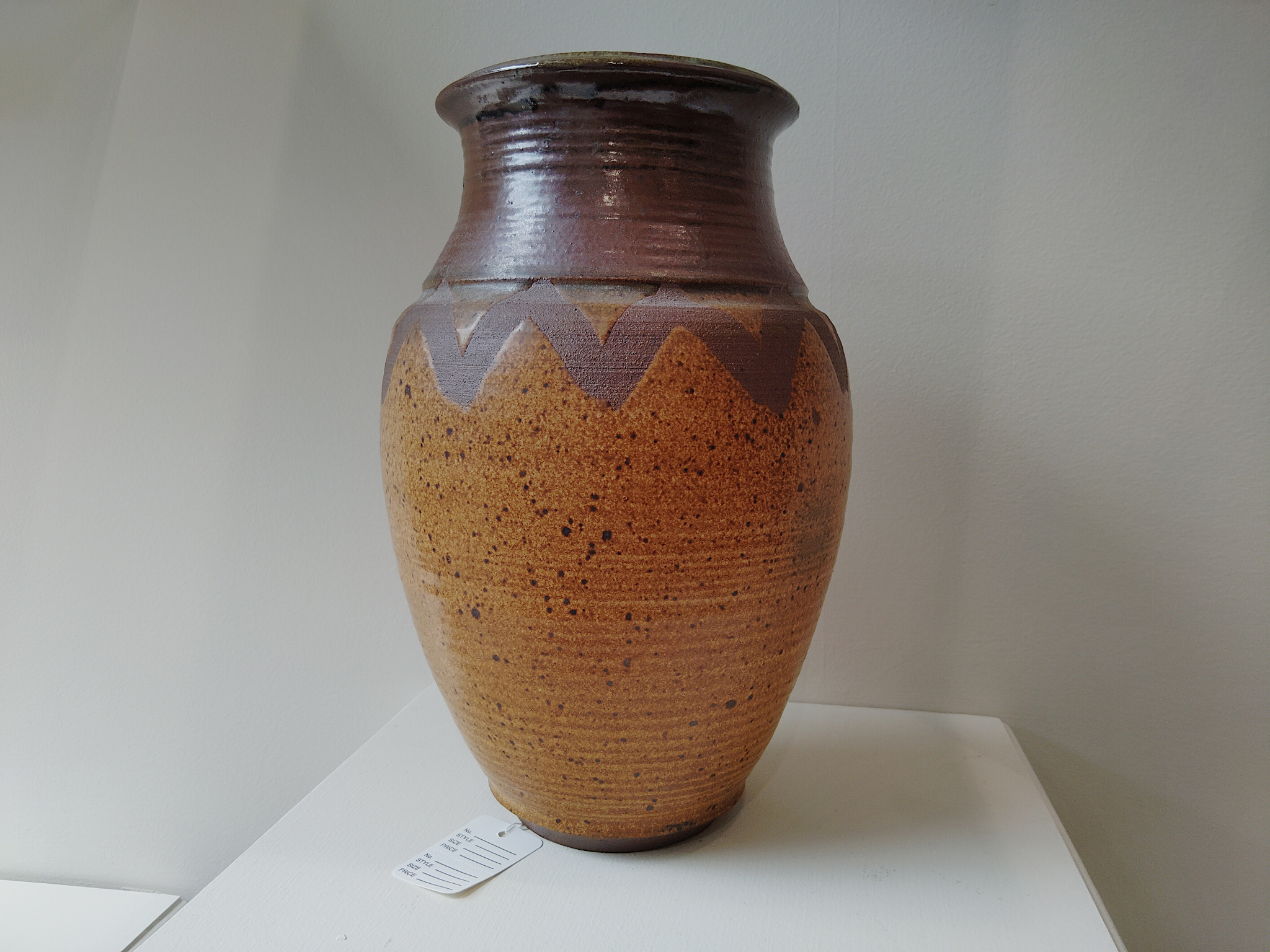
And then there’s Walker’s pottery, equally as appealing, but in a totally different way. I want to wrap my hands around his pottery, to feel what he felt when he shaped a mug or a bowl from clay. I value such connections to art.

Ceramic necklaces created by Char Johnson. (Minnesota Prairie Roots copyrighted photo October 2025)

Char Johnson brings her love of nature and of animals into her detailed art created in the mediums of clay, animal fiber and photography. I find needle felting particularly intriguing as, in my mind, it hearkens to hardy pioneer women.

“Woohitike Courage” wood intarsia by Lain Kuhlman, Bethlehem Academy sophomore. (Minnesota Prairie Roots copyrighted photo October 2025)

When I walked over to view the wall gallery of Bethlehem Academy student art, I wondered about the stories behind their creations. What of the untitled piece featuring three masks? What of the colorful abstract “Crazy Minds”? What of “St. Olga of Kiev”? Or “Wóohitike ‘Courage’”? I reacted to each. I thought of the masks we all wear, of mental health, of the war in Ukraine, of Indigenous peoples.

An untitled acrylic on cast plaster by Hannah Miller, Bethlehem Academy senior. (Minnesota Prairie Roots copyrighted photo October 2025)

And I thought, too, of how much I love and value the arts and my access to them.

More pottery by Johnnie Walker. (Minnesota Prairie Roots copyrighted photo October 2025)

TELL ME: What do you love about the arts? Where do you access the arts? Are you a creative? Or simply share your thoughts on the art featured in this post.

Julie Fakler’s animal portraits, painted with acrylics on hardboard.

FYI: The Paradise Center for the Arts, 321 Central Ave. N., Faribault, is open from noon-5 pm Wednesday-Friday and from 10 am-2 pm Saturday. All art featured in this post was photographed with permission of the PCA. Artists own the copyrights to their art.

© Copyright 2025 Audrey Kletscher Helbling


“Anonymous mother” & a call to action November 5, 2025

An anonymous mother’s story and commentary as written by Kate Langlais for her “I Am Minnesota” project. (Minnesota Prairie Roots copyrighted photo October 2025)

I ALMOST MISSED IT. “Anonymous Mother’s Story” positioned next to “The Young Mother” charcoal portrait in the “I Am Minnesota” exhibit by Faribault artist Kate Langlais. But there it was, tucked in the corner near the light switches in the Paradise Center for the Arts main gallery.

The exhibit features some 20 portraits and stories of first and second-generation immigrants from my community. None is more relevant than that of the young mother who now faces deportation and separation from her infant. Here are key words in her story: young mother. here legally. green card. application suddenly canceled. awaiting deportation. ankle bracelet. cruel and inhumane.

We’ve all heard countless media reports of people snatched from the streets and elsewhere by masked agents of the federal government, unlawfully detained without due process, separated from family, deported… That is, indeed, cruel, inhumane, heartbreaking and wrong. Even when immigrants are following all of the rules, all of the laws to legally live here, they find themselves targeted.

Martha Brown took this photo of the anonymous mother which is included, along with text, in the “I Am Minnesota” exhibit. (Minnesota Prairie Roots copyrighted photo October 2025)

To read the story of this young mother from my area, to see the faceless portrait, and then to also view a photo taken by Martha Brown, candidate for Minnesota House District 19a, deeply touched me. Brown photographed only the young woman’s legs and the wheels of her baby’s stroller. That was absolutely the right and compassionate thing to do.

The intentionally-framed image is more effective and powerful than if Brown had photographed the woman’s face. Every single person who sees this image should understand the reasons for anonymity. In a statement with the photo, Brown urges southern Minnesotans to reach out to their U.S. congressman “to stop this cruel and inhumane treatment.”

Langlais’ inclusion of the anonymous mother’s portrait and story, along with Brown’s photo and words, is perhaps the most important part of the “I Am Minnesota” exhibit. And to think, I nearly missed it there in a corner of the gallery. Don’t miss this exhibit, which closes on November 15 at the Paradise Center for the Arts. It’s located in historic downtown Faribault, a place many immigrants call home.

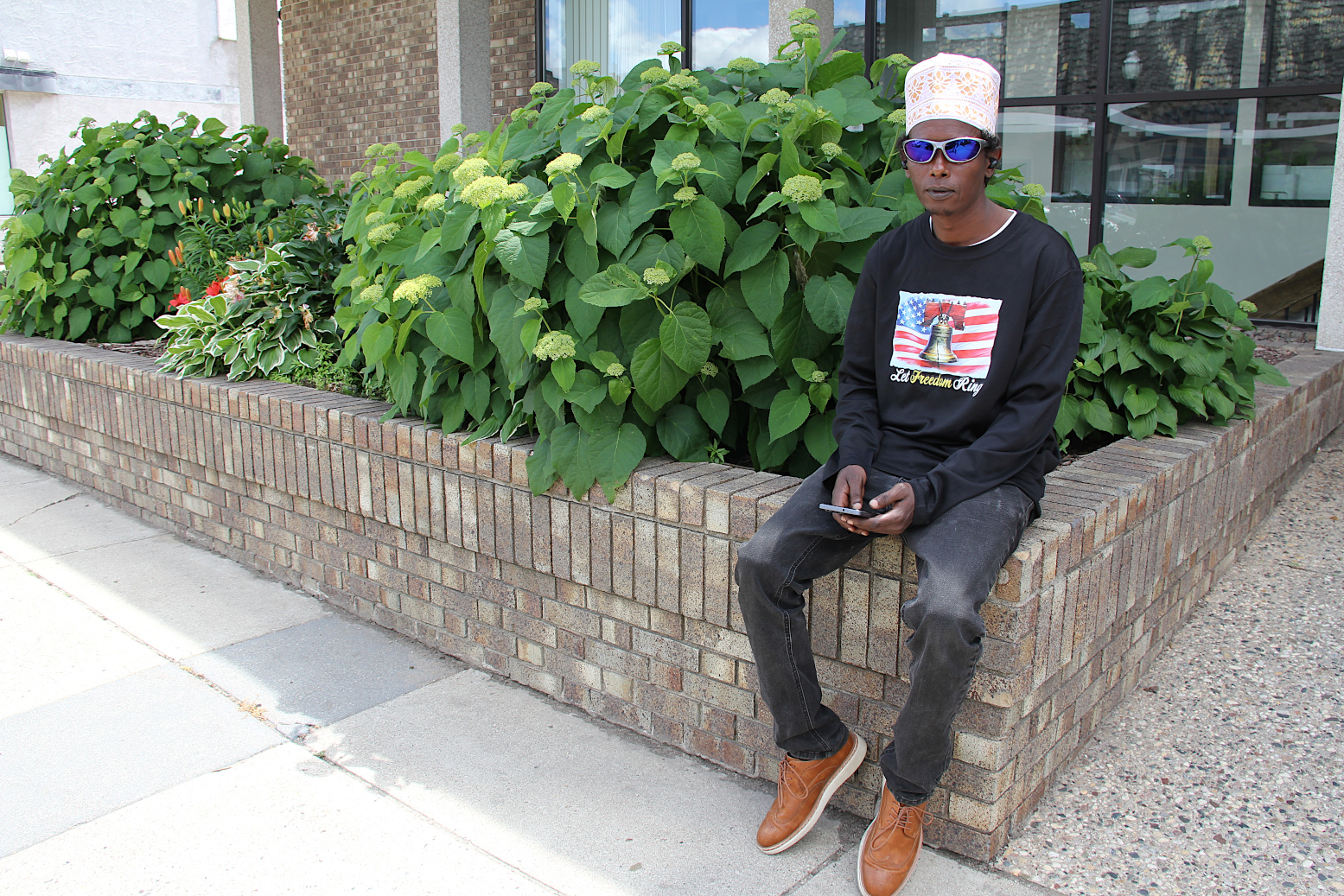
One of my favorite images from downtown Faribault shows a group of Somali men visiting on a street corner. (Minnesota Prairie Roots copyrighted file photo 2024)

FYI: The Northfield Public Library is hosting “Bridging Communities: A Celebration of Somali Culture” from 1-4 p.m. Saturday, November 8. The event features interactive dance workshops led by the Somali Museum of Minnesota Dance Troupe; a performance by the Faribault Middle School Choir; and a participatory sing-along of Somali songs. Other activities include henna art, face painting, bilingual Somali storytelling, a scavenger hunt with prizes and more. The library is collaborating with Somali community partners and St. Olaf and Carleton colleges to bring this event to Northfield.

NOTE: I photographed the “I Am Minnesota” exhibit with permission of the Paradise. I also received permission from Martha Brown to include her photo in this post.

© Copyright 2025 Audrey Kletscher Helbling
 

“I Am Minnesota” exhibit features immigrants’ portraits & stories in Faribault November 4, 2025

Kate Langlais’ newest installment of her “I Am Minnesota” project fills the main gallery at the Paradise Center for the Arts with nearly 20 portraits. (Minnesota Prairie Roots copyrighted photo October 2025)

EACH TIME I VIEW the portrait art of Faribault artist Kate Langlais, I feel gratitude. Gratitude for the project she’s undertaken to showcase first and second-generation immigrants in my southern Minnesota community. Titled “I Am Minnesota,” this collection of portraits and accompanying first-person stories is now displayed in the main gallery at the Paradise Center for the Arts in downtown Faribault until November 15.
Kylee, as drawn in charcoal by Kate Langlais. (Minnesota Prairie Roots copyrighted photo October 2025)

Every single person in Faribault, Rice County and Minnesota ought to see this enlightening exhibit. In her artist’s statement, Langlais shares her own family story of descending from immigrants. She invites everyone to write their stories in the gallery guestbook and then to take the time to read the posted stories and “open your heart to connecting with all of your Faribault neighbors.”
The Monroy Lara Family, an oil on canvas by Kate Langlais. (Minnesota Prairie Roots copyrighted photo October 2025)

I appreciate those words, “open your heart to connecting.” It is when we begin to talk to one another, to meet each other on a personal level, to see each other as individuals, that barriers begin to fall and we become neighbors, even friends.

A charcoal portrait of Cathlena by Kate Langlais. (Minnesota Prairie Roots copyrighted photo October 2025)

This “I Am Minnesota” exhibit connects us in a way that is effective. It doesn’t get much more personal than faces and stories. These are the stories of individuals rooted in Africa, Asia, North America, South America and Europe.

In her own words, Cathlena’s story. (Minnesota Prairie Roots copyrighted photo October 2025)

Viewing this creative project takes time. Some of these portraits I’ve previously seen at smaller exhibits of Langlais’ immigrant-focused work. It’s important to see every face, hear every voice. Like Rosa’s.

The Molina Family as drawn in charcoal by Kate Langlais. (Minnesota Prairie Roots copyrighted photo October 2025)

Born in the US and raised in Texas and Minnesota, Rosa has struggled with racism. She tried to fit in while growing up—reciting the Pledge of Allegiance, joining Girl Scouts, throwing toilet paper at houses… Still, Rosa was told to “go back” to her own country. America is her own country. She was told, too, to “speak English because this is America.” Being bilingual is, in my opinion, a strength in today’s interconnected world.

Another view of portraits in the “I Am Minnesota” gallery exhibit. (Minnesota Prairie Roots copyrighted photo October 2025)

Even among acquaintances, I’ve heard derogatory comments about Faribault’s immigrant population, especially Somalis. I don’t let those negative remarks go unchecked. Rosa says it well: “I just think sometimes that some people forget that their families were once the different ones.”

Kate Langlais’ drawing of Sam, born in a Cambodian refugee camp. (Minnesota Prairie Roots copyrighted photo October 2025)

To be “different”—in how you dress, the language you speak, the food you eat, the way you look, your customs and traditions—often makes you a target. The first and second-generation immigrants who shared their stories with Langlais don’t hold back. They’ve been bullied, misunderstood, struggled, been told to assimilate… It’s disheartening at times to read their truth. But these are words we need to read.

The Echeverria Family operates a successful food truck, Delicious Pupusas, as drawn in charcoal by Kate Langlais. (Minnesota Prairie Roots copyrighted photo October 2025)
Silvia Echeverria’s story about how her family business came to be accompanies the family portrait. (Minnesota Prairie Roots copyrighted photo October 2025)
In the corner of another portrait is the name of a popular Faribault restaurant, El Tequila Family Mexican Restaurant in business for 27 years in multiple communities. (Minnesota Prairie Roots copyrighted photo October 2025)

Among all of the tough truths there are beautiful words, too, of friendships, dreams, opportunities, goals, hard work and success. Restaurants opened. A food truck business started. And many other stories of obstacles overcome to achieve personal happiness and professional success.

Charcoal portrait of Dawud, whose family story is rooted in Somalia, by Kate Langlais. (Minnesota Prairie Roots copyrighted photo October 2025)

Second grader Dawud, born in St. Paul and living in Faribault, holds unbridled optimism about his future. “I want to grow up to be a business owner, just like my dad, and travel around the world,” he says. But then he also dreams of becoming a professional basketball or soccer player, like many other Minnesota boys his age. I hope nothing, especially not his immigrant background, holds him back. Ever.

As Marco, who came to the US at age seven shares, “We love autumn, flowers, the sun, nature, and the great opportunities to become better people.”

The Paradise Center for the Arts in historic downtown Faribault. (Minnesota Prairie Roots copyrighted photo October 2025)

FYI: The Paradise Center for the Arts, 321 Central Avenue North, Faribault, is open from noon-5 p.m. Wednesday-Friday, from 10 a.m.-2 p.m. Saturday and also during scheduled events and performances.

This exhibit was photographed with permission of the PCA. Portraits are the copyrighted work of artist Kate Langlais. My photos, in some cases, do not show the entire portrait. Please visit this gallery exhibit to view all of the portraits in full and to read the accompanying stories.

© Copyright 2025 Audrey Kletscher Helbling