Minnesota Prairie Roots

Writing and photography by Audrey Kletscher Helbling

The names behind the numbers in the Titanic disaster & more April 13, 2012

ALL TOO OFTEN following a major disaster, numbers overwhelm, overtake and distance us from the personal loss. It is easy to overlook the individuals—those who lived and those who died—in the sheer immensity of the situation.

Consider the Titanic, which 100 years ago this Sunday, April 15, 1912, sank into the icy depths of the North Atlantic, claiming the lives of nearly 1,500 people. Around 700 survived.

Who are the individuals behind those numbers?

Writers Debbie and Michael Shoulders introduce us to 31 of those Titanic passengers and crew members in their children’s picture book, T is for Titanic: A Titanic Alphabet, illustrated by Gijsbert van Frankenhuyzen and published by Sleeping Bear Press in 2011:

Allen, Frederick
Astor, John Jacob
Astor, Madeleine
Bride, Harold
Brown, Margaret Tobin
Browne, Father Francis
Carney, William
Daniels, Robert W.
Dean, Milvina
Fleet, Frederick
Harper, Henry
Hart, Eva
Hartley, Wallace
Hays, Margaret
Hichens, Robert
Ismay, Joseph Bruce
King, Alfred
Lightoller, Charles Herbert
Loto
Louis
Murdoch, William
Navratil, Michel
Pacey, Reginald
Phillips, Jack
Rothschild, Elizabeth Barrett
Rothschild, Martin
Smith, Captain Edward John
Spedden, Douglas
Straus, Ida
Straus, Isidor
Zimmerman, Leo

It is that personal aspect, the brief telling of individual stories, which humanizes this book targeted for the 6 – 10-year-old age group (although most certainly of interest to any age). That several children are included in the list of 31 is a credit to the authors.

Among the children is 7-year-old Eva Hart, who became fascinated with one of the 10 dogs aboard the Titanic. More than 40 years after the disaster, she found a French bulldog like the one she’d favored on the ship.

The story of Loto and Louis is less joyful. Their father, Michel Navratil, estranged from his wife, boarded the ship with his two young sons. Navratil, who used aliases for himself and his boys, died. His sons survived. Eventually, they were reunited with their mother.

At just nine weeks old, Milvina Dean was the youngest passenger. She died at age 97 as the last Titanic survivor.

Scroll through the list above and you will read the names of the Titanic’s captain, elevator operators, a violinist, a pregnant woman, a publisher, a farmer from Germany and more.

These were real people with hopes and dreams. And it was the dream of one man, Joseph Bruce Ismay, director of White Star Line, the company that owned the Titanic, to sail this large luxury liner. He was aboard the Titanic on the fateful voyage. He climbed into one of the last lifeboats and survived.

The authors pack plenty of factual information about the ship, the disaster, the rescue and the aftermath into their book. But the strength of this book lies in the personal stories.

It is the names that touch the soul, stir the heart and cause one to pause and ponder the grief and pain resulting from this unforgettable tragedy.

DISCLAIMER: I received a free review copy of this book. However, that did not influence my decision to write this review or the content of the review.
Book cover image courtesy of Sleeping Bear Press. Click here to read more about T is for Titanic: A Titanic Alphabet.

#

TWO RESIDENTS of my community, Simon and Karen Zeller of Faribault, are currently aboard the MS Balmoral Titanic Memorial Cruise which left on April 8 from Southhampton, England, with 1,309 passengers. The Balmoral, owned by Fred Olsen Cruise Lines, is following the route of the Titanic and will arrive at the site of the disaster on Sunday. Its final destination is New York. Fred Olsen’s parent company, Harland and Wolff, Ltd., built the Titanic. Click here to read an article about the Zellers published in the Faribault Daily News.

#

JEFF OSBORNE, who works in Faribault and lives in nearby Montgomery, built a radio-controlled model of the Titanic in the late 1990s. The model is made of cardboard but has been waterproofed on the bottom so the replica ship can be placed in water. Read about the Titanic model in the Faribault Daily News by clicking here.


 

Poetic Strokes: Strong regional writing April 12, 2012

COULD YOU WRITE a poem about bacon?

Julie Hathaway of Rochester did. She penned “Bacon,” one of 30 poems selected for publication in 2012 Poetic Strokes: A Regional Anthology of Poetry from Southeastern Minnesota.

When I saw the poem title, I had my reservations. How could bacon possibly be poetic?

Julie proves that bacon, bacon grease specifically, can certainly be poetic when connected to your past—to fried eggs and fried potatoes and a cast iron skillet—and to your life today. This unlikeliest of topics made for a nostalgic read in a volume that highlights some strong regional writing.

You’ll find poems like “Zumbro River Almanac” by Kevin Strauss of Rochester, where the Zumbro slices through the heart of the city. Other poems in the volume, such as “To the North” by Betty J. Benner of Austin, “Sunrise” by Nicole Borg of Wabasha and “Jacobs Lake” by John Chernega of Winona, also possess a strong sense of place.

And then there are poems like “Scottie’s Apple Pie” by Bev Jackson Cotter of Albert Lea. It’s perhaps the sweetest verse in this volume as Bev writes about the precious memories a mother tucks into her heart after baking a pie from the crab apples her four-year-old picks.

On the opposite end of youth, Peter C. Allen of Kenyon writes about his aged, dying father in a poignant poem.

Then, to lighten the mood, Riki Kölbl Nelson of Northfield compares a first snowfall to rollicking, out-of-control children slitting bed covers and spilling feathers from a sky castle. It is a playful image.

All in all, this sixth edition of Poetic Strokes, a project of Southeastern Libraries Cooperating and financed with Minnesota’s Arts and Cultural Heritage fund monies, is a delight to read. You will find copies of 2012 Poetic Strokes now available for check-out from libraries within the 11-county SELCO system.

FYI: My poem, “Writing Poetry as the Sun Rises,” is published in this 2012 anthology as one of 30 poems selected from 202 submissions.

© Copyright 2012 Audrey Kletscher Helbling


In search of genuine pearls in Sciota Township April 10, 2012

Filed under: Uncategorized — Audrey Kletscher Helbling @ 7:25 AM
Tags: , , , , , , ,

IT IS THE ROAD less traveled that often leads to the best discoveries even, if at first, the journey doesn’t appear all that promising.

Recently, my husband and I followed back gravel roads from Randolph to Northfield. We were expecting bucolic farm sites complete with grand red barns and white wood-frame farmhouses wrapped in inviting country porches. Instead, we found mostly ramblers and split levels and other modern homes that, if clumped along a cul-de-sac, could have been in suburbia.

It was disappointing to find all these houses strung, like so many imitation pearls, along the smooth neckline of a wide gravel road. I wanted the real thing—pearls spilling across grandma’s bosom.

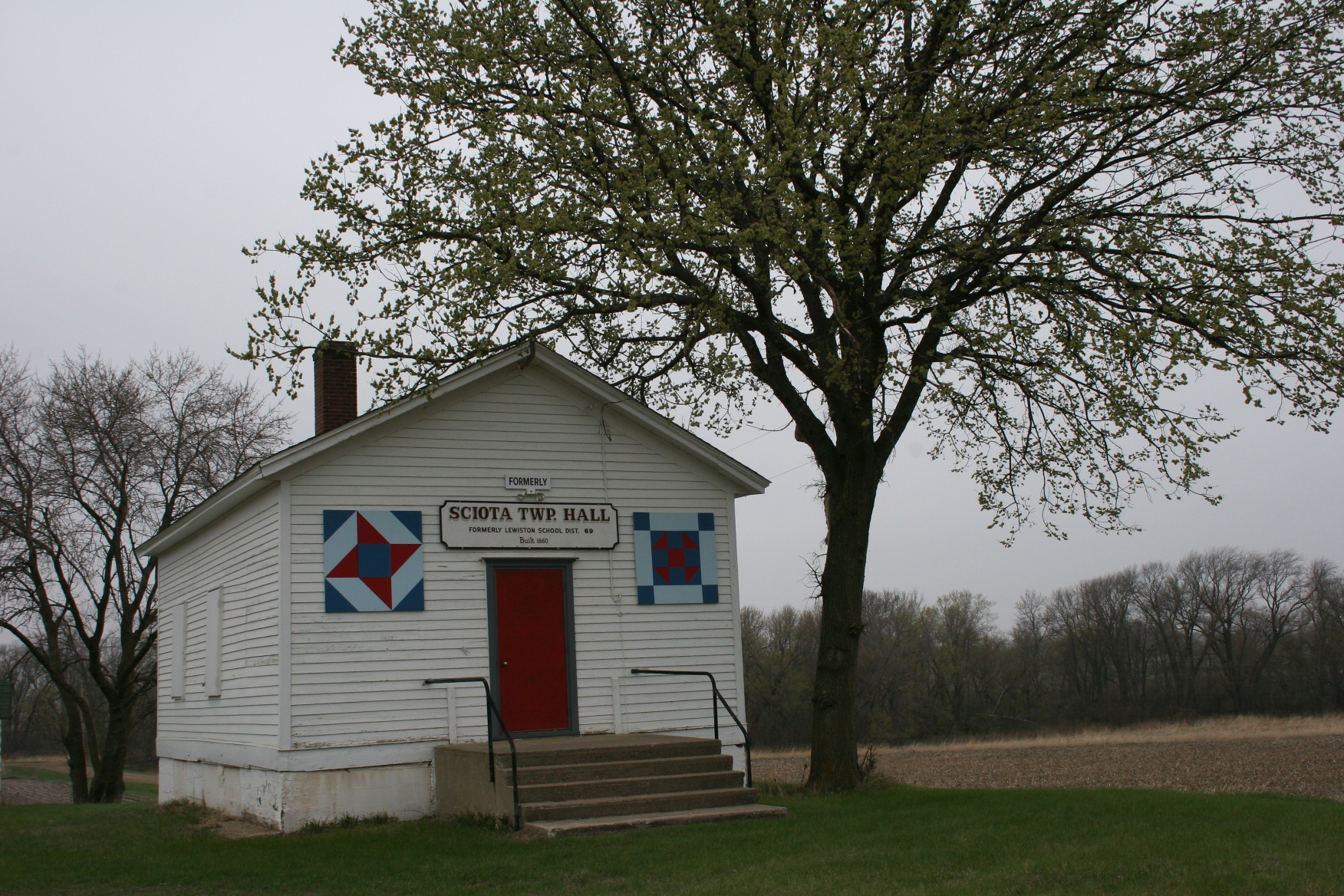
But then, when I’d nearly given up hope of finding anything genuine, we came across the old Sciota Town Hall at the corner of Alta Avenue and Sciota Trail/310th Street East in the southeastern hem of Dakota County.

The former Sciota Town Hall and, before, that, the Lewiston School, built in 1860

I couldn’t tumble from the van fast enough to photograph this former hall, originally the Lewiston School District 69 schoolhouse built in 1860. It is one of Dakota County’s oldest remaining schoolhouses and originally sat on the north side of the Cannon River in Lewiston, a town long gone (not to be confused with the still-existing Lewiston in Winona County).

In the fall of 1879—and I don’t know the reason—the 18-foot by 30-foot school building was moved to the south side of the Cannon, to its current site atop a hill at the intersection of two gravel roads.

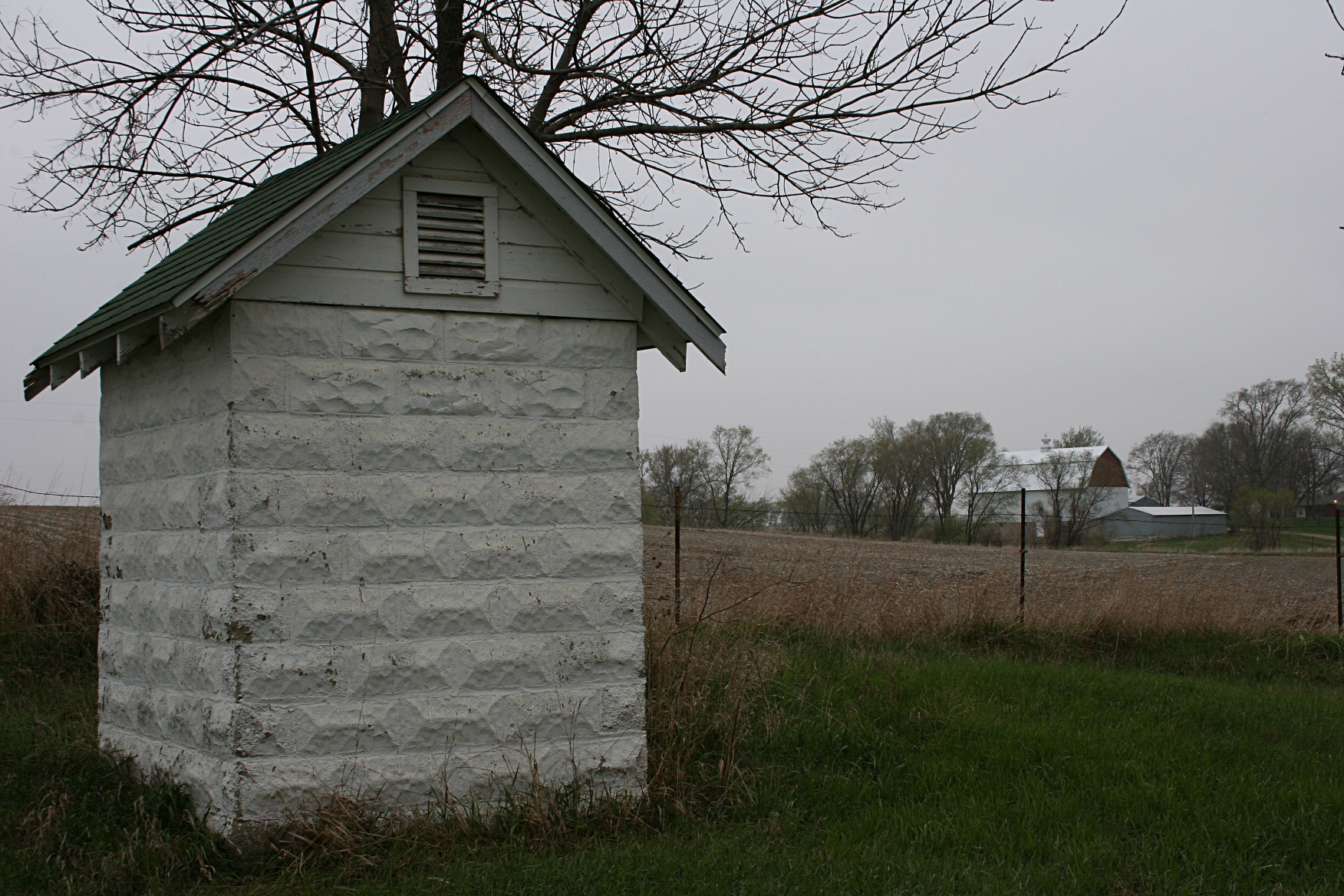
Two stout block outhouses still buffet the school as does an aged water pump minus its handle.

A water pump behind the old schoolhouse.

One of two outhouses on the property. Over the barbed wire fence, in the distance, a farm site, not all that common anymore in Sciota Township.

It’s easy to imagine this place once teeming with children from neighboring farms as they pushed out the schoolhouse doors, legs flailing, into the schoolyard.

It’s easy to imagine, too, the rhythmic thrust of the pump gushing cold well water into their cupped hands, droplets splashing upon their worn leather shoes.

Had the doors of this former schoolhouse been unlocked, I could have imagined more, much more.

FYI: The Sciota Town Hall is no longer housed in the historic building, but in a modern pole shed style structure. Click here to see a photo of the 2005 town hall and to learn more about Sciota Township. Does anyone know whether the former town hall/school ever is opened for any type of historic celebrations or other events?

© Copyright 2012 Audrey Kletscher Helbling


In which we travel to Wisconsin and make paper April 9, 2012

Filed under: Uncategorized — Audrey Kletscher Helbling @ 3:20 PM
Tags: , , , , , , ,

WHO WOULD HAVE thought that making paper could be so much fun for a bunch of grown-ups?

Not me.

But making paper at The Paper Discovery Center in Appleton, Wisconsin, on Saturday proved so much fun for our family that I declared, “I could really get into this paper making.”

At that moment my 18-year-old son, Mr. Logical Scientist-Math Guy, clarified: “Technically we did not make paper.”

He would be right. We did not transform a tree into paper. Rather, we recycled the Sunday comics and other paper into new paper.

And here is how we did it with the assistance of two patient and friendly young missionaries from the Church of Jesus Christ of Latter-day Saints who volunteer at the discovery center.

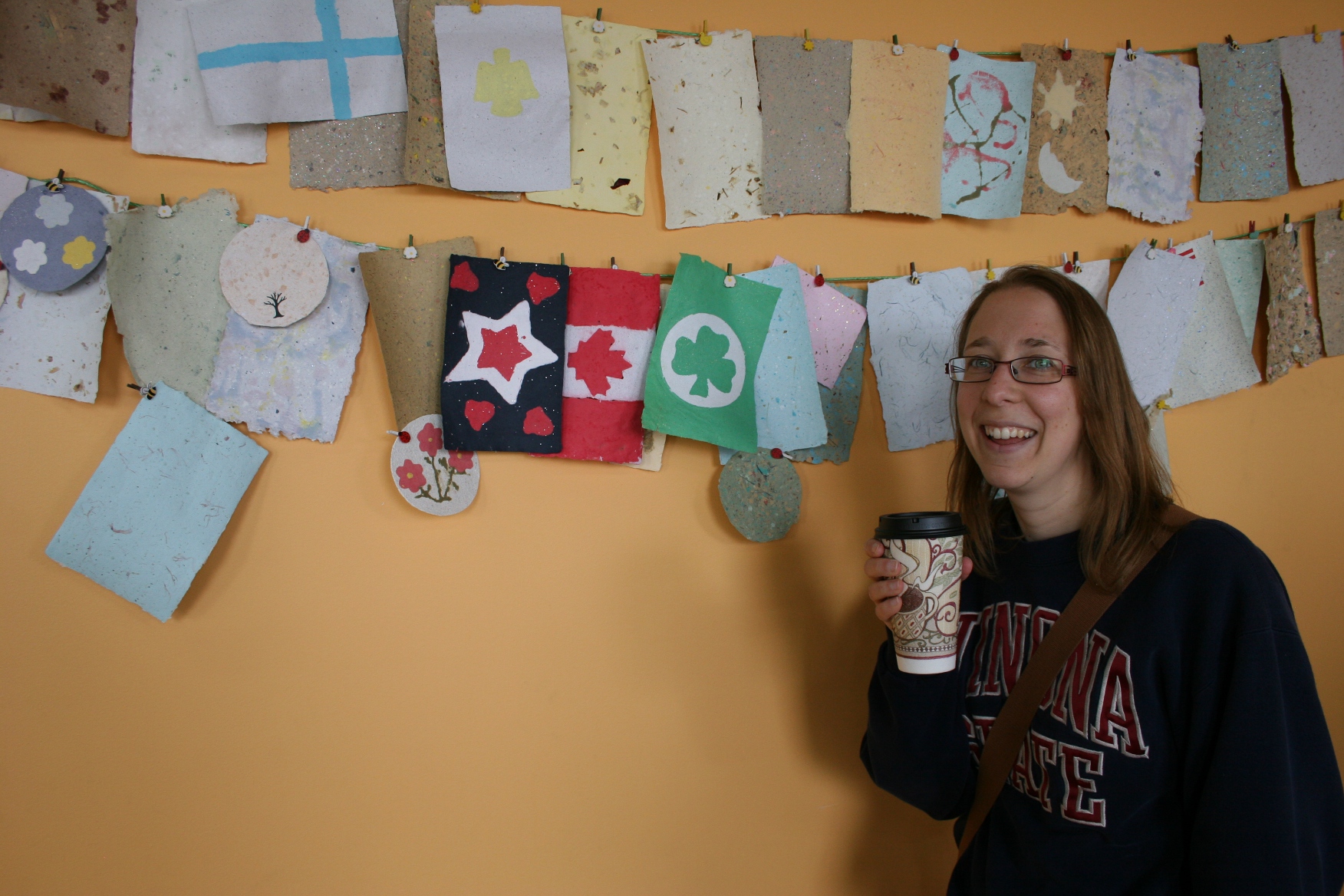
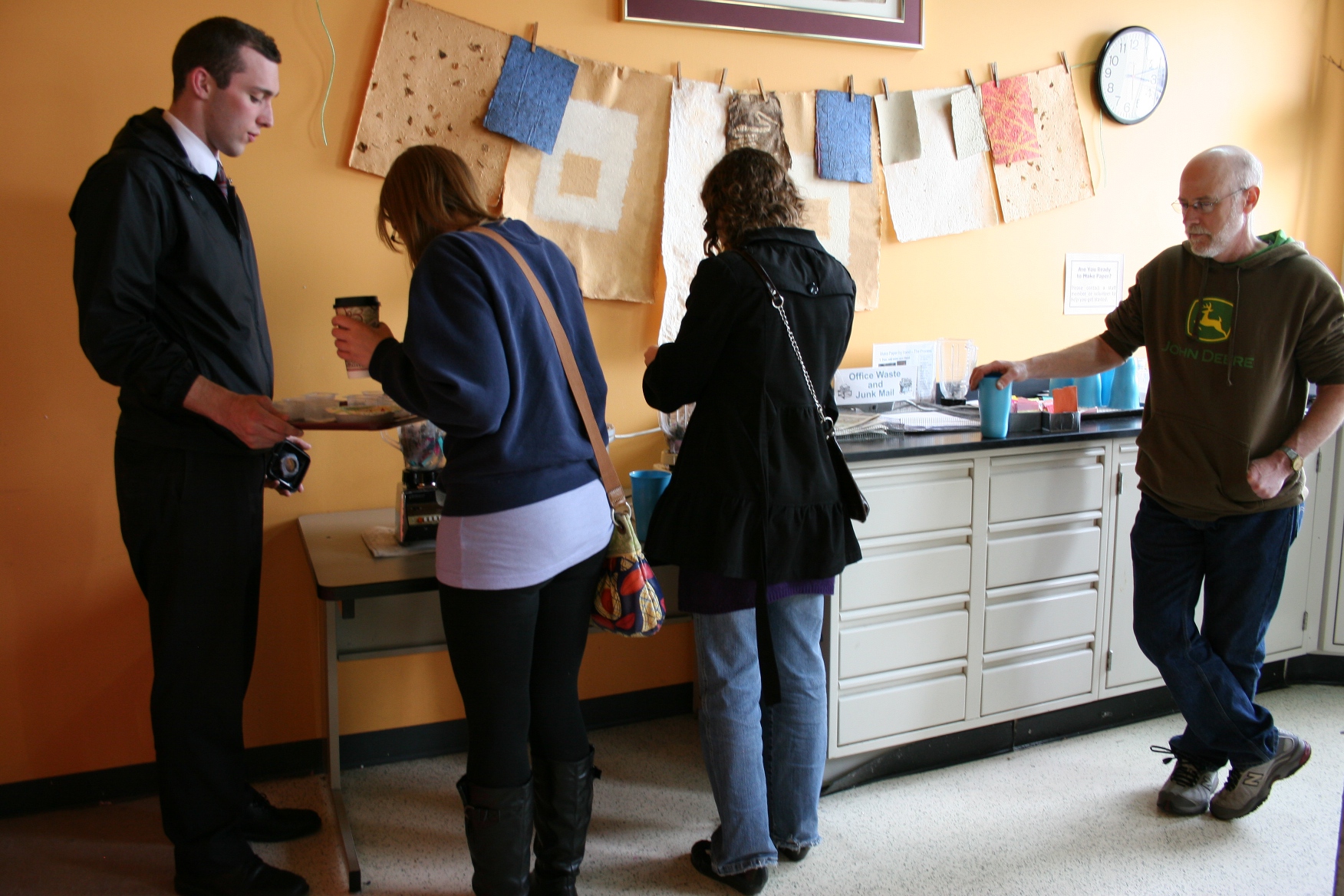
First, peruse the paper samples to determine what type of paper you would like to make. Ideally, you (your daughter) should drink your (her) coffee before coming to The Paper Discovery Center. But, if you (your daughter) are (is) fortunate enough, the nice lady at the front desk will allow you (your daughter) inside with your (her) coffee as long as you (she) promise (s) to keep a lid on it (the coffee cup, that is).

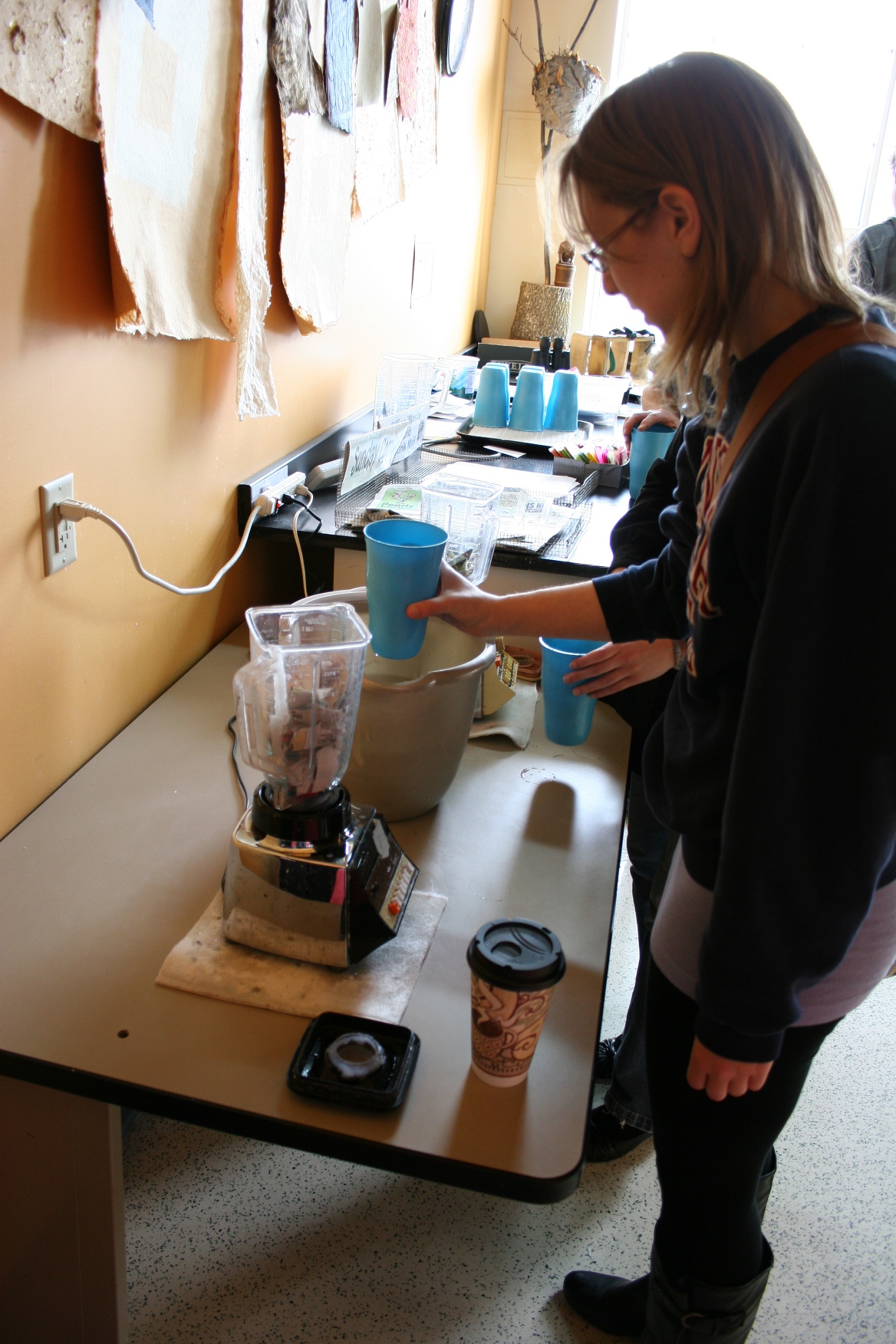
After you have torn your selected papers into postage stamp size pieces, drop the paper into the blender and add water, about three-fourths of the blue cup shown here.

Here you can add condiments (that's what I call them) like glitter and pressed flowers to the mix before blending in an ancient blender. A garage sale blender would work great for this part of the paper making. On the left is one of the patient paper making volunteer instructors. That's my husband waiting his turn.

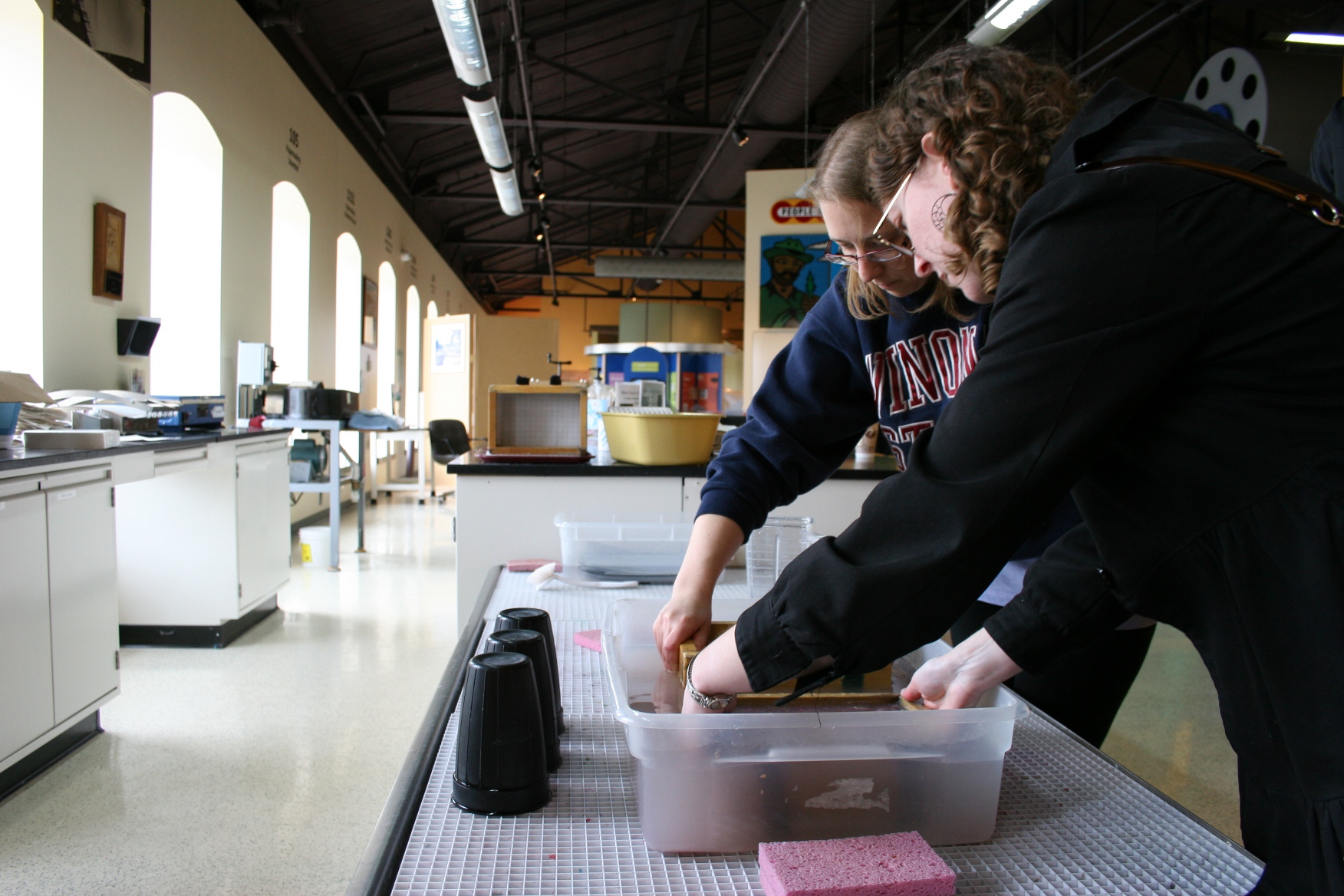
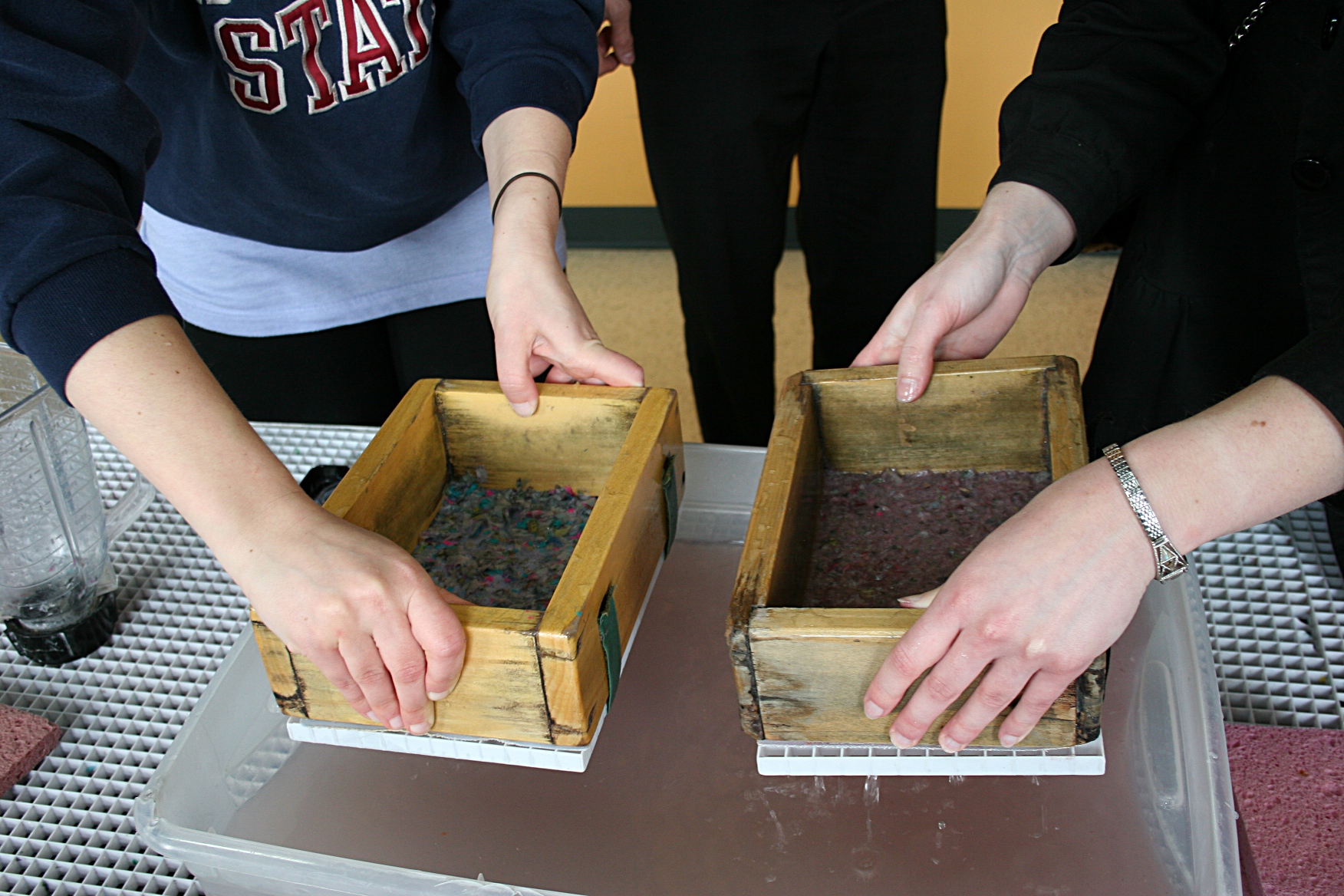
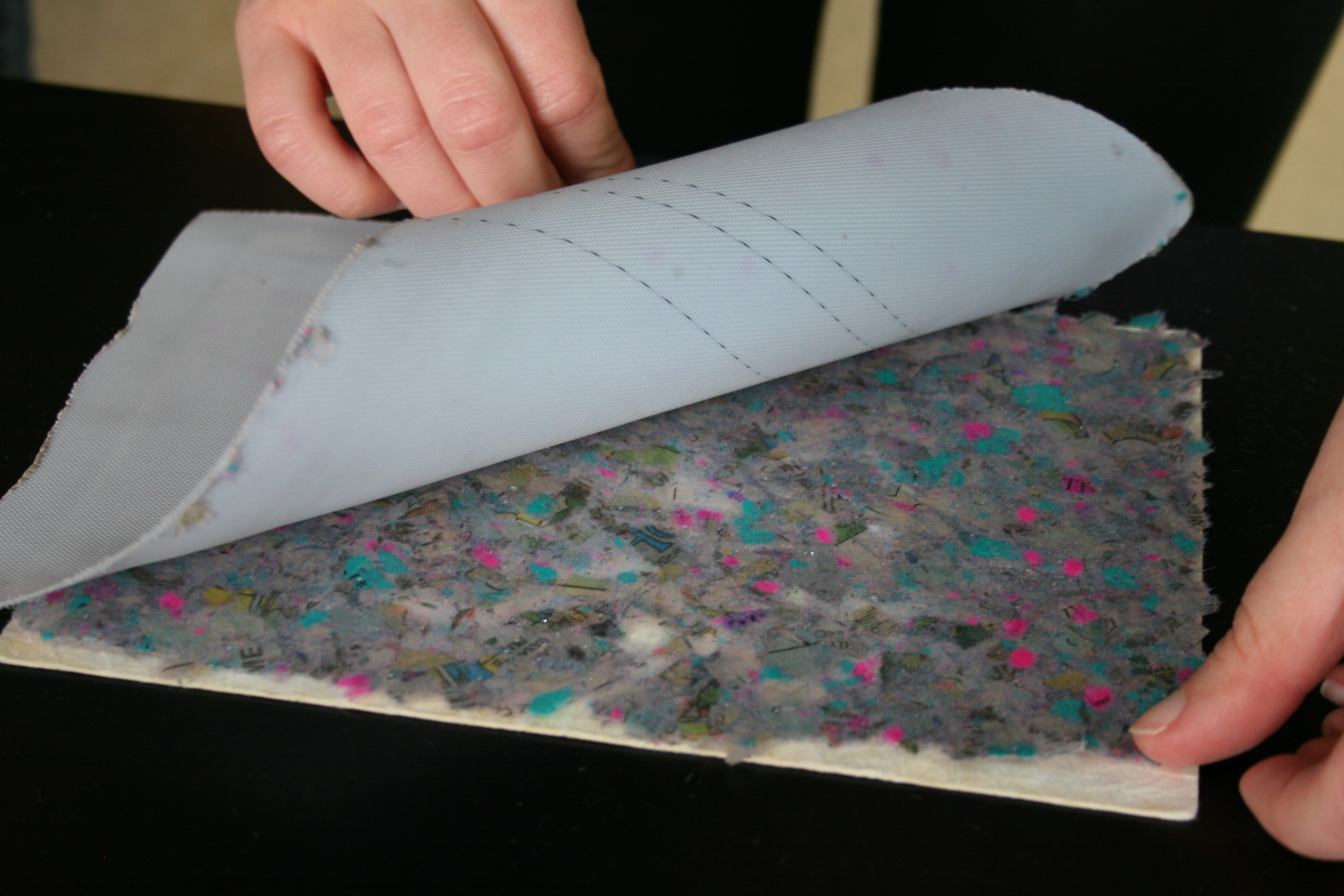
Next, pour the blended paper pulp into a screen inside a wooden form and immerse in water. Here's where you get to dip your fingers into the pulpy water and swish everything together.

Evenly ease the forms from the water to reveal your paper. Remove the forms and sponge excess moisture off.

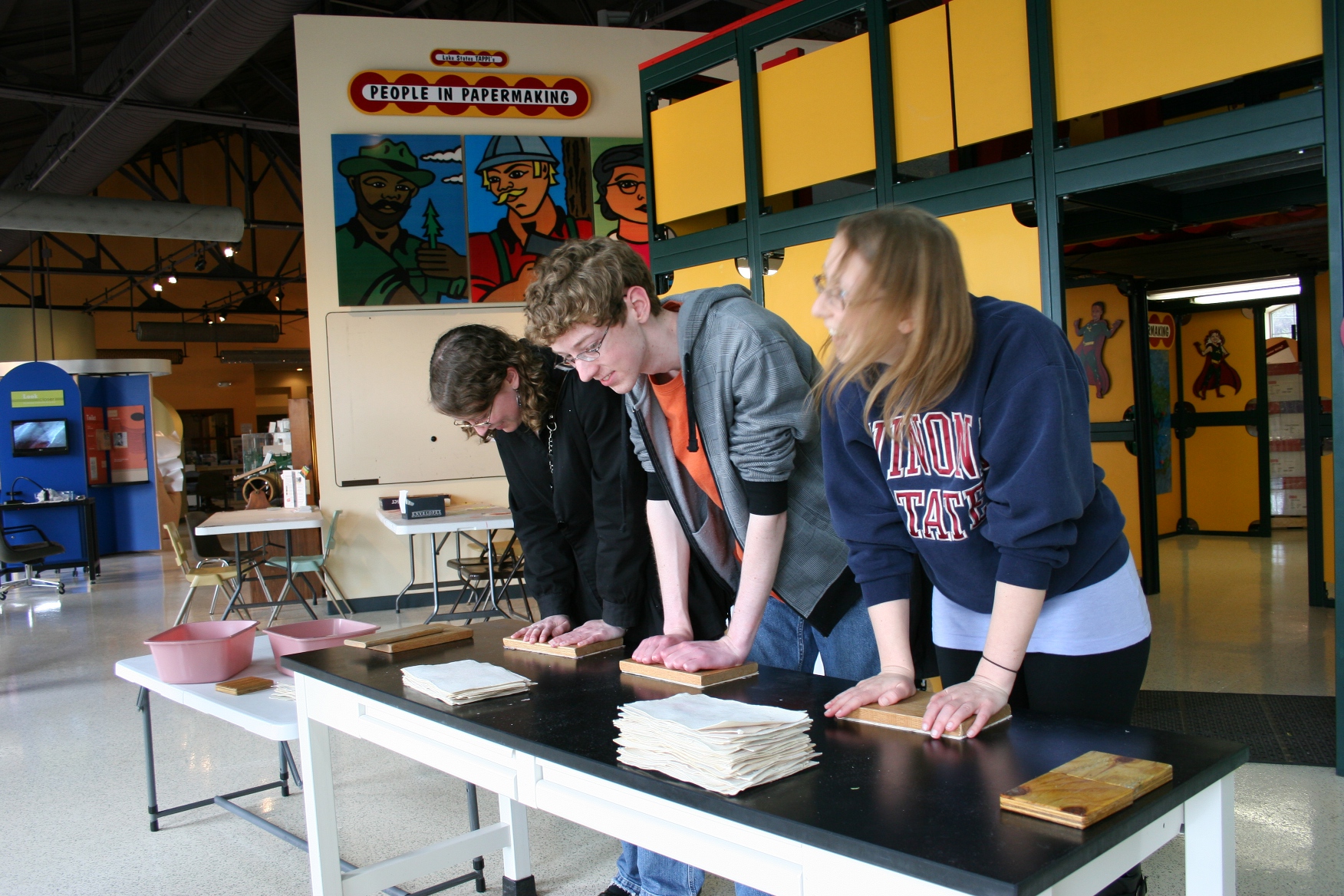
Move to the next table and lay an absorbent sheet of paper (can't recall the name, but it starts with a "c") on top of your paper. Put a board on top and press. The idea is too absorb even more water. Repeat several times.

Pull back the absorbent paper to reveal the recycled paper you've made. But you're not done yet. Next, move to a contraption that exerts 2,000 pounds of pressure onto the paper, binding the fibers. After that, move to a machine that applies heat to the paper. Keep your fingers out of both.

Finally, pose for a photo with the paper you've just created.

HAVE YOU EVER MADE paper like this? I’d like to hear, especially if you’ve made your own forms, etc. This may just be an art I’d like to try at home.

PLEASE CHECK BACK for another post from The Paper Discovery Center in Appleton, Wisconsin.

© Copyright 2012 Audrey Kletscher Helbling


My Easter in a single snapshot

Filed under: Uncategorized — Audrey Kletscher Helbling @ 8:32 AM
Tags: , , , ,

HOLIDAYS ARE MEANT to be celebrated with family. I know that’s not always possible as distance separates many of us from loved ones.

But this Easter my husband and I spent the weekend with our three grown children at our second daughter’s Appleton, Wisconsin, apartment, a five-plus hour drive from our southeastern Minnesota home.

It was, as the four of us traveling there in our family van would conclude, “a long, weary journey,” made longer by the beginning of road construction season.

But it was worth the detour, the traffic, the $3.939/gallon gas in Appleton, the fierce wind, the dust storm in potato land near Coloma, the tumbleweeds and small branches flying across the interstate at Tomah…. so worth the drive for all five of us to be together.

We laughed and teased. Dined and worshiped together. We built family memories.

I could write hundreds of words to sum up the weekend. But the image below, although technically of low quality, best tells it all. This single, blurred shot captures what only minutes earlier I had attempted to get in posed pictures. The three are viewing those posed frames on my oldest daughter’s camera. Just look at the trio with my husband in the background. You can almost feel the love, can’t you?

I had no time to adjust my camera or frame this image. I saw the moment and snapped the shutter button. Perfect.

© Copyright 2012 Audrey Kletscher Helbling


Where there’s smoke, there’s fire April 6, 2012

Filed under: Uncategorized — Audrey Kletscher Helbling @ 1:50 PM
Tags: , , , , , ,

MY SWEATSHIRT REEKS of smoke, as if I’ve been sitting around a campfire for hours.

But in reality, I’ve only stepped into my backyard for several minutes, into the strong scent of smoke drifting from across the street a few houses away.

Honestly, I could not believe my eyes. Who, in their right mind, would burn leaves in tinder dry conditions like this? Apparently my neighbor.

Only an hour ago, I heard a local radio broadcaster announce a burning ban issued by the sheriff in Rice County. Given the dry conditions, only recreational campfires and grilling are allowed.

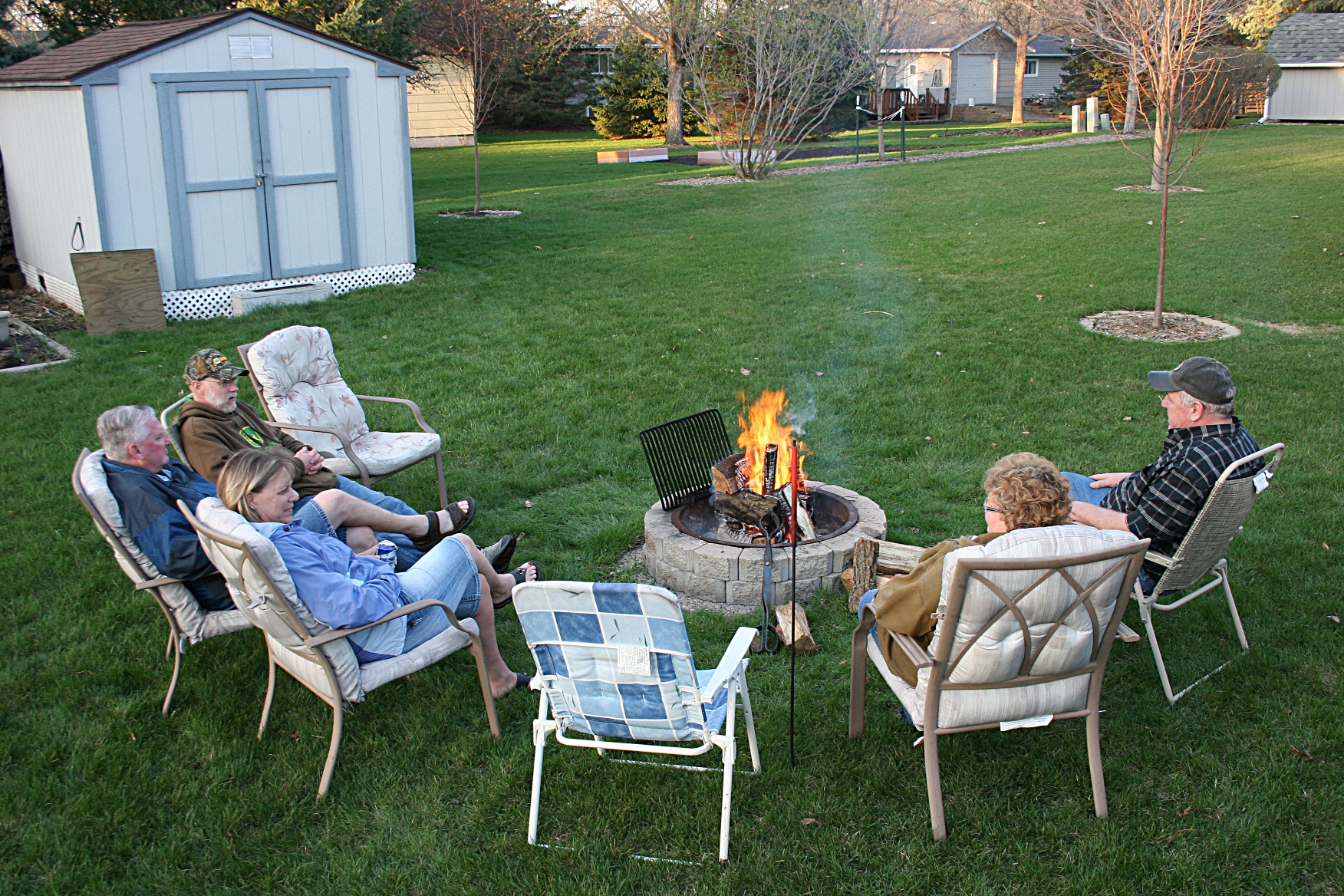
Recreational campfires like this one are still allowed. I gathered with extended family around this campfire in Waseca on March 24. This photo is for illustration purposes only.

The National Weather Service has issued a “red flag warning” for the western half of Minnesota from the northern to southern borders. Gusty winds and low relative humidity in an already dry landscape are creating “critical fire weather conditions,” according to the NWS.

Heed the warning, Minnesotans. Use common sense. It doesn’t take a rocket scientist or a warning from the NWS or a directive from the sheriff to tell you that burning leaves, or anything else for that matter, today or anytime soon would be a very bad idea.

I kept expecting to hear the wail of fire trucks racing to my neighbor’s house. I live along a heavily-traveled street. It’s happened before that a passerby has called the fire department when a neighbor has been burning leaves.

HAVE YOU HAD any fires in your neighborhood today or recently? If so, send me a report via a comment.

© Copyright 2012 Audrey Kletscher Helbling


Hop into church on Easter

Filed under: Uncategorized — Audrey Kletscher Helbling @ 6:57 AM
Tags: , , , , ,

TYPICALLY, JUNK MAIL I receive goes directly from my mailbox into the recycling bin without even a read-through.

But the message and graphic on this piece of mail paused me to stop, read the words and actually flip the oversized postcard to the other side.

Now why did this mass mailing capture my momentary attention?

The short, off-the-wall powerful message popped right out at me. And, the image, well, who doesn’t savor a chocolate Easter bunny?

Connecting the bitten-off-tail bunny with the chosen message seems creative genius to me, the perfect pairing of art and words.

Now I don’t know who, specifically, is the creative mind behind this postcard. But the mailing comes from CANVAS Church in Northfield.

I won’t be attending or joining CANVAS Church. I already have a church home. But I applaud this congregation for reaching out to the masses with an impressionable message that might just bring people in the doors for Easter morning worship.

As an added Easter worship incentive, CANVAS is offering free individual or family photos by a professional photographer.

There you go. Creative marketing and gimmicks to draw in worshipers. Not a new concept. But certainly one that made me stop to read a piece of junk mail before tossing it into the recycling bin.

© Text copyright 2012 Audrey Kletscher Helbling


At the railroad swap meet in Randolph April 5, 2012

Filed under: Uncategorized — Audrey Kletscher Helbling @ 6:39 AM
Tags: , , , , , , ,

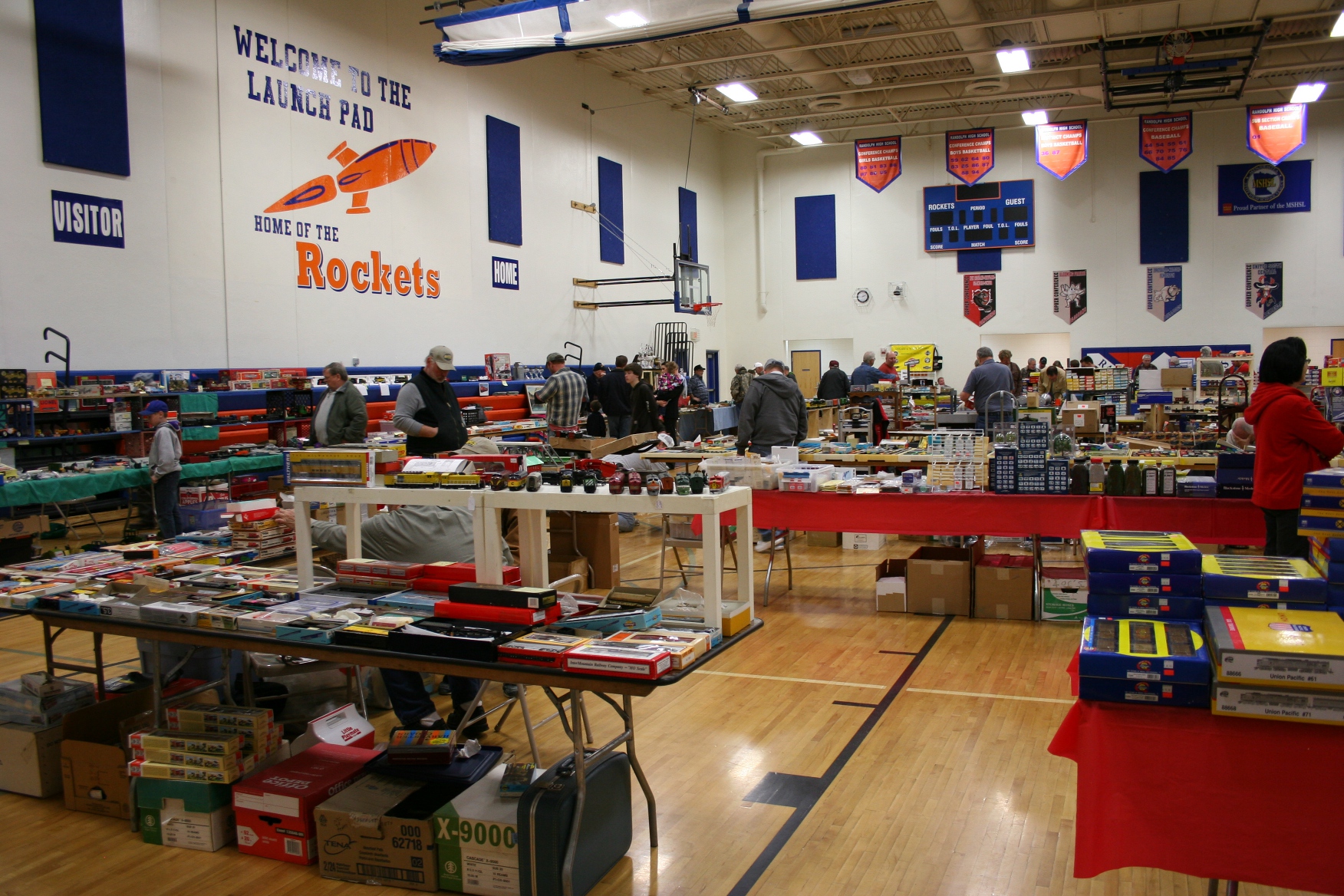
Vendors packed a gym at the Randolph School with their railroad merchandise.

IF I WAS INTO TRAINS or railroading, I could have spent hours filing through the collections of railroad-related merchandise offered at the Randolph Railroad Days Swap Meet on Saturday.

But after awhile, admittedly because I know little about this railroading hobby, the goods started to blend together. So I had to pick and choose and focus on the details to keep myself from becoming lost in the sheer volume of the offerings.

That said, join me on this select tour of the swap meet in a gym at the Randolph School. I was more than a bit distracted by the school’s icon, the rocket, displayed everywhere, even on the gym floor. I’m wondering “why Rockets?” other than the obvious connection to the “R” in Randolph. But that’s another topic because, you know, I did photograph those Rockets.

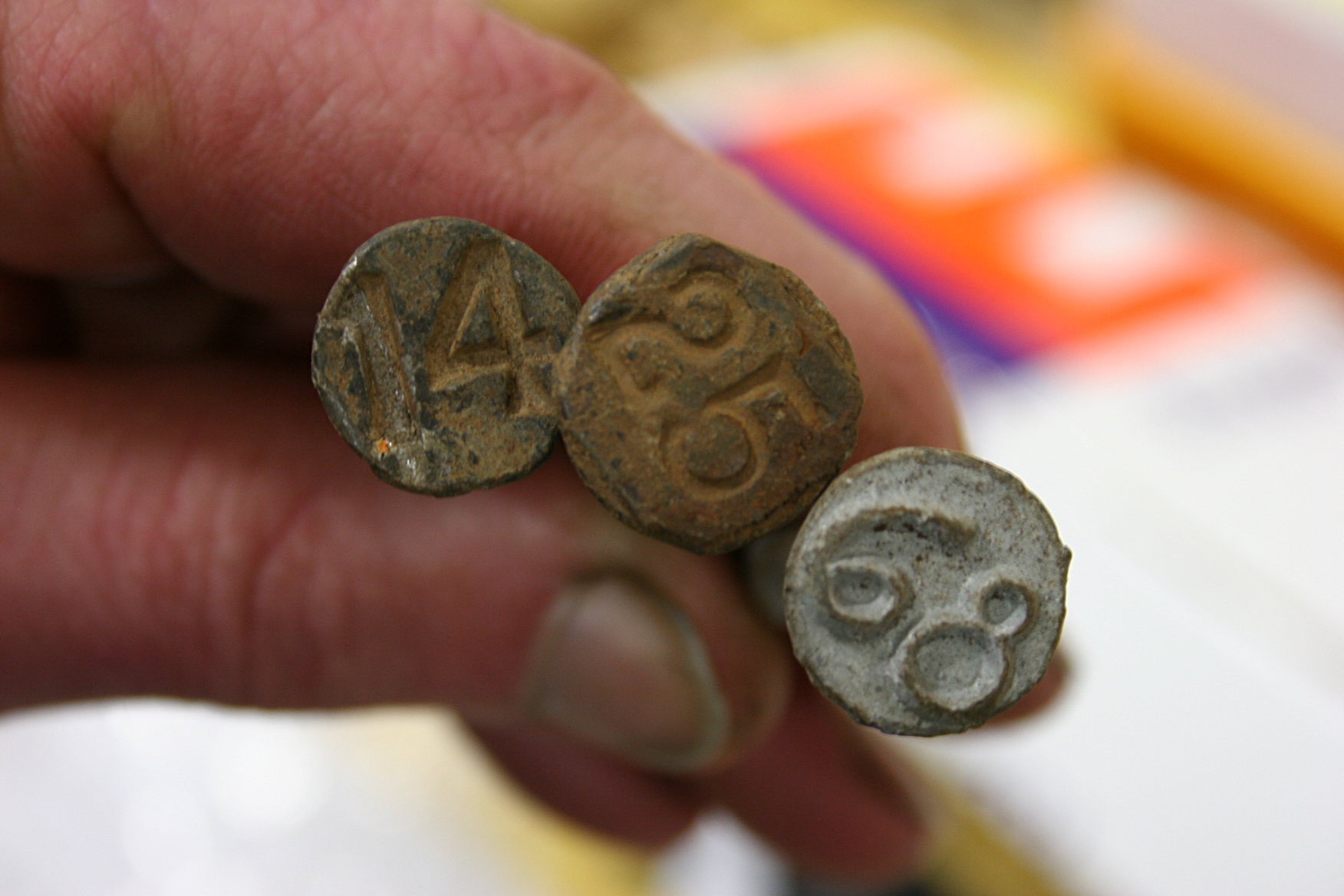
Railroad date nails drew my attention. The numbers represent the years.

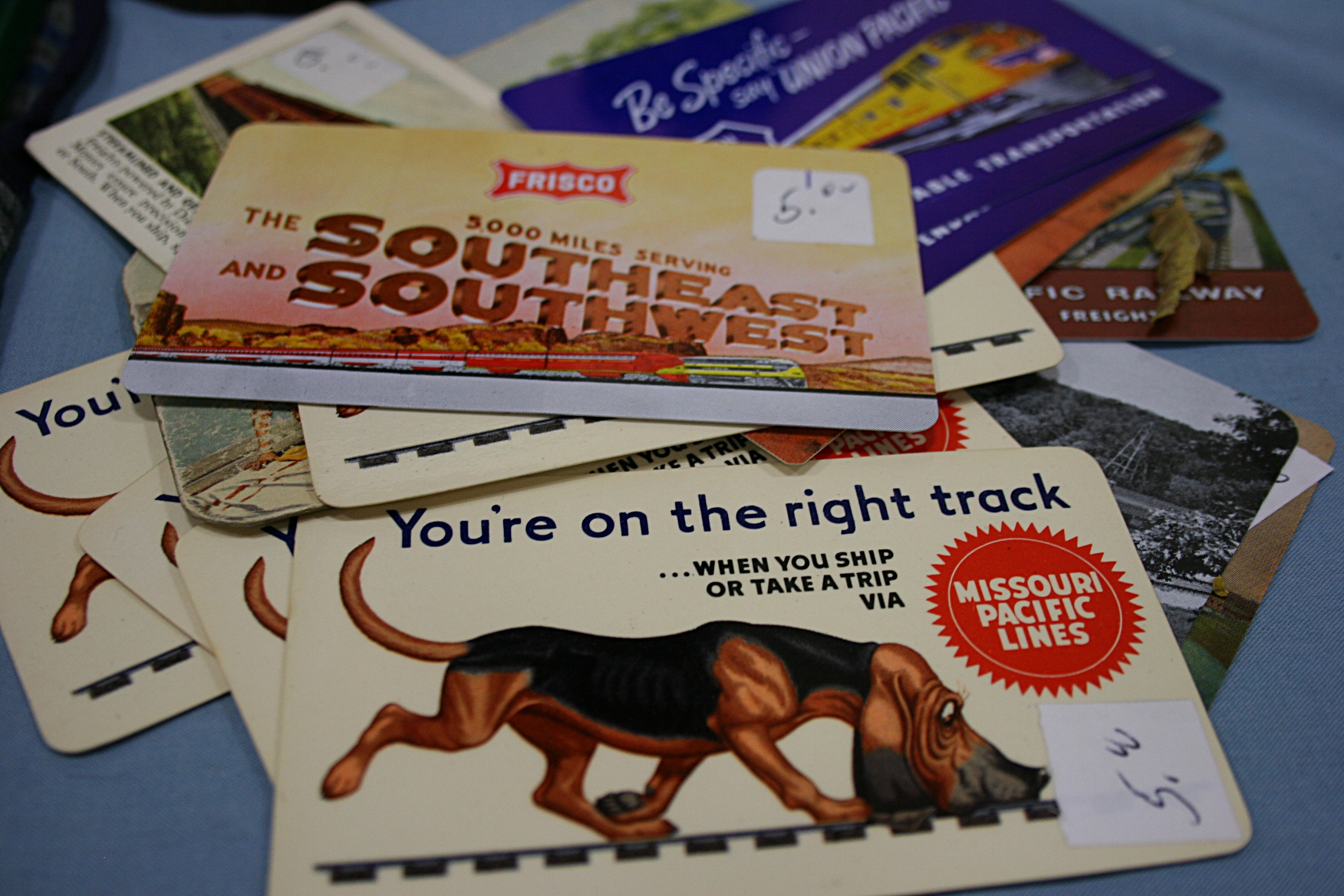
Pocket-size calendars, which I choose to call "railroad art."

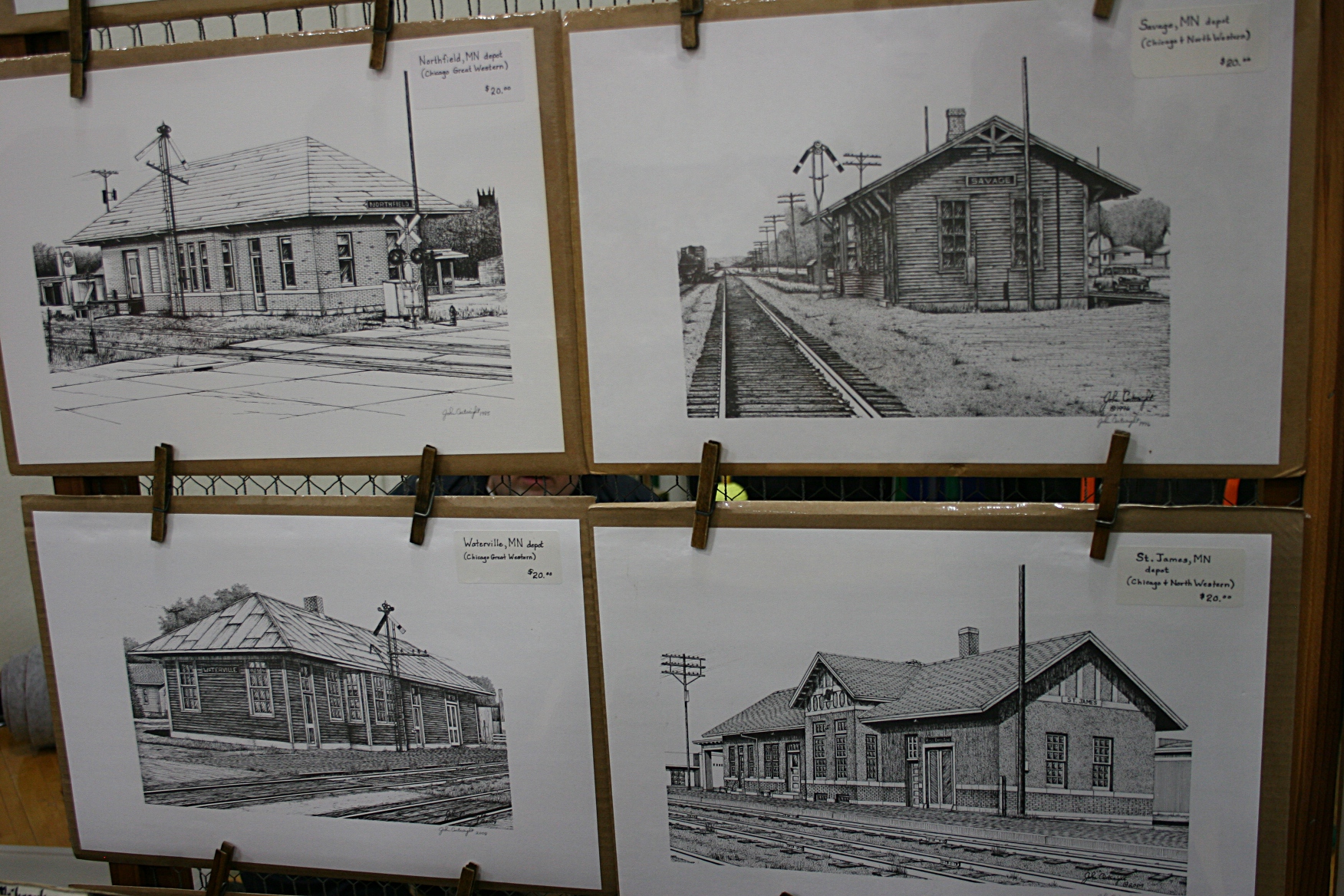
And then there's railroad art like this created by John Cartwright. The Shoreview artist was selling prints of his ink drawings. Visit his website at ArtRail.com for more information.

Toy/model trains galore were available for purchase.

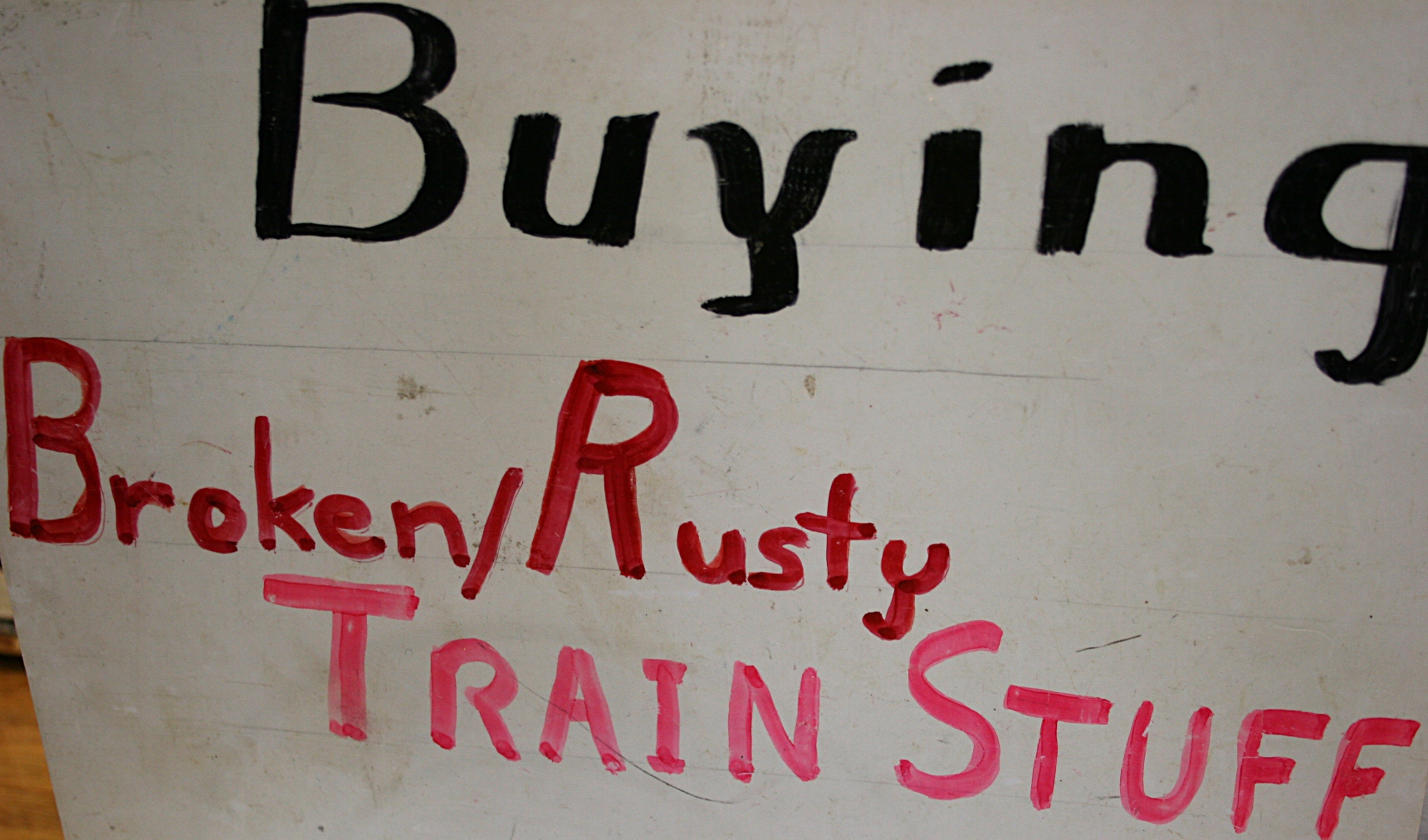
Condition doesn't matter to this swap meet buyer.

I found this attractive belt buckle among an assortment of buckles.

Yes, this hobby could get expensive. The details in train set-ups impressed me.

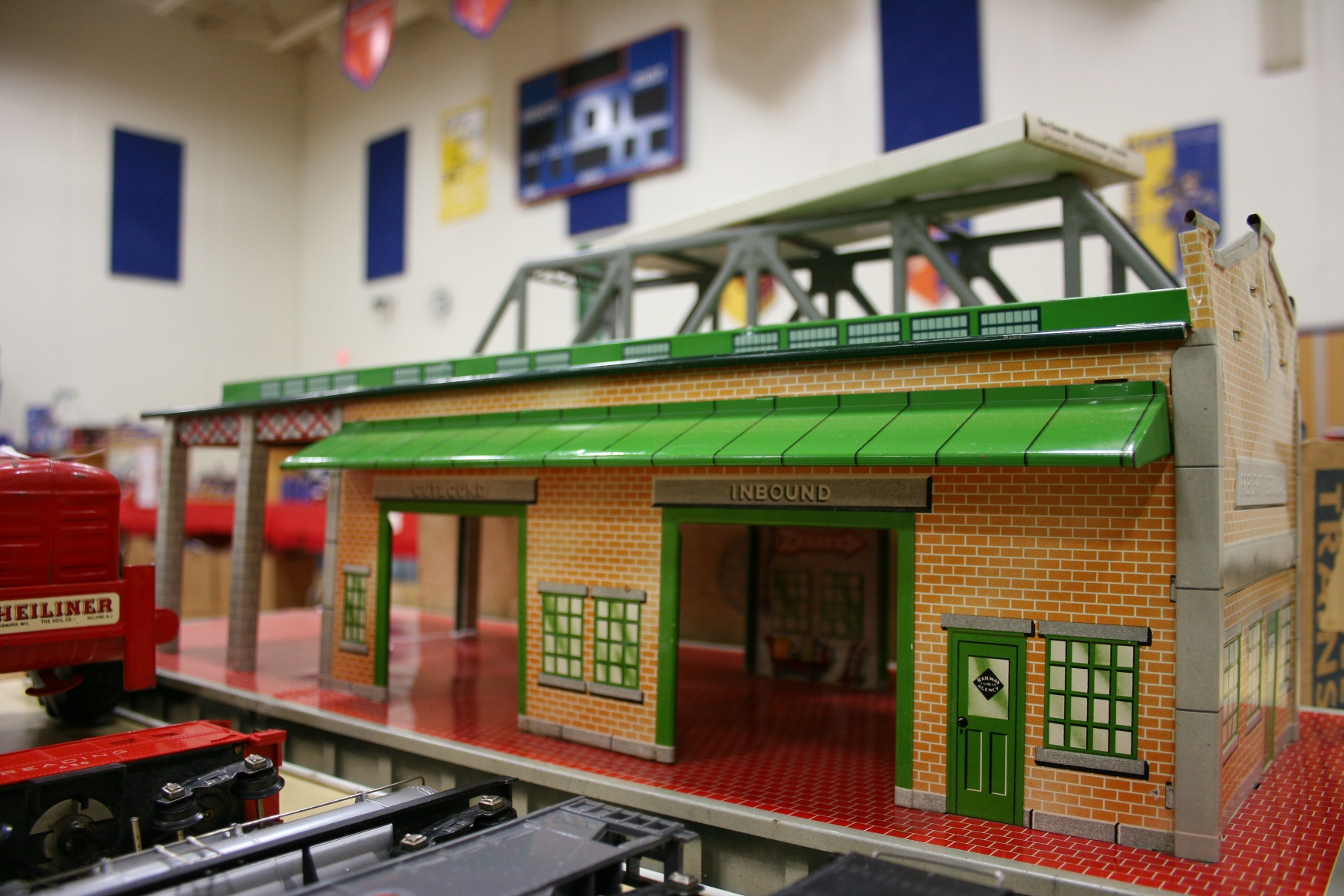
This replica toy depot caught my eye because it reminded me of the metal dollhouse I had as a child. Oh, how I wish my mom had kept the vintage dollhouse and not given it to my cousins.

Just the cheerful, vivid colors alone are enough to make you smile.

© Copyright 2012 Audrey Kletscher Helbling

Thank you to railroad artist John Cartwright for allowing me to photograph his beautiful ink drawing prints. You can learn more about this award-winning artist by clicking here.
 

Finally, a woman on the Steele County Board April 4, 2012

CONGRATULATIONS, STEELE COUNTY, Minnesota. You’ve finally elected a woman to serve on the County Board of Commissioners. It’s about time.

I could hardly believe the news when I heard it this morning on an Owatonna radio station. It wasn’t the election of a female that surprised me. It was the fact that it’s taken this long.

For the first time in its history, this southeastern Minnesota county will have a woman serving on its county governing board. She is Nina Huntington, a dental hygienist from Owatonna, who beat out opponent Doug Hughes in a special election on Tuesday to represent the Fifth Commissioner District.

Huntington won with 250 votes, or 60 percent, compared to Hughes’ 164 votes, according to an article in the Owatonna People’s Press. Only 10.25 percent of the district’s registered voters cast ballots.

Interestingly enough, Steele County also made headlines on Tuesday as Minnesota’s healthiest county in ratings released by the Robert Wood Johnson Foundation and the University of Wisconsin Population Health Institute. That study considers mortality, morbidity, health behaviors, clinical care, social and economic factors, and physical environment. Click here to read those study results.

So there you have it—Minnesota’s healthiest county now has a woman helping to govern it.

Huntington’s election in Steele County leads me to wonder this:

How many other Minnesota counties have never had a female serve on the county board of commissioners? If you have the answer or can direct me to that information, I’d like to hear. I would guess that number to be quite high.

Also, what do you think a woman can bring to county government that a man may not?

CLICK HERE to read an interview with Huntington published in the Owatonna People’s Press after she filed for office.

CLICK HERE to read the election results story in the OPP.

© Copyright 2012 Audrey Kletscher Helbling


The Last Supper Drama begins Holy Week at a rural Minnesota church April 3, 2012

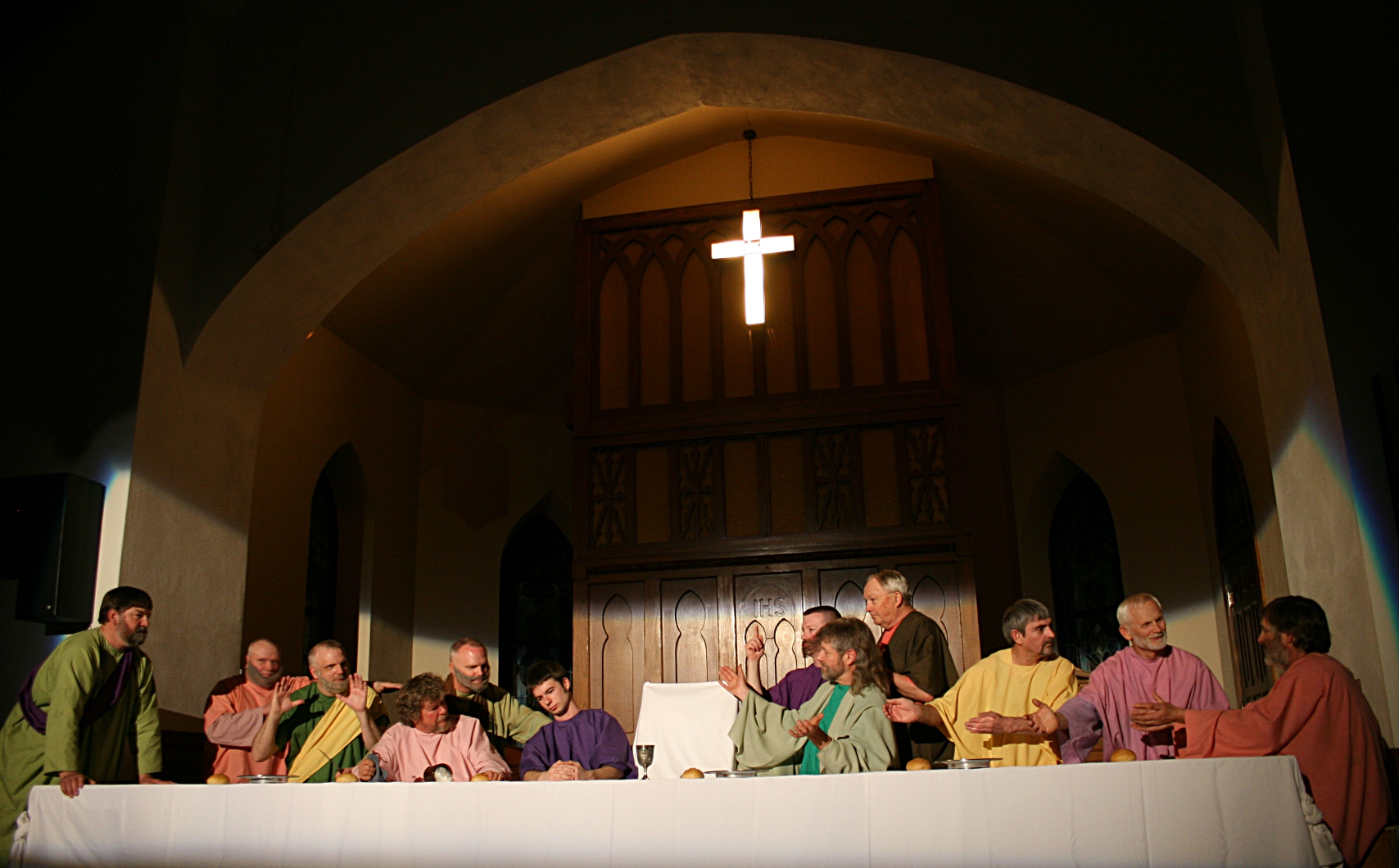
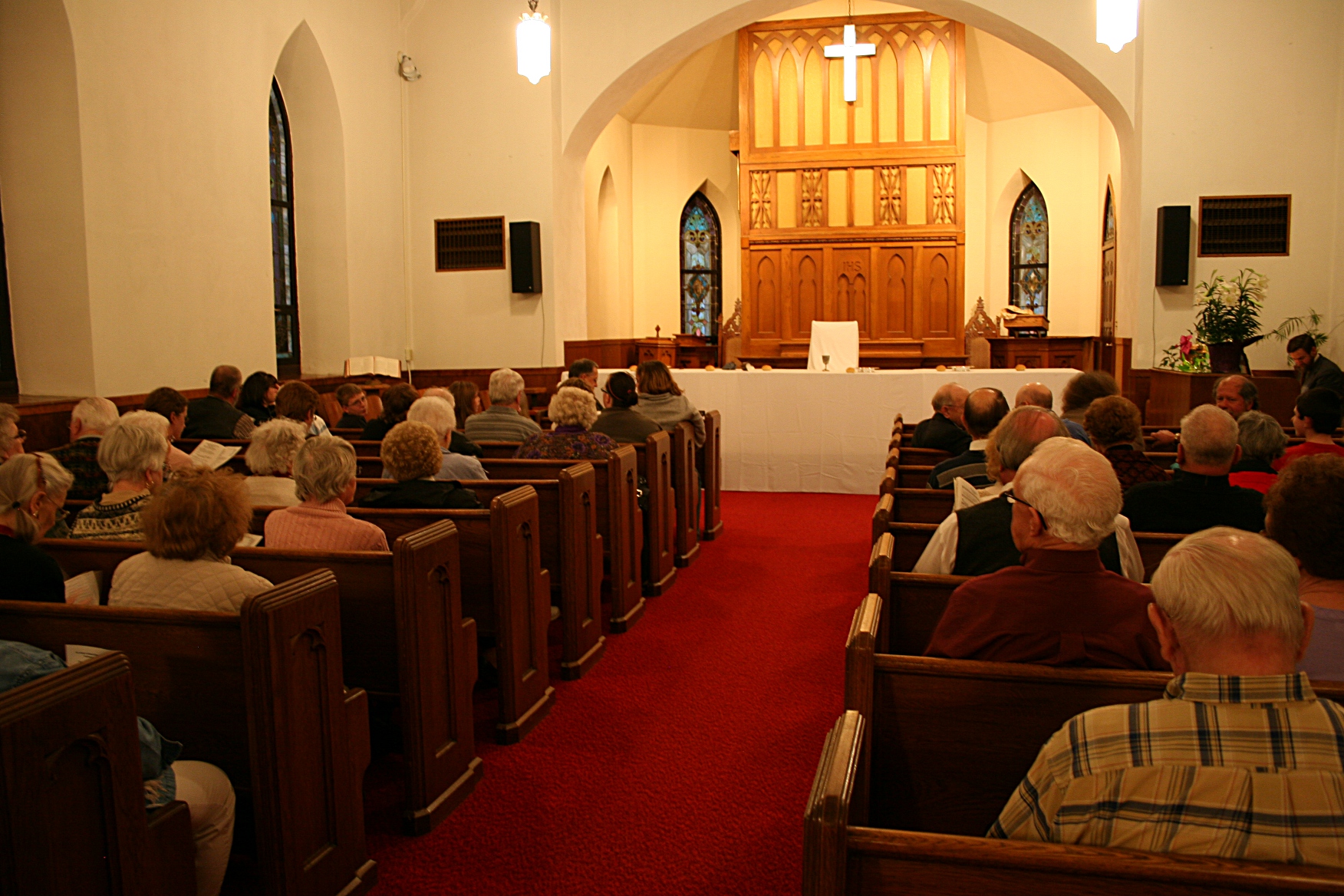
St. John's 50th presentation of The Last Supper Drama in the sanctuary with the actors positioned just as the disciples are in Leonardo da Vinci's painting. However, in the drama, an empty chair represents Christ.

THOUSANDS OF MILES from Milan, Italy, in the flat farm fields of Rice County in southeastern Minnesota, Leonardo da Vinci has left his mark on a small congregation.

For 50 consecutive years, St. John’s United Church of Christ, Wheeling Township, has presented The Last Supper Drama, a theatrical interpretation of the master artist’s most famous painting created in 1495 as a mural in an Italian monastery.

The rural Faribault church was nearly full for the golden anniversary of The Last Supper Drama.

Palm Sunday evening I joined a sanctuary full of worshipers to view the drama which inspires and moves for its touching, personal account of Christ’s last meal with his 12 disciples. In the script written so many years ago by a former St. John’s pastor, each of Jesus’ followers speaks of his personal relationship to the Lord.

In the reverent near-darkness of this late 1800s limestone church, the cast, in loud, clear, animated voices and with gestures fine-tuned by years of practice and presenting, truly bring to life da Vinci’s painting. They speak of their failures and deaths, of their love for Christ.

“Be not faithless, but believing,” advises doubting Thomas, played this evening by Thad Monroe.

Claims Don Katra as Matthew: “My life really began when I met and followed Him.”

Most of the actors are shown here as they pose for photos after the performance.

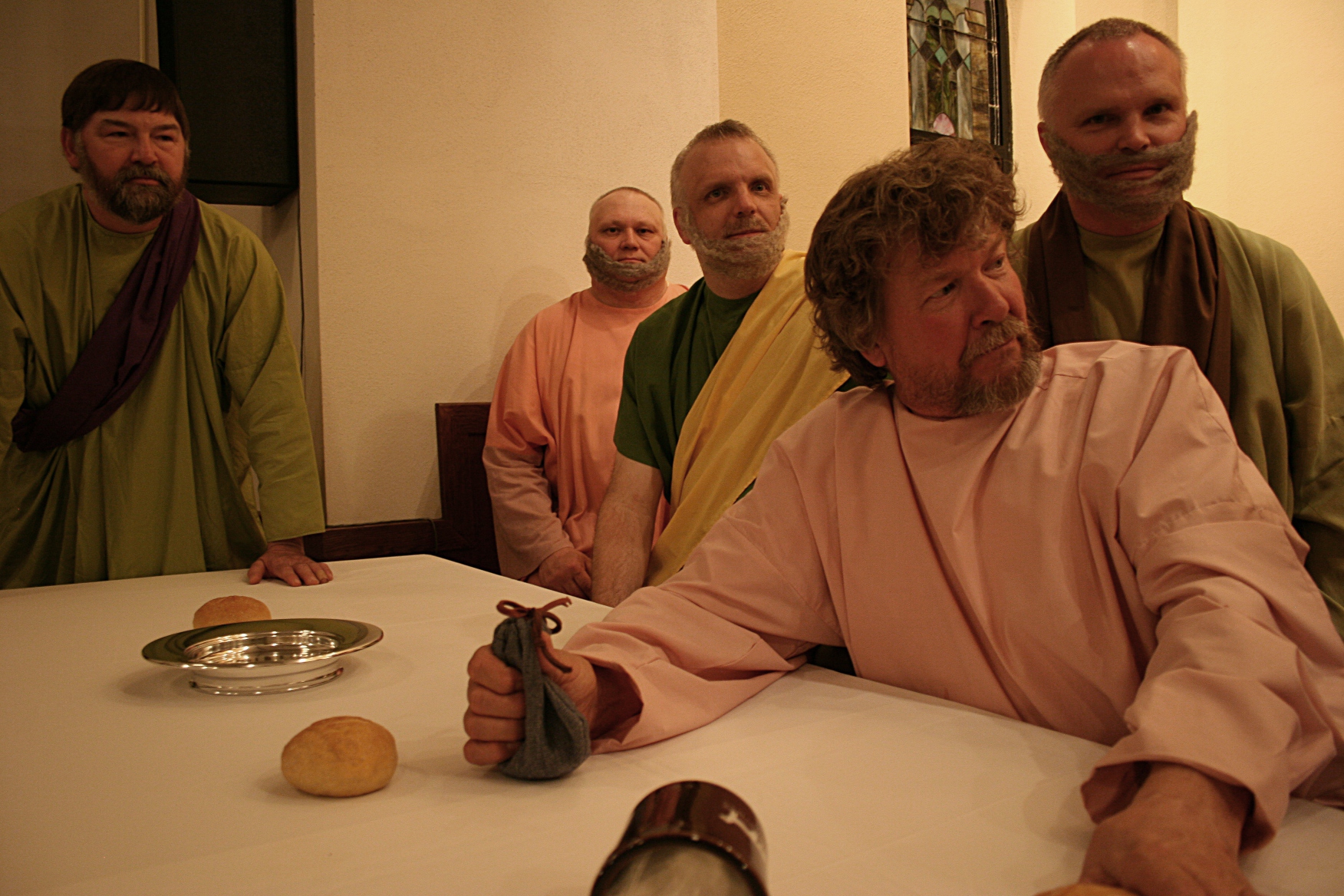
Judas grips the bag of silver, his reward for betraying Christ.

Even Gordie Wiegrefe as Judas the betrayer, admits, “It was too late. They wouldn’t take the silver back. I failed my Lord.”

The moment when Christ announces that one of his disciples will betray him is the precise moment da Vinci captures in his painting. In St. John’s performance, the defining moment of betrayal comes when Judas slams a jingling bag of 30 pieces of silver onto the table.

Later, after the drama concludes, St. John’s Pastor Lora Sturm tells worshipers, “Let us feel the light of His love as we enter the darkness of this Holy Week.”

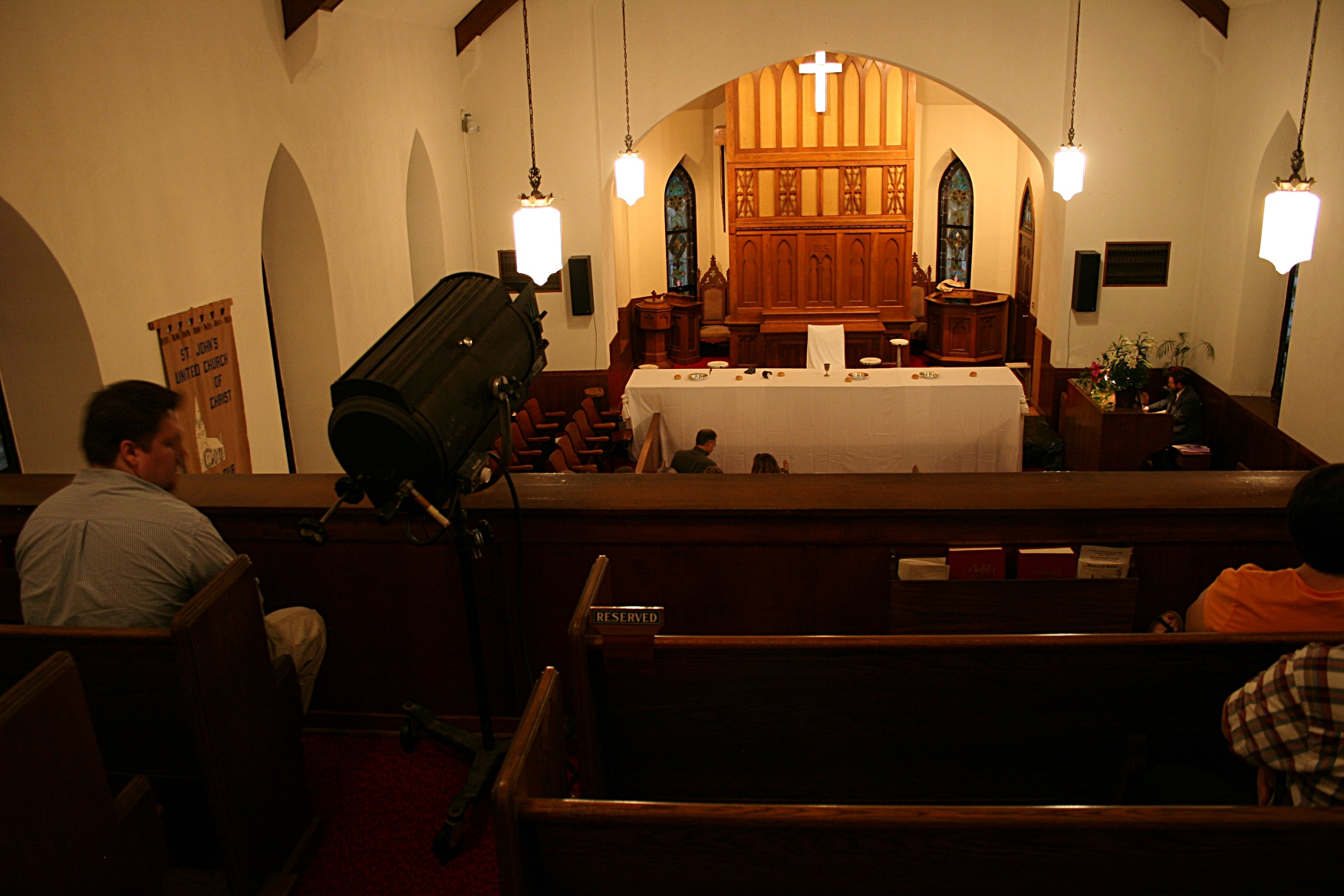
A view from the balcony before the drama begins shows the spotlight to the left and The Last Supper table below. The actors enter, spotlighted in the dark church, to take their seats at the table. There they "freeze" in place to mimic Leonardo da Vinci's painting.

That message resonates as a spotlight first illuminates a cross suspended above the altar in the dark sanctuary, then moves down to an empty chair representing Christ and finally pans out to shine upon all 12 disciples. It is how the drama opens and ends, impressing upon attendees the darkness of Holy Week which concludes on Sunday in the glorious light of the resurrected Lord.

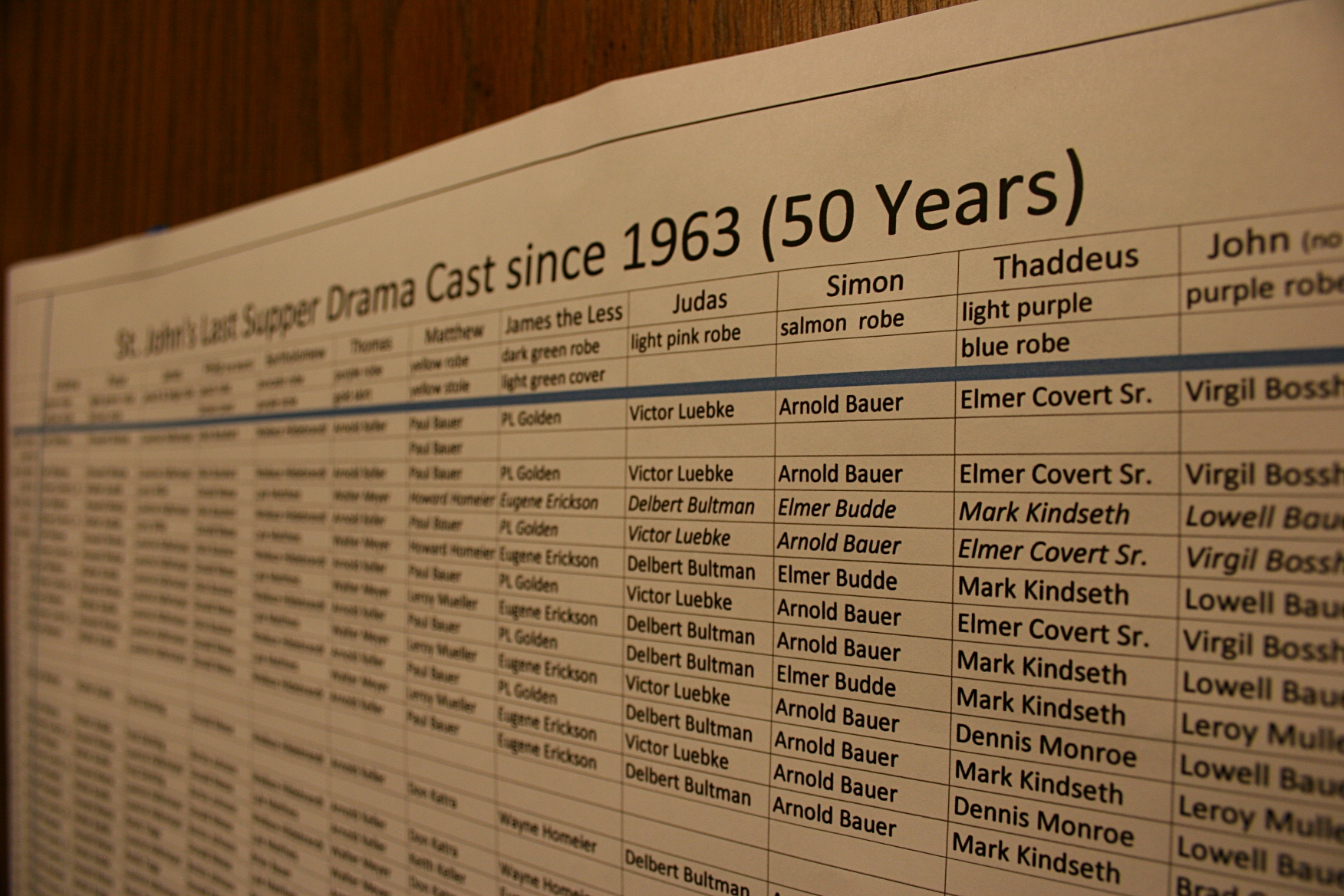
Spreadsheets on display Sunday evening listed those involved in the St. John's drama through-out its 50-year run.

FOLLOWING SUNDAY’S 50th anniversary performance, special recognition was given to those who have been part of St. John’s The Last Supper Drama. Original 1963 cast members Wallace Hildebrandt and Luverne Hafemeyer stood up to applause.

Other 50-year history trivia includes:

  • Seventy individuals have participated in the drama since 1963.
  • The role of John has been played by 10 actors.
  • The youngest actor was Kyle Keller who in 2011 assumed the role of Philip.
  • The oldest cast member was Kyle’s grandpa, Arnold Keller, who was 76 years old when he last acted in 1997.
  • Nine individuals have performed 20 or more times in the St. John’s drama.

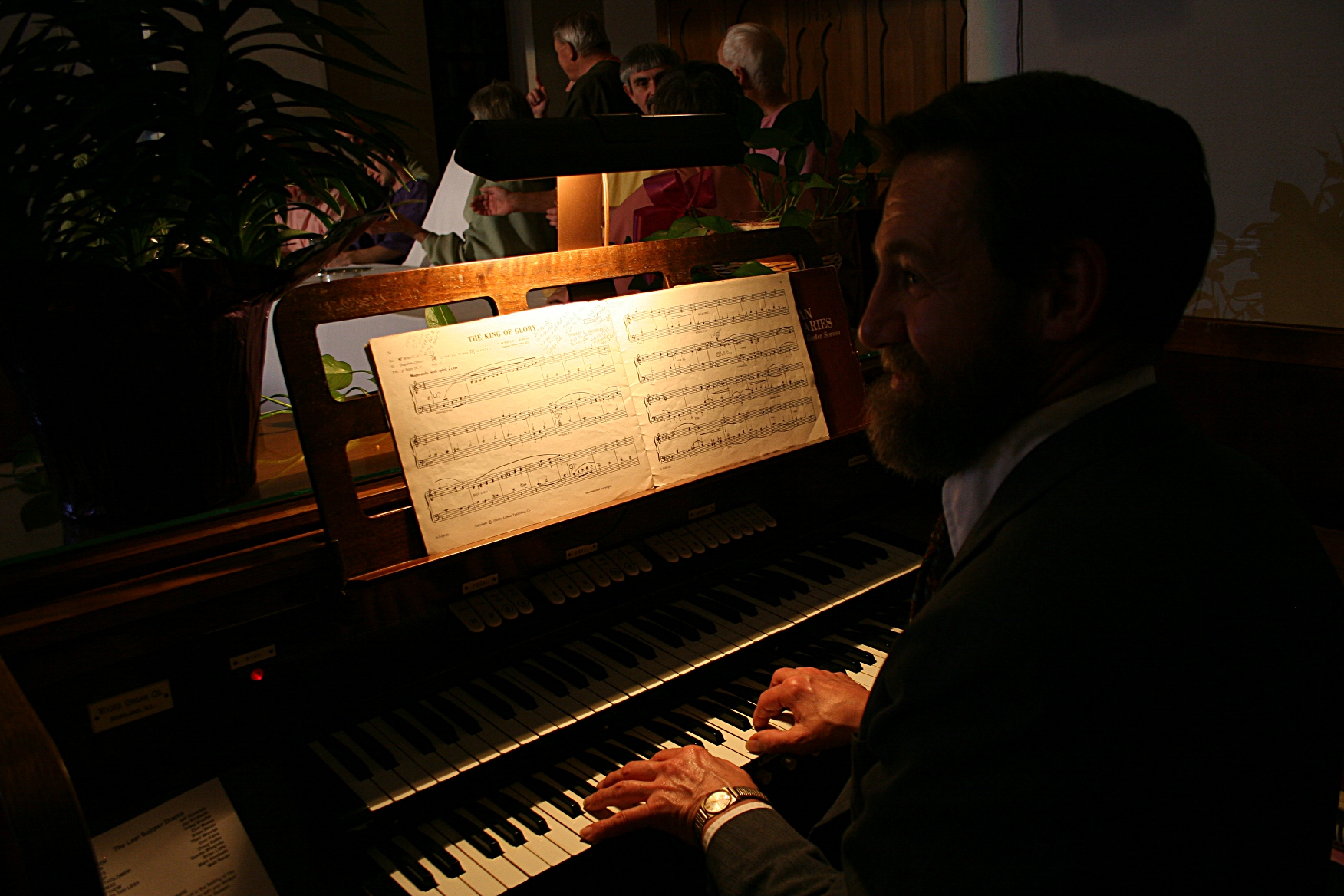
Craig Keller has been the long-time drama organist, playing the same music every year. The script and music remain unchanged in 50 years. Craig's father, Arnold, was an original cast member.

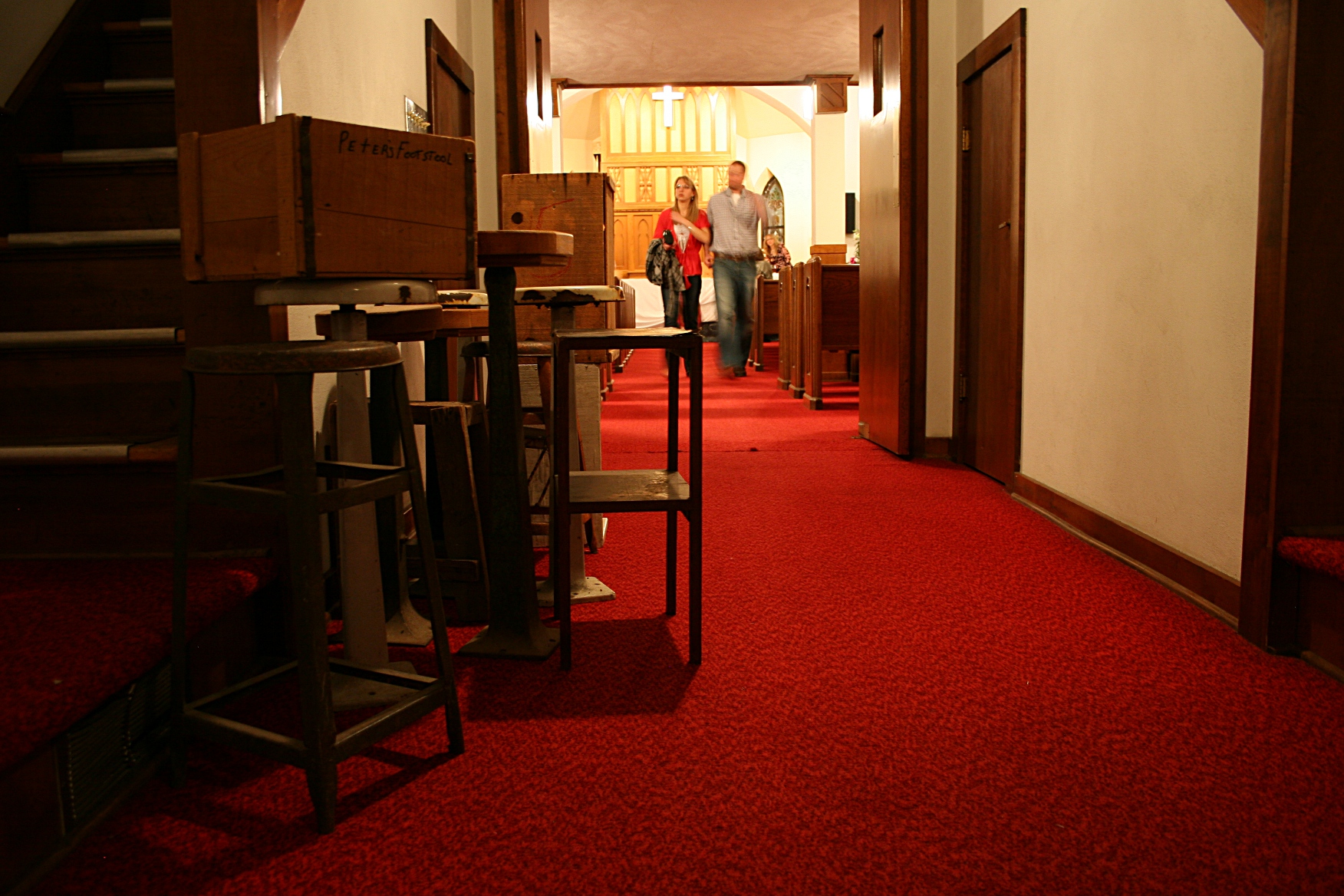
After the performance the cast took their stools and footrests out of the church, grouping them together (left) in the sanctuary entry. Later they carried the seats into a balcony storage area. Each stool is labeled with a disciple's name. They are the original stools, first used 50 years ago.

This artistic rendition of The Last Supper hangs in the St. John's Fellowship Hall.

After the performance, folks gathered in the social hall for cookies and beverages.

A tray of cookies awaits audience members and performers.

TO READ A PREVIOUS POST I wrote about the 2011 drama, click here.
© Copyright 2012 Audrey Kletscher Helbling