Minnesota Prairie Roots

Writing and photography by Audrey Kletscher Helbling

Minnesota heat wave, Argentine polar wave…what’s with this crazy weather? August 12, 2010

Filed under: Uncategorized — Audrey Kletscher Helbling @ 7:19 AM
Tags: , , , , ,

WHEN MY DAUGHTER e-mailed recently from Argentina complaining about the cold weather, I wasn’t too sympathetic. It’s winter there. What does she expect?

Plus, I’d welcome a blast of chilly air right now to ice down this interminable, steamy hot summer we’ve had in Minnesota.

But then I started thinking, as I’m apt to do, and sent her a list of questions, as I’m apt to do. Fortunately, my second-born indulged my curiosity and replied with an informational e-mail about South America’s recent “polar wave.”

Even that phrase, “polar wave,” makes me smugly smirk as I think of “Arctic air” and “Alberta clippers” in Minnesota. What do these South Americans know about frigid temperatures anyway? Have they ever endured temps or windchills in the double digits below zero like us hardy northerners?

Once I overcame my oversized Paul Bunyan attitude of superiority, I attempted to objectively consider my daughter’s southern weather report.

She wrote: “The polar wave, or La Ola Polar, supposedly is cold air that comes up from Antarctica. It may last for a few days or a whole week, it depends. I think they start calling it a polar wave when it’s around 0 degrees Celsius or lower (32 degrees F). People usually just put on heavier jackets. Gloves and scarves are common, too. You won’t see a large amount of people with hats, though.”

OK, no stocking caps, no ear flaps, no wool coats or parkas or winter boots. And, for gosh sakes, don’t those Argentines know that your fingers will stay warmer if you wear mittens instead of gloves?

Then, surprise, surprise, “some places in Argentina even got snow,” my 22-year-old daughter continues. “For my friend Sam in Tucuman, it was his first time seeing snow! An article in the Clarin (Buenos Aires daily newspaper) from August 4 said that on August 3, it got to  -7.1 degrees C (around 19-20 degrees F), with a windchill of -11.5 C (about 11 F) in San Antonio Oeste in the Río Negro province, and that was the lowest temp recorded for the day. Another Clarin article said that on Aug. 4 the coldest place in the country was in Río Mayo in the Chubut province, where it got to -25 C (-13F). This was the coldest temperature recorded in the past 5 years. In the Mendoza province, they had to suspend classes in 23 schools b/c the pipes froze.”

About then I realized that maybe this polar wave isn’t all that humorous. Likely, these South Americans don’t have the heating systems or insulated homes to deal with such unexpected frigid air. And, certainly, they don’t have the seasoned, inbred knowledge we Midwesterners have for comfortably surviving harsh winters.

After a bit of online research, I discovered that this recent cold weather has claimed many lives—in Bolivia, 18; Paraguay, 10; and Argentina, eight (in a single weekend), according to a July 20 CNN World report.

Thankfully, weather conditions are improving in South America, including Buenos Aires where my daughter lives. “After a week in the 35-40 degree range, it’s now around 55-60 degrees,” she tells me.

The warmer weather arrives in Argentina just in time for the arrival of her older sister today from Minneapolis.

I’ll be curious to hear: Which does she prefer, Minnesota heat wave or Argentine polar wave?

© Copyright 2010 Audrey Kletscher Helbling


Minnesota or Arkansas, heat or mosquitoes… August 11, 2010

Filed under: Uncategorized — Audrey Kletscher Helbling @ 8:47 AM
Tags: , , , ,

WHEN MY UNCLE BOB proclaimed last week that he had just gotten his first mosquito bite in 15 years, I nearly flipped over in my lawn chair.

But I quickly rebounded. “Well, then,” I suggested, looking him squarely in the eye, “why don’t you take a whole van load back to Arkansas.”

He declined my offer while my Aunt Rae disputed his 15-year claim. Despite the differing opinions, I surmised that mosquitoes apparently aren’t all that common in northern Arkansas where my relatives retired to from Minneapolis 15 years ago.

But I’ve heard about the unbearable, muggy, oppressive heat down there, similar to what we’ve experienced in Minnesota this summer.

However, on the day my aunt and uncle visited my Faribault home last week, the weather was picture perfect after a string of unbearable, muggy, oppressive days. As we sat on the patio visiting, Bob remarked how nice it was to sit outside in the cool evening air.

I, too, was enjoying the respite from the heat and humidity, and from being cooped up inside in the air conditioning.

As dusk approached, my relatives announced that they should leave for their daughter’s Minneapolis home, their day’s final destination.

“Come down and visit us sometime,” Aunt Rae invited, as she does every time I see her and Uncle Bob.

I was non-committal. I’ve already had enough of the heat and humidity, I thought to myself. But that mosquito-free environment did tempt me, for just a second.

© Copyright 2010 Audrey Kletscher Helbling
 

Soleful art in Paradise August 10, 2010

Filed under: Uncategorized — Audrey Kletscher Helbling @ 7:24 AM
Tags: , , , , ,

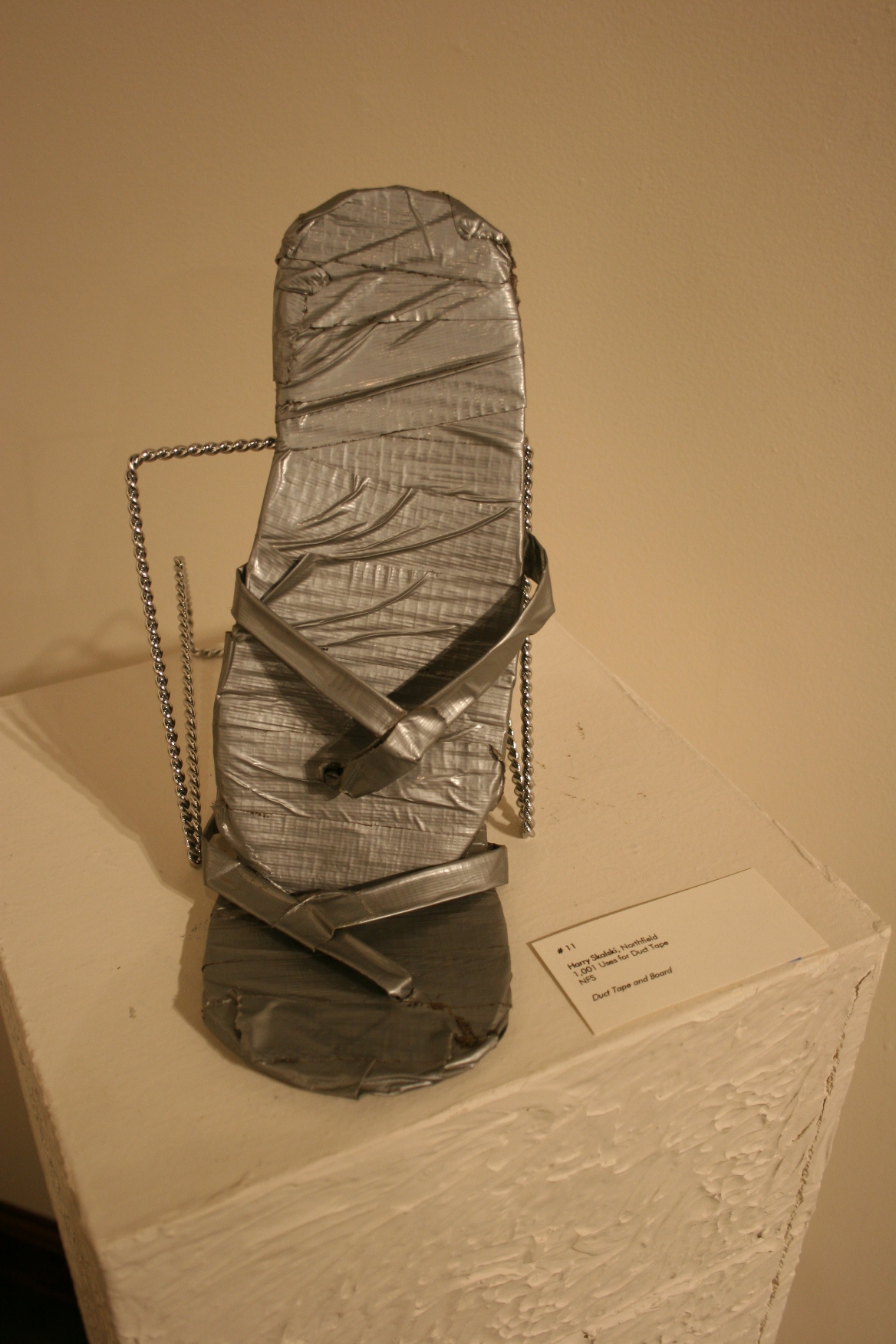
"1,001 Uses for Duct Tape" by Harry Skalski

THEY ARE NOT EXACTLY ruby slippers. They are, in fact, quite the opposite of the sparkly, magical heels worn by Judy Garland in The Wizard of Oz.

Yet, angled on a pedestal under the strategically-placed lights of the art gallery, these one-of-a-kind silver flip flops shine with individual style, for they are made of shiny duct tape-wrapped board.

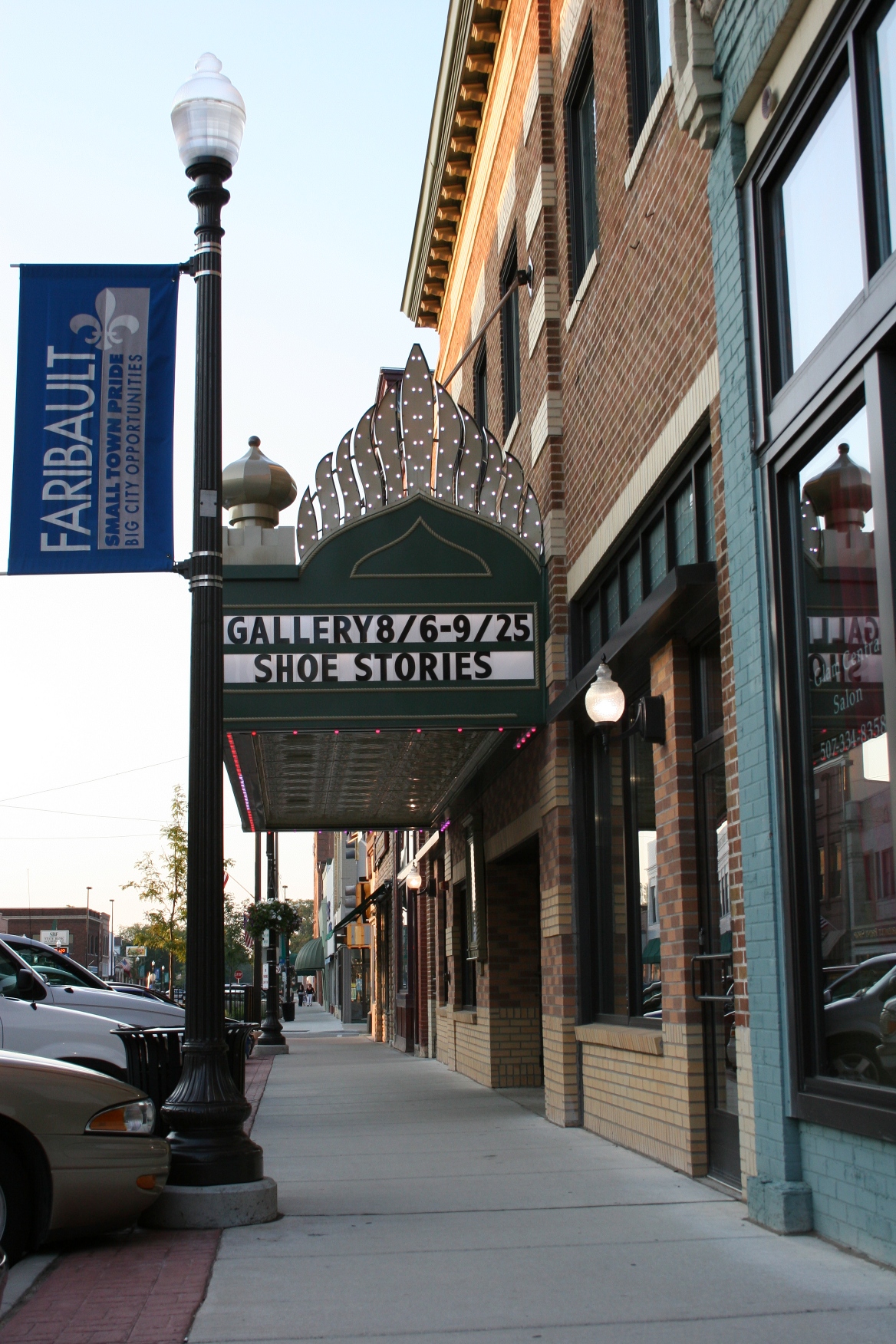
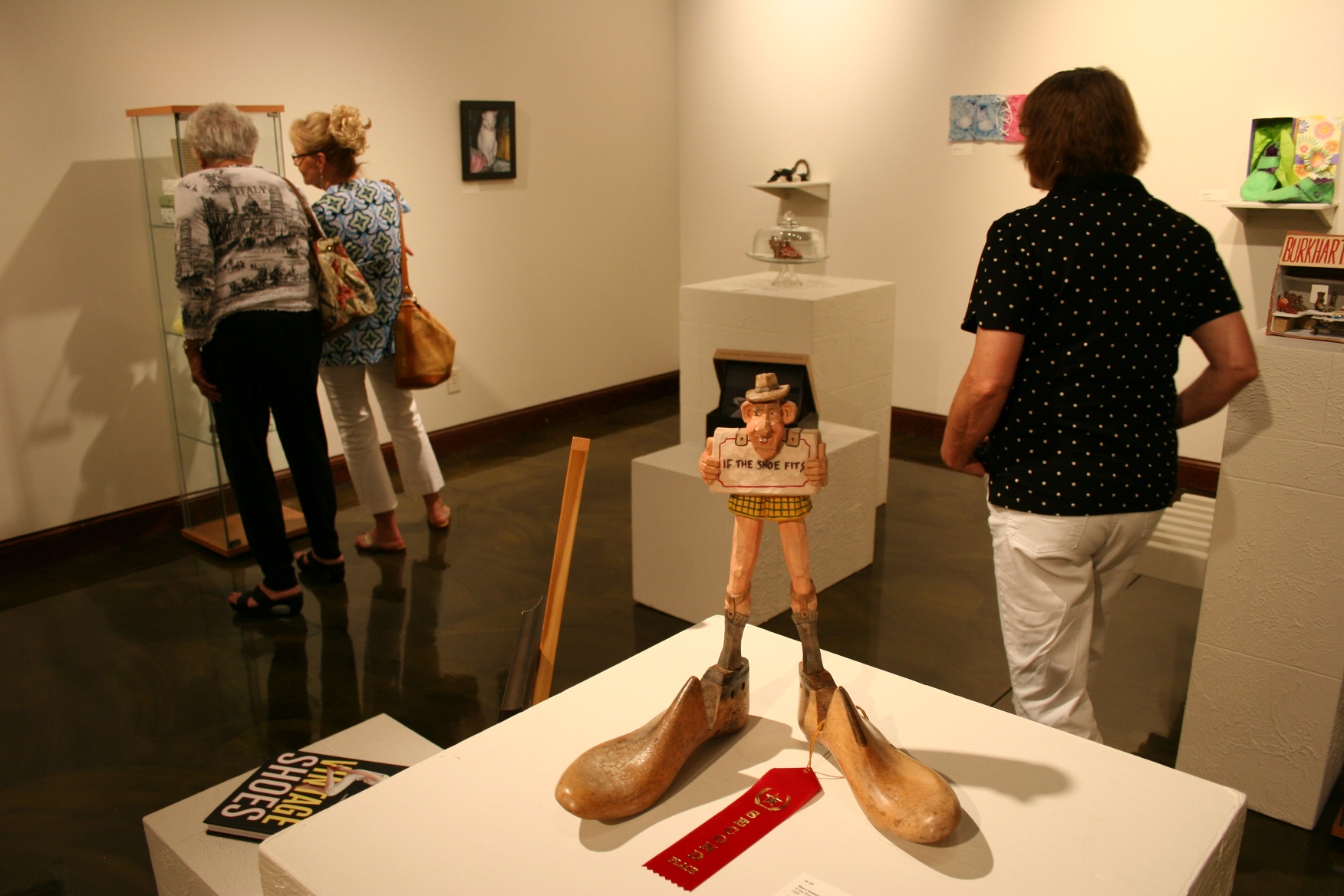
Welcome to “Shoe Stories,” the latest art exhibit at the Paradise Center for the Arts in historic downtown Faribault. Here nearly 40 pieces of juried art, like “1,001 Uses for Duct Tape” by Harry Skalski of Northfield, fill the gallery. Artists were invited to submit a shoe-themed piece that fit inside a shoebox.

"Shoe Stories" opened Friday at the Paradise Center for the Arts in Faribault.

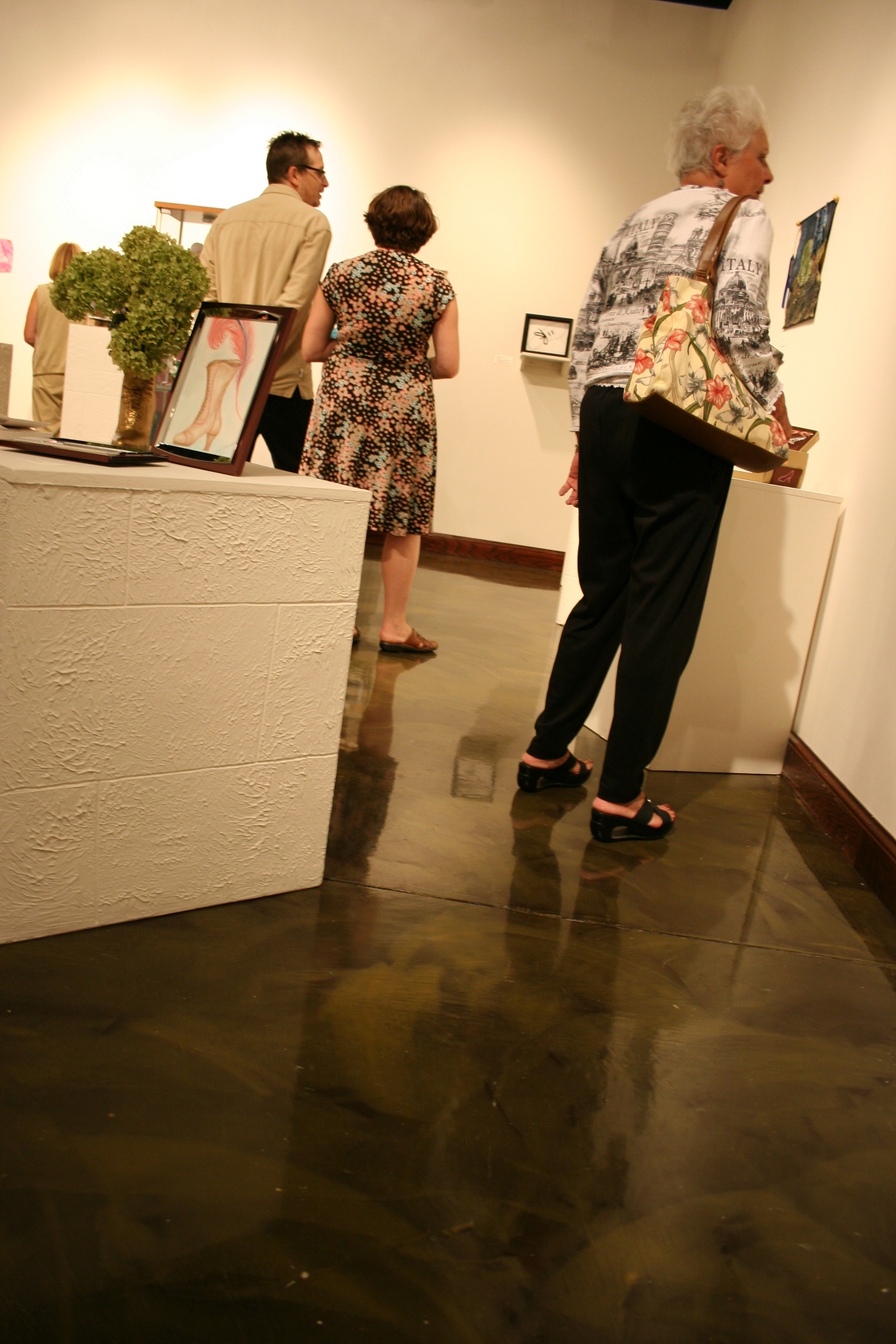
The result is a show as magical and alluring as the Emerald City. As I circle the gallery, weaving in and out of displays, I feel as if I am on the yellow brick road, encountering not flying monkeys, but pieces of soleful art that engage and invite me to pause and ponder.

Visitors peruse "Shoe Stories" on the exhibit's opening night.

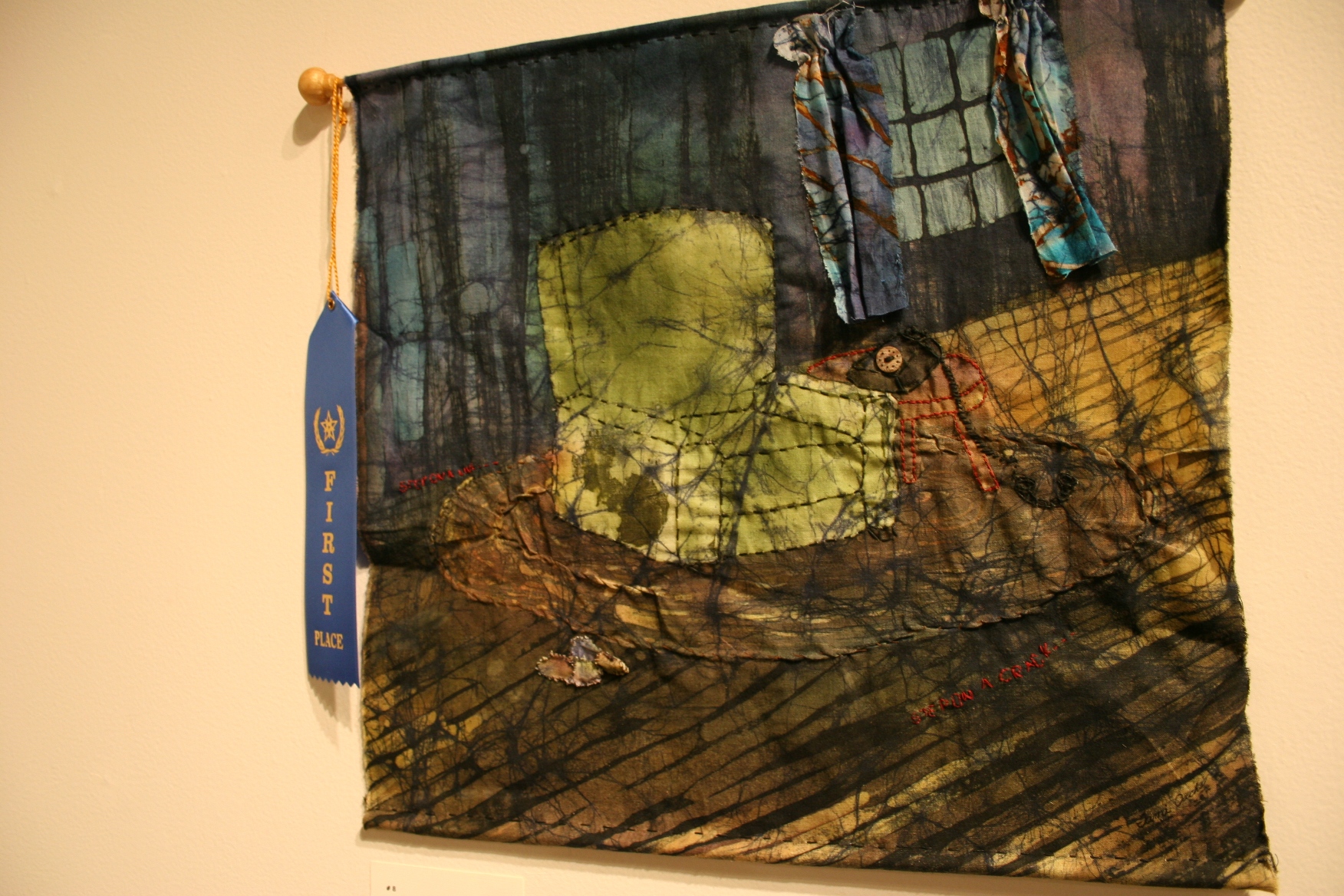
"Step on a line," a batik with stitching by Faribault artist Tami Oachs, received first place as judged by Minnesota State University-Mankato Professor Emeritus James Tanner.

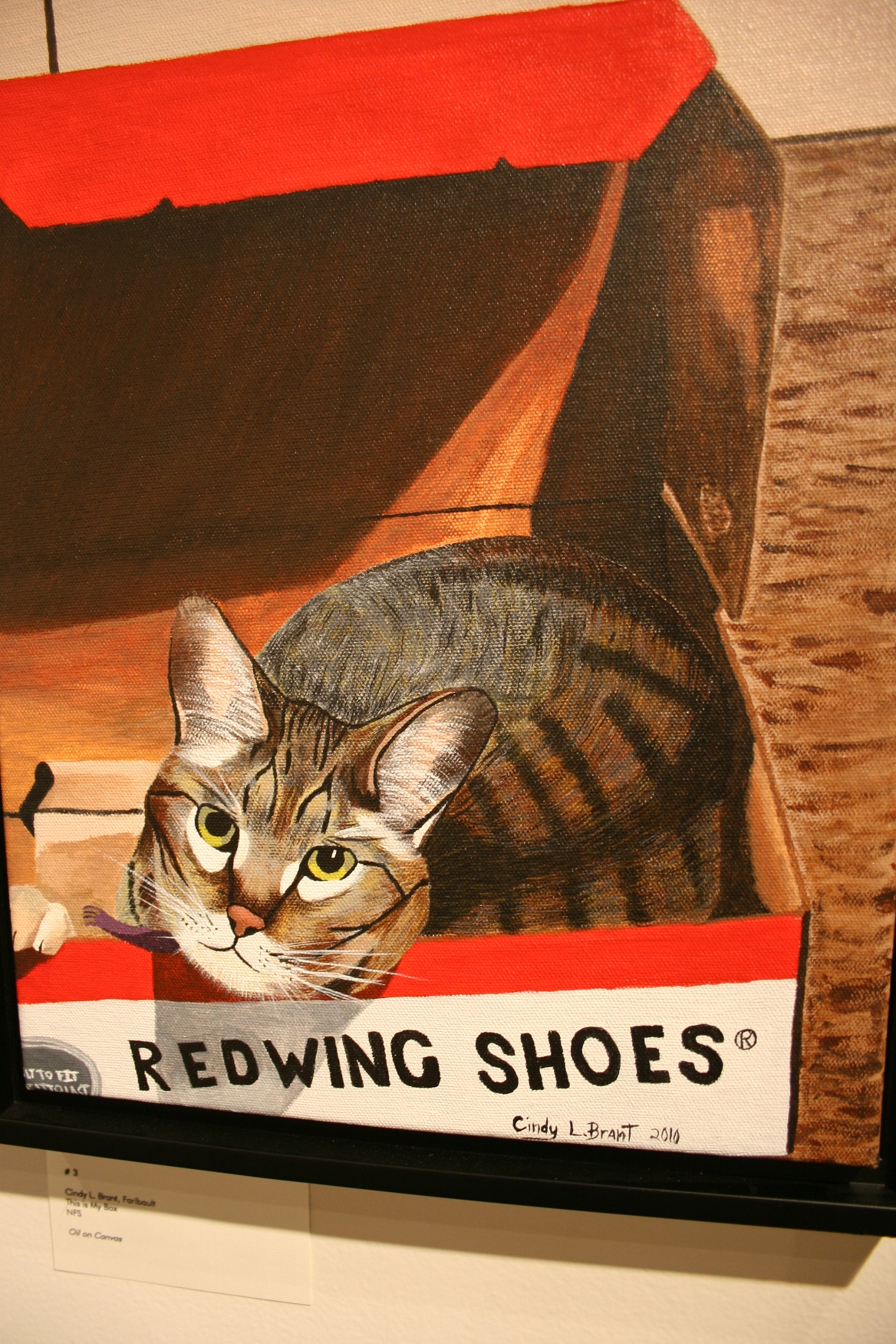
"This is My Box," an oil on canvas by Cindy L. Brant of Faribault.

Internationally-renowned Faribault woodcarver Marv Kaisersatt's wood caricature, "If the Shoe Fits."

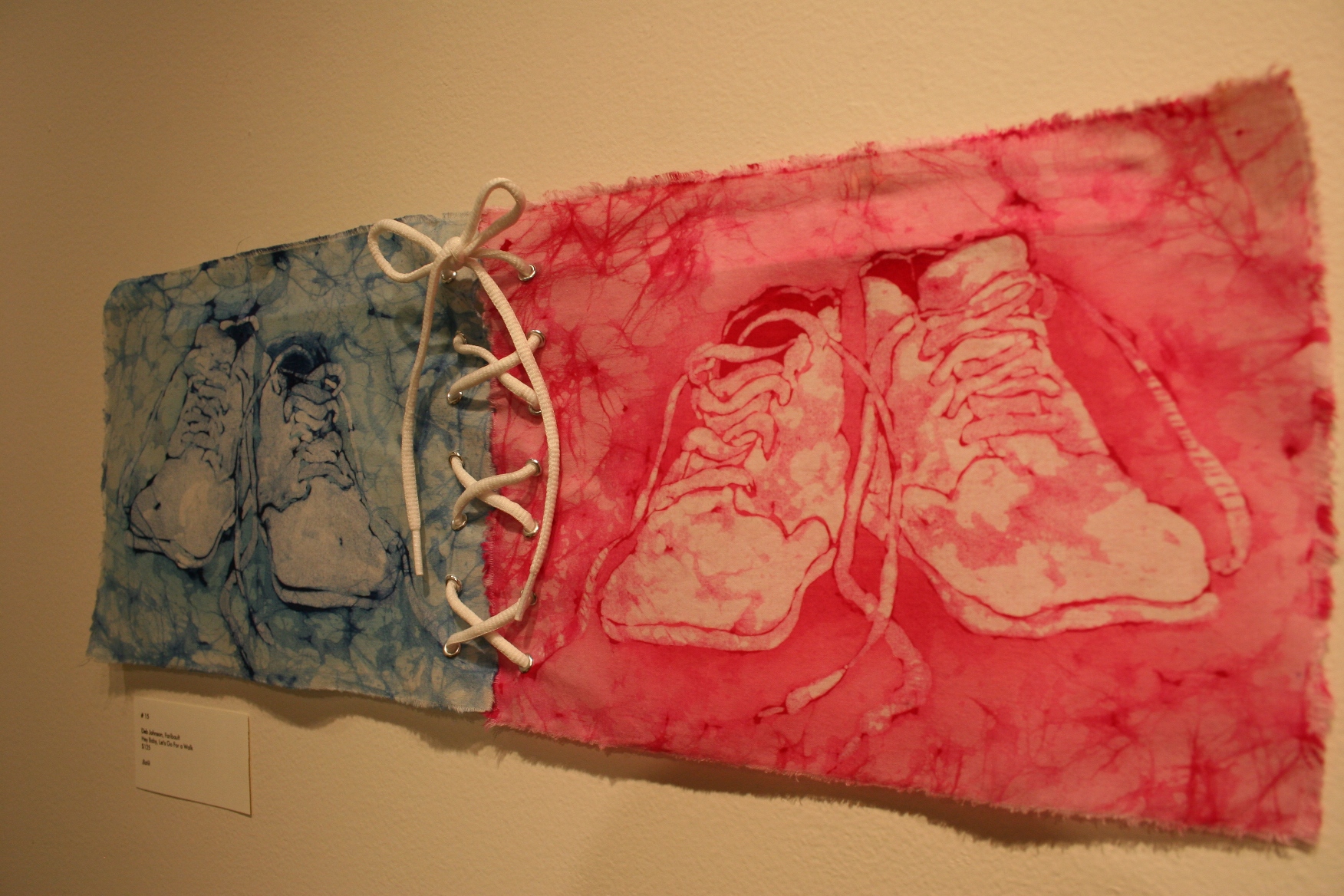
Faribault artist Deb Johnson's batik, "Hey, Baby, Let's Go For a Walk."

Truly, every artist has communicated some message, some idea, on the subject of shoes. Many have shared stories in addition to art.

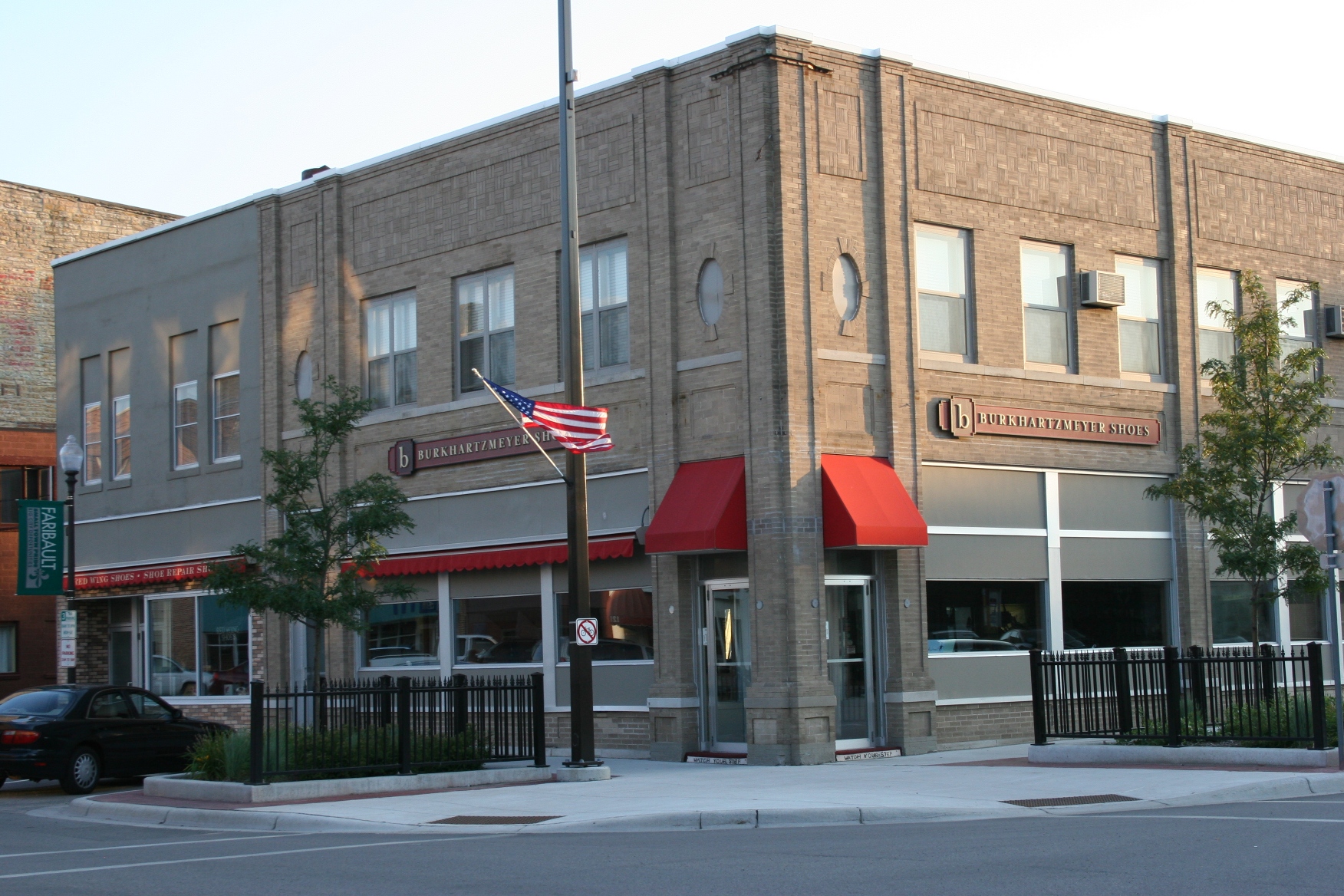
Krista Kielmeyer Swanson, for example, presents a nostalgic remembrance of shopping at Burkhartzmeyer Shoes, a long-time family shoe store several blocks away and a co-sponsor of “Shoe Stories” along with Johnson Advisors. Writes Swanson: “To this day I can remember the feeling I would have when you handed me my shoes, tied with string. I felt so proud walking out of the store carrying my new shoes.”

Burkhartzmeyer Shoes, "A Family Tradition Since 1949," and located at 128 Central Avenue in Faribault. Purchased shoes are still boxed and tied with string in this old-fashioned traditional shoe store.

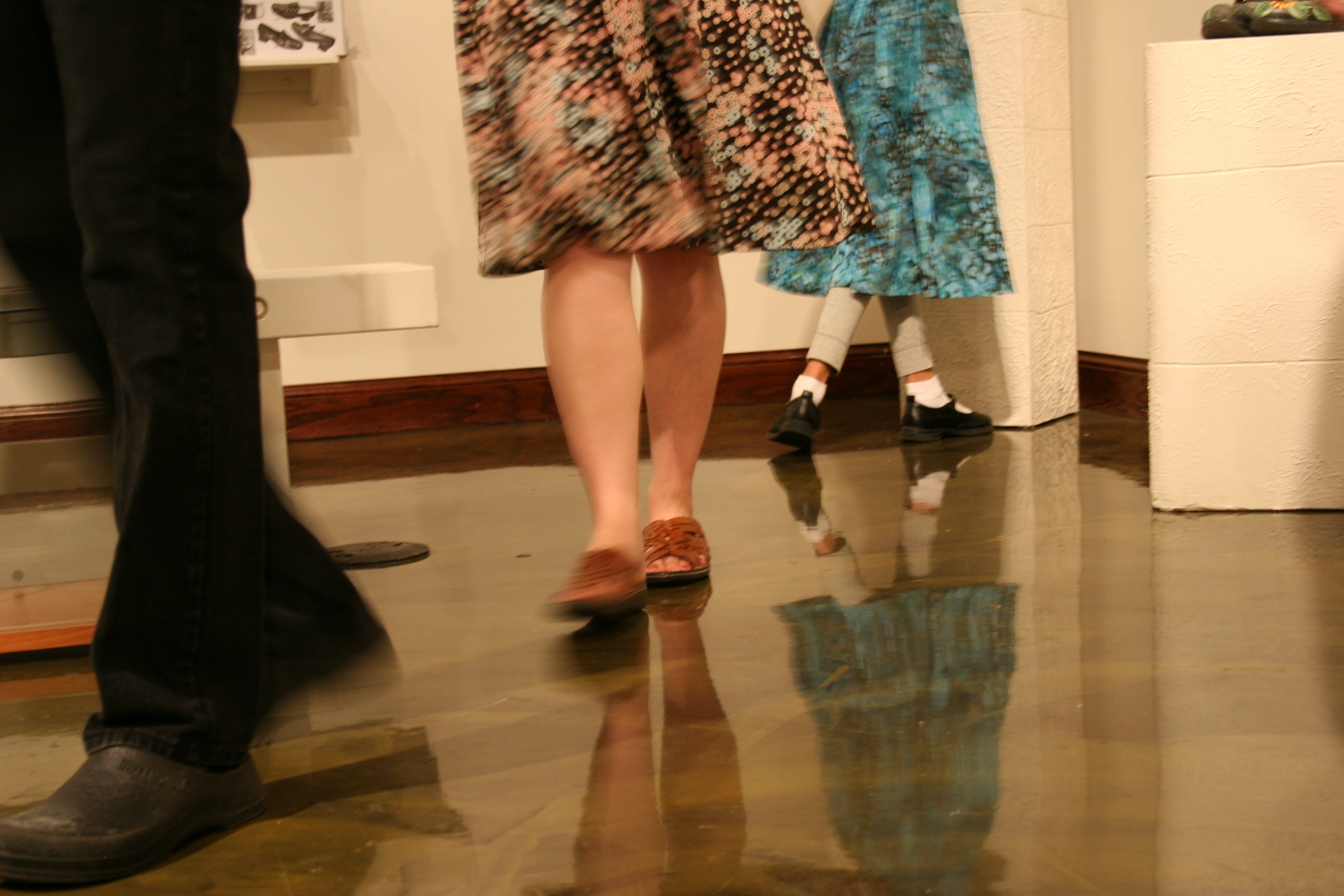
As I read the stories, peruse the art, I begin noticing the shoes of other art gallery visitors—strappy leather sandals, shiny Mary Janes, sturdy two-toned practical ties, clogs…

"The Sole of Art," my blog art version of "Shoe Stories," inspired while photographing exhibit visitors' shoes.

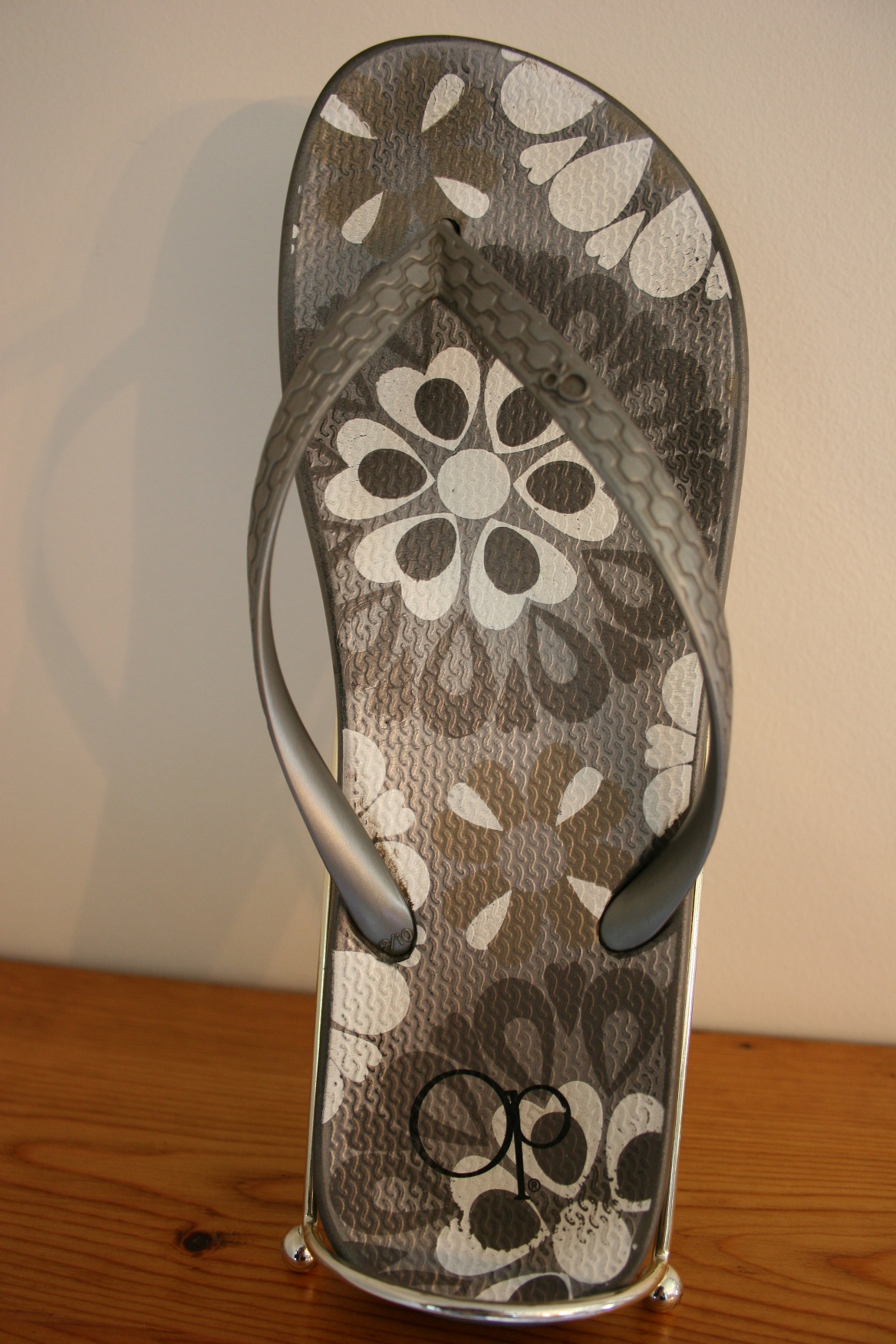
And then I look down at my feet and my silver flip flops which, except for the field of flowers growing under my soles, resemble “1,001 Uses for Duct Tape.”

My silver flip flops, purchased at a major retailer.

“SHOE STORIES,” the idea of Faribault artist and PCA Gallery Committee member Arlene Rolf, is showing through September 25 in the Carlander Family Gallery. The art center is open Tuesday through Saturday and is located at 321 Central Avenue in historic downtown Faribault.

© Copyright 2010 Audrey Kletscher Helbling
 

Gargoyles perform at The Cathedral of Our Merciful Saviour August 9, 2010

THE CHURCH DOOR bangs, the weight of the solid wood slamming against the frame as if decisively shutting out the hot, humid air that oppresses on this sultry Sunday afternoon in August in Minnesota.

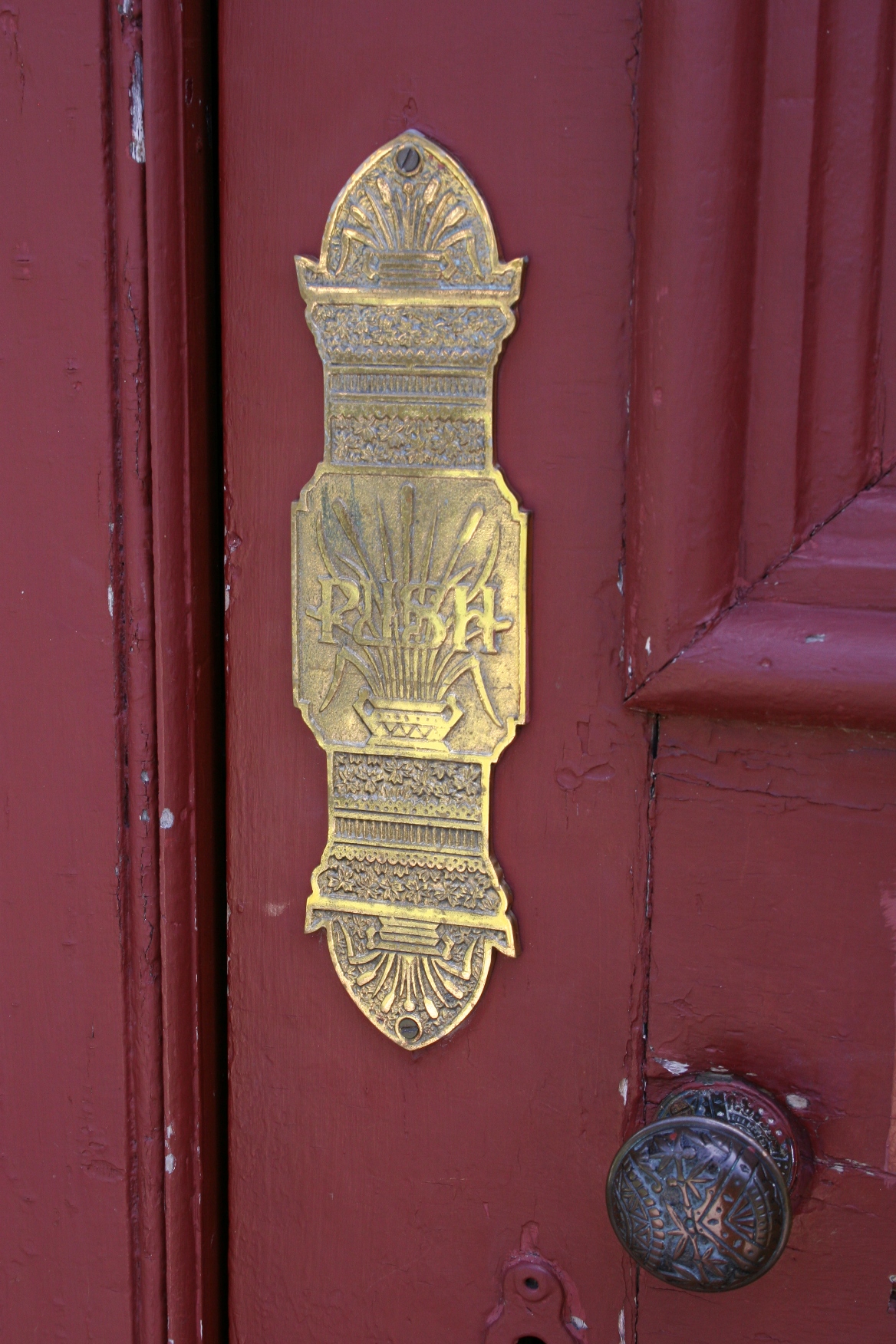
We entered The Cathedral of Our Merciful Saviour through this heavy side door, which you need to push rather than pull, we learned after waiting outside, thinking we were locked out of the church.

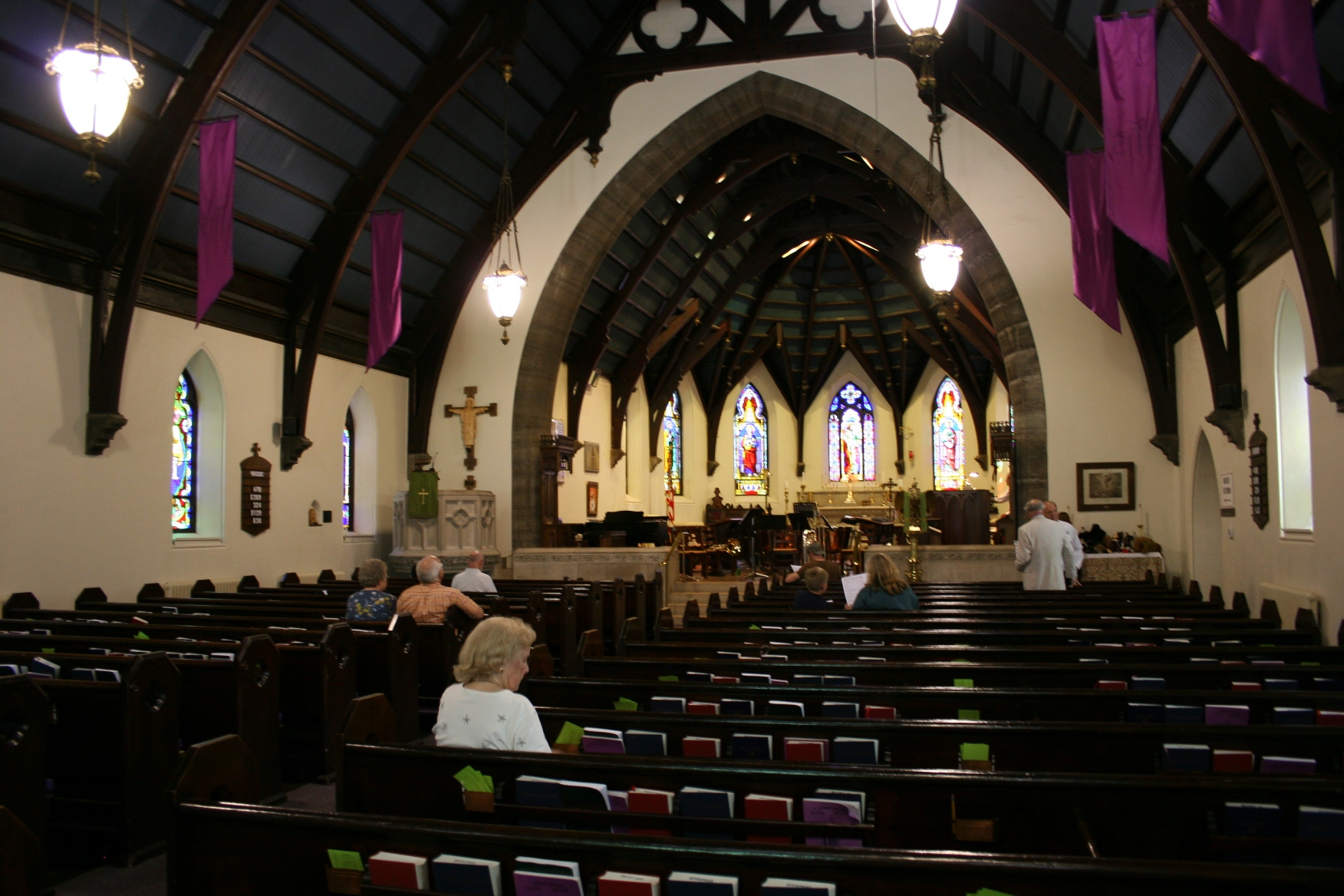
Inside the sanctuary, I seek respite from the suffocating 90-plus degree heat. I settle onto a purple cushion which softens the hardness of wood against flesh in a pew that forces me to sit ramrod straight.

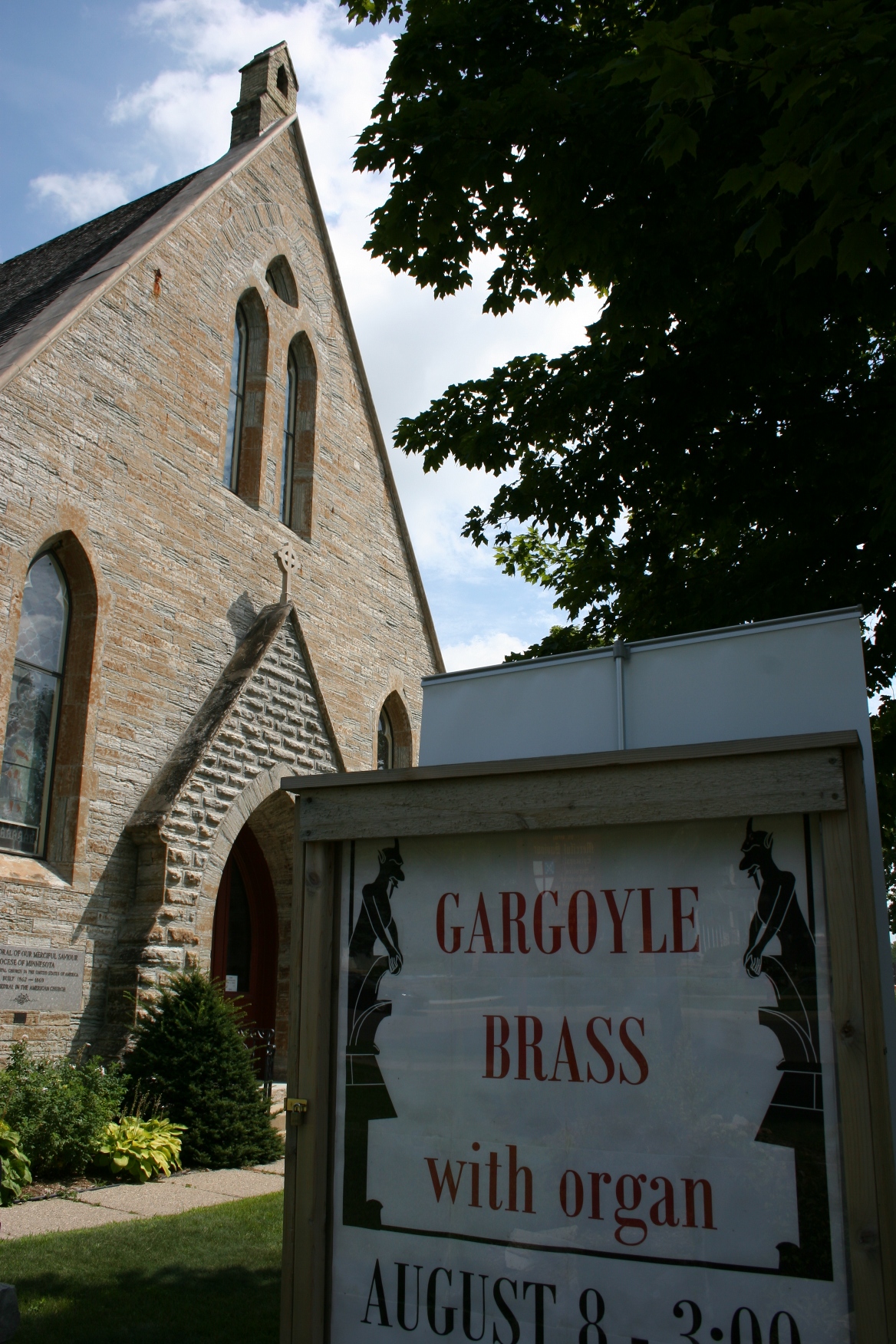
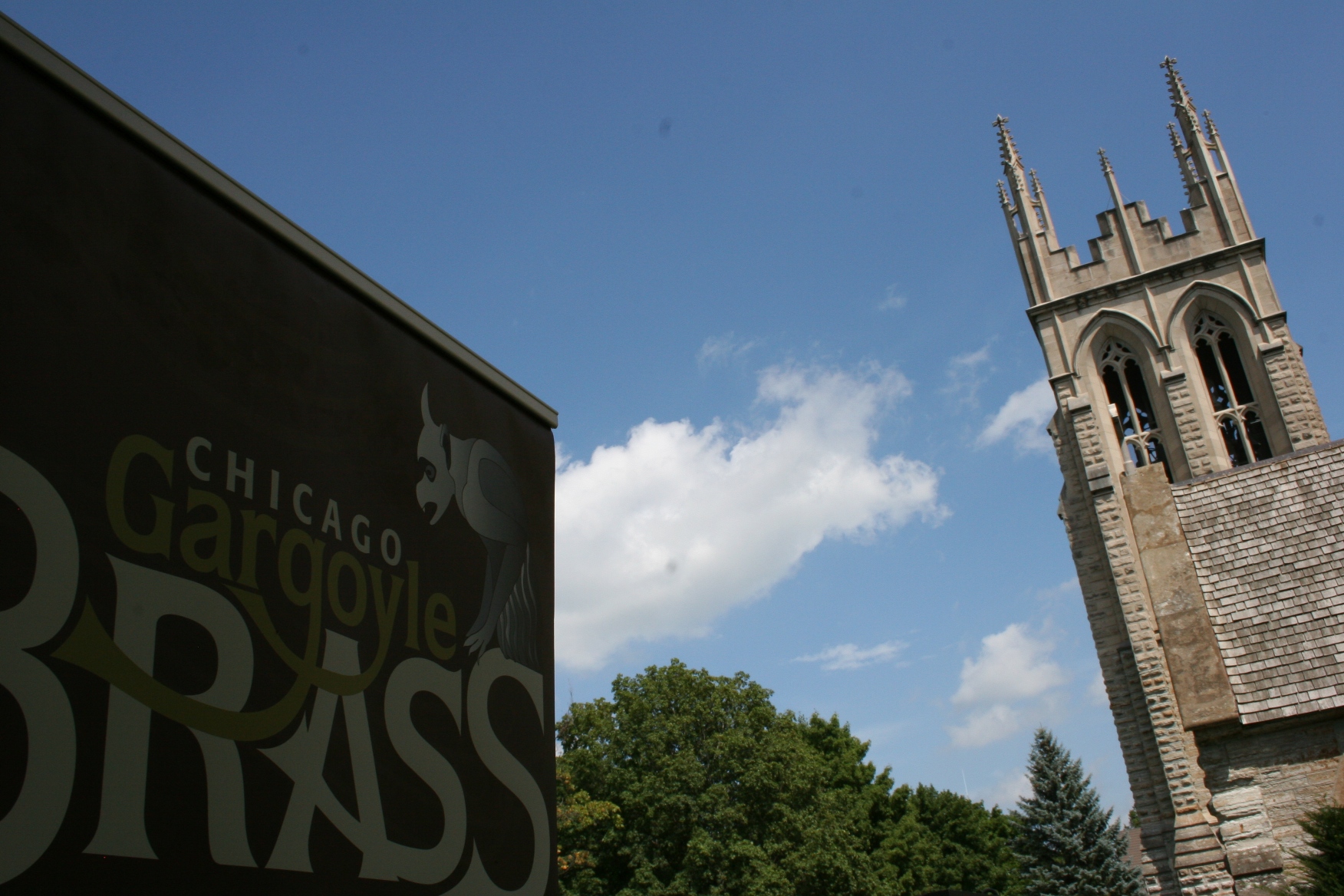
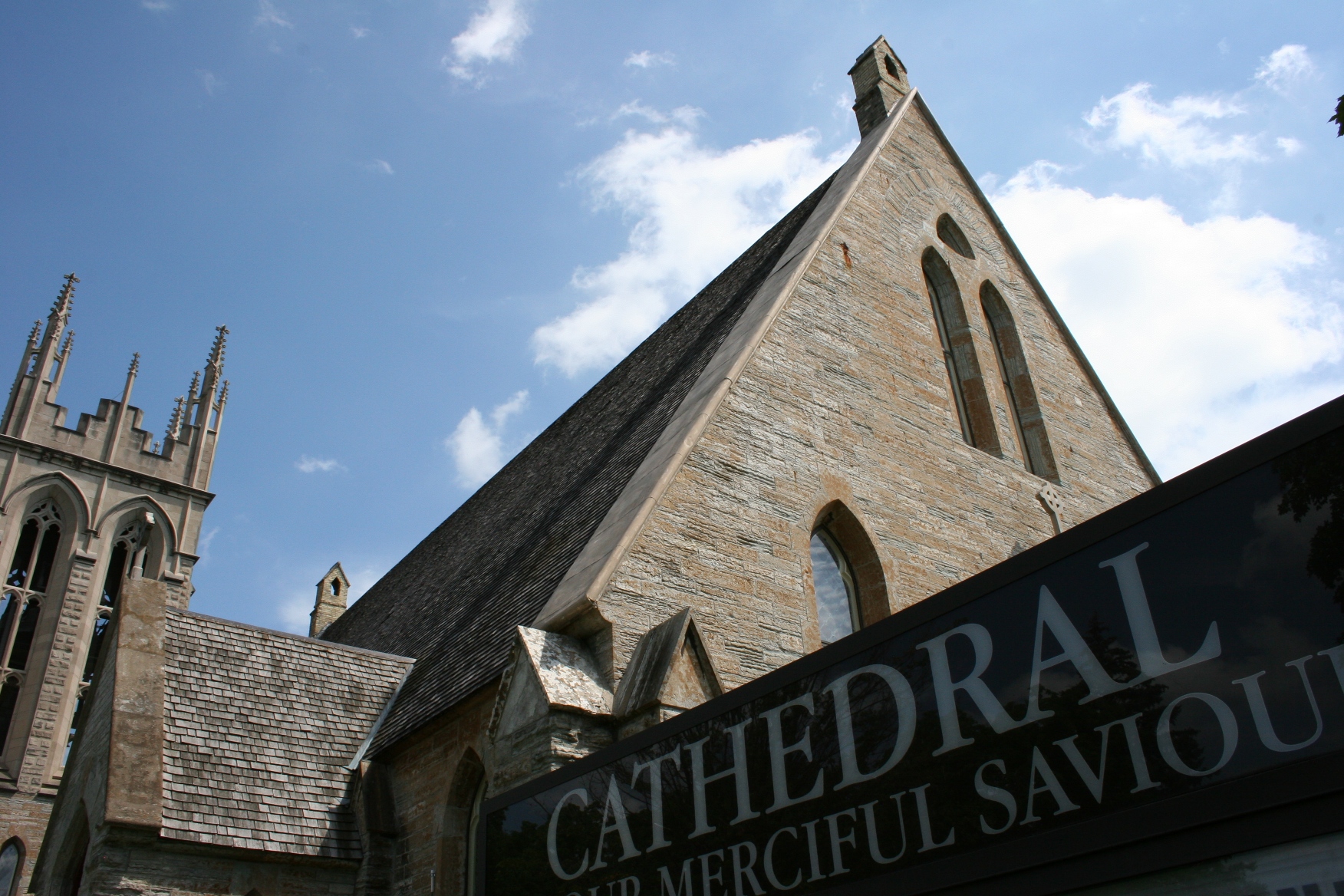
My husband and I, expecting a packed house, have arrived early for a performance by The Chicago Gargoyle Brass at The Cathedral of Our Merciful Saviour in Faribault. This massive structure with its looming tower was constructed from 1862 – 1869 as the first Cathedral of the American Church.

The Chicago Gargoyle Brass presented a Sunday afternoon concert at The Cathedral of Our Merciful Saviour in Faribault.

The Cathedral of Our Merciful Saviour sits along Second Avenue across from Faribault's Central Park.

Inside, I welcome the coolness, visually defined by stone and by the dark wood that shapes the arches of the ceiling.

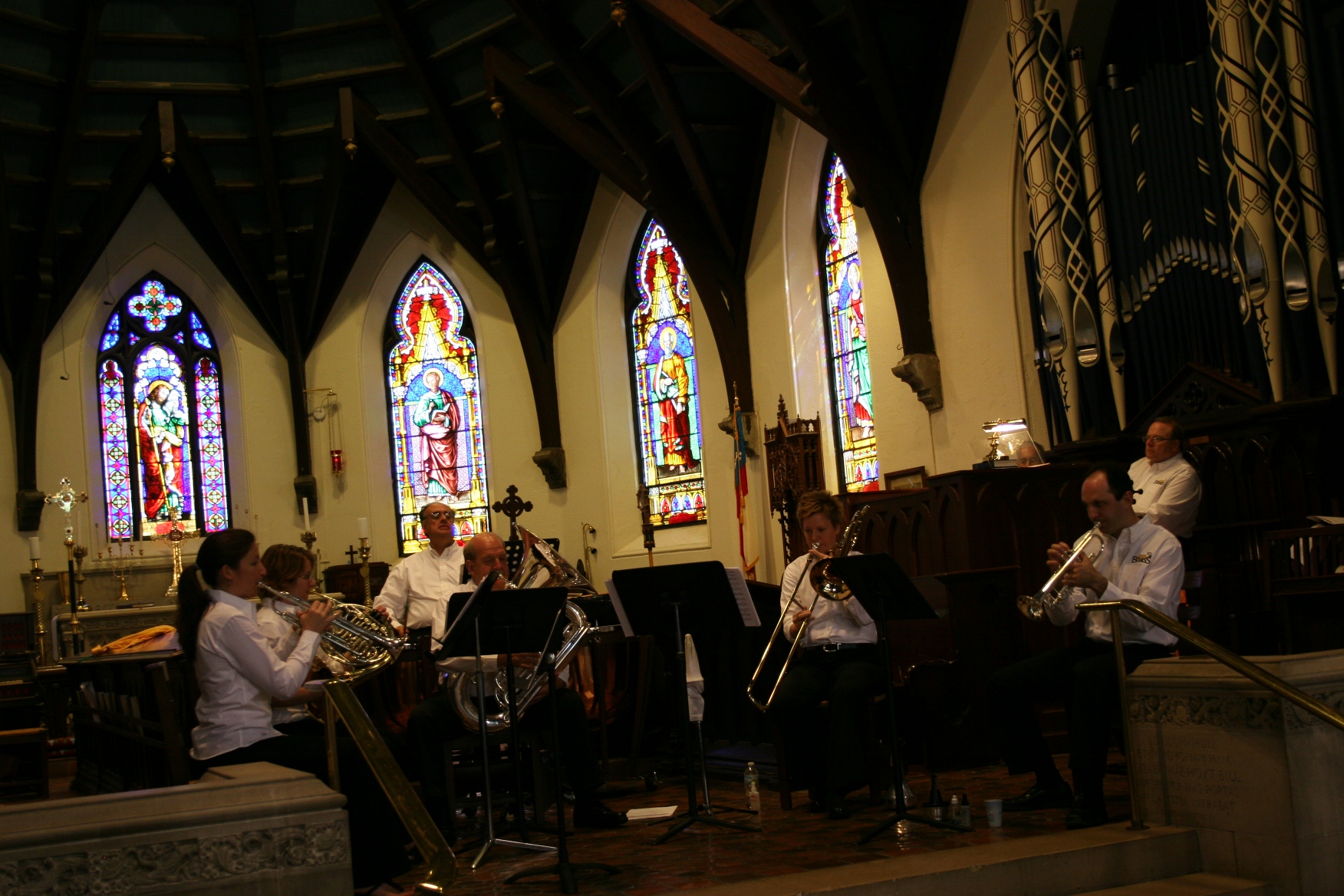
In the chancel area, which stretches an interminable distance from the pews and which is bigger than some country churches I’ve seen, Gargoyle Brass members have positioned their gleaming instruments and music stands at the forefront. Six stained glass windows embrace this “stage” with the glorious 1871 pipe organ (with more old pipes than any other in Minnesota), to the right.

Concert attendees filter into this historic cathedral made of dark wood and stone.

Truly, I am in awe of this cathedral. “This place smells old,” I whisper to Randy as I run my hand along the back of a pew. “Are these the original pews?” They are, I learn upon reading a brochure I’ve picked up. A Civil War veteran cut and planed the wood from northern Minnesota white pine.

I can’t seem to take my eyes off the brass eagle that serves as a lectern given in honor of Bishop Henry Whipple’s wife, Cornelia, who died in July 1890. Bishop Whipple settled in Faribault, oversaw construction of the cathedral and Episcopalian schools and was known for his efforts in helping and befriending Native Americans.

While I wait for the concert to begin, I contemplate the beauty and history of this place and the effort it must have taken to build this stone cathedral.

Soon the concert, part of The Vintage Band Festival hosted in nearby Northfield, begins and we are swept away by the sounds of trumpets, horn, trombone, tuba and timpani (kettledrums) melded with the organ.

The Chicago Gargoyle Brass performs at the Cathedral of Our Merciful Saviour.

I am surprised mostly that the organ does not overpower this cathedral. Often, the music sounds more sedated and muffled than majestic, as I had expected. That has nothing to do with the quality of the organists—for they are superb—but more, I think, to do with the organ placement.

At one point during the concert, a key spring on the organ breaks and a second organist must hold up the key during a performance. “Does someone have some bubblegum?” one of the musicians asks the audience. I’m not sure whether he’s serious or joking, but the concert continues without the gum.

Admittedly, I am no music expert. I can’t read notes. I barely know one instrument from another. So my enjoyment of music is purely, solely authentic, grassroots basic. When my head bobs spontaneously, when I feel the music reverberating, tingling my feet, when I feel an emotional connection, then I know I am hearing good music.

Sunday afternoon I heard good, even great, music from The Chicago Gargoyle Brass, which began in 1992 as a University of Chicago based group. The name was derived from the university’s architecture.

“I love this church,” horn player Arisia Gilmore tells us before performing “Twas a Dark and Stormy Night” with Michael Surratt at the organ. “It’s fitting for the atmosphere we’re trying to portray here.”

As I listen to the music build, like a storm, Randy leans toward me. “Does this remind you of two weeks ago?” he speaks softly into my ear. I nod. He is, like me, recalling the night of July 23 when we were caught in our car on a rural southwestern Minnesota road in the middle of a raging thunderstorm that packed 70 mph winds.

That’s the purpose of music, I think—to stir passions, emotions and, yes, even memories of dark and stormy nights when gargoyles lurk.

A looming tower marks the cathedral located along Second Avenue across from Faribault's Central Park.

© Copyright 2010 Audrey Kletscher Helbling
 

“It could be cancer, but you’re too healthy” August 7, 2010

Filed under: Uncategorized — Audrey Kletscher Helbling @ 10:49 AM
Tags: , , , , ,

Layton Fossum, cancer survivor, poses with a luminary bag given in his honor at the Straight River Stroll in Faribault Friday night.

MEET LAYTON FOSSUM. Two years ago the Northfield man suffered from a raspy throat, a hearing loss and then a twitch in his face.

Must be a virus, the doctors initially told him. But the then 45-year-old persisted and eventually was diagnosed with a very rare form of cancer with a name he struggles to pronounce. So he simply says “head and neck cancer.”

After a 10 ½-hour surgery that was supposed to take three, he emerged with 40 fewer lymph nodes, but thankful to be alive. Next he would explore his post-operative treatment options, traveling to Houston, Seattle, Illinois and California before finally settling on radiation at Cancer Treatment Centers of America in Zion, Illinois.

Through-out his journey, this Malt-O-Meal employee who missed six months of work due to his cancer and is happier than ever now to go to work, has remained positive. Even today he can joke about his experience. “I told my wife I’m worth more. I have gold in me,” Layton tells me Friday night at the Rice County Fairgrounds in Faribault during the American Cancer Society Straight River Stroll.

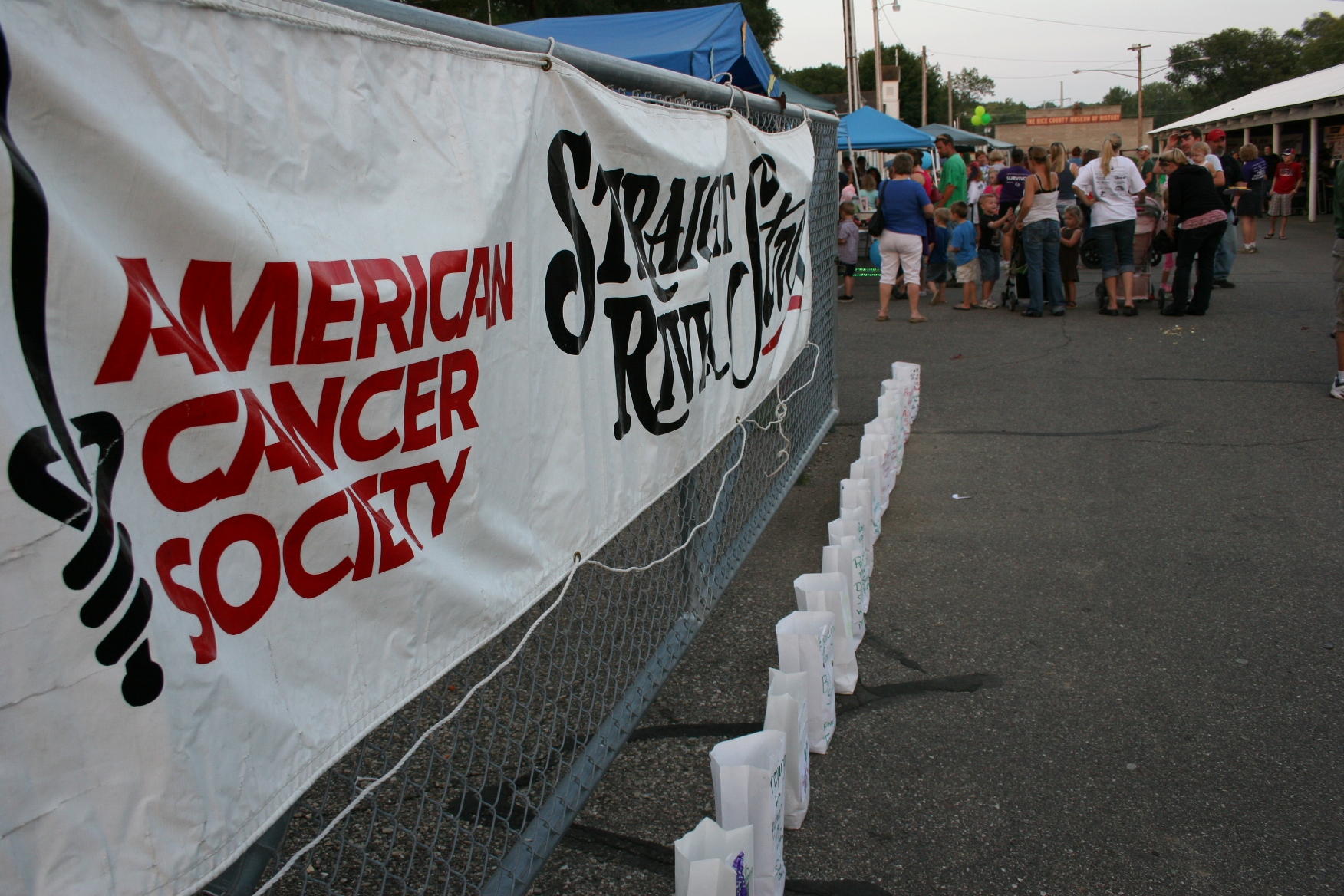
Thousands gathered Friday evening at the Straight River Stroll at the Rice County Fairgrounds to raise funds for cancer research to remember, celebrate and pray for those touched by cancer.

Layton points to his right eye and the lump of gold in his eyelid. Because he no longer has facial nerves on the right side, he needs the weight to help close the lid, which will shut only when he closes the opposite lid.

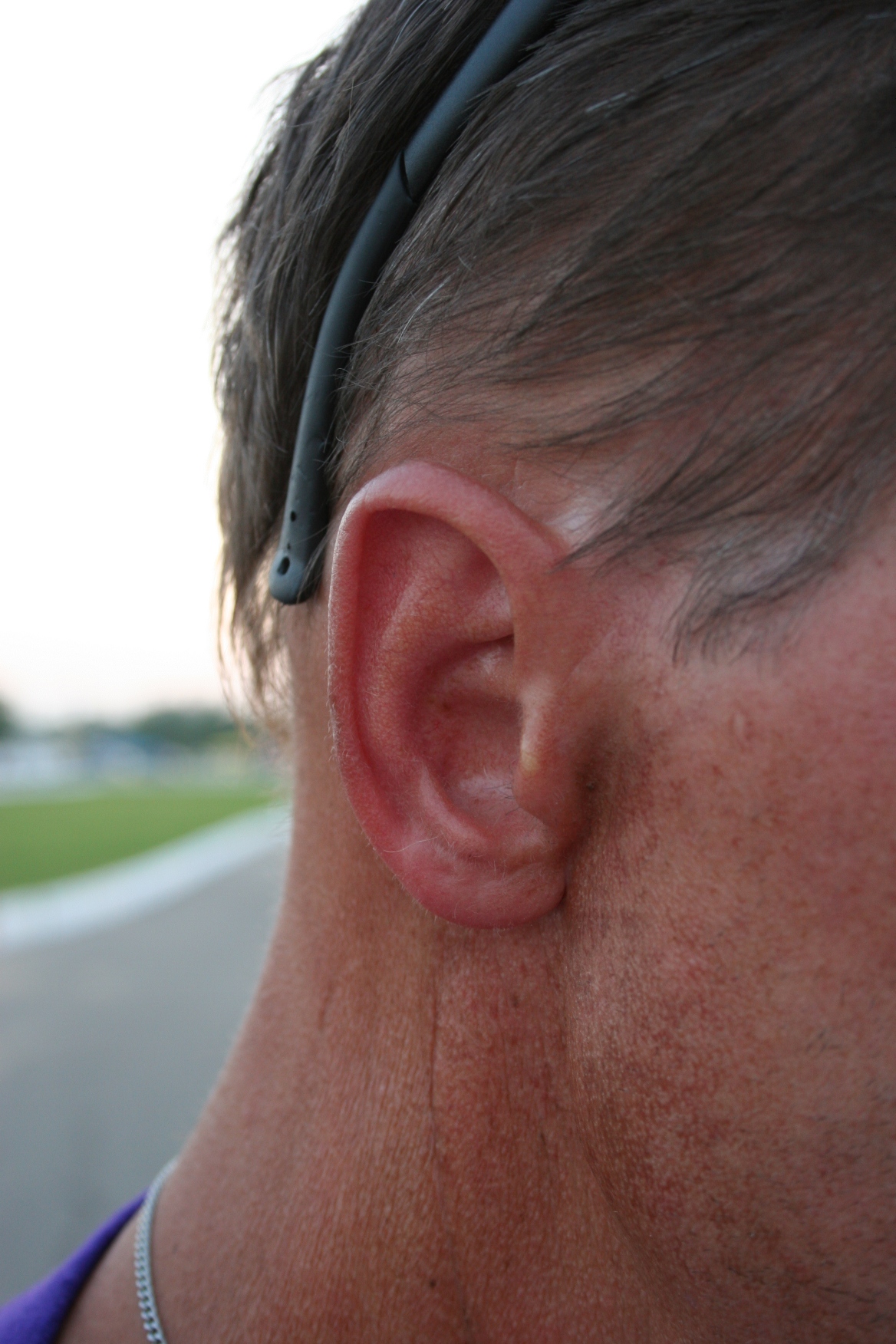
Then Layton shows me his ear, which, too, was reshaped during reconstructive surgery to tighten his drooping face.

Layton has no hearing in his right ear, which was reshaped during reconstructive facial surgery.

Yet, despite all he has undergone, despite the changes in his appearance, Layton remains upbeat and eager to tell his story. He was invited back to Zion and spoke for 1 ½ hours to a roomful of suit-and-ties, he says.

Before his diagnosis two years ago, Layton was the picture of health, the last one you would expect to get cancer, a friend says.

He heard the same from doctors: “It could be cancer, but you’re too healthy.”

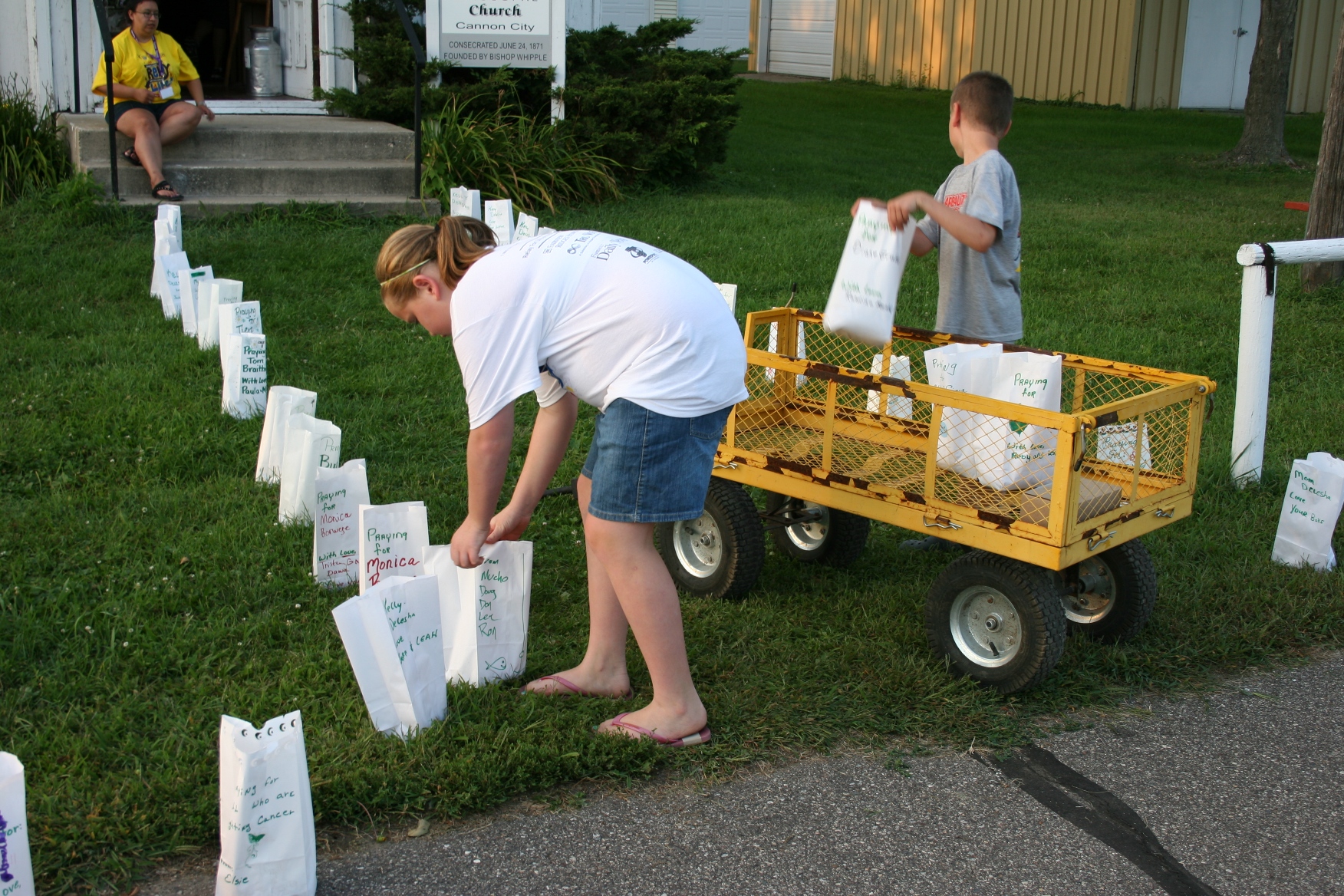
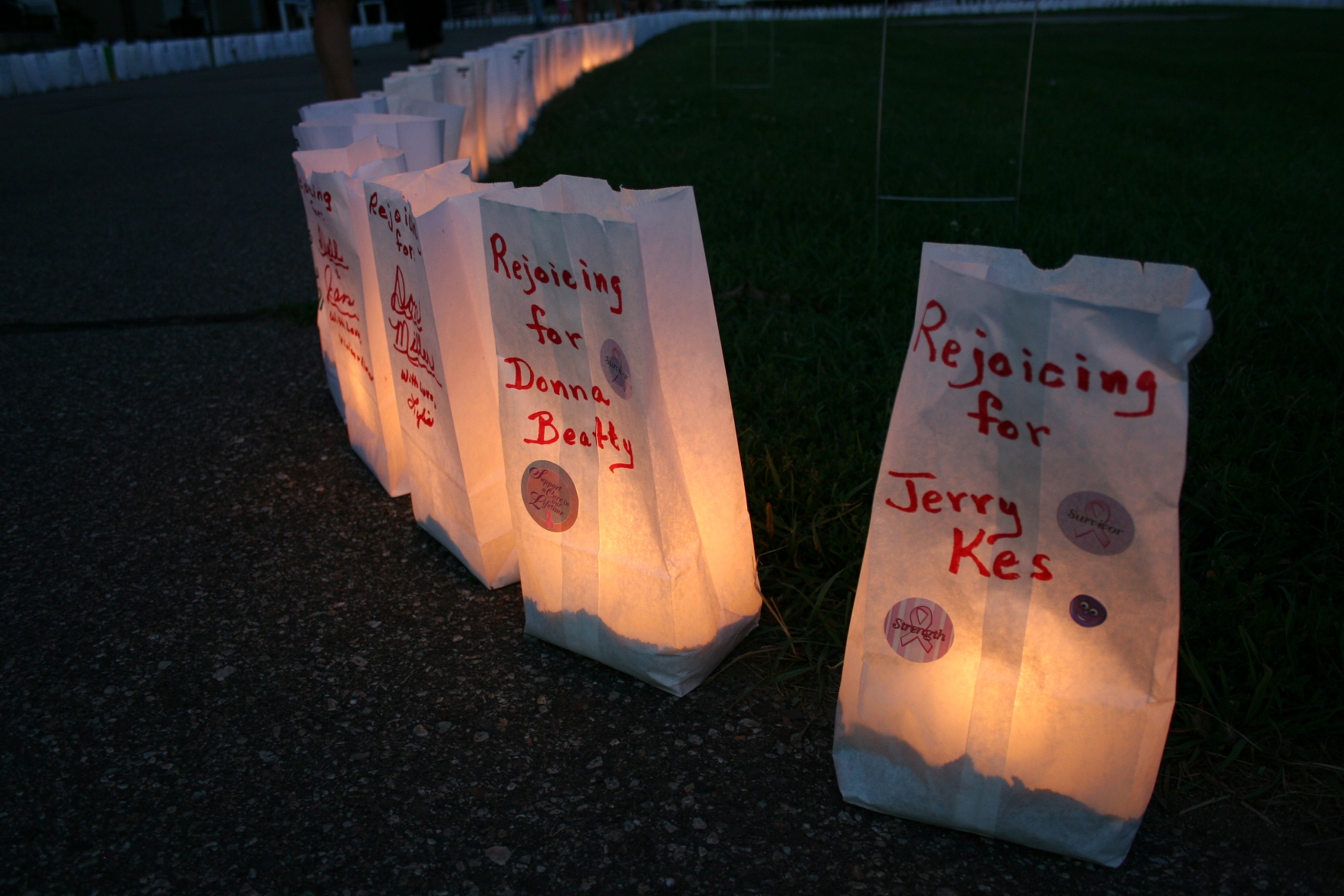
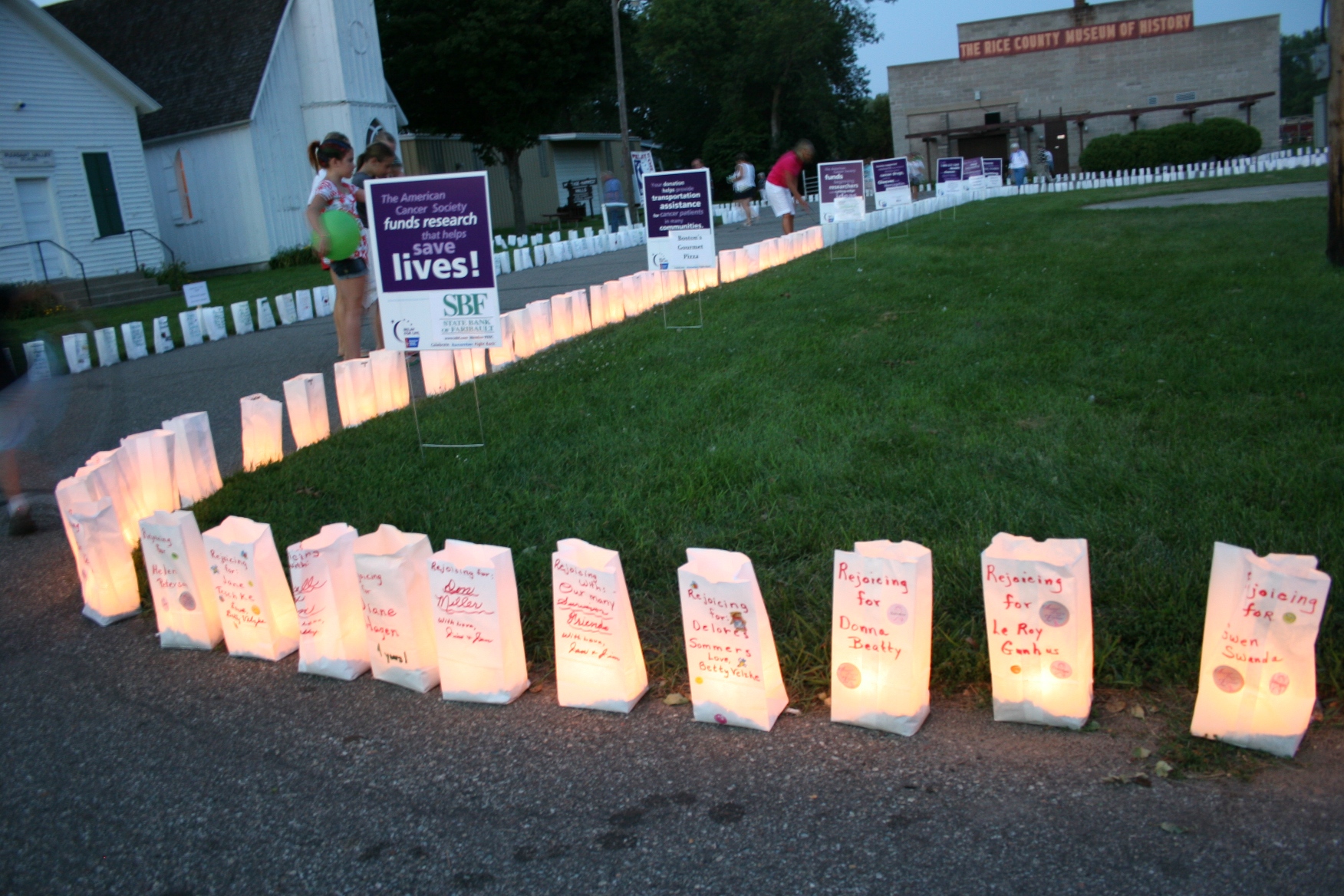
Still, he did have cancer. And Friday evening Layton was among those celebrating their cancer-free lives at the Straight River Stroll, a Relay for Life event to fund cancer research. As I walked beside him, switching from his right to left side so he could hear me, I marveled at this man who stopped often, bent low to read the names written on white paper bags in memory of, praying for and rejoicing with those who, like him, endured cancer.

Some lost the battle. Some won. Some are still fighting.

This team of kids set out luminaries by the wagonful.

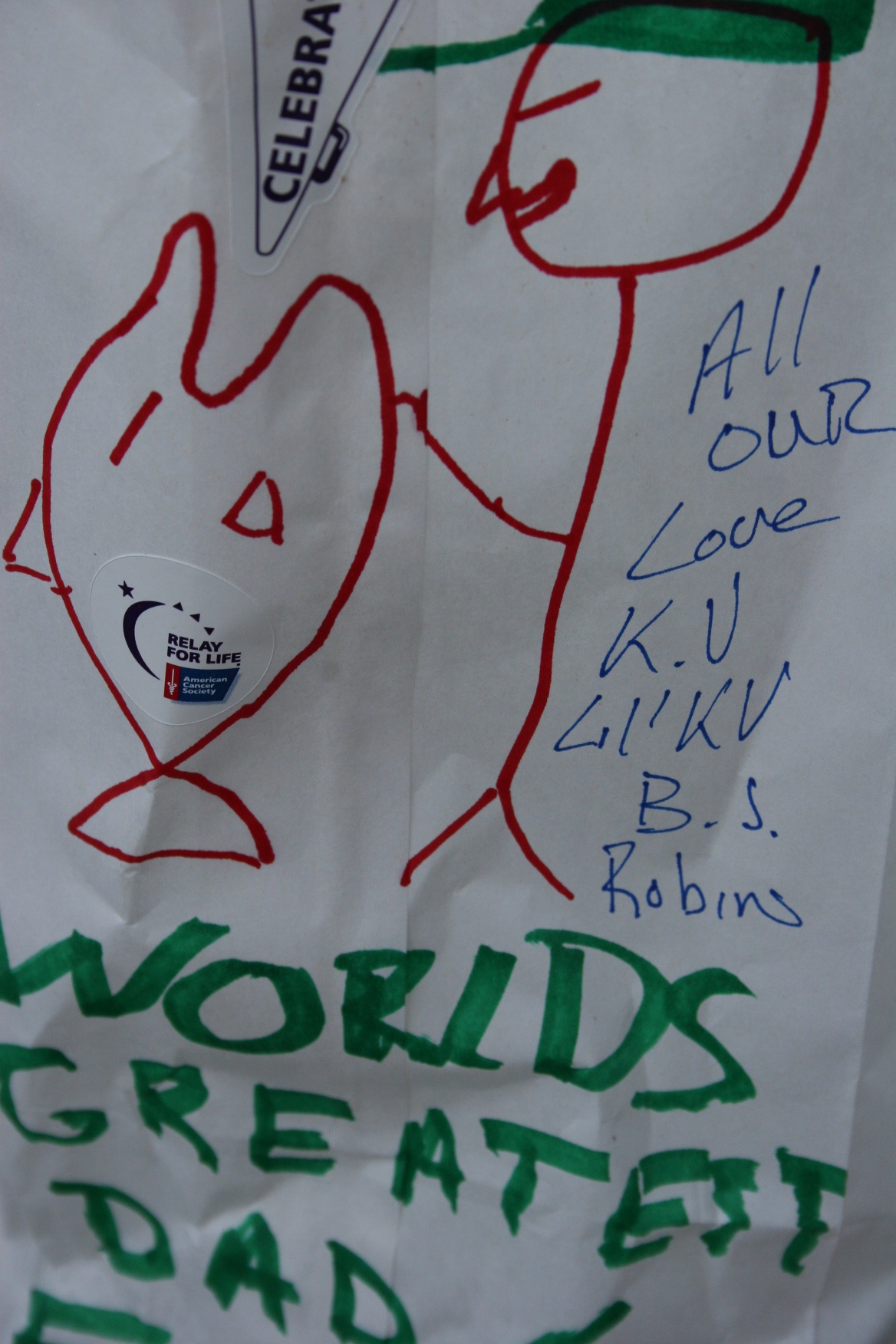
Among the personalized bags, I discovered this especially touching one drawn by a child in celebration of a father's survival.

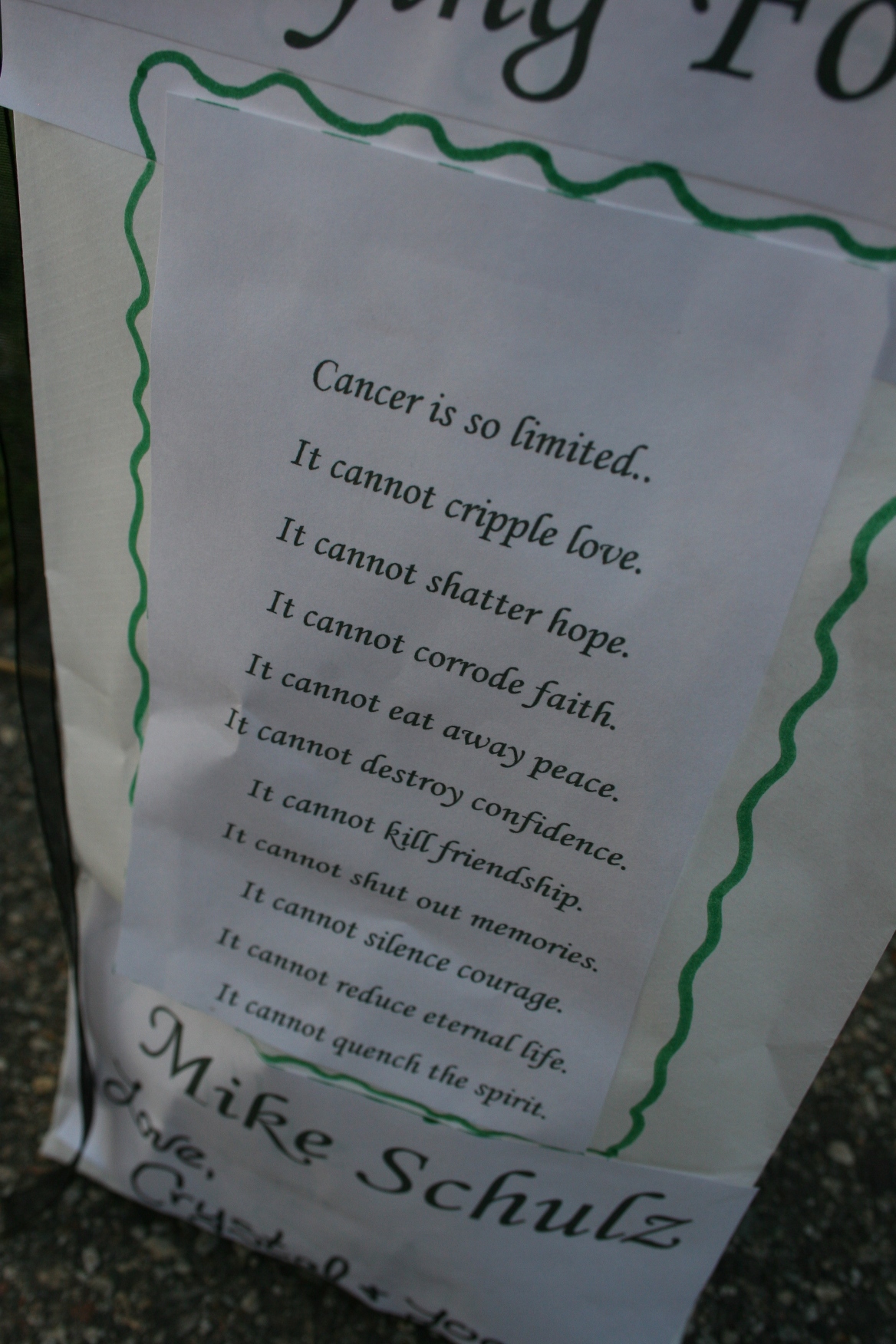
Words of encouragement for Mike Schulz.

A luminary honors Sandy Doehling, who died of breast cancer.

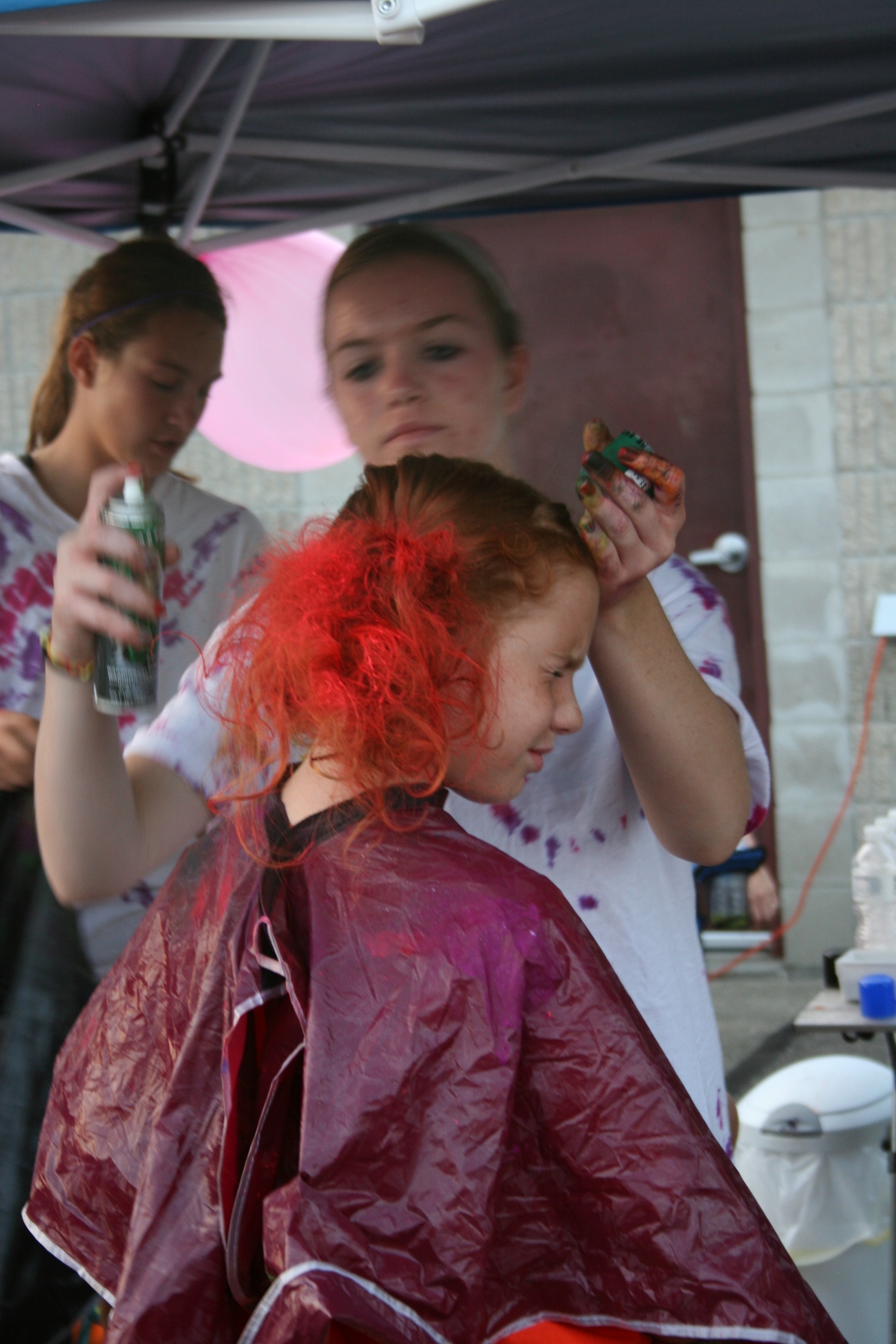
Kids and teens, even adults, lined up to have their hair spray painted at a booth to raise funds for cancer research.

A volunteer ratted and sprayed a girl's hair, all to raise monies for cancer research at the Straight River Stroll.

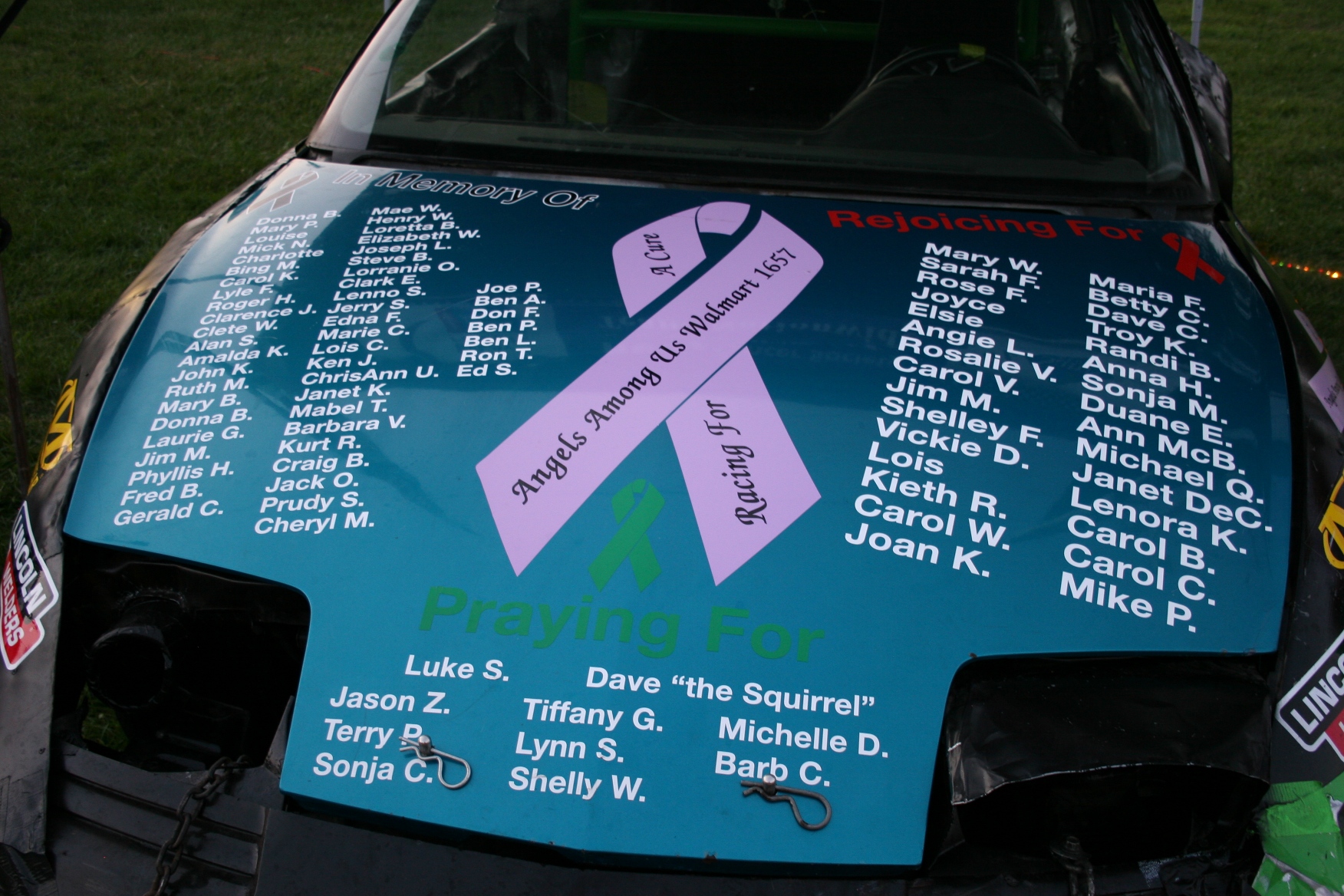
Kids could climb inside this race car, with a hood especially designed to recognize those who have endured cancer. The hood is placed on the car, which races at Elko Speedway, only for special occasions like the Stroll.

Faribault resident Jerry Kes led the Stroll as an honored cancer survivor.

As dusk settled, volunteers began lighting the luminaries which stretched and wound around the fairgrounds.

(This post is written in memory of my dad, who died of esophageal cancer in 2003; my nephew, Justin, who died of non-Hodgkin’s lymphoma in 2001; and my mom, who is a breast cancer survivor.)

© Copyright 2010 Audrey Kletscher Helbling
 

The anatomy of an Allis-Chalmers auction on a Minnesota farm August 6, 2010

Filed under: Uncategorized — Audrey Kletscher Helbling @ 8:11 AM
Tags: , , , , , ,

THEY CAME…

the young

and the older

to Allis-Chalmers collector Carl Krueger’s farm

where he sold his beloved truck

and his cherished Allis-Chalmers tractors

to the highest bidders.

The collectible Allis-Chalmers tractors

even the Wallis

and the Allis-Chalmers tractor manual sold.

But the neighbor’s rare 1964 Schafer failed to get a high enough bid.

Auction attendees fueled up on bars from the Lutherans

clasped steering wheels

at the auction on a Minnesota farm field on an August afternoon.

© Copyright 2010 Audrey Kletscher Helbling
(See my August 2 post for additional photos from Carl Krueger’s Allis-Chalmers auction.)


Frogs cast an enchanting spell in my sister’s Minnesota garden August 5, 2010

Filed under: Uncategorized — Audrey Kletscher Helbling @ 7:56 AM
Tags: , , , , , ,

One of the many frogs tucked among the flowers and plants in my sister's yard.

MY SISTER LANAE really doesn’t need a frog. She found and married her prince nine years ago.

Yet, she’s fallen hard for a bunch of frogs (technically an army of frogs) and a few toads. They’ve invaded her yard, taken over fountains and flower beds, bird baths and blossoms, and she’s welcomed them.

They’re all part of her plan, her grand plan to cast an envious spell (in my opinion) upon all who enter the enchanting world that is her backyard.

Now, you may think I’m exaggerating, playing this up, maybe even waving my own magical wand over you. But I’m not. My sister, the floral designer, has subtly tucked some 20 frogs and toads and other sweet little surprises into her gardens.

I marvel at her attention to detail, her designs, her intriguing way of naturally melding collectibles with the plants and flowers she has carefully selected, blended, nurtured. Her creations beckon visitors to pause, to really look, to delight in her artistry, for she is every bit an artist. Her yard is her canvas for the beautiful floral scenes she paints.

Last Sunday, during the Waseca Garden Club Garden Walk, folks noticed what I’ve known about my sister for decades. She colors outside the lines. She dares to make horses pink, cows purple. She is a strong, opinionated, determined, talented woman.

As I photographed Lanae’s vignettes, I eavesdropped, heard the praise, the ooohing and the aaahing, the exclaiming over her creations.

She deserves the gushing words—every single kudo, every single utterance of praise, every compliment—for she gardens with passion, with a love for the earth, with a heart for creating that which is absolutely, undeniably, beautiful.

Lanae created a lovely memory garden in honor of her friend, Vicki Andrejewski, who died in September 2009. Vicki's purple bird bath centers the garden, planted in her favorite colors of lime green and purple.

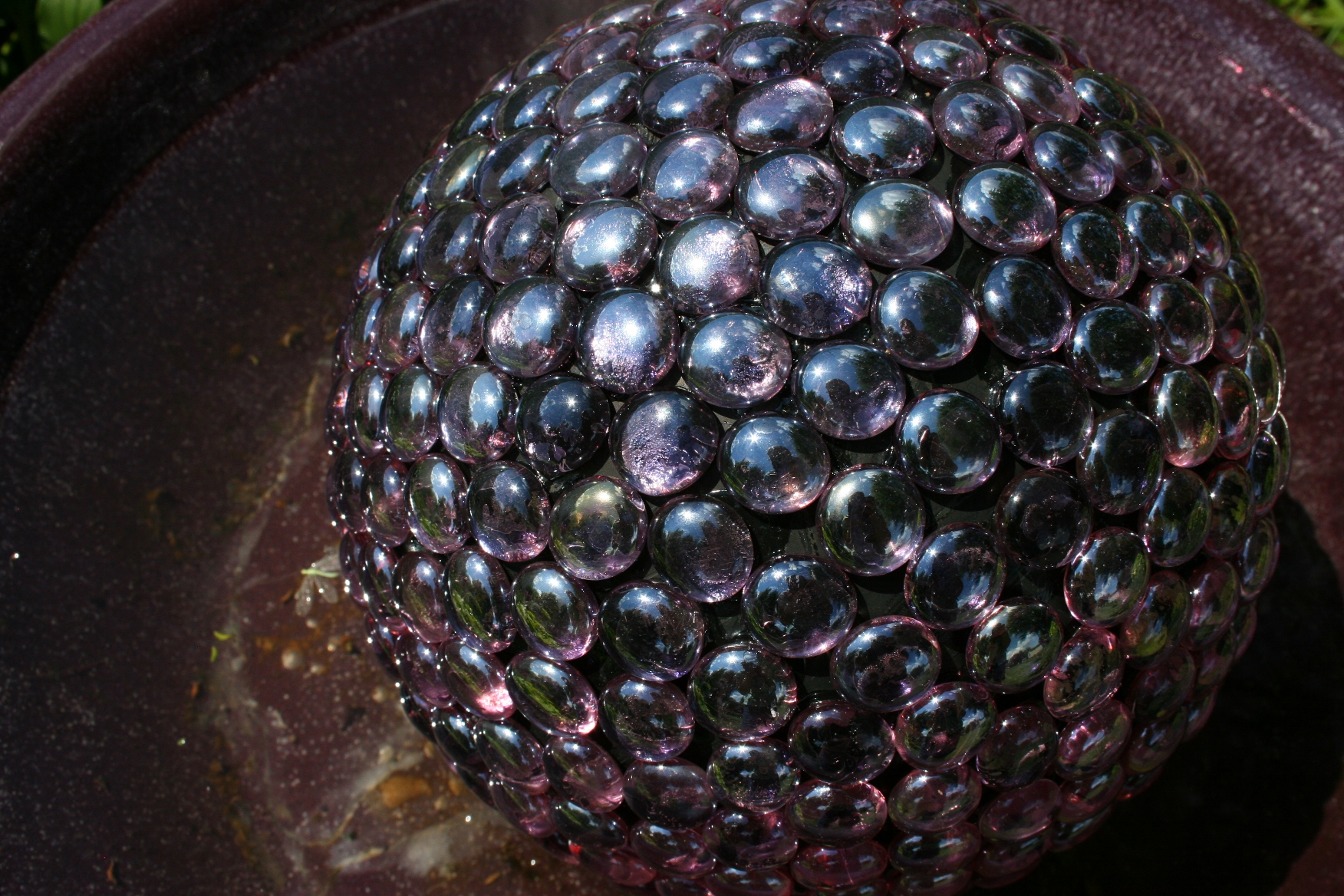
This gem-covered bowling ball drew the attention of visitors. Lanae applied "gems" to the recycled bowling ball using E6000 glue. The shimmering ball rests in Vicki's bird bath.

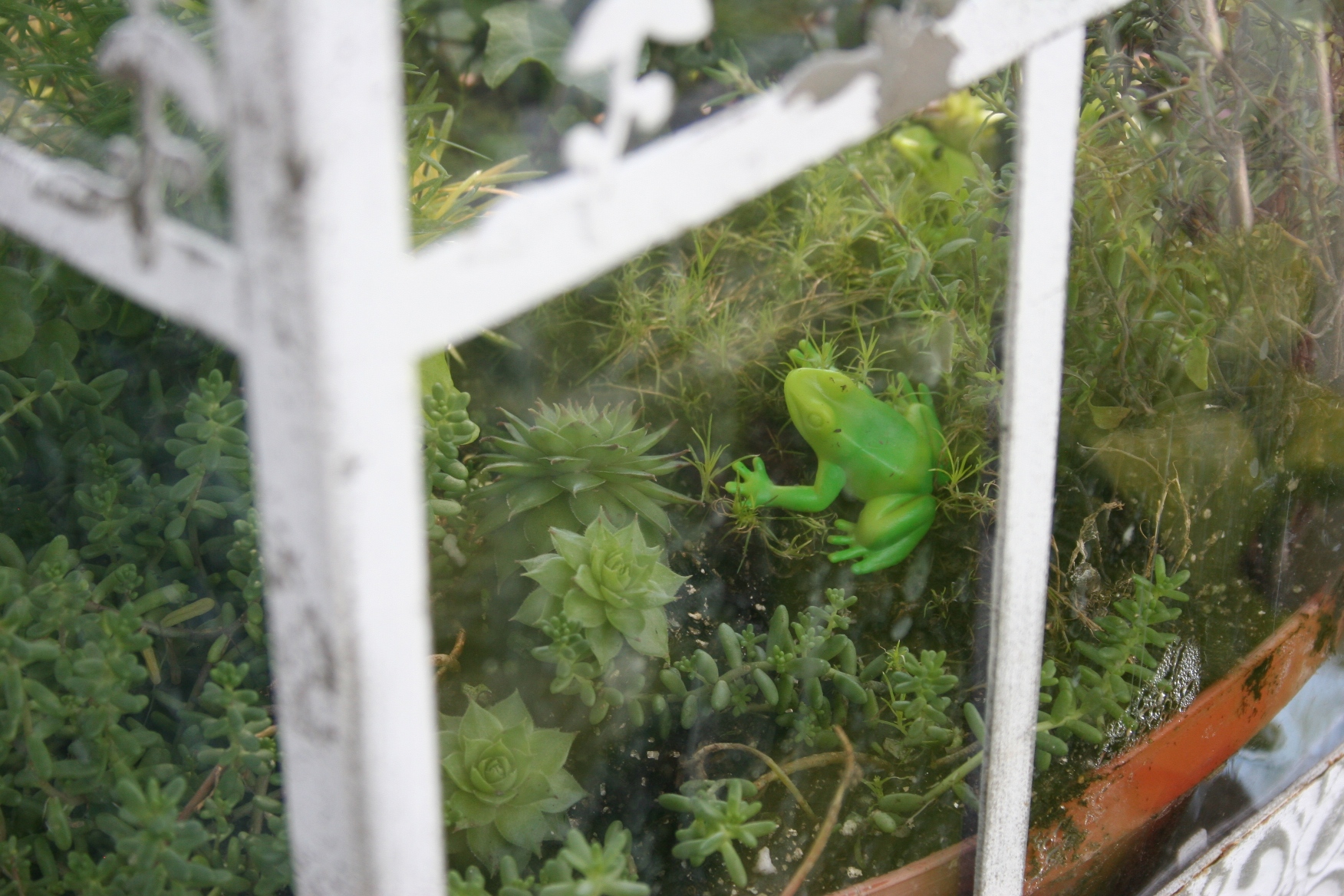
A bird bath accents a cluster of sedum. To the right, in the back, Lanae has rooted plants inside a birdcage-style terrarium.

Look closely and you'll discover a tiny frog tucked inside this birdcage terrarium.

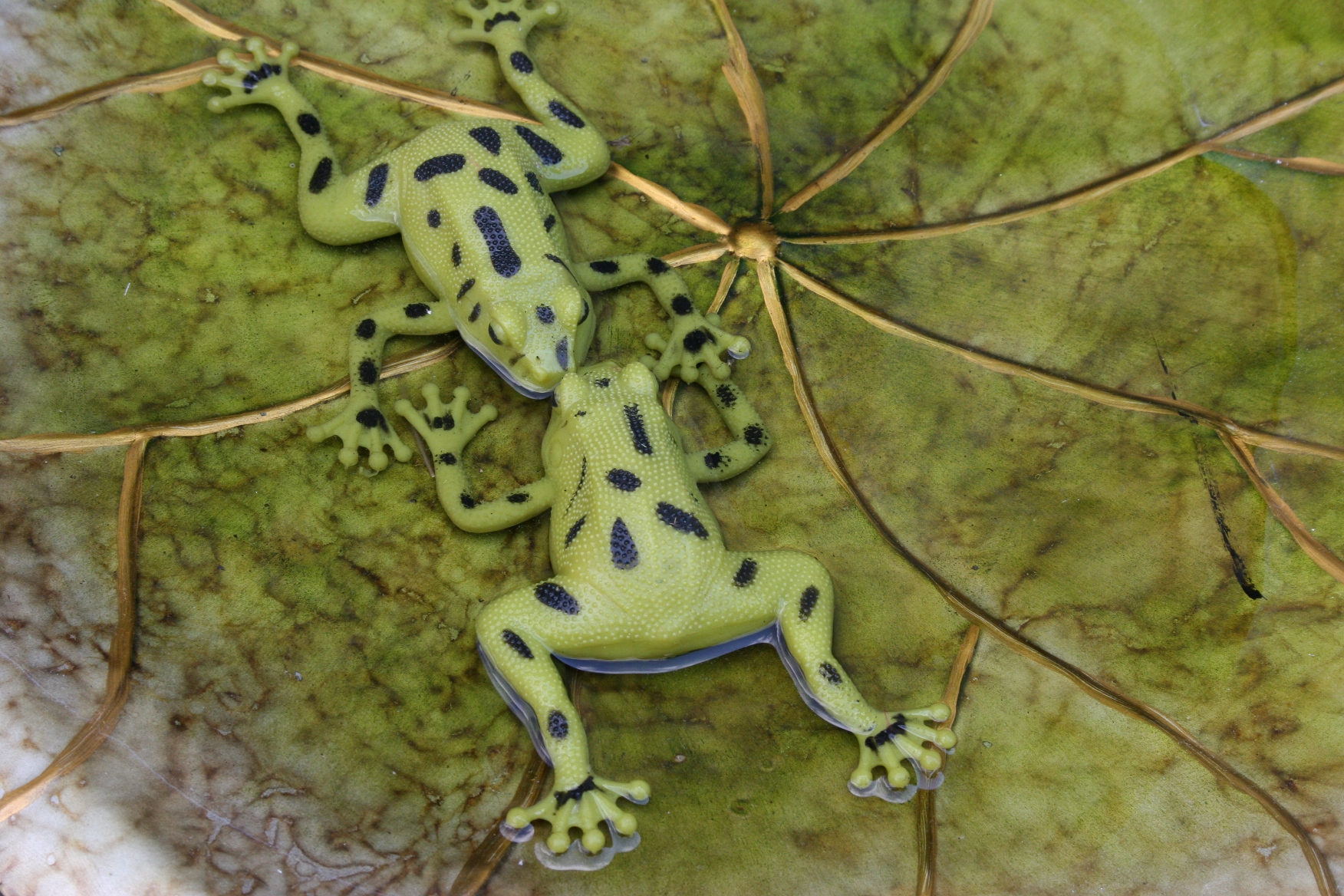
I saw a boy grab these squishy frogs from a bird bath and then playfully toss them back into the water.

Using chicken wire and wood, Lanae created a wall garden. She planted hen 'n chicks, creeping Jenny, Mezoo trailing red Dorotheanthus, two types of sedum and two types of thyme and leaned the box against a tree.

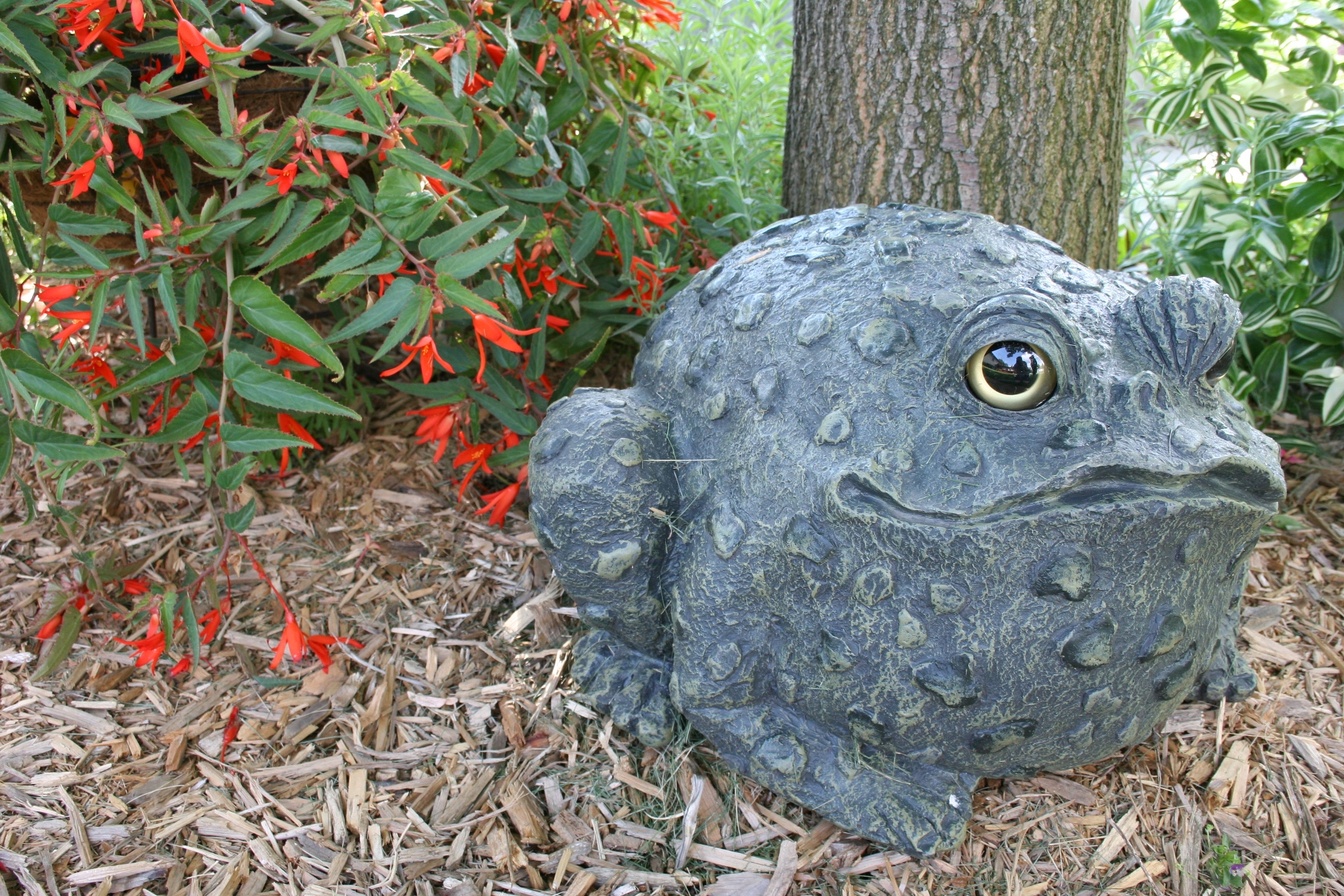
A sizable toad lounges under a shade tree next to a Firecracker begonia.

Fairy tale mushrooms brighten foliage in a shady garden spot.

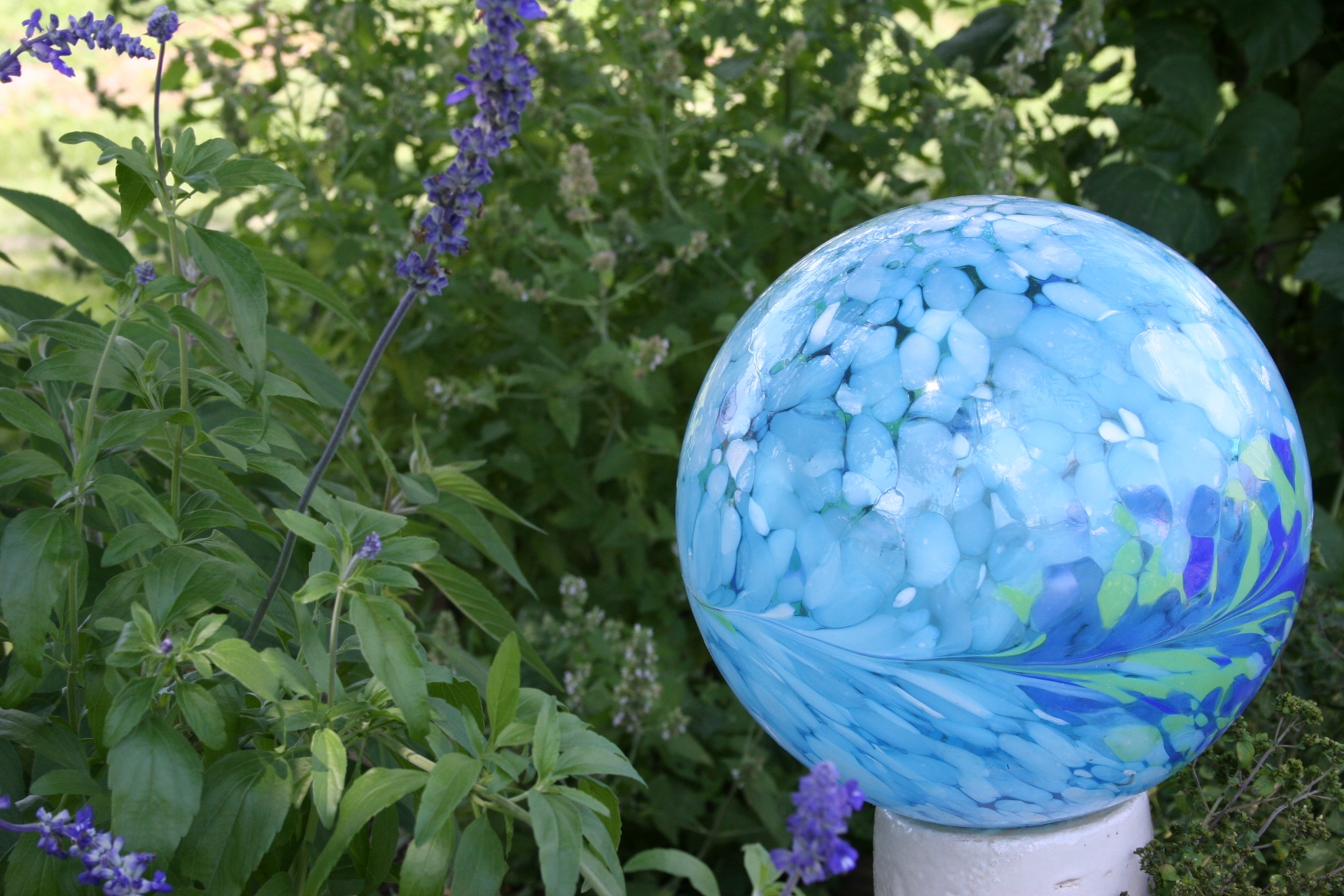
A dreamy blue ball set upon a pedestal accents a bed of blue salvia.

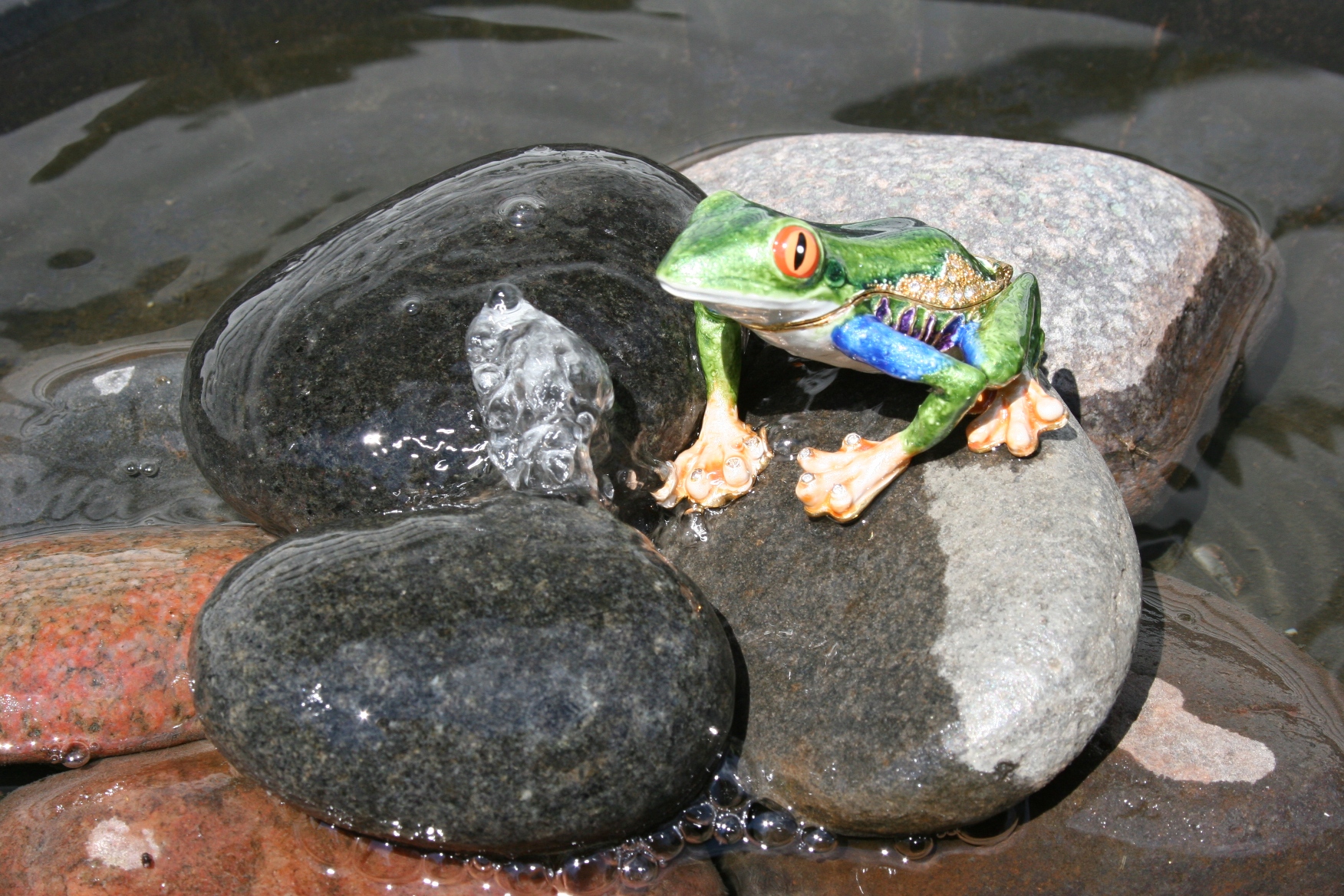
A colorful frog perches, almost naturally, in a gurgling fountain.

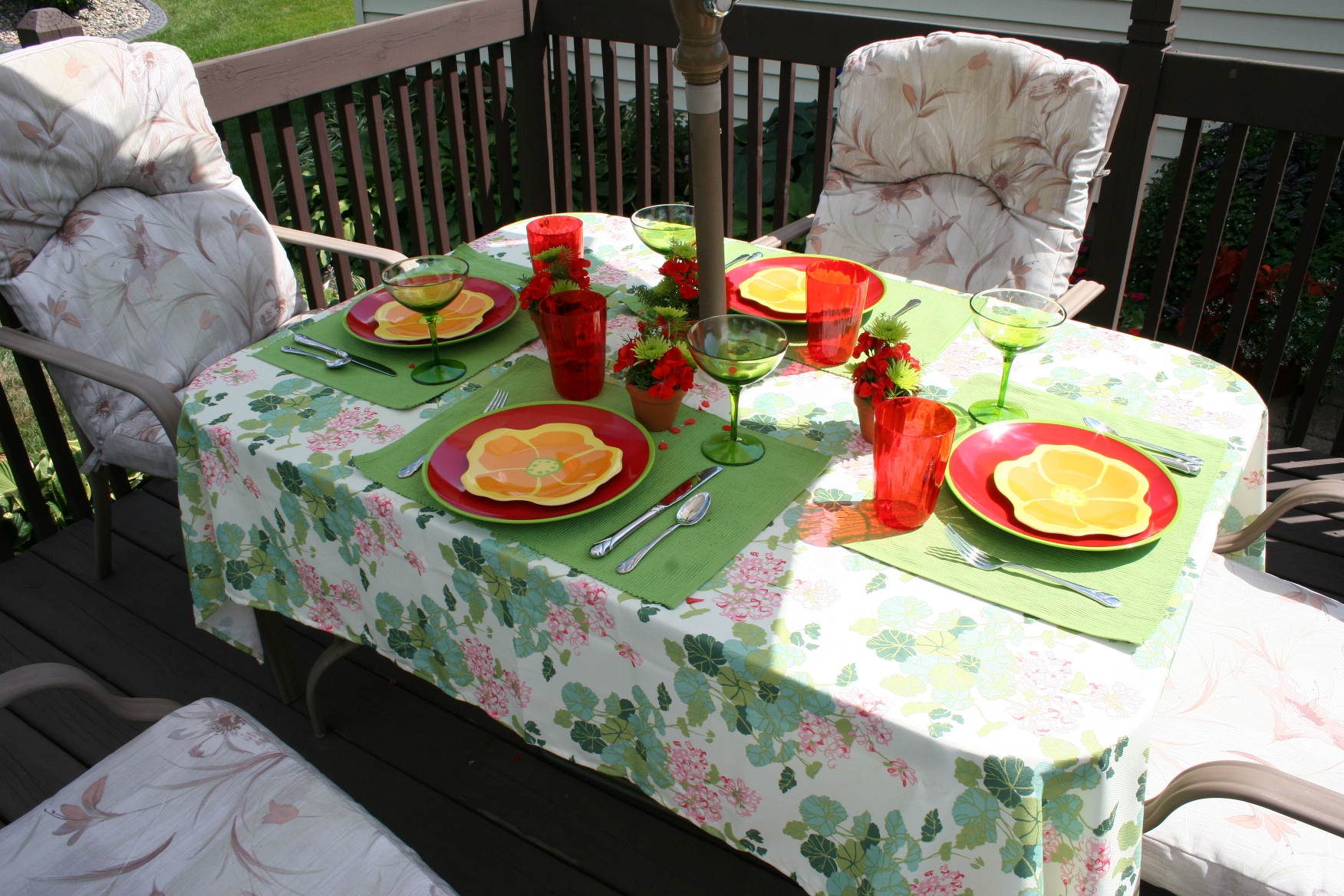
Lanae's yard was picture perfect for the garden tour, right down to the summery place setting on her patio table.

© Copyright 2010 Audrey Kletscher Helbling
 

“Little House on the Prairie” originated as a book series, remember August 4, 2010

Filed under: Uncategorized — Audrey Kletscher Helbling @ 7:28 AM
Tags: , , , , ,

A Laura look-alike climbs onto a covered wagon at the Laura Ingalls Wilder Pageant site near Walnut Grove recently.

WHENEVER THE TOPIC of “Little House on the Prairie” surfaces, folks cannot believe that I know the stories from the books and not the television show.

But years before the long-running TV series aired, in a school in a small town some 20 miles north of Walnut Grove, my teacher read, yes, read, Laura Ingalls Wilder’s books to me and my classmates daily after lunch. I have fond memories of sitting there in my desk at Vesta Elementary School raptly listening to Mrs. Kotval read of the Ingalls family’s life on the prairie, my prairie.

At the time, back in the mid-1960s, I simply loved hearing the mesmerizing accounts of prairie fires and of blizzards, of fiddle-playing and of grasshopper plagues, of mean Nellie Oleson and of kind, kind Mary, Laura’s older sister. Wilder’s descriptive writing drew me in—into the dug-out, onto the seat of the covered wagon, into the country school. Simply put, I adored the Little House books.

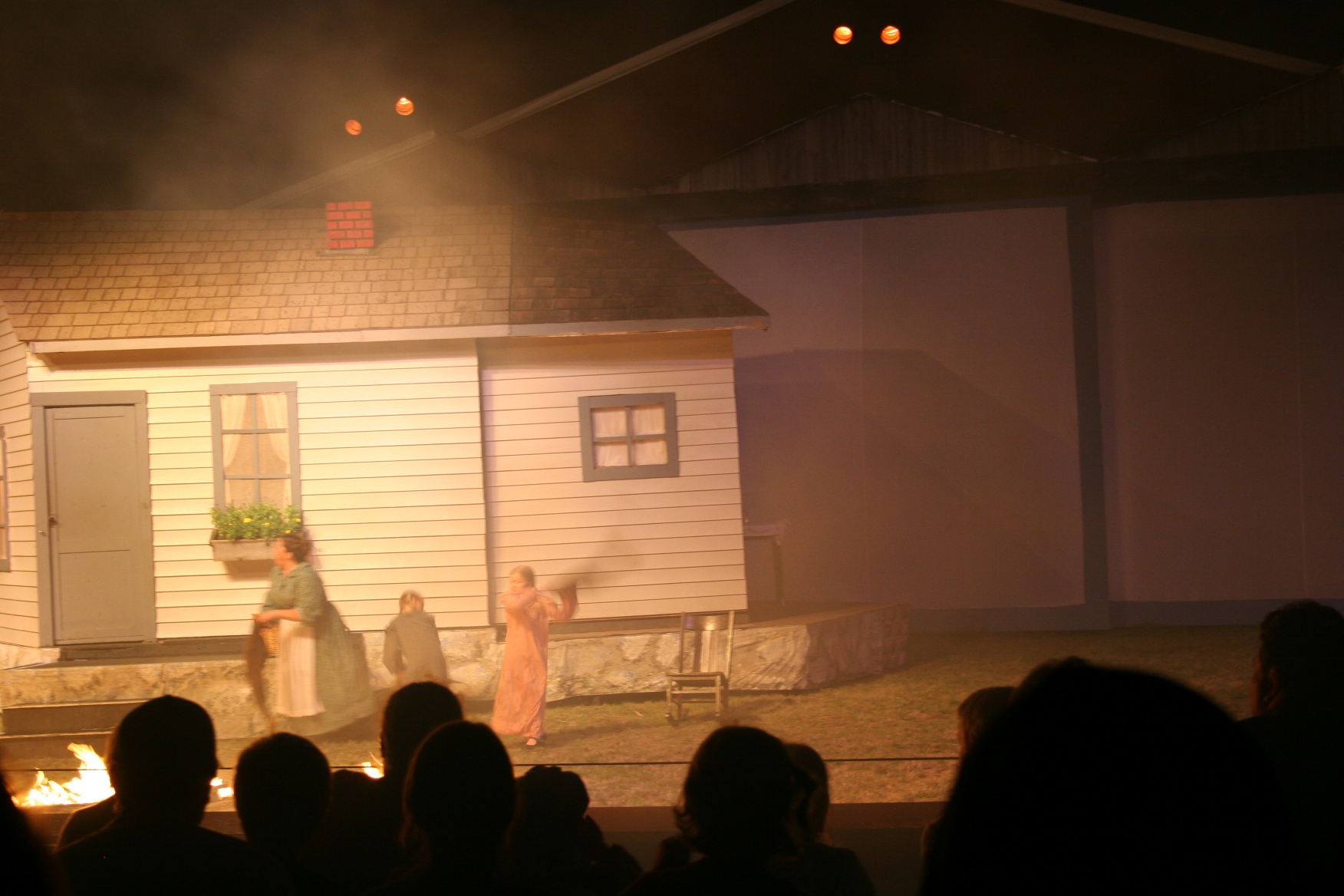
A prairie fire scene from the Laura Ingalls Wilder Pageant, presented every July at a hillside amphitheater along the banks of Plum Creek near Walnut Grove. I've seen the pageant three times in its 33-year history.

Honestly, I don’t recall my teacher emphasizing that neighboring Walnut Grove, the Ingalls’ family home from 1874 – 1876 and from 1877- 1879, was the setting for On the Banks of Plum, Creek. Truly, what mattered most to me was the telling of a good story to which I felt connected.

You would think then, given my early exposure to the Little House books, that I would have become a devoted fan of the television series. I wasn’t. The show aired in September 1974, my first year of college. I had no time for TV then or in the years that followed.

However, I recall seeing an episode or two or three. Of those I remember only the inaccuracies of mountains in Walnut Grove and of day-trips to Mankato. Despite the producers’ clear lack of prairie-landscape and geographic-distance knowledge, they offered good, wholesome family entertainment that has endeared generations, just not me.

I remain unimpressed by the hoopla over the television series and the big to-do about those, like Michael Landon (Charles “Pa” Ingalls) and Melissa Gilbert (Laura Ingalls), who starred on the show.

It is the books, the writing of Laura Ingalls Wilder, that impress me, that take me back to elementary school days, when my teacher gave me the gift of reading.

Years later I would pass that gift along to my daughters by reading the Little House books to them. Even as preschoolers they would snuggle against me on the couch, leaning in close as page after page I read of prairie fires and of blizzards, of fiddle-playing and of grasshopper plagues, of mean Nellie Oleson and of kind, kind Mary, Laura’s older sister.

I worry that today’s generation is growing up without that intimate knowledge of Wilder’s writing, accepting instead the embellished Hollywood version of life on the prairie. Even my 8 ½ and 12-year-old nieces, who recently attended the Laura Ingalls Wilder Pageant, “Fragments of a Dream,” in Walnut Grove with me and other family members, had not read the books. I was surprised, disappointed even.

I mourn that loss of connection to the written word, that ability to create, to envision, to perceive, yes, to imagine a scene, a setting, a place, simply through reading.

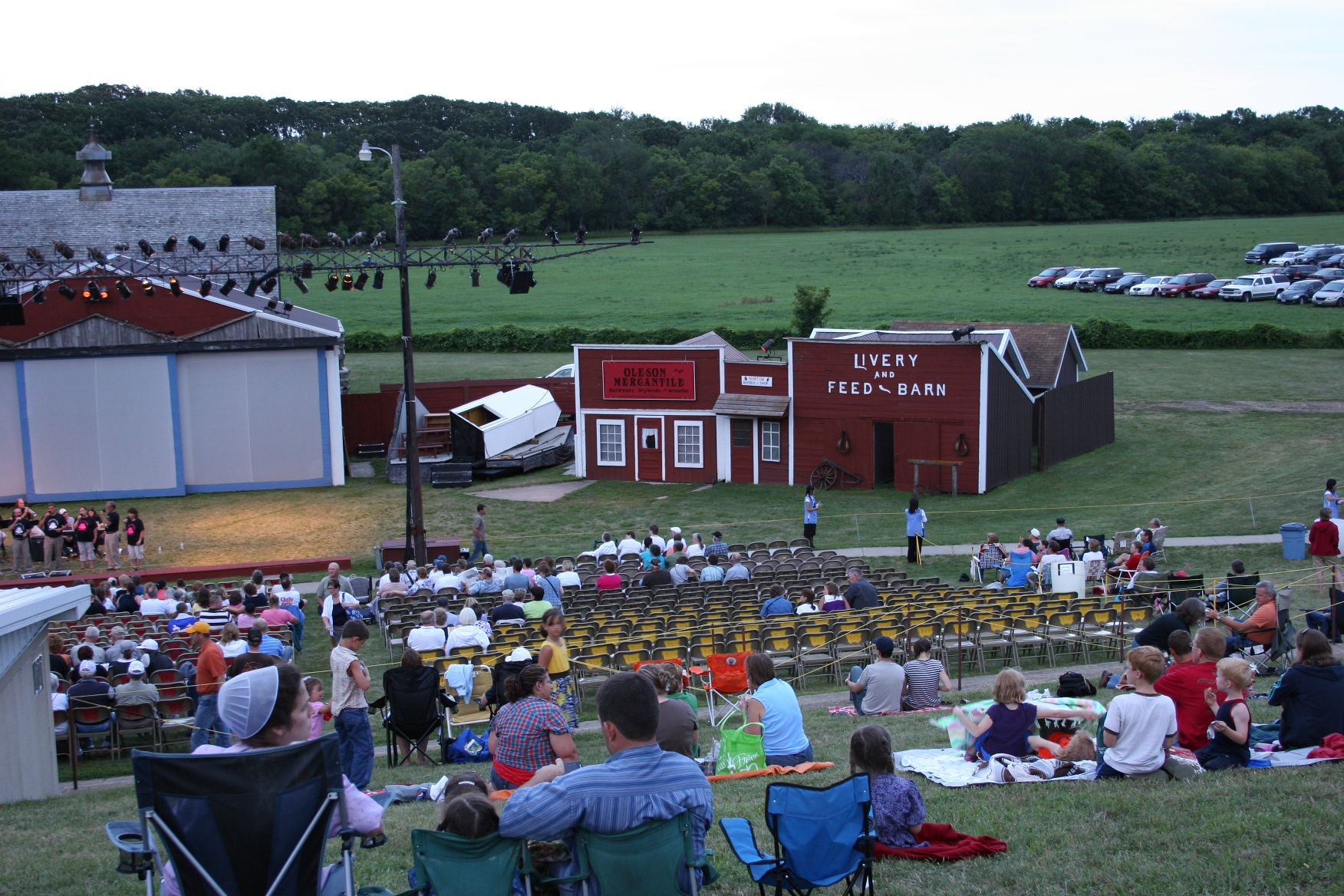
For 33 years, Walnut Grove area residents have presented the Laura Ingalls Wilder Pageant based on Wilder's stories. I've found the pageant to be true to the books, the acting superb, the setting beautiful.

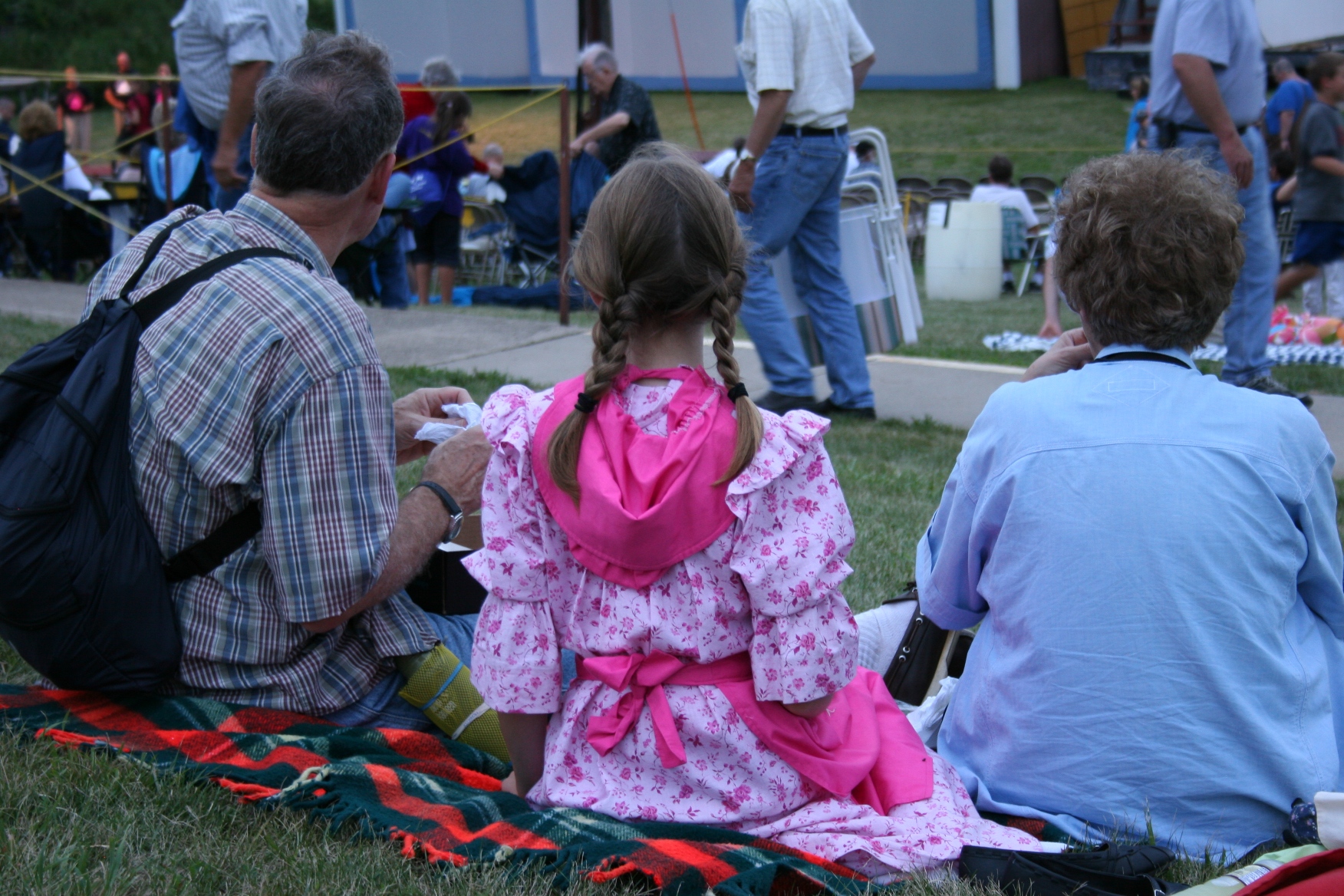
Devoted "Little House" fans come to the pageant dressed in prairie dresses and bonnets.

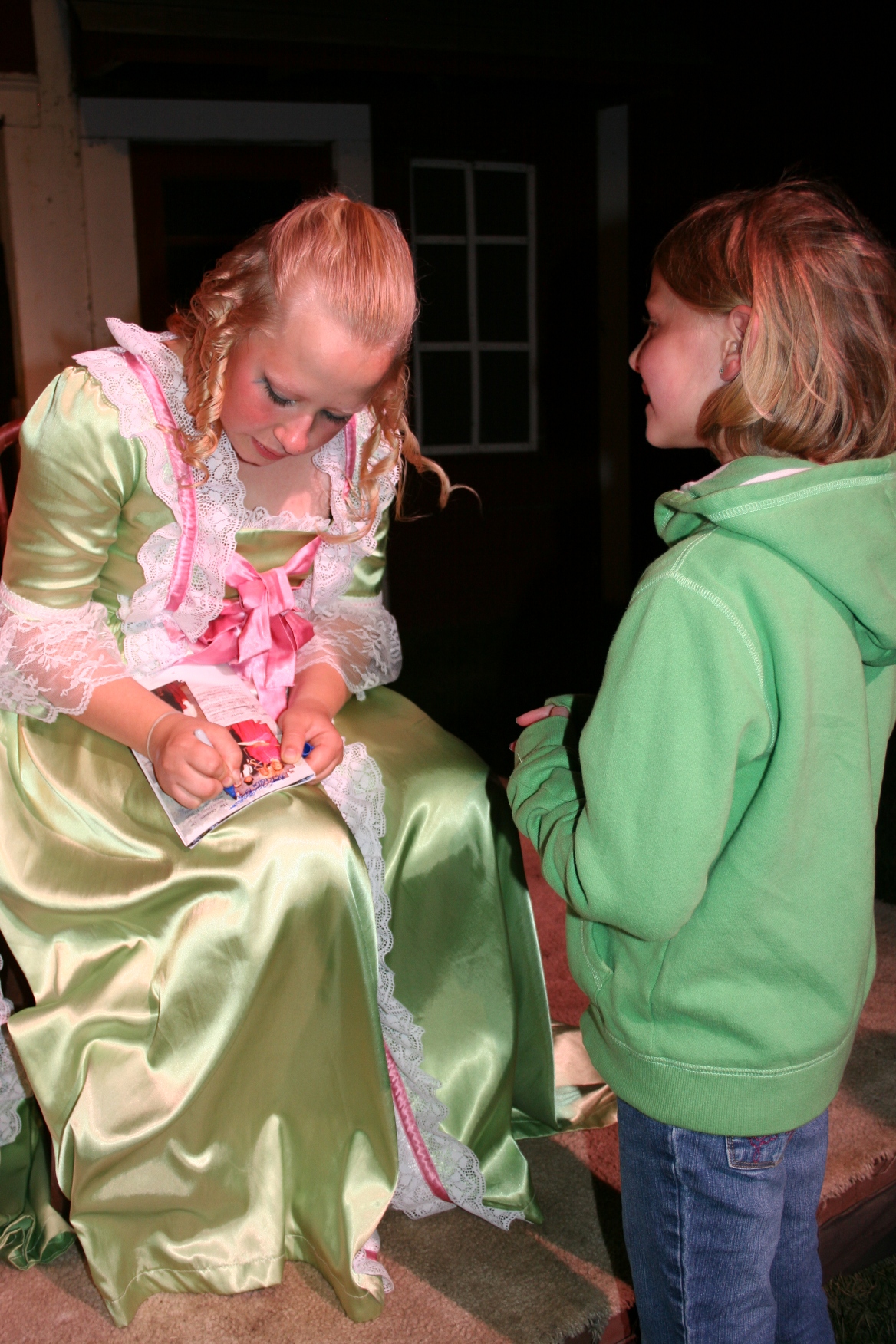
Amy Van Dorsten, 15, played the coveted role of mean and spiteful Nellie Oleson in this year's pageant. My niece Cortney insisted on getting Nellie's autograph after the performance.

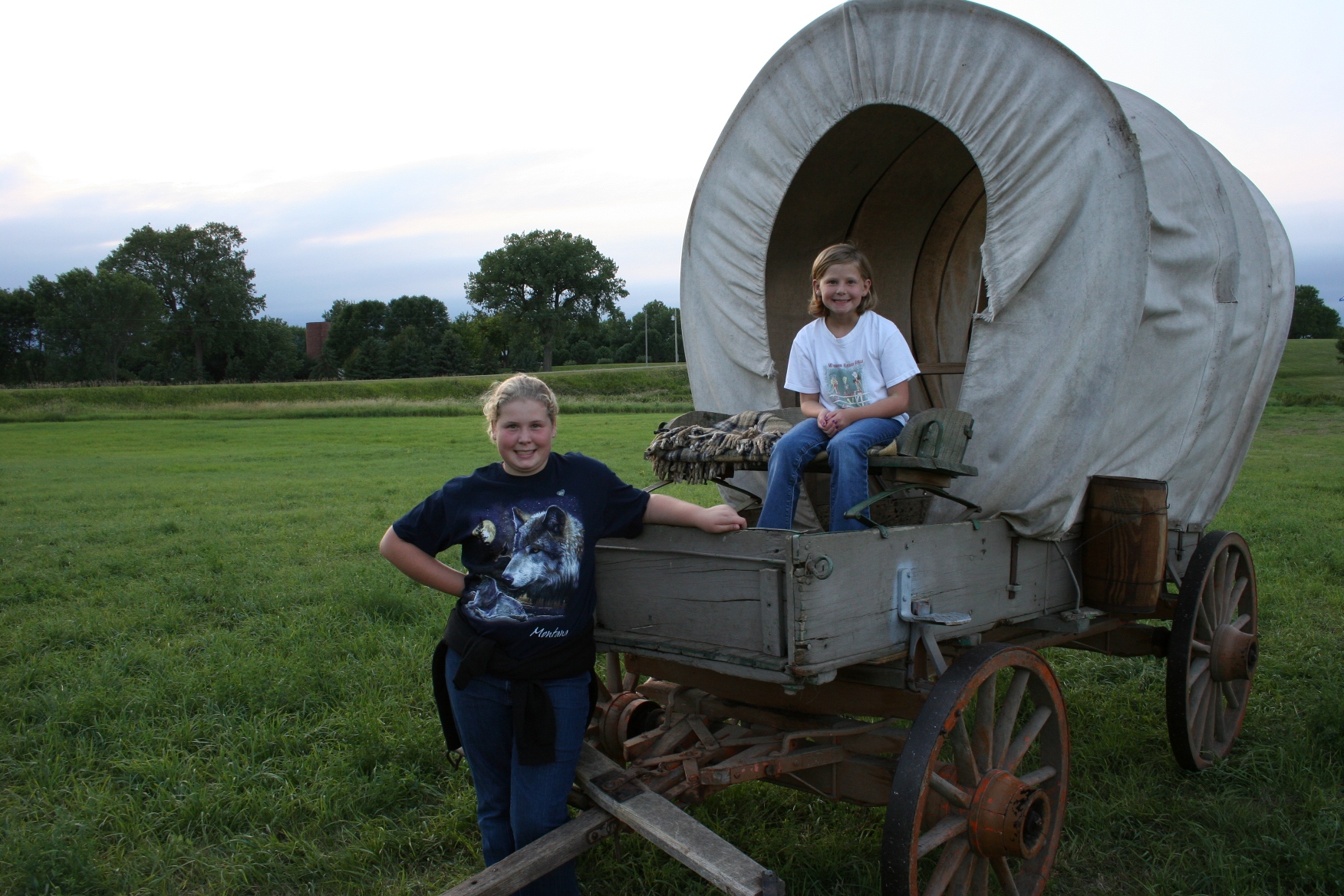
A covered wagon near the pageant grounds entrance provides photo ops for Little house fans like my nieces.

© Copyright 2010 Audrey Kletscher Helbling
 

Fredrickson’s book presents field work, past and present August 3, 2010

Filed under: Uncategorized — Audrey Kletscher Helbling @ 7:41 AM
Tags: , , , , ,

ONCE UPON A TIME, I told my farmer-dad I wanted to be a farmer when I grew up. Clearly, I became a writer instead of a tender of the land or of animals. But my heart remains rooted in the southwestern Minnesota prairie, my childhood home, the place where I worked in the barns, worked in the fields and became the person I am today.

For those reasons I particularly appreciate children’s picture books like those written by Lakeville author Gordon W. Fredrickson who specializes in writing about country life and farming.

His second, If I Were a Farmer book, Field Work, recently released from Beaver’s Pond Press, just in time for Minnesota’s annual celebration of agriculture, Farmfest. Fredrickson and his wife, Nancy, will be in the Craft/toy/home and garden pavilion during Farmfest’s three-day run this week at the Gilfillan Estate between Morgan and Redwood Falls. The event opens at 8 a.m. today.

That pitch aside, let me tell you a bit about Fredrickson. He grew up on a Scott County dairy farm, did his share of farm chores and working the land, farmed for awhile as an adult and taught high school English. He possesses the experience, knowledge, skills and passion to write about agriculture in an interesting, informative and, sometimes, humorous fashion.

Fredrickson’s subtle humor shines in Field Work as page by opposite page, he compares past farming practices and farm equipment to modern-day farming practices and equipment.

His book reconnects me to the past, to those years on the farm. So for that reason, Fredrickson’s story also appeals to adults, particularly former farm kids.

For those unfamiliar with agriculture through the years, Fredrickson’s story provides a history lesson. He even includes a glossary (per my suggestion after publication of an earlier book) to further aid readers in understanding the equipment and other terminology used in his story.

From working the soil through planting and harvesting, this former farmer details the growing season via would-be farmers. Little Nancy imagines herself as a modern-day farmer while Tommy prefers older equipment and practices from about the 1950s. Children, especially those ages 6 – 8, will enjoy the storyline and the educational content woven into it.

I don’t want to spoil the ending for you, but the humorous clincher last page clearly shows me that Fredrickson, even though an award-winning writer now, is a true mustard-pulling, rock-picking, scoop-shoveling farm boy at heart.

#

IN ADDITION TO FIELD WORK, Fredrickson has also published If I Were a Farmer: Nancy’s Adventure and three books in the Farm Country Tales series–Christmas Eve, Halloween and Thanksgiving.

#

FIELD WORK ILLUSTRATOR David H. Jewell of Minneapolis died on July 15 after being hospitalized for pneumonia. He suffered from diabetes and related complications.

#

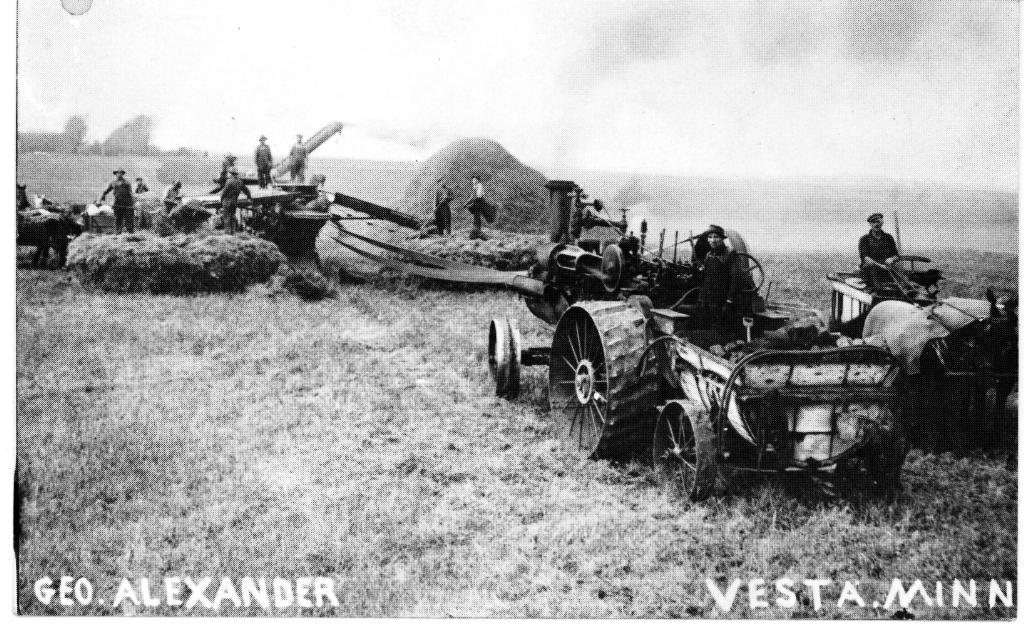
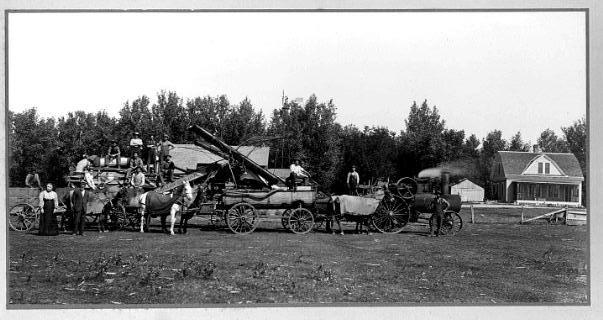
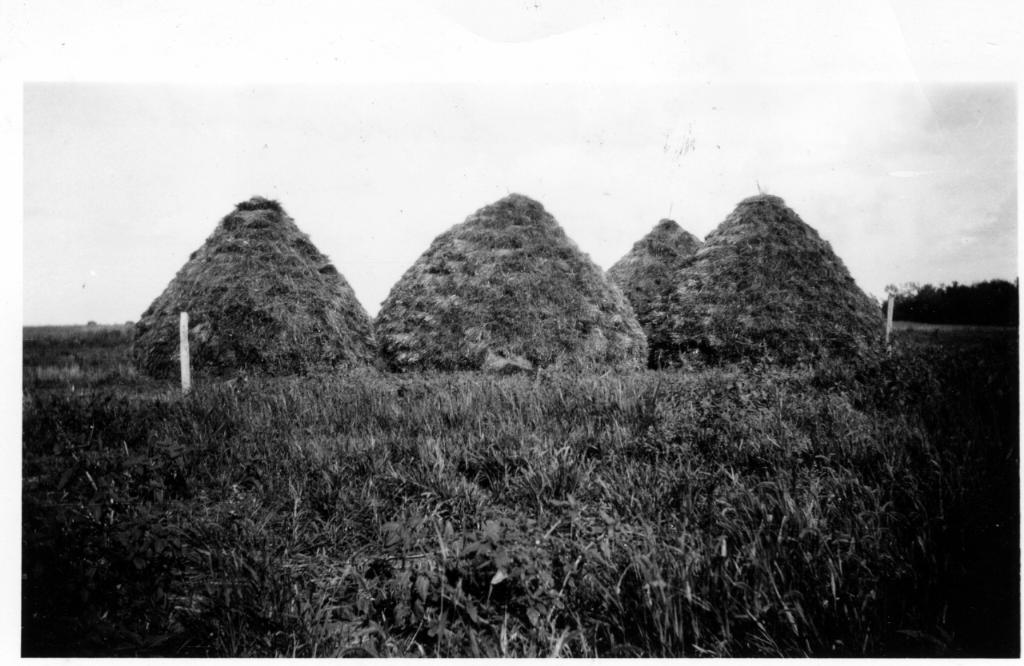
JUST FOR FUN, I asked Redwood County historian and Redwood Falls Mayor Gary Revier if he had any old farm photos he could share for publication on this post. He obliged and here are just three of the many he e-mailed. These hearken back to the days of horse-drawn machinery, even earlier than the time period covered in Fredrickson’s Field Work.

This threshing scene is near my hometown of Vesta in southwestern Minnesota, in Redwood County, home to Farmfest. Given the label, I assume this was at the George Alexander farm.

Another threshing scene, this one from the Whittet place in Redwood County.

A field scene from Sundown Township.

© Text Copyright 2010 Audrey Kletscher Helbling
Photos courtesy of Gary Revier

Book cover image courtesy of Gordon W. Fredrickson


Guys and their tractors, at an Allis-Chalmers auction August 2, 2010

Filed under: Uncategorized — Audrey Kletscher Helbling @ 7:51 AM
Tags: , , , , , ,

Bidding proceeds on the 50-plus Allis-Chalmers tractors at the auction.

WHEN MY HUSBAND SUGGESTED Saturday morning that we take in a large Allis-Chalmers auction at North Morristown, I balked.

Why would I want to stand in the middle of a field on a hot and humid summer day and watch an auctioneer sell old tractors and other farm equipment?

“It’s blog material,” Randy said.

He got me there and he knew it, so Saturday afternoon I relented and tagged along, camera bag in tow.

Maring Auction Company ran the auction on Carl Krueger's farm.

The auction had already been going 4 ½ hours when we arrived at collector Carl Krueger’s farm next to Trinity Lutheran Church and School, which is North Morristown. Randy parked our car among the rows and rows of pick-up trucks that stretched across the trampled alfalfa field. Up and over, on the other side of the hill, people swarmed like ants around the auctioneer’s truck and around the orange tractors and other farm equipment spread out in orderly rows.

This steel wheeled tractor immediately grabbed my attention upon arrival at the auction

A close-up of that steel wheeled tractor in a long line of tractors.

Immediately, I saw the potential and soon parted ways with Randy, who was primarily interested in the tractors while I was primarily interested in the crowd. I had already spotted several photogenic characters. Not that I ignored the pumpkin orange tractors; they, too, offered ample photo ops.

But the bidders, the curious, intrigued me the most, mostly because many sported bright orange attire. If I had been on a highway, I would have thought we were in a construction zone.

I quickly determined that these Allis-Chalmers folks are pretty devoted to their brand. Otherwise, why would you willingly choose to dress like this? I’m no fashionista, but even I would need to think twice before donning bib overalls, a bright orange shirt and an equally bright cap. I saw plenty of all three at the auction.

The dress code of the day: Allis-Chalmers orange.

"The Allis-Chalmers Kid," Carl Krueger, left, watched as his tractors were sold at Saturday's auction.

Clearly, these folks love and respect old tractors, and I appreciate that. As I watched, men (the crowd was overwhelmingly male) settled onto the seats of Allis tractors, clasped their hands upon the steering wheels and drove away in their imaginations. Palms caressed tractor metal. Butts connected with tractor tires, offering a temporary resting place in the heat of the afternoon.

Three men rest on three tires on three Allis-Chalmers around 3 o'clock.

Many a potential buyer, or simply an Allis-Chalmers devotee, settled onto a tractor seat.

Leaning on, touching, climbing--all were important in evaluating Allis-Chalmers tractors at the auction.

Randy was right. I had found sufficient blog material here on this hillside farm field on an August afternoon. But after 1 ½ hours of pursuing photos, I needed a break.

“Is my face all red?” I asked, knowing the answer before the words even tipped my tongue. When I get overheated, my face turns beet red. I sought out the shade of a pole shed, where volunteers from Trinity school were selling beverages, sandwiches, bars and other food. I dipped my hand into a beverage-cooling cattle tank and swiped refreshing water across my flushed skin. Since I didn’t have any money with me for bottled water or pop, I was tempted to slurp a handful of water too. But I figured that wouldn’t be appropriate although no one probably would have cared. I talked to a few people, snapped several images and aimed back toward the field to find my misplaced husband. He was still ogling the tractors.

A long orange line of Allis-Chalmers tractors awaited bidders.

“My dad had one like that,” he said, pointing to the 1950s Allis Chalmers WD, just one in the long orange line. Oops, that’s John Deere’s tag—the line, the long green line. I met a guy who dared to wear his John Deere t-shirt here in this oasis of orange. His girlfriend has an Allis-Chalmers, he explained, as if justifying his attire, even his presence.

I wanted to tell him: “I don’t think it really matters. I’m here. I’m not wearing orange and, uh, we don’t own a pick-up truck.”

Pick-up trucks lined the alfalfa field at the auction site.

WATCH FOR ADDITIONAL auction photos later this week on Minnesota Prairie Roots.

© Copyright 2010 Audrey Kletscher Helbling