Minnesota Prairie Roots

Writing and photography by Audrey Kletscher Helbling

Embracing the arts at a former Carnegie library April 27, 2012

Filed under: Uncategorized — Audrey Kletscher Helbling @ 7:37 AM
Tags: , , , , , ,

Crossings at Carnegie, an art center located in Zumbrota sits across the street from Quality Siding and Window Inc. and ACE Hardware and just down the block from the State Theatre and a picturesque white-steepled church.

IT’S TYPICAL Carnegie library with steep front steps and double columns and a gracious, arched doorway fronting a brick building.

But today in Zumbrota (and since 2001), the 1908 Classical Revival style building houses an art center. Crossings at Carnegie, with a gallery and gift shop, with a clay studio and with classes in theater, writing, art and more, and with an array of concerts, centers culture in this southeastern Minnesota community of 3,200.

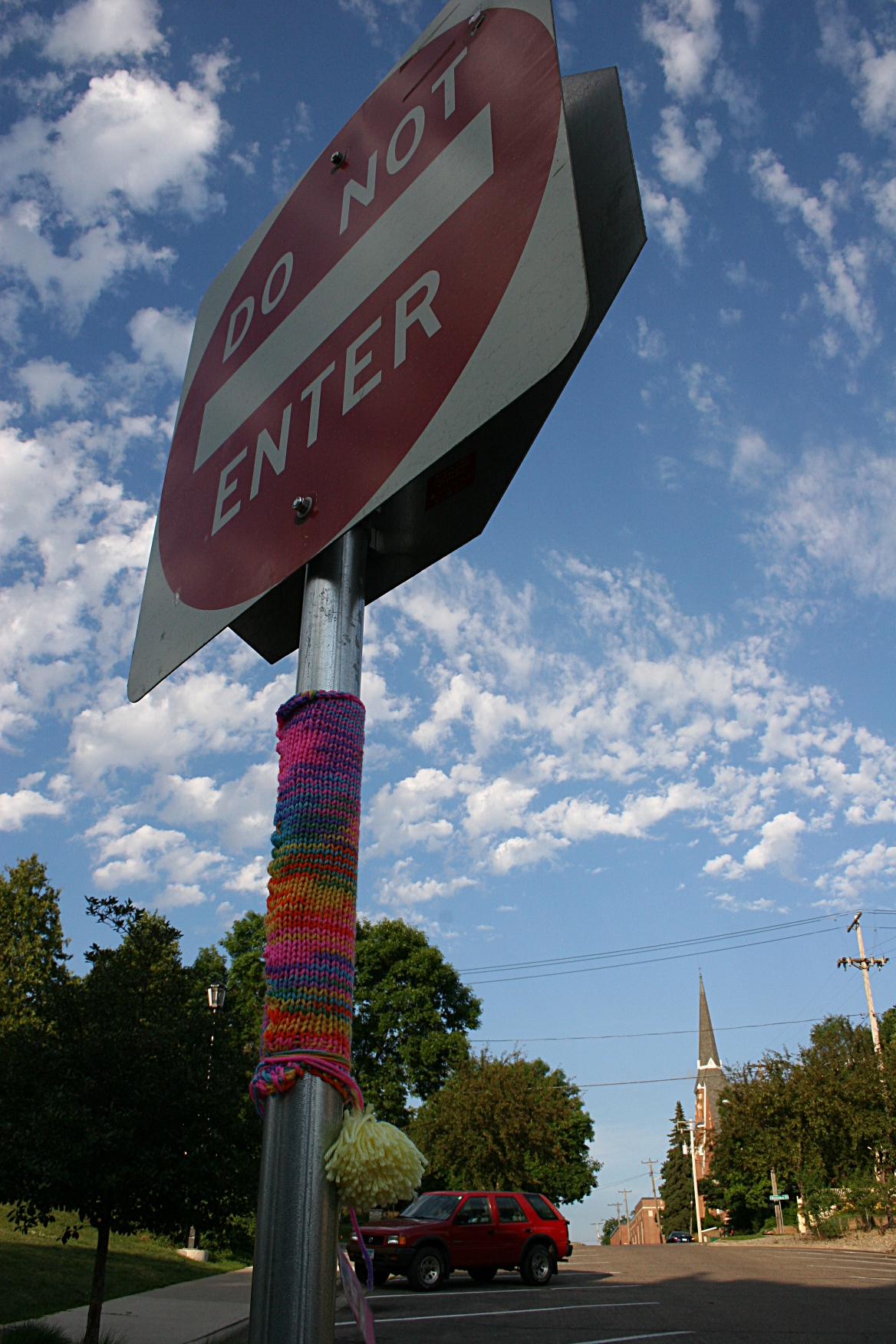
Colorful yarn wraps a front exterior stairway railing.

Saturday evening I climbed the steps into this privately-owned art center for the first time, into a space that visually overwhelmed me. With elbow-to-elbow people squeezed into the former library and with art crammed everywhere, I admittedly escaped twice—down stairs to the basement and down stairs to the outdoors.

The charming exterior front door leading into Crossings.

An estimated 1,500 visitors walk through the art center doors each month, according to the Crossings website, rating this as one popular spot for shoppers, art lovers, students of the arts and more. Saturday night drew a crowd as Crossings celebrated its 11th annual Poet Artist Collaboration. I was among the 26 participating poets. Click here and here to read two previous blog posts about this event.

I noticed art leaning on the piano as musician Matthew Rivera played the piano at Saturday evening's Poet Artist Collaboration XI gala reception. He also strummed the ukulele later.

In the midst of mingling and weaving and escaping, I tried to notice details like the yarn wrapped around a railing post, the colorful exterior signage, art propped upon the piano, the misspelled sign welcoming dogs…

In the end, I decided to return in the solace of a non-event day to this place which celebrates the arts with such exuberance.

A welcoming misspelled sign on a front window at Crossings.

Vivid colors and outdoor art define Crossings as an art center.

FYI: Click here to learn more about Crossings at Carnegie, 320 East Avenue, Zumbrota.

© Copyright 2012 Audrey Kletscher Helbling


Understanding poetry & connecting it to art in one Minnesota community April 23, 2012

Filed under: Uncategorized — Audrey Kletscher Helbling @ 7:01 AM
Tags: , , , , , , , ,

Viewing art paired with poetry at Poet Artist Collaboration XI at Crossings at Carnegie in Zumbrota.

“POETRY KIND OF SCARES ME….I’m kind of rough around the edges…I don’t always get poetry.”

If anything, I appreciate the honesty of Dale Lewis, a Hastings artist who Saturday evening spoke about the table-size chess board he created in response to 12-year-old Fiona Kiger’s poem, “Chess.”

Dale was among 52 artists and poets participating in Poet Artist Collaboration XI, a poetry-inspired art celebration organized by Crossings at Carnegie in Zumbrota.

Pieces in the chess set, comprised of wood, marble, granite, stainless steel and glass, created by sculptor Dale Lewis. He titled his art "This is your chess set on poetry" in response to the poetry of Fiona Kiger, a homeschooled student from Rochester who already has completed several chapters in a fantasy book.

Dale Lewis arrived at Crossings at Carnegie with a crocodile sculpture strapped to the top of his car.

The juried competition and Saturday gala reception and poetry reading/art talk drew a broad spectrum of artists and writers and guests that, I’m certain, included more than a few individuals who feel exactly as Dale does, sometimes somewhat intimidated by poetry. Count me, a poet, among them. I don’t always “get” poetry either.

But events such as the Zumbrota collaboration are helpful in understanding writing that can sometimes, perhaps even oftentimes, cause many to bypass poetry books and avoid poetry readings like the plague.

Listen to Dale: “I’m not as afraid of poets as I was a few weeks ago.”

Neither am I.

It did my writer’s persona good to mingle with other poets and with artists Saturday evening, to hear that no matter where we are in the stages of writing or in creating art, we are in this for the love of our respected crafts. That, I sensed, more than anything.

Peter C. Allen reads his poem while Sarah K. Nygaard of Zumbrota, who created the corresponding art, "Long Live the King," looks on. Artwork was projected onto a screen in the reading/ artist talks at the 90-year-old historic State Theatre just down the block from Crossings at Carnegie.

I met poet Peter C. Allen from Kenyon, who lives on a hobby farm and read his “Chicken Crossing,” slinging out a line (which I can’t repeat here) that caused the audience to erupt into raucous laughter.

Pine Island artist Bill Shain's airbrushed composition was inspired by Patrick L. Coleman's poem. Patrick's poem, Bill says, seems like a page out of a romance novel. He went out of his comfort zone, Bill says, to create "Power and Surrender." In his painting the woman has power over the man, her red dress like the cape of a matador and also resembling bowels.

I met Patrick L. Coleman of Minneapolis, who, during his introduction to “Frederica Reminisces” caused me to feel a bit inadequate when he mentioned that his poem initiated as an assignment in a Loft poetry class. But later, when I met Patrick and his wife, Donna, we instantly connected. He’s a retiree who decades ago turned down a journalism scholarship to the University of Minnesota to pursue a career as a bio chemist. Today he is working on a mystery novel and sometimes writing poetry.

Toni Stevens of Rochester painted "A Loving Pear," a watercolor inspired by the poem, "Traveler," by Elise Gregory of Ellsworth, Wisconsin. This is a close-up of that painting.

I listened to Betty J. Benner of Austin spin her story-poem of rhubarb and cucumbers left on her front steps during a reading of “This is just to say.” Betty acknowledged to me earlier that she had deviated from her usual serious poetry to pen a humorous piece. The audience responded with laughter.

Likewise, a St. Louis Park poet drew chuckles when she introduced herself as Sandy Beach followed by “Yes, that’s my real name.”

While many of the poems were infused with humor, several were immersed deep in emotions, reflecting on life and death. Others recalled memories. And others held a strong sense of place.

Janelle Hawkridge of Winnebago and her paired artist, Katherine E. Smither of Rochester, honored women in their collaboration on, the most unlikeliest of subjects, a 70-year-old’s spider/varicose-veined legs. Janelle’s poem, “A Work of Art,” particularly, resonates with me. She views those imperfect, aging legs as history, a life story, a work of art.

The poets read with passion. The artists spoke with passion. They connected. You could hear it in their words, see it in the locking of their eyes, a touch on the shoulder, a nod of the head.

In the end, poet Ronald J. Palmer of Bloomington, who wrote about the stages of life in “The Significance of Traffic Lights,” perhaps best summarizes the feelings of many attending the poetry reading/art talk in Zumbrota: “I think poetry and art should be together more often.”

That recommendation, Ronald, gets a green light from me.

Crossings at Carnegie, a privately-owned art center, is housed in a former Andrew Carnegie library built for $6,500 in 1908 in the Classical Revival style.

CLICK HERE to learn more about Poet Artist Collaboration XI, which closes April 26 at Crossings at Carnegie in Zumbrota.

The poetry reading/artist talks were held in the State Theatre, built in 1921 for $38,000. Up until recently, movies were still shown in the theatre. In December 2011, the Zumbrota Area Arts Council purchased the theatre and is currently raising monies to renovate the building.

CLICK HERE to learn more about the historic State Theatre.

CLICK HERE to read an earlier blog post about my poem, “Her Treasure,” and artist Connie Ludwig who created “Pantry Jewels,” inspired by my writing.

FYI: Close-up photos of the two art pieces were taken with permission of the artists. Permission was not sought to reproduce the copyrighted poetry. Therefore it is not featured here.

© Copyright 2012 Audrey Kletscher Helbling


Celebrating poetry and art in Zumbrota on a Saturday evening April 22, 2012

Artist Connie Ludwig's "Pantry Jewels," inspired by my poem, "Her Treasure." (Please excuse the glare on the glass; there was no way to avoid it while photographing the painting.)

Her Treasure

In the dark, dank depths of the dirt-floored cellar
she stocks a treasure-trove of jewels
in jars upon slivered planks—
golden corn nuggets,
amber chunks of ample beef,
ruby red tomatoes,
peas like unstrung pearls,
jade shards of dill pickles,
amethyst beets,
clusters of topaz apples
and an abundance of sauerkraut,
diamond of this hard-working German farm wife,
dweller of the Minnesota prairie,
tender of the earth,
keeper of the pantry
and guardian of the garden gems
that will adorn her dinner table
during the long winter months ahead.

#

I MET “MY ARTIST” Saturday evening and saw the art she created, inspired by my poem (above).

And I use those words, “my artist,” because I feel connected to Connie Ludwig of Goodhue. She, like 25 other artists participating in Poet Artist Collaboration XI at Crossings at Carnegie in Zumbrota, took words of poetry and shaped them into art.

“Her Treasure,” under Connie’s paintbrush, became “Pantry Jewels.” The earthy watercolor painting of canned beets, pickles and peaches glows with the perfect balance of light and darkness, with sunlight filtering through glass and glinting off the golden rings that lock in garden goodness.

Connie understands my poem—the memories of my mother canning fruits and vegetables in her southwestern Minnesota farmhouse kitchen. She understands the dark dirt-floored cellar in which these preserves were stored upon rough boards. She understands the importance of honoring the women who honored the land by feeding their families with the fruits of their labors.

In the chapbook published for Crossings’ Poet Artist Collaboration XI, Connie writes:

My mother and aunts loved gardening and canning. They considered those “squirreling skills an essential part of themselves. I have wonderful memories of the ladies showing off, trading and sharing their canned jewels. And, of course, feeding them to us. The models for this painting came from the pantry of my husband’s cousin.

Connie, right, and I pose for a photo after a 90-minute presentation in which 26 poets read their poems and 26 artists talked about how the poems inspired their art. Note Connie's "Pantry Jewels" painting just above my head to the left. If I could buy this $490 watercolor on aqua board, I would in a snap. I love it that much and how it honors my rural roots. But I can't... If you're interested, contact Crossings.

Connie, thank you for transforming my poem into such down-to-earth, beautiful art that touches my soul. Your painting was all I hoped for in this process of poetry inspiring art.

A snippet shot of the crowd at Crossings at Carnegie, including Marie Marvin, center in blue. This place was elbow-to-elbow people during the hour-long gala reception before and after the poetry readings and artist talks held at the next door historic State Theatre. There were 26 poems selected from around 180 submissions for this juried Poet Artist Collaboration, now in its 11th year.

Thank you also to the artists and poets and guests who took the time to thank me for writing “Her Treasure.”

Thank you to my husband, Randy, for always supporting me in my writing.

To Crossings at Carnegie, and specifically Marie Marvin who opened the art center in 2001, thank you for acting as the driving force behind this collaboration. The phenomenal (or as I would say, overwhelming) turn-out is a tribute to the hard work of your team. I’d like to see more events like this through-out Minnesota that pair words and art.

To be one of the 26 poets selected for inclusion truly brought me joy. To mingle with so many poets and artists for an evening inspired and validated for me the importance of the arts in our lives.

Crossings at Carnegie, housed in a former Carnegie library, is a privately-owned cultural, visual and performing arts center in Zumbrota. I love the rural atmosphere with the hardware store and grain elevator just down the street. I need to return to Crossings as I was overwhelmed (crowd-wise and visually) on this busy evening.

I’d encourage you, if you have not seen this exhibit at Crossings, 320 East Avenue, to take it in before the April 26 closing date. Click here for more information.

Also check back here for an additional post from Poet Artist Collaboration XI.

© Copyright 2012 Audrey Kletscher Helbling


Pairing poetry and art in Zumbrota April 19, 2012

Filed under: Uncategorized — Audrey Kletscher Helbling @ 7:08 AM
Tags: , , , , , , , ,

Lois' jellies and pickled beans photographed in July 2009 at the Faribault Farmers' Market.

In the dark, dank depths of the dirt-floored cellar

she stocks a treasure-trove of jewels

in jars upon slivered planks—

Thus begins my poem, “Her Treasure,” which I will read this Saturday, April 21, at the Poet-Artist Collaboration XI Gala Reception at Crossings at Carnegie in Zumbrota. The reception begins at 6:30 p.m. at Crossings with guests treated to refreshments and to music by pianist Matthew Rivera. The event then moves next door to the State Theatre for poetry readings with on-screen art at 7:30 p.m.

Yes, art. And poetry. Together. One inspired by the other.

I’ll meet “my artist,” Connie Ludwig of Goodhue who created a watercolor, “Pantry Jewels,” inspired by my poem about canned fruits and vegetables stocked in a farmhouse cellar.

The works of 25 other poets and of 25 other artists are also included in this juried exhibit.

Once I learned Connie’s identity, I contacted her, asking her to share some information about herself and about the process of creating her poetry prompted piece. Unlike me, Connie is not a novice at this poet-artist collaboration. This marks her tenth time participating in the Crossings event.

Recently retired from the Zumbrota library, Connie is an established artist who typically works in pastels from her home studio. In the summer she does pastels outdoors and on her front porch.

But this time, for this show, Connie opted to work in watercolor, which, she says, “more often than not has control over me.”

Drawing on childhood memories of the huge garden her family planted every year at their home in St. Croix State Park along the Minnesota-Wisconsin border east of Hinckley, this artist understands the content of my poem.

My aunts and my mother were survivors of the Great Depression and gardens and canning were very, very important to them. So you can probably deduce that your poem about the dark basement, dirt floor and canned jewels reminded me of them.

When I read it (your poem), I could picture the light on the jars when I used to go down and get them. And I knew both the physical resemblance to jewels and the equivalent worth of jewels was how they felt about their canning endeavors. You wrote a poem that reflected an important part of their lives.

Fortunately my husband has cousins that enjoy canning. The models for the three jars that I used to illustrate your poem are Mary’s peaches and Greg’s pickles. I took a picture of them and painted both from that and the actual jars. Jim (my husband) could hardly wait for me to finish so he could “open and eat.”

Well, Connie, I can hardly wait to see your art, “Pantry Jewels,” paired with my poem.

FYI: Click here to read more about Poet-Artist Collaboration XI, including a list of the participating poets and artists. The exhibit will be on display through April 26. Please join Connie and me at the Gala Reception and at the poetry reading.  I’m second on the list to read my poem and Connie to talk about her art. We’d love to meet you.

Copyright 2012 Audrey Kletscher Helbling


In which we travel to Wisconsin and make paper April 9, 2012

Filed under: Uncategorized — Audrey Kletscher Helbling @ 3:20 PM
Tags: , , , , , , ,

WHO WOULD HAVE thought that making paper could be so much fun for a bunch of grown-ups?

Not me.

But making paper at The Paper Discovery Center in Appleton, Wisconsin, on Saturday proved so much fun for our family that I declared, “I could really get into this paper making.”

At that moment my 18-year-old son, Mr. Logical Scientist-Math Guy, clarified: “Technically we did not make paper.”

He would be right. We did not transform a tree into paper. Rather, we recycled the Sunday comics and other paper into new paper.

And here is how we did it with the assistance of two patient and friendly young missionaries from the Church of Jesus Christ of Latter-day Saints who volunteer at the discovery center.

First, peruse the paper samples to determine what type of paper you would like to make. Ideally, you (your daughter) should drink your (her) coffee before coming to The Paper Discovery Center. But, if you (your daughter) are (is) fortunate enough, the nice lady at the front desk will allow you (your daughter) inside with your (her) coffee as long as you (she) promise (s) to keep a lid on it (the coffee cup, that is).

After you have torn your selected papers into postage stamp size pieces, drop the paper into the blender and add water, about three-fourths of the blue cup shown here.

Here you can add condiments (that's what I call them) like glitter and pressed flowers to the mix before blending in an ancient blender. A garage sale blender would work great for this part of the paper making. On the left is one of the patient paper making volunteer instructors. That's my husband waiting his turn.

Next, pour the blended paper pulp into a screen inside a wooden form and immerse in water. Here's where you get to dip your fingers into the pulpy water and swish everything together.

Evenly ease the forms from the water to reveal your paper. Remove the forms and sponge excess moisture off.

Move to the next table and lay an absorbent sheet of paper (can't recall the name, but it starts with a "c") on top of your paper. Put a board on top and press. The idea is too absorb even more water. Repeat several times.

Pull back the absorbent paper to reveal the recycled paper you've made. But you're not done yet. Next, move to a contraption that exerts 2,000 pounds of pressure onto the paper, binding the fibers. After that, move to a machine that applies heat to the paper. Keep your fingers out of both.

Finally, pose for a photo with the paper you've just created.

HAVE YOU EVER MADE paper like this? I’d like to hear, especially if you’ve made your own forms, etc. This may just be an art I’d like to try at home.

PLEASE CHECK BACK for another post from The Paper Discovery Center in Appleton, Wisconsin.

© Copyright 2012 Audrey Kletscher Helbling


The Last Supper Drama begins Holy Week at a rural Minnesota church April 3, 2012

St. John's 50th presentation of The Last Supper Drama in the sanctuary with the actors positioned just as the disciples are in Leonardo da Vinci's painting. However, in the drama, an empty chair represents Christ.

THOUSANDS OF MILES from Milan, Italy, in the flat farm fields of Rice County in southeastern Minnesota, Leonardo da Vinci has left his mark on a small congregation.

For 50 consecutive years, St. John’s United Church of Christ, Wheeling Township, has presented The Last Supper Drama, a theatrical interpretation of the master artist’s most famous painting created in 1495 as a mural in an Italian monastery.

The rural Faribault church was nearly full for the golden anniversary of The Last Supper Drama.

Palm Sunday evening I joined a sanctuary full of worshipers to view the drama which inspires and moves for its touching, personal account of Christ’s last meal with his 12 disciples. In the script written so many years ago by a former St. John’s pastor, each of Jesus’ followers speaks of his personal relationship to the Lord.

In the reverent near-darkness of this late 1800s limestone church, the cast, in loud, clear, animated voices and with gestures fine-tuned by years of practice and presenting, truly bring to life da Vinci’s painting. They speak of their failures and deaths, of their love for Christ.

“Be not faithless, but believing,” advises doubting Thomas, played this evening by Thad Monroe.

Claims Don Katra as Matthew: “My life really began when I met and followed Him.”

Most of the actors are shown here as they pose for photos after the performance.

Judas grips the bag of silver, his reward for betraying Christ.

Even Gordie Wiegrefe as Judas the betrayer, admits, “It was too late. They wouldn’t take the silver back. I failed my Lord.”

The moment when Christ announces that one of his disciples will betray him is the precise moment da Vinci captures in his painting. In St. John’s performance, the defining moment of betrayal comes when Judas slams a jingling bag of 30 pieces of silver onto the table.

Later, after the drama concludes, St. John’s Pastor Lora Sturm tells worshipers, “Let us feel the light of His love as we enter the darkness of this Holy Week.”

A view from the balcony before the drama begins shows the spotlight to the left and The Last Supper table below. The actors enter, spotlighted in the dark church, to take their seats at the table. There they "freeze" in place to mimic Leonardo da Vinci's painting.

That message resonates as a spotlight first illuminates a cross suspended above the altar in the dark sanctuary, then moves down to an empty chair representing Christ and finally pans out to shine upon all 12 disciples. It is how the drama opens and ends, impressing upon attendees the darkness of Holy Week which concludes on Sunday in the glorious light of the resurrected Lord.

Spreadsheets on display Sunday evening listed those involved in the St. John's drama through-out its 50-year run.

FOLLOWING SUNDAY’S 50th anniversary performance, special recognition was given to those who have been part of St. John’s The Last Supper Drama. Original 1963 cast members Wallace Hildebrandt and Luverne Hafemeyer stood up to applause.

Other 50-year history trivia includes:

  • Seventy individuals have participated in the drama since 1963.
  • The role of John has been played by 10 actors.
  • The youngest actor was Kyle Keller who in 2011 assumed the role of Philip.
  • The oldest cast member was Kyle’s grandpa, Arnold Keller, who was 76 years old when he last acted in 1997.
  • Nine individuals have performed 20 or more times in the St. John’s drama.

Craig Keller has been the long-time drama organist, playing the same music every year. The script and music remain unchanged in 50 years. Craig's father, Arnold, was an original cast member.

After the performance the cast took their stools and footrests out of the church, grouping them together (left) in the sanctuary entry. Later they carried the seats into a balcony storage area. Each stool is labeled with a disciple's name. They are the original stools, first used 50 years ago.

This artistic rendition of The Last Supper hangs in the St. John's Fellowship Hall.

After the performance, folks gathered in the social hall for cookies and beverages.

A tray of cookies awaits audience members and performers.

TO READ A PREVIOUS POST I wrote about the 2011 drama, click here.

© Copyright 2012 Audrey Kletscher Helbling


How I became an artist March 30, 2012

Filed under: Uncategorized — Audrey Kletscher Helbling @ 7:44 AM
Tags: , , , , , , ,

MY SKILLS AS A PAINTER are limited. I can paint a wall. I can dip a brush into a kid’s watercolor paint set and swirl colors onto a piece of paper. But I won’t promise a masterpiece.

Oh, no, if you want to see my best paintings, you will need to step back in time to more than 40 years ago. Imagine me hunched over an oilcloth-draped kitchen table in a southwestern Minnesota farmhouse dipping a thin brush into miniscule pots of paint. With great care, I brush shades of blue and brown onto cardboard as a ballerina emerges.

I have never seen a real ballerina. Her dainty features and fancy dress and perfect posture seem so foreign to me as I slump at the table in my rag-tag clothing that smells of the barn.

I imagine this ballerina smells only of flowers, like the ones I paint into the bouquet she clutches and into the wreath encircling her hair. Her bangs sweep in a fashionable style across her forehead, unlike my slanted, too-short bangs.

The paint-by-number ballerinas I painted as a young girl during the 1960s.

This ballerina’s life in New York City is so much different than mine on the farm. For the hours I am painting the flower-bearing ballerina and her sister, the twirling ballerina, I escape into their world. I dance on my tiptoes and spin and bow with grace on the stage of an opulent theater.

If not for Dan Robbins, though, I never would have experienced ballet. The Michigan artist created the first paint-by-number patterns in 1951. That led to a nation-wide obsession that allowed non-artists like me to become painters. The magazine American Profile featured Robbins in its March 25 issue. You can read the feature story by clicking here.

That story prompted me to remember the paint-by-number ballerinas I created as a child. Because my mother saves everything, I have those paintings today and they are among my most treasured childhood possessions.

TELL ME, HAVE YOU created paint-by-number paintings? Or do you collect these paintings? I would like to hear about your experiences and/or interest in paint-by-number kits.

You can learn more about the paint-by-number craze that swept the country during the 1950s by clicking here onto the Smithsonian National Museum of American History.

© Copyright 2012 Audrey Kletscher Helbling


Animal art March 20, 2012

Some of Julie Fakler's pet portraits displayed at the Paradise Center for the Arts in Faribault.

COLORS, VIBRANT AND BOLD, first draw you toward Julie Fakler’s art in a current exhibit. But move closer and it is the expressive eyes that connect you to the subjects of her portraits, adoptive animals from Prairie’s Edge Humane Society in Faribault.

“I paint domestic animals and I was trying to think of a way to help out local domestic animals,” says this Faribault artist. “That’s when I came up with the idea to paint portraits of the animals at the Prairie’s Edge Humane Society.” The local animal shelter will receive a portion of the sales from portraits sold during Julie’s current exhibit.

A snippet of a cat portrait by Julie.

Julie merges her skills as an artist and her passion for animals into acrylic hardboard portraits that practically pull the viewer in for a closer look.

Her work is showing locally in two galleries with “Prairie’s Edge Humane Society Portraits” at the Paradise Center for the Arts, 321 Central Avenue, Faribault, through April 17 and “New Work” at the Northfield Arts Guild, 304 Division Street, Northfield, through March 31.

Recently, I perused Julie’s PCA exhibit for the second time, this visit with camera in tow and with the artist’s permission to photograph her work.

Adoptable cats and dogs are the subject of her Paradise exhibit. A grant from the Southeastern Minnesota Arts Council and McKnight Foundation funded the body of her work and the gallery show.

I’m not a pet owner. But Julie’s engaging portraits will cause anyone to fall for these adoptable animals whose spirits shine in her creations. In her artist statement, this Minnesota College of Arts and Design graduate says: “The images of the animals represent their energy, personality and physical attributes.”

I agree. I remember the first time I saw Julie’s art, during a studio art tour in the autumn of 2010. Her use of bold, mostly primary, colors give her work a memorable, signature flair. I thought then, and still think, that her vibrant art would suit a children’s picture book. Or maybe t-shirts or handbags or…

The possibilities seem endless for Julie’s art.

The vibrant colors and sweet faces in Julie's art are irresistible.

FYI: Click here for more information about artist Julie Fakler.

Click here to learn about Prairie’s Edge Humane Society.

© Copyright 2012 Audrey Kletscher Helbling


Poets & artists collaborate in Zumbrota and I’m in March 13, 2012

Filed under: Uncategorized — Audrey Kletscher Helbling @ 7:52 AM
Tags: , , , , , , ,

I SET A GOAL for 2012 to write more poetry. I’ve posted a contest list on my office desk and filed information in a three-ring binder. But all the best-laid plans and organizing are meaningless unless I follow through with my intentions.

Thus far, I’m doing OK, although not penning poetry probably as frequently as I should be.

Yet, I’ve already seen my initial efforts, including poetry revision, rewarded with the acceptance of a poem into Crossings Poet-Artist Collaboration XI in Zumbrota.

The exhibit, which will be installed on April 2 at Crossings at Carnegie, pairs poetry with art.

Poets were invited to submit up to three poems for consideration. Then four professional writers/poets juried the poetry—this year more than 180 poems—and selected 26 for inclusion.

I’m honored and thrilled to have my writing in this exhibit.

Marie Marvin writes in an e-mail to the selected poets: “It was exciting to receive such a fine outpouring of exceptional work from so many talented poets for this collaboration. Jurists told us they were a pleasure to read, and selecting those to be included was a difficult task.”

Additionally, Laura McDonough of Crossings tells me jurists were given complete license and no specific guidance during the selection process and did not know the identity of the poets.

But, she surmises, “They look for excellence and magic.”

Now artists, who also were juried for the collaboration, are working their magic creating  pieces of art inspired by the poetry.

Paired poets and artists will not know each others’ identities until the show is installed. Nor will the names of participating poets and artists be revealed to the public until April 2. I asked.

I’m not disclosing the content of my poem which I unsuccessfully submitted to previous contests and then reworked for this competition to make it a stronger, better poem. Yes, time allowed me to view my writing with fresh eyes and see areas where I could improve.

Naturally, I’m wondering how “my artist” will interpret my quite visual poem.

I’ll find out on Saturday, April 21, when I attend a reception beginning at 7 p.m. at Crossings at Carnegie, 320 East Avenue, in Zumbrota. Poets and artists will discuss their works. Please join me and the 25 other poets and 26 artists at this celebration during April, National Poetry Month.

FYI: MARIE MARVIN, who opened Crossings in 2001 to create an oasis for artists, writers and musicians, is the driving force behind the Crossings Poet-Artist Collaboration. She discussed her love for “mixing up the arts” with poet Beverly Voldseth and, between the two of them, the first collaboration took shape in April 2002.

The collaboration also includes publication of an exhibit book offered at a nominal cost to participating poets and artists and their families.

Crossings is housed in a former Andrew Carnegie Library built in 1908 in the Classical Revival style. I can’t wait to see the building as I appreciate libraries, history and architecture.

Zumbrota, a community of around 3,000, is located along U.S. Highway 52 about 25 miles north of Rochester.

Click here for more information about the art center.

IF YOU’D LIKE to share information about a similar poet-artist collaboration in Minnesota, please submit a comment with details.

© Copyright 2012 Audrey Kletscher Helbling

Graphic courtesy of Crossings at Carnegie


Encouraging our youth in the arts March 11, 2012

Filed under: Uncategorized — Audrey Kletscher Helbling @ 12:12 PM
Tags: , , , , , ,

Third grader Henry Johnson of Nerstrand Elementary School created this vivid art for the Student Art Exhibit which opened Friday at the Paradise Center for the Arts in downtown Faribault.

SEVERAL WEEKS AGO while attending a church meeting about demographics, I noticed a young girl two pews ahead of me sketching. After the drawn-out session ended, I approached her and asked to see her art. I can’t recall the subject of her drawing. But I do remember our conversation. We talked about her interest in art.

And then I asked if she also writes. Her grandpa, who’d been listening, piped up, “She’s always writing stories.”

That’s all I needed. “I’m a writer, too,” I said.

“What books did you write?” the elementary-aged girl asked, her eyes widening.

I could hear the awe in her voice before sharing that I hadn’t actually published a book, but have had my essays and poetry published in collections. I also mentioned that I write for a magazine and that I blog.

But I didn’t want this to be about me. I wanted this to be about her, the budding writer.

My writing summarized, I shifted the conversation back to her, suggesting she continue writing and drawing and doing what she loves.

Whenever I can encourage a young person in the arts, I will. Sometimes that’s all it takes—the attention of an adult—to set a child on a path to a future career or engagement in a past-time that fulfills a creative need.

Just a snippet of the art created by artists from five Faribault area schools and currently displayed at the Paradise Center for the Arts through April 7.

Last week I had a similar opportunity to encourage a home-schooled tenth grader, Claire Ellendson, whose art is currently exhibited in the Corey Lyn Creger Memorial Gallery at the Paradise Center for the Arts in Faribault. I could hear Claire’s excitement as we talked about her Washington, D.C., street-scape that sold days before her gallery show opening. Any artist would be elated to have a piece of art sell before opening day. Imagine how that uplifts a young person still evolving into her identity as an artist.
That brings us to today, to March, Youth Art Month, an effort “to emphasize the value of art education for all children and to encourage support for quality school art programs,” according to the National Art Education Association.

In celebration of that, an annual Student Art Exhibit featuring the art of school-age children from Faribault area schools opened Friday on the second floor of the Paradise. Five of the invited schools opted to participate.

While I got there too late to interact with the artists and with only enough time to shoot photos before closing, I still wanted to encourage these youth. Thus I’m writing this blog post.

Jeremiah Kuball, a student at Waterville-Elysian-Morristown Schools, used colored pencils to draw this John Deere 4450. Among his shading techniques is crosshatching.

Artists from Jefferson, Lincoln, Nerstrand, Roosevelt and Waterville-Elysian-Morristown Schools, I’m impressed with your art. I’m impressed by the level of talent at such a young age. This is not the crayon art of my youth. This collection of some 200 pieces (guessing on that number, but each school could submit up to 40 works) includes art I’d love to hang in my home.

First grader Kyle Ernste of Nerstrand Elementary School painted this vivid butterfly which reminds me of children's picture book artist Eric Carle's art.

And, yes, I photographed more than I can showcase here, on this page. So I’d urge you to see for yourself what these young artists have created by touring the Student Art Exhibit, which runs through April 7.

For those of you who don’t live anywhere near Faribault, or even in Minnesota or the U.S.A., I ask you to find one young person who loves the arts. Foster that child’s love for the arts via praise or perhaps the gift of art supplies or an art class. Such words and actions, offered in sincerity, can be powerful.

Additionally, I invite you to share your comments here on youth art and/or how someone encouraged you in the arts.

Families peruse the student art hung in the hallways of the Paradise's second floor.

A snippet of Lincoln Elementary School fifth grader Evelyn Nigon's Statue of Liberty painting.

Fifth graders from Jefferson Elementary School infused humor into their interpretations of the Mona Lisa.

CLICK HERE for more information about the Paradise Center for the Arts in Faribault.

© Copyright 2012 Audrey Kletscher Helbling