Minnesota Prairie Roots

Writing and photography by Audrey Kletscher Helbling

Land of the FREE July 30, 2012

Filed under: Uncategorized — Audrey Kletscher Helbling @ 7:28 AM
Tags: , , , , , , ,

Bridge graffiti along Minnesota Highway 28.

DO YOU EVER WONDER—because I do—how, when and why graffiti is spray painted onto bridges, buildings, boxcars and elsewhere?

Do these artists/vandals/rebels/criminals (choose the noun that fits) plot and then sneak, in the cover of darkness, to scrawl their messages and art upon these very public canvases?

Why?

Who are these defiers of rules?

Did they scribble with crayons on walls while growing up? Did they doodle in notebooks when they should have been doing homework? Are they reckless and wild or the girl/boy next door accepting a dare?

I’ve never known a graffiti artist, although I’d like to meet the one who block-letter-printed “FREE” on this train overpass along Minnesota State Highway 28 between Morris and Sauke Centre.

I’d ask him/her, “Why did you choose that word, ‘FREE?’”

Have you freed yourself from something? Have you set someone free? Or do you simply appreciate what it means to live in the land of the free?

© Copyright 2012 Audrey Kletscher Helbling


For your entertainment: Two perspectives on Faribault’s Car Cruise Night July 24, 2012

Filed under: Uncategorized — Audrey Kletscher Helbling @ 7:26 AM
Tags: , , , , , , ,

A Ford Model A drives into downtown Faribault on Central Avenue during the July 20 Faribault Car Cruise Night.

I NEVER THOUGHT I would find old cars and trucks interesting. Not in a million years.

But I’ve acquired, in recent years, an appreciation for the vehicles of yesterday displayed at local car shows. I credit my smart and talented automotive machinist husband, who is like a walking Wikipedia when it comes to knowledge of vehicles, for my interest. Randy finally convinced me to tag along once to a car show and that was it.

HIS VIEW: Not my color, not at all.  MY VIEW: The graceful curves of a swan hood ornament draw my eye to this street rod.

Our reasons, though, for appreciating these cars and trucks of the past differ. He’ll peer under the open hoods and such while I’m admiring hood ornaments and emblems, the curve and sweep of metal, paint colors and more.

HIS VIEW: Lotta teeth there.  MY VIEW: Can you see my reflections in the shiny, curvy bumper art on this car?

My interest springs from an artistic and photographic perspective. His is more mechanical and practical.

And as a bonus, if I overhear or discover a story or two at these shows, I value the displayed vehicles even more. Watch in upcoming days for several interesting stories from the July 20 Faribault Car Cruise Night. It was quite a night for stories, as you will read. Until then, enjoy these photos.

HIS VIEW: Let’s buy one, but not a yellow one.

MY VIEW: Look how the setting sun glints across the hood as I photograph those magnificent, detailed wheels.

HIS VIEW: That would be a nice old pickup to own.  MY VIEW: Loving the stylish sweep of the front end.

HIS VIEW: Why are you photographing that taillight?  MY VIEW: Just look at those shimmering reds, the honeycomb effect and that royal art.

HIS VIEW: A good cruisin’ car.  MY VIEW: It’s the stripes, the stripes, oh, yes, the stripes that lead my eye across the trunk and beyond.

HIS VIEW: I’d love to own that 1930s vintage Chevy truck.  MY VIEW: I know you would, dear. It is pretty sweet.

HIS VIEW: I didn’t know grasshoppers grew that big.  MY VIEW:  Thanks for making me laugh and bringing back memories, for me at least, of all those grasshoppers on the farm when I was growing up.

HIS VIEW: That’s the inside of a 1967 Chevy Impala Super Sport.  MY VIEW: Look at all those circles, circles, circles.

HIS VIEW: A good looking Pontiac Firebird.  MY VIEW: Art.

HIS VIEW: Insert key here.  MY VIEW: I’ve never noticed a rocket emblem before on a car (Oldsmobile Ninety Eight).

HIS VIEW: Check out the motor.  MY VIEW: One sweet Chevy.

HIS VIEW: Just the front of a Buick.  MY VIEW: Vertical lines on the front of the car and the building behind create a pattern.

MY VIEW and maybe HIS VIEW, too: Nice curves.

MY VIEW: A fancy, schmancy MG with a royal air. HIS VIEW: I never cared too much for British cars.

OUR VIEW: Lost in the 50s, 60s, 70s…on a Friday evening in downtown Faribault.

© Copyright 2012 Audrey Kletscher Helbling
 

Join efforts to connect neighbors in a celebration of cultural diversity July 14, 2012

Several Latinos lead in singing of Mexico’s national anthem last September during the International Festival Faribault at Faribault’s Central Park.

ORGANIZERS OF THE SEVENTH ANNUAL international festival celebrating the cultural diversity of Faribault are looking for participants, help and donations for the Saturday, August 25 event.

Can you help?

And when I say “you,” I mean anyone, whether you live in or near Faribault or not.

Served at the 2011 fest: Guatemalan chuchitos– chicken, corn and salsa wrapped in a corn husk.

Drive on down from the Cities; we’re only an hour from downtown Minneapolis. Or drive across town to set up a booth showcasing your culture at International Festival Faribault. Sell ethnic cuisine. Pedal your ethnic arts and crafts or other merchandise. Show and tell and educate the public about your culture in this event pegged as “neighbor meeting neighbor.”

I like that neighborly phrase, for it is when we meet face-to-face and engage in conversation and sample each others food and learn each others customs that the cultural barriers begin to fall and friendships (or at least understanding) form.

Vendors, like this Somali woman, peddled their wares at the 2011 festival.

Table and booth space at the 10 a.m. – 4 p.m. festival are currently available to the public for a $20 fee. But get this: You keep all profits earned. Non-profit organizations get free space.

Now if that isn’t enough incentive to book a spot in Faribault’s Central Park for the day, consider how you will help advance the mission of the non-profit International Festival Faribault. Here’s the organization’s mission:

…to promote understanding between diverse cultures within Faribault, MN; uniting the community with music, dance, ethnic foods and merchandise which is experienced at a once a year festival organized by the committee.

Hoop maker, performer and teacher Adrienne Lee teaches a Girl Scout the art of hoop dancing. The Girl Scouts were among the non-profit groups with booths at the 2011 fest.

Already, Spanish and Somali singers, a local dance academy and several small bands have committed to providing on-stage entertainment. A hula hooper and jugglers are signed on to wander through the crowd.

The scramble for candy after the pinata is broken at last year’s festival.

What can you contribute? Dancing, singing or other musical entertainment from your culture? On-site ethnic art/crafts demonstrations? Are you willing to sing your country’s National Anthem on the Central Park Bandshell stage? How about presenting a mini drama or storytelling focused on your ethnicity? Can you plan and lead ethnic activities for kids?

The group also needs volunteers to assist with set-up and clean-up, help throughout the day, etc.

Monetary and silent auction donations are also needed. Do you have a tent and/or tables the group can borrow? Can you help with banners or flyers? Donate food items?

Yes, the list of needs is lengthy. But remember the “neighbor” part of this festival? Neighbors help neighbors.

Colorful skirts for sale at Riyaam’s booth during the 2011 celebration.

If you are interested in participating, contributing or helping in any way, email internationalfestivalfaribault@gmail.com or call (507) 412-9139. You must complete an application form and submit the $20 payment in advance to reserve a booth/table space.

Also, click here to visit the festival website at http://internationalfestivalfaribault.blogspot.com.

Finally, even if you’re unable to participate or donate, mark your calendar for 10 a.m. – 4 p.m., Saturday, August 25, for the International Festival Faribault. Admission is free and I promise, you’ll come one step closer to understanding your neighbors.

A young girl’s henna stained foot, photographed at the 2011 fest..

© Copyright 2012 Audrey Kletscher Helbling
 

St. Paul artist connects art to geocaching via her GeoNiche Project July 11, 2012

A ST. PAUL ARTIST and educator with roots in the southwestern Minnesota prairie is bringing her art to the public via a project that links art to geocaching.

Felice Amato, who grew up in Cottonwood and Marshall, has hidden about 15 original works of ceramic art in St. Paul and in southeastern Minnesota through her GeoNiche Project, funded by a Minnesota State Arts Board Artist Initiative Grant awarded in 2011. To date, she’s stashed her sculptures at Swede Hollow, a St. Paul Park, and in or near Faribault, Red Wing and Winona. She’s created pieces for the Red River Valley area, too, but has yet to install them. And she would also like to sculpt GeoNiche art for her native prairie.

Amato follows the geocaching model wherein geocachers use GPS devices or smart phones to find her art based on geographic coordinates and clues. Her caches are listed on Geocaching.com as felice.amato and on Opencaching.com as felice1.

The project evolved as Amato considered a unique way to get the ceramic niches and tableaus she’s made for years out to the public. “My sister, brother and aunt are avid geocachers and it just struck me that this could be an interesting way to make my work public,” she explains.

Finding no one out there doing exactly what she proposed, Amato moved forward with the GeoNiche Project and her unifying theme of women’s lives.

“I wanted to create secular niches that spoke to a sense of place, history and continuity—and that honored the important life moments that we all experience,” she says.

“Under the Arbor,” one of the GeoNiches placed in Swede Hollow. Photo courtesy of Felice Amato.

She placed her first GeoNiche close to home, a mile away in Swede Hollow, a St. Paul valley originally settled in the mid 1800s by Swedish immigrants and thereafter by Polish, Italians and Spanish Americans. “The rhythm of settlement in Swede Hollow made that especially rich,” Amato says. “Flooding, impermanence and the piecing together of community shanty by shanty—the thriving, the dispersal, the abandoning, the reclaiming—it all inspires my imagination.”

This photo, courtesy of Felice Amato, shows houses and quilters in progress for Swede Hollow.

Amato was inspired to shape pieces like “Mother and Child by the ‘Hobo’s Washroom’,” “Little Girl with birds,” “Bread house” and three other larger works for Swede Hollow. Those GeoNiches hint at folktales based on the experiences of the immigrants who once called this place home. A hand-drawn map to those artworks can be found inside a GeoNiche by Swede Hollow Cafe (coordinates N 44° 57.551’ W093° 04.330’) as Amato awaits approval of official Geocaching.com listings for Swede Hollow.

“Seamstresses” in place at the historic Faribault Woolen Mill along the Cannon River blends seamlessly into its environment. Photo by Audrey Kletscher Helbling.

In Faribault, she was naturally drawn to the Faribault Woolen Mill, she says, because of an art series initiated several years ago on women in factory settings. Amato created “Seamstresses” and tucked it into a niche along a retaining wall at the mill next to the Cannon River.

Amato’s sculptures tell a story as seen in this close-up of woolen mill factory workers. Her sculptures are made from paperclay with wire details. Photo by Audrey Kletscher Helbling

Explains Amato of her women in factory art:

The metaphorical potential of women and labor—especially manual and repetitive labor—is enormous with so many different layers it makes my mind explode. To what did/do women give their lives? What other inner lives (maybe as poets or artists, or dreamers) did they have especially at times where realizing those passions was even more difficult than it is today? I wanted to speak to a sense of honor and even sacredness in the making, the plodding, the rote quality of manual tasks—often just a part of an end product. Sewing and weaving itself is rich with metaphor as is the factory setting: the balance of isolation and comradery.

Amato secured “Prairie” onto a tree near a bike trail west of Faribault. Photo by Kevin Kreger.

Outside of Faribault, lashed onto a tree along a bike trail, Amato switches to a rural theme in “Prairie,” a definitive piece which connects to her prairie roots. The sculpture was partially-influenced, she says, by “the solitude and perseverance of the prairie woman in her battles with so many forces—the soil, the wind, the grasshoppers, the fires.”

Geocacher Kevin Kreger of Faribault, who sought out both Faribault area GeoNiche art pieces, says he was drawn in by “Prairie” and found the placement of “Seamstresses” at the Woolen Mill a fitting location.

The sweet surprise GeoNiche at the Faribault Woolen Mill. Wear solid walking shoes as you will need to walk over rocks (not the ones photographed here) to reach this art treasure. Amato encourages finders to sign the logbook tucked into a plastic bag behind “Seamstresses.” Photo by Audrey Kletscher Helbling

“The idea (GeoNiche) delights me,” says Kreger who has been geocaching for half a dozen years everywhere from New York City to the Oregon coast and as near as a local county and city parks. “Turning the corner, seeing another’s idea of beauty in an unexpected spot, it’s one of those unanticipated sweet spots in life.”

The first entry in the “Seamstresses” logbook. Photo by Audrey Kletscher Helbling

Amato hopes for that type of positive reaction from those who discover her public art hidden in niches. “Many people seem to really experience my work, seeing it as meaningful to them and that it is meaningful to me,” she says. “It evokes stories of memories or hooks people’s imagination and emotions.” She wants finders of her art to interact with her, to share their thoughts in her on-site logbooks and/or online.

Kreger appreciates the time and skill Amato has invested in creating her art, made from “paperclay,” a method of mixing paper pulp into recycled clay. He wonders, though, how long the GeoNiches will stay in place, comparing them to performance art and as a gift the artist must be willing to give up.

Another sculpture hidden in Swede Hollow Park. Photo courtesy of Felice Amato.

While one of her Swede Hollow GeoNiche sculptures was smashed, the rest have remained intact with one even moved to a more logical and visible location. Amato’s considered taking the pieces down for the winter or sealing them to protect the vulnerable clay from the elements. But she’s unsure. “When I installed “The Potter” in the pottery dump at Red Wing and looked at all the shards of broken ceramic work, I thought eventually she will be among that and it felt OK,” Amato says.

An overview of the location for “Seamstresses.” Look and you will find her sculpture in this image. The positive responses from the people of Faribault have been a huge incentive, Amato says, to explore the area more. Photo by Audrey Kletscher Helbling

Exact placement of her art is most successful, she adds, when the spot is discovered as though it was waiting.

Even though the grant period for her GeoNiche Project has ended, this St. Paul artist intends to seek additional funding to continue creating and hiding her art for geocachers and others who may happen upon it. She plans to work, also, with artist friends interested in GeoNiche. And she’s contemplating offering a GeoNiche workshop.

While she’ll seek out funding for her innovative project of connecting art and geocaching, Amato says she’s not a geocacher or a seeker.

“I would imagine,” she says, “most people are primarily either seekers or hiders. I am a hider.”

Artist Felice Amato. Photo courtesy of Felice Amato.

FYI: Felice Amato, the mother of two daughters, has been a public school teacher for nearly 20 years (teaching first Spanish and then art) and has also taught summer art classes and camps for children through the St. Paul non-profit, Art Start. She is an artist specializing in clay and tile making. Her artwork has been exhibited in numerous shows and in several galleries during the past 10 years with an upcoming show set for October 18 – November 17 at The Phipps Center for the Arts in Hudson, Wisconsin. For more information about Amato, click here to link to her Facebook page and here to link to her website.

Click here to link to Amato’s GeoNiche website.

And click here to check out her GeoNiche Project Facebook page.

© Copyright 2012 Audrey Kletscher Helbling
Photos by Audrey Kletscher Helbling, Felice Amato and Kevin Kreger


Embracing everyday & public art, plus a new sculpture in Northfield June 28, 2012

GROWING UP, I DIDN’T have all that much formal exposure to the arts. Not at home. Not in school. Not outside of either.

Life was different back then, in the 1960s and early 1970s, with families in my southwestern Minnesota farming community simply working long, hard hours to survive. We didn’t, for the most part, have art galleries and live theatre, concerts or art shows or any of those cultural centers and events that today are an assumed aspect of life, even in the most rural of areas.

Despite that absence of organized art opportunities, I was not deprived of art. Rather, its presence was subtle—found in the flower gardens of Great Aunt Dora, in the dance of corn tassels on a breezy summer afternoon, in the patchwork symphony of quilts my Grandma Ida stitched, in the blazing orange of a prairie sunset painted across the wide sky, in the distinguishable cadence of a John Deere tractor, in the stones my great uncle rockhounds collected, sculpted and polished to shiny perfection.

Those exposures to art were so much a natural part of my life that I never realized their significance as artful influences.

Today I can find organized art anywhere, including right here in my community of Faribault. I embrace (most of) it with exuberance.

And to the north, in neighboring Northfield, the arts scene is even more vibrant.

The recently-installed “Tree of Knowledge and Delight” at the Northfield Public Library.

At 4:30 p.m. this Friday, June 29, Northfield celebrates its latest addition to downtown art at the official unveiling of the “Tree of Knowledge and Delight,” a sculpture created by 10 Northfield High School students and installed in the Northfield Public Library plaza.

A St. Olaf College emeritus professor of art and a St. Olaf art apprentice guided the students in their non-credit, extra-curricular public art course which resulted in the sculpture. Funding for the Northfield Young Sculptors Project came via a $4,150 Legacy grant approved by the Southeastern Minnesota Arts Council.

I viewed the sculpture for the first time Sunday evening. I’ll admit that I didn’t study the sculpture like I should have. But oftentimes it takes me awhile to warm up to abstract art.

Eight branches comprise the tree sculpture.

But if you take the time to examine the tree, you will see the visual themes related to learning and individual artistic expressions—the book, the faces, the snake, the harmony of colors and more.

That students would have this opportunity to create such a sizable piece of public art seems exceptional. What an encouragement to them as young artists.

The “Tree of Knowledge and Delight” will remain at the library plaza for a year before relocating to a permanent home at Northfield High School. Plans call for a public sculpture to become an annual project for NHS students and their professional mentors. And that is good.

Yet, aside from this organized project, I hope students will not overlook the art in their everyday lives. For that is the art which, as I see it, defines the artistic world in its simplest, purest, most grassroots form.

FYI: This project was also supported by the Northfield Arts and Culture Commission, the Northfield Public Library, Northfield High School and the City of Northfield.

Right next to the Northfield Young Sculptors Project you’ll see this knit art wrapped around a “Do not enter” sign post. An attached tag, which includes a photo of a young woman, reads: “It’s immortality, my darlings.– Alison.” This is apparently a memorable line by character Alison DiLaurentis from the teen drama television series, “Pretty Little Liars.” Never heard of it. Any idea who placed this quote and knit art on the Northfield street sign? And what does that message mean anyway?

© Copyright 2012 Audrey Kletscher Helbling
 

Margaret’s Monet garden June 27, 2012

Filed under: Uncategorized — Audrey Kletscher Helbling @ 7:07 AM
Tags: , , , , , , , ,

This overview shows you the size of Margaret’s sprawling flower garden on Faribault’s east side.

OH, WHAT AN ABSOLUTE JOY to be Margaret’s neighbor, to gaze across the street into her flower garden reminiscent of a Claude Monet painting.

But, alas, I live down the hill, over the river and into the valley across town from this eastside Faribault garden.

I happened upon Margaret’s sprawling, Impressionist style garden on a recent Saturday morning. And because I’m not at all shy, I popped out of the van and approached Margaret as she weeded her flowers.

She obliged my request to photograph her flowers (but not her) and also answered my questions like, “What is that?” or “Is that …?”

Low-lying fuchsia sedum add a jolt of brilliant color.

Loved these dainty, pale pink flowers. Gardeners, what are they? No, I couldn’t ask Margaret to identify every single plant.

Margaret didn’t tell me I couldn’t photograph her hand. She kept working while we talked, bucket of tools nearby. She had more gardening tools in the garage, she said.

Margaret knows her flowers and her passion for them is irrepressible. She simply loves to garden. That’s apparent as her flower garden stretches nearly the entire 180-foot length of her and her husband’s lot and then extends 30 – 40 feet from the edge of the sidewalk, down the slope and to the garage. She began planting the garden about five years ago, partially so her husband wouldn’t need to mow the slope of the lawn.

From daisies to bee balm, sedum to clematis, lamb’s ears to lilies and dozens of other perennials, Margaret’s garden is awash in color and blooms. Her pride and joy, though, are her 50 some rose bushes.

Margaret’s garden is a rose lover’s paradise.

“I just love roses,” Margaret says. “They just have beautiful flowers and smell wonderful.”

Roses and more abloom with pieces of art tucked in among the flowers.

One of the many English rose bushes, which are Margaret’s favorite for their thick layers of petals and scent.

I roamed the perimeter of the garden, snapping photos as rain pittered and hastened my photo shoot. Yet, I took time to inhale the heady perfume of Margaret’s beloved English roses. English and shrub rose bushes compromise most of the roses in her garden.

The most gorgeous clematis I’ve ever seen, in full bloom.

Just look at Margaret’s eye for color, pairing purple clematis and coral roses.

I noticed this gardener’s talent for pairing colors—especially the striking contrast of royal purple clematis next to coral-hued roses.

Who knew a rain gauge could also be a piece of garden art staked next to lilies?

I appreciated, too, how she tucks garden art among her flowers with the skills of a designer.

A snippet overview of a portion of Margaret’s Monet garden.

If Margaret’s garden was a painting, surely it would be a Monet.

Margaret mixes the jewel tones of raspberries with flowers. She’s also incorporated strawberries and tomatoes into her flower garden.

FYI: Margaret’s garden is located at 1325 11th Avenue Northeast, Faribault.

© Copyright 2012 Audrey Kletscher Helbling
 

Why we attended Bike Night in Moorhead instead of an art walk in Fargo June 22, 2012

Randy with his 1977 Harley Davidson Sportster in the summer on 1981.

I’M NO BIKER CHICK or Motorcycle Mama.

But my husband, well, once a Harley guy, always a Harley guy. Randy hasn’t owned a bike, though, for 15 years. On a mid-June morning in 1997, a teen driver plowed his car into my spouse’s 1977 Sportster on a Northfield city street. Randy landed on his tailbone in the roadway and was transported by ambulance to the hospital. He experienced severe bruising, soreness and back pain for quite awhile, but suffered no other apparent injuries.

The insurance company totaled the Sportster.

Ever since then, Randy has longed for a replacement Harley. But finances and my worries have kept him bike-less. The 1997 accident marked his second bike incident. Previously Randy laid his Harley down on a Faribault highway to avoid a collision.

The June 14 Bike Night in the east parking lot of the Moorhead Center Mall.

Occasionally he’ll say, “I should get a bike.” Randy expressed that wish again recently when we attended Bike Night at the Moorhead Center Mall.

Bike Night wasn’t my choice of events to attend when we were in the Fargo-Moorhead area last week. I would have much rather strolled through downtown Fargo shops sipping wine and watching artists during the Corks & Canvas Art and Wine Walk than meander between motorcycles in a mall parking lot.

But, because marriage is about compromise and sometimes doing what the spouse wants, there we were, looking at bikes. I’ll admit to not being in the best of moods. I was hot, thirsty, tired, hungry and crabby upon our arrival.

Eventually, though, I figured out that I may as well make the best of it.

One of my favorite bikes at Bike Night because of the license plate, flags and message, “Riding for the son.”

One of the oldest of the estimated 350 bikes at Bike Night.

Biking through the Moorhead Center Mall east parking lot during the June 14 Bike Night.

So…if motorcycles are your thing and you’re in the Moorhead area, you have two more opportunities to attend Bike Night from 5:30 p.m. – 9 p.m. on July 12 and August 9. Non-bikers are supposed to park near Herberger’s, which we did not because we had a tough time even finding the Bike Night location. It’s in the east parking lot.

You’ll see plenty of bikes—an estimated 350 on the June evening we were there—and plenty of interesting characters. There’s food and beer, too, although we did not sample either.

If you’d rather sample wine and experience the art scene, do the Corks & Canvas Art and Wine Walk across the river in Fargo from 5 p.m. – 9 p.m. on July 12, August 9 and/or September 13.

Perhaps if I’d mentioned that Turtle Shell Stained Glass Gallery was on the art walk, my husband may have opted for the arts event. He’s taken a class in stained glass and created several pieces. But, naw, I don’t think it would have mattered. Bikes trump art anytime for him.

© Copyright 2012 Audrey Kletscher Helbling
 

We may have skipped class at NDSU, but… June 21, 2012

The main entrance to North Dakota State University in Fargo.

OLIVIA FROM THE NORTH DAKOTA STATE UNIVERSITY Conference, Orientation and Recruitment Team promised not to tattle on us, because, on our first day back at school, my husband and I skipped our afternoon classes.

We’re not setting a very good example for our 18-year-old son, who was also in class on the same day at NDSU. He didn’t skip.

But we were tired due to the noisy Fargo Holiday Inn guests who practically shouted their way past our room around 2 a.m. Friday. My husband struggled to stay awake during the first Friday afternoon orientation session. And I admit my eyelids were weighing heavy, too. We needed a break.

I mean no disrespect to NDSU as the university did an excellent job in programming at the orientation and registrations sessions my husband, son and I attended. But our youngest marks the third child we’ve sent off to college so we kind of know this basic college stuff already.

I wish I could spin some dramatic tale about the reasons for our truancy. But I cannot. It is what it was and Olivia promised not to report us.

Perhaps I can redeem our bad behavior by telling you that we pursued only educational opportunities during our time away from class.

A Bison t-shirt in the NDSU Bookstore.

We started by stopping at the college bookstore to inquire about textbooks and to look at the Bison apparel. The bison is the university’s mascot.

Inside the NDSU Memorial Union, I photographed this sculpture of a bison, the university’s mascot.

The NDSU Technology Incubator.

Next we weaved our way over to the NDSU Research & Technology Park, where, according to a pamphlet I picked up, “…university researchers combine their talents with private industry to create new technologies, methods and systems.” Our son was awarded an NDSU Entrepreneurial Scholarship which requires him to work and volunteer in the Technology Incubator during his four years at NDSU. We’re thrilled that he will have the opportunity to gain hands-on research experience and network with private industry as he prepares for a career in computer engineering.

We weren’t able to meet with any of the incubator clients, but at least we got inside the building and learned basics about the facility.

The Plains Art Museum in downtown Fargo.

From the technology park, we headed to the Plains Art Museum, an art center housed in a lovely, historic brick building along First Avenue North in downtown Fargo. Inside, we perused an outstanding/phenomenal/incredible collection of wood carvings by Willmar, Minnesota, artist Fred Cogelow. We also enjoyed the works of Luis Jimenez, whose notable “Sodbuster” sculpture is temporarily on exhibit. The works of Fargo abstract expressionist artist Marjorie Schlossman were also on display. Since neither my husband or I especially like abstract art, we breezed through those galleries.

The North Dakota Mural by James Rosenquist installed in 2010 inside the Plains Art Museum.

I, of course, was quite disappointed that I couldn’t photograph any of the art except the North Dakota Mural on the first floor. It kills me to pack away my camera when I see so much I want to share with you.

The Plains Art Museum building was built in 1904 by International Harvester Company and originally served as a shipping, receiving and showroom space for farm implements. It’s a beautiful place with wooden floors, exposed support posts, rough brick walls and more.

An informational display outside the research rooms of the NDSU “Germans from Russia” Heritage Collection.

After a short walk around the block and a stop at a gas station, we headed back to the NDSU campus and hung out at the library. Or, more specifically, my husband holed himself up in the “Germans from Russia” Heritage Collection rooms while I sat on a retaining wall outside because our cell phones did not work in the library and we were awaiting a call or text message from the son as to when he would finish registering for classes. (NDSU, please add some benches to your campus; the parents would appreciate resting spots.)

Eventually the husband extracted himself from digging into the history of the Helbling family whose roots run deep in North Dakota. His forefathers were among the “Germans from Russia” who settled in the Mandan/Bismarck area, home to the largest group of such immigrants in the U.S. My spouse’s parents relocated from North Dakota to central Minnesota in the 1960s.

Now, some 50 years later, our son is coming full circle back to North Dakota, to the place where his paternal ancestors settled upon arriving in America so many, many years ago.

So, you see, my husband and I may have skipped our afternoon college classes. But we never stopped learning.

© Copyright 2012 Audrey Kletscher Helbling
 

de Servin, de Groot and Dunn art at bargain prices June 8, 2012

I’M NO ART EXPERT. I buy art simply because I like it, not because of its value.

Yet, I’ve managed through the years to purchase several pieces of art, which unbeknown to me, were created by notable artists and therefore possess more than your average value.

I didn’t find these in some upscale, trendy metro art gallery. Rather, I’ve discovered my art treasures at rummage sales and at recycled art sales right here in Faribault.

Yes, I shop on the cheap because, frankly, as much as I wish I could, I cannot afford an original work of art sold at retail price. That is the truth and I apologize to all the starving artists out there who are trying to make a living via their art. Remember, I am a writer. I understand.

That said, let me show you the trio of recycled art pieces which I consider my most valuable art discoveries, although I certainly did not realize this at the time of purchase.

My bargain Jose Maria de Servin painting.

I was shopping at the Paradise Center for the Arts annual Recycled Art Sale several years ago when I came across this interesting painting of a young girl on burlap. The bold colors, the subject and the uniqueness of the art—unlike any I’d ever seen—drew me to her. For $7, this art piece was mine.

Later my second daughter, who at the time was studying Spanish in college, researched the artist, Jose de Maria Servin, and shared that he’s a rather well-known Mexican artist. Seems his original oils fetch anywhere from several hundred to well over $1,000.

To make this even more interesting, I bought Servin’s oil painting on the third day of the recycled art sale and the husband didn’t much like it. He likes it now, or at least its value.

Theodore de Groot LathArt by Austin Productions, patent number 4,061,514

The second notable piece of art also came from that recycled art sale at the Paradise. It’s LathArt, a type of folk art by the Dutch artist Theodore de Groot. LathArt, according to information I found online, was produced by Austin Productions in the 1970s using a patent to die cut the pieces.

Again, I bought the de Groot LathArt owl for $10 because I liked the rustic design and the uniqueness of the art, not because I knew anything about the art or artist.

My print of Harvey Dunn’s “The Prairie is my Garden.”

Ditto for a print of South Dakota artist Harvey Dunn’s painting, “The Prairie is my Garden.” When I spotted the framed print at a yard sale, it reminded me of my native southwestern Minnesota prairie and I just had to have it along with a dozen wine glasses and a “Felix the Cat” video, all for $20.

Months later I grew curious about the artist and learned Dunn was a well-established illustrator for magazines like The Saturday Evening Post among other accomplishments.

So there you go. I’ve been fortunate enough to acquire art of value without even knowing its value. I bought the art solely because I liked it. And isn’t that the best reason for purchasing a work of art?

A sidewalk sign outside the Paradise Center for the Arts advertising the fifth annual Recycled Art Sale.

FYI: The annual Recycled Art Sale at the Paradise Center for the Arts, 321 Central Avenue North, Faribault, began at noon Thursday and continues from noon to 5 p.m. Friday and Saturday. Proceeds benefit the Paradise and the Faribault Mural Society.

Old film reels from the former Paradise Theatre are among items being sold at this years Recycled Art Sale. The smaller reels hold movie trailers such as “Rambo” and “Brewster.” Gallery walls and tables are covered in art donated for the fundraiser.

The musical, “A Year with Frog and Toad,” opens Friday evening at the Paradise.

© Copyright 2012 Audrey Kletscher Helbling
 

Cruisin’ on Central on a Friday night in Faribault May 22, 2012

Filed under: Uncategorized — Audrey Kletscher Helbling @ 6:44 AM
Tags: , , , , , , , ,

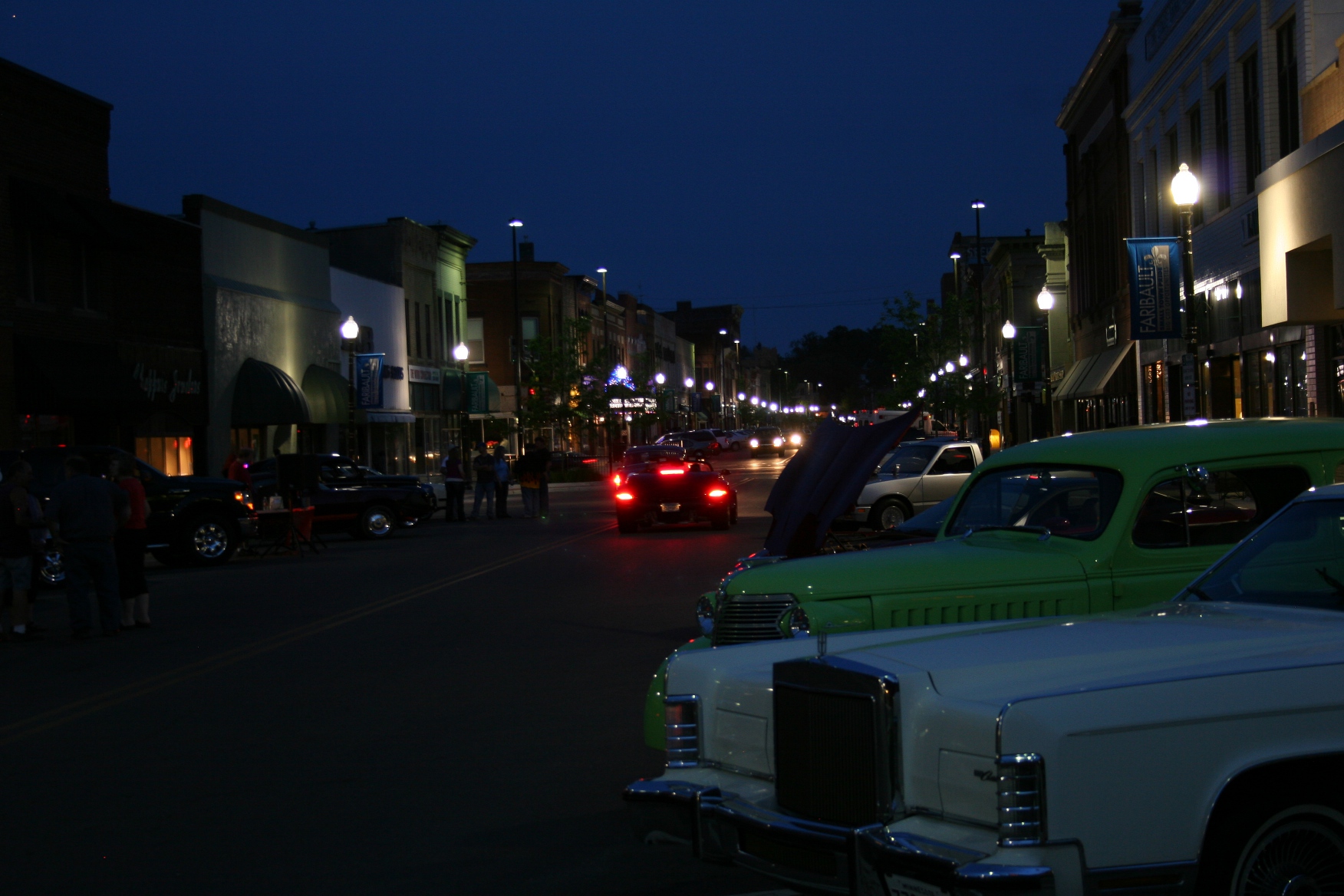
Looking south on Central Avenue during the Faribault Car Cruise Night on Friday.
BY THE TIME my husband and I arrived at the first Faribault Car Cruise Night of the season around 9 p.m. Friday, the last remnants of daylight were morphing into a beautiful inky blue sky of darkness.
Illuminated business signs and lighted storefront windows and the flickering motion of a big screen television in a second floor apartment and the spotlight of streetlights provided enough light to view the few remaining vehicles and to snap a few photos.

Music rocked the 400 and 500 blocks of Central Avenue, and beyond, as we wandered.

Hanging out along Central Avenue during Faribault Car Cruise Night.

Love the colors: the green against blue.

While we’d missed most of the cars and most of the crowd and the poker walk, I didn’t particularly care. Don’t get me wrong; I appreciate events like this and checking out all the classic cars and trucks. But on this night, my focus was on the deep, rich shades of that inky blue sky.

The dreamsicle car, Peachy, a 1955 Chevy.

Seriously, do you not love that peachy pastel Chevy contrasting with the blue sky?

The contrast of light and dark, of vivid lime green and creamy dreamsicle orange against that bold blue spoke to the artist in me.

Then, as I shot my final photos, headlights shone like beacons and red taillights blurred as, one by one, the last of the vintage antique and collectible cars slipped into the dark of a balmy and windy evening that felt more like summer than spring in Minnesota.

In a blur of taillights, a vintage car exits Central Avenue.

FYI: Faribault Car Cruise Night is held from 6 p.m. – 10 p.m. on the third Friday of the month, May – September, in the 400 and 500 blocks of Central Avenue in historic downtown Faribault. I’d advise arriving well before 9 p.m. if you’re more interested in the vehicles than in the darkening sky.

© Copyright 2012 Audrey Kletscher Helbling