Minnesota Prairie Roots

Writing and photography by Audrey Kletscher Helbling

My adventure at a Minnesota “antique theme park,” Part II September 18, 2012

Would you follow this driveway into the woods? I did. And what an adventure.

“I’M A LITTLE SCARED,” I admitted as we turned off Pillsbury Avenue just south of Lakeville, Minnesota, onto a narrow, hard-packed gravel road. Thick dark woods crept to the edge of the driveway and my imagination ran wild with fairy tales that ended badly.

What lurked in those woods? I glanced toward my husband, who was guiding our van into the unknown. “I hope there’s not a big dog.” I imagined a ferocious canine, teeth bared, legs planted in a defensive stance.

A dog-themed sign, one of many signs on the property. And, no, spelling is apparently not a priority here.

There were no guard dogs—unless you count the little dog interested only in pursuing a baby bunny and not humans. There were no bad endings.

But I wanted to warn you, lest you initially think like me and consider backing out even before you enter the wonderment which is Hot Sam’s Antiques.

Junk cars line the driveway, left. And, yes, that’s a Statue of Liberty standing in that red junk car in the background.

This place is part junkyard, sculpture garden and antique shop.

If you like your picking places all nice and neat and tidy, then this may not be your shopping venue.

Under construction in the woods, an over-sized motorcycle sculpture currently lashed to a tree limb among the junk.

But if you are adventuresome, don’t mind scuttling around junk (aka art/fabulous finds/treasures), have lots of time to meander and appreciate a one-of-a-kind place bursting with creativity, then, welcome to Hot Sam’s Antiques.

FYI: Click here to read my first post introducing you to Hot Sam’s Antiques. I have so much to show you that I will be writing a third post.

Along the driveway, you’ll see this fence decorated with an eclectic collection of stuff.

Just more abandoned vintage cars along the side of the driveway.

One of two planes on the property; the other one’s nosedived into the swampland. Yup, that’s a train in the background, behind the gigantic sunflower and to the left.

Following its theme park theme, Hot Sam’s pays tribute to the 1960s television sitcom, “Petticoat Junction,” via several on-site train cars (including this caboose) and a water tank. You’ll find antiques and collectibles inside the boxcars.

Anyone who knows me and how much I fear chickens will appreciate that I actually photographed these fowl roaming at Hot Sam’s.

This log cabin is simply bursting with antiques and collectibles, inside and out.

The hippie van, parked along the beach in the theme park area of Hot Sam’s.

I was tempted, quite tempted, to disobey these signs. Next visit…

© Copyright 2012 Audrey Kletscher Helbling


Touring Hot Sam’s, an “antique theme park” near Lakeville September 17, 2012

Northbound on Interstate 35 just south of Lakeville, you’ll see this roadside art marking the location of Hot Sam’s Antiques.

YOU’VE SEEN THE ECLECTIC COLLECTION, I’m sure, if you’ve ever traveled Interstate 35 northbound near Lakeville.

Just another view of the eclectic art collection, shot while traveling the interstate. No stopping for this photo.

You’ll see the fearsome shark first as you’re driving north on I35.

Just south of exit 81 atop a hill on the east side of the interstate, a red ANTIQUE sign draws your eye to a mish-mash of stuff. Several rusting cars. A rather vicious looking blue shark (although I’m sure you don’t notice the detailed sharp teeth while racing along the interstate at 70 mph). A lady bug. A rocket and a submarine. And, heck, there’s an oversized guitar, too.

At the north end of the line, the ginormous guitar.

A view from atop the hill, in the middle of the eclectic collection.

For 30 years I’ve seen the changing collection and always wondered about Hot Sam’s Antiques. Now, after a recent Saturday afternoon visit, I need wonder no more.

Kathy Sakry, left, and Aina Puritis on the front porch of the log cabin.

Honestly, how to begin to describe this place seems an impossibility, until I meet Aina Puritis—pronounce that Latvian first name with a silent “A” and a long “i”—a part-time employee of three months. “I’ve never seen anything quite like this,” I tell Aina.

“You got that right, honey,” she agrees, then offers her definition. “It’s an antique theme park, a mix of this and that.”

The log cabin, back and to the right, is packed with antiques and collectibles. I spotted the charming, cottage style treehouse, left, but didn’t even check to see if I could explore inside. I was running short on time.

Aina nails Hot Sam’s with that description because, in addition to thousands of antiques and collectibles crammed inside and outside a log house, outbuildings and train cars and scattered upon the grass and through the woods and along the sides of the narrow gravel drive, you’ll discover a wonderment of creations fitting a theme park.

Barry was painting a giant sunflower when I came upon him among the junk in the woods.

You might find Barry (no last name offered), a retired laser cutter turned artist, back in the woods among all the junk working on his latest sculptures—painting a giant sunflower or building an oversized motorcycle roped and suspended from a tree limb.

Nemo from the back, looking toward the log cabin on the hill, center, a boat on the left and train cars in the distance to the right.

He takes credit for transforming a vintage car into the Disney cartoon fish Nemo via orange paint, the addition of fins and eyes and some major interior redecorating. Nemo’s beached in sugar fine sand along a ribbon of water which meanders into the 10-acre property.

Inside Nemo, my absolute favorite part of the entire antique theme park. Who would ever think you could turn an old car into something so incredibly magical?

The tropical beach scene seems oddly out of place given the native swampland grass and surrounding woods and the autumn leaves littering the sand. But no one claims anything’s exactly as it should be at Hot Sam’s.

A close-up of the hippie van parked in a beach setting with fine white sand and even a hammock.

That’s part of the appeal, to see a peace-out hippie van parked on the beach; the wreck of the S.S. Minnow from the 1960s T.V. sitcom, Gilligan’s Island, hugging the shore; the canary yellow tail of a crashed airplane poking through the swampland grass across the water.

“It became a labor of love,” Kathy Sakry says of this whole intriguing place. She’s the significant other of Jake Hood, who, along with his mother, Gladys Hood, 26 years ago transformed a field with a two-car path into Hot Sam’s Antiques. Nine years prior to that, the business was located in Burnsville. Gladys died in December 2010.

Kathy prefers not to explain the story and inspiration behind the antique theme park, choosing instead to hand over a reprint of an article written by Gladys and published in Reader’s Digest. To summarize, Gladys’ father, Hyreeg, an Armenian immigrant living in Detroit, collected scrap metal to raise money for a flagpole upon which he flew a U.S. flag symbolizing his pride in becoming an American.

Inside the log cabin, I found this collectible glassware and this welcoming sign, which seems to exemplify the welcoming spirit of Hot Sam’s Antiques.

Gladys wrote in 2002 that she acquired her father’s love for hard work and collecting (she would go “picking” with him as a child) and continued his legacy via her business. She collected for practical and recycling reasons and for the joy of sharing in the memories of those who visit Hot Sam’s.

I saw at least three Statues of Liberty on the property.

Whether a tribute to her father’s patriotism or not, numerous replicas of the Statue of Liberty are planted on Gladys’ tangible slice of the American dream.

About that business name… Kathy says Hot Sam was Gladys’ nickname, a name she preferred to her given Gladys, which taunting youngsters reinvented into, well, you can figure that out, during her childhood.

Then Kathy shares more about Gladys and a clearer picture emerges of this strong woman. She once raced cars, breaking the land speed record on Daytona Beach in 1956.

This mock, crashed airplane is positioned across swamp grass on the property.

Despite her prior days of daring, competitive racing in a man’s world and of traveling, Gladys seldom left Hot Sam’s once established, Kathy relates. And when she did, it was to attend air shows with her adopted daughter, airline and aerobatic pilot Julie Clark. The bi-plane and staged, mock plane crash at Hot Sam’s are perhaps visual connections to Julie, whose birth father was murdered in 1964 while piloting a plane which subsequently crashed, killing all 44 aboard. Or perhaps the planes reflect Gladys’ general affection for air shows.

While wandering the grounds of Hot Sam’s, you have to wonder where Jake and Gladys acquired all this stuff and Kathy says only that they are buyers and sellers. She wants me to talk to Jake and sets off to find him. But I am anxious to photograph this magical antique theme park in the perfect, golden hour around sunset. I never do connect with Jake.

I am not the only photographer here on this late Saturday afternoon. I meet a young couple and their two children primping for a family photo shoot with St. Louis Park-based portrait photographer Jess Sandager of Olive Avenue Photography. Later I meet up with the family and photographer near the beach. Jess tells me Hot Sam’s is well-known in the photo industry.

Although I’d like more details, I won’t keep Jess from the waning, perfect light.

I watch for a minute as Jess works her camera, photographing the little boy on a tractor and then mom and baby.

The beached Nemo.

Father and son, in the meantime, are now heading toward the orange fish on the beach, toward Nemo—dad walking, son running…

Watch for this sign at 22820 Pillsbury Avenue South directing you onto the narrow gravel road into Hot Sam’s Antiques.

FYI: To get to Hot Sam’s Antiques from Interstate 35, take exit 81 near Lakeville and go east on Dakota County Road 70 about half a mile to the stoplight. Then turn south onto Kenrick Avenue/County Road 46. Continue approximately 1 1/2 miles on Kenrick, which turns into Pillsbury Avenue. Hot Sam’s is located on the west side of the road at 22820 Pillsbury Avenue South, Lakeville. You’ll see a sign.

Hours are from 10 a.m. – 6 p.m. weekdays (except closed on Thursday) and Saturday and from noon to 6 p.m. on Sunday.

Check back for more photos from Hot Sam’s because there’s so much more I need to share with you.

© Copyright 2012 Audrey Kletscher Helbling

 

A Minnesota arts collage, from theater to poetry September 15, 2012

FOR A FEW SECONDS THERE, I searched the dictionary of my brain for that word which temporarily eluded me. Collage. That would be it.

Remember when that art form was especially popular, when, as a school assignment, you had to scrounge up ten zillion magazines and then snip out images themed to a specific subject and glue it all in a jumbled mess onto a piece of paper?

Today I present a collage—not a jumbled mess, though—of art.

Let’s take the biggest focal piece first. A Hudson.

A Hudson, like this one I photographed several years ago at a Faribault car show, centers “The Car.” Do not expect, though, to see a real Hudson on stage, only the shape of one.

The Hudson centers the stage at the Paradise Center for the Arts during a production of The Car by Carol Wright Krause. My husband and I saw this play by the Faribault-based The Paradise Community Theatre Friday evening. I’d rate it as one of the best I’ve ever seen performed locally.

Here’s a summary of the play written by director Gabe Talamantes:

The Car is about a family’s car, which as Ed (a character in the five-person drama) puts it “is a miracle of modern American engineering.” This miracle car is a character in itself, a highly theatricalized version of a 1954 Hudson. It takes us on a journey into the lives of the Banners and the challenges an all American family faces as they struggle through two decades of change at home and abroad. We will see how they choose to overcome such difficulties.

Now, why am I so enthusiastic about The Car? Because it moved me to tears. When a theatrical performance can evoke such a strong emotional reaction from me, I will embrace it with unbridled enthusiasm.

That break-down moment for me came near the end of the play, when Vietnam War veteran Hal Banner (played by Todd Ginter), broke down in the arms of his father, Ed Banner (Chuck Larsen). He was no hero, Hal said, pointedly telling his father that he (Ed) would never understand the horrors of war. And then Hal got specific, talking about seeing the eyes of those he killed.

That’s when the tears trickled down by cheeks and I struggled mightily to keep from sobbing. In that moment, I heard my Korean War veteran father, not Hal/Todd. My dad, too, spoke of seeing the eyes of those he killed on the front lines in Korea.

Later, when I congratulated Todd on his performance, he told me that he had talked to several veterans in preparation for his role. And it was the eyes which they spoke of and which he knew he needed to emphasize in that heartrending father-son conversation. It is easily the most powerful moment in the play.

I wondered how many audience members might be veterans and at that moment suppressing war memories and feelings, as my father did.

But this play is about so much more than war. It also addresses the issue of prejudice when Hal brings home a Japanese wife, portrayed by Carrie Jendza whose mother came here from Korea some 40 years ago. Carrie presents a stunning performance as do Susan Dunhaupt as Ed’s wife, Geneva, and Faribault High School sophomore Emily Remmey as Beth Banner, Hal and Sumiko’s daughter.

The prejudice starts right away when Ed Banner insists on calling Sumiko the Americanized “Sue.” He slides in references to “slant eyes” (there’s the “eye” thing again) and other derogatory comments.

In real-life, prejudice is an issue in Faribault, home to many Latino, Somali and Sudanese family. It is no secret that prejudice exists in my community. You can read about it in a previous post by clicking here.

I didn’t spot a single minority in the audience Friday evening,  not unusual despite Faribault’s sizable minority population.

There, that’s all I’m telling you about The Car, other than to advise you to see this powerful and memorable production. It’s community theater at its best for the superb acting and the unforgettable messages delivered.

Faribault artist Vivian Jones created this watercolor, “It Was Grandma’s Car,” for the current “car pARTS” show.

Additional performances of The Car at the Paradise, 321 Central Avenue, Faribault, are set for 7:30 p.m. on September 15, 20, 21 and 22 and at 2 p.m. September 16. Call (507) 332-7372 or click here to reach the Paradise website. According to info published in the theater program, production of The Car is made possible through a Minnesota State Arts Board Operating Support Grant.

While you’re at the play, be sure to check out the exhibit, “car pARTS,” in the Carlander Family Gallery.

The Beat logo.

NOW LET’S PLACE another piece in that art collage. On-air poetry.

In July, Northern Community Radio began airing poetry on its weekday morning show during a segment called The Beat.

On Monday my poem, “Her Treasure,” will air on 91.7 KAXE (89.9/Brainerd) and on 90.5 KBXE. Now I won’t be able to listen to whomever reads my poem between 7:30 a.m. – 8 a.m. and again between 3:30 p.m. – 4 p.m. Faribault is well outside the coverage area which extends from Thief River Falls to Hermantown to Pierz. Eventually, though, I’ll be able to listen to the reading of my poem online.

You can listen to The Beat via online streaming. (I’m not smart enough to figure that out and my former in-house techie now lives at NDSU in Fargo.)

I’m in the company of some mighty fine poets, from novices to Minnesota’s 2011 poet laureate, Joyce Sutphen, to well-known Minnesota writer Will Weaver. You can check out the current listing of The Beat poems/poets by clicking here.

The poems chosen for airing were selected through a juried process.

Connie Ludwig, right, and I pose for a photo with her watercolor, “Pantry Jewels” (above my head) inspired by my poem, “Her Treasure.” This photo was taken in April at Crossings at Carnegie in Zumbrota.

Just, FYI, “Her Treasure” is the same poem featured in “Poetry Artist Collaboration XI” at Crossings at Carnegie in Zumbrota last April. To read my poem, click here.

I love this whole concept of The Beat, of Northern Community Radio’s “daily reminder that, in Minnesota, poetry matters, and Minnesota poets prove that every day.”

You can expect a forthcoming detailed post from me on this project funded by Minnesota’s Arts & Cultural Heritage monies.

The cover of last year’s The Talking Stick 20.

NEXT, LET’S PLACE the third piece in this arts collage. More poetry, plus fiction and creative nonfiction.

Today I’m missing out on a book release party for The Talking Stick 21 in the Park Rapids area. This anthology, published by The Jackpine Writers Bloc, represents some fine writing by Minnesota writers. You can, referencing back to The Beat, listen to the poetry of Sharon Harris, a Jackpine member and one of the key producers of the collection.

I’ve been published in two previous volumes of The Talking Stick (including receiving an honorable mention for my poem, “Hit-and-Run,” in volume 19) and will be published again in this newest volume. My poem, “Broken,” was chosen from among 275 submissions for publication.

To learn more about The Talking Stick, click here. To learn more about The Jackpine Writers’ Bloc, click here.

THAT’S IT. Now, go ahead, add your own pieces to this art collage via your comments.

© Copyright 2012 Audrey Kletscher Helbling
 

A maple bacon sundae & other delights at a Waterville coffee shop September 13, 2012

Singing Hills Coffee Shop, at the corner of Main and Third Streets in downtown Waterville in southern Minnesota.

KATHY GREW UP in Detroit, worked 20 years as a deck officer on a freighter for the Merchant Marine, met her husband at a Halloween party, birthed two daughters in her 40s and then, with no business experience, opened a coffee shop in December 2010.

That’s the life synopsis of the woman behind Singing Hills Coffee Shop in the southern Minnesota lakeside community of Waterville, best known for its bullheads and Buccaneers—as in the local high school champion football and basketball teams.

Inviting outside dining at the Singing Hills Coffee Shop.

One-third of a stately, anchor brick building on a corner of Waterville’s Main Street houses the coffee shop. It’s as inviting on the outside—with bistro tables and a bench and window baskets popping with hot pink petunias and luscious ivy spilling from pots—as it is inside.

The bright, cozy dining area of the coffee shop with local arts and crafts displayed on shelves to the right and on walls.

Kathy’s daughter, Marina, waits on customers.

On an early Sunday afternoon, 45 minutes before the 2 p.m. closing, Kathy hustles to prepare sandwiches and ice cream treats while her 10-year-old daughter, Marina (yes, her name is a nod to Kathy’s time on the water), takes orders, accepts payment and makes change.

Kathy hurries back to the kitchen to prepare orders while customer and friend, Kari, relaxes in a back coffee shop corner. Tim Foster’s “American lures” painting (oil paint, oil pastels and graphite on canvas) anchors the wall. It was inspired, he says, by old fishing lures. Kathy would like to purchase the $450 painting as a permanent installment in her shop. I suggested she collect tips to help her buy it. Foster sells his mostly abstract and surreal paintings through his website and studio, at Hogan Brothers in Northfield and via art shows. Kathy saw “American lures” at the 2012 Sakatah Arts Experience in Waterville and invited Foster to bring his painting to her coffee shop.

In a comfy corner chair, Kathy’s friend, Kari, is reading her bible, seeking comfort at the recent, unexpected loss of her 36-year-old cousin. Light floods the homey space warmed by walls the hue of honey on two sides and a contrasting robin’s egg blue on the other.

A printed sign on a slim spot between two towering windows reads:

Conduct Code—Love your neighbor as yourself. Treat other people the way you want to be treated!

Owatonna resident John Muellerleile’s fine art photography on display and for sale.

Kathy welcomes customers and artists here, into this corner haven in a town that thrives on summer-time business from resort guests, cabin dwellers and users of the recreational Sakatah Singing Hills State Trail.

Her customers come here for the ever-popular smoothies and the favorite turkey avocado sandwich, for the coffee and the espressos and other beverages, for the breakfast and soup and sandwiches and salads and baked goods and ice cream treats.

On this Sunday, my husband and I have driven 15 miles for an ice cream treat upon the recommendation of our friend, Joy, who raves about the maple bacon sundae.

As Randy places our order with Marina, I chat with Kari in the corner, take photos and admire a focal point, 6-foot by 4-foot oil painting by Tim Foster of Northfield. His fish-themed art piece, titled “American lures,” is “so Watervillian,” Kathy tells me later, fitting this lakeside town which celebrates bullheads at an annual June festival. There’s a deeper meaning to the painting in which words like “love” and “prove it” and “Federal Reserve Bank” are hidden, Kathy says, but we don’t get into details.

An example of the handcrafted work of local artisans for sale in the coffee shop.

Kathy works with the nonprofit Waterville Local Cooperative Outlet to provide a marketplace for some 8-10 local artisans and crafters. Their creations—from woodcrafts to crocheted caps, paintings, photos and more—are displayed on walls and on shelves through-out the coffee shop.

Donald Kelm of Waterville, a custom woodworker, created this mug.

Engaging the arts community exemplifies Kathy’s efforts at community development. That extends to the food aspect of her business, too. She wanted, she says, more dining options than bar food burgers and fries for the town she and her family now call home. And Kathy offers that with a sandwich menu which doesn’t include a single burger. The closest thing to fries are the chips accompanying sandwich orders.

On her sandwich menu, you’ll find choices like egg salad on a croissant; veggie wrap with hummus, provolone, red onion, red pepper and spinach; and cherrywood smoke ham with garlic cheddar, tomato and mustard sauce. You can build your own sandwich, order a cup of soup.

Hungry for a bakery treat? Kathy has selections from cupcakes to pie to traditional Upper Peninsula style pasties, a tribute to her native Michigan.

Singing Hills Coffee Shop’s delicious maple bacon sundae.

But, on this Sunday, I’ve come only to sample the maple bacon sundae with spicy maple-glazed pecans, homemade maple caramel and bacon, yes, bacon, on vanilla ice cream. My husband questions my choice. I don’t, and find the sweet and salty mix a perfect complement to the ice cream. I’d give the maple bacon sundae a five-star recommendation.

An equally tasty blueberry sundae.

My less daring spouse orders a blueberry sundae and is equally pleased with his selection.

These two boys came with their moms, and a sister of one, for ice cream treats. The boy on the right told the boy on the left that he had a mustache. Then I told the boy on the right that he had an ice cream mustache, too.

A retired couple who spend their summers at a Waterville resort rave about the sandwiches while two moms ordering ice cream for themselves and their kids endorse the ice cream.

Kathy, though, admits that business growth was slow during her first year and that she’s still learning, given her inexperience as a businesswoman. With summer winding down, she’s cutting back on hours. Singing Hills Coffee Shop is closed now on Mondays and Tuesdays, but open from 8 a.m. – 5 p.m. Wednesday – Saturday and from 8 a.m. – 2 p.m. on Sunday.

On October 14, the coffee shop will close for the season and then reopen in mid-April.

So, if you want to try that maple bacon sundae…

FYI: For more information about Singing Hills Coffee Shop in Waterville, click here to reach the shop’s website.

To learn more about the arts scene in Waterville, specifically the annual Sakatah Arts Experience, click here.

For more info about Northfield artist T. Andrew Foster, click here to visit his Creative Space Art Studio website. 

Copyright 2012 Audrey Kletscher Helbling
 

All about cars at Faribault art center August 31, 2012

“Flower Car for a Living Detroit,” acrylic on canvas by Michigan artist Stephanie Gallison and part of the car pARTS exhibit at the Paradise Center for the Arts. The painting “represents life, hope and resurrection for the city of Detroit; the opposite of recession, decline and decay,” according to Gallison’s website.

IF YOU’VE FOLLOWED this blog for awhile, you know that I’m a supporter of the arts.

And I don’t specifically mean I write out generous checks to buy art or donate to an arts cause or such. I wish I could. But the fact is that my family, like many middle class families, needs to watch its budget.

That doesn’t mean, though, that my husband and I can’t treat ourselves to the occasional night out to see a play or enjoy a concert or catch a comedy show, or become members of the local arts center.

A snippet of the current car pARTS exhibit at the Paradise.

I appreciate that we have the Paradise Center for the Arts right here in Faribault as a venue to enjoy the visual and performing arts and even take a class, if I wish, but haven’t.

Perhaps because I grew up in the 1960s and 1970s in rural southwestern Minnesota, without access to the arts, I especially value the arts opportunities offered right here in my community, only blocks from my home. No need to drive up to the Cities or elsewhere.

Faribault artist Vivian Jones created this watercolor, “It Was Grandma’s Car,” for “car pARTS.”

For example, currently the juried exhibit, “car pARTS,” is showing in the PCA’s Carlander Family Gallery through September 25. The show is exactly as it name implies, artwork featuring cars or parts of cars.

The logo for the Faribo Drag-On’s Car Club.

Hanging out along Central Avenue during Faribault Car Cruise Night in May.

The subject seems an ideal one for this predominantly blue collar community which has a special fascination with cars. That’s my assessment, anyway, based on the long-standing Faribo Drag-On’s Car Club, the Classic Car Roll In on Tuesday evenings at the Country Kitchen and the recent start-up of the May-September third Friday of the month Faribault Car Cruise Night on downtown’s Central Avenue.

Following the car theme, the Paradise Community Theater will present six performances of the play, The Car by Carol Wright Krause, beginning September 14 and running through September 22.

Acrylic paintings of dogs in cars, by Julie M. Fakler of Faribault , are in the car pARTS exhibit.

The play seems the ideal mesh with “car pARTS,” one complementing the other.

Here’s a summary of The Car, pulled from the PCA website:

Meet the Banners, a picture perfect postcard of a 1950s American family with an all-American son, a doting mother and an honest car salesman of a father, who does everything by the book and has just recently purchased the car—a 1954 Hudson Hornet. But when their son suddenly joins the military, only to return with a Japanese wife, the family’s world is suddenly turned upside down. Things may not be as picture perfect as they seem. The Car hits a few potholes along the way, takes some sharp turns, but takes you on an engaging and entertaining ride.

Looking south on Central Avenue during the Faribault Car Cruise Night in May.

I’d love to see all those collectors who are members of the Drag-On’s and/or all those who will be participating in the last downtown car cruise of the season on Friday, September 21, among those attending The Car in Faribault’s historic theater.

I invite any of you with vintage vehicles, whether from Faribault or not, to drive to the theater in your vintage vehicles, park along historic Central Avenue and experience the arts scene here. Maybe even dress up in back to the 50s garb to truly embrace the time period of the play.

Do you know who owns this Hudson Super Jet?

And whoever owns this Hudson Super Jet, which I photographed at a car show in TeePee Tonka Park in 2009, you’d be especially welcome given the car in the play is a 1954 Hudson Hornet.

Just a close-up of the Hudson Super Jet, built either in 1953 or 1954, I believe.

FYI: Click here for more information about the Paradise Community Theater’s performance of The Car.

P.S. This additional postscript has nothing to do with the arts in Faribault. But it is related to my support of the arts via my work on Minnesota Prairie Roots. Earlier this week I posted about the Gabor and Edith Nemeth Study Collection, a priceless collection of 15th to 19th century paintings in Park Rapids. The Nemeth Art Center is attempting to raise $1,200 for a storage unit to safely store and protect the paintings. Since posting this story on Monday, five more contributions have been made to the cause via the NAC’s online fundraising campaign, which you can find by clicking here. You have four more days to donate.

To read my original post about the Gabor and Edith Nemeth Study Collection, click here.

© Copyright 2012 Audrey Kletscher Helbling
 

Raising funds to preserve priceless paintings in Park Rapids August 27, 2012

BETWEEN NORTHWESTERN MINNESOTA and Chicago, you won’t find another art collection like the Gabor and Edith Nemeth Study Collection dating from the 15th to 19th centuries.

Now that “Old Masters” collection of 42 European paintings owned by the Nemeth Art Center in Park Rapids is in need of a permanent storage unit to preserve the valued art for future generations.

A campaign is currently underway to raise $1,200 for materials to construct a modular custom storage unit that will keep the paintings separated and vertical, thus preventing further damage. As of August 23, the NAC had raised $600 via an online campaign and direct contributions, according to NAC Executive Director Meredith Lynn.

Brian Stieler of the Minneapolis Institute of Arts has volunteered to design and build the storage structure. And representatives of the Midwest Art Conservation Center in Minneapolis have already been to Park Rapids to assess the collection and lay out plans for restoration.

“St. Jerome,” painted by a 17th century follower of Hendrik van Somer, and part of the collection.

About a third of the paintings require restoration, Lynn says, with several in such condition that they can no longer be exhibited. More than 30 of the pieces are continually on display (during the center’s open months from May – September) in the 1900 Victorian style brick courthouse turned art center which opened in 1977.

That was the year the historic and priceless collection of paintings, by students who studied well-known masters like Rembrandt, Rubens and Bosch, came to be owned by the then newly-established North Country Museum of Arts.

European born art restorer and dealer Gabor Nemeth, who came to the U.S. in the 1940s and worked thereafter primarily in Los Angeles, also maintained a home in the Park Rapids area (his primary residence now) and brought his collection to Minnesota in the mid 1970s.

After a three-day January 1977 exhibit of his collection in Park Rapids—a show which drew long lines of some 4,000 people total in the then town of 2,700, according to newspaper reports—Nemeth decided to offer the art to Park Rapids. Conjecture had long been that St. John’s University would be the recipient of the collection (for a reason unknown to Lynn; I asked).

In an article published in the May 2, 1977, issue of the Bemidji-based newspaper, The Pioneer, Nemeth is quoted: “There is really nothing up here as far as art goes. People will appreciate it (the collection) if they are given the chance to see it.”

“Adam and Eve,” a 17th century painting by a student of Cornelisz.

Clearly the people of Park Rapids realized the significance of Nemeth’s offer as 30 families borrowed $35,000 to purchase the paintings, a price “significantly less than the appraised value,” Lynn notes.

She won’t put a value on the paintings today other than to assess it’s “quite high.” Beyond the monetary value, the art center director calls the collection “historic and unique paintings with priceless cultural value.”

Speculation has existed that perhaps the masters themselves may have dipped their brushes into oil or tempera to work on paintings in the collection. The art center lays no official claim to that suggestion, although Lynn says, “…it’s possible that painters such as Rembrandt painted on several of the canvases that we own.”

The identities of whose who painted the pieces as part of a greater studio study setting are primarily lost to history, according to Lynn.

Many of the paintings were originally acquired for Lois Warschaw, an art collector and prominent political figure in Los Angeles, prior to ownership by Gabor Nemeth and his wife, Edith.

Today, as it always has, the Gabor and Edith Nemeth Study Collection centers the Nemeth Art Center, which opened in August 1977 after the Park Rapids community pulled together to purchase the paintings and remodel the courthouse into a center for the arts.

Says Lynn:

New visitors to the Nemeth Art Center are always pleasantly surprised by the beauty and historical relevance of our paintings. Park Rapids is a small town, but the arts community here is growing and hopefully our collection will help raise awareness of the town as an arts destination.

That’s exactly what Gabor Nemeth hoped for 35 years ago—that his collection of Old Masters paintings would draw tourists to this community in northwestern Minnesota. And it does. The collection includes works of biblical scenes like “Madonna and Child,” “Madonna of the Harpies,” “The Holy Family,” “Christ in the Garden of Gethsemane,” “Christ in the Wilderness,” and several genre paintings such as “Kitchen Scene” and “The Card Players.”

Today efforts also focus on preserving the collection via construction of the custom storage unit. With $600 more in contributions (as of August 23), the project can proceed.

But the art center’s goals go well beyond a storage fix. Options are under consideration to move into a handicapped accessible building with more consistent climate control. The center is also working on a seven-year plan to restore the study collection paintings.

Executive director Lynn summarizes the situation and needs:

The Nemeth Art Center is a unique institution, and this collection forms its backbone. Maintaining historic items is important and costly, and the NAC cannot provide the community with something so special without continued help.

“Portrait of a Noblewoman,” an 18th century painting by a follower of Rubens.

IF YOU’D LIKE to contribute to the storage unit fundraising effort, click here to reach the NAC storage unit project campaign on indiegogo.

Or visit the NAC website, by clicking here, for details and contact information.

To read a detailed history on The Gabor and Edith Nemeth Study Collection, click here to a presentation prepared by Steven R. Peterson with grant funding from the Region 2 Arts Council. Thanks to LouAnn Muhm, chairperson of the NAC Board of Directors, for directing me to this presentation, the source for some of the information cited in this post.

Special thanks to NAC Executive Director Meredith Lynn for answering my lengthy list of questions via email.

If you wish to view the Gabor and Edith Nemeth Study Collection, art center hours are from 10:30 a.m. – 4:30 p.m. Tuesday, Thursday and Saturday, May – September. Each month the NAC also features a curated exhibit of contemporary art in addition to pieces from its permanent collection.

Finally, check out the current “Rembrandt in America” exhibit now showing at the Minneapolis Institute of Arts by clicking here. Perhaps viewing that will inspire you to support efforts to preserve the priceless paintings in Park Rapids.

Images of paintings are courtesy of the Nemeth Art Center


From shy teen to confident artist, entertainer & business woman August 21, 2012

Jodi Gustafson of Big Shoe Entertainment begins transforming young Owen’s face into a Ghost Rider’s skull mask at the recent Blue Collar BBQ & Arts Fest in Faribault.

IMAGINING 37-YEAR-OLD JODI GUSTAFSON—also known as Lollipop the Clown, Jenius Strangeways or the proprietor of Big Shoe Entertainment and Jodelle’s Finery—as a once shy teen weaving down the hallways of Richfield and Coon Rapids high schools seems an impossibility.

But this vivacious and confident small business owner, whom I met at the recent Blue Collar BBQ & Arts Fest in Faribault where she was transforming faces through her stunning full face painting, reveals an adolescent timidness that contradicts her very public professions.

“I hated being shy,” said Gustafson, who recalls turning red if anyone so much as said “hi” to her. Determined to overcome that shyness, she eventually, and purposefully, chose a job with the United Way which involved public speaking.

“I knew I would never change if I didn’t get out of my comfort zone.”

That decision proved pivotal for Gustafson when a company wanted a carnival theme for its campaign but couldn’t afford to hire a clown. Gustafson volunteered, thinking clowning couldn’t be all that difficult. She was wrong, but continued anyway with the clowning which led to painting cheek art and then, with the encouragement of Cindy Trusty of Cindy’s Creative Celebrations, to full face painting and finally the official formation of Big Shoe Entertainment in the early 2000s.

Owen’s half-mask skull evolves under Gustafson’s skillful hands. She contracts her work for community and private events (such as birthday parties) and with corporations (such as for company picnics).

Today this mother of three (ages three to 17) operates two successful small businesses from her Bloomington home. Big Shoe Entertainment, encompassing clowning, balloon twisting, airbrushed and glitter tattoos, henna and crazy hair, but primarily full face painting, keeps her crazy busy, especially during the summer, with gigs throughout Minnesota, Iowa and Wisconsin. The pace slows during the other seasons.

An assortment of the make-up, all with FDA-approved ingredients and meant to be used on the body and face, which Gustafson uses for face painting.

In anywhere from one to five minutes Gustafson, with brushes and make-up pads and an array of colorful make-up, can transform a face into a work of art. She’s morphed five billion faces, she exaggerates, into butterflies, and also creates lots of flowers and princesses, and masks such as skull, dragon and Mardi Gras.

She especially enjoys painting “gore” faces, but seldom has the opportunity.

Owen sits perfectly still as Gustafson paints. Some kids squirm or won’t close their eyes, meaning she sometimes needs to adjust her work to eliminate painting around the eyes or needs to explain step by step what she is doing. Typically, Gustafson doesn’t talk while painting faces.

She’s always learning—from videos, books, classes and practice. That practice includes painting designs all over her arms and legs while relaxing at home in front of the television. Gustafson puts her own spin on existing patterns via color choices and painting style, defining her work as her own in a profession that’s becoming more saturated. Yet, most are not at her level of expertise, she says, in an honest, but not boastful, way.

Gustafson works with two agents and occasionally hires independent contractors to assist at events where she can’t handle the volume solo. She’s picky, though, and chooses only the best artists.

American Family Insurance of Faribault sponsored free full face painting by Gustafson at the recent Blue Collar BBQ & Arts Fest. Lines were long. Gustafson painted for five hours, averaging 20 – 25 faces per hour. If she returns next year, she’ll bring another painter, she says, to shorten those lines.

All of this is interesting given Gustafson early on was intimidated by full face painting. Clearly she’s not anymore as she works with the swiftness and assurance of a skilled artist. She always had an interest in art, she says, but not the confidence. She took art classes in high school and moved on to painting still lifes in acrylic on canvas, something she has no time for now.

Besides mothering and operating Big Shoe Entertainment, Gustafson also owns Jodelle’s Finery, specializing in Renaissance and Victorian “garb.” That’s her term, “garb,” referencing the durable period clothing she fashions, as opposed to “costumes,” for the Minnesota Renaissance Festival and steam punk events. (Steam punk fashion, since I didn’t know and perhaps you don’t either, is Victorian clothing with a technological, sci-fi twist.)

Even Jodelle’s Finery, in typical Gustafson fashion, has an interesting beginning. When pregnant with her middle child, Gustafson was feeling quite domestic and taught herself to sew. Her first project was a baby quilt. Today she’s advanced to sewing that garb for others and for her role as the street performer Jenius Strangeways at the Minnesota Renaissance Festival.

Yes, this once shy teen morphed into an actress too—role playing at the Renaissance and on the stages of community theaters in Faribault (where she lived until moving to Bloomington in June), Owatonna and Northfield.

“I don’t like to be still,” claims Gustafson, who before she took on the Renaissance acting gig two years ago, worked in shops at the Minnesota festival.

Owen’s skull face mask is almost done.

Yet, in the middle of all that public busyness of painting faces and clowning and acting, Gustafson says she still occasionally slips back in to the quiet, nervous and shy Jodi of years past. That happens, she explains, if she’s not role-playing and doesn’t know anyone at an event she’s working.

Mostly, though, she’s made a choice to get past her shyness, to be the strong and confident woman who paints faces, entertains and clothes entertainers via her two successful businesses.

Owen opens his eyes for the great reveal.

FYI: Jodi Gustafson doesn’t have a website for Big Shoe Entertainment, so don’t bother trying to find one. You may contact her via email at gusjodi@gmail.com or call her at (952) 215-4544. You can also check out her Jodelle’s Finery Facebook page by clicking here.

I initially developed this post idea to showcase Gustafson’s full face painting because I was so impressed by her work. But when I interviewed her about a week later and learned how she overcame her shyness, that became the real story. I hope you will be inspired, as I am, by Gustafson’s determination to overcome an obstacle, change and pursue her passions in life as her professions.

Gustafson transformed Isaac into a tiger at the Faribault festival.

Isabella, 7, of Faribault, became a dalmatian under Gustafson’s crafting. Butterflies and dalmatians proved the most popular paintings chosen by attendees at the Faribault fest.

© Copyright 2012 Audrey Kletscher Helbling
 

Carv-Fest brings together novices to pros in Faribault August 13, 2012

I WONDER WHAT THE ODDS ARE, that a community of some 22,000 would be home to two internationally-known, award-winning woodcarvers.

That would be Faribault. And they would be Marvin Kaisersatt and Ivan Whillock.

Woodcarvers, from novice to pros, participated in Carv-Fest 2012. Here are students and instructors in a Saturday morning session.

The carvings of these two gifted Minnesota artists, and gifted doesn’t even seem to begin to fit their talent, were among art displayed at the August 9 – 11 Carv-Fest 2012 which drew woodcarvers, from beginners to seasoned carvers, to Faribault.

The intricate chip carving of Marty Leenhouts of Garden City, Minnesota.

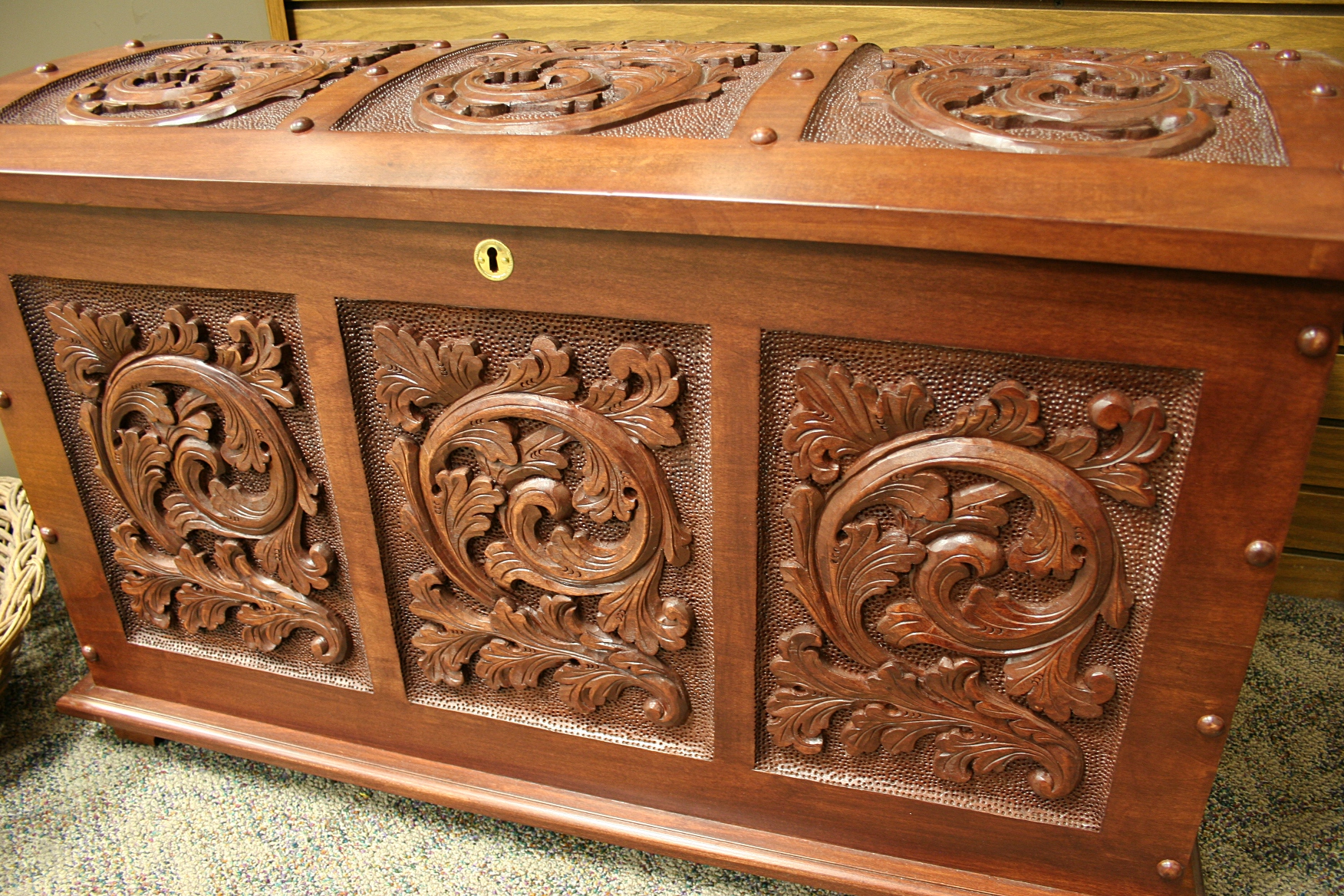
It may be summer, but Santa showed up in a woodcarving and classes at the festival.

Imagine if this had been a hand instead of a glove…

I roamed the fest on Saturday, seriously impressed by the intent concentration of the attending woodcarvers, the intricacies of the carvings, the variety of art created and the fearlessness in putting sharp tools to wood. No wonder they wear gloves.

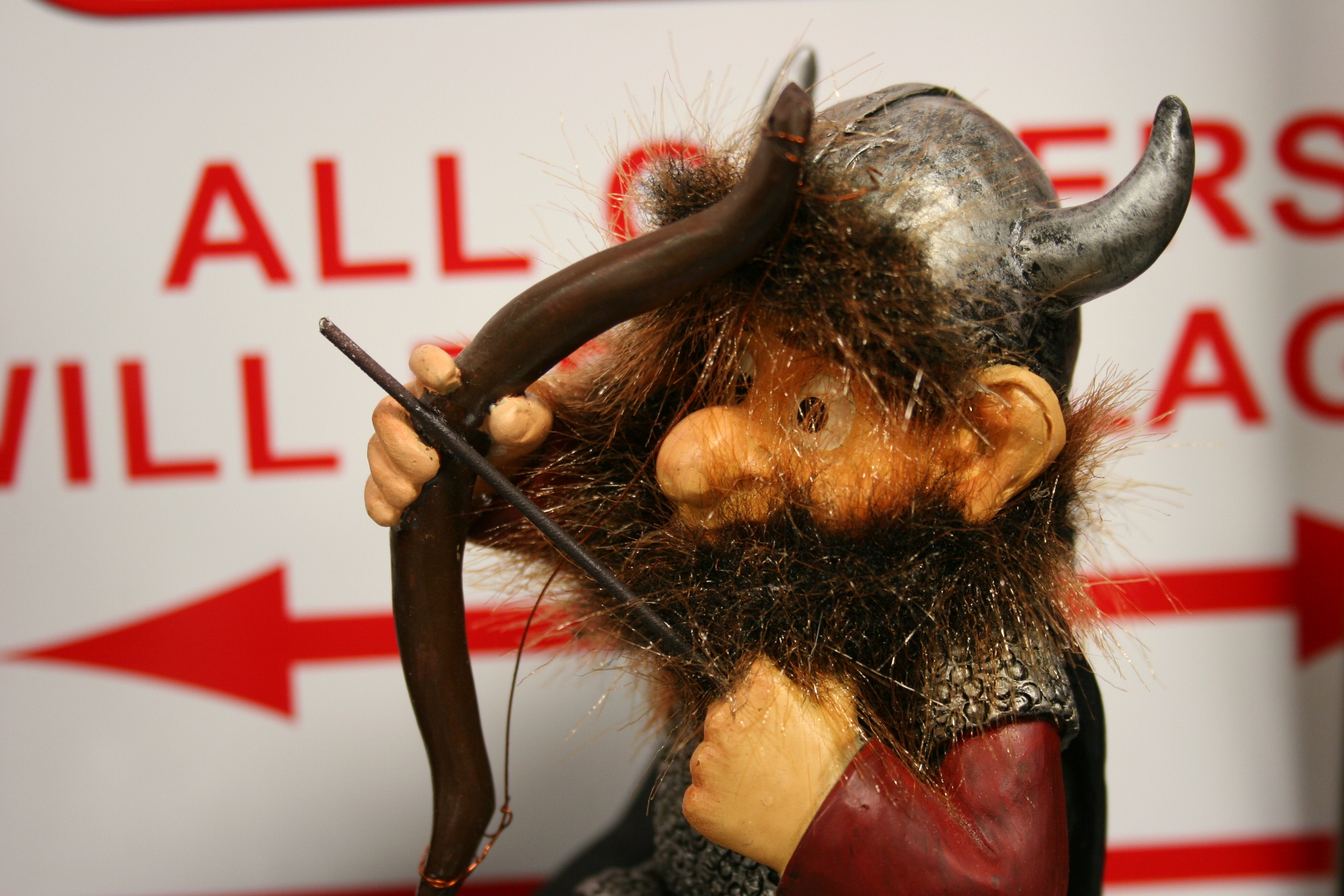
Marv Kaisersatt sketched out the character he was teaching his students to carve on Saturday.

I didn’t know any of the carvers, except Marv, whom I interviewed in 2009 for a short magazine article which certainly should have been much longer had space allowed. He impressed me then for the simple life he lives in an upstairs apartment in downtown Faribault, carving caricatures. I can’t even describe talent of his level. But I can describe a man who is humble and funny, engaging and content with the creative process of sketching, shaping clay models and carving.

This retired math teacher also impressed me in that interview with the fact that he doesn’t sell his woodcarvings, choosing instead to occasionally donate his caricatures, carved from blocks of basswood, to nonprofit fundraisers.

Marv Kaisersatt assists a student in his class.

On Saturday, Marv circulated among his students, advising them on carving a Minnesotan (I presume) dressed for winter in stocking cap and chopper mittens, oversized boots weighing down his feet.

Marv gave me a polite nod and then it was all business teaching the students lucky enough to learn under his guidance.

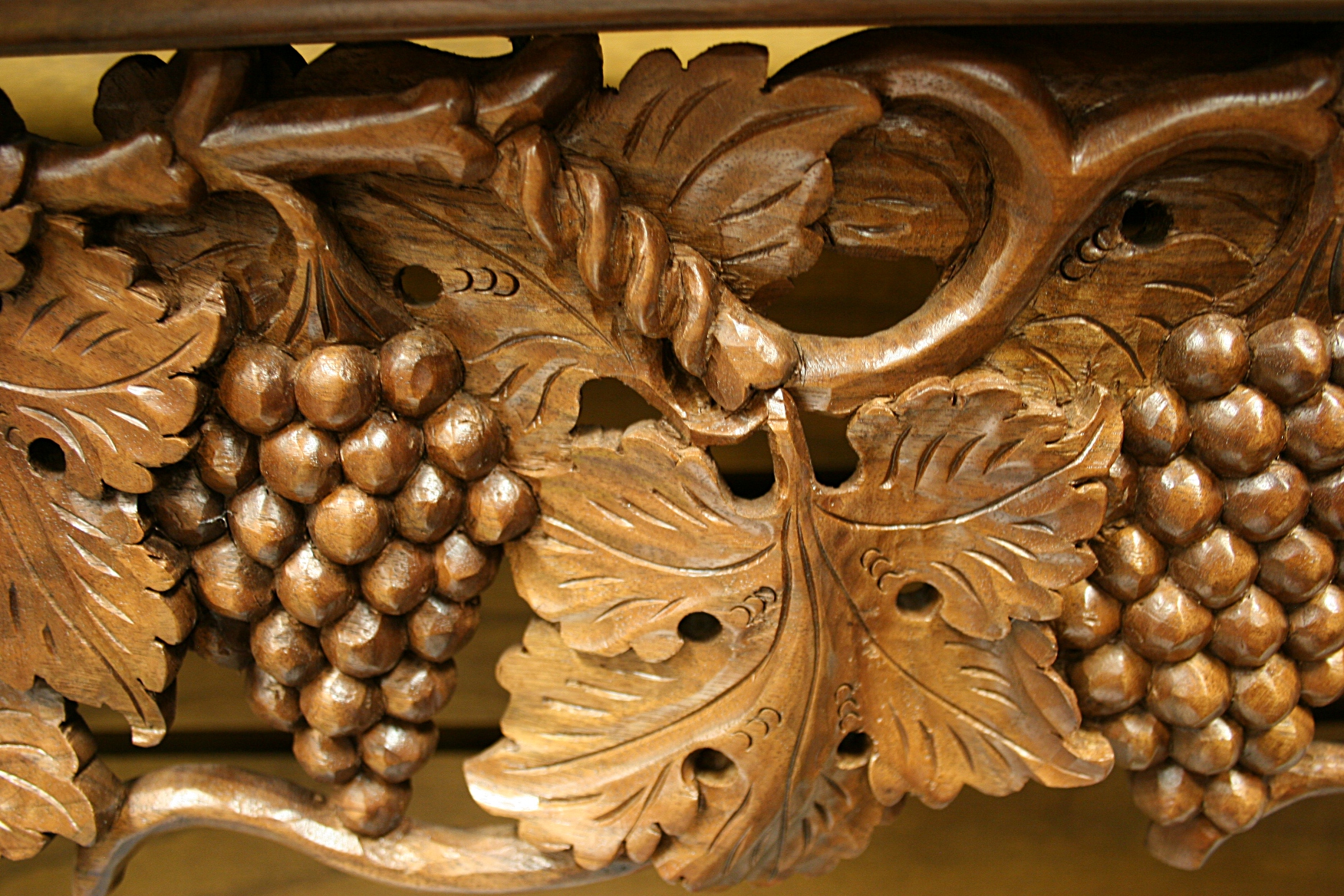
A snippet of Ivan Whillock’s incredible, detailed and realistic carving.

Whillock, whose woodcarvings are the polar opposite of Marv’s work, wasn’t teaching. But given his woodcarving family organizes Carv-Fest, I expect he had more than enough to keep him busy. He carves religious and secular sculptures and reliefs, works of art that grace places like churches (including mine, Trinity Lutheran) and libraries (including Buckham Memorial Library in Faribault).

Whillock and his family are the key organizers of Carv-Fest which draws woodcarvers from all over.

A stunning, three-dimensional carving by Ivan Whillock.

Both men teach at Ivan Whillock Studio. They’ve written books and created patterns and developed an appreciative following of admirers across the world.

And if you saw their work, you would understand why they are so beloved among woodcarvers and those of us who wouldn’t dare pick up a knife for fear of slicing away a fingertip.

A carver brought his handcarved toolbox to a class on Saturday morning.

Just another example of the woodcarvings on display during the festival.

These students were hammering and chiseling away during a class, making quite a racket in the ice arena/fest site.

The step-by-step process to woodburn a wolf as taught by Nancy Dardis of  Dardis Designs, Bloomington.

A pheasant in wood, foreground, and students in class, background.

Learning the art of chip carving.

© Copyright 2012 Audrey Kletscher Helbling
 

Mixing art, music and BBQ at Faribault festival August 12, 2012

The banner and band scaffolding/set-up in the 300 block of Central Avenue during Saturday’s Blue Collar BBQ & Arts Fest in Faribault

FROM DEAFENING MUSIC that bounced between historic buildings along Faribault’s Central Avenue, to the savory taste and tantalizing, smokey smell of barbecued meat to the cheers of onlookers when a local celebrity plunged into the dunk tank to the clink of washers against asphalt in the washer tournament to human faces morphing, via paint, into animal faces, offerings at the fourth annual Blue Collar BBQ & Arts Fest in Faribault drew crowds, and smiles, on a picture perfect Saturday.

An overview of the crowd early into the event on Saturday, looking to the 300 block of historic downtown Farbault.

Coordinated by the Paradise Center for the Arts, the 13-hour free festival focused on bringing people into the historic downtown to enjoy/participate in the arts, music, food, a BBQ and homemade brew competition, and more.

The Black Widow BBQ team, one of about a dozen competing for top prizes of $500 in several categories.

BBQ teams set up along a side street to cook their meats and desserts.

A Texas native, now living in Faribault and a member of The Black Hat “BBQ” team, sprays apple juice onto his St. Louis style pork ribs during the BBQ contest.

Grill Cabin team members, from New Prague, prepare entries in the BBQ competition.

Retail stores like The Crafty Maven, 212 Central Avenue, at the heart of the arts and crafts fair and kids’ activities, expected an increase in business with an influx of an anticipated 5,000 people into the downtown for the festival. And that’s part of the plan, to celebrate downtown businesses, many of them event supporters. Other businesses in the community also sponsored parts of the festival.

Flower art and more, shaped and welded from old silverware, etc. is helping the DeWall brothers of DeWall Bros Metal Creations of Grand Meadow finance their college educations. Their art was for sale at the arts fest.

While the DeWall men were peddling their metal art, the women–mom/wife, Cindy, and girlfriend, Allison– were shopping and getting their faces painted by Jodi Gustafson of Big Shoe Entertainment.

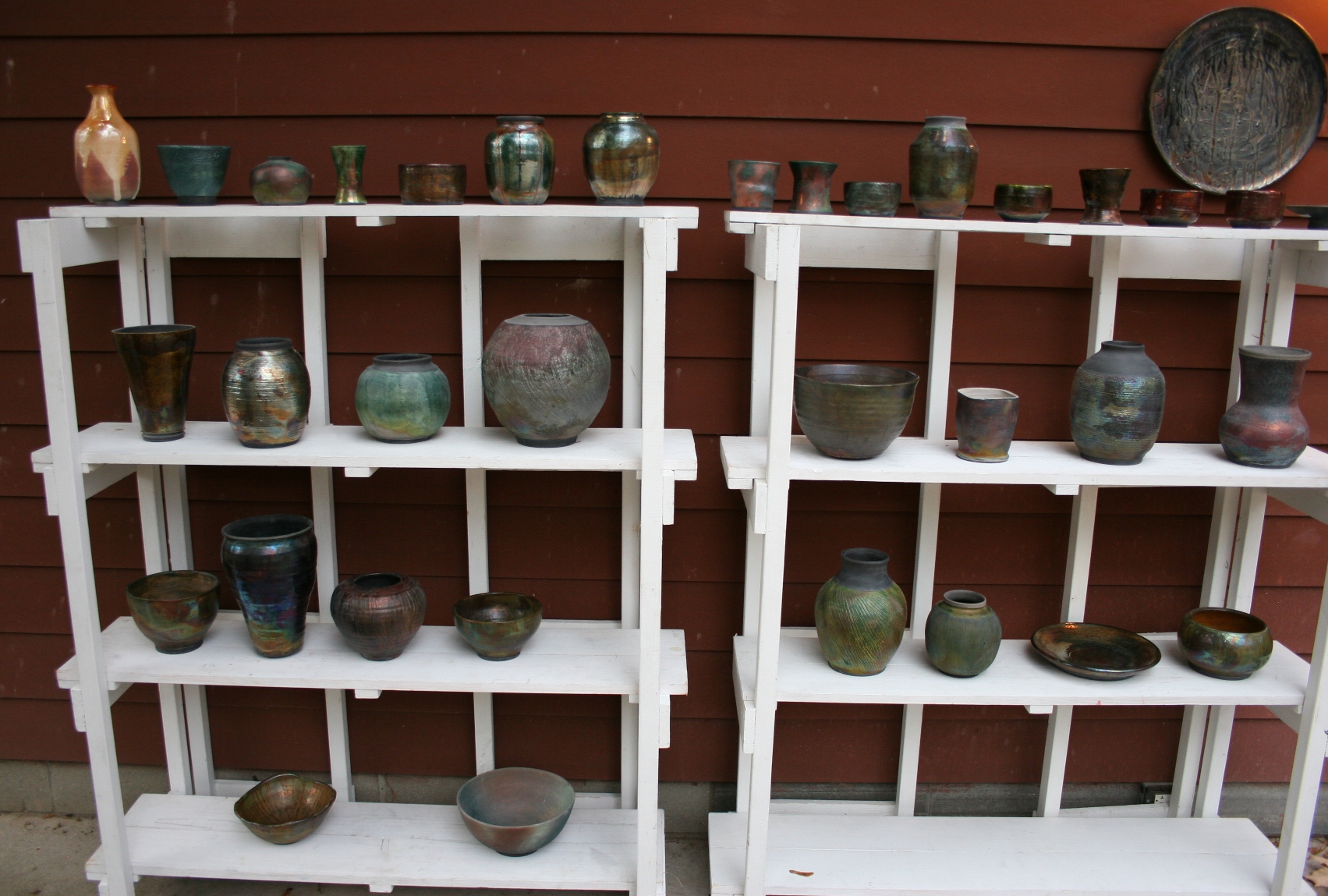
Bob Maegerlein of Rochester, specializing in Raku ware, sold his pottery at the arts fair.

I arrived late morning and wandered for several hours past vendors—wishing I could sample the meat smoking in BBQ contestants’ grills; admiring the artistic creations of artists and a gifted face painter; ducking into the Paradise Center for the Arts to photograph the current art show, Car pARTS; steering mostly clear of the north end of the 300 block of Central because I couldn’t tolerate the volume of the live band music; trying a vendor’s delicious BBQed meat trio sampler that was way overpriced for the quantity (plus, no forks included); and, finally, stopping at Pawn Minnesota and then a Somali clothing shop on my way to the car.

Blues-rock guitarist/musician Trent Romens was among six featured musical acts.

Did the festival accomplish for me what I expected? Yes. I was entertained, although I would have appreciated a much lower volume on the music. Ditto for the price on the meat sampler. And I would have liked access to the home brew competition, which was tucked into the Paradise somewhere.

But all in all, the festival provided a fun way to while away part of a Saturday. And, for those downtown business owners who hoped the event would draw shoppers into stores, it worked for me. I’d never been into the pawn store and wasn’t even aware of the Somali shop or another ethnic business across the street (which wasn’t open).

If you’re from Faribault, I hope you took  time on Saturday to attend the Blue Collar BBQ & Arts Fest and appreciate what we have, right here in our own community.

With the weather about as good as it gets on a summer day, attendance was high at the Blue Collar BBQ & Arts Fest.

Dad and grandpa watched the pets while the kids played in the bouncy inflatables. These pom pom pets were a popular item sold at the arts fair.

Kids practiced for the washer tournament. I was not convinced by a tournament organizer to participate. “She would throw the washer through a store window,” my husband told him. He would be right. Either that or I would have struck a passerby. We walked away, for the safety of those in attendance.

Isabella, 7, of Faribault, one of the many kids who lined up for the free face painting. Check back for an additional post featuring the artwork of professional face painter Jodi Gustafson of Big Shoe Entertainment.

Taking a turn in the dunk tank…

© Copyright 2012 Audrey Kletscher Helbling


Pets on parade in Faribault August 8, 2012

Filed under: Uncategorized — Audrey Kletscher Helbling @ 7:34 AM
Tags: , , , , , , , , , ,

Taco the dog, photographed earlier this summer on a Saturday morning at the Faribault Farmers’ Market in Central Park.

PETS AND KIDS equal cuteness, wouldn’t you agree?

Thursday evening the cuteness combination commands several city streets during my community’s Pet Parade—the 76th annual according to information published by the Faribault Parks & Recreation Department.
The kids and their animals will line up in categories like little dogs, big dogs, rabbits, kittens and cats, unusual pets, farm animals, and, at the tail end, horses, of course.

In between, there will be floats and kids in strollers and on bikes, trikes, scooters, skateboards and roller blades. There will be clowns and costumes and perhaps even chaos in this “It’s a Zoo Around Here!” themed event.

I haven’t been to the Pet Parade in many years, mostly because my kids are all grown up and they were the reason I attended.

We never participated in the parade. Our only pets were goldfish. And I probably never told my three they could walk in the parade without a pet. Sometimes parents are smart like that and don’t share details. Just let the kids think that because they don’t own a cat or dog or snake or some other animal, they must simply watch.

I expect I never told them either about the free freeze pops and music in Central Park after the parade. I don’t know if treats are still part of the parade. But the parade still ends in Central Park. This year’s entertainment features zoo animal dances by girls ages 5 – 9 who participated in a Spirit Team summer camp. More cuteness, for sure.

The Pet Parade mural installed on the Central Park band shell.

Central Park is also the site of an artistic tribute to Faribault’s long-running Pet Parade. In May the Mural Society of Faribault installed a Pet Parade mural on the park’s historic band shell, making it the seventh mural the group has placed in Faribault.

Lots of dogs on the left side of the mural…

The artwork definitely possesses that cuteness factor although I wish a few animals besides dogs were featured in the mural.

And what about that date, “since 1939?”

Lots of dogs and that 1939 date on the right side of the mural.

If that date is right, then the 2012 Pet Parade would not be the 76th, but the 73rd annual. Correct? I’m not really all that good at math. And, yes, my kids know that.

FYI: The Pet Parade begins at 7 p.m. on Thursday, August 9, at Ninth Street Northwest and Second Avenue Northwest, proceeds south on Second Avenue, turns west on Fifth Street and ends in Central Park.

© Copyright 2012 Audrey Kletscher Helbling