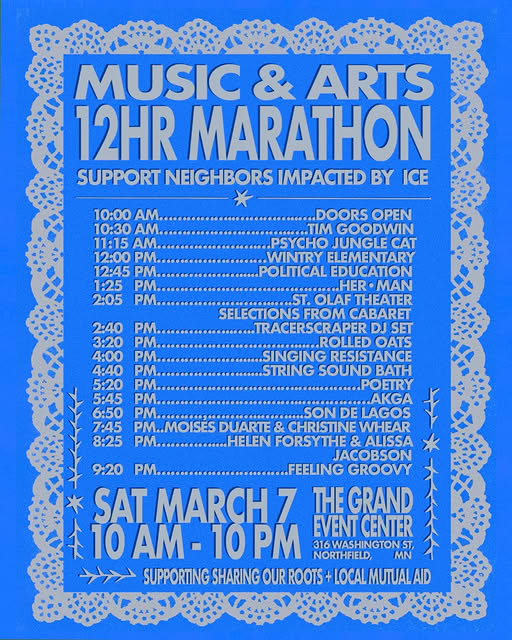
(Promo sourced from The Grand Event Center Facebook page)
THE GOOD FOLKS of Northfield, Minnesota, are organizing again to help their neighbors. This time it’s via a 12-hour Mutual Aid Marathon from 10 am-10 pm Saturday, March 7, at The Grand Event Center in this college town south of the Twin Cities.
Proceeds from the fundraiser will go to organizations—such as Sharing Our Roots and Northfield Community Action Center—providing mutual aid to those in the community impacted by federal immigration enforcement.
Doors open at 10 am at the event center, 316 Washington Street, just a block off Division Street in the heart of this historic downtown. Suggested donation at the door is $10.
From 10 until noon, attendees can enjoy a breakfast with 30 percent of entree sales going to organizations doing vital work in the community. Likewise, profits from a “pay what you can” appetizer buffet, which starts at 4 pm, will also be donated.
Event planners promise a full day and evening of live music, performances, poetry, political education, and powerful speakers. See the event poster promo above for a complete schedule.
Organizers are calling upon the public to: Bring friends. Bring family. Bring your appetite and your solidarity. Come for a while or stay for the entire marathon.
As I see it, the Mutual Aid Marathon is all about neighbors helping neighbors, which is the very definition of a loving and caring community.
THE MINNESOTA WRITING COMMUNITY has always impressed me as talented, prolific and generously giving.
Now add united activism to that list as 50-plus Minnesota authors join from noon to 4 p.m. Saturday, February 28, in an Authors for Minnesota Day event at 24 independent bookstores across the state. Their efforts focus on “A Day of Books, Community, and Support for Immigrant Rights.”
I could not be more proud of these writers and booksellers who are publicly raising awareness of the challenges our immigrant neighbors, our communities and small businesses (including indie bookstores) have faced, and continue to face, in the wake of massive federal immigration enforcement throughout Minnesota.
These authors and bookstore owners are taking their support to the next step—action. Anyone who makes an on-site donation to the Immigrant Law Center of Minnesota and/or the Women’s Foundation of Minnesota Immigration Rapid Response Fund on Saturday will get a free, signed copy of a participating author’s book, while supplies last. (See online donation options at the end of this post.)
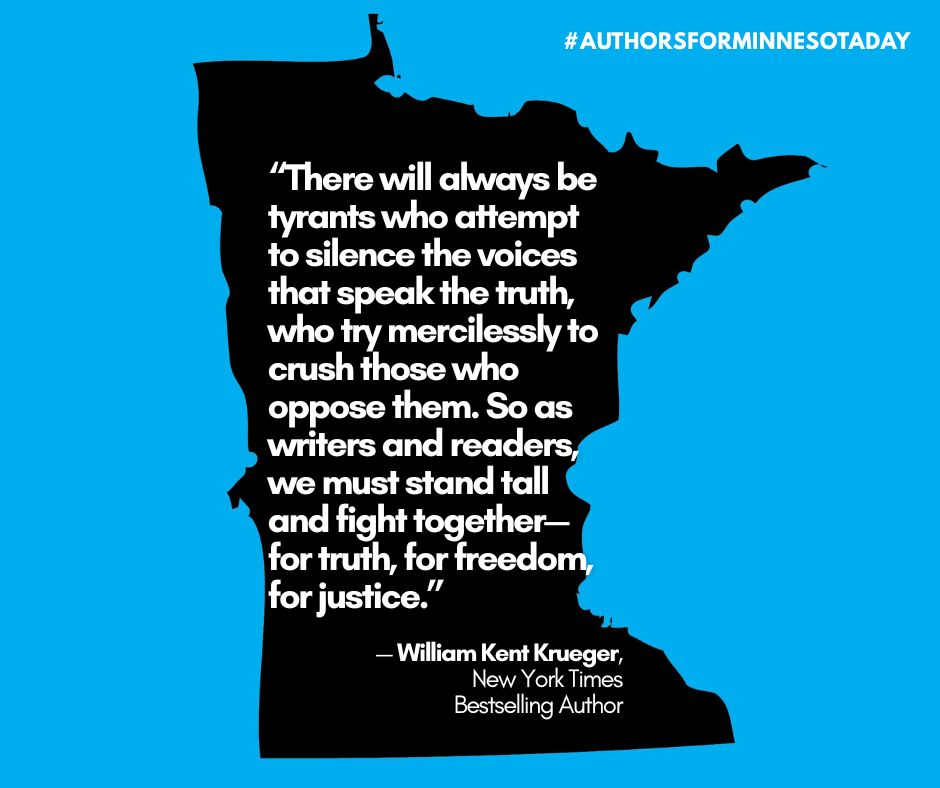
Bestselling mystery writer William Kent Krueger will be at Once Upon a Crime bookstore in Minneapolis along with Allan Evans and Patrick Barb. (Graphic sourced online)
Saturday it will be all about community and supporting community as book lovers meet with authors in bookshops across Minnesota. While most host sites are located in the metro, three are in greater Minnesota—Drury Lane Books in Grand Marais, in the far northeastern corner of Minnesota; Hey Darling in Austin near the Iowa border; and then Content Bookstore in Northfield, south of the metro and a 20-minute drive from my home.
(Book cover sourced online)
Bestselling mystery and thriller author Allen Eskens of nearby St. Peter, and one of my favorite Minnesota writers, will be at Content Bookstore signing his latest novel, The Quiet Librarian, now out in paperback. Northfield writer Mary Bleckwehl will also be at Content with her children’s picture book, ARRRGH! Me Have to Wait.
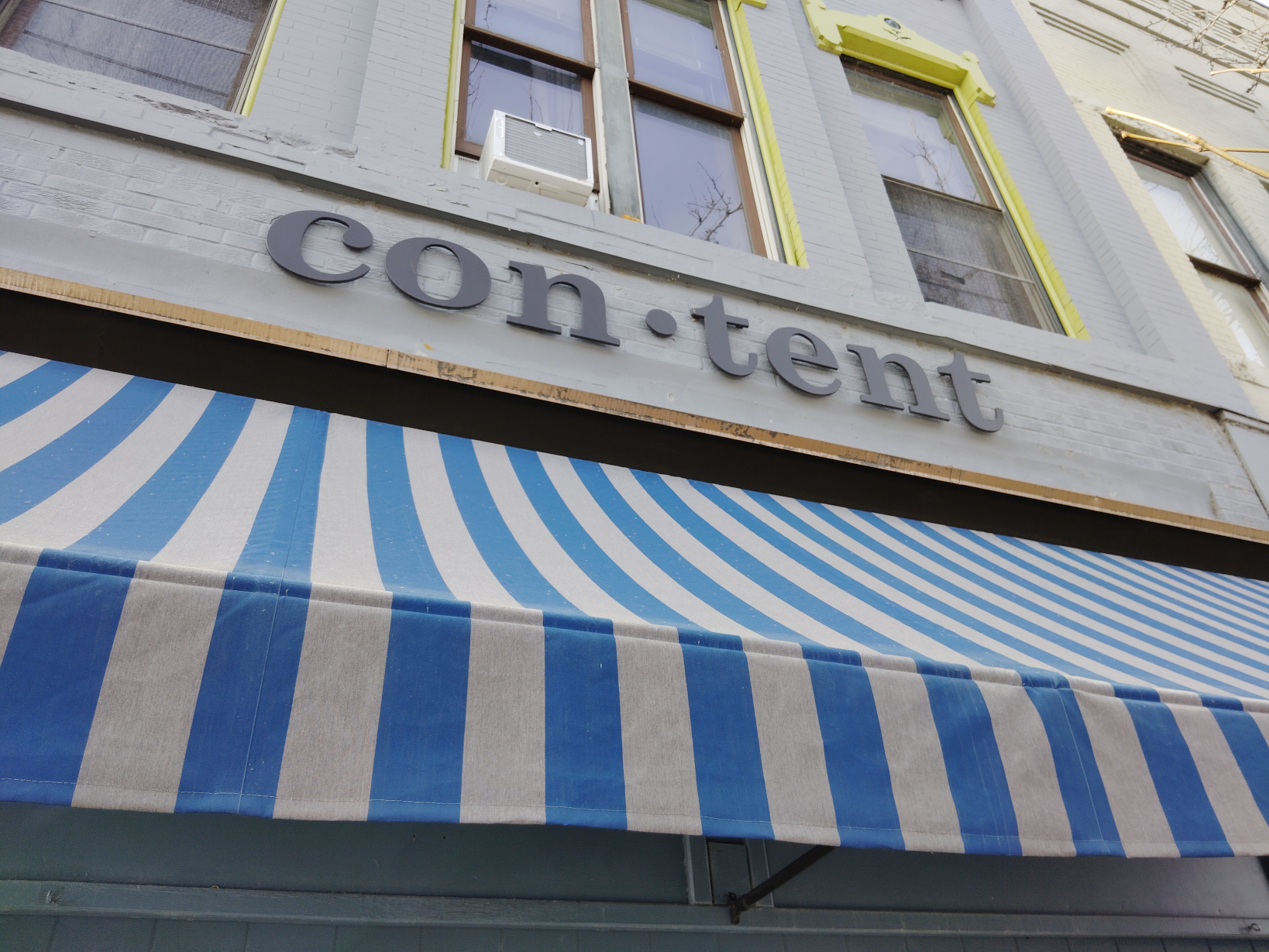
Signage on Content Bookstore along Division Street in downtown Northfield. (Minnesota Prairie Roots copyrighted photo February 2026)
Here’s a complete list of independent bookstores hosting Authors for Minnesota Day from noon to 4 p.m. Saturday: Avant Garden (Anoka), Big Hill Books (Minneapolis), Birchbark Books (Minneapolis), Black Garnet Books (St. Paul), Comma, a Bookshop (Minneapolis), Content Bookstore (Northfield), Cream & Amber (Hopkins), Drury Lane Books (Grand Marais), The Enchanted Quill (North Branch), Excelsior Bay Books (Excelsior), Hey Darling (Austin), Inkwell Booksellers (Minneapolis), Irreverent Bookworm (Minneapolis), Lake Country Booksellers (White Bear Lake), Moon Palace (Minneapolis), Next Chapter Booksellers (St. Paul), Niche Books (Lakeville), Once Upon a Crime (Minneapolis), Red Balloon (St. Paul), Scout and Morgan (Cambridge), Subtext (St. Paul), Tropes and Trifles (Minneapolis), Valley Bookseller (Stillwater), and Well Read Books (Elk River).
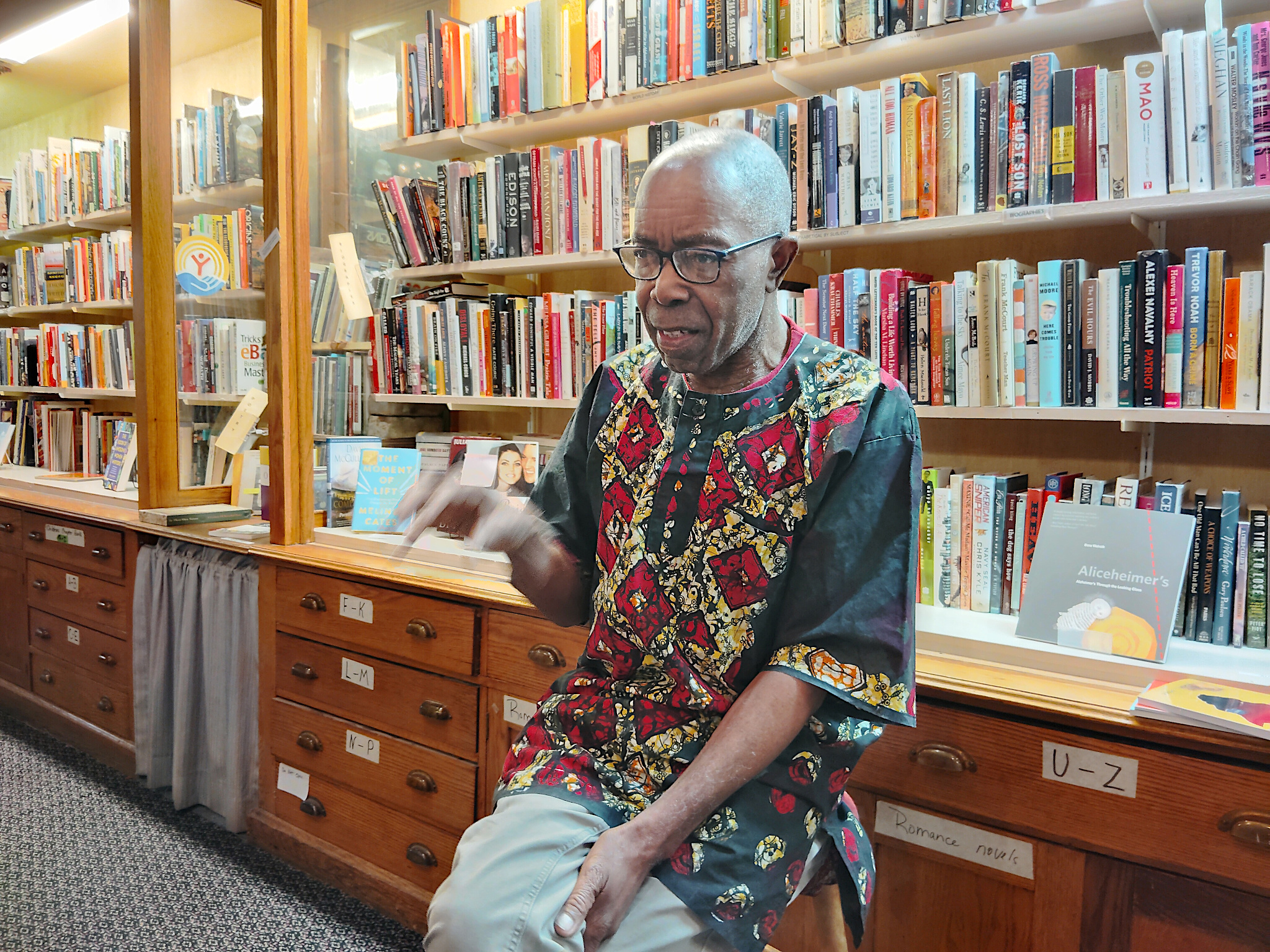
Joseph Mbele shares stories, proverbs and culture on February 11 at Books on Central, Faribault. (Minnesota Prairie Roots copyrighted photo February 2026)
Last Wednesday evening, Joseph Mbele, retired St. Olaf College professor of post-colonial literature, cultural consultant, author and storyteller, shared three African proverbs during a literary event at Books on Central. This man, who calls himself an African and a Tanzanian, held the rapt attention of attendees gathered in the used bookshop in the heart of downtown Faribault, home to many Somalis.
THE CROCODILE
While I enjoyed the two African folktales Mbele told, I really appreciated the proverbs. They are, by nature of a proverb, succinct. A few words carry a whole lot of punch. First up, this proverb: “Before you cross the river, don’t insult the crocodile’s mouth.”
Immediately the image of a crocodile’s sharp teeth popped into my mind. As it should have. This proverb, Mbele explained, is about being respectful to people in our relationships and in life in general. Be anything but respectful and we risk negative consequences. Snap.
THE BLACKSMITH
Second up this African proverb: “It’s because of man that the blacksmith makes weapons.” Thinking in African terms, the weapons would be knives and spears. I thought of guns. Mbele repeated the proverb, letting it sink into our brains. “It’s because of man that the blacksmith makes weapons.” The lesson here, Mbele said, is that we can be better than this—be kind, helpful and supportive—so we don’t need to bear arms/weapons. That’s an oversimplification, of course. But proverbs are not meant to be complex.
THE VISUALLY-IMPAIRED
Third, Mbele recited this proverb: “The one-eyed person only thanked God after he saw a blind person.” As someone with vision issues, that hit home. The proverb is a way of teaching gratitude, Mbele said. The contrast between seeing with only one eye and total blindness put the situation in perspective. The thought that there’s always someone who has it worse probably flitted through the minds of everyone in the bookshop.
THE STORYTELLERS
Mbele talked about the tradition of Africans sitting around telling stories to entertain and teach. Languages like his native Matengo, an indigenous language in Tanzania, are oral, not written. As he spoke, I began to understand the importance of folktales in African life. Stories connect people and, like proverbs, teach lessons.
Applied to my own community, Mbele explained that Somali men gathering on downtown Faribault street corners are simply socializing and sharing stories and are not to be feared. “It’s un-African to be by yourself,” he said of a culture that focuses on family and togetherness.
He even went so far as to say an African could be considered evil or a witch if living alone. That surprised me, but drove home the cultural importance of community and family. Now if only everyone in Faribault could hear these proverbs and insights from this native Tanzanian. Then perhaps they would not fear that which they don’t understand, like the Somali elders gathered on street corners downtown telling stories, sharing news or simply sitting in each other’s presence.
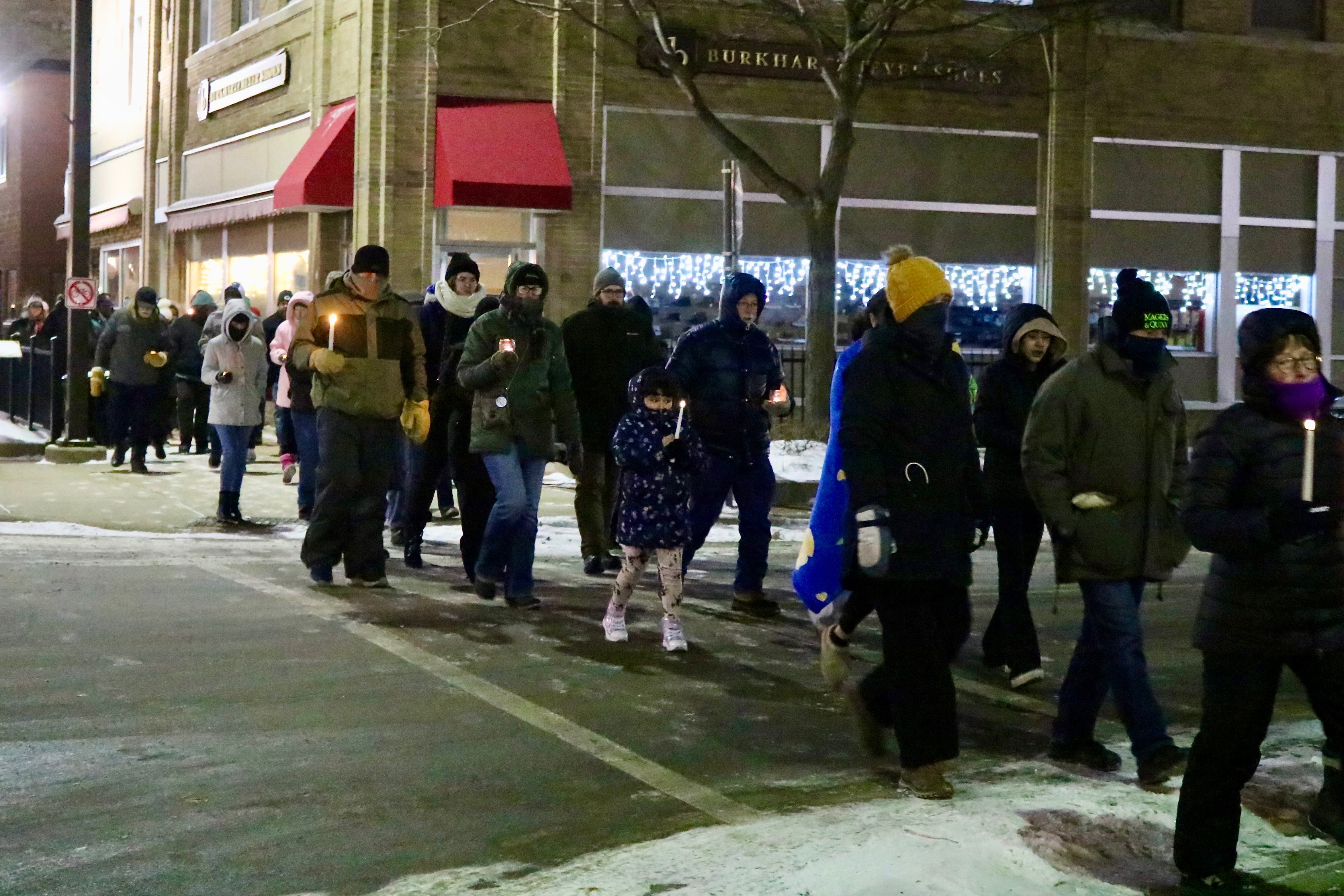
I join others for a candlelight vigil in downtown Faribault on Saturday evening. (Photo by and courtesy of Chloe Kucera, Faribault Daily News)
WE MARCHED IN SOLIDARITY, in community, in collective grief Saturday evening through downtown Faribault. No signs. Only candles, flames flickering, lights shining in subzero temps as vapor billowed from our faces.
An estimated 100 of us walked eight blocks in reverent silence, only the sound of boots crunching on snow and the occasional passing vehicle breaking the quiet.
Bundled up against the frigid cold, we left our warm homes to gather and honor 37-year-old Alex Pretti, an ICU nurse shot to death Saturday morning by ICE agents on the streets of south Minneapolis, less than an hour’s drive north on Interstate 35. It is the second fatal shooting of a Minneapolis resident, a Minnesotan and an American citizen by federal agents in recent weeks.
Faribault resident Martha Brown hastily organized the candlelight vigil via social media, calling for people to walk in silence on our city streets “to mourn together and peacefully pray for the (federal) occupation to end.” I knew I needed to be there, to join Martha and others who felt overwhelmed, yet determined to raise their voices via silence.
FOR OURSELVES & OUR NEIGHBORS
We did this not only for ourselves individually and collectively, but also for the Hispanics, Latinos and Somalis who call Faribault home and who have been targeted by ICE. Our neighbors are living in fear, sheltering in their homes as ICE continues to threaten, take and traumatize right here in my community and across the state.
As the march began in the parking lot outside Buckham Memorial Library, a Hispanic family waited along the curb. I motioned for them to join us and they did as the father filmed the walk for those whom he said could not be there. Those who cannot leave their homes for fear of ICE.
His daughter, about 8 years old, walked ahead of me, her bare hands clutching a slender battery-lit candle someone had given her. I felt so proud of this little girl while simultaneously thinking, she should not have to be here doing this. What a strong, brave family.
REFLECTING IN SILENCE
Walking in silence gave me time to reflect, process my emotions and observe. I passed Mexican and Somali-owned shops, restaurants and a bakery, all told about a dozen in our core downtown business district. I considered how they contribute to our economy, our tax base, our diversity, filling buildings that may otherwise stand vacant.
But I passed, too, a large GUNS sign on the pawnshop, the significance of that singular word not lost on me in the context of the day’s shooting.
Four blocks into the march, I felt strengthened by simply being among caring people of all ages united in purpose and grief. That young girl and her family. A woman in a wheelchair who was wheeled across snowy curb cuts. All of us there, connected by this moment in time in Minnesota.
GRATITUDE FOR COMMUNITY SUPPORT
When the half hour vigil walk ended back in the library parking lot, we stood in a moment of silence, then prayer before the Hispanic man stepped up and thanked us for coming, explaining how much it meant to him to see and feel our support.
Back home I got a text from family in south Minneapolis to “Shine a Light for Minnesota” by placing a lit candle outside at 7 pm. And so Randy set the tea light candles we had just carried through downtown Faribault on our front steps, flames flickering for our communities, for Alex, with the flaming message of ICE OUT NOW.
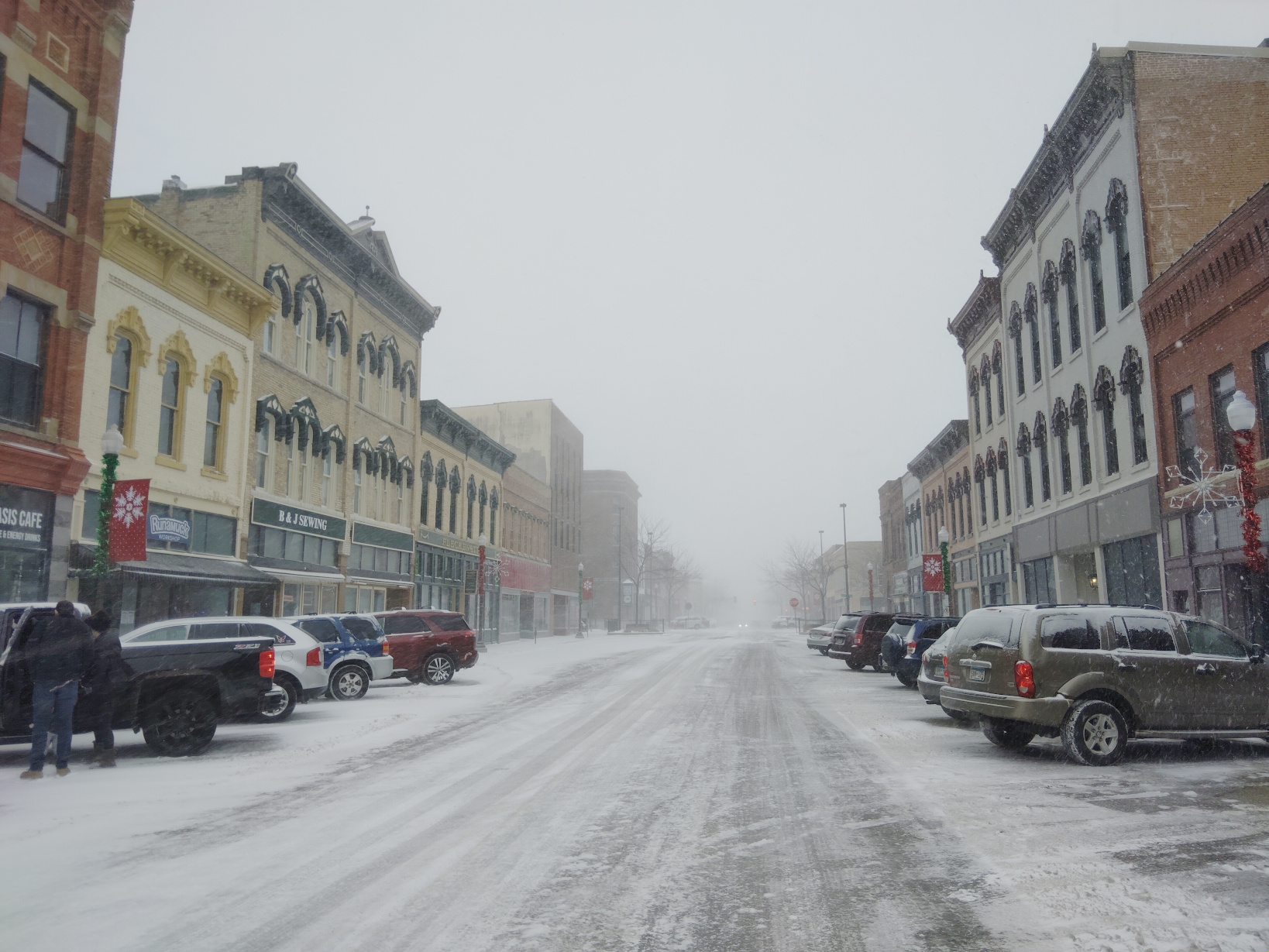
Downtown Faribault during a snowstorm on a recent Sunday afternoon. (Minnesota Prairie Roots copyrighted file photo December 2025)
COMPLAIN. COMPLAIN. COMPLAIN. We all do it, right? While venting helps, that doesn’t solve problems. But listening, really listening, and sharing ideas thoughtfully and respectfully moves us toward solutions.
With that introduction, I point to the city of Faribault and its monthly Council Chats, an opportunity to engage with elected officials, city staff and others on issues of concern within the community. I’ve been to several of these and really appreciate the informal format of short presentation followed by a Q & A and then mingling. “Chat” definitely fits.
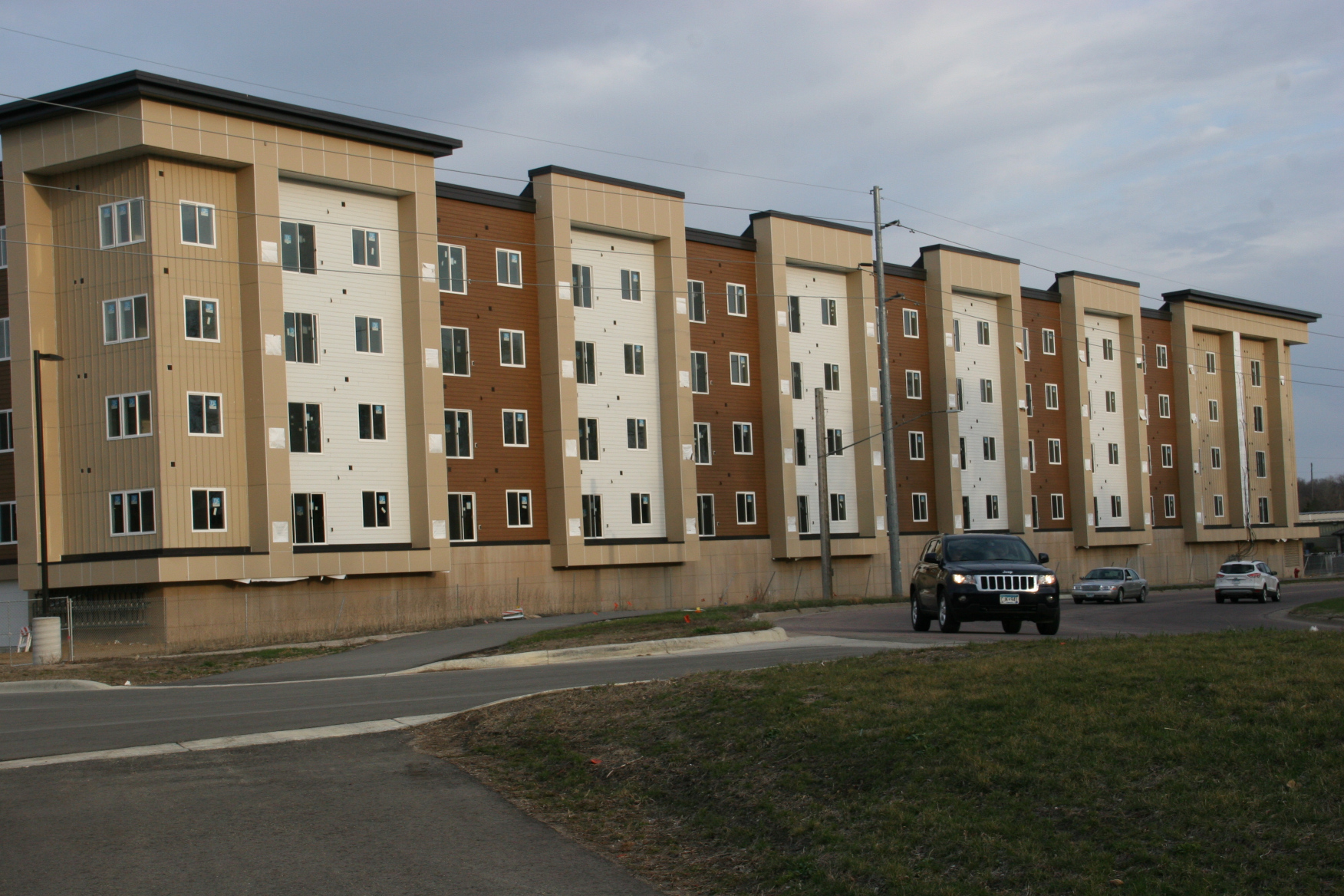
Faribault has experienced a surge in apartment construction in recent years, especially near downtown. This shows Straight River Apartments under construction in April 2022. (Minnesota Prairie Roots copyrighted file photo 2022)
This month’s meeting, set for 6 pm Wednesday, January 14, at the Viaduct Park building, is promoted as a “Community Listening Session” led jointly by city staff and the Community Action Center, a community-based human services nonprofit in Faribault (and also in Northfield). Lack of housing, environmental concerns and employment opportunities will focus discussion. Those have been identified as top issues by city residents.
Based on the pre-event information I’ve read, the Community Listening Session promises to be a worthwhile sharing of information, exchange of ideas and thoughtful conversation. Attendees will be able to view and give feedback on locally-themed posters with Faribault specific data. It is the feedback that I find invaluable in planning for the future of my community. Attendees may have other concerns they wish to address.
The Community Action Center, according to its Facebook page, has been working hard to gather information for Wednesday’s chat:
Over the last few months we’ve been collecting meaningful feedback from our neighbors about important topics impacting all of our daily lives. Through one-on-one conversations with food shelf shoppers and folks at community events, by carefully listening to parent groups and partners, while reading responses from multilingual surveys, and by hearing participant stories, we are finally prepared (and excited) to share the perspectives and experiences that will help inform the future of our community.
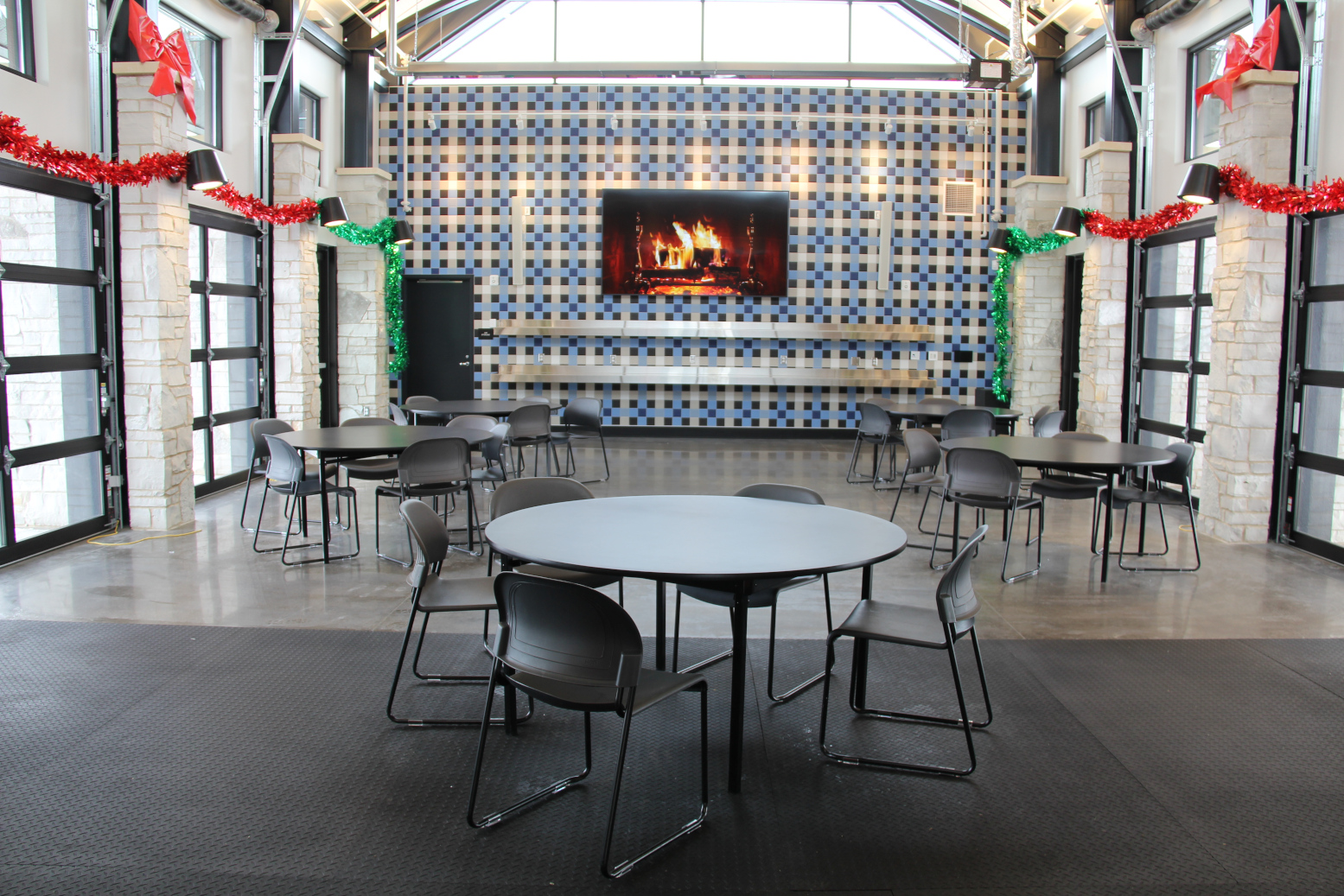
The Gathering Room at Viaduct Park, the city’s newest park, will be the site of Wednesday evening’s Council Chat Listening Session. (Minnesota Prairie Roots copyrighted file photo December 2025)
I am hopeful turn-out for this event will be good. People are too quick to criticize, especially on social media. Too quick to blame. Too quick to attack. Too quick to think their voice either doesn’t matter or is the only one that matters.
In many ways, these Council Chats are the most basic form of grassroots government—like sitting down over a cup of coffee, or a bottle of beer if you prefer that, and talking to one another sensibly. If we actually listen to one another, then perhaps together we can forge a plan of action that betters our community.
Among the many hands of the Faribault community, painted in a mural. (Minnesota Prairie Roots copyrighted photo September 2025)
WHAT ARE WE without community? The answer: alone.
We, at our very core, need each other. In times of celebration. In times of challenges. Even in times of great division. Without friends, family, neighbors and others, we are but individuals without community.
This mural was painted for and placed outside the Congregational Church in Faribault. (Minnesota Prairie Roots copyrighted photo September 2025)
And in Faribault, among the many murals adorning public spaces in the downtown area, one piece of art stands out as representing community. That is a free-standing mural placed on the west side of the Congregational Church of Faribault United Church of Christ this past summer. It seems an appropriate focal point to end 2025 and begin the new year.
The artwork, created by Shirley Rainey and her son Jason, features outstretched arms rising from the earth against a backdrop red heart and blue sky. “The mural represents the importance of coming together to share burdens and triumphs, while reaching for our highest selves,” Rainey said in an artist’s statement.
Henna painted on a hand reflects Somali culture. (Minnesota Prairie Roots copyrighted photo September 2025)
I see that in the mural. But I also see a community of diversity. The Raineys show that in assorted skin tones, clothing, hand sizes and even henna painted on a hand. I love that about this art, this intentional, varied depiction of Faribault as it is—gloriously diverse.
That said, I am well aware of the racial tension (and that’s a tamped down word) in my community. I wish it didn’t exist, that we all got along, welcomed and embraced one another. We are, after all, just people who live, love, work, play, laugh, cry… The list of commonalities we share as humans goes on and on. Yes, we are different, too. But differences seen as negative, those we create.
The diverse hands of Faribault, up close, in the new community mural. (Minnesota Prairie Roots copyrighted photo December 2025)
We can learn from that church painting. We can choose to love one another, as portrayed in the over-sized backdrop red heart. We can stand side-by-side and raise our hands to help one another. We can see, in those arms stretched skyward, the possibilities in building community. In that blue sky, we can envision not only our personal dreams, but the dreams of all who call Faribault home.
Faribault is a multi-cultural community, always has been. From early settlement days to today, people have come here from around the world to start anew. Whether French, Irish, German, Scandinavian, Latino, Asian, Sudanese, Somalian or any of many other ethnicities, this place has become home. We can choose to create community or not.
I hope in 2026 that Faribault can build a better, stronger, more unified community which celebrates our commonalities, and our differences.
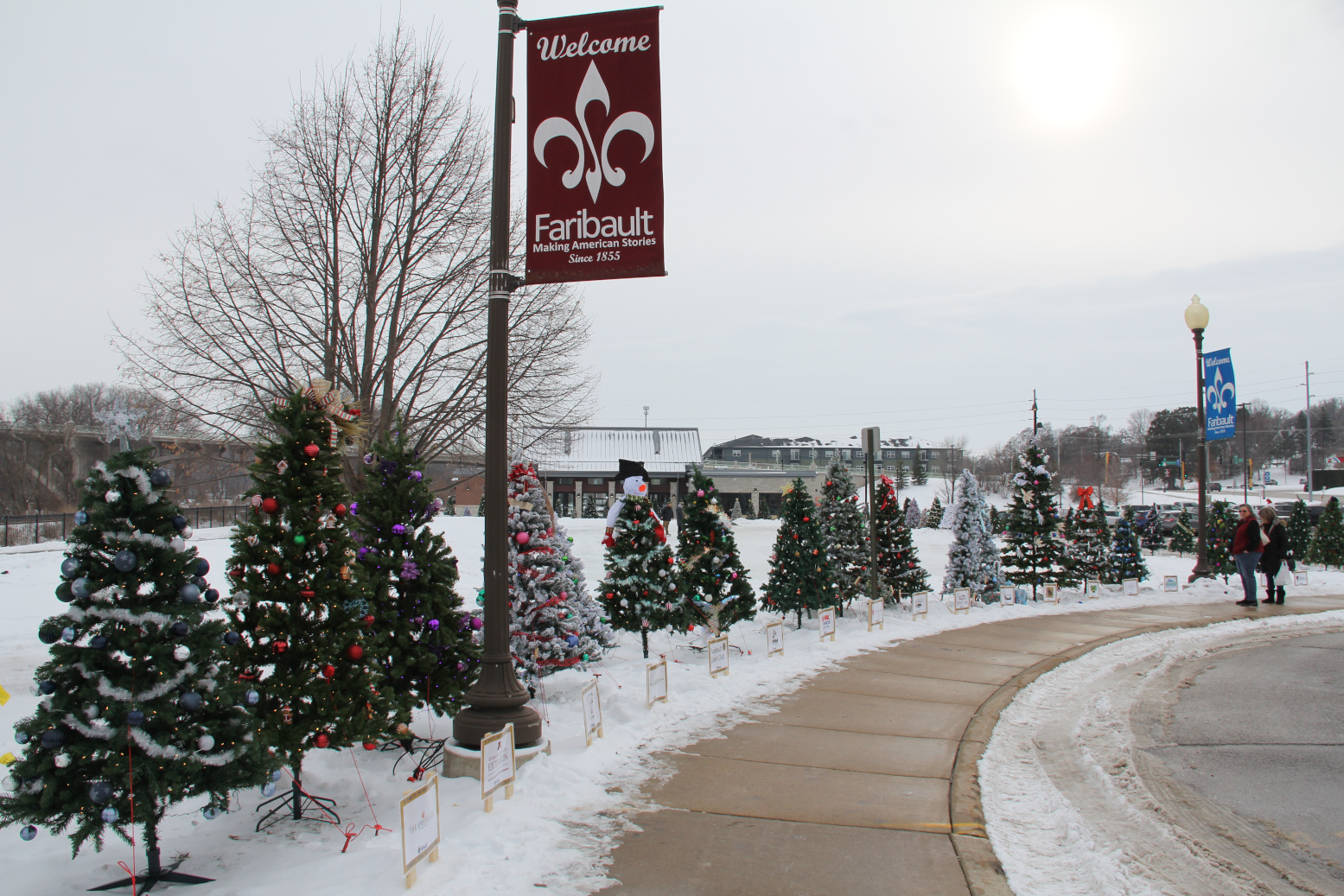
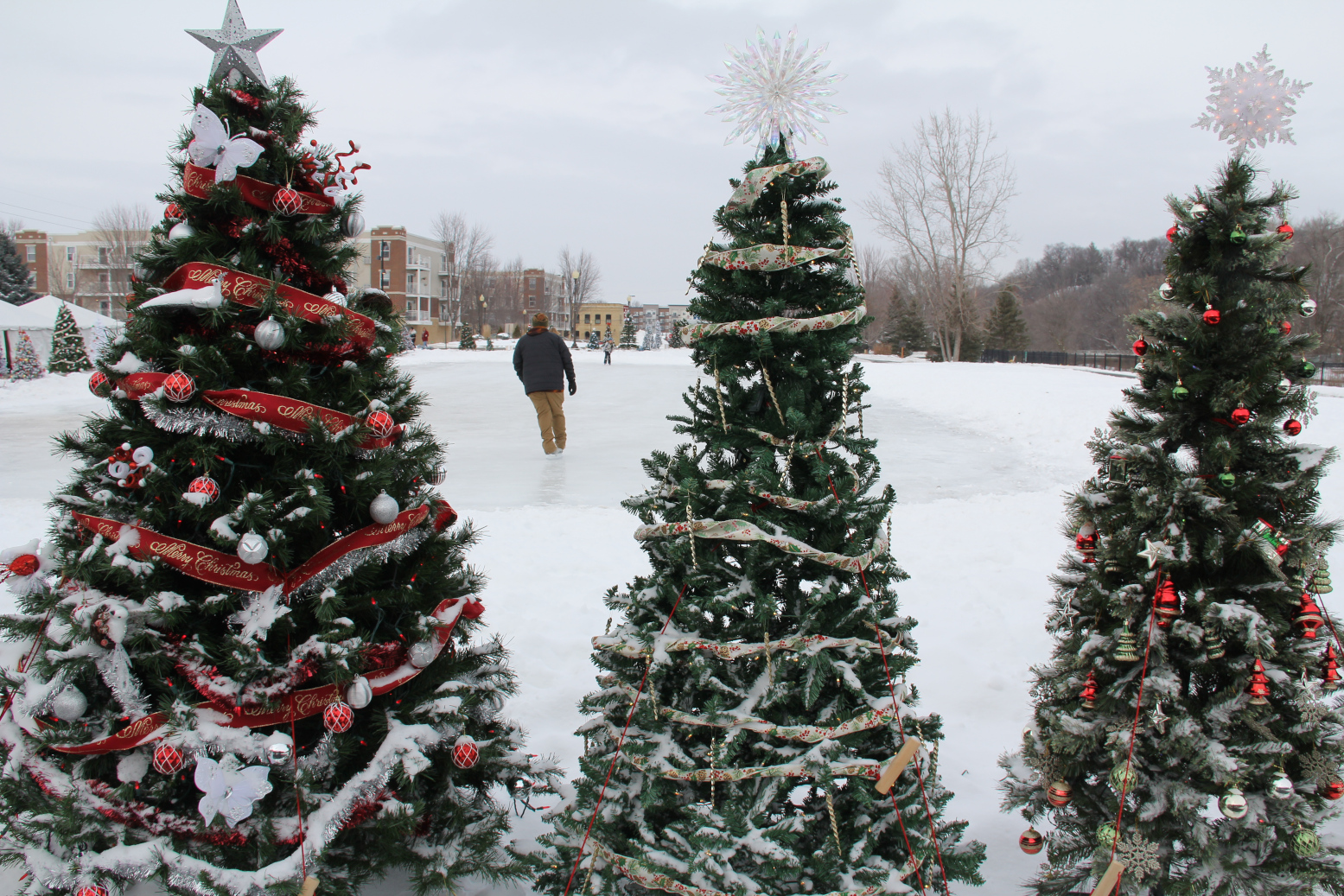
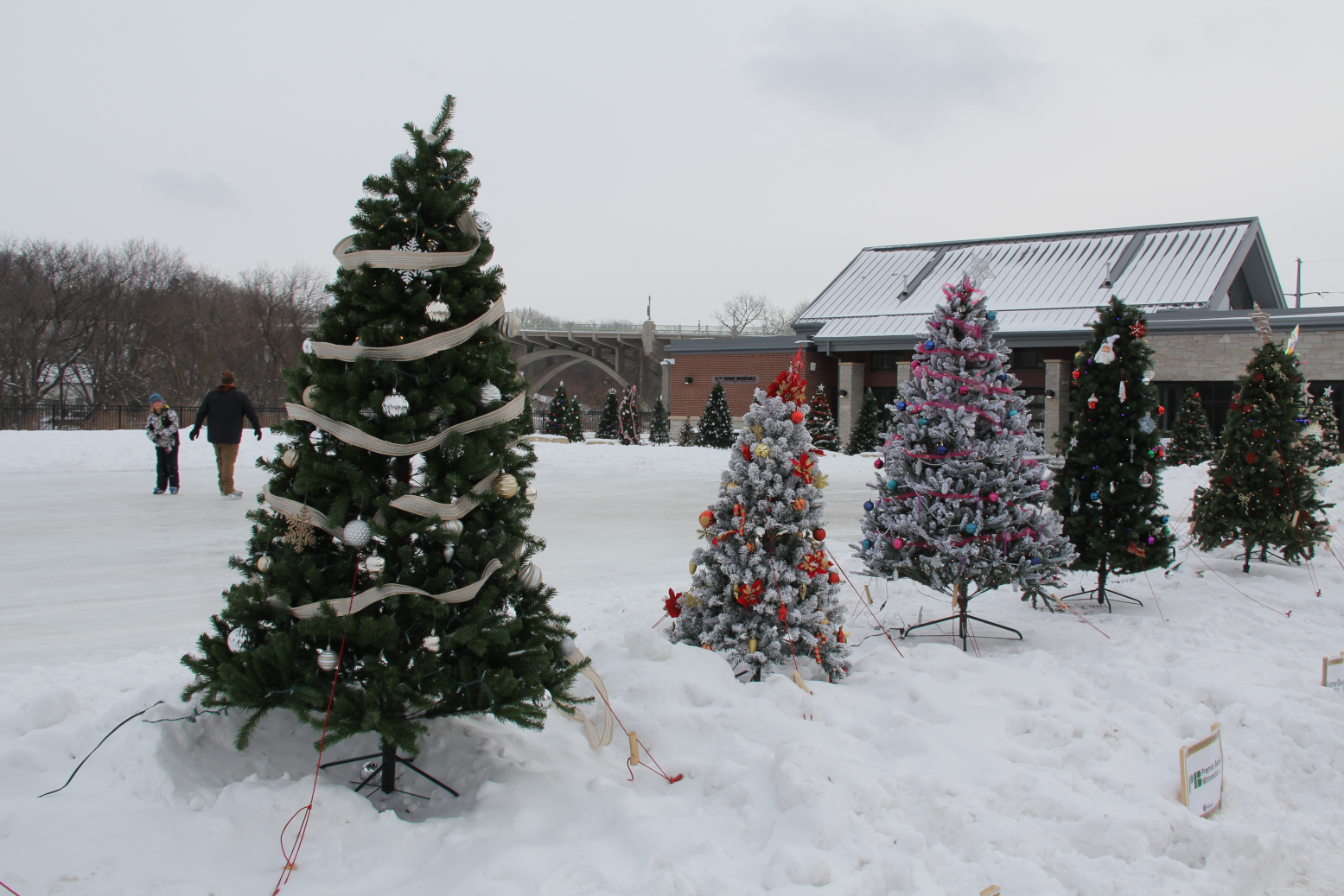
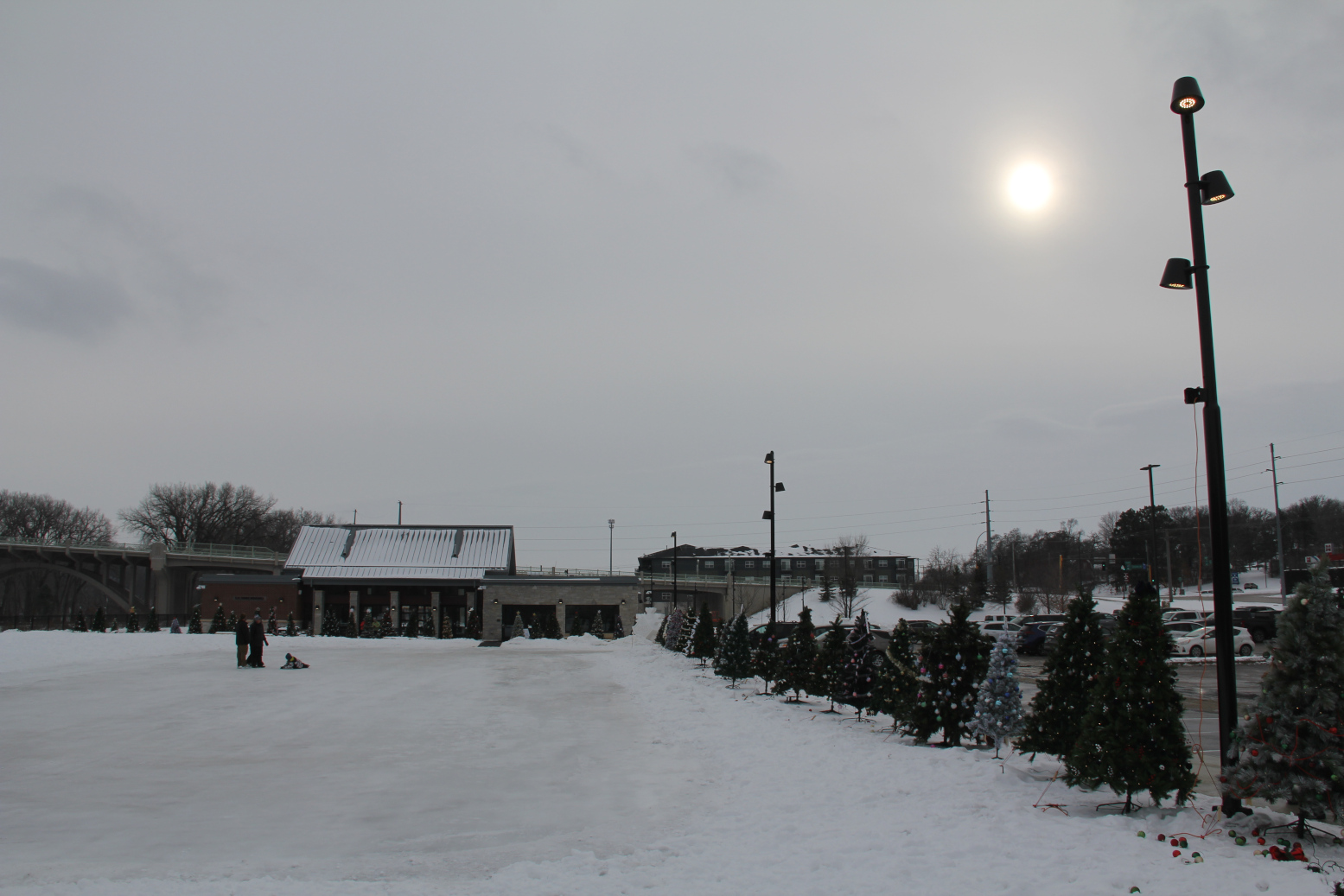
Adopt-a-Tree Christmas trees curve along the sidewalk past the ice rink at Faribault’s Viaduct Park. (Minnesota Prairie Roots copyrighted photo December 2025)
THE GENEROSITY OF MY COMMUNITY is never more publicly visible than each December, when artificial Christmas trees are decorated, displayed and then donated to those in need.
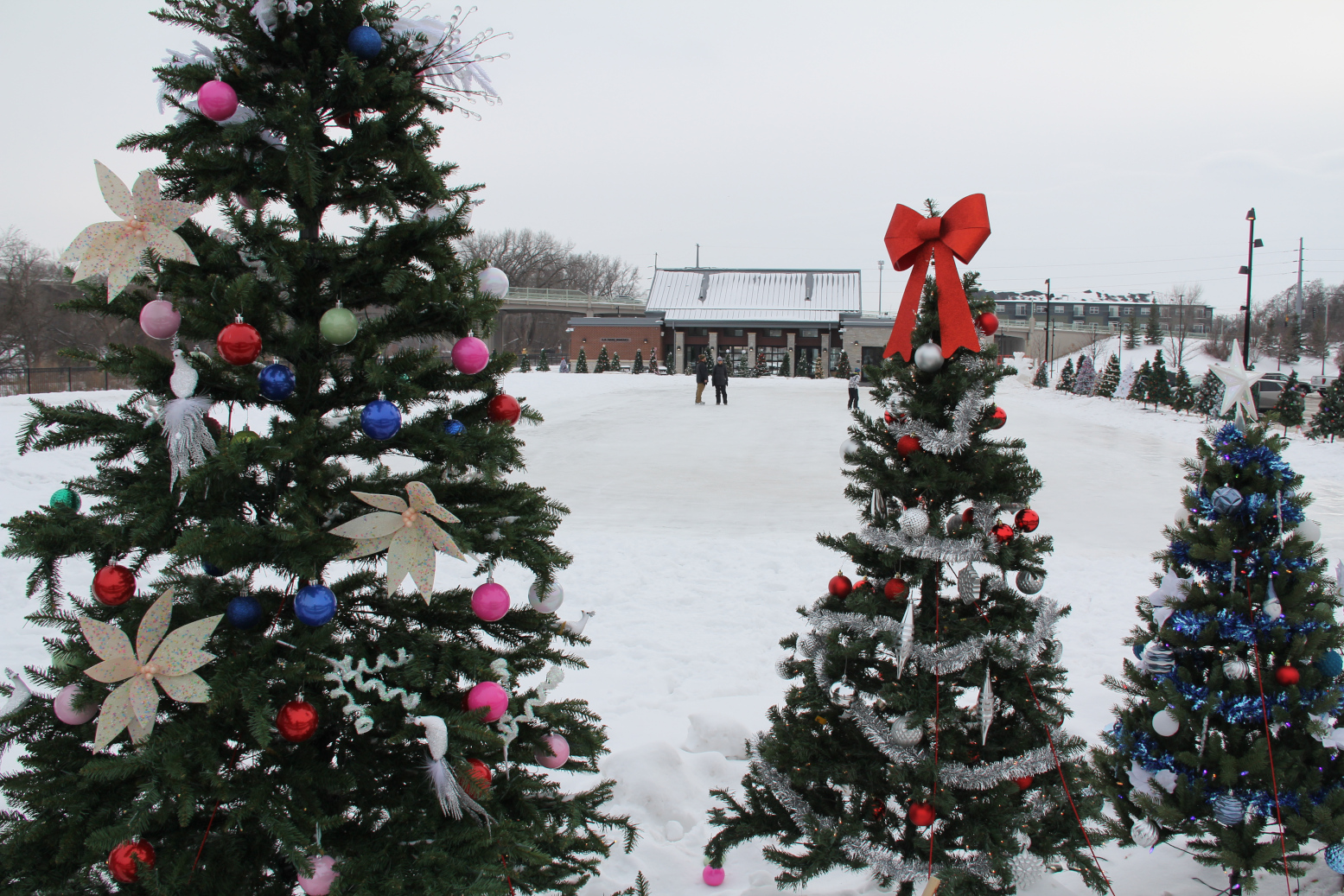
Looking through the Christmas trees to the ice rink and the Viaduct Park community gathering space in the background. (Minnesota Prairie Roots copyrighted photo December 2025)
This past weekend I toured the trees rimming the ice skating rink at Faribault’s new community gathering spot, Viaduct Park. That park centered recent Winterfest activities.
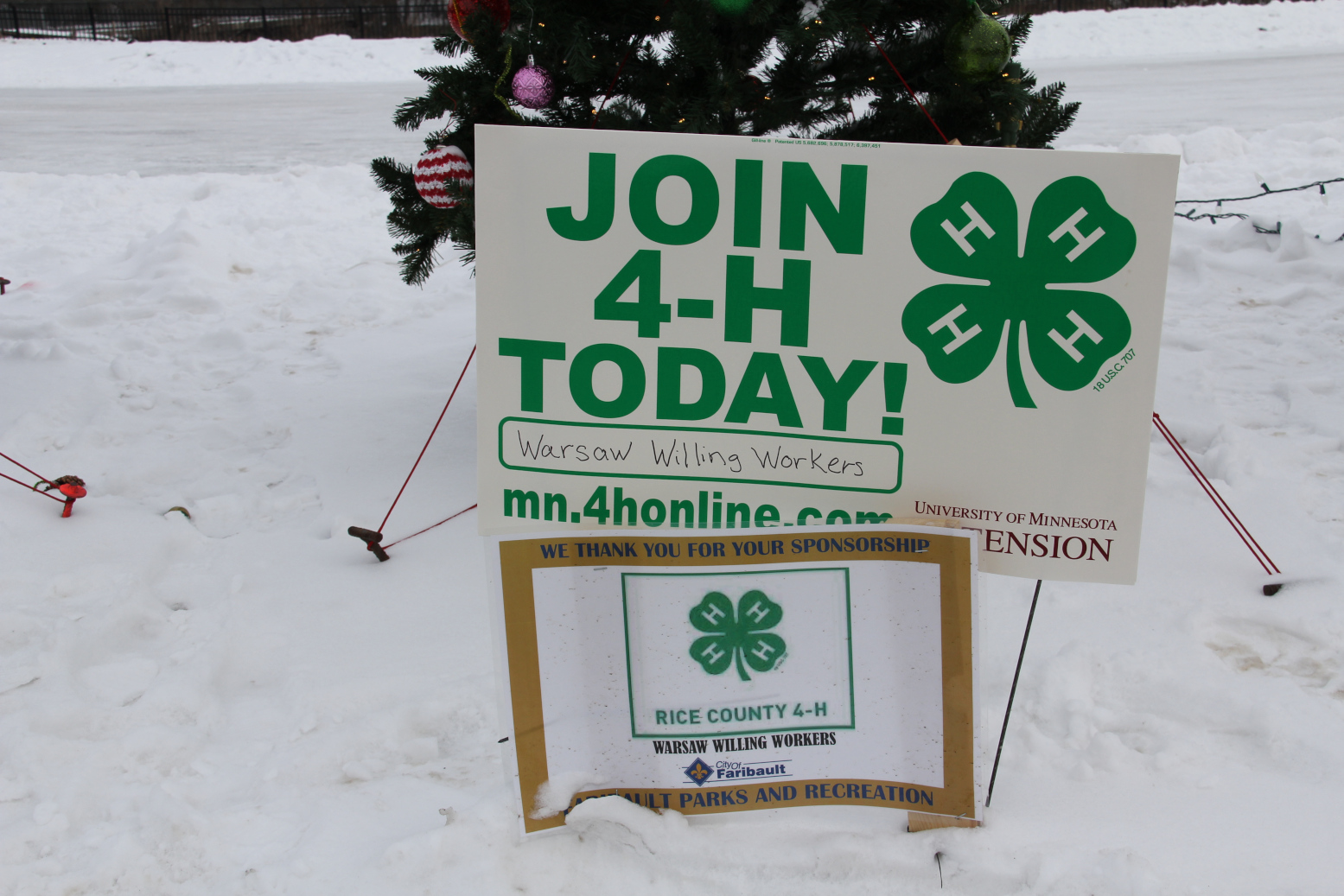
A local 4-H club is among those decorating and donating a tree. (Minnesota Prairie Roots copyrighted photo December 2025)
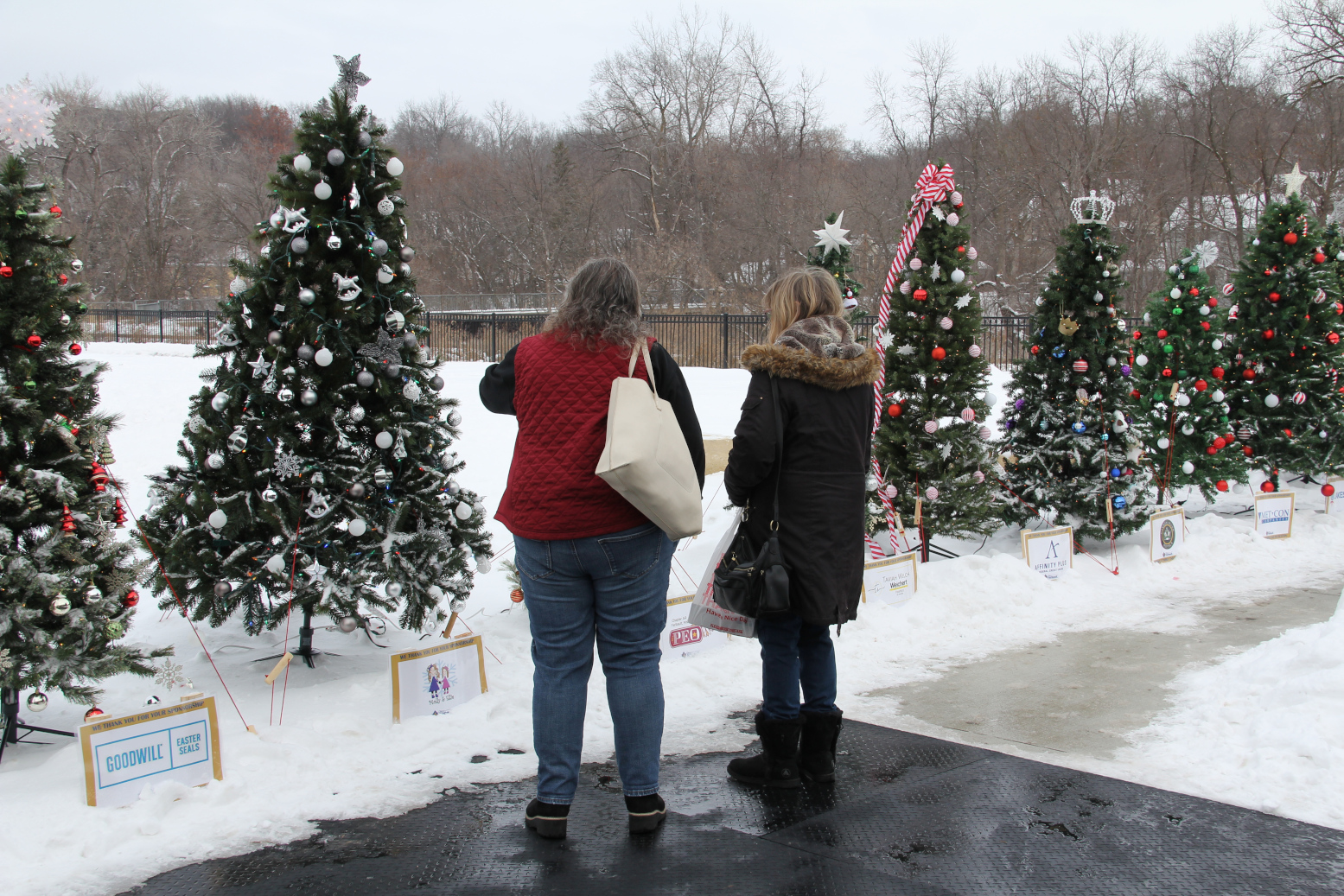
As I slowly walked along the sidewalk looking at the festive trees, I thought of those who gave and those who will receive. Businesses, organizations, nonprofits, churches and more participate in the Adopt-a-Tree project with 77 trees gifted this year.
These women take their time looking at the 77 trees. (Minnesota Prairie Roots copyrighted photo December 2025)
The program was started by the Faribault Parks & Recreation Department in 2020 to bring a little holiday cheer to the community during the COVID-19 pandemic. Each December since, those numbers have steadily grown from 20 trees that first year to nearly 80 today. That’s a whole lot of families receiving Christmas trees. Families that might otherwise go without a tree because of the cost of buying one.
A skater skates on the other side of the trees edging the rink. (Minnesota Prairie Roots copyrighted photo December 2025)
Now, more than ever, with the price of groceries and other necessities rising, the need seems especially great. We’re all feeling the pinch in our pocketbooks. But, if you’re living on an especially tight budget, the reality is that maybe you can’t afford a tree or gifts. And that’s where my community, like so many others across Minnesota and the country, steps up and gives from the heart.
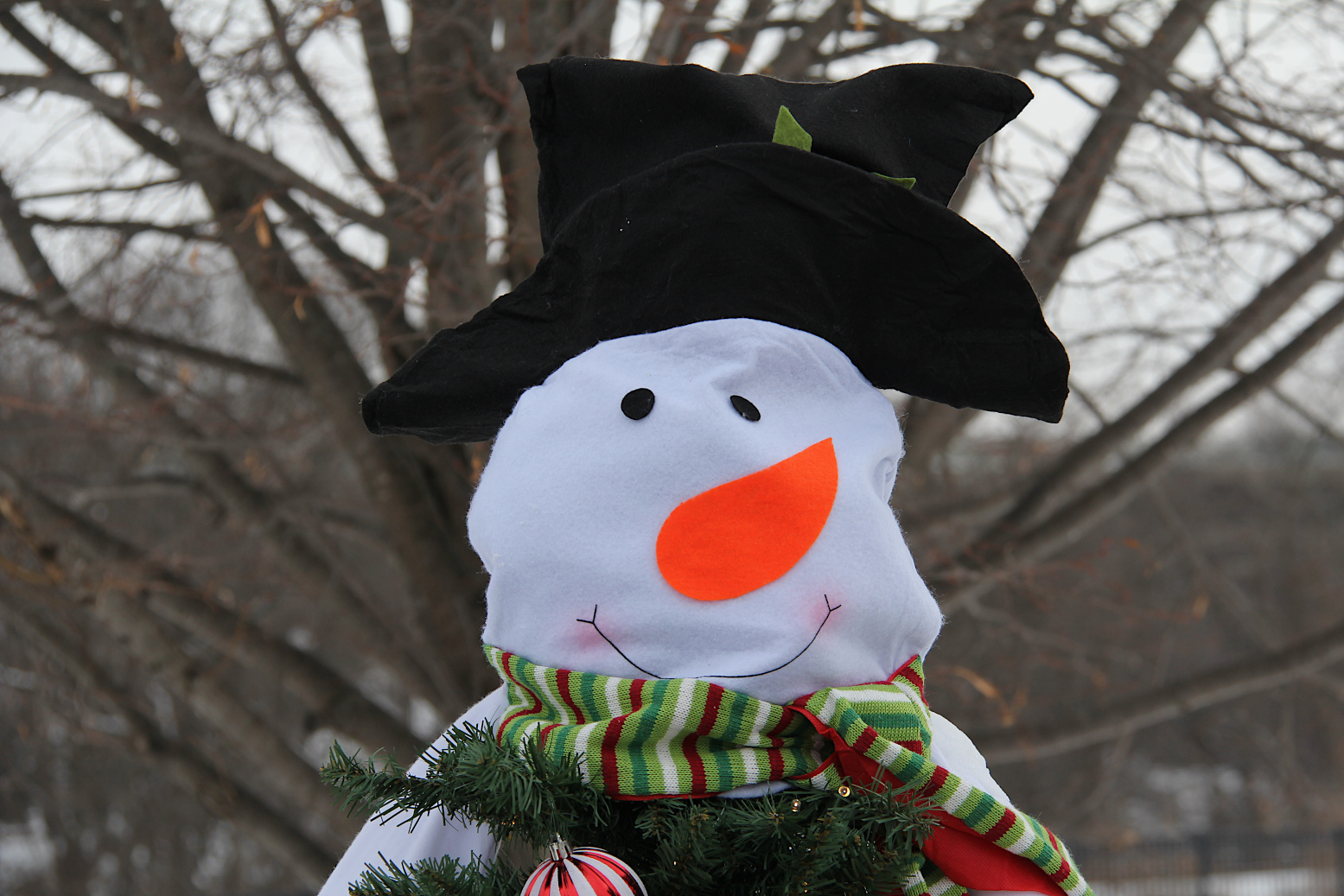
So many fun Christmas tree toppers, including this snowman. (Minnesota Prairie Roots copyrighted photo December 2025)
When I think back to my own childhood, I realize my parents likely scrimped and saved to buy Christmas presents for me and my five siblings. We maybe got two gifts each. And we were ecstatic to receive those.
Skaters skate next to the trees and the Viaduct Park gathering space, which is open for warming up and to buy concessions from 3-5 pm weekdays and from 1-6 pm weekends. (Minnesota Prairie Roots copyrighted photo December 2025)
Our Christmas tree was so small that it sat on the end of our Formica kitchen table. To this day, I look for a Charlie Brown tree because of the fond childhood memories associated with a less-than-perfect tiny tree.
A festive holiday ribbon circles a tree. (Minnesota Prairie Roots copyrighted photo December 2025)
I hope the children in my community whose families receive Adopt-a-Tree trees will feel the same Christmas joy. I hope they feel the love of those who care about them, who want them to have a Christmas tree in their homes. Likewise, if they receive gifts through many of the giving programs in Faribault, I hope they feel loved.
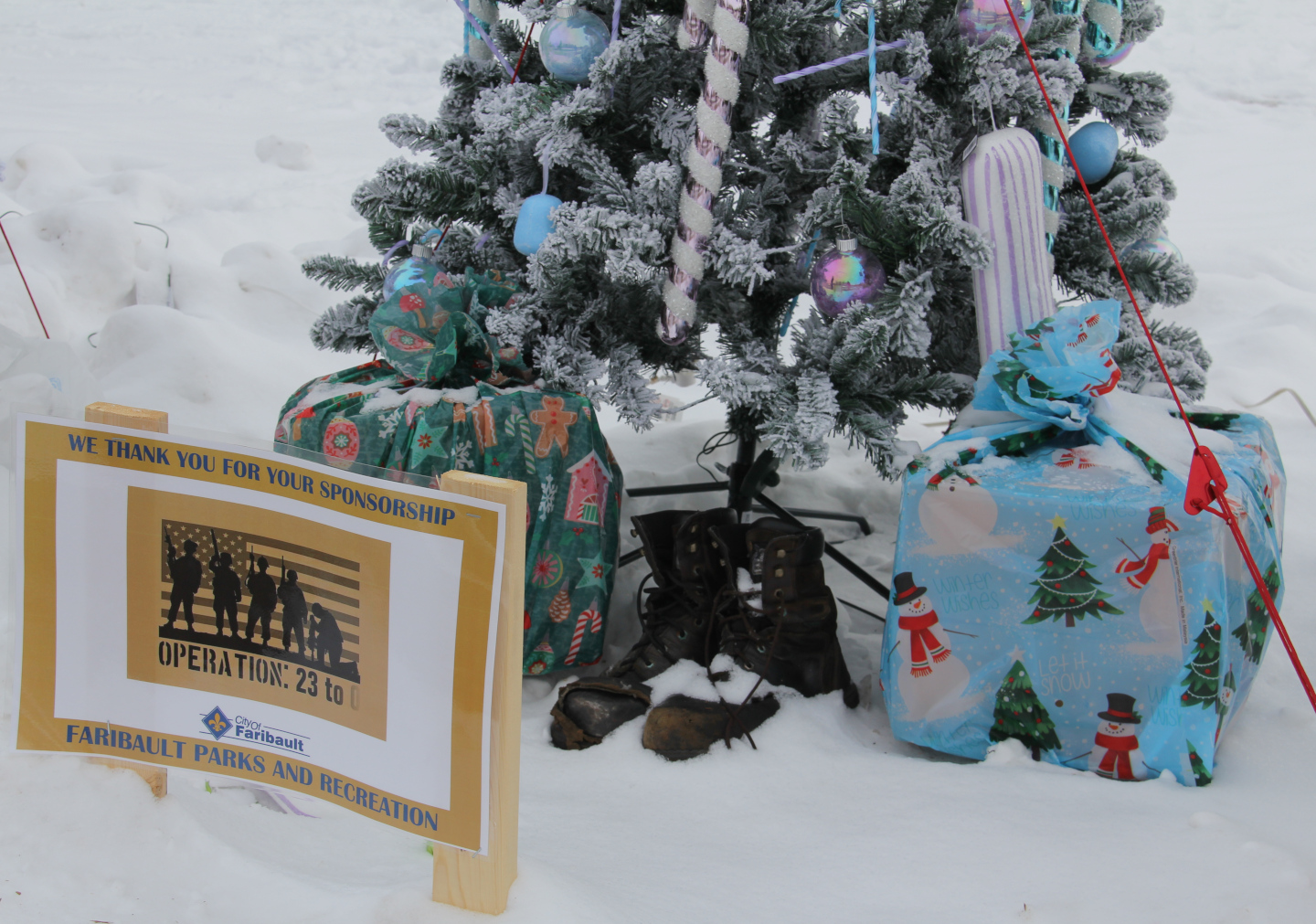
Operation: 23 to 0, which works toward suicide prevention, participated in Adopt-a-Tree. (Minnesota Prairie Roots copyrighted photo December 2025)
Perhaps some day, they, too, will give back, reflecting on those hard times when others uplifted them during the holidays. My husband and his sibling were on the receiving end of such giving during their childhood. Today Randy and I are part of a bible study group at Trinity Lutheran Church that facilitates a Christmas Angel Program. We’ll gather soon to wrap all those donated gifts.
Generosity shines like the star topping one of the Christmas trees. (Minnesota Prairie Roots copyrighted photo December 2025)
Kindness. Compassion. Care. All shine bright in Faribault from those donated Christmas trees to every single gift purchased for someone in need. Both reflect the spirit of the season. And that is a spirit of love and of generosity.
I viewed the trees during daylight, under overcast skies. I’d encourage night viewing also to see the lights. (Minnesota Prairie Roots copyrighted photo December 2025)
FYI: If you want to see the Adopt-a-Tree trees, look soon. They are coming down early this week. Thank you to all who participated in this project.
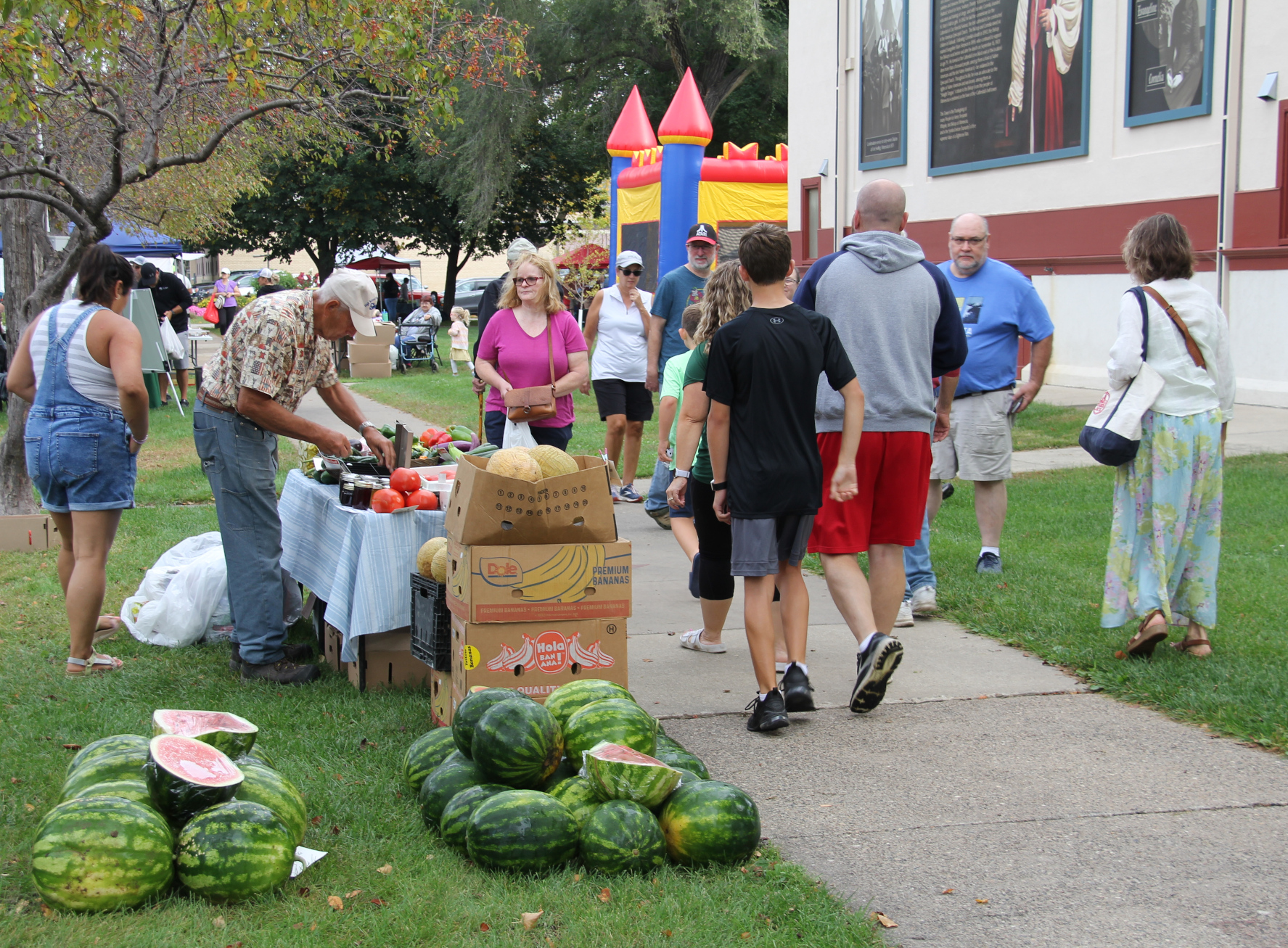
Shopping at the Faribault Farmers’ Market on a Saturday morning. (Minnesota Prairie Roots copyrighted photo September 2025)
FUN, FOOD, COMMUNITY AND CREATIVITY drew all ages to Central Park on September 13 for two special events—the Faribault Farmers’ Market Family Day and the Faribault Makers’ Market Customer Appreciation Day.
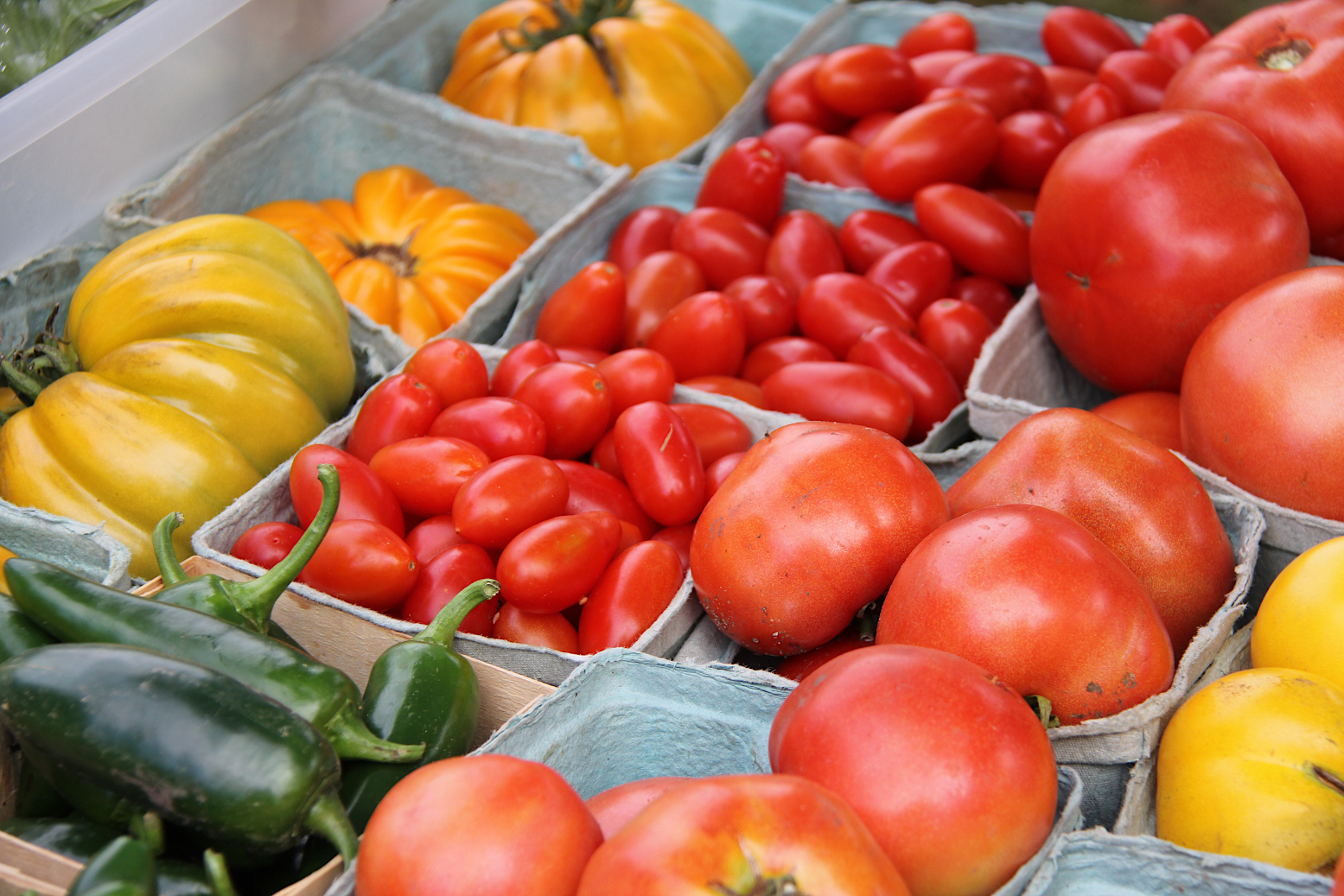
Some of Al’s vegetables. (Minnesota Prairie Roots copyrighted photo September 2025)
Randy and I joined those shopping for local food and goods. We brought home a ginormous watermelon from our friend Al plus two pounds of ground beef from Big Woods Beef, sweetcorn from River View Veggie Farm, and four juicy and savory pears from a vendor who lives near Union Lake.
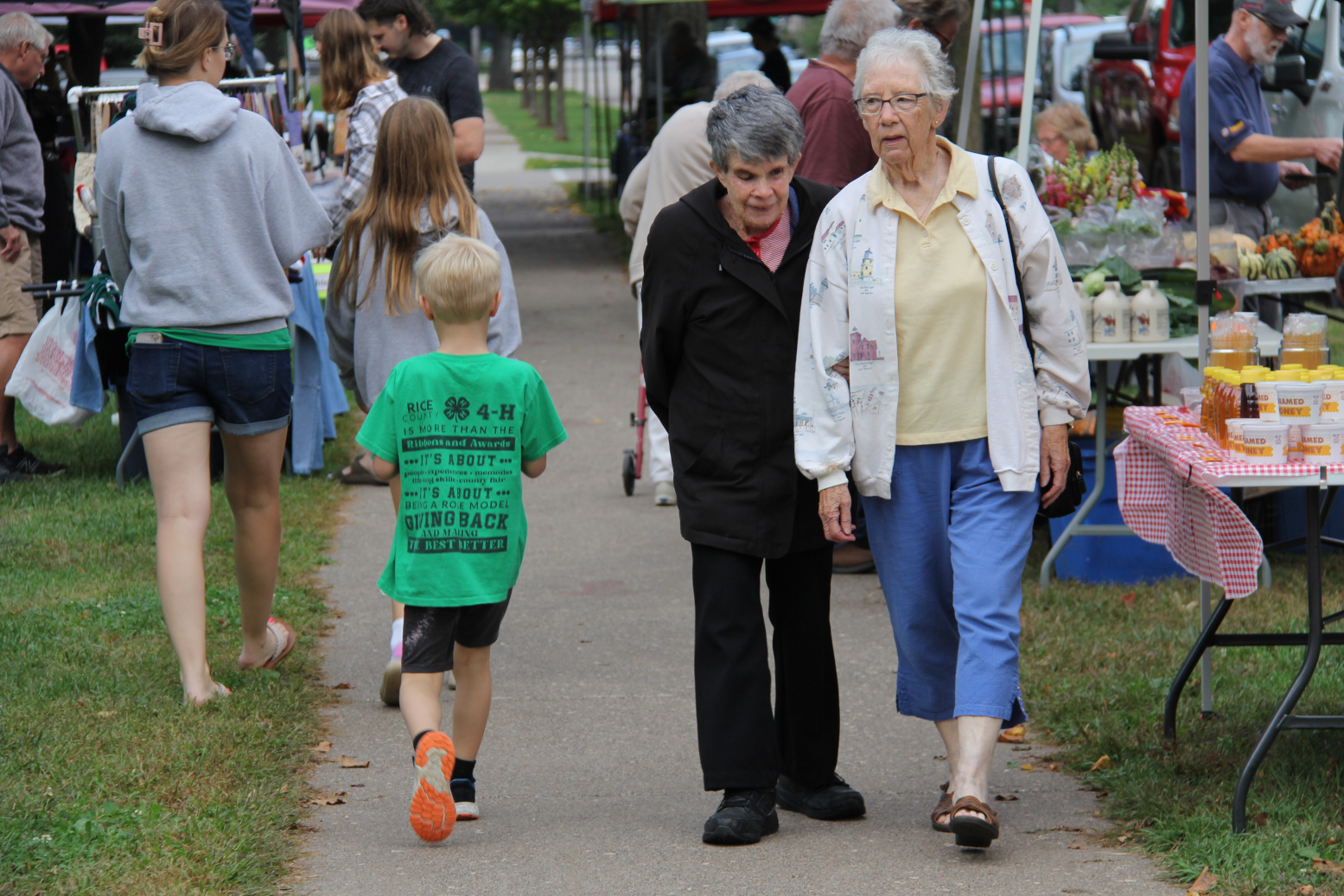
Shopping at the farmers’ market. (Minnesota Prairie Roots copyrighted photo September 2025)
A close-up of a colorful crocheted throw at Barb’s Kitchen Crafts and Homemade Goods. (Minnesota Prairie Roots copyrighted photo September 2025)
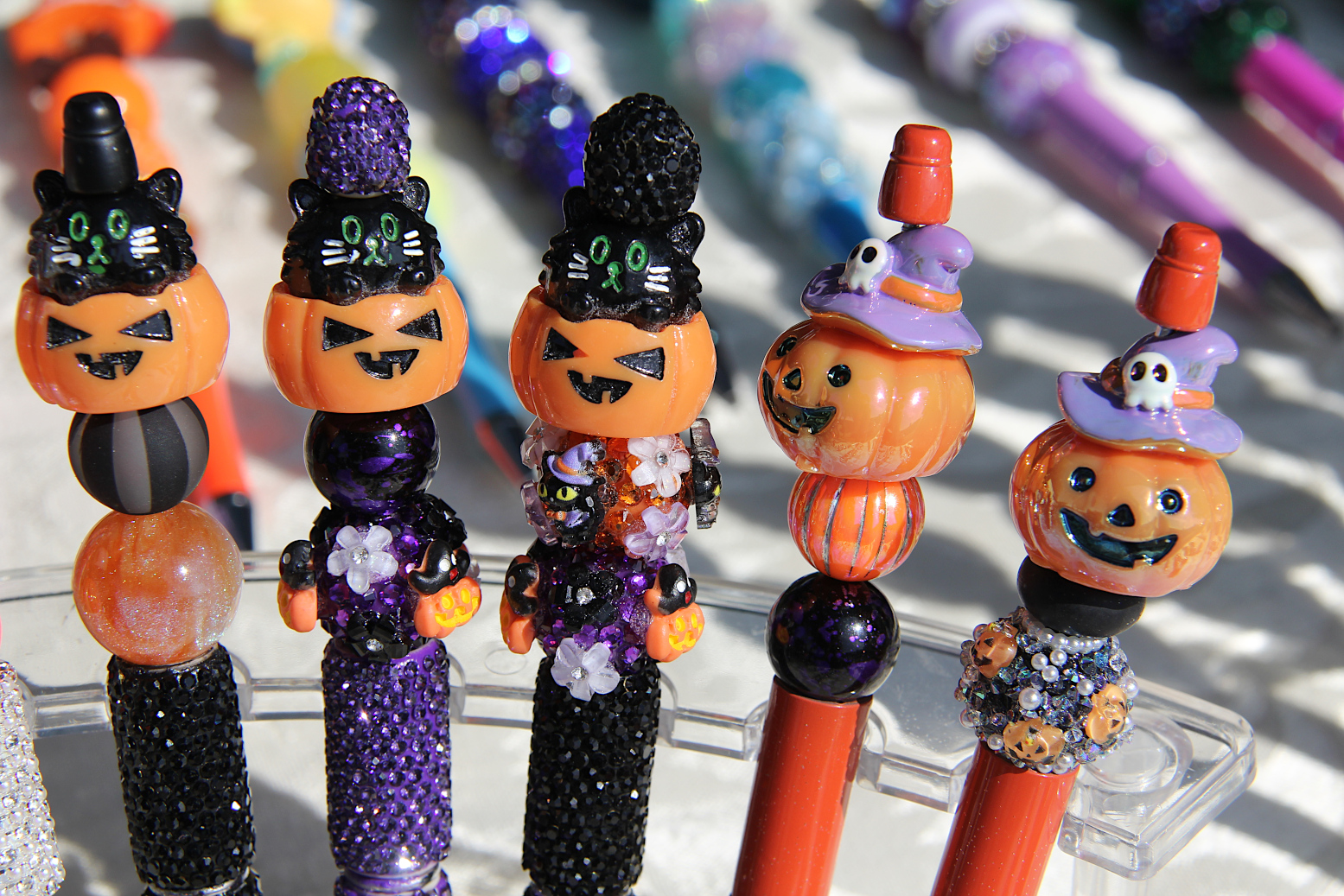
Halloween themed pens for sale at the makers’ market. (Minnesota Prairie Roots copyrighted photo September 2025)
I also snapped photos and engaged in some wonderful conversations. For me, these markets are all about celebrating community—the people who live here, farm and garden here, bake here, create here.
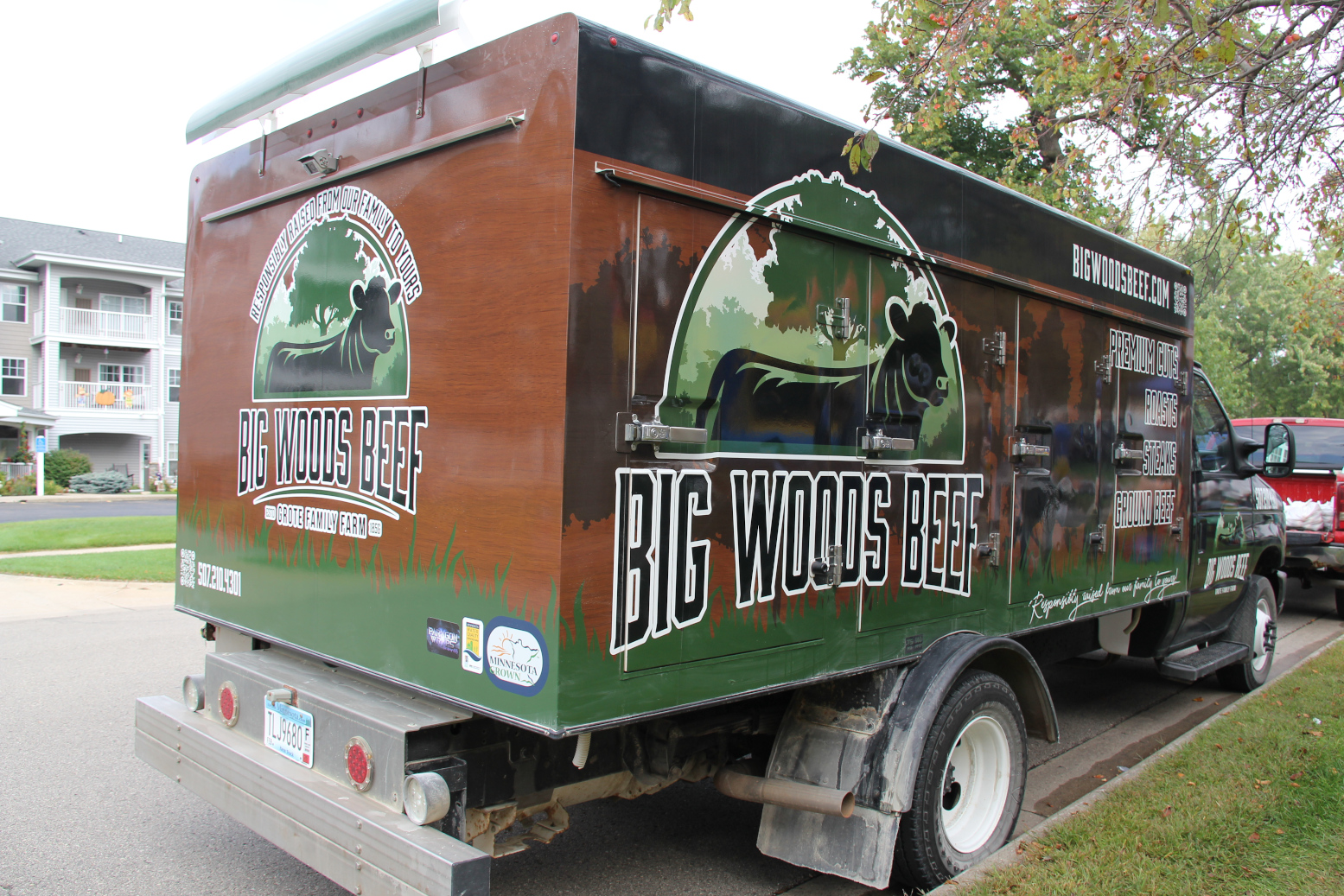
An ice cream truck repurposed for selling locally-raised beef. (Minnesota Prairie Roots copyrighted photo September 2025)
I learned, for example, when chatting with the couple at Big Woods Beef that their refrigerated truck is a repurposed Schwans delivery truck. That led to my reminiscing about the Schwans “Ice Cream Man.” We talked about farm prices too, about the low prices of corn and soybeans and the high price for beef. And I understood, as I did decades ago when my farmer dad struggled to support his family, how challenging the economics of farming remain.
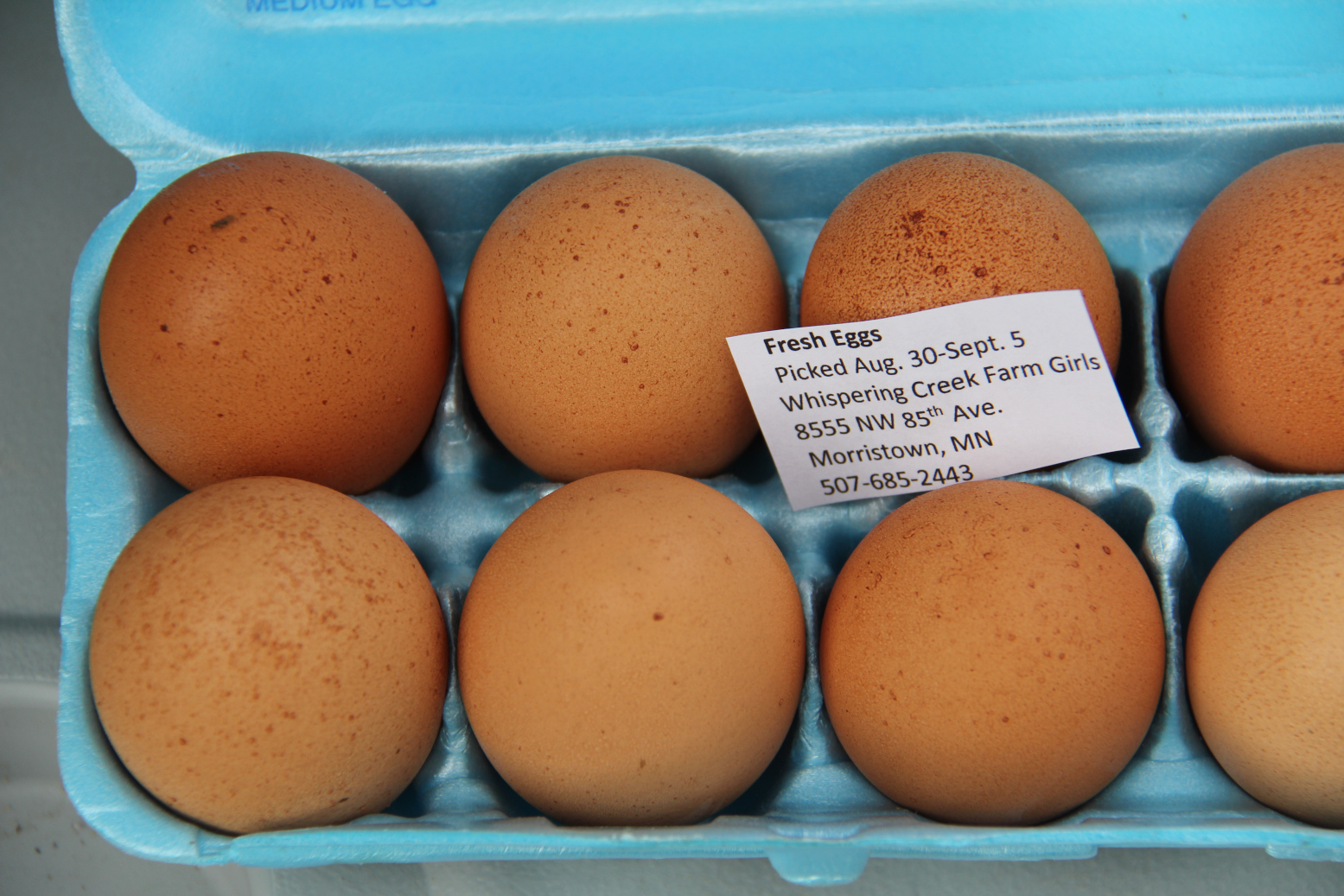
Eggs fresh from the farm. (Minnesota Prairie Roots copyrighted photo September 2025)
At the farmers’ market, there’s a direct link to the land—in fresh eggs gathered, in bumpy pumpkins pulled from the vine, in garden fresh tomatoes ripened by the sun, in clutches of colorful zinnias and gladiolus cut from fields…
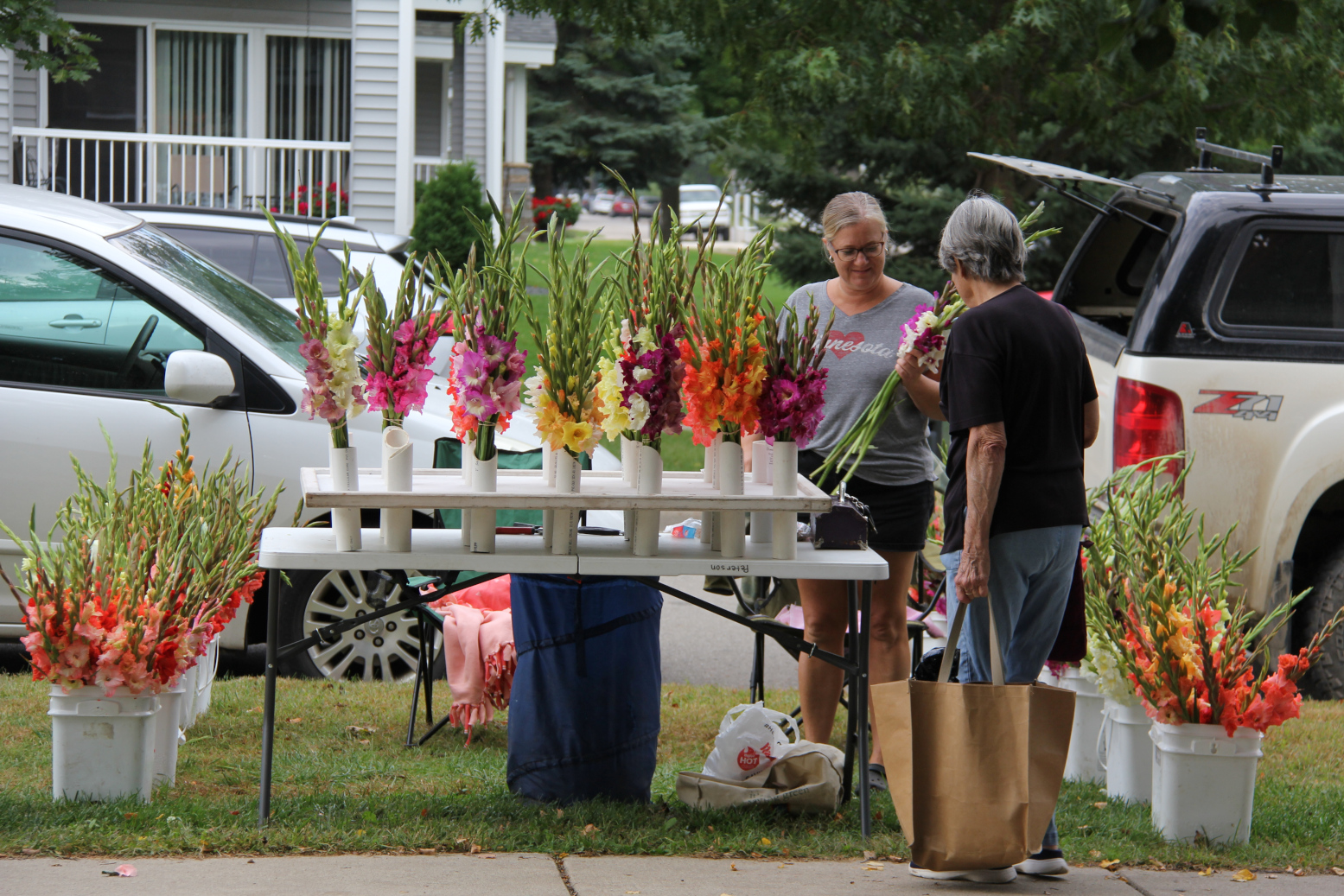
Selling gladiolus at Three Glad Girls. (Minnesota Prairie Roots copyrighted photo September 2025)
Three Glad Girls (and their mom) have vended gladiolus at the Faribault market for years, since the sisters, after whom the business is named, were young. They battled mosquitoes to bring their $10 bouquets of glads to Saturday’s market. The mosquitoes proved relentless even as they sold their flowers.
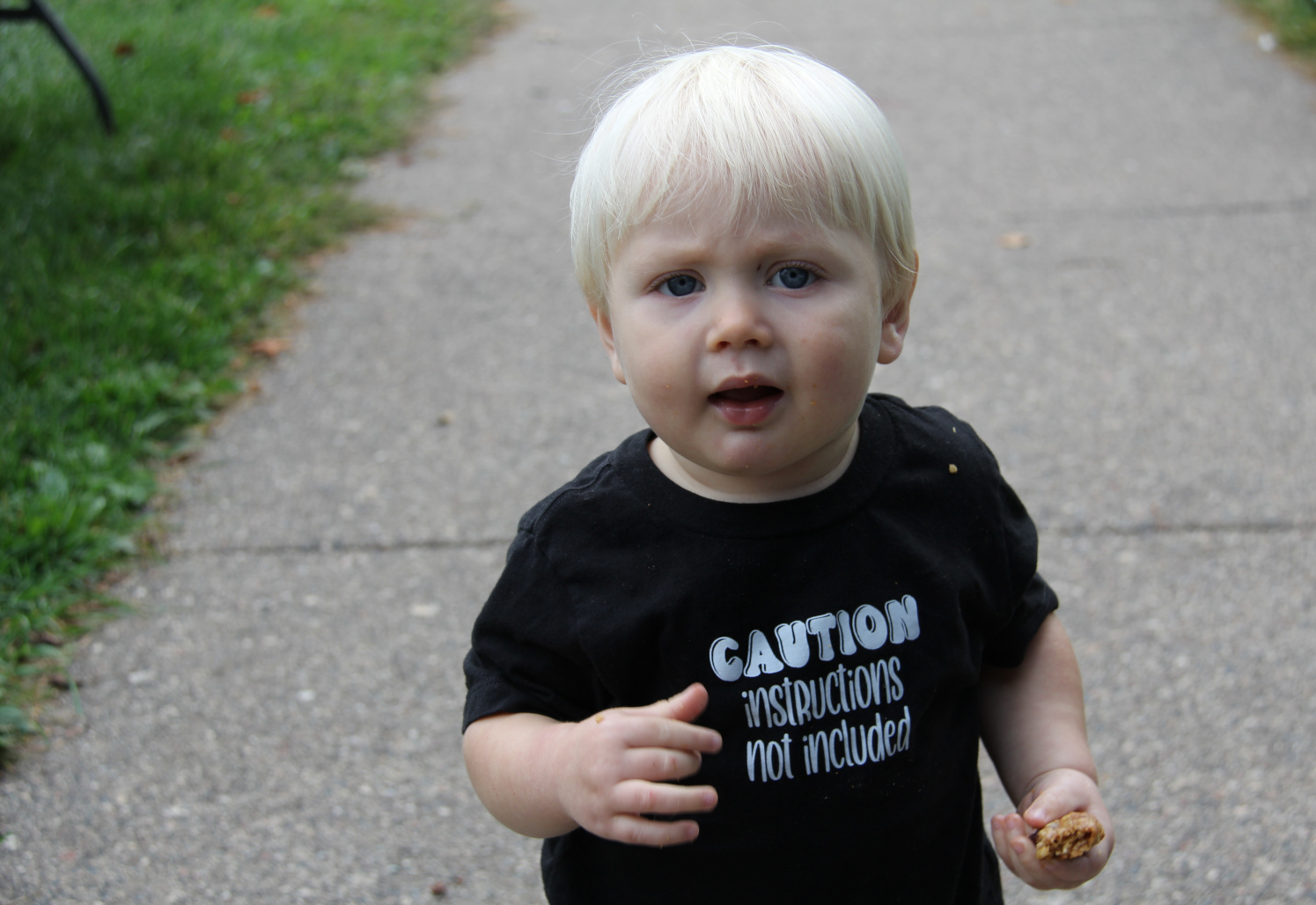
Jax enjoys a cookie while his mom sells at the farmers’ market. (Minnesota Prairie Roots copyrighted photo September 2025)
Saturday’s special family day focused primarily on activities for kids. I met several of them. Jax, 1, clutching a cookie and wearing a simple black tee with the words “CAUTION instructions not included.” Now that made me laugh. His mom, Jaylyn, was selling tallow balms, lotions, sugar scrubs and more with her business, Tallow Parlor.
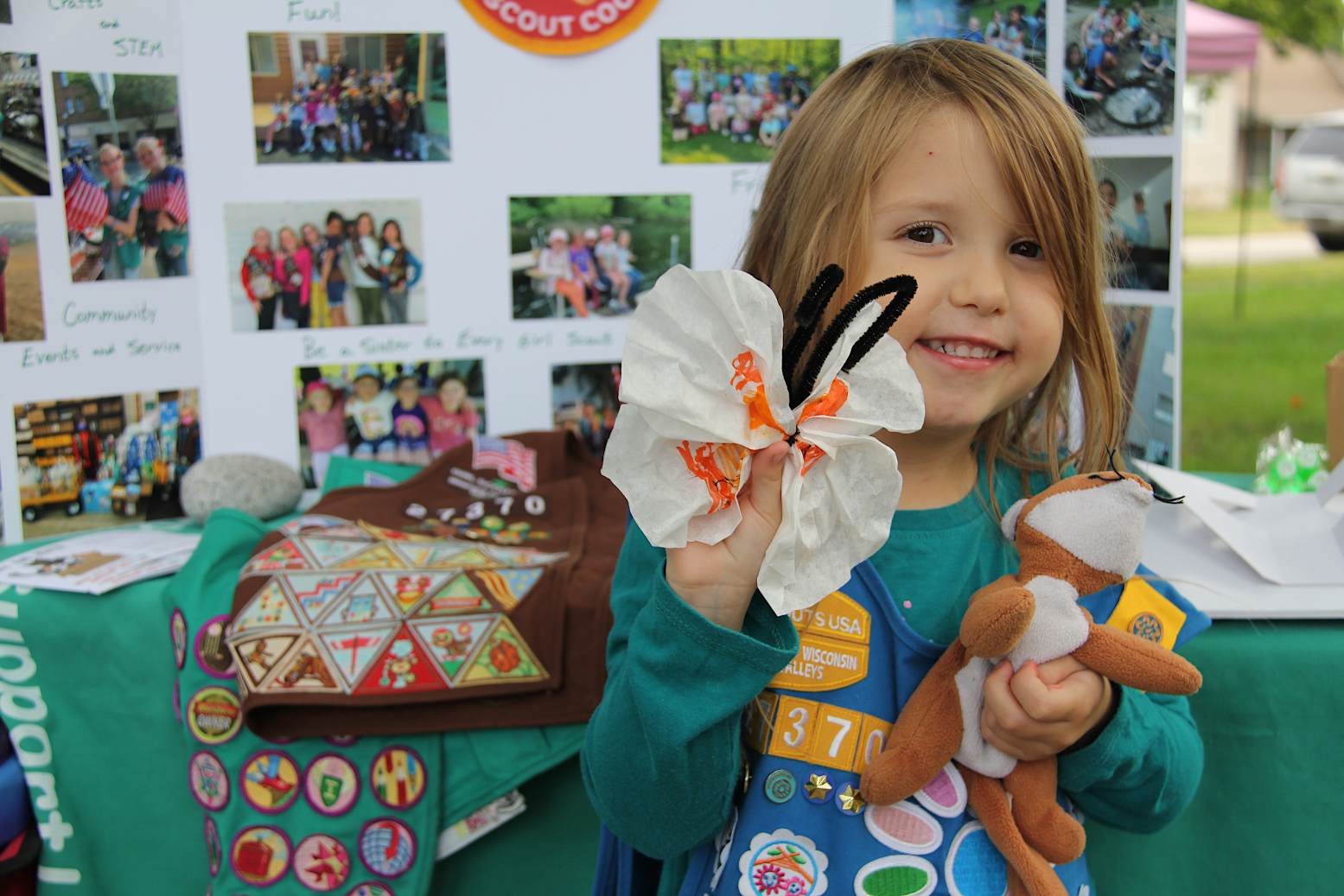
Margot shows off the butterfly she made. (Minnesota Prairie Roots copyrighted photo September 2025)
Over at an informational display about Scouting, Margot, 4, not old enough yet for Girl Scouts, posed with a coffee filter butterfly she crafted at a master gardeners’/University of Minnesota extension service table. The adults got a swag bag.
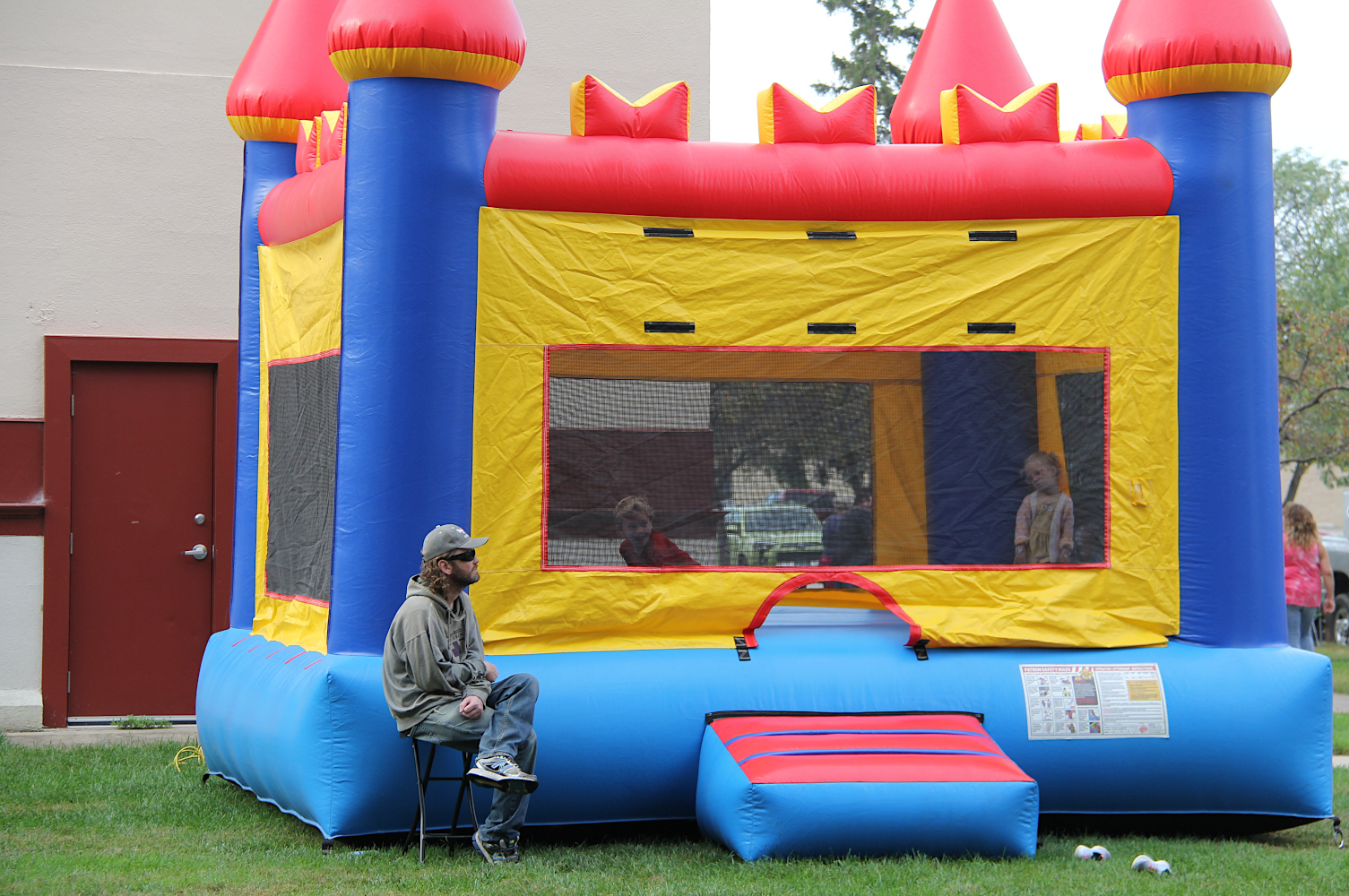
Kids enjoy the bouncy castle set up next to the Central Park Band Shell. (Minnesota Prairie Roots copyrighted photo September 2025)
Near the Central Park band shell, kids bounced inside an inflatable castle and played yard games while shoppers passed nearby. There was market BINGO for all ages.
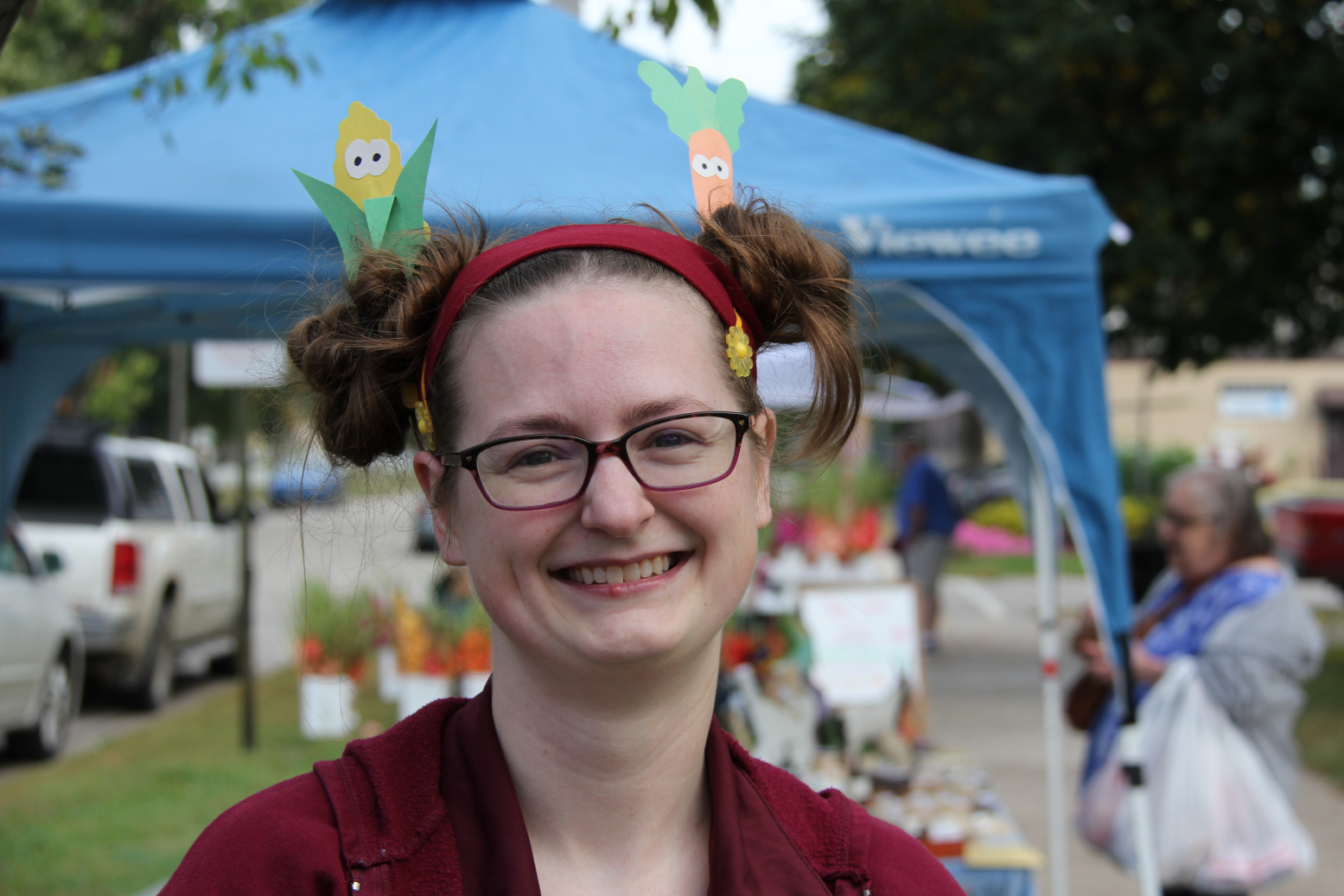
Friendly and creative Amelia. (Minnesota Prairie Roots copyrighted photo September 2025)
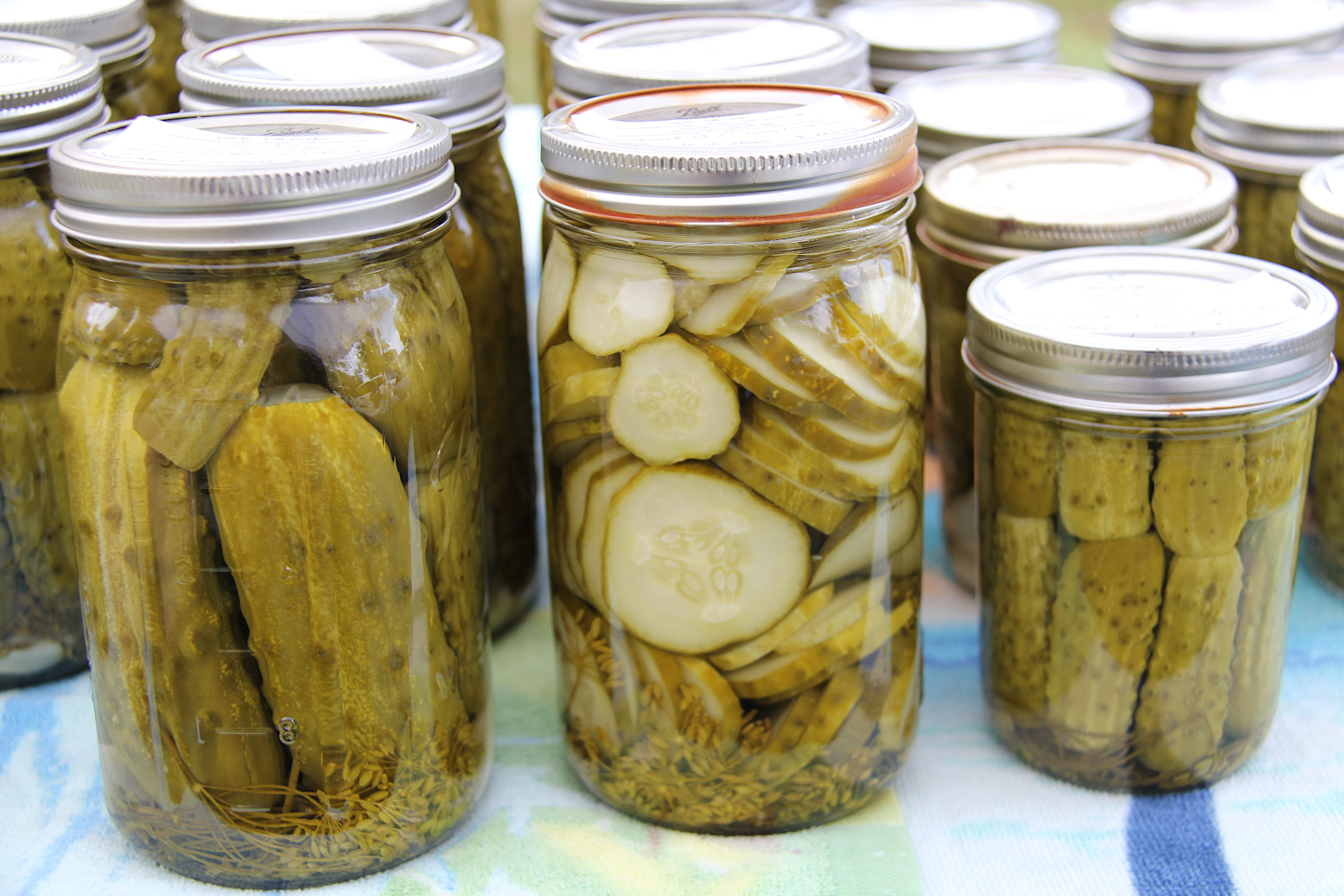
Pickles crafted and canned by Amelia’s dad. (Minnesota Prairie Roots copyrighted photo September 2025)
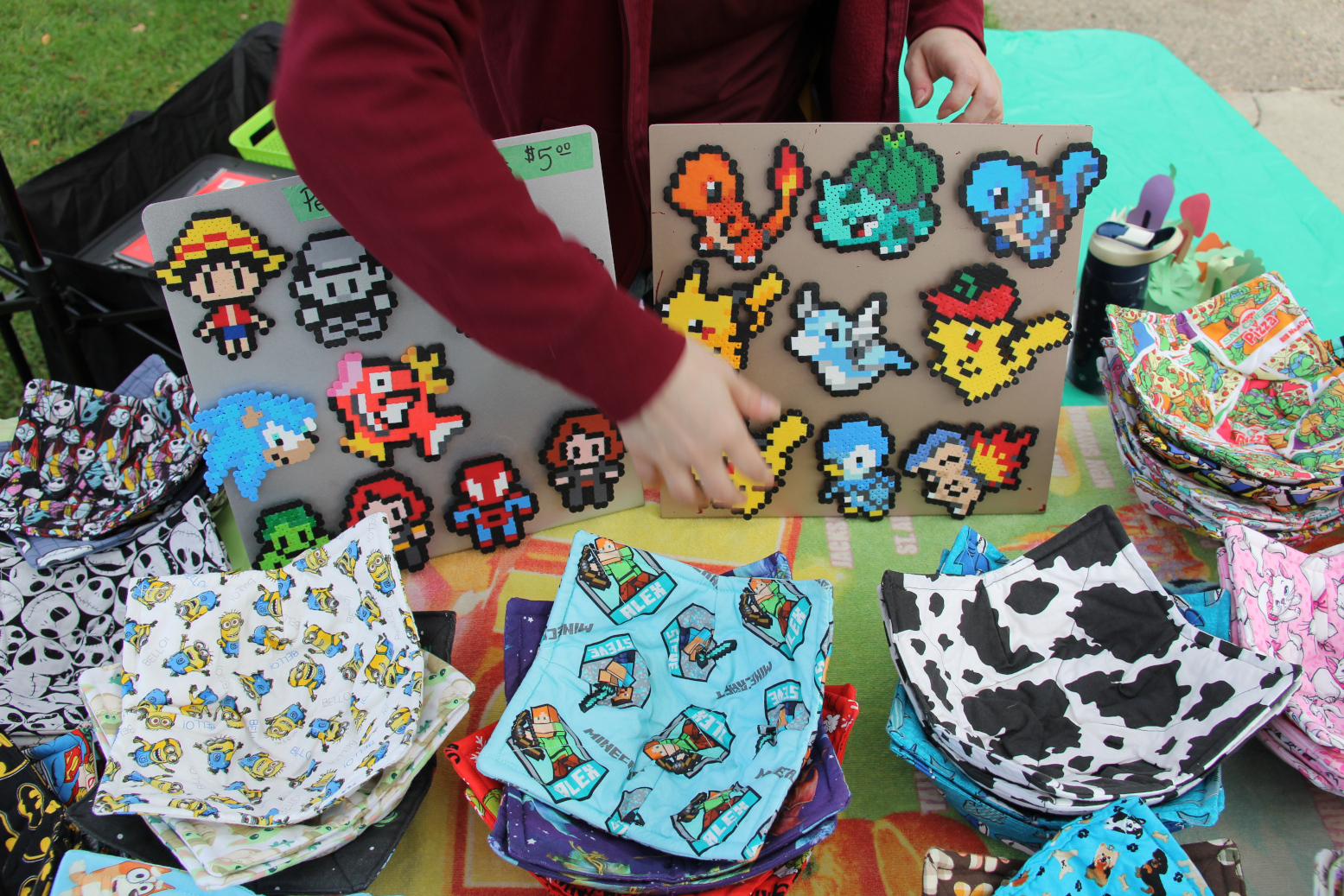
Amelia arranges some of the items she creates for the farmers’ market. (Minnesota Prairie Roots copyrighted photo September 2025)
I continued to work my way along the sidewalk, pausing to chat with vendor Amelia, a bubbly and energetic young woman who crafted a carrot and corn to wear in her hair, her contribution to the fun. I always make a point of talking to her because she makes me happy. Amelia stitches and crafts. Her dad gardens and cans.
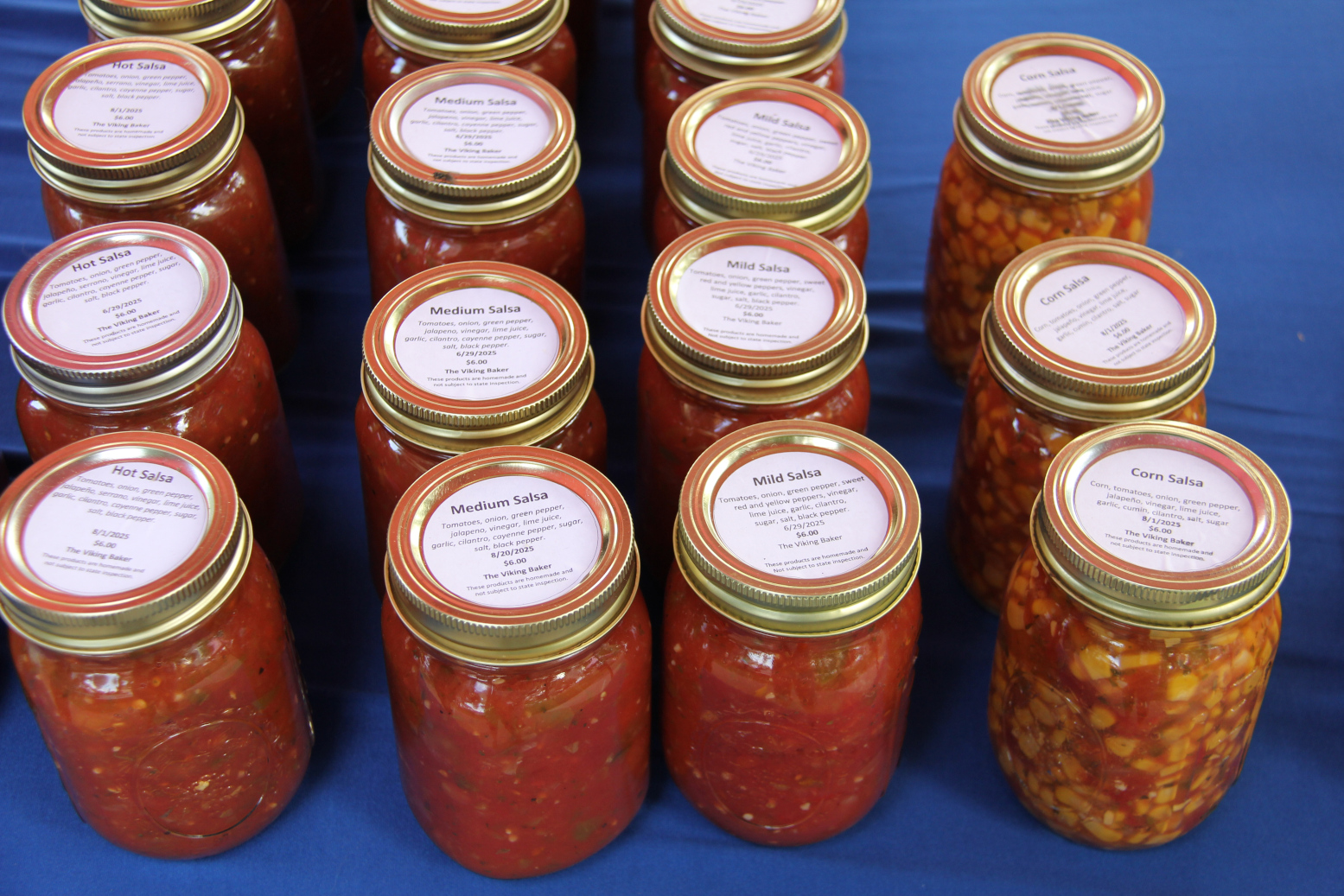
Homemade salsa from The Viking Baker. (Minnesota Prairie Roots copyrighted photo September 2025)
I walked past piles of melons, pumpkins filling a wagon, jars of homemade salsa and a whole lot more local goodness.
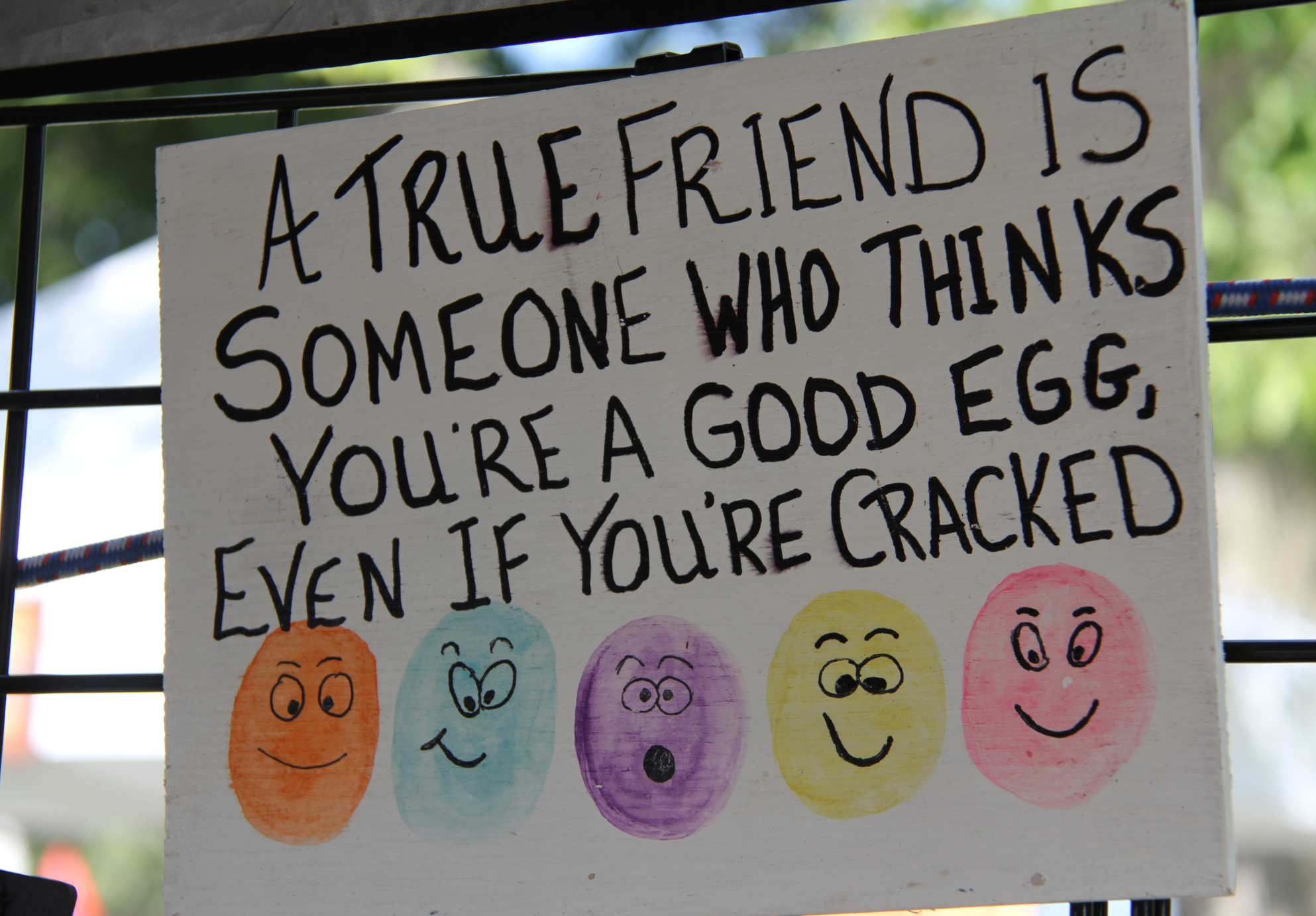
I love this message on the artsy sign crafted by Ronda. (Minnesota Prairie Roots copyrighted photo September 2025)
Over on the south side of the park, where the makers set up shop, I talked to my friend Ronda, whose joyful personality matches that of bubbly Amelia. Ronda’s love of crafting is evident. She’s been doing this for years, crafting and selling at markets.
Harvey shows off his stenciled art. (Minnesota Prairie Roots copyrighted photo September 2025)
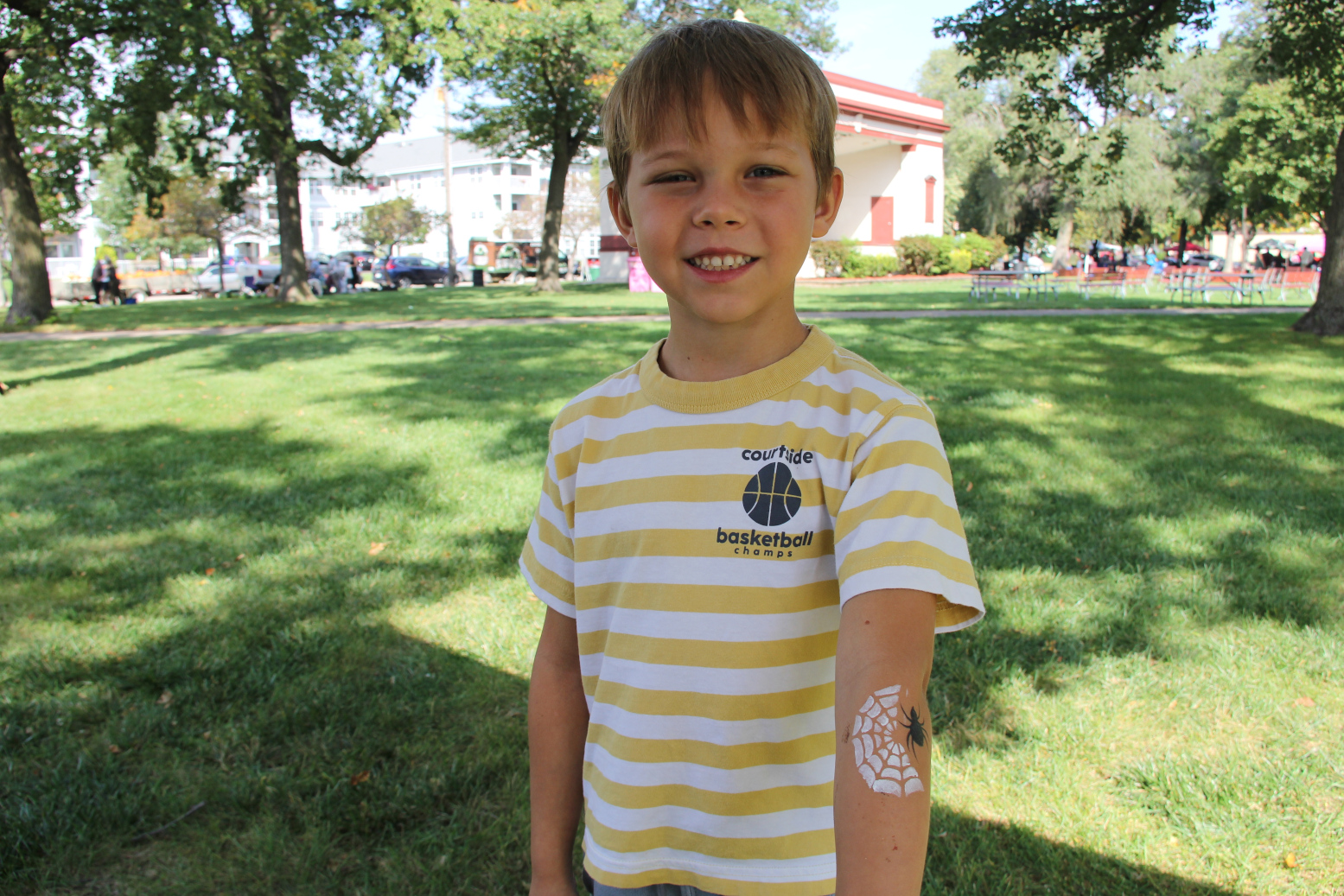
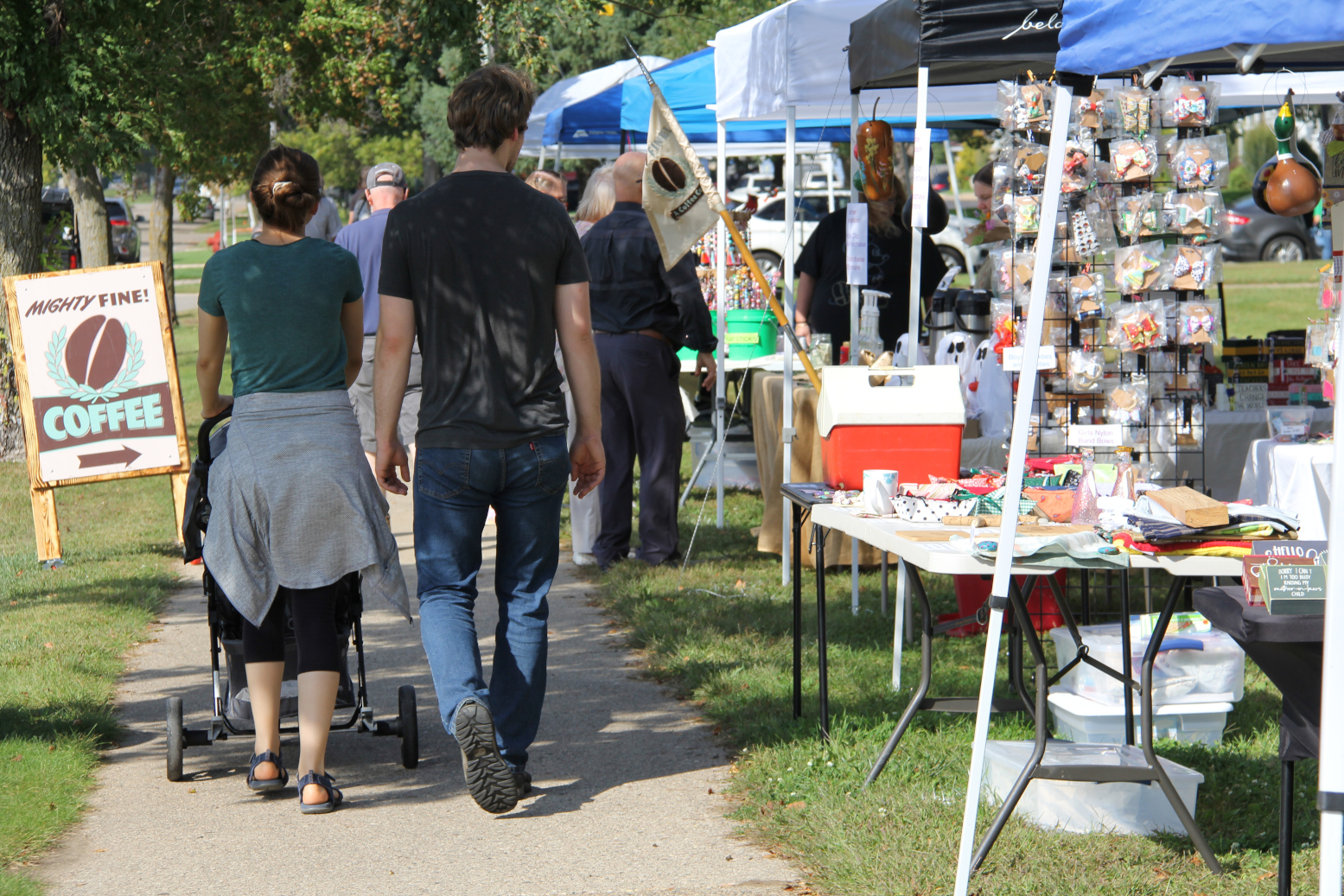
I popped into several other booths, passed by the Mighty Fine Coffee vendor, stopped to photograph Harvey, almost seven, sporting a freshly-painted spider web and spider on his arm. His smile reached to his eyes.
Selling and shopping at the makers’ market. (Minnesota Prairie Roots copyrighted photo September 2025)
This is why I attend community markets and events. This place, these people, bring me joy.
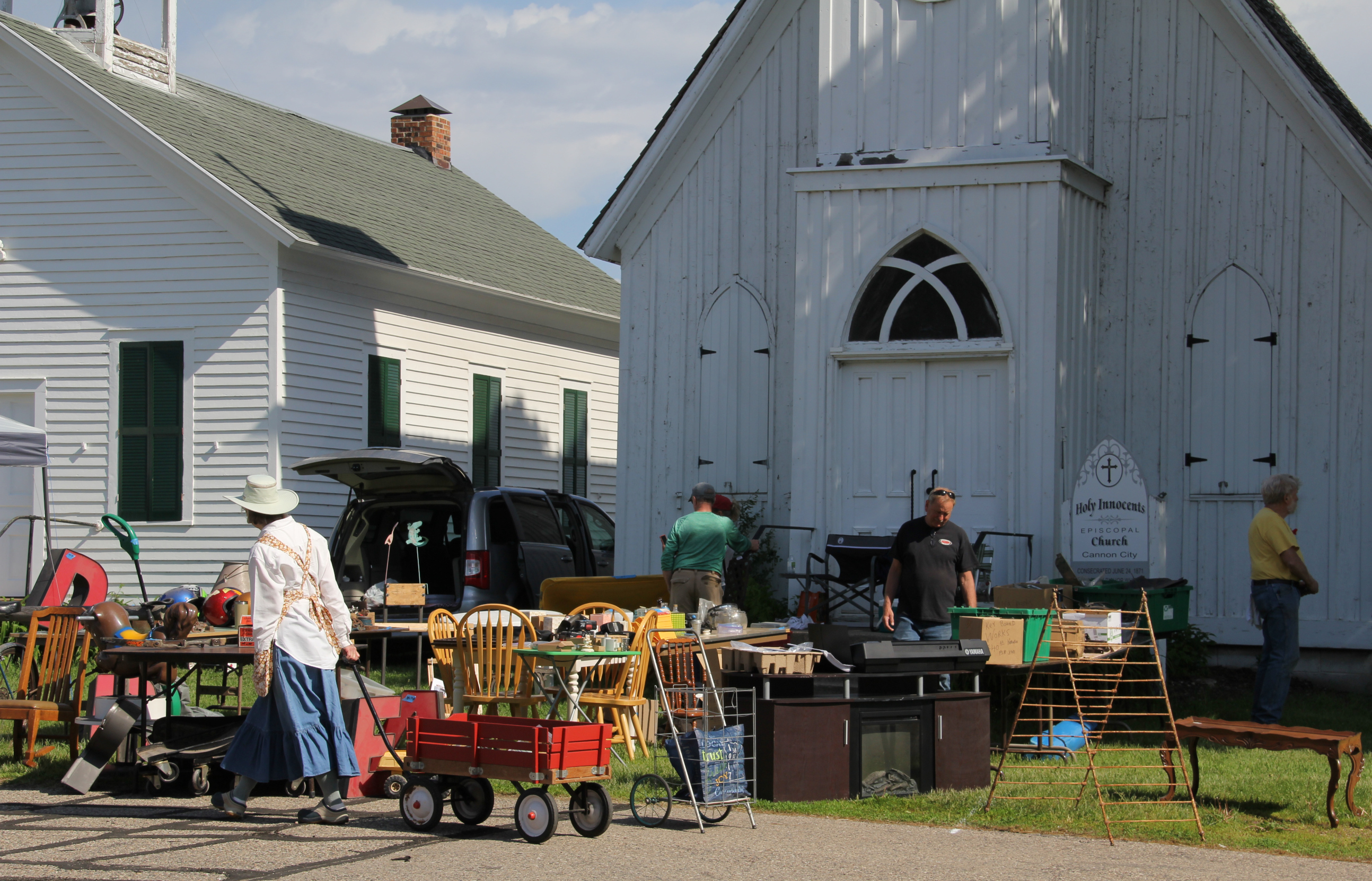
Shoppers and vendors at a previous Rice County Historical Society Flea Market. (Minnesota Prairie Roots copyrighted file photo May 2024)
THE UPCOMING WEEKEND brings a quartet of local events that not only entertain, but also honor, support and celebrate. Count me in.
First up is the Rice County Historical Society Fall Flea Market from 8 a.m.-2 p.m. Saturday, September 13, at the RCHS museum grounds along Second Avenue in Faribault. Here vendors set up shop and sell an assortments of goods with the variety of an old time mercantile.
I love browsing, and sometimes buying, at this outdoor market. But I also enjoy connecting with the sellers and other shoppers. Often I’ll see people I haven’t seen in a while, which leads to conversations. And to me, that’s what these events, at their core, are really about—connecting and reconnecting to build a strong sense of community.
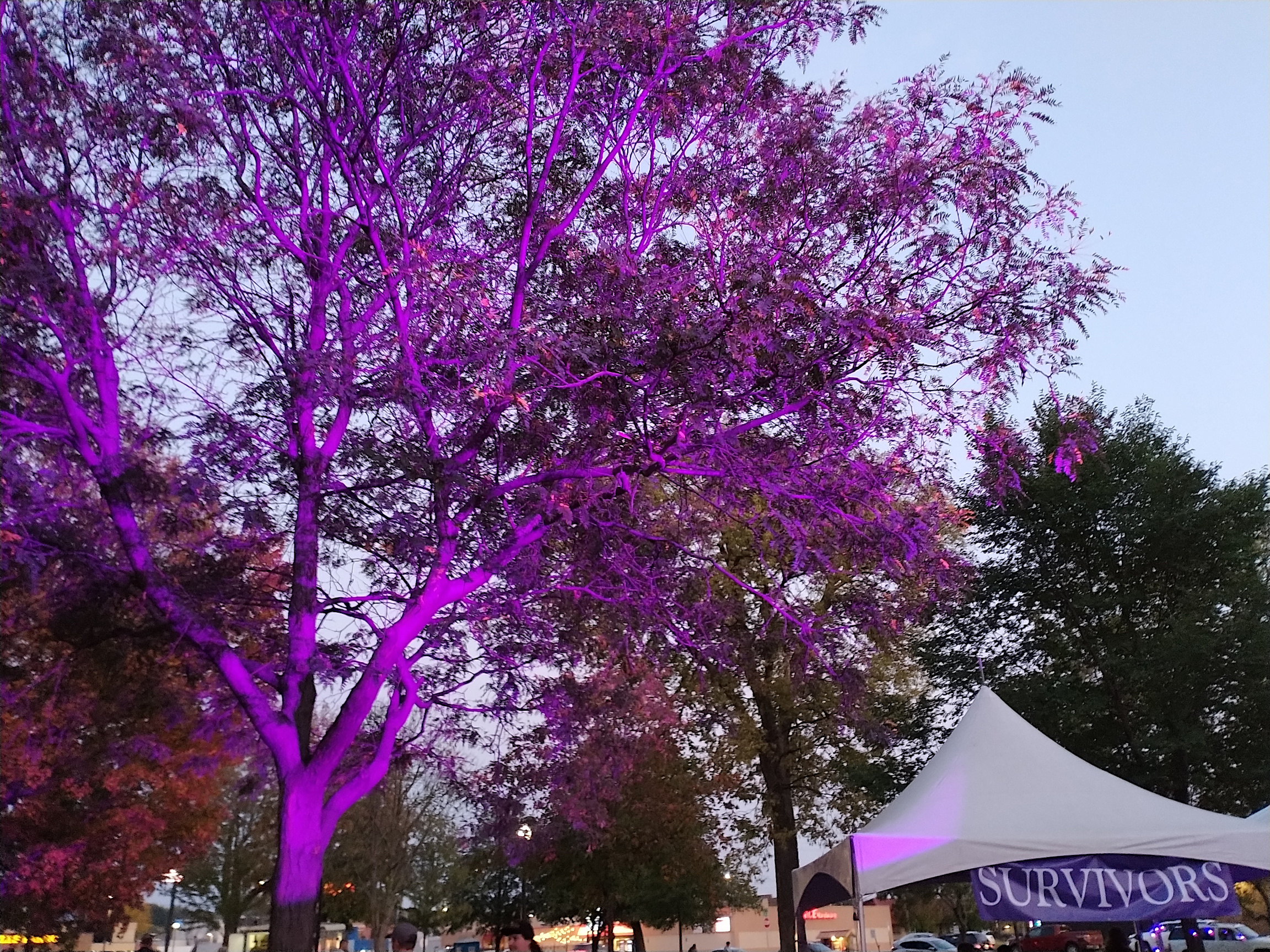
Trees flooded with purple lights at a past Light of Hope Celebration and a special tent for survivors. (Minnesota Prairie Roots copyrighted file photo September 2023)
LIGHT OF HOPE
Saturday afternoon, beginning at 4 p.m. until 10 p.m., folks will gather in Faribault’s Central Park for the Light of Hope Celebration, which focuses on cancer. Or, more accurately, focuses on those who have died from, survived or are fighting cancer. I expect every single one of you have been touched by cancer. Many of my friends and family members have endured cancer, including my dad who died of cancer in 2003. And my dear friend Barb, who died in 2024. I also know plenty of survivors.
Light of Hope aims to raise monies for local cancer patients and their families through the sale of luminaries, bench markers and donations. Recipients receive gas cards and/or monies to assist with mortgage payments, groceries, utility bills and other everyday expenses. The Light of Hope organization emphasizes “local” in their mission. I appreciate that people within my community can get financial help in the midst of a cancer diagnosis.
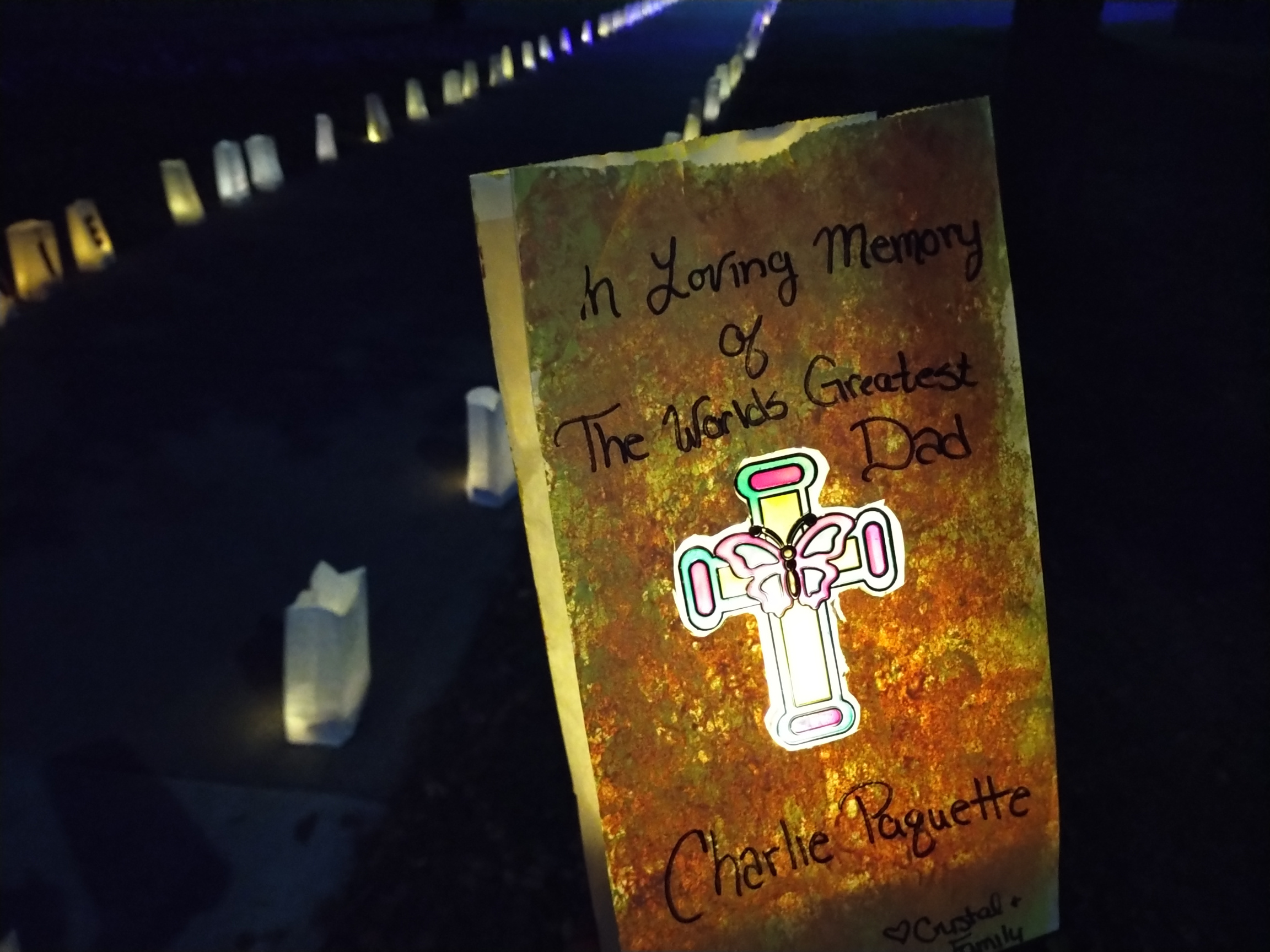
Among the hundreds of luminaries at a past Light of Hope luminary walk. (Minnesota Prairie Roots copyrighted photo September 2023)
Saturday’s celebration includes a luminary walk, personal stories, family fun, music, food trucks, raffle baskets and more. While the mood is celebratory, it can also be difficult as memories of loved ones unleash strong emotions. I know. I’ve walked the luminary path and cried as I read names of those dear to me.
SPIRIT FEST
Also on Saturday, from 5-9 p.m., Divine Mercy Catholic Church in Faribault hosts its annual Spirit Fest, a jam-packed weekend event featuring, food, music, auctions, raffles, makers’ market, bake sale, kids’ crafts, games, inflatables, outdoor movie, mini golf, cornhole tournament and much more. The fest is open to the public. Sunday, September 14, brings a second day of fun starting at 9 a.m. and running until 5 p.m. (Click here for a full schedule of events.)
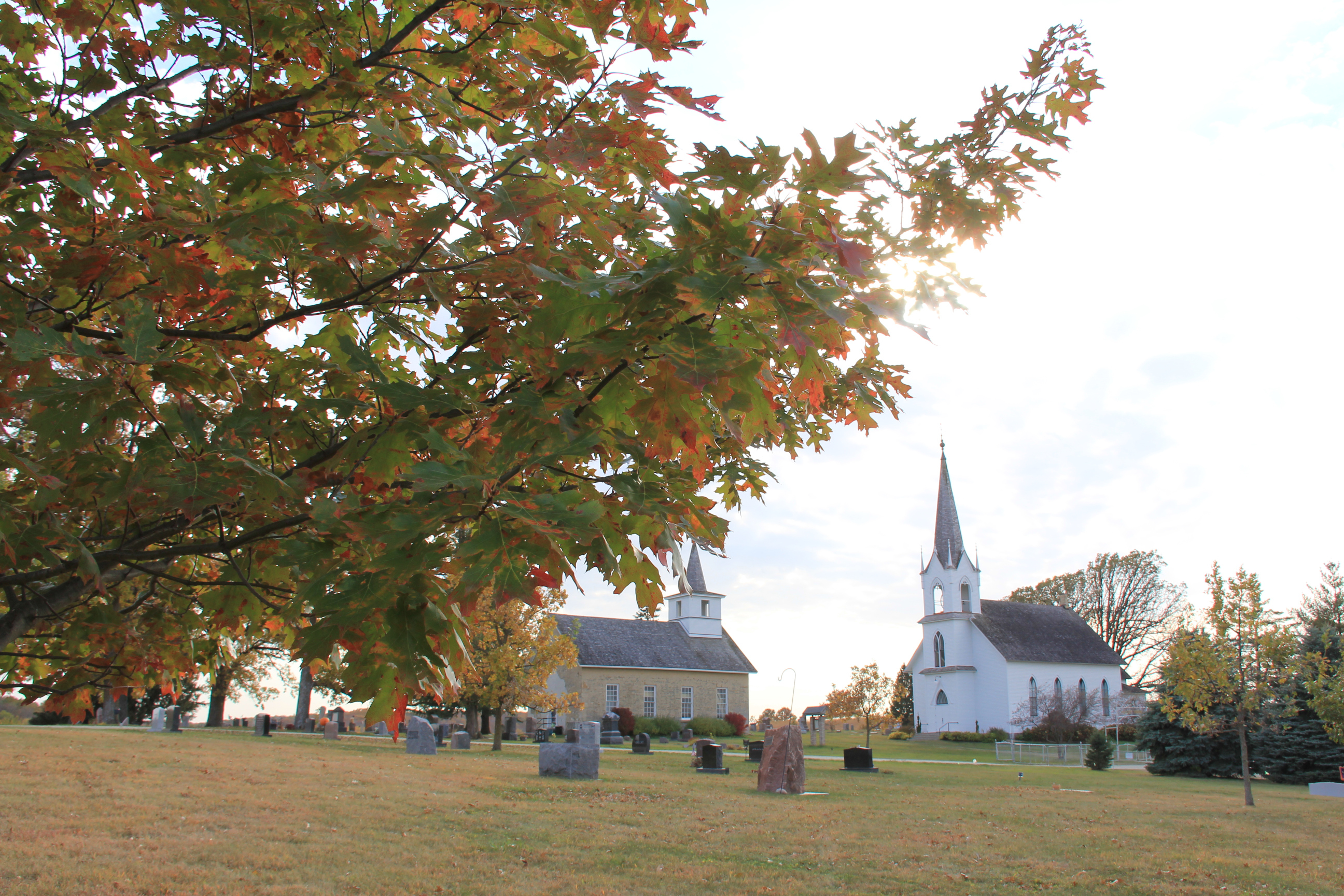
Valley Grove churches and cemetery, rural Nerstrand. (Minnesota Prairie Roots copyrighted file photo October 2024)
VALLEY GROVE COUNTRY SOCIAL
In rural Nerstrand, the focus turns to history, specifically two historic Norwegian immigrant churches set high atop a hill in rural Nerstrand. The Valley Grove Preservation Society celebrates its annual Country Social from 1- 4 p.m. Sunday, September 14, with Nordic music, a history stroll, wagon rides, children’s activities, blacksmithing and rope-making demonstrations, a book discussion and more, including coffee and treats.
Attendees are also encouraged to view commissioned Norwegian tapestries inside the 1862 stone church and the renovated steeple on the 1894 clapboard church just across the lawn.
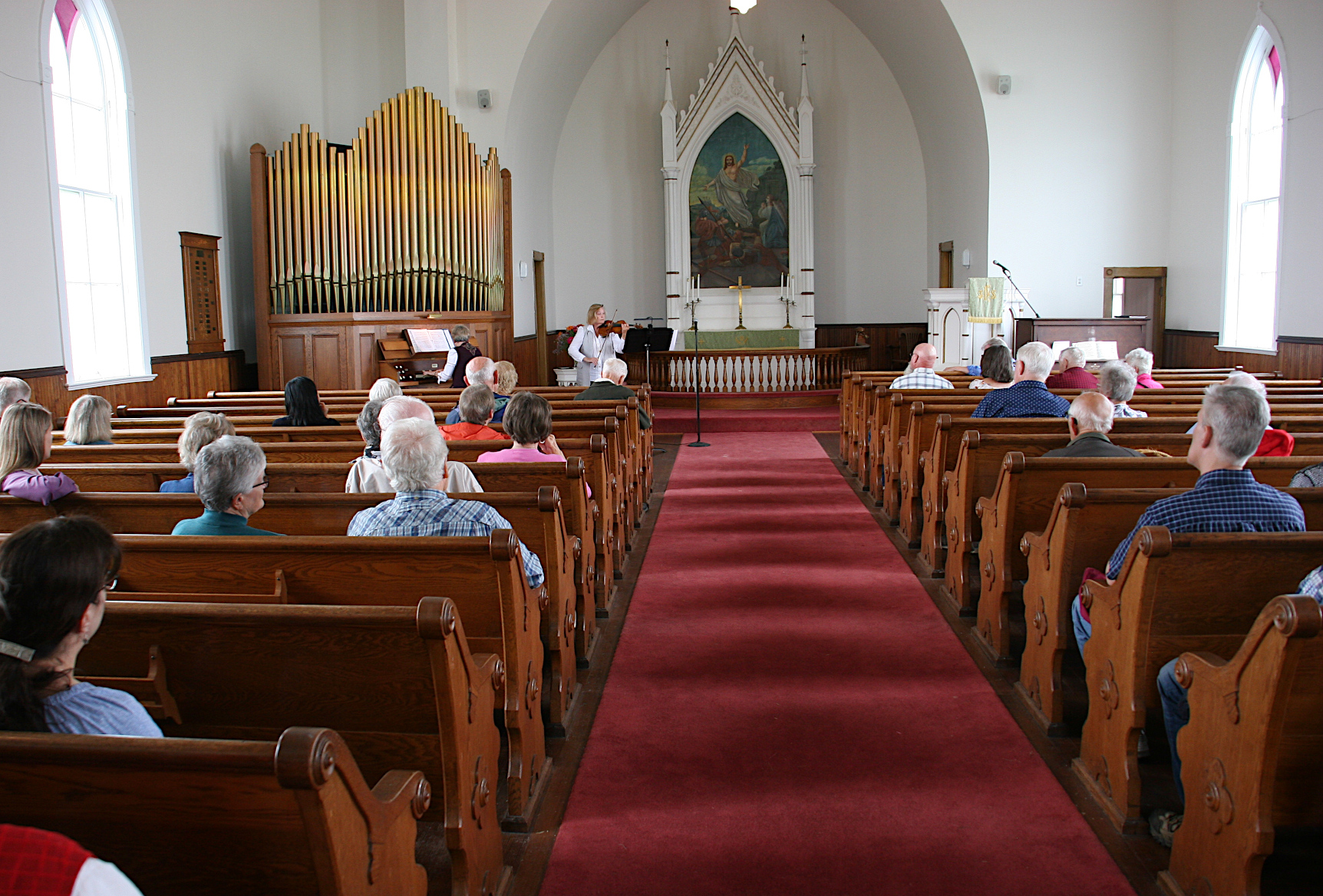
Inside the wooden church at Valley Grove. (Minnesota Prairie Roots copyrighted file photo 2022)
Valley Grove happens to be one of my favorite spots in rural Rice County because of its natural beauty, history and peacefulness. Fifty acres of rolling prairie grasses and woods surround the two churches, which are on the National Register of Historic Places. The church buildings are beautiful in their simplicity. It’s not hard to imagine long ago Norwegian immigrants gathering here to worship, mourn, marry and celebrate.
Truly, all four of these weekend events in my area are about community, connecting and celebrating. Thank you, organizers, for offering these activities that are fundraisers for your groups and fun for all of us.
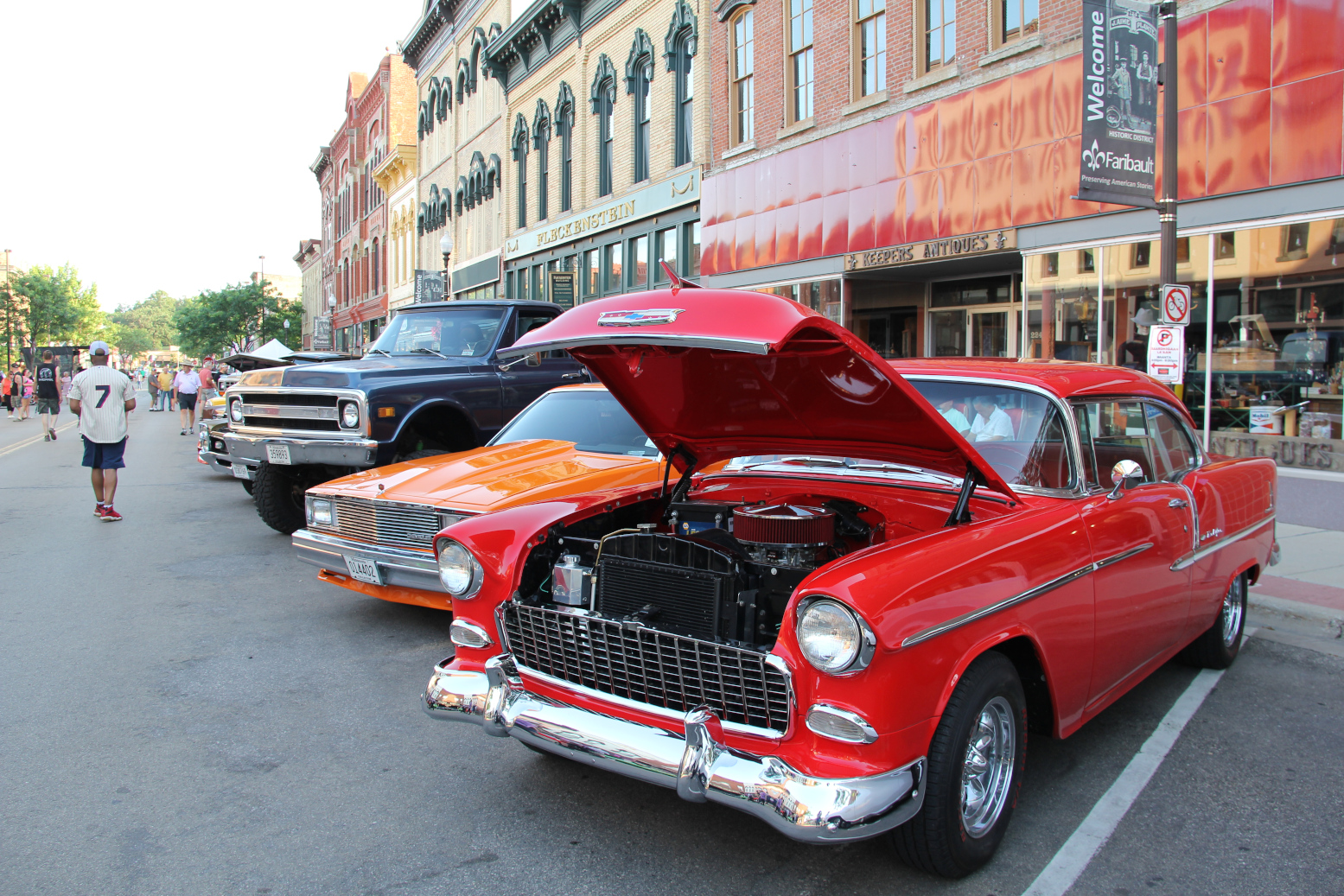
Faribault’s Car Cruise Night features mostly vintage vehicles parked in our historic downtown. (Minnesota Prairie Roots copyrighted photo June 2025)
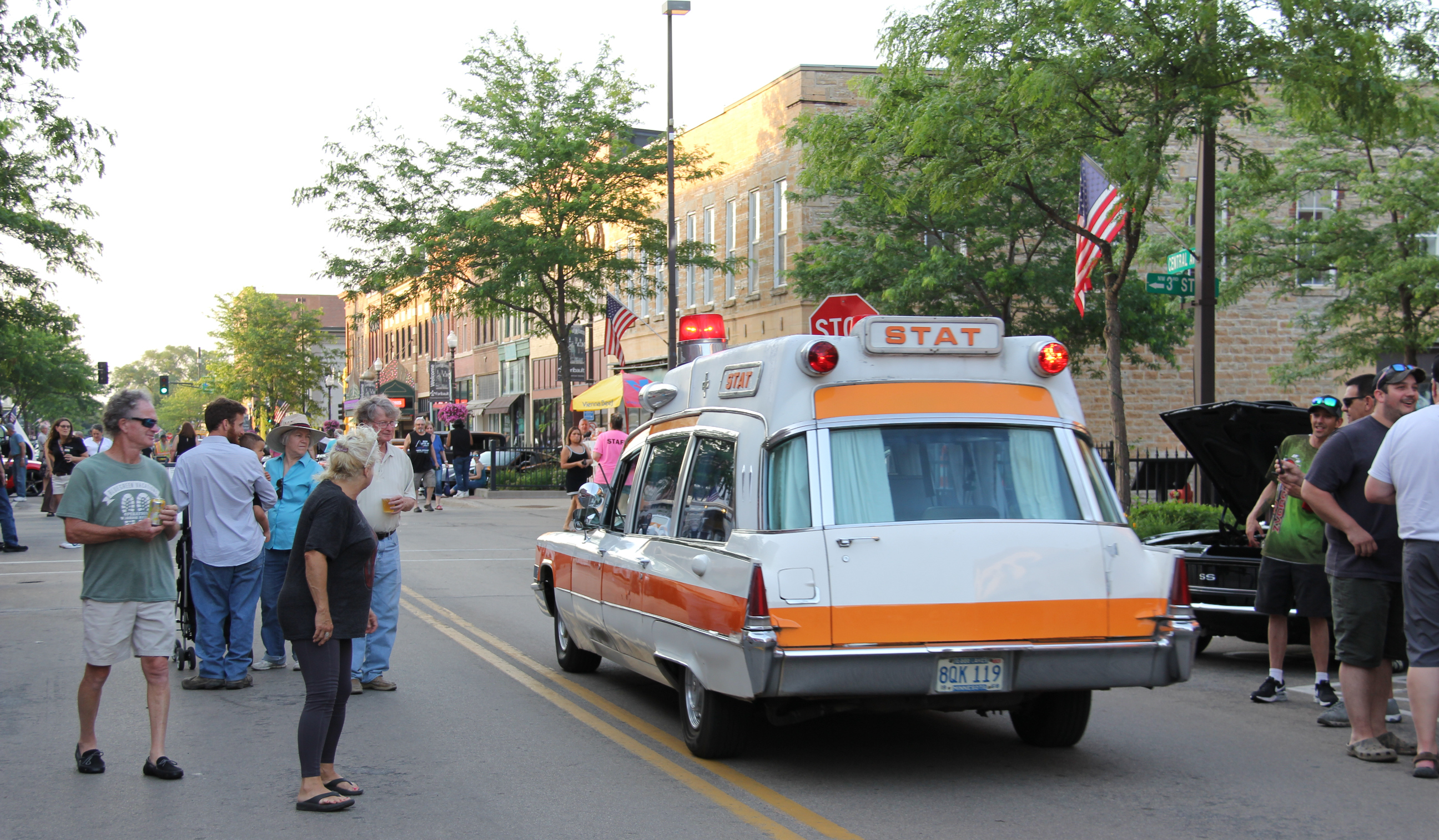
ON A SULTRY SUMMER SOLSTICE EVENING, hundreds converged on Faribault’s Central Avenue for the monthly Car Cruise Night. Our downtown offers an ideal backdrop of historic buildings for the many vintage and antique vehicles and sports cars showcased in a four-block area.
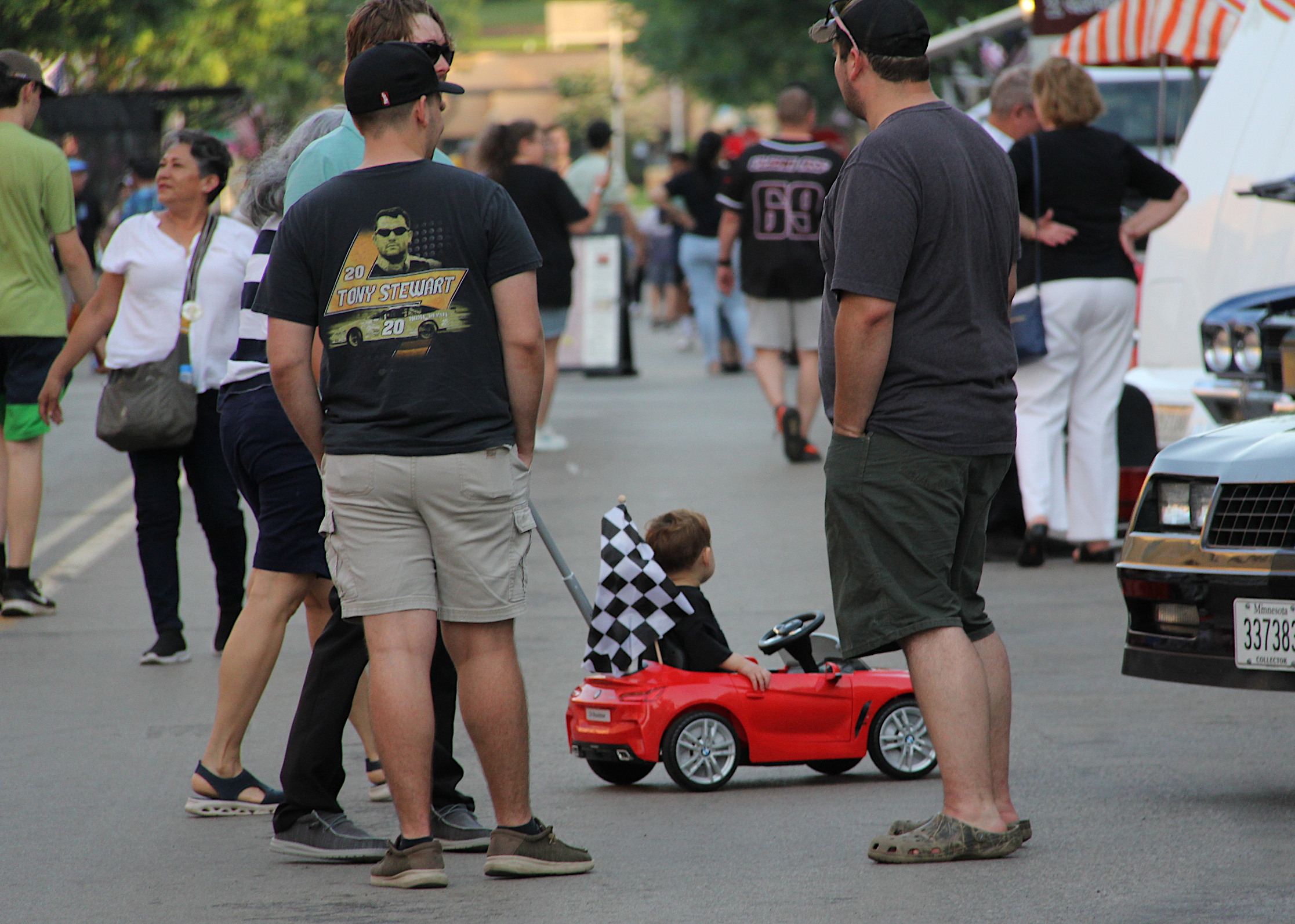
Among all the full-size vehicles was this kids’ mini car. (Minnesota Prairie Roots copyrighted photo June 2025)
But this event is about much more than cars and trucks. It’s also about community. About coming together. About connecting with hugs and one-on-one conversations. Young and old alike come here, infusing energy into the downtown during a season when everyone wants to be outdoors, heat and humidity aside.
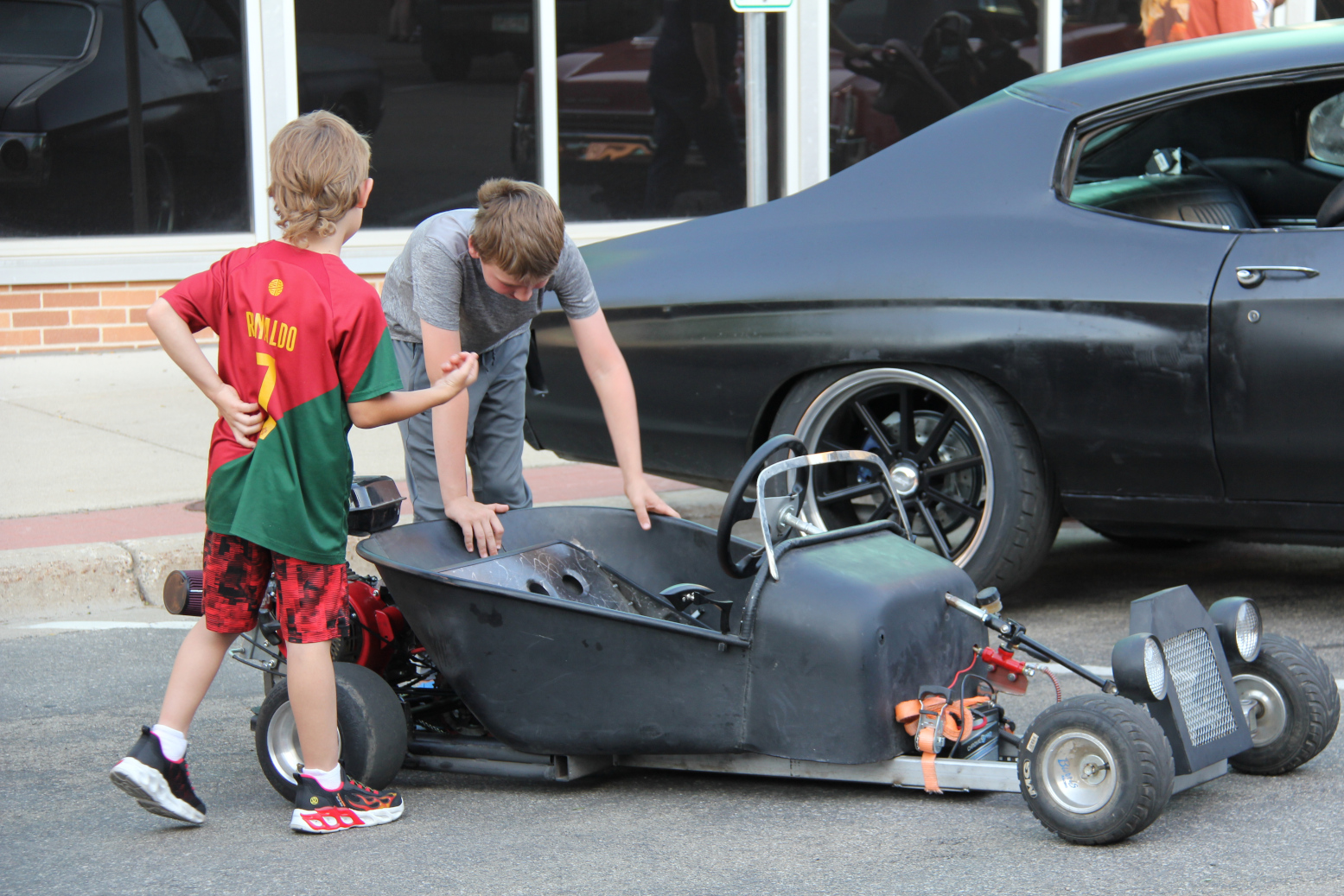
These boys were definitely interested in wheels, including this go kart. (Minnesota Prairie Roots copyrighted photo June 2025)
Some bring their dogs. Others bring their babies and toddlers and kids of all ages for an evening out. Something to do. The excitement of some—especially two pre-teens who thought they spotted a Lamborghini—felt palpable. It was not a Lamborghini. But for the boys, in a singular moment, they held high hopes.
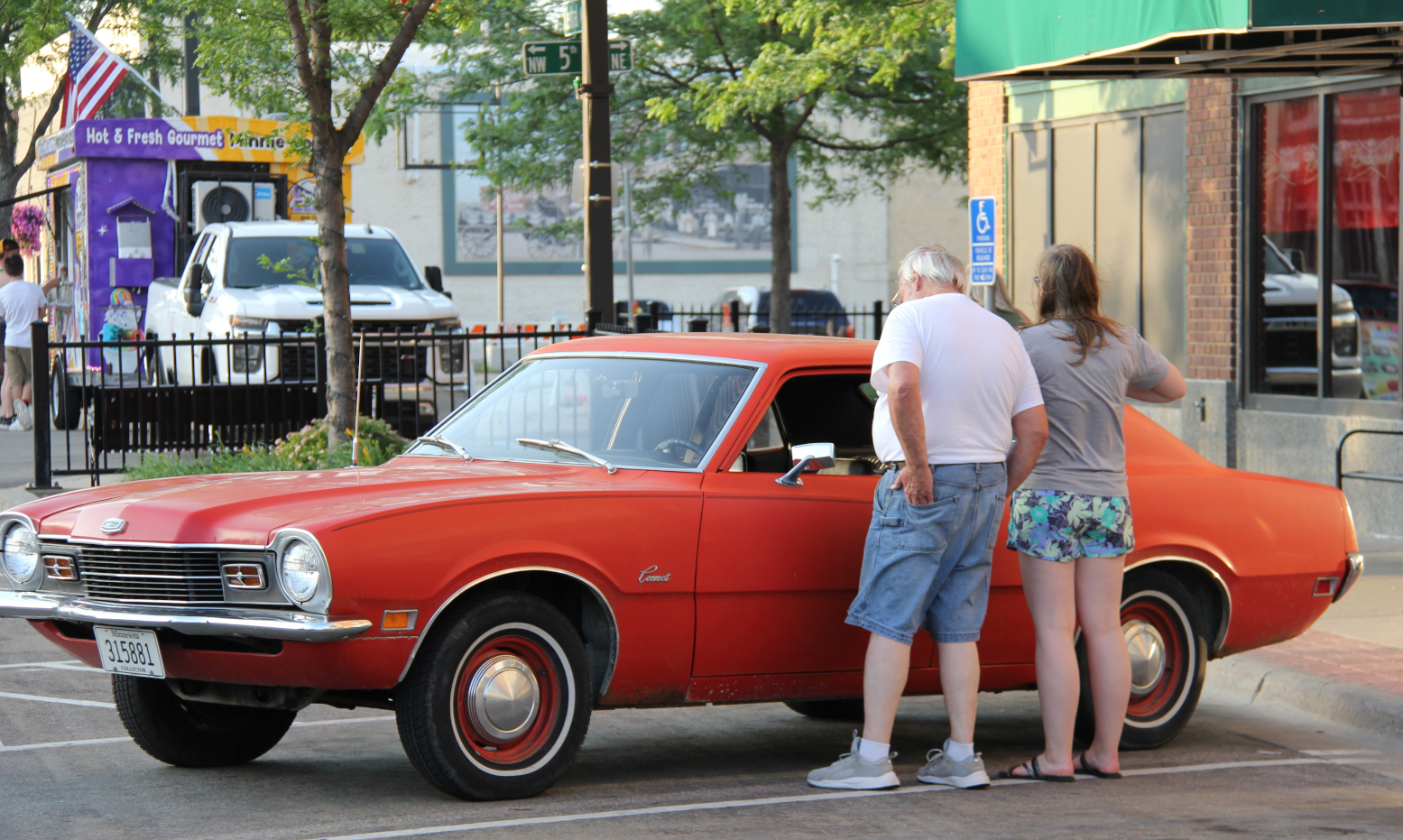
A vintage Mercury Comet. (Minnesota Prairie Roots copyrighted photo June 2025)
I got excited when I spotted, from a distance, a car outside Boxer’s Bar that looked remarkably like a Mercury Comet. My husband confirmed that the red four-door was, indeed, a Comet. My first car was a 1976 two-door canary yellow Comet, which I nicknamed, well, let’s just say a word that rhymes with Comet. I spent way too much money repairing that vehicle. Plus, the driver’s door wouldn’t close in the winter. I digress. Perhaps the owner of the red Comet has had much better than lemon luck.
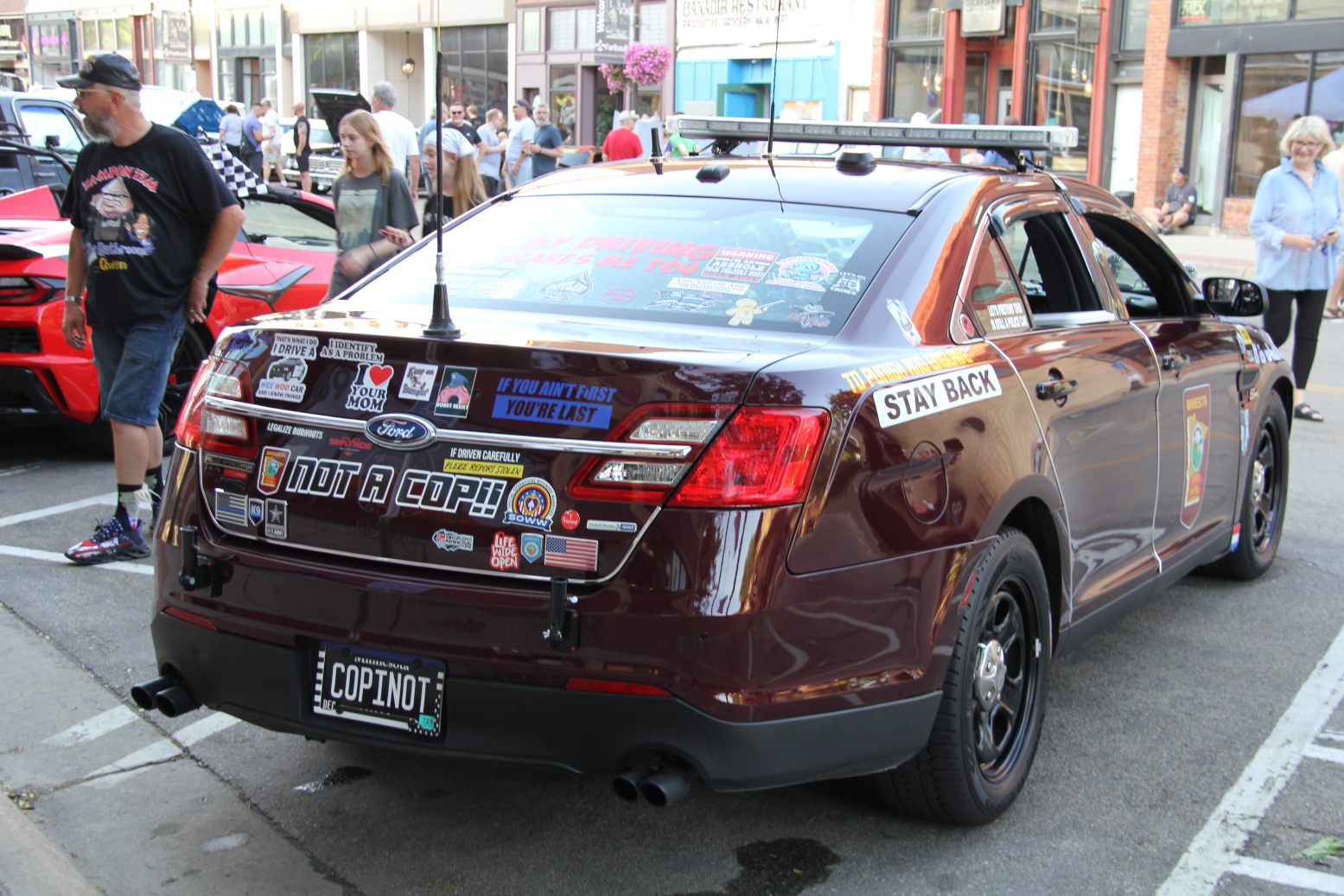
This retired Minnesota State Patrol car drew a lot of interest. (Minnesota Prairie Roots copyrighted photo June 2025)
Car Cruise participants will share stories about their vehicles if you ask. Most settle onto lawn chairs on the sidewalk and watch as people circle their treasures on wheels. A retired Minnesota State Patrol cruiser, a 2015 Ford Taurus Interceptor, attracted plenty of attention with so many flashing, pulsating lights that I had to look away. It gave me pause, especially in light of recent events in Minnesota. But signage and license plates made it clear this Taurus is no longer an active duty patrol car. I appreciated that clarity.
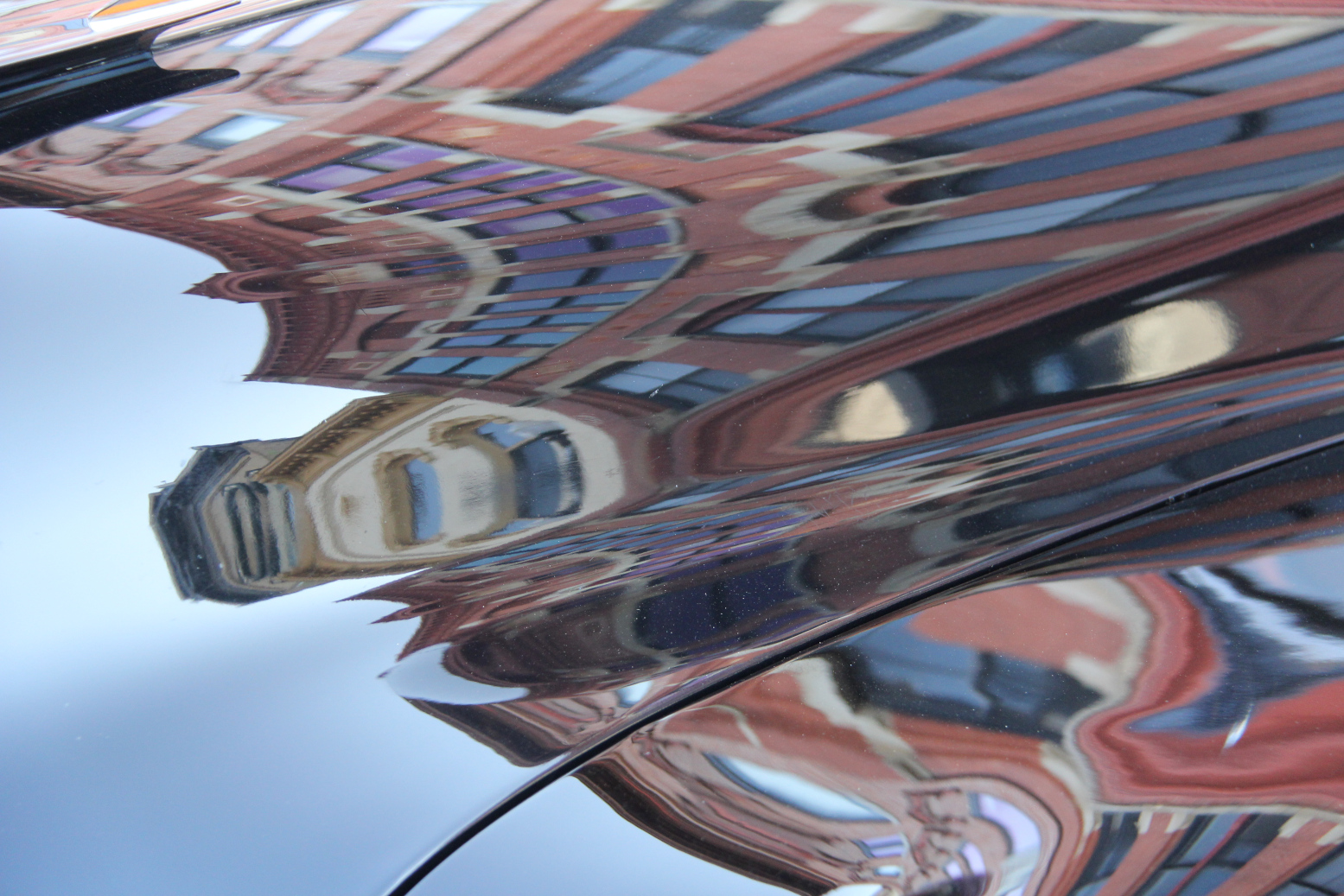
Historic buildings reflected on a shiny 1948 Chrysler. (Minnesota Prairie Roots copyrighted photo June 2025)
And then there’s pride in ownership showcased in shiny, spotless vehicles waxed to perfection. Flawless. Brian Boelke of Mazeppa polished his 1948 Chrysler to mirror image shine. I was fascinated by the reflection of historic buildings curving across the hood and sides of his black car. Abstract art. Beautiful. I wonder if others noticed.
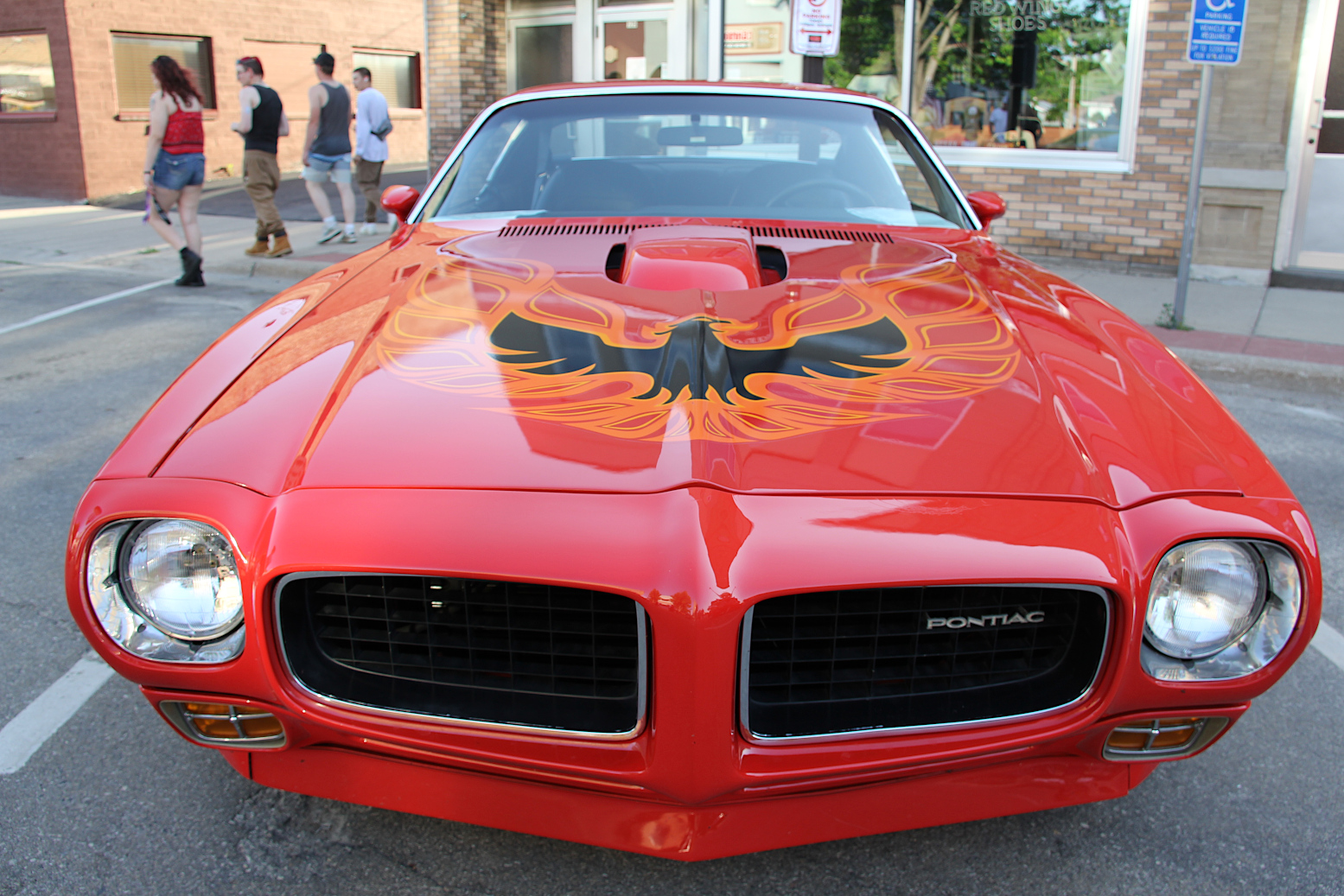
The hood art of a 1973 Pontiac Firebird. (Minnesota Prairie Roots copyrighted photo June 2025)
I view Car Cruise Night through an artistic lens, Central Avenue like a gallery of auto art.
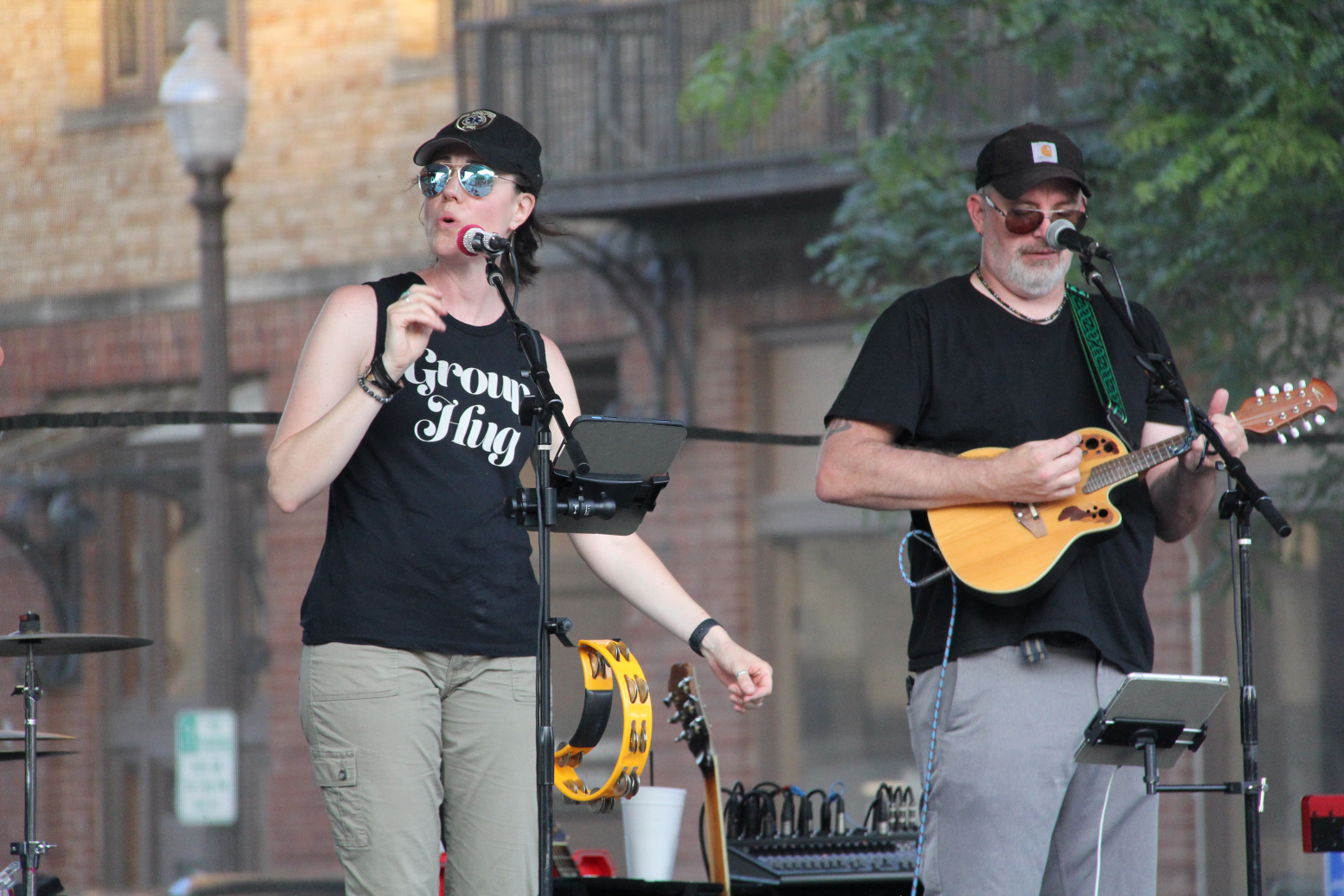
Two members of the Jason Paulson Band perform. (Minnesota Prairie Roots copyrighted photo June 2025)
The performing arts are also part of this monthly summertime event. On the longest day of the year, the Jason Paulson Band beat a rhythm of Americana music from an intersection outside the beloved hometown Signature Bar & Grill. People walked by. Some danced. Others relaxed on history-themed benches or settled onto a vintage Tilt-a-Whirl car anchored outside third-generation family-owned Burkhartzmeyer Shoes. Friends paused mid-street to talk.
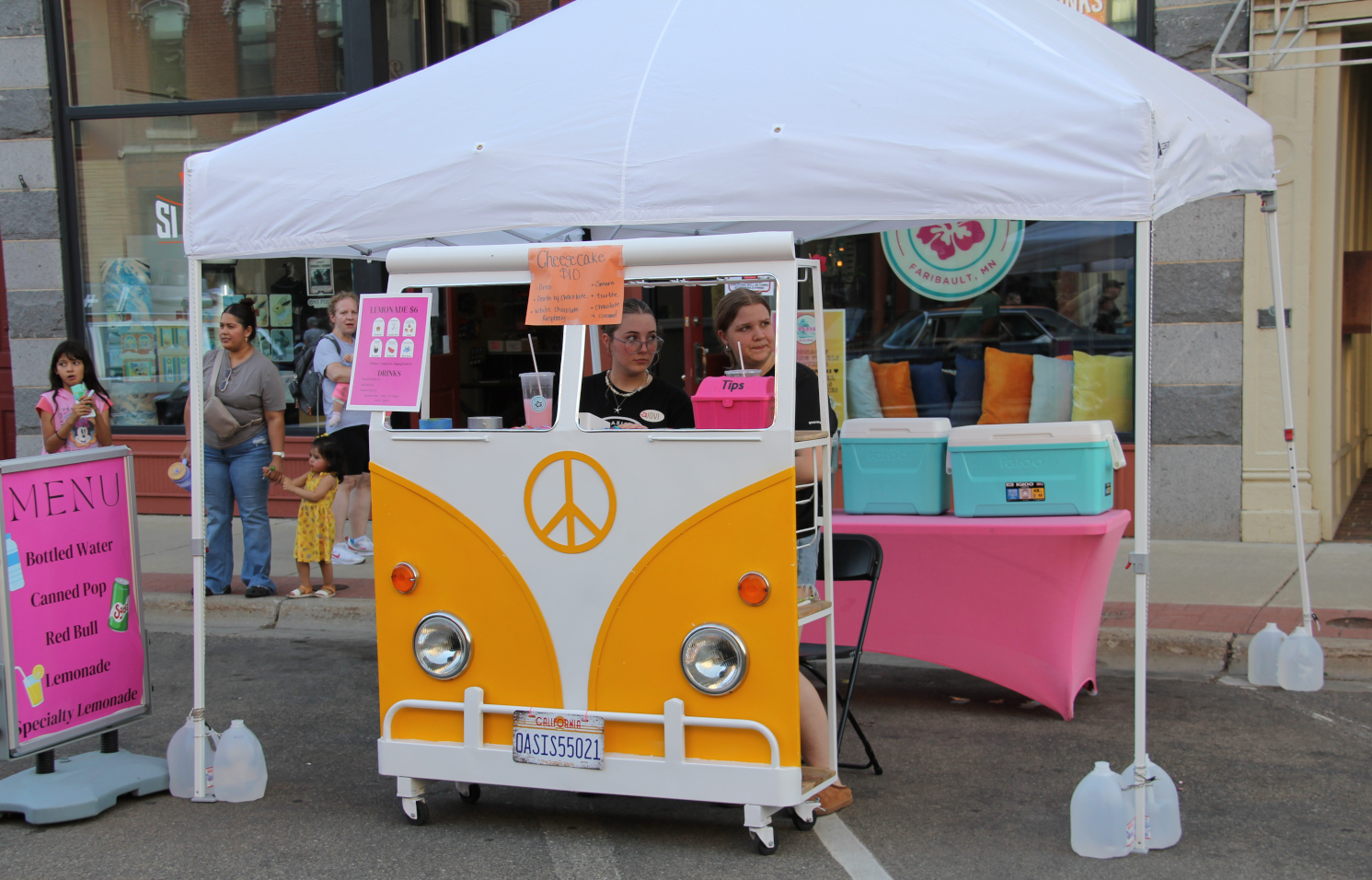
Even The Oasis 55021 food stand was themed to the Car Cruise. (Minnesota Prairie Roots copyrighted photo June 2025)
For the hungry and thirsty, there were plenty of options from downtown businesses and food trucks and stands. I spotted a boy eating his last mini donut, a favorite fair food of mine. I didn’t cave to temptation, until back home when I scooped up chocolate chip ice cream.
Another crowd-pleaser, Craig and Kathy’s vintage ambulance. (Minnesota Prairie Roots copyrighted photo June 2025)
As cars and trucks began pulling away from their parking spots along Central Avenue with the Car Cruise winding down, Randy and I listened briefly to the band before heading home. I was feeling overheated, in need of a cool place and a long cold drink of water after taking 108 photos on this summer solstice evening in southern Minnesota.
FYI: Upcoming Car Cruises are set for 6-9 p.m. Friday, July 18, and Friday, August 15, in downtown Faribault. The final cruise will be held Saturday, September 19, at Faribault Harley Davidson.









 Minnesota Prairie Roots
Reflections on diversity & growing community in Faribault December 30, 2025
Tags: art, commentary, community, Congregational Church of Faribault United Church of Christ, diversity, Faribault, Jason Rainey, Minnesota, multi-cultural community, mural, painting, reflections, Shirley Rainey
WHAT ARE WE without community? The answer: alone.
We, at our very core, need each other. In times of celebration. In times of challenges. Even in times of great division. Without friends, family, neighbors and others, we are but individuals without community.
And in Faribault, among the many murals adorning public spaces in the downtown area, one piece of art stands out as representing community. That is a free-standing mural placed on the west side of the Congregational Church of Faribault United Church of Christ this past summer. It seems an appropriate focal point to end 2025 and begin the new year.
The artwork, created by Shirley Rainey and her son Jason, features outstretched arms rising from the earth against a backdrop red heart and blue sky. “The mural represents the importance of coming together to share burdens and triumphs, while reaching for our highest selves,” Rainey said in an artist’s statement.
I see that in the mural. But I also see a community of diversity. The Raineys show that in assorted skin tones, clothing, hand sizes and even henna painted on a hand. I love that about this art, this intentional, varied depiction of Faribault as it is—gloriously diverse.
That said, I am well aware of the racial tension (and that’s a tamped down word) in my community. I wish it didn’t exist, that we all got along, welcomed and embraced one another. We are, after all, just people who live, love, work, play, laugh, cry… The list of commonalities we share as humans goes on and on. Yes, we are different, too. But differences seen as negative, those we create.
We can learn from that church painting. We can choose to love one another, as portrayed in the over-sized backdrop red heart. We can stand side-by-side and raise our hands to help one another. We can see, in those arms stretched skyward, the possibilities in building community. In that blue sky, we can envision not only our personal dreams, but the dreams of all who call Faribault home.
Faribault is a multi-cultural community, always has been. From early settlement days to today, people have come here from around the world to start anew. Whether French, Irish, German, Scandinavian, Latino, Asian, Sudanese, Somalian or any of many other ethnicities, this place has become home. We can choose to create community or not.
I hope in 2026 that Faribault can build a better, stronger, more unified community which celebrates our commonalities, and our differences.
© Copyright 2025 Audrey Kletscher Helbling