Minnesota Prairie Roots

Writing and photography by Audrey Kletscher Helbling

Help with the FAFSA equals a happy mom February 28, 2012

IT IS A RELIEF, I tell you, to have the taxes and the Free Application for Federal Student Aid filed. Both have been hanging over my head since the first of the year.

Since I detest figures and forms, I fail to welcome January with any hint of enthusiasm.

But somehow I manage to plow through the paperwork, sifting through files, pulling together information for the tax preparer. Yes, I pay someone to “do” our taxes because it is well worth the money to have everything done right without stressing me to the max.

This year I was under additional pressure to get the taxes done early so I could file the FAFSA. My son, my youngest, starts college in the fall.

Several years have passed since I last filled out this college financial aid form for my second daughter and, before that, her sister. I welcomed the respite from this task. Not that it should be so difficult given the process is done online. But, remember, I don’t like figures or forms. At all.

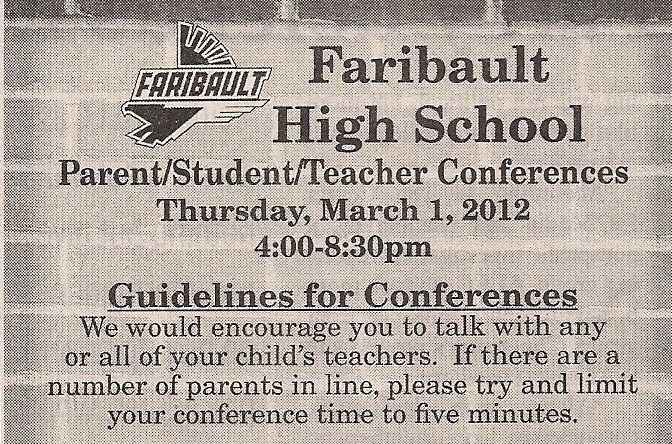
A portion of the informational sheet my son received from Faribault High School about the FAFSA workshop.

This time around, though, I wasn’t on my own. The Faribault High School Counseling Department hosted a Minnesota College Goal Sunday Workshop to assist parents and students in completing the FAFSA.

Yes, my son and I were among the first in line for the two-hour workshop. I expected long lines. My expectations were wrong. I have no idea how many turned out, but certainly significantly fewer than I anticipated during the hour we were there. Computer terminals were not packed, not by any stretch.

That was good for my son and me. No waiting. Questions answered as soon as my arm shot into the air, which was often.

The FAFSA offers a new feature—at least new since the last time I filed—that allows applicants to connect to their tax returns. The tax return information then automatically transfers to the FAFSA app. That option failed to work for us; something about too little time elapsing since taxes were filed.

Within an hour, my son and I had his FAFSA completed and zipped into cyberspace. The process should have taken us only a half hour, according to a rep from the local technical college, among three volunteers who assisted us at the workshop. Well, yeah, I shared with her that I detest figures and forms.

And it didn’t help that I left my prescription computer eyeglasses at home, meaning I struggled to read the words and numbers on the monitor.

FYI: COLLEGE GOAL SUNDAY is a national effort that brings financial aid professionals and other volunteers together to help students and their families complete the FAFSA. Click here for general program information about the Minnesota College Goal Program.

Click here for information and a listing of workshop sites in Minnesota.

Students who attend, fill out and submit a FAFSA and then complete a workshop evaluation are entered into a drawing for a $500 scholarship. Now how’s that for an incentive to participate? One student in Faribault will walk away with $500 for his/her college education. Win. Win.

Even if my son doesn’t win the scholarship, we’ve still won. We got professional assistance, at no cost, to complete a task I dread.

I’m just wondering. Can I return next year even though my son will already be in college?

© Copyright 2012 Audrey Kletscher Helbling


If you take away my microwave… February 24, 2012

Filed under: Uncategorized — Audrey Kletscher Helbling @ 8:25 AM
Tags: , , , , , ,

HAVE YOU EVER read Laura Numeroff’s children’s picture books, If You Give a Pig a Pancake or If You Give a Mouse a Cookie?

The storylines basically follow the premise that if you give someone something, they’ll want something else. Or one thing leads to another. For example, the mouse in Numeroff’s story asks for milk with his cookie then wants to look in a mirror and see if he has a milk mustache, etc. The pig needs syrup with his pancake, but gets so sticky he wants a bath, with bubbles, etc.

See how that works?

Now let’s apply that to my life, with this story:

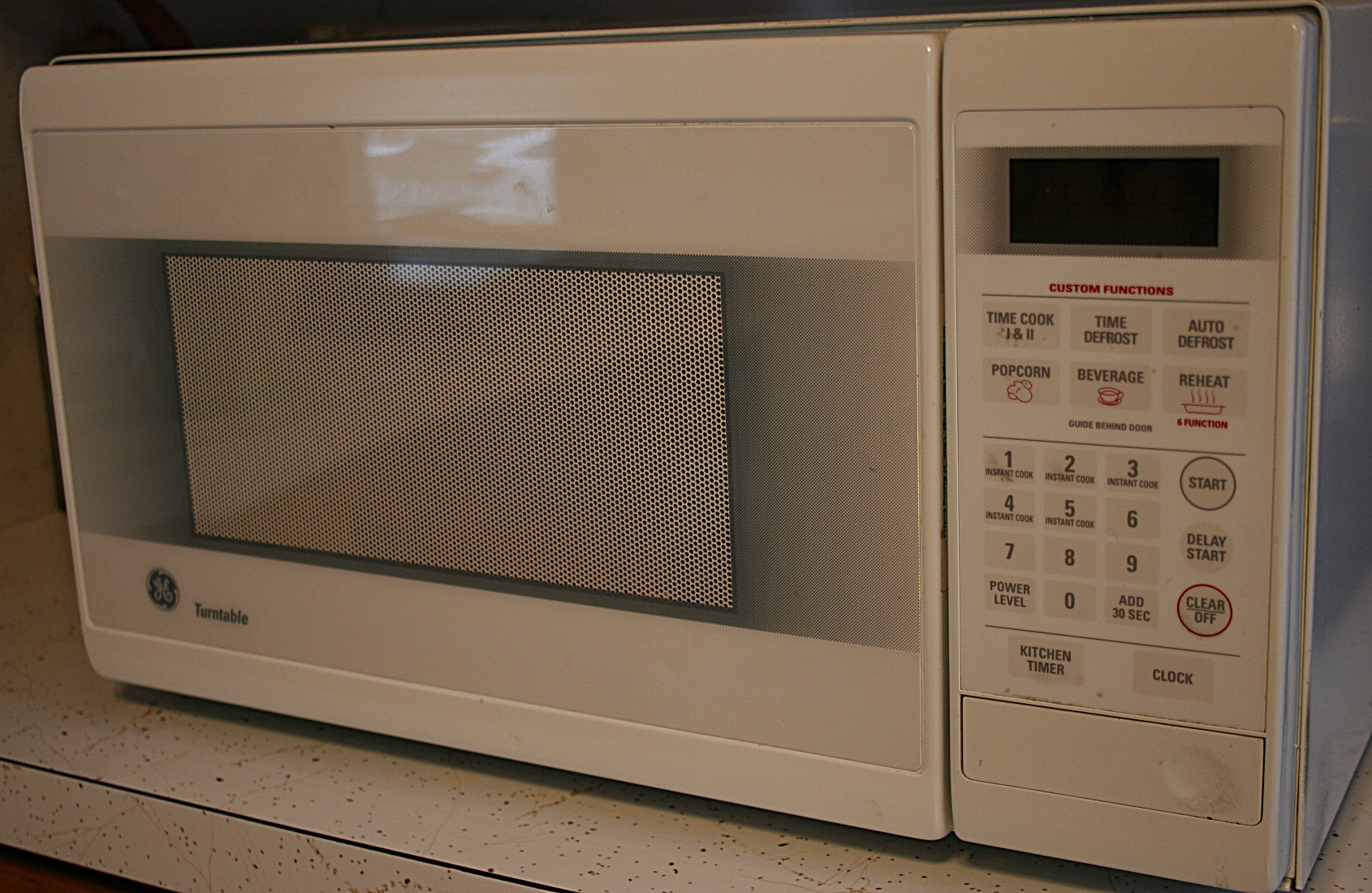
My microwave oven, useful for cooking & experiments.

If your 18-year-old son hauls your microwave oven to his Advanced Chemistry class so he can measure the speed of light by melting marshmallows, you will need to find another way to prepare your morning oatmeal, or choose another food for breakfast.

If you opt for sugary cereal, then you’ll break your personal commitment to consume oatmeal each morning because your Uncle John, who eats oatmeal daily, told you doing so lowers cholesterol.

You’ll also derail your plan to a healthier and slimmer you.

By skipping the oatmeal, which you have found satisfyingly filling, you will find yourself reaching for a mid-morning snack. And, if you reach for a mid-morning snack…

See how that storyline goes? And all because of an Advanced Chemistry experiment.

I’m all about education, but if I don’t get my microwave back soon, I’ll…

© Copyright 2012 Audrey Kletscher Helbling

 

What I learned on a college visit may surprise you February 21, 2012

Filed under: Uncategorized — Audrey Kletscher Helbling @ 8:02 AM
Tags: , , , , ,

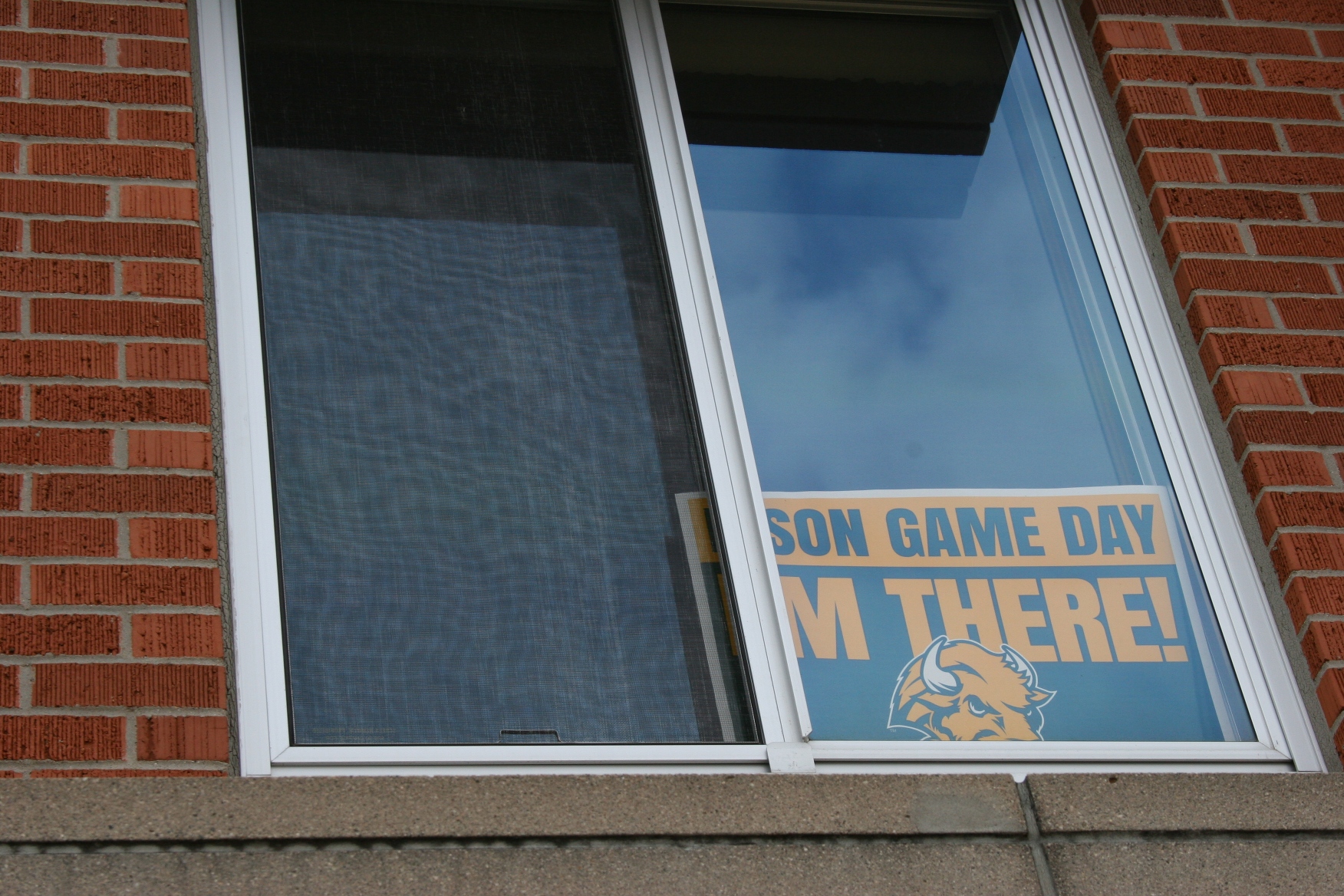
A sign supporting Bison athletics in a NDSU dorm.

WHAT DO BEAGLES and bison have in common?

If you were to travel to Fargo, you would learn that beagles and bison are integral to North Dakota State University. I picked up that information during a campus visit Friday with my husband and college-bound son.

“Do you like dogs?” our campus tour guide asked.

“No,” my 18-year-old answered.

But the other student in our tour group did, so he was advised that beagles can be checked out from the veterinarian program and taken for walks.

Now you might think that I am about to tell you bison also live on campus. No. (At least I didn’t see any.) But the bison is the university’s mascot and you’ll see that noted everywhere.

Here’s another interesting tidbit I learned: NDSU students drink a lot of Mountain Dew. I wish I recalled our student tour guide’s exact quote about high consumption of this soda. But I remember thinking, “This is not something I would tell parents of prospective students.”

As long as we’re talking consumption here, I was pleased to hear that comfort foods like tator tot hotdish are offered in the dining halls, of which there are three.

Over in a computer lab, engineering students can dish up servings of humor via a collection of “The Far Side” comics found on a corner bookshelf. My husband and son both enjoy Gary Larson’s humor. Me? Not so much. But I appreciate that among all the academia, laughter is encouraged.

It’s little details like this which reveal so much about a college.

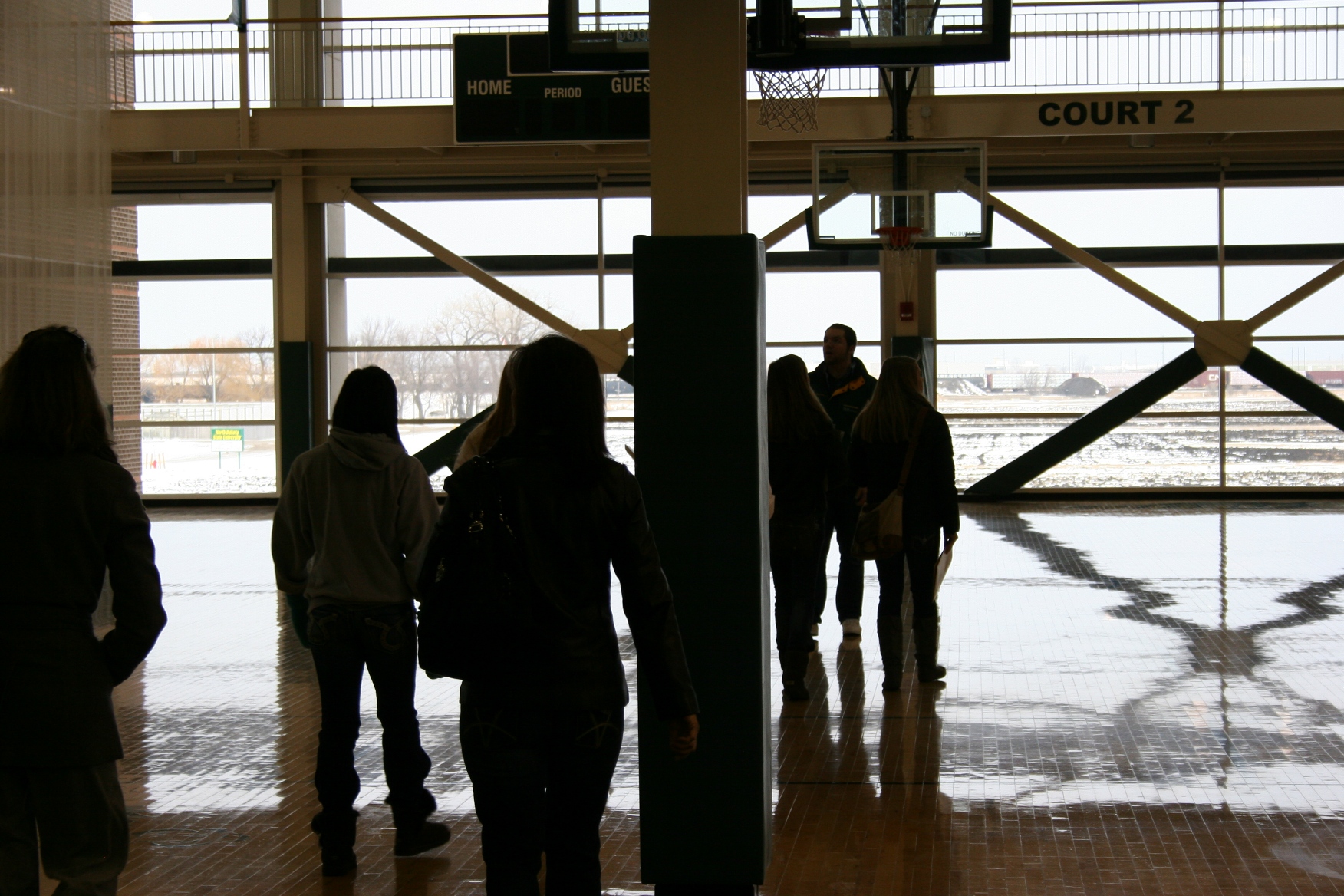
A tour group, not ours, checks out the basketball court in the NDSU Wellness Center. It was the view through the bank of windows which most impressed me. This is typical Fargo, land stretching flat and far.

It’s also reassuring, though, to hear, as we did from an engineering professor, about the more serious aspects of college life. This teacher shared that potential employers value the strong work ethic prevalent among NDSU graduates.

That same educator looked my son directly in the eye and advised him to choose a career path that follows his passion and will make him happy in his life’s work. I couldn’t think of any better career advice than to choose happiness over money.

I appreciated his honesty and attitude and friendliness and enthusiasm, and even the computer information he exchanged with my teen. This visit really was all about my son and the choices he’ll make.

Based on our interaction with this professor, I could see the connection between student and teacher which, when I asked, he defined as the strength of the NDSU engineering program. It’s fostered partially by small class sizes.

My specific inquiry about the program’s strength caught the professor a bit off guard. But that’s OK. I like to ask the unexpected.

I didn’t care about the cost of parking or space for a big screen television in a dorm room or whether an elevator is available on move-in day. Yes, inquiries were made of our student guide on those topics. But not by anyone in my family.

As for the beagles and the bison, the tator tot hotdish and “The Far Side” comics (and, yes, even the Mountain Dew), those personalized the university.

But what matters most are affordability, quality of education, connections and that my soon-to-be high school graduate finds a college that is a good fit for him and will make him happy.

HOW ABOUT YOU? If you’re the parent of a college-bound child or have had a child go through college, what do you/did you look for in a post-secondary institution? What questions would you ask?

© Copyright 2012 Audrey Kletscher Helbling

 

Kudos to the smart science kids out there February 8, 2012

Filed under: Uncategorized — Audrey Kletscher Helbling @ 8:27 AM
Tags: , , , , , , ,

SEARCH THE RECESSES of my home and you won’t find a single sports trophy, medal or ribbon. We are not athletes.

But you will find honors for academic achievements.

During elementary school, my second daughter consistently placed in the region’s Lutheran schools spelling competition, bringing home trophies and ribbons. In 2006, she graduated from high school at the top of her class. (My mom and a niece also graduated at the tops of their classes and I graduated second.)

Now my 17-year-old high school senior has won two medals for his scientific and mathematical skills and knowledge. This past weekend Caleb and his Faribault High School Science Team teammate, Luke, earned first place in the Regional Finals Science Olympiad competition in Rochester with their gravity vehicle.

They built a vehicle and ramp and then, using physics skills, calculated time, distance and speed to race and stop their car at a specific point. They came within about an inch of the target. I won’t attempt to explain the details of how they accomplished this because, well, I don’t understand it. Suffice to say, they did everything right to win the contest.

A wheel on the winning car, as it was being built. I would show you the car, except I did not get a good shot of it and now the car is at school and Caleb would not like that I want to photograph it. Suffice to say the car is basically four pieces of wood joined into a rectangular shape. Caleb and Luke wrote their names on the car. That's it. Why make it flashy? Flashy doesn't count, my son says. Gotta love that attitude.

Caleb, along with a different teammate, Travis, also placed third in an astronomy competition.

Faribault students Anna and Anwyn earned first place regional honors in “Write It Do It.” Sara and Riley placed second and Anwyn and Tanner, fourth, in “Forestry.” And a fourth place finish also went to Nathaniel and Max in the “Fermi Questions” competition. (Don’t even ask about “Fermi.” I have no clue; I never claimed I was smart in science.)

Faribault High’s two science teams finished fifth and eighth at region, qualifying both teams for state competition. However, rules allow only one team from each school to compete at state.

FHS science teacher Jason Boggs says this is the first time since he’s been co-coaching the science teams that both teams have technically qualified for state.

Caleb and 14 other FHS students will compete at state on March 3 at the University of St. Thomas.

So there you have it—my little plug today for all those smart kids out there who excel in academics but seldom receive the recognition they deserve.

Be proud.

Your academic successes will take you far in life.

© Copyright 2012 Audrey Kletscher Helbling

 

An affordable college option for Minnesotans: Canada December 14, 2011

MY 17-YEAR-OLD BOUNDED down the stairs Tuesday morning, uncharacteristically cheerful. He’s not a morning person. I’ve learned that the less interaction with him any time before 10 a.m., the better.

So his upbeat attitude and engaging me in conversation before 8 a.m. surprised me.

While I don’t recall his exact words, they went something like this: “You know, Mom, how I sometimes listen to Minnesota Public Radio? Well, they were talking about colleges in Canada and reciprocity with Minnesota and how much cheaper it is to go to school there.”

I could see exactly where this was leading. He wanted to apply to a Canadian college.

However, I was in no mood to hear any of this. After months of attempting to persuade him to apply to shoe-in, affordable Minnesota, Wisconsin or Dakota colleges, I didn’t want him to pursue a dead-end. We’re getting to crunch time here on college apps. (He’s applied to four out-of-state colleges, three of them highly-competitive and totally unaffordable at $40K – $55K annually for tuition, room and board. My son, BTW, is academically-gifted and scored exceptionally well on his ACT test.)

I should have heard him out. But, instead, I spouted rather ridiculous responses like: “Your dad and I don’t even have passports.” And “Do you know how much it would cost to fly to and from a Canadian college?”

He slammed out the door on his way to high school classes without even a goodbye hug. I don’t blame him. I had failed as a mother to listen to my son.

Later Tuesday morning, I checked out the MPR news story, which you can read by clicking here. In summary, Minnesota and Canada, specifically the province of Manitoba, have had a tuition reciprocity agreement for 20 years. Who knew? Not me.

"Canada is closer than Colorado," my son told me.

Tuition at a Manitoban university, for example, will cost a Minnesota student around $4,000 annually. That’s less than tuition at a Minnesota community college, state-run university or the University of Minnesota, according to the MPR article.

The most recent enrollment statistics listed on the Minnesota Office of Higher Education website show 31 Minnesotans attending post secondary institutions in Canada during the 2009-2010 school year. Click here to check out information on that website.

Will my son head north across the border to the University of Winnipeg or one of six other Manitoban colleges?

I don’t know. But it’s certainly worth investigating as he considers his college options.

All of this brings me full circle to two questions raised in recent weeks by several friends:

  • Is it even worth going to college any more?
  • Does it matter where you attend college? One friend tells me her son, who went to a state-run South Dakota university, earns just as much as co-workers who graduated from more elite and expensive private colleges.

I’ve considered these same questions.

WHAT’S YOUR TAKE on going to college? Is it worth the investment? Does attending a prestigious private college give you an employment advantage? I’d like to hear your thoughts. Please submit a comment.

© Copyright 2011 Audrey Kletscher Helbling

 

Why the discrepancies in AP class offerings? July 12, 2011

STATISTICS CERTAINLY DON’T tell the whole story when you’re reading a compilation of numbers. But neither do they lie.

That said, I’d like to direct you to a report by ProPublica, “an independent, non-profit newsroom that produces investigative journalism in the public interest.”

The topic of ProPublica’s investigation (click here to read), advanced placement class offerings in public schools, certainly interests me. I’ve often wondered why Faribault Senior High School, the school my children attended (and one still does) offers so few advanced placement classes. These college-level classes give students an opportunity to test for college credit upon course completion. That, in my parental opinion, equals academic challenges for students and money saved for those who pass the AP exams and continue on to college.

Faribault High offers four AP classes in physics, English literature and composition, calculus and psychology.

Now, compare that to neighboring Northfield and Owatonna, each about a 15-mile drive away. Northfield Senior High School students can choose from 14 AP classes. In Owatonna, the number is even higher at 20 courses.

The three high schools are similar in size: Faribault, 1,230 students; Owatonna, 1,595; and Northfield, 1,300. They are also located in similar-sized communities. However, anyone who lives in the area knows that Faribault is clearly a blue collar town and Northfield is white collar. I’m not sure about Owatonna, but I would peg it as more blue than white collar.

WHY IS THAT IMPORTANT?

A link may exist between educational opportunities at a school and local poverty levels, some conclude. I don’t necessarily buy into the whole “we have X number of students getting free and reduced government lunches therefore we are offering fewer AP classes because students won’t take the courses anyway” philosophy. That’s an all-too-easy excuse to explain away the lack of AP classes and/or low student enrollment or interest in those classes.

Rather, I think the number of AP classes has more to do with funding, priorities and how much a school pushes, or doesn’t push, these advanced courses.

So let’s take a look at some of those statistics. ProPublica lets you type in your school and even compare it with neighboring districts. (Note: The database only includes public schools with a student population of more than 3,000 in the 2009 – 2010 school year.)

At Faribault High, 28 percent of students get free/reduced price lunches, compared to only 13 percent in Northfield. In Owatonna, 21 percent of students get those lunches that are targeted for low income households.

The statistics show high school minority populations of 21 percent in Faribault, 15 percent in Owatonna and only 11 percent in Northfield.

So you get the picture: Mostly wealthier white kids attend high school in Northfield. Not so much in Faribault and Owatonna.

Therefore you would conclude, if you adhere to the whole poverty-educational opportunities theory, that Northfield should outshine Faribault and Owatonna in the area of Advanced Placement classes and enrollment.

You would be wrong.

Owatonna shines with 20 AP classes and 29 percent of their students taking at least one AP course.

Northfield isn’t far behind with 26 percent of  students taking at least one of the school’s 14 AP classes.

Faribault doesn’t even come close with just five percent of students enrolled in at least one of the only four Advanced Placement courses offered.

WHAT’S GOING ON HERE?

I’ve discussed AP and Post Secondary Enrollment Option classes with several FHS teachers at various times and received answers ranging from an administration that doesn’t make AP or PSEO a priority to staff that prefer not to have class content dictated by AP guidelines. Whether those conclusions are accurate, I don’t know.

But as a parent, I am frustrated. Why shouldn’t any child attending Faribault High have the same educational opportunities afforded students in nearby Owatonna or Northfield?

Faribault also falls below the state-wide average of nine AP classes per high school and 23 percent of Minnesota high school students taking an AP course.

I repeat: Only five percent of FHS students take at least one AP class, of which only four are offered in Faribault.

What’s going on here?

NOTE: Statistics listed on ProPublica come from a nation-wide survey by the U.S. Department of Education’s Office for Civil Rights.

THANKS TO Minnesota Public Radio’s Bob Collins for directing readers to ProPublica’s report in his Friday, July 1, News Cut column.

© Copyright 2011 Audrey Kletscher Helbling

 

Reflections on Independence Day July 4, 2011

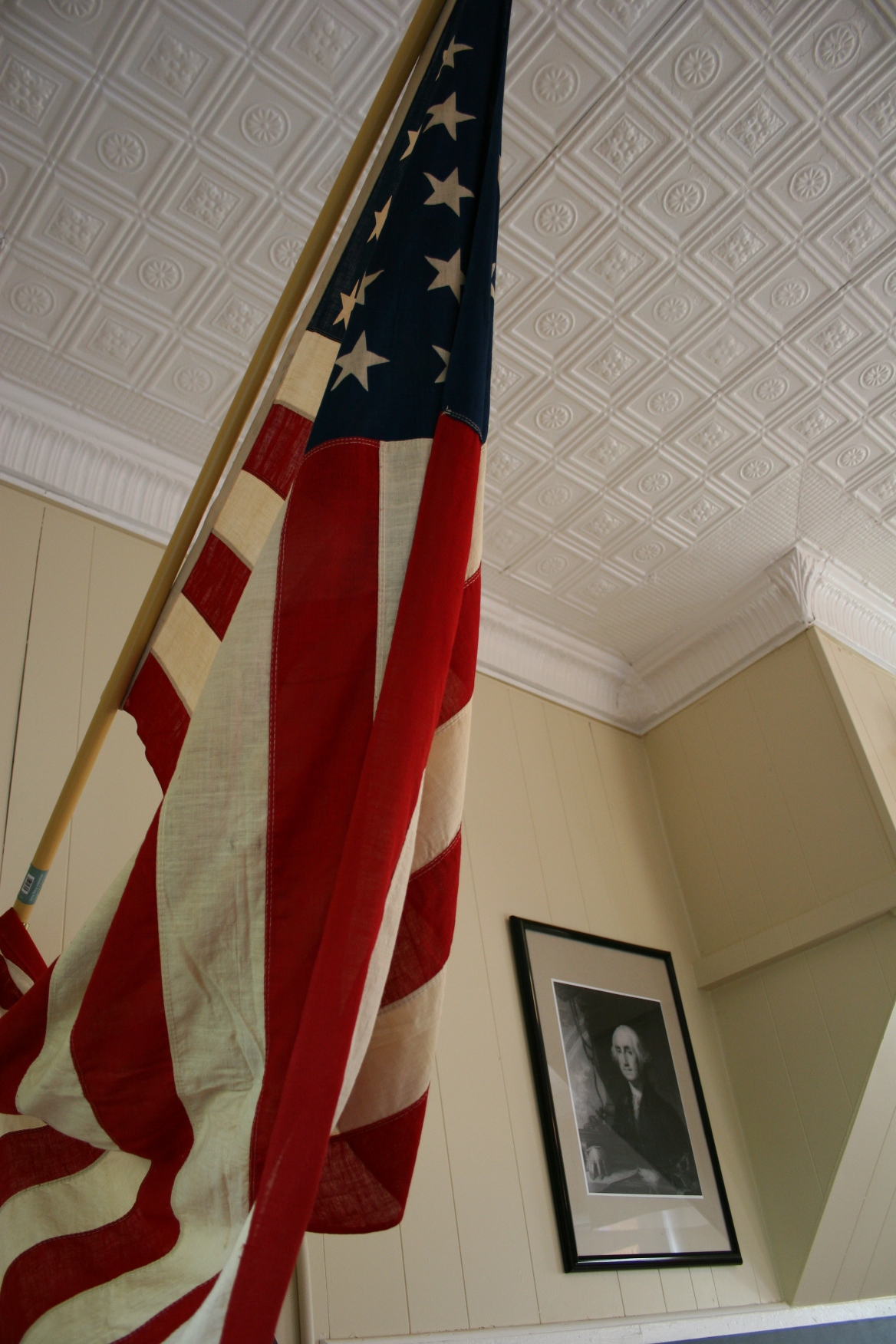
A flag and portrait of George Washington at the former District 20 Millersburg School, now a museum.

“I PLEDGE ALLEGIANCE to the flag of the United States of America and to the Republic, for which it stands, one nation under God, indivisible, with liberty and justice for all.”

As a child, my school days began with that pledge. My classmates and I arose from our desks at Vesta Elementary School, turned toward the American flag in the corner, placed our hands across our hearts, fixed our eyes upon the stars and stripes, and recited the pledge in unison.

I doubt we ever thought too much about the rote words we spoke. They were simply part of our routine, something we did, although I do recall feeling a sense of pride in speaking those words daily.

So much has changed in the decades since then. The Pledge of Allegiance, in most cases, has been banned from public schools in the name of political correctness. We are no longer one nation under God. While the U.S. remains one country, we as individuals are certainly divided in our views of anything and everything. That’s as it should be in a democracy. Liberty and justice have managed to prevail.

As we celebrate our nation’s Independence Day, it would be wise for all Americans to reflect on the Pledge and the words of other documents and songs that focus on the flag and freedom.

We hold these truths to be self-evident, that all men are created equal, that they are endowed by their Creator with certain unalienable Rights, that among these are Life, Liberty and the pursuit of Happiness.—The Declaration of Independence, signed on July 4, 1776

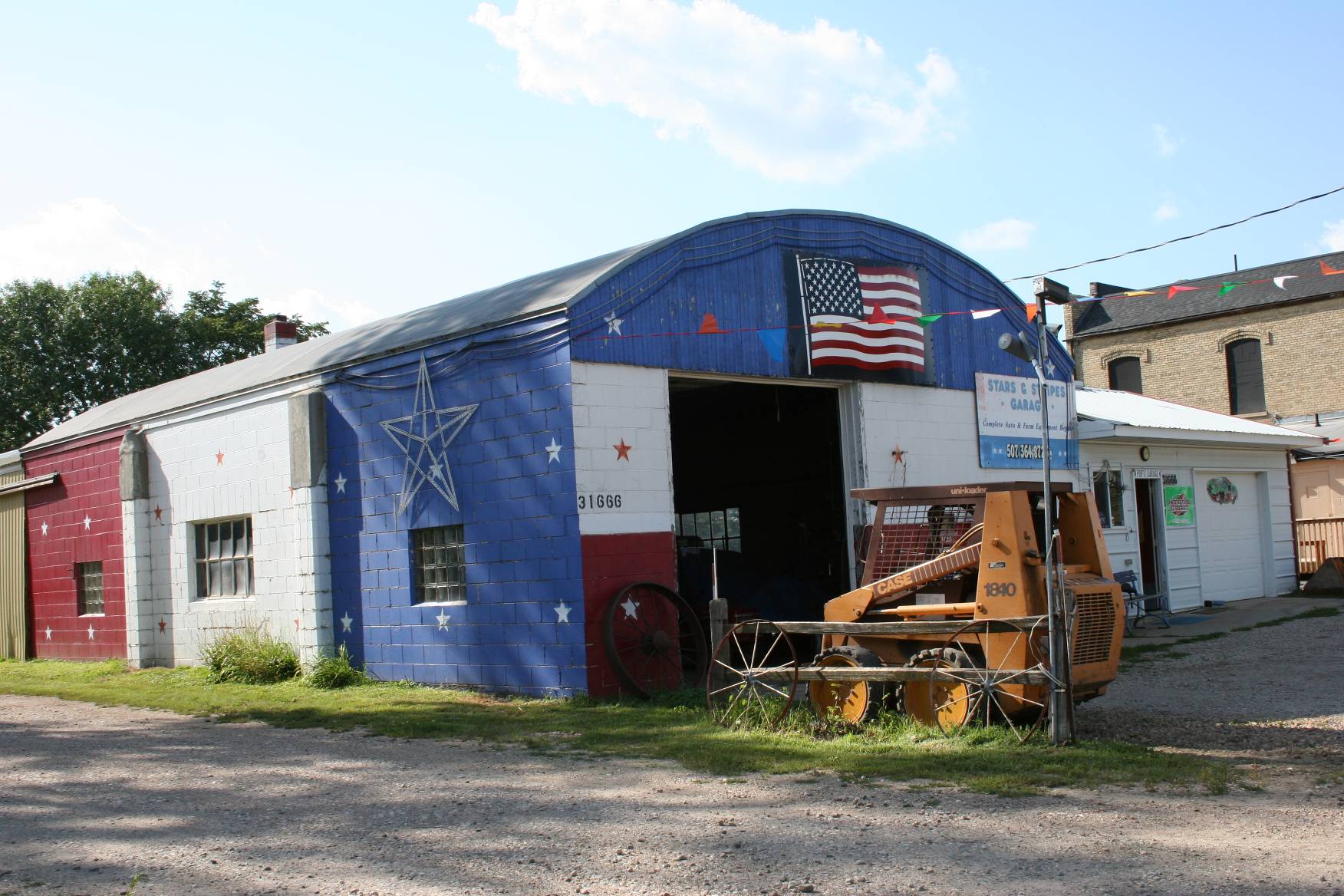
Vietnam veteran Joel Kukacka's patriotic garage in the hamlet of Heidelberg, Minnesota.

Oh, say does that star-spangled banner yet wave
O’er the land of the free and the home of the brave?
—The Star Spangled Banner

An American flag painted on a shed in Dundas in southeastern Minnesota.

Congress shall make no law respecting an establishment of religion, or prohibiting the free exercise thereof; or abridging the freedom of speech, or of the press; or the right of the people peaceably to assemble, and to petition the Government for a redress of grievances.—The Bill of Rights, Amendment I

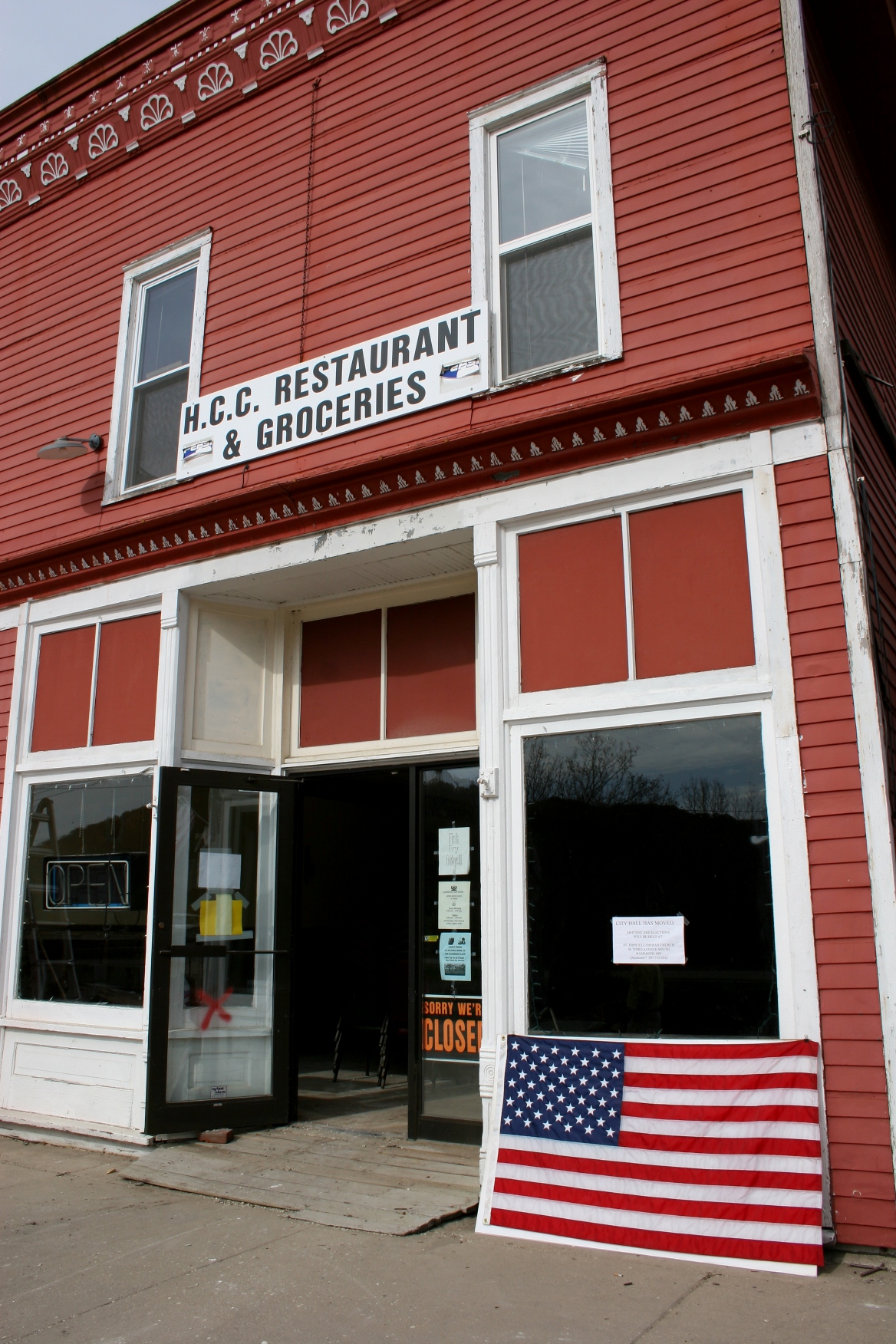
Weeks after a devastating Sept. 2010 flash flood in Hammond, in southeastern Minnesota, an American flag marked a ravaged business.

God bless America,
Land that I love,
Stand beside her and guide her
Thru the night with a light from above;

From the mountains, to the prairies,
To the oceans white with foam,
God bless America,
My home, sweet home.
God bless America,
My home, sweet home.

Flags decorate a vintage tractor at the Rice County Steam & Gas Engines Show near Dundas.

© Copyright 2011 Audrey Kletscher Helbling
 

I’ve never met Garrison Keillor, but… June 8, 2011

SO, HOW WOULD YOU feel if a photo you took was incorporated into a video/slide show narrated by Garrison Keillor?

Would you slip on your red shoes, lace up the laces and dance a polka?

Since I don’t own red shoes like Keillor and I don’t polka, I enthused to my husband repeatedly about my stroke of luck. I haven’t really boasted to anyone else. We don’t do that sort of thing here in Minnesota. But, I thought maybe I could tell a few of you. A photo I shot of winter on the Minnesota prairie is part of a video/slideshow narrated by our state’s most famous storyteller.

Now, how does this happen to a blogger like me who happily blogs along each day with words and photos from Minnesota, without a thought, not a single thought, that Keillor may someday come into my life. Well, I didn’t exactly meet him and I haven’t exactly spoken to him, but…

A MONTH AGO, Chris Jones, director of the Center for Educational Technologies at Gordon College in Wenham, Massachusetts, commented on my January 7, 2010, blog post, “Wind and snow equal brutal conditions on the Minnesota prairie.” He was inquiring about using my photo of winter on the prairie in a video/slideshow for retiring President R. Judson Carlberg and his wife, Jan.

Typically I do not personally respond to comments via email. I am cautious that way, protective of my email address and of anybody out there who may not have my best interests in mind. So I didn’t, just like that, snap your fingers, fire off a response to Jones. First I sleuthed. Honestly, I had never heard of Gordon College and I sure can’t spell Massachusetts.

Here’s what I learned from the college’s website: “Gordon College in Wenham, Massachusetts, is among the top Christian colleges in the nation and the only nondenominational Christian college in New England. Gordon is committed to excellence in liberal arts education, spiritual development and academic freedom informed by a framework of faith.”

I am Lutheran and that all sounded conservative enough for me.

So I emailed Jones, with several questions. You really didn’t expect me to not have questions, did you? I asked Mr. Gordon College guy: “Could you explain to me the nature of this video, which photo you are interested in using and where this video will be shown?”

That’s when he dropped Garrison Keillor’s name as the video/slideshow narrator. Sure. Yeah. Use my photo. Wherever. Whenever. Fine with me. Credit me and Minnesota Prairie Roots, send me a link to the completed video and allow me to blog about this and we’ve got a deal.

And so we did. Have a deal. After I promised not to publicly share the video with you. Sorry, I wish I could because it’s an entertaining media presentation, but I gave my word.

I also gave my word that I would make it clear to you, dear readers, that Garrison Keillor doesn’t just go around every day narrating surprise media presentations for college presidents’ retirement parties.

He met Jud and Jan Carlberg on a cruise. They struck up a friendship and, later, when the college was planning the video/slideshow, a Gordon writer “thought boldly, imagining this as a wonderful surprise for the Carlbergs, and started making inquiries,” Paul Rogati, Gordon’s CET multimedia designer, shared in a follow-up email. “When Mr. Keillor agreed to record the narration, the script was written for his style of monologue, with a reference to the winters on the prairies of Minnesota. Your image was a perfect match.”

"The photograph," taken along Minnesota Highway 30 in southwestern Minnesota.

And that is how my photo taken in January 2010 along Minnesota Highway 30 in southwestern Minnesota became connected to Garrison Keillor.

My prairie picture is one of many, many, many images incorporated into this retirement tribute to a “tall Scandinavian scholar from Fall River, Massachusetts” who was inaugurated as Gordon’s seventh president “in a swirling March blizzard” in 1993.

Yes, the whole piece is pure “A Prairie Home Companion” style and it’s a pleasure listening to Keillor’s silken voice glide across the words penned by authors Jo Kadlecek and Martha Stout.

The monologue opens like Keillor’s radio show, but “on Coy Pond on the campus of Gordon College.” It is a pond which “sometimes freezes up solid enough to go ice fishing on,” Keillor professes. And “there are rumors of an ice fishing shack being built” by the retired president with more time on his hands.

Several other references are made to Minnesota in a presentation that mixes humor with factual information about the Carlbergs’ 35-year tenure at Gordon, a “college which includes Lutherans” and which offers students off-campus experiences in places like the Minnesota prairie.

Then, finally, at the end of the video, the Carlbergs are invited to “sometime come up to the prairies of Minnesota to see what winter is all about.” A snippet of my photo appears on the screen, slowly panning out to show the full winter prairie landscape frame.

I’m not sure which the Carlbergs will do first in their retirement—sneak past Gordon College security and park an ice fishing shack on Coy Pond or visit southwestern Minnesota in winter, where, no doubt, “all the women are strong, all the men are good looking and all the children are above average.”

#

WHEN (not if) the Carlbergs travel to Minnesota in the winter, they will also see scenes like this on the southwestern Minnesota prairie:

An elevator along U.S. Highway 14 in southwestern Minnesota.

The sun begins to set on the Minnesota prairie.

Barns abound in the agricultural region of southwestern Minnesota, this one along U.S. Highway 14.

A picturesque farm site just north of Lamberton in Redwood County, Minnesota.

© Copyright 2011 Audrey Kletscher Helbling


A look back at a 1951 graduation speech about communism June 5, 2011

I recently attended this graduation reception for my niece Hillary, who graduated from Wabasso High School.

A soon-to-be 2010 graduate of Westbrook-Walnut Grove High.

IF YOU’RE LIKE ME, you’ve received invitations to numerous high school graduation receptions. You’ll make the rounds, shaking hands with the new graduates, inquiring about their future plans, congratulating their parents and then grabbing something to eat (pacing your food intake) before moving on to the next reception.

If you’re like me, you also have not attended a single graduation ceremony, unless your child is graduating or you are invited to a small-town high school where seating is not limited to four spaces per graduating senior’s family.

Therefore, you probably have not heard a student commencement speech in some time.

About a week ago my niece graduated as valedictorian of  Wabasso High School, my alma mater, and gave a graduation speech, of which I’ve received a copy. Hillary spoke about the past and how it weaves into the future. “As we become the people we are meant to be, we can hold onto the memories of yesteryear and the hopes of tomorrow,” she said in part. “The one thing that will always remain constant is the change in our lives.”

Now compare that to the speech (see below) given by Hillary’s grandmother, my mother, at Wabasso High School 60 years ago. Class of 1951 valedictorian Arlene Bode spoke about “Our Part in the Fight Against Communism.”

When my mom first told me the title of her speech, I laughed. “Who gives a graduation speech about communism?” I asked, and laughed again.

An old fallout shelter sign on a building in downtown Pemberton in southern Minnesota.

Then my 79-year-old mother reminded me of the time period—the Cold War, the fear of the Soviet Union, the Korean War, fallout shelters—and I understood. She doesn’t recall whether she chose the topic or whether the subject was assigned. But the content gives some youthful, historical insight into the world six decades ago:

My father, a Korean War veteran, in Korea in 1953.

“WE, THE GRADUATING SENIORS, wish to take this opportunity to express our sincere gratitude to our parents, teachers, and all others who have helped us obtain our education.

OUR PART IN THE FIGHT AGAINST COMMUNISM

Communism is threatening the peace and security of our country. This is being brought more and more to our attention each day by the governmental leaders of the United States. We are sending our boys to Korea. We are conducting investigations to reveal any communist workers who may be in our government. We are sending Voice of America broadcasts behind the Iron Curtain to inform the people of how democracy works. But this is not enough. The tide of communism is moving ever forward. Most of Europe is communistic and it is spreading rapidly in Asia. This has happened just in the last few years. We must stop this tide before it is too late. It behooves us as graduating seniors to help in the fight against communism while there is still time.

Of course we must know what we are fighting against. The mere word communism is not enough. We must know what it means. The word communism is derived from the Latin word communis meaning common. It is said that communism is the distribution of income to each according to his need. They believe that all natural resources and most businesses should be owned by the government. They also believe in community ownership of property. This is the true meaning of communism, but it has an even greater meaning here in the United States. Senate hearings have shown that it is a politically controlled conspiracy, promoted by a foreign nation, for the overthrow of our government. If they should accomplish this overthrow it would be a decisive step toward placing the entire world under communistic government. According to Kenneth Goff, author of “Confessions of Stalin’s Agent,” the communist party has six main points in its program: Abolition of all governments, inheritance, private property, patriotism, family, and religion.

The communists strike first at the poorer class of people and at those who are not satisfied with present day conditions. They promise these people that under communism they will have all they want, such as rest, leisure, and social security paid by the State. But this is far from what really happens. What really happens is that these people lose their personal freedom and whatever they do is for the benefit of the communist party.

If we have an understanding of what communism means and how it works we can fight against it. Here are some of the things we can do.

Patriotism displayed on a rural Minnesota home.

We must at all times practice democracy. Democracy means a sharing of respect, a sharing of power, and respect for the dignity of man. Democracy is promoted by a balanced economic distribution and an enlightenment of the people. We should see that parliamentary procedure is used in all organizations to which we belong such as, church organizations, community organizations, and women’s clubs. It is important to secure the wishes of the majority of the people without wasting time.

We must set a good example by being democratic in our every day life and in our dealings with others by working toward a definite goal in life, setting up ideals to follow, being a neighbor to all people regardless of their race, color, or religion, showing good judgment in all we do.

In a few years we will have a voice in our government and we must do our best to keep communists out of it. We can do this by voting at each election, which is one of the privileges of living in a democracy and one which we must never lose. But just casting a vote is not enough. We should know who we are voting for by studying the policies of each candidate to see what he stands for.

If each and every one of us practices democracy wherever we are we have done our part in the constant fight against communism. The part we play may seem small, but every little bit counts if we are to win over communism.”

AFTER READING MY MOM’S SPEECH several times, I wondered how often we as Americans pause to consider the freedoms we likely take too much for granted.

“We must at all times practice democracy. Democracy means a sharing of respect, a sharing of power, and respect for the dignity of man.”

WHAT’S YOUR TAKE on this 1951 graduation speech? Are any of her comments relevant today? What particularly struck you about this speech? I’d like to hear your specific reactions.

© Copyright 2011 Audrey Kletscher Helbling
Graduation speech © Copyright 1951 Arlene Bode Kletscher (Except for corrected errors in spelling, this speech is published here as originally written.)

2011 graduation speech excerpts © Copyright 2011 Hillary Kletscher


Reflecting on graduation speeches by three generations of Minnesota women May 27, 2011

Wabasso High School, where my niece will give a speech tonight as class valedictorian. My mom and I also graduated from WHS, although the building looks much different than when we graduated in 1951 and 1974.

Arlene Bode Kletscher's 1951 graduation portrait.

SIXTY YEARS AGO 18-year-old Arlene Bode stepped onto the stage at Wabasso High School and gave a commencement speech, “Our Part in the Fight Against Communism.”

While that seems an unlikely, unsuitable, topic for an address by the class valedictorian, my mom says you need to remember the time period in which she wrote and gave that speech.

This was 1951, at the height of the Cold War, the era of bomb shelters and fear of the Soviet Union.

My mom espoused patriotism, encouraging her southwestern Minnesota classmates “to be patriotic and vote…so we can keep our freedom,” she recalls. She has a copy of that speech tucked inside her WHS diploma.

She found the speech recently when pulling out her diploma to show her granddaughter, Hillary Kletscher, who graduates tonight, also from Wabasso High.

Hillary, like her 79-year-old grandmother, is the class valedictorian and will speak at commencement. When I texted Hillary early Thursday afternoon, she hadn’t yet titled her speech. But, she said, the “main subject is change and how it’s good but we have to hold onto what we learn from the past.”

I won’t be there to hear my niece’s address. But I intend to ask her for a copy, just like I plan to get a copy of my mom’s speech, which I’ve never seen. These are parts of our family history, words reflecting the time periods in which they were written, words of hope and wisdom and patriotism (at least in my mom’s case).

Hillary will step onto the WHS stage tonight and speak on change, yet remembering the past.

Audrey Kletscher Helbling, 1974 WHS graduate.

That my mom kept her speech through six decades impresses me. I say that specifically because I have no idea where to find the speech I gave at my graduation from Wabasso High School in 1974. It’s packed in a box somewhere in a closet in my home, but I possess neither the time nor energy to dig it out.

I remember only that, as class salutatorian, my farewell address included a poem. What poem and by whom, I do not recall.

In 2006, my daughter Miranda graduated as valedictorian of Faribault High School and gave a commencement speech. Given that occurred only five years ago, I should remember the content. I don’t. I recall only that she held up a test tube to make a point.

I am also making a point here. Thankfully much has changed in the 60 years since my mom spoke on “Our Part in the Fight Against Communism.” While the world today remains in turmoil, at least the intense fear, felt by the Class of 1951 during the Cold War, no longer exists.

We have also moved beyond the turbulent 60s and 70s, a time of rebellion, anti-establishment, and anti-war sentiments and discontent over the Vietnam War experienced by my class, the Class of 1974.

By 2006, when my second daughter graduated, we as a nation were beginning to recover from 9/11, yet we lived in an increasingly security-focused society.

Today my niece graduates in a day of continuing economic uncertainty, when young people are struggling to find jobs and when Baby Boomers like myself worry about our jobs and retirement.

Yet, through it all—the Cold War, Vietnam, September 11 and a challenging economy—we remain four strong women living in a free country where we, individually, spoke freely, representing the classes of 1951, 1974, 2006 and 2011.

© Copyright 2011 Audrey Kletscher Helbling