Among the many sympathy cards I received when my mom died in January 2022. (Minnesota Prairie Roots copyrighted file photo 2022)
IN THE TWO YEARS and two months since my mom died, I have not cried much over losing her. Not at her funeral, held at the height of omicron in a church packed with mostly unmasked mourners. Not at the cemetery. Not once have I fully-wept.
It’s not that I don’t feel her loss deeply. I do. Some Sunday evenings I still want to pick up my phone and call her, as was my routine up until she could no longer manage even that. Now my son typically calls me on Sundays from his home in Boston, a gift to me in more ways than he can imagine.
Me with my mom during a January 2020 visit. (Minnesota Prairie Roots copyrighted file photo January 2020 by Randy Helbling)
The day before his last call, on a Saturday afternoon, the grief I’d tucked inside over my mom’s death spilled out. Everything came together in an emotional moment at my friend Arlene’s funeral. I missed Mom with the fierceness only a daughter can feel.
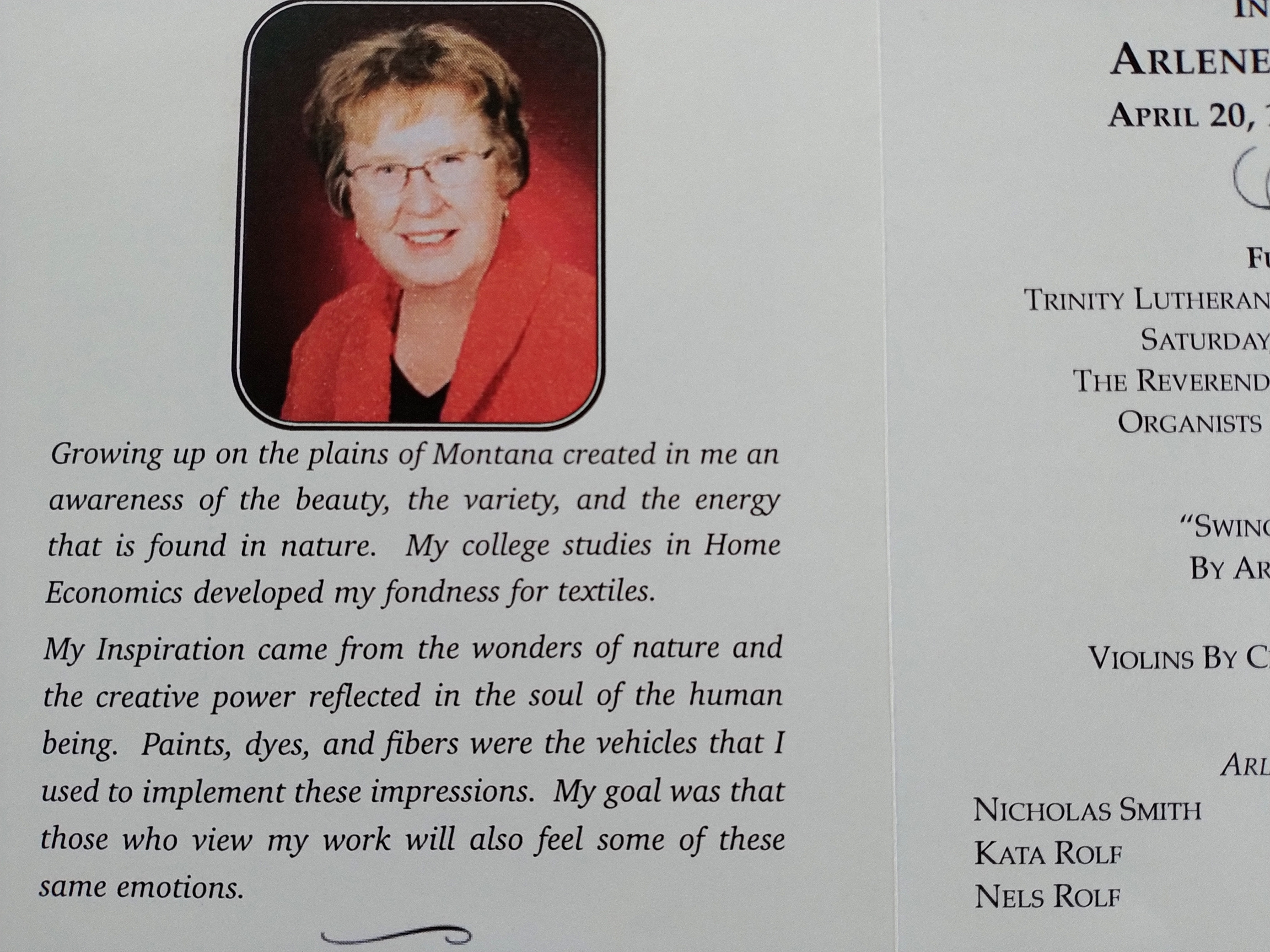
A section of Arlene Rolf’s memorial folder. (Minnesota Prairie Roots photo March 2024)
My mom’s name was Arlene. And I think that started the torrent of emotions I felt as I grieved the other Arlene, mother to Will and Karen and Steve. My friend. An artist. A woman of faith and compassion and kindness. So like my own mother, except for the creativity.
This is just a small part of Arlene Rolf’s “Creation” batik art, photographed from the cover of her funeral service worship folder. (Art copyrighted by Arlene Rolf; photo by Minnesota Prairie Roots, March 2024)
As I opened the worship folder graced with Arlene Rolf’s “Creation” batik art, I noticed first the selected scripture readings. Familiar. Meaningful. Joshua 1:8-9, verse 9 being my Confirmation verse: Be strong and courageous…for the Lord your God will be with you wherever you go.
And then Romans 8:28-30. Verse 28 has always been a favorite bible passage: …in all things God works for the good of those who love him. That scripture, like Joshua 1:9, has carried me through many challenges in life.
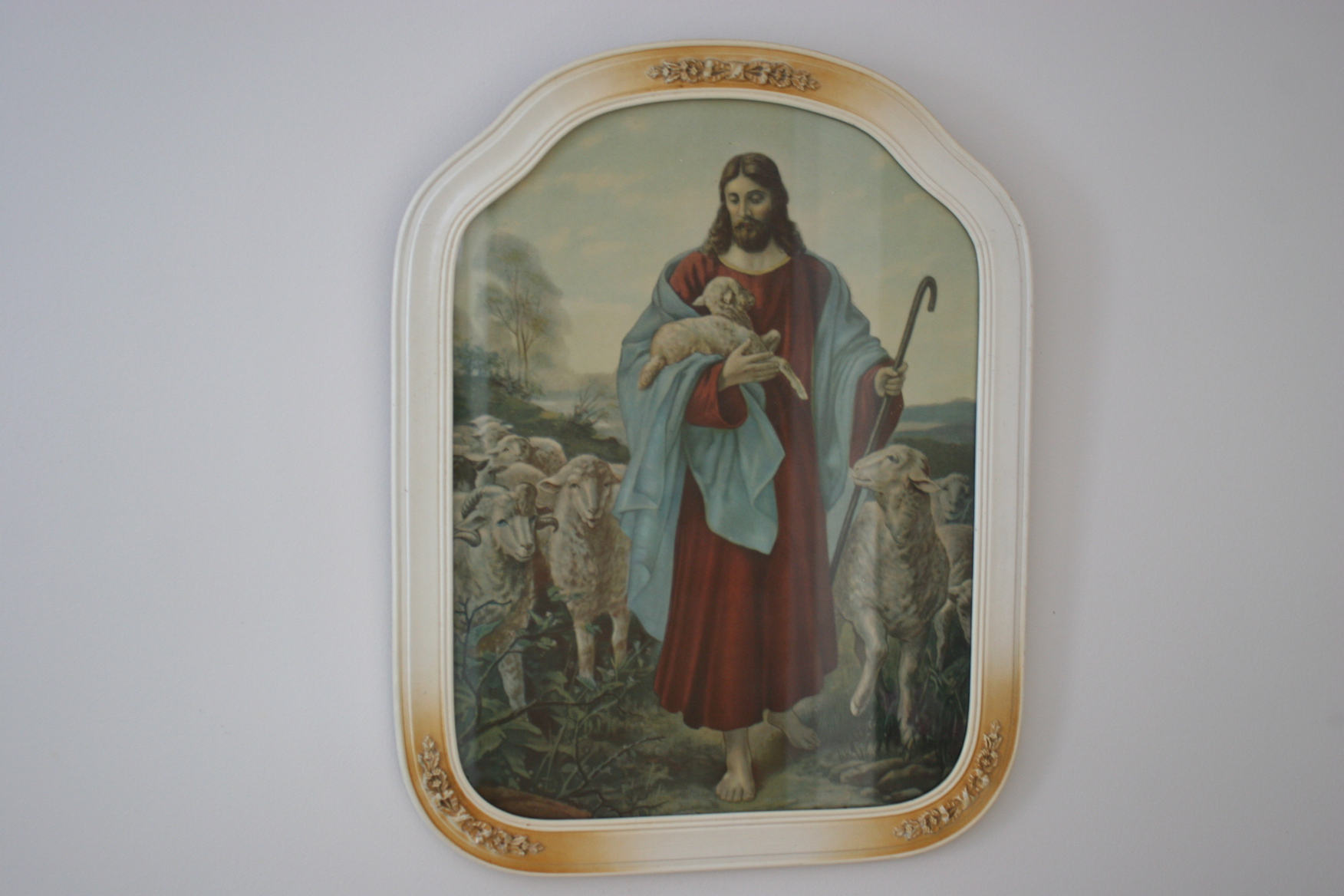
“The Good Shepherd” framed print was a wedding gift to my parents. It hung in their bedroom and then in my mom’s care center room until her death. I now have this treasured piece of art. (Minnesota Prairie Roots copyrighted file photo)
Finally, I read the gospel lesson from John 10:7-15 about the good shepherd and his sheep. It was, I was certain, the same section of scripture read at my mom’s 2022 funeral. Later I would confirm the overlapping of verses chosen for the funerals of the two Arlenes.
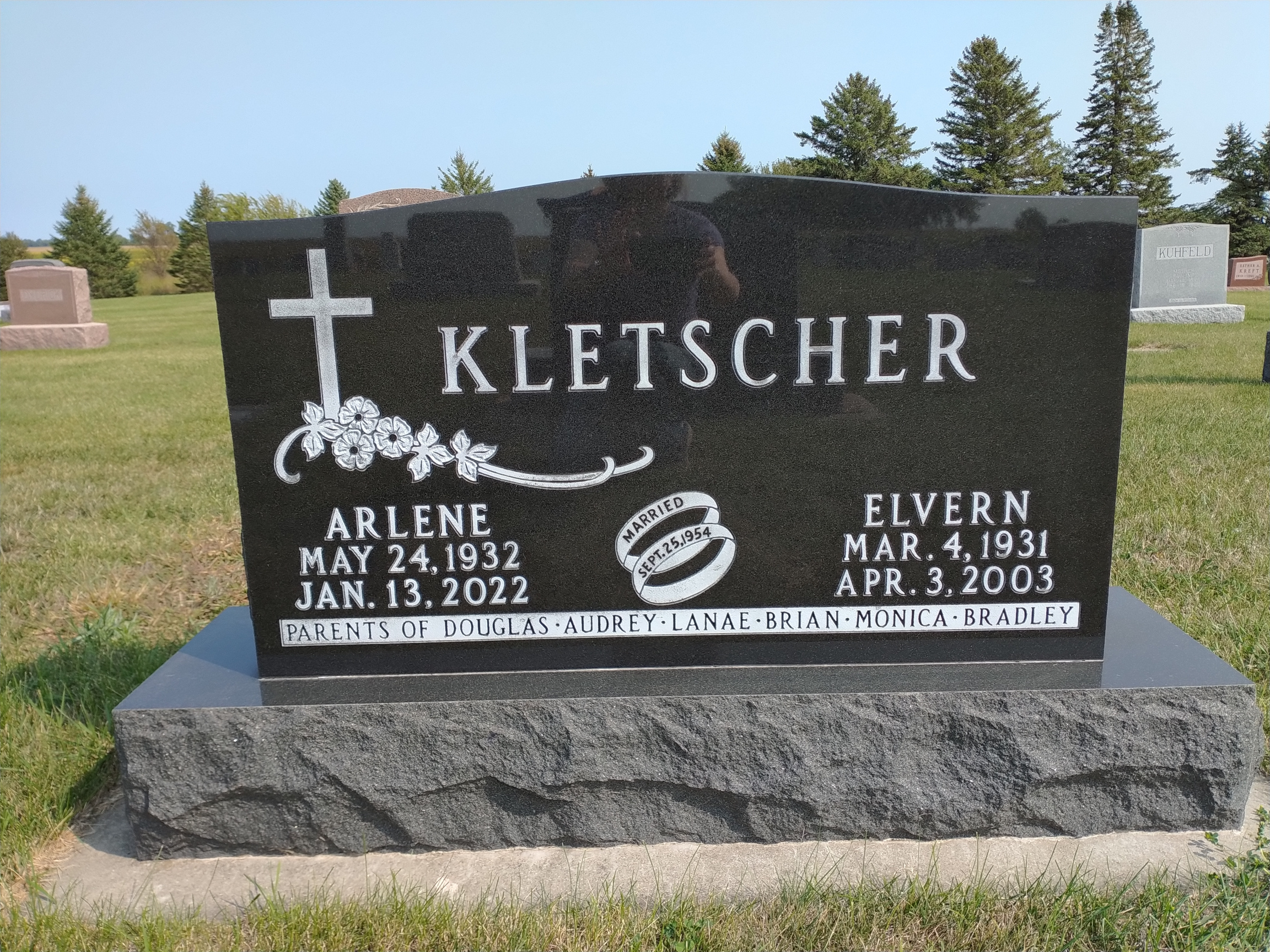
My parents’ tombstone in the Vesta Cemetery in southwestern Minnesota. (Minnesota Prairie Roots copyrighted file photo September 2022)
I don’t believe in coincidence. I believe in God moments. And I was experiencing those as I mourned my friend Arlene on March 9. I held it together, through all the bible readings, liturgy and songs, until several of Arlene’s grandchildren clustered together to sing “Swing Low, Sweet Chariot.” Their pure, sweet voices, minus any instrumentals, carried such emotion. It was as if a band of angels were welcoming their grandmother, my friend, into heaven. It was too much. I felt tears brimming my eyes, then sliding down my cheeks as I thought of my own dear mother welcomed into the loving arms of Jesus on January 13, 2022.
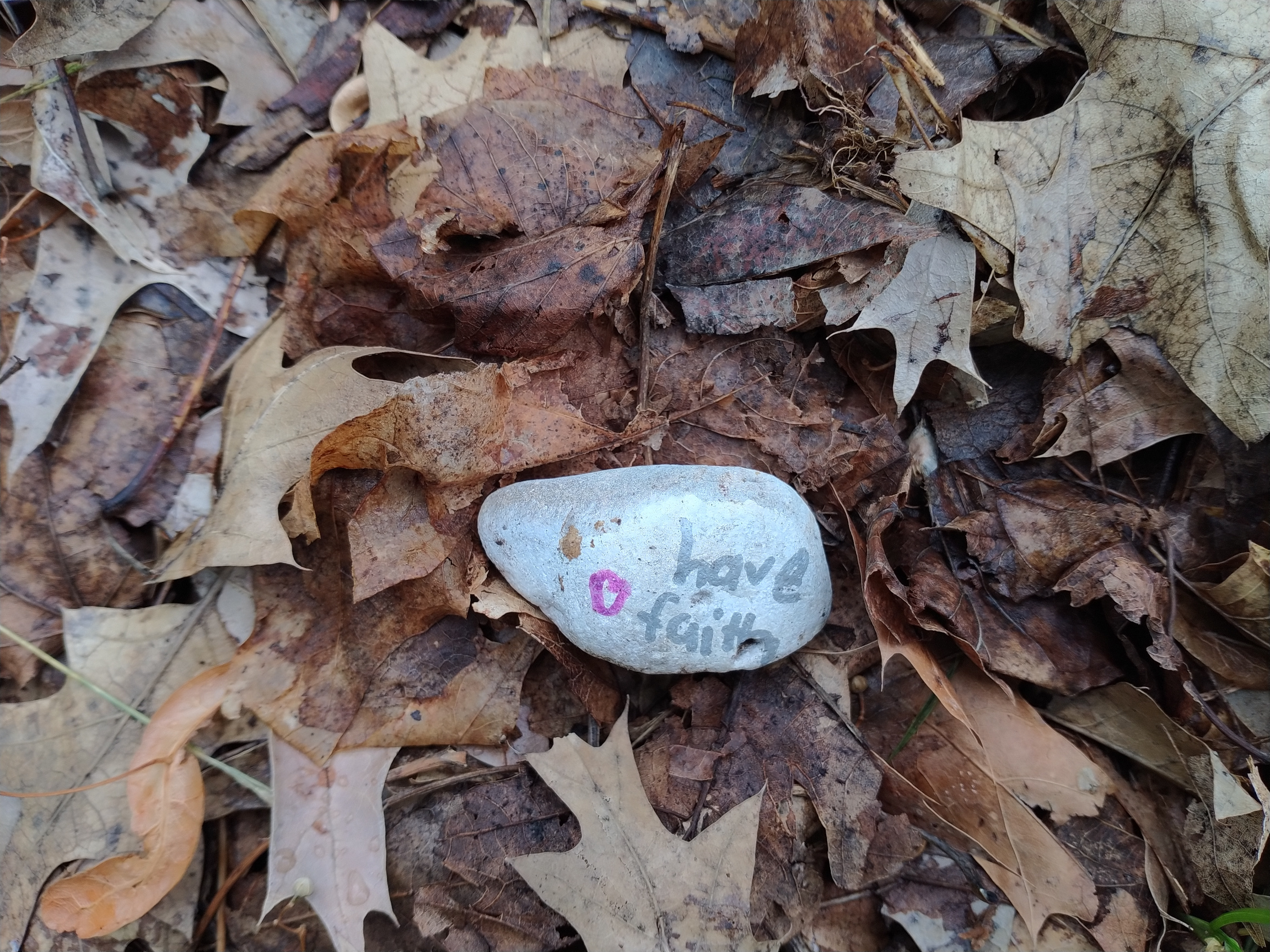
A found message. (Minnesota Prairie Roots copyrighted photo July 2023)
CALL IT SERENDIPITY, coincidence, even divine intervention. But when I spotted a white stone in a flowerbed at Faribault’s Central Park recently, then flipped the stone to read the words, have faith, I felt with certainty this message was meant for me.
I needed these encouraging words. It’s been a long past several months as I deal with ongoing challenging health issues that sometimes leave me feeling hopeless and in tears. It’s a lot, these layered diagnoses of vestibular neuronitis, Menerie’s Disease and peripheral sensory neuropathy. When symptoms flare, which is often, I wonder if I will ever be myself again. And every time a new symptom arises, I wonder why my body is seemingly under siege. Definitive answers and solutions feel elusive.
Yet, if I reflect on this journey, I can see improvements in balance and my ability to handle sensory input. I attribute those to 3.5 months of vestibular rehab therapy and the prayers of many. Have faith. Those two words are powerful, filled with hope. Hope for better days, better health, a return to life as I once lived it.
#
THANK YOU to you, my blog readers, for your gifts, cards, prayers and words of encouragement. Every caring word and act of kindness uplifts me and makes me feel, oh, so loved. I am grateful for your support, care and concern.
Signage indicating the Trinity service is airing. (Minnesota Prairie Roots copyrighted file photo April 2018)
DURING THE COVID-19 PANDEMIC, when I wasn’t attending worship services at my church, Trinity Lutheran, Faribault, I switched on the radio. In the safety and shelter of my home, I listened to Sunday morning worship services broadcast on Faribault-based KDHL radio. I was grateful for the AM listening option. I could have watched live-streaming. But I preferred the less distracting radio delivery.
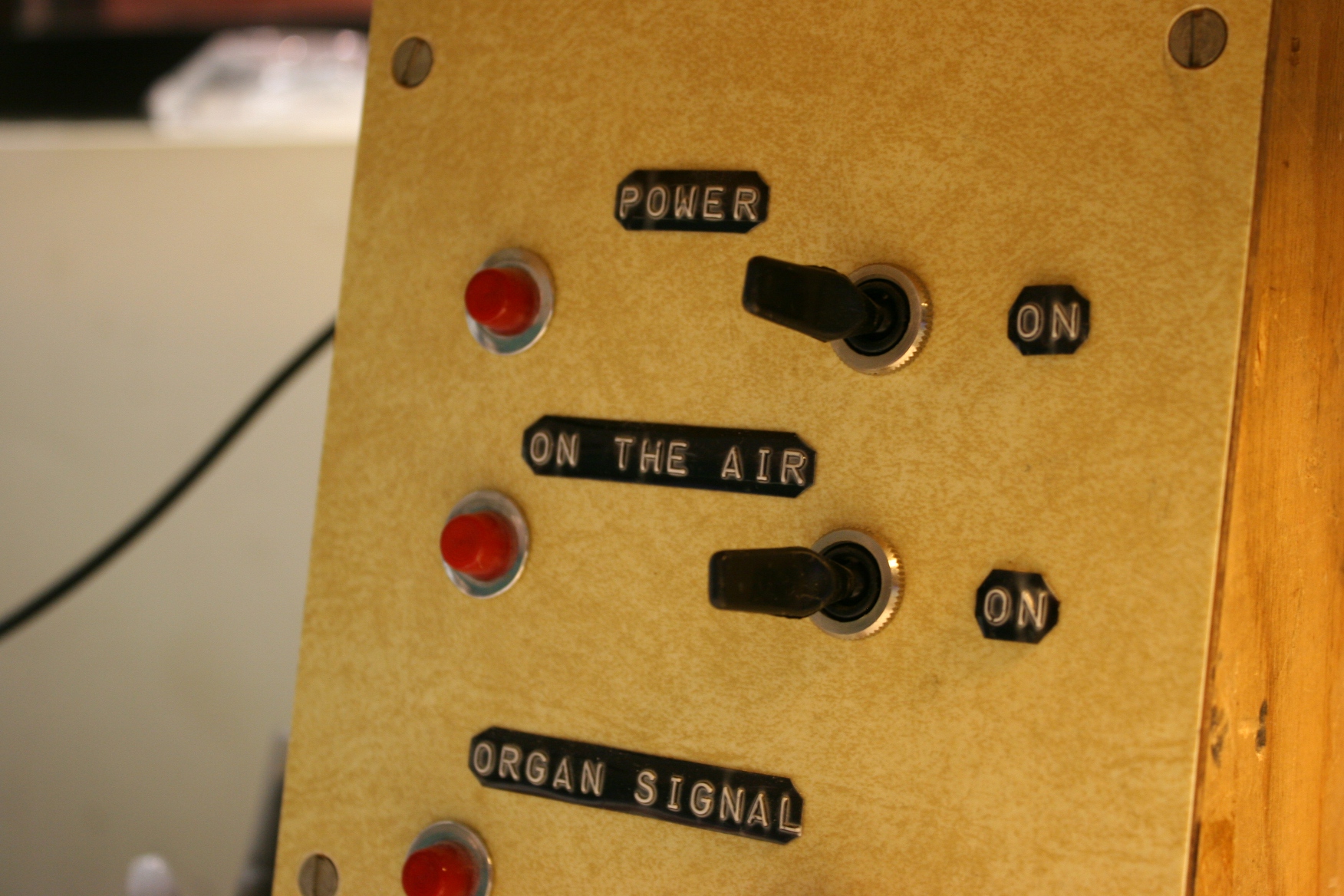
Vintage switches inside the Trinity Radio Club booth. (Minnesota Prairie Roots copyrighted file photo April 2018)
Eventually, I returned to in-person worship. But today I’m back tuning the radio to 920 AM at 8 am Sunday because of a health issue that leaves me sensory sensitive and more. I can’t tolerate the sound of the organ or the multi-layered sensory input of being among people in a busy environment.
The original microphone used in 1948.(Minnesota Prairie Roots copyrighted file photo April 2018)
That’s the backstory behind my personal appreciation of the Trinity Radio Club, which has broadcast church services for 75 years, first airing on April 25, 1948. That’s remarkable in longevity, in decades of sharing the Gospel initially via the air waves and then via live-streaming and other online platforms.
The early transmitter. (Minnesota Prairie Roots copyrighted filephoto April 2018)
This weekend, April 29 and 30, the Trinity Radio Club celebrates its 75th anniversary during worship and during a special program between Sunday morning services. It’s important to commemorate and honor the work of long ago visionaries who embraced a radio ministry. They initially pledged $5/each toward the effort and also committed to paying 35 cents weekly to support the broadcasts. That doesn’t seem like much money today. But I expect it was a sacrifice in 1948, when the first broadcast cost $46.
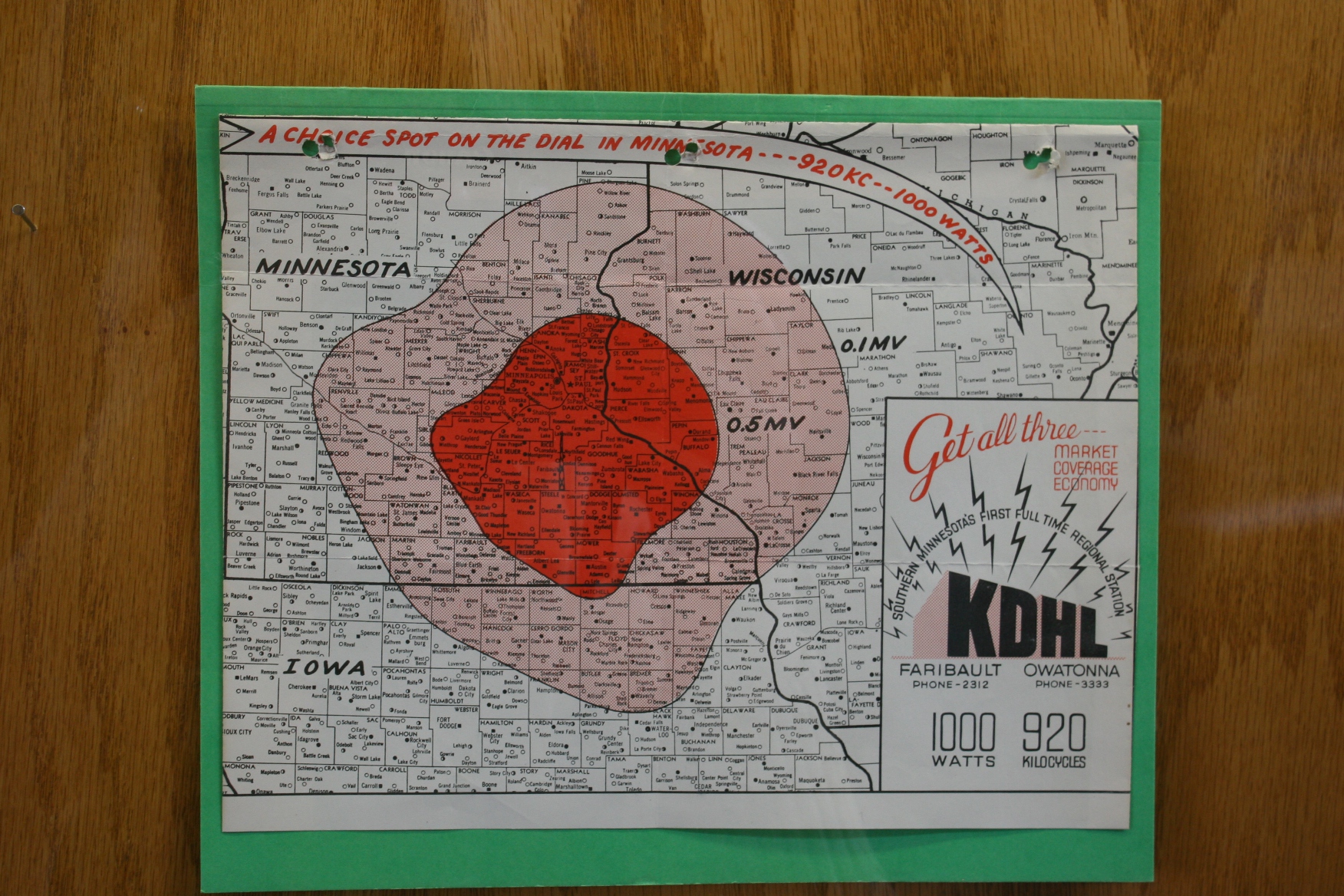
The original coverage area for KDHL radio, which began broadcasting in 1948. (Minnesota Prairie Roots copyrighted file photo April 2018)
Throughout its 75 years, the Trinity Radio Council (today the Trinity Radio Club) has remained strong in its mission of reaching people with the good news of salvation, whether locally or an ocean away. The club has continued to upgrade technology, to make improvements that assure uninterrupted transmission of services via radio and online. Unlike many churches during the COVID pandemic, Trinity was already up and running with a strong, safe and viable way of reaching and connecting with people outside the walls of the sanctuary.
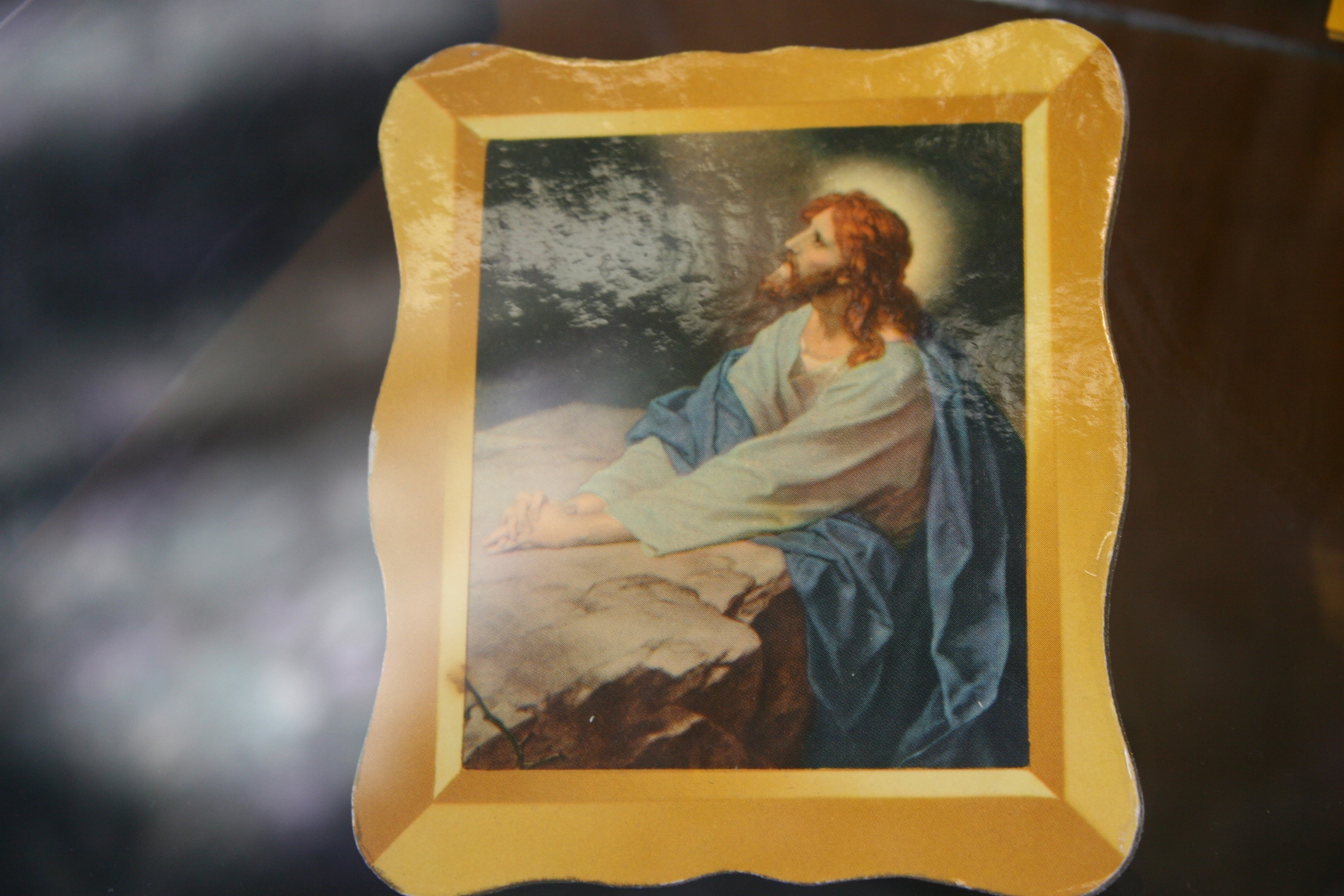
Vintage radio room art centers on Christ. (Minnesota Prairie Roots copyrighted file photo April 2018)
For awhile, Randy and I (mostly Randy) were part of the club’s mission. Once a month, sometimes more, Randy would take a DVD of the 8 am worship service to a local nursing home. Sometimes I accompanied him. He would lead part of the service and then play the sermon part of the recording for residents. Many of them slept through the entire thing. But, yet, when Randy led them in The Lord’s Prayer, they would join in. No memory issues. No sleepiness. Just a roomful of the faithful praying.
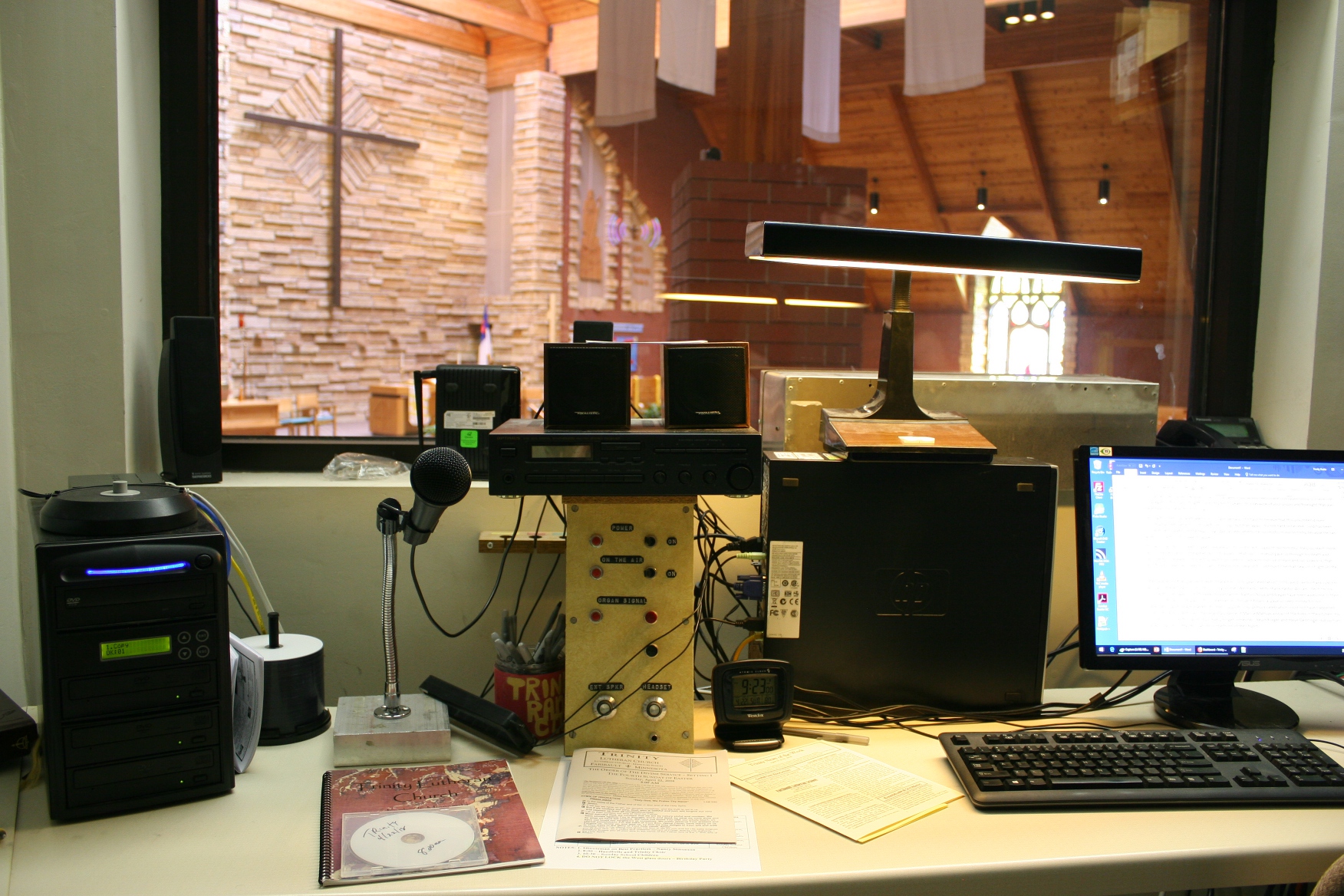
The operations tech hub inside the radio studio at Trinity in 2018. (Minnesota Prairie Roots copyrighted file photo April 2018)
That word “faithful” seems appropriate to insert here. Generations have committed to maintaining and expanding the Trinity Radio Club ministry. That comes via financial support and volunteering. When our tech-savvy son was in high school, he volunteered. Every broadcast and streamed service requires people in the soundproof studio working the computer, the switches, all the tech stuff I don’t understand.
A view from the studio overlooking the sanctuary in 2018. (Minnesota Prairie Roots copyrighted file photo April 2018)
But I understand one thing. I understand the importance of this ministry personally. When I can’t be in church, and there are others just like me, I can still be there.
Gratitude on the screen, Trinity sanctuary in the background. (Minnesota Prairie Roots copyrighted file photo April 2018)
I am grateful to those individuals who saw the need for a radio broadcast 75 years ago. I am grateful for the continuing expansion via technology. I am grateful for a congregation which financially and otherwise supports the Trinity Radio Club. I am grateful for listeners who also donate. It takes a joint effort, a team, dedication and hard work. And for the initial founders of the Trinity Radio Council, it took a vision based on faith to launch this ministry which has blessed so many, including me, during its 75-year history.
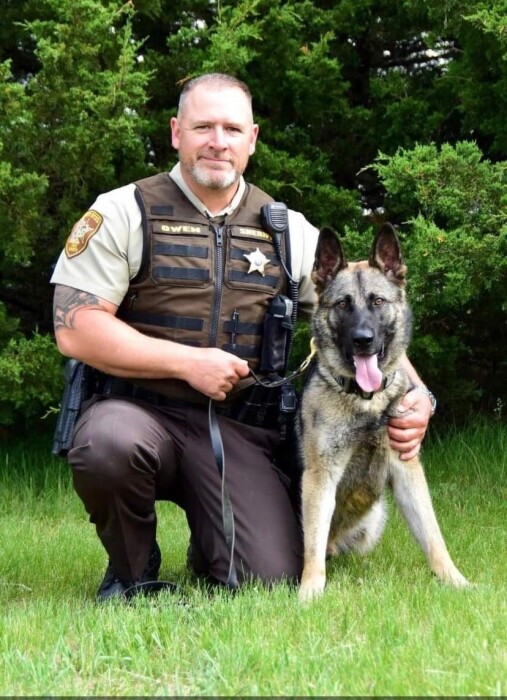
Those final words from the Rev. Bryan Taffe, pastor of St. Paul’s Lutheran Church in Lowry in western Minnesota, concluded a Saturday morning funeral service for Pope County Deputy Josh Owen, shot and killed April 15 while responding to a call of domestic violence. Taffe’s message and final blessing comforted me as I watched TV coverage of the deputy’s funeral some 180 miles northwest of Faribault in Glenwood.
I didn’t know the law enforcement officer killed on his 44th birthday. But, collectively, as a state, we knew Josh. He was described by speakers as hardworking, a common sense individual, calm under pressure, a family man… The kind of guy you would want having your back, whether on the battlefields of Iraq or in rural Pope County, Minnesota.
“ALWAYS PICK JOSH”
Lt. Col. John Anderson of the Minnesota National Guard served as Josh’s platoon leader during a 22-month deployment, including 16 months in Iraq. He shared of his soldier’s selfless heroism. Anderson learned early on to “always pick Josh.” He could count on him to handle dangerous situations, including the rescue of a severely-injured soldier in what he described as “a killing zone.”
An emotional Pope County Chief Deputy Nathan Brecht echoed Anderson’s theme of relying on and trusting that Josh could handle anything. His physical bulk proved invaluable. Yet, he held a tender side, showing compassion to a suicidal man and encouragement to a young woman in the throes of drug addiction.
PERSONAL INSIGHTS
As I listened to Anderson, Brecht and his cousin by marriage, Josh Palmateer, a clear picture began to emerge of Josh Owen. For me that was important, to begin to understand the man behind the badge, the man behind the headlines. The husband of Shannon, father to 10-year-old Rylan, friend, co-worker, son, cousin…protector.
Josh had a distinct laugh, pulled pranks with his fellow soldiers, had an insatiable thirst for Mountain Dew, loved lifting weights, hated doing paperwork. His motto: “Don’t start sh*t you can’t finish.”
I embraced Chief Deputy Brecht’s poetically descriptive image. When he sees a crack of lightning and hears a roll of thunder, he will think of Josh. Campfires and fishing and drinking an IPA will also remind him of the guy he could count on.
LOVE & GRATITUDE
At times, I wondered if the grieving deputy would make it through his remembrances of Josh. But he did, and with an important message. He vowed to tell his co-workers that he appreciates and loves them. Brecht regrets not doing that with Josh. He thanked the community for its outpouring of support, sharing that “every act of kindness sustains us.” And he referenced one of my favorite bible verses, Romans 8:28: All things work together for good to those who love God… Admittedly, Brecht said finding the good in Josh’s tragic death is not easy. But he said he’s gotten to know the family better and understands the importance of expressing love, aloud, to others. Like Brecht, I firmly believe that something good comes in every challenge, although it can take awhile to see that. For me, the good has often emerged in empathy, compassion and, yes, reaching out with kindness.
More scripture was quoted at the funeral held in the Minnewaska Area High School gymnasium packed with mourners, including hundreds of law enforcement officers. Be strong and courageous.Do not be terrified; do not be discouraged, for the Lord your God will be with you wherever you go. By the time Josh Palmateer quoted Joshua 1:9, I was not surprised. That is my Confirmation verse, words that embolden me to trust.
BLESSED ARE THE PEACEMAKERS
As the memorial service closed with a message by the Lutheran pastor, I felt joined in grief to the 4,000-plus mourners in that rural high school gymnasium. I felt connected and comforted. As a Christian, I appreciated the clergy’s hopeful message of eternal life. I appreciated, too, his reference to The Beatitudes, recorded in Matthew 5. Most of us know them: Blessed are those who mourn, for they will be comforted…Blessed are the peacemakers, for they will be called the sons of God… But Rev. Taffe explained the blessed part in a way that I’d not previously grasped. “You may not be feeling blessed,” he told the crowd. He then went on to explain that being blessed in grief “means God is showing favor on you…in deep sadness you are in God’s hands more than any other time.” That resonated with me, deep within my soul.
When the funeral service and TV coverage ended simultaneously at noon, I felt emotionally drained. But I also felt better for having learned about Josh Owen—the deputy and the man—and better for having heard inspirational messages. Calls to express love, to realize that we can unite collectively, give me hope.
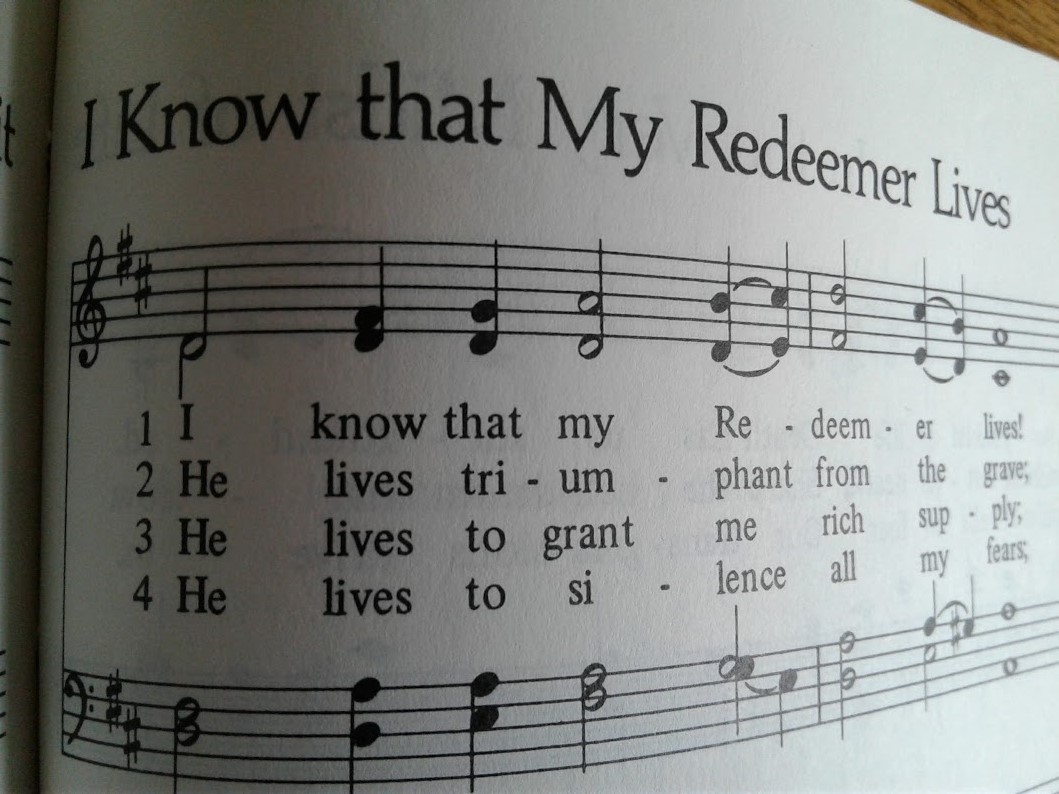
My favorite Easter hymn. (Minnesota Prairie Roots copyrighted file photo)
IT IS MY ABSOLUTE favorite Easter hymn—“I Know that My Redeemer Lives.” And there is a reason behind that choice.
As a child, I sang that song with my Sunday School class during Easter worship services at St. John’s Lutheran Church in Vesta. Dressed in our Easter finery—girls in pastel dresses and Easter hats, boys in dress pants and shirts, some with bow ties cinching their necks—we belted out the joyful words about the risen Lord.
To this day, I can recite most of the verses. The words are that ingrained in my memory. Words of triumph, love, blessings, assurance and so much more. I feel my soul filling with Easter morning hope in the memories of singing that aged hymn.
I admittedly cannot carry a tune or read a single musical note. And I admit to a bit of fear on those long ago Easter mornings in rural southwestern Minnesota. Not fear about forgetting the words to a hymn. But rather a dislike of sitting in the St. John’s balcony with only a low, partial wall separating me from the sanctuary below. I never jostled for the front pew in that upstairs packed with kids.
I hold another memory from Easter morning. Not of danger, but rather of youthful disobedience. Mom asked my siblings and me not to tattoo our arms before church services. Of course, we didn’t listen and excitedly held washcloth to paper tattoos, imprinting temporary art (from Easter egg dyeing kits) onto our skin. In the end, I don’t think anyone really cared as long as we showed up to sing at church.
And so all these decades later, I remember my favorite hymn and how my faith has carried me through life. Through joyful moments, through ordinary days, through really difficult times…
He lives to bless me with his love.
He lives to help in time of need.
I know that my Redeemer lives!
A joyful Easter to all of you from my home in southern Minnesota, not from the balcony of St. John’s!
TELL ME: Do you have a favorite Easter hymn and/or memory? I’d like to hear.
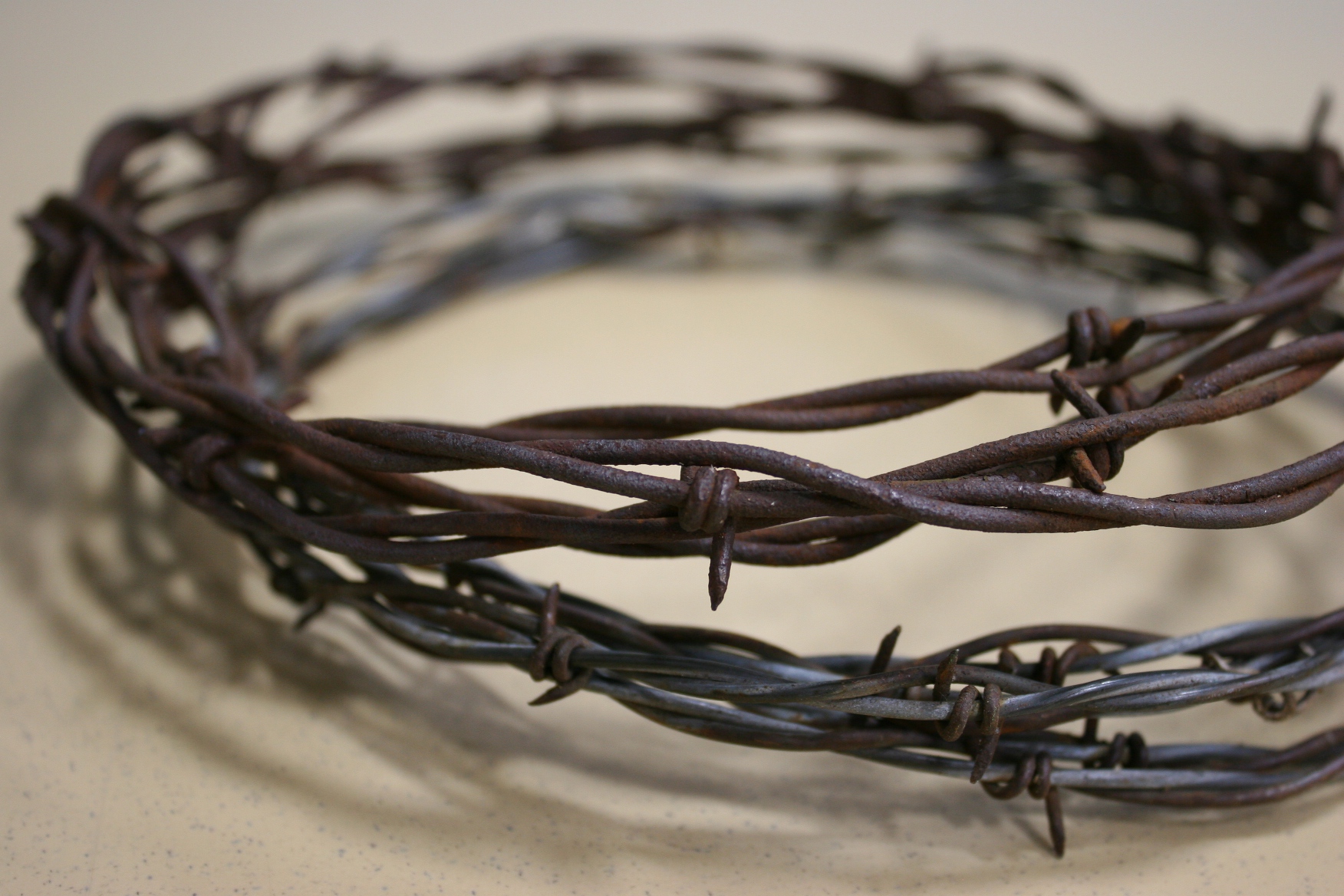
A crown of thorns (similar to that worn by Jesus on the cross) used in a Stations of the Cross event at my church in 2019. (Minnesota Prairie Roots copyrighted file photo April 2019)
ON THIS GOOD FRIDAY, the day Christ was crucified, I contemplated what I would write. I had two topics in mind—suffering and compassion. Then I realized I needn’t choose one. I could focus on both.
Christ died a cruel and agonizing death. There is no denying that. Yet, even in his betrayal, his pain, his intense suffering, he showed compassion to the end. And beyond the end. We can learn a lot from Jesus.
We all experience suffering in life. That’s a given in our humanity. Right now I have friends going through some really rough stuff within their immediate and extended families. A one-year-old on life support. A nephew dead in a tragic car accident. Another battling advanced cancer. Ongoing and new health issues. It can feel like a lot. And to think otherwise would be to deny the challenges facing people about whom I care deeply. There are days when I feel overwhelmed by all the suffering in this world and beyond. Enough already, I want to scream.
Reaching out with care and compassion. (Minnesota Prairie Roots copyrighted file photo)
But then I recognize that I can either be dragged down by it or I can do as Christ did—show compassion. I can be that person who listens. I can be that person who offers encouraging words. I can be that person who mails an uplifting greeting card with a personal note. I can be that person who connects and shows care in tangible ways and sets aside my anguish to focus on those at the center of challenges.
This is not the time to pull out my own stories and compare, thus putting the focus on me. This is not the time for me to tell anyone how to think, feel or act. This is not the time to offer advice. This is the time to simply be there. To listen. To hug. To pray, but to take my compassion beyond thoughts and prayers.
We can all work on improving our listening skills. Not just hear, but listen. (Minnesota Prairie Roots copyrighted file photo)
I am a major advocate of listening. It is one of the greatest gifts anyone can give to someone who is grieving, in crisis, in the throes of health or other challenges. Listening doesn’t seem to come easily for most people. It takes a conscious, focused effort. But at its core, listening is easy. It requires keeping one’s mouth closed, for starters. And then it necessitates concentrating, taking in every word, every nuance, body language and detail.
By nature, I am a quiet observer. I don’t need to be, want to be, the loudest person in the room pushing my ideas or opinions or recommendations. I know too many individuals who fit that self-centered persona. They exhaust me and, yes, sometimes even anger me. Quiet compassion and listening center me.
An important message painted onto a fence in a downtown Faribault pocket garden. (Minnesota Prairie Roots copyrighted file photo)
Today, as I reflect on the life and death of Christ, I see someone who showed great compassion throughout his time on earth. He witnessed and understood suffering. He experienced emotions. He felt pain. Yes, I can learn a lot from Jesus. About loving. About listening. About showing compassion, even in suffering.
TELL ME: How do you show compassion to those who are facing challenges?
CHRISTIAN FAITH COMMUNITIES have long integrated art into their houses of worship. Whether in stained glass windows, sculptures, paintings or other art forms, this art is an important way to visually connect worshipers with Scripture, with foundational teachings.
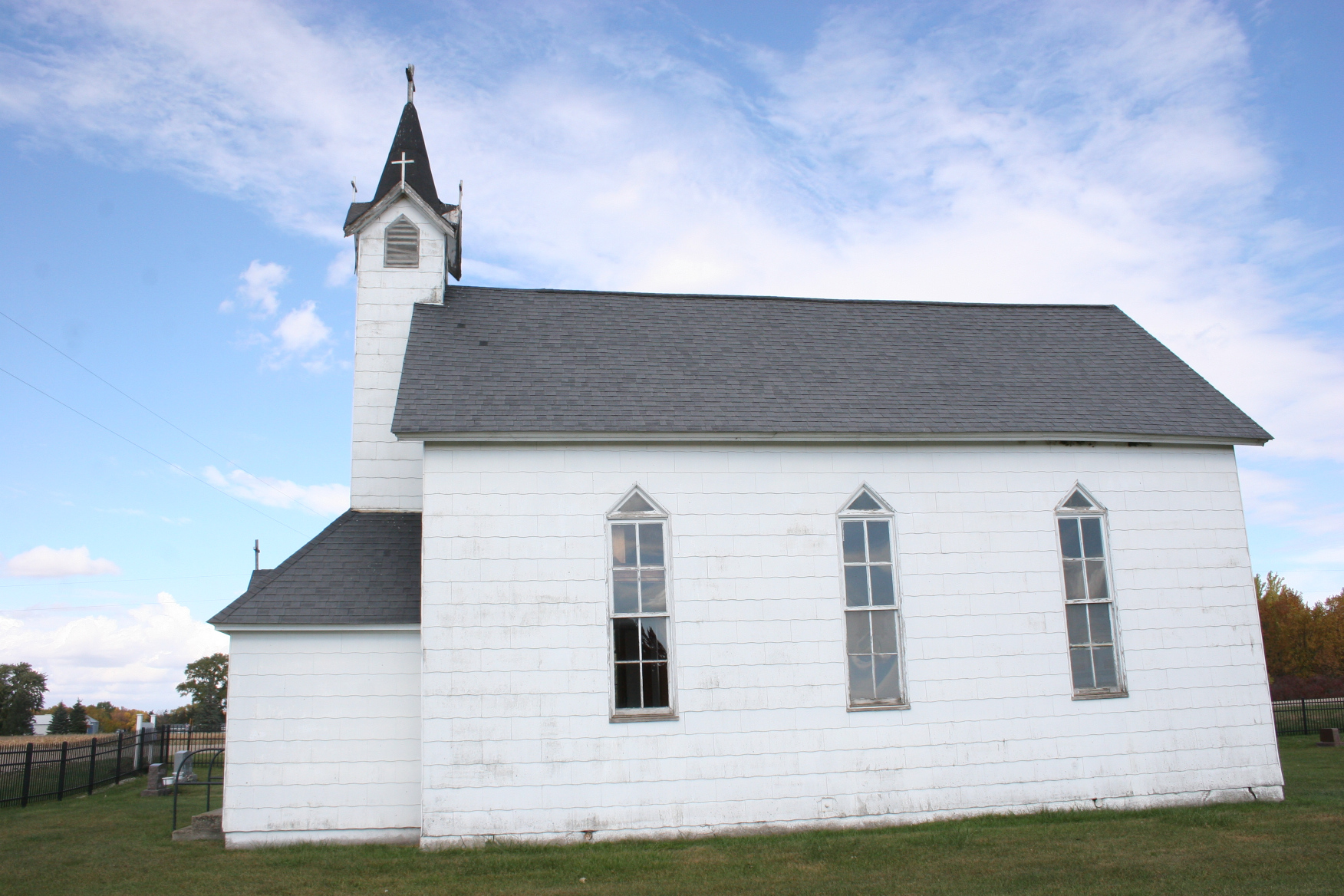
The historic Immaculate Conception of the Virgin Mary Church in Shieldsville Township, rural Rice County, sits isolated along a gravel road, edged by the Trebon Cemetery. The Czech church closed long ago and is locked. But I’ve wandered the cemetery grounds and found unusual art. (Minnesota Prairie Roots copyrighted file photo October 2022)
This week, Holy Week, I consider the art of churches I’ve visited in my area of southern Minnesota. Aged sanctuaries graced with connective and inspiring art. I never tire of stepping inside a rural church or meandering through a country cemetery to view faith-focused art. It’s beautiful in its own way, often in the visual storytelling of events documented in the Bible.
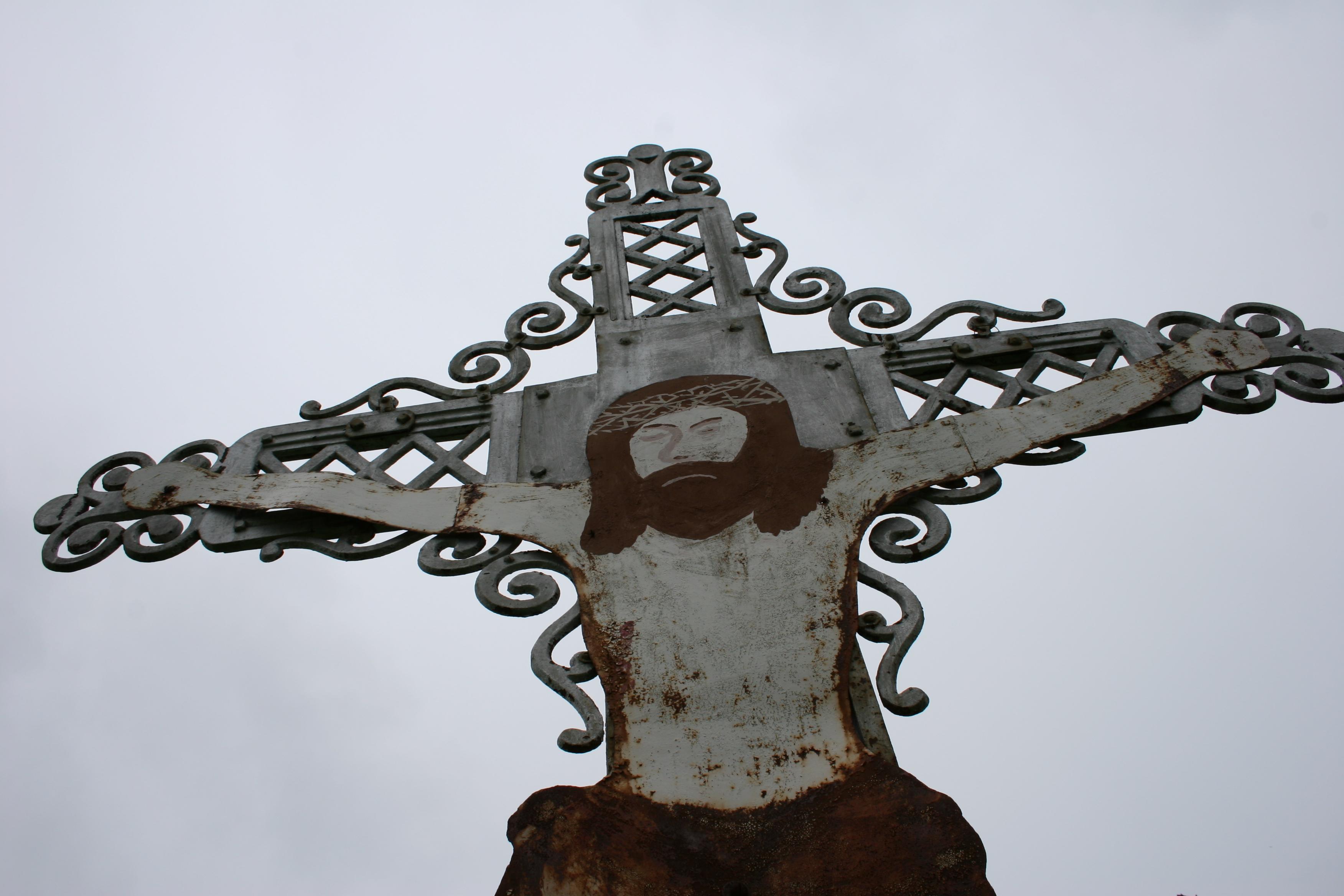
Folk art in the Trebon Cemetery honors the crucified Christ and the deceased. (Minnesota Prairie Roots copyrighted file photo April 2014)
As a woman of faith, the days leading up to Jesus’ crucifixion and subsequent resurrection on Easter morning make this week particularly meaningful.
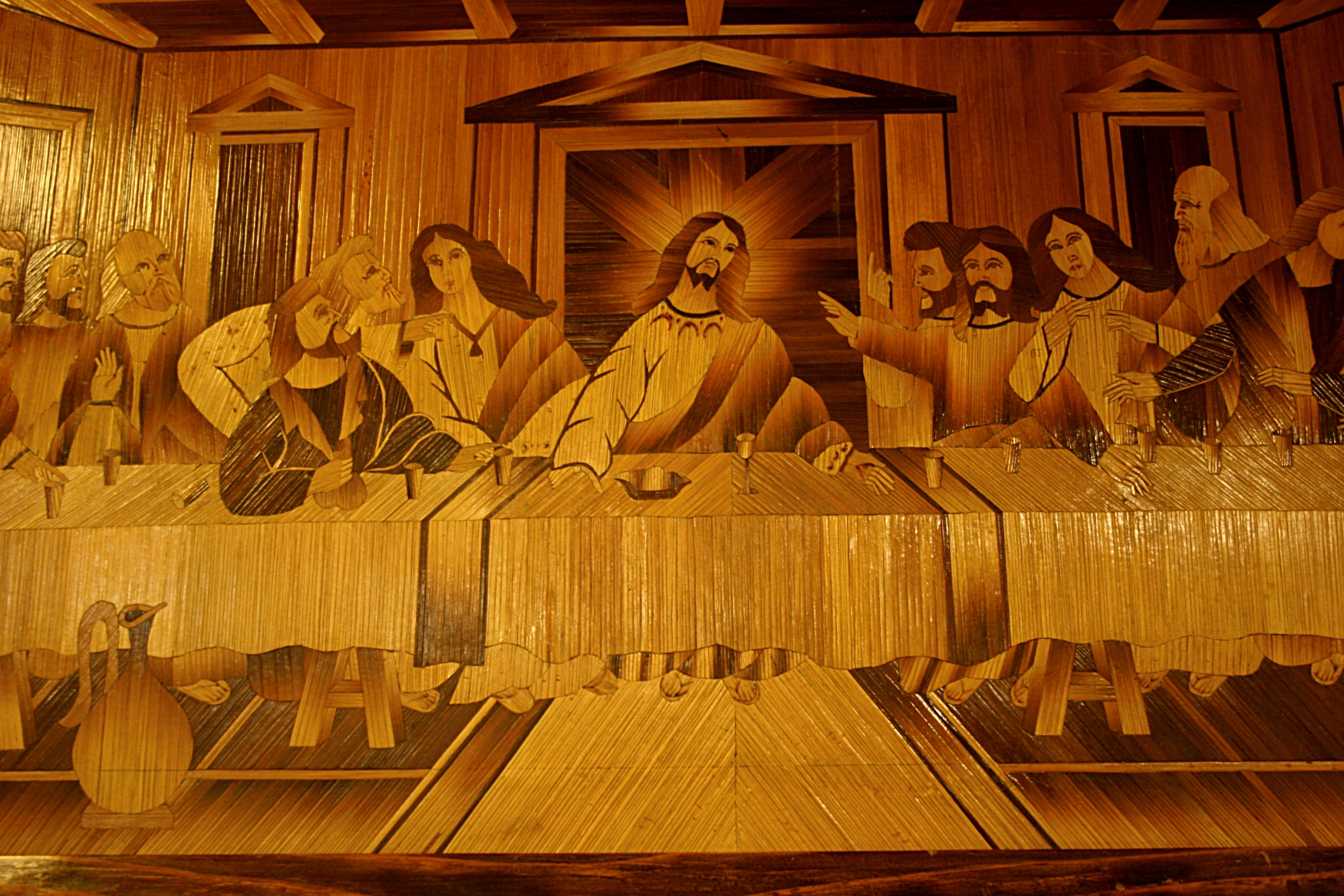
This artistic rendition of The Last Supper hangs in the St. John’s United Church of Christ, Wheeling Township, rural Faribault, Fellowship Hall. (Minnesota Prairie Roots copyrighted file photo April 2012)
From Jesus praying in the Garden of Gethsemane to The Last Supper to his betrayal by Judas and then his crucifixion and resurrection, the events of Christ’s final days unfold in art inside sanctuaries and on cemetery grounds.
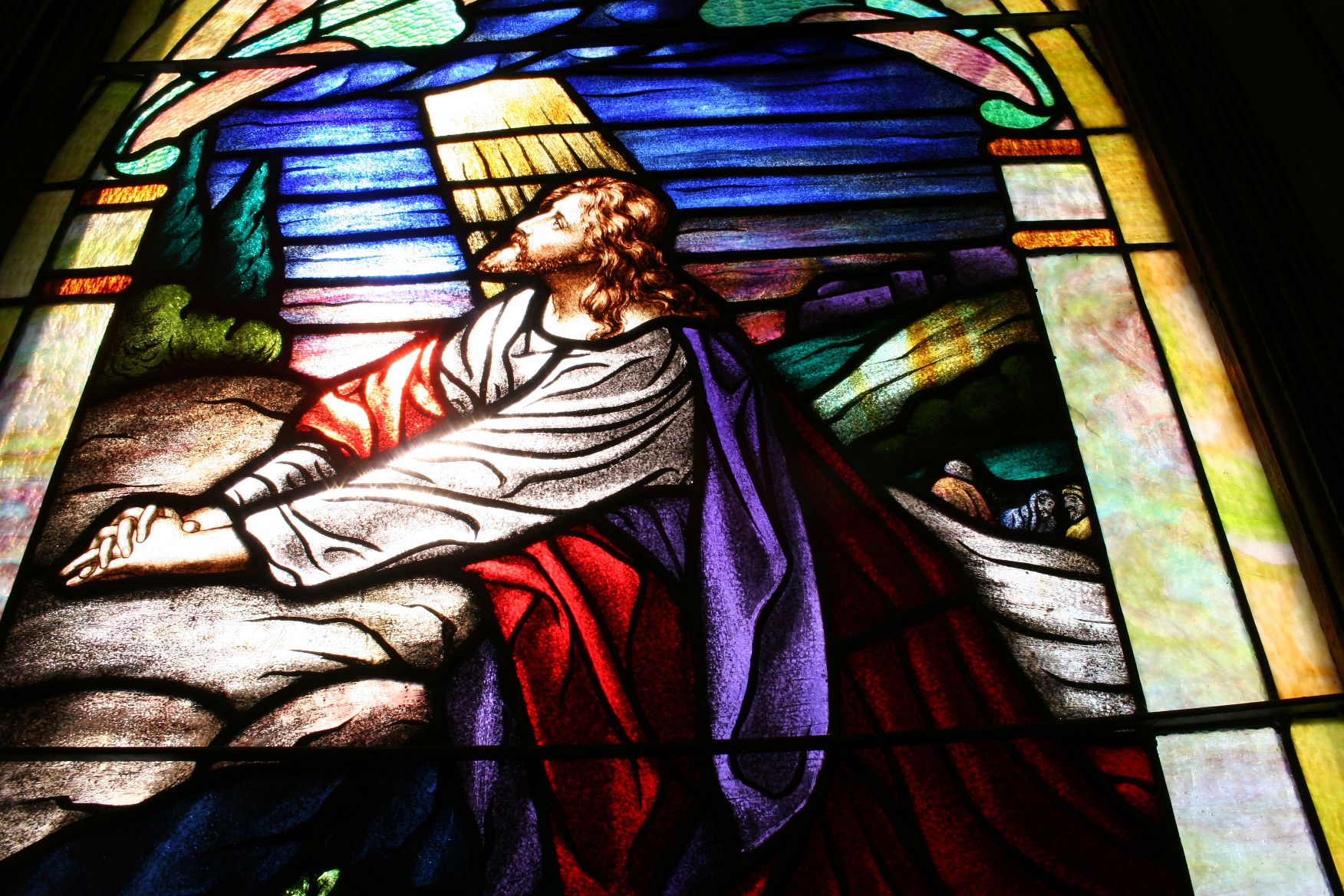
Inside Vang Lutheran Church, rural Dennison, a stained glass window shows Christ praying in the Garden of Gethsemane. (Minnesota Prairie Roots copyrighted file photo 2014)
I feel a certain reverence for the artists who designed and crafted stained glass windows that rise high inside sanctuaries, sunlight streaming through colorful glass. It’s almost as if the beauty therein beams directly from heaven, filling dark souls with light.
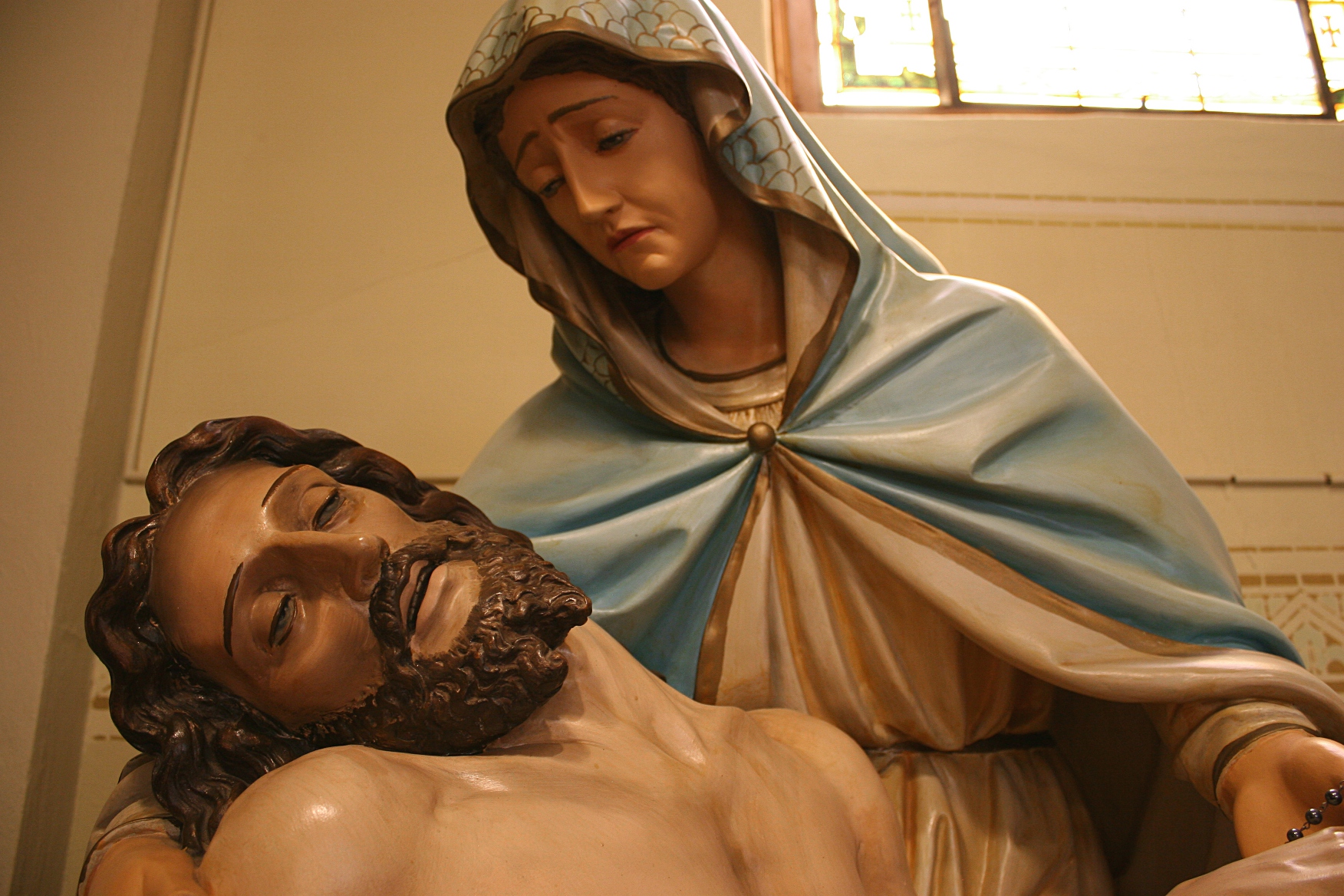
In the face of Mary, I see profound grief in losing her son. This statue is inside St. Mary’s Catholic Church, New Trier. (Minnesota Prairie Roots copyrighted file photo)
Likewise, statues, most often found in Catholic churches, add a down-to-earth human element in their life-sized presence. I have the urge to reach out, to touch a hand or a face, to offer comfort, to extend compassion. Art, especially faith-based art, holds that power.
Centering the altar is this depiction of Jesus’ crucifixion inside St. Mary’s Catholic Church, New Trier. (Minnesota Prairie Roots copyrighted file photo)
Whether centering an altar or hanging on a church fellowship hall wall, biblically-based artwork is an important part of Christianity. I appreciate the ornate and the simplistic. The oversized and the understated. The all of it, uplifting, inspiring, moving me.
This shows the resurrected Christ in a snippet of the center stained glass window in a trio above the altar at Trinity Lutheran Church, Wanamingo.(Minnesota Prairie Roots copyrighted file photo March 2016)
During this Holy Week, I reflect on the art gracing churches throughout my region. Art that truly is a spiritual treasure. Art that carries a heritage of faith.
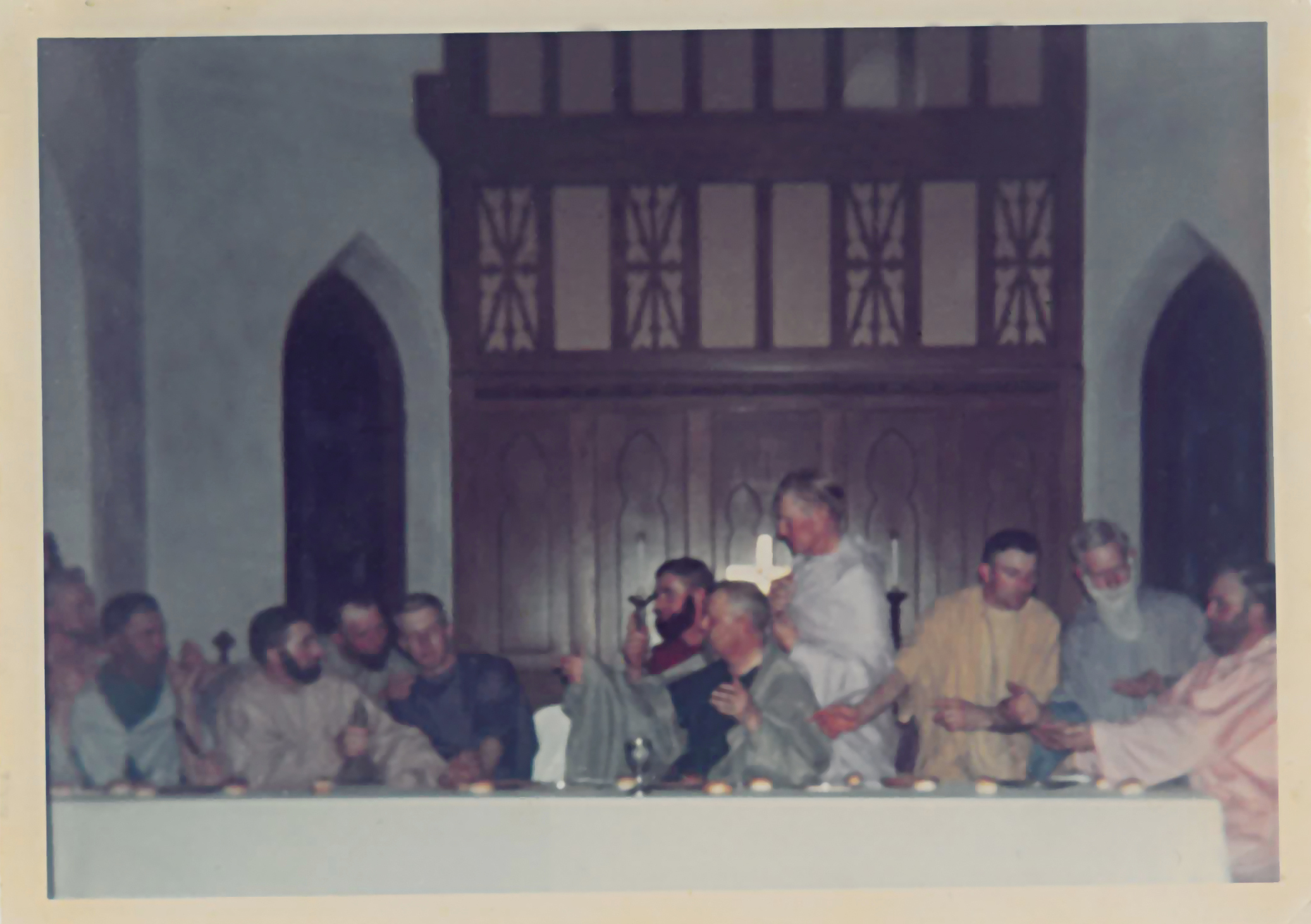
St. John’s members portray the disciples in this undated vintage photo, the first record of a photograph from “The Last Supper Drama.” Actors, from left to right, are Luverne Hafemeyer, Earl Meese, Victor Luedke, Howard Meese, Virgil Bosshart, Arnold Keller, P.L. Golden, Alvin Bosshart, Paul Bauer, Elmer Covert Sr. and Arnold Bauer. (Photo courtesy of St. John’s)
FROM MILAN TO MINNESOTA, Leonardo da Vinci’s “The Last Supper” painting continues to leave its imprint. For more than 500 years, this rendition of Jesus’ final meal with his 12 disciples has held a sacred place among those of the Christian faith, including me.
The parking lot at St. John’s United Church of Christ, Wheeling Township, is nearly full 20 minutes before the congregation’s annual performance of “The Last Supper Drama.” (Minnesota Prairie Roots copyrighted filephoto April 2011)
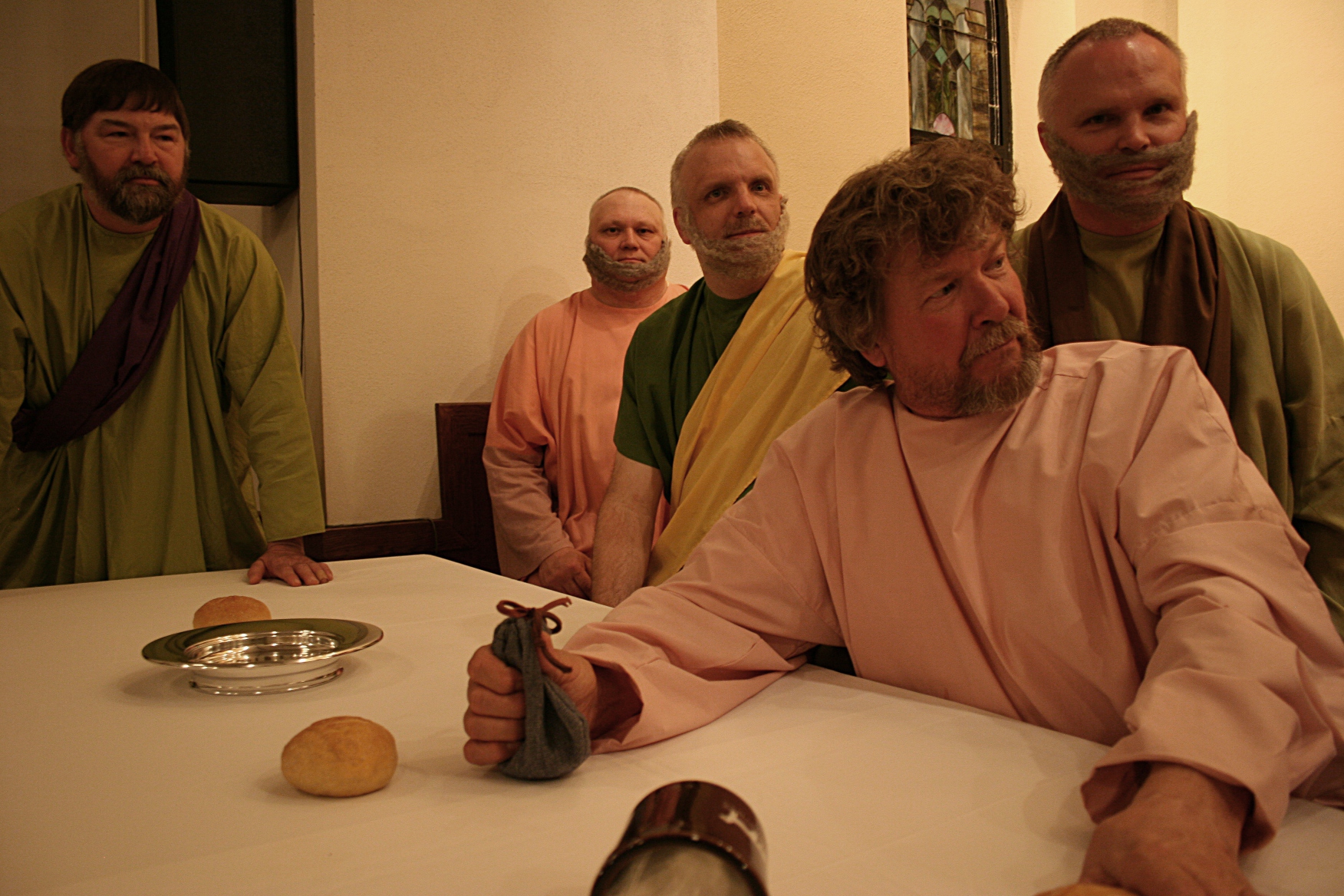
Judas grips the bag of silver, his reward for betraying Christ. (Minnesota Prairie Roots copyrighted file photo April 2012)
I’ve attended this long-running monologue of each disciple and their relationship with Christ many times. Although the script and music remain the same, the actors change from year to year. Yet, there’s a consistency in that, too, with many of the men switching parts, perhaps taking a year off. I recognize actors’ surnames like Bauer, Keller, Little, Meyer, Wiegrefe and another Keller (Craig) always at the organ.
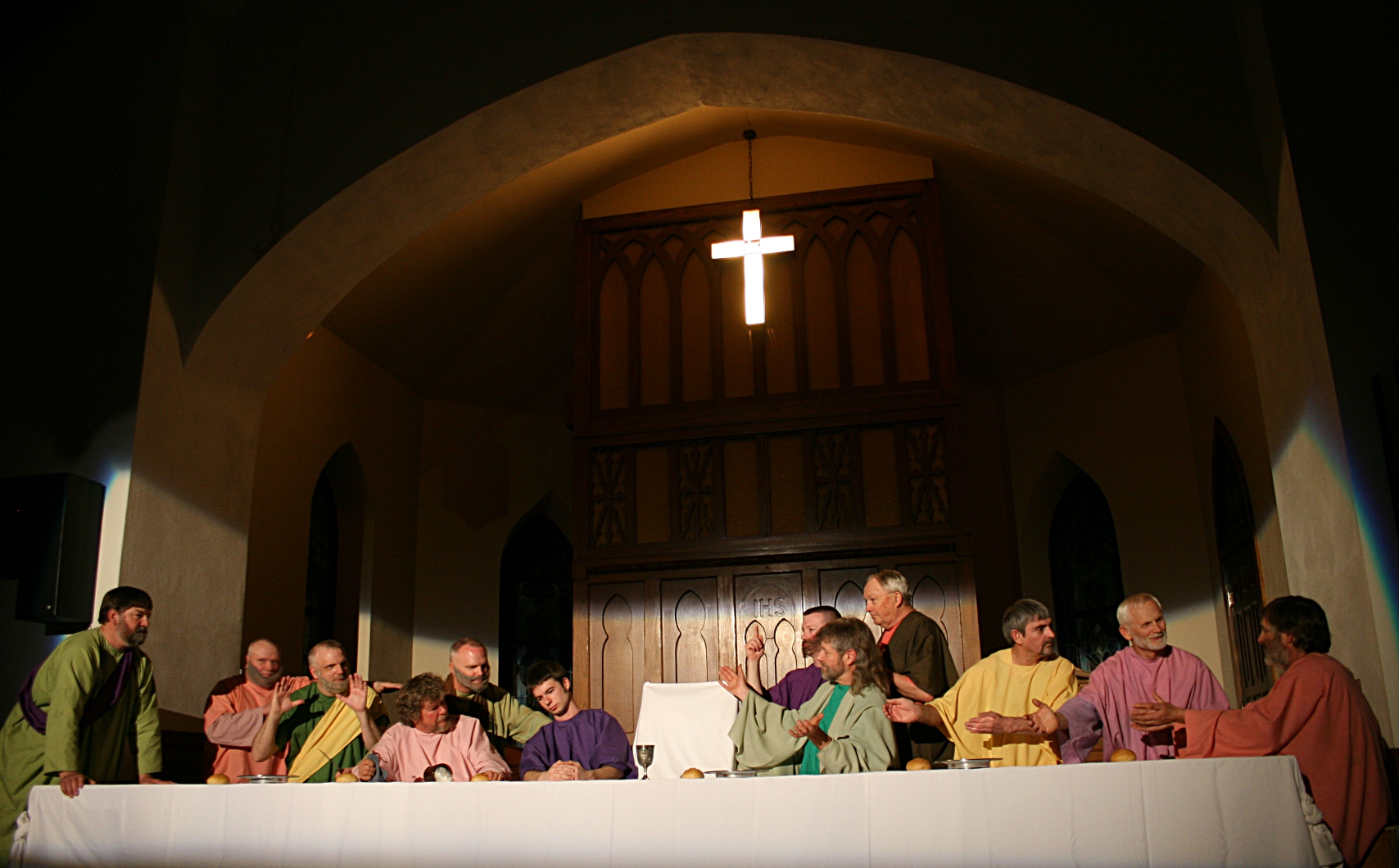
St. John’s 50th presentation of “The Last Supper Drama.” (Minnesota Prairie Roots copyrighted file photo April 2012)
There’s a sameness to St. John’s presentation of “The Last Supper.” And that is comforting. The darkening of this 1800s limestone church. The mood-setting music. The disciples processing in to sit at a long table set before the altar. The statue-like poses. The spotlight focus on each disciple. The bold, sometimes heart-wrenching, monologues. The emotion. The pain. Then the spotlight shifting to the empty chair representing Christ.
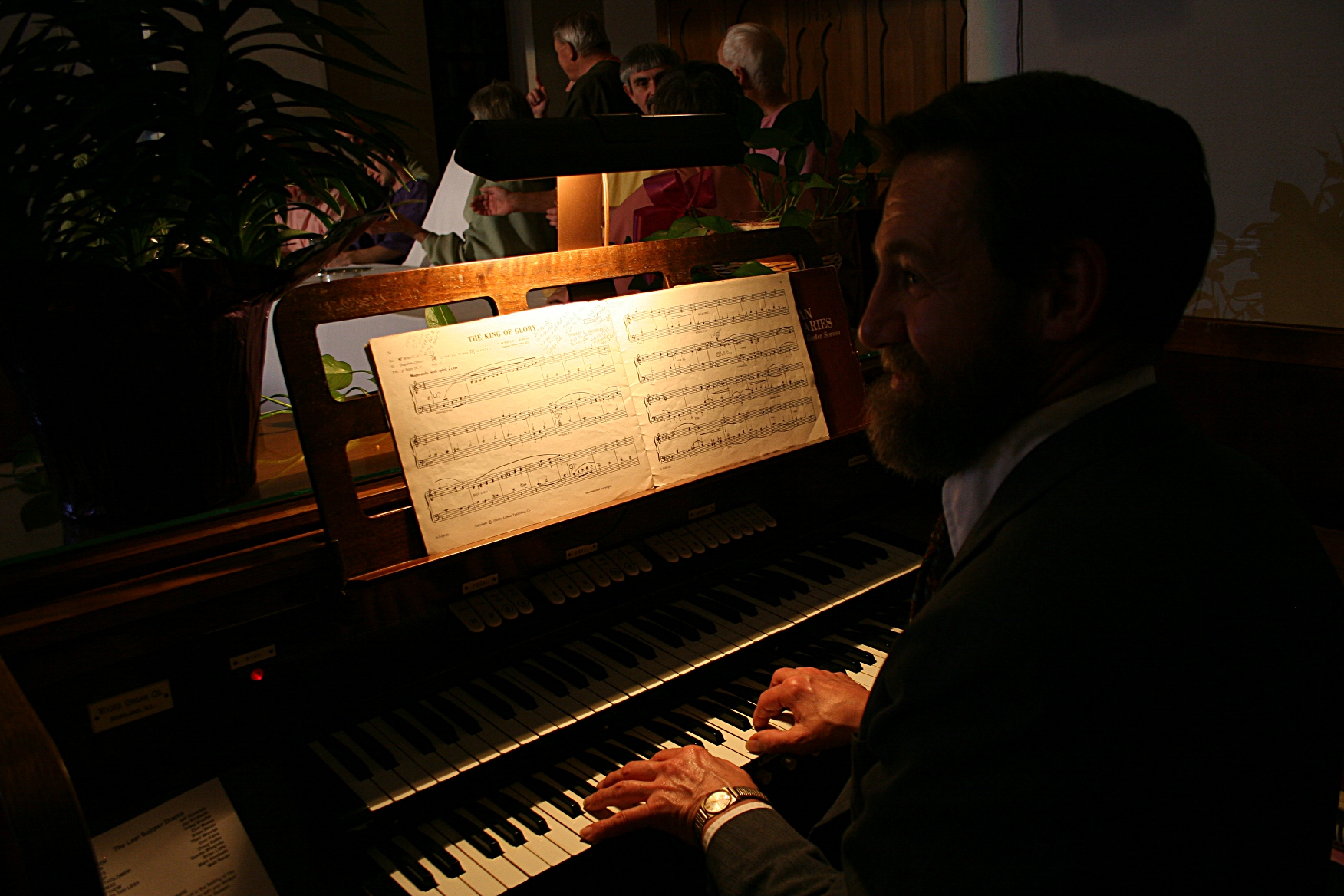
Craig Keller has been the long-time drama organist, playing the same music every year. The script and music remain unchanged. (Minnesota Prairie Roots copyrighted file photo April 2012)
Even after seeing this drama many times, I pick up something I haven’t in prior viewings. I always exit the sanctuary feeling reflective, emotional, even a bit sad. The tone is set for the beginning of Holy Week, transitioning to Jesus’ crucifixion and then, on Easter, his joyful resurrection.
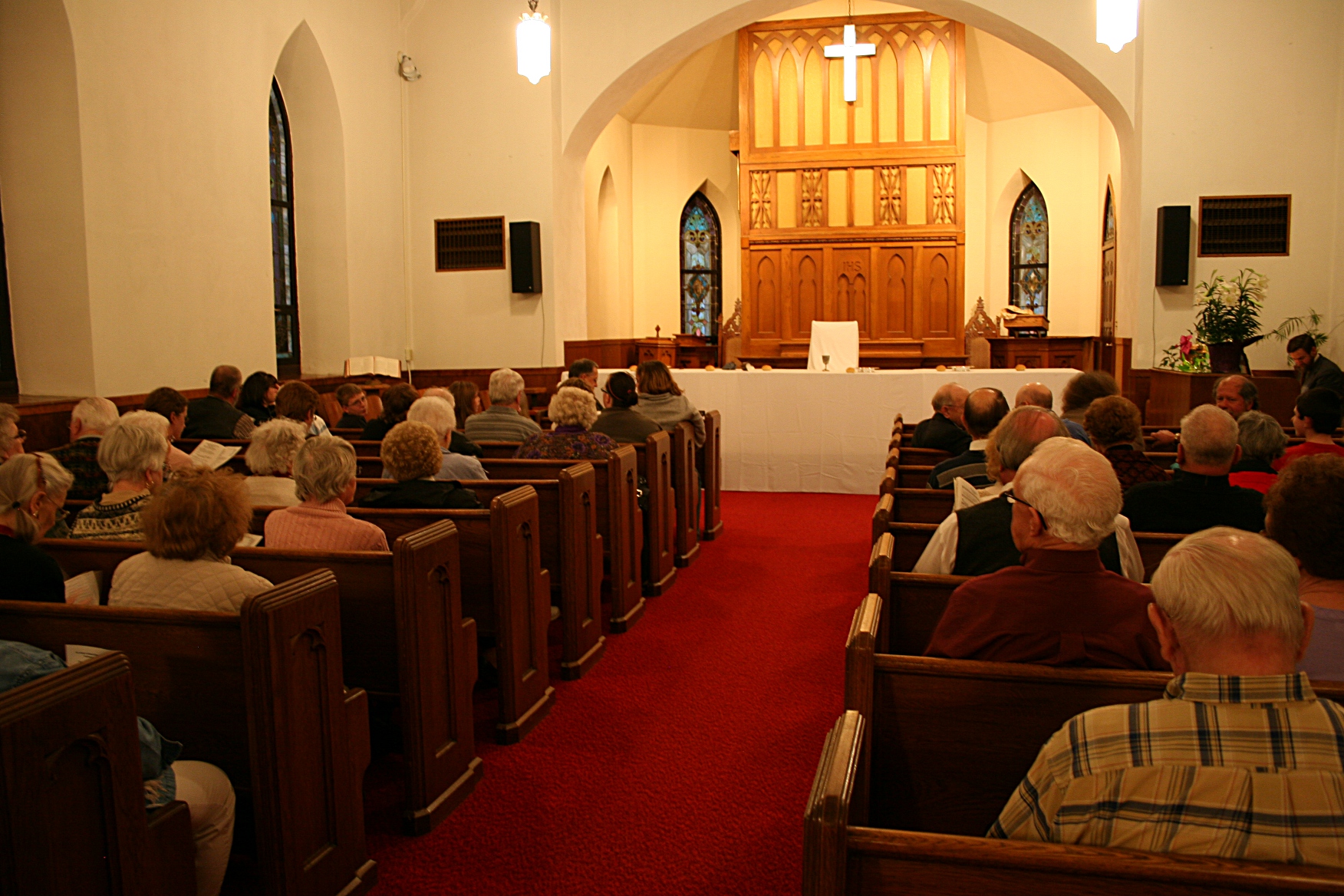
The sanctuary fills prior to the drama in 2012. (Minnesota Prairie Roots copyrighted file photo April 2012)
This tradition at St. John’s is part of this congregation’s history. Part of their faith heritage. And a gift to the greater community. To settle into a pew in this country church and watch the drama unfold is to appreciate da Vinci’s art in a way that touches the soul.
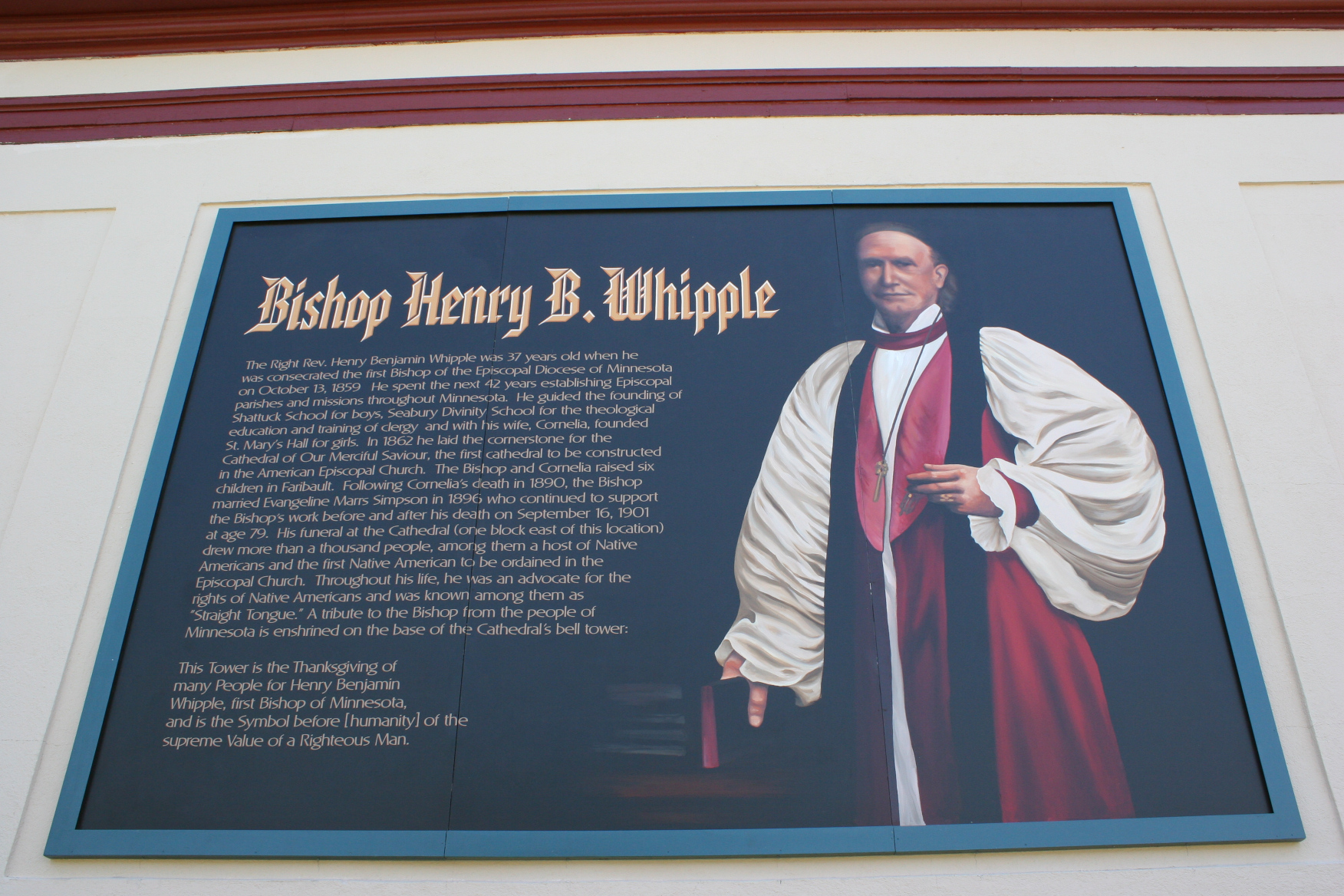
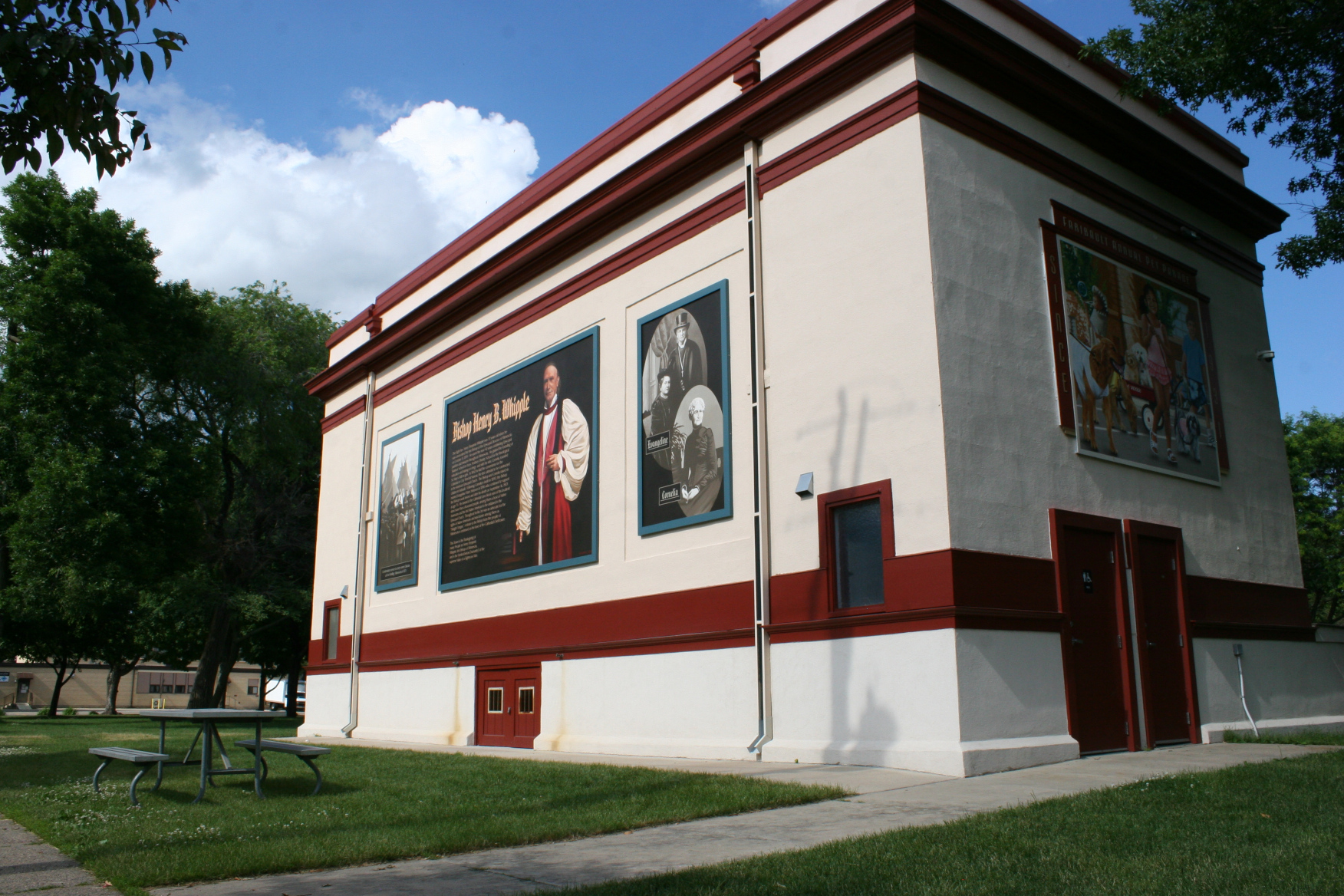
A painting of Bishop Henry Whipple and information about him grace a mural on Faribaults’ Central Park Bandshell. (Minnesota Prairie Roots copyrighted file photo June 2020)
He was known as “Straight Tongue” for his honesty. He was disparagingly called “The Sympathizer” by others for the compassion and care he held for the Dakota. He was Bishop Henry Whipple.
Thursday evening, Rice County Historical Society Executive Director David Nichols spoke to a packed room about this Episcopal priest who played such a pivotal role in Minnesota history, specifically during the time shortly before, and then after, The U.S.-Dakota War of 1862. For me, personally, Nichols’ focused talk connected my home region of Redwood County, the area in which the war centered, to my home of 40 years, Rice County.
I grew up with a limited (white) perspective of the war with no knowledge of Whipple. I only learned of this New York born clergyman upon my move to Faribault in 1982. Nichols broadened my understanding during his presentation and during a question and answer session that followed.
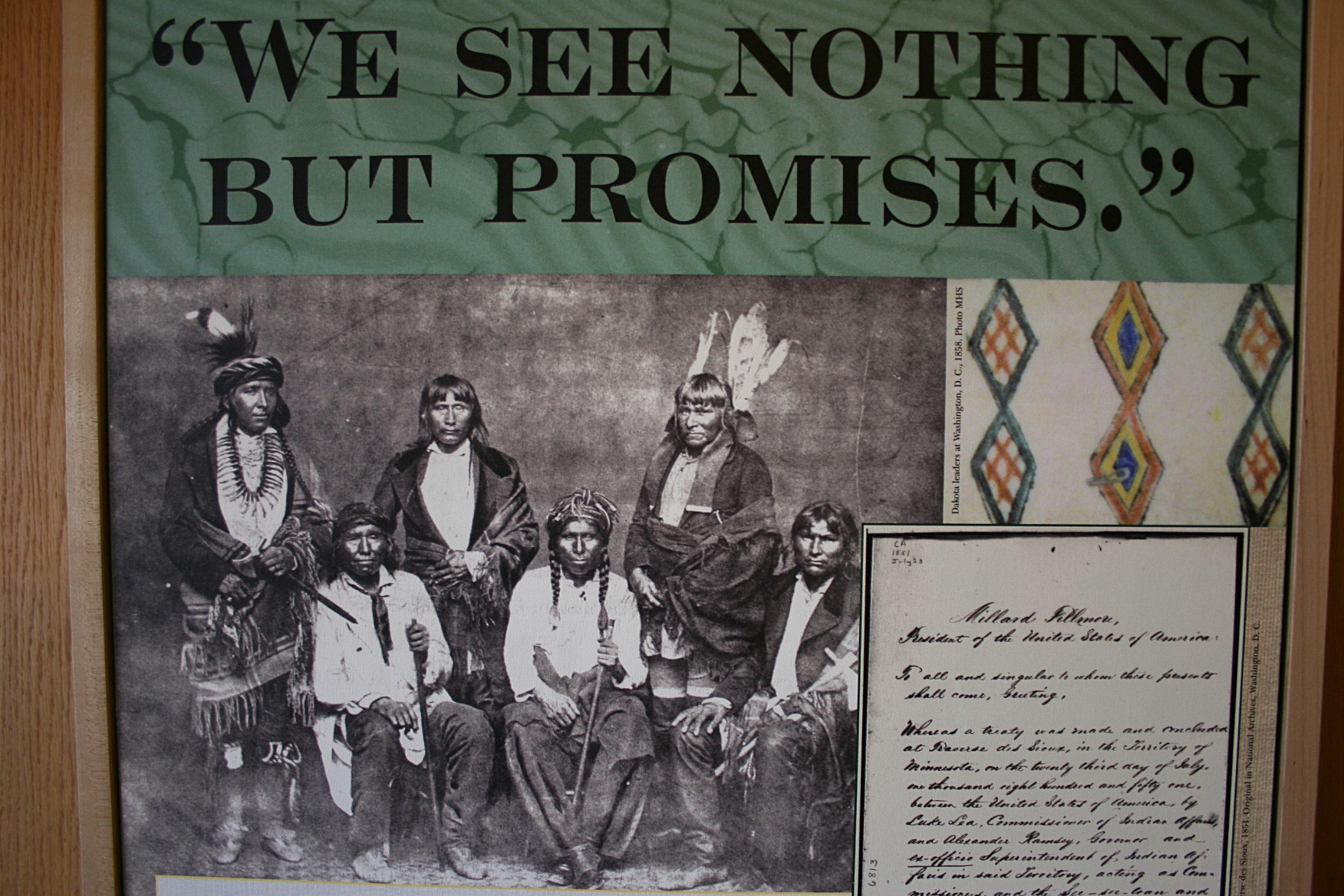
A panel at the Traverse des Sioux Treaty Center in St. Peter shows Dakota leaders photographed in Washington D.C. in 1858. The photo is from the Minnesota Historical Society. It references broken treaty promises and rising tension. (Minnesota Prairie Roots copyrighted file photo)
HIGH TENSIONS
Whipple arrived here in 1860 as the newly-elected Bishop of Minnesota, settling in Faribault. Already at that time, tensions were mounting among settlers and the first peoples of Minnesota, Nichols said. Tensions also existed between the “Farmer Indians” (those who adapted to Euro culture) and “Blanket Indians” (who maintained their Native culture, traditions and lifestyle). Conditions on reservations were terrible with disease, starvation, and dishonest agents failing to provide promised government annuities.
That is the situation Whipple found when he landed in Minnesota. It was a time, noted Nichols, of “tensions about to boil over.” And eventually they did with the outbreak of war in August 1862. It was a decidedly bloody and awful war, as all wars are. Some 600-800 died and the Dakota were eventually displaced from their land.
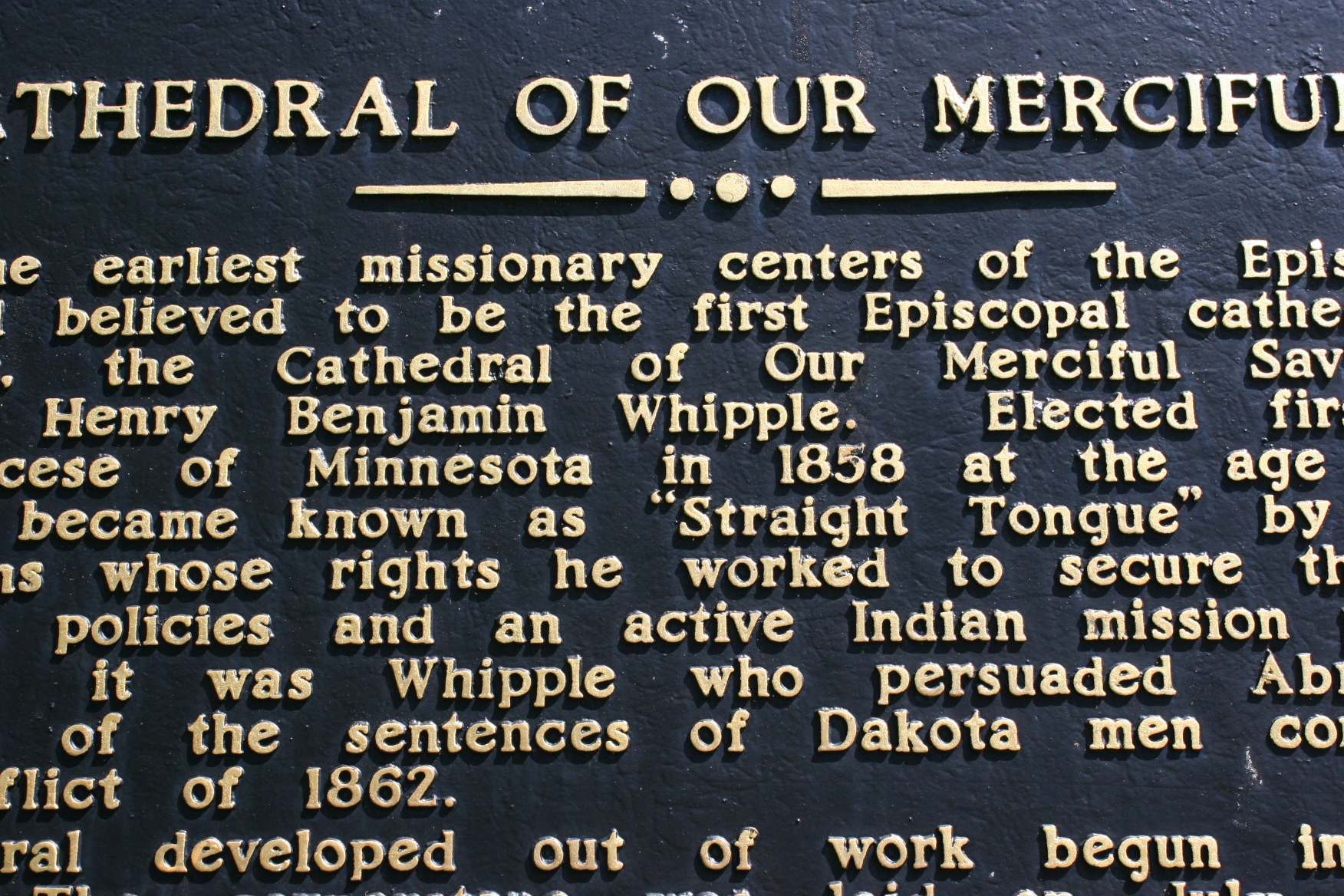
Details on a sign outside The Cathedral of Our Merciful Saviour, Whipple’s church in Faribault. (Minnesota Prairie Roots copyrighted file photo 2020)
THE SHAPING OF A HUMANITARIAN
To understand Whipple’s position and part in this, Nichols provided background. Whipple was involved in New York politics as a “conservative Democrat,” a term which drew laughter from the crowd at Thursday’s presentation. He briefly attended Oberlin College, notable because the college was among the earliest to admit women and African Americans. And Whipple was ordained in 1849, during the so-called “Second Great Awakening” with a focus on civil rights.
Learning this helped me better understand the bishop. All of these experiences shaped a man who spoke with honesty and compassion, advocated for Minnesota’s Indigenous Peoples (both the Dakota and the Ojibwe, natural enemies), called for reform and peace and understanding. Whipple was, said Nichols, a voice for calm, calling for justice, not vengeance, when the short-lived U.S.-Dakota War ended.
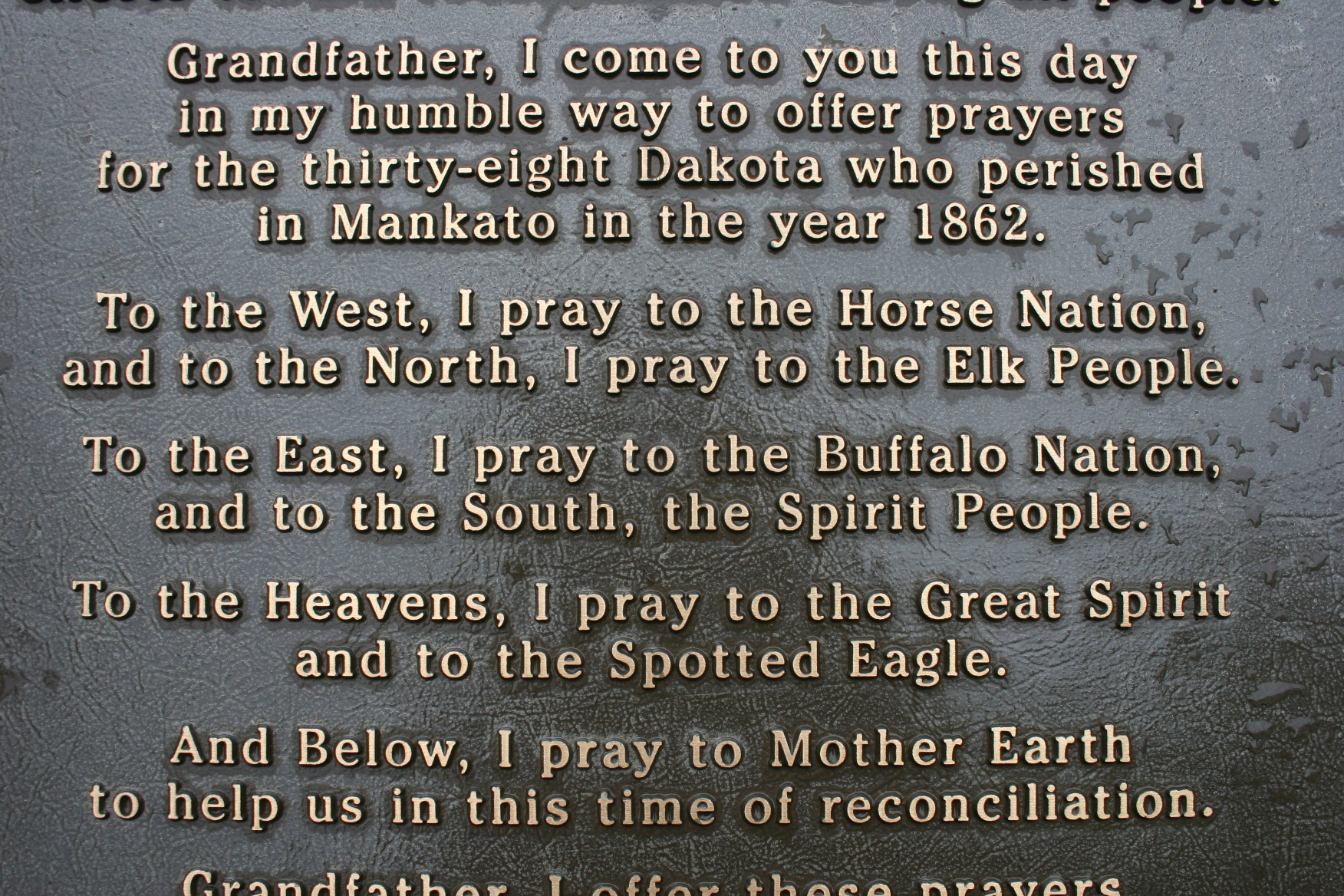
Words on a marker in Reconciliation Park in Mankato where 38 Dakota + 2 were hung on Dec. 26, 1862. (Minnesota Prairie Roots copyrighted file photo May 2012)
ADVOCATING FOR PARDONS
In his many years of missionary work and advocacy, even when his life was threatened by those who viewed him as an “Indian sympathizer,” one singular moment stands out to me. And that is Whipple’s efforts to save the lives of 303 Dakota men sentenced to death after the war. He met with President Abraham Lincoln and was “partly responsible,” Nichols said, for Lincoln’s eventual pardon of all but 38 Dakota. The 38, plus two others, were hung in a public mass execution in Mankato on December 26, 1862. It is a terrible and profoundly awful moment in Minnesota history, especially the history of the Dakota.
A full view of the bandshell mural featuring Bishop Whipple and his first wife, Cornelia, and his second wife, Evangeline. (Minnesota Prairie Roots copyrighted file photo)
ASSIMILATION
While listening to Nichols’ presentation on Whipple, I felt conflicted. Conflicted because the bishop was, he said, “a strong assimilationist.” That label bothered me until I talked further with Nichols. He explained that Whipple did not view himself and Europeans as superior to Native Peoples, but rather observed, in the context of place and time and thinking, the need to adapt versus being driven out. That helped me better understand Whipple’s approach. I recognize, though, and acknowledge the current-day struggles with assimilation, especially as it relates to Indian boarding schools. I appreciate the recognition of, and return to, culture, tradition and heritage today.
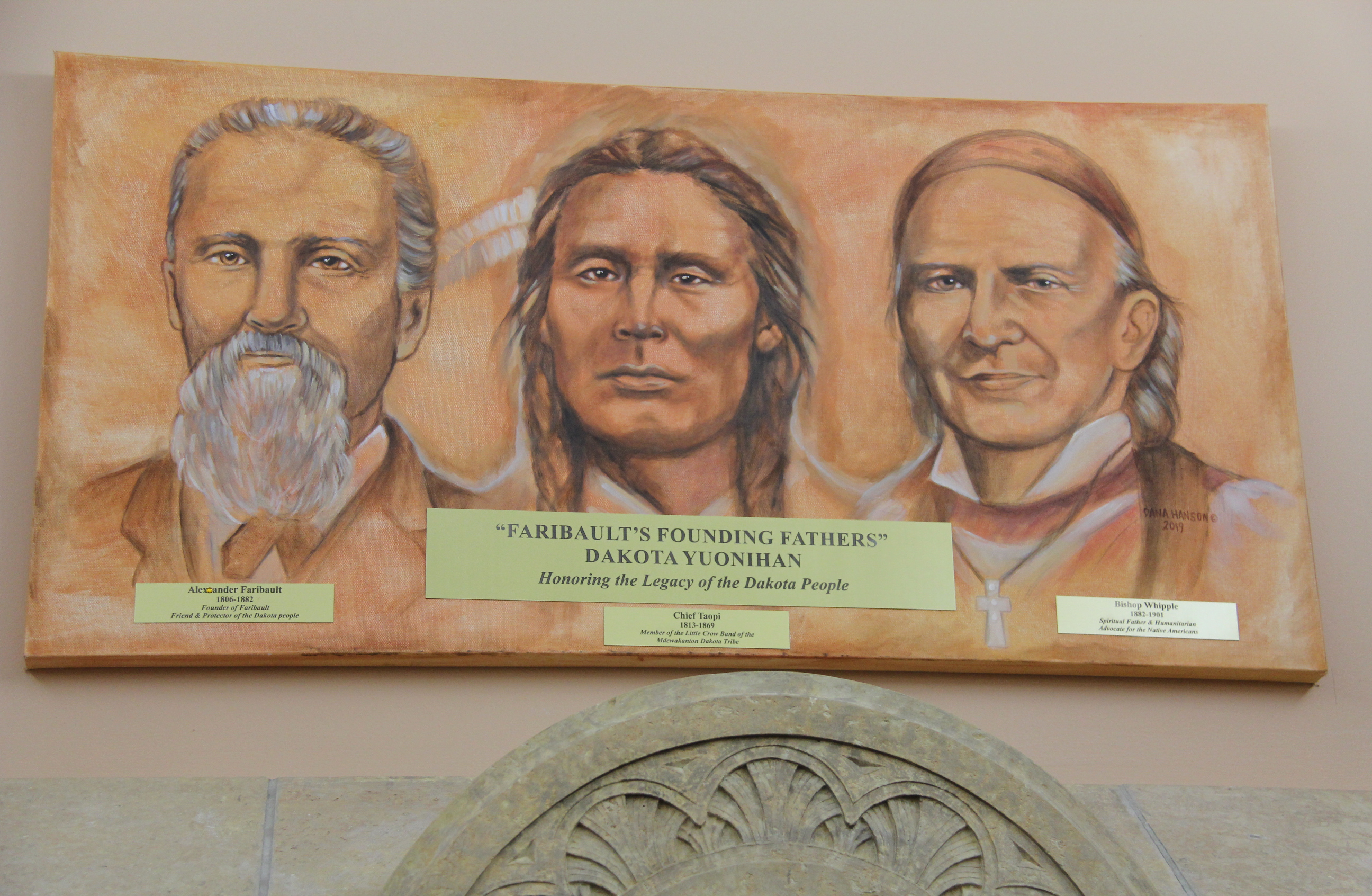
“Faribault’s Founding Fathers,” portraits of Alexander Faribault, left to right, Chief Taopi and Bishop Henry Whipple, by Dana Hanson hangs in Faribault’s Buckham Memorial Library. (Minnesota Prairie Roots copyrighted file photo November 2022)
WELCOMING THE DAKOTA TO FARIBAULT, OR NOT
Whipple, by his words and actions, embraced the Dakota and Ojibwe who called Minnesota home long before white settlers arrived, long before he moved to Faribault. My community, founded by fur trader Alexander Faribault, himself half Dakota, was a safe haven for the Dakota (“you don’t attack family”) during the 1862 war and thereafter, Nichols said. Faribault and Whipple worked together to move 180 Dakota from St. Paul’s Fort Snelling, where they were held following the war, to live on land Alexander owned along the Straight River in Faribault.
I wondered, “Were they welcomed here?” The answer, given by former RCHS Executive Director Susan Garwood, was as I expected. Mixed. While some supported the Dakota’s presence in Faribault, others were vocal in their opposition. In that moment, I thought of our ever-growing immigrant population in my community. Many welcome our newest neighbors and, like Alexander Faribault and Bishop Henry Whipple, support and encourage them. But many also want them gone. History repeats.
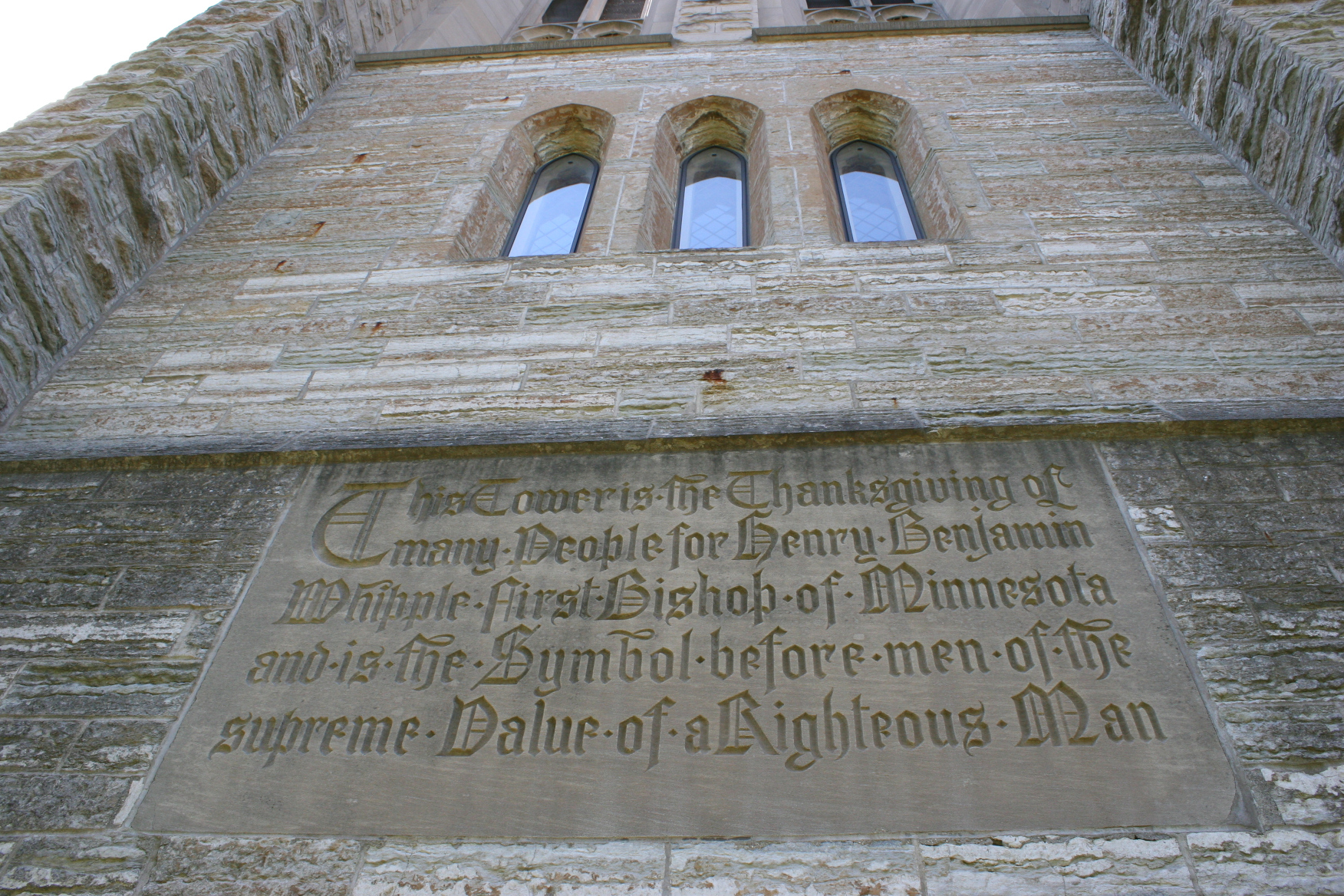
An inscription honors Whipple on the Cathedral bell tower. (Minnesota Prairie Roots copyrighted file photo June 2020)
MARKING HISTORY
Walk around Faribault today and you will see many reminders of the work Whipple did not only locally, but across Minnesota. Historical markers and inscriptions about the bishop grace The Cathedral of Our Merciful Saviour, his faith base. He’s buried under the altar there. Across the street at Central Park, Whipple-themed murals cover the west side of the historic bandshell. Downtown, one of many history-focused benches honors Whipple. And across town, at the Chapel of the Good Shepherd on the campus of Shattuck-St. Mary’s School, a marker notes his role in founding Shattuck and other schools in Faribault.
Efforts are underway now locally to recognize the Dakota as well, to publicly mark their place in the history of Faribault. I’d like to think Bishop Henry Whipple, also known as “Straight Tongue” and “The Sympathizer,” would welcome the idea, would even step up to fund raise, just as he did some 160 years ago to support the relocation of 180 Dakota from Fort Snelling to Faribault.
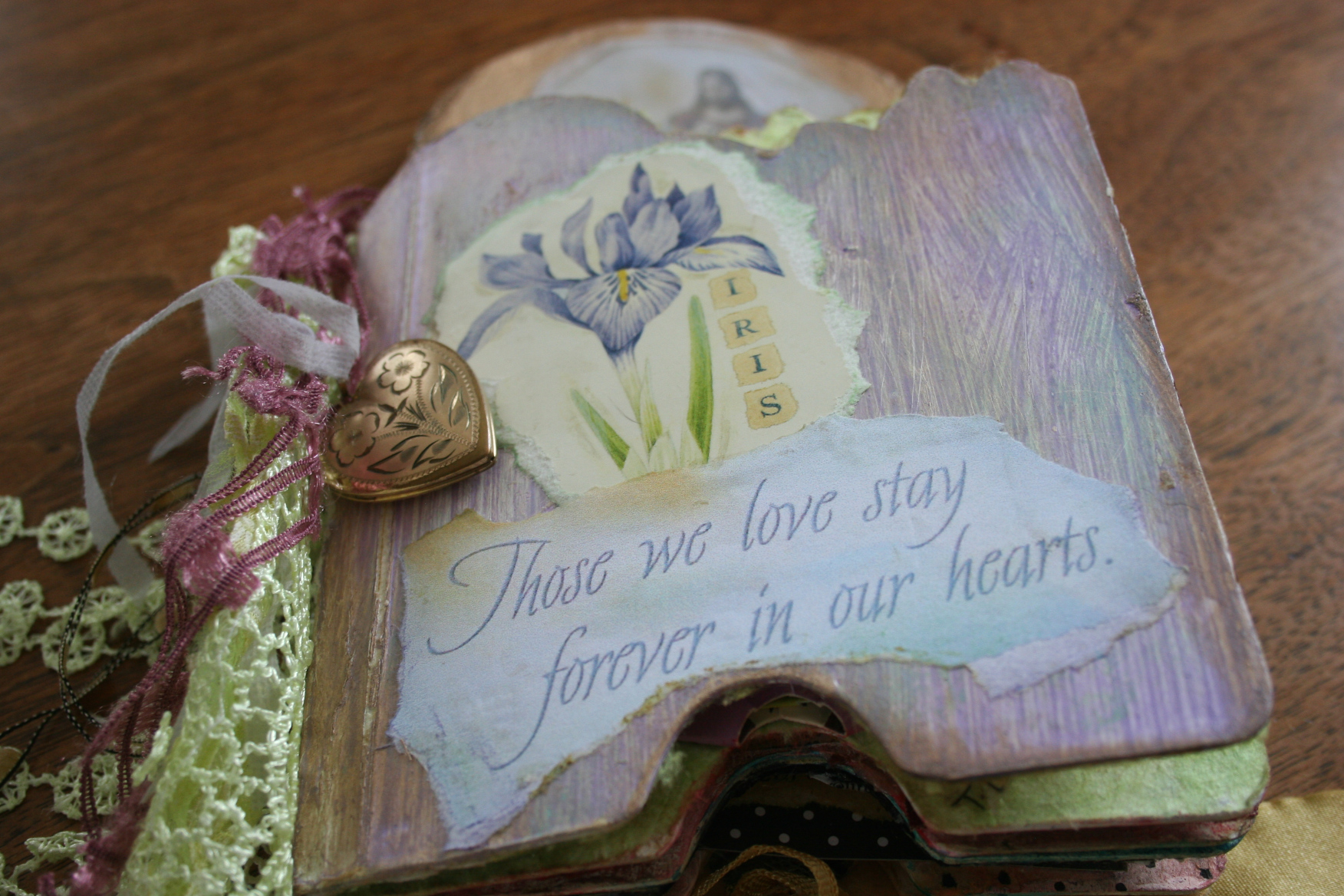
The cover of an altered book my friend Kathleen created for me following the death of my mom. (Minnesota Prairie Roots copyrighted file photo 2022)
THE CALL CAME SHORTLY after 6 pm on a Thursday evening one year ago. In that moment, when my youngest brother’s name flashed on my cellphone screen, I knew. Mom died. Not passed. Not was gone. She was dead.
The news was not unexpected. Yet it was. As much as we think we are prepared for a parent’s death in the light of long-time failing health, we are not. I was not.
One of my treasured last photos of my mom and me, taken on January 11, 2020. Because of COVID restrictions, I was unable to see Mom much during the final years of her life.(Minnesota Prairie Roots copyrighted file photo January 2020 by Randy Helbling)
A year after that January 13 call, I still have not fully-grieved. Part of that I attribute to the timing of Mom’s death during the height of omicron. For me, there was nothing normal about Mom’s big public funeral (which I did not support) during COVID. No standing in a receiving line beside my siblings. No hand shaking. No hugging. No crying beneath my N95 mask. Just tears locked inside. Feelings held inside. Emotions of feeling disappointed and disrespected in a church packed with unmasked mourners checked.
It is a struggle to let go of such hurt, such pain. But I’m trying. Mom would want me to focus not on her death, funeral and burial, but rather on her earthly life and now her glorious new life in heaven. She taught me well, leaving a strong legacy of faith.
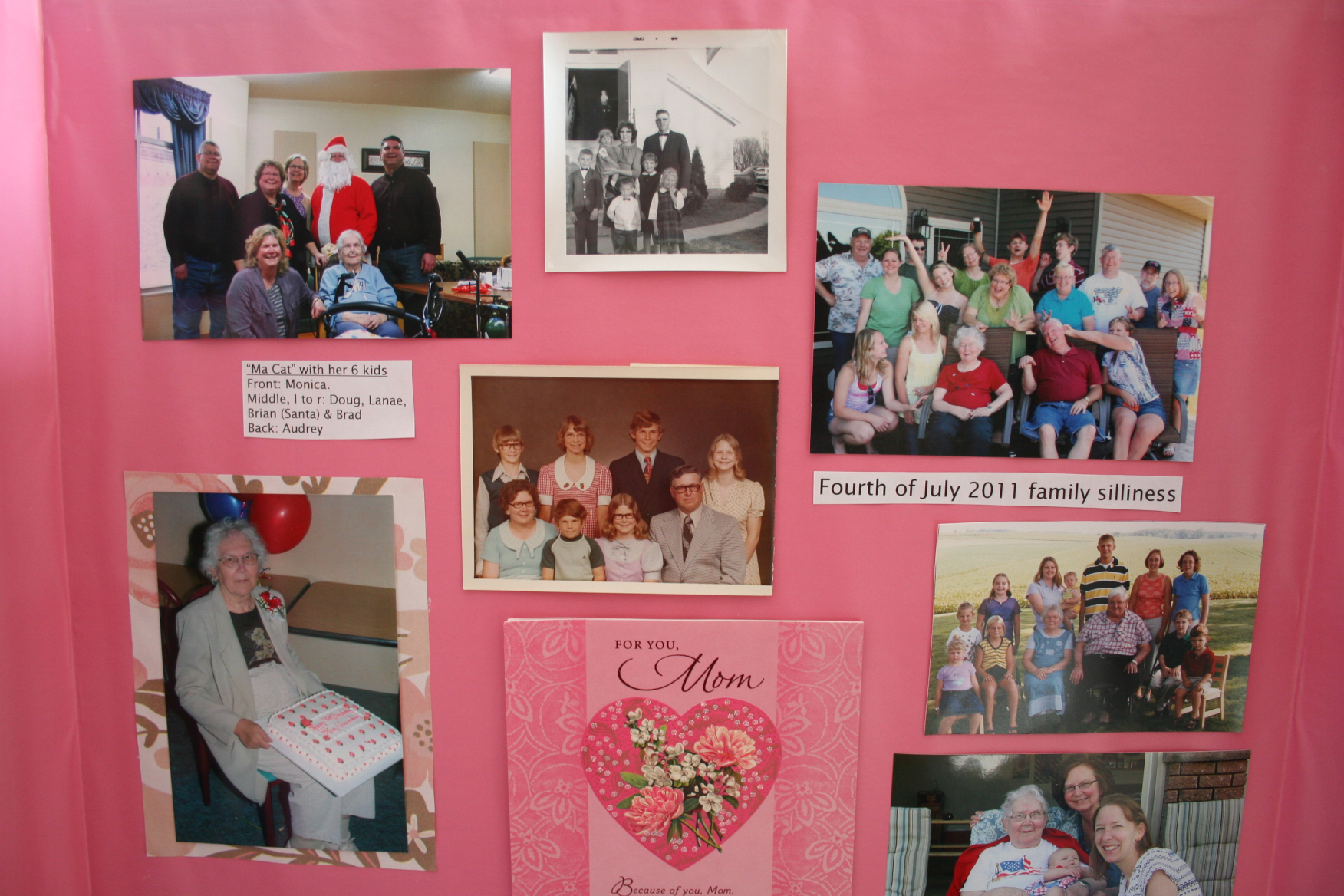
A portion of a family-themed photo board I created for my mom’s January 22, 2022 funeral. (Minnesota Prairie Roots copyrighted file photo 2022)
That legacy is not one simply of beliefs and words, but also one of attitudes and action. My mom was one of the kindest, humblest, gentlest souls I’ve ever known. My five siblings and I would occasionally test her spirit, her patience, her fortitude. But seldom did she express her exasperation. Sometimes I think Mom just had too much to do in the day-to-day running of a household and mothering of six kids to get upset. Wash clothes with the Maytag wringer washer. Can a crate of peaches. Weed the garden. Bake bread. Make supper. Scrub the floor. Iron clothes. On and on and on the list of endless chores went inside and outside our rural southwestern Minnesota farmhouse. She never complained, simply pressed on in her own quiet, mothering way.
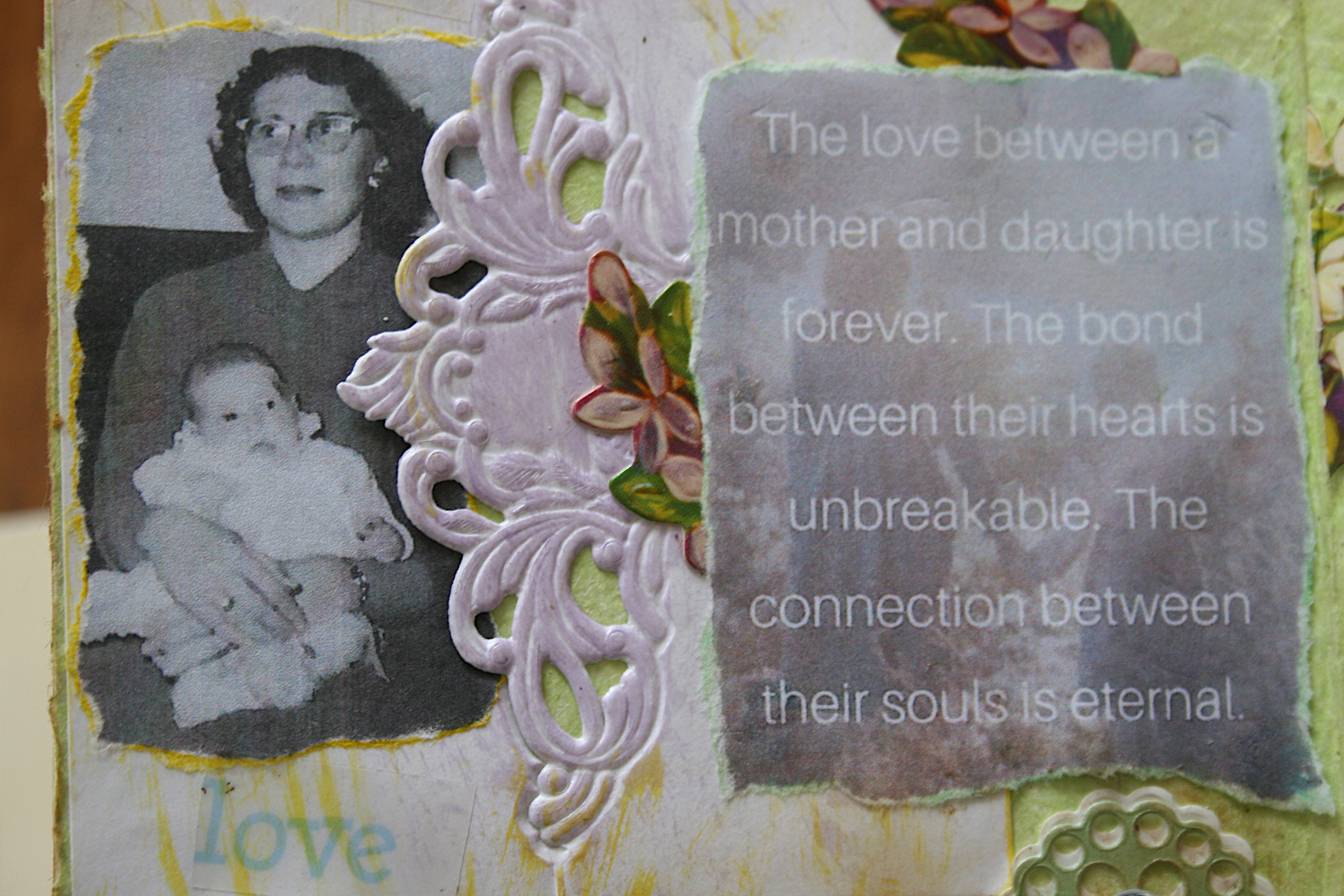
Another page of the altered book features a photo of my mom holding me. I love the quote. (Minnesota Prairie Roots copyrighted photo 2022)
Even with all that family-centered work, Mom found time for outside activities. She was active in St. John’s Lutheran Church, the Legion Auxiliary, Extension Club, Craft Club, Senior Citizens and helped at Red Cross blood drives. Some of this came many years into motherhood, when her responsibilities lessened. I was already gone from home. I once asked Mom if she missed me when I left for college in the fall of 1974. No, she replied. She was, she said, too busy with the other four kids still at home. While I didn’t necessarily appreciate her answer, I understood, and I knew she loved me. Mom was undeniably honest, a trait I hold dear also.
I am forever grateful for the loving sympathy cards, memorials and other gifts I received. (Minnesota Prairie Roots copyrighted file photo 2022)
Honesty. Integrity. Service to others. All were part of Mom’s life story. She lived her faith. These words from the hymn “Beautiful Savior,” sung at her funeral service, fit Arlene Anna Alma Kletscher: Truly I’d love thee, Truly I’d serve thee, Light of my soul, my joy, my crown. The hymn has always been my favorite for its message and its beautiful, poetic imagery.
On the Sunday before the one-year anniversary of my mother’s death, “Beautiful Savior” and “Precious Lord, Take My Hand” were sung during the worship service at my church, Trinity Lutheran in Faribault, some 120 miles from St. John’s in Vesta. The congregation also sang “Precious Lord” at Mom’s funeral. Because of illness, I missed Trinity’s worship service last Sunday. But I listened on the radio, thankful in many ways that I was not in the church pews. Trying to sing the hymns from Mom’s funeral may have proven a breaking point for me, unleashing a year’s worth of grief. Oh, how I miss my mom.
I miss her smile. I miss hugging her. I miss talking to her and remembering with her. I miss calling her every Sunday evening at the same time. I miss sharing photos of my grown children and her great grandchildren. I. Miss. Her. In the hard moments of life—and I’ve had plenty in recent years—I’ve turned to Randy and said, “I just want to be the kid again, to have my mom take care of me.” It is an impossible wish, a longing, a yearning, yet a verbal acknowledgment of my mother’s love.
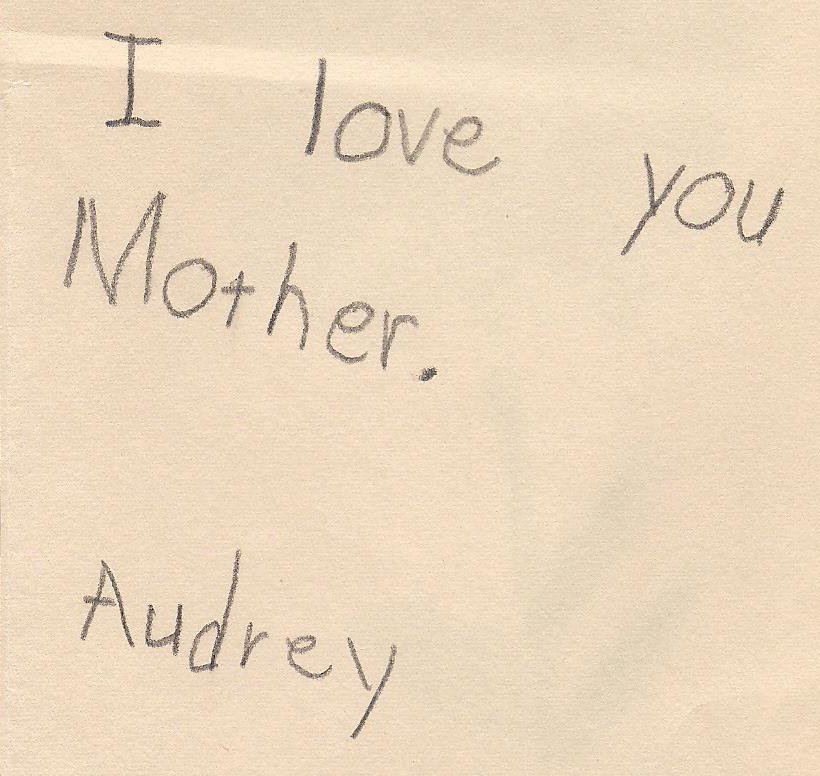
I printed this message inside a handmade Mother’s Day card back in elementary school. Mom saved the card and I am grateful. (Minnesota Prairie Roots copyrighted file photo)
Now, in my year-old grief, I still feel Mom’s love. I see her love, too, in the memory of her lips curving into a slight smile when I saw her for the last time, when I said goodbye and I love you and exited her room at Parkview. That smile proved her final, loving gift to me, her oldest daughter. I’ve locked that moment in my heart to unlock when grief sneaks in, when the pain of missing my mom rises within my spirit.
I unlock, too, the comforting lyrics of “Beautiful Savior”: He makes our sorr’wing spirit sing.

















 Minnesota Prairie Roots
Recent Comments