Minnesota Prairie Roots

Writing and photography by Audrey Kletscher Helbling

The tragic story of “The Christmas Tree Ship” November 30, 2011

THE PROMO READS:

A delightful holiday musical for the entire family. It’s the true story of a Great Lakes schooner, whose captain risks life and limb to transport Christmas trees to the German immigrants in Chicago during the late 1800’s. The result was the Christmas tree tradition spread throughout the Midwest and America.

Attend The Merlin Players’ production of The Christmas Schooner, opening Friday, December 2, at the Paradise Center for the Arts in historic downtown Faribault, and you’ll never view a Christmas tree in quite the same way. Guaranteed, you’ll appreciate your tree a whole lot more and the ease with which you can pull yours from storage, browse in a Christmas tree lot or tromp through the woods to chop down your own.

Allow me to take you 6 ½ hours away from Faribault to eastern Wisconsin, to Rawley Point, a piece of land that juts into Lake Michigan in Point Beach State Forest five miles north of Two Rivers.

Rawley Point at Point Beach State Forest along Lake Michigan in early August.

Off this point 26 ships sank or became stranded, including the steamship Vernon, which broke up in stormy waters in 1877 with 52 lives lost. Only one seaman survived.

Then there’s the Rouse Simmons schooner, widely known as “The Christmas Tree Ship.” With Captain Herman Schuenemann at the helm, the ship left Thompson, Michigan, on November 22, 1912, bound for Chicago with a holiday cargo of Upper Peninsula Christmas trees. (Sorry, but I can’t explain the discrepancy in dates between the play promo and the true date of the schooner’s demise.)

A painting of the Christmas Tree Schooner at the Great Lakes Coast Guard Museum in Two Rivers.

The schooner, with 16 crew members, never reached Chicago. Not until 59 years later was she found in 170 feet of water off Rawley Point, her Christmas trees still stashed in her hold. The schooner remains preserved in the icy waters of Lake Michigan.

The beach at Rawley Point on a Sunday afternoon in August.

Walking Rawley Point beach on an August afternoon, the only hazards are stinky dead fish and driftwood.

The U.S. Coast Guard's erector style lighthouse at Rawley Point rises 113 feet above Lake Michigan. The light is one of the largest and brightest on the Great Lakes and can be seen from 19 miles away.

This past summer my family visited Point Beach State Forest and attractions in nearby Two Rivers, all within an hour’s drive of my second daughter’s home in Appleton, Wisconsin. On that Sunday afternoon, strolling along the sandy beach near Rawley Point Lighthouse, it seemed impossible that Lake Michigan could transform into stormy waters that would become a grave for so many.

But it did.

Now you can experience the touching and tragic story of “The Christmas Tree Ship” via The Merlin Players’ The Christmas Schooner production. I saw this performance several years ago at the Paradise.

I cried.

I’ve never cried before at a play.

The historic Rogers Street Fishing Village includes the 1886 Two Rivers' North Pier Lighthouse, to the right.

Inside the Coast Guard museum, a worker points to a model of the Rawley Point Lighthouse, which was moved from a French exhibit at the Chicago World's Fair in 1893 to Rawley Point.

You'll find information and artifacts from area shipwrecks at the fishing village and museum.

FYI: Performances of The Christmas Schooner are set for 7:30 p.m. December 2, 3, 8, 9 and 10 and at 2 p.m. December 4 and 11 at the Paradise Center for the Arts, 321 Central Avenue, Faribault. Admission is $14 for adults and $9 for those 12 and under. For tickets, call (507) 332-7372 or stop in during box office hours, from noon to 5 p.m. Tuesday, Wednesday, Friday and Saturday or from noon to 8 p.m. Thursday.

I’d highly-recommend buying tickets in advance.

CLICK HERE for information about the Rouse Simmons schooner from the Wisconsin Historical Society.

CLICK HERE for info about Two Rivers, Wisconsin.

CLICK HERE for info on Point Beach State Forest.

CLICK HERE to read a previous post I wrote about the Hamilton Wood Type Museum in Two Rivers.

© Copyright 2011 Audrey Kletscher Helbling


Black Friday shopping my way & a shooting November 25, 2011

Filed under: Uncategorized — Audrey Kletscher Helbling @ 6:10 PM
Tags: , , , , , , , ,

Amber's $10 vintage coat.

SO, DEAR READERS, did you shop today, on Black Friday?

I hadn’t intended to, but then my oldest daughter ran downtown to the bank and I decided to tag along. We, along with my other daughter, perused merchandise at The Clothes Closet, a used clothing store operated by the Faribault Senior Center.

Amber, the oldest, walked out with what she termed a “vintage” jacket. Price: $10. You can judge whether this qualifies as “vintage.” She’s happy, even though her brother claims she looks like Santa in the coat. (Brothers!)

As a bonus, the clerk threw in a free pair of $2 earrings on a “buy one, get one half price” special.

After lunch, during which my husband called from work in Northfield to tell me about a shooting last night near the Target store, Amber left to return to her Minneapolis home and Miranda and I headed to the Salvation Army Store. (Click here to read about the Target area shooting, which began with an armed robbery and reported shooting in Faribault.)

Yes, I realize that now you could care less about any purchases I made and you would rather hear details of that shooting. But, alas, I have nothing more to tell you about the crime or the waiting-in-line Target shoppers who heard the gun shots and saw the cop cars and helicopter.

At the Salvation Army Store in Faribault, signs of an earlier crime remained in a boarded up front window. Several weeks ago a man allegedly drove into the building then fled the scene. Why is it taking so long to replace that window?

All this crime aside—and honestly, we typically do not have shootings in Rice County or cars driving into buildings—the second daughter and I spent $9.21 at the Salvation Army. Miranda got a shirt and a dress. I got two vintage trays and an original painting.

No crowds. No rush. No shootings. No worries. Just bargains with the money going to a good cause to boot.

HOW WAS YOUR Black Friday? What did you do? If you went shopping, tell me about your experiences and deals.

A $4 dress and a $2 shirt from the Salvation Army.

I purchased two vintage trays for $1.

© Copyright 2011 Audrey Kletscher Helbling


Snapped out of complacency November 23, 2011

Filed under: Uncategorized — Audrey Kletscher Helbling @ 9:48 PM
Tags: , , , , , , ,

Globes and flags decorated tables at a missions appreciation dinner Sunday in Faribault.

YOU KNOW HOW EVERY once in awhile someone says something and you suddenly appreciate your life a whole lot more than you did only minutes earlier?

Take me on Sunday, when I spent an hour at morning worship services, another hour in bible study, 2 ½ hours at a mission gathering and another 3 ½ hours at a mission-centered appreciation dinner.

You can bet I heard enough in those eight hours to realize I have it pretty good living right her in Faribault, Minnesota, in a three-bedroom mortgage-free home with one bathroom.

Good because—

  • Even though I have an outdated kitchen with a brown sink, leaky faucet, vintage countertops and yellowing cupboards, at least I don’t cook my meals outside over an open fire and I don’t live in a yurt.
  • I don’t rely on the generosity of a missionary to supply me with two bags of rice so I have something to eat.
  • I can speak freely about, and live, my faith without fear of reprisal. Missionaries in Iran would be killed for doing so if they were caught.
  • Even though I’m unhappy with the high costs of health insurance and medical care, at least I have healthcare, unlike so many in Third World countries. Tears edged my eyes when I saw the photos and heard the story of 11-year-old Emay who died from an inoperable tumor.
  • I am blessed to have been raised by Christian parents.
  • I can read a bible that has not been censored and/or edited by the government.
  • God is my boss.

To those who spoke and sang during the “Let the People Praise!” Mission Event on Sunday at Trinity Lutheran Church in Faribault, and to Gary Thies of Mission Central in Mapleton, Iowa, thank you for snapping me out of my complacency.

The timing couldn’t have been better, coming right before Thanksgiving.

HOW ABOUT YOU? Have you heard or seen something lately that made you more appreciative of all that you have?

FYI: Click here to learn more about Mission Central, the largest mission supporting agency in the U.S. for the Lutheran Church Missouri Synod. Credit goes to Thies for the “God is my boss” phrase cited above. Like a company president’s portrait in a corporate boardroom, Christ’s portrait hangs in Gary’s office, above his desk.

© Copyright 2011 Audrey Kletscher Helbling


Zombie horror at Faribault High School November 18, 2011

My son Caleb, pictured with other cast members, made his acting debut last night.

Thomas Simonson plays one of the lead roles as Gary.

I’M PUTTING IN a proud mother plug today for the Faribault High School Theatre Troupe’s presentation of Teenage Night of Living Horror.

You must, must, must see this suspenseful, horrifying and, yes, sometimes funny, production which will be on stage through Sunday afternoon.

To summarize the plot, a group of high school students are planning Ghoul Night in an abandoned farmhouse located near a cemetery. The farmhouse has a not-so-great history that involves a mad doctor, who happens to be played by my 17-year-old son.

Caleb makes his acting debut as Dr. Thanatos. He plays his part to the hilt, evil laugh and all. For someone who’s never acted before, he seems a natural. And I’m not just saying that because I’m Caleb’s mom.

All 44 cast members did a superb job in creating a production that held my interest for the entire 1 ½ hours. And I can’t always honestly say that about a high school play.

These teens genuinely appeared to have fun while trying to scare the crap out of us. (Sorry for using that word, but I couldn’t think of a better one.) I fully expected one of the 25 Zombies to creep down the dark theatre aisle and grab me. But my sister Lanae was sitting closest to the aisle, so they would have gotten her first.

The mood-setting music, lighting and sound effects added to the chilling, frightening atmosphere.

Honestly, folks, you must see this show. It’s that good.

Two of the 25 horrifying Zombies.

FYI: Performances are scheduled for 7:30 tonight (Nov. 18) and Saturday and again at 2 p.m. on Sunday in the Michael J. Hanson Performing Arts Center at Faribault High School.

I would not recommend taking young children or anyone prone to nightmares about Zombies. I would also suggest locking your car doors, especially if you’re driving past a cemetery on your way home.

© Copyright 2011 Audrey Kletscher Helbling


You can help: Establishing “water coolers of literacy” in rural Minnesota November 17, 2011

Buckham Memorial Library, Faribault

WHEN A NOTICE arrived in my e-mail in-box on Monday that Kathryn Stockett’s The Help was available for me at the local public library, I was thrilled. I’d been number 45 on the waiting list. I figured maybe I’d get the book in say seven years, long after I had forgotten it. Instead I waited only a few months.

Around 6:30 p.m. Monday, on my way to a church meeting, I stopped at Buckham Memorial Library in Faribault to pick up this bestselling novel. Much to my dismay, the library appeared closed. It was. And then I remembered the budget cuts that had trimmed evening hours to only Tuesdays and Thursdays.

As frustrated as I sometimes am about shortened night-time hours, I shouldn’t complain. At least I have a library in my community, unlike my hometown of Vesta in southwestern Minnesota. Like two dozen other small towns in Redwood, Cottonwood, Murray and Pipestone counties, Vesta residents rely on the services of the Plum Creek Bookmobile to deliver library materials. (Click here to learn more about that bookmobile.)

Once a month the bookmobile pulls onto Vesta’s Main Street, just as it does in towns like Currie, Iona, Revere and other towns you’ve probably not heard of unless you live or grew up in that rural area of Minnesota.

Given how often I use the Faribault library, I’d have a tough time with only once-a-month library access via a bookmobile. But I know that residents of these rural communities, like my 79-year-old mom, are grateful for their library on wheels.

Can more be done, though, to get books into the hands of these rural residents more frequently? I don’t expect that will come via public library systems with already financially-strapped budgets.

That’s why I’m particularly excited about the nonprofit Little Free Library project, co-founded two years ago by Todd Bol, a native of Stillwater now living in nearby Hudson, Wisconsin. I spoke at length with Bol earlier this week about this endeavor which places birdhouse-sized mini libraries mostly in front yards and in some public locales.

A Little Free Library seems the ideal way to fill a void in small towns without libraries.

But the problem lies in connecting to these sparsely-populated areas and growing these libraries. Bol wanted to pick my brain on how to best reach these communities and spread the word about opening a Little Free Library.

A recently-opened Little Free Library in a southwest Faribault neighborhood.

Several weeks ago a little library opened in Faribault. I learned about Dale and Joan Smith’s front yard library in the local daily newspaper on the same day I read about one opening in Detroit Lakes. Minnesota now has about a dozen Little Free Libraries with orders for some five more, Bol says. Two of those are going to Lakefield near Worthington in the southwestern corner of the state.

That’s the area I want to target for these libraries which operate on the premise of “Take a book, leave a book.” No library cards. No fee. No anything except a steward of the library and the sharing of donated books.

In a blog post published last week about the Smiths’ library, I challenged Vesta area residents to open a Little Free Library. Thus far, no one has responded.

Bol’s nonprofit is there to help, offering everything from advice to publicity to ready-built mini libraries. Those physical libraries range from a basic no-frills model priced at $375 to original art deluxe models listed at $1,000.

Or, like the Smiths in Faribault, you can build your own and then become a Little Free Library member, for a recommended $50 donation. That entitles you to benefits like a sign, sharing of your story online, listing on the LFL world-wide map and more. (Click here for membership details.)

With monies donated through the LFL’s “Pay It Forward” program, funding is available for underwriting library costs, for signs, donations of the library structure, etc.—all aimed toward helping others open village libraries. Currently the nonprofit is assisting soldiers with placing libraries in Afghanistan. No application process exists to apply for funds, but Bol hopes to eventually establish one.

Some 200 officially-registered Little Free Libraries have opened world-wide, according to Bol, who is especially excited about one planned for the Minneapolis Sculpture Garden. He’s also thrilled about an upcoming story in an Italian fashion magazine.

Defining himself as a “social entrepreneur by profession,” Bol focuses on change and making a difference. He views a Little Free Library as “a water cooler of literacy.” That comes from a man who says he “leans toward dyslexic” and reads primarily social engineering, quirky nonfiction and history books.

The Smiths of Faribault have filled their Little Library with a variety of books.

A LFL, Bol continues, becomes not only a place to get and give books, but also a community gathering spot, a “unique space of conversation” to discuss reading, books, education and more.

“There’s a sense of community being built through Little Free Libraries,” its co-founder says. He sees social interaction between neighbors who previously may not have met or spoken. A front yard library brings them together.

Bol remembers the moment he realized he was onto something with the Little Free Library concept. He had built and placed a schoolhouse-shaped library in his Hudson front yard honoring his mom, June A. Bol. When folks stopped by to shop at a garage sale he was holding and saw the mini library, they were intrigued. “That’s cute. Can I build it?” customers inquired.

From that spark of community interest, this social entrepreneur and his friend Rick Brooks of Madison, Wisconsin, ran with the idea and co-founded the Little Free Library movement.

Today Bol’s looking to engage others, like me, in spreading the word about these mini libraries. I didn’t come up with a brainstorm of an idea when we talked about how to best reach places like the small towns of southwestern Minnesota without libraries. I only suggested establishing a LFL in the area and then contacting small-town daily and weekly newspapers and radio stations in a publicity blitz.

He suggested a contest that would give away a Little Free Library, something he’s previously done.

Bottom line, it’s going to take networking to grow Little Free Libraries in more remote and rural areas.

Once the interest is established, it’s going to take individuals, families, neighbors and/or organizations to build and tend these libraries—perhaps a 4-H club or a 4-Her, a Boy Scout or Girl Scout, a church youth group, a Friends of the Library organization, a woodworker, a service club like Sertoma or Rotary or…

IF YOU HAVE ideas, any ideas, on how to grow Little Free Libraries in rural Minnesota, please submit a comment and share.

IF YOU HAVE a Little Free Library, plan to open one or need assistance in opening one, submit a comment. Most of all, tell others about this project.

FINALLY, if anyone is specifically interested in opening, building or funding a Little Free Library in my hometown of Vesta, let me know. It’s always been my dream to have a library in Vesta.

CLICK HERE for detailed information about the Little Free Library project.

© Copyright 2011 Audrey Kletscher Helbling


In the kitchen preparing for a German dinner November 15, 2011

Barb Young preps food in the Trinity Lutheran Church/Faribault Lutheran School kitchen for Cannon Valley Lutheran High School's German dinner.

THESE DINNERS DON’T happen without lots of willing hands and hours and hours and hours of volunteers working together.

We’re talking church, school and community dinners here, and specifically Cannon Valley Lutheran High School’s second annual German Fest of Thanks and Praise.

This past weekend I got a behind-the-scenes, before-dinner peek at the effort that went into preparing a German meal for more than 200 diners. Cooking isn’t my forte, meaning I admire folks like Arlen and Suzanne Krause who always seem to be in the kitchen whenever CVLHS, based in Morristown, hosts a fundraising dinner. The Krauses love to cook and they know how to cook. I’ve suggested more than once that they open a catering business or restaurant.

Arlen Krause prepares ethnic food for the German Fest dinner.

Saturday evening, while assisting my friend Mike Young, the CVLHS volunteer development director, and my husband Randy with setting up tables and chairs for the German dinner, I occasionally popped into the kitchen to photograph progress there. The Krauses and Barb Young, who’s married to Mike, were busy mixing and stirring and slicing in the two hours I was there; they’d started around noon and labored until 9 p.m. and were back again the next morning. And I know they’d also been prepping food earlier in the week.

Beef awaited slicing and complete transformation into tender and savory sauerbraten.

The feeding-multitudes recipe for delectable bread pudding.

Bread cubes, mounded high in bowls, were baked into bread pudding.

Pans of raisin-topped bread pudding cooled on the kitchen counter Saturday evening.

Fortunately, the kitchen crew trio didn’t mind my scooting around the counters, camera in tow. I tried to stay out of their way and not ask too many questions or overstay my welcome.

But staying out of the kitchen proved challenging given the tantalizing scent of gravy bubbling in roasters, the sweet Grandma’s kitchen aroma of bread pudding baking in the oven and the pungent, nose-stinging scent of vinegar poured onto cabbage.

By the magic addition of vinegar, the cabbage color changed from blue gray to purple in the foreground. I was witness to a science experiment and cooking class rolled into one.

I am 100 percent German, after all, and perhaps my German genes were naturally drawn to these food smells of the Motherland. Either that or I was awfully hungry given the supper hour. Probably both. Homemade caramel corn, strategically placed on the serving counter, cut the hunger edge.
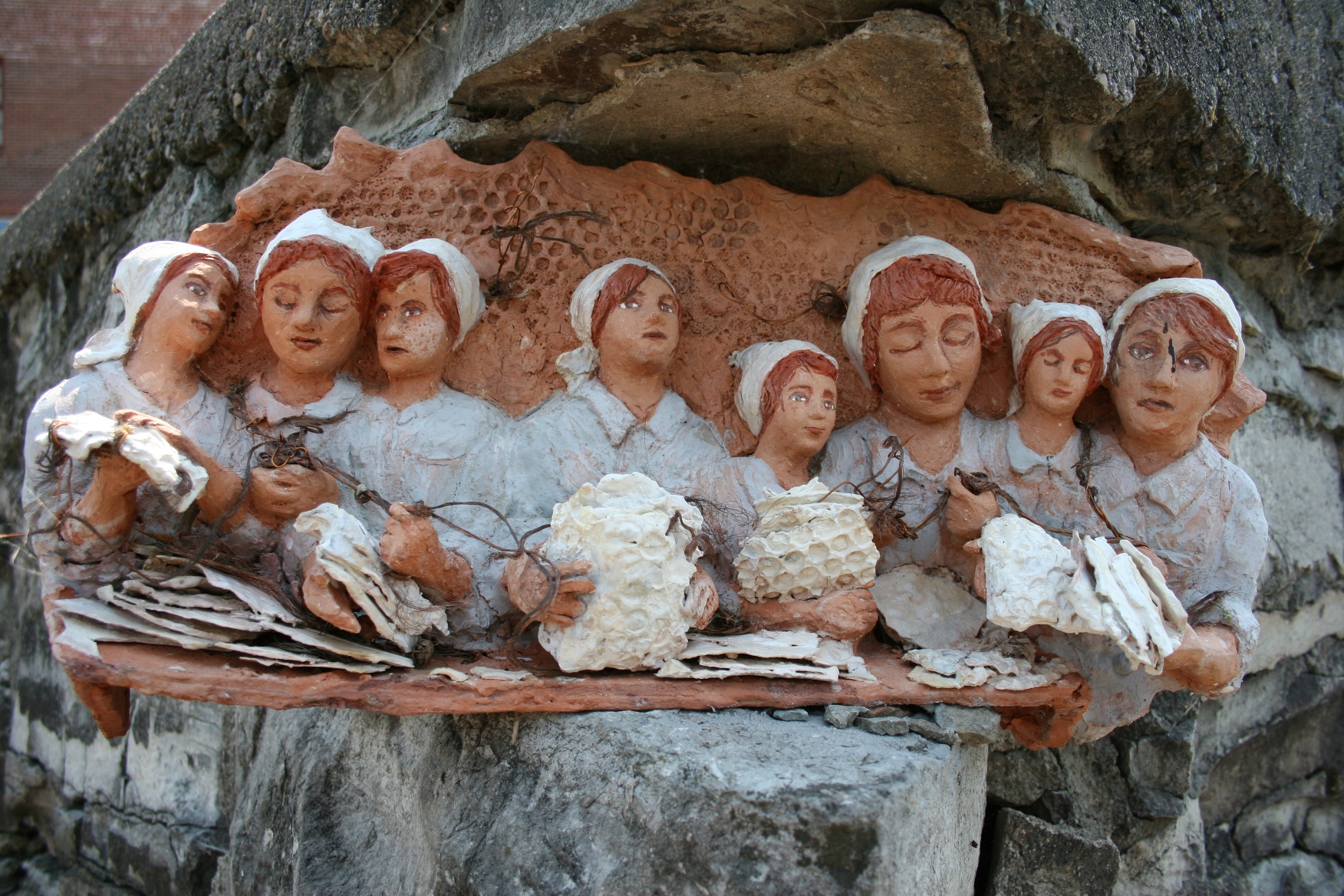
Vinegar, sugar and butter—lots and lots and lots of butter—were key ingredients in the ethnic foods I saw prepared. I could hardly wait to taste the complete meal Sunday evening following the German worship service.

Let me tell you, the German dinner rated as absolutely fabulous. Tender sauerbraten (savory beef and gravy) atop spaetzle (like mini dumplings); dense bratwurst mixed with sauerkraut; tangy, bacon-laced German potato salad as good as I’ve ever eaten; the perfect blend of sweet and sour in the jolt-of-color red cabbage; a nip of pepper in the tiny rounds of pfefferneusse (cookies); and to-die-for, heavenly bread pudding smothered in a buttery, sugary sauce.
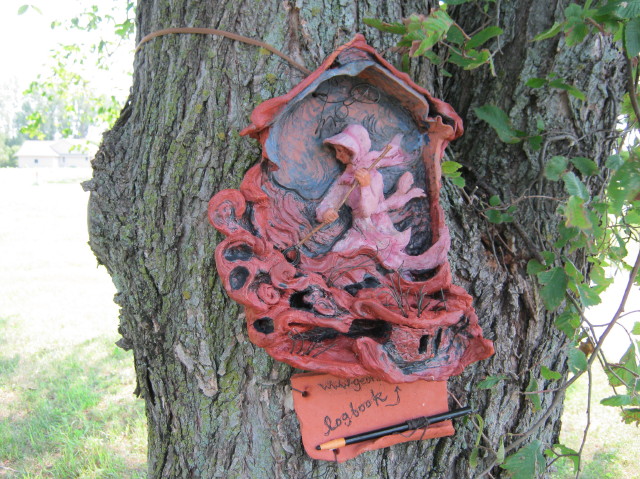
The German meal: sauerbraten and spaetzle on the left, German potato salad, sweet and sour red cabbage, dinner roll and sauerkraut and brats.

CVLHS volunteer cooks and bakers—and I know more were involved than Arlen, Suzanne and Barb—thanks for one outstanding ethnic meal.

As long as I’m extending appreciation, I’d like to express a broader thanks to all those folks out there who labor behind the scenes at church, school and community dinners. I’ve been to a handful or more of these dinners this year and I have, every time, been beyond impressed with the quality of the food and the hard work that clearly is invested in such events. Well done.

CVLHS students served the German meal to attendees.

Diners enjoy the ethnic meal at the second annual CVLHS German Fest.

Kristin Sellentine, a Trinity Lutheran Church member and active in community theater, greeted guests as Katie Luther, wife of Reformist Martin Luther. Her costume hearkens from her days of acting at the Renaissance Festival.

CVLHS Development Director Mike Young, a designer at Erickson Furniture in Faribault and a floral designer, transformed the Trinity gym into a beautiful dining experience with his creative talents.

Prior to the dinner, German Fest attendees gathered in the Trinity sanctuary for a service of thanks and praise, including a performance by the CVLHS Tone Chime Choir. Hymns and prayers spoken and sung in German and English, and other musical selections, were also part of the 45-minute service.

© Copyright 2011 Audrey Kletscher Helbling


Poetry in wine tasting November 14, 2011

I photographed this gorgeous mural at Cannon River Winery in downtown Cannon Falls in mid-August. This was the only Minnesota winery represented at a wine tasting event in Faribault Friday evening.

Cannon River Winery Sogn Blush with the label created by an artist from the region.

Crisp nuances of pink grapefruit, mango and sweet melon interwoven with hints of soft white tea and honeysuckle.

Flavors of rhubarb and black cherry complemented by hints of mocha, chocolate, spice and vanilla.

…slightly sweet with aromas of wild berries and just a hint of American Oak.

Welcome to wine tasting.

My husband and I embarked on our first-ever wine tasting experience Friday at the Paradise Center for the Arts Members Appreciation Night in historic downtown Faribault. I know. You’re thinking: “She’s never been to a wine tasting party…”

Well, well, isn’t life all about new experiences no matter your age?

Once Randy and I got our instructions, wine glasses and guidebook, from whence the above lovely and poetic phrases have been lifted, we headed into the Paradise theatre to sample wines.

We quickly discovered that, with 45 wines available, we would need to be selective in our sampling.

We also surmised that we needn’t be “Minnesota Nice” and finish off any wine samples we disliked. “Just pour it in here,” we were instructed. And so we did, whenever we found a wine too bitter or not quite delivering as described.

And so the evening proceeded—meandering and sipping and repeating “I don’t like dry wine,” and chatting with friends and acquaintances. We discussed the wines, traded glasses and sipped and sampled and asked each other, “Do you like this one?”

It was fun.

We’re never going to become wine connoisseurs. But if Randy and I pick up tidbits here and there, we learn a thing or ten that might assist us with selecting wines. I mean, I’ve bought wine in the past because I liked the label design or name or bottle, silly as that may sound. So, yes, graphic designers, artists and marketers, you can influence my wine choices with creative and visually appealing packaging.

Friday night, words also impacted my wine tasting decisions. Imagine that—words influencing me.

I mean, could you resist …zesty aromas of orange, lemon-lime and peach…silky, black-cherry elegance…memorably lush…exquisitely sweet…decadent character…intriguing layers of fresh pineapple, green apple, crisp lemon, juicy pear and wildflowers…?

(How do you get a job describing wines? That’s a writing assignment I could savor given I enjoy turning a poetic phrase now and then.)

Visitors to the Cannon River Winery enjoyed Minnesota wines on an August afternoon.

Wine barrels inside Cannon River Winery.

The labels for Cannon River's "Sogn" series are designed by regional artists who compete for the honor. Currently, you can vote for your favorite Sogn art at the winery.

A former garage houses the Cannon River Winery. President Obama visited Cannon Falls, thus the welcome sign on the winery during my mid-August visit..

Click here for more information about Cannon River Winery.

© Copyright 2011 Audrey Kletscher Helbling

Wine description source: Paradise Center for the Arts Holiday Wine Tasting booklet; wine selections sponsored by Haskell’s.


For the love of reading: Little Library opens in Faribault November 10, 2011

Buckham Memorial Library, Faribault

GROWING UP on a farm in rural southwestern Minnesota, all I ever really desired in my hometown was a library, a place where I could check out books and then read to my heart’s content.

Today Vesta, population around 340, still doesn’t have a library, although the bookmobile stops along the one-block Main Street once a month.

Fortunately I have, for nearly 30 years, lived within blocks of Buckham Memorial Library in Faribault. I go there often as did my three children, all of whom possess a deep passion for reading.

Just like Joan Smith of Faribault.

Joan, a member of the Rice County Library Board, loves reading and books so much—she can’t pass up a bookstore—that she and husband Dale have opened a library, in their front yard on Faribault’s south side.

As part of a growing world-wide “Little Free Library” movement, this retired couple decided, when encouraged by fellow book lover and library board member Pat Rice, to start a free library.

Dale, known for the log cabin style birdhouses he crafts and sells, had the skills to build the little library. The Smiths sized up books before deciding on the dimensions of 18 inches wide and 12 inches deep.

I counted 31 books in the Smiths' Little Library when I stopped to photograph it. "We all find ourselves with too many books," Joan says. "We need a place to share them." Her place is a Little Library.

That's the Smiths' house to the right at 825 Sixth Ave. SW. Feel free to knock on the door to drop off books, ask questions or thank them. Or simply drop by, open the library plexiglass door and take and/or leave a book.

Shortly before Halloween, the Little Library, situated atop a post at Joan’s eye level and within about a foot of the Fifth and Sixth Avenues Southwest sidewalk intersection, opened. (And, yes, folks, I got that right; two avenues do intersect by the Smiths’ house at 825 Sixth Avenue Southwest.)

Detailed with doors, windows and shutters, the Little Library stands at the intersection of Fifth Ave. S.W. and Sixth Ave. S.W. Here's a back view of the library Dale built.

Joan gushes over a project that shares her passion for reading and which she hopes will get others excited about reading and using the local public library.

“It’s (Little Library) another step toward reading and becoming a lover of books,” she enthuses.

Joan enjoys books, always has, ever since she was a young child living in Mankato, the childhood home of author Maud Hart Lovelace. Her mother read Lovelace’s Betsy-Tacy series to Joan as well as Little Women by Louisa May Alcott.

Later, when the family settled in the Faribault area, Joan attended a country school with less than two dozen old books on a library shelf. But her mother took her to Buckham Memorial Library, a place with plenty of books.

Joan understands the importance of reading to success in education. Although few children live in her neighborhood, Joan encourages her neighbors to grab a book from the Little Library when the grandchildren visit. She also wants the Faribault community to know: “This is for everybody and you’re welcome to come.” Already, those outside the neighborhood are stopping at the library.

It’s a library without rules or library cards. Take a book. Take a book and leave a book. Leave a book. Whatever works, Joan doesn’t care as long as people are reading.

You never know what books you'll find in the Little Library. Joan says she momentarily panicked after spotting a book with a library label. Turns out the donated book was a library discard.

She’s stocked the Little Library with books gathered from her home and from family members: mysteries and westerns, easy-reader children’s books and picture books, classics and the popular vampire series for teens and, well, whatever Joan collects, buys or no longer needs.

And, yes, the Smiths are accepting donations to their library. They’ve been asked, “What if everyone starts bringing you books?”

“That wouldn’t be a problem,” Joan responds. If she can’t use the books in their library, she’ll donate them wherever they are needed.

Dale Smith is open to considering requests to build little libraries. But the couple encourages interested individuals to construct their own libraries. (Dale’s pretty busy with that birdhouse building.)

Joan hopes their Little Library in southwest Faribault inspires others to open mini libraries and to read, yes, to read.

The Little Library is located right next to the sidewalk in the Smiths' front yard.

A front view of the Little Library looking toward Fifth Avenue Southwest.

FYI: Click here to visit littlefreelibrary.org for details on this library movement, including locations of existing libraries and how to start your own.

The website lists the following Little Free Library sites in Minnesota:

If you know of a Little Free Library in your neighborhood or plan to open one, submit a comment. I’d like to hear.

I’D LIKE TO CHALLENGE the residents of Vesta to start a Little Free Library. How about in or near the Vesta Cafe? Make my dream of a library in my hometown come true. I’ll even bring some books for the library the next time I’m “back home.”

Main Street Vesta and the Vesta Cafe, perhaps the perfect spot for a Little Free Library.

And I was thinking… maybe I should open a Little Free Library. I live along a well-traveled street in Faribault with lots of kids in the neighborhood. I love books, love to read…  Say, Dale, are you up to building another library?

© Copyright 2011 Audrey Kletscher Helbling


Scarecrows from around the world at MSAD October 29, 2011

FROM EGYPT TO INDIA TO MEXICO…, you’ll find those countries and more represented at this year’s Minnesota State Academy for the Deaf Scarecrow Fest.

Autumn wouldn’t be quite the same without this annual display at the school’s picturesque campus on the east side of Faribault. For years my family has toured the scarecrows showcased in the school’s green space edged by lovely, historic limestone buildings.

Unlike past festivals, the scarecrows this year hadn’t been ravaged by the brisk winds that often sweep across this hilltop location. Durability is a requirement in construction of the scarecrow scenes, which are also judged on use of materials, overall appearance and creativity.

I don’t know how judges decided on the winners this year because so many entries in the themed “Cultures of the World” contest ranked as outstanding. MSAD classes, public school classes, dorm groups, community groups, families and staff can enter the competition.

This year’s theme, especially, pleased me given the ever-growing cultural diversity that defines Faribault.

If you want to see the scarecrows in person, you best hurry. The displays went up a few days ago, will remain up until Halloween, and must be removed from the campus on Tuesday.

"International ECE Children" by the MSAD ECE with historic Tate Hall in the background.

A close-up of "Barn Raising Rebels" by the Faribault High School American Sign Language Group 3.

A detail in the "Barn Raising" scene that made me pause and wonder if this blackbird was about to take flight.

"Italian Pizzeria" by the MSAD ECE won third place.

Animal art in the "Kenya" display by MSAD grades 2/3.

"Welcome to Egypt" by the MSAD Class of 2015 included an Egyptian, a camel and three pyramids.

Viking Leif Erickson was part of the "Greenland" scarecrow scene by MSAD grades 4/5. The entry won second place.

Several skulls were incorporated into "Mexico's Day of the Dead" by MSAD Class of 2013.

Faribault High School's American Sign Language Group 1 created this Jamaican.

The Baker family built the Taj Mahal, which mimics the shape of Noyes Hall in the background, for their "Welcome to India" scarecrow display. The Bakers won first place.

The Baker family got the details, right down to the jewel on the Indian woman's forehead.

© Copyright 2011 Audrey Kletscher Helbling


Honoring veterans with a little R & R October 28, 2011

My father, Elvern Kletscher, left, with two of his soldier buddies in Korea.

MENTION KOREA and my thoughts automatically flip to my father, a veteran of the Korean Conflict, or Korean War, or whatever title you want to attach to that hellish war.

My dad, Elvern Kletscher, fought on the frontline in the cold, cold mountains of Korea. He killed men so close he could see the whites of their eyes. He saw a buddy blown apart in front of him, the day before Ray was to return home to the States, to Nebraska, to see his baby daughter for the first time.

Shrapnel struck my dad at Heartbreak Ridge and embedded into his neck. Just like all those awful experiences that embedded into his memory. Horrible, nightmarish memories he could never shake. Never.

So I am thinking of my dad today as I pull together this post about how the Historic Hutchinson House Bed and Breakfast in Faribault is honoring qualifying veterans by giving away a free night’s stay in the B & B’s five guest rooms on November 10.

The give-away coincides with the Faribault Community Theatre’s production of M.A.S.H., which opens tonight and continues at 7:30 p.m. October 29 and 30 and November 3, 4 and 5 and then at 2 p.m. on October 30 at the Paradise Center for the Arts.

Volunteers at the Paradise Center for the Arts promoted M.A.S.H. and served chili samples at the recent Faribault Fall Festival and Chili Cook-Off.

Tami Schluter, who co-owns the Hutchinson House B & B with her husband Doug, came up with the give-away idea after M.A.S.H. director Palmer Huff asked his cast for a way to honor veterans as part of the theatrical performance.

M.A.S.H. tells the story of the 4077th Mobile Army Surgical Hospital based in South Korea during the Korean War and Tami plays the part of chief nurse, “Hot Lips” Houlihan.

The Historic Hutchinson House B & B in Faribault

The Schluters last year participated in a program among North American B & Bs offering free rooms to veterans on November 10. So it was a natural to open their 1892 Queen Anne-style Victorian home again to veterans at no cost for one night “to say thank you to all those who have served our great country,” says Tami.

Those selected for the complimentary one-night Hutchinson House R & R (with a guest), and a three-course breakfast the following morning, will come from among qualified active and retired military personnel. To qualify, registrants must attend the M.A.S.H. production at the Paradise and leave their contact information in the theater lobby drop-box. Proof of veteran status will also be requested.

Winners’ names will be drawn on Sunday, November 6.

Then, on November 10, the honored veterans and their guests will meet “Hot Lips” Houlihan, aka Tami, at her B & B.

If my dad was still alive—he died in 2003—I’d invite him to attend M.A.S.H. with me and try for that free night at the Historic Hutchinson House B & B. My Purple Heart-pinned father would have been so deserving given all he’d been through on the battlefields of Korea.

Instead, I’ll just cross my fingers and hope a Korean War veteran is among those who win the one-night get-away and awaken on 11-11-11, Veteran’s Day, to that three-course gourmet breakfast served by the Schluters.

FYI: Three other Minnesota B & Bs are participating in the B & Bs for Vets Program: Hillcrest Hide-Away B & B in Lanesboro, Deutsche Strasse B & B in New Ulm and Classic Rosewood Inn in Hastings. According to online information, rooms for vets are already filled at the Lanesboro and New Ulm B & Bs.

To check out the Historic Hutchinson House B & B, click here.

For information on the M.A.S.H. production at The Paradise Center for the Arts in downtown Faribault, click here.

TO READ A STORY I wrote about my father’s time in Korea, published in 2005 in God Answers Prayers Military Edition–True Stories from People Who Serve and Those Who Love Them, click here. This collection of military stories was compiled by Allison Bottke and published by Harvest House Publishers.

© Copyright 2011 Audrey Kletscher Helbling

Historic Hutchinson House photo courtesy of Tami Schluter