
I’M NO ART EXPERT. I buy art simply because I like it, not because of its value.
Yet, I’ve managed through the years to purchase several pieces of art, which unbeknown to me, were created by notable artists and therefore possess more than your average value.
I didn’t find these in some upscale, trendy metro art gallery. Rather, I’ve discovered my art treasures at rummage sales and at recycled art sales right here in Faribault.
Yes, I shop on the cheap because, frankly, as much as I wish I could, I cannot afford an original work of art sold at retail price. That is the truth and I apologize to all the starving artists out there who are trying to make a living via their art. Remember, I am a writer. I understand.
That said, let me show you the trio of recycled art pieces which I consider my most valuable art discoveries, although I certainly did not realize this at the time of purchase.
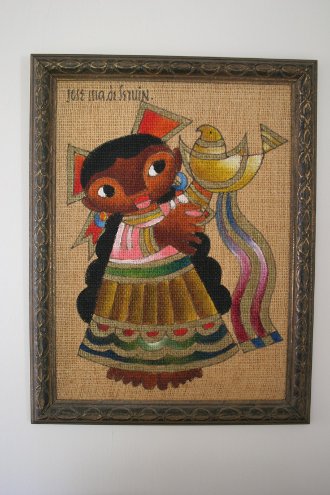
My bargain Jose Maria de Servin painting.
I was shopping at the Paradise Center for the Arts annual Recycled Art Sale several years ago when I came across this interesting painting of a young girl on burlap. The bold colors, the subject and the uniqueness of the art—unlike any I’d ever seen—drew me to her. For $7, this art piece was mine.
Later my second daughter, who at the time was studying Spanish in college, researched the artist, Jose de Maria Servin, and shared that he’s a rather well-known Mexican artist. Seems his original oils fetch anywhere from several hundred to well over $1,000.
To make this even more interesting, I bought Servin’s oil painting on the third day of the recycled art sale and the husband didn’t much like it. He likes it now, or at least its value.
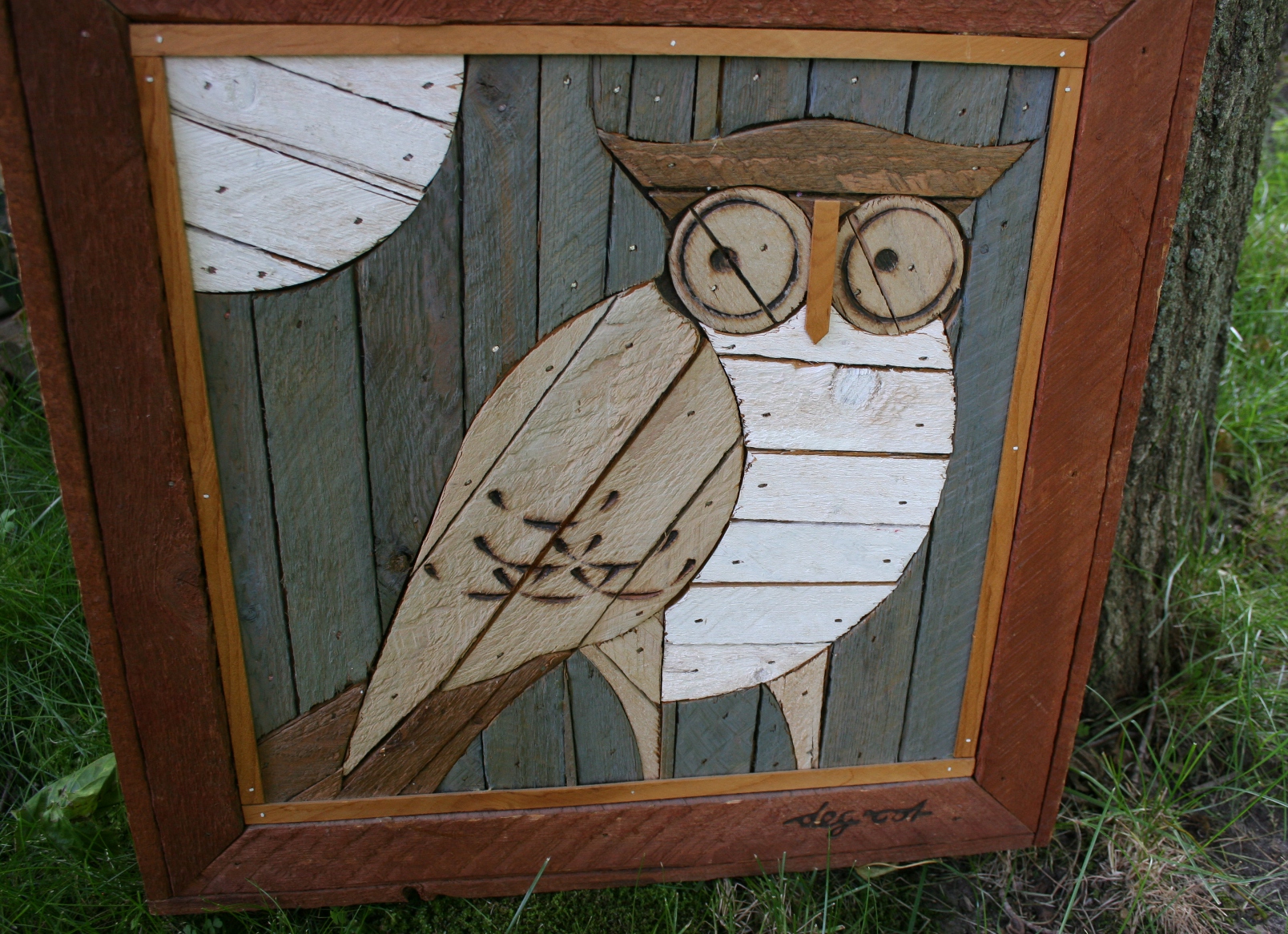
Theodore de Groot LathArt by Austin Productions, patent number 4,061,514
The second notable piece of art also came from that recycled art sale at the Paradise. It’s LathArt, a type of folk art by the Dutch artist Theodore de Groot. LathArt, according to information I found online, was produced by Austin Productions in the 1970s using a patent to die cut the pieces.
Again, I bought the de Groot LathArt owl for $10 because I liked the rustic design and the uniqueness of the art, not because I knew anything about the art or artist.
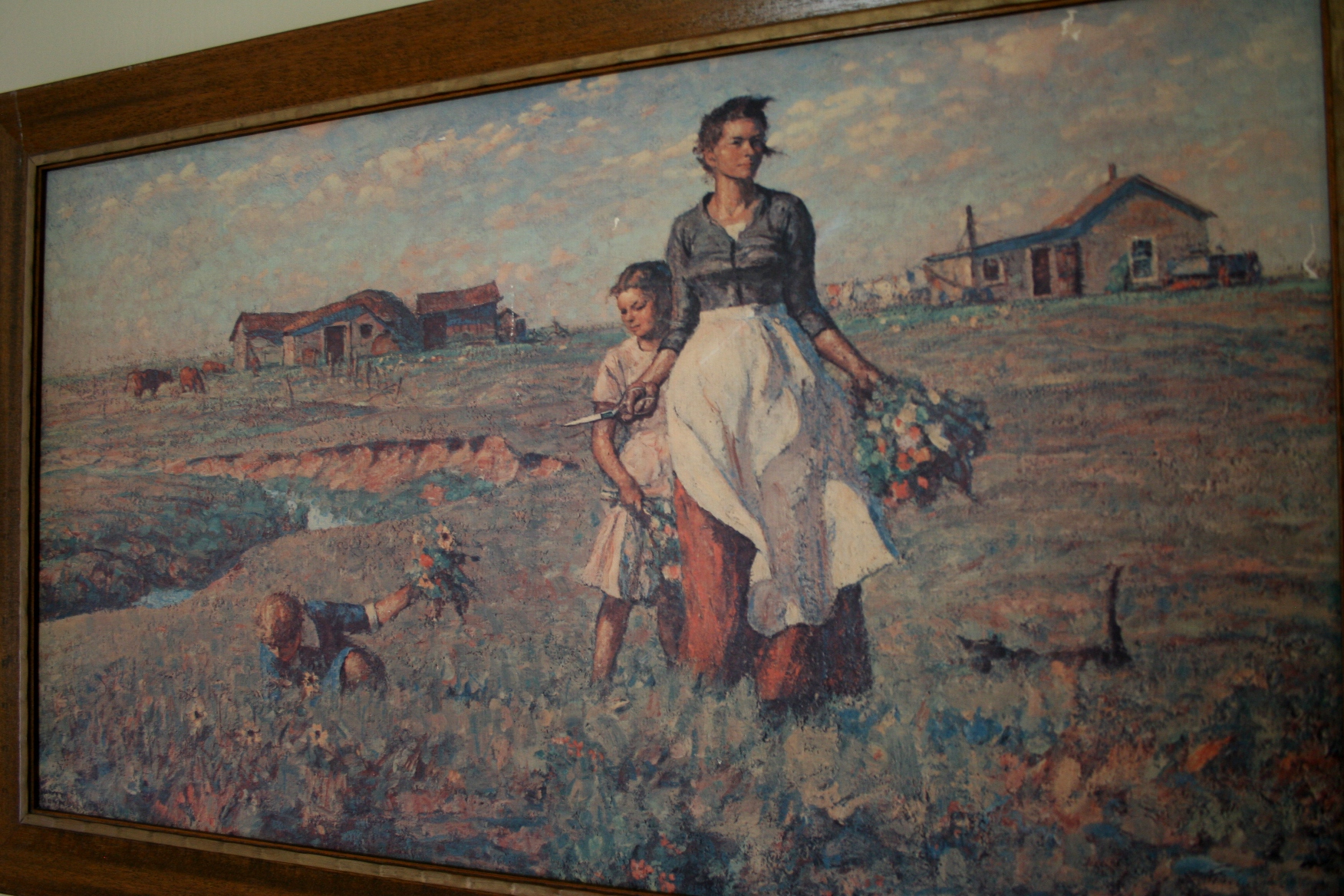
My print of Harvey Dunn’s “The Prairie is my Garden.”
Ditto for a print of South Dakota artist Harvey Dunn’s painting, “The Prairie is my Garden.” When I spotted the framed print at a yard sale, it reminded me of my native southwestern Minnesota prairie and I just had to have it along with a dozen wine glasses and a “Felix the Cat” video, all for $20.
Months later I grew curious about the artist and learned Dunn was a well-established illustrator for magazines like The Saturday Evening Post among other accomplishments.
So there you go. I’ve been fortunate enough to acquire art of value without even knowing its value. I bought the art solely because I liked it. And isn’t that the best reason for purchasing a work of art?

A sidewalk sign outside the Paradise Center for the Arts advertising the fifth annual Recycled Art Sale.
FYI: The annual Recycled Art Sale at the Paradise Center for the Arts, 321 Central Avenue North, Faribault, began at noon Thursday and continues from noon to 5 p.m. Friday and Saturday. Proceeds benefit the Paradise and the Faribault Mural Society.

Old film reels from the former Paradise Theatre are among items being sold at this years Recycled Art Sale. The smaller reels hold movie trailers such as “Rambo” and “Brewster.” Gallery walls and tables are covered in art donated for the fundraiser.
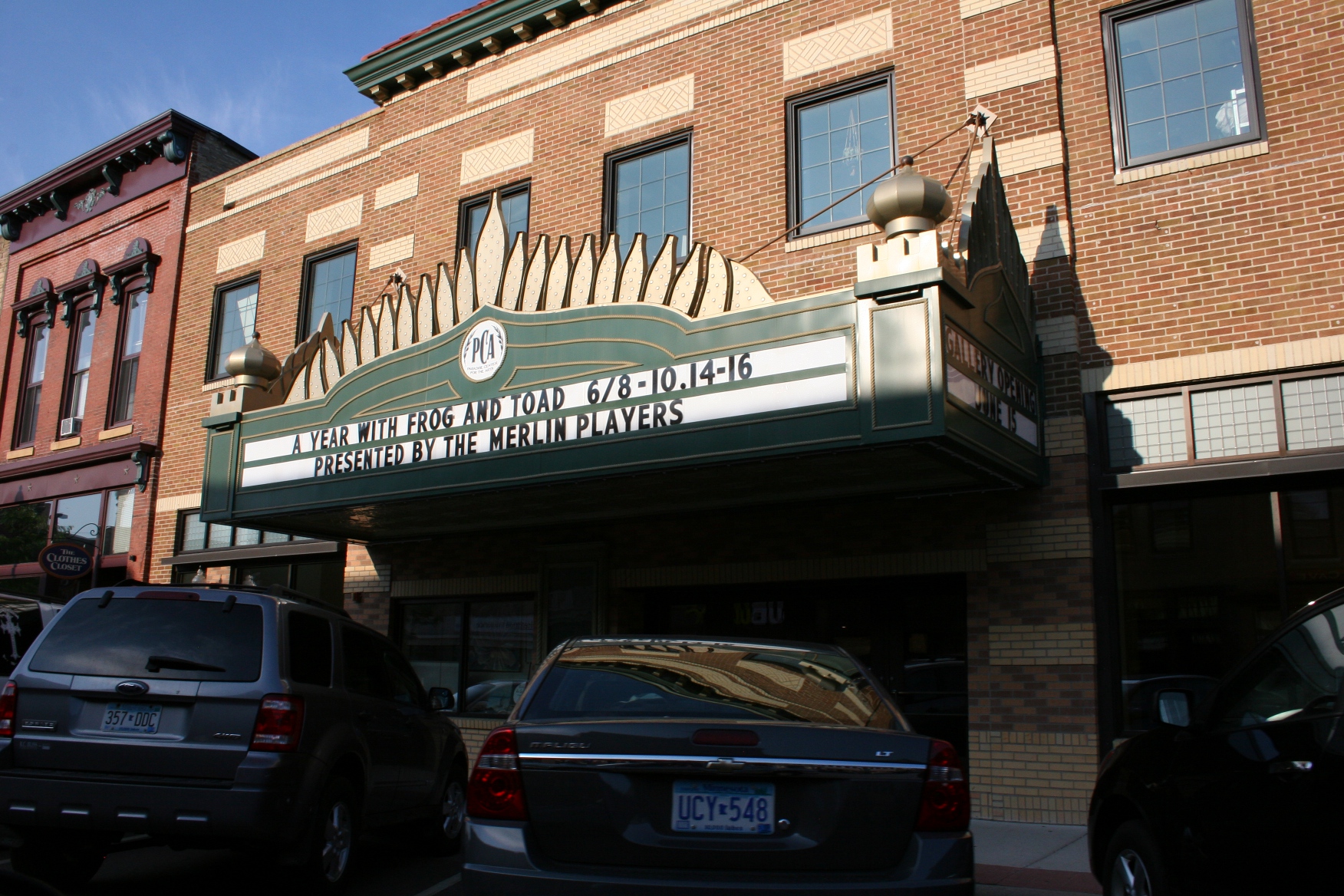
The musical, “A Year with Frog and Toad,” opens Friday evening at the Paradise.
© Copyright 2012 Audrey Kletscher Helbling

















Yes, Faribault is a diverse community May 3, 2012
Tags: City Pages, comments, diversity, Faribault, Minnesota, thoughts
In this file photo, a Somali family waits to cross a downtown Faribault street.
ON ANY GIVEN DAY, I can drive on a street in Faribault, walk along the sidewalk, glance out my office window or go shopping and see a racial diversity of people.
I can stand in my side yard and look toward the home of an Asian couple. I can glance up the hill and watch two preschoolers, the daughters of a white mother and an African American father, play outside. In my front yard, I can see, several houses down, the Hispanic family that has lived in my neighborhood for years.
Yes, Faribault, population 23,352, is a community of diversity. Thirteen percent of our residents are Hispanic/Latino and another 7.4 percent, black or African American, according to the 2010 U.S. Census. All totaled, about one-fifth of our residents identify themselves as “non-white.”
As my husband would say—and this is not meant at all as derogatory—shopping in at least one local grocery store is like walking into the United Nations. We shop side-by-side with Spanish-speaking Latino families and with Somali women clothed in billowing dresses and head scarves.
Just the other evening, as I entered the local public library, a Sudanese man held the exterior library door open for me while his pre-teen son opened the interior door. It’s been a long time since a young boy held a door for me and I expressed to him my appreciation for his respect and good manners.
The other day, while waiting in the car for my husband to pick up milk at a local convenience store, I observed a cluster of teenaged Somali girls, dressed in head scarves and flowing dresses, move along the sidewalk while, just across the street, a 60-something white woman clad in a jacket resembling an American flag pushed a cart of groceries. It was a unique visual illustrating diversity in Faribault.
Several Latinos lead in singing of Mexico’s national anthem last September during the International Festival at Faribault’s Central Park. Flags represent the birthplace nations of those participating.
The diversity of my community bubbled to the surface Tuesday after I read a comment on City Pages, an online Minneapolis-based information source. A post I published last week about jewelry store thefts in Faribault and elsewhere in Minnesota was linked to in “The Blotter” section as was an article in the Faribault Daily News which identified the jewelry store thieves as “black males.”
Now I don’t want to get into the issue of whether the news reporter should have racially-tagged the suspects. But I was miffed by the first Blotter comment on the blog post.
It looks like “diversity” has now spread to Hastings and Faribault.
That comment was followed by a reply I won’t print here because of the language. But you can read it by clicking here.
So why did the initial diversity comment rile me? Well, I’m tired of over-generalizations that those of us living outside the Twin Cities metro area reside in closed-up communities comprised mostly of Anglo-Americans. We are not just a bunch of white descendants of Scandinavians or Germans or Irish or French… We are racially diverse and growing in diversity.
If you ask the residents of Willmar or Worthington, St. James or Madelia, or many other Minnesota towns, they’ll tell you the same. Latinos, Asians, Somalians, Sudanese and others call outstate Minnesota home.
Diversity spread to Faribault decades ago. Just stroll through my neighborhood.
How diverse is your neighborhood, your small town, your suburb, your city? Let’s hear.
© Copyright 2012 Audrey Kletscher Helbling