Minnesota Prairie Roots

Writing and photography by Audrey Kletscher Helbling

The eyes have it until they don’t May 7, 2024

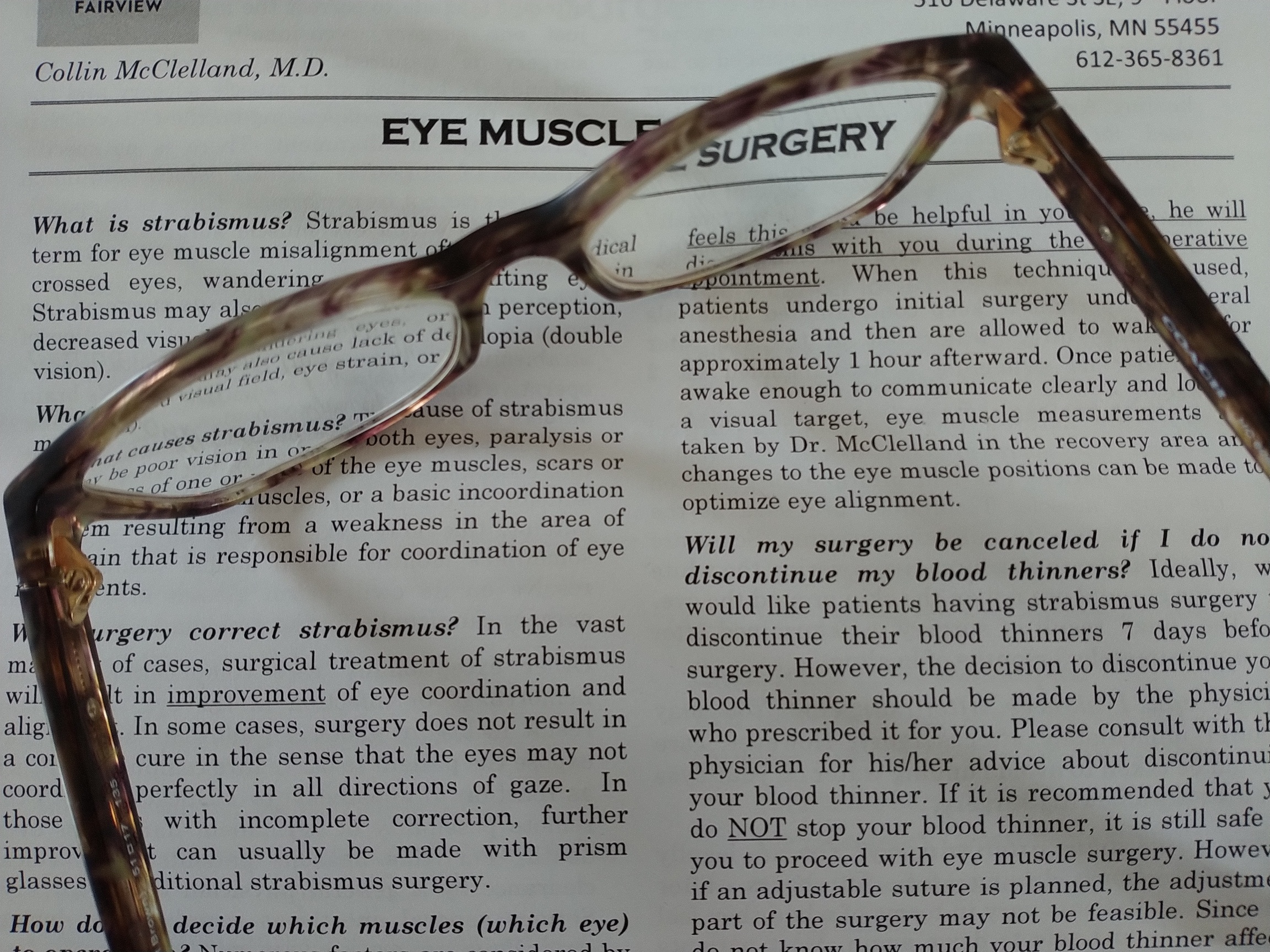
My old glasses atop info about bilateral strabismus eye surgery. (Minnesota Prairie Roots copyrighted file photo November 2023)

SIGNIFICANT REGRESSION OF SURGICAL EFFECT. Those are words you don’t want to read/hear following any surgery. But, three months out from surgery to realign my eyes, that’s where I’m at with my vision.

During my second post-op check last week with my neuro ophthalmologist, Dr. Collin McClleland, I learned that my eyes apparently have a mind of their own. They are back to not working together. This came as no surprise. I’ve been experiencing ongoing double vision, although less than before my January 22 surgery.

What I didn’t expect was the word “significant.” I knew the possibility existed that my eyes would return to misalignment; I did my homework in advance of bilateral strabismus eye surgery. But who thinks they are going to be in the minority of that final surgical outcome? Not me.
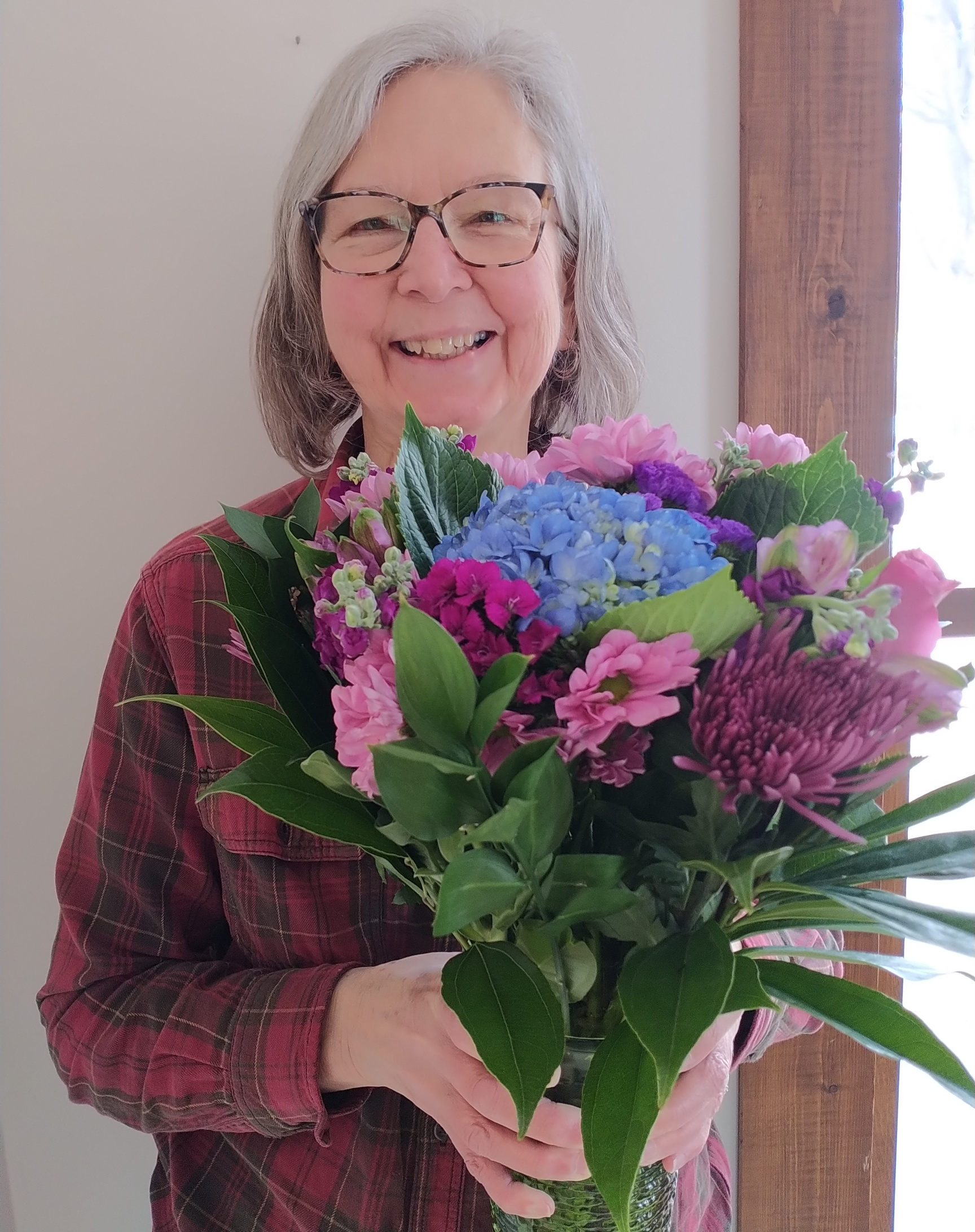
Several days after my January surgery, I was smiling, happy to have surgery behind me, happy with flowers from my family. (Minnesota Prairie Roots copyrighted file photo by Randy Helbling, January 2024)

Immediately after surgery, my eyes were in near perfect alignment. I was happy. My surgeon was happy. But then, as my eye muscles healed and my brain and eyes adjusted, the shift began.

Extensive testing during my recent appointment showed “significant regression.” I won’t confuse you with numbers and medical terminology. Suffice to say I’m frustrated and disappointed as is my surgeon. But, Dr. McClelland said, he wouldn’t have done anything differently during surgery. I needed it, and the surgery did improve alignment. I agree. Why my eyes reverted mostly back to their misaligned positions is unknown. I asked. There’s no answer.

I explained to my doctor that it takes effort sometimes to see just one, and not two. That exhausts me. And if I’m doing anything that requires a lot of visual back-and-forth, like shopping, my eyes feel like they’ve done calisthenics. They hurt. Whenever I have lots of sensory input or am doing multiple things, my double vision worsens. I was experiencing all of this before surgery, too.
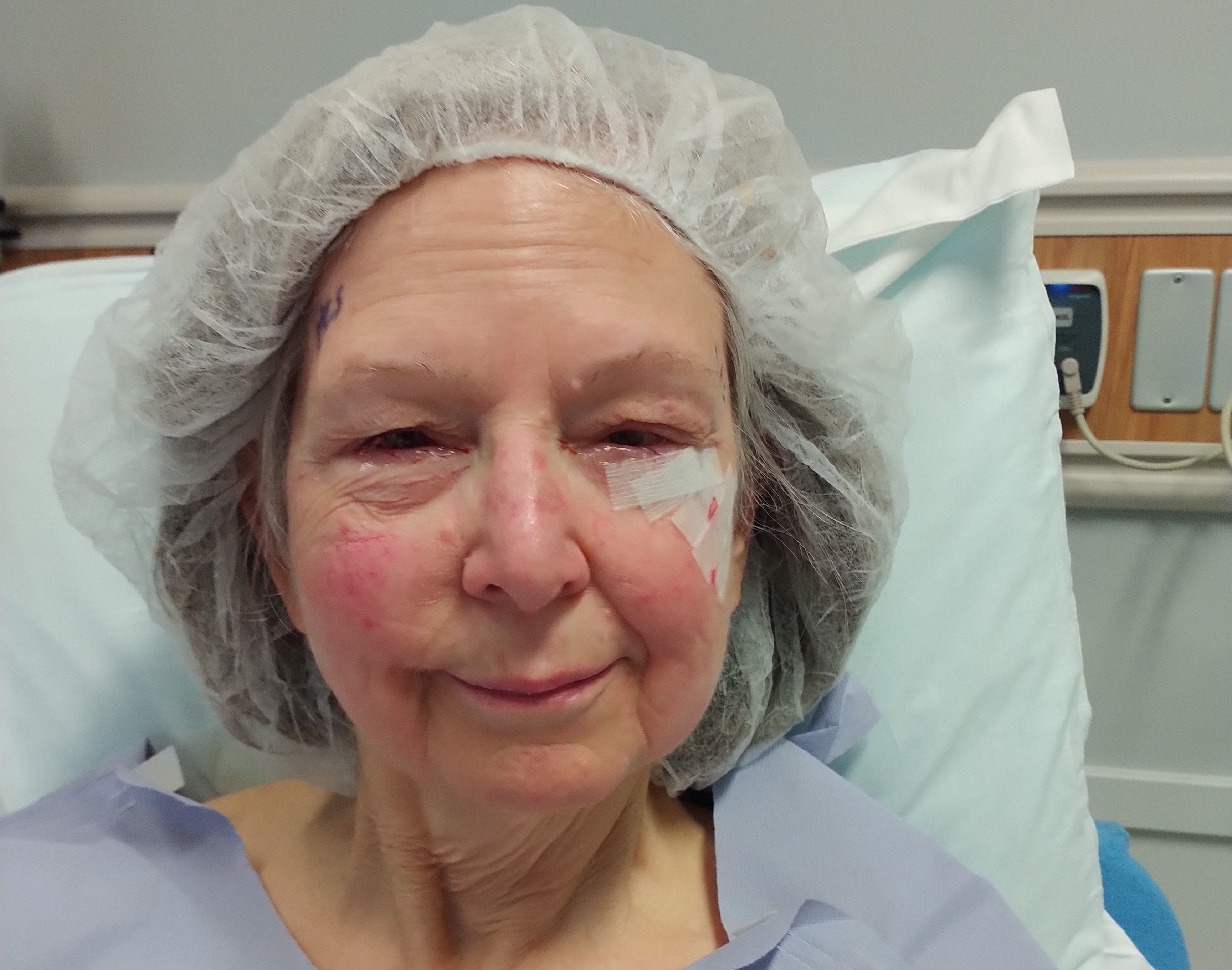
In the recovery room after surgery on both eyes in January. (Minnesota Prairie Roots copyrighted file photo by Randy Helbling, January 2024)

What to do next was the question of the morning. My surgeon offered two choices: One, add more prisms to my glasses and hope that alleviates some of my double vision. Or try surgery again. I was mentally unprepared for this. But I quickly opted for more prisms. I am in no hurry to rush back into an operating room, even if the 1 ½-hour surgery was not horrible and I have full confidence in Dr. McClelland. Surgery is surgery.

So here I am, no line bifocal prism glasses ordered. The lenses will take about two weeks to make given the extensive work required. Then I’ll be without glasses while the lenses are placed in my frames. Then the test begins. Will the added prisms, divided between both lenses, help with my double vision? Time will tell. Prisms bend light before it travels to your eyes and the brain has to sort it all out and create a singular image, or something like that.

The issue, my ophthalmologist explained, is whether I can tolerate more prisms added to my prescription lenses. I could experience distortion, what he calls “the fish bowl effect.” The goal is “comfortable singular binocular vision.” If I can’t handle the added prisms (which are actually less than they should be, but within the hopefully tolerable range), then I will need to revisit surgery.

That’s where I’m at today. Waiting for those prism-heavy lenses. I’m trying to prepare myself for what I know will be several weeks of adjusting to my new prescription. And hoping this non-surgical approach works.

These buildings house outpatient clinics, including the M Health Fairview Eye Clinic, on the campus of the University of Minnesota in Minneapolis. (Minnesota Prairie Roots copyrighted photo May 2024)

As disappointed and frustrated as I feel about the final surgical outcome, I remain grateful for the vision I do have, even if far from perfect. Sitting in the waiting room at M Health Fairview Eye Clinic in Minneapolis puts my situation in perspective. I have watched little kids there navigating with the aid of a white cane…

© Copyright 2024 Audrey Kletscher Helbling


Reflecting on pre-surgery anxiety & ways I coped February 20, 2024

Information about my eye muscle surgery. (Minnesota Prairie Roots copyrighted file photo 2023)

SURGERY. Most of us would rather not hear that word when it comes to our health. But sometimes surgery is necessary. I’ve had surgery nine times in my lifetime. I’m currently four weeks out from my second bilateral strabismus eye surgery (the first was at age four) to realign my misaligned eyes. Healing and recovery are progressing.

Nearing downtown Minneapolis, the route to M Health Fairview Surgery Center and Clinics. (Minnesota Prairie Roots copyrighted file photo)

Today’s post, though, is not about recovery, but rather about my January 22 surgery day. As a creative, I have stories to tell about my experiences at M Health Fairview Clinics and Surgery Center. Admittedly, I felt anxious as Randy and I aimed north along Interstate 35 to the surgery center about an hour away on the campus of the University of Minnesota in Minneapolis. I detest metro traffic, which added to my pre-surgery anxiety. But on this morning, traffic was not horrible.

Waiting is always the hard part. I waited at check-in behind an angry patient. We’d ridden the same elevator to the fifth level, but she got ahead of me because she knew where she was going. I did not. And so I had to stand there listening to her spew about how she’s never been called about whatever. Her voice volume increased. I felt increasingly frustrated by this hostile woman who should have taken her complaints elsewhere, not to the surgery check-in desk. She was not there for surgery. Finally, I bypassed her to another check-in station, wondering if the first employee would need to call security. This was not off to a good start.

I settled onto a green upholstered chair in a spacious room filled with people, most on their phones, waiting. A bank of tall windows revealed a sunny day. I heard persistent coughing on the other side of a waiting room half-wall, somewhat worrisome to me. I’d been screened for COVID symptoms, but Randy and other caregivers weren’t. That is typical of clinic screenings, it seems. But I digress.

Eventually, after I’d people-watched, tried to work a crossword puzzle, studied abstract fabric artwork, Tatenda called me to begin the process of preparing for surgery. That started with basic questions followed by depression screening. I am thankful this screening is now routine in healthcare and I told Tatenda that. And then I added, “But you didn’t ask about anxiety.” Anyone who says they aren’t anxious about surgery is, in my opinion, not being truthful. Thankfully, Tatenda and others who cared for me understand pre-surgery anxiety and helped ease mine.

One of my go-to Bible verses when I’m worried or anxious. This is displayed at my church, Trinity Lutheran in Faribault. (Minnesota Prairie Roots copyrighted photo February 2024)

There was one point, though, when I had to dig deep mentally to stop myself from fleeing a small room where I waited alone for the next step in surgery prep. Tatenda handed me a lavender paper gown, instructing me to change into that and pull on a pair of purple socks. Then she left. Do. Not. Leave. Me. Alone. I expected her back quickly. As the minutes ticked by, I felt my anxiety rising. I was cold, shivering almost, hugging my folded legs to my body for warmth. The over-sized, one-size-fits-all paper gown that smelled to me of antiseptic provided zero warmth. Maybe I should have wrapped it around my slim body twice. I attempted to calm myself by repeating the words of Psalm 46:10: Be still…be still…be still…

Eventually nurse Amanda arrived and connected a hose to my lovely lavender gown, a hose that blew air inside to either warm or cool me. She explained how I could turn a switch to adjust the temperature. It was a game-changer not only for my comfort level, but also in giving me control. Of. Something.

Signage on The Pearl, a popular ice cream spot in downtown La Crosse. (Minnesota Prairie Roots copyrighted file photo 2015)

As Amanda searched and poked twice for an adequate vein to start an IV, we talked. Conversation distracts me. This nurse, the same age as my eldest daughter, and I chatted about her hometown of Potosi, Wisconsin, where I’ve been to the brewery; our love of La Crosse (and The Pearl ice cream shop); motorcycles; and then how I met Randy and where we went on our first date. “Stir Crazy,” I replied. The movie starring Richard Pryor and Gene Wilder. Amanda said she would ask Randy the same when she brought him to see me shortly before surgery. When he answered “Blazing Saddles” to the first date question, I told Amanda that he was an imposter, that she needed to find my real husband. We laughed. Humor helps.

Once Amanda left, the anesthesiologist and neuro ophthalmologist surgeon arrived for last-minute briefings and questions. I was ready. Soon I was being wheeled down a hallway toward the operating room. I remember nothing until I awoke 1 ½ hours later in recovery. That is another story…please check back for more storytelling.

TELL ME: If you’ve had surgery, how did you cope with pre-surgery anxiety? How did others help ease your anxiety right before surgery?

© Copyright 2024 Audrey Kletscher Helbling

 

Sort of like a broken bone, but not really November 3, 2022

Filed under: Uncategorized — Audrey Kletscher Helbling @ 5:00 AM
Tags: , , , , ,
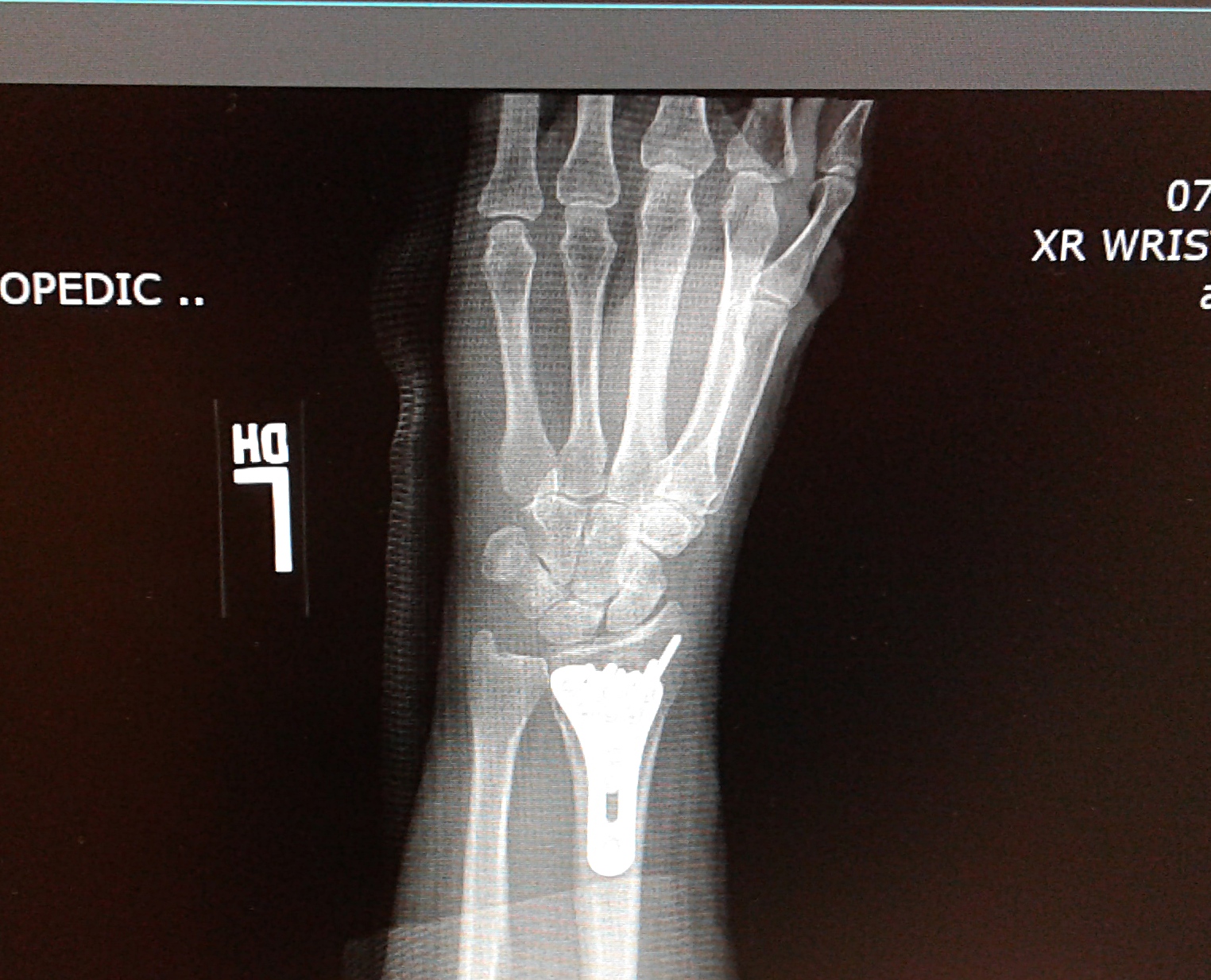
Look on the lower right side of my wrist to see the surgically-implanted plate, shaped like an ice scraper, and held in place by 10 screws. (Minnesota Prairie Roots copyrighted file photo 2018)

WHEN I BROKE my right shoulder one summer and then a year later shattered my left wrist, I needed physical and occupational therapy. Muscles quickly weakened with my shoulder clamped immobile in a sling and my wrist secured in a splint. After months of in-person therapy and at-home exercises, I regained my strength and use of my shoulder and wrist. I felt grateful for the therapy, which was easily accessible and covered under my insurance (although I ended up paying because of my high deductibles).

I also got lots of encouragement following those bone breaks. Cards. Texts. Emails. Calls. Even some meals delivered. When you’re experiencing a health issue, it’s reassuring to feel the support of others.

Buttons photographed at the Northfield Public Library. (Minnesota Prairie Roots copyrighted file photo)

But what if your health issue is a mental health issue? Do you have the same access to healthcare? Does your insurance plan offer sufficient coverage? How do friends and family respond?

A post, “Help needed—therapy information please” published a few days ago by Texas blogger Penny Wilson, and my personal interest prompted me to write on this topic. Penny is seeking information on affordable mental health therapy for her friend whose benefits are soon ending. She understands. Penny, too, faced the same problem when she needed therapy and her insurance would cover only three sessions. Three. Sessions. Penny writes, “3 sessions didn’t even begin to scratch the surface. After that, I was on my own to figure out how to pay for it.”

I’d like to think the experiences of Penny and her friend are the exception. But I don’t believe that, not for a second. First, unlike my easy access to therapy for my broken bones, accessing mental healthcare is difficult at best. At least in Minnesota. Waits are long, if psychiatrists and psychologists are even taking new patients. That often leaves individuals in a mental health crisis seeking care in an emergency room. Unless the hospital has an on-call mental health professional, this is not necessarily the best treatment option. But when you can’t access care any other way…

Whether insurance adequately covers mental health treatment and therapy seems debatable. For Penny and her friend, obviously not.

This message refers to the struggles with mental illness. (Minnesota Prairie Roots copyrighted file photo)

And then there’s the topic of personal support. Mostly, it’s lacking. Although we’ve made strides in reducing the stigma of mental illness, we have a long ways to go. Ask anyone who’s experienced a mental health crisis, whether directly or indirectly as a family member, and you will likely not hear stories of tangible support. No meals delivered. No cards sent. No texts. No emails. Primarily silence. There are, of course, exceptions.

Beyond the emotional toll, a mental health crisis can devastate individuals and families financially. Yet, there are no public fundraisers. Again, this traces to the stigma, the lack of understanding, not necessarily a lack of compassion.

Mental illness, in my opinion, is not viewed on the same level as say diabetes or cancer or other debilitating diseases. I’m not taking away from anyone who has dealt with those because they are horrible and awful. But so is a serious mental illness. There are no cures, no single plans of treatment that work for everyone. A med may ease symptoms and then it doesn’t and then it’s start over with a different med. The same for therapy. Imagine the exhaustion and frustration that can set in as individuals struggle to manage anxiety, depression, bipolar and more. It’s a lot.

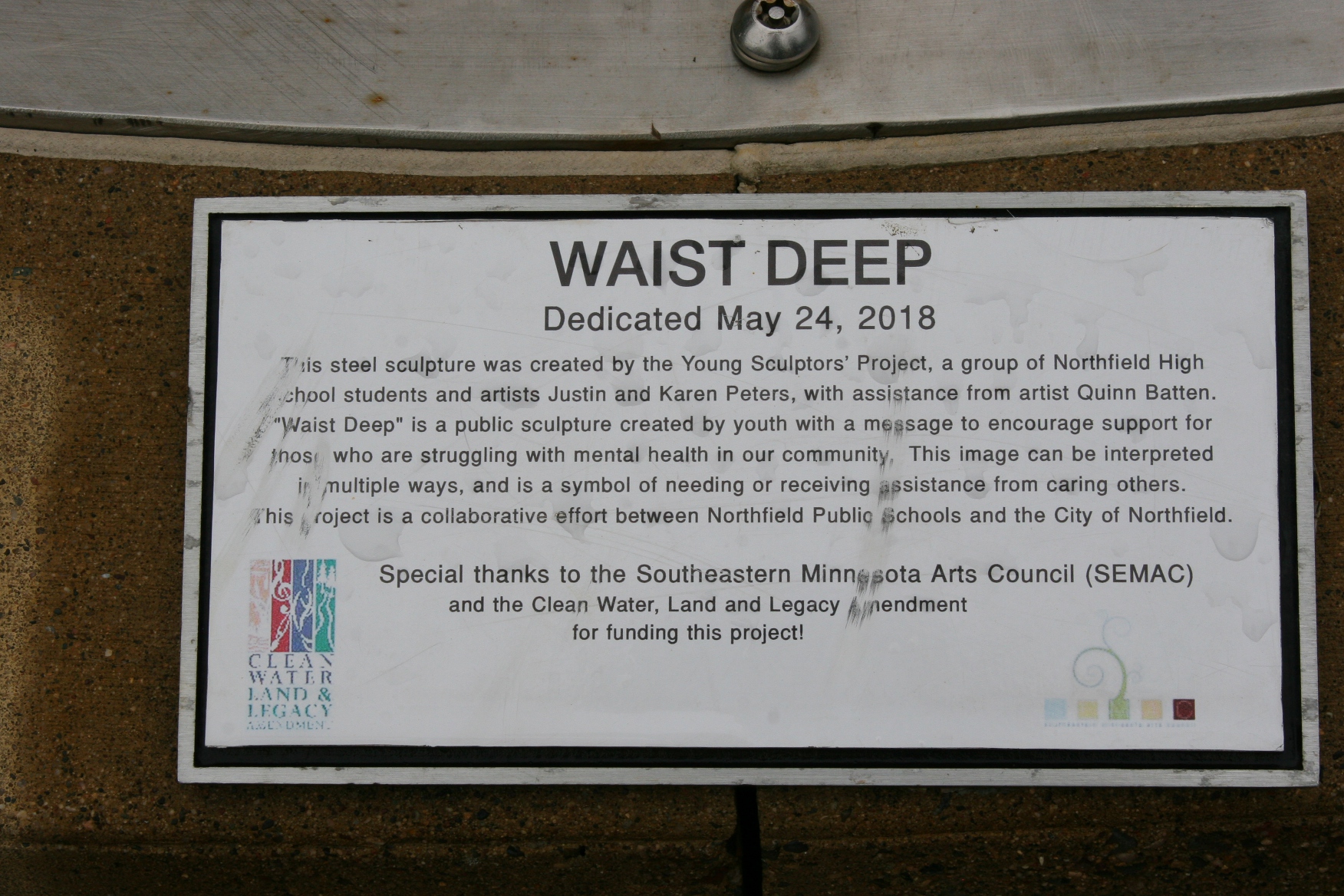
A mental health-themed sculpture, “Waist Deep,” once stood outside the Northfield Library. This is such a strong visual of reaching for help. (Minnesota Prairie Roots file photo 2019)

So what’s the point of this post? The point is to educate and raise awareness. The point is to reduce the stigma of mental illness. The point is to encourage you—if you know someone struggling with mental health—to reach out, acknowledge, support. Act. Support their families, too. Offer words of encouragement. Offer financial support if needed. This is their broken bone.

FYI: The National Alliance on Mental Illness (NAMI) is a great resource for information and support. Click here for more information.

© Copyright 2022 Audrey Kletscher Helbling
 

Doing my part to raise awareness about mental health August 3, 2022

A hand reaches skyward in a mental health themed sculpture that once graced a street corner outside the Northfield, Minnesota, Public Library. (Minnesota Prairie Roots copyrighted file photo 2019)

WHEN HE HEARD ME rant for the umpteenth time about “people just don’t get it, they don’t understand,” he advised, “Then you need to educate them.”

He, my husband of 40 years, is right. Venting to Randy about offensive terminology and uninformed/misinformed comments and attitudes about mental illness does nothing other than temporarily ease my frustrations. Speaking out, writing, based on my observations and experiences, can make a difference. So write about my concerns I will, with the disclaimer that I am not a medical professional.

I photographed this shirt at an event at the Northfield Public Library. This message refers to the struggles with mental illness. (Minnesota Prairie Roots copyrighted file photo September 2019)

WORDS MATTER

Today—on the heels of recent offensive lyrics by Beyonce’—seems the right time to share what’s bothered me for way too long. The pop singer used the derogatory term, “spaz/spazzin,” in her new release, “Heated.” Although she was referencing spastic diplegia, a form of cerebral palsy causing motor impairments in limbs, and not mental health, the analogy fits. Her word choice proved offensive to people who are disabled. And rightly so. To her credit, Beyonce’ acknowledged her unintentional slur and is changing the lyrics. Just like Lizzo, who used the same wordage not all that long ago.

For the millions who each day bravely face mental health challenges and for those who love them, everyday careless language can hurt. Words like crazy, insane, nuts, it’s all in their head, off their rocker, out of his/her mind…are hurtful. As hurtful as the lyrics sung by Beyonce’ and Lizzo.

Recently, while reading a Good Morning America Book Club selection published in 2021, I came across this phrase: “the usual terrible but addictive schizophrenic medley.” In the context of this fictional story, the character was not talking about anything mental health related, but rather about what she was seeing on Instagram. I stopped reading and considered how insulting those words, especially to someone diagnosed with schizophrenia. I doubt the author intended to offend. But she did.

Buttons previously available for the taking at the Northfield library. (Minnesota Prairie Roots copyrighted file photo)

IF YOU HAD…

Now you might say I’m being overly-sensitive. But consider if you, or someone you loved, was diagnosed with cancer, diabetes, whatever, and uncaring words (which I can’t even think of) were tossed out there. It’s no different for those diagnosed with bi-polar, schizophrenia, depression, anxiety, post traumatic stress disorder…

I’m thankful individuals undergoing cancer treatment and/or who have survived cancer, for example, are not subjected to negative/offending words and behavior, but rather are supported with encouragement, fundraisers, even hot dishes delivered to their homes. That type of care and attitude should be a model for how all of us treat individuals dealing with a mental health crisis and their families. We should respond with equal love, compassion, care and understanding. And tangible support.

A sign explains the story behind the “Waist Deep” sculpture in Northfield. (Minnesota Prairie Roots file photo September 2019)

CHANGING ATTITUDES, BUT MORE IS NEEDED

I recognize attitudes toward mental health are changing, that, as a whole, we are growing more informed, finally beginning to reduce the stigma of brain disorders. But much work remains. Individuals in a mental health crisis should have immediate access to care. Busy, understaffed emergency rooms are often the first-line treatment option. I don’t know of a single doctor who would send a person experiencing a heart attack home. Individuals in a mental health crisis, the equivalent of a heart attack, deserve the same immediate life-saving care. Yet the wait to see a psychiatrist often exceeds six weeks, at least here in greater Minnesota. That’s unacceptable.

There’s a need for more mental healthcare professionals and in-patient treatment and recovery centers. There’s a need for more funding, more research. Insurance companies should not determine care/medications or refuse to fully cover mental healthcare expenses.

This sculpture, once located outside the Northfield library, is called “Waist Deep” and addresses mental illness. (Minnesota Prairie Roots copyrighted file photo 2019)

IT STARTS WITH EACH OF US

At a grassroots level—that’s each of us individually—more compassion, support, understanding are needed. A few years ago I walked into a southwestern Minnesota brewery and spotted a man sporting a jacket advertising a neighboring brewery. Imprinted on the back was an image of a straitjacket. I could not believe what I was seeing, especially after also reading the offensive name of the brewery. Later I looked online to read the brewery’s list of “Crazy Good Beer” with words like manic, catatonic, lobotomy, kookaloo… in the craft beer names. Simply writing this makes my blood pressure rise. I wanted to rip that jacket right off that beer drinker, so strong was my anger in that moment. Imagine the uproar, for example, if a brewery used words like chemo or radiation in its beer names or used an IV drip as its logo. Somehow a straitjacket is OK? Not from my perspective.

Imagine, too, if you have gone through cancer treatment and someone said you will be fine now that you’ve completed treatment. In the back of your mind, you recognize that the cancer could return despite the treatment. It’s no different for someone with a serious mental illness. Drugs work for awhile and then they don’t. Medications and therapy help manage symptoms, but there is no cure. Symptoms can return. Relapses, crises, happen.

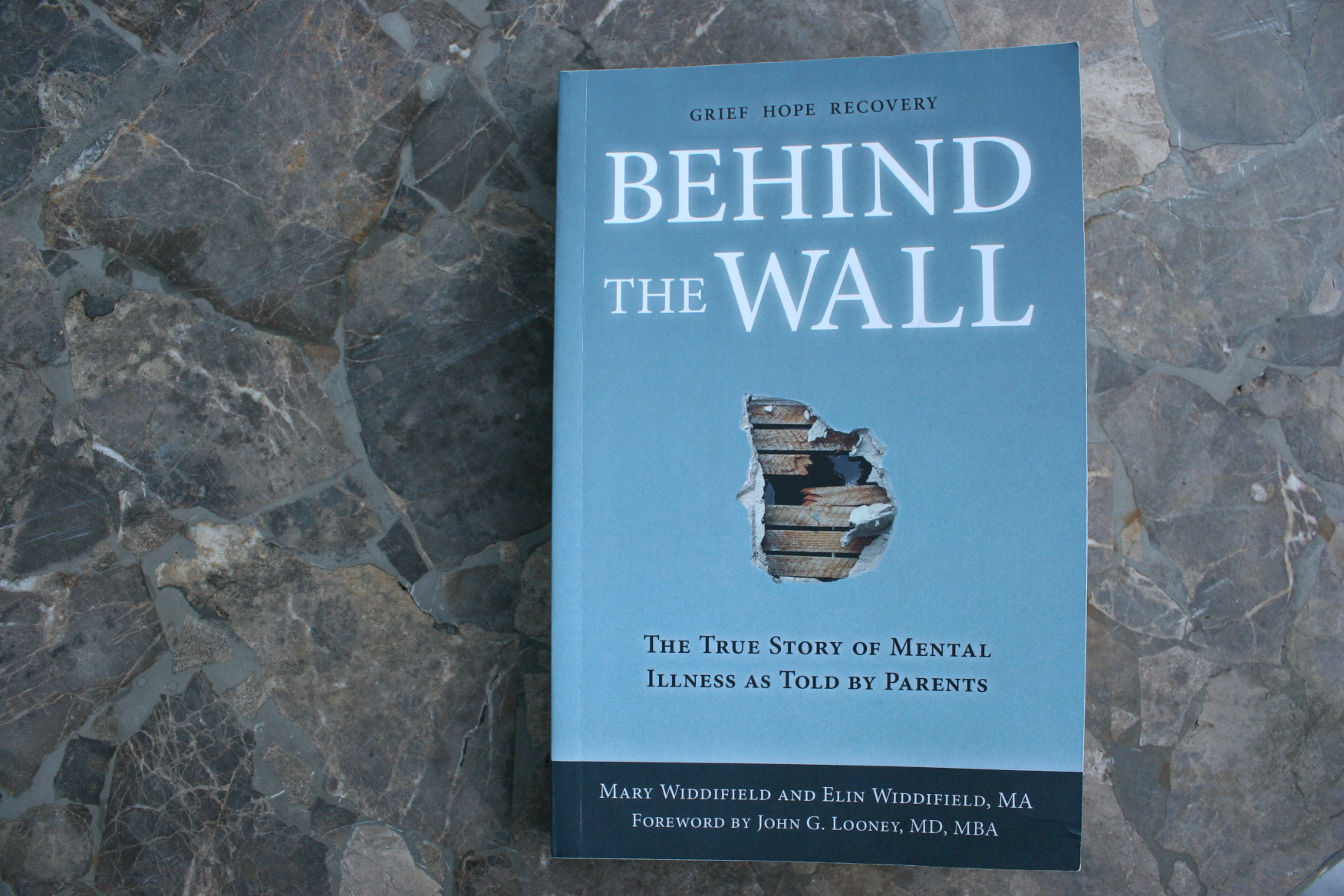
I highly recommend this book, among many I’ve read on the topic of mental illness. (Minnesota Prairie Roots copyrighted file photo)

GRATITUDE & RESOURCES

I appreciate every single person who has made a concerted effort to understand mental health, mental illness specifically. I appreciate organizations like the National Alliance on Mental Illness, which works tirelessly to support individuals and their families who face mental health challenges. I appreciate NAMI’s advocacy work and education. I appreciate mental healthcare professionals. And, most of all, I admire those individuals who deal with mental illness—whether depression, anxiety, post traumatic stress disorder, schizophrenia, bi-polar… They are among the strongest people I know and they deserve, yes, deserve, our love, compassion, understanding, support and respect.

THOUGHTS?

RESOURCES: If you or a loved one are experiencing a mental health crisis, seek immediate help. Call 911. Call 988, the National Suicide and Crisis Lifeline. Connect with NAMI. You are not alone.

Click here to read previous posts I’ve penned on mental health.

© Copyright 2022 Audrey Kletscher Helbling

 

“Everybody just breathe,” a book review July 26, 2022

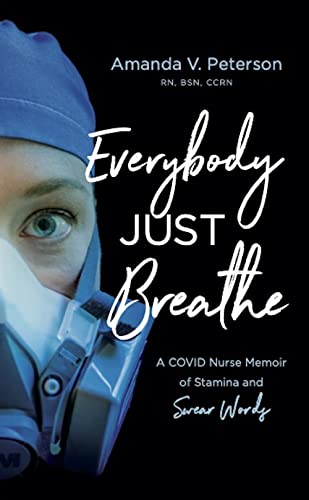
Photo source: Amazon

I’m so freaking tired of people thinking this virus is bullshit, and that only old or unhealthy people are being affected by it. It is so hard to listen to.

I pulled this quote from Everybody Just Breathe: A COVID Nurse Memoir of Stamina and Swear Words by Amanda Peterson, who worked for 11 months in a Minnesota metro hospital’s COVID ICU Unit beginning in March 2020. Her memoir documents her time there, in what she terms the longest shift of her life. This was primarily prior to vaccines.

Hers is a powerful book in so many ways, but mostly because Peterson takes readers into the ICU. She spares no details in patients’ deteriorating conditions, their struggles to survive, or not, how their families are affected and how she’s been impacted.

A early depiction of the coronavirus. Image source: CDC

I challenge anyone to read this book and not come away with a strong visual of how COVID wreaks havoc on the body beyond an inability to breathe. As a non-medical person, I didn’t fully understand how destructive this virus can be. I do now, thanks to Peterson’s stories from the ICU. The ravages of COVID for a critically ill patient are beyond nightmarish.

In her book, Peterson uses the fictional “Jack” as a COVID patient. Privacy laws necessitate this, but “Jack” represents all the patients she cared for during her time in a special COVID unit where an air filtration system roared and medical staff worked tirelessly to save lives while also comforting patients whose loved ones could not be with them.

Raw emotions of anger, fear, frustration and more pack the pages of this book. Often Peterson reminds herself to just breathe, like the patients she prompts to just breathe. Her two young children provide comic relief, noted in interspersed humorous quotes. She escapes into nature. Finds peace in prayer, strength through her faith. Support from her co-workers.

Yet, she reveals how she feels shunned, ignored, silenced, disrespected, even called a liar by the very people she’s trying to help. Her hurt is palpable. Yet, this ICU nurse carries on with caring.

Photographed in the window of The Rare Pair in Northfield early in the pandemic. (Minnesota Prairie Roots copyrighted file photo 2020)

She is, Peterson writes, tired of simultaneously fighting the virus and the public. A public whom she calls selfish in their unwillingness to, for example, wear face masks and/or avoid gathering in crowds. Again, this was in the beginning of the pandemic, but still applicable today as highly-transmissible variants spread, infect, hospitalize and kill. I ask you to wear a mask not out of fear but out of love, she writes. Peterson repeatedly stresses the love perspective, that we ought to think about others. Why, she asks, is love so hard? I wonder the same.

That a pandemic can bring out selfishness and ugliness instead of community and love is horrifying, Peterson writes. She notes how COVID has become politicized but that the virus doesn’t care about politics. She’s right.

I came to this book with hesitancy, not about the content, but wondering whether this would be well-written. Just pages into the memoir, I was hooked. Peterson can write. Her writing style is like a conversation, free flowing (with swear words tossed in the mix), honest, introspective, nothing held back. Her stories, insights, experiences are powerful. Emotional. At times I laughed out loud. Other times I nearly cried at the immense suffering, loss and pain.

I encourage you to read this memoir by a COVID ICU nurse from Hudson, Wisconsin, who is, undeniably, in the right profession. Peterson deserves our respect and thanks for not only the care she’s given to all the “Jacks,” but also for the telling of her experiences in this unforgettable, impactful book.

© Copyright 2022 Audrey Kletscher Helbling
 

From Minnesota healthcare leaders: “Heartbroken & overwhelmed” December 15, 2021

Coronavirus. (Photo source: CDC)

SOME TWO WEEKS until Christmas and nearly two years in to the COVID-19 pandemic, Minnesota medical leaders on Monday issued a strong warning to the public along with a plea for the unvaccinated to get vaccinated.

Nine healthcare executives—including the head of the world famous Mayo Clinic—signed a letter which published in newspapers throughout Minnesota. These two statements banner the message:

We’re heartbroken.

We’re overwhelmed.

The carefully-crafted letter is powerful. Emotional. Factual. And, oh, so necessary. I feel deep gratitude to these healthcare leaders who joined in sending a strong message to Minnesotans. We need to hear this. All of us. Vaccinated. And unvaccinated.

The decision not to get vaccinated affects every single one of us. That’s clear in the words of these medical professionals, in daily media reports and in information from the Minnesota Department of Health. Emergency rooms are full. Hospital beds are full. And that means challenges in accessing healthcare. For treatment of COVID-19, cancer, injuries, heart attack… That should concern anyone and everyone. None of us knows when we might need immediate emergency medical care. The situation is “critical,” according to the letter.

I appreciate the honesty. The statement “…every day we’re seeing avoidable illness and death as a direct result of COVID19” points directly to the root of the current crisis. And the frustrations felt in the medical community. “How can we as a society stand by and watch people die when a simple shot could prevent a life-threatening illness?” Exactly. How? Why? I don’t get it and I share the frustrations of those nine Minnesota healthcare leaders and their associated healthcare teams.

They conclude their letter with an “ask.” Get vaccinated and boosted. Wear a mask (regardless of vaccination status). Socially distance. Get tested if you feel sick. Encourage others to follow those steps. None of that is new. But it just does not seem to be sinking in. Especially in rural areas. My roots are rural. I love and care about our rural communities. But the truth is that in many areas of Greater Minnesota, vaccination rates are low, COVID case counts high. This virus doesn’t care about rural or urban boundaries.

In Faribault, I see very few people masking in public. Our vaccination rates in Rice County could be better, especially in those under age 49. Of those eligible for the vaccine, from age five on up, only 62% have completed their vaccine series, according to Rice County Public Health (December 13 statistics). We’ve already lost 147 of our friends, family members and neighbors to COVID in our county. Some died before vaccines became available. And I expect, although I can’t confirm, that some recent deaths of seniors may be from break-through cases in that vulnerable population. But many likely are among the unvaccinated, a situation repeating throughout the country.

I feel for the doctors, nurses and other medical personnel staffing our hospitals. I have no doubt they feel heartbroken and overwhelmed. The stress. The demands. The never ending flow of COVID patients. The death all around. The grief. The helplessness. Day after day after day. Endless physical and mental exhaustion.

I am grateful for their fortitude. Their strength. Their compassion. Their care. And now, today, I feel grateful for this united message from nine healthcare professionals calling on all of us to come together, to do our part to end this pandemic.

#

NOTE: I moderate all comments and will not publish anti-vaccine, anti-mask and other such views on this, my personal blog.

© Copyright 2021 Audrey Kletscher Helbling


Looking beyond ourselves to the broader community June 24, 2021

Filed under: Uncategorized — Audrey Kletscher Helbling @ 5:00 AM

Tags: , , , , , ,
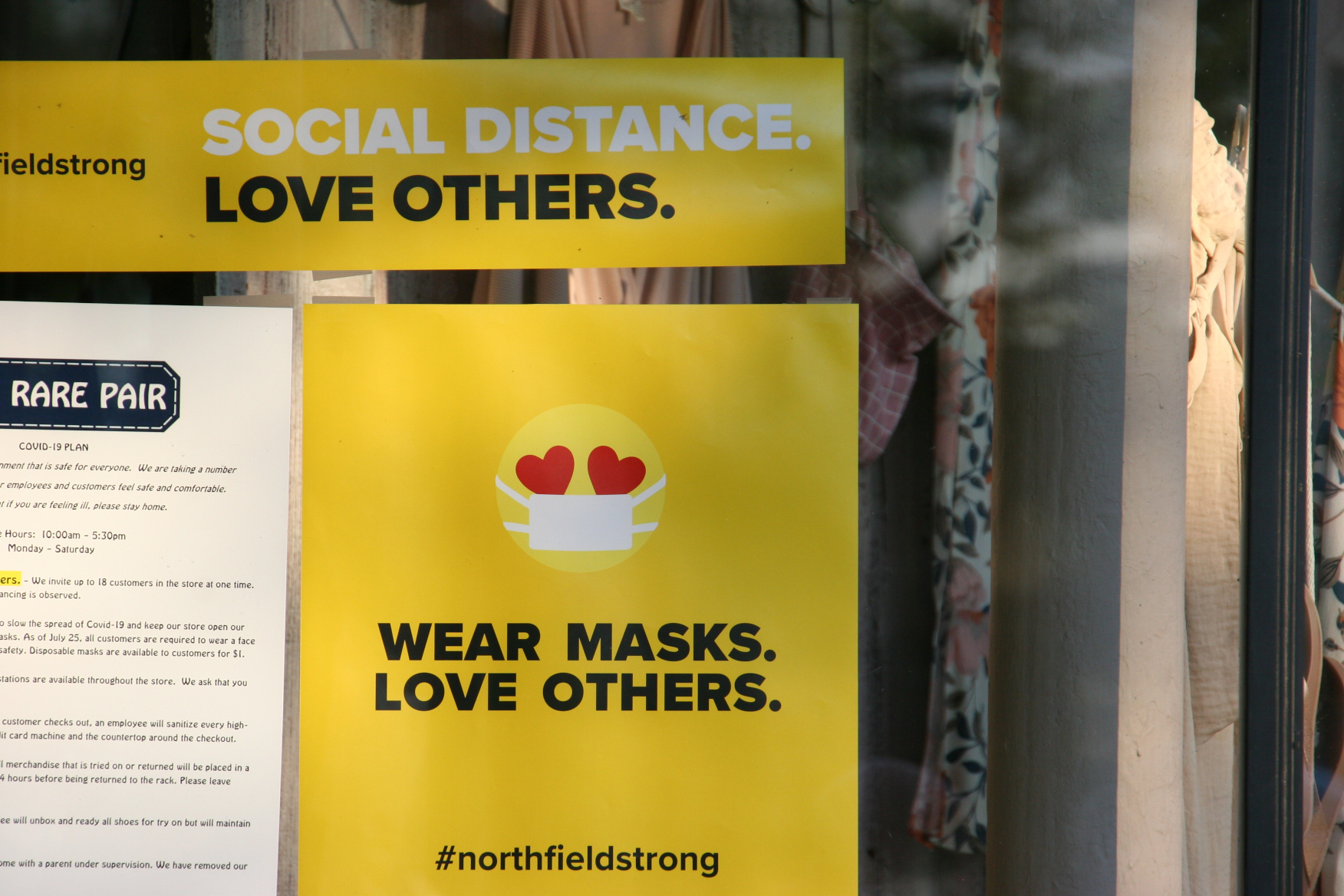
Early in the pandemic, the Rare Pair in Northfield posted this sign on the front door. While social distancing and masking are no longer required in Minnesota, the overall message of LOVE OTHERS can apply to vaccination. Minnesota Prairie Roots file photo 2020.

AS THE BAND PLAYED, as the scent of gyros wafted in the breeze, as the summer day drew to a close in Central Park during Faribault’s Heritage Days celebration, I engaged in a conversation that left me frustrated. The subject: COVID-19 vaccination.

For some 10 minutes, an acquaintance and I discussed the vaccine, specifically his refusal to get vaccinated. I tried to be respectful as I listened to his belief that COVID is no worse than the flu and his assessment that, if he gets the virus, he expects a mild case. He’s around my age, in his 60s. I politely disagreed with his assessment of COVID and stated no one really knows how their body will react to the virus. In our county of Rice 110 people, ranging in age from 24 to 104, have died from COVID.

I shared stories about those, with a connection to Randy and me, who have died of COVID. Those deaths didn’t seem to matter. He acknowledged hearing my concerns, but remained unswayed.

“PARANOID” VS. CAUTIOUS & CARING

When he called his co-workers at a local factory “paranoid” about COVID, I felt myself losing patience. There’s nothing paranoid about concern, about taking precautions, about preventing the spread of a potentially deadly virus. There’s nothing paranoid about caring for your own health and the health of humanity by choosing vaccination.

In hindsight, had I known I would have this conversation, I would have taken a different approach—emphasizing that the decision whether to get vaccinated or not stretches beyond our individual selves to our families, friends, neighbors, and yes, even our co-workers. Even to strangers.

My acquaintance, while seemingly unconcerned about his own health, should feel a sense of responsibility to his community. I wonder how he would feel if he exposed someone to COVID and that person died or suffered long-term health issues. I would struggle with guilt.

I DON’T UNDERSTAND

Not only do I struggle with my acquaintance’s refusal to get vaccinated, but I really struggle with those employed in healthcare settings who are refusing vaccination. At my local hospital, about 37% percent of staff remains unvaccinated, according to a recent story in the Faribault Daily News. They are putting patients at risk by that choice. The same goes for those who work with our elderly and most vulnerable in long-term care centers. Where is the sense of care for others, of respecting science, of maintaining health in a place devoted to health?

GRATITUDE MIXED WITH ONGOING CONCERN

To those of you who have chosen vaccination, thank you. Thank you for protecting yourselves, those you love and the broader community. Because of your choice, we are seeing a significant drop in COVID cases. Vaccines are working. That decline doesn’t apply everywhere, though. In states like Arkansas, Missouri and Oklahoma, where vaccination rates are especially low, COVID cases are still prevalent, according to media reports. And the highly-contagious Delta variant is quickly spreading, accounting for 20% of new COVID cases in the U.S. This pandemic isn’t over yet and I’m concerned for those who aren’t getting, or can’t yet be, vaccinated. Like my acquaintance. And my young grandchildren. And others I know who refuse to trust and accept that vaccines work.

DESPERATE TO BE VACCINATED

In closing, I want to share one final story. A friend’s son and his family are flying from their home in Brazil to Minnesota to get vaccinated. Vaccination is many months away for them in a country hit especially hard by COVID. Their oldest daughter, who has Downs Syndrome and thus is especially vulnerable to the virus, is their primary concern. Think about that for a moment. We can’t give away vaccines in this country. People are refusing them. And here we have a family of four flying some 5,000 miles to get vaccinated. They trust the science. They want to protect themselves. They understand that COVID-19 can be worse than the flu. They are part of our global family and I feel thankful that they are choosing vaccination.

If you are not yet vaccinated, please get vaccinated. Your decision is about more than you. It’s about all of us. Your family. Your friends. Your neighbors. Your co-workers. Your community. Your world.

© Copyright 2021 Audrey Kletscher Helbling


Focus on mental illness: A Minnesota family’s story December 2, 2020

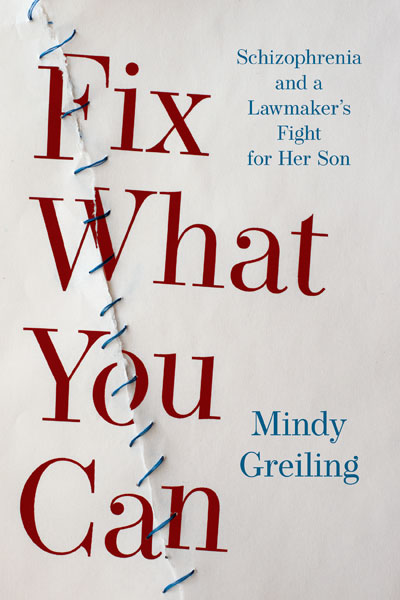
I READ THE BOOK in a single day. That should tell you something. Fix What You Can—Schizophrenia and a Lawmaker’s Fight for Her Son by Mindy Greiling is an incredibly powerful book. It is painfully honest, deeply personal and informative. A must read, whether you know little or a lot about people with serious mental illnesses.

Greiling writes about the flaws in the mental healthcare system—from lack of providers and treatments and options to poor communication to the struggles families face, too often alone.

You will cry with this mother as she shares the challenges faced by her son, Jim, diagnosed with schizoaffective disorder and also a substance abuser. You will feel her pain, her fear, her anger. This is her story. Jim’s story. Her family’s story. Maybe your, or a loved one’s, story.

GRIEF. ANGER. ADVOCACY.

Mindy writes of transitioning through the stages of grief. From anger to advocacy. Not because her son has died, but rather grieving the loss of what may have been if not for Jim’s disease. She takes her personal experiences and uses her position as a state representative to effect changes in Minnesota laws and ways in which people view mental illness. She became involved in the National Alliance on Mental Illness. She became not only Jim’s advocate, but an advocate for the broader base. All the while managing her own fears and feelings of being alone through all of this, of experiencing trauma.

IMAGINE.

Imagine if your son heard voices directing him to kill you. Imagine if your son suffered from paranoia. Imagine if your son had to get off the one most effective medication for his disease because side effects could kill him. Imagine…

This was/is reality for the Greiling family as Jim continues to navigate life and his disease. But it is also a story of hope and resilience and the strength of not only Mindy, but of her son. She recognizes that, even with schizoaffective disorder, Jim is capable of so much. She believes in him. Never gives up. You will see that repeated throughout the pages of this book written by a determined and caring mother faced with crisis after crisis.

There is no fairy tale ending to this story. Jim’s is a life-long disease with no cure.

PUTTING A FACE TO A DISEASE

I admire Mindy, who sought her son’s input in writing this book released in early October. I admire Jim’s strength in the public telling of his story. Such first-hand accounts make an impact, take a disease beyond statistics to a face. An individual. A family. This is a mother trying her best to secure help for her son, to advocate when needed, to make tough decisions when necessary. This is a family in need of understanding and support, all too often missing when it comes to mental illness. When Mindy’s husband, Roger, emails extended family and asks them to send get well cards to Jim in a hospital psych ward, my heart breaks. But this is too often reality. Families feel alone, without much-needed support from family and friends.

LEARN. LISTEN. SUPPORT.

I encourage you to read Fix What You Can—Schizophrenia and a Lawmaker’s Fight for Her Son published by the University of Minnesota Press. And then, when you’ve finished, reassess how you feel about individuals who are dealing with mental illness. Consider that they did not choose these brain diseases, just like people do not choose cancer.

There is much to be learned from the Greiling family’s story. We’ve come a long way in opening up about mental health. But so much remains to be done. We need more mental healthcare providers. (Mindy writes of a six-week wait for Jim to see a psychiatrist, more common here in Minnesota than uncommon.) We need more programs. More funding. More housing and treatment options. More training for law enforcement. More understanding and compassion. And support. We can pledge, as individuals, to educate ourselves about mental illness and then to take that knowledge and be that person who sends a card, listens, prepares a meal…for an individual/family in need of our ongoing care, compassion, understanding and support. A family like the Greilings.

© Copyright 2020 Audrey Kletscher Helbling


COVID-19 stories from Minnesota November 18, 2020

Filed under: Uncategorized — Audrey Kletscher Helbling @ 2:25 PM
Tags: , , , , , , , ,
Minnesota Prairie Roots photo taken in downtown Faribault, MN on May 15, 2020.

AT 6 PM TODAY, Minnesota Governor Tim Walz is expected to announce more restrictions related to COVID-19 during an address to our state. With cases, hospitalizations and deaths exploding, additional measures seem wise and necessary. Minnesota recorded 67 COVID deaths today, a new record.

On Tuesday afternoon, the governor led a press conference that focused on stories, what he termed “the basic human part of what COVID is.” If you read my MN Prairie Roots post yesterday, you understand the value I place on stories. Last Friday I emailed the governor’s office and suggested stories as a way to personalize COVID. Whether my email helped shape the approach taken at yesterday’s briefing, I don’t know. It doesn’t matter. What matters are the powerful stories shared. I feel it’s important to pass along these stories, using notes I took during Tuesday’s press conference.

“IF WE DON’T ACT NOW…”

Former State Representative Nick Zerwas from Elk River began the storytelling with his COVID experience, one which landed him in the hospital for five days. Only 39 years old but with an underlying heart defect, he required supplemental oxygen. “I was stunned that I was so overwhelmed and ill from this virus,” he said.

At times throughout the tele-conference, I heard Zerwas coughing and wondered if he would make it through the briefing.

Zerwas, a Republican, has done an about face on the virus, now advocating mask wearing and coming together to stop rampant community spread. He spoke candidly about his change in attitude, noting, though, that the virus situation (community spread) now is much different than this summer.

I’ve seen the same attitude changes recently in other Republican leaders who, just last week, became infected with COVID. It’s a welcome shift that I hope ripples to the public and ends the politics of COVID-19.

In his lengthy storytelling, followed by a media question, I found this statement by Zerwas to be particularly powerful: “The virus is here. If we don’t act now, God help us.”

IN THE ICU WITH HEART AND KIDNEY FAILURE

The second speaker, Sarah Winston, the mother of a 17-year-old daughter infected with COVID-19, spoke next. Hers is a story that needed to be told and to be heard by anyone who thinks they are “safe” from the ravages of the virus just because they are young and healthy.

Sarah described her daughter as a healthy student athlete who contracted COVID from an asymptomatic friend. Ella ended up in the hospital for 10 days with heart and kidney failure and more and deals now with inflammation of her heart.

This mother urged Minnesotans to stay home, to quarantine even if they test negative after exposure, to wear masks, to be safe, to be smart.

I was surprised to hear her say, though, that she wants sports to continue (for the mental health of young people).

“AN AWFUL EXPERIENCE”

Dr. Jon B. Cole, a doctor in Hennepin Healthcare emergency medicine, termed COVID-19 “an awful experience.” He spoke from both a personal and professional perspective. In March, when COVID was just breaking in this country, he canceled a trip to Florida with his wife and four children. Five days later, he developed the virus and was among the first in Minnesota to test positive for COVID. Cole emphasized how thankful he was for his decision to cancel the Florida trip.

On a professional level, he spoke of the “substantial number” of nurses and doctors now sick with the virus or in quarantine. He warned of a shortage in healthcare workers.

GRIEVING

“I don’t want anyone else to endure what my family has had to endure,” Lt. Gov. Peggy Flanagan said after sharing the story of losing her brother to COVID-19 in March. She described her brother as “a Marine, tough as nails.” He cared for their father, who died in January. Not long after, he was diagnosed with aggressive cancer and then COVID.

Flanagan noted that she never got to say goodbye to her brother, that she hadn’t processed her grief. It wasn’t until October that her family buried his ashes. Grief threaded through her narrative. As did strength and a determination that her experiences will make a difference.

She emphasized that every life has value, no matter an individual’s age in obvious reference to many elderly in care centers who have died as a result of COVID.

Flanagan said it’s “killing” her not to have Thanksgiving with her mom, asking Minnesota families to do the same so the chairs around their holiday tables are full next year. She encouraged people to drop the “magical thinking” that one Thanksgiving dinner won’t count in stopping the spread of COVID. Those were hard words to hear.

“COVID will continue to spread as long as we allow it to,” she concluded, urging everyone to take care of themselves and each other.

SOME WORDS FROM THE GOVERNOR

When the press conference ended, the media asked questions, mostly of the governor. He noted there will be a pause in sports and other restrictions announced today.

He also expressed gratitude to those who shared their stories Tuesday afternoon. I am grateful, too, for those stories which, as the governor stated in his opening remarks, add the human element to this virus.

Walz offered one final observation: “This is as bad as it was in New York in the spring.” If only he was wrong.

#

Take care, dear readers. Make good choices for yourself and others. Follow health and safety guidelines/mandates. Be safe. Be well.

NOTE: I welcome comments and sharing of stories. However, I moderate all comments and will not publish those which are inflammatory or which spread misinformation and/or false narratives.

© Copyright 2020 Audrey Kletscher Helbling


The saga continues: Unsustainable & unaffordable health insurance November 12, 2020

Filed under: Uncategorized — Audrey Kletscher Helbling @ 5:00 AM
Tags: , , , ,
Minnesota Prairie Roots file photo.

ELEVEN MONTHS CANNOT pass quickly enough for me. And, no, this has nothing to do with COVID-19 although I certainly wish for an end to that, too.

What I most anticipate, what I’m most excited about and looking forward to from a financial perspective in 2021 is turning 65. And getting on Medicare. Why? Because of the cost of my health insurance.

Recently, Randy brought home the new premium numbers for 2021. Since I’m self-employed, I get my coverage through his work plan. Based on media reports and based on the across-the-board decline in medical services provided this year (due to hospitals canceling elective surgeries early in the pandemic and fewer people seeking medical care, etc.), I expected our premiums would remain the same or even decline. I couldn’t have been more wrong.

We are facing another increase, of nearly $200 a month, to monthly premiums of $1,245 each. Times two, that’s $2,490 a month (up from $2,297/month) for policies with $4,250/each deductibles. That’s an 8.4 percent increase.

This is a photo of an x-ray showing the implant I have in my left wrist. Minnesota Prairie Roots file photo 2018.

Let’s break that down. Randy’s employer pays half of his premium. None of mine. Therefore our portion of the premiums will be $1,868 a month, $144 more than the $1,724/month we currently pay.

This is unsustainable. And ridiculous. This is not affordable health insurance, to all you politicians out there who claim you’ve made healthcare affordable. Talk to me. I’ve remarked to Randy that soon he will need to pay his employer to work for him, just to cover our health insurance premiums. While I may be stretching that a bit, I see the numbers on his paychecks. When I do the math, I see that nearly three weeks of his base gross wage each month goes toward health insurance premiums.

I also recognize that employers, especially small businesses, feel the financial impact of such high health insurance premiums. If you are fortunate enough to work for an employer who covers your full premium and maybe even contributes to family coverage, consider yourself “lucky.” I have no doubt Randy’s employer is looking forward to his getting off the company plan in 11 months as that will save the business money.

An incorrect medical bill I received in 2018 after surgery to place a plate into my broken left wrist. Minnesota Prairie Roots file photo 2018.

I’ve always been a financially responsible person, someone who spends her money wisely, who doesn’t need the newest/biggest/best. Live within your means, don’t accrue unnecessary debt. That will never change about me. Or Randy. But, still, I yearn for an updated kitchen to replace the 1970s yellowing cupboards, the brown sink with the leaky faucet, the Formica countertops, the worn vinyl flooring…, well, you get the picture. I could have had that lovely new kitchen years ago if not for the exorbitant cost of health insurance.

But, more than that, I dislike that my hardworking husband is giving up a sizable chunk of his paychecks to pay for health insurance that is basically only a catastrophic plan. Any suggestion that we simply go without insurance is not a financial risk we wish to take. Not at our age. So we wait. Eleven more months…

© Copyright 2020 Audrey Kletscher Helbling