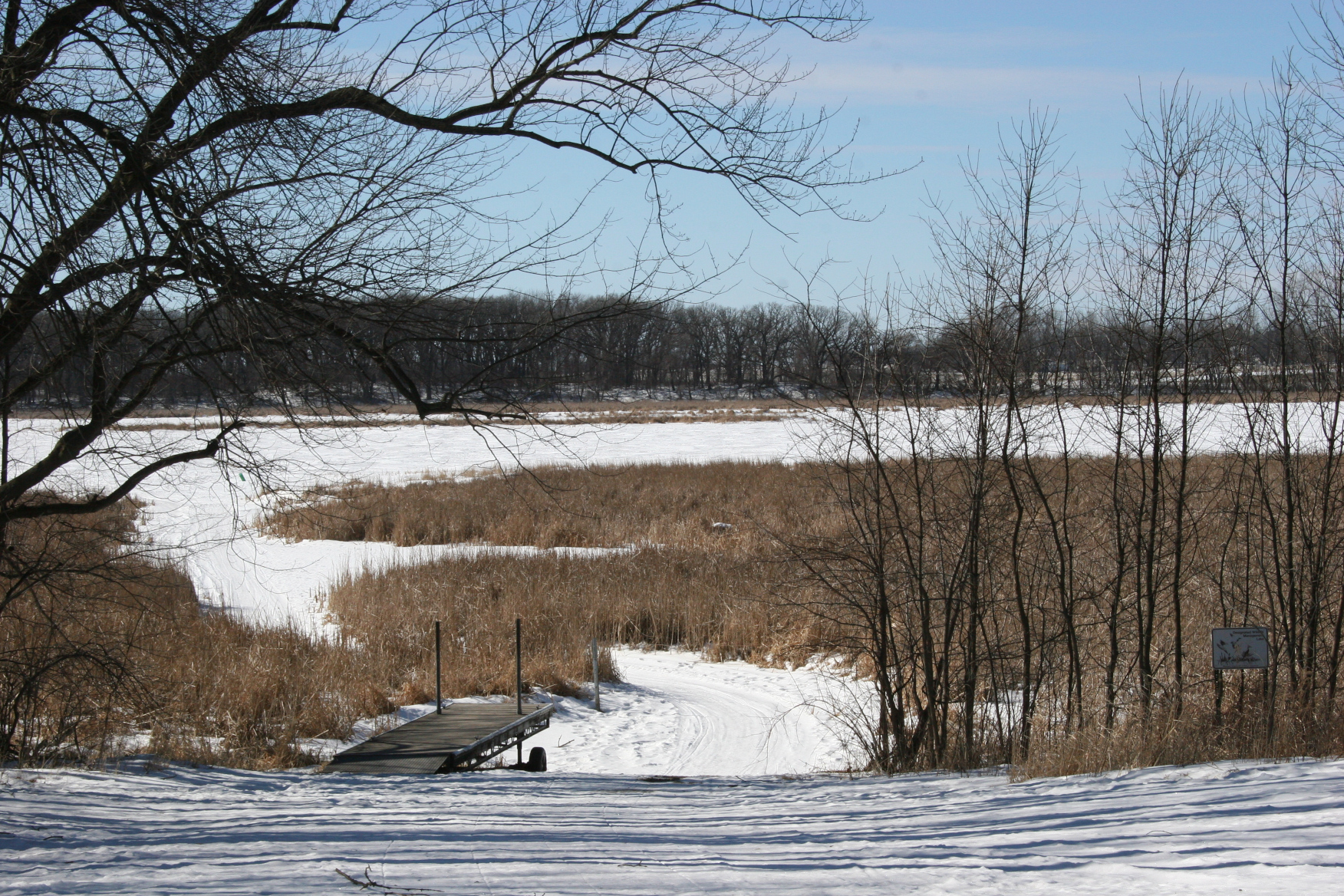
A view of frozen Rice Lake at Rice Lake State Park on February 19. (Minnesota Prairie Roots copyrighted photo February 2022)
IN THEORY, THE PLAN seemed a good one. Randy and I would hike in a nearby state park on February 19, the first of four “free entry” days to Minnesota’s 75 state parks and recreation areas.
Mid Saturday morning, we packed sandwiches, fruit, granola bars and almonds for a picnic lunch, although we would eat in the comfort and warmth of our van. Temps in the 20s do not allow for outdoor dining.
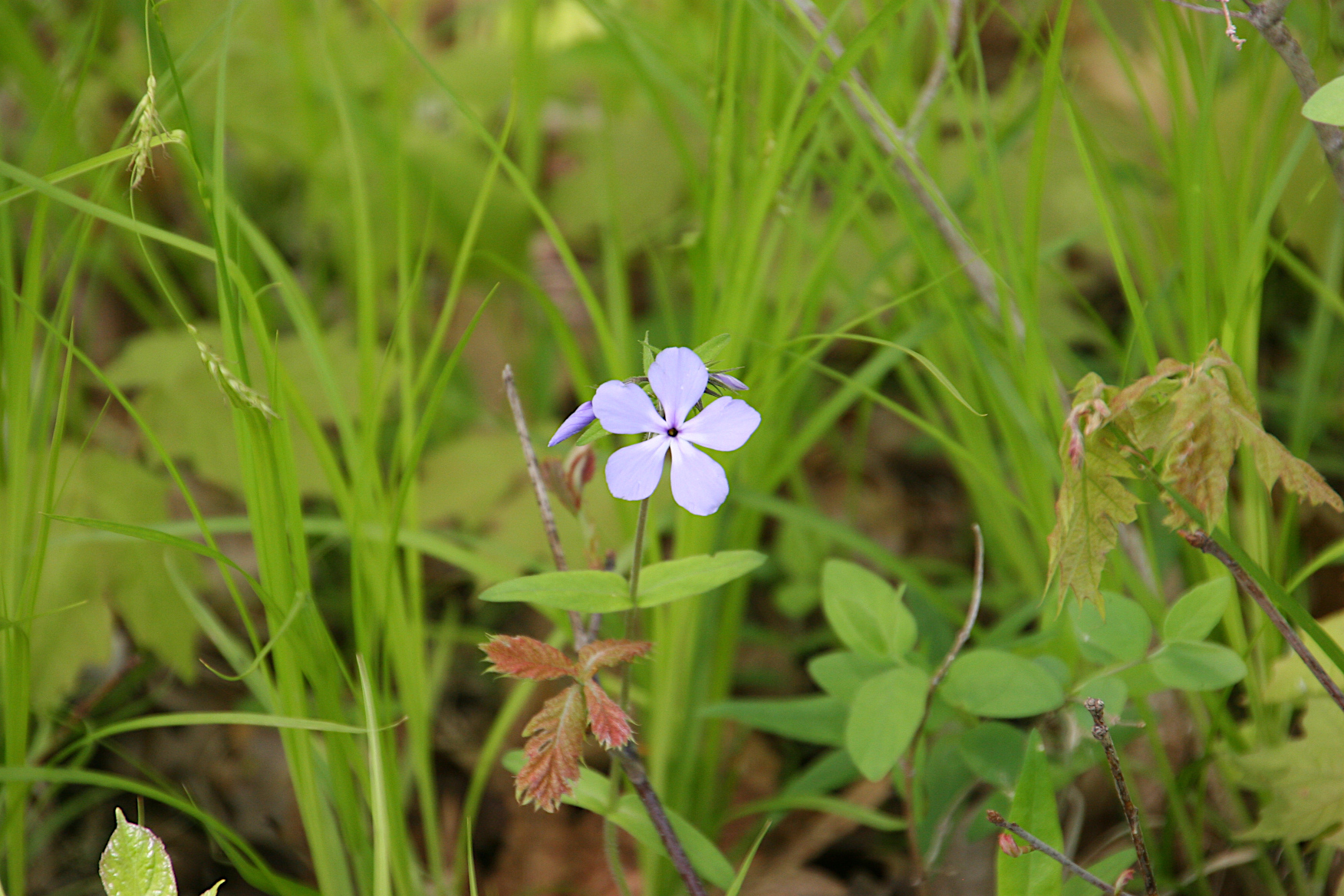
Wildflowers abound in the woods at Rice Lake State Park in this spring-time photo. (Minnesota Prairie Roots copyrighted file photo May 2022)
Originally we intended to drive to Carley State Park south of Plainview. It’s a park we have not visited. But part way there, I suggested we wait. A description of Carley’s Whitewater River-hugging Wildflower Trail and Virginia bluebells carpeting the forest floor in May prompted the change in plans.
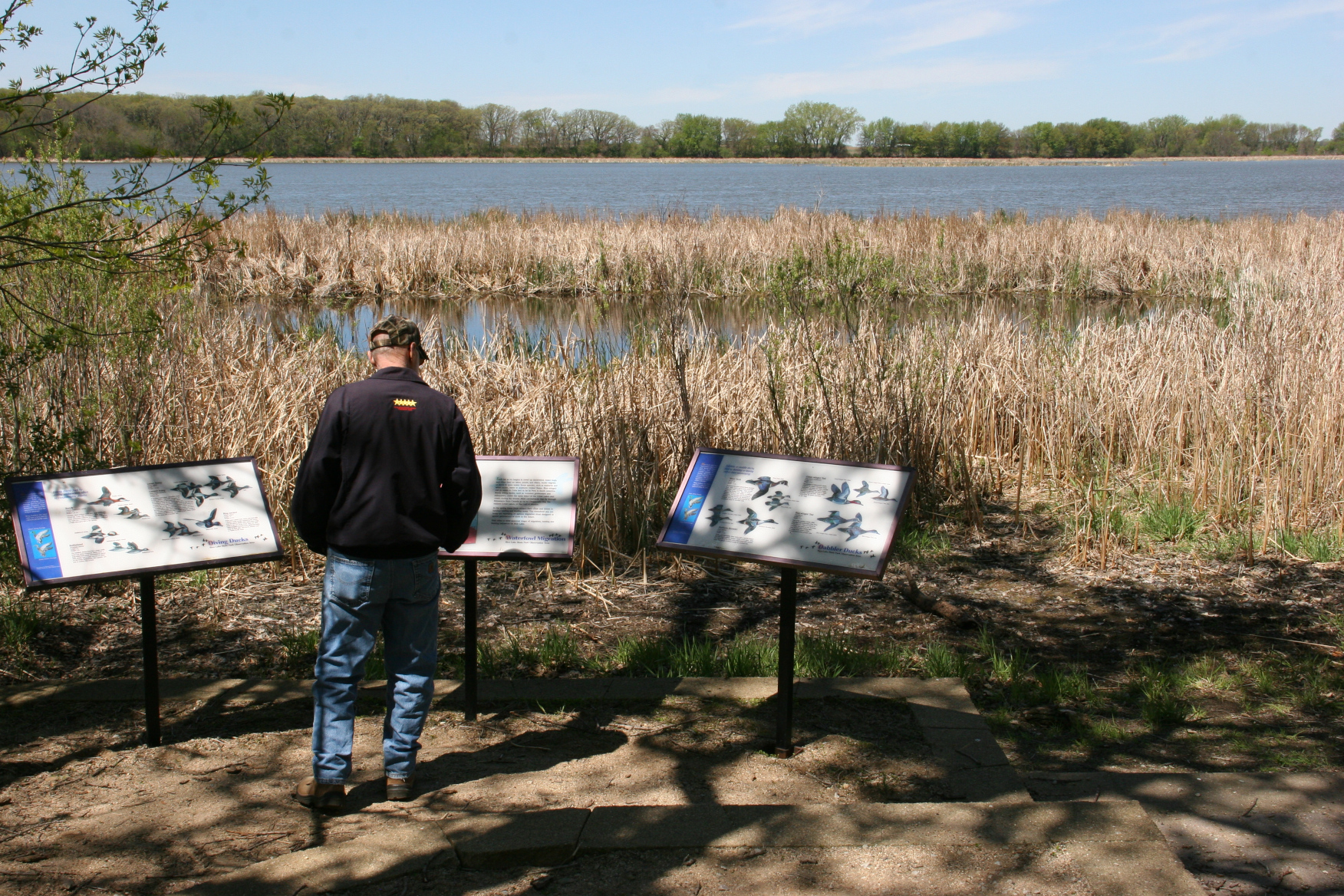
Randy reads signs about waterfowl posted by the lake during a May 2020 visit to Rice Lake State Park. (Minnesota Prairie Roots copyrighted file photo May 2020)
Instead, we aimed for Rice Lake State Park some eight miles east of Owatonna. We’ve previously been there, although not in winter. Following back paved county and gravel roads, I already envisioned hiking the park’s trails along frozen Rice Lake. I imagined the quiet of the woods, the beauty of the snow-covered landscape. Such were my expectations. I also felt excited to participate in the Rice Lake State Park Challenge, a special free entry day event that involved finding passwords to claim a possible prize.
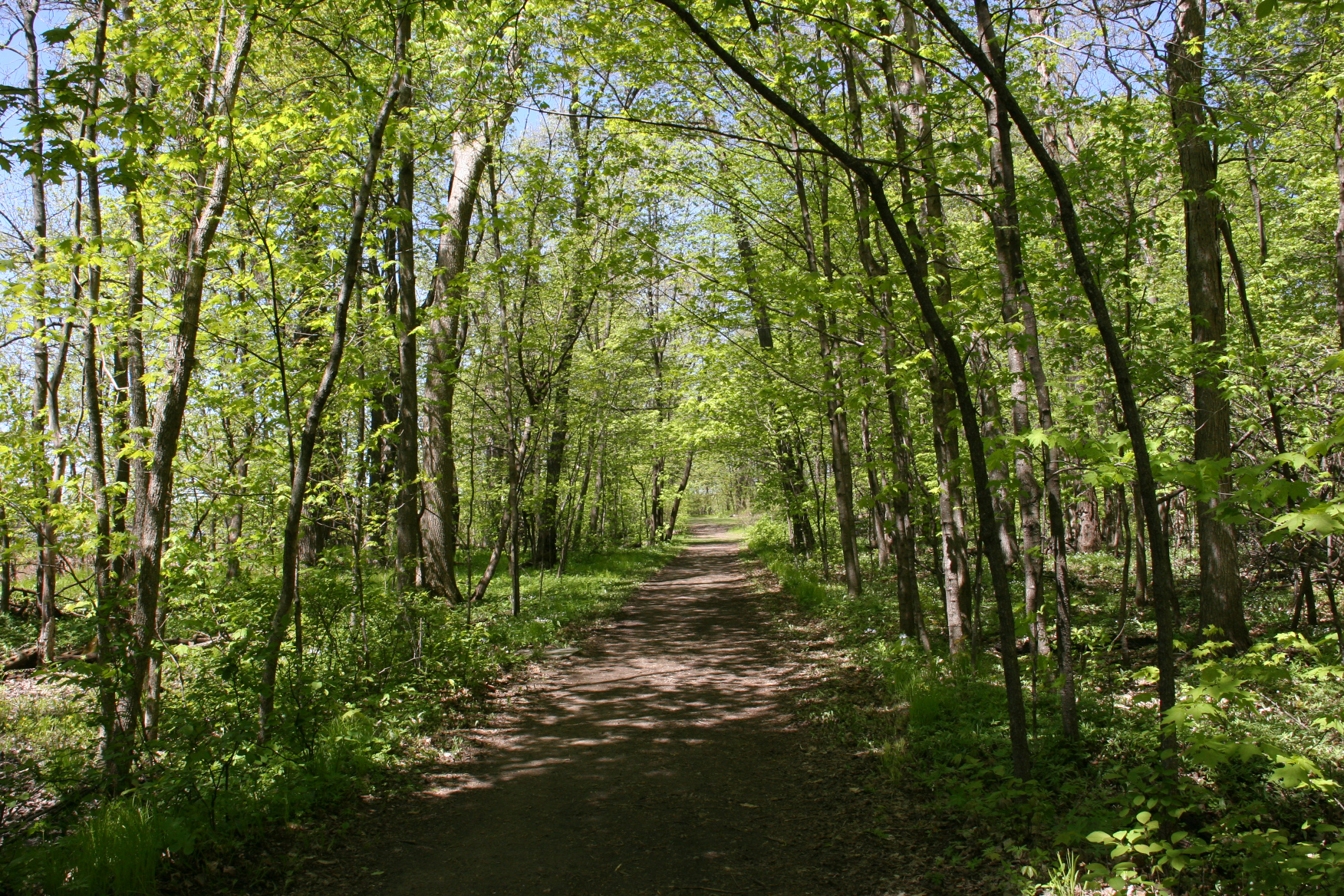
Walking into the woods at Rice Lake State Park in the spring. (Minnesota Prairie Roots copyrighted file photo May 2020)
When we pulled into the park, I checked in at the park office for a map and the challenge entry form. As I was about to leave, the park staffer warned, “Be careful, the trails are icy.” I would soon discover for myself just how right she was in that assessment.
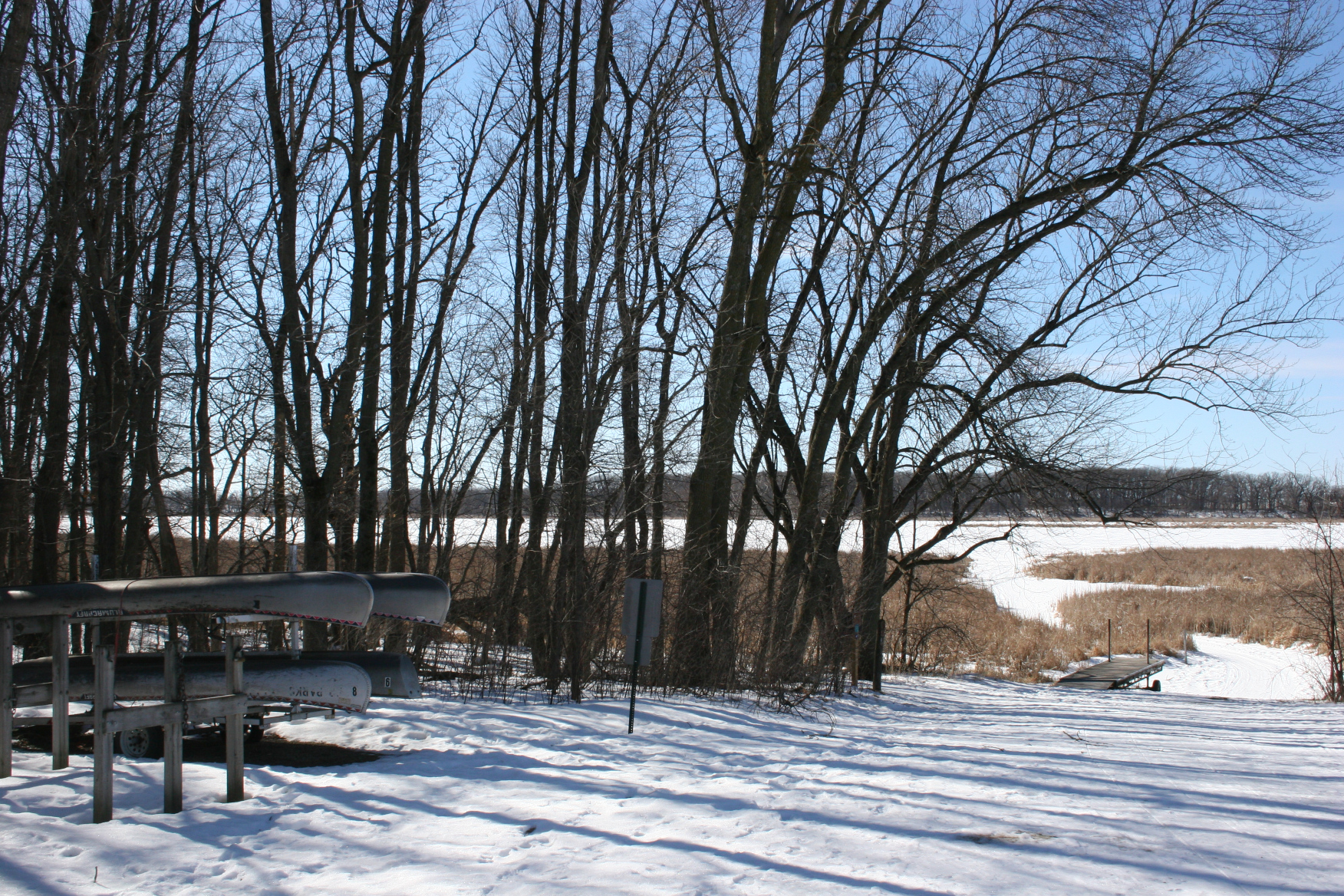
Rental canoes are stacked next to the parking lot and lake. The trail we took started at the edge of the woods near lake’s edge. (Minnesota Prairie Roots copyrighted photo February 2022)
The snow-packed, icy parking lot offered the first clue to conditions. I carefully stepped from the van, draped my camera strap around my neck and aimed toward the lakeside trail. Not even part way there, I was already grasping Randy’s arm. As someone who’s broken her right shoulder and left wrist in falls (the last requiring surgery), I have no desire to fall and break a third bone. Note that neither occurred in winter but rather in May and June and involved a missed step inside a hospital and a rain-slicked wooden step in a friend’s backyard.
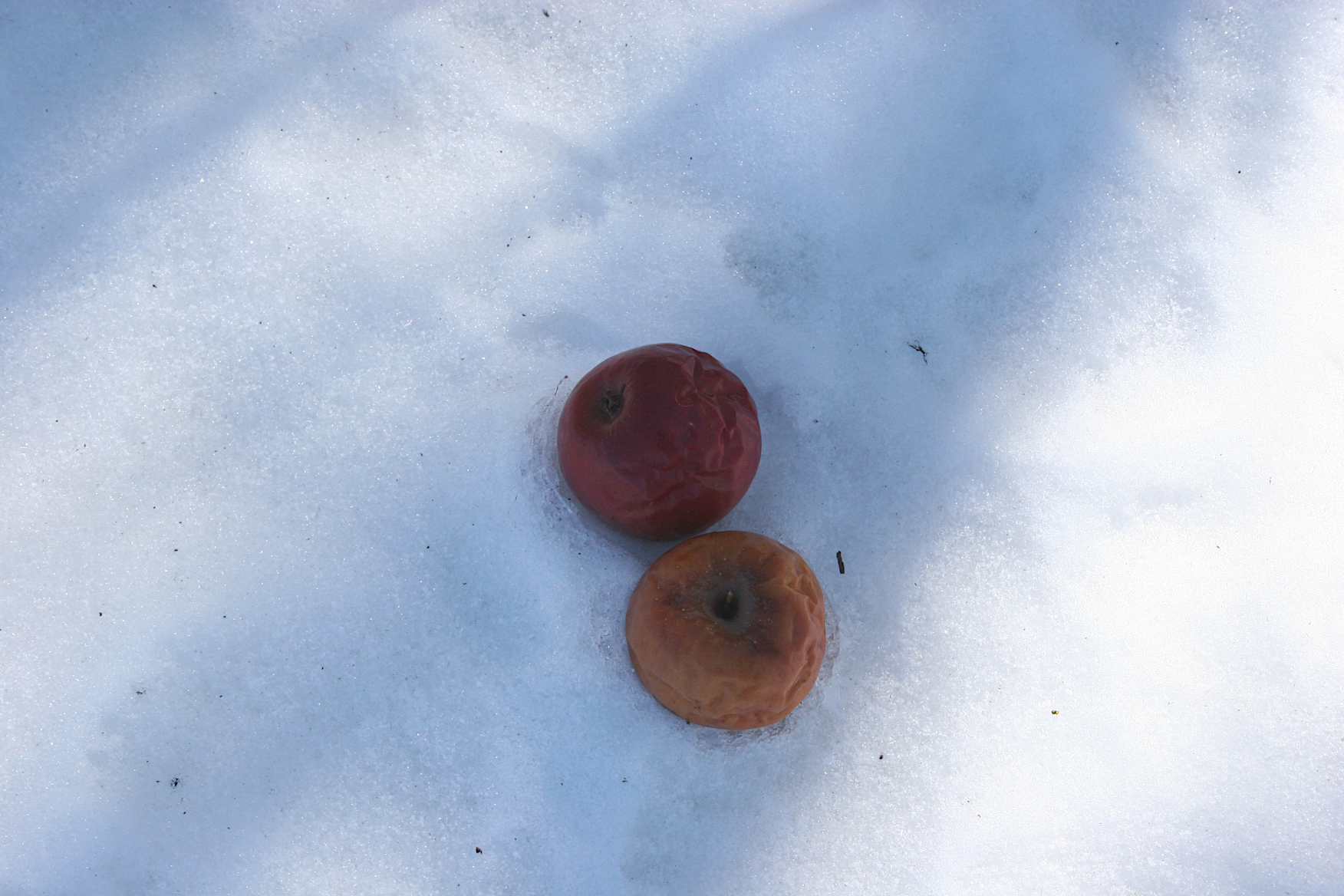
On the way back to the van, I spotted these apples in the snow. Deer food? (Minnesota Prairie Roots copyrighted photo February 2022)
At the beginning of the trail at Rice Lake State Park, I paused, observed and assessed that, yes, the trail was, indeed, icy. But I was willing to try, hoping conditions would improve. They didn’t. Soon Randy and I found ourselves crunching through the snow aside the trail rather than traversing the ice-packed path. Not even 20 feet in, Randy advised that perhaps we best turn around. I agreed.
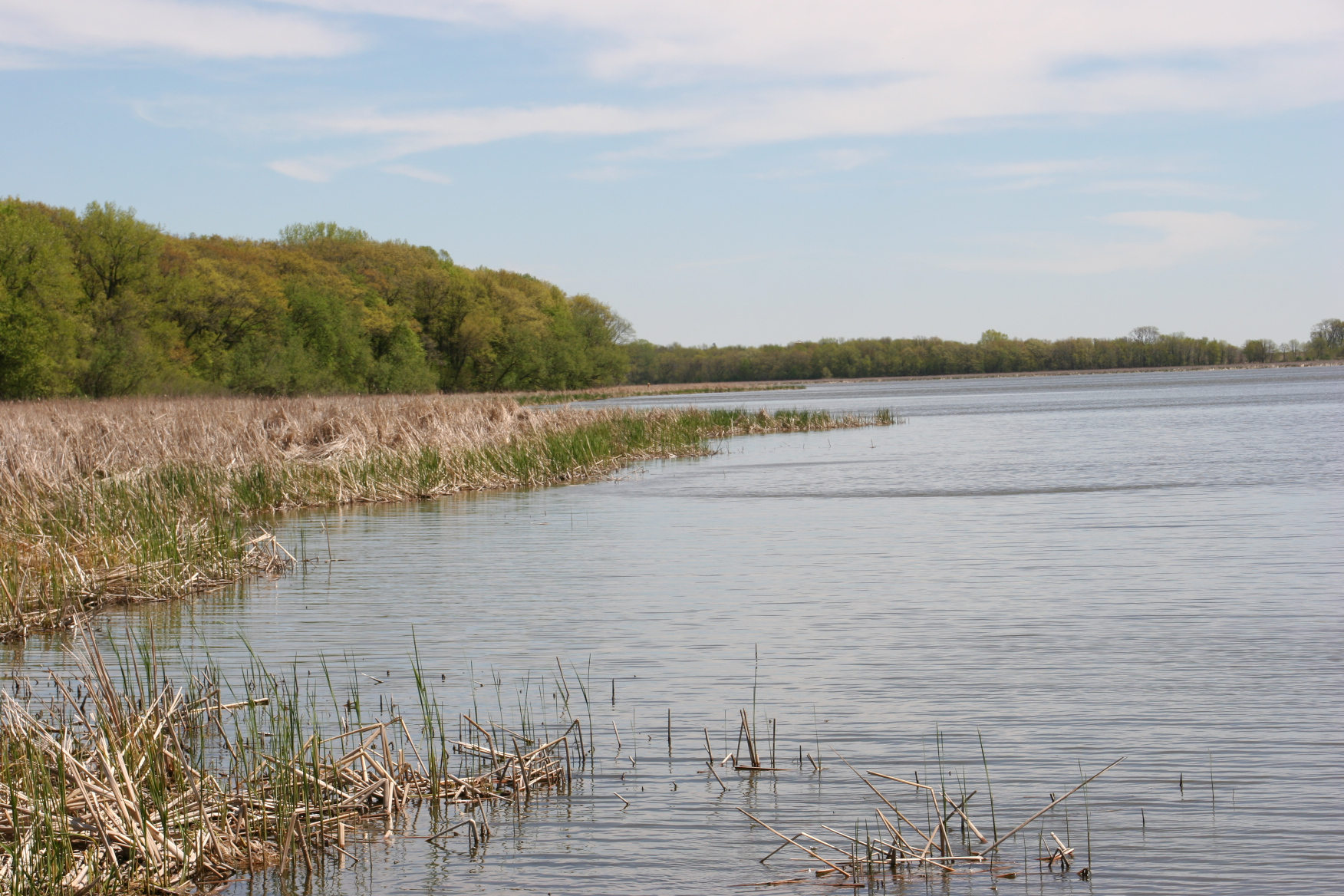
Lake and sky meet at Rice Lake State Park during a spring visit. (Minnesota Prairie Roots copyrighted file photo May 2020)
Disappointment filled my thoughts. I didn’t realize how much I had anticipated this time in nature, in the woods, by the lake. And now…plans would pivot. We realized conditions would likely be the same at other state parks. So we headed west to Owatonna for that picnic lunch and more.
#
TELL ME: If you live in southern Minnesota, where can I find clear trails for winter hiking? If you live elsewhere, where do you like to hike this time of year?
#
FYI: Minnesota has three more upcoming “free entry” to state parks and recreation areas in 2022. Those dates are April 23, June 11 and November 25. I highly-recommend a warm weather hike in Rice Lake State Park. It’s especially peaceful.
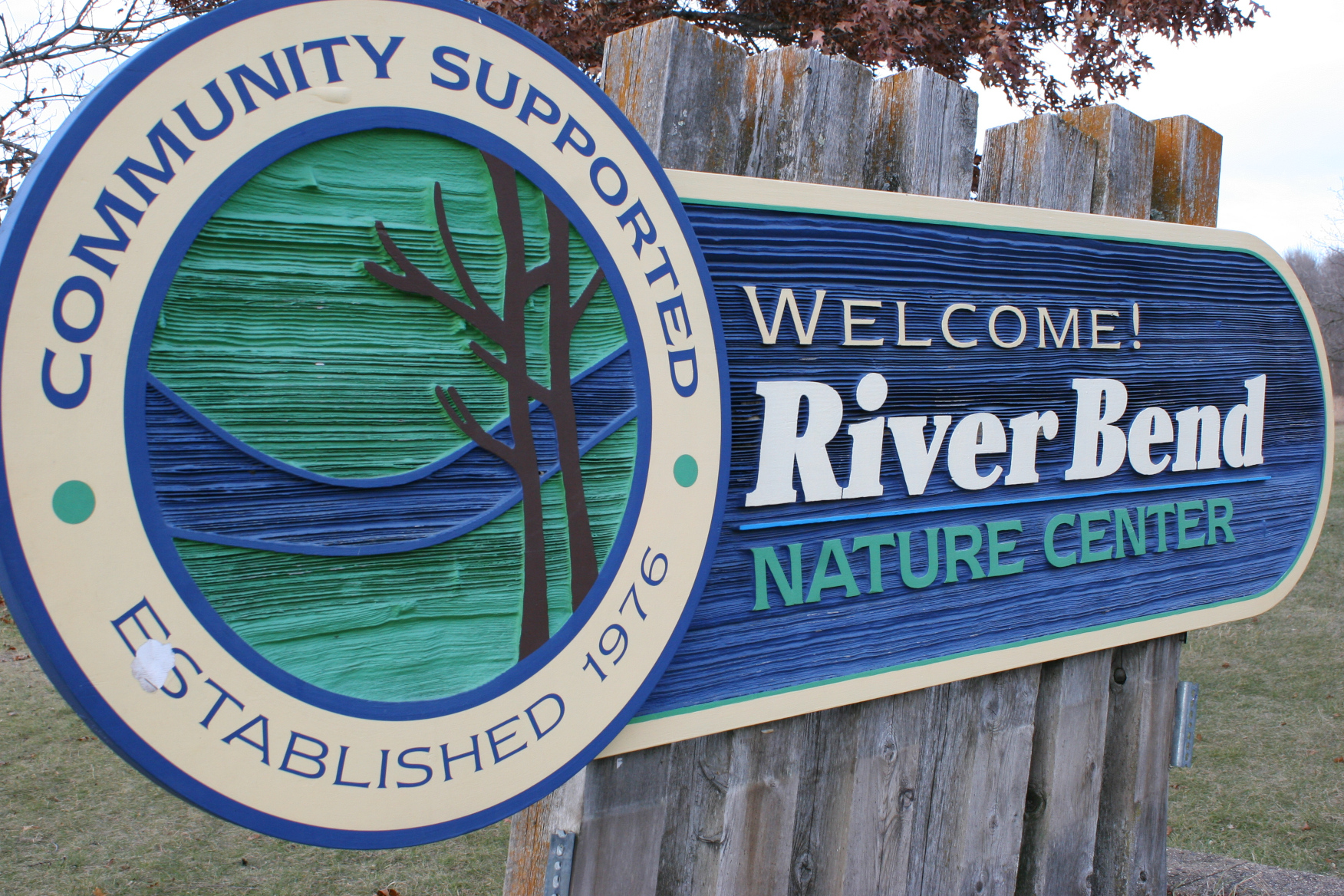
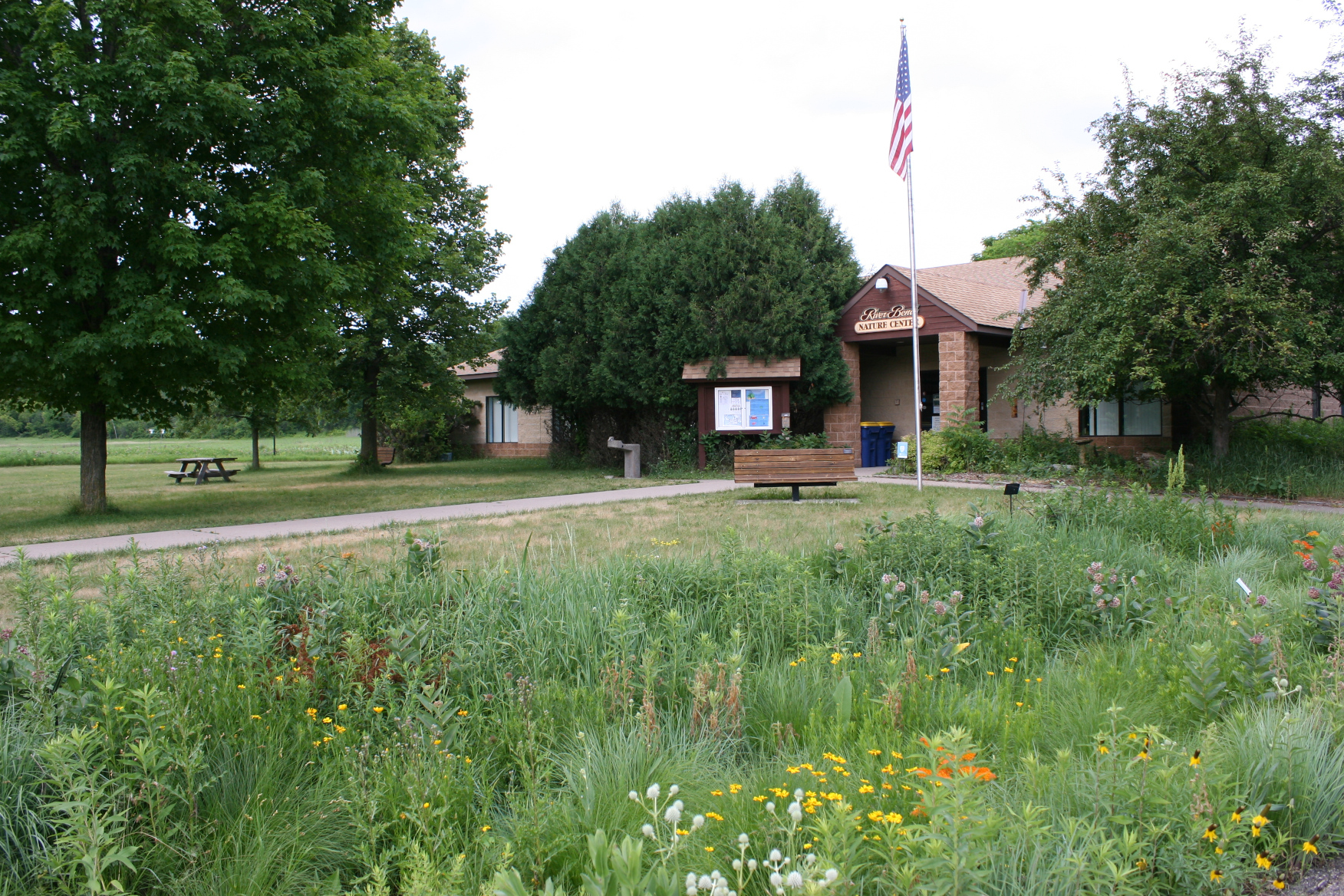
This sign stands near River Bend Nature Center’s interpretative center. (Minnesota Prairie Roots copyrighted file photo November 2021)
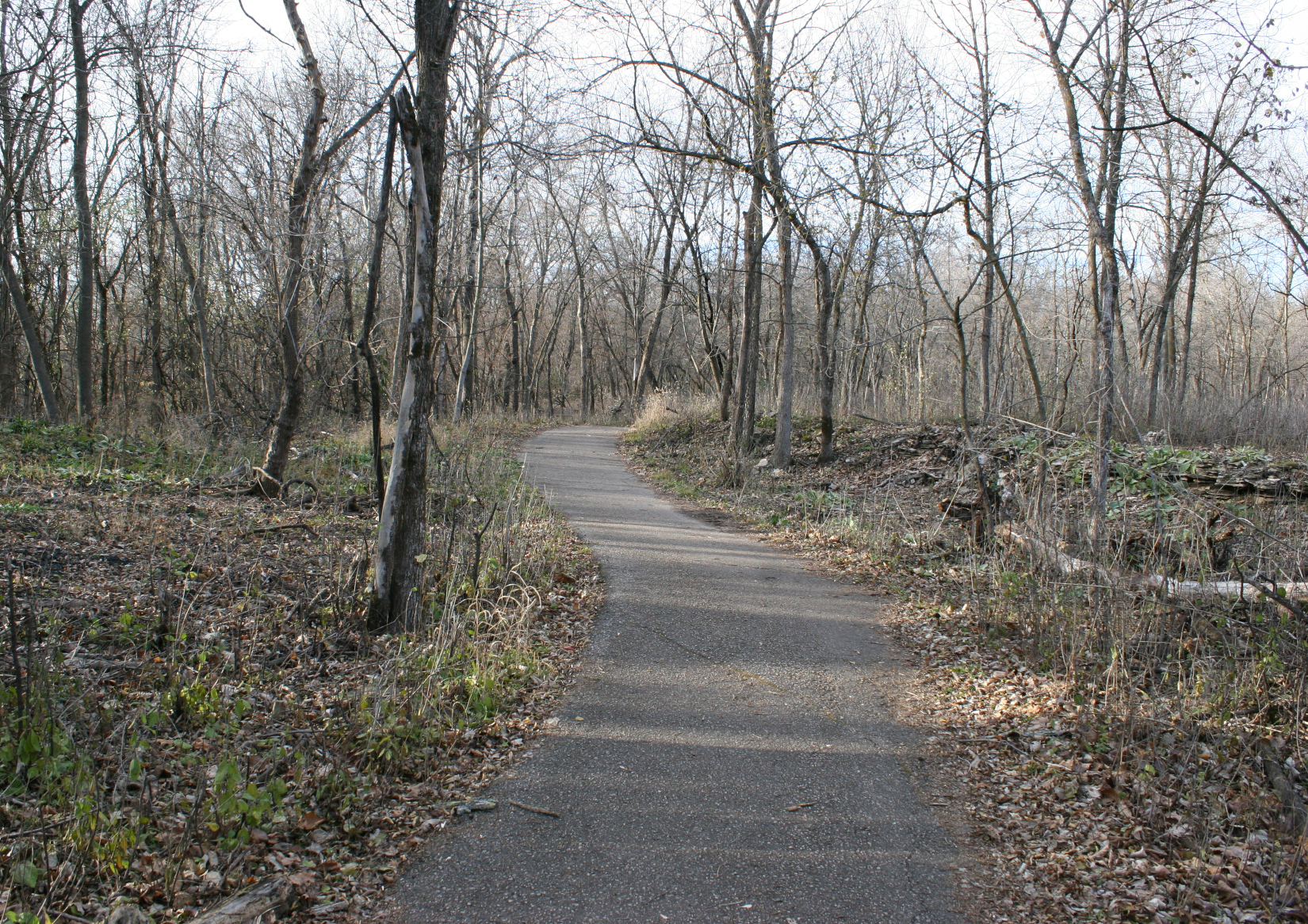
MONTHS AGO,BEFORE SNOW FELL and the season officially transitioned to winter, I followed a paved trail into the woods at River Bend Nature Center and then a grassy path to a wetlands overlook.
River Bend, on Faribault’s east side, rates as a favorite outdoor destination. That November day I embraced the lingering remnants of autumn, now overtaken by the cold and snow of winter.
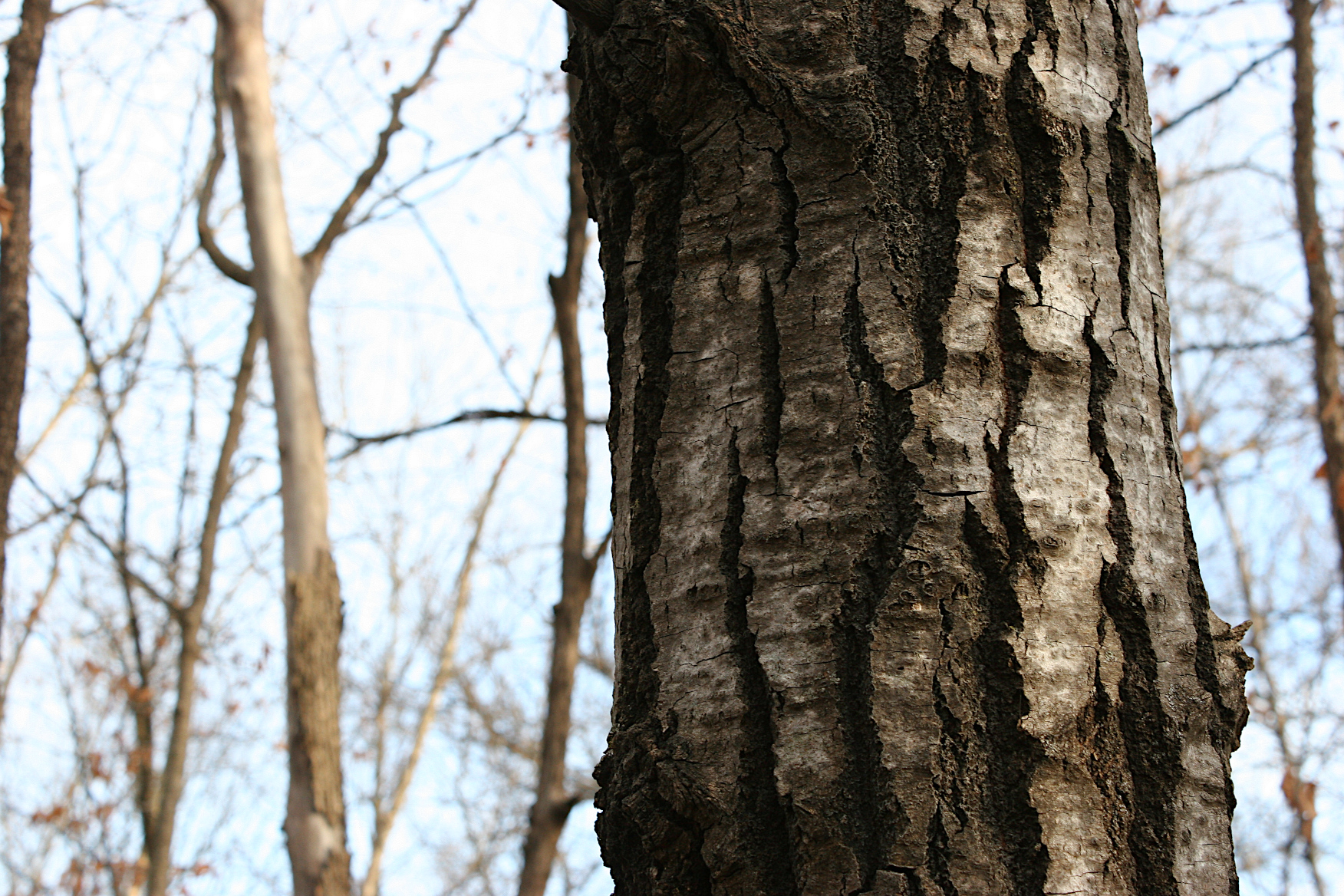
Rugged bark draws my eye as I hike. (Minnesota Prairie Roots copyrighted file photo November 2021)
Even in the muted hues of autumn’s end, beauty exists.
But, for me, taking in the evolving landscape stretches beyond simply seeing that which unfolds before me. It’s also about looking back. To my childhood on the southwestern Minnesota prairie.
One of many wooded trails in River Bend. (Minnesota Prairie Roots copyrighted file photo November 2021)
When I hike the wooded trails of River Bend, I see my younger self riding my bike through the grove back on the farm. Except the bike was a horse, not a bike. I grew up in the era of TV Westerns—of “Rawhide” and “Bonanza.”
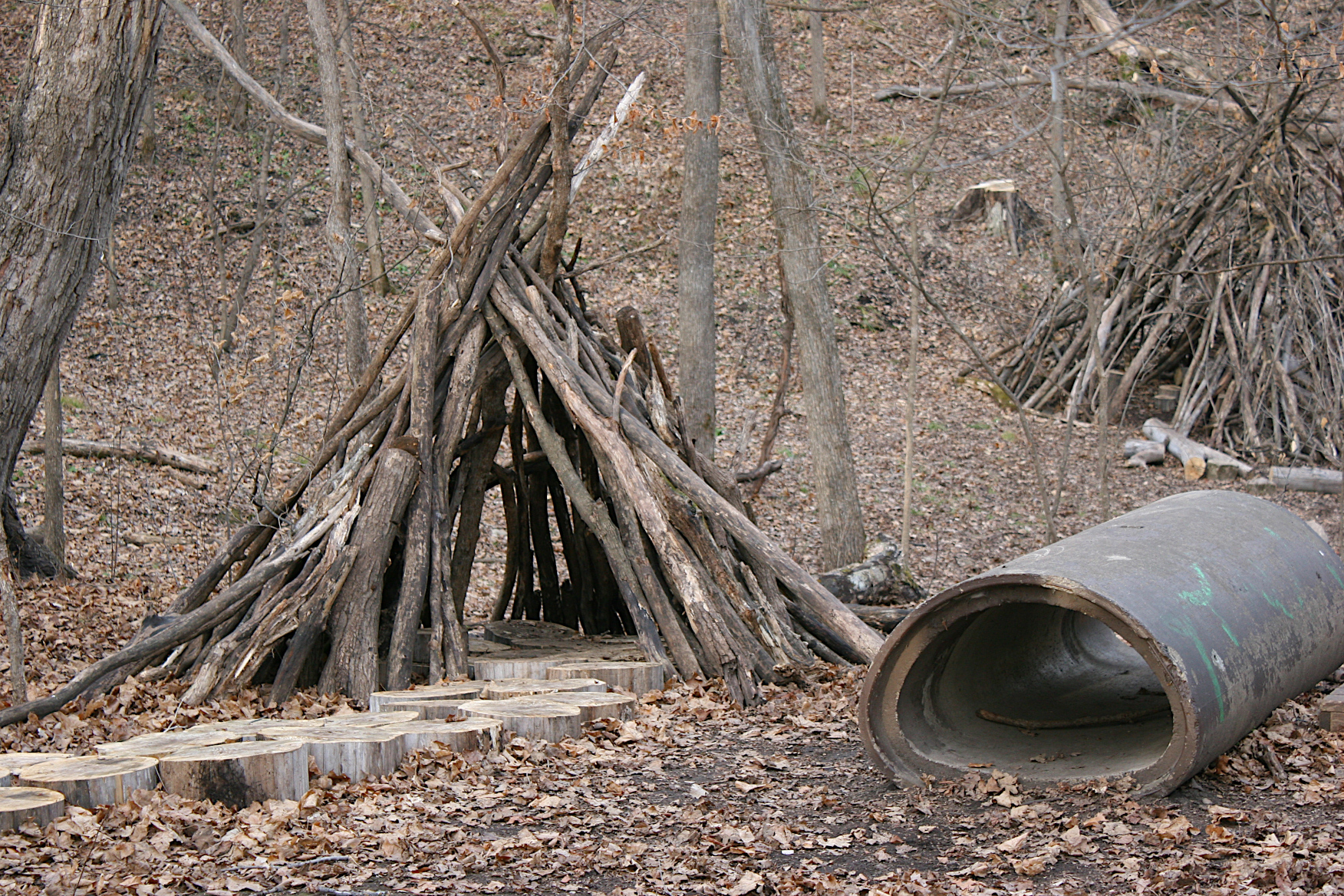
The kids’ play area at River Bend. (Minnesota Prairie Roots copyrighted file photo November 2021)
Fallen branches at River Bend angled into a shelter resemble those built by me and my siblings. We also constructed buildings by looping baler twine around tree trunks. And we crafted a house, too, from discarded wire fencing. Oh, the imaginations of farm kids let loose in the grove.
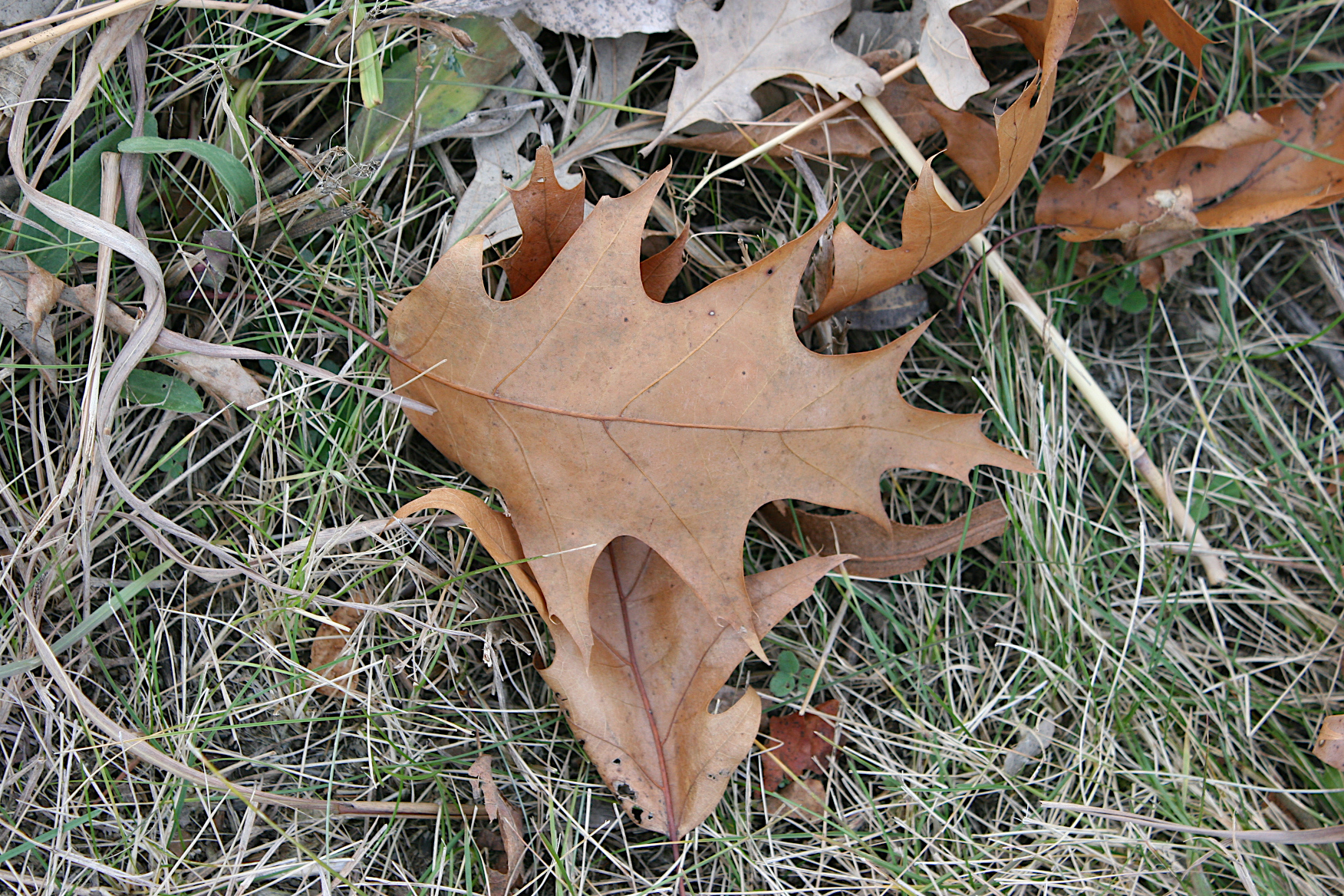
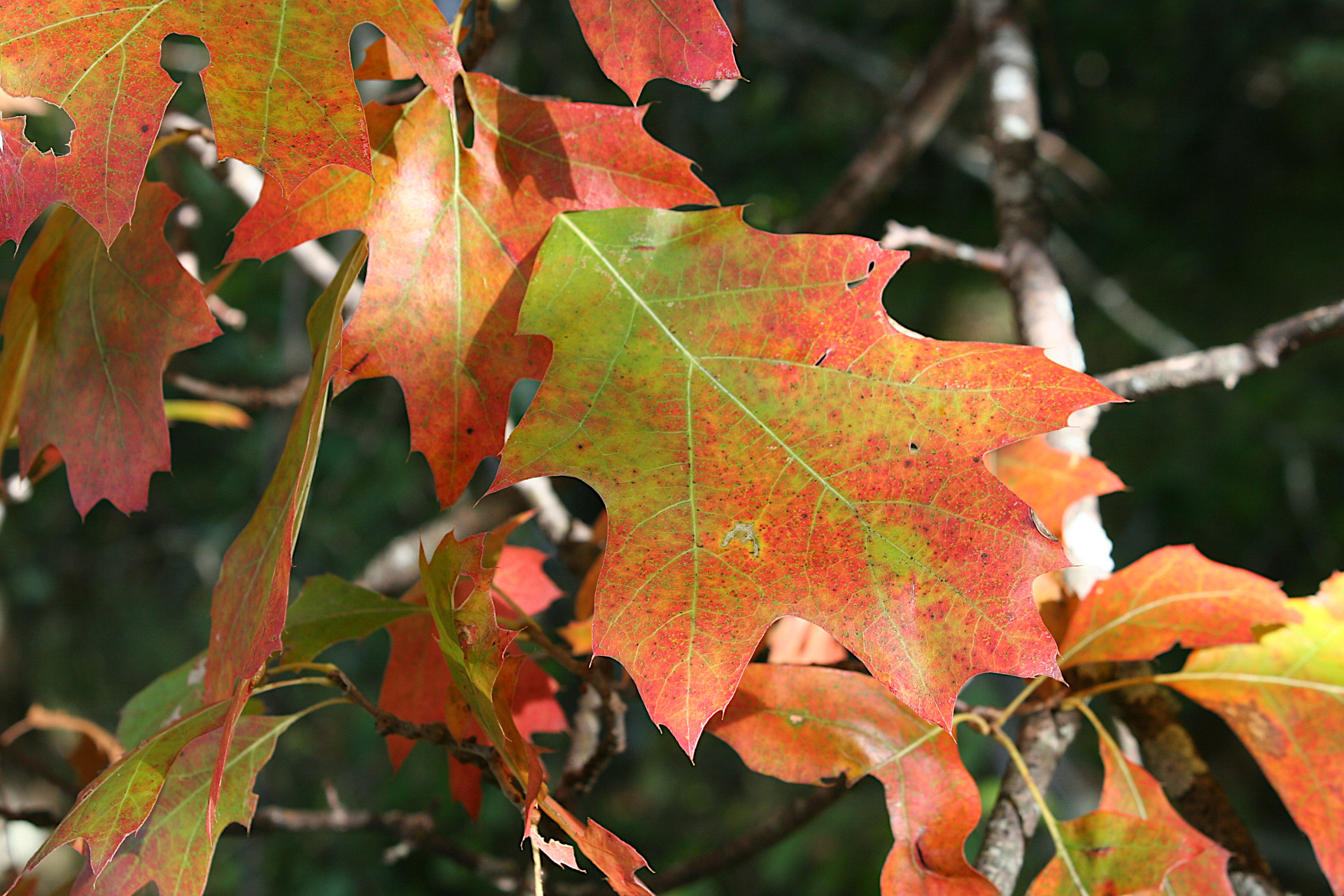
Dried oak leaves. (Minnesota Prairie Roots copyrighted file photo November 2021)
Dried leaves scattered in the woods bring more memories. Each autumn, I gathered fallen leaves into piles, then dropped the leaves into lines. Walls. Constructing leaf houses filled many a recess at Vesta Elementary School. And many an autumn day for my siblings and me.
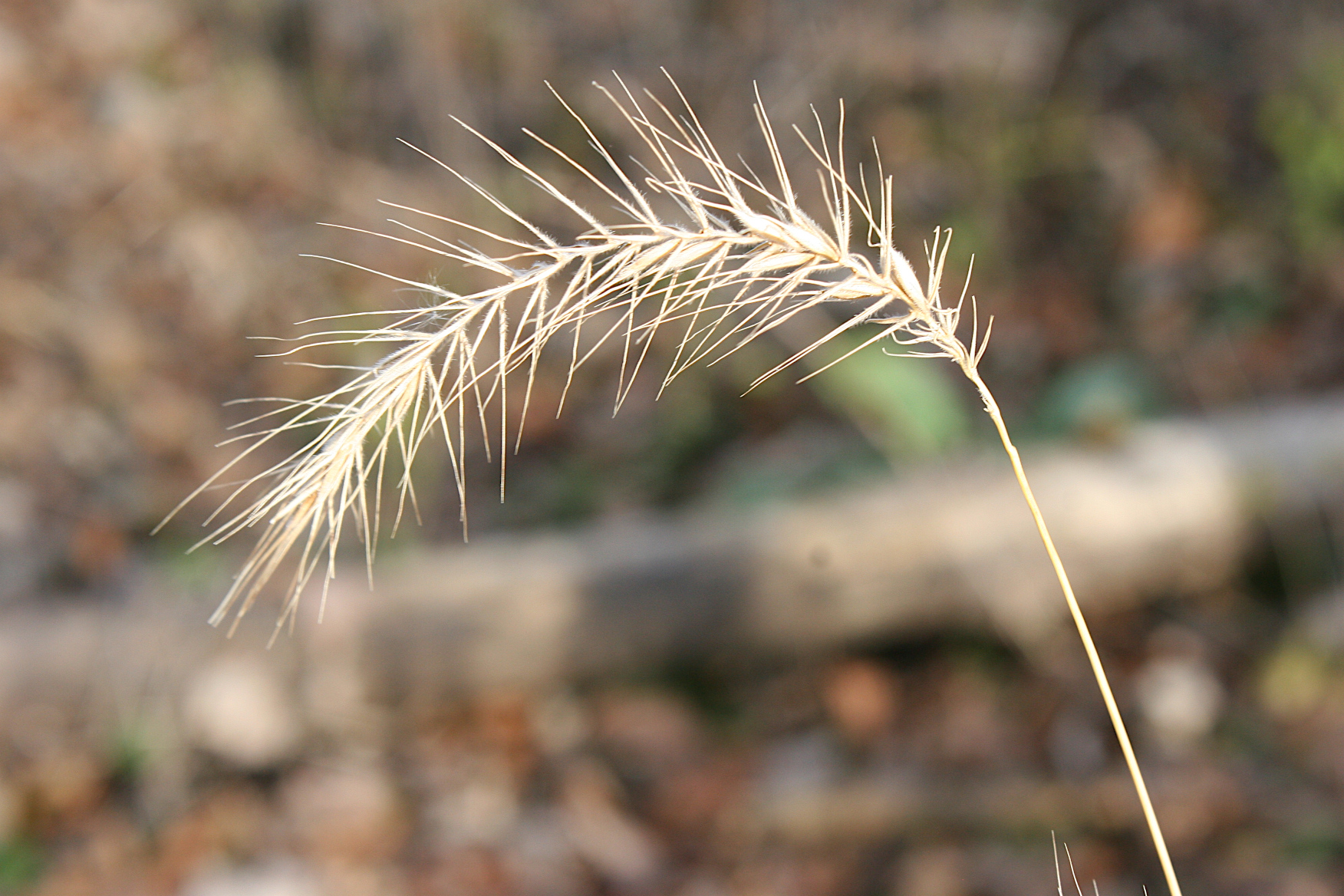
A single dried grass stem holds simple beauty. (Minnesota Prairie Roots copyrighted file photo November 2021)
I recall, too, hiding in tall grass between the granary and the south grove. When I scan the prairie expanse of River Bend, I imagine myself vanishing. Hiding from brothers with cap guns holstered at their sides. Yes, I owned a cap gun, too, and wore a straw cowgirl hat, although we called them cowboy hats back then.
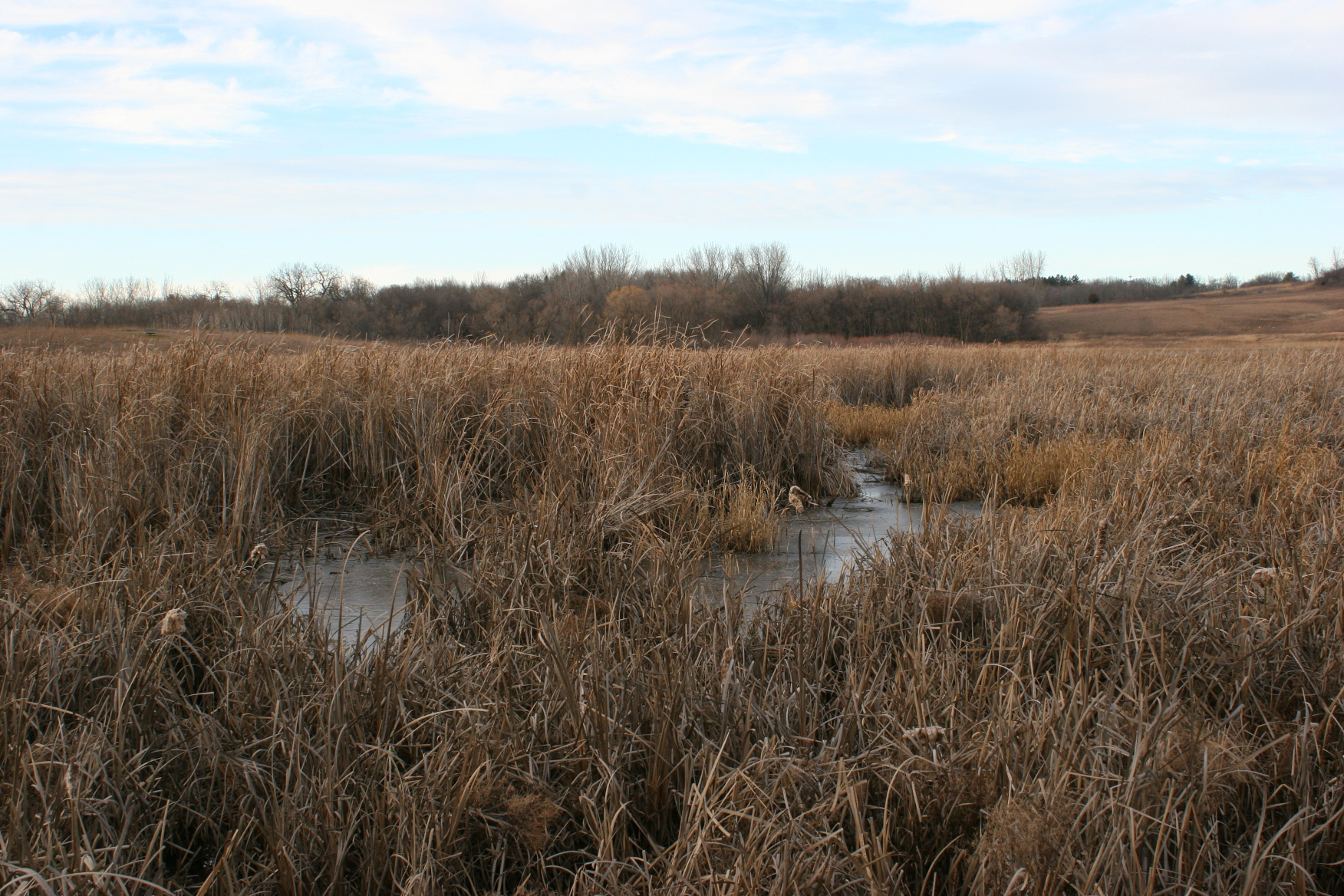
The wetlands on prairie’s edge. (Minnesota Prairie Roots copyrighted file photo November 2021)
My father owned a gun, which he used once a year to hunt for pheasants in the slough hole (as we redundantly termed the slough on our farm). When I look across the wetlands at River Bend, I think of the one time my oldest brother and I accompanied Dad to the low lying pothole to hunt for pheasants. I don’t recall whether that hunt was successful. Eventually, Dad drained the slough to add more tillable acreage. I often wonder about the sensibilities of draining prairie potholes and how that affected the land. The undrained wetlands of River Bend are mostly dry in this drought year.
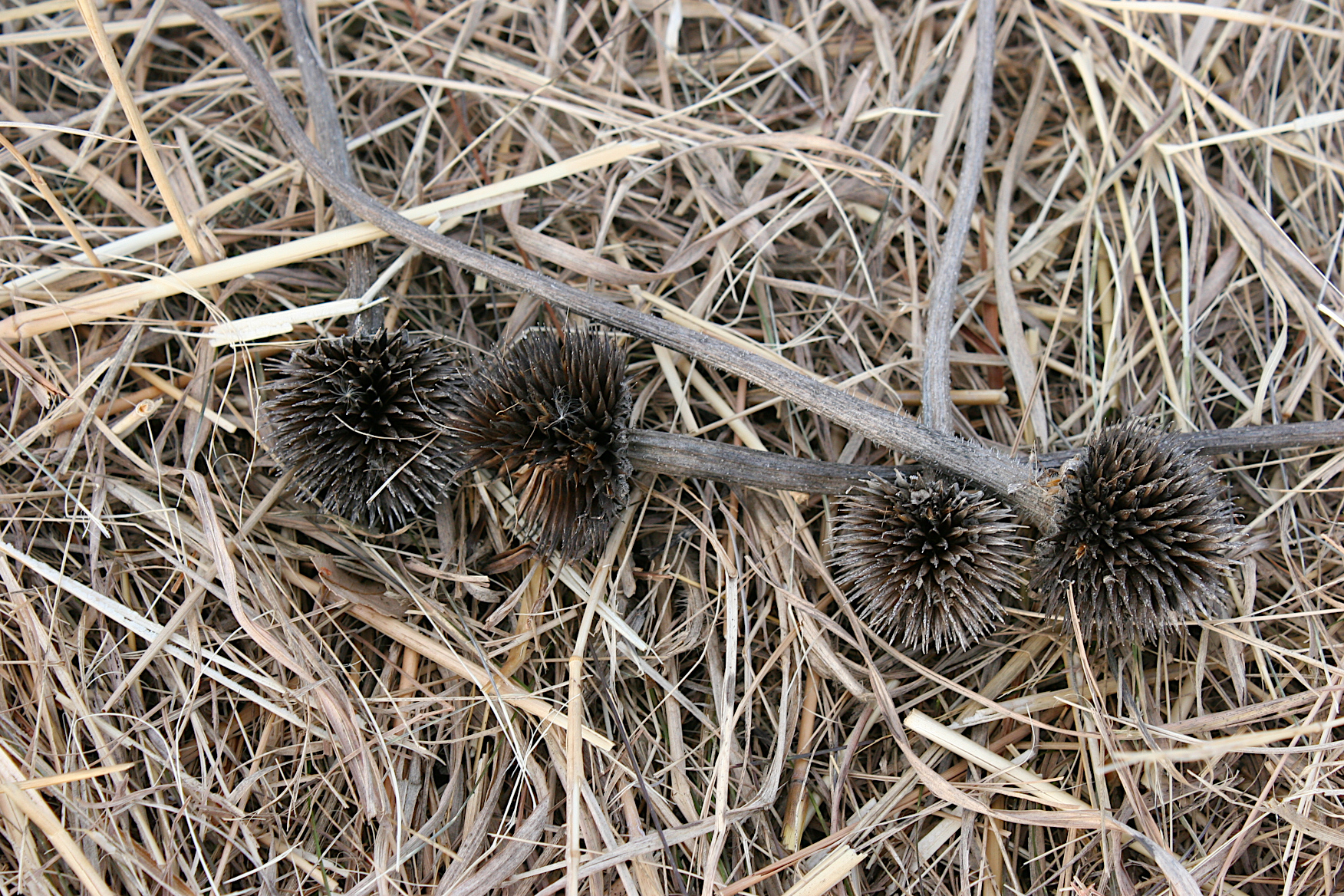
While walking the prairie, I spotted dried seedheads. Coneflower seeds lying atop the grass, where they will eventually reseed. Nature recycling.
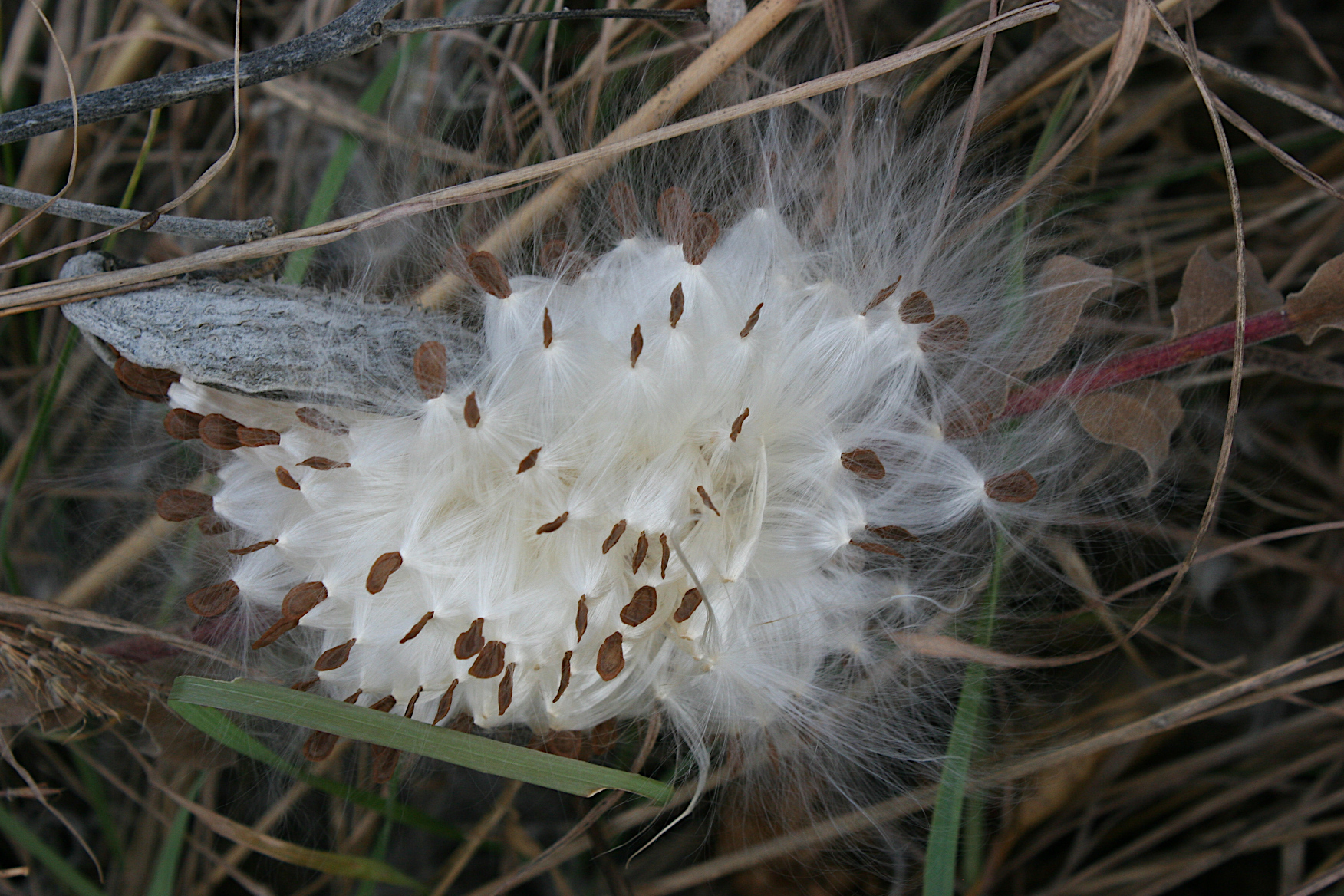
Milkweed pods, too, flourish in River Bend’s prairieland. Back on the farm, I pulled milkweeds from soybean fields. “Walking beans” is the correct term. Walking between soybean rows pulling unwanted weeds—especially cockleburs and thistles. Only detasseling corn ranks as worse. I’ll walk beans or shovel manure any day (and I did plenty of that) over corn detasseling on a hot and humid July day.
A dried milkweed pod burst open on the prairie. (Minnesota Prairie Roots copyrighted file photo November 2021)
Those dried milkweeds at River Bend bring one final memory. And it is a Christmas memory. One year I crafted a Christmas ornament for my Aunt Rachel from a milkweed pod and a discarded holiday card. (My mom saved everything.) I cut out an elfin girl dressed in a glittery red suit, her face framed by a pointy hood. Then I taped the cut-out to a toothpick and stuck the impish child into the downy snow of an open milkweed pod. Beautiful.
These are the childhood memories sparked by my November walk through River Bend Nature Center. I feel grateful for this sprawling natural space, for the peace it brings me as I follow trails into the present. And into the past.
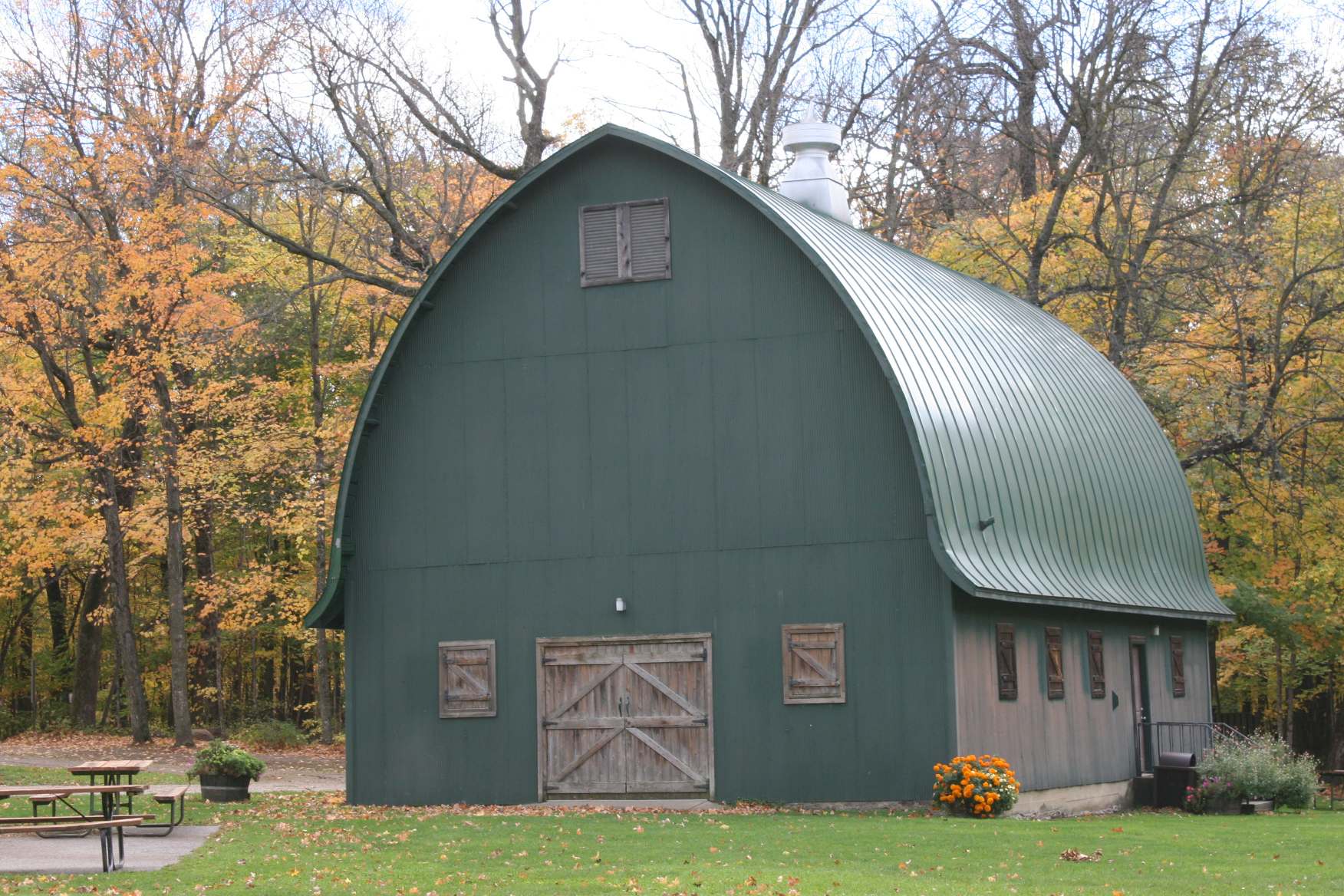
Richter Woods County Park and the on-site barn in LeSueur County. Minnesota Prairie Roots copyrighted photo October 2021.
EACH DAY OF SUNSHINE and warmth this late in October in Minnesota presents as a gift. We long-time Minnesotans understand that and celebrate. One less day of winter. One less day of cold and snow when the season of autumn extends. The recent weather has proven simply glorious.
Richter Woods Barn. Minnesota Prairie Roots copyrighted photo October 2021.
Late last week Randy took two days off work to savor these final days of autumn. And while we didn’t travel far, we delighted in nearby discoveries. We got a late start on Thursday, catching up on some much-needed rest. So we stayed close to home, aiming for western Rice County into LeSueur County.
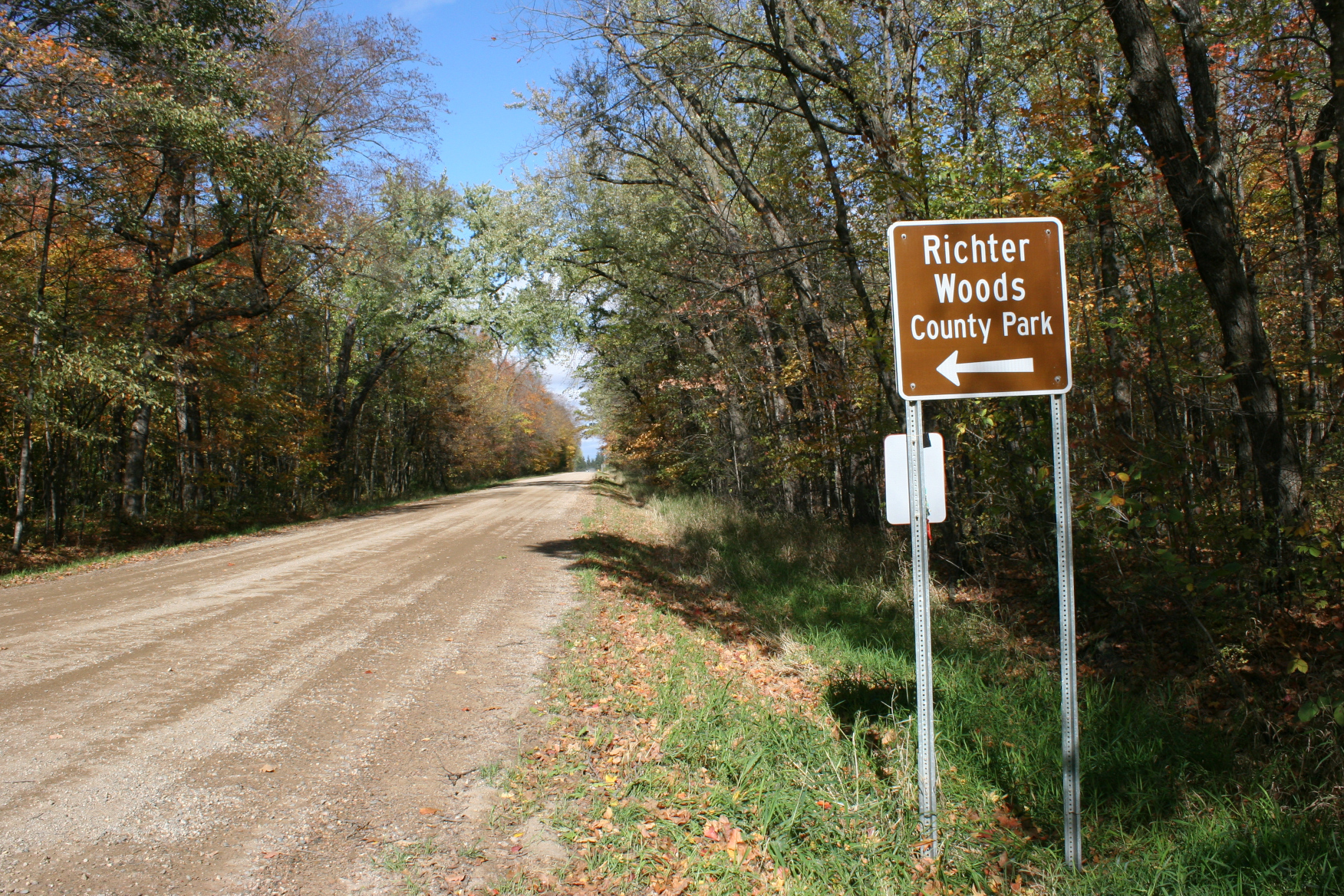
Trees line both sides of the gravel road leading to Richter Woods. Minnesota Prairie Roots copyrighted photo October 2021.
Eventually, we landed at Richter Woods County Park 1.5 miles west of Montgomery. I’d heard of the park, but had yet to visit.
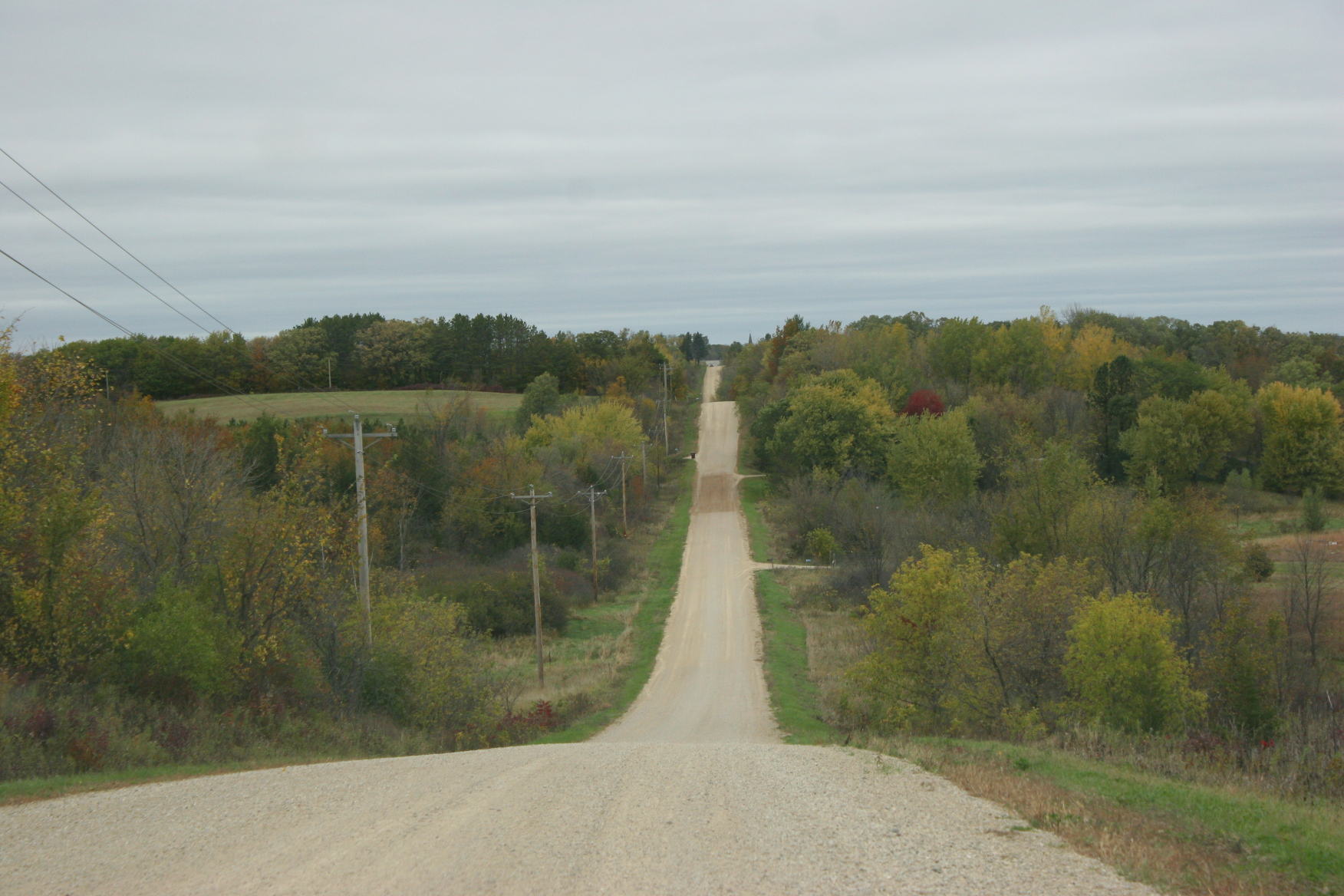
The hilly countryside near Trondjhem Church, rural Lonsdale. Minnesota Prairie Roots copyrighted photo October 2021.
We followed the slow-paced route there along mostly back country gravel roads.
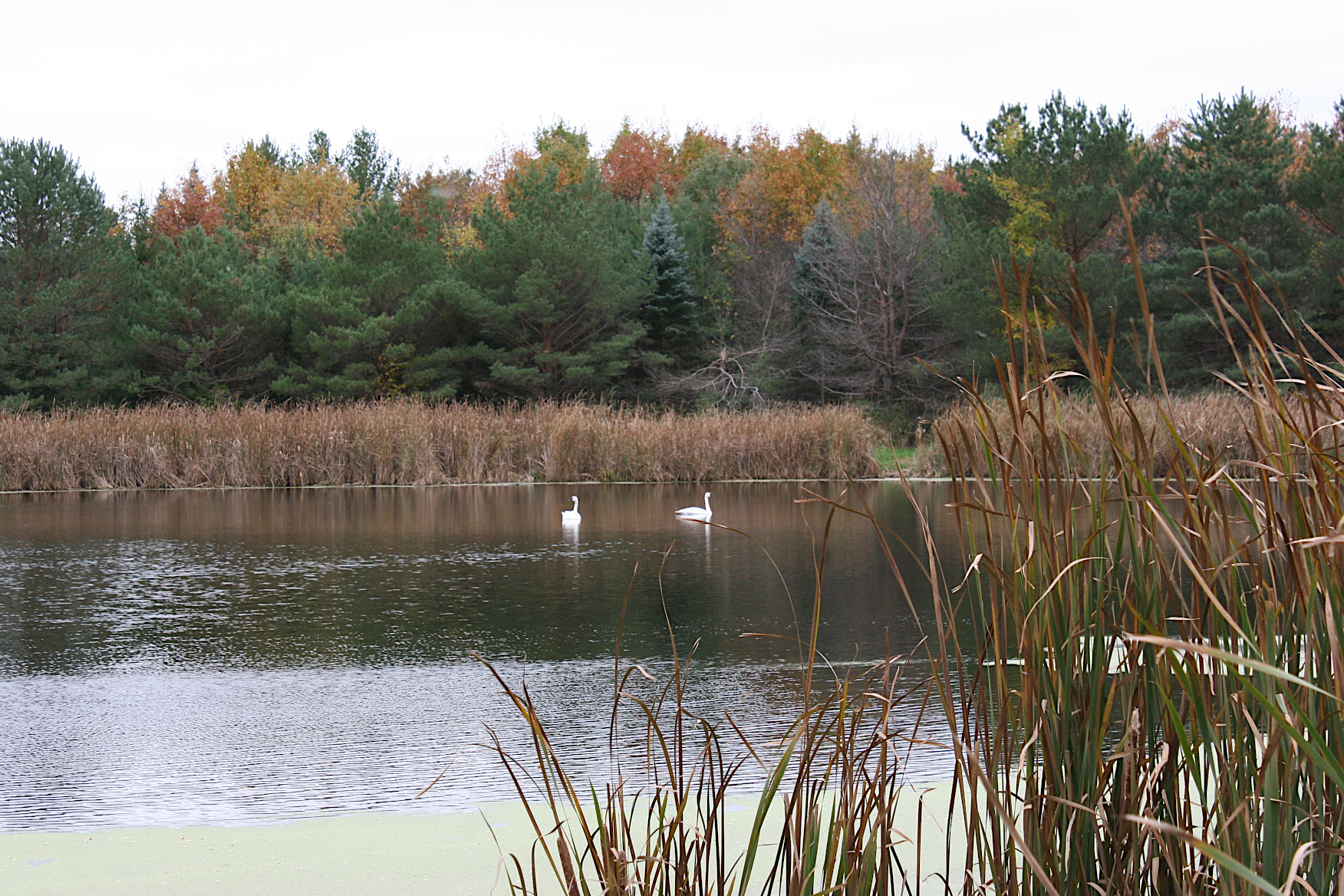
An unexpected sighting of two swans. Minnesota Prairie Roots copyrighted photo October 2021.
We paused once so I could photograph a pair of swans gliding across a small lake.
An aged barn along a gravel road. Minnesota Prairie Roots copyrighted photo October 2021.
I photographed, too, a weathered barn with fieldstone foundation. I often wonder how long barns will remain a landmark of our rural landscape. I feel an urgency to document their existence before roofs cave, boards rot, and only foundations remain.
A playground sits next to Richter Barn. Minnesota Prairie Roots copyrighted photo October 2021.
At 80-acre Richter Woods, a mammoth barn looms, centering the park gathering space. The barn is available to rent for $75/day from April-October. With a spacious loft and main level, the barn offers plenty of room for events like weddings, reunions and much more.
Looking up to the haymow. Trees shadow the barn door. Minnesota Prairie Roots copyrighted photo October 2021.
I couldn’t access the locked barn. But I could envision the interior, especially the haymow with its curved wood frame. Many bridal couples covet rustic settings like this. I wonder whether many have discovered this barn circled by woods in the quiet countryside near Montgomery.
A splash of red/pink flowers bloom on a bush next to the green barn. Minnesota Prairie Roots copyrighted photo October 2021.
As much as I appreciated the barn, I couldn’t get over the forest green color. I longed to see that barn in red, a historically-accurate hue. I expect others, too, have wondered at the unusual color choice. As a photographer, I find a red barn much more visually-pleasing.
One of two trails we took into Richter Woods. Minnesota Prairie Roots copyrighted photo October 2021.
No maps in this mailbox. Minnesota Prairie Roots copyrighted photo October 2021.
There are lots of picnic tables on-site, some nice, others not so much. Minnesota Prairie Roots copyrighted photo October 2021.
Before pulling out our picnic lunch to dine near the barn, Randy and I stretched our legs. We followed a leaf-strewn dirt trail into the woods with no map to guide us. The on-site mailbox was without the promised maps.
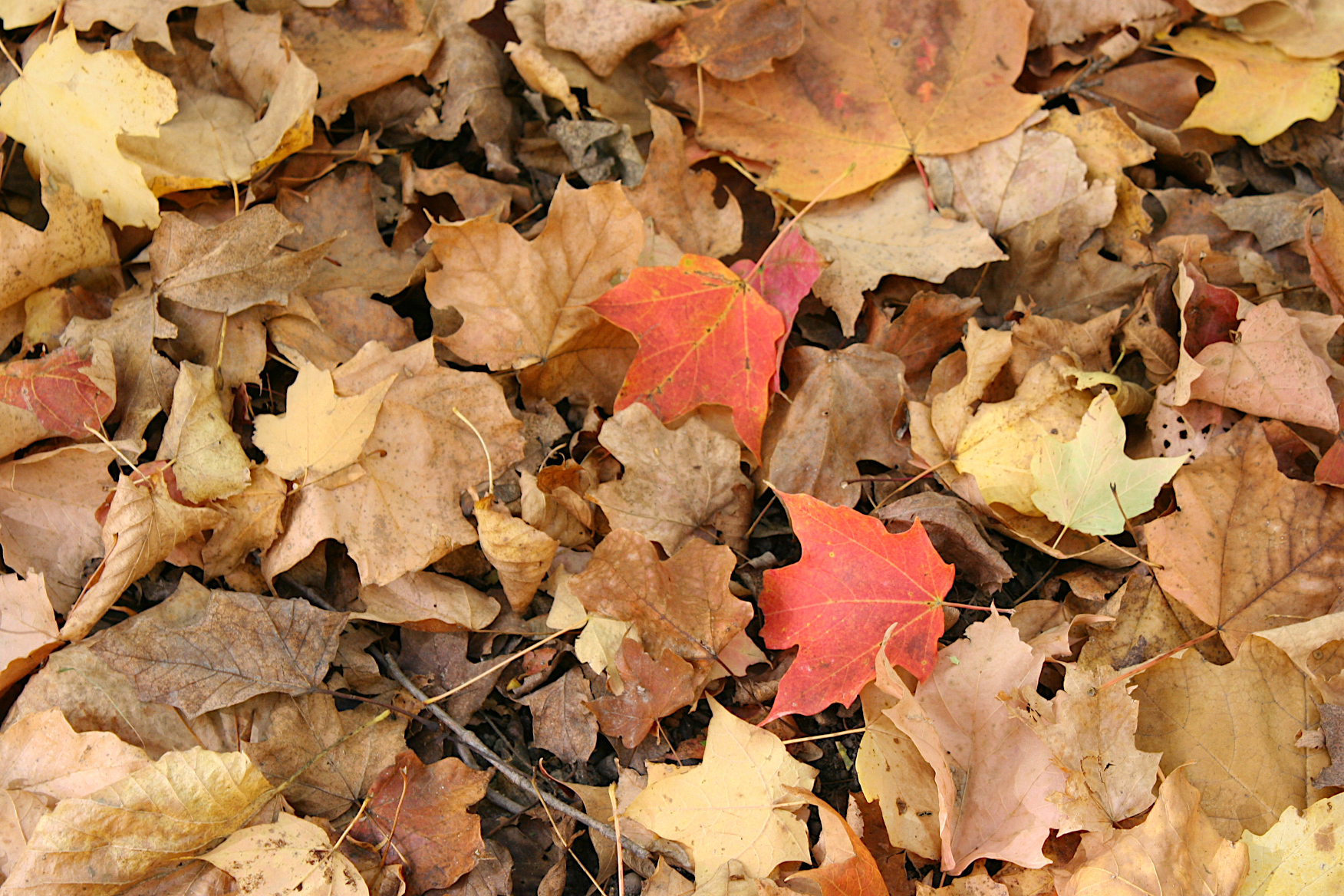
Maple leaves galore. Minnesota Prairie Roots copyrighted photo October 2021.
Maple leaves, especially, blanket the earth.
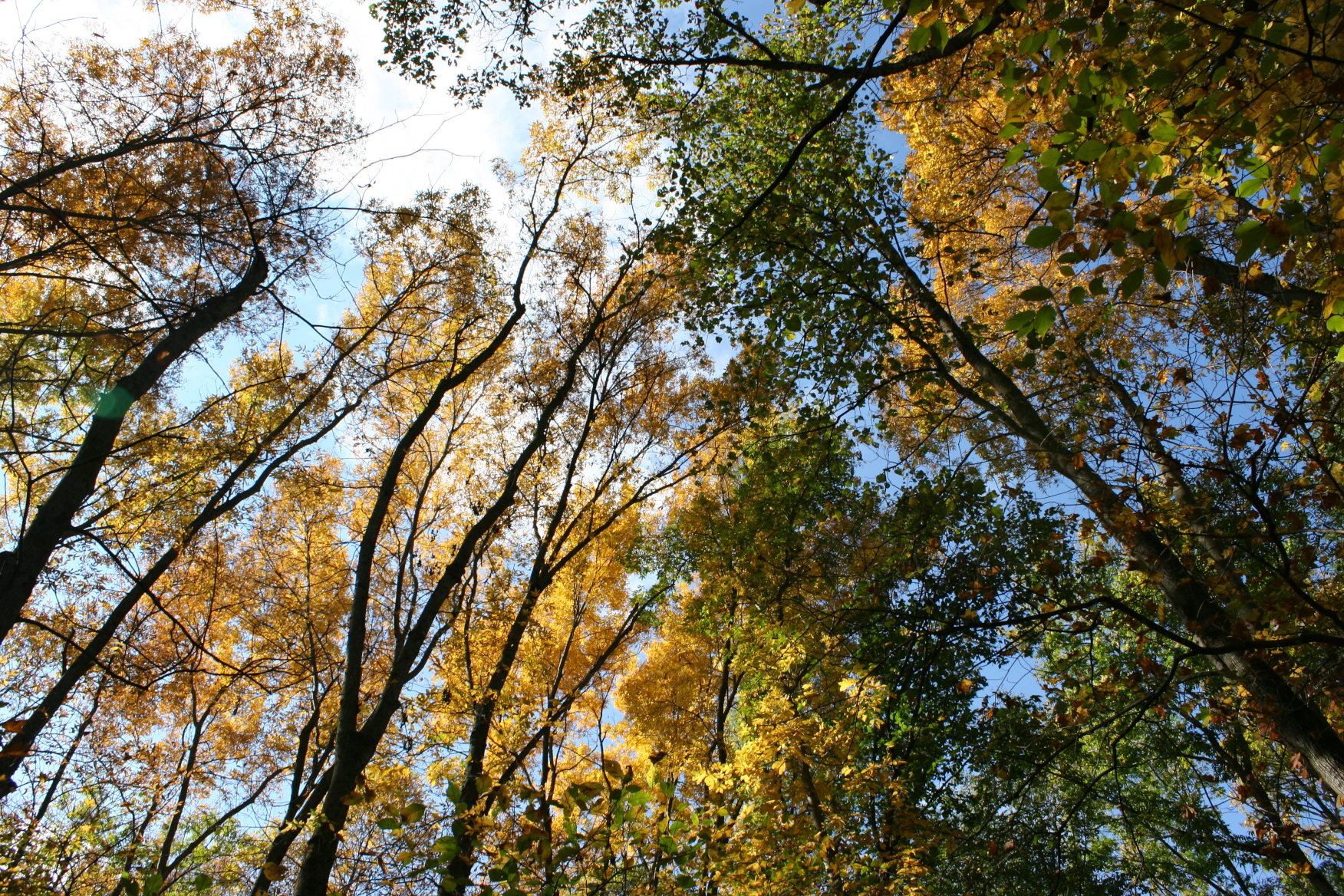
Looking up toward the colorful tree canopy. Minnesota Prairie Roots copyrighted photo October 2021.
In a few spots, I looked overhead to a canopy of red and yellow trees set against the deep blue sky of October.
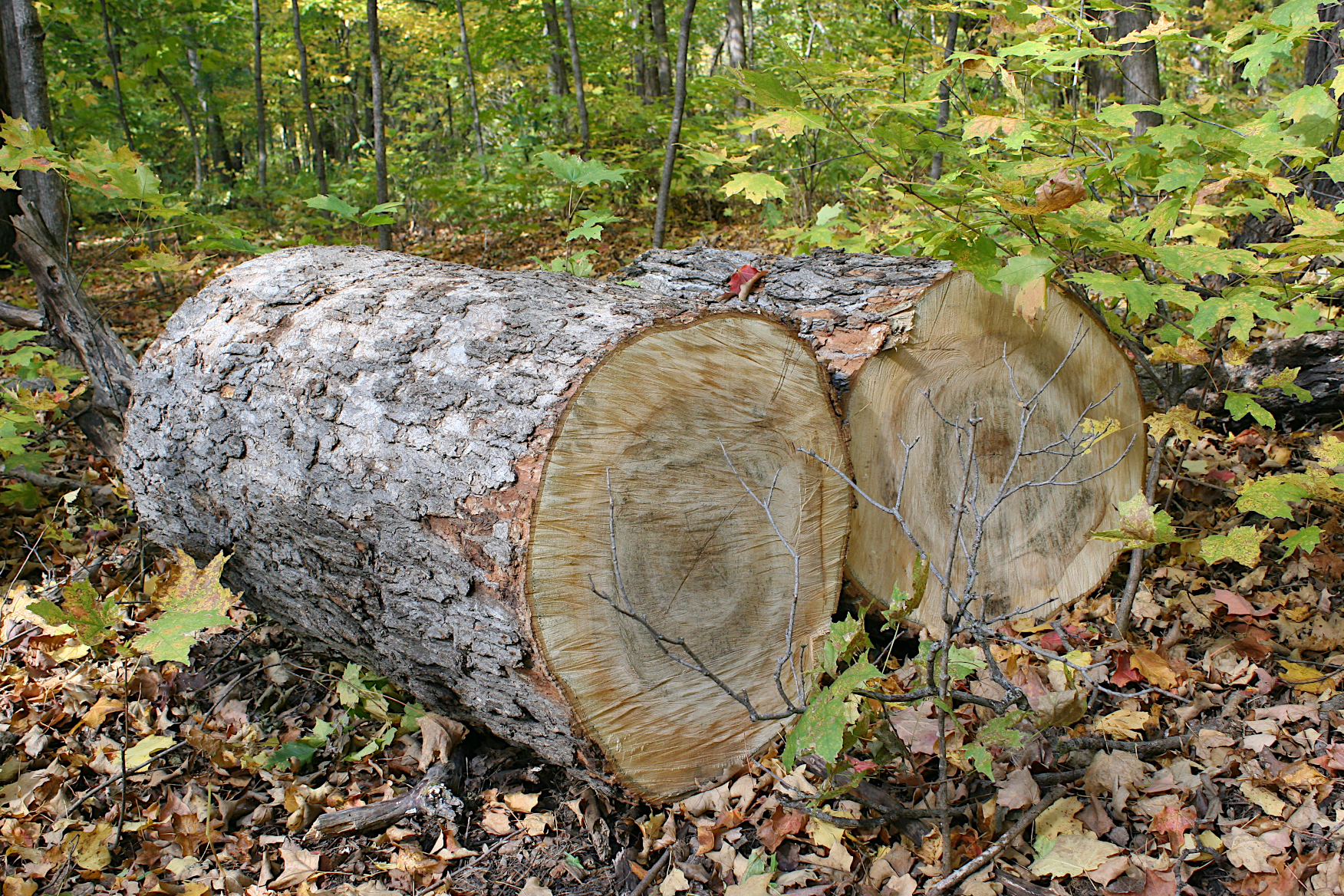
A recently-sawed tree. Minnesota Prairie Roots copyrighted photo October 2021.
We noticed, too, the many rotting and recently-sawed trees, I felt inwardly thankful for an afternoon without strong winds to possibly topple dead trees, loose branches.
Mushrooms on a fallen tree. Minnesota Prairie Roots copyrighted photo October 2021.
Mushrooms thrive in decay.
Loving the graceful curve of the barn roof. Minnesota Prairie Roots copyrighted photo October 2021.
Mostly, though, I noticed the peace. The quiet. I feel incredibly grateful to have access to natural settings like Richter Woods County Park. And I feel grateful, too, to live in this decidedly rural region of Minnesota within an hour of downtown Minneapolis. I feel grateful for gravel roads to follow. For barns that still stand. For warm and sunny October days that draw me into the countryside, into the woods.
#
PLEASE CHECK BACK as I take you on to more backroads in Rice and LeSueur counties.
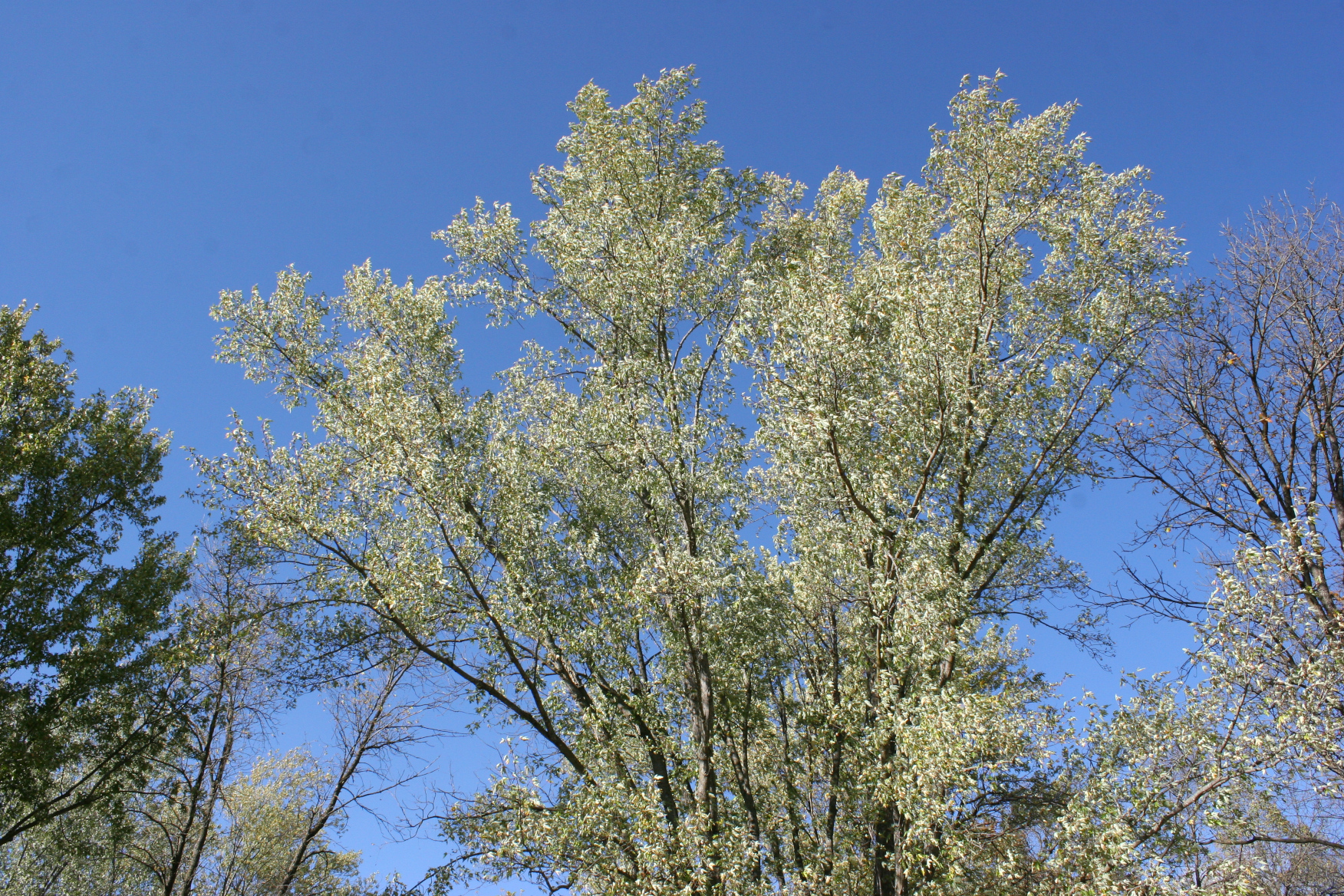
On the expanse of grass outside the woods, silver maples shimmer against the blue sky of autumn. Minnesota Prairie Roots copyrighted photo October 2021.
A MILE EAST OF FARIBAULT just off Minnesota State Highway 60, the 61-acre Falls Creek County Park offers an escape into the woods. Mostly undiscovered, it’s rare to encounter others while hiking here.
Last Sunday afternoon, Randy and I headed to the park, pulling into the vastly over-sized gravel parking lot pocked with potholes. From there, we headed downhill across a grassy expanse, past the picnic shelter and toward an opening in the woods.
A wooden footbridge over Falls Creek allows entrance to narrow dirt trails. There are no maps to guide hikers, so you must rely on visual cues, obscured in October by fallen leaves. But we’ve been here before, always taking the main trail following the creek.
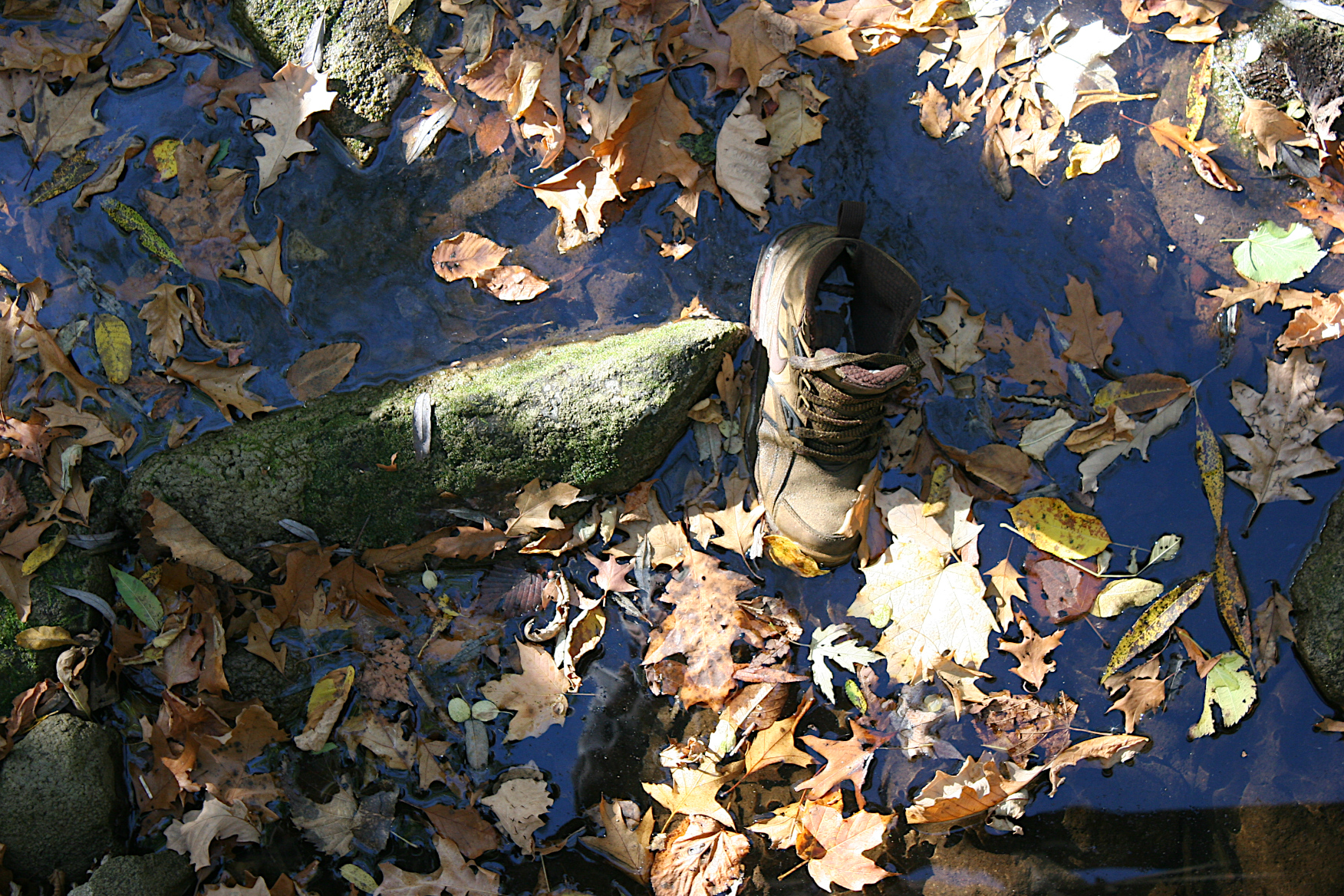
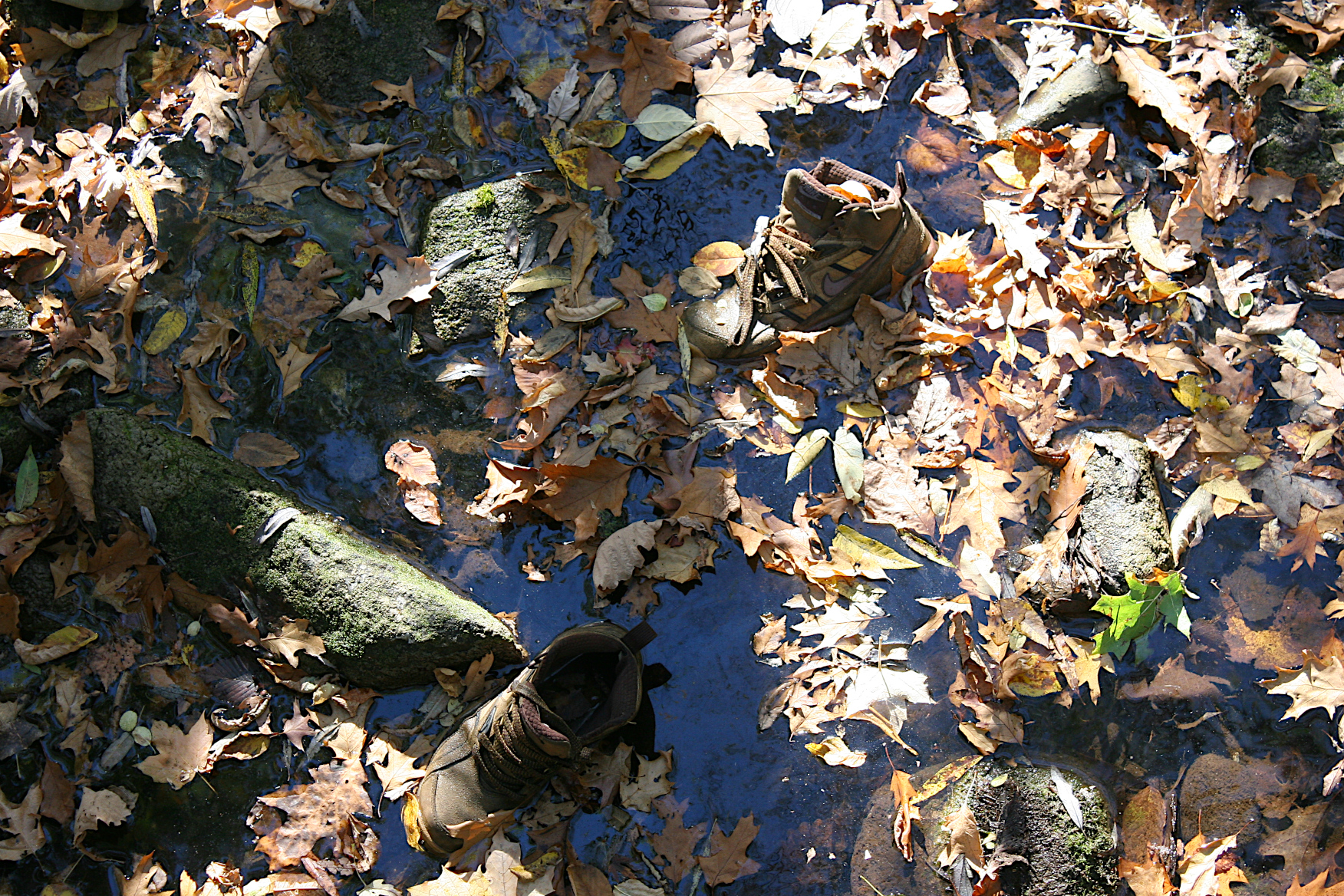
An unusual find in the creek: shoes/boots. Minnesota Prairie Roots copyrighted photo October 2021.
The creek is always my first stop. I pause on the bridge, typically to watch water rush over and around rocks. But this visit, the shallow water pooled, littered with leaves and a pair of hiking boots—perfectly good hiking boots from the looks of the shoes. I wondered how they landed there, in the water.
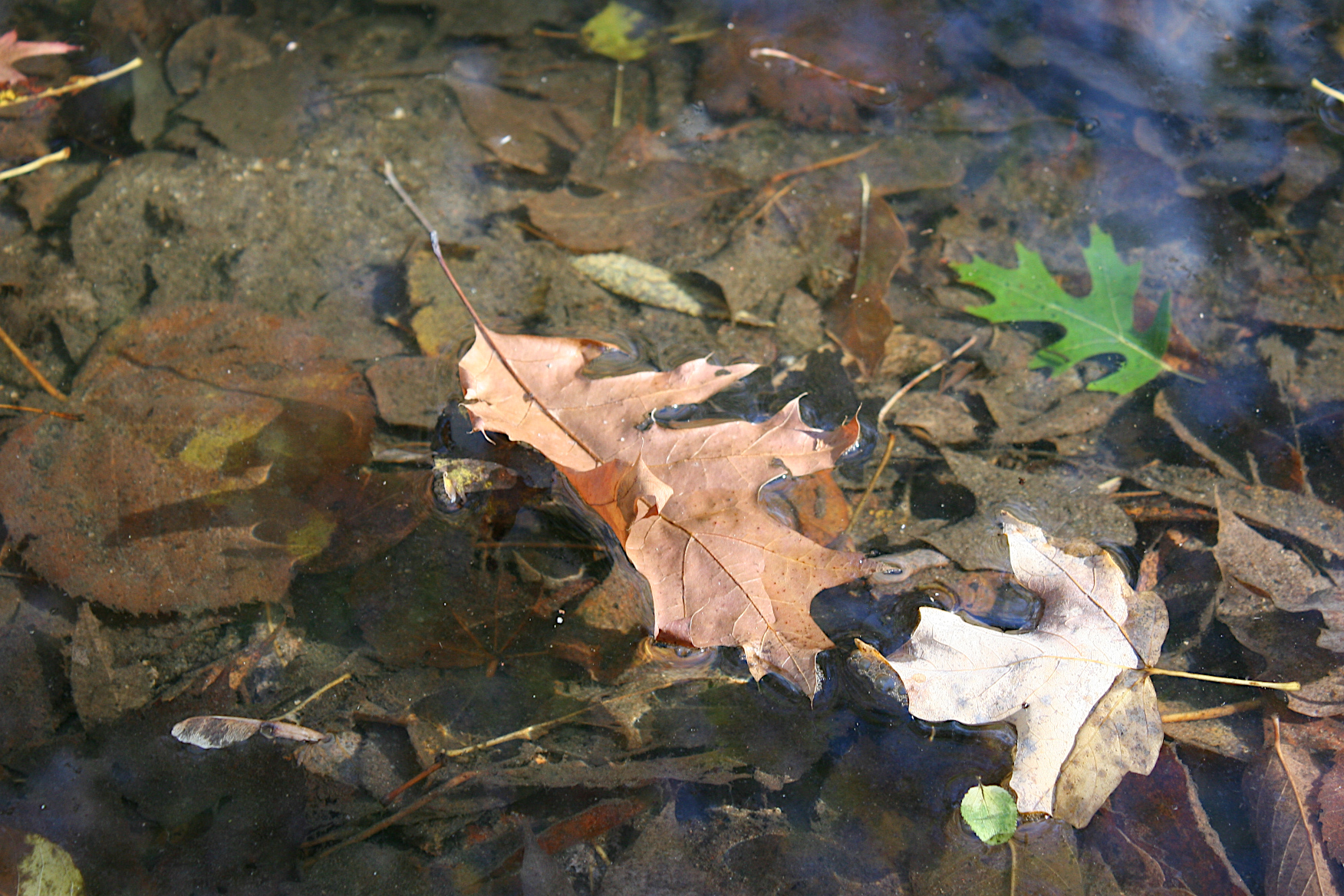
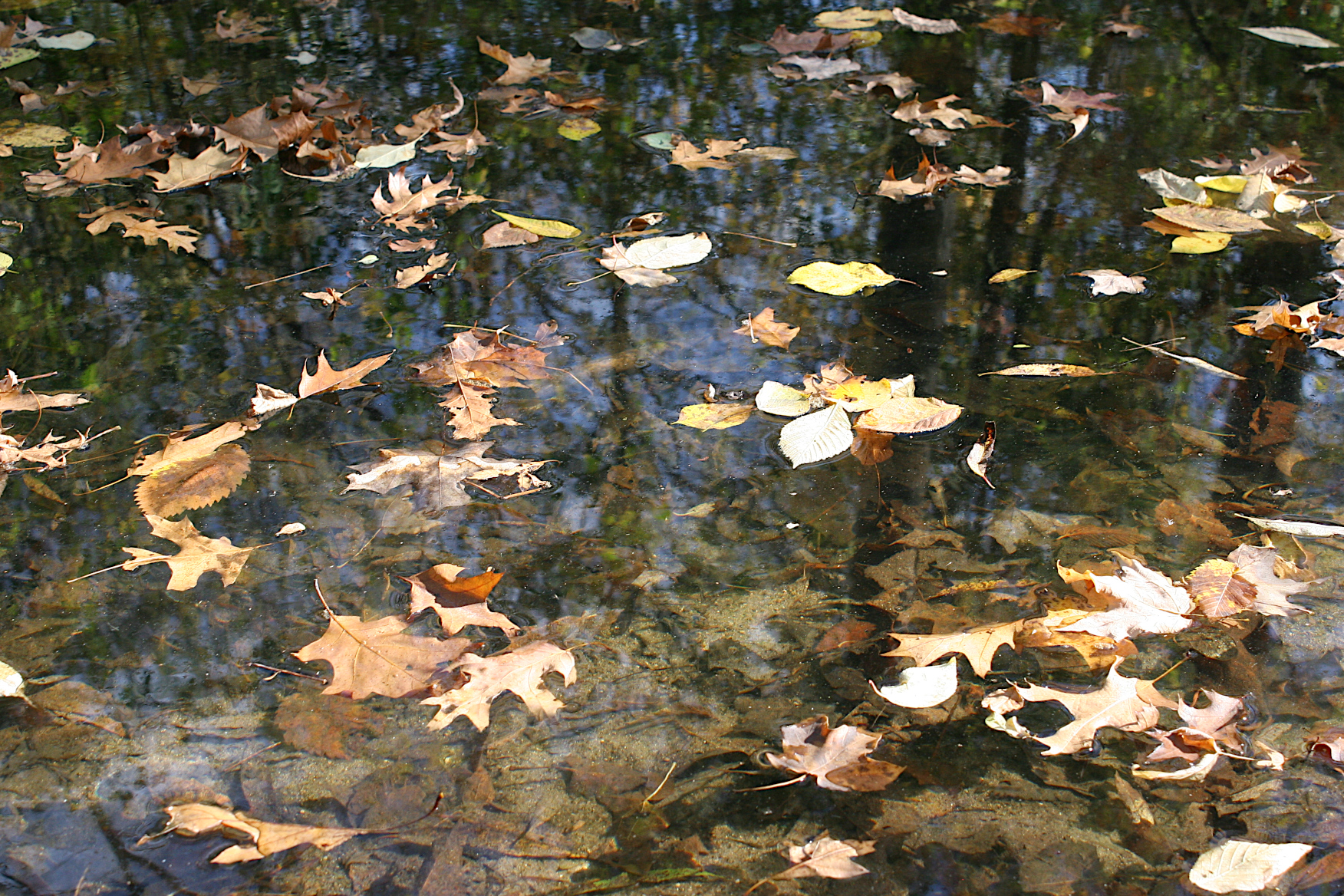
In the places where water remains in the creek, leaves float.Minnesota Prairie Roots copyrighted photo October 2021.
Mostly, the creek bed was dry, a result of this year’s drought. In areas where water remains, minnows darted. The water is at least clear, a rarity in this agricultural region.
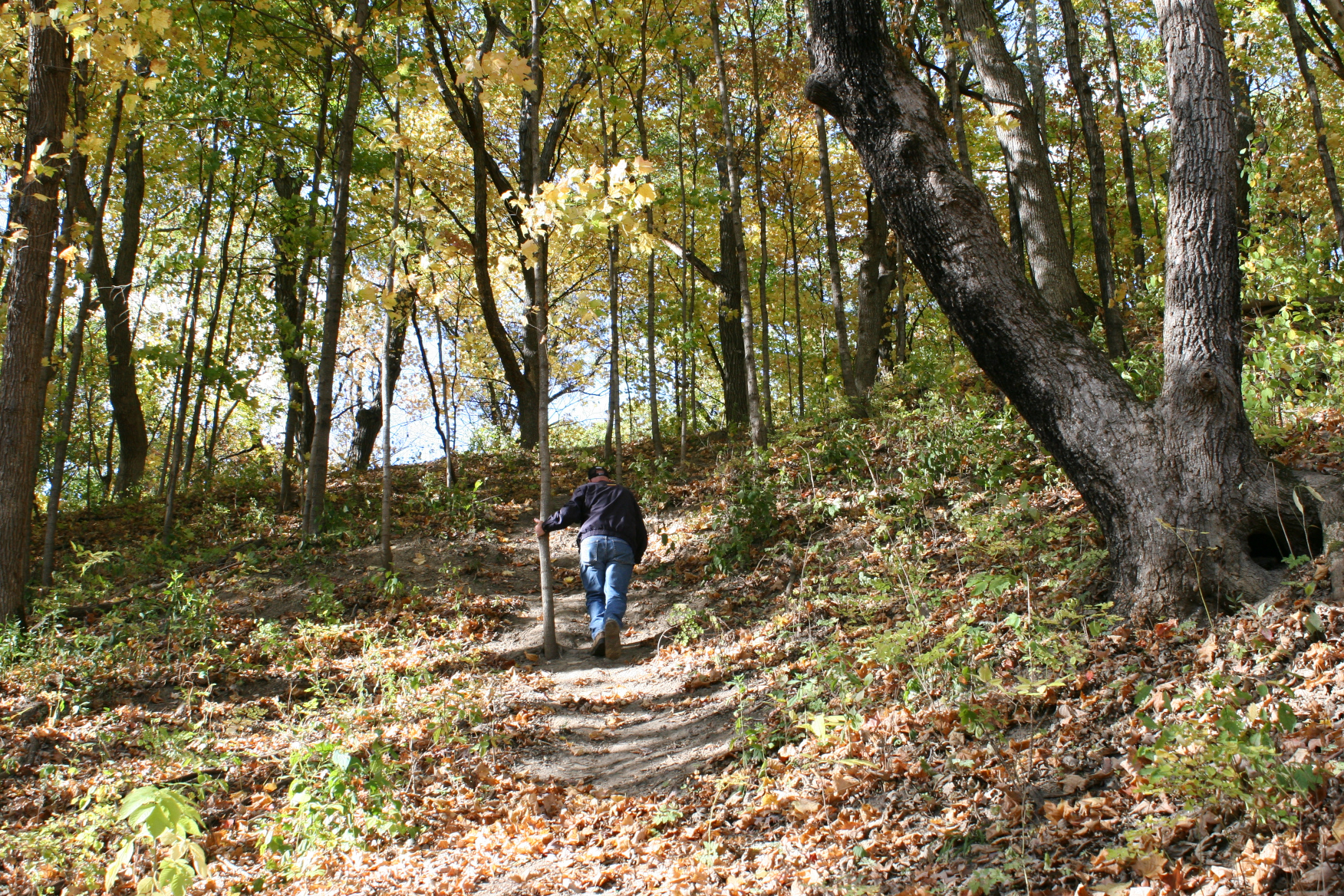
Randy scales a steep hill into the woods. Minnesota Prairie Roots copyrighted photo October 2021.
A short distance into the woods, Randy spotted a worn path up a steep hillside. I’d never noticed this during prior visits. Before I could dissuade him, he hoofed his way up, slipping and sliding and grabbing onto trees. When Randy lost his footing, I feared he would tumble and injury himself. As much as I yearned to follow, I recognized my limitations and my desire to keep my bones in-tact.
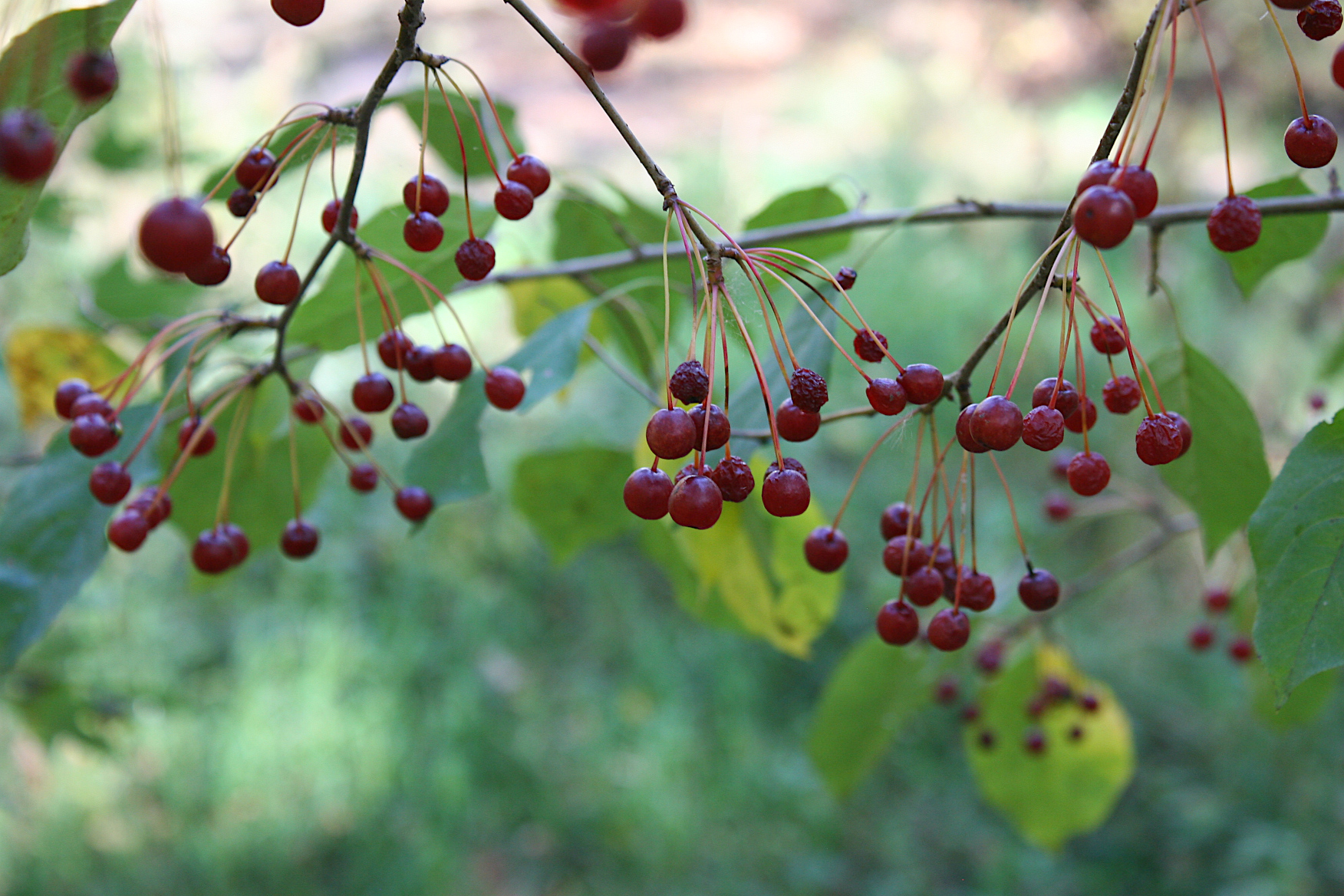
Berries jolt color into the woods. Minnesota Prairie Roots copyrighted photo October 2021.
As he disappeared along the hilltop treeline, I continued along the creek route. But soon my mind went to that niggling place of worry, about the time I reached the point where the path sidles next to the eroded creek bank. One misstep and I could plunge over the edge. Not that it’s that high. But far enough to cause injury.
I backtracked, dug in my backpack for my cellphone (hoping for service), and then called Randy. He answered. “I didn’t come here to walk alone,” I told him, also inquiring about his location. He couldn’t pinpoint that except to say that he would head back. I feel thankful that Randy, unlike me, possesses a good sense of direction.
Remembering the hiking boots/shoes in the creek. Minnesota Prairie Roots copyrighted photo October 2021.
“I don’t like being out here alone,” I added, noting that I’d observed two people on the path, too far away for me to clearly see them. Obviously those hiking shoes dumped in the creek prompted the beginning of a mystery plot in my writer’s brain.
Despite that concern, I aimed for the strangers…finding a cordial couple about my age examining mushrooms on a decayed tree. We talked mushrooms and my missing husband and they offered to help find him should need be. Their story of getting lost in these very same woods did nothing to assure me that Randy would find his way back. But he did. At a different point, where an unseen spring ran down the hillside and he did more slipping and sliding, this time in mud.
Randy follows the leaf-laden trail as it edges close to the eroded creek bank. Minnesota Prairie Roots copyrighted photo October 2021.
We reversed course and, together, followed the creek-side path deeper and deeper into the woods…until turning around and retracing our steps. I wished again for a trail map guide.
Near the footbridge, pools of water remain, collecting the fallen leaves of autumn. Minnesota Prairie Roots copyrighted photo October 2021.
We veered briefly off the path to another trail leading to the creek. Again, no water. Only rocks on a dry creek bed.
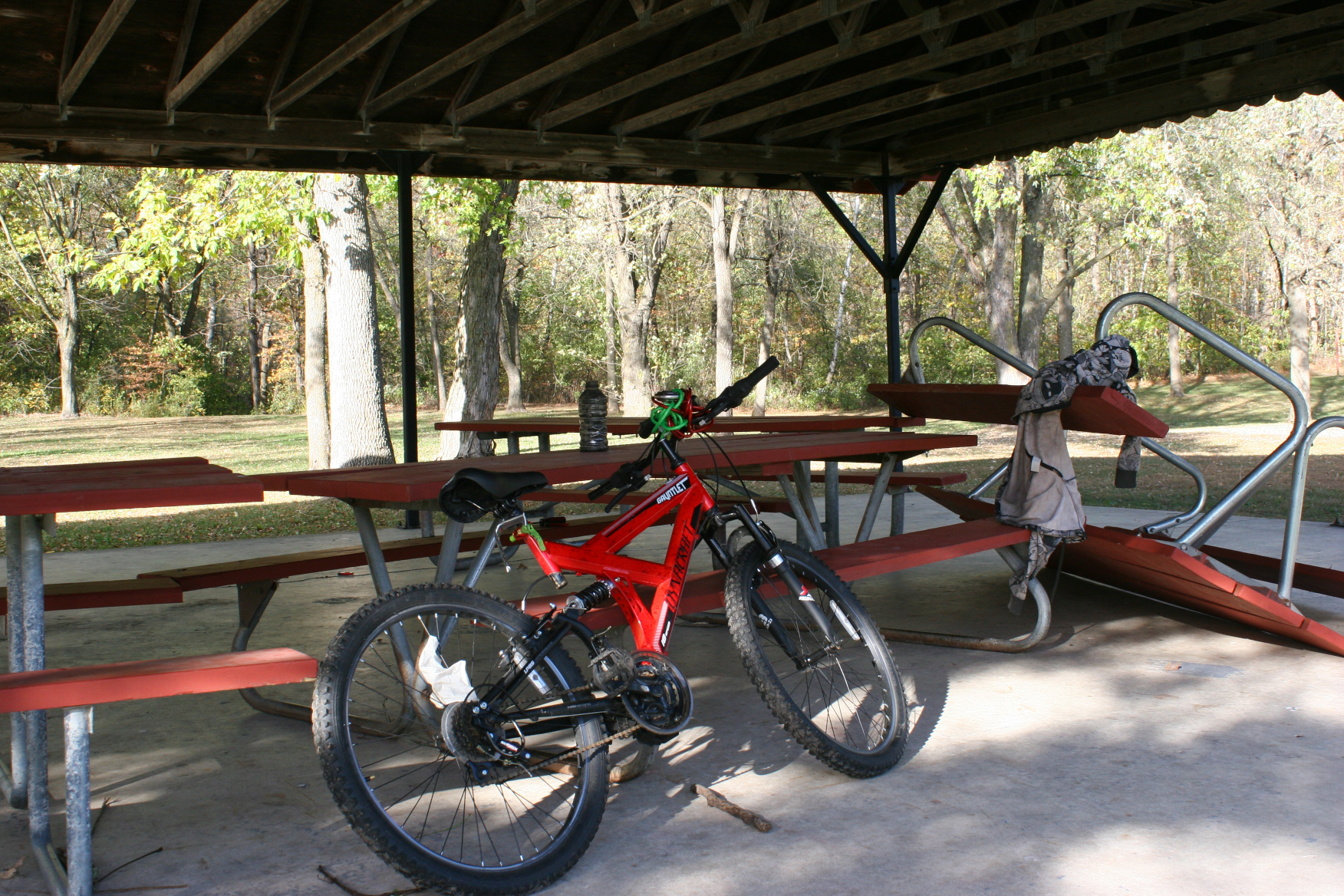
Seemingly abandoned in the shelter. Minnesota Prairie Roots copyrighted photo October 2021.
Then it was back to the main route, a pause on the bridge to again wonder about those hiking boots and then a pause at the shelter to speculate about an abandoned bike, jacket and beverage bottle.
Not a soul remained at Falls Creek Park. At least no one visible to us. Only mysteries—of abandoned and tossed belongings and of unmarked trails leading deep into the woods.
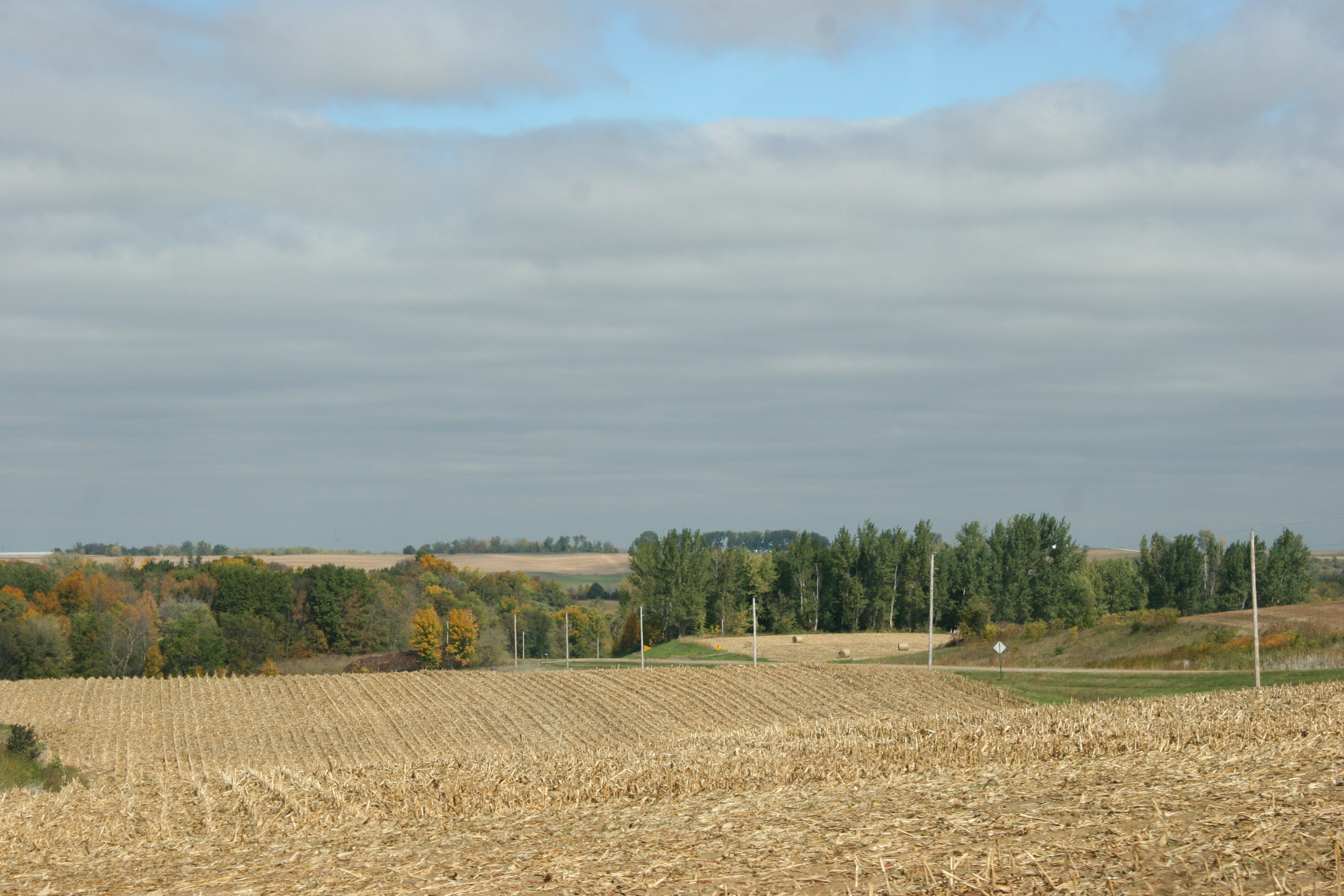
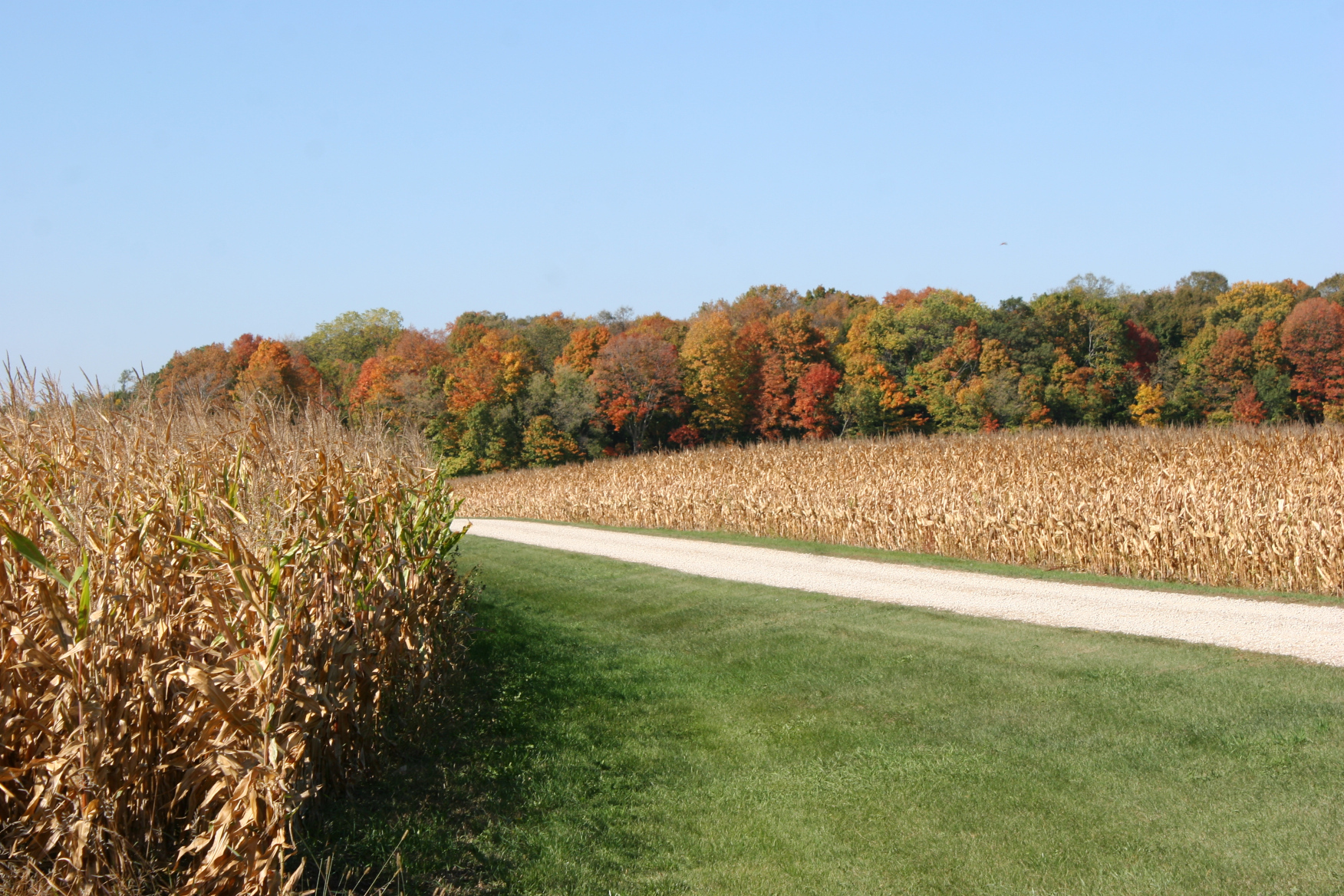
Just days ago color tinted trees edging a cornfield in rural Rice County. Minnesota Prairie Roots copyrighted photo October 2021.
THE MUTED AND VIBRANT HUES of autumn mix in the rural Rice County landscape, creating stunning seasonal scenes. If you crave color and harvest, this is your moment to get out for an afternoon country drive.
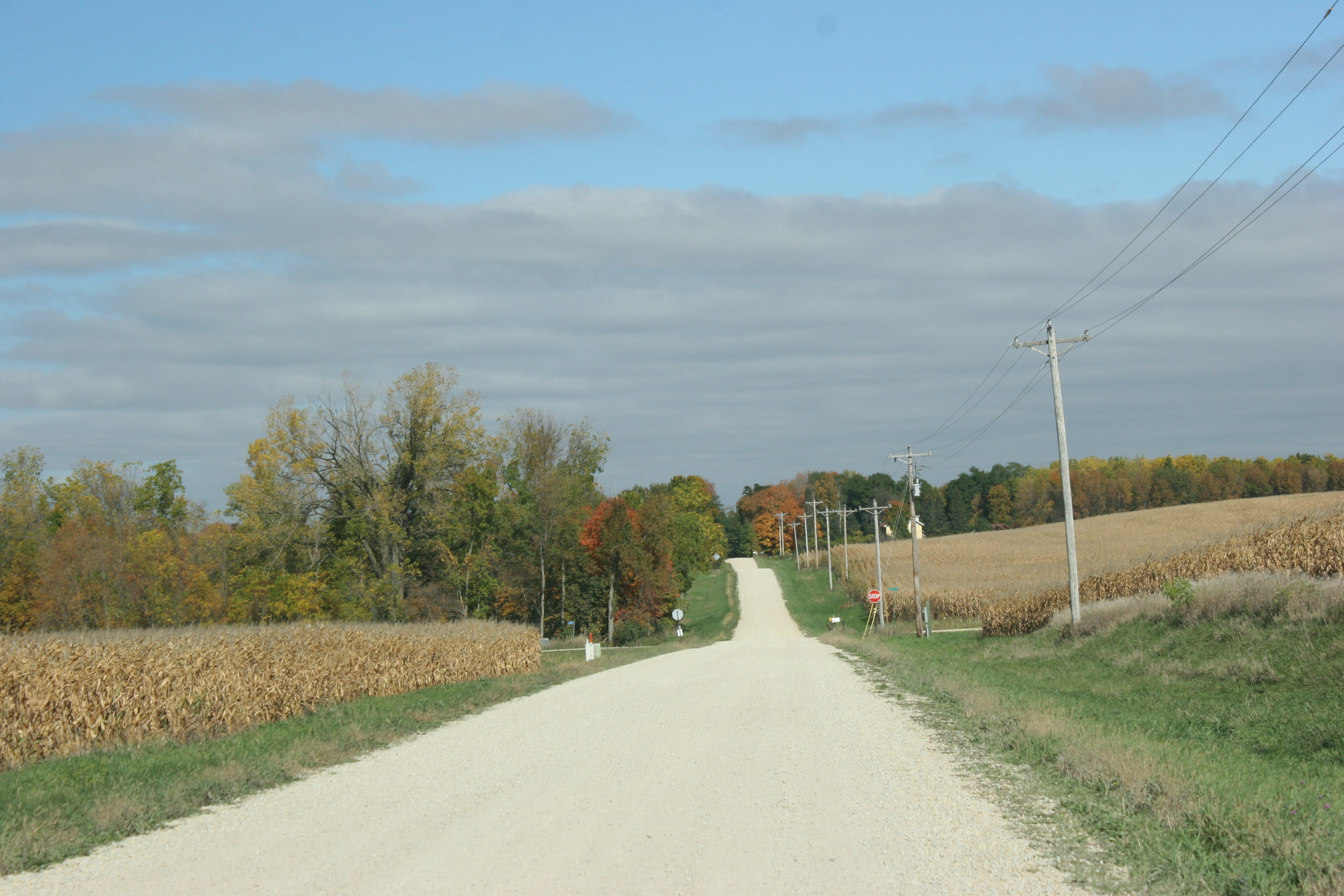
Choose a gravel road, any gravel road, and see where it leads you, here past fields and trees turning color. Minnesota Prairie Roots copyrighted photo October 2021.
Randy and I consider our county a best-kept-secret-place to view fall colors. Last weekend we traveled mostly gravel and county roads from Faribault to the Nerstrand area and back and then west to Kelly Lake. In between, we stopped for a hike at Caron Park, a picnic lunch at the hilltop Valley Grove churches and then for apples at Apple Creek Orchard.
Harvest is well underway in Rice County. Minnesota Prairie Roots copyrighted photo October 2021.
As farm-raised kids—me in southwestern Minnesota and Randy in central Minnesota—we find ourselves drawn to the countryside, especially during spring planting and then again during fall harvest. Our weekend drives updated us on harvest progress as we passed fields of corn and soybeans. Some picked. Some still drying under the intermittent autumn sun.
Even under partly sunny skies, the colored hillside of trees were beautiful. This is on a gravel road (Falk Avenue) off Rice County Road 20 northeast of Cannon City. Minnesota Prairie Roots copyrighted photo October 2021.
Across an expanse of cornfield on County Road 84/Falk Avenue (just off County Road 20 between Cannon City and Northfield), we paused to admire a treeline in the distance. We return here each year to simply stop and appreciate the hillside aflame with the hues of autumn.
Entering the woods on Farmers Trail. Minnesota Prairie Roots copyrighted photo October 2021.
Likewise, we also follow nearby Farmers Trail, a remote gravel road (off Falk Avenue) which winds through woods. Primarily maples as evidenced by the colors and by the blue maple syrup tube collection system that weaves through the trees.
The beautiful treeline at Caron Park. Minnesota Prairie Roots copyrighted photo October 2021.
Caron Park, too, draws us to stop and hike into the woods. It’s a less-crowded option than the nearby popular Nerstrand Big Woods State Park. The treeline at Caron Park, behind an open field of muted, dried grasses, is particularly stunning.
A family walks through the woods at Caron Park. Minnesota Prairie Roots copyrighted photo October 2021.
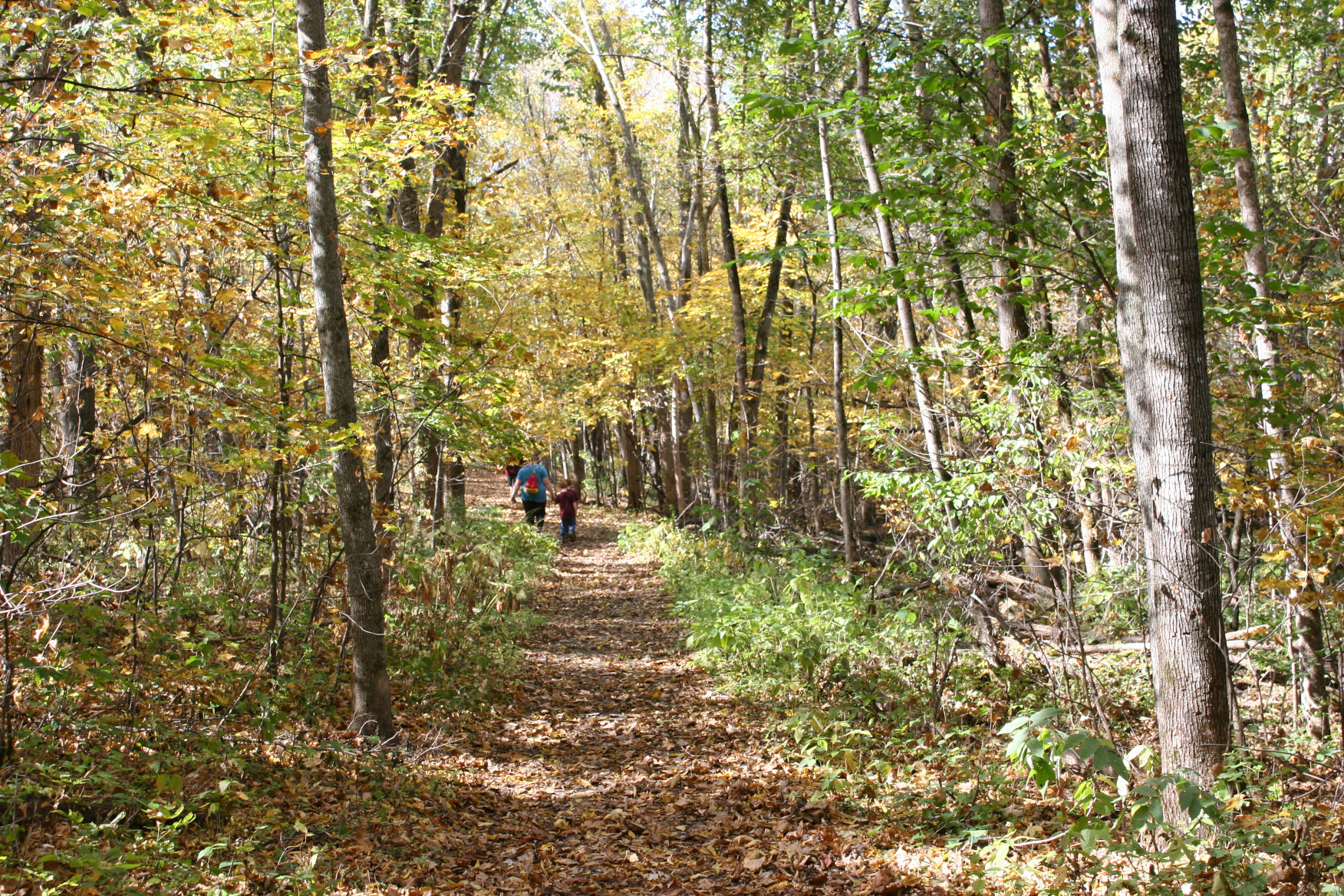
We walked into the woods, following a leaf-covered, eroded dirt trail that made me uncomfortable and unsure of my footing. Tree roots presented potential tripping obstacles. I focused more on staying upright than anything. Yet, despite that, I enjoyed the quiet and beauty of the woods. As did others, mostly young families.
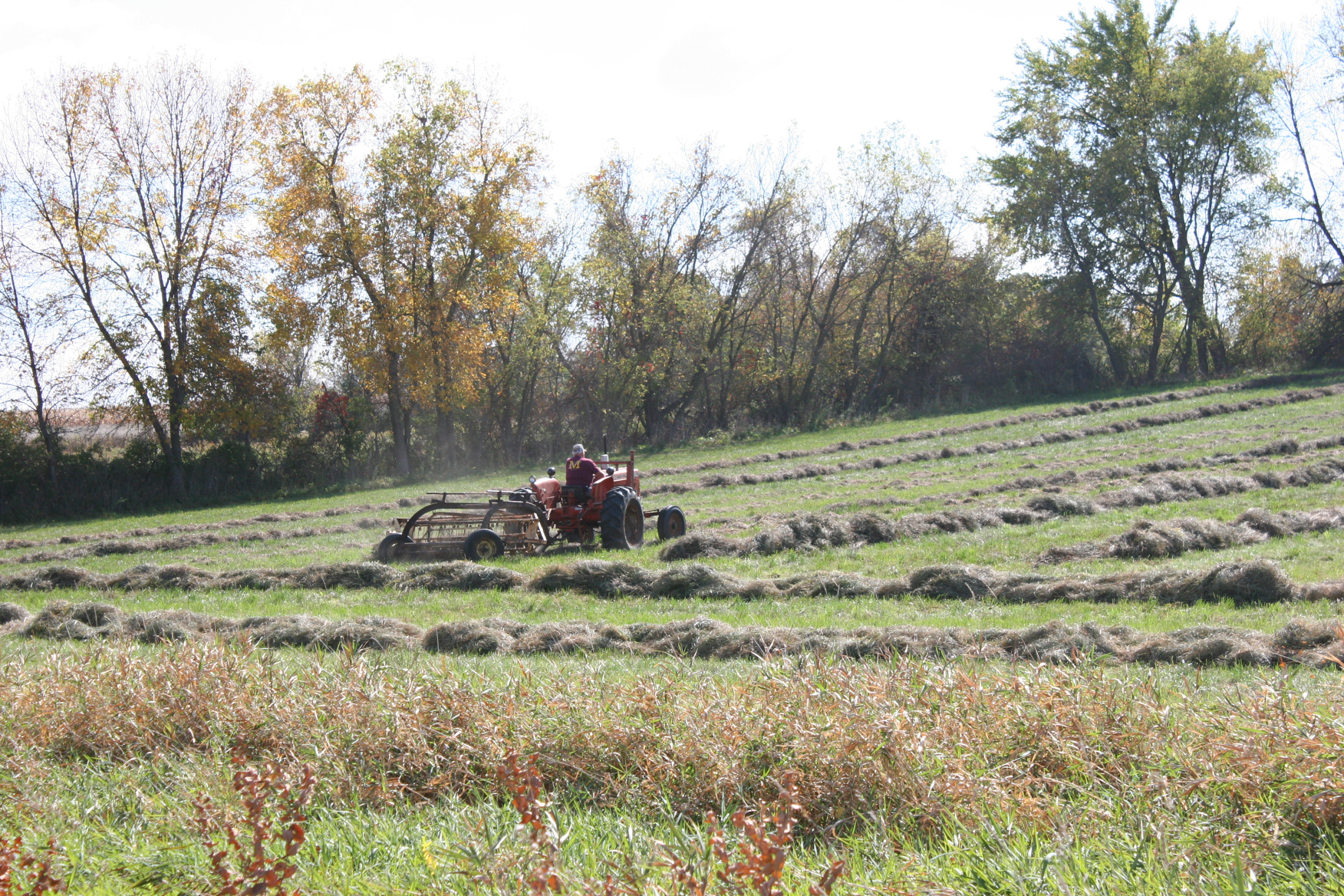
We came across this farmer raking hay, like a scene from the past. Minnesota Prairie Roots copyrighted photo October 2021.
As we continued to follow country gravel roads, we sometimes drove in clouds of dust trailing pick-up trucks. That, too, reminds me of my agrarian upbringing. Yes, nostalgia often seeps into our view and our conversations. Once a farm girl/boy, always a farm girl/boy. Even if we’re decades removed from the farm.
Beauty in autumn ruralness. Minnesota Prairie Roots copyrighted photo October 2021.
I love how the rural countryside of Rice County often sweeps in valleys and hills, providing incredible vistas. Of farmland. Of wooded and open hillsides. Of land and sky connecting. All connected by gravel roads. This rural setting rates as particularly stunning in autumn.
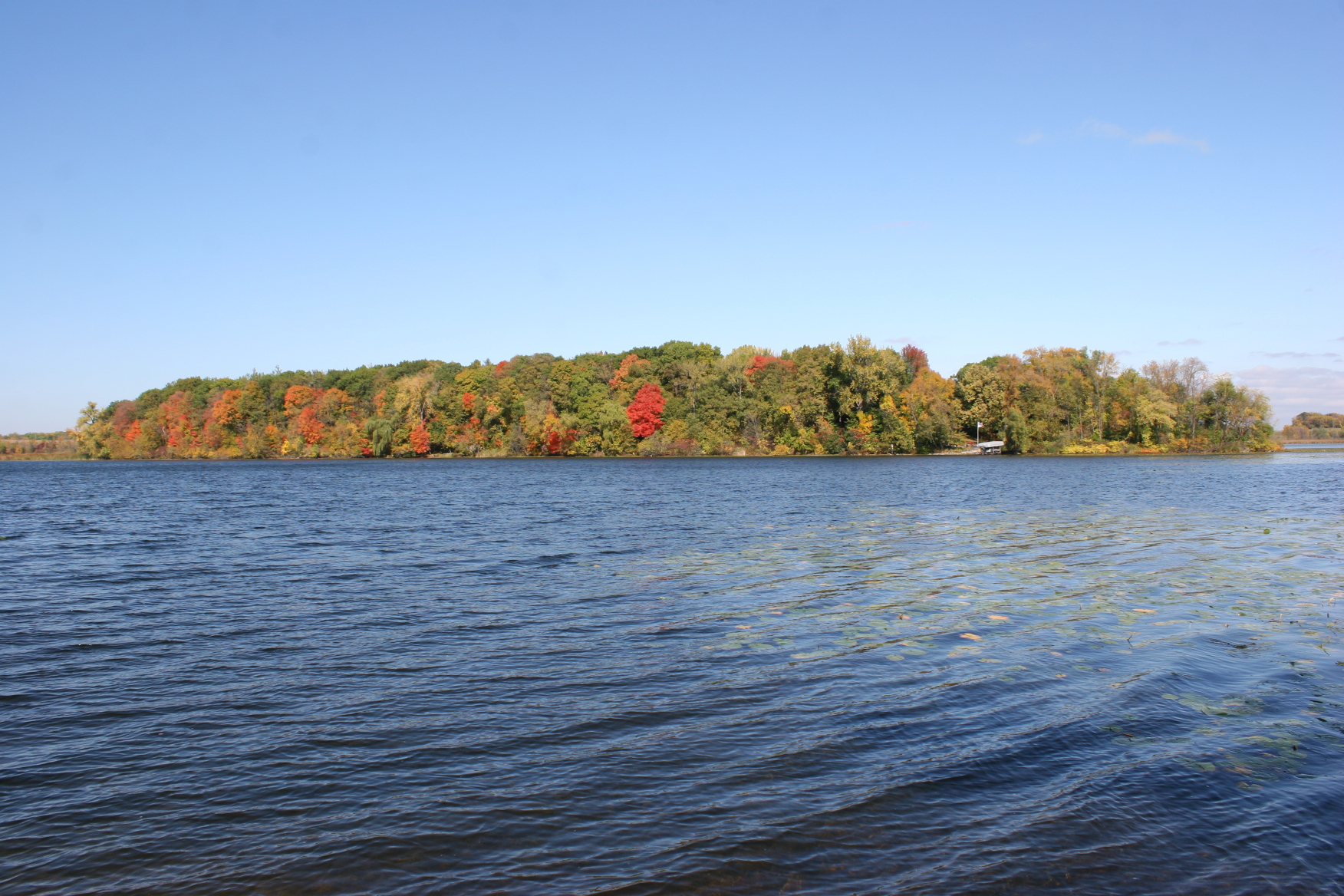
The treeline across Kelly Lake is particularly beautiful in autumn. It should be even prettier than this soon. Minnesota Prairie Roots copyrighted photo October 2021.
We ended our drive at another favorite fall destination, the public boat landing at Kelly Lake northwest of Faribault. The view of the treeline across the water—which was unusually clear—always looks particularly lovely, although the colors were not at their peak yet during out stop. Soon.
Appreciating the trees overhead while hiking in Caron Park. Minnesota Prairie Roots copyrighted photo October 2021.
Heading back into Faribault toward home, I admired, too, how beautiful the trees in my community. Seventh Street. Second Avenue. There’s much to be said for looking in your own backyard for autumn’s glory. And I’ve found it. Right here, in Rice County.
FYI: Please check back for more photos from our country drive and for separate posts on Valley Grove churches and Apple Creek Orchard.
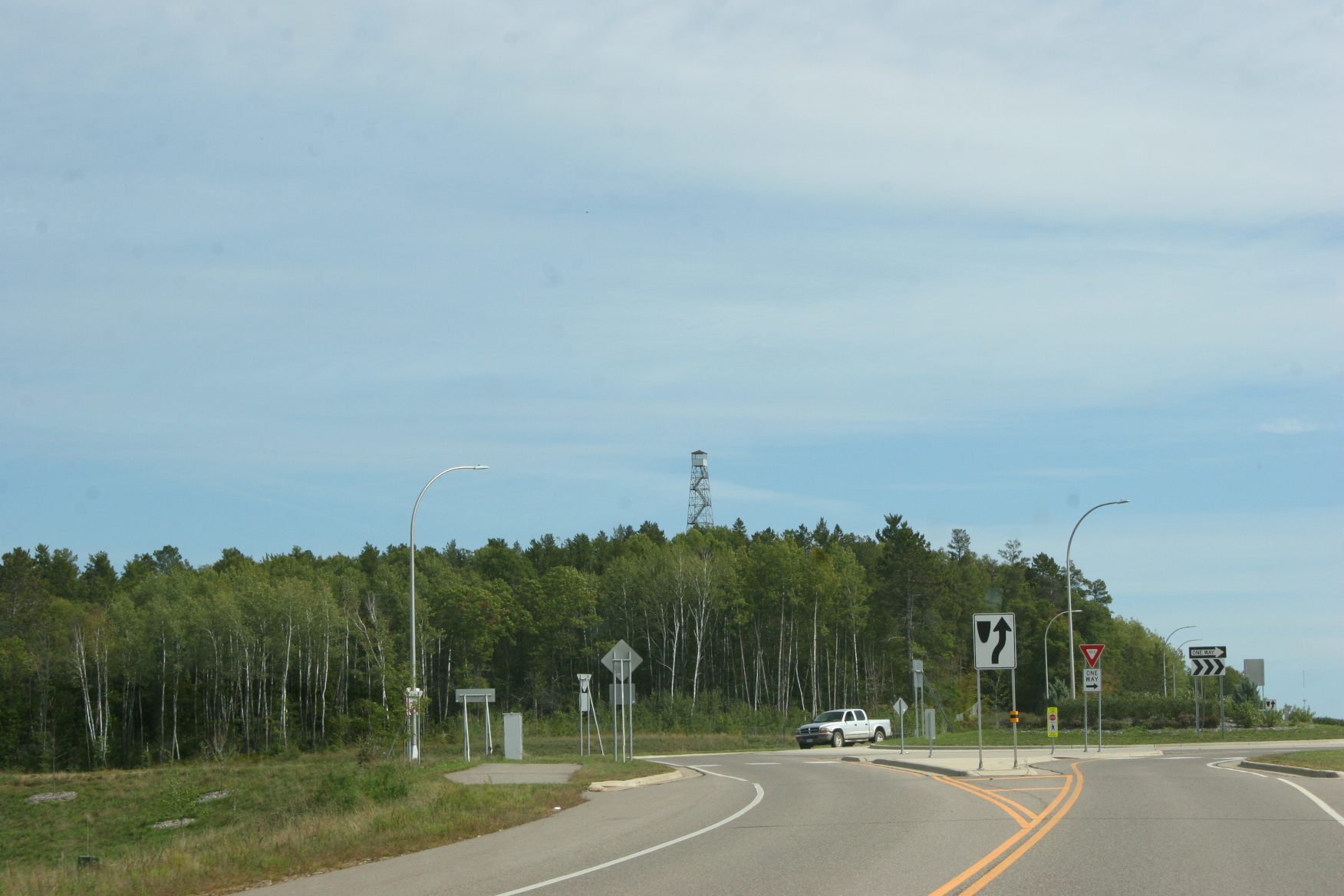
Just a short distance from this roundabout by Pequot Lakes, you can see the Paul M. Thiede Fire Tower peeking through the treetops. Minnesota Prairie Roots copyrighted photo September 2021.
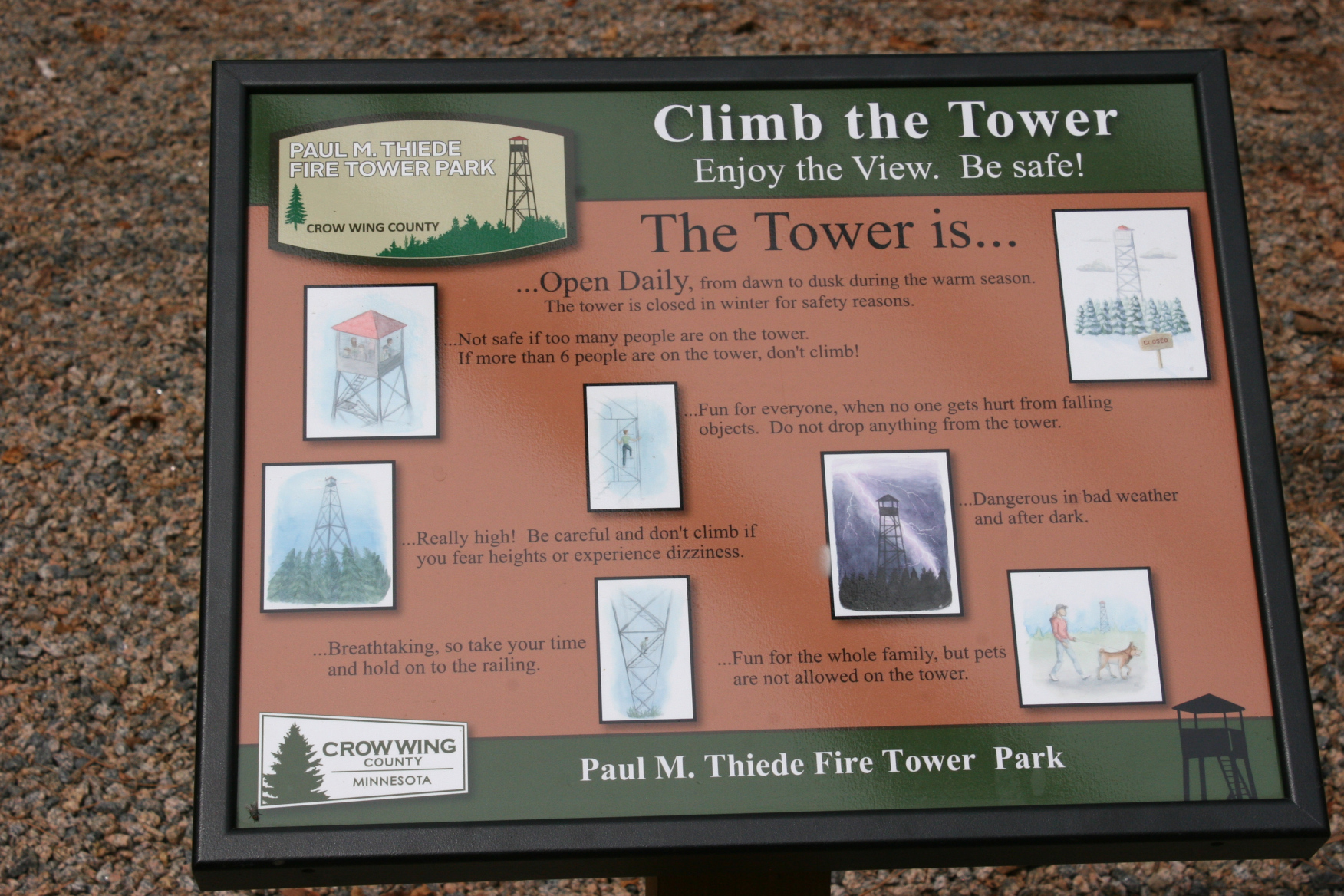
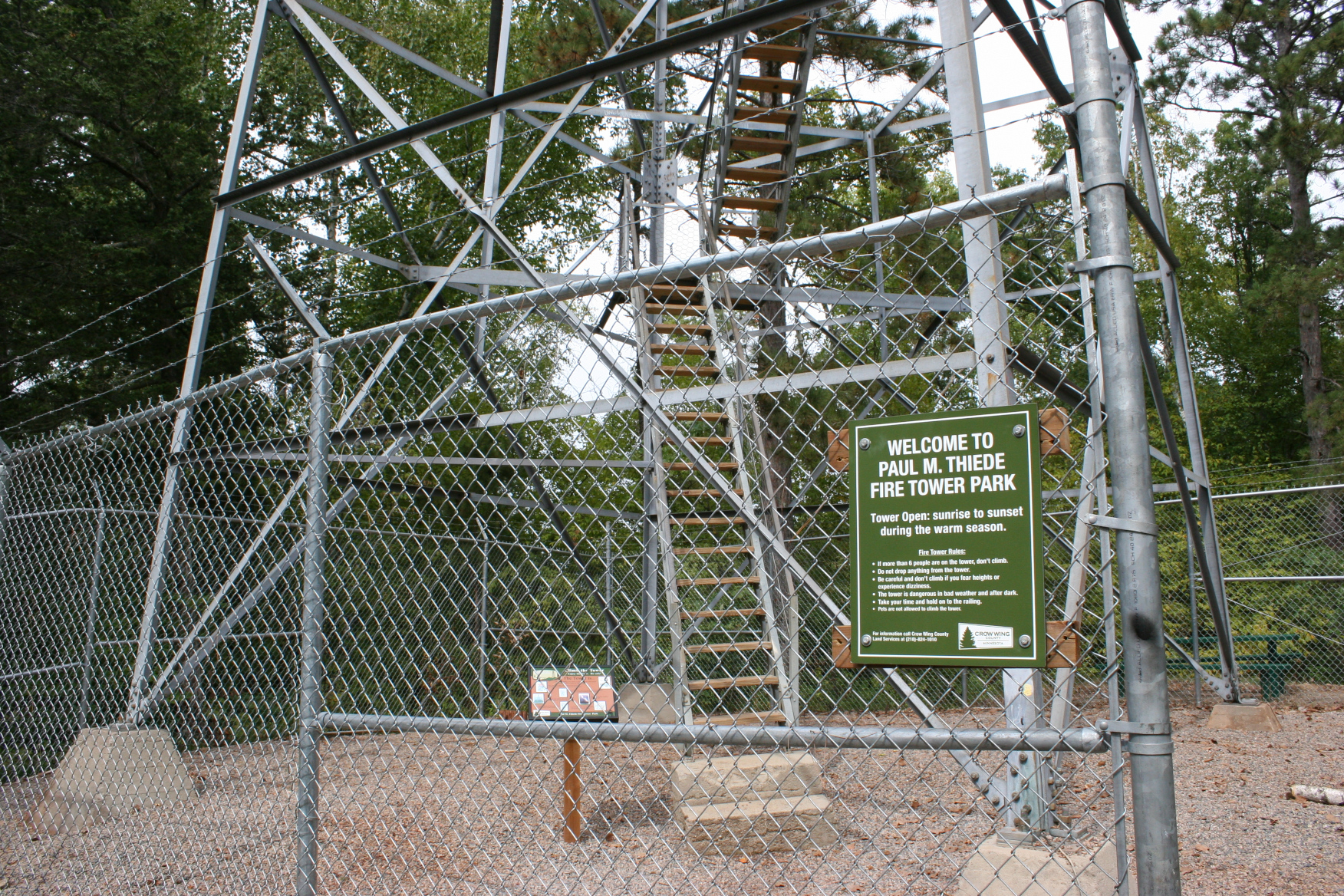
Really high! Be careful and don’t climb if you fear heights or experience dizziness.
The warning sign and rules posted at the base of the fire tower. Minnesota Prairie Roots copyrighted photo September 2021.
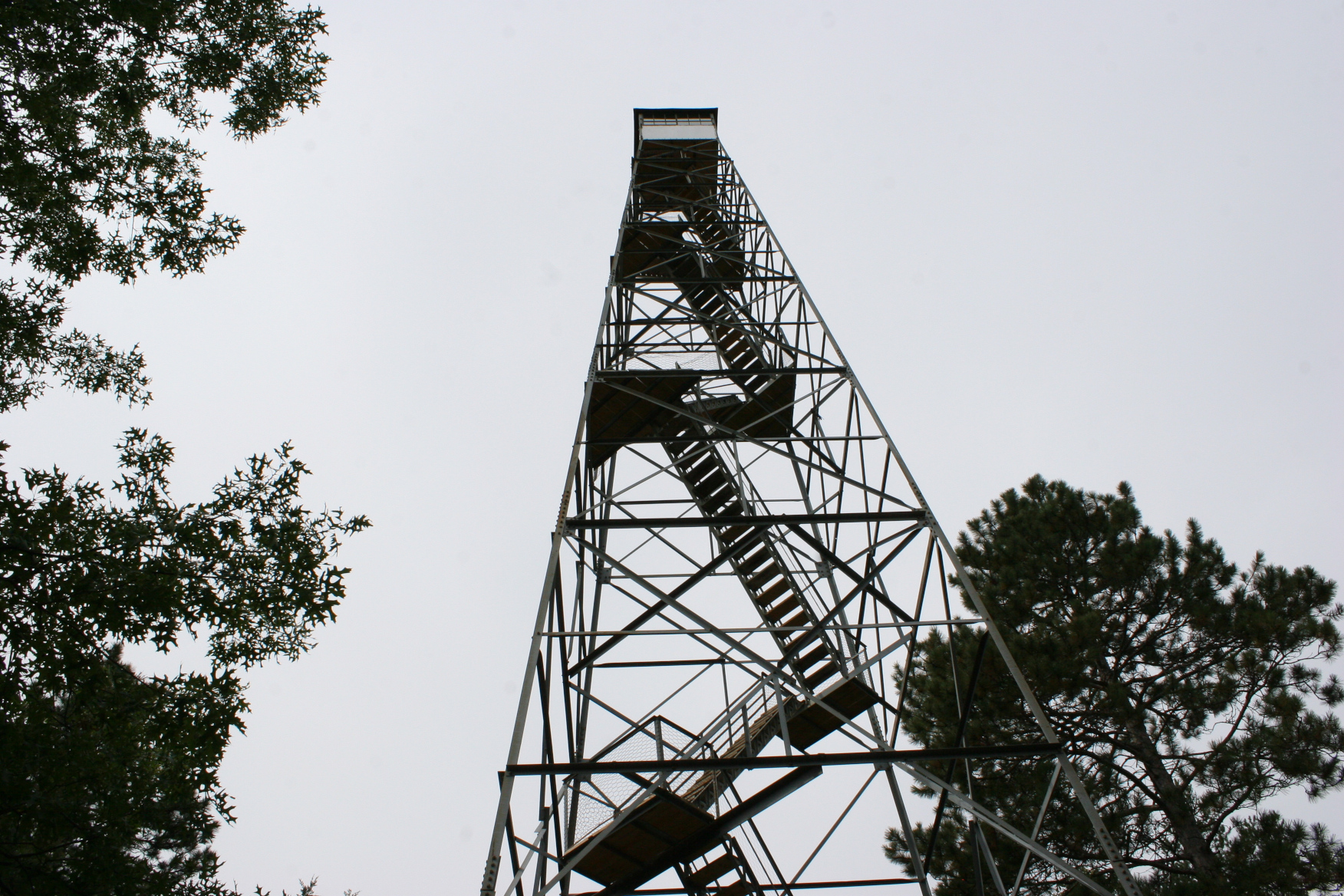
I heeded the warning and stayed put. Feet on the ground. Camera aimed skyward. Toward the 100-foot high Paul M. Thiede Fire Tower just outside Pequot Lakes in the central Minnesota lakes region. The top of the tower pokes through the trees, barely visible from State Highway 371. Turn off that arterial road onto Crow Wing County Road 11, turn left, and you’ve reached the fire tower park.
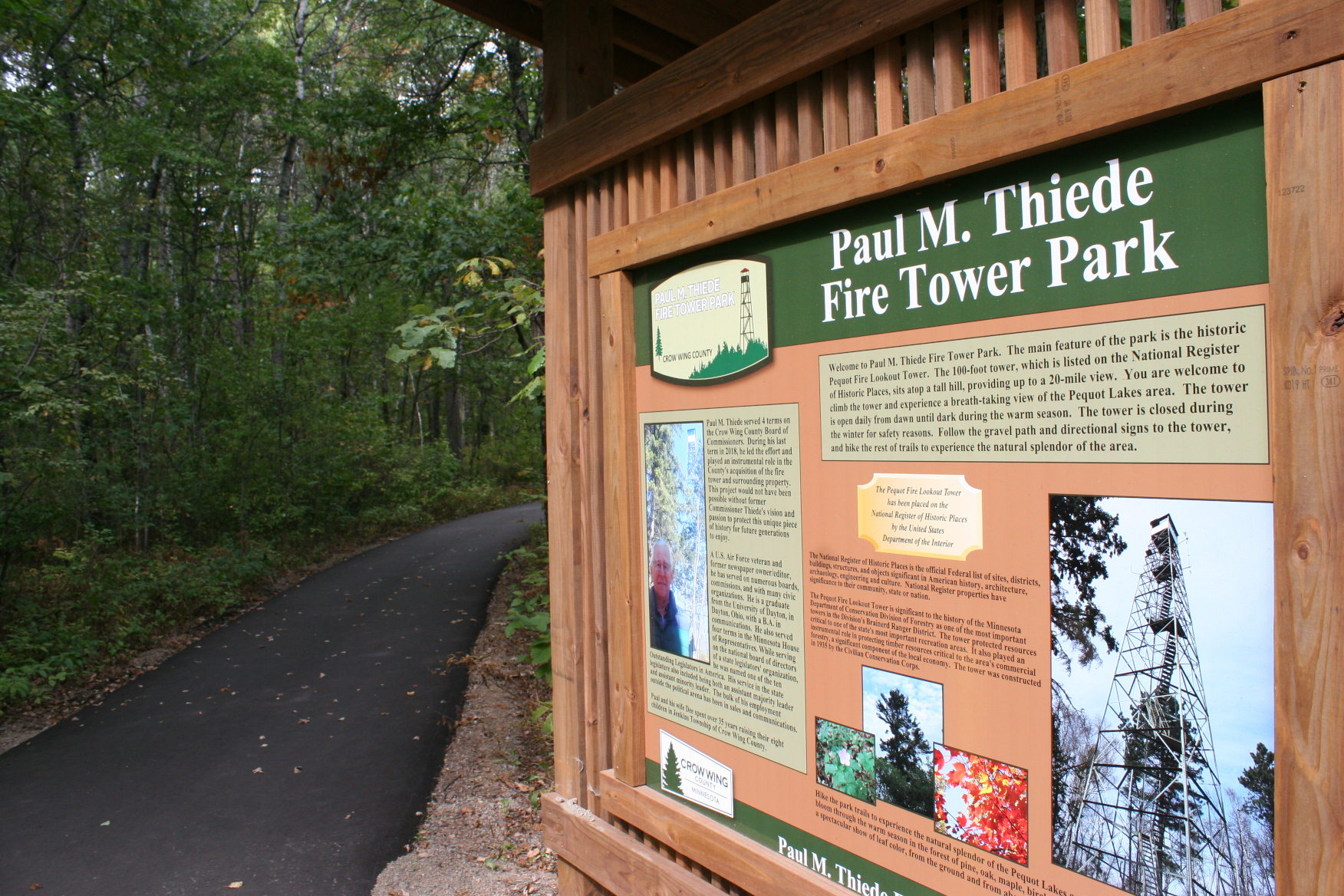
A little background on the park. Minnesota Prairie Roots copyrighted photo September 2021.
The Paul M. Thiede Fire Tower Park (named after the county commissioner instrumental in developing this 40-acre park) offers visitors an opportunity to hike to, and then climb, the historic tower built in 1935 by the Civilian Conservation Corps. As one who prefers low to high, I was up for the 0.3 mile hike, but not the climb.
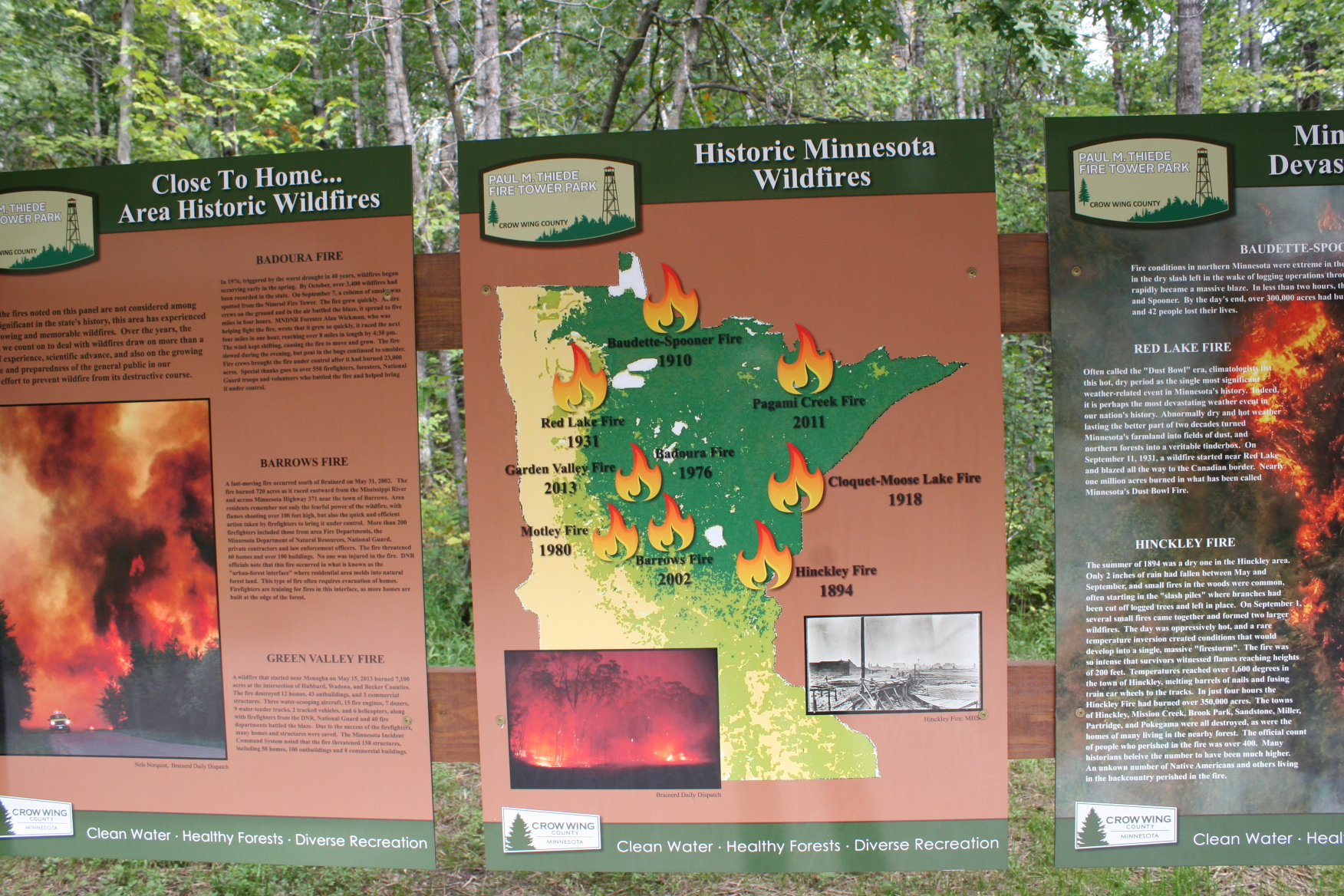
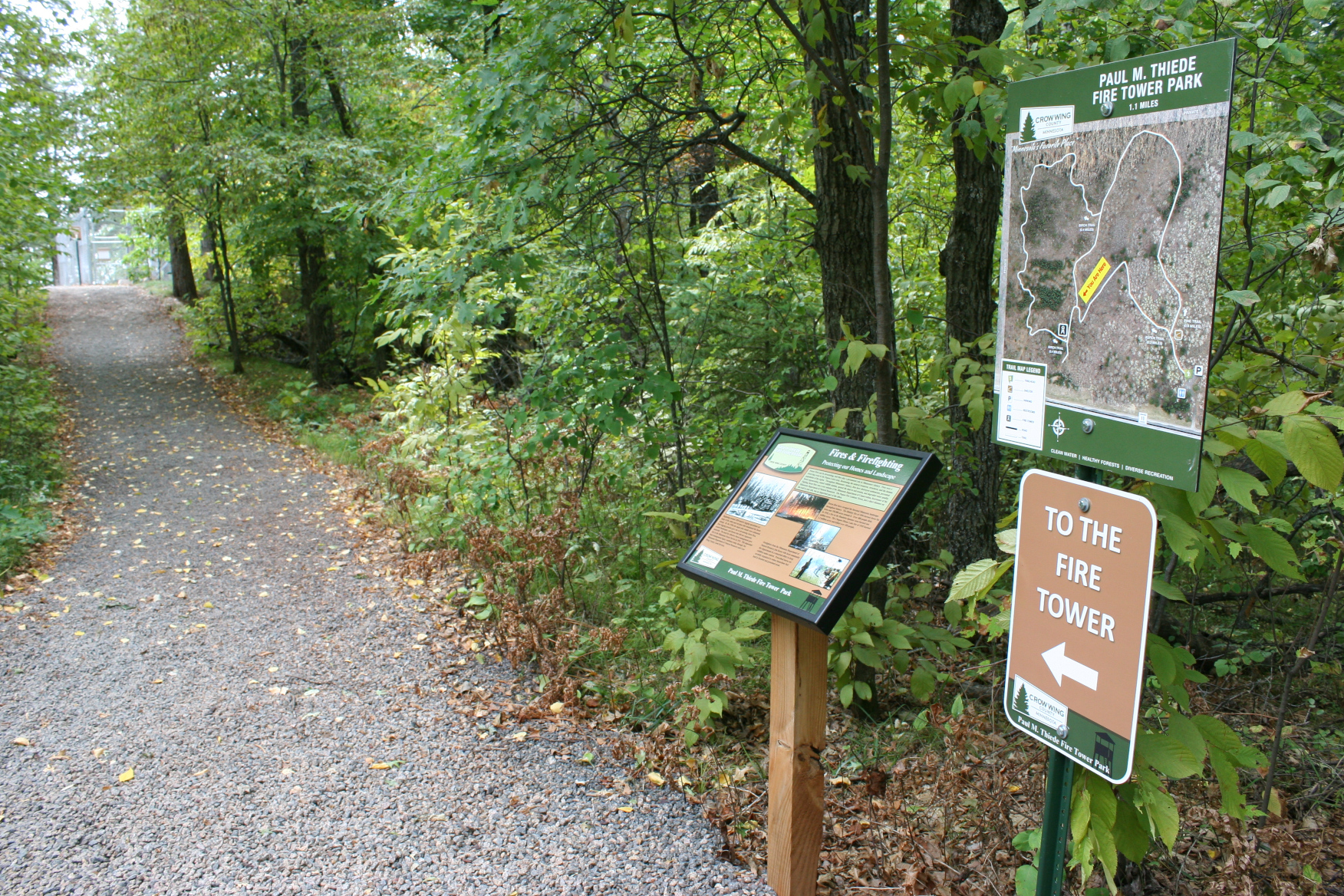
Lots of info packs signs in the outdoor interpretative area. Minnesota Prairie Roots copyrighted photo September 2021.
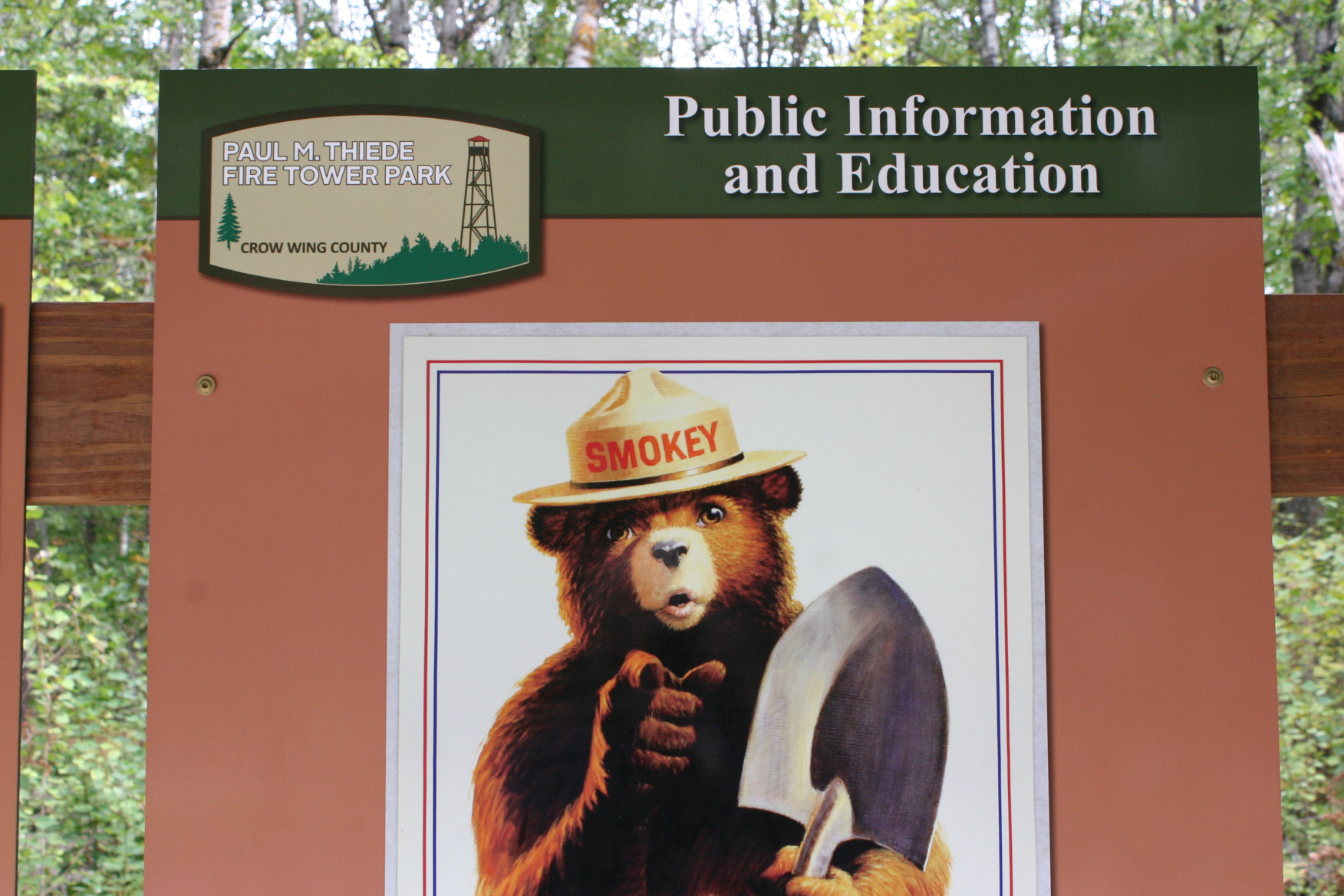
The iconic Smokey the Bear reminds us that we can prevent forest fires. Minnesota Prairie Roots copyrighted photo September 2021.
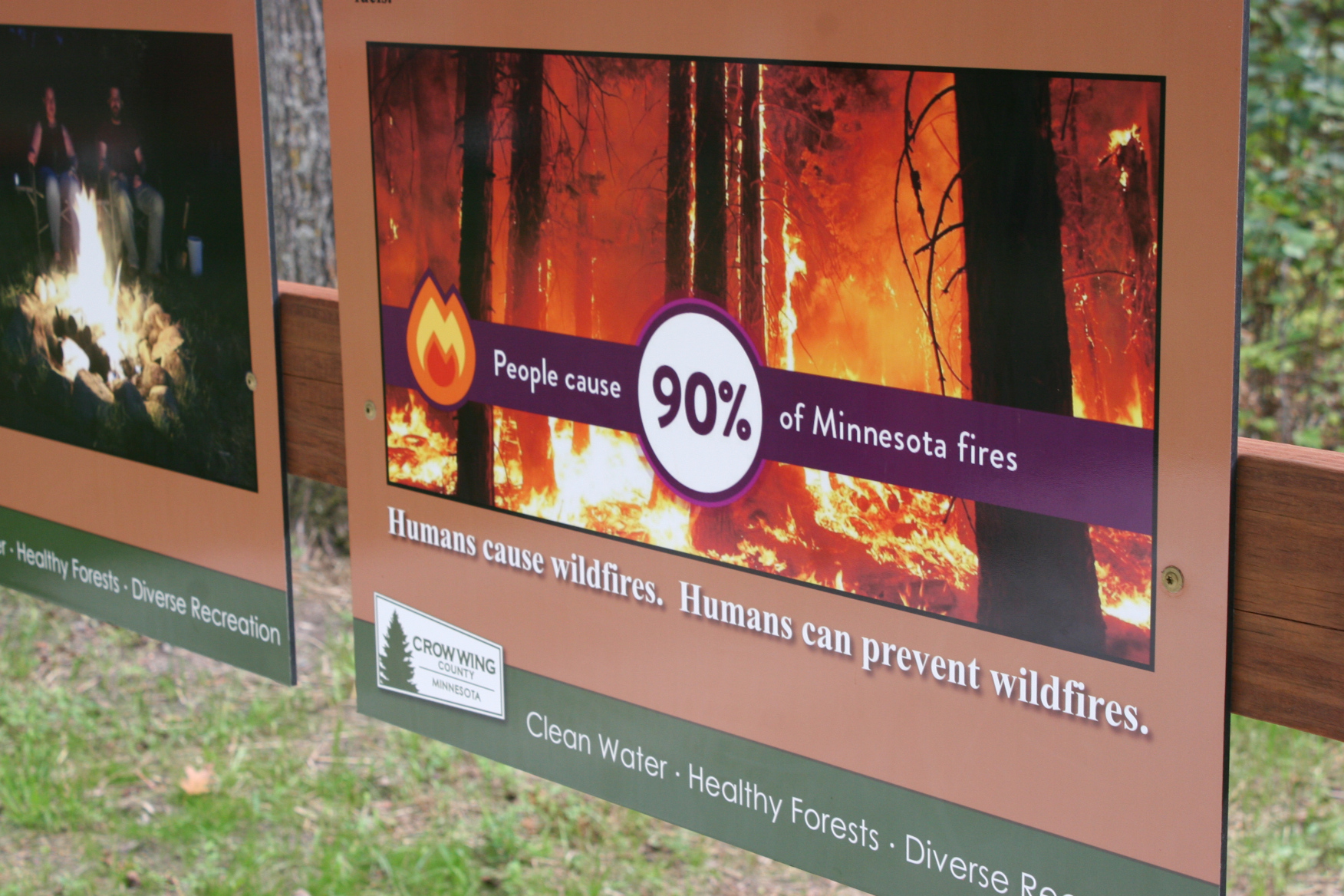
Weare to blame for nearly all of Minnesota’s wildfires, according to this park sign. Minnesota Prairie Roots copyrighted photo September 2021.
Before Randy and I headed onto the trail, though, we read the interpretative signage featuring information on the tower (which is on the National Register of Historic Places), Minnesota wildfires and other notable fire facts. This summer marked an especially busy fire season in the northern Minnesota wilderness. Those of us living in the southern part of the state felt the effects also with smoke drifting from the north (including Canada) and from the west (California). That created hazy skies and unhealthy air some days, unlike anything I’ve ever experienced.
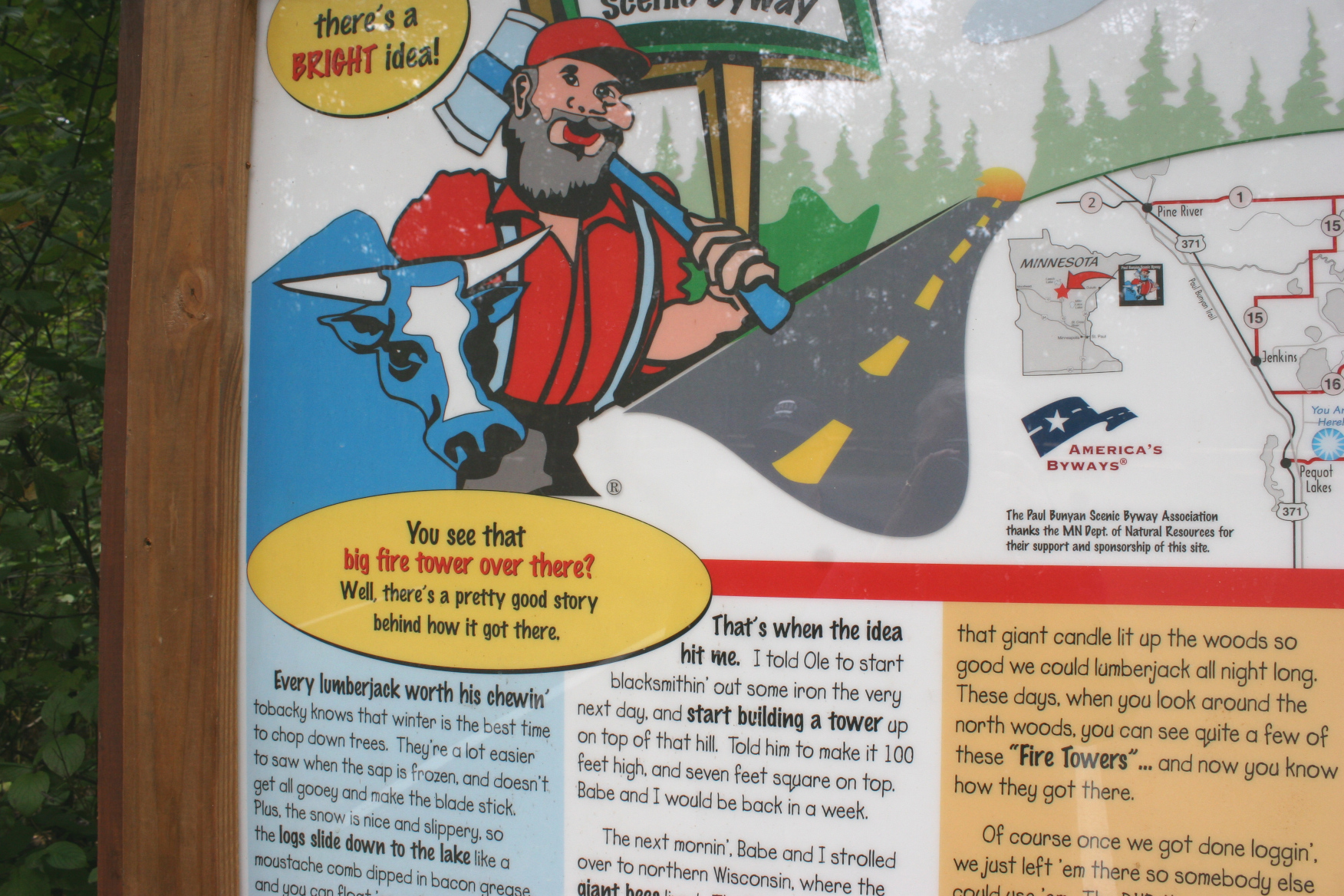
Lots to read here, including Paul Bunyan’s fire tower story. Minnesota Prairie Roots copyrighted photo September 2021.
We also read a bit of Paul Bunyan lore, a fun addition to the park located in the Paul Bunyan Scenic Byway area. This region of Minnesota is big on lumberjack stories about Paul and his sidekick, Babe the Blue Ox. The Pequot Lakes water tower is even shaped like Paul’s over-sized fishing bobber.
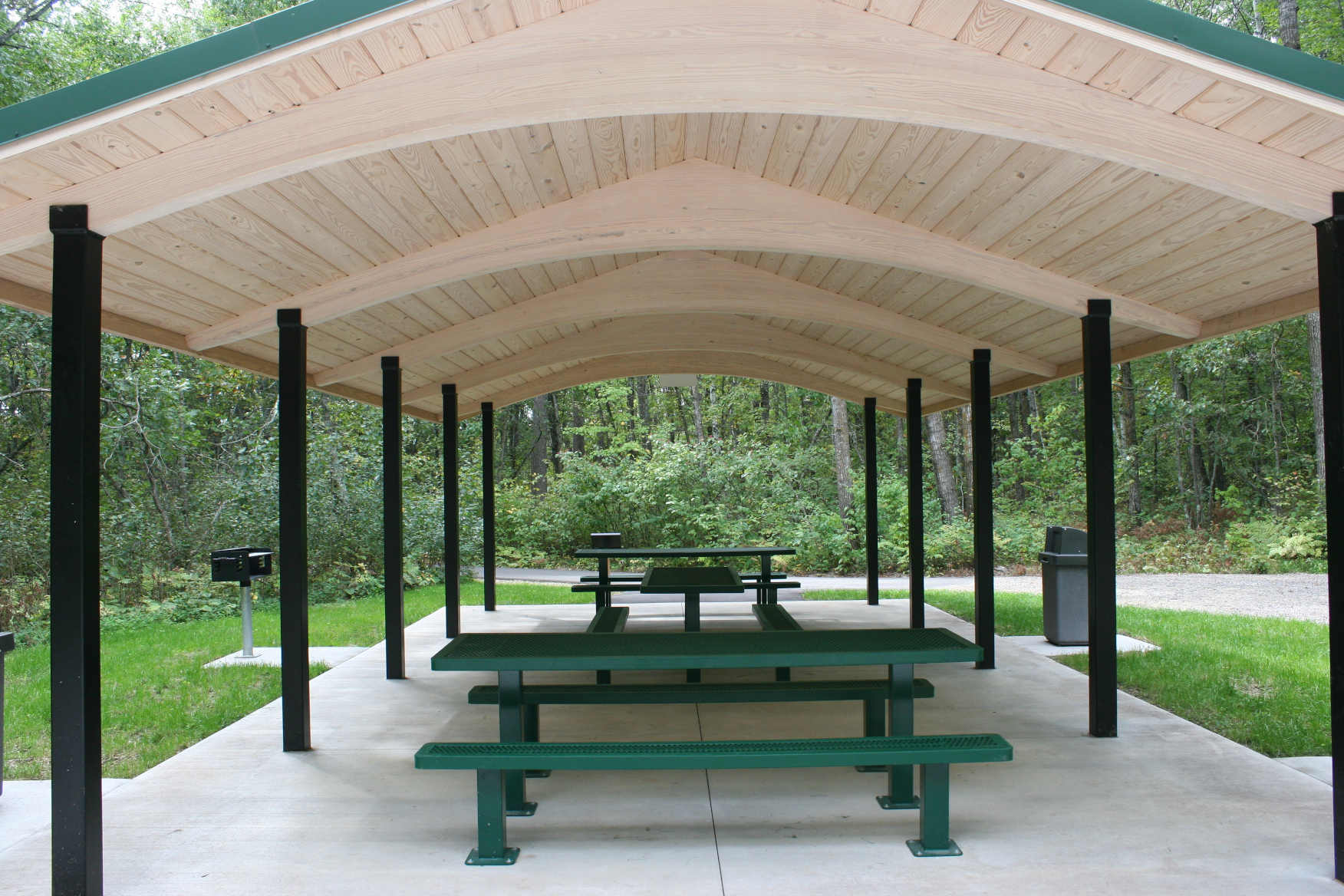
The pristine picnic shelter. Minnesota Prairie Roots copyrighted photo September 2021.
Signs point the way to the fire tower trail. Minnesota Prairie Roots copyrighted photo September 2021.
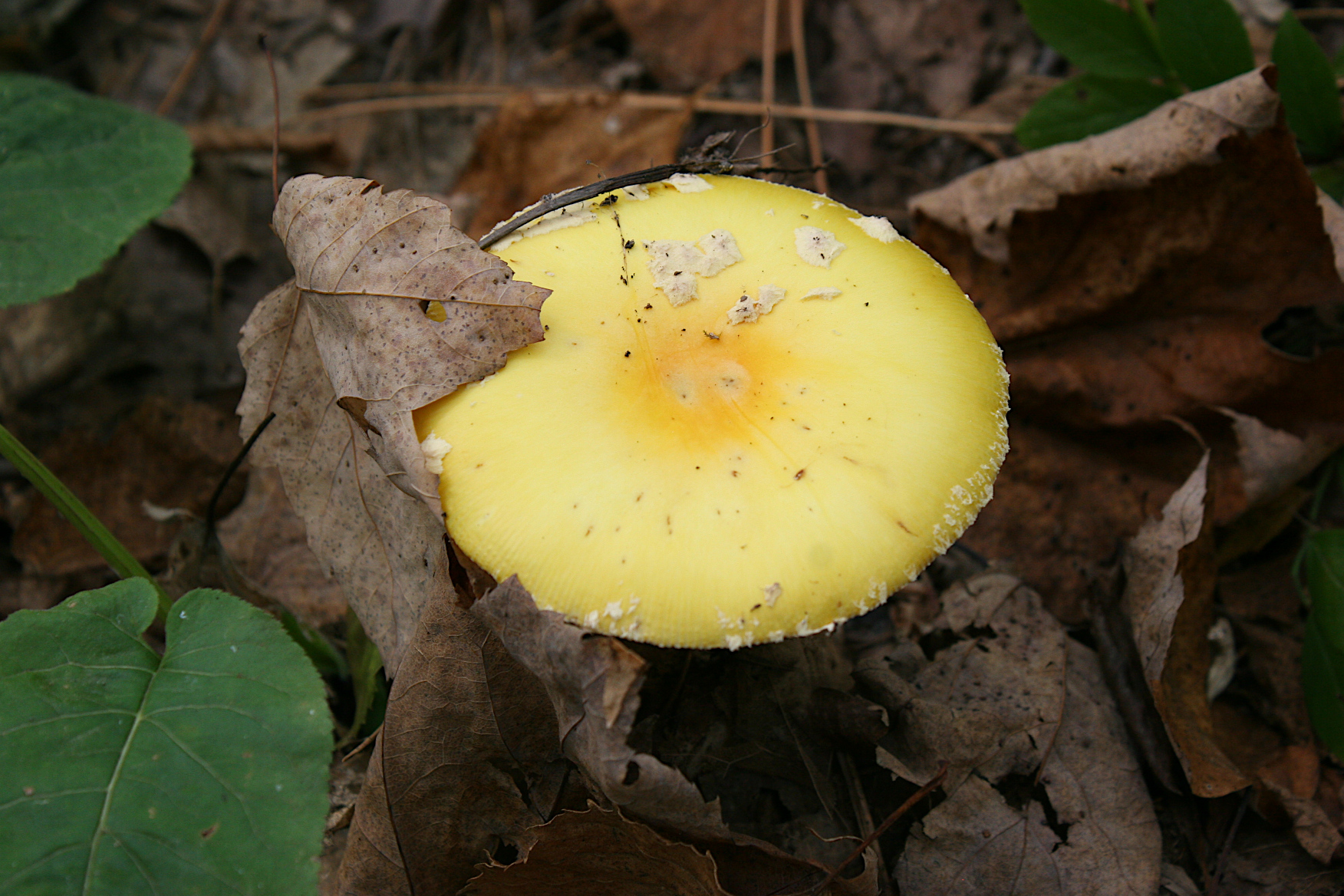
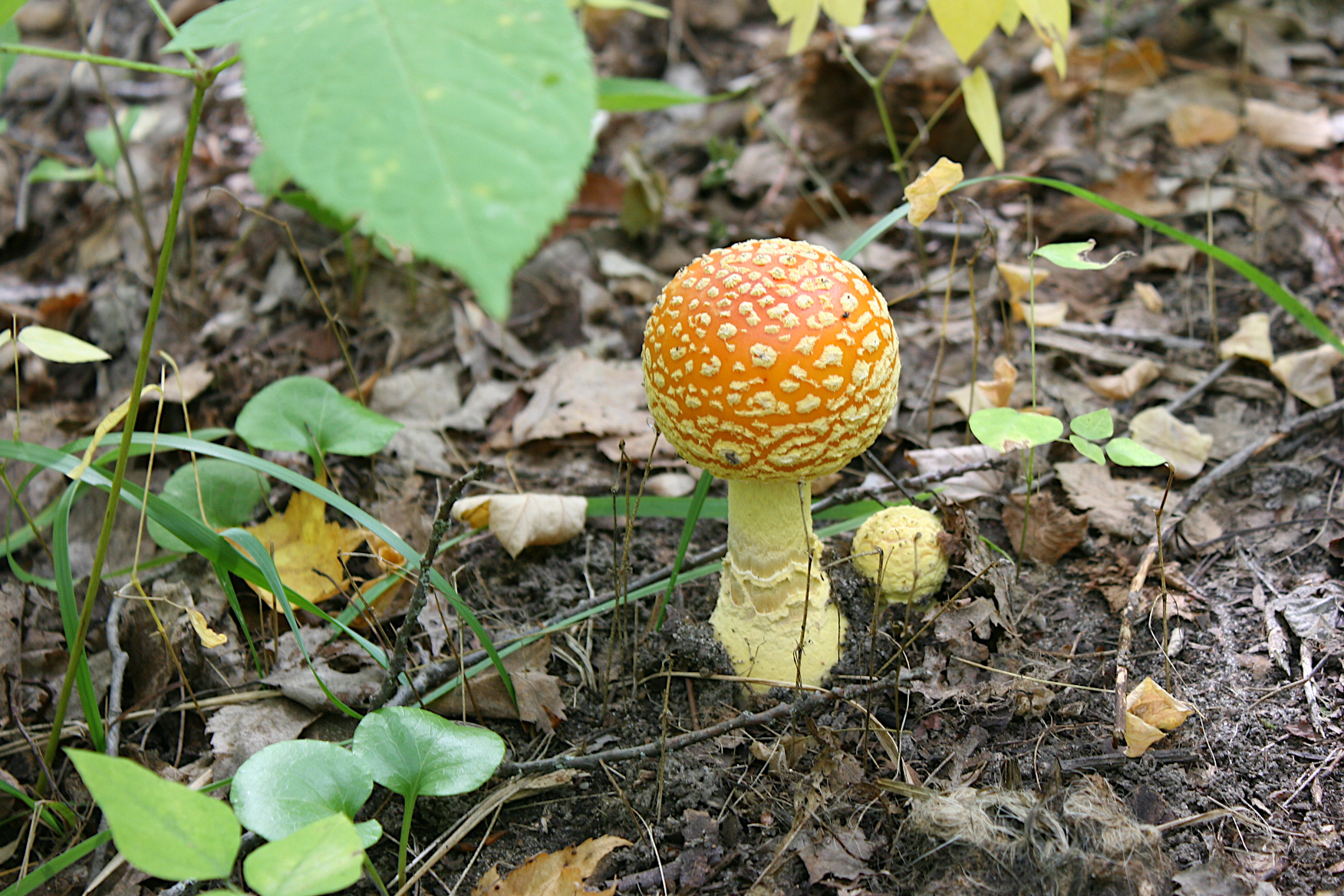
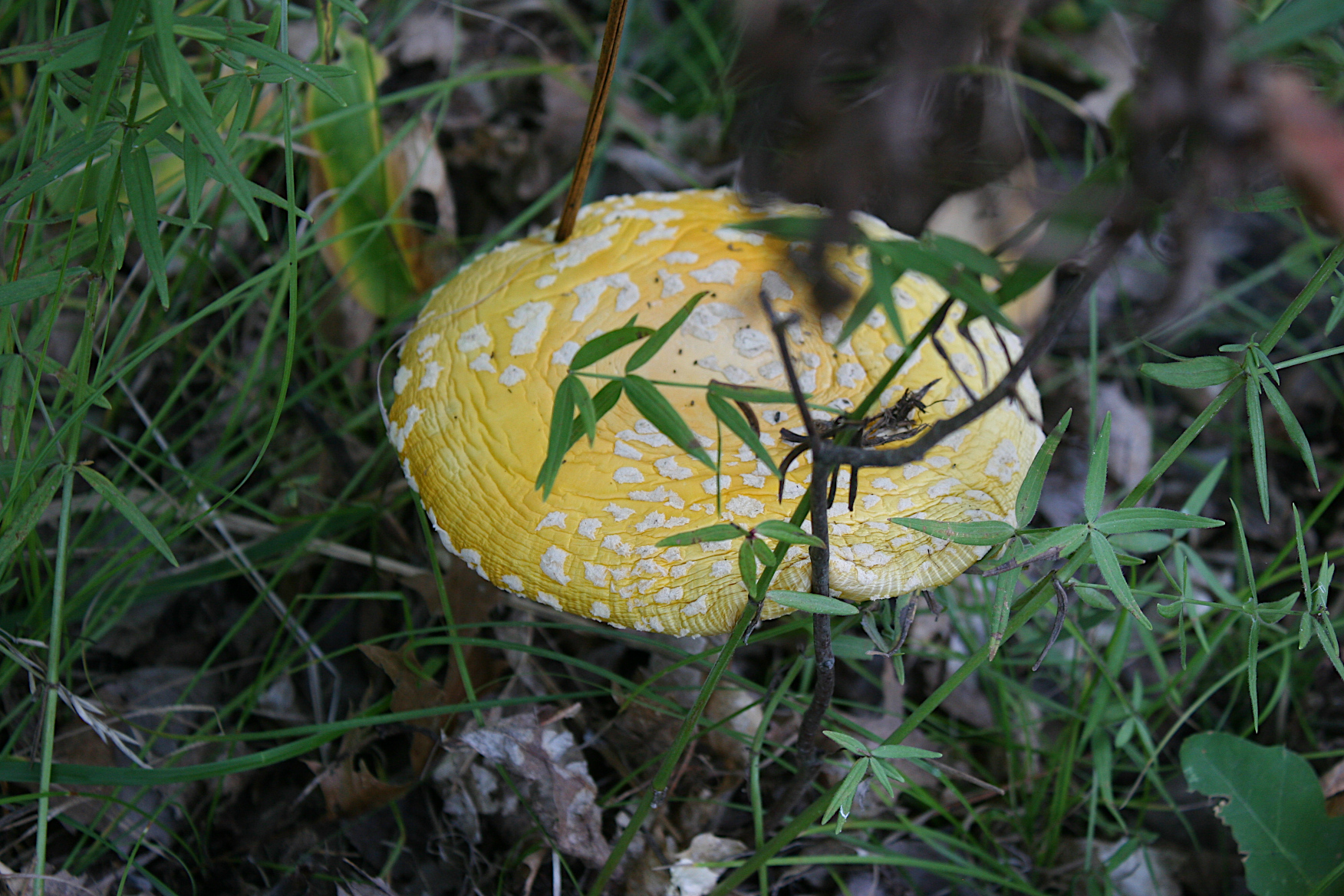
On the way to the tower, this large yellow mushroom temporarily distracted me. Minnesota Prairie Roots copyrighted photo September 2021.
Once we’d finished reading, and then admiring the beautiful new picnic shelter, we started off on the pea rock-covered trail through the woods and toward the tower. Up. Up. Up.
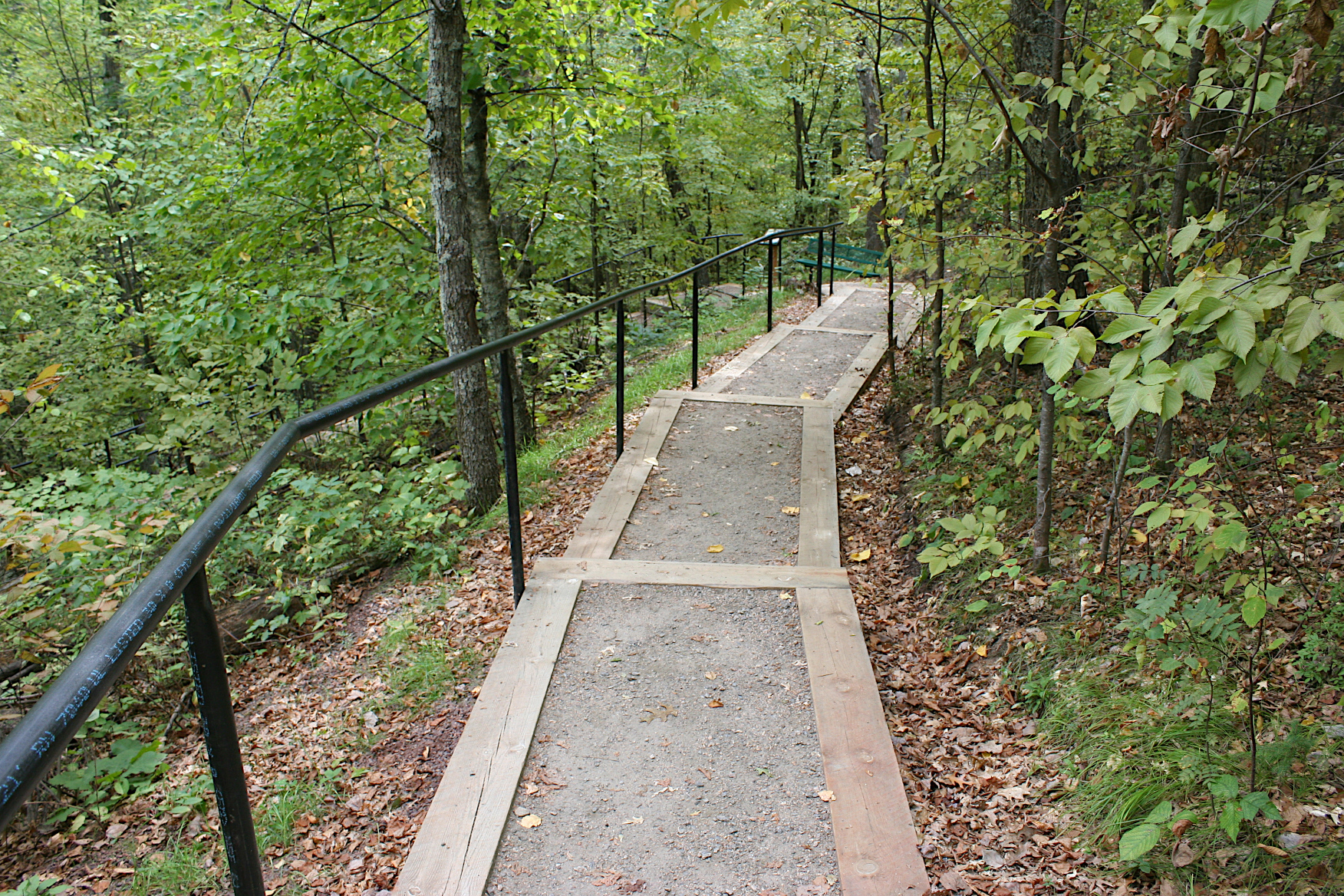
When the trail gets especially steep, steps aid in the climb. I took this photo on the descent. Minnesota Prairie Roots copyrighted photo September 2021.
After awhile, I began to tire, to wonder, how much farther? And just as I was about to declare myself done climbing steps, Randy assured me the tower was just around the bend. Yes.
Looking up at the tower, all of which I couldn’t fit in a photo, I determined I was not climbing that high. Minnesota Prairie Roots copyrighted photo September 2021.
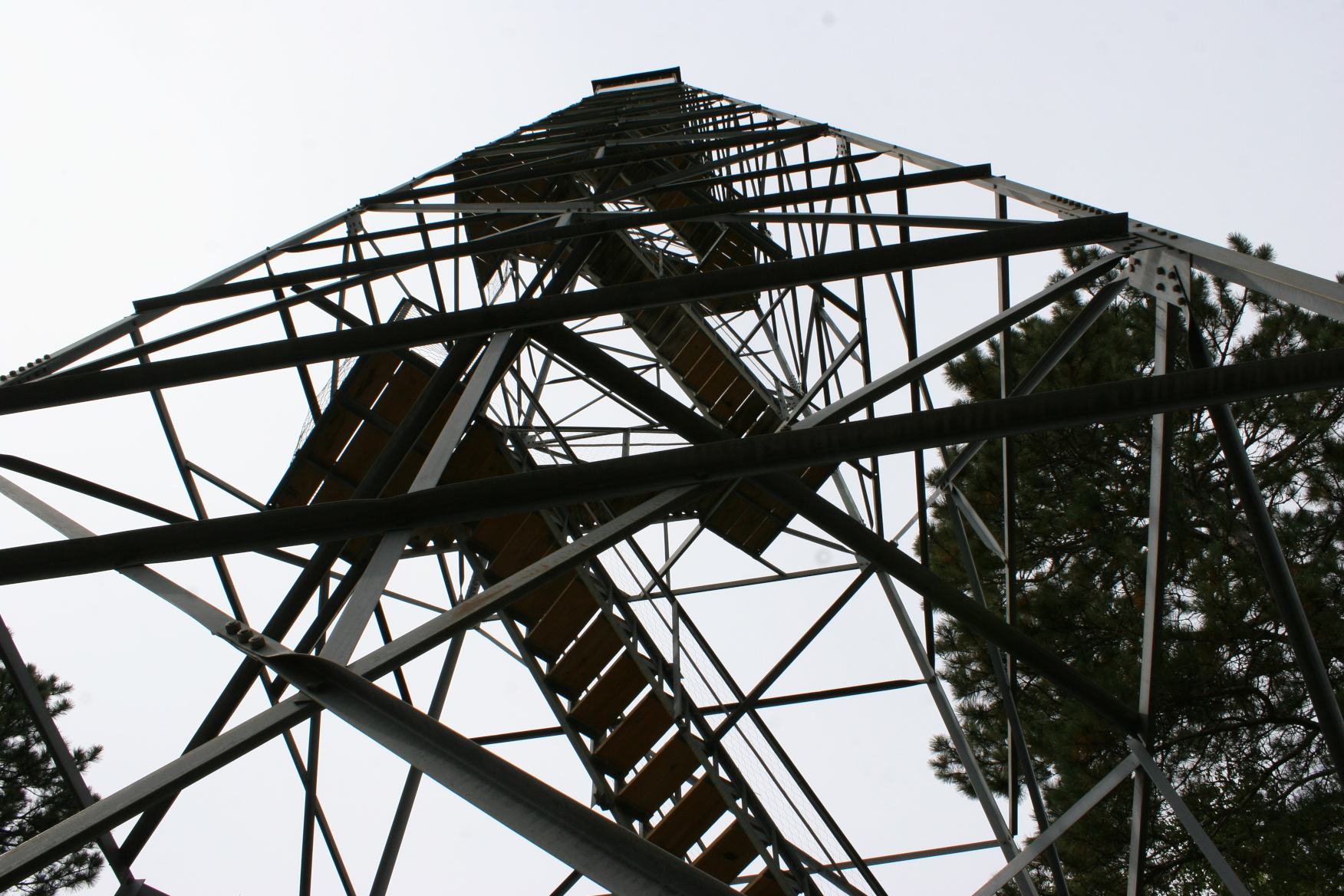
Once there, I stood at the base of the tower, reading the rules and warnings. I decided I best admire the ironwork from below. And I did. There’s a lot to be said for the 1930s workmanship of skilled craftsmen.
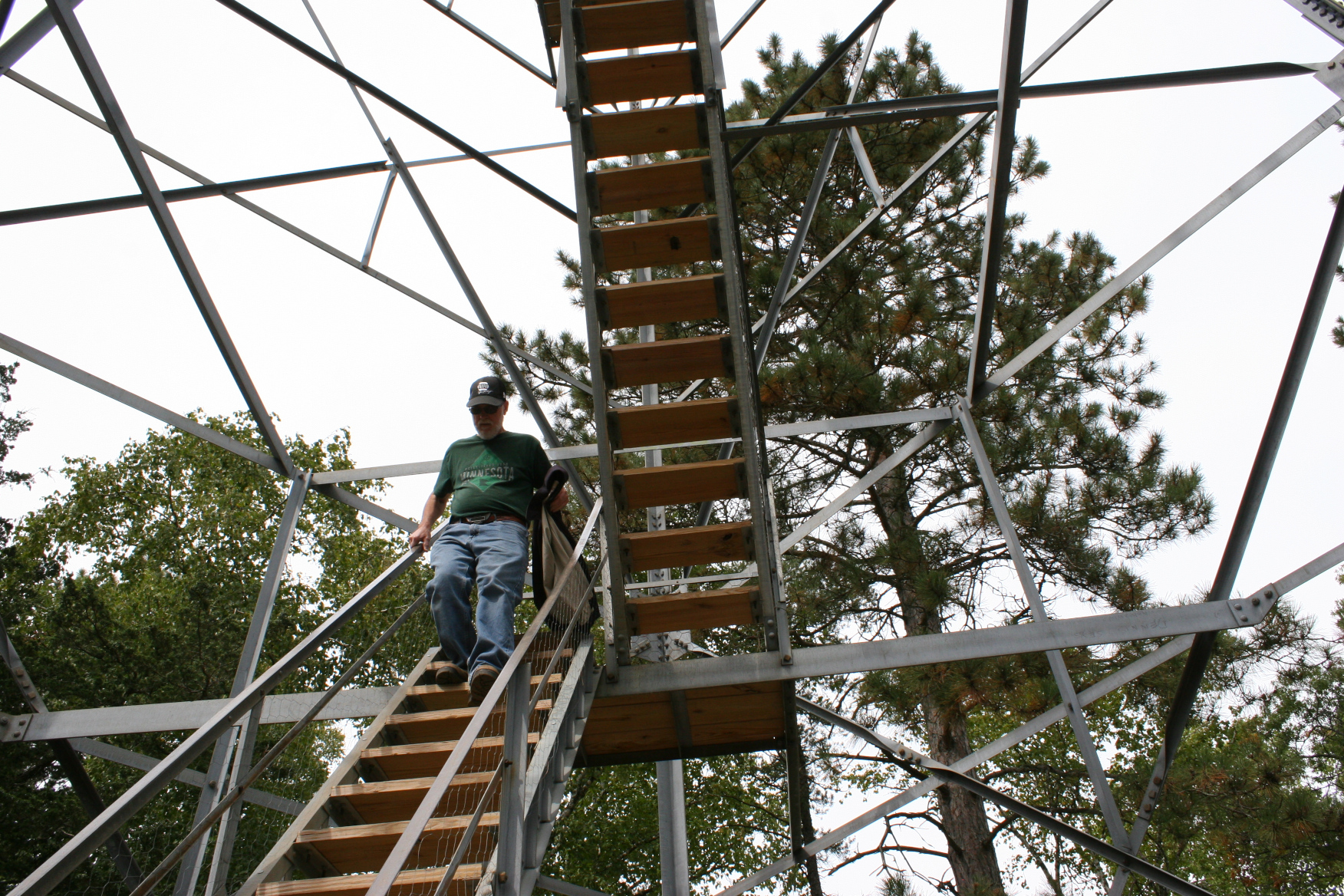
The underside of the tower shows layers of stairs. Minnesota Prairie Roots copyrighted photo September 2021.
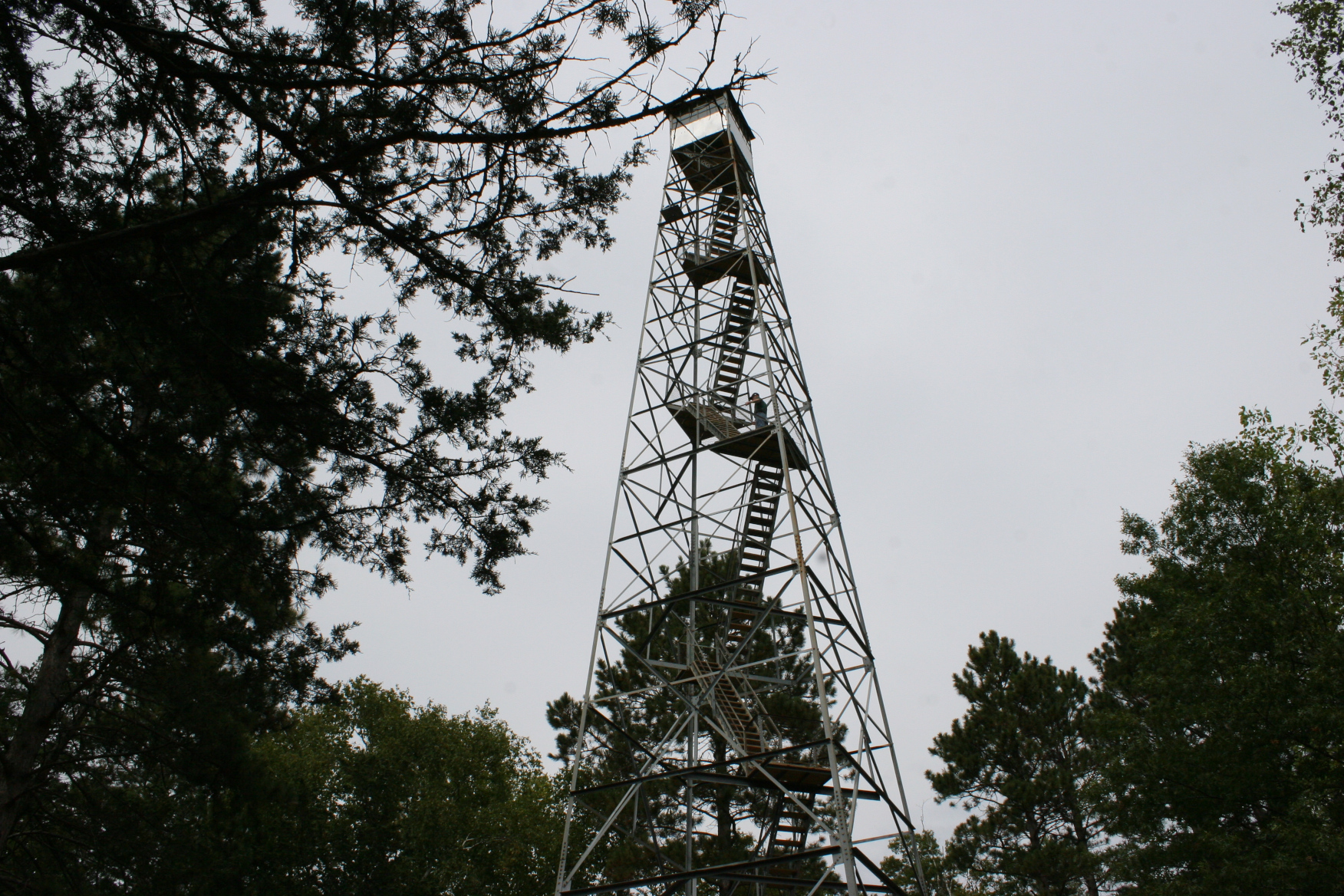
Randy, though, started up the layered steps leading to a seven-foot square enclosed look-out space at the top of the tower. At that height, fire watchers could see for 20 miles.
If you look closely, you can see Randy with only a few more flights to reach the top. At this point, he decided not to go any farther. Minnesota Prairie Roots copyrighted photo September 2021.
As I watched, Randy climbed. Steady at first, but soon slowing, pausing to rest. “You don’t have to go all the way to the top,” I shouted from below. He continued, to just above treetop level, and then stopped. He had reached his comfort height level.
The tower is fenced at the base. Minnesota Prairie Roots copyrighted photo September 2021.
I can only imagine how spectacular the view this time of year, in this season of autumn when the woods fire with color. We visited in mid-September, when color was just beginning to tinge trees.
Randy exits the tower, several flights short of reaching the top. Minnesota Prairie Roots copyrighted photo September 2021.
Eventually, we began our retreat down the trail, much easier than ascending.
An incredibly vibrant mushroom thrives trailside. Minnesota Prairie Roots copyrighted photo September 2021.
Occasionally I stopped to photograph scenery, including species of orange and yellow mushrooms. Simply stunning fungi.
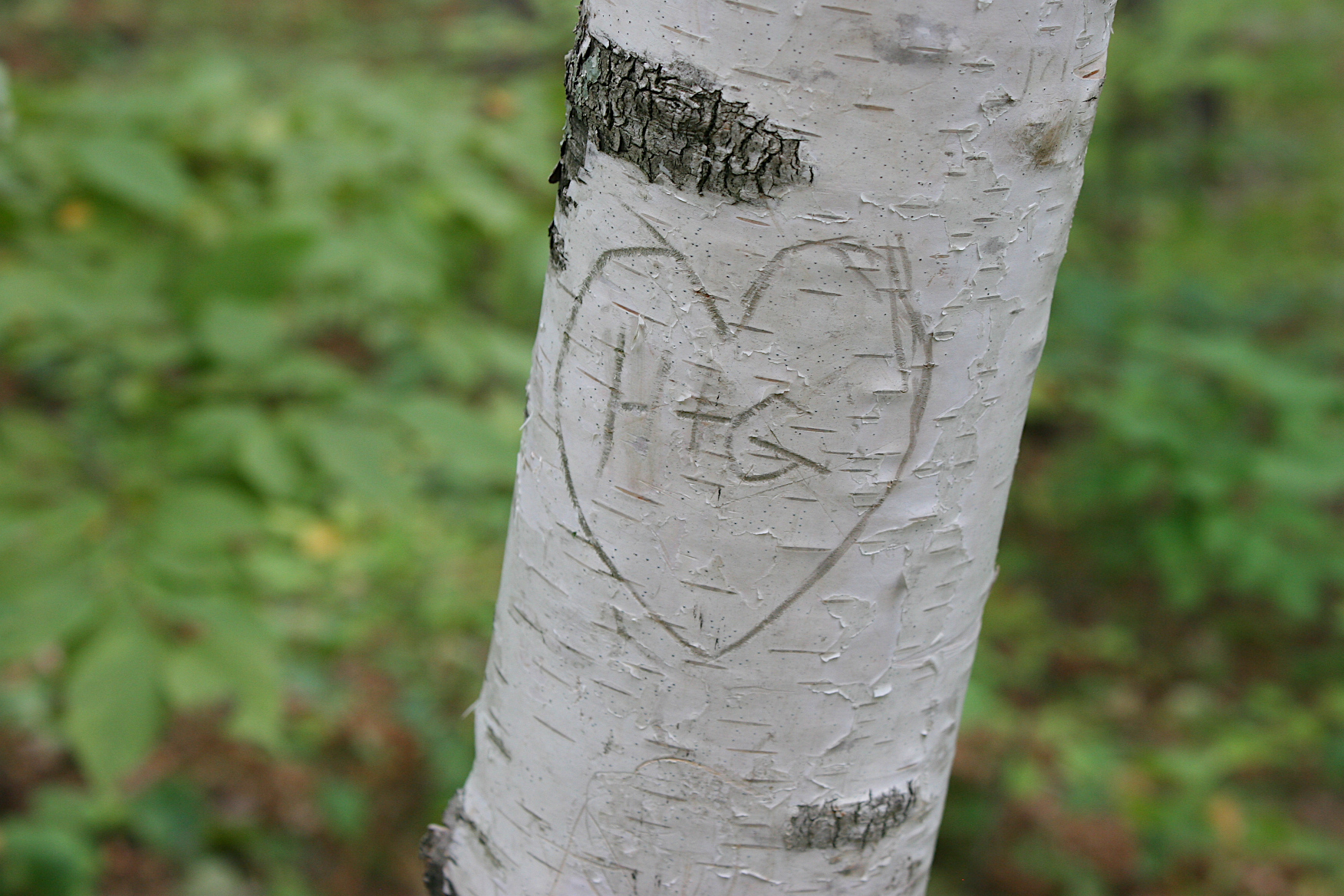
Sadly…a carving on a birch tree along the trail. Minnesota Prairie Roots copyrighted photo September 2021.
We also paused to visit with a retired couple on their way to the tower. They have a generational lake home in the area, like so many who vacation here. While we chatted, a young runner passed us. I admired her stamina and figured she’d face no physical challenges climbing the 100-foot tower.
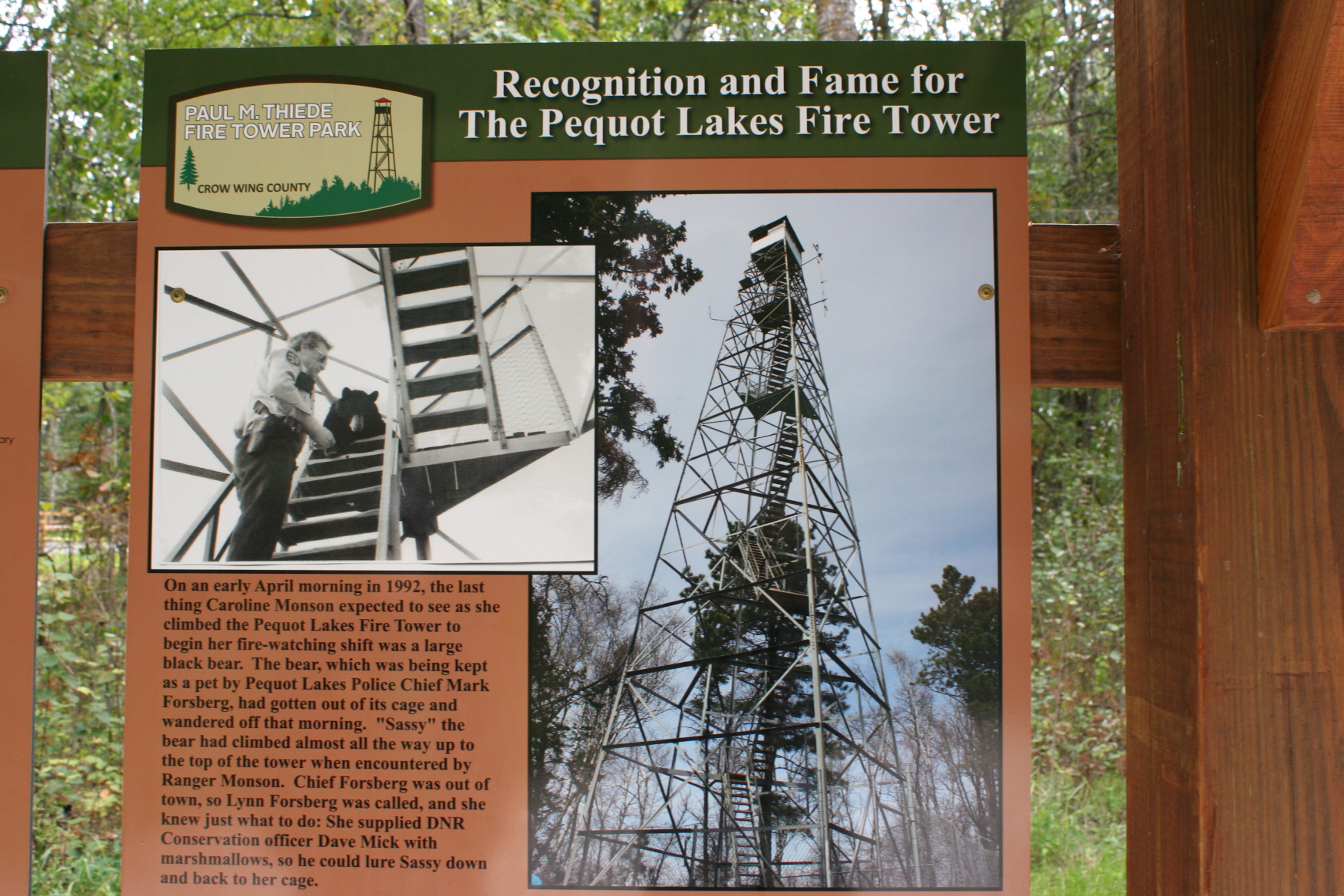
The story of Sassy the bear is included inthe interpretative area. Minnesota Prairie Roots copyrighted photo September 2021.
Just like a domesticated black bear that once escaped and scampered up the tower. A ranger lured him down with a bag of marshmallows. That is not the stuff of Paul Bunyan lore, but of life in the Minnesota northwoods. This historic fire tower, which once provided a jungle gym for a bear and a place to scout for wildfires, now offers a unique spot to view the surrounding woods and lakes and towns. If you don’t fear heights or experience dizziness.
FYI: The Paul M. Thiede Fire Tower is open from dawn to dusk during the warm season, meaning not during Minnesota winters. Heed the rules. And be advised that getting to the tower is a work-out.
Right now should be a really good time to catch a spectacular view of the fall colors from the fire tower.
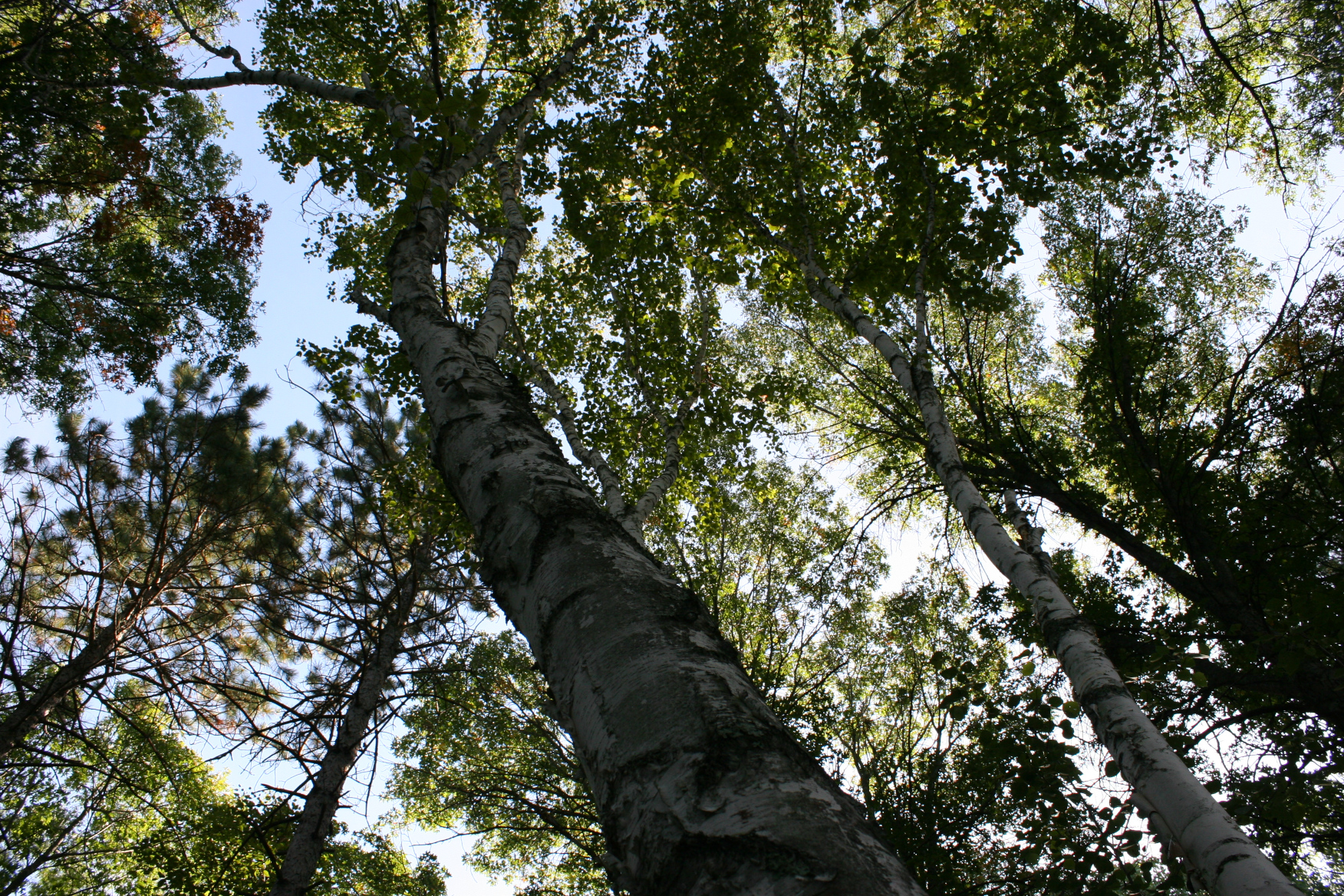
Looking skyward toward the trees inside the woods at Mission Park, Merrifield, MN. Minnesota Prairie Roots copyrighted photo September 2021.
A QUIET PLACE TO BE.
That message banners signs in Mission Township in the heart of central Minnesota’s lake country. The nearly 35-square-mile rural community is, indeed, quiet, if you tuck yourself in among the woods, off the main routes Up North to the cabin.
Leaves are changing color in the park. Minnesota Prairie Roots copyrighted photo September 2021.
From mid-May fishing opener well into autumn, until the first hard freeze, vacationers and seasonal cabin owners travel into and through Crow Wing County to reach their personal and resort destinations. And now Randy and I, too, are living the Minnesota Up North experience thanks to family who are sharing their lake property. Thrice this year we’ve spent time at the cabin, each visit heading to nearby Mission Park.
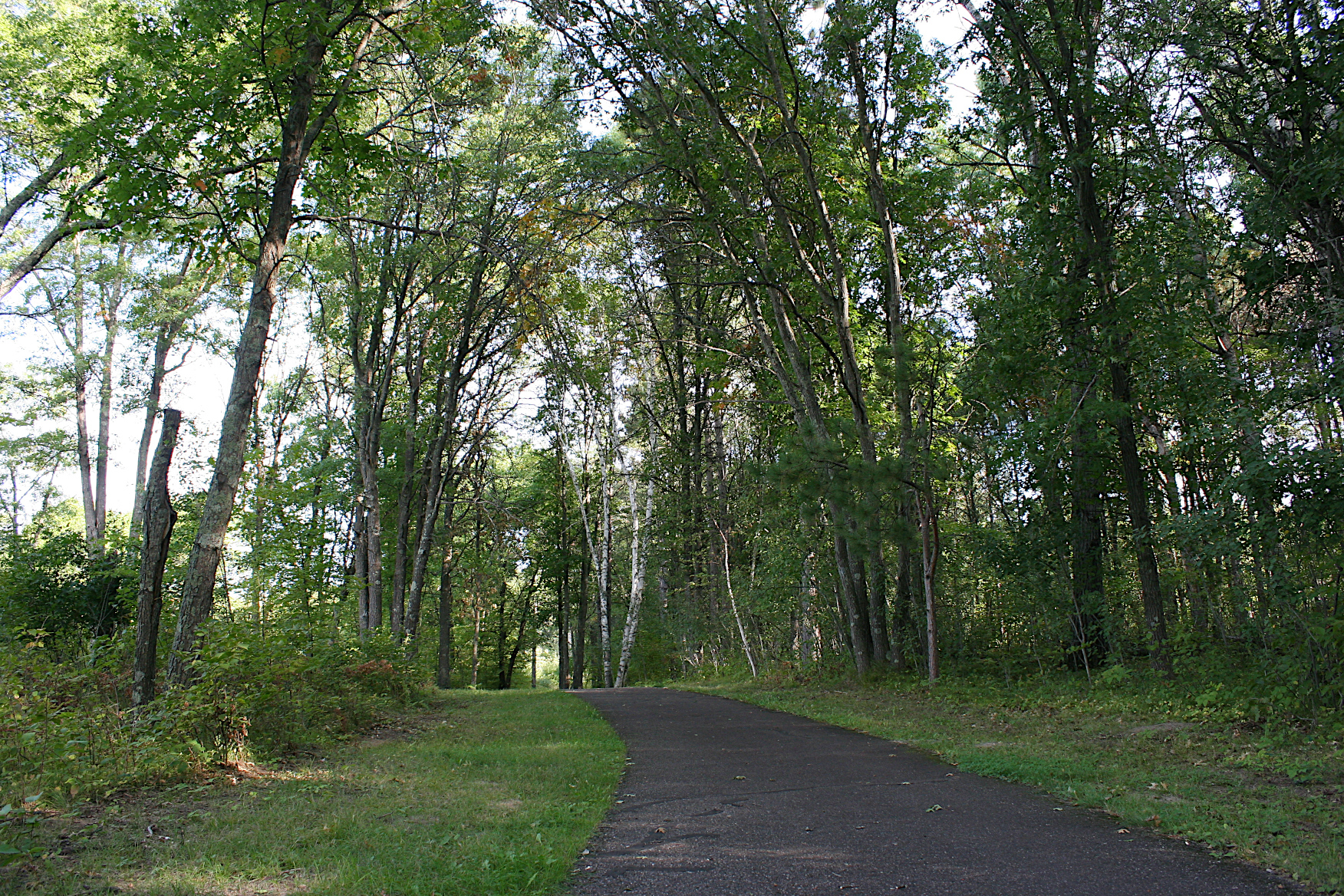
We typically follow the well-maintained paved trail. Minnesota Prairie Roots copyrighted photo September 2021.
The close-to-the-cabin proximity of the park and its 3/4-mile paved hiking trail draw us to this quiet spot in the woods. During our most recent stay in mid-September, we twice hiked in the park. Here leaves are already turning color and I paused often to photograph the autumn hues.
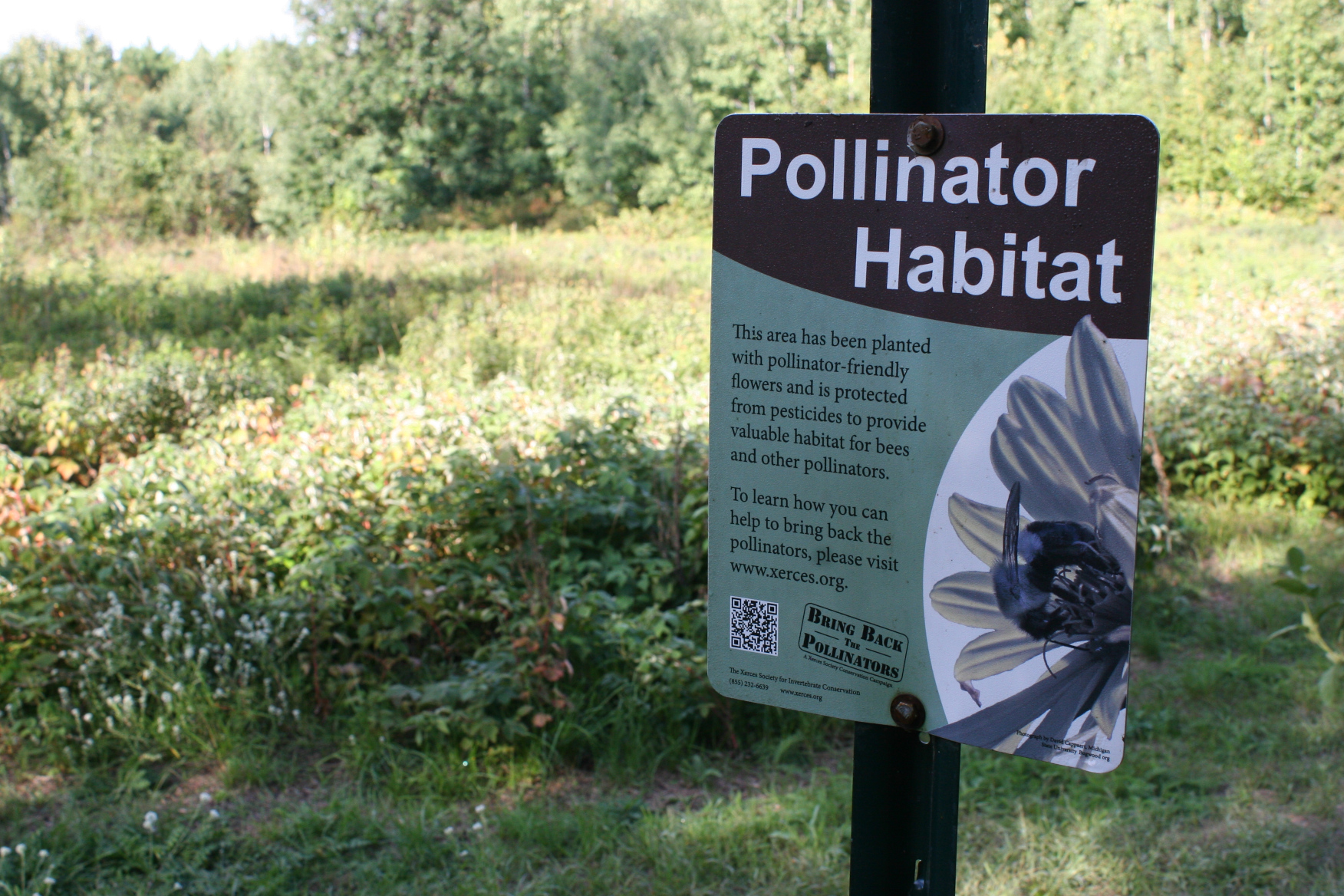
In an open spot in the woods, a pollinator garden has been started. I caught the end of the season. Minnesota Prairie Roots copyrighted photo September 2021.
Seed heads in the pollinator garden. Minnesota Prairie Roots copyrighted photo September 2021.
I spotted a few wildflowers still blooming along trails. Minnesota Prairie Roots copyrighted photo September 2021.
Once, while detouring along a mowed grass path to a pollinator garden, I also stopped to examine a pile of dung. It glistened in the sun, indicating freshness to my untrained non-expert eyes. The sheer volume of excrement led me to wonder…bear? Later, when I shared this with my brother-in-law who is especially knowledgeable about the outdoors, I determined this likely was not bear scat given the lack of acorns and other such matter in the pile. That said, bears (yes, plural) have been sighted in the area, according to the brother-in-law and a park worker who advised to “Make yourself as big as possible and don’t run” if you encounter a black bear. Alright then. Thank you.
Among the colorful mushrooms I found. Minnesota Prairie Roots copyrighted photo September 2021.
Another unknown to me mushroom, nearly camouflaged. Minnesota Prairie Roots copyrighted photo September 2021.
I have never seen a mushroom in this vibrant hue. Minnesota Prairie Roots copyrighted photo September 2021.
As long as he was parceling out advice, I asked about the many wild mushrooms growing in the park. That, he said, was not within his realm of knowledge. Nor is it in mine. So I admired the fungi, in varieties and hues I’ve never seen. Ever. Anywhere. Bold yellow and orange. Stunning. Still life art.
Discovered growing on the forest floor, a large disc-shaped mushroom. Minnesota Prairie Roots copyrighted photo September 2021.
If quick research is correct, the more colorful the mushroom, the more likely it’s poisonous. Deadly. Nope, you’re not going to catch me picking mushrooms in the woods. I’ll settle for photographing them, as much as I like the taste of (store-bought) portabella mushrooms.
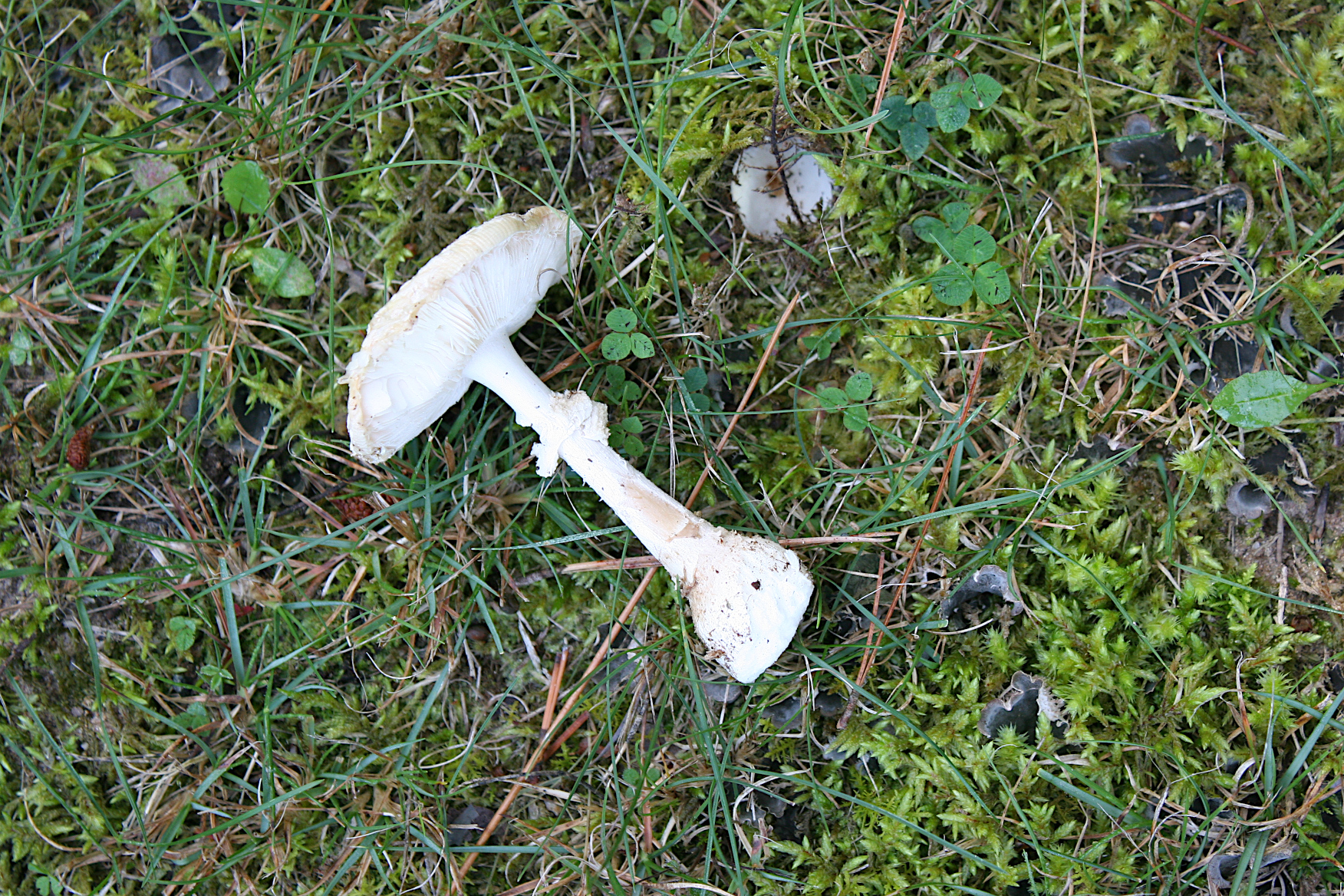
I spotted this broken off mushroom on the grass at woods’ edge. Minnesota Prairie Roots copyrighted photo September 2021.
The park employee noted, however, that a guy knowledgeable about mushrooms forages for them here.
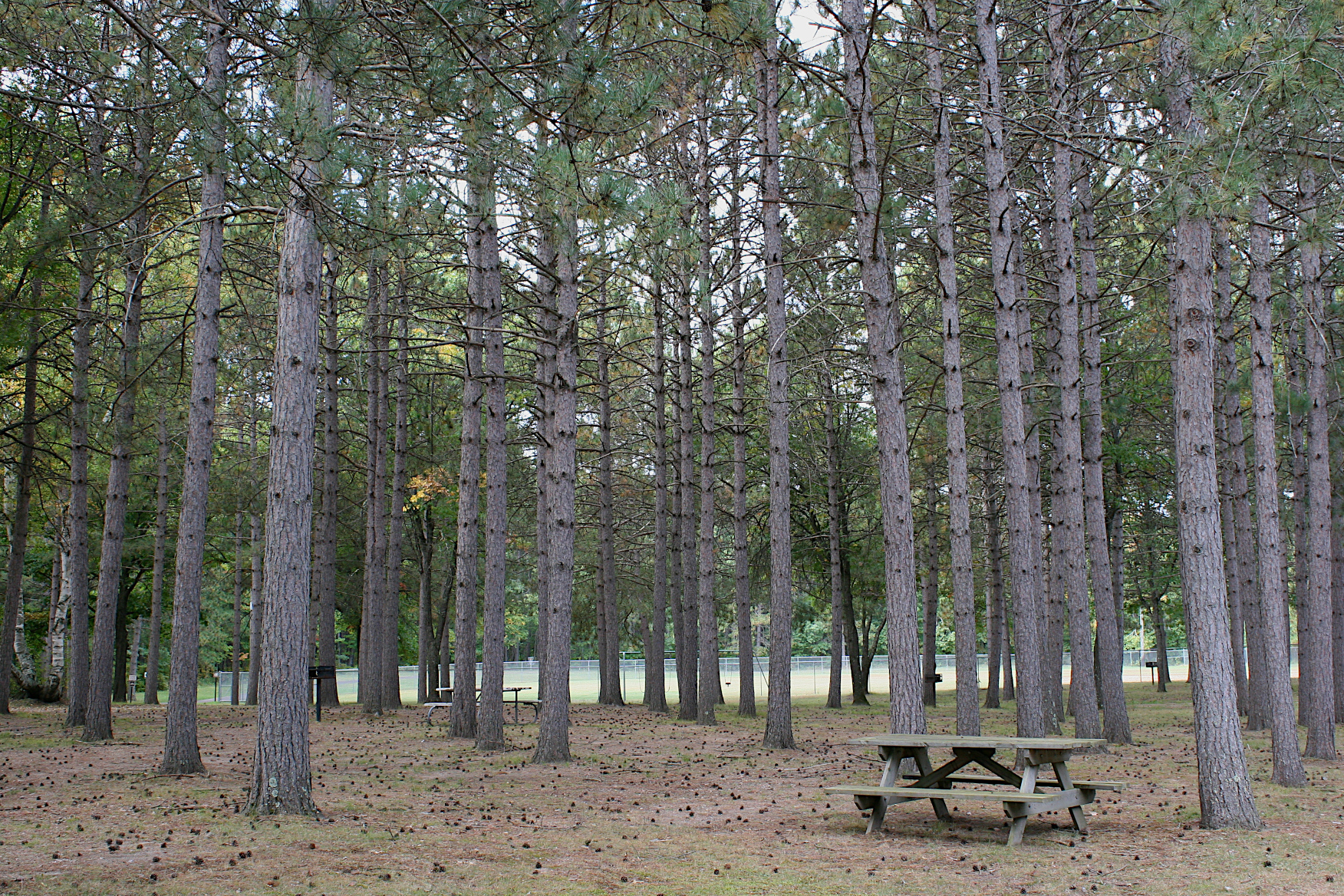
Set among the slim jackpines, a picnic area. Minnesota Prairie Roots copyrighted photo September 2021.
If you’re not into mushroom hunting or photography or hiking, Mission Park offers plenty of other options—tennis and pickleball courts, a disc golf course, ball fields, horseshoe pits, playground, picnic shelter and much more.
Every single time we’ve hiked through this park, the motto, A QUIET PLACE TO BE, holds true. Here you can hear the quiet, even as you listen for bears.
#
PLEASE CHECK BACK for more photos from Mission Park and a post on the area’s connection to my Faribault church.
If you are familiar with mushrooms, feel free to educate me on those I photographed.
A peaceful and lovely scene at Milford Mine Memorial Park on a hazy July afternoon, rural Crosby. Minnesota Prairie Roots copyrighted file photo July 2021.
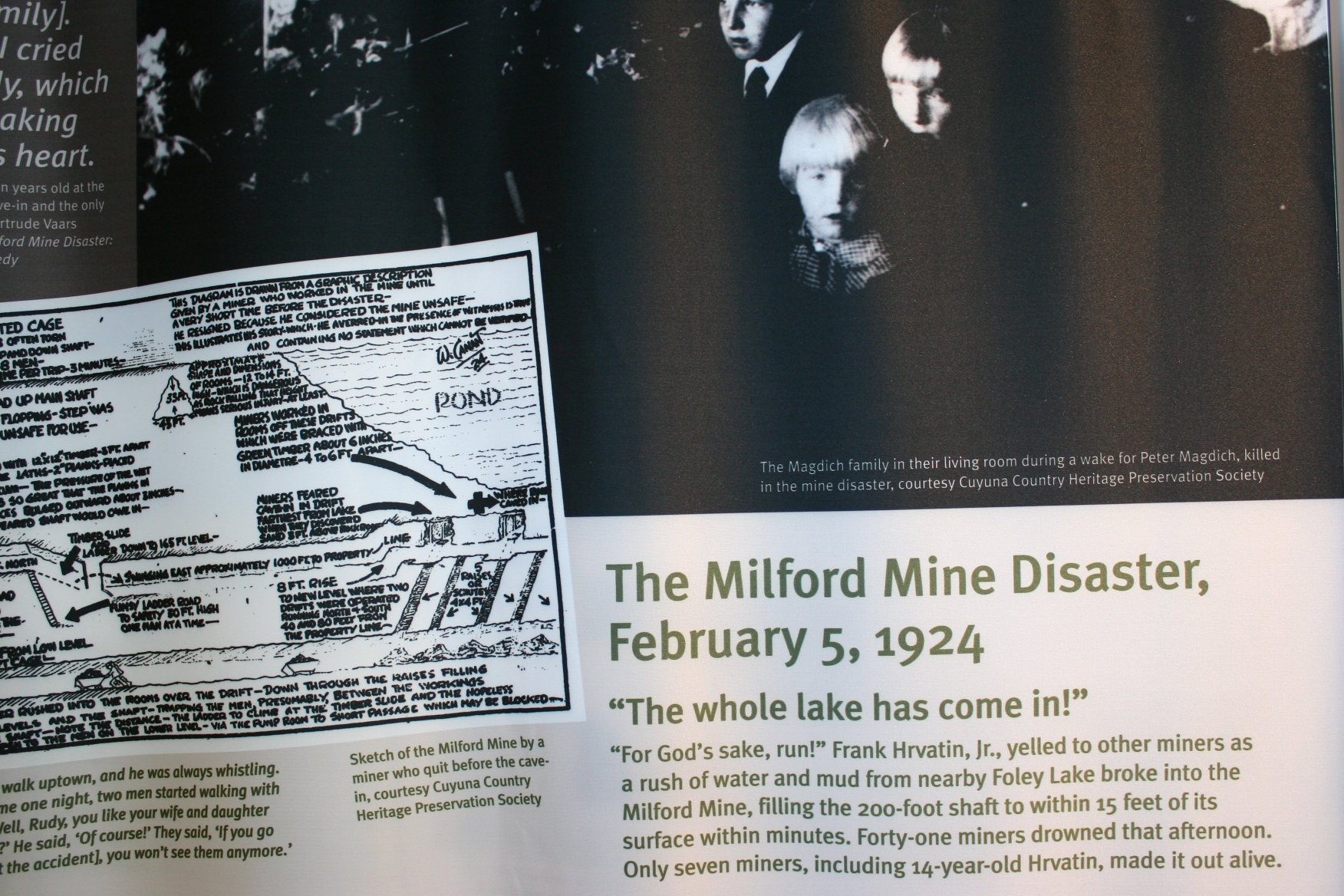
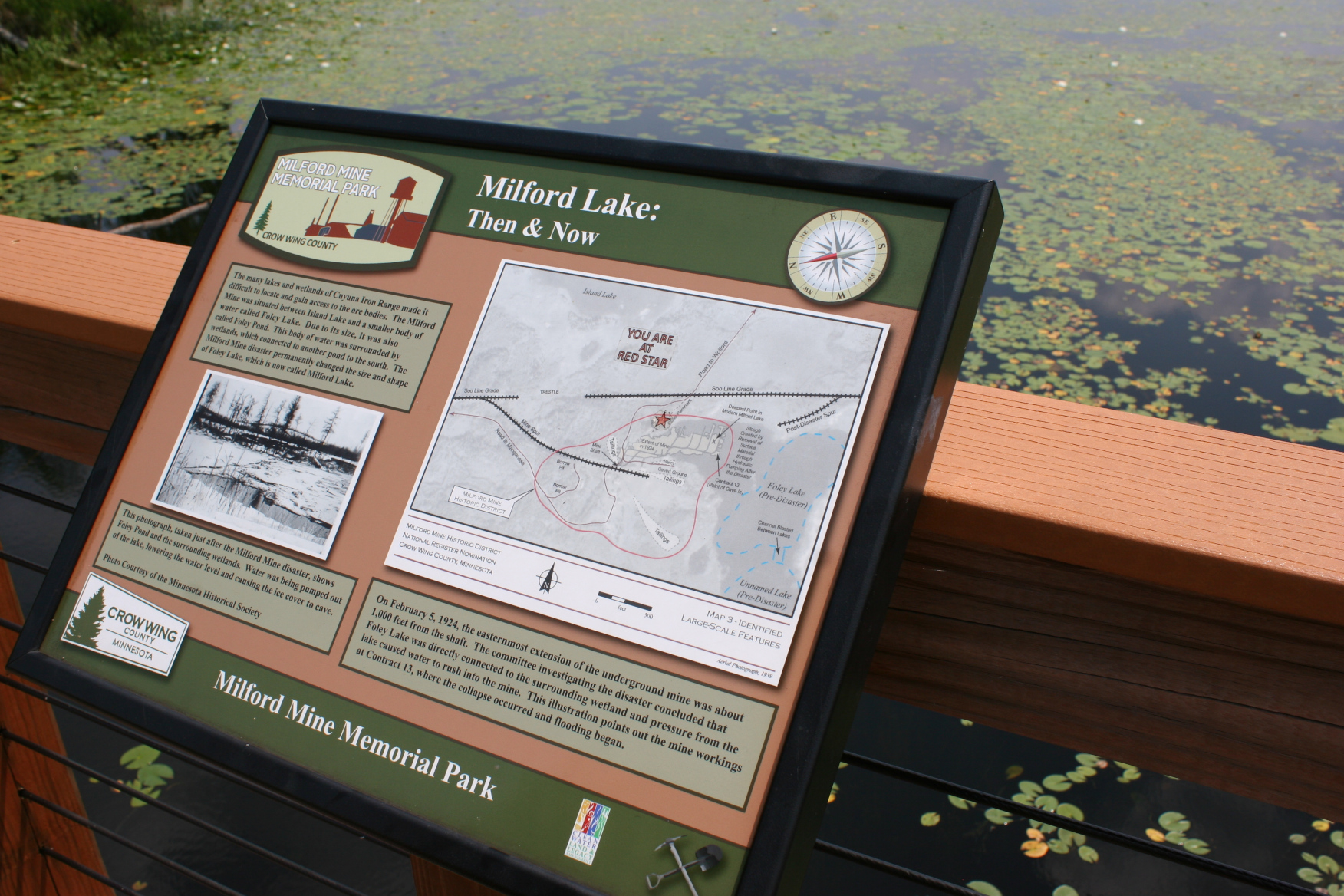
IN A BEAUTIFUL NATURAL SETTING, among the woods and water and wetlands, an American tragedy unfolded nearly 100 years ago on the Cuyuna Iron Range. In the late afternoon of February 5, 1924, water seeped into and then flooded the Milford Mine near Crosby, killing 41 miners in Minnesota’s worst mining disaster.
Information about the mine disaster is included in a traveling exhibit from the Minnesota Historical Society. I photographed this at the Steele County History Center in Owatonna several years ago. Minnesota Prairie Roots file photo.
Their deaths left 38 women without husbands. And 83 children without fathers.
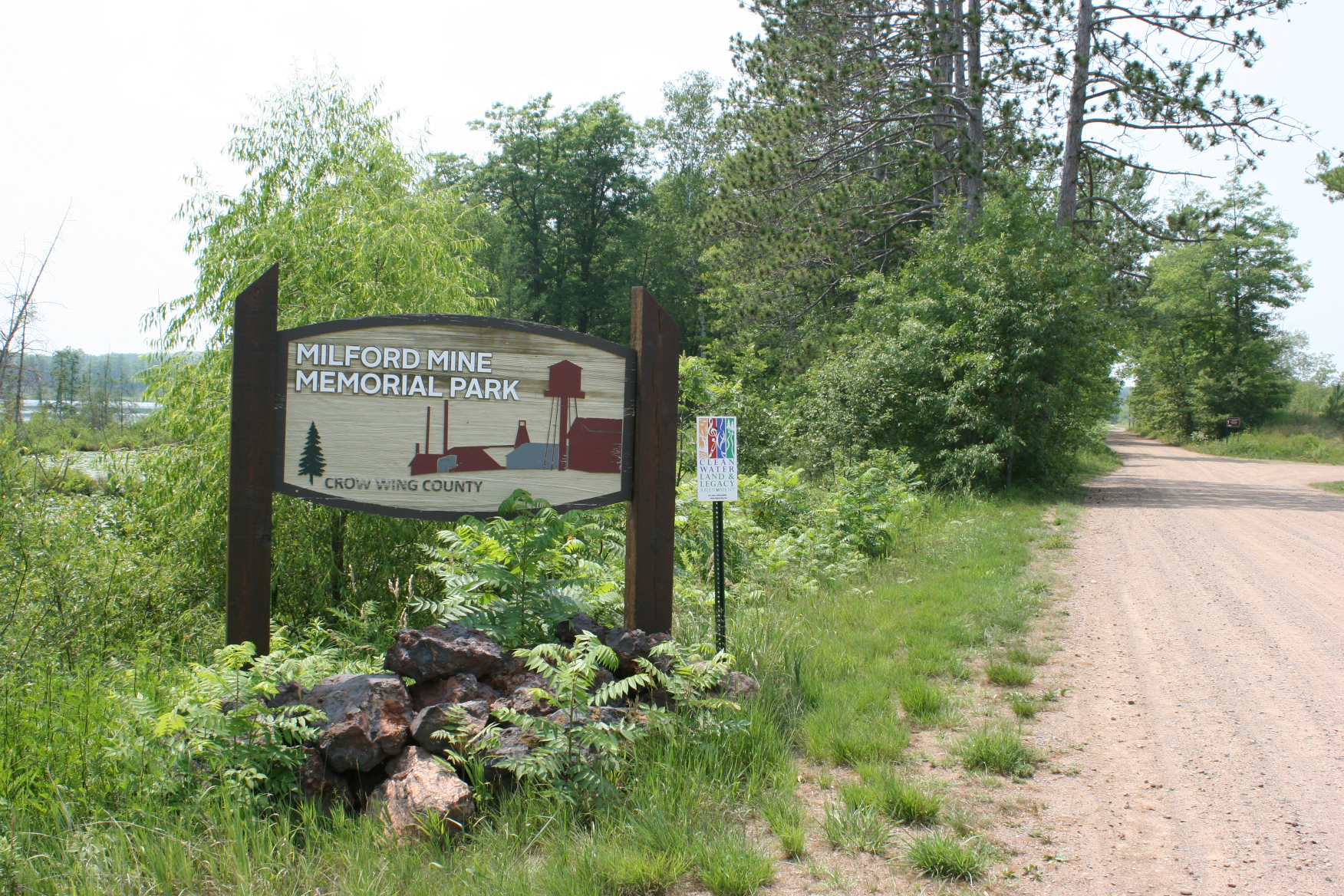
This sign marks the gravel road entry to the memorial park. Minnesota Prairie Roots copyrighted file photo July 2021.
Today the memories of those 41 hardworking iron ore miners, and the seven who survived the mine collapse, are honored at Milford Mine Memorial Park. The Crow Wing County Park is located four miles north of Crosby, just off County Road 30. The Milford Mine Historic District is on the National Register of Historic Places, so important is this to the region’s mining history.
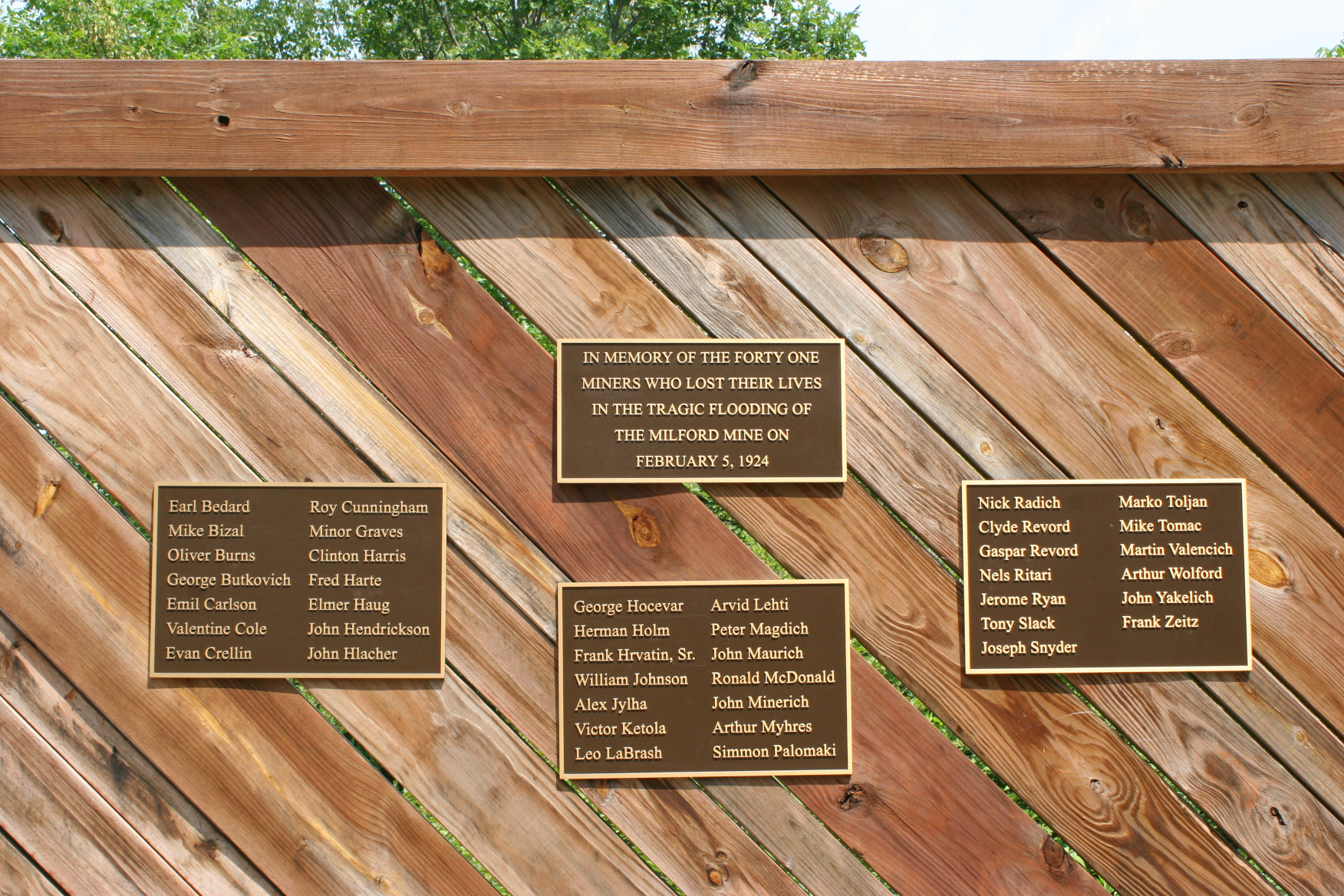
Those who died in the mine. Minnesota Prairie Roots copyrighted file photo July 2021.
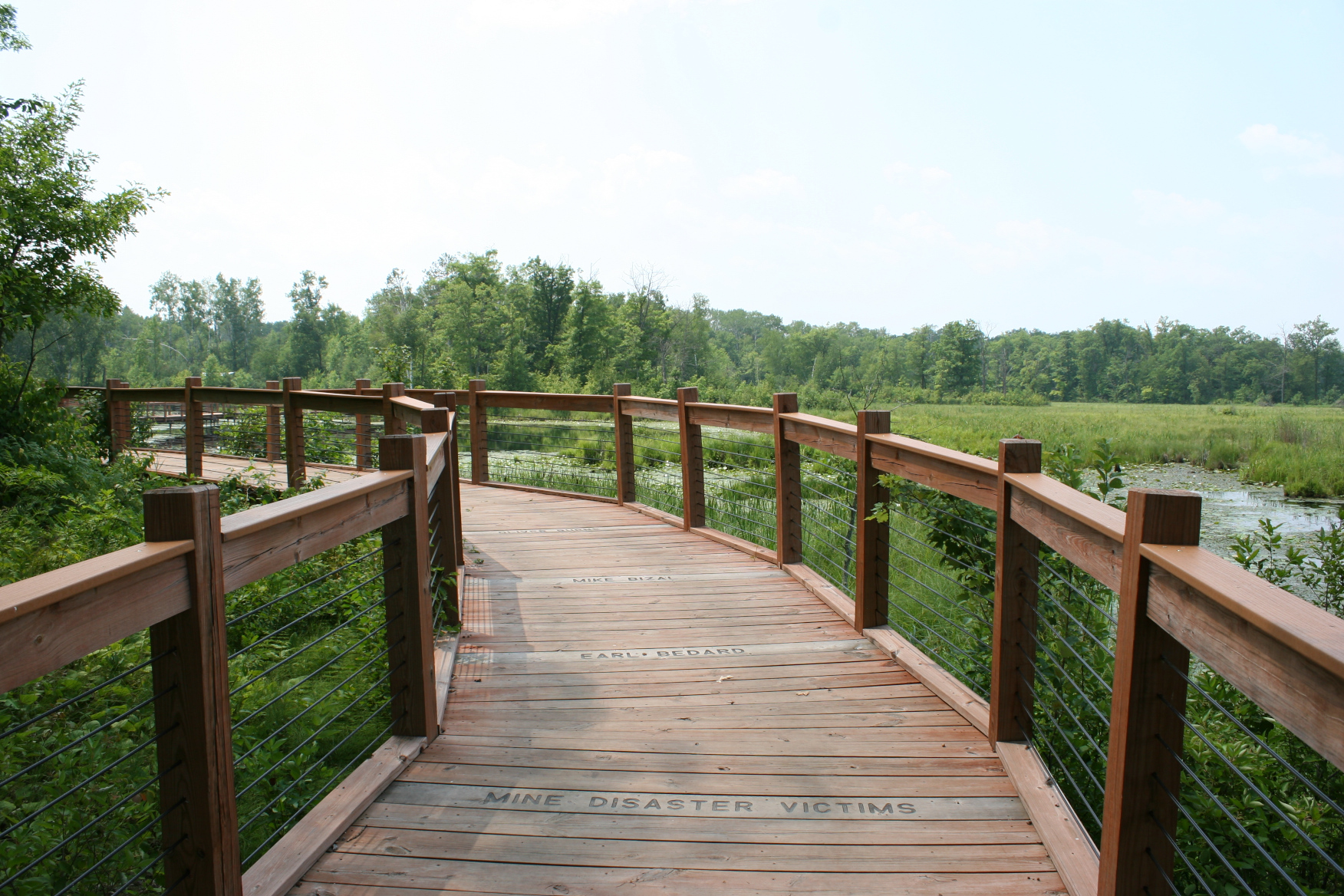
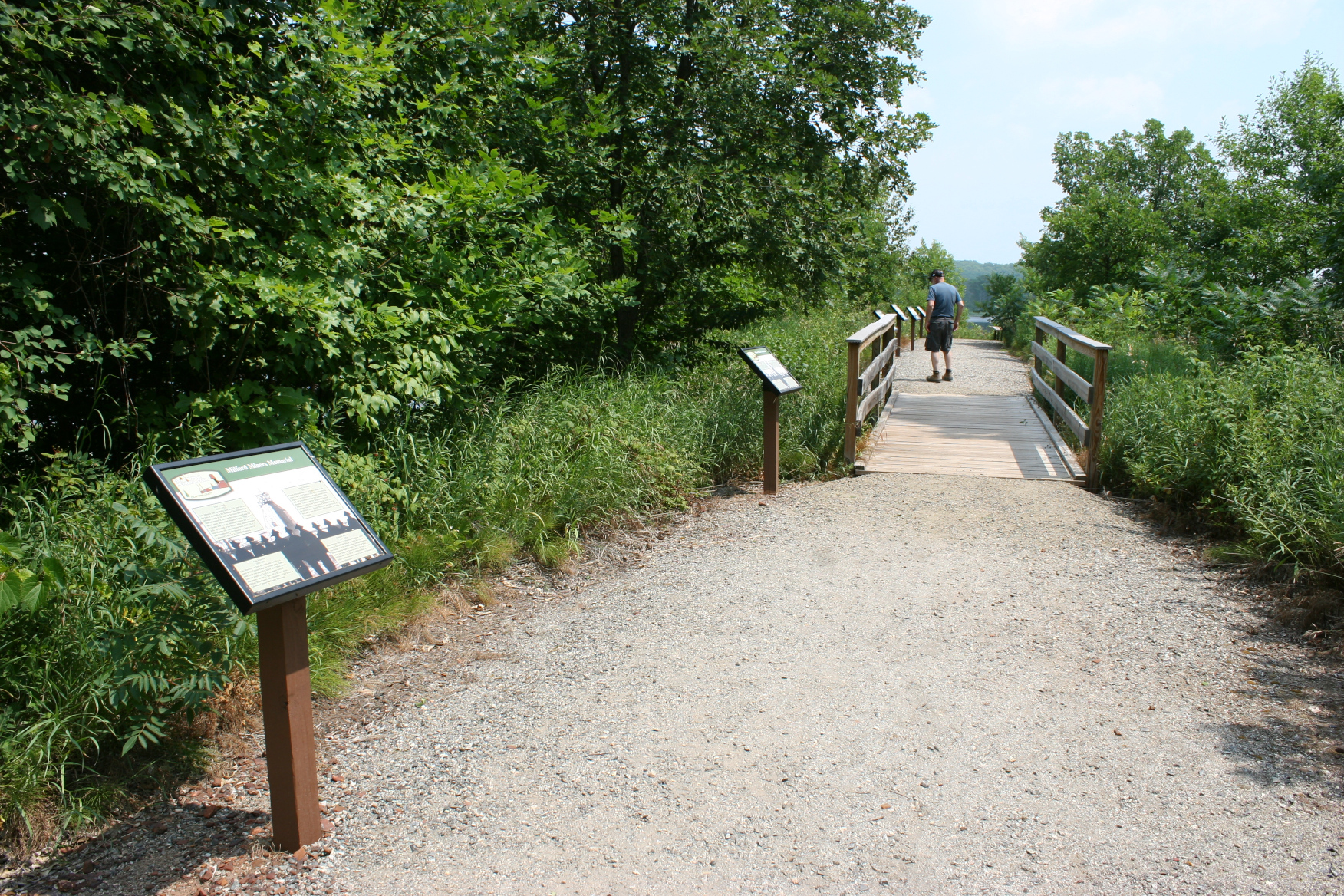
The first boardwalk lists the victims’ names, spaced alongthe path. Minnesota Prairie Roots copyrighted file photo July 2021.
Signs along the trail honor each miner. Minnesota Prairie Roots copyrighted file photo July 2021.
This is truly a remarkable park that covers the history of this event in a deeply personal way. Through names on boardwalks and brief bios on signs, this park moves this disaster beyond statistics. Only then do we begin to understand, to feel the loss.
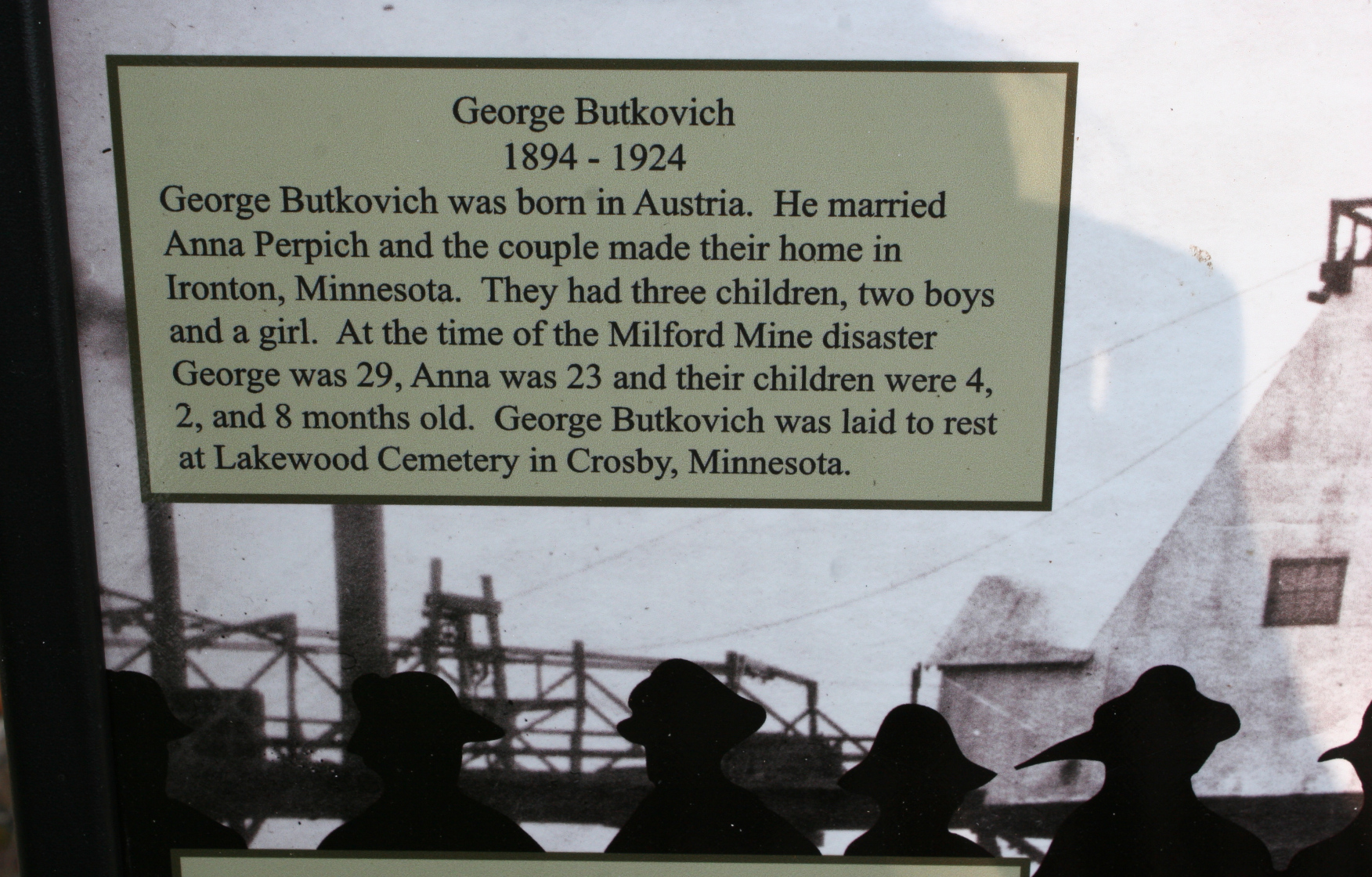
Honoring George Butkovich. Minnesota Prairie Roots copyrighted file photo July 2021.
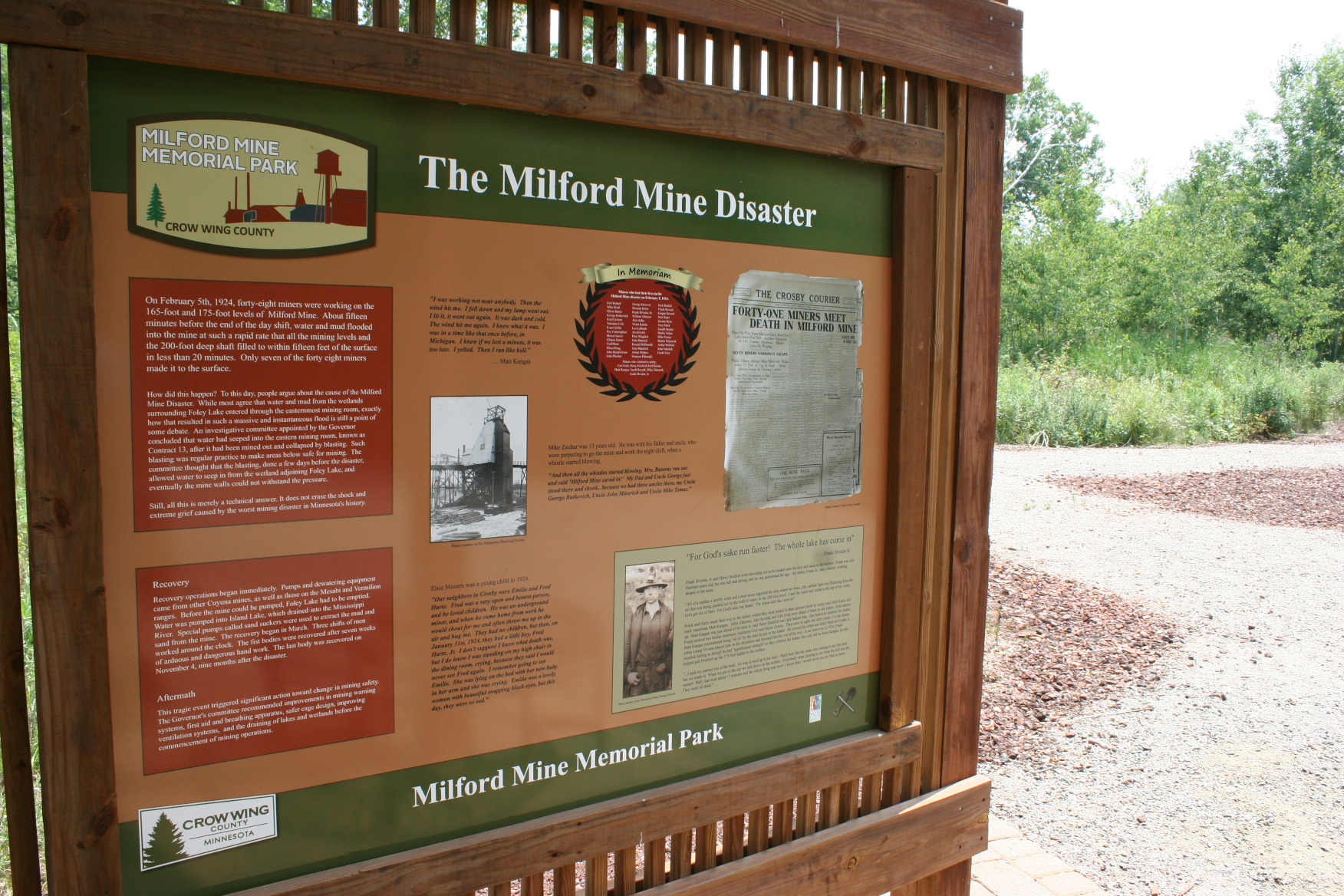
A summary of the disaster. Minnesota Prairie Roots copyrighted file photo July 2021.
Emil A. Carlson, 29, from Finland, was the father of four and married to Elma. They lived in Crosby.
The bios of four who died in the mine. Minnesota Prairie Roots copyrighted file photo July 2021.
Nels R. Pitari, 37, also a Finnish immigrant, was married to Hilda. They lived in Brainerd and had four children, one only five months old at the time of his father’s death.
The park is not only a great place to learn about history, but also a great place to hike and enjoy nature.
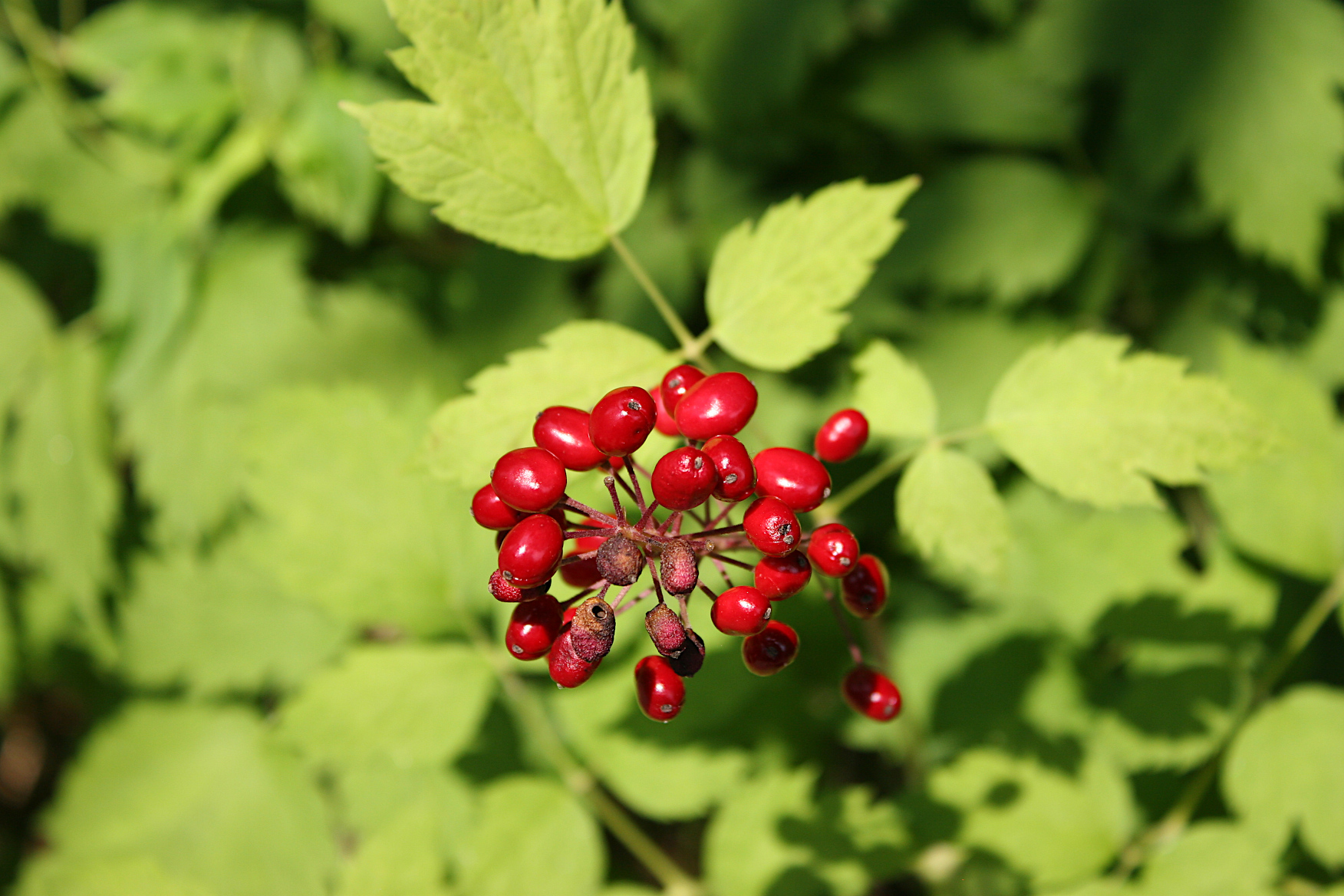
Bold berries pop alongside the trail. Minnesota Prairie Roots copyrighted file photo July 2021.
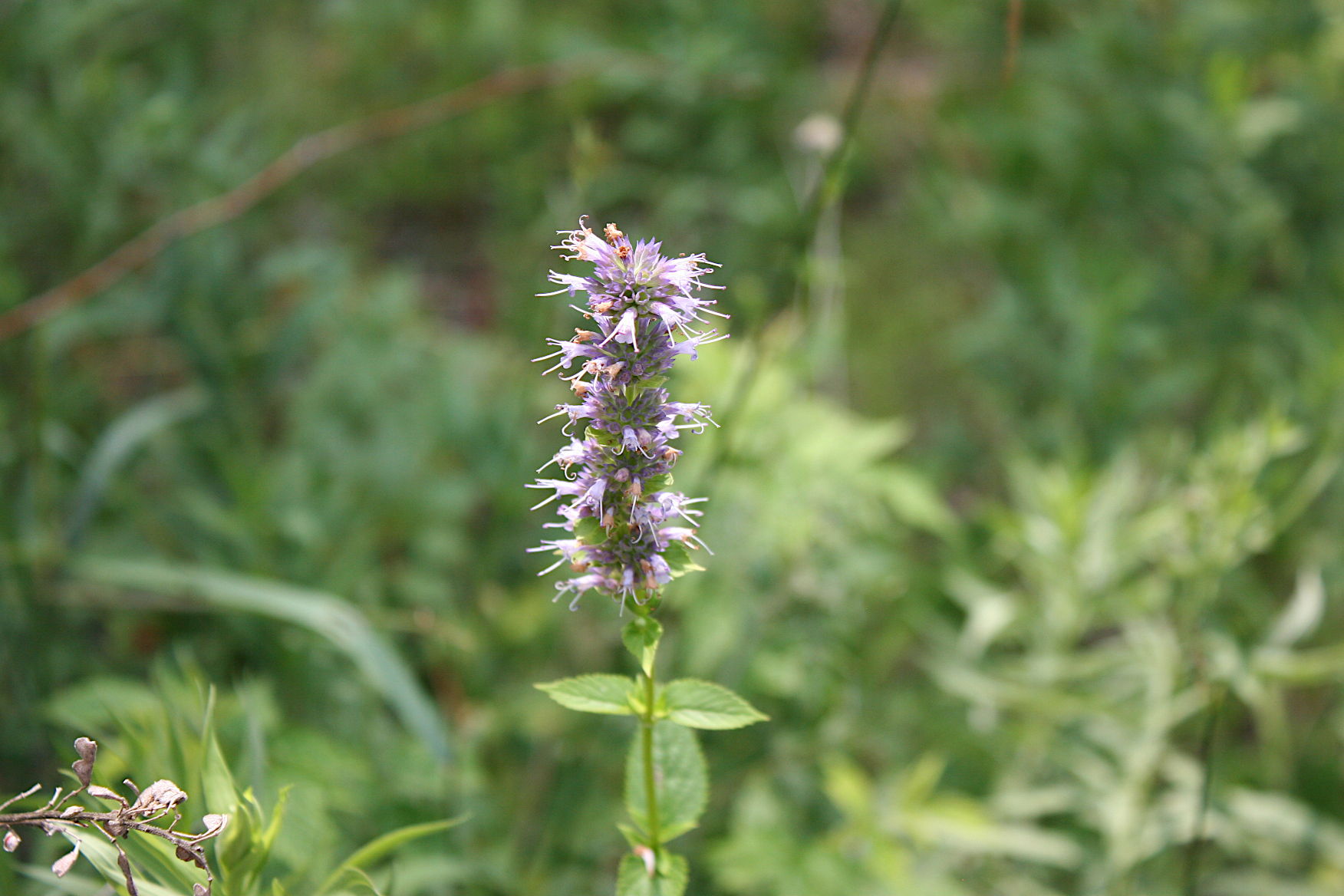
Not to be missed, the many wildflowers gracing this park. Minnesota Prairie Roots copyrighted file photo July 2021.
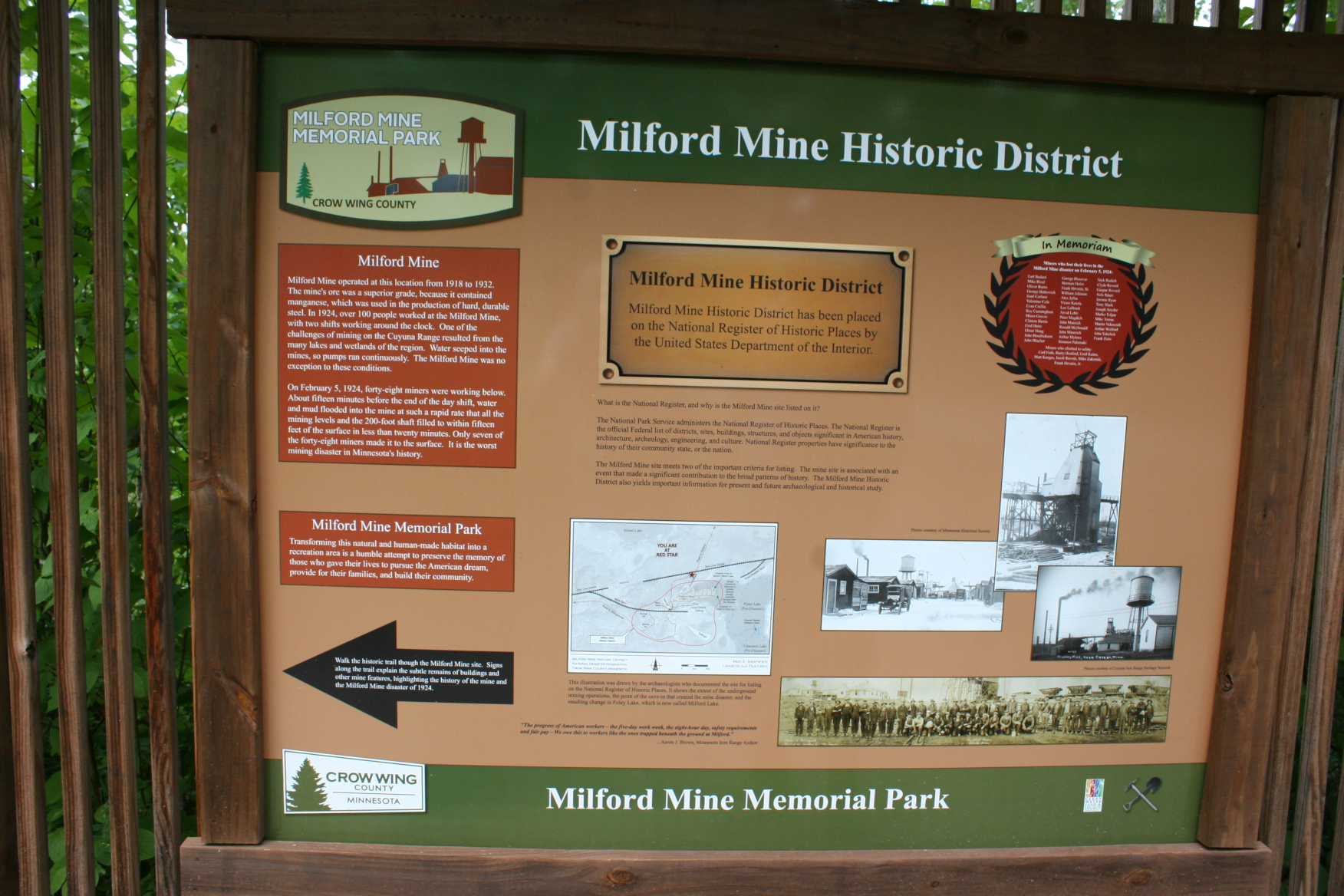
According to signage at Milford Memorial Park, the park “is an attempt to preserve the memory of those who gave their lives to pursue the American dream, provide for their families and build their community.” That’s necessary to understand given the importance of iron ore mining in this region. The high grade ore from the Milford Mine was used in the production of steel. This region of Minnesota was built around iron ore mining.
History honored and shared… Minnesota Prairie Roots copyrighted file photo July 2021.
Many who came to this area arrived from across the US, Canada and the European continent. They were a diverse group, looking to better their lives, to raise their families in a new place, to build strong communities.
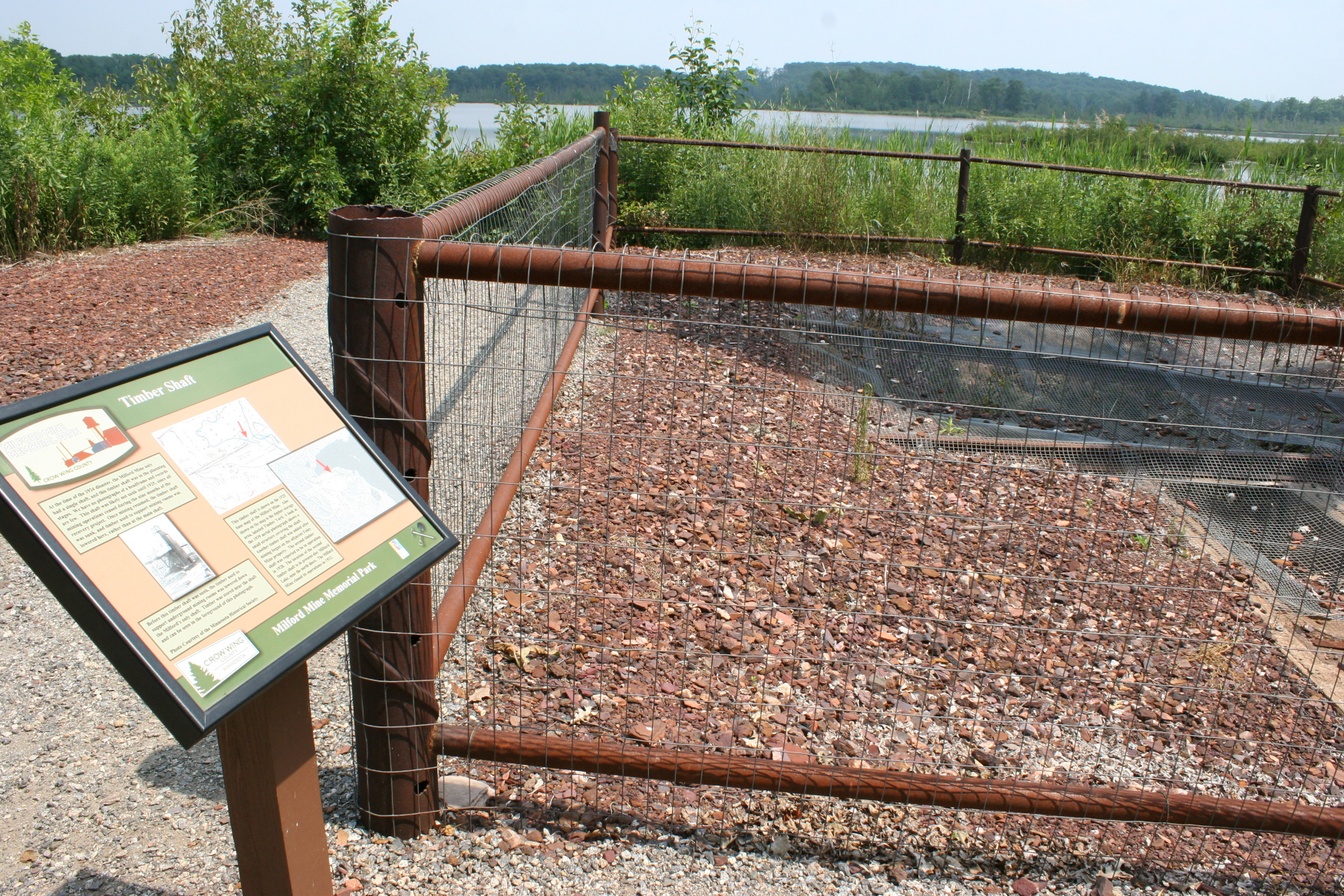
Site of the timber shaft. Minnesota Prairie Roots copyrighted file photo July 2021.
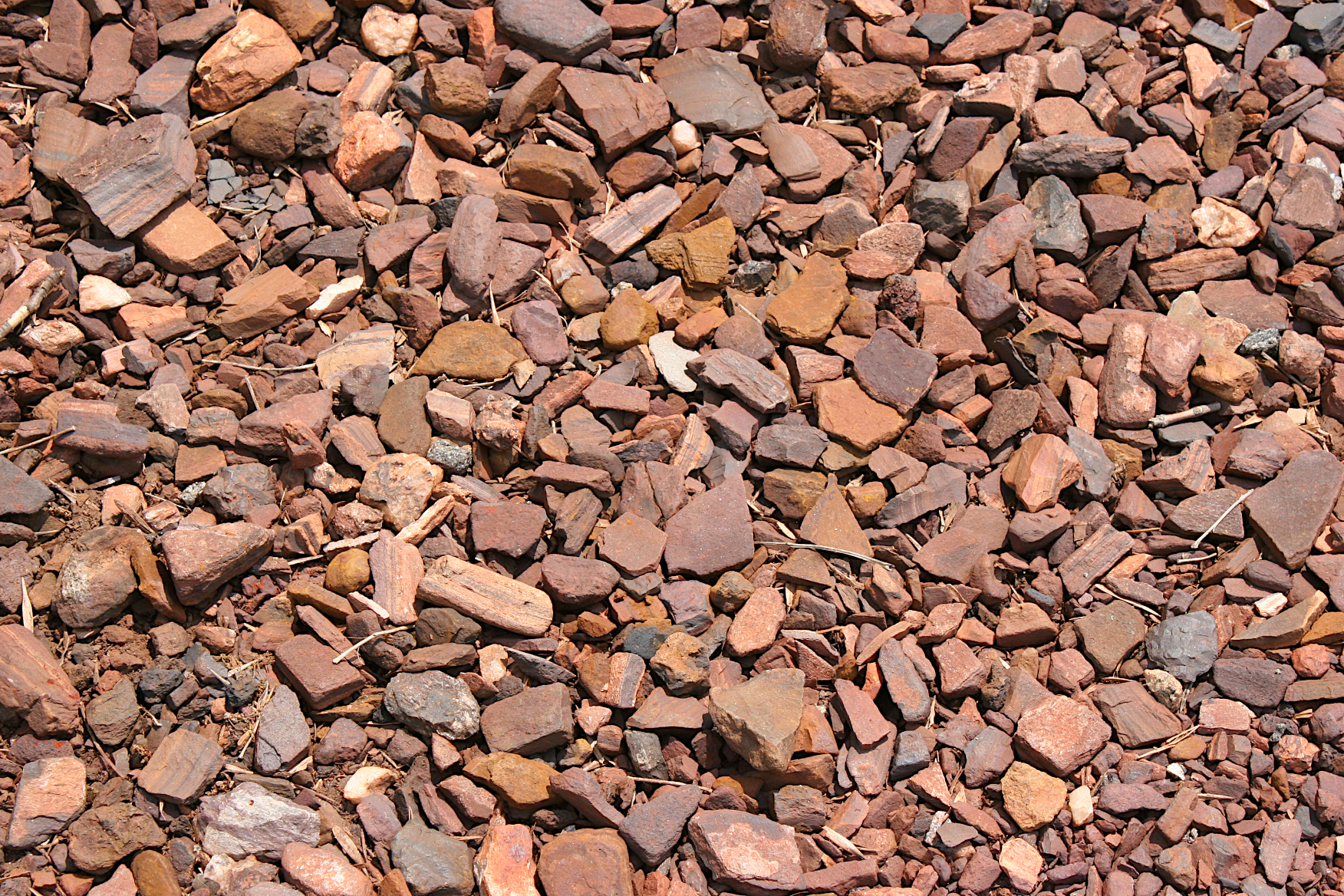
What I presume to be iron ore. Minnesota Prairie Roots copyrighted file photo July 2021.
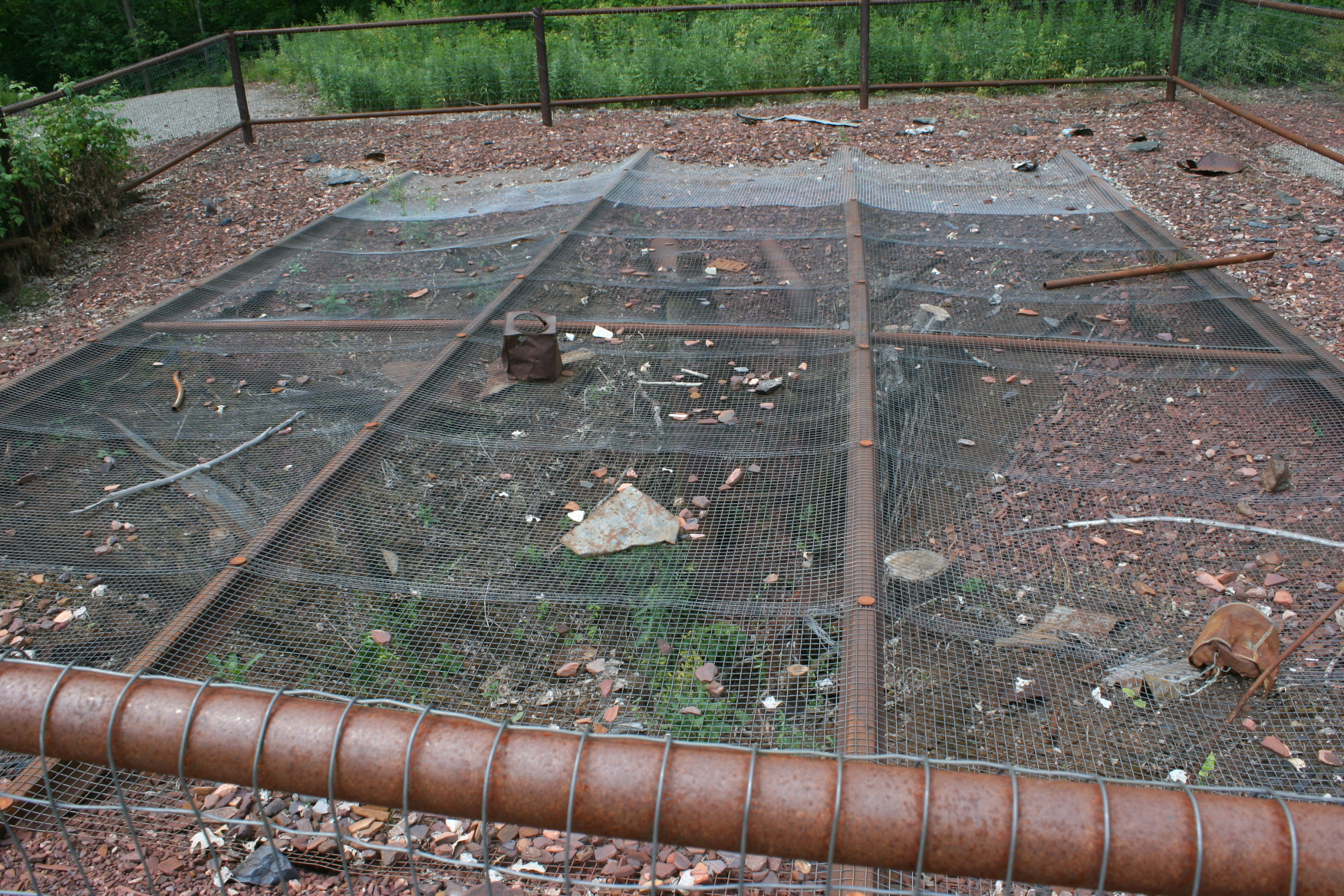
The entry to the mine shaft is fenced around and over. Minnesota Prairie Roots copyrighted file photo July 2021.
In walking through the park, pausing often to read the history of this place and to view marked sites like the machine and blacksmith shops and the mine and timber shafts, I felt a sense of reverence, a sense of understanding of the loss connected to this land.
Originally named Lake Foley, the lake has since been renamed Milford Lake. Minnesota Prairie Roots copyrighted file photo July 2021.
Water lilies in Milford Lake, Minnesota Prairie Roots copyrighted file photo July 2021.
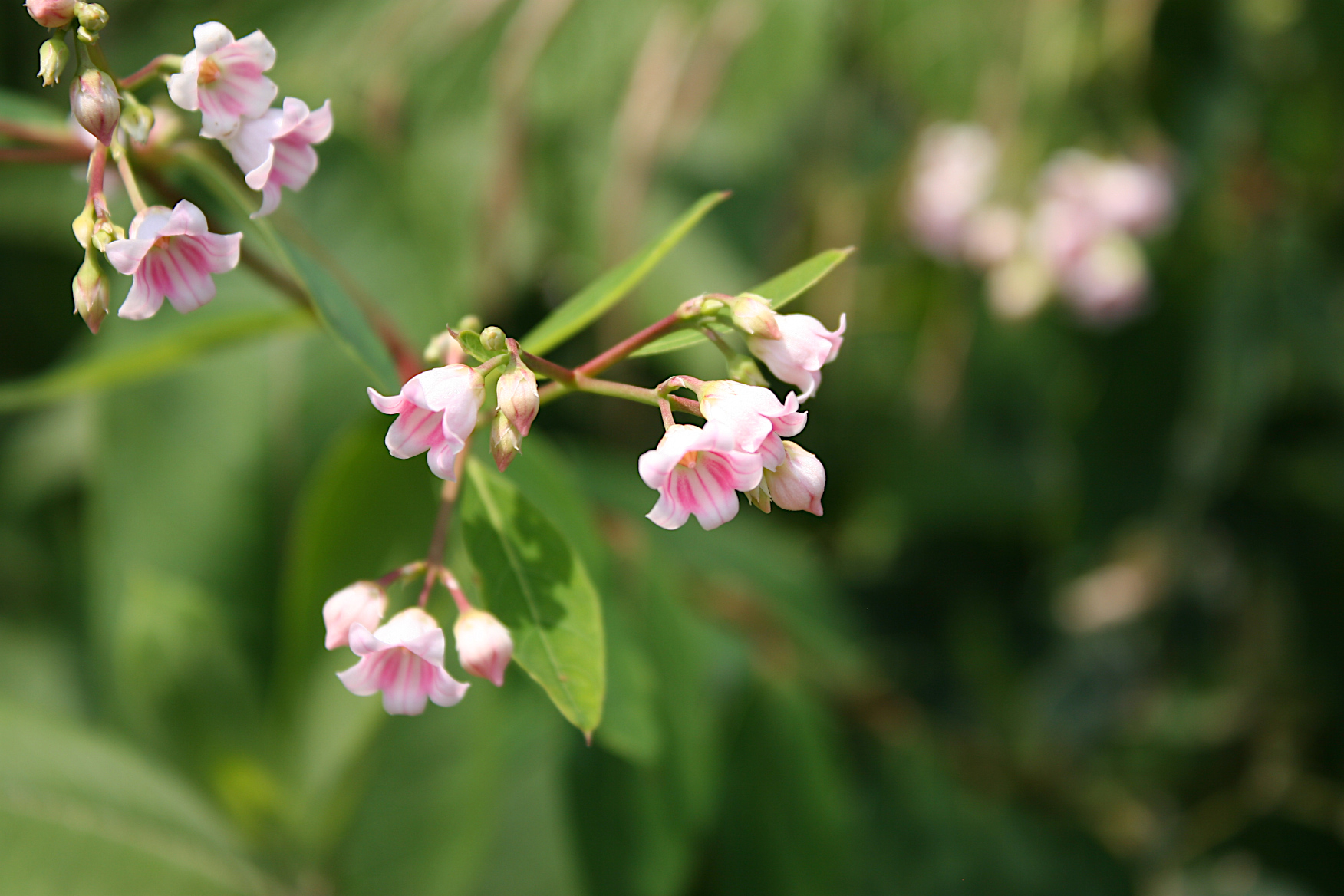
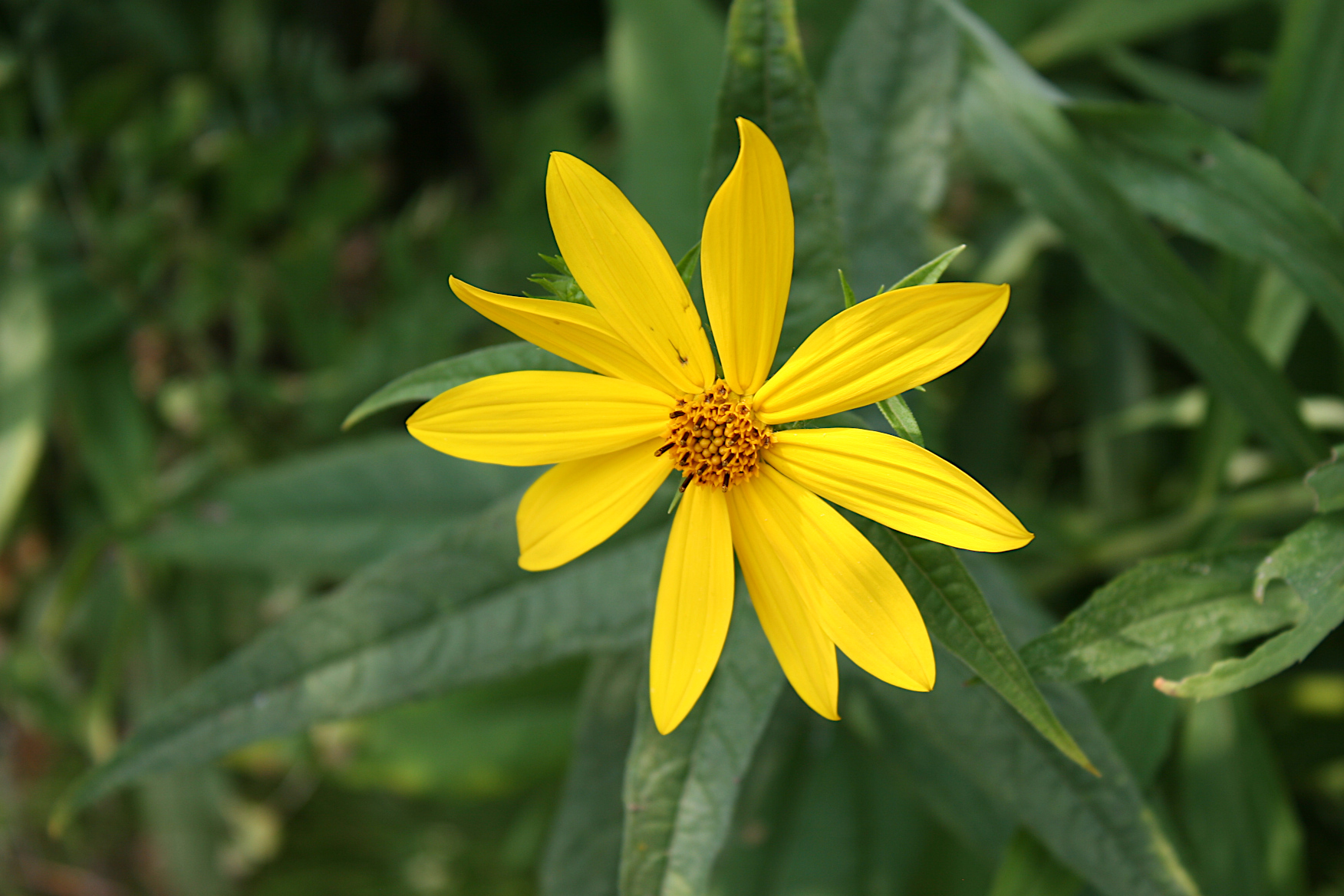
A flower brightens woods’ edge near the lake. Minnesota Prairie Roots copyrighted file photo July 2021.
Investigators determined that pressure from Lake Foley, connected to adjoining wetlands, caused water to rush into the mine resulting in the collapse of the mine’s walls. Within 20 minutes of that occurrence, the 200-foot deep mine shaft filled to within 15 feet of the surface. That allowed only minimal time for the miners to attempt an escape. Only seven got out. They, too, are recognized at the memorial park on a survivors’ boardwalk: Carl Frals, Harry Hosford, Mike Zakotnik…
Lengthy memorial boardwalks curve into the park. Minnesota Prairie Roots copyrighted file photo July 2021.
As I walked the boardwalks and trails, I felt sometimes overwhelmed by the sheer tragedy of the Milford Mine Disaster. So much loss. So much grief and pain. So many father-less children. And it is that, perhaps, which touched me the most.
NOTE: Milford Mine Memorial Park is open daily from sunrise to sunset. I encourage you to visit, to experience this important part of Minnesota history.
Black-eyed susans on the prairie at River Bend. Minnesota Prairie Roots copyrighted photo 2021.
WHENEVER I NEED TO CONNECT with nature nearby, my go-to destination is River Bend Nature Center, just across the Straight River on Faribault’s east side.
A viewing and resting spot by the prairie wetlands, now drying up due to the drought. Minnesota Prairie Roots copyrighted photo 2021.
In this 743-acre natural space, I can immerse myself in a diverse landscape of woods, prairie and wetland. Each setting provides not only a sensory change from the noise and motion of living along a busy street, but also a much-needed mental break.
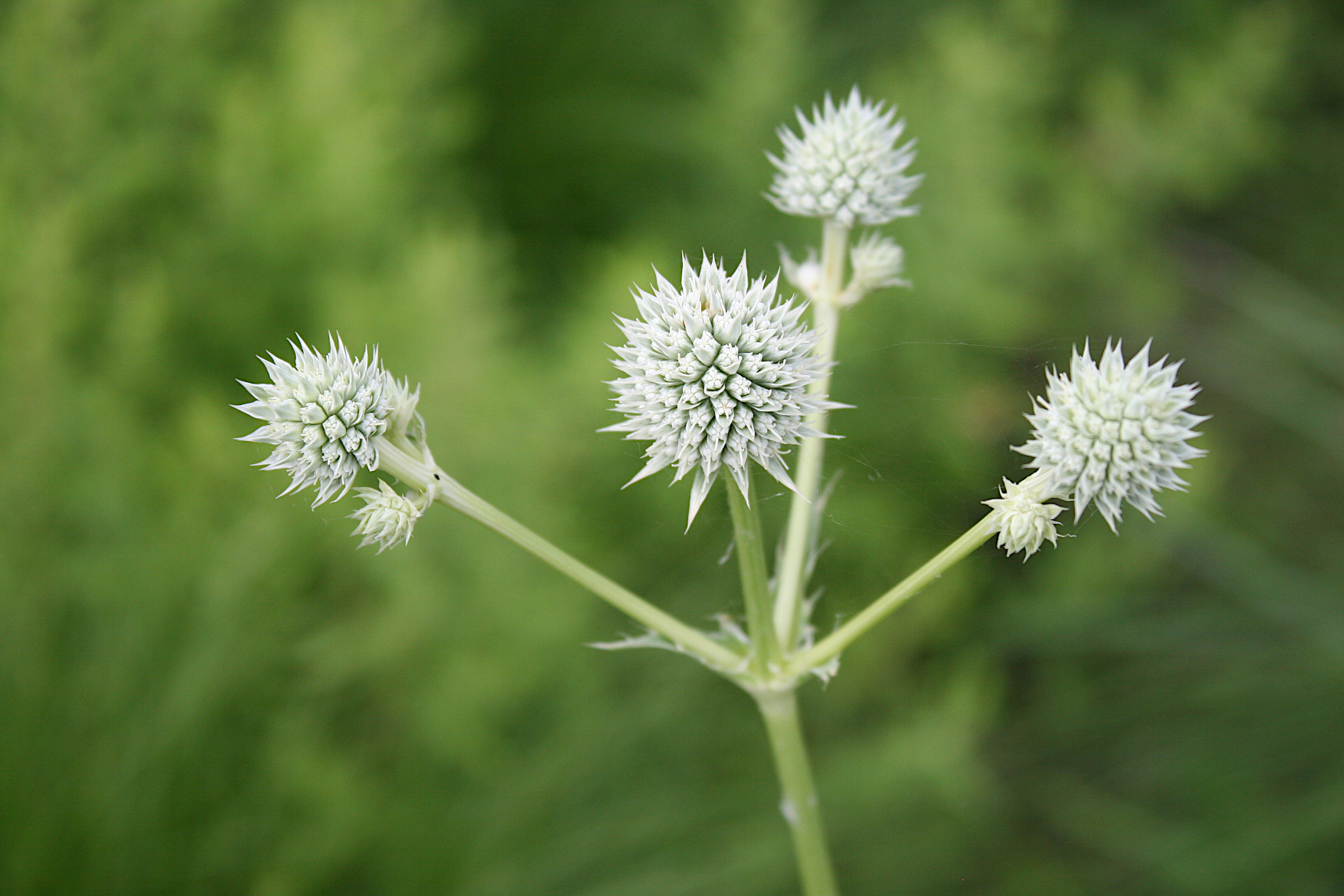
An unknown to me prairie plant. Minnesota Prairie Roots copyrighted photo 2021.
When I’m at River Bend, I forget about what’s happening in my life or the world. Rather, I focus on being present in nature. Listening. Observing. Connecting.
Rain gardens front the RBNC interpretative center. Minnesota Prairie Roots copyrighted photo 2021.
That word, connecting, fits River Bend, which emphasizes its purpose as helping connect people to outdoor education, recreation and natural resource conservation close to home.
River Bend has an extensive trail system, some paved, some not. Minnesota Prairie Roots copyrighted photo 2021.
My own children, while growing up and attending school in Faribault, went on many field trips to River Bend. I remember also one winter evening when our then-young son delighted in a star-gazing event, complete with telescopes, on prairie’s edge. Today I occasionally take my grandchildren to walk RBNC’s trails. Randy and I also hike the paths.
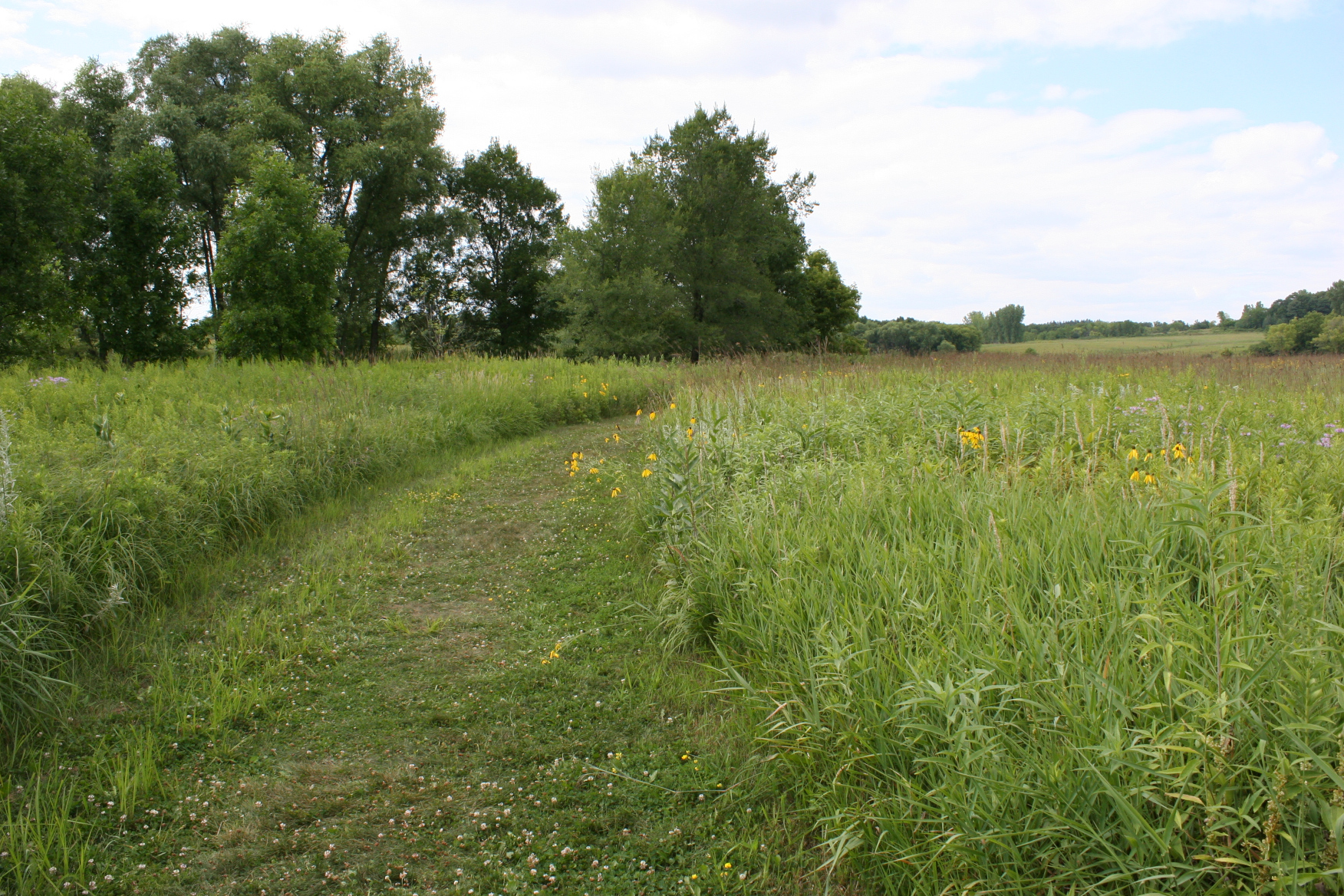
A prairie path. Minnesota Prairie Roots copyrighted photo 2021.
Perhaps my favorite part of this spacious nature center is the prairie. It reconnects me with my prairie roots. With southwestern Minnesota, the land of open spaces and spacious skies. I love to walk through the path sliced into the prairie at River Bend. The path edged by tall prairie grasses and wildflowers. The path where I can pause to take in the vast sky with no trees blocking my view. I need to visually breathe.
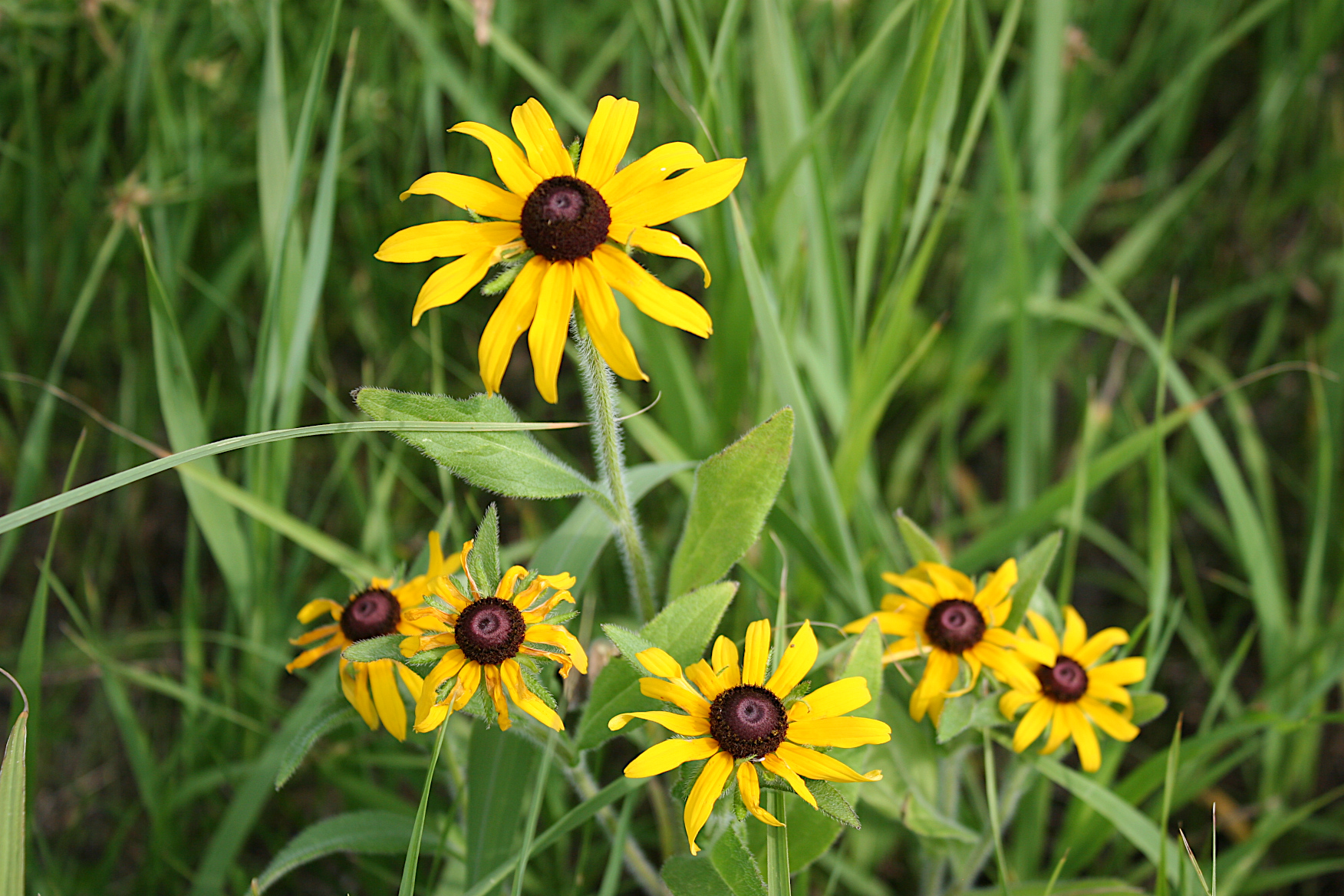
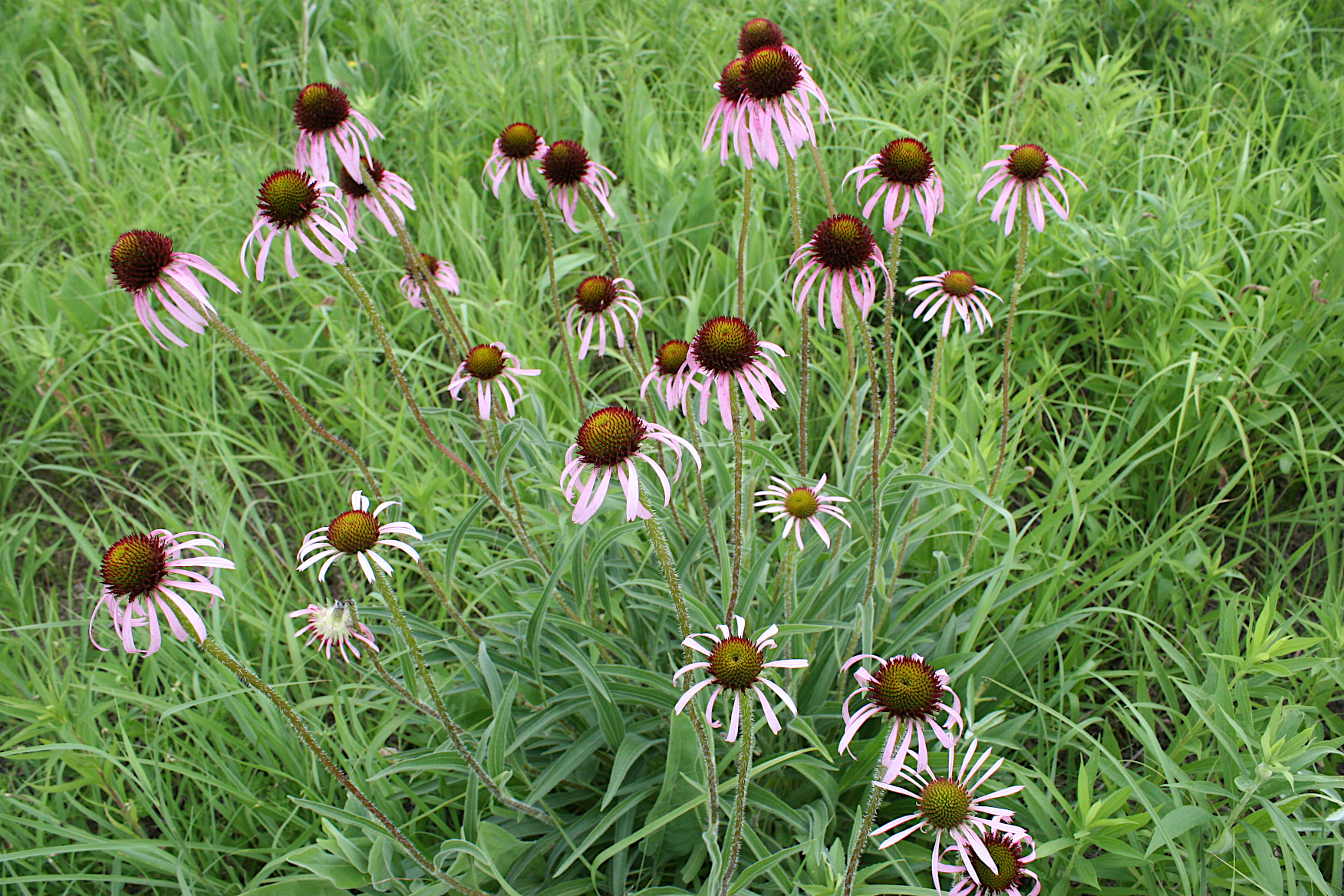
Coneflowers, one of my favorite prairie flowers. Minnesota Prairie Roots copyrighted photo 2021.
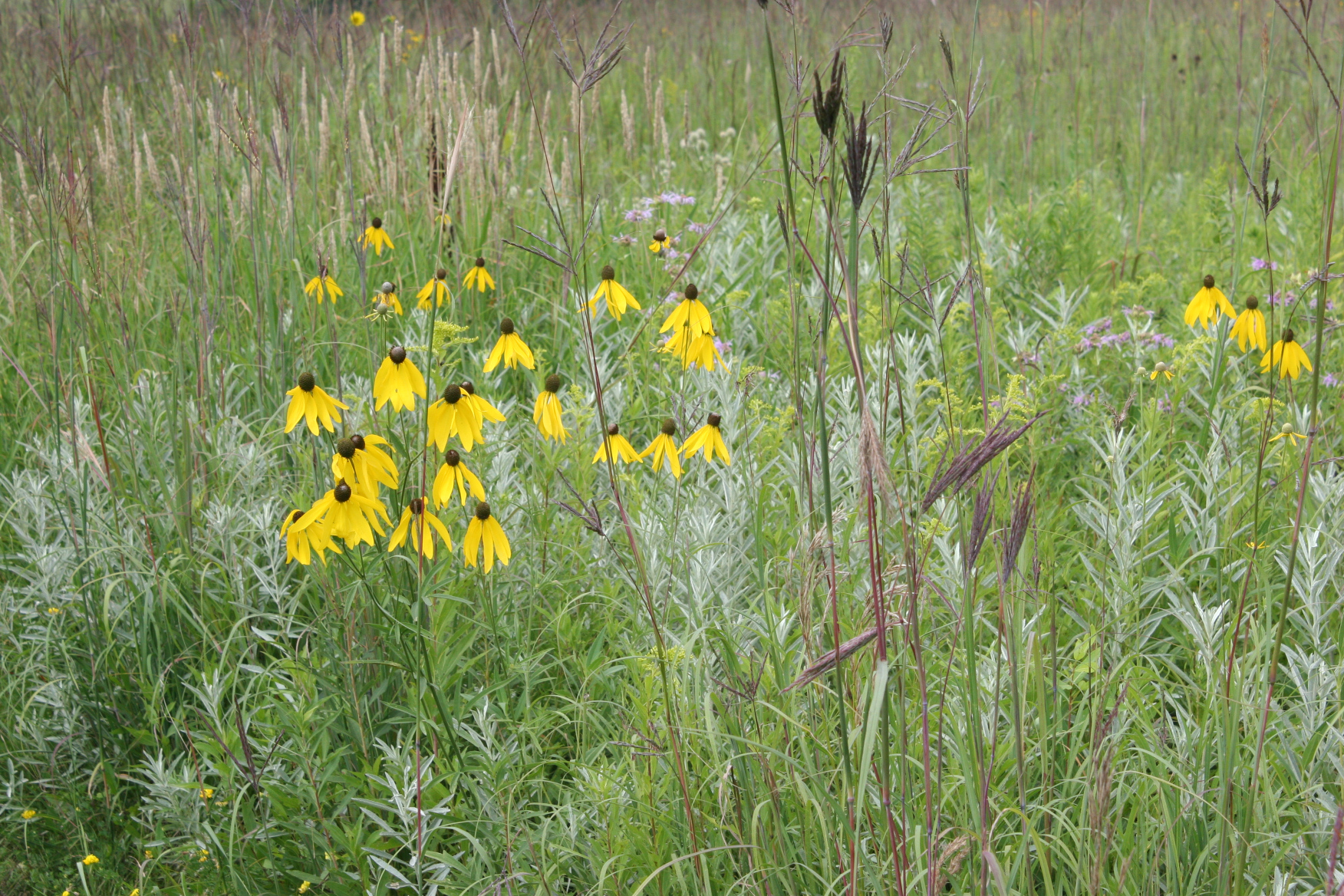
Wildflowers and grasses mix on the prairie. Minnesota Prairie Roots copyrighted photo 2021.
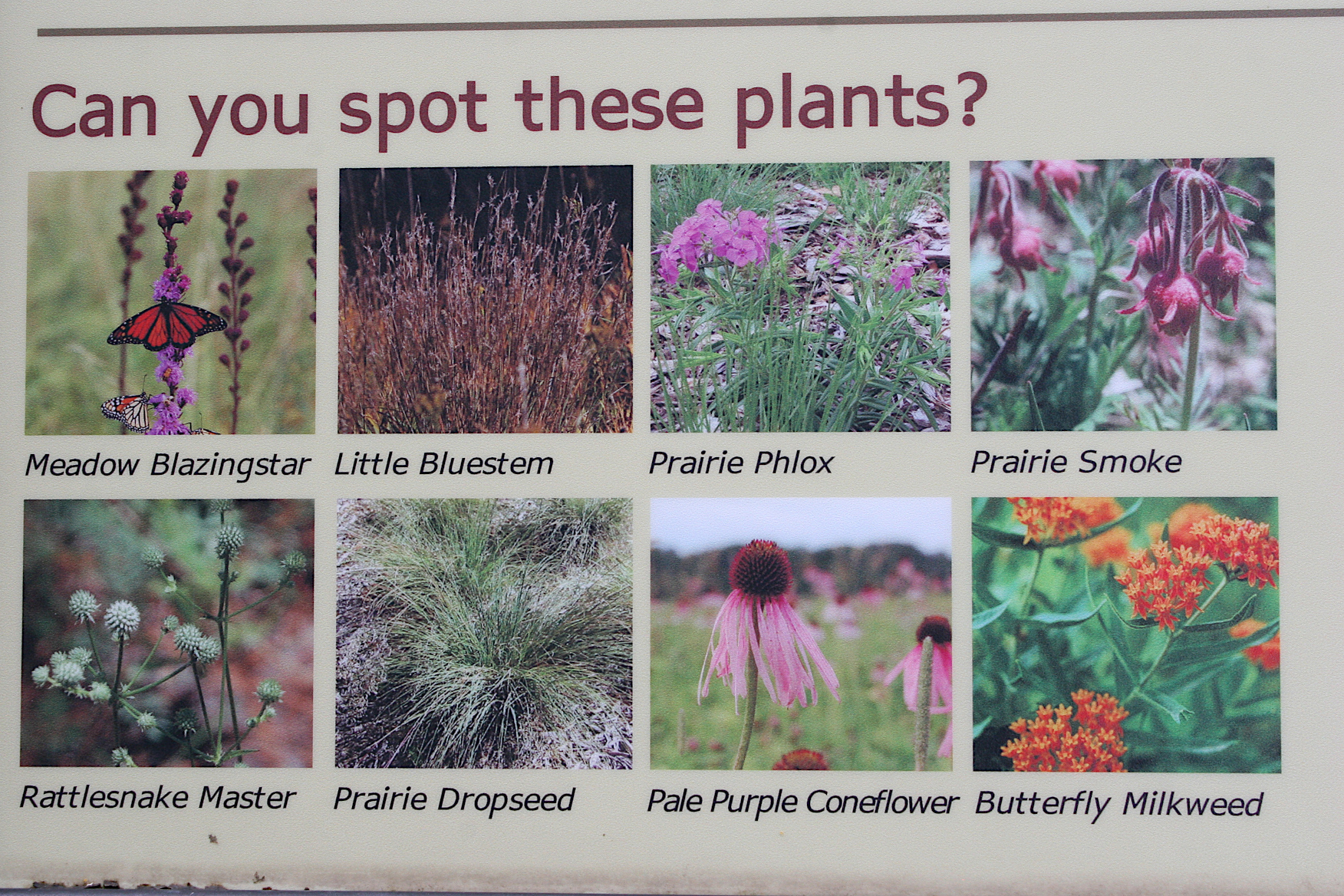
On my most recent visits, the prairie has focused my attention. Specifically the wildflowers—those interspersed among the grass and those planted in the rain garden near the interpretative center. While fading, the flowers remain an integral part of the prairie eco-system as they form seeds and then grow and/or re-sprout in the spring.
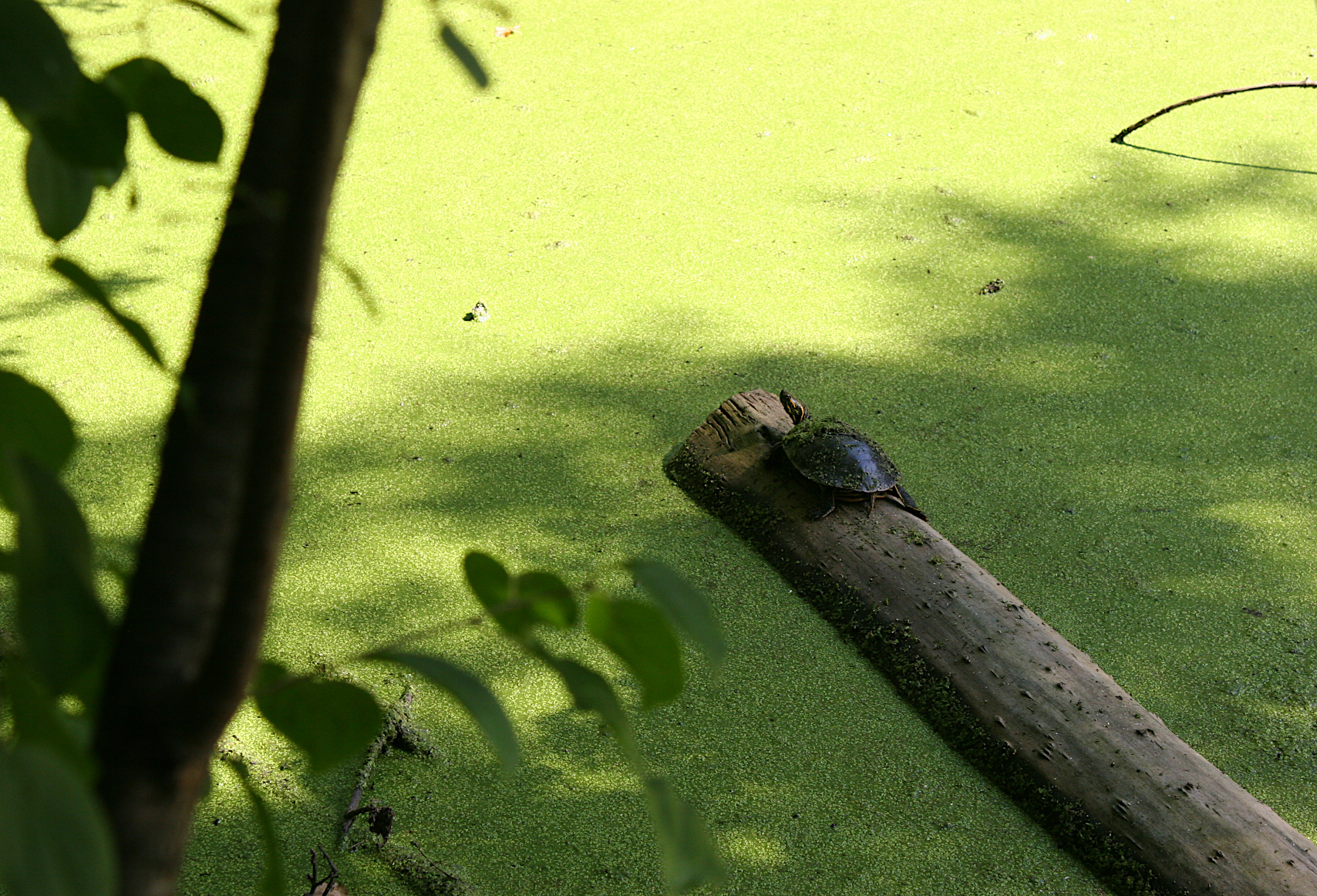
A lone turtle suns itself on a log. Minnesota Prairie Roots copyrighted photo 2021.
I also spent time in the nearby woods, stopping at the Turtle Pond to photograph turtles sunning on logs. They delight me and generations of kids, including mine, fascinated by those lazing turtles.
River Bend holds generational appeal. I’ve seen young families pushing babies in strollers, teens driving remote-controlled vehicles on limestone shelves, older couples like us walking, and much more.
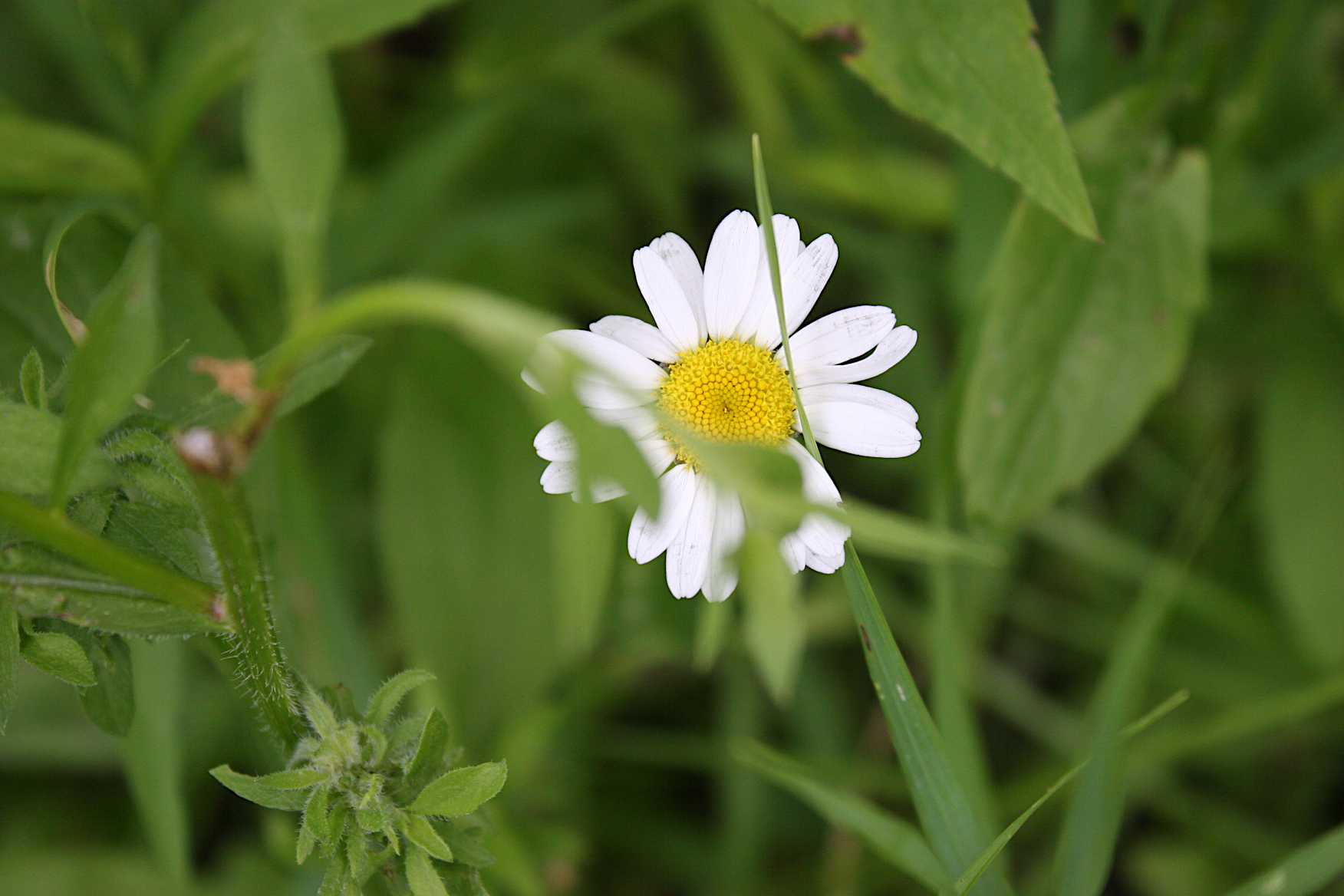
A lone daisy blooms among the prairie grass. Minnesota Prairie Roots copyrighted photo 2021.
Next week, August 16-20, River Bend focuses on its annual Ramble fundraising campaign. As a nonprofit, RBNC relies on fundraising, donations and memberships to keep the center open and operating. For more information about the Ramble, visit the RCNC website.
TELL ME: Where’s your favorite place to escape into nature near your home?
A jolt of color in the woods. Minnesota Prairie Roots photo June 2021.
Lacey flowers. Minnesota Prairie Roots photo June 2021.
I usually carry my camera while at River Bend. That causes me to really notice my surroundings. This most recent visit, I spotted an abundance of wildflowers. From woods to prairie, flowers thrive in the summer heat.
Minnesota Prairie Roots photo June 2021.
A plaque on a bench reminds hikers to take time to smell the flowers, although I didn’t dip my nose into any blossoms. Rather, I appreciated the simple beauty of color splashed in the otherwise green woods.
On the way to the Turtle Pond, I spotted this interesting grass. Minnesota Prairie Roots photo June 2021.
Maple leaves. Minnesota Prairie Roots photo June 2021.
Minnesota Prairie Roots photo June 2021.
Even the greenery holds visual appeal in the rolling droop of grass, the lace of maple leaves, the woods that hug trails.
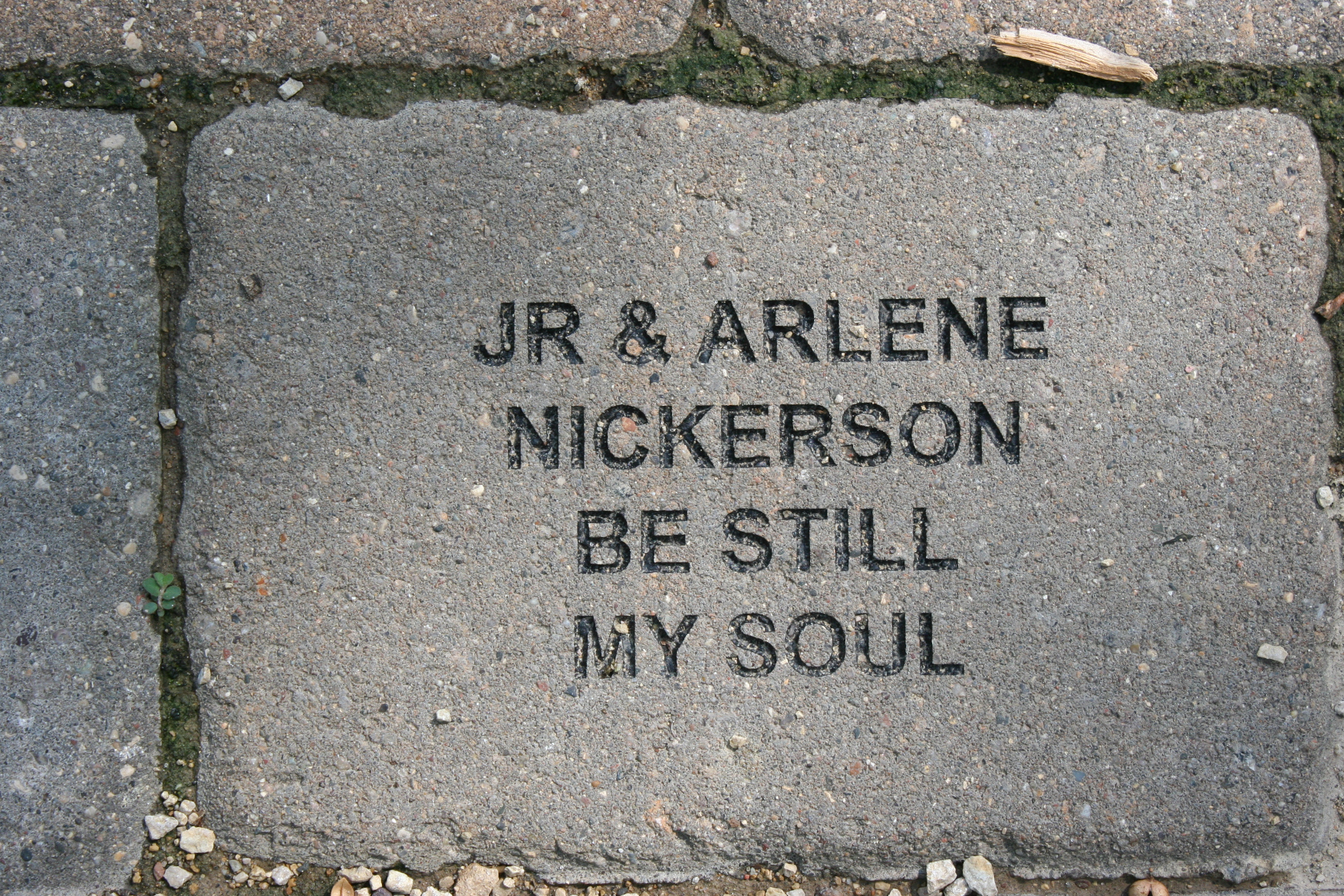
This paver in honor of my friend’s parents reminds me of Psalm 46:10. Minnesota Prairie Roots photo June 2021.
Messages on pavers at Honor Point, overlooking the Straight River, inspire. Be still. Pause. Appreciate.
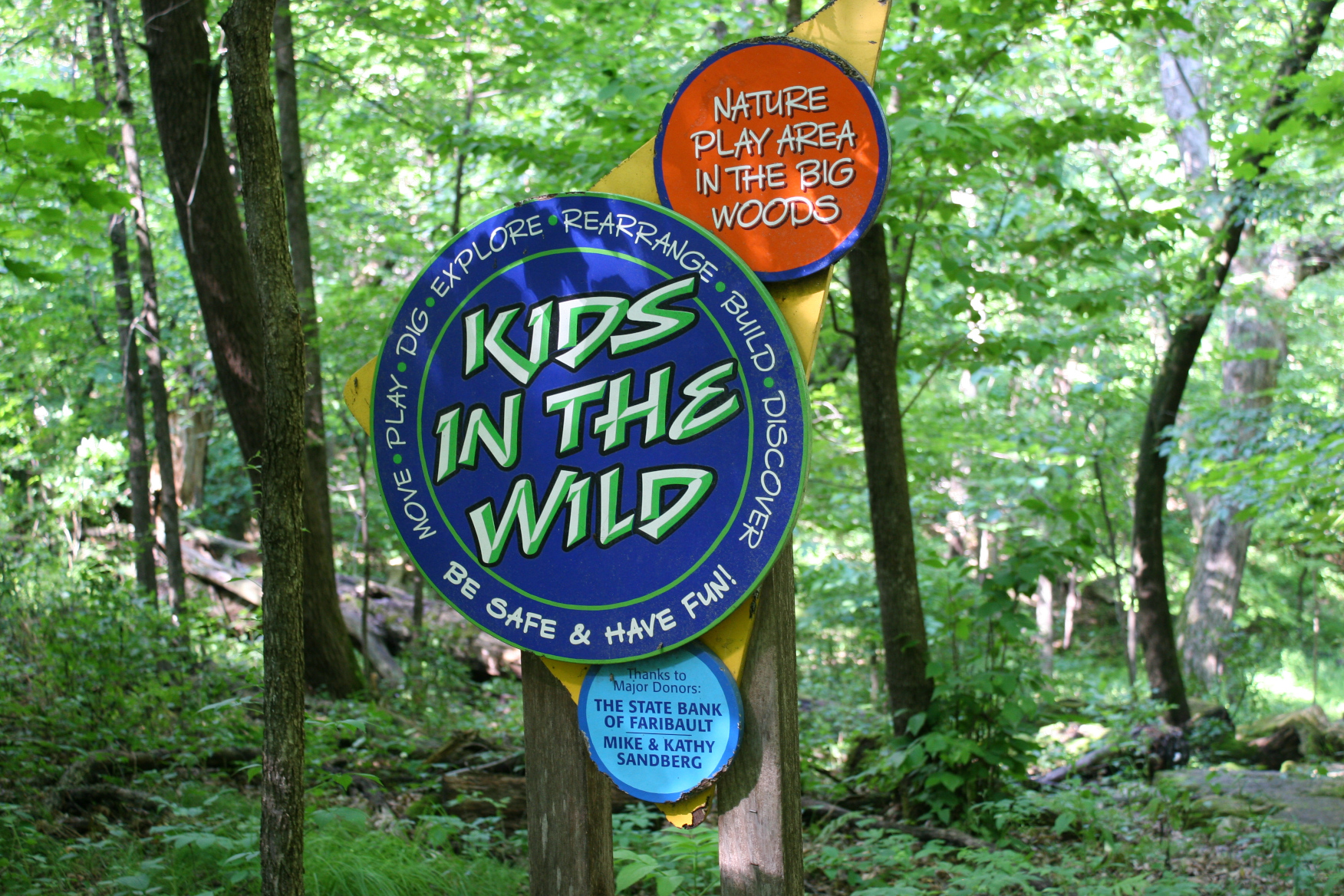
River Bend features a natural play space for kids in the woods. Minnesota Prairie Roots photo June 2021.
There’s something to be said for being still. Simply being. Listening. Connecting to the earth. Perhaps remembering how you felt as a child, exploring.
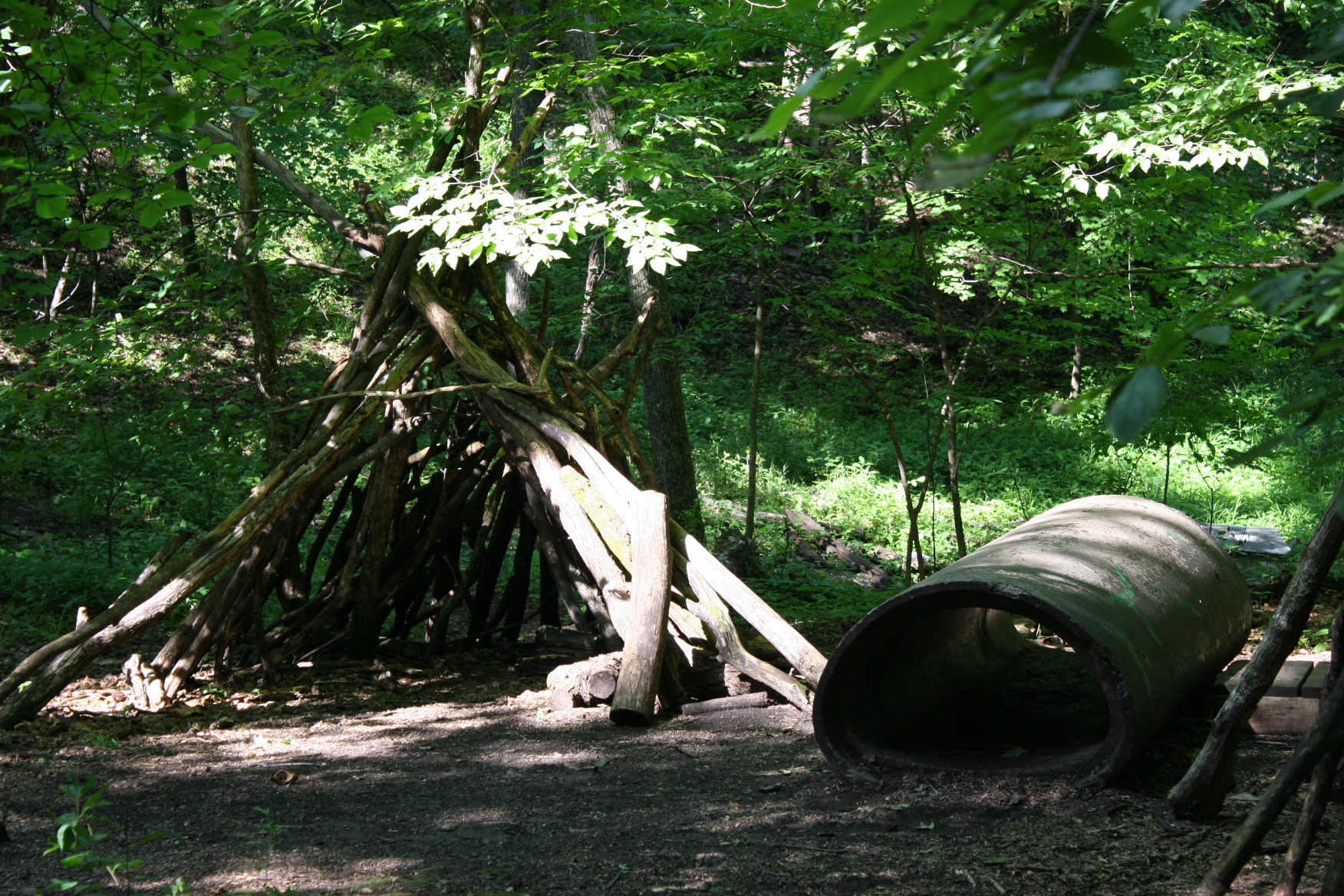
A fort and “tunnel” in the kids’ play area. Minnesota Prairie Roots photo June 2021.
In my youth, I “lived” outdoors, coming indoors only to eat and to sleep. With my siblings, we built forts in the grove, rode our bikes along dirt trails, hid in prairie grasses higher than us.
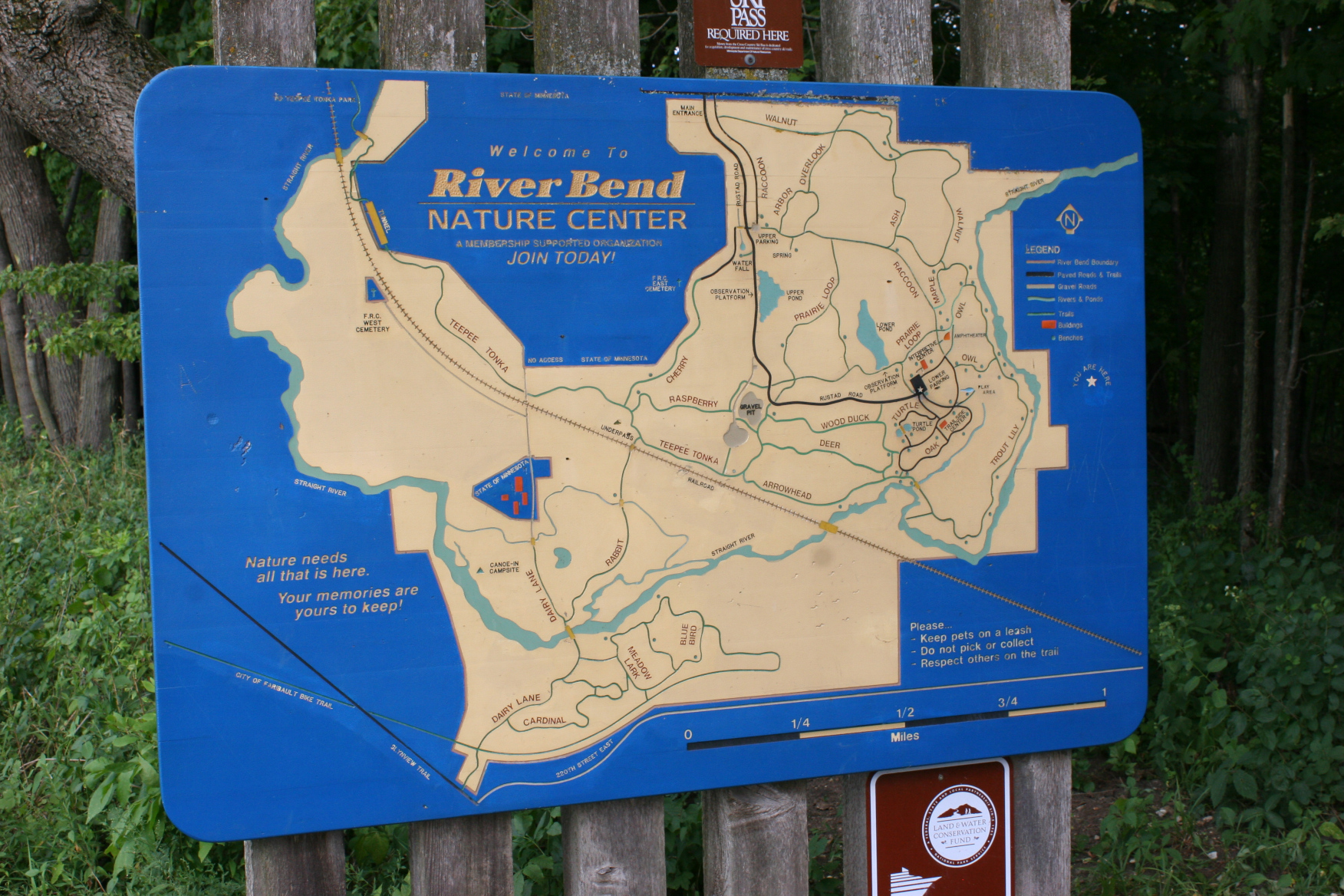
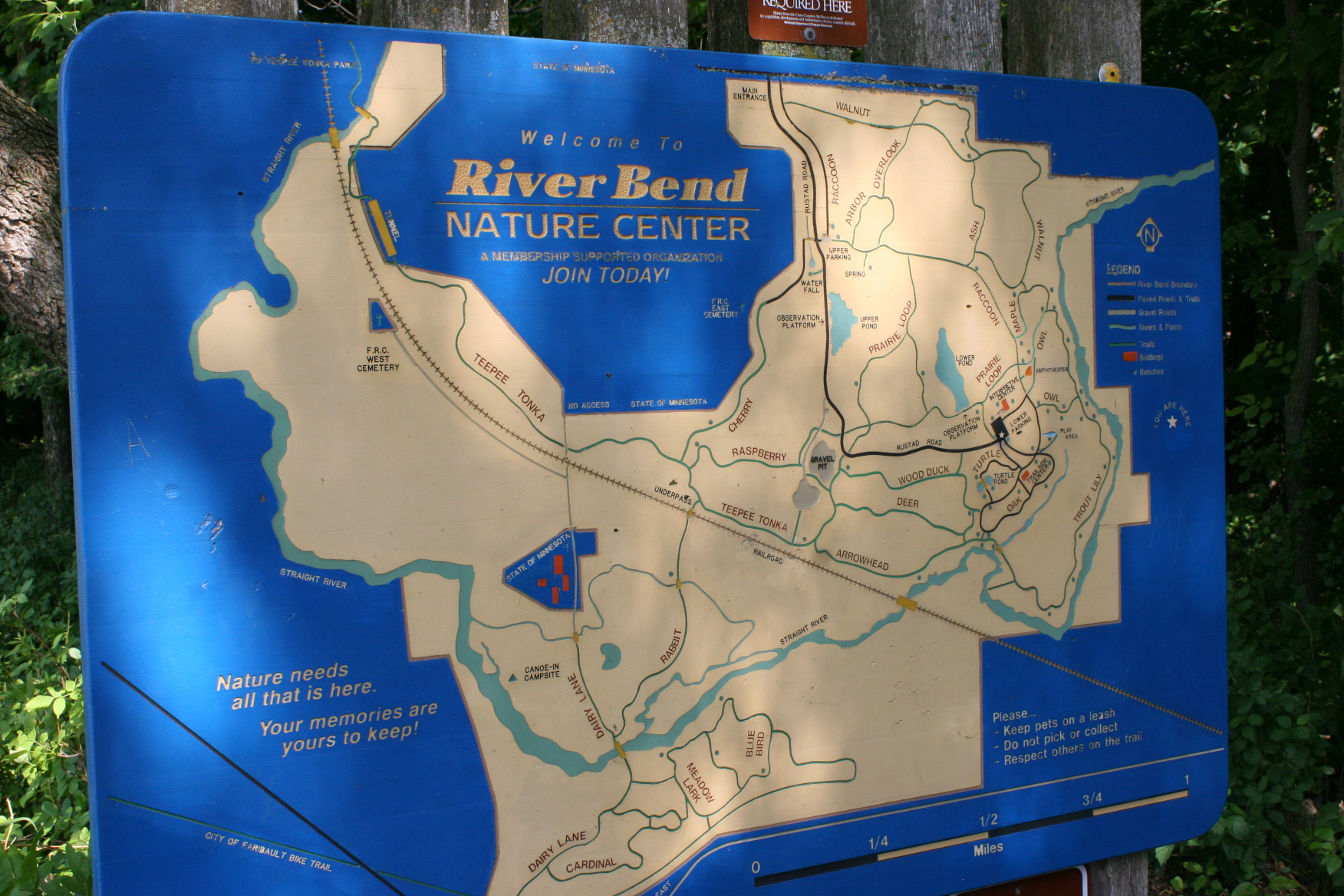
At the edge of the woods, a map details River Bend. Minnesota Prairie Roots photo June 2021.
I took time. Time to play in nature. To become part of it. To imagine. When I hike at River Bend, I reclaim that childhood joy.
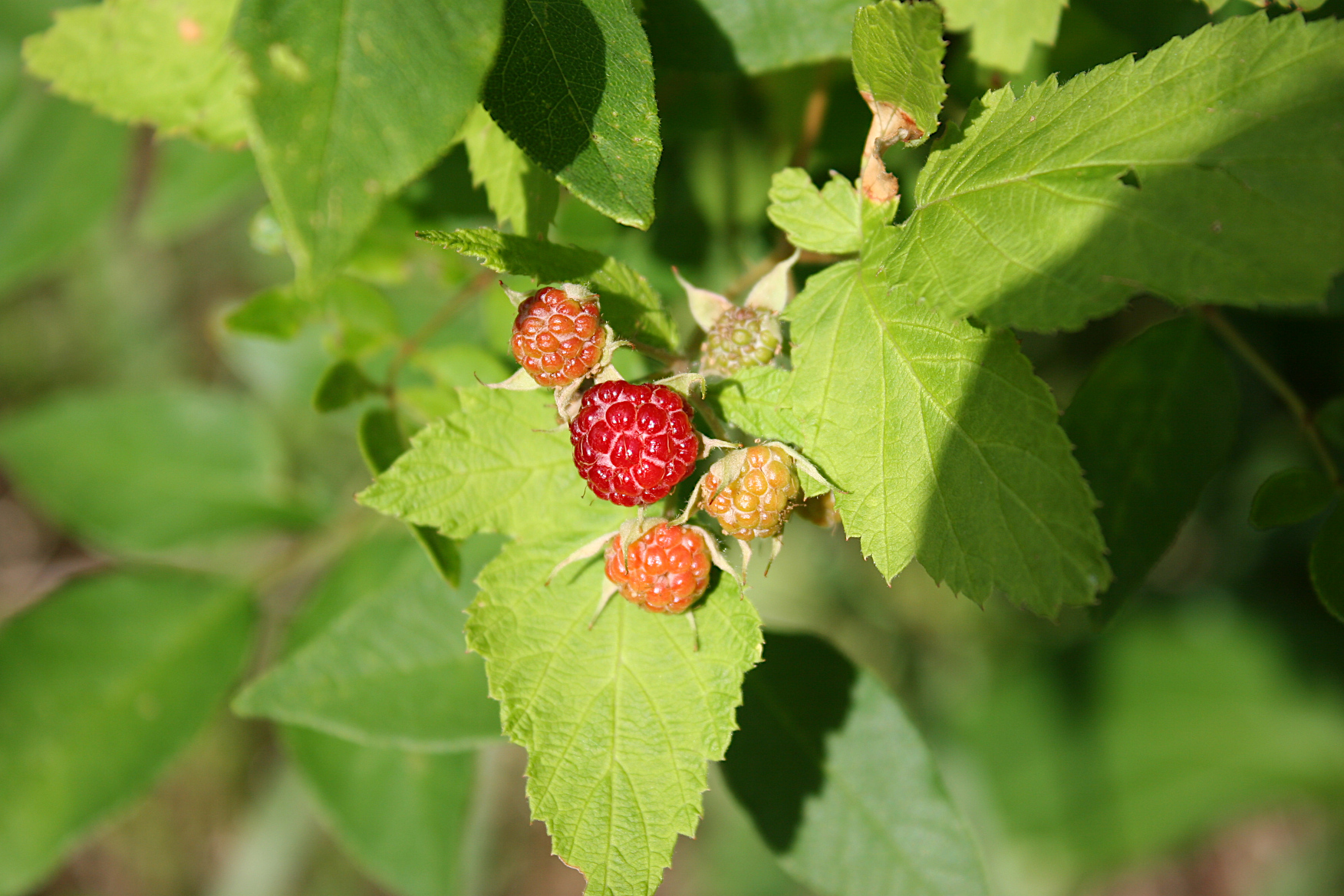
Wild raspberries edge the woods near the prairie. Minnesota Prairie Roots photo June2021.
I savor the moments. The sights. The tastes. The scents. The sounds. All that which defines the natural world.
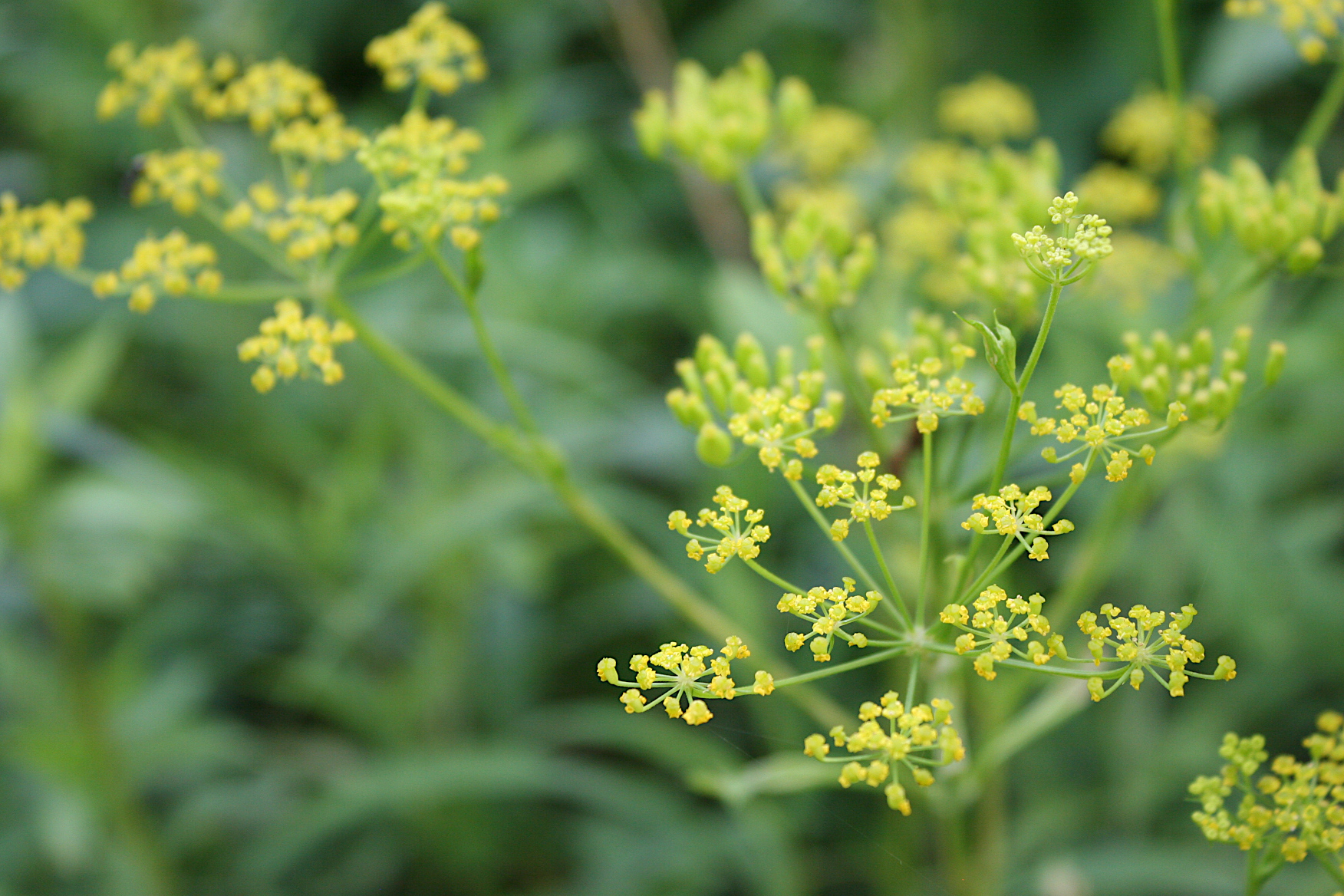
To be avoided: wild parsnip. Minnesota Prairie Roots photo June 2021.
WARNING: Stay away from this plant, wild parsnip. It looks a lot like dill and is growing alongside trails. Wild parsnip will burn your skin. Do NOT touch it.
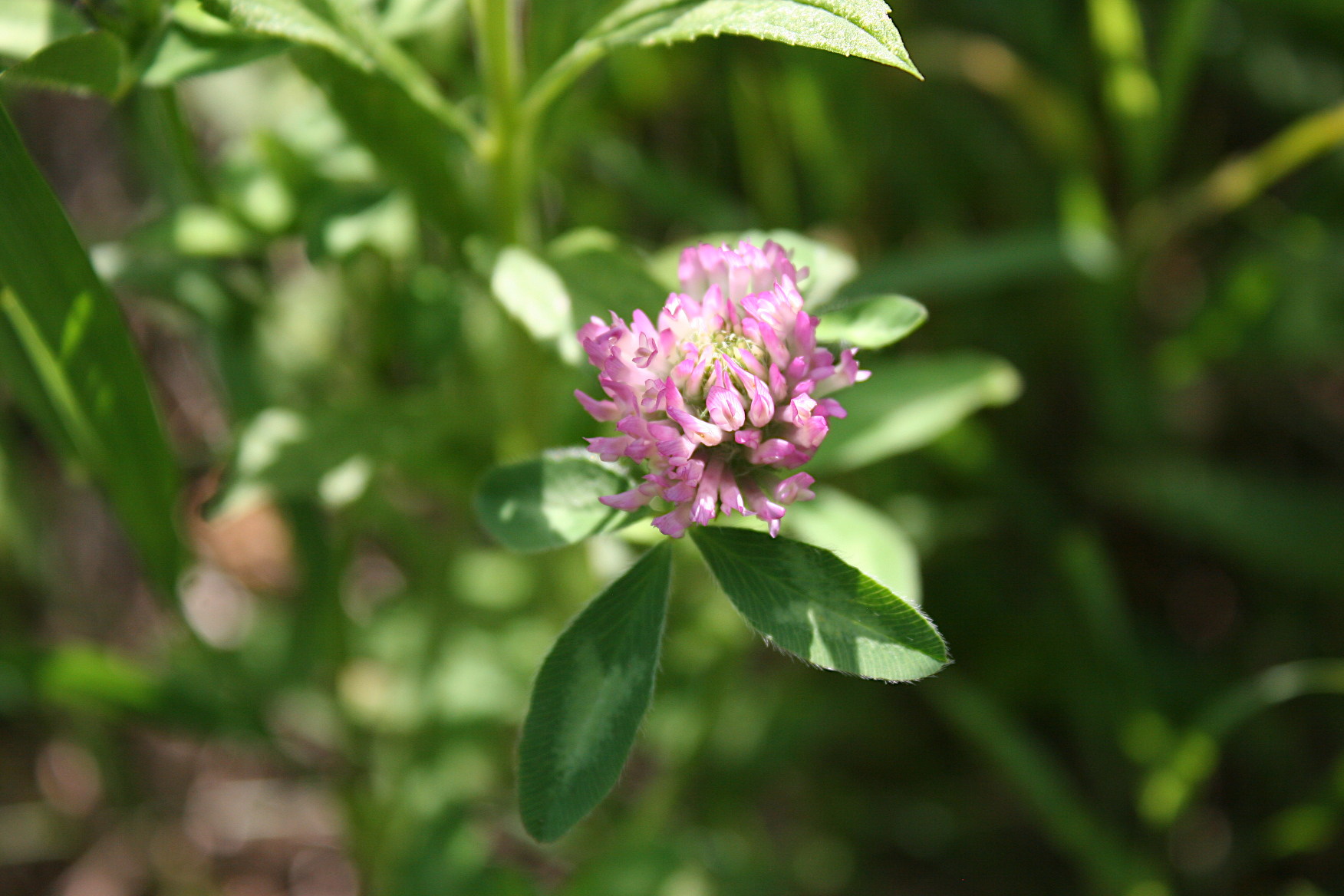
Clover grows in sun dappled spots in the woods by the prairie. Minnesota Prairie Roots photo June 2021.
PLEASE CHECK BACK for more photo rich posts from my recent visit to River Bend. Next, I’ll take you into the prairie.


















 Minnesota Prairie Roots
Recent Comments