Minnesota Prairie Roots

Writing and photography by Audrey Kletscher Helbling

New exhibit highlights Rice County in the U.S.-Dakota War of 1862 September 2, 2012

IT IS EASY TO FORGET SOMETIMES, because I grew up in the region of Minnesota where the U.S.-Dakota War of 1862 was centered, that residents of the county in which I now live also played an integral role in the conflict.

Specifically, Rice County residents Bishop Henry Whipple and Alexander Faribault, after whom my community of Faribault is named, are key persons often noted in historical information written about the war.

I am always surprised that relatively few people from outside of southwestern and central Minnesota know so little about the bloody, six-week war between the Dakota and the white settlers and soldiers given it is a major, defining event in Minnesota history.

An overview of 1862, Through Rice County’s Eyes, which opened August 22 in Northfield.

However, awareness has grown considerably this year on the 150th anniversary of the war, including right here in Rice County. The Northfield Historical Society, partnering with the Rice County Historical Society, is currently showcasing an exhibit, 1862, Through Rice County’s Eyes.

I recently checked out the Northfield exhibit, which features mostly memorable quotes, volumes of summarized information and copies of photos. It’s a lot of reading.

But if you’re interested in educating yourself, it’s worth the time and concentration needed to absorb the information presented in this exhibit. And I’ll admit to occasionally skimming the postings because I am more of a visual, multi media, show-and-tell kind of history learner. I also had a pretty good background of knowledge going into the exhibit.

This sculpture of Alexander Faribault trading with a Dakota trading partner stands in Faribault’s Heritage Park near the Straight River and site of Faribault’s trading post. Faribault artist Ivan Whillock created this sculpture which sits atop a fountain known as the Bea Duncan Memorial Fountain.

I knew, for example, that fur trader Alexander Faribault was one-quarter Dakota and married to Mary Elizabeth Graham, whose mother was a family member of a Dakota chief. I knew, too, that Faribault was involved in the negotiating and translating of land treaties between the government and the Dakota before the war and that he benefited financially.

I was aware that Alexander Faribault sheltered the Dakota.

Above the photos and info is this quote by Bishop Henry Whipple to President Buchanan in August 1860: “In my visits to them, my heart had been pained to see the utter helplessness of these poor souls, fast passing away, caused in great part by the curse which our people have pressed to their lips.”

But I had forgotten that Bishop Henry Whipple, a long-time advocate for the rights of the Dakota and known to them as “Straight Tongue,” worked to find a safe refuge for them in the city of Faribault.

Alexander Faribault opened his land to the Dakota. Information in the exhibit states:

This land was the only safe-haven of its kind in a state now prejudiced in fear and anger against anyone with Dakota blood.

According to info in the exhibit, Alexander Faribault, whom you recall was one-fourth Dakota, also experienced prejudice against him. By 1869, this once successful fur trader, flour mill owner and politician had to sell his land and assets, including the land occupied by the Dakota.

Equally interesting is the quote, below, attributed to Mary Whipple. Even though her husband, the bishop, worked tirelessly to help the Dakota, fear still existed in his home community.

A quote from a letter written by Mary Whipple to her sister during the U.S.-Dakota War.

Perhaps the most interesting fact I learned relates to that of Lt. Rollin Olin, a decade-long resident of Northfield. He was second in command of the Third Minnesota Regiment at the Battle of Wood Lake—the final battle of the war—and a member of a five-man military tribunal which tried the Dakota following the war. He signed more than 300 death sentences for nearly 400 Dakota charged with murder, rape and/or robbery.

For me, that raises the obvious question: How could someone who fought against the Dakota judge them without bias? All members of the tribunal, in fact, had fought the Dakota. The answer, of course, is that Lt. Olin and the other four could not.

Likewise, the Northfield Historical Society is wisely careful to indicate that its new, temporary exhibit may not please everyone or include everything on the topic of Rice County’s connection to the war. On the NHS website, you’ll read this disclaimer:

As varied as these and other local perspectives may be, any exploration of the U.S.-Dakota War of 1862 suffers from the inevitable limitations facing every historical examination—limitations such as scope and biases, past and present, which impact the telling and perception of the stories and data. In presenting the exhibit 1862, Through Rice County’s Eyes this fall, NHS endeavors to draw visitors into thoughtful interest and discussion of this momentous event and its aftermath by sharing local connections. Come and critically examine this exhibit.

The exterior of the Northfield Historical Society, 408 Division Street, Northfield.

FYI: To learn more about 1862—Through Rice County’s Eyes, click here to the NHS website.

To learn more about the Minnesota counties, county by county, involved in the U.S.-Dakota War of 1862, click here.

© Copyright 2012 Audrey Kletscher Helbling


A sweet surprise: An old sorghum mill on a southern Minnesota elk farm & more August 10, 2012

HOW MANY TIMES HAS MY FAMILY driven Minnesota Highway 60 east of Elysian, unaware of Okaman Elk Farm to the south not far from the highway? Too many.

My husband Randy and I almost missed Okaman’s again last Sunday as we traveled along Waseca County Roads 3 and 5. If not for the colorful miniature train transporting kids and adults along the shoulder of the road, we likely would have passed right by.

Passing by the Okaman Elk Express in our car on a Sunday afternoon.

But that train stopped us in our tracks and caused us to turn around and drive back to the farm.

There we discovered much more than a plain old elk farm. We also found family-friendly activities, a farmers’ market, art, animals and history.

The historic Seha Sorghum Mill.

In 1991, Don and Joyce Kaplan bought this historic place to raise elk and then sell the meat. Their business sits on the site of Okaman, a town established in 1855 between Lake Elysian and Lily Lake. Here, according to a posted sign, several hotels, a theater, the Buckout Flour Mill, the Okaman School and the Seha Sorghum Mill were located.

Inside the sorghum mill.

It is that 1895 sorghum mill, which produced and sold sorghum syrup until 1953, that most interested me. Randy and I poked our way through and around the old mill trying to determine how the whole operation worked. I think he understood the process much better than me.

Apparently wagons of sorghum were unloaded atop the hill behind the mill where the canes were crushed and the juice then flowed into steam-heated cookers, or something like that.

The original steam boiler stands behind the sorghum mill.

According to the Waseca County Historical Society website, Cornelius L. Seha built the mill, today the only known historical sorghum mill remaining in Minnesota and added to the National Register of Historic Places in 1979.

Because the mill today is basically an old building and steam boiler with weeds and brush growing around the holding tanks, equipment and structures, everything is left open to self-interpretation. Perhaps someday this historic site can be restored and specific educational information posted.

Cats roam the farm.

Then, perhaps, the younger farm visitors will be more interested in the historic buildings. They are, for now, focused on  the donkeys and alpacas, the goats and elk and dog, and especially, the cats and kittens. Or perhaps the playground equipment.

Visitors are free to wander the pasture with the alpacas, donkeys and goats.

Loved this sign at the petting zoo telling visitors that the animals are fed daily.

The farm is open seven days a week to the 3,000 – 4,000 visitors who stop by annually, says Joyce Kaplan. The Kaplans may not always be around, but guests are invited to peruse the place on their own. Just follow a few rules like:

You can enter the petting zoo pens or pastures at your own risk. Please don’t allow children to chase the animals and no dogs allowed. Close gates behind you.

Veggies from R & C Produce of Otisco.

Canned mixed veggies from Val’s Yard ‘N Gardens (Joe & Val Zimprich of Le Center).

Reusable price stickers in the back of the Zimprichs’ truck.

While the farm is always open, on Sundays from 1 p.m. – 4 p.m. during the summertime harvest and into October, farmers’ market vendors set up in the farmyard peddling their garden fresh produce and other products.

An art gallery is housed in an old barn.

That beautiful old barn, with an art gallery and studio in the haymow.

Antler art, including chandeliers, inside the art gallery with Paul Ristau’s art studio behind the windows pictured here.

Inside the gift shop and adjacent art gallery, you’ll find gifts anytime and the creations of artist and craftsman Paul Ristau, who renovates homes and businesses and is a mason specializing in stone fireplaces. He was doing some tile work for the Kaplans and ended up as their in-house artist focusing on the creation of antler art. He has a workshop in the haymow-turned-art-gallery where his elk antler chandeliers are a focal point.

A Native American influence on art hung in Paul Ristau’s studio.

A Native American influence is visible in Ristau’s art given his interaction with those living on the White Earth Indian Reservation where he once drove bus.

Of course, the farm also sells elk meat, inside the original 1893 homestead. The farm is now down to 23 elk, according to Joyce Kaplan who says she grew up on a farm and has been cleaning barns all her life and maybe it’s time soon to stop cleaning barns.

The final activity of the day, feeding apples to the elk.

On the Sunday I visited, her husband was handing out apples so the kids could feed the elk.

And the Okaman Elk Express was chugging along the shoulder of the roadway, thrilling the kids and, bonus, drawing in visitors like my husband and me.

You’ll find binoculars in the barn to view the elk in the pasture.

FYI: To find Okaman Elk Farm, take Minnesota Highway 60 east of Elysian 1 ½ miles and then turn south to the intersections of Waseca County roads 3 and 5. The farm is open year-round. Click here to reach the farm’s website.

© Copyright 2012 Audrey Kletscher Helbling
 

Discovering New Ulm’s Goosetown, across the tracks and down by the river August 2, 2012

DISCOVERING SOMETHING totally unexpected rates, for me, as the plum, the prize, the most interesting aspect of travel.

And you needn’t journey far to find these places. Last Saturday while driving to southwestern Minnesota, my husband and I stopped in New Ulm because I wanted to see the Defenders and German-Bohemian historical monuments. Well, we never did get to the Defenders marker.

The German-Bohemian sculpture and marker in German Park.

But we eventually got directions for and located the immigrant sculpture overlooking scenic German Park. As lovely and manicured as that park is, and I’ll share photos in a future post, it was not the highlight of our visit.

Rather, it was Goosetown which captured my fancy.

We drove across the railroad tracks and past the old Valley Grain Co. to reach Goosetown.

Goosetown is that side of New Ulm—across the tracks and down by the river—where mostly Catholic German-Bohemian immigrants began settling in the late 1800s. They were primarily farmers or retired farmers, of peasant stock. And they kept geese, which wandered and fed along the banks of the Minnesota River.

Goosetown residents worked at the local roller mills, including the Eagle Roller Mill. That mill and the New Ulm Roller Mill once made New Ulm the third largest milling center in Minnesota. The New Ulm flour millers had elevators in three states.

And so the name Goosetown became attached to southeastern New Ulm, specifically to South Front and South Valley streets. The immigrants who lived here labored in nearby roller mills and breweries and worked as carpenters, masons and cigar makers. Women supplemented the family income by making Klöppel lace and/or sewing feather-filled bedding. Families also gathered clam shells from the river for pearl buttons.

At first thought, it all seems rather romantic, this stretch of Gȁnseviertel next to the railroad tracks and river. But I expect life there was hard as families, many of them living in two-room houses, struggled to survive. I also expect, and New Ulmers can correct me if I’m wrong, that this area of town wasn’t always embraced by the community at large. You know that thing about “the other side of the tracks.” Every community seems to have that part of town perceived as less than positive whether due to poverty or people who are different from the majority. Riverside land (and Goosetown is no exception) was once the site of town dumps, which should tell you something, too.

Sisters Amber, 8, and Kiera, 4, pose with Gertie the Goose, a statue donated by Dr. Ann Vogel of New Ulm and located in Riverside Park.

I likely could have learned even more about the history of Goosetown had the Regional River History & Information Center, 101 South Front Street, Riverside Park, been open. The center is housed in the former Franklin School.

Kiera showed me another goose tucked into a flowerbed in front of the river center.

Today New Ulm embraces the heritage of Goosetown with a plaque and statue in Riverside Park. There’s also an occasional Goosetown reunion and Victor “Fezz” Fritsche, leader of the one-time Goosetown Band, was inducted into the Minnesota Music Hall of Fame in 1991.

The logo for the Goosetown Roller Derby Girls who have names like Deutschland Dolly and SoUr Kraut.

Most recently, in January, a flat track roller derby team, Goosetown Roller Girls, was founded.

Goosetown Storage, once the home of Minnesota Seed Company.

A side view of Goosetown Storage, with signage pointing to its original use as the location of Minnesota Seed Company. Anyone know the history of Minnesota Seed?

At least one building is labeled Goosetown Storage and the New Ulm Fire Department has a Goosetown Fire Station next to the train tracks.

Engine House No. 3, commonly known as the Goosetown Fire Station, was established in 1890. The newer station pictured here houses two pumpers. A 47-foot drill tower (not shown here) stands nearby.

Even so, I was unaware of this ethnic treasure until we happened upon Goosetown on Saturday. New Ulm is best known to the touring public as the site of a major battle during the U.S.-Dakota War of 1862; for the August Schell Brewing Co.; the Hermann the German Monument;  the childhood home of author and illustrator Wanda Gag; the Minnesota Music Hall of Fame;  the Glockenspiel; the Cathedral of the Holy Trinity; Way of the Cross stations; the home of Minnesota’s 14th governor, John Lind; and most certainly as a city that features all things German. You can see how historic Goosetown could get lost in that long list of New Ulm attractions.

If you’re like me and appreciate the lesser-known, less touristy aspects of a community, drive across the tracks and down by the river in Anytown. Perhaps you’ll discover a place like Goosetown, rich in heritage and sturdy brick buildings and stories stitched into the land, if only you knew those stories.

FYI: Please check back for more posts from New Ulm.

© Copyright 2012 Audrey Kletscher Helbling
Goosetown Roller Girls image comes from the team’s website.


Driving into a ghost town on Hogsback Road July 23, 2012

An old building, perhaps a former blacksmith shop, in Belvidere Mills.

GHOST TOWNS INTRIGUE ME. I wonder—who lived in these places and were these towns once thriving and why did people leave?

Often, placement of the railroad determined which Minnesota town survived, which did not.

Recently my husband and I, on one of our day trips, turned off Goodhue County Road 3 about 10 miles south of Red Wing, onto Hogsback Road and into Belvidere Mills.

Yes, Hogsback Road. When you read a street sign like that, you just know there’s a story somewhere that’s been passed down from generation to generation. If only I knew the right old codger to consult for a little history lesson on the road that now also is called Wellscreek Trail. I’ll travel on Hogsback Road, thank you.

The former Belvidere Mills creamery, modernized into a garage.

The first view we got of the lovely old barn in Belvidere Mills.

And so we did, up the hill on Hogsback Road past a handful (or less) of houses and the old creamery and a stately red barn and past another old building (perhaps a blacksmith shop), around a curve in the gravel road and we were already out of Belvidere Mills. We turned around and backtracked.

Our second view, the side, of the barn as we backtracked into the ghost town.

And back again past the old building in the top photograph, this a side shot. What is it, readers?

Thanks to signage placed by the Goodhue County Historical Society along the county road, we knew this was the site of the former Belvidere Mills, established in 1858.

The historical society has marked some 60 ghost towns in Goodhue County with signage to “preserve their history and to recognize their historical contribution.” All either once had, or currently have, post offices.

They also have intriguing names like Black Oak, Cannon Junction, Featherstone, Roscoe Centre, Skyberg and White Willow.

And then there are the Goodhue County Minnesota ghost towns of—ready for this—Lena, Norway and Miami.

© Copyright 2012 Audrey Kletscher Helbling
 

Discovering a historic gem (pearl) in Lake City July 16, 2012

A view of downtown Lake City, Minnesota.

DRIVING INTO LAKE CITY on a recent sultry summer afternoon, I expected to learn about water skiing in this Lake Pepin side community which calls itself the birthplace of that water sport.

Lots and lots and lots of sailboats are moored in Lake City.

After all, the popularity of water sports is evident in the sailboats crammed and tethered in the harbor on a weekday, waiting to be unleashed on the weekend.

I wanted to check out the sculpture (an anchor?) along Lake Pepin, but no parking was allowed and the weather was too hot to walk any distance. That’s Wisconsin across the lake. Beautiful scenery here in this busy water sport area.

And around the bend, fancy yachts—at least that’s what I call boats so big that one arrived on a semi—float in the bay. And a bit farther, boaters enjoy a summer afternoon on the lake.

Nautical-themed merchandise perched on a window on the second floor of Treats and Treasures. The “treats” are homemade candy, found downstairs in the treats section.

Offshore, too, you’ll catch the nautical theme of this Mississippi River town in business names and merchandise.

A side view of the Lake Pepin Pearl Button Co., now an antique store featuring merchandise from some 40 dealers.

But, if you happen to walk into the Lake Pepin Pearl Button Company, which is today a place of “the old, odd and unusual,” you will learn the gem of history I found most interesting about Lake City. Dave Close, who along with his wife, Juleen, runs the aforementioned antique store, will educate you about Lake City’s role in making pearl buttons.

It’s fascinating to hear about clammers who once harvested freshwater clams from Lake Pepin, delivering them to the Lake Pepin Pearl Button Company and The Wisconsin Pearl Button Company (according to Steve Swan at Swan Jewelers). Both Swan and Close can offer detailed oral histories about local button making.

The Closes have this display of clam shells and button blanks in their shop.

According to Close, about 50 percent of the buttons in the world once came from the Upper Mississippi River, north of Ohio. That included Lake City, where factory workers sawed button “blanks” from clam shells before shipping the 50-pound burlap bags of clam shell cut-outs downriver to button finishing houses in La Crosse, Wisconsin, and Muscatine, Iowa.

Old photos and more pay homage to this building’s former use as the Lake Pepin Pearl Button Co.

Next to the still operating original freight elevator, the Closes have posted vintage photos and other items, including these clamming bar hooks. Note also the beautiful original wainscoting from the building.

Dave Close, co-owner and in-house historian at the Lake Pepin Pearl Button Co.

Close has created a mini museum about this side of Lake City’s history behind the counter and in a corner of the 1866 former dry goods store which housed the button company from 1914 – 1920. It is the building’s history and Close’s clear appreciation for that history, which set his business apart from your typical antique shop. You need only notice the clam shells on the counter, the rainbow of buttons secured to his straw hat and the Pearl Button signage, inside and outside, to inquire about the Lake Pepin Pearl Button Company.

Two freshwater pearl rings crafted by jeweler Steve Swan of Swan Jewelers in Lake City.

Nearby, Swan also honors Lake City’s button past via a display in his jewelry store that includes jewelry he’s crafted from the pearls of freshwater clams. Up until about a dozen years ago, when the Minnesota Department of Natural Resources halted clamming operations on the river, this jeweler was buying from clammers.

However, the once thriving pearl button making industry ended long before that, in the late 1930s, when plastic buttons replaced pearl buttons, according to Swan.

All of this I learned on a sultry summer afternoon in Lake City, the birthplace of water skiing.

WATCH FOR ANOTHER POST from this southeastern Minnesota community of some 5,000 residents and many, many, many boats.

© Copyright 2012 Audrey Kletscher Helbling
 

Always obey Rule 99 & other historic reflections July 12, 2012

VISIT A PLACE like the Village of Yesteryear in Owatonna, especially during a celebration such as last weekend’s Steele County Historical Society Extravaganza, and you get an in-depth glimpse of life back in the day.

Dressed in period costumes, members of the Old West Regulators added a real-life element to the Extravaganza.

Guides, costumed reenactors and others, with their extensive historical knowledge, most assuredly add to the educational and entertainment value.

But, because it is impossible to speak with every one of them or to observe every activity or to read every informational sign, one must sometimes rely on simple observations to consider the historic stories and realities which define life years ago.

I therefore present these Extravaganza photos with basic information. Much more lies open to your interpretation, influenced perhaps by your experiences or the stories passed down from generation to generation within your family. That is your personal history. Take it. Remember it. Own it. Pass it along.

Memories of attending a one-room country school remain for many, including my 55-year-old husband. He attended Chimney Butte School in rural North Dakota and recalls the day students were kept indoors during recess because of coyotes roaming the schoolyard.

What memories does the District 14 country schoolhouse, pictured above, hold for those who were taught in this 1856 building four miles south of Owatonna until the school closed in 1962 due to consolidation?

Hollyhocks stand strong and sturdy outside that same schoolhouse at the Village of Yesteryear.

But for me, hollyhocks belong next to the milkhouse, an odd place for flowers, it would seem. Yet, on the southwestern Minnesota dairy and crop farm where I grew up, that was their spot, a splash of beauty perhaps more for my mother than for her farmer husband.

 A scene recreated in the 1866 Bixby railroad depot leaves you wondering about the railroad crew and passengers who waited here to board trains. Where were they going? And, for the passengers, why?

And then you see this sign inside an old caboose and completely forget about those passengers and question why the railroad employees climbed onto the roof of the caboose because they certainly must have or there would be no Rule 99.

How many tears were shed, in joy and in sorrow, by those occupying these pews in the 1891 St. Wenceslaus Mission in Moravia Church built in 1891 in Moravia seven miles south of Owatonna? Who crafted these pews? And how did parishioners feel when their church closed in 1952?

Perhaps you could ask Tony Seykora, whose mother, Mary Meixner, attended St. Wenceslaus and whose daughter, Susan, was married here. He wasn’t sharing any stories on Sunday while touring his ancestral church at the Village of Yesteryear.

 Oh, the stories this old town hall, the Owatonna Town Hall built in the late 1850s, could tell about those who met here and shaped the future of the city.

And if you could peek over their shoulders, would you to see how those in the Meriden area voted? This folding polling booth was patented in March of 1892 making it first available for the Presidential election that same year. The polling booth was used at the Meriden Town Hall until 2009. Until 2009, people.

Who wore these hats displayed inside the historic 1868 Dunnell House, home of Minnesota legal scholar, educator and Congressman Mark Hill? Were they hats of mourning, hats of celebration, practical hats…?

A volunteer who works with the Blue Earth County Historical Society and the Betsy-Tacy Society in Mankato in decorating vintage hats studies the collection for ideas.

Also in the Dunnell House, a nook in the parlor offers a place for quiet conversation. Oh, to have been there, eavesdropping…the stories and secrets you may have heard about/from Congressman Hill and other legislators.

Horse power, but certainly not horses…these vintage tractors were parked next to the horse barn at the Steele County Fairgrounds. Surely they would speak of long, hard days on the farm, their wheels weighed down by the burdens of a farmer’s worries and the uncertainties that have always been a part of farming from the early days of Minnesota to current day Minnesota.

What is that saying? You haven’t walked a mile until you’ve walked in my shoes. Consider that, how challenging it would have been to walk in the boots/shoes of your ancestors for whom life presented so many daily challenges simply to survive.

FYI: To learn more about the Steele County Historical Society, click here.

CLICK HERE to read my first blog post about the Steele County Historical Society Extravaganza. Watch for one final, upcoming post.

© Copyright 2012 Audrey Kletscher Helbling
 

Steele County showcases history in a big way July 10, 2012

Five-year-old David of Faribault, aka Apache Shadow, was among costumed reenactors from the Old West Regulators.

WHEN THE STEELE COUNTY HISTORICAL SOCIETY in Owatonna throws an extravaganza, they put on a heckuva an event.

Late Sunday morning my husband Randy and I headed about 15 miles south on Interstate 35 to the Village of Yesteryear for the historical society’s 26th annual celebration of history. I cannot believe that I’ve never known about this extravaganza, which I’d recommend to anyone interested in a free family-friendly day of learning about the past.

Kids, like Kennedy, right, were drawn to the water and the old-fashioned wringer.

Owatonna resident Tom Gray carves a mountain man.

From hands-on demonstrations of rope making to washing clothes the old-fashioned way to printing on an aged press to carving wood and working with leather, and more, we observed an array of dedicated and passionate historians showcasing yesteryear.

Two actresses shoot it out in a scenario presented by the Old West Regulators.

Add in costumed reenactors modeling period attire and shooting it out in mini dramas; a country singer crooning Hank Williams’ “Your Cheatin’ Heart;” kids circled around a table in an old country school crafting corn husk dolls; tractors snail-crawling toward the finish line in a slow tractor race; the tantalizing aroma of shredded pork sandwiches and the refreshing promise of icy root beer; 15 buildings, most of them vintage, plus a caboose to tour, and you have a full day.

Dunnell Lenort, who has performed at the Grand Ole Opry and elsewhere, presented a selection of songs, including “I Fought the Law.” It was, he said, “for those who have been on the wrong side of the law.”

Kids learned how to make corn husk dolls inside the former District 14 country school, built in 1856 and located about four miles south of Owatonna along Lemond Road. The school was closed by consolidation in 1962.

Lest you think the John Deere won this race, you would be wrong. The winner here was the tractor which drove the slowest along about a 50-foot stretch to the finish line in a slow tractor race.

Randy expected we would be there an hour; we left more than four hours later and could have stayed longer. We missed the vintage baseball game and other events.

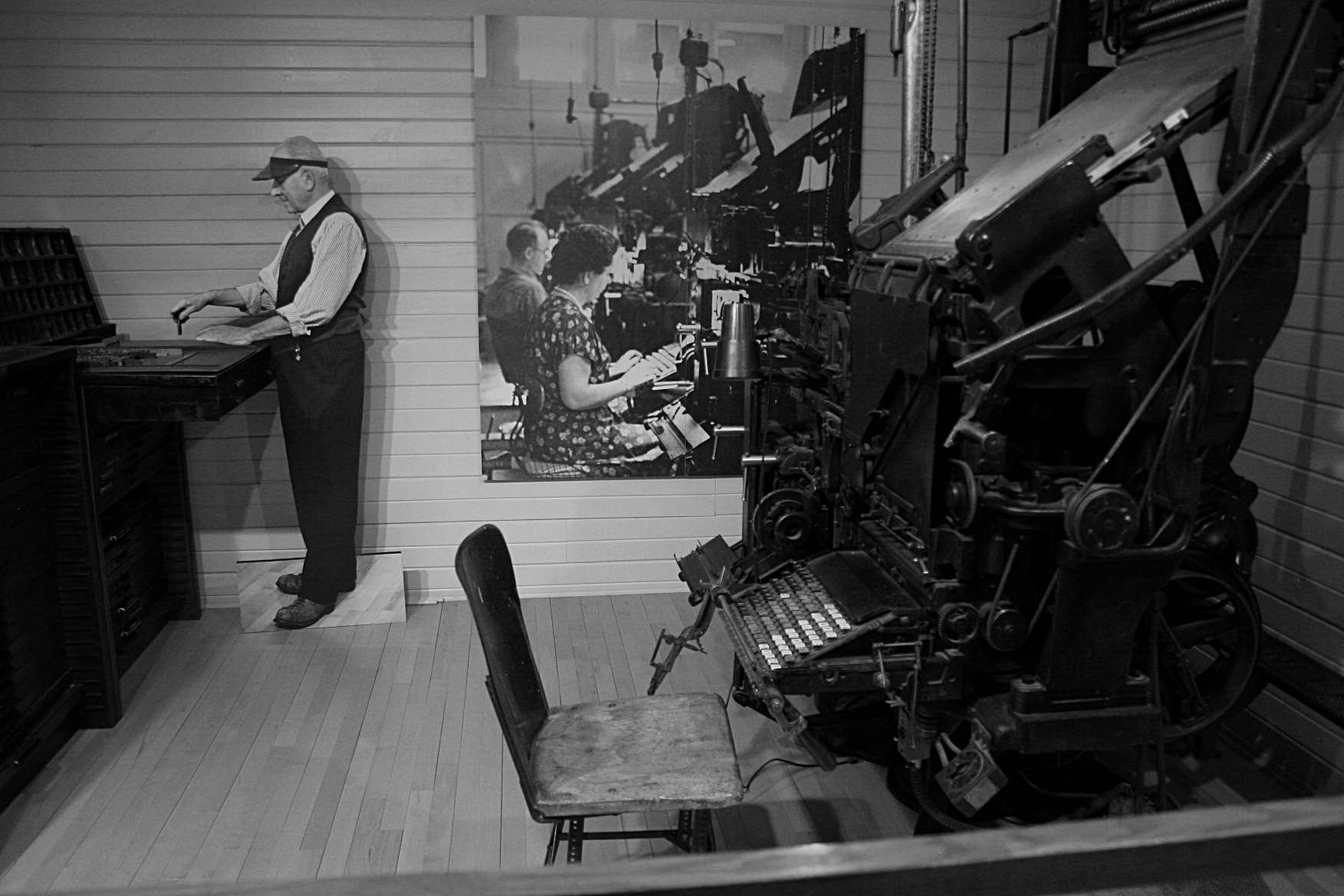
Pete the printer at work in the Village of Yesteryear print shop.

Of course, my spouse will tell you that, had I not been so interested in the village print shop, we could have knocked perhaps 30 minutes off our extravaganza tour. But given my journalism background; two years of employment at a weekly newspaper which printed auction bills and other items on an old Linotype machine; and my appreciation for the art of printing, I was fascinated by the working print shop and its resident printer, Pete Baxter.

Randy indulged my print obsession and I, likewise, later feigned interest in the engine display over in the agricultural section of the extravaganza.

Letters laid out to spelling “printing.”

Let’s back up to that print shop and printer Pete, who once owned North Cal Printing, as you would expect, in California. Family brought Pete to Minnesota about a dozen years ago. And the old print shop at the Village of Yesteryear was one of the deciding factors in his settling specifically in Owatonna.

Today he’s an enthusiastic volunteer who dons a printer’s apron as he educates visitors, spins a few stories and inks up the press to spew out bookmarks and cards with messages like “Without a love for books the richest person is poor.”

Spend any time with this man who owns a library of 1,500 volumes; is a member of The Wördos, an organization which meets monthly in the metro to discuss errors in local and national media; and who knows the ins and outs of the printing business, and your interest in printing is likely to grow, too. When he mentioned the bit about The Wördos and their dissection of media grammar, usage and more, I wanted to grab back the business card I’d handed him for fear of him scrutinizing my writing. But I didn’t.

I wasn’t about to allow my insecurities to interfere with learning from an old-school printer educated in the 1940s at California Polytechnic State University during the transition from letterpress to offset printing.

Pete’s interest in printing stretches back to his childhood when he often accompanied his dad to a California street car station and stood at the window of a nearby newspaper office watching printers at work.

One day, as Pete dramatizes with arms gesturing, a worker exited the print shop, grabbed him by the arm and shouted, “Get your snot nose off my window.” He hauled young Pete inside, gave him a tour, and, as the printer says, “I was hooked.”

The next Christmas, he received a toy printing press and a case of type. Years later, he would earn a printing degree from Cal Poly and eventually own a print shop.

An original OZ Press print of the Indian princess after whom Owatonna is named, on display in the print shop.

That Pete the printer understands and appreciates printing is obvious to anyone who takes the time, as I did, to listen. He’s quick to spotlight the work of Owatonna’s probably most notable press, OZ Press. OZ co-owners Alice Ottinger and Jean Zamboni—thus the OZ name—donated an 1885 working printing press and artwork to the Village of Yesteryear print shop. Their press specialized in original art printing and silk screening during its 40 years in business, 22 of them in Owatonna.

Jean Zambonia, left, talks about OZ Press at the artisan market. Framed OZ Press prints, on the table, were for sale.

Later I met Jean Zamboni in the new Steele County History Center and learned that she taught art at Minnesota State University, Mankato, before opening her press with friend Alice Ottinger. They designed some program covers for the college, did silk screening and eventually determined they could afford to start a press.

“So that was it,” Jean summarized as she stood next to a table where a limited selection of OZ framed prints were sold at the extravaganza. I wish now that I’d purchased one.

And you likely wish, about now, that I’d informed you of the Steele County Historical Society Extravaganza before the event. Mark it on your calendar for next July. Before that, though, you can attend Christmas in the Village, set for 4:30 – 8:30 p.m. Friday, November 30, and again from 10 a.m. – 2 p.m. on Saturday, December 1. The holiday celebration includes sleigh rides, visits by Santa and Mrs. Claus, children’s activities, selected buildings decorated for the season, a cookie sale, music and more. If it’s anything like the summer extravaganza, you will not want to miss it.

The general store and Museum of Professions at the Village of Yesteryear.

FYI: Click here to learn more about the Village of Yesteryear. Watch for several more posts from the extravaganza to be published here on Minnesota Prairie Roots.

© Copyright 2012 Audrey Kletscher Helbling
 

Historic Faribault Woolen Mill opens retail store with an artsy vibe June 12, 2012

Perusing merchandise at the recently reopened Faribault Woolen Mill retail store.

RUSTIC. SIMPLISTIC. MINIMALIST.

Those words wash over me as I step into the Faribault Woolen Mill Company’s recently re-opened retail store.

I could have strolled into an art gallery for the artsy vibe of this place. It has that feel, that sense of style and creative energy, which tells you this is no cookie-cutter retail outlet but someplace special.

The retail store has a comfy, relaxed and trendy feel.

From the white-washed paneled walls to the utility spools brushed in crisp white paint to the shelves leveled upon a ladder to the uniform white cubbies, the décor here is bare bones basic. It’s perfect for showing off the woolen blankets hung and folded ever so precisely in this historic woolen mill along the banks of the Cannon River in Faribault.

Faribault Woolen Mill blankets/throws are artfully hung on a simple pipe.

Crisp white cubbies, ever so perfect for showing off blankets/throws.

Jean Moody is tending the store on this recent hot and humid Saturday afternoon in May when the thought of purchasing a wool blanket seems not even a remote possibility. My curiosity draws me inside the store, into this building where I’ve never set foot even though I’ve lived in Faribault for nearly 30 years.

A wall once located near bathrooms has been incorporated into the retail store, behind the check-out counter, to showcase a name etched in wood in 1931.

An American flag on a wall in a meeting room, visible through floor to ceiling glass in the retail store, emphasizes the Woolen Mill’s dedication to “American made” products.

On this afternoon, Jean welcomes me, obliging my request to photograph a meeting room and also a wall behind the retail counter. I have no idea she is the wife of Paul Mooty, who purchased the foreclosed mill and reopened it in 2011 with his cousin, Chuck Mooty, until she introduces herself later.

She’s friendly and engaging and genuinely interested in connecting with Faribault residents and grateful for the warm welcome given to her family.

An historic 1895 circa photo from the mill, among those featured in a mini wall of Woolen Mill history.

After the sudden closure of the mill in 2009, locals seem delighted with the Mooty cousins’ revival of the mill which dates back to 1865.

In its labeling, the mill promotes itself as “Purveyors of Comfort and Quality” with its products “Loomed in the Land of Lakes.”

The Faribault Woolen Mill’s mission, according to the company website is “to provide the finest quality goods made only by American craftsmen here in Faribault, Minnesota.”

Wool blankets with a definite Northwoods feel are sold in the retail store.

Fine examples of that craftsmanship are presented to the public in the woolen blankets and throws so artfully displayed in the store which, according to Jean, has a Ralph Lauren/Northwoods look.

I’d agree. Comfort. Simplicity.  Americana. All qualities in Ralph Lauren’s signature fashion style exist in this mill store which seems destined to once again become a must-see destination for visitors to Faribault, one of Minnesota’s oldest and most historic cities.

The historic Faribault Woolen Mill sits along the banks of the Cannon River.

FYI: The Faribault Woolen Mill retail store holds its grand opening from 4:30 p.m. – 7 p.m. on Thursday, June 14. A ribbon-cutting is scheduled in conjunction with the Faribault Heritage Days Mayor’s Reception.

Tours of the Woolen Mill, located on the banks of the Cannon River at 1500 Second Avenue Northwest near the Rice County Fairgrounds, will be offered as part of the Heritage Days celebration at 2 p.m. and 2:30 p.m. on Wednesday, June 13, and again on Friday, June 15. Preregister by calling (507) 334-2064.

For more info about the Faribault Woolen Mill, click here to link to the company website.

A replica of an original sign is now in the Woolen Mill’s historic display area.

Even this Woolen Mill conference/meeting room possesses an inviting, rustic appeal.

© Copyright 2012 Audrey Kletscher Helbling
Note: These photographs were shot one month ago.


Chief Sleepy Eye shouldn’t have a mustache June 6, 2012

Filed under: Uncategorized — Audrey Kletscher Helbling @ 7:19 AM
Tags: , , , , , ,

In mid-April I photographed this sign featuring Chief Sleepy Eye on the east end of Sleepy Eye, MN.

HIS EYELIDS MAY HAVE DROOPED, but I’m quite certain Chief Sleepy Eye didn’t sport a mustache.

However, on this sign welcoming visitors to Sleepy Eye, in Brown County, Minnesota, the town’s namesake clearly has facial hair.

I didn’t notice the apparent defacing of Chief Sleepy Eye until now, while sorting through on-the-road photos I shot in April.

I expect that’s exactly the problem. Locals and travelers pass by the welcome sign along U.S. Highway 14 and don’t even notice. We get so accustomed to something that we overlook the details.

Scratching a mustache onto a person’s photo in a newspaper (haven’t we all done that?) is one thing. But marring a Sisseton Dakota chief’s image on a public welcoming sign is quite another.

So who, exactly, was Chief Sleepy Eye?

Born in 1780, this leader of the Swan Lake or Little Rock band of hunters was considered a friend of explorers, traders, settlers, missionaries and others. He was among those signing, albeit reluctantly, the Treaty of Traverse des Sioux in 1851. In that historic treaty, the Dakota ceded land in exchange for promises of cash, goods, education and a reservation.

From 1857-1859, Ishtakhaba’s (Sleepy Eye’s) main village sat along Sleepy Eye Lake. He died in 1860 while hunting in South Dakota. His remains were eventually buried beneath a granite obelisk monument that stands near the historic railroad depot in Sleepy Eye.

Even though I lived and worked in Sleepy Eye briefly in the early 1980s, I don’t recall ever taking time to view this monument or to appreciate the Dakota chief it honors. Perhaps it’s time to detour a block off highway 14 and educate myself.

FYI: To view Chief Sleepy Eye without a mustache, click here to an image on the City of Sleepy Eye website.

© Copyright 2012 Audrey Kletscher Helbling


A Minnesota politician & writer shares his insights on “The Dakota War, a clash of cultures” May 18, 2012

Filed under: Uncategorized — Audrey Kletscher Helbling @ 3:15 PM
Tags: , , , , , ,

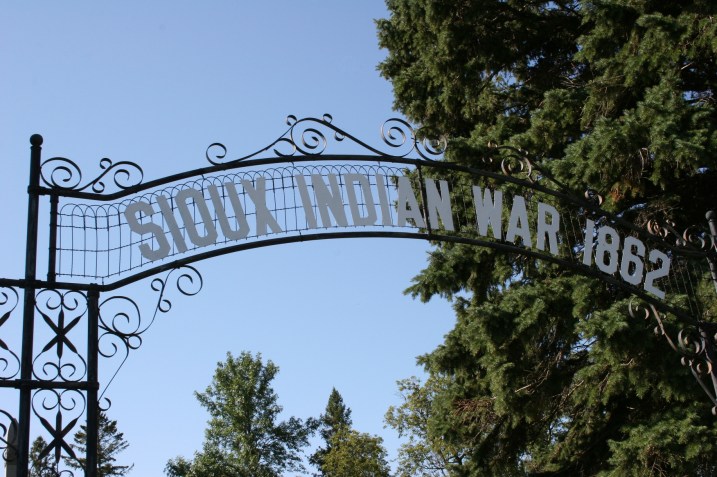
This archway leads to the Wood Lake State Monument, on the site of the battle ending the U.S.-Dakota Conflict.
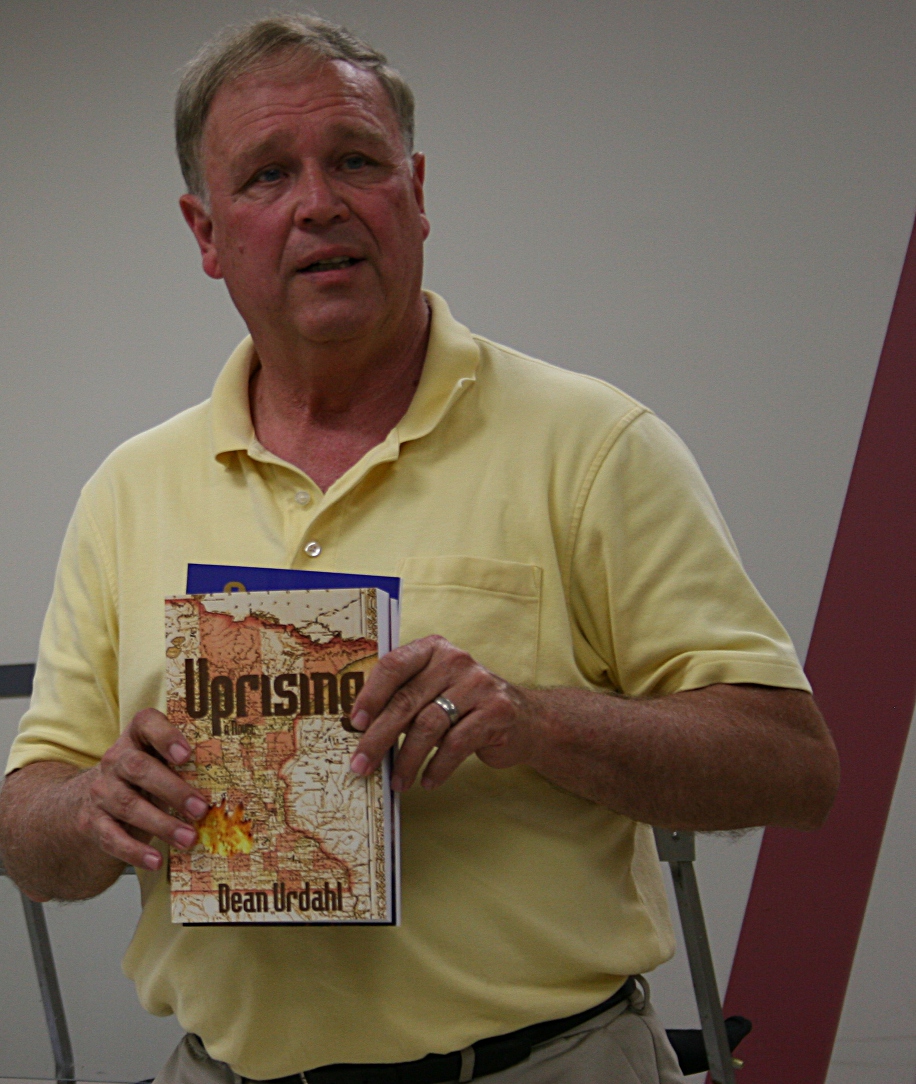
Dean Urdahl has written the trilogy of Uprising, Retribution and Pursuit.

I COULD HAVE LISTENED to Dean Urdahl for hours. Not Urdahl the Minnesota State Representative from District 18B. But Urdahl the historian, the retired American history teacher, the storyteller, the writer.

The southern Minnesota politician, who co-chairs the Minnesota Civil War Commemoration Task Force, was in Faribault Thursday evening to talk about the U.S.-Dakota War of 1862 and to promote his trilogy of historical fiction novels about that conflict.
Urdahl’s interest in the U.S.-Dakota War is rooted deep in family history, in the soil of Meeker County where his Norwegian immigrant ancestors settled in 1856 and where, on August 17, 1862, five settlers were killed by a small group of Dakota. That attack in Acton Township, only 1 ½ miles from Urdahl’s current home, marked the beginning of the war.
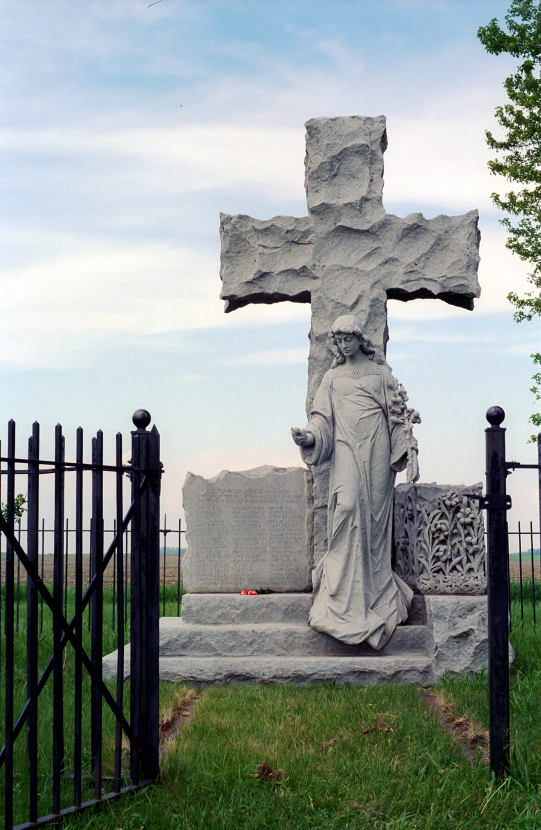
Urdahl’s great-great-grandfather helped bury those five victims in the cemetery of Ness Lutheran Church, a country church southwest of Litchfield. A monument there honors the five who were slain. The Representative grew up attending Ness Lutheran, listening to his mother tell stories about his ancestors and the area’s history. That sparked his interest in history and specifically a strong interest in the U.S.-Dakota War of 1862.

“What happened in 1862 (in Minnesota) is largely ignored by historians,” Urdahl said, adding that the U.S.-Dakota War “gets scant attention and deserves more.”

In 1862, a divided nation was more focused on the conflict between North and South than on the clash between cultures in Minnesota, Urdahl explained.

This historian, however, certainly drew attention to the war between the white settlers/soldiers and the Dakota during his presentation, “The Dakota War, a clash of cultures,” at the monthly Cannon Valley Civil War Roundtable meeting in Faribault in this, the 150th anniversary year of the War.

Cultures collided, Urdahl said, as immigrants settled in the native home of the Dakota and the government adopted a policy “to turn them (the Dakota) into farmers.”

Conflict also existed among the Dakota—between “the blankets,” those sticking to traditional ways, and “cut-hairs,” those turning into farmers, he said.

Speaking without notes and with the skill of a master storyteller passionate about his subject, Urdahl mesmerized his audience, sharing information and a story-style time-line of how the U.S.-Dakota War unfolded.

The Milford State Monument along Brown County Road 29 west of New Ulm commemorates the deaths of 52 settlers who were killed in the area. Located along the eastern edge of the Lower Sioux Reservation, Milford had the highest war death rate of any single township.

Urdahl’s talk was a refresher course for me, a native of Redwood County located at the geographical center of the War. I’ve always been interested in the conflict and even penned a term paper on “The Sioux Uprising of 1862,” as it was labeled when I was a high school student. My maternal ancestors lived in the New Ulm area in 1862 and were warned by friendly Indians to leave; the families fled to the safety of nearby St. Peter.

“We find throughout the war, friendly Indians warning people to leave,” Urdahl said.

That, and much of what this historian said, I already knew. You’ll find it written in books. But some of what Urdahl shared I had forgotten or never heard such as…

  • A drought in 1861 left the Dakota near starvation and relying on government food. (I didn’t recall the drought as preemptive to the desperate situation among the Dakota.)
  • In late July 1862, some 5,000 Dakota gathered at the Yellow Medicine Agency ready to storm the warehouses. Agents eventually released the storehouse of grain to the hungry Dakota, thus averting the start of the war for several weeks.
  • The settlers at Acton were challenged to a target shooting contest by the Dakota before they were killed.
  • The Dakota were intent on attacking New Ulm because they thought the town was built on reservation land. The reservation covered a 10-mile by 150-mile area along the Minnesota River.
  • From 500 – 800 Minnesotans were killed/died during the six-week war, only 75 of whom were soldiers. “The rest,” said Urdahl, “were Swedish, German and Norwegian immigrants who didn’t know what was going on.”
  • Although there is not an accurate count on the number of soldiers who died in the Battle of Birch Coulee, the count of dead horses stands at 90. “They could replace men, not horses,” Urdahl said.
  • When Fort Ridgely was under attack, fort leader Lt. Thomas P. Gere was coming down with the mumps.
  • During the final battle at Ft. Ridgely, doors on both ends of the surgeon’s quarters/headquarters were opened and a cannon ball fired down the hallway toward the stables where the Dakota were stationed.
  • A Confederate officer was reportedly spotted in Little Crow’s (Dakota leader) camp. Some speculate that the Confederacy played a role in the U.S.-Dakota War of 1862, thus diverting soldiers from the Confederate front by keeping them in Minnesota to fight the Dakota.
  • Little Crow lived in a brick house at the time of the War.

Trader Andrew Myrick refused to grant the Dakota credit, remarking, “Let them eat grass.” After an attack on the Lower Agency, Myrick was found dead, his mouth stuffed with grass.

The message on a marker near the Lower Sioux Agency reads: 75 feet north stood the building in which upwards of 100 Sioux Indians were tried by court martial, convicted and sentenced to death Nov. 1862.

As I listened to Urdahl’s presentation, I wondered how Native Americans would react to the information he shared. What perspective would they offer? Would they disagree with him, challenge his facts, voice their opinions? How would they feel?

“There are still very hard feelings on both sides,” this descendant of Norwegian immigrants told his audience. He occasionally gets e-mails from angry descendants of settlers killed during the U.S.-Dakota War.

Growing up in Redwood County decades ago, I was well aware of the animosity between whites and the Dakota passed down through the generations. I know the bad feelings still linger on both sides.

But perhaps in this 150th anniversary year, we can all (white and Dakota) strive to overcome, to understand and to, finally, forgive.

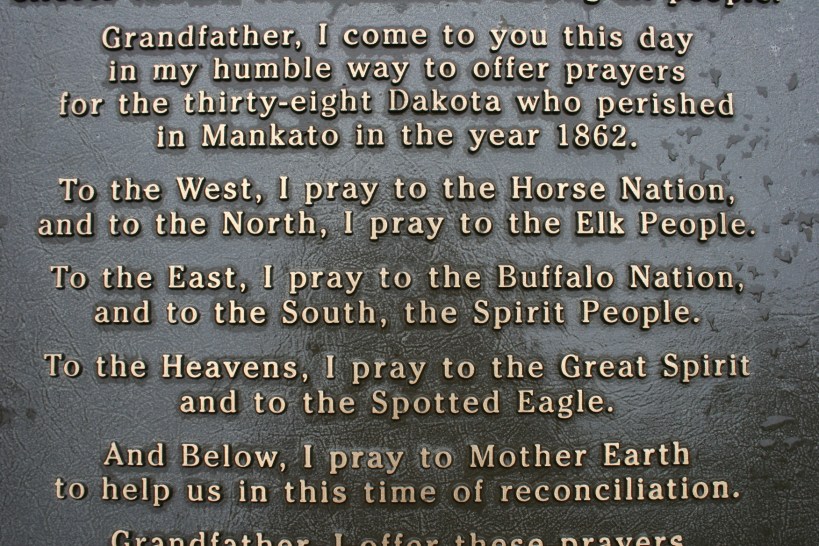
Words on a marker in Reconciliation Park in Mankato where 38 Dakota were hung on December 26, 1862. This stands as the largest mass execution in American history. Initially, 303 were sentenced to death. President Abraham Lincoln approved the deaths of 39 and granted a last-minute reprieve to one other.

FYI: All of the above monument images were photographed within the past several years.

© Copyright 2012 Audrey Kletscher Helbling