Minnesota Prairie Roots

Writing and photography by Audrey Kletscher Helbling

Award-winning book addresses slavery in compelling stories, haunting art February 21, 2024

I CAN’T IMAGINE a world without books. From the time I was first read to and then learned to read as a young child, I have loved books. From books, I’ve learned, I’ve escaped, I’ve broadened my world well beyond southern Minnesota.

From reading the writing of others, I’ve grown, too, as a writer. Laura Ingalls Wilder, in her Little House books, taught me the importance of detail, of setting, in writing. I grew up on the prairie, some 20 miles from Walnut Grove, once home to the Ingalls family. A grade school teacher read the entire Little House series to me and my classmates. Books have, in many ways, shaped me.

Book cover image sourced online.

But imagine a world without books. That was a reality for slaves in America, denied access to books and to education. I just finished reading Kin: Rooted in Hope, written by Carole Boston Weatherford and illustrated by her son, Jeffery Boston Weatherford. The young adult book, published by Atheneum Books for Young Readers, was named a Coretta Scott King Author Honor Book 2024. It is a book that ought to be read by everyone not only for its insightful poetry-style storytelling, but also for its haunting scratchboard art.
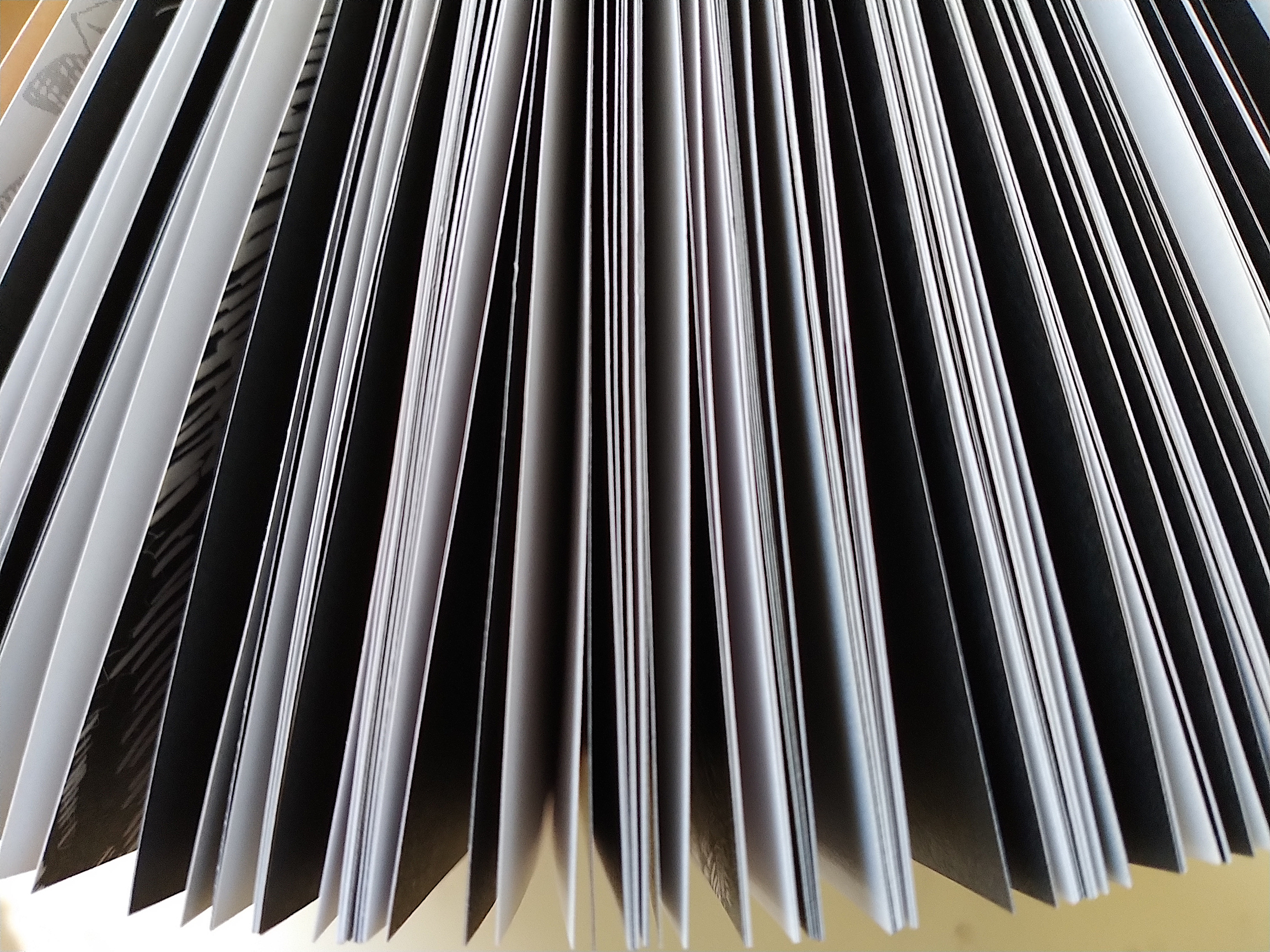
Looking down on the pages of the book with a mix of black and white paper. (Minnesota Prairie Roots copyrighted photo February 2024)

Adding to the overall subliminal effect is the way in which the book is printed. Black words ink white paper. White words imprint black pages. And the artwork is made by etching away black ink to reveal white. This mixed usage of black and white, reinforces the storyline of slavery and slave owners. Black. White.

As I read Kin, which I pulled from a book display for kids and teens at my local library, I was increasingly horrified by what I read. Sure, I’ve read about slavery in history books. But this approach of historical fiction really brought home the ugliness, the abuse, the violence, the awfulness of slavery in a personal way. Fiction rooted in truth.

Children born into slavery. Whippings. An auctioneer’s gavel. Names written on an inventory list along with commodities. Jemmy. Big Jacob. Lyddia. Tom. Walter. Isaac. Mush ladled into a trough. Swimming banned lest an escape to freedom be attempted. And on and on. Atrocities that seem unfathomable to inflict upon individuals chained in Africa, sailed to Maryland, sold, abused, treated like property by wealthy white families.

Photo used for illustration only. (Minnesota Prairie Roots copyrighted file photo)

But in the all of this, threads of kinship, endurance, strength and hope, even defiance, run. Perhaps my favorite line in the book is that of Prissy, a house servant waiting on a dinner guest. He leers at her, making an inappropriate comment. She wants to tell him that she spit in his soup. At this point half way into the book, I applaud her unstated rebellion. As the chapters unfold, so does the move toward freedom for slaves. The author writes of freedom at last and of current day issues (controversial statues in public places, the murder of George Floyd…), all interspersed with a whole lot of history (including historic figures like Frederick Douglass and Harriet Tubman…).

Even though this book is written for young adults, it should be read by older adults, too, who need to hear Prissy’s defiant voice. Author Carole Boston Weatherford gives voice to those who endured slavery, and to those whose family histories trace to enslavement, including her ancestors. Her son’s detailed scratchboard art reinforces the story, the words which wrench the spirit.
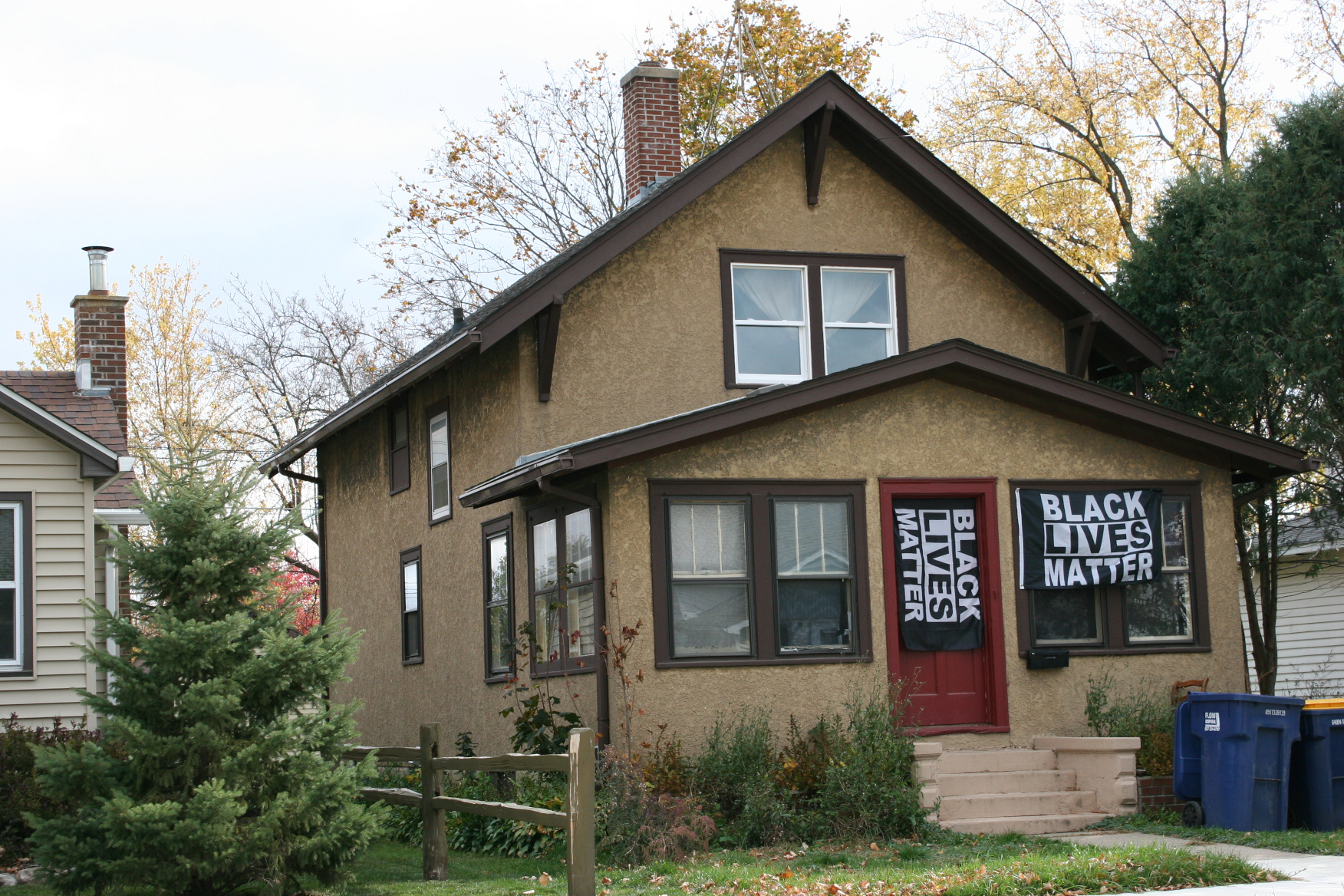
I photographed this scene in 2020 in Kenyon, MN. It remains one of my favorite images of this message given its location in a small town. (Minnesota Prairie Roots copyrighted file photo October 2020)

Kin: Rooted in Hope proves an especially fitting read during February, Black History Month. Through this book of historical fiction, I’ve learned more about a part of U.S. history which is horrendous in every possible way. That humanity can treat humanity so atrociously seems unfathomable…until I consider underlying and outright racist attitudes which continue yet today.

© Copyright 2024 Audrey Kletscher Helbling


Johnston Hall film screening at historical society December 15, 2023

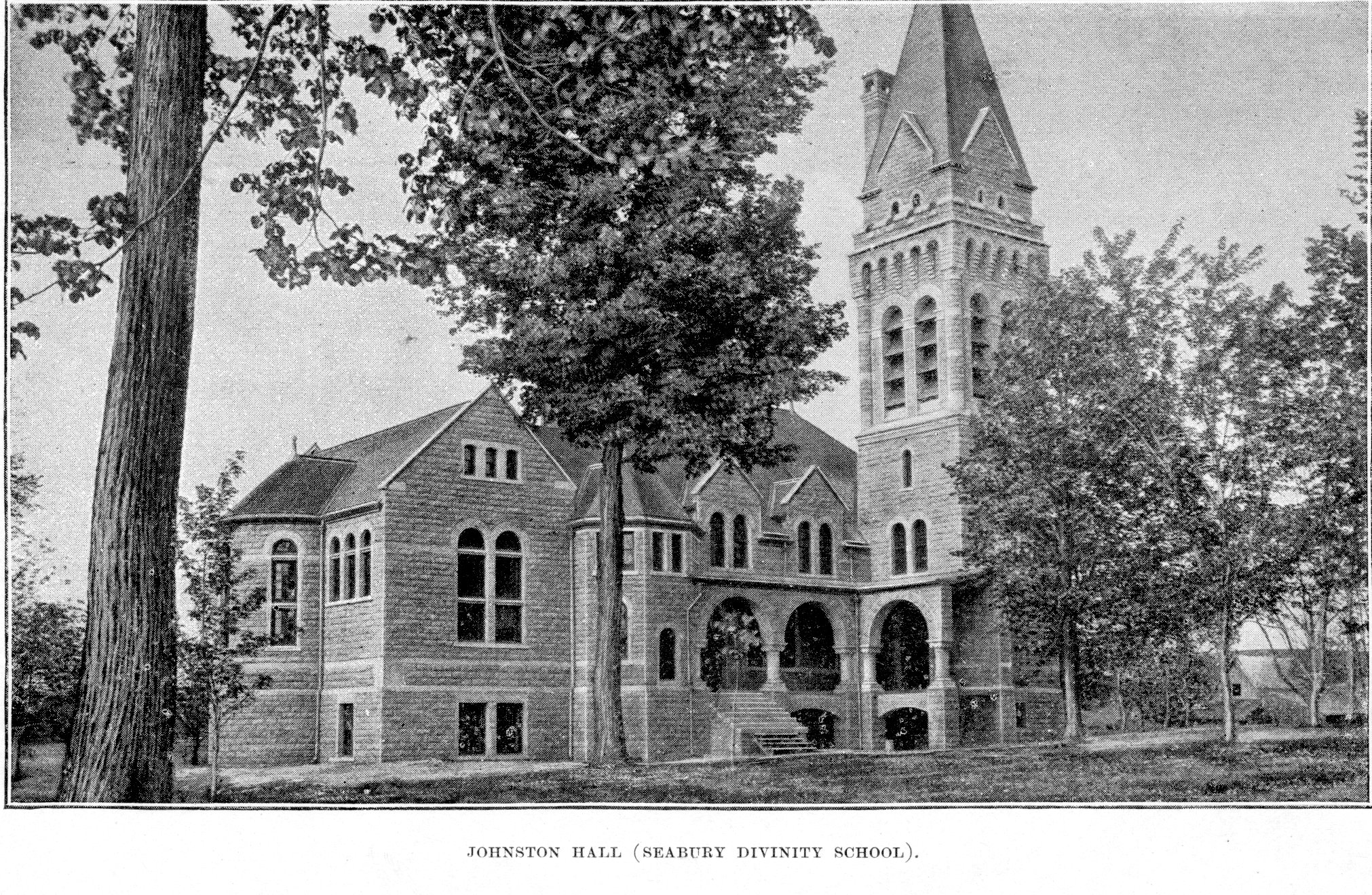
Johnston Hall, date unknown. (Photo courtesy of Rice County Historical Society)

IN EARLY NOVEMBER, I watched a local documentary online about Johnston Hall in the comfort of my home office. The film, “Love Inwrought: Johnston Hall and the Memory of a Building,” was created by Sam Temple and Logan Ledman. The ambitious and talented young filmmakers have, since their high school days, focused on local history through their 1855 History Team (Steamboat Media Co.). Their latest project focuses on Johnston Hall, completed in 1888 as part of Seabury Divinity School. The building was demolished in 2021 after standing on Faribault’s east side for 133 years.

Sam Temple, left to right, Logan Ledman and Troy Temple. (Photo courtesy of 1855 History Team)

This Saturday, December 16, the duo will present a public screening of their film at the Rice County Historical Society in Faribault from 5:30-6:30 pm. And while I am not able to be there, I encourage anyone interested in Johnston Hall and the fine work of writers and directors Temple and Ledman to attend.

A Q & A follows the screening. Attendees are encouraged to share their stories about Johnston Hall, which saw many uses through the years.

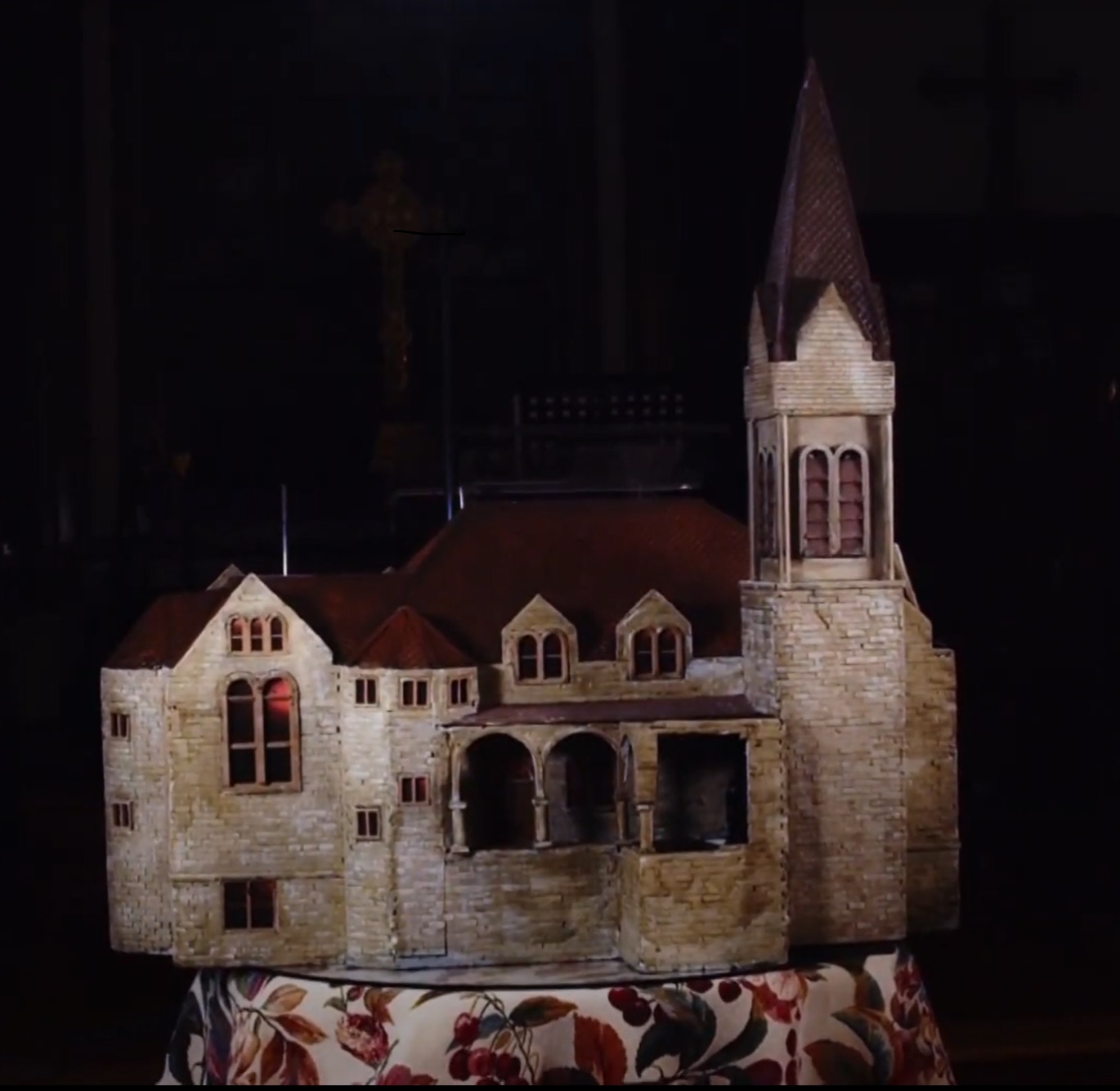
Johnston Hall model. (Photo courtesy of 1855 History Team)

But that’s not all. A model of the building handcrafted by Rathbun Reliquilaries plus artifacts and architectural items saved by the historical society will also be available for viewing.

Saturday’s event offers an ideal opportunity to learn more about Johnston Hall and to meet members of the team that worked diligently to create the documentary. Besides Temple and Ledman those include Troy Temple, illustrator Piper Mohring, composer Sam Dwyer, and actors Steve Searl (portraying Bishop Henry Whipple) and Eli Hastings (as the Rev. Henry St. Clair).

Documentary promo. (Courtesy of 1855 History Team)

According to Sam Temple, the title of the documentary traces to a quote by Bishop Whipple: “There is an unwritten history of faith and love inwrought in every building erected here.” The Episcopalian bishop was referencing buildings (including Johnston Hall) at the schools he helped organize.

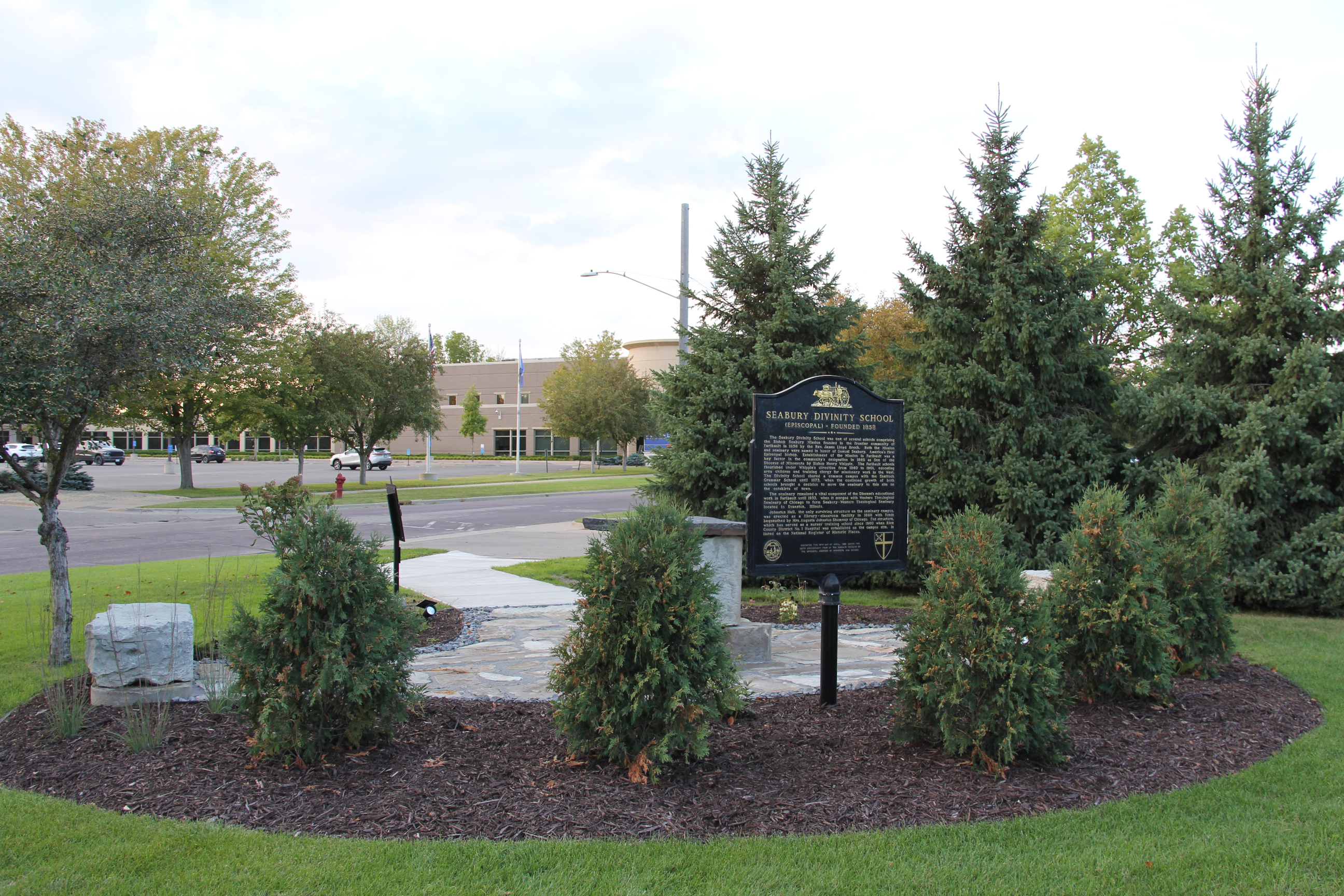
This signage stands at Johnston Hall Memorial Garden across the street from the local hospital and clinic. (Minnesota Prairie Roots copyrighted file photo August 2023)

The work of Temple, Ledman and their team is top-notch professional, outstanding and deserving of accolades. These young men are passionate about history, storytelling, filmmaking and creating an appreciation for our past. Their enthusiasm and work impress me. I can’t wait to see what they do next.

FYI: To read my review of “Love Inwrought,” click here.

© Copyright 2023 Audrey Kletscher Helbling


Learning about Indigenous peoples from “The Forever Sky” November 27, 2023

(Minnesota Prairie Roots copyrighted file photo September 2022)

IN THE PAST YEAR, my desire to learn more about Native American culture has heightened. My new interest followed a talk in September 2022 by then Rice County Historical Society Director Susan Garwood about “The Indigenous history of the land that is now Rice County, Minnesota.” This county, this community, in which I live was home first to Indigenous peoples, long before the first settlers, the fur traders, the Easterners who moved west.

This sculpture of Alexander Faribault and a Dakota trading partner stands in Faribault’s Heritage Park near the Straight River and site of Faribault’s trading post. Ivan Whillock created this art which sits atop the Bea Duncan Memorial Fountain. (Minnesota Prairie Roots copyrighted file photo)

I knew that, of course. But what I didn’t know was that the Wahpekute, one of the seven “Council Fires” of the Dakota Nation, used the current-day Wapacuta Park just up the hill from my house for honoring their dead.

This Faribault city park, where my kids once zipped down a towering slide, clamored onto a massive boulder, slid on plastics sleds, was where the Wahpekute many years ago placed their dead upon scaffolding prior to burial. That ground now seems sacred to me.

That it took 40 years of living here to learn this information suggests to me that either I wasn’t paying attention to local history or that my community has not done enough to honor the First Peoples of this land.

(Book cover sourced online.)

Whatever the reason, I have, on my own, decided to become more informed about Indigenous peoples. And for me, that starts with reading. I recently headed to the children’s section of my local library and checked out the book, The Forever Sky, written by Thomas Peacock (a member of the Fond du Lac Band of Lake Superior Anishinaabe Ojibwe) and illustrated by Annette S. Lee (mixed-race Lakota-Sioux of the Ojibwe and Lakota-Sioux communities).

These two Minnesotans, in their collaborative children’s picture book, reveal that “the sky and stars all have stories.” Oh, how I value stories. And the stories shared in this book, these sky stories, are of spirits and animals and the Path of Souls, aka The Milky Way, and…

I especially appreciate the book’s focus on the northern lights, explained as “the spirits of all of our relatives who have passed on.” The descriptive words and vivid images make me view the northern lights, which I have yet to see in my life-time, through the eyes of Indigenous peoples. The changing blues and greens are their loved ones dancing in the night sky. Dancing, dancing, dancing. How lovely that imagery in replacing loss with hope and happiness.

The Forever Sky has created an awareness of Native culture previously unknown to me. Just like that talk a year ago by a local historian aiming to educate. I have much to learn. And I am learning via books found not only in the adult section of the library, but also among the children’s picture books. That writers and illustrators are covering topics of cultural importance in kids’ books gives me hope for the future. My grandchildren, even though they will never see the vast, dark, star-filled sky I saw nightly as a child of the prairie, are growing up much more informed. They will understand cultures well beyond their own heritage. And that encourages me.

© Copyright 2023 Audrey Kletscher Helbling


New film focuses on the people & stories of Johnston Hall November 7, 2023

This undated photo of Johnston Hall is courtesy of the Rice County Historical Society.

AS A WRITER AND PHOTOGRAPHER, I understand the power of storytelling. That focuses my work. I strive to connect with readers in a meaningful and personal way via images and words.

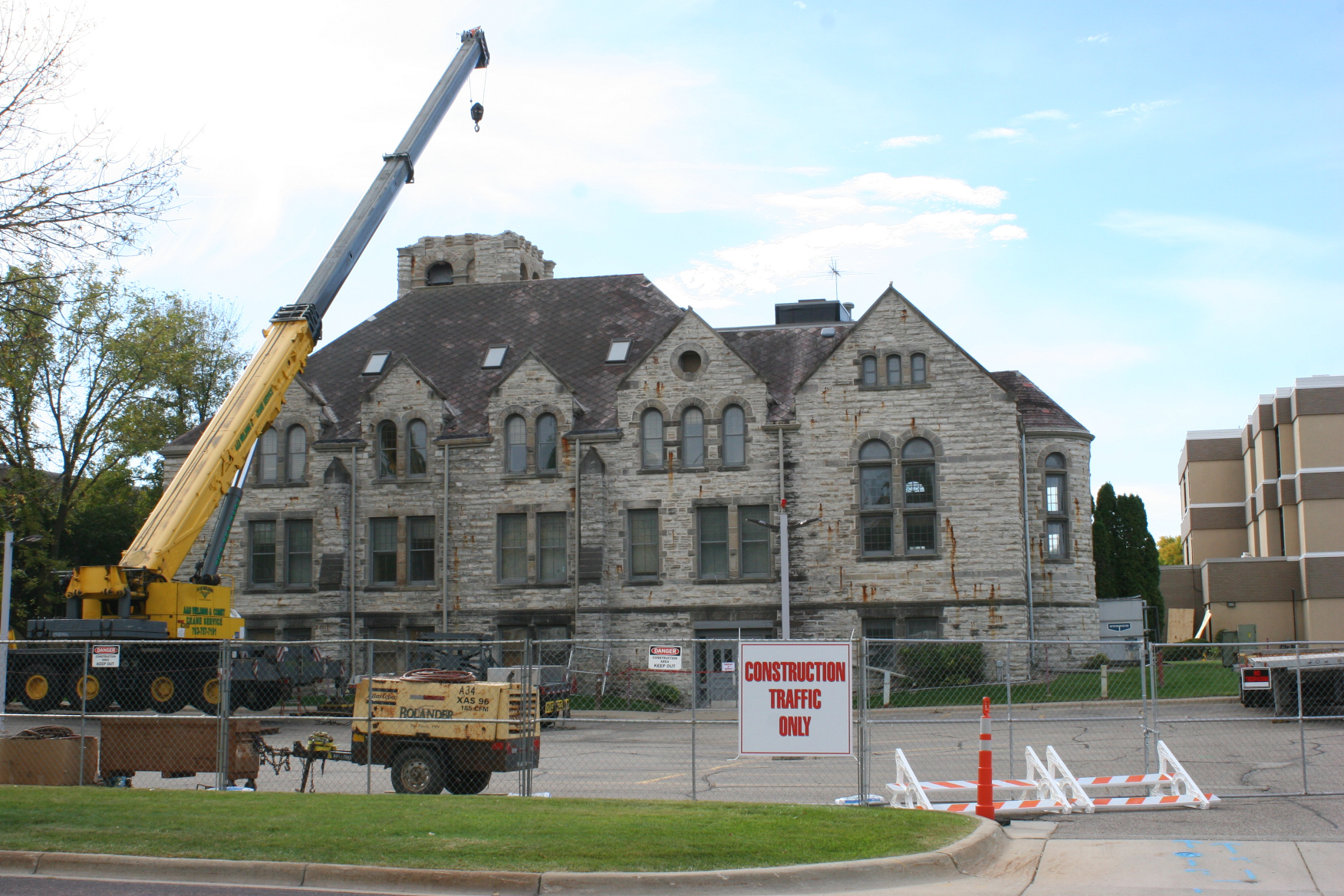
Johnston Hall, photographed shortly before it was demolished. (Minnesota Prairie Roots copyrighted photo September 2021)

And so storytelling is the approach I intended to take in writing about Johnston Hall. A building constructed in 1888 on Faribault’s east side. A building which once centered learning, then healthcare. A building placed on the National Register of Historic Places. A building that did not, physically, withstand the ravages of time and weather. A building which in 2021 was demolished, but not without efforts to save it.

The QR code on the sign links to the new documentary on Johnston Hall. (Minnesota Prairie Roots copyrighted photo August 2023)

Johnston Hall is not only part of my family’s story, but of the larger community, of Faribault’s history for 133 years. Now filmmakers Samuel Temple and Logan Ledman of the local 1855 History Team (Steamboat Media Company) have released their newest documentary, “Love Inwrought: Johnston Hall and the Memory of a Building.”

This shows the back of Johnston Hall Memorial Garden, looking toward Allina Health Faribault Medical Center. The garden is next to an employee parking lot. The bronze Seabury Divinity School plaque was saved from the hall and focuses the garden. (Minnesota Prairie Roots copyrighted photo August 2023)

I need to backtrack for a moment, though, to late August, when I photographed Johnston Hall Memorial Garden, located along State Street on the campus of the Allina Health Faribault Medical Center. The recently-completed garden honors the history of Johnston Hall and provides a contemplative space to reflect. For me, that’s remembering the time I spent, along with loved ones, in the aged building that once sat north of the hospital and clinic, northwest of the new garden.

Image credit: 1855 History Team Facebook page

In their Johnston Hall documentary, the filmmakers weave together history, memories, stories. Temple states that “…each soul passing through a building is a part of its memory, its identity and its legacy.” That is the singular line which stands out for me, the line defining Johnston Hall as more than a building that once stood tall, grand and strong, initially as part of Seabury Divinity School. Johnston Hall is part of so many personal stories, including mine.

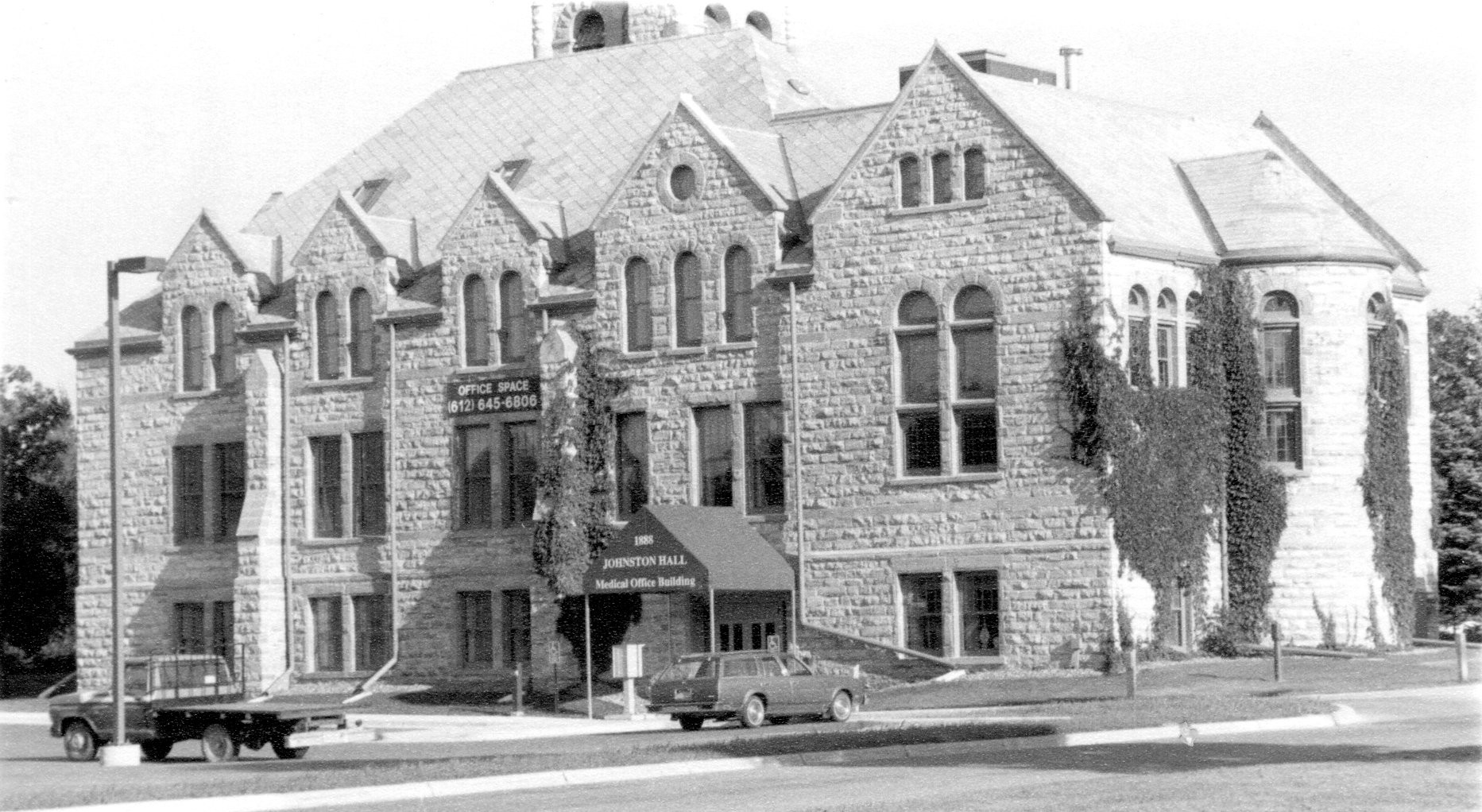
Johnston Hall in a 1990 image, as a Medical Office Building. (Photo courtesy of the Rice County Historical Society)

While I don’t recall the exact year I first walked through the doors of this stately limestone Romanesque architectural style structure, it was after an orthopedic and fracture clinic moved into the building. That followed histories of usage as the divinity school (closed in 1933) library and classrooms, a nurses’ training school and then a vocational-technical school.

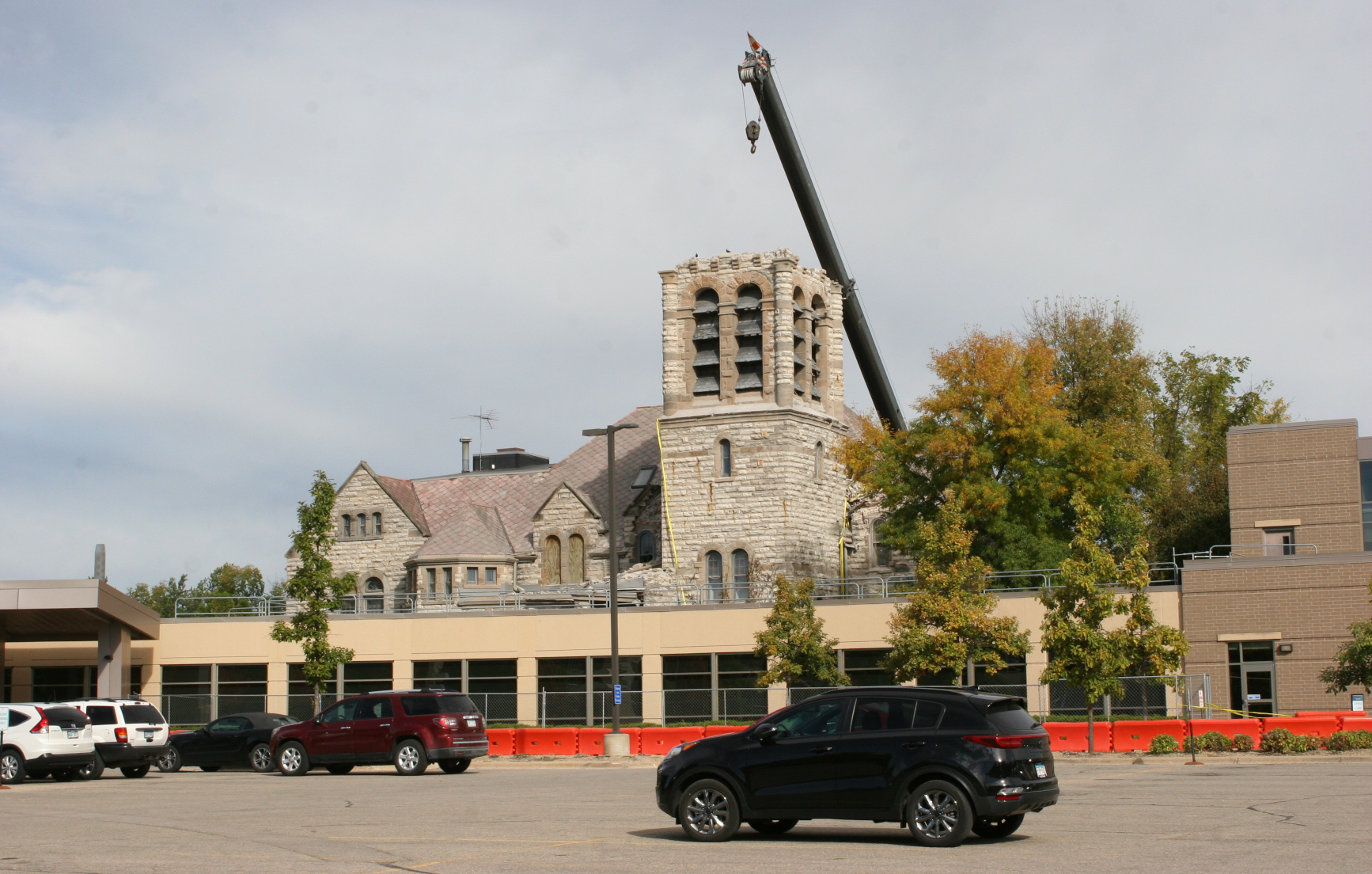
Johnston Hall photographed from the parking lot of the hospital and clinic. (Minnesota Prairie Roots copyrighted photo September 2021)

Broken bones and other health issues landed me and my family inside Johnston Hall. As a grade schooler, my son broke his little finger while unicycling in our driveway. In 2006, he was back at Johnston Hall, this time with a rib fracture and a broken bone in his hand after a hit-and-run driver struck him while he crossed the street to his bus stop. The same morning of that May 2006 scare, while my husband and son were in the hospital emergency room, I wound my way to nearby Johnston Hall for an appointment with an orthopedic doctor. I had waited too long to cancel my appointment, although I desperately wanted to stay by my son’s side in the ER.

On that May morning, I learned that I would eventually need right hip replacement surgery due to osteoarthritis. I delayed that surgery until 2008. The stairway and waiting room and exam rooms of Johnston Hall soon grew all too familiar.

To my second daughter also, who was screened for scoliosis in junior high and then referred to the medical team at Johnston Hall. Eventually her spinal curvature required wearing a customized, full body, hard plastic back brace 24/7 for a year. It was the first time I cried at Johnston Hall.

Stone was saved from Johnston Hall and incorporated into the memorial garden, including stone marking the hall as a gift from Augusta Huntington. (Minnesota Prairie Roots copyrighted photo August 2023)

In many ways, Johnston Hall and tears are intertwined. As the filmmakers share in their documentary, funding for the hall came from Augusta Huntington, formerly Augusta Shumway. Horatio Shumway left tens of thousands of dollars to his grieving widow. She used his gift to fund construction of Good Shepherd Chapel and then Shumway Hall in honor of Horatio. Both sit on the campus of the current-day Shattuck-St. Mary’s School, a private college prep school. In 1888, construction of Johnston Hall was completed, the cornerstone laid. The hall was a final bequeath from Augusta, who died in 1884. The building honors her father, William Johnston.

Up close, historic Johnston Hall shortly before its demolition. (Minnesota Prairie Roots copyrighted photo September 2021)

“Love Inwrought: Johnston Hall and the Memory of a Building” features much more in-depth history, including the connection between Minnesota’s first Episcopal bishop, Bishop Henry Whipple (who called Faribault home), and Augusta Shumway. The filmmakers also highlight Henry St. Clair, a Dakota man who attended Seabury Divinity School, studying inside the library and classrooms of Johnston Hall. He became an ordained deacon and then a pastor. Indigenous peoples are an integral part of Faribault’s history and I appreciate that these filmmakers focus on that, too, in their latest work.

Incorporated into Johnston Hall Memorial Garden, the 1888 cornerstone. (Minnesota Prairie Roots copyrighted photo September 2023)

In their well-researched documentary, Temple and Ledman use historical photos, illustrations, even a building model, actors, original music (composed by Sam Dwyer) and narration to tell the stories of Johnston Hall. Theirs is, indeed, a work of love, revealing how love inwrought takes a building beyond wood and limestone to memories abiding within the souls of those who’ve passed through its doors.

FYI: To view this documentary film, click here.

Please check back for a follow-up story featuring a closer look at Johnston Hall Memorial Garden.

© Copyright 2023 Audrey Kletscher Helbling


Bison: History, cultural importance, a film & a poem October 12, 2023

Minneopa State Park near Mankato is home to 30-40 bison fenced on 325 acres of primarily prairie. (Minnesota Prairie Roots copyrighted file photo 2019)

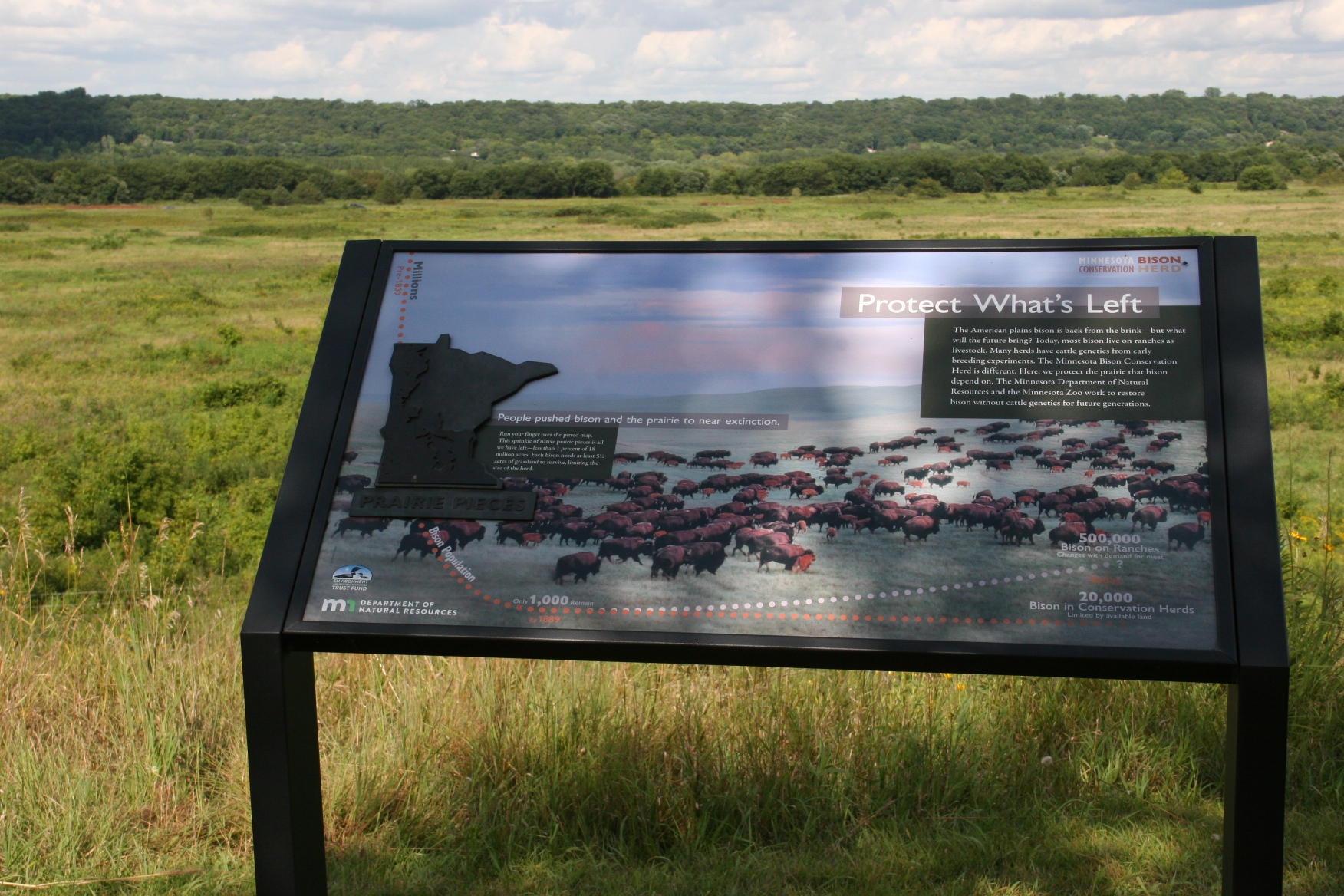
THEY ARE MASSIVE BEASTS, once roaming the American Great Plains by the millions. They are bison, also called buffalo, today numbering some 370,000 in North America. Most are raised as livestock. But some 31,000, or eight percent, are part of conservation herds, including right here in Minnesota. Such herds are designed to protect wild bison and preserve their genetic diversity.

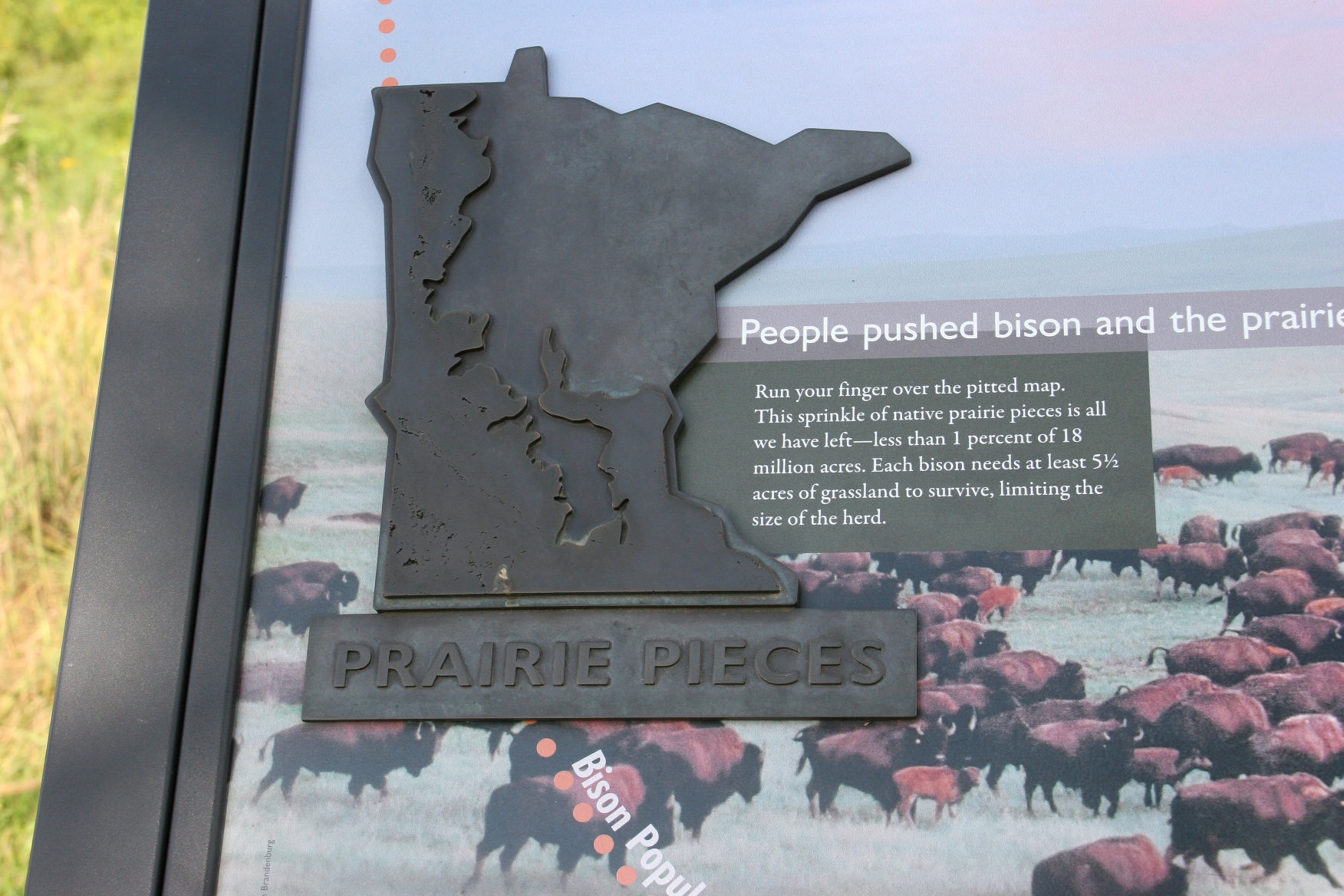
Interpretive signage about bison overlooks the prairie at Minneopa State Park. (Minnesota Prairie Roots copyrighted file photo 2019)

An upcoming documentary, “The American Buffalo—A Story of Resilience” by awarding-winning filmmaker Ken Burns, and my own recently posted poem about bison prompted my renewed interest in this animal. Burns’ 4-hour film airs in two parts, at 7 pm on Monday, October 16, and on Tuesday, October 17, on PBS. His documentary traces the history of bison, their importance in Native peoples’ lives and culture, their near extinction, and efforts to bring them back.

Bison up close while driving through Minneopa State Park. (Minnesota Prairie Roots copyrighted file photo 2019)

My connection to bison began decades ago with childhood visits to Ramsey Park (in Redwood Falls), now also more appropriately called Cansayapi Park. Cansayapi in the Dakota language means “where they marked the trees red,” the traditional Minnesota River valley homeland of the Dakota. The Lower Sioux Indian Community is located near nearby Morton with an enrolled membership of 930 of the Mdewakanton Band of the Dakota.

A map, posted in Minneopa State Park, shows the prairie and historic bison territory in Minnesota. (Minnesota Prairie Roots copyrighted file photo 2019)

Given the region’s rich Native heritage, the presence of a small group of bison in the Ramsey Park Zoo seems fitting. I recall rushing to see the buffalo there, both excited and intimidated by their massive hulk. Today I’m not so much afraid as respectful of their size and their importance in Indigenous Peoples’ culture.

A sculpture of White Buffalo Calf Woman, part of Indigenous culture, displayed at the 2011 Mankato City Art Walking Sculpture Tour. Artwork by Lee Leuning and Sherri Treeby. (Minnesota Prairie Roots copyrighted file photo 2011 by Audrey Kletscher Helbling)

One need only look back in history to see how invaluable bison were to these original inhabitants of the prairie, the plains. Bison provided food, shelter, clothing and more to Indigenous Peoples. They also held spiritual and cultural significance. Bison were considered kin, respected by those who respected Mother Earth.

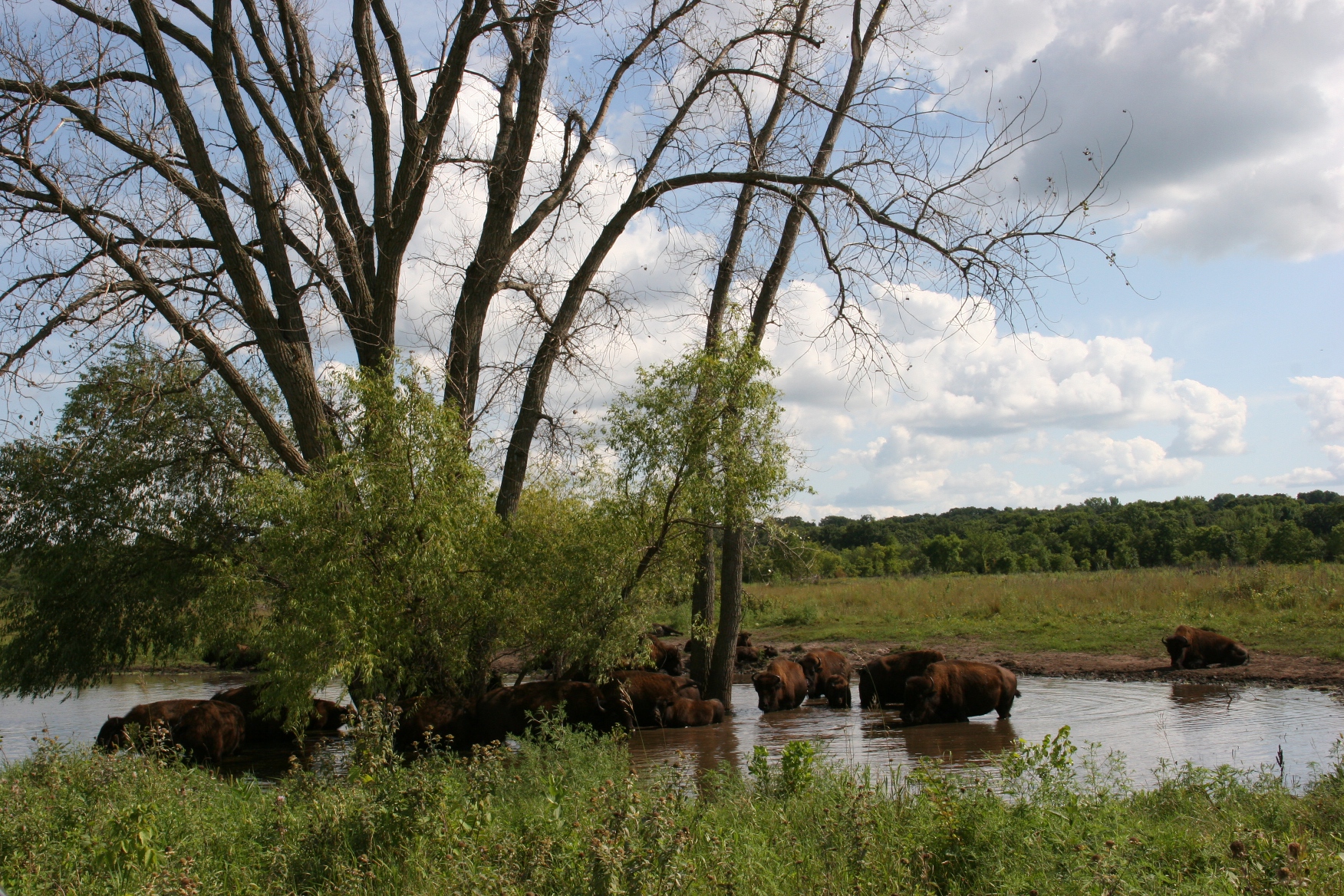
Bison at Minneopa State Park watering hole. (Minnesota Prairie Roots copyrighted file photo 2019)

And then the white man came in the 1800s, overtaking the land, nearly driving bison to extinction as they hunted and slaughtered the animal primarily for their hides.

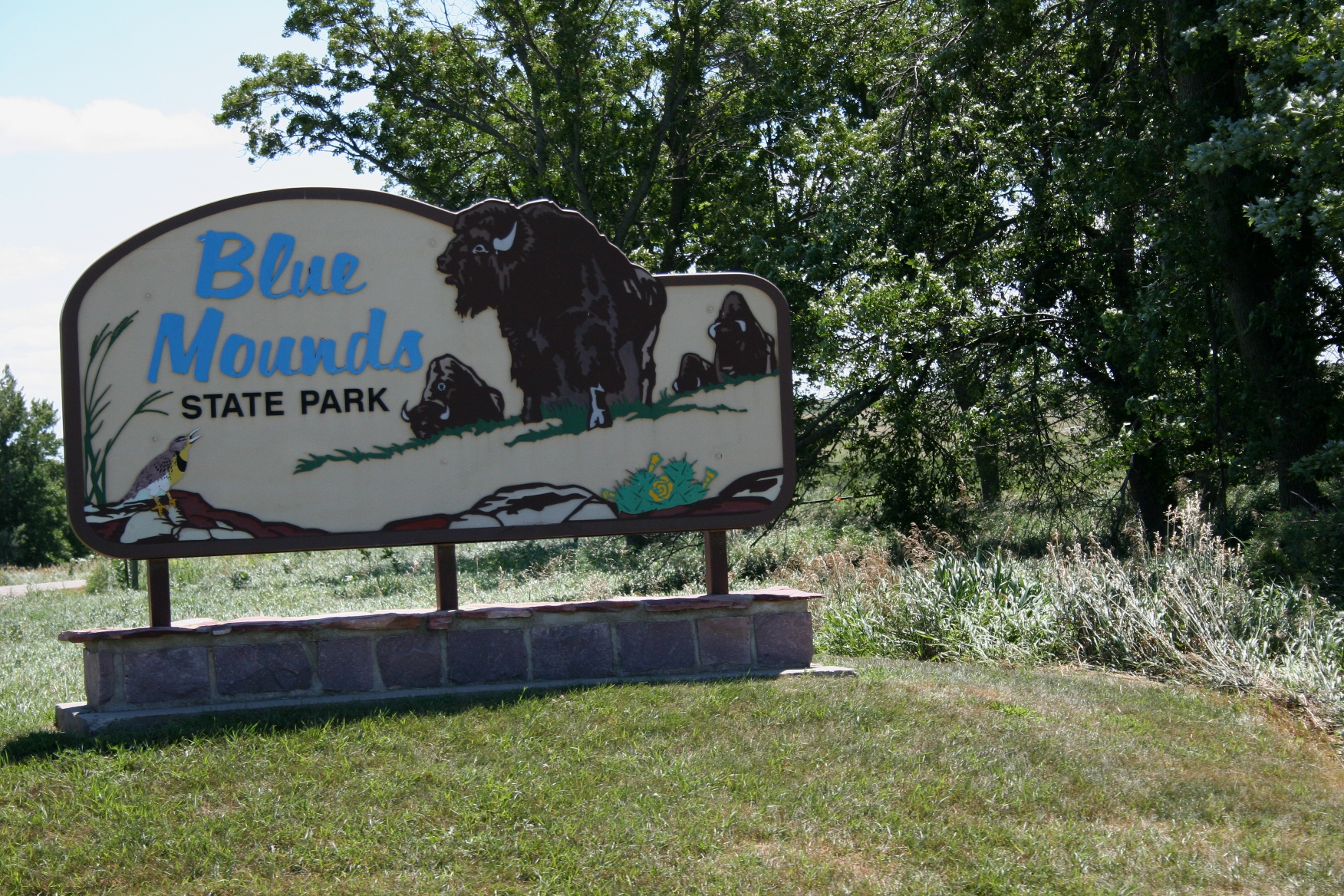
Blue Mounds State Park in rural Rock County, Minnesota, is home to 80-90 bison, although I did not see them when I visited the park in 2013. (Minnesota Prairie Roots copyrighted file photo 2013)

And so the story of bison is not only one of past atrocities in American history, but also one of personal history for me with those fenced bison in Minnesota’s largest municipal park, known as “The Little Yellowstone of Minnesota” for its beautiful natural topography seemingly like Yellowstone National Park. Yellowstone, the one in Wyoming, is home to nearly 6,000 bison.

A sign along the prairie’s edge at Minneopa State Park informs about bison in Minnesota. (Minnesota Prairie Roots copyrighted file photo 2019)

In my youth, I didn’t understand the importance of bison in Native culture. I simply delighted in seeing them in the zoo at then Alexander Ramsey Park in my native Redwood County. Neither did I recognize how offensive the name of the park I loved as a child—Alexander Ramsey Park. Alexander Ramsey served as our first territorial governor and then as the second state governor of Minnesota during the US-Dakota War of 1862. He offered a bounty to anyone who killed a Dakota person and called for Indigenous Peoples to be driven out of Minnesota.

This 67-ton Kasota limestone sculpture stands in Reconciliation Park in Mankato. It symbolizes the spiritual survival of the Dakota People and honors the area’s Dakota heritage. The park is the site of the largest mass hanging in U.S. history. (Minnesota Prairie Roots copyrighted file photo 2019)

With that backstory and an understanding of a period in Minnesota history marked by hatred and injustices, I paid homage to bison in a poem now gracing a sign in Mankato. Mahkato, a Dakota word which means “blue earth,” was the site of the largest mass execution in the United States on December 26, 1862. Thirty-eight Dakota, sentenced to death in sham trials for their roles in the US-Dakota War, were hung in Mankato.

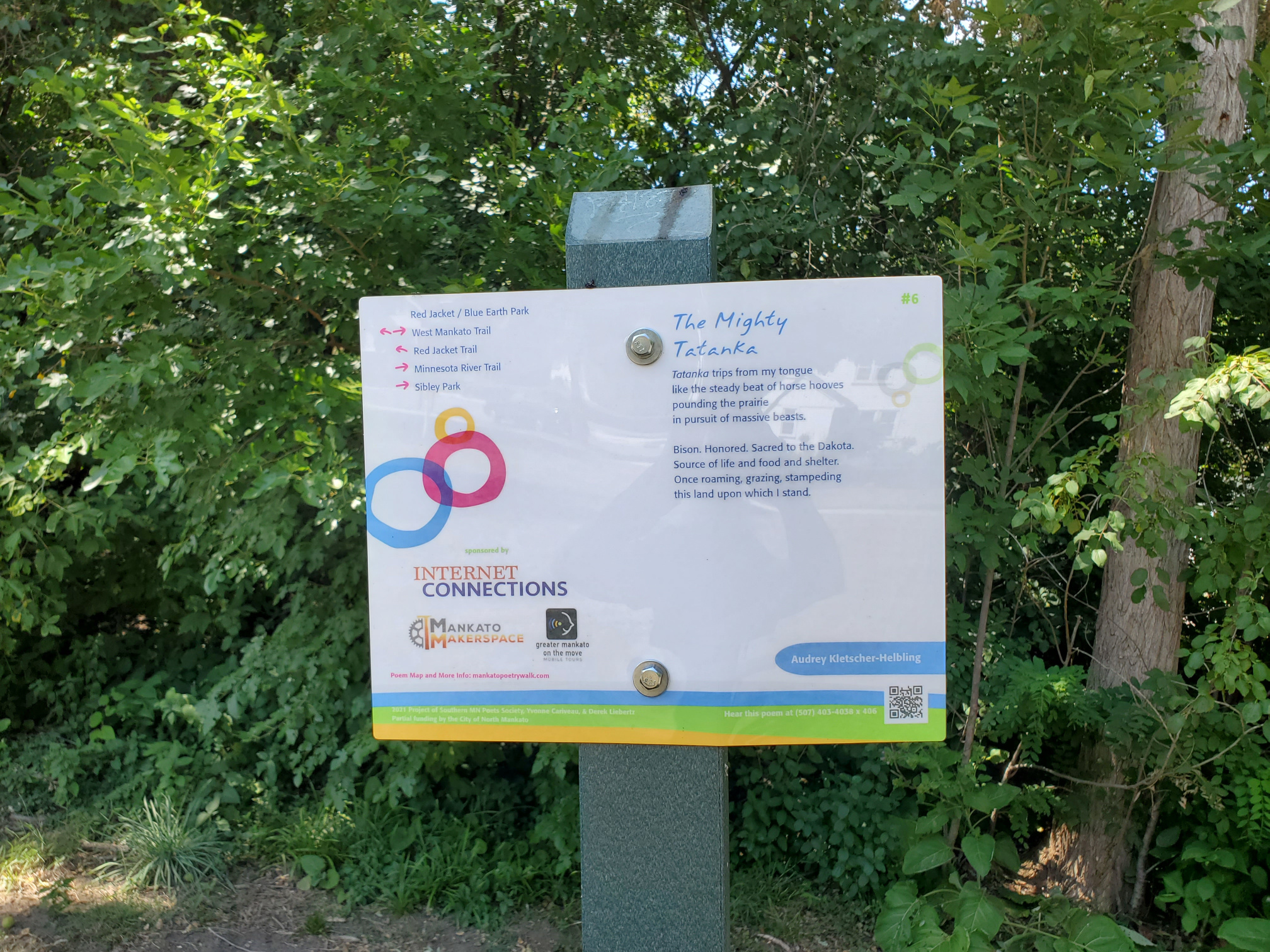
My poem posted along a recreational trail in Mankato. (Photo credit: Kay Herbst Helms)

I wanted to honor the original inhabitants of Mahkato, the bison, the Native culture, the land. And so I wrote “The Mighty Tatanka,” using the Dakota word for bison. My poem was selected for inclusion in the Mankato Poetry Walk & Ride and is posted on a sign in West Mankato.

The Mighty Tatanka

Tatanka trips from my tongue
like the steady beat of horse hooves
pounding the prairie
in pursuit of massive beasts.

Bison. Honored. Sacred to the Dakota.
Source of life and food and shelter.
Once roaming, grazing, stampeding
this land upon which I stand.

While my poem is succinct, limited by wordage requirements in the poetry competition, I’d like to think “The Mighty Tatanka” is powerful. It holds not only the rhythm of carefully selected words, but a story. A story of bison, of Indigenous Peoples, of a way of life, of a culture. It holds, too, honor for the land and of those who first inhabited, and respected, it.

#

FYI: My poem is posted on a sign along the West Mankato Trail near the intersection of Owatonna Street and Blue Earth and Sylvia Streets in West Mankato. You can listen to me read my poem by calling 507-403-4038 and entering 406.

Noted Minnesota wildlife photographer Jim Brandenberg’s (right in video) work, including this image of bison, is featured in a gallery bearing his name in Luverne, near Blue Mounds State Park. (Minnesota Prairie Roots copyrighted file photo 2013)

To see Minnesota Bison Conservation Herd bison in Minnesota, visit Minneopa State Park near Mankato, Blue Mounds State Park near Luverne, the Minnesota Zoological Garden, Oxbow Park & Zollman Zoo by Byron, and Spring Lake Park Reserve Bison Prairie in Dakota County.

© Copyright 2023 Audrey Kletscher Helbling


A look at Taopi, plus an overview of failures, injustices & war in Minnesota October 9, 2023

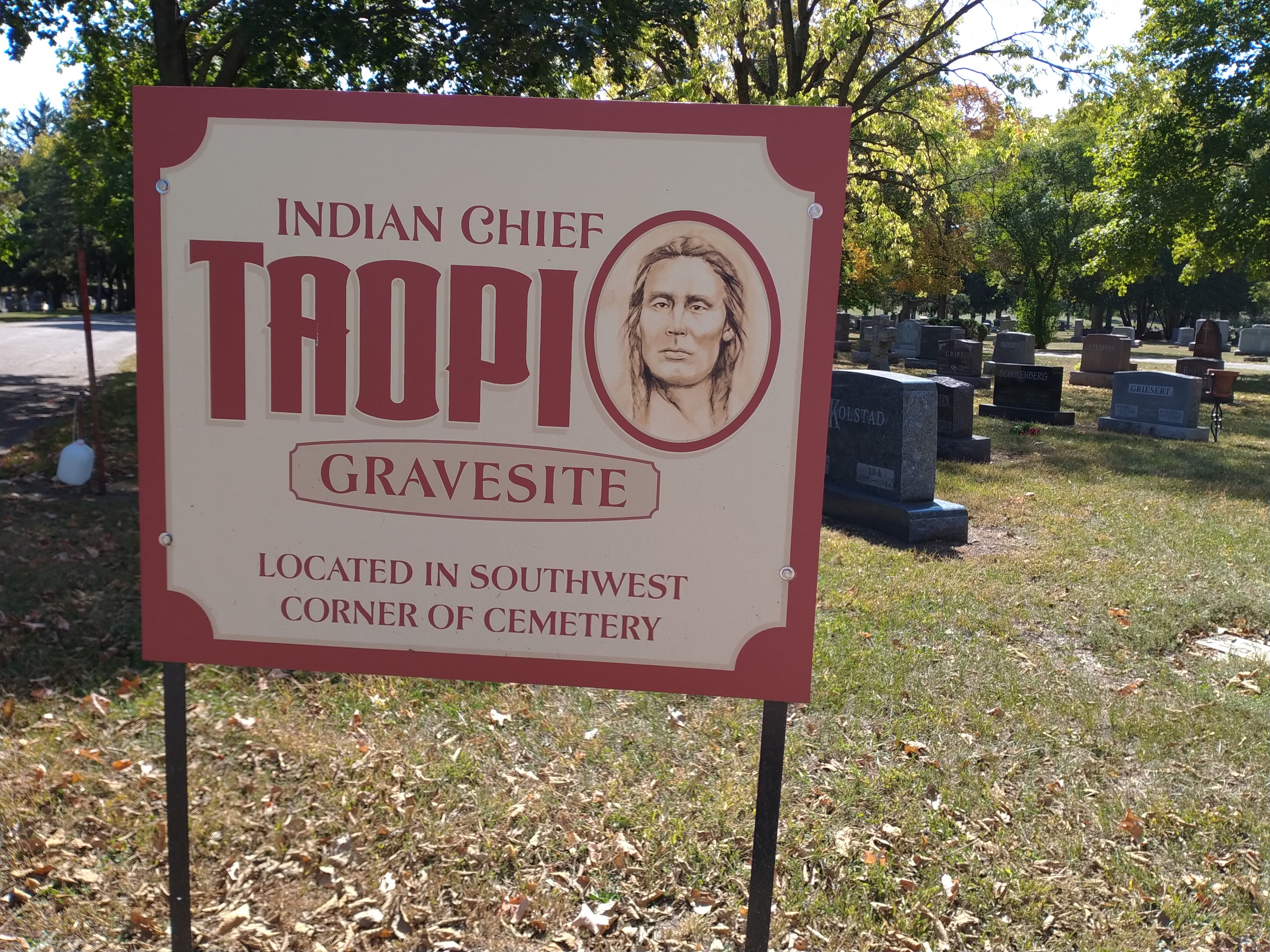
Just inside the entrance to Maple Lawn Cemetery, a sign directs visitors to Taopi’s gravesite. (Minnesota Prairie Roots copyrighted photo October 2023)

MY GOAL WAS SIMPLE—to write a piece honoring Indigenous Peoples’ Day. My focus, I initially decided, would be on Taopi, a member of the Little Crow Band of the Mdewakanton Dakota Tribe. Taopi is perhaps best known in Faribault, where he lived for a while and is buried. A small Mower County town near the Iowa border also honors him in name. But my writing expanded beyond Taopi.

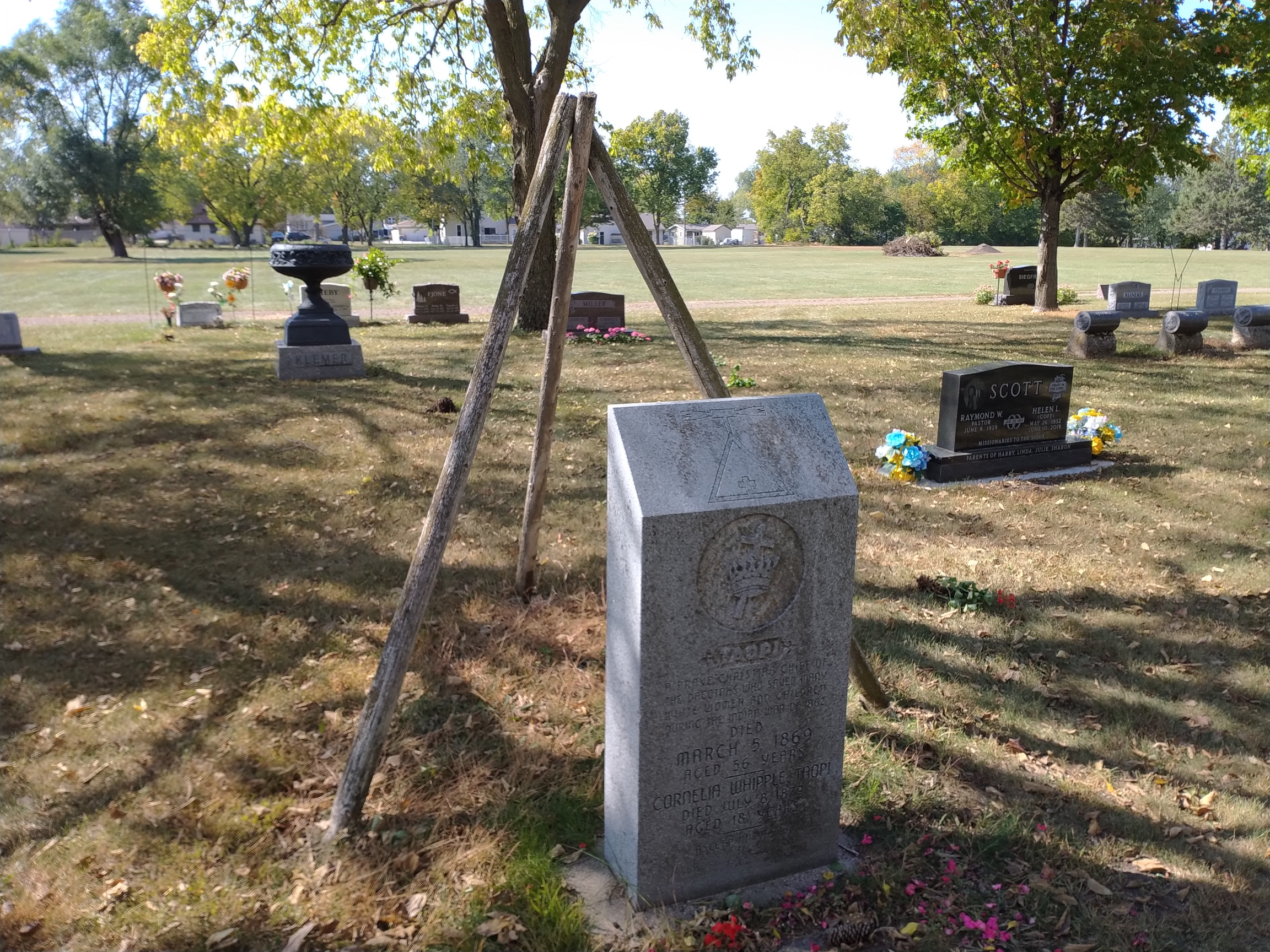
Taopi’s grave, and that of his daughter, are easily spotted via the propped poles. (Minnesota Prairie Roots copyrighted photo October 2023)

Recently I visited Taopi’s gravesite at Maple Lawn Cemetery. My interest piqued. I wanted to learn more about this Dakota leader and his importance in my community and in Minnesota history. His place in history connects to the US-Dakota War of 1862, a war all too familiar to me. My native Redwood County, where the Lower Sioux Agency was located, centered that deadly, short-lived conflict between white people and Native Peoples.

Now, viewing this war through a lens not tinted primarily by a white perspective, I understand the injustices. Decades ago, when I wrote a high school term paper on the war, I admittedly wrote a biased, unbalanced report based on biased, unbalanced research sources.

With time and maturity came the realization of the great injustices done, first when the US government acquired Indigenous Peoples’ land at a seemingly low cost and then failed to honor those treaties. The treaties opened nearly 24 million acres to white settlers. It was the Natives, the original inhabitants of this land, who found themselves cheated of government annuities, starving, pushed off their land and confined to strips of land along the Minnesota River. That includes the Wahpekute, a small band of the Dakota who lived in south central Minnesota, including the Faribault area. I live just below a Faribault city park called Wapacuta.

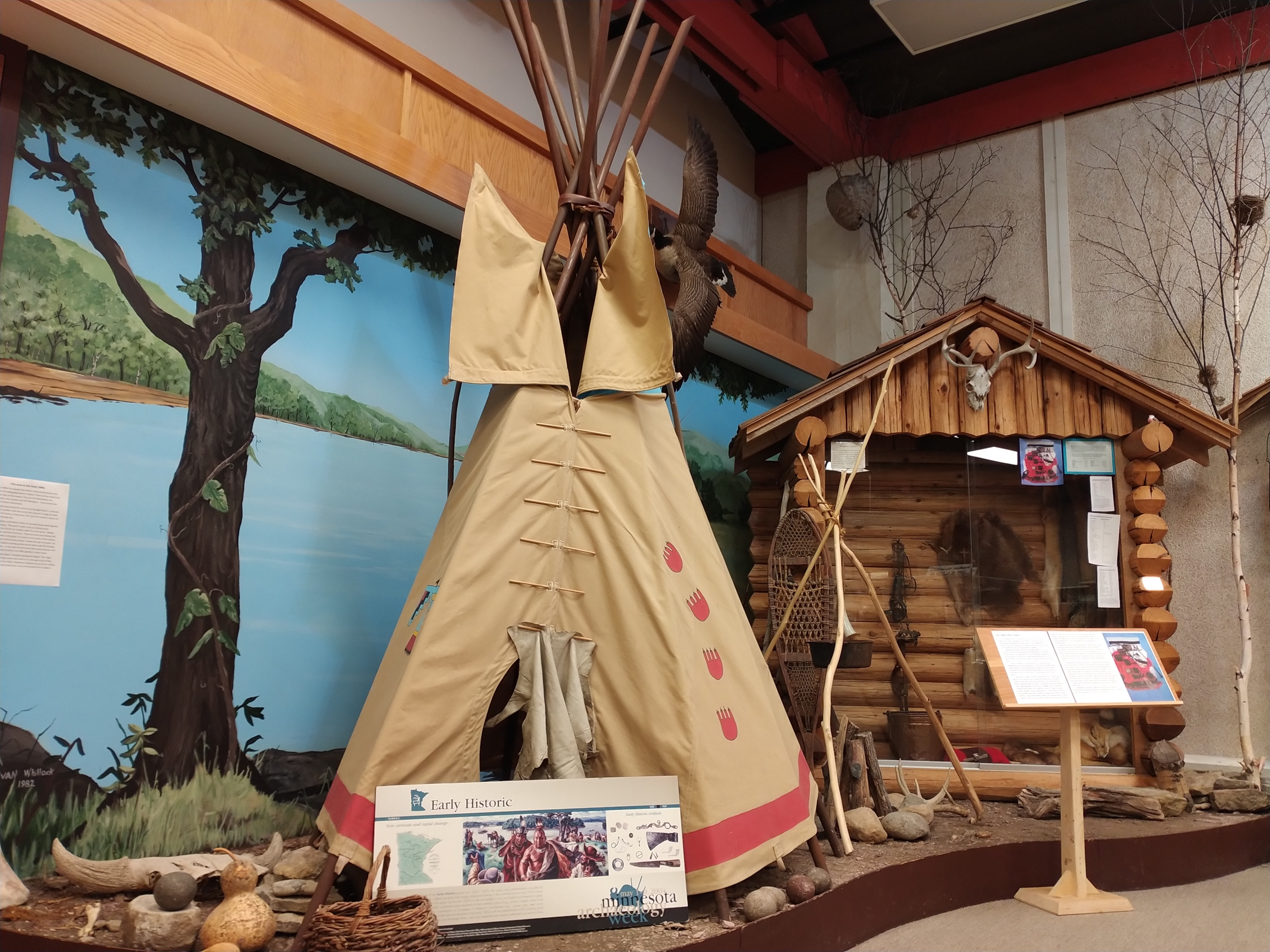
An exhibit at the Rice County Historical Society Museum. Artifacts from Indigenous Peoples are also displayed in cases. (Minnesota Prairie Roots copyrighted photo October 2023)

At the time of the US-Dakota War of 1862, Taopi was in the thick of all of it as a “farmer Indian,” the name tagged to Native Peoples who opted to farm, adapting the ways of the white man in occupation, dress and sometimes religion. He lived near the Lower Sioux Agency, relocated to a reservation there following the Treaty of Mendota in 1851. Those who continued with their hunting and fishing culture were known as “blanket Indians.” Taopi assuredly felt the animosity of his own people for the lifestyle and other choices he made.

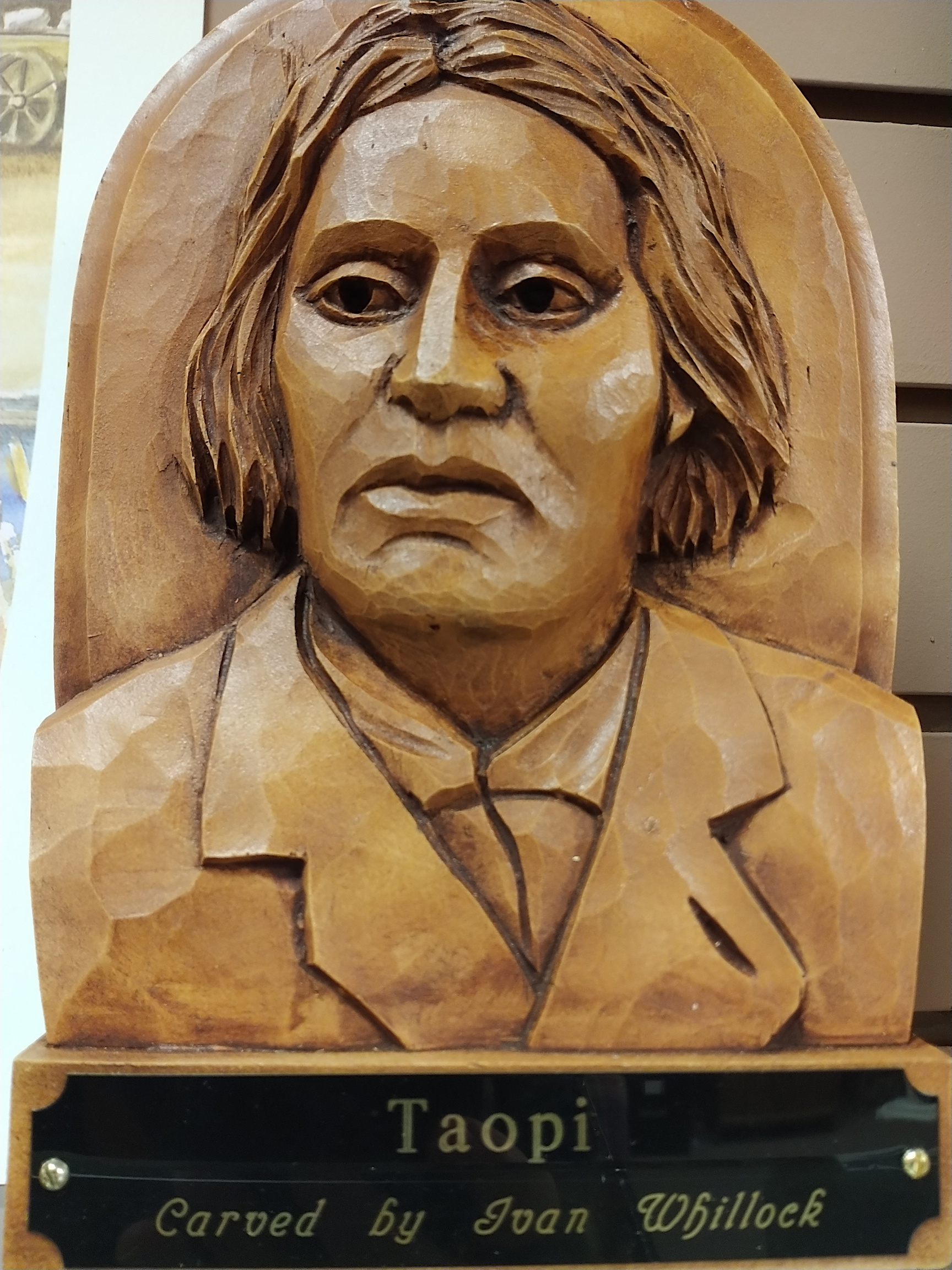
A woodcarving of Taopi by noted Faribault artist Ivan Whillock is for sale in the Rice County Historical Society Museum’s gift shop. One is also displayed in a museum exhibit on Taopi. (Minnesota Prairie Roots copyrighted photo October 2023)

I can only imagine the pressure Indigenous Peoples experienced as white settlers moved into the area. The change, at times, had to feel overwhelming. Life would never be the same. Long-time homelands were lost, tradition and culture endangered. And so Taopi and others adapted, likely accepting that change was inevitable.

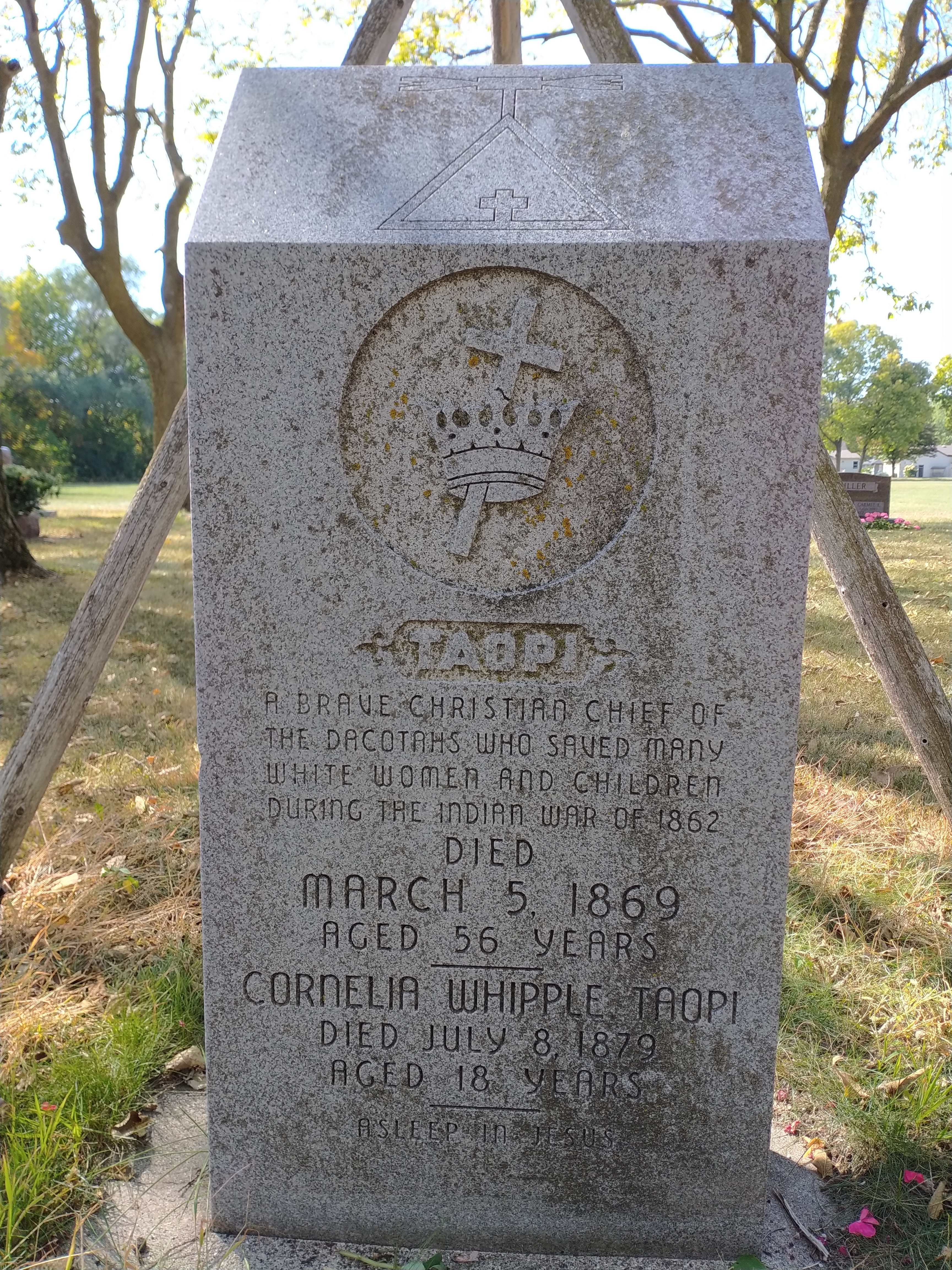
The gravesite of Taopi and his daughter, Cornelia Whipple Taopi (named after Cornelia Whipple, married to Bishop Henry Whipple). (Minnesota Prairie Roots copyrighted photo October 2023)

But one thing that remained constant with Taopi was his focus on peace. He opposed the war and was a leader in the Dakota Peace Party. He is credited with saving the lives of many.

Yet, at war’s end, Taopi found himself caught—disliked by his peoples, who considered him a traitor, and disliked by whites holding a deep animosity toward any Native person. In Faribault, though, he had a friend in Bishop Henry Whipple, a strong advocate for First Peoples, and in town founder Alexander Faribault. Eventually, Taopi and other Natives moved onto land owned by Alexander Faribault, living under his protection on a bluff overlooking the Straight River. Taopi died in 1869. In 1895, the Indigenous Peoples of Faribault were displaced once again, moved to the Lower Sioux Reservation. They had always existed on the fringes in Faribault, never fully-accepted by most residents while under the protection of the bishop and town founder.

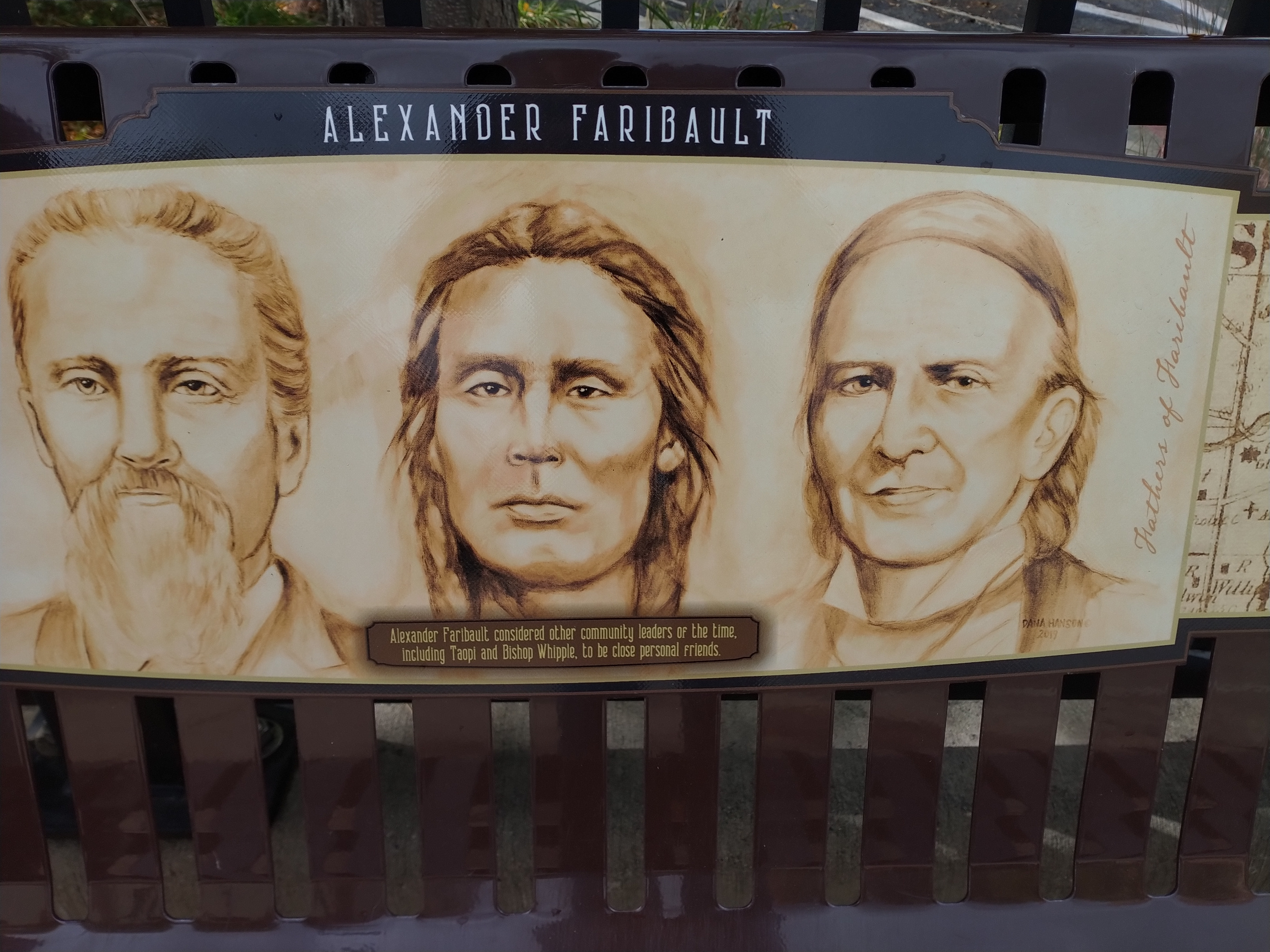
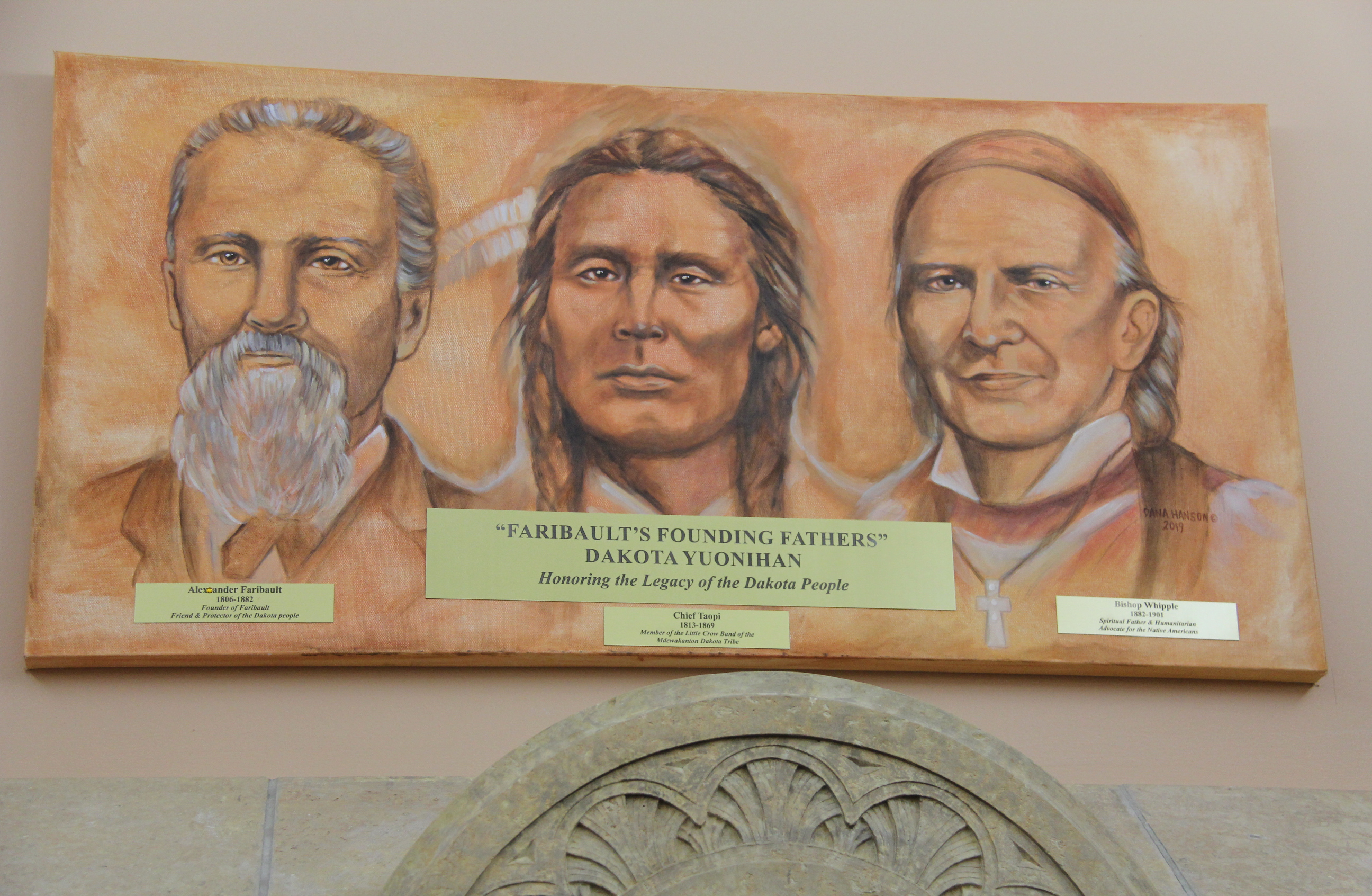
Dana Hanson’s “Father’s of Faribault” (left to right, Alexander Faribault, Taopi and Bishop Henry Whipple) featured on a bench along Central Avenue in downtown Faribault. The same artwork hangs inside Buckham Memorial Library. (Minnesota Prairie Roots copyrighted photo October 2023)

And so that is a brief look at Taopi, whose gravesite I visited. His presence remains visible elsewhere in Faribault. He’s featured in an exhibit at the Rice County Historical Society Museum. A “Fathers of Faribault” portrait of Taopi, Bishop Whipple and Alexander Faribault by Dana Hanson hangs at Buckham Memorial Library. Just a block to the north, that same artwork graces an historic-themed bench. Taopi was, most assuredly, a man of importance in local and state history. I will remember him primarily as a man of peace in a time when peace was decidedly elusive.

#

© Copyright 2023 Audrey Kletscher Helbling
Sources: The First Cathedral, an Episcopal Community for Mission by Benjamin Ives Scott and Robert Neslund; the Minnesota Historical Society website; and the Rice County Historical Society Museum’s Taopi display.


The power of hair among Native Peoples September 19, 2023

“My Powerful Hair,” published in 2023 by Abrams Books for Young Readers. (Book cover source: Abrams Books)

SOME OF THE MOST MEANINGFUL, enlightening and powerful books I’ve read, I’ve found in the children’s picture book section of my local public library. That includes My Powerful Hair written by Carole Lindstrom and illustrated by Steph Littlebird.

I happened upon this book while searching for recently-published astronaut and geography books for my 4-year-old grandson. I never did find those sought-after titles. Not that it mattered. What I discovered instead were three must-read books: My Powerful Hair, Boycott Blues—How Rosa Parks Inspired a Nation and We Are Better Together.

Parks is certainly familiar to me as the Black seamstress who in 1955 refused to give up her seat to a white man on a city bus in Montgomery, Alabama. That sparked a bus boycott and the Civil Rights Movement. Likewise, working together to effect change, to improve our world, to help one another is a familiar theme.

“The Native Man, His Eagle & His Chanupa,” an oil painting by Dana Hanson and part of her 2018 “Healing the Land” exhibit at the Owatonna Arts Center. (Minnesota Prairie Roots copyrighted file photo 2018, used for illustration only. Art copyrighted by Dana Hanson.)

THE IMPORTANCE OF HAIR REVEALED

It is the story on hair, though, which proved a particularly teachable read. My Powerful Hair focuses on Native Peoples’ hair and its importance in their culture, their history, their lives. Through the writing of New York Times bestselling and award-winning author Lindstrom, who is Anishinaabe/Metis (and an enrolled citizen of the Turtle Mountain Band of Ojibwe), and Indigenous artist Littlebird of Oregon’s Confederated Tribes of Grand Ronde, I learned the symbolism and power of hair in Native American culture. Admittedly, this is something I should have known, having grown up on the southwestern Minnesota prairie between the Upper Sioux and Lower Sioux Indian Reservations (today termed “communities”). I thought I was informed. But I wasn’t, not about hair.

Told from the perspective of a young Native girl, My Powerful Hair explains the reasons Native Peoples grow their hair long. And keep it long. Hair holds stories, memories, strength, sorrow, connections to each other and to Mother Earth. And more. Page after page, the narrator shares events in her life that weave into her hair. When Nimishoomis (her grandfather) taught her to fish, her hair reached her ears. When her cousins taught her to make moccasins, her hair flowed past her shoulders. In the sharing of these moments, I began to understand the power of hair in Native American culture.

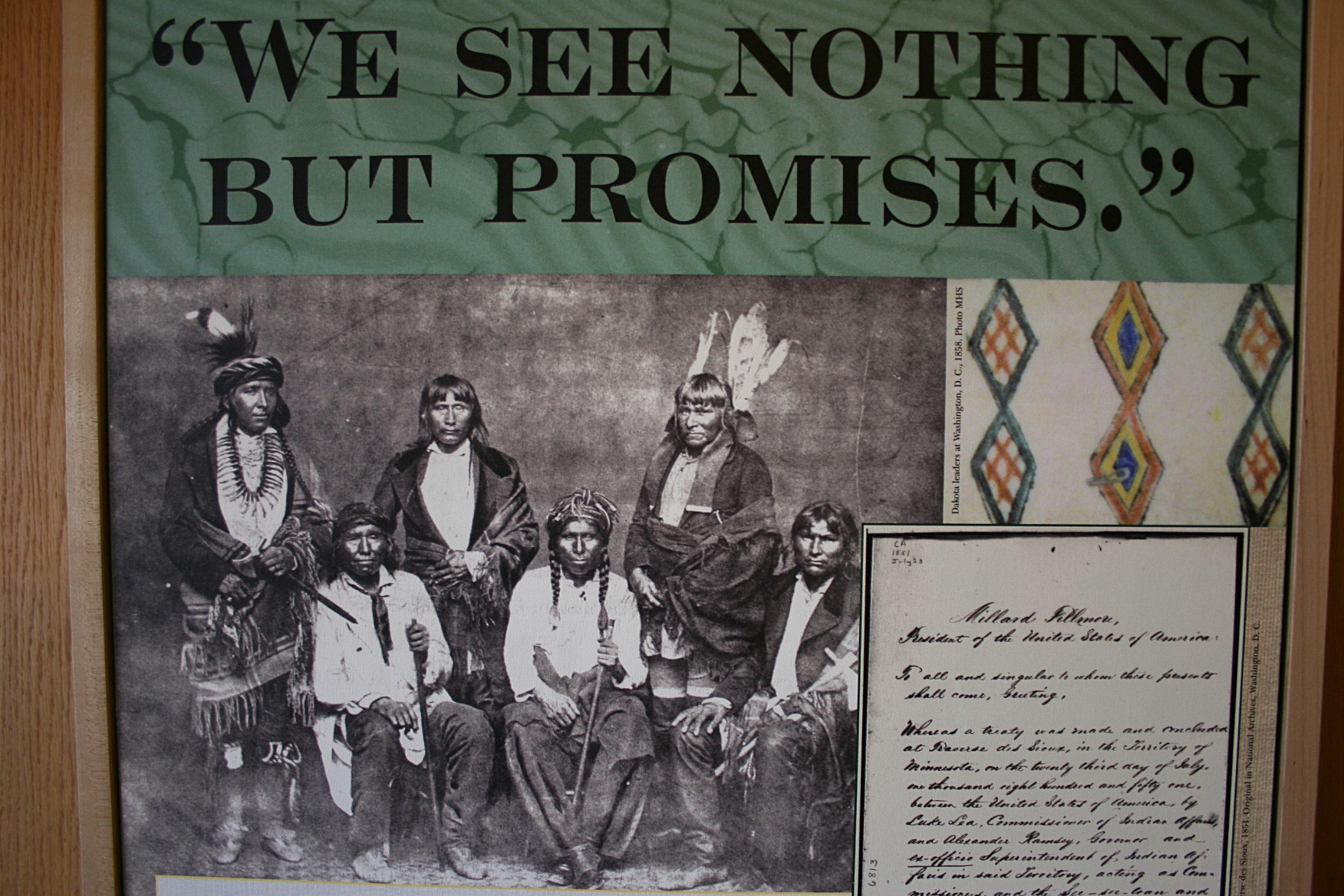
A photo panel at the Traverse des Sioux Treaty Center in St. Peter shows Dakota leaders photographed in Washington D.C. in 1858. The photo is from the Minnesota Historical Society and is used here for illustration only.

FORCED HAIRCUTS

I also understood fully, for the first time, the trauma inflicted upon Indigenous individuals forced long ago by white people to cut their hair. The writer and illustrator don’t hold back. In the first few pages, a young Nokomis (grandmother) is in tears as the hands of a Catholic nun grasp, then cut, her braids. It’s an emotionally impactful visual.

But this was reality at Indian boarding schools, within faith communities and elsewhere back in the day, in a time period when efforts focused on erasing Indigenous culture, on conforming Native Peoples to European ways. It was wrong.

Displayed at Bridge Square during Northfield’s Earth Day celebration in 2022. (Minnesota Prairie Roots copyrighted file photo April 2022, used for illustration only)

A TERRIBLE INJUSTICE”

A blogger friend from the central Minnesota lakes region recently shared a bit of her family’s experience per my request. Of unverified (records were often destroyed) Cherokee ancestry, Rose speaks of her mother’s trauma after being sent to a Catholic girls’ school in Crookston. “Mom didn’t tell us much about her experience there,” Rose says, “only that they made her cut her long black hair. My mom never cut her hair again for the rest of her life. She saw the forced haircut as a terrible injustice.” Injustice seems a fitting word.

In an author’s note, Carole Lindstrom shares the same trauma, documented, she writes, in a photo of her grandmother and two great aunts with their black hair shorn above their ears. They were forced into an Indian boarding school in the early 1900s.

“Honoring the Legacy of the Dakota People” focuses this artwork by Dana Hanson. Chief Taopi centers the painting with Alexander Faribault to the left and Bishop Henry Whipple on the right. The word “Yuonihan” means honor or respect. This art hangs inside Buckham Memorial Library. (Minnesota Prairie Roots copyrighted file photo November 2022. Art copyrighted by Dana Hanson.)

POWER IN STORIES, IN HERITAGE, IN RESPECT

Rose is thankful for books like My Powerful Hair. “I am glad that stories like this are being told,” she says. “Much First Nations history nearly disappeared. And many First Nations keep their ceremonies and other information ‘secret’ so it won’t be distorted or misused by people who don’t understand, or who seek to harm them.” Based on history, that seems warranted.

This Minnesota woman has one more reason to feel grateful for children’s picture books by Indigenous Peoples. Her grandchildren are of Ojibwe heritage; their other grandmother lives on the White Earth Nation in northwestern Minnesota. “My hopes for my grandchildren are that they learn all they can about their Ojibwe ancestors and customs and values,” Rose says. “I hope they can choose what lessons they want to carry forward in their own life. I hope they are fantastic examples of how people from different backgrounds can get along and respect and love one another.”

And so I learned, not only from Rose, but from reading My Powerful Hair. Stories woven into our hair matter. For they are powerful.

© Copyright 2023 Audrey Kletscher Helbling


Thoughts on MLK’s “I have a dream” speech August 28, 2023

A student watches a video of Martin Luther King, Jr. in the “Selma to Montgomery: Marching Along the Voting Rights Trail” exhibit at St. Olaf College, Northfield, in 2015. (Minnesota Prairie Roots copyrighted file photo 2015)

WE ALL HOLD DREAMS. Hopes and desires and wishes that improve our lives. Financially, mentally, emotionally and otherwise. Perhaps they are dreams directed inward. Or they are dreams for others in our lives, especially our loved ones.

Sixty years ago today, Martin Luther King, Jr. revealed his dream at the Lincoln Memorial in Washington, DC. His was a powerful speech packed with powerful words that resonated as much on August 28, 1963 as they do today:

I have a dream that one day this nation will rise up and live out the true meaning of its creed: We hold these truths to be self-evident, that all men are created equal.

I have a dream that my four little children will one day live in a nation where they will not be judged by the color of their skin but by the content of their character. I have a dream today.

Visitors could photograph themselves at the “Selma” exhibit and express their thoughts. (Minnesota Prairie Roots copyrighted file photo 2015)

King’s statements in “I have a dream” held the hope of Americans denied very basic civil and voting rights simply because of their skin color. A year later, the Civil Rights Act of 1964 became law, prohibiting discrimination (and segregation) in public places. Passage of the Voting Rights Act of 1965 followed, assuring the right to vote. But the struggle continued as it does today for people of color.

Back in 1964 and 1965, I was too young and too far removed from the Civil Rights Movement to have any knowledge of what was happening in the world beyond my childhood home in southwestern Minnesota. I lived in a rural area of primarily Germans and Scandinavians, where the only difference was in religion. Either you were Lutheran or you were Catholic with a few Presbyterians, Methodists and Brethren tossed in.

I don’t recall ever seeing a Black person. Few, if any, lived in Redwood County. Indigenous Peoples lived on nearby reservations to the east and to the west by Morton and Granite Falls. But I never saw the Dakota, never interacted. Mine was a world of whiteness. Now I am the mother-in-law of a man whose father is black, his mother white. I’ve heard my son-in-law’s unsettling stories of what it’s like to be a Black man in America today.

Opinions expressed in the “Selma” exhibit polling place. (Minnesota Prairie Roots copyrighted file photo 2015)

Today I live in a place of varied colors and cultures. For that I feel thankful. At the core, we are all just people with hopes, desires, wishes. We all hold dreams, no matter our skin color.

© Copyright 2023 Audrey Kletscher Helbling
 

“The Viaduct,” an enduring Faribault landmark August 23, 2023

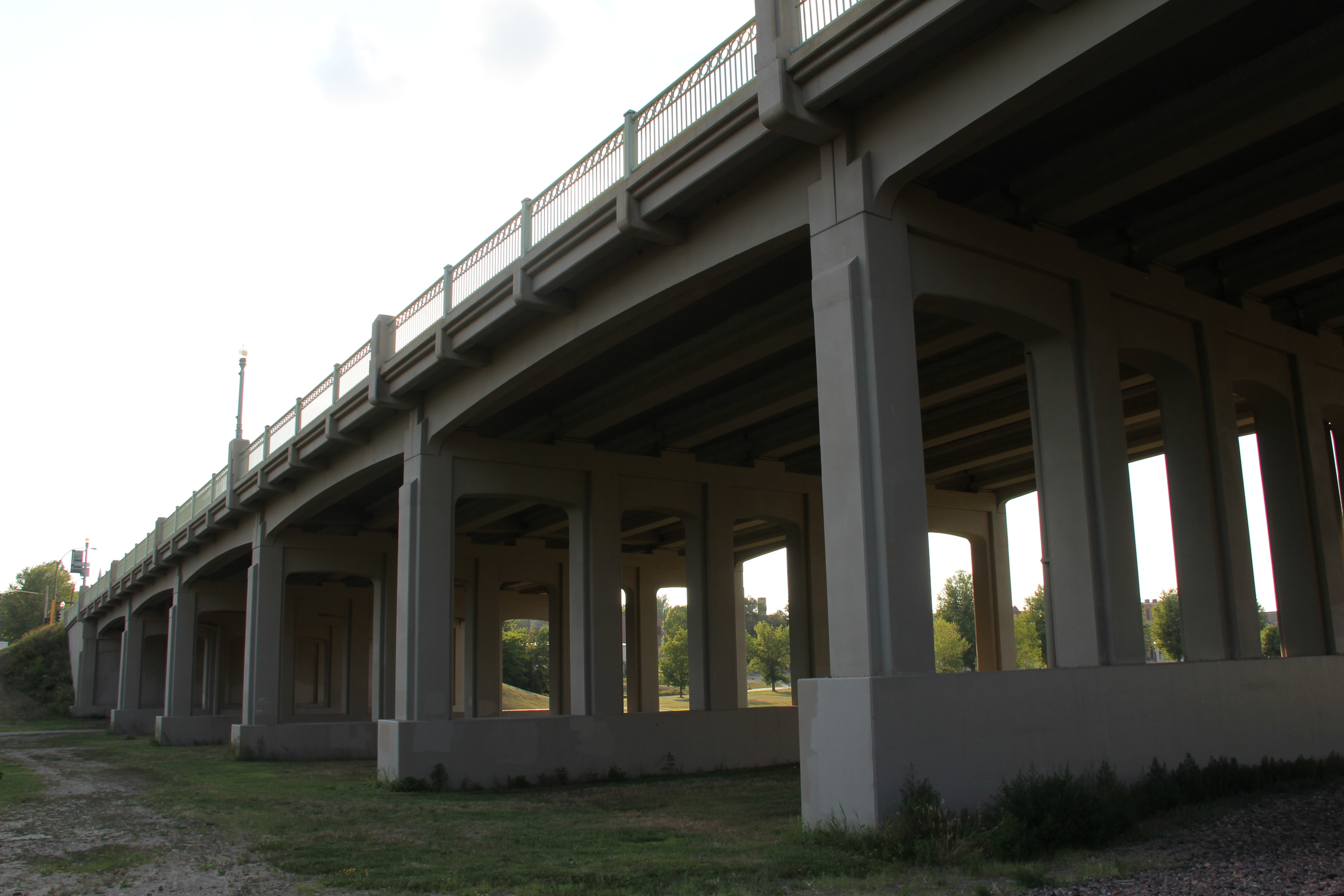
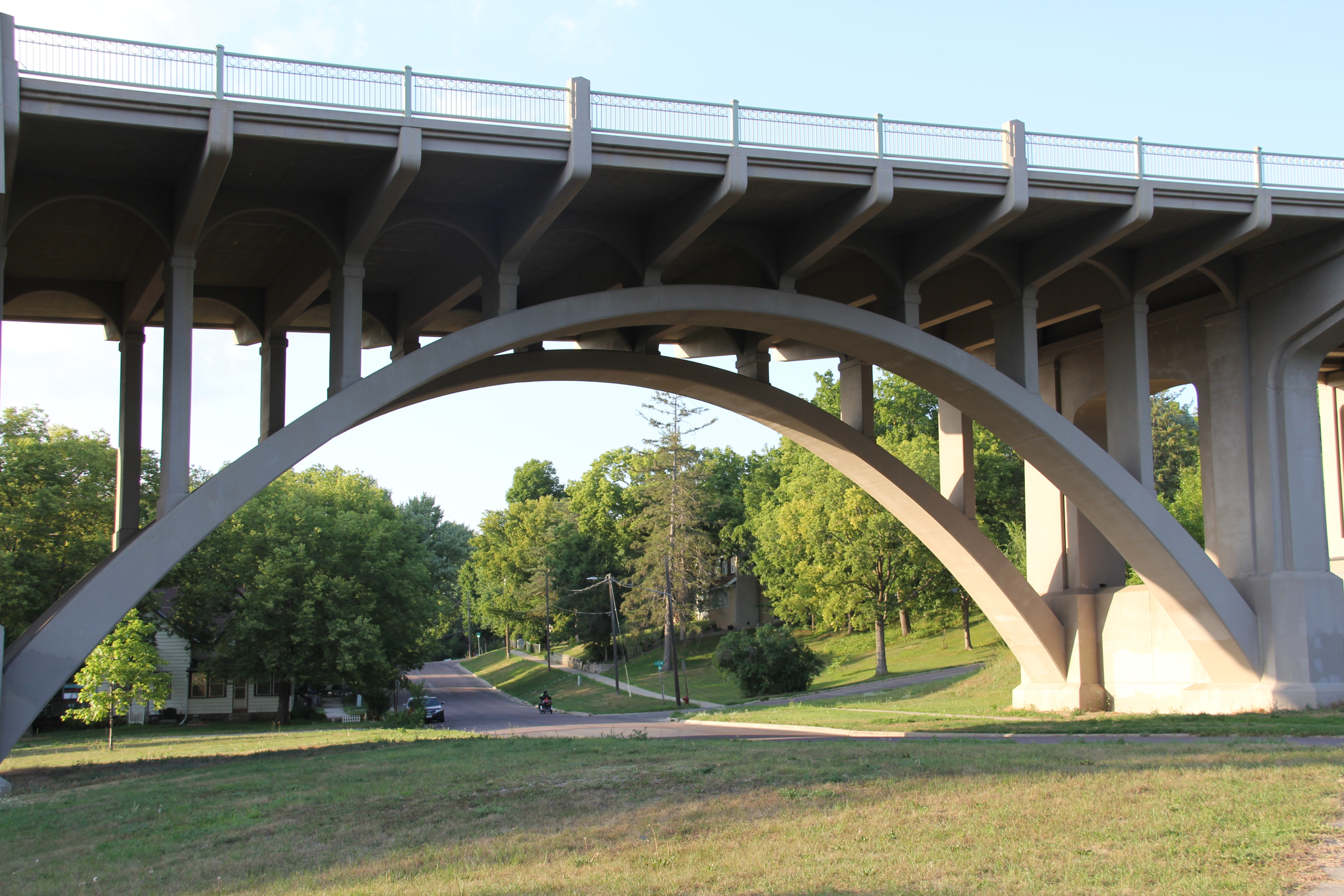
A side view of a section of Faribault’s historic viaduct. (Minnesota Prairie Roots copyrighted photo August 2023)

ARCHITECTURE, ART AND HISTORY meld on an expansive structure connecting Faribault’s east and west sides.

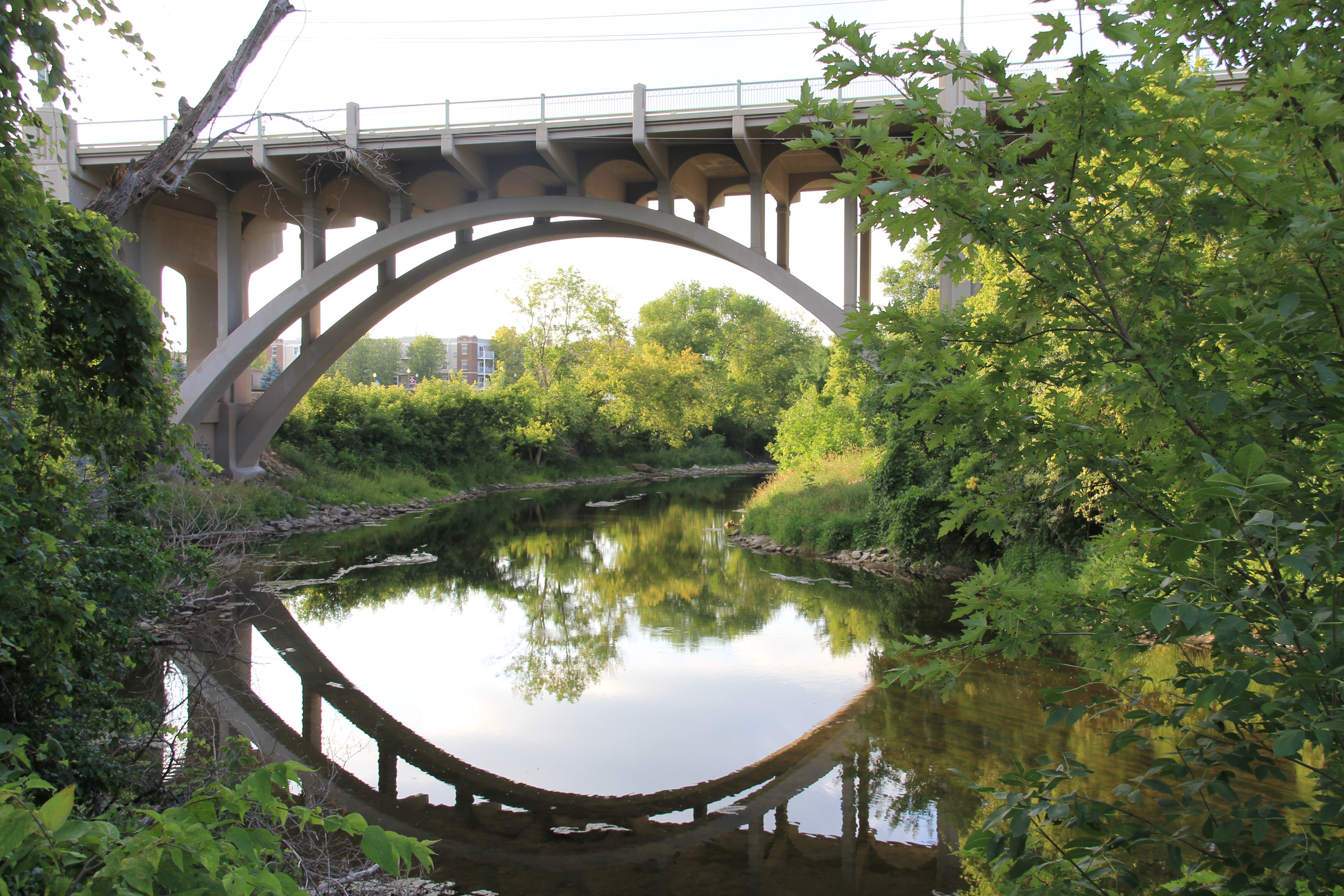
The viaduct reflects in the Straight River in the early evening light. (Minnesota Prairie Roots copyrighted photo August 2023)

Locally referred to as “The Viaduct,” the continuous concrete rib arch bridge routes pedestrians and traffic along Minnesota State Highway 60 over railroad tracks and the Straight River far below. Three massive reinforced arches distinguish this as a viaduct rather than a bridge.

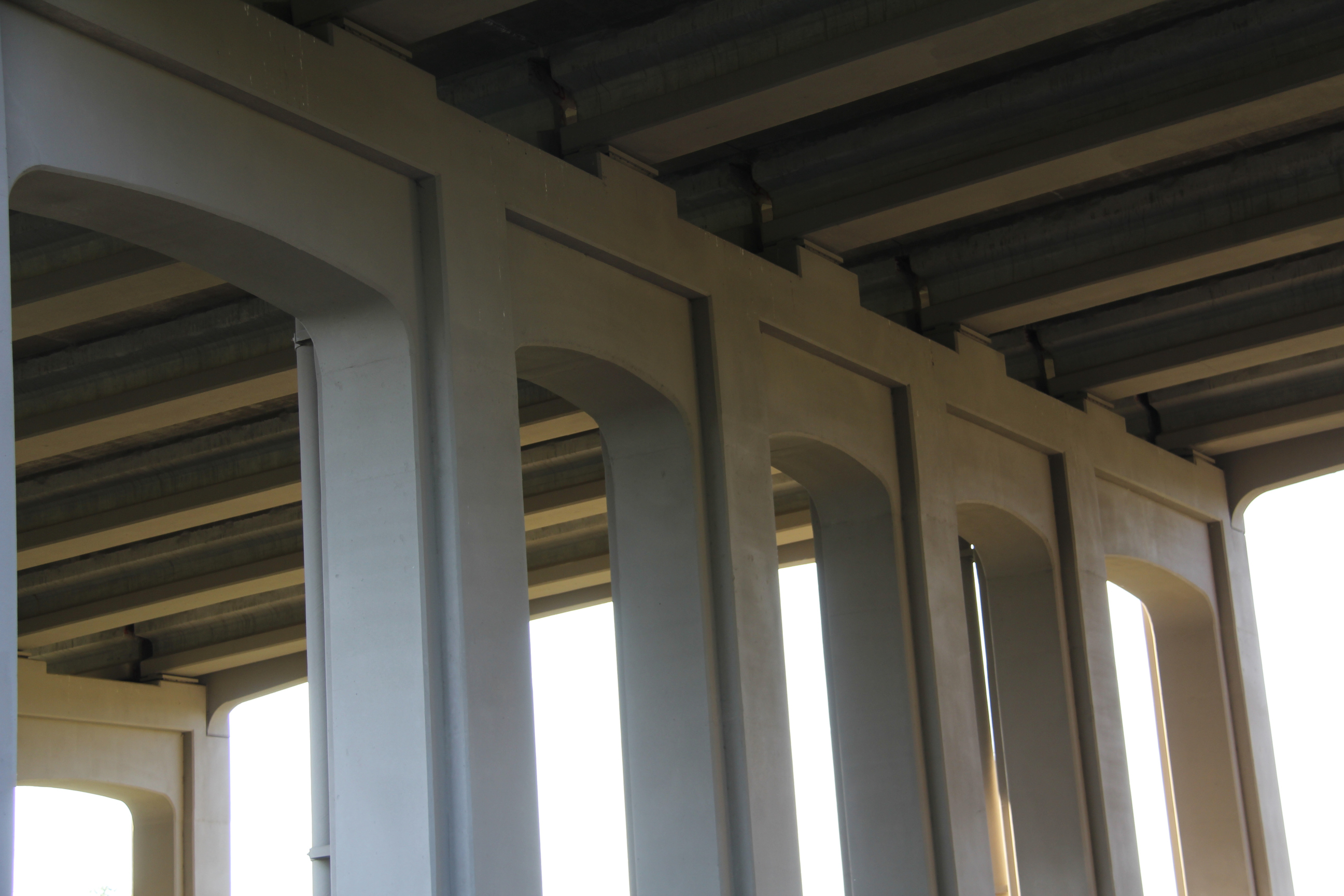
Piers and under the roadway up close. (Minnesota Prairie Roots copyrighted photo August 2023)

Thousands of times I’ve crossed the viaduct via vehicle in my 41 years living here. But not until recently did I pause to really study the underbelly of this 1937 Works Progress Administration project which is on the National Register of Historic Places. Only via a close-up look from ground level did I fully appreciate this engineering feat.

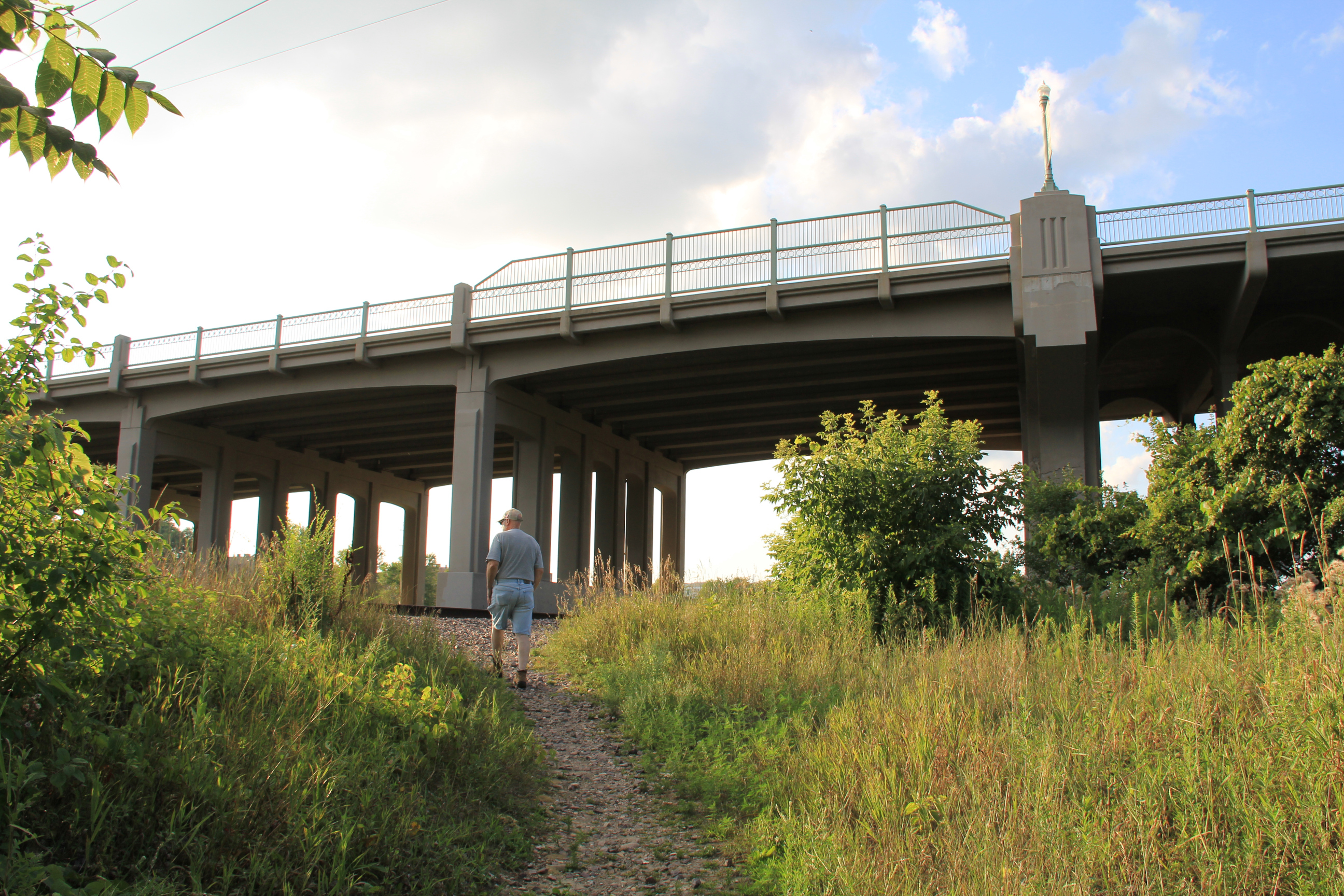
I followed Randy along this path leading to the tracks. (Minnesota Prairie Roots copyrighted photo August 2023)

I followed a narrow dirt trail through trees and underbrush in Teepee Tonka Park to reach a good viewing spot of the viaduct underside. From that perspective next to the train tracks, I observed the way patterns and lines repeat to build a strong structure that has withstood the test of traffic and of time. The bridge was rehabilitated, the roadway widened in 2008-2009.

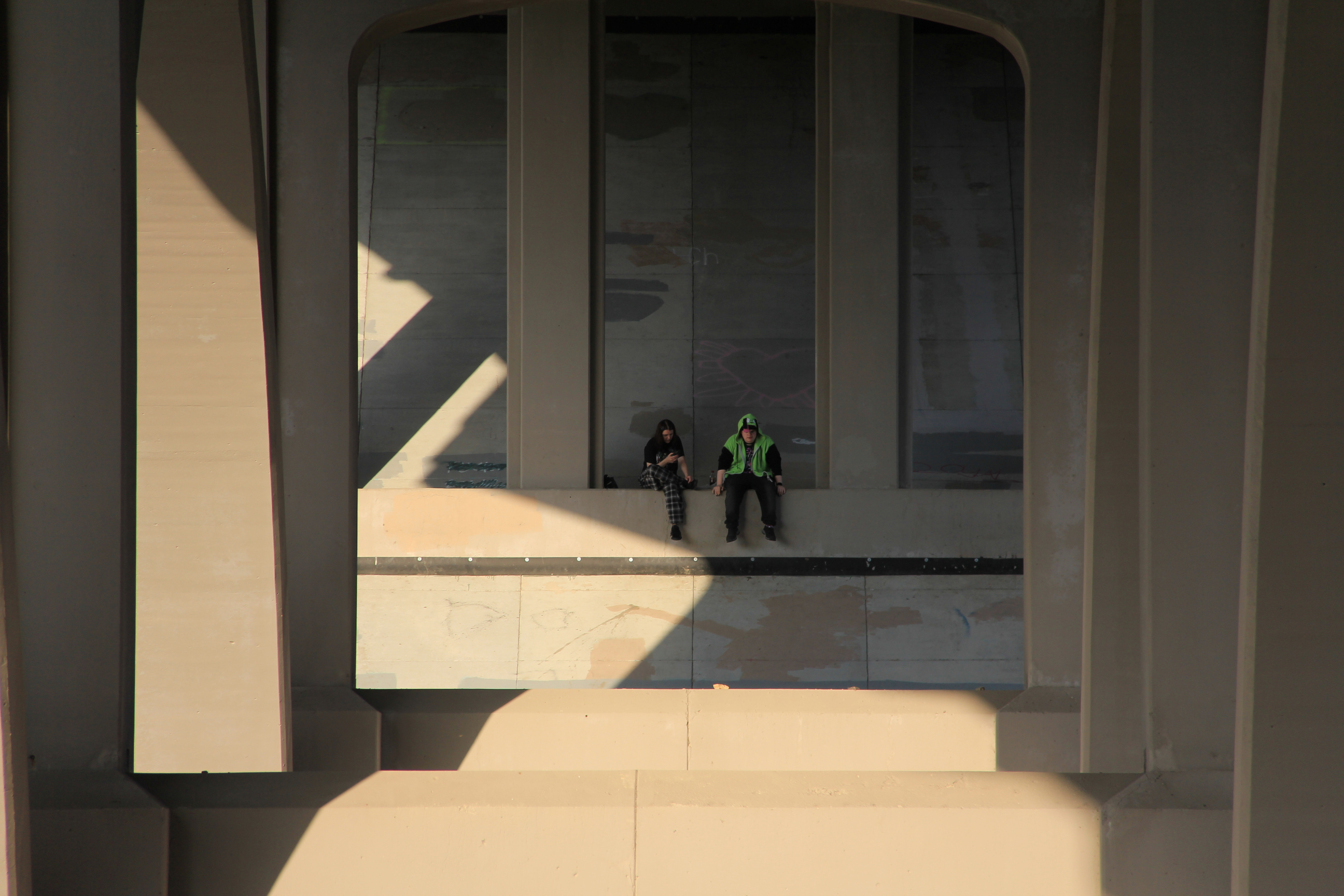
Hanging out under the viaduct. (Minnesota Prairie Roots copyrighted photo August 2023)

The viaduct impresses in design and size. I felt dwarfed by its massiveness, even more noticeable when I spotted a couple sitting on the far end. They appeared small in comparison to the concrete piers rising above and around them. I felt overpowered, too. I wondered how WPA workers managed to build this wonder in the late 1930s without the modern equipment of today.

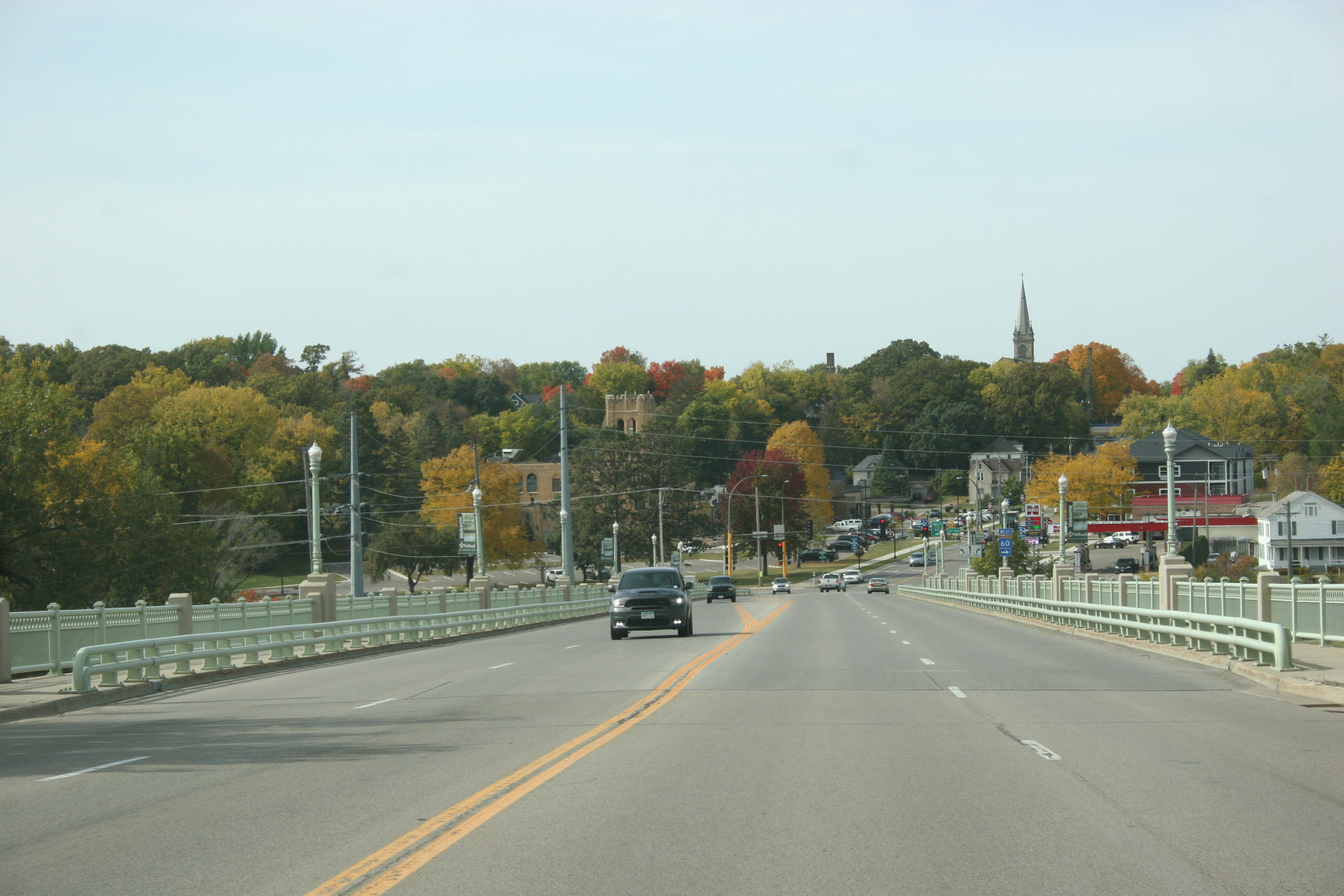
Westbound on the viaduct, Buckham Memorial Library is to the left and the Immaculate Conception Church steeple in the distance. (Minnesota Prairie Roots copyrighted file photo October 2022)

But it is more than utilitarian construction that marks this viaduct as noteworthy. The viaduct is a work of public art—an interactive sculpture which provides a sweeping view of historic downtown Faribault and the surrounding area when heading westbound. To view the bridge from below is to truly see its artsy side, its Art Deco/Classical Revival style. That style carries through in the concrete piers and, on road level, in the decorative railings and lights, replicas of the originals.

The viaduct is a marvelous work of architecture, art and engineering. (Minnesota Prairie Roots copyrighted photo August 2023)

As I stood under the viaduct studying its design, artsy arches, curves and lines, I considered the many people who have traversed this bridge. If only this concrete could speak, oh, the stories it would tell. Stories of construction workers who labored for 1½ years to complete this project. Stories of Ford Model As, among the first to drive across this linkage between east and west. Stories of students arriving at the Minnesota State Academies for the Deaf and Blind. Stories of athletes heading to hockey camp at Shattuck-St. Mary’s School. Stories of prisoners transported to the Minnesota State Correctional Facility, Faribault. Stories of ambulances racing across the viaduct toward the hospital. Stories of expectant parents headed there, too. Stories of families and students on their way to River Bend Nature Center. Stories of travelers simply passing through Faribault.

On the east side of the river, a road passes the viaduct and leads to Teepee Tonka Park. (Minnesota Prairie Roots copyrighted photo August 2023)

For 86 years, The Viaduct has gathered stories atop graceful arches, upon a roadway that is more than a route. This is a local landmark, an architectural and artistic marvel which visually and historically defines Faribault.

© Copyright 2023 Audrey Kletscher Helbling


Building the Eiffel Tower in France, then Minnesota June 22, 2023

Completed 3-D wooden puzzle of the Eiffel Tower. (Minnesota Prairie Roots copyrighted photo June 2023)

CONSTRUCTION OF THE EIFFEL TOWER in Paris took two years, two months and five days and a whole lot of engineers and factory and construction workers.

Construction of the Eiffel Tower in Faribault, built by one man, took 30 minutes.

Clearly there’s a difference in what, exactly, was constructed. My supposed-to-be-retired automotive machinist husband assembled a 3D wooden puzzle of the Eiffel Tower by B.C. Bones in a half hour. Information on the puzzle box estimates construction time at 1 to 2 hours. I am not one bit surprised that Randy fit the 32 pieces into a tower in much less time. His mind works that way. He sees a bunch of parts and he immediately envisions how they all work together.

Me? I would still be struggling to build the Eiffel Tower, especially given the missing architectural blueprint in the puzzle box. That and a missing fact file were likely the reasons this 2003 puzzle was in the freebie pile at a Northfield garage sale.

That Randy managed to construct the tower in such a short time and without a cheat sheet blueprint impresses me. But then I am not one who likes puzzles or has the ability to figure out how stuff connects. We each have our talents. Puzzling puzzles is not one of mine.

Now this two foot high tower sits on a vintage chest of drawers in our living room, displayed not as a completed puzzle project, but rather as a work of art. Just like the real tower in Paris, a tourist draw for 7 million annual visitors who appreciate its architectural and artistic beauty.

Engineer Gustave Eiffel designed the tower, built in 1889 to celebrate the Exposition Universelle. The structure reaches 1,083 feet heavenward and weighs 10,100 tons. But the fact I found most interesting on the official Eiffel Tower website was the 2.5 million rivets used in construction. That’s a whole lot of rivets holding the metal pieces in place.

Only slots hold the tight-fitting wooden puzzle together. But it’s amazingly strong and can be carried without falling apart. That gives me some insight into just how strong the real Eiffel Tower was engineered to be.

This garage sale freebie proved an interesting and engaging find. I learned something about architecture and engineering and facts about the Eiffel Tower unknown to me, mostly because I’ve never researched this architectural icon. And for Randy, this puzzle proved easy. For a garage sale freebie, I’d say we got our money’s worth.

#

TELL ME: How would you do assembling this 3D puzzle without a blueprint? Do you do puzzles? Have you visited the Eiffel Tower in Paris?

© Copyright 2023 Audrey Kletscher Helbling