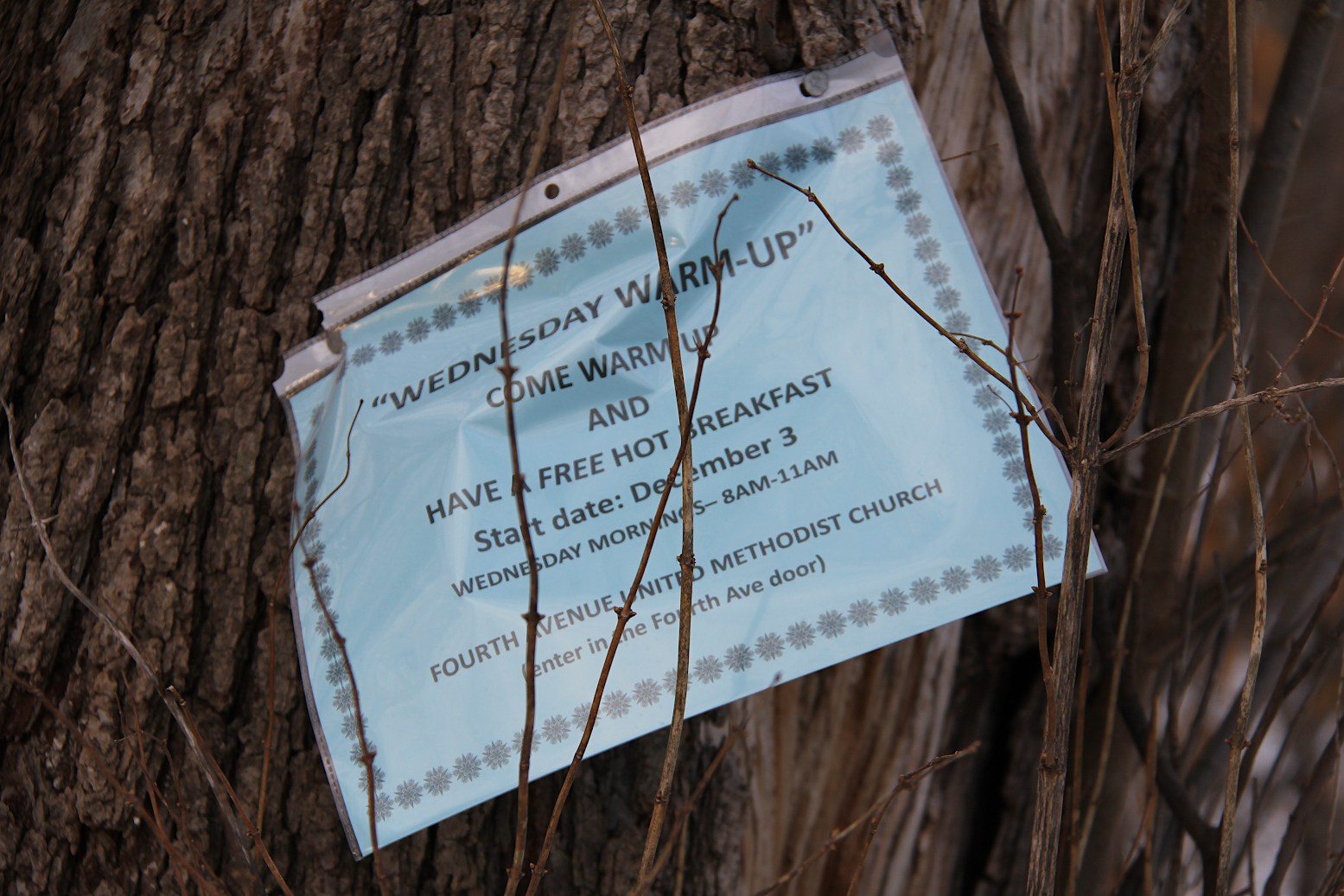
This sign posted on a tree led me to learn more about “Wednesday Warm-Up.” (Minnesota Prairie Roots copyrighted photo January 2026)
POSTED ON TREES in woods edging the Straight River Trail in Faribault, two duplicate blue signs drew my attention. I paused in my walk to read the notices slipped into protective plastic sleeves. And that is how I learned about “Wednesday Warm-Up” at Fourth Avenue United Methodist Church.
Since December, this Faribault congregation has opened its doors from 8- 11 a.m. every Wednesday to anyone wanting a free hot breakfast. They’re focusing on the underprivileged and those experiencing homelessness, according to John Streiff, mission outreach chairman for Fourth Avenue UMC.
(Minnesota Prairie Roots copyrighted file photo used for illustration only)
A few people come for the morning meal, which changes weekly. One Wednesday the featured food may be French toast, the next week biscuits and gravy, eggs or pancakes with a meat, fruit, doughnuts/toast and beverages. Most of the food is donated.
This is not, Streiff emphasizes, about “drafting” people into church. Rather, it’s about “what Jesus would do…to show what unconditional love is,” he said.
And that’s exactly what I heard in my brief phone conversation with Streiff about the Wednesday morning breakfast. I could hear the compassion in his voice as he mentioned a couple who came to eat and who are living out of their car. Some are down on their luck. Some share their personal stories, others don’t.
If anyone needs additional assistance, the church will do what they can by directing them to resources and/or providing tangible help such as gift cards for gas. “All we’re trying to do is share the love of God,” Streiff said.
This message, posted outside Fourth Avenue UCC in 2019 under a previous pastor, seems to fit the congregation’s community outreach mission of caring for others. (Minnesota Prairie Roots copyrighted file photo)
In online videos, Fourth Avenue UMC pastor, the Rev. Shawn Stoll, talks about building community and friendships over food at the Wednesday Warm-Up breakfasts. The breakfast is open to anyone, “regardless of who you are or where you slept,” he says.
Streiff echoed that message as he talked about opening the church doors for people to come in, warm up and visit (if they wish) over breakfast. Fourth Avenue will continue serving breakfast weekly through the end of February and perhaps beyond. Streiff noted that it takes time to build trust between people.
I love this community outreach, something Fourth Avenue UCC has done previously with a free Christmas dinner open to anyone. Congregants understand the importance of building community and of meeting people where they are at in life. And of serving.
Wednesday Warm-Up breakfasts provide for a basic human need—food. This faith community is taking biblical directives to feed the hungry and actually doing that, not simply talking and praying about it. And for that action, that compassion, that love, that service, I feel deep gratitude.
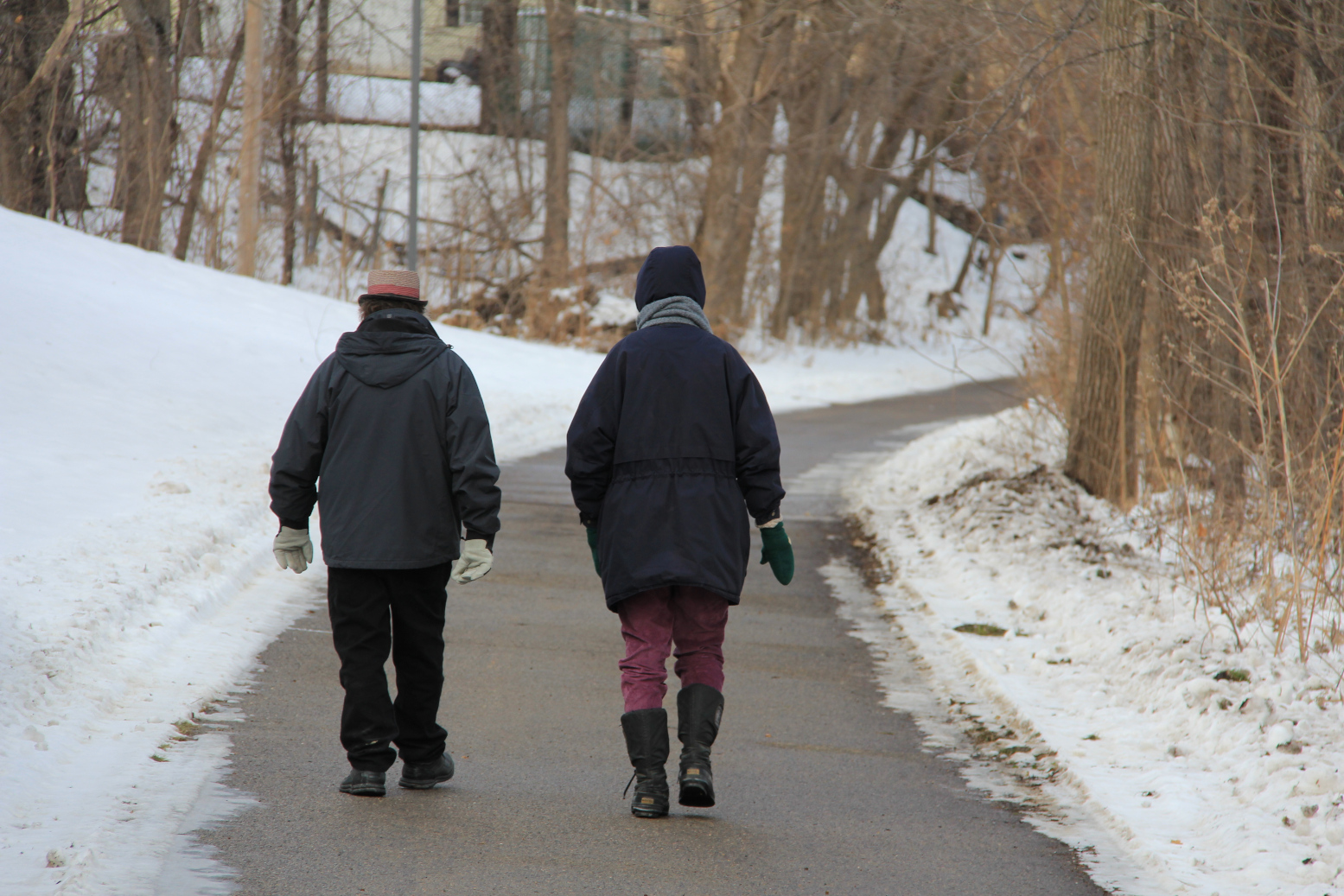
Walking along the Straight River Trail near Fleckenstein Bluffs Park on a recent winter day. (Minnesota Prairie Roots copyrighted photo December 2025)
WITH WINTER OFFICIALLY LAUNCHED, it’s easy enough to stay home, settle in, curl up with a good book and avoid the ice, cold and snow that define Minnesota weather in January. When winter burrows in, I’m more inclined to hibernate. But I push myself to get out. It’s good for my physical, mental and emotional health.
An extensive city trail system runs throughout Faribault. (Minnesota Prairie Roots copyrighted photo December 2025)
Faribault offers plenty of options for aging Baby Boomers like me and others who simply want to take a walk. On the worst of winter days, I can loop around the soccer field at Shattuck-St. Mary’s School, which opens its dome to the public most weekday mornings (except holidays) from November into early spring. Hours vary, but generally run from around six-ish to 9:30 am.
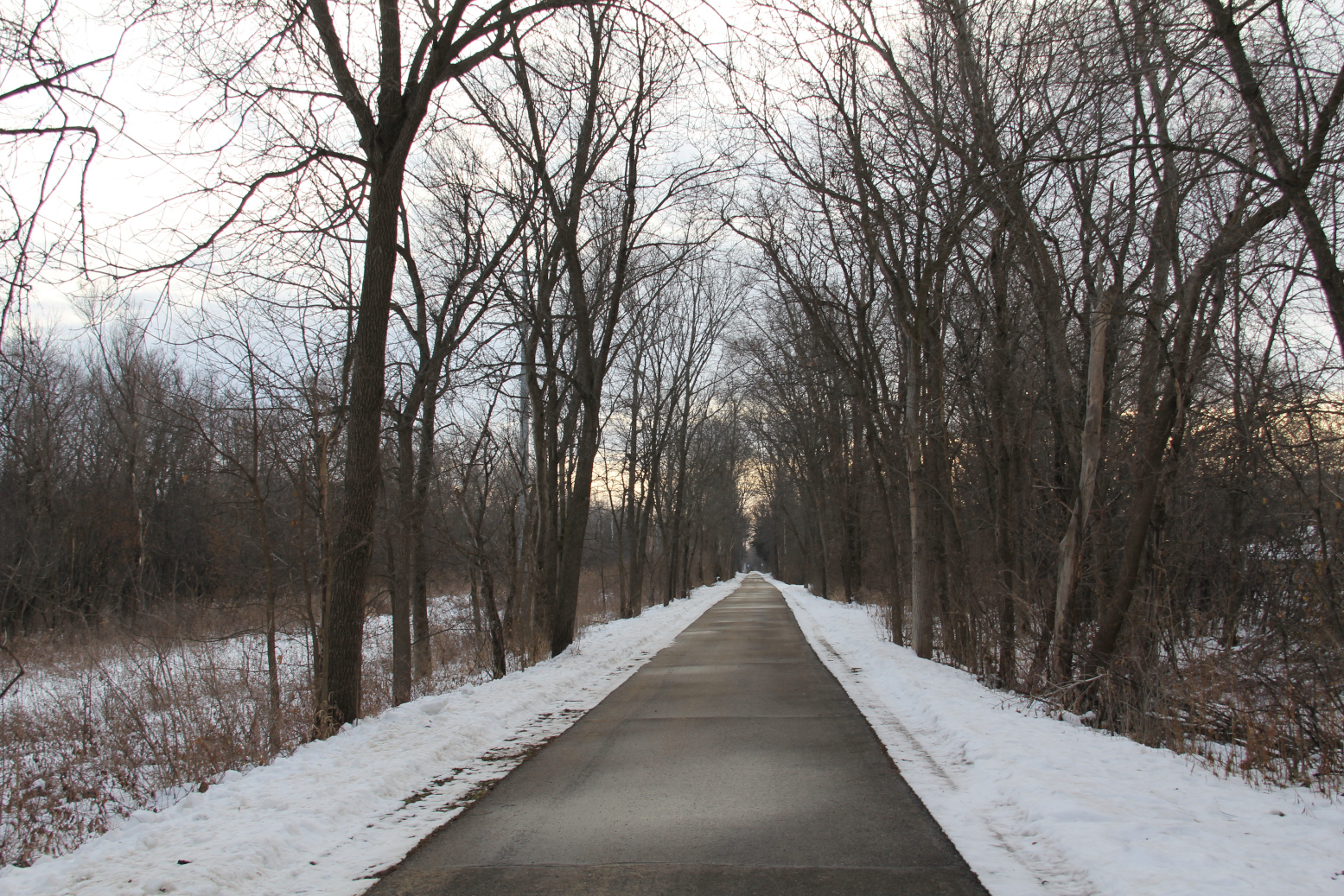
The Straight River Trail stretches before me in the area known as Frog Town. (Minnesota Prairie Roots copyrighted photo December 2025)
And when I want to be outdoors, the city’s paved recreational trails are usually cleared, allowing me to safely immerse myself in nature. There’s something about walking outdoors at a brisk pace on a cold winter day that invigorates.
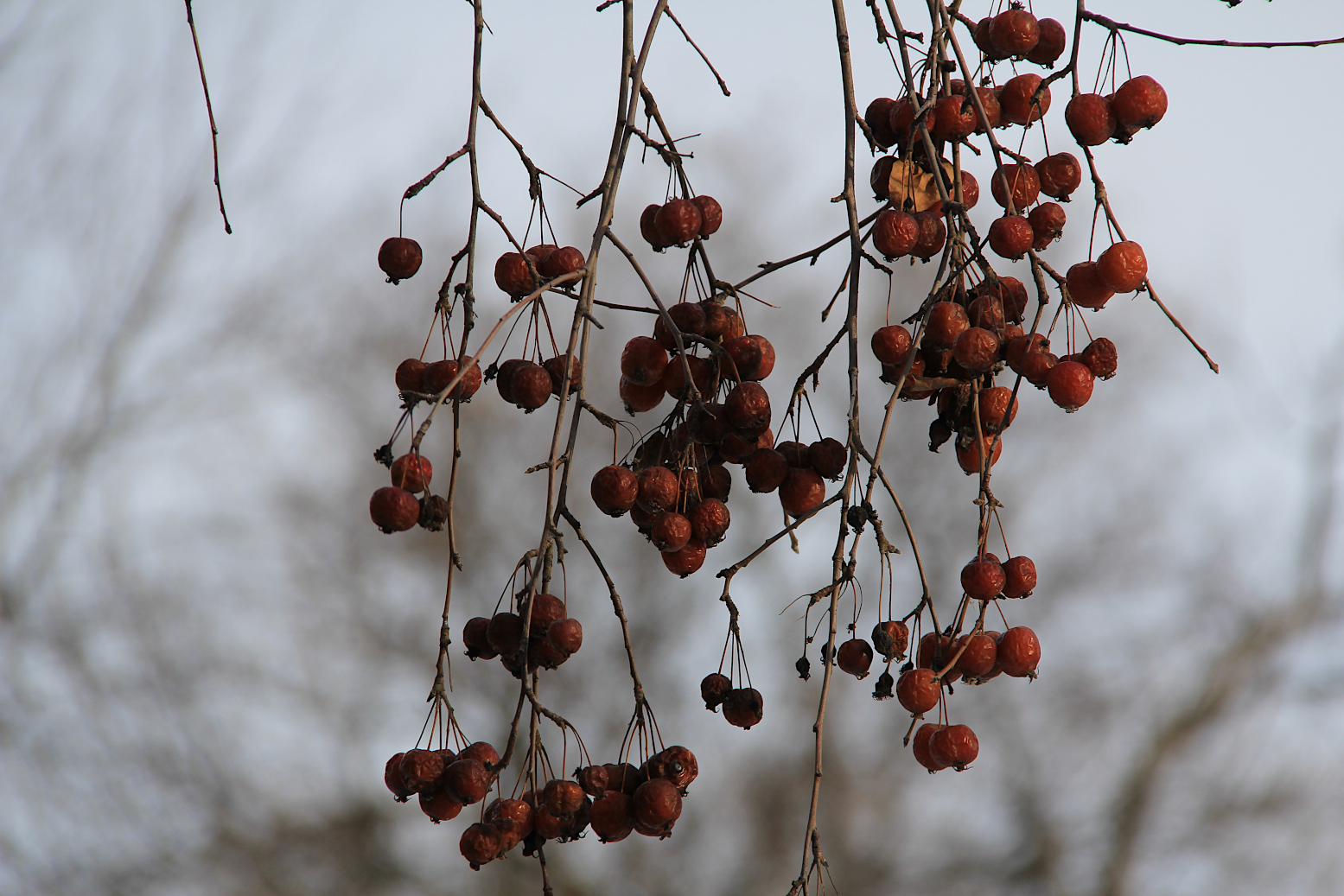
Even in the drab winterscape, color can be found, such as in these dried berries. (Minnesota Prairie Roots copyrighted photo December 2025)
Sometimes, though, I opt to carry my camera and focus on the environment rather than upping my heart rate. Photography improves my well-being, too, because I begin to notice nature’s details in a mostly monochrome landscape. Winter’s beauty emerges. And that is good for my spirit, my soul, my creativity.
The Straight River is anything but straight as it winds between woods and bluffs in Faribault. (Minnesota Prairie Roots copyrighted photo December 2025)
I especially delight in following the Straight River Trail because water, whether frozen or flowing free, mesmerizes me. I think humans have always been drawn to water. Near Fleckenstein Bluffs Park, the Straight River curves, winding through the woods, under the railroad bridge, along the bluffs.
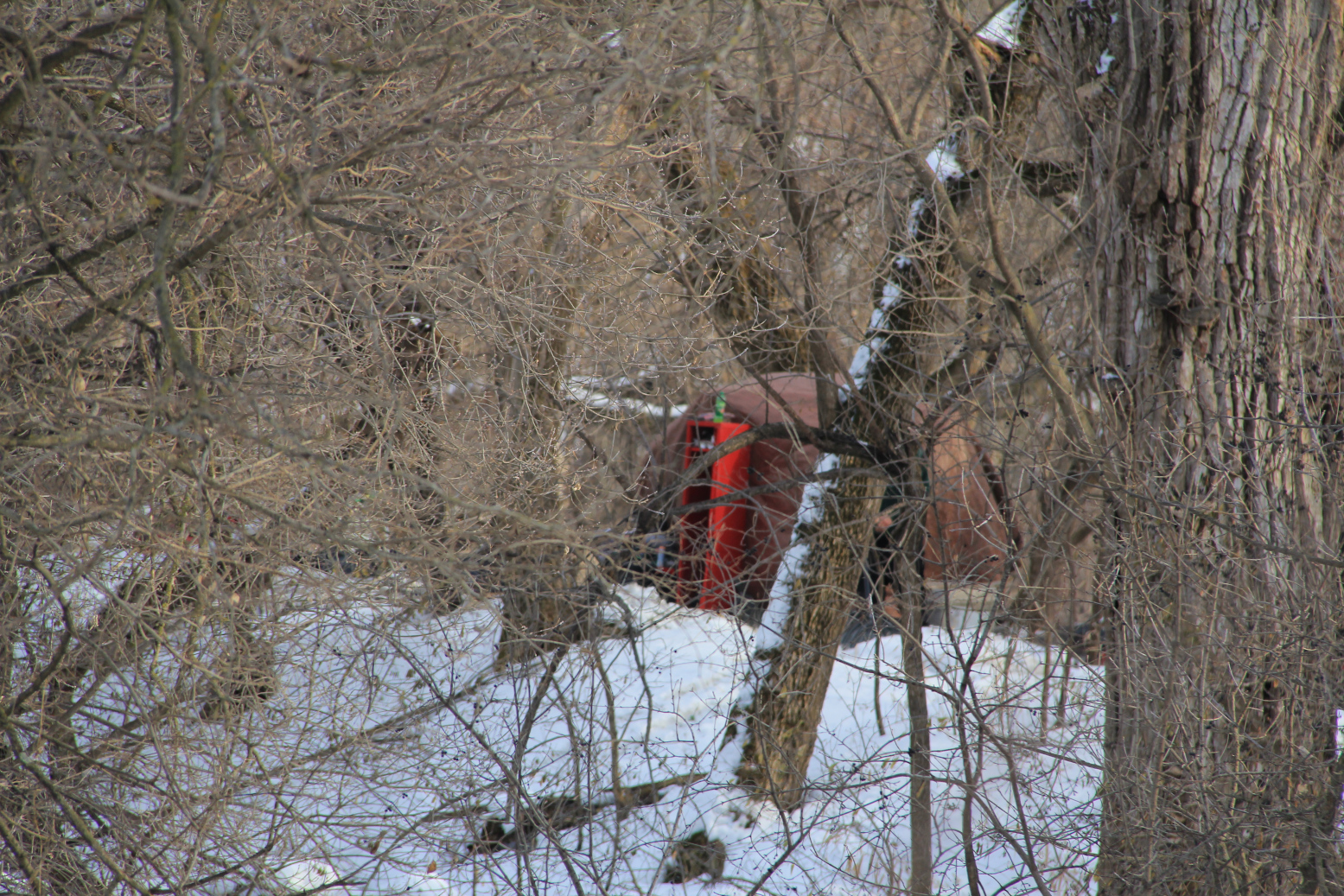
Barely discernible, a temporary riverside shelter in the woods near Fleckenstein Bluffs Park. (Minnesota Prairie Roots copyrighted photo December 2025)
On a recent afternoon along the trail, with Canon camera in hand, I spotted a flash of red across the river in the woods. From a distance and through the trees, I couldn’t clearly distinguish details. But I knew this was a temporary shelter for someone without a permanent home. I saw a person shoveling snow.
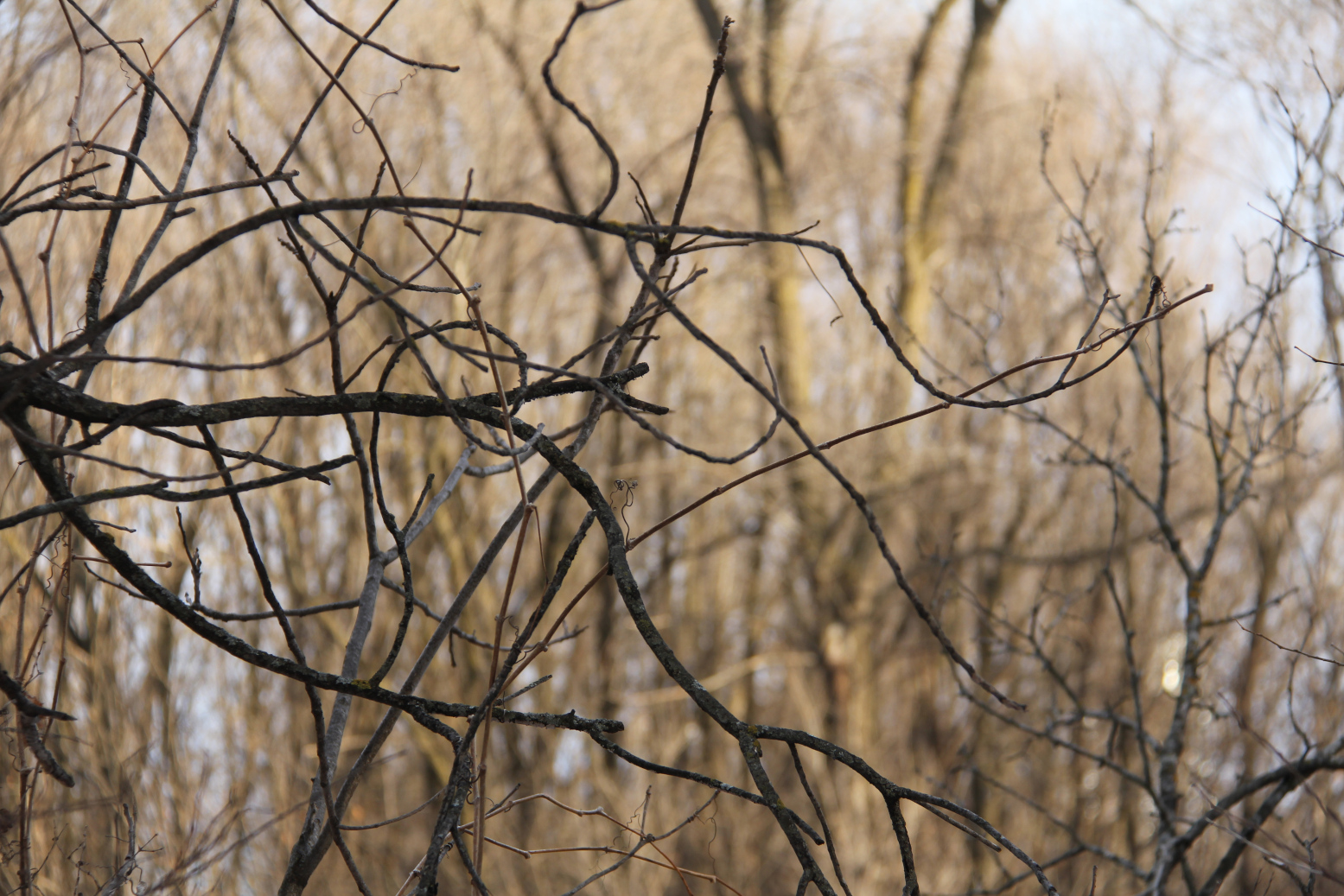
Tangled twigs along the Straight River Trail. (Minnesota Prairie Roots copyrighted photo December 2025)
And I thought of my poem, “Misunderstood,” inspired by a previous walk along the Straight River Trail. That poem published in 2024 in Talking Stick 33, Earth Signs, a Minnesota literary anthology:
Misunderstood
Tents cluster along the Straight River,
home to the homeless on land
once held by the Wahpekute.
History and hardship merge here
in long-ago and present-day stories.
Bison skin tipis and nylon tents.
Different times. Different peoples.
Drawn to the water, the sheltering woods.
Misunderstood then. Misunderstood now.
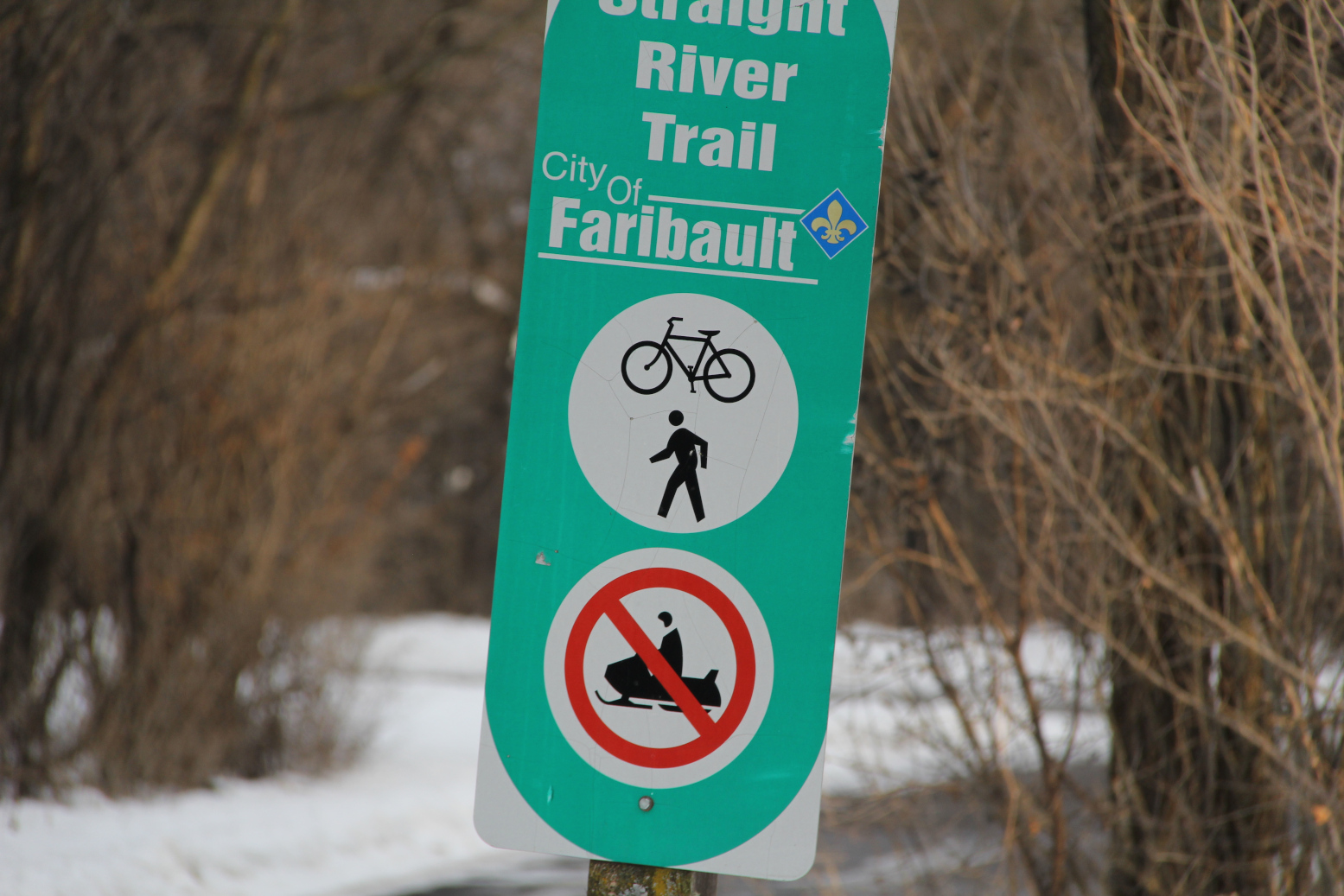
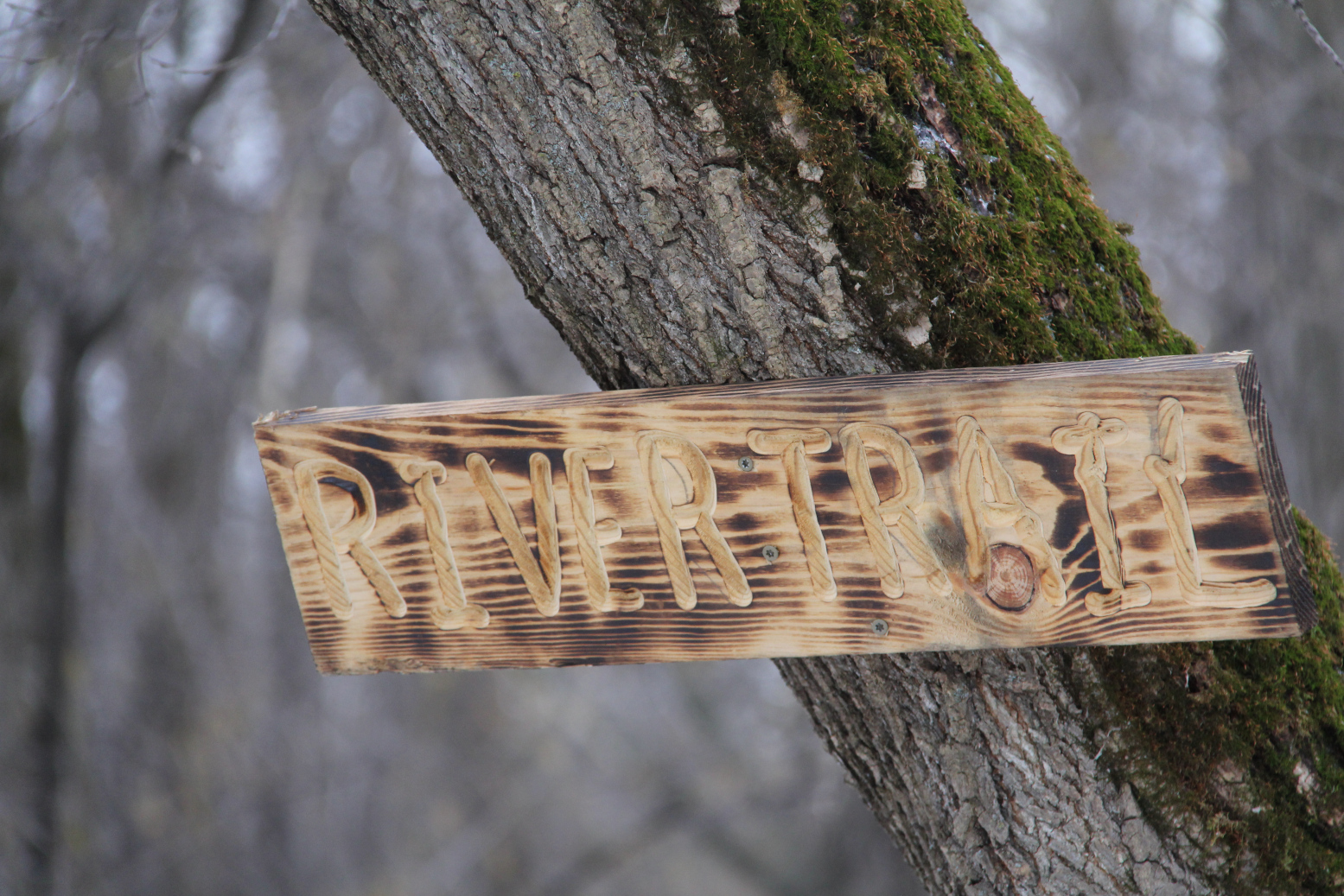
This homemade trail sign, screwed to a tree along the Straight River Trail in Frog Town, leads to a path beaten through the snow. I did not follow the unofficial trail, not this time. (Minnesota Prairie Roots copyrighted photo December 2025)
Getting outdoors feeds my creativity. If not for that walk and my knowledge of Faribault history, I would not have crafted that poem about the Dakota and those experiencing homelessness today in my community. I observe, photograph, write, creating photos and stories that need to be shared.
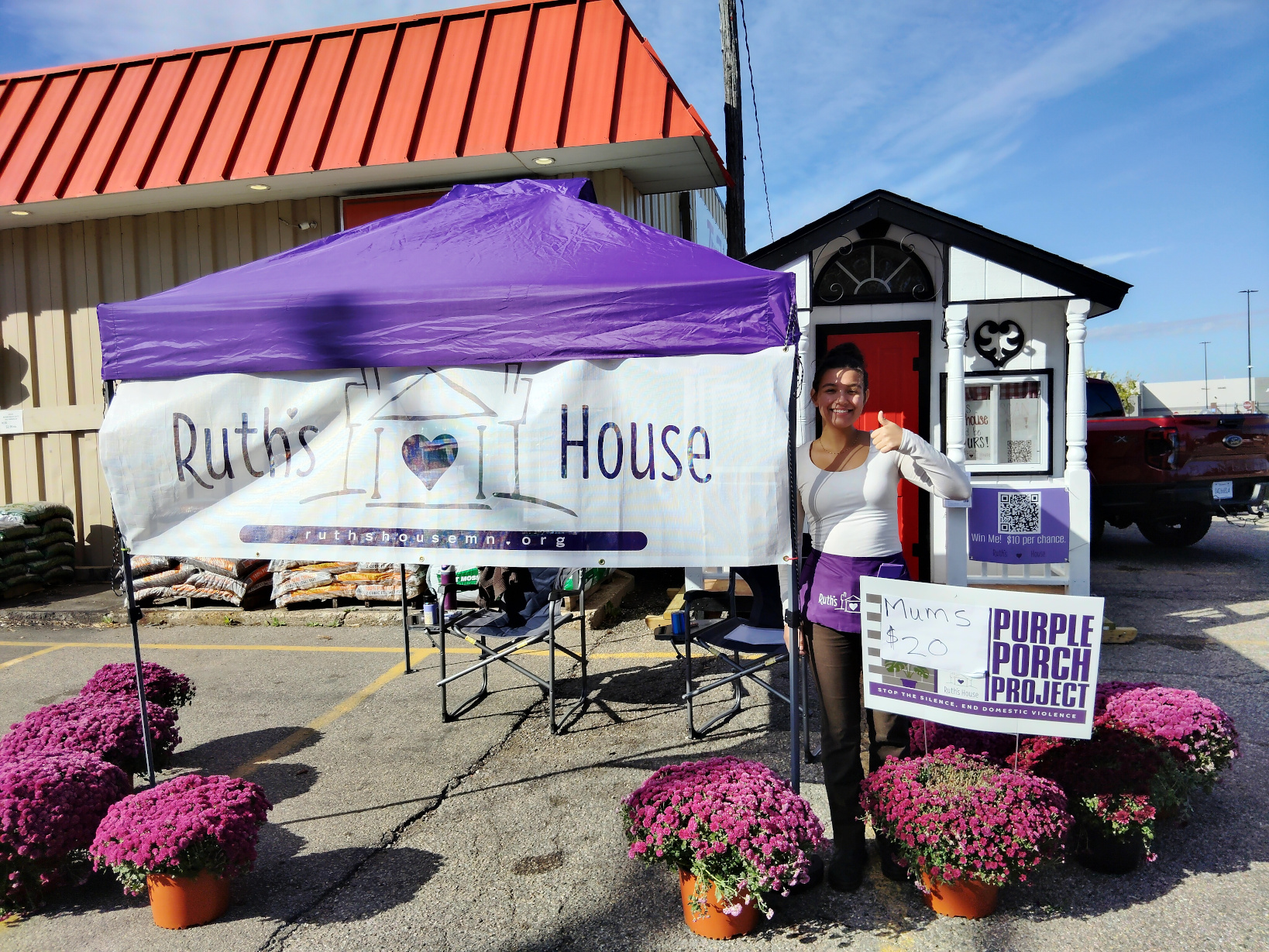
Ruth’s House sells mums and more outside Faribault Fleet Supply Tuesday morning. (Minnesota Prairie Roots copyrighted photo October 2025)
MASSIVE PURPLE MUM plants packed a wagon parked outside Faribault Fleet Supply when I stopped by Tuesday morning to pick up a multi-purpose plant spray.
Nearby, two women staged mums on the pavement next to a purple canopy bannered with “Ruth’s House.” A sign placed among the mums identified this as the “Purple Porch Project. STOP THE SILENCE, END DOMESTIC VIOLENCE.”
October marks Domestic Violence Awareness Month, a nationwide effort to raise awareness about the signs of domestic violence and ways to stop it, support survivors and advocates, and provide information and resources to those who are in positions of leadership and policy-making. Purple is the identifying color for this month-long endeavor.
The State Bank of Faribault promotes the Purple Porch Project outside a parking lot entrance to the bank. (Minnesota Prairie Roots copyrighted photo October 2025)
Ruth’s House, marketing the purple mums, is an emergency/transitional shelter in Faribault for women and children in crisis and a sober living space for women transitioning from in-patient treatment. Those who temporarily move into Ruth’s House may be homeless due to domestic violence, poverty, substance abuse disorder, health challenges or other issues.
Whatever the reasons for their homelessness, I’m thankful my community has a house to call home for these women and their families. Likewise, I’m grateful for HOPE Center, another local organization that supports survivors of domestic violence and sexual assault with Hope, Outreach, Prevention and Education.
Both Ruth’s House and HOPE Center rely heavily on individual and community financial support, and also on government grants, to operate. And we all know that counting on government funding right now is tenuous at best. Thus fundraisers like Ruth’s Purple Porch Project are happening with the sale of $20 purple mums; a $100 Purple Porch décor kit (includes a handcrafted purple door wreath, 66 feet of purple string lights, a purple mum and a yard sign symbolizing unity); a $25 DIY purple wreath kit; and a $20 Ruth’s House yard sign.
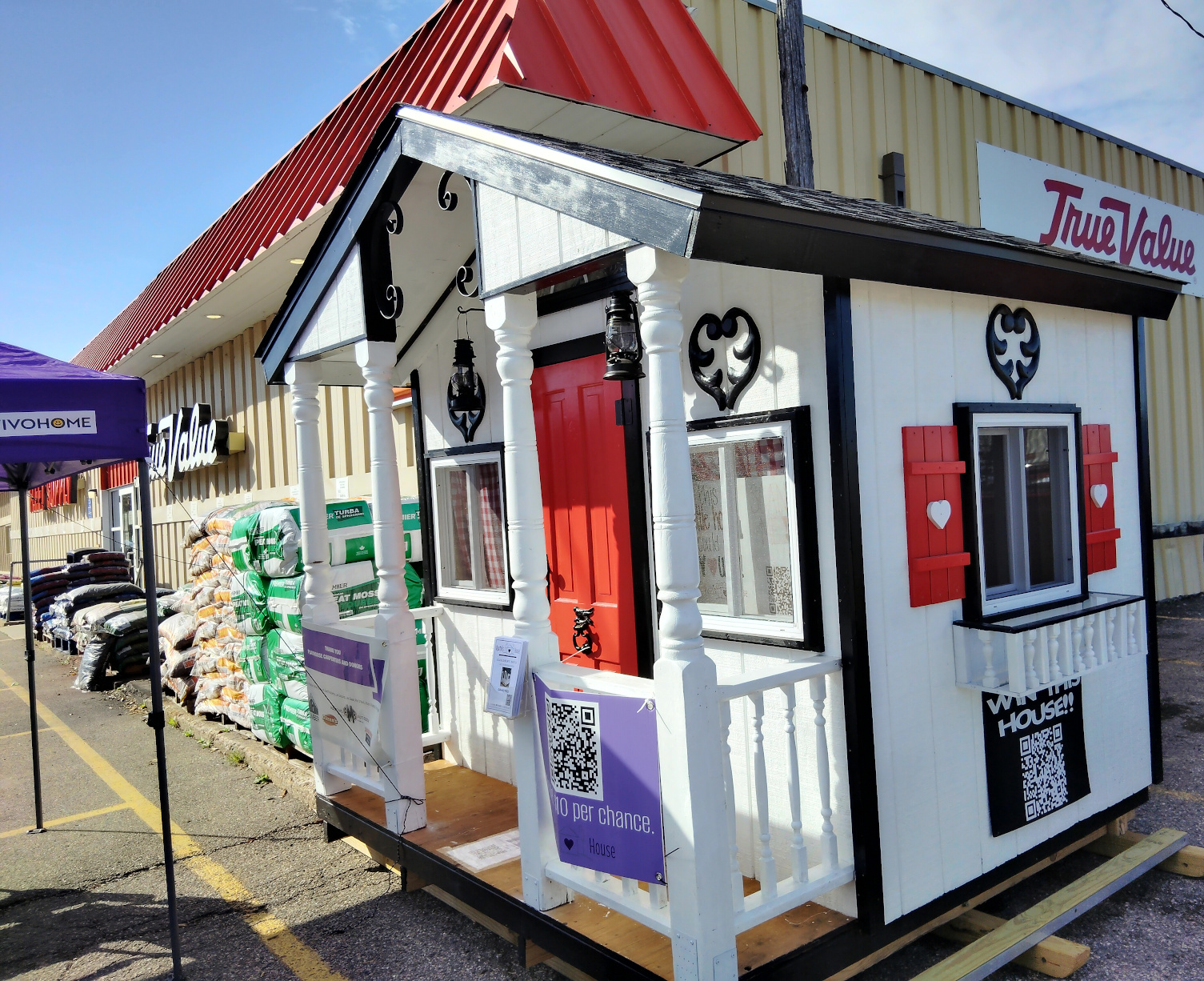
This children’s playhouse, displayed outside Faribault Fleet Supply, is the grand prize in the Ruth’s House raffle. (Minnesota Prairie Roots copyrighted photo October 2025)
Additionally, Ruth’s House is selling $10 raffle tickets for a children’s playhouse, wooden swing set, bike and helmet, arts & crafts table and chair set, play kitchen with table and two chairs; and a family game night basket. Ticket sales will help fund children’s programs at the emergency shelter.
Mostly, I want you to pause for a moment and reflect on domestic violence. And if you don’t know that much about it, take time to learn. (Click here.) So many misconceptions exist about domestic violence with that oft asked question of “Why doesn’t she just leave?” It’s not that easy. It’s complicated and difficult and even potentially dangerous without a safe plan in place.
Do what you can. Support. Encourage. Love. Advocate. Be there. Listen. Help. It takes all of us, individually and collectively, to stop domestic abuse and violence.
This poster inside Trinity Lutheran Church shows an architectural drawing of Ridgeview Heights and a Vacation Bible School mission fundraising goal for the housing project. (Minnesota Prairie Roots copyrighted photo August 2025)
ON MY WAY TO SUNDAY MORNING church services, I missed an opportunity to live my faith. Reflecting on that moment, I’m still uncertain what I could have done. But the guilt I feel about doing nothing at the time remains.
Let me set the scene. While driving to church, Randy and I dropped off some mail downtown. Up the hill from the post office, I noticed a parked car crammed with stuff. Someone clearly lived out of the vehicle, one I’ve previously seen. Then my eyes shifted to the adjacent street corner and an individual, cocooned in a bright gold blanket, sleeping atop a bench. And then we turned the corner.
“I should take a picture,” I told Randy, my mind already creating a story that would enlighten others about homelessness in Faribault. But then I quickly realized that taking a photo wouldn’t be particularly kind. And so we continued on to church.
Still, I couldn’t shake the image of that person stretched atop a bench along Central Avenue. I wondered about his story, why and how he found himself without a home. And I considered how vulnerable and exposed I would feel sleeping like that in a public place. Those thoughts followed me into church.
“HOUSING FOR THE HOMELESS”
When I stepped inside the sanctuary, I immediately noticed a “Housing for the Homeless” poster near the organ. There are coincidences and then there are what I term “God moments.” And this, in my mind, was clearly divine. I’ve seen enough of these occurrences in my life to distinguish the two. God was assuredly nudging me to write on the topic of homelessness and housing insecurity in my community.
That sign in church was a promotional for the chosen mission of this year’s Vacation Bible School, which started that very evening at Trinity. Participants are donating their monetary gifts to Ridgeview Heights, an accessible, sustainable housing community to be built in downtown Faribault just blocks from the slumbering man on the bench. The VBS fundraising goal is $500.
That $500 may seem inconsequential considering the $2.5 million project cost. But every dollar helps in constructing the two buildings aimed at housing families with children, including those experiencing homelessness. Two of the eight units will serve as free emergency shelters and the other six will be market rate workforce units.
A COMMUNITY ACTS
The Community Action Center, which works collaboratively to alleviate hunger, homelessness and poverty among individuals and families in the community, is the lead on Ridgeview Heights. With an in-kind land donation from the city of Faribault, two grants, gifts, community donations and financing, the CAC is able to break ground at 4 p.m. today, August 6, for the much-needed two and three-bedroom units.
So first I saw the sleeping man, then the poster. And then came the sermon…with a directive that congregations ought to think, plan and act in ways that bless people. The guest pastor encouraged us not to think less of ourselves, but to think of ourselves less (a loose quote from C.S. Lewis). In other words, turn the focus outward on the community rather than inward to the church’s needs. The VBS kids will be doing exactly that this week with their “Housing for the Homeless” mission focus.
A FAMILY THAT CARES
Now you may think my story ends here. But it doesn’t. On July 28, I received a mass email about an upcoming Helbling family reunion. Organizers are changing things up this year by raffling items made by family members. One of several ways to qualify for a raffle entry is via a $5 charitable donation. All donations will go to the Community Action Center in Faribault with a dollar-for-dollar match from my eldest niece’s employer.
Truly, I was meant to write this story. I may have bypassed the man sleeping on the bench. But I got the message, loud and clear, that I needed to write about homelessness and housing insecurity in Faribault. I’ve seen the tents pitched along the river, beside train tracks, behind evergreen trees, next to a park. I’ve seen the homeless in the library, sleeping in the Central Park bandshell, biking and walking about town, including past my house. I am aware of the long waiting list for emergency shelter. Even if I failed to “do” something, I can raise awareness through my writing. And by doing that, perhaps I am helping in some small way to bless my community, including the man sleeping on a bench in the heart of downtown Faribault on a Sunday morning.
A box of food left inside the band shell at Central Park. (Minnesota Prairie Roots copyrighted photo October 2023)
A SHARP OCTOBER WIND cut across Central Park, chilling me as I walked. For several months now, Randy and I have power walked here and in the surrounding neighborhood as part of a new exercise routine. But these daily outings have proven to be more, much more, than an effort to raise our heart rates, build strong bones and stay in shape. They have opened our eyes to sides and peoples and challenges previously unseen by us in Faribault.
Left on a park bench, bedding and a bag. (Minnesota Prairie Roots copyrighted photo October 2023)
That includes homelessness. I’ve come to recognize those without housing security. And although I’ve never stopped to ask their stories, I’ve wondered. I wonder if they have enough food, where they sleep, why they are homeless. And I wonder, what are we as a community doing to help them find housing and more?
In the darkness of early evening, I found this box of food sitting next to a tree. (Minnesota Prairie Roots copyrighted photo October 2023)
On the evening I noticed a cardboard box aside a tree and investigated, I had even more questions. Food filled the box. Unopened boxes of Raisin Bran and baked goods mostly. Why was this box of food placed there, next to a tree near the band shell?
Bread simply dropped on the grass. (Minnesota Prairie Roots copyrighted photo October 2023)
The next morning the box sat inside the band shell, a single loaf of French bread lying on the grass. And three days later, when I noticed a cardboard box edging over a trash can, I investigated again. To my dismay, I found the food dumped, a head of cabbage, hazelnuts, baked goods and more inside the garbage barrel. I didn’t dig deeper. Why this unnecessary dumping of food?
A whole lot of food packed these abandoned boxes. (Minnesota Prairie Roots copyrighted photo October 2023)
A variety of foods fill two of the boxes. (Minnesota Prairie Roots copyrighted photo October 2023)
Several weeks later I spotted boxes of food again, this time three boxes left by a picnic table on the band shell’s north side. Inside were half-gallons of milk, eggs, dried lentils, cereal, baked goods, crackers, salad and, at the bottom, rotten pears. The temperature hovered at 60 degrees, not nearly cold enough to keep perishables. I expect someone had good intentions in leaving the food there.
St. Vincent de Paul, a charitable nonprofit located across from Central Park. (Minnesota Prairie Roots copyrighted photo October 2023)
I’ve observed people waiting in line for food, clothing and more across the street at The Society of St. Vincent de Paul Center for Charitable Services. I’ve observed, too, volunteers’ vehicles parked outside The Cathedral of Our Merciful Saviour, home to the Community Cafe, which every Tuesday evening serves a free meal. The church sits across from the park, next to a bank, a block from St. Vincent.
Signage posted outside the entrance to St. Vincent de Paul. (Minnesota Prairie Roots copyrighted photo October 2023)
An acquaintance, whom I suspect is homeless and whom I haven’t seen in the park since I asked if he has a home (I did so respectfully), told me he got food from St. Vincent, ate at the Community Cafe and at Buckham West Senior Center. So I know these outreaches are working.
Central Park, band shell in the background, during the light of early evening. (Minnesota Prairie Roots copyrighted photo October 2023)
Then there was the evening Randy and I witnessed a drug deal, or more accurately, a suspected drug deal. A motorbike drove into the center of the park and an exchange occurred between two young men. There was a bit of yelling before one of the guys (the one who’d been waiting on a park bench) dashed toward an empty parked car that we’d noticed idling upon our arrival. We’d been warned about drug deals at Central Park. But to be warned differs from witnessing.
And the day I found a small pack lying on the sidewalk, then opened it to check for identification, I discovered a stash of marijuana secured in plastic wrap, along with prescription eyeglasses and a large print Sudoku book. Randy reminded me that pot is now legal in Minnesota when I suggested turning the drugs in to police. So we left the bag, hanging it on a low lying park fence. Days later it was gone.
A empty bottle of alcohol discarded on a picnic table. (Minnesota Prairie Roots copyrighted photo October 2023)
There’s plenty of drinking happening at Central Park, too, even if consumption is banned, allowed by permit only. I’m no teetotaler. But I am a rule follower. And it troubles me to see this drinking and then alcohol bottles and cans and boxes strewn about. A liquor store sits right across the street. I once saw a young homeless man charging his cellphone in an exterior outlet of the liquor/grocery store. And I recently witnessed a woman, seated at a picnic table, chugging a Hamms beer too early in the day.
Food dumped in the trash at Central Park. (Minnesota Prairie Roots copyrighted photo October 2023)
All of this—the suspected drug deal, the abandoned food boxes and trashed food, the homelessness (including the person sleeping on a picnic table inside the band shell, bike nearby), and substance abuse—leaves me feeling melancholy. I don’t know the circumstances, the stories, the situations behind anything or anyone I’ve observed. I only know how I feel. And that is helpless, sad and with a whole lot of questions.
Left inside the band shell, a twin-sized mattress. We’ve also seen a flat screen TV left here. (Minnesota Prairie Roots copyrighted photo October 2023)
I recognize, though, that we each are likely only a financial, health or other crisis away from hunger, homelessness, addiction, despair. And that is, perhaps, what imprints upon me most. We are human. And to be human is to face challenges that can lead into the darkest of places. To be human is also to take an eye-opening walk through a city park to see that previously unseen and in the seeing to recognize the need is great among us.
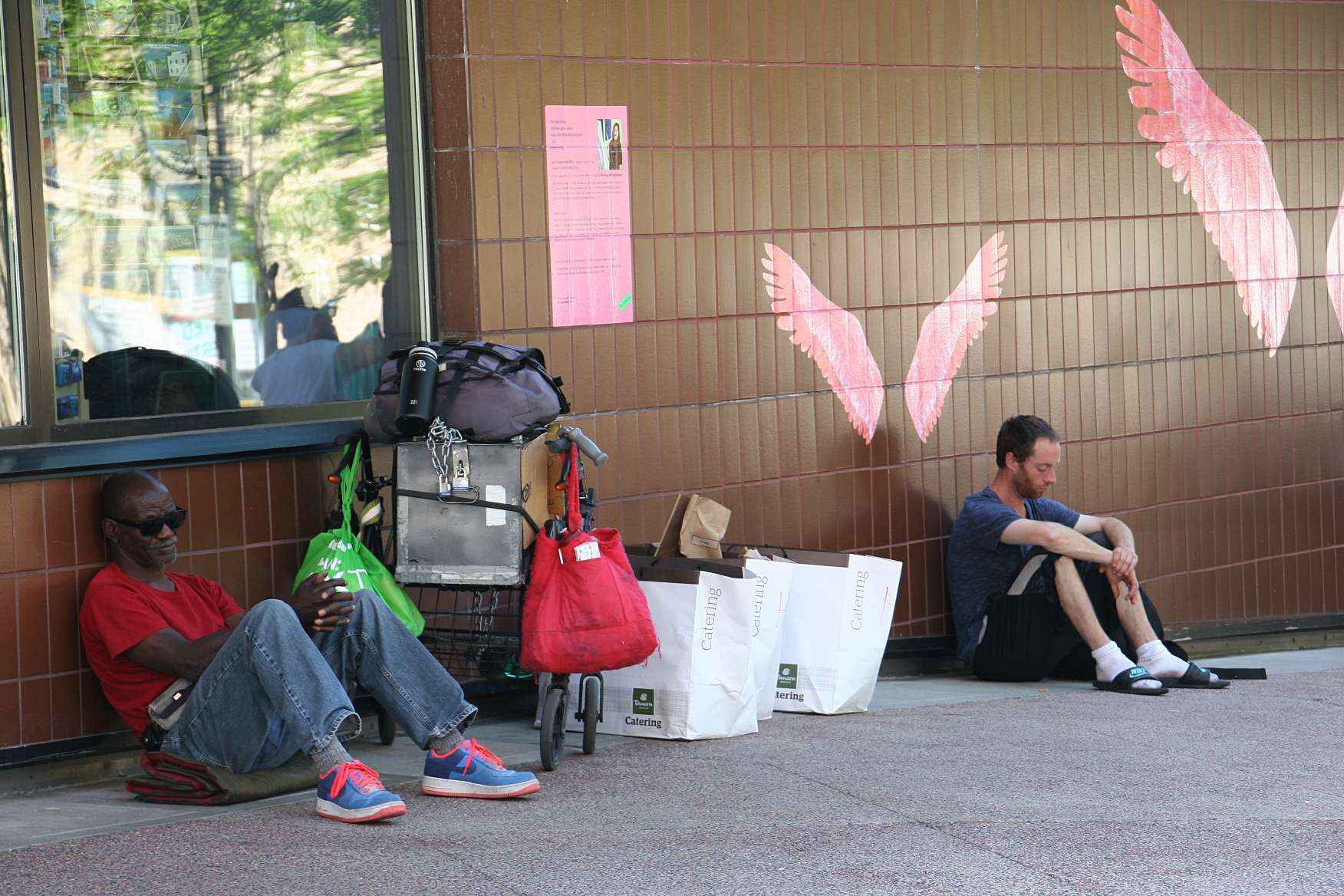
The homeless, photographed in downtown Madison, Wisconsin, in June 2018 near the state capitol. The wings on the side of the Wisconsin Historical Museum were part of a temporary art installment, “Pink Flamingo Wings.” But I viewed them differently, as symbolic, as angel wings of hope for these two men. Minnesota Prairie Roots file photo used for illustration only and as documentation of homelessness.
DAYS LATER, THE SCENE still haunts me. The scene unfolding in my neighbor’s yard at 8 Sunday morning, just across our driveway and up a small incline.
Only minutes earlier, I turned on the radio, tuned to KDHL for the worship service at Trinity Lutheran Church. As I listened, I spooned coffee grounds into a filter, filled the reservoir with water, then switched on the coffee maker to start my day.
Typically, I would be in church, worshiping in person. But, since the start of the pandemic, Randy and I have opted to stay home and listen to services either online or on the radio. It’s not my preference. But it’s my comfort level.
As I listened, I lifted the dining room shade. It was then I noticed him. The man outside a massive dumpster set in my neighbor’s driveway. At first I thought it was my neighbor, but soon realized this was a stranger, who had now climbed inside the dumpster. He rummaged methodically through the contents. Picking up, then dropping stuff. Tossing. Sorting. Moving items.
I watched mesmerized. I don’t mean that to sound dismissive or uncaring. But I felt momentarily stunned. This was a first—a presumably homeless man in my neighborhood. I felt helpless, wondering what, if anything, I could or should do. I worried that he may not be warm enough in his maroon hoodie layered under a heavy plaid flannel shirt jacket. I noticed he at least wore gloves. I worried that he may not have food. I worried, too, that he may not have shelter, a warm place to sleep in the cold of a Minnesota winter.
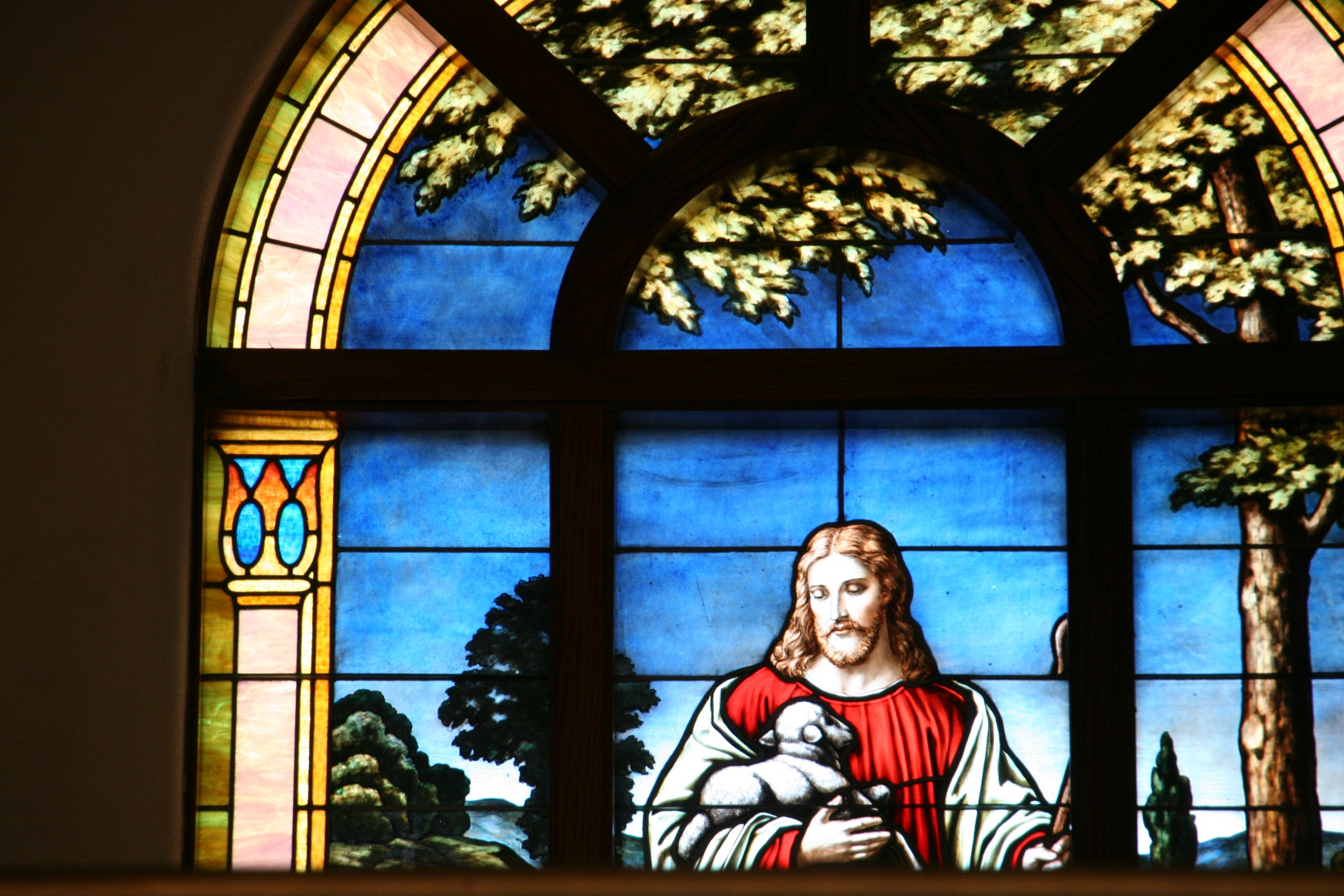
A Good Shepherd stained glass window inside Trinity Lutheran Church, North Morristown, Minnesota. Minnesota Prairie Roots file photo.
So many thoughts filtered through my brain as I watched while simultaneously listening to hymns and Bible readings and a sermon about Jesus, the Good Shepherd. Words that invited me to hear the voice of Jesus, to support, encourage and uplift others, including those in my community.
By my lack of action, I wasn’t exactly following that directive to live out my faith. I failed miserably. Because I did nothing.
I thought of phoning the non-emergency police number. But what would I say? That I felt concern for a man rummaging through a dumpster? That seemed a faulty plan since the individual had committed no crime. And what if the police came and the scenario quickly changed to something ugly. I’ve read/heard of that happening all too often. Not here. But as nearby as the Twin Cities metro an hour distant. I wouldn’t risk that.
And so I found myself at a loss. Approaching the man seemed unwise given COVID, concerns about my safety and so much uncertainty. I drank my coffee, ate my cereal in the warmth of my home. Sheltered from the cold.
After nearly 45 minutes, the man climbed out of the dumpster and onto his fat tire bicycle. He coasted down the street, turned the corner, then pedaled away. Empty-handed.
TELL ME: What would you have done? If this ever happens again, I want to feel prepared, perhaps have a plan of action to help. I’m open to suggestions, even to specific resources available to assist individuals like this. Thank you.
Zach, who now lives in Florida, will be in Appleton for the 10 a.m. Saturday, January 24, screening at Valley Value Cinemas, 2165 South Memorial Drive, and for a reception following at The Mission, 314 North Appleton Street. Movie attendees are invited to afterward walk the two miles from the movie theatre to the church, thus visually and publicly raising awareness of homelessness.
Now, you’re likely wondering how I know about this movie event 300 miles from my Minnesota home. Well, my second daughter, Miranda, lives in Appleton and attends The Mission Church. She phoned recently all excited about the Little Red Wagon. I’m not surprised. Twice after Hurricane Katrina, she traveled to New Orleans to assist with clean-up. She’s a young woman with a big heart and a passion for helping others.
So even though this project is not happening in my main readership area, I couldn’t turn down my daughter’s request to publicize this cause.
In addition to the movie showing and the Q & A with Zach, The Mission Church has been collecting small toys, activity books, socks, mittens, sample-size toiletries, food and more to fill 300 “Zach Packs,” bags measuring 14 by 17 inches. These will be gifted to area homeless children through Harbor House (which serves victims and survivors of domestic abuse) and Homeless Connections (an organization helping the homeless in the Fox Valley region), Miranda says.
If you live in eastern Wisconsin, I’d encourage you to attend this Little Red Wagon event in Appleton on Saturday. If you can’t be there, like me, I suggest you check out the Little Red Wagon website by clicking here. The nonprofit accepts monetary donations for its projects. Or take action in your own community.
ON SUNDAY, I CAME face to face with homelessness for the first time.
Sure, I’d read the news stories and statistics. But in the deepest depths, I never quite believed that homelessness exists in Rice County. We are, after all, out-state Minnesota and not “the Cities.”
However, that naïve thinking—or perhaps it is more an attitude of not wanting to believe—changed when I met a homeless woman after Sunday morning worship services at the Lutheran church I attend in Faribault.
When the middle-aged woman and her companion, a young man perhaps in his late 20s or early 30s, walk into the nearly-empty narthex, I can’t help but notice them. In their worn, casual attire, they don’t really fit in.
Even writing that last sentence, I feel profoundly judgmental. I have just come from a contemporary “Connection” service where I’ve sung about embracing others. Although I can’t recall the exact words, I remember the line about a strange woman slipping into the pews and the staring glances of faithful worshippers.
I will admit that on Sunday morning I am more cautious than welcoming.
As the woman enters the narthex, I approach her because, clearly, she is looking for someone. “Can I help you?” I ask as she walks toward me. Her male friend (or maybe he is her son) is already half way across the room. I am keeping a distrustful eye on him. Earlier this year, a stranger prowled our church during worship services and stole a computer and other items. Since then, we as a congregation have been on watchful alert.
As I am thinking all of this, the woman asks to speak with the pastor, whom she met in March. “Which pastor?” I inquire, giving their names.
She doesn’t remember, but I tell her I will take her to the pastor. As we head toward his office, she explains how she already has been to another church in town that morning seeking help. She found none there, although she says she got a doughnut. That pastor had left for the day.
I am surprised that she shares this information and her first name. Perhaps she is trying to emphasize her desperate situation.
She talks about a man who “tricked” her and something about the wife he is divorcing and that’s why she is without a place to live. I don’t quite understand the situation. But rather than probe, which would be typical of me and my inquisitive nature, I keep quiet.
She seems to need a listening ear and I can at least give her that, and her dignity.
Then she apologizes for her comments. I tell her she’s entitled.
We are walking through the gym now where volunteers are setting up food for an afternoon reception. “Are you having a lunch here?” she asks, the new optimism in her voice noticeable.
“Oh, it’s a reception for someone who’re retiring,” I reply, knowing full well that’s she’s likely hungry. I wish I could offer her some food, but I don’t feel it’s my right to do so.
Then we are at the main office, where the pastor is just leaving.
“These folks would like to talk to you,” I say, wishing I could remember the woman’s name. Typically, I am good at recalling names.
As I turn to leave, the pastor is already jingling his keys, opening his office door to allow the pair inside. The door closes.
I walk away, wondering about this woman and, if by failing to remember her name, it will be easier for me to dismiss her and her homelessness.











 Minnesota Prairie Roots
Clearly I needed to write about homelessness & housing insecurity in Faribault…read on August 6, 2025
Tags: church, commentary, Community Action Center, donations, emergency housing, faith, Faribault, homelessness, housing insecurity, Minnesota, mission, Ridgeview Heights, Trinity Lutheran Church, Vacation Bible School, workforce housing, writing
ON MY WAY TO SUNDAY MORNING church services, I missed an opportunity to live my faith. Reflecting on that moment, I’m still uncertain what I could have done. But the guilt I feel about doing nothing at the time remains.
Let me set the scene. While driving to church, Randy and I dropped off some mail downtown. Up the hill from the post office, I noticed a parked car crammed with stuff. Someone clearly lived out of the vehicle, one I’ve previously seen. Then my eyes shifted to the adjacent street corner and an individual, cocooned in a bright gold blanket, sleeping atop a bench. And then we turned the corner.
“I should take a picture,” I told Randy, my mind already creating a story that would enlighten others about homelessness in Faribault. But then I quickly realized that taking a photo wouldn’t be particularly kind. And so we continued on to church.
Still, I couldn’t shake the image of that person stretched atop a bench along Central Avenue. I wondered about his story, why and how he found himself without a home. And I considered how vulnerable and exposed I would feel sleeping like that in a public place. Those thoughts followed me into church.
“HOUSING FOR THE HOMELESS”
When I stepped inside the sanctuary, I immediately noticed a “Housing for the Homeless” poster near the organ. There are coincidences and then there are what I term “God moments.” And this, in my mind, was clearly divine. I’ve seen enough of these occurrences in my life to distinguish the two. God was assuredly nudging me to write on the topic of homelessness and housing insecurity in my community.
That sign in church was a promotional for the chosen mission of this year’s Vacation Bible School, which started that very evening at Trinity. Participants are donating their monetary gifts to Ridgeview Heights, an accessible, sustainable housing community to be built in downtown Faribault just blocks from the slumbering man on the bench. The VBS fundraising goal is $500.
That $500 may seem inconsequential considering the $2.5 million project cost. But every dollar helps in constructing the two buildings aimed at housing families with children, including those experiencing homelessness. Two of the eight units will serve as free emergency shelters and the other six will be market rate workforce units.
A COMMUNITY ACTS
The Community Action Center, which works collaboratively to alleviate hunger, homelessness and poverty among individuals and families in the community, is the lead on Ridgeview Heights. With an in-kind land donation from the city of Faribault, two grants, gifts, community donations and financing, the CAC is able to break ground at 4 p.m. today, August 6, for the much-needed two and three-bedroom units.
So first I saw the sleeping man, then the poster. And then came the sermon…with a directive that congregations ought to think, plan and act in ways that bless people. The guest pastor encouraged us not to think less of ourselves, but to think of ourselves less (a loose quote from C.S. Lewis). In other words, turn the focus outward on the community rather than inward to the church’s needs. The VBS kids will be doing exactly that this week with their “Housing for the Homeless” mission focus.
A FAMILY THAT CARES
Now you may think my story ends here. But it doesn’t. On July 28, I received a mass email about an upcoming Helbling family reunion. Organizers are changing things up this year by raffling items made by family members. One of several ways to qualify for a raffle entry is via a $5 charitable donation. All donations will go to the Community Action Center in Faribault with a dollar-for-dollar match from my eldest niece’s employer.
Truly, I was meant to write this story. I may have bypassed the man sleeping on the bench. But I got the message, loud and clear, that I needed to write about homelessness and housing insecurity in Faribault. I’ve seen the tents pitched along the river, beside train tracks, behind evergreen trees, next to a park. I’ve seen the homeless in the library, sleeping in the Central Park bandshell, biking and walking about town, including past my house. I am aware of the long waiting list for emergency shelter. Even if I failed to “do” something, I can raise awareness through my writing. And by doing that, perhaps I am helping in some small way to bless my community, including the man sleeping on a bench in the heart of downtown Faribault on a Sunday morning.
© Copyright 2025 Audrey Kletscher Helbling